
I have learned from nature that all is equal… all is equal and in balance. I see everything as fitting together.
~Joseph Raffael
Here in our home in the woods, I can look out our windows and see all sorts of interconnections – butterflies on Ironweed and Joe-Pye-Weed, American Goldfinches eating coneflower seeds, and birds searching for insects in the trees. There is another connection that seems to be one of the purest- like two puzzle pieces that fit perfectly together. That is the link between one of my favorite native wildflowers and one of my favorite summer birds – Cardinal Flowers and Ruby-throated Hummingbirds. If you look at their range maps, they overlap to a great degree, owing, no doubt, to the dependence of the flower on the pollination compatibility of these hummingbirds.
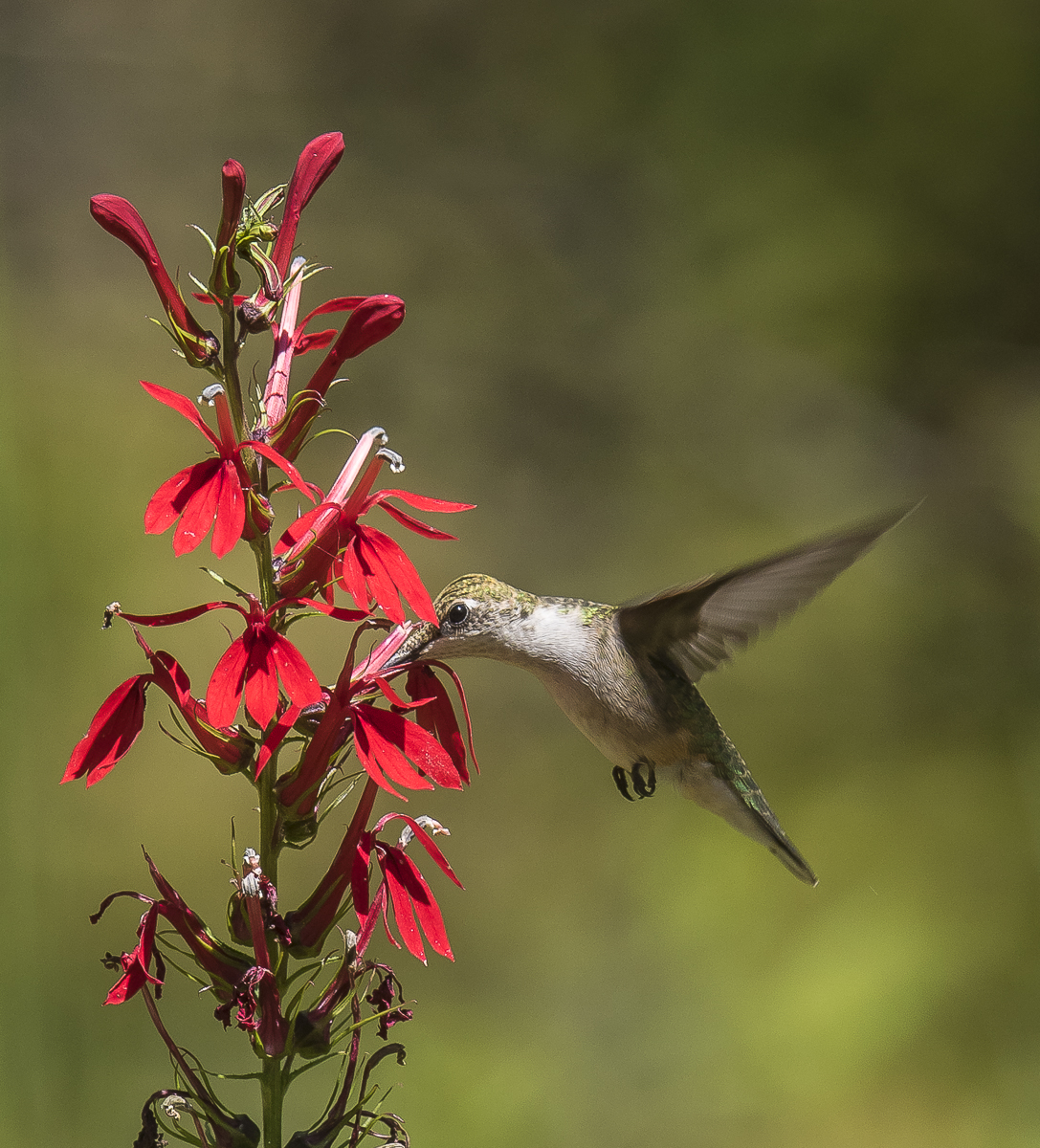
-A Ruby-throated Hummingbird at a Cardinal Flower (click photos to enlarge)
Cardinal Flower (Lobelia cardinalis) is a brilliant red flower named after the red robes worn by Roman Catholic cardinals. It grows naturally in damp soil, often along stream banks throughout much of our state. It is adaptable and grows well in any area with good soil, sun or part shade. The impressive flower stalk can bloom from July into September, with flowers opening from the bottom up. The plants are protandrous, meaning the male parts (stamens and anthers) mature before the female flower parts (style and stigma). The stamens form a tube around the immature female style. When the flower first opens, the style expands and pushes the anthers with the pollen out the top of the tube like a plunger. Thus, when a flower first opens, it has pollen dangling from the tip of that tube, ready to be deposited on the head of a visiting hummingbird. As the flower matures, the style continues to grow, and extends beyond the flower tube, the anthers wither, and the stigma becomes receptive to pollen. On any one flower stalk, you will likely have flowers near the top still releasing pollen while those below have receptive stigmas ready to receive pollen. As a hummingbird visits various flowers, it will pick up pollen on top of its head from some and deposit pollen grains on the receptive stigmas of others.
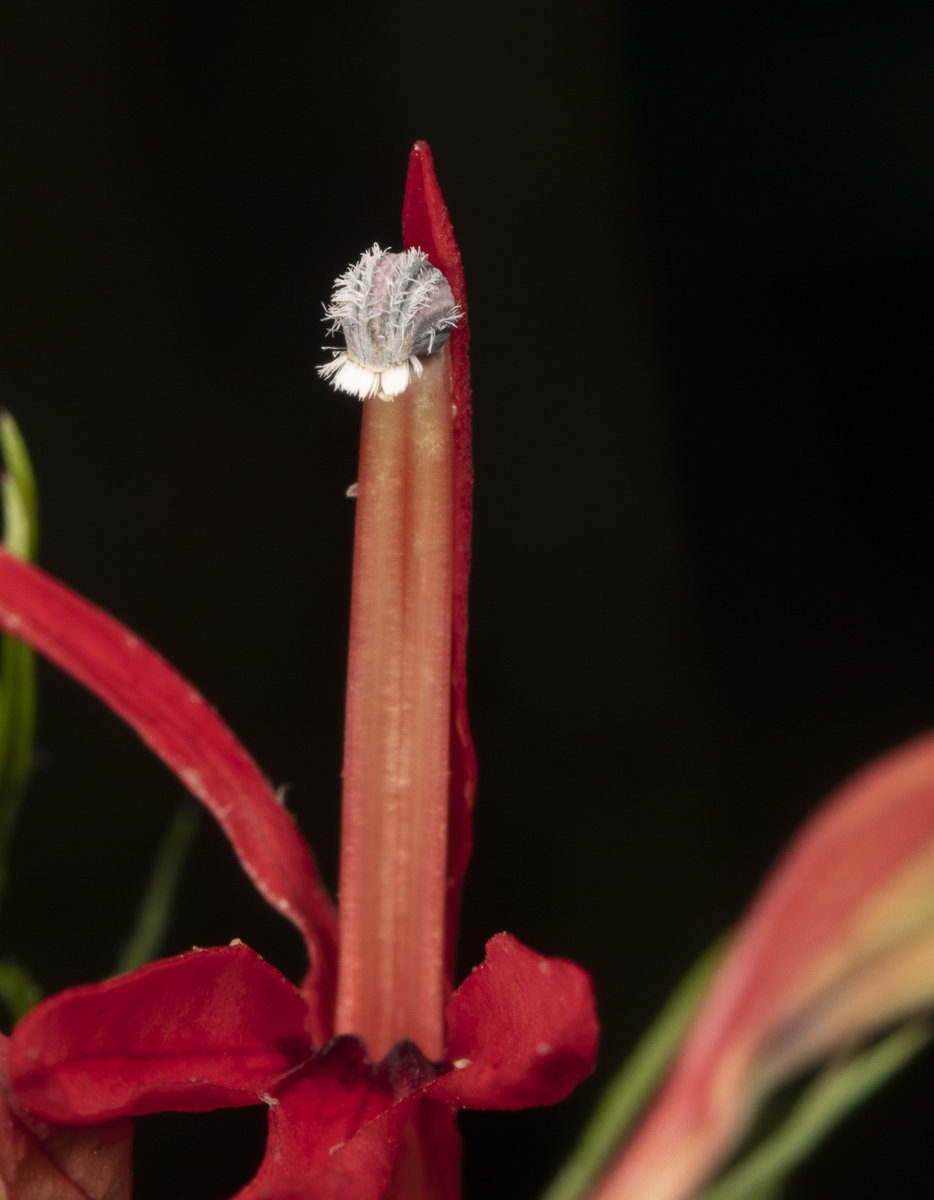
-Five stamens are joined to form a tube around the style and are topped with a mustache-looking brush when the flower is releasing pollen. The brush-like “hairs” may help disperse the pollen more effectively.

-As the flower matures, the style pushes the now receptive stigma out the top of the tube. When a hummingbird sticks its beak into the flower to get the nectar, pollen grains on its head can be transferred to the stigma.
Due to the shape of the flower, the nectar is too deep for most pollinators to reach. Some bees will cut holes in the flower to “rob” nectar. Several large specie of butterflies can reach it with their long proboscis, but they rarely make contact with the reproductive parts of the flower and therefore don’t transfer pollen. But hummingbirds are a perfect fit. As they push their bill into the flower for nectar, the fused tube with either pollen or a receptive stigma, bends down to make contact with their head. Two slow motion video clips below show a hummingbird visiting a cardinal flower outside our window,
–Hummingbird feeding at a Cardinal Flower (slow motion)
Cardinal flowers apparently produce copious amounts of nectar as hummingbirds make regular visits to each flower stalk in between bouts at the various feeders and other nectar-producing wildflowers (they also really like the Jewelweed blooming right now) scattered around the yard.
As much as the hummingbirds and I love these plants, it seems a couple of other denizens of our wildlife-friendly yard do as well, and that creates some conflicts (at least in my mind). Whenever a rabbit sets up territory within our deer fence, it never fails to seek out and cut down any cardinal flower it comes across. I have helped that situation by placing some green wire cages around certain vulnerable plants.
The other critter is more problematic. A few years ago, I started seeing heavy chewing on the leaves of my cardinal flowers. I finally found the culprit after some careful searching – a small green caterpillar the blends perfectly with the stem and leaf petioles as it voraciously consumes all parts of the plant.

-When we go away for a few days, this is often what many of our Cardinal Flowers look like when we return – everything chewed to the nub, including the flowers and seed capsules
The defoliator is a sort of plain green caterpillar, one of these that can be tough to identify because of all the look-alikes. After a lot of searching, I think I finally know what is eating all my Cardinal Flowers…
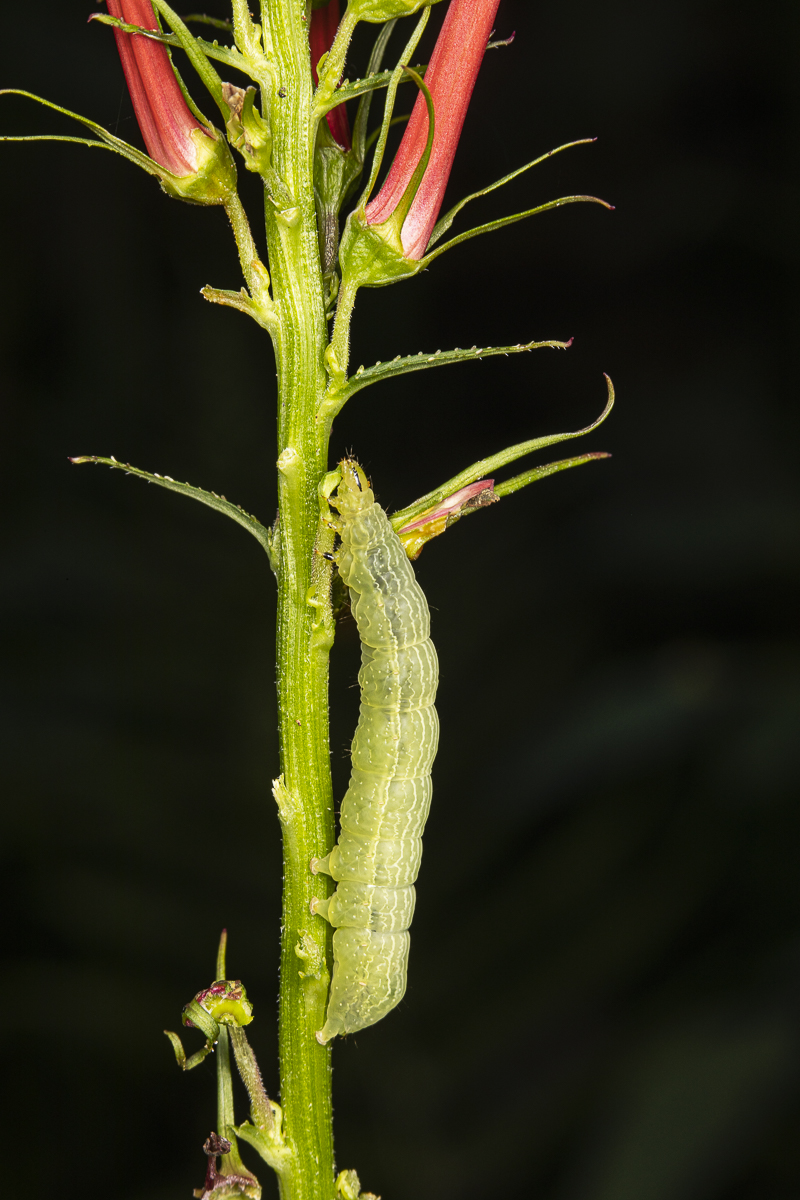
-The culprit – I believe it is the caterpillar of the Pink-washed Looper Moth, Enigmogramma basigera
If you know anything about me, you know I am very fond of caterpillars. But this one is testing my limits of tolerance. I am amazed that there will often be several different sizes of this caterpillar on one plant, as if a moth is laying an egg every day or two. They are quite difficult to see, especially the smaller ones, as they blend in very well and often hide underneath the leaves. I have also found several of the pupae under the few remaining leaf pieces on a particularly hard hit plant. I have started hand-picking them and tossing them, hopefully to end up as a tasty snack for the many species of birds that scour our yard jungle for food.

-A hummingbird enjoying nectar from one of the remaining Cardinal Flowers in our yard
These moths must have a spotty distribution as I have local friends with plenty of Cardinal Flowers in their gardens that have no issues. But, someone in a local native plant group recently posted a photo of their defoliated plants (both Cardinal Flower and Great Blue Lobelia – these larvae are apparently Lobelia specialists) asking people to help figure out what was happening. They had a rabbit fence around their garden but still suspected some sort of mammal. Various comments suggested deer or a rabbit somehow evading the fence. I commented on their post and suggested they look closely for these little green caterpillars. They quickly responded that my theory was “spot on” and their plants had several of the voracious little larvae.
Ah, the trials and tribulations of “gardening for wildlife”. Guess I’ll just need to keep buying Cardinal Flower plants so that there hopefully will be enough for both birds and bugs.
 Roads End Naturalist
Leave a comment