
If you haven’t found it yet, keep looking.
~Steve Jobs
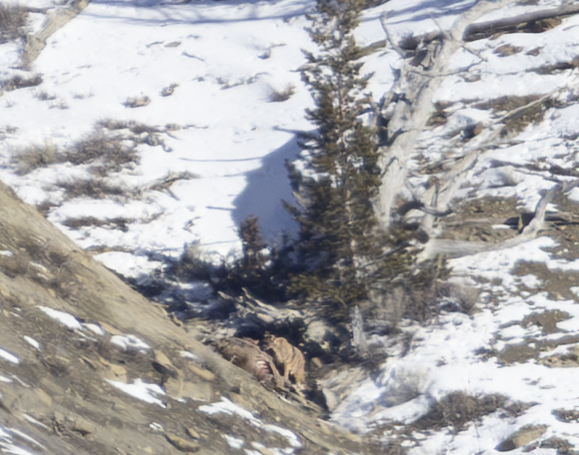
It has finally happened – after visiting this incredible landscape for over 40 years, I saw my first mountain lion! Our friend Beth texted us one morning last week that a mountain lion was visible from the road just outside Mammoth up on Mt. Everts. We were both headed to Bozeman that morning but we decided to run up there in the hopes of seeing it. We have just missed them on a few occasions over the years…”you should have been here 10 minutes ago” or “we are waiting on the mountain lion to return to its kill” (as we are headed to Bozeman to catch a flight home). We drove the 15 minutes to an area just east of mammoth and soon saw a line of parked cars and scopes, always a good sign that something is being seen. After getting some directions on where to look, we found the carcass in our scopes. It was an elk carcass on a steep slope about 1.5 miles away near the top of Mt. Everts. There was a lone conifer adjacent to the carcass and bare ground and rocks with scattered snow all around. It was in a vertical ravine and at that hour of the morning, the whole area was in the shade making it difficult to see any detail. Finally, we saw movement to the right of the carcass – the mountain lion was turning its head we were told, but, boy, it was tough to make out.
Melissa needed to go on to Bozemen to meet her teacher group at the airport but I decided to stay. The plan was for me to text her with reports on the lion so she would know whether to rush to try to get the group back in time to see it. I ended up staying all day. When the sun hit that part of the slope, you could finally clearly see that it was indeed a mountain lion – and she had kittens! People kept stopping by and I shared my scope view with a lot of park staff and other local folks that came by on their lunch break. In conversations with some biologists from the park I learned this was a collared female known as F210. That is how she was spotted at such a long distance – researchers studying her located her with a receiver that picks up signals from her collar. She was born in 2016 and this is her the sixth litter of kittens. This litter of three was believed to have been born back in October. These cougars (mountain lions go by various common names) are part of a population of mountain lions in the Northern Range of Yellowstone that is estimated to number around 40 animals. Their primary prey items are mule deer and elk though they will take smaller prey as well as the occasional mountain goat and bighorn sheep.
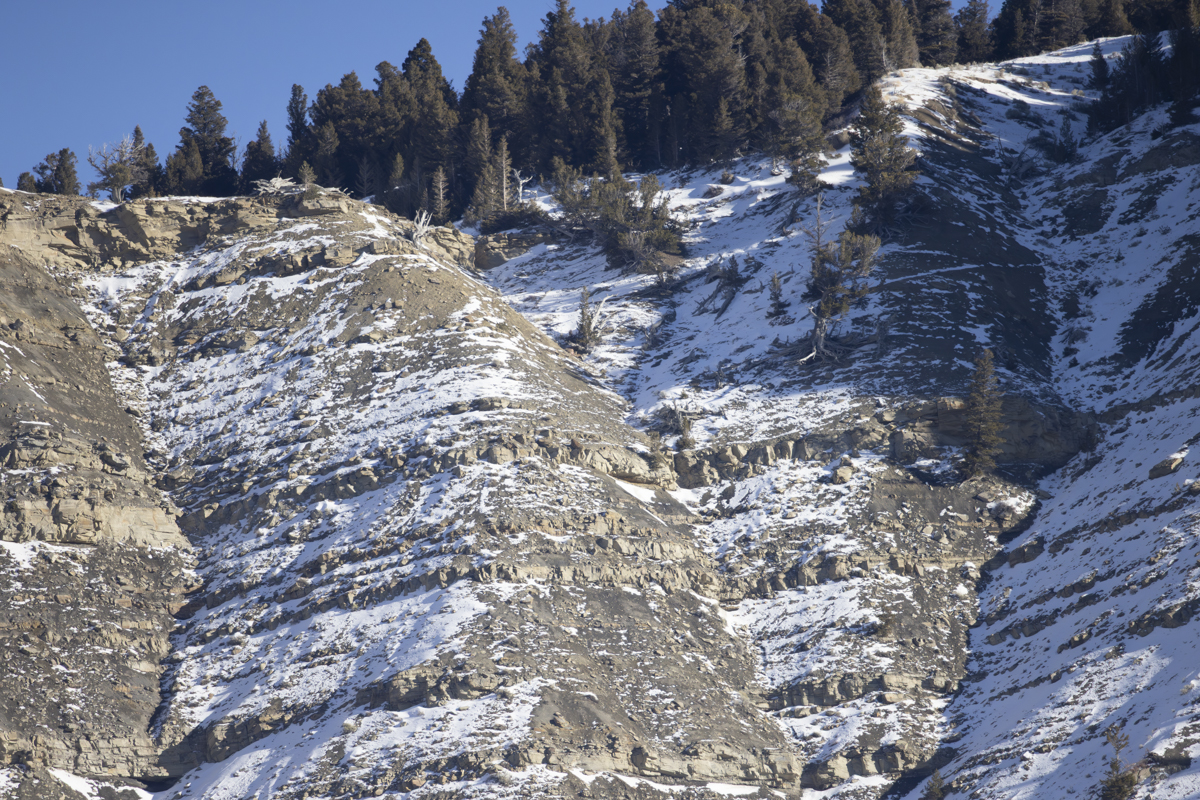
The carcass and mountain lion are at the base of the lone conifer you can see just above the center of this photo. The sunshine finally gave me a chance to attempt a photo. Pics were taken with an 800mm telephoto and heavily cropped so the quality is not great, but at least you can tell it is a mountain lion.
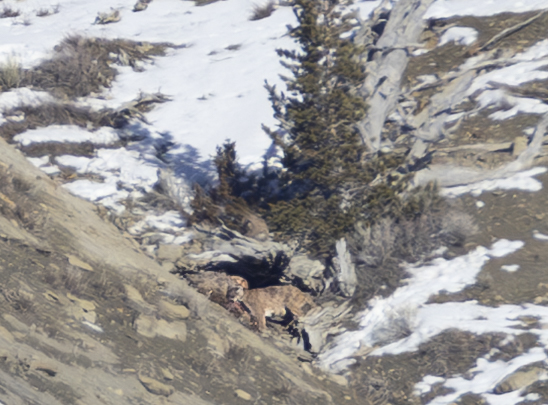
I also shot some video through Melissa’s Swarovski spotting scope using my iPhone and a Phone Skope adapter. The heat waves were pretty bad at times giving the video a wavy look. Videos are best viewed full screen.
I had heard she had two or perhaps three kittens but I did not see them for quite some time. It turns out they were under and in a conifer above the carcass site. They started playing and shaking tree limbs and that was when I spotted them. I only saw two, but later videos by other people confirmed there were three young. The young of small cat species (like house cats and bobcats) are called kittens. Those of larger cats like lions and tigers are called cubs. Apparently, mountain lions are borderline in size so their young can be called either. But I must admit, weighing in at between 75 and 150 pounds, adult mountain lions seem pretty big to me (males are larger than females).
I finally did see two of the cubs come down to the carcass though it is hard to see the one at the base of the elk in this next photo.
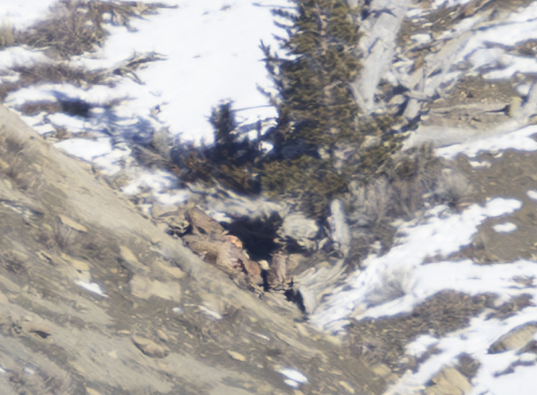
This final clip has a bit less heat waves so you can clearly see the adult feeding. One young is sitting above the carcass on a log
–The female feeding on the carcass with one young watching
This mountain lion family fed on the carcass for a week without leaving it. The fact that it was on such a steep slope probably helped keep other carnivores like wolves away. Wolves and bears can drive a lion off a kill. Normally, mountain lions will cover their kill with nearby vegetation to help hide it from scavengers but there wasn’t much available at that site so she just stayed right there to protect her food supply. I did see her jump up and stare at a raven that flew over a couple of times and she was having none of it…no sharing. When the lions finally did leave, folks reported ravens, magpies and bald and golden eagles visiting the carcass to glean the leftovers.
Being close to Mammoth (the park headquarters) and visible from the road provided countless visitors (including us) with a chance to see their first mountain lions. What a rare treat for so many people. I look forward to our next sighting and hope that it is perhaps a tad closer.


 Roads End Naturalist
Leave a comment