

I have been away a few days celebrating a major birthday (hard to believe it is that number) and returned to find a few caterpillars from BugFest still active (most were released the day after the event). I was particularly pleased to see the snappily-attired Turbulent Phosphila munching away on its host plant, Greenbrier (Smilax sp.). I remember the first time I found one of these pin-striped beauties I could not decide which end was which, a common caterpillar conundrum. A frequent defense strategy of many types of insects is to present a false head to would-be predators. This usually involves eye spots of some sort since we, and most vertebrate predators like birds, associate eyes with the head of an animal. By going after the head first, a bird is likely to immobilize its prey quickly and cut off any escape attempt.
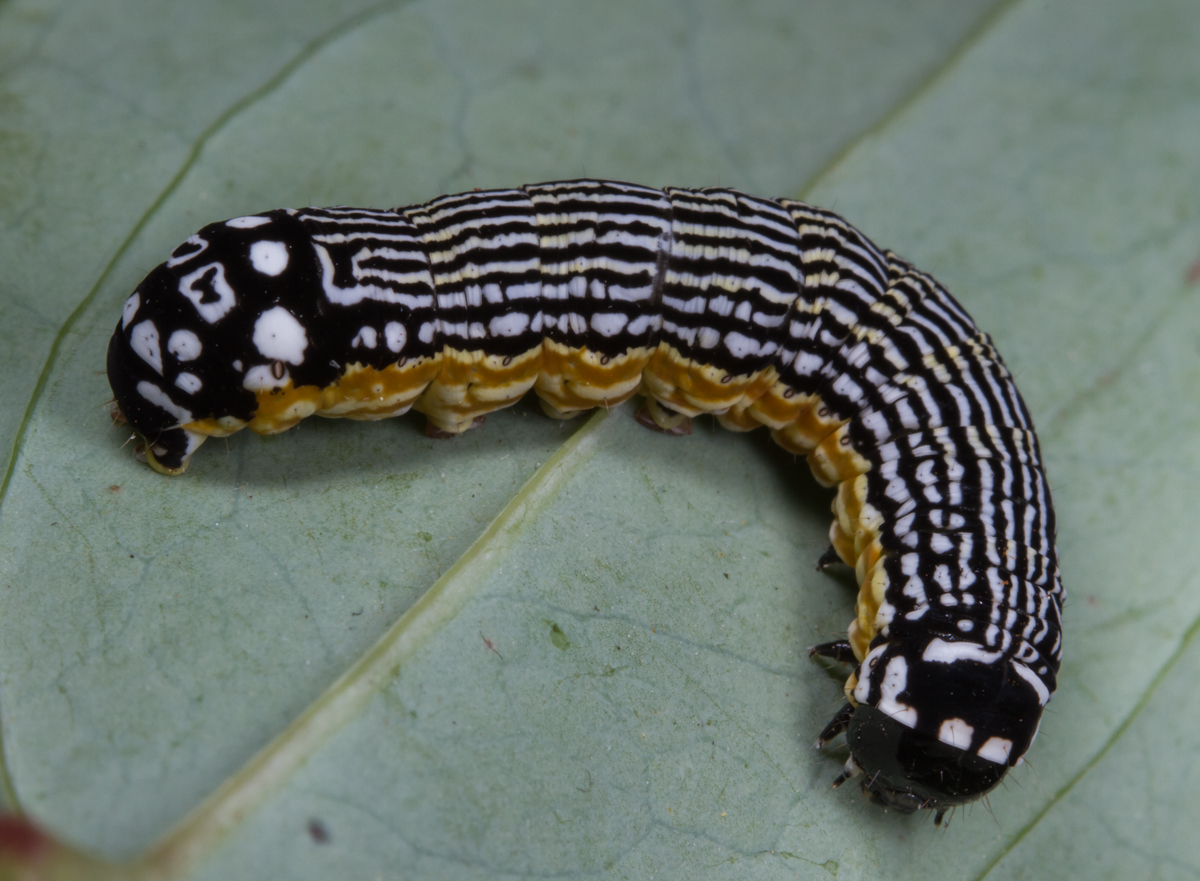
A close look reveals the truth – the last three segments of the rear of the caterpillar are somewhat enlarged and have prominent white spots suggesting eyes. Ironically, the true head end of the larva also has false eye spots on the thorax. The true eyes, like those of most caterpillars, are diminutive and arranged in arcs on the side of the caterpillar’s true head capsule, which is tucked on the right side of the larva in the image above (note the presence of the short antennae and true legs on that end). Maybe it is no accident that referee shirts look like the bold patterns of this larva – many of us question where their eyes are as well.

David Wagner (Owlet Caterpillars of Eastern North America) states that “the bold coloration is suggestive that the insect is chemically protected, although it remains to be shown if the Turbulent Phosphila is in fact unpalatable, or if its patterning is largely a ruse”.

Young caterpillars are gregarious feeders on various species of Greenbrier, but as they grow older, they become more solitary. Finding a group of them on the underside of a Greenbrier leaf or clumped on a vine is a caterpillar-lover’s (and perhaps graphic artist’s) delight. The moth has two generations per year throughout much of our region and can often be found as late as November in the coastal plain. Finding the Curve-lined Owlet caterpillar, and now these interesting larvae, on Greenbrier, gives me a reason to appreciate this often maligned vine.


Leave a comment