Roads End Naturalist

Exploring the natural world as we wander at the end of the road


Lake George

·

Lake George is without comparison, the most beautiful water I ever saw; formed by a contour of mountains into a basin… finely interspersed with islands, its water limpid as crystal, and the mountain sides covered with rich groves…

~Thomas Jefferson, 1791

Melissa’s family has a long tradition of summer vacations on Lake George in upstate New York. I can see why as it is one of the clearest lakes I have visited and is surrounded by forested mountains, so the views are great. It is also a large lake – 32 miles long, up to 2.5 miles wide, and almost 200 feet deep. In early August, the entire family was able to get together at a beautiful old house surrounded by state-owned land for a week of relaxation and fun. A bonus for me was the abundance of wildlife (big and small) on the property and that is the primary focus of this post.

Our rental home for the week. Built in the early 1900’s, this was a caretaker’s house for a large estate, the bulk of which was sold to the state as part of Adirondack Park (click photos to enlarge)
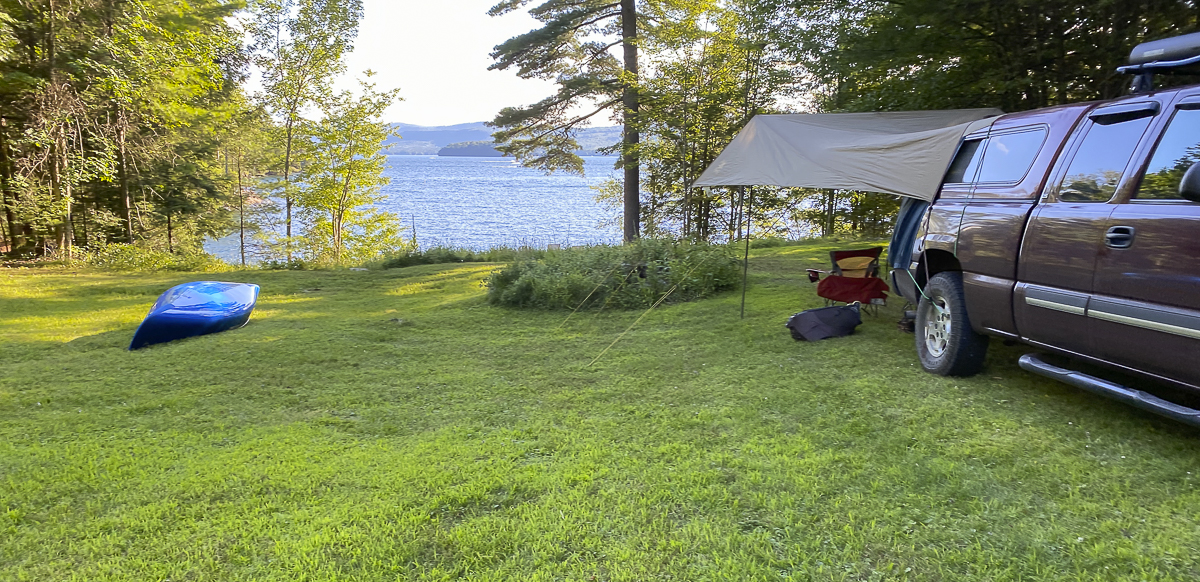
Melissa and I spent nights in our truck down by the lake to free up some bedroom space in the house (not a bad trade at all given the view and the almost constant breeze)
View of the dock and the lake

The owner told us to expect some wildlife, especially out by the mulberry tree in front of the house. The first morning, Melissa’s dad saw some turkeys and a Red Fox out under the tree. Dang, we were down by the lake so we missed all of the excitement.
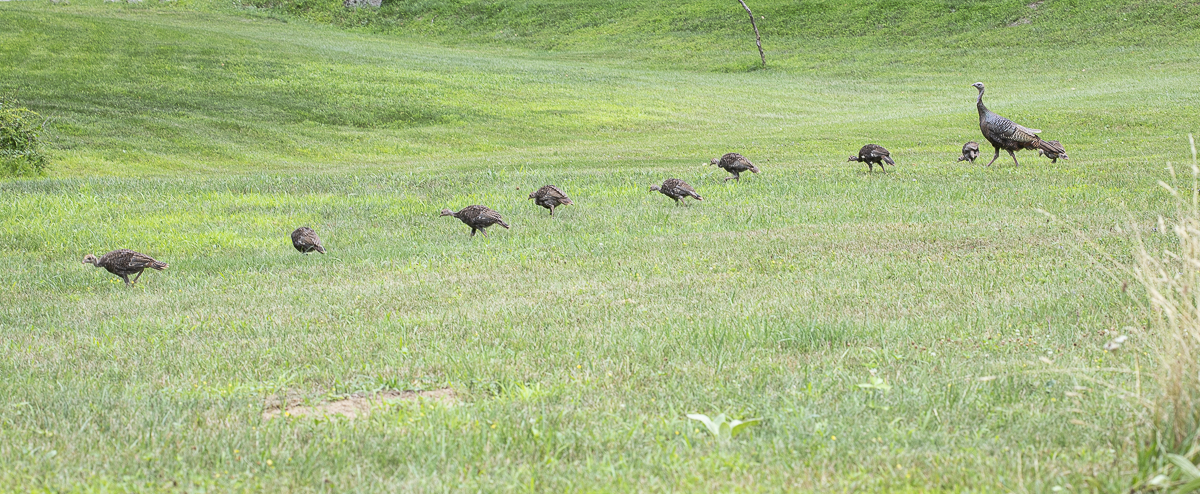
A flock of Wild Turkeys (two hens and nine young ones (poults) visited us daily

Then he showed me a phone video he had taken of a critter I have only seen once in the wild (In Grand Teton National Park) – a North American Porcupine! Porcupines range in the West from Canada down to northern Mexico, but are found only as far south as Pennsylvania in the Eastern United States. The next morning we were talking about the “wildlife tree” and I look out and there are two porcupines strolling towards it. They provided entertainment for the family for the next hour or so as they slowly climbed into the mulberry tree and, to my surprise, seemed to feed mainly on the leaves rather than the berries (they did consume a few berries as well).

Young North American Porcupine in mulberry tree

Porcupines spend most of their time in trees, foraging on leaves, fruit, and bark (especially in winter). They have several adaptations that make them excellent tree climbers – long claws, wrinkled pads on their feet that give them extra grip, and stiff bristles on the underside of their tail that acts much like a woodpecker’s tail spines to brace them as they climb. They do spend time in dens (rock crevices, hollow logs, abandoned buildings) in cold snaps or when giving birth.

A look at the formidable claws that help porcupines climb

The word porcupine is derived from Latin and means thorn pig. They are not related to pigs, but are, in fact, the second largest rodent in North America (behind American Beavers), attaining weights of up to 20 pounds. But it is their quills that make porcupines so distinctive.
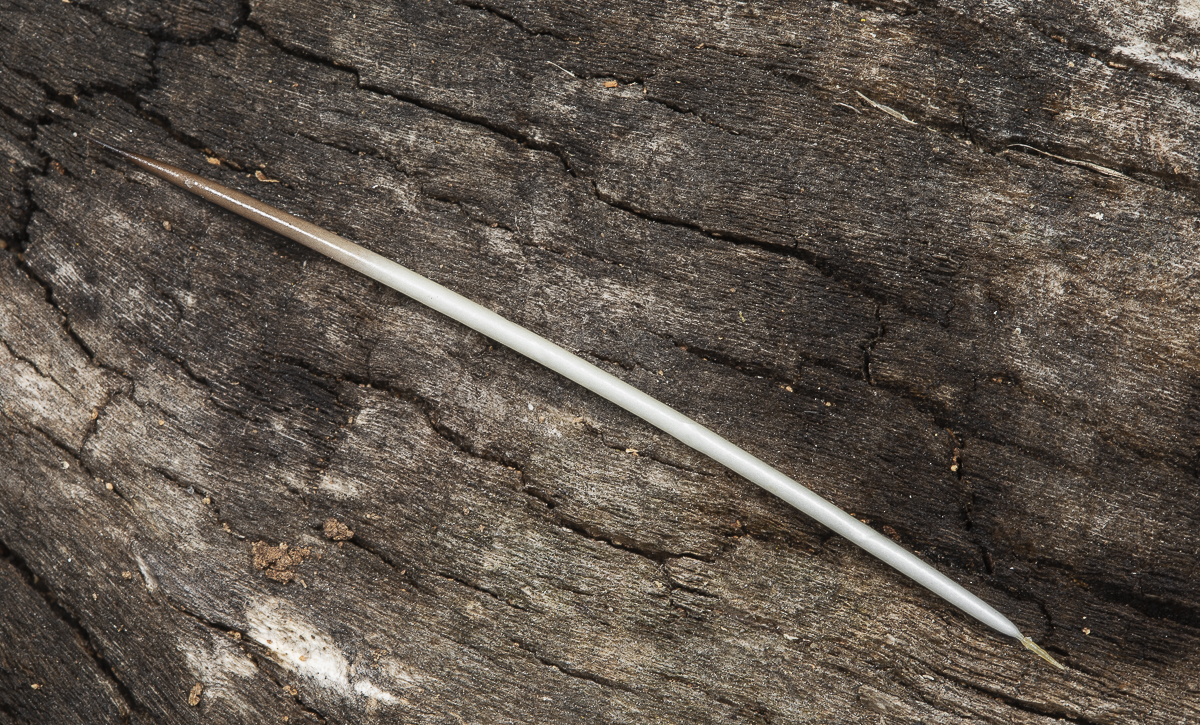
We found several shed porcupine quills under the mulberry tree. The quill is attached to muscles below the skin that control its movements. The microscopic barbs are at the tip (in this photo, the left side of the quill)

Quills are modified guard hairs filled with a spongy matrix and can be up to 4 inches in length. They have microscopic barbs at the tip that are angled such that, if not removed, the quill digs deeper and deeper into an animal as it moves. They can work their way into vital organs of the victim or, over time, go entirely through and come out the other side of the animal if they avoid bones and organs. They are an effective protection against most predators, with the weasel-relative Fisher, being the primary exception in New England. There may be as many as 30,000 quills on one porcupine! it is a myth that they can throw their quills, but they do release easily when they come in contact with a predator (and are easily shed as they move about).

One porcupine came down one branch to climb another and I approached for a clearer view. It raised its quills along the back side and tail in a defensive posture that gave a clear message – don’t come any closer. The bold black and white pattern on the back and tail resembles that of a skunk, and is believed to serve as a similar warning to would-be predators

The quills are covered with a mild antibiotic greasy compound that is believed to provide some protection to the animal should it fall from a tree or otherwise manage to get punctured by its own spines.

The larger porcupine finally came down out of the tree and slowly ambled into the forest, the quills on its back side erect, letting us know we should leave it alone. The younger porcupine spent its days sprawled across a limb high in a tree about a hundred feet from the mulberry tree

We also had a lot of smaller wildlife to keep me fascinated during our stay. I had never seen evidence of the introduced Spongy Moths before, but there were egg masses, shed caterpillar skins, and pupae on many tree trunks around the property. Spongy Moth is the new common name of Lymantria dispar dispar, formerly known as the Gypsy Moth. The name was changed by The Entomological Society of America as part of their Better Common Names Project. These destructive insects were accidentally introduced to North America from Europe in 1869 in an effort to create a silk industry. Caterpillars are generalist feeders and can defoliate large swaths of forest in eruptive years.
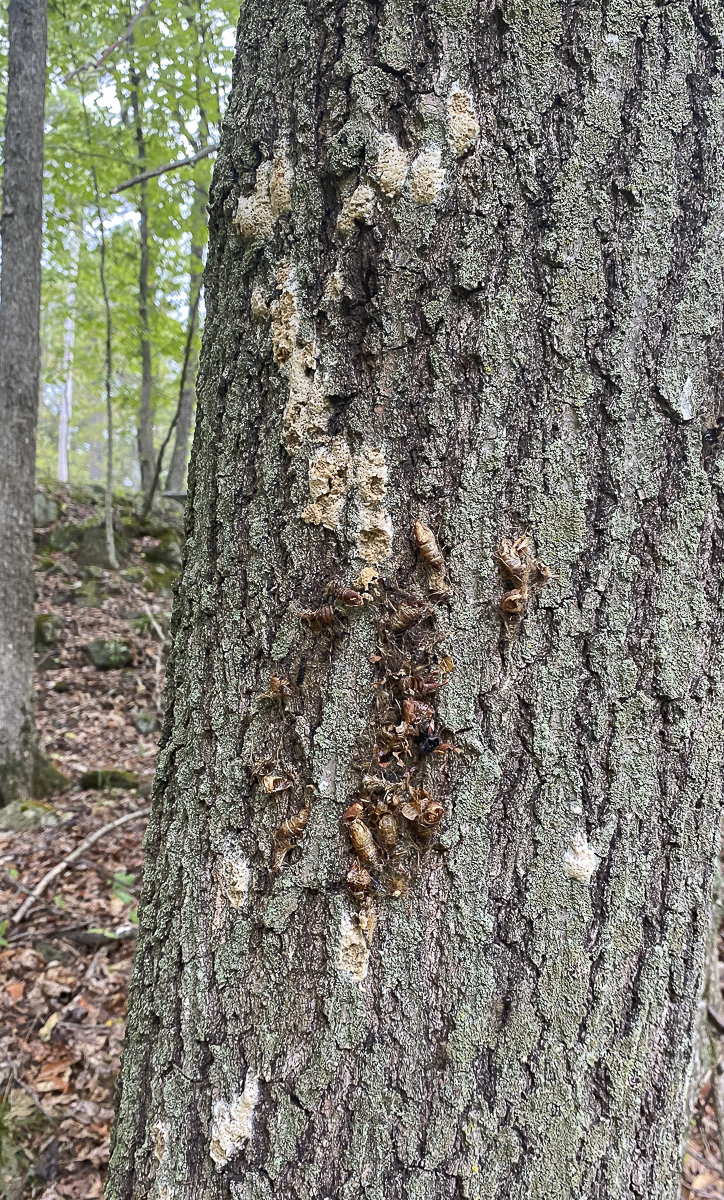
Spongy Moth egg masses and pupae on a tree trunk

Under some of the protective eaves and open barns on the property were lots of tiny funnels in the sandy soil, a sure sign of the presence of one of my favorite insects – Antlions.

A patch of ground under a shed roof is covered by Antlion funnels. Larval Antlions dig these and lie in wait at the bottom of the pit for ants and other crawling insects to tumble down into their waiting jaws.
I scooped out an Antlion larva for this pic, showing the formidable jaws and spines on its legs and body that help the ant lion hold its position in the bottom of the pit when subduing a struggling ant. Antlions pupate in the soil and then emerge as a nocturnal flying adult that somewhat resembles a damselfly.

One day, I grabbed the camera and just wandered around the yard (which included some nice mini-meadows) and photographed some of the abundant charismatic micro-fauna. Here is a sampler.
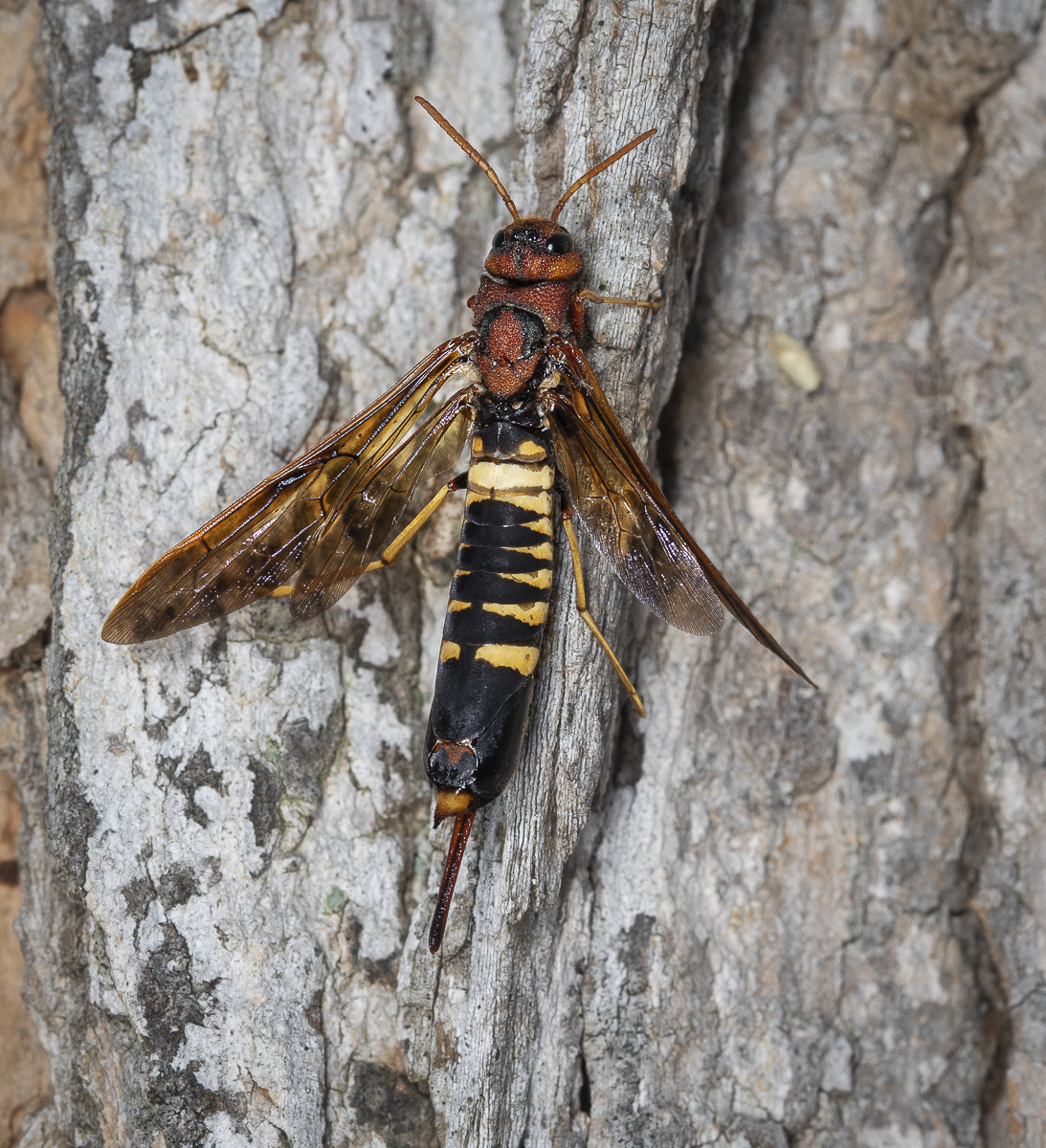
A Pigeon Horntail adult female, Tremex columba. These are large insects in the wasp family, but they do not sting. Females insert that ovipositer into dead or decaying wood, lay eggs, and deposit fungal spores with the eggs that germinate to enhance the wood decomposition. She carries these fungal spores with her in a special abdominal pouch. After hatching, the larva then eats the decaying wood and the fungus.
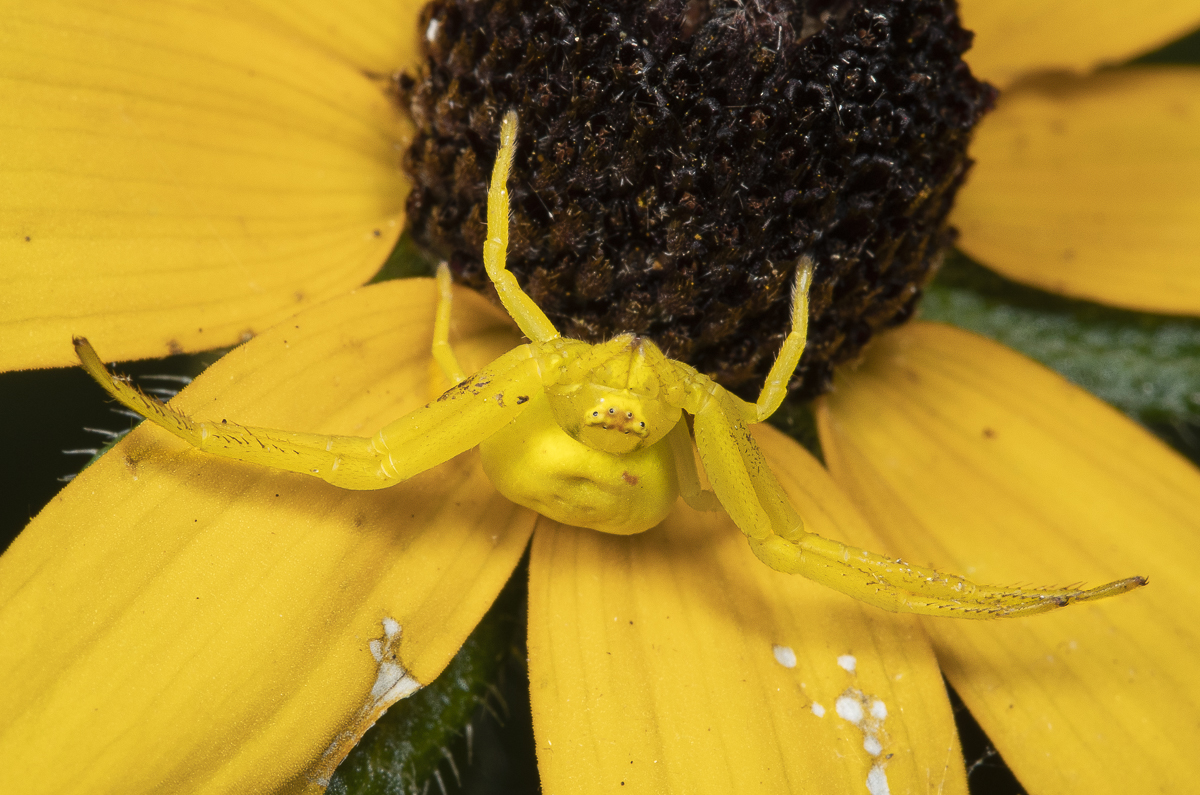
There were several Crab Spiders hanging out on the wildflowers in the unmowed areas. Some species are capable of changing their color to better match the background color of the flower where they wait for incoming prey
The last thing a small pollinator may see as it approaches a Black-eyed Susan
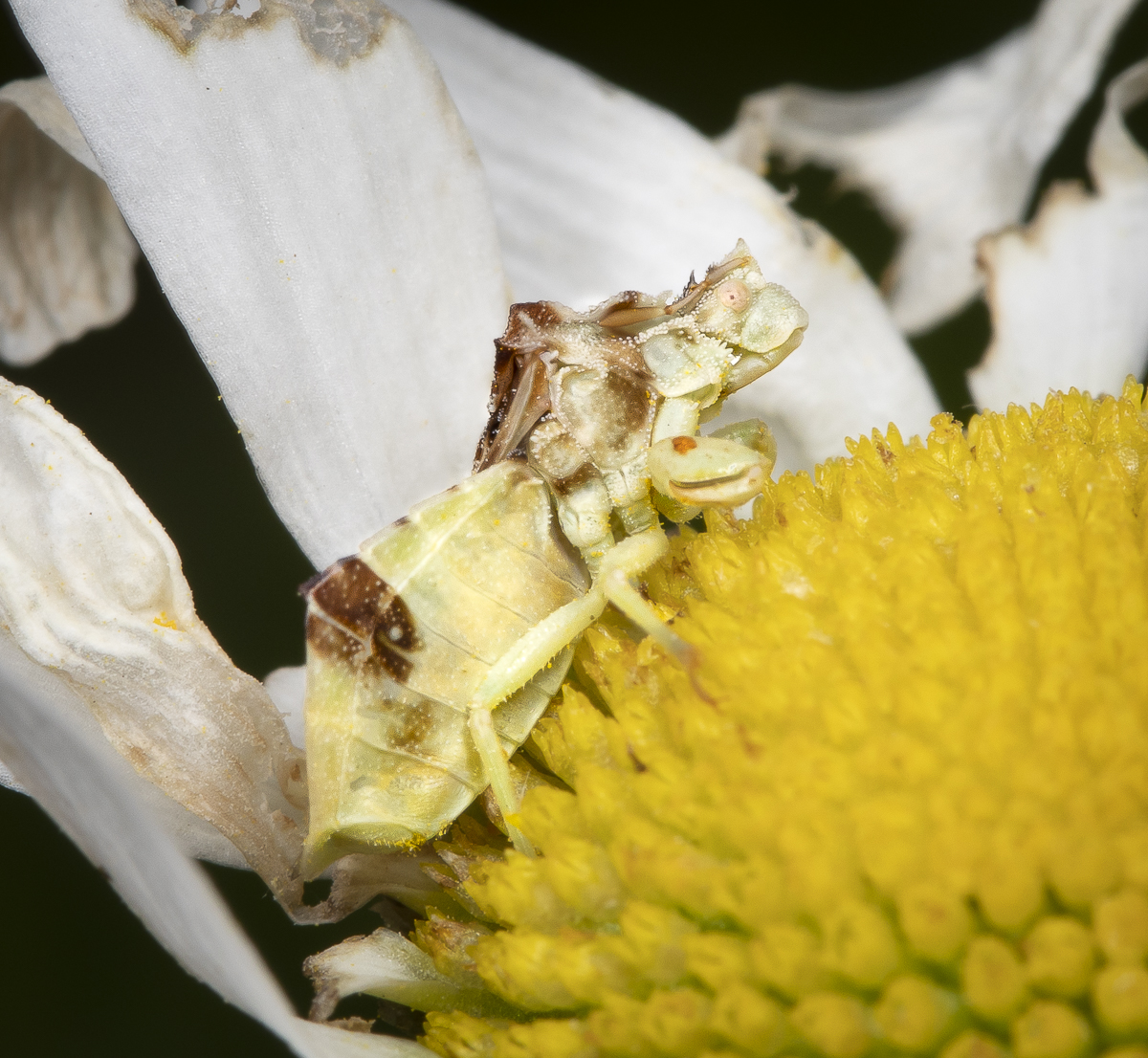
Another ambush specialist is the aptly named Ambush Bug. Like some Crab Spiders, some species of Ambush Bug are thought to change color to match their surroundings. These guys look like a small tank had a baby with a praying mantis, since their bodies appear heavily armored with huge raptorial front legs.
Here is a yellow one on a Black-eyed Susan. When an insect lands nearby, they grab it with those front legs and inject a fluid that immobilizes the prey and starts to digest it. They then suck up the innards of the prey’s body through a beak-like proboscis.
A mating pair of Ambush Bugs on Queen-Anne’s-Lace. Males are often darker than females.
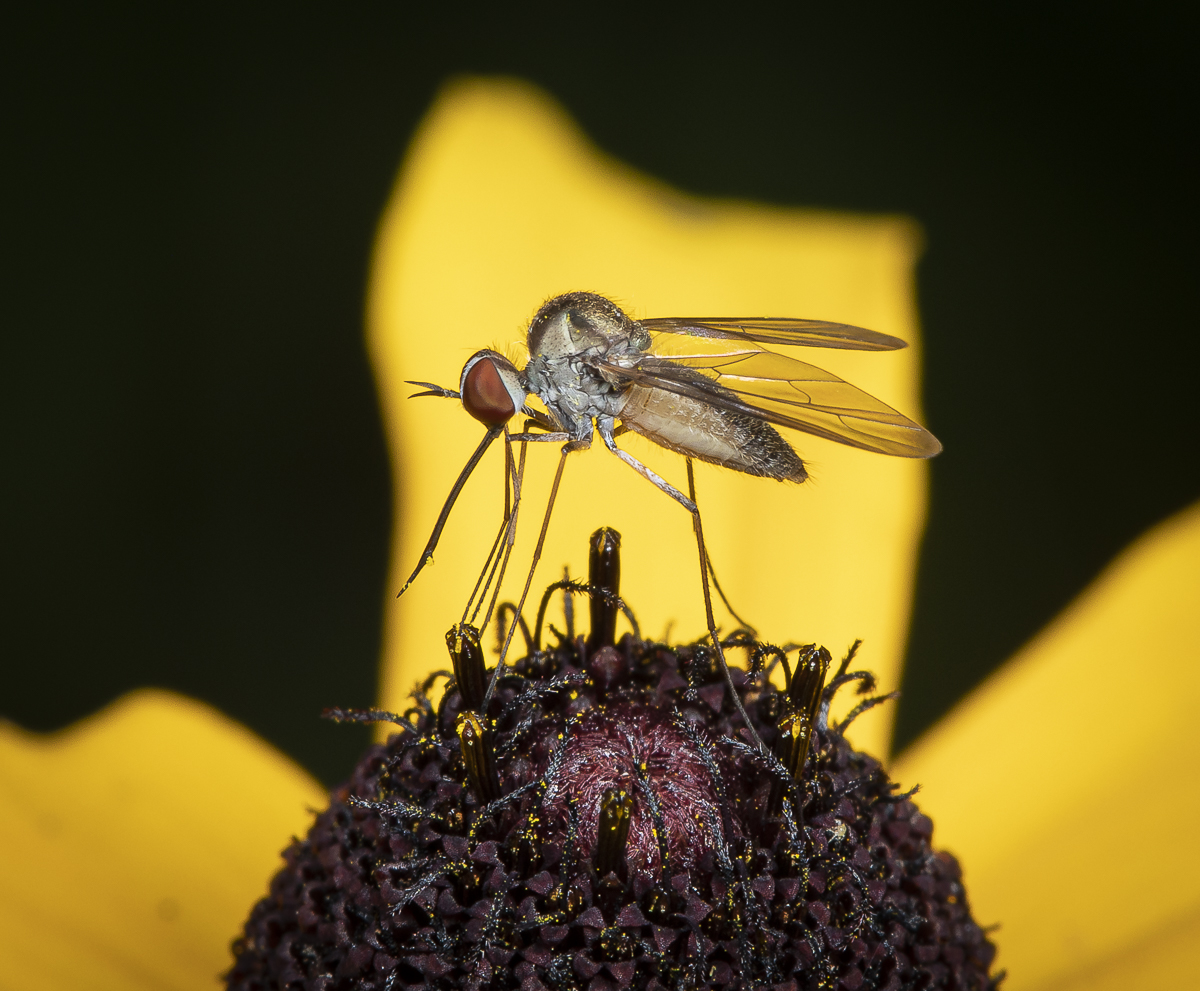
A new group of insect for me – tiny bee flies in the genus Geron (means old man, in this photo, imagine a hump-backed old man with a cane). These hunch-backed little insects were common on many flower heads, sipping nectar. Larvae of this group are parasitic on many moth larvae.

All in all, a spectacular week of scenery, fun, food, family, and the wild creatures that make Lake George so special.

Comments

29 responses to “Lake George”

  1. Diane Rainey Avatar
    Diane Rainey

    Love following all your adventures…you are so interesting and educational with all the photos you share. I was wondering if you would be interested in sharing the lens you use to get your close ups of your bugs…thanks.

    >

    1. roadsendnaturalist Avatar

      Thanks, Diane. I use a Canon 100mm macro lens and flash for most of my macro work. I also have extension tubes that I occasionally use for really tiny subjects.

  2. Diana Avatar

    How cool, especially the porcupines! I’ve never seen one in the wild.

    1. roadsendnaturalist Avatar

      A definite thrill to have them around so much to enjoy.

  3. Joy Hewett Avatar
    Joy Hewett

    Doodlebugs! You call ’em ant lions. We used to take tiny bits of stems and stir the top gently so we could watch the doodlebug in the bottom of its cone come alive. So fun, the patience of children in the dirt of a carport.

    1. roadsendnaturalist Avatar

      They are just cool little critters.

  4. Joy Hewett Avatar
    Joy Hewett

    Imagine the wealth for that rental to be a caretaker’s cottage–we’d call it a nice home today!

    1. roadsendnaturalist Avatar

      Indeed! But they did good by selling most of the estate to the state of NY.

  5. Dan Avatar
    Dan

    What do porcupines say when they hug?

    Ouch.

  6. Deb Hanson Avatar

    Keith and I have been on a mission to see porcupines whenever we’re in their range. No luck yet. So cool that you had them so close and cooperative. Beautiful pics… with that new macro lens?

    1. roadsendnaturalist Avatar

      Yes, such cool critters! And the macro lens is the same one I have had for many years, but the flash unit is new.

  7. daytraks Avatar
    daytraks

    Thank you for a trip down memory lane… the first 2 weeks of August during my childhood 1950’s-60’s were spent living in a cabin on Lake George near Hague, NY. Daily journeys on the lake fishing with my father, mother & brother in our boat – end of day enjoying the most delicious home cooked fish dinners served with local farm produce. The nearby streams were also a favorite fishing spot for my father. Visiting Indian Kettles, Fort Ticonderoga (the smell of paper factory spew balanced by the intoxicating scent of paper birch) finding musket balls diving in the lake, and nightly stargazing & Sputnik sightings around the neighborhood outdoor fire place. Your images show a place just as I remember Lake George.

    1. roadsendnaturalist Avatar

      Wow, you paint a wonderful picture of fond memories. My father-in-laws family also spent time up there every summer, close to where you mention…the Cardwell family, including what I hear was a renowned water skiing brother, Tony.

  8. The Cedar Journal Avatar

    Wonderful photography as usual. Had a chuckle as porcupines are very common in MN,but as always learned something new from your observations and research. As always your insect photography is just plain interesting. Thanks for sharing your finds and knowledge with all of us!

    1. roadsendnaturalist Avatar

      Thanks. It was obviously a thrill for all of us to hang out with the thorn pigs. But I hear they can cause some issues with their taste for all things salty.

      1. The Cedar Journal Avatar

        Interesting, didn’t know about the salt thing. In Northern MN they mostly stick to the trees and are pretty slow going unless threatened.

      2. roadsendnaturalist Avatar

        I have read about them eating wooden canoe paddles and even auto tires (from the road salt). But, they certainly are cool critters.

  9. Denis DuBay Avatar

    Wow, just wow! Great photos and such details! Thanks for sharing.

  10. Margot & David Ringenburg Avatar
    Margot & David Ringenburg

    Wonderful post, Mike, both the text & the photos! We’re currently on Deer Isle, in Maine, where it’s easy to focus exclusively on the larger landscape. As your post makes clear, it’s important to give the sometimes-hidden wonders of the micro world equal attention. Many thanks, as always.

    1. roadsendnaturalist Avatar

      Thanks! Enjoy your stay in beautiful Maine.

  11. Ann Steighner Avatar
    Ann Steighner

    Thank you for the information and photos of the porcupine. Fascinating creatures indeed. I’ve never seen one in the wild but will keep my eyes out when I visit upstate New York next month.
    More information about their evolution below:

    Source: iNaturalist
    The porcupine is a caviomorph rodent whose ancestors rafted across the Atlantic from Africa to Brazil over 30 million years ago, and then migrated to North America during the Great American Interchange after the Isthmus of Panama rose 3 million years.

  12. Kim Smith Avatar

    Loved all the insect photos in this one! And that looks like a wonderful vacation spot.

    1. roadsendnaturalist Avatar

      Thanks, Kim. And you are right, it really is beautiful up there.

  13. Jim Fuchs Avatar
    Jim Fuchs

    Hi,
    I am one of the owners of the house pictured above. It was great to see how you enjoyed our place on Lake George. Is is alright with you if I use one of your porcupine photos on our webpage?
    Thanks,
    -Jim

    1. roadsendnaturalist Avatar

      You are certainly welcome to use any and all photos. We thoroughly enjoyed your place – what a beautiful home and setting. We are hoping to do that again in the near future. It was perfect. Thank you for allowing it to happen.

Leave a comment

Roads End Naturalist

Exploring the natural world as we wander at the end of the road

Copyright Mike Dunn and Melissa Dowland