
Wherever we go on land, these small creatures are within a few inches of our feet—often disregarded. We would do very well to remember them.
~Sir David Attenborough
The sound of periodical cicadas continues to dominate the air here in our woods, but I see more and more of their lifeless bodies scattered about as I walk around the yard. Their short time amongst us as winged adults is probably about half over and, soon, they will be just a memory.

Since much of their daily life now happens high in the trees, I am starting to look for some of my other tiny wild neighbors. Here are a few I’ve encountered the past couple of days while working/walking in the yard…
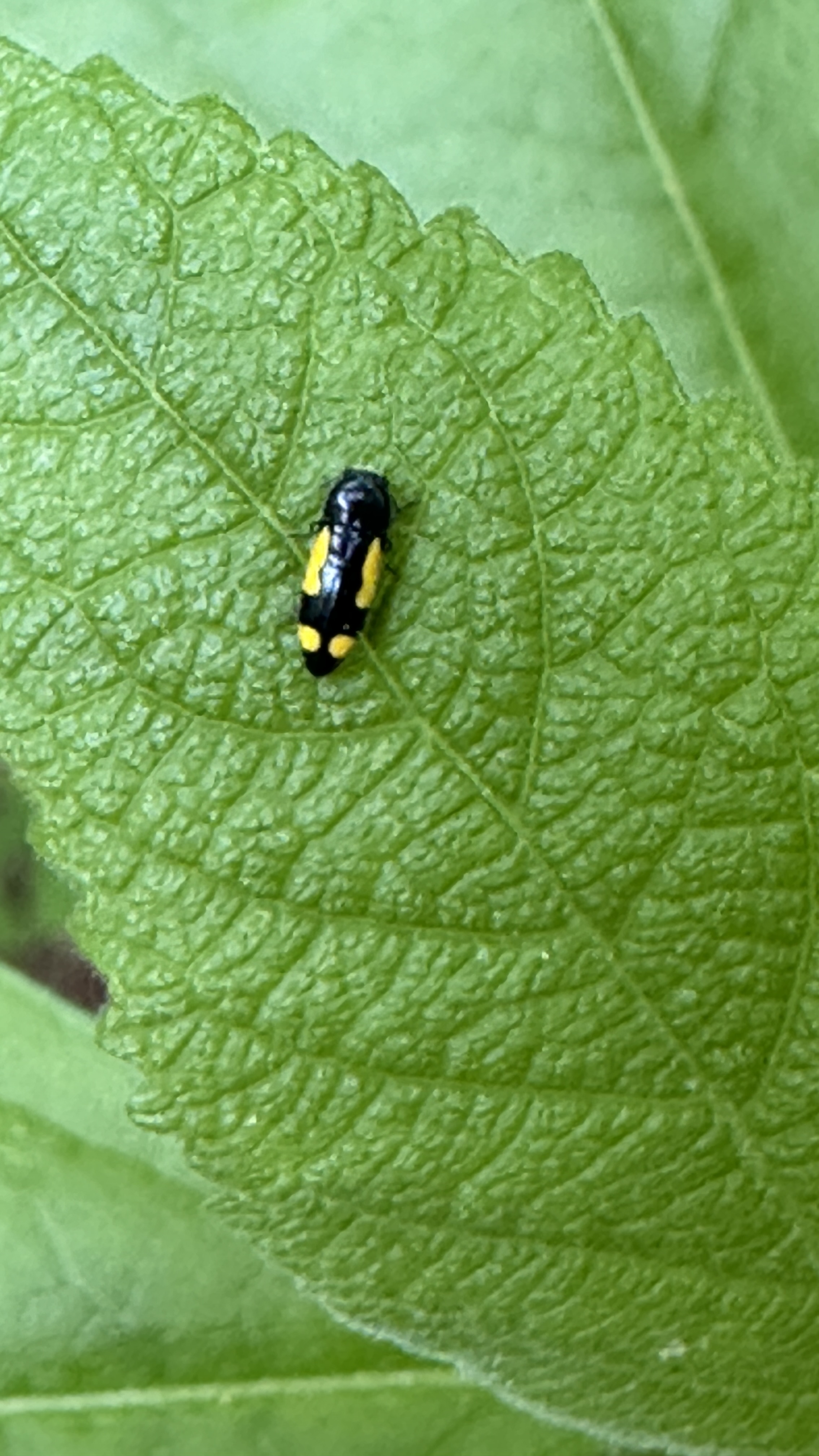
I’m always on the lookout for new species to add to my iNaturalist list of invertebrates for the property and before the drenching rains, I spotted a small beetle with unusual markings. I took a quick phone photo for ID purposes and went inside to get my camera. Of course, it was gone when I got back so the slightly out-of-focus phone pic will have to do. This small metallic wood-boring beetle is found on its namesake tree, Eastern Redbud. Larvae live and feed in the wood. This one was on a leaf of another species underneath a Redbud tree.
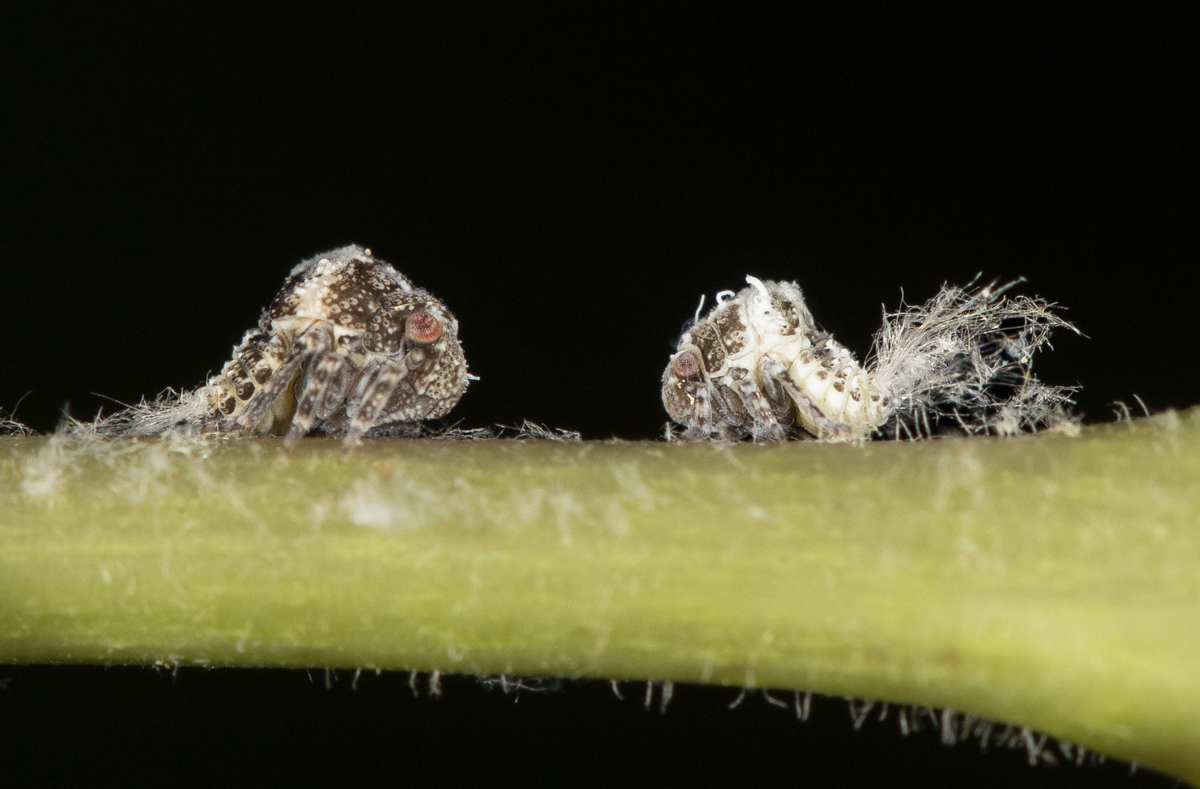
One of the more common insects in our yard is the Two-striped Planthopper. I came across a band of nymphs on a Cross Vine. Their bizarre butt tufts are waxy filaments that are supposedly water repellant. The poofy fibers are created by glands in the abdomen and may serve to help disguise the nymphs and may dissuade predators from dining on this particular type of string cheese.
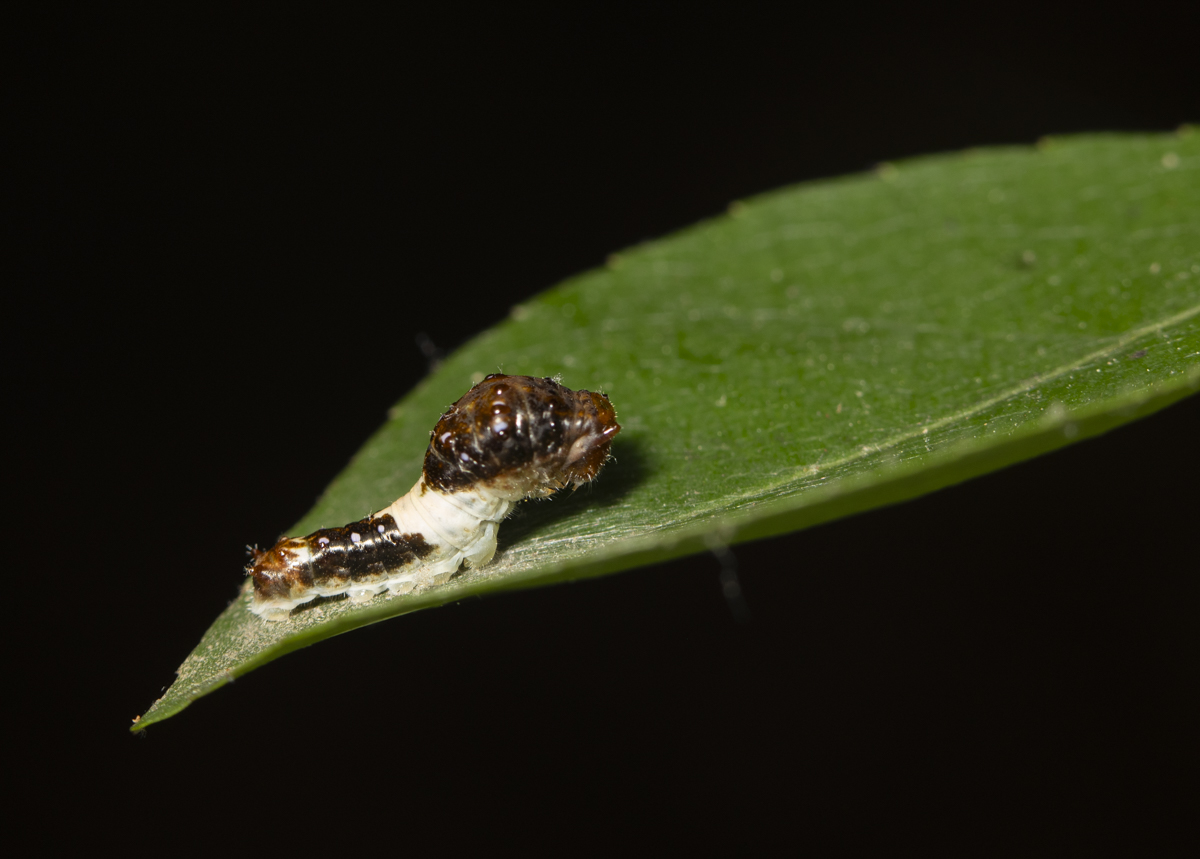
I’ve seen a few Eastern Tiger Swallowtail caterpillars around the yard, most in their bird poop mimic phase of life. The disguise must work as they tend to be on the top of the leaves, fully exposed to the eyes o hungry birds. Most are on their favored host plant on our property, the abundant Tulip Poplars. But this one was a rarity here as it was sitting on a Wild Cherry leaf.
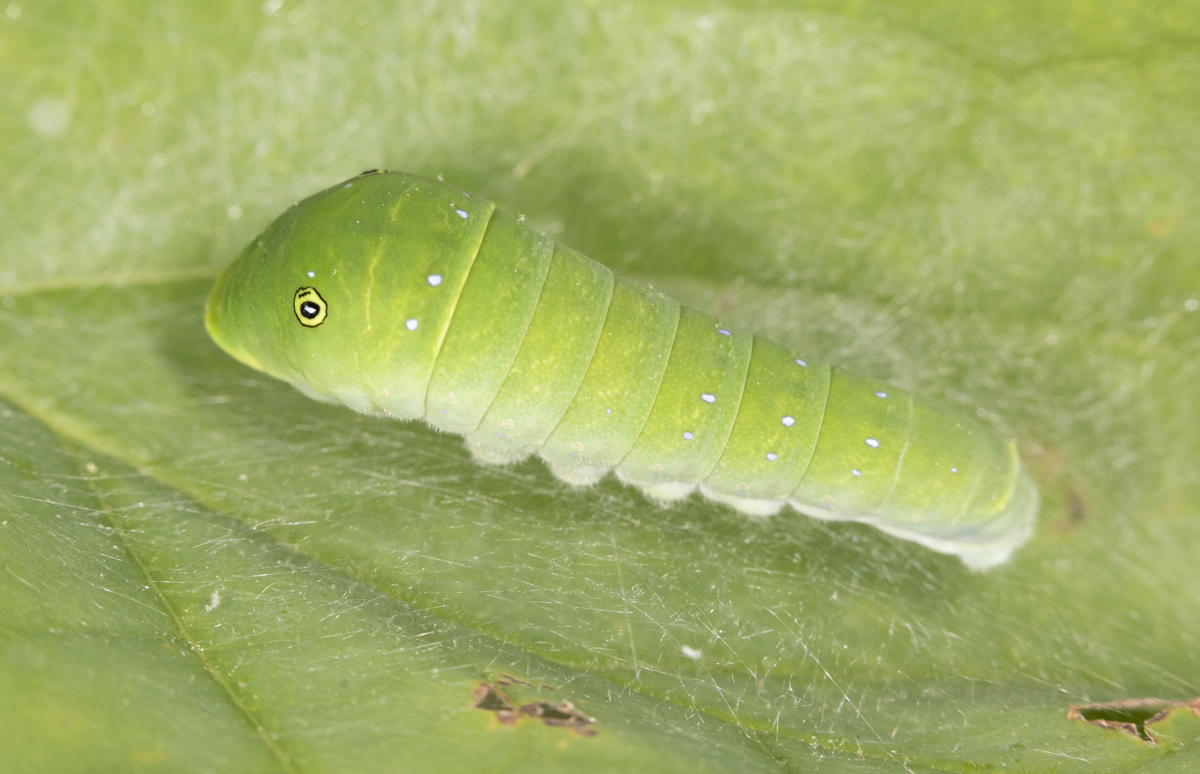
The first tiger swallowtail caterpillar I found was a first instar one on a Tulip Poplar saping at the edge of our garden. I often leave the saplings of potential host plants in the yard and just keep cutting them back each year so they don’t shade out our garden plants or wildflowers. This particular sapling has been a good site for finding caterpillars over the years so I keep it about 4 feet tall to make it easier to see the larvae. After its second molt, the caterpillar vanished so I assumed one of the patrolling wasps or a foraging wren had found it. But, as often happens with this species, it reappeared as the hard-to-see green caterpillar perched on its silken platform a few days ago. I think they must crawl to a hidden spot to molt since that is such a vulnerable time in their larval life.

As I looked at one of the wildflowers I recently planted, I noticed some movement. It was a small dark jumping spider. As I moved in closer, it did what many jumpers do, it oriented towards me, staring up at me with its eight eyes (well, at least the two big ones on the front of its “face”). If I continue to move the camera closer, they often jump onto the lens, making photography a bit more challenging. Another pic of the dorsal side of this spider allowed me to ID this little guy as a Sylvan Jumping Spider, a species I had catalogued last year on iNaturalist. Males of this species look quite different than the females.
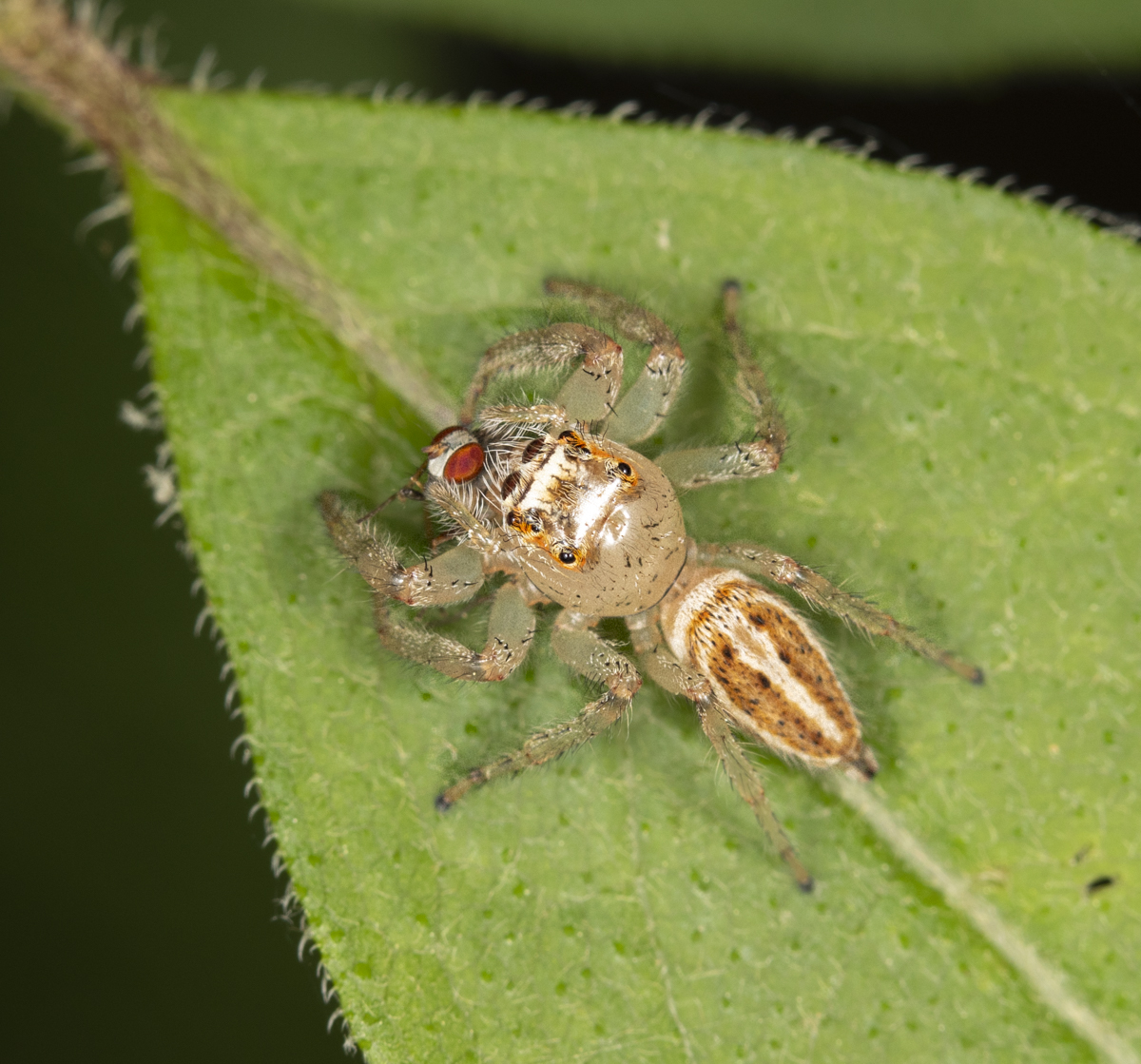
Females are tan with some stripes on the abdomen and white and red or orange between the eyes. I spotted this female a few feet from the male in the previous pic. She was less interested in jumping at my camera and was more concerned with keeping me from stealing her meal.

She stared and dared me to try to take it, and then scurried under the leaf, safe from the giant two-eyed monster (my macro lens has two large white diffusers on the twin flashes).
The cicadas have occupied much of my (our?) attention these past few weeks, but their time in the sun may be fading soon, so it is good to remind ourselves that there is so much more out there beneath our feet. But, I must admit, I will miss the red-eyed masses when they are gone.


 Roads End Naturalist
Leave a reply to Birder’s Journey Cancel reply