
The mountains are calling and I must go.
~John Muir
I’ve been longing to get out camping since we arrived in Montana in early May. First, there was unpacking and house projects, then there were my teacher workshop and family visits, then some concerns about what seems to be a particularly explosive mosquito population this year… but finally, last week, we made it out to spend a couple nights camping in the Beartooth Mountains to the northeast of Yellowstone. We’ve visited the Beartooths many times before, typically in June with groups. At over 10,000 feet in elevation, spring comes late in the Beartooths. On previous June visits, we typically ran into tall walls of snow on the roadsides and muddy meadows just starting to sprout spring beauties. But come July, the harsh colors of June melt into vibrant greens dotted with a rainbow of wildflowers. As we roll into August, even the high elevations are starting to dry out, though more green remains in the Beartooths than at home in the Gardiner Basin, especially in wetland areas, which are numerous.
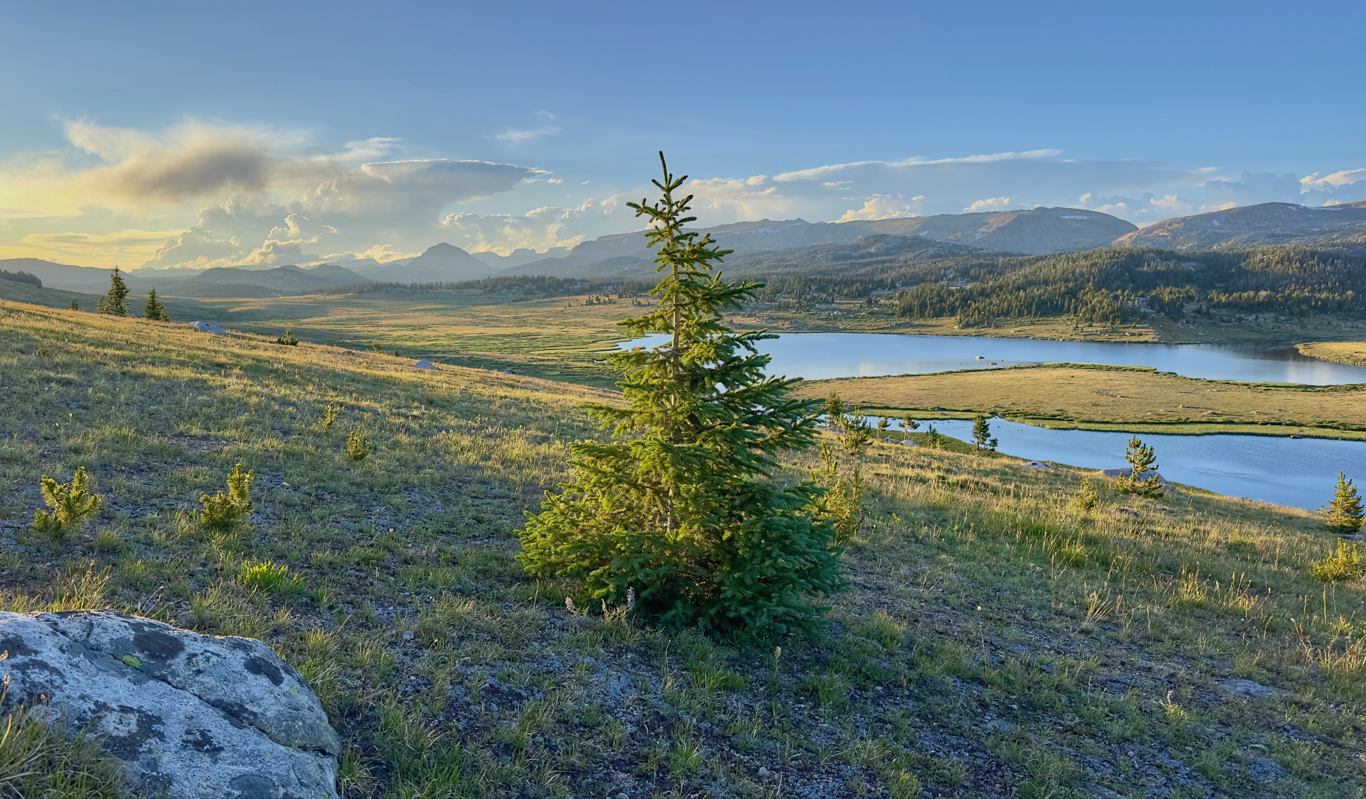
On a visit to the area with a friend from Raleigh a week before our camping trip, we took a spin down a dirt road that I’d been eyeing for a while. I love exploring the back roads in our national forests, and this one did not disappoint. There were lots of excellent camping spots with stunning views of the plateau, dotted with lakes and granite outcroppings reminiscent of the Sierras. So, when we had a few empty days last week, we headed back.
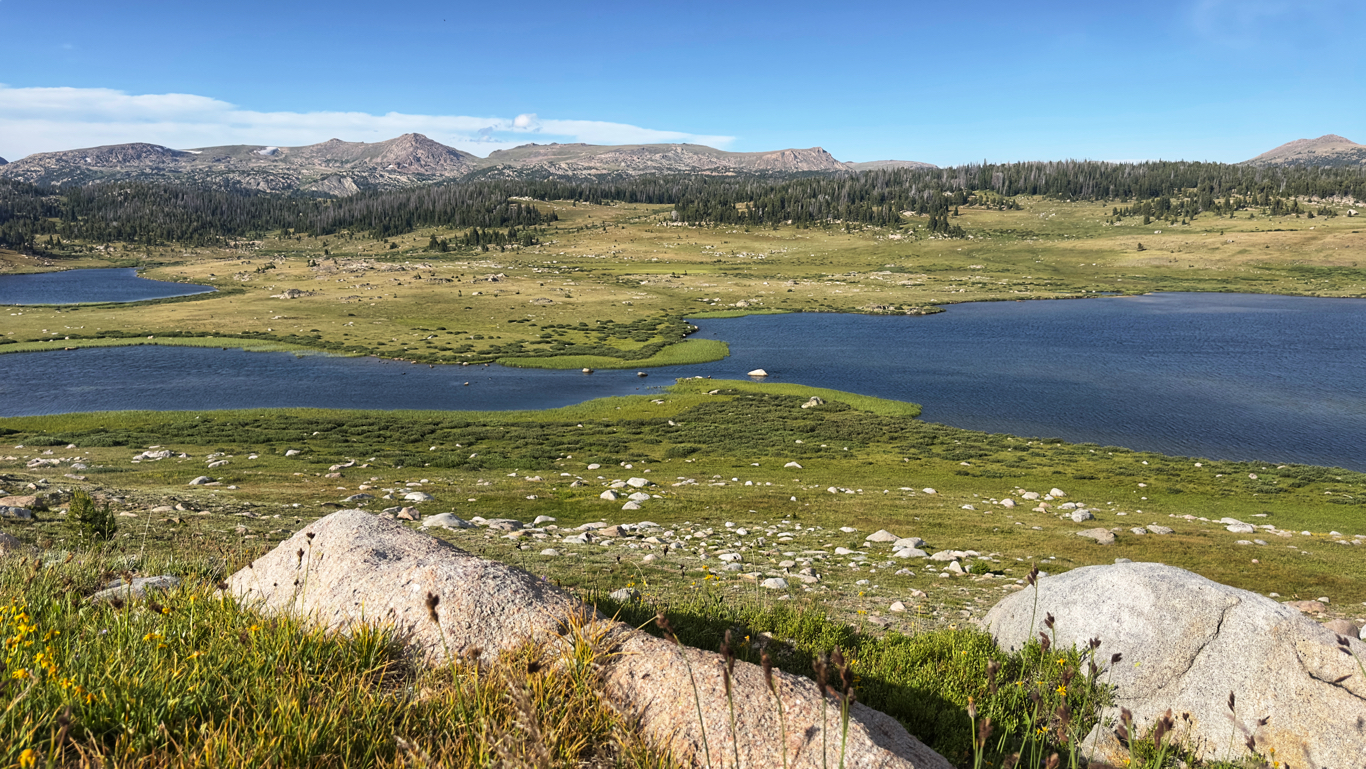
We spent most of our time enjoying our campsite and hiking through the adjoining meadows, learning new species of wildflowers and looking for wildlife. The most abundant critters were white-crowned sparrows and American pipits, the sparrows alighting on the small lodgepole and whitebark pine trees that crowned our hilltop, and the pipits favoring the ubiquitous boulders dotting the meadows. We spotted a marmot or two, unsurprising given their affinity for rocky burrows. And we saw quite a few insects, including a few more mosquitoes than we’d like, but also numerous bumblebees.
We recently took a workshop to learn how to contribute data to the Montana Bumblebee Atlas, so we were particularly drawn to observing these neighbors. Apparently, they do well in montane climates because, unlike most other insects, they can shiver to produce their own heat. We’re hoping to head back to the Beartooths tomorrow to do our first bumblebee survey!

The wildlife highlights of our trip, however, happened after we packed up camp and headed out. We decided to head up towards the top of the Beartooth Pass before driving home in the hopes of catching sight of a mountain goat and with the intention of “sitting for pika” (an activity where you find a rock field, pick a boulder, and sit for a while, hoping you’ll catch a glimpse of a pika running between the rocks).
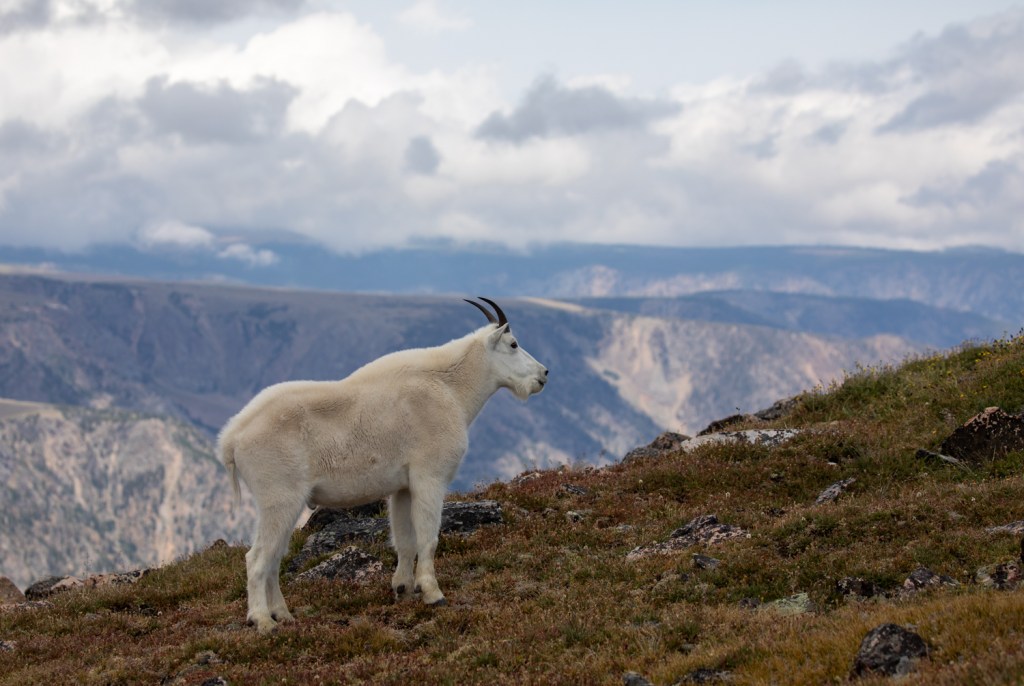
We were in luck! As we rounded one of the last switchbacks before the summit at a spot we’ve stopped many times before (folks who’ve been on a Yellowstone Institute trip with us will know the pullout!), Mike caught a quick glimpse of goats above the road. I swung the truck into the last bit of the pullout, and we grabbed our cameras and headed up the hill. The herd of goats were bedded down near the edge of a cliff. We approached slowly, not close enough to shift their behavior, and grabbed patches of scratchy mountain grass to sit on and watch them. The nearest goat in the group was a male (called a billy) with some nannies and kids (yup, that’s what they’re called!) below and behind his position.

The billy was sprawled out in a particularly photogenic spot, chewing his cud with eyelids drooping. After a while, he perked up and started rubbing his face on the rock next to him. I couldn’t tell if he was scratching, licking for minerals or salt, or maybe eating lichen. After the goats had moved on, I walked over to his rock to see if there was any sign that would help me solve the mystery of his behavior. There was a bit of crustose lichen growing on it, but not enough that it seems like a food source, so I think it may just have been scratching.

After quite a while, the billy stretched out and got to his feet. He took a few steps in our direction before the rest of the herd arose and began moving uphill. About four or five adults and three kids moved past him and began scrambling up the rocks toward the summit. After they all passed, he took a moment seemingly to survey his mountain domain, then followed them. It was a magical moment!
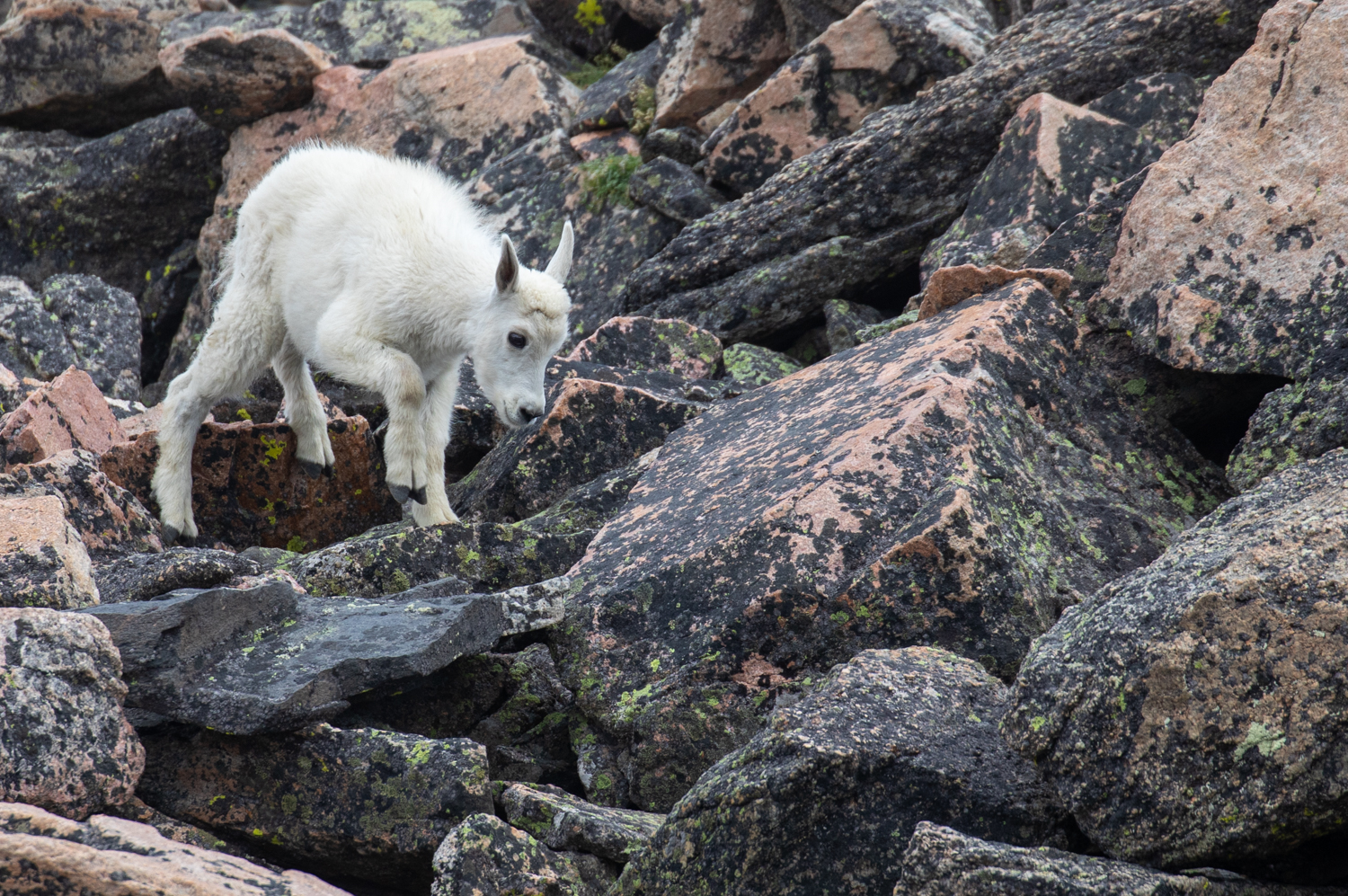
It’s amazing to watch mountain goats move with grace over talus slopes. Seeing them on cliffs from a distance has given me an appreciation for their ability to navigate impossible-looking terrain. But at close range, they seem to almost float across a landscape that makes me choose every step incredibly carefully and move slower than a caterpillar! The kids seemed to hesitate now and again, like the little guy pictured above. But their flexible and grippy two-toed hooves give them stability and allow them to make these mountains their home.
Rocky Mountain goats are actually an introduced species in the Greater Yellowstone Ecosystem. They are native to the Rocky Mountains in Canada and Alaska, ranging down to Washington, Oregon, and Idaho, and into western Montana, but not as far south and east at Yellowstone and the Beartooths. There are some concerns that they will take habitat niches used by bighorn sheep and that they may impact fragile alpine ecosystems in the area with their grazing.
Once the goats disappeared over the mountainside, we turned our attention to pika. We’d heard a few of their “eeep” alarm calls as we watched the goats, so we knew they were in the area. I waded (much more slowly than a goat) out onto the talus and found a somewhat-comfortable rock to perch on. After a few minutes of quiet sitting, I saw my first pika! It had a mouthful of grass that it was carrying to its haystack. Pikas do not hibernate, so they busily spend the summer months collecting and stashing plants in piles tucked under and around rocks, where they dry into a food source to last through the long winter.
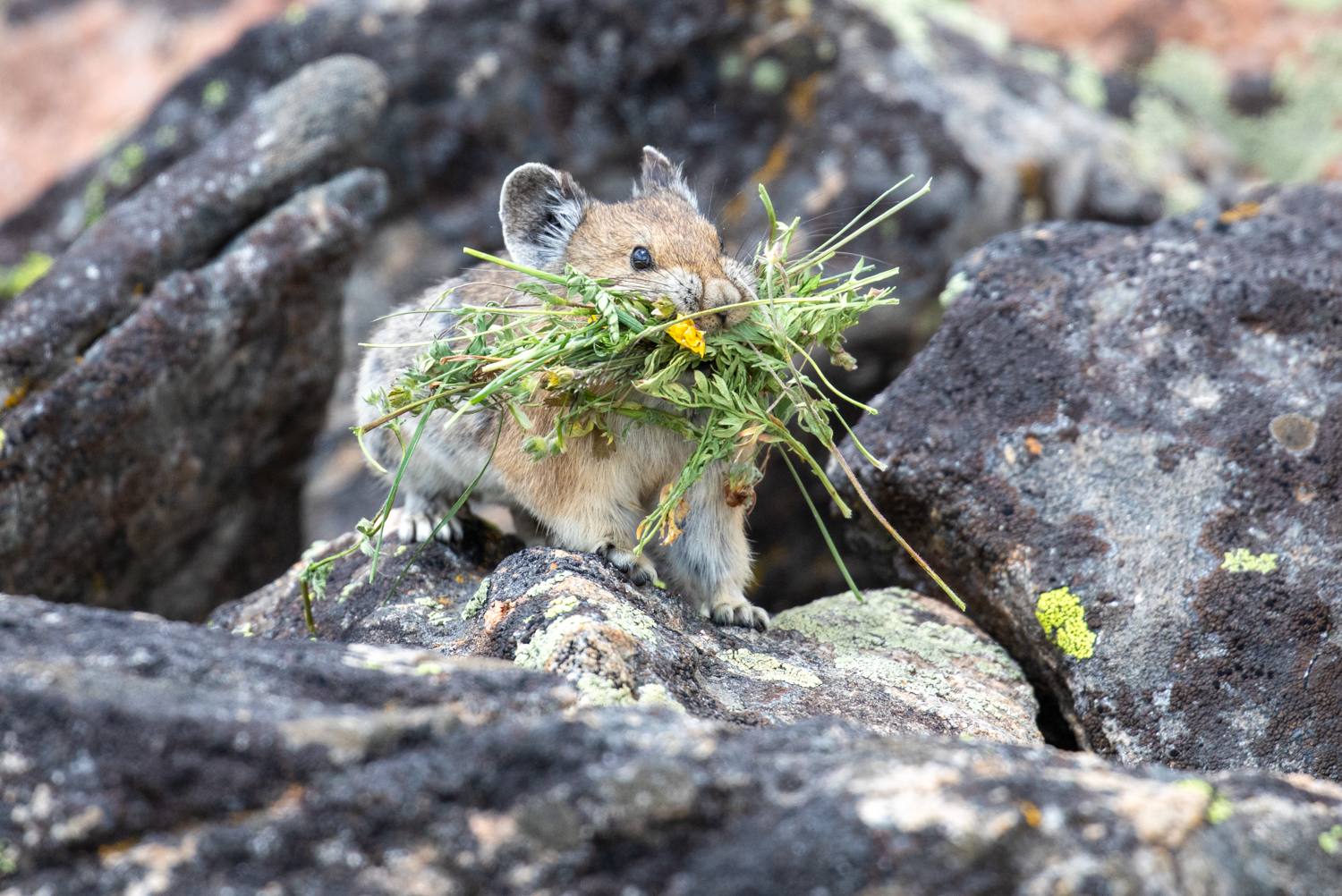
After watching a couple pikas with grasses head behind a notable pink boulder with plants and then depart empty-mouthed, I got up and slowly made my way in that direction. Soon enough, I spotted the pikas’ haystack in the rocks. It was a lot more extensive than I realized, extending under multiple boulders covering an area that was probably at least a square meter or two. I backed away to a spot where I wouldn’t disturb the busy critters and found another not-quite-comfortable rock to wait on.
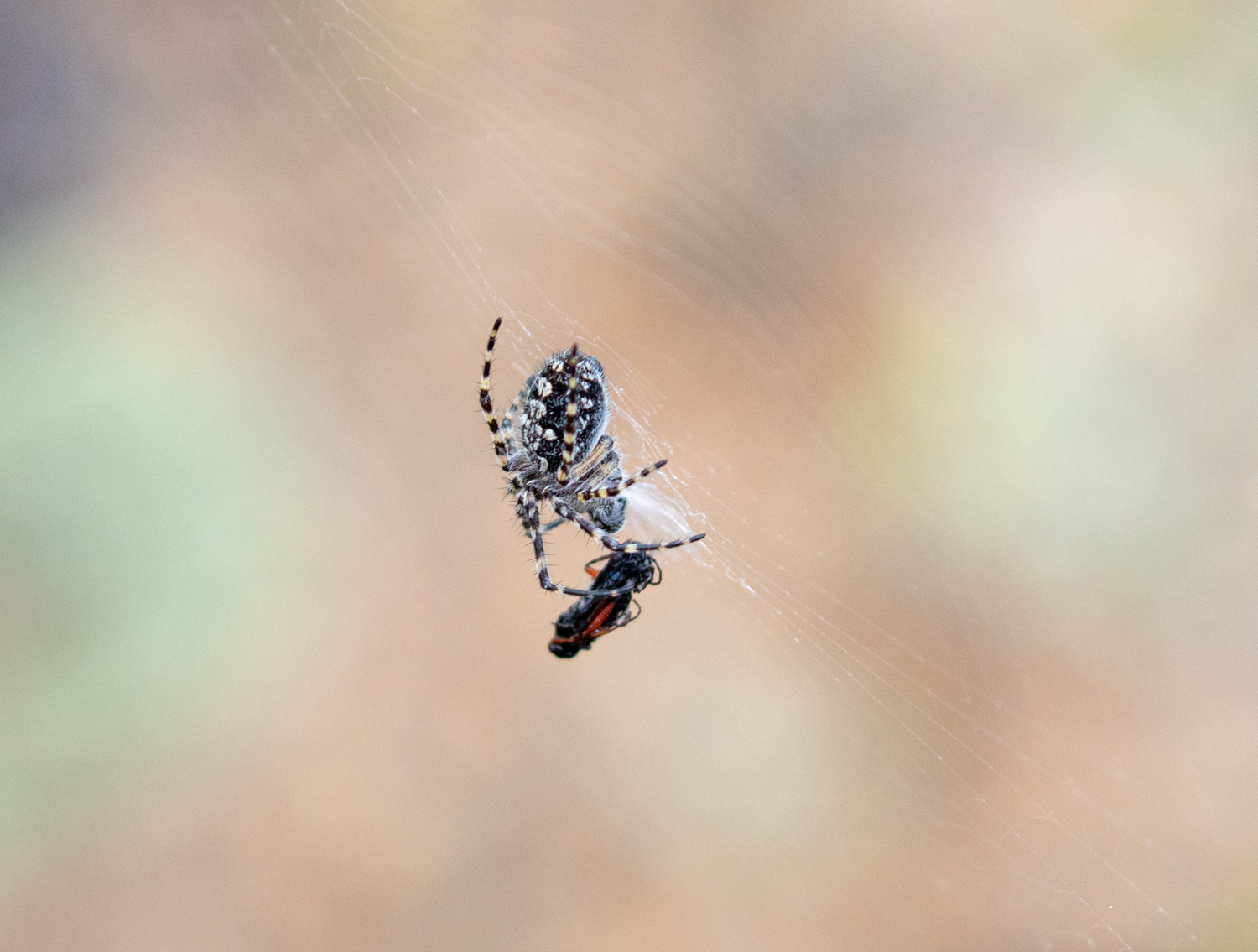
While waiting for the pikas to reappear, I got distracted by a different type of critter nearby. There were numerous orb-type spiderwebs strung around and between the rocks. At first, I thought the spiders were extra hairy and speculated that maybe that was an adaptation for the cold montane climate. But on closer inspection, I realized that their webs had additional silk in the center (where most of the spiders were sitting), somewhat similar to the stablimenta woven by Argiope garden spiders back east, though significantly smaller.
But back to the pikas… By softening your vision and not focusing on anything around you, your eye will catch movement in the environment; this is sometimes referred to as “splatter vision”. Using this technique, I was able to spot a pika out gathering grass and track its progress between rocks as it returned to add to the cache. After stashing its bounty, it headed back out for more.

Though you might assume pikas are rodents given their size and behavior, they are actually relatives of rabbits. They cannot tolerate temperatures above the high 70s for extended periods of time, and they rely on snowpack in the winter for insulation since they remain active year round. Both of those factors have made them something of a poster child for climate change. As winter snowpack decreases, pika may struggle to survive winters. And if you live at the top of a mountain, you can’t go higher up to escape hotter summer weather. Perhaps even more of an issue is that populations will become more isolated as corridors where they might once have been able to move between high elevations become too hot for them to travel. Fortunately, these cuties in the Beartooths seem to be thriving for now.


 Roads End Naturalist
Leave a comment