
If it is meant to be, it will be.
~Anonymous Japanese photographer
I’m going to try to catch up on some of the many cool things we have witnessed in recent weeks as we travel to learn about our new surroundings. Melissa’s parents visited back in July and one thing they wanted to see was a moose, arguably one of the more difficult creatures to find in Yellowstone. And, indeed, we did not find a moose here in spite of our travels up through the northeast entrance, usually the best place in Yellowstone to locate the largest member of the deer family. But, her parents also wanted to visit Grand Teton National Park during their stay, and that location offers you a much better chance of finding a moose. Yellowstone is estimated to have fewer than 200 moose whereas Grand Teton’s moose population is closer to 500 animals. And to further prove that areas’ moosiness, there is even an unincorporated community named Moose within the park.
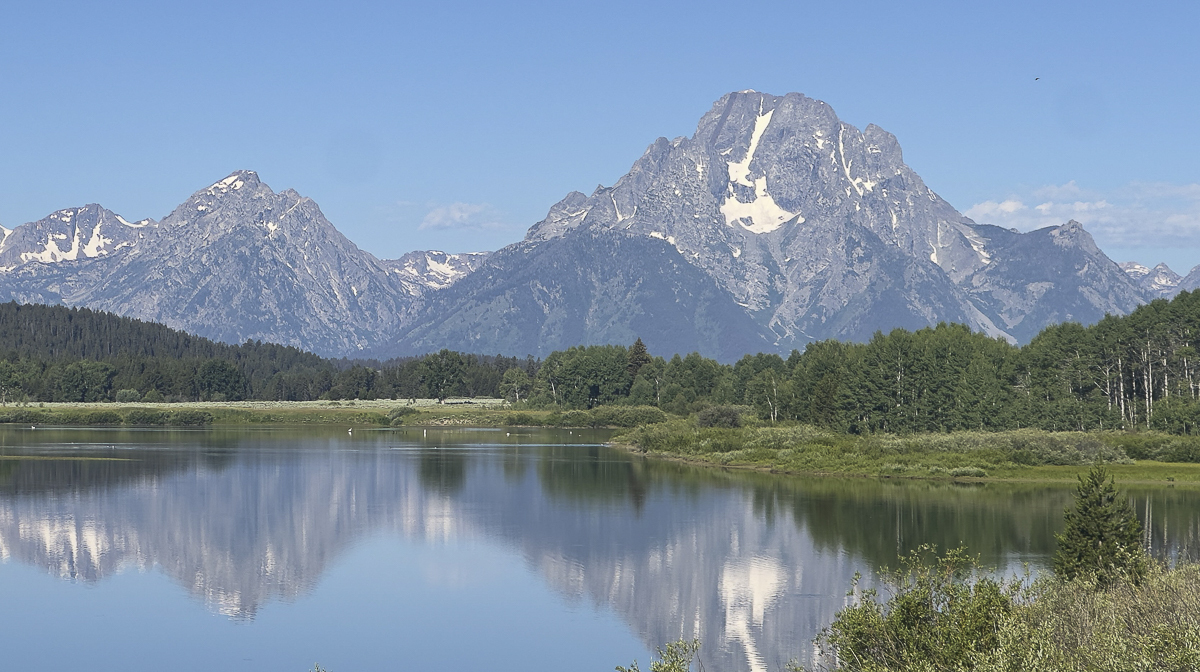
So, off we went to the Tetons for a couple of days and, sure enough, we spotted a cow and calf moose high on a meadow from the road at a place called….Moose Junction. They were pretty far away but we got out and looked for a bit and then headed on, hoping to get a closer look at another moose and perhaps even a large bull. Driving the Moose-Wilson Road produced no results but in a discussion with another visitor we learned his family had seen a large bull moose on a campground road the evening before and it had supposedly been hanging out in that area for a few days. That set our agenda for the final day in the park. We drove to that area late in the day and soon spotted a few cars pulled off on the side along the river. And there it was, a moose, and a nice bull at that!

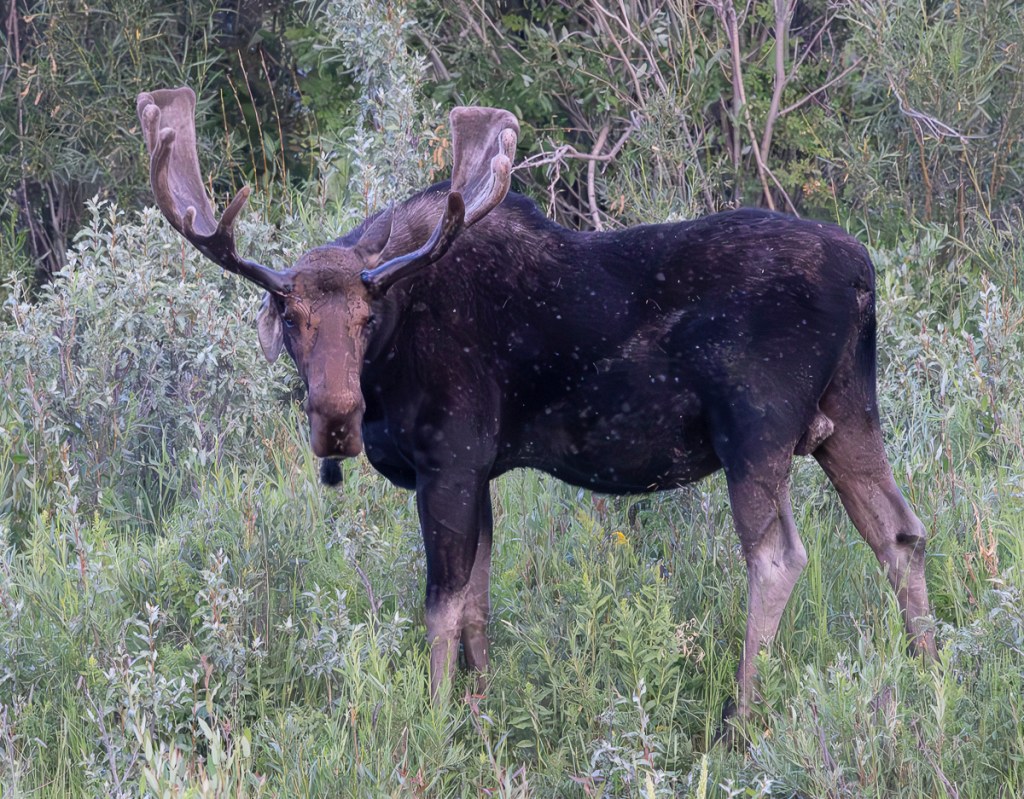
The moose’ antlers stood above the riparian shrubs, but the bulk of the animal was hidden as it browsed in the thick vegetation. It started moving and suddenly stepped out into the open.

We shared our scope with some bystanders and loved hearing the oohs and aahs as they got a closer look at this beautiful beast. Melissa had recently figured out a good solution for a phone adapter for her scope and started filming the moose as it fed. We switched to my phone so I could get a few clips and I was very impressed by the quality of the images, even in the low light of late evening.
Bull moose filmed through a spotting scope with a Phone Skope adapter for our iPhones
By this time, we had a few mosquitoes making an appearance but when I looked at the footage later I could see a cloud of insects around the moose. Not sure if he was being sucked dry or whether there was some sort of hatch of aquatic insects happening.
The other thing I noticed was his impressive dewlap (also called a bell). Many animals from birds to lizards have this anatomical structure which is defined as “a fold of loose skin hanging from the neck or throat of an animal”. The purpose varies according to species. In Carolina anoles (I miss those little green lizards that frequented our yard in NC), the males have an impressive extendable pink dewlap that they show during courtship rituals and territorial disputes. In some birds, the dewlaps (often called wattles in birds) may help with thermoregulation and sexual displays.
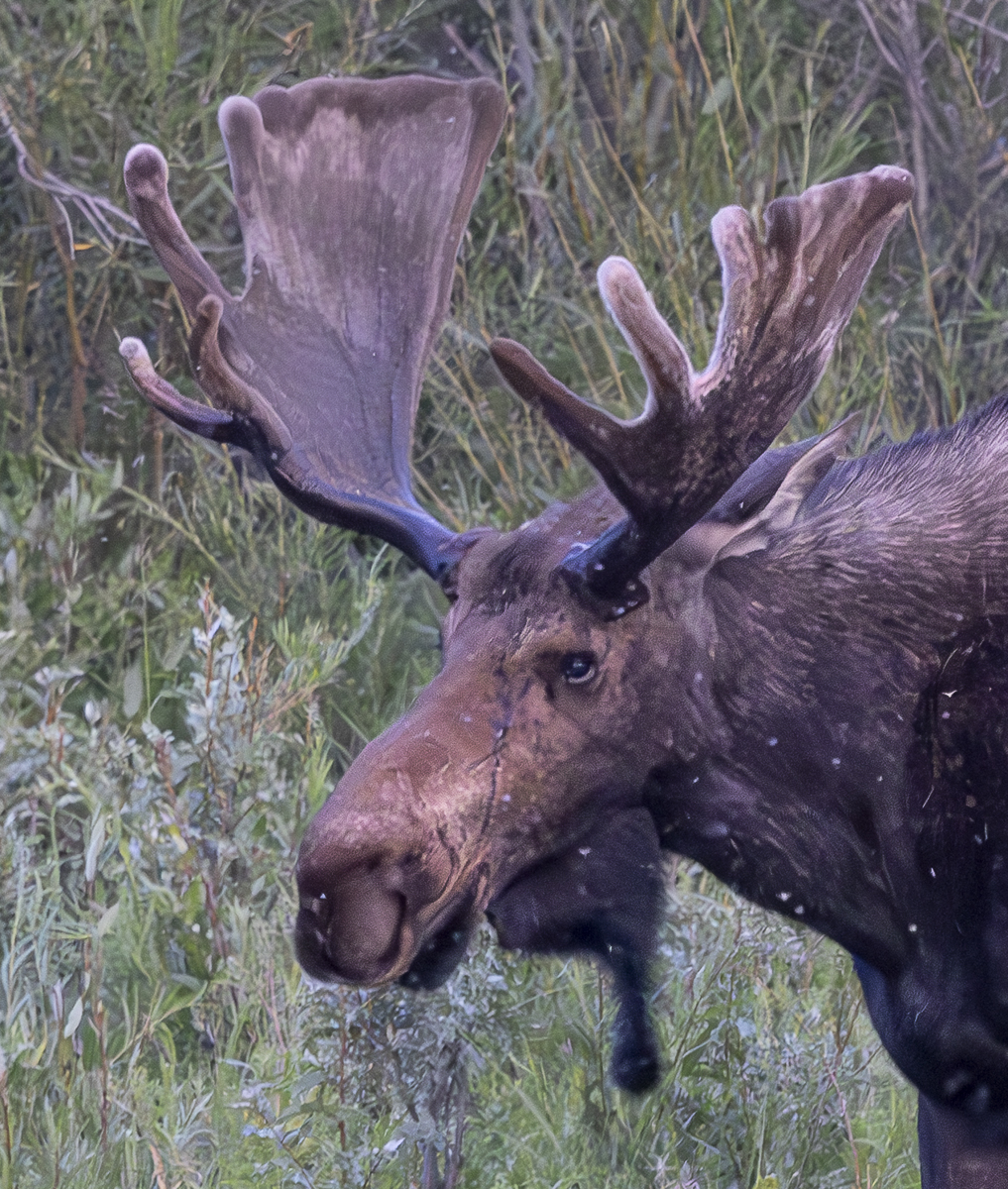
Studies of the dewlap in moose have been inconclusive as to its exact function. Perhaps a dangling flap of skin may help in thermoregulation by dissipating heat from this extra surface area of vascularized skin. Or, it may serve some function in communication. Bull moose tend to rub their dewlap on females during courtship perhaps transferring scent to them. The size and shape of a dewlap may also indicate something of the health of a bull and give a cue to females of his worthiness and to rival males of his potential dominance. Then again, it may be some sort of vestigial anatomical feature that has lost all or most of its original function over evolutionary time. I suppose only the moose knows for sure. At the very least, it is a fun word to have around when discussing one of our most impressive large mammals.


 Roads End Naturalist
Leave a reply to Stringernc Cancel reply