

Since I have what might be considered by some an abnormal fascination with caterpillars, I decided to keep track of the development of the Black Swallowtail eggs from the garden. The photo above is what a typical egg looks like shortly after it is laid.

Yesterday I was watering the garden and found an egg that was darker, indicating it might be close to hatching. I brought it in and took a closer look. You can see the larva inside if you look closely. The larva appears to be curled on the lower and right side of the egg with the head capsule near the top. There is also a dent in the egg so I was a bit worried that something had happened to it (or is this typical prior to hatching?).
I started taking photographs every few minutes and checking the egg for changes in between dinner ad catching up on some Daily Show episodes I had missed. Well, as my luck would have it, I looked at one point and the little guy had chewed his way out already….I had missed it.

As most species do, the larva began to consume the egg shell. There are no doubt valuable minerals and maybe even symbiotic bacteria associated with it so it makes sense to recycle the shell. The tiny caterpillar was eating very slowly so the shell was not completely consumed for over an hour after it hatched.

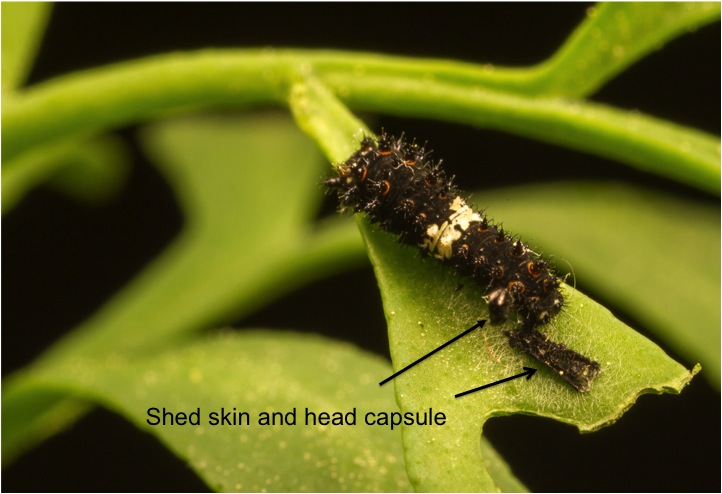
Meanwhile, the caterpillar I had photographed a little over a week ago has undergone its first molt. This one is feeding on rue and it seems the larvae tend to grow more slowly on that host plant than on fennel, parsley or carrots. Most caterpillars molt their skin five times from hatching to becoming a pupa. When ready, they typically spin a silken pad and attach themselves with their prolegs and become still for a day or two as changes take place for the molt. They then crawl out of their old skin and rest for an hour or two while their new skin hardens. Just like with the egg shell, they often eat their old skin for the nutrients. In the photo below you can see the shriveled first instar skin (excuvia) and detached head capsule lying alongside the newly molted and much larger second instar larva.


 Roads End Naturalist
Leave a comment