

One of the joys of heating with a wood stove is cutting and splitting wood. There is something satisfying about the pile of logs ready for the fire after a couple of hours of work in the cold, crisp air. But often, I find some interesting stowaways in my firewood. Such was the case this week when I finally decided to cut down a large maple snag, all that remained standing of a huge tree that had fallen this summer. The tree had rotted near the base and was riddled with soft wood, insect galleries, and fungi. After felling the snag, I started cutting it into manageable sections with the chain saw. As I cut through one point, I saw something move in a crevice in the wood.

It was a huge Dark Fishing Spider, Dolomedes tenebrosus. Way back in March, when I started this blog, I posted on a spider shed I had found – a Dolomedes shed. I have seen the living embodiments of that shed on may occasions since, usually in one of two sheds here in the woods (although I recently found one in the house and promptly captured it and let it go outside – this will probably not be shared with future house guests).
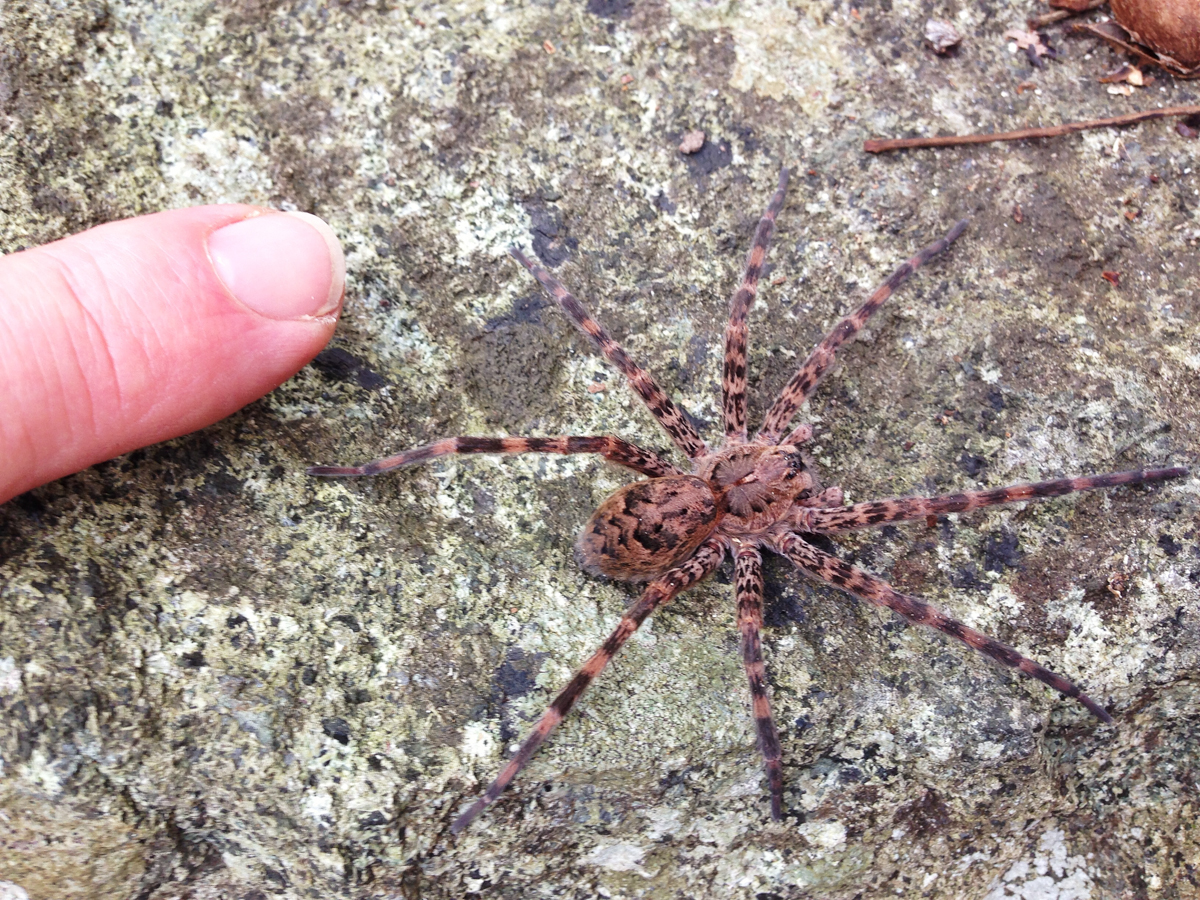
This is one of the largest spiders in North America, with the larger females having a leg span of up to 3 inches (males are about half that size). This species is the one Dolomedes that is most often found far from water. It is common throughout the Carolinas, hiding by day in dark areas like tree knotholes, stumps, pump houses, and my garden sheds. It is often seen resting in the vertical plane on the sides of walls, trees, etc.
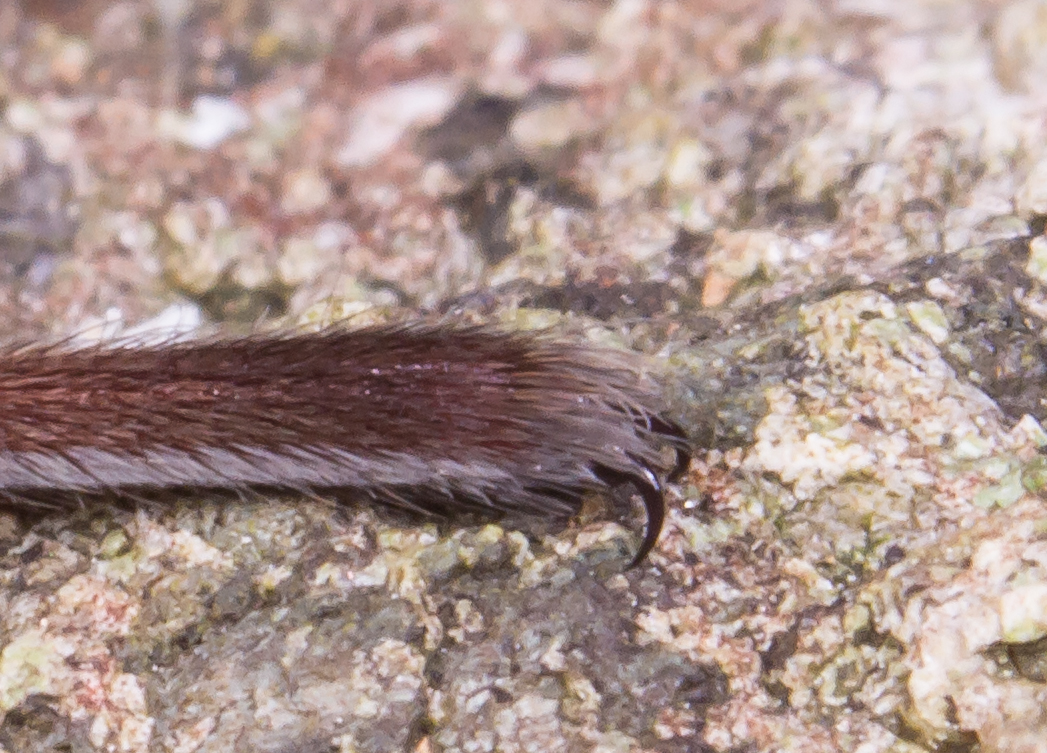
She was fairly lethargic so I was able to get close to observe. I saw something I had never noticed before, a pair of tiny black claws. Most families of spiders have two, equal-sized claws at the tip of their legs, with some having a smaller, third claw tucked in between.

I could also see the rather straight pedipalps that resemble short legs and are positioned between the jaws and the first pair of legs. The straight last segmet is characteristic of most female spiders. Males have enlarged tips on their pedipalps and the last segment is modified for sperm transfer. I refer to them as looking as if they are wearing boxing gloves.

Suddenly, I saw a movement off to my side, and there was another large spider, but only about half the size of the female Dolomedes.
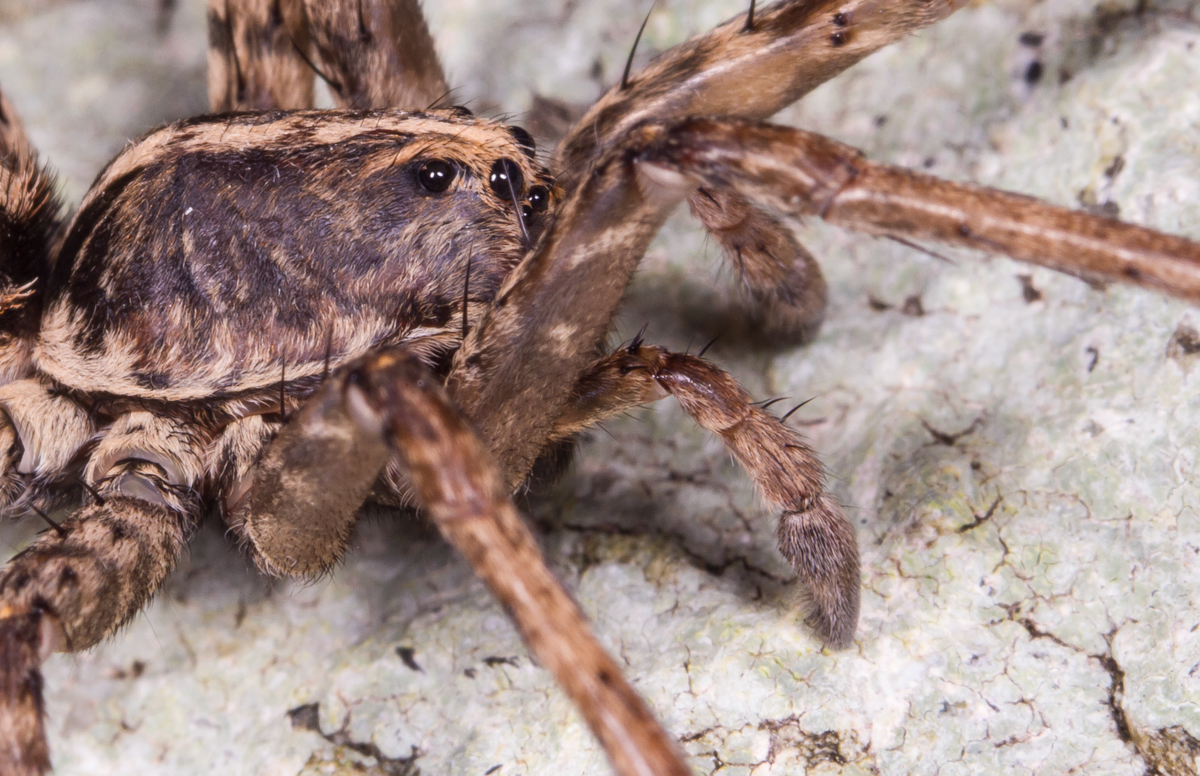
I looked at its pedipalps and the tips seemed somewhat irregular in shape so I thought this could be a male Dolomedes. It was much more active so after herding it around with a twig and getting a few shots, I let it ramble off in peace.

I went inside to look up the spiders and confirm their identities. The vast majority of spiders have eight eyes and a key feature for identifying different families of spiders is their eye arrangement. I confirmed the large spider as a Dolomedes, (probably D. tenebrosus).

Dolomedes spiders are in the family Pisauridae and their eyes are arranged in two slightly curved rows when seen head-on.These spiders do not build webs to catch prey but instead rely on their vision to stalk and capture anything from large insects to small vertebrates such as frogs.

When I looked at my images of the other spider, the eye arrangement looked different. Looking in the guides and online (there is an excellent article on spider eye arrangement at http://bugguide.net/node/view/84423), it appeared that the eyes on this specimen were in three rows. This arrangement, with the largest of the eyes being in the middle row facing forward, and the third row being up on top, is diagnostic of the family Lycosidae, the Wolf Spiders. I had also noticed a distinct difference in the chelicerae (the paired, downward projecting “jaws”, each containing a fang) coloration between the two specimens, but I wasn’t sure whether it was a difference between the sexes or indicated different species.


When both spiders are viewed from the side, you can see the difference in the eye arrangement more clearly. Based on this, plus the slight yellowish coloration of the chelicerae and the spiders’ large size, I now think the second spider was a male Carolina Wolf Spider, Hogna carolinensis. These spiders often make burrows to hide in during the day and then come out at night to stalk their prey. These, and other spiders in this family, are frequently seen at night when their eyes reflect the light from your flashlight. This is the largest member of the wolf spider family and is the official state spider of South Carolina. I did not flip it over to check the truly diagnostic feature of black coloration on the underside, but it looks like that species based on other factors, especially its size.
So, as is often the case these days, I frittered away a couple of hours photographing and learning about these two fascinating spiders. I even learned some fascinating secrets of the sex life of the Dolomedes spider, but will save that for another post. Guess that is one of the beauties of retirement, I have the time to fritter. Here’s wishing you some moments to pause and learn about your wild neighbors.


 Roads End Naturalist
Leave a comment