
Here’s to the land of the longleaf pine,
The summer land where the sun doth shine,
Where the weak grow strong and the strong grow great,
Here’s to “Down Home,” the Old North State.~North Carolina State Toast
In my last post, I talked about some of the amazing, small plants that grow beneath the longleaf, but not so much about the longleaf itself. It, too, is well-adapted for poor, sandy soils and thrives in an environment frequently visited by fire, and has some amazing strategies for surviving under those conditions.
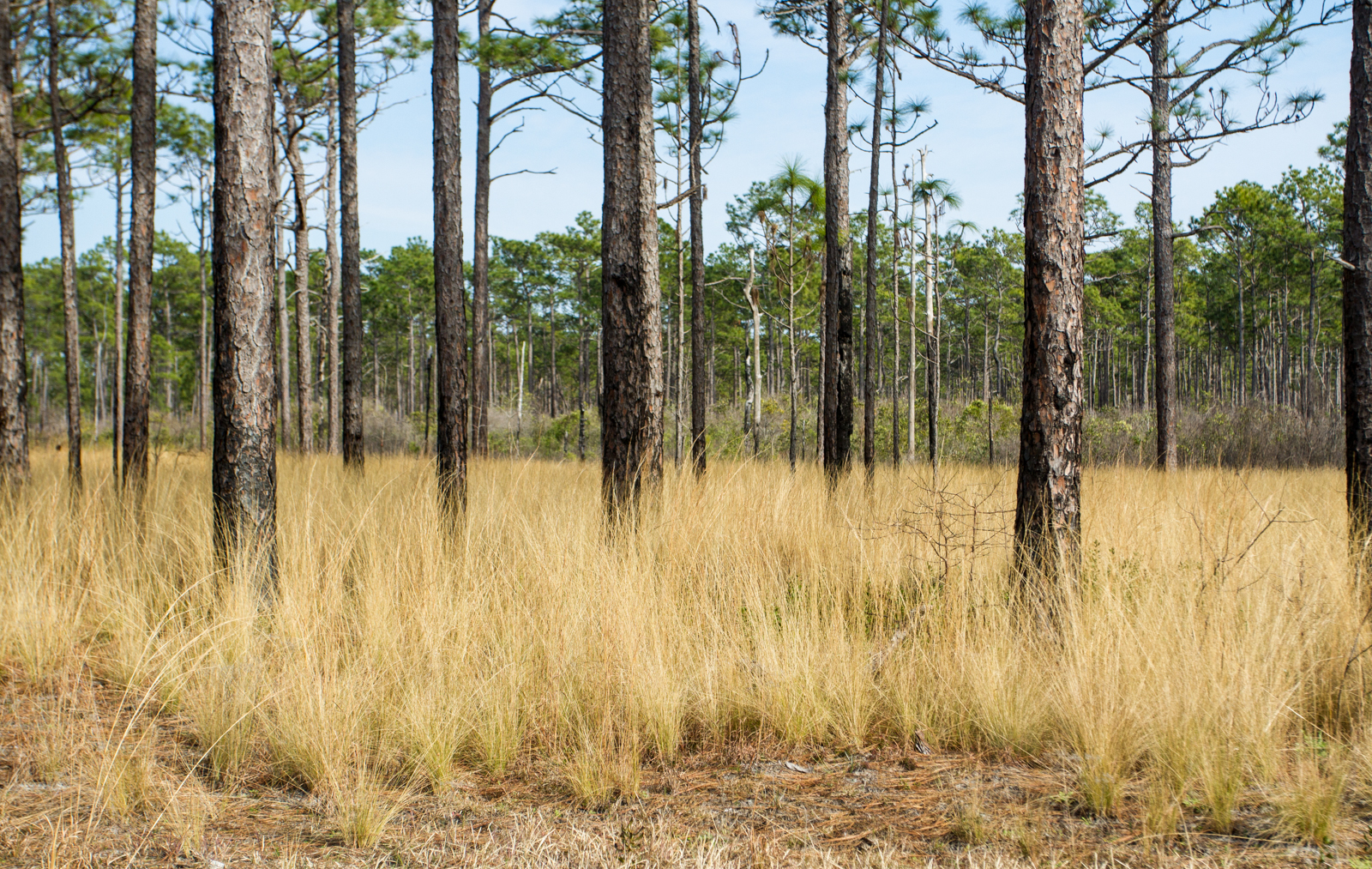
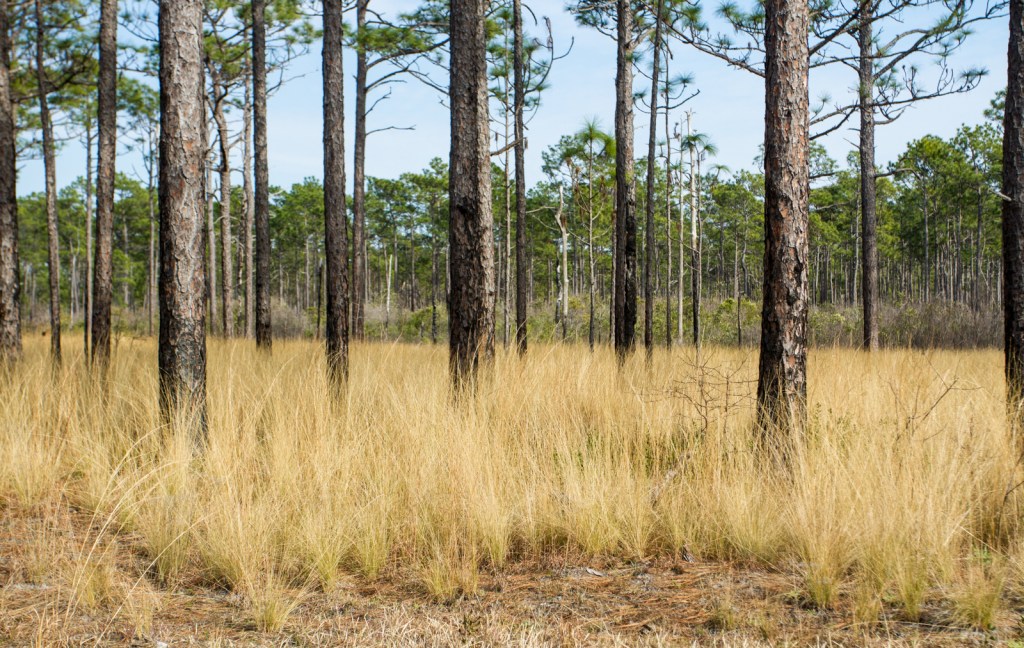
Longleaf are not tolerant of shady conditions. In a mature savanna, they grow spaced fairly far apart so that each needle on each branch can receive as much sunlight as possible. They lose their lower limbs as they grow larger, and viewed from the ground seem to provide a loose, permeable canopy held aloft by elegantly arranged poles. This openness is one of the reasons that the savanna has such a diversity of low-growing species. The other is fire. Fire clears away other shrubs and trees, like turkey oak and gallberry, that typically grow beneath longleaf pine, and opens the forest floor for shorter species, like carnivorous plants, as well as seedling longleaf. Mature longleaf trees have thick bark that makes them resistant to all but the hottest fires. But with fire occurring every 3 years or so, historically, how would that allow new longleaf to sprout? Well, their growing stages are also perfectly adapted to this sandy, fire-prone habitat.

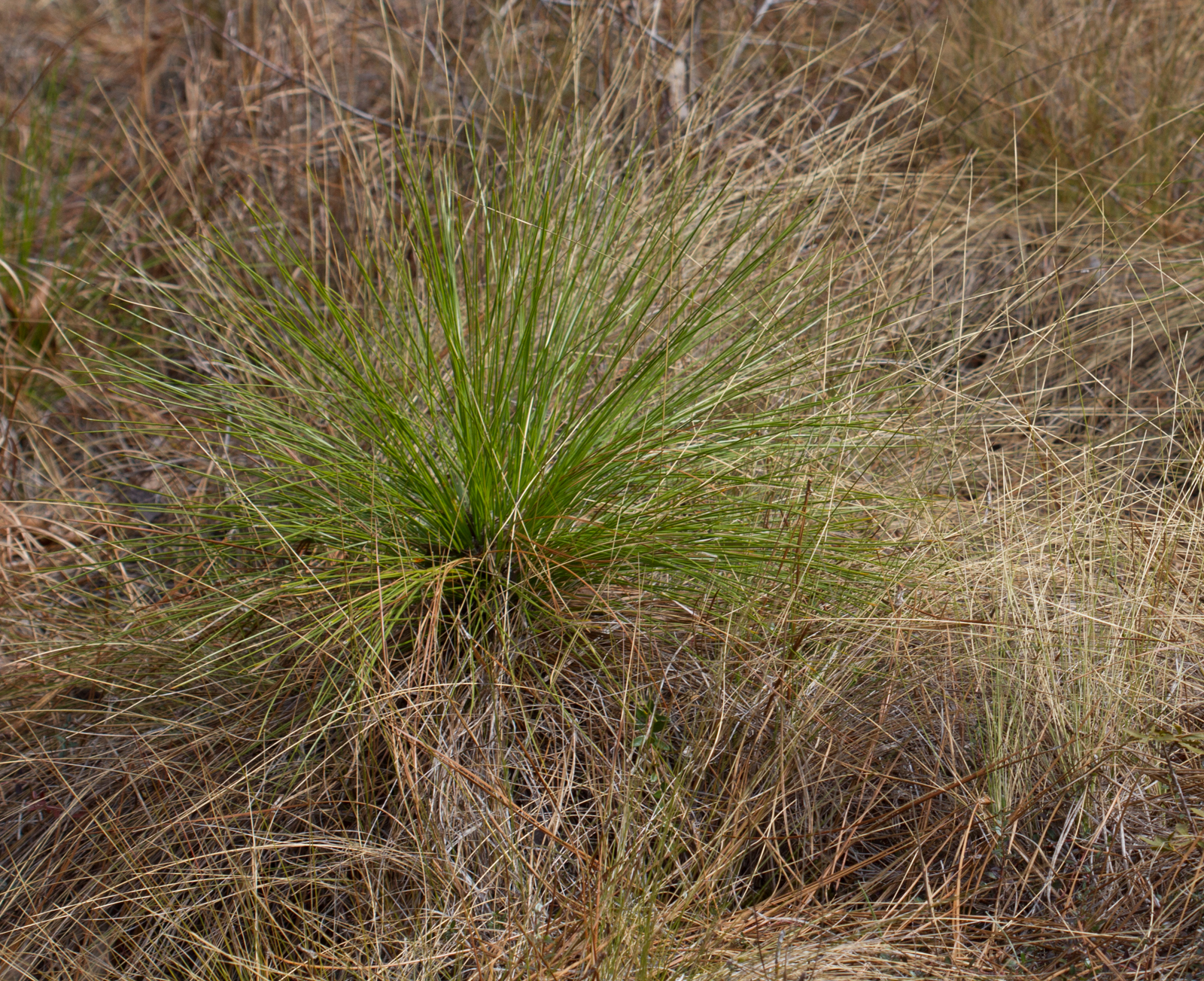
A longleaf seed is most likely to be successful if it germinates in a relatively open area where it receives a lot of sunlight… which is just what you would find in a longleaf savanna just after a fire. The seedling develops into a special phase of life, unique to longleaf, called a grass stage. At this stage, the “tree” is just a tuft of needles at ground level that looks very much like the surrounding wiregrass. For a period of around 3 years (sometimes shorter, but sometimes much longer), the longleaf grows downward rather than upward, sending a taproot deep into the soil to fuel future growth. During this stage, it is, perhaps surprisingly, fairly fire resistant. The thick needles protect the all-important growing tip at the heart of the grass stage. Even if the needles are mostly burned, the tree can still make it!
When the time is right, the longleaf moves out of the grass stage with rapid vertical growth. It develops a thick, white bud-like tip, sometimes called a candle, and from there begins its growth.

Its goal during this time is to get tall enough and develop thick enough bark to survive a fire. This is no time to worry about branches, so the young tree looks much more like a bottlebrush than anything else; this stage is often called the “bottlebrush stage.” Though an educator on a workshop once suggested that it should be named the “truffula stage” after the crazy-looking multi-colored trees in Dr. Seuss’ The Lorax. During this phase the young longleaf is most susceptible to fire.


But a tree just can’t grow up, and eventually the longleaf begins to grow out as well. The graceful side branches reach out horizontally and then turn up toward the sky. The “candelabra” stage is well-named! Longleaf tend to grow their 8-18″ long needles in clusters near the ends of branches, adding to the visual appeal of the tree.
At about 25-30 years, longleaf reach maturity and start producing cones. Though the species is fire-adapted, it does not have serotinous cones – cones that open in the heat of fire. A neighbor to the longleaf, the pond pine, which commonly grows in boggy pocosins adjacent to longleaf savanna, does have serotinous cones. My coworker Megan decided we needed to observe this phenomena for ourselves; so, armed with a lighter and a closed pond pine cone, we did! With the heat from the lighter, the scales of the cone opened with an audible pop, kind of like the popping of popcorn. Inside each scale were two winged seeds, as with other pines. Pond pines also grow best after fire, so their serontinous cones are a great adaptation to promote growth when the conditions are right. Longleaf don’t use that strategy even though they depend on similar conditions for germination. But their cones are equally impressive. The largest pine cones in North Carolina, they can be up to about 12″ long!


The oldest documented longleaf in North Carolina is found in Weymouth Woods State Park and is more than 465 years old! Though perhaps at one time there were many such old monarchs of the forest, that’s rare now. But mature longleaf play a very important role in the ecosystem, particularly for red-cockaded woodpeckers. As longleaf age, they become more susceptible to red heart fungus, which softens the (very hard) heartwood of the tree. Red-cockaded woodpeckers are our only species of woodpecker that seek out live trees for nesting, and they prefer mature longleaf pine that are infected with red heart fungus. This is because they hollow out nest cavities in the living trees, and the softening due to red heart makes that easier. They also peck holes in the tree surrounding their cavity that draw out the tree’s sticky resin. This acts as a defense against a common predator, rat snakes. If you’re visiting a longleaf forest and spot trees painted with white rings, look up for the cavity! Biologists studying RCWs mark their nest trees in this way to make them more visible.


The longleaf pine savanna is an amazing diverse habitat, and the longleaf pine is well-adapted to live there. If you have the chance to visit, see if you can spot each stage of its life – grass, bottlebrush, candelabra, and mature tree!



 Roads End Naturalist
Leave a comment