Departure of a year welcomes so many new memories.
~Munia Khan
Our woods offer a lot of things to us – a quiet soundscape, a canopy of huge trees that help cool our landscape in summer, majestic gray forms that stretch to the winter sky, and a source of nourishment and shelter for the countless wild neighbors that share our land. I try to observe as much as I can in my wanderings in the yard and on our forest paths, but I am not out there all the time. When I am not present, I have other eyes to record the comings and goings of the wildlife. In the final two weeks of last year, the trail cameras recorded the usual activities of the herd of deer (still munching on the abundant acorns), the scampering of squirrels, the nightly forays of the Raccoon family, and even some neighbors enjoying the woods. But there were also some nice surprises. Here are a couple of new memories from the final days and nights of 2022…
That’s a wrap for trail camera adventures for last year. Looking forward to many more glimpses into the lives of our wild neighbors. Now, if only a wandering bear would stop by…
It is a sad truth, but we have lost the faculty of giving lovely names to things.
~Oscar Wilde
I enjoy cold winter days as I tend to pay more attention to the little things in our woods like patterns, surprise colors, and living things that I sometimes pay less attention to in warmer months when birds, insects, and flowers seem to always demand my attention. Mosses, lichens, slime molds, and fungi suddenly take more prominence (although they really deserve our appreciation all year).
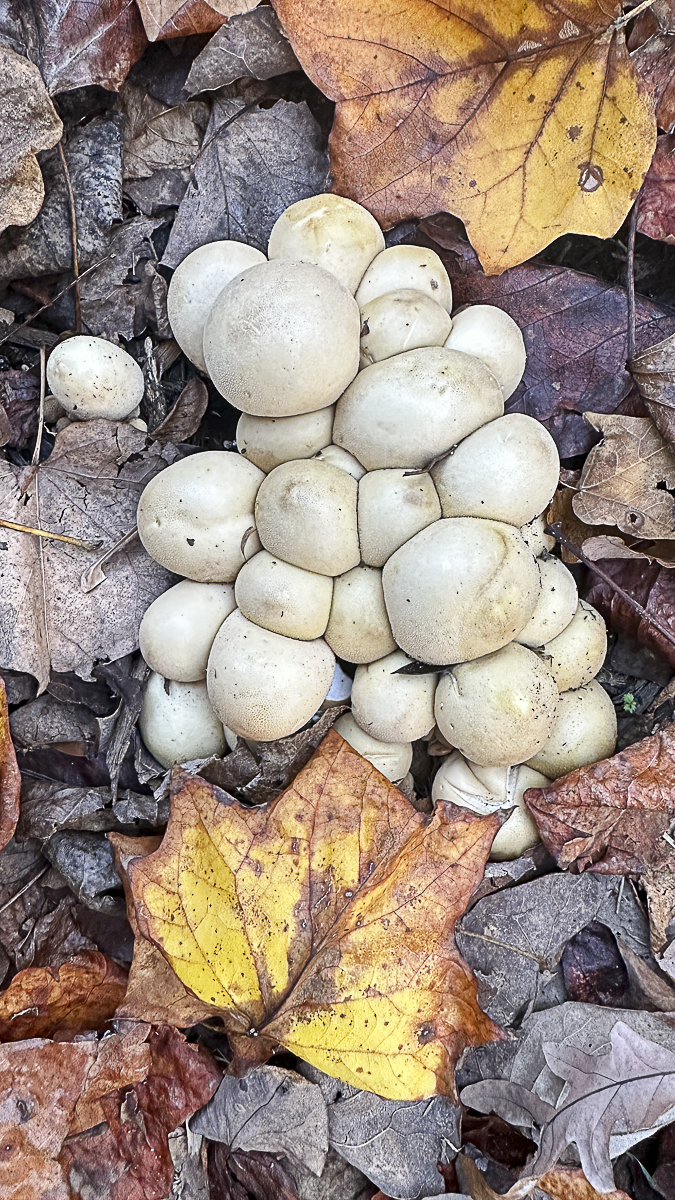
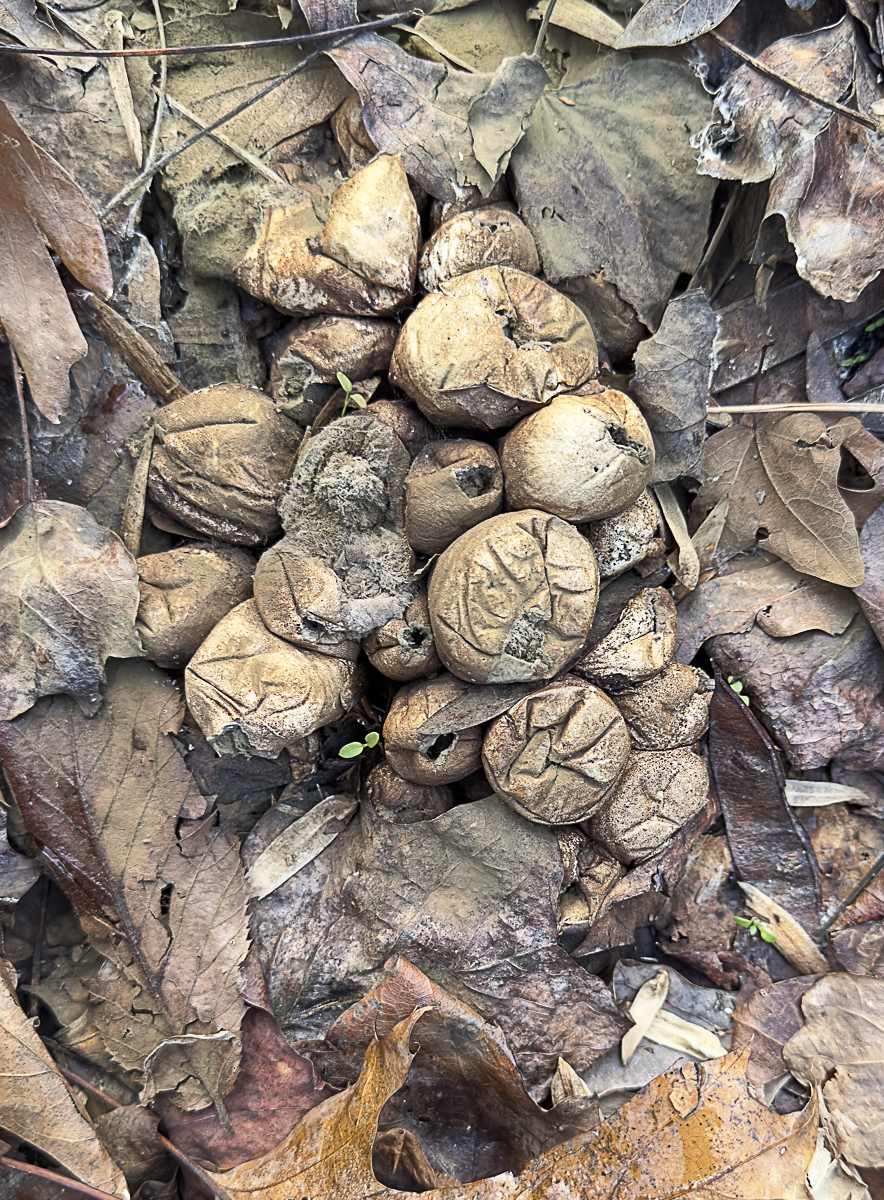
This has been a good season for fungi in our woods, and one group, in particular, really caught my eye. In November, I spotted several clusters of round white blobs on downed trees or the mulch in our yard. As Fall progressed, I began to recognize them as puffballs, so named for their spore dispersal mechanism. As they dry, they develop splits on the surface and any physical disturbance, such as raindrops, the tap of a finger, or an accidental footstep, will send clouds of brownish spores up in a tiny billow of “smoke”. I photographed one on a pathway in our yard back in November and again right before the holidays. Below are the photos and a short video of the spores being released.
A cluster of Wolf-fart Puffballs in our yard in early November (click photos to enlarge)
The same cluster in December
When I came across some drying puffballs in the woods a couple of weeks ago, I couldn’t resist making puffball smoke by gently poking them with my finger. Here’s a slo-mo clip of puffballs doing their thing.
Thinking I might want to post this, I decided to learn more about these unusual fungi. When I put the photo in SEEK, the all-things-natural identification app, I loved the common name that came up – Wolf-fart Puffballs. Yep, that’s what I said, wolf fart. The scientific name is Lycoperdon pyriforme. It turns out the translation of that name defines the common name – “Lyco” means wolf in Greek; “perdon” means to break wind. Together, they mean wolf fart! People understand how the word fart came to be favored given the visible puff that comes up when one is touched, but why the association of wolves? Who knows. And “pyriforme” means pear-shaped referring to the shape of some of the structures.
After laying next to a clump to get the ground level video, and having a breeze blow some of the spores my way, I thought that perhaps it is not a good idea to breathe in the spores. And with some research I discovered that I was right! If you inhale large numbers of spores you may suffer from respiratory problems. But, medical experts say it requires inhaling a large quantity of spores to show any signs of lung distress, so I suffered no ill consequences.
As always, I am amazed at the wonders just outside our door. Take some walks this winter and see what catches your eye.
Ice has a social life. Its changeability shapes the culture, language and stories of those who live near it!
~Robert Macfarlane
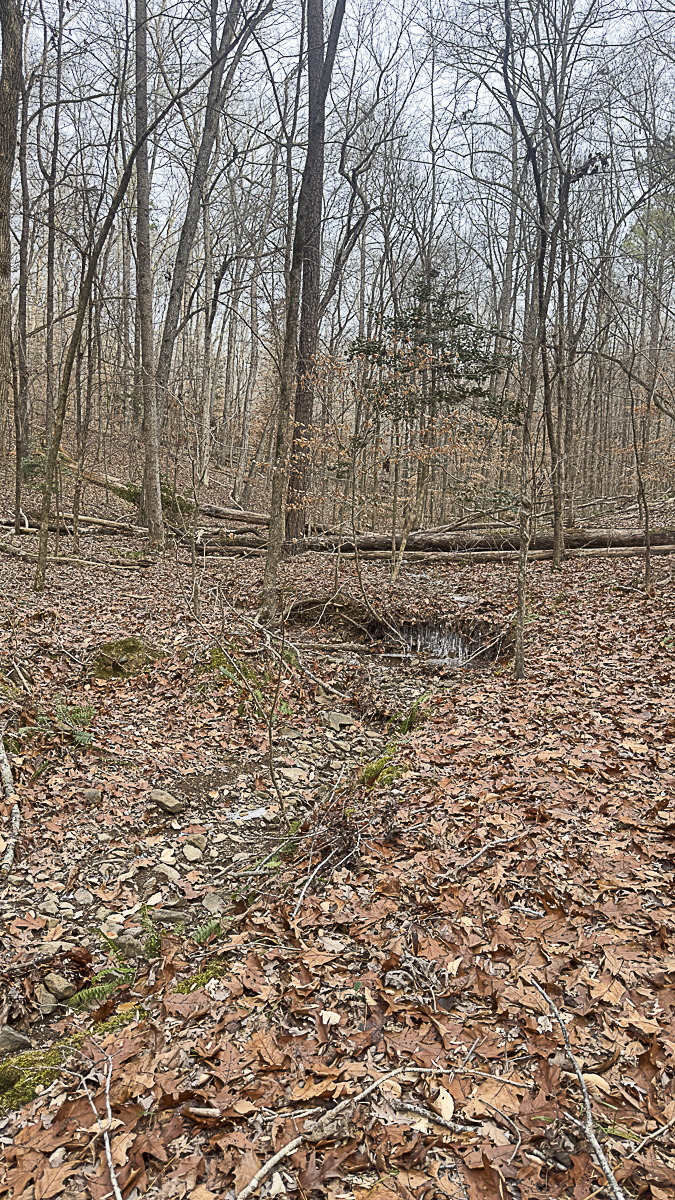
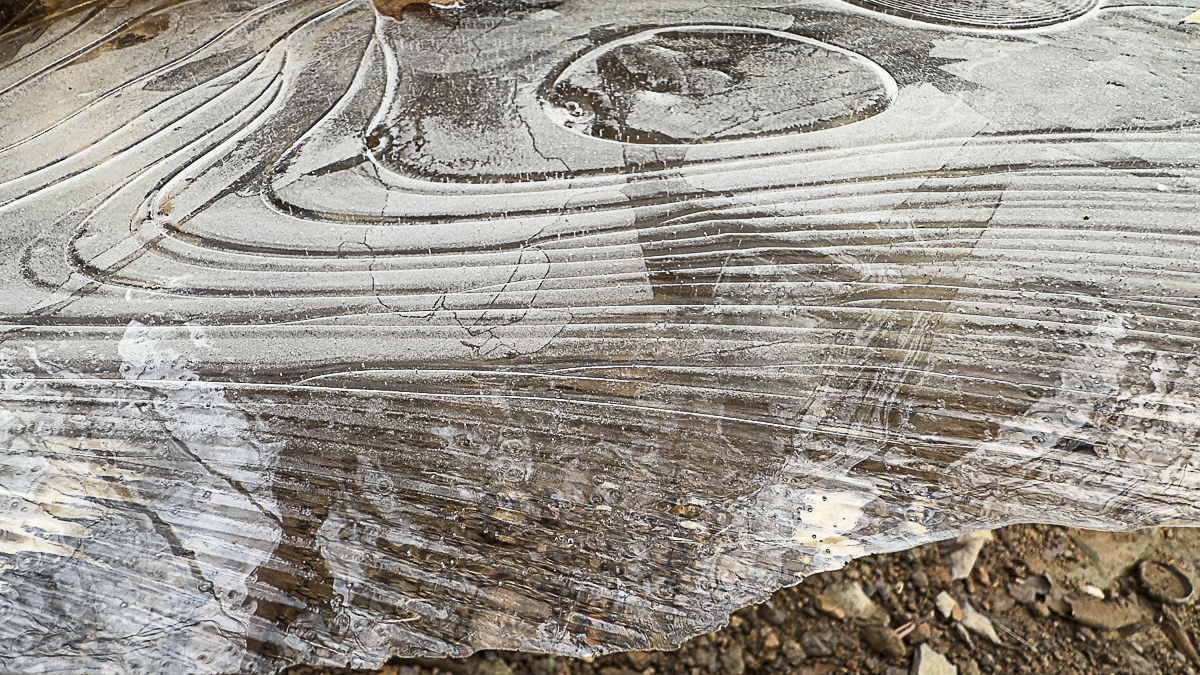
I went for a walk in our cold woods on Monday and came across some remnant ice patterns left from a combination of heavy rain followed by frigid temperatures while we were away for the holiday. Our little creek is a wet weather stream, usually only flowing after abundant rain in winter when most of the trees lining the creek bed are dormant.
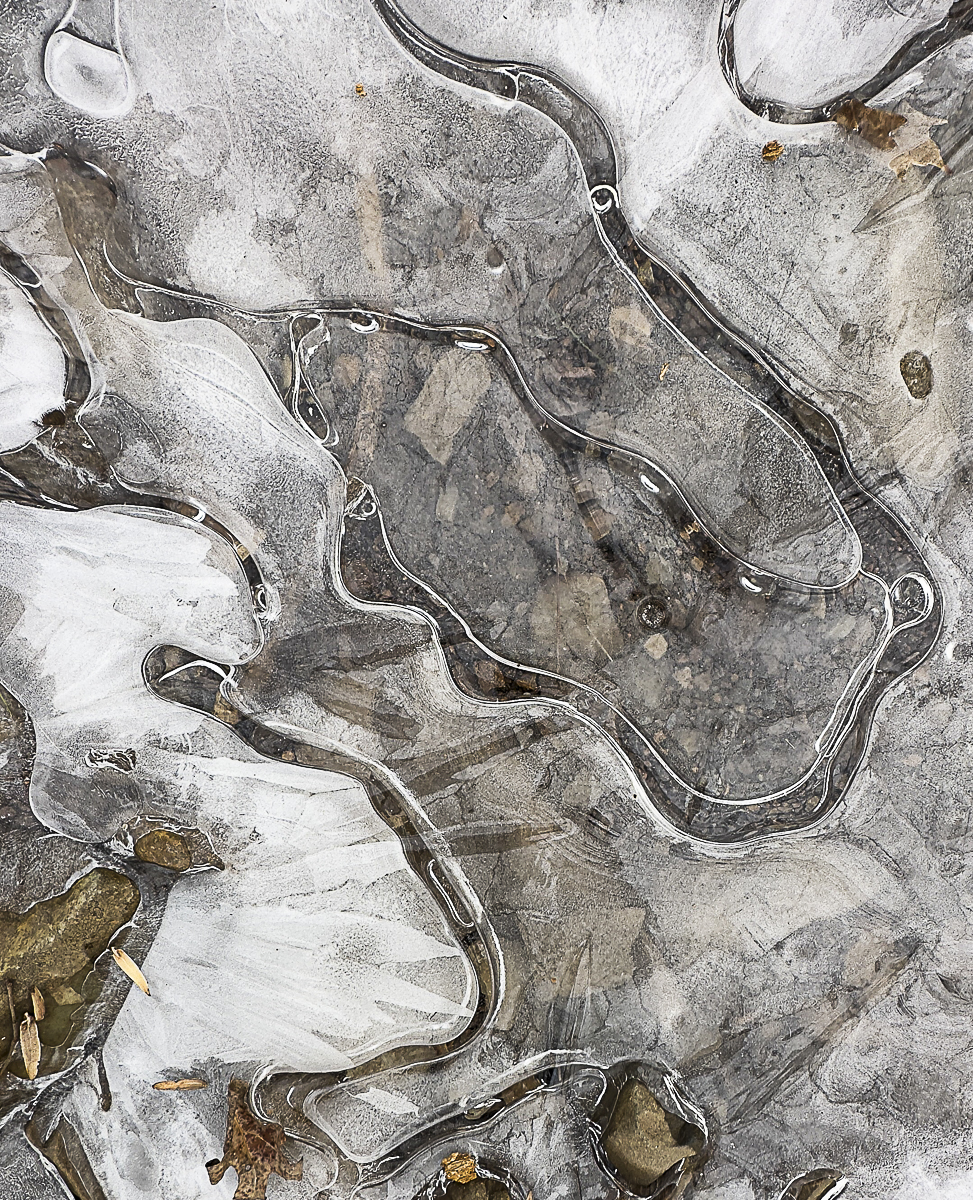
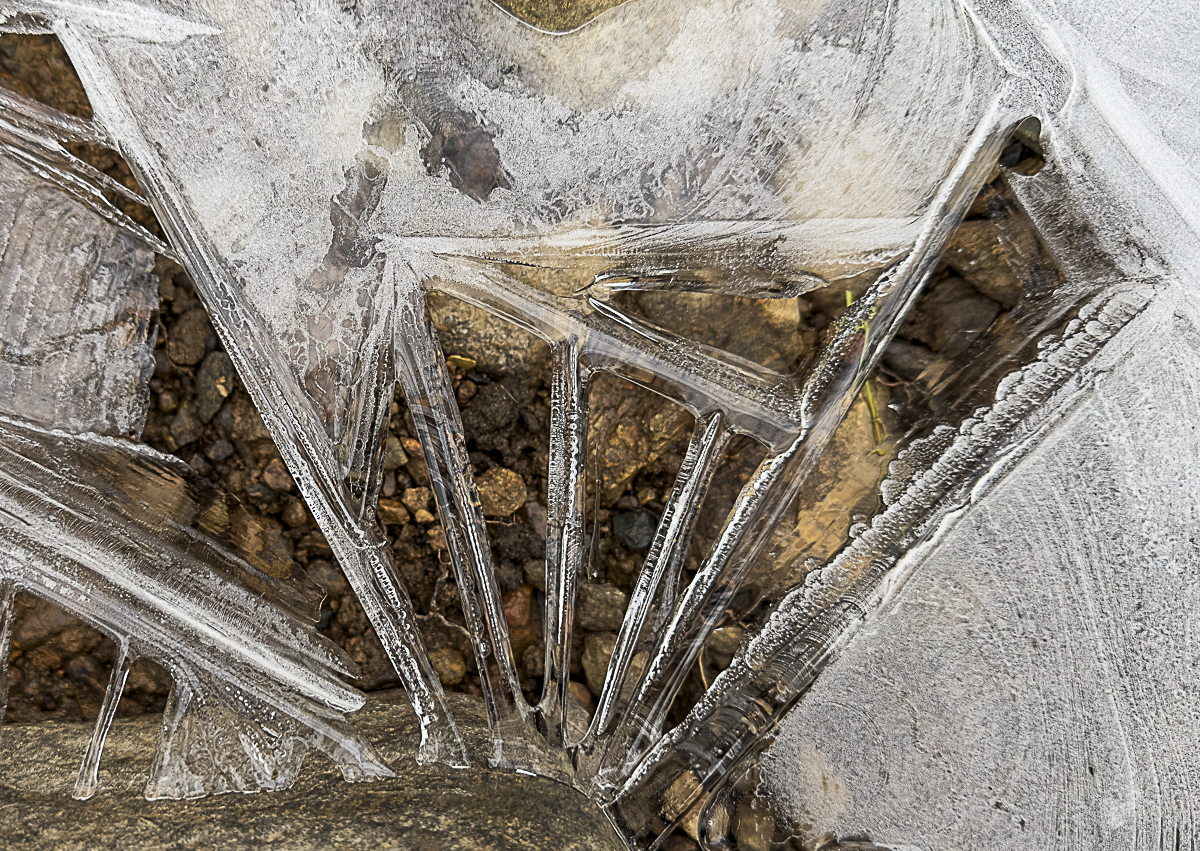
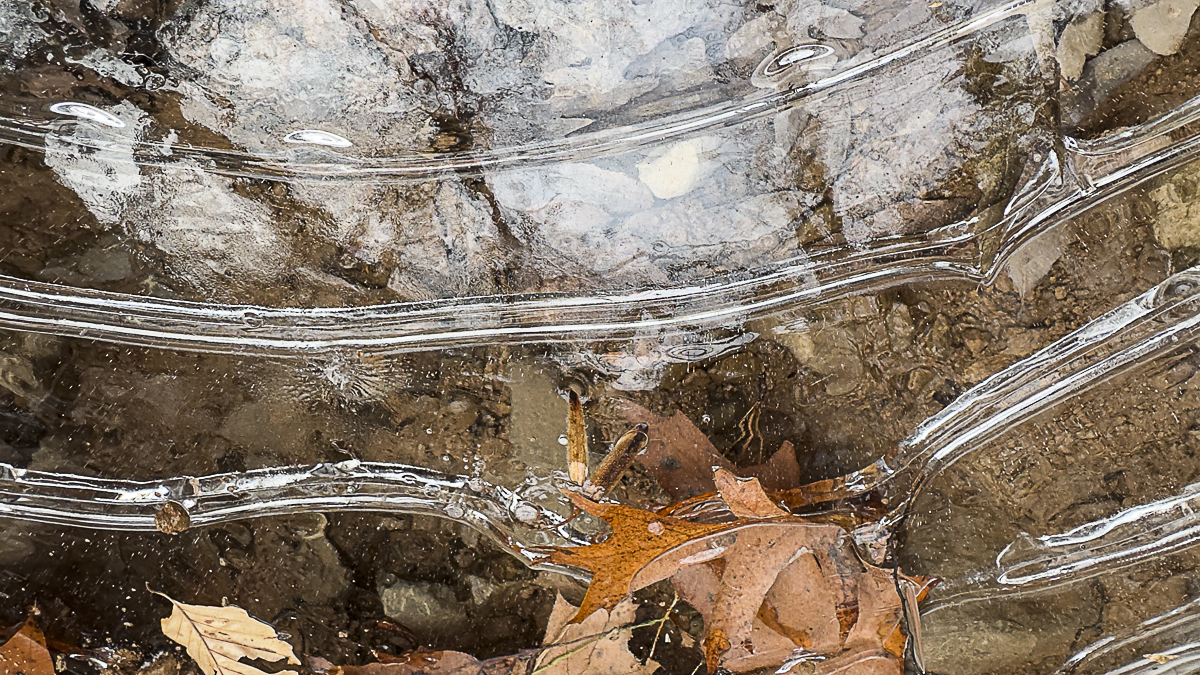
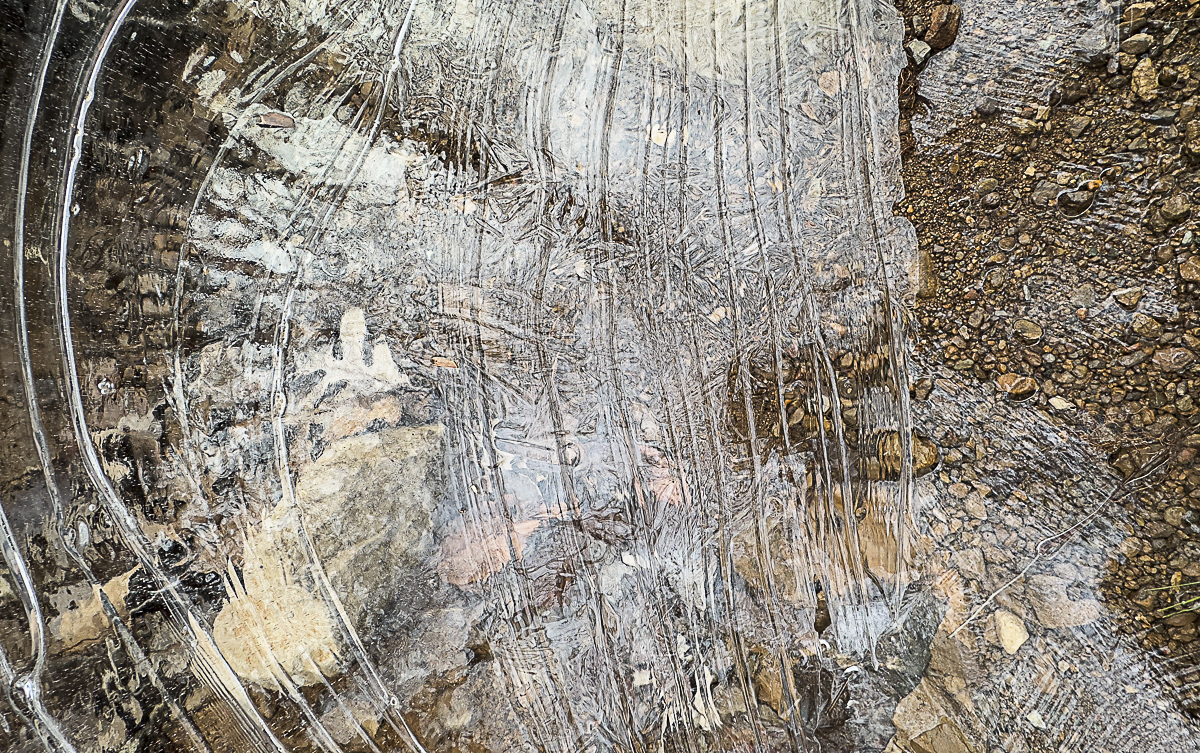
Our now dry stream bed held onto some beautiful ice sculptures for a few days after the rains (click photos to enlarge)
It looked a bit odd to see ice art in a dry stream bed. There was even a perched ice shelf over a depression that had held a foot of water only a few days before. With the warming temperatures, the intricate ice patterns are retreating, leaving only memories of the ephemeral beauty they added to our woods. I’m glad I was able to enjoy them for a day at least…
Ice columns on rootlets where a small waterfall forms after heavy rains
A shelf of ice suspended almost a foot above a now dry pool
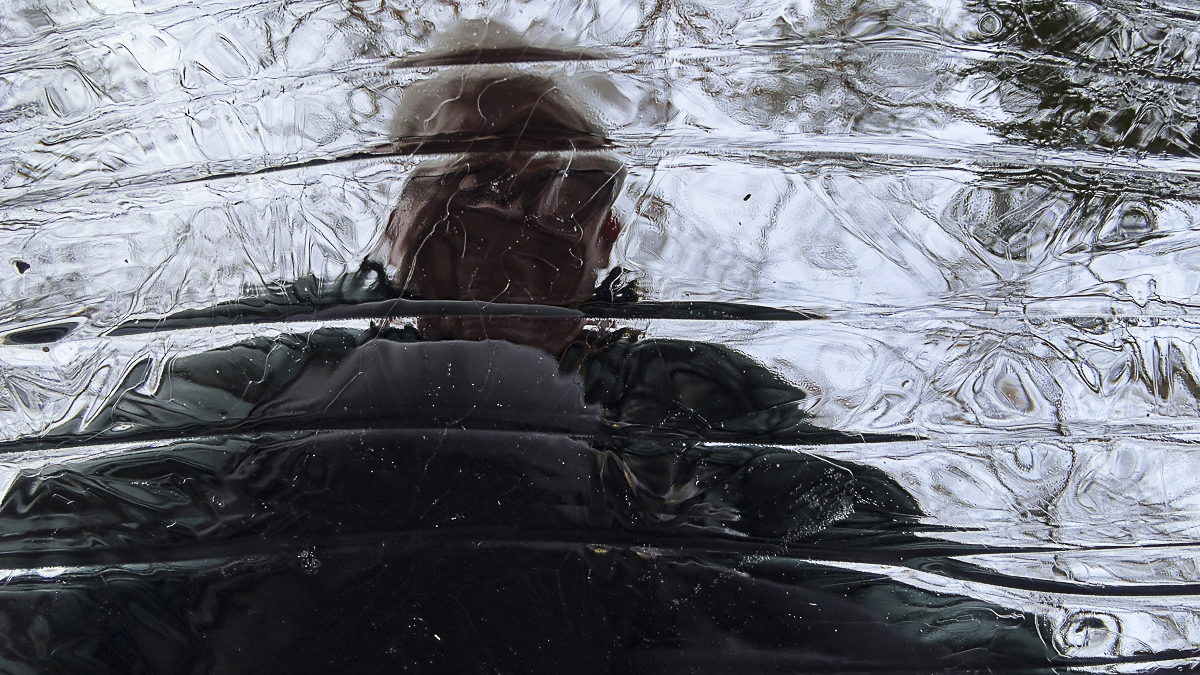
I held the phone underneath the ice shelf and took a photo up through the ice to capture the tree outlines above
Self portrait from below the ice shelf (the least glamorous photo of the day)
Many people think of winter as bereft of birds after autumn migrations, but in fact this can be a bountiful season for bird-watchers.
~Val Cunningham
It is the time of year when I yearn to be with the birds of Pungo. There is something magical about their abundance, their flight, and their sounds. And the cast of characters that accompany them is pretty great too. So, this past week, I headed east early one morning to eventually meet up with some friends of a friend to show them some of the wonders of our coastal refuges in winter.
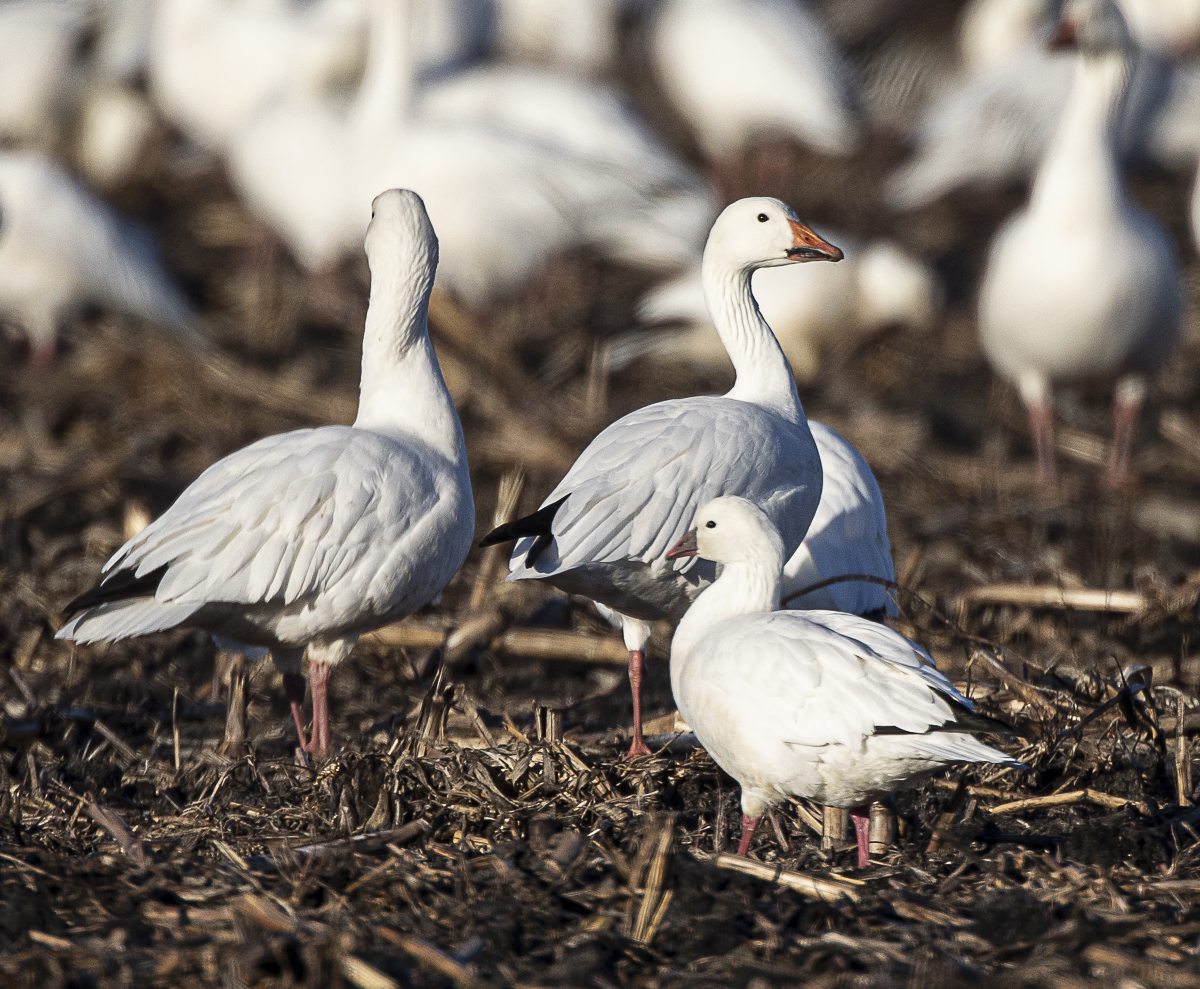
I arrived early on Monday and spotted some activity on the far side of the crop fields at the entrance to the Pungo Unit of Pocosin Lakes National Wildlife Refuge. Snow Geese! I drove over and pulled in slowly so as to not spook the feeding flock. To my delight, I was the only human present (a true rarity these days).
I stayed in my vehicle (most wildlife seem to prefer that behavior from us humans, but few of us abide their wishes). The sounds of a feeding flock of Snow Geese are raucous and somewhat mechanical, like a feathered combine moving through a field. The flock jumped up a time or two as they always seem to do (I am amazed at how they manage their energy budget with all this jumping up, flying in circles, landing, repeat).
A wall of wings as part of the flock circles the field (click photos to enlarge)
I sat alone with the birds for a good 15 minutes before another vehicle pulled up. The driver got out and set up his tripod and camera and the birds started moving away.
A diminutive Ross’ Goose at the edge of the flock
Suddenly, a large portion of the flock blasted off, filling the sky with wing beats and a “chorus” of their nasal honks, one of the loudest sounds you encounter in winter bird watching. The flock headed back to the safety of the lake, and just like that, the scene was quiet, with only a handful of American Robins flitting across the field.
This happens often it seems, I arrive before friends, and Pungo puts on a show, and I have to say, you should’ve been here… For the next two hours, I drove the refuge roads, shared by only two other cars. Perhaps because of that, I managed a couple of nice wildlife photography opportunities of often secretive birds – a Red-shouldered Hawk and the ever-elusive Belted Kingfisher.
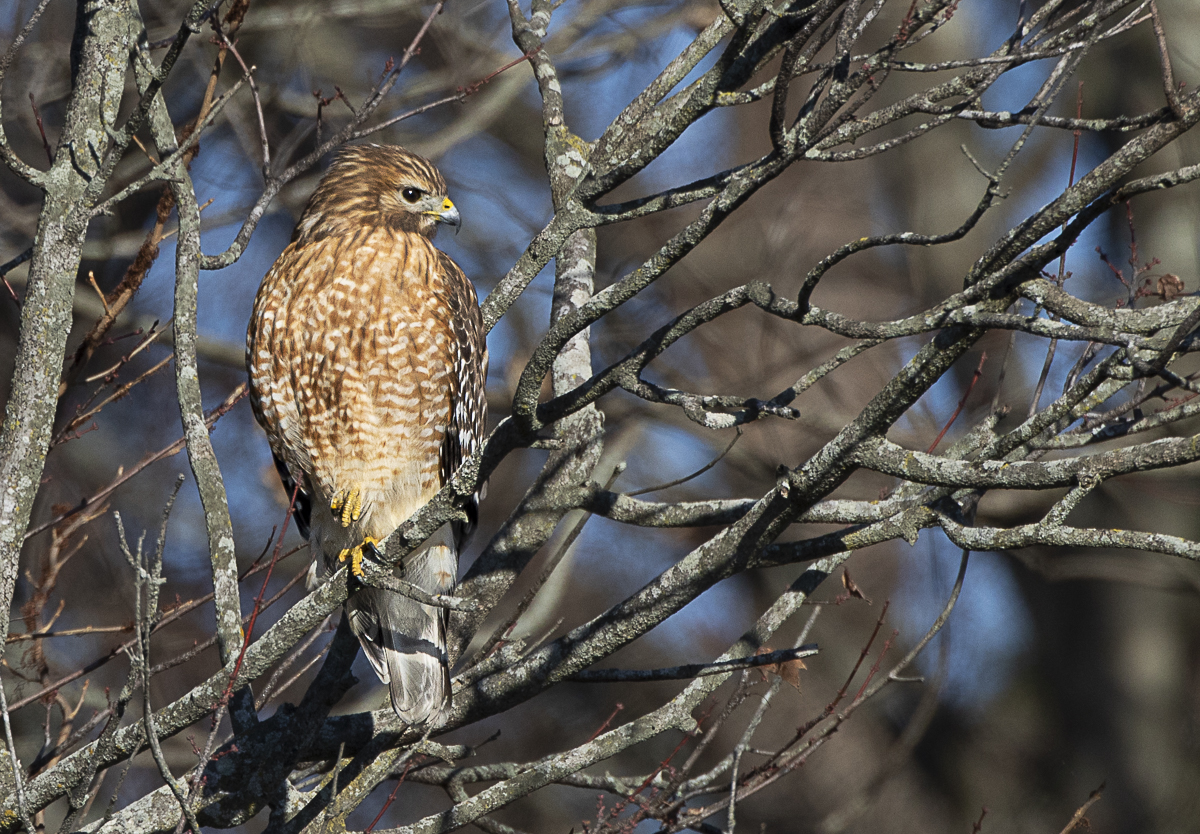
An adult Red-shouldered Hawk perched along one the roadside canals, searching the edges for a meal
A female (note the rust-colored breast band, males lack this) Belted Kingfisher cooperated for several quick images before darting off and scolding me with her rattling call.
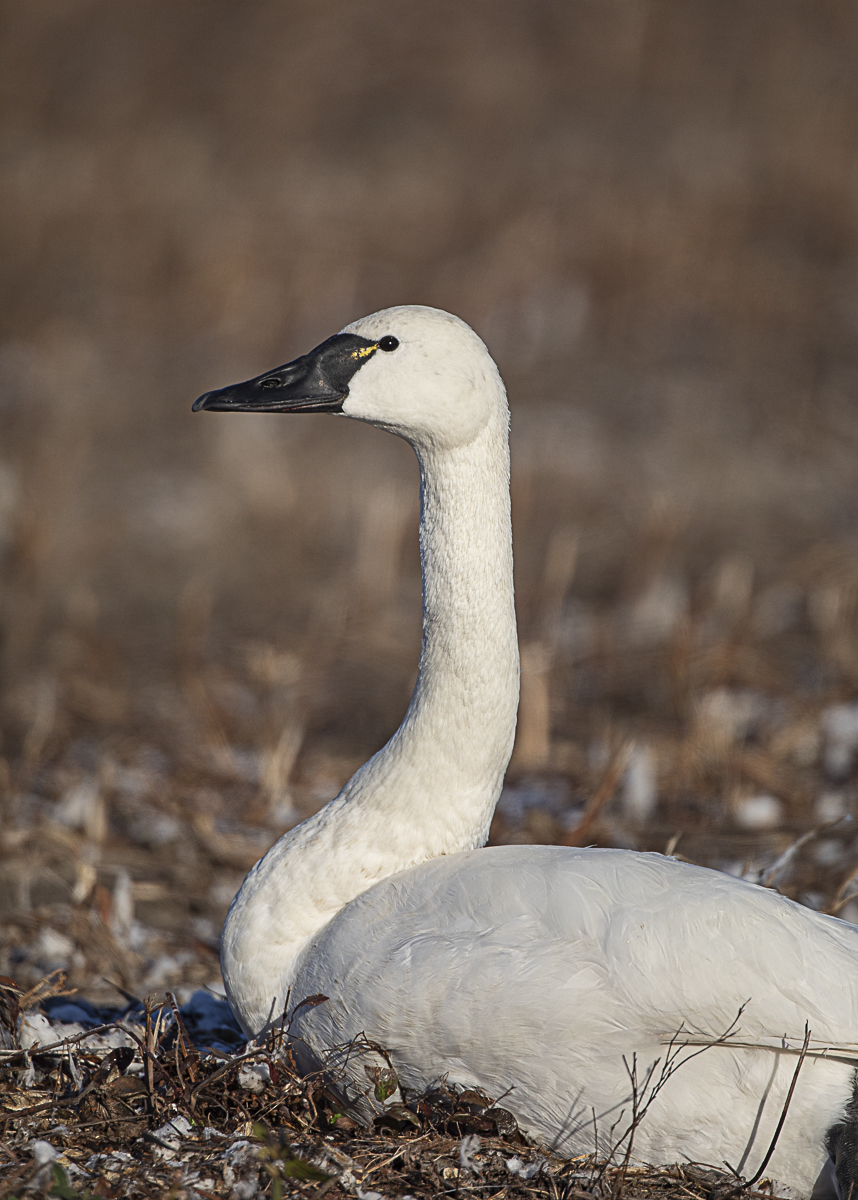
My crew arrived before lunch and we set off to see what we could see. Along the edge of D-canal was a lone Tundra Swan, sitting on the bank. It had not moved all morning so is undoubtedly injured or sick (it was in the same spot the next day as well). Its fate is most likely to serve as food for the likes of the two Bald Eagles I had seen nearby at first light.
A sick or injured Tundra Swan along a roadside canal
Driving toward Marsh A to view the swans, I spotted something out of the corner of my eye and backed up to see a huge ball of gray fur on a snag in the swamp. I was very light-colored and had its head and tail hidden, so I opened my car door and got out to get a better view. A very fat Raccoon raised its head, gave me that look, and disappeared into a hollow below its perch. I apologized for disturbing its sleep and we moved on.
A sleepy Raccoon awakes from its bed atop a tree snag and crawls into a hole on the side of the tree
The afternoon was spent on “Bear Road”. I was surprised to find only one car parked at the gate, an increasingly unusual occurrence these days.
Searching the fields for bears
Another beautiful sky at Pungo
We walked past two photographers standing near the corn, waiting for bears to come out. We moved down toward the “tree tunnel” and suddenly, out pops a bear. She came out of the woods, slowly walked across the grassy road and headed into the field, a ritual she has no doubt done countless times in her life. Seconds later, two cautious cubs followed. One had an unusual injury to its left flank, something I had seen posted earlier on social media. That one moved a bit awkwardly but managed to keep up with its bigger sibling. I hope the little guy recovers
A large sow bear comes out of the woods, crosses Bear Road, and heads into the adjacent corn field for dinner, giving our group a glance before disappearing into the cornstalks
Two cubs followed their mother into the corn field. The smaller one has an injured hind quarter.
It turned out to be a very beary afternoon and when it was over, we had counted 13 bears! On the way out, I saw the Snow Geese feeding in the same field as that morning, so we pulled over and watched and listened to them for a few minutes before they blasted off, circled, and flew off toward the lake for the evening.
After a great afternoon of wildlife watching, we headed to the nearby town of Belhaven for a wonderful dinner at Spoon River. Check it out if you are in the area. The next morning, we were back at Pungo for sunrise. The developing pink sky and the soft coos (plus a few loud calls) of a few thousand Tundra Swans is a great way to start your day.
The Snow Geese flew off the lake about 7:30 a.m. so we headed out to the front fields in hopes of witnessing the show. But, they fooled me and apparently had flown elsewhere, off the refuge, for their morning meal.
Next stop was Mattamuskeet NWR, where we saw thousands of ducks (mainly Northern Pintails) in the impoundment. It was a duck hunt day on the refuge, so a portion of Wildlife Drive across the canal was closed until early afternoon, so we spent some time in the wonderful Visitor Center and drove the open portion of the road, searching for birds. A highlight was a pair of Anhinga resting on a fallen tree in the canal. It is becoming more commonplace to spot a few of these impressive birds on this refuge every winter. The Cornell website, All About Birds, shares that the name, Anhinga, comes from the Tupi Indians in Brazil, meaning “devil bird” or “evil spirit of the woods.” But, I find them to be elegant as opposed to devilish, and very adept at hunting fish with their dagger-like bills.
One of two Anhinga we spotted perched on a downed tree in a roadside canal at Mattamuskeet
Driving on Hwy 94 north of Mattamuskeet, we spotted two more bears, bringing our total for the trip to 15. Our last stop was going to be Pettigrew State Park. On the way we passed through the small town of Creswell, and, to my surprise, there was a new coffee shop in town, Big Blue 252. I made a quick stop and we went in for some delicious coffee and pastries. This will definitely change my itinerary on future trips as good coffee is important on long days in the field (and is hard to come by in these parts). I normally don’t promote businesses in my blog, but, this is an exciting find and the owner, Alfreda, is great. Check it out if you are in the area.
My new go-to place when in the vicinity of Pettigrew State Park
And I was so excited by this find, that I didn’t even see a new small restaurant that has opened up across the street until we pulled away. These new businesses will make my stays in bear and bird country all the more enjoyable.
All in all, a great couple of days in my favorite public lands in North Carolina. Great birds, lots of bears, and good friends (and coffee!!). Wishing you all a wonderful holiday and hoping you have a chance to get outside and enjoy the beauty of a winter day, wherever you may find yourself this week.
Wild is the music of the autumnal winds amongst the faded woods.
~William Wordsworth
I’m trying to get into our woods every few days to see the changes that are occurring as autumn transitions to the bones of winter. The big change this week was the sudden accumulation of oak leaves on the forest floor. It seems they all fell at once, carpeting the ground in a crunchy brown rug. Meanwhile, the trail cameras are still getting lots of deer videos, but the rut has quieted and things are not as frantic as a few weeks ago. Here are a couple of forest vignettes from this past week…
I’ve noticed a lot of variation in the antler size and shape in our deer herd. White-tailed Deer typically have fairly symmetrical antlers with an equal size, spacing, and number of points on both sides. But, so-called atypical antlers, are not uncommon. The young buck in the video shows a strange bend on one side and some waviness in the point of its antler. I can’t tell from the video if a point was broken or it is just an odd shape. Antler deformities can occur in three major ways: injuries to the pedicel (the antler growing base attached to the skull); injuries to the antler when it is in velvet (the soft, hair-like membrane rich in blood that covers the antlers during their growth phase in spring and summer); or leg injuries. This last one caught me by surprise when I read it. Apparently, the mechanism for the relationship between leg injuries and antler deformation is not well known, but scientists think it may be the result of reallocation of nutrients from antler growth to healing the bone in a leg injury. Oddly, an injury (such as a car collision) to a front left leg can cause a deformity in the left antler, but an injury to a left rear leg may result in the right antler being misshapen. Observing our wild neighbors always seems to bring up more questions and the resulting online searches usually reveal many surprises.
The trees will tell their secrets to those who tune in.
~Steven Magee
I check the trail cameras once a week or so and am always anxious to see what secrets they uncover in our woods. The past few weeks it has mainly been squirrels chasing each other around and deer, lots of deer. November is the peak of the mating season (aka rut) for deer in our area and they have been busy. The abundant acorn crop is giving them plenty of food so they all look in their prime. There is a herd of about nine does that I see regularly on the cameras. Several bucks (at least four or five that are 6-pointers or larger) are making the rounds, chasing does and challenging each other and nearby tree saplings. Here are a few of the highlights from this month.
Any glimpse into the life of an animal quickens our own and makes it so much the larger and better in every way.
~John Muir
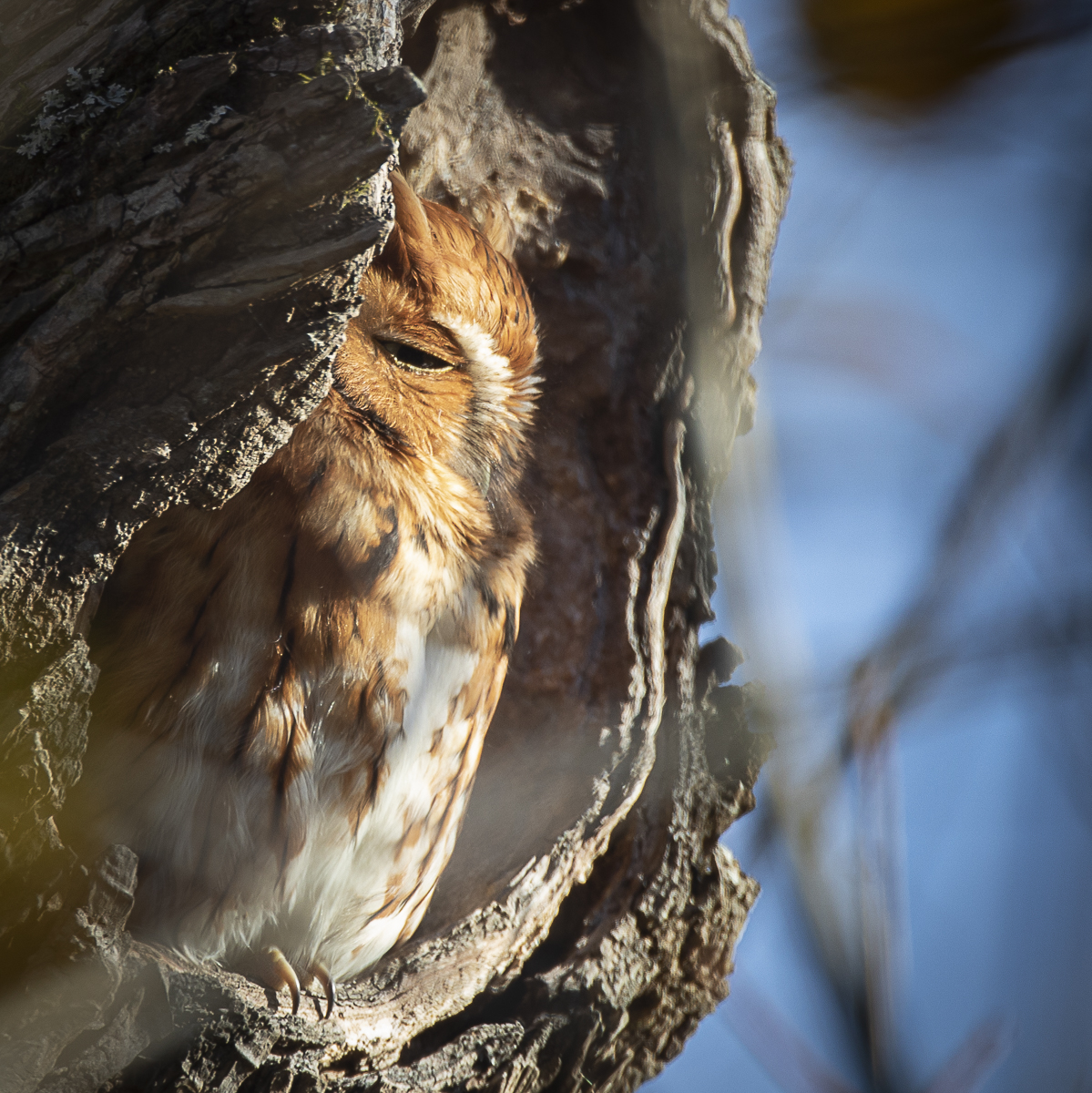
It’s been awhile since I posted. Not sure where the time goes, but here we are. Last week I had a last minute idea to run down to my favorite wildlife refuges for a wildlife observation and photography fix. The weather was supposed to be nice and cold on Friday, so I thought whatever birds have arrived this early might be active as would the bears. I didn’t get out as early as planned but arrived at the Pungo Unit about 9 a.m. I went straight to “Bear Road” and there were 4 cars there so I headed elsewhere. As I approached the impoundment, I could see two trucks and several photographers out in the vicinity of last year’s Eastern Screech Owl roost so I figured it was still there. Several people were getting back into their vehicle as I drove up, so I just slowed down and stopped for a second to take a photo – yup, still there!
This beautiful Eastern Screech Owl (red color morph) is still using the same roost as last year (click photos to enlarge)
It is always nice to spend time with the swans on Marsh A, so I pulled up and sat for awhile, window down, listening to their soothing sounds and watching them preen, bathe, feed, and interact.
Tundra Swans have arrived on the Pungo Unit
I scanned the back side of the water and saw what I had hoped for, a few Sandhill Cranes preening amongst the swans.
The gray colors of the Sandhill Cranes separate them from the mostly white Tundra Swans
The light was pretty bright, the water in the canals is low, and the vegetation along the canals high (making it difficult to see anything in the canals), so I decided to head over to Mattamuskeet National Wildlife Refuge for a couple of hours to see what was happening there. The deterioration of the water quality in the lake the past several years means that now there is almost never anything to see on the causeway road across the lake (I used to see plenty of swans and other waterfowl feeding or resting on the lake near the causeway, but not now).
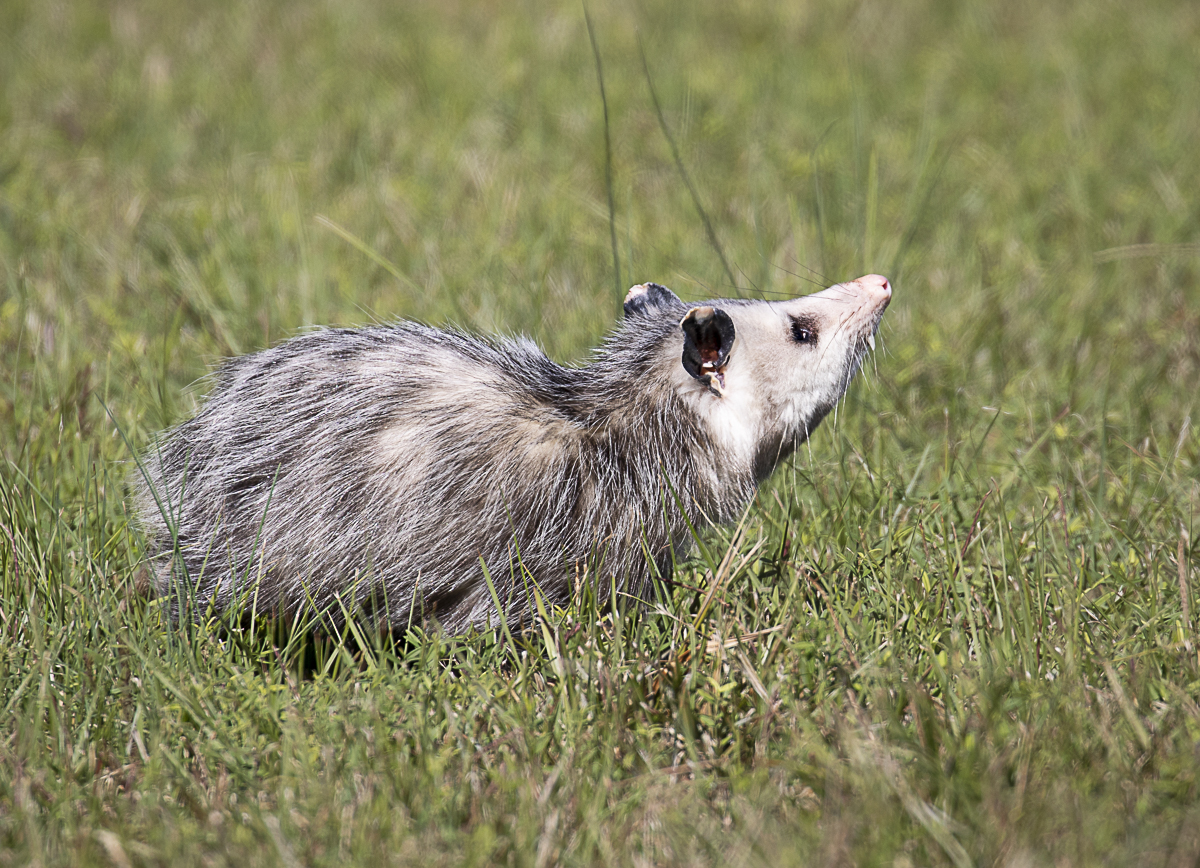
As I approached Wildlife Drive I saw movement along side the shrubs lining the road – a Virginia Opossum! It was grubbing through the short grass out from the shrubs, pausing every now and then to munch on something it found. I pulled a U-turn and stopped near it. It scurried to the cover of the shrubs, but soon came out and started feeding again. It gradually came closer and I took a few photos before it headed back to the edge of the cover and stared grooming itself.
I noticed that it had a tooth exposed on both sides of its mouth. I don’t know if this is typical for an opossum to be snaggle-toothed, but I think it is a good look.
You’ve got to admit, opossums are just cute
At the lodge, I saw one Great Blue Heron in the usual roosting spot grove of trees across the canal. There are some ducks, but not much else yet and water levels are low in the impoundment.
A Great Blue Heron surveying its world
After talking with a friend I saw near the lodge, I headed back to Pungo for the remainder of the afternoon. Driving near Marsh A, I stopped to take a couple of photos of the screech owl since no one else was around. The little guy seems oblivious to any admirers and just sits in the late day sun, soaking it all in.
A couple of quick photos and then I moved on, leaving his little guy to its peace and quiet
I had seen three bears near the entrance when I first drove in, so I figured I might as well head over to “Bear Road” and see what I could see. There were 5 cars already there and I could see a group of a dozen or so photographers at the far end of the field. Oh well…I walked down and then slipped into the woods for some quiet time before I reached the crowd. I sat down on a log to enjoy the golden light flooding the forest and soon heard the tell-tale heavy tapping of a large woodpecker behind me. I eased around and saw a Pileated Woodpecker hammering away at a vine encrusted tree trunk.
After watching it for a few minutes, it suddenly flew off and landed in a tree above me, frozen against the trunk. Did it see something I had missed – a predator like a hawk or owl? It remained motionless for a minute or two before finally moving up and around the tree.
This view clearly shows the toe placement (like an X) and stiff tail spines that are woodpecker adaptations for clinging to vertical surfaces
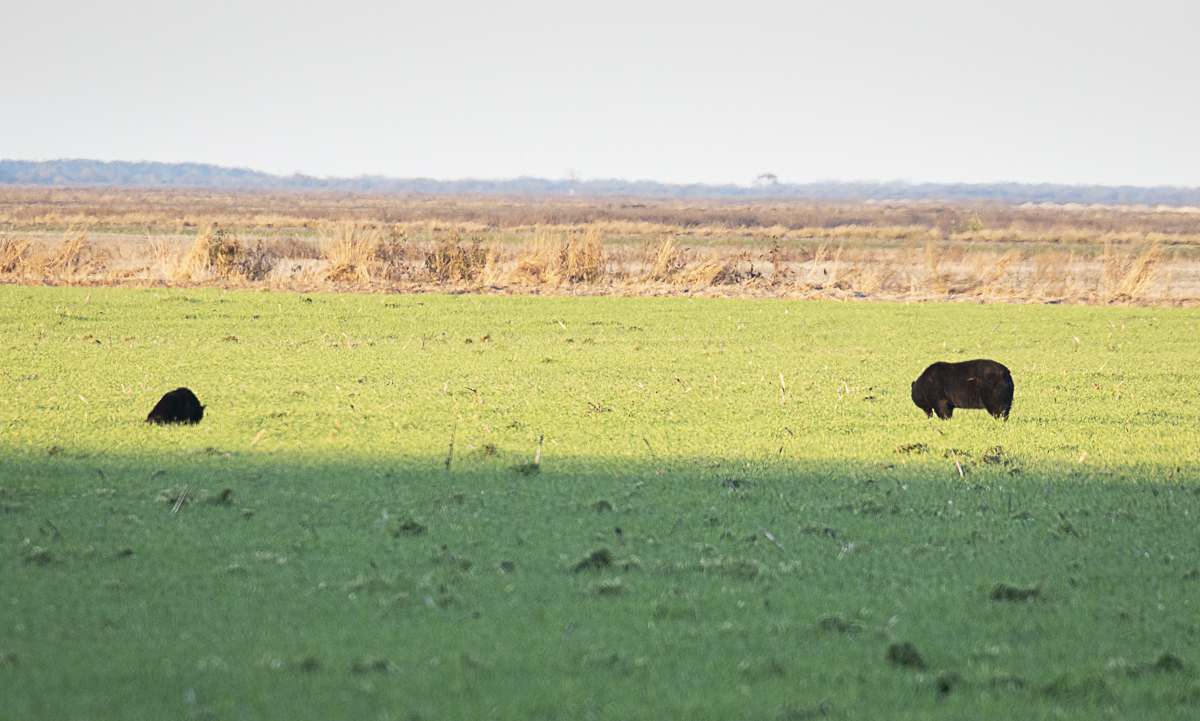
I eased out of the woods as the crowd was headed back to their cars, excitedly talking about the bears they had seen and sharing images from their cameras. Out in the field were three bears, a sow and two cubs, grazing in the light of a setting sun. Swans returning to the lake were highlighted in the golden light as they called their soothing ou, ou sounds. As I walked by one of the people on the road, he asked if I had any good shots of the bears. I responded that I hadn’t really tried, I just wanted to be out there with the sights and sounds of the refuge. I’m not sure he understood…but every time I am there, I just want to sit quietly and take it all in. I do love to take photos, but I am realizing that I love the quiet, solitude, and the memories even more.
A sow and one of her cubs feeding in a field along “Bear Road”
Like delicate lace, so the threads intertwine, oh, gossamer web of wond’rous design! Such beauty and grace wild nature produces…
~Bill Watterson
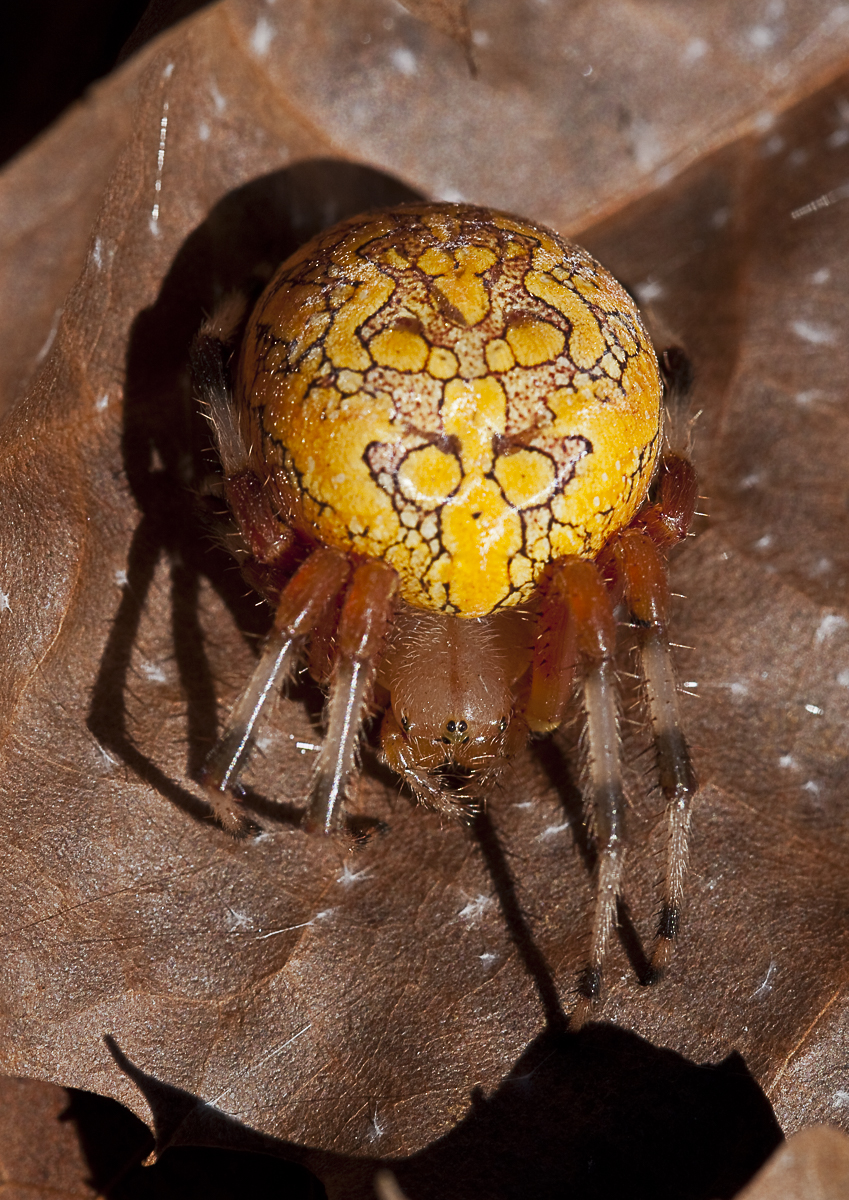
Yes, ’tis that special holiday, ’tis Halloween. And we manage to gravitate toward all manner of spooky things and transfer our fears anew to many elements of the natural world such as bats, wolves, and spiders. One of my favorite arachnids is aptly particularly evident this time of year – the Marbled Orbweaver, Araneus marmoreus. It’s relatively large size and bright yellow-orange colors make it particularly noticeable in October and gives rise to a couple of its other common names – Pumpkin Spider and Halloween Spider.
Last week I was changing cards in my trail cameras in our woods and took my camera along in case I saw anything interesting. I’m always checking for spider webs in my path this time of year as many orbweavers reach their peak size and, therefore, apparent abundance, in October. I try to avoid the silk-in-my-face greeting of most of these weavers by doing the forest side step if I spot the web or one of the often long anchor lines. This species creates a hide outside the main web, a fact that I appreciate as it means you are much less likely to have a crawling spider on your head or face if you should miss seeing their gossamer handiwork in your path. When a prey item lands in the web, she can feel the vibrations and rushes out of the hide to subdue her meal. I suppose if you are such a noticeable bright color, it pays to have a place to conceal yourelf from would-be predators.
I soon spotted a beauty highlighted in the the dappled sunlight in her holly leaf shelter on our south slope. I stopped to admire her intricate black patterns on a bold yellow background and grabbed a few photos.
Marbled Orbweaver in her silken hide (click photos to enlarge)
Walking a few feet more and I missed seeing another silken line and got entangled in a large web of another Halloween Spider. When I pulled on it to free myself, the owner dropped out of her hide onto the ground and scuttled away (a common defense strategy), but not before I managed a photo as she crossed an equally colorful fallen leaf.
This Halloween Spider dropped from her web and scurried under some leaves on the ground, allowing me only a photo before she disappeared.
As it turns out, this beautiful species is the subject of an article I wrote for the October issue of Walter magazine. Last year I was approached by the magazine editor (at the suggestion of some of my former co-workers at the NC Museum of Natural Sciences) and asked if I would be willing to write a monthly nature column. I had heard of this publication, but wasn’t that familiar with its content. After looking at it, it struck me as a quality magazine that I likened to being similar to an Our State magazine for the Triangle area. They have high production values and I am impressed by the quality and range of topics covered. I encourage you to take a look and subscribe if you agree. Here is a link to this month’s spider article with more information and photos. You can search for my other monthly articles (starting last January) in the archives by putting Nature in the search box on their website and scrolling through the articles. I must admit, I never thought I would have my photos of spiders and the like next to advertisements for Rolex watches, but, it’s a good chance to reach a broader audience.
A beautiful Marbled Orbweaver spotted on the ground one Halloween weekend long ago on a museum educator workshop about elk in Cataloochee Valley.
And here’s wishing you all a safe, sweets-filled, and Happy Halloween!
I don’t have to take a trip around the world or be on a yacht in the Mediterranean to have happiness. I can find it in little things, like looking out into my backyard and seeing deer in the fields.
~ Queen Latifah
It is deer season. They are very active in our woods as the weather changes to bring on fall. The trail cameras have picked up almost nothing but deer the past few weeks (except for a raccoon family, the occasional opossum and squirrel, and, unfortunately, my neighbors cats). Here are a few of my favorite clips from last month.
Fawns born in May weighed about 7 pounds at birth and are approaching 60+ pounds as fall begins. Still sporting a few spots, a fawn gets in some nursing from its mother. This is about the last month it will be nursing.
Below are some scenes of bucks, now reaching their prime for the rut. A couple of nice bucks have been seen together frequently. One spent several minutes testing a sapling with its antlers while another enjoys the bountiful supply of acorns on the forest floor this season.
The more clearly we can focus our attention on the wonders and realities of the universe about us, the less taste we shall have for destruction.
~Rachel Carson
Our booth, Caterpillarology, was a tiny fraction of the hundreds of educational opportunities available at the museum’s annual BugFest event last weekend. This was the first time in a few years (that pandemic thing) that the museum has hosted a full scale BugFest and we were excited to participate once again. Staff and volunteers spent hours searching for, collecting, and then feeding over 50 species of local larvae to showcase at the event. Based on my cracking voice at the end of the day, I would say it was a huge success as we had a steady stream of visitors observing our caterpillars and asking questions for a solid seven hours. Though it doesn’t include all the species, here are photos of some of the stars of the show. Almost all have now been released back into the wild (we are raising a couple of species until they pupate to protect them from predation/parasitism and then will release that stage back into suitable habitat). Looking forward to next year’s event and what we may find.
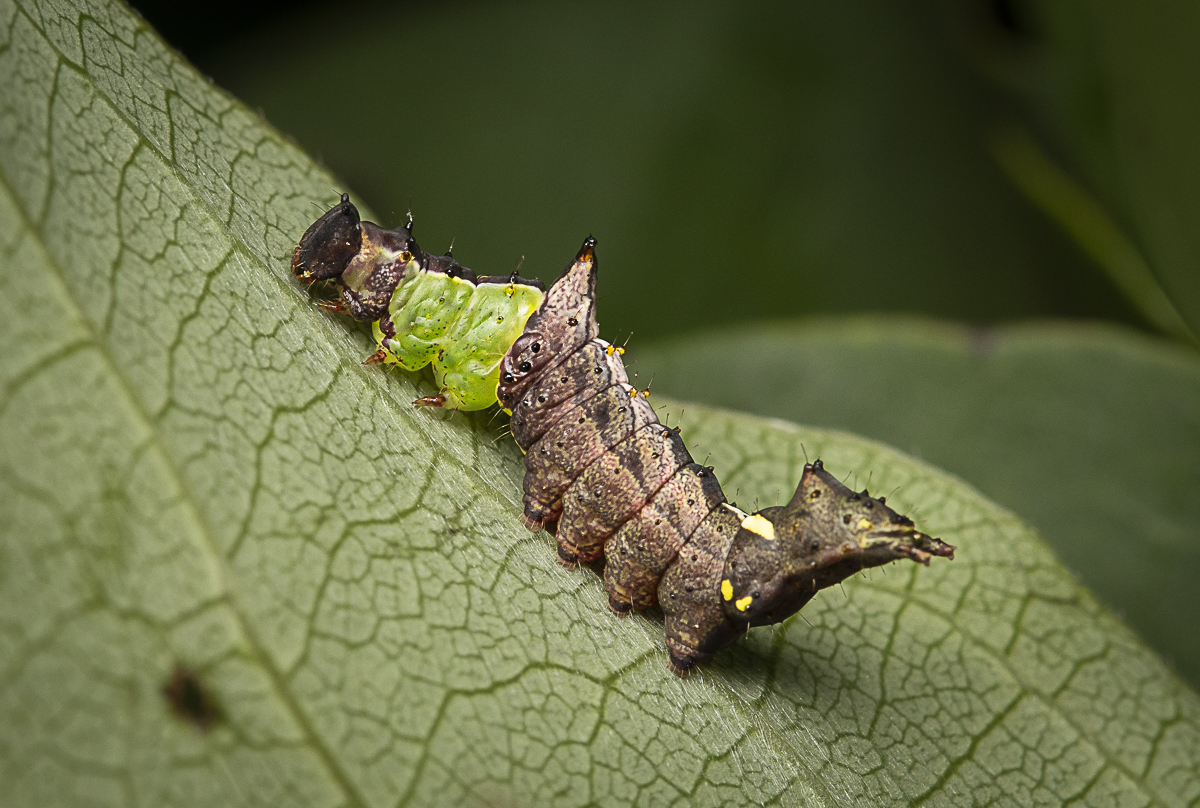
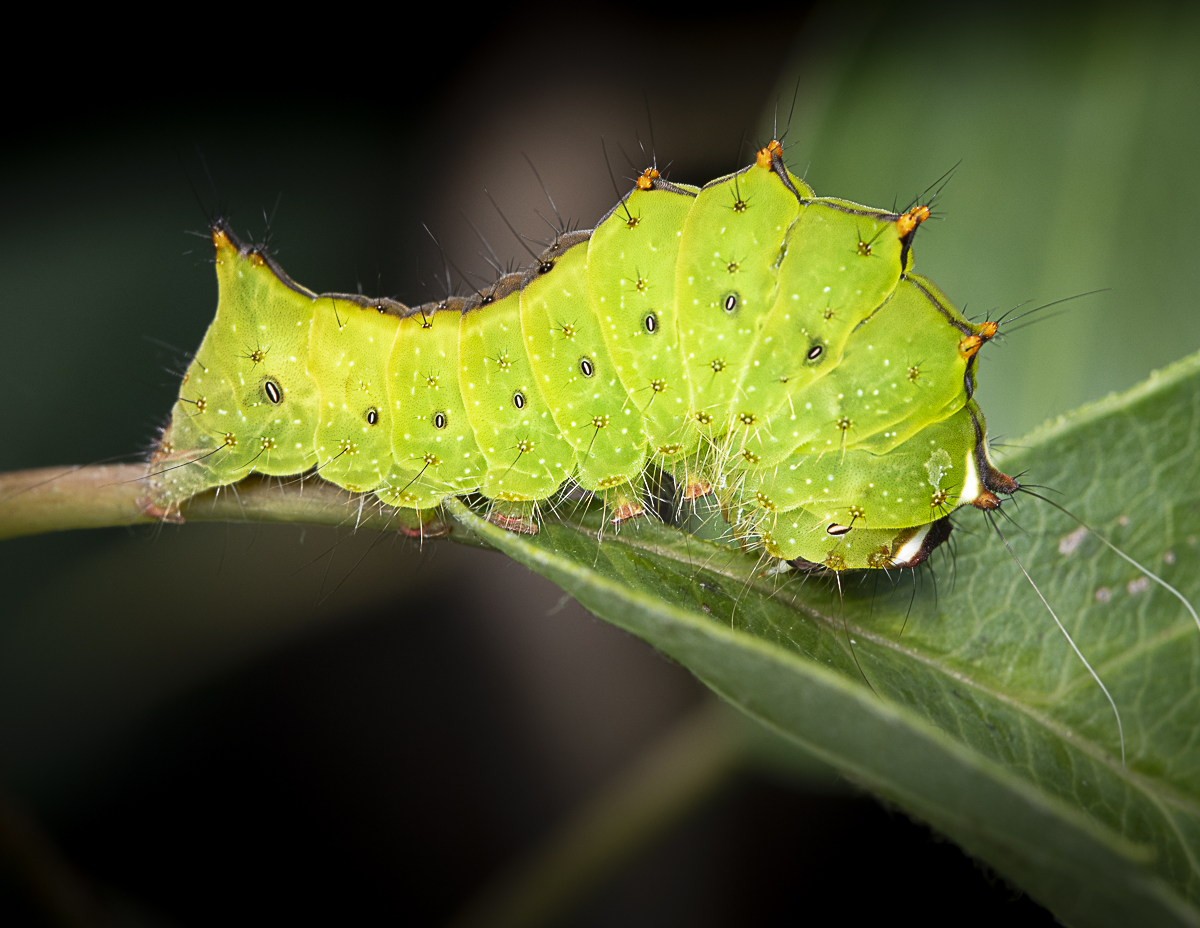
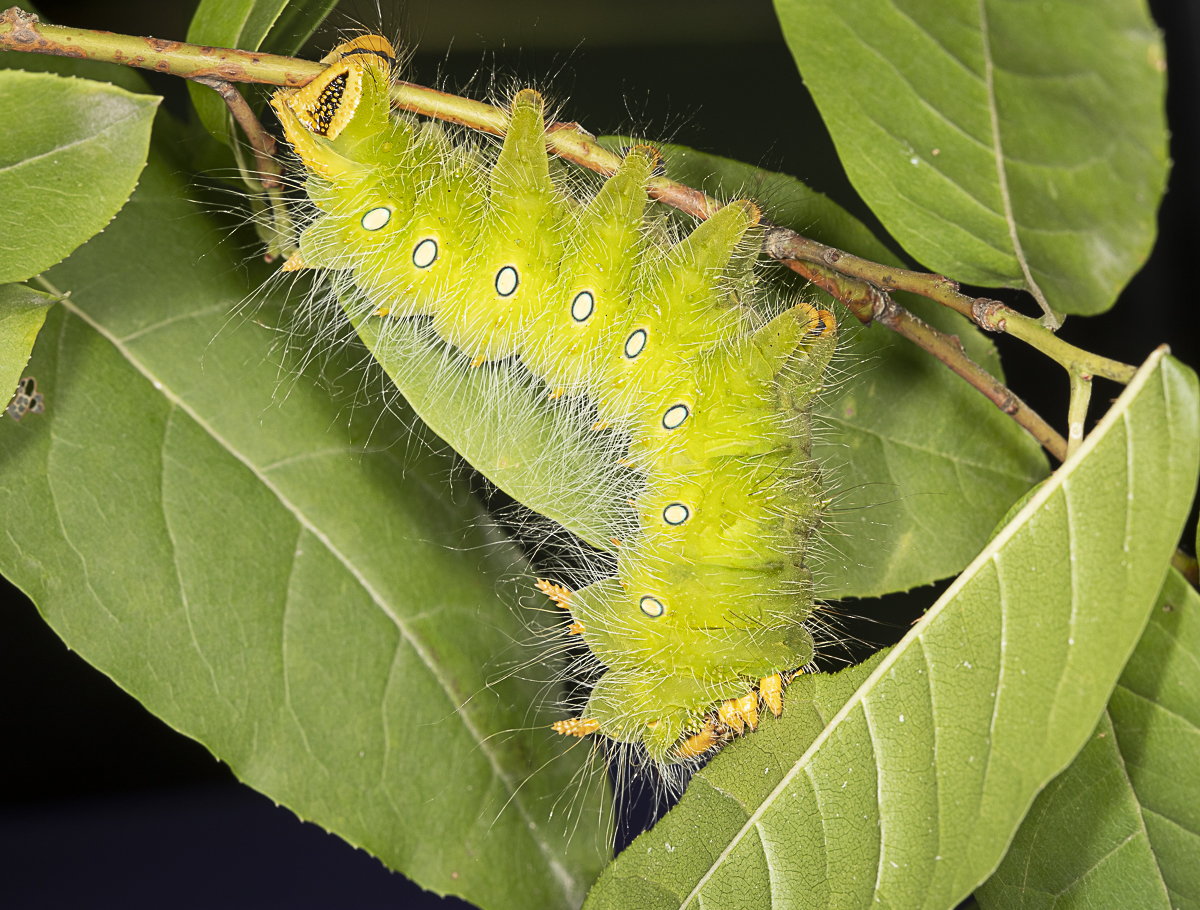
Spicebush Swallowtail (Papilio troilus) caterpillar. The large fake eye spots, its habit of creating folded leaf shelters to hide in, and the woodcock-like creeping motion (it often bobs its head as it crawls) make this common species a crowd favorite. Look for these on Spicebush and Sassafras. (click photos to enlarge)A close relative to the larva above is this Eastern Tiger Swallowtail (Papilio glaucus). Favorite host plants include Tulip Poplar and Wild Cherry. An early instar White Furcula (Furcula borealis). The long “tails” are actually the anal prolegs. When disturbed, the caterpillar shunts fluid into them, they greatly elongate, and are then whipped about as a defense.Waved Sphinx (Ceratomia undulosa) on ash. Most sphinx moth larvae are adorned with a horn (hence the name hornworm) on their posterior. The exact function of the horn is not known, although it may serve as a visual predator deterrent. I have had many people tell me they think they can sting (but they can’t).A Snowberry Clearwing (Hemaris diffinis) larva on Japanese Honeysuckle. This caterpillar turns into a day-flying bumblebee-mimic moth.A Hummingbird Clearwing (Hemaris thysbe). I once had someone ask about the really tiny hummingbirds at their flowers…it turned out to be the adults of this caterpillar, another day-flying moth.This Hog Sphinx (Darapsa myron) was captured by accident as I brought in some wild grape vine to feed another larval species. I snipped some vine from the yard, brought it in and Melissa spotted this little guy. Guess I need to look before I snip. This species varies in color from brown to green to yellow.Pink-striped Oakworm (Anisota virginiensis) on Red Oak. These often occur in large clusters as female moths may lay several hundred eggs on one branch.Lace-capped Moth larva (Oligocentria lignicolor). Like many of the prominent caterpillars, these larvae eat away a portion of the leaf and then rest their body along the chewed edge to camouflage themselves.Another leaf edge larva, a Unicorn Caterpillar (Schizura unicornis) (see, unicorns ARE real).A Clear Dagger Moth (Acronicta clarescens) caterpillar withdrawing its head capsule as a defensive posture.Grapeleaf Skeletonizer (Harrisina americana). Touching this tiny larva may result in a skin rash on sensitive individuals.Luna Moth larva (Actias luna) on hickory. In our area, Sweet Gum is usually the primary host plant, but we also found them on this tree and a Persimmon.The largest Polyphemus Moth (Antheraea polyphemus) caterpillar we have ever seen! They are often confused with Luna Moth larvae, but lack the prominent red dots and the lateral line of the latter. Oaks and River Birch are the primary hosts.Another of the big caterpillars this year was this beautiful green Imperial Moth (Eacles imperialis) larva. They come in a variety of colors from this leafy green to brown, red, and salmon. All are easily recognized by their long setae (hairs) and prominent white spiracles (breathing ports along the side).The true star of the show, a Hickory Horned Devil (Citheronia regalis), was given to us by a friend in Southern Pines. North America’s largest caterpillar is always a delight to find, but, due to the usual timing of BugFest, is a tough one for us to get as they usually pupate by early September. This one stopped feeding and started turning blue-green in color the night before the event, indicating it was preparing to pupate. At the end of the day, we placed it in a tub of soil and it quickly buried itself to form a pupal chamber and shed its caterpillar skin one last time to turn into a pupa. It will spend the winter underground before emerging as a Royal Walnut Moth next summer.These early instar Cecropia Moth (Hyalophora cecropia) caterpillars were raised in the museum’s Arthropod Zoo. They will grow to be almost as large as the Hickory Horned Devil before forming their cocoons.This beautiful larva is a Saddleback Caterpillar (Acharia stimulea), one of the so-called “stinging” caterpillars. They possess spines that can inject small amounts of venom into anything they touch. The resulting sting feels much like a wasp sting.This beauty is a Stinging Rose Caterpillar (Parasa indetermina) from the Sandhills. They also occur in orange or red and can be found on a variety of woody plants.One of my favorite slug caterpillars, the Crowned Slug (Isa textula). David L. Wagner, in his wonderful field guide, Caterpillars of Eastern North America, sums up the bizarre slug caterpillars as being “more fantasy than reality”. As a group, the slug caterpillars often become the favorites of anyone that gets interested in caterpillars, and I admit to thinking they are the coolest of the Lepidopteran larvae.This Yellow-shouldered Slug caterpillar has a tachinid fly egg on it (the white oval near the bottom of the larva). The fly larva hatches shortly after the egg is laid and burrows into the caterpillar, eating it from the inside and eventually killing the host.The unusual shape is a diagnostic feature of the odd Skiff Moth (Prolimacodes badia) larva. Unlike most of the slug caterpillars, these do not have stinging spines, but can emit a foul-smelling liquid when disturbed. The white spots may be an adaptation to deceive tachinid flies from laying their eggs since female flies may not lay an egg on a caterpillar that is already infected with the parasitoid. Black-waved Flannel Moth (Megalopyge crispata) larva on Persimmon. The dense hairs hide spiny warts which can inflict a painful sting. This species feeds on a variety of hardwood leaves.Another Black-waved Flannel Moth showing the color variation in this species.The Puss Caterpillar (aka Southern Flannel Moth, Megalopyge opercularis) is a species you definitely do not want to touch. The stinging spines beneath the dense hairs pack a powerful punch that can send worried victims to the ER due to the long-lasting pain. Most people never encounter this unusual caterpillar as it usually spends its entire life cycle from egg to pupa up in the branches of various hardwood trees.A museum staffer collected this species, a Southern Tussock Moth (Dasychira meridonalis). I have never encountered this unusual caterpillar, which, to me, looks a bit like a spider-mimic.We found this fuzzy American Dagger (Acronicta americana) at night using a UV flashlight. Many species glow under UV light, making them easier to locate, although this species can be readily spotted during the day due to its long white or yellow setae.A harmless, but spiky, Gulf Fritillary (Agraulis vanillae) caterpillar on Passion-vine. This strange mystery caterpillar was found on a blackberry plant near Raleigh. A local entomologist tentatively identified it as a type of tiger moth larva, but we have not been able to pin it down as yet. Another strange-looking larva, the Harris’ Three-spot (Harrisimemna trisignata). It mimics a bird-dropping and possibly a spider. It also has the unusual habit of retaining its shed head capsules on long setae. It supposedly uses these as a club to ward off small parasitoid flies and wasps. Perhaps the most bizarrely shaped caterpillar we have is this Curve-lined Owlet (Phyprosopus callitrichoides). It feeds on greenbrier vines and the long extensions from its body look a lot like the tendrils on the vine.A later instar of a Curve-lined Owlet showing how it is also a dead leaf mimic. It even vibrates slightly when disturbed, looking like a dried up leaf segment gently fluttering in the breeze.






















 Roads End Naturalist