When your environment is clean you feel happy motivated and healthy.
~Lailah Gifty Akita
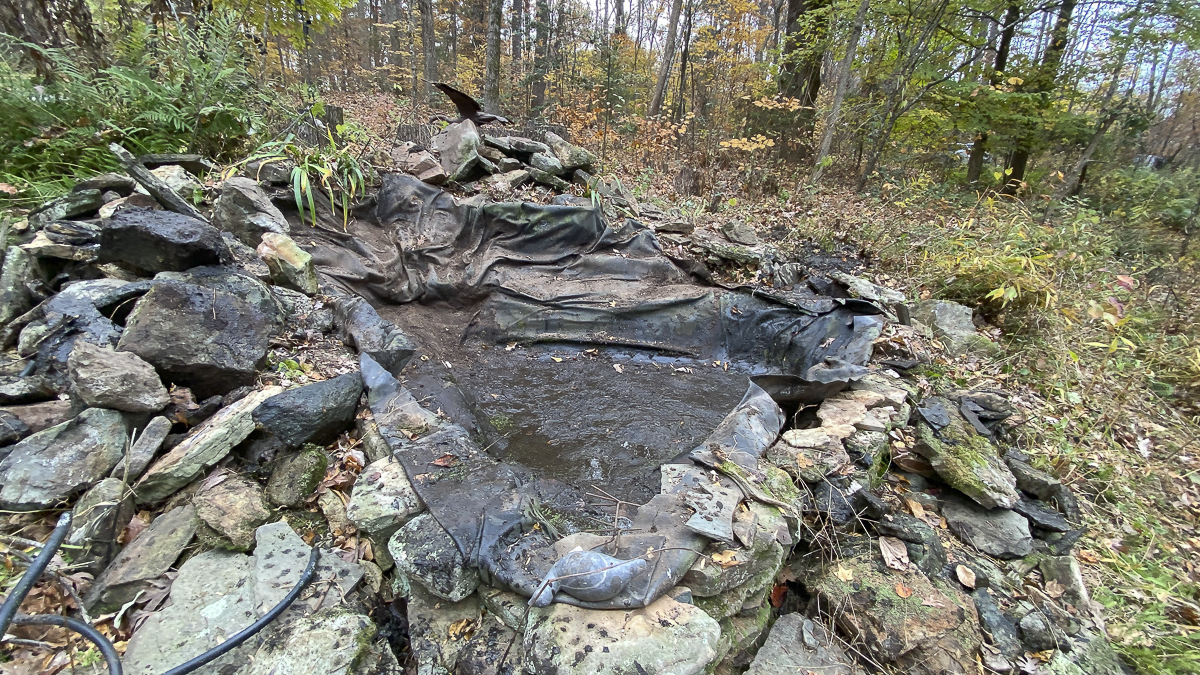
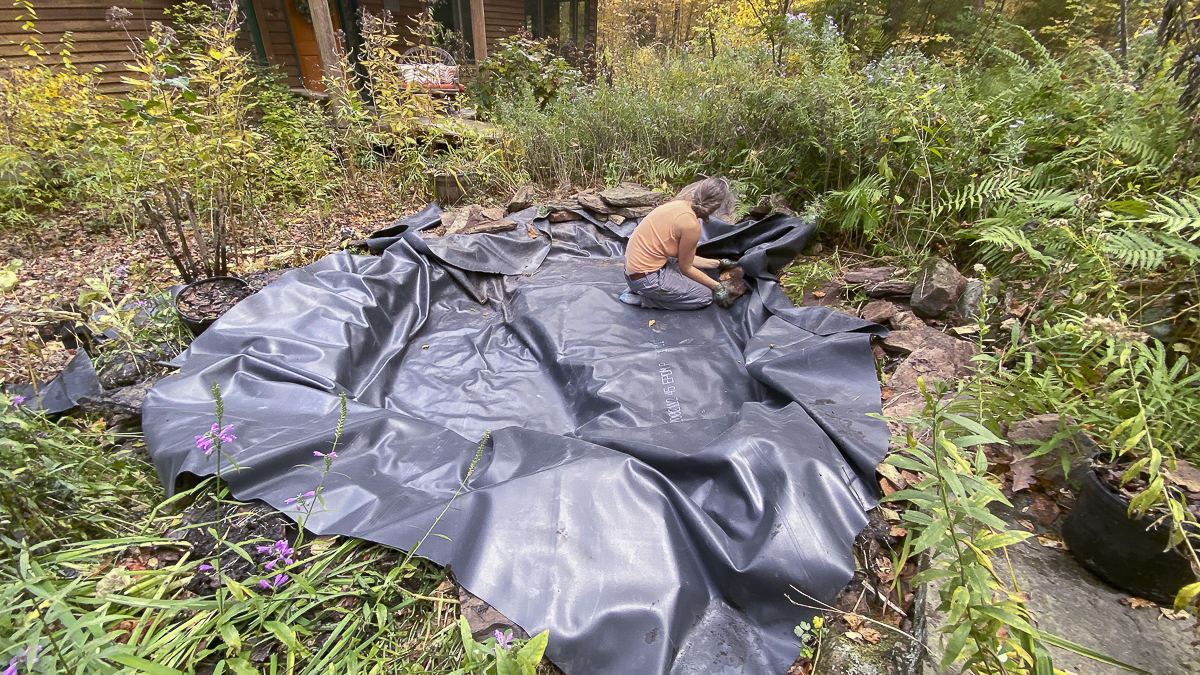
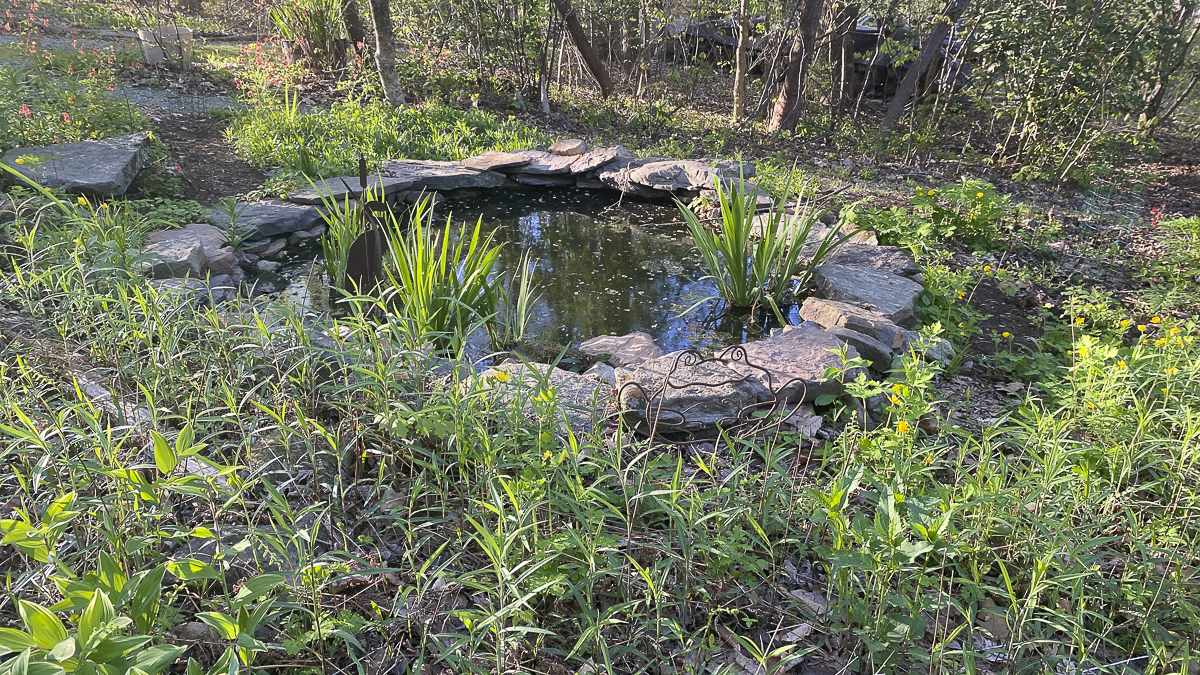
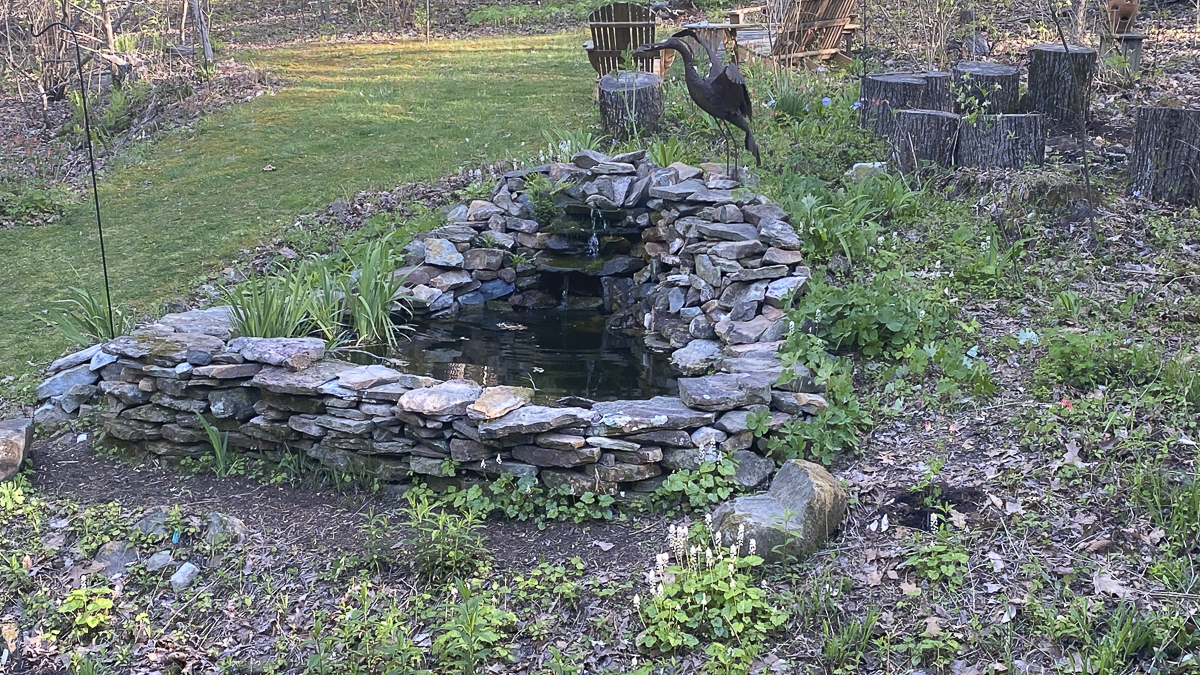
I mentioned in an earlier post that we finally got around to cleaning out our two water gardens (aka salamander pools) in November. One had sprung a leak mid-way up its height a couple of years ago. It still held enough water for some critters but was choked with duckweed. The other sprung a leak this fall and drained, leaving a mud flat and lots of aquatic vegetation and their tangled root mats. These liners have been in for over 20 years (they are typically rated for 10) so I consider us lucky. We have a fairly narrow window for pond repairs as I want it to be late enough that cold weather has set in and numbed any Copperheads that might be hanging out in the rock walls, but before the Spotted Salamander breeding season, which can start as early as late December some years. I checked prices locally and online and purchased the liners at a place in Raleigh (prices have increased in 20 years!). I won’t bore you with the details, but I was pleased it only took us about a day each to totally re-do each pond, including cleaning out all the muck, putting in the new liner, and rebuilding and stabilizing their rock walls.
Lots of moving of rocks and debris to expose the old pond liner in the waterfall pool (click photos to enlarge)
Laying out the new liners and then trimming to fit
After getting the liners in place, the difficult part is rebuilding a sturdy rock wall around each pond. Years ago, I purchased some flat rocks and then filled in with the irregular shaped stones that are so abundant on the property.
The first pool to be completed The second pool has a small waterfall
The waterfall pool is great because we can hear the moving water from our screen porch so I like to think I am somewhere in the mountains when I hear it. The real advantage is as a possible additional attractant for birds (they love the sound of moving water), especially the neo-tropical migrants that move through our woods, so we will see what this season brings.
Our first good salamander rainfall didn’t occur until mid-February. We had a small run of salamanders and we ended up with about ten egg masses. About a month later we had a couple more nights of perfect weather for salamanders, and the bottoms of both pools were covered with spermatophores, followed a couple of nights later by lots of egg masses.
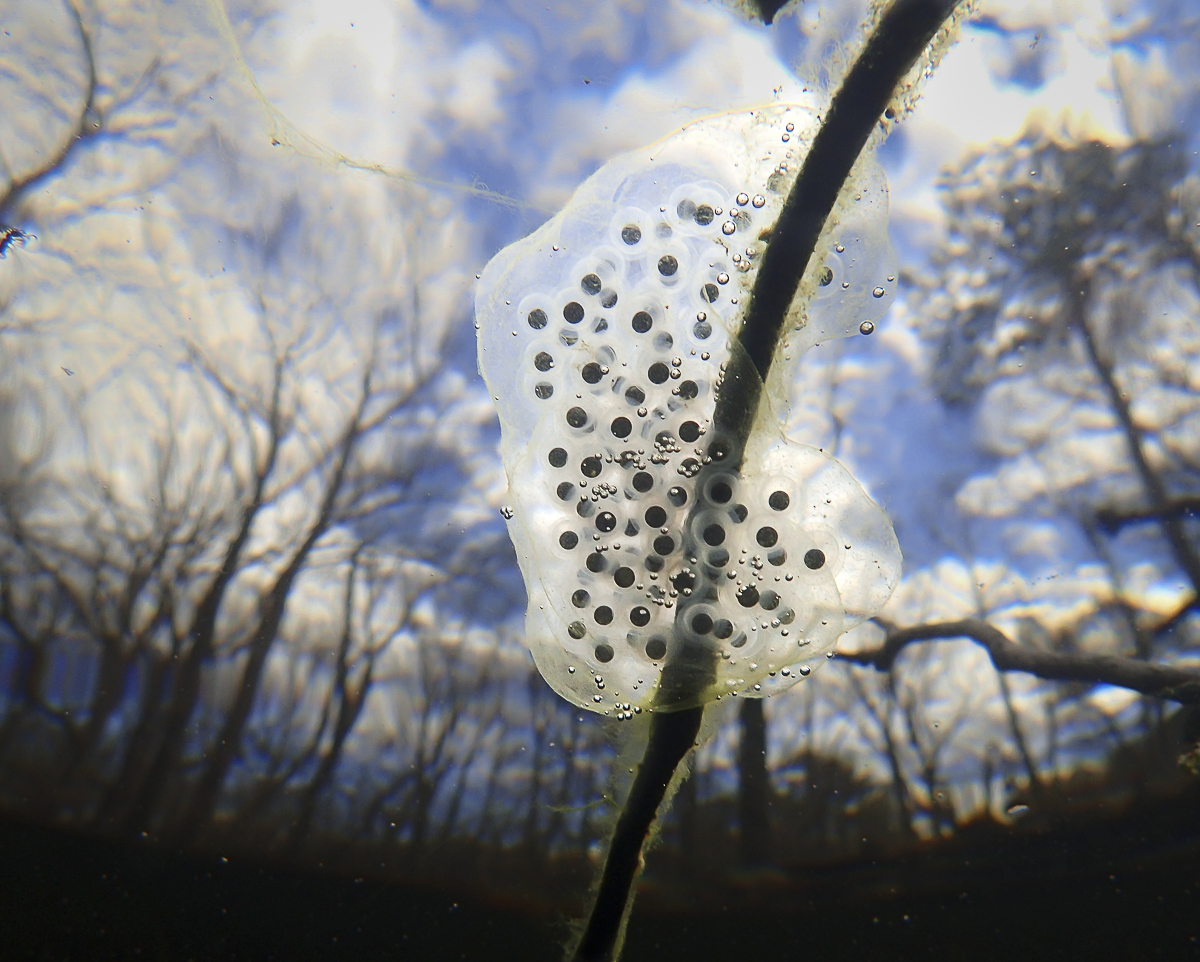
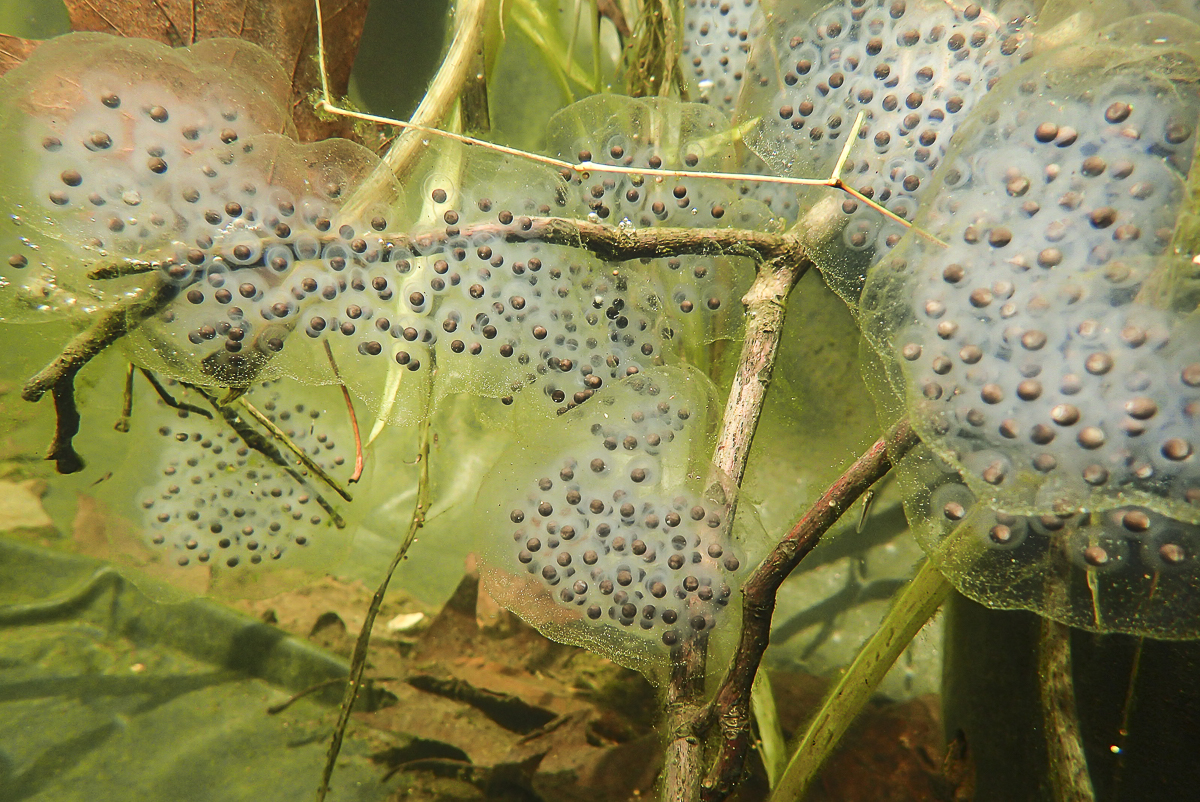
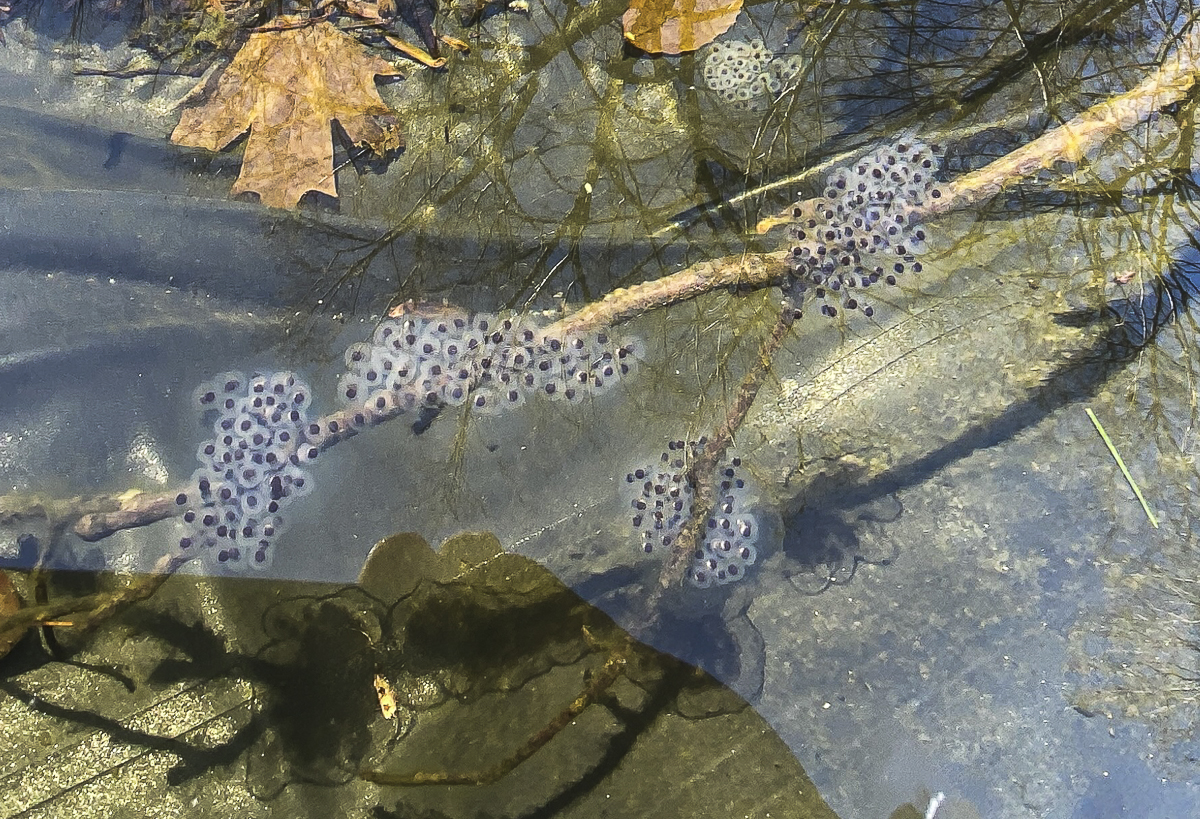
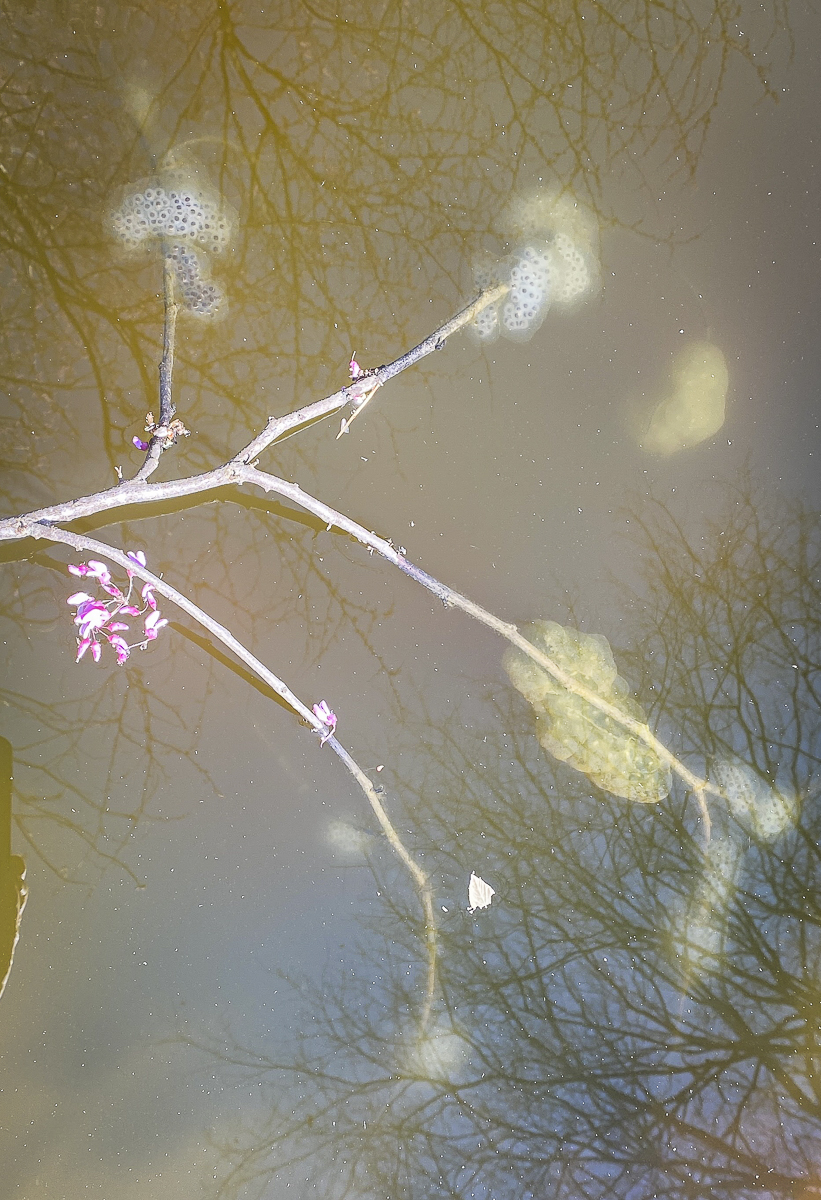
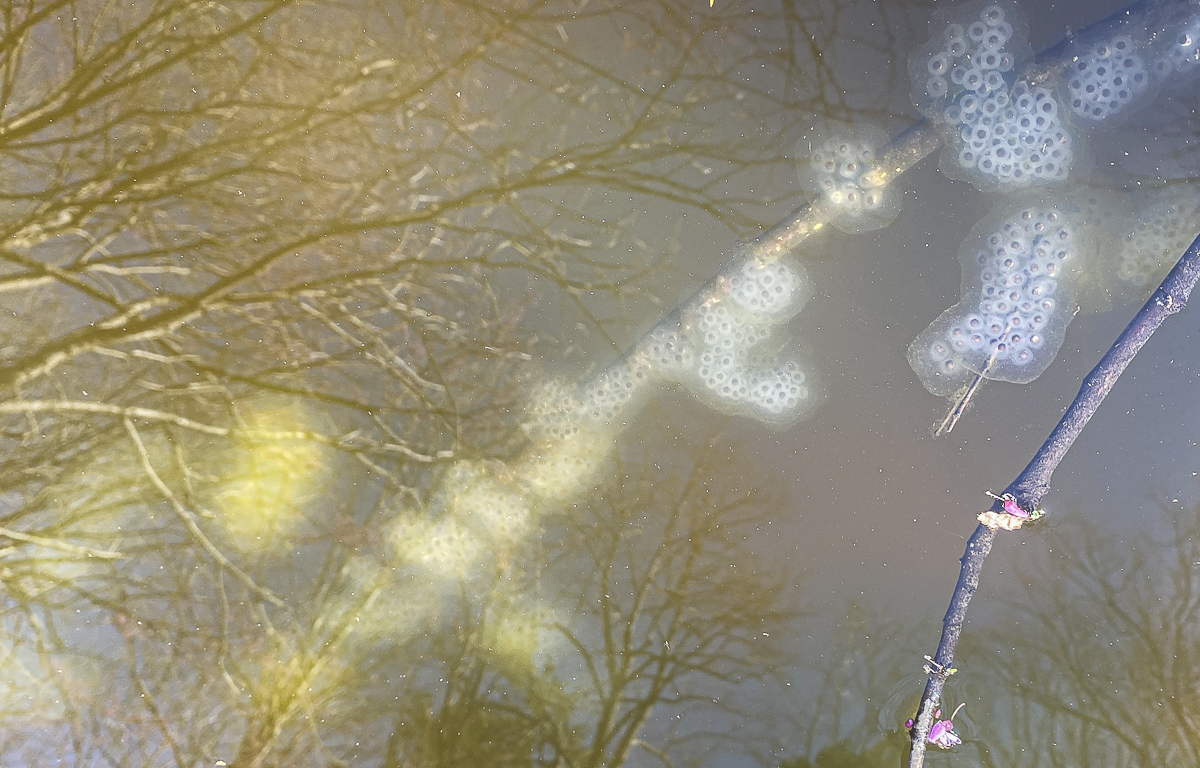
A Spotted Salamander egg mass as seen from below. The waterfall pool started off with very clear water which made observations and photography much easier (underwater photo taken with Olympus Tough camera)Egg masses at different stages of development in the waterfall pool (underwater photo taken with Olympus Tough camera)White embryos, as seen in the center egg mass, indicate the eggs are not viable. Studies have shown that egg mortality can be caused by a number of factors (including freezing) and may reach 20% to 40% of the total eggs laid in some years. Note that the gel of the egg mass itself can range from white-ish opaque to clear. That is the result of specific proteins in the gel. The significance and function of the opaque versus clear egg masses is unknown.Egg masses are usually attached to twigs or underwater vegetation. I placed several tree branches in each pool for the females to utilize as attachment points for their eggs.The egg masses grow in size over the first few days due to absorption of waterWe ended up with about 100 egg masses in the two pools by mid-March!
I’ve been keeping tabs on the development of the eggs in the two pools over the last few weeks. Most have turned greenish in color due to the presence of an algae that is specific to Spotted Salamander egg masses. The algae probably gain nutrients like nitrogen from the waste products of the developing larvae and the larvae probably get oxygen from the photosynthesizing algae. Egg hatch time is temperature dependent and usually takes 4 to 6 weeks.
An egg mass a few weeks after being laid. Note the green color (due to symbiotic algae) and the progress in the development of the larvae.
The gel matrix holding the egg mass together starts to break down close to the time of hatching. I went out last week and lifted some of the twigs holding the egg masses and the jelly blobs started to fall apart. I gently placed one in a clear container and went inside to get my phone to photograph it. By the time I returned, there was a lot of activity in the container. Here is a quick video clip…
If you pause the video and look closely, you can see the tiny straight appendages dangling down near the head that serve as balancers for the newly hatched larva (there are also branched external gills at the head). After a couple of days, the balancers are reabsorbed when the larva is stronger and can swim and maintain an upright position in the water column.
I dipped in the pool yesterday and found one larva that has grown considerably and is now an active swimmer. Here’s hoping that many of them survive and transform into terrestrial juveniles in a couple of months. I look forward to their return on some cold and rainy nights in the years to come.
I’m always astonished by a forest. It makes me realise that the fantasy of nature is much larger than my own fantasy. I still have things to learn.
~ Gunter Grass
Things have slowed a bit on the trail cameras out back, but we still get some nice surprises from time to time. Here are a few of them from the past couple of weeks.
In all my years here, I have only seen one Wild Turkey in the neighborhood, and that was years ago, walking down our gravel road. But, in the last year, the trail cameras have captured three, two of them in the past two weeks.
Late note – after writing this, Melissa saw a turkey out back late yesterday afternoon, just beyond our deer fence!
I moved a trail camera to an area with a log on the ground that had a few interesting looking holes along it that might be some sort of burrow entrance. I left it there over a week and never saw anything going in or out of the holes. But, it was a regular squirrel highway, and one day, this hawk dropped in, perhaps thinking it might partake of a rodent snack, but no such luck.
After a few weeks absence, the Coyotes have made a reappearance on three cameras. Here are two clips. Pause this first clip and look at the Coyote – either a big meal or perhaps soon-to-be pups in that belly?
~A.B. Coleman (the man who donated Merchants Millpond to the state for a park)
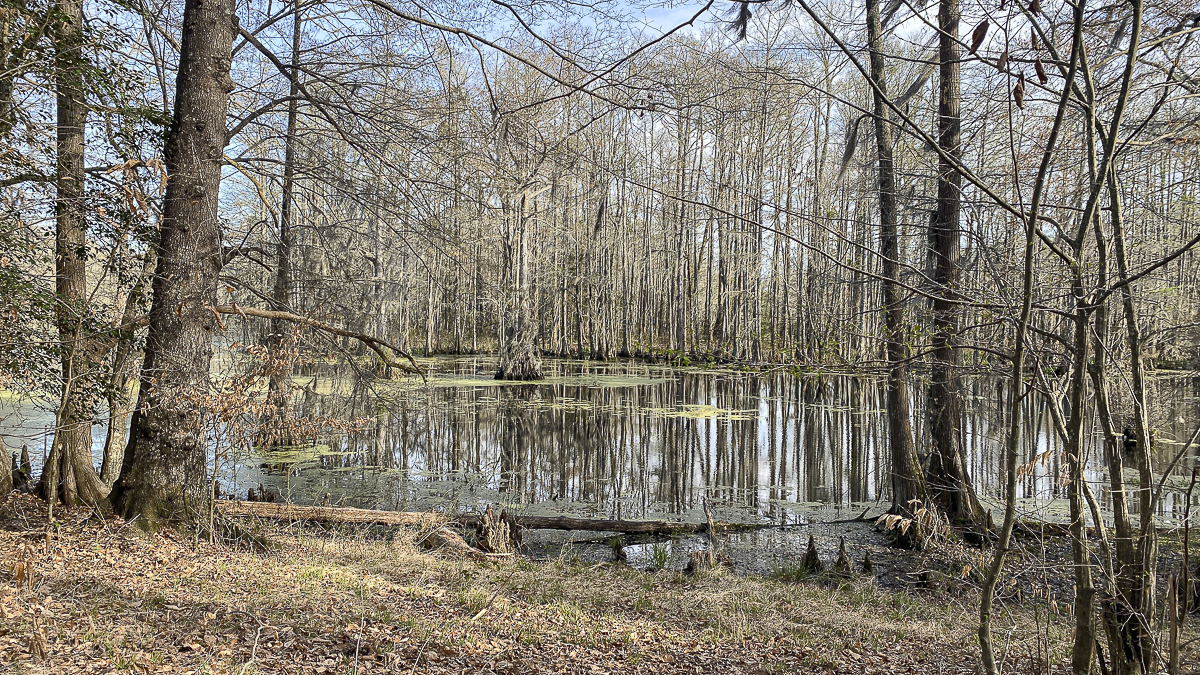
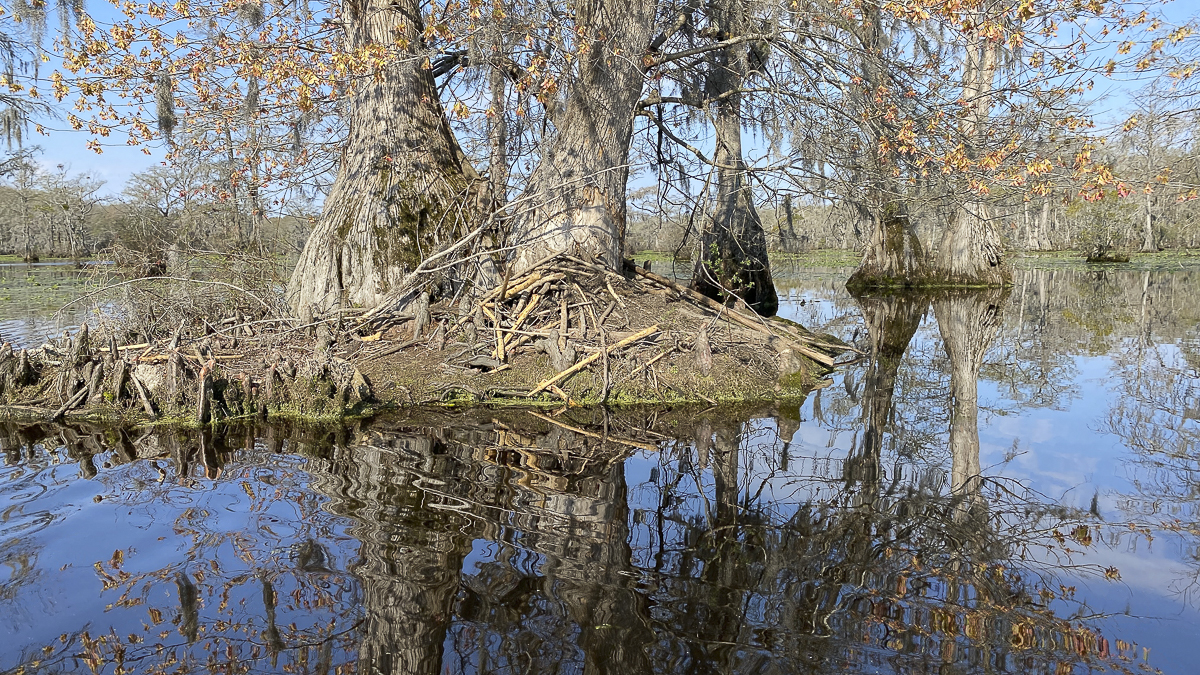
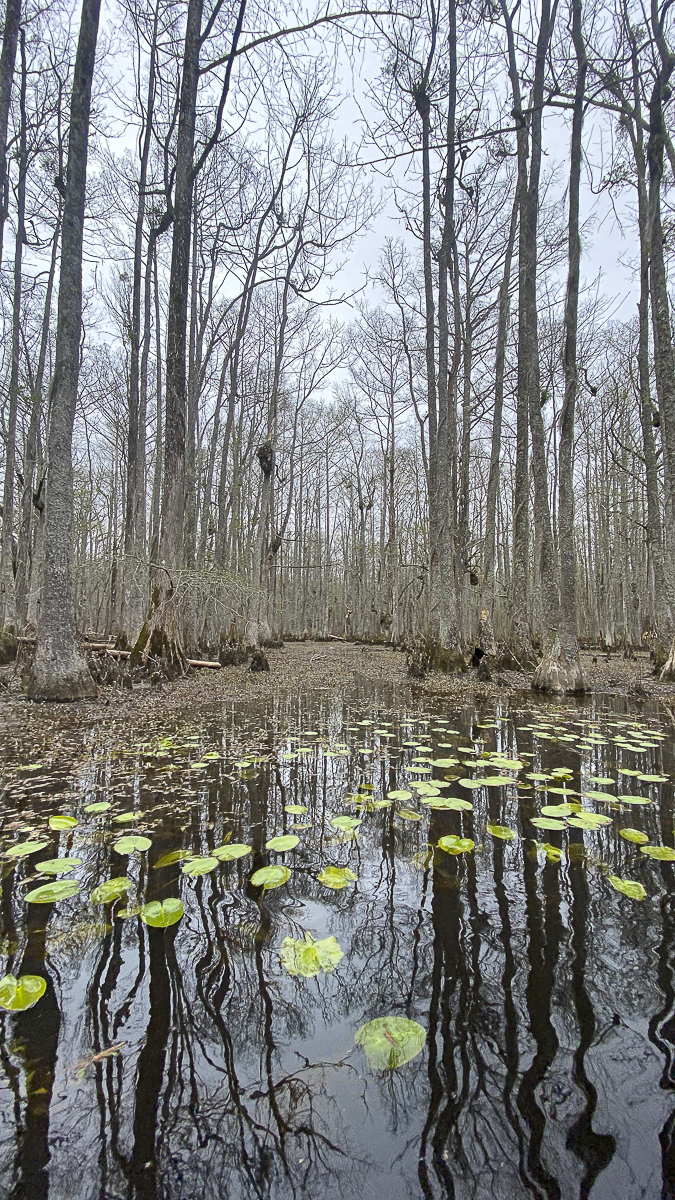
Over a week ago, Melissa and I managed a two night get-away to one of our favorite state parks, Merchants Millpond. I think Mr. Coleman was right, this may be everybody’s “dream swamp”. It combines an open millpond dominated by Tupelo Gum and Bald Cypress, with a beautiful swamp and surrounding hardwood forest. It is a paddler’s paradise and a naturalist’s delight with an incredible variety of plants and animals to observe. We reserved one of the canoe-in campsites and arrived at the millpond late in the afternoon after stopping to see our friends, Floyd and Signa, long-time residents of the area, former park employees, and two of the best naturalists we know. We also met a good friend of theirs that has been paddling the millpond for a couple of decades and returns each year to take it all in.
View of the millpond from our campsite (click photos to enlarge)
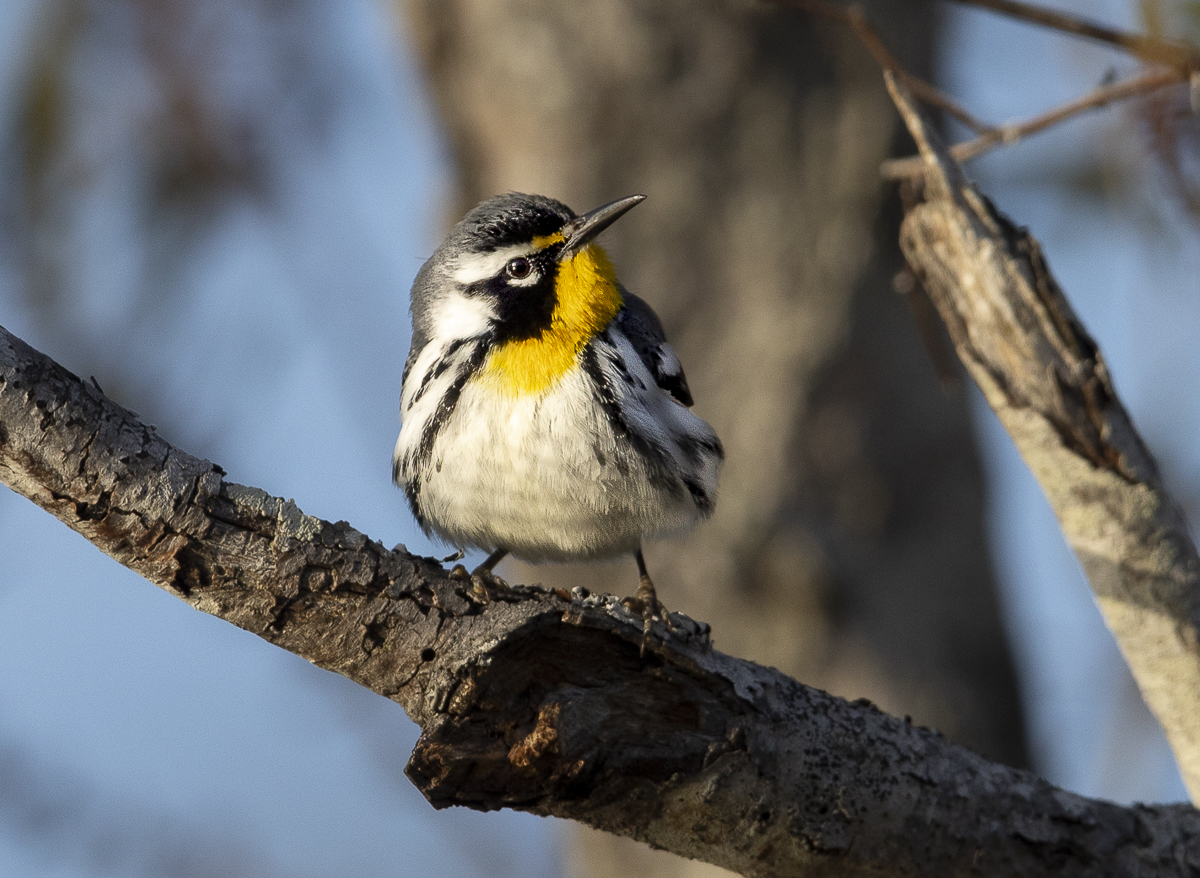
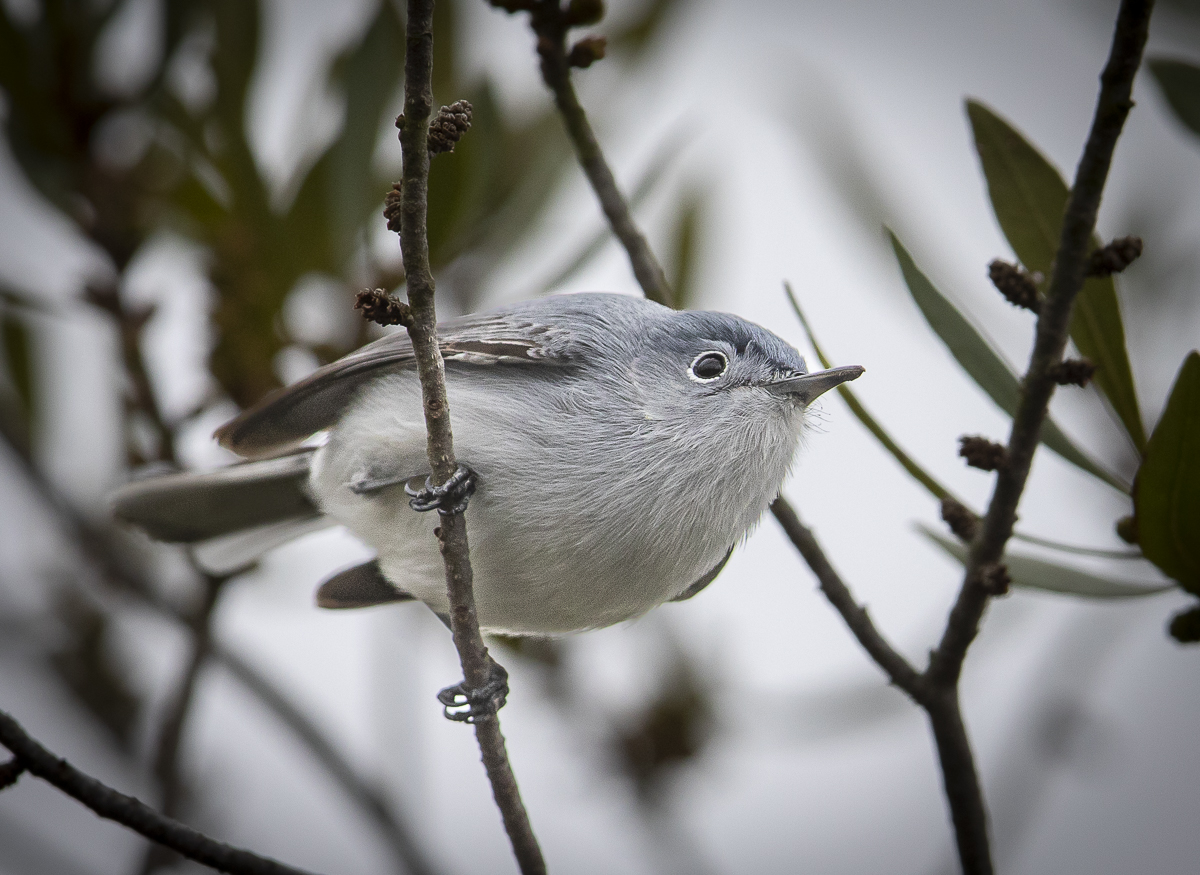
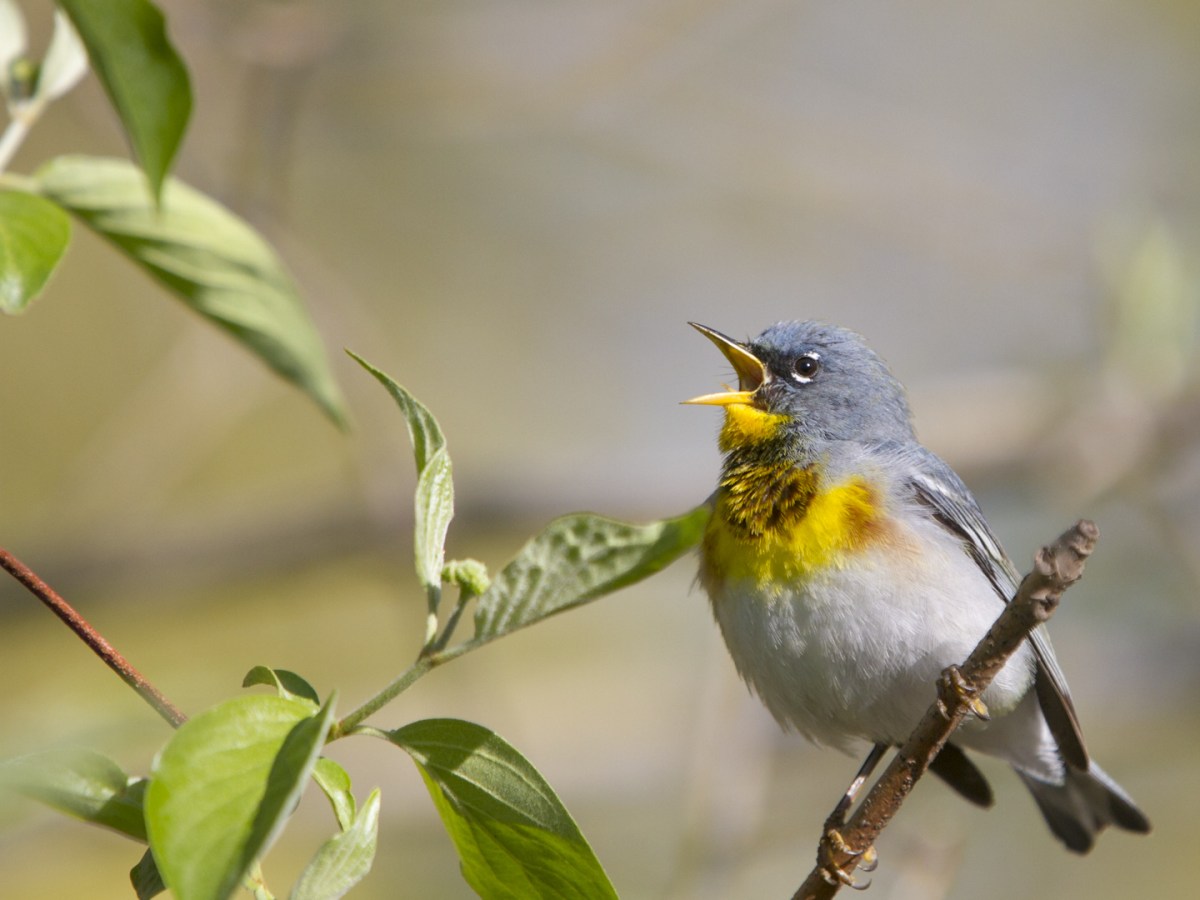
We set up camp and headed out to look for wildlife as the sun slowly made its way to the horizon. We heard lots of new spring arrivals – especially Yellow-throated and Northern Parula Warblers and Blue-gray Gnatcatchers. Picking some of these small neo-tropical migrants out can be tricky, especially when they are mixed in with the large numbers of Yellow-rumped Warblers flitting through the trees and stump island vegetation. But, one warbler was very cooperative, and we followed it around for several minutes as it sang and snagged a few insects.
Our cooperative Yellow-throated Warbler came down low enough for some good looks and pics
We also followed a few gnatcatchers as they gleaned some of the hundreds of tiny midges flying around the stump island vegetative communities common out on the millpond.
A Blue-gray Gnatcatcher with that high-energy look they always seem to have
We headed back to camp and had a relaxing evening around a campfire listening to the swamp sounds we love – Barred Owls hooting, and the beginnings of the many frog calls that will soon flood the swamp. And we were amazed at the abundance of fireflies that kept us company until we headed into our tent.
The next morning we headed up toward Lassiter Swamp at the upper end of the millpond. Along the way, we enjoyed some of the many sights that make springtime in the swamp so special.
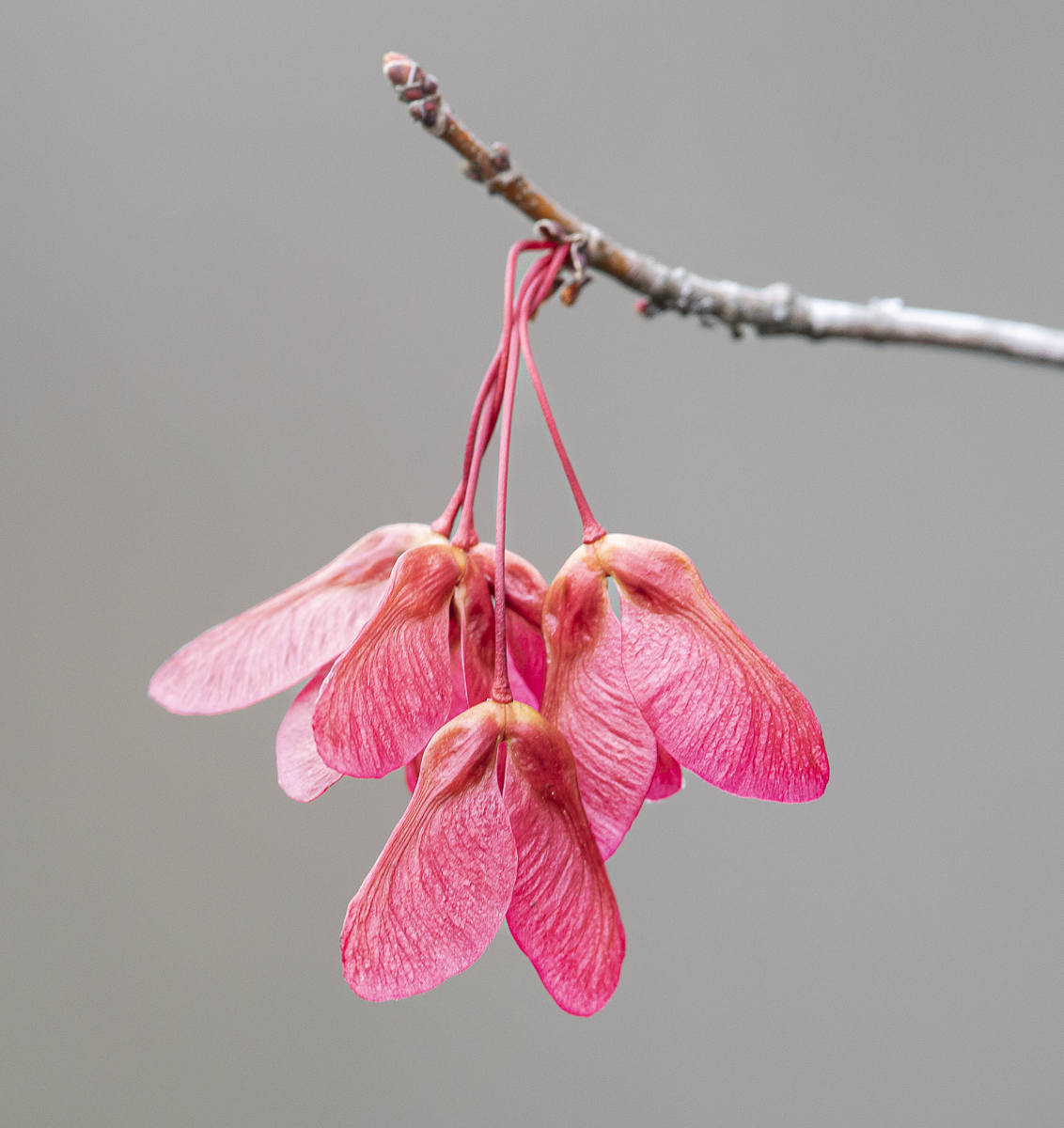
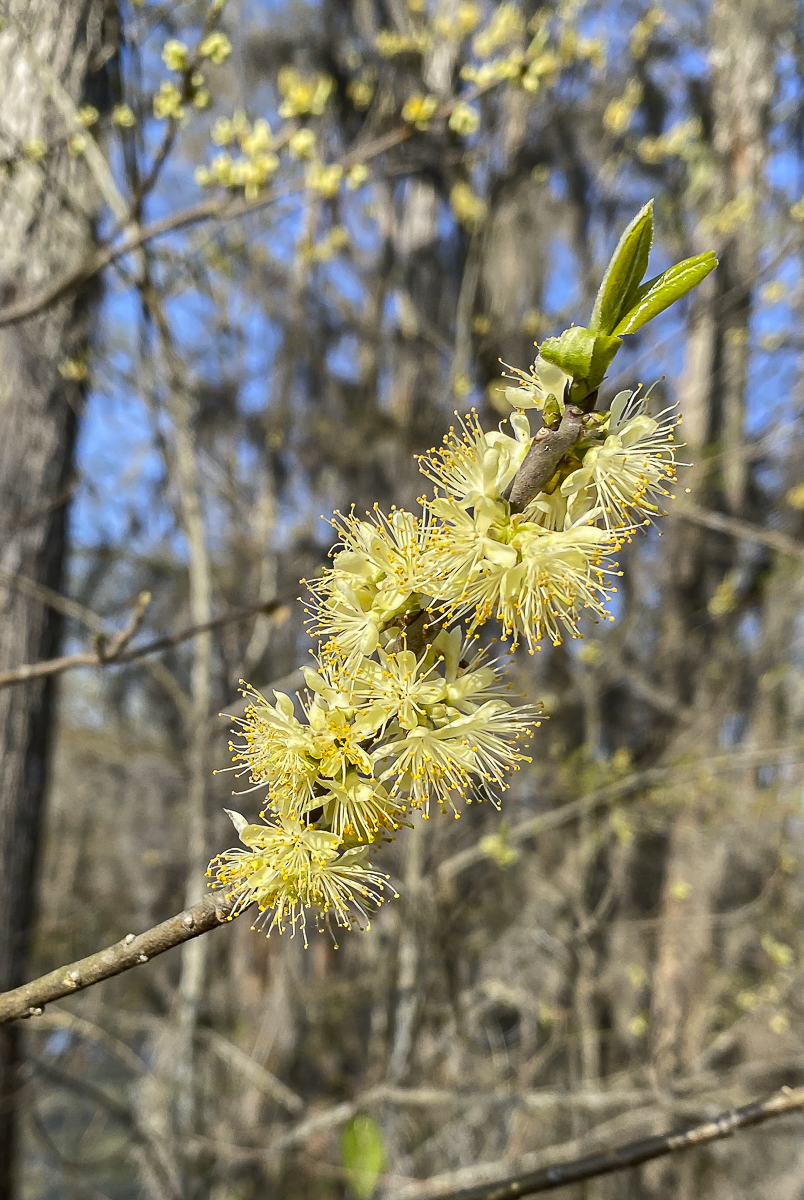
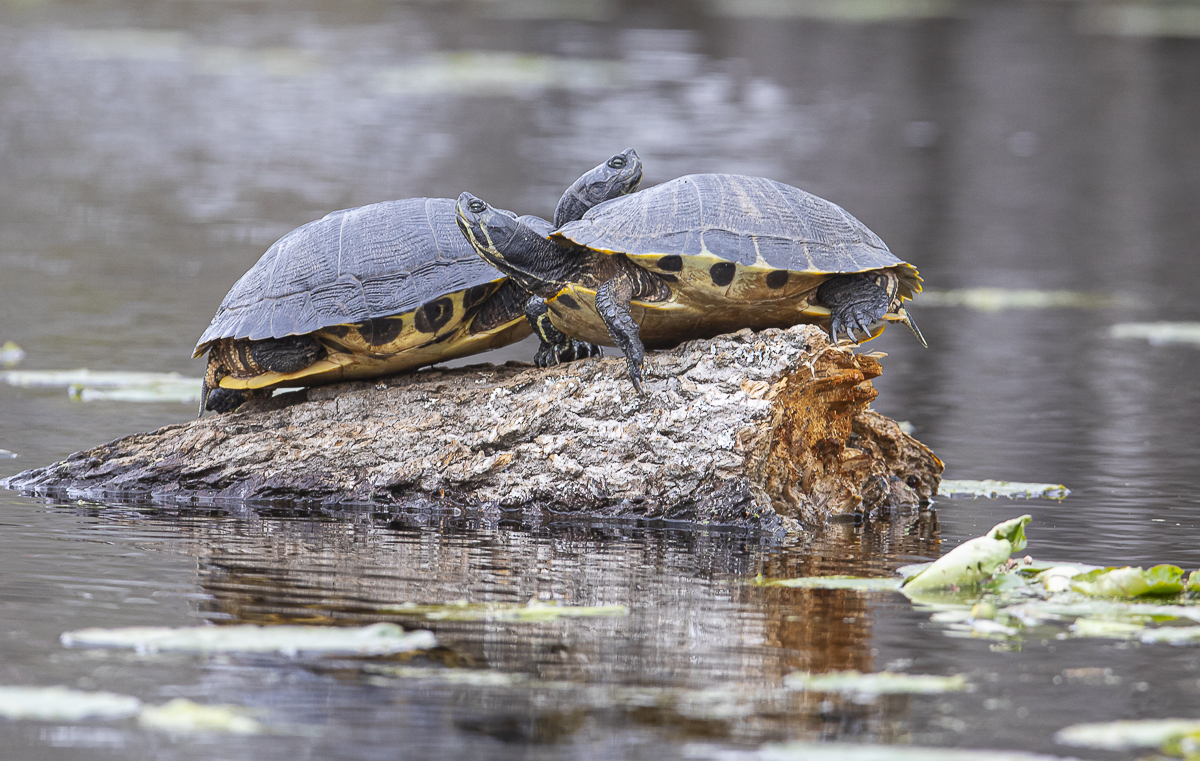
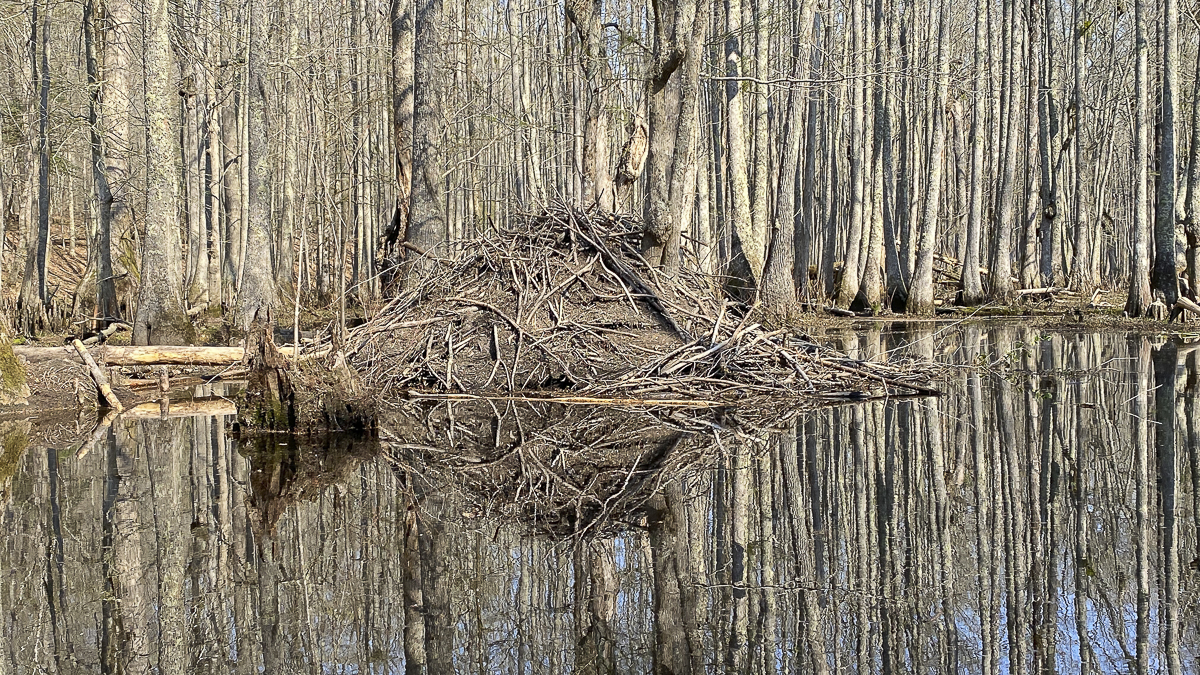
Red Maple seeds add a splash of color to the swampThe showy blossoms of Horse Sugar (Symplocos tinctoria) along the shore of the millpondSome sliders taking in the warm temperaturesOne of several large Beaver lodges we passed on our way to Lassiter Swamp
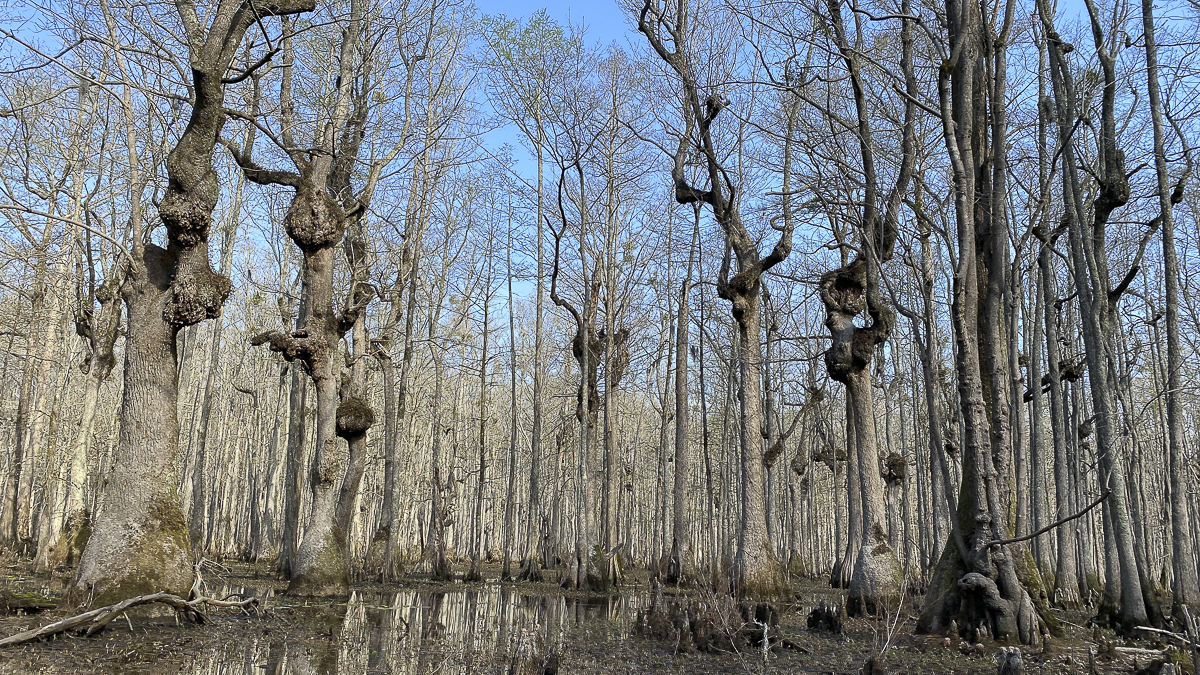
Entering Lassiter Swamp is like crossing a bridge into another world. There are usually fewer paddlers (we only saw one other canoe up there all day) and the enchanted shapes of the Tupelo Gum (transformed by their interaction with Mistletoe) heighten the magic and mystery of the place. Plus, there are usually some interesting wildlife species to see or hear.
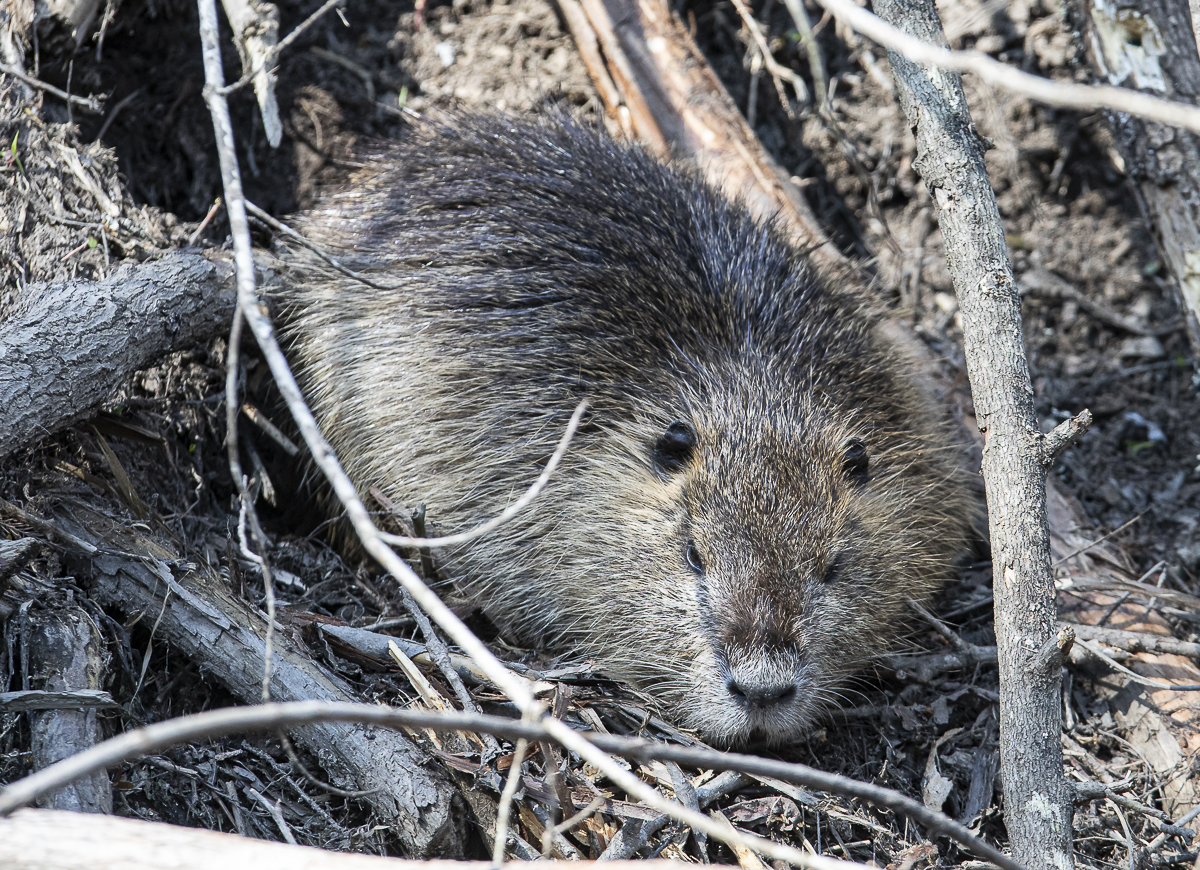
Mistletoe creates unusual growth forms in the branches of the Tupelo Gum trees in the swamp, lending a ghostly appearance to the sceneAnother oddly-shaped tree greets paddlers in the swampSplashes of spring green stand out in the grays of the swampA huge Beaver lodge in the swamp yielded a surprise as we paddled to the other side…A Nutria (an exotic mammal species introduced from South America into NC in the 1940’s for their fur) resting on the lodge. Nutria are larger than a Muskrat but smaller than a Beaver. They can be identified by their size and white whiskers on both sides of their nose. Sadly, we saw more Nutria on this trip than I have ever seen in the park.
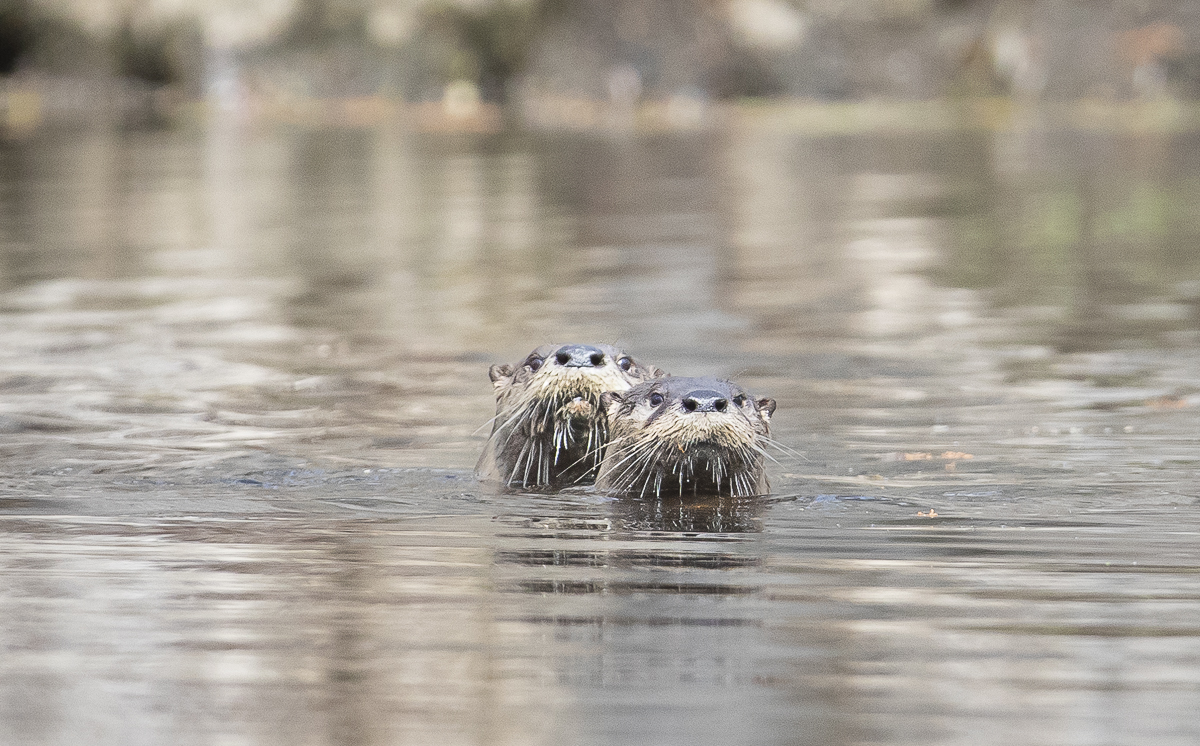
Melissa spotted movement in the water and we heard the distinctive snort of a River Otter. Then another snort and another and we saw six otters swimming ahead, bobbing up and down as they expressed their displeasure (or curiosity). The otter split with two going downstream and the others upstream, but not before a couple swam over to check us out.
A couple of River Otter come over to investigate this strange visitor to their swamp
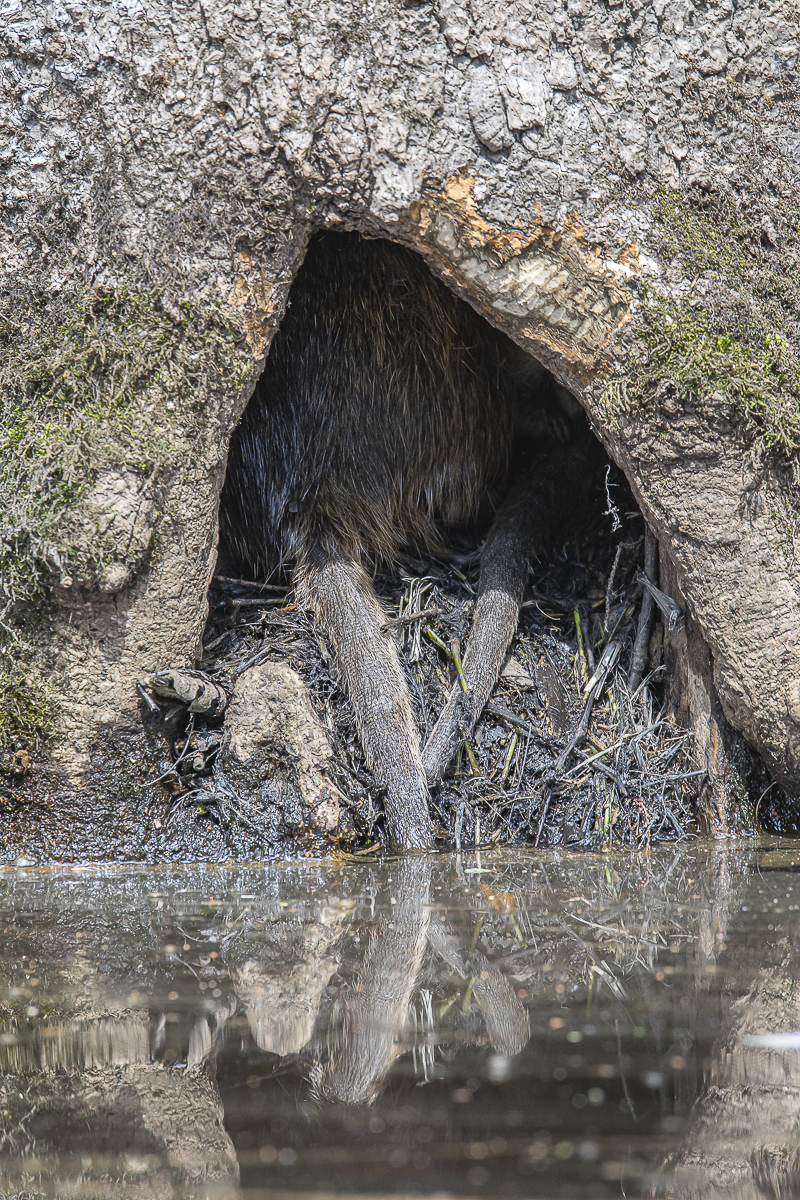
Along the stream channel we saw an occupied hollow tree base with three Nutria inside. The smallest one had just pulled its tail back into the hollow when I snapped this pic. A little farther along, we saw movement – our otters were lounging and playing on a moss-covered log up ahead…
Nutria hang-out
The otters hit the water and swam upstream, snorting at us as they went (I think it was definitely disapproval this time).
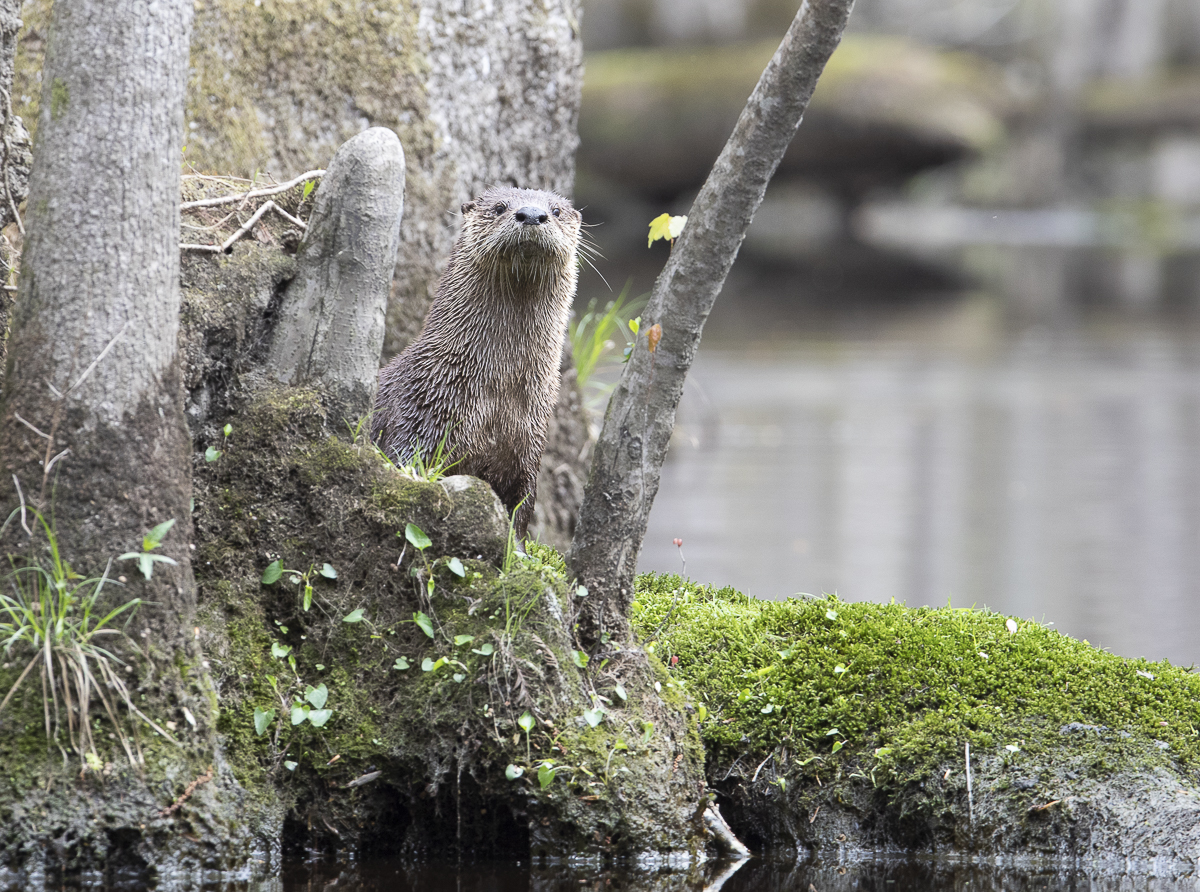
An otter peers over a cypress knee before gracefully sliding into the water
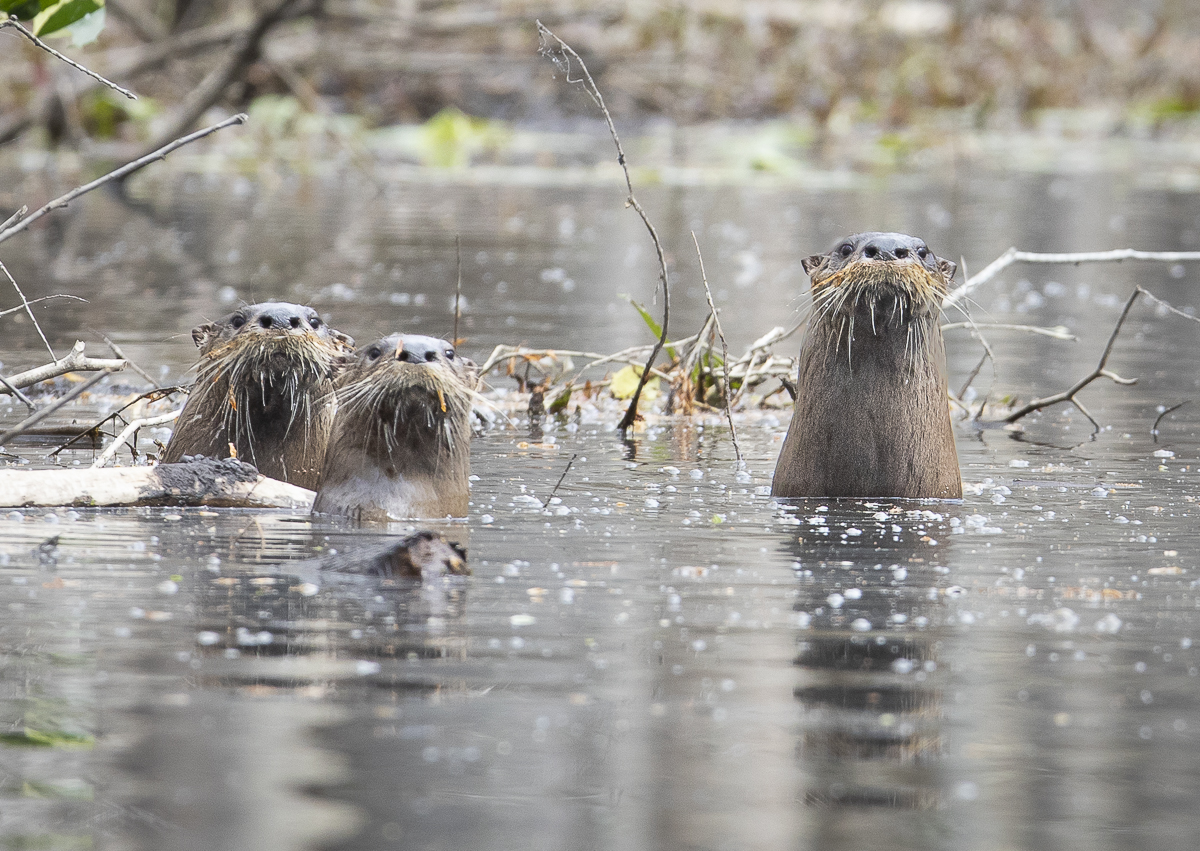
We saw them again a little upstream and all four (one is just off camera) raised up in the dark water to get a better look.
We came across this group of otter several times during our paddle up the swamp
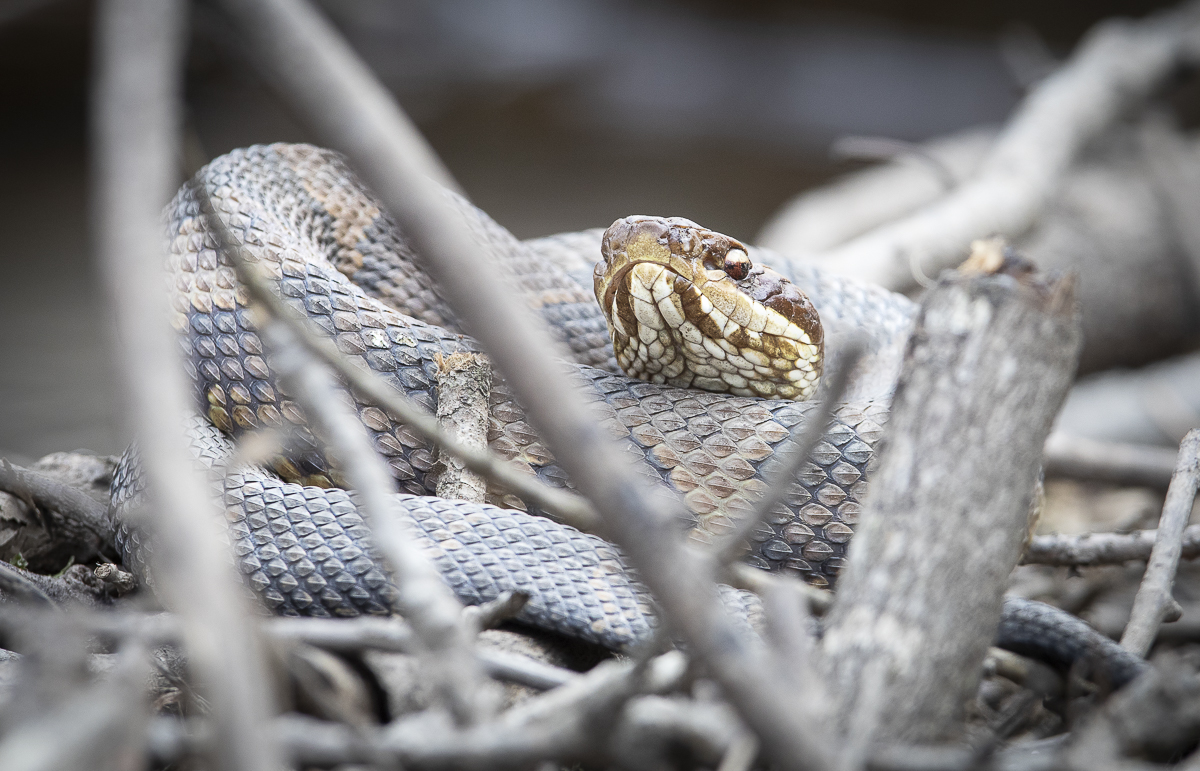
Water levels were a bit low so we encountered several log jams and small Beaver dams across the creek that needed to be “scooched” over as we paddled upstream. We had our rubber boots on and had to get out once to pull the canoe over a log. Then we hit a larger barrier – a log across the channel with a pile of debris caught in the low spot. A couple of feet to one side was a small Cottonmouth attempting to blend in with the stick pile (you always need to check blockages like this for Cottonmouths before getting out up in the swamp). After failing to find a passage around it, Melissa decided to get out and try to pull us over. Let’s just say that didn’t go well (the debris pile turned out to be less sturdy than she thought). After helping pull her back up we decided to let the far reaches of the swamp remain unchallenged for this day. By the way, the Cottonmouth remained calm throughout the process and never even showed us the classic warning pose with mouth agape. I guess it figured we weren’t much of a threat.
Cottonmouth eyeing the paddlers at a channel blockage
We spent the rest of the afternoon paddling back to the millpond and enjoying the scenery and the wildlife.
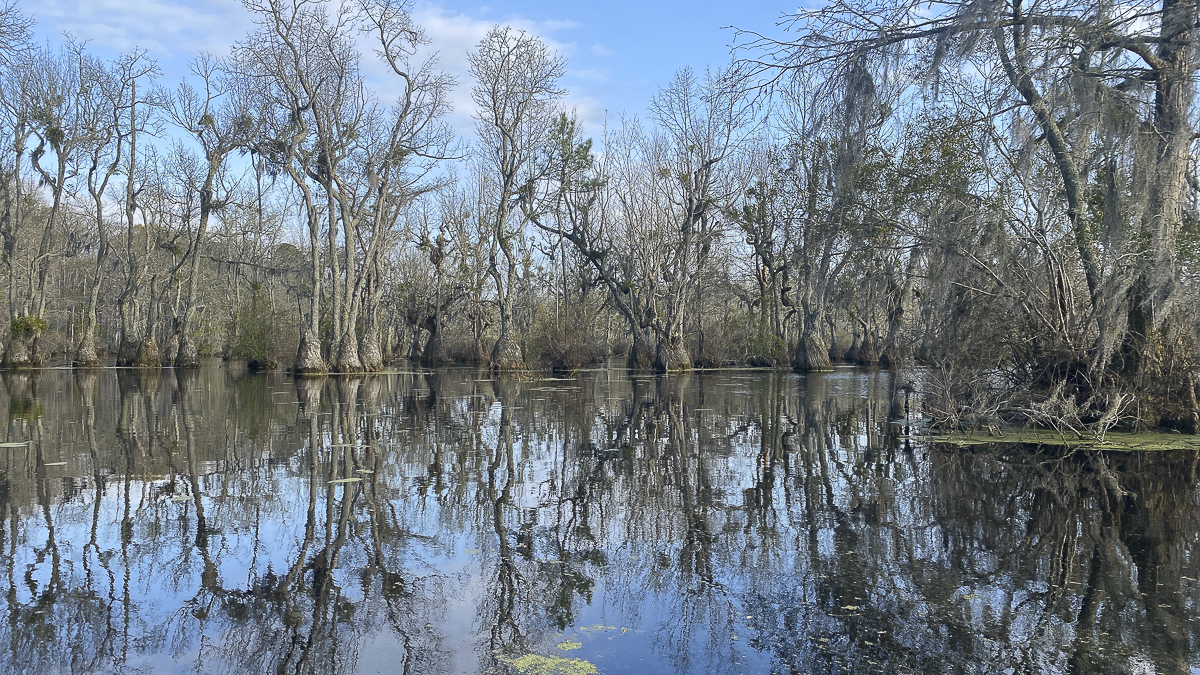
Reflections on the millpond on a windless day can be stunning
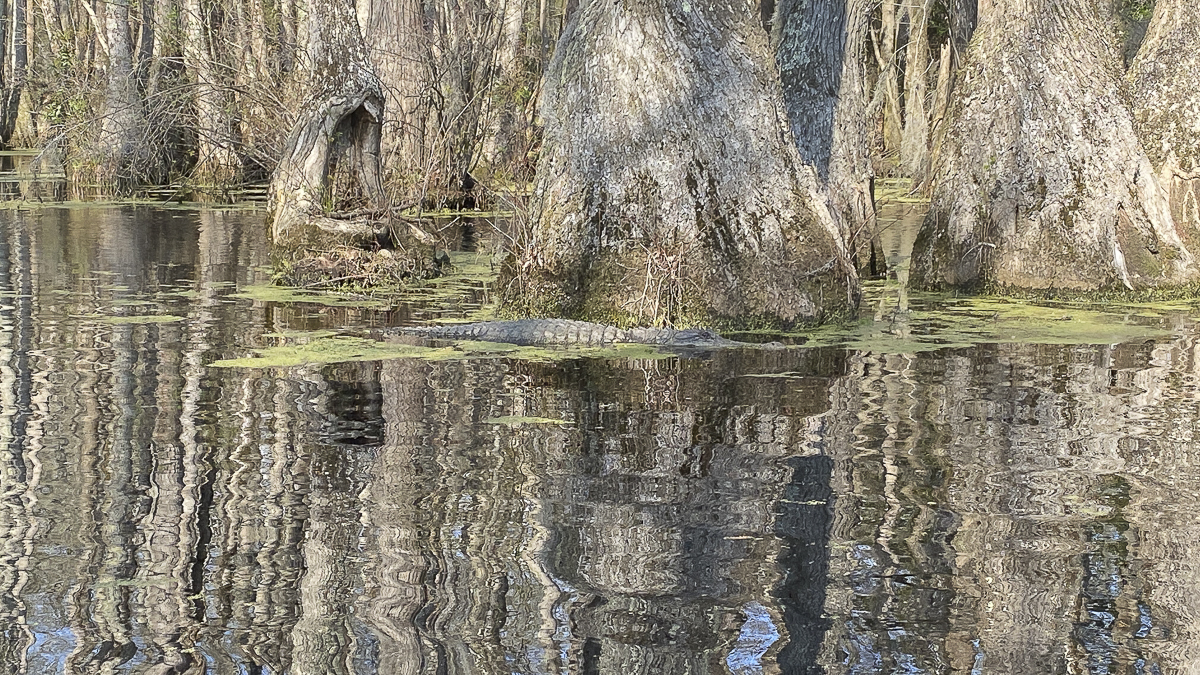
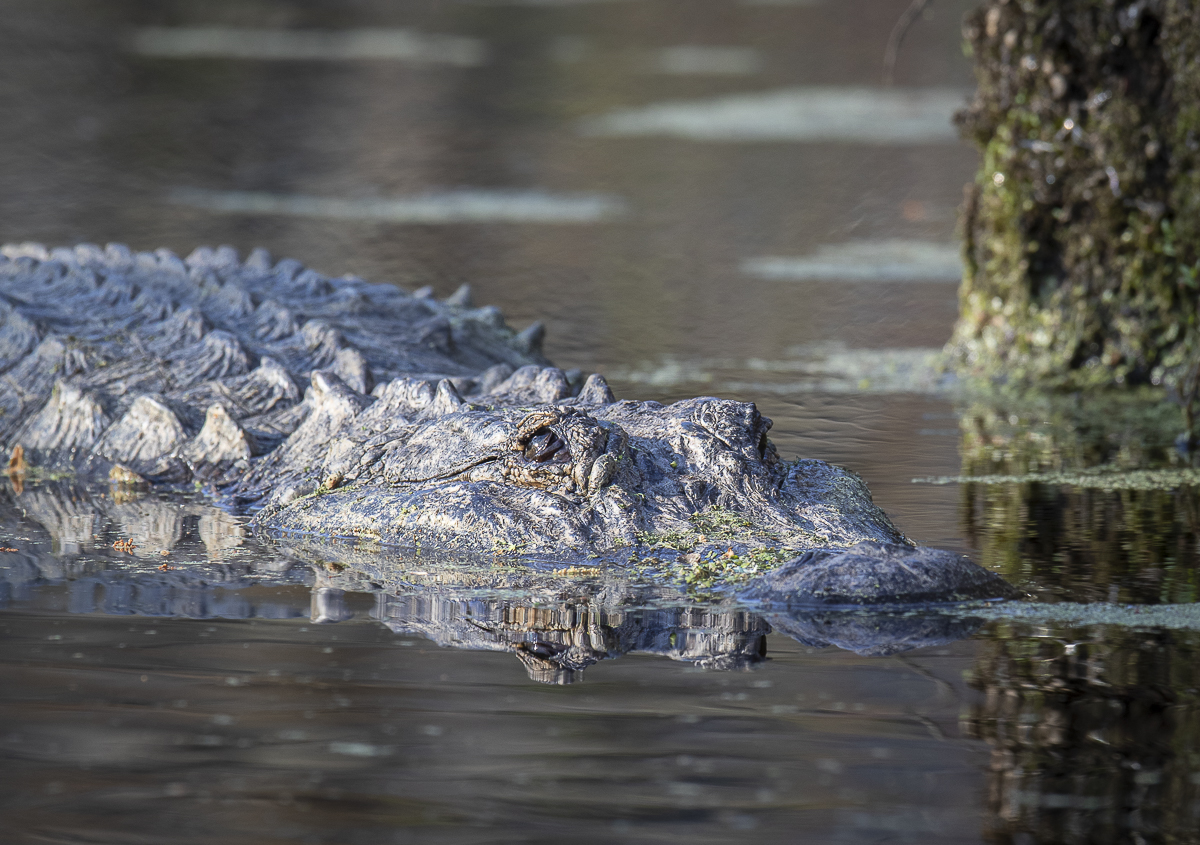
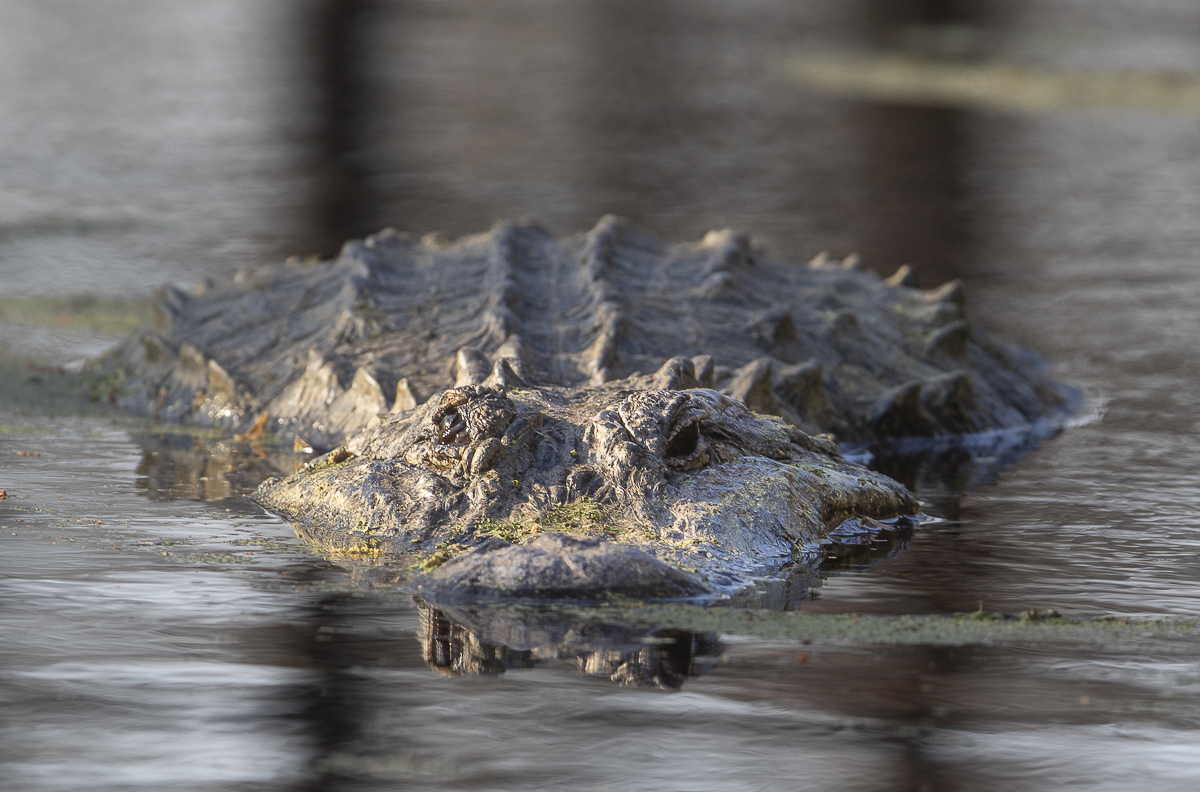
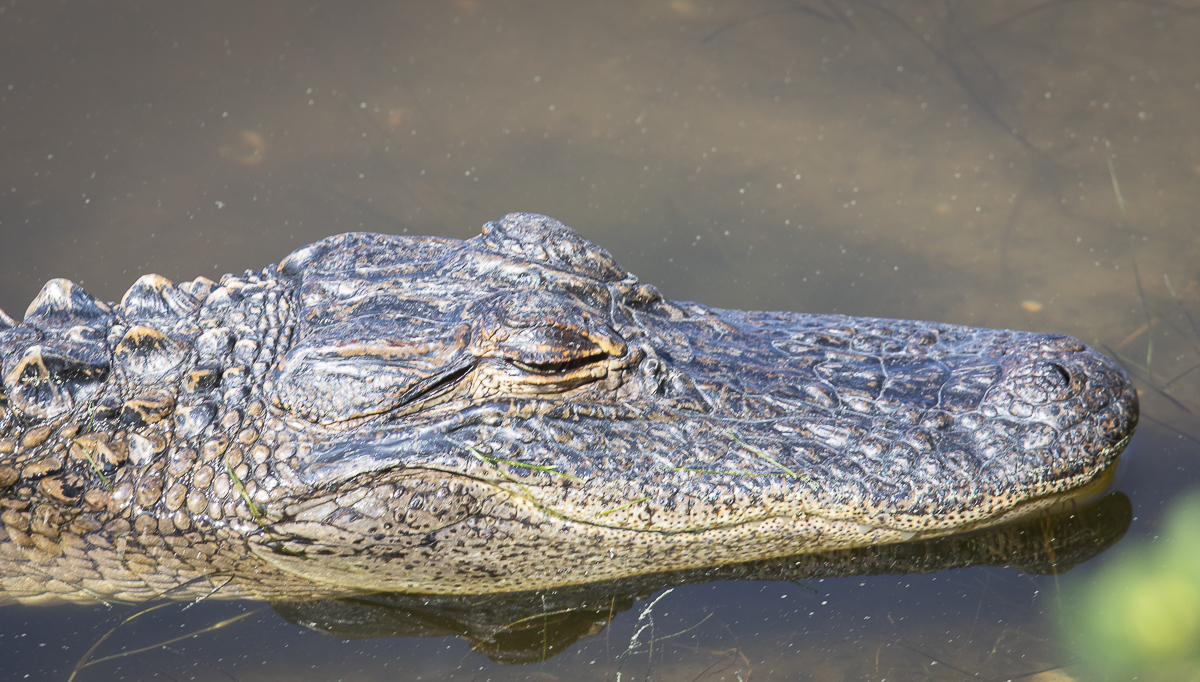
There have been a few changes on the millpond since my days as a state parks district naturalist oh-so-many-years ago. There are a lot of noisy Canada Geese now nesting on the millpond; Nutria have expanded their range into the millpond area; and the first American Alligators have appeared. As we paddled the lower end of the millpond, Melissa saw a large ‘gator lying up against a swollen tree base. North Carolina is at the northern limit of the range of American Alligators, so they are not common in this part of the state. Our friends say there are probably three ‘gators on the millpond, but no babies have been reported in the years since they first appeared. We circled around it, admiring its size and taking some photos with our telephoto lenses. Looking at this guy, we certainly didn’t feel like getting too close (and you shouldn’t either). They don’t pose a danger to paddlers, but you should treat them with respect and not harass them. This individual was a large one, perhaps 9 feet in length and weighing in at about 200+ pounds.
An American Alligator Such an amazing creature…and so wide!
After the alligator, we paddled slowly back to camp, and I thought of what a truly great gift this was to the state of North Carolina, this dream of a swamp. There really is no other place quite like it. Thanks to all who have helped preserve it and make it available to the public for all these years and into the future.
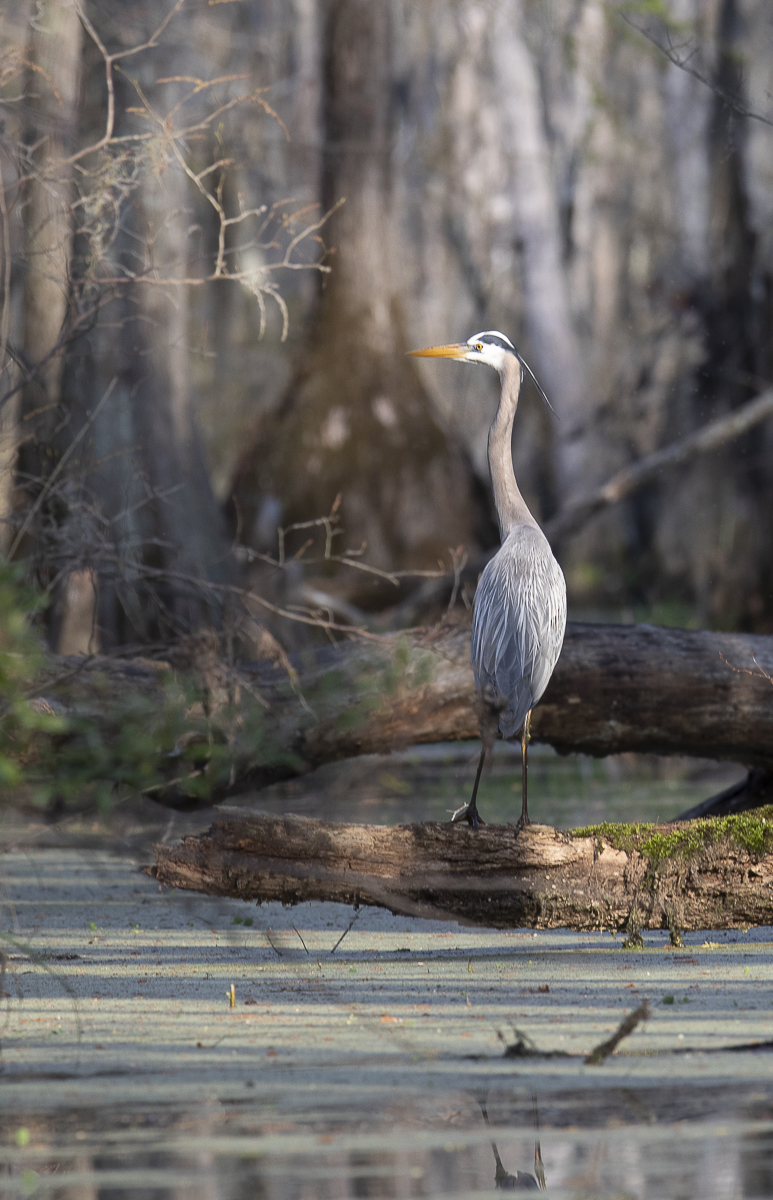
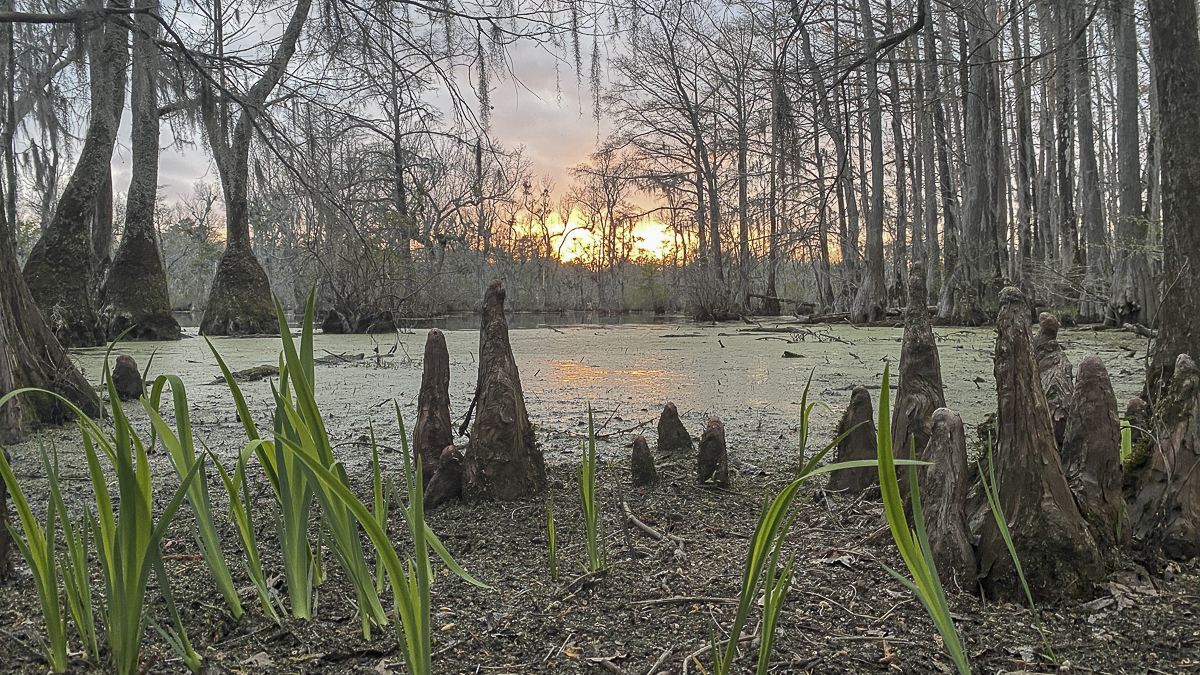
Millpond reflectionsThe last light of the day highlights a Great Blue Heron in a cypress groveOur final sunset on the millpond…but we will be back
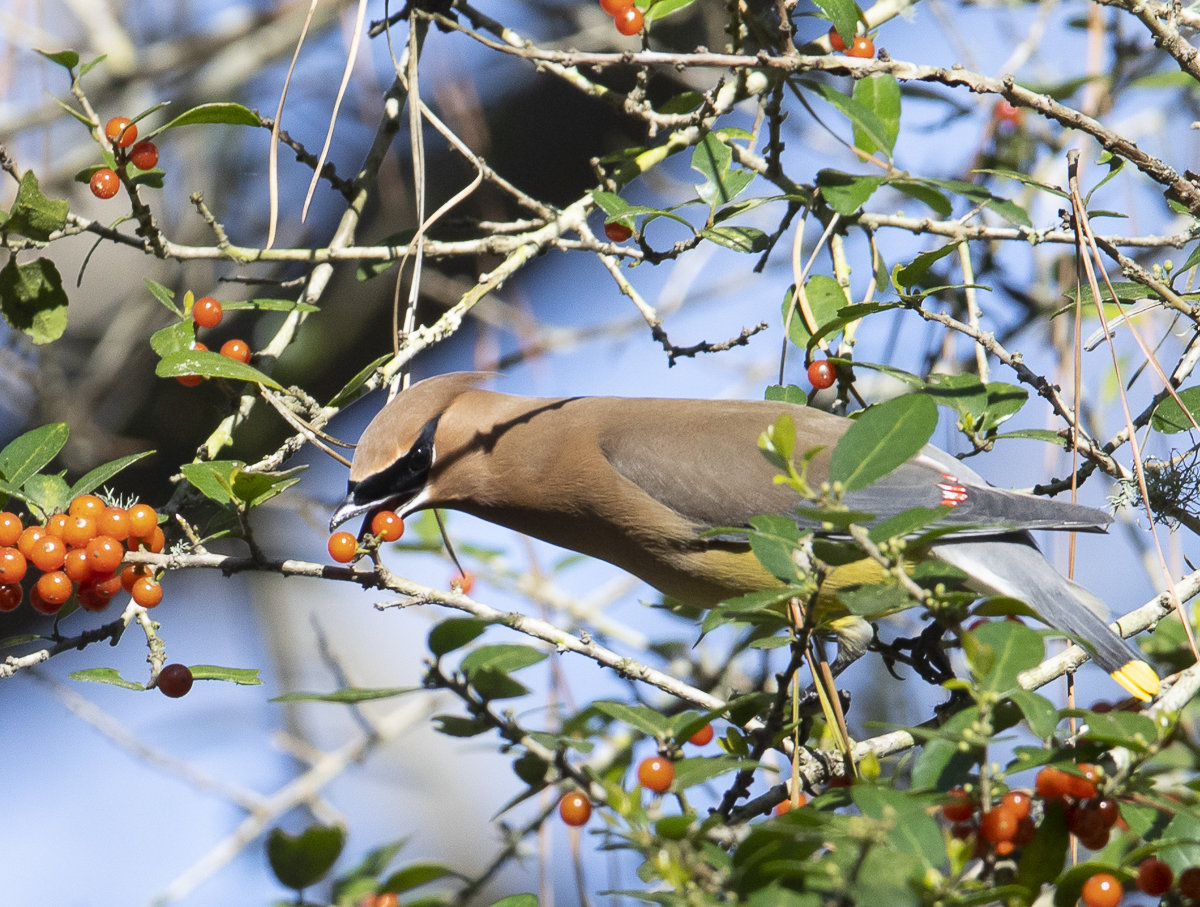
My trip last weekend included some time at both Myrtle Beach State Park and nearby Huntington Beach State Park. While hanging with friends at the former park, I was impressed by the amount of bird activity and marine life (from the ocean pier) we saw. Cedar Waxwings were everywhere scarfing up the ripe Yaupon berries. The surprise birthday party for my friend was held at one of the picnic shelters and there happened to be some Yaupon trees along the road edge so I finally took my camera over toward the trees and stood for awhile hoping the flock would come in closer. They were pretty spooked by all the bicycles and cars going by so I managed only a few images.
Cedar Waxwing eating a Yaupon berry (click photos to enlarge)
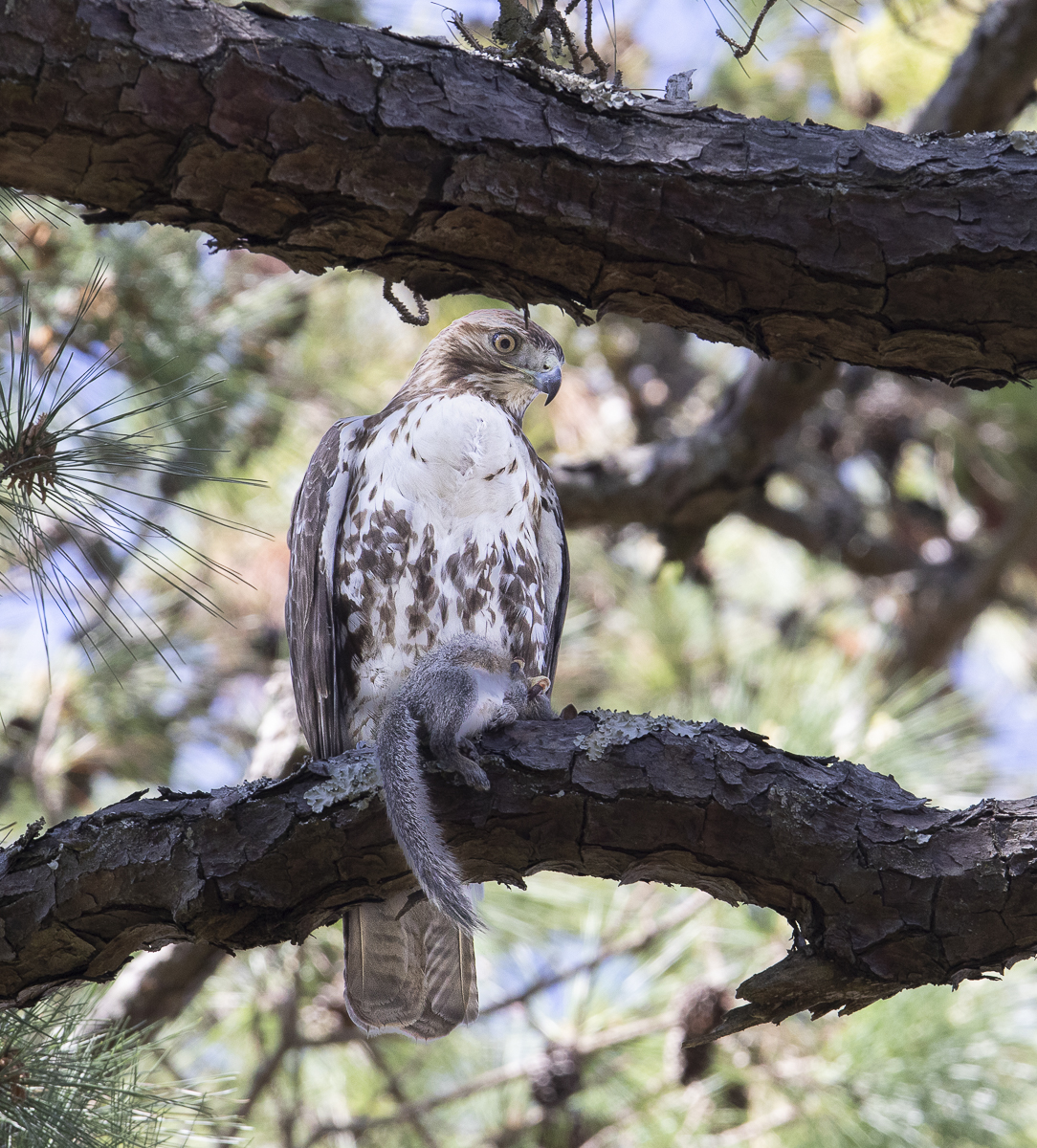
While sitting at the picnic shelter, Scott saw an immature Red-tailed Hawk fly in and land on a pine limb over the road. It had captured what looked like a young squirrel. We all got up and looked at it and it just sat there looking around. I finally eased over underneath to get a photo. It finally took off and flew into the woods a few hundred feet away and began to eat its meal.
Juvenile Red-tailed Hawk (see the bands on its tail?, that means it is an immature) that captured a young Gray Squirrel
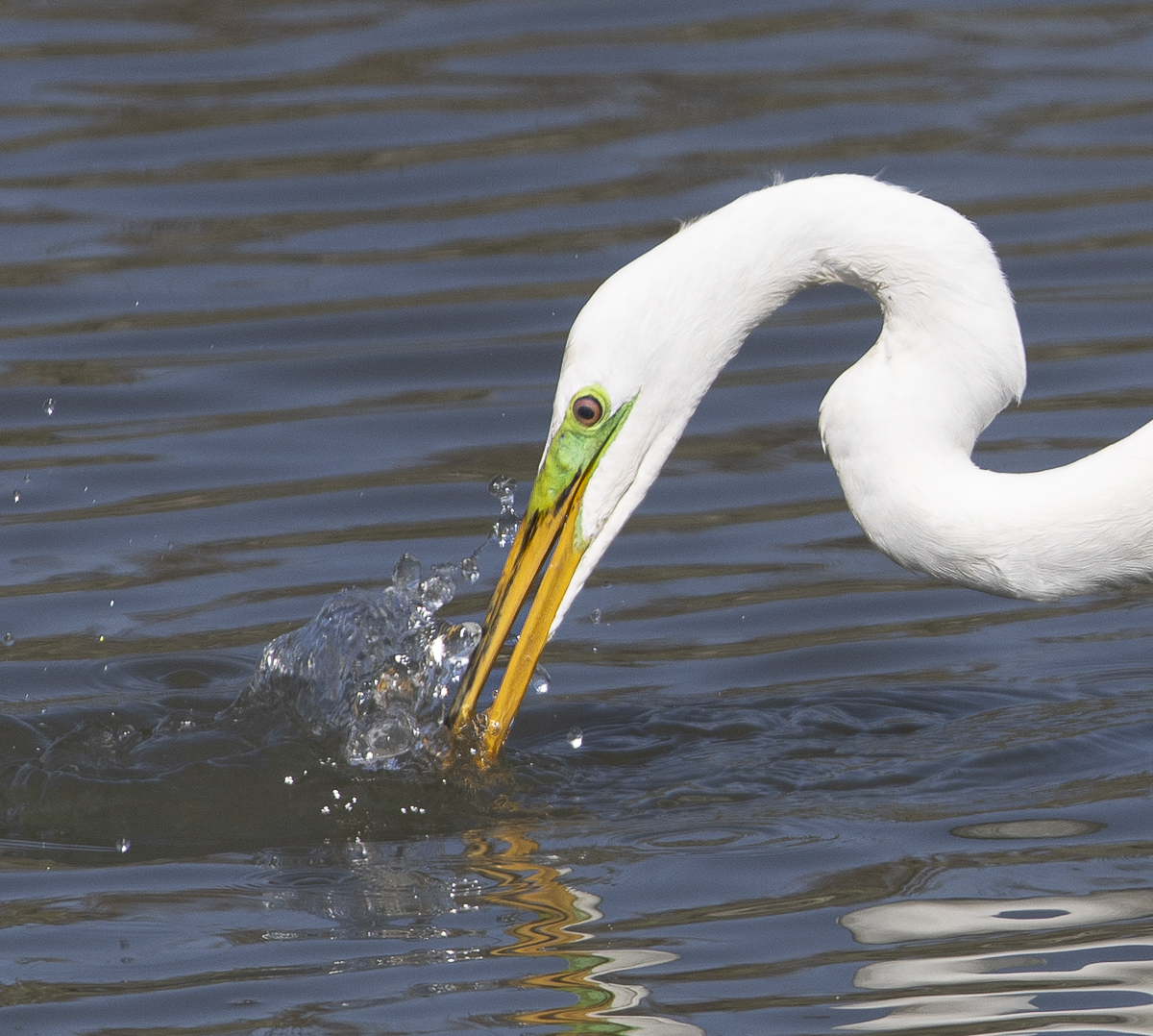
Back at Huntington Beach, the falling tide on the salt marsh side of the causeway revealed a smorgasbord of dining opportunities for the local birds. Great and Snowy Egrets stalked the shallows for small fish.
A Great Egret strikes at a small fish
The Tri-colored Heron and Greater Yellowlegs were mainly going after smaller prey, the abundant transparent Grass Shrimp.
A Greater Yellowlegs catches a small Grass Shrimp at low tide
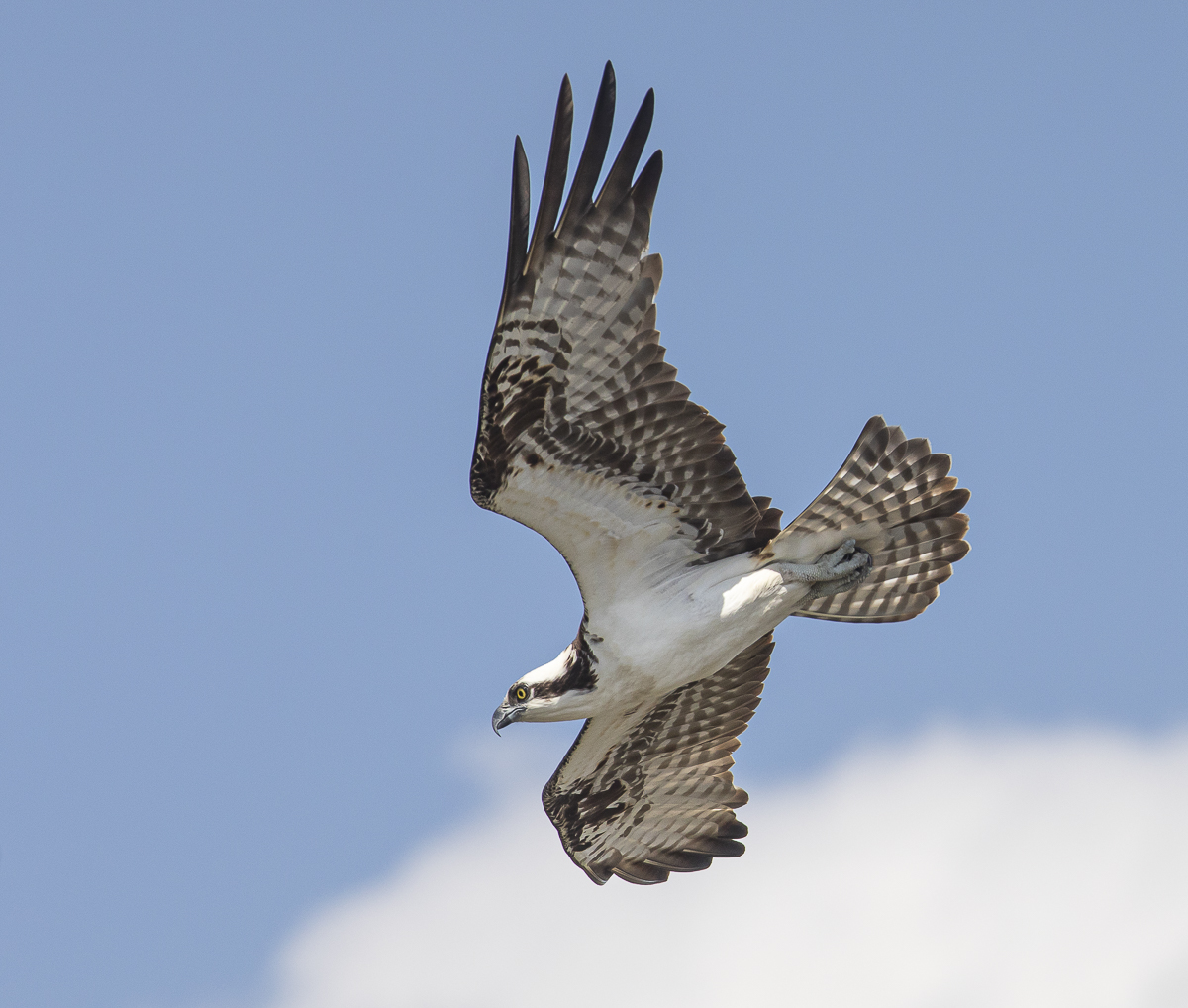
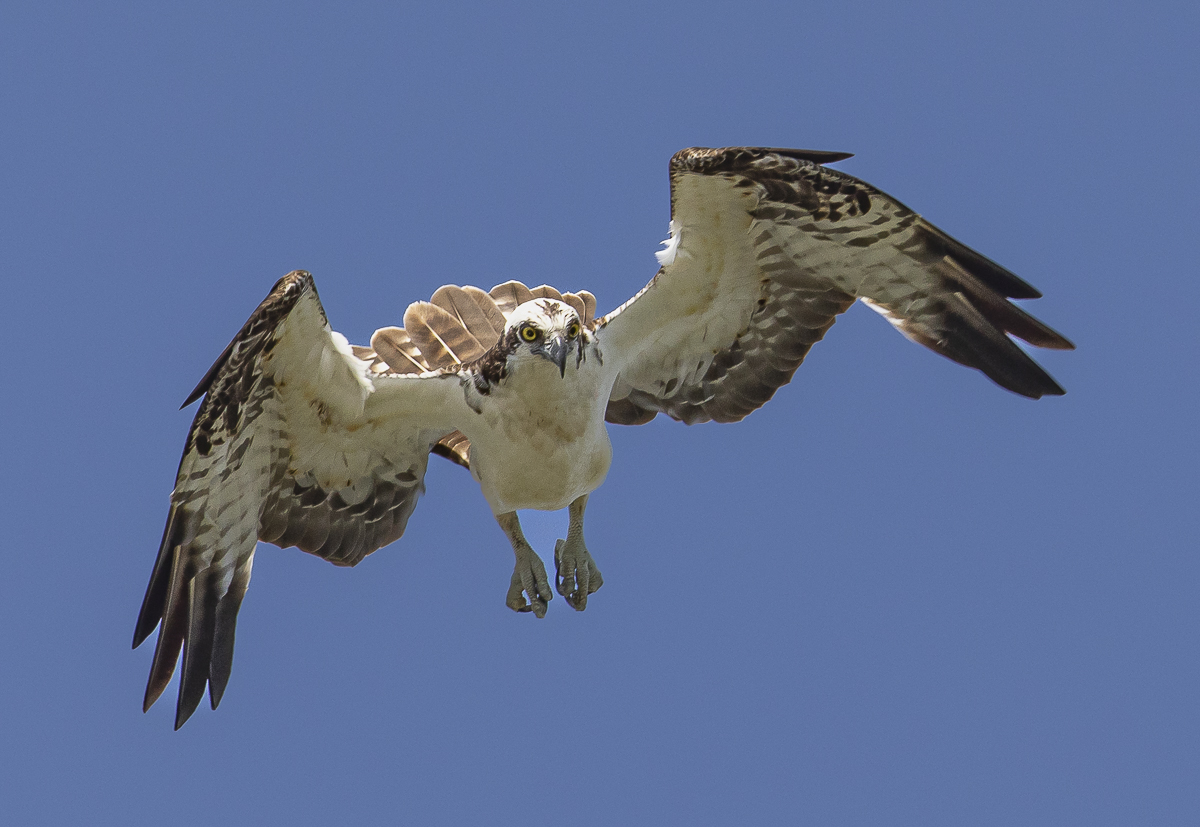
My favorite hunters were the pair of Ospreys patrolling both sides of the causeway. I was hoping to get a series of shots of one diving and catching a fish, their primary prey (an Osprey’s diet is 99% fish). An Osprey typically soars over a water body at a height of 30 – 100 feet, scanning the water surface for fish. When it spots one, it will usually momentarily hover, and then fold its wings and drop toward the water. I watched as one bird did this time and again and then pulled up before actually hitting the water.
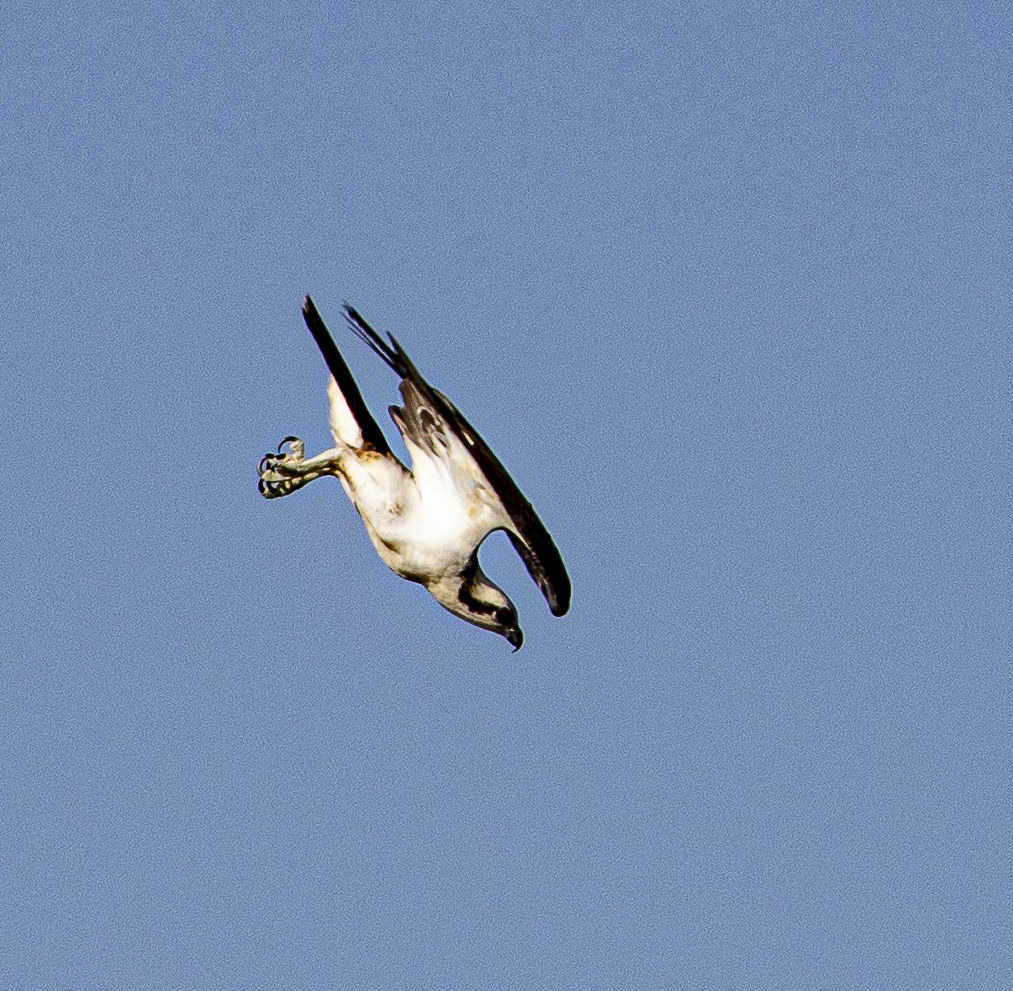
An Osprey begins its dive after hovering for a few secondsWings angled and feet dangling are part of the speedy dive. I found it difficult to keep up with the diving birds with my camera
Finally, one bird hovered close to the causeway and quickly started its dive. I tried following it but missed a few images or had some blurry ones as it dove toward the surface near the causeway.
This one turned and headed straight down toward the water near me
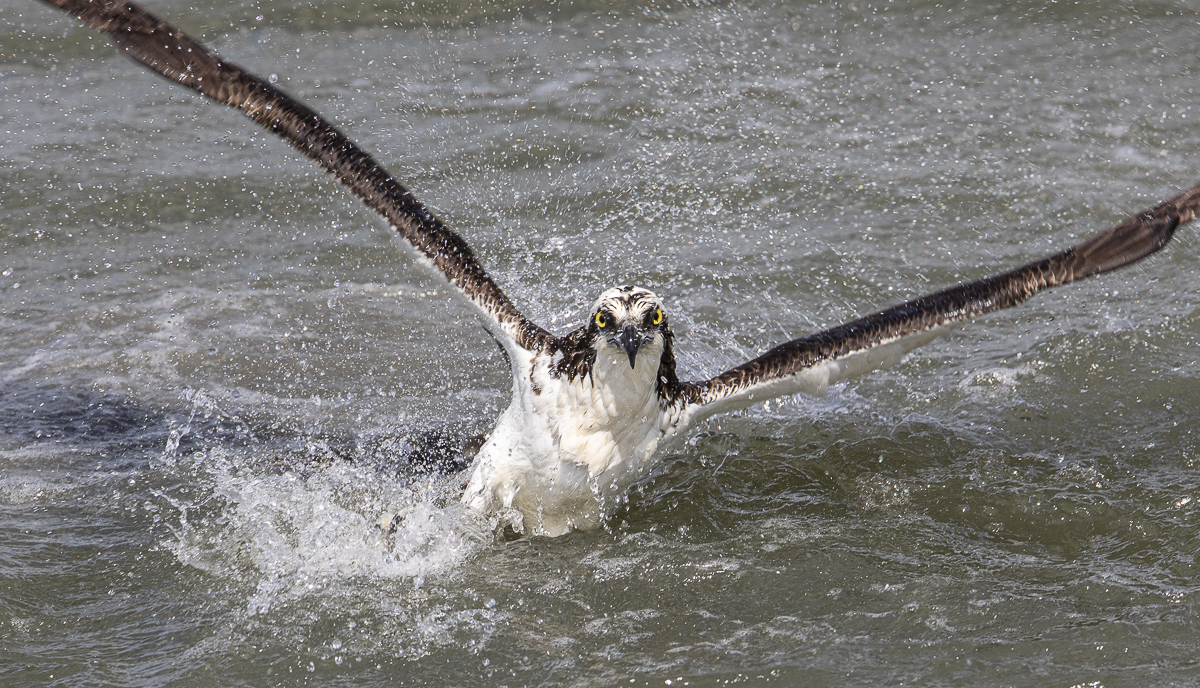
It hit the water several feet out in front of me and was so close that I couldn’t get the whole bird in the photos! Their long wings give the extra lift to pull their prey out of the water. Their nostrils also shut tight as they hit the water.
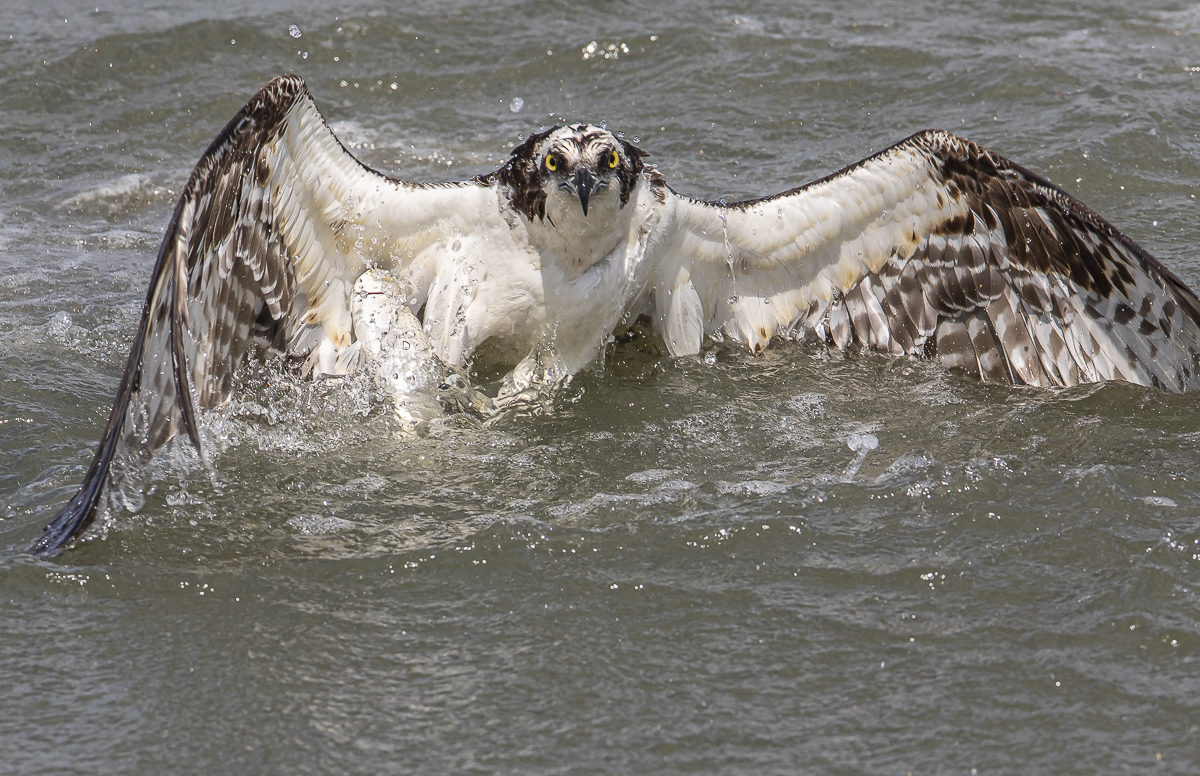
The Osprey briefly disappeared under the water with a huge splash and then rebounded to the surface with wings spread
Studies show success rates for Osprey dives of between 24% and 82% (meaning they don’t catch a fish every time). They have specialized toe pads, strongly hooked talons, and a reversible outer toe, all of which give them a better grip on the fish.
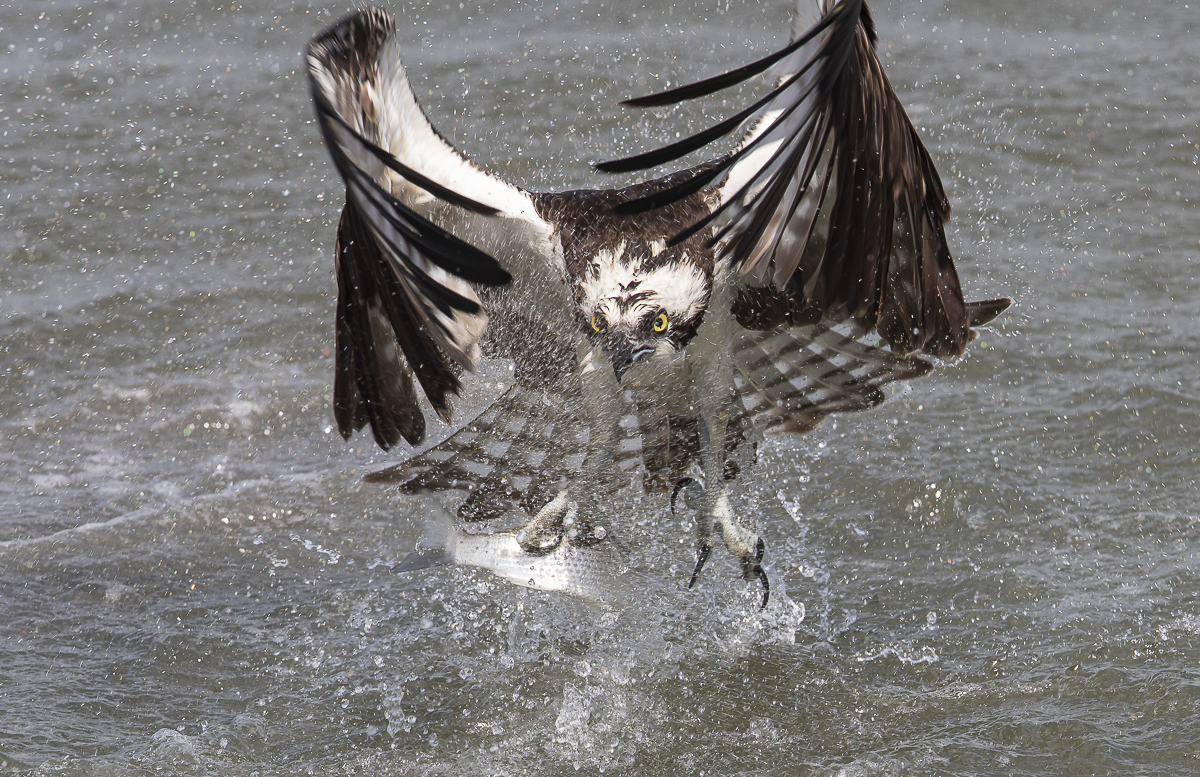
The Osprey flaps and rises up out of the water, a fish in its right footIt takes a couple of flaps to clear the surface
Osprey are the only raptor that has oily feathers, which allows them to shake off the water as they emerge from the surface, making it easier to lift off with their prey.
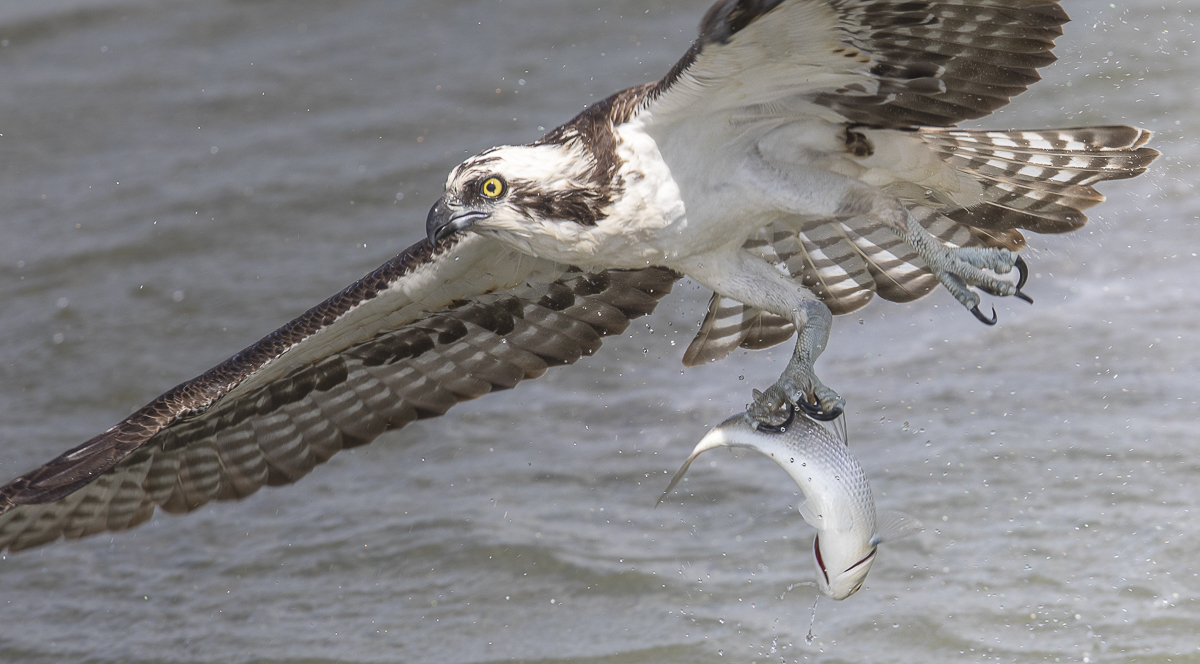
The bird clears the surface with powerful wing beats, pulling a Mullet up from the waterLook at those talons!It looks like a tenuous grip on the struggling fish, but it managed to fly off with its meal
It all happened so fast, I lost track of the Osprey as it flew away, did the characteristic body shake that follows most dives (to shake off the water) and headed to a perch to eat its meal. Ospreys usually orient the fish head first to reduce drag as they fly. On this day, no Bald Eagle appeared to try to steal a meal and I finally saw the Osprey fly far across the marsh to a large dead tree.
All in all, a great couple of hours of hunting at Huntington Beach. Watching all that feeding had made me hungry, so I decided to grab a bite myself and head home.
Portraits are about revealing aspects of an individual.
~Kehinde Wiley
Last weekend I drove down to Myrtle Beach, SC, for a surprise birthday party for my friend Scott. Of course, I had to visit one of my favorite birding and photography spots while I was there, the nearby Huntington Beach State Park. The causeway leading to the beach passes across an oasis for birds with a freshwater lake on one side and a tidal salt marsh on the other. With lots of time with old friends from my state park days, I didn’t make it over to Huntington at prime time of dawn or sunset, but still managed to grab a few mid-day photos of some of the residents. One of the great aspects of this place for photography is that the critters are very accustomed to people walking on the causeway and nearby trails and can be quite tolerant while you capture their portrait.
Great Blue Heron stalking prey among the oysters at low tide (click photos to enlarge)A Tri-colored Heron moves about swiftly stabbing at small fish and shrimpSnowy Egret staring into the water right before lunging at a small fishA Great Egret sporting its breeding colors around the eyes grabs a killifishI sat with this Double-crested Cormorant for several minutes while it dried its wings and preened. You need to be close to appreciate their eye color.It is breeding season for the striking Anhingas and this male was looking dapper as it perched near a group of nesting pairsWhile sitting with the cormorant, a passer-by asked me “Have you seen any?”. I asked, “Any what?” This is what she and many other visitors are hoping to see along the causeway.
These woods are lovely, dark and deep, But I have promises to keep, And miles to go before I sleep, And miles to go before I sleep.
~Robert Frost
The trail cameras continue to capture moments in the lives of our woodland neighbors. Here are a some clips from the past couple of months to highlight some of the mysteries of the forest after dark.
Most of the coyote video captures are similar to this in terms of behavior – very focused, trotting through the woods (unless they see the IR camera, and then they tend to flee). Their purposefulness made me think of the Frost poem above. This is the first time on our property that three coyotes have been recorded in one clip.
Another first for the trail cameras – Gray Foxes. Last year we had several weeks of captures of a Red Fox, but this is the first time Gray Foxes have been seen.
An Eastern Screech Owl landed on a slight mound on the forest floor containing numerous mouse runways and holes. The owl is just inside the field of view on the lower left. Did it catch a mouse?
The owl flies to a nearby sapling. I can’t see any prey…
Two nights later the owl lands on the camera. Was it attracted by the IR lights?
A few weeks later, the owl is back and presumably lands on the branch with the camera. This must be a good hunting spot.
Birds learn how to fly, never knowing where the flight will take them.
~Mark Nepo
This is a brief update on the recent posts where I shared a few sightings of tagged birds – one, a Common Raven in Yellowstone, and three American Oystercatchers on Masonboro Island in southeastern North Carolina. First, the shorebirds at Masonboro. When I got home, I searched the web for information on banded American Oystercatchers and immediately came up with the American Oystercatcher Working Group. This is a conservation group of scientists and resource managers created in 2001 to monitor oystercatcher population dynamics and promote the conservation of American Oystercatchers and their habitats. Their web site has information on reporting sightings of banded birds so I submitted my data. Once they verify your observations and the leg band ID, you receive information on the birds you reported.
Here are the three birds and what we know of their stories…
American Oystercatcher with Band CUU (click photos to enlarge)
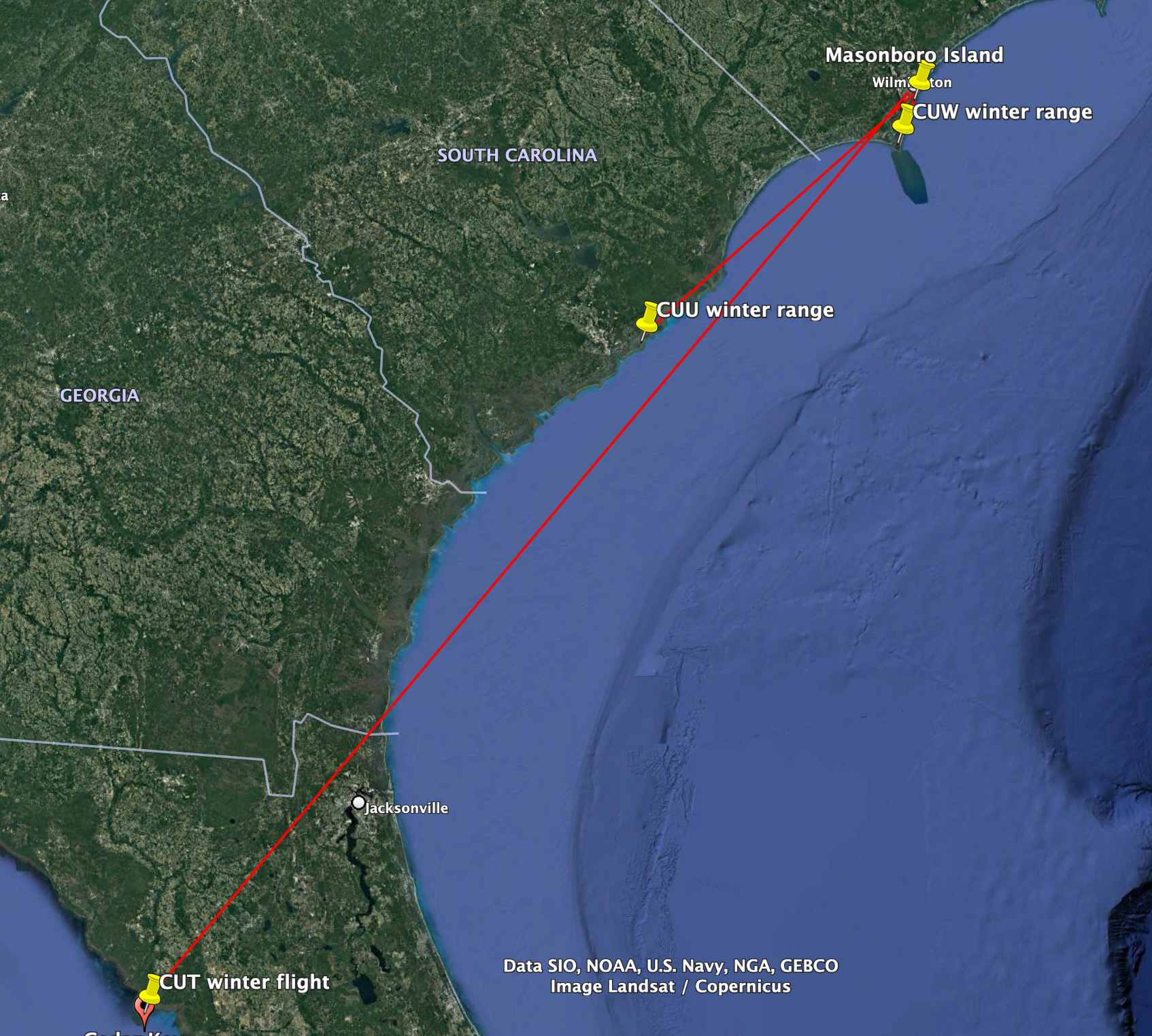
CUU was captured and banded on 4/26/16 on Masonboro Island. There have been 33 reported sightings since that time. There are 3 confirmed breeding/nesting seasons on Masonboro (the nest was found); In other years, the bird was seen on Masonboro during the nesting season, but a nest was not observed. Winter sightings were at Dewees Island, near Charleston, SC, in December of 2017 and 2018, a distance of approximately 140 miles from Masonboro.
Banded bird CUW
This is the homebody of the three birds, never having been reported more than 18 miles from Masonboro (on Bald Head Island), even in winter. Captured and banded on 4/26/16 on Masonboro. Reported sightings 43 times. Also has 3 confirmed nests on Masonboro Island and has appeared in that location during the other breeding seasons, but no nest was observed.
Banded oystercatcher CUT
The long distance traveler of the group. Captured and banded on 4/26/16 on Masonboro Island. Re-sighted 56 times. Five confirmed nesting seasons on Masonboro (nest found). Observed in Cedar Key, Florida, every winter since it was banded. That is a distance of about 460 miles one way every year.
The map below shows the apparently consistent winter travels of the three American Oystercatchers.
Range map of the migrations of the three oystercatchers I observed
The type of leg band that the oystercatchers had can be viewed and reported from a distance using binoculars, a scope, or a telephoto lens. That type of information gives a data point for any time someone reports seeing the bird. The “tag” on the ravens in the Yellowstone research project includes color coded leg bands for visual observation and a solar-powered GPS backpack with an antenna that submits the birds’ locations every 30 minutes throughout the day. This combination gives a much more detailed view of the birds’ behavior.
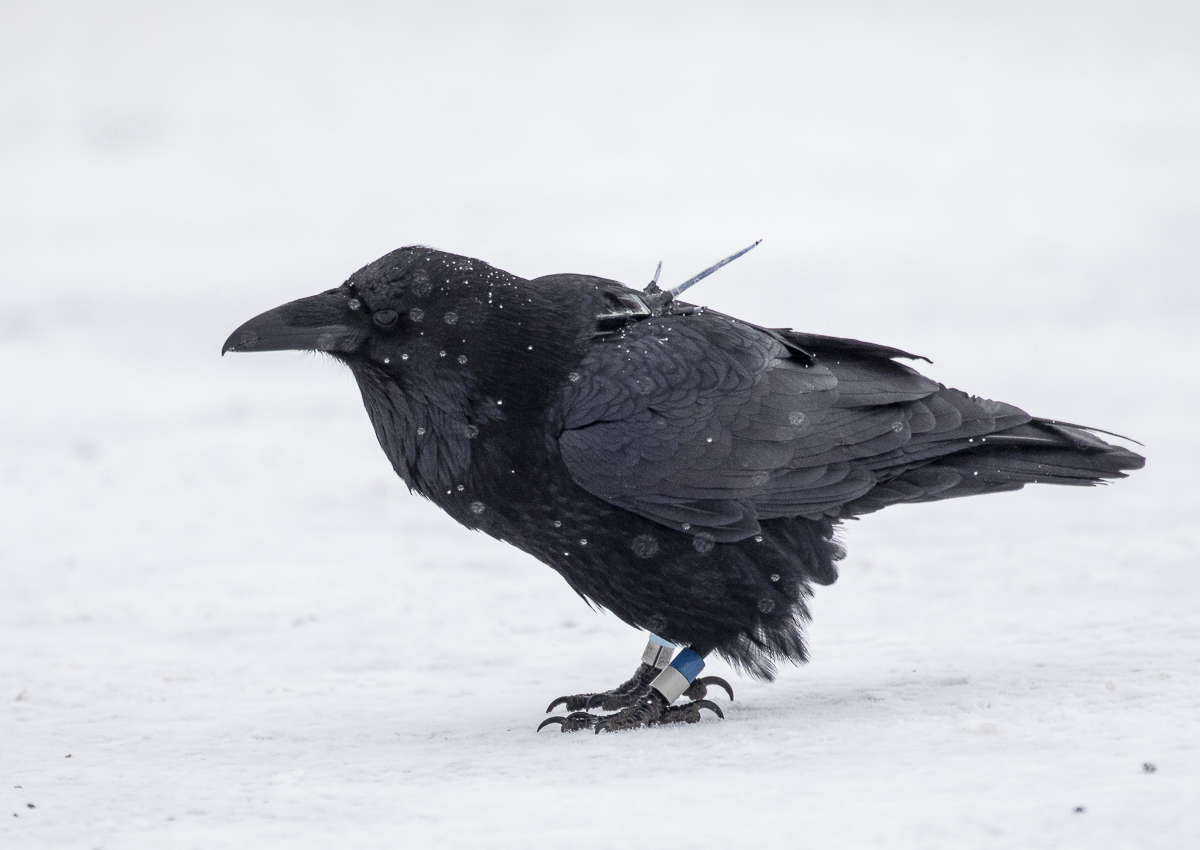
The 70 or so tagged ravens are a part of a study looking at interactions of these intelligent birds with their habitat (foraging and roosting sites for example) and with large carnivores (bears, mountain lions, and wolves). In an earlier post, I mentioned I had found out about this research online and had contacted the lead scientist, Dr. John Marzluff. He identified this bird as the female at Tower Junction (the location where she was captured and tagged) with transmitter 7493-2. She was captured on December 10, 2021 and we observed her on 1/20/22 at Tower Junction, patrolling the parking lot at the pit stop and recycle bins.
Common Raven at Tower Junction showing the solar-powered GPS backpack and color-coded leg bandsThe colored leg bands… Left – dark blue over gray, Right – light blue over metal
Her data is now visible on the Animal Tracker app (for iPhone and iPad – search for raven and then scroll down to Tower_Junction_female). She tends to move mostly between Tower Junction and Lamar Valley, a distance of about 12 miles. Her longest flight to date has been to an area north of the park entrance along Hwy 89, a distance of about 22 miles. Some of the tagged ravens have dispersed much farther, with one heading up to the Bozeman area, and another, the record-holder, flying up to Alberta, Canada.
The Tower Junction female raven tends to move mostly between that area (the dark cluster of data points is Tower Junction) and Lamar Valley (map from movebank.org web site).
Is she going to carcasses in Lamar or just stopping at places where there are concentrations of visitors? I would love to be out there and recording data on these birds to see what they are actually doing. It is a treat to get a peek into the private lives of wildlife. But, more importantly, this is valuable information that may help researchers and resource managers make better decisions for protecting these birds and their important habitats.
I’m a greater believer in luck, and I find the harder I work the more I have of it.
~Thomas Jefferson
Today was one of those days. Coming back home after a doctor’s appointment, a motion caught my eye while driving past a small roadside vernal pool. I slowed and saw it was a Barred Owl that had landed on a snag in the pool. I figured it might have babies in a nest nearby and was looking for a meal of crayfish or salamanders (this pool and another one nearby are breeding pools for Marbled and Spotted Salamanders). I had no camera with me so I drove the remaining few miles back home. I decided there was a chance it might hang around and hunt, so I grabbed a camera and headed back up the road. No cars were behind me, so as I approached the pool, I slowed down and looked for the owl. It was not on the prominent snag perch where I had seen it…bummer. But, then I saw it even closer to the road on a tree branch. I stopped, and stuck the camera out the window and fired off 3 shots. Another car then zoomed by in the other direction and the owl flew off. Luck was with me today.
A cooperative Barred Owl stayed put long enough for a few photos (click photo to enlarge)
Ironically, while waiting at the doctor’s office, I read an email from a teacher that had been on a workshop with Melissa and I years ago,. She encountered two Barred Owls yesterday on a trail and had sent us a note because she knew we would appreciate it. She even thanked us for teaching her about owls and what to look for. A double bonus day indeed.
Your growing antlers, Bambi continued, are proof of your intimate place in the forest, For of all the things that live and grow only the trees and the deer shed their foliage each year and replace it more strongly, more magnificently, in the Spring. Each year the trees grow larger and put on more leaves. And so you too increase In size and wear a larger, stronger crown.
~Felix Salten
After placing a new trail camera down along the wet weather creek, I was rewarded with a very nice clip of a beautiful White-tailed deer buck. This is from February 18, about the time most deer in our area are dropping their antlers for the season. As I mentioned in a recent post about Moose in Yellowstone, antler drop is an annual event for male members of the deer family, caused by changing day-length and lowered testosterone levels after the mating season.
A week ago, I had a very short clip that showed this buck still sports his nice set of antlers. It is getting a bit late for them to still be carrying their antlers, so I would love to have him drop one or both somewhere on our property. I have only found one antler shed here in all the years of roaming these woods. Rodents make short work of shed antlers for their calcium content.
The same day the large buck above was caught on camera, a smaller buck who had dropped its antlers was filmed. Note the roundish scar between the ey and ear – the pedicle. Soon, new antler growth will begin at this site for next mating season’s crowns.
The edge of the sea is a strange and beautiful place.
~Rachel Carson
Last week was another first for me – a canoe camping trip to Masonboro Island. Masonboro Island is one 10 sites that make up the NC Coastal Reserve and National Estuarine Research Reserve. This 8.4 mile long island reserve was protected in 1991 and is the largest undeveloped barrier island along our southern coast. It lies between Wrightsville Beach to the north and Carolina Beach to the south. We put in at Trails End Park along the Intracoastal Waterway. We had tried calling the Reserve office on the way down just to ask a few questions about access, but staff were not available. We planned to launch on an incoming tide (a necessity for easy access to some parts of the island) late in the afternoon. As we were loading the canoe, a vehicle and trailer with state tags pulled in and it turned out to be the staff person we had tried to call earlier (some days you get lucky). They had been out cleaning up some trash on one of the dredge spoil islands that comprise the reserve. She gave us a 10-minute overview of where to go and what to expect and we were off. There was a stiff northwest breeze, so the usual 20+ minute paddle took us about 45 minutes. We started looking for a camping spot that would provide a little protection from the wind and settled on an old over-wash area behind a small patch of maritime shrub thicket.
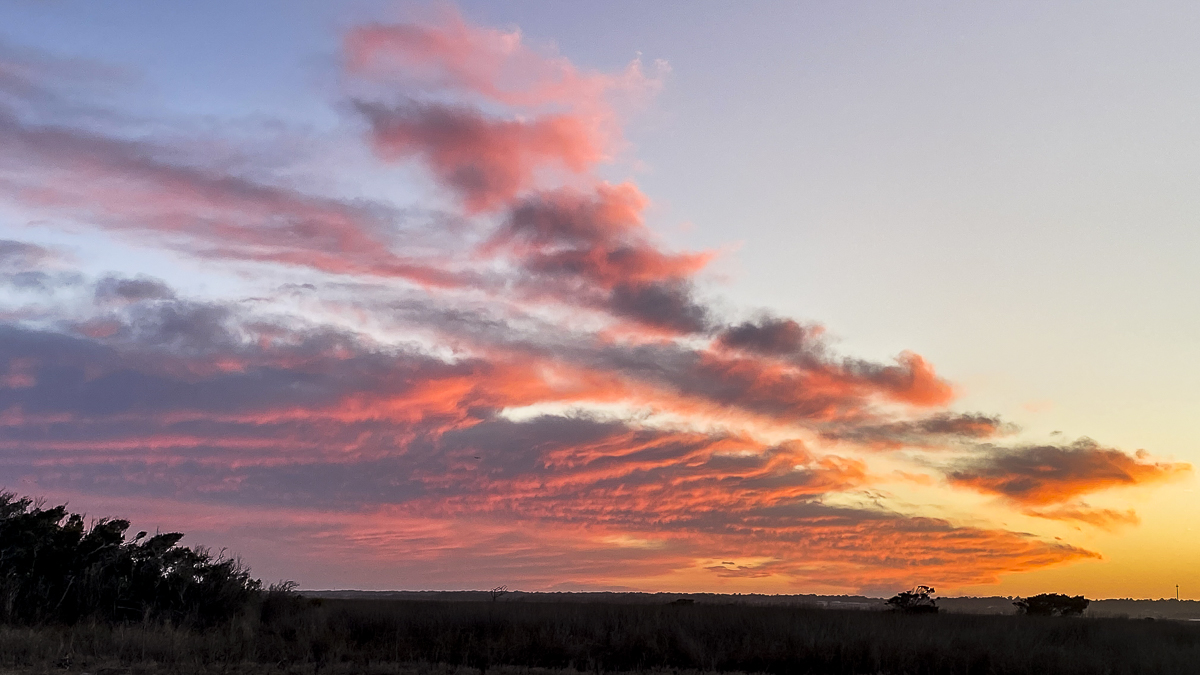
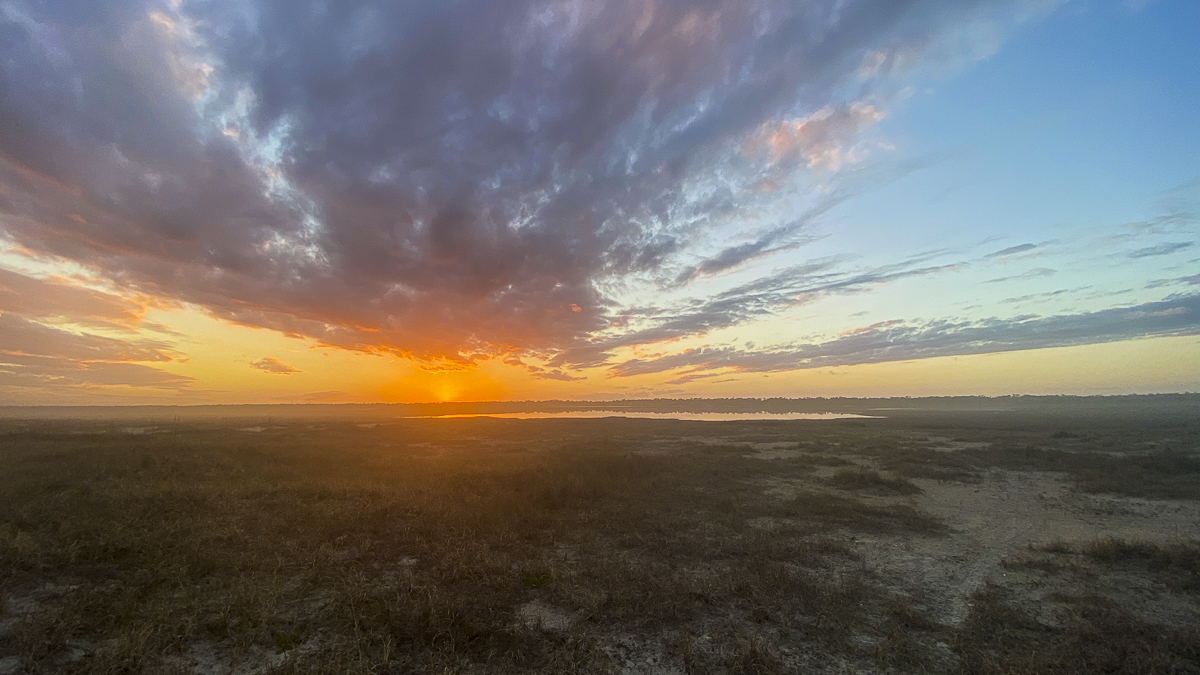
Our campsite the first night gave us some protection from the steady winds (click photos to enlarge)A beautiful sunset our first night
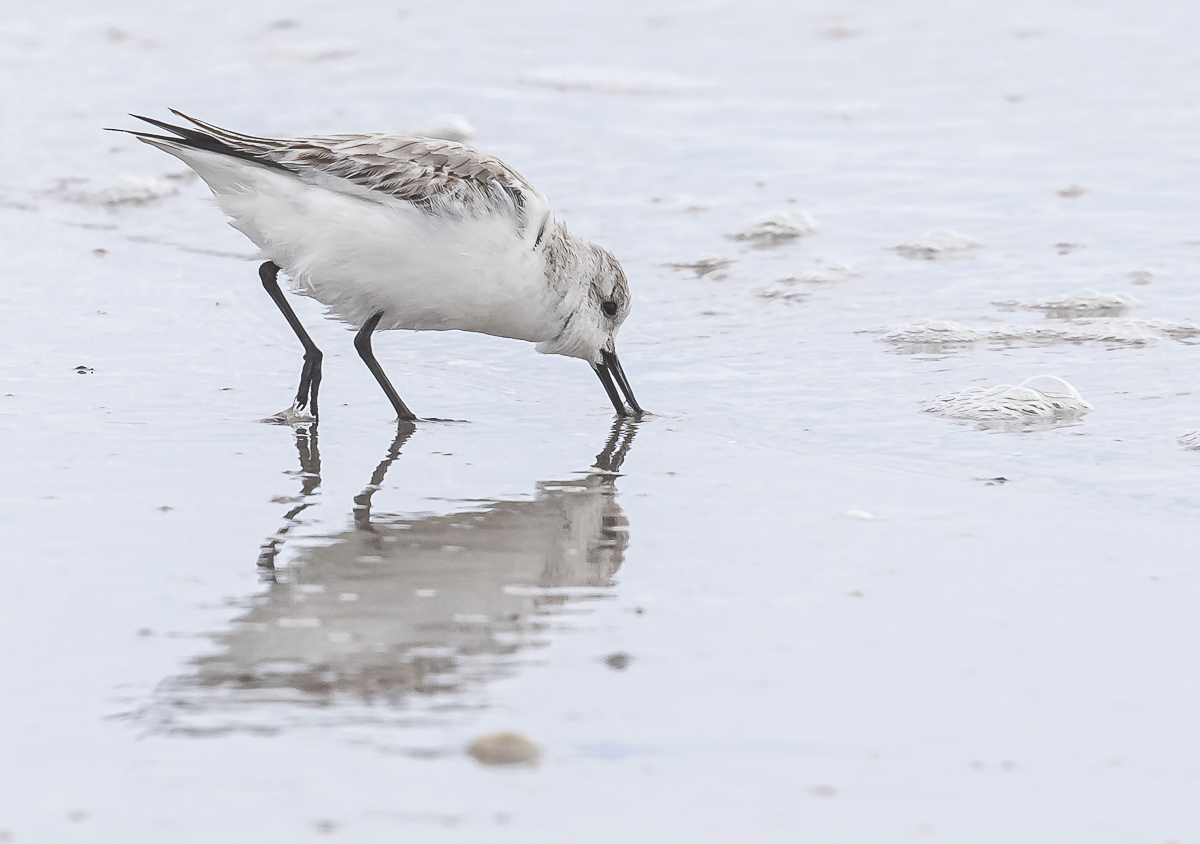
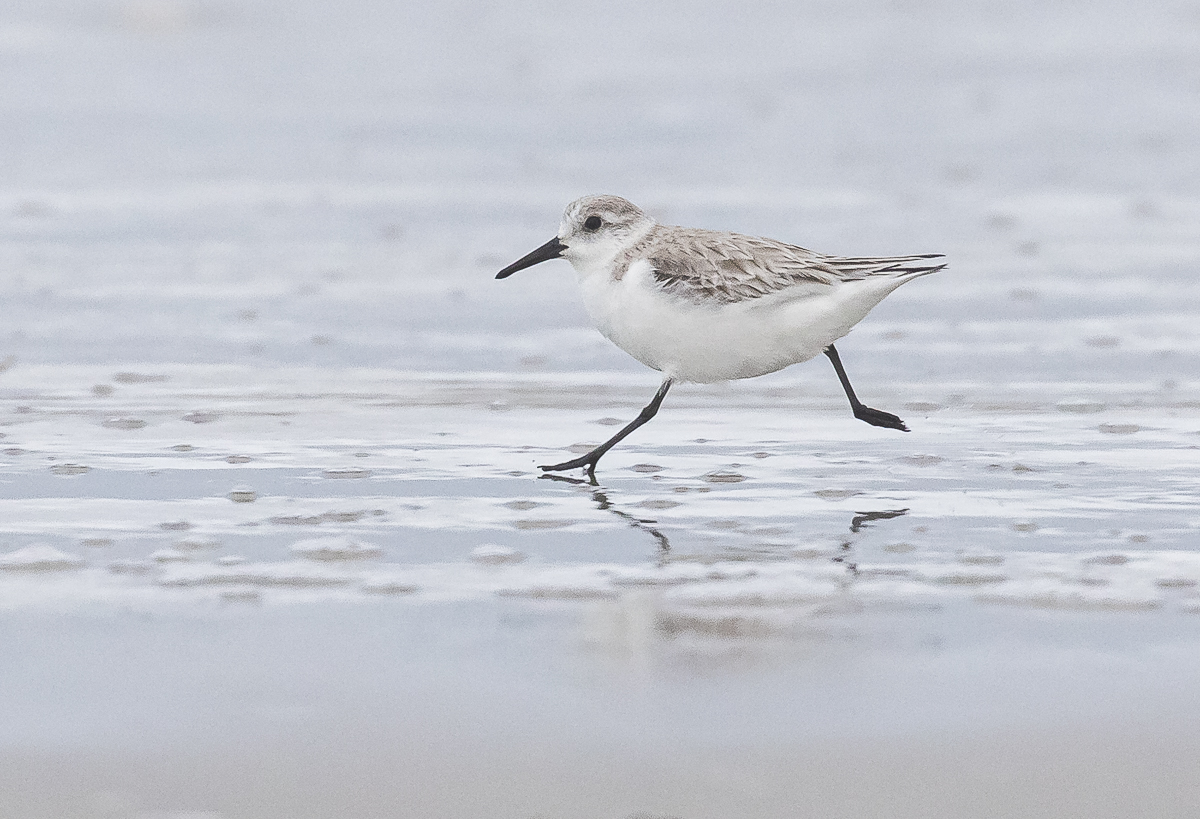
The wind continued to blow on our second day, finally dropping down late in the afternoon. I was a bit surprised by the lack of bird activity with just a few pelican fly-bys and only a handful of shorebirds in sight during the day. The most abundant was the ubiquitous Sanderling, the energizer bunny, wind-up toy of birds that can be found on any sandy beach. I always enjoy watching them chase back and forth in front of the wave action, gleaning whatever tiny food morsels they can find along the beach. I spent a lot of time just watching their antics and trying to get photos of their high enery movements. They were more cooperative than the other species of shorebirds we saw in terms of tolerating our presence, especially if you just got out ahead of them as they moved down the beach and sat still. They would forage until they got just even with me and quickly run a few feet just beyond me to resume feeding.
Sanderling probing the sand for food
Sanderlings can be found any month of the year on our beaches, but the largest numbers occur during migration in spring and fall. They breed in the high Arctic tundra. Their migration routes and distances vary considerably with the average migration distance from wintering to breeding grounds being over 5000 miles. No wonder they are so busy running up and down the beach feeding!
The quintessential Sanderling pose – on the move
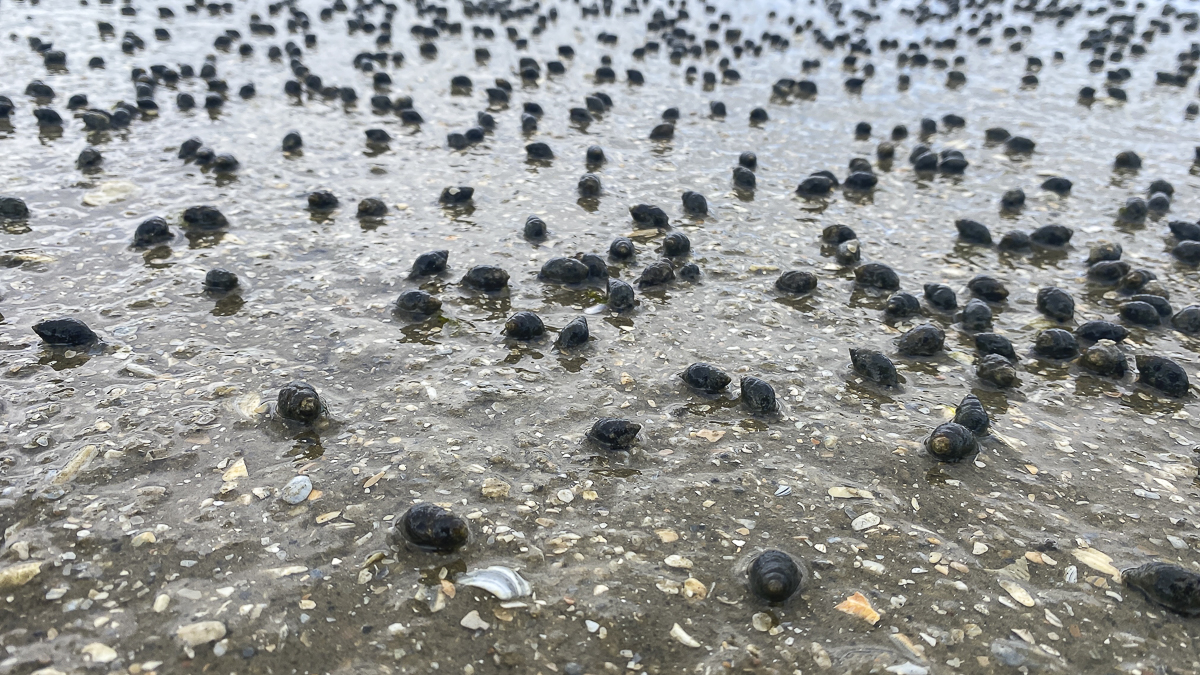
At low tide we went back to the sound side of the island and saw why everyone says you need to paddle over on an incoming tide. The large bay we paddled in on was now a giant mud flat. Eastern Mud Snails (Ilyanassa obsoleta) covered the mud. It is hard to imagine how many snails are out there when you look out and see black dots covering the entire mud flat. They feed primarily on microorganisms (e.g., bacteria, blue-green algae and diatoms) that grow in and on the surface of the sediment but will also scavenge any dead fish or other animal carcasses. They are native to the Atlantic Coast of North America but have been accidentally introduced to the West Coast where it is considered an invasive species that is out-competing some of their native snail fauna.
Eastern Mud Snails exposed at low tide
The other notable thing you see at low tide are the oyster reefs along the marsh edges. Eastern Oysters are able to survive being exposed by tightly shutting their shells and maintaining water inside during the low tide cycle. These are incredibly important salt marsh organisms due to their water filtering capabilities (one oyster can filter up to 50 gallons of water a day while feeding), shore stabilization properties, and the habitat provided by the structure of oyster reefs. And they are a favorite food of many creatures from crabs to shorebirds to us humans. I also learned a valuable lesson about their habitat. We walked out in our rubber boots to examine some oysters. I stood in one spot for a few minutes and when I started to turn to walk away, one boot remained solidly stuck in the mud while the rest of me did a sideways plop into the thick goo (luckily, no photos exist of this embarrassing moment in the life of a naturalist).
Eastern Oysters (Crassostrea virginica) at low tide
Later in the day, the wind finally started to subside and we decided (well, really, Melissa decided) to move our campsite closer to the ocean in a small break in the dunes. The high tide mark was about 15 feet from our tent, so I kept an eye on the incoming ocean water. But, all was good and it turned out to be one of the most beautiful campsites ever.
We spent the afternoon walking up and down the deserted beach (we were the only humans on the island for our entire stay) looking for shells, birds, and scanning the ocean for marine life (we did finally see a pod of dolphins).
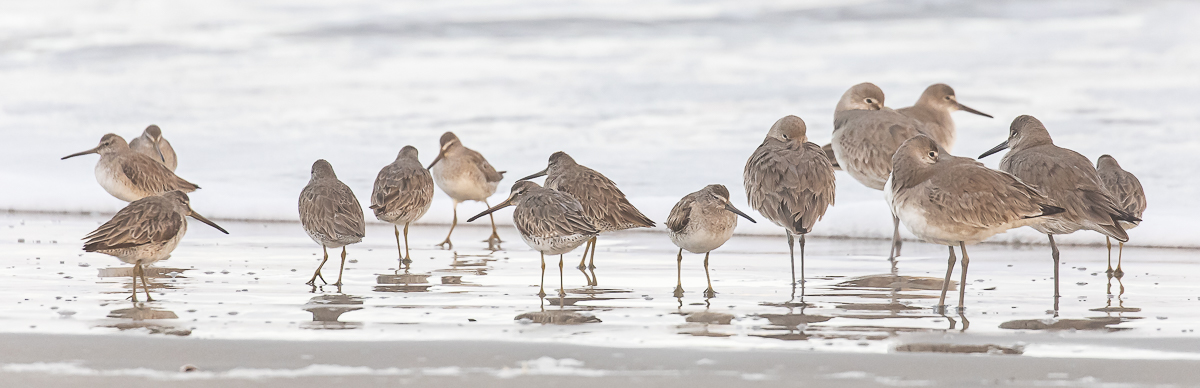
A small flock of shorebirds (Short-billed Dowitchers and Willets) resting on the beachA pair of American Oystercatchers, one with legs bands
The most interesting birds we observed were several pairs of American Oystercatchers scattered along the beach. We heard many have just recently arrived back here for breeding (they typically nest on sand and shell beaches, at marsh edges, and other areas with little or no vegetation). Oystercatchers are boldly patterned and large for a shorebird and they have a conspicuous long red bill. They use this bill to probe for mussels and other invertebrates in sand and mud and to feed in a remarkable way on oysters and other shelled creatures. As the tide drops, oystercatchers move out onto the oyster reefs and search for oysters with partially open shells. They then use that knife-like bill to stab the abductor muscles that hold the two halves of the shell together so the oyster cannot close. The bird then pulls out and eats the soft parts of the oyster. They also use their beak to hammer open softer shelled bivalves.
American Oystercatcher with leg bands CUT
While watching these fascinating birds, I noticed some leg bands on one bird in three of the pairs I observed. Back home, I searched the internet and found the banding program is run by the American Oystercatcher Working Group. From their web site – Since 1999, over 6,000 American Oystercatchers have been banded in the U.S. and Mexico. Banding individual birds helps researchers learn about demographics, movement, habitat requirements. American Oystercatchers are a species of concern due to declining numbers in recent decades. I filled out the report forms and should soon be notified of the data on these particular birds. I’ll be sure to share when I get additional feedback.
Another spectacular sunset
The wind died and we enjoyed another beautiful sunset, dinner, and the a campfire on the beach (something Melissa has always wanted). She found some abandoned firewood near our first campsite (you must bring your own firewood if you want a campfire on Masonboro). We built a fire below the high tide mark so the next tide would remove all traces and we enjoyed a long and relaxing campfire with the sounds of the ocean and a beautiful night sky as our only companions on our last night on this magical island.
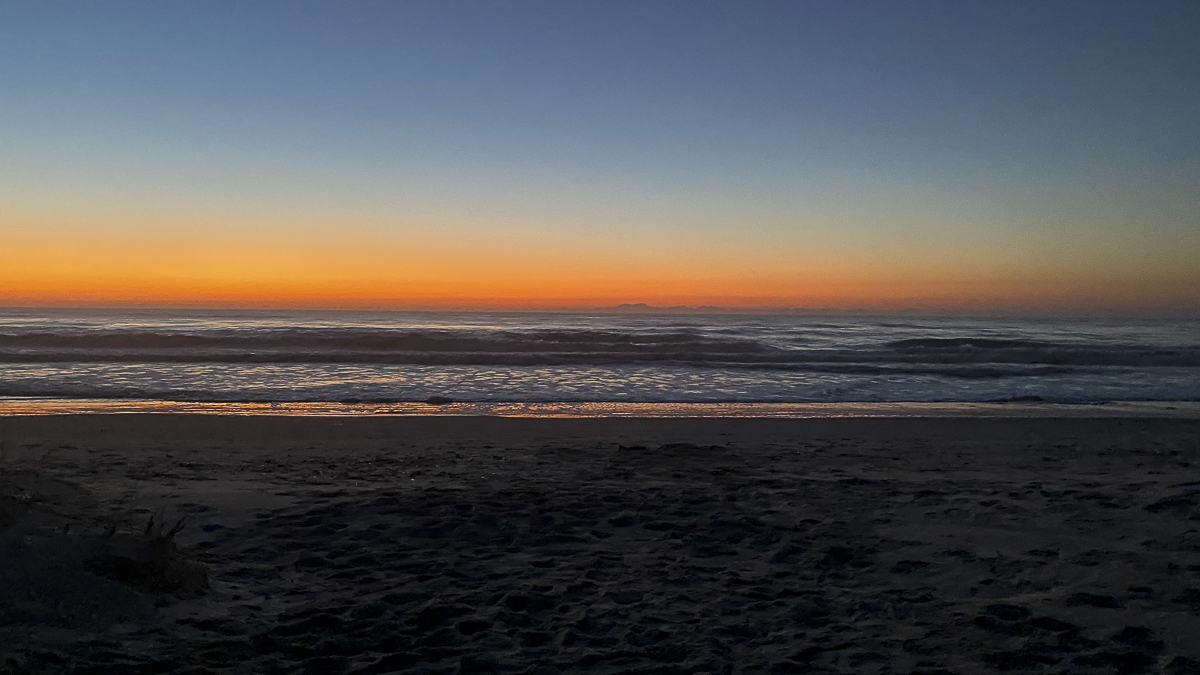
The glow on the horizon just before sunriseCoyote tracks
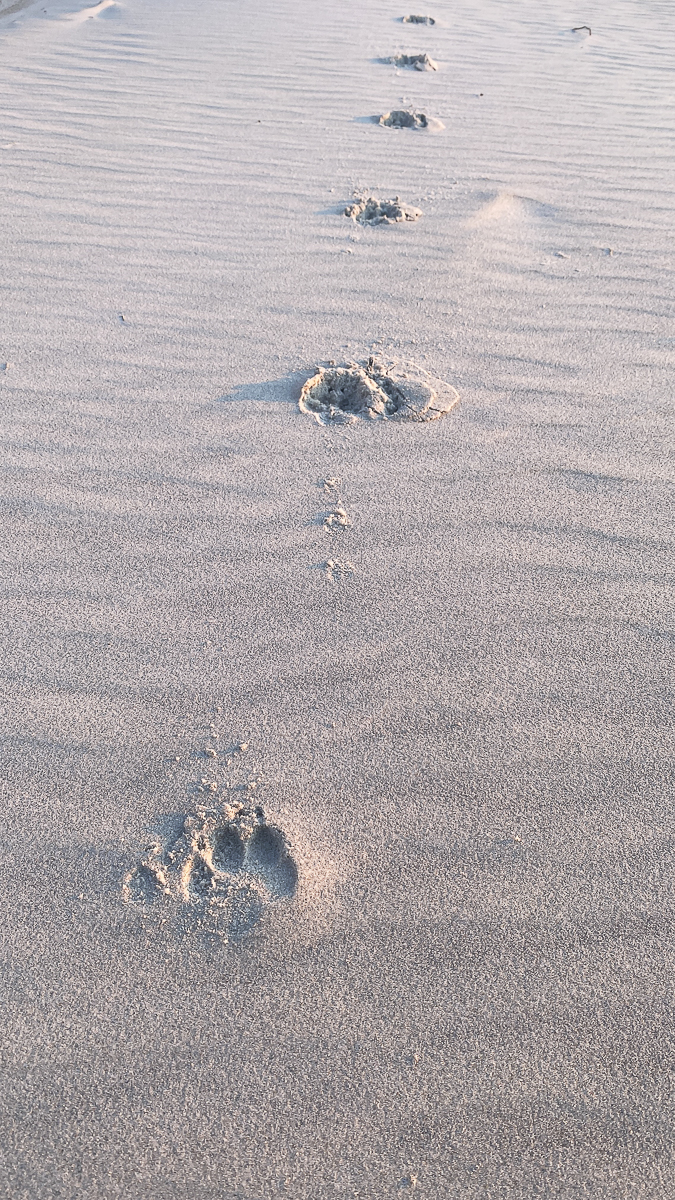
The staff person we spoke with at the launch site mentioned that coyotes are on Masonboro and we should protect our food (just as we would from any other critter when camping). We stored our supplies in our “bear canister” and, though I kept a lookout at sunrise and sunset, I never saw any mammals on the island. But on our last morning, we walked down the beach and found a line of coyote tracks that went by our campsite. Some time during the night, the coyote had come down off a steep dune face and trotted in the typical straight line gait until it got to within about 50 feet of the dune break where our tent was set up. It then veered off toward the ocean and returned back to above the high tide mark once it was about 50 feet past us. This is why I like our trail cameras back home so much – you never know what is going on outside after you go to sleep.
The steep dune face of the winter beach
Being by ourselves on a deserted island is a good way to purge some of the world’s troubles from your brain for at least a short while. Masoboro looks like it could be a bit crowded at times in warm weather, but we lucked out and experienced the island solitude for a couple of days and it was good!
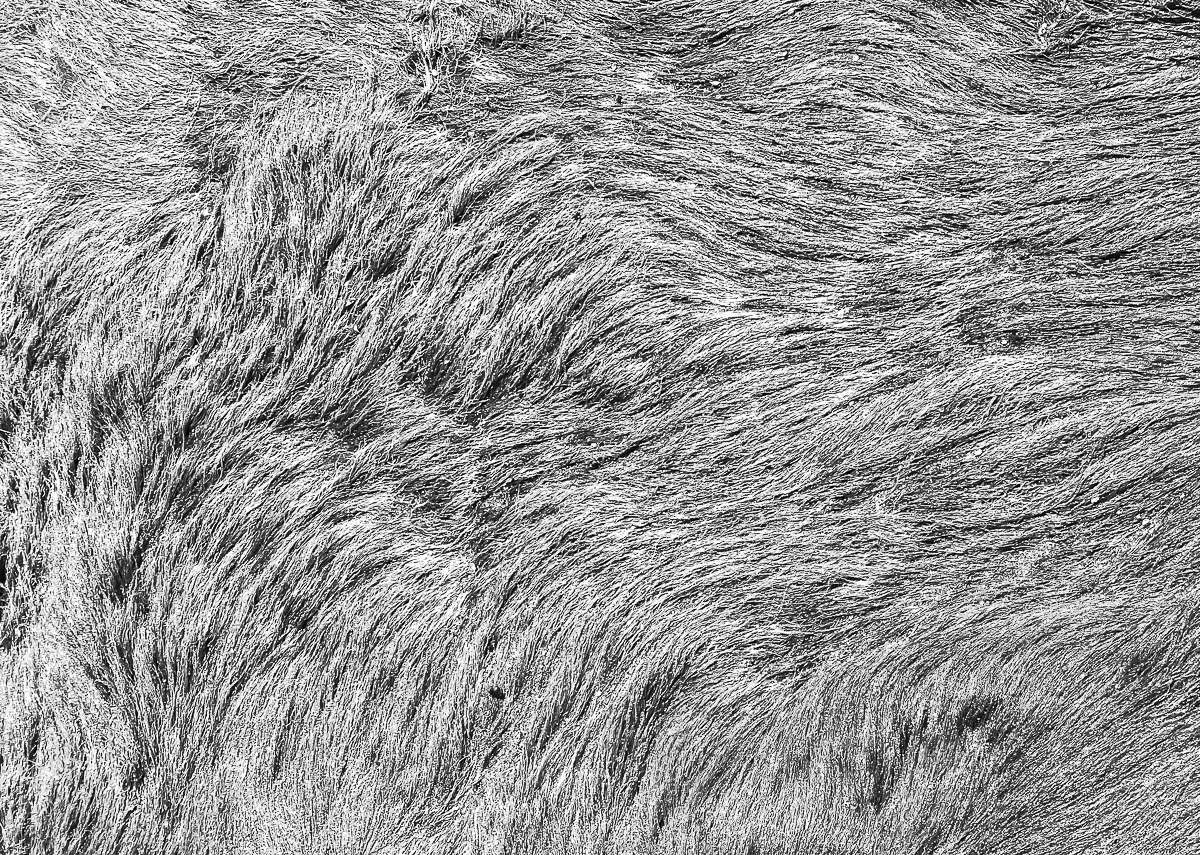
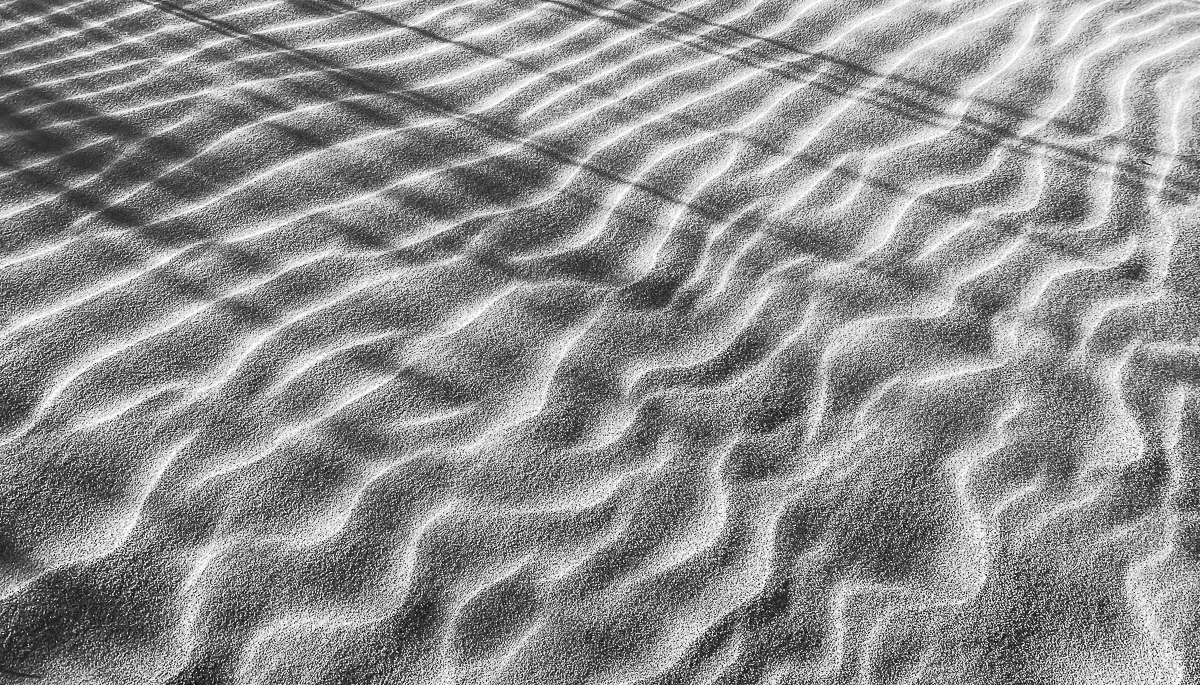
One thing we did to pass the time was walk along the beach, looking at the small wonders that wash up from the depths. We collected a couple of shells but I really enjoy looking at the patterns created by the forces of wind and water. Below are a few shots of natural patterns we found as we enjoyed the island and nearby beaches.
Live Oak tree canopy on the beach at Fort FisherAlgae swirls on the coquina rock outcrop at Fort Fisher at low tideWind ripples on dry sand on Masonboro IslandPatterns in the sand from water caught in low spots on the upper beachSand patterns from water in pools on the beach


















 Roads End Naturalist