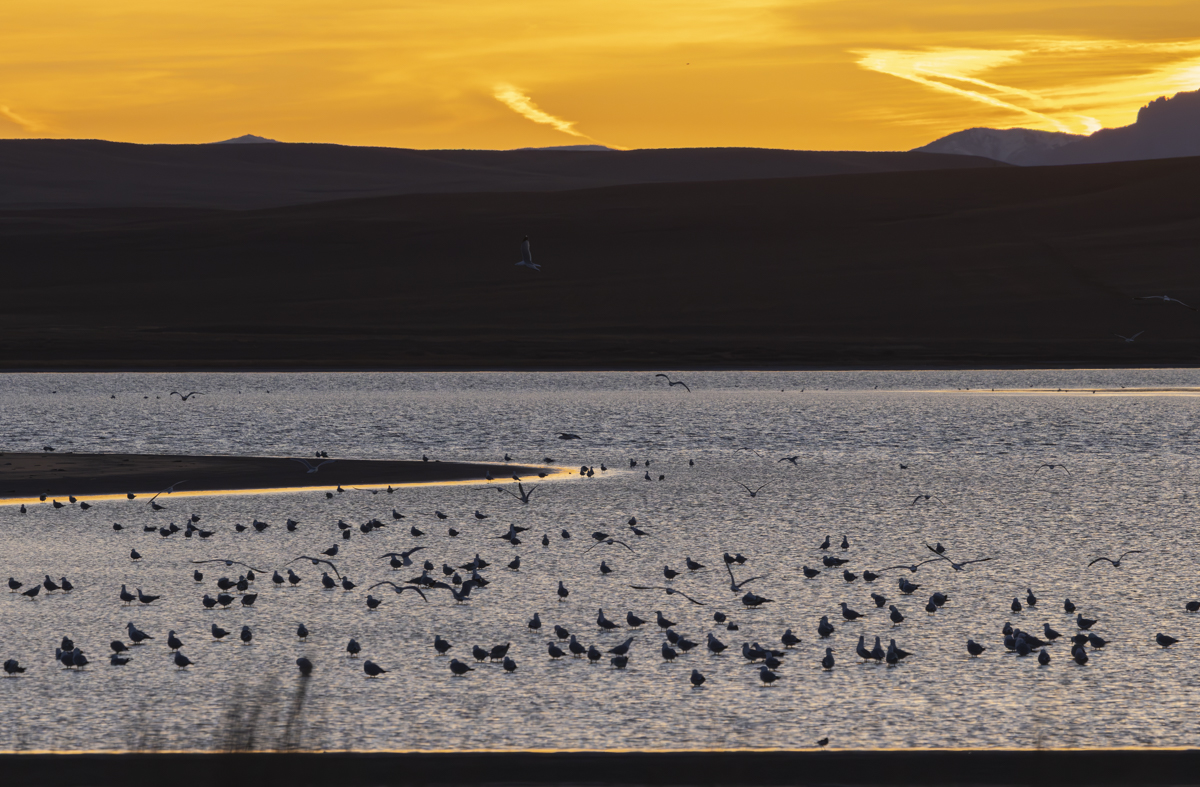
Mike and I are sitting in our camping chairs on a mat of cattails, trampled down by the feet that came before ours as they approached the shore of Freezout Lake. The smell of the mudflat lingers in the air when the breeze dies, triggering memories of eastern salt marshes, which is ironic, given that we’re sitting at the western edge of the Great Plains in Central Montana. The low angle sunlight lays on the broad, broken cattail leaves, painting them a more golden hue than they would otherwise appear. They make a whispered rattle as they are shaken by the wind off the distant Rocky Mountain Front.
As I gaze through my spotting scope, I name the waterfowl. Northern shoveler. American wigeon. Common goldeneye. White pelican. Its brilliant white is eye-catching. I watch it preen with its comically long bill. I can see the details of individual feathers, a contrast of light and shadow. The vivid colors of its skin are a surprise. It reminds me of a tropical cocktail. Its dark eye is decorated with yellow and orange eye shadow. The top of its bill is the least vibrant — a dusty orange. Its mouth gapes red. The bill edge is lined with baby pink. But the most shocking is the canary yellow of its pouch that darkens to sunset orange at its chin. Below, magenta legs disappear in the dark water.
Northern pintail — note the white chinstrap. Mallard — that green head shimmers in the light. Gadwall — a subtle duck with a noteworthy black butt. Redhead and canvasback — russet heads, one with a yellow eye, one with red. These ducks seem like old friends to me. I remember when I was learning them at Lake Mattamuskeet in North Carolina. Mike would call out the “white wedge” on the side of the ring-necked duck, the fast wing-flap of the green-winged teal. I’m not sure when my eyes finally learned all those notes, but today may be the most confident I’ve ever been that I am seeing exactly those features, that I recognize each one. The excellent light doesn’t hurt.
I’m startled from my reverie as the snow geese lift, three thousand black and white bodies circling the sky. The volume of their endless calls cycles with the movement of the flock. I spot the dark silhouette of the eagle that spooked them off the water as they sink down again, one by one: wings set, feet out, dropping onto the water. I scan the flock with the scope, picking out one, then two of the miniature Ross’s geese. The snow geese are bug-eyed and smiling. The Ross’s geese look a little pissed off… do they resent their smaller stature?
My fingers have chilled as the shadows of the cattails fall on my book, as I rush to scribble some closing thoughts. Car tires rumble on the gravel and wind turbines circle on the horizon. The light turns even more impossibly golden as I linger for a final moment.
We need another and a wiser and perhaps a more mystical concept of animals… They are not brethren, they are not underlings; they are other nations, caught with ourselves in the net of life and time.
~Henry Beston
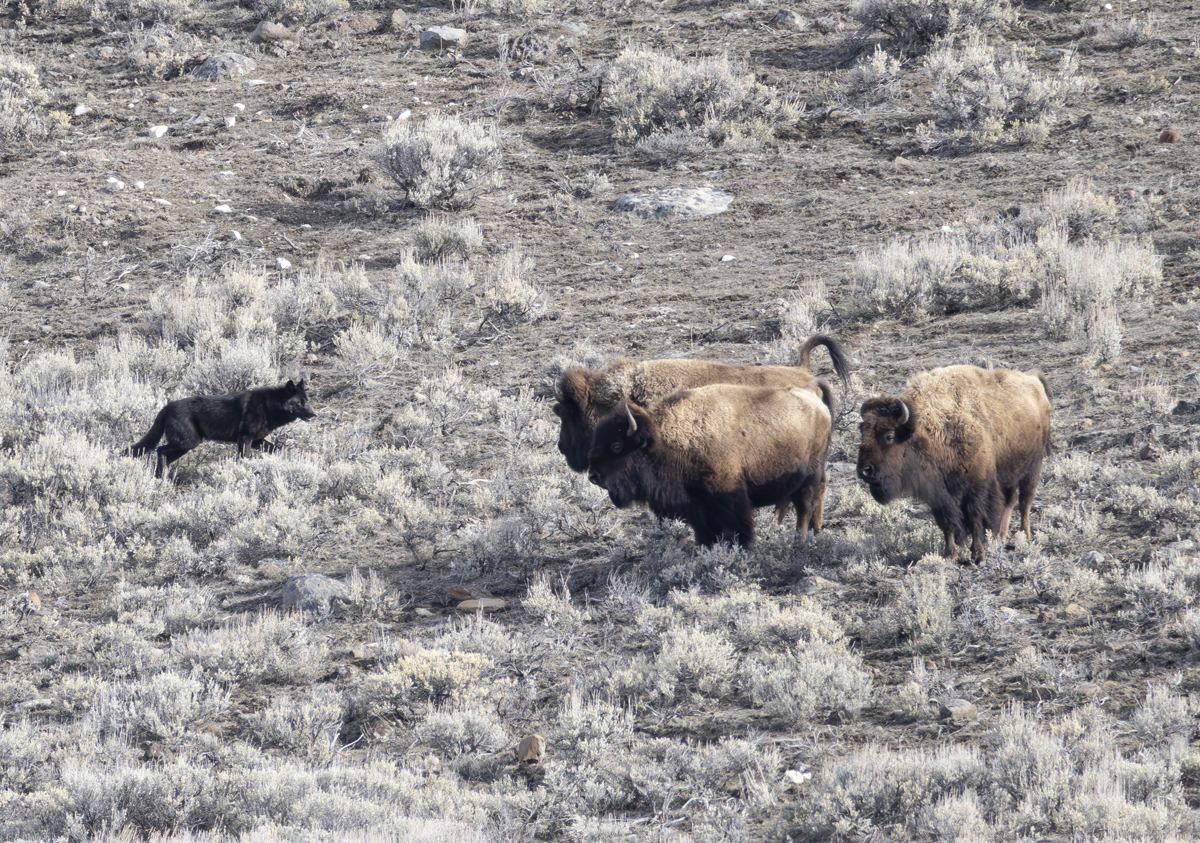
I went back to the Blacktail Ponds area yesterday to see if there had been any changes at the bison carcass. As I approached I saw several cars pulled over in a pullout a 1/4 mile or so prior to the one adjacent to the floating bison carcass. I thought that perhaps a grizzly was now in the area, but when I stopped I was told there was a lone black wolf out in the flats. I quickly saw it and got out the scope and camera. As I got things set up the wolf let out a long howl, a great way to start your morning for sure. This was a real treat as wolves have been scarce the latter part of this winter (at least wolves that aren’t specks at great distances). For the next 45 minutes I watched this wolf as it made its way east through the ponds area (without any interest in the carcass) and over a distant hill. I managed to stay just ahead of it by driving to different pullouts and waiting for it to appear. The wolf seemed to be paralleling the road but at a distance until it finally disappeared into a drainage that could take it away from the road into the far hills. Along the way, it stopped and howled two more times, perhaps trying to connect with its pack mates. I could not hear a response but maybe it did as it kept on a pretty direct eastward path at a decent trot.
Along the way, the wolf passed by a small group of bison. They eyed the lone wolf, no doubt confident they could take this loner, but still had their tails arched as a sign of concern/anger that a lone predator would dare come so close.
The bison telling the lone wolf to think better of it
Since the wolf had taken me beyond the carcass pullout (there were no scavengers on it as I drove past) I headed to another bison carcass at the far end of Lamar Valley. This one was close to the road but you had to park some distance from it and look back (park staff put up closure signs near a carcass so people don’t interfere with scavengers and to reduce potential conflicts with bears). There were a few ravens and magpies but nothing else. On a second trip later in the day there was a coyote feeding on the carcass but I didn’t stay to watch. Going back toward the Blacktail Ponds I came across yet another bison carcass with an eagle feeding on it. This was was in good view of the road so I stayed awhile, chatting with some international visitors, but nothing returned after the eagle departed. So, off I went to sit for a bit with the floating bison carcass in hopes of seeing a bear or some other scavengers.
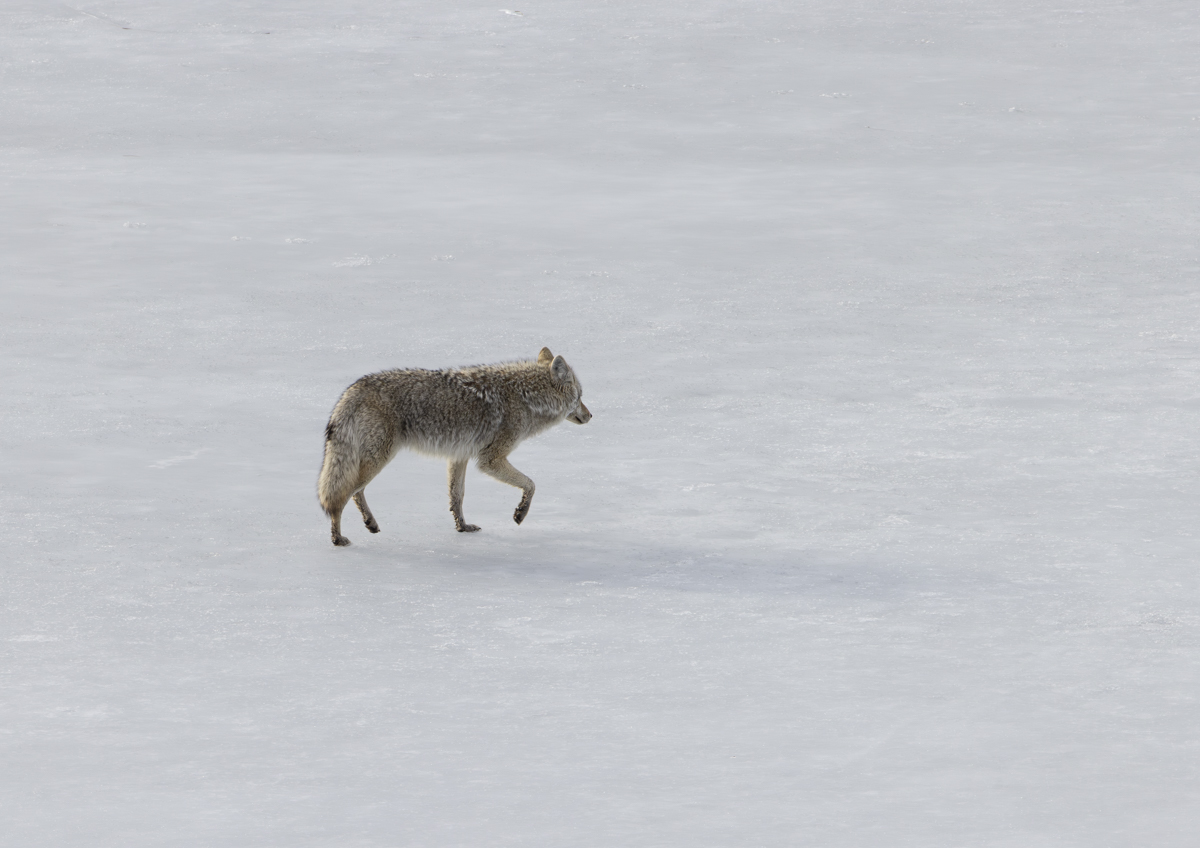
Once I got to the carcass site I could now clearly see that the hole the coyote was head dunking in on my last visit is indeed another bison carcass that was under the ice and is now floating with the warm temperatures the past few days. It is probably a bit too far out for terrestrial scavengers like a coyote to reach but there were a couple of ravens nearby and one was sitting and feeding on the first carcass. I soon spotted a coyote headed across the ice toward the first carcass. It slowly approached and the raven seemed to know it was safe in its watery cafe. The two had a staring standoff until the coyote gave up and headed toward the second carcass, only to be frustrated again by its inability to reach it.
Another coyote soon showed up and followed in the path of the first, but came to the same conclusion that a bear was needed to make this food available. It seemed to sadly slink across the frozen lake and soon disappeared into the sage-covered hills.
A coyote leaves across the frozen pond without getting a morsel of water-soaked bison
I wondered if these two coyotes were the same ones I had seen a couple of evenings earlier. On that day, I sat watching the area and heard a single coyote bark across the valley. I strained my eyes looking in that direction but didn’t see the noise-maker (it did finally show itself and trot across the valley after this next scene took place). I soon heard another coyote off to the east. I spotted a single coyote trotting toward the carcass. Then there was another single coyote bark further east. Soon, a second coyote came running toward the other, yelping along the way while wagging its tail. Obviously, these two knew each other and seemed glad to reunite. There was one other car in the pullout and, luckily, that person was quiet as this next scene unfolded. Turn up your volume and enjoy this coyote greeting.
It is fitting that Coyote Awareness Week 2026 runs from March 16-22. This is organized by Project Coyote to promote coexistence, education, and protection for this species and other wild carnivores.
For a scavenger, patience is the key to the pantry.
~Delia Owens
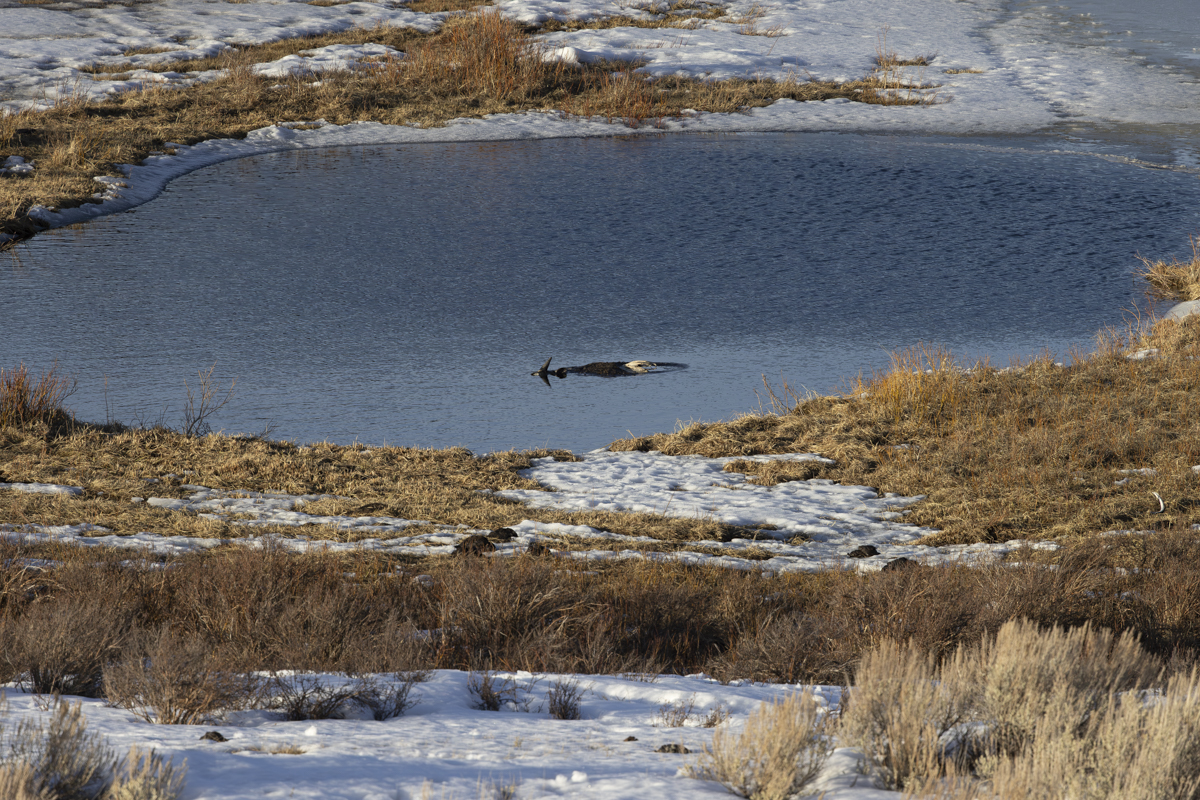
Every winter, one or more bison drown in the Blacktail Ponds area when they break through the ice. If the carcass is away from the shore, eagles and ravens can land on it and try to feed but the hide is so tough that it takes things with teeth (like coyotes, wolves, bears) to break through. The carcass shown below has been floating in this small pool for some time now and I have seen coyotes looking longingly at it from the bank but I haven’t seen any on it (though eagles and ravens have landed on it and the ribs are exposed so maybe something has been able to pull away at some of the meat).
A bison carcass floats in a small pond in the Blacktail Ponds area of the park (click photos to enlarge)
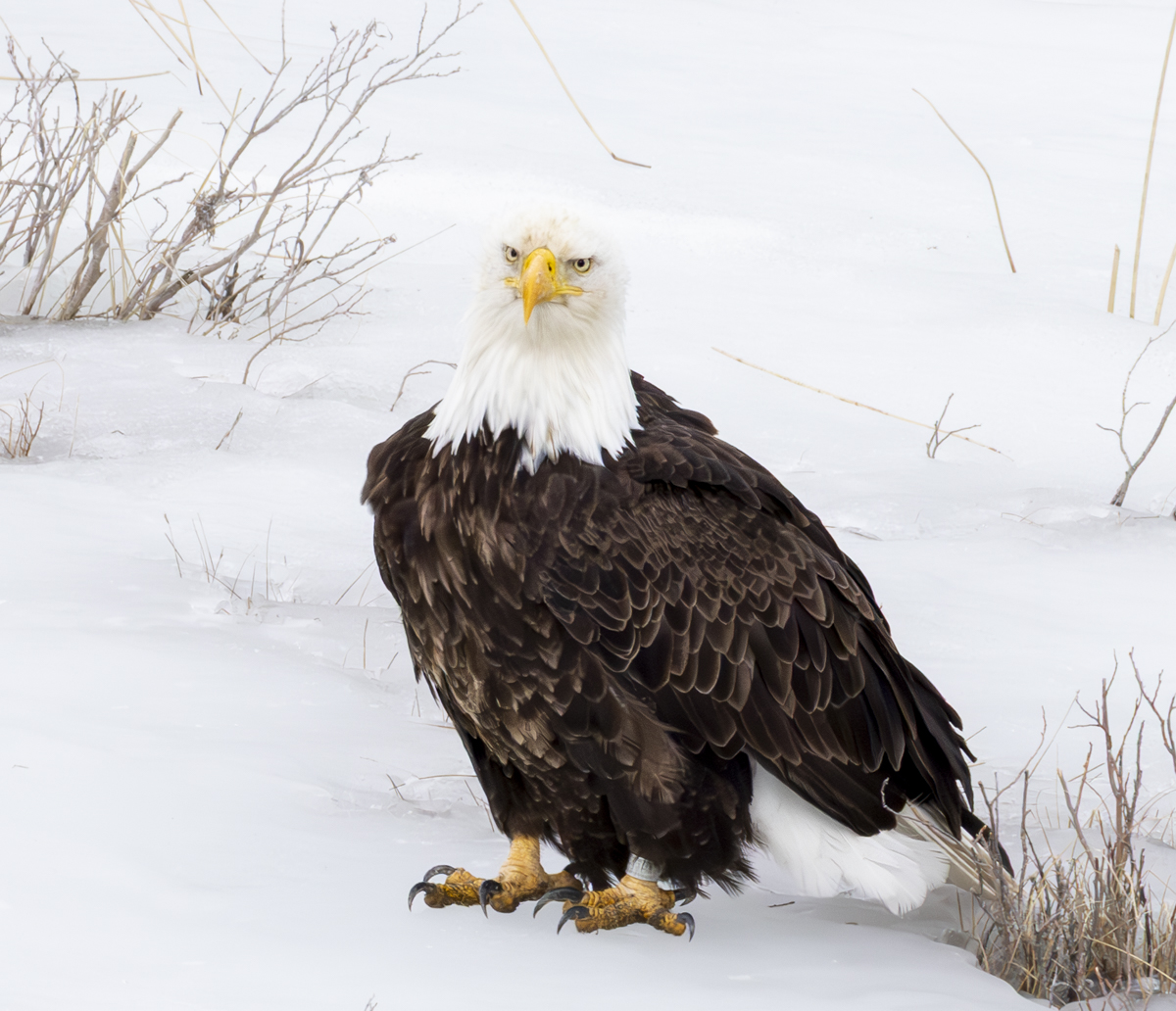
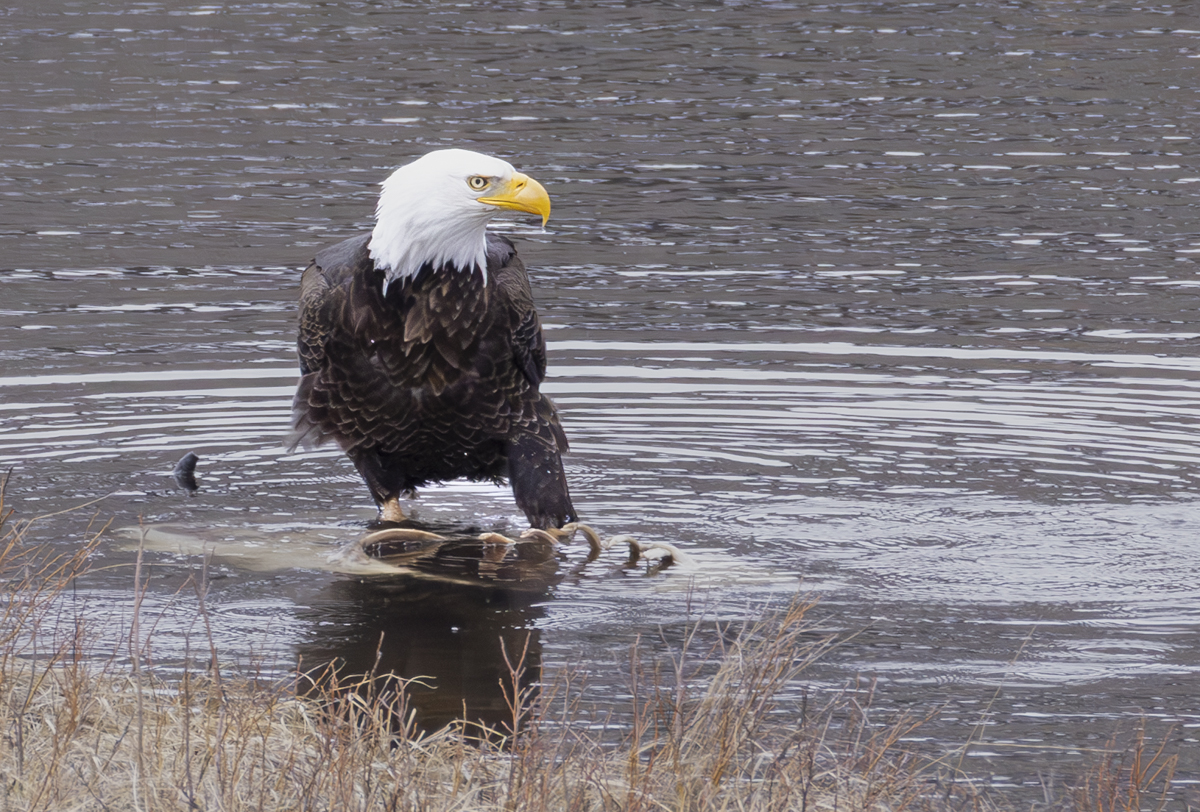
A few days ago I drove into the park and saw a couple of cars at a pullout close to the carcass so I pulled in. The first thing I saw was an adult bald eagle sitting several yards away with that typical eagle “I’m mad at something” look in its eyes.
A bald eagle staring at the carcass area (note the leg band)
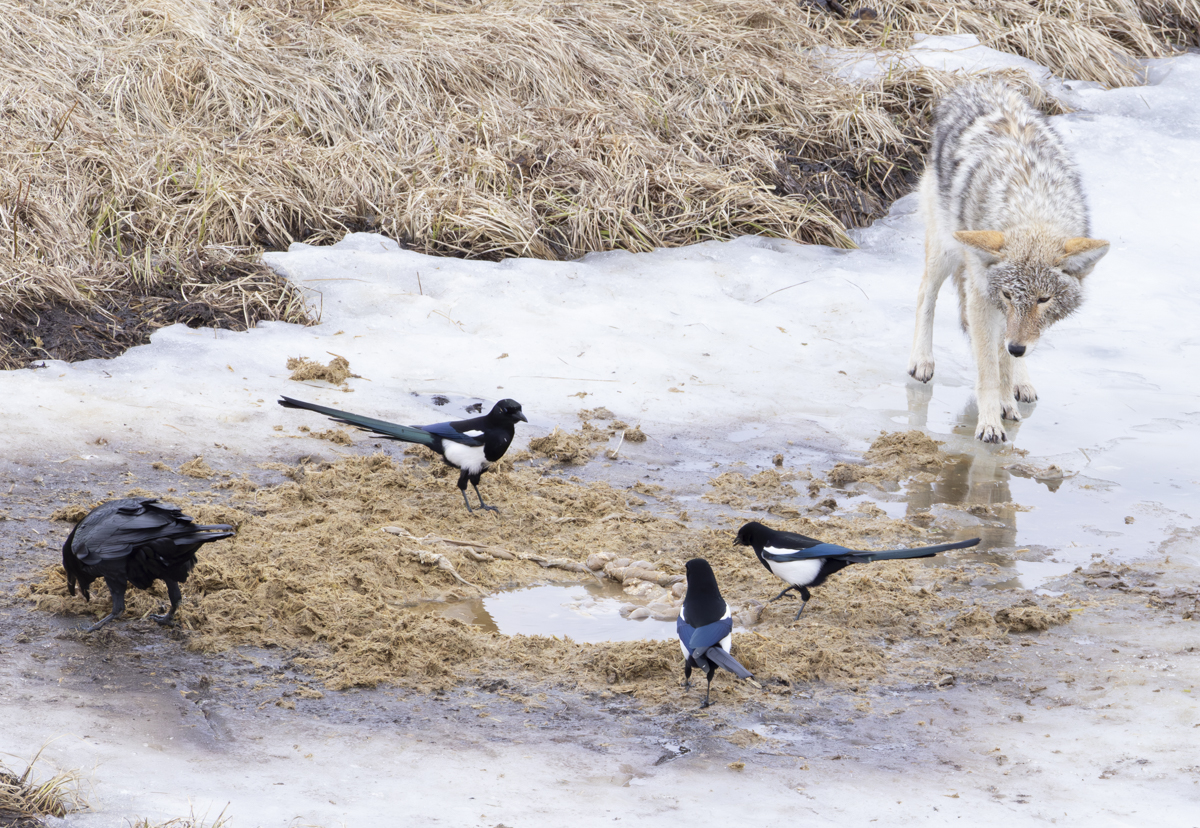
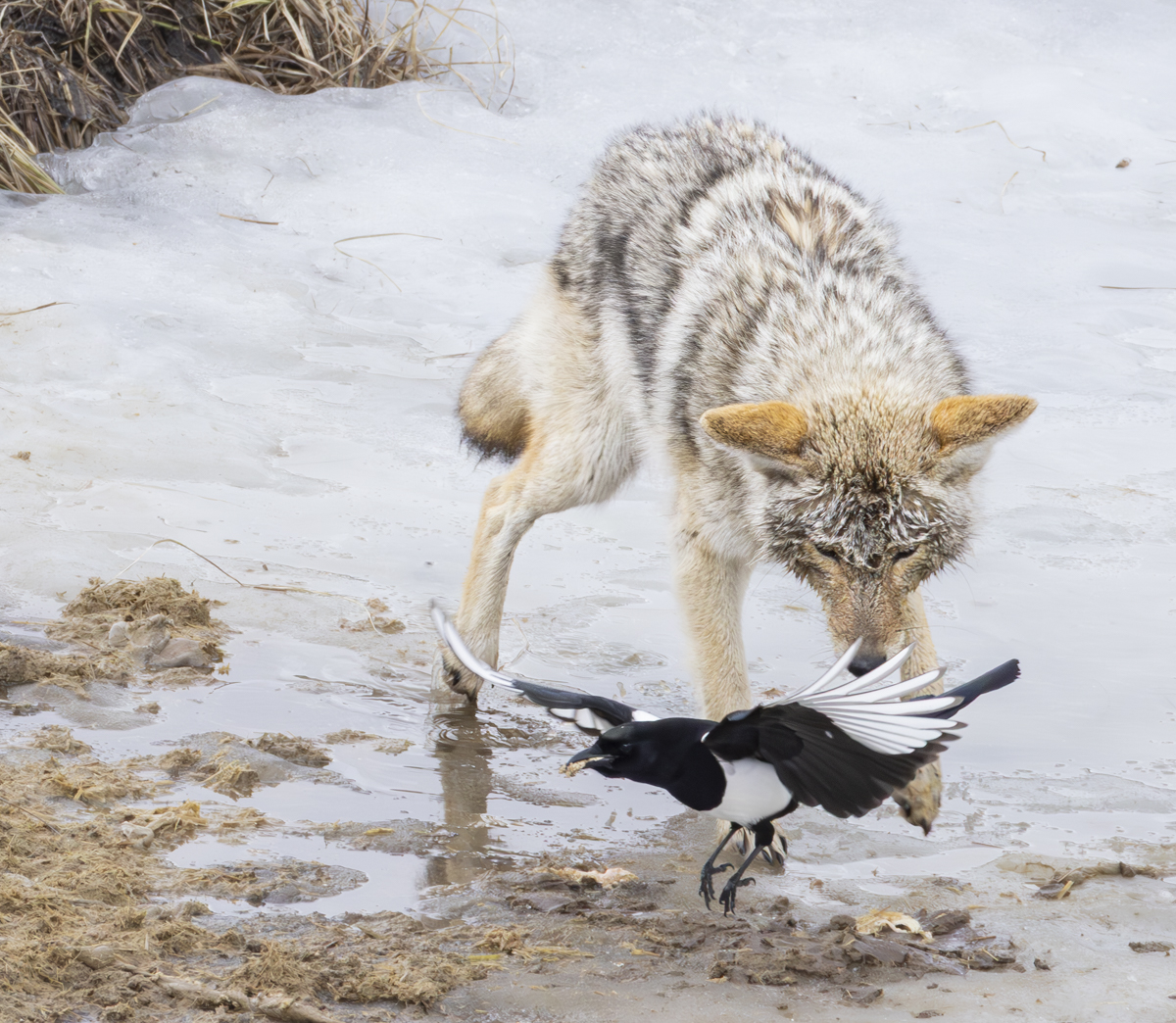
Soon, a coyote appeared and one of the folks standing nearby told me that the eagle and coyote were “fighting” near a small water hole right before I drove up (that may explain that look in the eagle’s eyes). Bald eagles are generally displaced from a carcass by a coyote, but there may be a disagreement or two before that happens. There were also several magpies and a few ravens at the water-filled hole that was many yards away from the floating bison carcass.
The somewhat timid-looking coyote approaches the scavenging corvidsA black-billed magpie flies off with a morsel in its beak as the coyote gets close
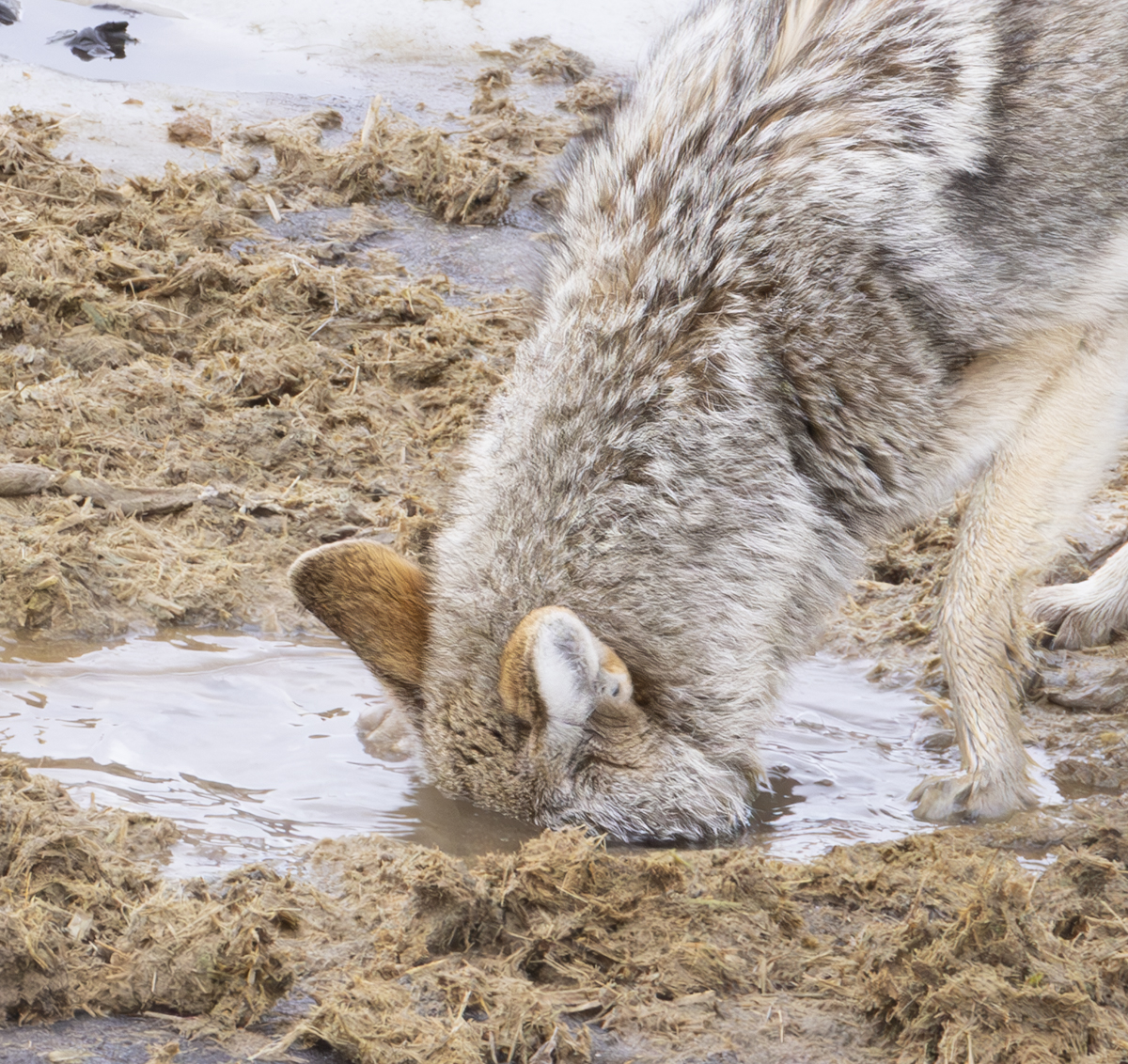
As I watched, the coyote went up to the hole and dunked his head down into the icy water! What is going on here?
The coyote does a head dunk in the small water hole
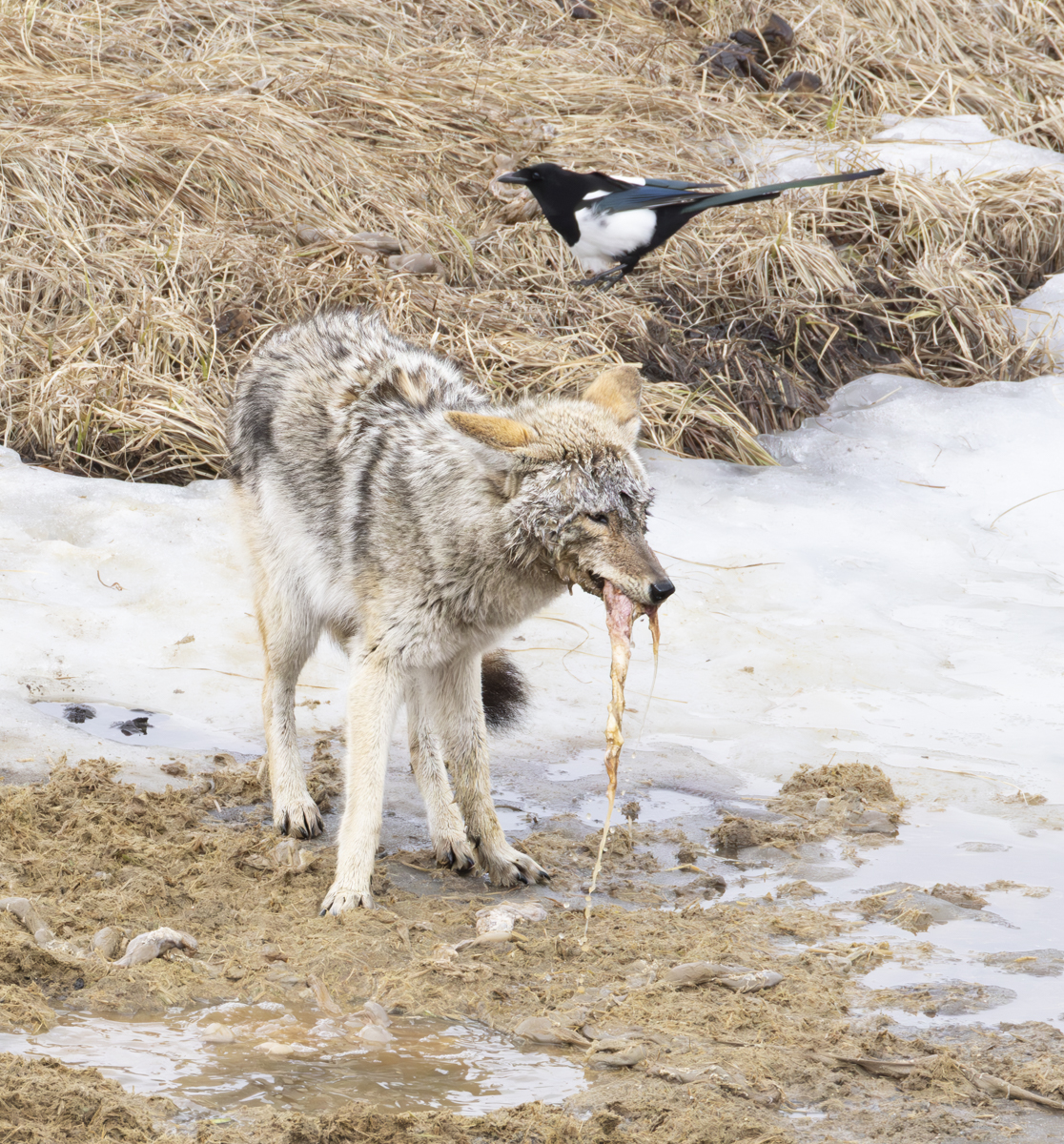
He pulls out a long stringy object that I realized was the intestines of a creature (probably a bison). But I did wonder how it got over to this spot (and under water) if it was from the floating carcass many yards away.
The coyote pulls out a chunk of intestines from the water hole
This next clip is not for the squeamish I suppose. It shows the coyote pulling out some more of the internal organs of a carcass as magpies and a raven continue to pick at the leftovers. Notice the circular patch of dried “grass” that surrounds this small water hole. That is probably the contents of the deceased animals’ rumen (one of the four chambers of the stomach of grazers like bison – ruminants). Melissa and I discussed the oddity of the distance of this pile of “goodies” so far from the floating carcass. Did something manage to get the organs out of the carcass and carry it here? Or is this from another bison carcass that is submerged beneath the ice layer but that has this hole that gives critters access? However it happened, this coyote was doing a bunch of head dunks to pull out whatever it could to eat as other scavengers looked on (and grabbed some for themselves).
I sat here for over an hour and a half watching this play out. The wind was fierce so I stayed close to the truck to shield myself and the camera from the gusts as much as possible. After many head dunks, the coyote walked off about 40 feet and laid down. The bald eagle then started walking toward the carcass. But the coyote was having none of that and got up and positioned itself between the incoming eagle and the hole. The coyote then resumed “bobbing for guts” as the eagle looked on.
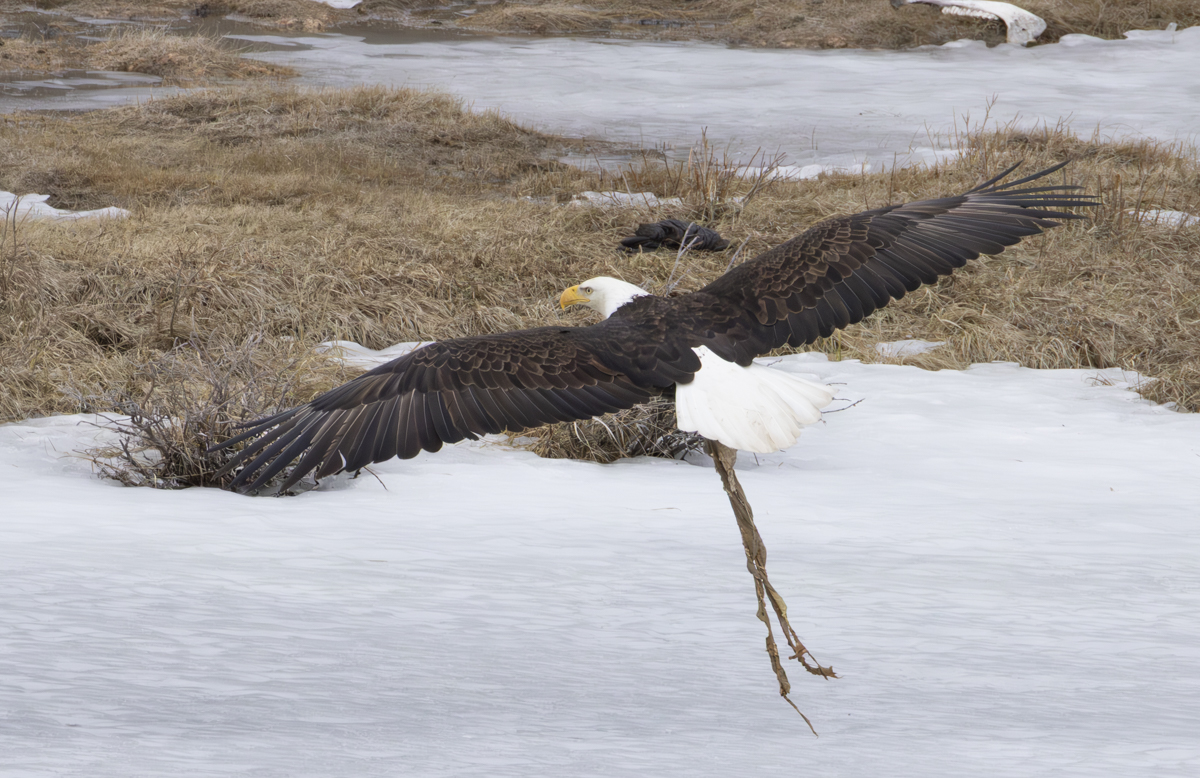
But the eagle was not to be outdone. When the coyote stepped away at one point to chew on its snack, the eagle swooped in and grabbed a section of the intestines and flew off landing several hundred feet away to pick at the remains in peace.
The eagle snags some food from behind the coyotes’ back
After several more head dunks, the coyote seemed satiated, but perhaps unhappy with its appearance (and maybe smell). So, he started rubbing his head and neck on nearby shrubs to rid himself of any unpleasant residue. It seemed as though only certain shrubs would do as he would walk along rubbing on some and rejecting others.
The eagle took off and flew around the area spooking a group of mallards that had been in a small section of open water on a larger pond. It finally headed back to the floating carcass and landed.
The eagle flies toward the floating carcass
That eagle only stayed a short time before flying off to the far shore of the pond. Another adult eagle came in and headed straight for the floating carcass while the first eagle sat and watched what I assume was its mate. A third bald eagle, a juvenile, soared overhead shortly after the arrival of the second adult, but never came in to the site.
The second eagle started tugging at the skin and even plunged its head underwater several times to search for available meat. But I never saw it come away with anything edible.
I finally headed home with the second eagle still on the carcass and its mate watching, perhaps knowing they would both need to wait for an awakening grizzly to come and pull the bison out of the water before they would get much else from this carcass.
The second eagle was still trying when I pulled away to drive home.
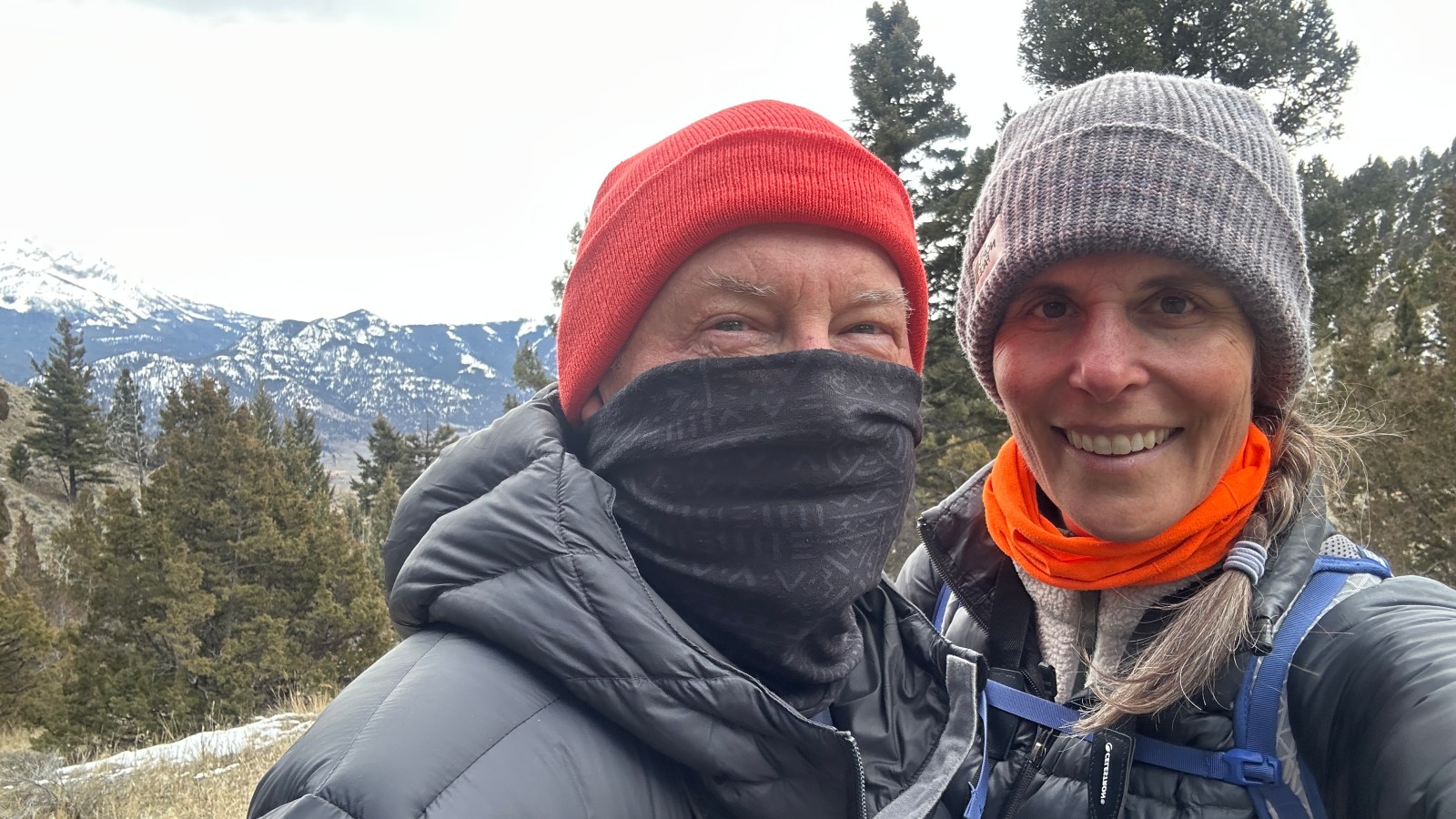
A couple days ago, Mike and I went for a hike in Custer-Gallatin National Forest not far from our house. The trail followed a small creek up a ravine dotted with large Douglas fir trees and limber pines. We were excited to see three species of deciduous trees as well: quaking aspen, Rocky Mountain maple, and alder. Most of the trail was snow-free, as this has been a mild and warm winter. However, the day of our hike was cold and windy, so at least the trail was frozen rather than muddy!
Very chilly! Plus, blaze orange as tribal members are still hunting in the vicinity.
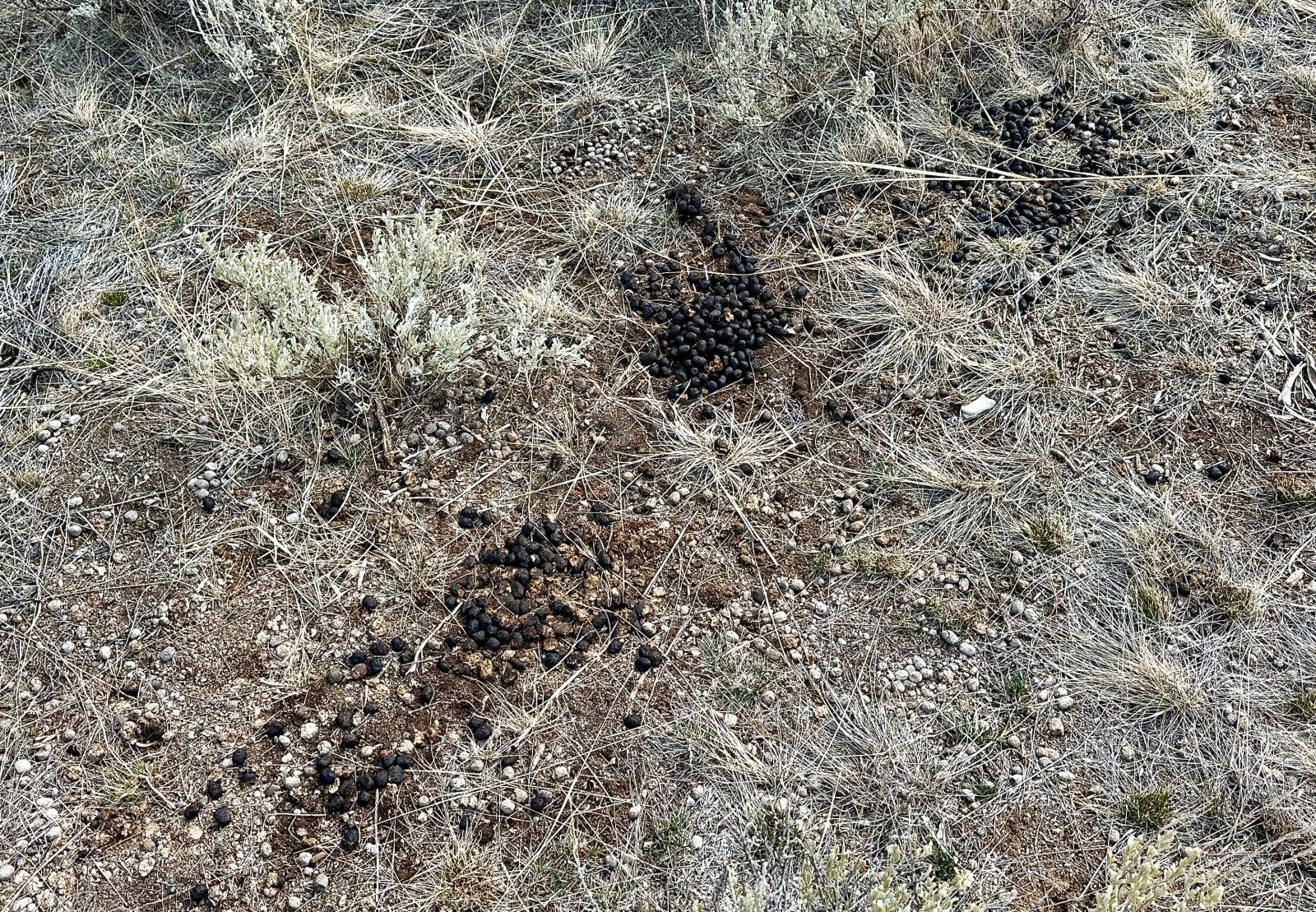
On our way down, we struck off through some sagebrush on a game trail to a flat hill overlooking the Yellowstone River valley and across to Electric Peak. The trail was dotted with piles and piles of elk scat, more than we’ve seen on pretty much any trail we’ve been on. As we reach a flat area and looked around us, I noticed a group of elk on the slope across the creek from us. It was a group of about 25 elk, all looking over at us. Outside of the national park, elk are hunted, so these animals were wary. I checked them out through my small, car binoculars (I had forgotten my real ones at home, duh!). Then, a bit to the left, I was shocked to notice an even larger herd of elk. They covered the open sagebrush slope. I counted tens through my binoculars. I think there were perhaps 200 total, including the 25 I had seen originally. It was quite an impressive sight. You might think that would have been the highlight of our hike… but wait…
That’s a lot of elk scat, folks.
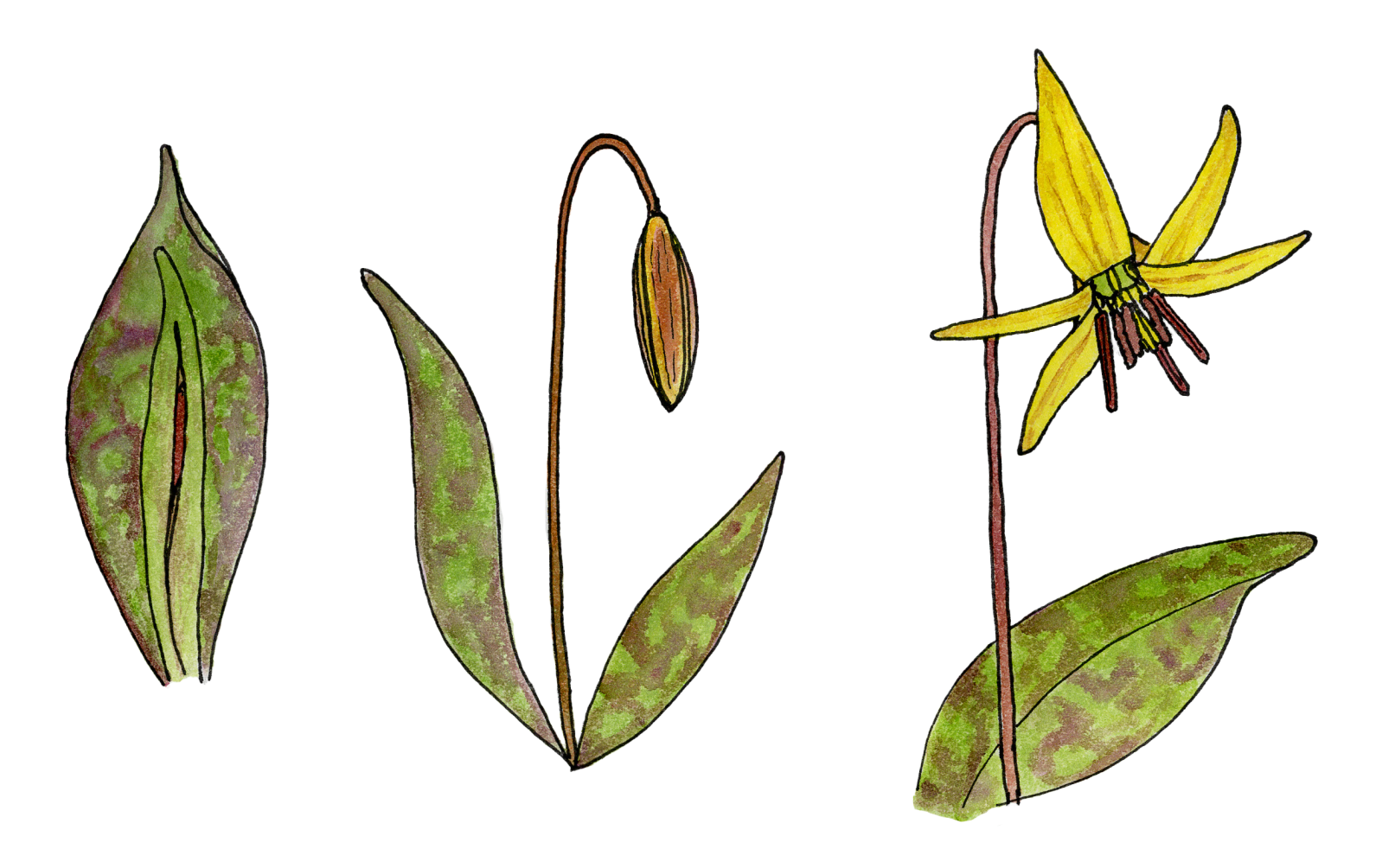
I’ve been seeing lots of pictures of trout lilies from folks in North Carolina lately. Usually, wildflowers in Yellowstone don’t start until much later, though of course, we’re still learning the phenological timeline here as we experience our first spring as residents of the Greater Yellowstone Ecosystem. Around the house, we’ve seen green rosettes of leaves that look like they’re starting to come to life as temperatures warm. But honestly, I’m not sure they’ve changed much. Plus, this has been a very odd winter, with much warmer temperatures than normal.
An illustration of the development of a trout lily flower I did for a writing project I’ve been working on… more on this in the coming months.
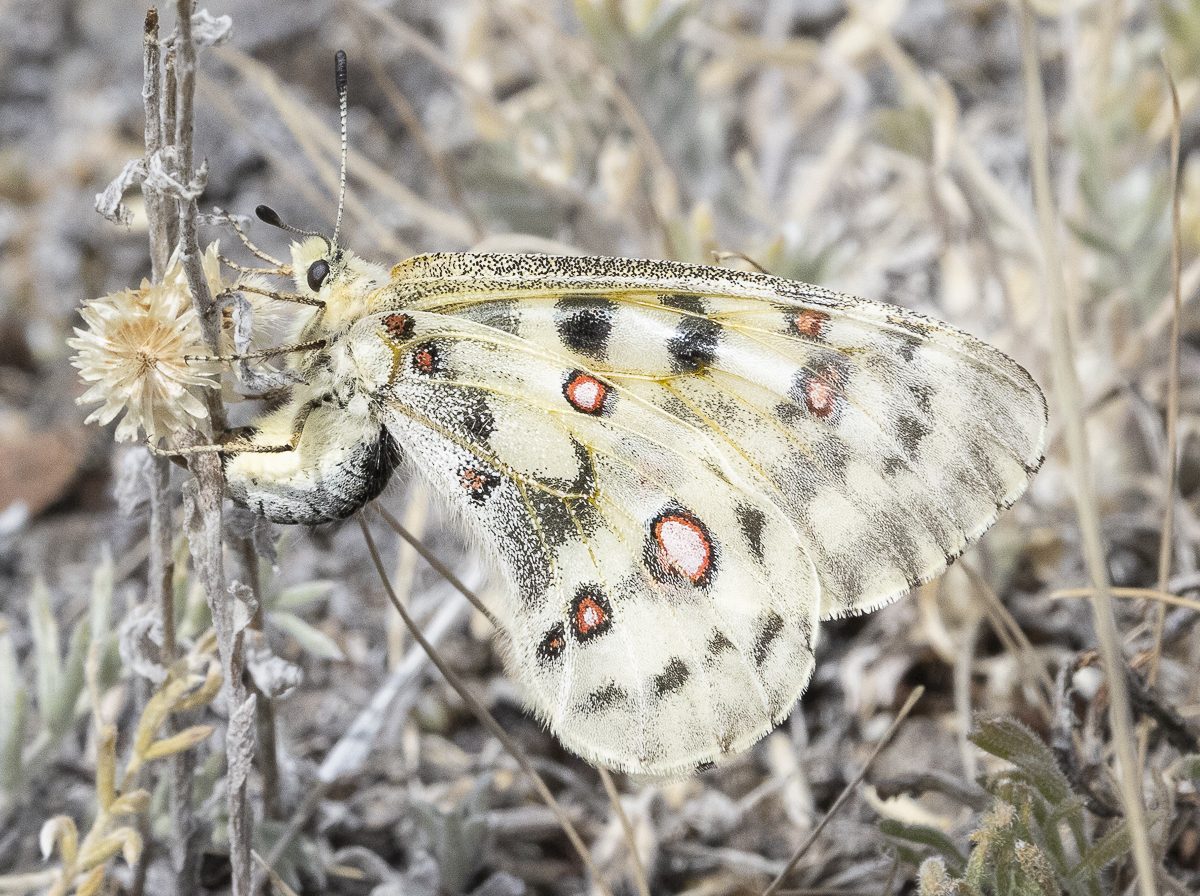
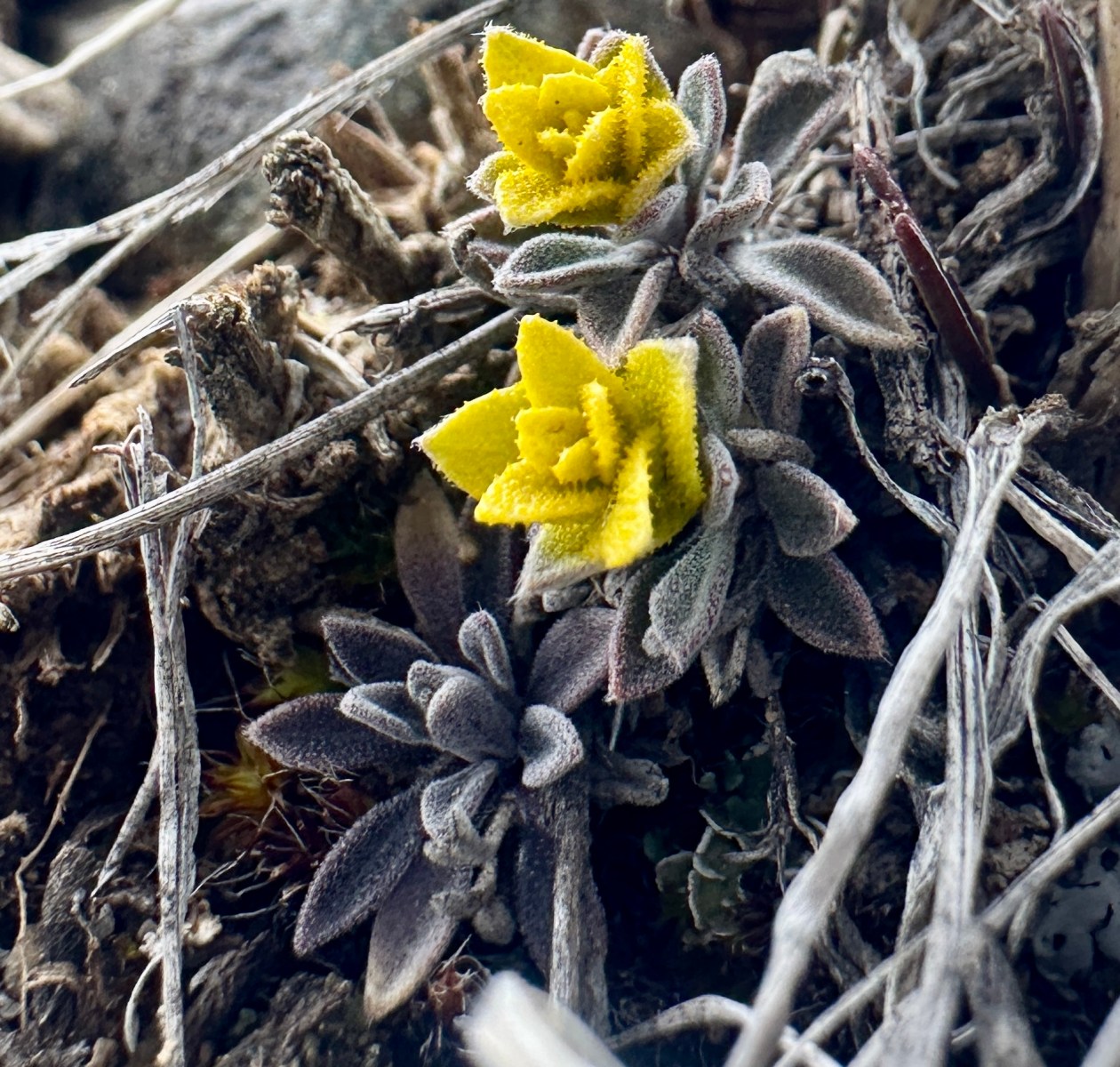
When I spotted a yellow flower hugging the ground near the rock I was sitting on, I was excited! It reminded me of the yellow stonecrop (lanceleaf stonecrop) that is abundant around here. In the summer, we had seen a Rocky Mountain parnassian butterfly laying eggs on and near stonecrop plants out in the park. I immediately thought of those butterfly eggs and wondered if they’d be hatching soon to munch on the spring stonecrop growth.
Seeing one yellow flower, I started to see more. They were dotting the hillside we were on! There seemed to be another flower about every four or five feet. Mike and I both took a number of pictures with our phones, thinking to share about our first wildflowers in March in Montana!
Our first spring “flowers!” (Note the quotation marks… and keep reading!)
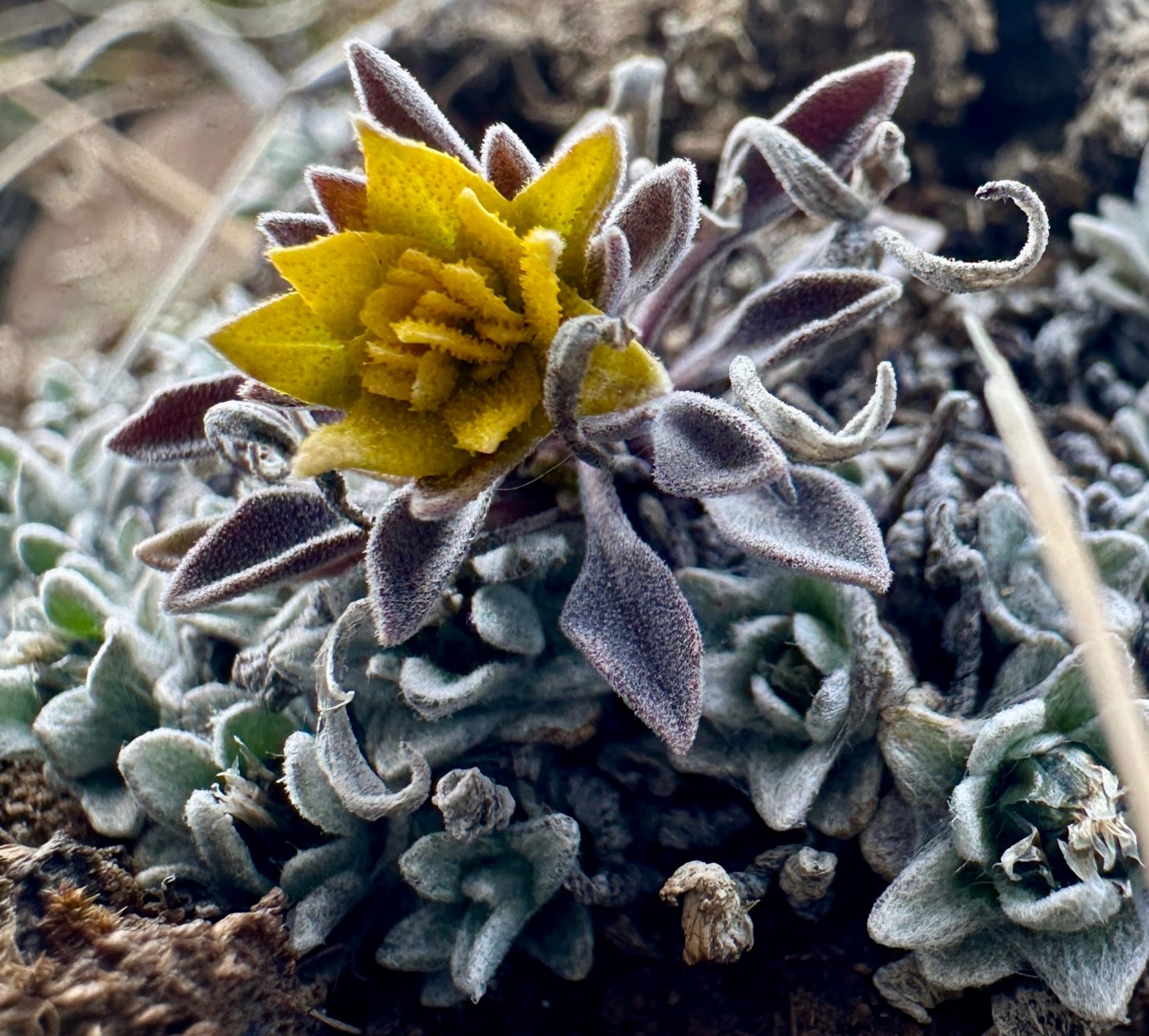
Fast forward a couple of days. I wanted to verify which stonecrop flower this was and look at its typical blooming season. I pulled our trusty “Flora of the Yellowstone” field guide. I flipped to the entry for stonecrop, of which there is apparently just one species. As I looked at the pictures, I realized they didn’t look very much like the yellow flowers we had seen on the trail. I pulled up my pictures to compare. Neither the flowers nor the leaves matched. Not a stonecrop! I flipped through the section of the field guide for yellow flowers. Nothing matched the flowers we had seen. When in doubt, there are resources for these things… so I plugged a photo of the flowers in my SEEK app. It immediately identified my “flower” as mustard flower rust, Puccinia monoica. I looked through the images of the species in the app… indeed, that’s exactly what Mike and I had seen. Not a flower at all!
This discovery set us off on a huge google-fest to try to figure out what exactly was going on. Here’s the story, to the best of my ability to explain it. The rust is a fungi. Like many other rusts, it requires two host plants. The rust I was most familiar with in North Carolina was cedar apple rust that infected cedar and apple trees. Mustard flower rust uses a few species of grass as its primary host (where spores for sexual reproduction are produced) and plants in the mustard family as its alternate host (a second host needed for other parts of its life cycle). The plant we were seeing with its yellow “flowers” was a rock cress, which is in the mustard family, an alternate host for the mustard flower rust.
It turns out that the mustard flower rust is an example of a “zombie fungus.” It takes control of the plant to make it produce the yellow flower-mimic we were seeing all over the hillside. It starts when fungal spores land on the mustard plant. These spores are haploid (which I had to look up), meaning that they have only half the chromosomes of the plant. In the case of mammals, an analog would be eggs and sperm. However, these spores (basidiospores, if you want some new vocabulary to throw around at your next cocktail party) can do a lot more than just an egg or sperm cell can. They land on the mustard plant and immediately grow hyphae to tap into the rock cress’s nutrient flow. The fungus infiltrates multiple genes of the plant, triggering a number of different processes. The plant begins to produce smaller, rounded leaves that are more symmetrical than normal to make those leaves look more like a flower. The fungus also suppresses the development of real flowers so the leaves it is busy turning into fake-fungus-flowers will linger longer. It activates genes in the plant for the production of wax, which may keep the pseudoflowers from drying out. It increases sugar production in the plant to create a fake-fungus-nectar that is twenty times more sugary than normal nectar AND it has the plant synthesize fragrant compounds that smell good to pollinators!
Why does it do this, you might ask? Well, just like the flowers it is mimicking, the fungus needs to transfer genetic material to sexually reproduce. As the fungus grows into the host rock cress, it develops fungal structures known as spermatogonia. The spermatogonia are yellow dots covering the surface of the modified leaves, giving the pseudoflowers their yellow coloration, which can help attract pollinators (and fool naturalists), too! These structures produce spermatia spores (also haploid, like the basidiospores, because they haven’t met “the right one” just yet), the next phase of the fungus’s life cycle. Now, the fungus could just rely on the wind to spread those spores (and if you keep reading, you will find that it does, indeed, use the wind later in its super complicated life cycle). But this fungus selected for a different dispersal mechanism at this stage of its development. Pollinators including bees, flies, ants, and wasps are attracted by the scent, sweet nectar, and yellow coloration of the fake-fungus-flower. As they land to collect nectar, they also pick up the spermatia produced by the fungus. When they fly off to find another nice-smelling, super-sweet-treat fungus-flower, they carry the spores with them. Basically, the fungus hijacks the plant AND the local pollinators to reproduce.
You’re looking at this “flower” differently now, aren’t you!
Pretty crazy, right? And honestly, this is the heart of the story. But I couldn’t leave it there. I wanted to know the whole story, the rest of the rust’s life cycle. It was a deep dive into terms I have not heard since high school, but it’s fascinating. If you want to join me in this rabbit hole… keep reading.
When a pollinator covered in fungus spermatia lands on another rock cress that is also infected with the rust (because, of course, that rock cress has bright yellow, nice-smelling, nectar-producing psuedoflowers too), complementary spermatia join (love at first sight!). This is the first step in fungal sex. It is definitely not the last, because the haploid — remember, half the chromosomes — cell nuclei of the spermatia don’t join just yet; instead, they hang out together-but-separate within the same cell. (Need another vocab word for your next cocktail party? Try “dikaryotic.” Autocorrect just tried to change that to eukaryotic. You might remember eukaryotic, as I do, from high school biology class. Eukaryotic is the word for cells with a nucleus, as opposed to prokaryotic, which are cells like bacteria that don’t have a nucelus. Well, dikaryotic, a new word for me, means a cell with two haploid nuclei within the same cell. Never knew that was a thing. Anyway, enough biology for now.)
The new, friendly-but-not-totally-joined-yet spermatia work together to grow new “spermatogonial hyphae” into the plant. These trigger even more changes in that one poor rock cress. The yellow on the pseudoflowers fades to green, and cup-like structures called aecia develop. (As if the plant hasn’t had enough already, though at least it is allowed to stop producing the super-sweet nectar at this point.) And what do those aecia do? Make aeciospores, of course. Now you’re getting the hang of this, aren’t you! The aeciospores are still dikaryotic (two haploid nuclei just hanging together, remember?) and are sent off on the wind to find… some grass, which by this time of year is growing! Yup, we’ve finally made it to the primary host for the mustard flower rust!
Oh, but it’s not over yet… the aeciospores send hyphae into the grass to make uredinia which make urediniospores. Still dikayrotic, still just chilling with each other (are they ever going to get it together?!?!). Over the course of the summer, the urediniospores blow around in the wind and infect more grasses and make more urediniospores. This is the phases where the fungus can really make an impact and spread itself around, until… fall comes and the grasses begin dying back. The change of seasons triggers a change in the uredinia, which turn into telia. (Why not, right? We all grow and change… and if we’re lucky, the other haploid nucleus we’re hanging out with loves us anyway). Guess what the telia make? Teliosporses, of course! Teliospores have nice thick cell walls to get them through the cold, dry winter. Not dissimilar to what sometimes happens when two humans are holed up together for a long time, those two cell nuclei finally join up to make a diploid cell nucleus (aka, sex)! Woo hoo! A new baby fungus is born!
You thought that was it, didn’t you? Not quite. Because, come spring, the teliospores germinate and grow something called basidia (shall we call them teenage fungi?). Inside the basidia, meiosis occurs. (Had you forgotten that word from high school biology? Me too. Meiosis is when cells divide and also divide their chromosomes. It’s the process that makes sperm and eggs. We’re back to haploid, folks!) Anyway, you know where this is going… the basidia make these haploid basidiospores, and the wind carries the basidiospores to rock cress as it is just emerging in early spring, say in March on the slopes above a creek covered in elk turds just outside of Yellowstone. In case you missed it (because this is ridiculously complicated and therefore ridiculously long), this is where we started the story! The basidiospores grow hyphae in the rock cress that affect its genes and create pseudoflowers that are dotted with spermatogonia…. and the cycle continues.
It is truly amazing how complicated life is, particularly fungi. Fungi can do amazing (and creepy) things. And I would never have known about any of this if I hadn’t been really excited to see my first spring “wildflower” in my new home!
If you made it to this point, you must be really interested, so here’s a list of references that helped Mike and I piece together the crazy story of the mustard flower rust:
Always be yourself. Unless… you can be a bison. Then, always be a bison.
~Unknown
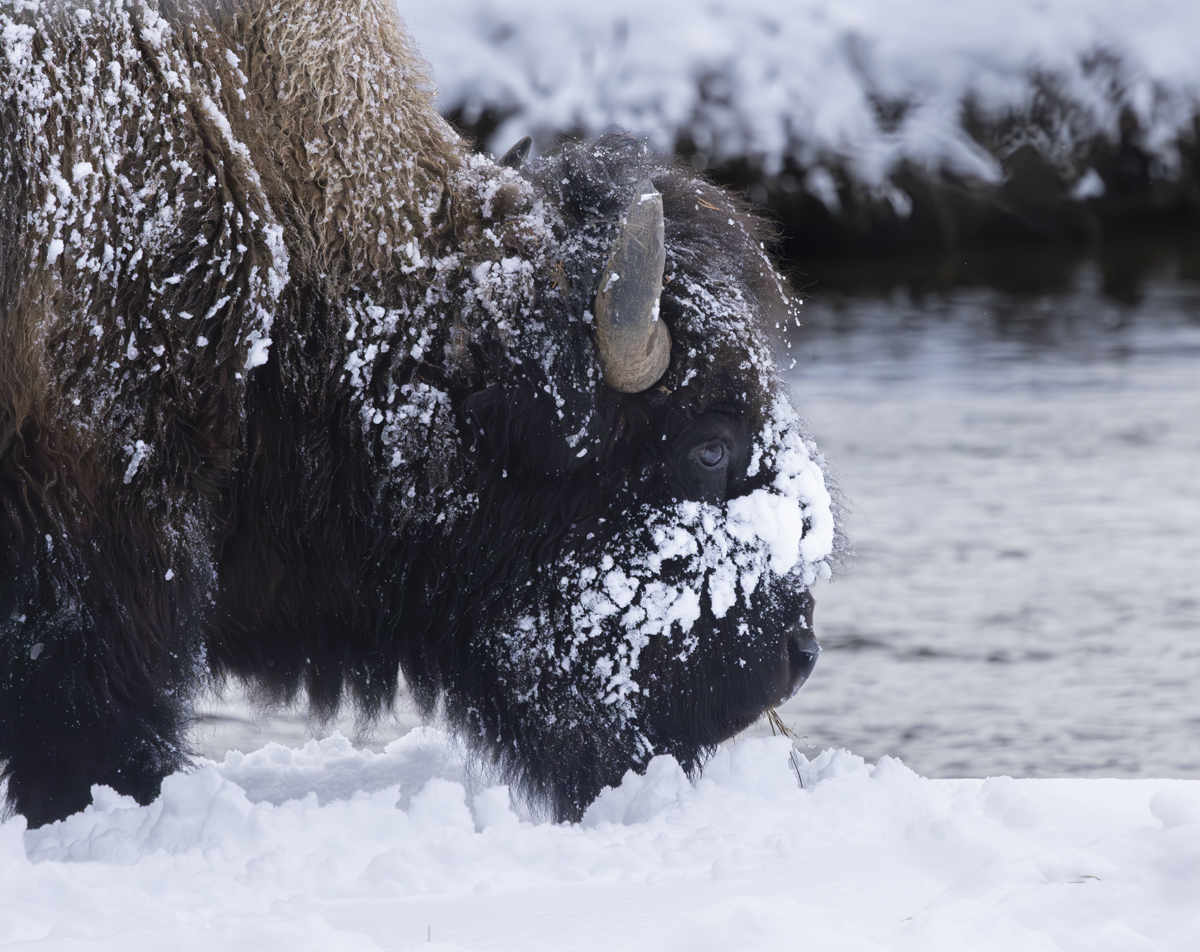
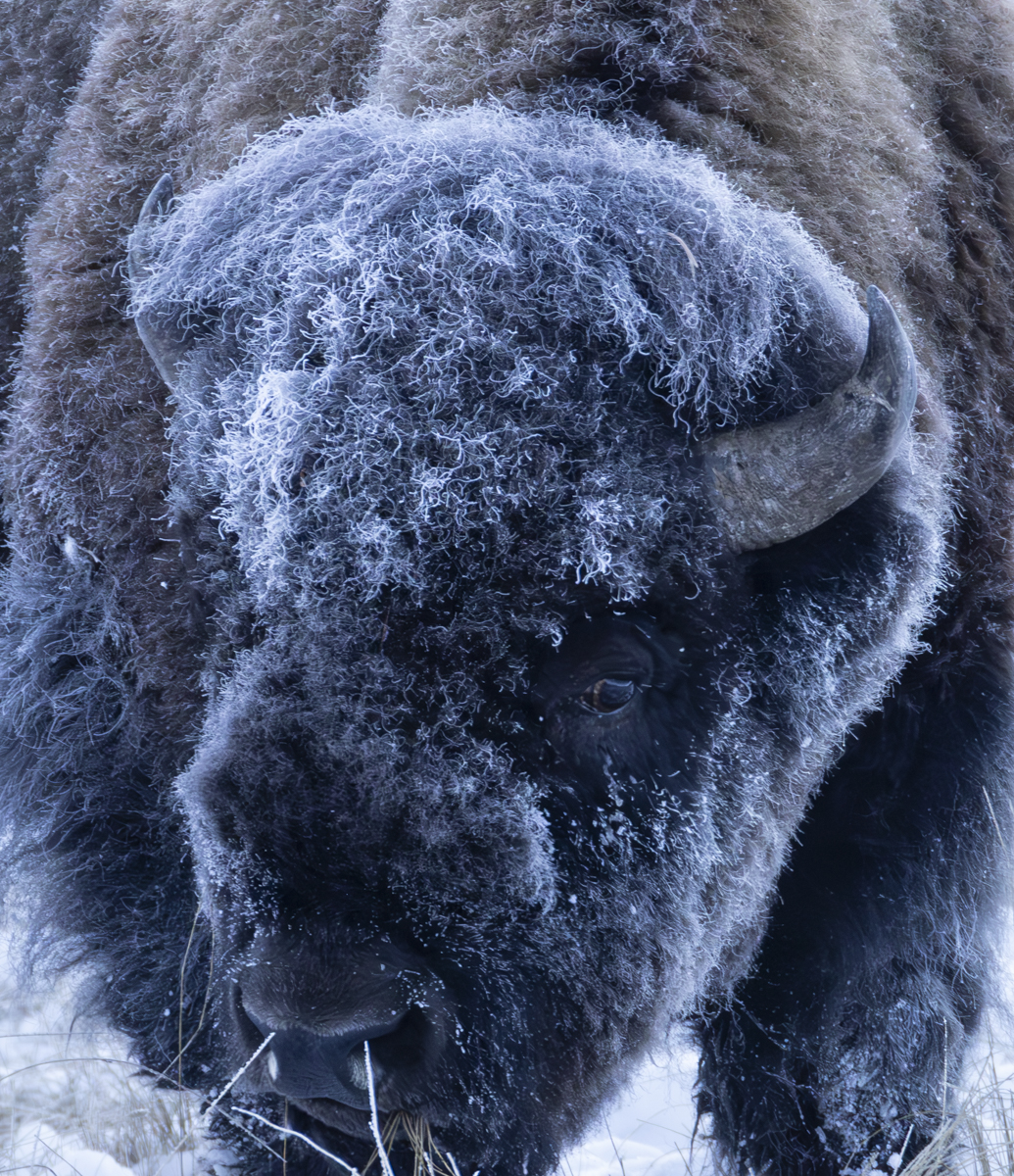
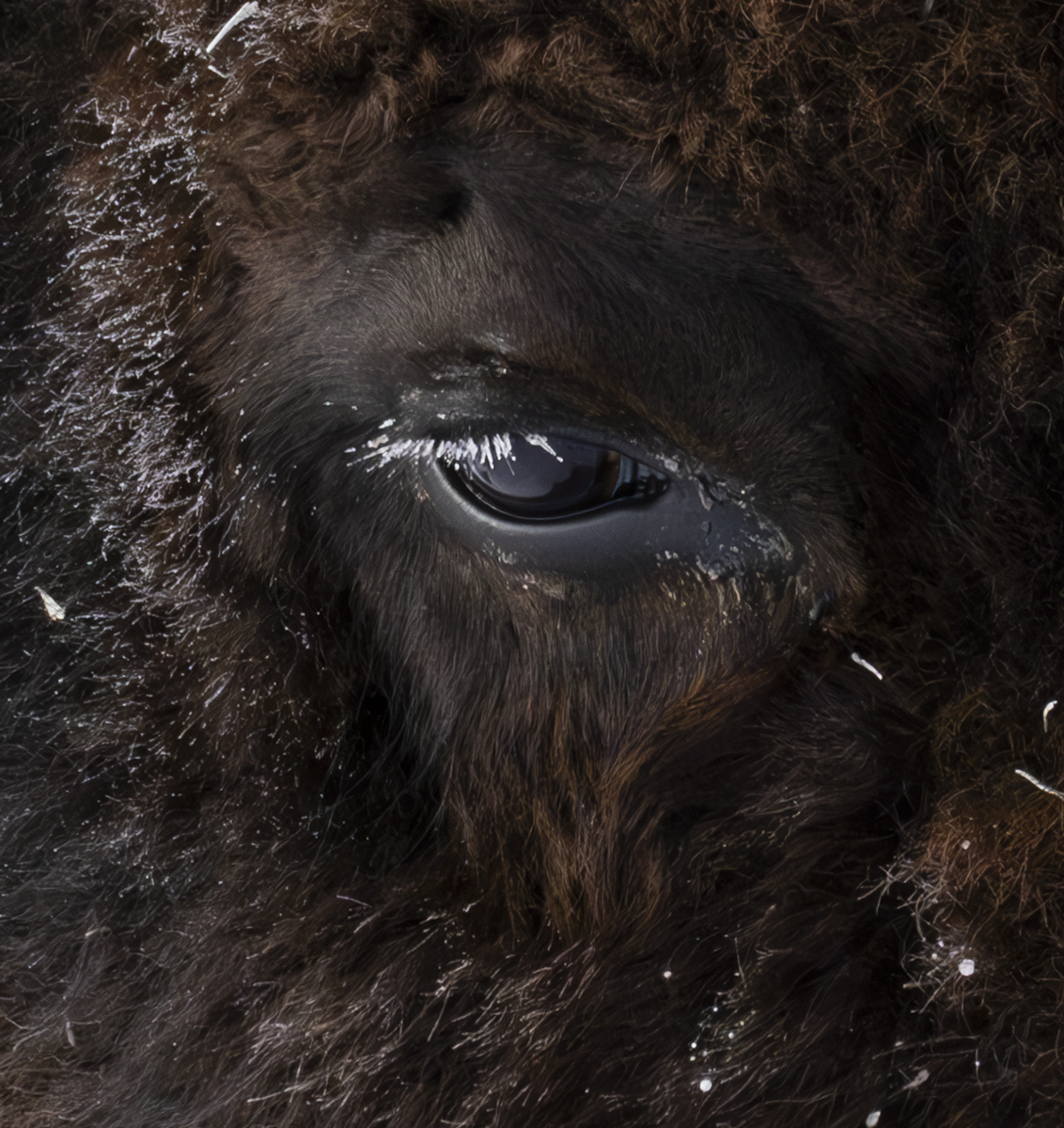
I had hoped to get some classic photos of bison in winter – their breath showing like a small cloud around their heads on a below-freezing morning, their coats covered in ice, and their determination and strength showing in their eyes. But, this was the winter that wasn’t here in Yellowstone so icy bison were not a common sight this year. Instead, this winter in Yellowstone stands out for its lack of consistent, deep snow and mild, above-average temperatures. Though our winter is far from over, even when it snows like it did earlier this week, it has melted away rather quickly and temperatures have not been much below zero these past few months. But there were a few frosty mornings that I spent time with the bison, one of my favorite creatures here in Yellowstone.
Bison are extremely well-adapted to the bitter cold when it does occur. The have a thick winter coat consisting of two layers – a dense undercoat and a thick, coarse outer layer of guard hairs that helps repel water and wind. The dense coat has close to 20,000 hairs per square inch (that’s about 10X the number on some cattle and 2000x that of a human). This insulation means that snow doesn’t melt on the back of a healthy bison. They are supposedly “comfortable” at temperatures down to -40 degrees F.
I haven’t seen a lot of bison “snow plowing” this winter (using their massive heads to swing back and forth to uncover dried grasses beneath the snow) since the snow just has not been that deep. We did see some when we went into the interior of the park (where snow is typically much deeper than in the northern range) on a snow coach back in January. Their massive humps are the muscles that power this head swinging behavior that is critical for their winter diet.
Here are a few photos of these magnificent animals as they survive like generations before them in this winter landscape.
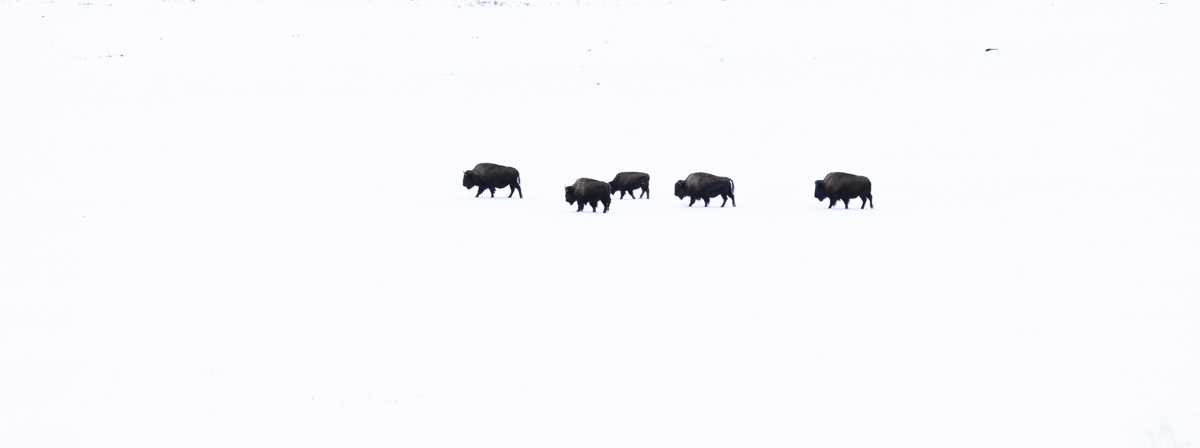
A bison that had been “snow plowing” at Old Faithful in January (click photos to enlarge)A bison wades across the Firehole River at Old FaithfulA frosty bison on a cold morning in the northern rangeFrosty eye lashesSome bison slowly walking across the snowy landscape of Lamar Valley
And here are a couple of bison videos from this winter…(best viewed full screen)
This next scene can happen anytime of year but seems a bit more common in winter as bison use the roads for travel instead of having to walk through the deep snows (that usually are here). I came around a curve and was greeted by a large herd of bison running towards me so I stopped, rolled down my window, and enjoyed the scene. A long line of cars was behind them.
I’m starting to experiment with the slow motion video feature on my Canon R5. Slow motion video on this camera has no sound which is both a good and bad thing depending on the situation. I’ve taken several videos of a few different species and find that it is interesting to see details of what they are doing that my eye alone sometimes misses. I’ve also discovered it can be a very long video clip if the animal isn’t doing anything particularly noteworthy. So, here are a couple of clips that may fall somewhere in between those two criteria (viedos are best viewed full screen).
One afternoon I crawled down near the Lamar River as a group of Barrow’s goldeneyes were diving to feed (they primarily eat aquatic invertebrates). They typically stay underwater for less than 30 seconds and this section of the river is fairly shallow so it may even be less here. They moved back and forth across the river as a group until another person came over to the edge of the road near me and the birds slowly moved away.
Their feeding behavior is like a graceful dance with water droplets and the splashes behind them adding to the beauty.
This next clip was taken along the Old Yellowstone Trail, a dirt road that parallels the main highway into Gardiner on the other side of the river. It is a great place to see pronghorn, elk, deer, and bighorn sheep, especially in winter. Any time I take trash out to the dump I always drive a few extra miles and cross over the river to take this road back to town. You just never know what you might see. On this particular trip, I pulled over to watch several pronghorn feeding on the very short grass out on the flats next to the road. To my surprise, a few of these elegant animals decided to walk towards my truck and start browsing on a row of sagebrush shrubs less than 20 feet from where I was parked. I took some video at the normal rate and their feeding action is quite rapid with many pulls at the shrub in quick succession before pausing to chew their cud. Slowed down, you can see how precise this doe is in pulling the tips of the branches. And then you get that long pause while she chews on it for a bit while keeping a pair of huge wary eyes on this thing huddled in a huge chunk of metal near her dining room.
Looking forward to filming additional behaviors (hopefully a bit more action-oriented) in slow motion as spring and summer bring new life to the landscape of Yellowstone.
Nature’s beauty is a gift that cultivates appreciation and gratitude.
~Louie Schwartzberg
I had a couple of spinal injections this past week so I was taking it easy this weekend. Melissa and a friend went on a hike for a few hours but I decided to not strain the ol’ back and went for a drive across the northern range. It was a beautiful day (too warm for this time of year, but mostly clear skies). Wolf watchers were busy climbing hills in Lamar Valley to see the Junction Butte wolf pack but I decided to stay closer to the road. I was rewarded with the usual suspects – 5 moose, lots of bison, some elk and mule deer, and plenty of canid action from the other two species of park “dogs”.
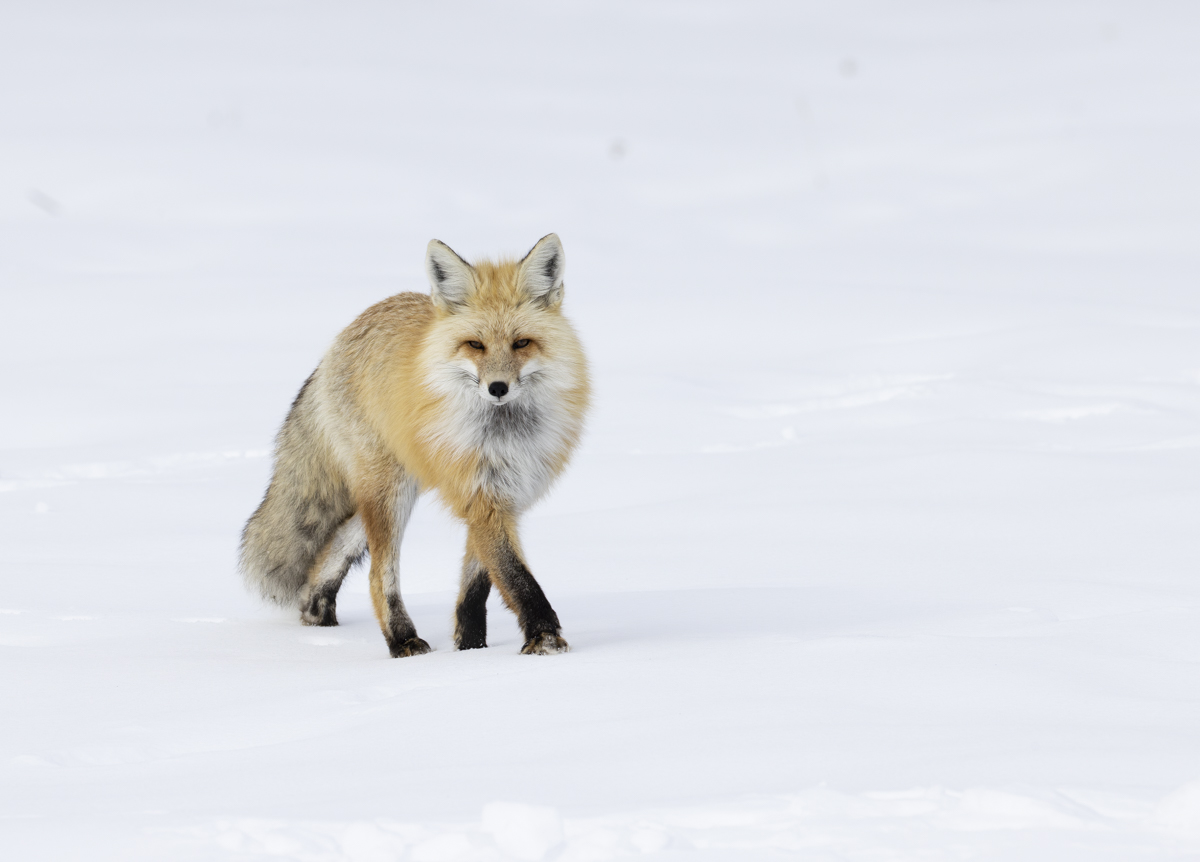
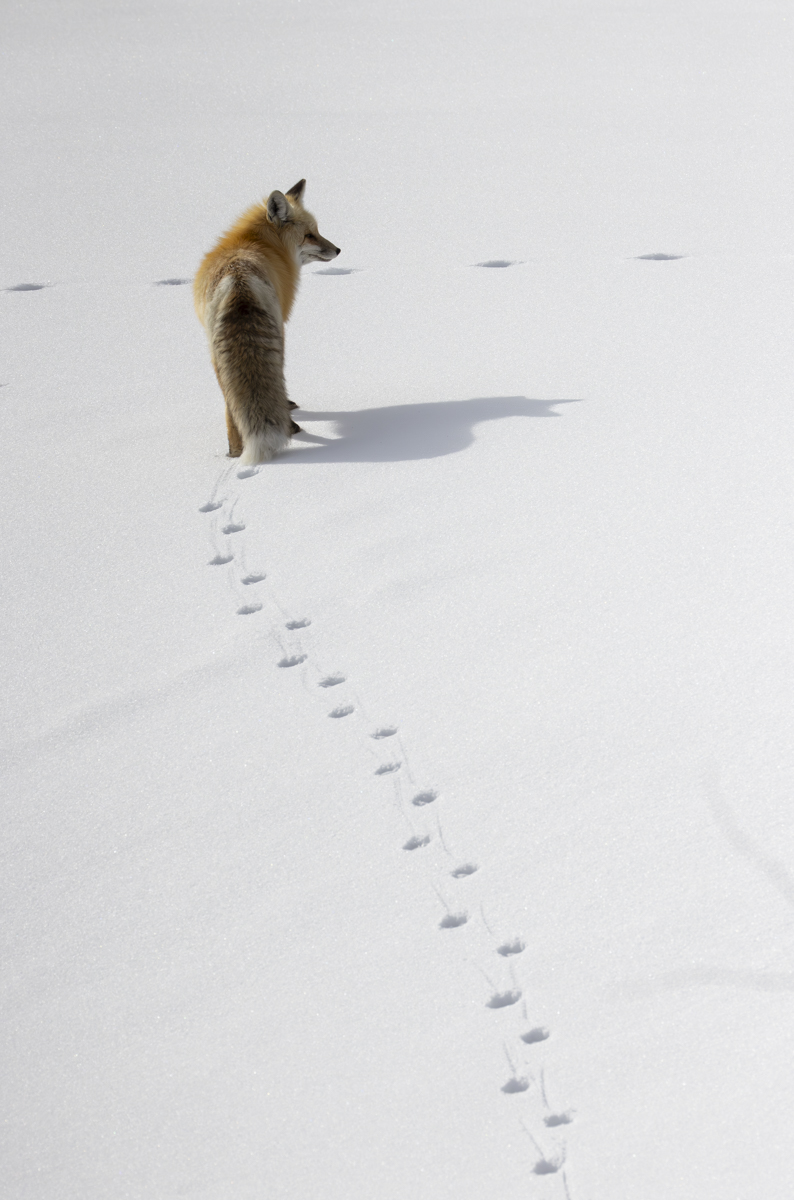
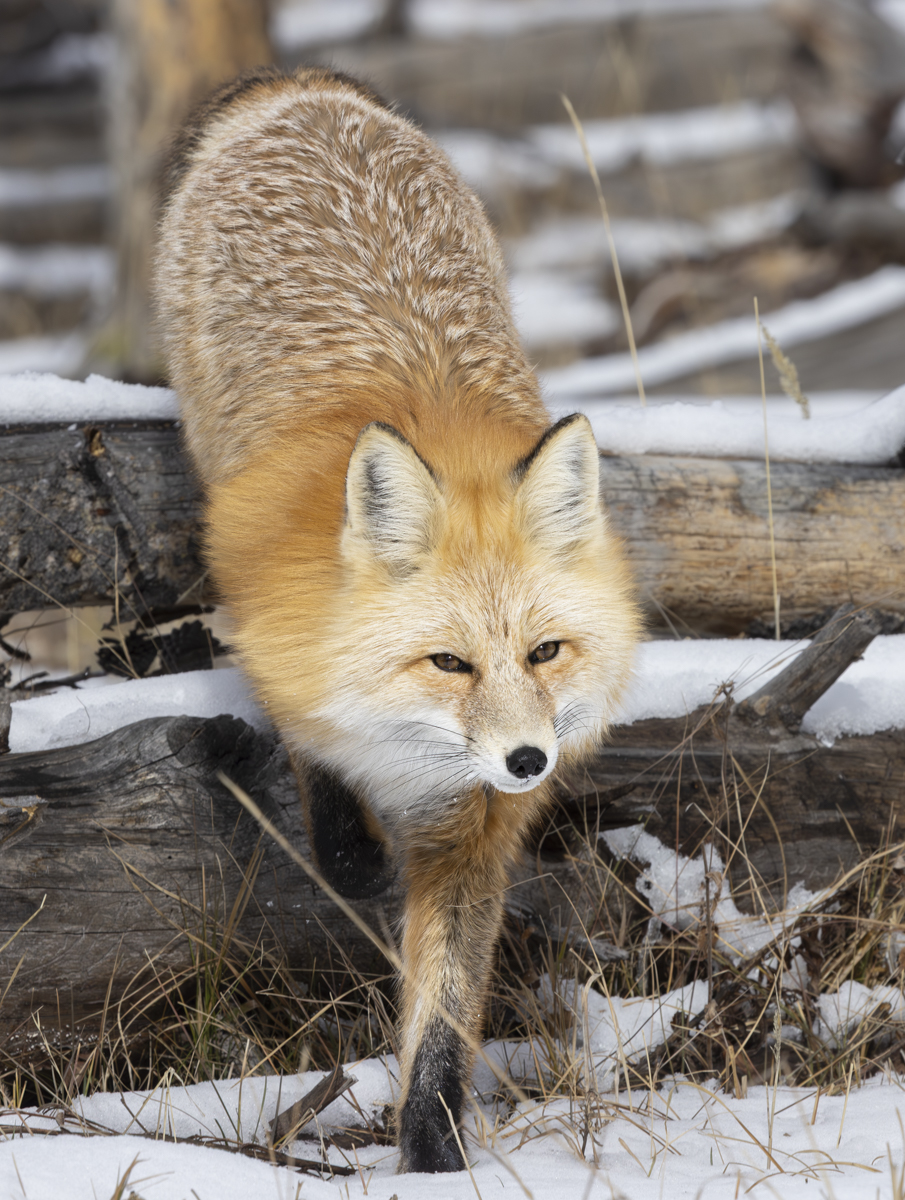
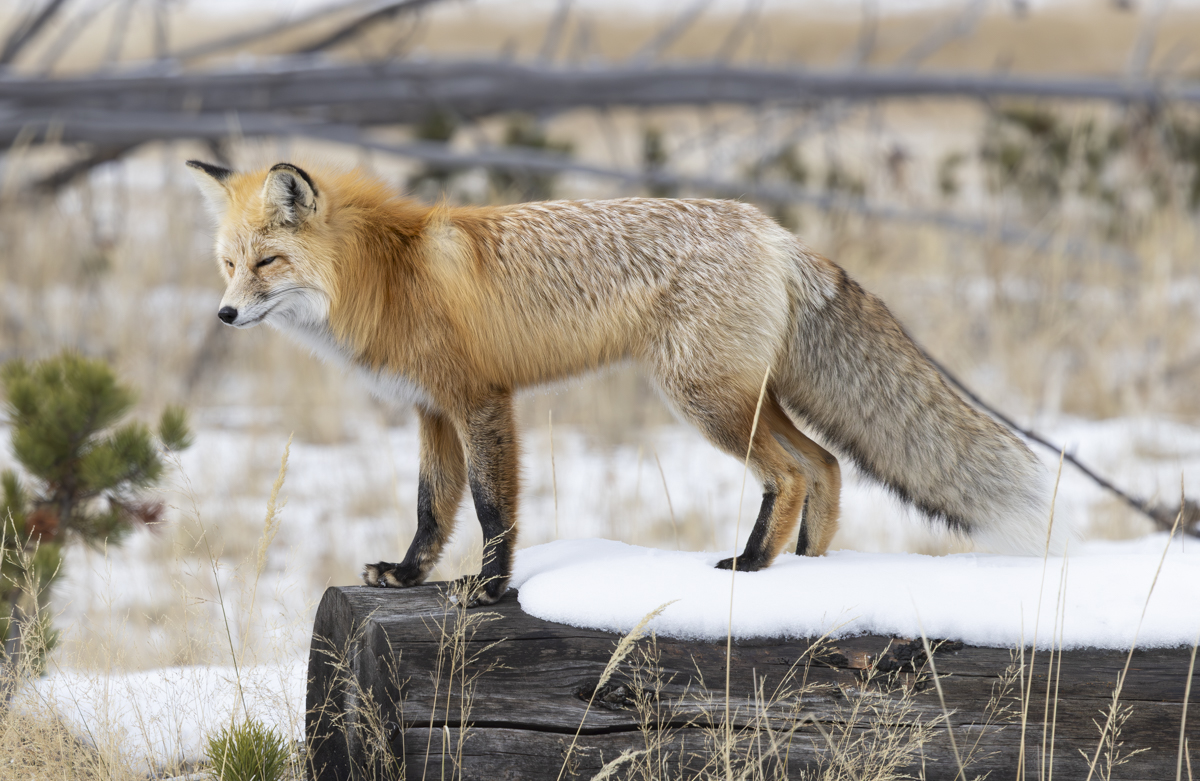
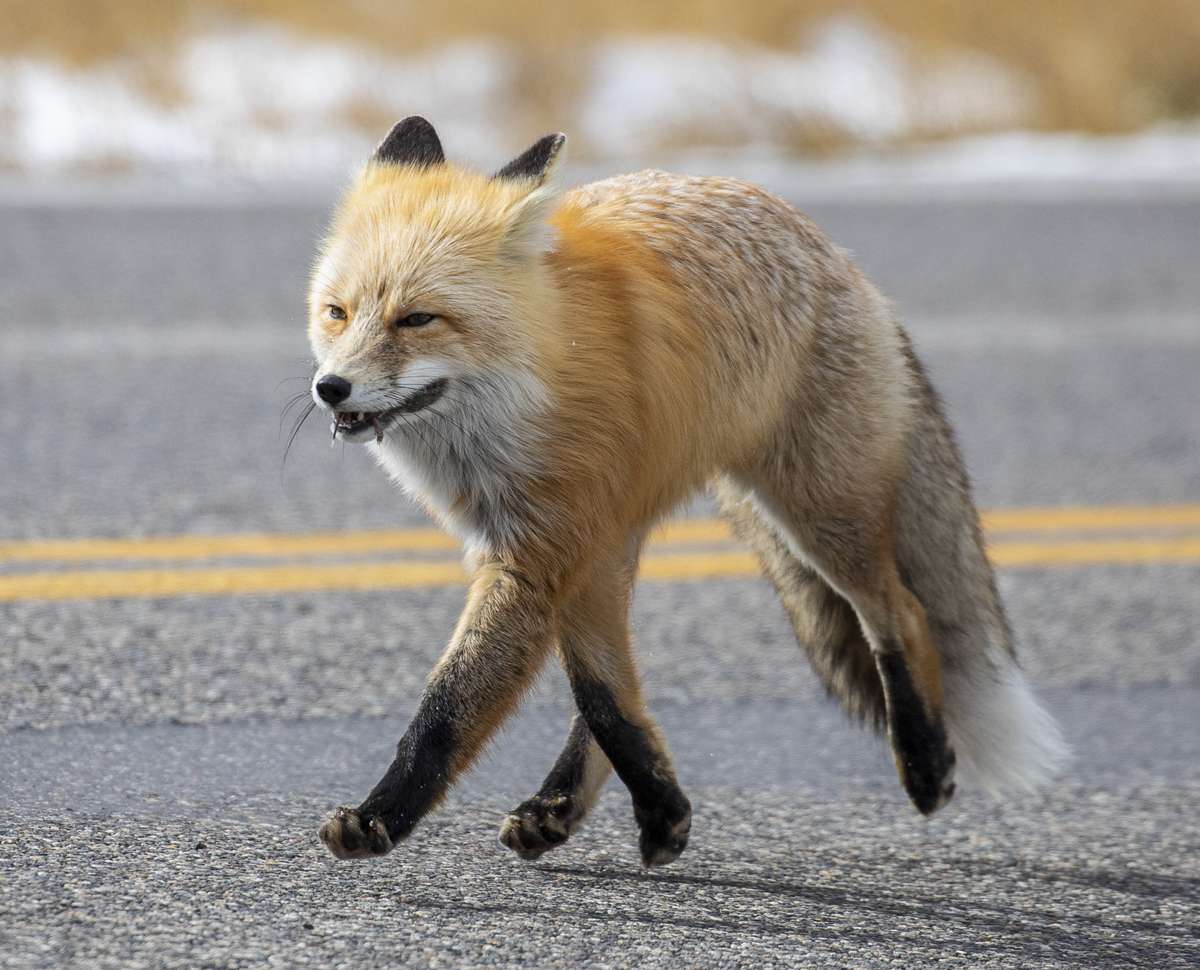
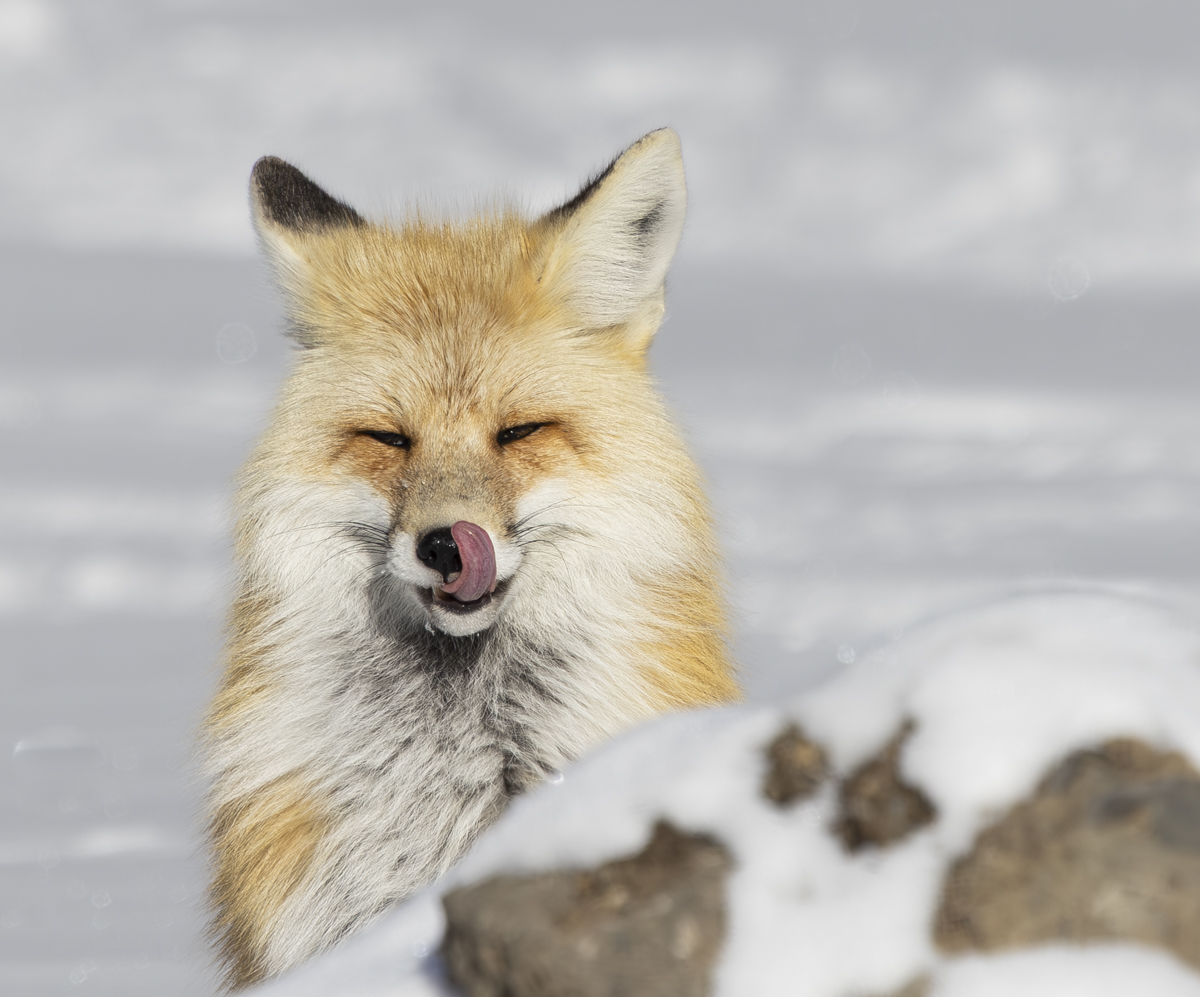
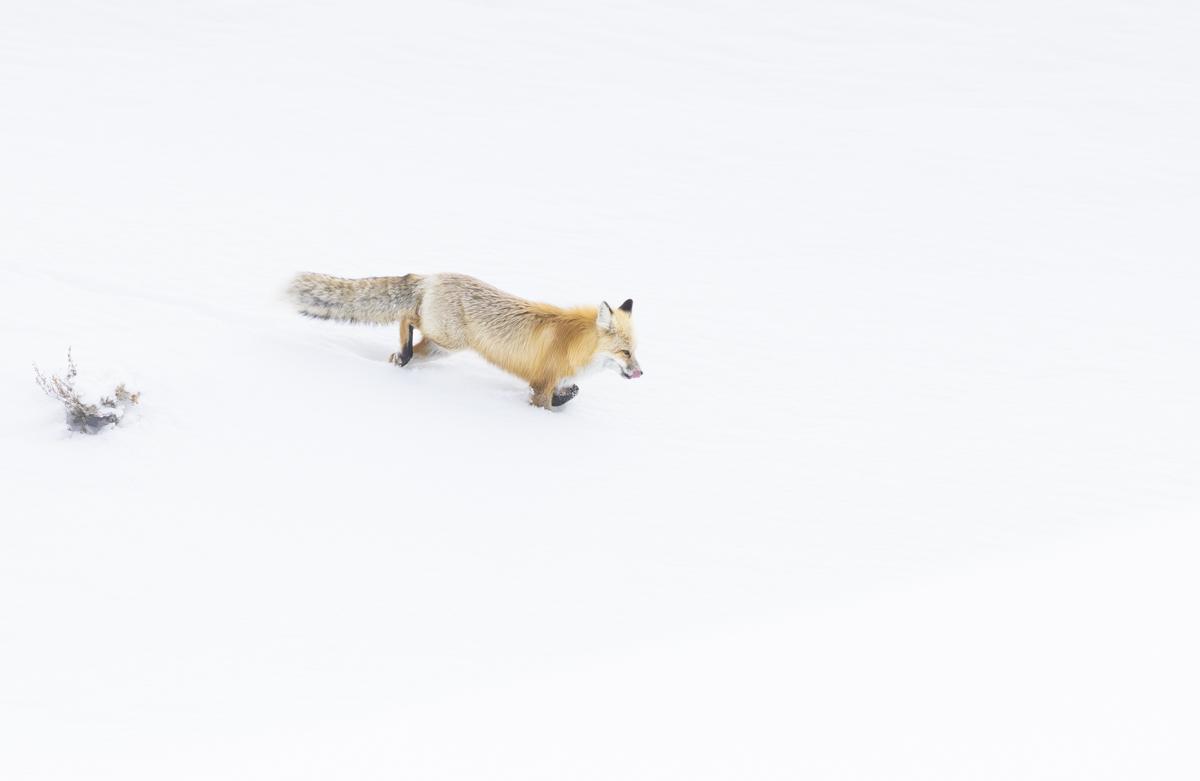
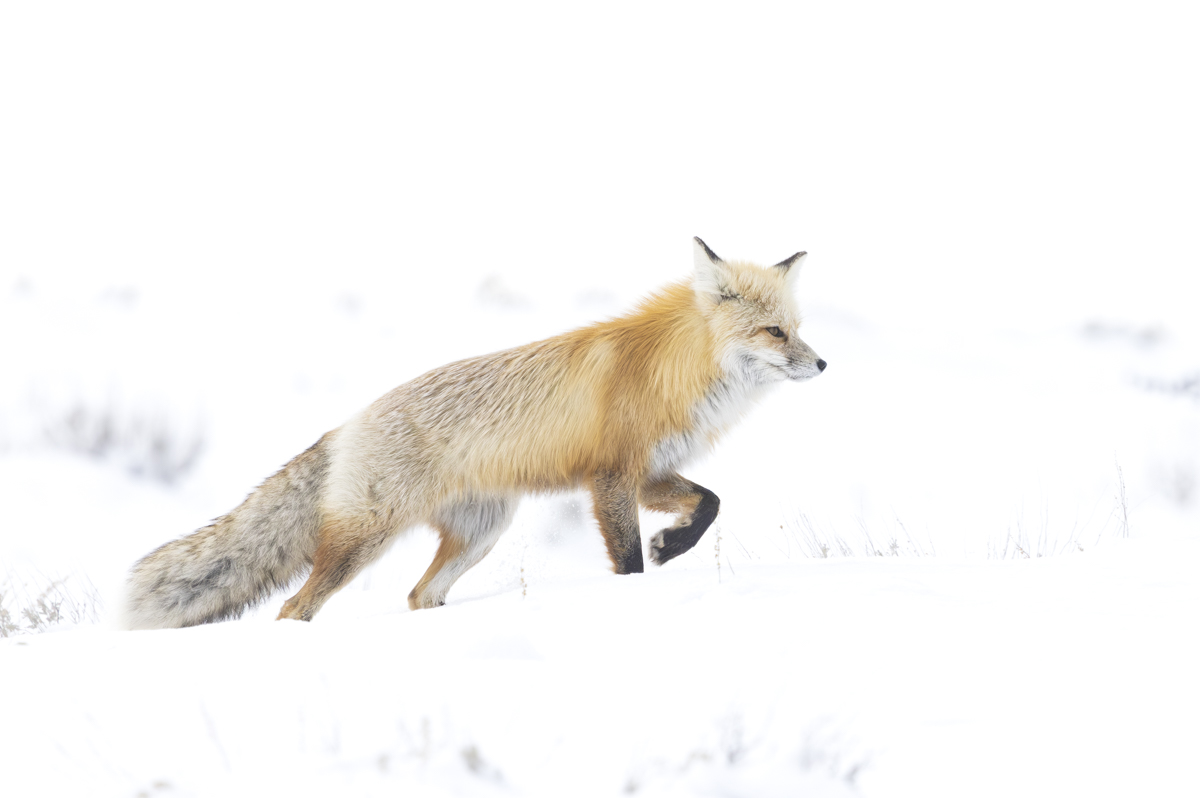
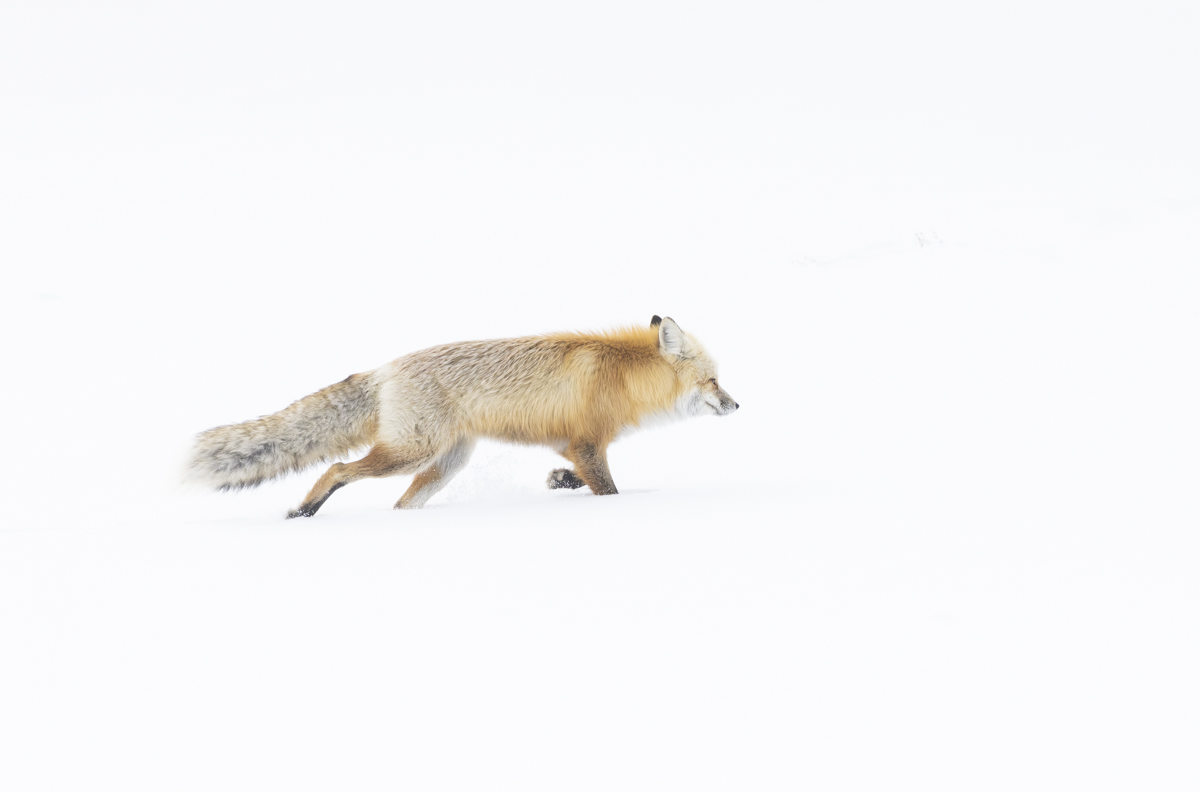
I spent about an hour with the predictable red fox at Pebble Creek. He (I think it is a he, but not sure) makes the rounds most days and checks out the picnic tables at Pebble Creek for scraps dropped by careless humans. He then wanders over to the dumpster just in case. He is a bit too comfortable around humans but has not in my experience crossed the line yet to direct begging (something some other foxes unfortunately have learned in this part of the park).
Red fox at Pebble Creek (click photos to enlarge)
I normally don’t like to spend time watching wildlife with a crowd but the fox was so beautiful in the snow I decided to just stand next to the car and watch him for a bit. Once he got away from the picnic tables he was acting more like a fox should and was offering some nice opportunities for photos.
Standing up on the road looking down at the fox and his track trail. Notice the foot drag mark in the snow as the fox pulls each paw out of the snow going forward.
It was neat watching the fox trot effortlessly on the snow surface. A couple of people stepped out onto the snow for a closer view and sank a foot or more. Advantage fox.
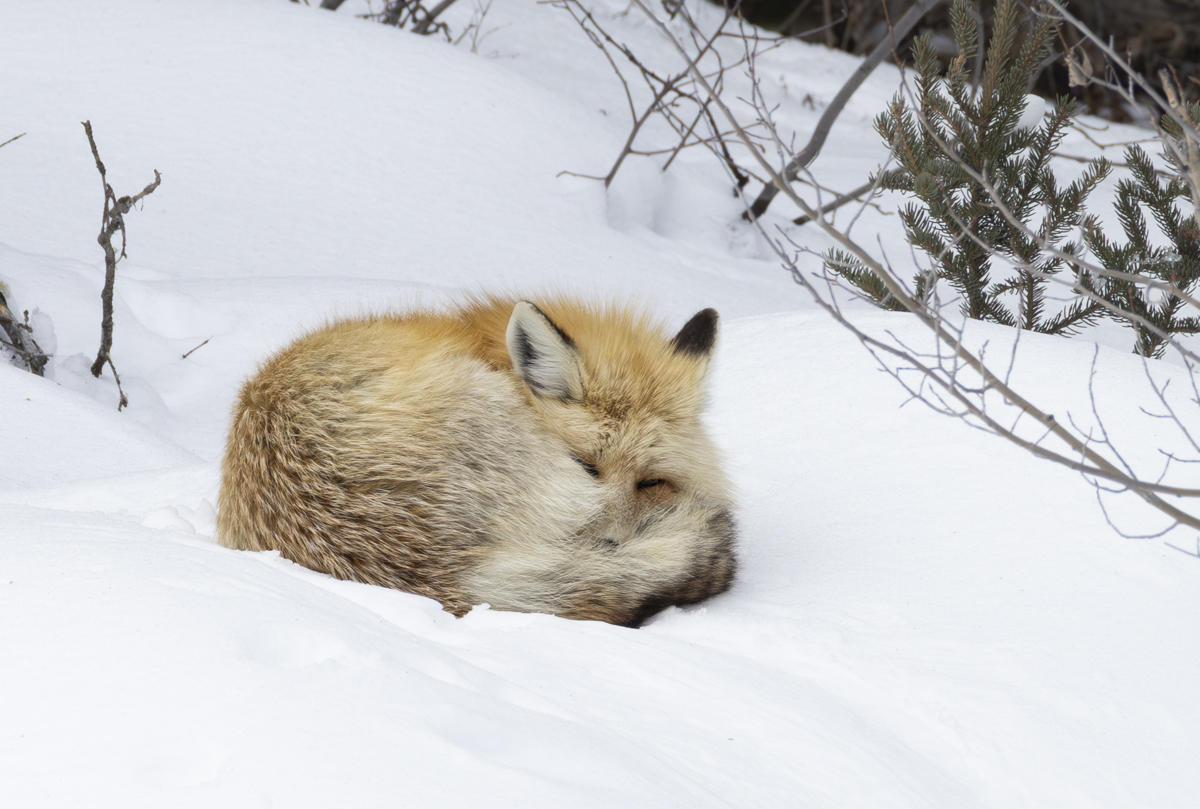
Curled up in the snow.
The fox rotted up a wooded slope and bedded down for a nap. As most dogs do, it had to find just the right spot by occasionally getting up and turning around before plopping back down. This circling behavior probably serves several functions – flattening the space to make it more comfortable; one last check for potential threats (those pesky humans) before laying down, and maybe by creating a tight bed-like bowl in the snow it can help retain body heat. As often happens, the fox did something cool before I positioned the camera on the tripod…it rolled over and accidentally slid about 20 feet down the slope on the snow. It then jumped up, looked around (you didn’t see that , did you?) and climbed back up to its nap spot.
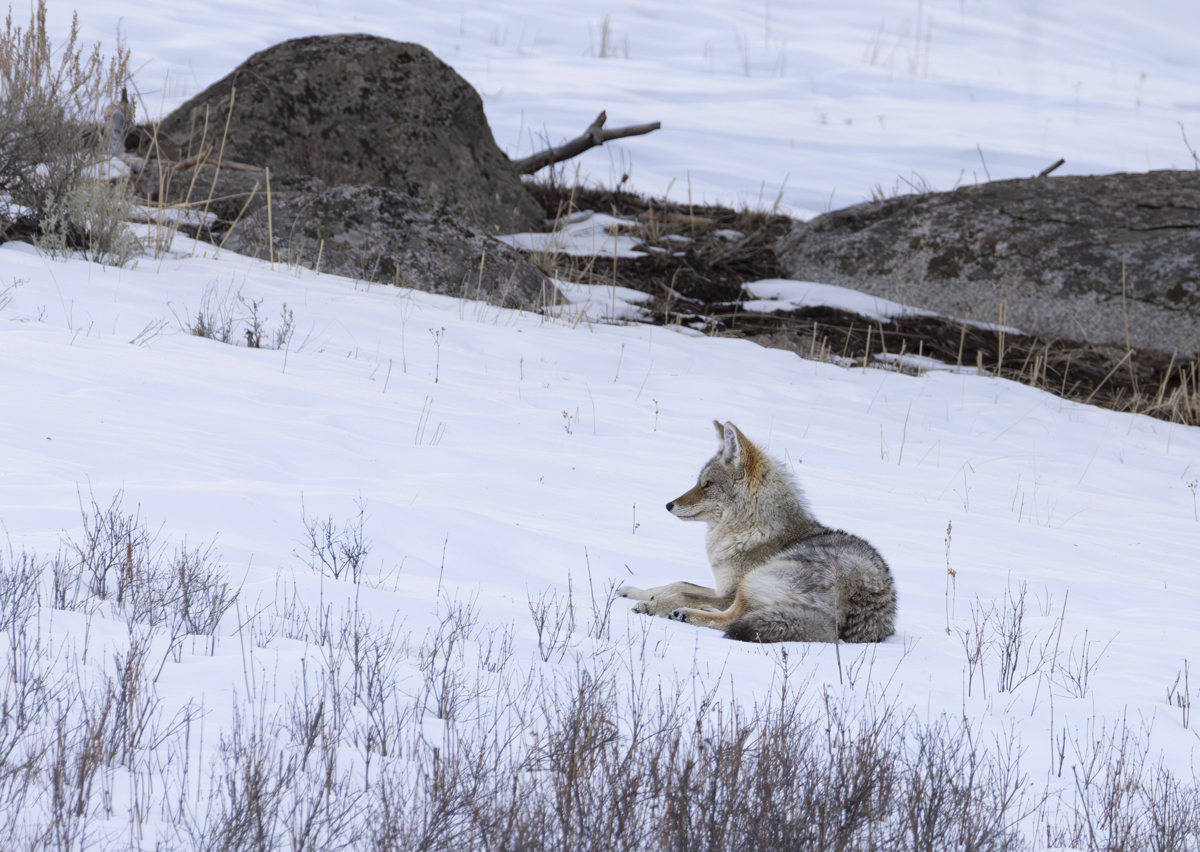
I left the fox and continued homeward passing through a few bison jams on the way. Near Junction Butte I spotted a woman off in the woods with her phone pointed up the hill. I pulled over and went back as she was headed to her car. That is when I saw the object of her photos – a coyote laying in the snow. The woman drove off leaving me and the coyote alone.
Coyote taking a break on the snow
I stayed in the car and watched as it looked around, gave a head scratch or two, and finally got up and stretched. I slipped out of the car to put the camera on the tripod since it was getting late and the light was fading fast.
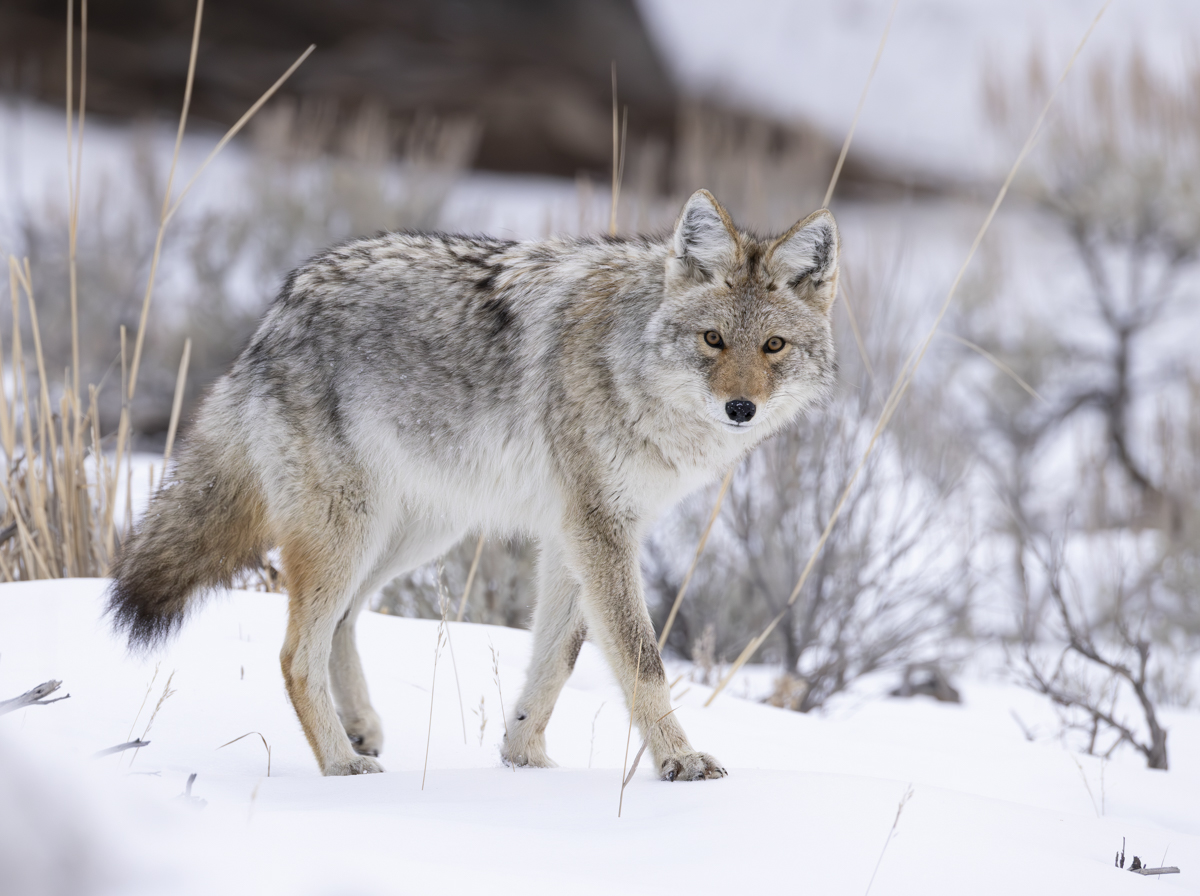
The coyote pounced with its paws a couple of times as I was setting up the tripod (naturally, they never wait until I’m ready) without success. It then turned, and to my surprise, headed straight toward me. There was no one else around and I was standing behind the car as the coyote came down to the road and crossed about 40 feet from me giving me one glance as it neared the pavement.
Coyote glances my way as it is about to cross the road
Now down in a meadow below the road, the coyote uncovered what looked like a chunk of bone and started chewing on it. After about a minute, it dropped it and wandered over to a boulder and took a seat.
The coyote surveying its domain from a boulder throne
About that time a car drove up and a couple of people got out. The coyote looked our way and trotted off. I headed home after enjoying some time with a couple of Yellowstone canids. Watching them do their thing is a great way to spend a Sunday afternoon.
In mythic systems from other parts of the world, the fox may guide a young person from one phase of life to another.
~Martin Wallen
One of my favorite animal species to see in winter is the red fox. They are masters of mousing and I have a goal of getting some good photos or videos of one doing that in deep snow. But this winter is not cooperating as we are way below normal snow levels in much of the park. We did have an early snow back at the end of October and we took a road trip down to Hayden Valley right before the roads to the interior closed for the winter season (typically the first of November through some time in April depending on snow levels). Visitation is down that time of year but there were some die-hard wildlife watchers in pursuit of great gray owls and ermine that had been seen in recent days in that region. We also looked for great grays and got lucky the next evening as I posted back in November.
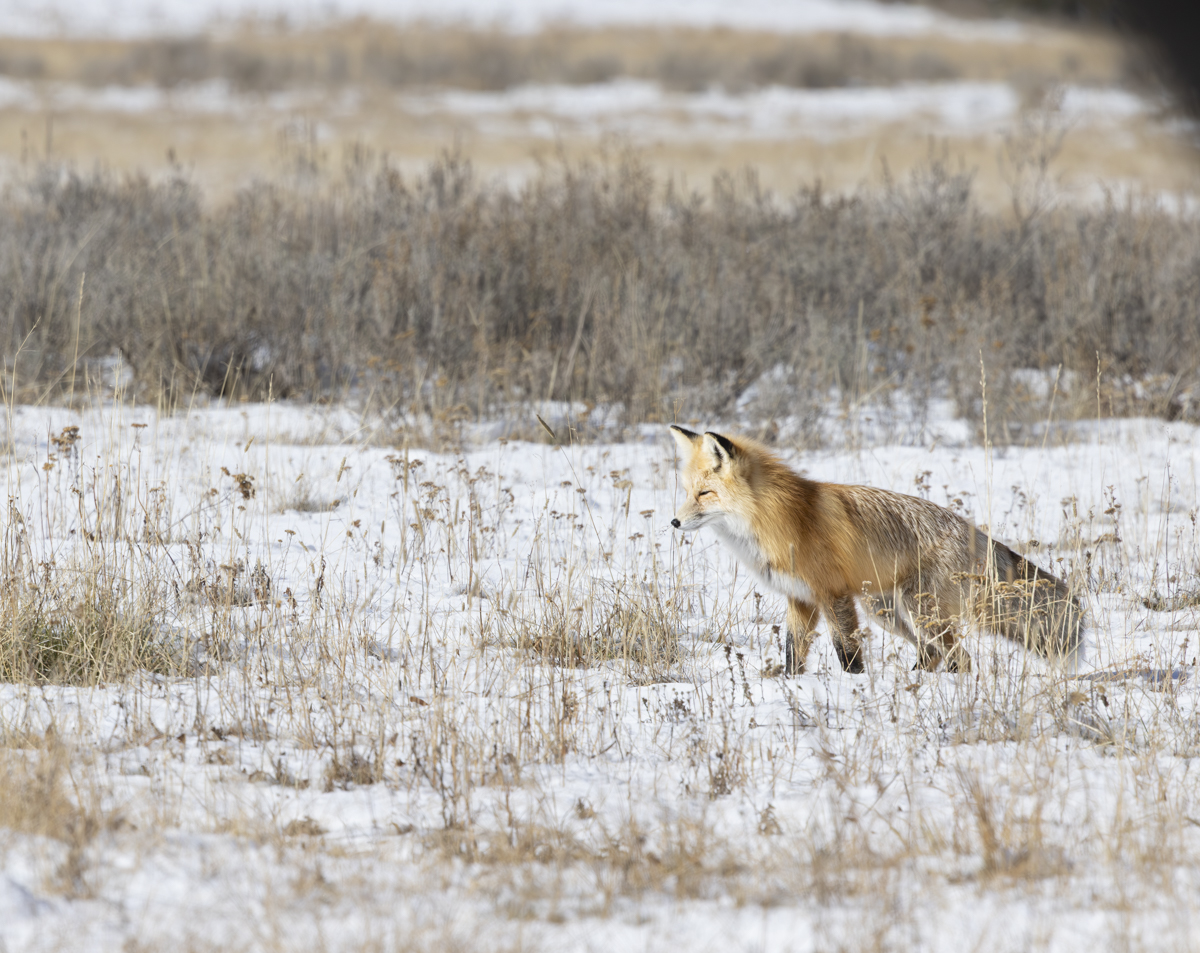
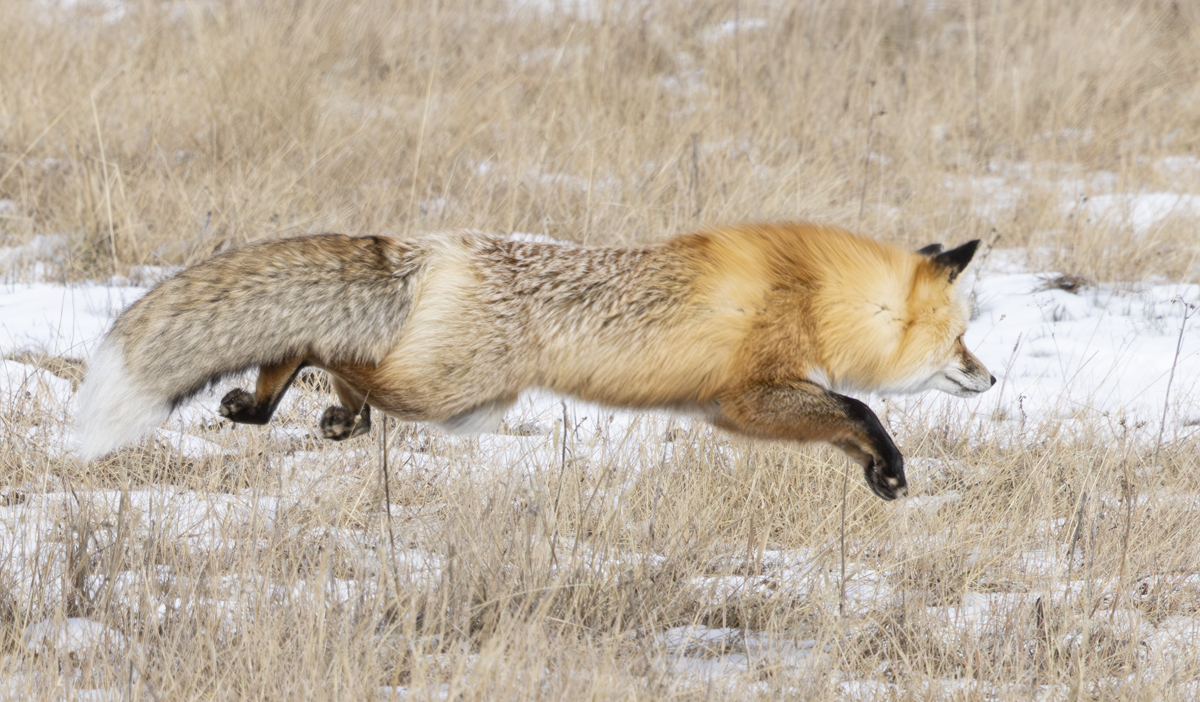
As we were driving near Mud Volcano, we spotted a red fox out in the sage and grasses of a roadside meadow. It was slowly going along listening and hunting. There was only about 2 to 3 inches of snow on the ground so no classic head dive jumps were in order, but we pulled over to watch anyway.
Red fox hunting in meadow (click photos to enlarge)
The fox walked slowly and stopped, head tilting a bit from side to side. It saw or heard something just ahead.
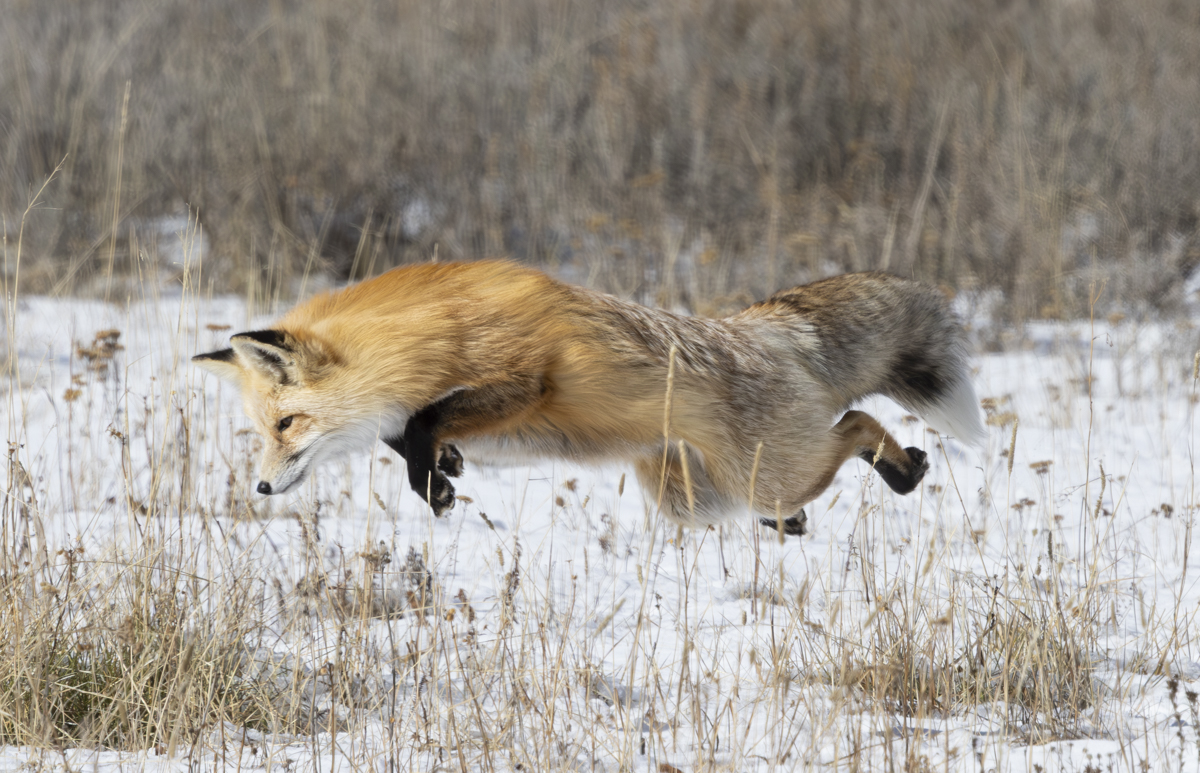
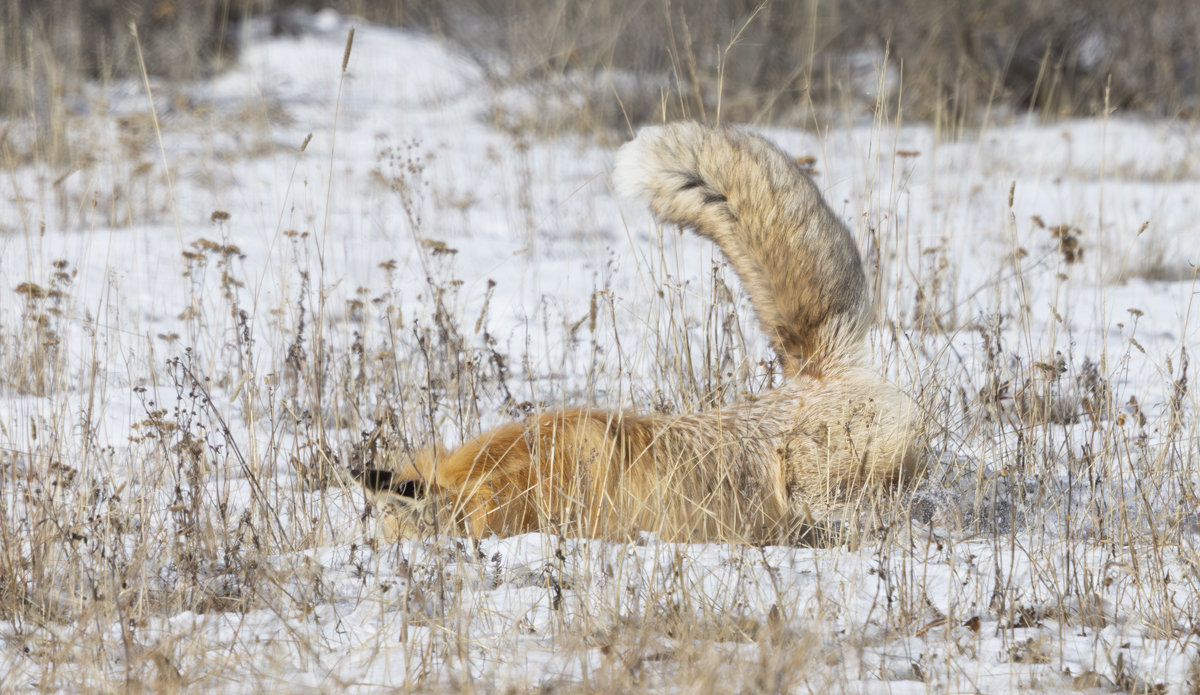
A leap focused on something in the grass aheadThe fox splays out on the snow but comes up empty this time
That leap was a miss. We continued watching as the fox meandered around the meadow. It did catch a small rodent on the next leap but it was in some taller sagebrush so we couldn’t tell what it was for sure.
This was a successful leap
We had parked on a side road leading to a picnic area. I was out of the car watching the fox when it disappeared behind a line of trees between me and the meadow. Suddenly the fox appeared close and was walking straight toward us. I crouched and the fox continued on, crossing some deadfall along the drive.
The fox crossed a downed log right next to the pavement and only about 10 yards from where I sat.
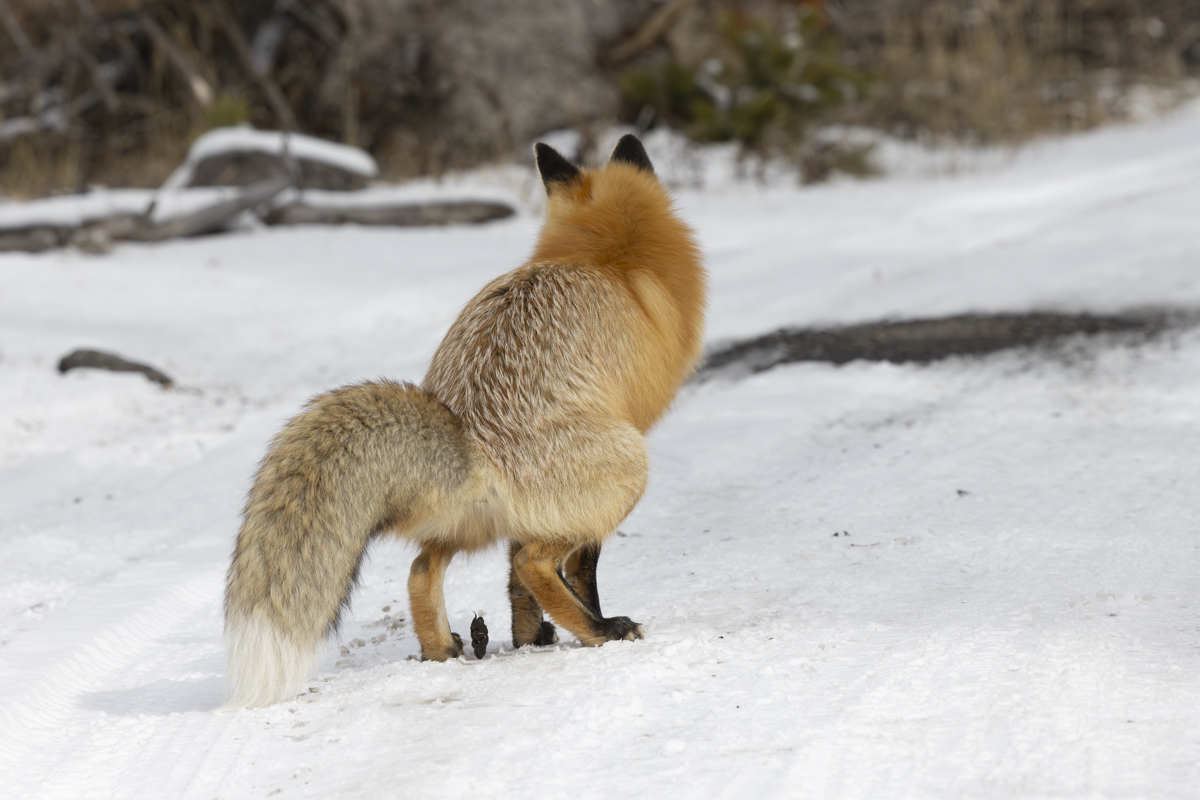
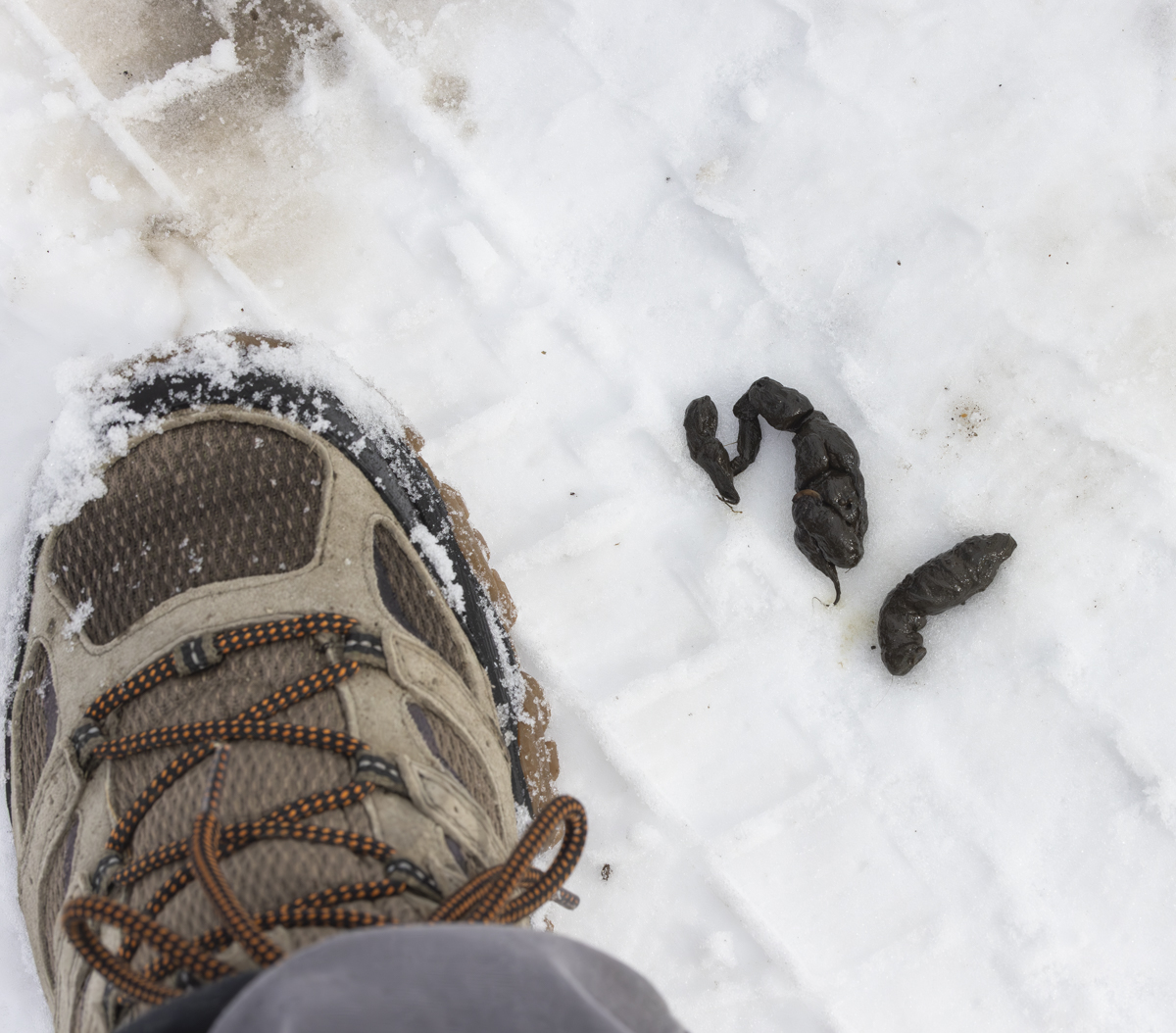
It turned and walked down the road a bit and then hunkered and deposited some scat in the road (perhaps making some statement about our proximity?). Well, it’s not often you get to look at fresh scat so after the fox trotted away we walked over and, of course, took a photo (don’t worry, we usually don’t have this on the itinerary for guests).
The fox making a statementField guides describe red fox scat as 3 to 4 inches in length, tubular, and tapered to a distinct point at one or both ends. I”d have to agree.
It turns out they usually deposit scat at trail intersections or other prominent spots to mark their territory so maybe he just wanted us to know this meadow was his. The fox wandered back into the field and then came back towards the main road walking along a fallen log and pausing to look around.
Surveying from a vantage point
After crossing the main road the fox had another successful leap that was hidden from our view by trees. Next thing we know it comes trotting down the main road carrying a rodent.
Fox trotting past us on the road carrying its prize (photo by Melissa Dowland)
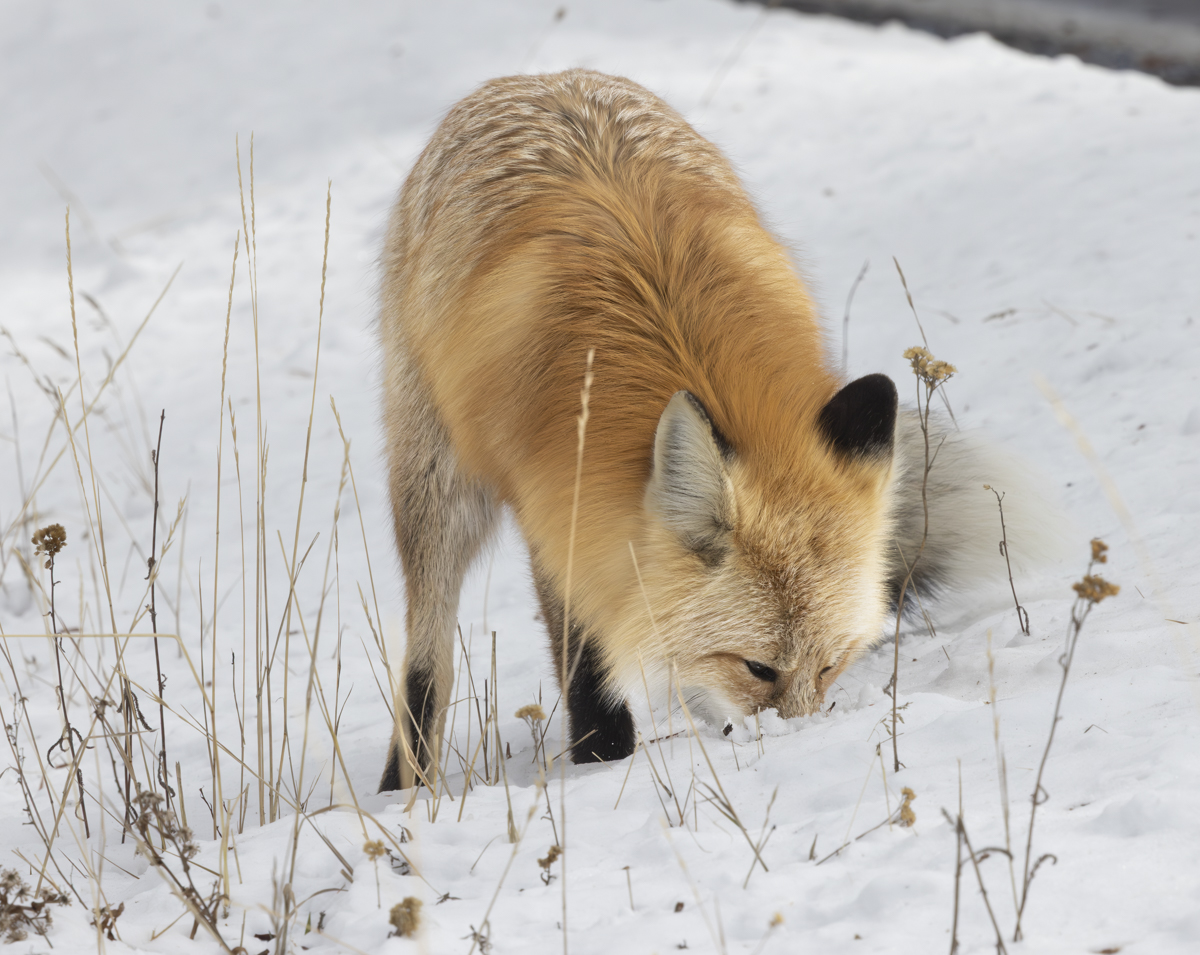
Then it did something that we felt privileged to witness…it cached this prize in the shallow snow right next to road about 25 yards from us. After dropping the rodent, the fox stuck its nose in the snow in a couple of places and then pushed snow aside, picked up the prey and dropped it in place. It then pushed snow over it with its nose and trotted off down the road.
The fox burying its prey in the snow
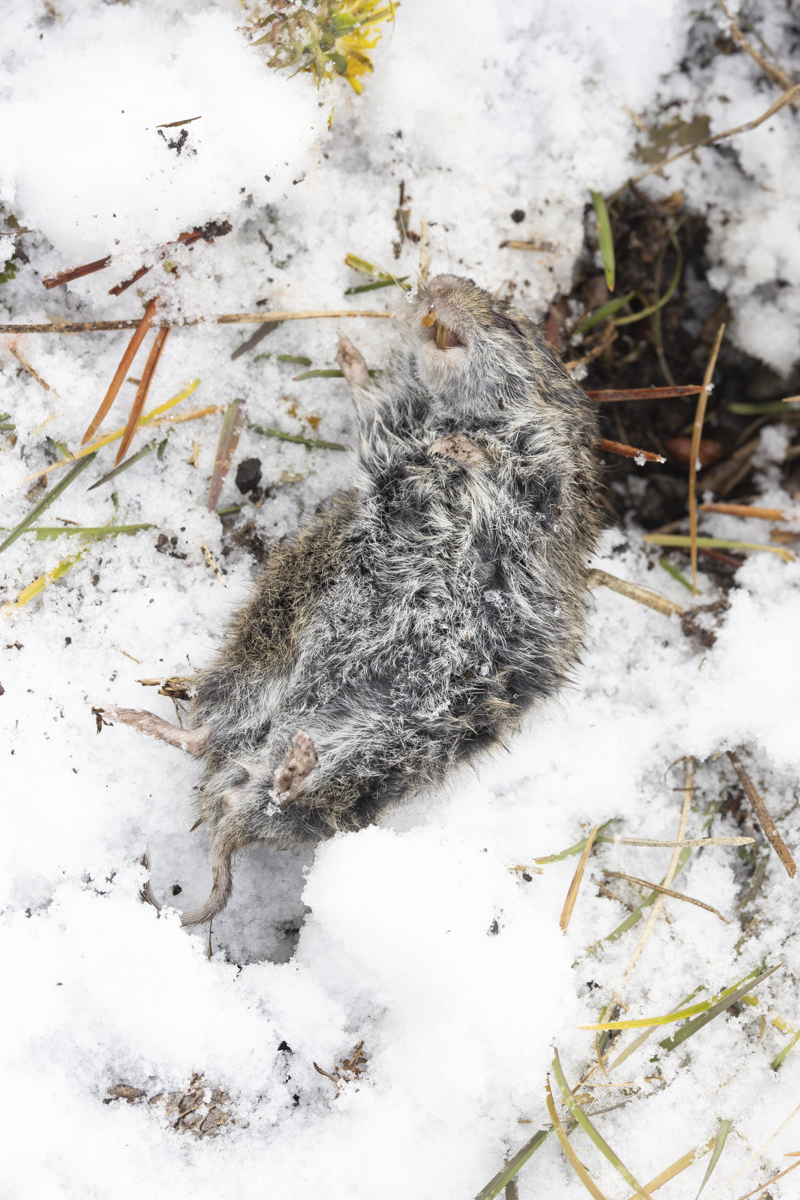
We debated for a second and then decided to go check it out. We wanted to know what the fox had caught. After looking at the general area where we thought the prey was cached, we started lightly digging in the snow (it was only a few inches deep) and Melissa found it. It looked like a montane vole, probably one of the most abundant rodents in the park and a very important prey item for all sorts of predators from canids to weasels to raptors.
The buried prey item was a vole
Voles are active year round and have tunnels beneath the snow (the subnivean zone) where they travel and feed. This year’s unusually shallow snow depths probably puts them at a disadvantage both in terns of risk from predators and extremes of temperature (the normal snow depth has an insulating effect and their subnivean habitat is maintained at a relatively constant 32 degrees). We reburied the vole in the same spot and drove home. The next day we drove back and decided to check and see if the fox had returned for its prize. I have been curious as to how long they might leave a cache and if they generally find all of them. After a little searching we found the vole still buried. I had to wonder if our scent might deter the fox from returning or did it just not come back. We’ll never know.
I’ve had a couple of other encounters with foxes this winter so here are a few more photos of these small elegant carnivores.
This fox has been regularly patrolling the picnic site at Pebble Creek. From my encounters with it, it doesn’t seem to be a beggar like some of those closer to Silver Gate, but it routinely stops by the Pebble Creek site to check the picnic tables (yes, soe people eat their lunch here in the snow) and dumpster for scraps.
On a January trip into the interior via snow coach our group spotted a red fox in Hayden Valley. The first glance was of it doing an impressive leap and head-first dive into the snow after a rodent (most in our coach saw it but I was in the back and missed that). We stopped and got out and watched as the fox continued on in a sea of snow, its fluid form jumping off the white canvas. This is the essence of the fox, a delicate ghost that adds a splash of color and mystery to a beautiful winter scene.
Our Hayden Valley fox moving across its snowy hillside homeThe fox seemed to ignore us as it moved across the hillsideBe like the fox…confident in your abilities, resourceful, and adaptable in your surroundings.
Eagles come in all shapes and sizes, but you will recognize them chiefly by their attitudes.
~E.F. Schumacher
We are having a very strange winter here. Yesterday (and this is early February mind you) we had a high of 53 degrees, very spring-like. It had me thinking about our home in North Carolina and the woods and abundant wildlife.on our 14 acres. To add to that, I received our copy of the new field guide to the Moths of Western North America in the mail. It is a beautiful book and I quickly paged through looking for some of our “old friends” from our mothing nights back East. I was disappointed to see that we may only have one slug moth in this region. The slug moths are one of our favorites, at least their caterpillars are. So many bizarre and beautiful larvae like saddlebacks, crown slugs, and spun glass slugs. It made me a bit sad thinking about all those creatures we no longer see on a regular basis.
But then I thought about the day I had just had. A typical day of doing chores and running errands. It included making the 10-minute run out to the dump/recycle center a few miles out of town. I often drive back along the Old Yellowstone Trail on the opposite side of the river just to see what I might see. Much of this gravel road runs along the boundary of the park and ends up at the Roosevelt Arch in Gardiner. In winter, you typically see groups of Rocky Mountain bighorn sheep and pronghorn antelope grazing in the flats along the road. That’s when I was reminded about what a special place this really is…I was driving past about 50 bighorn sheep and close to 75 pronghorns all within a couple of miles of our house (not to mention the mule deer and elk walking in the streets of town as I left the house).
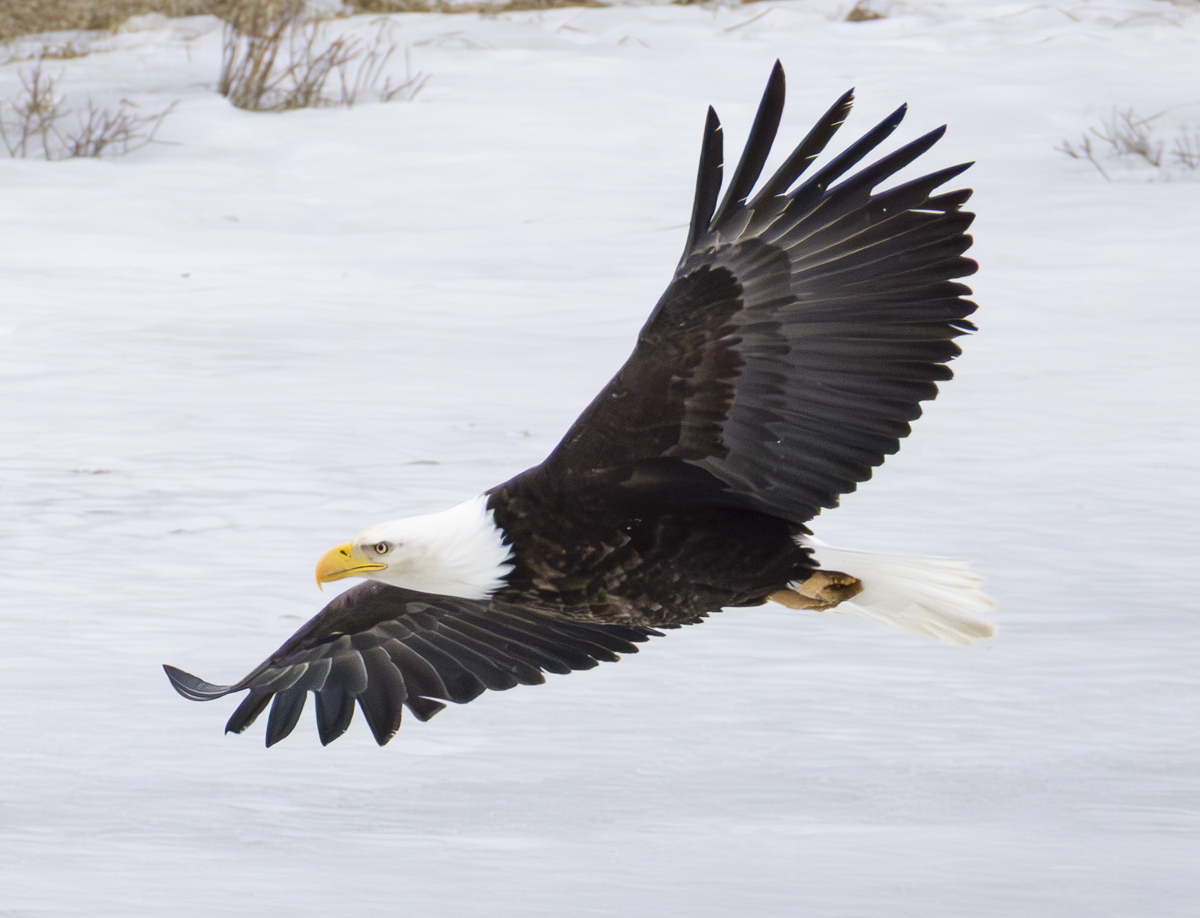
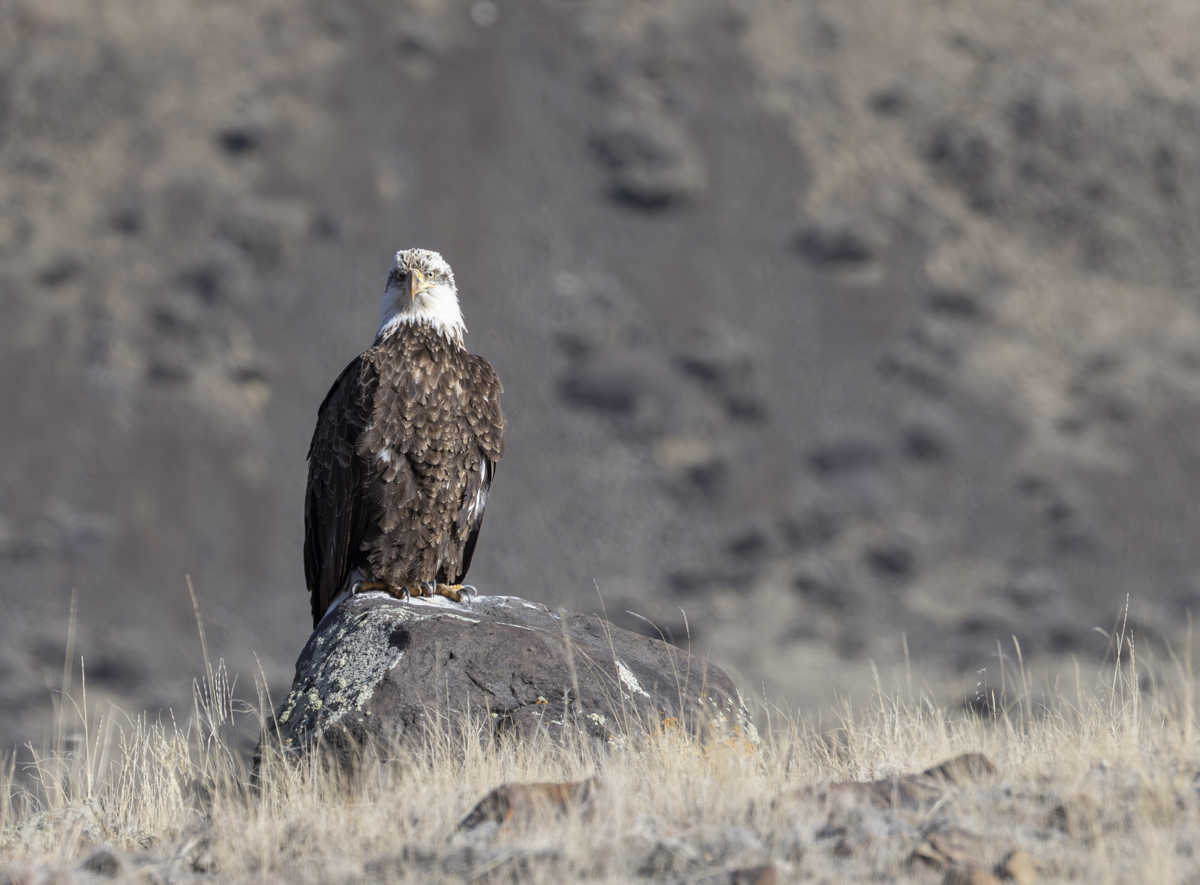
As I was reflecting on this amazing landscape we now call home, I saw it – the silhouette of a large bird sitting on a rock on the hill ahead. I thought, no way, an eagle? I had brought my camera in hopes of seeing an eagle along the river as I drove out on the main highway but had come up empty. I had never seen an eagle along this stretch of road as there are no large trees and this road pulls away from the Yellowstone River shortly after you cross the bridge from the main highway. The drove up the hill and, sure enough, it was a bald eagle.
A bald eagle perched on a rock along the Old Yellowstone Trail (click photos to enlarge)
When I stopped, the eagle glared at me with those piercing eyes and then turned its head and ignored me satisfied that I wasn’t a threat (I stayed in my truck).
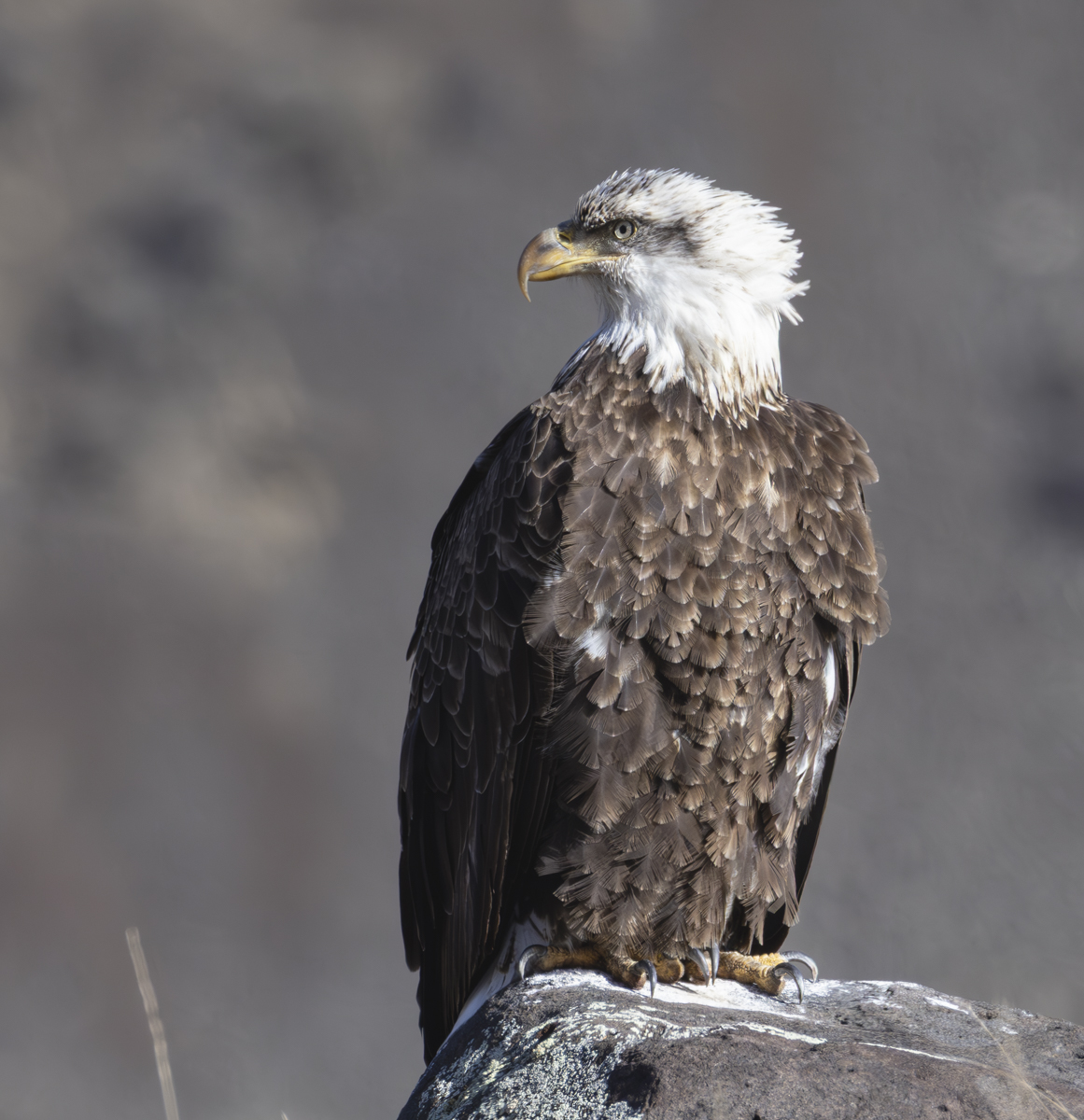
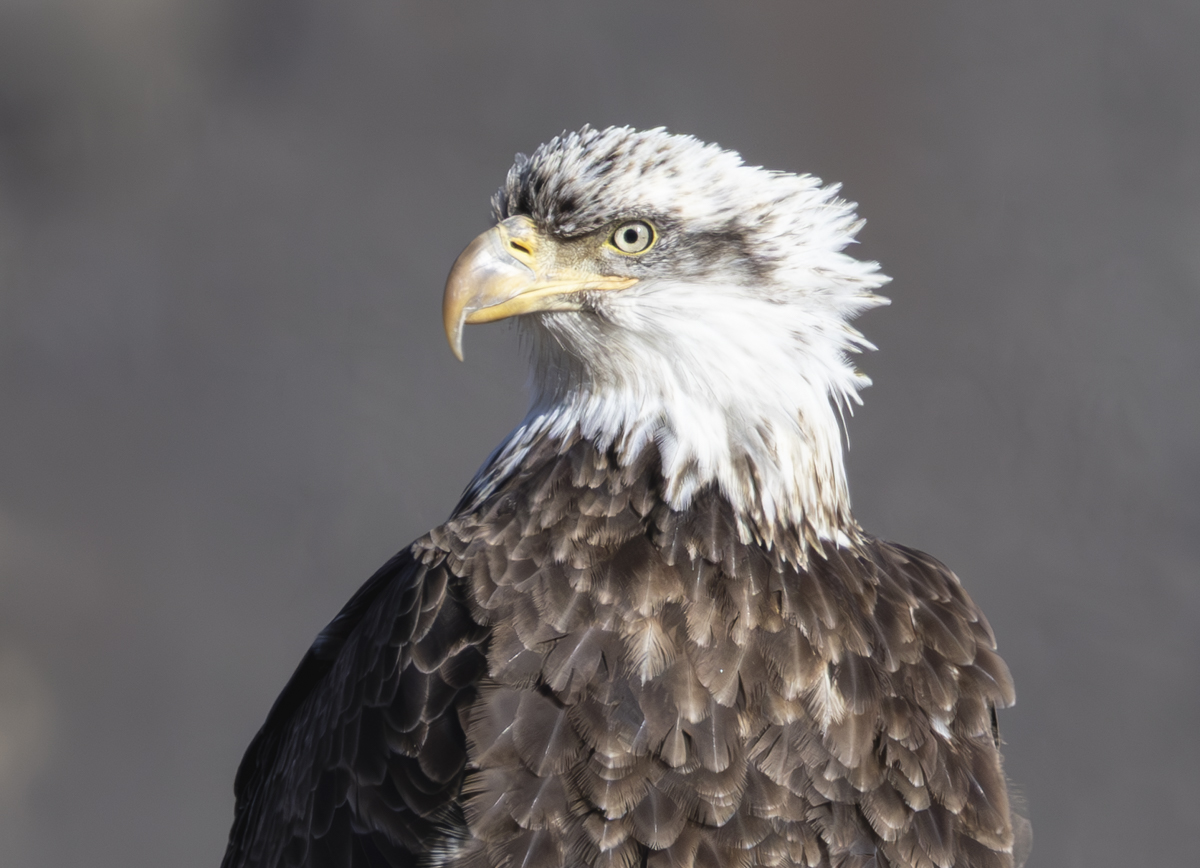
When the eagle turned its head I could clearly see it was not a mature adult
Mature bald eagles are widely recognized by their white heads (hence the name, bald) and tails. Males and females look similar though females are larger. (an average of 25% bigger than a male). Younger birds have quite variable plumage. First-year eagles are considered juveniles and have dark brown plumage up to about 1 1/2 years. After that, it can be variable though plumages do tend to follow a similar pattern until they reach full maturity at about 5 1/2 years of age. From 1 1/2 to 3 1/2 years they show blotches of white on their undersides. From 3 1/2 to 4 1/2 years of age they begin to acquire the white head and tail feathers.
This bird shows the dark eye stripe and dark flecks on the head typical of an immature eagle of about 4 years of age
The dark patch through the eye and a few white blotches on the breast tell me this bird is about 4 years old. By next year it should have the definitive plumage of an all white head and tail that it will keep for the rest of its life (bald eagles can typically live 20 to 25 years in the wild).
Though we will miss seeing some of our beloved caterpillars here in this high desert climate, the habitat provides moments of magic if you just look (and get outside, even if you are just taking out the trash). And this year we hope to look more intentionally for the small creatures we share this new world with while still appreciating the abundant and majestic megafauna that surround us.
Coyote is always out there waiting, and Coyote is always hungry.
~Tony Hillerman
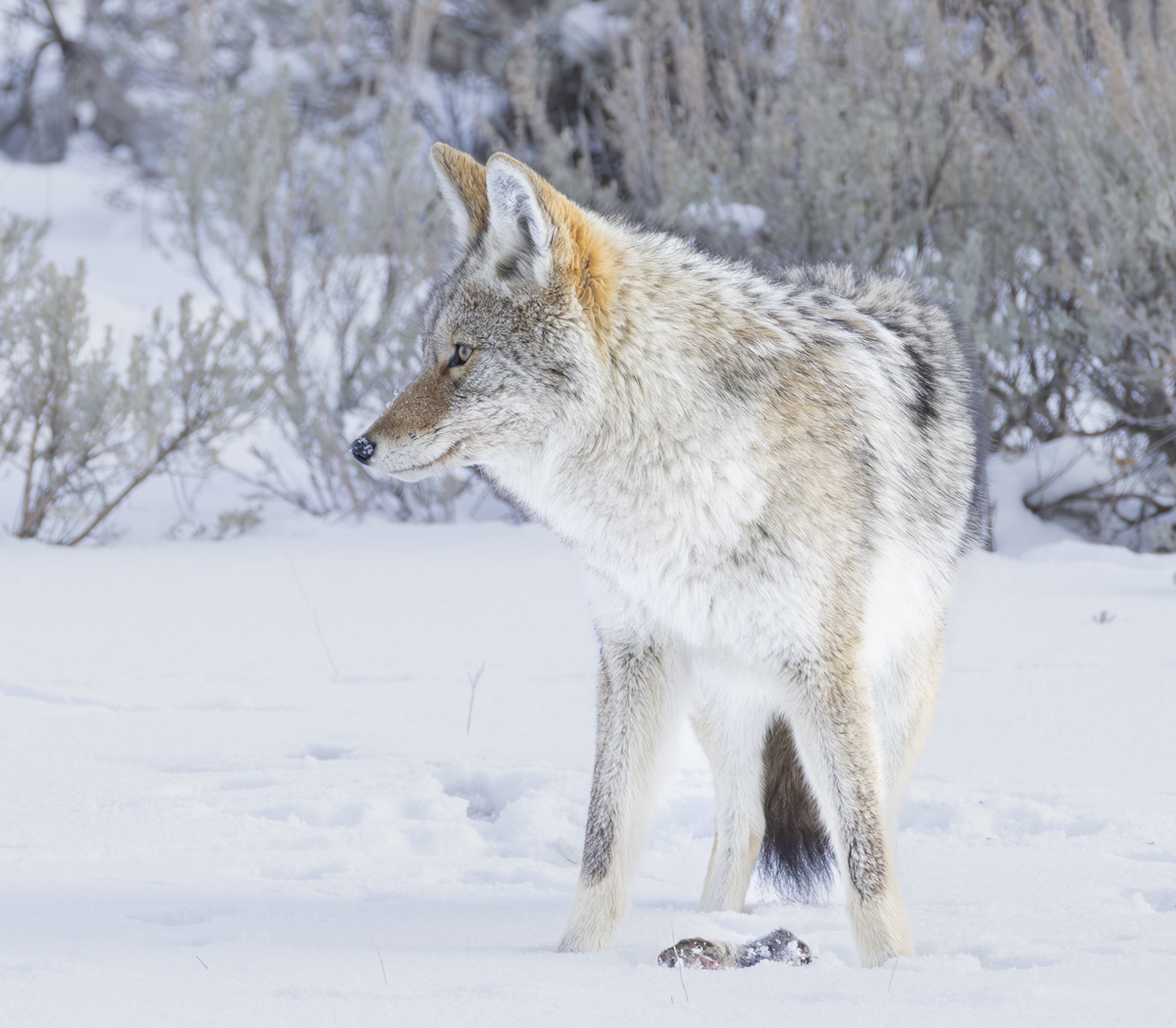
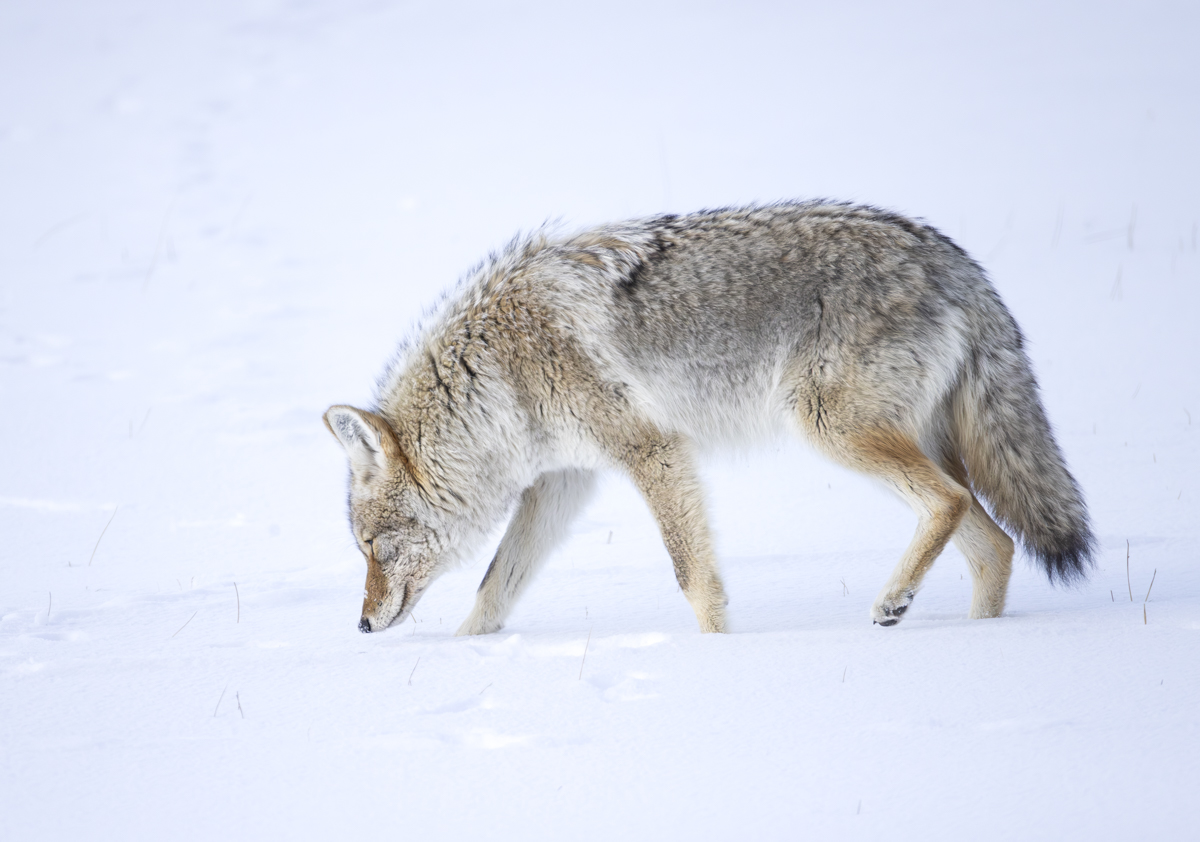
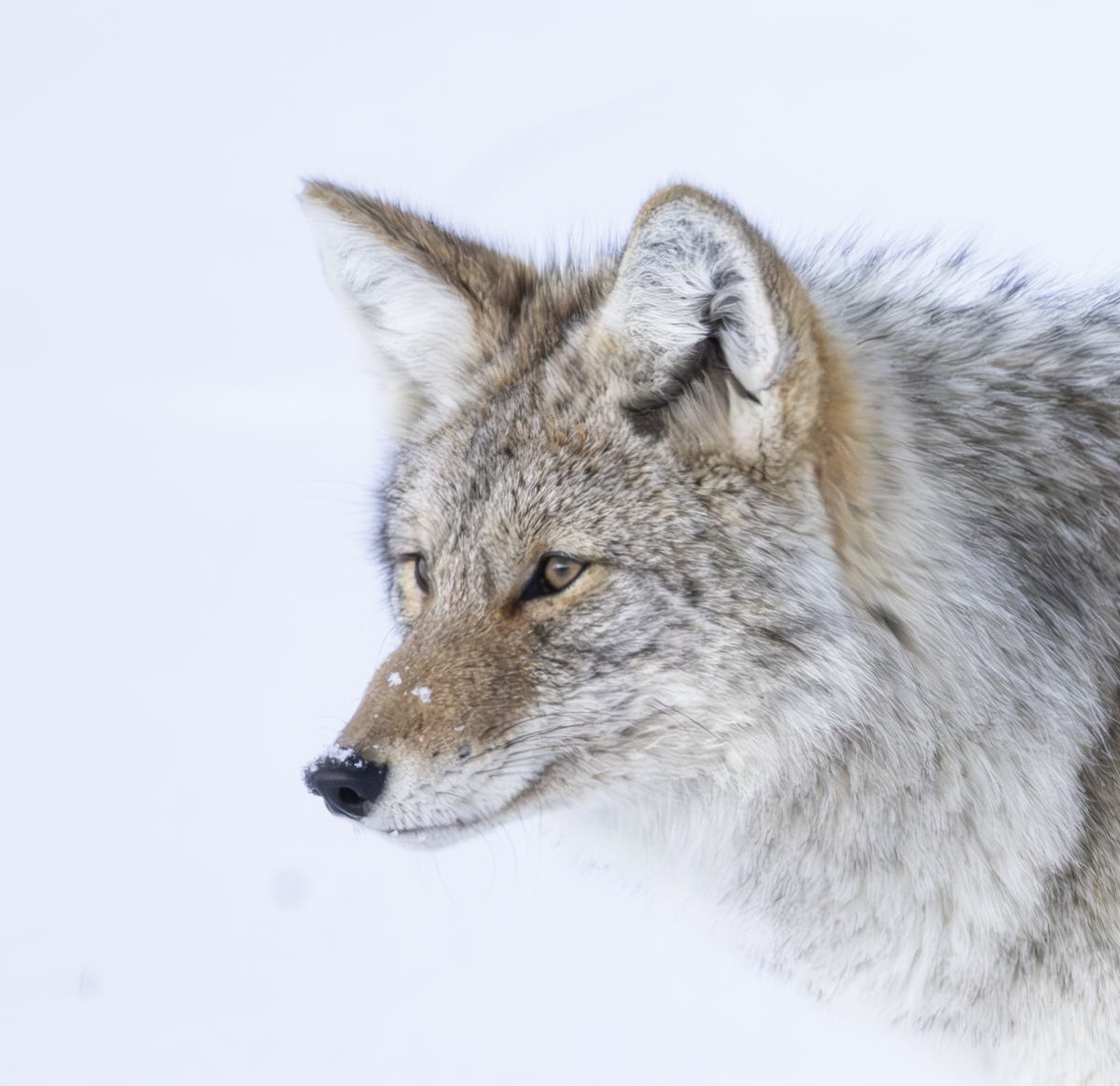
Winter is the time of the coyote. Always on the move, always ready to take advantage of any food supply, and more visible to those of us that love to watch these amazing canids. It has been a particularly good coyote time these last few weeks. Here are a few of the most memorable encounters with these mid-sized predators.
I was on a snow coach trip to the interior recently and we spotted a coyote high on a ridge line in Hayden Valley.
Coyote in Hayden Valley
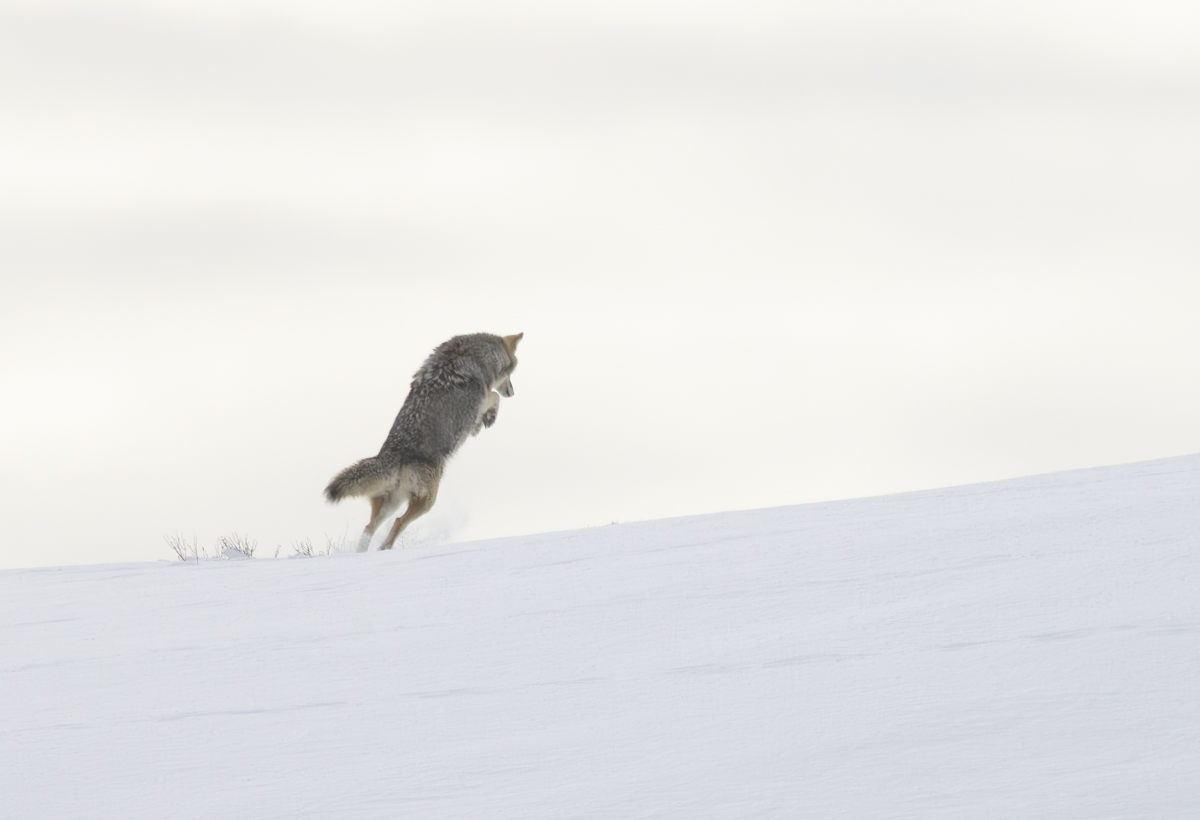
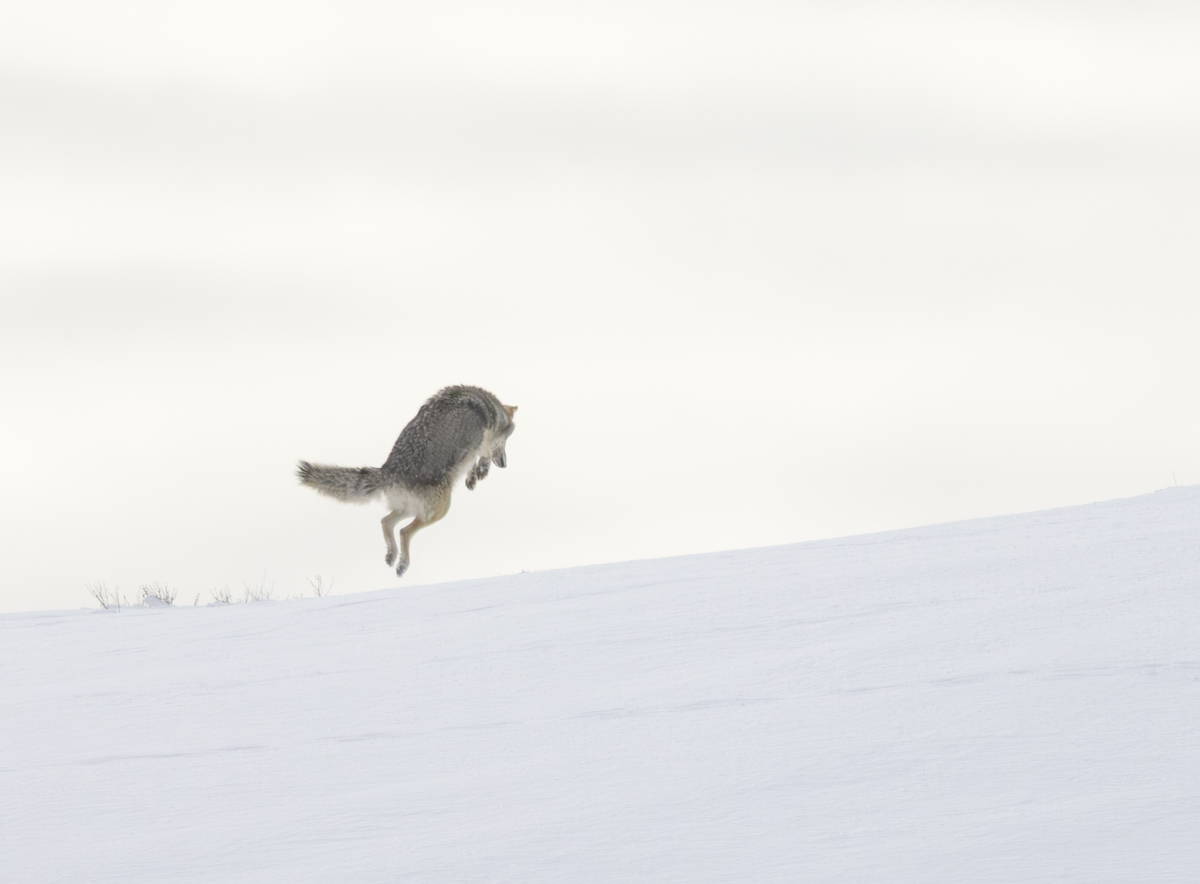
The coach driver stopped so we could watch it. The coyote took a few steps then cocked its head as they do when sensing something in the snow. A slight crouch and I knew what was next so I raised my camera and took this shot through the window of the coach.
The leap!This is the classic mousing jump of coyotes and foxes, especially in winter. This one did make a catch and quickly gobbled its rodent meal as it disappeared over the ridge.
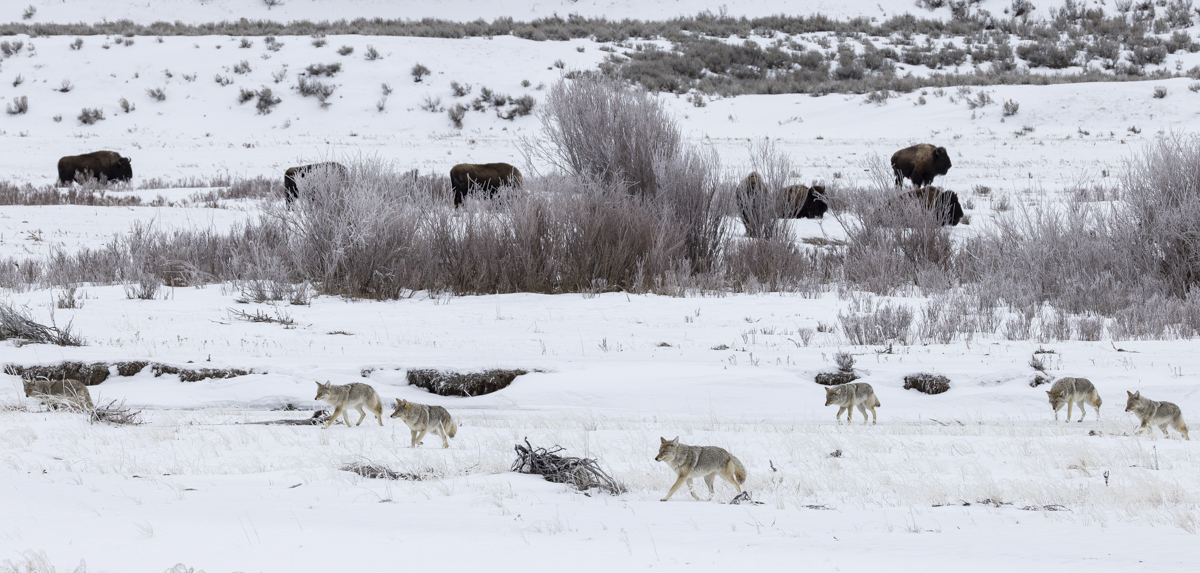
A few days later I was out along Soda Butte Creek when I spotted a couple of coyotes trotting along the creek bank. A couple soon turned into seven and I drove ahead and positioned myself along a high point near the road where I hoped to see the coyotes still following the creek. This has been an unusual winter out in Lamar Valley area with coyotes often appearing in large groups of 6, 7, and even 8 canids patrolling together. From what I have heard, groups of this size were more common back before the reintroduction of wolves when coyotes were the “top dog” in the park. After wolves became established the ever-adaptable coyotes tended to be in smaller units of 2 to 4 animals since wolves are dominant over the coyotes and will chase and kill them if they can. In talking with a few friends that have been here longer, we aren’t quite sure why we are seeing such large groups again. Perhaps it is just family units moving together until next spring.
A group of seven coyotes moving through the valley
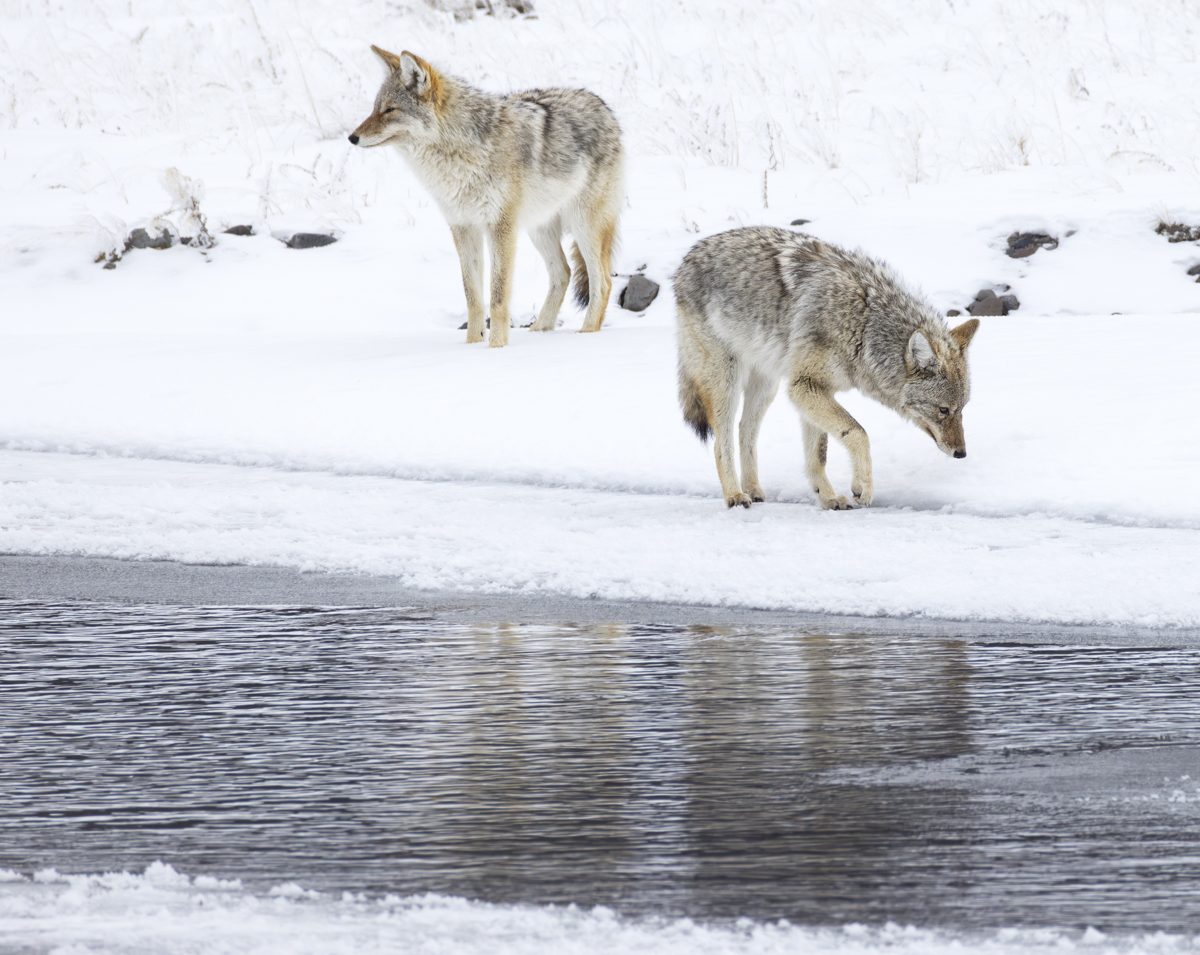
The group did come closer as they followed the creek and paused at one point to sniff around, providing me with some nice photos (shot with my 800 mm telephoto and cropped).
There was something of interest in this spot as a couple of coyotes stopped to sniff around the edge of the creek here.
The next day I was back out on the northern range hoping to see more wildlife. It was cold with temperatures hovering just above zero. Though it was a somewhat slow day overall for critters, the coyotes did not disappoint. As I was headed home I saw a few cars stopped at a pullout in Little America. I soon spotted the reason – a coyote trotting along slowly near the road. I drove on with the intent of turning back and trying to find a place to park when I saw another coyote about 200 yard down the road from the first, and there was no one watching this one. I pulled off the road and watched from my car. It stopped and stood over a spot sniffing the snow. It then dug up a small carcass. I have no idea if this was something it had cached earlier or just found dead in the snow.
A coyote standing over a rodent carcass
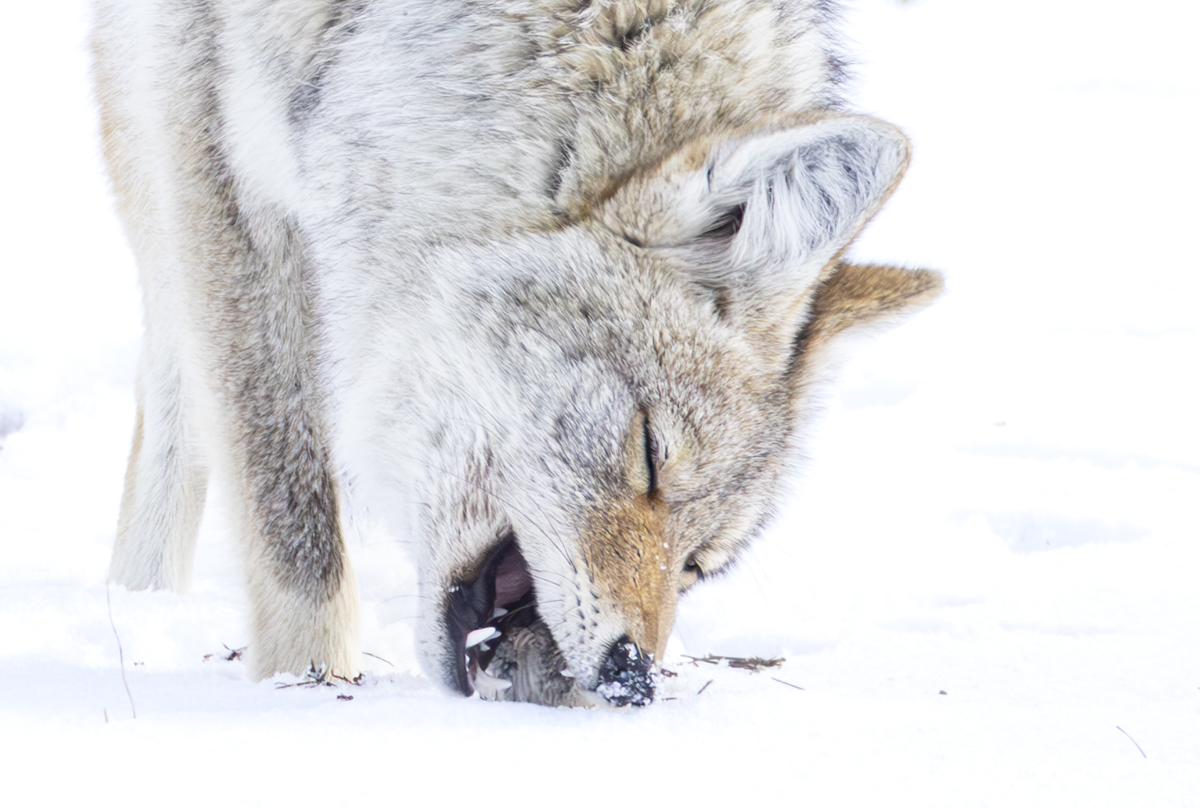
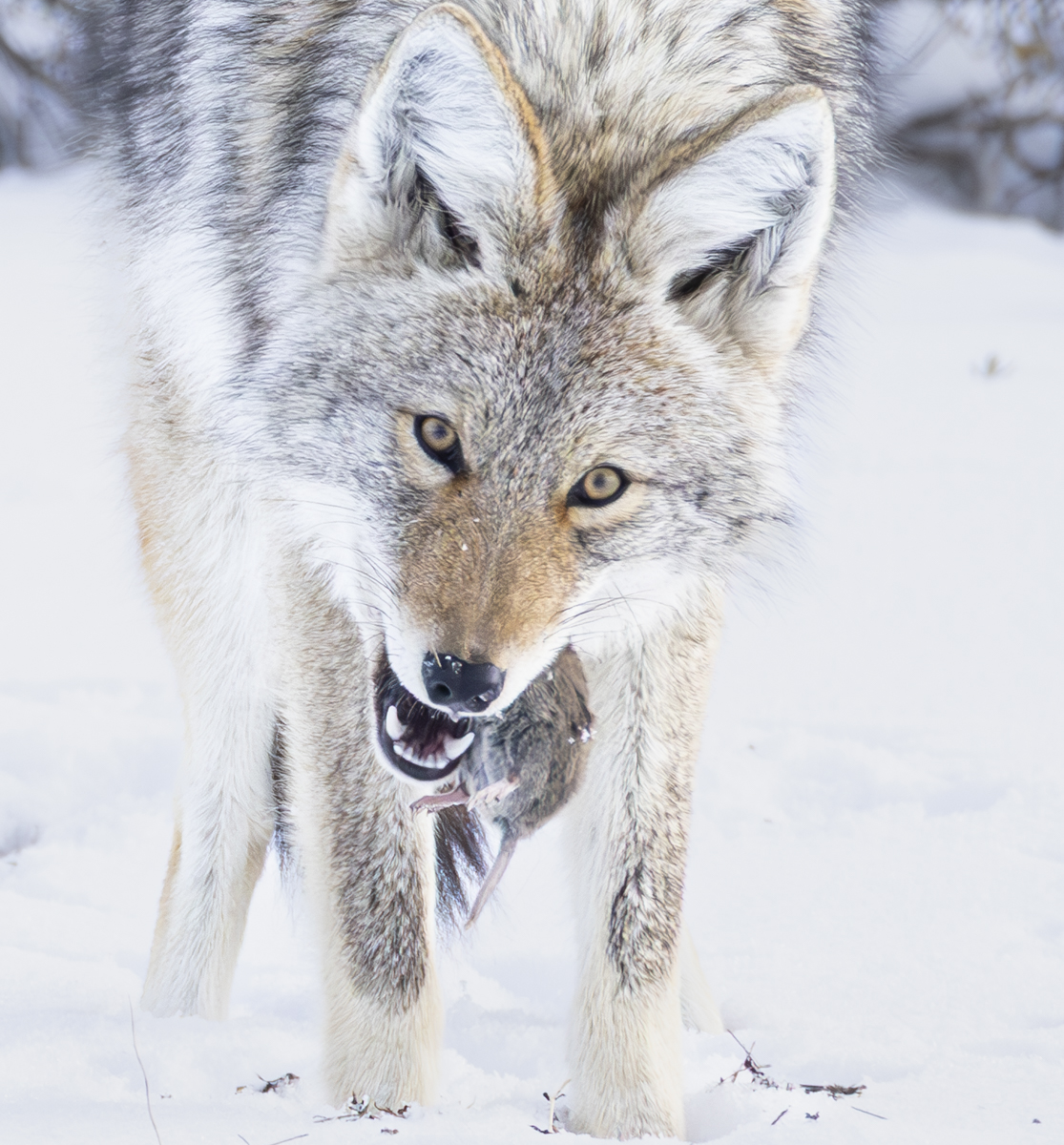
The coyote soon started pulling at its find and chewing on it.
It wasn’t long until another car came by and stopped. Two people got out and started walking my way and the coyote looked up from its meal to make sure all was well. This is why I prefer to stay in my vehicle if possible. Most wildlife in the park seems tolerant of cars going by but the second you step out they become more concerned of that human form. If I do get out, I try to stay near or behind my car or squat down to reduce the human outline.
The coyote looked up when a couple of other photographers approached on foot.
The people stopped and the coyote finished its meal with one last gulp. After looking around for a few seconds, it wandered off angling toward the road.
After finishing its meal, the coyote sniffed the area and then trotted off.
Now there were three cars watching this coyote as it calmly crossed the road and then walked parallel to us before sitting down. It was close, but not watching us, just scanning out in the distance. It slowly got up and turned away from the road, moving in an irregular path toward a far hill.
A coyote scans the landscape watching for who knows what – potential threats, companions, food?
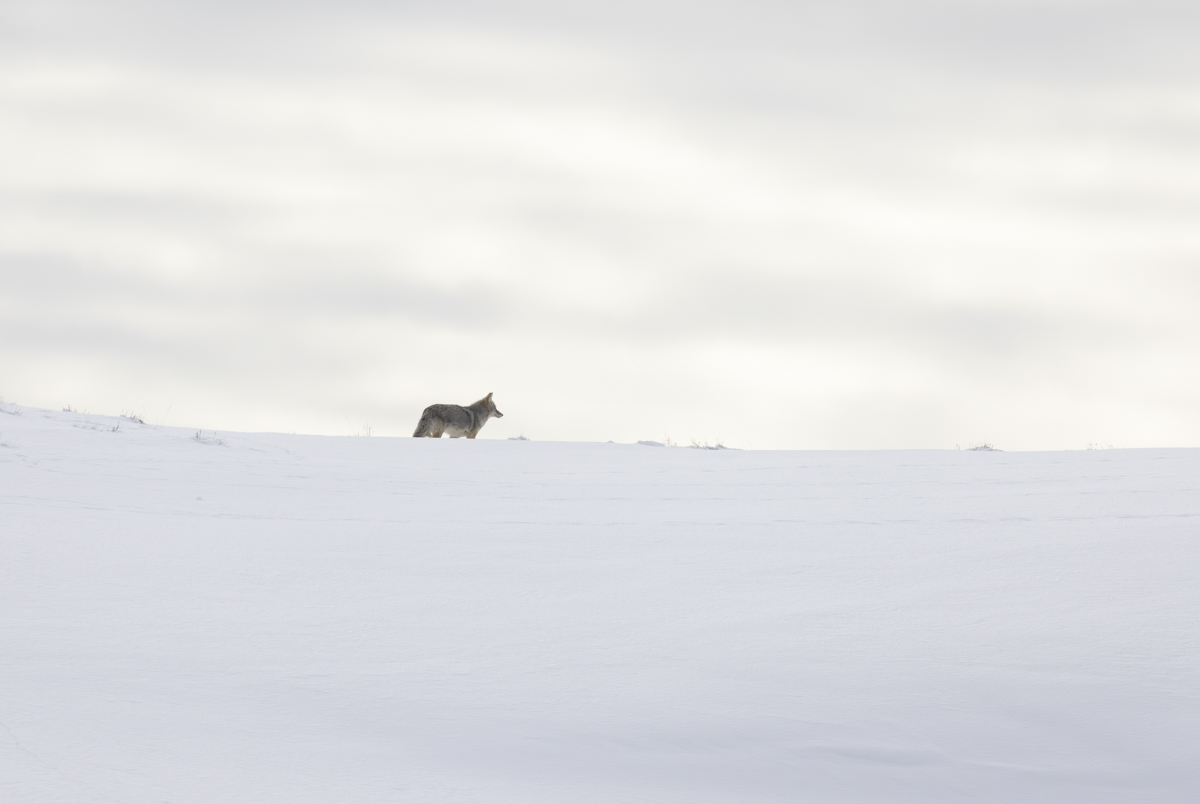
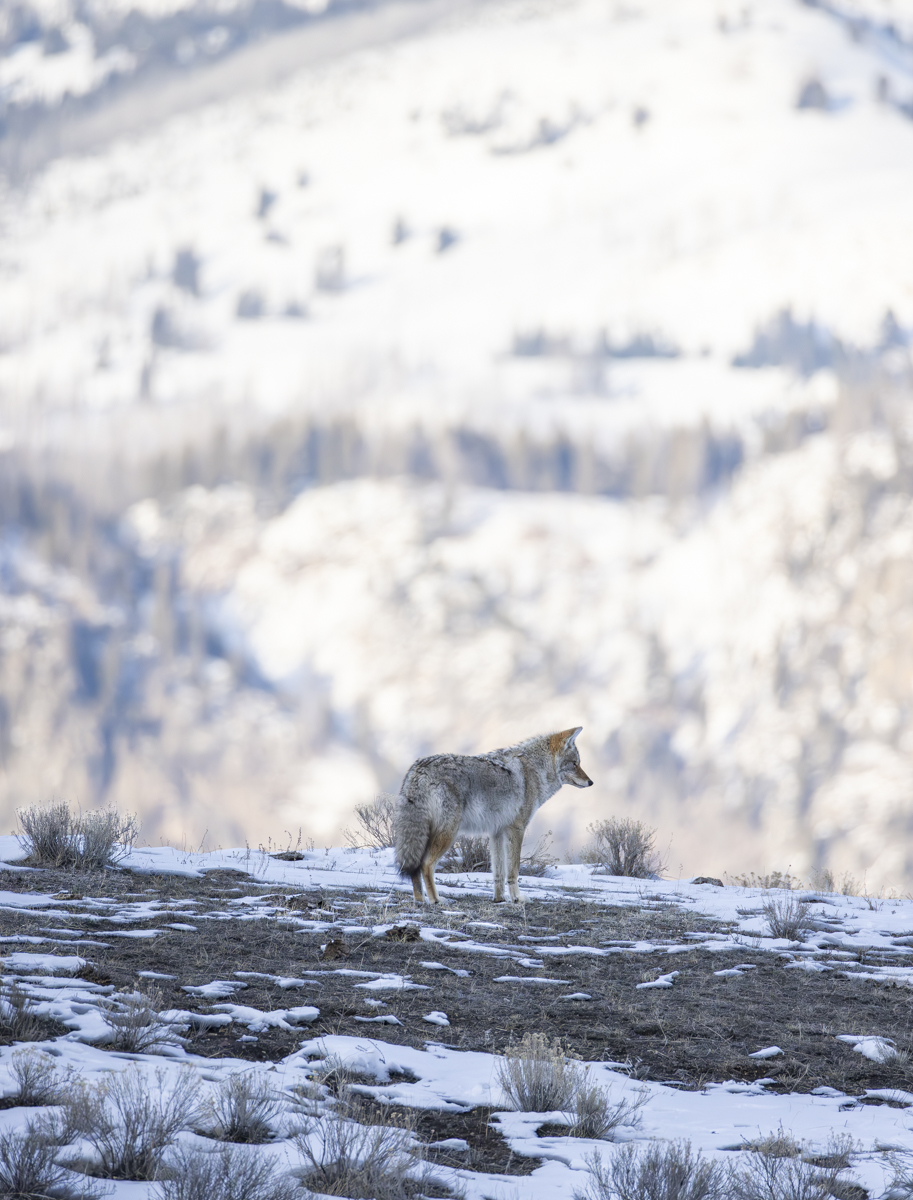
As it paused on top of the ridge, the coyote showed me an iconic predator surveying its majestic winter landscape.
The coyote in its vast home.
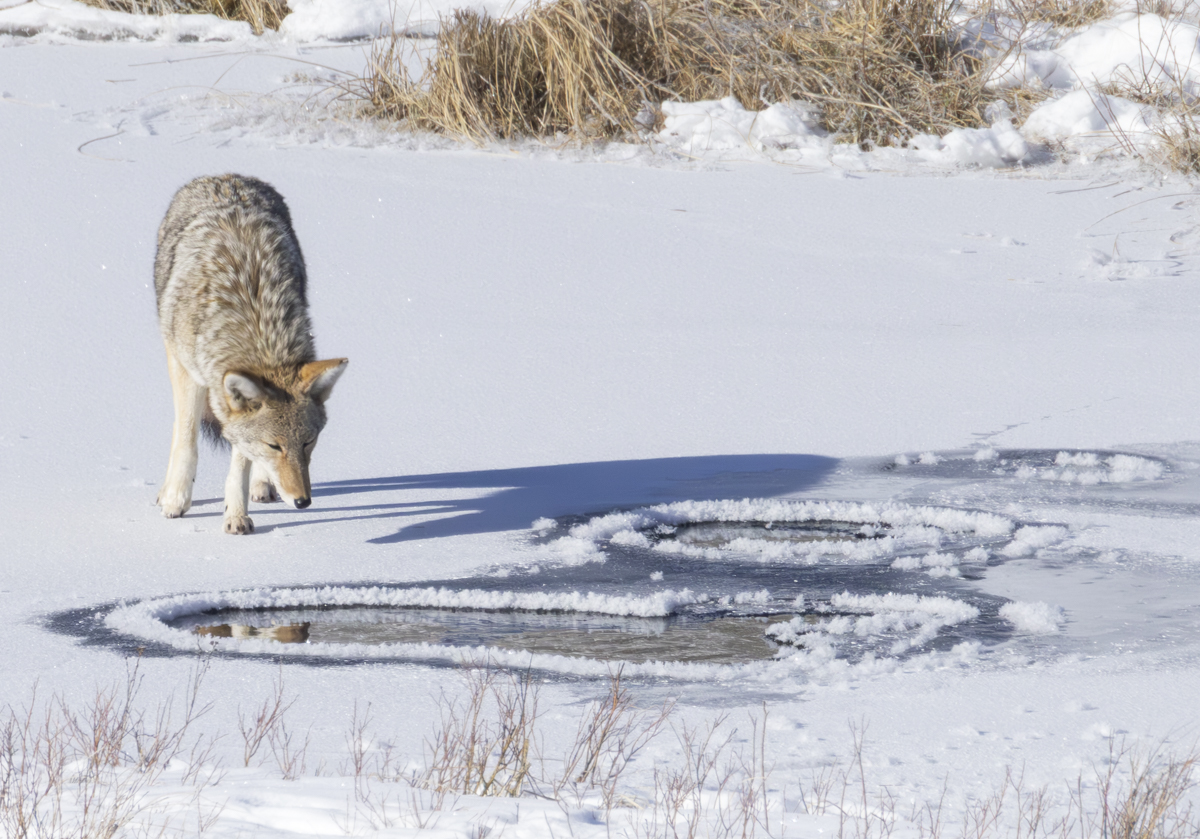
The next evening as I was driving through the Blacktail Ponds region, four coyotes were making their way between the frozen ponds. One stopped at a small hole in the ice that has puzzled us for some time now. What causes this hole, a small thermal underneath perhaps?
A coyote checking out the hole in the ice (or perhaps just admiring his reflection).
This next video clip may be a little tough for some viewers. It was getting late as I was driving home and I paused at a roadside jam of some sort to see what was up. I got lucky and found a parking space and walked down the road toward the scene. I was told a deer had been hit by a car earlier in the day and died just 30 yards off the road. Magpies, ravens, and a single coyote were on the carcass and a golden eagle just flew away when the coyote arrived (I had seen the eagle fly across the road as I approached). Within a couple of minutes another coyote arrived. Then someone up the road hollered, “a wolf is coming right toward you guys”. Not a wolf, but another coyote. I heard people call these wolves three times while I was there, a common mistake visitors make when they see a coyote in the park. Here is a somewhat long video clip of the interactions at the carcass. Notice the way the coyotes communicate with one another in addition to the growl and snarls which cannot be heard in this video.
As darkness started to settle in I got up and walked back to my car. Coming down the road was yet another small coyote. When I drove around the curve beyond the carcass site another small coyote was trotting down the road in that direction (presumably these last two were juveniles from this year). I stopped and checked the area the next day and there was hardly a sign that the carcass had even been there.
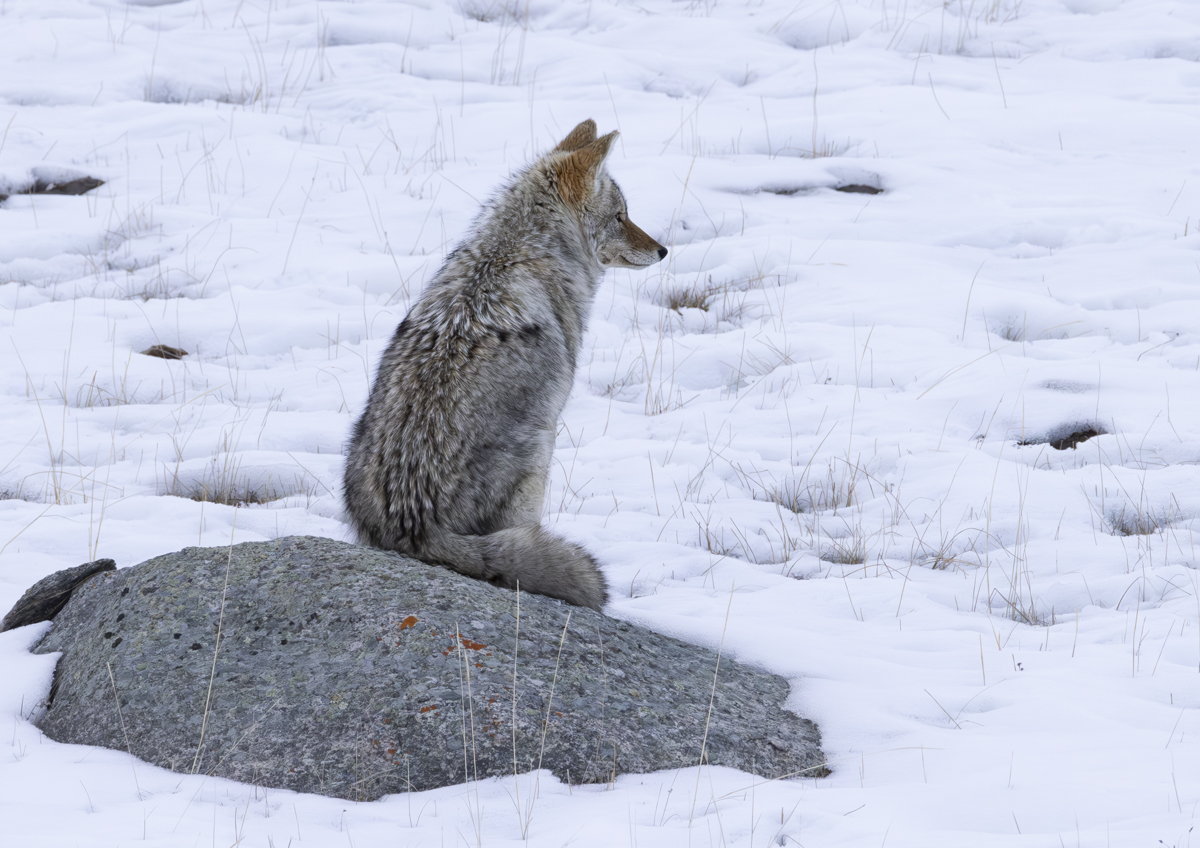
How amazing their sense of smell must be to zero in on these scarce food sources. It just shows the resourcefulness of these misunderstood animals. Before I wrote this blog I saw a news report of a predator “rodeo” where 80 coyotes were killed in one day in a nearby state. Unfortunately, this is a too common response to coyotes on the landscape. But, these song dogs have been around a long time and revered by many indigenous people, hated by many others, and yet they survive and even thrive. They has even managed to expand their range and spread across the country including to my previous home state of North Carolina. They are a creature that plays an important role in rodent control and are a beautiful addition to our lives if we stop to observe them and appreciate their survival skills. I look forward to spending more time with the “trickster” in the coming months here in Yellowstone.

 Roads End Naturalist