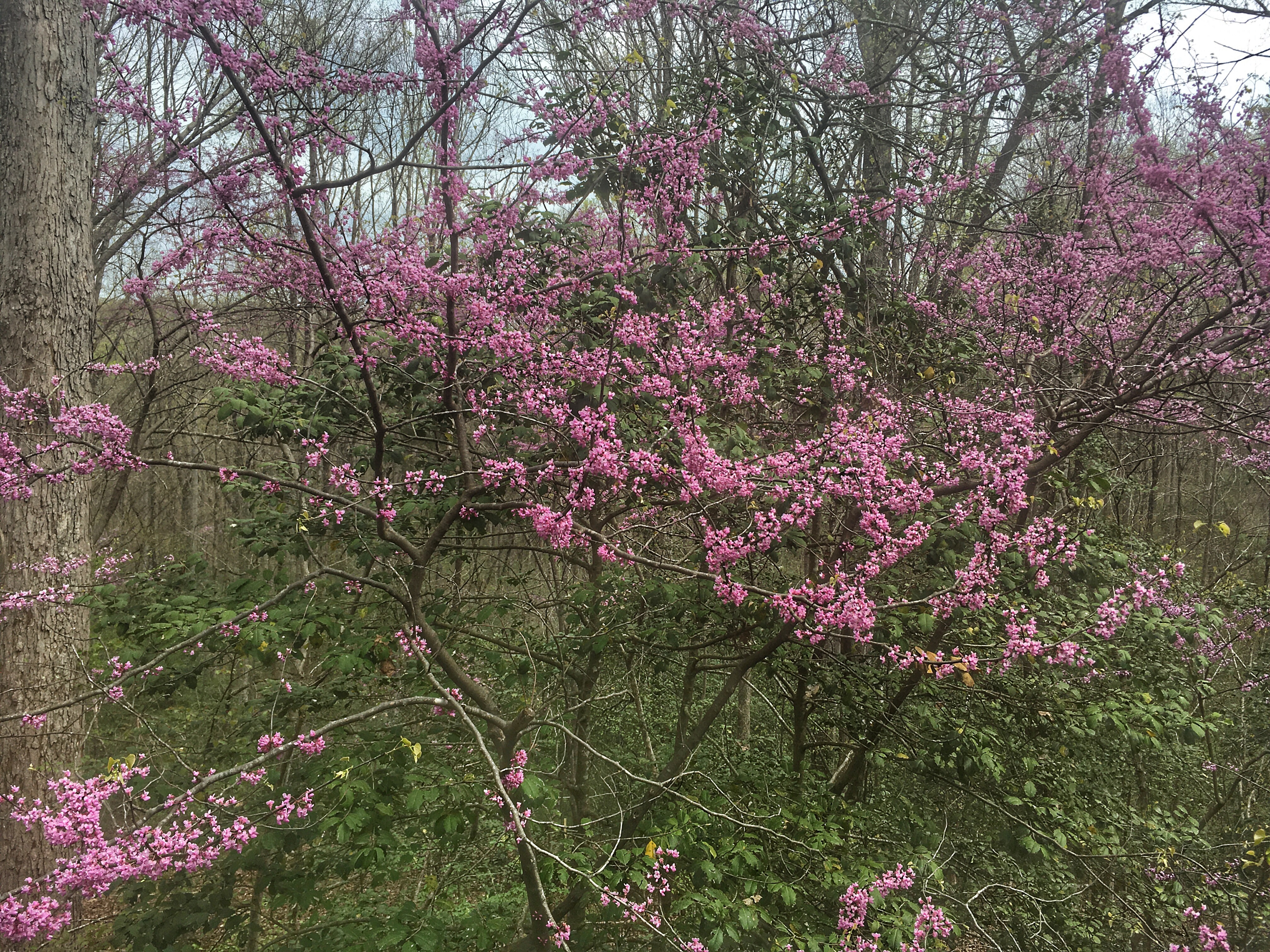
That quote is in reference to one of my favorite native trees, the Eastern Redbud, Cercis canadensis. And right now, they are at their peak in our woods, casting sprays of pink blossoms in the understory.
Redbud trees from our back deck (click photo to enlarge)
We have quite a few of these dazzling springtime trees around our house, but relatively few (and certainly no young trees) outside the deer fence as the deer have browsed the young ones for years, leaving only older trees along the roads and scattered elsewhere in the woods. With so much more time at home now, I have been watching all the comings and goings in the trees near our deck. Unfortunately, I did not get out the camera (was busy doing some much needed yard and garden work) on the few recent sunny days when the trees were abuzz with all sorts of bees, flies, and a few early butterflies. It really made me appreciate how important these abundant flowers are as an early nectar source for many of our pollinators.
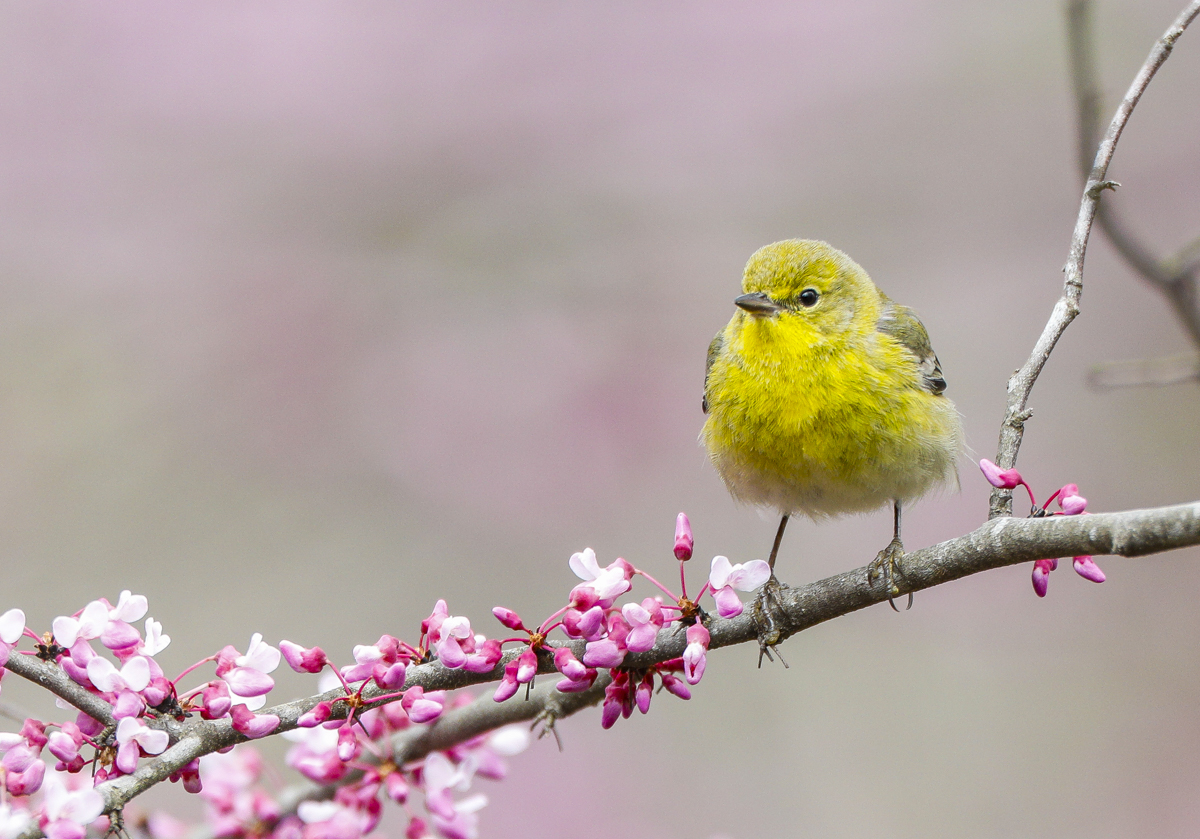
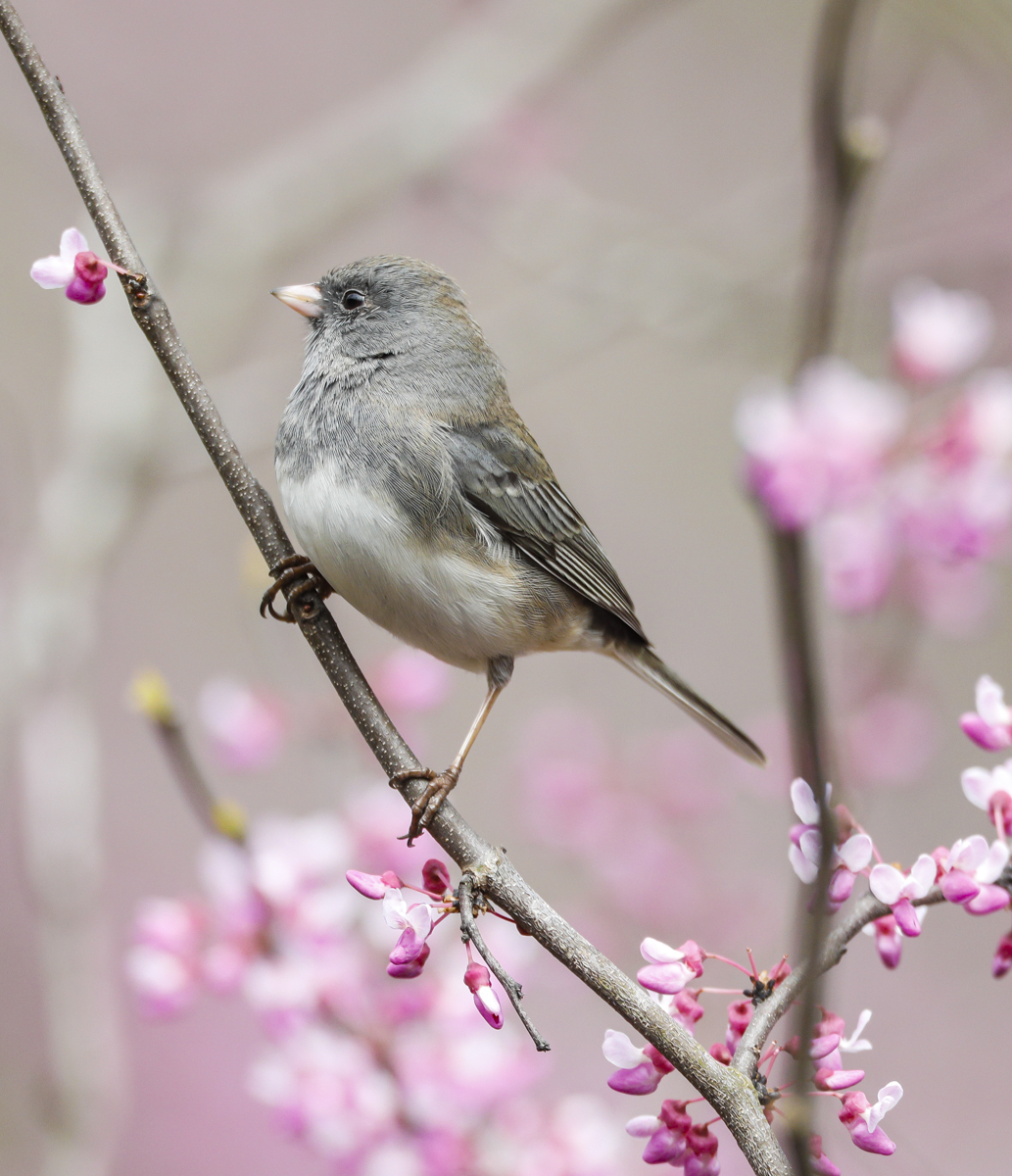
Male Pine Warbler adorning a flowering branch with some bright colors of his own.Dark-eyed Juncos are still abundant but will soon migrate to their nesting grounds farther north and to higher elevations.
Several redbud branches are close to the suet cage mounted on my deck and serve as a staging ground for birds approaching the feeder. One day last week, I sat on the deck and watched the parade of species as they waited their turn. Most managed to land behind a tangle of branches without a clear chance for a photo, but a couple of notable species shared something I did not know about birds and this tree…
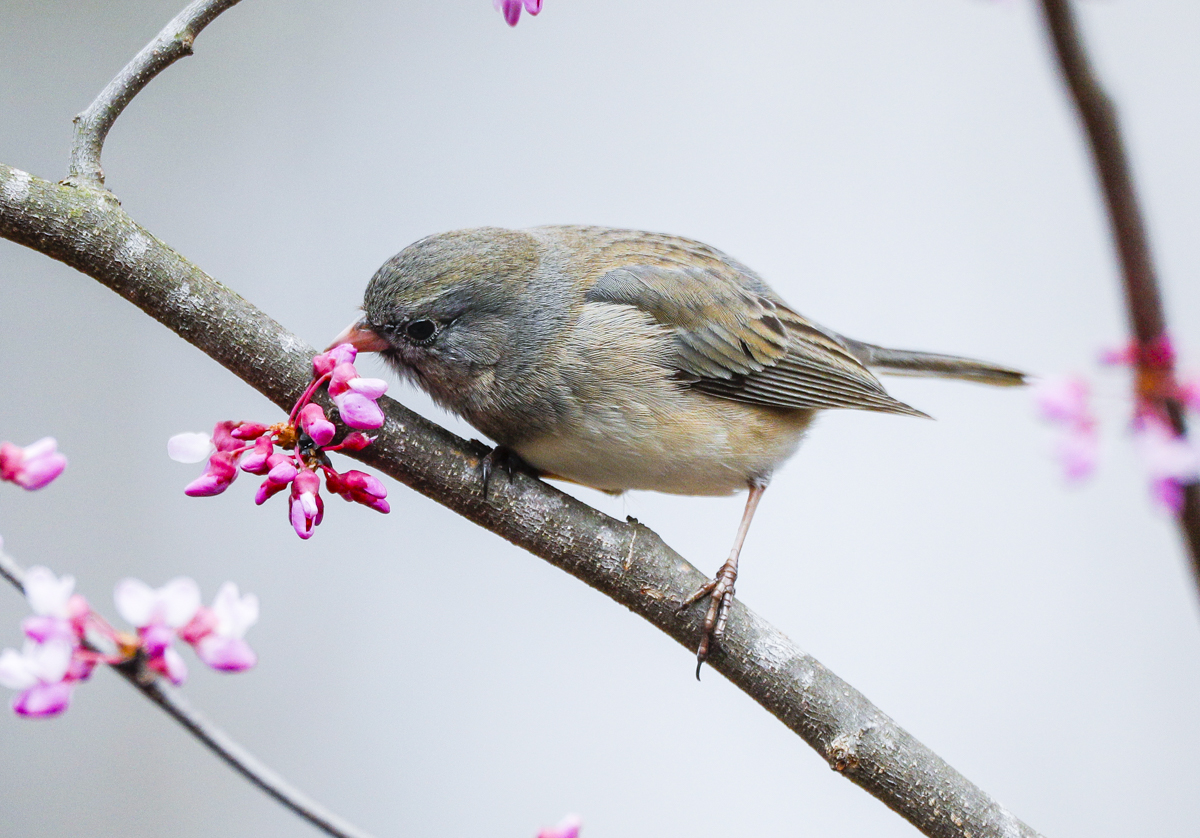
Dark-eyed Junco nibbling on a redbud blossom.
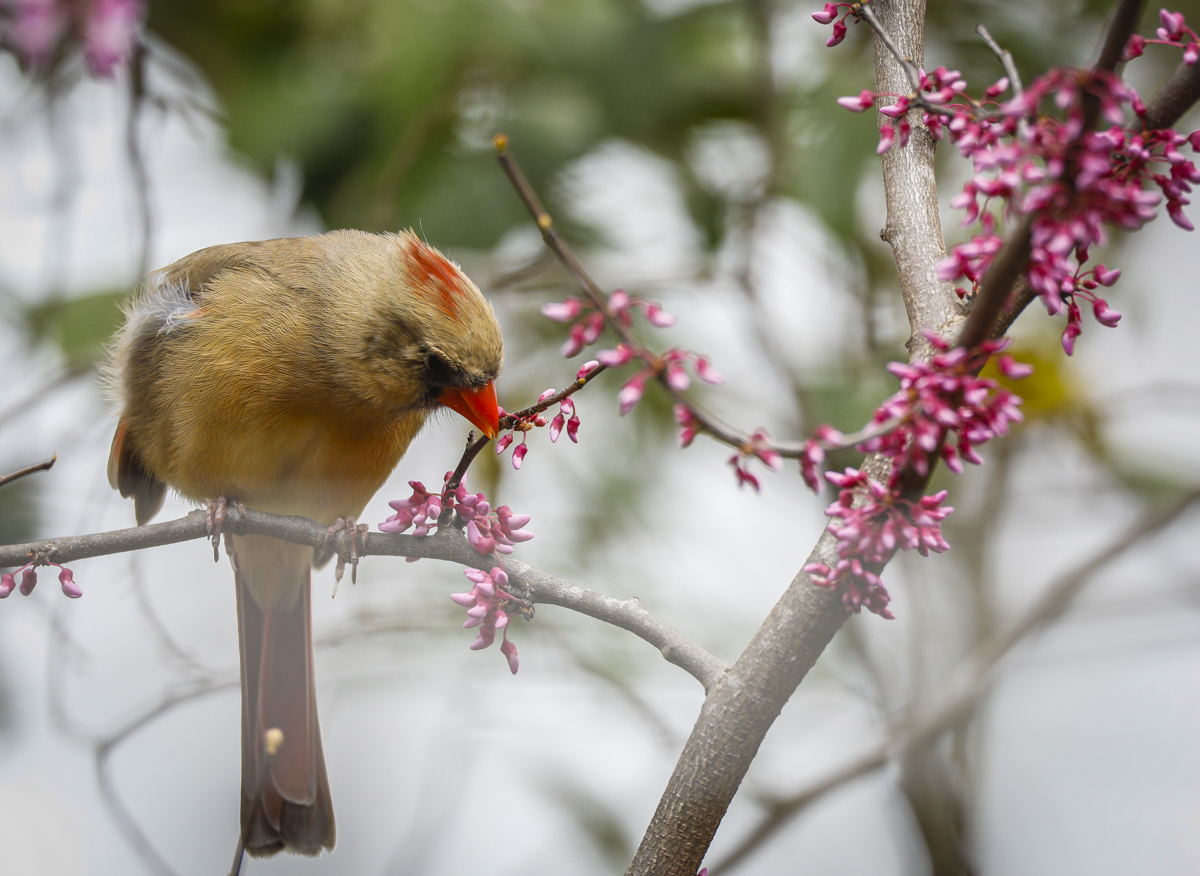
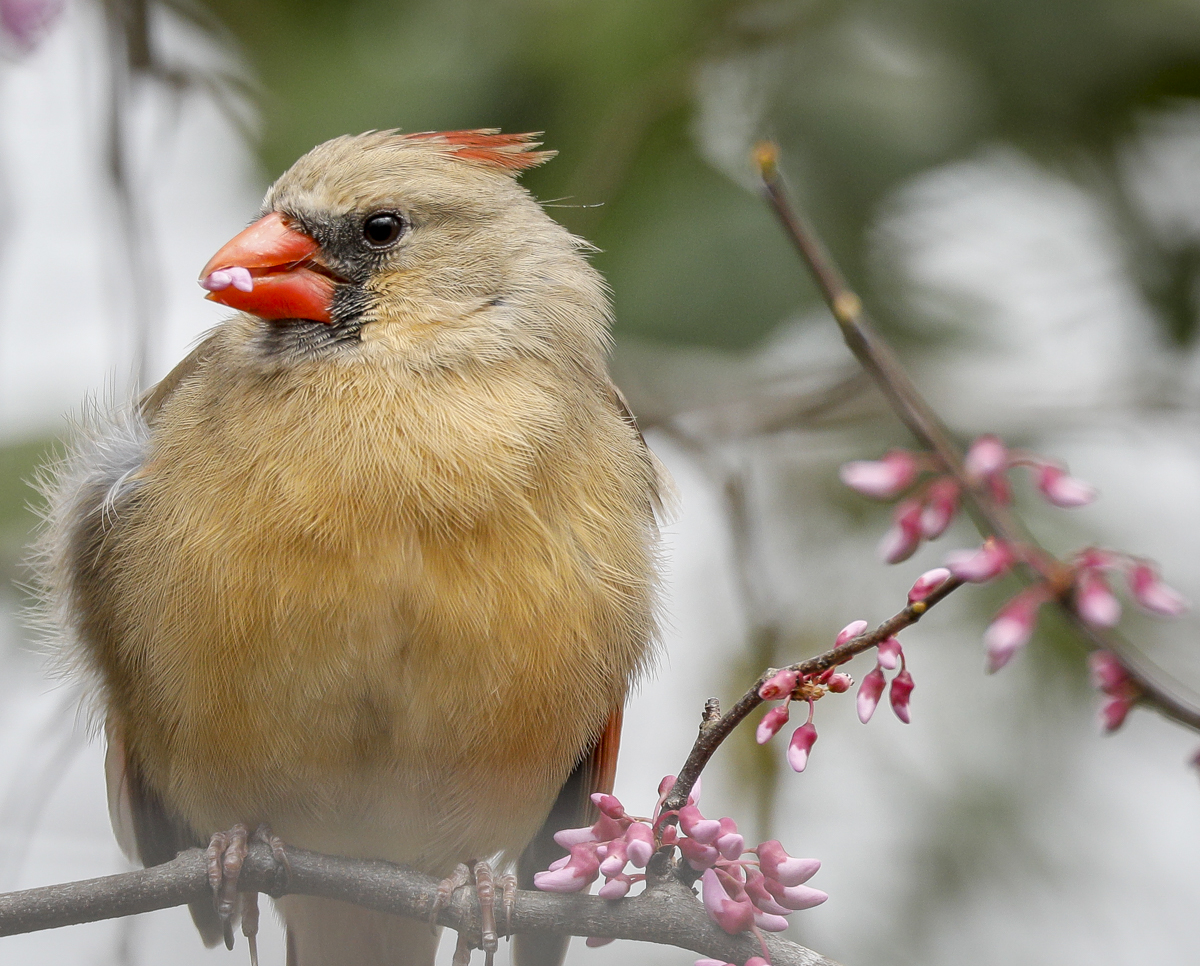
I watched as a few juncos and a male and female cardinal nibbled on many of the flowers. A few times, it almost looked as if the birds were just squeezing the flower, but I also saw them pull off a flower and eat it a few times in the hour or so that I watched.
Female cardinal puling at a flower.She chewed the blossom and then dropped part of it.
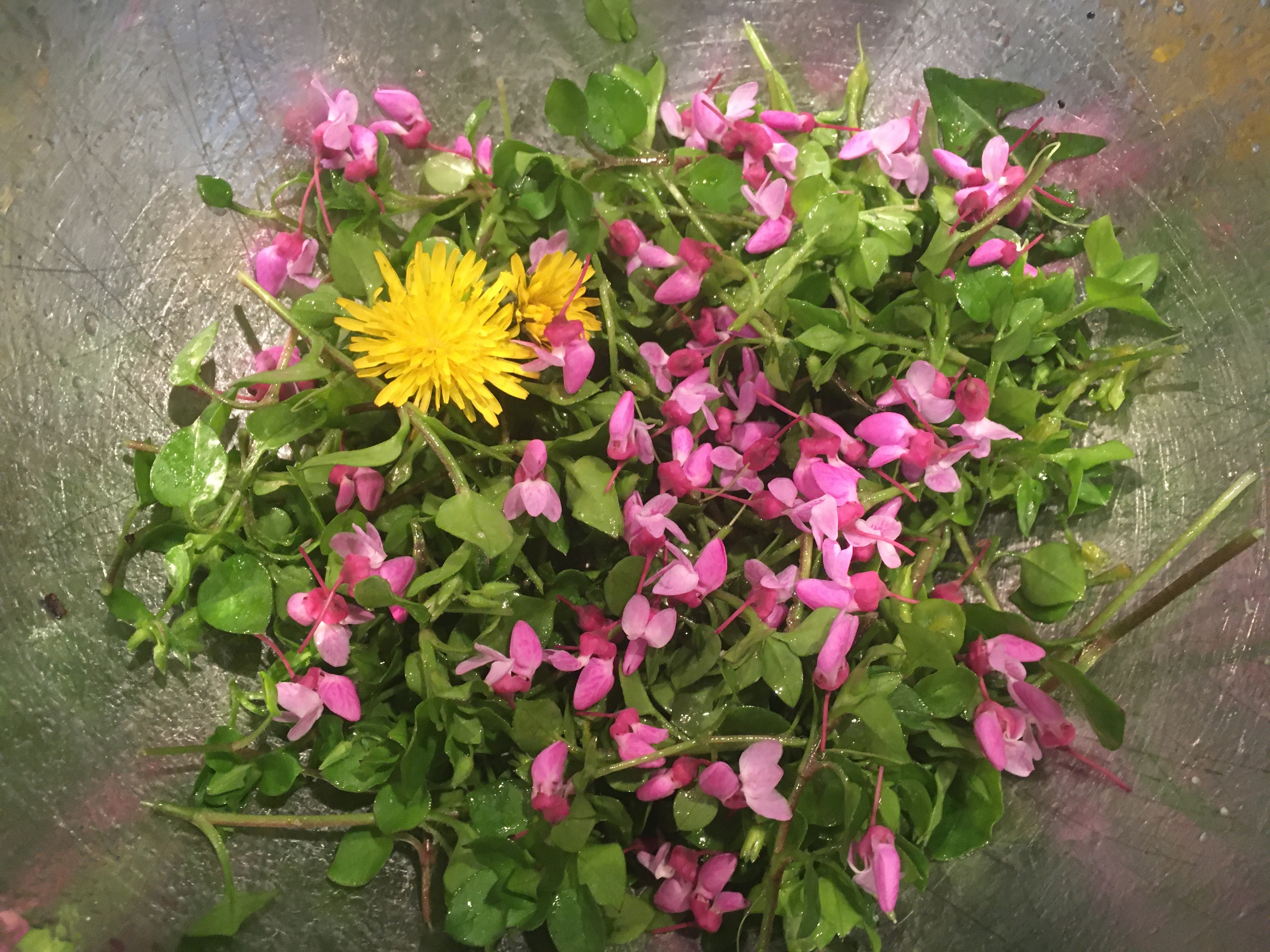
Many of you may know (or may have seen Melissa’s FB post about it) that redbud flowers are actually quite tasty as a treat alone or as part of a salad (or other types of foods). So it should come as no surprise that other critters may find them suitable as a food source. I have often wondered about the use of the incredibly abundant seed pods by birds and other wildlife, but have never seen anything actually eating the seeds.
Our yard salad prepared with chickweed, redbud blossoms, and dandelion parts (photo by Melissa Dowland).
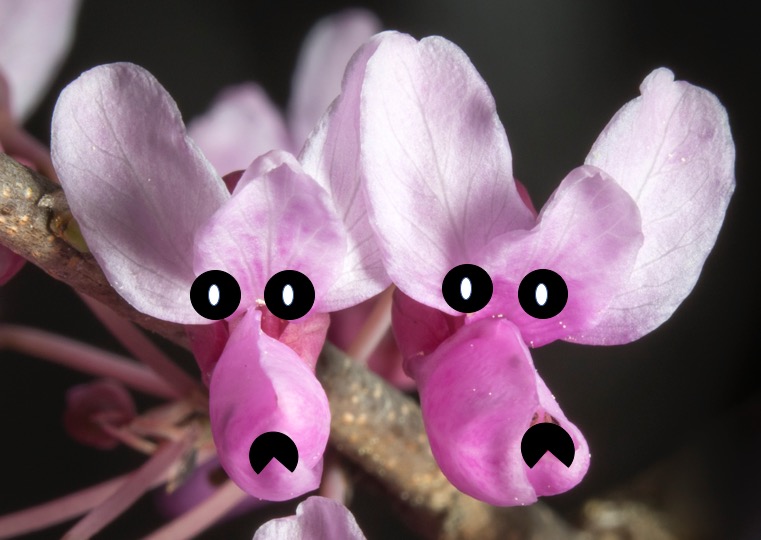
After watching the birds squeeze some of the flowers, I tried a couple to see if there was abundant nectar, but could not really tell anything definitive, other than the flower itself is tasty. The other thing I noticed when I looked closely was how the tiny irregular flowers look a lot like excited, big-nosed dogs with large ears. Maybe its just the self-isolation talking….
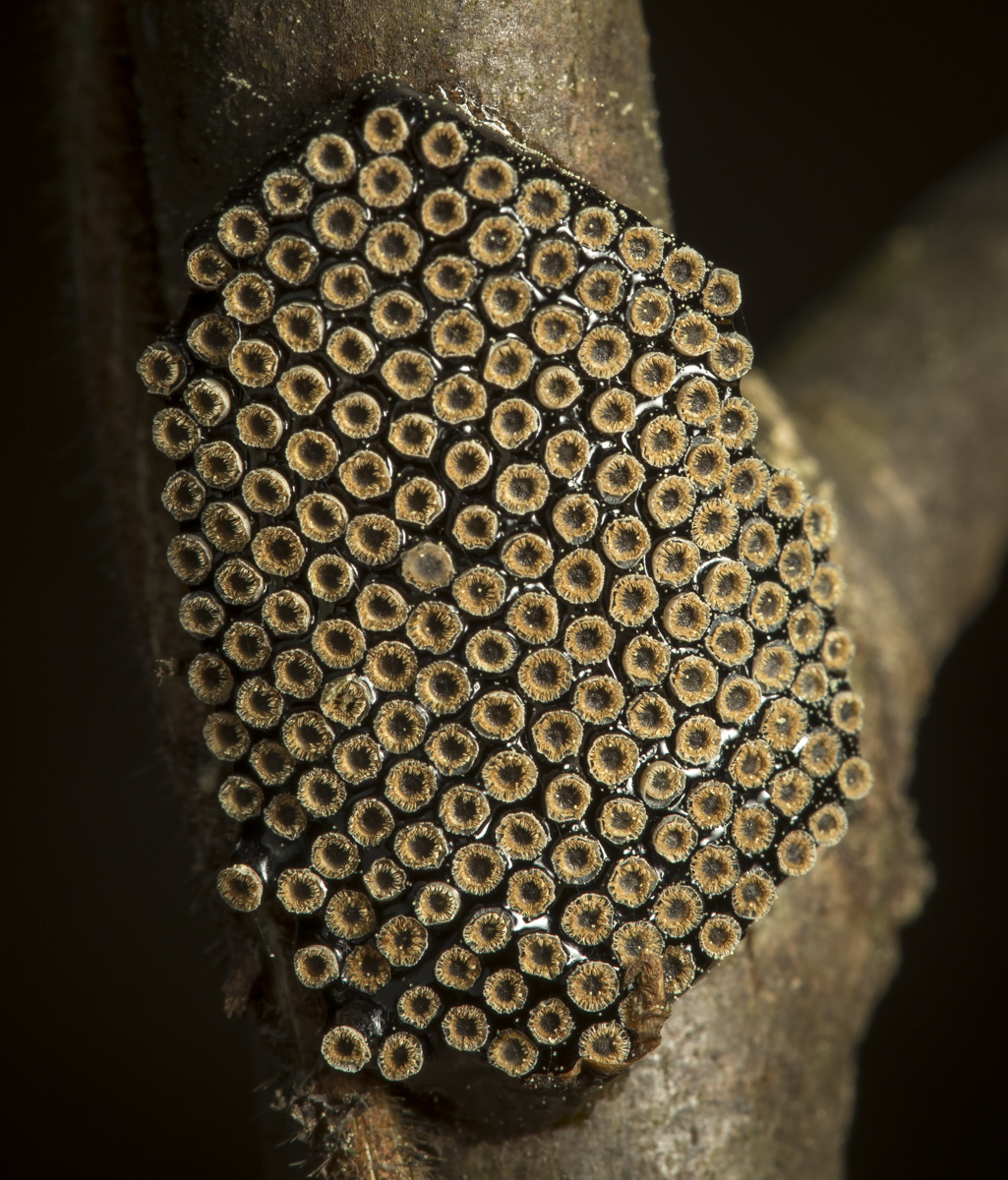
While out in the yard looking at the tent caterpillars the other day, Melissa turned around and saw an interesting pattern on the trunk of a small tree. The pattern and details of the egg tops told us it was the egg mass of a Wheelbug, Arilus cristatus. Wheelbugs (and many other members of this family of insects known as assassin bugs) typically lay a patch of eggs covered with a resinous substance that hardens as it dries. This is a fairly large egg mass, measuring about 2 inches from top to bottom. If you are bored inside today, perhaps you can guess how many eggs are here, and then count them…you may be surprised.
Egg mass of a Wheelbug attached to a small tree (click photos to enlarge)
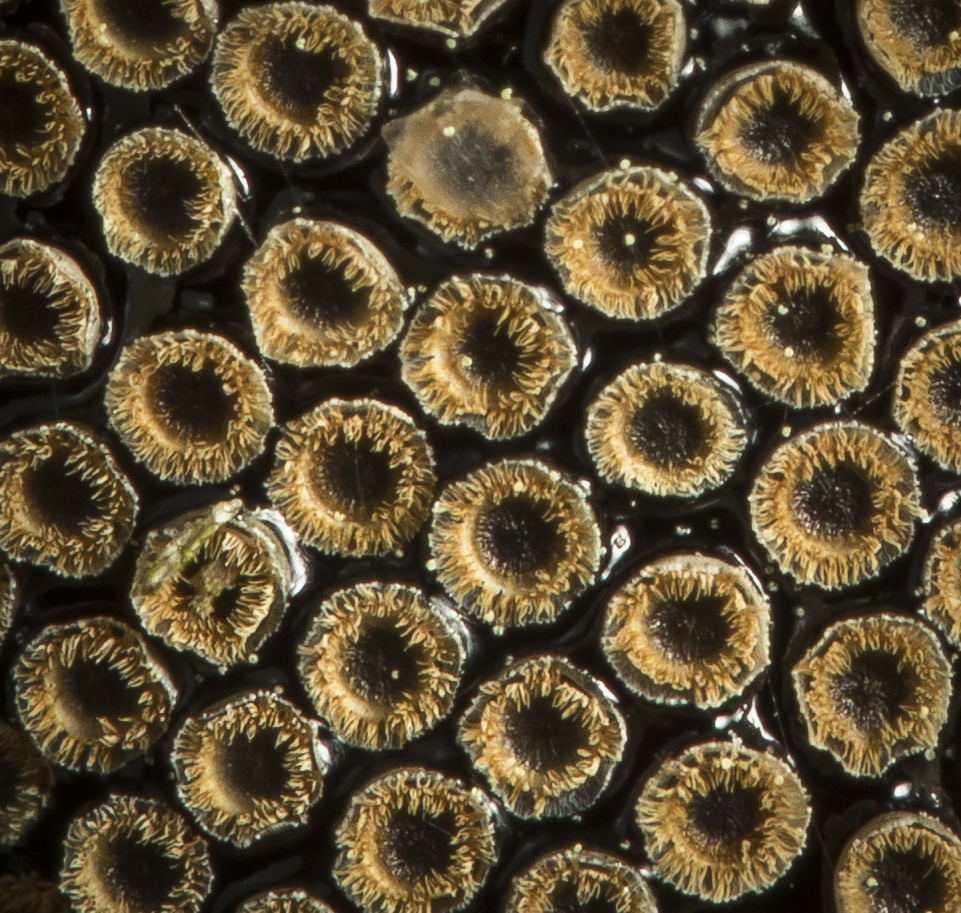
A closer view shows the typical fringe-like border around each egg top. I’m not sure what the function is, but I am guessing it could be to increase surface area for oxygen absorption.
Close-up of the egg mass shows the fringe along the top of each egg.
A side view shows the eggs are somewhat bottle-shaped and tightly stacked together. One reference described the eggs as looking like “brown bottles with fancy stoppers”.
Side view of eggs…the tiny dots are pollen grains.
These should hatch sometime later this spring and a horde of tiny reddish-orange and black (at first) robotic insects will be unleashed. I am guessing they may prey on one another as well, so their numbers will be greatly reduced before they reach adulthood in late summer (there is one generation per year). Once they are at that stage (over an inch long), they are formidable predators of many types of insects from caterpillars to bees. They are important predators of some pest species like the introduced and invasive Brown Marmorated Stink Bug, and some hairy caterpillars (like tent caterpillars) that are avoided by many birds. With their distinctive gear-like crest and large size, they are fascinating to observe, but handle them cautiously (or better yet, not at all), as they can inflict a painful bite with that long, needle-like beak.
An adult Wheelbug with its namesake armament and strong, piercing-sucking mouth part.
“Follow, follow, follow, follow, follow the yellow brick road… We’re off to see the wizard, the wonderful Wizard of Oz… because, because, because, because, because, because of the wonderful things he does…”
~The Munchkins of Oz
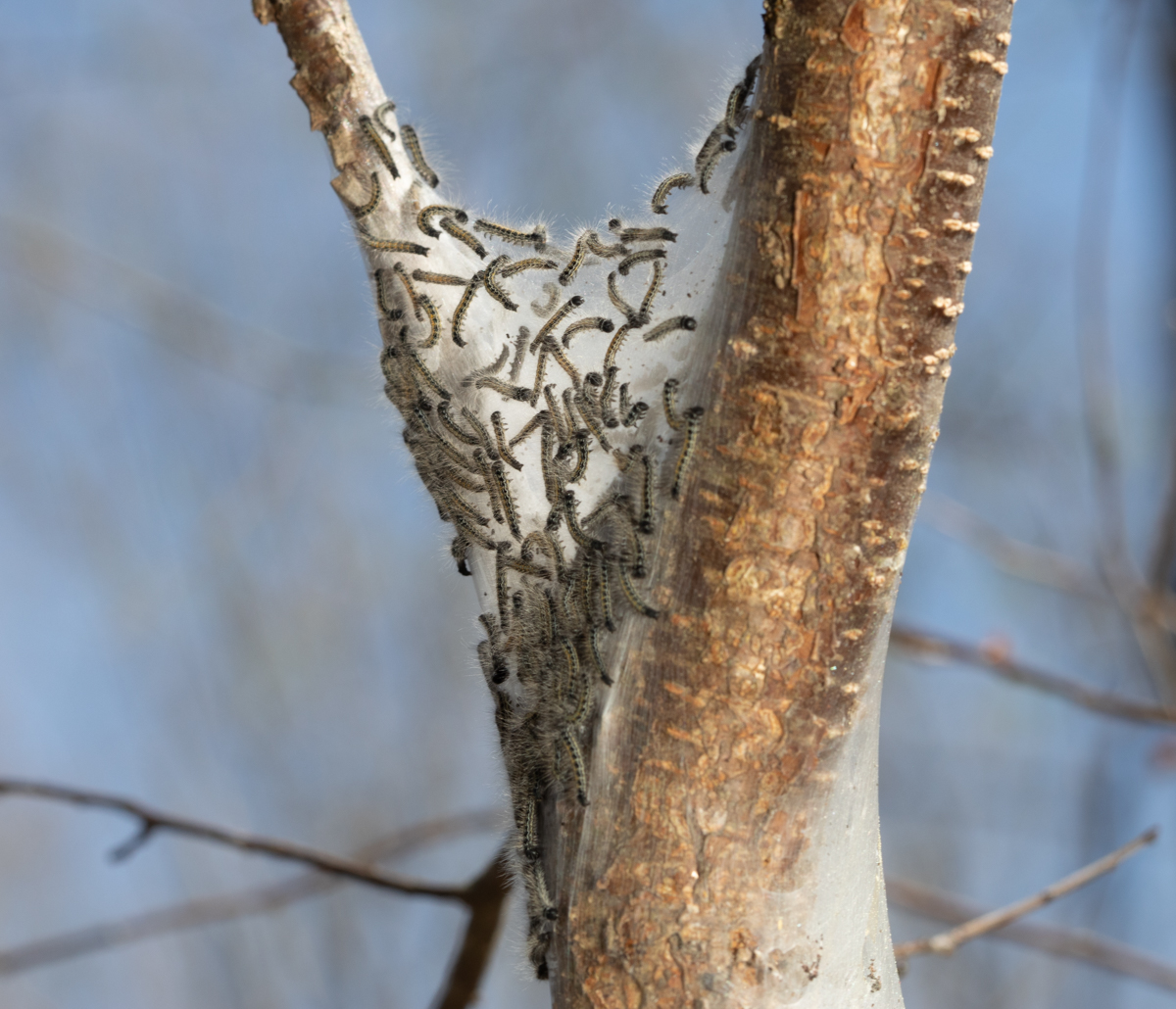
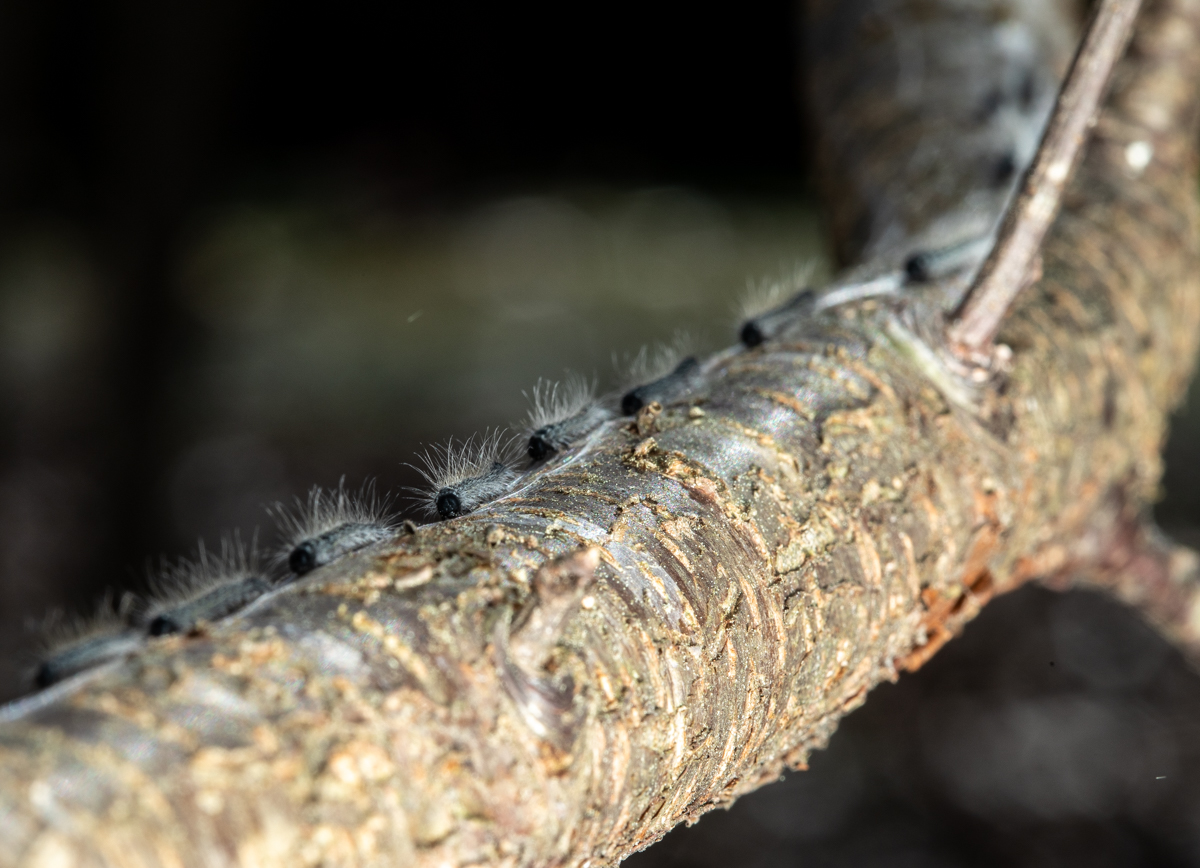
In this particular case, the road is not so much yellow and brick as white and silky… but these little critters certainly do some wonderful things…
Eastern tent caterpillars on a cherry tree branch
Hey, Roads End Naturalist readers, it’s Melissa here. With a little extra time on my hands I’ve been thinking a lot about ways to help teachers who are trying to teach virtually and parents who are now homeschooling to use the natural world as a teaching tool in this time of social distancing. So yesterday, I went out to document one of the most ubiquitous and friendly critters at this time of year – eastern tent caterpillars – as an idea for a subject to explore in your backyards or local parks (while staying 6′ from other people, please!).
Eastern tent caterpillars are the furry little guys who come out just as tree buds break in early spring and construct a silken web in the crotches of wild cherry tree branches. They’ve spent the winter as tiny larvae housed inside of an egg case that looks like a shiny, swollen growth on the tree branch. Our eastern tent caterpillars have been out and about for a little more than a week now, if memory serves me right. (Let’s see, I started to notice them in the branches before I stopped going to work, and that was a week ago Friday.) Most of them now are about 3/4″ long and starting to show some of the patterning that they’ll have later in life. And their tent homes range from about 4″ to 6″ across at this point.
Eastern tent caterpillar nest in between branches of a cherry tree with one caterpillar out on the surface. The dark spots inside the nest are frass (caterpillar poop).
Yesterday afternoon I got to observe a few of their really interesting behaviors when I went out for a look with the camera. I was very excited to note the silvery trails of silk running along most of the branches on the tree. As the young caterpillars go off to feed, and as they return, they leave a silken trail that is laced with chemical scents that guide the other caterpillars between the nest and leaves that they are feeding on. Over time, the silken “roads” become quite substantial. Apparently, a lot of research has been done on this behavior, and studies have shown that they are able to change the scent of the trail depending on the quality of food resources at its end – when a caterpillar comes back having fed successfully on a tasty branch, the next round of feeders will follow its trail back to the same spot.
I was even more excited when I saw a caterpillar follow a silk trail down one branch and back up another. Eventually, the caterpillar turned around and marched back to its nest – perhaps because at the end of the trial in the other direction was a different nest? It moved surprisingly quickly, so I had to anticipate its position along the branch to get a shot.
Tent caterpillar following a silken trail down a cherry tree branch.
A little later, after borrowing Mike’s fancy new camera with its twin light flash unit to try to better capture this phenomenon, I went out to a different, lower-down nest to try to get some closer images. The scene was totally different from earlier in the day! If you read this blog often, you probably know a little about caterpillars, as it’s a favorite topic in our household. But as a refresher, caterpillars shed their skin, usually five times (six for eastern tent caterpillars), to accommodate their dramatically increasing size as they grow. An analogy Mike once shared with me is that if a human baby grew as much as a caterpillar, it would end up the size of a blue whale! No one wants to live in a crowded house (especially when you’re not allowed to leave it… ah, pandemic humor…), so eastern tent caterpillars add additional layers of silk over time to increase the size of their nest.
The caterpillars have multiple “stories” to their house and can move between the layers of silk. You can see caterpillars within different levels of the nest in this image, as well a few out on the surface.
And since they don’t have HVAC systems, they also use their nests for thermoregulation. One study I read said temperatures were typically 4 degrees C higher in the nest than outside of it (that 7.2 degrees F if you’re like me and need the conversion)! Of course, on a warm day like Friday, that might not be a good thing, and the caterpillars were congregated on the shady side of the nest when I went back out to see them. I’m not sure if this was because it was cooler, or if this was their typical nest-expansion aggregation behavior.
I’m not sure if these caterpillars were expanding the nest or thermoregulating by hanging out in the shade, or maybe both. But it sure was cool to see. They moved around a good bit while on the outside of the nest.
These caterpillars really are fascinating. Numerous references (like this one and this one as well as a favorite classic field guide, Observing Insect Lives by Donald Stokes) note that they typically have 3-4 periods of feeding during the day. Apparently, the pattern is that they aggregate outside the nest and add layers of silk to expand it, then go off and feed. Sure enough, a little later (once I’d solicited Mike’s help to bend the tree down so I could get a better look at the nest), lines of caterpillars were marching along their silken roads back from the outer tree branches, I assume after having fed on the tasty, tender cherry leaves. This was the coolest moment yet – seeing the little caterpillars nose to tail marching down the branch and back home!
These caterpillars were marching down the branch toward their nest. You can see the silken “road” if you look closely under their bodies. Take another look at the first image in this post for another example.
They all marched right into the nest to hang out until their next bout of feeding.
One corner of the nest is at the right side of the image. The caterpillars entered through a hole where it meets the branch.
Here’s a few other interesting tidbits that I gleaned in researching this subject…
If there’s more than one nest in a tree, eventually the trails from caterpillars in each nest will run into each other. Apparently, the caterpillars will share nests. Friendly little guys!
Caterpillars in the same nest may be at different stages of development. It seems that development rate is linked to temperature, with warm temperatures being correlated with faster development.
Eating eastern tent caterpillars can cause abortion in horses! In 2001, more than 3000 mares aborted fetuses as a result of eastern tent caterpillar ingestion. My initial guess was that the concentration of cyanide, which is naturally found in cherry trees, by caterpillar feeding was perhaps the cause of the issue. However, it turns out that the hairs on the caterpillar are able to penetrate tissues inside the horse, and those hairs carry bacteria which, when they reach the uterus, can infect the horse and/or fetus and cause abortion. Fascinating!
So, here’s my challenge to you. Get out in nature (with proper social distancing), and see if you can observe some of these fascinating behaviors of eastern tent caterpillars!
If you’re looking for ideas for teaching kids at home, maybe challenge them to observe and document behavior over time. Here’s some questions and ideas to consider:
Can you document which times of day the caterpillars like to go out and feed? How does weather affect their behavior? What happens when they’ve eaten all the leaves on a branch?
Use a thermometer to measure the temperature on different sides of the nest – where is is warmer or cooler?
Use a compass to note the direction nests are facing – do they tend to be built at a certain orientation? Are the silk trails typically on a side of the tree facing in a particular direction, or is it more random than that?
How many caterpillars can you count in a single nest?
Using your observations, write a story or poem describing what it’s like to be a tent caterpillar, hanging out in a tiny silk nest with hundreds of your brothers and sisters… maybe not too dissimilar from your life right now? If anyone does this activity, feel free to post it as a comment on the blog – Mike and I would love to read some of your writing!
And if you really want to get into it, this book I found online has a whole bunch of experiment ideas using tent caterpillars – it’s chapter 17. I can’t find a way to link to the specific page, or even a page number to give you, but I found it by searching “eastern tent caterpillars” within the text.
I’d love to hear if any of the ideas are useful, or if you observe any interesting behaviors in your tent caterpillars. Please share in the comments on the blog or tag Mike and I on social media!
My scientific life has been spent describing the interactions that occur when butterflies meet and trying to understand what is going on and why…I persist in following butterflies with stopwatch and notepad.
~Ronald L. Rutowski, North American Butterfly Association
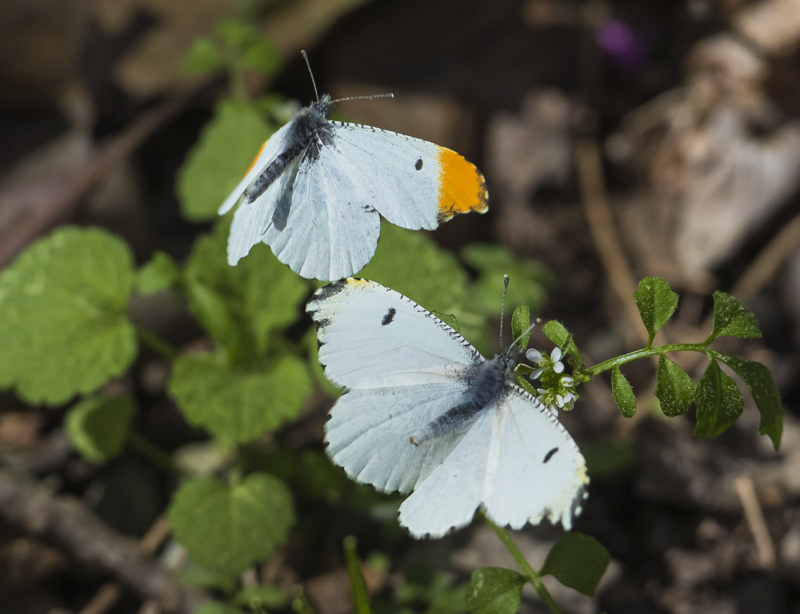
Yesterday’s sunshine (why can’t we seem to have at least two days in a row of that here lately?) brought out the invertebrates in the yard. I looked out the window at one point and saw a fluttering small white butterfly checking out the Hairy Bittercress weeds in the front yard. It was a female Falcate Orangetip (Anthocharis midea), and those weeds, members of the mustard family, are one of her host plants. These tiny butterflies are one of the sure signs of spring as they fly for only a couple of weeks early each year, looking for members of the mustard family on which to lay their eggs.
The distinctive developing seed pods of the common yard weed, Hairy Bittercress, Cardamine hirsuta (click photos to enlarge)
I grabbed my camera and by the time I got outside I saw another butterfly, this one with orange wing tips (a male Falcate Orangetip), pursuing the female. What followed was 3 minutes of intense butterfly behavior (and burst mode shooting on my part). The male’s flight pattern was rapid and erratic and he would dive in and briefly flutter near her before darting off and circling back.
Male Falcate Orangetip (with orange wing tips) fluttering near female perched on one of her host plants.
The female maintained an abdomen up position the entire time.
It seems as though the male’s efforts were unsuccessful as he eventually flew off and she continued patrolling the yard for bittercress.
I have seen this abdomen up behavior before when watching Falcate Orangetips. I have always assumed it was the response of a female that is not interested in the male’s attention. But, some research on a closely related European species shows that both receptive virgin females and non-receptive, previously mated females, show this raised abdomen behavior when a courting male comes a calling. The difference may lie in what chemical compounds the female is releasing when the male gets close. In one case, it may be an attractant pheromone. In the already mated females, it is believed to be a repellent.
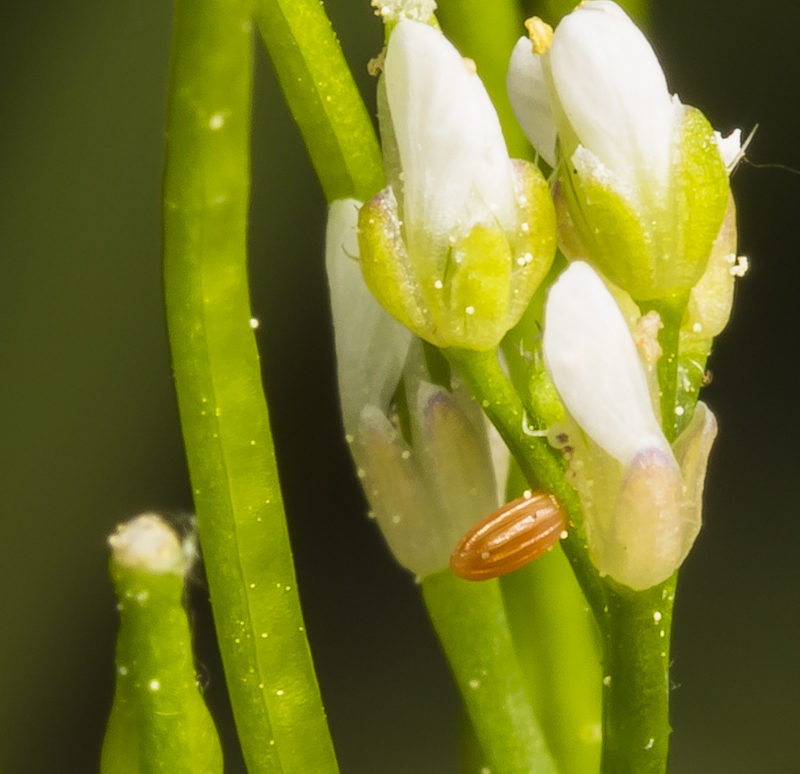
A single tiny egg on the flower of the host plant.
After the male departed, I tried following the female around the yard to see if she was going to lay an egg, but she eventually wandered off through the woods. I went back to the original plant I had seen her land on and began to search it for an egg. I finally found one – a tiny sculpted egg, laid at the base of a flower, just where the online references had said it would be. She supposedly deposits a pheromone on the egg that keeps other females from laying an egg on that same plant as the larvae are known to be cannibalistic. Now I want to try keep track of it as the larvae (and especially the thorn-like chrysalis) are extremely hard to find. The things you can do in self-isolation…
For more on the behavior of butterflies and their mating habits, check out this article, When Butterflies Meet, from the North American Butterfly Association.
Last Sunday, we wandered over to one of my favorite local spots, Mason Farm Biological Reserve, part of the North Carolina Botanical Garden. Given to the University in 1894 by Mary Elizabeth Morgan Mason, the 367-acre tract consists of a number of Piedmont habitats from bottomland hardwood forests to old fields. This variety makes for a great diversity of plants and animals. We started off on the 2+ mile loop trail and then cut into the woods to look for a red-headed woodpecker we heard. Once we entered the woods, we started seeing Spring Beauties everywhere. So, we just sauntered through the large tract of woods looking for anything we might find. I’m hoping my former co-workers at the Garden aren’t upset for me posting about being off trail, but we didn’t tromp through the meadows where I know they are reintroducing several species of wildflowers to compliment their mowing and prescribed burning efforts. And, in these crazy times, a little distance from the other trail users isn’t necessarily a bad thing, as long as you are respectful of the forest inhabitants.
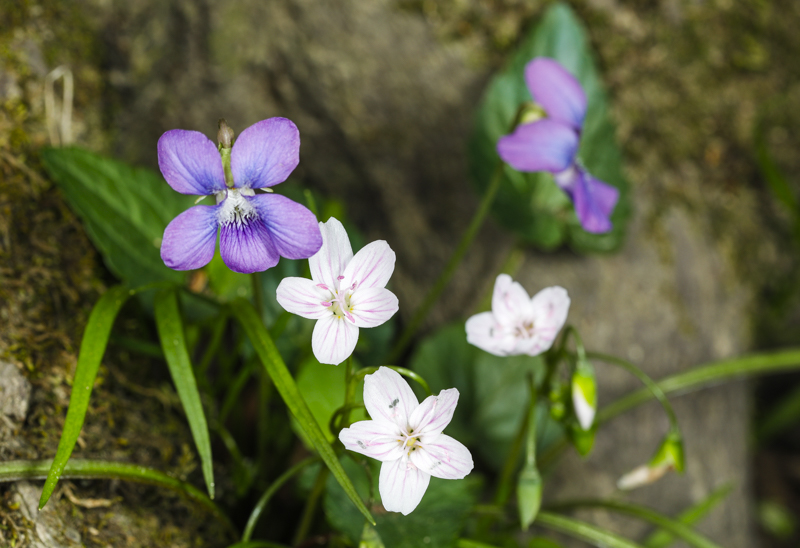
Violets and Spring Beauties growing against a tree trunk (click photos to enlarge)
A pair of Spring Beauties showing the difference in age of the flowers – the one on the left is younger since you can see the stamens loaded with pink pollen; the one on the right has the three-part pistil showing and the stamens have laid back against the petals to lessen the chances of self-fertilization.
A pleasant surprise was finding many clumps of Atamasco Lily throughout the forest floodplain.
A clump of Devil’s Urn (aka Black Tulip) fungi, Urnula craterium.
I noticed some interesting looking fungi along the edges of a branch lying on the ground. I remember seeing these in a recent FB post from Southern Piedmont Natural History (check out their free ebook here).
A closer view of Devil’s Urn fungi. As they mature, they get the scalloped edge.
This species typically is one of the earliest spring mushrooms and is usually found growing along the edge of fallen logs or branches (like we found them). When I looked online, I discovered a pretty cool fact about these unusual fungi – they hiss! Apparently, if you blow on them, they will release a cloud of spores and in doing so, make a hissing sound. Now I want to find some more and test this out (yup, our lives are pretty exciting).
A beautiful female Marbled Salamander. They always seem to be smiling.
As we crossed back to the other side of the loop trail, I turned over a few logs looking for the salamanders that frequent this area. Melissa got lucky and found a beautiful female (they tend to have grayish blotches and males are usually white) under a rock. We admired her for a second, put the rock back in place, and gently laid her down alongside it, and she crawled back underneath. About then, our friend, Mary, was coming up the trail, camera in hand. She is an excellent naturalist and photographer, and gave us an update on some of the birds she has been seeing. We went looking for a barred owl she sees frequently, but had no luck. But, given how things are, I think we will have ample time for another visit to check things out. Here’s hoping you all can get out and enjoy your surroundings…stay safe.
The tree is more than first a seed, then a stem, then a living trunk, and then dead timber. The tree is a slow, enduring force straining to win the sky.
~Antoine de Saint-Exupery
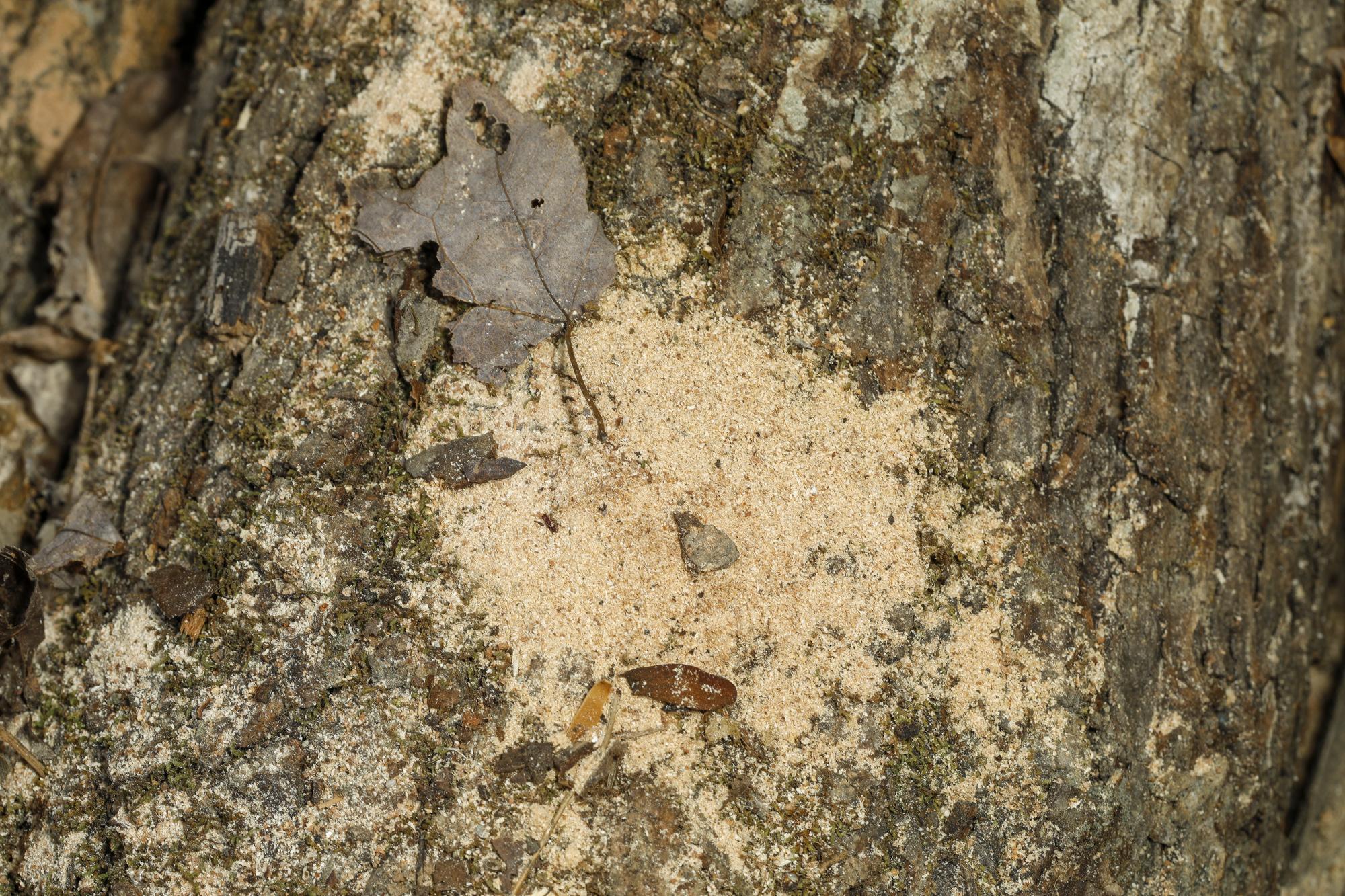
Last week I cut and split some firewood from a hickory that fell across the road in the storms of October, 2018. The wood has been stored under a tarp (with sides exposed) since that time. When I pulled the tarp off to start cutting, I immediately noticed the many piles of sawdust from the activities of wood-boring beetles.
Sawdust on the hickory wood pile (click photos to enlarge)
I have often encountered the grubs of beetles while splitting wood, but I soon realized this was an exceptional concentration of these guys in this pile.
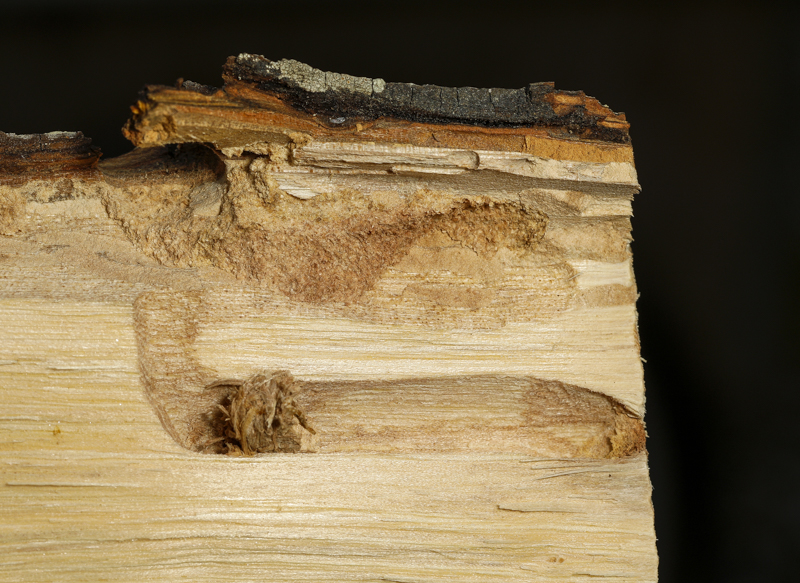
A split log reveals the source of the sawdust – galleries from the chewing of wood-boring beetle larvae.
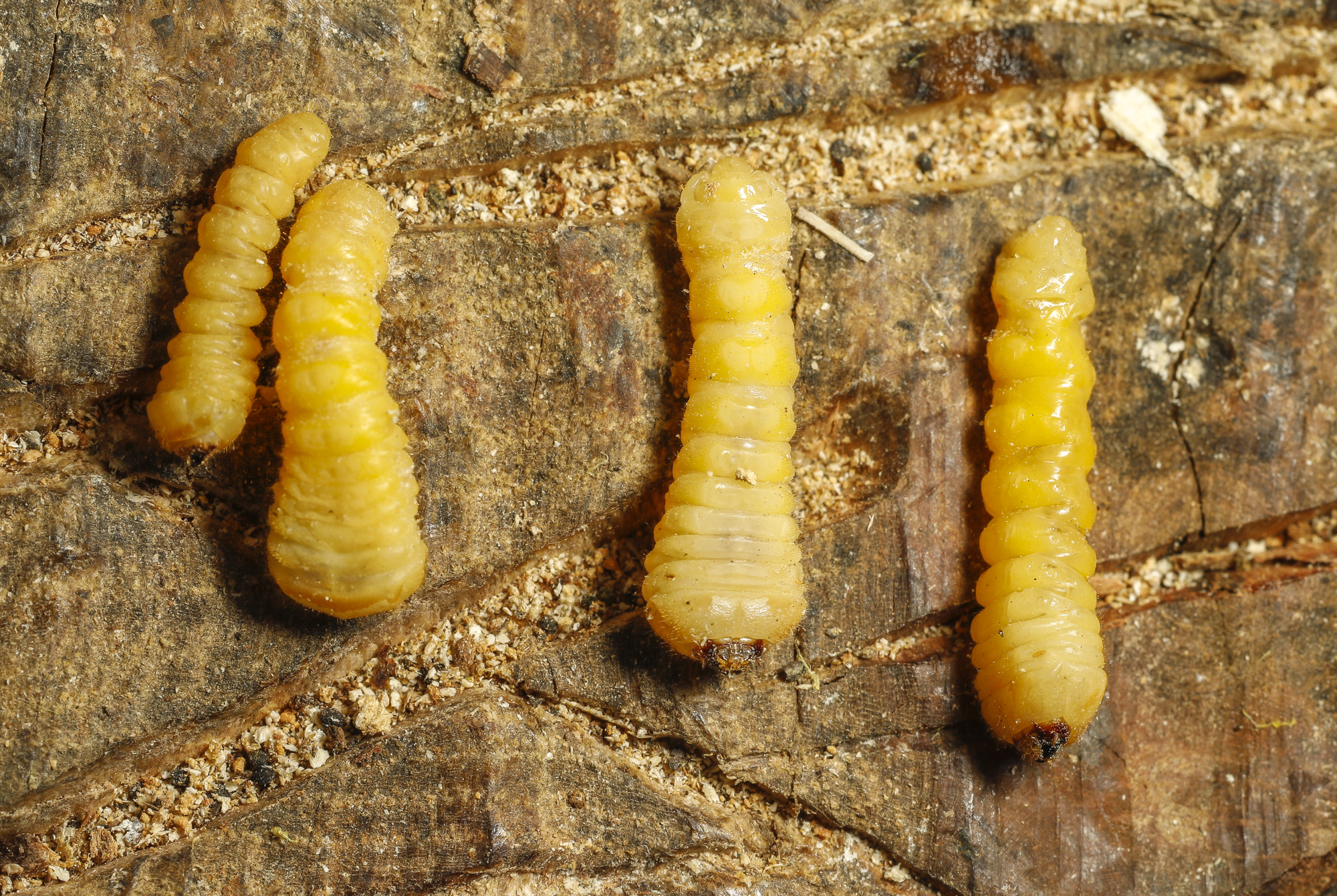
The excavators – the fathead grubs of a long-horned beetle were falling out as I split the hickory logs.
As I was chopping this wood, I had a whole new respect for the chewing abilities of these larvae. I mean, hickory has a well-deserved reputation as a very hard hardwood (hence its common use for tool handles, etc.), and on several swings of the maul it seemed like I was trying to split petrified wood. And yet these 1/2 to 3/4 inch grubs had tunneled through it like it was cream cheese.
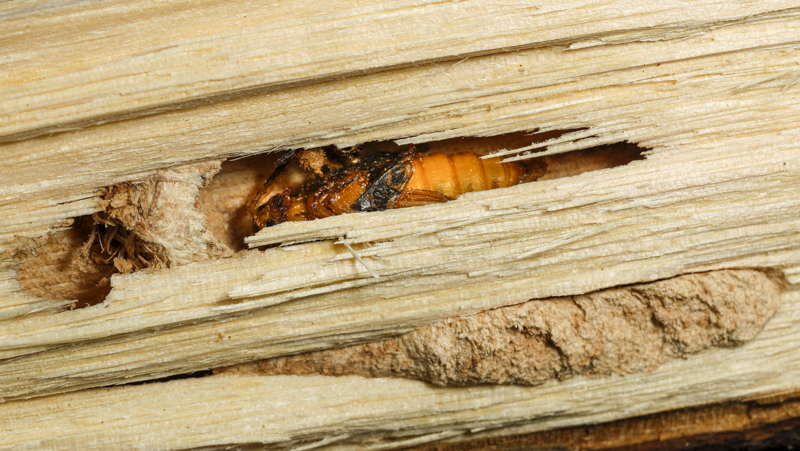
Pupa of a long-horned beetle in a chamber in the wood.
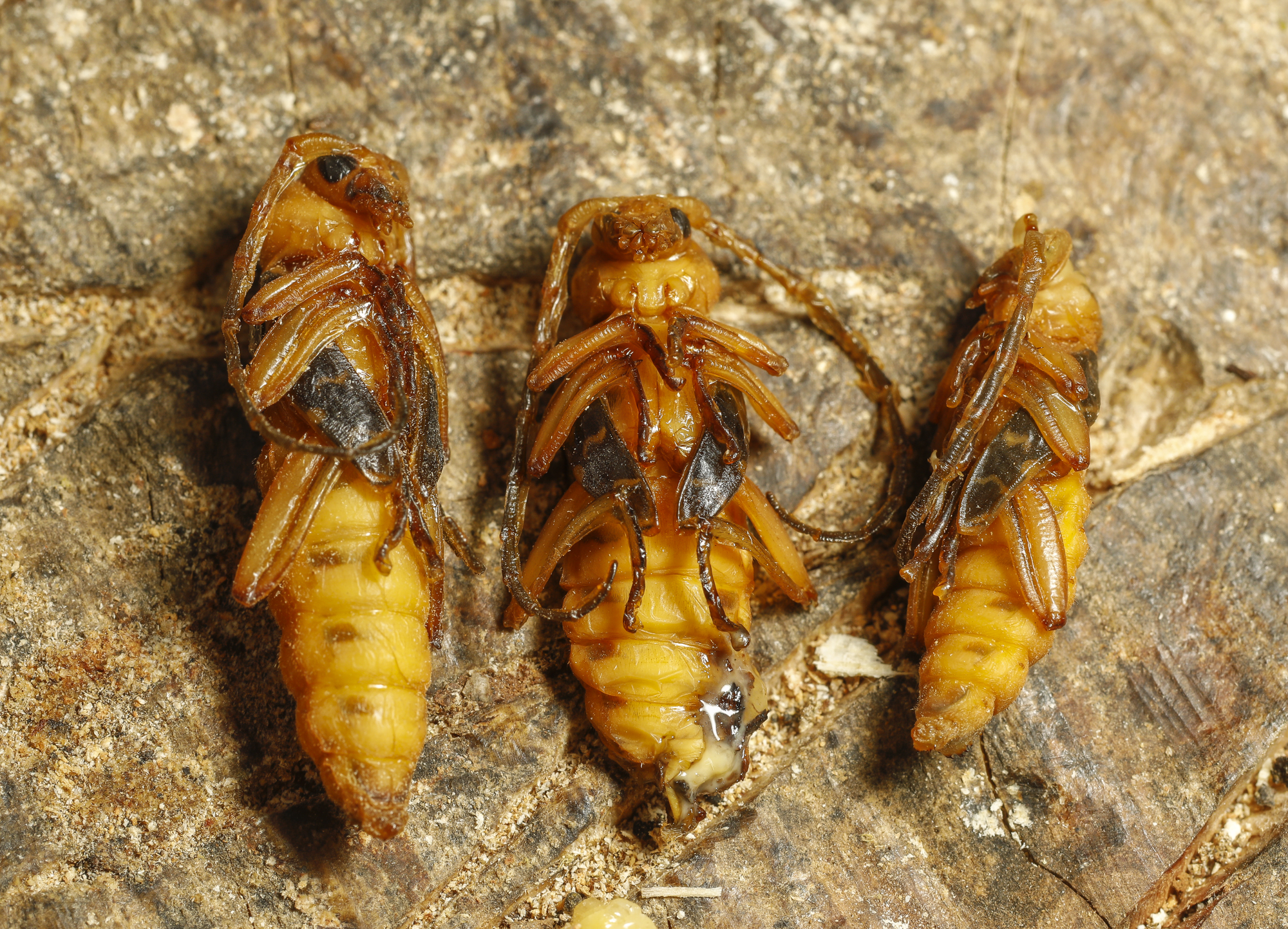
Several long-horned beetle pupae that were exposed as I split wood.
This species of long-horned beetle emerges in early spring, so these pupae are almost ready. After mating, a female will lay up to 50 eggs (that explains the abundance in my logs) in the bark of weakened wood or wood that has been dead for no more than a year. Hatched larvae chew into the wood and feed for 10-12 weeks before making a larger chamber for pupating, where they will remain until the following spring.
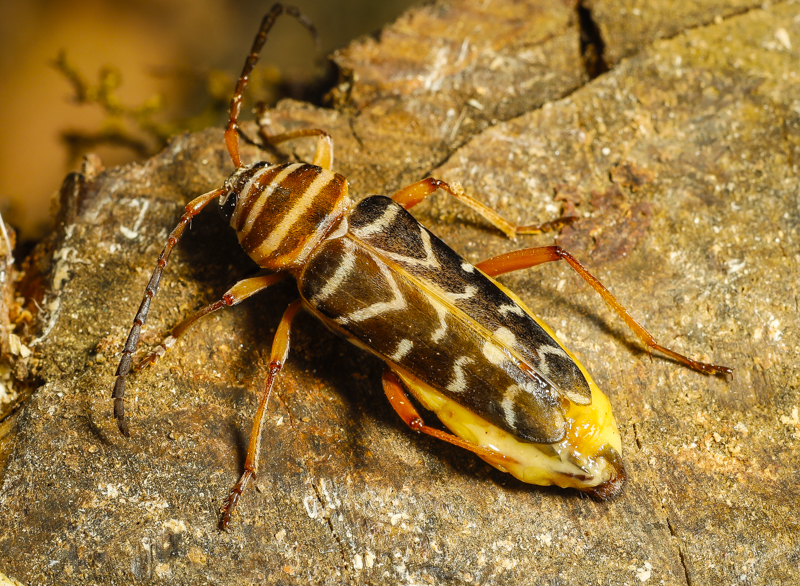
One beetle started slowly crawling after it dropped out of a split log (I don’t think it was quite ready to be out in the world). It is a Hickory Borer (aka Painted Hickory Borer), Megacyllene caryae. This species closely resembles the Locust Borer Beetle, and both are considered wasp mimics due to their appearance (but they are harmless).
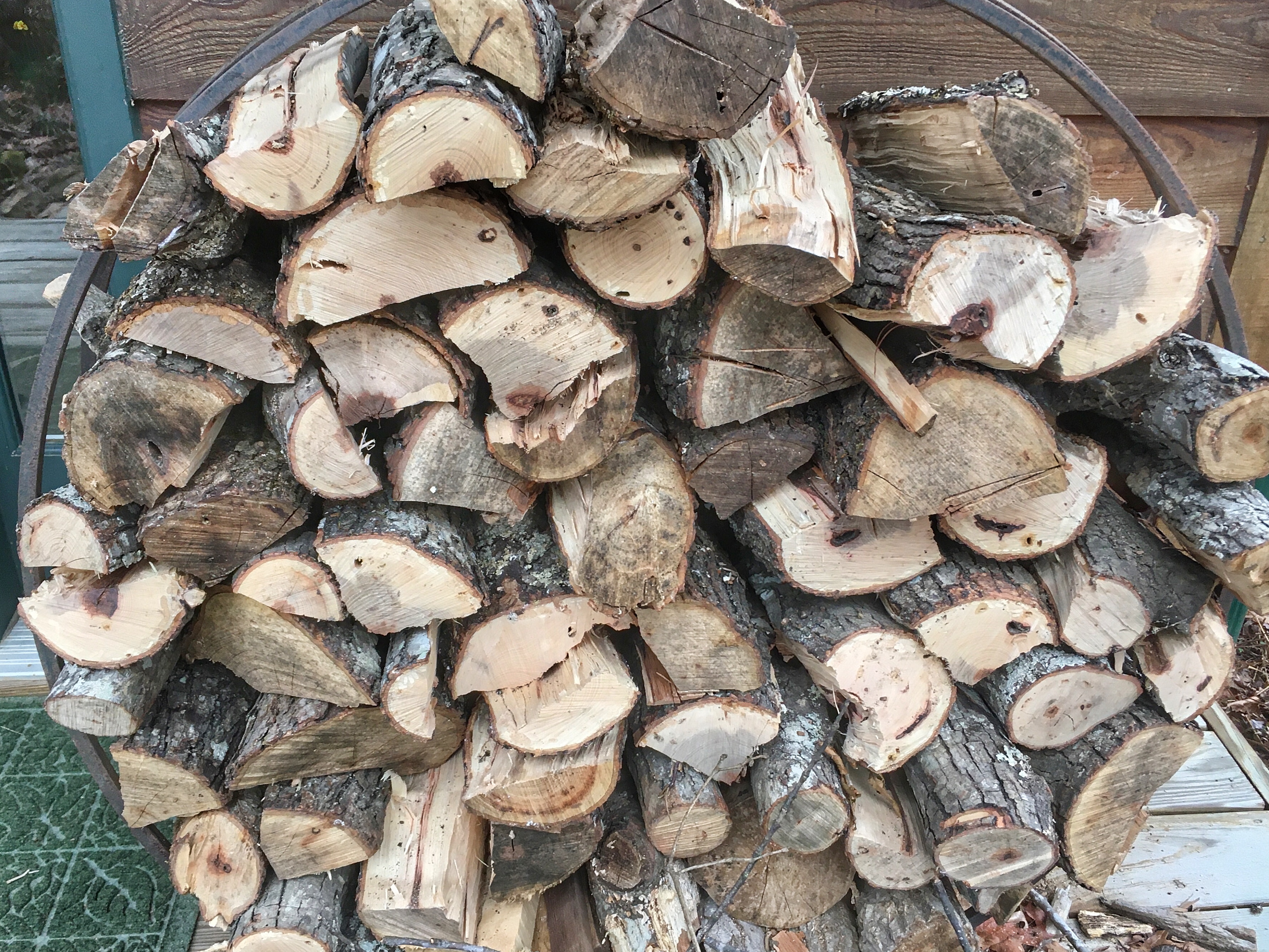
The freshly cut and split firewood. The dark spots visible on some log ends are the long-horned beetle galleries.
I admit to feeling a little guilty about dislodging all these beetle larvae and pupae but I think the Carolina wrens are quite happy about my wood chopping endeavors. But, I think there will be plenty of survivors in the remaining stack of logs to continue their boring behavior this spring. Seeing this community of critters in the wood and then feeling the warmth of the fire from these logs serves as a vivid reminder of the lasting legacy of a single tree. I look out the window and see so many stories in the forest…
These are interesting times for sure and we are all going to need a large dose of patience to get us through to the other side. Melissa and I are lucky to live in a place where it is easy to be socially distant and yet have the beauty of nature just outside our window. I know that is not the case for everyone. But, wherever you live, there is a bit of nature close by…birds singing or flying overhead, yard weeds growing in your garden or cracks in the sidewalk, a greenway or local park, or a schoolyard or church cemetery. Nature has some claim in the most surprising places. So, to help myself through this time of self-isolation, and maybe to encourage others to spend more time in the healing presence of nature, I am going to try to post observations more frequently these next few weeks (ideally every day, but at least 4 or 5 times a week). I think most will be rather short with a single topic and only a few photos. It would be great if environmental educators and other nature-lovers would post informative and fun nature stories that can share the wonders around us and maybe even be of some use to teachers and students that are looking for ways to integrate natural science into their disrupted class schedules. I wish I could produce some simple videos of natural moments, but I worry that our incredibly limited internet here in the woods will be a limiting factor (but I may try anyway).
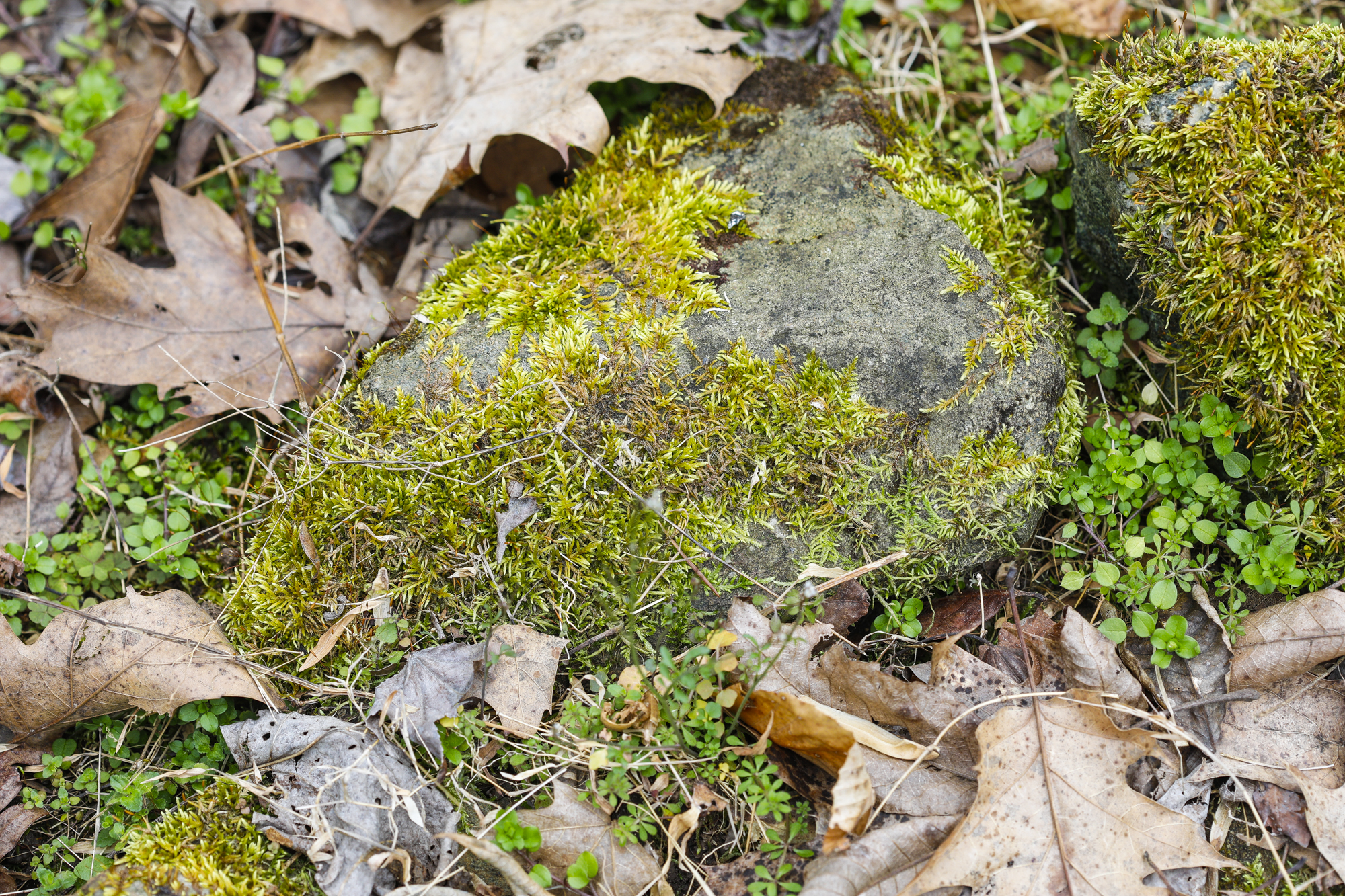
So, here is something we discovered over the weekend while working in the yard. We are building some new garden beds for herbs and wildflowers and Melissa was rearranging some rocks to make a new tiered bed. She picked up a smallish, moss-covered rock and started to move it a few feet away and discovered a beautiful surprise…
This rock turned out to have a nice surprise underneath (click photos to enlarge)
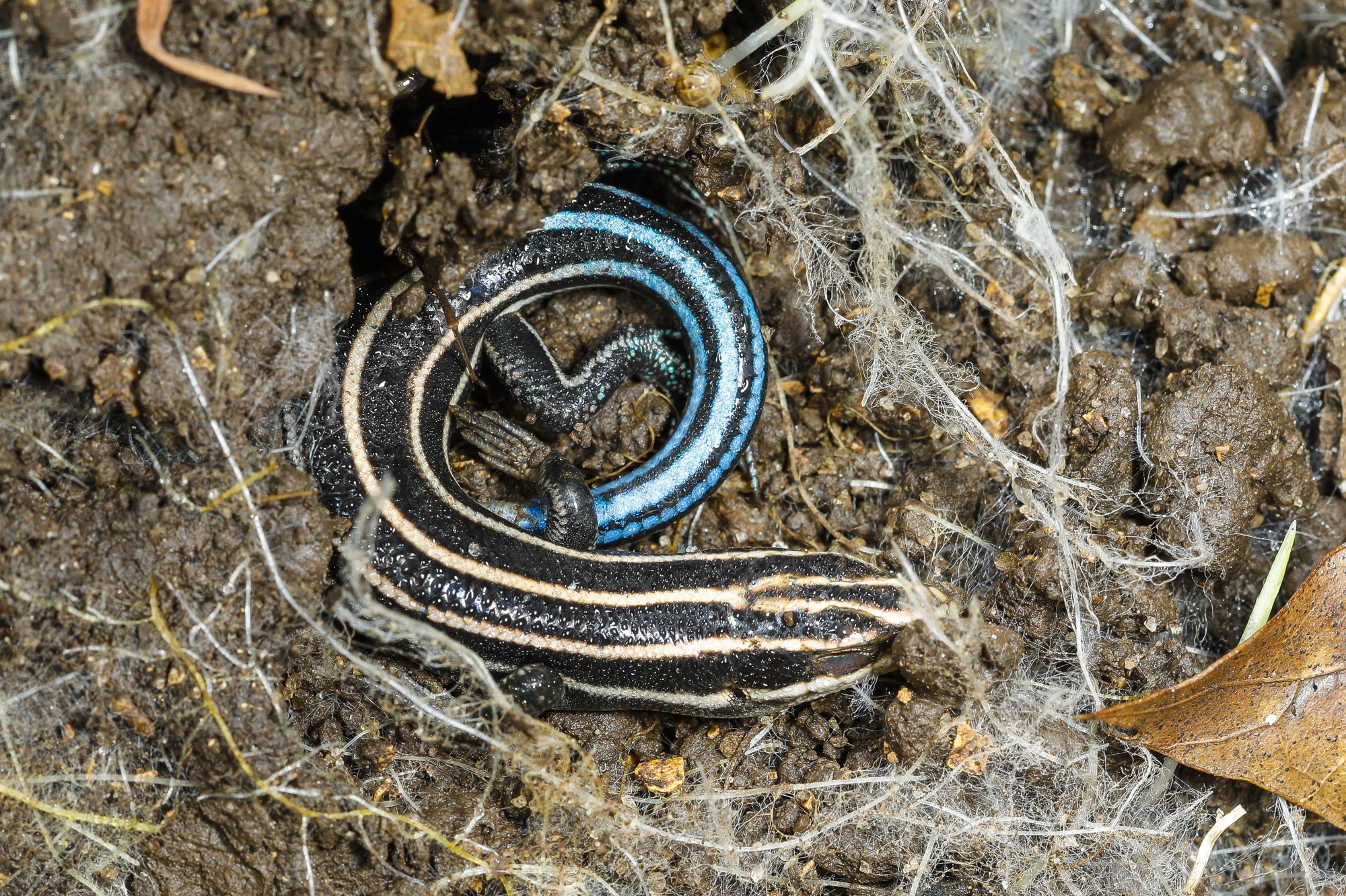
It was a juvenile Five-lined Skink (Eumeces fasciatus) curled up waiting for winter to finally be over. Reptiles are not true hibernators, but go through a state of inactivity or torpor known as brumation during periods of cold weather. In our area, you may see these and other lizards (or snakes) out on warm winter days and then disappear again with the return of cold temperatures. This species typically becomes active in late March or earl April here in the Piedmont, so this little guy doesn’t have to hide much longer.
A juvenile five-lined skink waiting for the warmth to return
I have to admit that I find it difficult to distinguish between the three species of blue-tailed skinks in our area (Five-lined Skink, Southeastern Five-lined Skink, and Broadhead Skink). Herpetologists can often do it by sight alone, but the best way is to do scale counts around the jaw and/or underneath the tail. I didn’t want to disturb this one to look under its tail (how rude), but I think it is a Five-lined Skink as I can only count 5 lateral lines down the body (the other two species have 7), and this habitat is not particularly dry (the Southeastern Five-lined prefers sandy habitats). As always, if someone out there knows for sure, please drop me a note. Oh, and in case you were wondering, we postponed our rock movements until warmer weather and very gently replaced this one.
The incredible but annually commonplace change that is life eternally renewed has begun to stir.
~Hal Borland
My last post dealt with the rapid changes in weather from the first spring wildflowers in our yard to the switch to bitter cold and time for chopping more firewood. The vagaries of “spring” weather really hit home when I went to visit my mother over the weekend and it snowed two inches overnight. Back at home earlier this week, I looked out the window and saw butterflies! I actually saw my first butterfly of the season last week, but didn’t manage to get out to get a photo before it disappeared. Tuesday, it was the same species, and not just one, but two, American Snout butterflies, flitting about the yard interacting, resting, and nectaring at one of the few flowers to be found, the diminutive yellow blossoms of Northern Spicebush.
American Snout butterfly, Libytheana carinenta (click photos to enlarge)
This is one of my favorite, and certainly one of the more bizarre, local butterflies. I don’t remember seeing them before as my first butterfly of the season, and here were two chasing each other around. After a brief bout, they separated with one going to spicebush flowers, the other settling on a post in the garden. I grabbed the camera and went out to try to document the event, but, at first, they were having none of it and were difficult to approach. That surprised me a bit as I have described this species to folks as “the friendliest butterfly” around. They have a habit of landing on people to imbibe our salty sweat and being somewhat fearless in doing so. I have had this happen several times in places where they congregate at puddles or other moist soil sites to gather minerals.
The common name comes from the enlarged labial palps, which give the appearance of a long snout.
I finally positioned myself and stood still, waiting for one to return to the tiny yellow flowers. That paid off and I was rewarded with several minutes of close observation. When I did a little research on my “nosy” neighbors, I was surprised to learn that this species overwinters as an adult, and thus is often one of the earliest butterflies seen. The large palps (part of the mouthparts of all butterflies, but greatly elongated on this species) that give the American Snout its name are believed to provide some additional camouflage for this unusual creature. This species often rests on a twig, head upward, snout and antennae touching the twig. Look at that first picture again and imagine it is not on the flower but on the twig. The brown coloration of the underwings resembles a dried leaf. When the snout and antennae rest on the twig, they resemble a leaf petiole, so when this guy stops and rests on a twig, it virtually disappears as dead background vegetation!
The squared off shape of the edge of the forewing is also characteristic of this species.
American Snout caterpillars feed exclusively on species of Celtis (Hackberry and Sugarberry in our area) and are more common in hardwood forests, especially near bottomlands. In the southwest, they occasionally undergo massive unexplained irruptions that can darken the sky and have been estimated to number in the millions. I was thankful to have just these two to brighten my day.
A Calligrapher Fly, Toxomerus sp.
While waiting for the snouts to land near me, I started noticing some other early spring visitors to the spicebush. A few syrphid flies were buzzing around and collecting nectar or pollen. I got a close look at one and believe it is a member of the genus Toxomerus. The genus name comes from the Greek, taxon, bow, and meron, thigh, and refers to the bow-shaped leg segment (femur) which can be seen in this photo. The other characteristic of this group is the V-shaped notch along the trailing edge of the eye (again, visible in this picture). These flies are wasp/yellow jacket mimics, but are harmless.
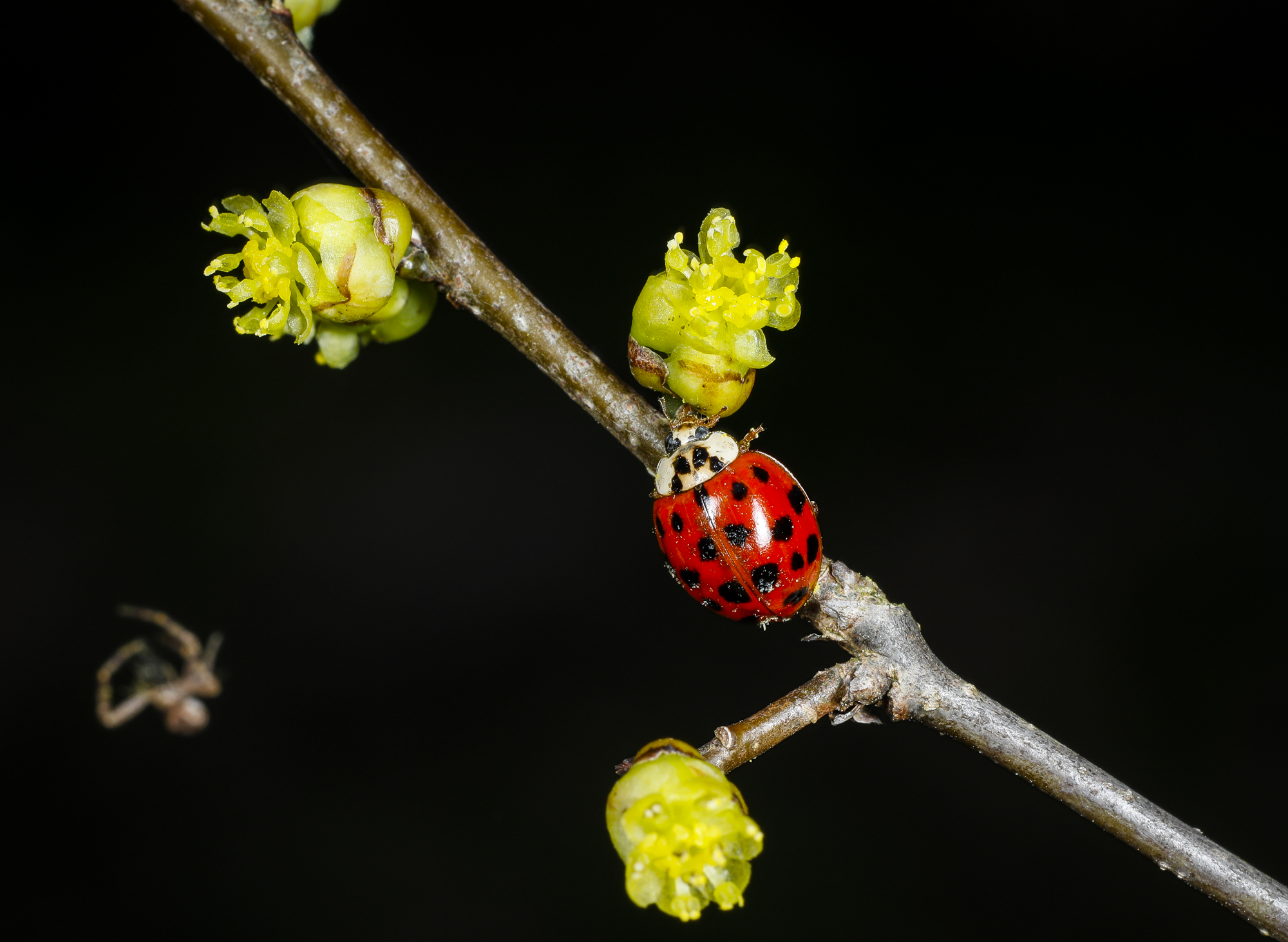
An Asian Lady Beetle (ladybug), Harmonia axyridis. I didn’t notice the small spider nearby until I looked at the image on my laptop.
Asian Lady Beetles (also commonly called Multicolored Asian Lady Beetles) are a highly variable (in color and pattern) species originally from eastern Asia. One key to identification is that they generally have a white pronotum (the shield behind the head) with what looks like an M or W showing. They have been intentionally released in various states since the early 1900’s as a biological control of aphids, but it wasn’t until the 1980’s that the species really took off nationwide. They are considered a pest by many for their habit of overwintering inside dwellings and their impact, through predation, on many of our native ladybug species.
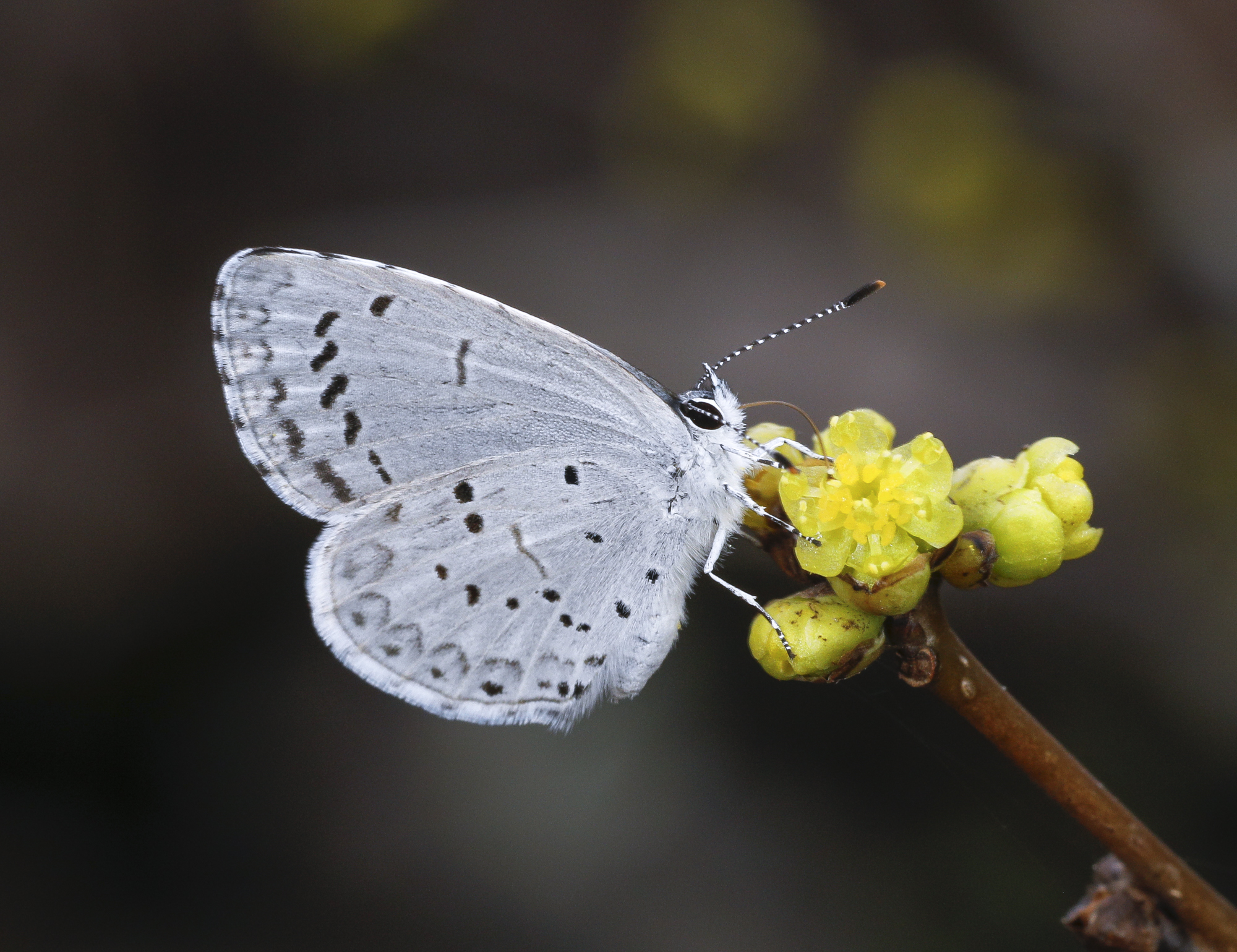
A dainty Summer (?) Azure, Celastrina neglecta
My second butterfly species of the season caught my eye as a tiny light blue speck flitting across the yard and then landing on a dead leaf on the ground. I assumed it was a Spring Azure, but was unable to approach close enough for a photo. Once again, I stood next to the blooming spicebush, and my quarry finally landed close enough for a portrait. When I went online to confirm its ID, I was reminded by several sources that the azures are a complex group of species that can be very difficult to sort out. My favorite source of information on butterflies in our state, the Butterflies of North Carolina, states that Summer Azures are more abundant and fly just as early as Spring Azures. The Summer Azure is considered the palest in color (both above and below) and in comparing images online, it seems like this one more closely matches the Summer Azure photos I saw. Of course, if any readers have an opinion, I’d love to hear it. This may be the best thing about retirement, the ability to take the time to observe and learn something new about the many incredible natural moments that happen right outside my door.
If we had no winter, the spring would not be so pleasant: if we did not sometimes taste of adversity, prosperity would not be so welcome.
~Anne Bradstreet
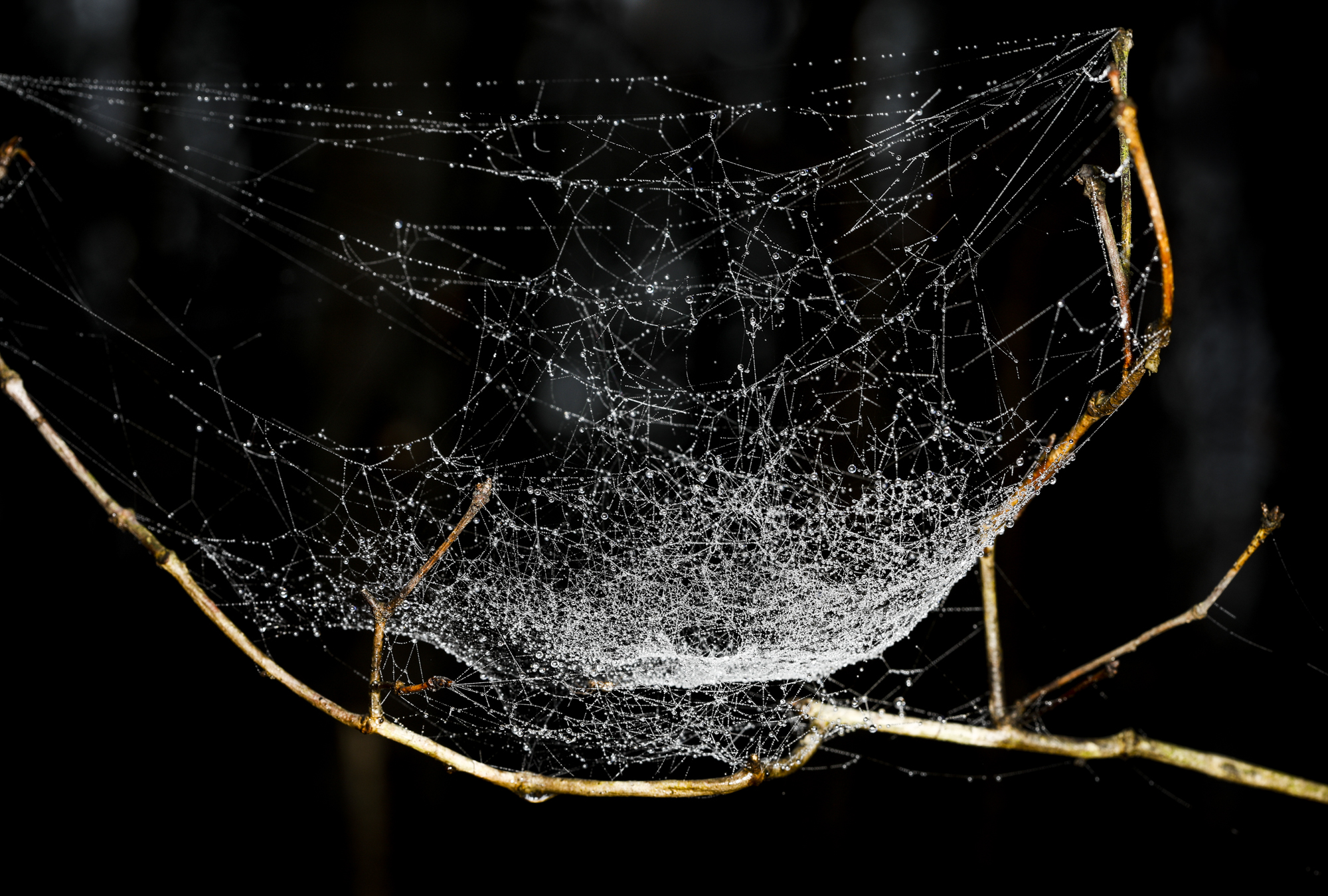
The past couple of days have been warm and spring-like with highs around 60. Yesterday morning dawned with a gray coating of fog across our woods, coating everything in tiny jeweled droplets that highlighted the onset of early spring wildflowers. Today changed all that with high temperatures more than 20 degrees colder and a brisk wind. Even though I love the cold weather (and it is much better for tasks like chainsawing and splitting firewood which I did today), the taste of spring was appreciated. Here are a few photos of what was out yesterday and a hint at what is coming…
The first spider web of the season on the arm of a twig (click photos to enlarge)
Wild columbine flower bud covered in “fog dew”
A black and white of fog dew on wild columbine leaves.
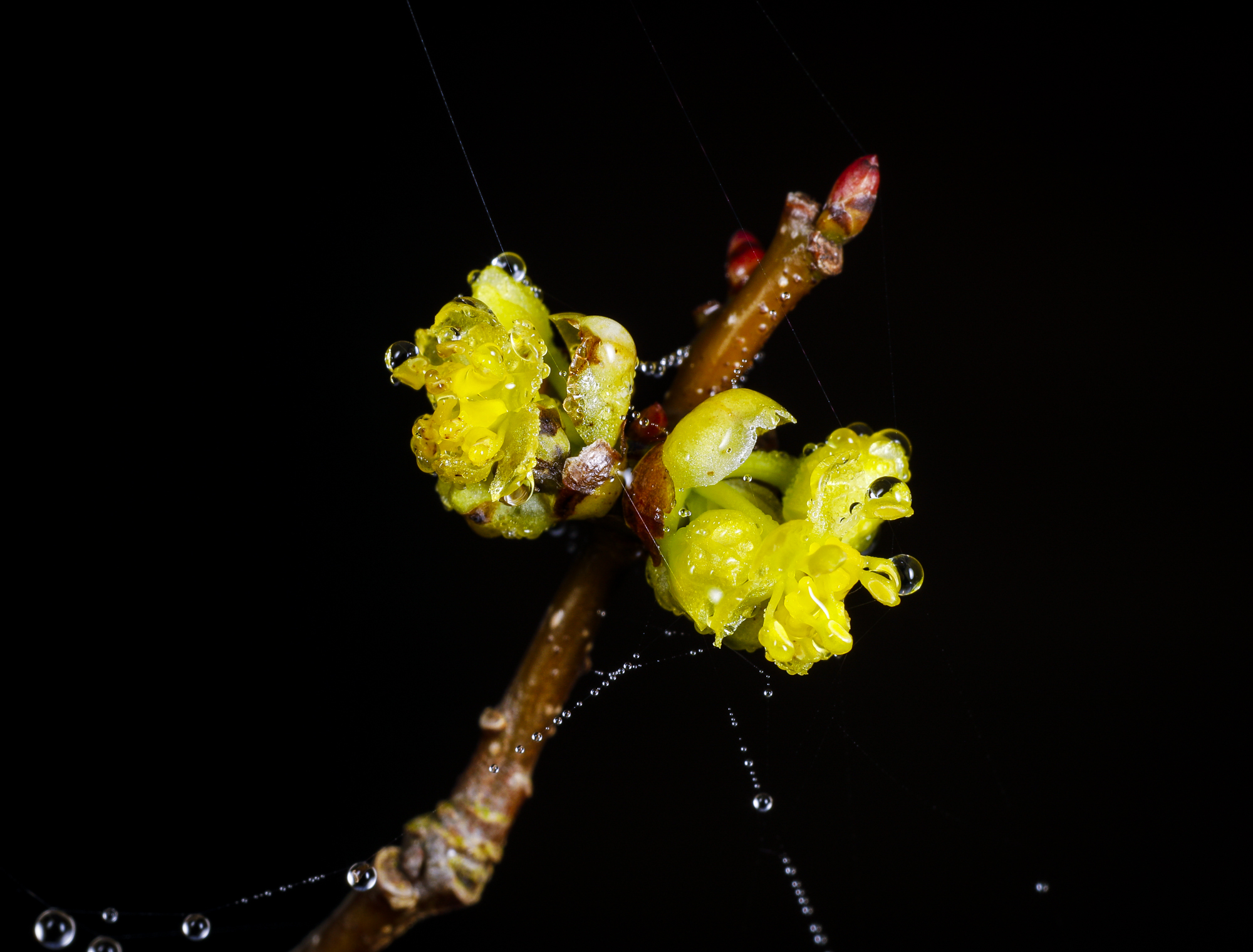
The tiny spicebush flowers have opened.
Buried in snow last week, this bloodroot flower bud is now reaching high.
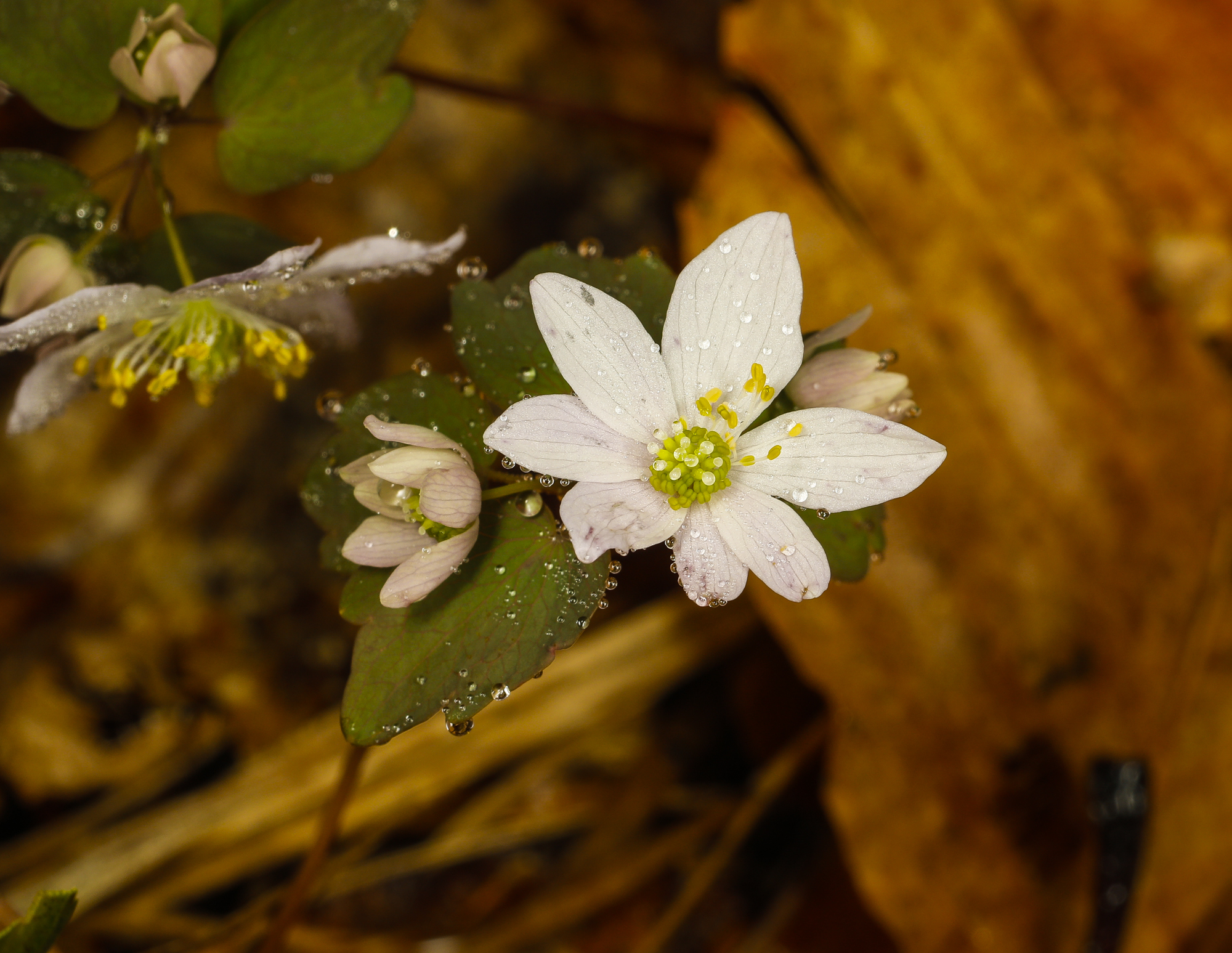
Windflower, one of my favorite spring ephemerals.
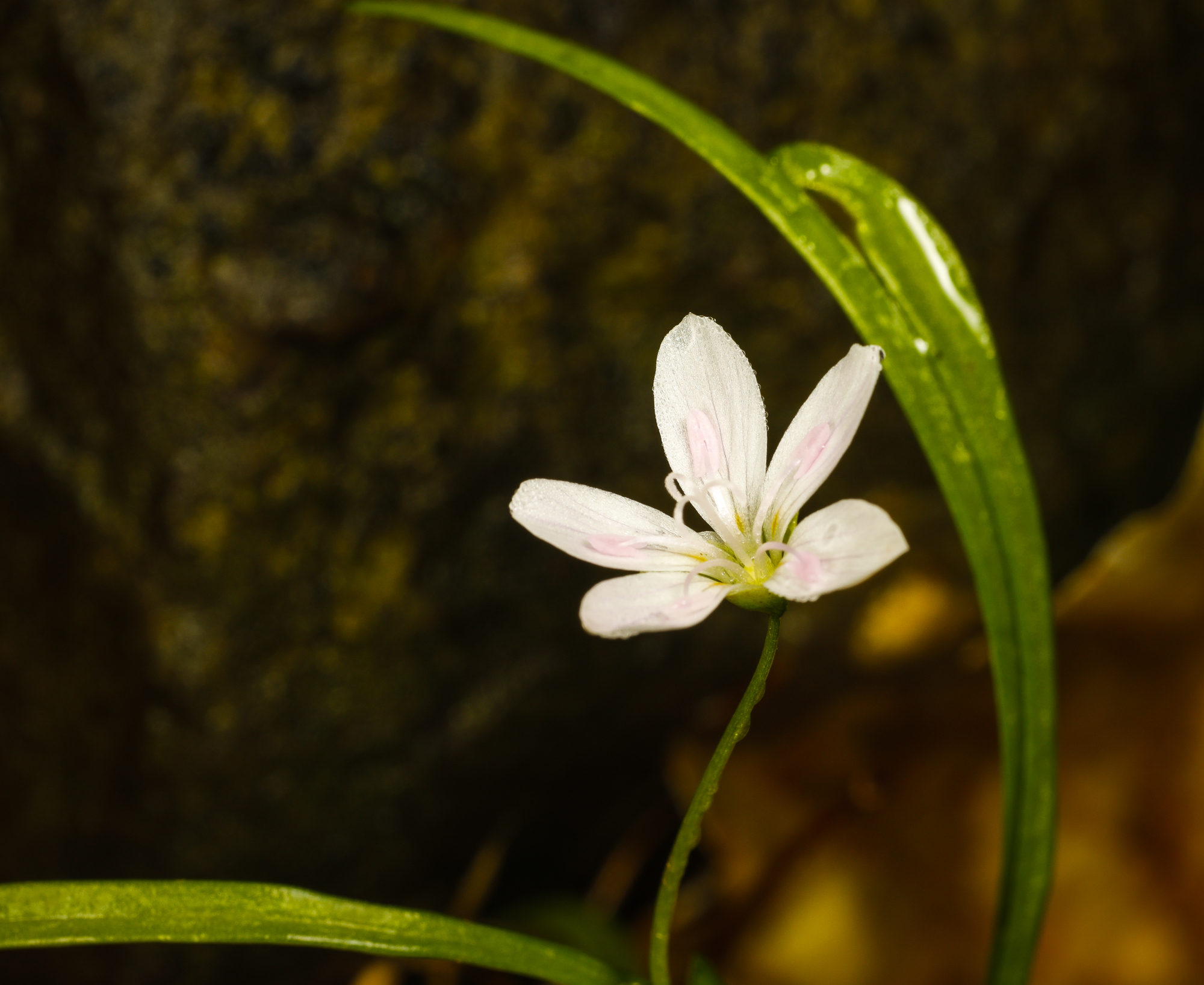
Spring beauties have been blooming for several days now, but are mainly closed today in the cold.
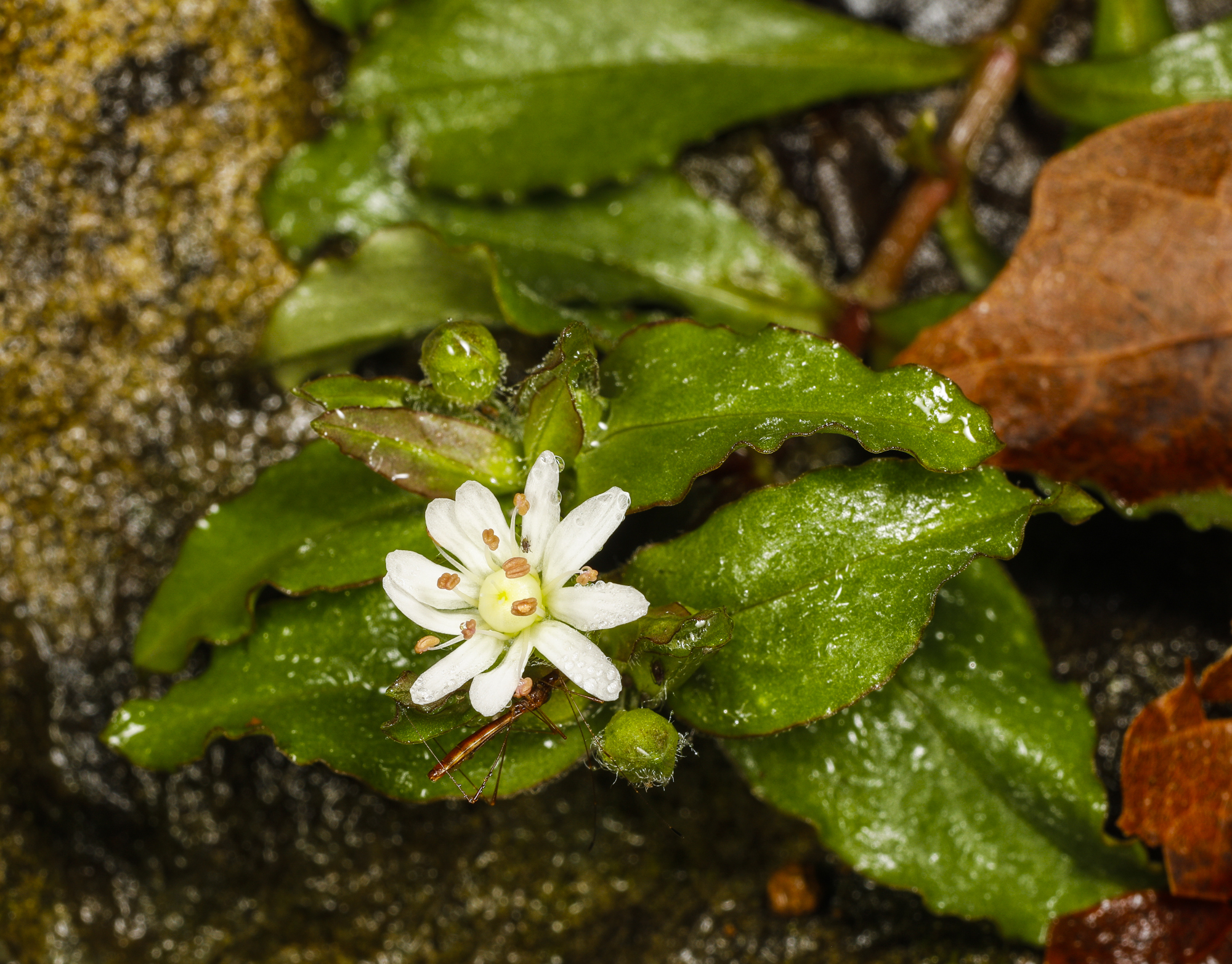
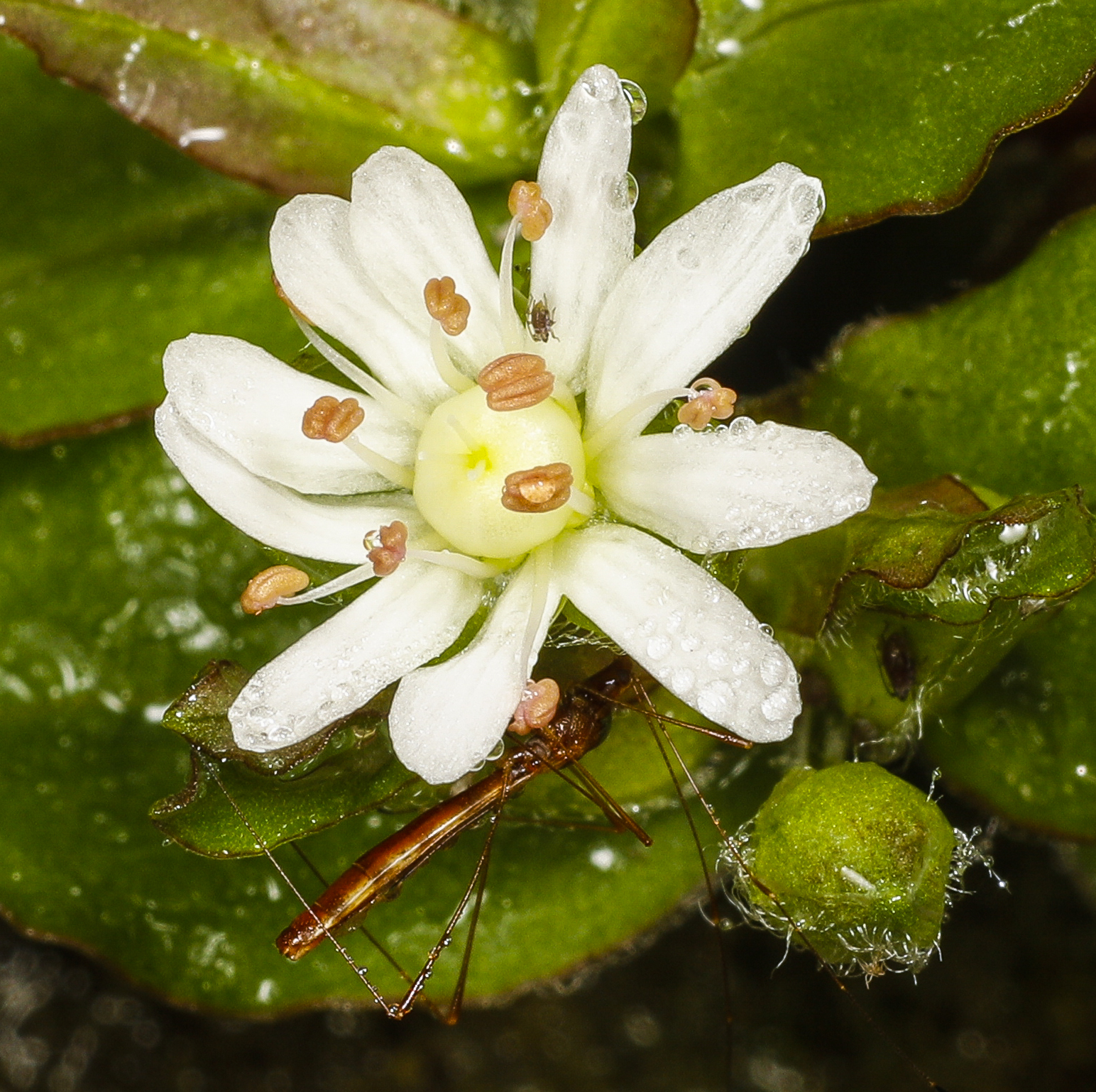
The first giant chickweed flower of the season.
When I looked at the image on the computer, I noticed a couple of insects I had missed while taking the photo.
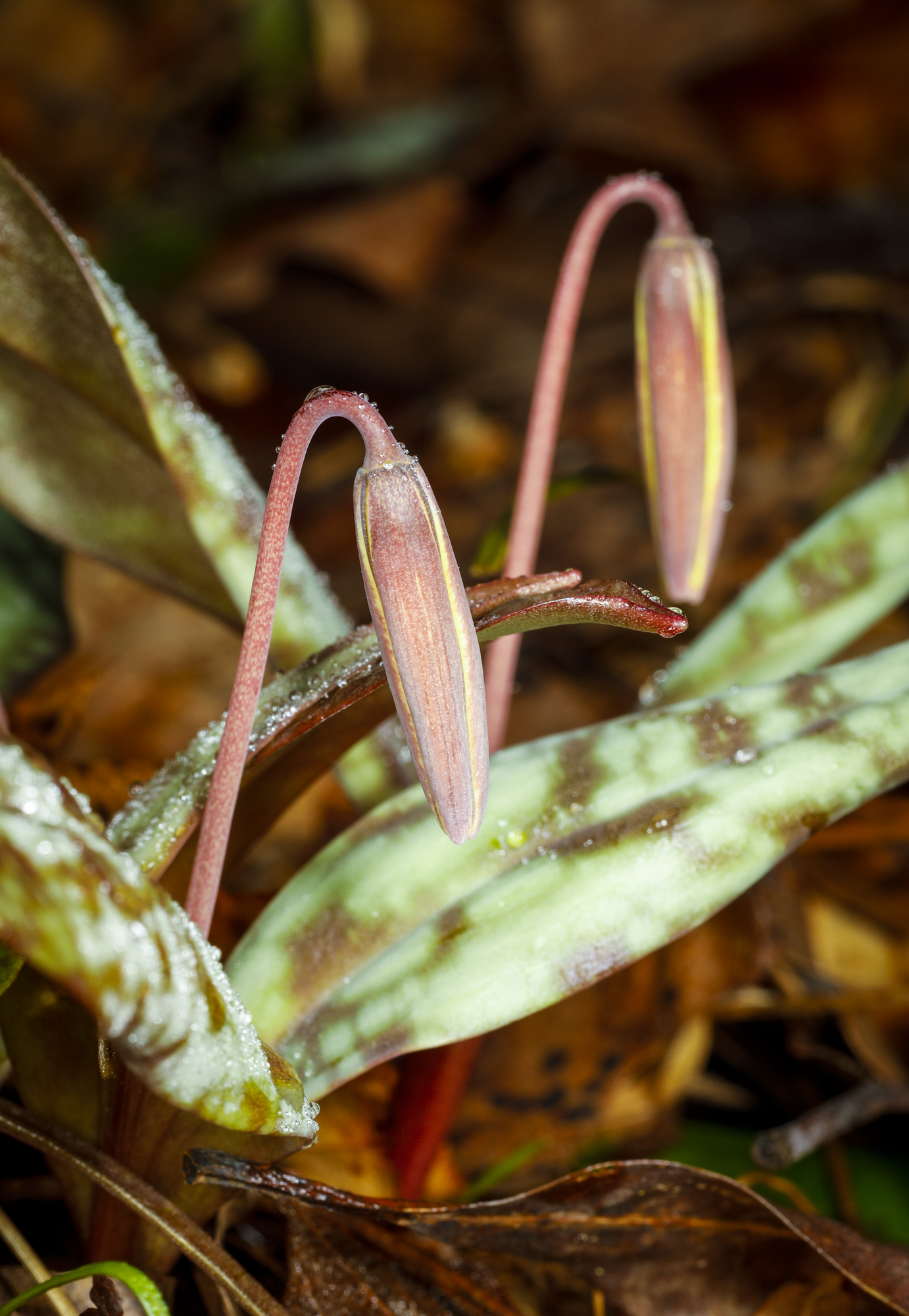
Trout lily flower buds on our north-facing slope are a bit behind those in some other woodlands in the area.
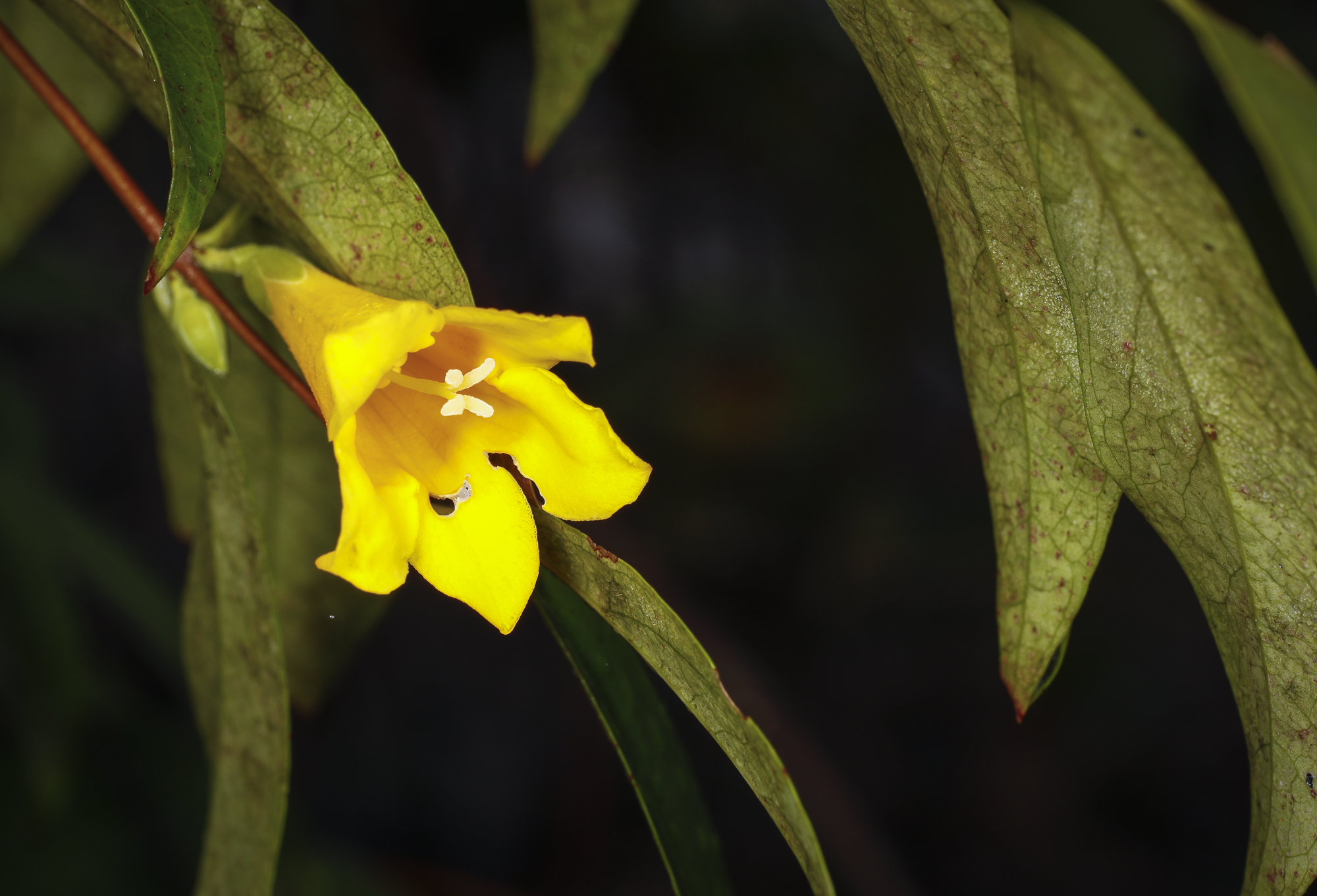
A yellow jessamine flower. This is the first year (after climbing a dead snag a few years ago) that this vine has flowered.
Oh winter! One never, never loses the surprise and wonder of new fallen snow…
~Emily Carr
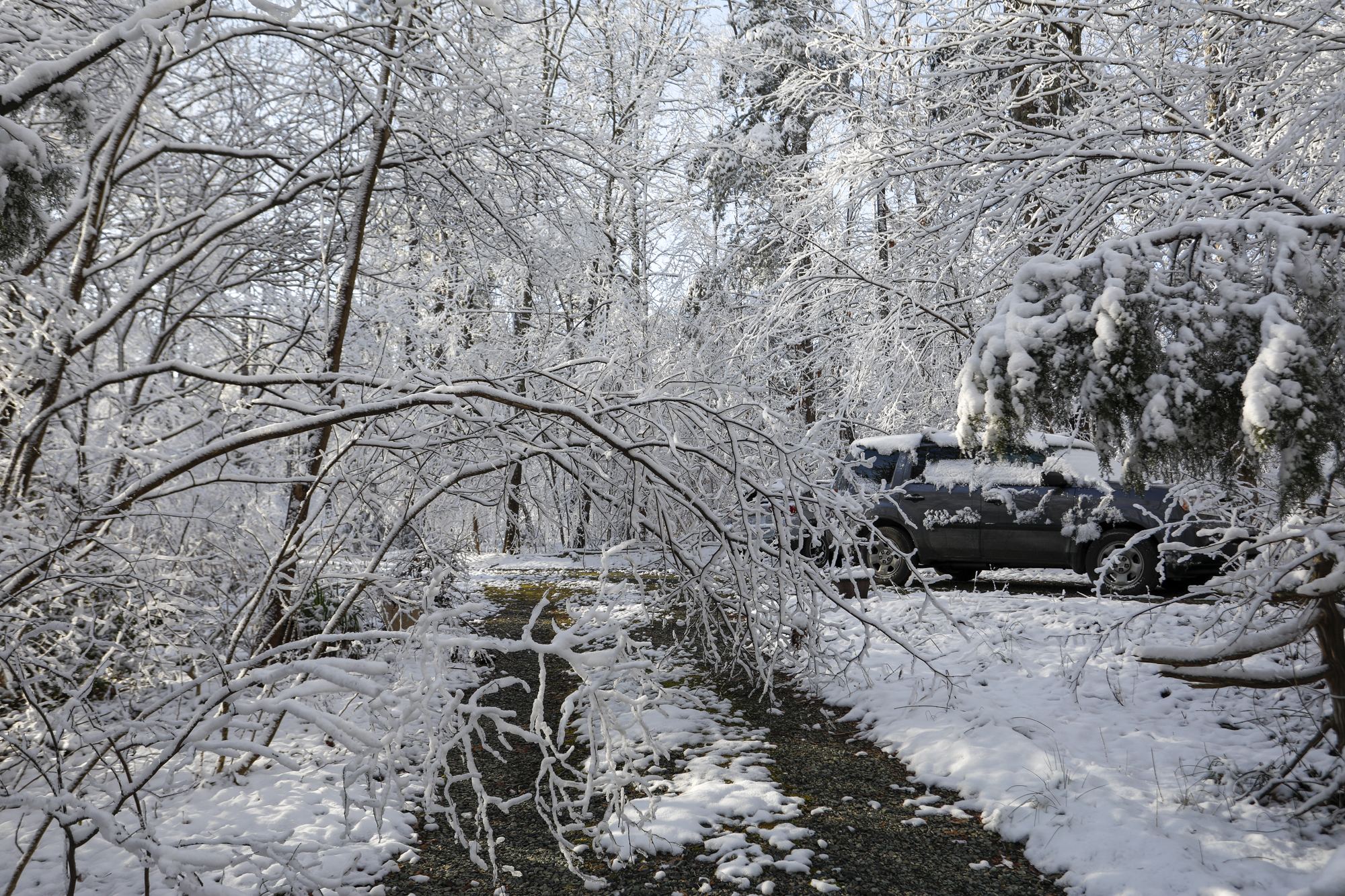
And surprise it was….they predicted it, and it actually snowed! That has been an unusual happening in these parts for over 450 days (I believe I heard the last measurable snow fall in central North Carolina was about 469 days ago). It started about 3 p.m. Thursday and lasted well into the night. The other surprise was how it affected the trees – it was a wet heavy snow with temperatures dropping rapidly, so ice built up on delicate tree limbs. By Friday morning, it looked as though all our small trees were bowing to the snow gods.
The view of the lower driveway with trees bending across the road (click photos to enlarge)
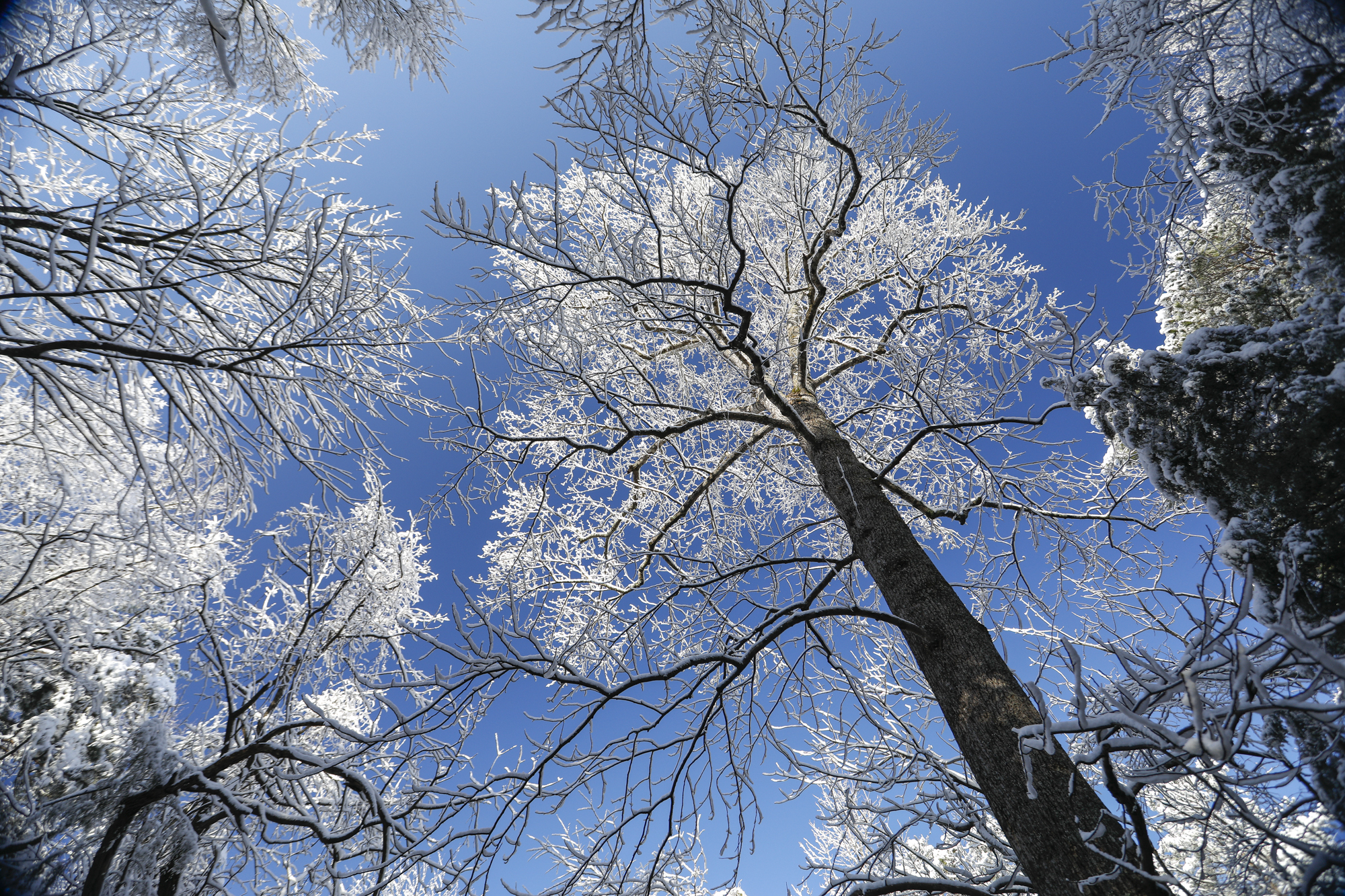
Brilliant white branches against a bright blue sky.
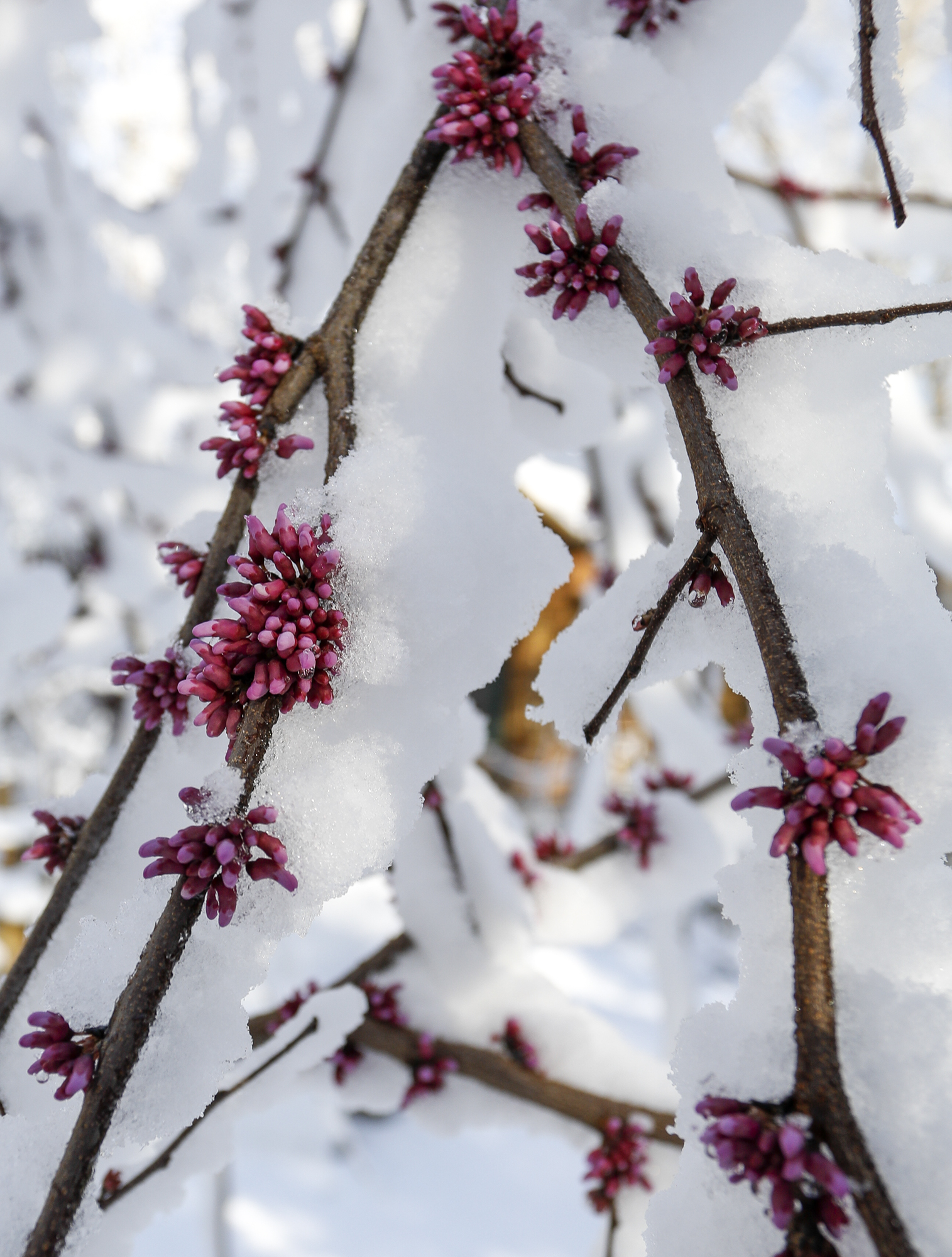
The redbud trees took a hit with several having split trunks or falling over due to the weight of the snow.
With such cold temperatures (in the 20’s) and a crust of frozen snow on most surfaces, the birds were busy at the feeders out back. I sat for a couple of hours watching their comings and goings before I just got too cold and had to retreat.
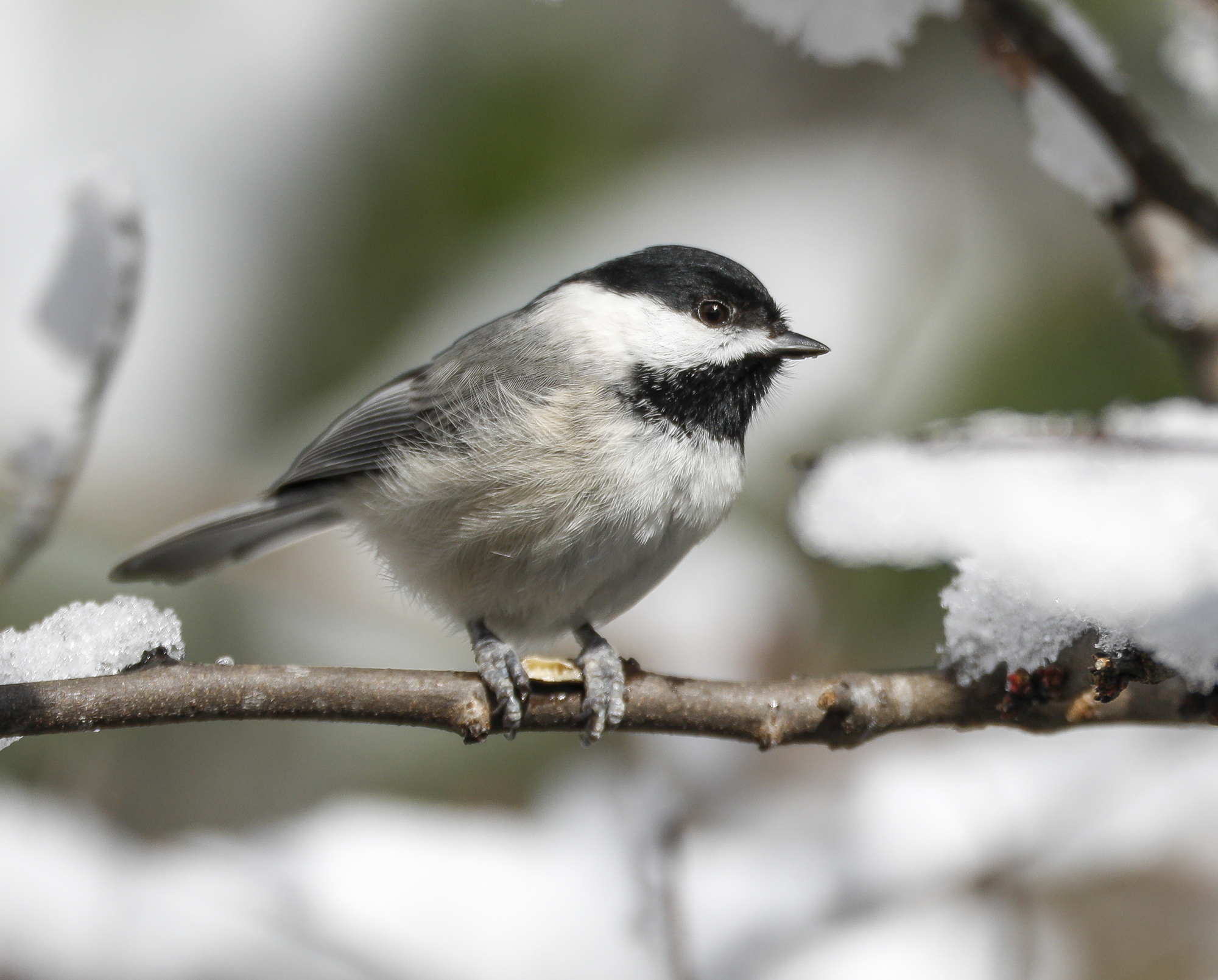
Carolina chickadee with a freshly hulled sunflower seed between its feet.
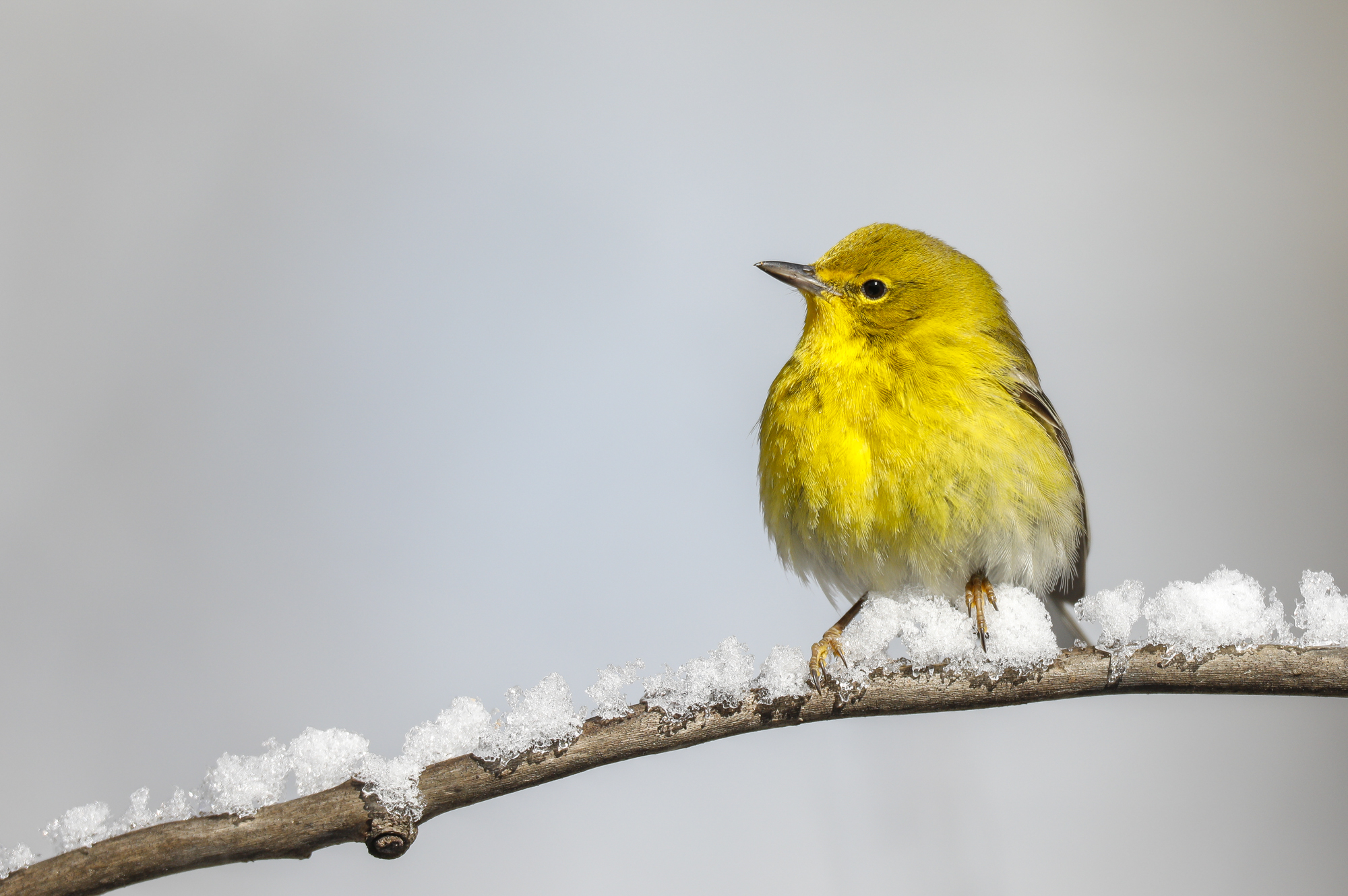
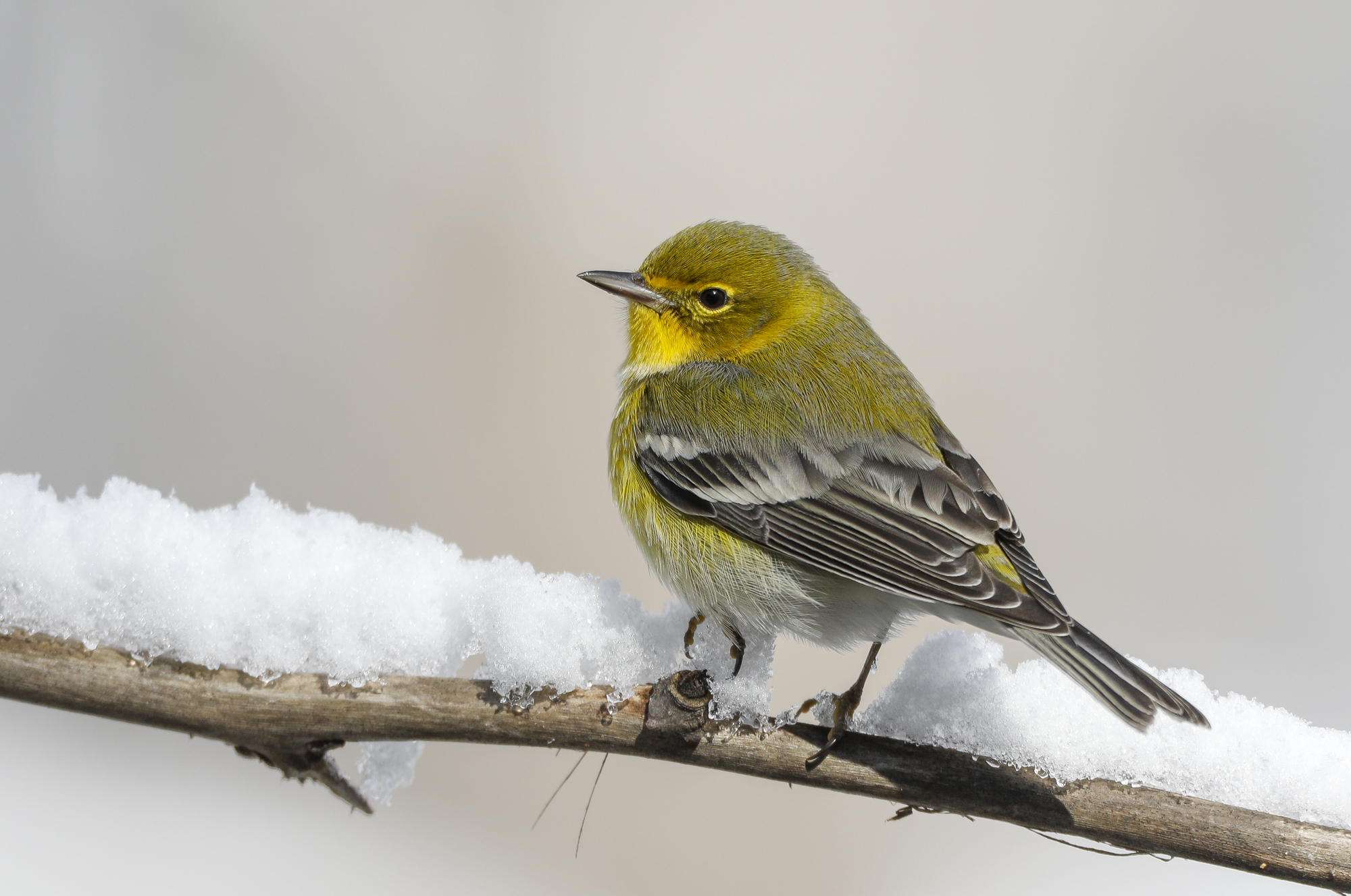
The most abundant birds I saw around the feeding station were pine warblers. They are the most common warbler we see in this area in winter (most warblers migrate out of our area to warmer climates). They can be found at both seed feeders (another unusual trait for a warbler) and suet (the latter is the preferred feeder here). They tended to come into the feeders in groups (typical behavior of winter feeding flocks) and exhibited quite a bit of aggressive interactions at times. I never managed to grab an image as a pair engaged in their brief battles where they fly up against one another, lock beaks, and spiral downward before releasing and chasing one another. I guess it is always good to have higher goals in life…
One of several pine warblers that stayed busy at the suet feeder. This one is waiting its turn as a more aggressive one is feeding.
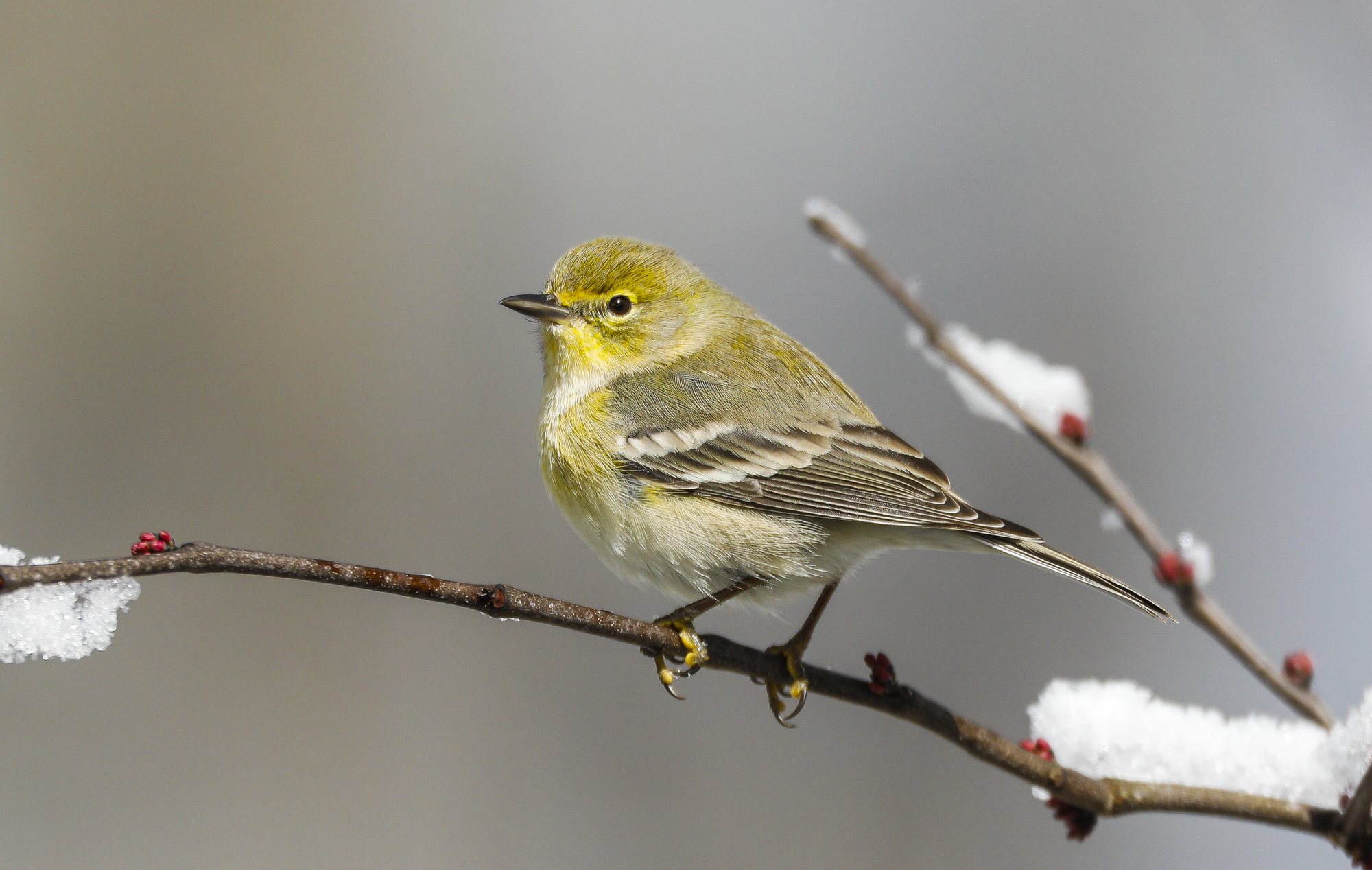
A brightly colored male pine warbler looking his best in the snow.
I appreciated the opportunity to take in the subtle differences in color of the pine warblers.
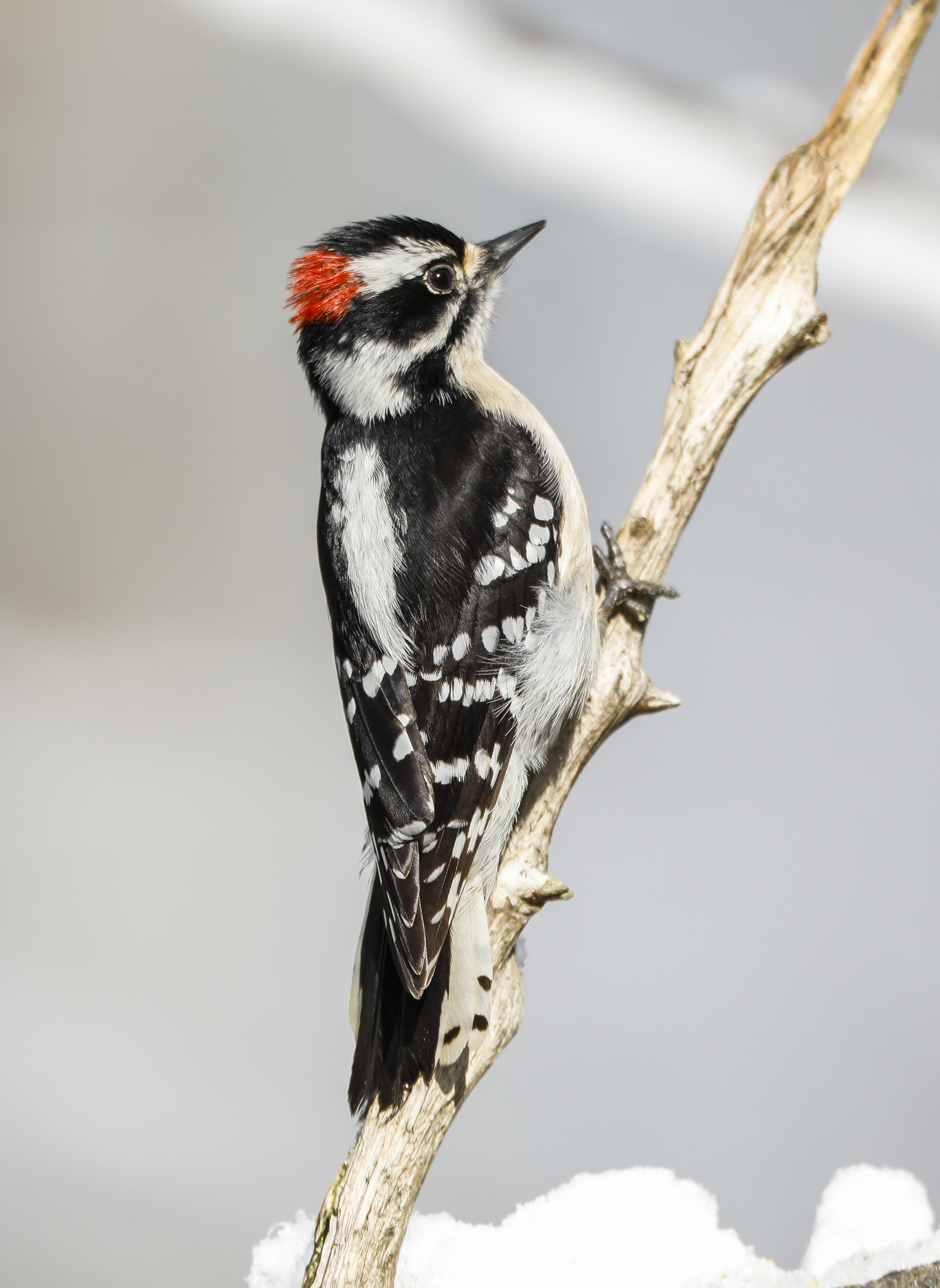
This downy woodpecker is a bit aggravated that the pine warblers are hogging the feeder.
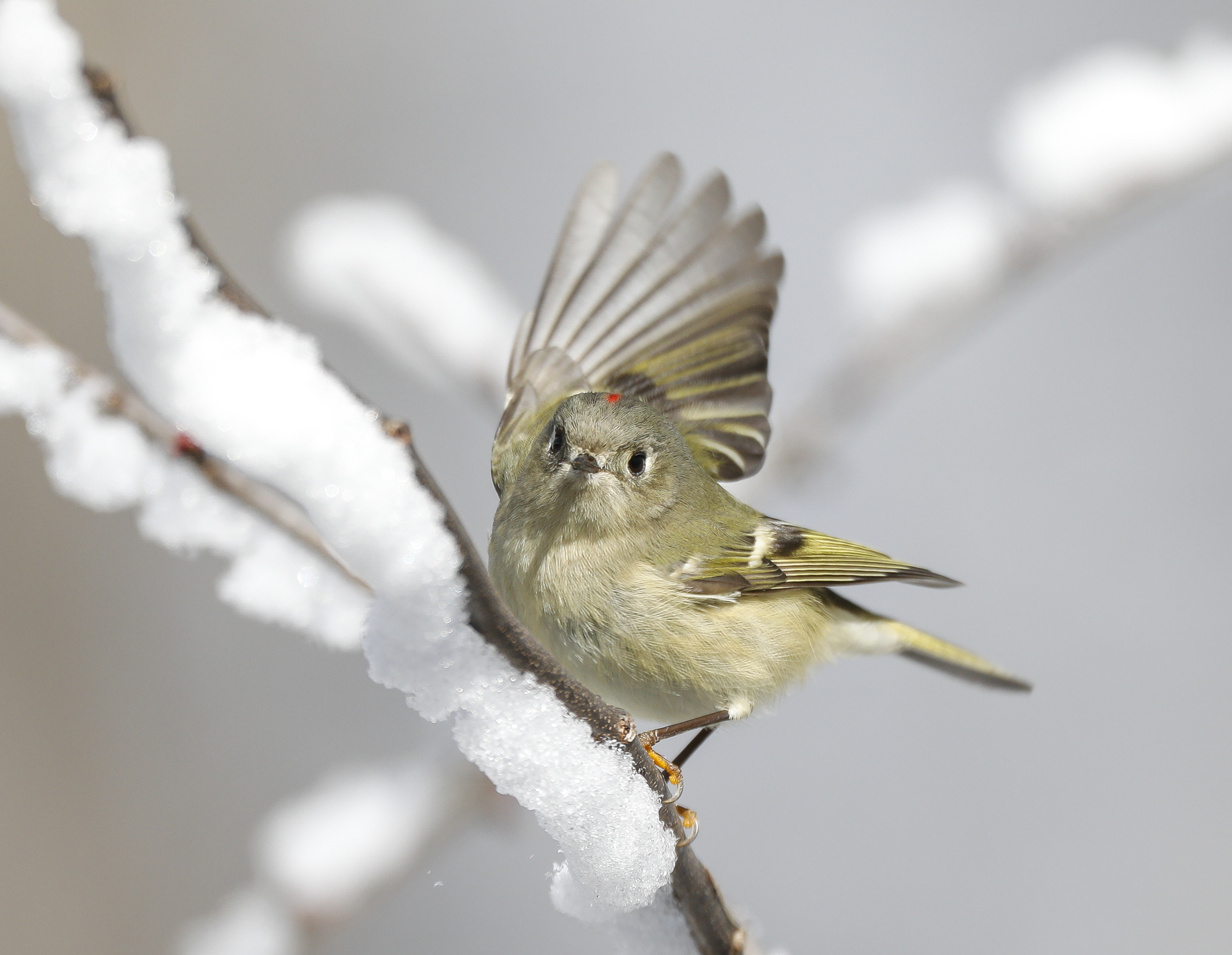
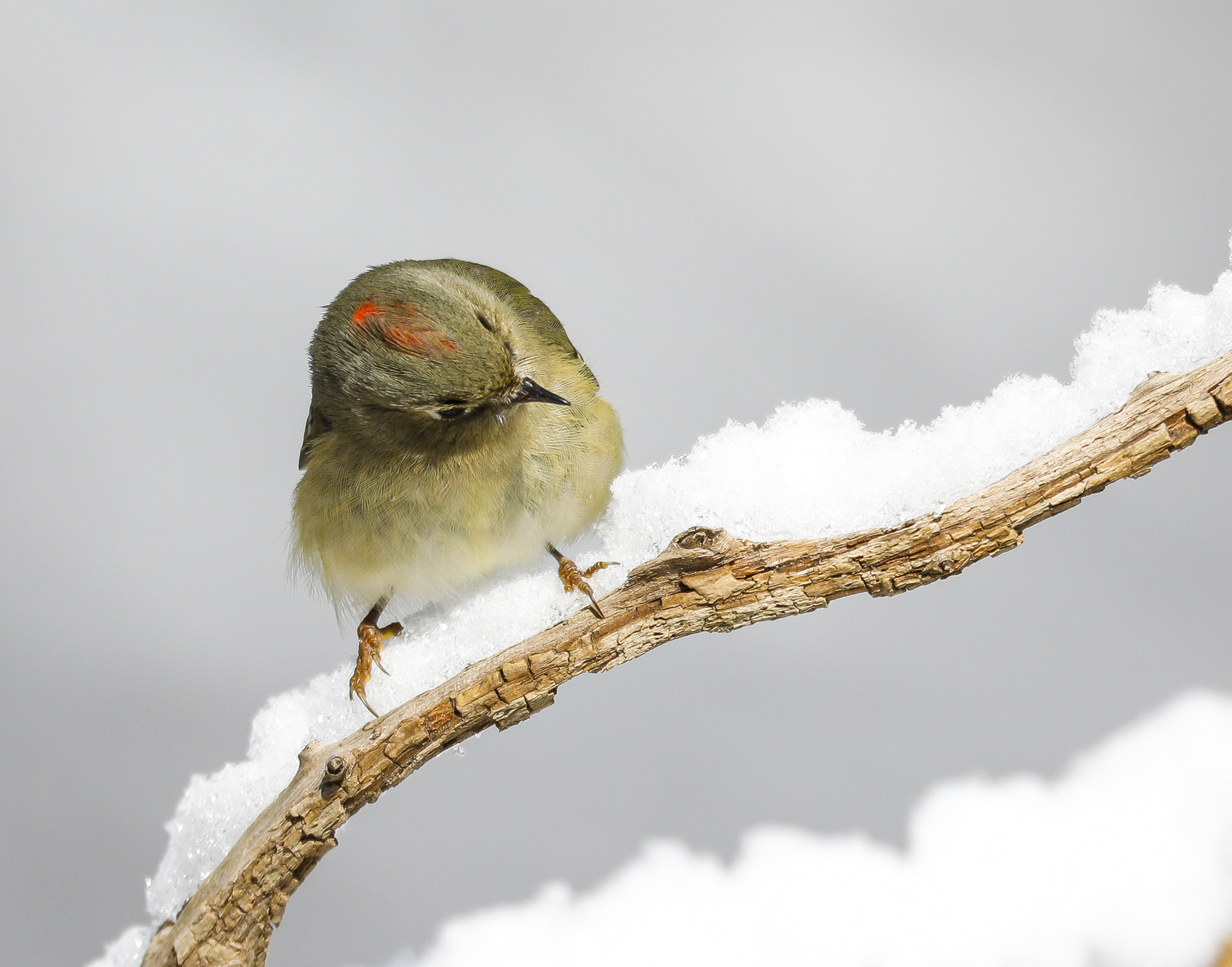
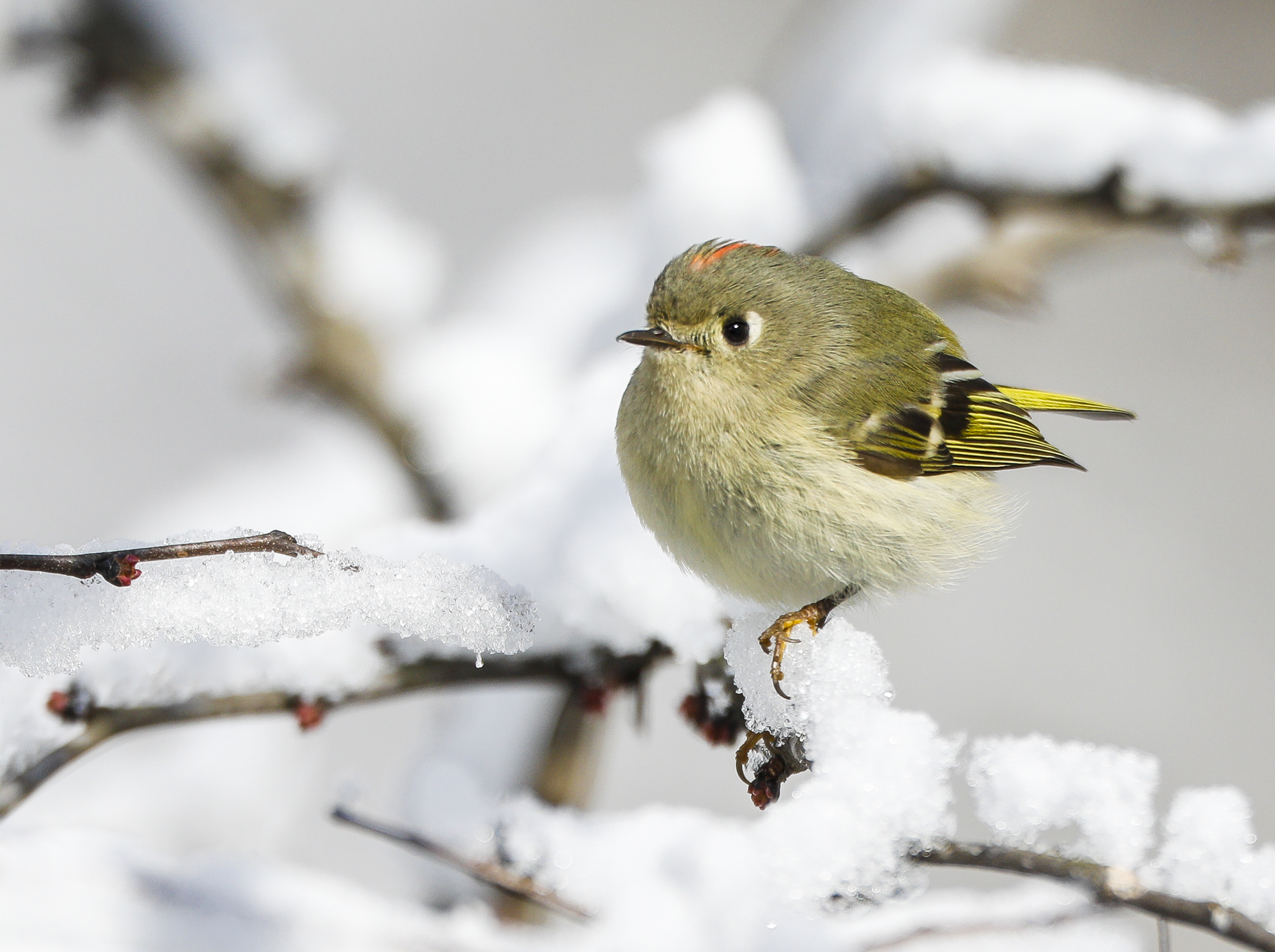
The most difficult subject to photograph – a constantly moving ruby-crowned kinglet.
Though I saw it many times, I never captured the full extent of his ruby crown when he was agitated because he just would not sit still long enough.
Still one of my favorite winter birds in spite of (or maybe because of) his high speed antics.
The snow is stubbornly clinging here on our north-facing slope, but temperatures are supposed to rise to 50 degrees later today, so I imagine it will all be a memory by tomorrow. Snow in the Piedmont is an excellent metaphor for life – enjoy it while you can.













 Roads End Naturalist