No matter how long the winter, spring is sure to follow.
~Proverb from Guinea
It has been a busy couple of weeks, both at the office, and in the Garden outside. Temperatures have swung widely – 60+ degrees a couple of days ago, a nice fire in the fireplace last night, a pretty typical February in North Carolina. But the natural world has its own schedule, its own to-do list. It starts start slowly, and then erupts – it is the arrival of spring. One of the first signs is an auditory one. On one of the warm mornings last week, I noticed birds starting to sing (especially the Northern cardinals, Carolina wrens, and Eastern bluebirds).
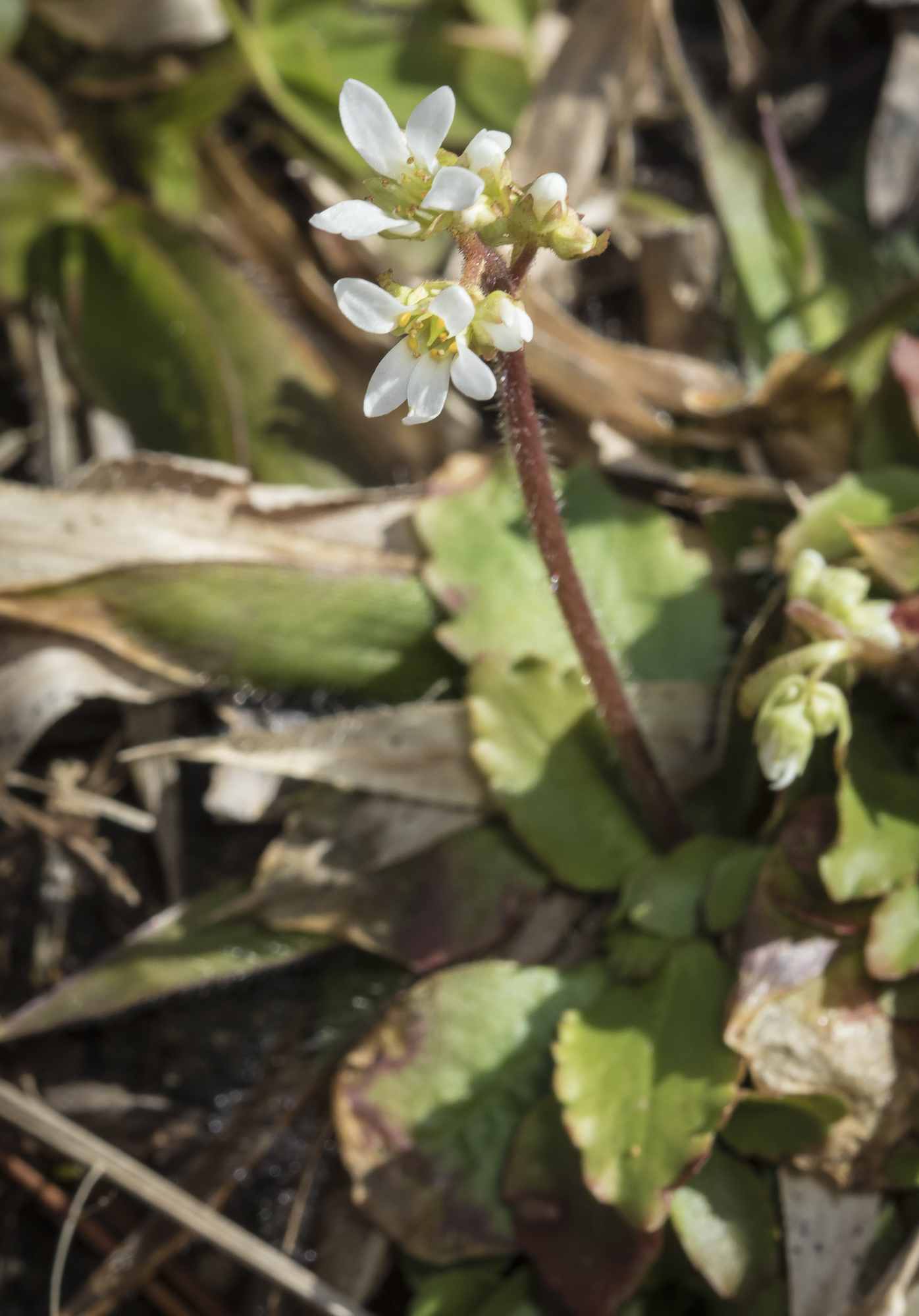
Early saxifrage in bloom at the NC Botanical Garden (click photos to enlarge)
The first wildflowers of the season make a quieter appearance. Early saxifrage, Micranthes virginiensis, is easy to miss when walking the paths at the Garden, my mind full of things to check off my to-do list. Luckily, someone alerted me to the first flowers, but I still had to look hard to find them. The generic name means small flower. an appropriate name for a a plant with tiny white flowers less than 1/2 inch across. Ironically, the common name, saxifrage, bestows a more powerful status to these tiny plants. It means stone breaker. Many species of saxifrage are plants of rock outcrops, with the tiny plants often nestled in soil deposits of the cracks and crevices of boulders. People once believed these plants to be responsible for the splits in the rocks where they grew.
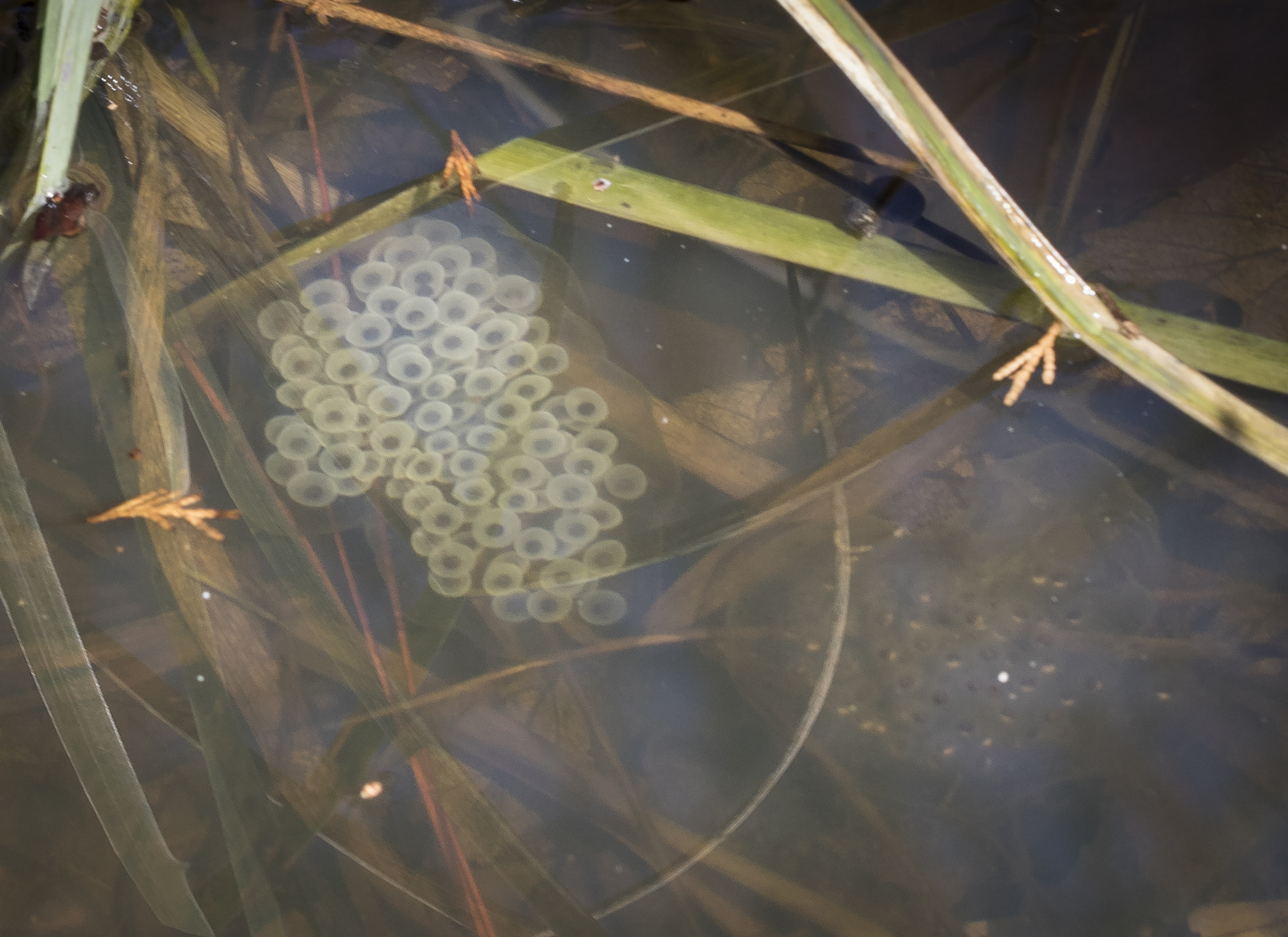
The first spotted salamander egg masses of the season
Some early spring amphibians are also on the move as the days lengthen. The first spotted salamander egg masses appeared in the pools at the Garden and in my home woods last week. Not a huge run of salamanders as yet, but a sure sign that warmer weather is on the way.
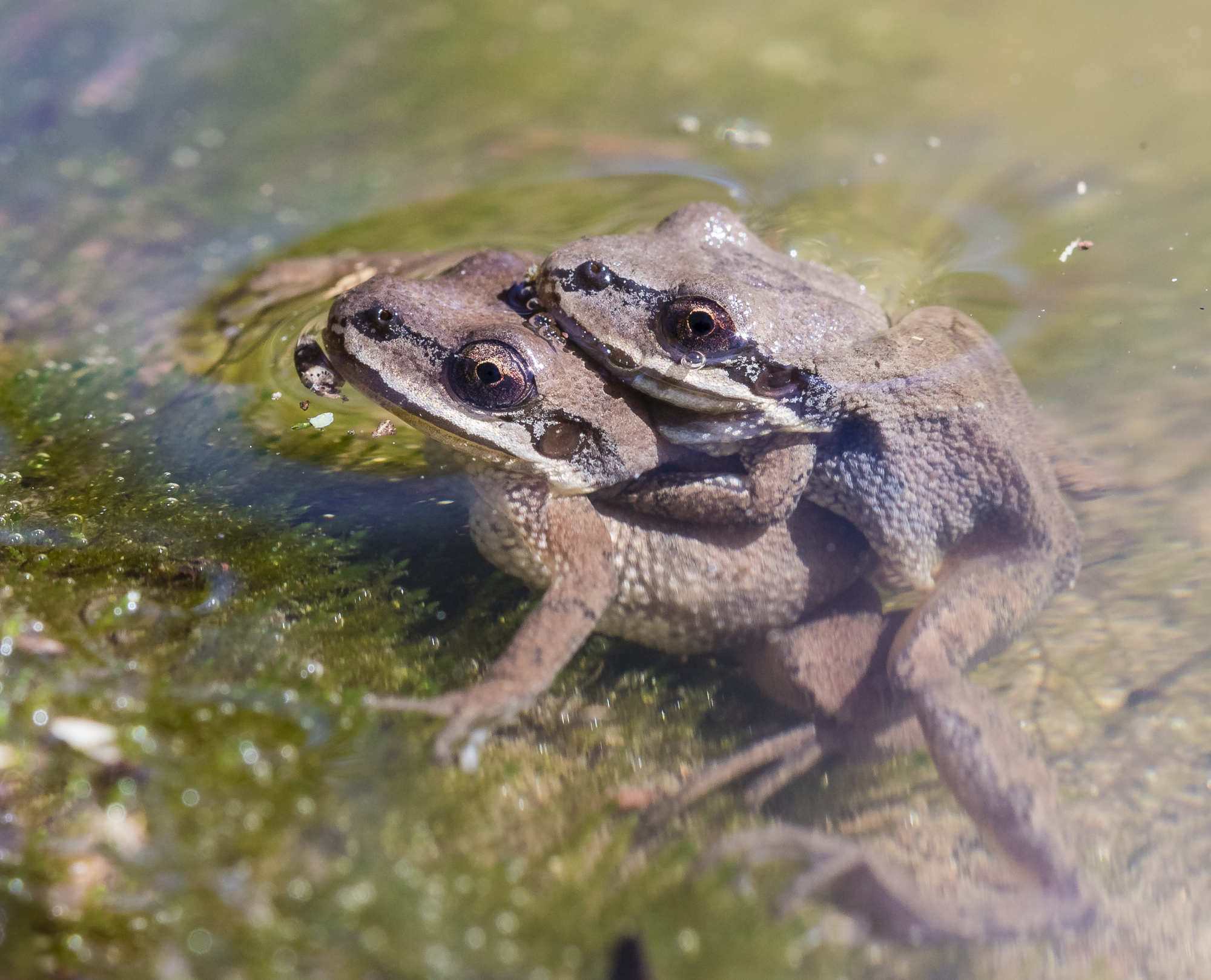
Upland chorus frogs in amplexus
While salamanders and saxifrage can appear without fanfare, the frogs of spring can’t be missed. Last week, we heard the first trills of our earliest frog breeder, the upland chorus frog. Instead of the vernal pool, their favorite dating hot spot last year, they were calling from the artificial “stream” at the back of the herb garden. This species is normally quite shy, and will quickly cease calling as you approach their breeding habitat, disappearing beneath the leaf litter or vegetation in the shallows. But at this location, the water is contained within concrete stream banks with little leaf debris, making it harder for these cryptic callers to vanish. You can usually locate one by a slight ripple in the water when they duck under the surface. Indeed, they all quit calling as I walked over, so I scanned the water’s edge, and found a pair in amplexus (the mating position of frogs and toads, in which the male clasps the female about the back and fertilizes the eggs externally as she deposits them). Unfortunately, I only had my macro lens with me, but I eased closer anyway, hoping to get at least one image. To my surprise, I was able to creep up, kneel down and get a close-up portrait without disturbing them The next evening I could hear more calling as I walked to my car. Then, two nights ago, the first spring peepers of the season were calling in the vernal pool in the woods next to the parking lot. It is coming…the eternal march of the seasons is quickening its pace. Get ready, the great greening of the landscape is not far off.
Yellowstone in the summer changed my life and teaching direction. Revisiting in the winter was like going back to an old friend’s house when all the ‘guests’ have gone home and you get to sit in the den and have long quiet conversations with the residents.
~Mike Leonard, an educator that attended both a summer and a winter field experience in Yellowstone with the museum
I had hoped to go to Pungo yesterday, but the weather had other plans for me. A day trip with all day rain just didn’t seem the thing to do. So, I sat home, did chores, and wished I was someplace else – with Melissa. She is leading a museum trip to our other special place – Yellowstone. Winter is probably my favorite season out there – so quiet, a living Christmas card, and the wildlife spotting is much easier against the snow. And so few people, relative to summer, it’s like having your own private park at times. She has sent a few notes about what they are seeing, and, today, the group heads to my favorite place – Lamar Valley. She said it has snowed every day. Not ideal conditions, since the landscape can seem so vast and sparkling when the sun is out, but not a bad way to spend your days – the softened sounds, the way the world seems to embrace you when it snows, everything (you, the wildlife, the scenery) all draped in a cloak of ever-changing white. And, she has discovered a new favorite thing – cross-country skiing. Guess I had better start getting in shape and practicing my balance for our next visit. As I sat reminiscing of past trips, I decided to share some images from our previous winter adventures to this special place in its special season.
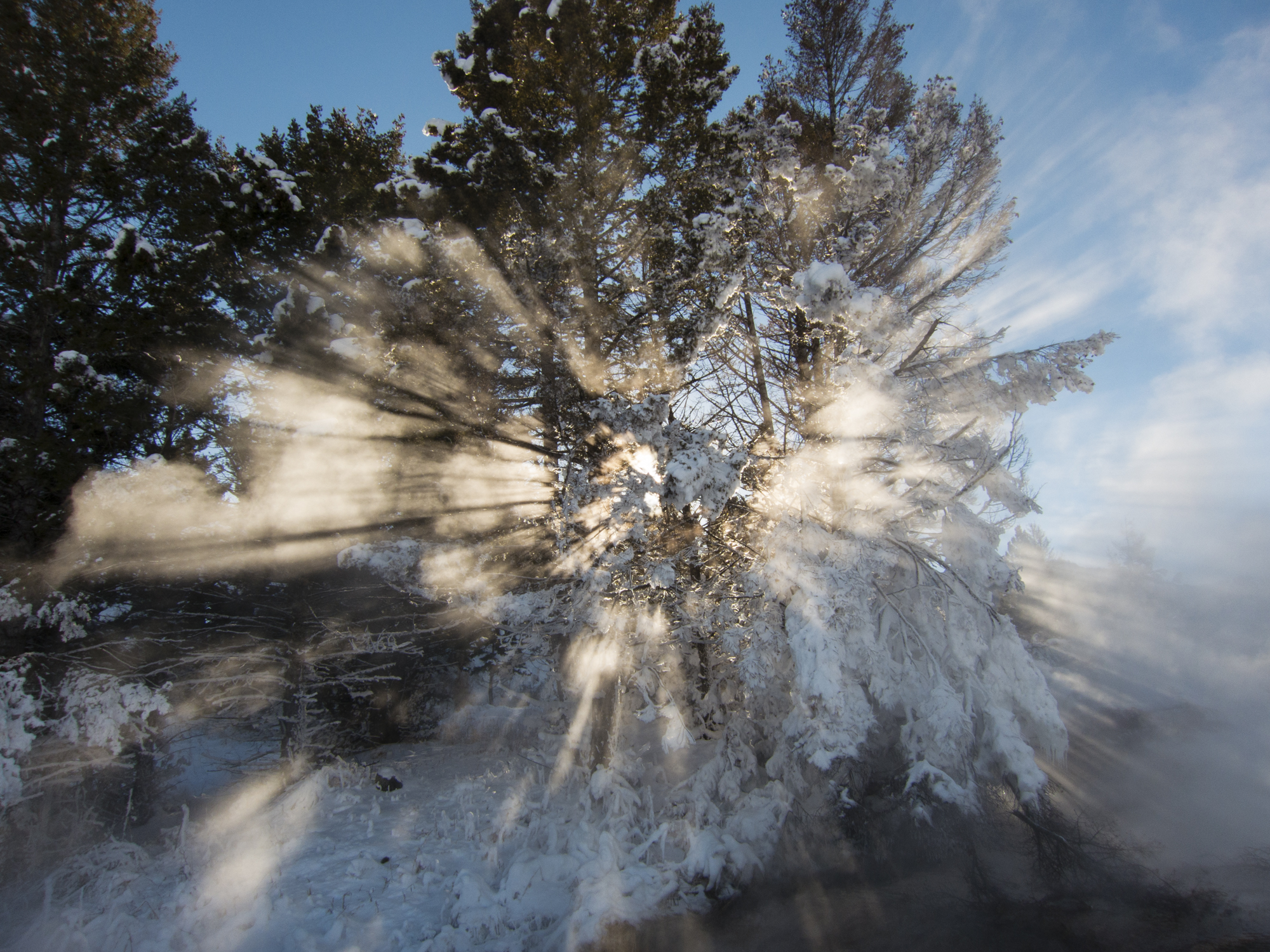
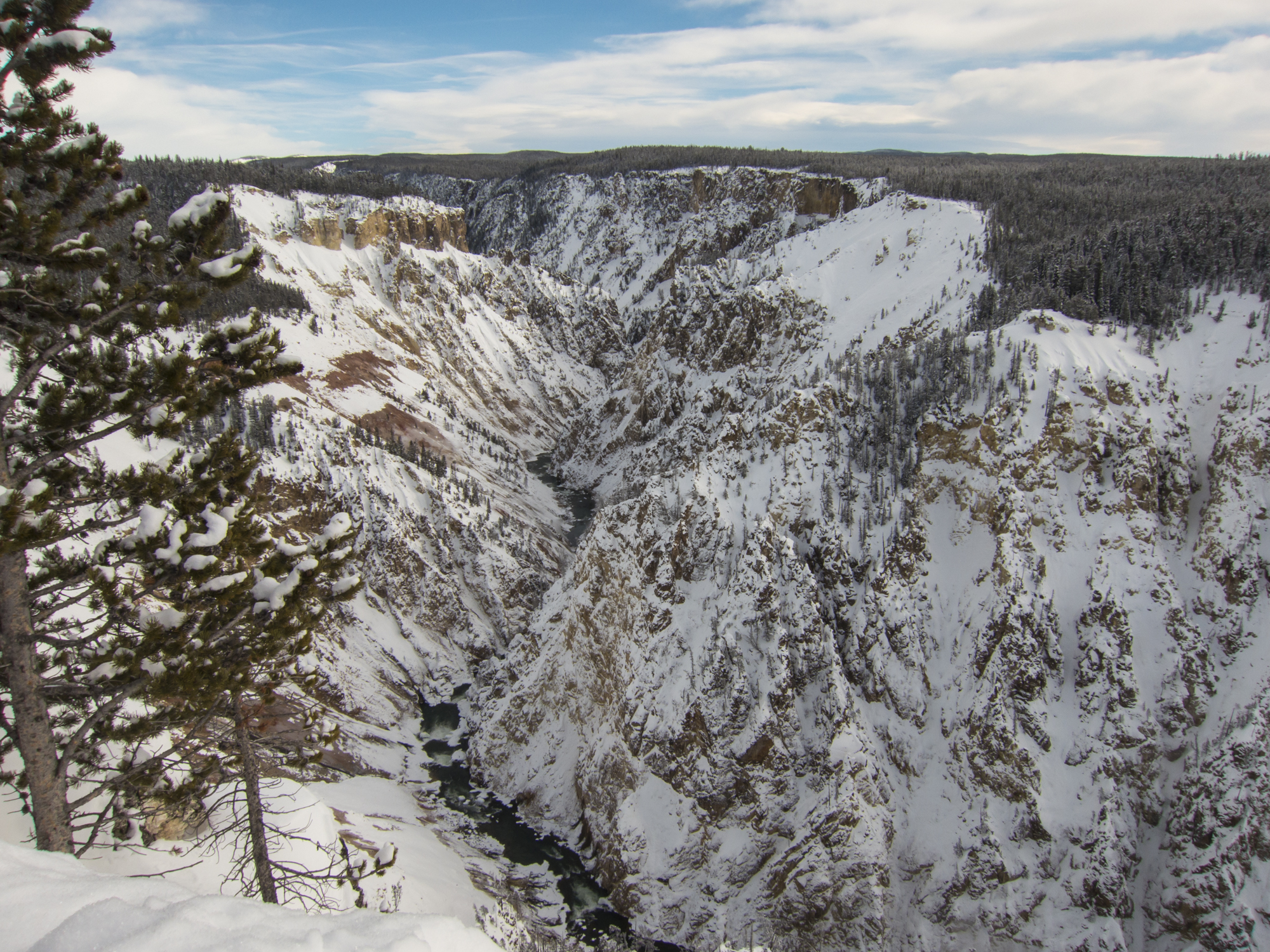
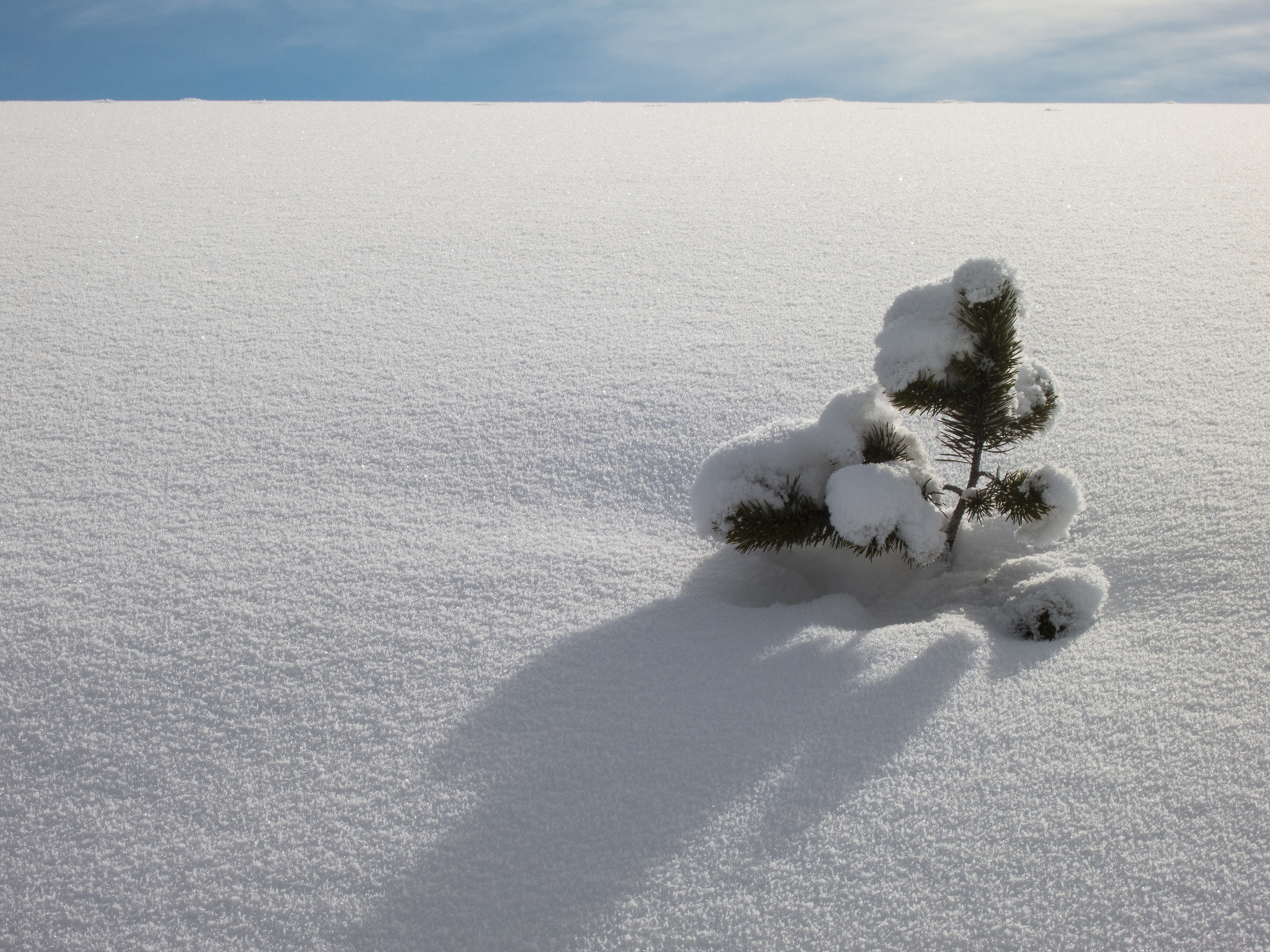
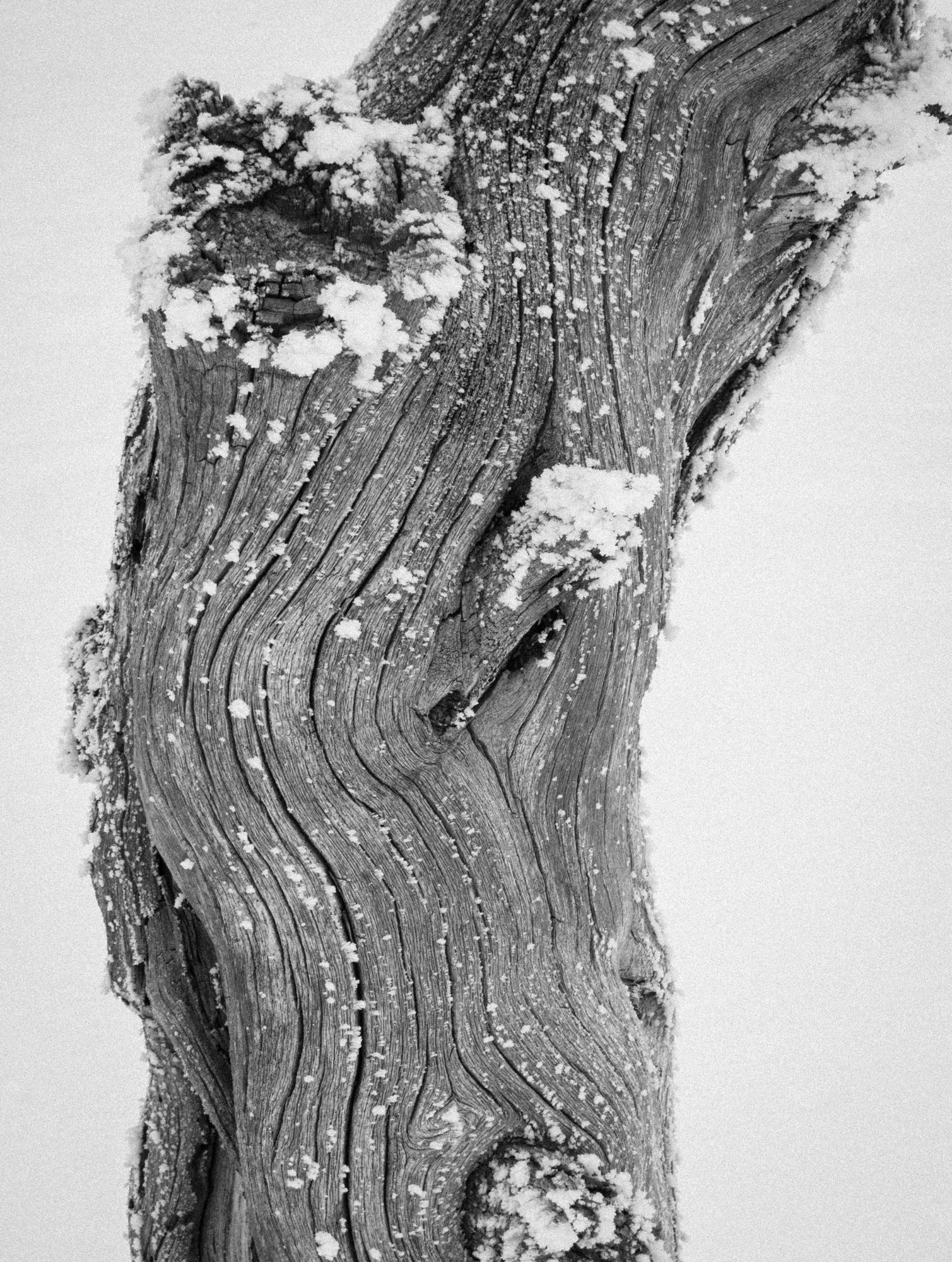
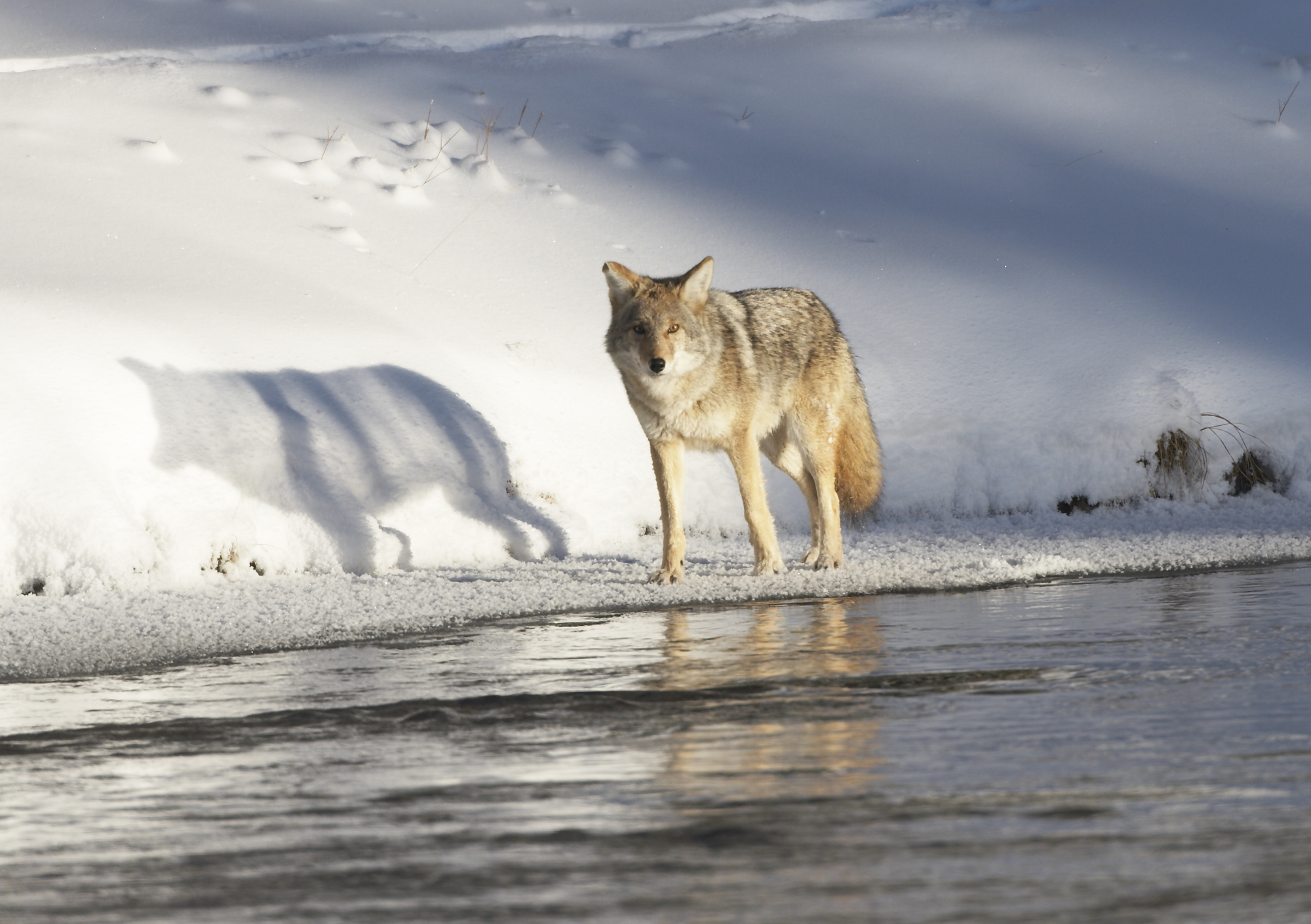
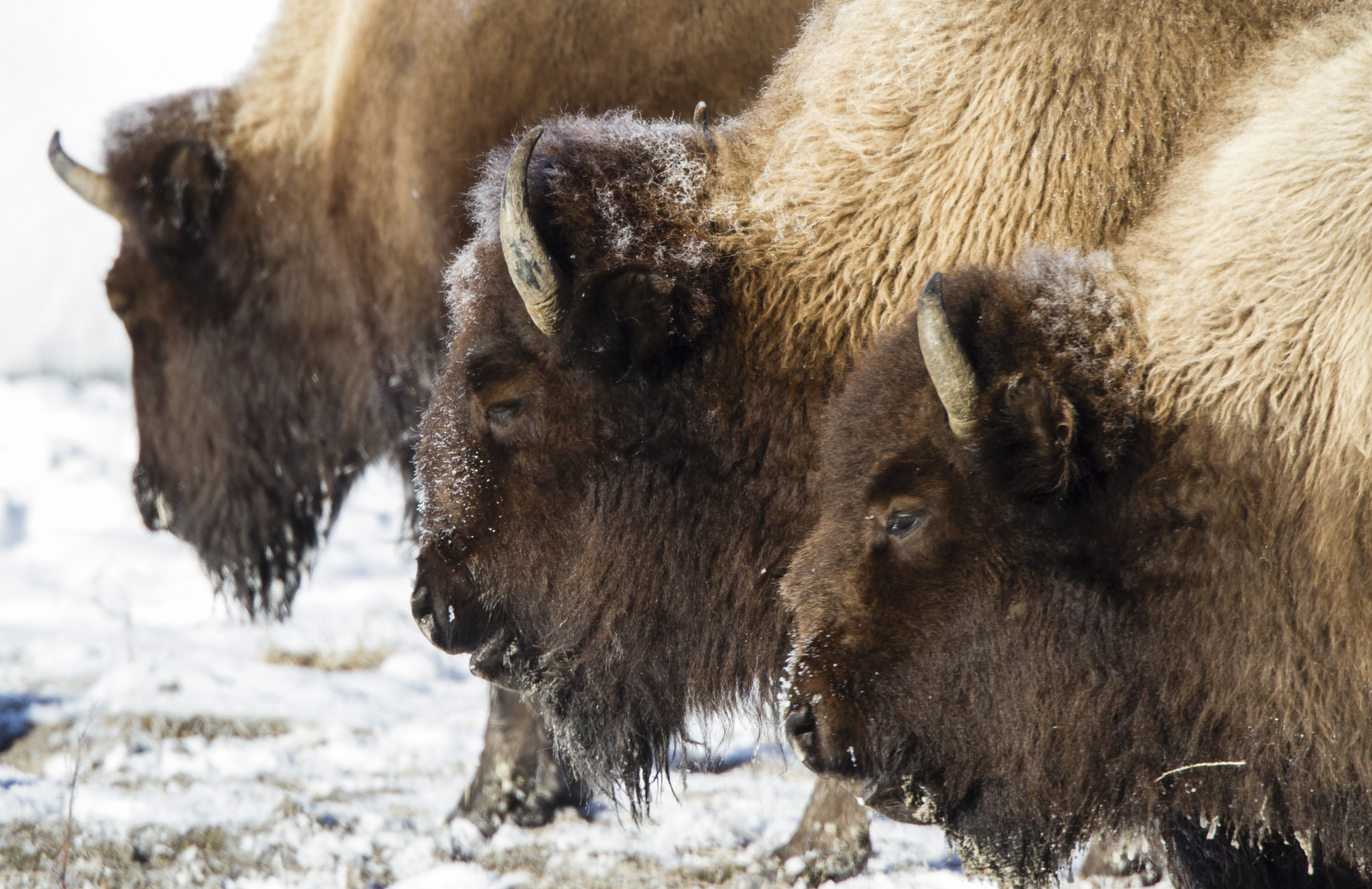
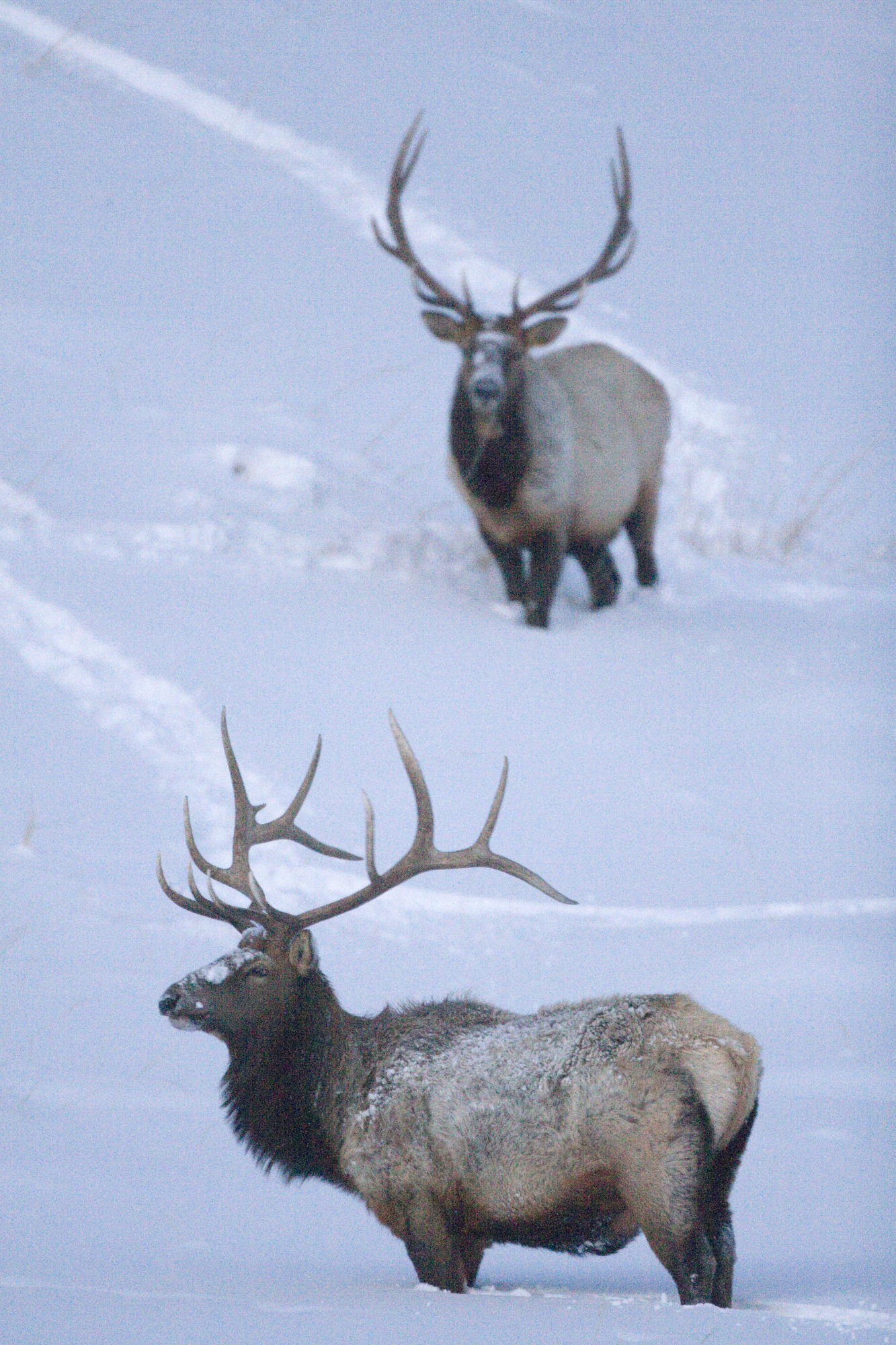
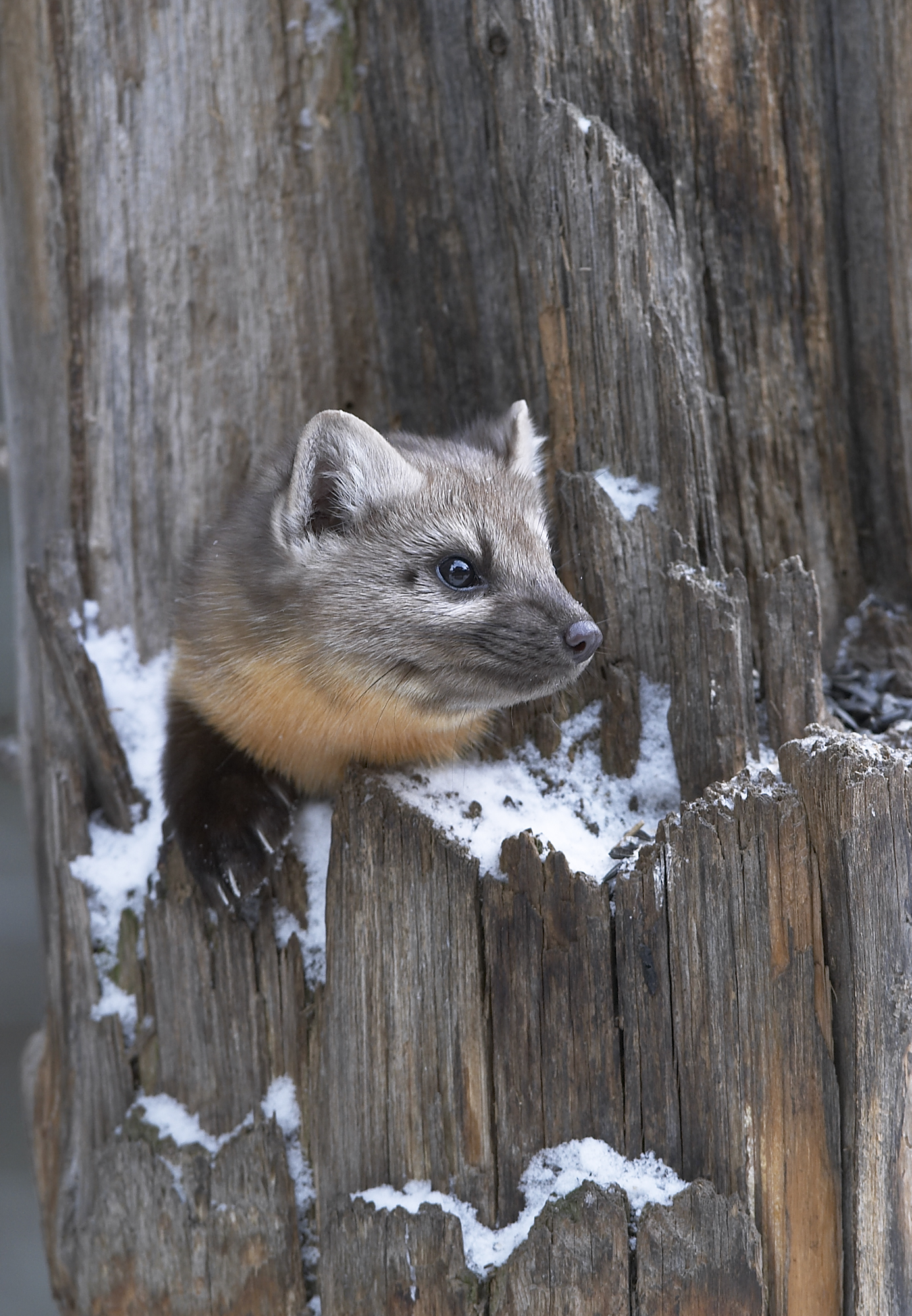
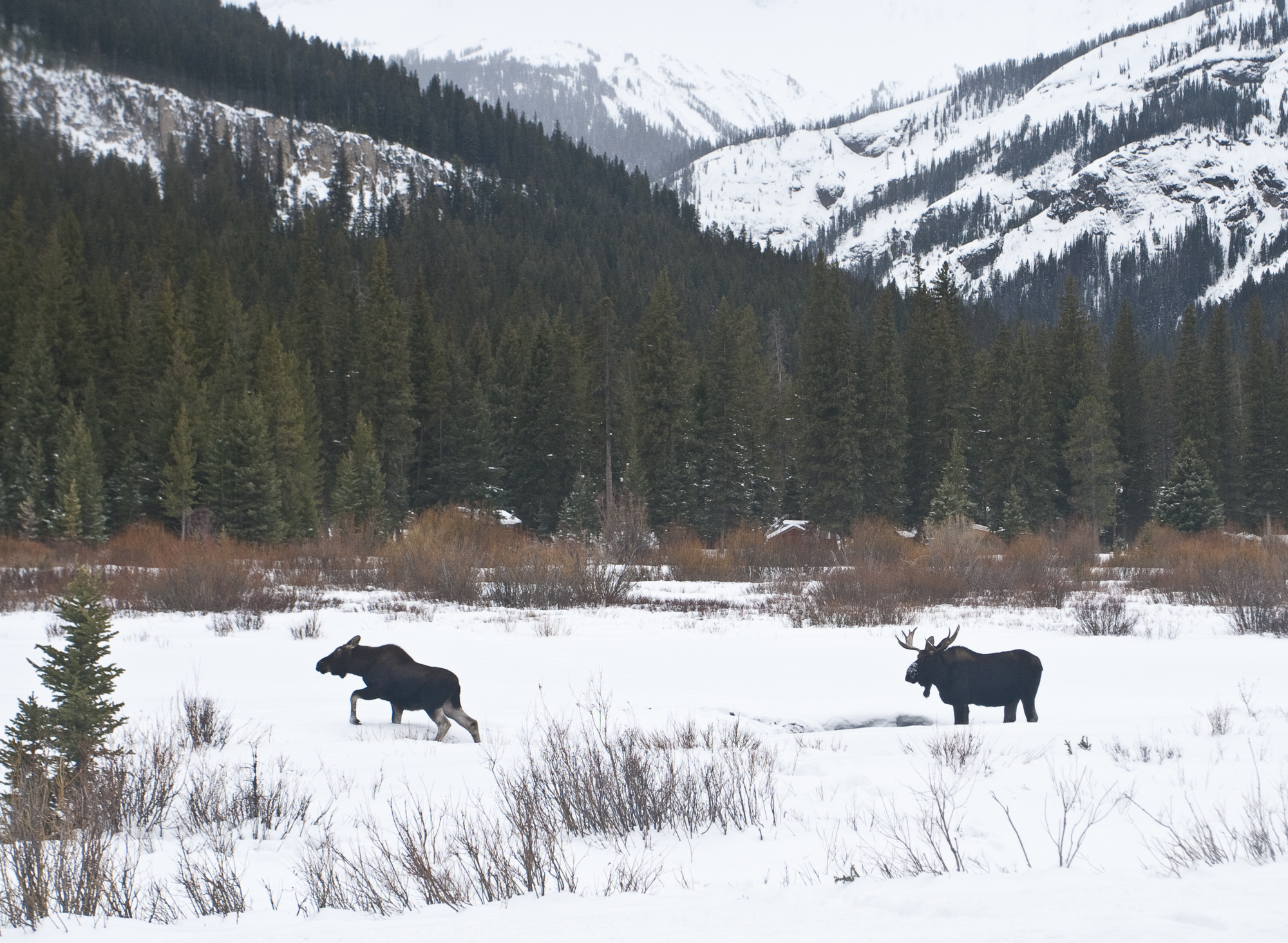
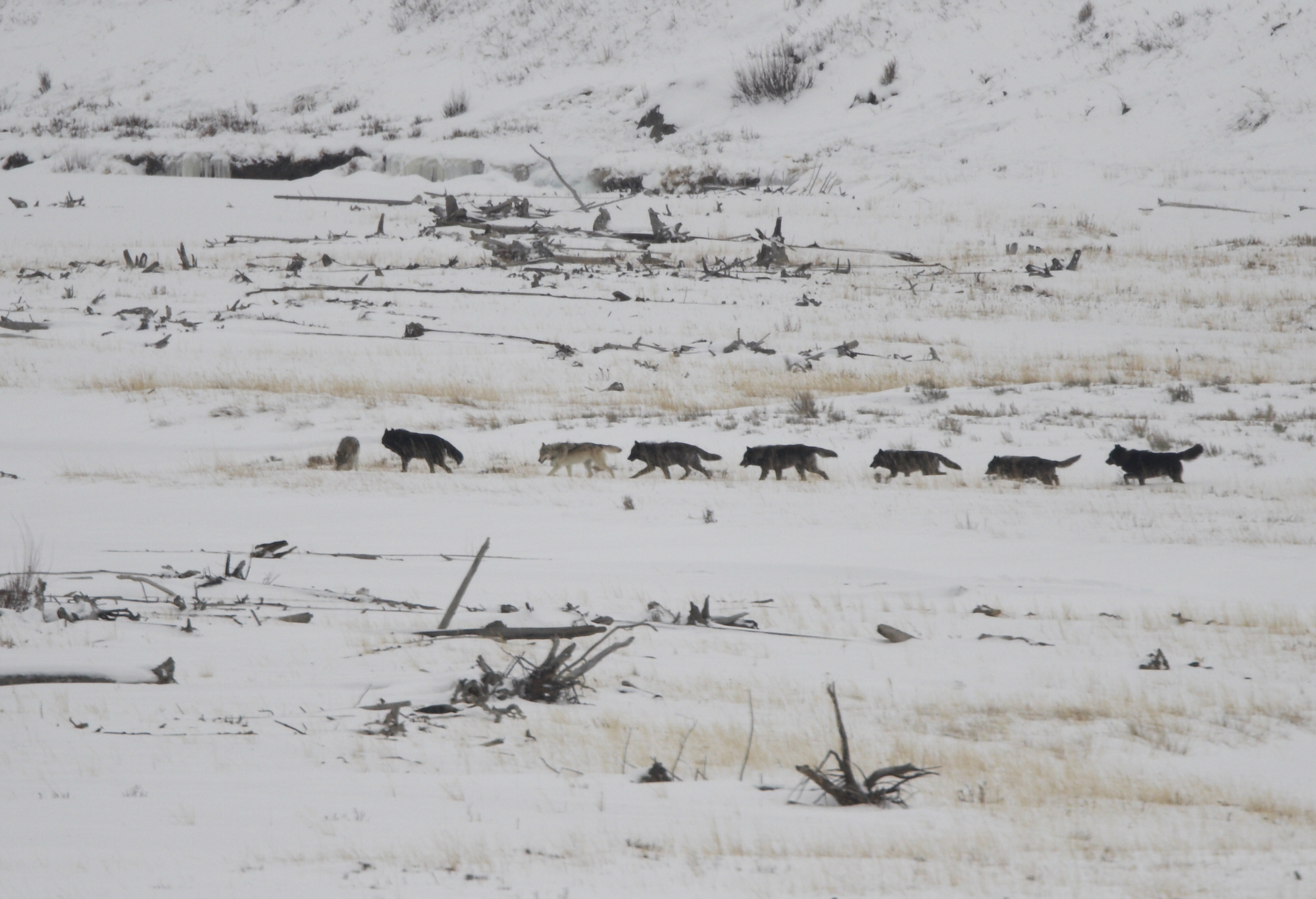
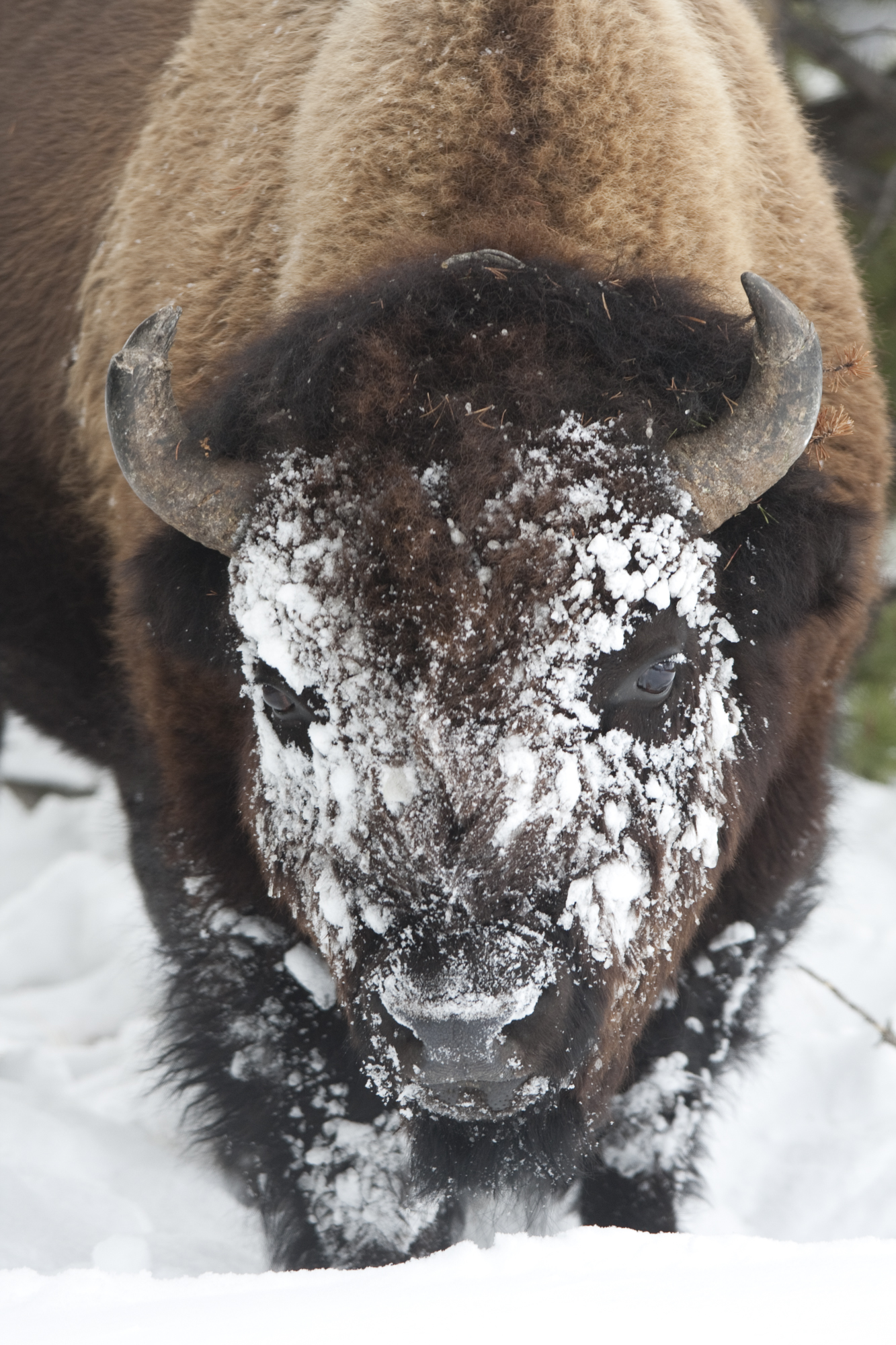
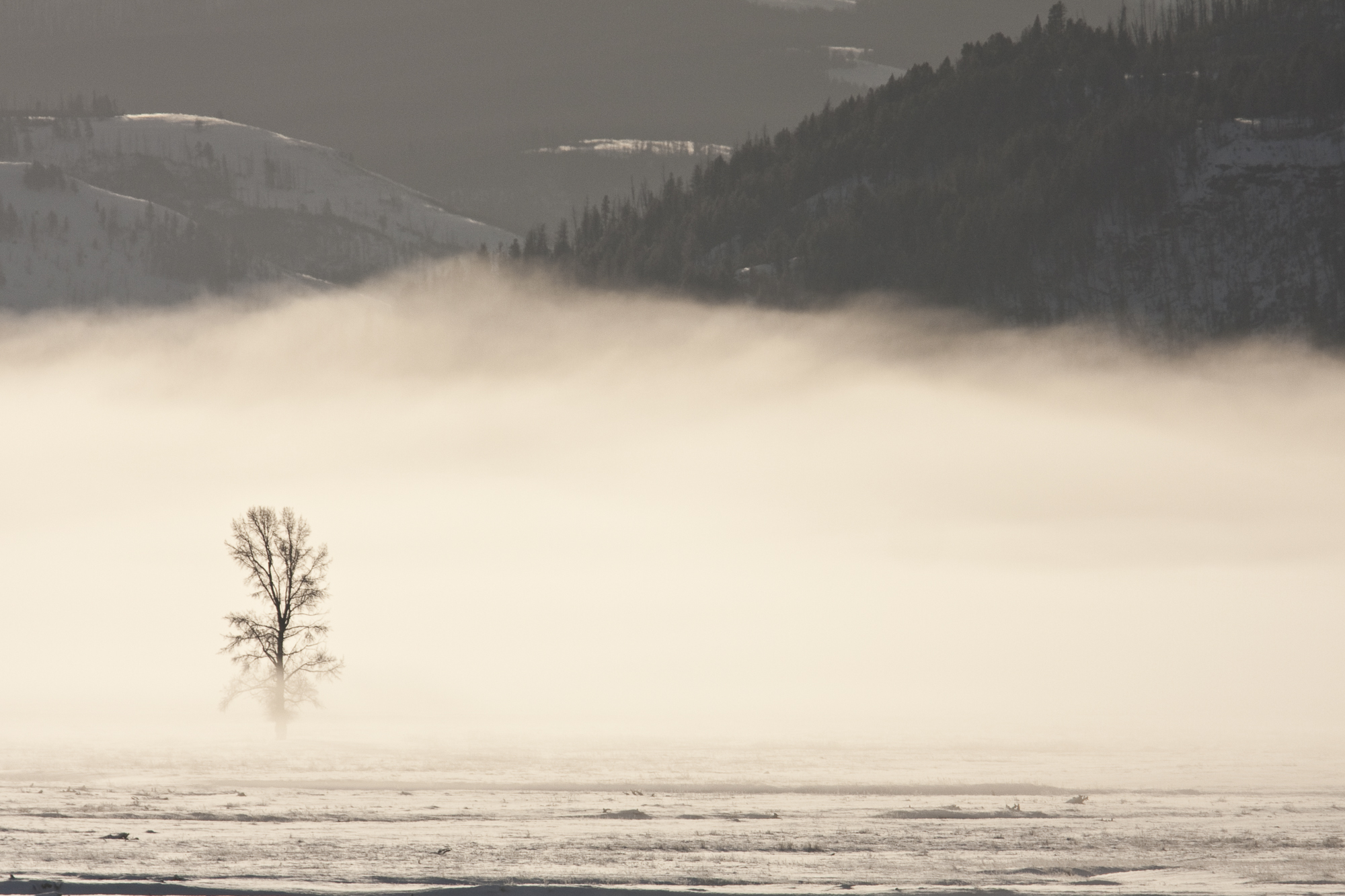
Sunlight catches a lone, ice-covered snag at Mammoth Terraces (click photos to enlarge)Sunrise at Canary Springs at Mammoth TerracesGrand Canyon of the YellowstoneStruggling to stay above the snowA weathered tree trunkEdge of ice on the Yellowstone RiverMelissa in deep snow at Canyon on a previous tripHayden Valley on a gray, snowy dayThe majestic landscape of Hayden ValleyA coyote and shadow along the Madison RiverBison patternsBull elk in Lamar ValleyPine Martin in Silver GateMoose in Silver GateThe once-dominant Druid Peak pack in Lamar ValleyBison snow plowA low fog hangs in Lamar Valley, highlighting a lone Cottonwood tree along the Lamar River.The incredible winter sky in Lamar Valley
I have been missing my usual winter routine of several trips down east. Schedules have been busy, and this thing called work has a way of occupying a lot of your time! So, last week we decided to make a day-trip to my favorite spots in North Carolina – Pocosin Lakes and Mattamuskeet National Wildlife Refuges. I wrote about one of the highlights in a previous blog – the epic battle between heron and fish. This post covers the rest of that amazing day, starting with a rendezvous with our friend in Raleigh at 6:45 a.m. (admittedly, a rather leisurely hour for such a trip).
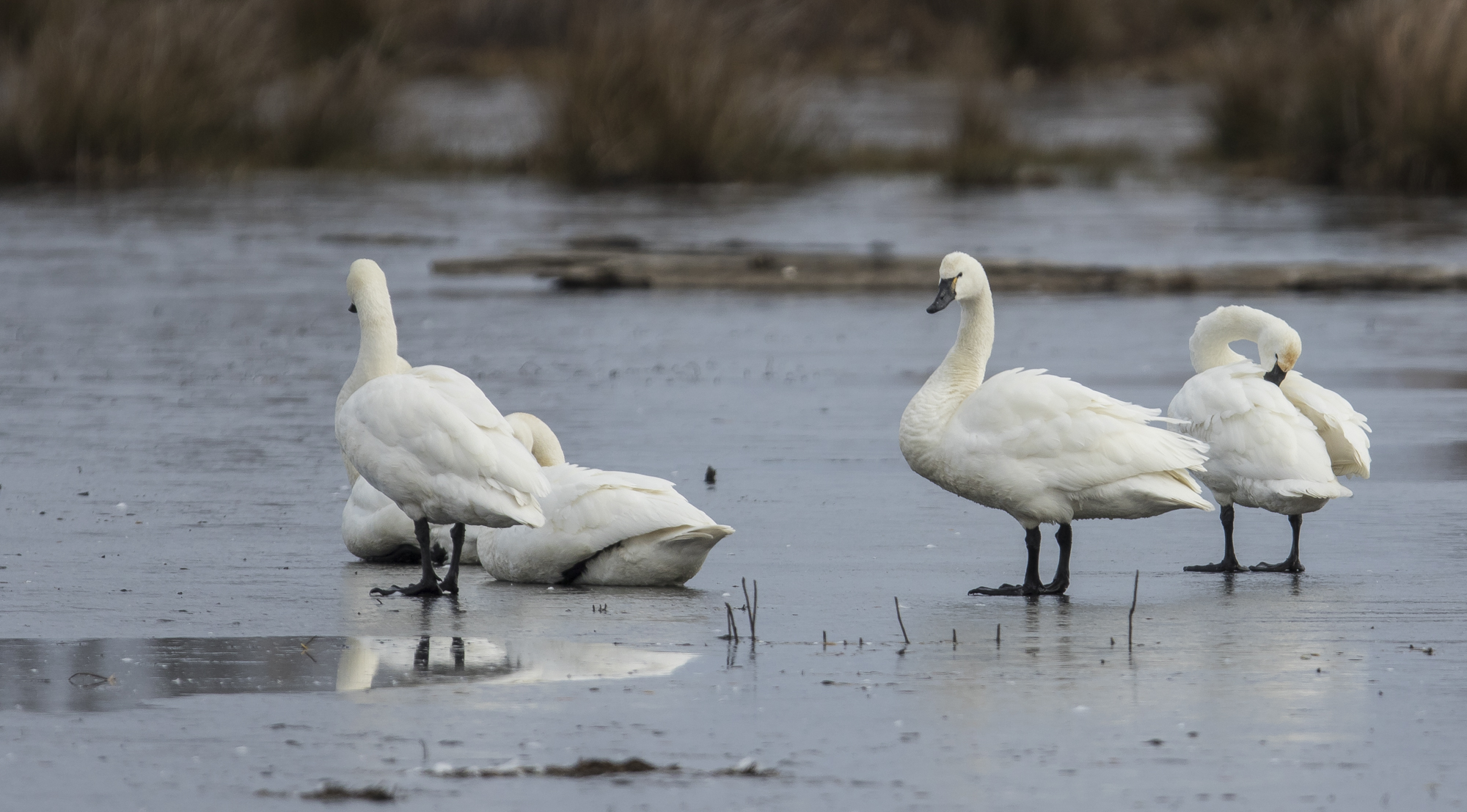
Tundra swans on ice (click photos to enlarge)
We arrived at the Pungo Unit a little after 9. The skies were gray, the wind whipping, temperatures below freezing – a Pungo kind of day. This is the reason I often tell people to dress as if “you will be the coldest you have ever been”. To our surprise, the only birds in the fields behind the maintenance compound were a ton of American robins. Friends had reported that large flock of snow geese had been feeding there in recent days, and it was the time of day when they are usually in the fields for breakfast. We drove on, spotting a couple of uncooperative river otter in a canal. Try as we might, we only managed quick glimpses before they totally disappeared. A quick stop at the blustery observation platform confirmed that the waterfowl know not to be out in the open on such a windy day. All we could see were some thin white lines of swans on the far shore where the forested shoreline provides them with some protection from the north wind.
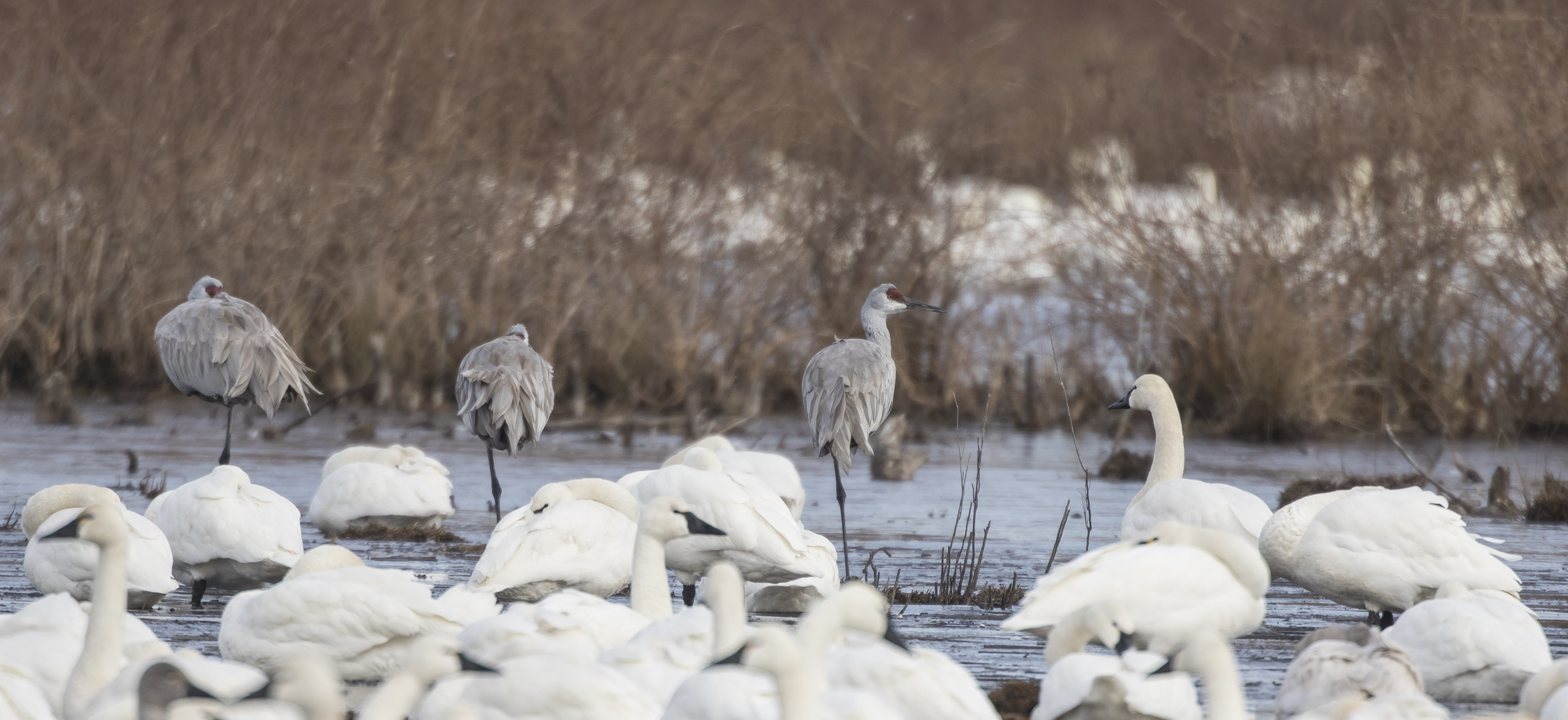
Sandhill cranes on the refuge!
On to Marsh A, one of the managed wetland areas for waterfowl, and a favorite place of both swans and swan-watchers. Indeed, there were a few thousand tundra swans milling about, some, on the fringes of the flock, walking on ice. A quick glass of the area revealed a bonus – three sandhill cranes! They were reported earlier in the season, but we had missed them on the Christmas Bird Count. I have seen this species here sporadically over the years, usually just as a fly-over. but these three were hunkered down in the marsh, no doubt wondering why they had not opted for a warmer habitat. We then saw a giant flock of snow geese flying into the lake from the north. Had they been feeding in the fields along “Bear Road”? We drove over, hoping to see some stragglers and were greeted by a few hundred snow geese out in the corn. We encountered some other friends from Raleigh, shared a few stories, and then headed over to Mattamuskeet for the middle part of the day. We spent a lot of the time with the aforementioned heron, but also saw thousands of ducks (especially northern pintails), another disappearing otter, and a dancing night heron.
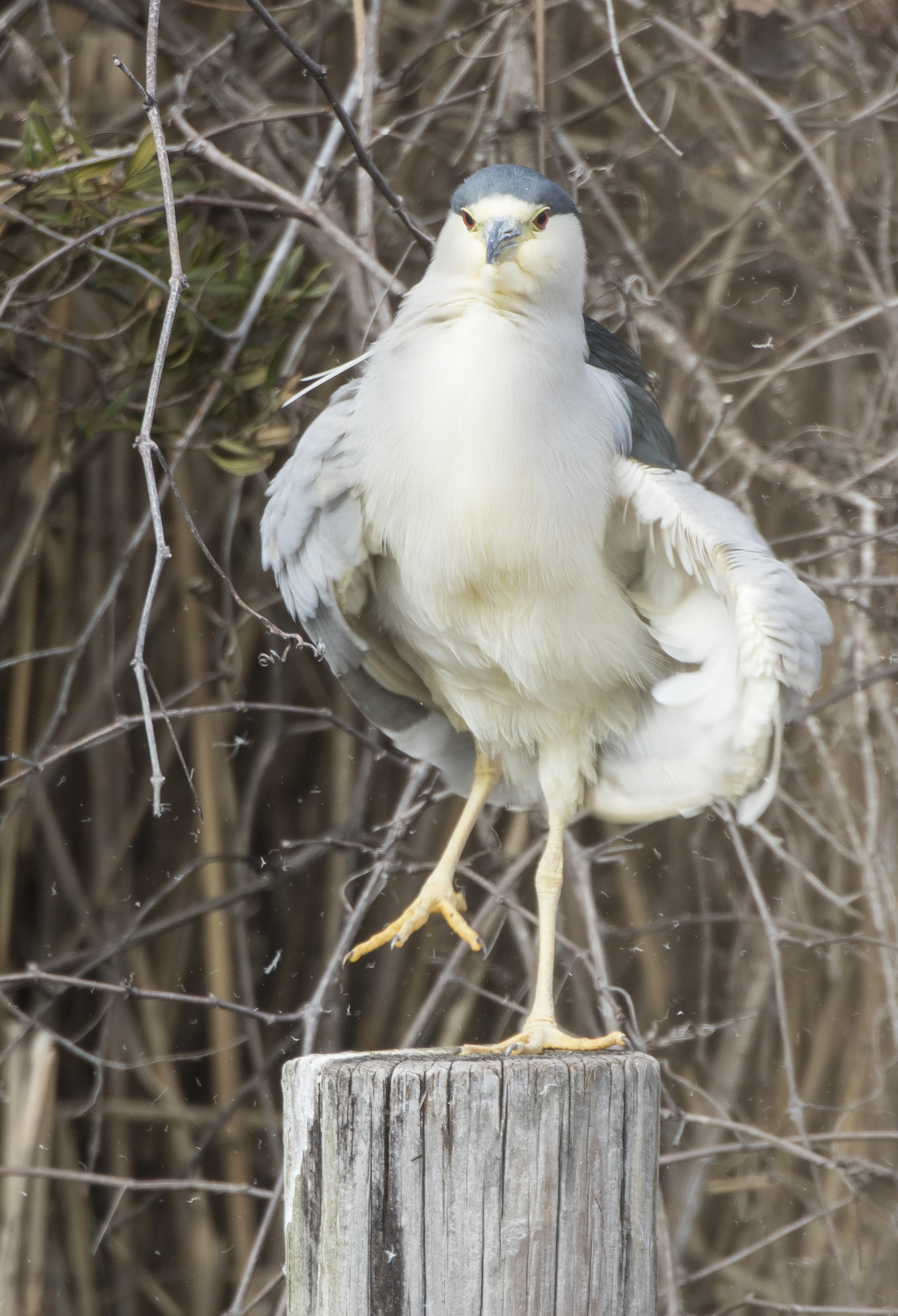
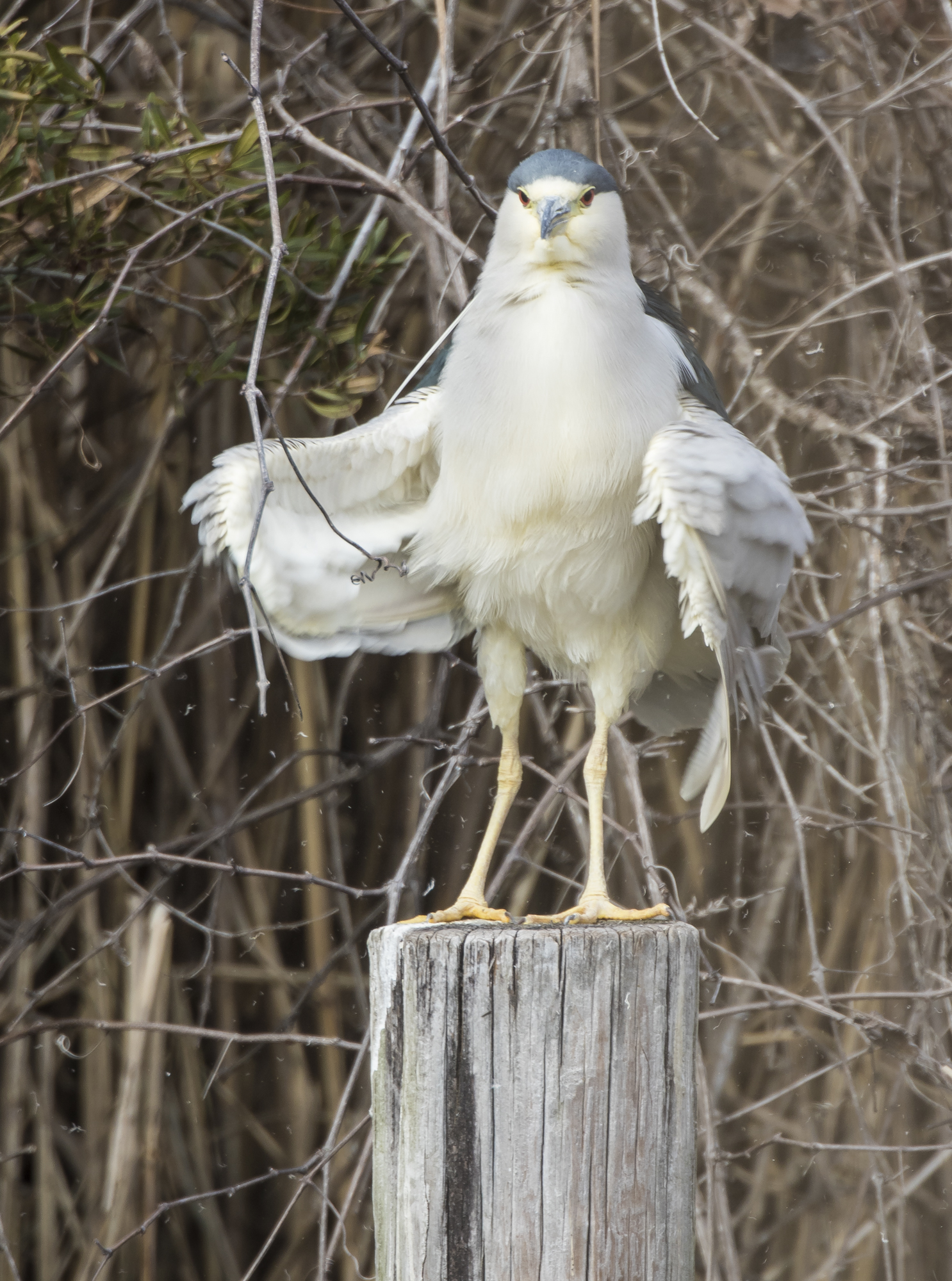
Night heron shimmyShaking it
An adult black-crowned night heron was on one of the usual pilings in the pool near the entrance to Mattamuskeet, so we stopped and walked over to admire. It was striking their usual stoic pose, when, all of a sudden, it went through a series of gyrations that would make any dance contestant proud. When it settled back down, it did a quick poop (lighten the load) and flew off.
After spending a couple of hours at Mattamuskeet, we headed back to Pungo for what we hoped would be a grand evening show. The walk down Bear Road quickly showed why I dubbed it thus years ago, before real road name signs went up – five bears came out across the field to feed. After watching them mill about and horse around (a couple of young ones were wrestling), we headed into the woods. Melissa and I both commented that there isn’t as much fresh bear sign in these woods this winter – there is some, but not the totally worn down “bear living rooms” we have seen in the past. Suddenly, our friend said, “Look, a tiny owl”!
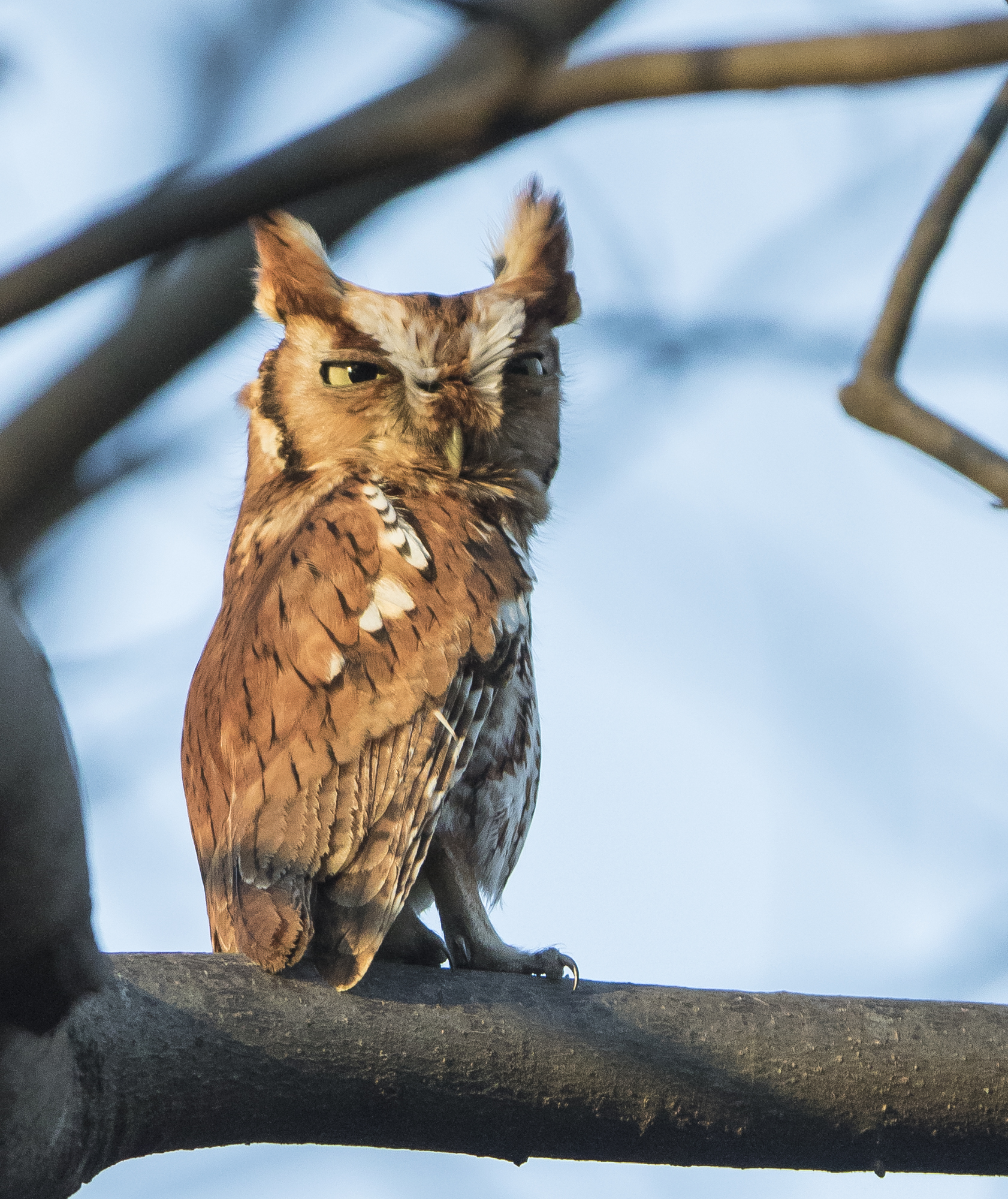
Eastern screech owl out on a limb
I had been checking out every snag as we walked, so I naturally looked at the dead top of the tree where she was pointing. I couldn’t see it. “Right there”, she exclaimed. I followed her outstretched hand, and, to my surprise, there is a screech owl sitting out in the open on a branch several feet away from the trunk. The little guy barely moved its head to watch us as we slowly maneuvered, trying not to scare it. The fading sunlight would move on and off the owl, highlighting its beautiful rufous plumage.
Gray morph Eastern screech owl from 2016
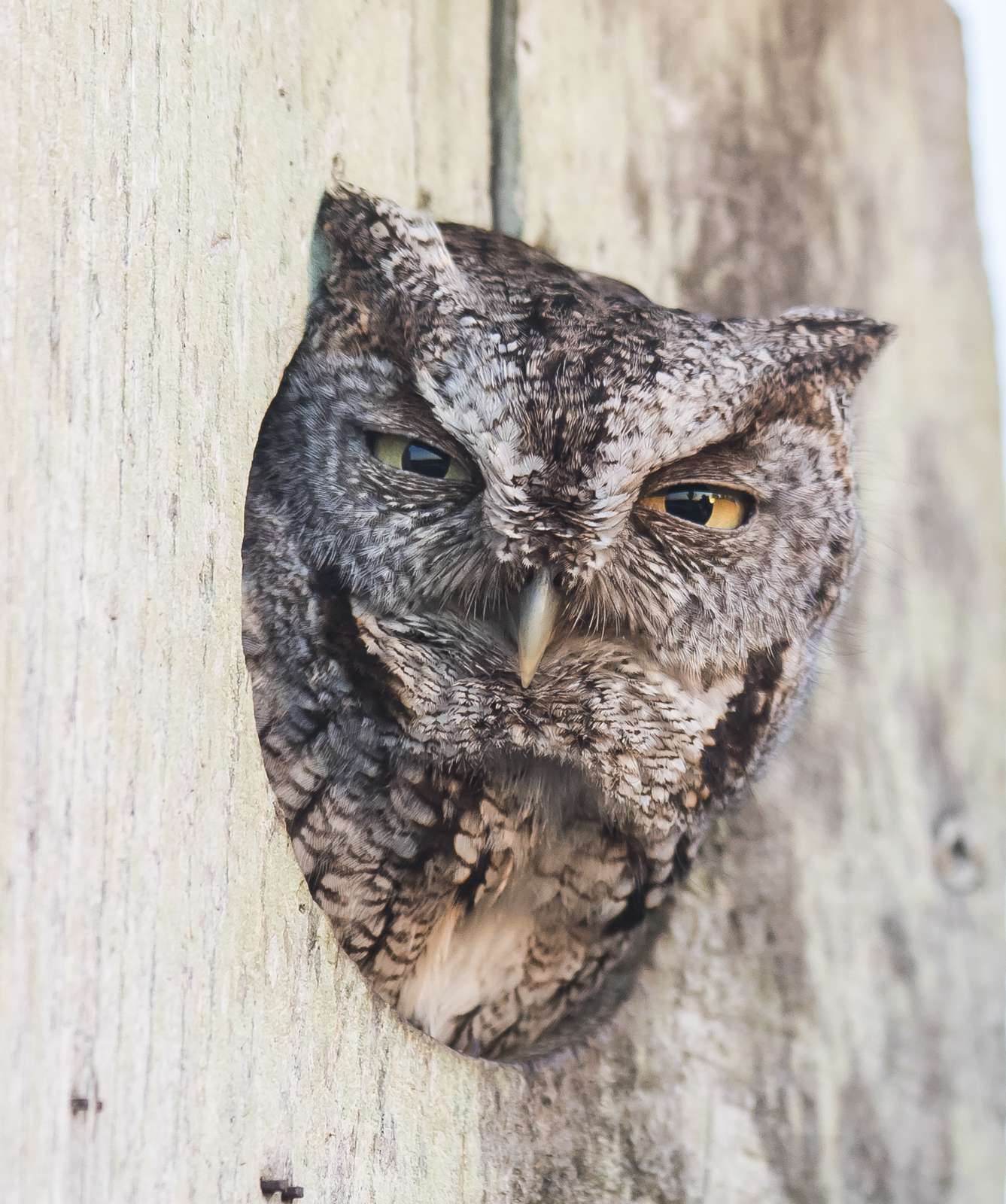
In a post from a very “owly” day a couple of years ago, I shared photos of another Eastern screech owl from the Pungo Unit. That one was a gray morph using a wood duck box as a nest site. Eastern screech owls come in two primary color morphs in our state – red (or rufous) and gray (there is a third, a brown morph, in the far south). That doesn’t mean they can change color (they remain whichever color they are their entire life), it simply means there are two primary colors seen in this species. It turns out that the red color morph is more common in southern parts of the range, while the gray is predominant in colder regions. Plumage color appears to be correlated with thermal adaptation. One ornithologist writing about the color morphs summarized findings that showed that gray birds survive colder temperatures better than red birds, which may account for their differential distribution.
That look that only a screech owl can give
After observing the owl (and it, half open-eyed, observing us) for several minutes, we walked on, hoping it would not fall prey to any of the numerous winged predators that hunt these woods (great horned owls, red-tailed hawks, Cooper’s hawks, etc.). About that time, flocks of snow geese started to fly overhead and began circling the fields along Bear Road. We headed out into the open, hoping they would land. As we watched (and wondered about the energy budget of snow goose behavior), something else caught my eye down the road.
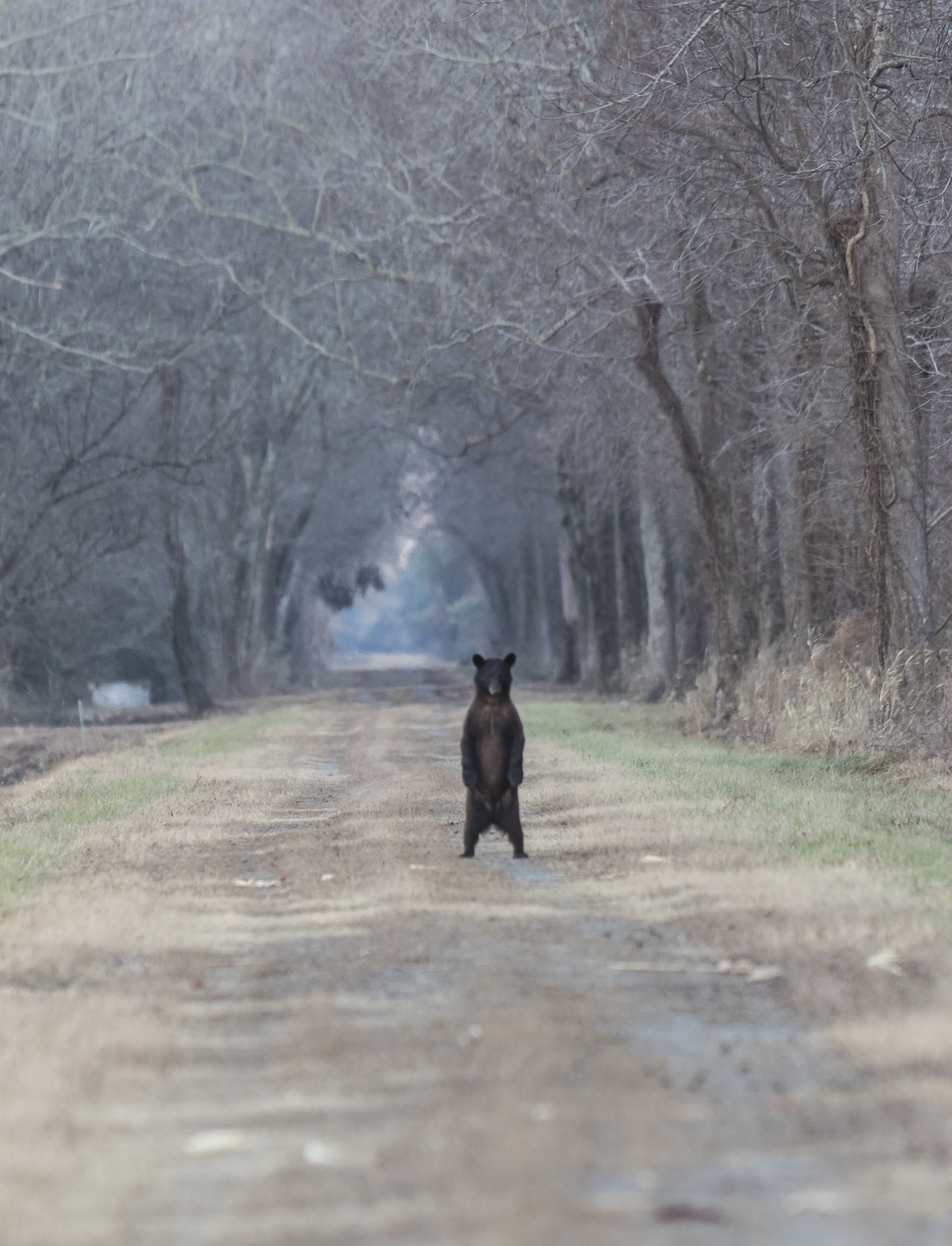
This town isn’t big enough for the two of us
A medium-sized black bear came out into the road and started ambling our way. When I alerted the others, we undoubtedly moved a bit, and the bear stopped in its tracks. He looked our way, then stood up to check us out. A standing bear always reminds me of how much we have in common with bruins. This one also looked as if he was trying out for a role in Gunfight at the Pungo Corral. He dropped and cautiously went back into the woods.
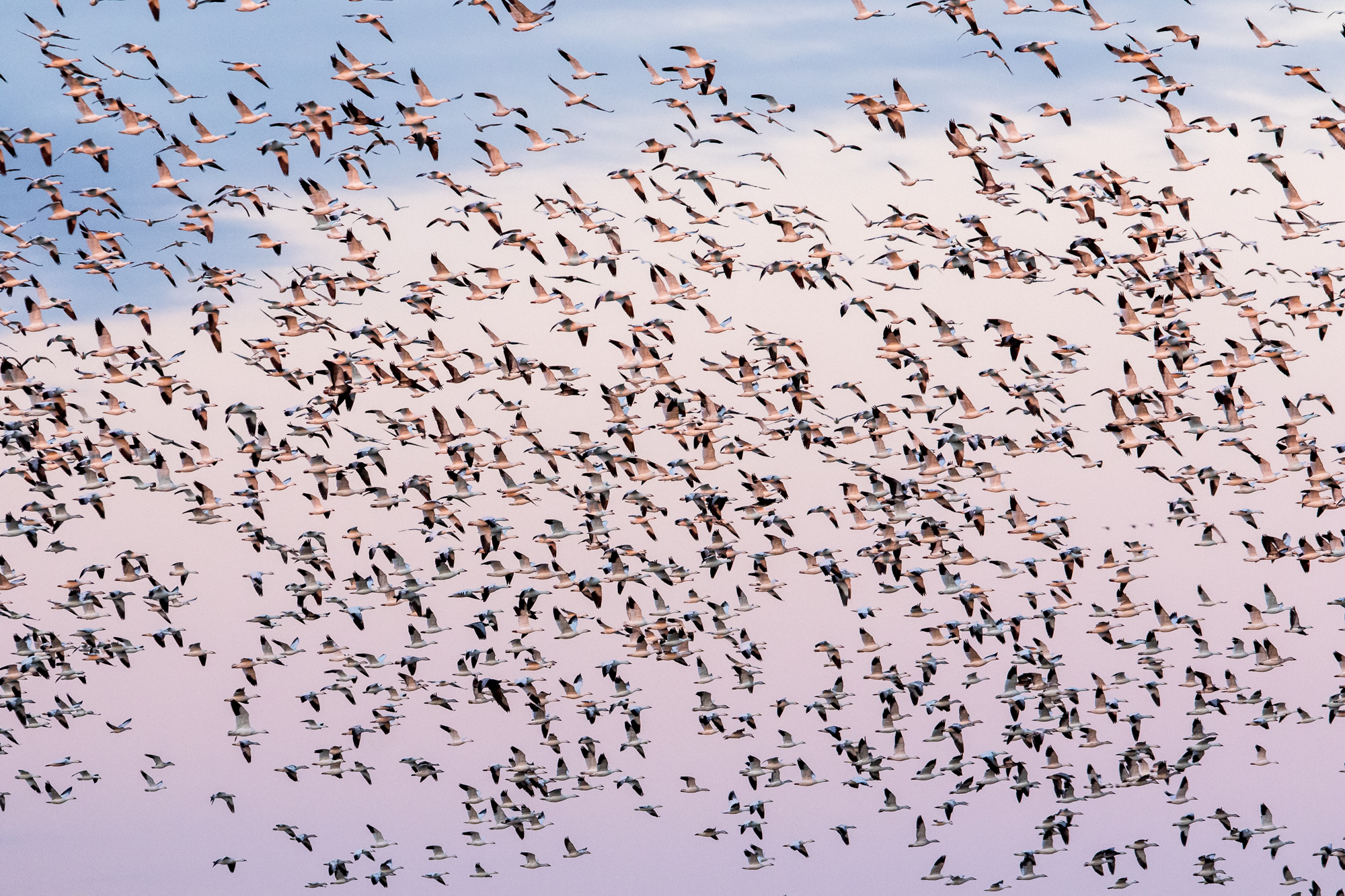
Snow geese swirling over the corn at sunset
Our attention shifted back to the birds, which were now circling near us in dense, squawking clouds. I never tire of this visual spectacle and the incredible sounds that accompany it.
I just want to cross at my usual spot
For the next several minutes, we stood in awe of the scene before us – countless birds swirling nearby, swans flying over our heads back to the lake, and our bear friend tentatively trying to reach his canal crossover spot. The bear may be one I have seen over the past couple of years that we dubbed “buddy bear” (for his tolerance of humans). He kept coming out to the road, looking our way, then retreating back into the woods. He would then ease closer to us, come back out into the road, and repeat the sequence. All the while, thousands of birds circled out in front of us…which way to look? The bear ended up catching our attention again when he came out on the crossover path and headed down the canal bank. We all watched as he swam across, shook off, and scurried into the standing corn. What a privilege to be able to witness all this.
Huge flock of snow geese flying into the field
We started to head back to the car and then saw wave after wave of snow geese flying in from the northeast to join the thousands already landing in the corn. This was like the scenes of a few years ago – thousands of snow geese in the fields along Bear Road at sunset, hundreds of ducks swooping in to join them, bears coming out from several directions, swans calling as they fly in from the north, deer coming out of the woods, and woodcock streaking out into the fields to feed. Then we heard the final actor in this grand play – the haunting call of a great horned owl.
A great horned owl at sunset
Melissa soon spotted it in a tree not far from us. It flew to a branch out over Bear Road, silhouetted against the fading orange sky. What a great ending to an amazing day! This place is truly magical. It really is somewhere you go to feel alive, to recharge your spirit, and to rediscover a sense of awe and wonder about our world, Thank you, U.S. Fish and Wildlife Service, for making this possible. We all need to support these public lands, especially now, so they remain available for us and these amazing natural spectacles.
Species observed at Pocosin Lakes (Pungo Unit) and Mattamuskeet National Wildlife Refuges 1/15/18:
Birds (61 species):
Double-crested Cormorant; Canada Goose; Snow Goose; Ross’s Goose; Tundra Swan; Mallard; Black Duck; Northern Shoveler; Northern Pintail; Ring-necked Duck; Wood Duck; Gadwall; Bufflehead; Ruddy Duck; Hooded Merganser; American Coot; Pied-billed Grebe; Great Blue Heron; Great Egret; Sandhill Crane; Black-crowned Night Heron; Turkey Vulture; Red-tailed Hawk; Bald Eagle; Northern Harrier; American Kestrel; Eastern Screech Owl; Great Horned Owl; Ring-billed Gull; Mourning Dove; Belted Kingfisher; Northern Flicker; Pileated Woodpecker; Red-bellied Woodpecker; Downy Woodpecker; Yellow-bellied Sapsucker; American Woodcock; Killdeer; American Crow; Eastern Phoebe; American Robin; Eastern Bluebird; Northern Mockingbird; Carolina Wren; Winter Wren; White-throated Sparrow; Swamp Sparrow; Savannah Sparrow; Song Sparrow; Tree Swallow; Red-winged Blackbird; Common Grackle; Brown-headed Cowbird; Northern Cardinal; Carolina Chickadee; Tufted Titmouse; European Starling; Orange-crowned Warbler; Yellow-rumped Warbler; Ruby-crowned Kinglet; Golden-crowned Kinglet
Mammals (7 species):
River Otter; Black Bear; Gray Squirrel; White-tailed Deer; Hispid Cotton Rat; Raccoon; Nutria
There is nothing in the world more beautiful than the forest clothed to its very hollows in snow. It is the still ecstasy of nature, wherein every spray, every blade of grass, every spire of reed, every intricacy of twig, is clad with radiance.
~William Sharp
Our road during the snow on Wednesday (click photos to enlarge)
The quiet beauty of a winter snow storm…this is one of the true blessings of living in the woods (and of loving cold weather, since you don’t mind getting out in it…in fact, you can’t wait!).
The view from beneath a snow-covered branch
I love the winter quiet of a snow storm…and the simple beauty it imparts on everything it touches. The patterns of branches, the trails of woodland creatures, the shapes of trees covered in white…all mesmerizing, magical. This snow lasted all day. Toward the end of the storm we went for a walk in the gray stillness of our woods, and felt lucky to live in such surroundings.
The house the morning after the storm
A brilliant blue sky greeted us the next morning, with a chilly 14 degrees on the thermometer. A walk in the woods seemed the thing to do (after filling the bird feeders, of course).
The road out front with the air glistening with falling ice crystals
What had been a gray sky and a black and white landscape of patterns and shapes was now a glistening white, with the air full of tiny diamonds every time a breeze shook the snow-covered branches.
A view of the house through our woods
We walked the property boundary, taking in the scenes of a forest transformed by a sculptor working with powdery white clay.
Snow falling from limbs
Snow burst
The wind started blowing and the tree branches began to shake their white blankets, releasing a snow burst of crystals that sparkled as they fell.
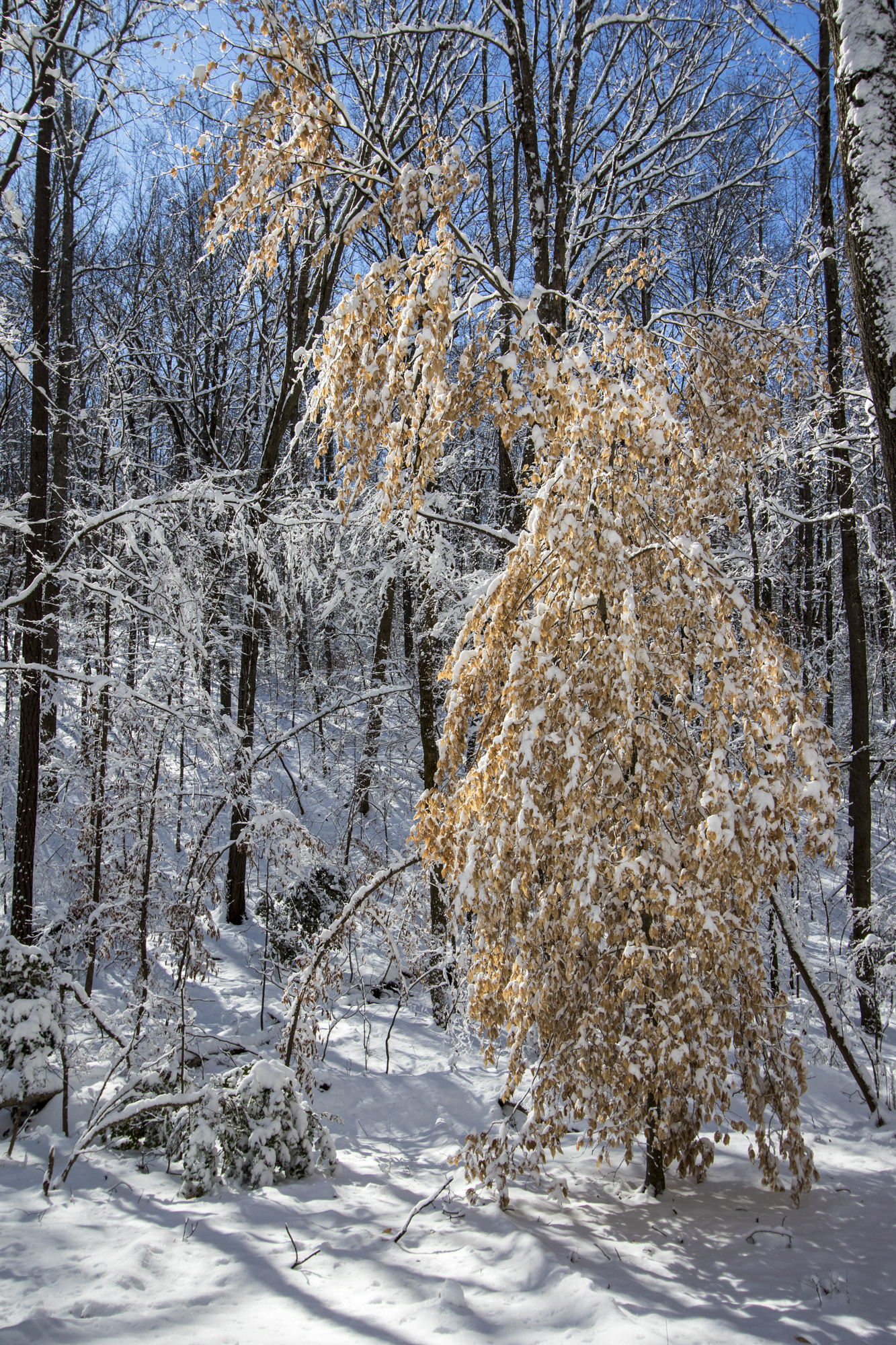
A beech hunched over with its burden of snow
Melissa walking through the winter wonderland
We ended the day with a perhaps too late attempt at sledding the big hill just down the road. The sun was already melting the lone tire track down to gravel, making for a few scrapes down the hill. Not as fast as previous snows, but still not bad.
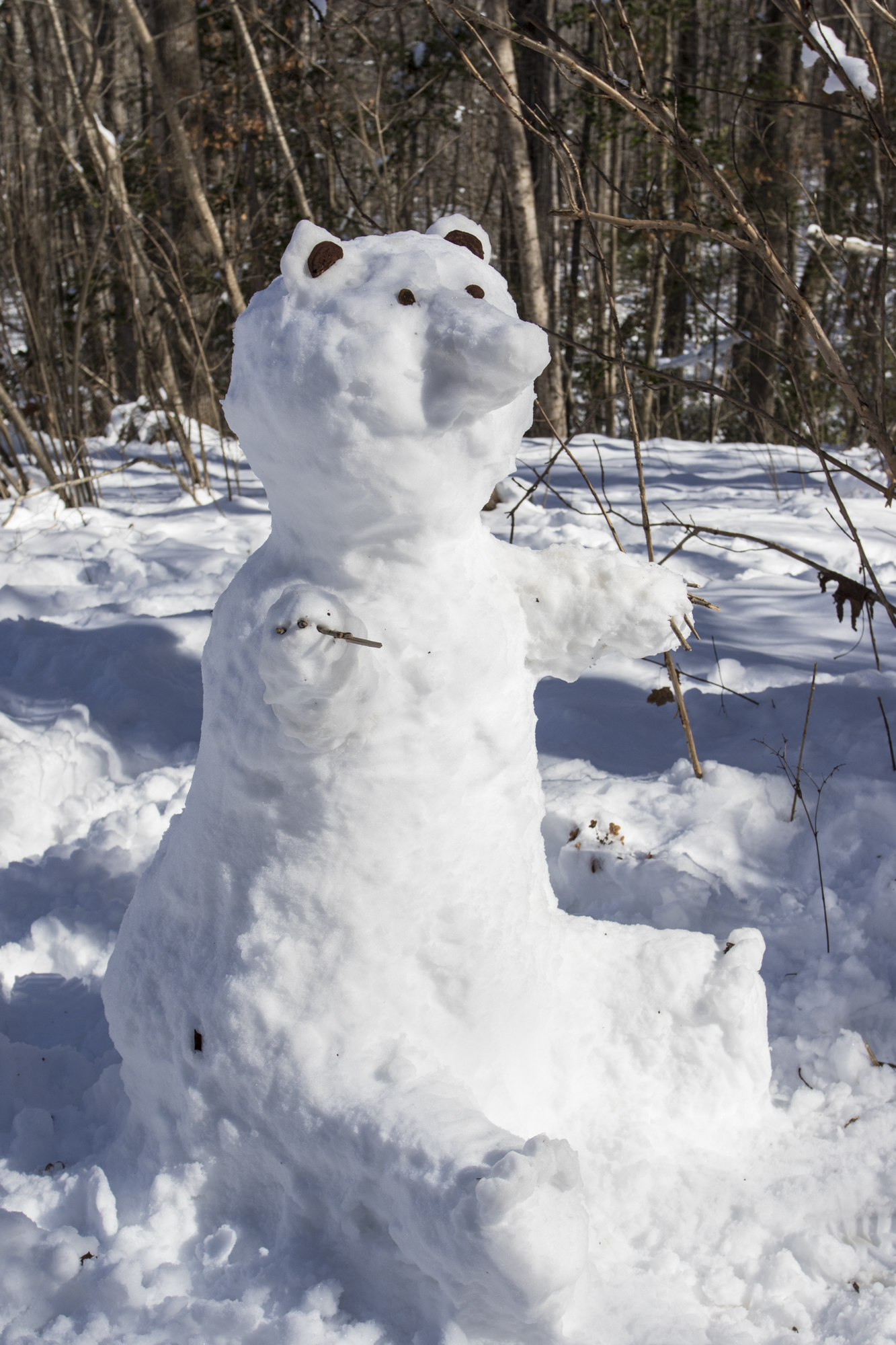
Snow bear
This morning we went out and decided to make some wildlife in the yard. If only we had the time and could get to Pungo and see some real snow bears!
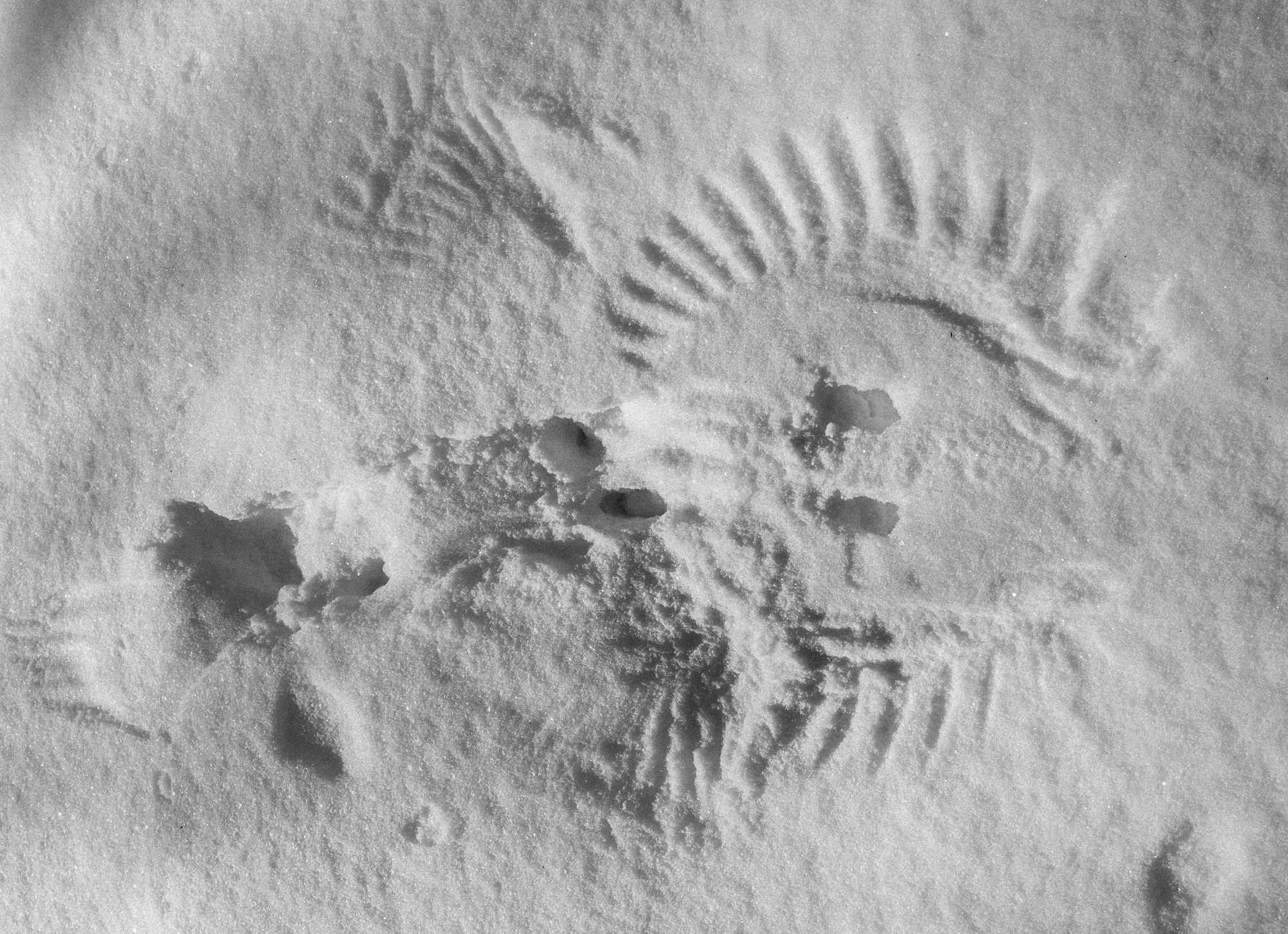
Snow crow in black and white
The real wildlife, especially the birds, have been very active since the storm. A group of American crows stopped by this morning, no doubt looking for some of the scattered seed. They are wary, so when I walked by the window they all took off, including the one that was brave enough to land in the yard. We checked out the track trail and tried to decipher what had happened. Look at it and decide for yourself before reading further to see if you agree with our conclusion.
I think the crow landed on the left side of the image, leaving a deep imprint of its body when it hit the snow (and a wing tip print on the far left). It then hopped up and turned to the right, leaving some wing tips seen at the top of the image. It took off from a position facing the right edge of the image, leaving two deep footprints and a sweep of its wings on both sides as it leapt off the snow. Let me know if you conclude something else.
Go confidently in the direction of your dreams. Live the life you have imagined.
~Henry David Thoreau
We all have dreams, some bigger than others. I dream of experiences, being in wild places, and seeing the spectacles that nature has to offer. I have often wondered if other species dream. Having had dogs much of my life, and watching them as they seem to chase something in their sleep with paws twitching and soft barks, I think they do dream. I’m not sure about other species – whether, for instance, herons dream, but we met one earlier this week that seemed to dream big…really big.
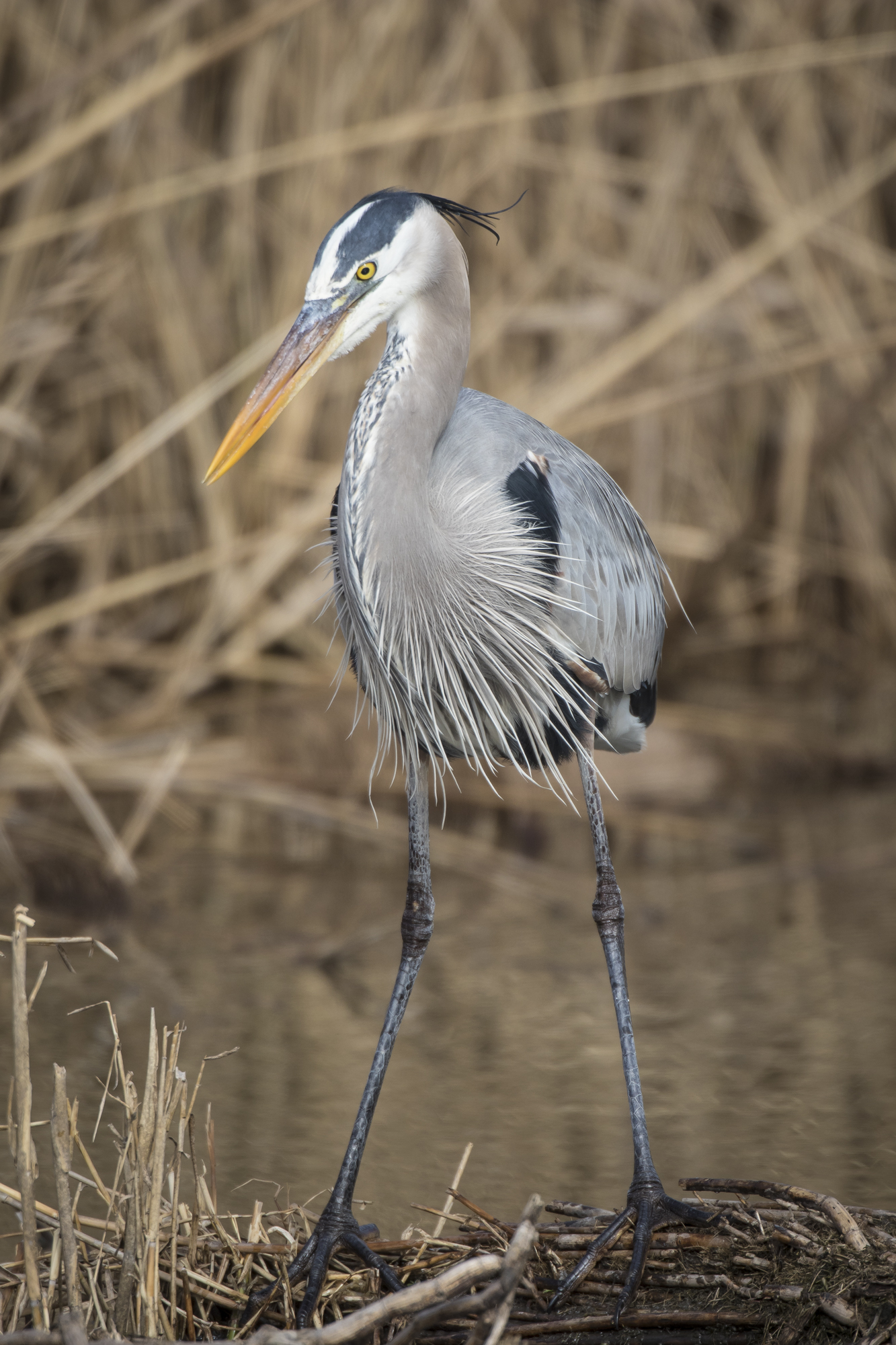
A stately great blue heron at Mattamuskeet National Wildlife Refuge (click photos to enlarge)
We did a quick day trip on Monday down to Pocosin Lakes and Mattamuskeet National Wildlife Refuges. I just haven’t been able to get away as much as my soul needs, so a day-trip would have to do. A friend from work (who had never been) was able to travel with us so I was hoping for a good show for her sake. After a bitterly cold morning at Pungo (more on the Pungo portion of the trip in the next post), we headed over to Mattamuskeet mid-day to see what we could find. As is often the case, there was a stately great blue heron at the pool near the entrance along Wildlife Drive. But I noticed something different this time…
The heron strikes
There was something else on the island of grass…
The prize revealed
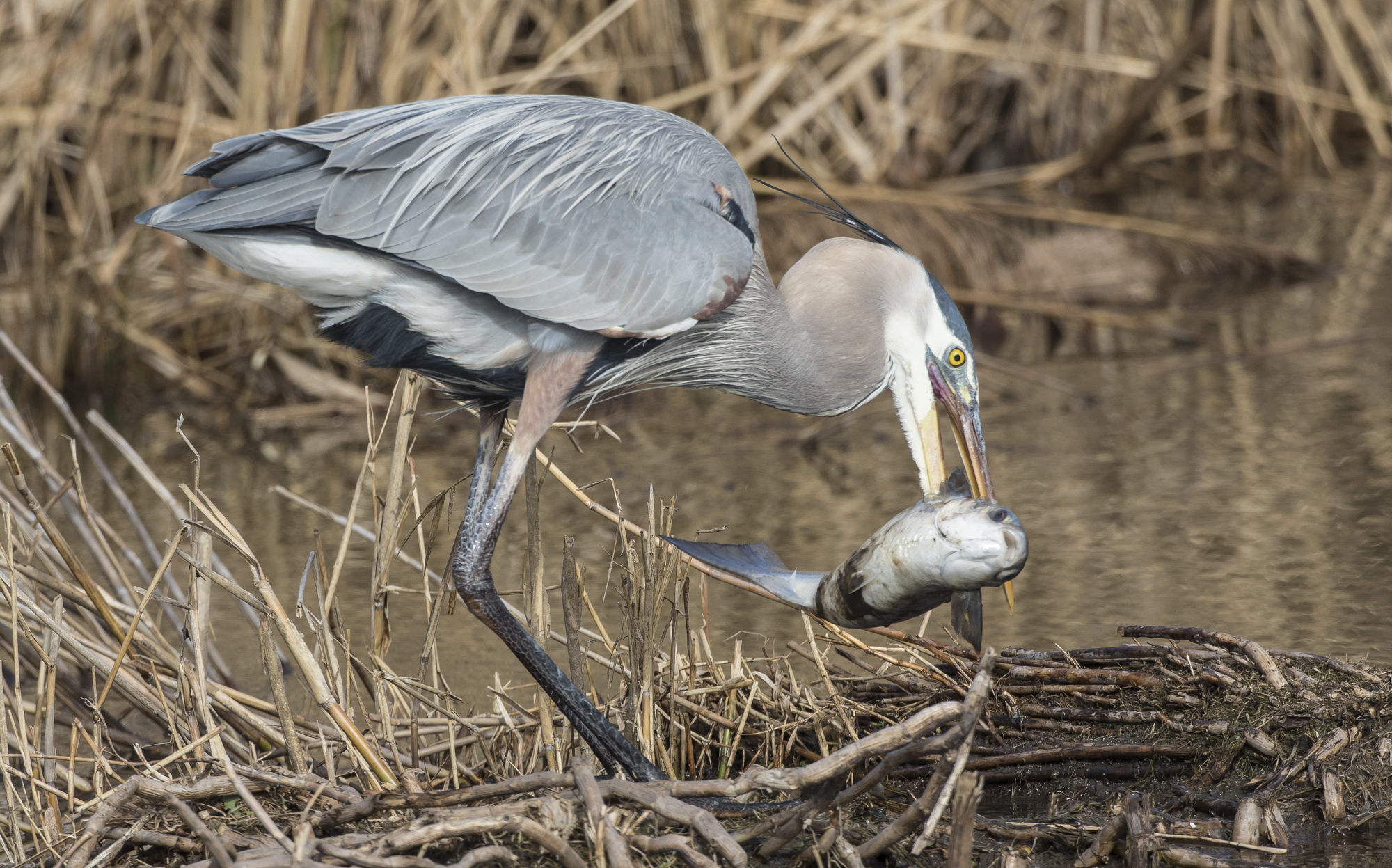
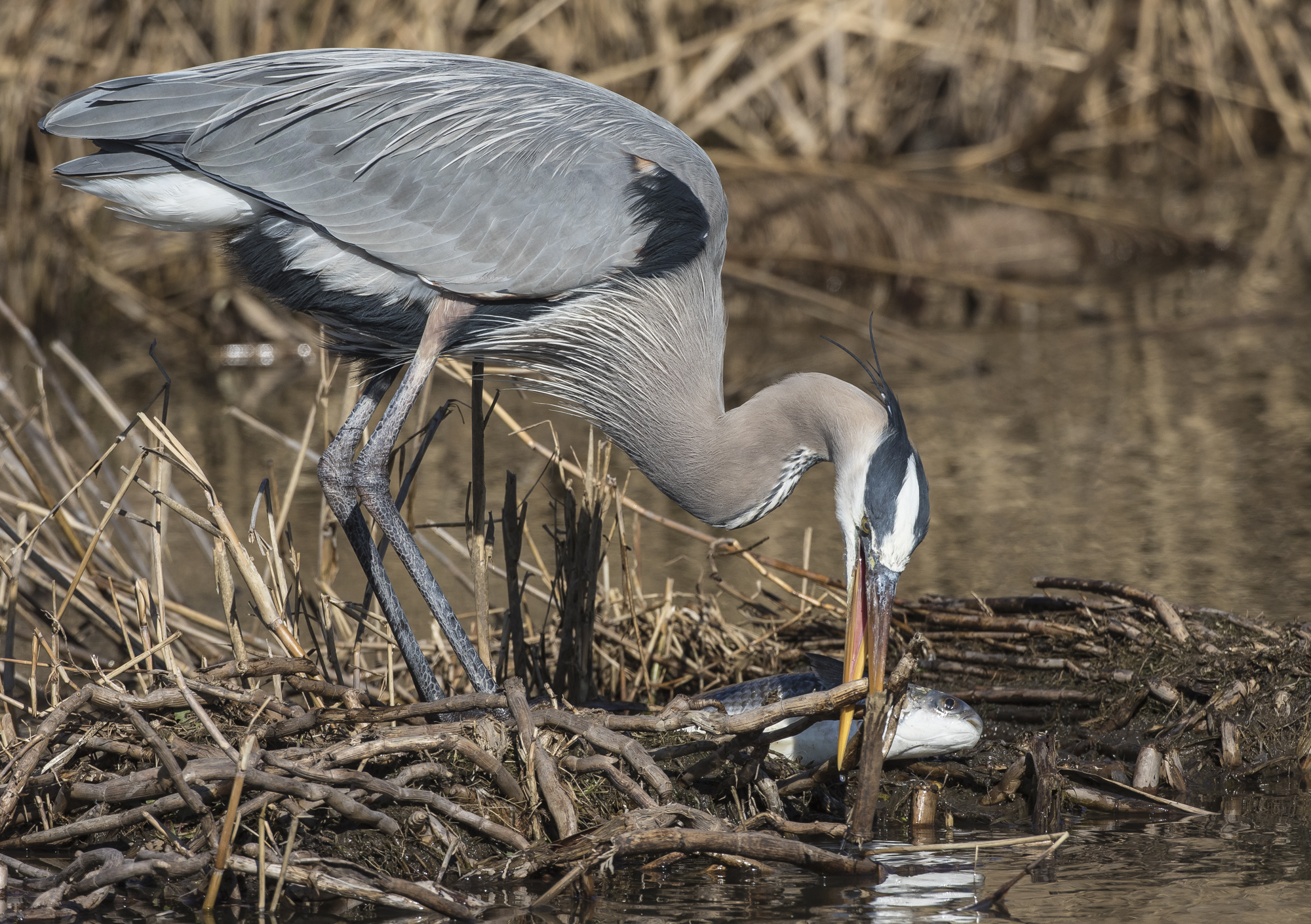
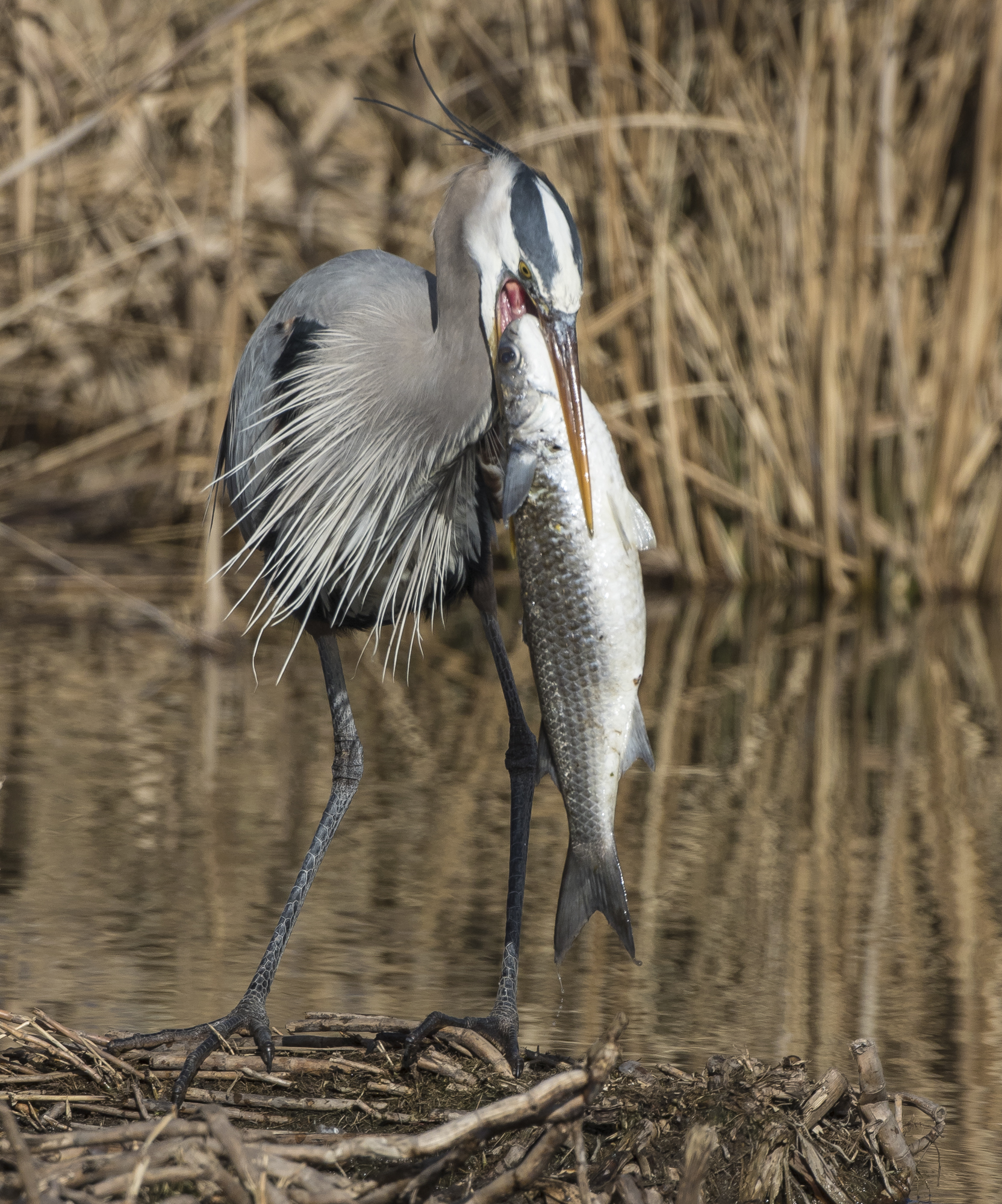
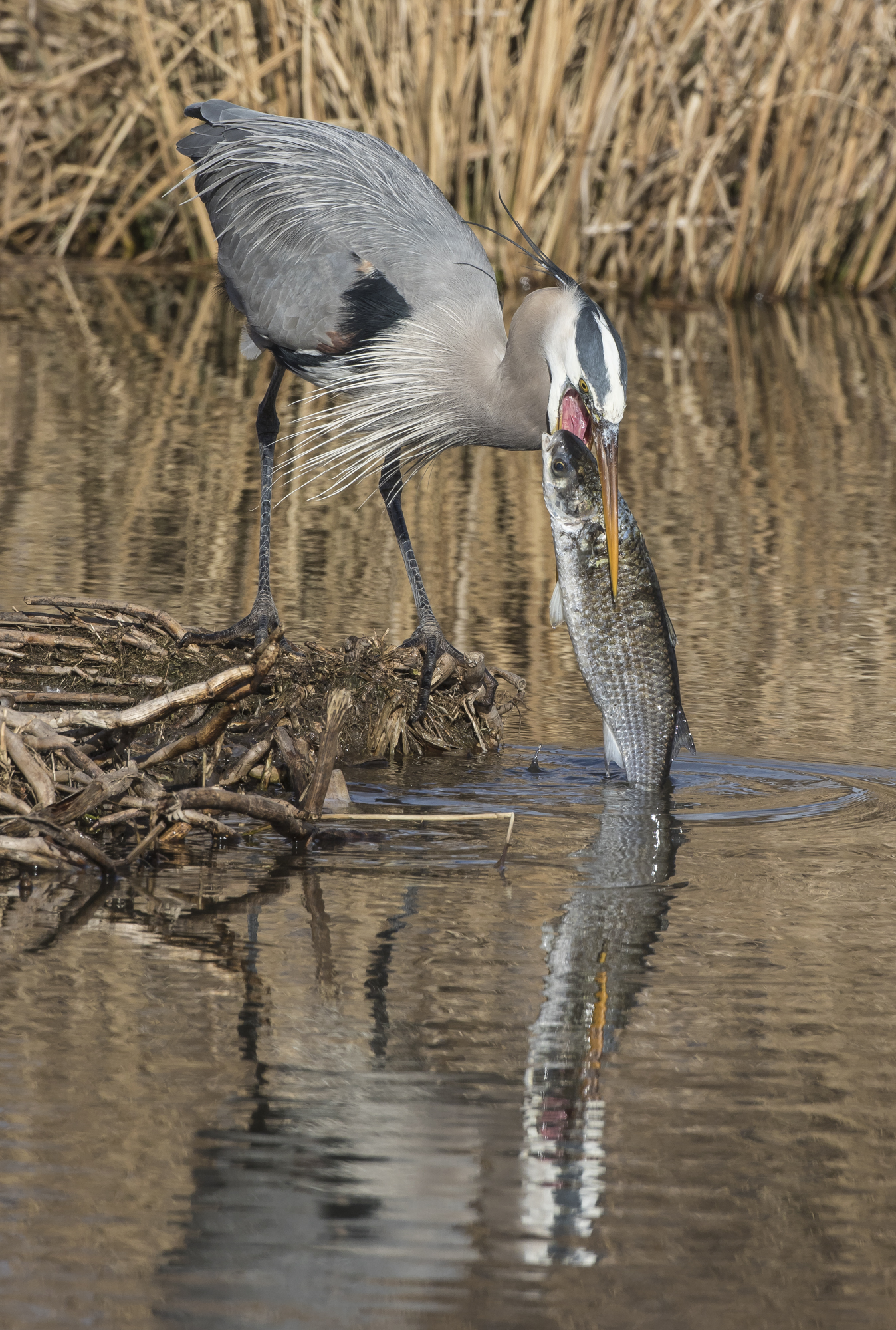
A huge fish! A mullet! Even though Mattamuskeet is a freshwater lake, this bird was on a canal outside the lake proper, one that connects via a long (~7 mile) system of canals out to Pamlico Sound, where striped mullet are very common. My apologies for posting so many images of this epic struggle, but I have always wanted to see a heron swallow a huge fish, and here it was, out in the open, a “dream” come true.
A lot to get your beak around
We watched as the bird tried to grab the still-flopping fish. It was a lot to get your beak around.
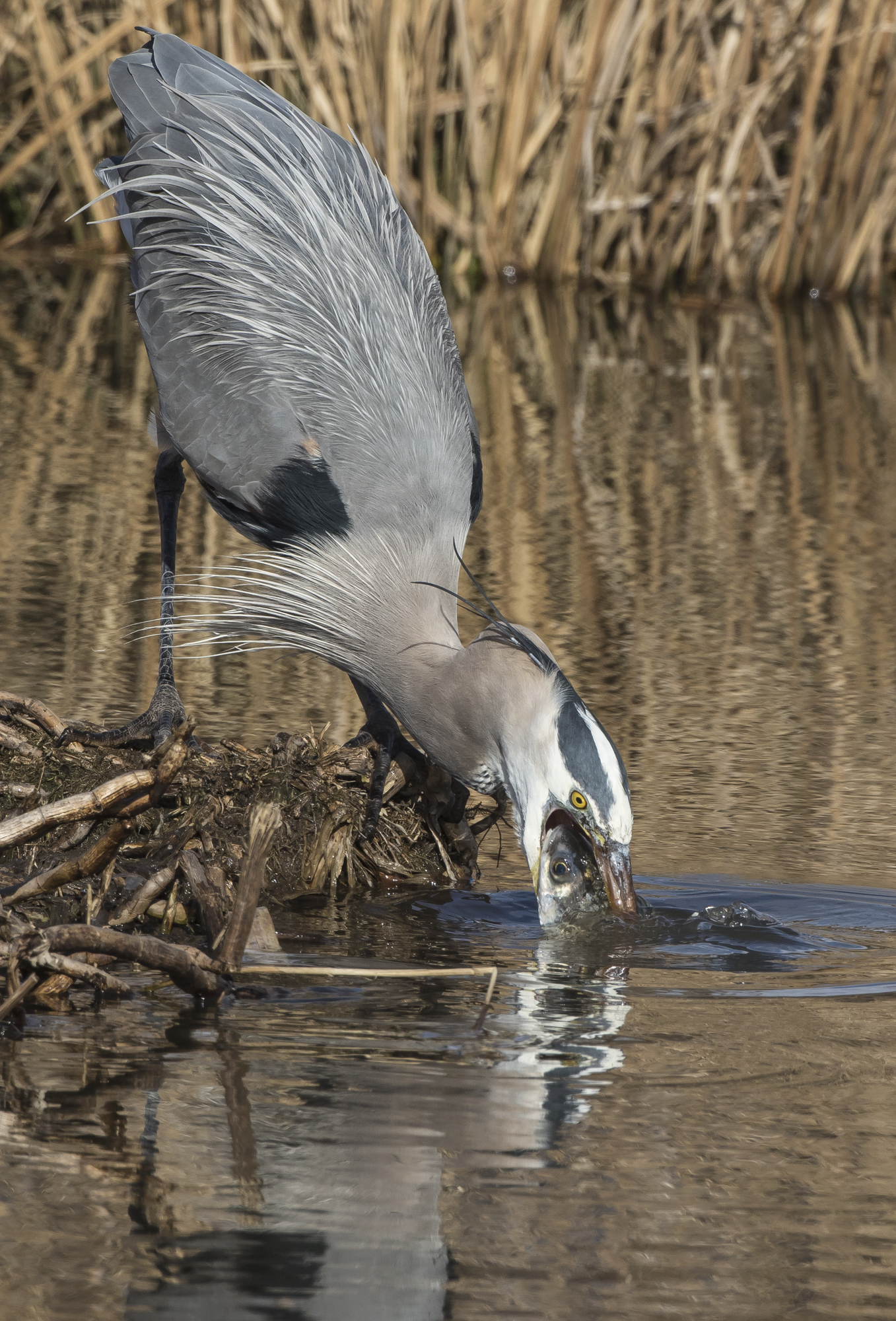
The heron took frequent sips of water
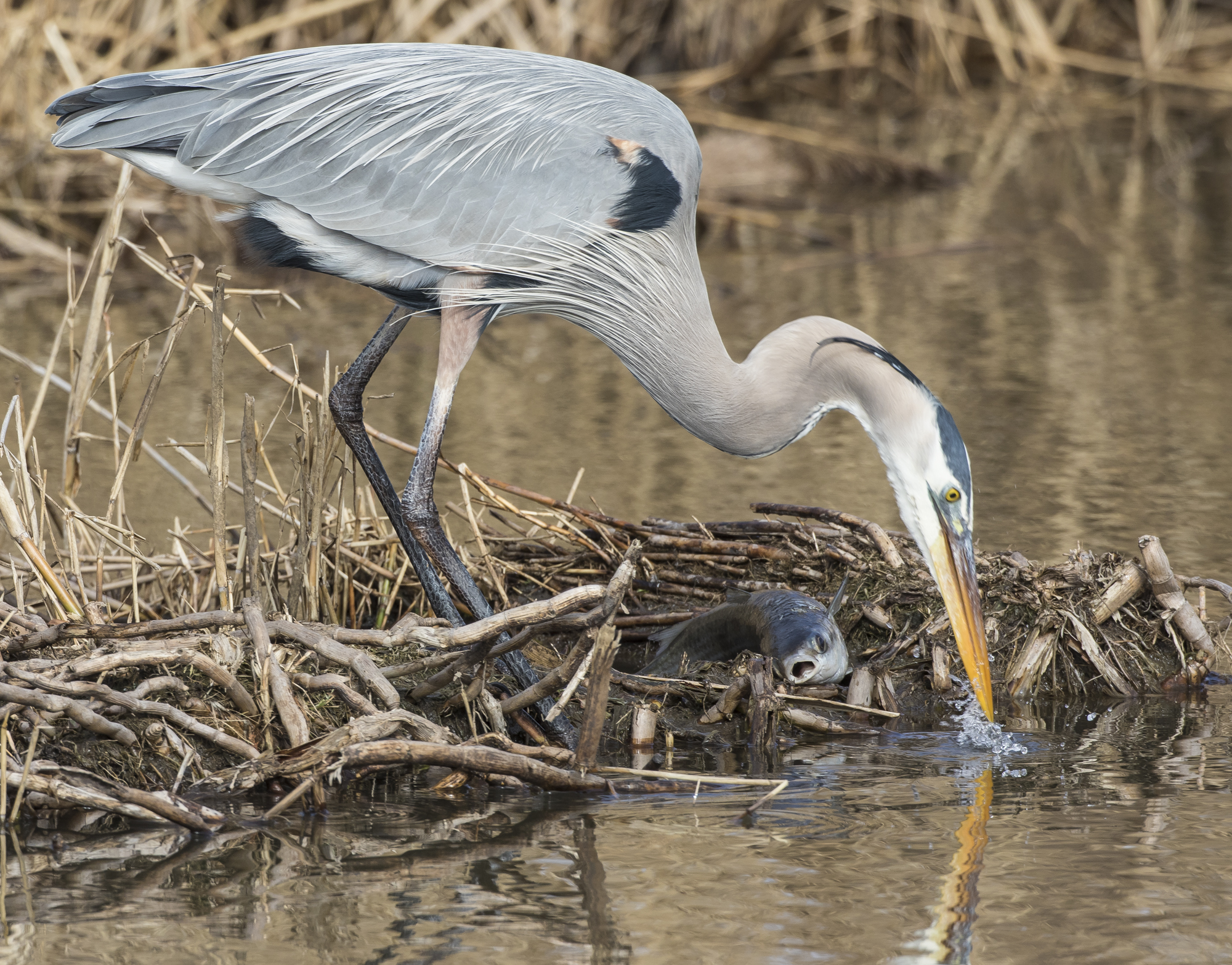
The heron would work at grabbing the fish, then drop it, and almost every time dip the tip of its bill in the water. Was it taking a drink, removing slime, washing out a bad taste…who knows?
A few sharp jabs with the beak eventually subdued the mullet
The heron used its stiletto beak in a series of quick jabs to try to subdue the mullet.
Now…how do I get this thing off my beak?
It sometimes took a few shakes to get the fish off. After several bouts of spearing the fish, the mullet stopped moving.
Displacement behavior?
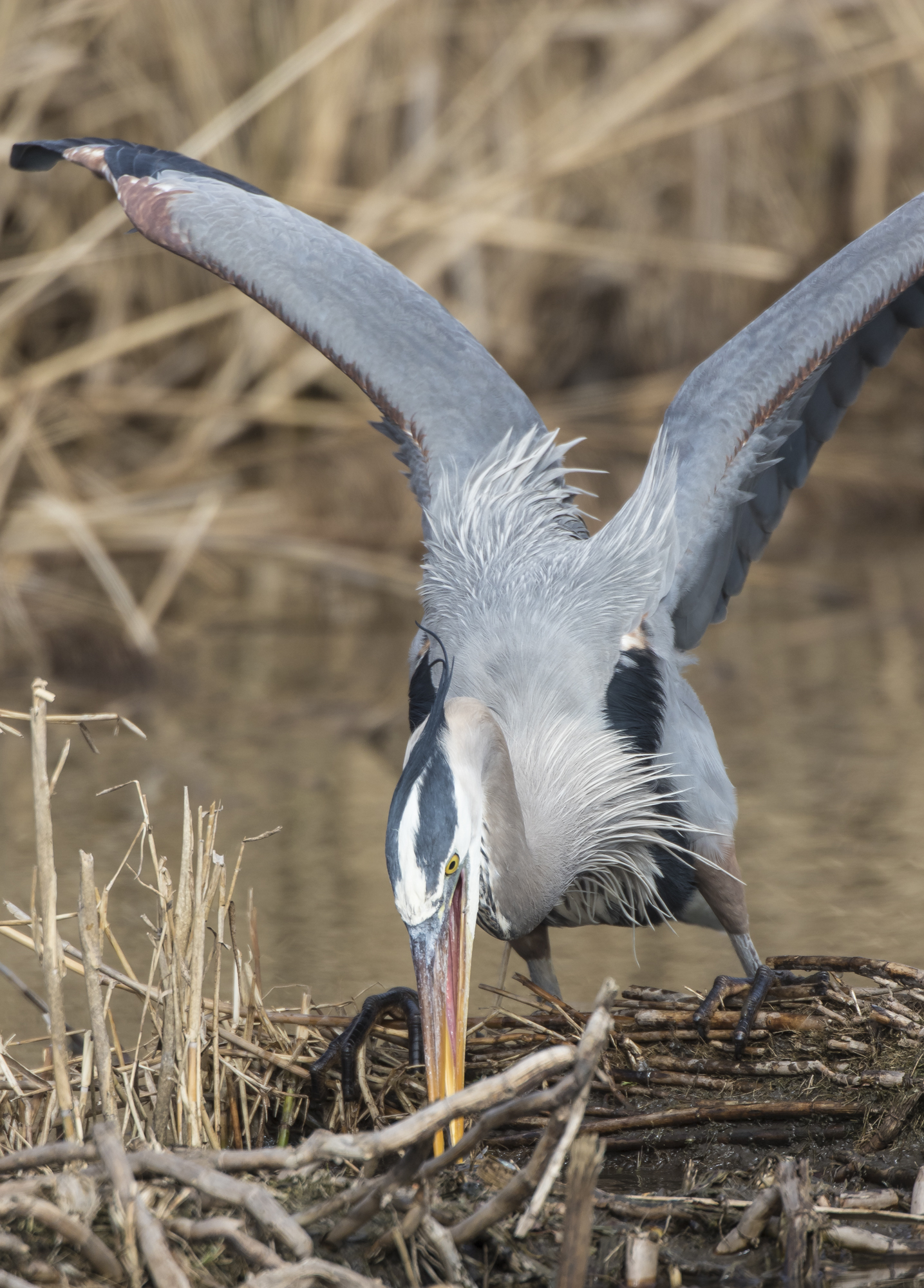
Curiously, in between efforts to swallow the fish, the heron would every now and then grab some roots, sticks, and shoots of vegetation on the island. Is this some sort of displacement behavior? Taking out its frustrations on plants?
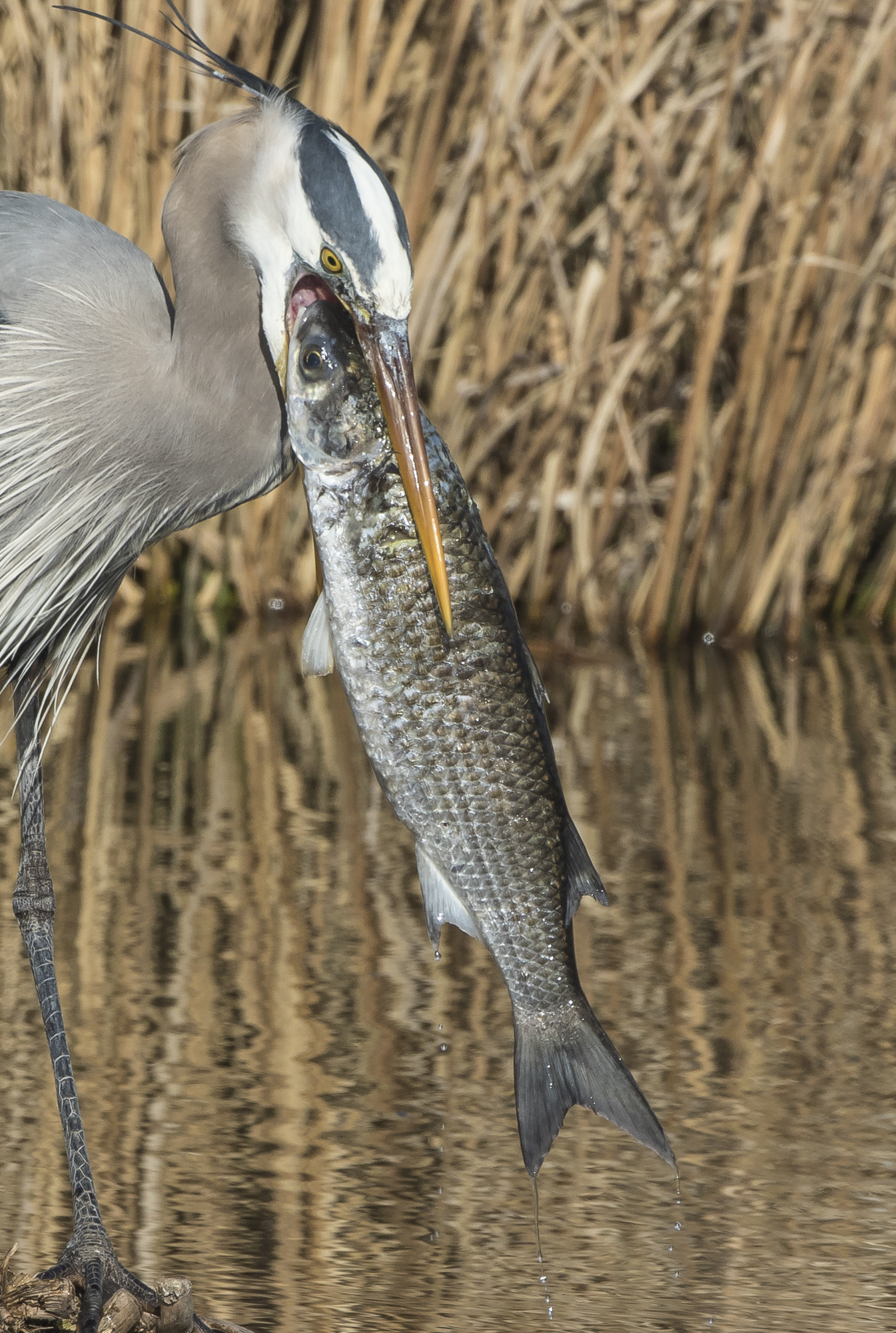
A lot to lift
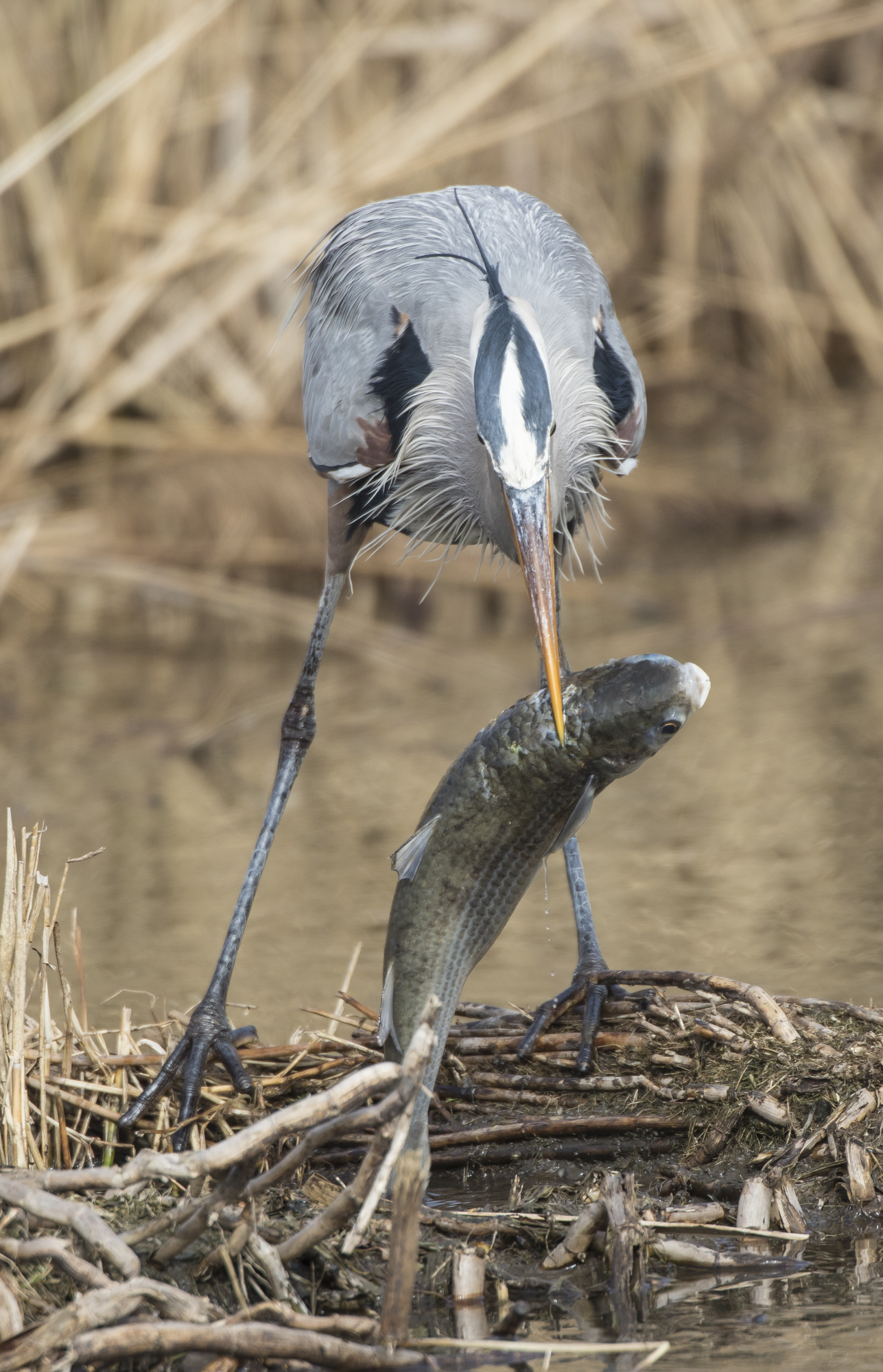
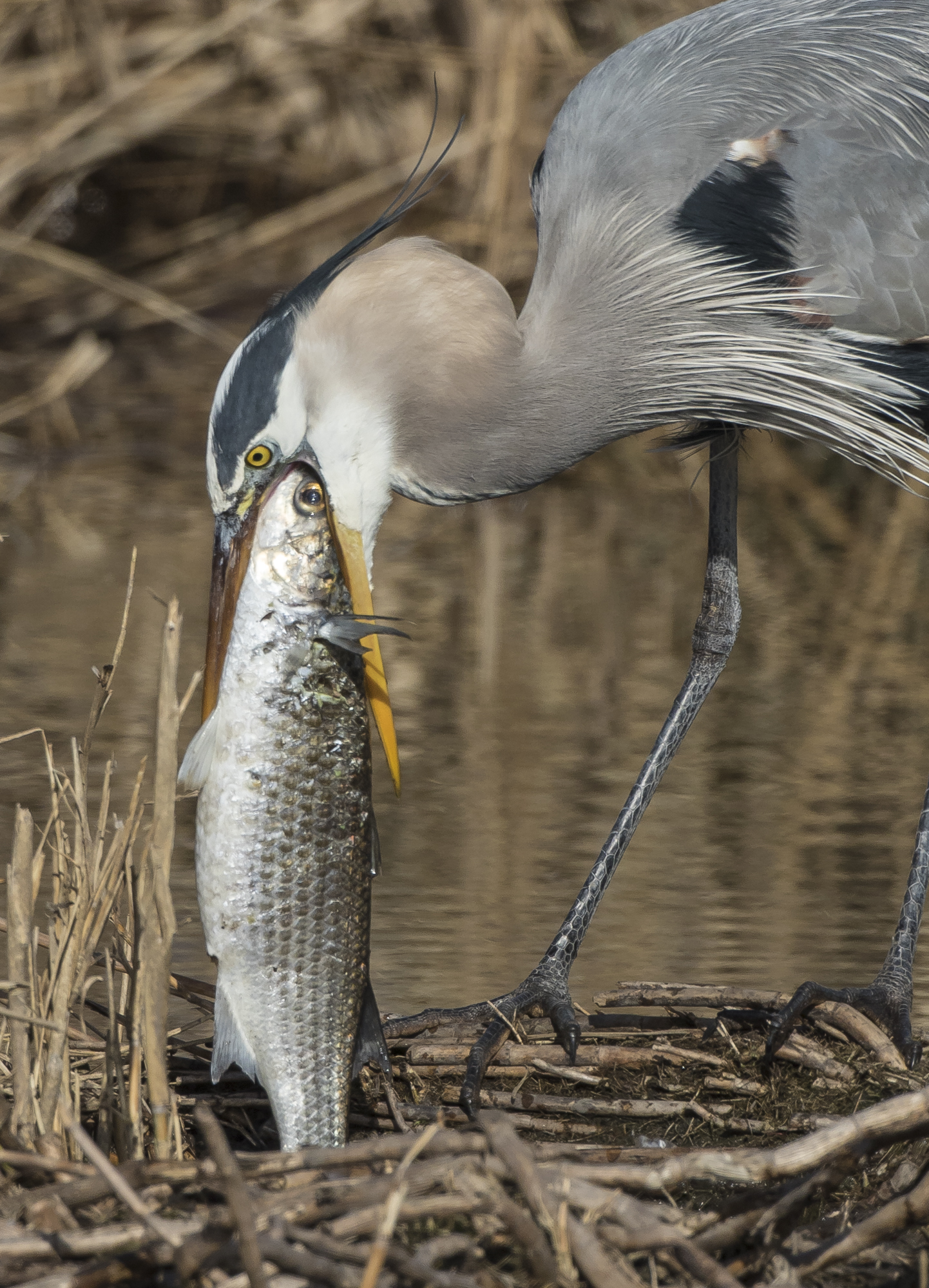
Not only was this fish a challenge in terms of its girth, it was a heavy lift for the heron. A typical adult great blue heron weighs about 5 pounds. Their upper bill is about 5+ inches in length. Looking at this photo, I estimate this fish to be about 14 inches in length (compare bill length to fish length). I found an online length-weight conversion estimator for fishes in Texas and used that to estimate the weight of this fish at about 1 pound – 1/5 the weight of the bird. So, that’s like me trying to gulp down a 40 pound hamburger!
Eye to eye
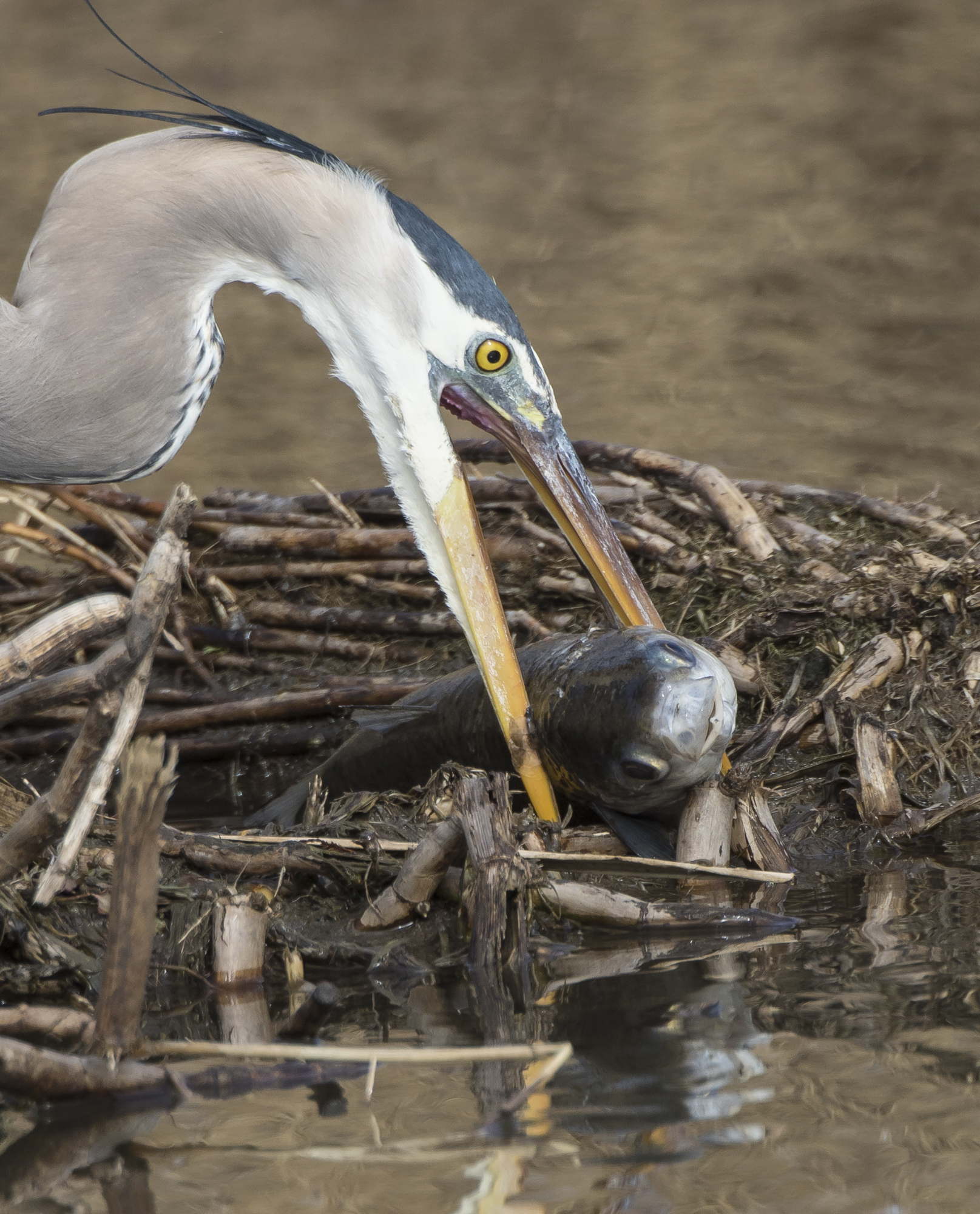
This photo “caught my eye”…the juxtaposition of the eye of the predator and the prey, now resigned to its fate. Our friend, Janna, suggested this caption…””that feeling you have when you realize who you have been trying to kiss”.
Maybe if I get it wet…
We watched the struggle for about 20 minutes and reluctantly decided to head off to see some other areas of the refuge, wondering if the heron would ever be successful. We came back about an hour and a half later, and the heron was still at it. Another couple of photographers had stopped, but the heron was paying us no mind. It had eyes only for the mullet. While we were gone, the heron seemed to have figured out a better strategy for lifting the fish, and came oh-so-close to swallowing it a couple of times.
Almost lost it
But it almost lost it into the water at one point, managing a quick grab to pull it back onshore.
Pondering your dreams
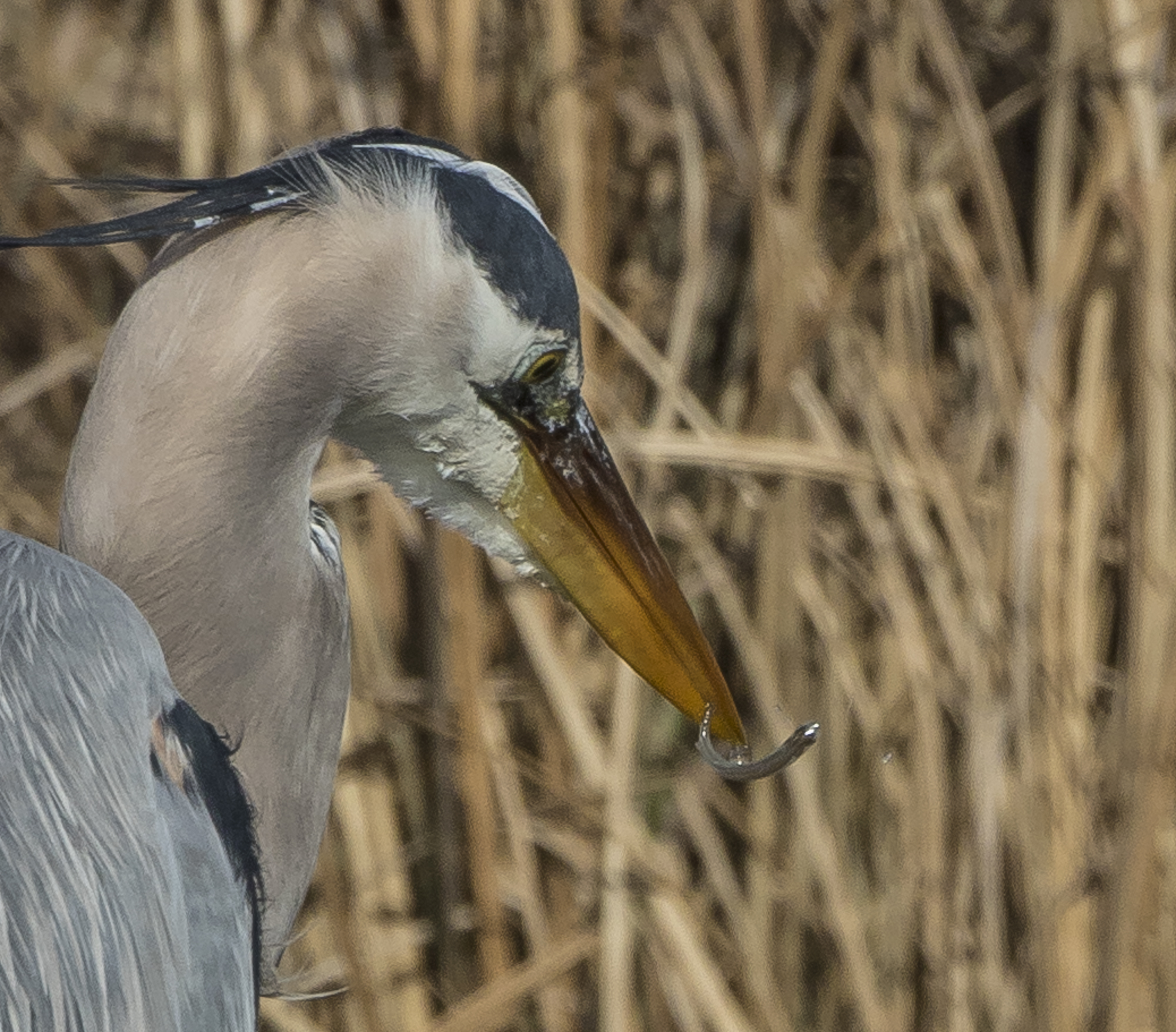
The heron was starting to tire. It took longer breaks between feeding attempts. We watched another 20 minutes. The proud bird twice turned its back (maybe hoping we woudn’t see?) and caught tiny fish and gulped them down.
Settling for less, or just grabbing a quick snack?
It was getting late. The heron had been at this for at least two hours. We had spent almost 45 minutes watching the struggle, camera shutters firing away (I’m almost embarrassed to admit I took 892 photos of this battle), and there was no end in sight. It was time to leave and head for Pungo for what we hoped would be a great sunset show.
Dream big
I hated to leave without knowing whether the heron realized its dream. But I guess I had achieved mine, even though I didn’t witness a successful end to the story. Perhaps the important thing, for both heron and human, is to dream in the first place.
All our dreams can come true, if we have the courage to pursue them.
The simplicity of winter has a deep moral. The return of nature, after such a career of splendor and prodigality, to habits so simple and austere, is not lost either upon the head or the heart. It is the philosopher coming back from the banquet and the wine to a cup of water and a crust of bread.
~John Burroughs, 1866
After a strange couple of days of unseasonably warm temperatures, winter has returned. A reminder that I am one of those odd folk that enjoys cold weather. In fact, the colder the temperatures, the better. I remember fondly the coldest day I ever experienced – a frigid -33 degrees Fahrenheit morning in my favorite place, Yellowstone. But it was spectacular! The air was clear and crisp, no wind, and the world was twinkling with tiny crystals of ice, called diamond dust, suspended in the air. Magical, indeed. Back here in the Piedmont of North Carolina, we have had some unusually cold temperatures this winter, dipping down to 9 degrees a week or so ago, and supposedly headed that way again this week. It makes for very active bird feeding stations, brisk walks under clear blue skies, and a better-than-usual seat bu a roaring fire as you read a good book. It has also has an interesting impact on one of my favorite plants – rhododendron.
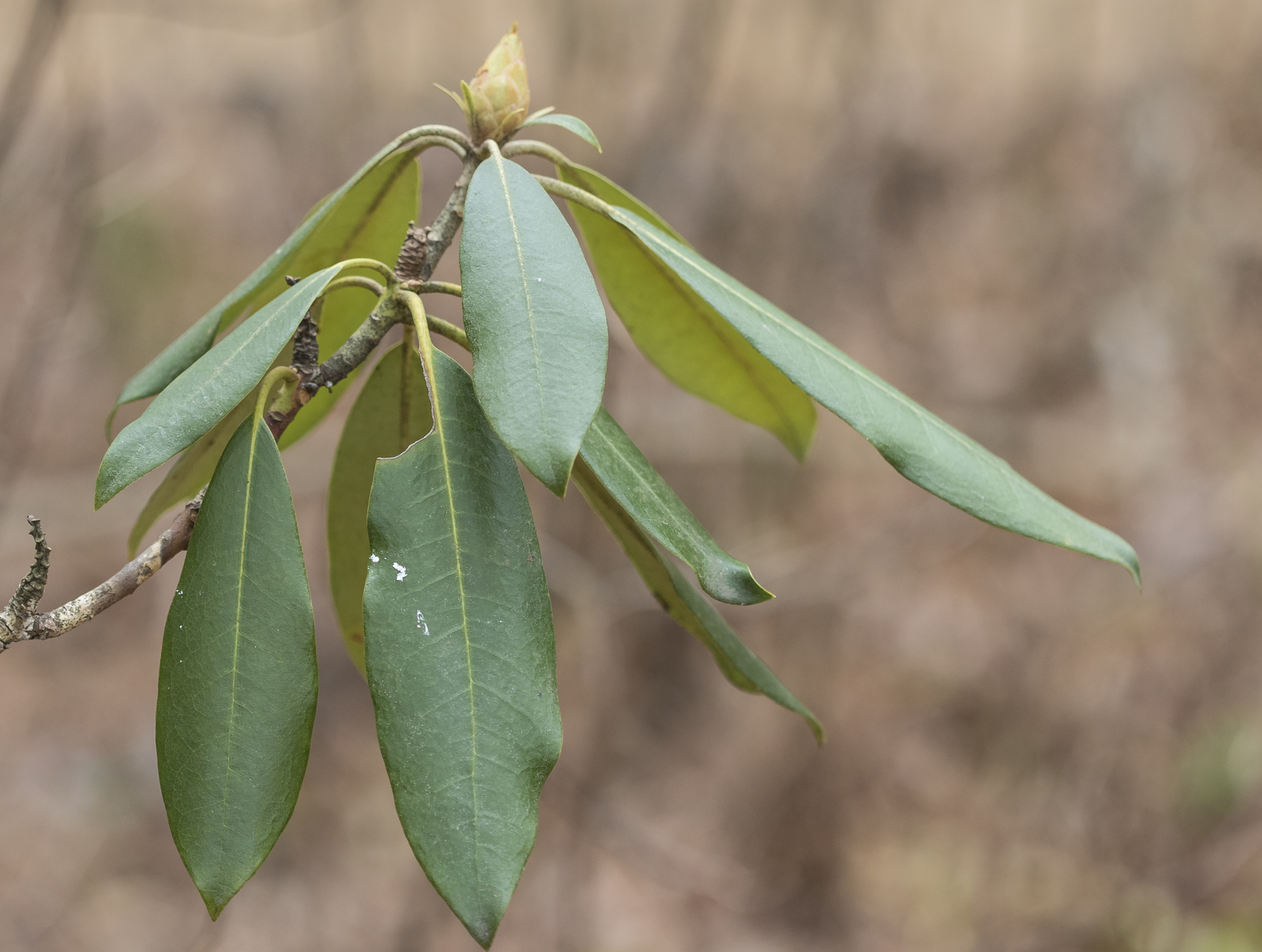
Rhododendron leaves at 32 degrees (click photos to enlarge)
It turns out that rhododendron leaves can be used as a biological thermometer. This is a phenomenon that is well-known, though the cause is not so well understood. I have made a resolution to get outside at least once a day at work, an easy thing to convince myself to do since I work in such a beautiful setting. Our mountain habitat has several large rhododendron shrubs and I noticed the leaves had started to droop as the weather got colder. I remember seeing them tightly curled in the true mountains on a few freezing occasions, so, with the predicted cold spell last week, I decided to photograph the tip of a single rhododendron branch at different temperatures. The first photo shows the branch at 32 degrees, the temperature at which the leaves are known to start to droop.
Rhododendron leaves at 26 degrees
As it got colder, the leaves drooped even more, and began to curl.
Rhododendron leaves at 15 degrees
On the coldest morning we had recently, the leaves were tightly curled, resembling green cigars. This curling is called thermonasty. That’s right, thermonasty. This odd-sounding name comes from the two root words- thermo (temperature), and nastic, which are non-directional plant movements that occur in response to environmental stimuli, in this case, temperature. The nastic movements of rhododendron leaves follow a fairly predictable pattern – when temperatures fall below freezing, the leaves start to droop but remain flat. At 25 degrees F the leaves start to curl and by 20 degrees F they are as tightly curled as they can get. Many people believe the curling is to protect the leaves from desiccation by shielding the stomata (the openings in the bottom of the leaf which allow the leaf to “breathe” or transpire). But recent research shows that the stomata are already closed when it is cold, and one researcher suggests a different theory for the change in leaf position.
According to Dr. Erik Nilsen (Why Do Rhododendron Leaves Curl?), the stomata are always closed in cold weather — they have nothing to do with drooping or curling of the leaf. The drooping is more likely a way to protect from the thawing that can occur on a sunny winter day. When the leaf is held in its normal flat and horizontal position, it will absorb sunlight and heat up and thaw, then could refreeze at night. Experiments have shown that flat leaves thaw faster than curled leaves. This is because a curled leaf exposes far less surface area to the sun than does a flat one. By thawing more slowly, cured leaves are better able to avoid the damaging effects of daily freeze-thaw cycles which can rupture cell membranes and eventually kill the leaf. By drooping and curling the leaf may be protecting itself from too much sun — opposite of what you might think it would try to do.
Rhododendron leaves at 58 degrees following the cold spell
My observations last week agree with the overall temperature response of these evergreen leaves. The thing I don’t yet have a good feel for is how quickly these changes occur. I need to watch the leaves this coming week to see how rapidly the rhodo-thermometer can track temperature changes. Always something to ponder and discover at the Garden.
One of the reasons there are so many terms for conditions of ice is that the mariners observing it were often trapped in it, and had nothing to do except look at it.
― Alec Wilkinson
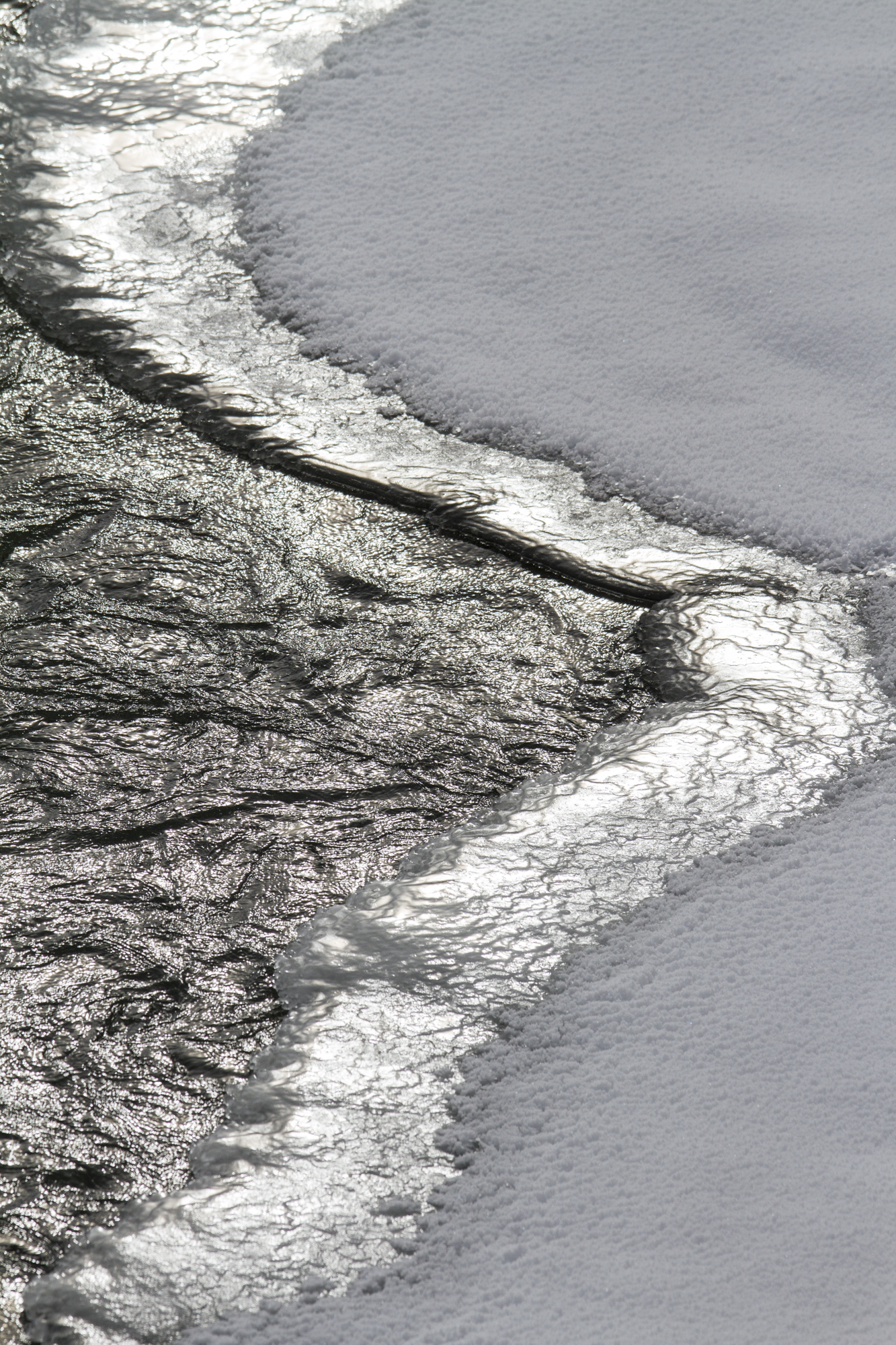
I must give credit to our friend, Bill, for the title of this post (hope he doesn’t mind). He is a poet and a wordsmith and used this phrase in an email about a hike along the Haw River we took this past Sunday with his godsons, Turner and Charlie. We hiked along the Lower Haw State Natural Area from the Hwy 64 bridge over the Haw up to our neighborhood, a distance of a little over 2 miles. Temperatures were in the 20’s when we started, but mostly sunny, and the air was still. The river, always special, was especially beautiful, with a fringe of ice along her shores that often extended far across her rocky breadth. From the outset, the river provided visual delights and mysteries.
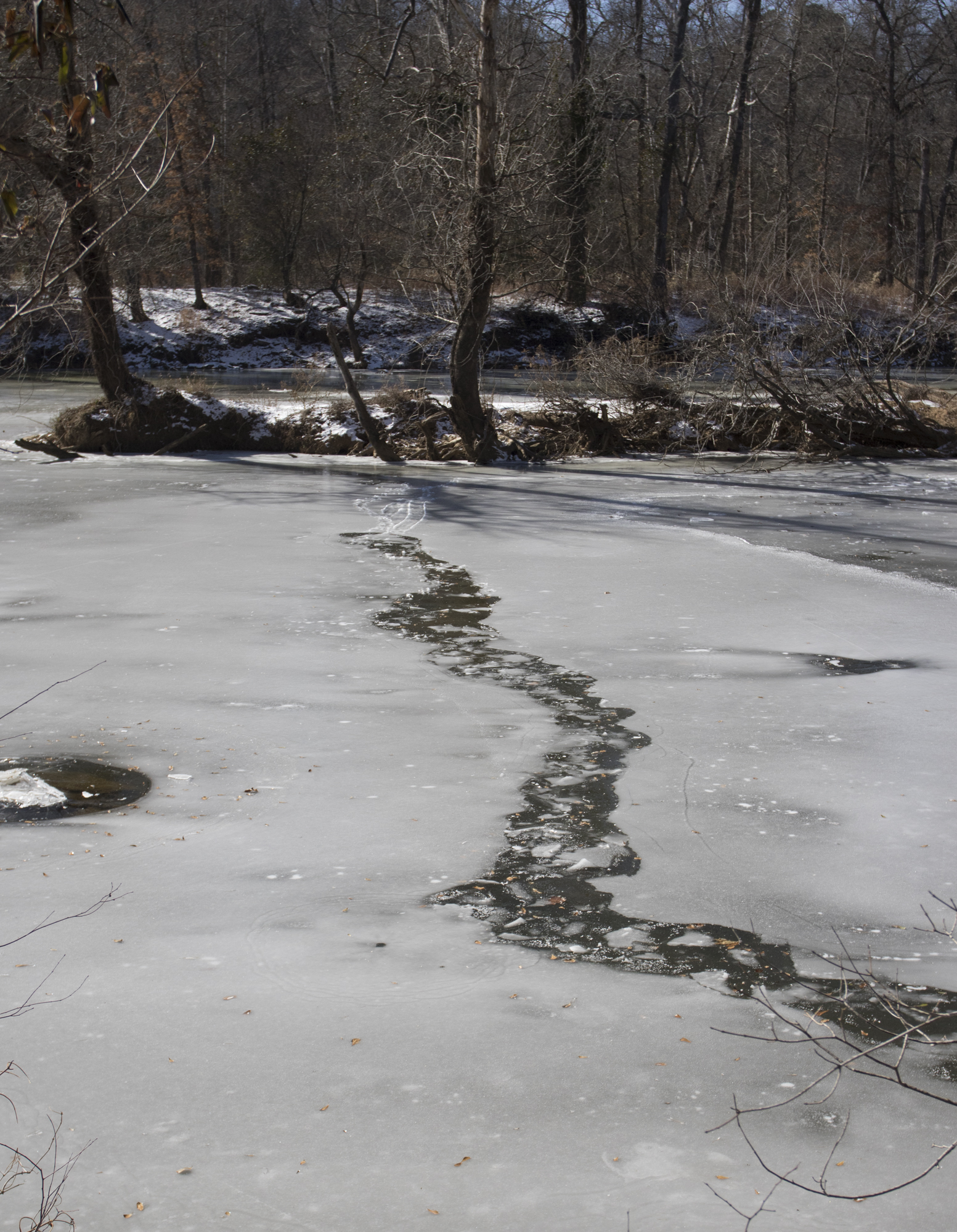
Unusual “trail” on the river ice (click photos to enlarge)
Just a short way upriver from the bridge, we started seeing some winding “trails” on the ice, looking as if someone had pulled a tiny sled in an erratic route across semi-frozen ice.
An open channel helped solve the mystery
Just beyond those first mysterious ice trails, we saw a partially open channel that had a similar irregular path. This one led over to an island in the river where we could see evidence of beaver chewed sticks piled along the bank. Mystery solved! The initial trails were frozen over beaver channels.
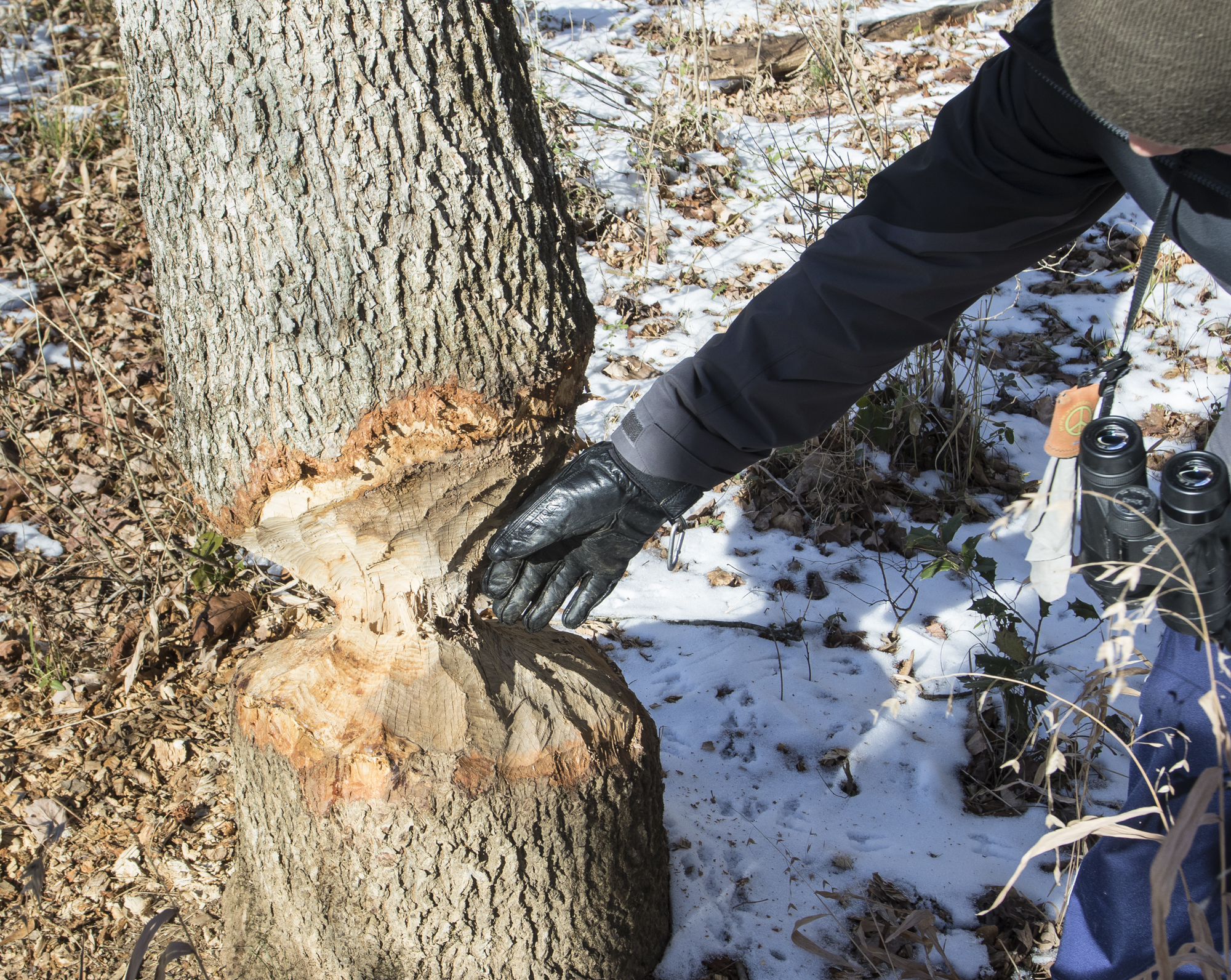
Beaver teeth marks on a sycamore log
There is abundant beaver sign all along the trail
From that point on, we encountered many active beaver chewed trees, some quite large. Years ago, when I was doing programs for state parks, I remember reading some facts about beavers – the largest one ever trapped weighed about 105 pounds (although my current reference on mammals says the largest on record was 86 pounds – still a huge rodent). Average weight for an adult beaver is around 50-60 pounds. I once saw a photo of the purported record tree felled by a beaver – a tulip polar a little over 5 feet in diameter! None of the trees along the trail approached that, although the busy beavers have been gnawing on some pretty large specimens. Beavers are somewhat generalist vegetative feeders in warm months, but this time of year they feed almost exclusively on the inner bark of tree trunks and branches. Other wildlife we saw included a variety of birds – great blue herons looking for open water along the river, and a variety of songbirds trying to find something to eat along the trail. American holly berries seemed a favorite and we saw several hermit thrushes and American robins feeding in some of the large trees. Mixed feeding flocks of other species including Carolina chickadees, tufted titmice, woodpeckers (red-bellied, downy, and pileated and a yellow-bellied sapsucker), some feisty yellow-rumped warblers, and a few ruby-crowned kinglets. A beautiful red-shouldered hawk, a blue jay, and some of its cousin American crows, rounded out our bird sightings.
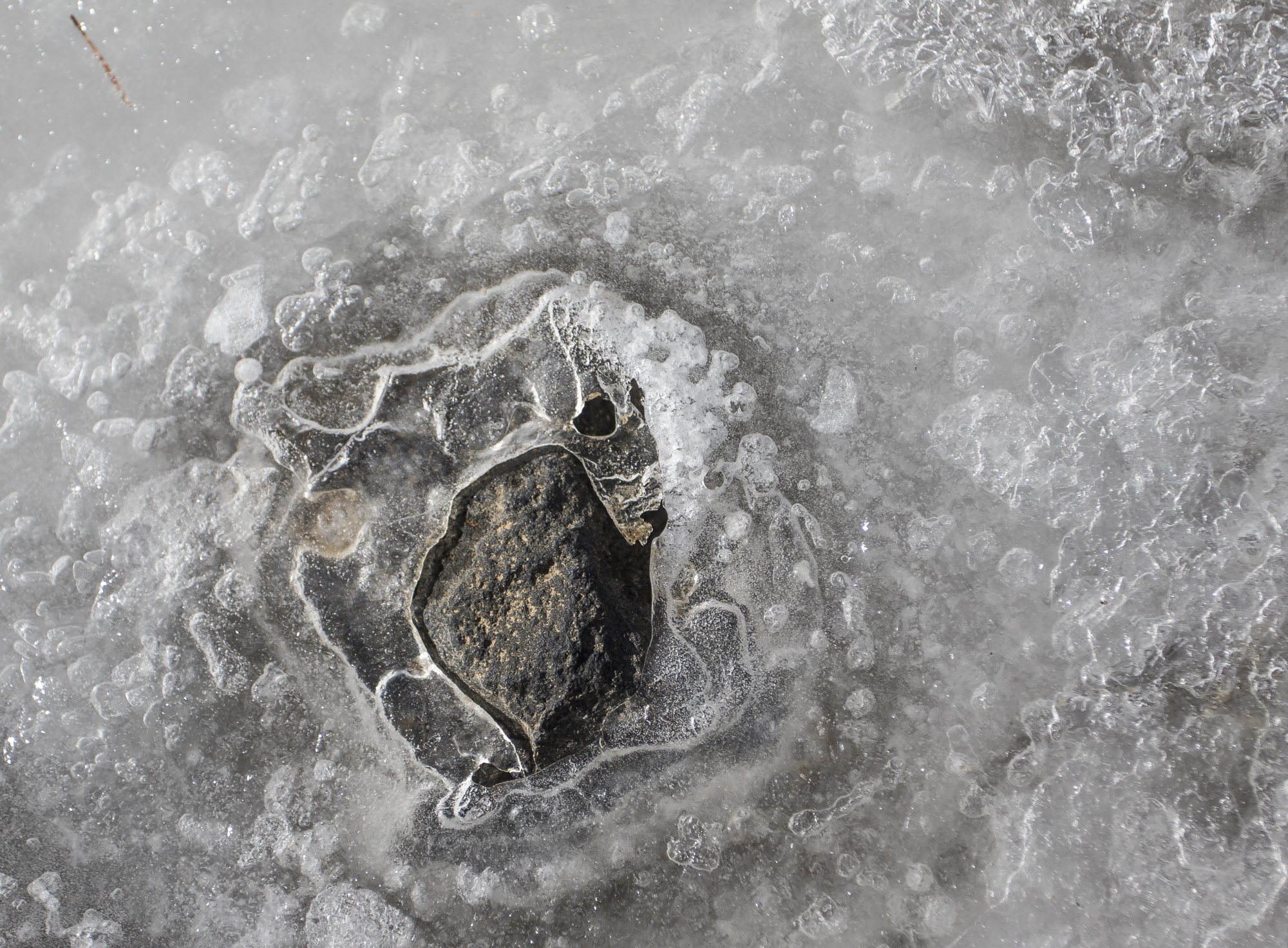
An exposed rock in a sea of ice
As I have said before, ice fascinates me. Life as we know it depends on the unusual characteristics of water and one of these is that, unlike most other chemical compounds, when it gets cold enough to turn into a solid, the solid floats (the solids sink in most cases).
Needles of ice in a patch along the shoreline
I remember a discussion I had about ice with a museum co-worker back in 2006. I was lucky enough to get chosen as part of an international science and education team to spend a month in the Arctic aboard a Russian ice-breaker (no collusion, I swear). She asked me if I thought I would get bored spending a whole month out on the ice, with nothing but an expanse of white to view. I had said no, and was justified when I realized the incredible variety of forms that ice can take – all beautiful. The ice along the Haw was no different, and showed us its many faces as we gazed upon it from the bank – all magical.
Beech leaf frozen in the surface of thick ice
A small ice shelf next to a riffle area
Ice lace edging along the rocky shore next to flowing water
Intricate patterns of ice on the surface of an eddy in the river
The mix of ice and open water along the river
The weather is warming, and ice is melting, but memories of a cold hike along the Haw, with good companions, will stay with us for quite some time. I spoke to our group of my appreciation for those that fought to set this corridor aside, and to the dedicated folks, like those of the Haw River Assembly, that continue to work toward its preservation. Haw-inspiring indeed.
Winter’s barren landscapes chide us to give our attention to the splendor of things nearby. When the air is thick and the sky overcast, we need not travel so far to have high expectations, for in her nakedness she teaches us to be less distracted but instead to be more connected, more aware.
~Henry David Thoreau
Here in the Piedmont, we are accustomed to having our hopes for snow dashed at the last minute. Places an hour away usually get the white stuff and we get nothing, or just a couple of flakes. Last week was different. They had predicted a trace for our area, but we managed a full 2.5 inches! Not huge by any stretch, but this snow is “real snow” – dry powdery snow that you can sweep off the walkway instead of shovel. And it has been so cold (temperatures at night in the lower teens) that it is still white, a full four days after the snowfall. Unlike most of the people I know, I like cold weather. It is physically invigorating, gives more reason to chop wood for the fireplace, and, on a sunny day, brings a crispness to your surroundings that help you see and appreciate details in the landscape. I notice this about winter skies, and a winter walk in the woods is no different. Here are a few of those details from a hike in the neighborhood this week.
Leaves frozen in creek water (click photos to enlarge)
I am fascinated by ice. We walked down to the neighborhood pond to check for ice, following the path of an intermittent stream that runs behind our house. Close to the pond, the creek has permanent water, and we had to look closely to see these leaves were actually suspended in extremely clear ice.
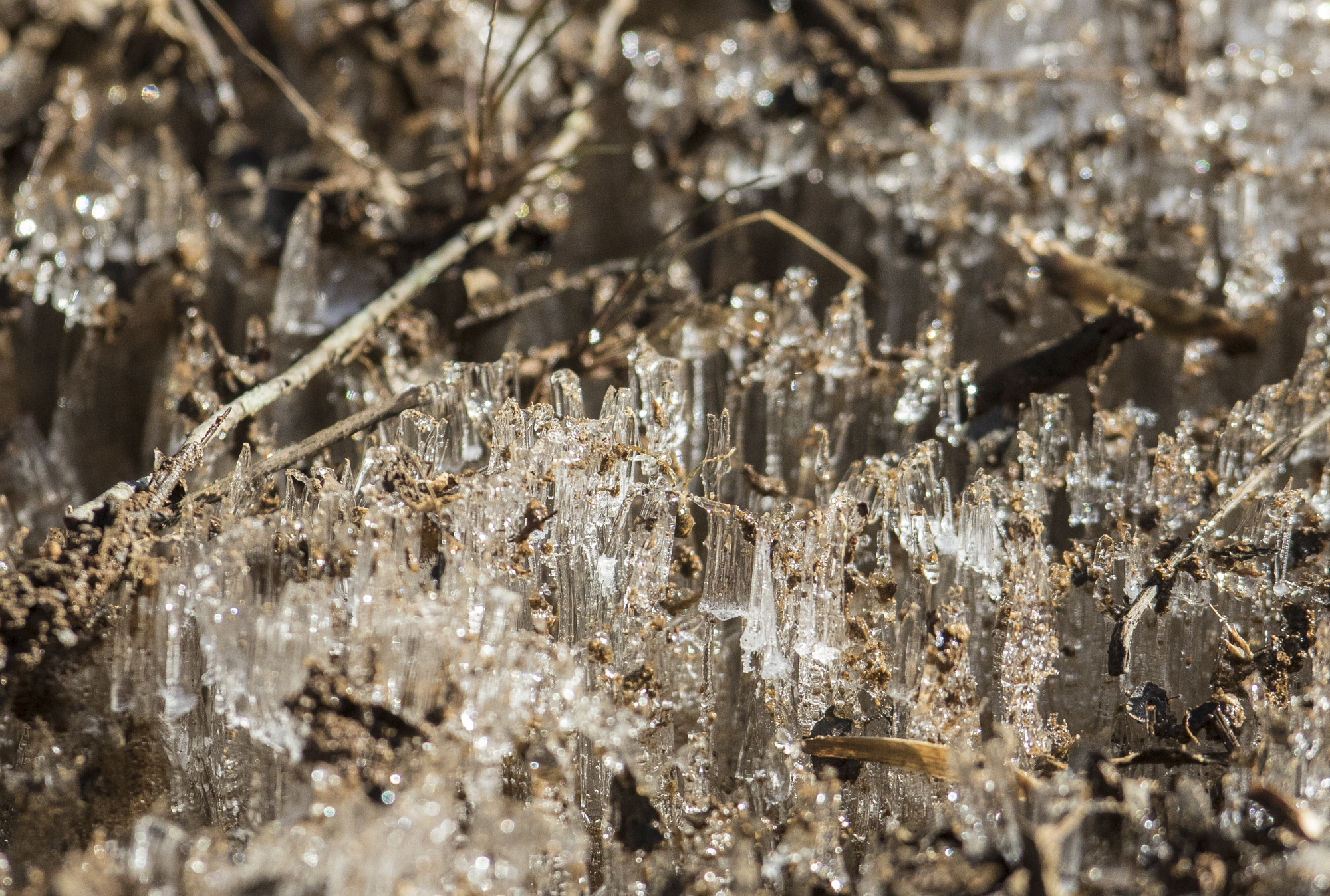
Needle ice along the muddy shore of the neighborhood pond
Walking along the creek bank at the pond was a noisy stroll, the soil crunching with every step.
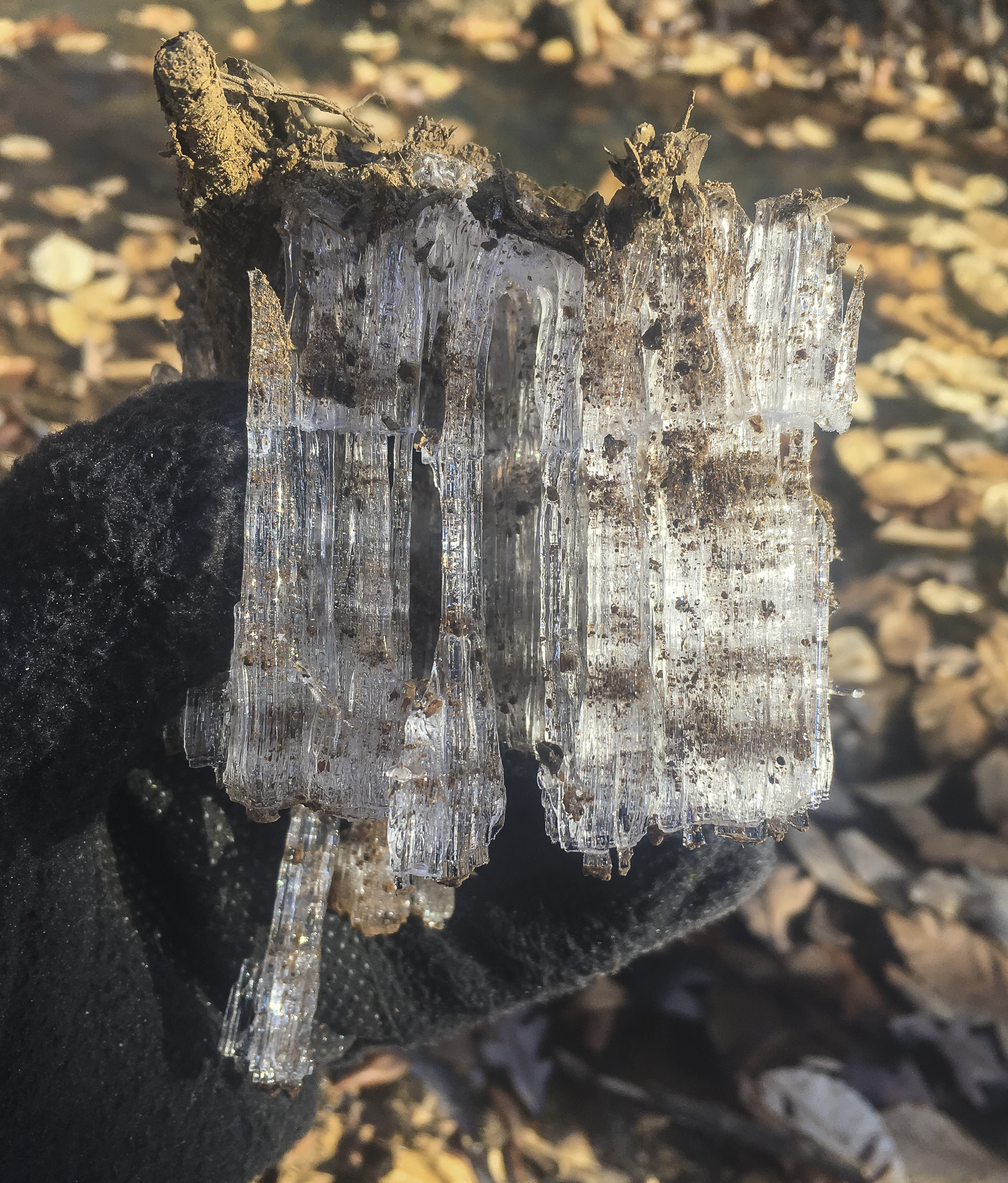
Holding a chunk of needle ice in my gloved hand
I turned to look at a duck out on the pond (which was still mostly ice-free that day) and saw my path littered with chunks of ice crystals. This distinctive columnar shape is called needle ice (also known as frost pillars or frost columns). This occurs in porous soils where the ground temperature is above freezing and the air temperature is below. Water from the soil is pulled upward by capillary action. The ice columns tend to push away the soil at the surface and can make for a very noisy walk, with each step throwing chunks of connected ice columns, some a few inches in length.
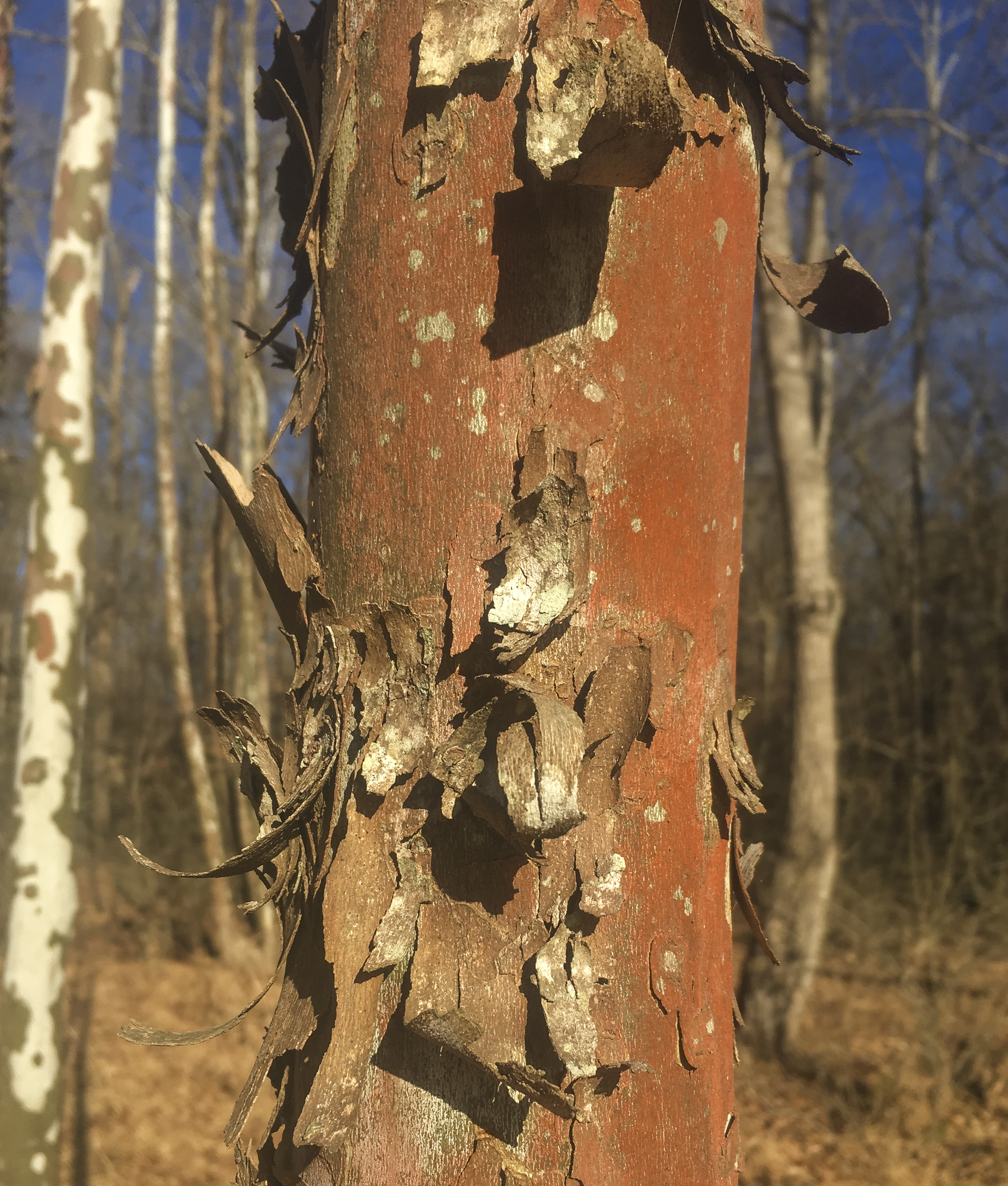
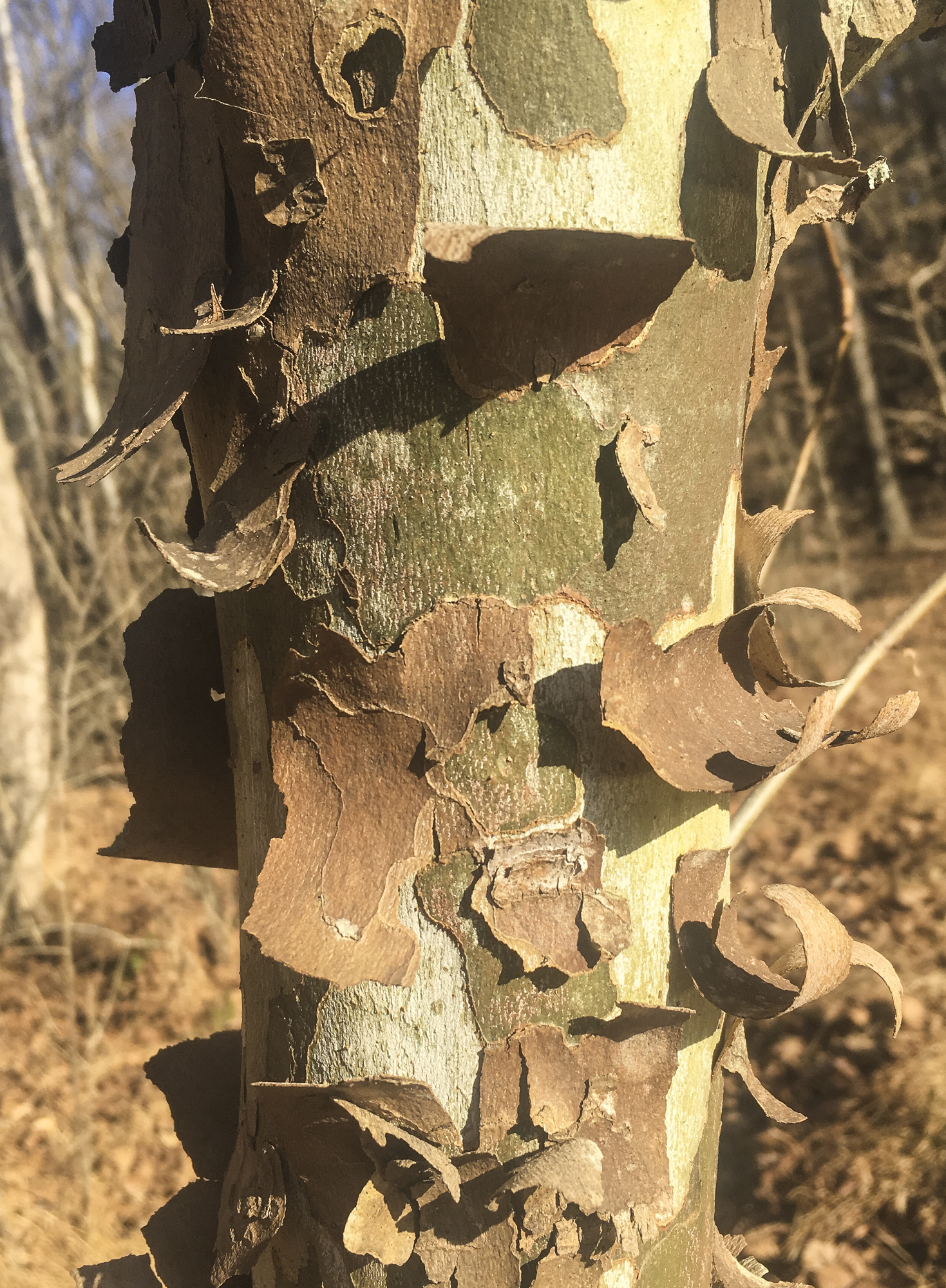
The many faces of young American sycamore trees near the pond
Along the back edge of the pond you walk through a grove of young American sycamores. The variety of bark textures and colors is amazing. Another advantage to the winter woods, a new appreciation for bark.
The large tulip poplar in the front yard
Back on our property (about a mile from the community pond), I pause to admire the unusual bark of a huge tulip poplar tree (Liriodendron tulipifera) in the front yard. This, and a couple of other smaller tulip poplars nearby, have strange bumps and twists in the bark that are particularly noticeable in the golden glow of late afternoon light in winter. I have asked several people, but no one seems to know for sure what causes this.
The unusual bark of our tulip poplar
Mouse tracks in the snow…
…disappear into a hole
Of course, tracks in the snow are one of the perks of a winter walk and the property is covered with distinctive shapes and patterns of hopping songbirds, bounding squirrels, a lone coyote trail, small groups of deer, and, surprisingly, only one white-footed mouse. Maybe they are laying low in these cold temperatures. This one trail led across a path and disappeared into a tiny hole under the snow next to a tree trunk.
Our far ridge glowing in the setting sun
With sunset approaching, we decided to walk the path we have through our 14+ acres. It was so quiet in the woods with the sun glowing on the far ridge line of our property.
The largest tree on our property, a huge white oak, lost a large limb this winter
The far property boundary is marked by a nearby giant – a huge white oak that is the largest tree on our land. I like to think it is 250+ years old based on its huge size compared to other trees I had to cut after storm damage. One of those had 126 growth rings, and it was nowhere near the diameter of this behemoth. A huge limb broke out this winter, providing a sheltered hollow that I hope one day will be taken up by one of the resident owls. I can’t help but think that I am not the only creature in these woods fascinated by this giant.
One more night of frigid temperatures
While many of my friends look like this old tree hollow when temperatures drop, I find it exhilarating and definitely worth the chill to explore the nearby woods. I encourage you to bundle up, and do the same.
Nature now, like an athlete, begins to strip herself in earnest for her contest with her great antagonist Winter. In the bare trees and twigs what a display of muscle.
~Henry David Thoreau, 1858
It is not so much muscle I saw the other day on a walk in the Garden, but rather puffiness. I took the camera with me when I went out to feed the birds at our bird blind, then sat for a few minutes to see who was hungry. Turns out, they all were, and soon I was surrounded by a mixed flock, many that looked a bit rounder and more puffed up than usual.
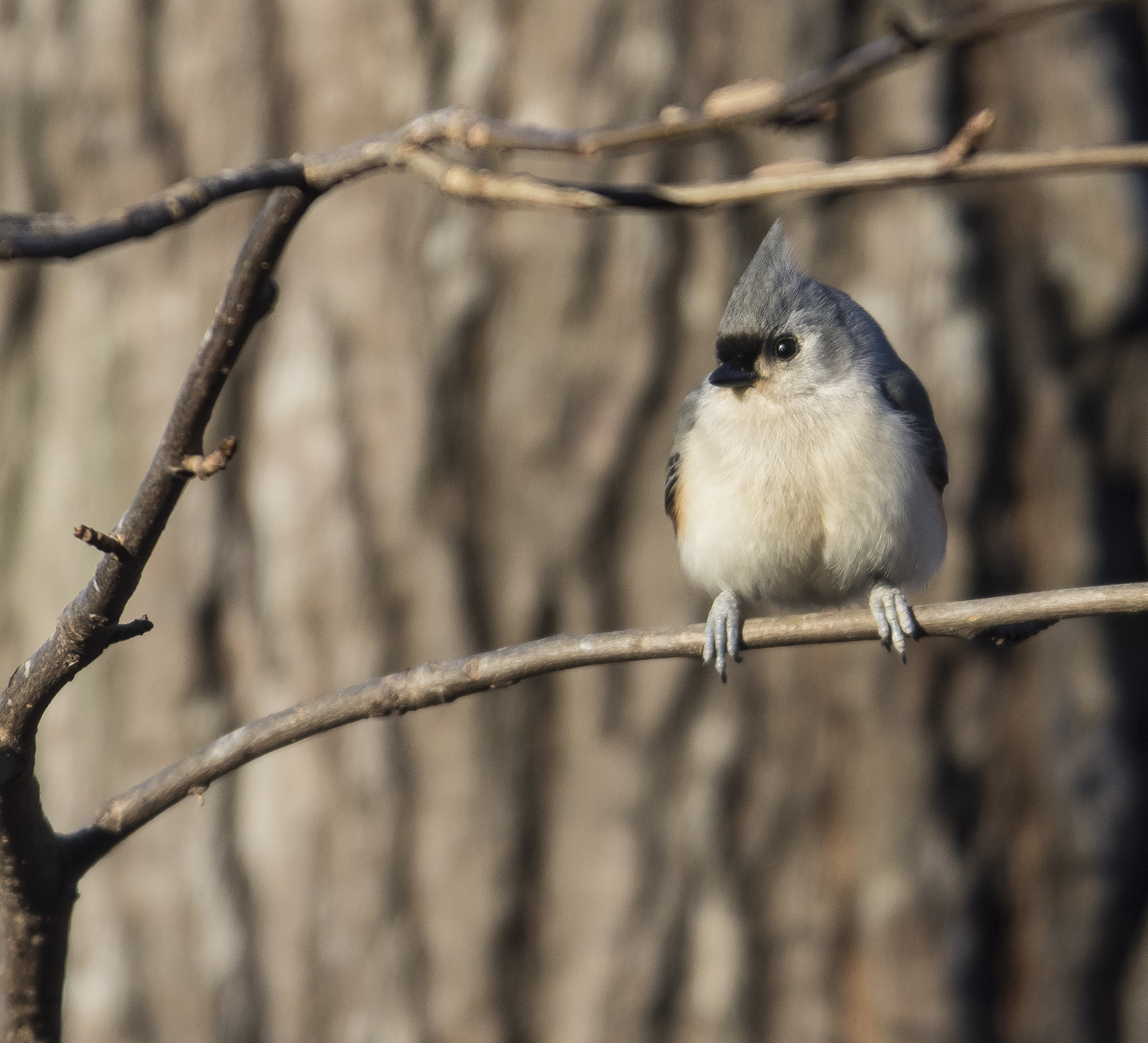
A tufted titmouse seems to be wondering when this cold spell will end (click photos to enlarge)
The tufted titmouse above is a prime example. That bird even threw in a somewhat stern countenance as if totally unhappy about the current situation of very cold temperatures. The puffed up appearance is actually one of the more efficient ways that our winter birds manage to survive the bitter cold. Air trapped between its feathers is heated up by a bird’s body. Puffing up (raising their feathers) traps as much air as possible in their feathers. More trapped air means more warmth, with some sources stating the heat retention can increase by as much as 30% when all puffed up.
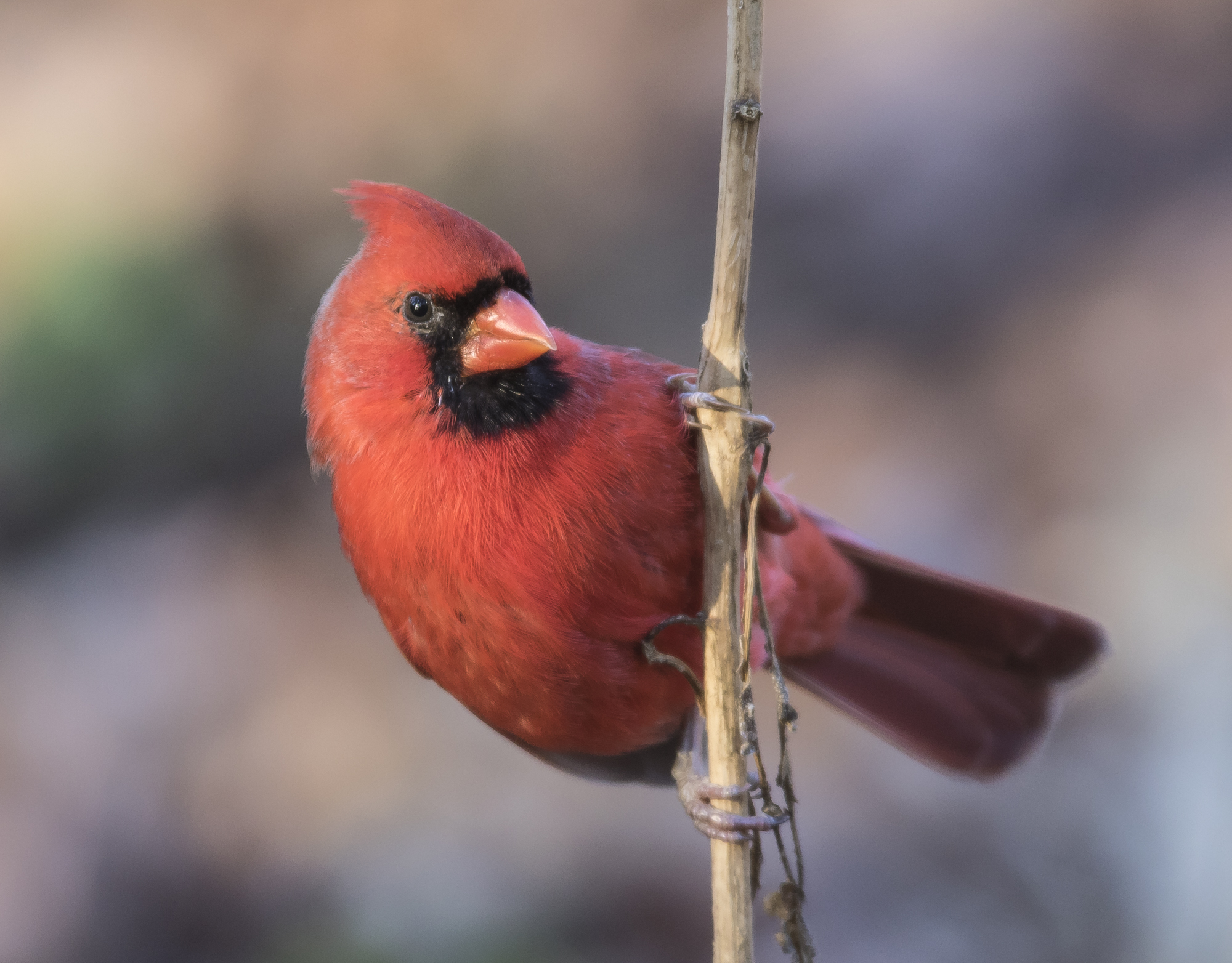
Northern cardinal moving in to feed
And, as any backyard bird watcher knows, bird activity at feeders greatly increases in cold or stormy weather. This week is no exception with many species (including a few, like Eastern bluebirds, that aren’t usually present at our feeders) spending more time at the feeding stations at work. Frequent feeding helps birds maintain their fat reserves which provide insulation and store extra energy used to increase body heat when necessary.
Northern mockingbird surrounded by its winter food supply
On my way out, to the blind, I saw the resident northern mockingbird in the usual spot – a large deciduous holly in the display garden of our courtyard. That bird has stationed itself in one of the two berry-covered hollies most days for the past few months. This is a common strategy for this species – guard your winter food supply from all those upstart berry thieves like bluebirds, robins, and cedar waxwings. As you can see, the strategy seems to be working. Other hollies in the garden are mostly stripped of the berries now.
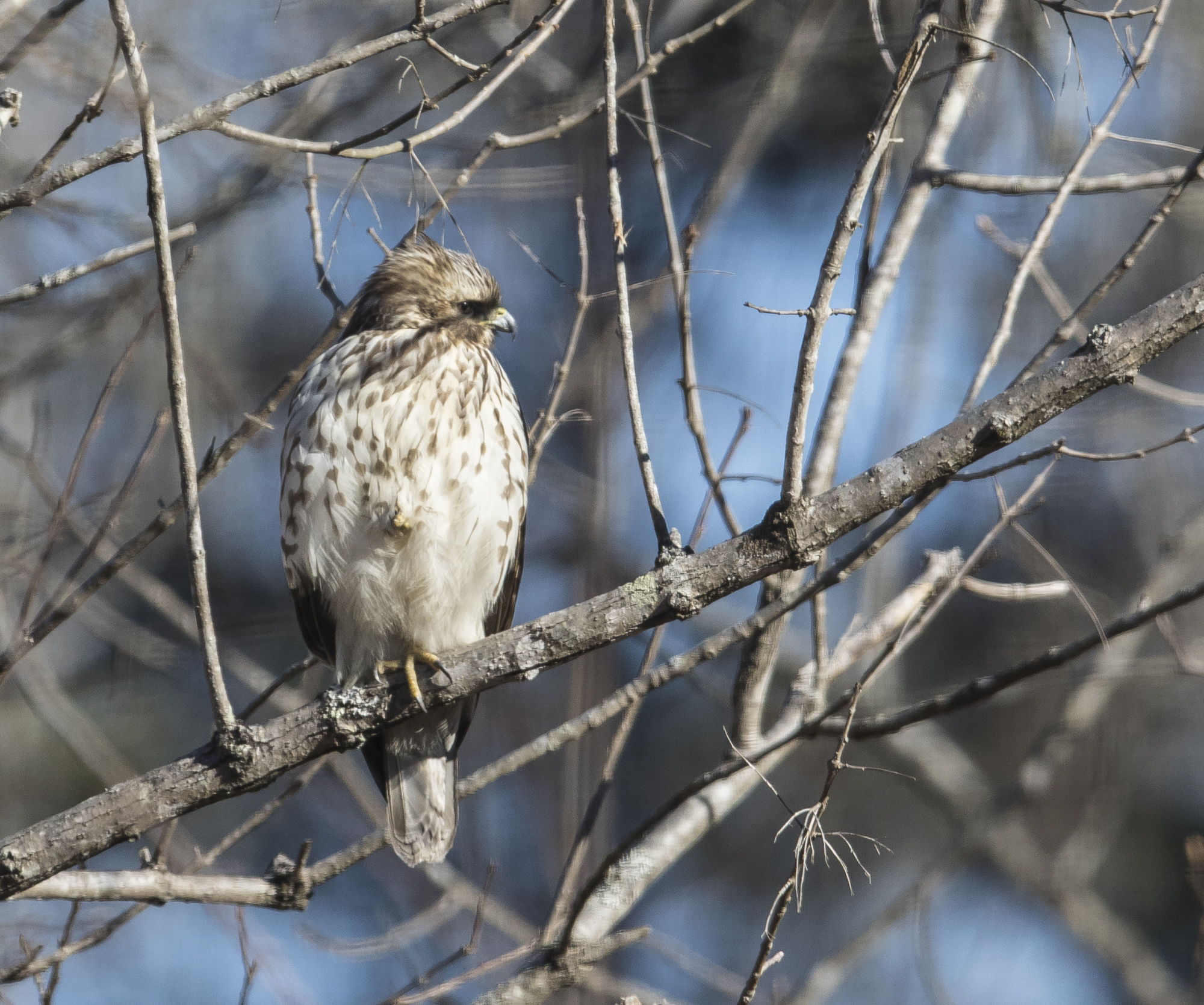
Juvenile red-shouldered hawk wondering where all the frogs went
Back in the office, I glanced out to see an immature red-shouldered hawk looking intently in the grasses below for any sign of something edible. Since this species prefers a diet of reptiles and amphibians, these cold weeks must be stressful, especially for young and inexperienced birds. I am keeping an eye in hopes of seeing what they might add to their diet when times are tough.
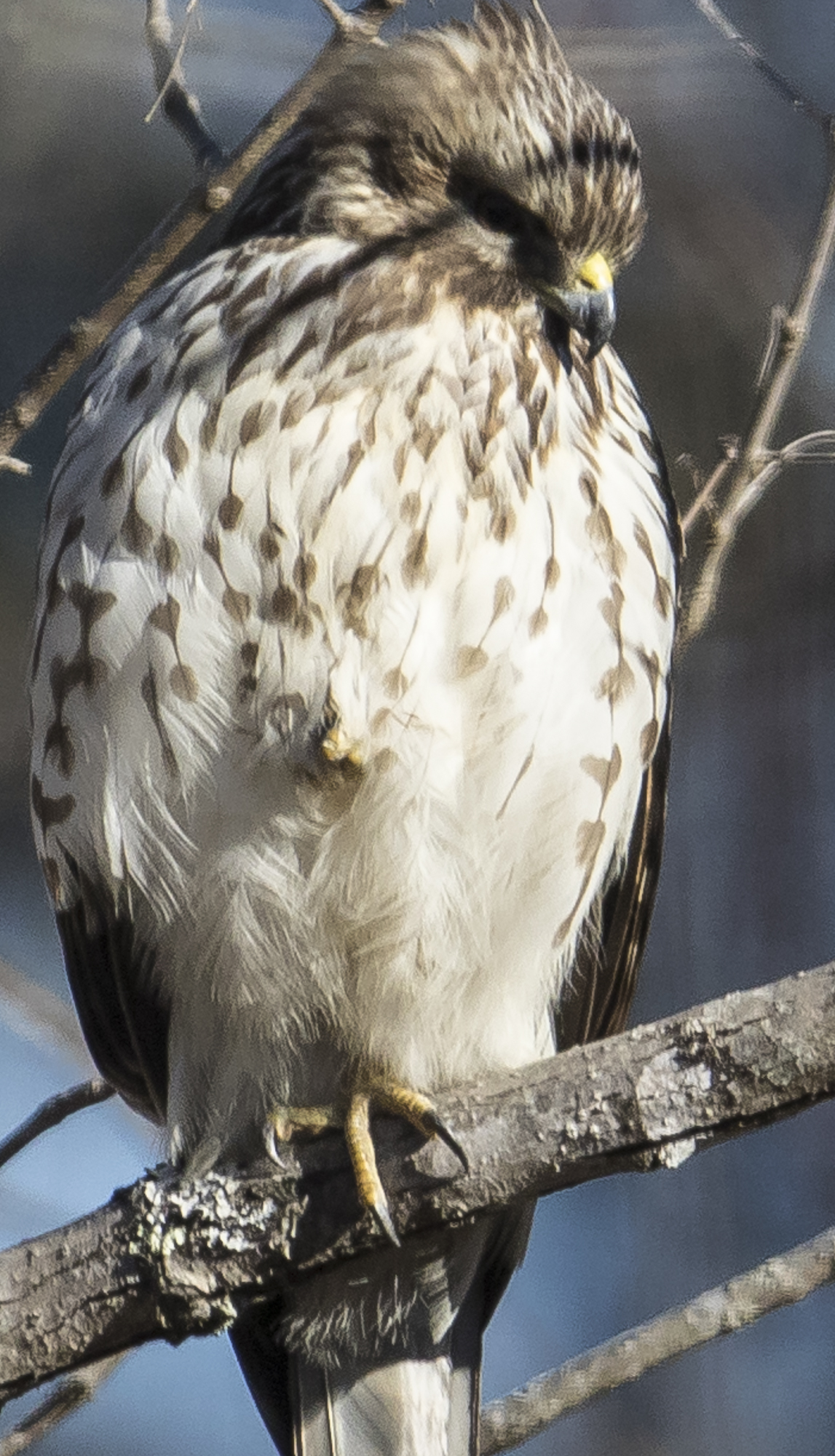
Standing on one leg is another strategy for staying warm
A closer look at our hawk shows another strategy used by birds to stay warm in winter – standing one leg with the other one tucked up under a blanket of feathers. They will often then switch to give the other leg a turn. In this case, the placement of the foot looked a bit odd at first and resembled a knot coming out of its belly.
The only bird at the Garden that doesn’t seem to mind the cold
There are a couple of other ways birds strive to stay warm – they shiver, although they typically don’t shake like we do. These muscle contractions help maintain their body temperature around 105 degrees (average for most songbirds). If all these adaptations are pushed to the limit on days like we have had lately, then surviving the cold, dark, nights of winter must be extra tough. That’s why many songbirds flock together after dark. Some, like chickadees and kinglets, crowd together in tight groups in protected areas like brush piles, evergreens, or even nest boxes, which helps them to conserve and share body heat.
We can help our feathered friends that don’t migrate to warmer climes by doing a few things in our landscapes:
Plant native plants that provide cover and food. North Carolina Audubon has some great suggestions here.
Don’t tidy your wildflower beds until later in winter or early spring, leaving seed heads and structure for food and cover.
Provide winter water in the form of moving water, a bird bath heater, or regular re-filling with warm water in freezing weather.
Next time you head outside with your puffed up winter jacket, think of how the birds are managing to survive, and how what we do in our yards and gardens can help.
…one of the most spectacular wildlife events that you can see anywhere…It’s the largest congregation of bats in the world, and they come out of this cave by the millions.
~Mylea Bayless, a senior director at Bat Conservation International
Here is another long overdue post from a wonderful trip to Austin, Texas, a few months ago. Melissa had a presentation at a national conference, and I was lucky enough to tag along on the front end. Our gracious hosts are long-time friends of her family, so we had a great tour of this beautiful city, its food, and nearby natural wonders. I have been lucky to see some incredible wildlife spectacles in my wanderings – the overwintering reserves of monarch butterflies in Mexico; thousands of reef fishes in all colors of the rainbow in the Virgin Islands; bison herds in Yellowstone; huge flocks of sandhill cranes and snow geese at Bosque Del Apache National Wildlife Refuge in New Mexico; and fields full of black bears and tundra swans back home in North Carolina. On this trip, I added another, the bats of Bracken Cave.
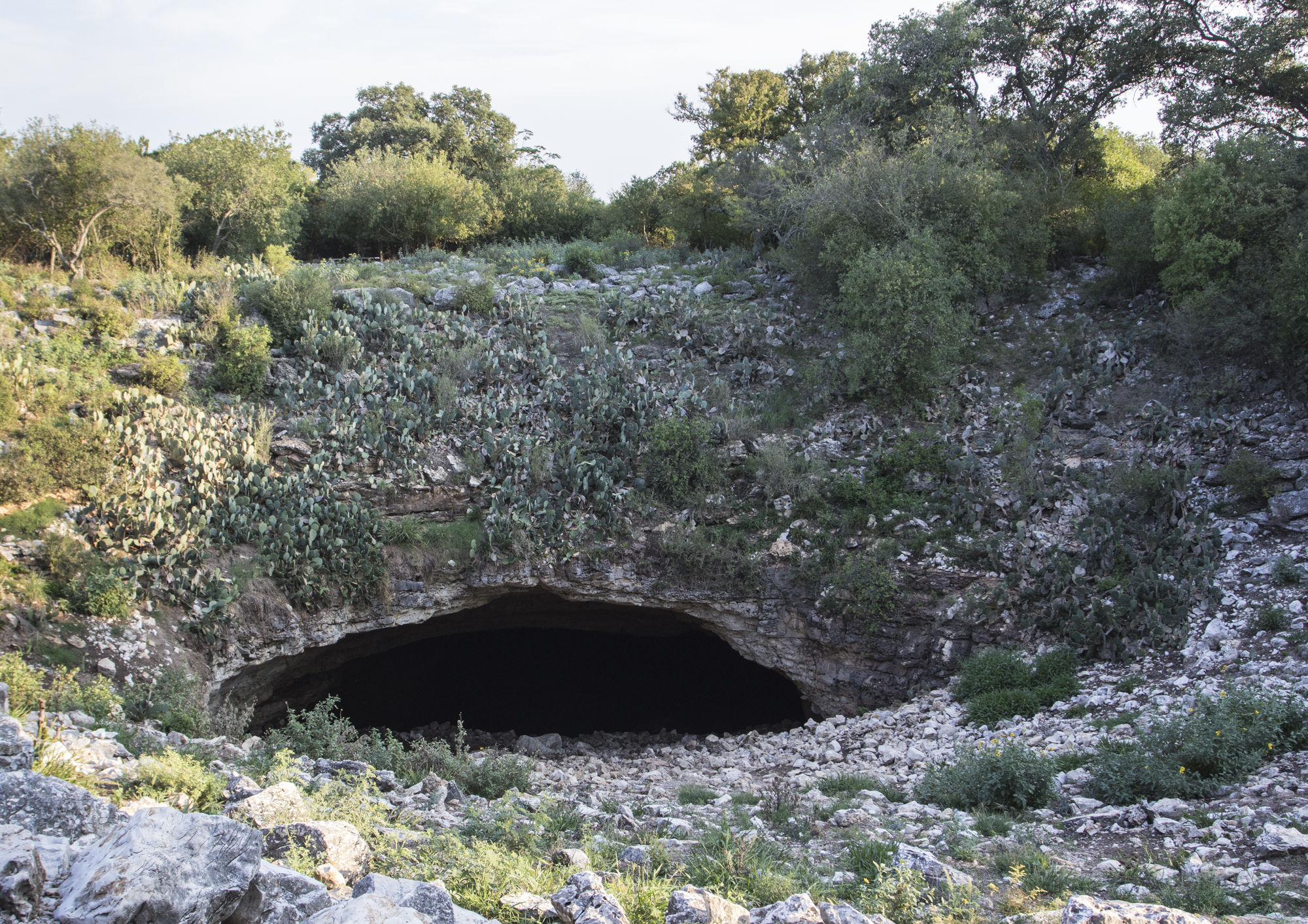
The unassuming entrance to Bracken Cave (click photos to enlarge)
We had heard about the bats in Austin and at Bracken (closer to San Antonia) from our hosts’ son, Skip, a professional wildlife filmmaker, when he visited us last year. We joined Bat Conservation International (BCI) before our trip in order to qualify for an overnight camp-out near the cave. This allowed us to witness both the evening departure and early morning return of the millions of Mexican free-tailed bats that call the cave home for several months each year. I wasn’t that thrilled with the idea of camping in Texas in early September, but we decided it would be worth it for this. And it turned out just fine, with mild temperatures, a wayward wild turkey that hung out with us, and a great group of fellow nature nerds with which to share a campfire.
Shortly after arriving, we walked down to the seating area near the cave for an introduction by one of the volunteers that help manage the site. Here are just a few of the amazing facts he shared about this incredible place:
There are an estimated 15-20+ million Mexican free-tailed bats (Tadarida brasiliensis) using the cave. Most of these bats spend the winter in Mexico (~1000 miles from this cave), where they mate before returning to Texas. Pregnant females form huge maternity colonies at places like Bracken Cave that have the right temperatures and humidity for raising their young (male bats form smaller colonies elsewhere).
Bracken Cave has one of the largest concentrations of mammals anywhere in the world.
The cave is a birthing place for millions of bat babies (called pups) every year with concentrations of up to 500 pups per sq. ft. hanging on the cave ceiling. Somehow, using a combination of sight and sound, mothers returning from a night of foraging manage to find and nurse their own pup amid this chaos. Pups are about 1/3 the weight of the mother (the equivalent of a human mother giving birth to a 40 lb. baby).
Each female bat gives birth to one pup per year with only about 50% of the pups surviving their first year. Once they reach adulthood, these bats may live up to 15+ years in the wild.
Mother bats must leave the cave each night to feed on night-flying insects to sustain themselves and their growing young. They fly up to 60 miles away from the cave each night, consuming huge quantities of flying beetles, winged ants and moths. Scientists estimate the Bracken bats eat 140 tons of insects every night. The value of this to Central Texas is huge in that one study showed the bats save the just the region’s cotton growers an estimated $741,000 per year in pesticide costs and crop damage.
The viewing at Bracken is controlled by BCI and limited to small groups a few nights per week. They are doing a great job of ensuring the bats keep returning to Bracken Cave. The site and surrounding landscape has been threatened by developments but recent partnerships brokered by the Nature Conservancy between business, politicians, and conservationists, have set aside more land to provide a buffer for the bats.
As we sat and listened, we saw some of the many predators that stalk the bats as they exit – a skunk, two coachwhip snakes, a couple of hawks, all seeking an easy meal provided by a nightly cloud of bats, that now included the inexperienced young. The air was still and had a slight pungent aroma of bat guano, which was once harvested from this cave for fertilizer.
The show begins slowly, a few bats fluttering out of the dark hole. People start pointing and you can hear some excited chatter. In the clip above, the wind was blowing so there is a bit of sound distortion.
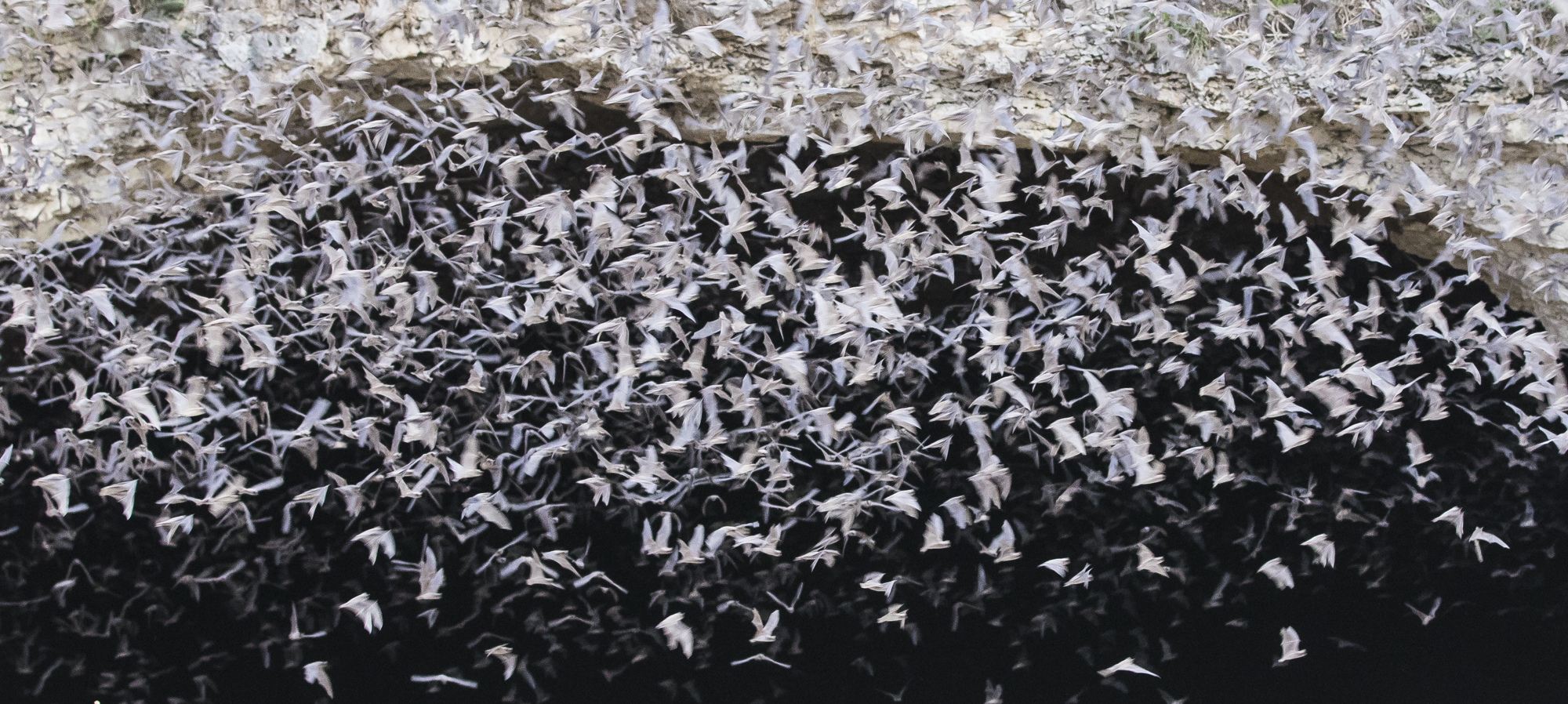
Bats emerging from the cave entrance
The sound of thousands of bat wings flapping is a bit like running water, and it fades and grows depending on where the swarm circles in relation to our viewing area.
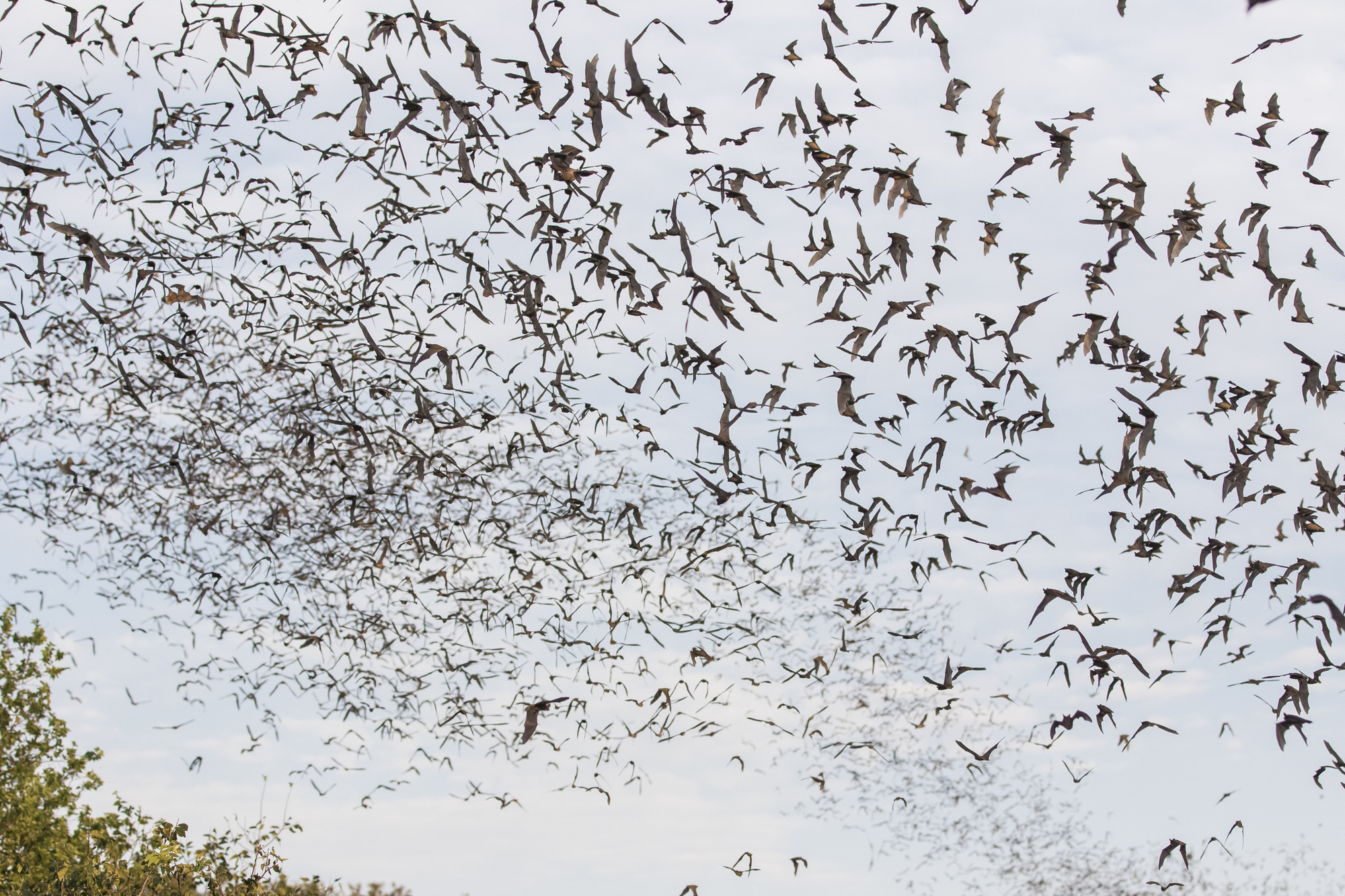
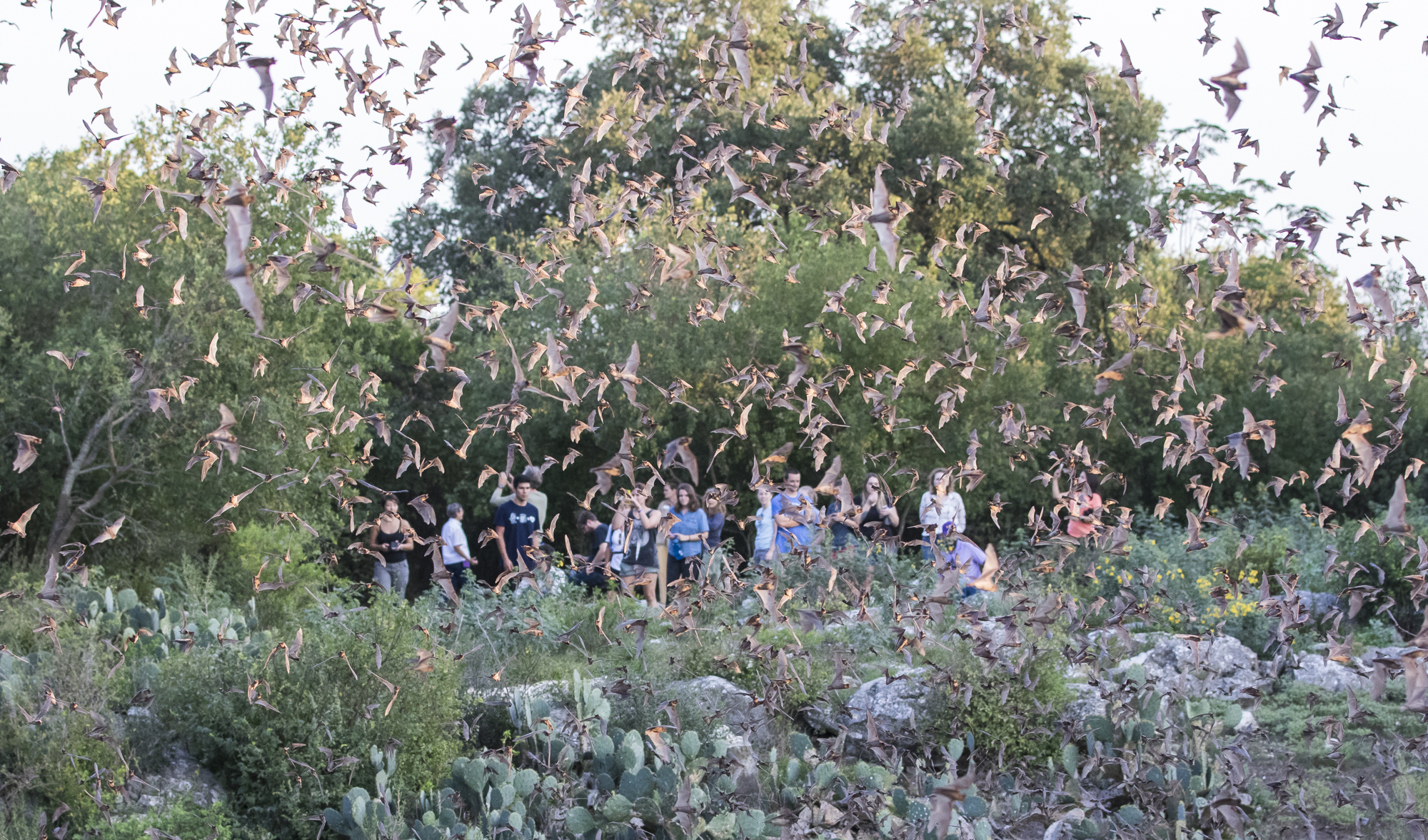
A cloud of bats in the sky above Bracken Cave
After circling the cave for a few minutes, the swarm begins to form, circling around higher until it trails off like a stream of smoke on the horizon.
The exodus continued for a few hours
It became very quiet, except for the whir of wings, as we all sat there in awe at this spectacle, trying to comprehend the sheer numbers of animals emerging from the ground before us.
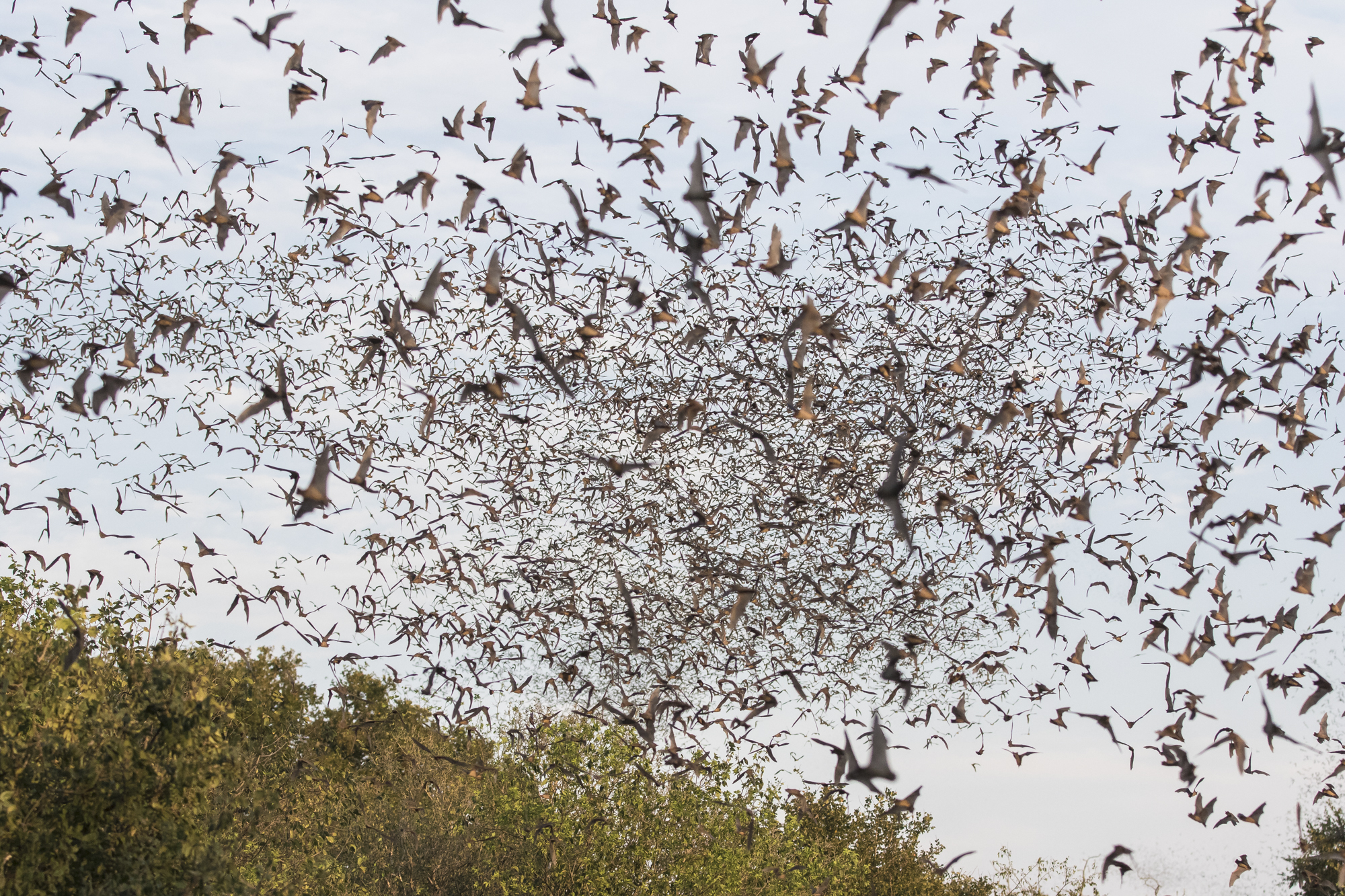
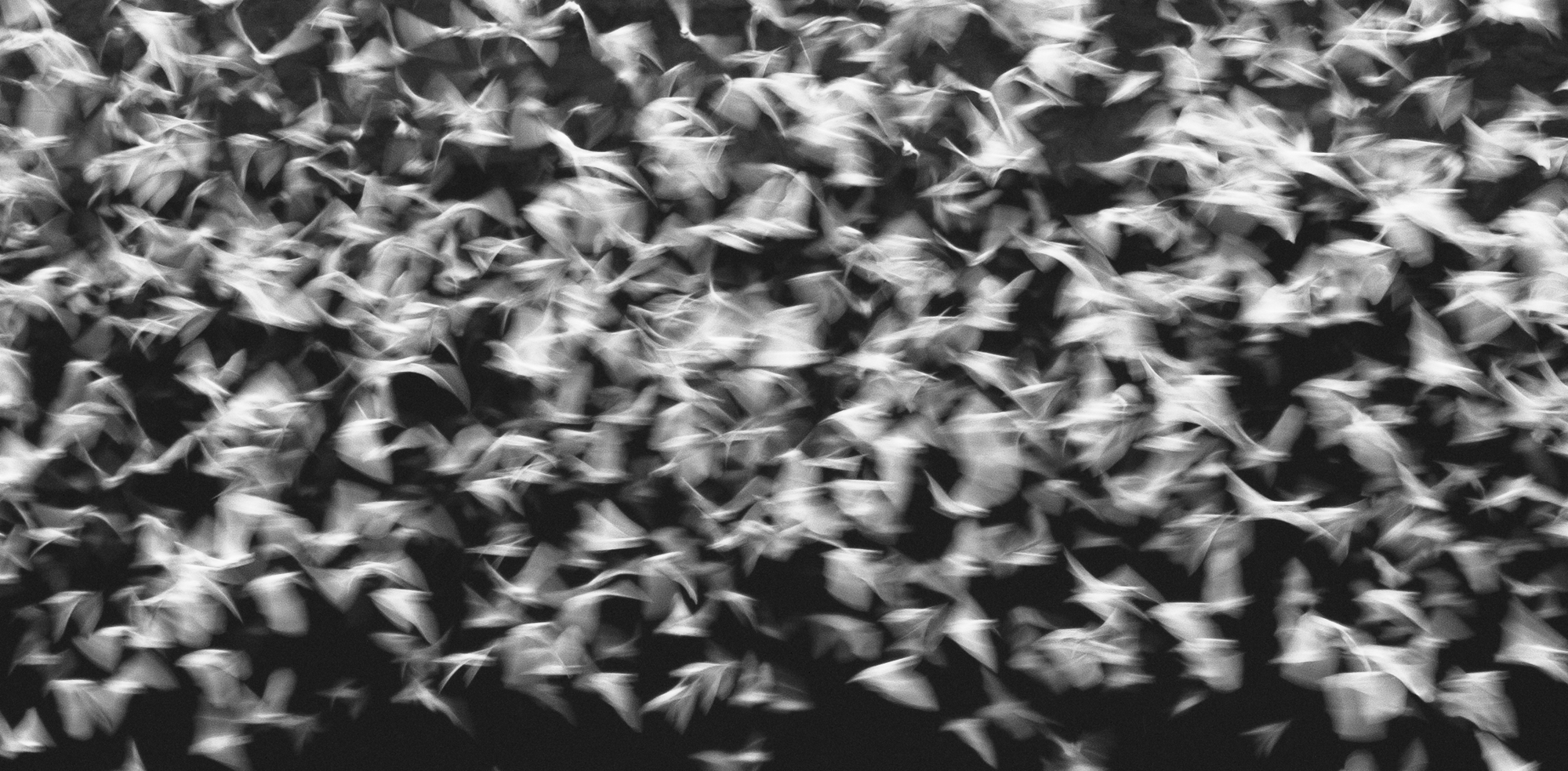
A bat storm
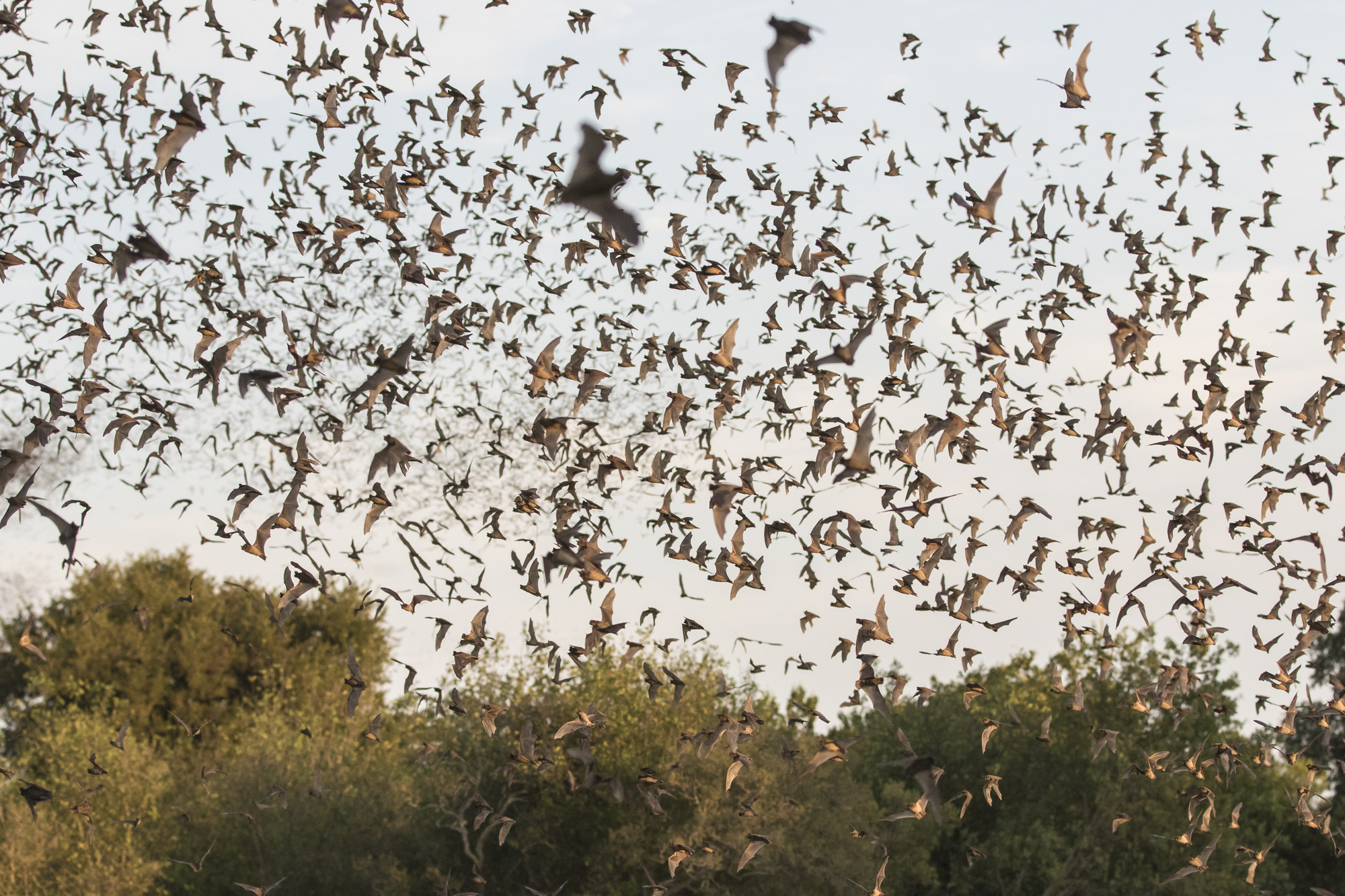
The beauty of bats in motion
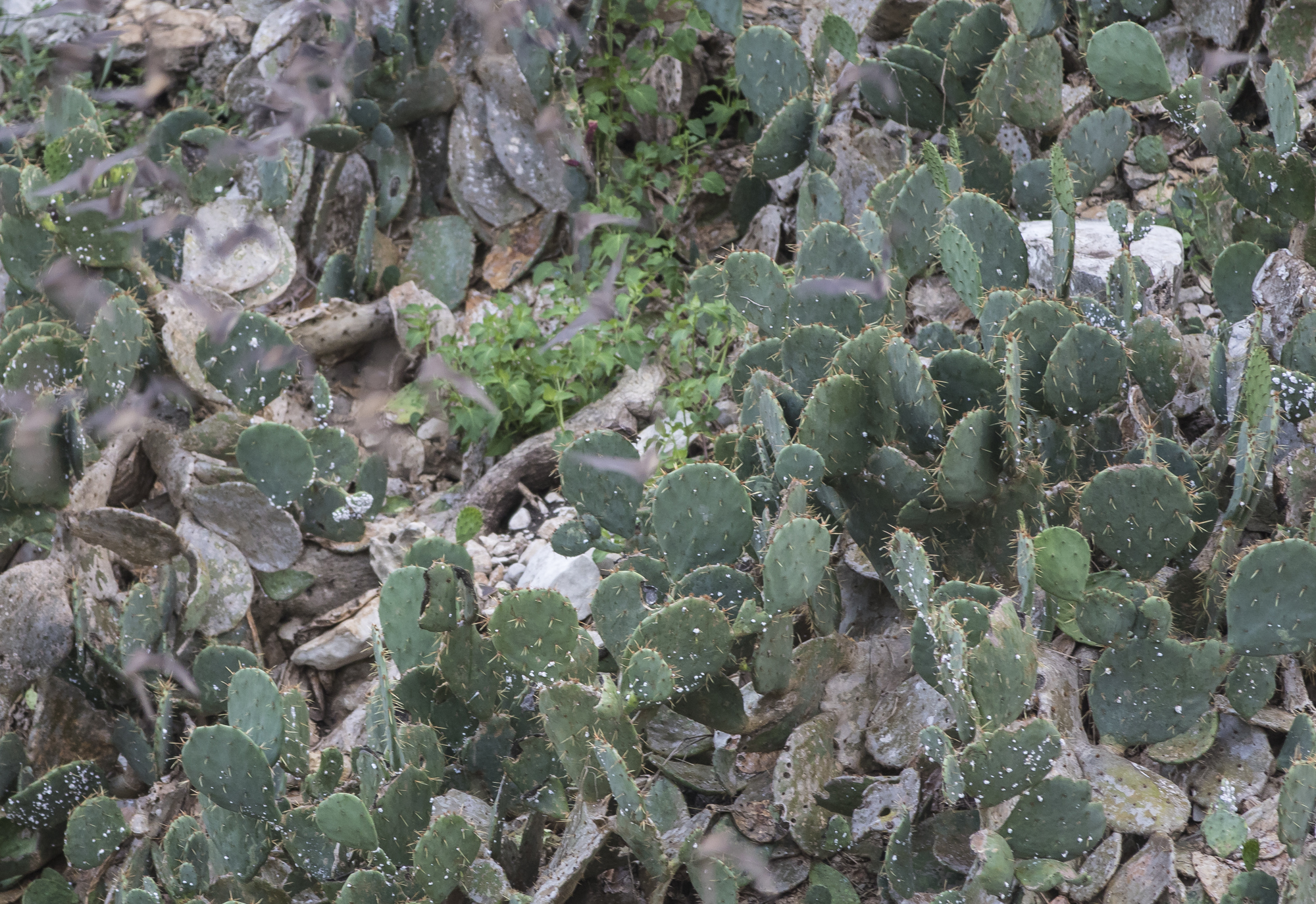
The cacti surrounding the cave claimed a few bats
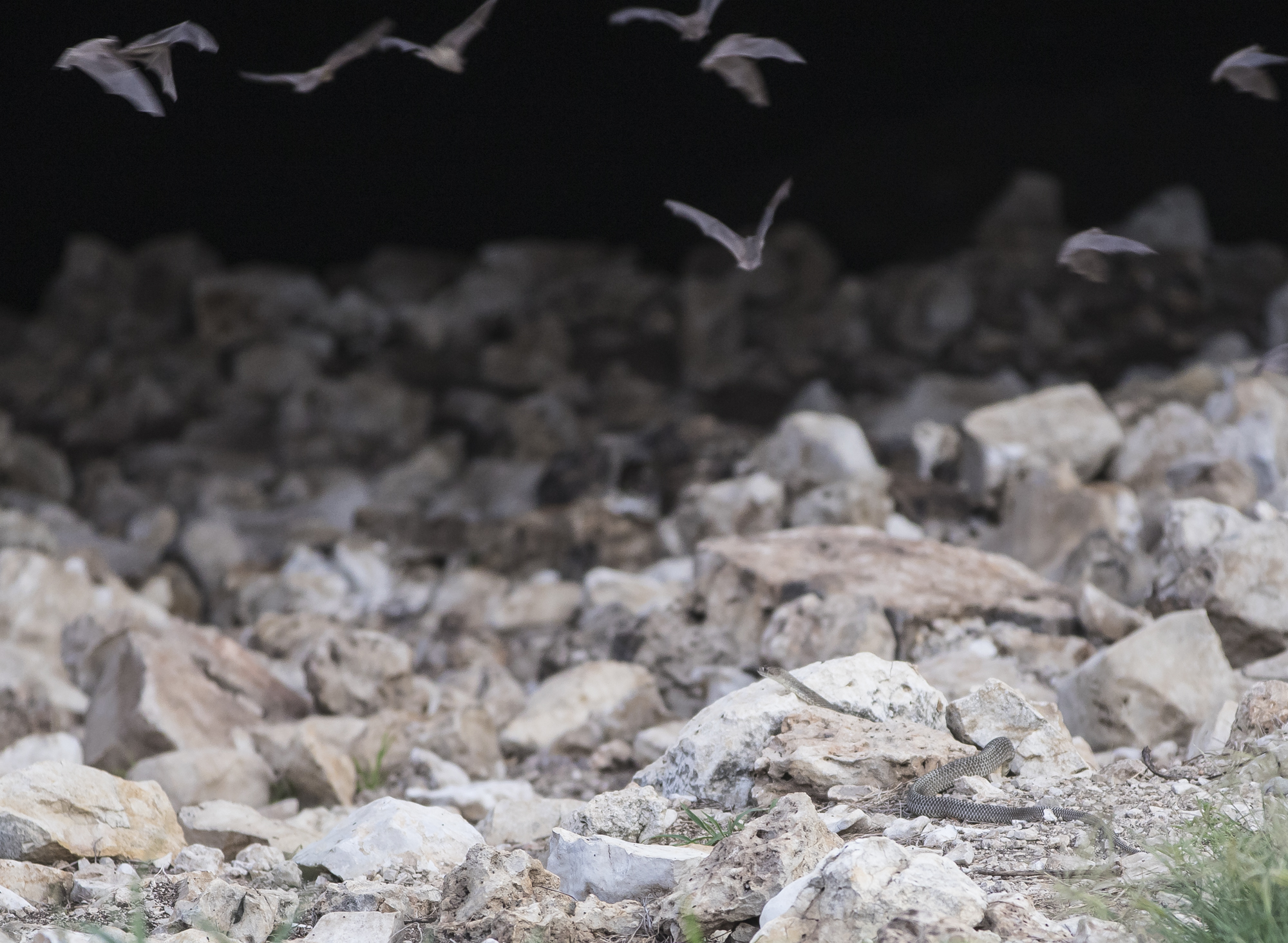
As so did a couple of snakes patrolling the entrance (one is in the lower right in photo above)
We began to look at other details in the scene as the seemingly endless stream of beating wings continued – a bat caught on a cactus spine; snakes grabbing bats that hit the ground near the entrance; a peregrine falcon and a Cooper’s hawk that each nabbed a bat mid-flight; missed attacks by a red-tailed hawk. It apparently isn’t easy being in such a dense crowd, especially if you are an inexperienced youngster.
People viewing the bats from above the cave entrance
Several people eventually walked the designated path to the other side of the cave entrance to experience that view, providing me with a unique perspective of two groups of mammals.
As darkness settled, the stream of winged creatures continued to emerge and fly off to hunt. I finally walked over to a point in the path where the exiting swarm was flying directly over my head.
Absolutely stunning! Be sure to turn your sound up for the roar of the wings and the clicking noises. And a reminder that this scene continued for a few hours! We finally retreated to our campsite and enjoyed some good conversation before retiring to our tent for the evening.
We were up early the next morning to witness a very different event – the return of the bats to the cave. By the time we arrived (at the first hint of light), the bats had already been returning for a couple of hours. There wasn’t a huge swarm like the mass departure of the night before, but rather a continuous stream of small groups of bats. They zigzagged down into the cave at rapid speed from high in the sky, perhaps to avoid predators. The sound of plummeting bats was like that when you rapidly swing a short section of rope above your head – whup, whup, whup. After a couple of hours, the numbers dwindled, and then finally stopped. We packed up and headed back to Austin to witness another bat spectacle.
Crowds gather each evening in Austin to watch the bats
It turns out that among the many cool things about Austin (breakfast tacos, live music, art) it also is home to the largest urban bat colony in North America. About 1.5 million Mexican free-tailed bats call downtown’s Congress Avenue bridge home from mid-March to early November. It has become a nightly tourist attraction for hundreds of visitors.
Bats flying out from the Congress Ave. bridge with viewers lining the bridge and the surrounding shoreline
Bats have apparently lived in Austin for many years but did not start using the bridge in large numbers until some renovations in 1980 that created 16-inch deep crevices running the length of the underside of the bridge. Bats use the cracks that are 3/4 to 1 1/2 inches wide where temperature and humidity conditions are just right for raising their young.
A spectacle definitely worth experiencing
It was quite a contrast from the quiet and solemn feel of Bracken Cave (above), but it was very cool to see so many people congregate for a natural event. In fact, I can’t think of too many other places on the planet where this many people regularly gather to witness such a spectacle of wild creatures. Kudos to the people of Texas that have helped protect these amazing concentrations of mammals that allow us to experience such moments of awe in the natural world.






















 Roads End Naturalist