
My scientific life has been spent describing the interactions that occur when butterflies meet and trying to understand what is going on and why…I persist in following butterflies with stopwatch and notepad.
~Ronald L. Rutowski, North American Butterfly Association
Yesterday’s sunshine (why can’t we seem to have at least two days in a row of that here lately?) brought out the invertebrates in the yard. I looked out the window at one point and saw a fluttering small white butterfly checking out the Hairy Bittercress weeds in the front yard. It was a female Falcate Orangetip (Anthocharis midea), and those weeds, members of the mustard family, are one of her host plants. These tiny butterflies are one of the sure signs of spring as they fly for only a couple of weeks early each year, looking for members of the mustard family on which to lay their eggs.

I grabbed my camera and by the time I got outside I saw another butterfly, this one with orange wing tips (a male Falcate Orangetip), pursuing the female. What followed was 3 minutes of intense butterfly behavior (and burst mode shooting on my part). The male’s flight pattern was rapid and erratic and he would dive in and briefly flutter near her before darting off and circling back.
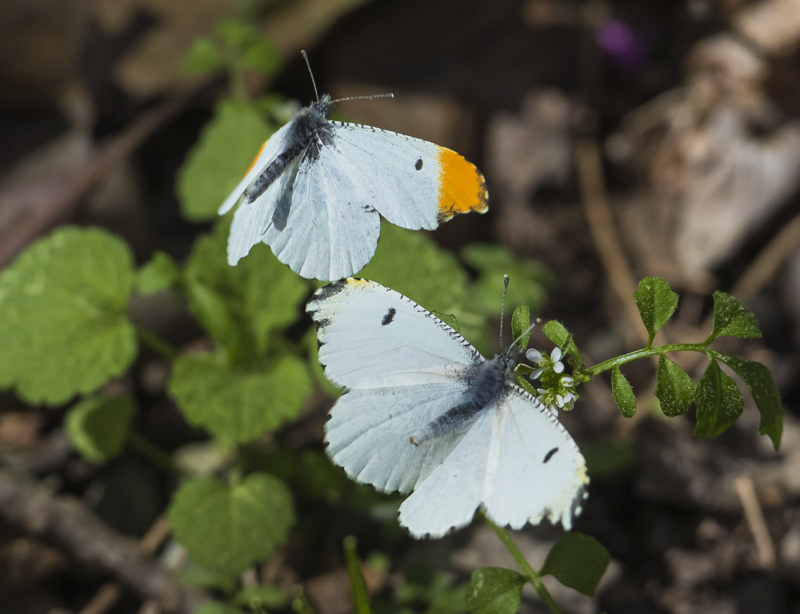


I have seen this abdomen up behavior before when watching Falcate Orangetips. I have always assumed it was the response of a female that is not interested in the male’s attention. But, some research on a closely related European species shows that both receptive virgin females and non-receptive, previously mated females, show this raised abdomen behavior when a courting male comes a calling. The difference may lie in what chemical compounds the female is releasing when the male gets close. In one case, it may be an attractant pheromone. In the already mated females, it is believed to be a repellent.
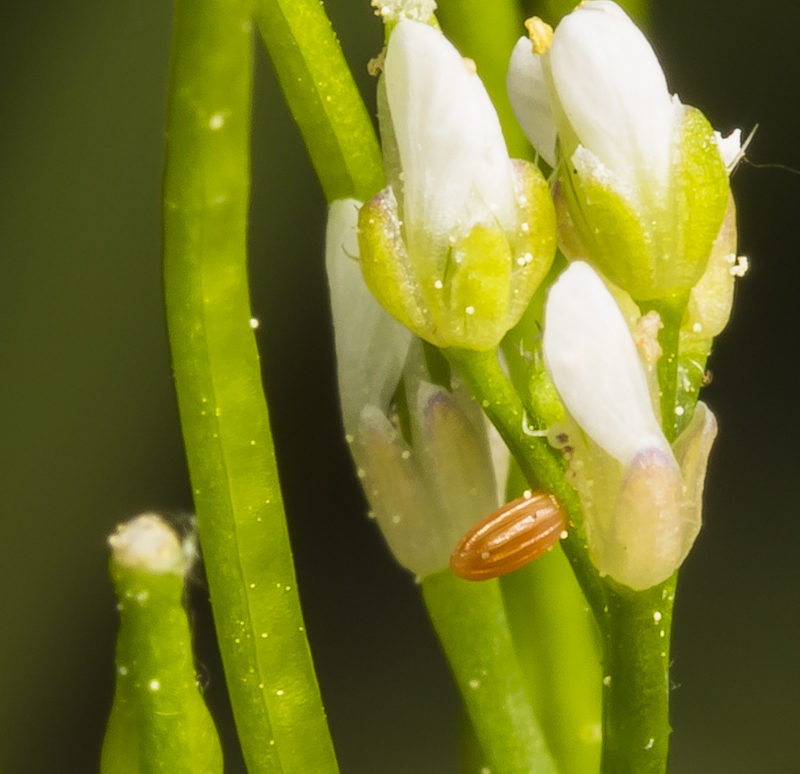
After the male departed, I tried following the female around the yard to see if she was going to lay an egg, but she eventually wandered off through the woods. I went back to the original plant I had seen her land on and began to search it for an egg. I finally found one – a tiny sculpted egg, laid at the base of a flower, just where the online references had said it would be. She supposedly deposits a pheromone on the egg that keeps other females from laying an egg on that same plant as the larvae are known to be cannibalistic. Now I want to try keep track of it as the larvae (and especially the thorn-like chrysalis) are extremely hard to find. The things you can do in self-isolation…
For more on the behavior of butterflies and their mating habits, check out this article, When Butterflies Meet, from the North American Butterfly Association.


 Roads End Naturalist
Leave a reply to Sue Hughes Cancel reply