
Don’t just chase your dreams, catch them.
~Annette White
I’ve been so busy that I am still playing catch up with blog about our past trips. This one has been on my bucket list for several years – a March trip to Nebraska to witness the spectacular spring migration of Sandhill Cranes. We occasionally see a few of these majestic birds in North Carolina in winter (we counted 24 on this past year’s Christmas Bird Count at Pocosin Lakes National Wildlife Refuge). But, along the Platte River in southern Nebraska, they often congregate in the hundreds of thousands during migration. We had planned this trip the spring after my retirement in 2020, but then the world hit pause for a couple of years and everything had to be rescheduled. But this spring, we made it.

Sandhill Cranes are elegant gray-brown birds from 3 to 4 feet in height (depending on subspecies) with wingspans of up to 6 feet. They mate for life and travel in family groups (a group of Sandhill Cranes is called a sedge). In addition to their physical beauty, they have a distinctive call. The famed conservationist, Aldo Leopold, described the sounds of Sandhill Cranes as the “tinkling of little bells, the baying of some sweet-throated hound, and a pandemonium of trumpets, rattles, croaks, and cries.” To me, their loud rattling trumpeting is a symbol of the wild, since I first heard it years ago on my first trip to Yellowstone.

There are several subspecies of this crane, some of which are migratory and a few, especially the Greater and the Lesser Sandhill Cranes, that undertake long-distance migrations in North America between their breeding grounds in the far north and wintering grounds in the southern U.S. and Mexico. The Platte River in south central Nebraska is an ideal stopover on this long journey – plenty of cornfields with leftover grain, plus a braided river where they can roost at night in shallow water, safe from predators. They stay in the area for several weeks each spring, building up the energy reserves necessary to complete their migration and start breeding and raising young. Lucky for us, when we reached Nebraska in late March, we were there at the peak of the migration numbers, an estimated 486,000 Sandhill Cranes!

Local groups like the Crane Trust and Audubon’s Rowe Sanctuary work with other conservation partners and local farmers to protect and manage the habitat the cranes prefer and need. There are opportunities to watch cranes come in to roost on the river in the evening from public viewing areas or through tours with the Crane Trust, Rowe Sanctuary, and some private businesses. We spent our first evening at a well-known viewing spot getting a feeling for the timing of the crane’s return from the fields. By 7:30 pm the orange sky was full of crane silhouettes and the sounds of thousands of cranes headed for their favorite roosting spots along the Platte River.
In addition to viewing the cranes from the usual spots, we paid for a special outing at the Rowe Sanctuary – sleeping in a small blind (about 6ft x 8ft) on the river next to where the cranes might roost for the evening. The blinds are fine if you are used to camping – small unheated wooden structures with viewing ports that open and close. Volunteers at Rowe Sanctuary drop you and your gear off at the blind in late afternoon. You are provided with a red flashlight (no white lights allowed as it might scare the cranes) and a bucket stocked with poo bags as your toilet (you’re not allowed to leave the blind at all). We brought sleeping bags and pads, plenty of warm clothes, camp chairs, some food and water, our camera gear and binoculars, and a sense of anticipation.

A few ducks and shorebirds were in front of the blind for the first couple of hours. As sunset approached, we saw small flocks of cranes flying over and landing about a half-mile upriver. This continued as they sun sank lower. I glanced at my watch thinking the birds should be here (it was 7:30 pm!). Flocks of cranes now filled the sky upriver but none were landing near us and I was trying not to show my disappointment. The time was now almost 8 pm and I was starting to feel very disappointed when four cranes suddenly landed about 50 yards upriver from us. Well, it was a start.
–Sandhill Cranes flying in to roost near our blind at sunset
After another few anxious moments, a large flock of cranes flew overhead, then circled and landed near the first four. Within minutes, there were more flocks landing, some right in front of our blind! Soon, there were thousands of noisy cranes within a couple of hundred yards up and downriver of the blind. The dim light prevented me using my telephoto lens, but sitting there with the lingering color of sunset and the sounds of so many cranes was a spiritual moment.
After darkness settled in, we gently closed the windows and used the red flashlight to put away our chairs and lay out our sleeping bags, worried that each move we made was so noisy that the birds would spook and fly off. Before sunrise the next morning, we slowly put away our sleeping gear, unfolded our chairs, and gently opened the windows to an amazing sight. The river was covered in cranes as far as we could see in both directions. It was a glorious morning listening and watching the cranes. Small groups were flying to and from the sand bars providing us with plenty of opportunities for photos in the morning light.

Dancing is perhaps the most famous behavior associated with Sandhill Cranes. Maneuvers include bows, head thrusts, and vertical leaps with spread wings. A crane often grabs a stick or piece of vegetation and tosses it in the air as part of this eye-catching ritual.
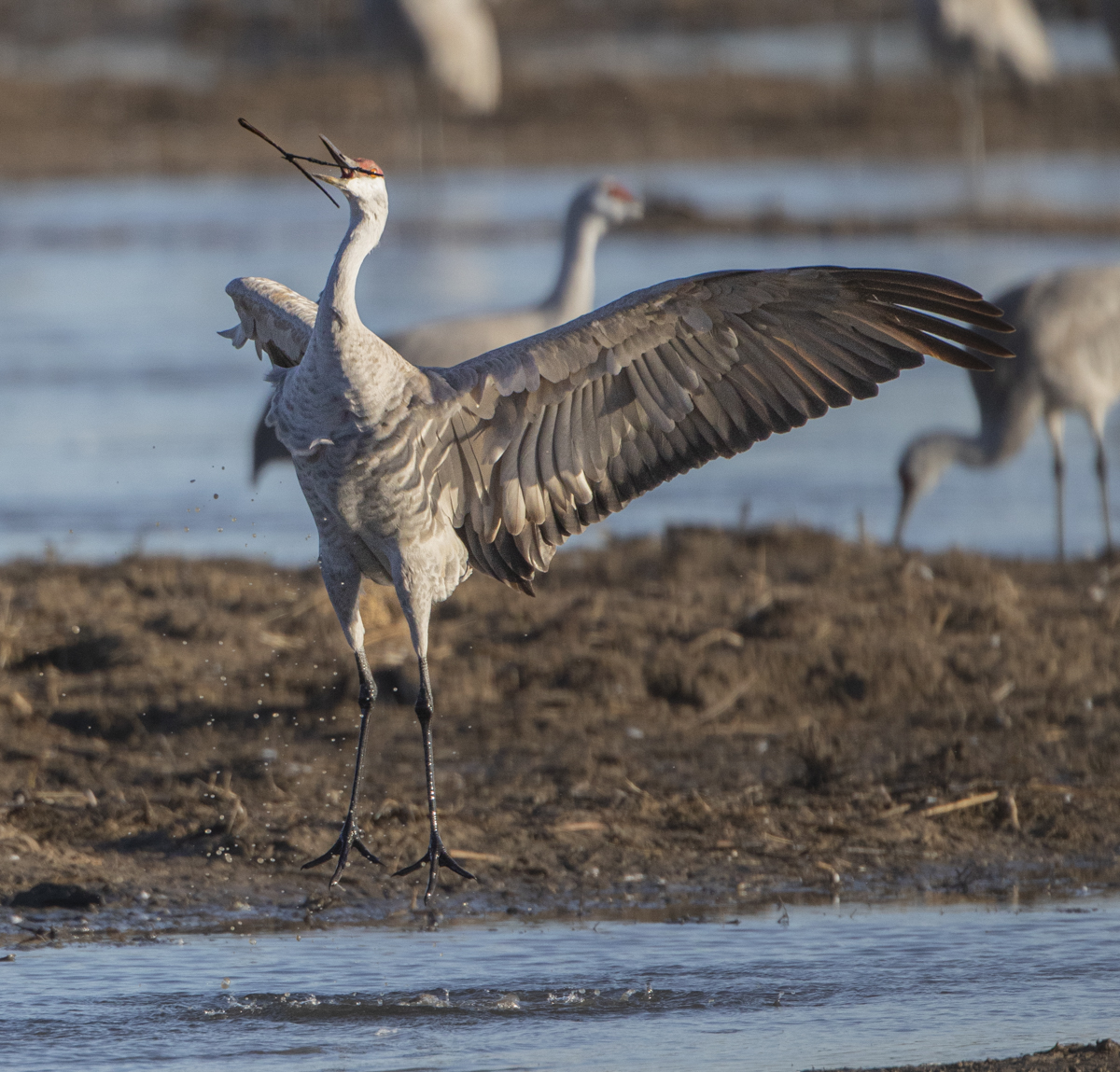
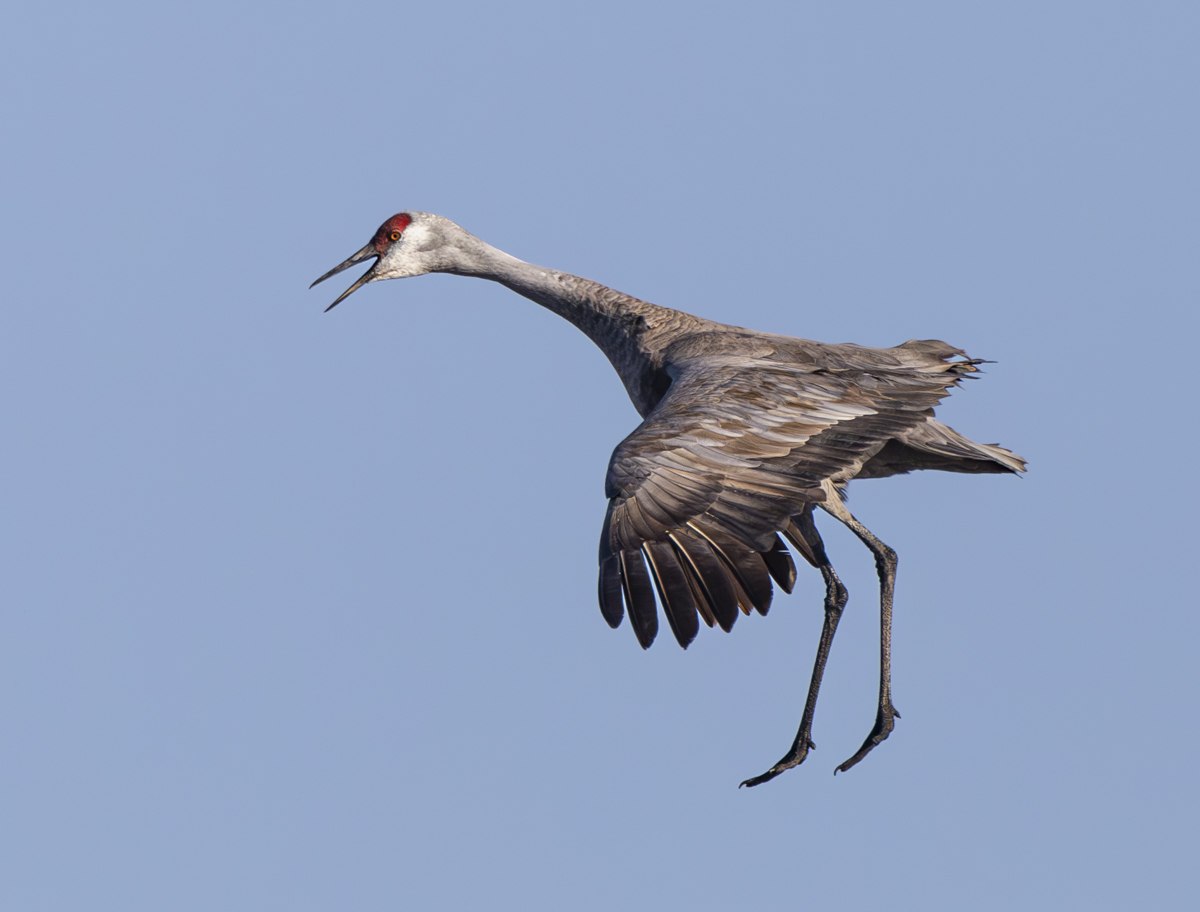
–Sandhill Cranes leaving their roost early the next morning
More and more birds took off and we were finally left with just a few scattered individuals by mid-morning when we heard the ATV coming to retrieve us. We had reserved thae next night at the much more luxurious Crane Trust lodge with a nice catered dinner. But, we had several hours before we checked in there so we drove the back roads looking for more birds.

We got lucky and spotted a group of large white birds feeding in a field with some Sandhills. They were Whooping Cranes, the tallest North American bird at almost 5 feet and also one of the rarest. A major conservation effort brought the population back from only about 15 birds in the wild in the early 1940s to today’s population of over 500 migratory whoopers. The Platte River is an important stopover in their migration from Texas to Canada every year and we were fortunate to see 15 over a couple of days.


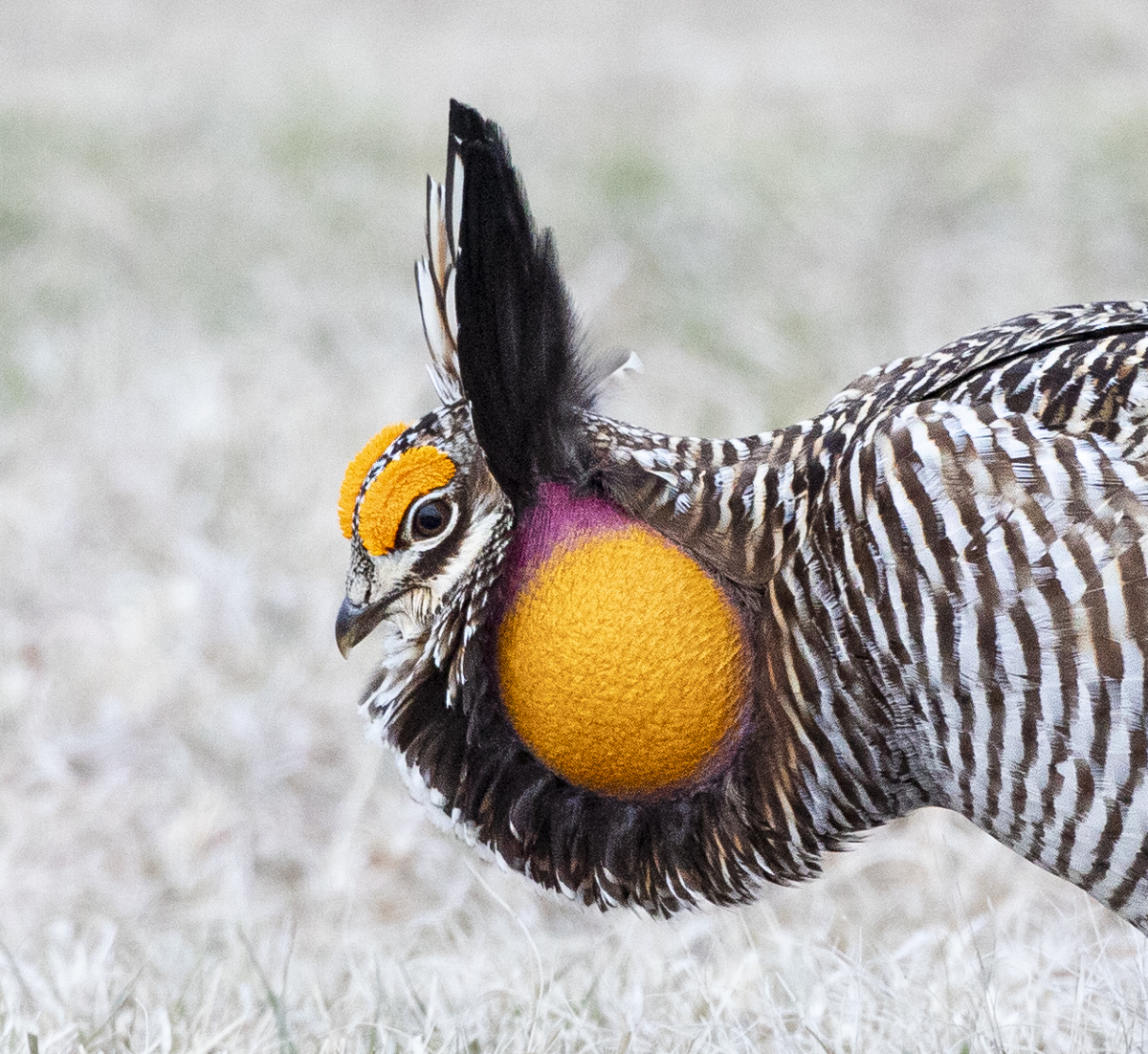
Though crane-viewing was the primary goal of our trip, we also took advantage of two other Nebraska birding wonders – the breeding displays of Greater Prairie Chickens and Sharp-tailed Grouse. Both species congregate at specific locations (called leks) each spring where males have elaborate courtship displays that include rapid foot-stomping, feather and wing displays, colorful inflated air sacs, and unusual sounds. A few local guides operate blinds to view the leks at dawn, when the birds are most active. We booked mornings in two different blinds, one of which was a modified horse trailer, the other an old school bus. The low booming sound of the males is something you wouldn’t expect from a bird. It is amazing that this has happened in these same locations for generations of birds.
–Greater Prairie Chicken displaying on a lek at Prairie Winds Birding Tours in Kearney, Nebraska
The birds continued displaying for a couple of hours after sunrise with occasional brief battles.
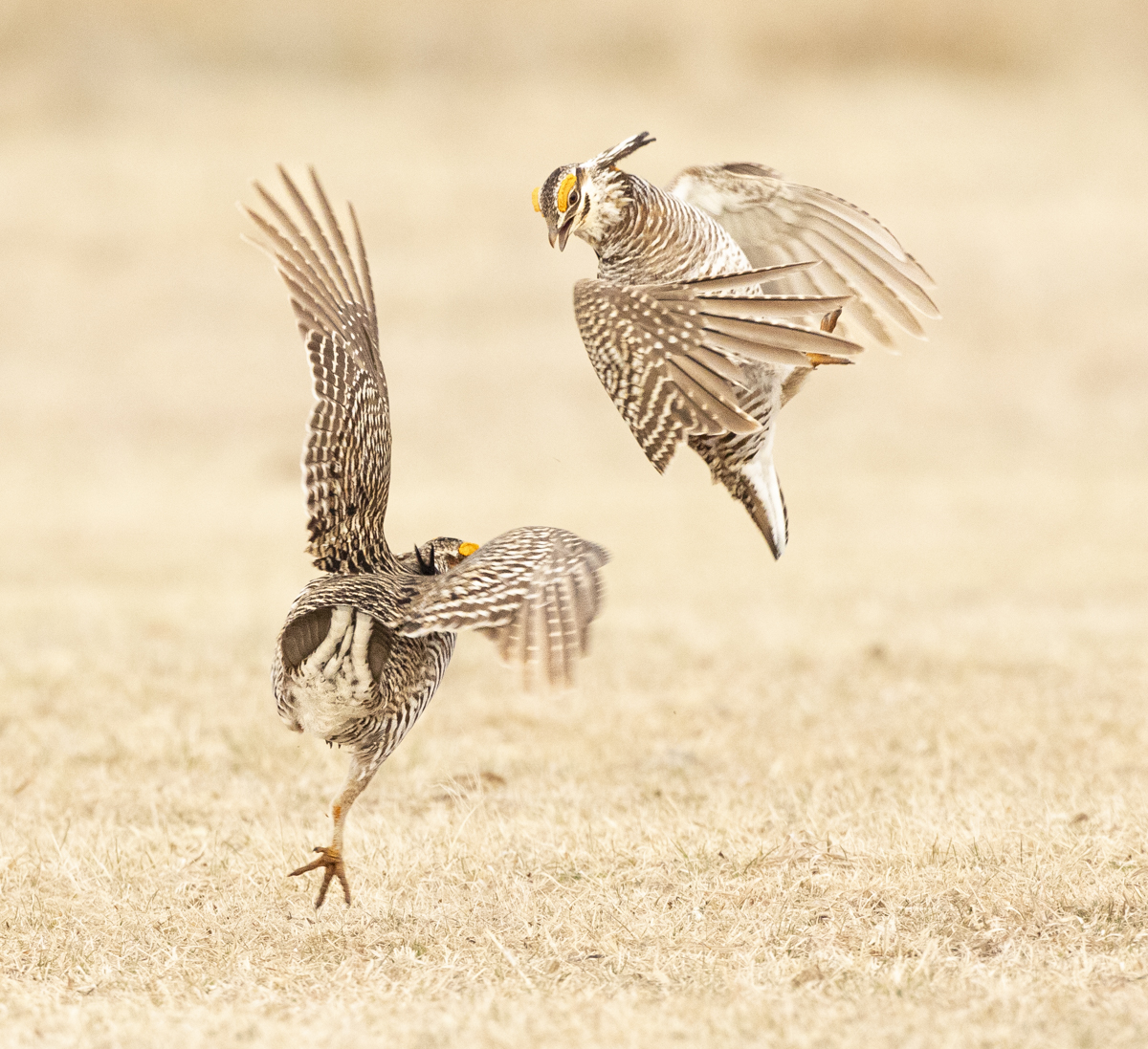
All the birds took flight at one point when a raptor of some sort flew above our blind (someone saw its shadow). A while later a Cooper’s Hawk dove into the lek and hit one of the birds, but it and all the others took flight. Our guide (the farmer on whose land the lek was located) called it a day at that point figuring the “chickens” wouldn’t return (and that some of us might need a bathroom break and some coffee).
We had reserved a blind at a Sharp-tailed Grouse lek at Valentine NWR and had received informatin on another at a National Forest site we had camped in before. A winter storm blew through the area delaying our plans to head north for a day so we missed our reservation date for the first site. We finally departed, using the online snow plow cams and maps to see what roads were clear (a very nice feature of the Nebraska Dept. of Transportation). The snow and lek location made for a stark, but beautiful, landscape. It turned out to be a real highlight, especially for Melissa. She drove our 4WD truck through several inches of fresh snow and then out onto the refuge “road” (no tire tracks here and when not covered with snow it is just a sandy/grassy lane through the Sandhills) toward the grouse blind so we would be close for sunrise the next morning. It was a beautiful evening camping out in the middle of nowhere with 5 inches of fresh snow.
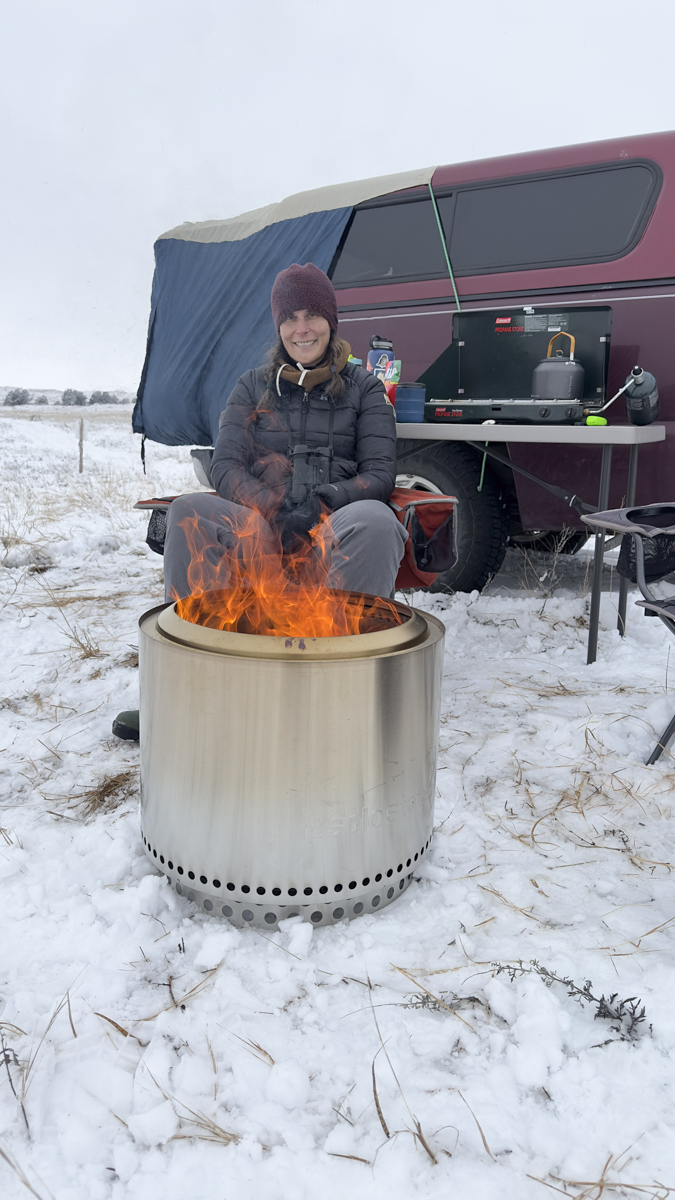
Whie traveling, we had checked the time for sunrise and set our phone alarms for 30 minutes before sunrise. There was close to a full moon that night so wen we got up the next morning it didn’t surprise us much that it was so light. But as we gathered our gear, the sun peeked up over the horizon…we were late (you are supposed to be in the blinds before sunrise so as to not disturb the birds). Worse yet, we could see with our binoculars that the birds were already on the lek. It turns out as we approached this site we had just barely crossed over the time zone line changing from the Mountain Time Zone to the Central Time Zone and it fooled us since we had no cell phone service out there. We went ahead and walked out and the birds did flush, but returned shortly after to start displaying again.

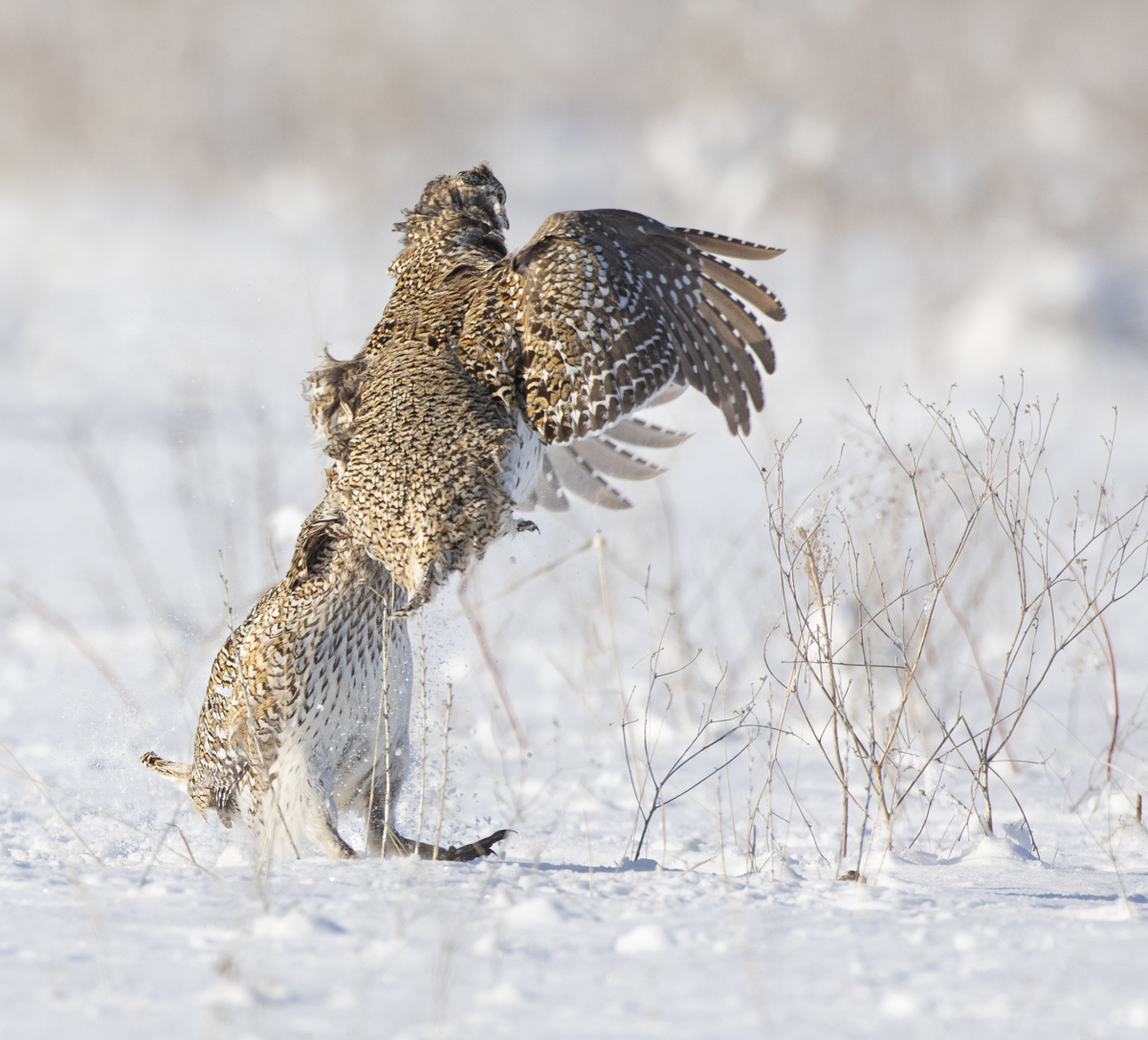
Though not as noisy as the prairie chicken display, seeing these birds dancing and sparring in the fresh snow at sunrise was phenomenal. This was early in the breeding season for this species and most of the birds weren’t quite up to the task to display and fight for very long and spent much of their time squared off against one another with rather brief bouts of displays.

But when a female came in they all got a bit more energetic. Reminds me of my college days…
Though it may not sound like it at first, a trip to Nebraska in mid-late March is certainly worth it. If roughing it in a small blind is not your thing, both Audubon’s Rowe Sanctuary and the Crane Trust have wonderful viewing blinds and a variety of program offerings. Your visit will support conservation efforts to help maintain one of North America’s greatest wildlife spectacles, the migration of thousands of Sandhill Cranes. And since you are there, check out the lek activities if you get a chance – well worth it.


 Roads End Naturalist
Leave a reply to roadsendnaturalist Cancel reply