Birds learn how to fly, never knowing where the flight will take them.
~Mark Nepo
This is a brief update on the recent posts where I shared a few sightings of tagged birds – one, a Common Raven in Yellowstone, and three American Oystercatchers on Masonboro Island in southeastern North Carolina. First, the shorebirds at Masonboro. When I got home, I searched the web for information on banded American Oystercatchers and immediately came up with the American Oystercatcher Working Group. This is a conservation group of scientists and resource managers created in 2001 to monitor oystercatcher population dynamics and promote the conservation of American Oystercatchers and their habitats. Their web site has information on reporting sightings of banded birds so I submitted my data. Once they verify your observations and the leg band ID, you receive information on the birds you reported.
Here are the three birds and what we know of their stories…
American Oystercatcher with Band CUU (click photos to enlarge)
CUU was captured and banded on 4/26/16 on Masonboro Island. There have been 33 reported sightings since that time. There are 3 confirmed breeding/nesting seasons on Masonboro (the nest was found); In other years, the bird was seen on Masonboro during the nesting season, but a nest was not observed. Winter sightings were at Dewees Island, near Charleston, SC, in December of 2017 and 2018, a distance of approximately 140 miles from Masonboro.
Banded bird CUW
This is the homebody of the three birds, never having been reported more than 18 miles from Masonboro (on Bald Head Island), even in winter. Captured and banded on 4/26/16 on Masonboro. Reported sightings 43 times. Also has 3 confirmed nests on Masonboro Island and has appeared in that location during the other breeding seasons, but no nest was observed.
Banded oystercatcher CUT
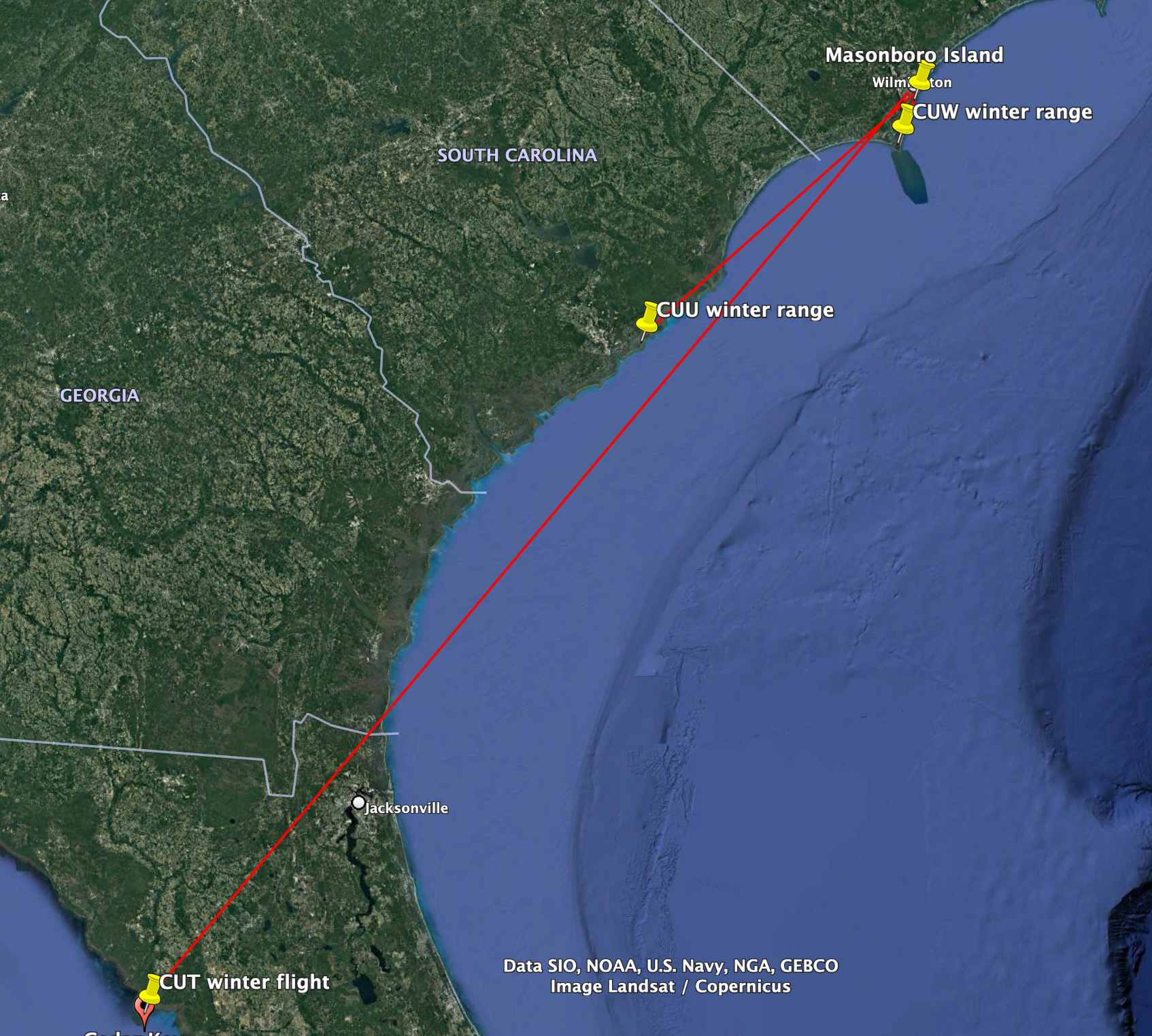
The long distance traveler of the group. Captured and banded on 4/26/16 on Masonboro Island. Re-sighted 56 times. Five confirmed nesting seasons on Masonboro (nest found). Observed in Cedar Key, Florida, every winter since it was banded. That is a distance of about 460 miles one way every year.
The map below shows the apparently consistent winter travels of the three American Oystercatchers.
Range map of the migrations of the three oystercatchers I observed
The type of leg band that the oystercatchers had can be viewed and reported from a distance using binoculars, a scope, or a telephoto lens. That type of information gives a data point for any time someone reports seeing the bird. The “tag” on the ravens in the Yellowstone research project includes color coded leg bands for visual observation and a solar-powered GPS backpack with an antenna that submits the birds’ locations every 30 minutes throughout the day. This combination gives a much more detailed view of the birds’ behavior.
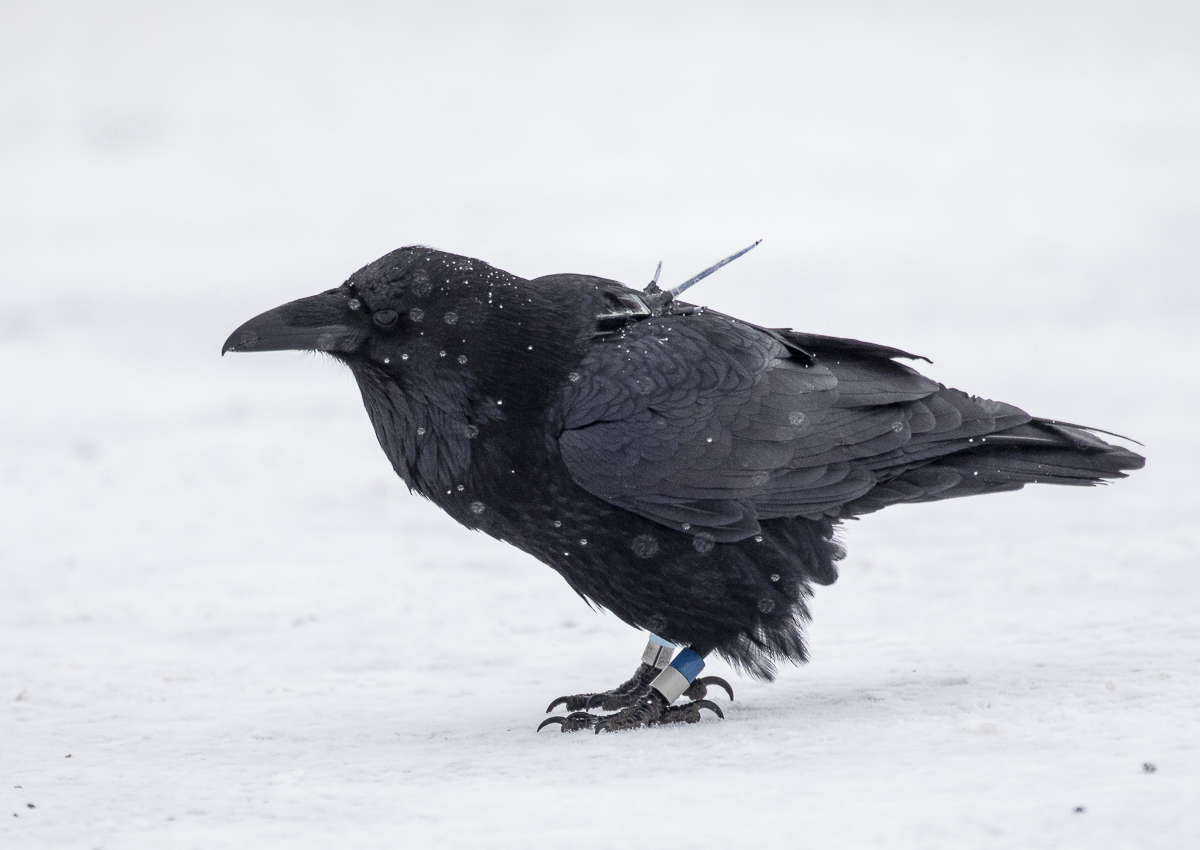
The 70 or so tagged ravens are a part of a study looking at interactions of these intelligent birds with their habitat (foraging and roosting sites for example) and with large carnivores (bears, mountain lions, and wolves). In an earlier post, I mentioned I had found out about this research online and had contacted the lead scientist, Dr. John Marzluff. He identified this bird as the female at Tower Junction (the location where she was captured and tagged) with transmitter 7493-2. She was captured on December 10, 2021 and we observed her on 1/20/22 at Tower Junction, patrolling the parking lot at the pit stop and recycle bins.
Common Raven at Tower Junction showing the solar-powered GPS backpack and color-coded leg bandsThe colored leg bands… Left – dark blue over gray, Right – light blue over metal
Her data is now visible on the Animal Tracker app (for iPhone and iPad – search for raven and then scroll down to Tower_Junction_female). She tends to move mostly between Tower Junction and Lamar Valley, a distance of about 12 miles. Her longest flight to date has been to an area north of the park entrance along Hwy 89, a distance of about 22 miles. Some of the tagged ravens have dispersed much farther, with one heading up to the Bozeman area, and another, the record-holder, flying up to Alberta, Canada.
The Tower Junction female raven tends to move mostly between that area (the dark cluster of data points is Tower Junction) and Lamar Valley (map from movebank.org web site).
Is she going to carcasses in Lamar or just stopping at places where there are concentrations of visitors? I would love to be out there and recording data on these birds to see what they are actually doing. It is a treat to get a peek into the private lives of wildlife. But, more importantly, this is valuable information that may help researchers and resource managers make better decisions for protecting these birds and their important habitats.
I’m a greater believer in luck, and I find the harder I work the more I have of it.
~Thomas Jefferson
Today was one of those days. Coming back home after a doctor’s appointment, a motion caught my eye while driving past a small roadside vernal pool. I slowed and saw it was a Barred Owl that had landed on a snag in the pool. I figured it might have babies in a nest nearby and was looking for a meal of crayfish or salamanders (this pool and another one nearby are breeding pools for Marbled and Spotted Salamanders). I had no camera with me so I drove the remaining few miles back home. I decided there was a chance it might hang around and hunt, so I grabbed a camera and headed back up the road. No cars were behind me, so as I approached the pool, I slowed down and looked for the owl. It was not on the prominent snag perch where I had seen it…bummer. But, then I saw it even closer to the road on a tree branch. I stopped, and stuck the camera out the window and fired off 3 shots. Another car then zoomed by in the other direction and the owl flew off. Luck was with me today.
A cooperative Barred Owl stayed put long enough for a few photos (click photo to enlarge)
Ironically, while waiting at the doctor’s office, I read an email from a teacher that had been on a workshop with Melissa and I years ago,. She encountered two Barred Owls yesterday on a trail and had sent us a note because she knew we would appreciate it. She even thanked us for teaching her about owls and what to look for. A double bonus day indeed.
Your growing antlers, Bambi continued, are proof of your intimate place in the forest, For of all the things that live and grow only the trees and the deer shed their foliage each year and replace it more strongly, more magnificently, in the Spring. Each year the trees grow larger and put on more leaves. And so you too increase In size and wear a larger, stronger crown.
~Felix Salten
After placing a new trail camera down along the wet weather creek, I was rewarded with a very nice clip of a beautiful White-tailed deer buck. This is from February 18, about the time most deer in our area are dropping their antlers for the season. As I mentioned in a recent post about Moose in Yellowstone, antler drop is an annual event for male members of the deer family, caused by changing day-length and lowered testosterone levels after the mating season.
A week ago, I had a very short clip that showed this buck still sports his nice set of antlers. It is getting a bit late for them to still be carrying their antlers, so I would love to have him drop one or both somewhere on our property. I have only found one antler shed here in all the years of roaming these woods. Rodents make short work of shed antlers for their calcium content.
The same day the large buck above was caught on camera, a smaller buck who had dropped its antlers was filmed. Note the roundish scar between the ey and ear – the pedicle. Soon, new antler growth will begin at this site for next mating season’s crowns.
The edge of the sea is a strange and beautiful place.
~Rachel Carson
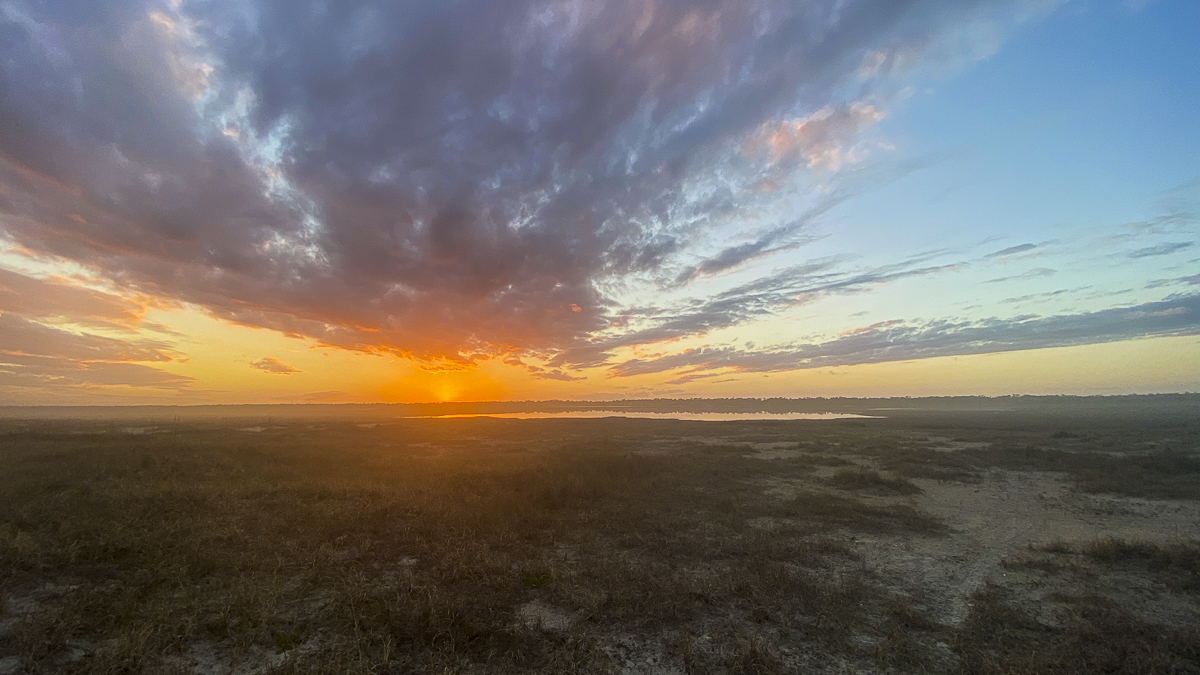
Last week was another first for me – a canoe camping trip to Masonboro Island. Masonboro Island is one 10 sites that make up the NC Coastal Reserve and National Estuarine Research Reserve. This 8.4 mile long island reserve was protected in 1991 and is the largest undeveloped barrier island along our southern coast. It lies between Wrightsville Beach to the north and Carolina Beach to the south. We put in at Trails End Park along the Intracoastal Waterway. We had tried calling the Reserve office on the way down just to ask a few questions about access, but staff were not available. We planned to launch on an incoming tide (a necessity for easy access to some parts of the island) late in the afternoon. As we were loading the canoe, a vehicle and trailer with state tags pulled in and it turned out to be the staff person we had tried to call earlier (some days you get lucky). They had been out cleaning up some trash on one of the dredge spoil islands that comprise the reserve. She gave us a 10-minute overview of where to go and what to expect and we were off. There was a stiff northwest breeze, so the usual 20+ minute paddle took us about 45 minutes. We started looking for a camping spot that would provide a little protection from the wind and settled on an old over-wash area behind a small patch of maritime shrub thicket.
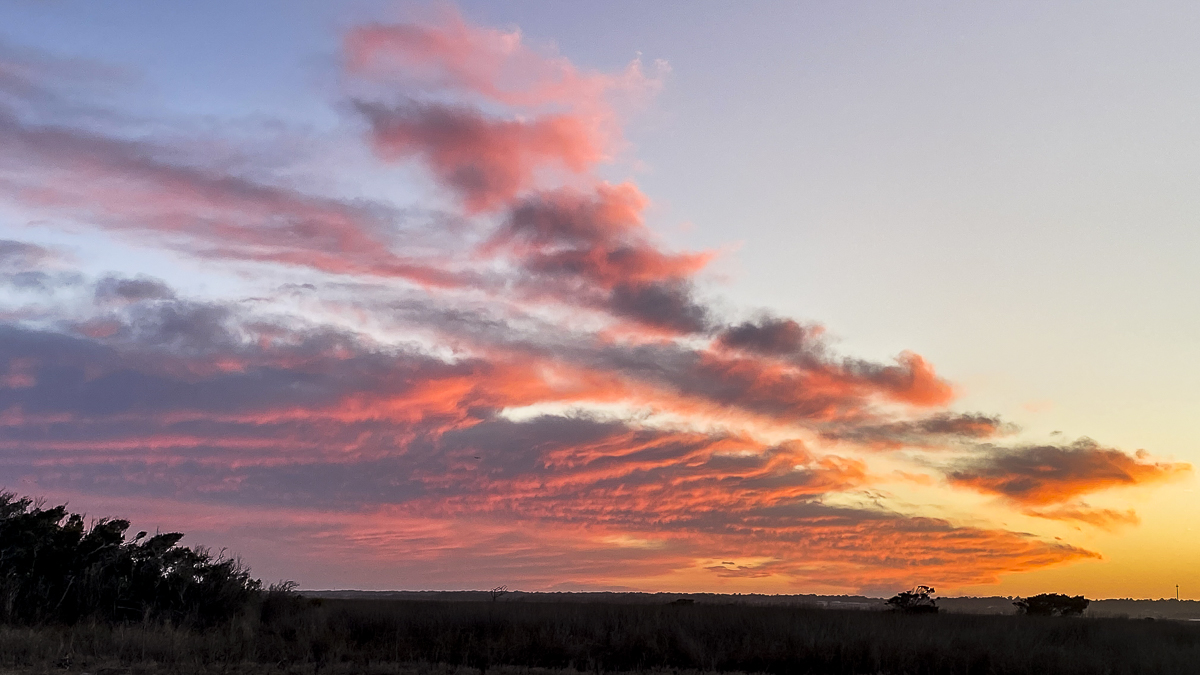
Our campsite the first night gave us some protection from the steady winds (click photos to enlarge)A beautiful sunset our first night
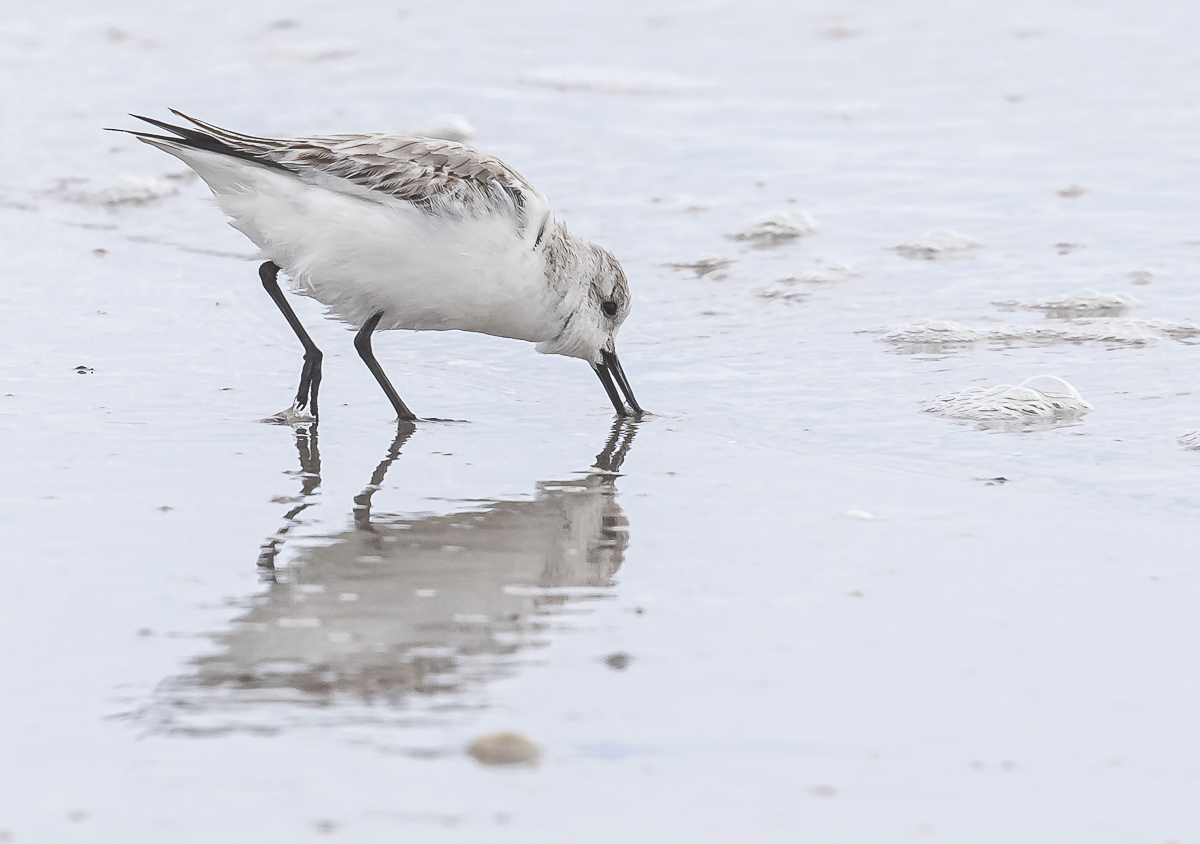
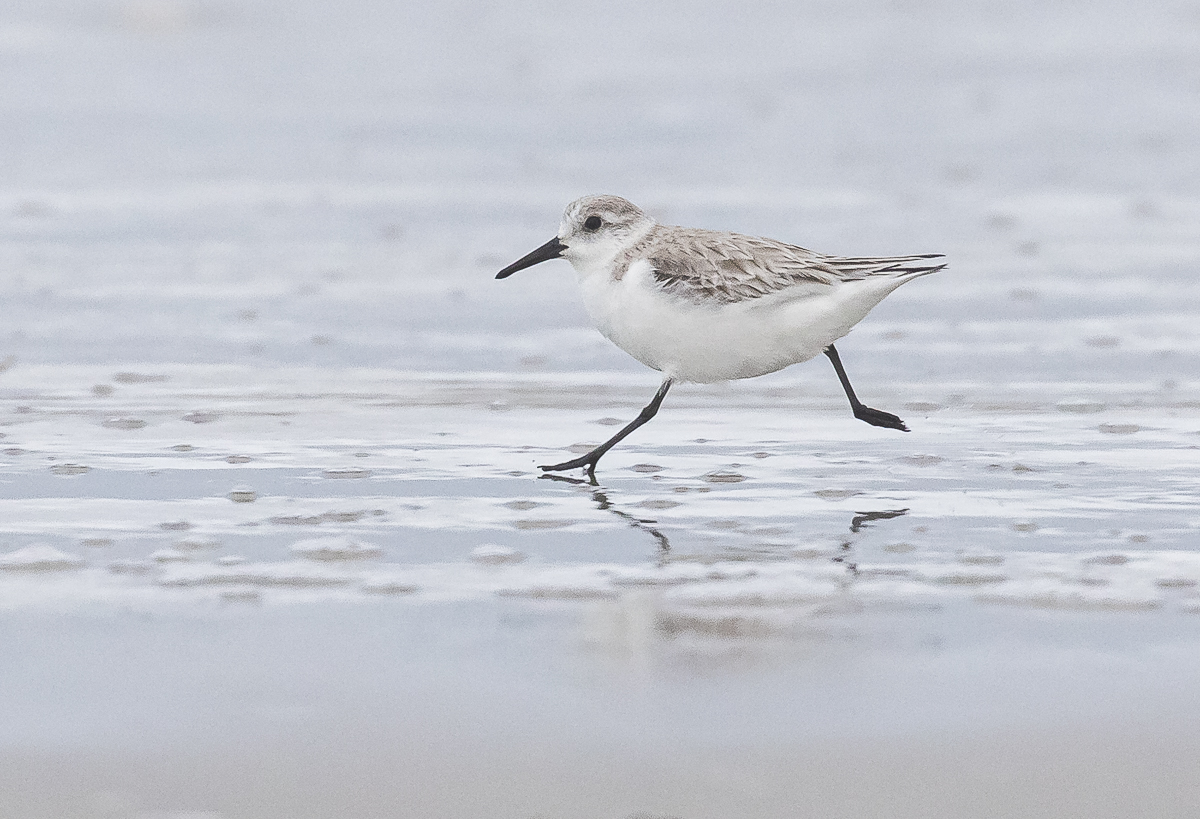
The wind continued to blow on our second day, finally dropping down late in the afternoon. I was a bit surprised by the lack of bird activity with just a few pelican fly-bys and only a handful of shorebirds in sight during the day. The most abundant was the ubiquitous Sanderling, the energizer bunny, wind-up toy of birds that can be found on any sandy beach. I always enjoy watching them chase back and forth in front of the wave action, gleaning whatever tiny food morsels they can find along the beach. I spent a lot of time just watching their antics and trying to get photos of their high enery movements. They were more cooperative than the other species of shorebirds we saw in terms of tolerating our presence, especially if you just got out ahead of them as they moved down the beach and sat still. They would forage until they got just even with me and quickly run a few feet just beyond me to resume feeding.
Sanderling probing the sand for food
Sanderlings can be found any month of the year on our beaches, but the largest numbers occur during migration in spring and fall. They breed in the high Arctic tundra. Their migration routes and distances vary considerably with the average migration distance from wintering to breeding grounds being over 5000 miles. No wonder they are so busy running up and down the beach feeding!
The quintessential Sanderling pose – on the move
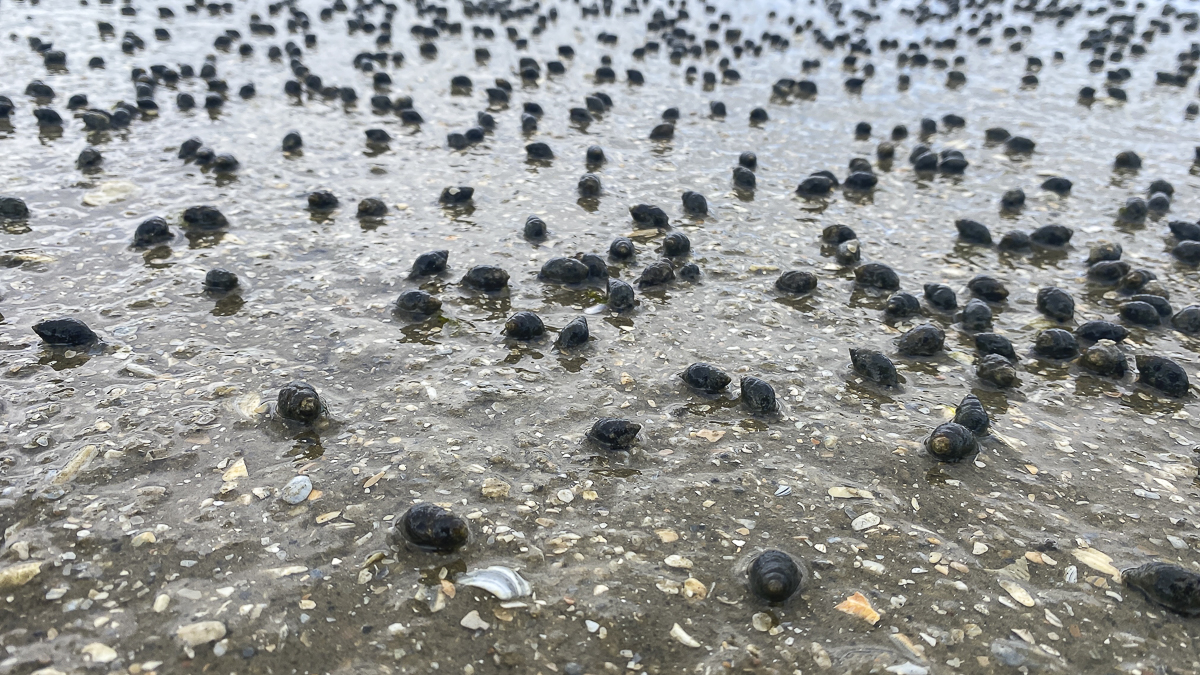
At low tide we went back to the sound side of the island and saw why everyone says you need to paddle over on an incoming tide. The large bay we paddled in on was now a giant mud flat. Eastern Mud Snails (Ilyanassa obsoleta) covered the mud. It is hard to imagine how many snails are out there when you look out and see black dots covering the entire mud flat. They feed primarily on microorganisms (e.g., bacteria, blue-green algae and diatoms) that grow in and on the surface of the sediment but will also scavenge any dead fish or other animal carcasses. They are native to the Atlantic Coast of North America but have been accidentally introduced to the West Coast where it is considered an invasive species that is out-competing some of their native snail fauna.
Eastern Mud Snails exposed at low tide
The other notable thing you see at low tide are the oyster reefs along the marsh edges. Eastern Oysters are able to survive being exposed by tightly shutting their shells and maintaining water inside during the low tide cycle. These are incredibly important salt marsh organisms due to their water filtering capabilities (one oyster can filter up to 50 gallons of water a day while feeding), shore stabilization properties, and the habitat provided by the structure of oyster reefs. And they are a favorite food of many creatures from crabs to shorebirds to us humans. I also learned a valuable lesson about their habitat. We walked out in our rubber boots to examine some oysters. I stood in one spot for a few minutes and when I started to turn to walk away, one boot remained solidly stuck in the mud while the rest of me did a sideways plop into the thick goo (luckily, no photos exist of this embarrassing moment in the life of a naturalist).
Eastern Oysters (Crassostrea virginica) at low tide
Later in the day, the wind finally started to subside and we decided (well, really, Melissa decided) to move our campsite closer to the ocean in a small break in the dunes. The high tide mark was about 15 feet from our tent, so I kept an eye on the incoming ocean water. But, all was good and it turned out to be one of the most beautiful campsites ever.
We spent the afternoon walking up and down the deserted beach (we were the only humans on the island for our entire stay) looking for shells, birds, and scanning the ocean for marine life (we did finally see a pod of dolphins).
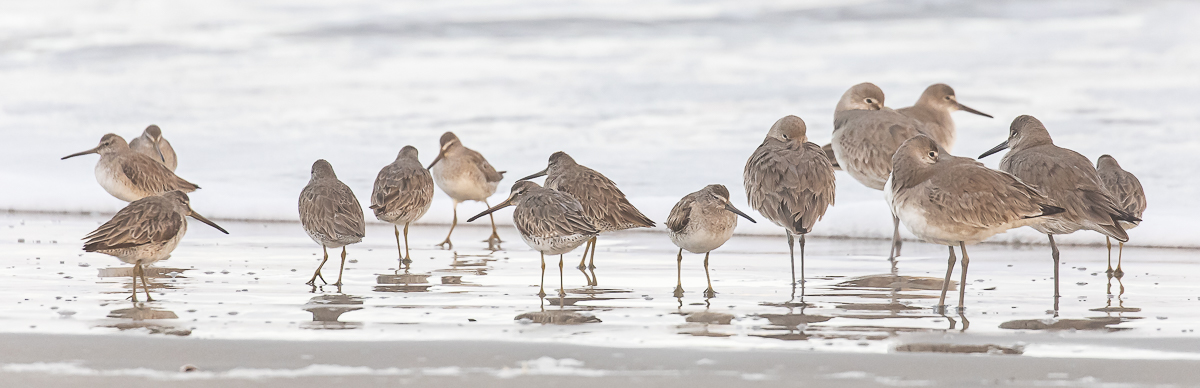
A small flock of shorebirds (Short-billed Dowitchers and Willets) resting on the beachA pair of American Oystercatchers, one with legs bands
The most interesting birds we observed were several pairs of American Oystercatchers scattered along the beach. We heard many have just recently arrived back here for breeding (they typically nest on sand and shell beaches, at marsh edges, and other areas with little or no vegetation). Oystercatchers are boldly patterned and large for a shorebird and they have a conspicuous long red bill. They use this bill to probe for mussels and other invertebrates in sand and mud and to feed in a remarkable way on oysters and other shelled creatures. As the tide drops, oystercatchers move out onto the oyster reefs and search for oysters with partially open shells. They then use that knife-like bill to stab the abductor muscles that hold the two halves of the shell together so the oyster cannot close. The bird then pulls out and eats the soft parts of the oyster. They also use their beak to hammer open softer shelled bivalves.
American Oystercatcher with leg bands CUT
While watching these fascinating birds, I noticed some leg bands on one bird in three of the pairs I observed. Back home, I searched the internet and found the banding program is run by the American Oystercatcher Working Group. From their web site – Since 1999, over 6,000 American Oystercatchers have been banded in the U.S. and Mexico. Banding individual birds helps researchers learn about demographics, movement, habitat requirements. American Oystercatchers are a species of concern due to declining numbers in recent decades. I filled out the report forms and should soon be notified of the data on these particular birds. I’ll be sure to share when I get additional feedback.
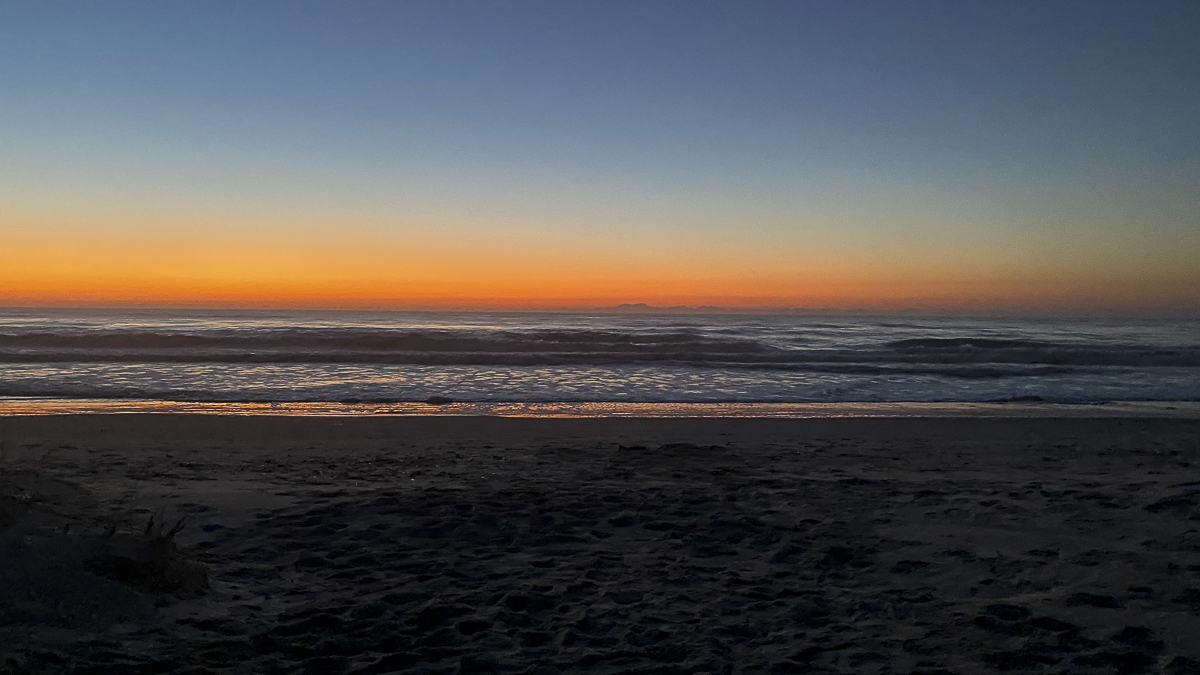
Another spectacular sunset
The wind died and we enjoyed another beautiful sunset, dinner, and the a campfire on the beach (something Melissa has always wanted). She found some abandoned firewood near our first campsite (you must bring your own firewood if you want a campfire on Masonboro). We built a fire below the high tide mark so the next tide would remove all traces and we enjoyed a long and relaxing campfire with the sounds of the ocean and a beautiful night sky as our only companions on our last night on this magical island.
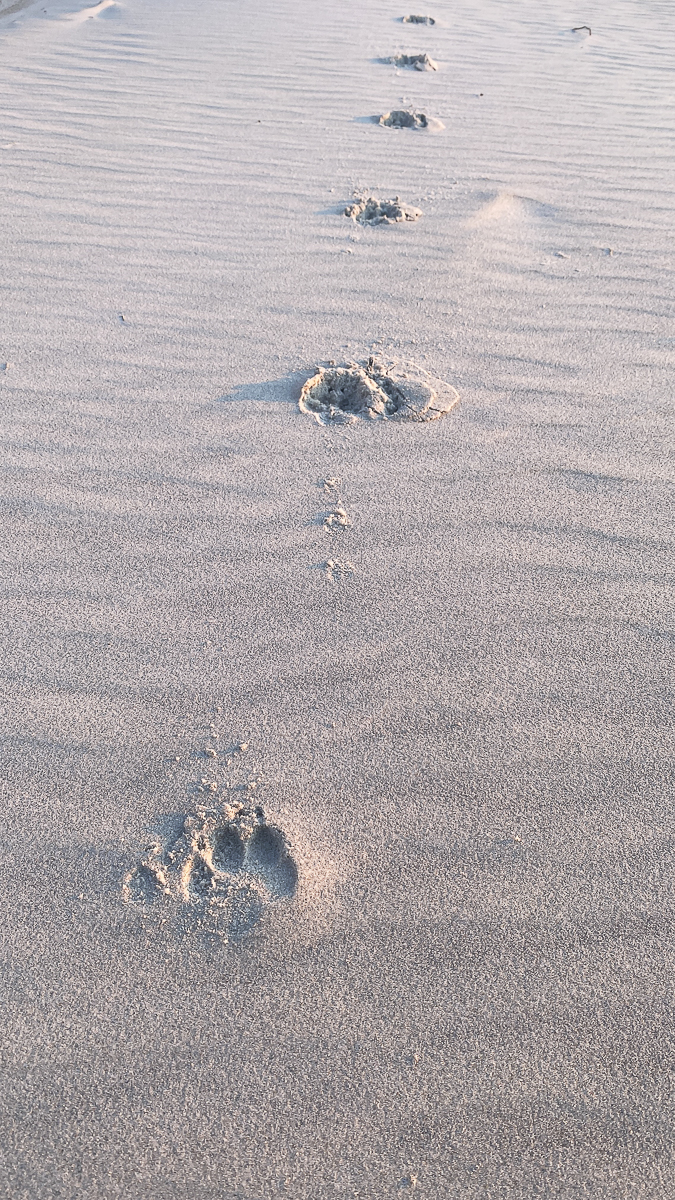
The glow on the horizon just before sunriseCoyote tracks
The staff person we spoke with at the launch site mentioned that coyotes are on Masonboro and we should protect our food (just as we would from any other critter when camping). We stored our supplies in our “bear canister” and, though I kept a lookout at sunrise and sunset, I never saw any mammals on the island. But on our last morning, we walked down the beach and found a line of coyote tracks that went by our campsite. Some time during the night, the coyote had come down off a steep dune face and trotted in the typical straight line gait until it got to within about 50 feet of the dune break where our tent was set up. It then veered off toward the ocean and returned back to above the high tide mark once it was about 50 feet past us. This is why I like our trail cameras back home so much – you never know what is going on outside after you go to sleep.
The steep dune face of the winter beach
Being by ourselves on a deserted island is a good way to purge some of the world’s troubles from your brain for at least a short while. Masoboro looks like it could be a bit crowded at times in warm weather, but we lucked out and experienced the island solitude for a couple of days and it was good!
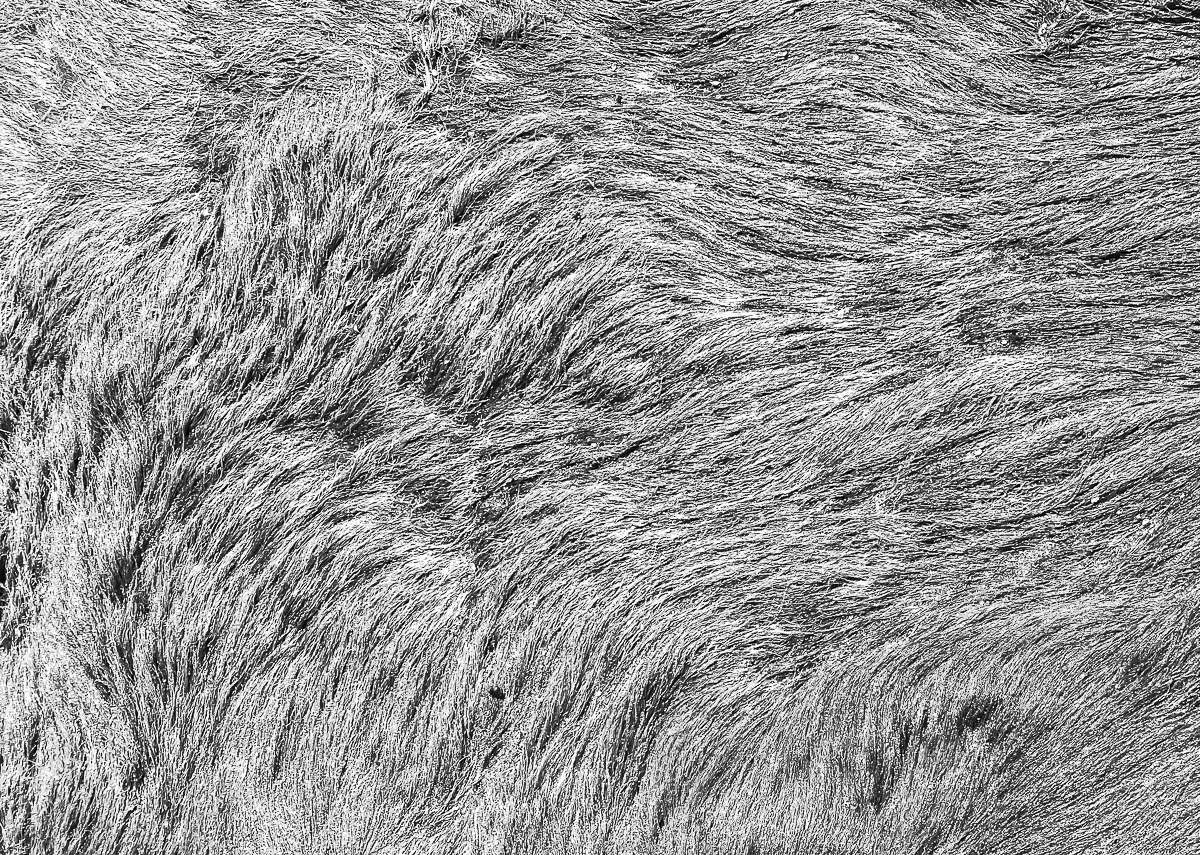
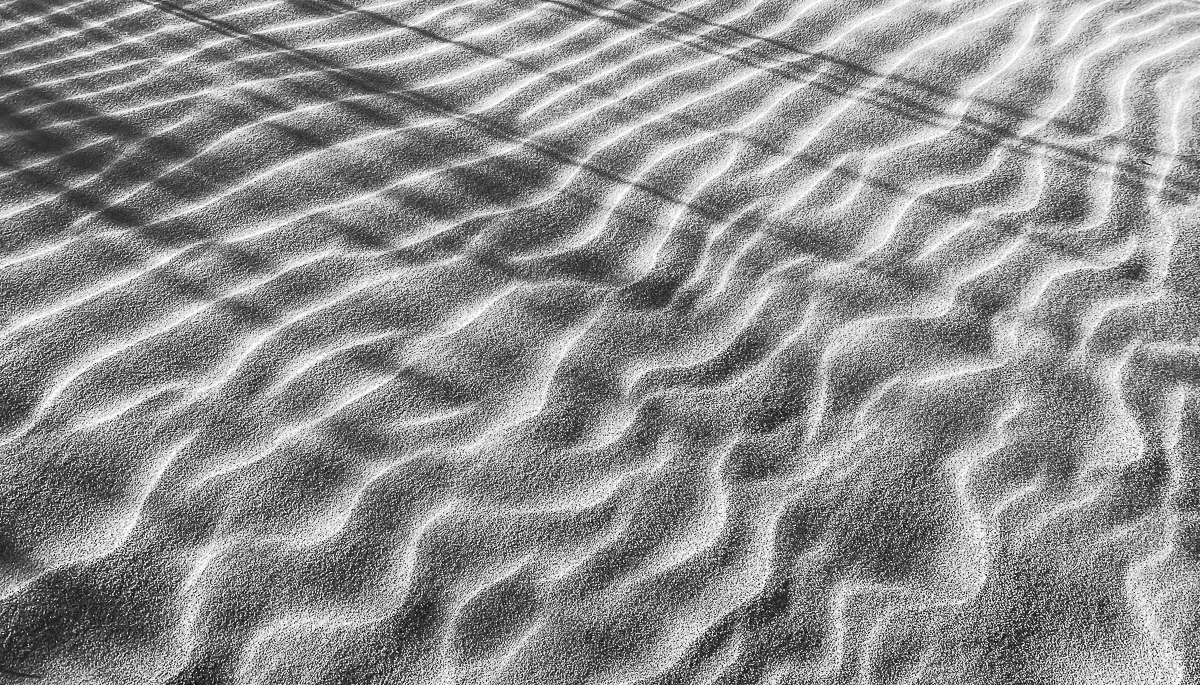
One thing we did to pass the time was walk along the beach, looking at the small wonders that wash up from the depths. We collected a couple of shells but I really enjoy looking at the patterns created by the forces of wind and water. Below are a few shots of natural patterns we found as we enjoyed the island and nearby beaches.
Live Oak tree canopy on the beach at Fort FisherAlgae swirls on the coquina rock outcrop at Fort Fisher at low tideWind ripples on dry sand on Masonboro IslandPatterns in the sand from water caught in low spots on the upper beachSand patterns from water in pools on the beach
I just take it one day at a time, and it always leads you to the right place.
~ Kyle Massey
My two recent trips to Pungo were two day trips, leaving home before dawn and leaving the refuge after sunset. While not the ideal way to do this, even a day trip can yield some great wildlife moments. I shared some images and stories about the dominant winter birds (Tundra Swans and Snow Geese) in my last post. This one covers some of the other interesting wildlife I (we, on the second trip) encountered.
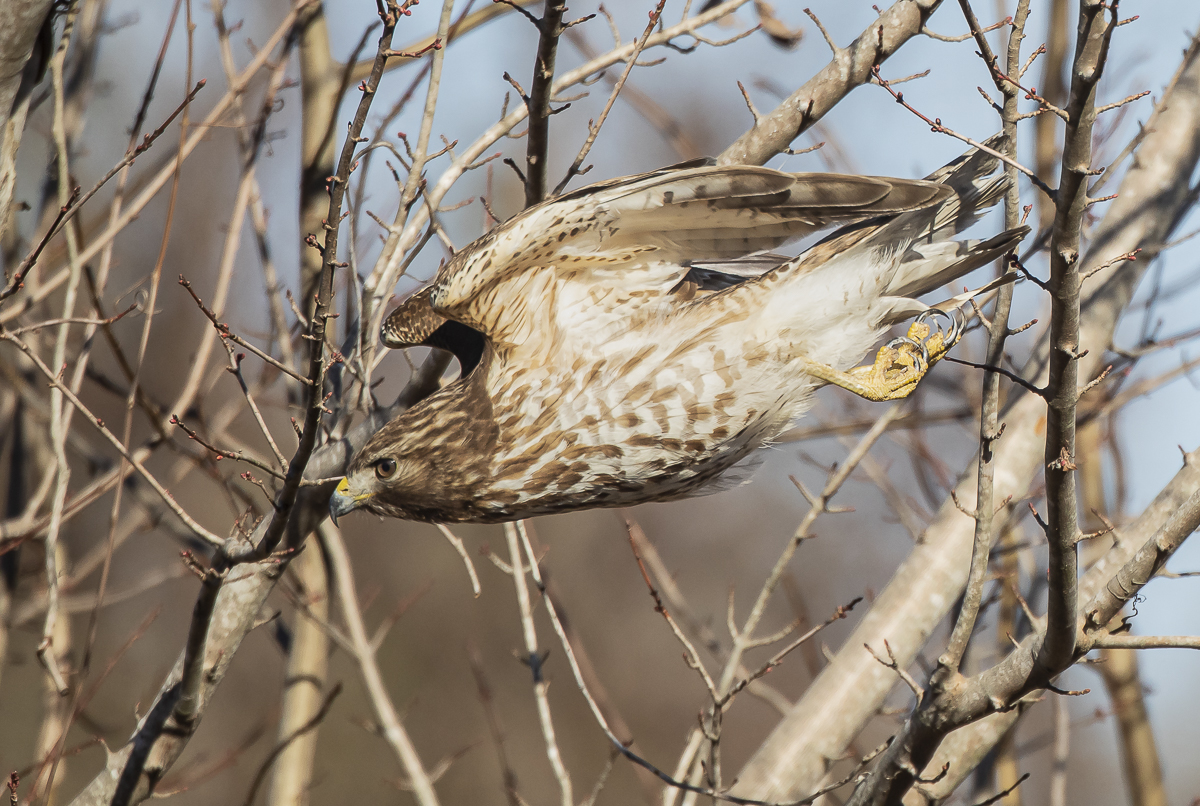
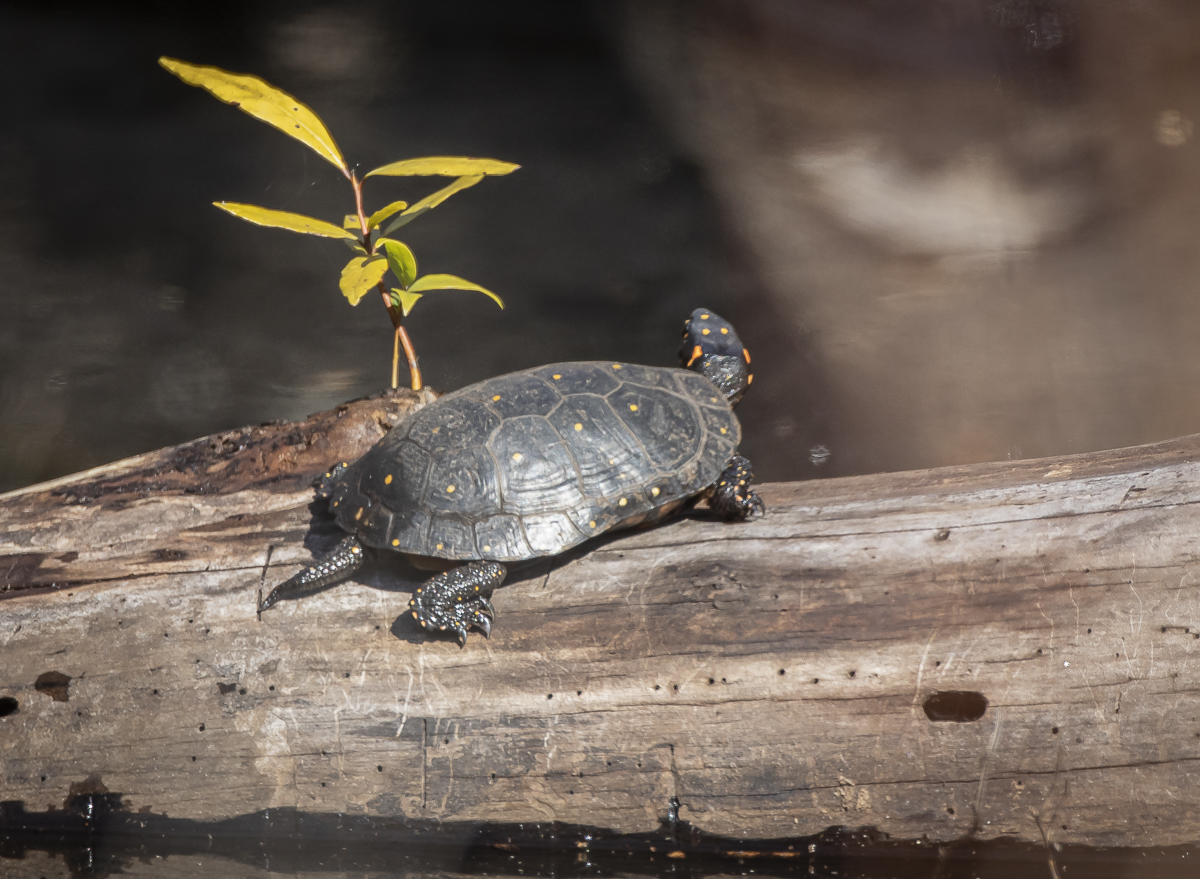
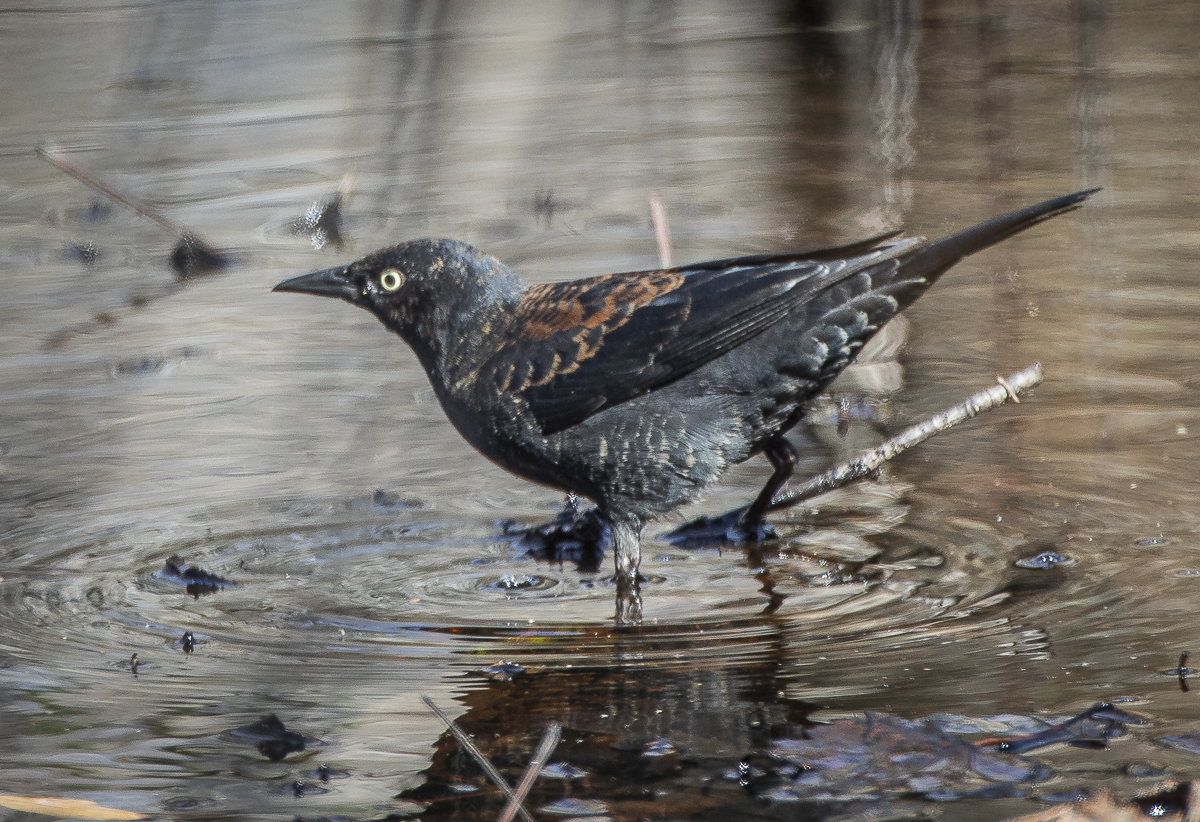
The first thing I saw was an adult Red-tailed Hawk perched in a tree in someone’s yard on the way in to the refuge. The hawk seemed to be surveying the hundreds of Red-winged Blackbirds feeding in the corn field across the road. (click photos to enlarge)A flooded portion of a cornfield across the canal on private land had this Greater Yellowlegs patrolling the shallows. Just beyond the shorebird was an immature Bald Eagle out in the field. There may have been a small carcass of some sort as there were also a couple of crows just out of camera view. Another car pulled up and the eagle took to the skies.Farther down the road was an immature Red-shouldered Hawk surveying the roadside canal. They feed on amphibians, small reptiles, birds, and small mammals, as well as invertebrates like earthworms. Why is it the hawks that don’t fly away as I approach are always surrounded by a thousand sticks in the background (or right in front of their head)?I watched this hawk for about 10 minutes before yet another car pulled in and it flew to a perch a little farther back from the roadA few deer were out grazing along some grassy roadwaysFebruary is the month when large flocks of blackbirds (mostly Red-winged Blackbirds) flood the fields with their undulating swarms and noisy antics. This field was near one with a few hundred Tundra Swans feeding on the waste corn (the swans can be seen in the background as a white line)Zoom in to see the red epaulets of the male birds. Females are all brown (streaked). There are also several Brown-headed Cowbirds mixed in with this flock (can you find any?)Turtles were out basking in the sun in many of the canals. One log in a swamp forest along the road had this beautiful Spotted Turtle.I stepped out of the car to receive a phone call (much to my surprise since most of the refuge has no cell phone service) and was surprised by a small flock of Rusty Blackbirds foraging in the swamp next to the road.
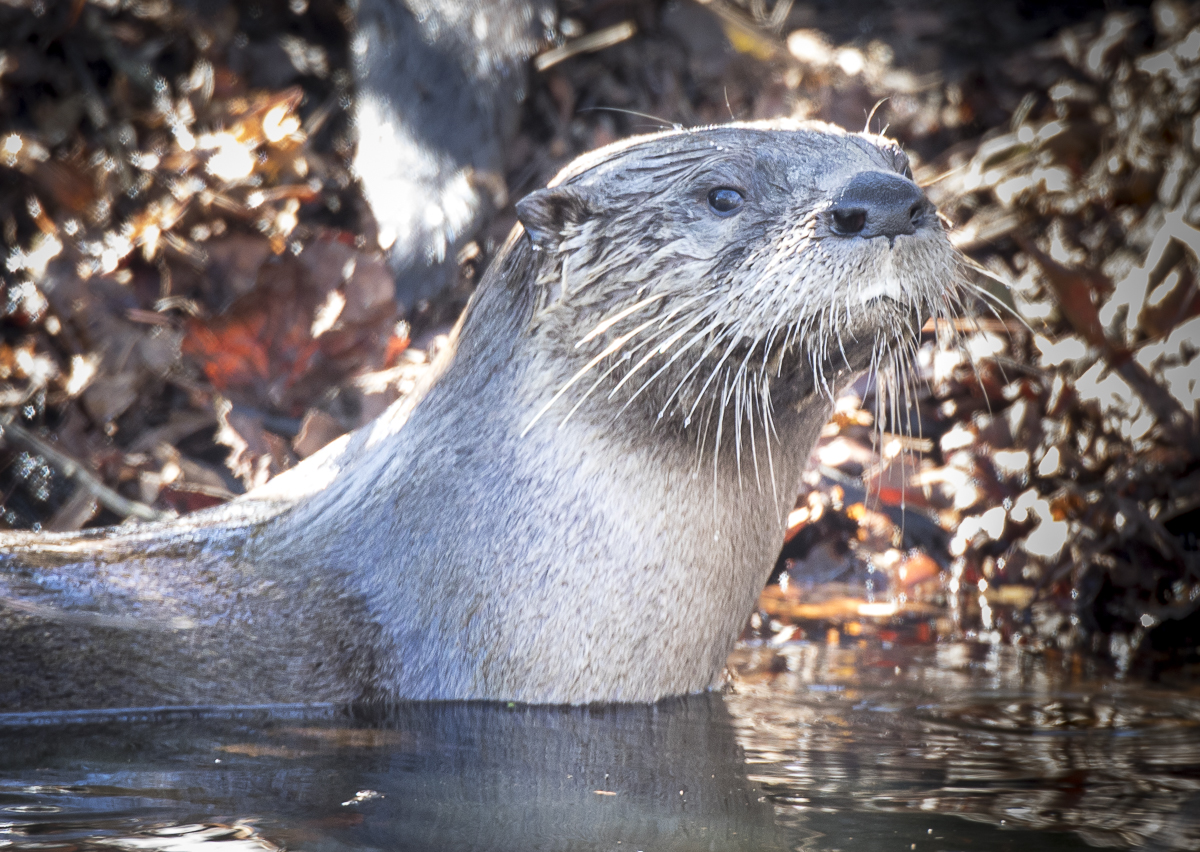
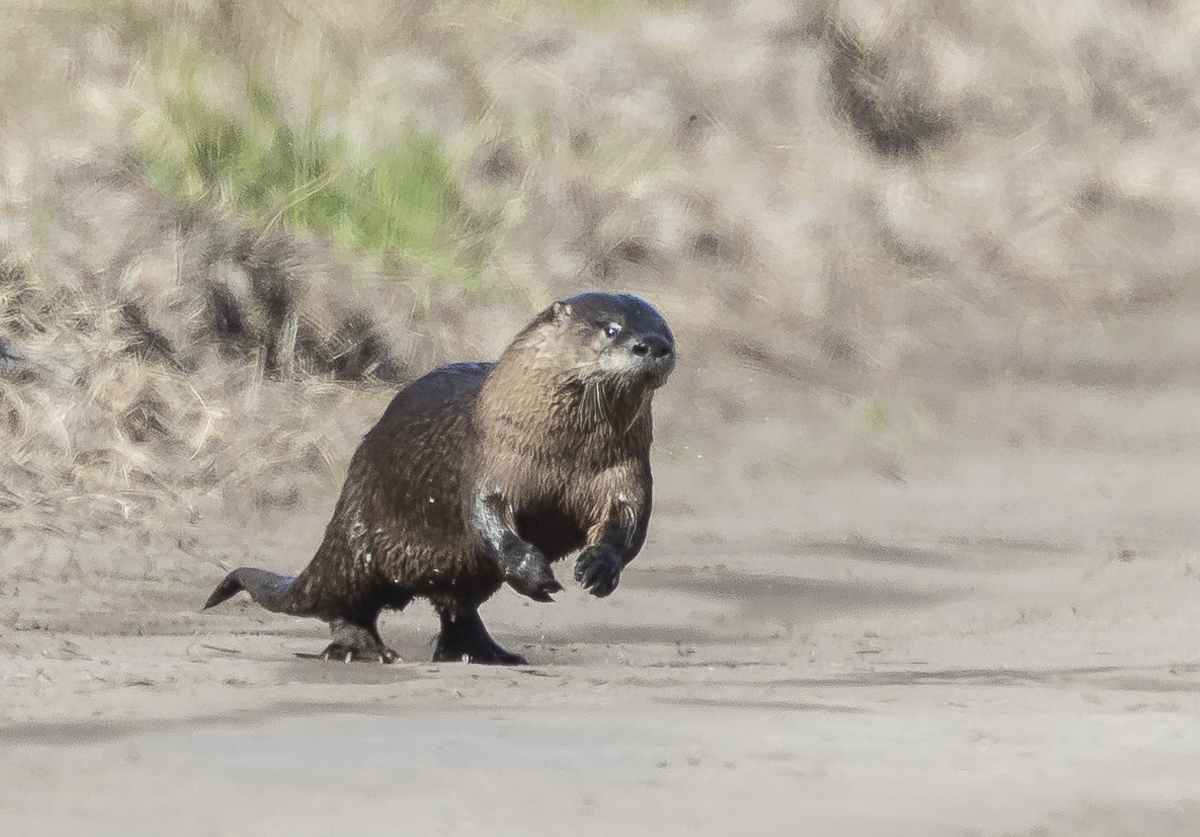
On my first trip, I saw 4 River Otter, a family grouping (I think) that I have seen on other trips to Pungo this winter. The next week we had a 9 otter day, with three groupings of 2, 3, and 4 otters seen at different times and locations. I didn’t try to get close to any but did get to spend quite a while watching a group of 4 where one had a very large fish that it didn’t want to share.
This otter was swimming with two others and decided to climb out on the back across the canal from where i was standing
A pair of otters came up out of the canal and started running down the road toward me. They eventually thought better of it and returned to the canal.
We stopped the car to look at an American Bittern, one of two we saw in Marsh A, when I heard squalls across the canal. It turned out to be the otters arguing over the large fish one had captured. For the next hour, we had this beautiful bird on one side of the road and the four otter on the other. Melissa stayed with the otter while I went back and forth trying to observe and photograph both wildlife events. There were a few other cars nearby but they were mainly concentrating on the thousands of swans in the shallow water of Marsh A just down the road.
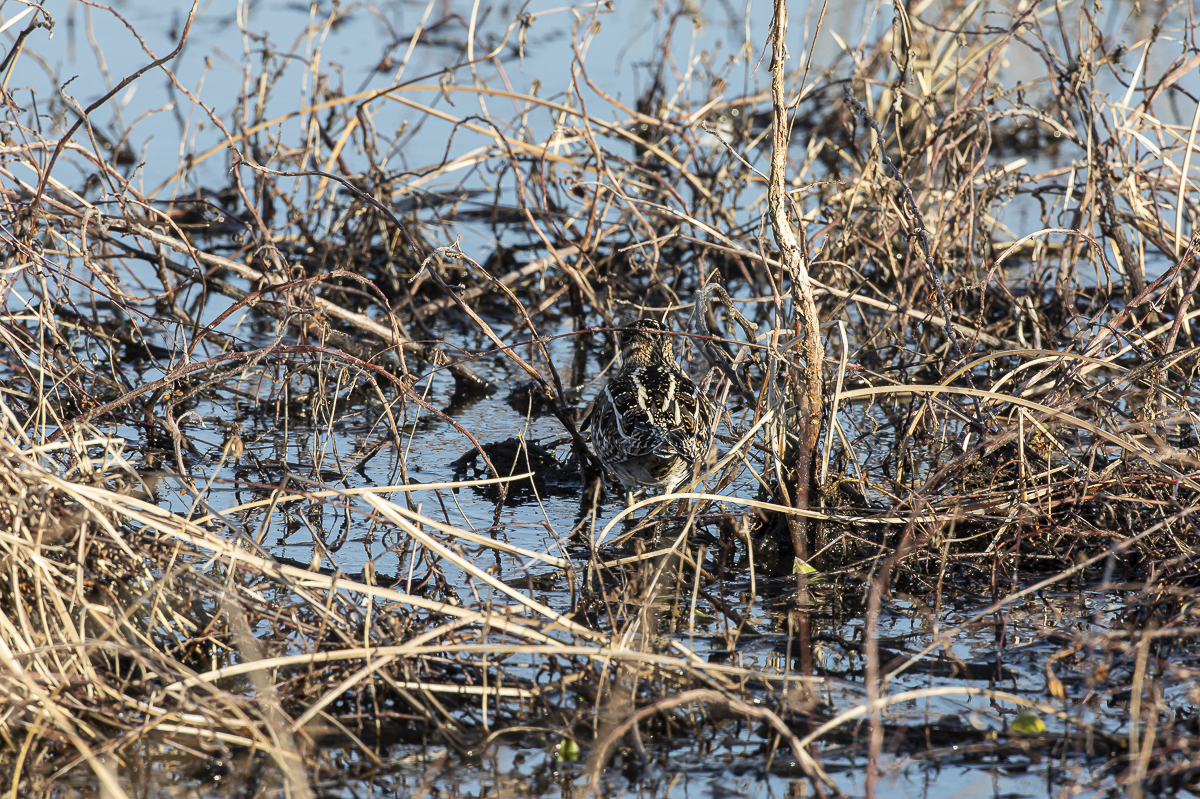
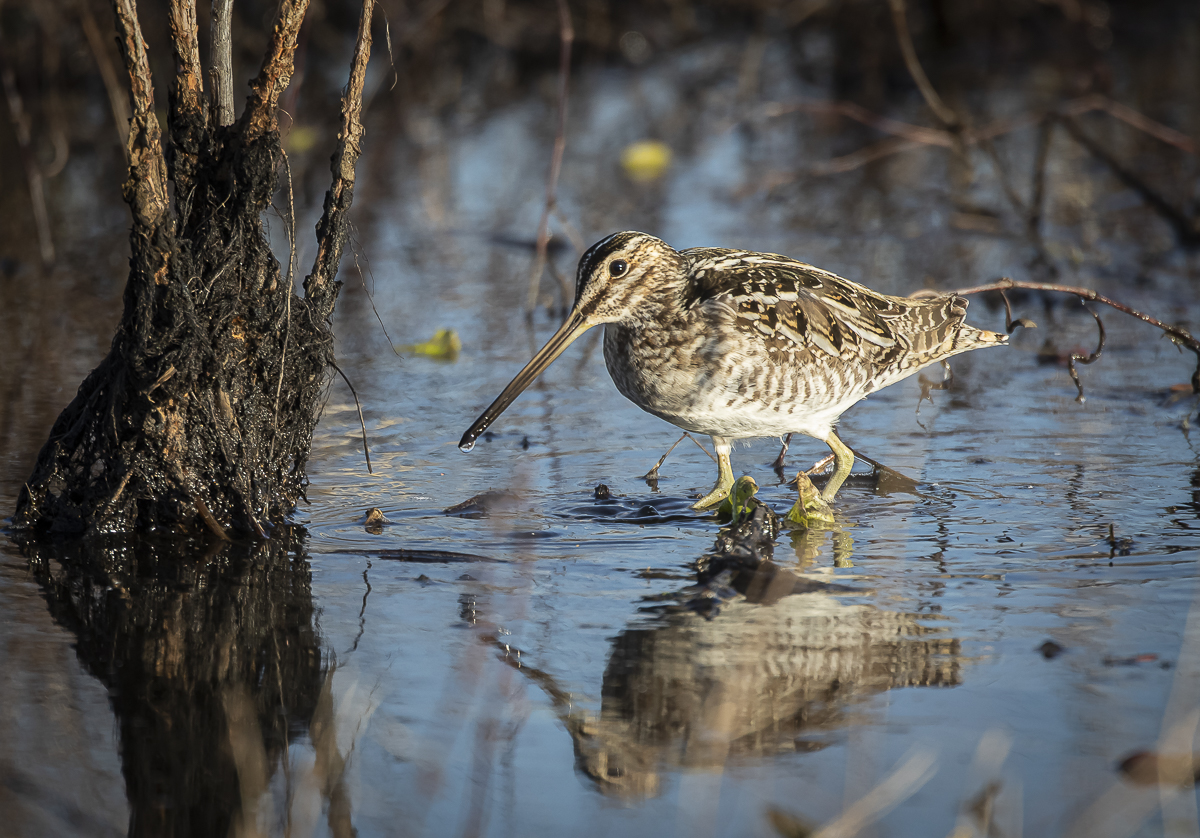
An American Bittern slowly moves through the grasses looking for prey. I watched it catch three items but could never clearly see what it caught because it was behind a clump of grass each time.When the bittern was among the grasses, it was very difficult to spot due to its streaked camouflage. Here it creeps across an opening and you can see that intense look they always seem to show.Another bird that is a master of disguise is the Wilson’s Snipe. Their streaked plumage blends in perfectly with their primary habitat – edges of wet marshy areas or muddy fields of patchy grass. You can drive by and never see one, and then stop, look around, still nothing. But if you make a noise or get out of your car, they can explode into the air right in front of you and then zigzag to a landing spot only to vanish once more. This one has its back toward me. I took dozens of photos of a group of snipe right next to the road and managed only two shots where they are out in the open enough to see the entire bird.One of the snipe finally walked across a small area of open water and gave me a chance for a reflection photo
On one trip, I introduced myself to a woman I follow on social media that I recognized walking along the road. She is an excellent photographer and visits Pungo way more than I do. She was trying to get a photo of a screech owl she had found in a hollow next to the road. She was gracious enough to show me the tree, though the bird wasn’t visible at the time (she said it would slide down into the hole when a car drove by and it had been a very busy day on the refuge). I thanked her and checked on the tree later that day, but still no owl. On my second trip, I spotted the owl the first time I drove by, but the light was terrible. I decided to wait until late that afternoon when the low angle sunlight would flood into this group of trees.
Eastern Screech Owl (red color morph) resting in a hollow tree opening. There are a lot of branches in front of this tree, so it is difficult to find a spot for a clear view.
We were trying to not disturb the owl and be discreet in our attempts to get a photo so as to not attract a crowd that might disrupt the little guy’s napping. The owl didn’t seem to mind our vehicle slowly driving by and stopping for a few seconds, so we did a couple of back-and-forths, hoping to get a clear look. After admiring this beauty on several drive-bys, we decided to move on and let it rest comfortably. I wonder how many times I have driven by this bird (and others) without seeing it? I guess that is one reason to keep going back…there is always something new to observe, even if only on a day trip. Here’s looking forward to many more in the future.
Our final look at the resting owl as it was facing into the setting sun. The golden light actually makes it even more difficult to see this color owl since the surrounding trees all take on a reddish-golden hue in the low angle light. I have seen both red (generally called rufous) and gray color morphs on the refuge. No one is quite certain what advantage, if any, a bird derives from being one color or the other.
Twenty thousand birds moved away from me as one, like a ground-hugging white cloud…
~Michael Pollan
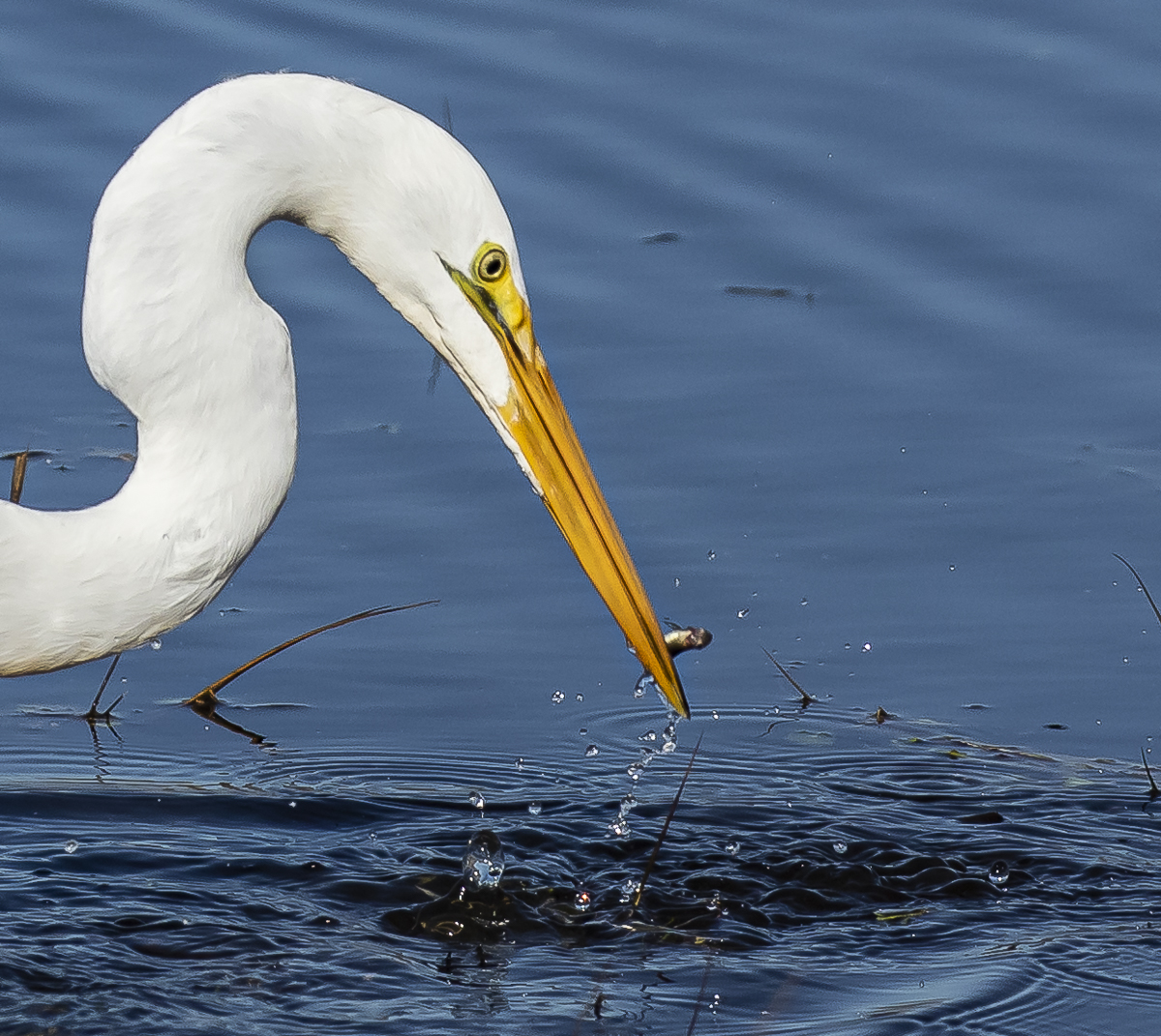
I managed a couple of trips to my favorite NC winter place recently and was rewarded with some wonderful scenes of wide colorful skies, masses of birds, quiet moments of watching wildlife, and some surprises. I’ll cover much of the events in this and the next post. Today, I’ll focus on the birds, specifically those elegant white birds of winter – Great Egrets, Tundra Swans, and Snow Geese (well, egrets can be seen any time of year actually). In addition to the Pungo Unit, I spent some time at Mattamuskeet National Wildlife Refuge, where I enjoyed watching some Great Egrets hunting in the flooded impoundment. Their typical hunting strategy involves walking slowly in shallow water, and moving their head and neck to get a closer look at potential prey. They then either strike quickly or lean in close to the water and, with incredible speed, slice through the surface to snag a meal. Their preferred food is small fish, although I have seen them take invertebrates, fairly large fish, and a friend recently reported one catching an amphiuma (a large aquatic salamander). Below is a record of one that walked by me several times spearing tiny fish.
A Great Egret does the leeeaaan for a successful strike (click photos to enlarge)A Great Egret spears a small fish, and then did it again, and again, and…
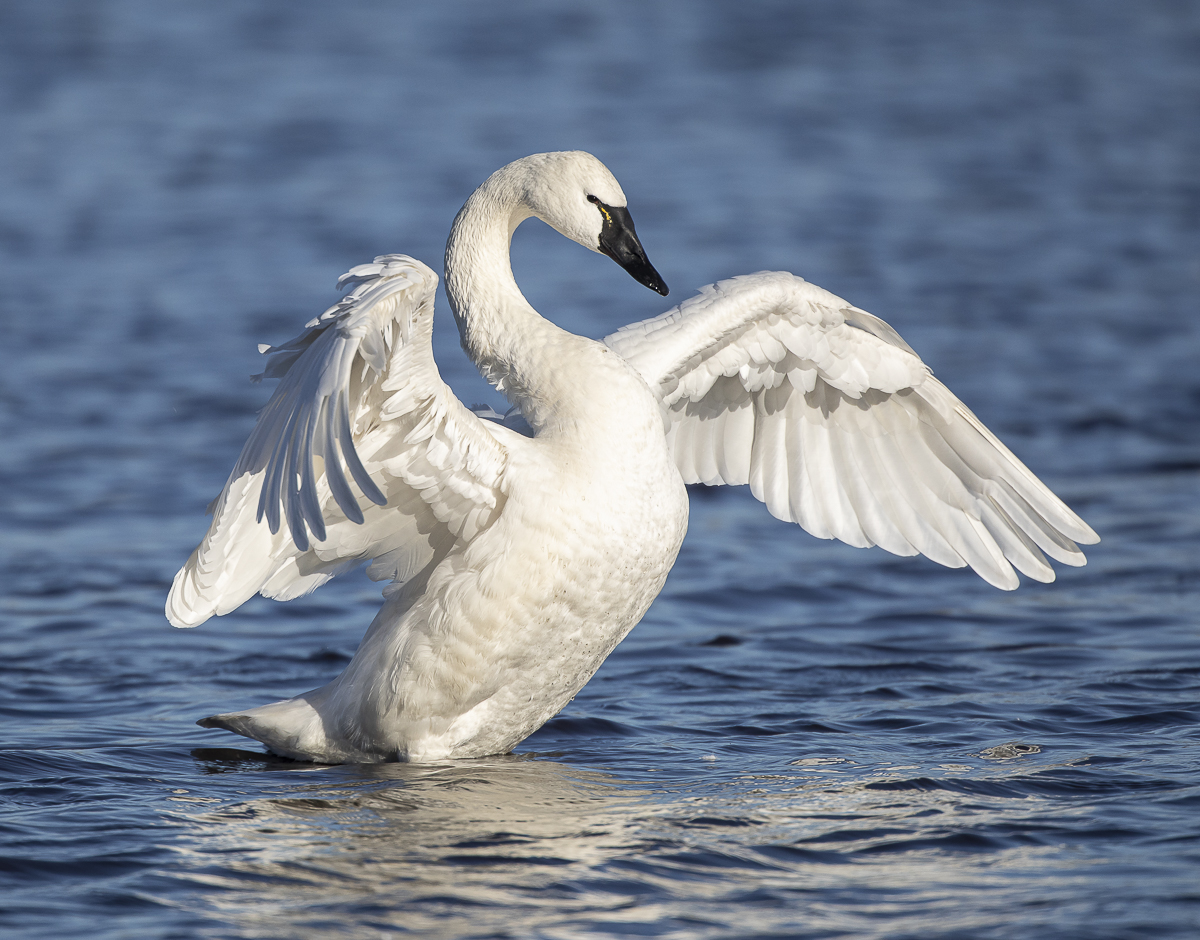
Over at Pungo, the water levels have finally come back up to normal in the impoundments and the swans are appreciating it. There were a few thousand in Marsh A and many more in the flooded corn field along D-Canal Road. Even though I have taken hundreds (no, probably a few thousand) photos of swans over the years, I enjoy watching and listening to them so much, I always manage to spend an hour or two sitting in the car at Marsh A and taking it all in.
One of the most elegant moves a swan makes is the wing flap They do this frequently as part of preening and also after interacting with other swans in the so-called triumph ceremonyI never tire of watching (and listening) to swans taking flight…the huge wings flapping and the slap, slap, slap of their large webbed feet hitting the water surface as they run to gain liftA few swans engaged in acrobatic bathing – rolling over in the water, flapping, splashing, dunking their heads and necks, and then shaking it all off before repeating the process
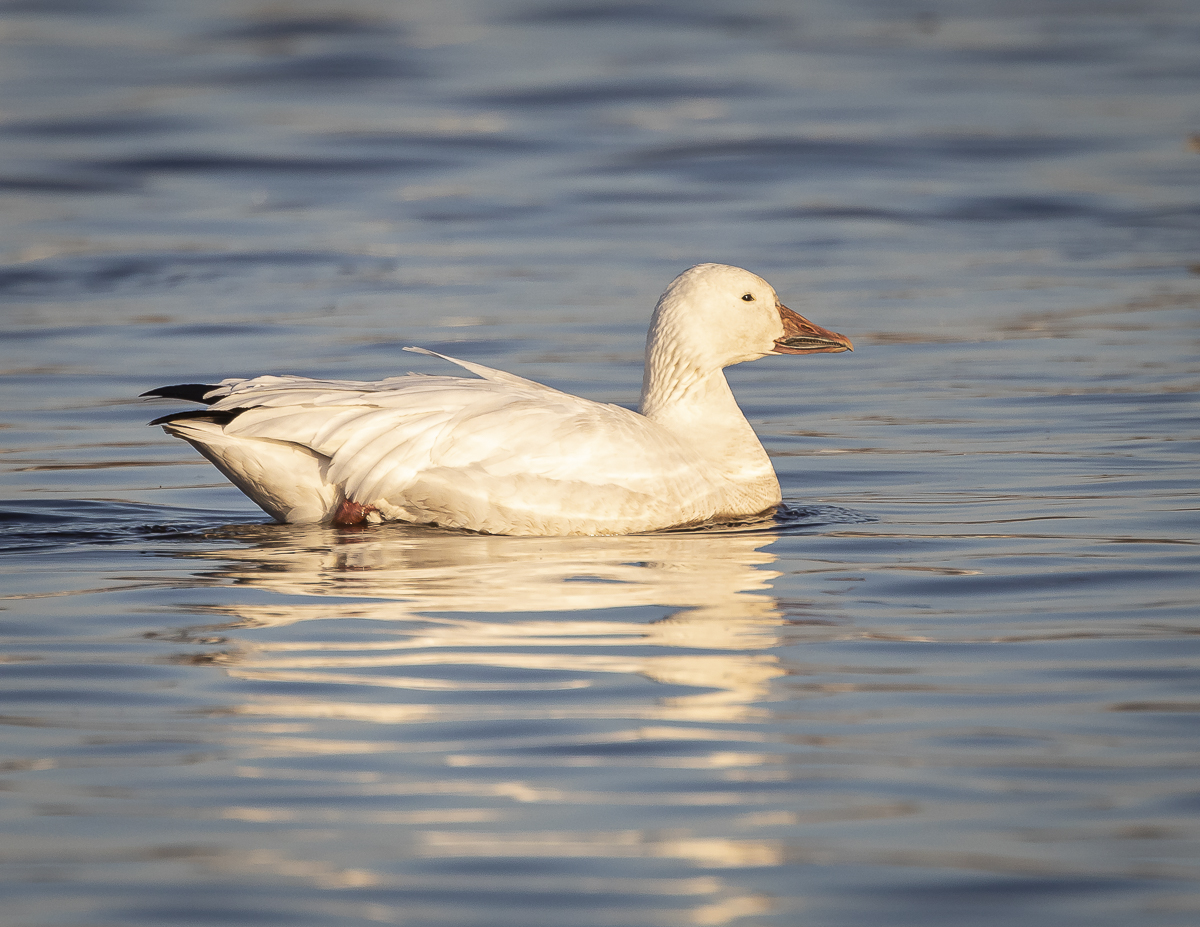
A lone Snow Goose swims among thousands of swans in Marsh A
I always hope to be where the Snow Geese are at sunset. They typically fly off the lake and head out to a field to feed a half hour or more before the sun goes down. If you are near, the sights and sounds of thousands of birds flying overhead are something you never forget.
Snow Geese landing in one the fields at Pungo already occupied by a few hundred Tundra Swans
A bonus on our last trip was the rising moon. We kept waiting for the Snow Geese to fly off the lake and head to the fields, but they were still on the lake at 5:30 p.m. (much later than on the trip where I filmed their flock behavior). We waited at a field with hundreds of swans feeding as that is usually a good bet where the geese will go when they finally lift off for their evening feed.
Tundra Swans across a rising moon
Melissa finally spotted the geese flying off the lake at about 5:45 p.m., but they didn’t head our way. Instead they flew north, so we hustled over to “Bear Road” and, sure enough, there was the flock of thousands of Snow Geese circling the corn field (the corn had been knocked down in the last few days so was prime for the birds). They kept circling for about 15 minutes, an unusually long time this late in the day. I managed a few images of geese flying across the moon while we watched. At last, birds started to drop into the field, but they only only stayed a short time before taking off and flying back to the lake. They may be getting antsy to head north. I probably won’t see them again this winter but I have promised myself to spend more time down there next year!
Snow Geese flying across the moon – they will probably be gone within days (if not already as you read this)
It’s not that I like ice Or freezin’ winds and snowy ground. It’s just sometimes it’s kind of nice To be the only bird in town.
~Shel Silverstein
This final post on our January Yellowstone trip shares a few highlights of the birds we encountered. There are certainly way fewer birds in this frozen land in winter, though the thermal features do keep some waterways open for the few waterfowl that remain (or gather there in winter, in the case of Trumpeter Swans). And the activities of wolves and the bottleneck of cold and food limitations do provide sustenance for the avian scavengers – the eagles, magpies, and ravens. Here are a few bird highlights from the trip…
Common Ravens are one of the most noticeable of the winter birds. They are large, noisy, and bold (will try to steal food if you are careless) (click photos to enlarge)
Recent surveys have estimated there are 200-300 ravens utilizing the northern part of the park as habitat. They are frequently seen near areas of concentrated human activity (pit stops, favorite pullouts, etc.) where they are very clever at taking advantage of any potential food items left unguarded. They are also abundant at any carcass, be it a roadkill or wolf kill.
This was my first time seeing a Raven with leg bands and a GPS backpack on in the park (Melissa has seen them on some of her previous trips the past couple of years). We learned that this is part of a study of Raven movements and interactions with wolves being conducted by researchers at the University of Washington.
The sight of Ravens wearing mini-backpacks (satellite transmitters) really peaked my curiosity. The one above was photographed at Tower Junction near the pit toilets and trash/recycling bins. We saw another one (maybe more) flying back and forth with chunks of meat at the bison carcass where we watched the wolves. When I got home I started searching for more information about this study, the Yellowstone Raven Project. The goal is to have about 70 ravens tagged in the park, all wearing solar-powered GPS backpacks with an antenna that submits the birds’ locations every 30 minutes throughout the day. Using this data, researchers are able to piece together the movement of Ravens from sunrise to sunset. There are many things they are investigating about these highly intelligent birds (how do Ravens consistently find wolf kills?; how far do they travel daily/monthly/yearly,?; where are they roosting?, etc.). I contacted Dr. Marzluff, the lead scientist, this week and asked about the Raven above, as I could not find the color code combination of leg bands on the Animal Tracker app, (this free app allows you to peek in on the movements of various tagged animals around the world, including the Yellowstone Raven Project). He promptly responded to let me know that this bird, a female, was captured and tagged on December 10, 2021, at Tower Junction, and has not yet been added to the app. In fact, he was watching that bird the day I emailed him! I’ll try to follow up with him in a few weeks to see what this bird has been up to. It is really amazing to be able to follow research going on in the park (and there is a lot of it!).
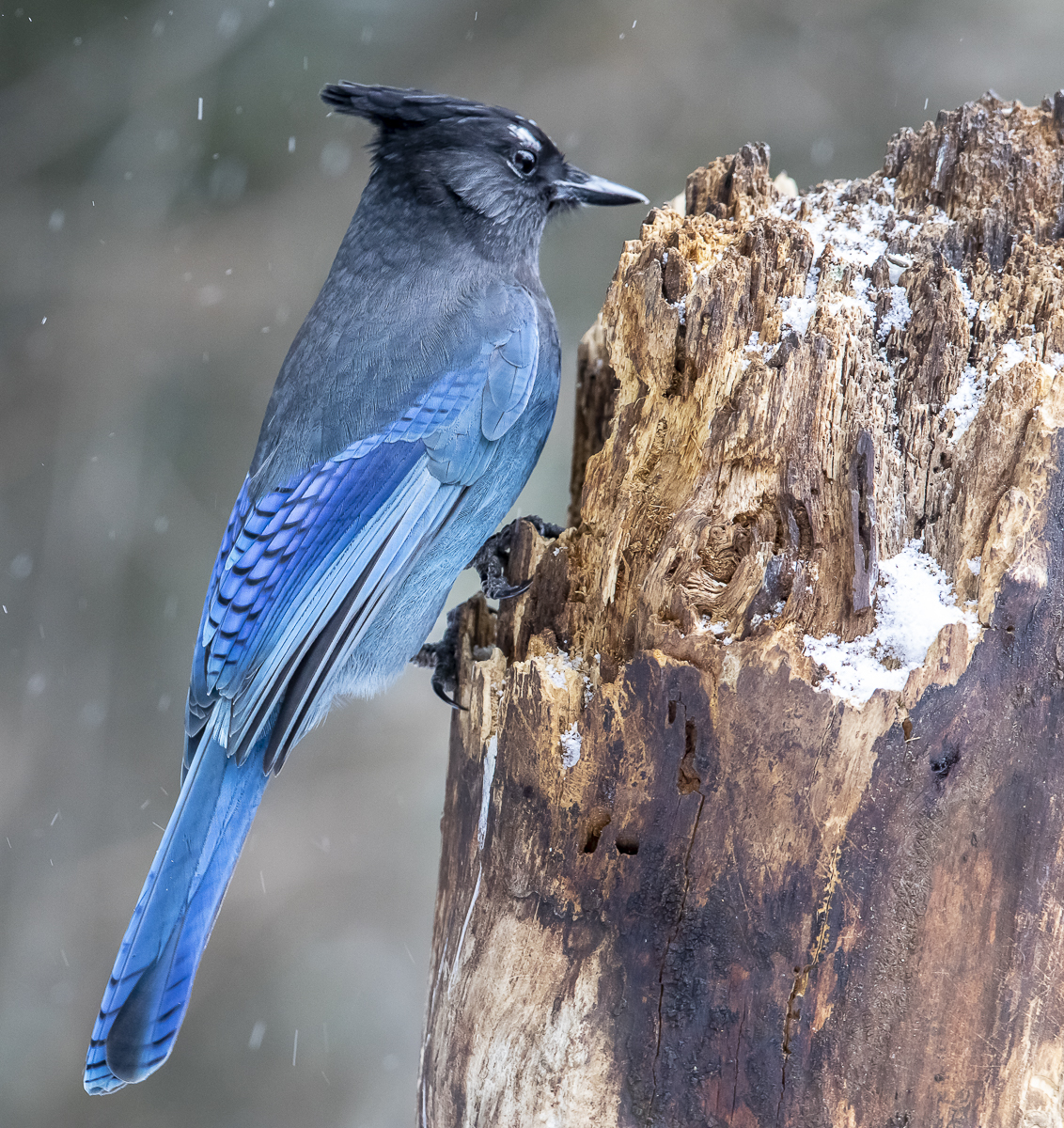
A gorgeous Stellar’s Jay at a friends tree stump feeder outside the park
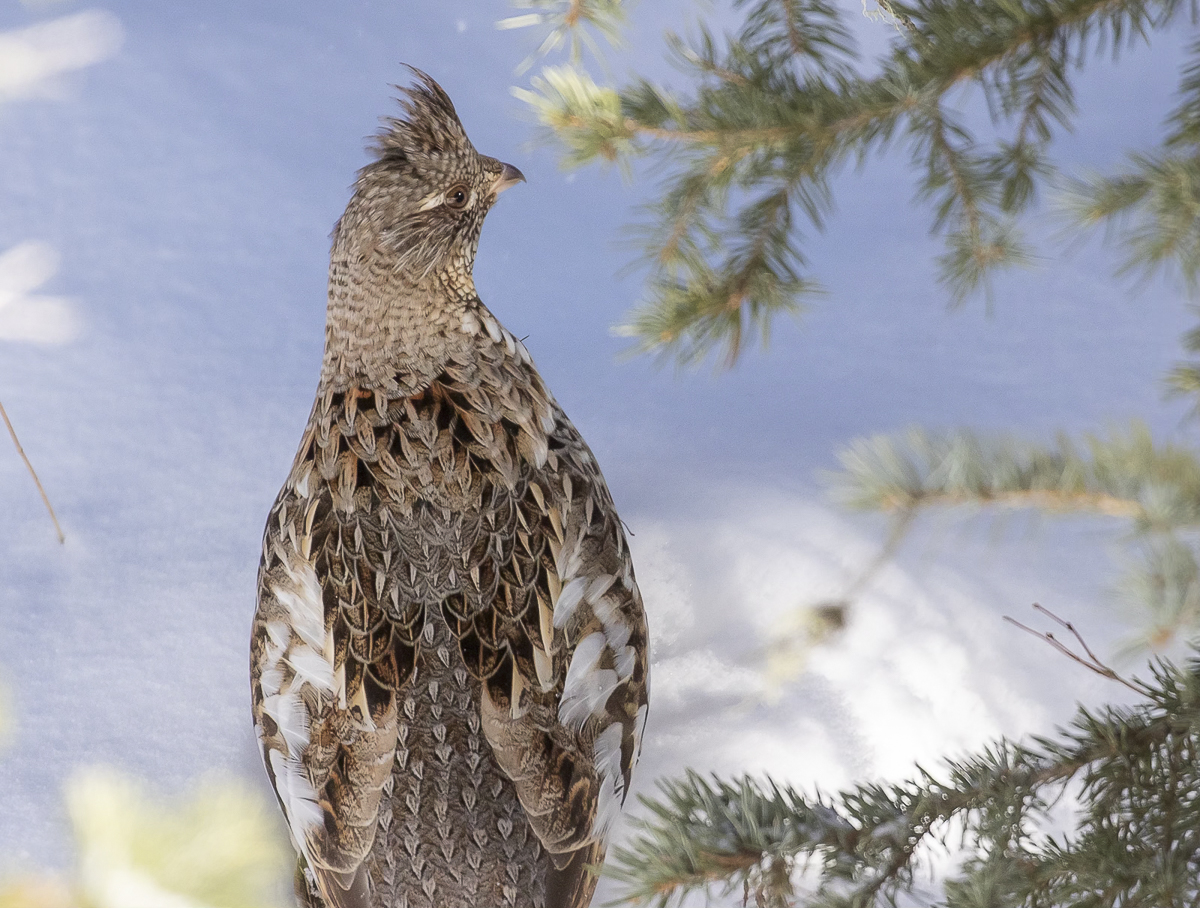
One of the more unusual bird interactions was with a roadkill Ruffed Grouse. We passed it and Melissa radioed me asking if that thing in the road was an animal or just a mud blob or other inanimate object. I wasn’t sure, so when we came back through, I noticed it was, indeed, an animal. I radioed her and she stopped, exclaiming it was a bird, a grouse! We parked and everyone got out to do a spontaneous roadside necropsy. We saw the track trail of the bird approaching the road in the snow and then the tragic result. Melissa poked around and we could see the stomach contents, which included some rose hips (something I had ironically mentioned as a bird food source to the group on one of our snowshoe hikes when we passed one of the shrubs with its bright red fruit). This close up view also allowed us to admire the beautiful plumage and the amazing adaption of the bristles along the birds’ toes which act like grouse-sized snowshoes. Another unique Yellowstone teachable moment!
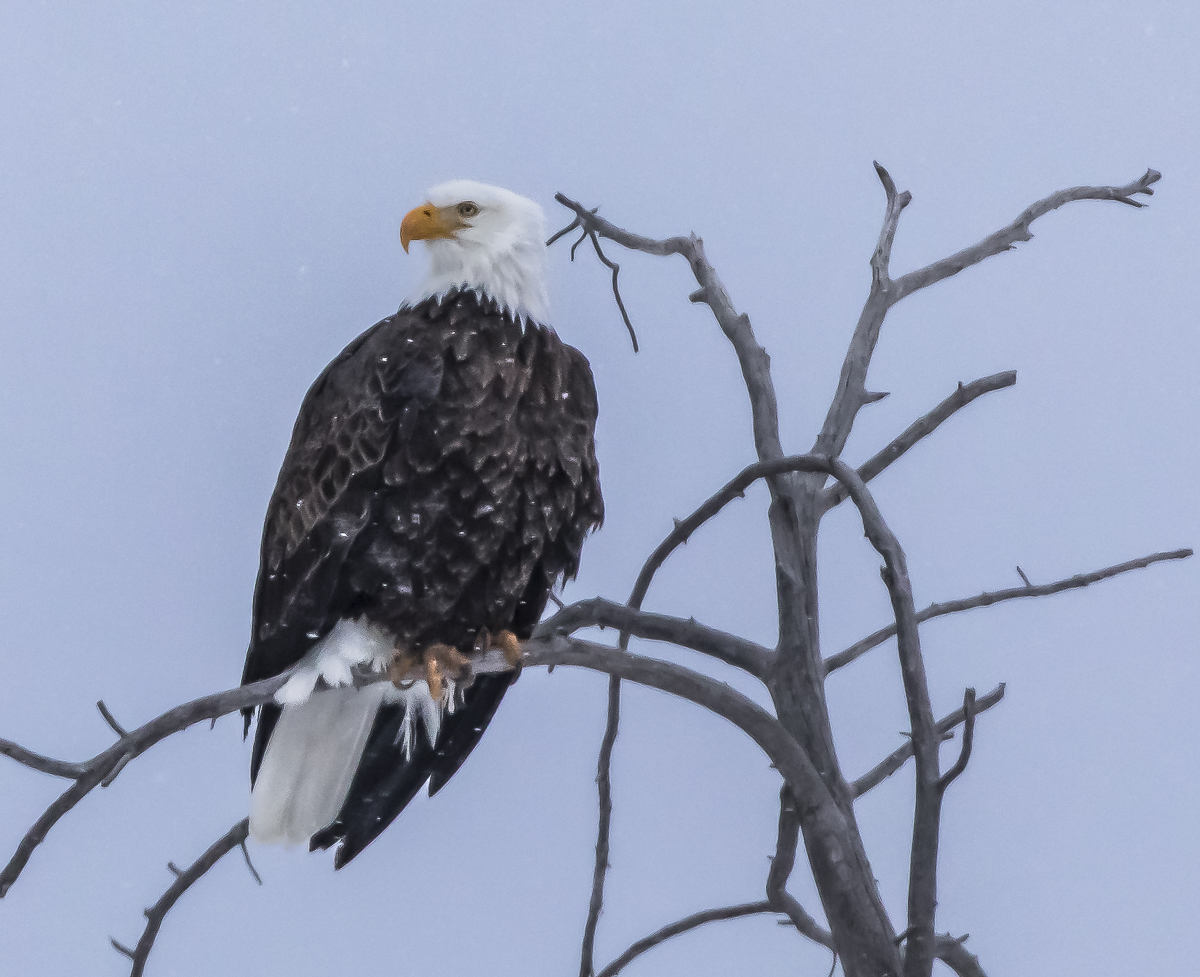
A roadkill Ruffed Grouse in the coniferous forest near the Northeast entrance (photo by Melissa Dowland)A more fortunate Ruffed Grouse after it crossed the road in front of Melissa (photo by Melissa Dowland)Bald Eagle perched along the Lamar River during a light snow fallA distant leucistic Bald Eagle (leucism is a genetic mutation which reduces pigment in a bird’s feathers) – taken with an iPhone through a spotting scope by Melissa DowlandA Golden Eagle at its favorite perch overlooking the confluence of Soda Butte Creek and the Lamar RiverThe most common duck we see in winter – a male Common Goldeneye
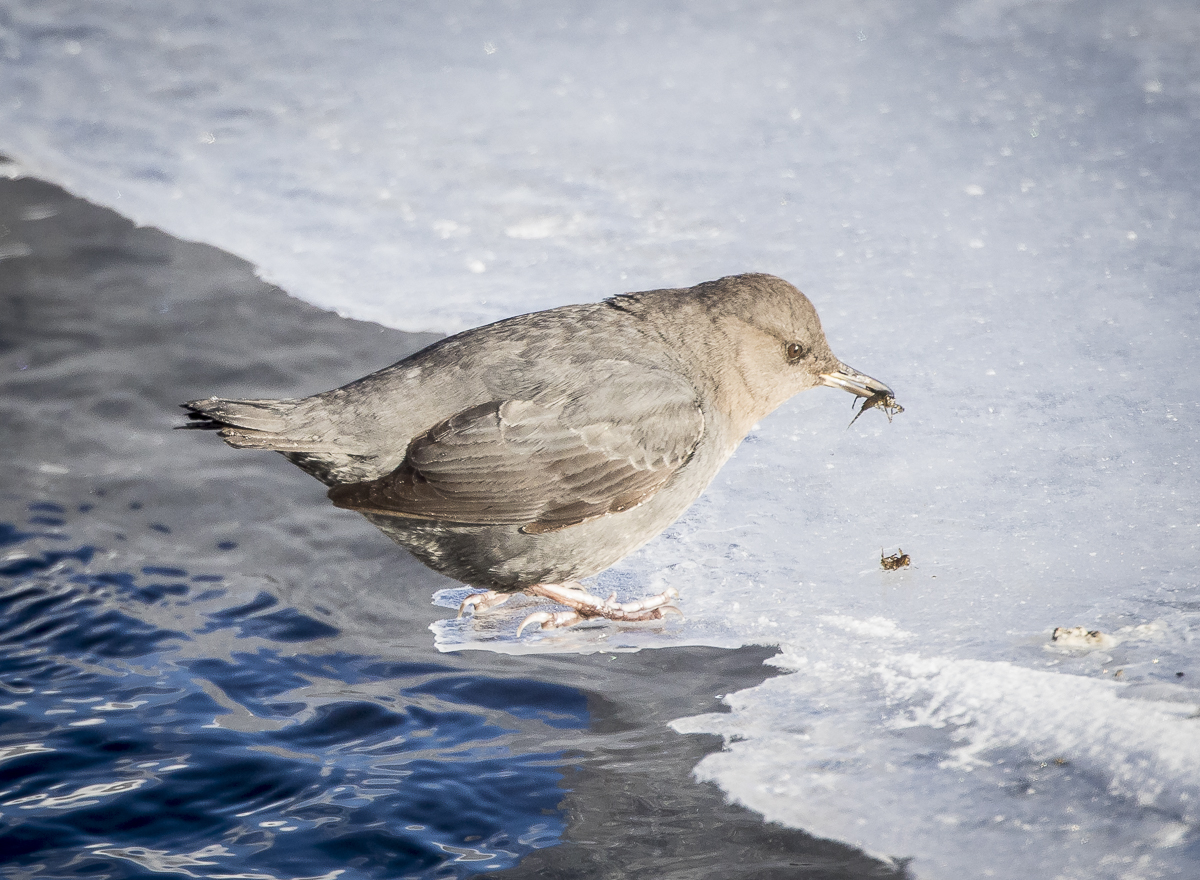
One of my favorite birds in the park, anytime of year, is the American Dipper. I sat along the river one day watching one feed from the edge of the ice.
An American Dipper on the edge of the ice along the Lamar RiverI think this prey item ls a stonefly
I reviewed 7 video clips I made of athe dipper feeding and the average time spent underwater was 6 seconds (five 6’s, a 5, and a 7). The dipper was successful in bringing up a prey item in all seven instances. All were small invertebrates with the exception of one decent-sized macroinvertebrate that I think was a stonefly larva.
So, why do dippers dip? There are a few theories out there: 1) the repetitive bobbing against the backdrop of turbulent water may help conceal the bird’s profile from predators; 2) dipping in this and some other birds may helps it sight prey; 3) the one that an Audubon article I ran across thinks is the most likely is that dipping and the rhythmic batting of those bright white eyelids is a mode of visual communication with other dippers in their typically noisy environment where the usual calls might not be easily heard.
We also saw several other species that evaded a decent photo including Common Redpoll, Gray-crowned Rosy Finch, Black-billed Magpie, Pine Grosbeak, Hairy Woodpecker, Clark’s Nutcracker, Gray Jay, and Red-breasted Nuthatch, Mallard, and Trumpeter Swan.
Thanks for following our winter adventure. Can’t wait to go back!
Hunters will tell you that a moose is a wily and ferocious forest creature. Nonsense. A moose is a cow drawn by a three-year-old.
~Bill Bryson
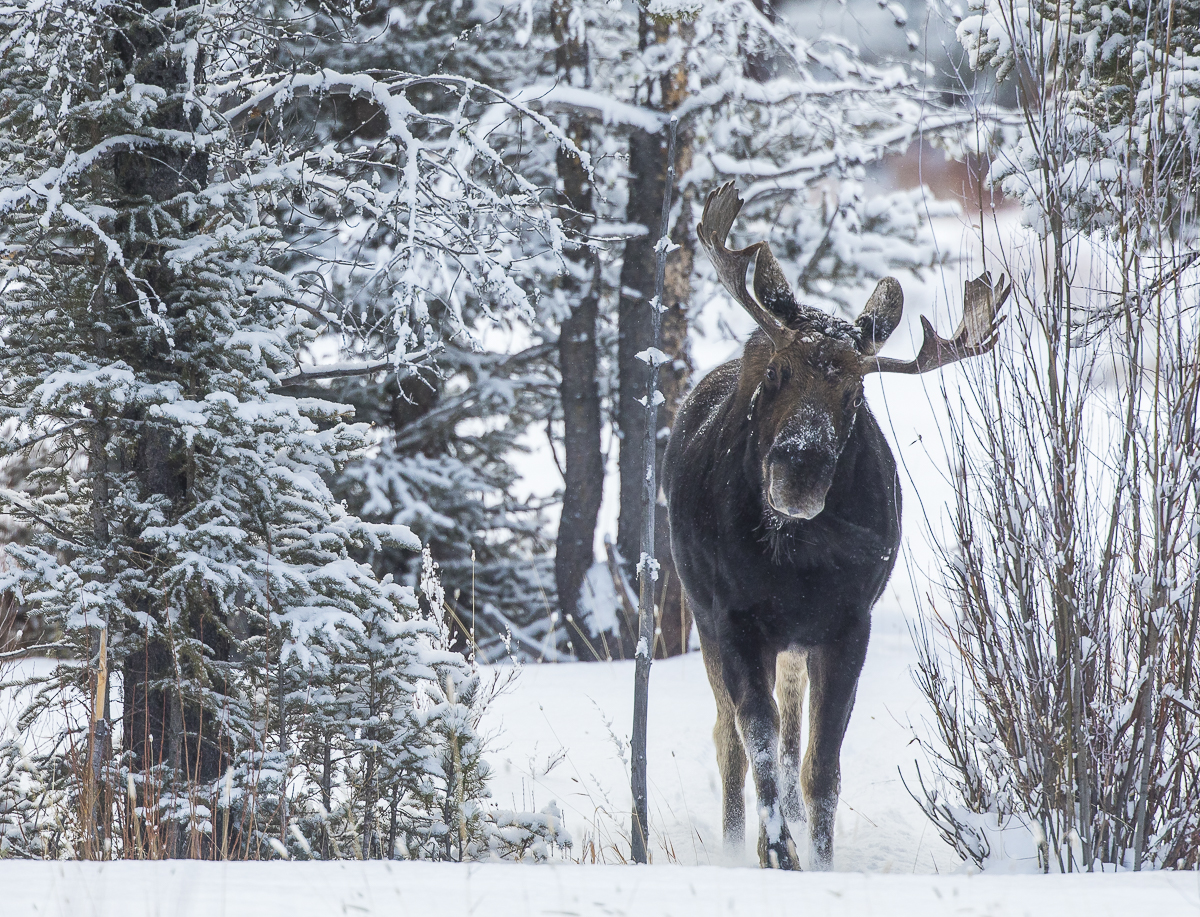
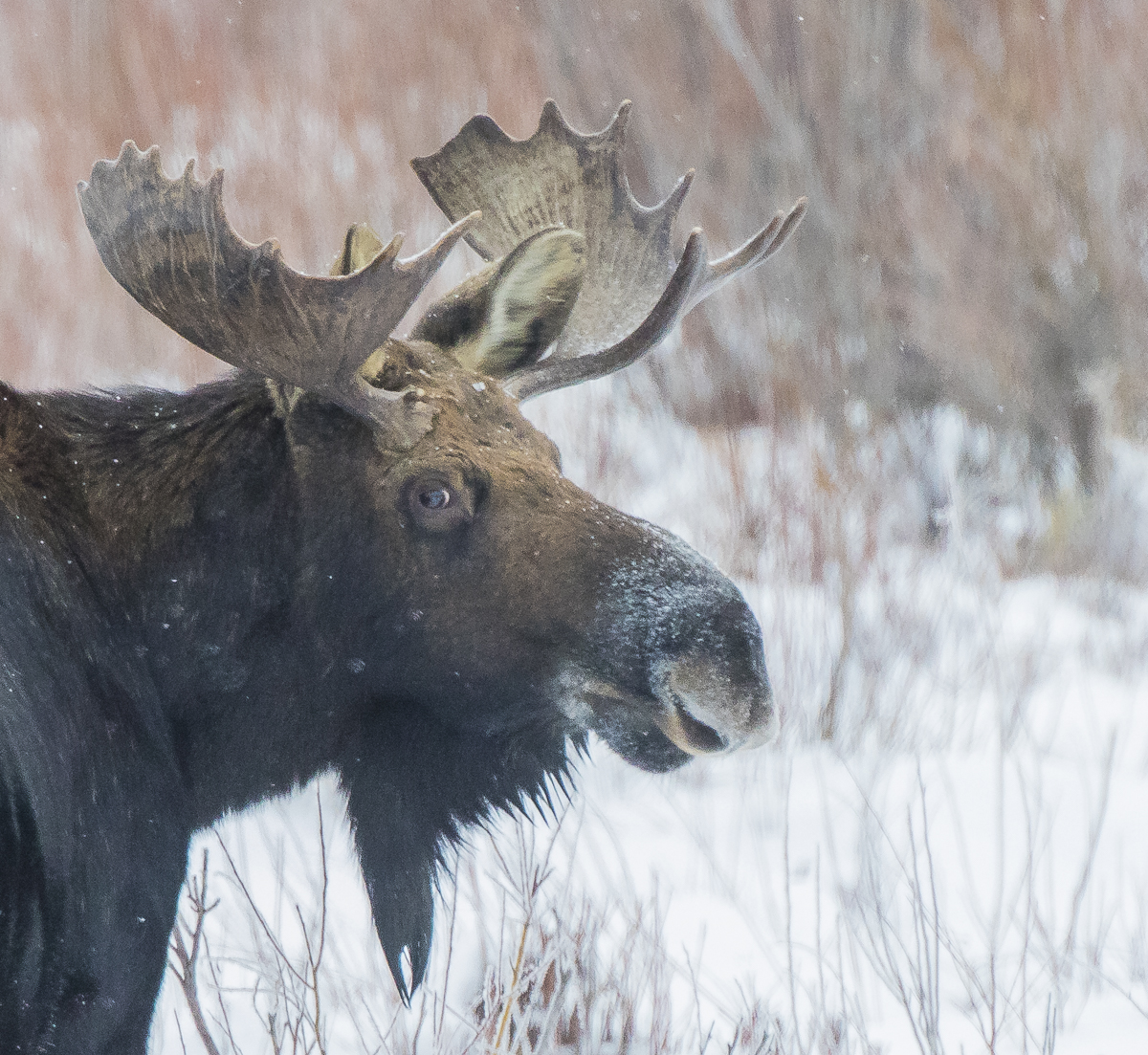
For many years, Moose have been one of the more difficult of Yellowstone’s large mammals to find. The best place was usually at the Northeast entrance or in the small town of Silver Gate just beyond that gate. This trip had Moose aplenty, with sightings on almost every day we were in the park, ranging from the upper part of Lamar Valley to near the Northeast entrance. The area known as Round Prairie was particularly productive and we saw a record (for us) of seven of these magnificent creatures there one day. Unfortunately, our best views happened before our group of students arrived, though they also saw Moose, but at greater distances (except for one quick roadside spotting on our last full day in the park).
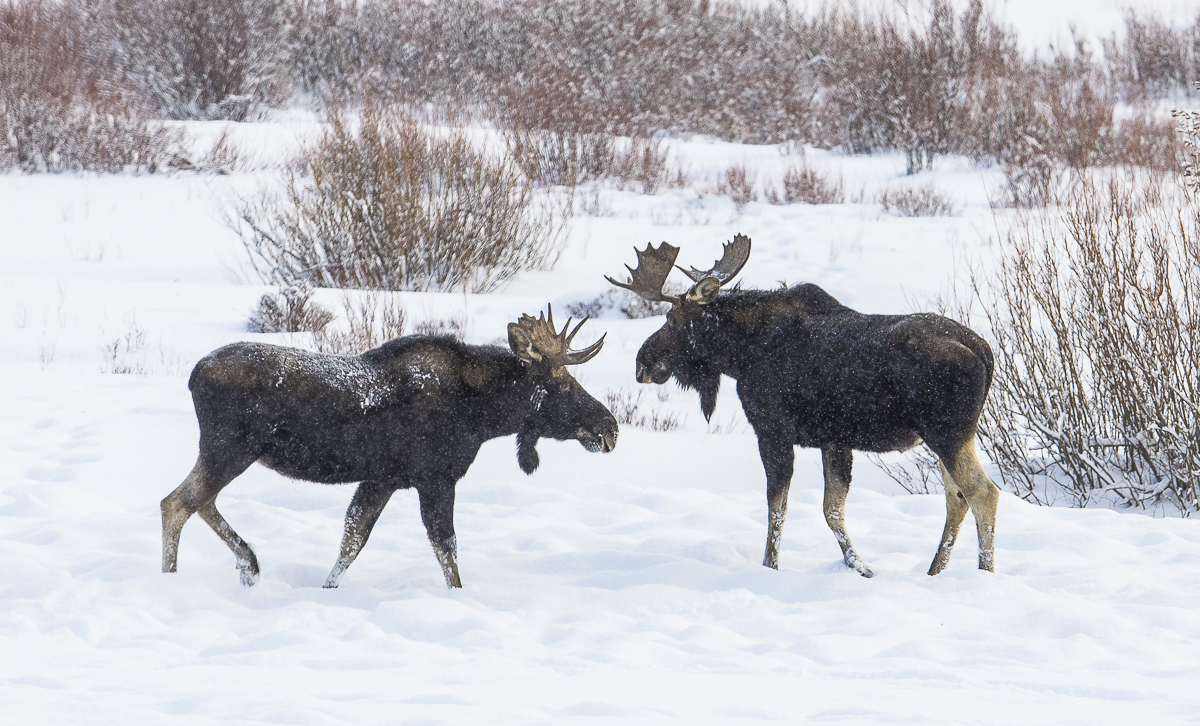
Needless to say, on our multi-moose day at Round Prairie, there was a crowd. We got lucky and pulled into a spot in the closest pullout as someone was leaving. Here are some images of the group of five Moose close to us (another two were far out in the meadow in another willow thicket).
A young bull tilts his head to thread his antlers between tree branches
At first glance, I thought we had two bulls and three cows feeding in front of us. When I looked with binoculars I could see that one of the largest animals was actually a bull that had dropped its antlers. Bull Moose shed their antlers annually anywhere from late November until March. Mature males tend to shed the earliest, soon after the fall mating season (the rut). That makes sense as you probably wouldn’t want to carry around those giant armaments (they can weigh over 50 pounds and span almost 5 feet) any longer than necessary.
Bulls start growing their new set of antlers a few weeks after dropping the old ones. A bull’s antlers increase in size (the number of points, span, and size of the palms – the flattened portions) each year until its prime (usually about 5 or 6 years of age). Young bulls start off with only a few points and small palms as a yearling. The number of points and the size of the palms will grow each season with the antlers usually forming a protective arch over the face during the prime years, preventing damage to the bull’s eyes when competing for mates. As he ages past his prime, the antlers tend to get smaller each year, with fewer points and smaller palms.
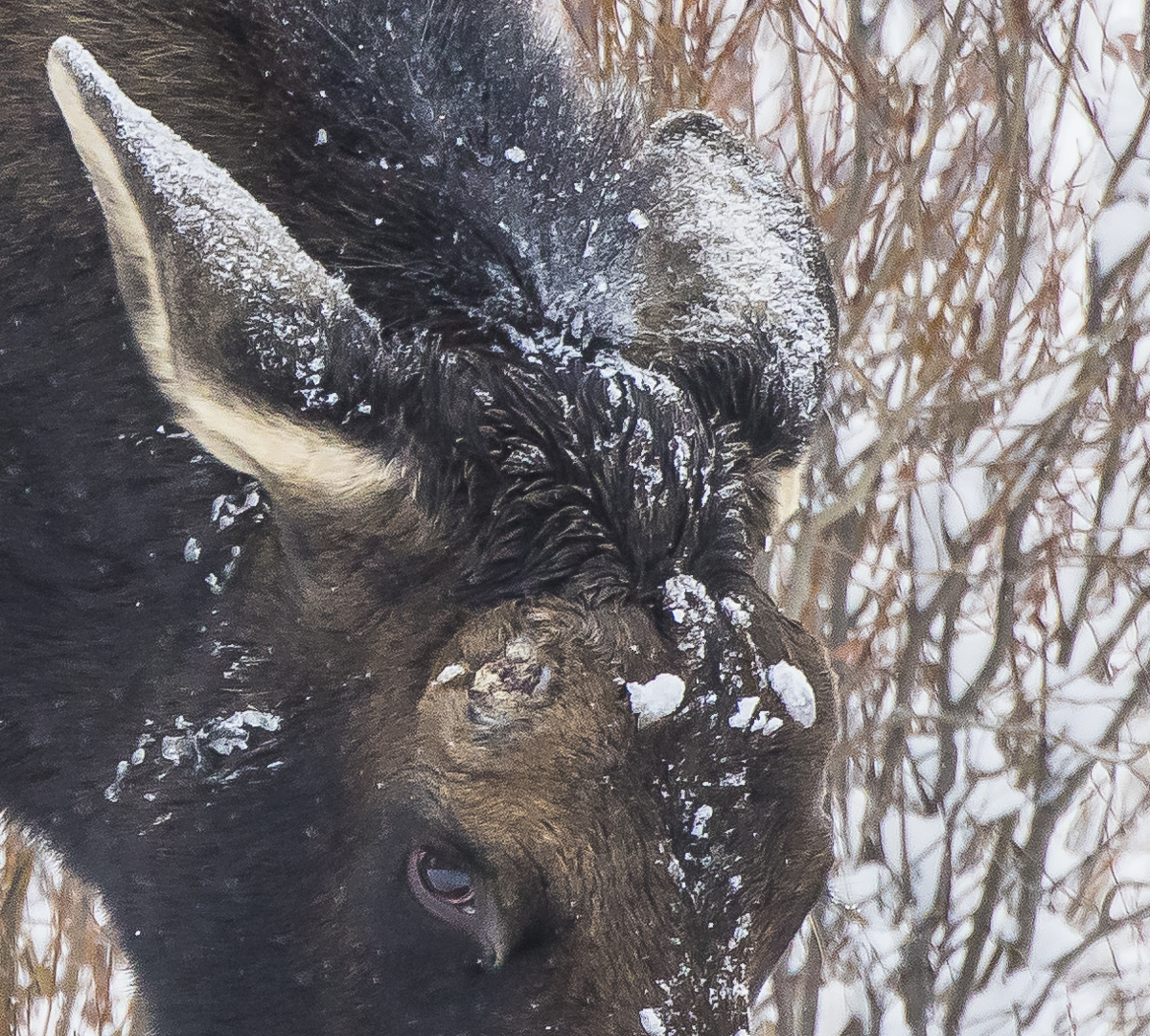
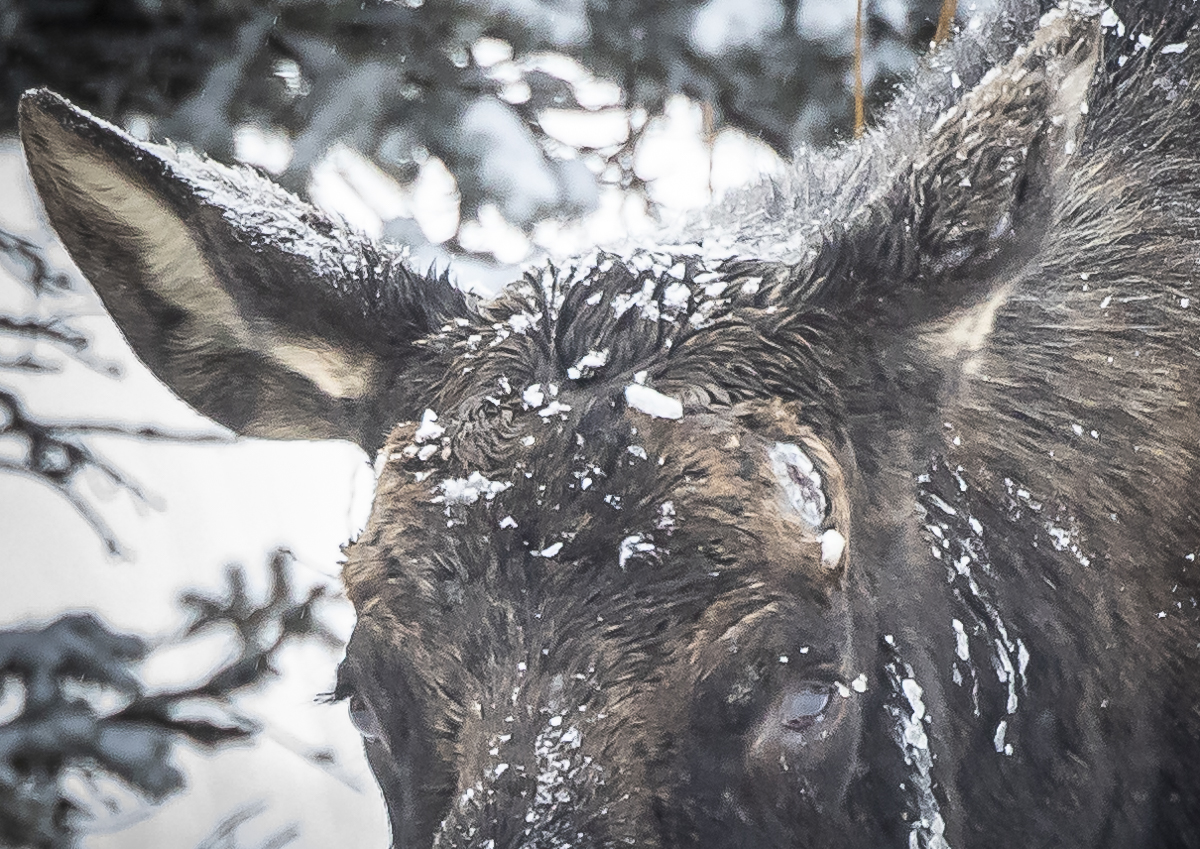
An antler-less bull feedingThe largest antlered bull showing how the antlers emerge from the head just above each eye. Antlers are a sign of rank and strength during the fall mating season. Younger bulls are usually scared off by the size of a mature bull’s rack, so fighting is avoided. Evenly matched bulls may lock antlers in a shoving match to fight for a female.Here is a close-up of the bull that had already dropped his antlers. You can see the point of antler connection to the skull, called the pedicle, as a somewhat circle-shaped scar above the eye. After the rut, the male’s testosterone levels drop, activating specialized cells called osteoclasts. These weaken the connection of the antlers to the pedicle and the antlers eventually drop off.Another view showing where the antlers were attached. When an antler first drops off, the pedicle may bleed a bit before clotting and drying up
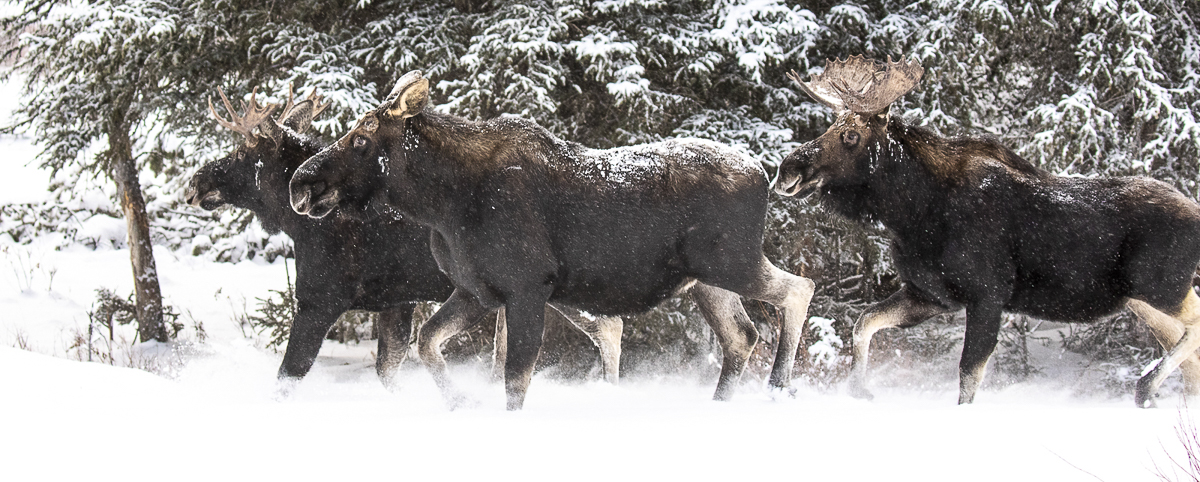
At one point, three bulls started running toward the road as they shoved one another and acted a bit aggressive. There’s nothing like a running bull moose (weighing up to 1100 pounds, being nine feet from nose to tail, and 7 feet at the shoulders) to get a gang of photographers to move (although I thought a few of them did not clear out of the way fast enough for their own good considering there were three bull moose running toward them!). Two of the bulls went across the road and then returned to the willows to feed with apparently no more ill will between them. Moose tend to be solitary animals, but will congregate, especially in winter, at good food sources. The willow stands in Round Prairie offer that prized resource.
A group of Moose suddenly moved quickly toward the road (photo by Melissa Dowland)Two bulls that crossed the road soon moved back and started feedingA cow and calf feed near a bull in a willow thicketHere you can clearly see the dangling triangle of skin below the chin called a dewlap (also called a bell). The dewlap’s function is not known though theories vary from heat exchange to communication during the rut. During courtship, a bull will rub the cow with his chin (called chinning) and the dewlap may transfer scent to the female.
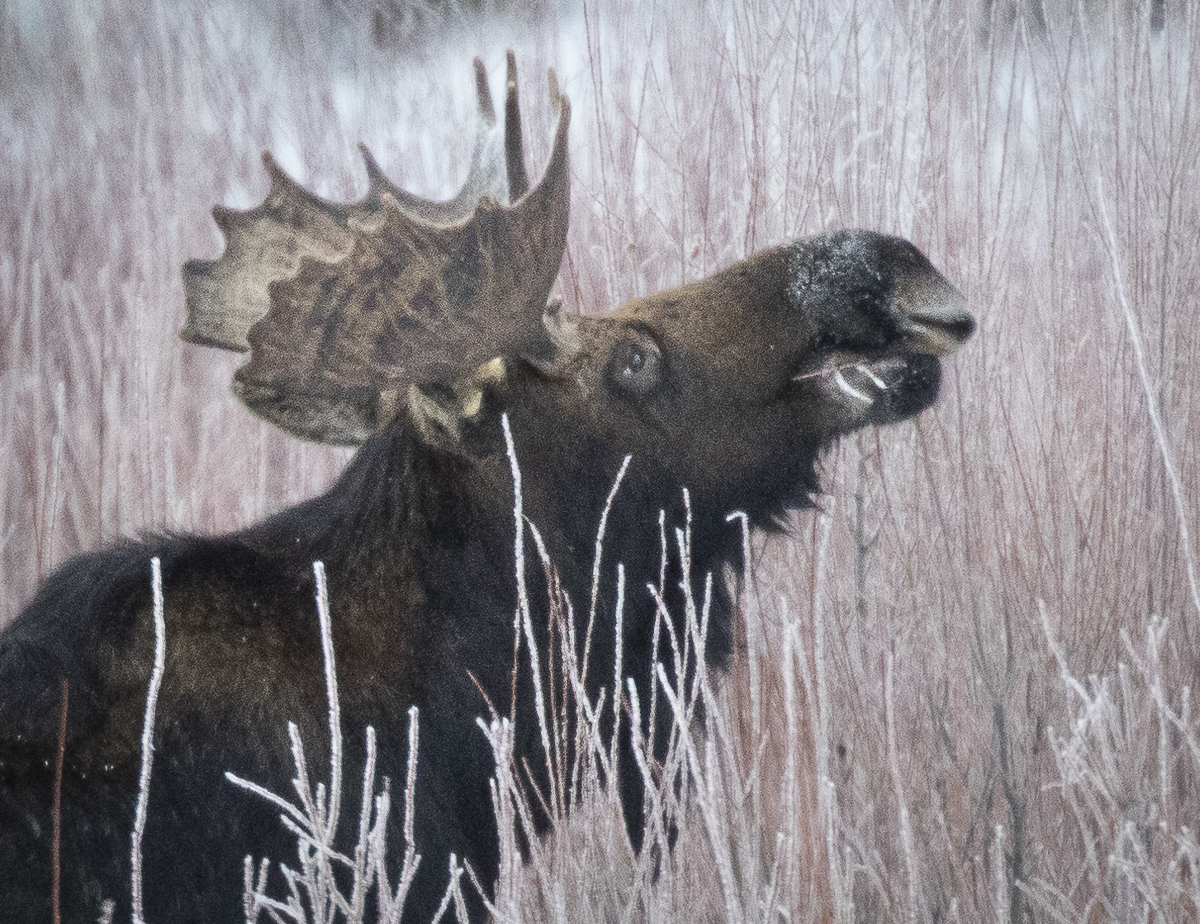
A Moose’s winter diet consists almost entirely of twigs. In fact, the word moose comes from a Native American word that means “twig eater”. We watched them browsing the tips of the willow shrubs and a close look would show them both breaking off the twig tips to eat and pulling on them as if to strip off the bark.
A Moose browsing on the willow twigs
Here is a short video clip of Moose eating twigs. The falling snow made it difficult to get a sharp image but it is still interesting to watch them feed.
Our final Moose was one spotted by one of the students as we headed back through the northern part of the park on our last full day (photo by Melissa Dowland)
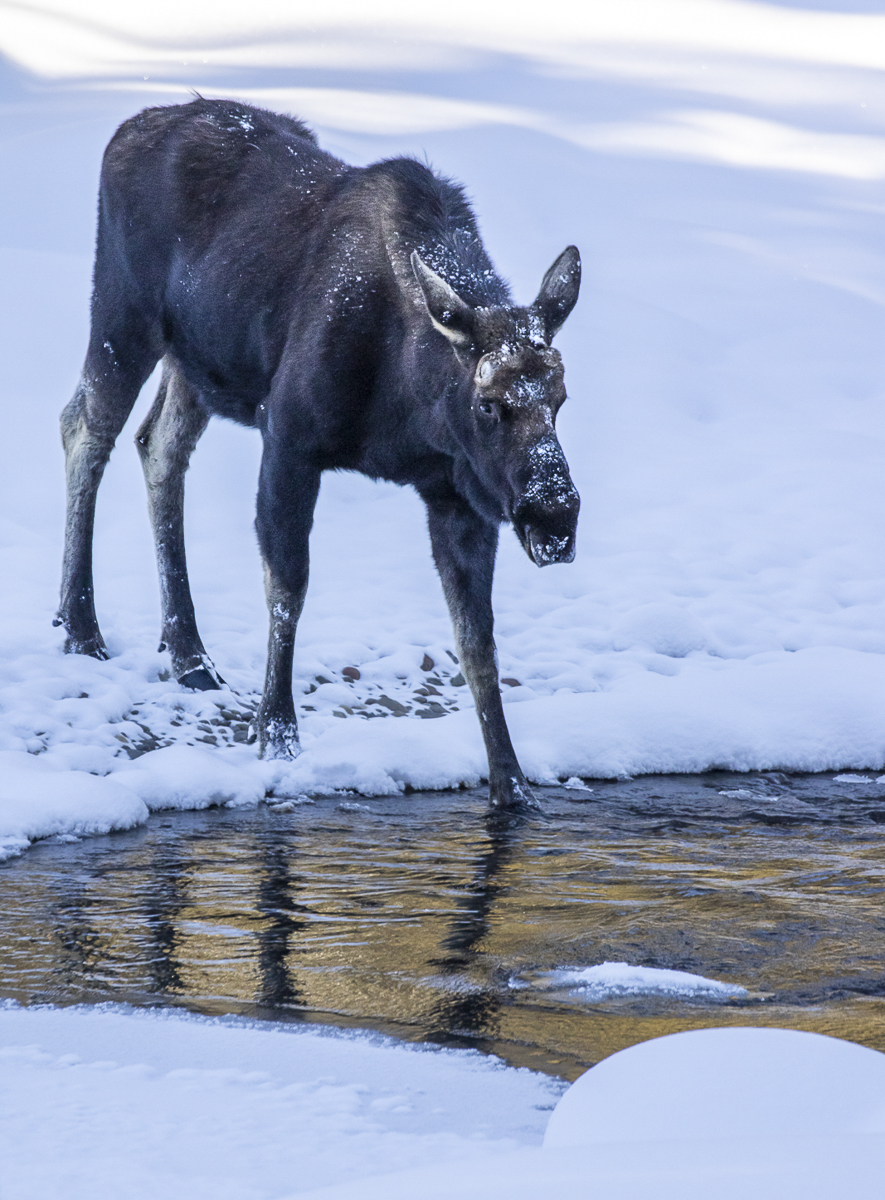
Though Moose look gangly and awkward to many, I am fascinated by this largest member of the deer family. I hope their population continues to grow in Yellowstone so other visitors may also marvel at these magical beasts.
The wild ram embodies the mystery and magic of the mountains…
~Jack O’Connor
Los Angeles Rams helmet (click photos to enlarge)
In honor of today’s contest between formidable members of the animal kingdom, I offer this short meander into the world of rams. Methinks the choice of a ram as a team mascot is a wise one – they are sure-footed, brawny, and capable of withstanding hard hits. They also have cool horns that fit nicely on a helmet. Sources claim that going into the 2021 season, the LA Rams were fielding the youngest roster in the NFL. But that had me thinking…how do you age a ram?
On our Yellowstone trip last month, we were lucky to see a few nice specimens of mature Rocky Mountain Bighorn Sheep rams (males). I had heard that you can approximate the age of a ram by counting annular rings on its horns, so that had me searching the internet when I got home to see what I could find. Indeed, there is a lot of information out there, but it seems to me that aging rams by their horns is somewhat of an art form. I present below what I have gleaned from a variety of web resources.
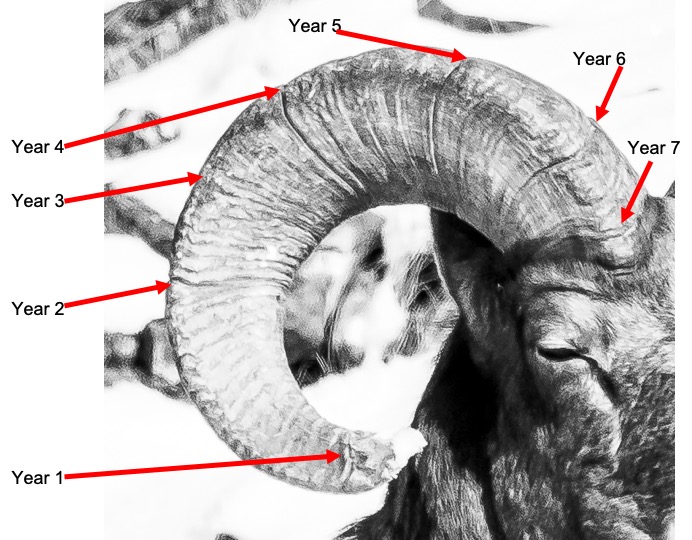
Unlike the antlers of members of the deer family, the horns of bighorn sheep continue to grow throughout their lives (they are not shed). Similar to tree rings, the growth varies during the year according to conditions like favorable nutrition. Winter is the time of stress for Yellowstone bighorns (mating season is early winter and food resources are more limited in winter), so growth slows considerably, resulting in an annular ring. Growth is typically fastest during the second year, resulting in a wide spacing between the first and second rings. It slows with age, so rings tend to be closer together toward the base in older rams. Rams reach sexual maturity at about 4 years, and one reference said that in most rams, the 4th year ring will be the most distinct (darkest, deepest). The first year of growth is often obscured in older rams as they have what are called broomed horns (broken tips) from battering against other rams during the mating season (bighorn sheep rams dual with each other for mating dominance by ramming their heads together to see who is the strongest). So, looking at the ram below, it looks like part of the first year has been obliterated (broomed) and then moving from the tip up, you see a fairly dark ring after a lot of growth. I think that is the second year ring. Then it gets a little harder, but, if you go with the darkest ring being the 4th year, you can see a dark ring before you get to the top of the curl.I see two other dark rings after that, with perhaps a new ring forming near the base. So, I’m guessing this is a 7-year old.
Rocky Mountain Bighorn Sheep ram
I cropped this picture and turned it into black and white to see if that helps highlight the rings any better. I labeled what I think are the annular rings. Just to make things more confusing they do have what are called false rings. You are supposed to look for rings that go all the way around the horn (something difficult to do without the horn in hand). This is how wildlife biologists estimate age (although the best method is to extract a tooth and count the rings).
Ram above with annular rings highlighted (or at least what I think are the annular rings)
Below are two more Yellowstone rams. What is your guess as to age? My estimates are at the bottom of the post. Start with which do you think is older, Ram A or B?
Ram ARam B
On Ram A, you can see a noticeably dark ring. If that is the 4th year, then I estimate Ram A to be at least 7, and maybe as much as 10, though the lighting and distance of the photo make it particularly hard to tell. Ram B seems to have more distinct rings. The 4th year looks like the ring near the top of the curl. The 5th year ring is next and also quite distinct. But I think the next two dark lines are false rings. Compare the rings in the horn on the left of the image with those on the right. You can see a couple of those dark rings do not go all the way around the top of the horn (look for grooves). I am guessing this ram is about 6 (almost 7). If I’m right, then Ram A is older than Ram B. See labeled diagrams below for my estimates.
Ram A with my guessesRam B with my guesses
But, as I said, these are my best guesses, If you want to test your skills more, see these references:
It certainly is an art form, and most people say you can get it to within a year of the ram’s actual age using this method. Now, I’m not sure about ageing Bengal Tigers…maybe the number of stripes divided by the age of the quarterback?
Ungulates. The most boring animals on earth. All they do is stand around and chew their cud.
~Hal Brindley
It seems there are not a lot of quotes out there about ungulates (hoofed mammals) but I found this one in a clever blog post by someone that I know through social media. I agree with him, that ungulates often get overlooked by a lot of people when there are charismatic mega-fauna like wolves and bears around, but they shouldn’t be, as they are fascinating and beautiful in their own right. Yellowstone has eight species of ungulates (hence the title), seven native to the region (Elk, Bison, Mule Deer, White-tailed Deer, Rocky Mountain Bighorn Sheep, Pronghorn, Moose) and one introduced to the area (Rocky Mountain Goats). On this trip, we managed to see the seven native species. It isn’t easy to spot a white goat high on a mountain slope in winter! Not many years ago, the toughest two of the ungulates to find in the park were Moose and White-tailed Deer (Mule Deer are the dominant of what are usually considered deer in the park). But, the past few years we have been seeing more of our familiar white-tails, and this year, was a relative banner year for Moose (more on them in a future post).
Here are some tales (and tails) of some ungulates we observed…
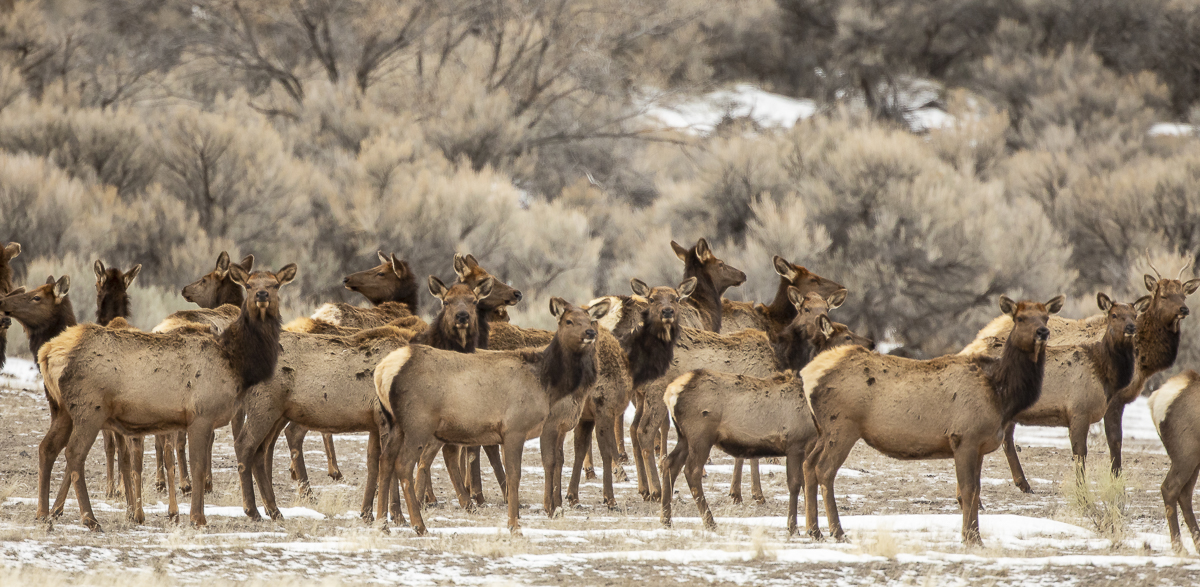
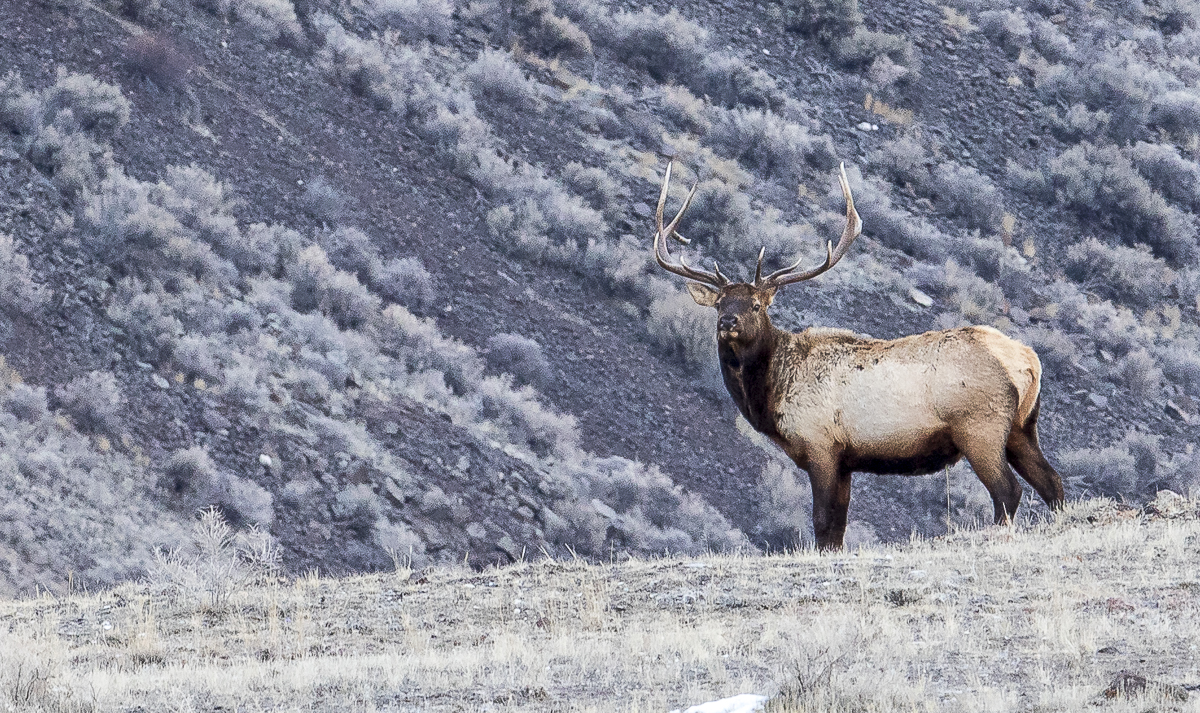
Many of these grazers move to lower elevations in winter due to the usual heavy snow in much of the park.They tend to congregate in the Northern Range due its lower snow pack and in areas near or beyond the North entrance at the town of Gardiner, MT. Indeed, one of the hazards of staying where we did, several miles north of Gardiner, was that we had to run the gauntlet of roadside Elk every morning and evening in darkness (definitely not a critter you want to encounter with your vehicle). These large members of the deer family undoubtedly gain another advantage by relocating to these areas in winter as there are probably fewer wolves due to the human presence (although that means they do encounter hunters).
We saw huge herds of Elk near Gardiner and out in Paradise Valley, north of the park (click photos to enlarge)A magnificent bull Elk along the Old Yellowstone Trail Road
The town of Gardiner lies in a rain shadow area and is below 6000 ft in elevation, so it tends to have milder winters than most of the park. It is amazing to me how the wildlife adapts to the town (and vice versa). One example is the use of the school’s athletic field as a hangout and grazing spot for Elk, Bison, Pronghorn, and a variety of other critters. I like to think that one unique form of detention at this school involves going out to the field and removing the scat piles before a game.
Attracting wildlife to your school yard is probably not a teacher workshop they need in Gardiner
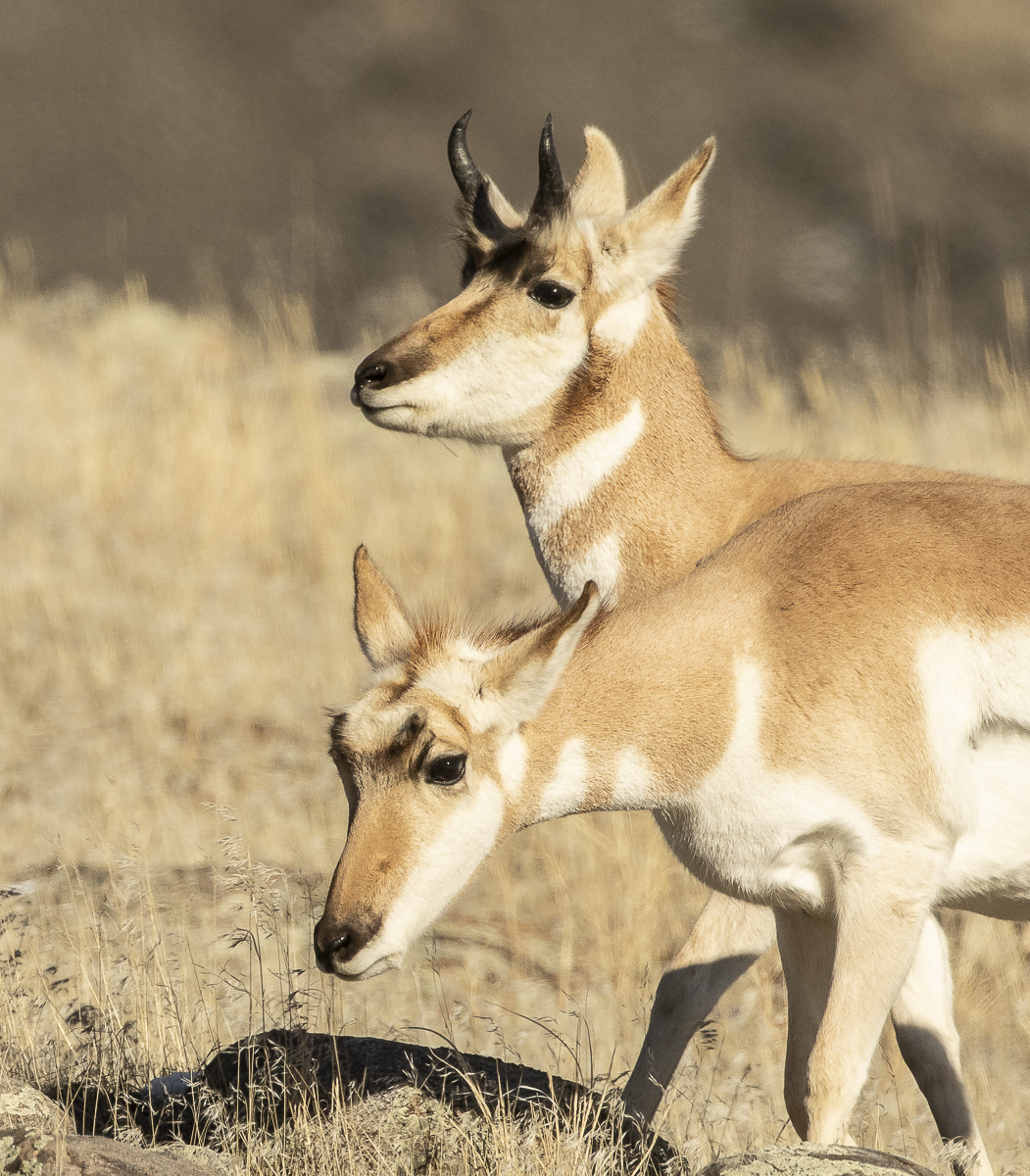
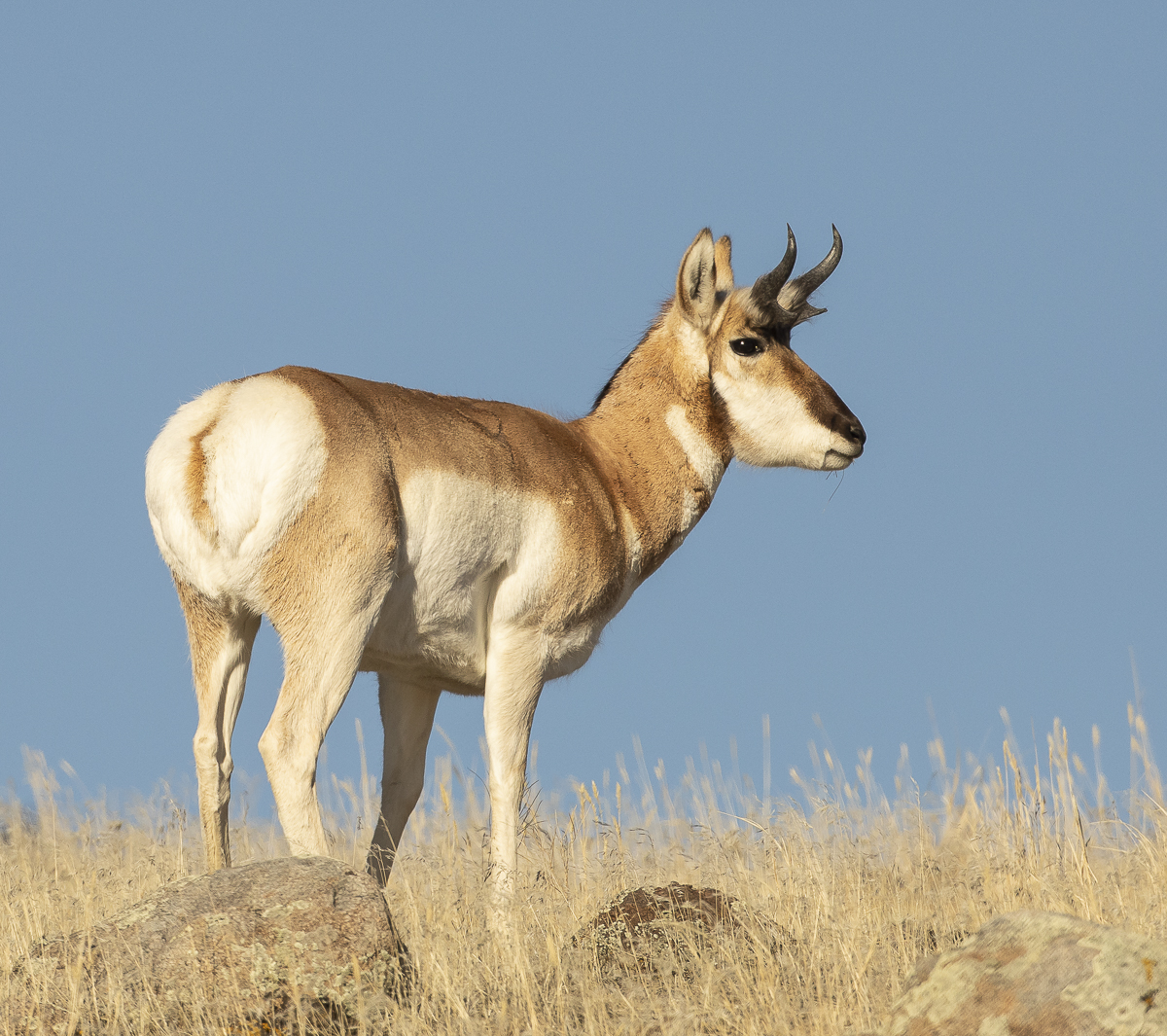
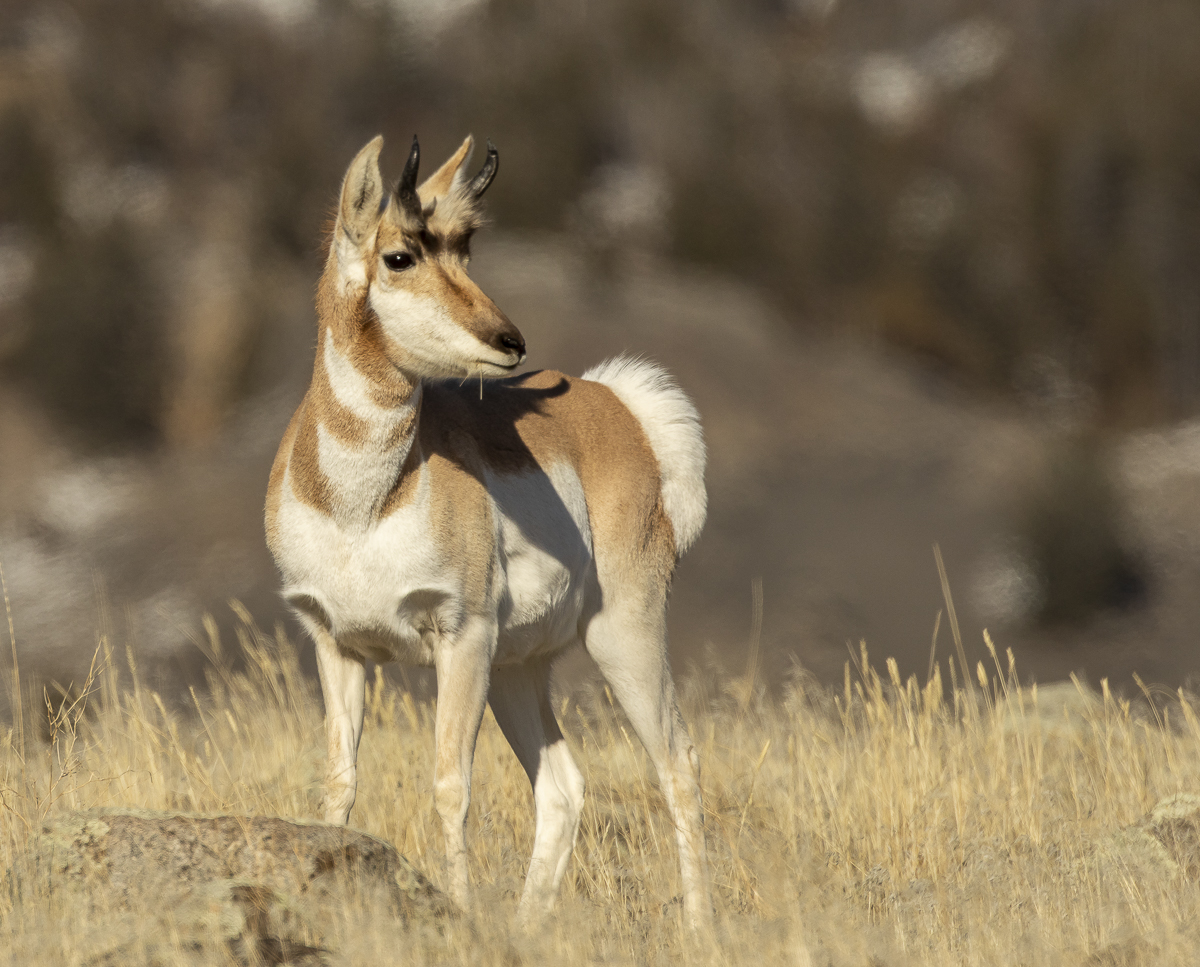
One ungulate, in particular, tends to leave all but the lowest elevations of the park (near the North entrance) every winter – the Pronghorn. Though they are common in Lamar Valley in summer, they all migrate over 25 miles to spend the winter near Gardiner or even farther north. Deep snow makes it difficult for them to browse and greatly diminishes their primary defense against predators – their speed. They are the fastest land mammal in North America, reaching burst speeds of a little over 60 mph and capable of sustained speeds of 45-50 mph. This makes them the second fastest mammal on Earth, second only to the Cheetah (but Pronghorns can keep up a fast speed longer than a Cheetah). Their large eyes are located on the sides of their head to allow for all-around viewing. And they have a large (for their size) heart, windpipe, and lungs, allowing them to get plenty of oxygen and blood supply for their high-octane movements.
There were large herds of Pronghorn on the Old Yellowstone Trail Road out of GardinerMale (top) and female (head down) Pronghorns. Males have prongs on their horns and a black patch along the jawline and neck area. Females can have horns (most do) but they are shorter and lack the prongs..
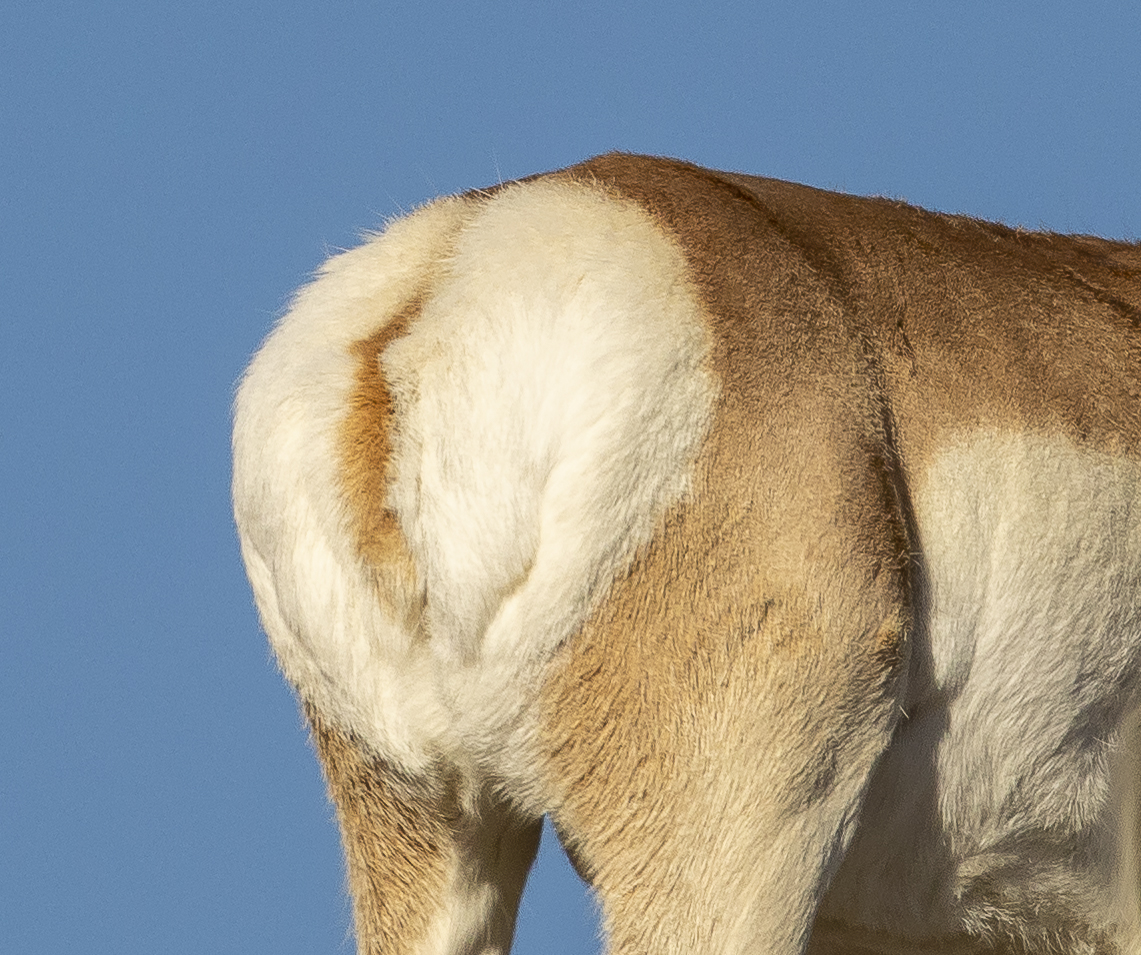
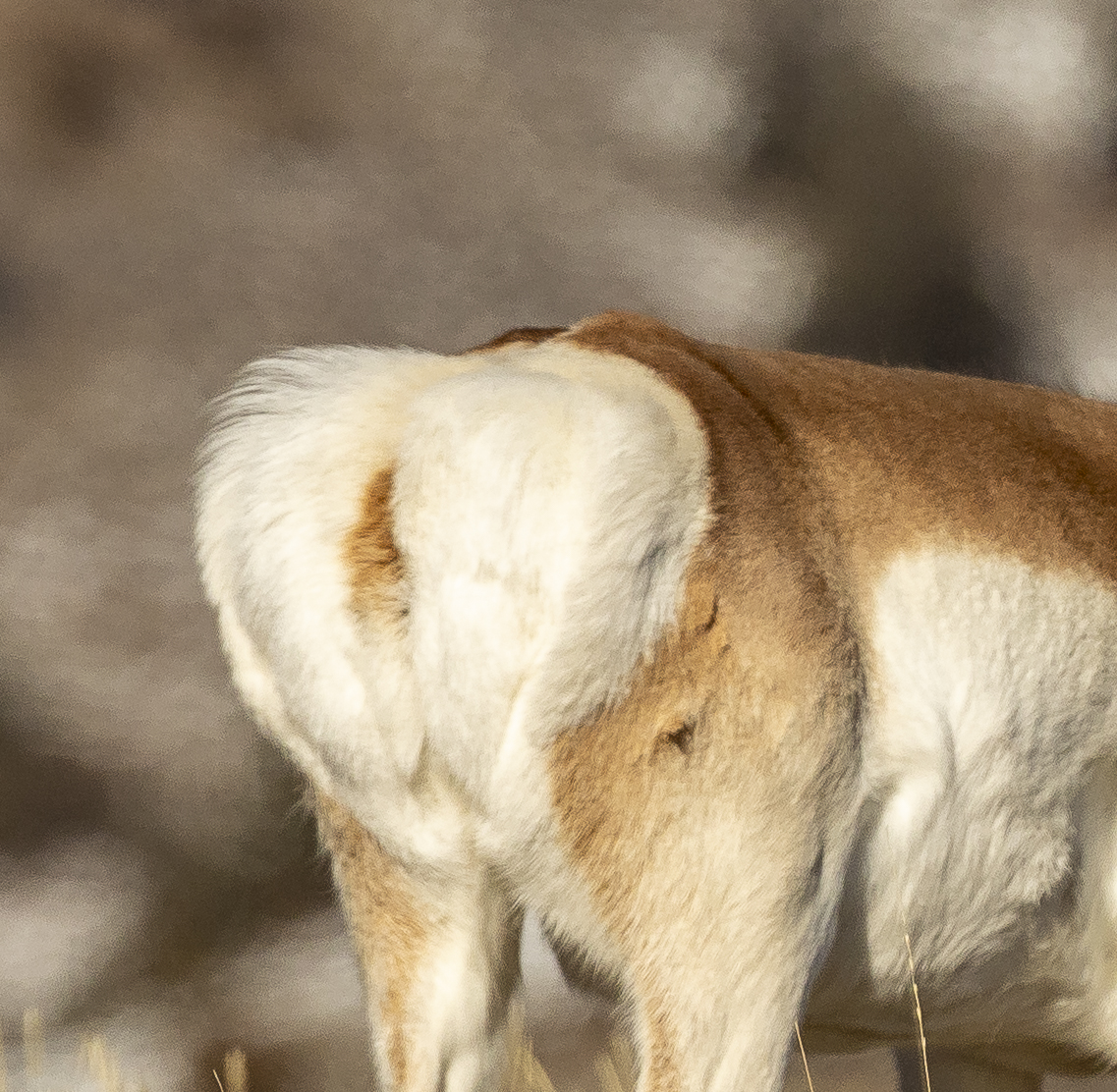
Since vision is such an important trait for Pronghorns, and since they live in herds in open habitats, they have another communication signal used to alert other herd members of danger. If a Pronghorn sees a predator, it raises the white hairs on its rump, making a large white patch visible for considerable distances. They also release an alarm odor from glands on the rump (it supposedly smells like buttered popcorn – probably why you never see Pronghorns at the movies…they would be freaked out all the time).
A buck Pronghorn watching a photographer who has left his car and is walking toward the animals
Below is a Pronghorn rump in action…
A calm rump patchA “hey dude, why are you getting out of your car for a photo” rump patchThe aforementioned photographer crept closer to the Pronghorn, eliciting this displeased response (see how raised the white rump hairs are)
I stayed in my car and spent about 45 minutes watching the Pronghorn feed. This is what I really like to do – watch wildlife going about their daily lives. Staying in your vehicle or sitting quietly helps wildlife feel more at ease and allows them to continue feeding, or doing whatever, undisturbed.
Along the same road, there was a large group of Rocky Mountain Bighorn Sheep grazing at the foot of the ridge-line. Many photographers stopped to get photos and one grpup, unfortunately, hiked over to the base of the ridge and obviously disturbed the herd as they moved up the slope. I saw this behavior way too often in the park this time.
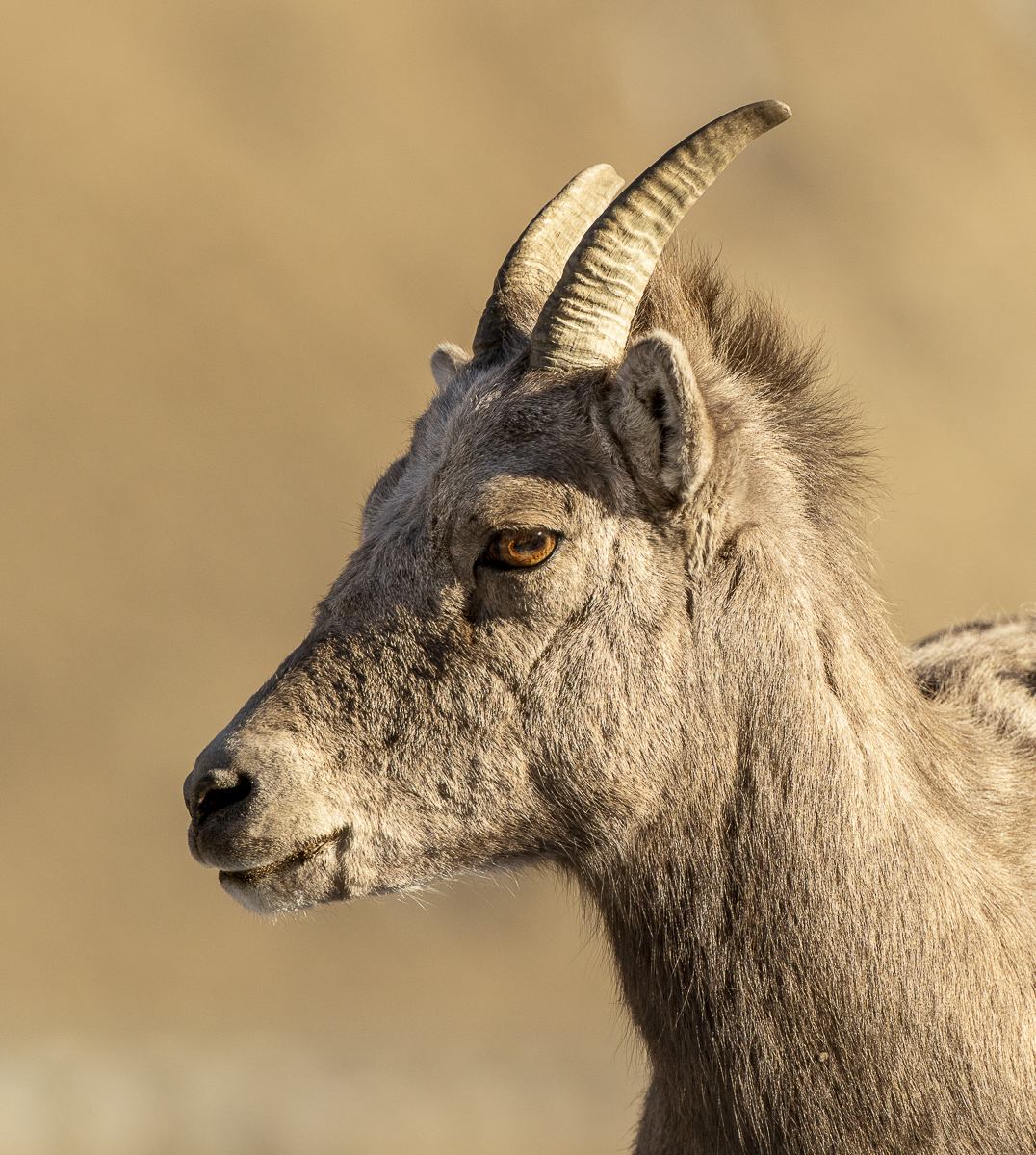
On another drive down this road, I had to stop to let a small band of ewes and young cross the road in front of me. I managed one portrait as they sauntered across.
A bighorn ewe in the golden light of late afternoon
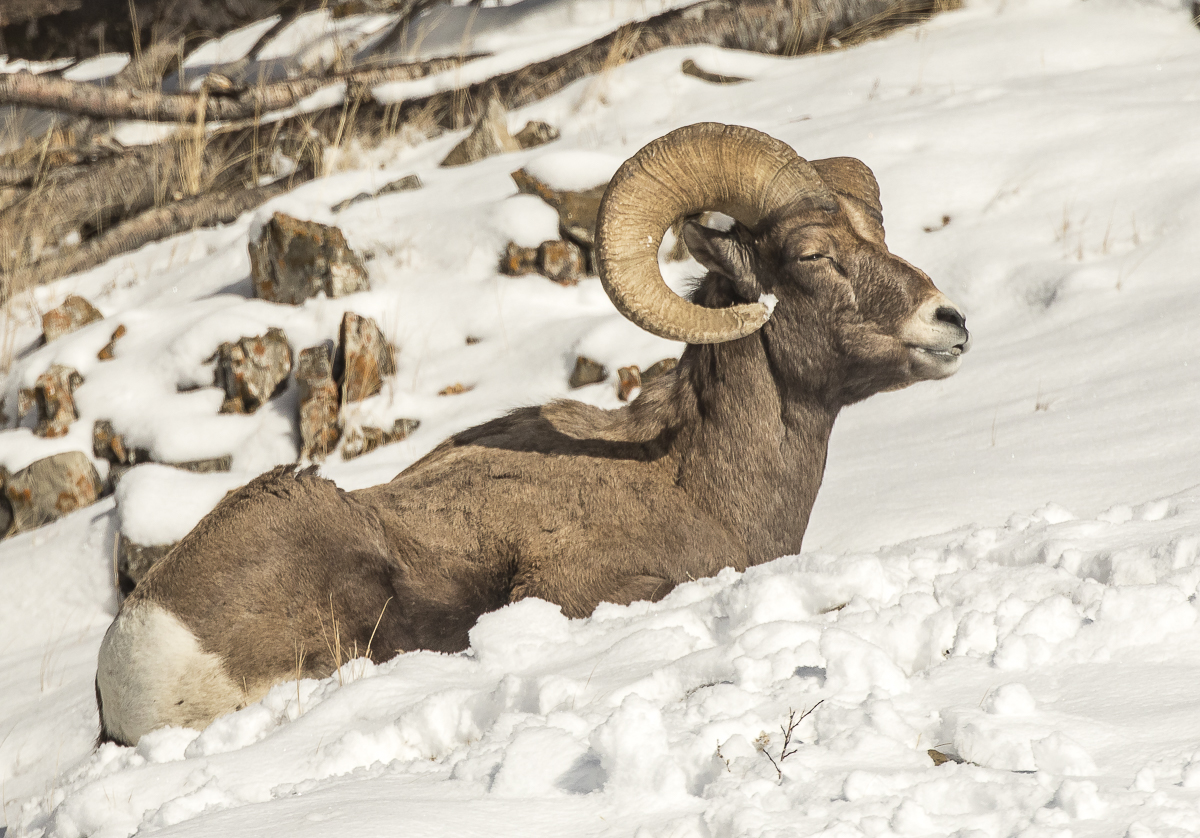
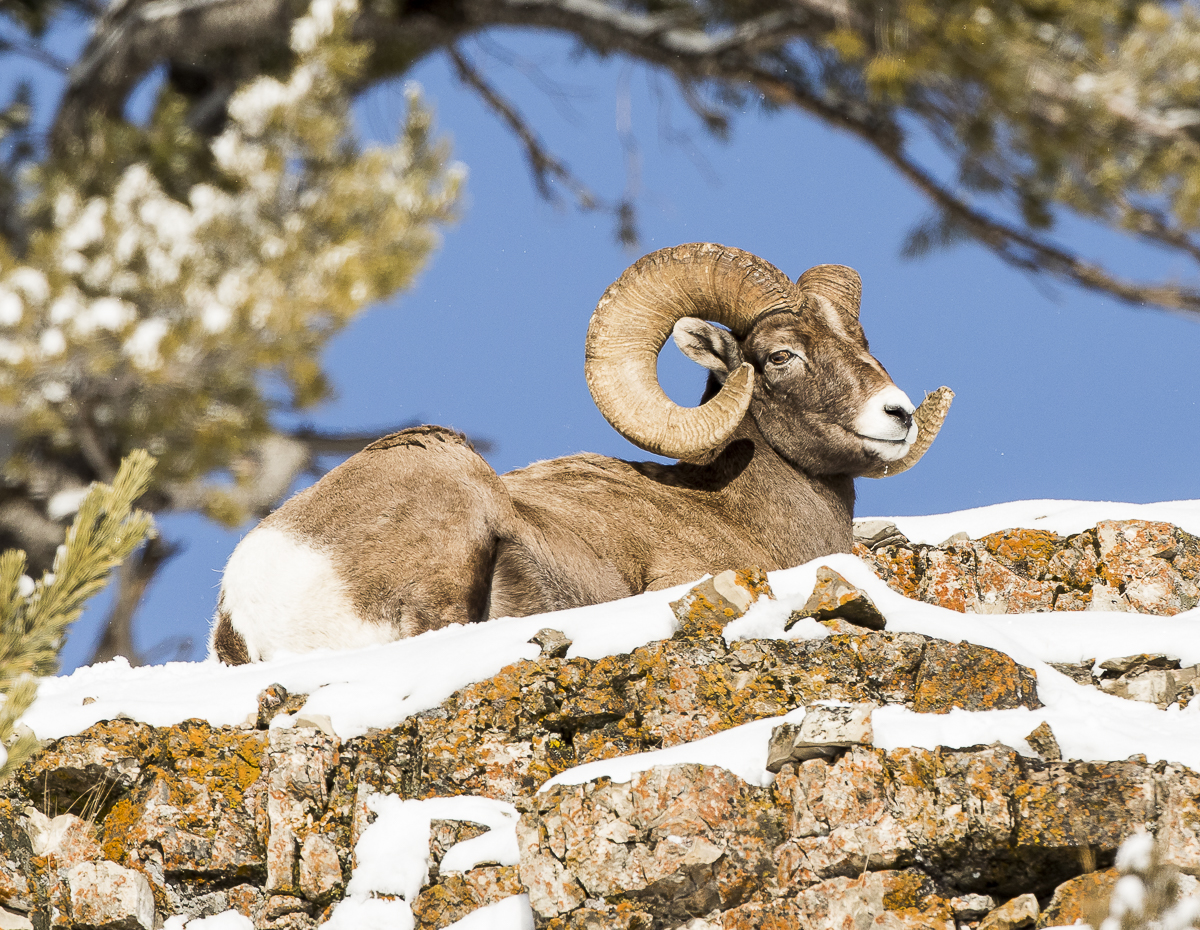
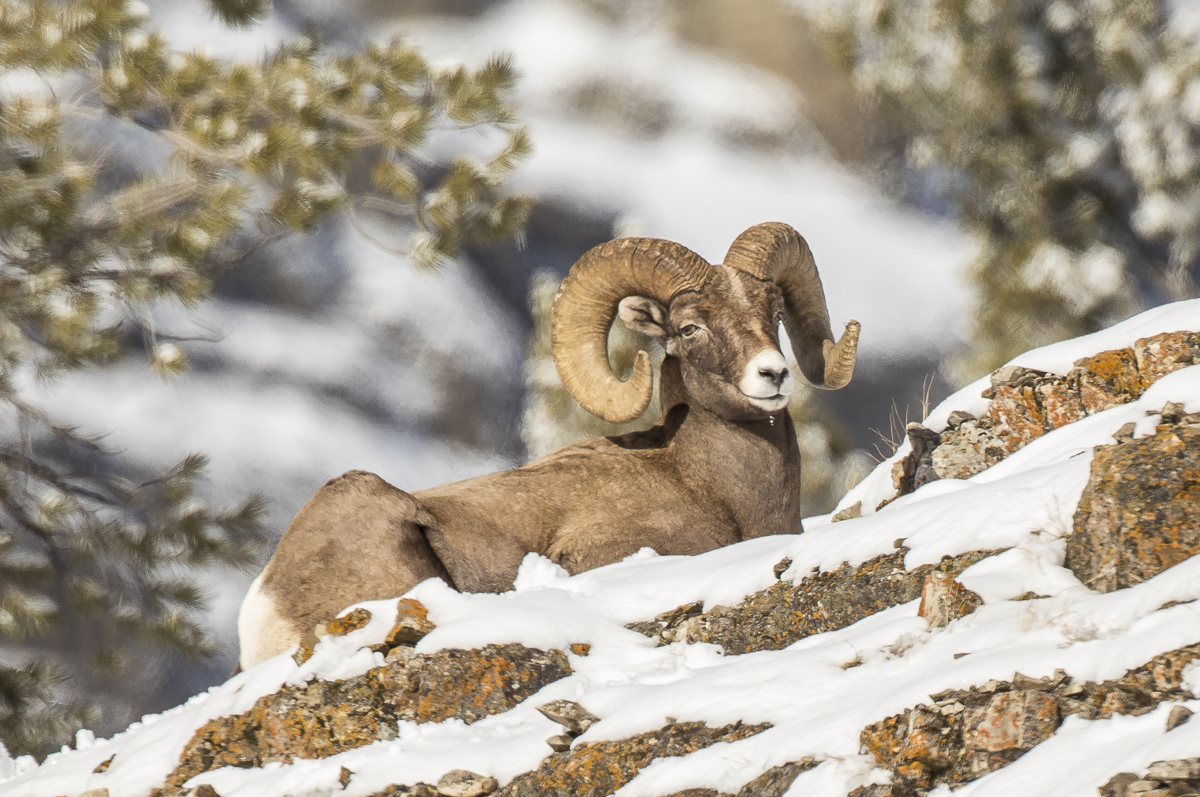
Among the most photographed animals I saw on this trip were a group of bighorn rams hanging out at the usual small cliff near the confluence of Soda Butte Creek and the Lamar River. This is consistently a good spot for sheep in the winter as I guess the small steep rock face provide just enough protection as an escape from potential predators like wolves. The cliff is a short walk from a pullout and you can get decent images from the roadside, which doesn’t seem to bother the rams at all. Here are a couple of examples…
The first ram I saw was lounging on a snow bank chewing its cudThis ram had everyone’s attention because of its perch on the top of the cliff. I walked down away from the small cluster of roadside photographers and found a spot where the ram was silhouetted against a patch of blue sky through the tree limbsFrom another angle, the ram’s horn curl was on full display
More on the magnificent horns of these rams in a future post.
Finally, a few images of the iconic Bison, America’s National Mammal (designated as such with the passage of the Bison Legacy Act in 2016). It joins the Bald Eagle as a national symbol and represents an amazing comeback from the brink of extinction. Bison numbers went from an estimated 30-40 million roaming North America in the early 1800’s, to fewer than 1000 individuals less than 100 years ago. The causes of this precipitous decline included uncontrolled market hunting (Bison hides were highly valued) and a concerted effort by the U.S. military to remove Native American tribes from the land by taking away their main food source: Bison. Some Bison found protection on private ranches, In Yellowstone, the numbers dwindled to about 24 Bison that survived deep in the park’s interior. In one of the first efforts to try to restore a wild species, park officials in Yellowstone began to manage the remaining herd and enhanced it with wild Bison purchased from private owners. The herd was ranched in Mammoth and then in Lamar Valley at the Lamar Buffalo Ranch. Today, the park’s herd numbers about 5000. More information on Bison and the history of management in the park can be found here.
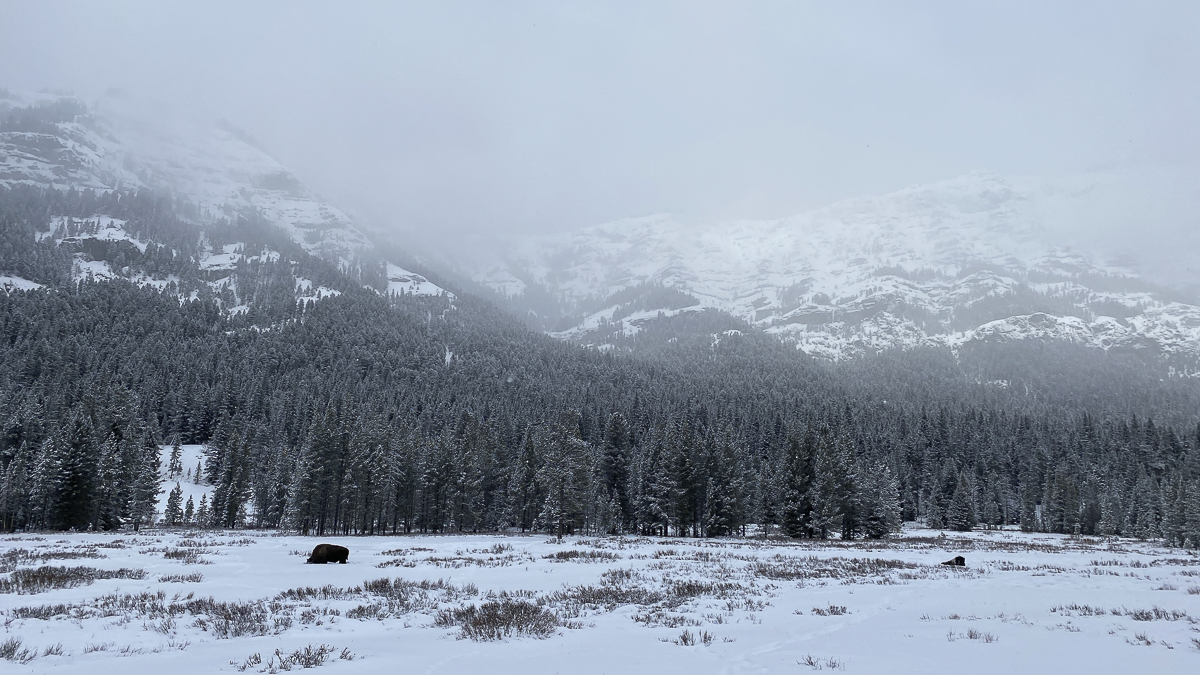
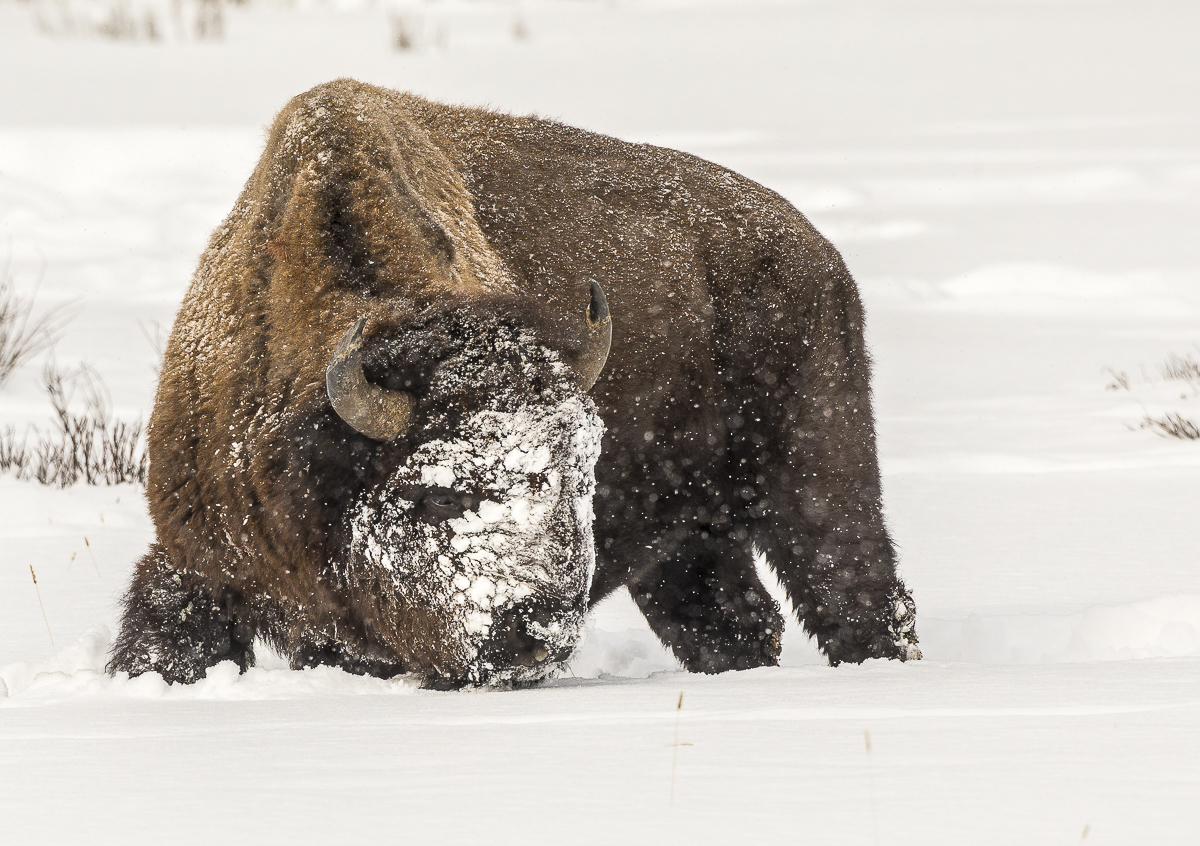
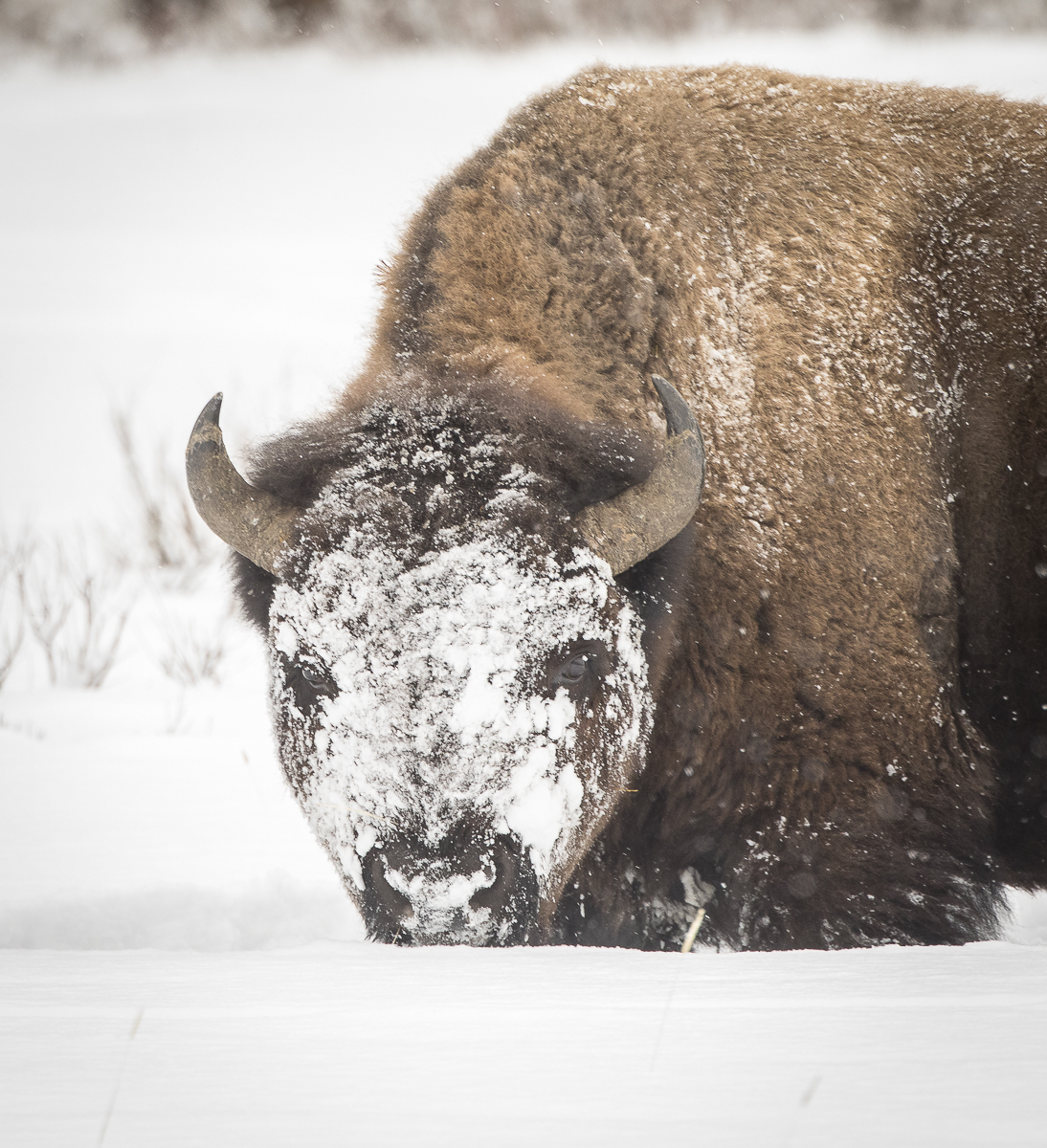
I have always had an affinity for Yellowstone Bison (I blame the movie Dances with Wolves), so I try to spend some time alone on each trip with these iconic creatures. I managed to spend over an hour one day with two large bulls, watching them feed in a picturesque valley below the towering Baronette Peak. Snow was falling, and then patches of blue sky would appear, and then more snow. None of it fazed the Bison as they plowed through the snow with their massive heads.
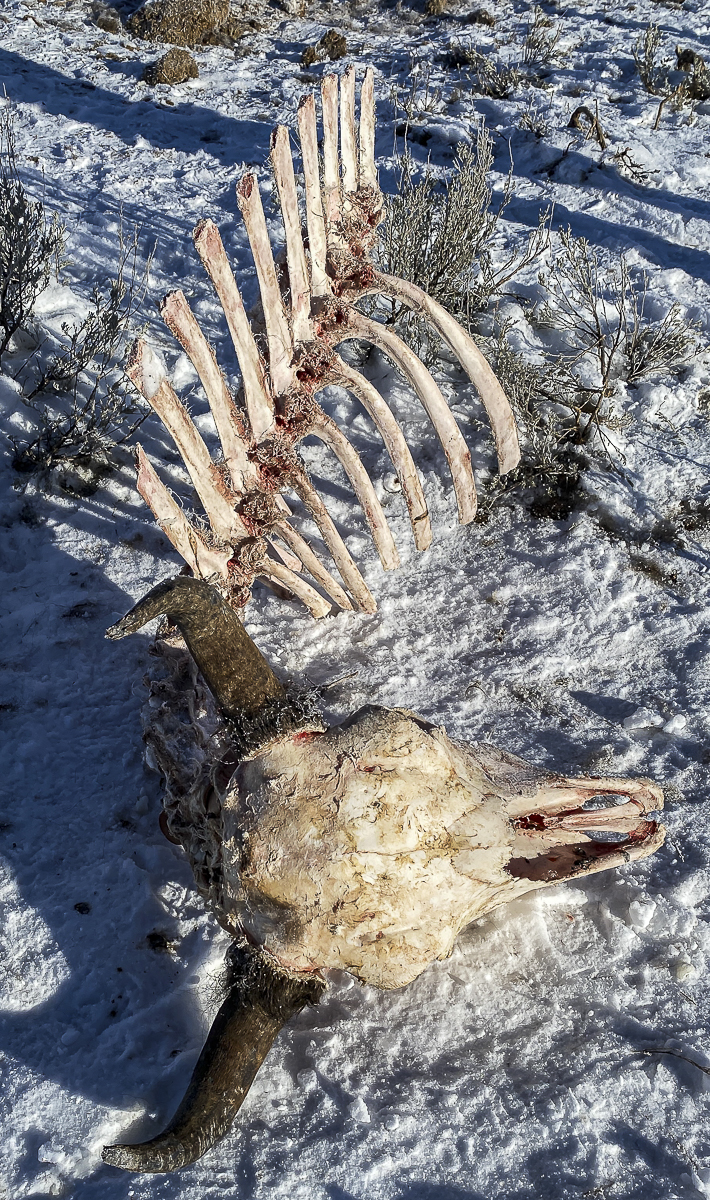
Two bull Bison in the lower Baronette areaThis old bull was plowing snow with his head to reach grasses underneathHere is the Bison carcass that had been picked clean by wolves and scavengers. You can see the thoracic vertebrae are long, giving the Bison the humped appearance. This provides attachment points for the massive neck and shoulder muscles Bison use to snow plow through deep snow to access dried grasses.I watched this bull for about 15 minutes before it raised its head out of the snow for this picThe other bull was covered in snow as it fed (these photos are cropped images from photos taken with a long lens from the roadside)
I’ll end with one of my favorite teacher quotes from my museum workshop days, penned by Donna, after spending time observing a herd in Lamar Valley…
What must it be like to be a Bison, to own nothing yet have everything?



































 Roads End Naturalist