Nature is painting for us, day after day, pictures of infinite beauty, if only we have the eyes to see them.
~John Ruskin
While we saw a variety of wildlife on our Florida adventure, I was a bit surprised we had not seen as many birds as I had hoped. As I mentioned in an earlier post, it has been a wet winter in South Florida, which apparently causes the birds to be more spread out than usual during the winter months.
Great egret preening in Big Cypress
There had been plenty of scattered sightings (and some great views) of egrets, herons, hawks, and song birds, but no large concentrations. On our last evening in Florida, I was hoping to change all that. On the advice of our kayak tour company, I had booked a sunset boat tour with Allure Adventures out of Everglades City. I was told Captain Kent was a long-time local that took small groups out to the mangrove islands at sunset with the chance of seeing lots of birds coming to roost, beautiful skies, and maybe even dolphins and sea turtles. He lived up to the promotion.
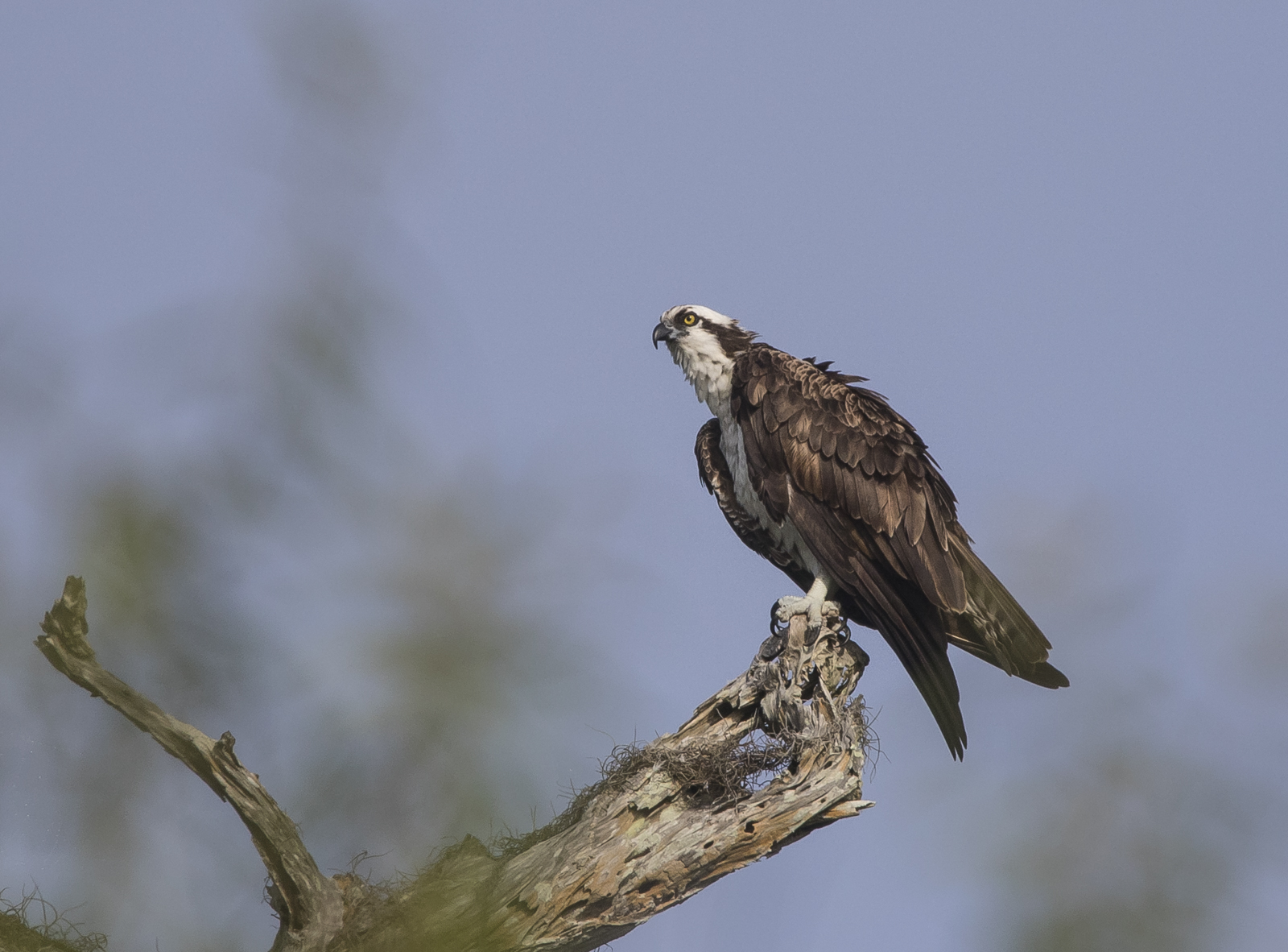
A nice Florida combo – osprey nest on a manatee zone sign in the channel
We met him at at the dock at 5:45 p.m., boarded his small boat, and headed out into the area known as Ten Thousand Islands. Close to shore we saw pelicans, a few egrets, some cormorants, and passed by a couple of osprey nests.
One of several mangrove islands filled with birds coming to roost at sunset
Within a few minutes, we saw a cluster of mangrove islands dotted with birds, lots of birds.
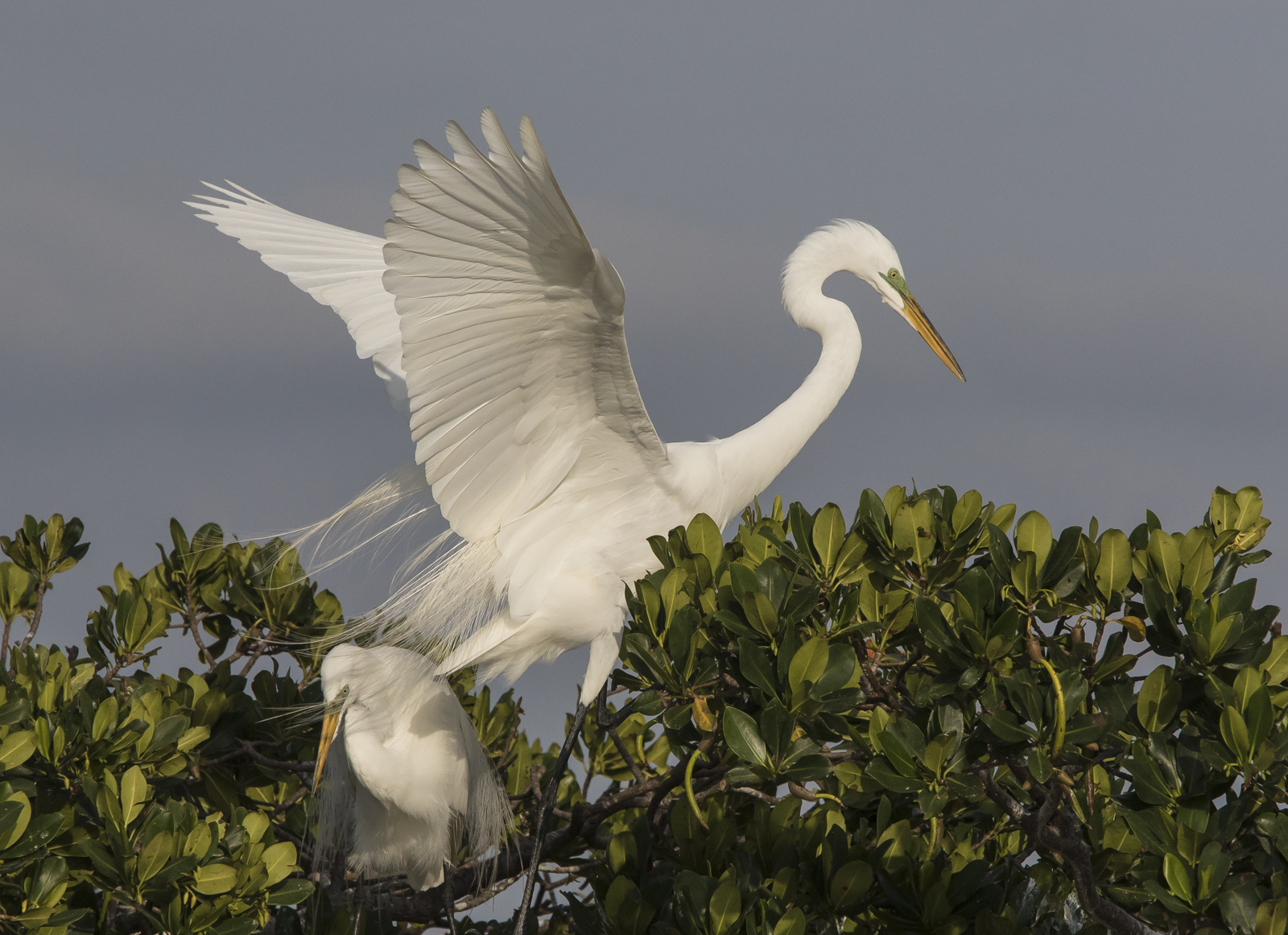
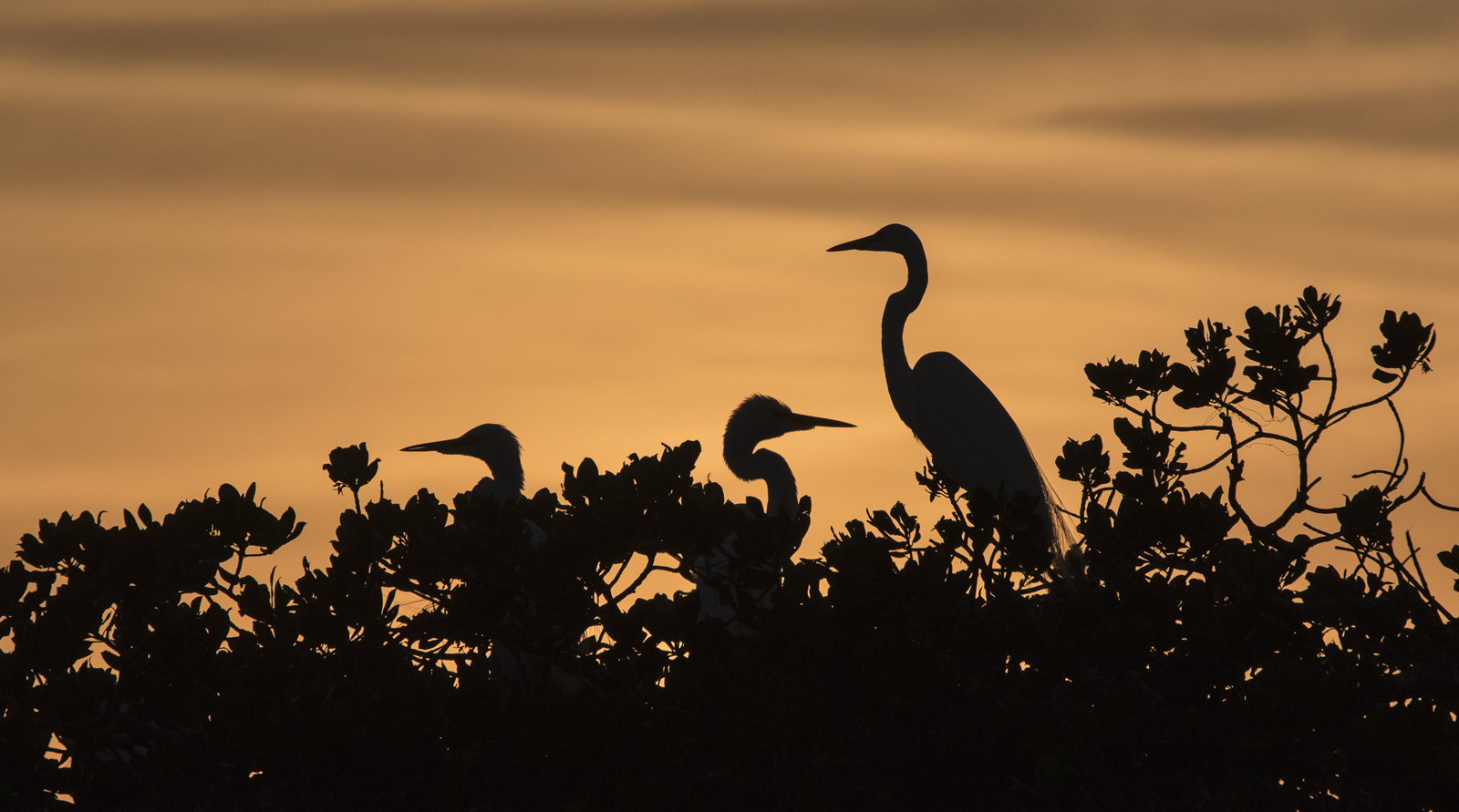
Great egrets settling in for the night
As our boat slowly circled the islands, I could see hundreds of great egrets, brown pelicans, white ibis, cormorants, and other species jostling for position as more of their kind flew in to roost for the evening.
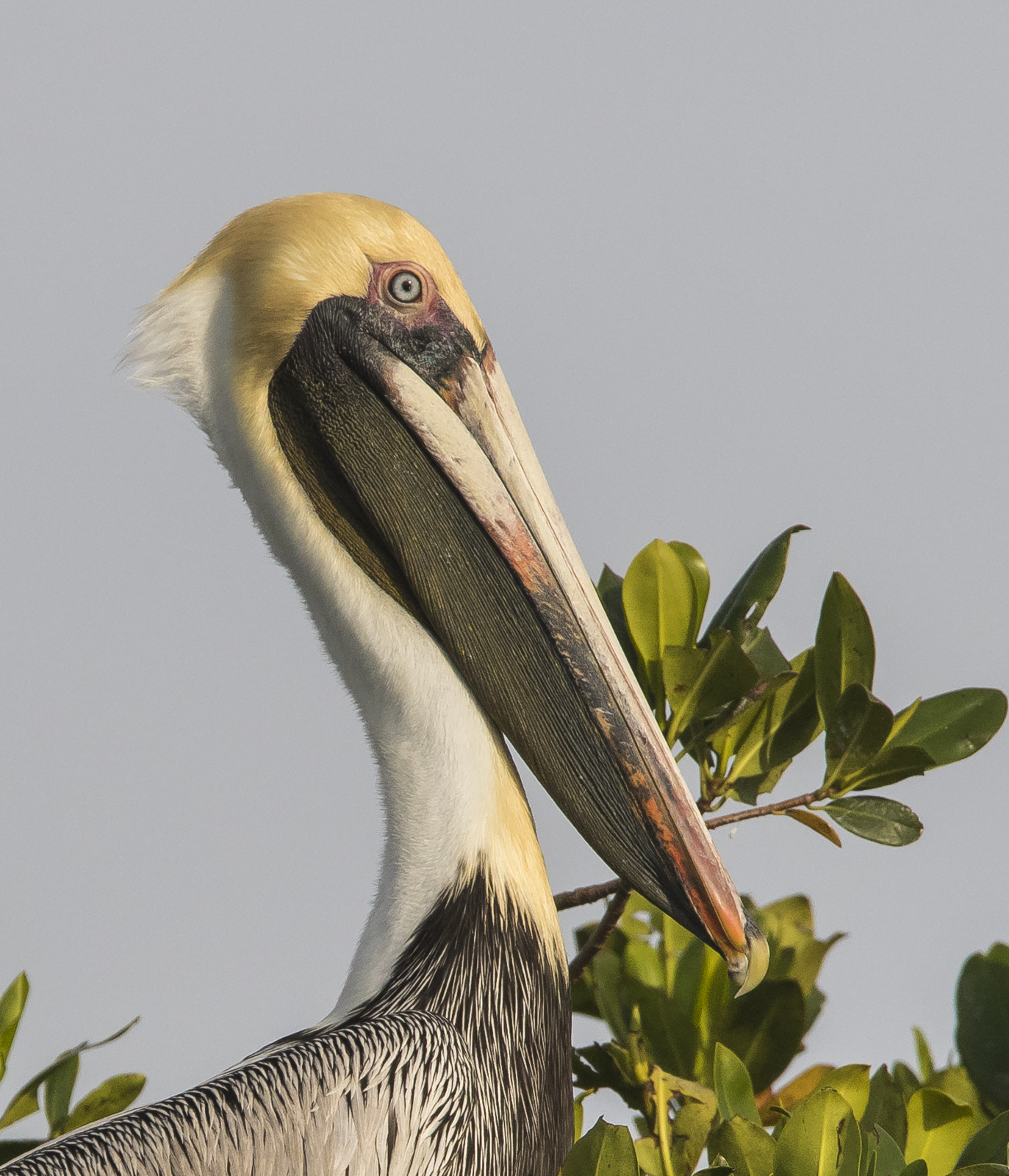
Adult born pelican surveying us as we cruise by the islandAdults have yellow heads and white necks; immature pelicans are gray-brown on their head and neck
Boats are required to stay a certain distance away from the roosting birds so as to not disturb them. Our slow speed, the calm waters, and a telephoto lens (plus a cropped image) allowed great views and close-ups.
The last mangrove island before the vast expanse of the Gulf of Mexico
Promising we would return before sunset, the captain steered us out through a maze of islands until we came to the edge of the Gulf of Mexico. We beached the boat and got out for a stroll for a few minutes to take in the view and immensity of the scene.
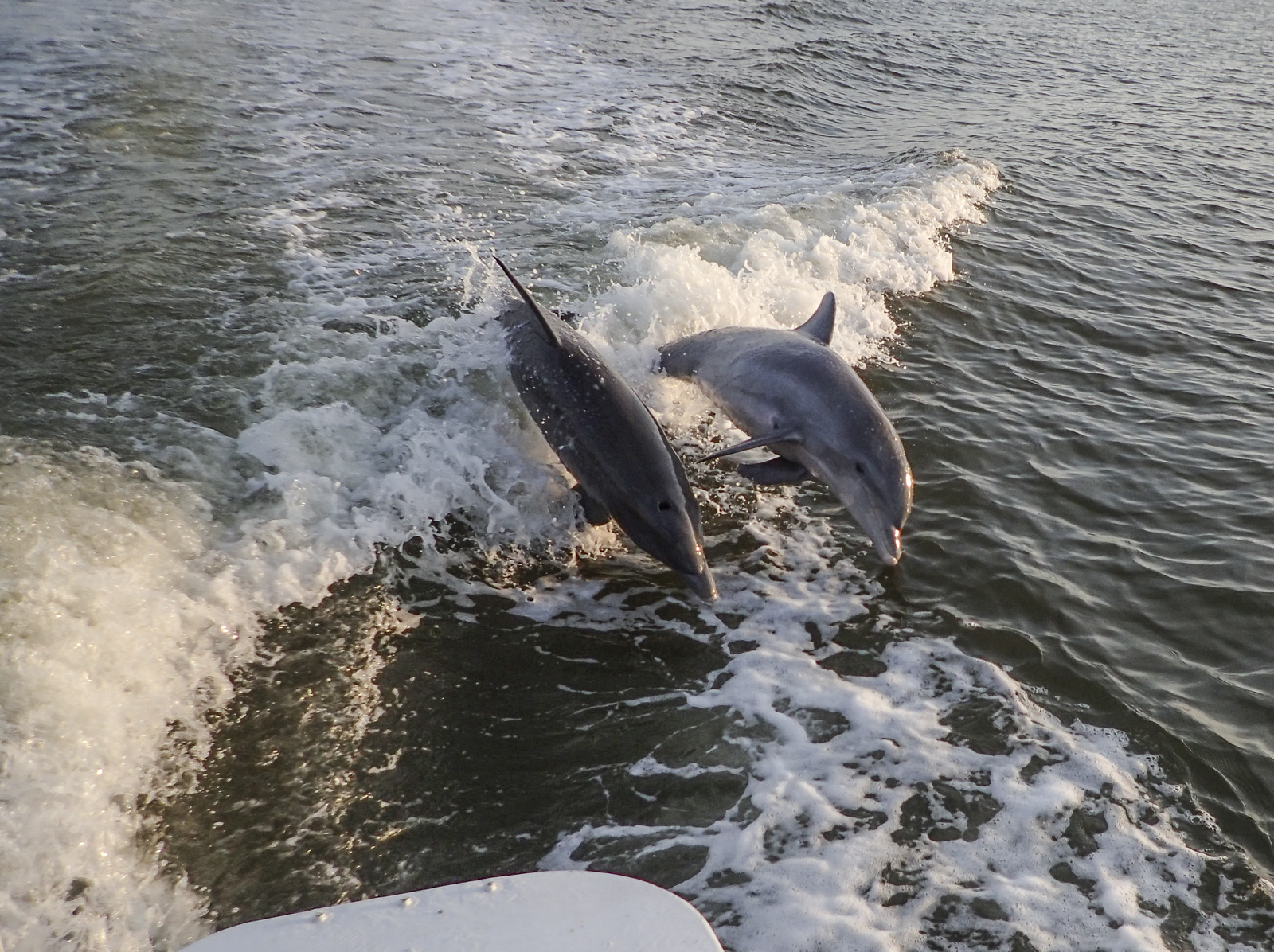
Dolphins riding our wake
Cruising back toward the birds, we spotted a couple of sea turtles, and a small group of dolphins. As we passed through the area where the dolphins had been swimming, the captain said they often like to “play” with the boat. Sure enough, it wasn’t long until we had dorsal fins trailing in the wake of our boat, with dolphins taking turns leaping out of the water behind us.
I’m not sure who enjoyed it more, the dolphins or us.
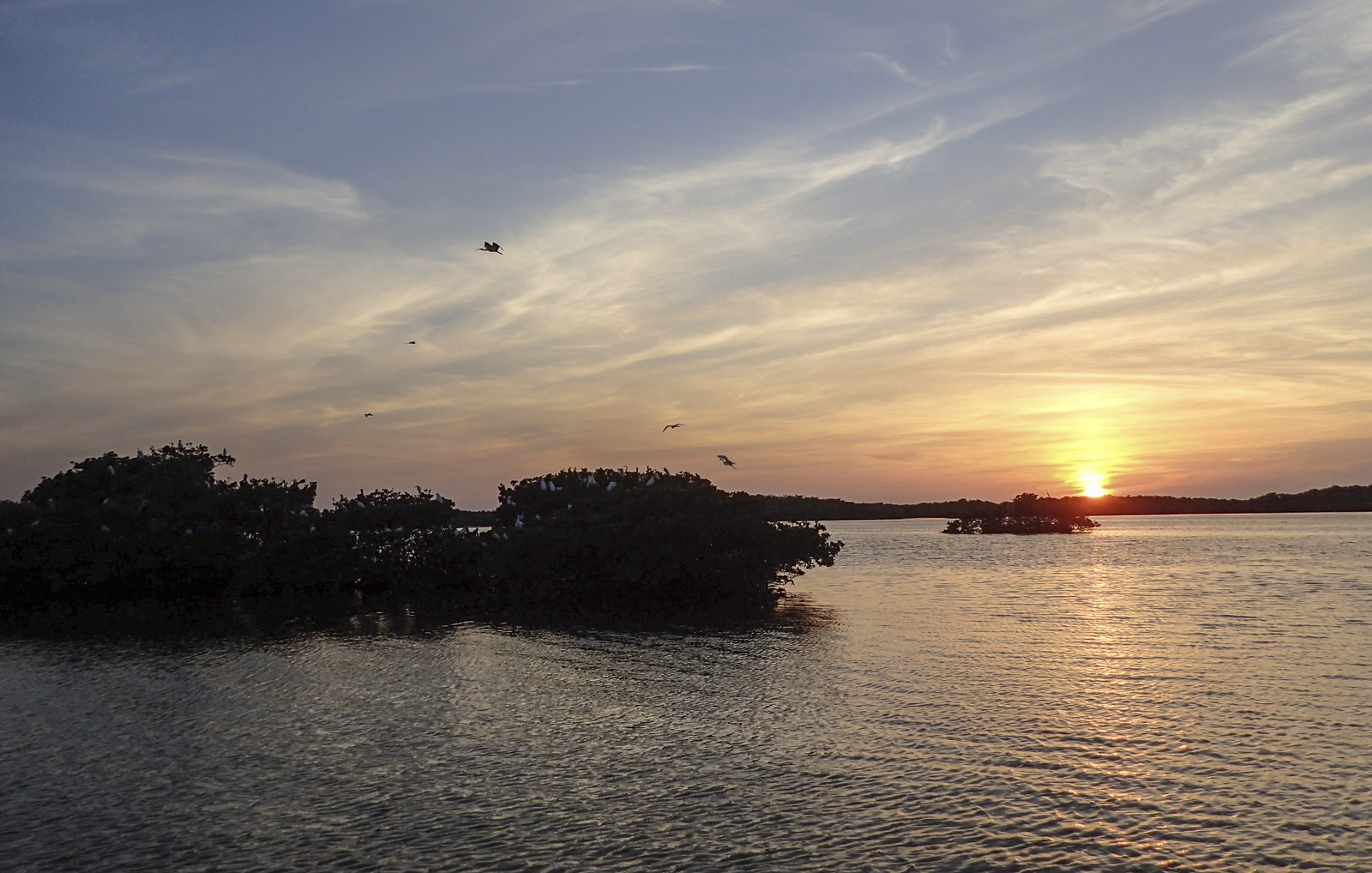
Cruising through the mangrove islands at sunset
We spent several minutes enjoying the company of the dolphins, but the captain soon turned the boat back toward the bird islands. The sun was setting and he wanted us to see how many more birds were now occupying the mangroves.
Hundreds of birds dotted the mangroves at sunsetBirds were flying in to roost from all directions
As we approached, the trees were speckled with white and dark shapes, with more coming in from all directions.
Spectacular scene at sunset
White ibis coming in to roost
The color of the sky became a flame orange as we circled the islands one last time. This was what Captain Kent wanted us to see…the bird rookery with a golden sky as a backdrop.
Some of the egrets are busy building nests in the mangroves
It was a perfect way to end our trip – calm waters, a beautiful sky, and huge numbers of birds flying in for the evening. This was what I had hoped to see, the spectacle of wild Florida. And I must also thank Captain Kent for going above and beyond the call of duty. One of our party left behind a pair of rather expensive binoculars, presumably out on the mangrove island we had walked on. The captain made a special effort to look for them on his next outing, and, amazingly, found them. They have been shipped to the owner, and we all thank him for an amazing trip, and his kindness. Now, that IS the perfect ending.
If, in the name of progress, we want to destroy everything beautiful in our world, and contaminate the air we breathe, and the water we drink, then we are in trouble.
~Marjory Stoneman Douglas, in response to critics saying that conservationists were trying to halt progress in Florida by preserving Big Cypress Swamp
Big Cypress National Preserve was once called the Western Everglades, and was originally supposed to be part of the national park, but was removed from protection before the park was created in 1947. An elevation difference of 1 to 2 feet makes Big Cypress a vastly different ecosystem than the river of grass of much of the eastern portion of Everglades National Park. Big Cypress is home to deep water cypress sloughs and strands (linear cypress islands) and is underlain more by peat than the limestone deposits more common in much of the park. The result is more of a “swamp feel” than the open grass prairies we experienced on our first two days in Florida.
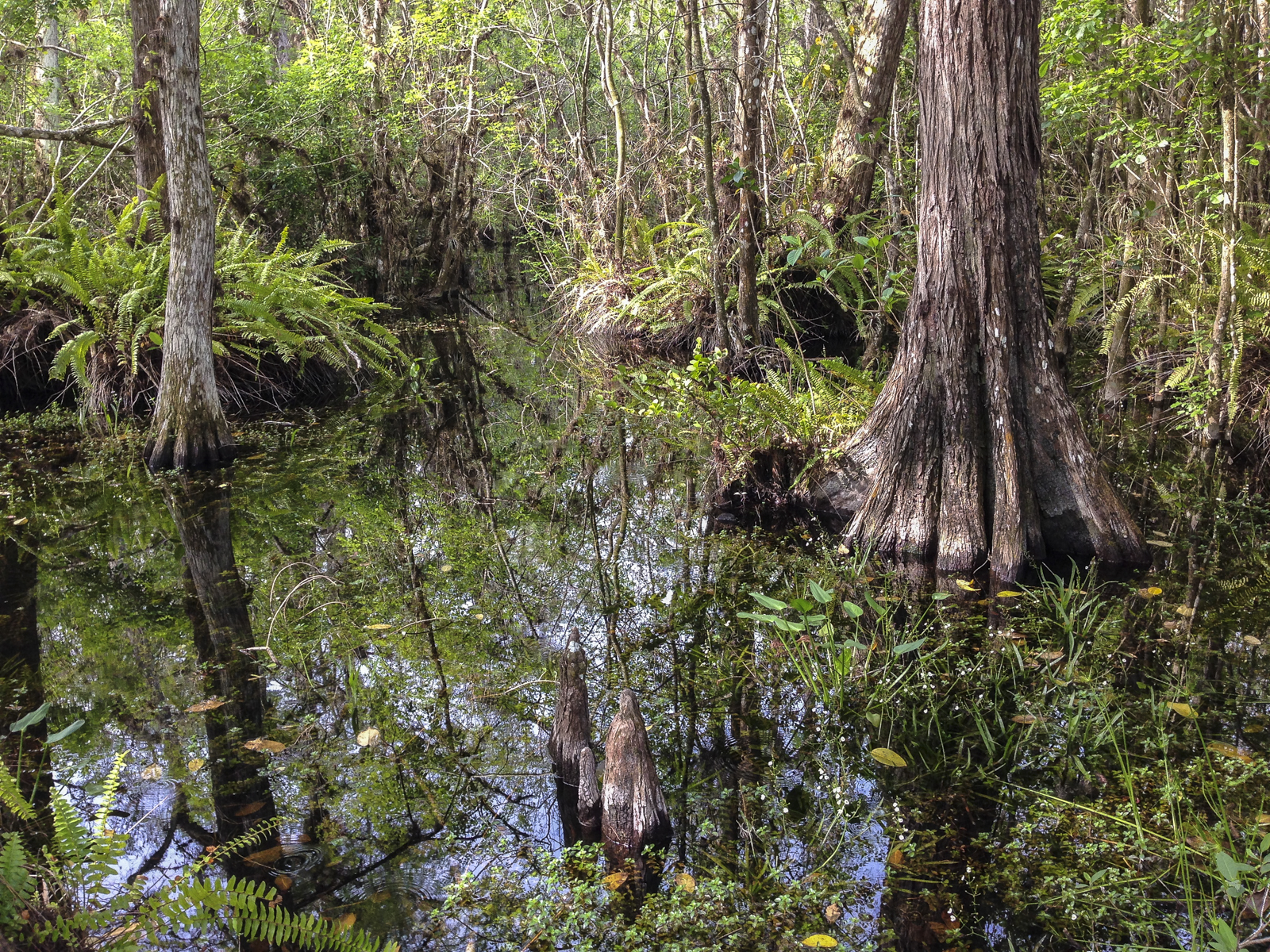
Pond behind our lodging in Big Cypress (click photos to enlarge)
It wasn’t until I returned home that I found out about the contentious history of the effort to preserve what is now Big Cypress National Preserve, the first national preserve in the United States. After the virgin cypress were essentially logged out throughout much of the region in the 1930’s and 40’s, the area was proposed as part of Everglades National Park. But, when the park was created, the lands encompassing Big Cypress were excluded. More controversy erupted in 1968, when plans were unveiled to create a huge jetport (what would have been the largest airport in the world) in part of Big Cypress. Conservationists joined the fight and the struggle went back and forth until the creation of the 720,000+ acre preserve in 1974.
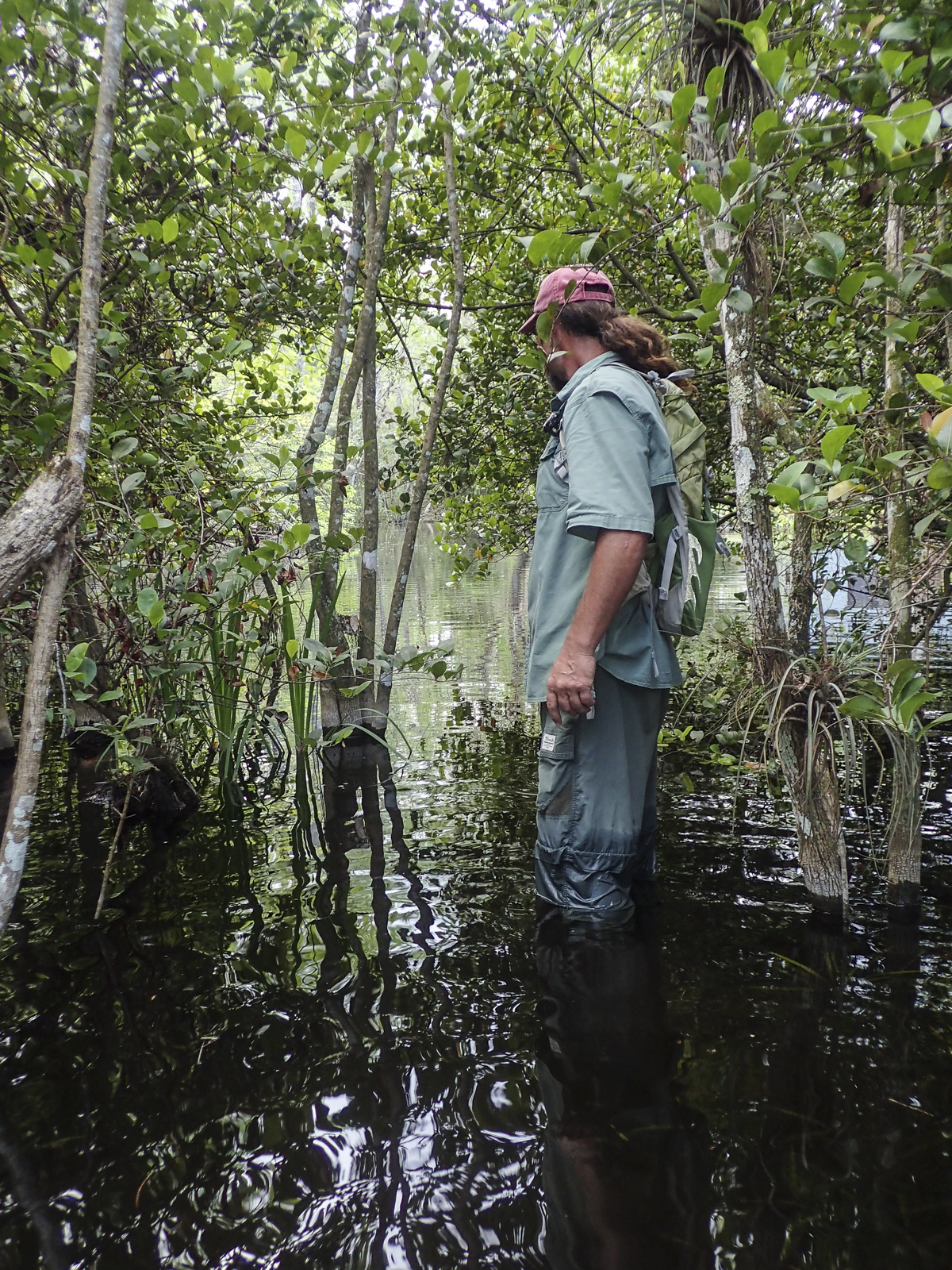
Our Swamp Walk guide, Scott, pointing out an alligator at the end of our trail
When planning the trip a few months ago, I learned about some unique lodging in an in-holding in Big Cypress – the cabins at the Big Cypress Gallery of famed landscape photographer, Clyde Butcher. I have been aware of Clyde’s images for many years and he really is the Ansel Adams of the swamp. He is also an ardent conservationist, and has done a great deal to bring the beauty and plight of the region to the public’s attention. When I found out he had lodging in Big Cypress, I couldn’t resist booking it. In addition to the wonderful accommodations and surrounding property, he offers guided swamp walks for a fee. Though it is a bit pricey, I am glad we did it. Our guide, Scott, is a wonderful person (as were all the staff we met) and very knowledgeable about the plants and animals of Big Cypress. The swamp walks usually take a couple of hours. You walk with a sturdy hiking stick (they provide those) on a flooded trail behind the lodging that passes through a variety of habitats, including swamp, prairie edge, and dwarf cypress stands. There was both excitement and some slight apprehension when we began the hike, and I particularly liked Scott’s answer to the question, “how deep does it get”? He said this winter has been unusually wet, so the deepest part was 38 inches. Nothing like a precise answer! Of course, he is 6 feet 5 inches tall, so the deep water comes a little farther up on our bodies than it does on his.
Bromeliads are very abundant in Big Cypress
We walked at a slow pace, taking in all the sights, and sounds, that the swamp had to offer. The grunting calls of pig frogs were particularly evident here as they were elsewhere on our trip. And the diversity of plant life is amazing!
An old growth cypress stand looks quite different than our old growth forests
At one point, the trail opened up into a mix of small cypress trees and grasses. Many of these trees are surprisingly old, stunted due to growing on the porous limestone bedrock of this particular part of Big Cypress. We saw relatively few animals until we got right to the end of the trail.
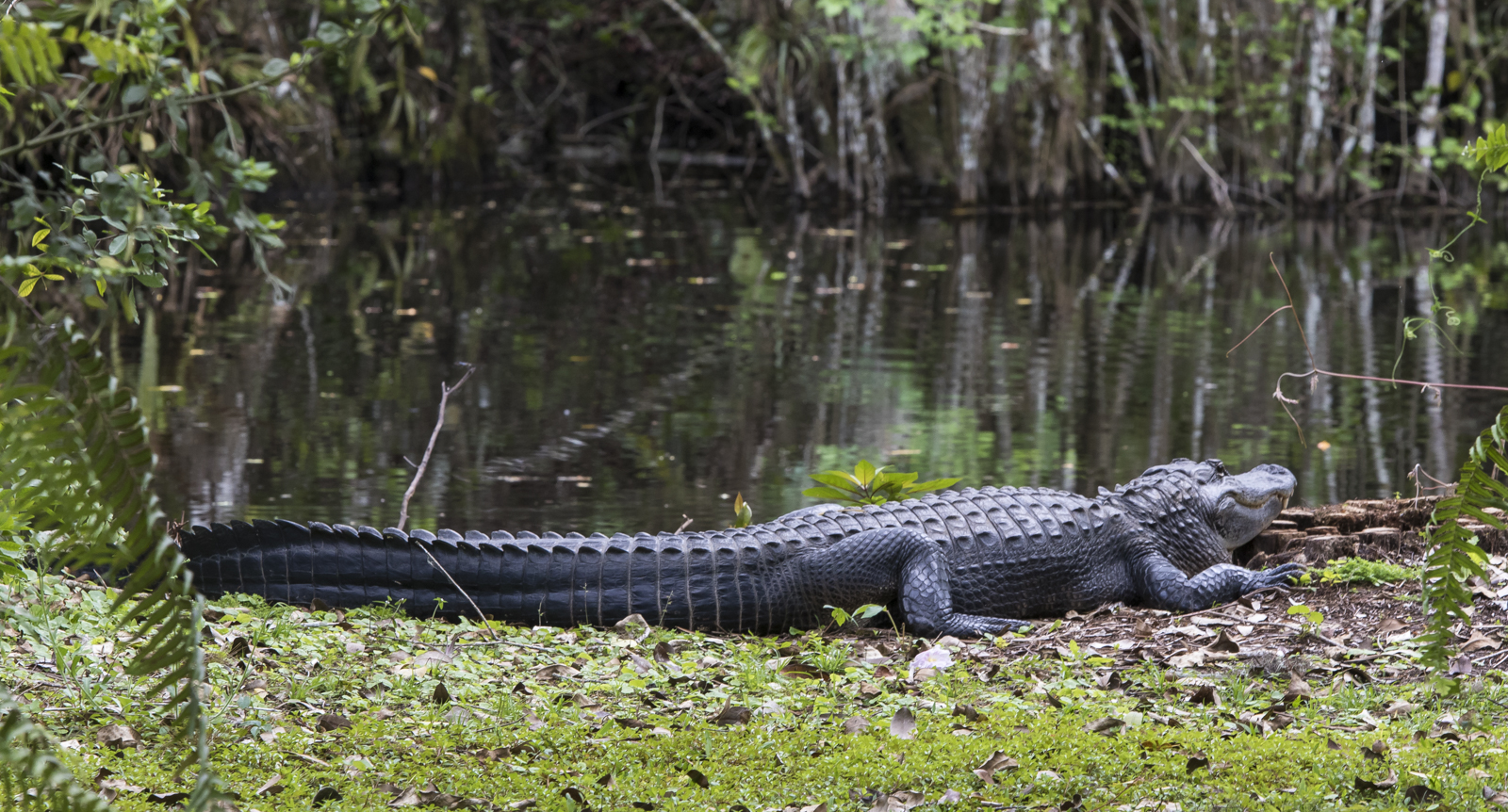
Large female alligator greets us at trails’ end
There, in a small pond behind one of the cabins, was a large female alligator (maybe 7 ft+ in length), along with several of her babies and a few 1 and 2 year old gators. She came over to greet us as we stepped out of the swamp onto dry ground, and hissed loudly to let us know we should not disturb her youngsters. Not to worry, we gave them a wide berth.
Big mama watching us as we look back
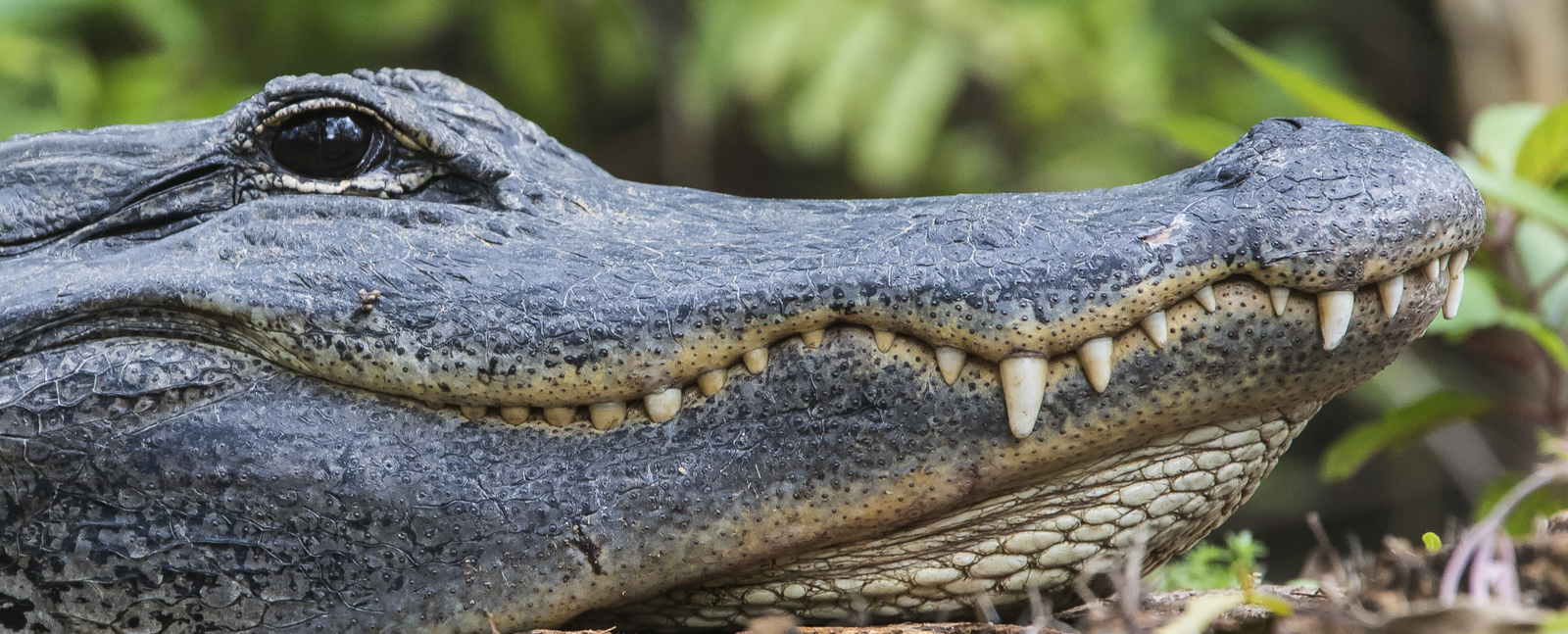
Gators have a toothy grin when viewed through binoculars or a telephoto lens, enough so that you respect their space…
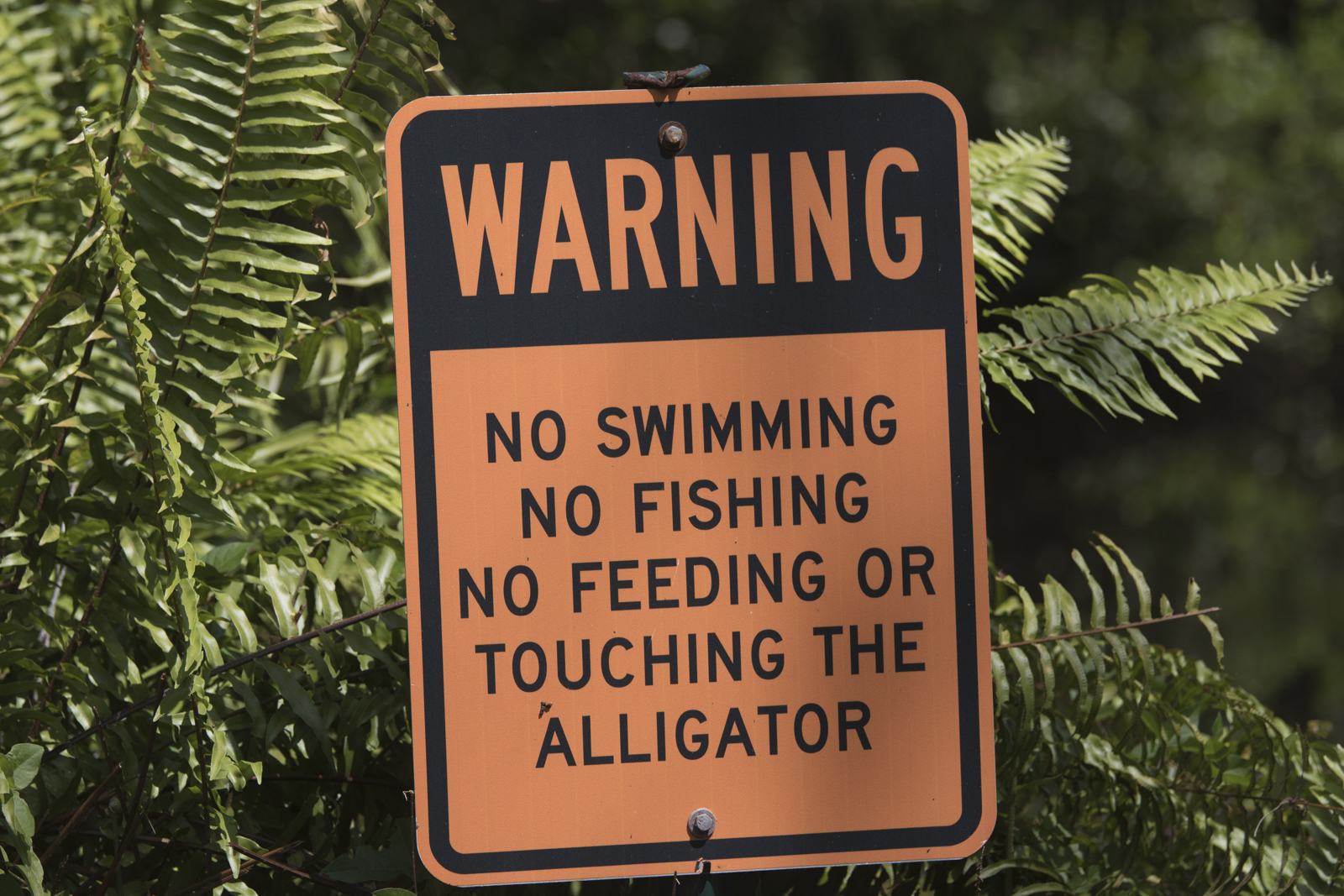
A sign that states the obvious
and shouldn’t need to be reminded with signage:) We did all wonder what it must be like to live next to such large reptiles. I will admit, I scanned the surroundings with my flashlight more than usual when I went outside at night.
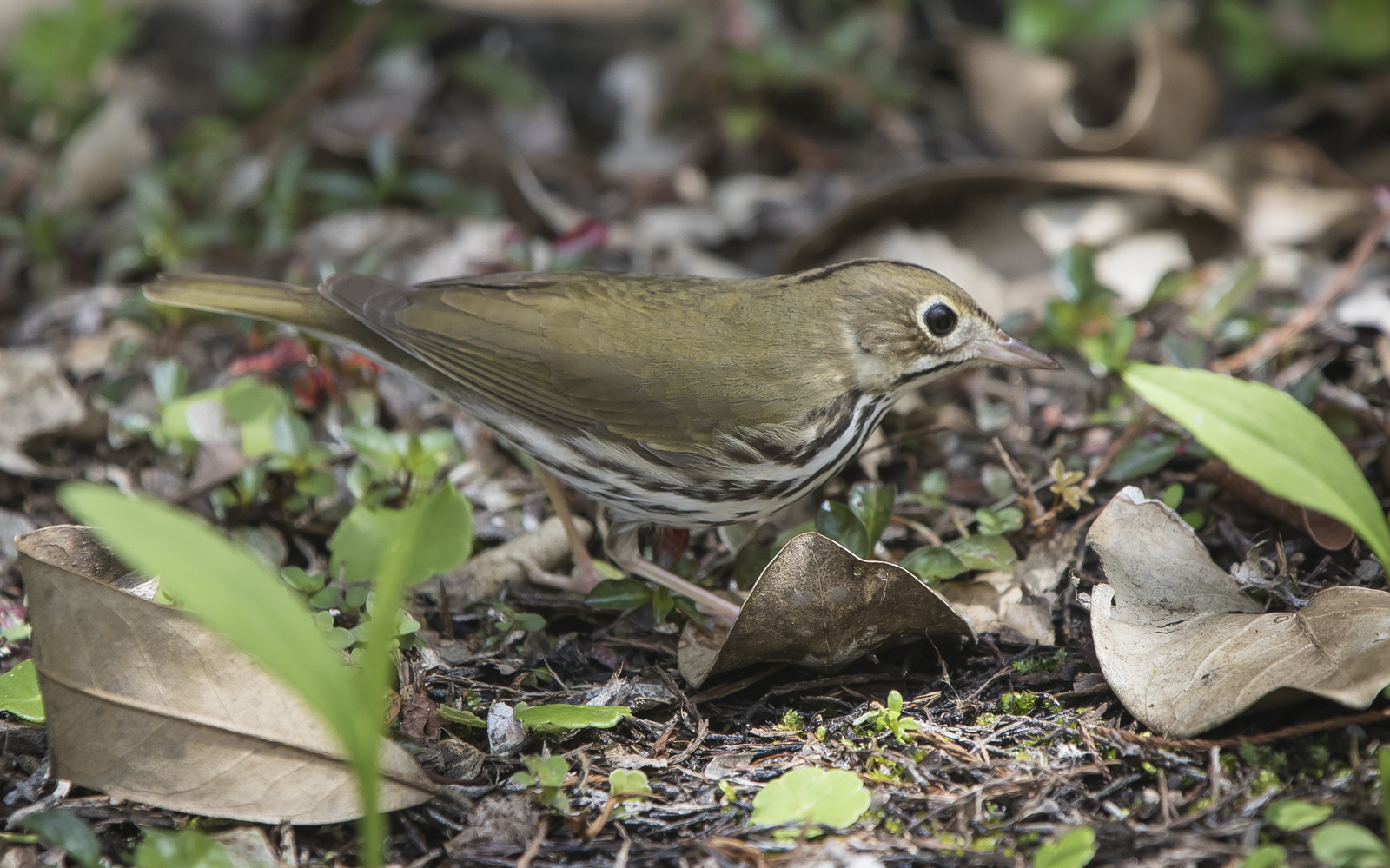
Ovenbird
Neotropical migrant birds are beginning to appear in South Florida (and should be here in NC soon, if not already). On a short walk at our lodging, I saw Northern Parula Warblers, Blue-gray Gnatcatchers, a Louisiana Waterthrush, Black-and-white Warblers, and several Ovenbirds.
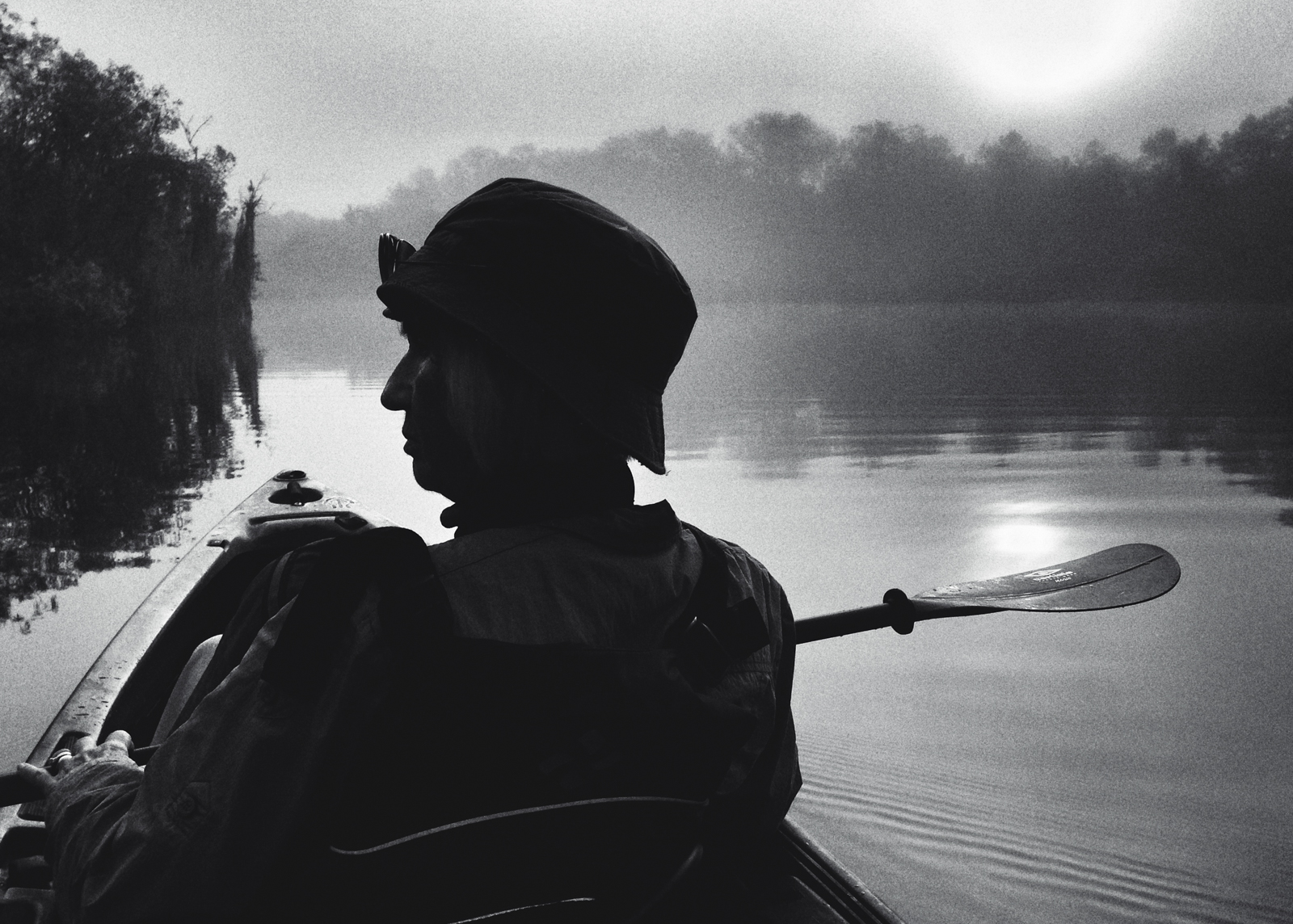
My kayak buddy at sunrise on the Turner River
Our first full morning in Big Cypress was spent with Shurr Adventures on their sunrise kayak tour on the Turner River Paddle Trail. I had picked this group since they were highly rated online, and I saw they do Yellowstone tours in the summer (how could I go wrong with that combo?). It turned out to be a great choice. The kayaks were very stable, with comfortable seats, and the guide was very personable and knowledgeable. The morning started out foggy, and we saw, and heard, lots of wildlife.
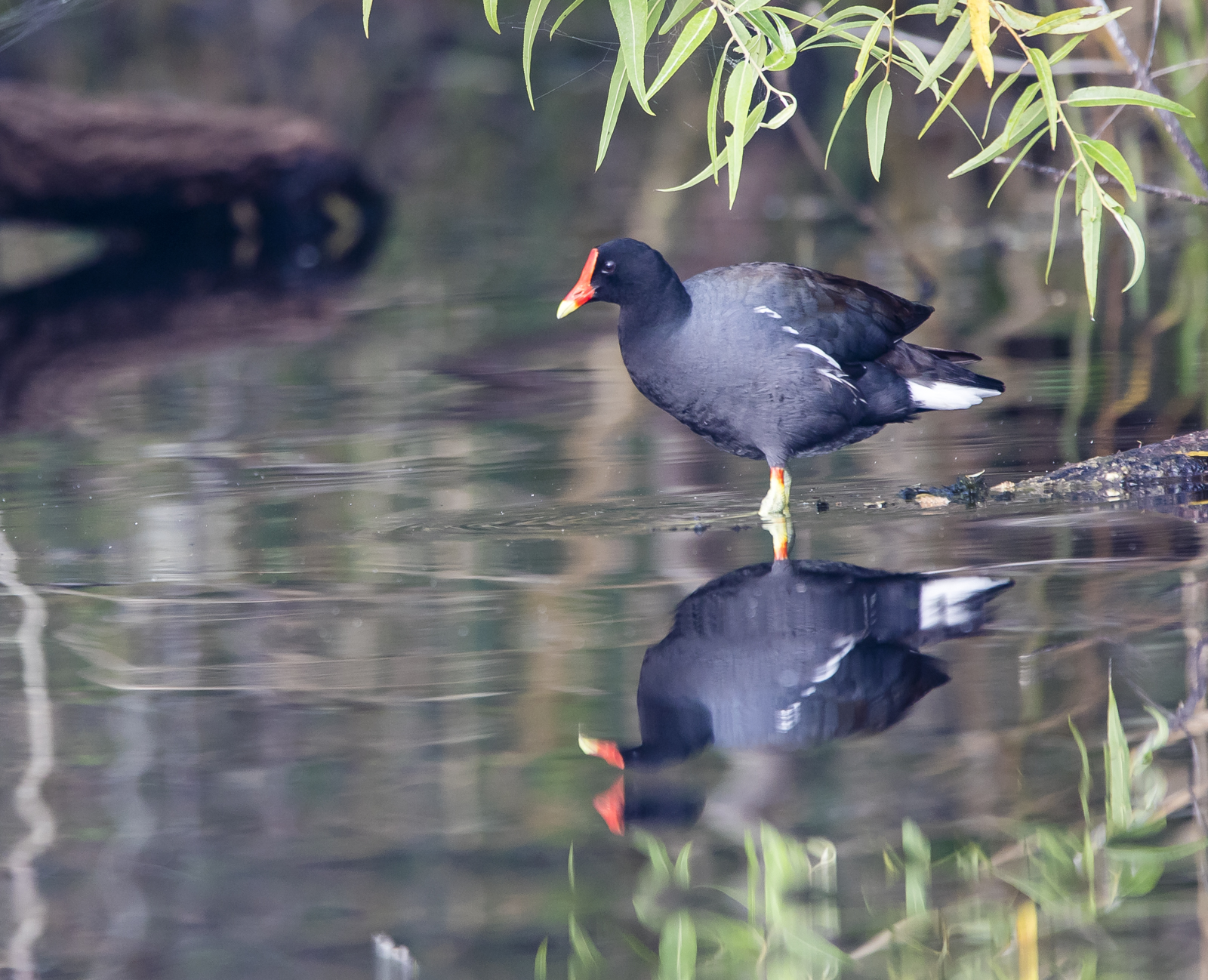
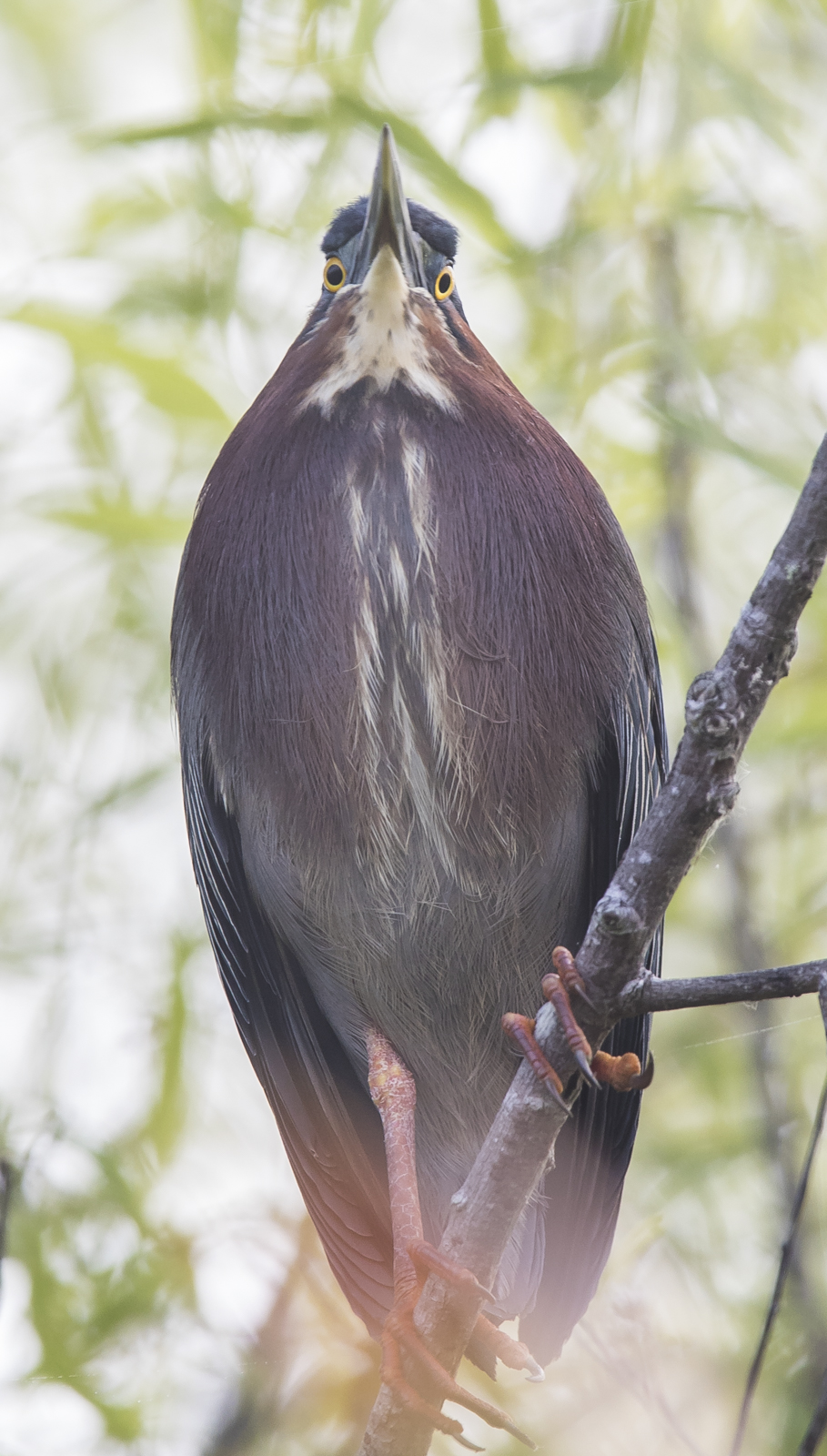
Common moorhen on the riverThis green heron allowed a close approach while it squawked its guttural callOsprey near its nest on the river
All sorts of bird life was active that morning, and the kayaks allowed us to get close to several species. When we headed south of the put-in point, we even got a pretty good view of one of my target species, a limpkin (unfortunately it was in thick vegetation , so not the best photo op).
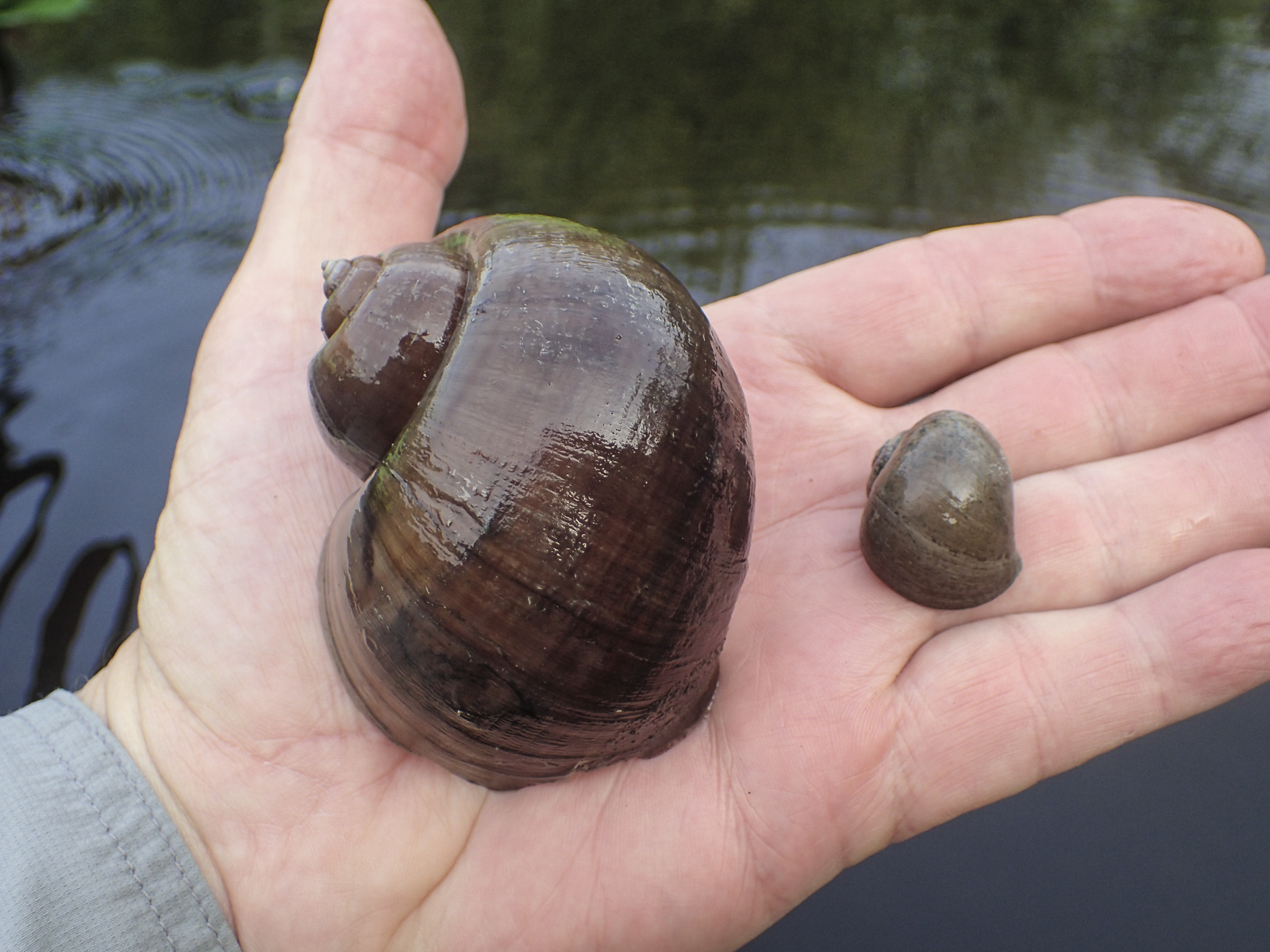
Exotic apple snail (left; smaller, native apple snail (right)
Florida is awash in exotic invasive species, both plant and animal. While paddling the Turner River, we were introduced to one of the more recent invaders, the island apple snail. Believed to have been introduced by releases from the exotic pet trade, this, and a few other species of exotic apple snail, are creating real concern for scientists in the Everglades. The native Florida apple snail, Pomacea paludosa, is much smaller than this invader, and is the primary food source for the endangered snail kite. The larger size, fecundity, and voracious appetite of the invader snail, P. insularum, is cause for concern, both in terms of altering the wetlands plant community, and out-competing the native species of snail, with potentially disastrous results for the kite.
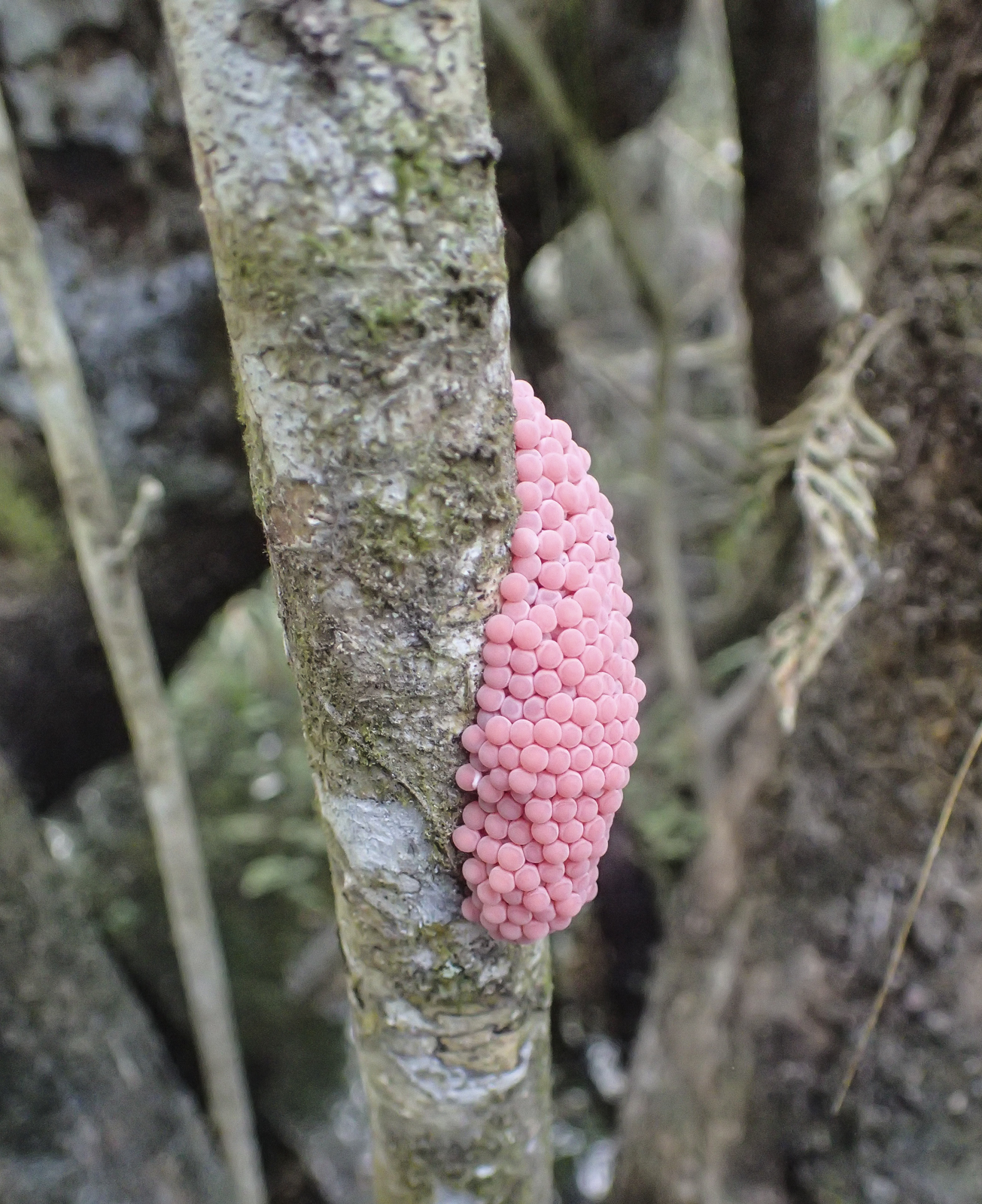
Egg masses of the exotic island apple snail are pink; eggs of the native species are larger, and white
During our stay, I found one egg mass of a native apple snail, but we saw many egg masses of the invader, especially in the Big Cypress Swamp area.
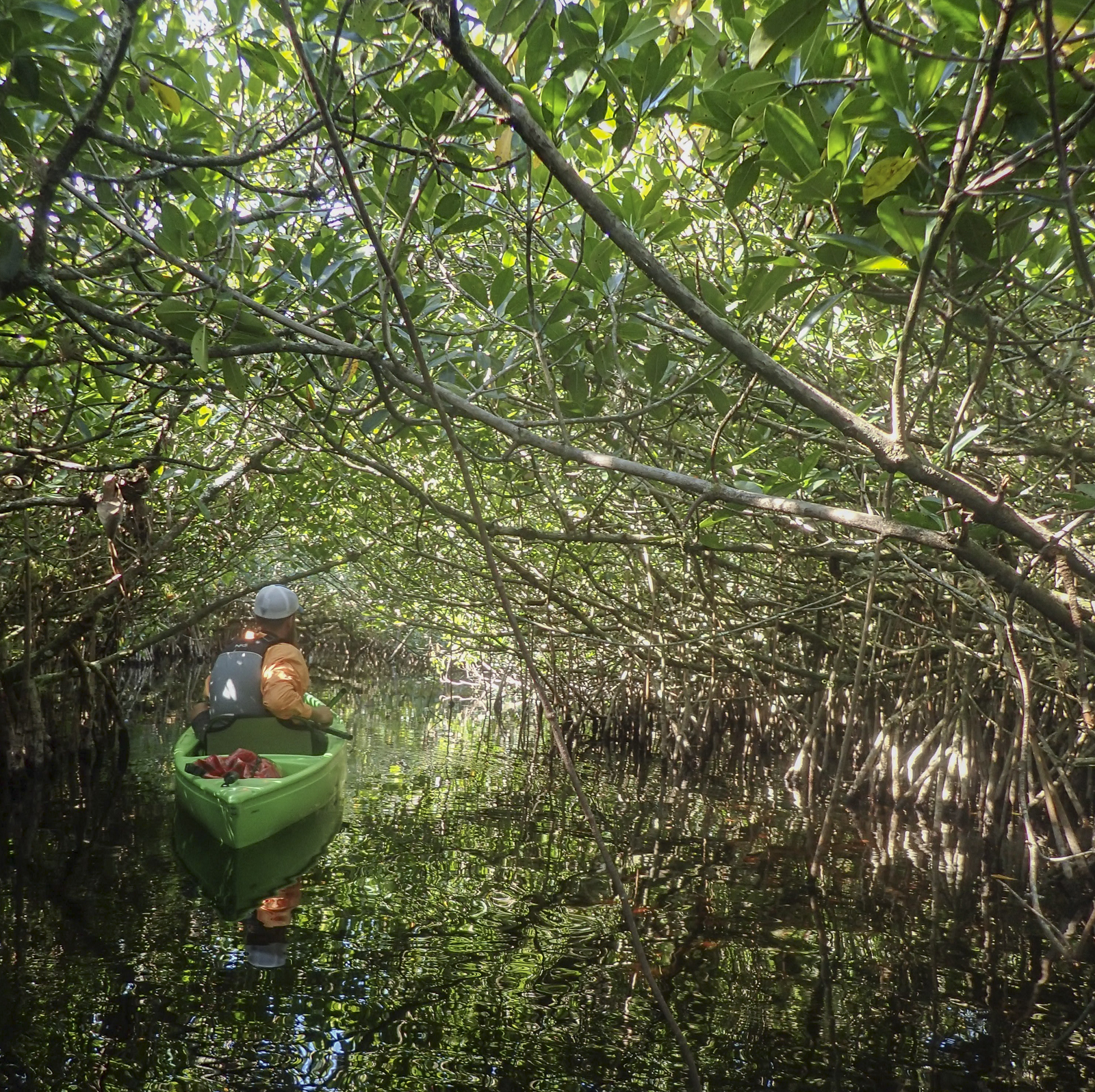
Kayaking through a mangrove tunnel
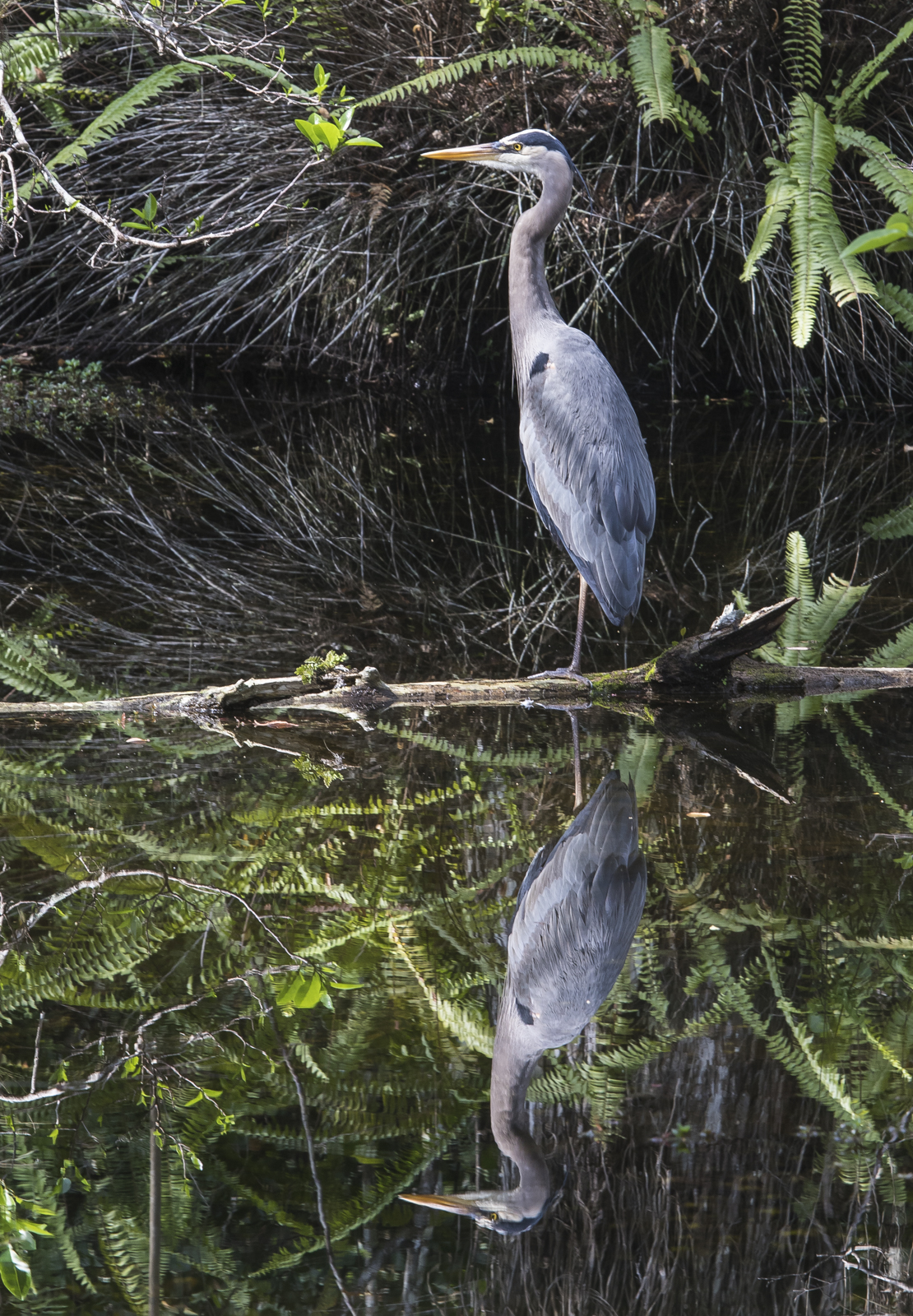
When we headed south of the Tamiami Trail in our kayaks, the plant community changed from a cattail fringed swamp forest to an expanse of red mangrove tunnels. Kayaking through the mangroves turned out to be a lot easier than paddling a canoe through them, like we had done at Nine Mile Pond, but you did need to break down the longer kayak paddle to avoid catching it on every prop root. After finishing our morning trip, we returned to Clyde Butcher’s place for some rest and exploration. I drove out to scout our route for our final day in the area (a dirt and paved thoroughfare called the Loop Road), and came across all sorts of birds and a seemingly endless supply of alligators. If you have the time, I recommend the Loop Road as a leisurely pathway to observe some of the scenery and critters of Big Cypress. The entire wild region was a great way to relax before heading back to the hectic pace of Miami for our flight home. Below are some more images of our time in Big Cypress. I look forward to a return visit in the near future.
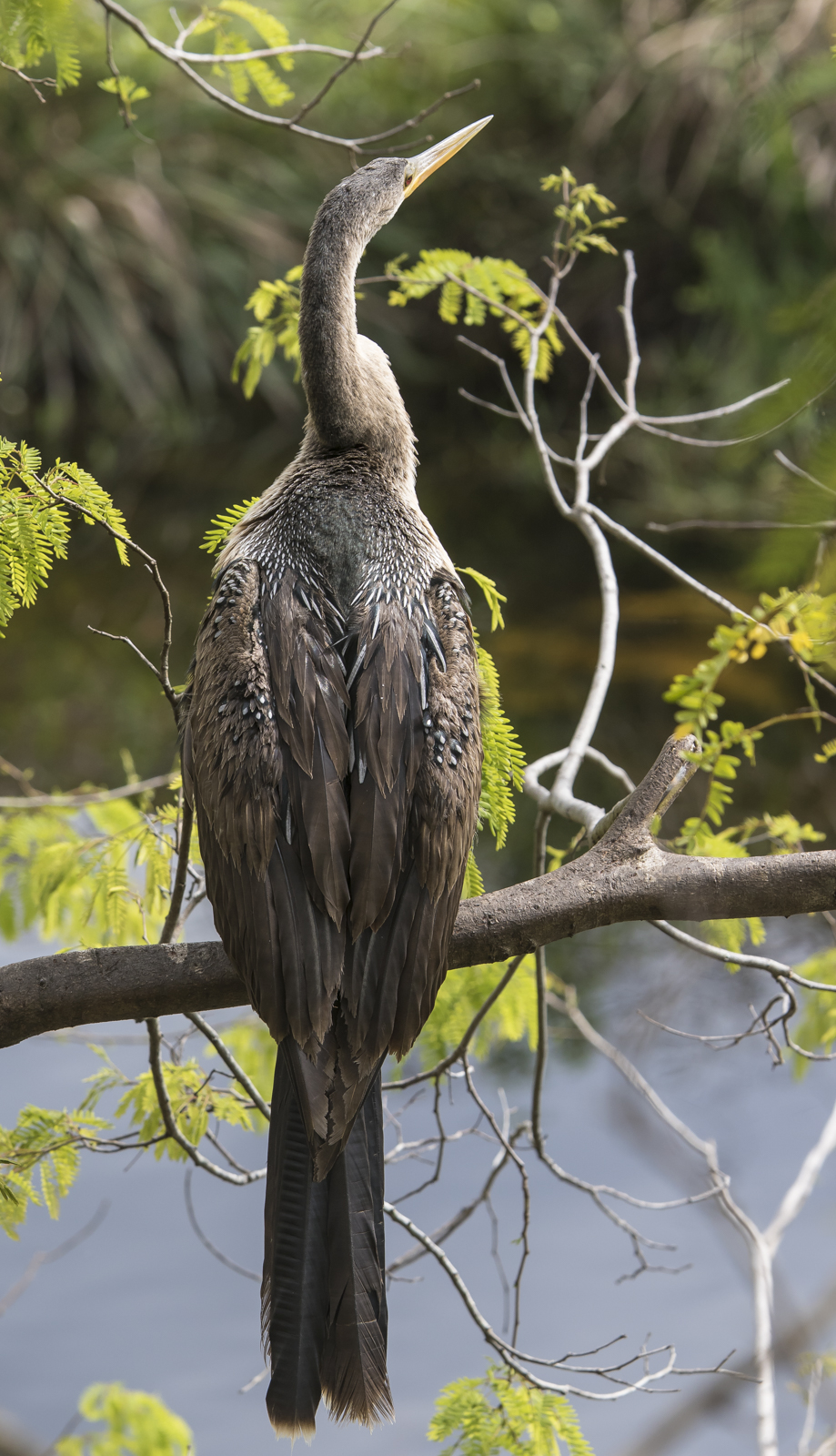
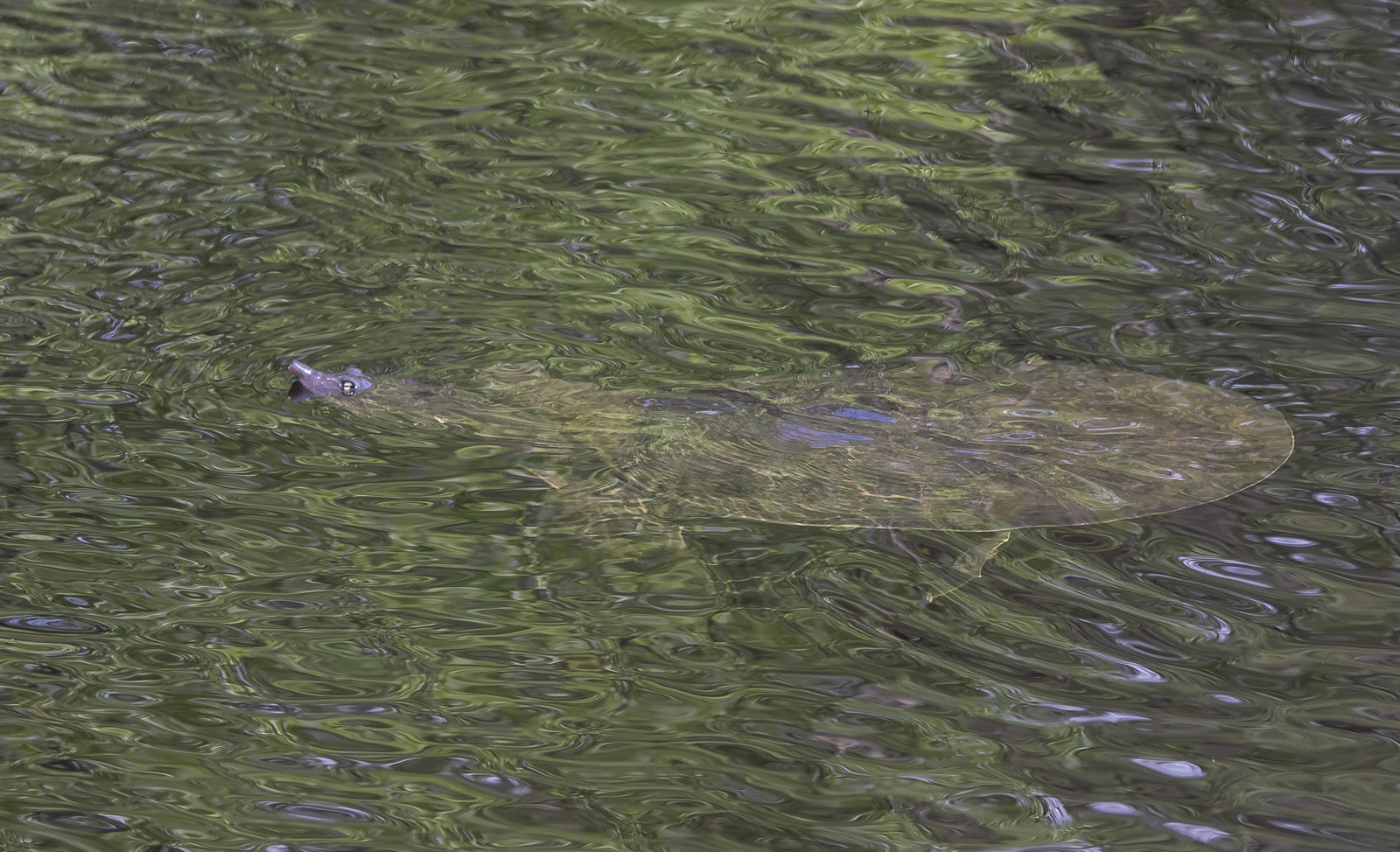
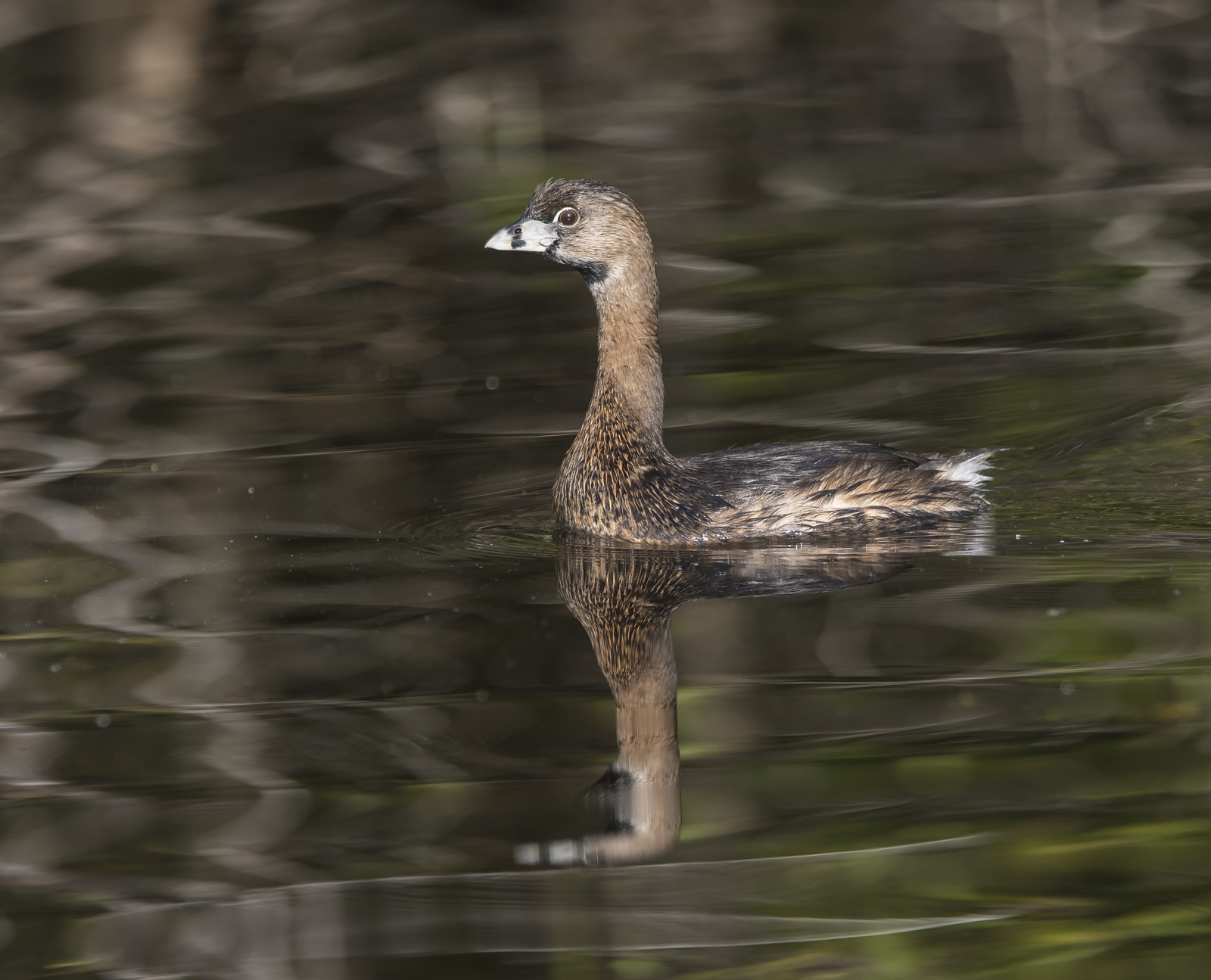
Red-shouldered hawks were seen everywhere we traveledAnhinga along the boardwalk at the Oasis Visitor CenterFlorida soft shell turtle along Tamiami TrailPied-billed grebe along the Turner RiverGators in black and white…
There are no other Everglades in the world. They are, they have always been, one of the unique regions of the earth, remote, never wholly known.
~Marjory Stoneman Douglas, author of The Everglades: River of Grass, 1947
Sitting by the fire yesterday afternoon, I can hardly believe I spent last week in the Florida heat and humidity, in one of the most extensive wild places I have ever been – Everglades National Park. Years ago, I drove across the state on I-75 (aka Alligator Alley) going from Miami to Tampa Bay, but I had never been in the park. So, it didn’t take much convincing when a group of friends asked if I wanted to join them on a trip. After flying into Miami (and getting a bit lost trying to get out of the city), it is a relatively quick drive through extensive farm fields, of every imaginable type of crop, to the sudden transition to the park.
The Anhinga Trail can be crowded, but still has great wildlife (click photos to enlarge)
Our first must-see stop was the famed Anhinga Trail, on the east side of the park. It is not far from the entrance and is said to be one of the best places to see some of the park’s iconic wildlife up close and personal. And even though it was crowded with visitors (and, I am happy to report, several school groups), it did not disappoint.
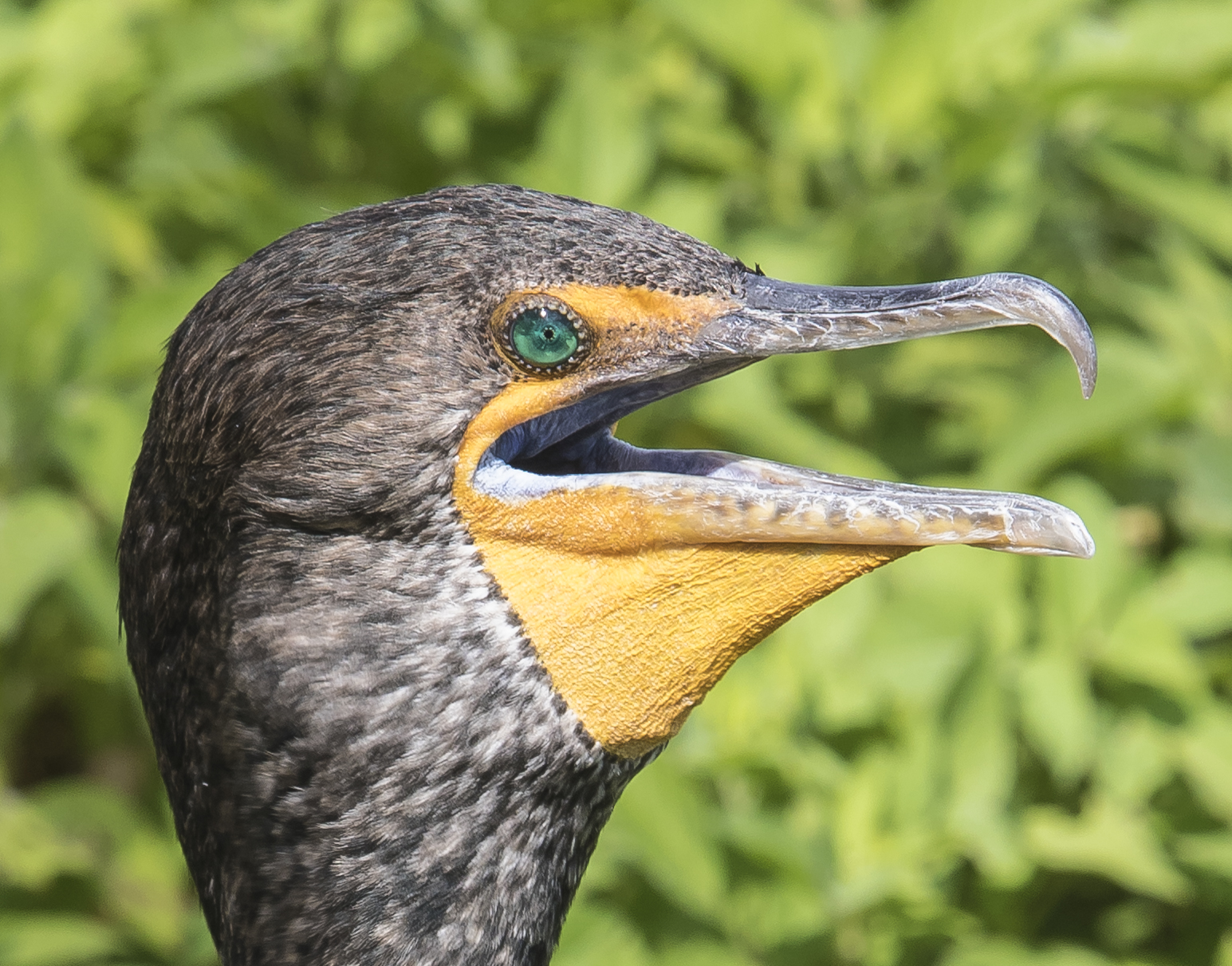
Double-crested cormorant along the trail
After spotting an alligator near the trail head, we walked by a double-crested cormorant, standing right next to the paved trail, and panting in the 80+ degree heat. I shot several close-up photos before moving on. I must admit, I always love seeing their emerald green eyes.
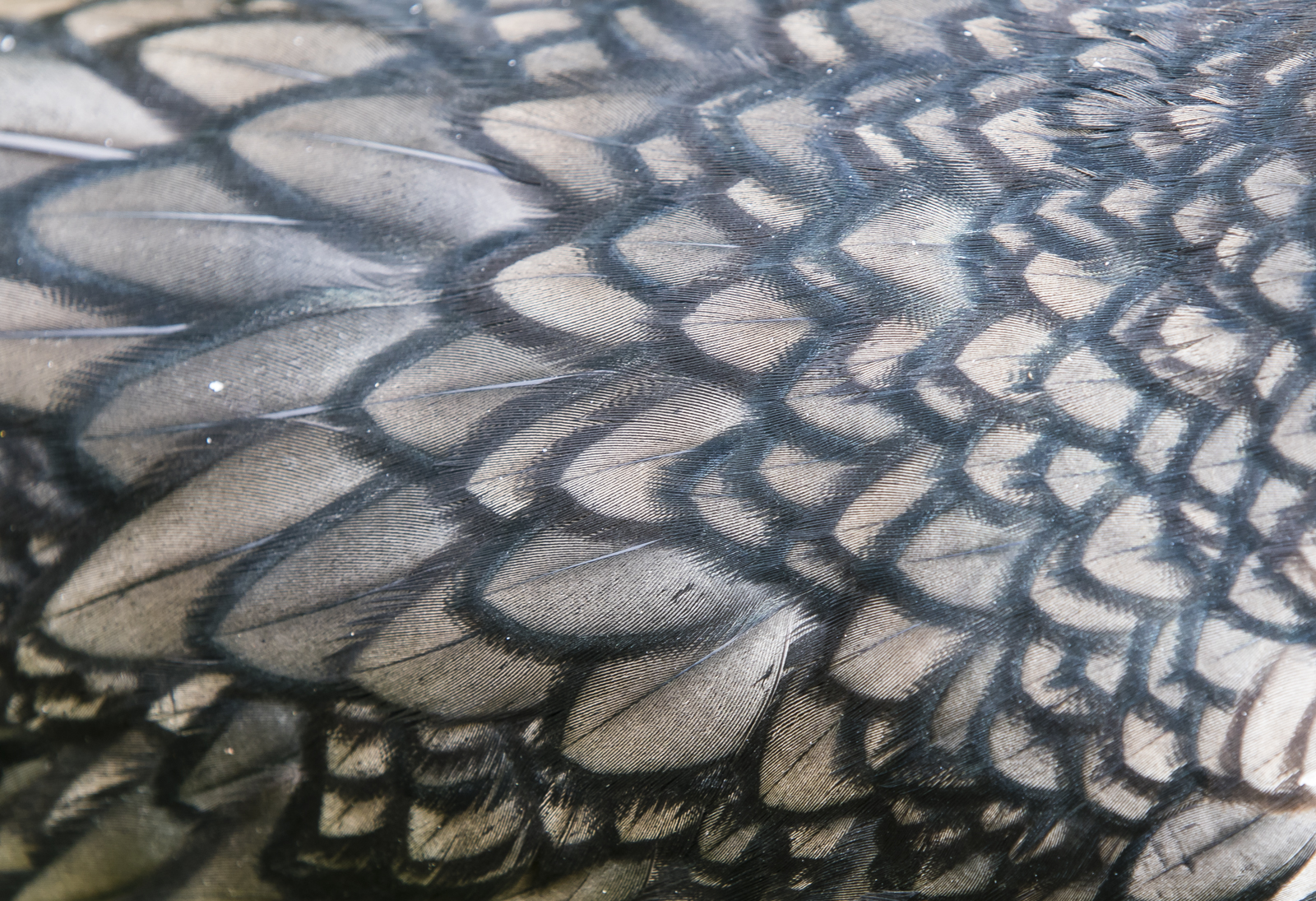
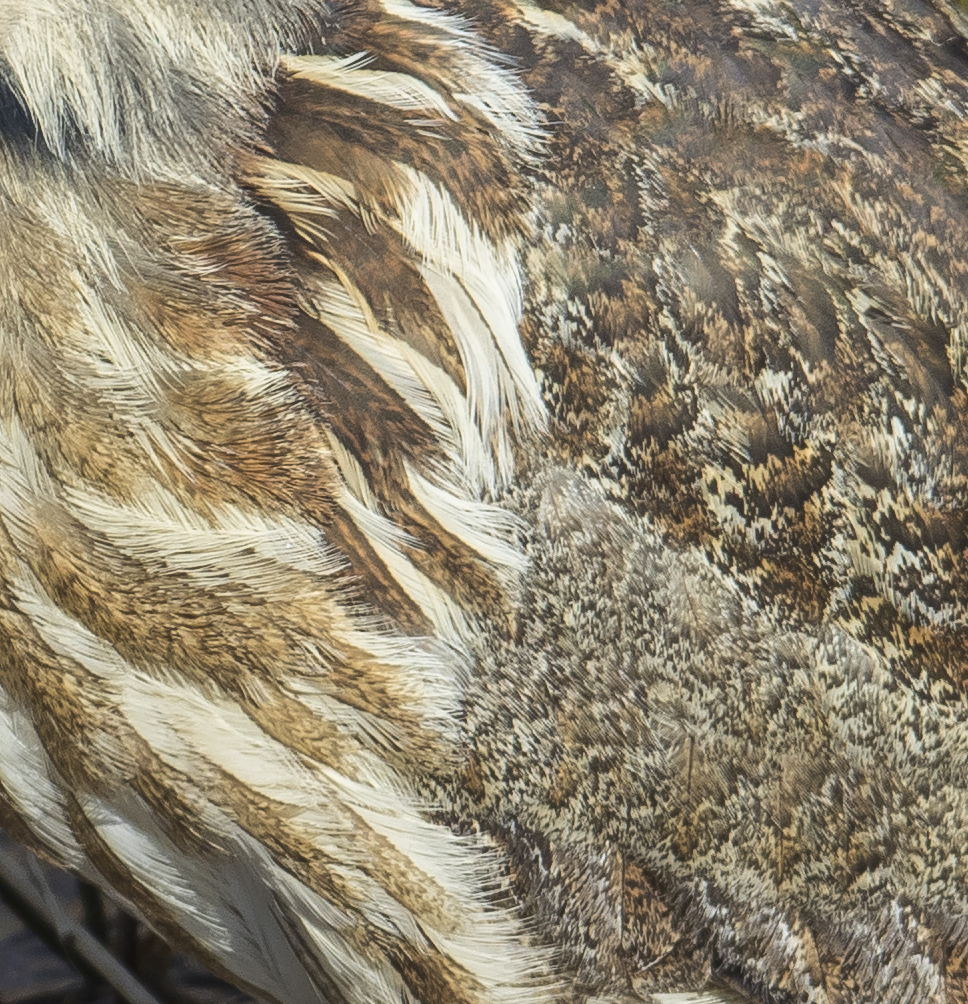
Feather pattern on the cormorant
This bird was so close to the trail, and seemingly so unafraid, that it also allowed me to appreciate the delicate feather pattern on its back.
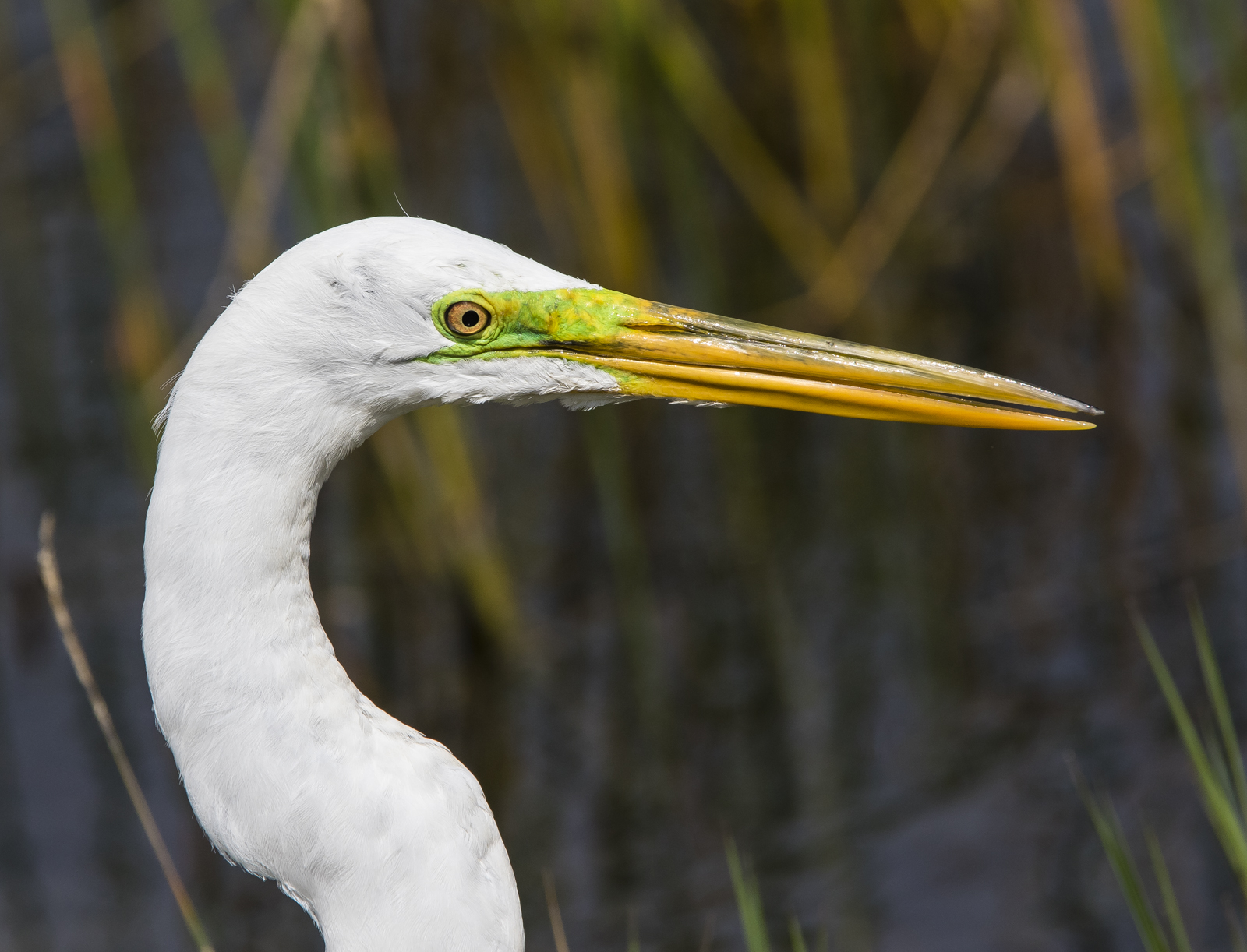
Great egret hunting next to trail
A few feet further along, a very tame great egret was hunting in a culvert that passed under the paved trail and spearing small fish. This time of year is the start of their breeding season and these elegant birds undergo a dramatic color change on their face – the lores (the skin between the eye and bill) turns from the usual yellow to a chartreuse green, and the bill changes from yellow to blackish-orange. They also develop long nuptial plumes, called aigrettes. These elegant feathers almost led to the extinction of egrets by plume-hunting in the early 20th century, when the feathers were used to adorn ladies’ hats. Luckily, conservation efforts helped stop the demand and the birds have recovered over much of their range.
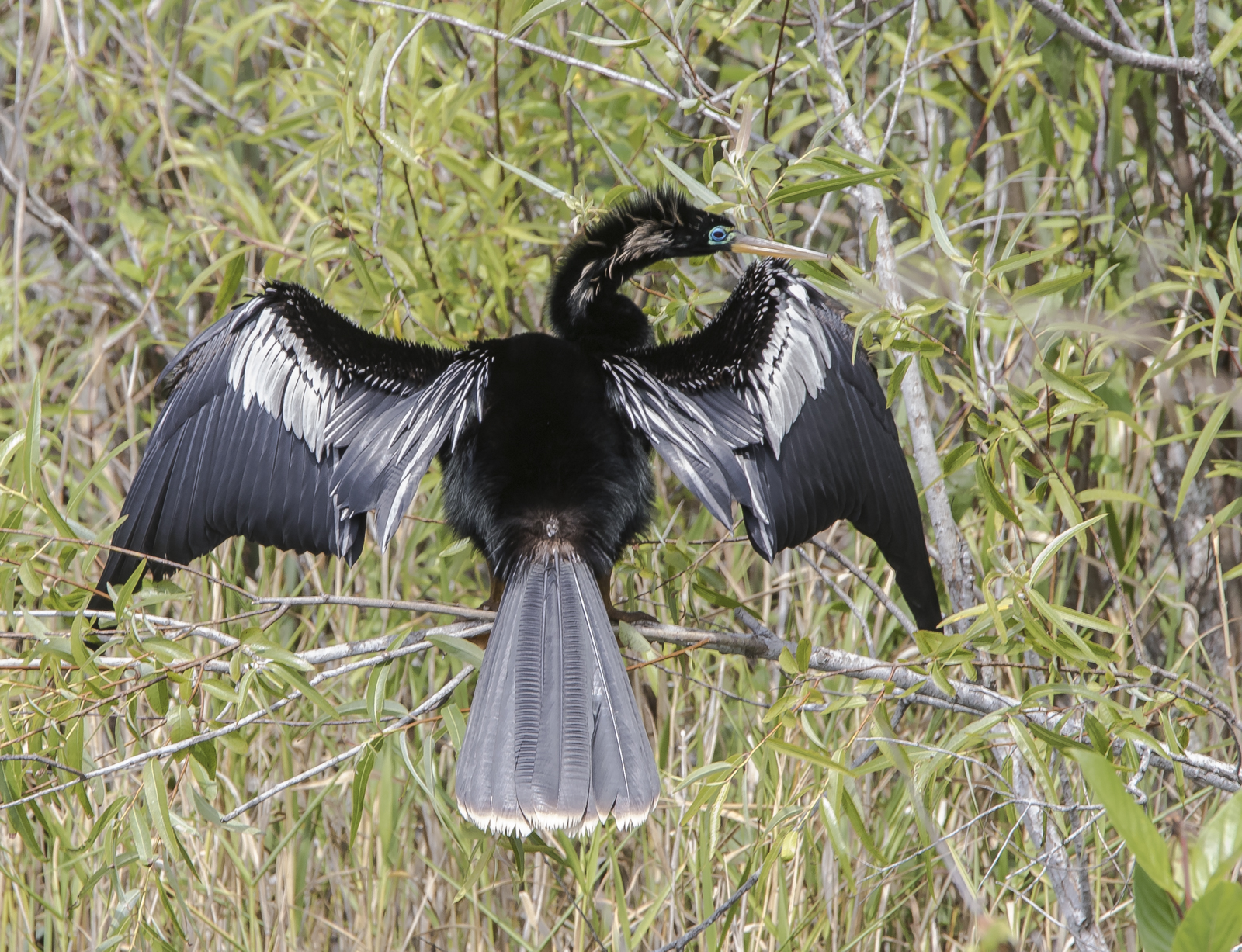
An anhinga, with wings spread, along the boardwalk
Walking out on one of the boardwalk sections, we spied numerous green herons, some more alligators, and the trail’s namesake, an anhinga. Anhingas are oddly beautiful birds that go by other names such as water turkey (their tail does resemble that of a wild turkey) and snake bird (for their habit of swimming with just their neck and head above water). This wing spreading behavior is to allow them to dry their feathers after swimming for their favorite prey, fish. Anhingas and cormorants are primitive birds that lack the oil glands to waterproof their feathers that other water-loving birds possess. During the breeding season, the skin around their eyes turns a bright blue.
Halloween pennant
Probably the most common flier we saw was not a bird, but a species of dragonfly, the Halloween pennant. It is easily recognized by its distinctive wing colors – orange with dark splotches and bands. It is often seen perched atop vegetation, swaying in the wind.
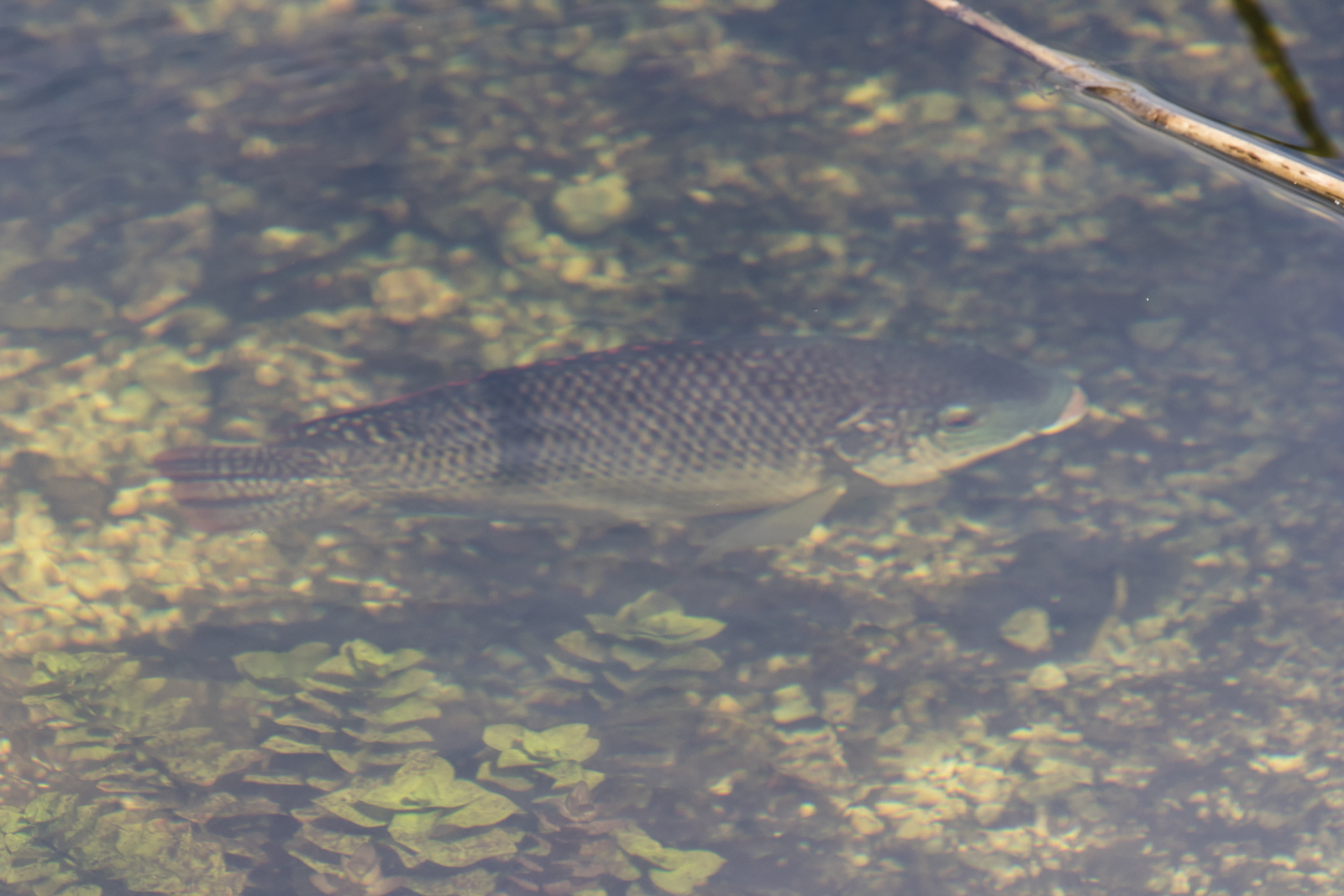
Blue tilapia
The clear water allowed us to see many species of fish along the canals and pools throughout the park. At the Anhinga Trail, one of the most common was baffling at first. It turned out to be an introduced exotic, the blue tilapia, native to Africa and the Middle East. These fish were everywhere in the canals and their large excavated nests were clearly visible in the dark water. South Florida is, unfortunately, a haven for all sorts of exotic plant and animal species. A few native fish species are also very abundant and easily observed including largemouth bass, various species of sunfish, and Florida gar.
Strangler fig
While many of the birds and other wildlife are species that I found familiar, many of the plant species in this portion of the park are more tropical in origin, but were vaguely familiar from my museum trips to Belize years ago. One we saw throughout our travels is the bizarre strangler fig, Ficus aurea. The life cycle starts when a bird or other animal eats the fig fruit and deposits the sticky seed on the trunk of another tree. The fig often begins as an epiphyte, but soon sends roots twining down the trunk of its host to reach the soil. It then grows to the top of the host, sends down aerial roots, and leafs out in the crown of the tree, shading out the leaves of the host plant. The fig continues to develop its crown and root system, often completely enveloping, and eventually killing, the host tree.
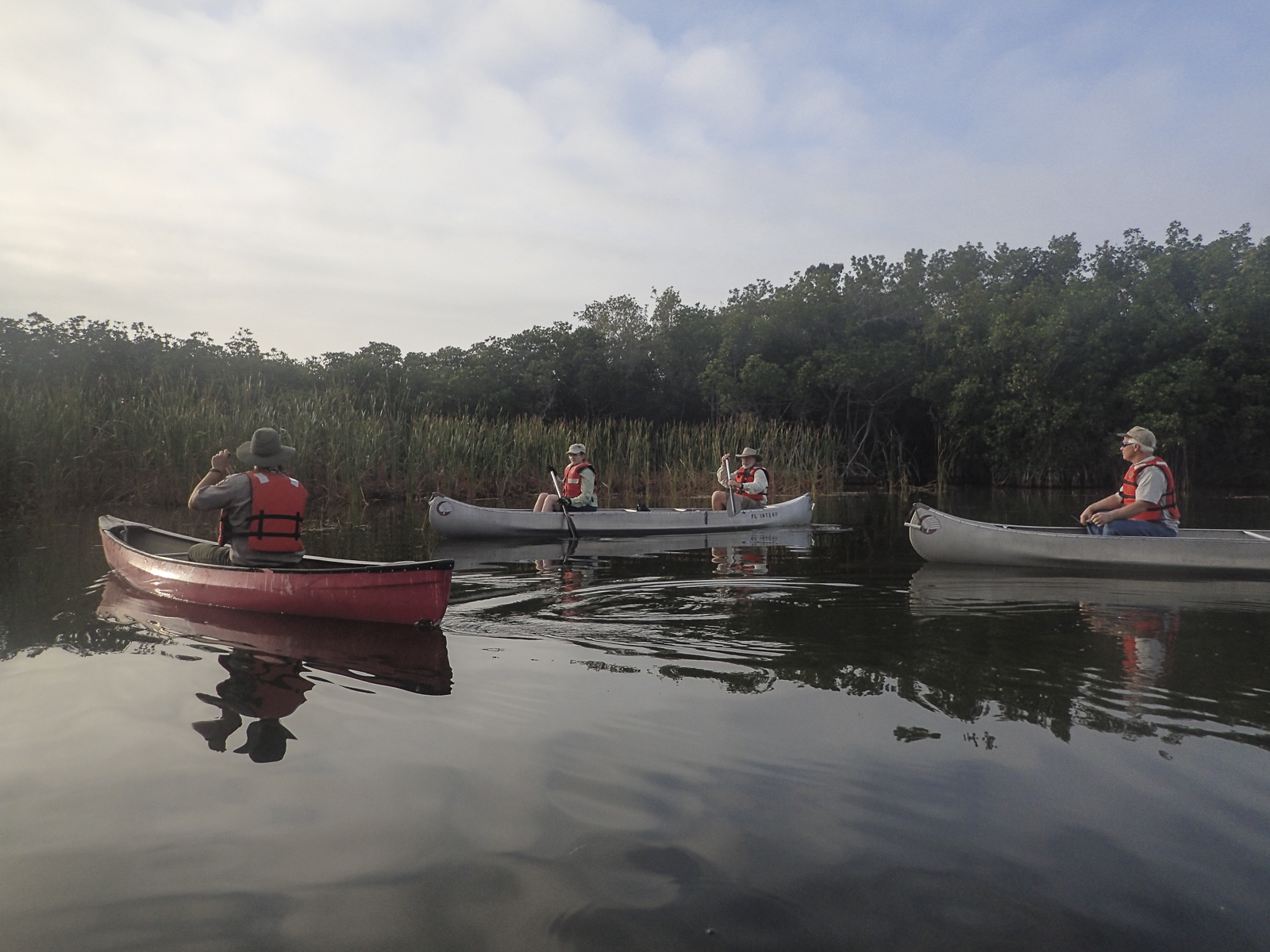
On our second morning, I had arranged a ranger-led canoe trip at Nine Mile Pond. We had 6 canoes, plus the ranger, on a 4 hour paddle through mangrove tunnels and marshes.
Mangroves and marshes along the paddle trail
We started with a fantastic sunrise and enjoyed numerous alligator sightings, a gentle breeze that helped with the rising heat, and blue skies punctuated by white puffy clouds.
Another alligator gives us the eye
The highlight for me was some serious alligator bellowing at one of our stopping points. It is the start of the gator breeding season and the big bulls bellow to attract a mate. It is one of the most impressive wild sounds in the southeast, reminding me of a roar of a lion or a bison bull.
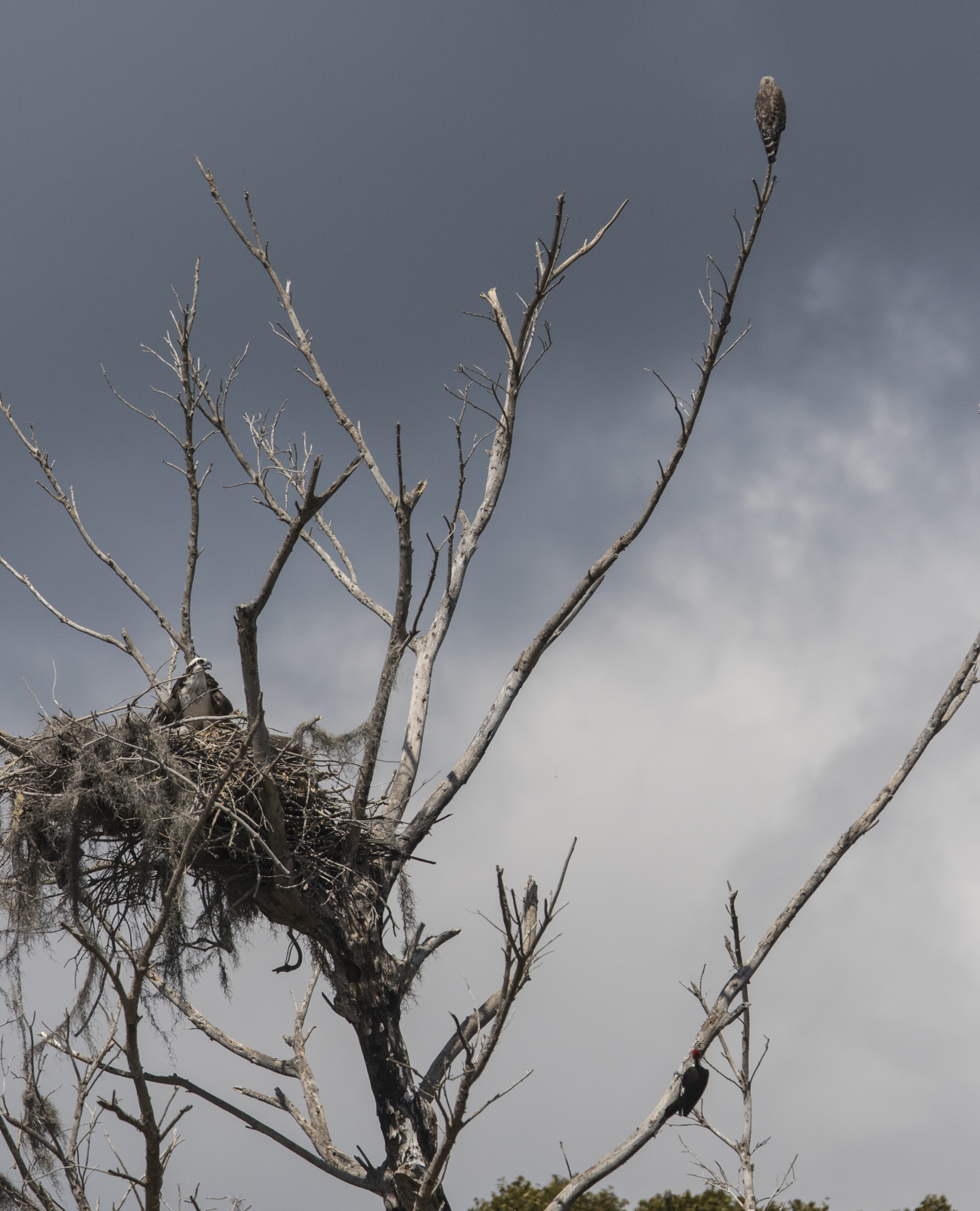
Can you find and identify the three bird species in this tree?
The road through this section of the park ends at Flamingo, a small enclave along Florida Bay with a marina, visitor center, and cafe. We spent time here on both of our first two days, enjoying the breeze and the abundant bird life. Osprey nests dotted the trees, mangrove islands, and man-made towers. At one point there were three great bird species in a tree near the parking lot – an osprey in its nest, a red-shouldered hawk, and a pileated woodpecker. Out in the Bay, we spotted American white pelicans, white ibis, brown pelicans, black skimmers, and numerous gulls, terns, and shorebirds. And, on a stroll to the marina (without my camera, unfortunately), we had great views of a huge American crocodile (this is the best place in the park to see this rare reptile) and four manatees. Needless to say, Flamingo is well worth the drive.
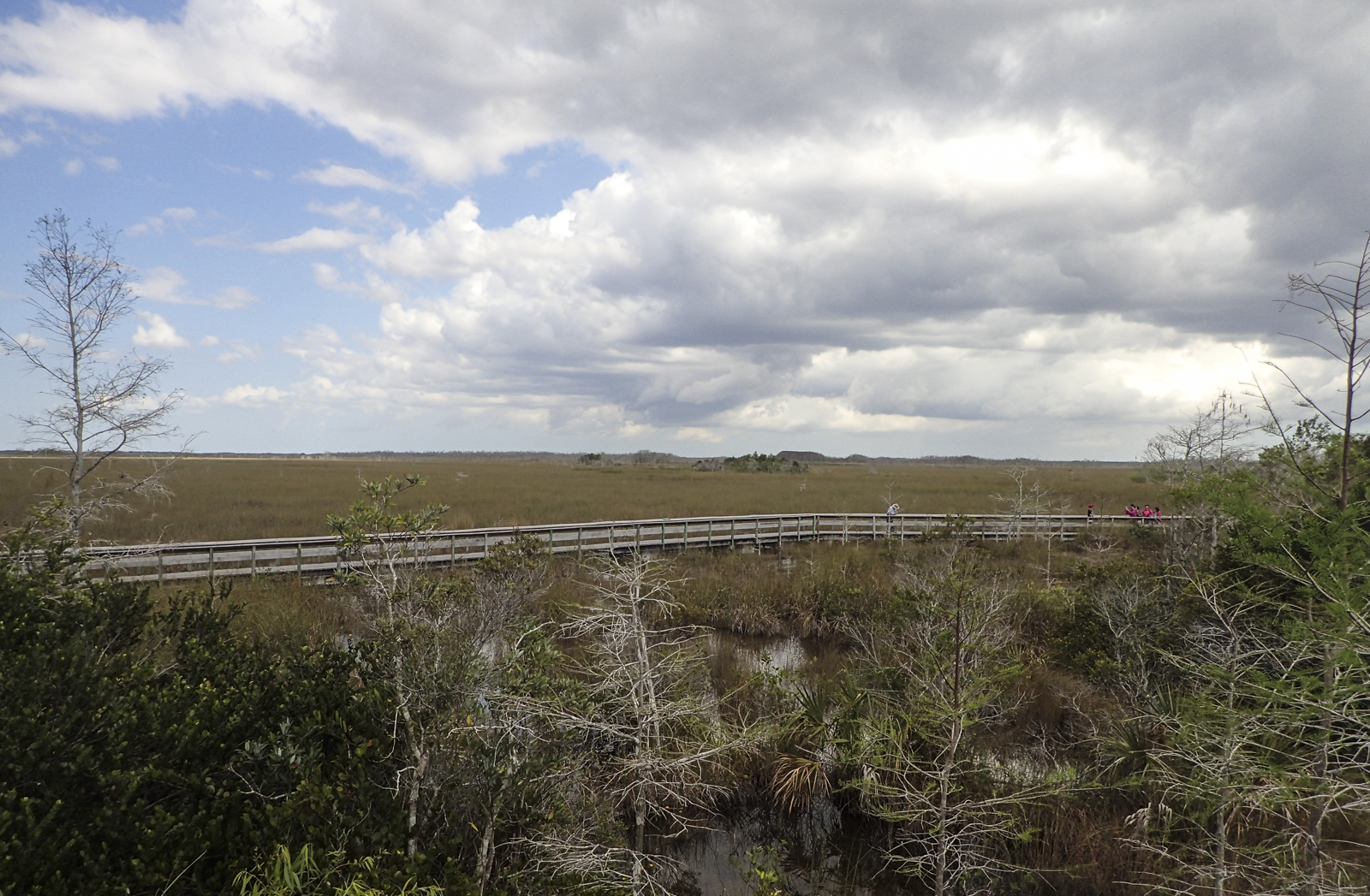
Vast saw grass prairie at Pa-Hay-Okee boardwalk
When I started planning the trip, I bought a copy of Exploring Everglades National Park and the Surrounding Area (A Falcon Guide), and it proved a valuable asset in choosing which of the many trails and boardwalks to visit in our brief stay. One of the highly recommended stops is the Pa-Hay-Okee Trail. The name is derived from a Seminole word meaning “much grass in water”, a reference to the vast saw grass prairies that make up much of this region. There is an elevated section to the boardwalk which gives an incredible view of the “river of grass” that is the lifeblood of the Everglades.
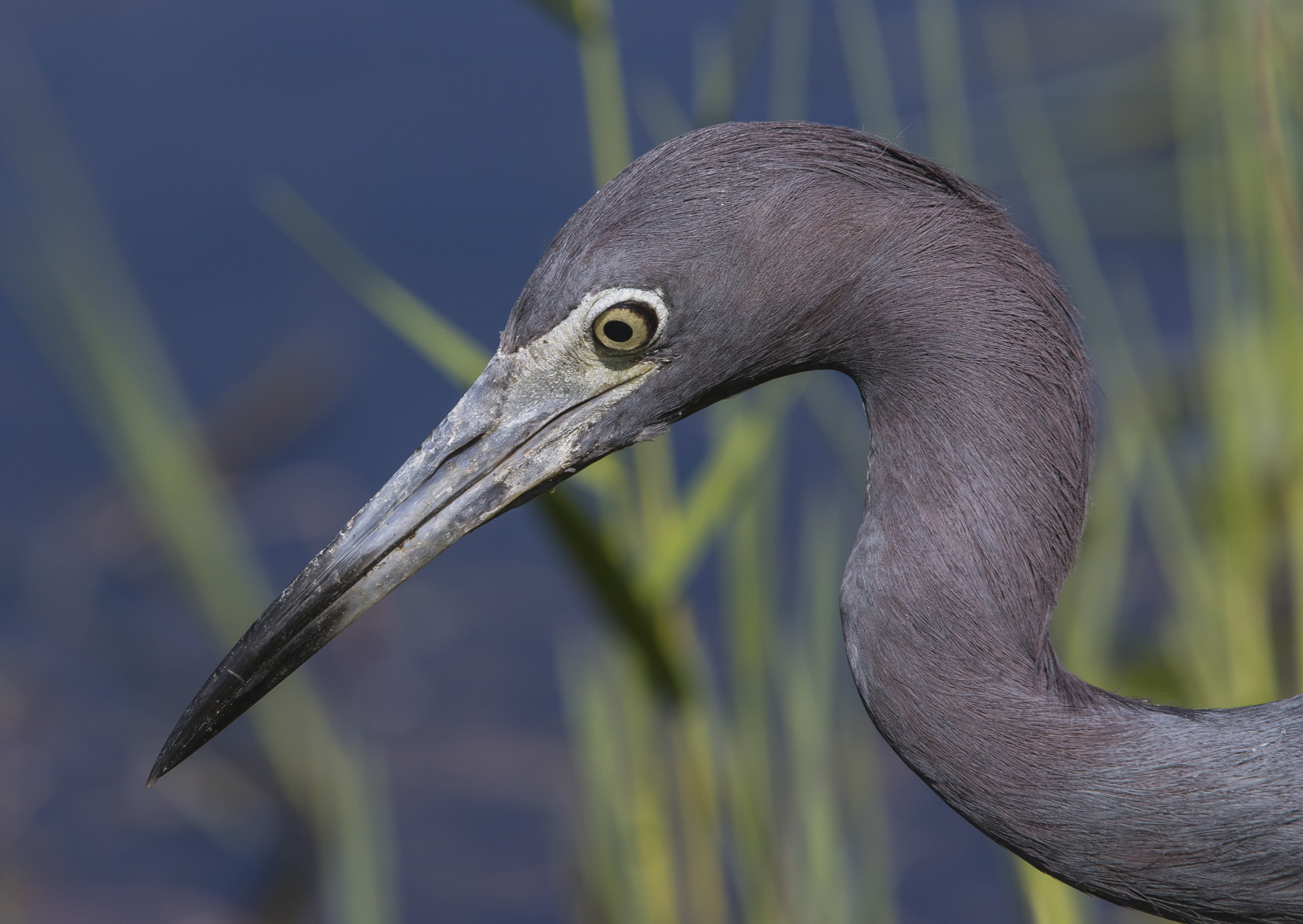
Little blue heron up close
Another must-see stop is Shark Valley. We arrived mid-morning and drove right in (there can be considerable wait times to get in on busy days – but you can drop your riders off and park along the main road outside the entrance and walk back in). There is a small visitor center, restrooms, a few picnic tables and a 15-mile paved trail (accessible by walking, bicycling, or taking a concession-operated tram tour) through the saw grass prairie. Along the trail is a canal that retains water even in the dry season, concentrating wildlife such as alligators and wading birds, for easy viewing. Even though this winter has been an unusually wet one, which has caused much of the wildlife to remain dispersed throughout the vast wetlands, there were still plenty of things to see as we walked a short distance along this easy path. A little blue heron hunted patiently within a few feet of the walkway, periodically snapping up tiny fish and gulping them down. Several species of warblers and other songbirds were seen and heard in the thickets along the canal (especially the ubiquitous white-eyed vireo).
Purple gallinule
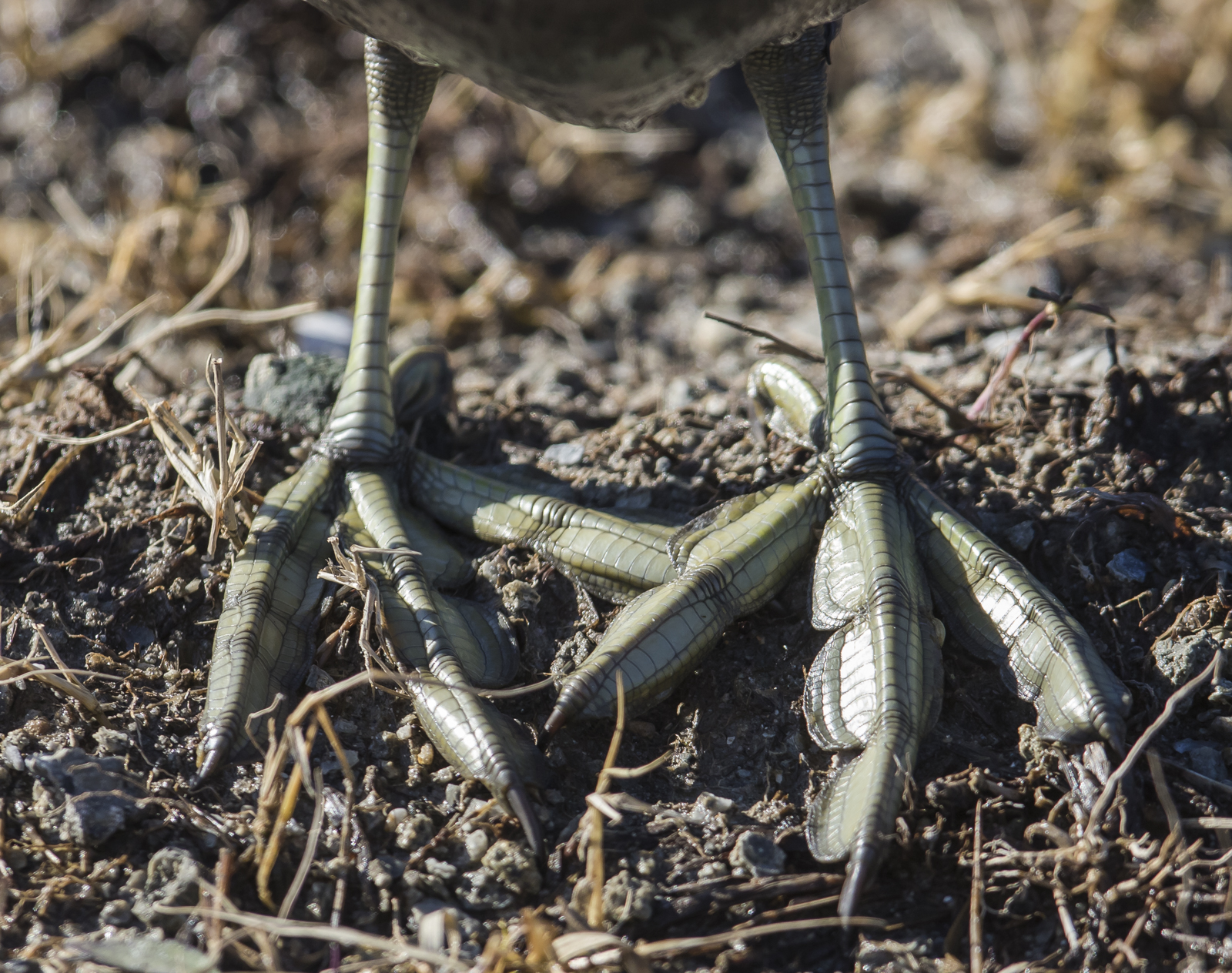
And we finally caught a glimpse of one of the “specialty birds” of this trail, a purple gallinule. These brightly-colored members of the rail family feed on a variety of plant material and invertebrates. Their enormous feet are useful for clinging to shrubbery and walking on floating vegetation such as lily pads.
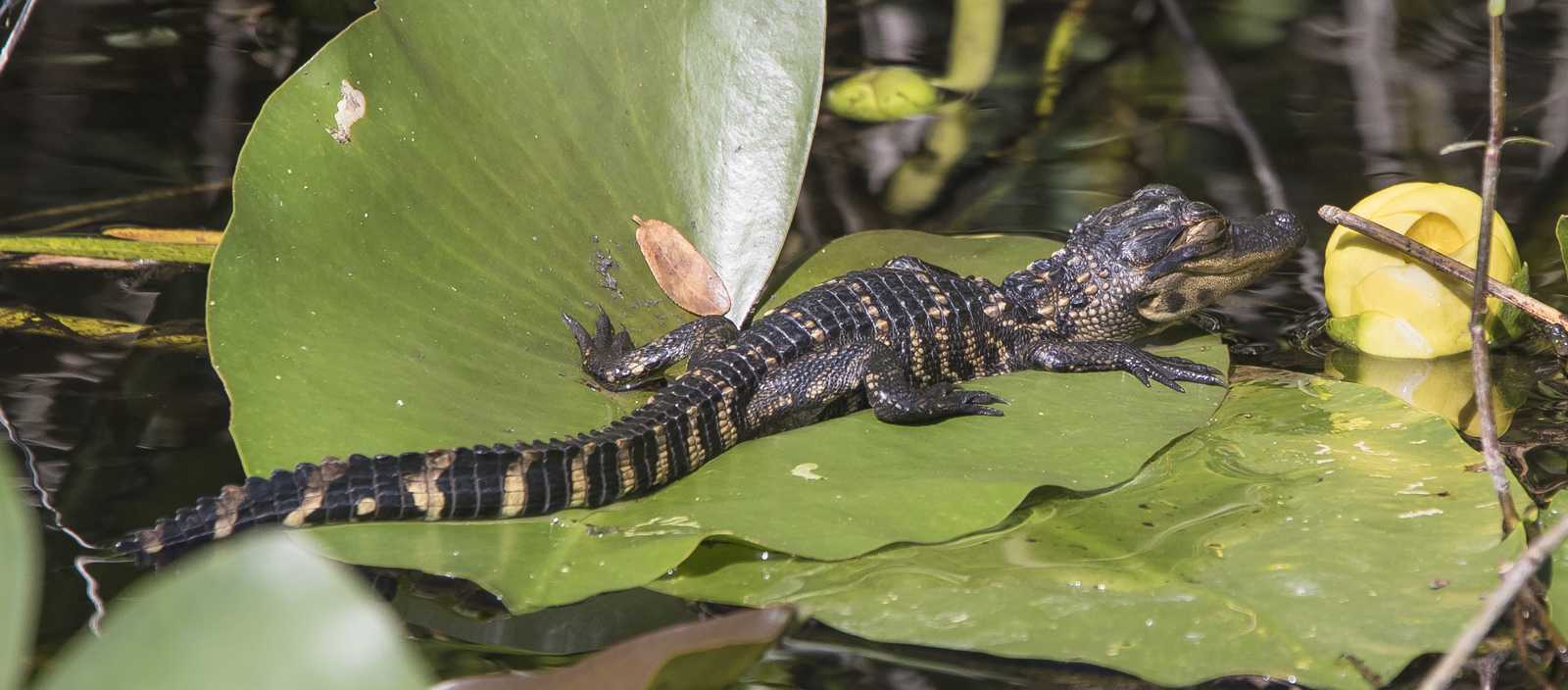
The first of many baby alligators we saw
Alligators were all along the canal, and we even had several baby alligators sunning themselves on lily pads. One walked across the pavement, as people stopped and wondered where the usually protective mother gator might be hiding and watching her brood. After a brief stay at Shark Valley, we headed out of the park and to our next destination, Big Cypress National Preserve. I feel like I only scratched the surface of the Everglades experience. It is the third largest national park in the continental United States at 1.5 million acres and is one that lies just outside the major metropolitan areas of Miami and South Florida, and the huge agricultural lands that provide food for countless Americans. Even though the park represents a large portion of land, the ecosystem is highly altered from its original condition. Roads and drainage canals have greatly reduced the flow of water from lands north to Lake Okeechobee, and agricultural chemicals are impacting the water quality. But, the Everglades still present a wild side of Florida that people need to experience. A visit to this park helps you understand why we must all continue to work together to protect out public lands and the incredible diversity of life that call them home.
While walking down by the intermittent stream in the woods this week, I caught a flash of movement out of the corner of my eye. I turned, but didn’t see anything at first. When I stepped in the direction of the flash, it happened again. This time I saw it – it was the quick escape leap of a tiny northern cricket frog, Acris crepitans.
Northern cricket frog (click photos to enlarge)
They are among our smallest vertebrates, with adults barely reaching 1.5 inches in body length. But they are great leapers for their size, jumping up to three feet when startled.
Cricket frogs blend in very well with their surroundings
Northern cricket frogs are widespread in the Eastern U.S., ranging from northeastern Mexico, up to Wisconsin, and east to the Atlantic states. There are actually two species of cricket frogs in North Carolina – the northern, which is mainly in the Piedmont, and the southern, more typically found in the Coastal counties. They are similar in appearance, both being small, cryptically colored frogs, with long, slender hind legs, and a warty appearance. Most have a distinctive darkened triangle pattern between the eyes, and a Y-shaped line extending down the back. Throughput their range, northern cricket frogs exhibit variation in color, with the dorsal stripe being either primarily gray, brown, reddish-brown, or green. The one above seems to be primarily brown with some hints of reddish-brown in some of the warts.
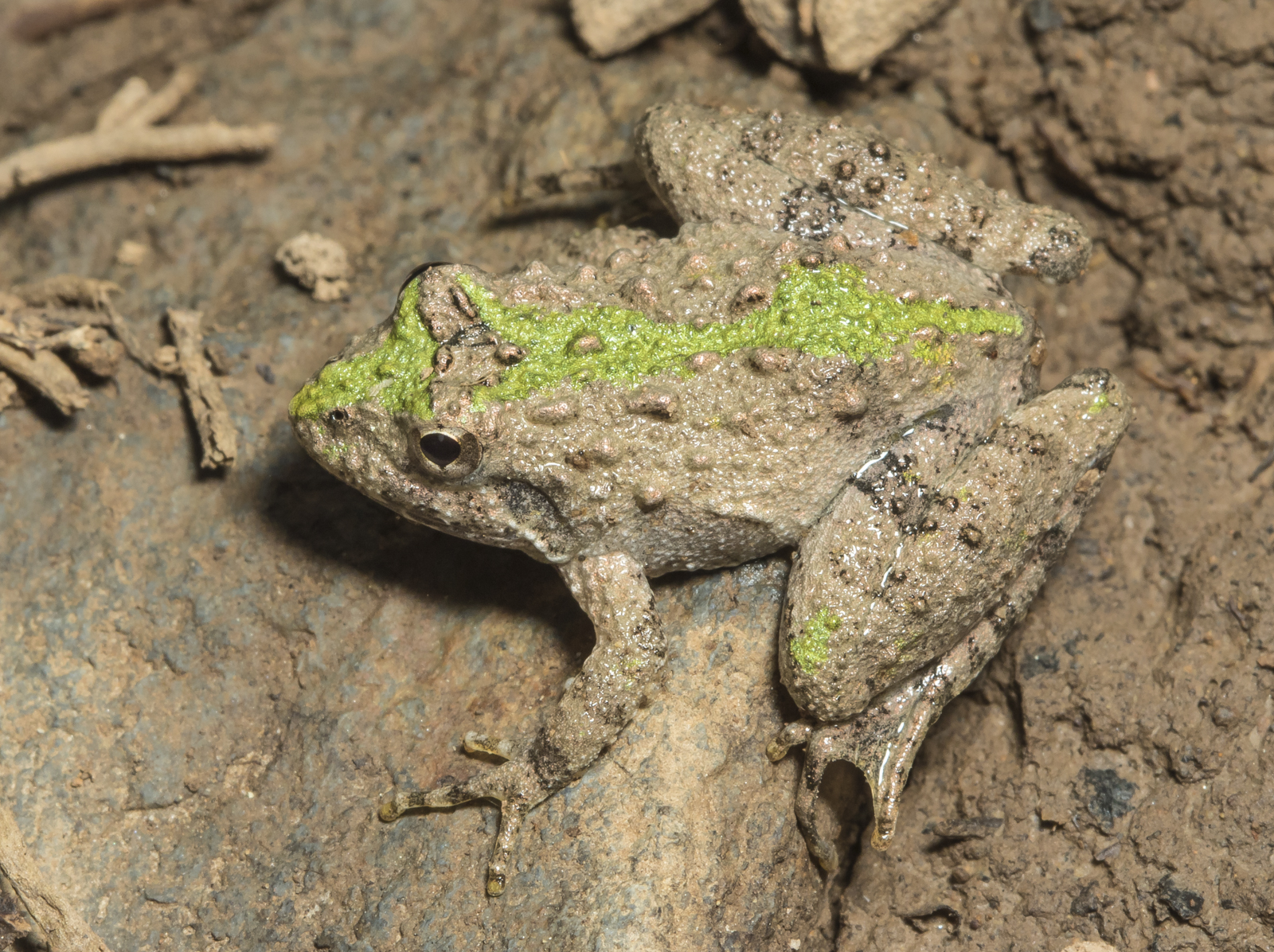
Another frog in these woods with a green color pattern
A few yards away, I came upon another cricket frog, this one with a noticeable green coloration in the dorsal Y-pattern. I looked up the topic of their color variation and stumbled on a host of scientific papers dealing with this phenomenon in cricket frogs, known as color polymorphism. Various theories have been proposed and tested throughout the range of this species. And they have come up with various reasons for the color differences: visual selection by predators directly determines color proportions (the theory being that those that blend in better with the local surroundings are better concealed and therefore survive better); another thought some color morphs correlated better with local substrate color but are more resistant to desiccation in certain habitat types; and yet another study disagreed and suggested natural selection may favor some behavioral characteristics associated with a particular morph.
Whatever the reason for their color, they are fun to watch
I finally found one Illinois study that did some comparisons with other data and concluded that different factors must operate throughout the species range to maintain this color polymorphism. The author states that chance may be a major factor in determining color morph proportions in localized populations. Perhaps the frogs know something about color variation that we just have not yet discovered. Whatever the reason, I always enjoy seeing one of these cryptic creatures leap and disappear into the background. And, I look forward to the start of their breeding season, accompanied by their clicking calls, in a few weeks.
Come with me into the woods where spring is advancing, as it does, no matter what, not being singular or particular, but one of the forever gifts, and certainly visible.
~Mary Oliver
I have been busy these past couple of weeks, busier than I like, especially for this time of year. It is the time of year when change happens quickly.
Giant chickweed in flower (click photos to enlarge)
I walk around the yard with coffee mug in hand, and I see new things appearing everywhere, as if by magic. We have a name for this magic – we call it Spring.
Toothwort is a host plant for falcate orangetip butterflies
Spring is marked by us woods-watchers as a season of firsts – the first spring ephemeral wildflowers, the first snake of the season (a garter snake this year), the first opening of a buckeye bud, and the first falcate orangetip butterfly. All of these, and more, happened this week in these woods.
The tiny yellow flowers of spicebush are among the first to appear in spring
The swollen buds of the yellow spicebush flowers (Lindera benzoin) finally burst open this week. They are small, and could go almost unnoticed, except that they are an abundant splatter of color on the otherwise bare twigs in a few spots in the yard.
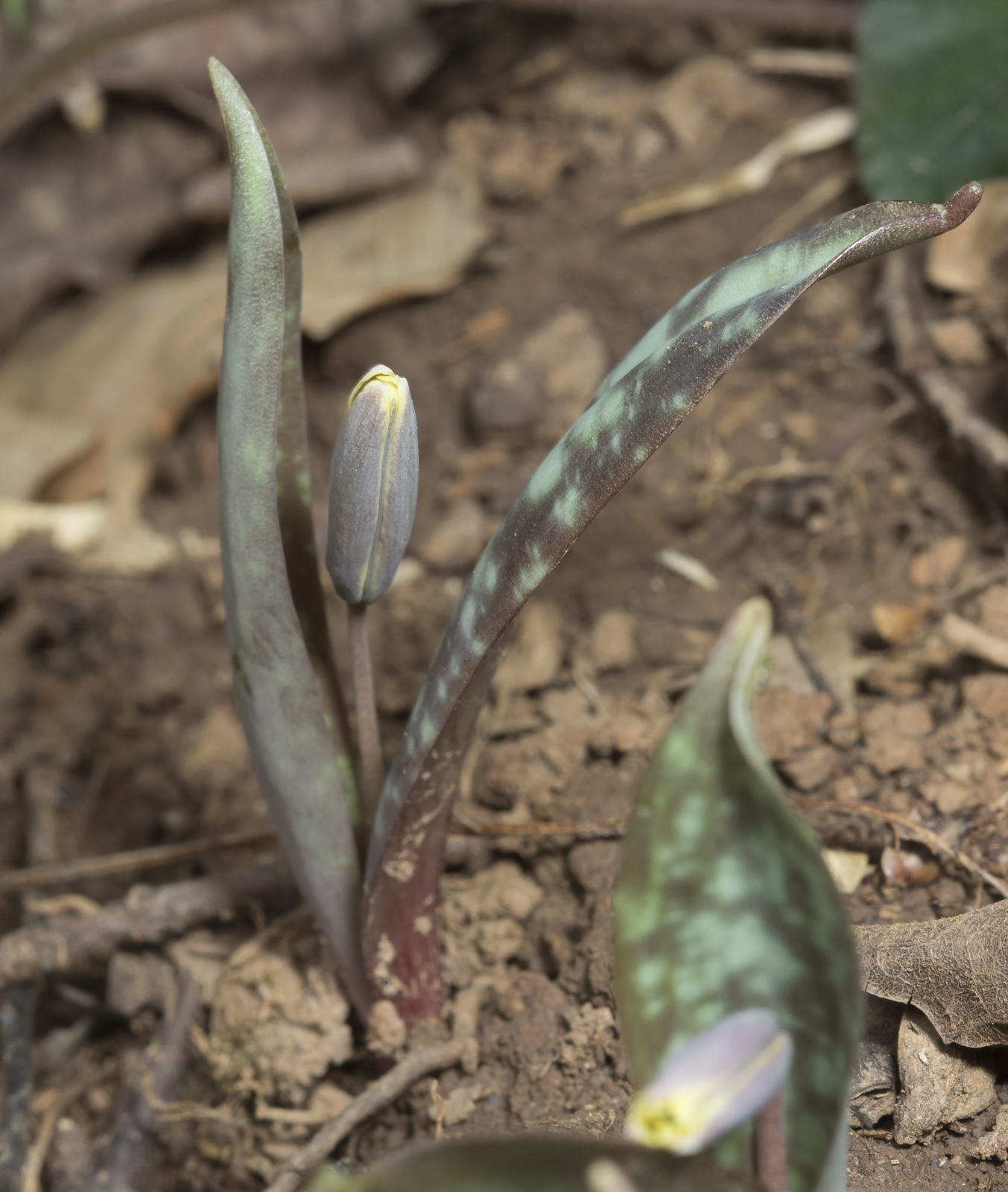
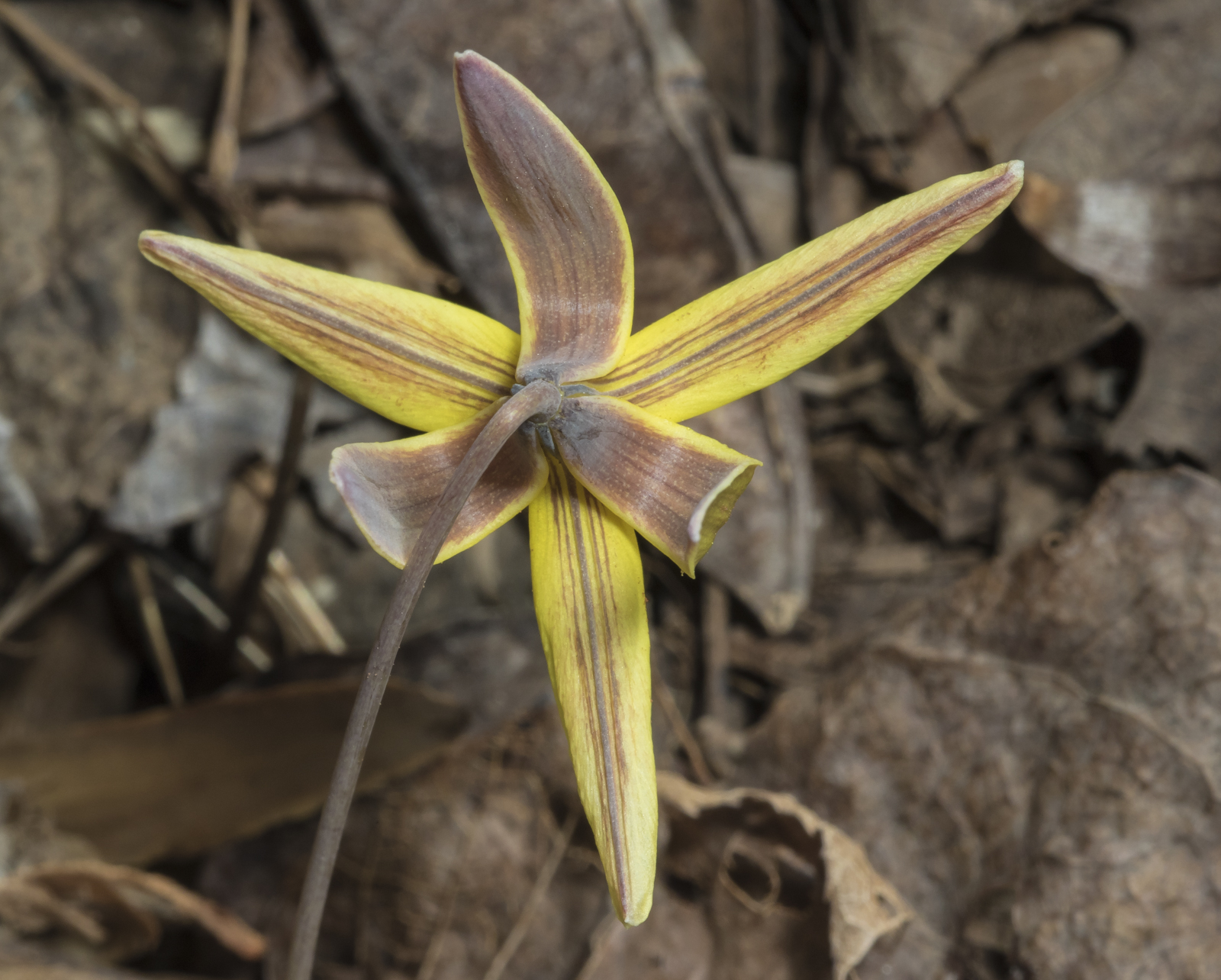
Trout lily buds are popping up throughout our shade gardens
One of my favorite spring wildflowers is the trout lily, Erythronium americanum. The mottled leaves are said to resemble the speckled skin of a trout, hence this common name. It also goes by a host of other names throughout its range including dogtooth violet (by the way, it is not a violet), fawn lily, and adder’s tongue.
Trout lilies are equally beautiful from above
This delicate beauty spends most of the year (40+ weeks) unseen by us, as just a bulb underground. If the plant is too young, or starved of enough nutrients, the bulb produces only one leaf, and no flower. But when things are going well for the plant, the bulb produces two leaves and a single nodding flower.
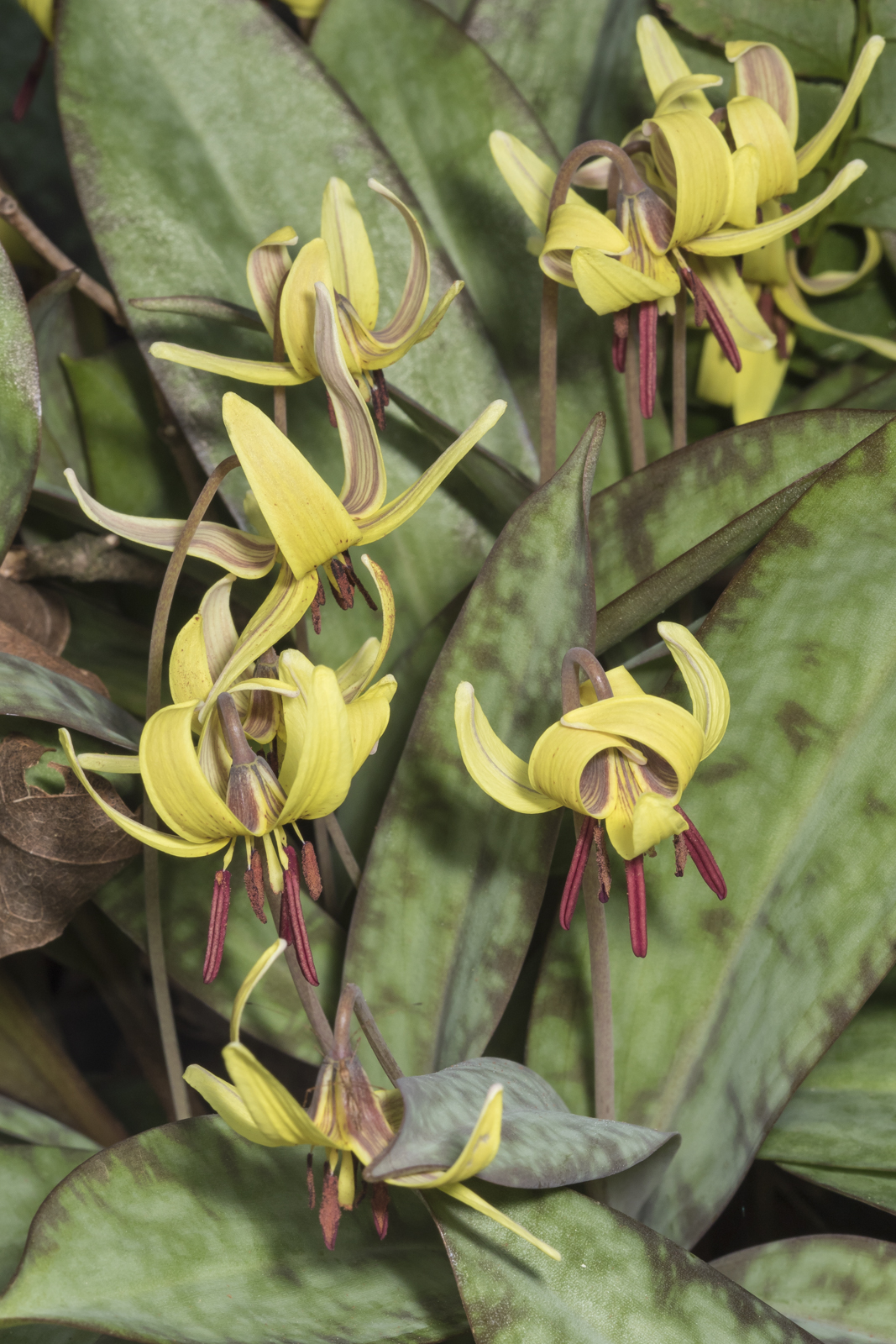
Dense clump of trout lily flowers
Trout lilies can form dense stands with large clumps of flowers and their arrival is surely one of the most anticipated floral displays of any woodland spring.
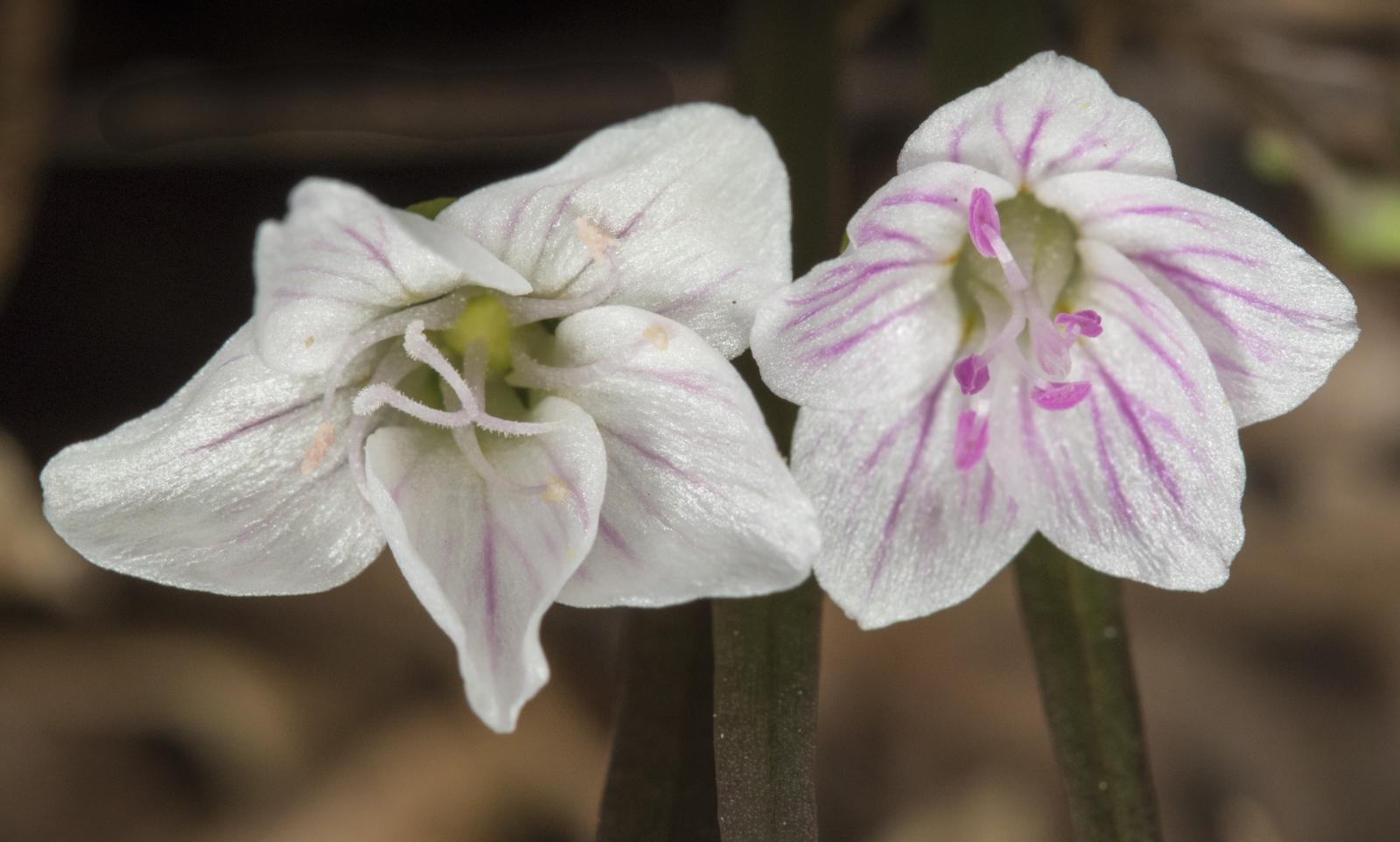
Spring beauty flowers (photo taken in late afternoon when flowers are starting to close for the night)
Blooming in concert with the trout lilies is another common spring ephemeral, the aptly named spring beauty, Claytonia virginica. Spring beauties can vary in color from a delicate white with faint lines to flowers having bold pink stripes on each petal. Spring beauty produces nectar and pollen to attract pollinators such as various flies and bees (especially the spring beauty bee, a pollen-specialist on spring beauty flowers). This flower is protandrous, meaning the flowers separate the timing of when they behave as a male flower (with pollen available) and when they act as a female flower (by making the stigma receptive to pollen). Each flower acts as a male for approximately one day. Then, the flower will act as a female for one day or more (generally up to a week). This helps ensure cross pollination by reducing the chances that the female plant parts receive pollen from the same flower. In the photo above, the flower on the left is older than the flower on the right. Note how the anthers have started to wither and are laying down on the petals. The anthers in the flower on the right are upright, and bright pink with pollen, and the three-part stigma is still fused together.
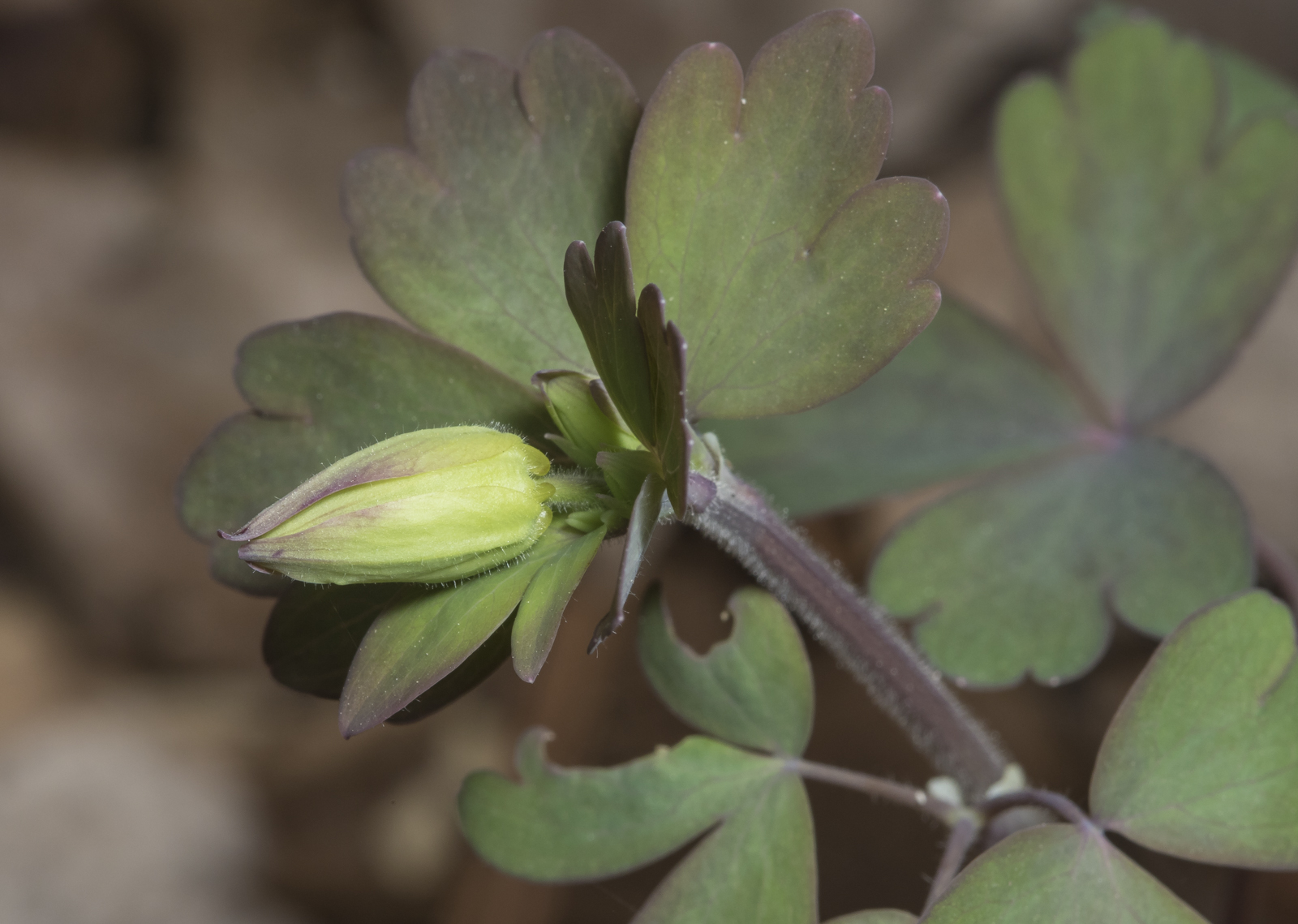
Windflower bud about ready to open
While these flowers are starting their short-lived blooming period, a host of other plants are waiting in line, ready to add their colors to the annual procession of a woodland spring. These next few weeks will see a steady stream of new species carrying their banners through the awakening woods. It certainly is one of the cherished “forever gifts”, and all we need to do to receive it is to take a moment, slow down, and look in the woods around us.
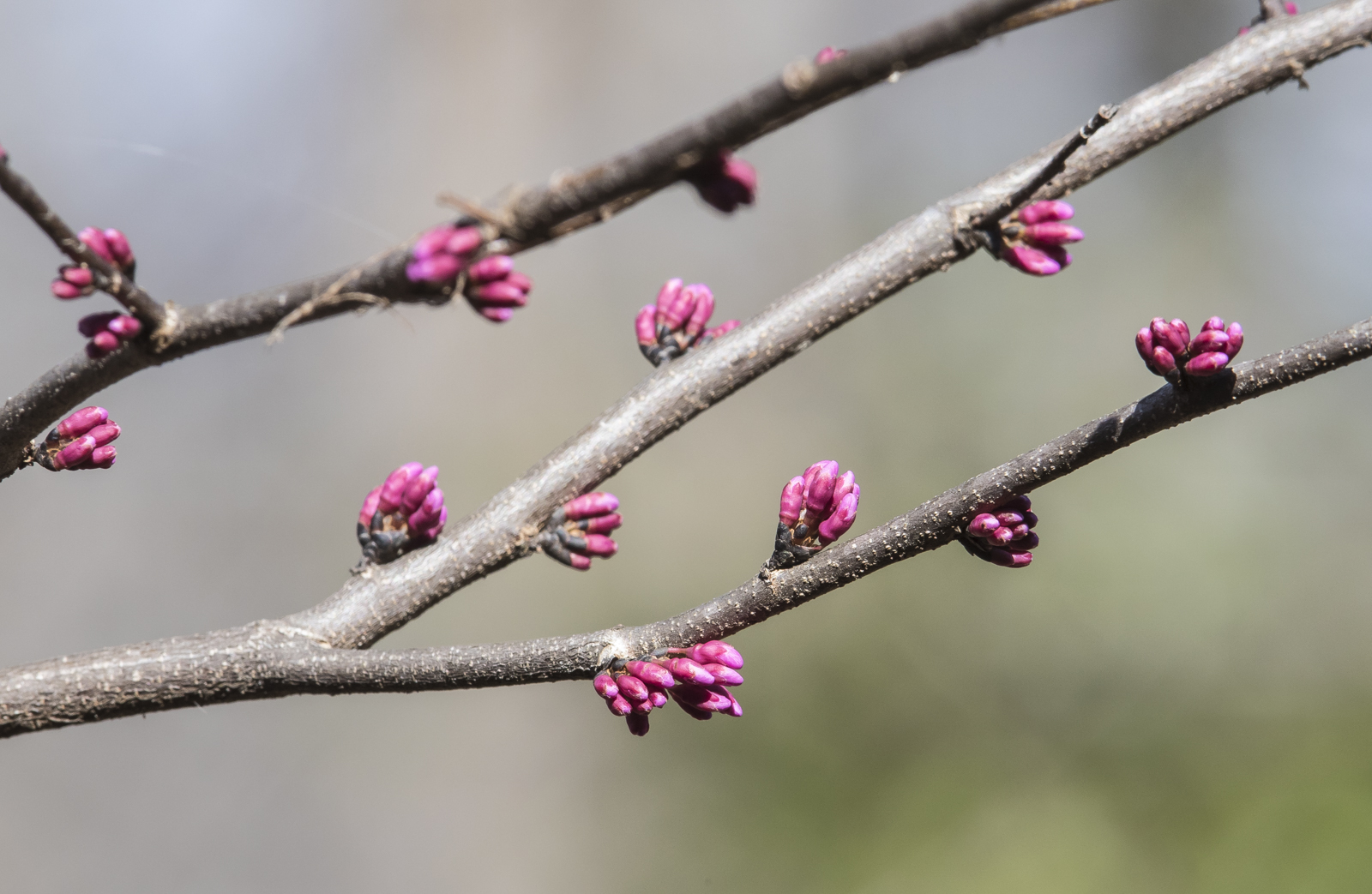
Redbud trees will be flowering in the next few days
Over the years, I have been privileged to lead thousands of people to some incredible natural areas in our state and beyond. We often take time to reflect on our experiences and I have seen and heard some wonderful stories about how a place or an event has affected someone. I have had people come to tears over special moments like hearing wolves howl in the Lamar Valley of Yellowstone or seeing their first black bear in the wild at Pungo. And I know that many of the educators I worked with over my career have gone to do wonderful things with their students as a result of something they experienced on a trip to an outstanding natural area.
Tundra swans at Pungo (click photos to enlarge)
But one of my most memorable of these moments came many years ago, and it involved my favorite part of North Carolina – the Pungo Unit of Pocosin Lakes National Wildlife Refuge (NWR). I had a chance to reminisce about it over dinner with my friend, Rick, after an outing this past winter. I first met Rick when I introduced him to the magic of Pungo over 15 years ago.
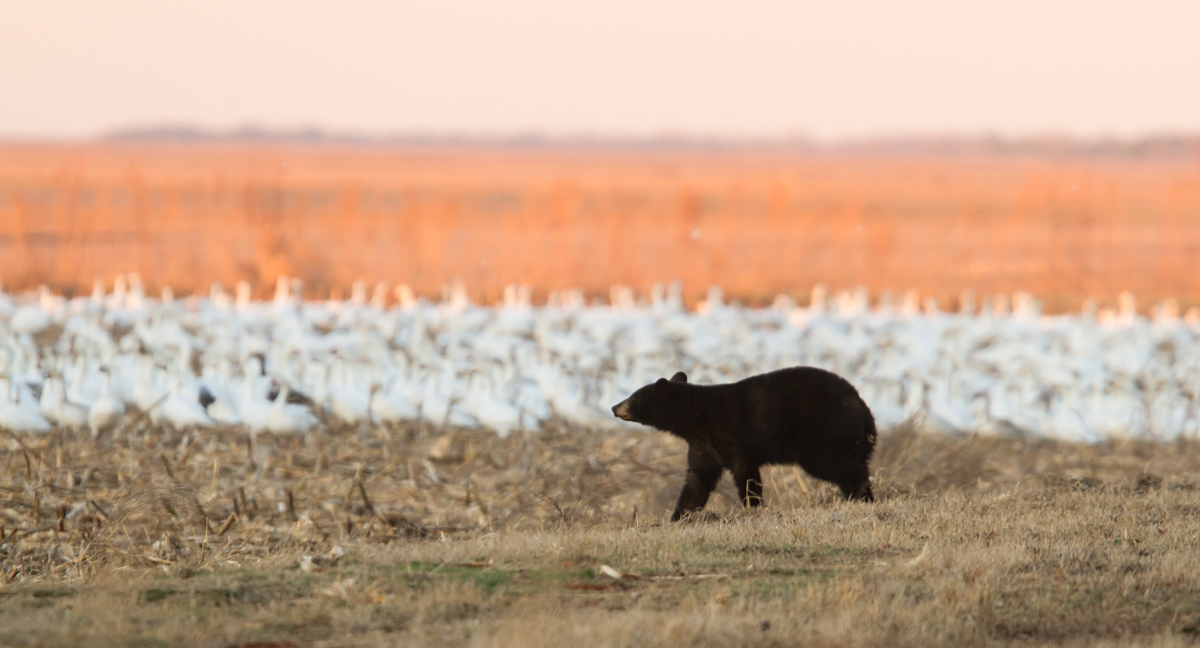
Black bear with snow geese
I was with some friends at Mattamuskeet NWR when a car pulled up and a teacher that had been on several museum workshops jumped out and said hello. She and her friends (including Rick) were down in the area looking for birds and wondered if we had seen anything interesting. We quickly pointed out the black-crowned night herons roosting in trees near the lodge. They were excited at the find, so I mentioned we were headed over to Pungo to hopefully see some snow geese, swans, and whatever else we might encounter. They were not familiar with the place, but they agreed to follow us over.
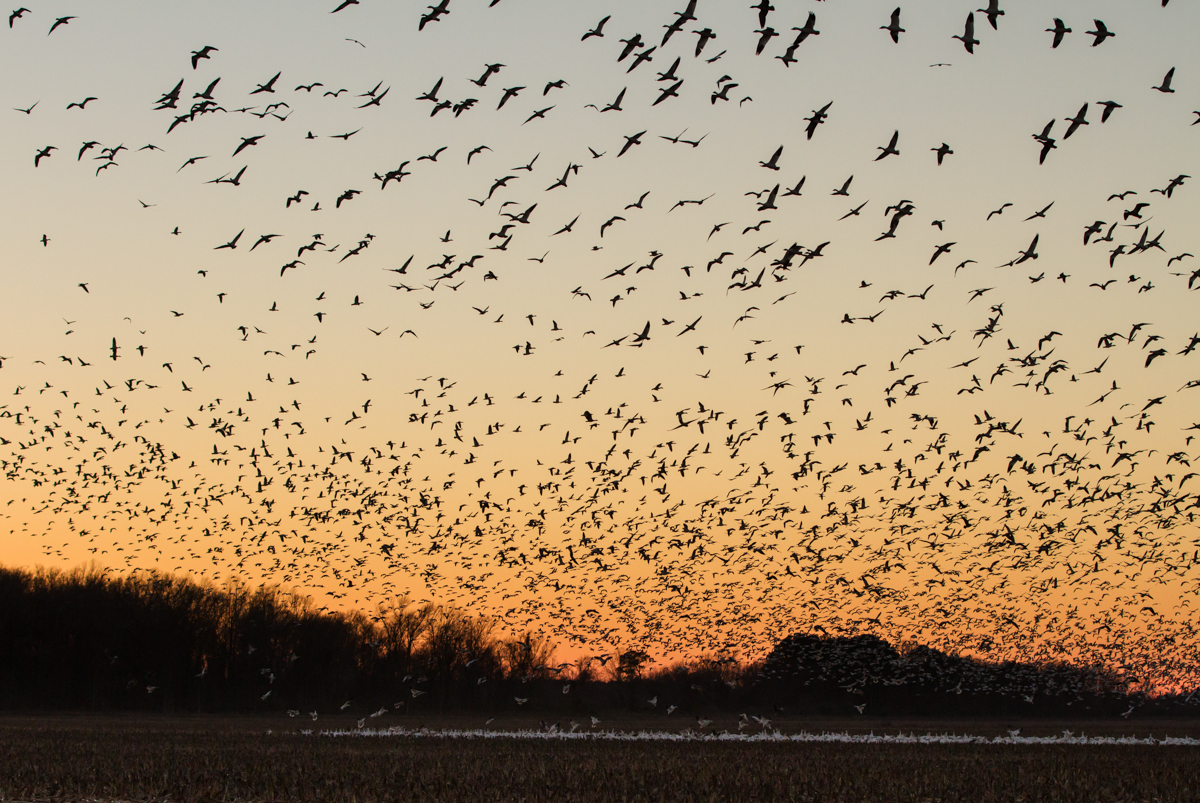
Snow geese at sunset
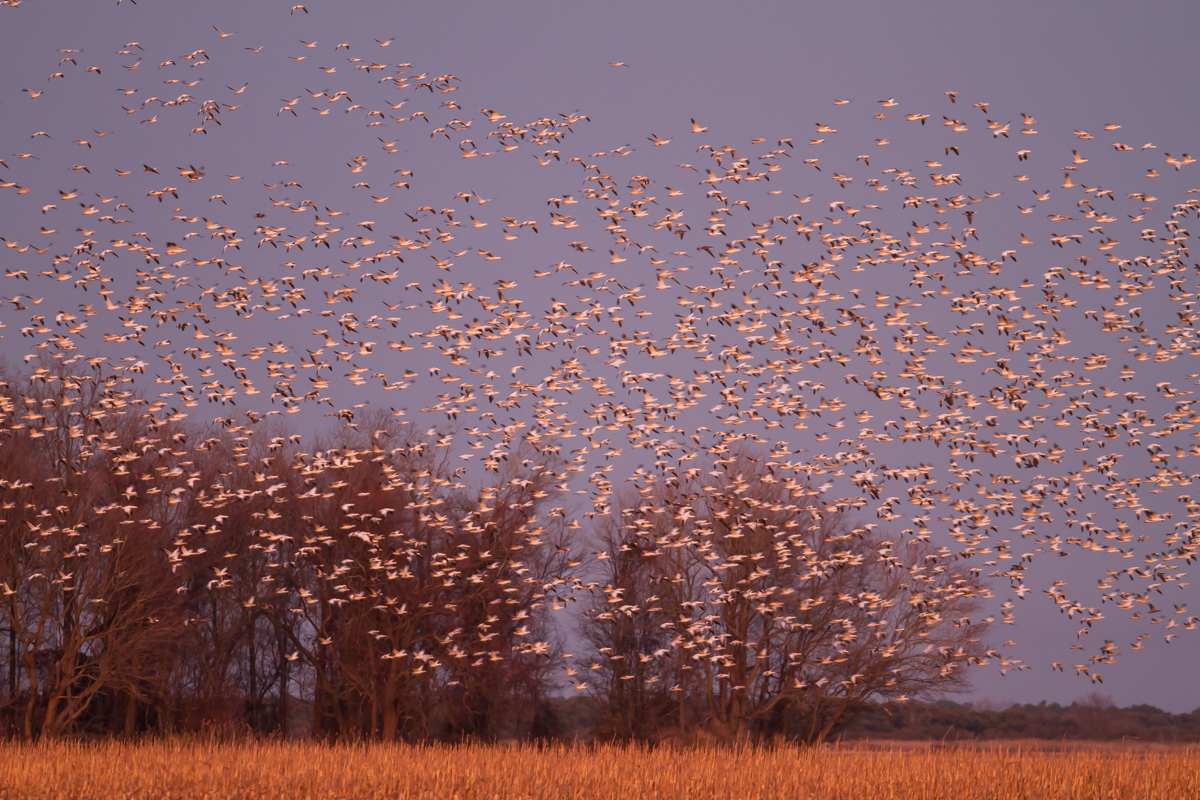
When we pulled up to the gate at “Bear Road” we could see and hear thousands of swans and snow geese flying to and from the lake, landing in the fields to feed on the corn. It was only then I realized the driver of the other vehicle, Rick, got out into a wheelchair. The usually muddy road was frozen, so he was able to go down the road with some help from his friend, Ken. Everyone was in awe of the spectacle. It was about as good as Pungo gets. A couple of bald eagles flew out across the field sending the flock of snow geese into the air in a raucous swirl of wings. A few minutes later, two black bears wandered out from the nearby trees. We watched as the setting sun lit the sky in fiery colors and thousands of birds lifted off to return to the safety of the lake for the night. We all knew we had witnessed something special, something magical.
Tundra swans flying back to Pungo Lake
I received an email from Rick a few days later, thanking me for the opportunity to witness the extraordinary spectacle that is Pungo. It would be the first of many emails I received from him over the coming years. Each winter, Rick would touch base about the birds at the refuges, asking for tips on the best places to go to see the huge flocks, and letting me know he was planning another trip down that way. Then came a very special email in 2006. He was sending me tickets to a premier of an orchestra piece that his friend, Ken, had written. It was music inspired by that first trip to Pungo and the spectacle of the birds. The piece was entitled, The Swans of Pungo Lake. I was blown away. I had no idea that Rick’s friend, Ken Frazelle, is a composer. Ken was commissioned (along with a few other North Carolina composers) to create musical “post cards” about the state as part of the 75th anniversary season of the North Carolina Symphony. Ken chose the wilds of Pungo and the thousands of birds that winter there as his post card. Needless to say, it was a privilege to attend the premier. Take a moment and listen…hear the wing beats, the energy of so many birds as they communicate and take flight.
The spectacle that is Pungo
I am happy that Rick and I have stayed in touch in the years since. It was a real pleasure to spend an afternoon with he and another of his friends a couple of months ago, experiencing yet another of the magical moments that Pungo can offer. At dinner that night, we remembered that first trip, and talked about the power of the place, the majesty of the spectacle of the swans and snow geese, the sounds, and the peace that being in such a place brings to those lucky enough to spend time there. It reminded me once again why wild places are valuable, why our public lands should be cherished and protected. They are places where we can truly grasp the grandeur of our planet, and perhaps come to understand our place in it, and see why what we do, what we conserve, is so important for us all. And it reminded me that sharing a special place, or an experience in nature, can sometimes reap benefits far beyond what you can imagine.
I believe the world is incomprehensibly beautiful — an endless prospect of magic and wonder.
~Ansel Adams
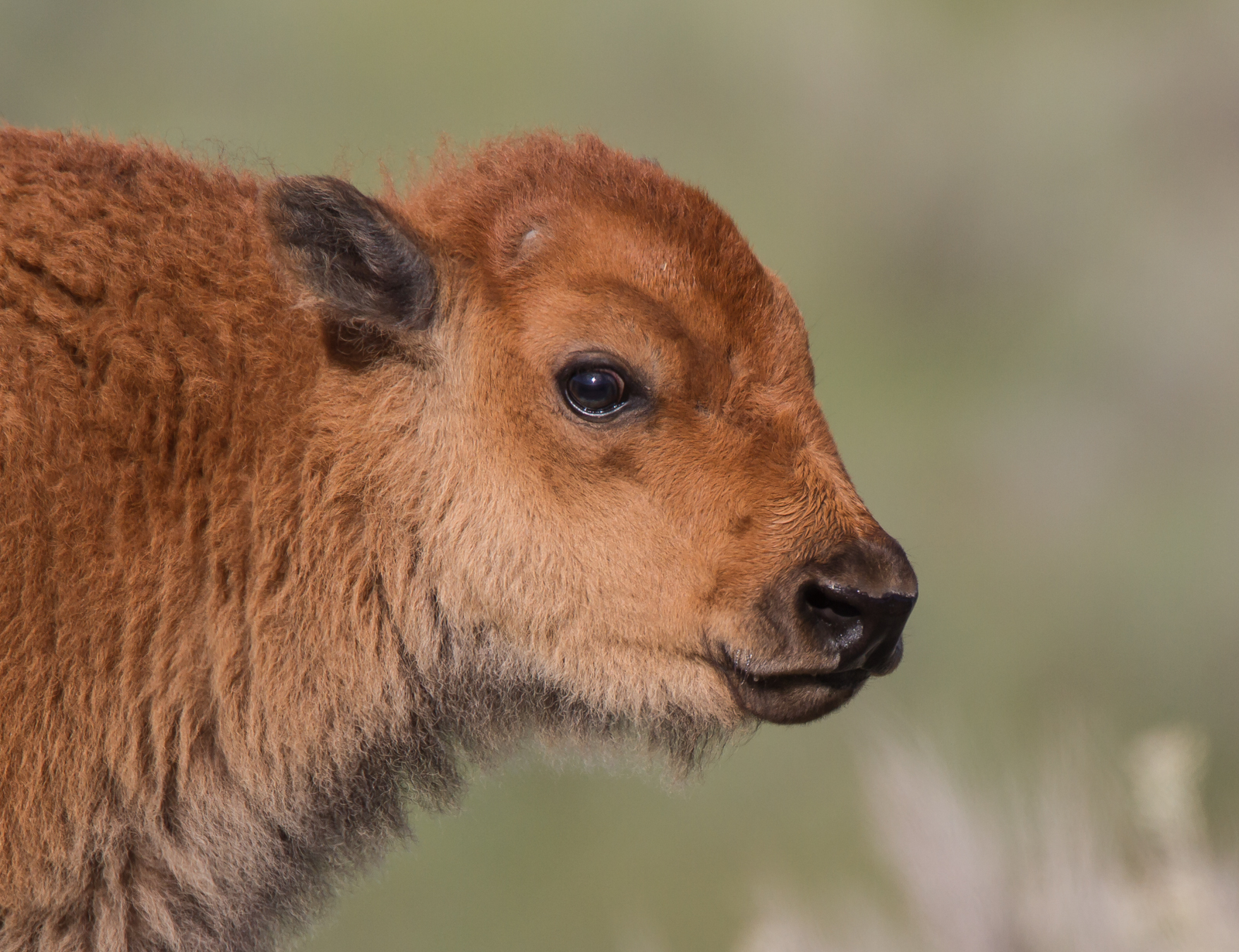
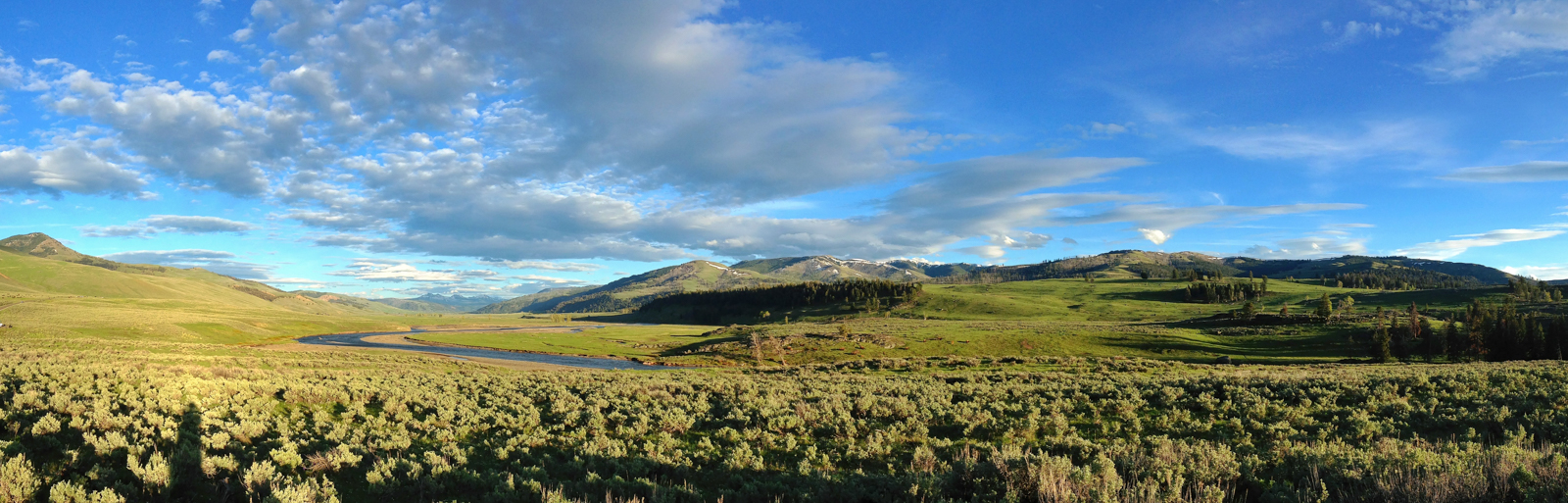
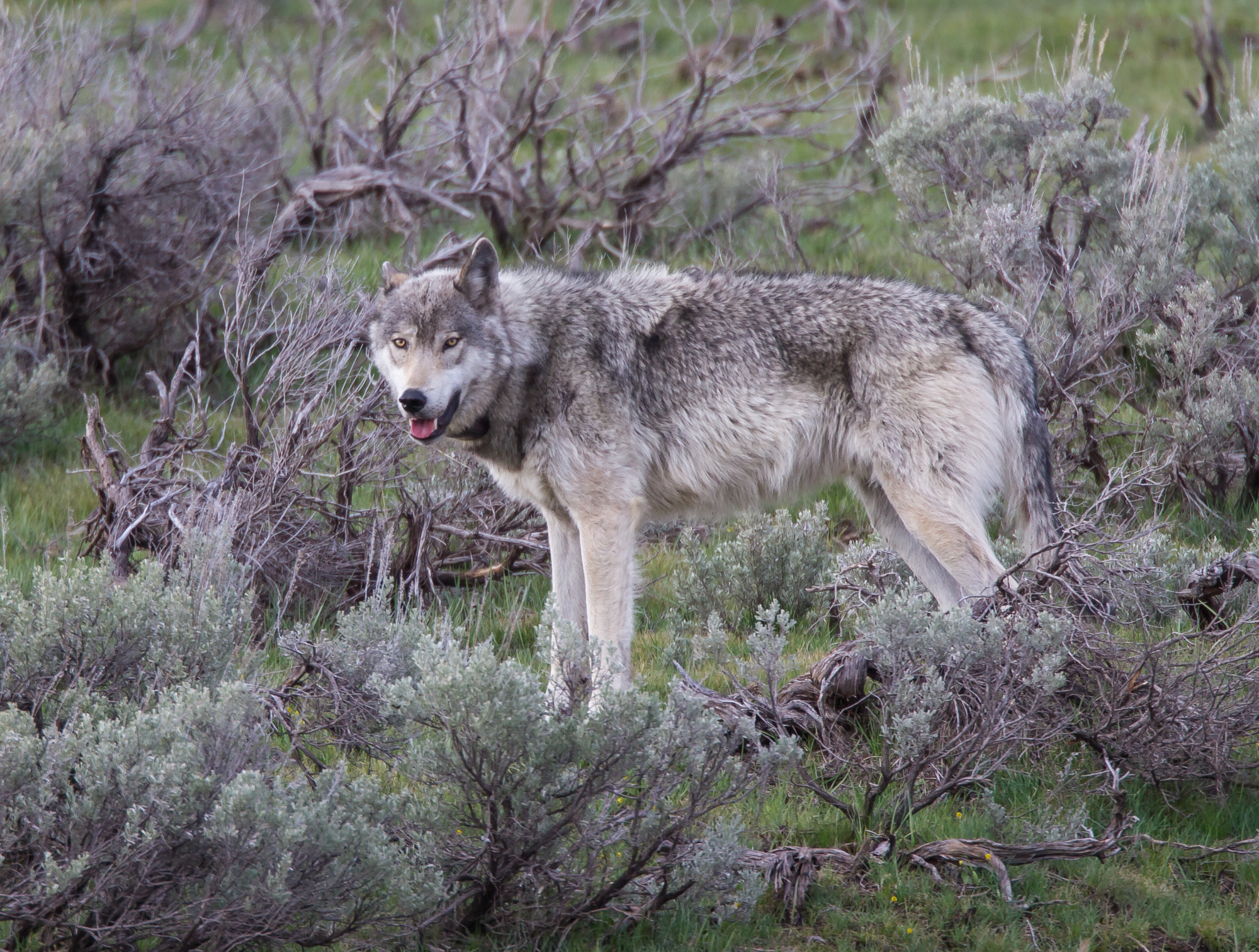
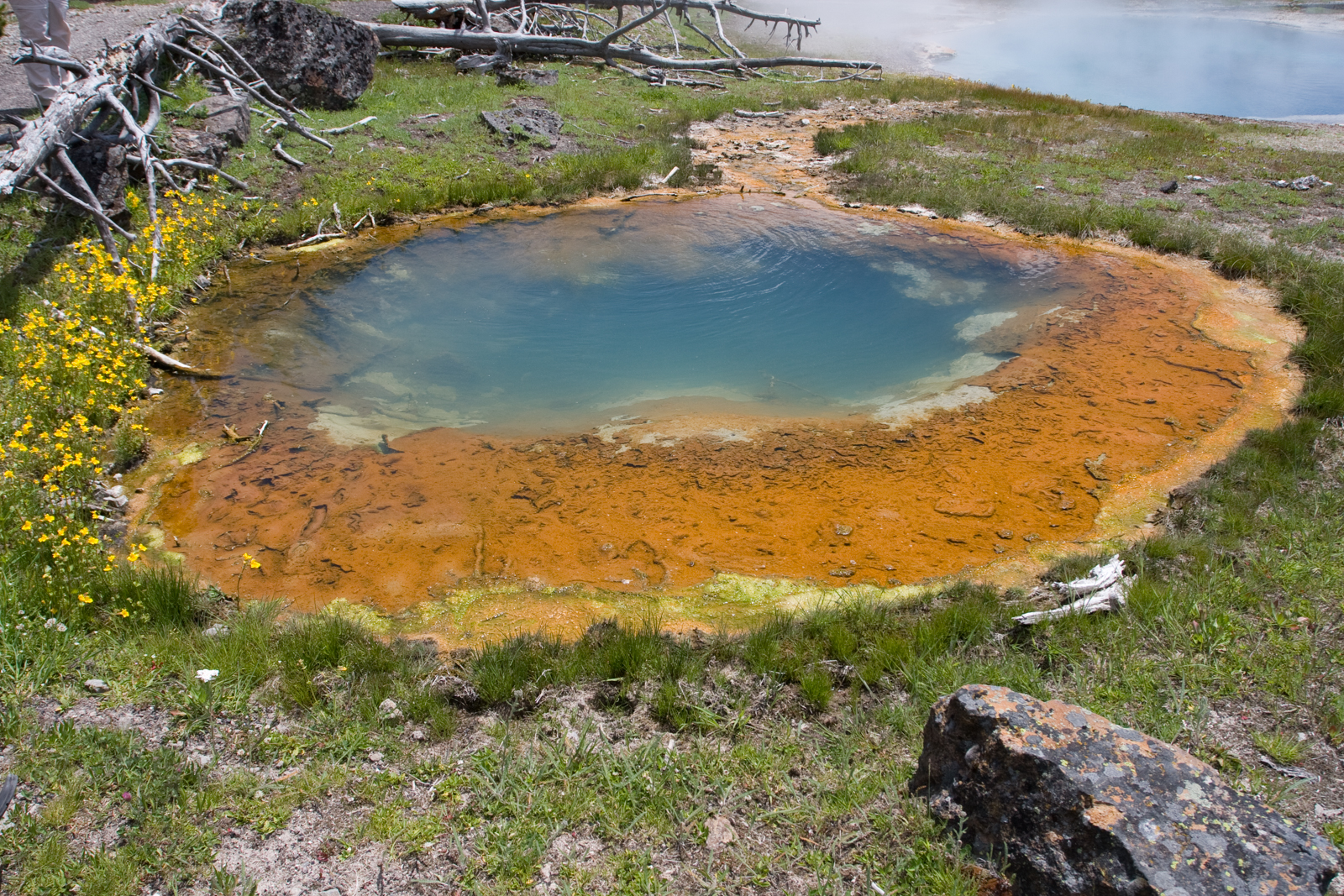
Join me, June 2-9, 2016, for an unforgettable experience in an incomprehensibly beautiful place – the world’s first national park, Yellowstone! This year marks 100 years since the creation of the National Park Service, and there is no better way to celebrate than by visiting Yellowstone. We will spend our days exploring Yellowstone’s unique thermal areas, beautiful landscapes, and wildlife-rich valleys. I offer small group (4 to 6 participants) field experiences that take you beyond the typical roadside views of this incredible park. Visit my Trips page for more information and to request a registration form. Space is limited. Previous blogs from Yellowstone trips can give you an idea of the wonder and beauty you will experience.
Here are a few images from past trips to entice you.
Steam at Grand Geyser (click photos to enlarge)Baby bison will be abundant in early JuneThe beautiful Lamar ValleyGray wolf in Lamar ValleyMountain bluebirdHot spring
By thus coordinating the management of the refuge with the natural cycles of plant and animal life, the Fish and Wildlife Service has developed Mattamuskeet to the point where it now supports much larger flocks of waterfowl than came to this refuge in former years.
~Rachel Carson, on a discussion of managing the lake for a natural cycle of draw-down in spring and summer, and higher water in fall and winter; in Mattamuskeet: A National Wildlife Refuge, 1947
I had a meeting last week in Greenville, so I decided to head down a day early and meander around Mattamuskeet. I was hoping for another look at the least bittern I photographed last week, but was up for anything that this treasure trove of wildlife might offer. The weather cooperated (for a change this winter), as did much of the wildlife (unfortunately, not the least bittern).
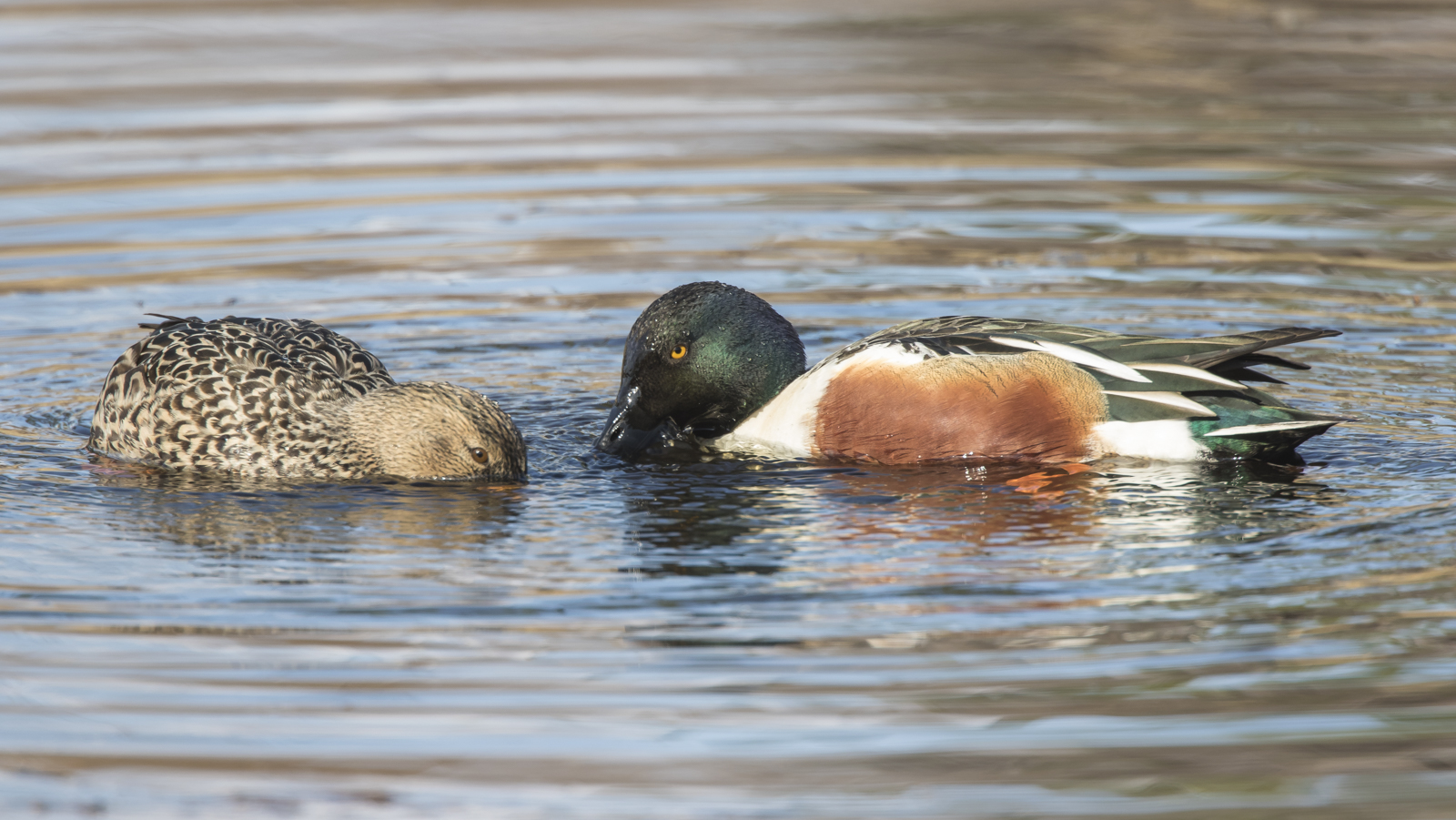
Pair of northern shovelers feeding (click photos to enlarge)
Now that hunting season is over, the ducks and other birds seem a little more relaxed, and approaching them is easier than a few weeks ago. There were several cooperative ducks along Wildlife Drive, including a couple of of pair of northern shovelers in good afternoon light.
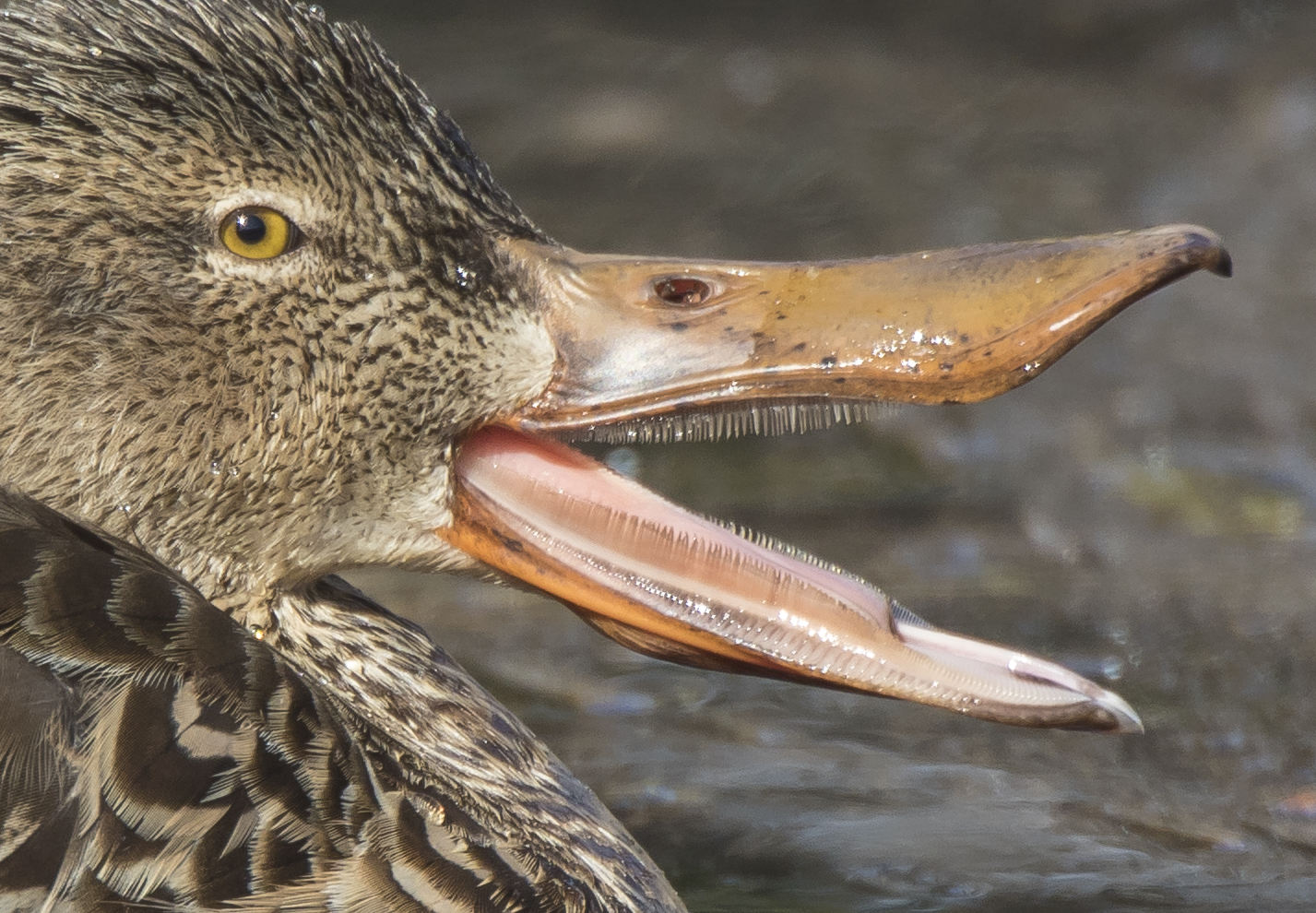
Close up of bill of northern shoveler showing lamellae
Shovelers are aptly named in that they have a spade-like bill, unlike any other duck. A unique feature of this spoon-shaped beak is how the edges are lined with fine, comb-like projections (called lamellae). The shovelers use them to strain out tiny food particles as they ingest water and muddy debris. The female shoveler above kindly opened wide for a nice close up of the “teeth of her comb”.
Another strange feeding behavior of shovelers is their spinning in tight circles (sometimes called called pin-wheeling or spin-feeding). This apparently helps pull fine particulate material off the bottom, concentrating it, and making it more available for ingestion.
The quick video clip above shows the scene that was being repeated by many northern shovelers as they dizzily dined.
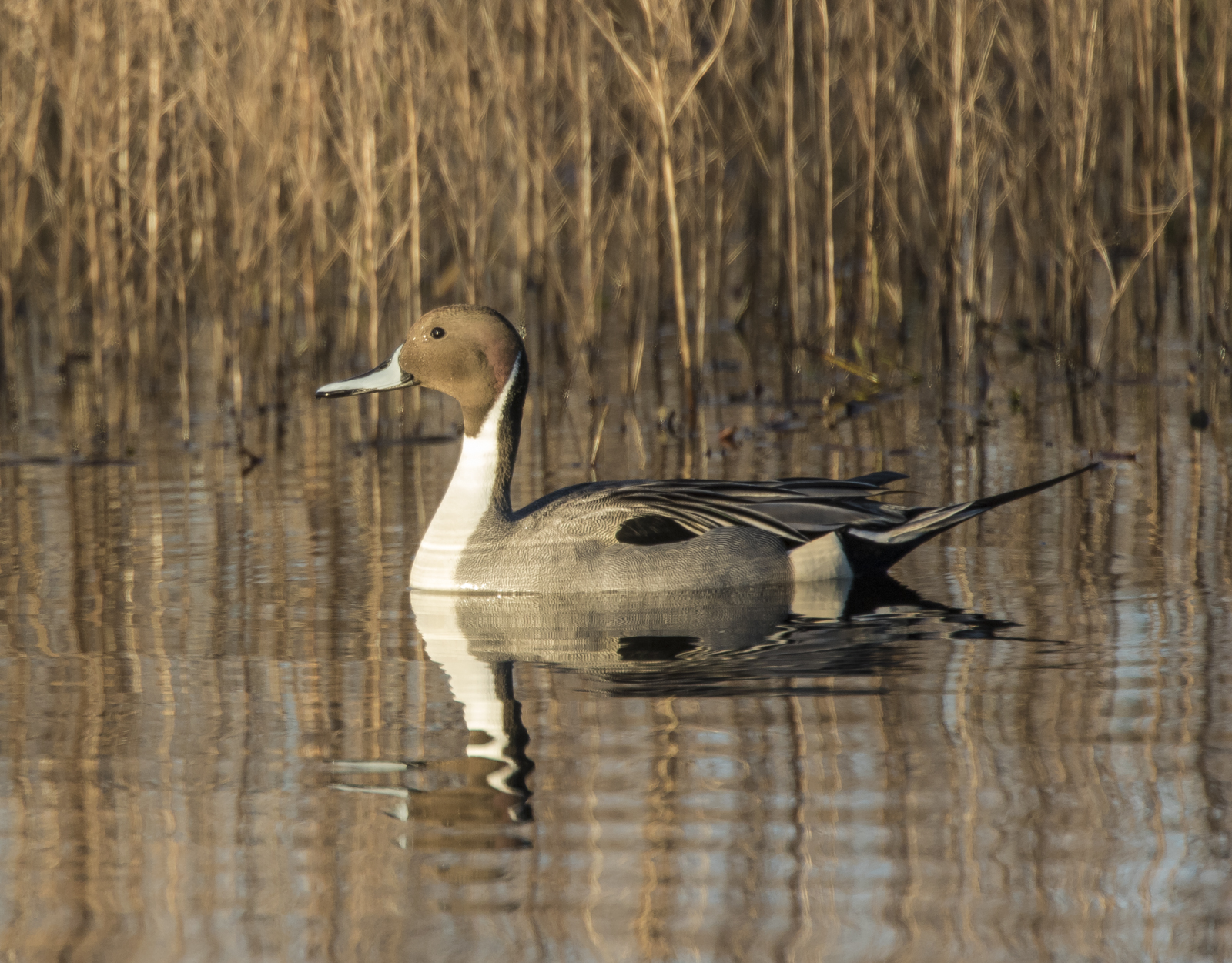
Blue-winged teal drakeNorthern pintail drakeTundra swan feeding in the marsh
Other common species included Canada geese, northern pintails, blue-winged teal, and tundra swans. I did manage to spot a couple of American bitterns, but they sulked back into the grasses before I could get a photo.
White-tailed deer in marsh
White-tailed deer were also abundant throughout the afternoon. Most were along the grassy canal banks on Wildlife Drive, but there was a small group wading out into the marsh to eat aquatic plants.
Turkey vulture with wings spread
Toward sunset, I drove over to check the trees near the lodge for vultures and egrets coming in for their evening roost. The usual vulture snag had about ten turkey vultures perched in the last light of the day. Several were in the ominous-looking spread-wing posture. Turns out this has a name – the horaltic pose. It probably serves multiple functions – to dry the wings, increase surface area exposed to the sun for warming the body, and exposing to sunlight the microbes that might have been picked up while feeding on carcasses, which may help kill potentially harmful bacteria.
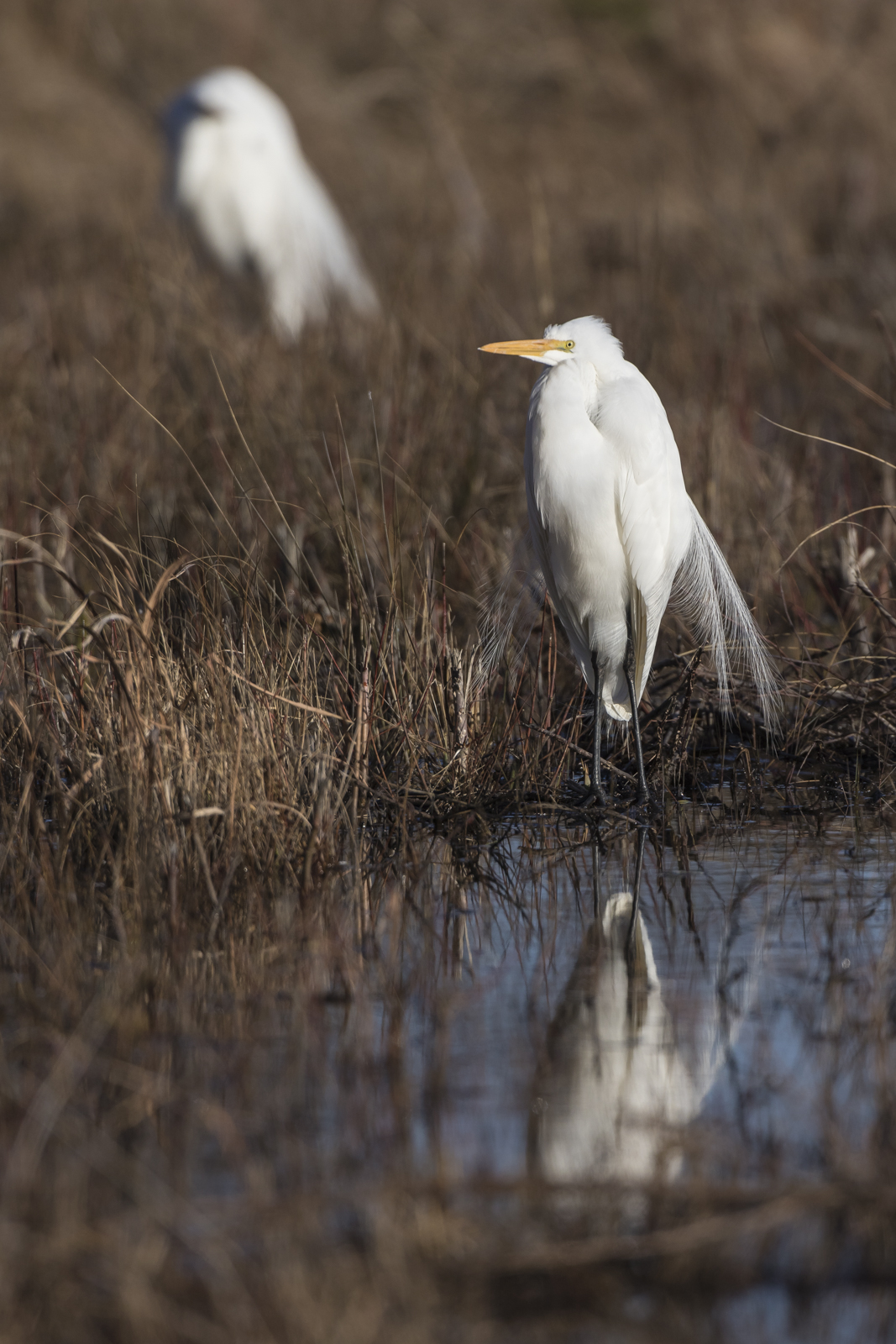
Great egrets in marsh earlier in the day
Much of the day I saw great egrets feeding and resting out in the marsh grass. But, starting about 5 pm, they begin heading to roost sites. Large numbers sometimes roost in the trees across the canal from the lodge, and it looked like that was going to happen again.
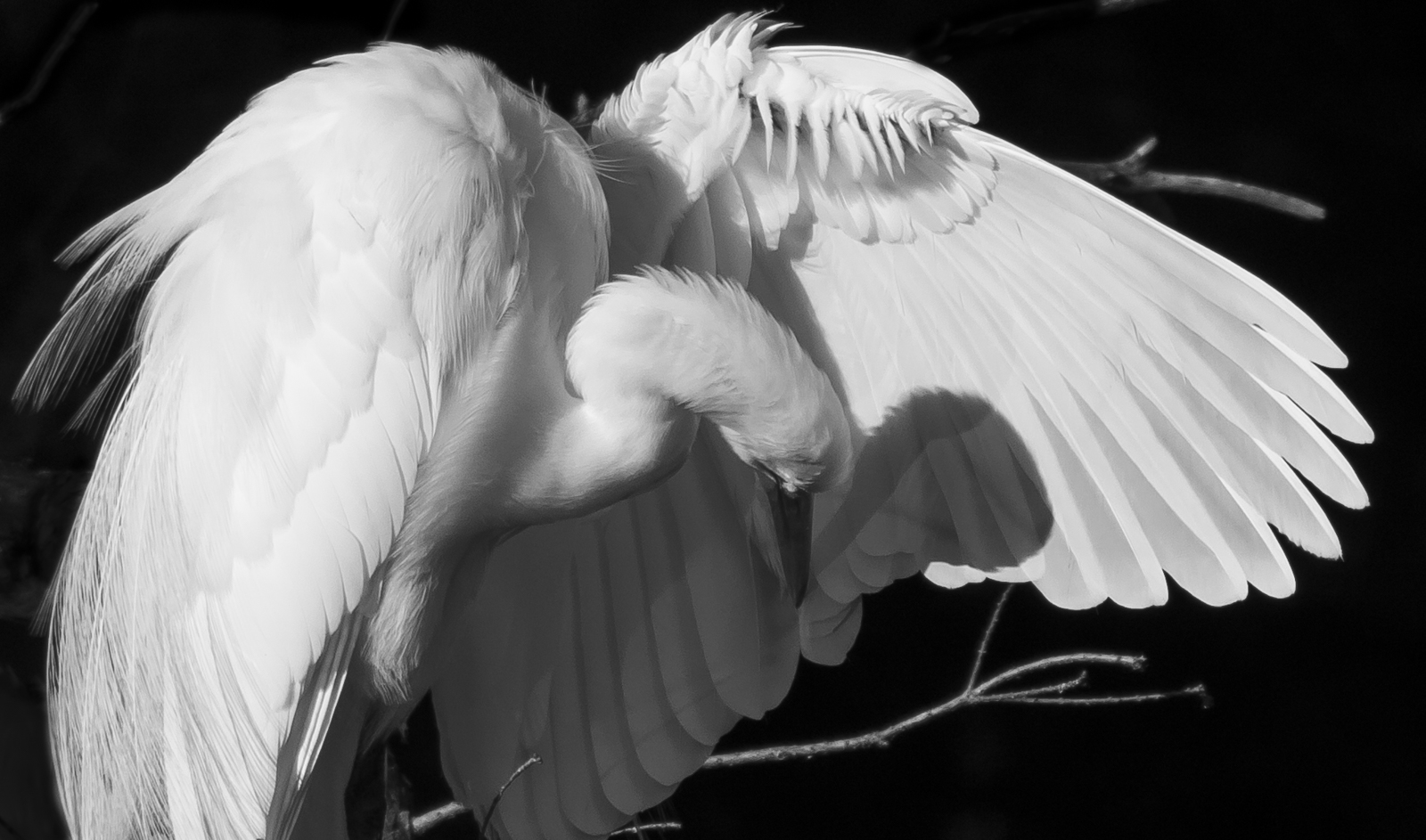
Great egret preening
They started arriving singly, then a few more at a time, jostling for position among the swaying branches, squawking at one another, and occasionally jabbing with their sharp bills to try to secure a spot. Once settled, many began the ballet of preening their beautiful white plumage.
It is unusual to be at the refuge with so few people around, so I stood there alone, watching, and listening as the birds ended their day. Before I left, more than a hundred white ibis had joined forty or fifty great egrets for what seemed like a less than peaceful evening. The video clip above shows some of the hazards of a sleepover with your feathered friends – note what happens to the egret as it is preening its feathers…something falls from above that requires a couple of good shakes, and then more preening.
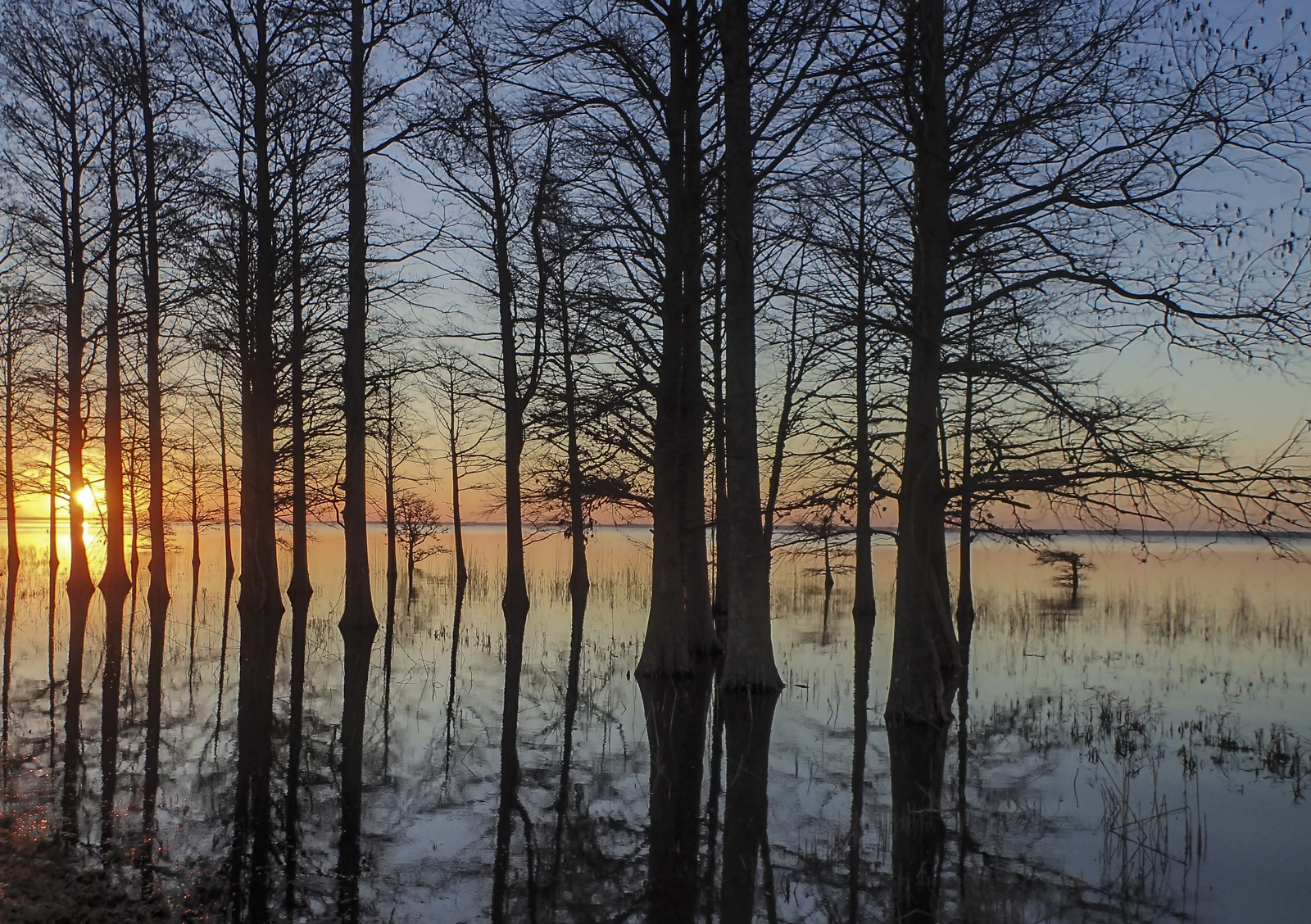
Sunrise along north shore of Lake Mattamuskeet
The next morning, I only had a couple of hours before I had to leave the refuge for my meeting, so I tried to cover a lot of area, looking for the least bittern. The sunrise was spectacular, as they often are at the lake, and I managed a different view point than usual.
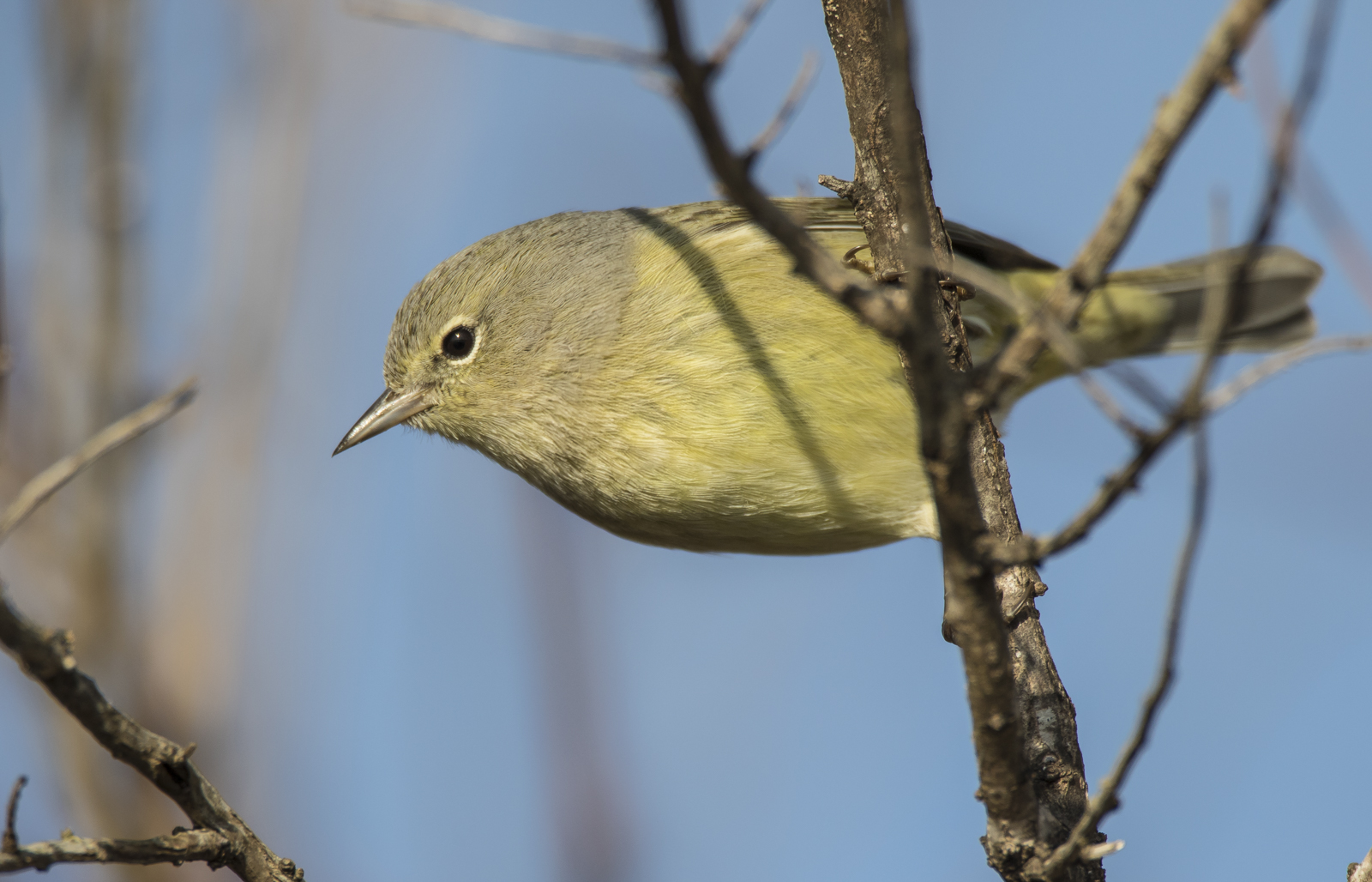
Orange-crowned warbler
There were a lot of birds out in the shrubs along the edge of the road, including a ruby-crowned kinglet, yellow-rumped warblers, a blue-gray gnatcatcher, and a photogenic orange-crowned warbler.
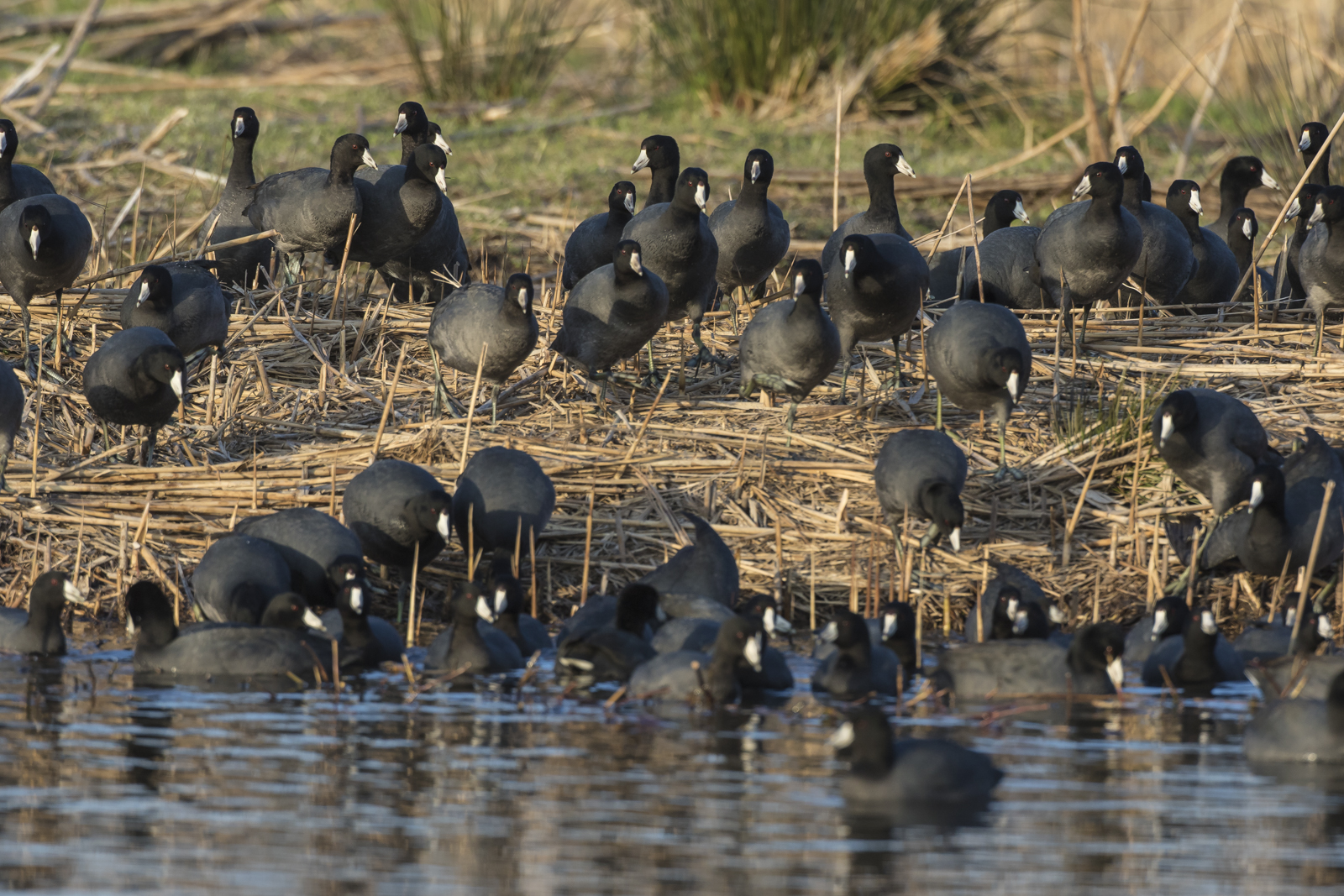
American coot feeding along canal edge
The usual ducks and swans rested near the road, and groups of American coot were waddling around all along Wildlife Drive. I was really hoping to see the bobcat(s) that are frequenting the far grassy edge of the canal, often hunting the coot, but, no such luck.
American coot along roadside
Coot are favorite food items of a variety of predators, undoubtedly due to their abundance, and relative ease of capture. One little guy was standing along the edge of the road and allowed me to pull up and get a few cute coot photos.
Lobed toes of an American coot
Coot are odd little ducks (well, actually they are not ducks at all, but are related to rails) with scarlet red eyes and a white bill with a dark frontal shield (a bump that goes up on the forehead from the upper bill). But their most noticeable strange feature is seen when they are on land – they have large feet with lobed toes (not webbed feet like ducks). This adaptation helps in both swimming, and walking on mud and mats of floating vegetation.
Dead tundra swan in impoundment
One of the sad notes from this trip was seeing a few more dead swans. There have been a fair number this winter (perhaps as many as several dozen), more than I have seen in recent years. Lead poisoning from ingestion of lead shot is believed to be the cause for many, and I think several have been sent off for analysis. This helps point out yet another way that we tend to impact wildlife populations, intentionally or not. There was also another interesting development this past week that may impact the future of the refuge’s waterfowl populations. A Memorandum of Understanding (MOU) was signed to allow joint management of the refuge by both the US Fish and Wildlife Service and the NC Wildlife Resources Commission. While I generally support both agencies and their missions, it is unclear to many why this MOU is needed, why the federal government may be relinquishing some of its control over a refuge they have managed since its establishment in 1934. There has been a lot of talk in some parts of the community the past few years about a desire to manage the lake at higher levels in the summer for fishing, but there is also concern this may have a detrimental impact on waterfowl use of the lake. I have observed a drastic reduction on the number of birds that are easily seen in the lake along the causeway the past couple of winters, perhaps due to the higher than normal water levels that may limit food plant production and access to food for dabbling ducks and swans. This is a world-class waterfowl refuge that is used by thousands of visitors every year for hunting, fishing, crabbing and bird observation. I hope any new or revised management plans will continue to maintain it as such.
I recently had a discussion with someone about sitting quietly in nature and just observing your surroundings as a way to relax, increase your observation skills, and just get in tune with a natural place. It reminded me of a project I had heard about several years ago called The Sit Spot. There are various iterations of the idea, but, basically you just go outside some place that is close enough to visit frequently, and you sit. That’s right, sit, for 15 – 30 minutes, or however long you can. It is a place to commune with your surroundings, ideally with no distractions (no phones or cameras, although I do take binoculars). And you observe, listen, think about what you are seeing. When you sit quietly, the world starts to come alive around you. So, Melissa and I have been trying to go out whenever we can and sit in the woods and watch. On a recent weekend, when I was leading a tour down east, she sat and observed some of the goings-on of some of the birds that call these woods home. She later wrote a poem about what she saw. Here it is, with some photos of the birds taken at other times and in other places.
Following the Nuthatch
by Melissa Dowland
When searching for a bird of prey On a fall or winter’s day Never trust the noisy titmice Only the nuthatch will suffice.
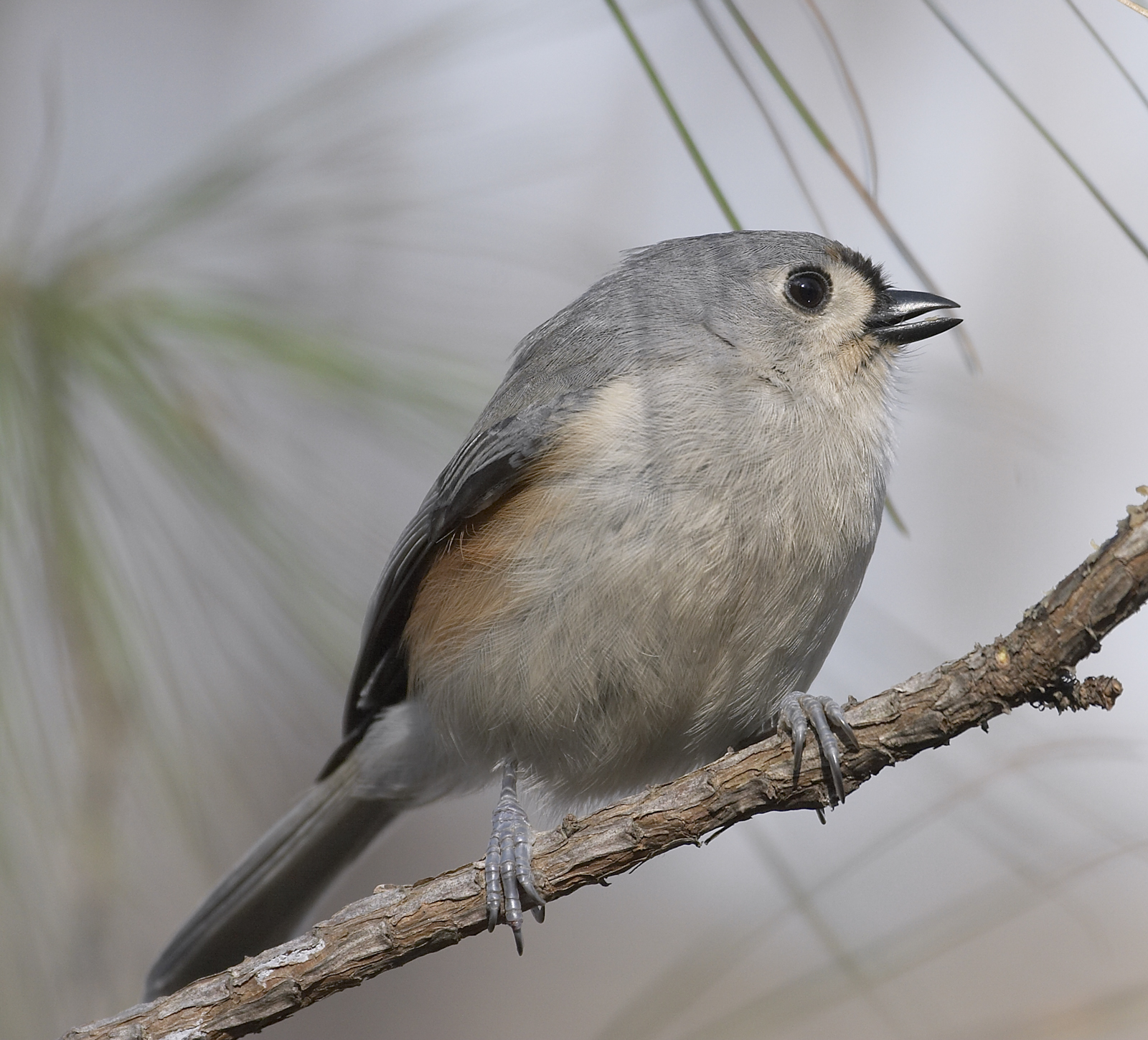
The titmouse is a busy soul Forever making a dreadful scold. He flits about the whole day long, Rarely pausing in singing his song.
Tufted titmouse
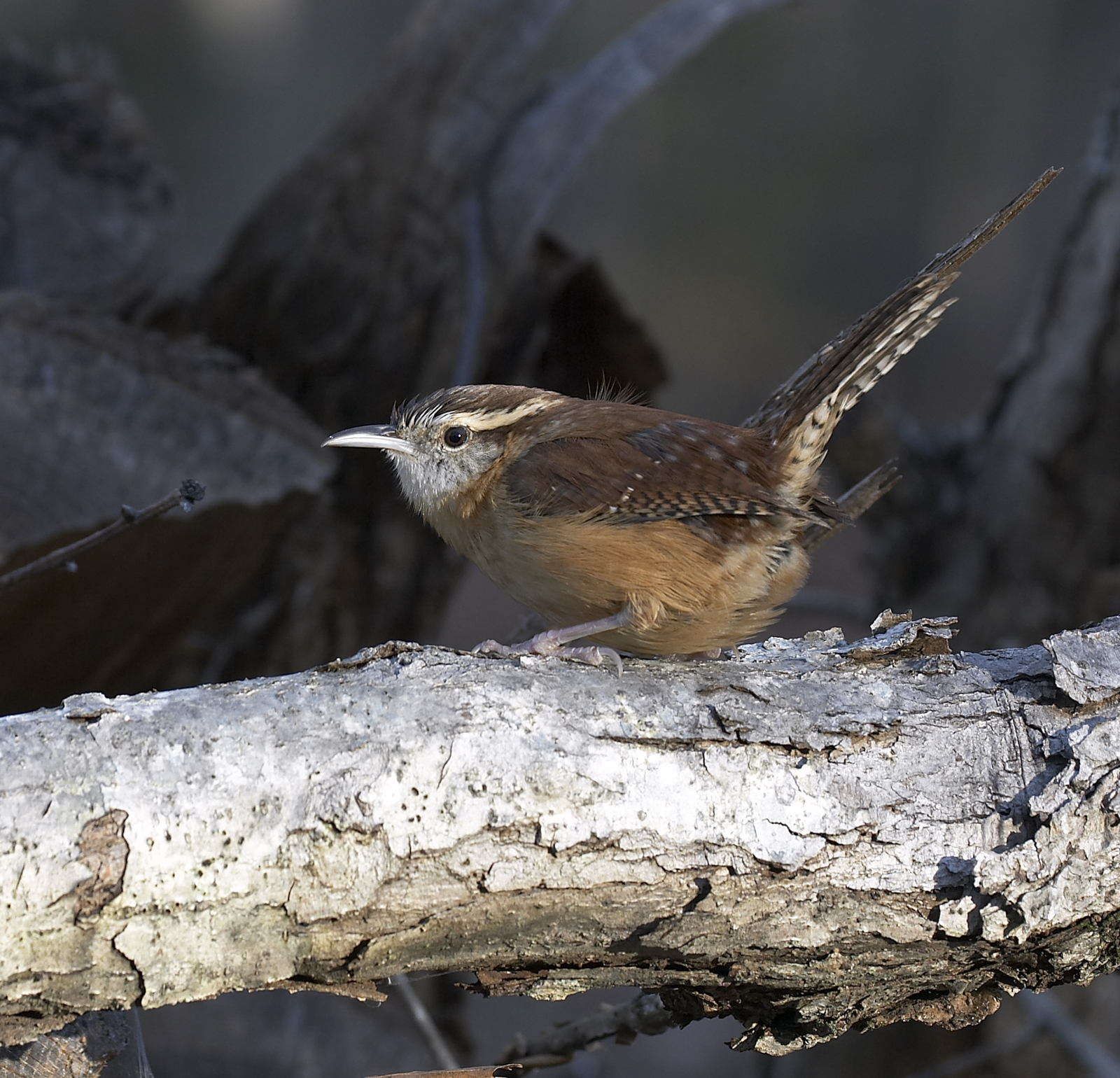
The busy wren, he too will cry So loud, he calls, though small in size. But he is easily distracted by The lonely squirrel who wanders by.
Carolina wren
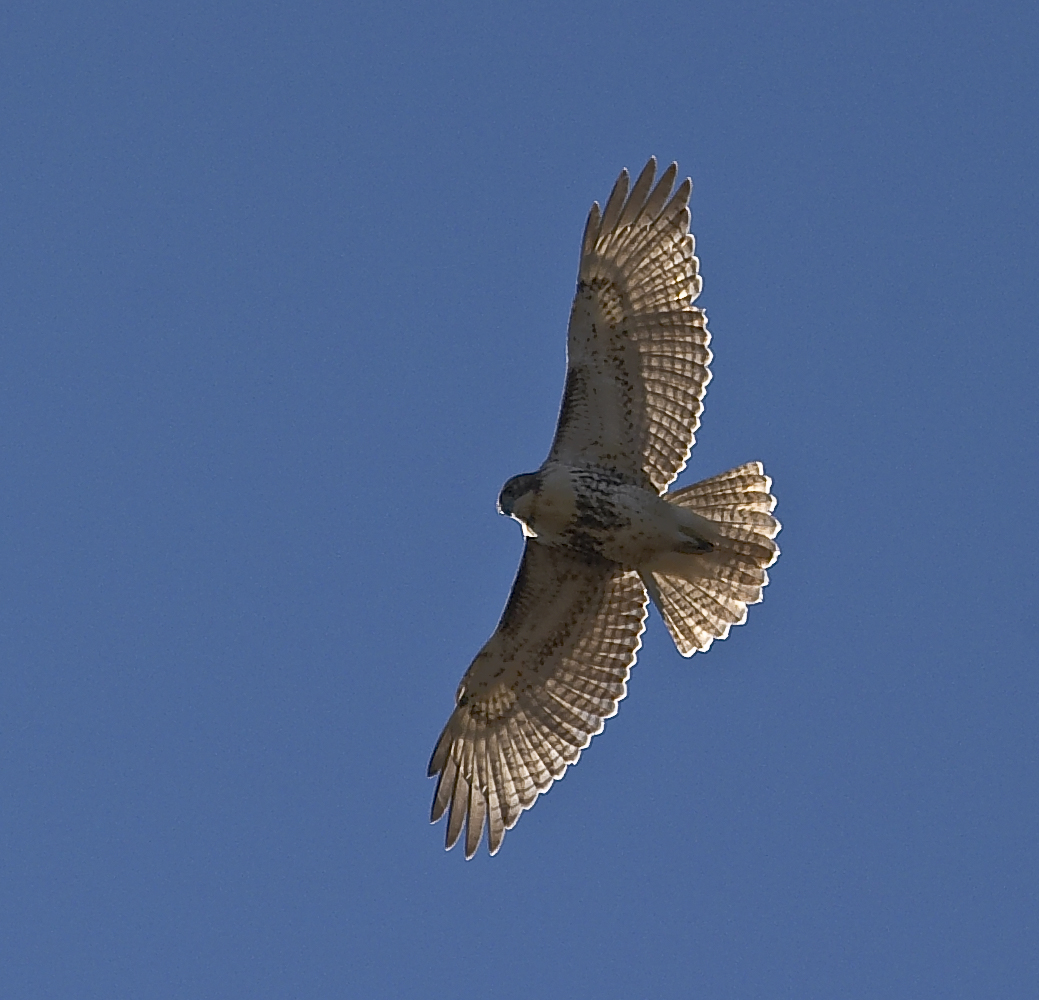
So would you like to spot a hawk On your winter hike or walk? Then heed the nuthatch’s nasal cry. For when the hawk his eye does spy
Out rolls his nasal, cranky ‘yank’ Heard over hill and down the bank. The nuthatch is a wise old bird So listen closely to his words.
“There goes the hawk, warn one and all! Oh forest, listen to our call!”
White-breasted nuthatch
So look, oh wanderer, for the source of that sound Up in the trees and on the ground. If you’re lucky you might be blessed If the nuthatch and hawk make you their guest.
Life wants you to have gratitude for the gift of living. Treasure every second.
~ Bryant McGill
The season is about over. It is hard to believe I just finished what is probably my last tour for this winter season at Mattamuskeet and Pocosin Lakes. But, if it is to be the last, at least it was a spectacular one. I was with a wonderful couple from Raleigh that were excited to see everything and learn about the incredible diversity of wildlife in the area. And we got great looks at a lot of species, including a couple of rarities.
Ice on reeds at Lake Mattamuskeet (click photos to enlarge)
We moved up our scheduled time one day to Sunday morning, due to the predicted wintry weather moving into the state on Monday. To be honest, it was wintry already, with low temperatures in the 20’s when we arrived at Mattamuskeet National Wildlife Refuge. And that means ice. It also means active birds, so we were in for a treat.
American bittern in its usual spot
As has been the case most of the winter, there were few birds were along the causeway, probably due to the extremely high water making it too deep for effective feeding by most waterfowl. As we turned into the refuge, things picked up. Right away, I spotted the faithful American bittern hunting in its usual spot next to Wildlife Drive.
Admiring his reflection?
With the high water, the bittern was a bit more exposed as it fed along the edge of the water. That gave us a chance to really admire this beauty.
The bittern’s streaked plumage helps it blend in with its surroundings
I put the scope on it to really be able to see the subtle colors, piercing eye, and greenish-yellow legs of this usually incredibly well-camouflaged marsh inhabitant.
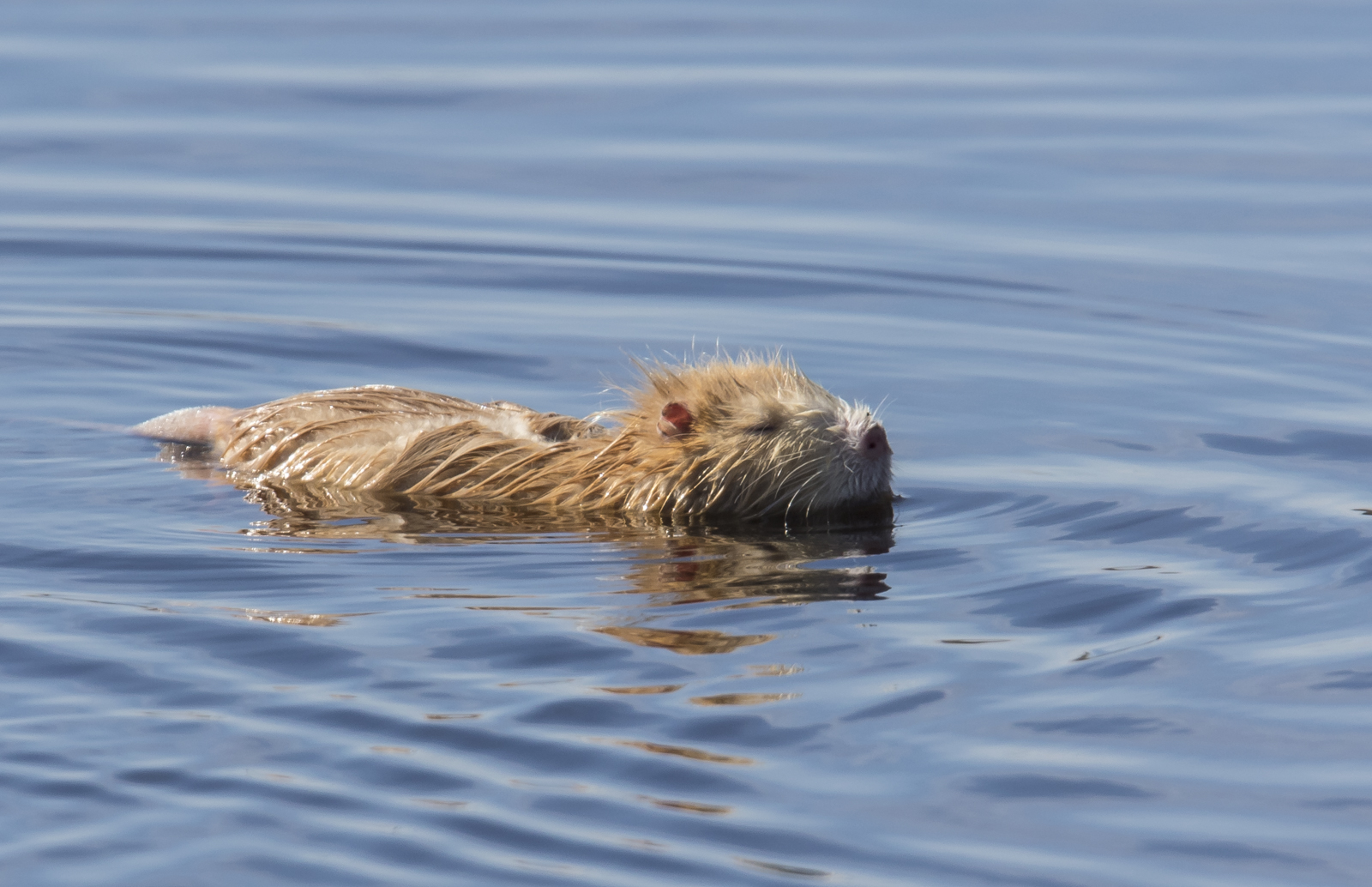
Blonde nutria
A little farther down the road we spied an unusual-looking mammal, a very light-colored nutria. A few other, darker nutria, had greeted us when we first arrived, looking somewhat stunned in the cold weather (these South American imports don’t seem to do well when ice appears). But this little blonde guy had been feeding on the bank in the sunlight, and seemed now to be waiting for us to move on so he could get back to his lunch break. This is the first nutria I have seen with this coat color.
American coot skating on the marsh
Flocks of American coot dotted the canal banks and patches of open water, while others skated on the skim of ice out in the impoundment. You can really appreciate their lobed toes when you see them up on ice.
Common gallinule
A common gallinule was mixed in with the coot near the observation platform. These relatives of rails look similar to coots (especially this juvenile) but can be distinguished by the white stripe along each side, their habit of flicking their tail, and the lack of lobes on their especially long toes. Known to breed in isolated locations in our state, the common gallinule is fairly rare in winter, and this is the first I have seen at Mattamuskeet this year.
Great egret showing off its plumesWhite-tailed deer were out browsing along the edge of the road
The high water had closed the far end of Wildlife Drive, but we got great views of a showy great egret and several deer before turning back.
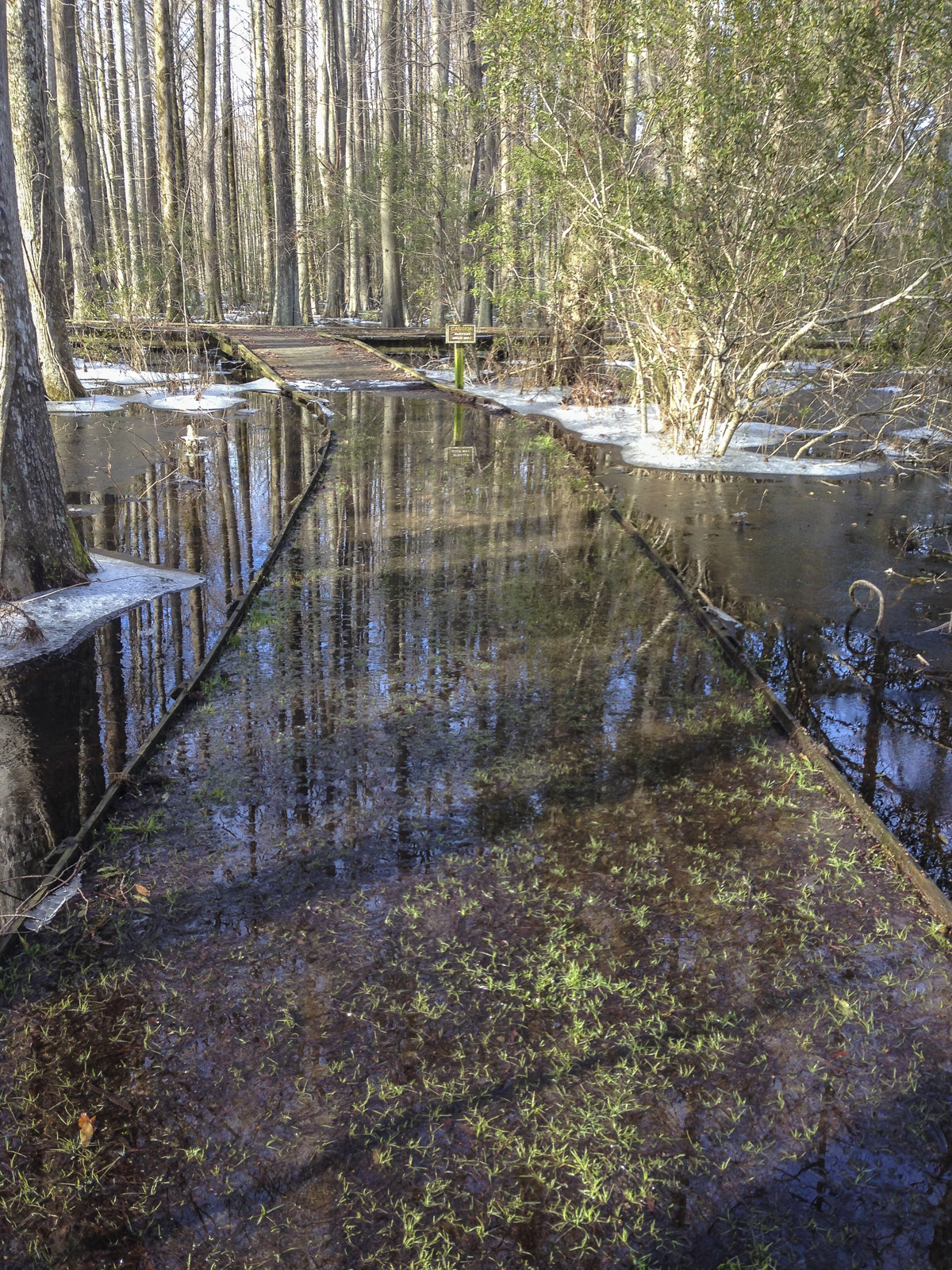
New Holland Trail partially submerged due to high waterSkim of ice in the swamp along New Holland Trail
We stopped for a short hike along New Holland Trail, one of my favorite spots at Mattamuskeet. Extremely high water and a skim of ice gave the swamp a very different look from my last visit a week ago. I love it when there is ice down here…a different world with new artistry everywhere you look.
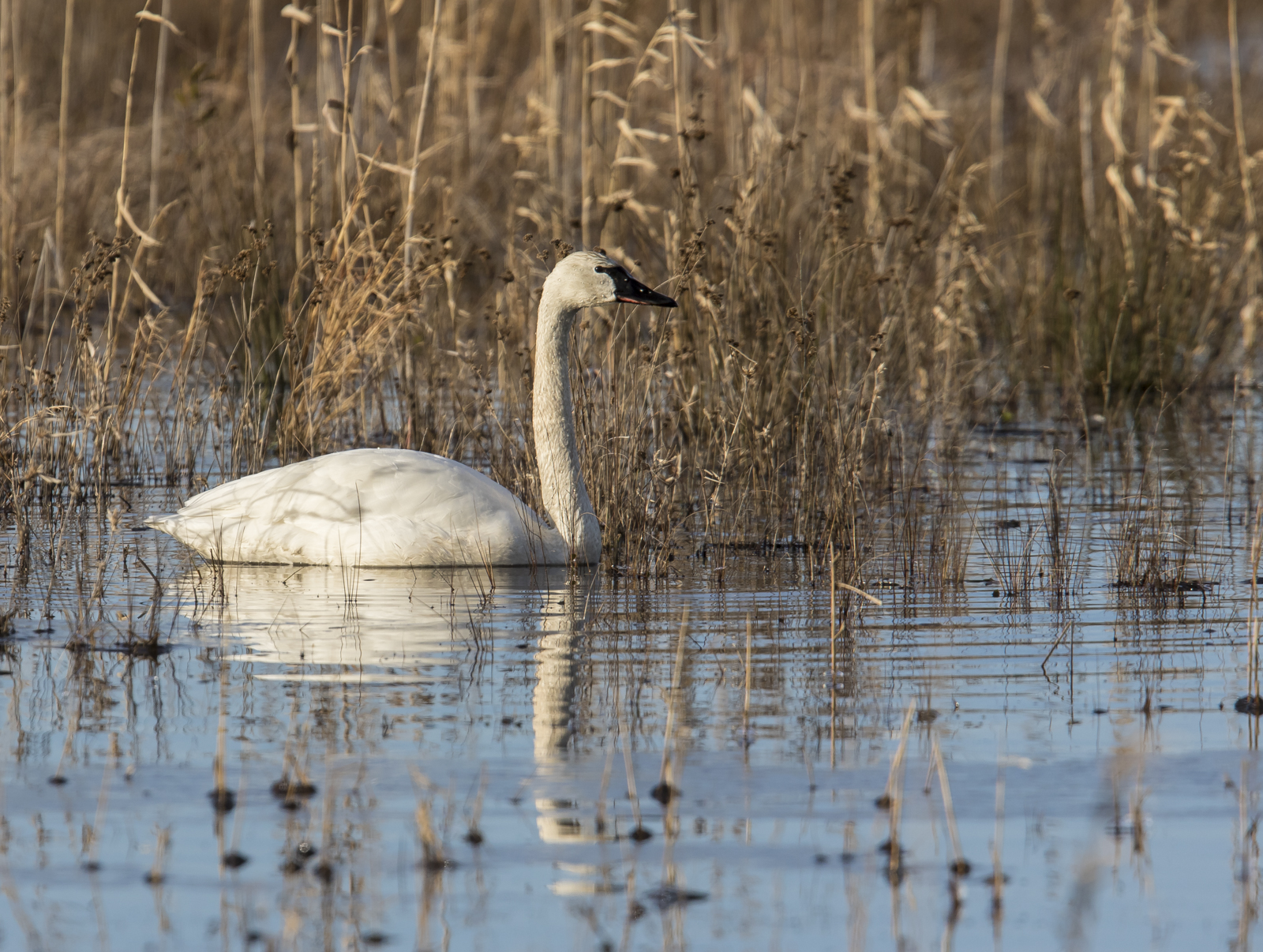
Tundra swan lounging in the impoundment
Driving along the back side of the impoundment we watched thousands of ducks lift off when an eagle flew overhead. Another American bittern was standing along the edge of the marsh, and swans, coot, and ducks were feeding in the shallows as the sun started to dip toward the horizon. Then my phone chirped that sound it makes when I get a text message. I glanced at it…a local number, but I didn’t know who…it read least bittern on entrance road!! Whoa, I said, let’s go….but there were cars in front of us, stopping to look at swans and ducks…we waited…another text…where are you? Our volunteers told me you were around. Now I knew, it was my friend, Keith, who works at the refuge. One of the volunteers from the office had apparently spotted the bird, told Keith, and then mentioned that I was at the refuge (we spoke at the visitor center earlier in the day). Keith knew I would be interested in this bird because we had talked about it when someone saw one a few weeks ago. So, thankfully, he texted me with this news while he was photographing it on the other side of Wildlife Drive. A least bittern is not something I see very often. In fact, I have only seen two in all my years of wildlife watching.
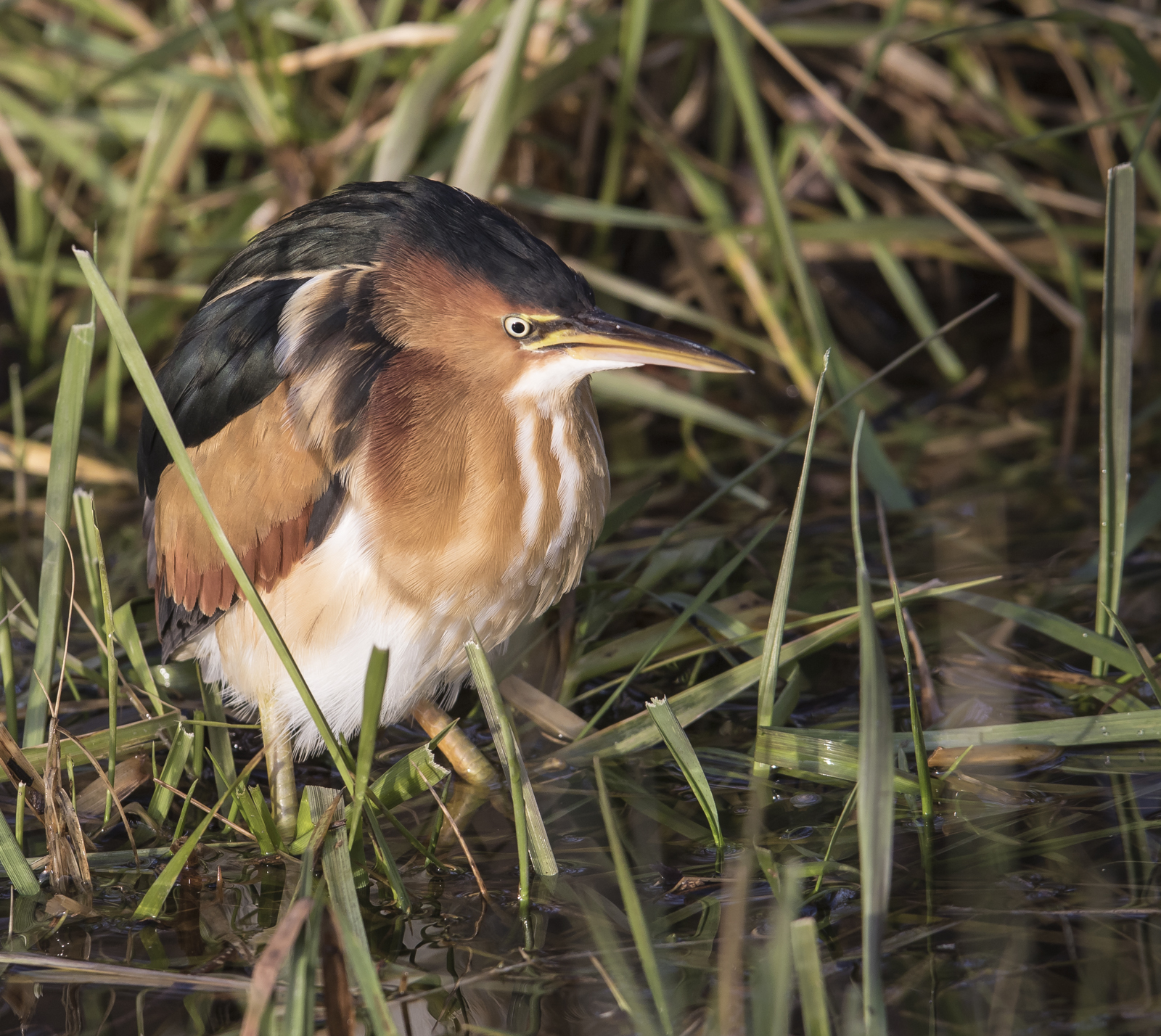
Least bittern stands like a statue along the water’s edge
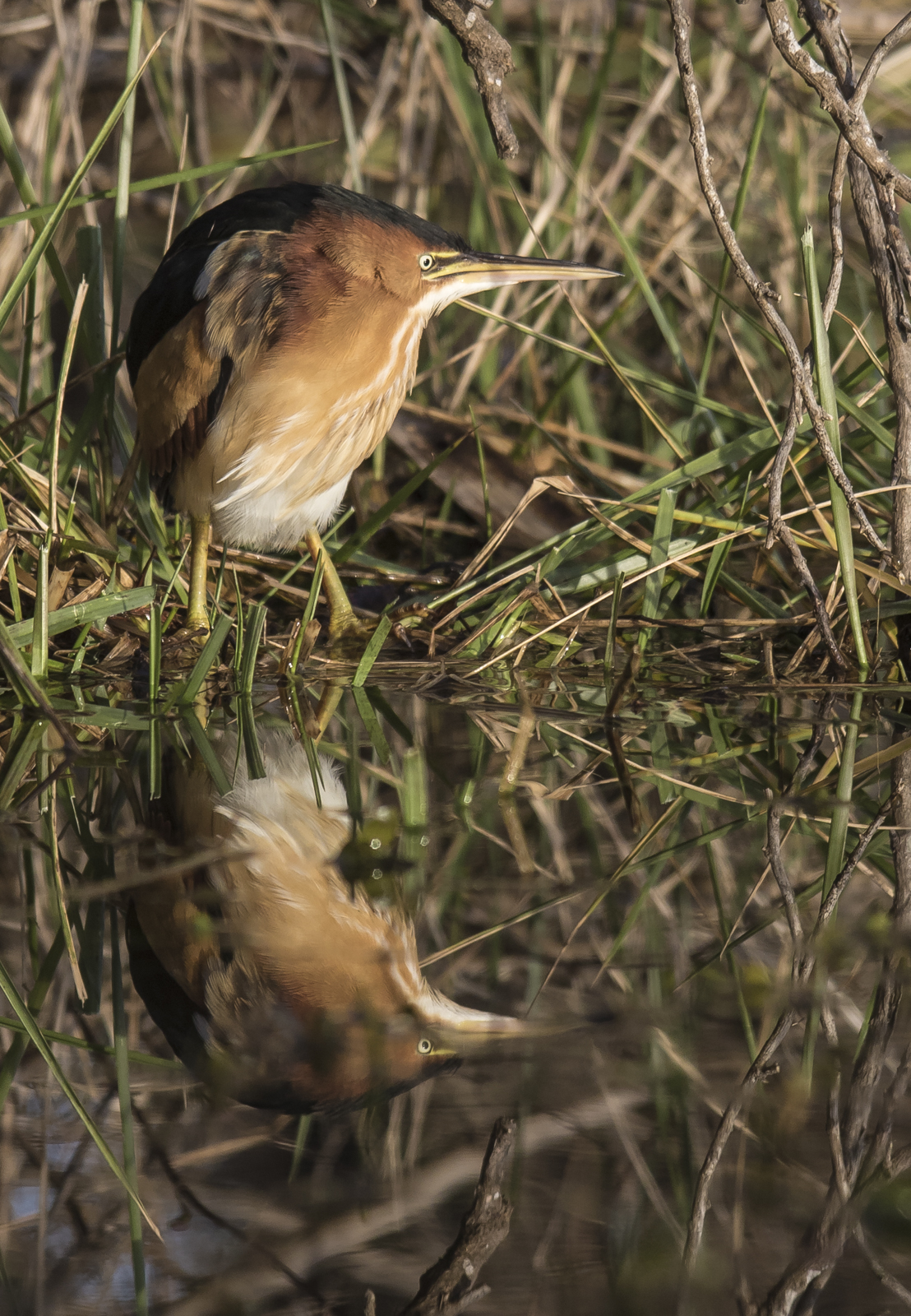
When we finally got over there, I saw Keith out with his camera. We got out, and there it was, in perfect light, standing right next to the road, motionless, like a piece of yard art. What a beautiful bird! I am guessing this is a male because of the dark head and back.
Like their larger cousins, least bitterns have an intense, piercing gaze
Least bitterns are one of the smallest herons in the world, standing only a little over 12 inches tall when stretched out, much smaller than its bulky cousin, the American bittern. The least bittern is usually more difficult to see, because of its small size and its preference for thick vegetation. These diminutive herons often walk through thick marsh vegetation (like cattails), not by wading, but by grasping the grasses with their long toes and striding through the narrow openings between the upright blades, literally sneaking through the grass above the water. This little guy was not bothering with stilt-walking, but was instead on the ground next to some standing water.
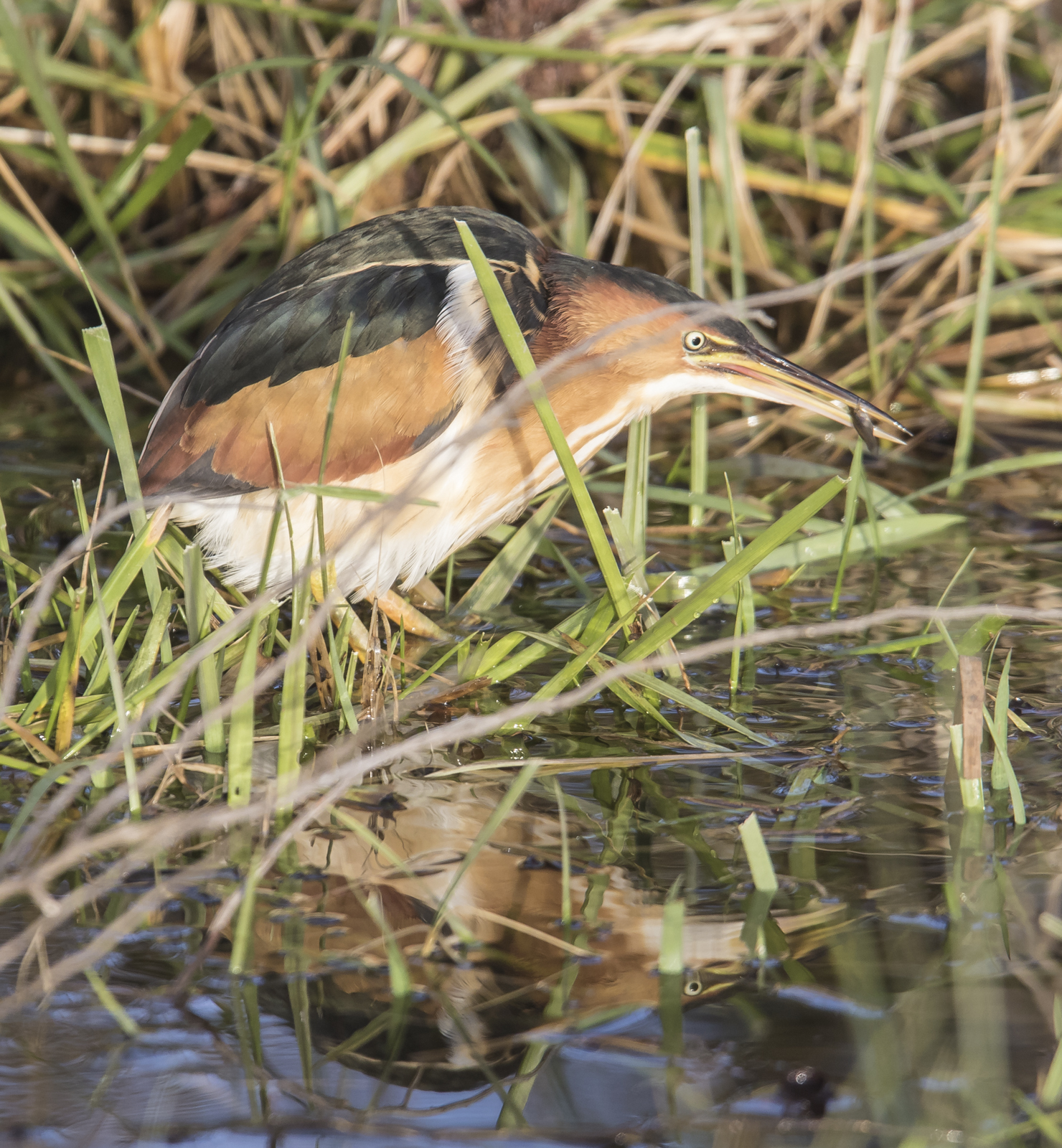
It grabs a small killifish
Keith and I crawled around on the edge of the road trying to get a good angle for some photos, while the bittern stood still. It finally moved its head, then went into classic bittern feeding mode. Within a minute of staring at the water, and slowly stretching out and downward, it struck and grabbed a small fish, gulping it down with a quick snap of its beak.
A fine way to wrap up a winter season
I would love it of this bird decides to stick around and nest somewhere in the vicinity. The young bitterns, like many young herons, are fine examples of punk feather-do birds, and I would enjoy a chance to photograph them. Odds are slim though, as they usually hide their nests fairly well in thick marsh vegetation.
The trip ended the next day with icy conditions, muddy roads at Pungo (including a large section closed due to flooding), and relatively few sightings at Pungo (although we did manage some species we did not see at Mattamuskeet – wild turkeys, a snipe, two cooper’s hawks, a sharp-shinned hawk, and a great horned owl).
It has been another very good winter season. While I am sorry to see the swans and snow geese starting to depart, I have many memories to fall back on. And the shifting season means new life just around the corner…spring wildflowers, calling frogs, migrating warblers, and so much more. I can’t wait…and I will back to the wildlife refuges to see what they offer this spring and summer, so, if you are interested in a trip, just contact me.






































 Roads End Naturalist