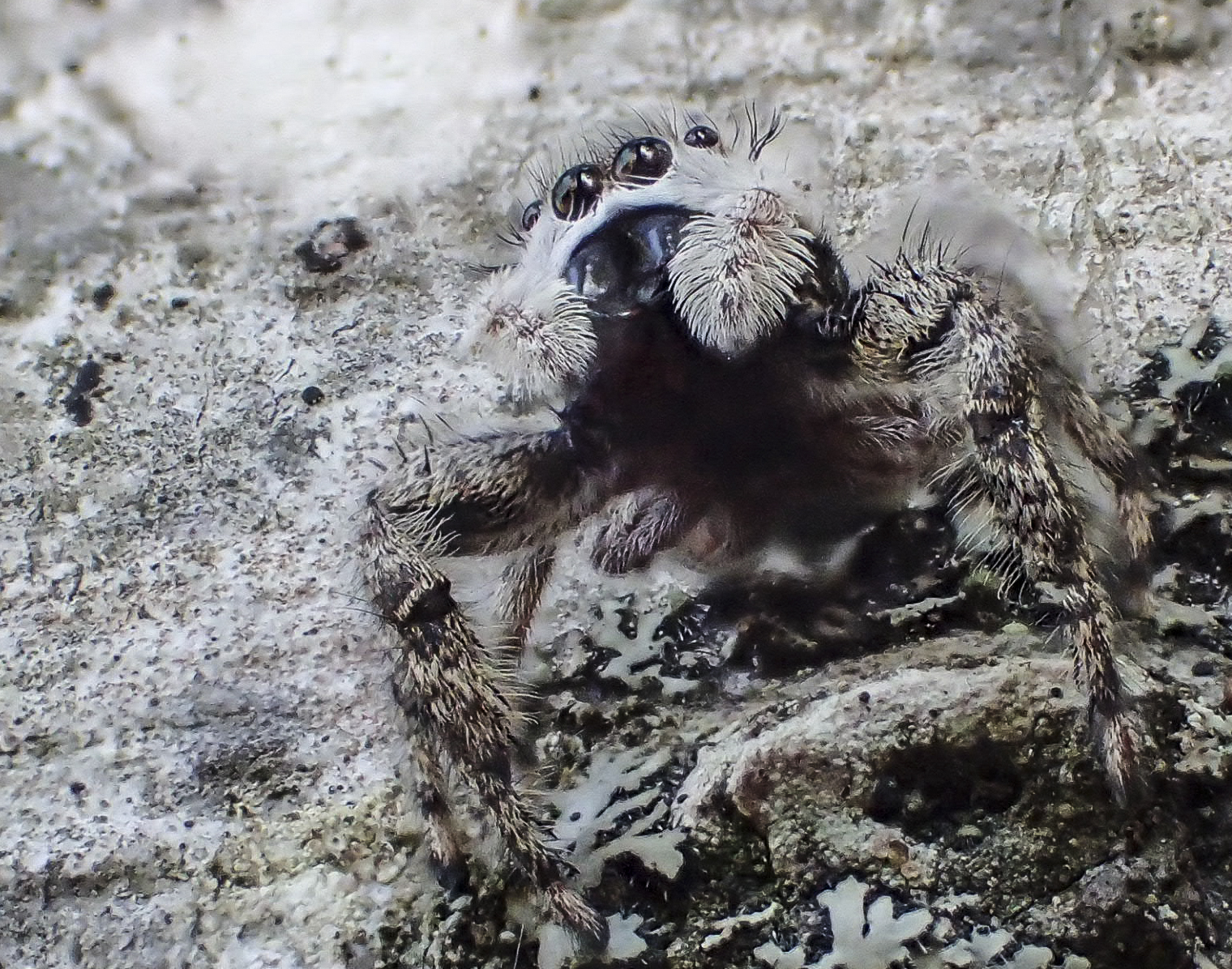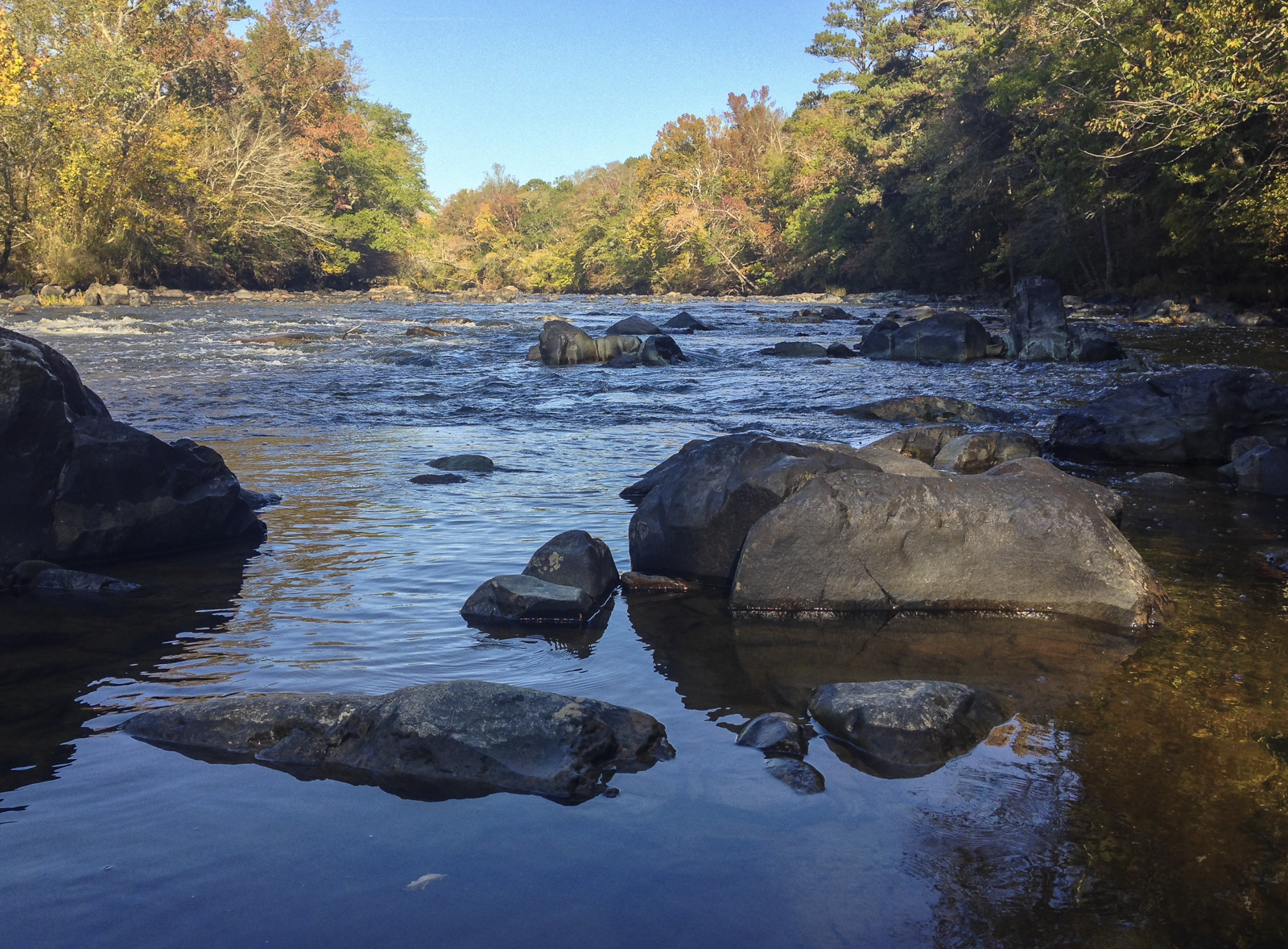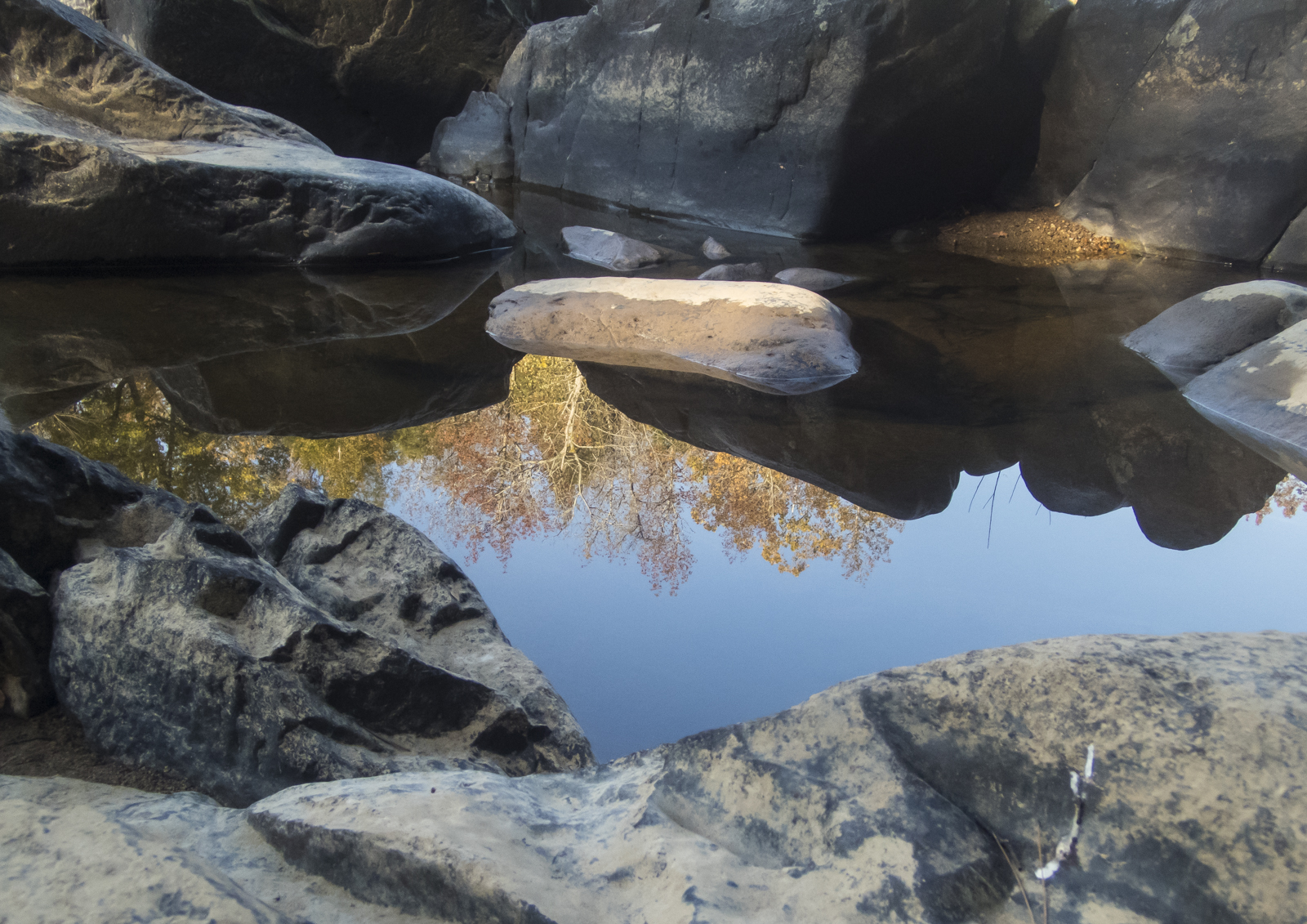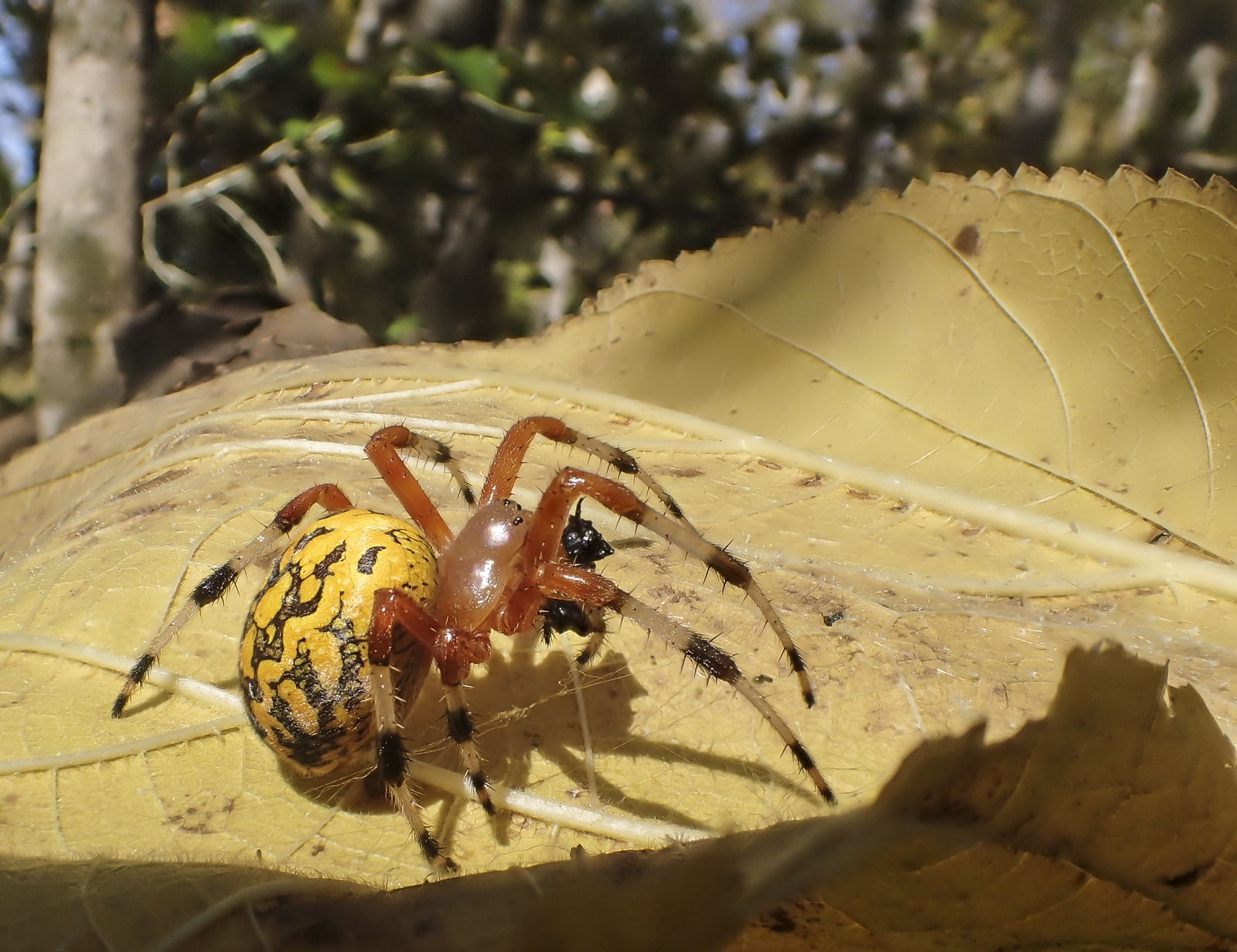
Welcome to our new website! We hope you like it. Please let us know if you notice something missing or that needs a correction. ~Mike & Melissa

  • Heads or Tails?

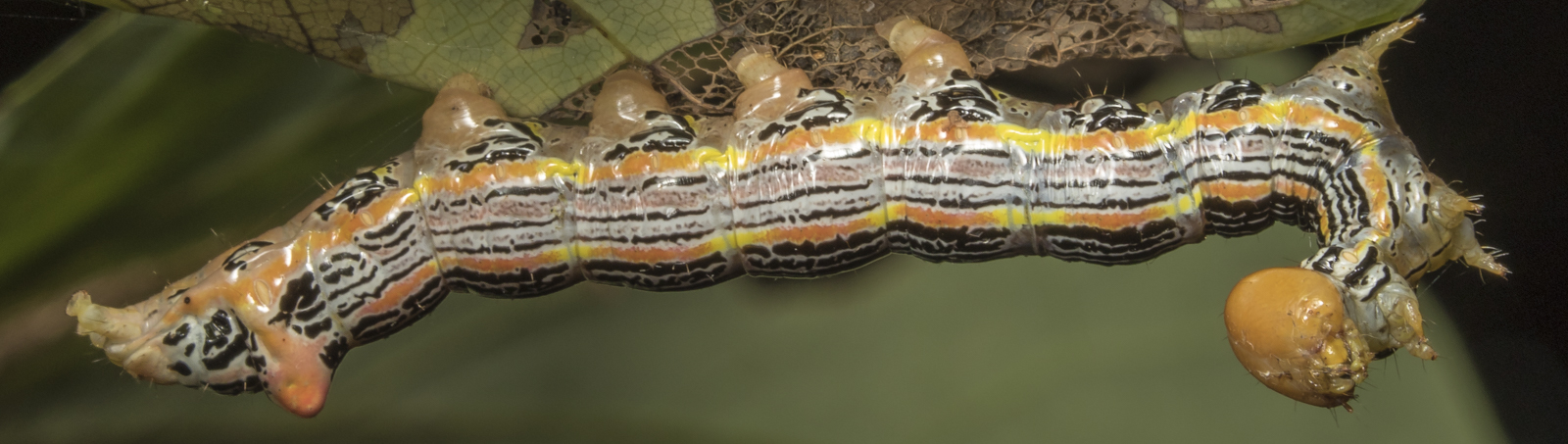
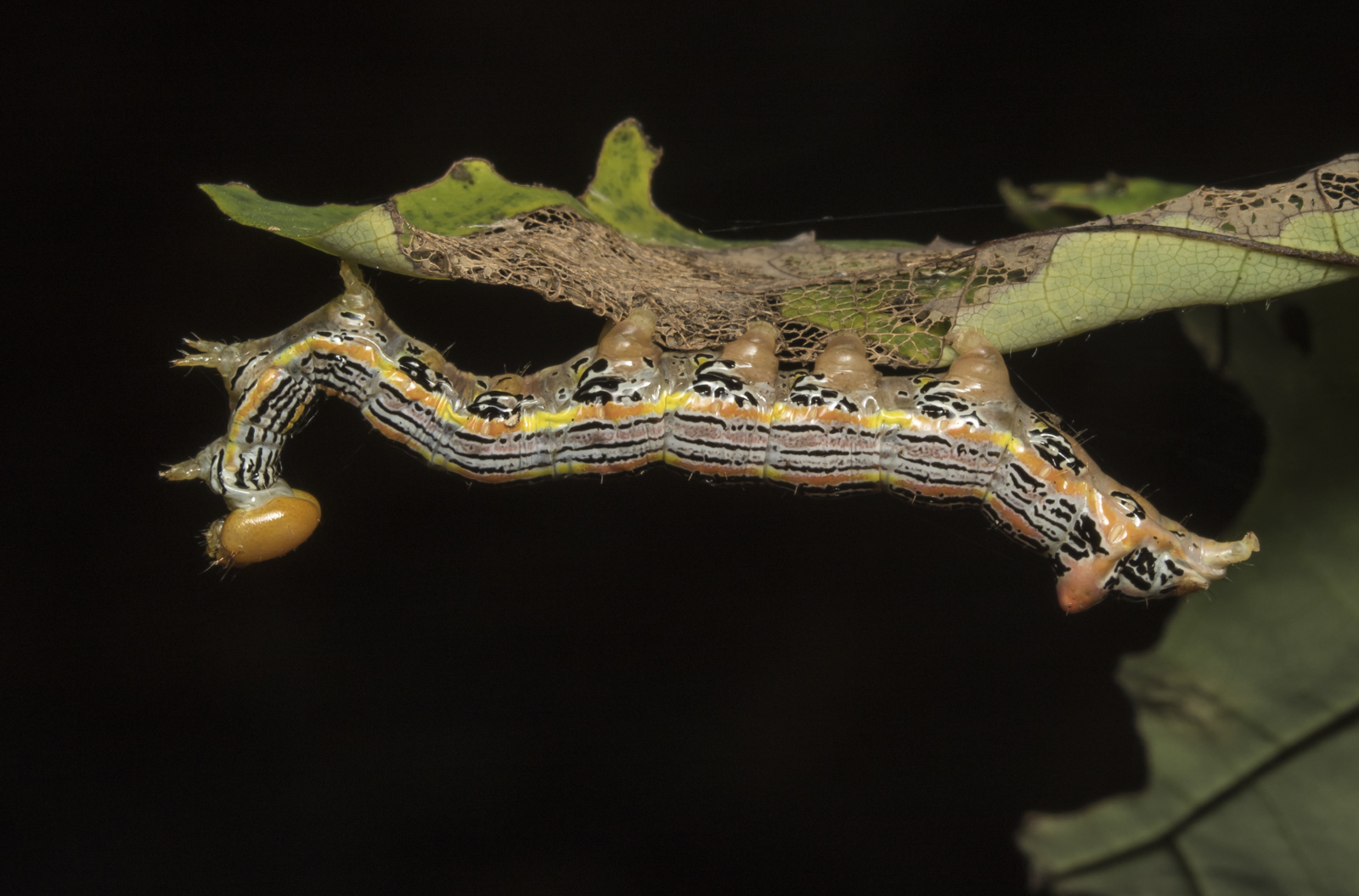
    There will always be scary predator eyes looking out at us from the bushes – it’s just that most of the time they are mounted on the rear end of a happily munching caterpillar.

    ~The Caterpillar Lab, Sam Jaffe, Director

    On a walk at Yates Mill Park the other day, I came across one of my favorite caterpillars. My first glimpse was of a darkened blob on a leaf as I walked past a fence. The leaf was on a climbing vine of a Greenbriar, Smilax rotundifolia.

    Turbulent Phosphila on leaf
    Turbulent Phosphila larvae on Greenbriar leaf (click photos to enlarge)

    When I stepped closer, I knew what the blob was…a group of tightly packed caterpillars! These striking larvae go by the unusual name of Turbulent Phosphila, Phosphila turbulenta. I discussed this species in an earlier post and am always delighted to find them. The name intrigues me…I understand the turbulent (characterized by conflict, disorder, or confusion) part…they are gregarious feeders in their early stages and can appear quite confusing when seen in a mass on the underside of a Smilax leaf (their only host plant). Sam Jaffe, an incredible photographer and educator on the subject of caterpillars, described them as looking like a mass appearing more like some strange outdoor QR code than biological life. Well said, Sam. It is the Phosphila part that has me baffled. If you break it down into its Greek roots, it means “phos” = Light, and “phila” = loving….light loving.

    Turbulent Phosphila on stem 1
    Turbulent Phosphila on Greenbriar stem

    These guys usually hide on the underside of leaves as larvae or are clustered along a stem, hardly the behavior of a light-lover. Perhaps the adult moth is especially attracted to light? I don’t know. Perhaps the bright white spots on the rear of the caterpillar resemble bright points of light to someone? Not sure. Those spots are believed to function as fake eyes, and are more prominent and numerous than the eye spots on the anterior end of this species, making it tough to tell which end is which.

    Turbulent Phosphila on stem
    Turbulent Phosphila larvae, head downward, on Greenbriar stem

    Whether the fake eye spots on the rear create a distraction for would-be predators away from the more vital head portion of the caterpillar, or they just serve as a startle and potential threat factor when seen in a grouping, the impact is one of confusion when you first look at these larvae. David Wagner, in his excellent reference, Caterpillars of Eastern North America, states that both the coloration and behavior suggest that these caterpillars are chemically protected. Whatever the case, they provide me with a wonderful visual treat every time I encounter them.

  • Another One (Hundred) Bites the Dust

    Don’t ask yourself what the world needs. Ask yourself what makes you come alive, and go and do that, because what the world needs is people who have come alive.

    ~Dr. Howard Thurman

    It happened again. Ten months go by, another 100 blog posts. So, as I have done in the past, I mark this passage of time with a brief review of some of the highlights from the last one hundred blogs. I suppose it is an excuse for me to look back and remind myself of how lucky I am, how much is out there to observe and enjoy, if I only make the time to get outside.

    The third one hundred started with a trip to the Low Country of South Carolina.

    Botany Bay
    Botany Bay (click photos to enlarge)

    Botany Bay turned out to be as beautiful as images I have seen…I need to go back when low tide is at sunrise.

    River Otter with fish 2
    River Otter with fish

    As always, Pocosin Lakes and Mattamuskeet National Wildlife Refuges provided many highlights of my last one hundred posts.

    Tundra Swan silhouette at sunrise
    Tundra Swan at sunrise
    Bald Eagle and potentil prey
    Bald Eagle stirs up a flock of Snow Geese

    This is especially true during the winter months, when the area’s lakes and farm fields fill with wintering waterfowl…

    Bear puling at Cross Vine 4
    Young Black Bear pulling at a Cross Vine
    Red-winged tornado
    Red-winged Blackbirds create a feathered tornado
    Gray Fox
    Gray Fox waking up from a nap along Wildlife Drive

    …and other wildlife.

    Spring Peeper calling
    Spring Peeper calling
    dwarf crested iris blue form
    Dwarf Crested Iris
    Pine Warbler male in Redbud
    Pine Warbler male in blooming Redbud tree

    Spring brought lots of amphibians, wildflowers, and beautiful colors…

    Bald Cypress along Conaby Creek 2
    Bald Cypress along Conaby Creek on the Roanoke River
    Prothonotary Warbler singing at nest cavity
    Prothonotary Warbler male singing at nest cavity

    …along with a couple of canoe camping trips along the Roanoke River.

    Chipmunk feeding 1
    Eastern Chipmunk in the yard
    spider shedding skin 1
    Spider just after molting

    And I spent a lot of time wandering the yard, discovering what my wild neighbors are up to.

    Chickadee bringing food to nest - spider 2
    Carolina Chickadee bringing food to nest box
    Four nestlings
    Four Wood Thrush nestlings

    I was happy to help provide some footage of nesting birds and what they feed their young for Hometown Habitat, an upcoming educational video on the importance of native plants.

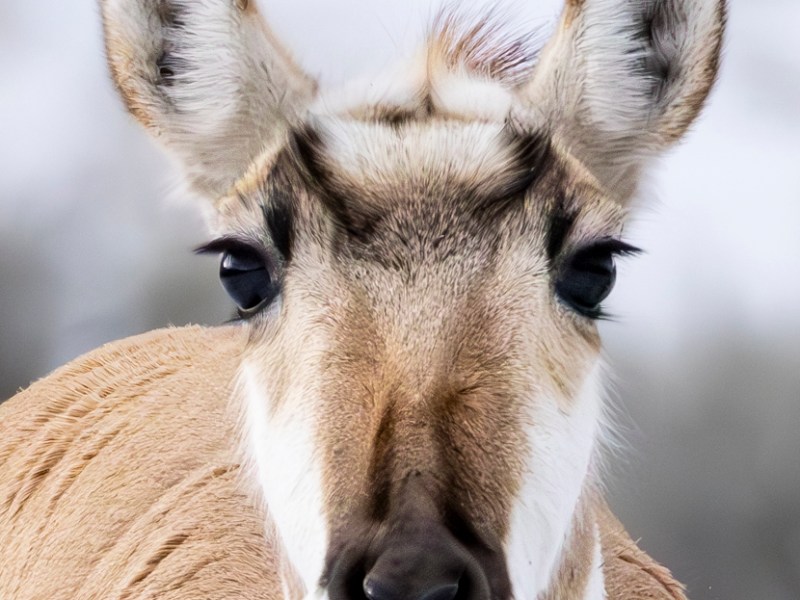
    Pronghorn Antelope face
    Pronghorn Antelope at sunrise
    Great Gray Owl chicks before fledging
    Great Gray Owl chicks
    Grizzly siblings
    Grizzly siblings
    Rainbow in Hayden Valley
    Rainbow in Hayden Valley

    And I was lucky enough to spend another wonderful couple of weeks in my favorite place, Yellowstone, leading a trip and observing some of the magnificent wildlife of the region.

    second cub
    Black Bear cub watching us from a tree
    Looking back at me
    Young bear looking down as I walk through the forest

    I spent a lot of time with bears these past few months, watching them, and being watched. A very good year for bears, I must say.

    Red-spotted Purple egg up close
    Red-spotted Purple butterfly egg
    Silver-spotted Skipper larva
    Silver-spotted Skipper larva

    As the summer ends and BugFest approaches (September 19 at the NC Museum of Natural Sciences in Raleigh), my thoughts, and camera, seem to turn to caterpillars and all things Lepidopteran.

    Closing in on cicada 2
    Copperhead closing in on a cicada (too late, it dropped from its shed)
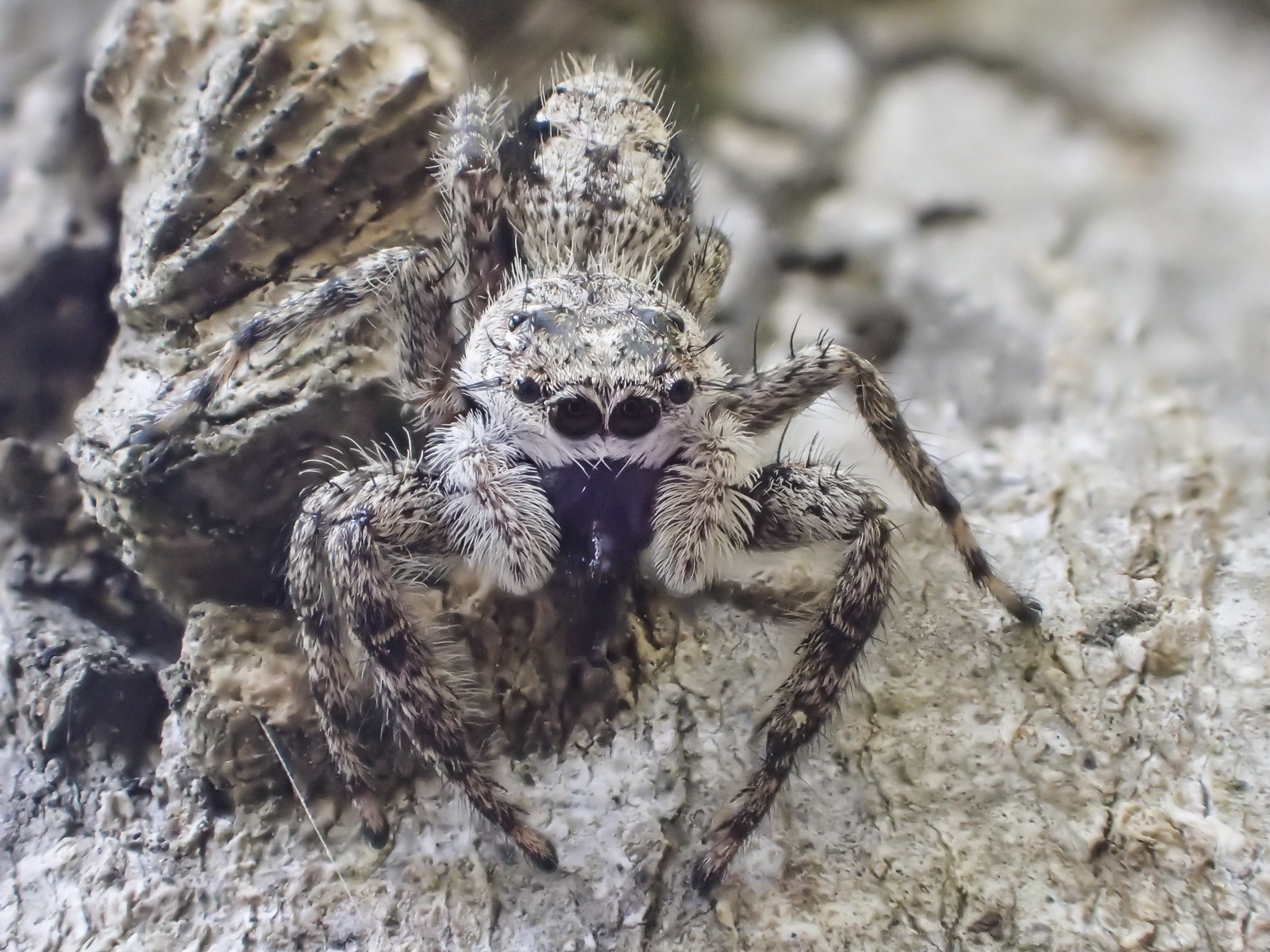
    Phidippus putnami - close up of eyes
    Phidippus putnami – close up of eyes
    Dobsonfly male on white background
    Eastern Dobsonfly male
    FW Jellyfish
    Freshwater Jellyfish in the local pond

    As always, I discovered some fascinating things as I wandered, and this has been a very productive few months for those “ah-ha” moments…Copperheads following cicada nymphs up into trees when they are emerging in order to dine on them; cool spider eyes; weird insects in the yard and at the moth light; and the return of the jellies to my swimming hole…wonder what the next one hundred will reveal? I can’t wait…

  • Poop, Pose, and Pastry

    Reality is easy. It’s deception that’s the hard work.

    ~ Lauryn Hill

    Nature is full of deception. And now it is being touted by none other than the New York Times.  A recent article on caterpillar defenses caught my eye. Researchers studied the late stage larvae of the Canadian Swallowtail (Papilio canadensis). The larvae are plump, green caterpillars with distinctive eye spots that are said to make them snake mimics. This type of mimicry is fairly common in the caterpillar world and is thought to provide some protection from avian predators. When I looked at the photos in the article, they looked very similar to something I found in the yard a couple of weeks ago.

    Eastern Tiger Swallowtail larva third instar
    Eastern Tiger Swallowtail larva – bird poop mimic (click photos to enlarge)

    I posted a photo of the third instar larva of an Eastern Tiger Swallowtail (Papilio glaucus) in an earlier post. Like the early instar larvae of many species of swallowtails, it is said to resemble a bird dropping. These so-called bird poop mimics usually have a dark base color and at least one conspicuous white splotch on their body (usually near the center). But, the last two instars of this species look very different.

    Eastern Tiger Swallowtail larva late instar
    Eastern Tiger Swallowtail larva in later stage
    I checked on the swallowtail caterpillar in my yard a week after that first photo and it looked almost exactly like the snake mimic photo of the Canadian Swallowtail larva. Gone was the bird dropping costume and in its place was a light green body with fairly prominent fake eye spots, and a slightly swollen anterior portion, giving it the appearance of a snake’s head.
    Eastern Tiger Swallowtail larva late instar swelling anterior po
    The larva rears up in a “snake strike pose” when disturbed

    When the caterpillar is disturbed (I blew on it and touched the leaf for the photo above), it arches its body making the eye spots become more visible and enlarging the “snake head” region. In the recent study reported in The New York Times, researchers studied the predator deterrent efficacy of this snake look-alike strategy by creating tasty plain green “pastry caterpillars”. When placed on twigs, birds readily ate them. They then added eye spots and snake-like heads, and the birds tended to avoid them. In fact, adding just eye spots caused about the same rate of avoidance. This caused them to wonder….If real caterpillars don’t gain extra protection from extra deception, then how could their disguise have evolved?

    They decided to present their pastry larvae to day-old bird chicks who had never seen a snake, theorizing that birds may have an innate fear of snakes and snake-like objects. Here are the results…When the chicks were offered simple green cylinders, they grabbed them. But when eye spots were added, the chicks became wary. Consistent with earlier research, the scientists found that adding a snakelike head didn’t make the chicks any more fearful. Over the next two days, the scientists presented the chicks with pastry caterpillars five more times. By the end, the chicks had learned that cylinders with eye spots were, in fact, tasty snacks. That was not the case when the chicks were presented with pastry caterpillars with both eye spots and snakelike heads. Even at the end of the study, the chicks were still fairly wary of the more realistic mimics. They concluded that birds have evolved a fear of snakes and that just a few characteristics, like eye spots, can make them wary. But, birds and other animals, can learn to distinguish between similar-looking objects, which may have driven caterpillars to evolve more elaborate disguises in order to keep fooling the birds.
    Eastern Tiger Swallowtail larva late instar with osmeterium
    After more provocation, the caterpillar extrudes its osmeterium, which happens to resemble a snake’s tongue

    And, if you are going to have a snake’s head, you may as well have a snake’s tongue. Turns out, all members of the family Papilionidae have a special glandular organ, called the osmeterium, that can be extruded from just behind their head capsule when they are threatened. The forked shape resembles the forked tongue of a snake, further reinforcing this disguise to any would-be bird doubters. The osmeterium also produces secretions with a distinctive and disagreeable odor. These secretions have been shown to repel many invertebrate predators such as ants and mantids, but are not believed as effective against most vertebrate predators.

    So, it seems this group of caterpillars are quite adept at the art of deception. From bird poop to strike poses, they offer an array of distasteful, or possibly even dangerous-looking, meal options for foraging birds. I am always fascinated by this long, slow dance of predator and prey and how it plays out in terms of behavior and appearance.


  • When Worms Aren’t

    The worm poop is raining down like a black sleet storm. Got to remember not to open mouth while looking up.

    ~Ken in Texas, on Unofficial Allis Chalmers Forum, talking about Catalpa Worms

    A little over a month ago, I received an email from a neighbor about some caterpillars that were “munching their way thru one of our catalpas”, along with a photo. He also mentioned he had heard these were considered “the gold standard of live bait.” And he was right, they were, indeed, the famed “catalpa worms” (also called catawba worms), a species I had always wanted to see up close. I had seen evidence of their feeding many times, but the caterpillars were always too high up in the tree to photograph. As luck would have it, time slipped away and I did not get down to my neighbor’s place in time to see that batch of caterpillars. But, last week, I went down to get a couple of plants at his nursery (Cure Nursery, a native plant nursery) and was stunned to see another group of early instar caterpillars on those same Catalpa trees.

    Catalpa tree branch showing caterpillar feeding
    Catalpa tree branch showing caterpillar feeding (click photos to enlarge)

    I was stunned because I always assumed there was only one generation per year, as the few trees I have seen around here are always stripped of all their leaves by June or July. In fact, the caterpillars will probably not survive on my neighbor’s trees because the leaves have all been stripped and have barely started to leaf out again. Those few leaves will surely not be enough feed all of these caterpillars. So, I gathered a few of the larvae up and managed to collect a few leaves from sapling sprouts at another roadside location.

    Catalpa Sphinx are colonial feeders
    Catalpa Sphinx are gregarious feeders in early stages

    These boldly patterned larvae are actually the caterpillars of the Catalpa Sphinx, Ceratomia catalpae. Female moths lay large clusters (sometimes numbering in the hundreds) of eggs only on Catalpa trees. Early instars of the larvae feed in groups, turning to solitary feeding in their later stages.

    Catalpa Sphinx larva
    Catalpa Sphinx larva

    As with most members of the Family Sphingidae, the larvae are adorned with a prominent tail spike, which seems exaggerated on the early instars.

    Catalpa Sphinx pair of larvae 1
    Pair of feeding larvae
    Catalpa Sphinx larvae heads
    They are eating machines

    And, like most caterpillars I have seen, these guys are eating machines. In the short time I was photographing them, just a few managed to consume about half of one of the large leaves I collected. And when they eat, they poop (you can see some frass, caterpillar poop, in the first photo of this pair). So, if you are standing under a large Catalpa tree having perhaps hundreds of large caterpillars up in its branches, I suppose it can sound like rain pouring down. Caterpillars eventually climb down the tree trunk and pupate in the ground nearby. And, surprisingly, it is common to have two or more generations in a season.

    Catalpa Sphinx pair of larvae
    Fishermen swear by the later stages of these larvae as fish bait

    In looking online, it seems the large (up to 3 inches) caterpillars are, indeed, a favorite of fishermen. In fact, their value as fish bait (especially for bass and catfish I am told) was mentioned when the species was first described in the 1870’s. Apparently, the skin is tough enough to hold the larva on a hook better than many live baits. So, whether the caterpillar is a pest when it defoliates your Catalpa, or a valuable commodity, depends on your perspective, as is so often the case when it comes to things in nature. For me, it’s enough to just have the chance to finally see some of these beauties up close.

  • Busy Bees

    Aerodynamically, the bumblebee shouldn’t be able to fly, but the bumblebee doesn’t know it, so it goes on flying anyway.

    ~Mary Kay Ash

    Pink Turtlehead
    Pink Turtlehead, Chelone lyonii (click photos to enlarge)

    On a recent visit to Mount Mitchel State Park I was amazed at the abundance of wildflowers along the high ridge lines in the park including flows of White Wood Asters, Cut-leaved Coneflowers, Pale Jewelweed, and smaller clusters of Filmy Angelica and Pink Turtlehead. And everywhere we went, we could hear the sound of pollinators buzzing around the flowers. It turns out, most of the buzzing was coming from very busy bumblebees. Along the trail to Mt. Craig, I stopped to watch some bumblebees struggling to pollinate what must be one tough flower to get into – a Pink Turtlehead, Chelone lyonii. Here is a short video:

    Seems as though the Pink Turtlehead is reluctant to give up its reward to just any ol’ pollinator. The upper lid of the flower overlaps the lower like a turtle’s beak, hence the common name. The male parts mature first, and when the pollen is ready, the flower is very hard to pry open so only the strongest of pollinators, like bumblebees, can get the job done. When the pistil starts to mature, the flower relaxes a little and is easier to enter, but it requires a long-tongued insect to reach the nectar. Again, certain bumblebees fit the job description. The advantage for the flower to requiring such pollinator specificity is that it helps ensure their pollen gets carried to other flowers of the same species and doesn’t get wasted on different flowers.

    Bumblebees as a group (there are close to 50 species of bumblebees in North America) are very efficient pollinators compared to most other insects that visit flowers. They are fast workers (some research indicates they visit twice as many flowers per minute as honeybees); because of their generally larger size, they can carry heavier loads of pollen, enabling them to make longer foraging trips; their large bulk also aids them in making contact with the stamens and pistils of the flower, thus ensuring better pollination; they tend to be fuzzy, which causes pollen to stick to their bodies better; and they can forage at lower temperatures and lower light intensities than most other pollinators. The latter may be especially important in an environment like Mt. Mitchell, the highest peak in North Carolina. Indeed, at about 5:30 p.m. one evening on our camping trip, I noticed a swallowtail butterfly that landed in a fir tree at our campsite to roost for the evening (it had clouded up and was threatening rain). Meanwhile, the bumblebees still buzzed about their business for at least an hour more, and started much earlier the next morning, in spite of the drizzle.

    Here’s another short video of pollinators actively working the flowers of a Filmy Angelica, Angelica triquinata.

    So many flowers, so little time, especially at these high elevations. Hoping to get back up there in the next week (high of 67 degrees reported yesterday:) and see if the bumblebees are still hard at work. I am betting they are.


  • Pond Jellies

    Life is a beautiful magnificent thing, even to a jellyfish.

    ~Charlie Chaplin

    Redbud pond
    Community pond (click photos to enlarge)

    I try to swim every morning in the community pond where I live. The pond was created about 30 years ago when the area was developed. It is a great community resource, a beautiful setting, and a wonderful place to swim (mornings are almost always quiet). It is also a great habitat for all sorts of interesting wildlife…the usual herons, occasional ducks, dragonflies, muskrats, and aquatic turtles make the pond home, as well as a variety of fish, frogs, and aquatic invertebrates. But nothing prepared me for what I discovered one summer day several years ago – jellyfish!

    FW Jellyfish
    Freshwater Jellyfish

    I had heard of freshwater jellyfish in some parts of the world, but didn’t realize they live here as well. Some online searching came up with some good information and a Freshwater Jellyfish web site with a database of information on the distribution of this species, Craspedacusta sowerbii (also spelled sowerbyi). It turns out, this is not a true jellyfish like the ones we see in salt water, but is more closely related to hydra in the Class Hydrozoa. But, since they look and move like jellyfish, that is what they are commonly called.

    FW Jellyfish 3
    Craspedacusta sowerbii

    The free-swimming phase (medusa) are about the size of a quarter. This stage (by far the most visible in the life cycle) apparently can be quite common some years and non-existent the next. I had not seen any all summer while swimming in the pond (I use swim goggles so can see well under water)…until this week. There are just a few, but, they are back! I went back out with a plastic bag and collected a few and put them in a small aquarium back home to photograph.

    FW Jellyfish 2
    Jellyfish drifting down

    There is a stalked form, called a polyp, that is attached to underwater substrates such as logs and rocks. Under certain conditions, a medusa stage is formed that is free-swimming in the water column This usually happens in late summer after water temperatures warm. There are multiple life stages – egg; ciliated planulae (larvae); sessile polyps; frustule larvae that can move about and colonize new areas; and hydromedusae. References state that populations are frequently all male or all female, making sexual reproduction rare, but they can reproduce asexually in the polyp stage.

    FW Jellyfish 1
    C. sowerbii is now widespread around the globe

    This species has been described from 44 states and areas in Canada, as well as many other places around the world. You can click here to see the species’ recorded distribution in North Carolina. Scientists think it is originally from China and has been introduced globally via ornamental aquatic plants, stocked fish, and on the legs and feet of waterfowl and other aquatic birds.

    FW Jellyfish 5
    The tentacles are used to capture prey such as zooplankton and possibly even larval fish

    C. sowerbii is a predator on tiny aquatic organisms such as daphnia and copepods. Like in marine jellyfish, prey is caught with their stinging tentacles. They wait for suitable prey to touch their tentacles as they drift through the water column. When small prey is encountered, nematocysts on the tentacle fire into the prey, paralyzing the animal, and the tentacle coils around the victim. The tentacles then bring it into the mouth. There is no evidence, however, that they are capable of penetrating human skin or causing any sort of stinging sensation. Having swam with large blooms of medusa in the past, I can say I have never experienced any discomfort from them, only fascination.

    It is always exciting to see them, especially since it is an animal I didn’t know existed in North Carolina until a few years ago. I’ll leave you with a short video clip of one of these graceful tiny dancers as it pumps its way through the water. Beauty is, indeed, all around us, and free for all to enjoy.

    By the way, the sound you hear in the video is the autofocus on my lens trying to keep up with the movement of the jellyfish.

  • An Eggsciting Mystery

    Mystery creates wonder and wonder is the basis of man’s desire to understand.

    ~Neil Armstrong

    Now, my mystery is not nearly as compelling as that which drove someone like Neil Armstrong to conquer space, but it was a mystery nonetheless.

    worm snake eggs
    Mystery eggs (click photos to enlarge)

    On July 3, I was doing some tidying up near the shed when I decided to remove an old decayed tarp from a remnant wood pile that had long ago started to rot. Always on the lookout for Copperheads in such places, I was paying close attention as I pulled the partially buried tarp. I suddenly uncovered a clutch of 6 eggs. Looking at them, I debated whether snake or lizard, and decided, due to the size and elongate shape, they were most likely a small snake of some sort, but I just wasn’t sure. So, I put them in a flower pot with some soil and mulch and set them in the shade, determined to keep an eye on them and see what might hatch. As the days went by, I checked on them whenever I walked by (or remembered to check on them), until one day I found a couple of the eggs either hatched or perhaps partially eaten (they were darkened and shriveled). The other eggs looked firm and fine. Last week, I noticed the flower pot on its side (maybe from a curious Gray Squirrel or rambling Raccoon), so I went over to check.

    Worm Snake hatchling
    Mystery solved!

    When I gently shook the pot, I uncovered a small snake. Then another.

    Worm Snake hatchling and egg 2
    Eastern Worm Snake and egg

    Looking through the soil mix, I saw two tiny snakes curled near the eggs. When I picked one up, it squirmed and stuck its pointed tail tip into my hand – classic behavior of an Eastern Worm Snake, Carphophis amoenus amoenus.

    worm snake
    Worm Snakes are harmless to humans

    These small snakes (adults get up to about 11 inches) are so named because they resemble their primary prey, earthworms. The scientific name also tells us something about them: Carphophis is derived from the Greek words karphos which means “straw” or “chaff” and ophios which means “snake”; amoenus is Latin for “pleasing” or “charming” referring to the disposition of this small, harmless snake. Worm snakes are secretive, hiding in the litter under logs and other objects, and only occasionally coming out into the open. They are often uncovered when raking or moving mulch. The pointed tail tip is actually a sharpened scale that presumably helps them gain a “foothold” when burrowing through soil. It may also serve a defensive purpose since they certainly press it into your hand when you pick one up – harmless to a human, but it might help deter a small mammal or a large salamander that wants to make a meal of it.

    I released them into the leaf litter after taking a few baby portraits. Another mystery solved. Every day is another glimpse into the mysteries of the world around us…that is somehow so satisfying. I hope you solve a mystery, or at least ponder one, every time you are outside.

  • Three Cat Day

    Nature is to be found in her entirety nowhere more than in her smallest creatures.
    ~Pliny the Elder (Roman scholar)

    When visiting Yellowstone, it is a great thing when you have a “three dog day”. That refers to a day where you are lucky enough to see the three primary species of canids found in the park – a Red Fox, a Coyote, and a Gray Wolf. Yesterday, in my yard, I had a different type of triple sighting, but I’m not quite sure what to call it. I am definitely in late summer mode, which means caterpillars on the brain, an annual disease that afflicts people like me and anyone else working the BugFest caterpillar tent. So, starting about now, anytime I take a walk outside, my eyes seem to be constantly scanning the vegetation for Lepidoptera larvae.

    Eastern Tiger Swallowtail black phase female
    Eastern Tiger Swallowtail, black phase female (click photos to enlarge)

    There have been large numbers of Eastern Tiger Swallowtail butterflies in the yard the past several weeks. This phenomenon occurs every few years when some unknown (to me anyway) set of environmental conditions are right – the flowers are crowded with bold yellow and black-striped butterflies. There are also a lot of black-colored swallowtails mixed in, representing a few common species – Spicebush Swallowtails, Black Swallowtails, and the occasional Pipevine Swallowtail. And there is one other – female Eastern Tiger Swallowtails can either be the familiar yellow color with black stripes, or they can be a darker morph, appearing black, or black with a hint of yellow.

    Eastern Tiger Swallowtail larva
    Eastern Tiger Swallowtail larva

    So, with all this recent swallowtail activity, my first stop on the caterpillar hunt was a grouping of sapling Tulip Poplars, a primary host plant for Eastern Tiger Swallowtails. After scanning a few, I finally spotted a larvae on the surface of one of the large leaves, resting in a silk pad. This is typical behavior for this species. And, like most of its swallowtail family, the earlier instar larvae resemble bird poop. Guess it is a great strategy to avoid being eaten by foraging birds – look like something they have already eaten and processed. The larvae of this species will eventually turn all green (with small fake eye spots) as it molts and matures.

    Black Swallowtail caterpillar last instar
    Black Swallowtail caterpillar, last instar

    Continuing my stroll, I caught the unmistakable black and yellow pattern of another member of the swallowtail group (family Papilionidae) tucked under some Parsley leaves. Black Swallowtail larvae also start out as bird poop mimics, but this one was in its last instar and had outgrown that unsavory likeness.

    Spicebush Swallowtail folded leaf
    Folded leaf on a Spicebush, Lindera benzoin

    The next stop was a semi-bog garden. There are chances here for two additional species of swallowtail larvae – Spicebush Swallowtails on the Spicebush, and Zebra Swallowtails on the Pawpaw. There were several folded leaves on the Spicebush, the telltale sign of caterpillar activity.

    Spicebush Swallowtail larva late instar
    Spicebush Swallowtail larva, late instar

    I carefully unfolded one leaf and found a comical-looking Spicebush Swallowtail caterpillar. These little guys are one of my favorites, with their large, detailed fake eye spots giving them a bit more personality than most larvae. All stages of the larvae of this species spin silk across a leaf causing the leaf to gradually fold over as the silk dries and contracts.

    Spicebush Swallowtail larva first instar
    Spicebush Swallowtail larva, first instar

    It makes a good hideout and probably provides some protection from the many predators out there, especially the hungry birds and paper wasps (wasps cut up caterpillars and feed them to their larvae in the nest). But it also makes them easy to find for us caterpillarophiles.

    Spicebush Swallowtail larva
    Spicebush Swallowtail larva, bird poop mimic

    There were a lot of folded leaves on the plants, especially one near the house I had trimmed that had re-sprouted. I think these fresh leaves are perhaps more palatable for the larvae and therefore more sought out by egg-laying female butterflies. One sprouting plant had what appeared to be all stages of development of the Spicebush Swallowtail larvae (another bird poop mimic in its first three instars).

    I tried in vain to find a Zebra Swallowtail caterpillar on the Pawpaw (its host plant), but I have always found them to be one of the more difficult larvae to locate. But, three swallowtail species in one afternoon – not bad. A three cat day? Three cat-tail day? Whatever it should be called, it is a good thing.

  • Beauty in Miniature

    Find beauty in the small things…

    ~author unknown

    It is the time of year when I turn my attention to caterpillars (BugFest is approaching). So, I am always glancing at shrubs and trees that I know are host plants to see what might be happening. There is a small Black Cherry tree out back and it has been a hot spot for various critters this summer. This morning I saw several leaves that looked like this…

    Red-spotted Purple egg on cherry leaf
    Red-spotted Purple egg on Black Cherry leaf (click photos to enlarge)

    A tiny white blob on the tip of several leaves. This is a sure sign of activity by a female Red-spotted Purple Butterfly (Limenitis arthemis astyanax). Why they lay on the leaf tip is unknown to me, but it sure makes them easier to find than the eggs of many other species.

    Red-spotted Purple egg up close
    Red-spotted Purple egg up close (a strand of spider silk has caught on the egg as well)

    I took a few images with my super macro lens (Canon MP-E 65mm) and you can see the delicate patterning on the egg surface (too bad it is such a shallow depth of field). It is sculptured with small hexagons with spikes arising from the corners. The purpose of this sculpturing may be to increase the surface area of the egg to facilitate the exchange of gases for the developing embryo. Or it may be to make people like me happy when we bother to look closely.

    rsp egg up close
    Even closer

    An even closer look shows some additional structure in one of the hexagons that probably corresponds to the top of the egg. Look just above and to the right where the spider silk is attached and you may see one hexagon that has a small series of bumps in it. This may be the perforations known as micropyles, where sperm enters the egg. These serve as gas exchange areas as well. As quoted in a great natural history book entitled, Butterflies and Day-flying Moths of Great Britain and Europe

    The cut-glass delicacy of these eggs, described by Edwin Newman more than a century ago as “a thousand times more delicate and fine than any human hand could execute”, is truly one of nature’s marvels.

  • The Mountain

    Our minds, as well as our bodies, have need of the out-of-doors. Our spirits, too, need simple things, elemental things, the sun and the wind and the rain, moonlight and starlight, sunrise and mist and mossy forest trails, the perfumes of dawn and the smell of fresh-turned earth and the ancient music of wind among the trees.

    ~Edwin Way Teale

    sign
    The summit of Mt. Mitchell (click photos to enlarge – all photos taken with iPhone)

    We made a pilgrimage back to the mountain this weekend – Mount Mitchell. I first visited the mountain as a child while on vacation with my parents as we drove down the famed Blue Ridge Parkway. I still remember walking the trail up to the summit and being fascinated by the shiny flakes (mica) sparkling on the ground along the way. There was a large gap in my visits as I studied in college and then finally took a job with NC State Parks as a naturalist for the eastern parks. I was sent to the mountain on a busy holiday weekend early in my career to help provide interpretation to the throngs of visitors. I remember being chilly on the 4th of July and thinking…Can this be real – am I still in North Carolina?

    sunset
    The first night’s sunset at Mt. Mitchell

    Over the years, I have returned many times, in many seasons. I love the campground at Mt. Mitchell – only nine sites, scattered along a short trail on a ridge. I especially like it as an escape from the heat of summer in the Piedmont. If you are in some of the first few camp sites, the western sky is your living room wall; the sunset, your window on the world.

    View at sunrise
    View from our site the first morning

    Our site was facing the earth’s other wall, that of the sunrise. Our first night was clear and cool. We stayed out late, hoping to catch a few shooting stars from the early stages of the Perseid meteor shower and were rewarded with several nice ones before a light cloud cover obscured the sky. The next morning was beautiful, but windy.

    View from the summit
    View from the summit

    After breakfast, we drove up to the summit and walked to the top of the observation tower. Fast moving clouds obscured much of the horizon, but the morning was alive with sights and sounds. The regenerating Fraser Fir trees near the summit seemed lush, many with noticeable batches of their distinctive upright cones. Will these soon fall victim to the Balsam Woolly Adelgid and other stresses of life at these high altitudes (winter storms, acid deposition, etc.)? Perhaps only the mountain knows.

    Mt Craig plaque
    Plaque on top of Mt. Craig

    Mt. Mitchell was North Carolina’s first state park, with land purchased in 1916 through the efforts of Governor Locke Craig, in response to local citizens’ concerns over the logging near the summit. A century later, it is one of the premier state parks in the nation, and a destination for thousands of visitors from all over the world.

    view from Mt Craig
    View from Mt Craig

    We spent our first full day on a leisurely hike along the ridge line trail that leads from the summit over to Mt. Craig, Big Tom, and Balsam Cone – a beautiful day to walk across the top of North Carolina.

    View from camp in fog, rain, and wind
    View from camp the second morning in clouds, rain, and wind

    Our trip ended with the mountain reminding all of the campers that you should be prepared for witnessing the power of nature when you visit her. The wind got up and it started raining shortly after dinner (and the initiation of a nice campfire). The rain and wind intensified throughout the night and finally slacked off at daybreak. The view out the east window was quite different on the morning of day two.

    It was a brief visit, a respite from the heat back home (daytime highs on the mountain on Monday were about 65 degrees) and the hustle and bustle of life. We had hiked, splashed in the rain, watched, smelled, and listened on the mountain, felt the wind in our faces and breathed in the crisp air. I had also thought more about why it is so important to have places like this to get away from it all and get recharged. I truly appreciate the work of people like Governor Craig that had the foresight to set aside the crown jewels of our state so that we can now feel the magic of the mountain and so many other special places. And thank you to all those people that work in and for our parks to make these visits possible, to provide us with these sanctuaries in an often too-hurried world.

    Here are a few more images from two days on the mountain…

    Pipevine Swallowtail
    Pipevine Swallowtail
    View along trail
    View along trail
    White Wood Aster
    White Wood Aster carpeted much of the mountain
    mushroom along trail
    One of many mushroom species along the trail
    Coneflowers at sunset
    Cut-leaved Coneflowers along park road at sunset
    ferns in forest 1
    Southern Lady Ferns long the trail
    Forest near the summit in fog 1
    Misty morning near the summit
    Mossy forest
    The trail winds through a forest of varied shades of green
    Lily leaves
    Leaves of Clinton Lilies growing in a large patch along the trail
    Forest near the summit in fog
    Forest near the summit encased in clouds

Search the Archives

Due to our site update, photos on older posts may not display correctly. Sorry for any inconvenience.


Recent Posts