Badger – to bother, harass, or annoy…persistently; on and on; without stop; relentlessly; over and over; endlessly.
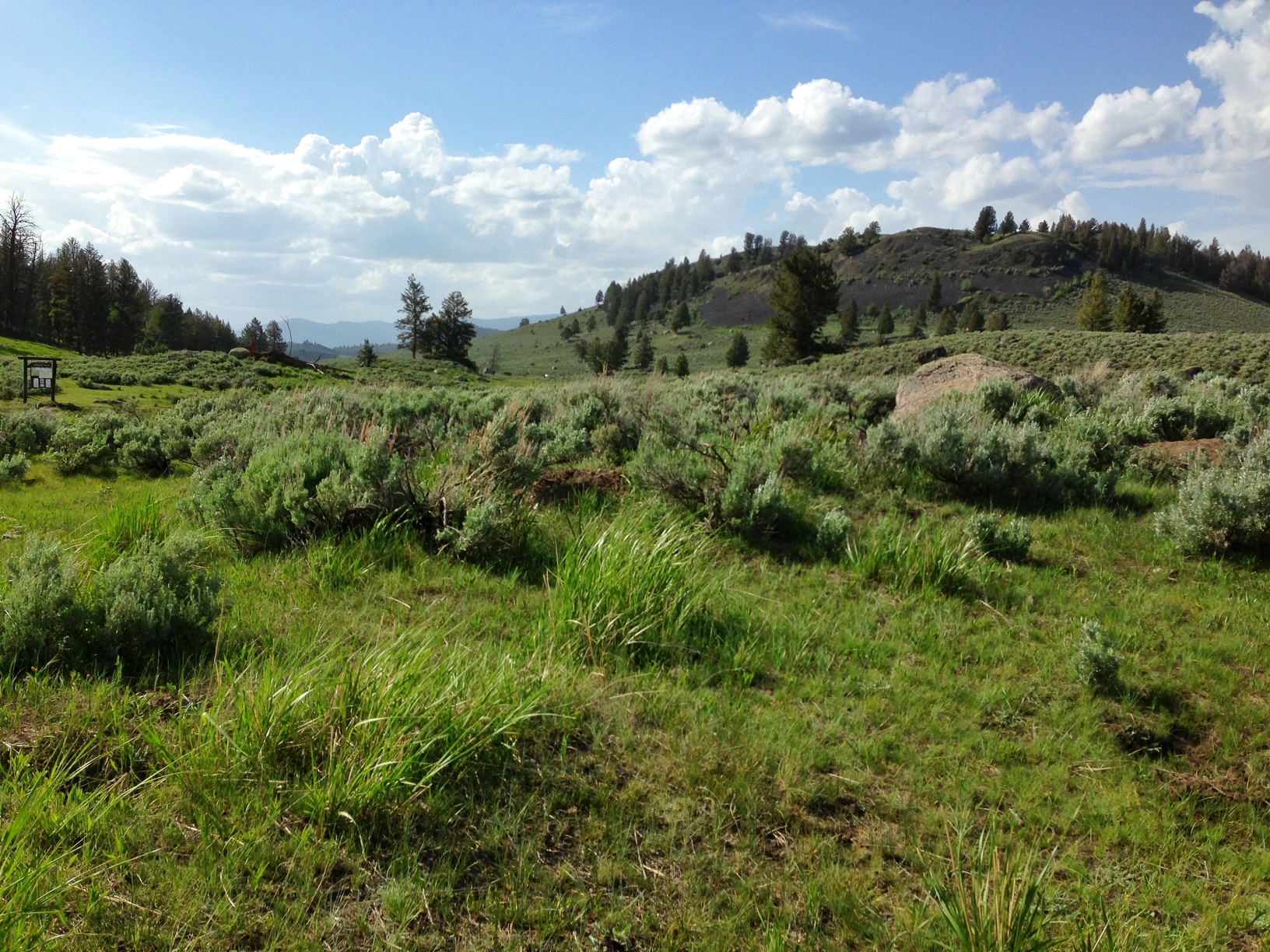
Wonder where that verb comes from? Whatever its origin, this is the summer of the Badger in Yellowstone. The animal, that is…a persistent, relentless digger that roams the sagebrush flats in search of prey. This year I saw the most American Badgers I have ever seen in my 25+ years of visiting the park. They live in habitats similar to this in the area called Little America in Yellowstone’s northern range,.
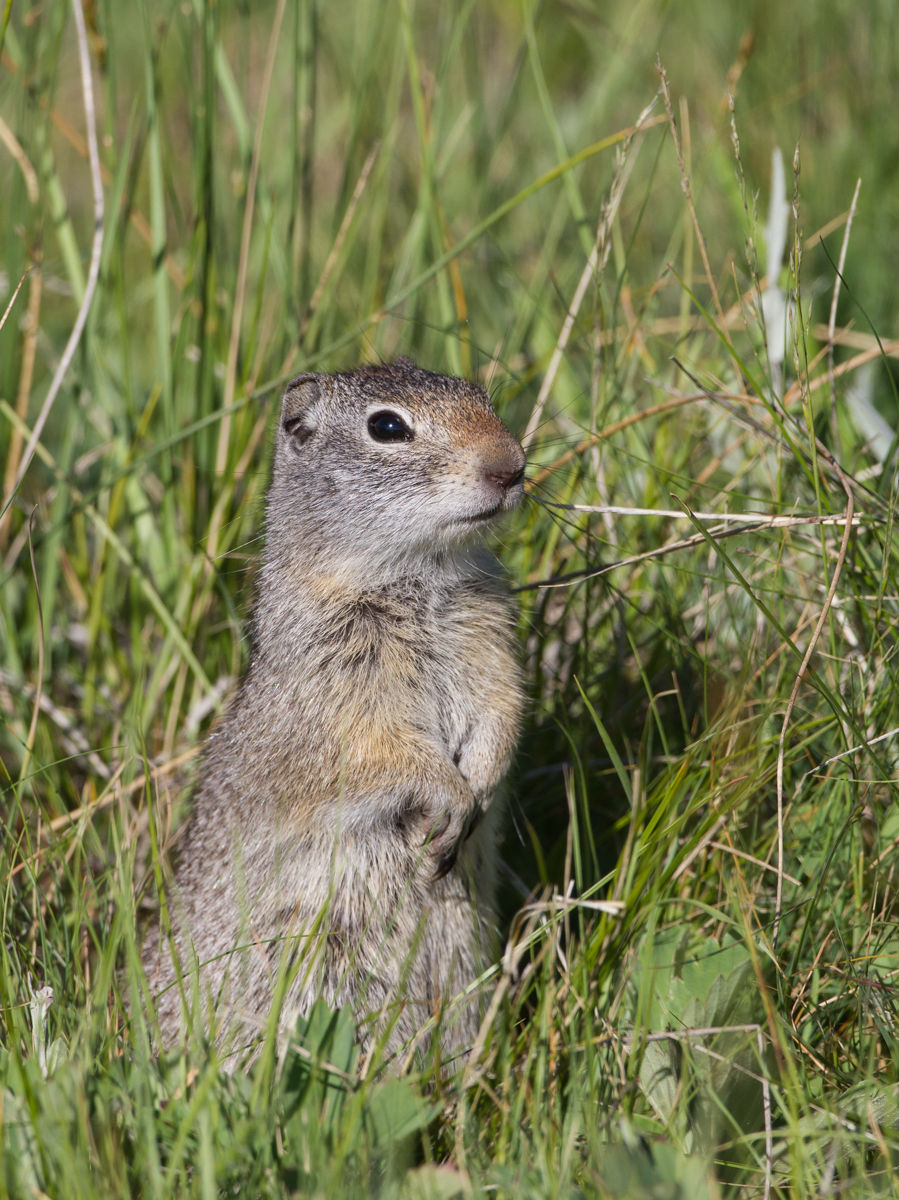
Uinta Ground Squirrel near Badger den
The usual prey here is the omnipresent Uinta Ground Squirrel, itself a proficient burrower. Last year our teacher workshop encountered a Badger in this same area so I brought my group there this year in hopes of seeing another. As we approached, I spotted an adult Badger waddling across the trail carrying a ground squirrel.
It quickly vanished in a large hole at the base of a boulder, only to reappear a few seconds later to peer through the sagebrush at us. It disappeared back into the burrow, only to come out again and move to another hole nearby.
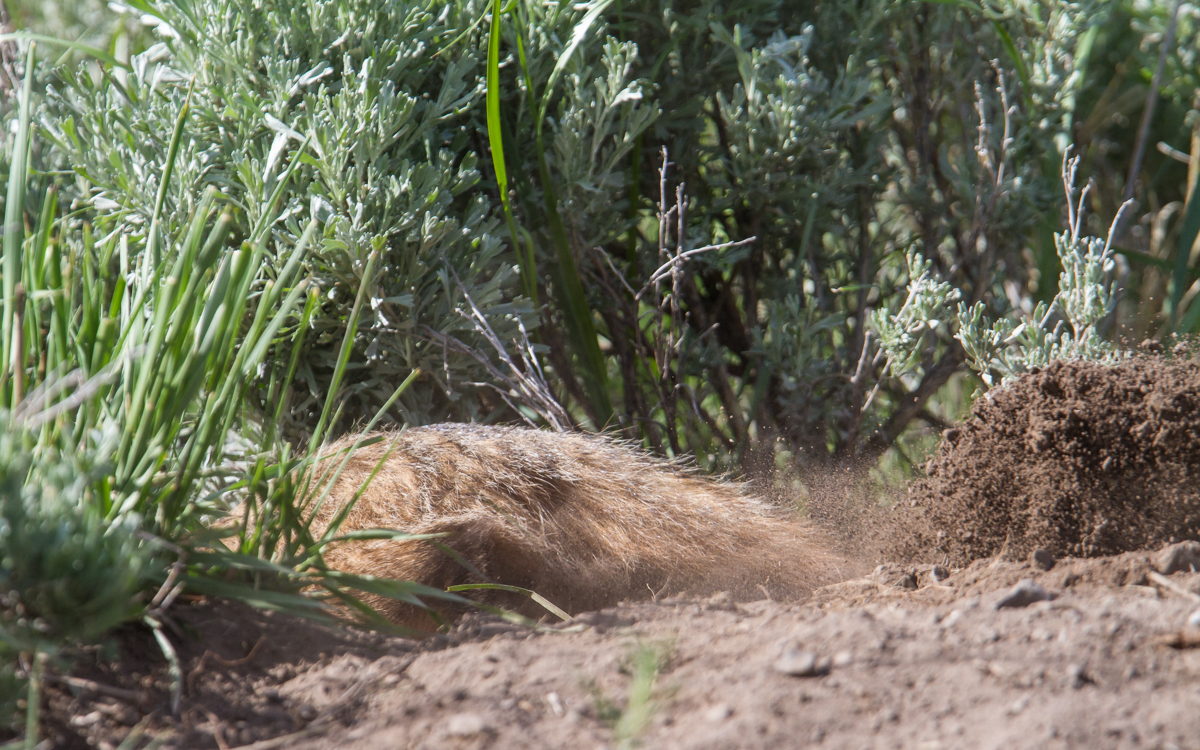
Badger digging
There it quickly began throwing dirt as it dug and soon disappeared into that hole. Badgers are well adapted to their digging life style: they have nicitating membranes on their eyes to protect them from dirt and debris; they have small ear canals; their body is flattened and their neck muscular, which helps in the digging process; they have long, sharp claws and their toes are partially webbed; and the loose skin may help them turn in tight tunnels. And burrow they do – they rarely use the same burrow for sleeping or resting more than a few times (except for burrows with young) and they are constantly digging for prey so a single Badger is estimated to dig well over a thousand burrows in a year.
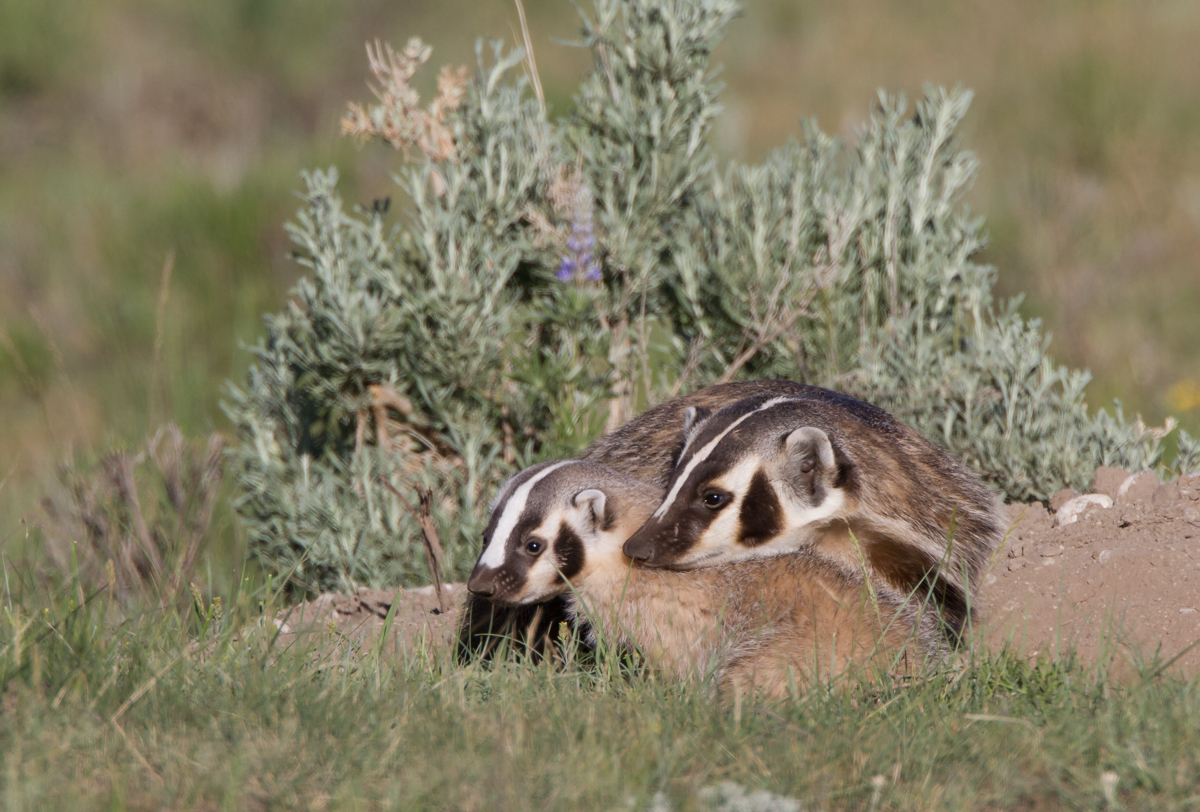
And for some reason, Badgers are super abundant this year in Yellowstone, including a well-photographed den near the road in Little America. The female must have moved her young into that den after I arrived because the second time I went through the area ( a week after the first) the park had placed signs and cones along the road to help keep people a reasonable distance from the den. And every day for the next several there was a “badger jam” at that site with lots of long lenses waiting for some action.
Badger adult and young at den along road
I joined in the jam for a few minutes to snap some shots and let my group do the same, and then we moved on, as I prefer to be away from the crowds to watch wildlife whenever possible.
Badger baby nipping at adult at den site
Badgers have been widely watched this spring in the park with two well known incidents happening in front of visitors. In two dramatic cases, a Badger had raided a den site and fought, evicted, and killed the young of a Coyote and of a Red Fox. I had seen images of one incident on a web site I follow and wolf watchers told me about the the other they had witnessed at a Coyote den in Lamar Valley. Coyotes are supposedly one of the major predators on Badgers, especially the young, but here was a case of the reverse. And Badger numbers may be up, in part at least, due to the decline of Coyotes on the northern range after the reintroduction of wolves.
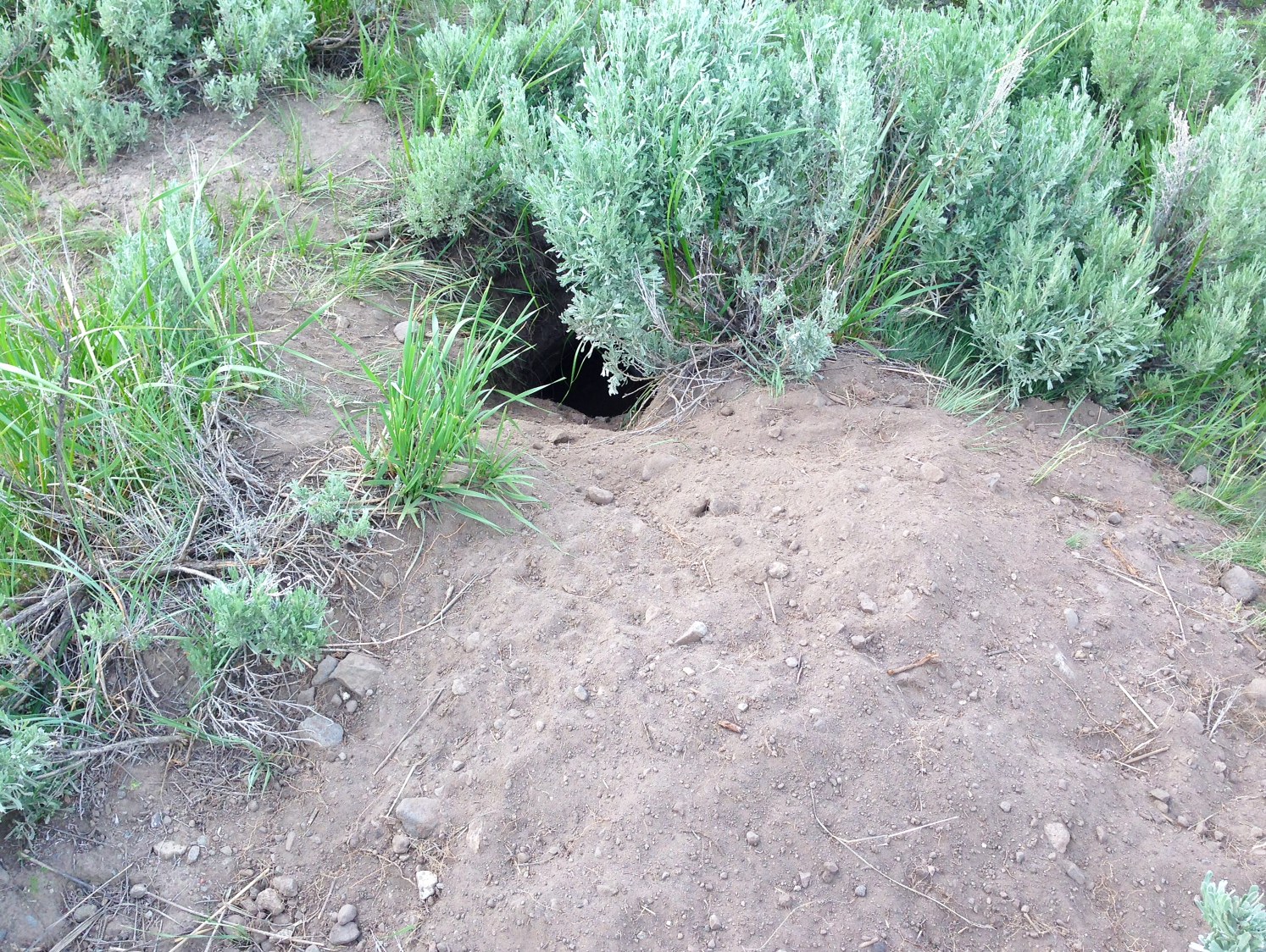
Badger burrow
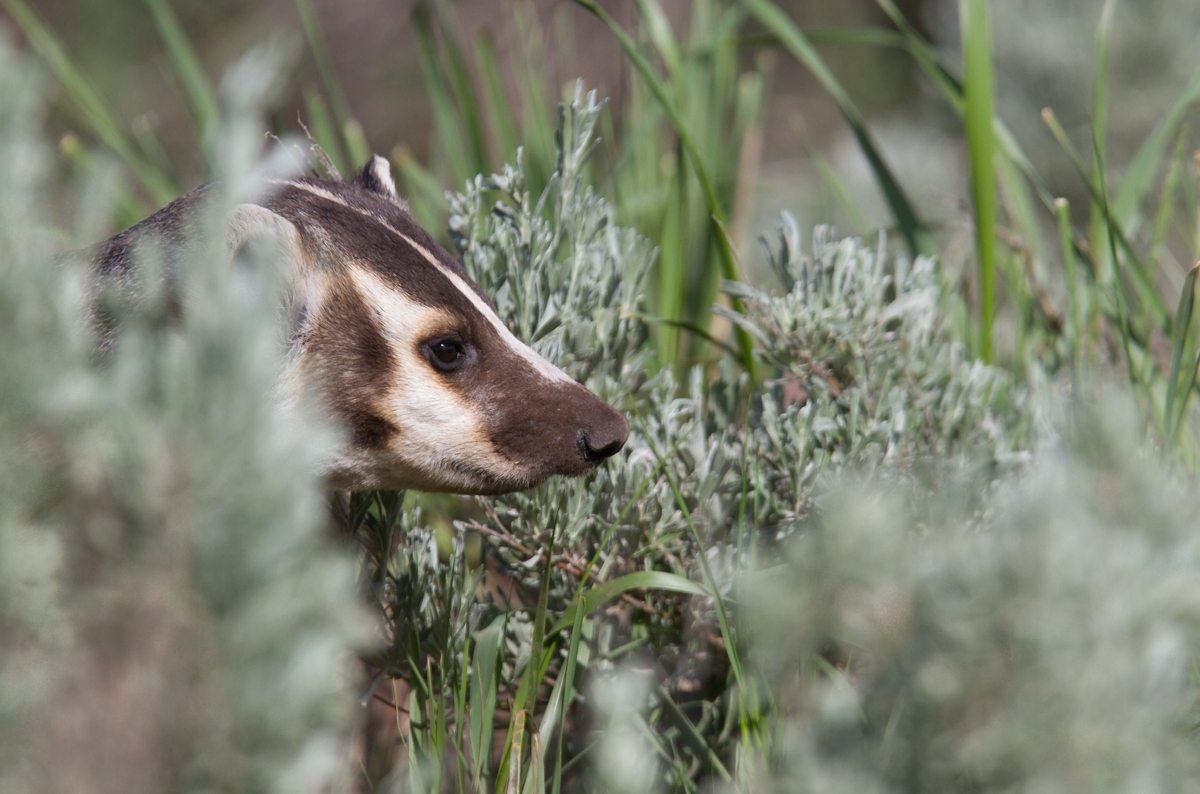
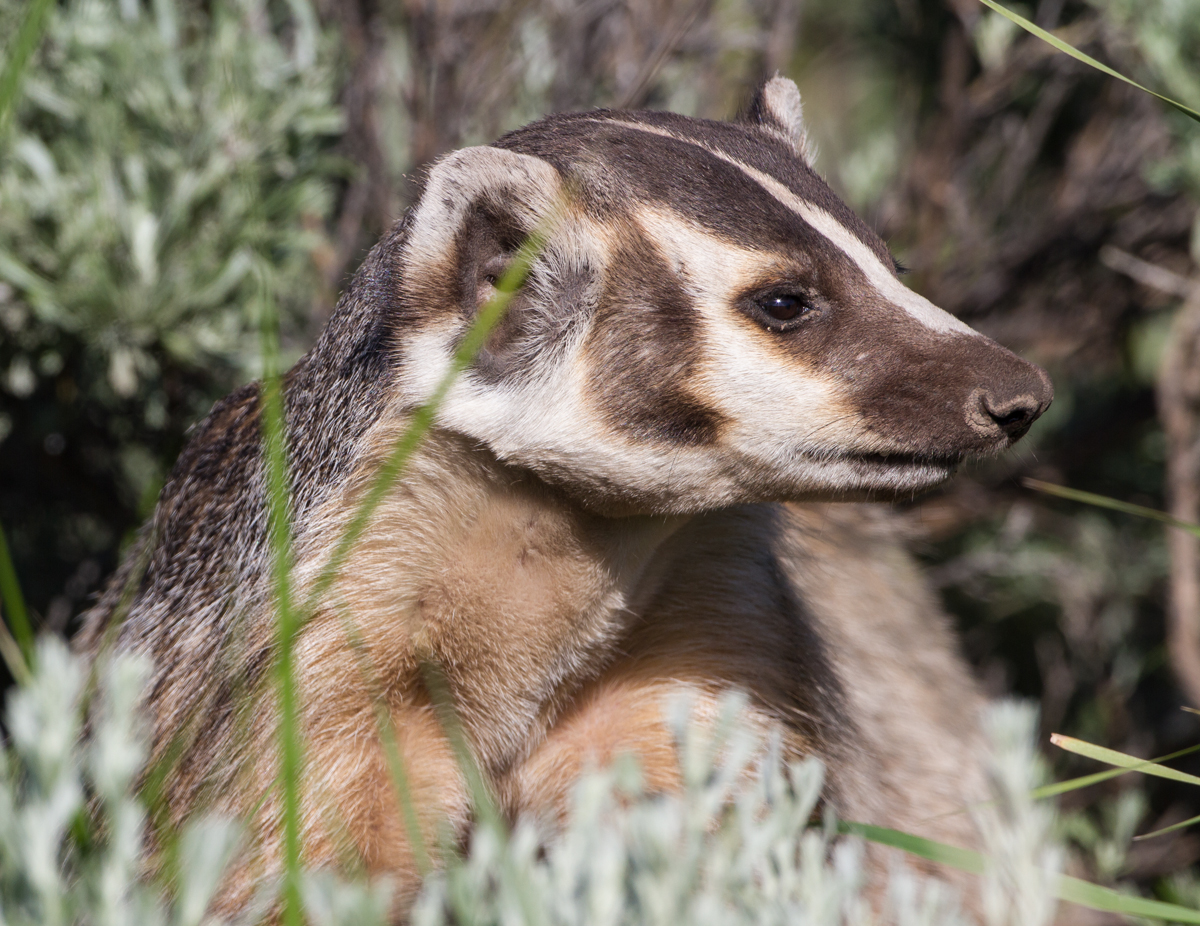
I returned to the secluded Badger burrow we had found earlier only to find no badger so I waited. I finally walked away from the hole a hundred feet or so just checking the area when I spotted the familiar black and white pattern of a Badger face in the sagebrush. The Badger had apparently moved the young to another burrow near the original one. This time I was able to get quick shots of both an adult and a young gazing out at their world through the vegetation.
Badger adultBadger juvenile
Their is a certain satisfaction in observing wildlife with no one else or just your group around. I visited this “private” badger group a couple of times and was rewarded with a close encounter with this family of weasel relatives as they shuffled around their den site, grunting ad snorting as they went about their daily lives. I enjoy this type of wildlife encounter the most – one where you really get the feel of an animal as it behaves the way it normally does without interference from crowds of people. On your next wildlife watching outing, I hope you are as fortunate.
I am back home in NC now after a great two weeks in Yellowstone. I will post a few more blogs about my trip in the coming days but wanted to start with what I witnessed on my last morning through the park.
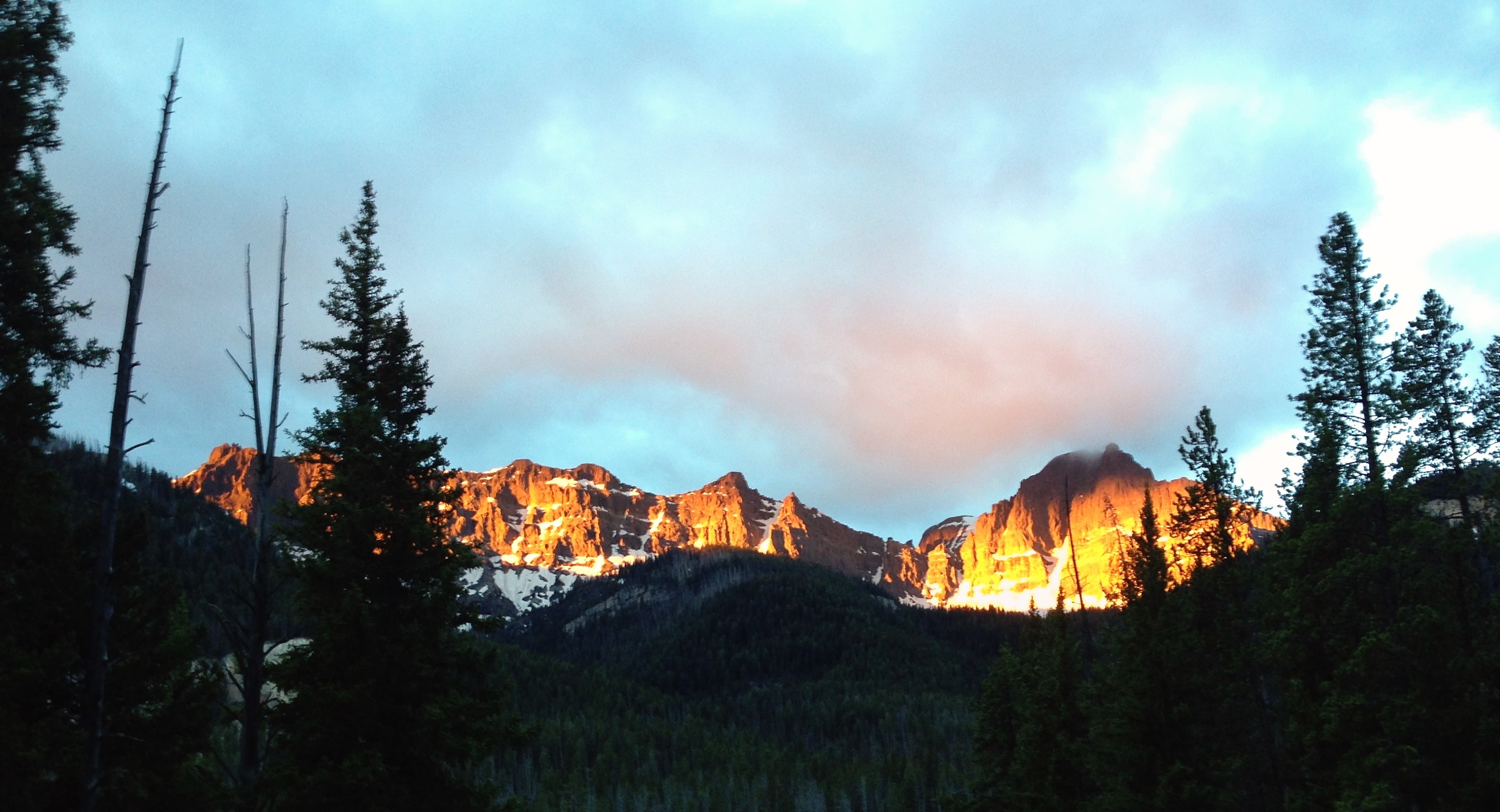
Sunrise on my last morning in the park
The day started with an expletive when I realized at 4:30 a.m. that the power was off in Silver Gate. I had enjoyed my stay at the Log Cabin Cafe cabins but was bummed that I would need to finish packing by headlamp and, worse yet, might have no shower for my long day of plane rides home. But, there was enough hot water to get the shower, and as I got into the car, I was greeted by a spectacular sunrise. It was going to be a great morning after all.
Bull Moose browsing on aspen saplings
As I approached Round Prairie I could see a car pulled off the road so I slowed and saw a beautiful bull Moose browsing on some aspen saplings. The visitor had been watching the bull feed for about 30 minutes (and it was only 5:30 a.m. when I arrived). I got out and watched for a few minutes as the bull slowly worked its way into some thick tree cover and disappeared from sight. Such are the vagaries of wildlife watching – one minute a great view and the next an animal as large as a horse can vanish for hours by moving only a few feet. Luck was with me this morning.
The clouds thickened as I headed into Lamar Valley. About a mile down the road I could see a gathering of cars on a hill so I stopped to glass the valley to see what was happening. I quickly noticed some ravens and magpies far out across the Lamar River and when I stepped out of the car I heard the alarm barks of a coyote. That probably meant wolves were nearby. After looking near the raven activity I finally saw canids including the unmistakable black color of a wolf. It appeared that the wolves were digging and that was probably bad news for the coyotes. I drove on and found out that the three wolves were digging out a coyote den. As there was no place to pull over I kept driving with plans to check on several things I wanted to see in the area known as Little America before heading for the airport.
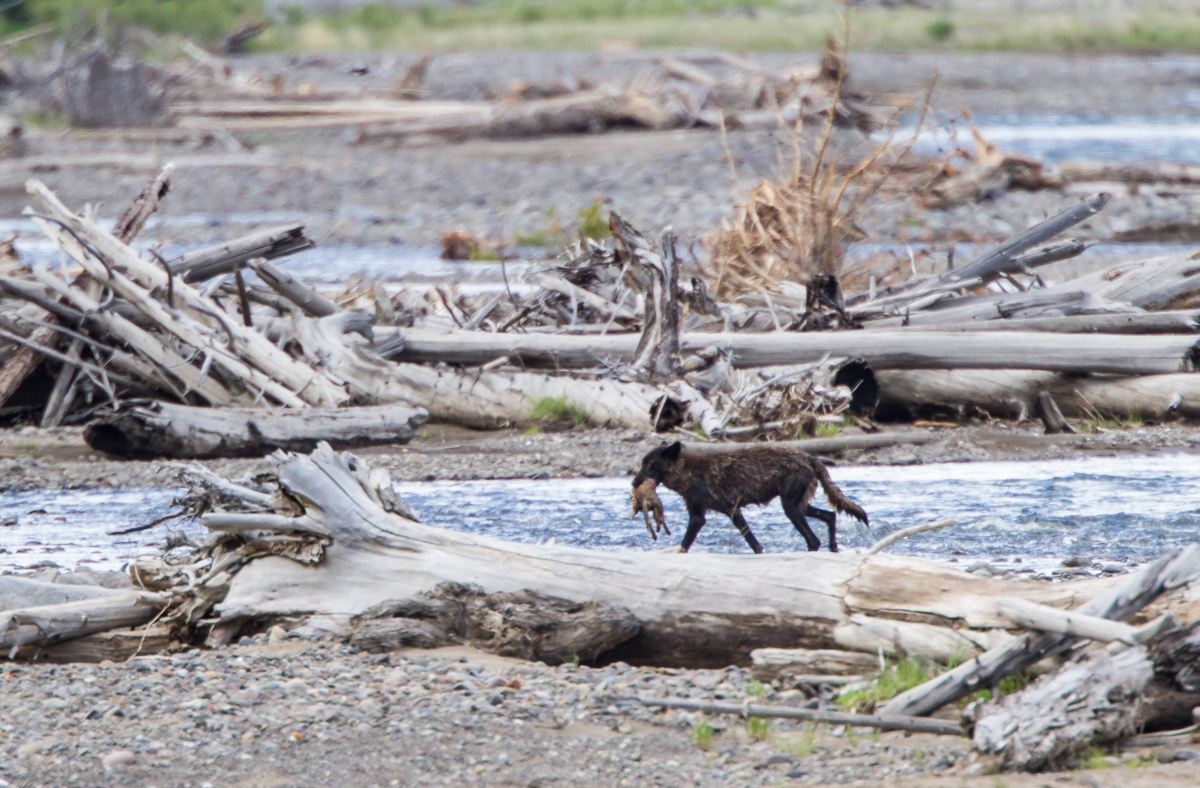
Black wolf out in valley
The dark skies were not great for photography, so, after spending some time watching a bison herd, I decided to drive back to Lamar one last time to check on the wolf-coyote saga. From the highest pullout I could see a black wolf a mile or more away headed down the valley. A half mile beyond me were about 50 people out watching. I drove beyond the crowd hoping the wolf would continue down the valley toward the den site a couple of miles beyond. When I stopped I could see the wolf was carrying something – a coyote pup. I later found out that this black wolf is a two year old female and is a persistent animal – she did the bulk of the digging at the coyote den (for over 45 minutes) while the other two wolves stood guard. She killed this pup and was carrying it back toward the wolf den with pups a few miles away.
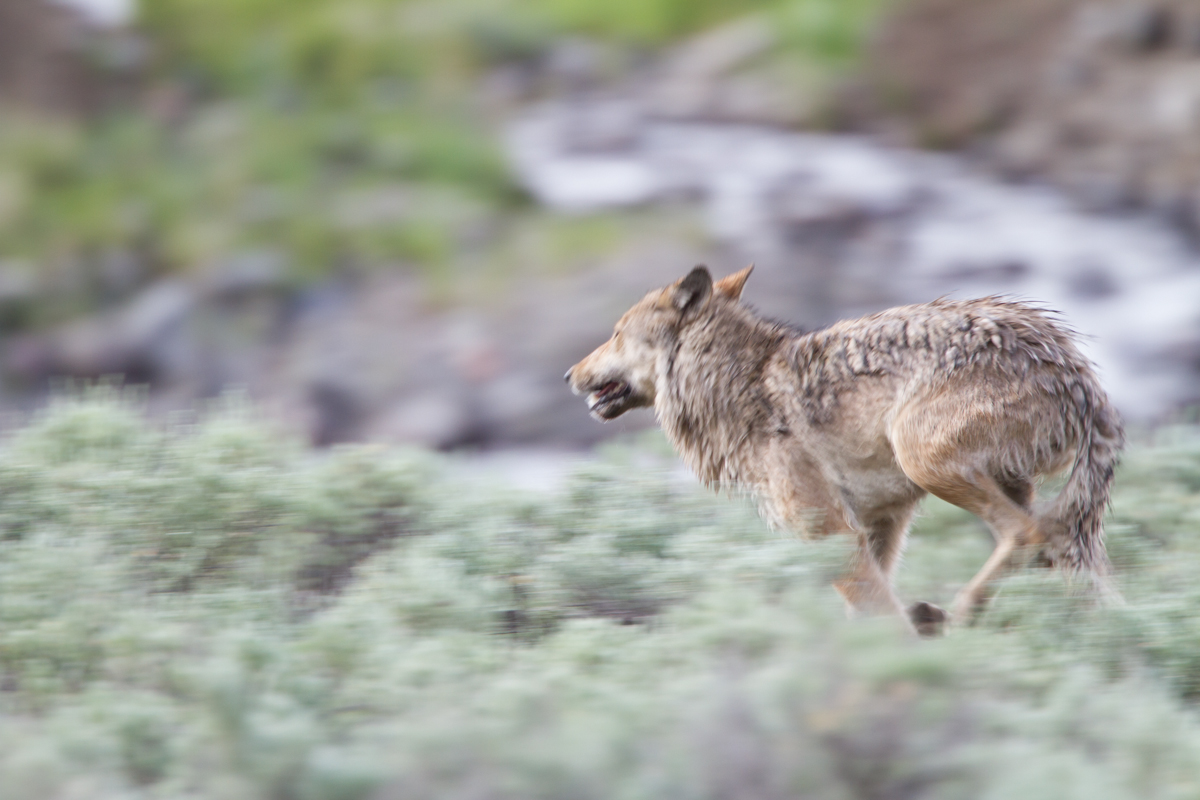
Wolf running by me as I wait for black wolf
I, along with two other people, had positioned myself down the road ahead of the crowd in an area where I anticipated the black wolf heading. While I was setting up my camera, I saw a blur out of the corner of my eye – it was a wolf running full speed between me and the river! The black wolf was far across the river so we were all startled by this close animal – and this wolf was being pursued by two coyotes.
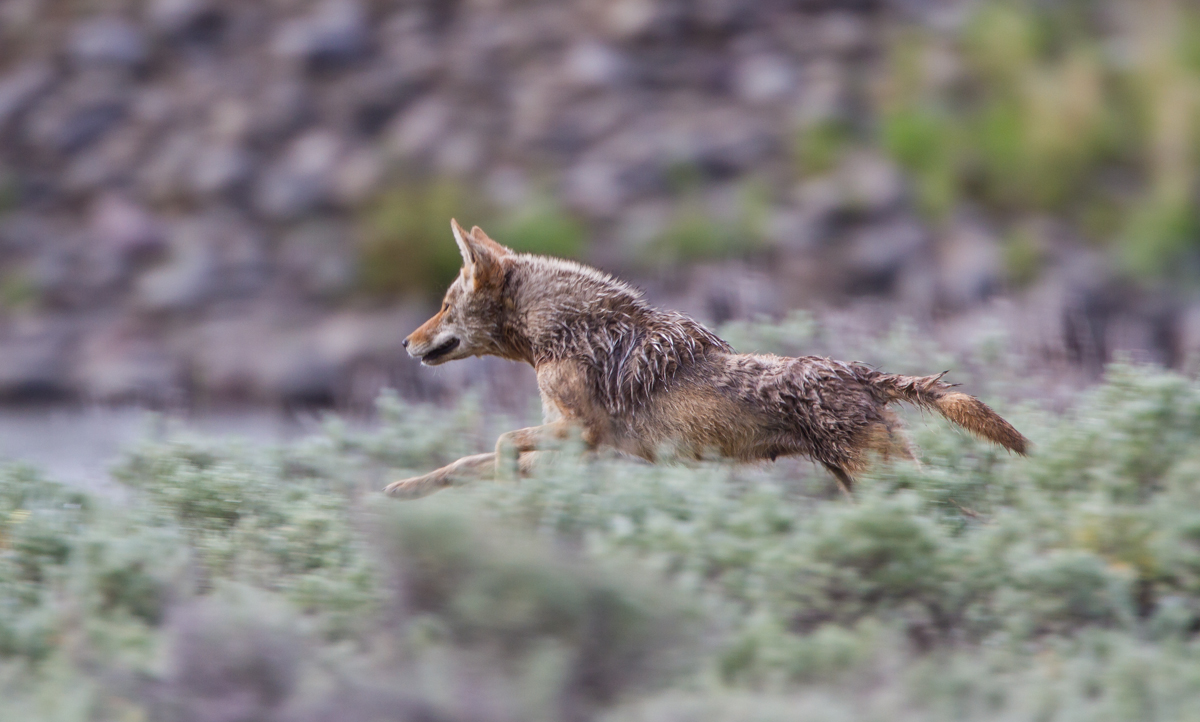
Coyote chasing wolf
I quickly spun the camera and fired a few shots and managed to capture a couple of somewhat blurry images before they were all out of sight. The three of us looked at each other and appeared stunned at what had just happened. I am guessing this wolf was being chased by the coyote pair that had just lost their den in a somewhat unusual turnabout of roles with the coyotes being the pursuers instead of the pursued. The images here of the other wolves are heavily cropped – these of the running wolf and coyote are not cropped at all, showing how close they were. Apparently the wolf had crossed the river far downstream beyond our view and was being chased along our side of the river when she blew by us.
Black wolf with Coyote pup
After catching my breath I turned my attention back to the black wolf who was approaching on the far side of the river carrying her prey. She moved quickly down the valley and then dropped the pup, looked back, and began wagging her tail.
Two wolves across Lamar River
I looked up from the viewfinder and saw a big gray wolf approaching ( I think this is the male of the group). After a brief greeting, the black wolf picked the pup up again and they moved on down the valley. The male turned and headed over a knoll and the black female continued on toward the river in the direction of the den.
Black wolf with Coyote pup getting ready to cross river
From my vantage point I saw the wolf approach the river and come out on the other side. By this time, many of the cars from down the valley had come down to try to see the wolf so there were people and cars on both sides of one of the mile-long no stopping zones that the park created along the road to allow the wolves to safely travel to and from their den site. When the black wolf finally crossed it did not have the pup carcass. I imagine it cached it somewhere amongst the willow flats along the river to be retrieved at a later time. I saw this same pack do that earlier in the week with a Pronghorn fawn they killed – the gray female carried the fawn’s body several hundred yards and buried it in an aspen grove.
Such is the cycle of life in Yellowstone. I heard people commenting on what we all just witnessed – most felt some sorrow for the coyote pup but were still thrilled at what we saw. This is part of the drama that is played out every day in this incredible place and awaits you if you simply take the time to observe. It is hard to put into words how it makes you feel – a mix of emotions and awe. But the drama of nature happens all around us every day if we only stop and look. As I am writing this, there is a Gray Squirrel out my window, perched precariously on a thin branch and reaching up and grabbing some Viburnum berries to eat. Granted, it is not a wolf with prey, but it is special nonetheless. One thing I have noticed over the years is that trips to places like Yellowstone, where we can more easily witness the behavior of wild creatures, helps us to better observe and appreciate the small wonders of nature back home. And that may be the most important lesson we can learn from this magical place.
Whenever I travel between Canyon and Lake I always stop at LeHardy Rapids on the Yellowstone River. The rapids are about 3 miles from the lake and were named for a map topographer in the late 1800s whose raft was destroyed in these swift waters.
I stop at LeHardy for two reasons
1) to catch a glimpse of the spawning Cutthroat Trout and, 2) the Harlequin Ducks.
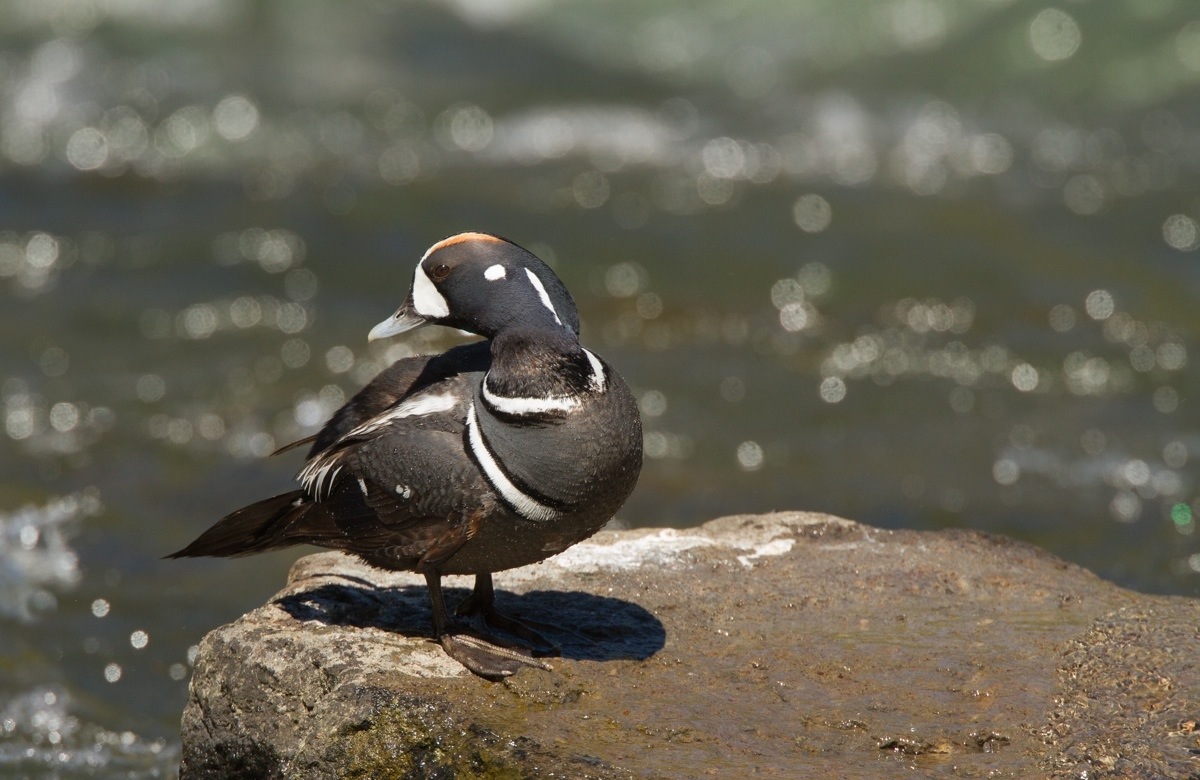
Harlequin Ducks are truly beautiful birds. The striking males are slate gray with chestnut sides and some bold white spots and stripes on the head and body. Females are duller brown with some white markings on the head. During the breeding season these ducks inhabit swift mountain streams where they feed on aquatic insects. In winter, they migrate to rocky coasts where they feed on shellfish and other marine invertebrates.
At LeHardy Rapids they often sit on one of a few boulders out in the white water.
But it’s when they enter the rapids that they become truly remarkable birds. They swim in the biggest waves, seemingly without effort.
They dive underwater to catch their food and then pop up nearby like a cork.
If they get swept a bit too far downstream they just flap their wings and almost swim on the surface back to their starting point.
Then they pop out of the water back onto their rock to preen and rest before starting it all over again.
NOTE: My group has arrived and we will be going through the park starting this morning. Posts will be limited for the next week due to internet access and time.
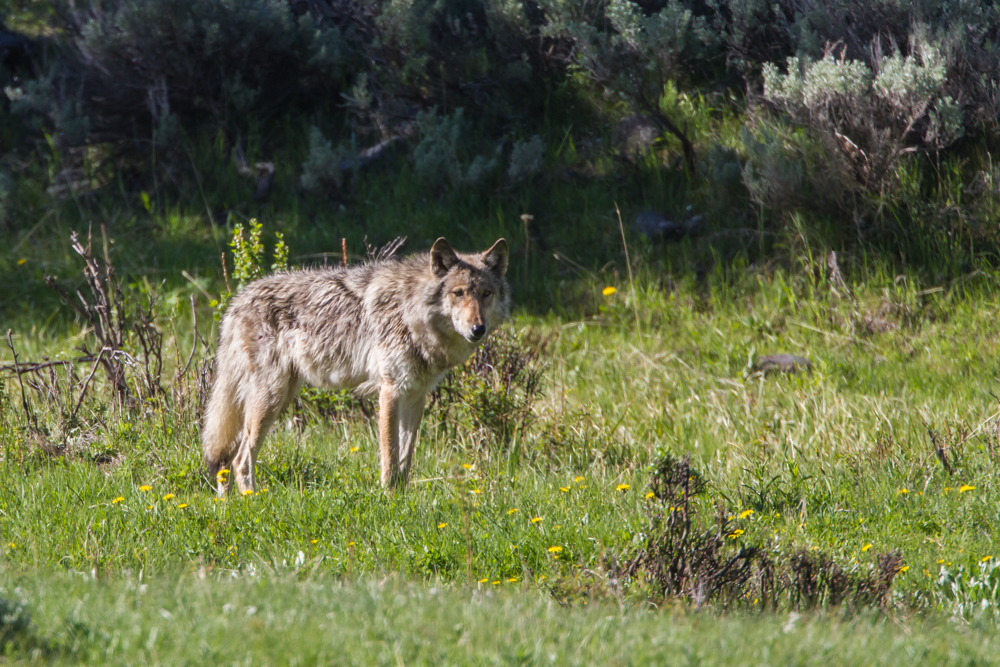
I’ve been in the park three days and no wolves. I know several “Yellowstone wolves” were legally killed in lands outside the park by hunters this past winter. I had read this may have disrupted pack structure in the northern range where many of the wolves in Yellowstone spend much of their time. So, it was not too surprising I had seen fewer than in past years. I also tend to not stop at the really large wolf-watching crowds (sometimes there can be 50-100 people at pullouts if a wolf has been spotted) so I probably missed a few opportunities.
Wolf seen through windshield (click to enlarge)
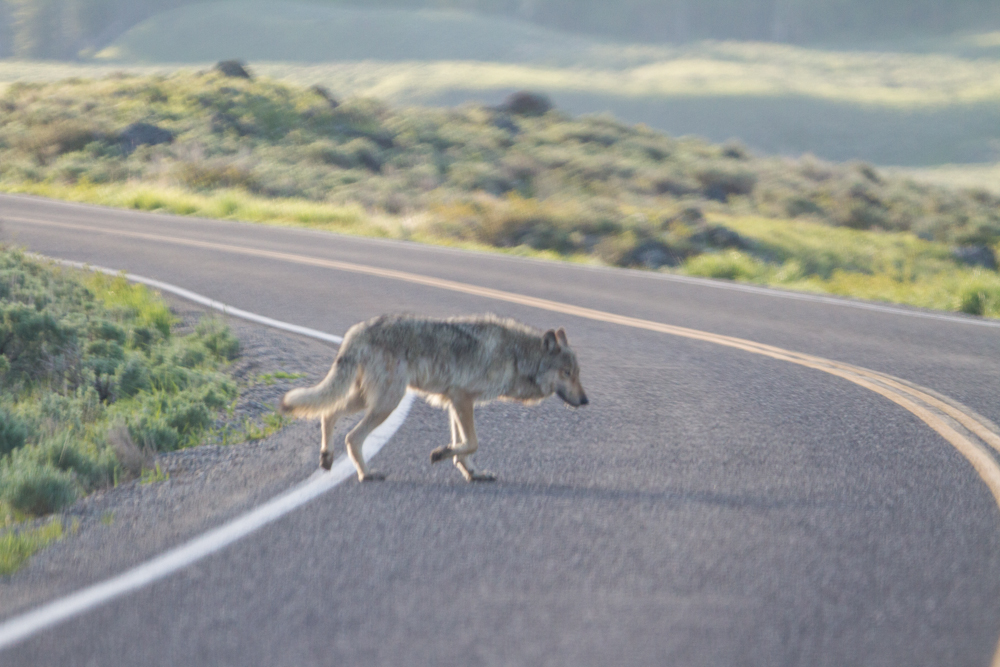
And then, when you least suspect it – a wolf! I was near one of the hot spots for seeing wolves but there were uncharacteristically no cars. I had seen lots of the usual wolf watcher cars a few miles back at another hot spot. Suddenly, a wolf came into the road in front of me and another car.
Wolf running across road – the only shot I thought I would get (click to enlarge)
I grabbed a couple of quick shots (these are the only images in this post that are not cropped) through the windshield and through the open window on the passenger side as it ran across and thought that was it. I backed into the adjacent pullout and the three car loads of people present watched it run out of sight over the hill. One car left and three people from the other car walked up on a knoll to see if they could see the wolf off in the distance. I looked over, and one of the women on the knoll was waving for me to come out, so I started walking over. She waved emphatically, so I ran! I got there and they said the wolf had been just below them on a sand bar in the creek when they got to the knoll, so the wolf had apparently slowed to a walk when it got over the hill. Rules in the park state that you can be no closer than 100 yards to a wolf, so we stayed put and let it walk downstream away from us.
Wolf at Soda Butte Creek (click to enlarge)
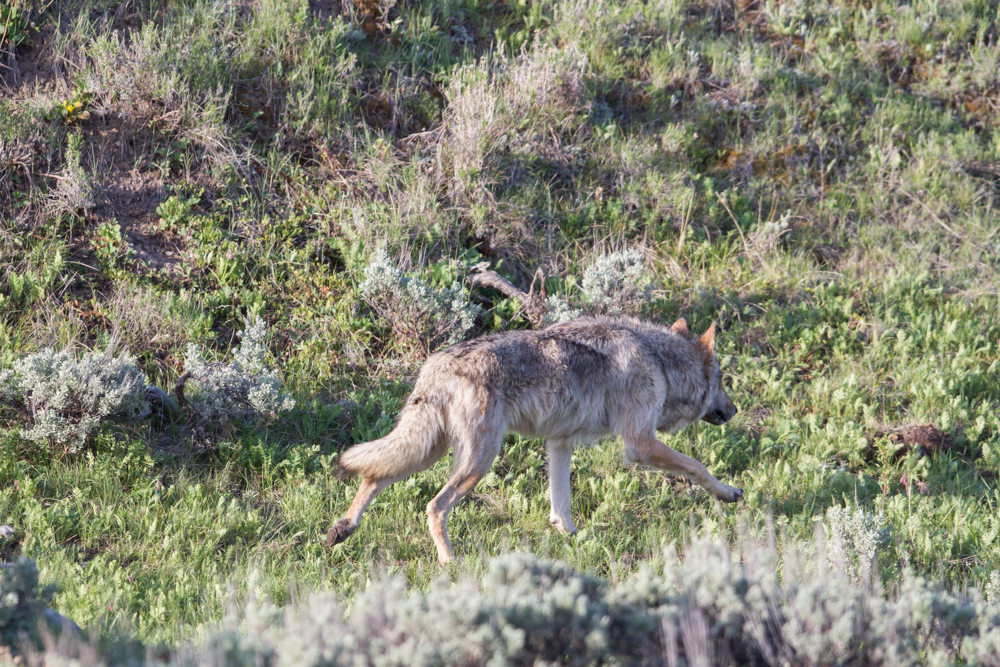
The sun was coming in and out of the clouds so I was shooting as fast as I could and trying to keep up with the changing light. But I also wanted to just watch the wolf, seemingly unconcerned that we were anywhere in the vicinity save for an occasional glance our way. It is such a rarity to see a wolf without a crowd around you. Our wolf was sniffing and checking out the area and then seemed to detect something of interest and slowly moved toward it.
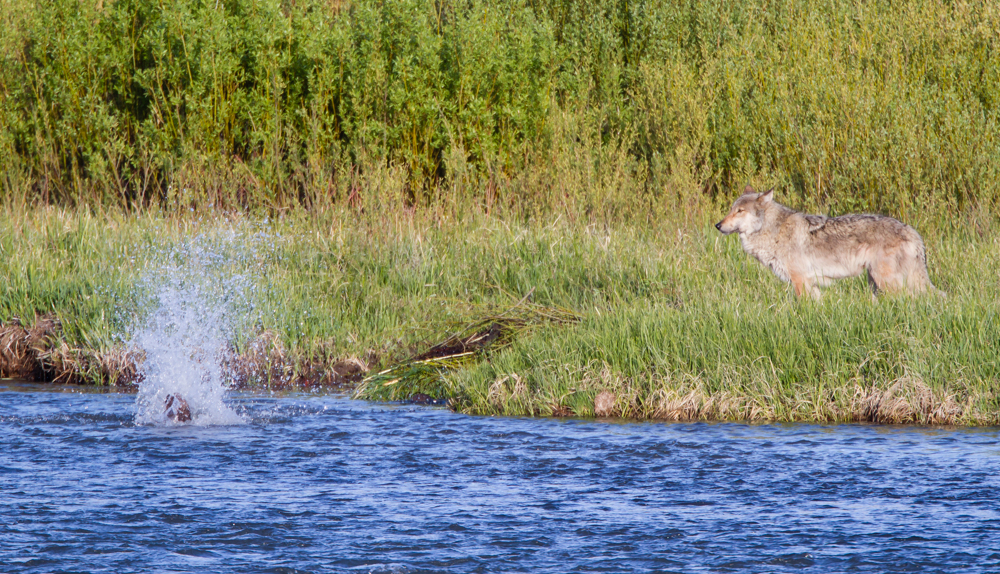
Wolf and Beaver – you can see the beaver’s tail slapping the surface (click to enlarge)
There was a big splash in the water a few feet from the wolf – a beaver! Beaver have been making a comeback in the park in recent years and this was near one of three small lodges I had seen on this trip. Missing that opportunity, the wolf moved downstream a bit and then swam across, apparently having a tough time at one point in the strong current.
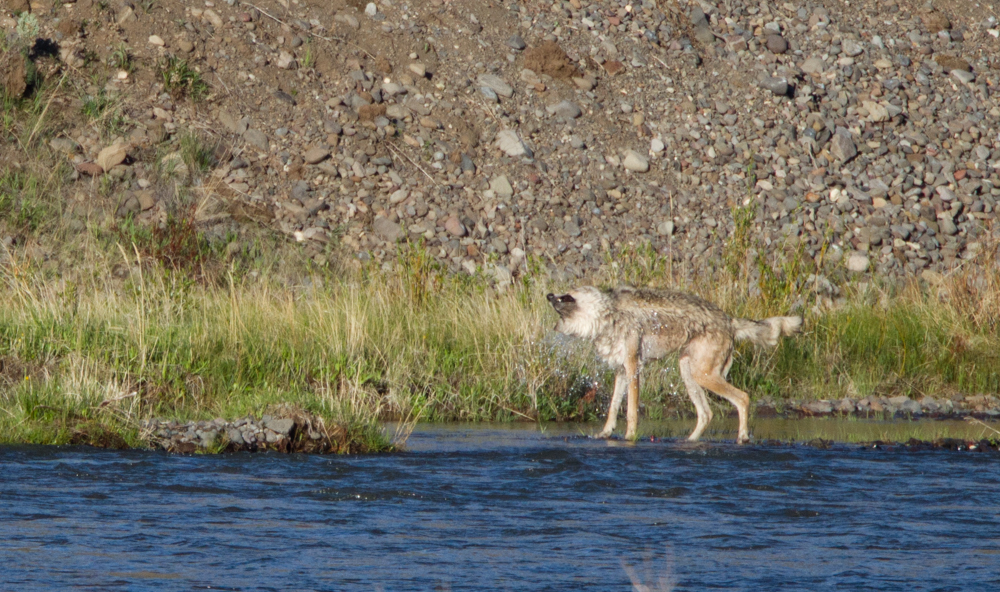
Wolf shaking after crossing creek (click to enlarge)
It then shook off, climbed a steep bank, and headed back upstream. I went back to the car and headed up the road to where I knew there was another pullout. As I approached, there were already a lot of cars so I went to the next spot down the road with just a few others.
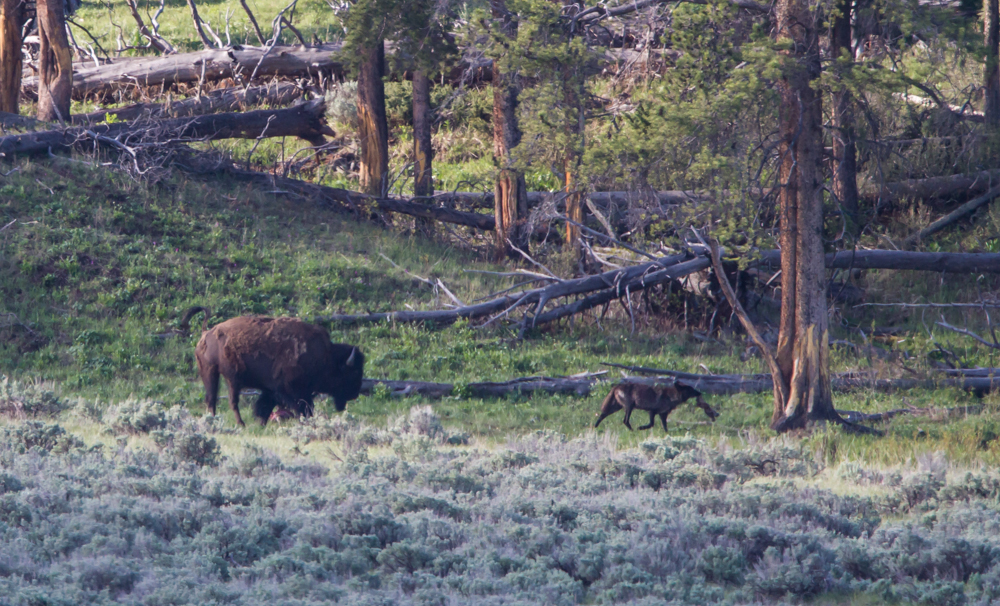
Wolf and Bison interact at carcass (click to enlarge)
These people were watching a different wolf – a black one. It was feeding on a carcass of some sort (some thought elk calf, some thought bison calf) but was interrupted by an adult bison that didn’t care for the wolf’s presence. The bison kept chasing off the wolf, but the wolf finally got a section of the carcass and ran a short distance and began to feed again.
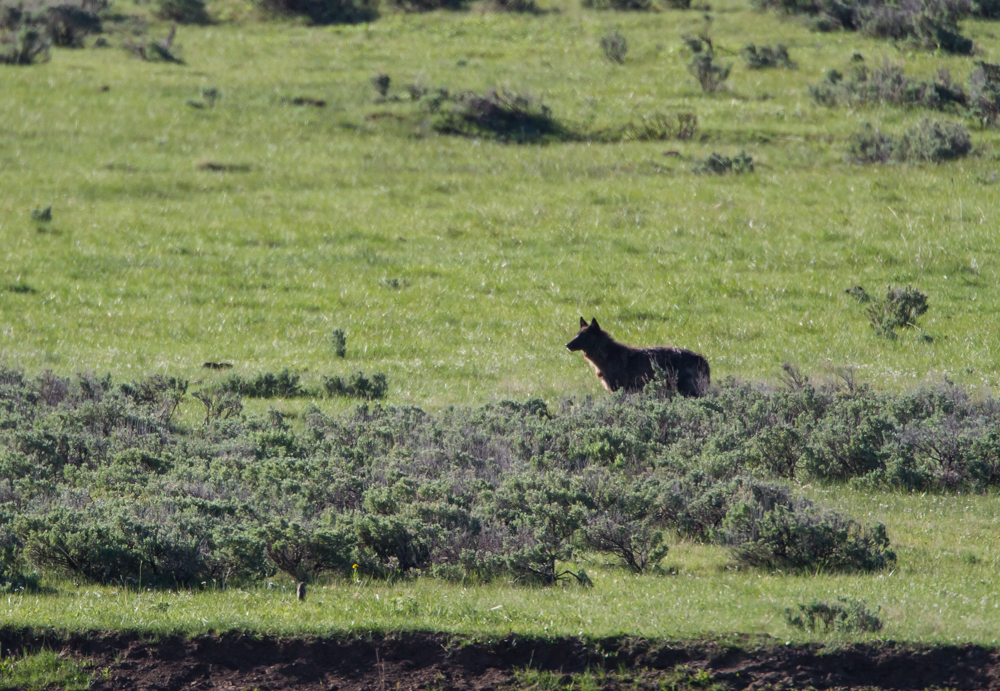
Black Wolf (click to enlarge)
The black wolf then departed, probably taking some food in its belly for pups in the den that is known to be nearby. While all this was going on, a female Pronghorn chased away a Coyote from the same area (she must have had a fawn out there), a Sandhill Crane walked through the scene, our wolf could be seen downstream, and someone pointed out two grizzlies high on a meadow across the valley. So much to see, so little time. Finally, both wolves disappeared from view and the crowds started to leave.
As I headed back to Roosevelt for a long overdue breakfast there was another group of cars lining the road a couple of miles from the scene of the wolf sightings. I stopped and found out a wolf was lying across the river in a small depression but was not visible at the moment. This time I did join the crowd to see if it was the same wolf that we had watched earlier.
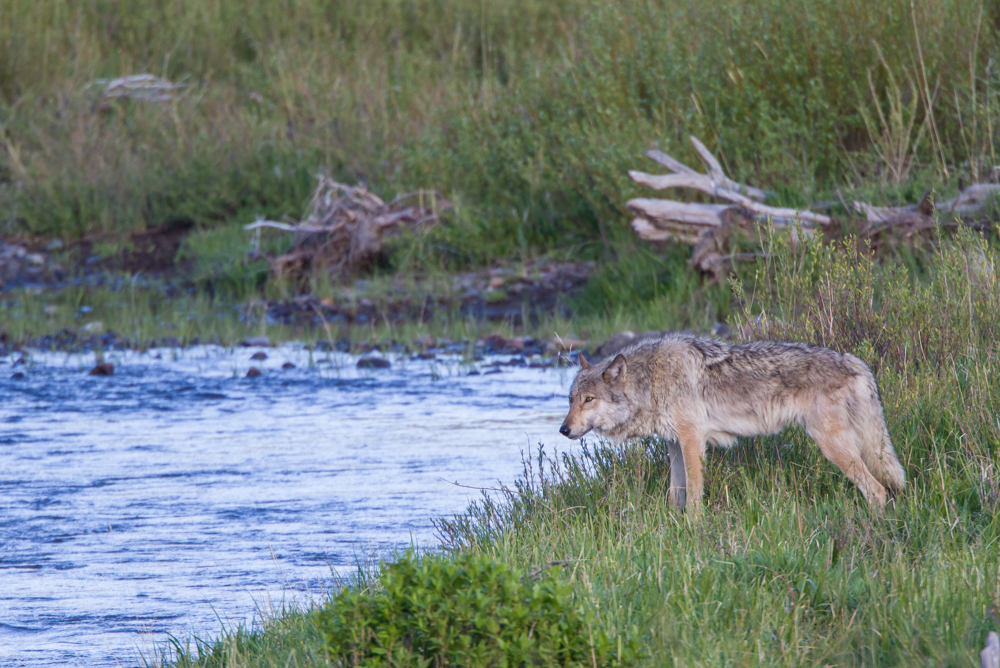
The Wolf known as Middle Gray along Lamar River (click to enlarge)
When it stood up, I recognized it as “our” wolf from the creek. This is the wolf known as Middle Gray by the Wolf Project observers. I believe she is part of the Lamar Canyon pack although the use of that pack name is in question since the alpha female was killed during hunting season last winter and the alpha male left the main group afterward. The black female I saw feeding on the carcass is in the same group of three wolves as Middle Gray. The group apparently has a den site near where they were seen but I have not heard any details on the pups as yet.
I hope we are as lucky in the next few days. Any sighting of a wolf in the wild is dramatic, but one where you are with only a few other interested observers, and you are able to watch the wolf be a wolf is a rare treat. The issue of wolf hunting is quite controversial. I hope a way can be found to provide a buffer zone around Yellowstone and Grand Teton National Parks so these animals that thousands of park visitors come to see have a better chance of surviving another winter.
I had heard about a Great Gray Owl nest in the park, so the morning after seeing the one up near the Beartooths (by the way, we did not find a nest at that one – yet) I decided to try to locate it. I knew roughly where it was as several photographers had mentioned it. After climbing through some dense dead-fall in the forest, I saw a few people with long lenses, and knew I was at the right spot. I was a bit concerned about people knowing the location of the nest due to disturbance, but I will give that group credit – they were very respectful and quiet and at a reasonable distance.
Great Gray Owl in nest (click to enlarge)
Great Gray Owls are our largest species and the huge facial disks give them an elegant, all-knowing countenance. The female is larger than the male and incubates the eggs. The male will hunt nearby and bring her and the chicks food. I sat with her for about an hour after the other group left, admiring this magnificent bird of the north, and felt privileged to be there. Finally, she turned in the nest with her tail feathers pointing my way, and I knew it was time to leave.
After seeing the Marten at Dan and Cindy’s I didn’t think that the day could get much better, but I was wrong. Later that afternoon Dan invited me to tag along with he and his daughter, Cassie, to look for a Great Gray Owl he had seen the day before up towards the Beartooth’s.
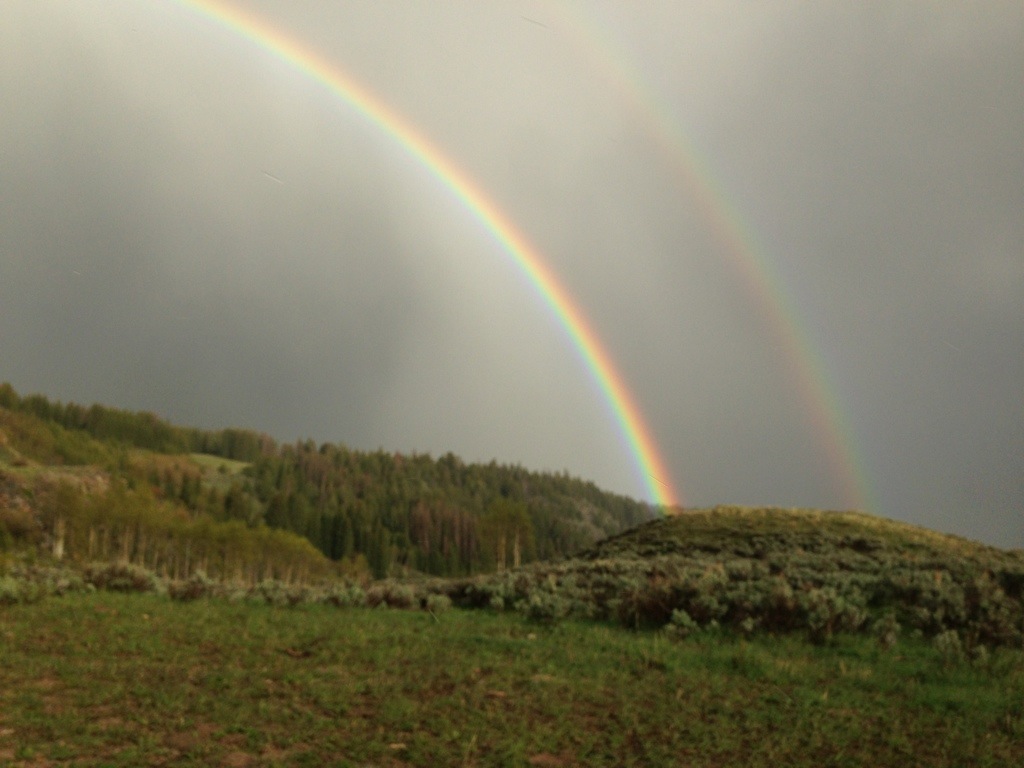
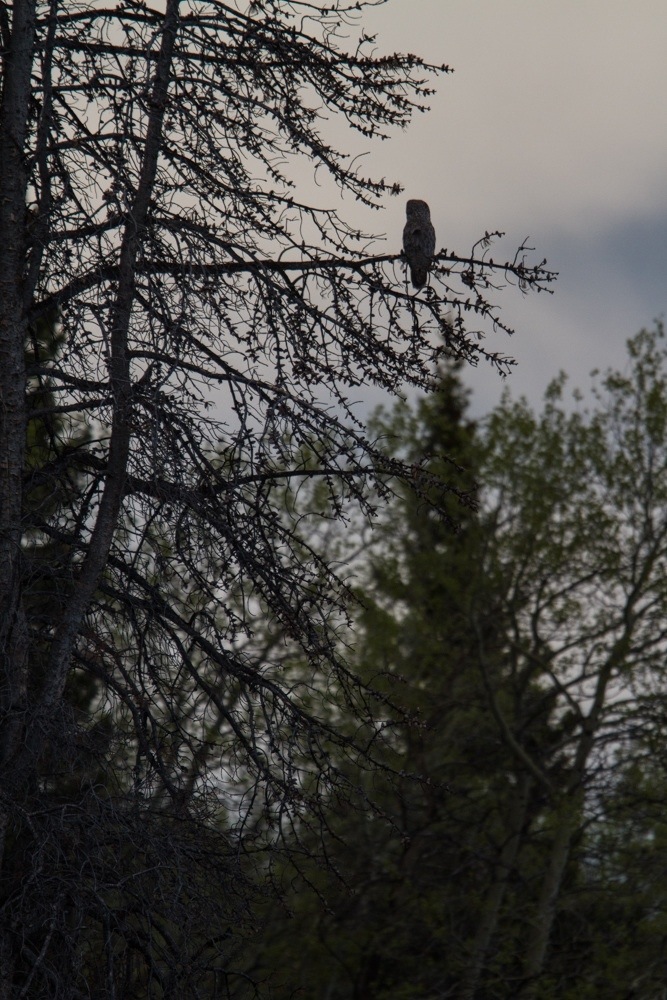
The weather didn’t look very inviting though as rainclouds moved in. As we got up towards where he had seen the owl the rain showers increased. Then Cassie spotted the owl perched in a dead snag across the meadow. Suddenly a rainbow appeared and then a double rainbow – perhaps a good omen?
When the rain stopped we hiked over to the meadow. I stayed to watch the owl while Dan and Cassie circled through the woods to see if they could maybe spot a nest.
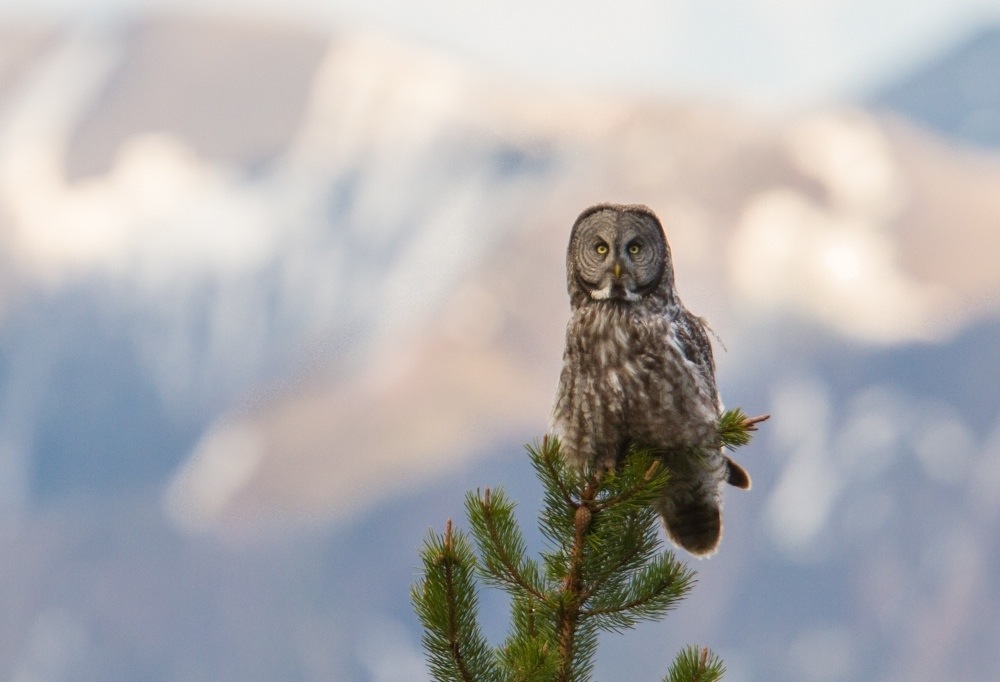
While I watched, the owl made two attempts to catch something, but failed both times. After the first attempt it flew directly towards me and landed in a lone pine out in the middle of the meadow with the mountains as a backdrop. Some days you just get lucky.
Made an early morning trip into the park to look for some wildlife highlights for my group in a few days but headed back through the northeast entrance by mid-morning. I stopped in Silver Gate at the home and gallery of my friends, Dan and Cindy Hartman, wildlife photographers and naturalists extraordinaire.
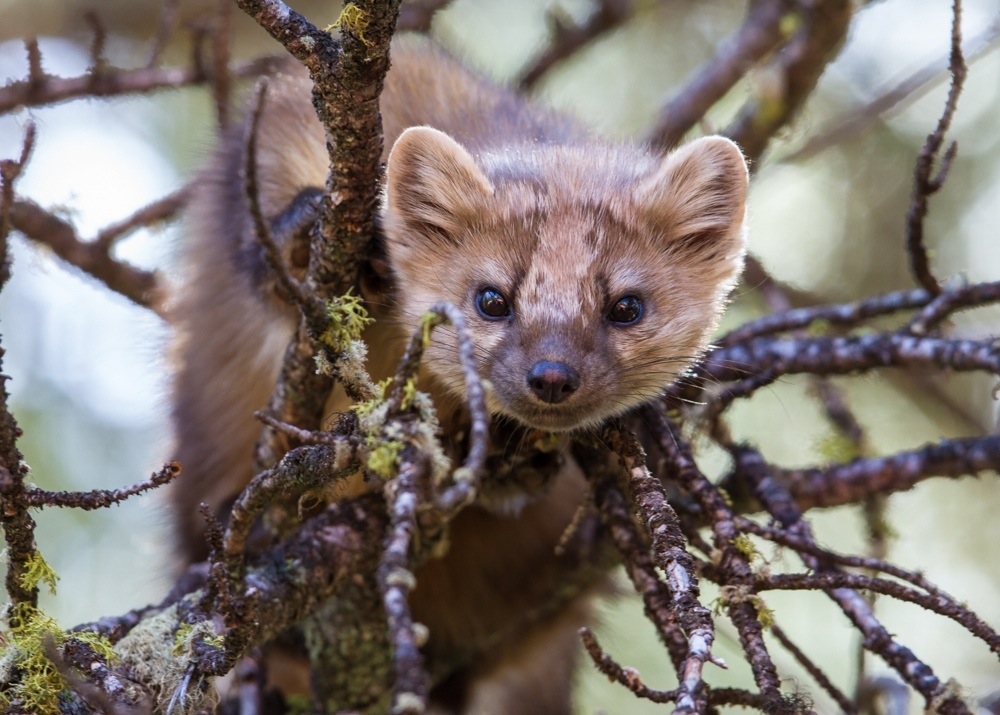
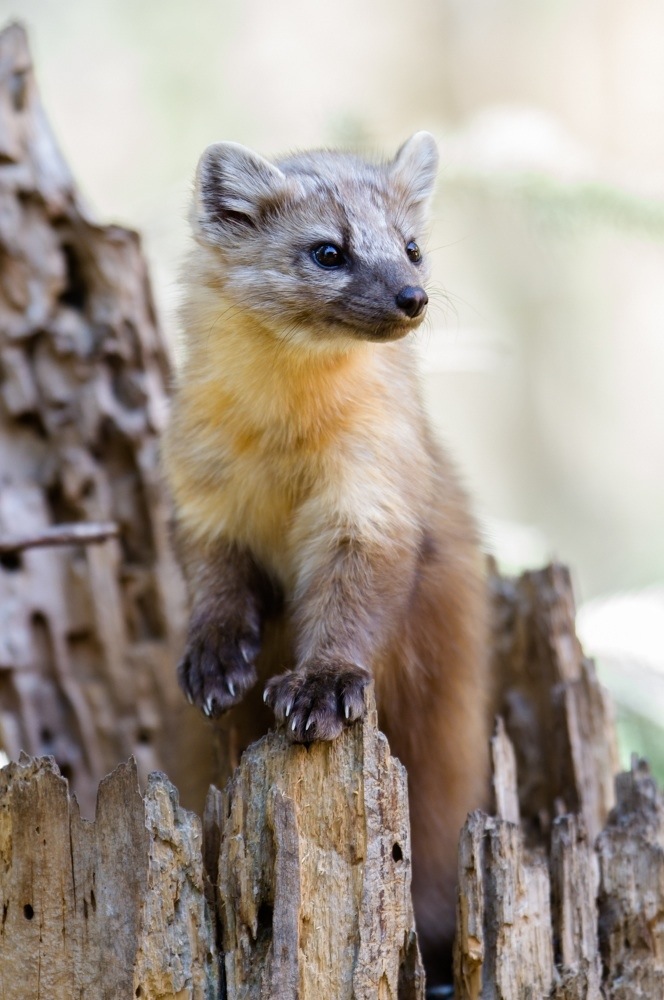
Dan was up in the Beartooths photographing pikas, but Cindy mentioned a pine marten had just been in the trees out front. A quick look around and I found it.
Martens are members of the weasel family, larger the our mink, smaller than our otter and found in forested habitats. They have beautiful brown fur with a bushy tail and orange patches on the throat. Their large paws allow them to run on top of the snow. They hunt voles, mice, small birds and eggs and are very efficient predators.
The Hartmans often have martens hanging around their house, lounging in the trees and working their wood pile for a meal. This marten proved to be very cooperative and made itself comfortable in a hollow snag. We watched it for 30+ minutes while it yawned, napped, and made use of every nook and cranny in that snag.
When she finally woke up and began to hunt she worked her way around the house and into the forest where Cindy thinks she may have young.
If you are in the area, visit the Hartmans at their gallery, Wildlife Along the Rockies, in Silver Gate just outside the northeast entrance to Yellowstone. You will undoubtedly learn something, see some interesting birds at their feeders, and you can buy a beautiful wildlife print. And you might even get lucky and see a marten.
It is spring in Yellowstone and there are babies everywhere, especially bison calves. Cute and frisky are the best words to describe these orange-furred bundles of energy – not the usual naturalist terms, but appropriate for these guys. And it has been a very good year for bison births – every herd has dozens of calves either frolicking or sacked out in the grass. And the sounds of being close to a herd are amazing – grunts and snorts, bawls of the calves, and even the munching of grass when they are close to your car.
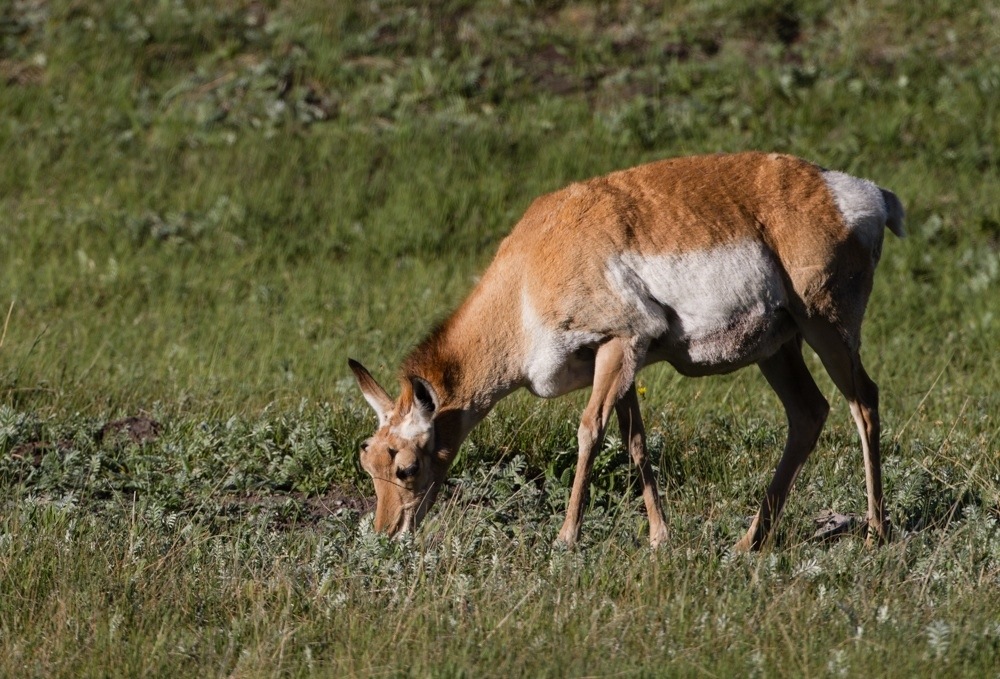
And there’s the promise of yet more babies to come. I’ve seen several pregnant pronghorn and mule deer. And then there are the nests – a bald eagle nest, a golden eagle nest, an osprey nest, and I’m sure many more yet to be discovered.
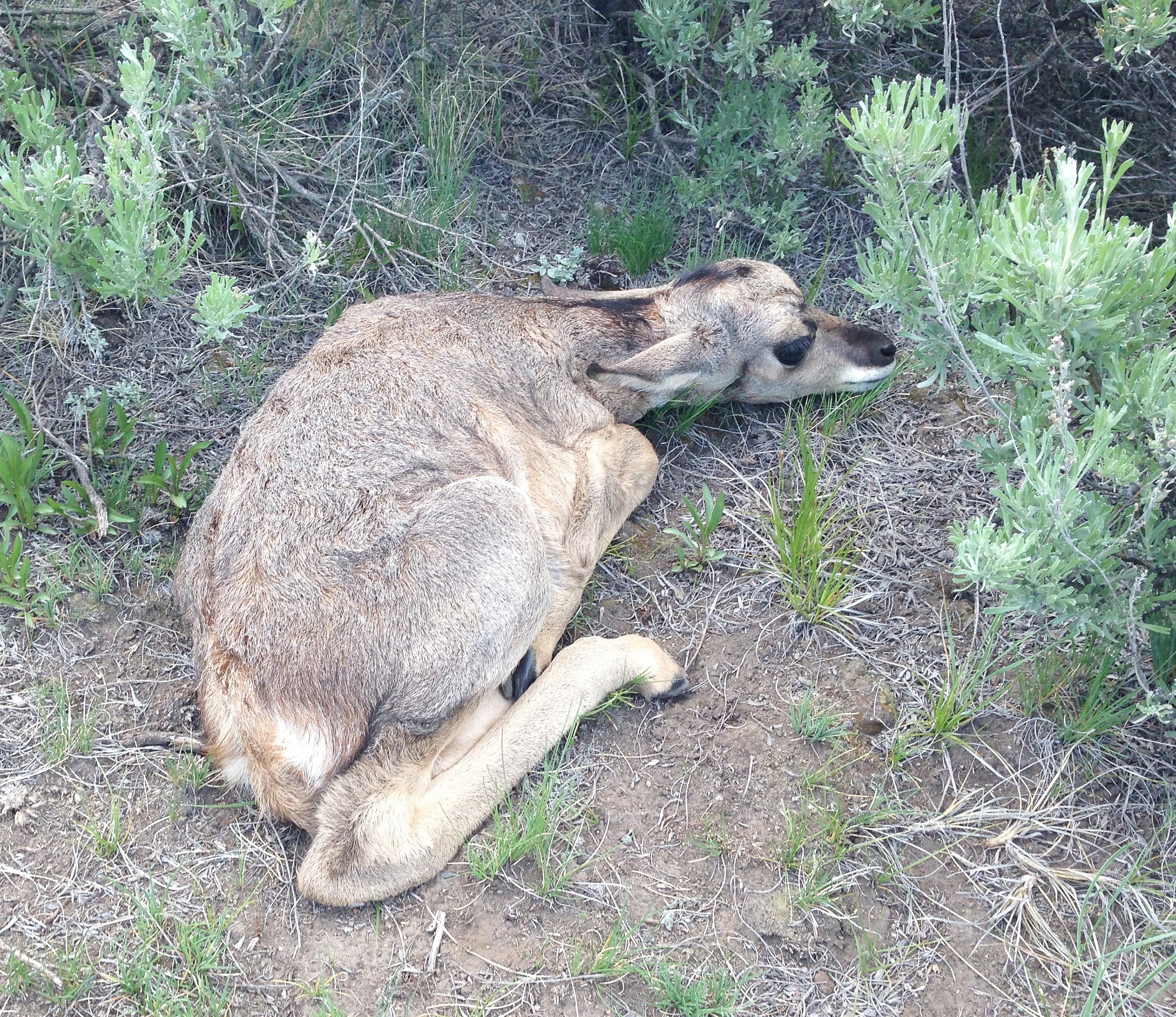
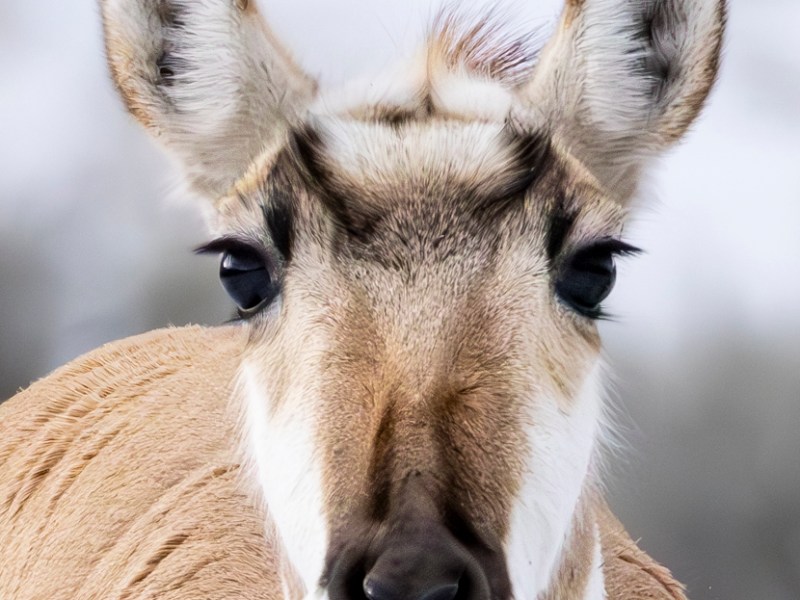
But the most amazing thing I’ve seen was a pronghorn fawn. I just walked out onto a small hill to take a look at a distant bison herd. I didn’t even have my camera with me because I was only 20 yards from the car. But I looked down and right at the edge of the sage was a young pronghorn fawn doing what its’ instinct tells it to do – lie perfectly still to avoid predators. I took one quick picture with my phone and moved away so as not to disturb it. I looked around when I got back to the car and I could see two pronghorn females about 100 yards away, one of them undoubtedly the mother. In a week or two that little pronghorn will be able to run and avoid many of the predators out here in Lamar. Until then it will need to rely on camouflage and it’s relative lack of scent to avoid detection. I wish it well.
I was looking forward to the final stop on the refuge tour, Chincoteague National Wildlife Refuge, as I had seen a ton of wildlife there a couple of years ago on a winter visit. But the afternoon I arrived, it was gray, rainy, and windy. Turns out the theme of the next 24 hours was gray and misty. I decided to wait until the next morning to venture in and the first critter seen was a large gray squirrel that wasn’t a Gray Squirrel – it was an endangered Delmarva Fox Squirrel. It is roughly twice the size of our Gray Squirrel and lives in mature forests of mixed hardwoods and pines with a closed canopy and open understory. Habitat loss and probably over-hunting contributed to population declines that led to this species being placed on the Endangered Species List. From 1969 to 1971, biologists relocated 30 Delmarva Fox Squirrels to Chincoteague NWR and released them. The population of squirrels at the refuge has since grown to over 300 and Chincoteague remains one of the best places to see this beautiful animal.
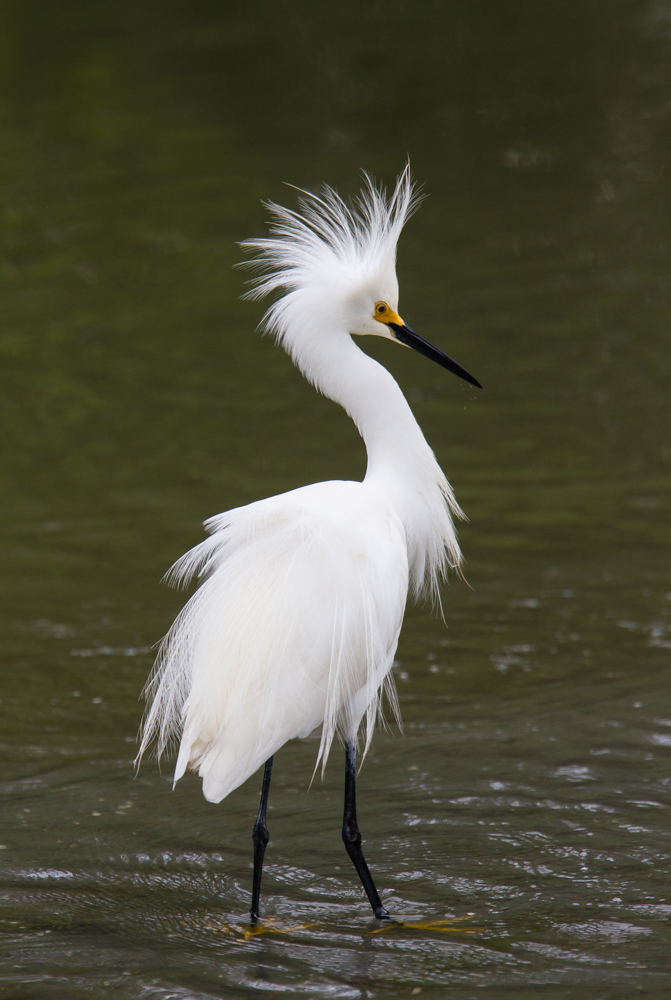
Snowy Egret (click to enlarge)
Driving on I could see a gathering of white birds in a roadside marsh channel. There were a half dozen Snowy Egrets running around catching something and interacting with one another when one egret would impinge on another birds’ space. I pulled over to a nearby safe spot and the birds could have cared less.
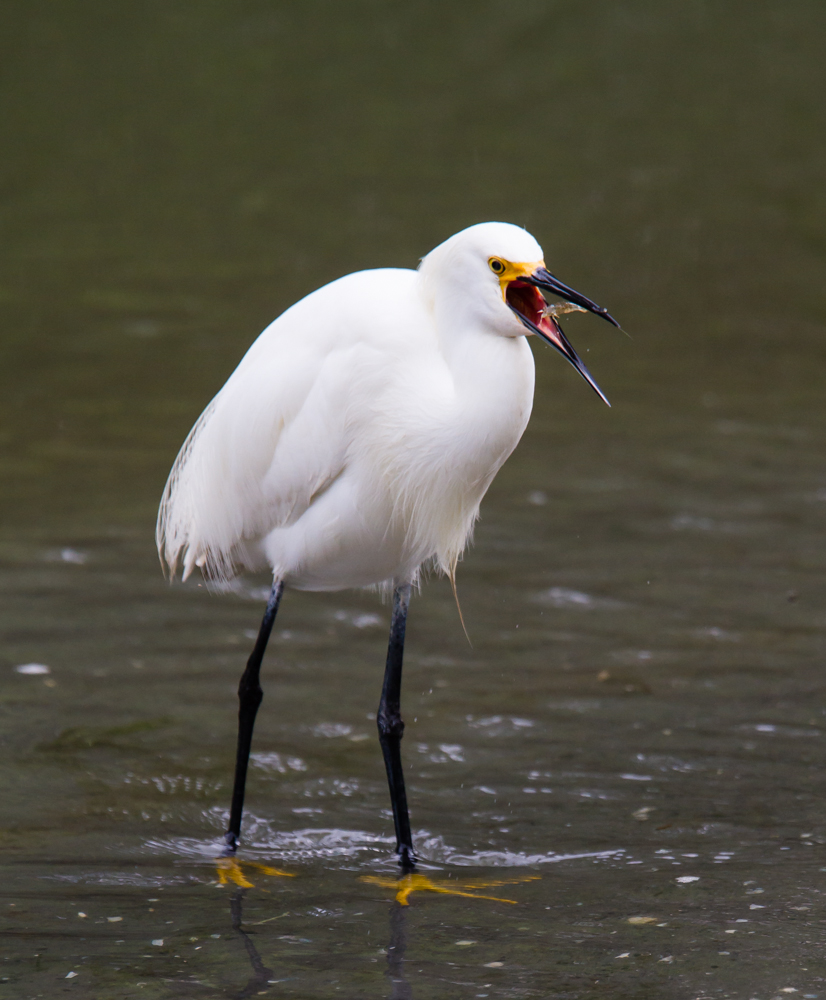
Snowy Egret catching shrimp (click to enlarge)
Turns out there was shrimp for breakfast! The tide was moving water rapidly in the channel and shrimp were flowing with it past a shallow spot that made for easy pickings for the sharp-eyed egrets. They were all dashing about, grabbing and swallowing shrimp.
Snowy Egret with crest flared in threat display (click to enlarge)
A couple of the egrets were apparently higher on the pecking order and would fluff up their feathers and chase other birds away anytime they would get into a prime shrimping spot so there was a lot to see and photograph. Crest raising is an important threat and territorial display in egrets and one guy in particular was using it to the fullest.
Great Egret preening (click to enlarge)
Just down the channel a Great Egret stood on a fallen tree and was making itself more presentable for the tourists. It was methodically preening every feather, including the long nuptial plumes, or aigrettes. Early in the breeding season adults grow long plumes on their backs, which they raise in courtship displays. Those plumes were considered fashionable for ladies’ hats in the late nineteenth and early twentieth centuries and, shockingly, it is estimated that more than 95 percent of the Great Egrets in North America were killed for their plumes in those decades. In 1903, plume hunters were getting $32 an ounce for the ornate feathers. Plume-hunting was banned, for the most part, around 1910, and Great Egret populations started to recover. The Great Egret is the symbol of the National Audubon Society, one of the oldest environmental organizations in North America, which was founded to protect birds from being killed for their feathers.
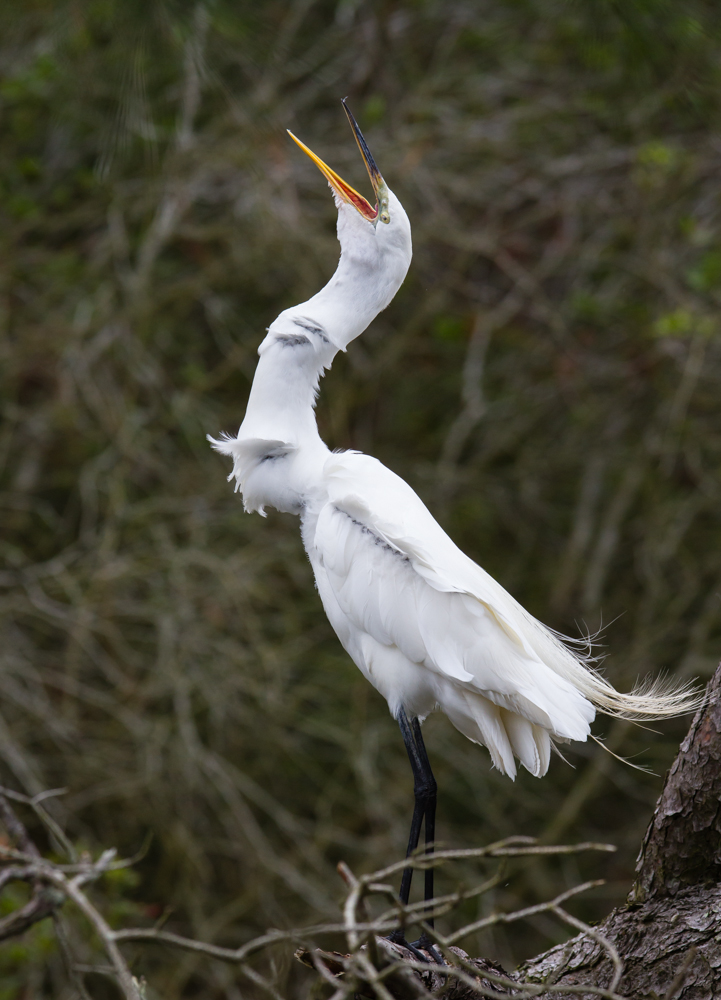
Great Egret gulping (click to enlarge)
I watched this bird delicately preen itself for many minutes before it made one quick move that showed it was not all grace and elegance. I’m betting it wishes the shutter had not been firing at that moment.
Blue Grosbeak male (click to enlarge)
During a brief few minutes of sunshine, I walked part of the Wildlife Loop, a paved 3.5 mile loop through managed wetlands that is kept closed most of the day for hikers and bicyclists to enjoy and then opened for cars later in the afternoon. It is a great place to see a variety of wildlife and it started of with a Bald Eagle flying overhead. Next, a gorgeous male Blue Grosbeak jumped out of the grass. Then, uncharacteristically for this species when it is anywhere close to me and my camera, it landed close enough and stayed long enough on a perch for me to grab a few quick shots.
Black Skimmer flock at rest (click to enlarge)
Driving back out toward the beach I came across a flock of Black Skimmers resting on a shallow sand bar. They are such comical-looking, yet beautiful, birds. As I have mentioned before, they ae a favorite of mine, so I spent the last hour of my time on my “refuge tour” hanging out with the skimmers, trying to capture their beauty and precision as they sliced through the shallow water searching for a meal.
Black Skimmer flock (click to enlarge)Black Skimmer skimming (click to enlarge)
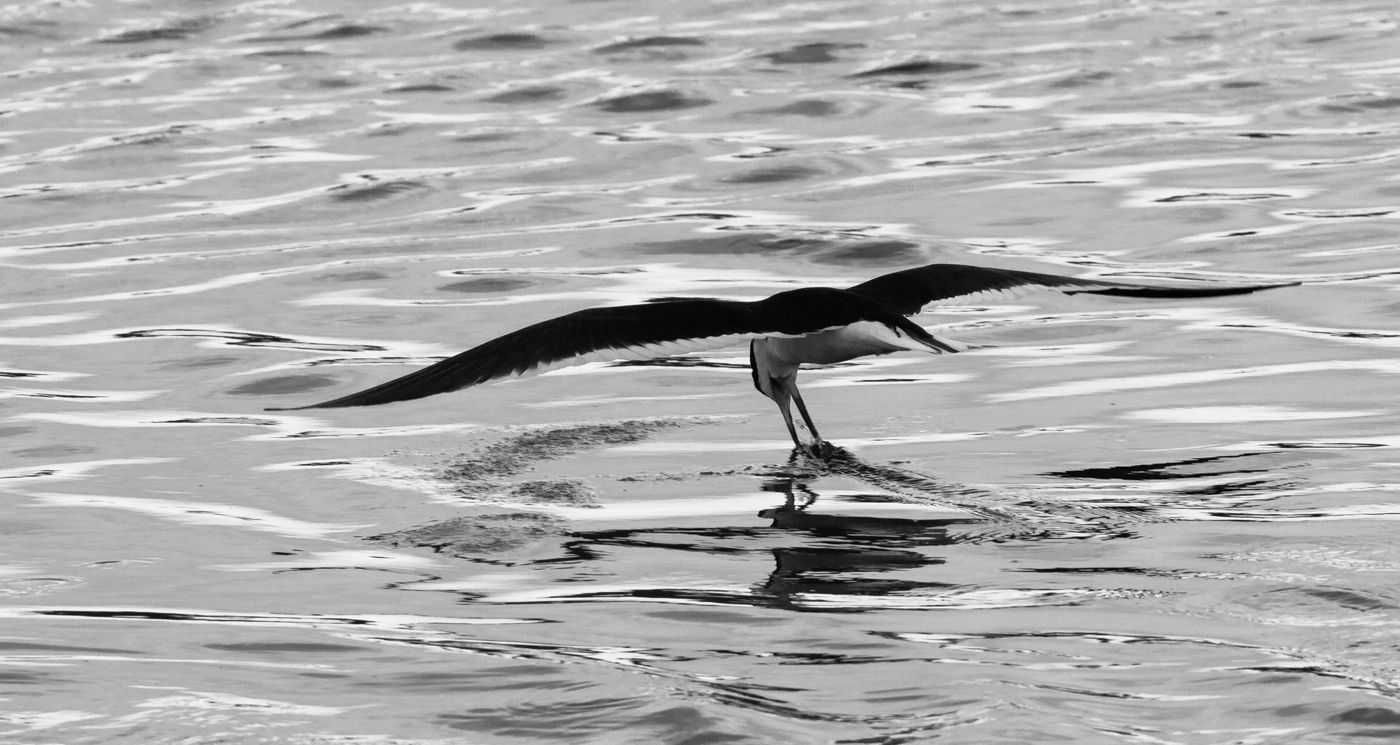
Check out the lateral compression of this bill – it really looks like a knife blade slicing through the water.
Black Skimmer flock landing (click to enlarge)Black Skimmer in black and white (click to enlarge)
My time in a few of the refuges of NJ, DE, and VA was awesome but now I am headed to my favorite place on the planet, Yellowstone, for a couple of weeks. I imagine the blog posts will be less frequent and perhaps a bit shorter due to limited internet access and cellular service throughout much of the park. But I’m sure I’ll have some images and adventures to share when I return.
Horseshoe Crabs on Slaughter Beach, DE (click to enlarge)
I borrowed the title of today’s blog from another blogger I ran across while reading about Horseshoe Crabs. Turns out there are lots of people fascinated by these ancient creatures, and The Beach Chair Scientist (http://beachchairscientist.com/) is one of them, so check her out for more information on these fascinating creatures and other topics of the sea. The blog title refers to part of the scientific name of Horseshoe Crabs, Limulus polyphemus, and the fact that this is the time of year when Horseshoe Crabs migrate to beaches for mating and egg-laying. The Delaware Bay region is believed to be home to the largest population of this species of Horseshoe Crab (there are 3 other species in the Pacific) and is therefore the place to be in late spring if you want to witness Limulus Love.
Horseshoe Crab male (click to enlarge)
Horseshoe Crabs are ancient arthropods, dating back perhaps as much as 300 million years (way before the dinosaurs). They not true crabs but are more closely related to spider and scorpions. Their anatomy is fascinating and you should check out some of the other web sites for details (also http://www.ceoe.udel.edu/horseshoecrab/index.html). They use their tail (telson) to right themselves when flipped over (although it is not always successful). Two large compound eyes are located on the front part of the shell (prosoma), with other light receptors scattered elsewhere over the body. The eyes are quite sensitive to low light and can help them find mates in the dark waters. Underneath are five pairs of legs, the first pair modified in males to be claspers for grabbing the edge of a female’s shell during mating. The last pair of legs are called pusher legs and have a leaf-like structure at the tip used for pushing and clearing away sediments as the crab burrows. There are two small chelicera in front of the walking legs that help guide food to the mouth, which is the bristly area between all the legs.
Horseshoe Crabs on Slaughter Beach (click to enlarge)
Horseshoe Crabs shed their chitinous exoskeleton as they grow, increasing in size about 25% each time they shed. It takes 16-17 molts over a period of 9-11 years to reach sexual maturity, with females being much larger than males.
Horseshoe Crabs on Slaughter Beach at high tide (click to enlarge)
For most of the year, Horseshoe Crabs are out at sea, feeding on marine worms and softer shellfish such as Razor Clams. But every spring, adult Horseshoe Crabs migrate to shallow waters to breed. Annual census data highlights Delaware Bay as the most important spawning ground in the world for American Horseshoe Crabs. The 2011 survey estimated well over a million Horseshoe Crabs utilized these critical beach habitats. The peak of spawning activity usually occurs several days around the new and full moons of May and June and coincides with the high tides.
During breeding, the smaller males couple onto a unattended female as she digs a shallow nest at the tide line. There may be several males in attending each female since the ratio of males to females on the beaches is about 3 to 1. The female releases several thousand eggs while the male(s) release sperm and the eggs are fertilized externally. Each mature female lays up to 20 clutches totaling up to 90,000 eggs during the spawning season, of which fewer than 1% will make it to adulthood.
Horseshoe Crab egg cluster photographed in aquarium at DuPont Nature Center (click to enlarge)Horseshoe Crab eggs (click to enlarge)
The eggs are laid in clumps, but I only saw one on the beach. The tidal action plus all the digging from mating crabs tends to bust up the clusters so the beach is covered by millions of loosely scattered greenish eggs about the size of a sand grain.
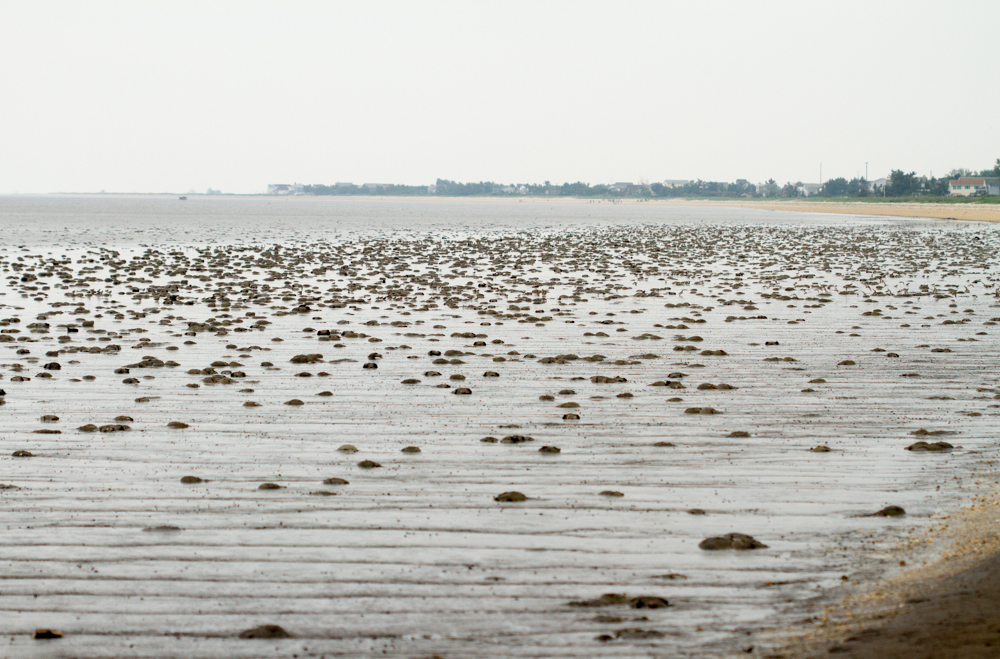
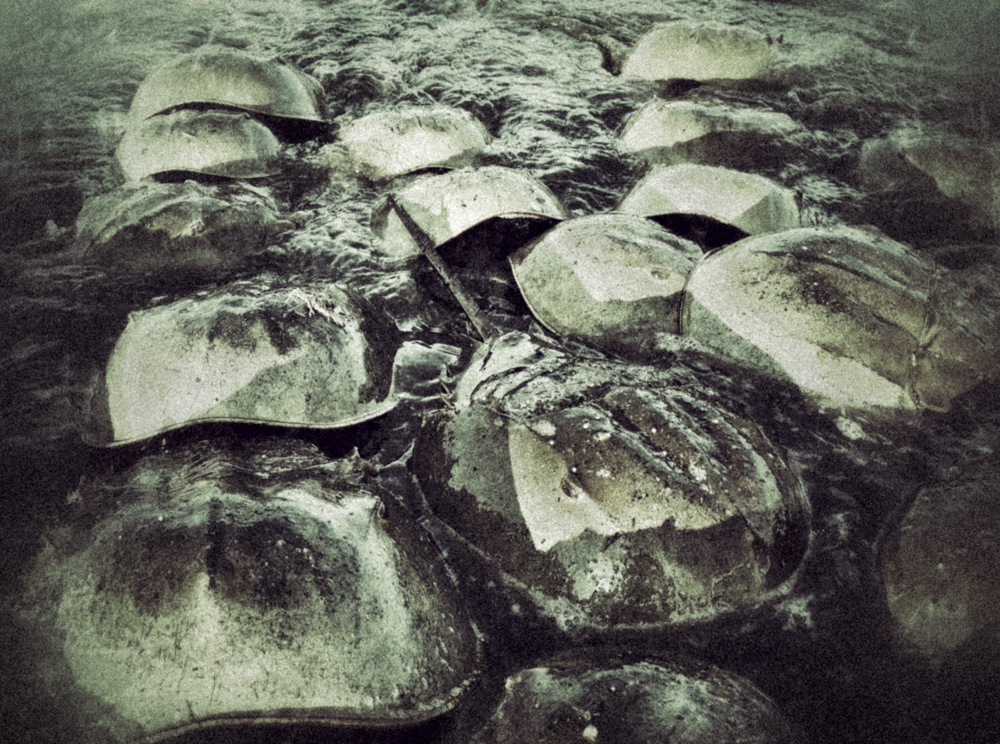
Horseshoe Crabs at low tide on Slaughter Beach (click to enlarge)
Back at Slaughter Beach the next morning it was low tide with a windy, gray sky. The stark scene had the look of devastation, with dark, motionless clumps scattered as far as the eye could see. But most of the crabs were still alive and with the next rising tide, would begin the ancient ritual again.
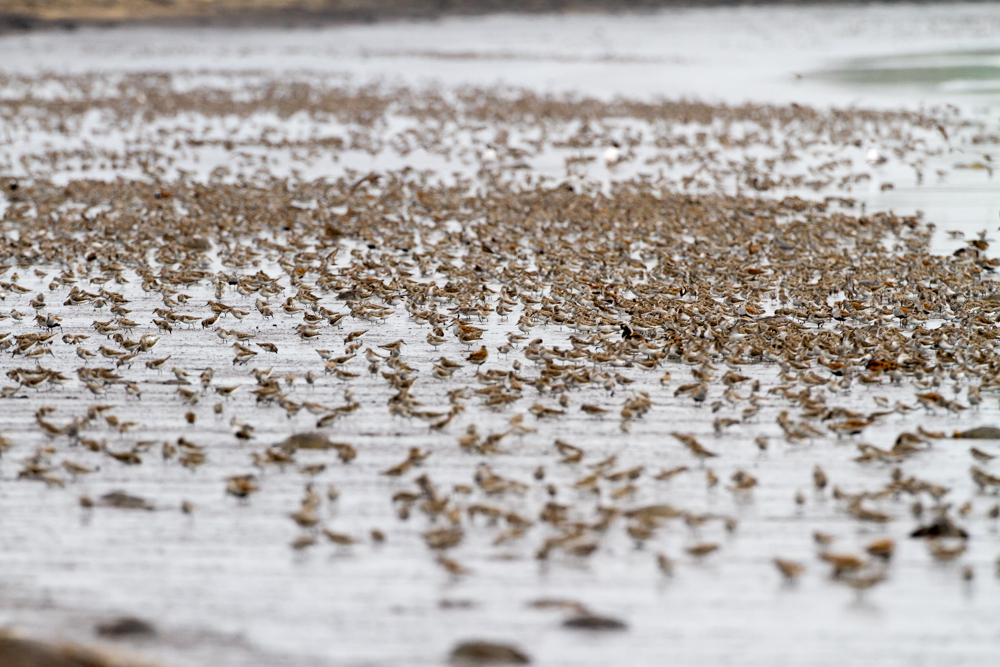
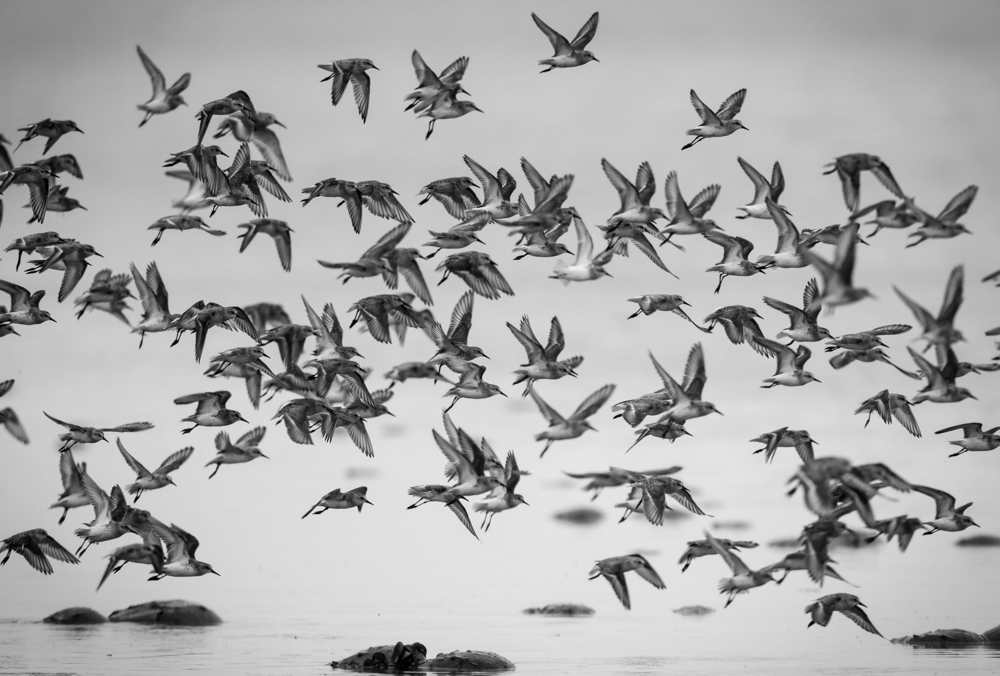
Shorebirds on Slaughter Beach feeding on Horseshoe Crab eggs (click to enlarge)
This superabundance of fat and protein rich granules sets the table for one of the greatest bird feasts in North America – the annual migration of hundreds of thousands of shorebirds through Delaware Bay. This area is a critical staging area as these birds make their way thousands of miles from their wintering grounds on the beaches of South America to their nesting grounds in the Arctic. The birds gorge on the Horseshoe Crab eggs as well as various worms and invertebrates in the tidal flats and beaches. In their two to three week stopover, they may double of triple their weight, which fuels them for the remainder of their long flight. It was a privilege to sit on the beach with almost no one else around, watching and listening to this grand event.
Researchers processing captured shorebirds (click to enlarge)
The migrants are made up of primarily four species: Semipalmated Sandpipers, Dunlins, Ruddy Turnstones, and Red Knots. The latter species is one facing steep declines in their population over the past decades. Researchers were on a distant beach the first afternoon of my visit as they have been for many years – capturing, weighing, and tagging Red Knots and other shorebirds to learn more about their needs in their perilous journey in the hopes of helping populations recover.
Statue of Red Knot B95 outside the DuPont Nature Center 9click to enlarge)
An unusual and fun statue greets visitors to the DuPont Nature Center in Mispillion Harbor Reserve. It is a tribute to the most famous Red Knot, known as B95, for the bright orange leg band with that code attached by an Argentinian researcher in 1995. During my visit, news broke that B95 had been spotted once again in Delaware Bay. Scientists estimate this Red Knot to be 20 years old (it was already an adult when banded), making it the oldest Red Knot known. And because its annual journey from the tip of South America to the Arctic spans about 9,000 miles one way, in its lifetime, this amazing bird has flown a distance equal to going to the moon and halfway back. That feat has earned B95 the nickname, Moonbird, and it is the subject of an award-winning children’s book by the same name. During its lifetime, B95 has seen the population of his kind crash from over 100,000 birds to about 15,000 today. There are great concerns over the decline in Horseshoe Crab eggs due to over-harvesting of the adults crabs for bait and available habitat for both crabs and birds due to development. Red Knots were scarce during my visit and I spotted only a handful amongst the thousands of other shorebirds.
And while the natural connections of Horseshoe Crabs are amazing, they also have important connections to humans. They have been used for food and fertilizer in earlier cultures, and are now harvested as bait for the eel and conch fisheries (regulations now restrict this harvest to ensure enough egg-laying adults to maintain the shorebird connection). Scientists have learned a lot about the human eye from studying the electrical impulses in the compound eyes of Horseshoe Crabs. And chitin from Horseshoe Crabs is used in the chitin coating of surgical sutures and wound dressings for burn victims. But the main human connection now comes form the creatures’ blue blood (their blood contains a copper-based respiratory pigment and turns blueish when exposed to air). An extract of the Horseshoe Crab’s blood is used by the pharmaceutical and medical device industries to ensure that their products (any intravenous drugs, vaccines, and medical devices), are free of bacterial contamination. So, if you or anyone you know has ever been hospitalized, you owe a lot to Horseshoe Crabs.
Horseshoe Crabs on Slaughter Beach at sunset (click to enlarge)
The experience at Slaughter Beach is something that I will never forget – the sights and sounds of thousands of Horseshoe Crabs clambering over each other at the tide line at sunset followed by tens of thousands of birds feeding on the eggs the next morning is one of the great wildlife spectacles in America. I recommend a stop at the DuPont Nature Center (http://www.dupontnaturecenter.org/index.html) if you are in that area. It has excellent displays on the incredible story of Horseshoe Crabs and the staff are very knowledgeable. You will come away appreciating these “living fossils” as much as I now do. Although it is a long drive from NC, I am considering offering a trip to this area in the future to witness this natural wonder. Let me know if you are interested.
A gallery of sights on the Horseshoe Crab beaches of Delaware…
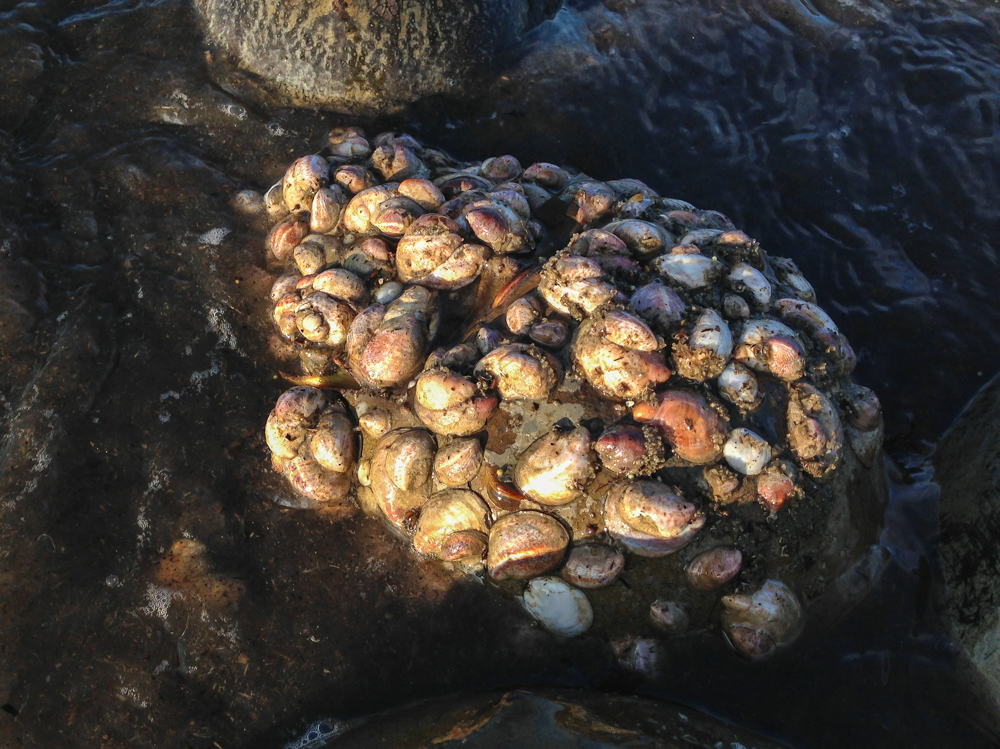
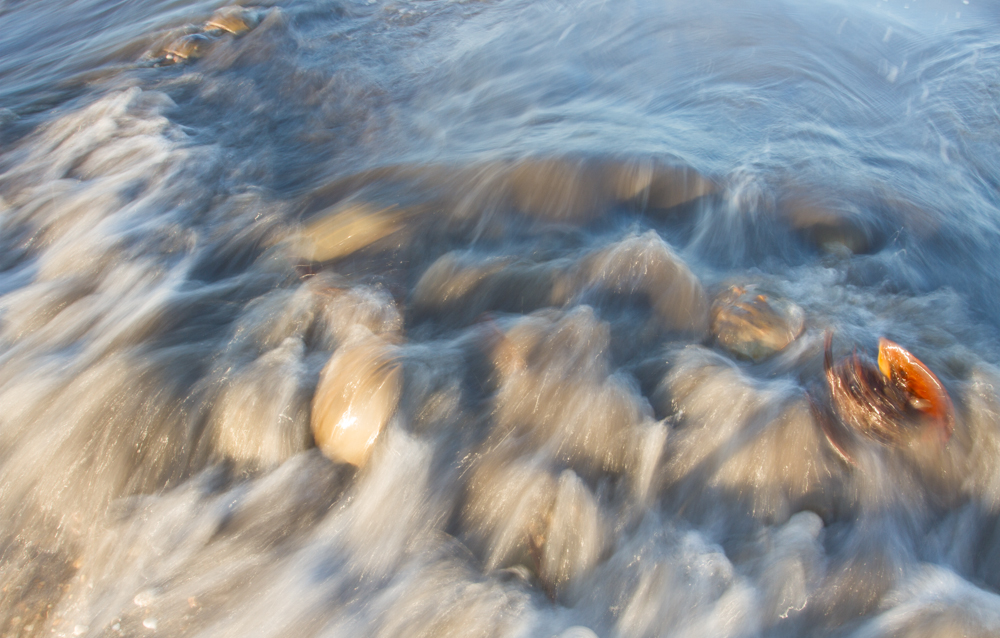
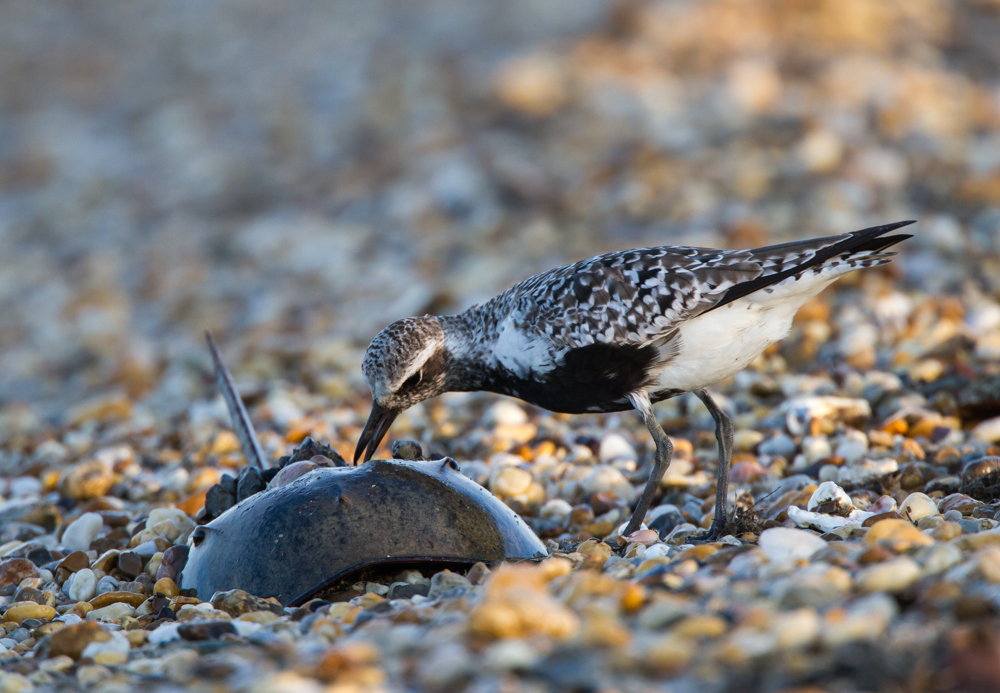
Horseshoe Crab burying in sand (click to enlarge)Horseshoe Crabs on Slaughter Beach with overturned crab (click to enlarge)Slipper Shells on Horseshoe Crab (click to enlarge)Short-billed Dowitcher (click to enlarge)Horseshoe Crab over-wash (click to enlarge)Horseshoe Crabs stylized (click to enlarge)Black-bellied Plover gleaning food from a Horseshoe Crab shell (click to enlarge)Shorebirds in flight at Slaughter Beach, DE (click to enlarge)





















 Roads End Naturalist