Welcome to our new website! We hope you like it. Please let us know if you notice something missing or that needs a correction. ~Mike & Melissa

  • Black Swallowtail eggs

    Black Swallowtail egg on fennel
    Black Swallowtail egg on Bronze Fennel (click to enlarge)

    As I was planting some veggies yesterday, I saw a female Black Swallowtail butterfly in her characteristic search and hover mode as she investigated various plants in the garden. I knew from this fluttery flight behavior that she was searching for the right type of plant on which to lay an egg (aka host plant). As with many species of butterflies and moths, Black Swallowtail females tend to be discerning when it comes to which plants they choose for their eggs. Host plants of the caterpillar include members of the parsley family (Apiaceae) including Carrot, Parsley, Dill, Fennel and Queen Anne’s lace and some members of the Rutaceae such as common garden Rue (Ruta graveolens).

    I have four of these in the garden right now: Parsley, Bronze Fennel, Sweet Fennel, and Rue. From my experience, the Bronze Fennel seems to be the preferred host, especially early in the season. The tops of the Carrots I grew last year were also very popular with the caterpillars. As any herb gardener knows all too well, Parsley is also immensely popular as a host plant, with the larvae often totally denuding your herb supply if you only have a few plants. That is one reason I plant the fennels as they tend to get tall (3 or 4 feet) which is usually enough to provide an adequate food supply. Rue becomes especially important as a host plant in my garden in the late summer and early fall as Black Swallowtails complete their final generation before winter. Last year I had one large rue plant with over 20 caterpillars on it and rue tends to be less completely devoured compared to some of the other hosts. Rue stems also tend to sprout quickly after being eaten. But I have also read that Rue can cause skin irritation in sensitive people, so be cautious if you plant it.

    Bronze Fennel
    Bronze Fennel (click to enlarge)
    Sweet Fennel
    Sweet Fennel (click to enlarge)
    Parsley
    Parsley (click to enlarge)
    Rue
    Rue (click to enlarge)
    Rue
    Close-up of Rue foliage (click to enlarge)

    Naturally, I was excited to see what I thought were the first butterfly eggs of the season in the garden. I grabbed my camera and took a few shots after finding eggs on several fennel and parsley plants. The eggs are spherical and cream-colored (or slightly yellowish). The other swallowtail species eggs I have seen are also spherical although different species tend to have different colors. The eggs of other butterfly and moth groups can be quite ornate with many shapes, colors, and ornamentations (perhaps a blog topic later this season). Each butterfly egg is surrounded by a hard outer shell, called the chorion, to protect the developing larva. The shell is lined with a layer of wax, which helps keep the egg from drying out. There is a small opening near one end called a micropyle, which allows sperm to enter the egg for fertilization. The egg shell also is dotted with microscopic pores called aeropyles which allow gas exchange. The butterfly glues the egg to the plant leaf using an adhesive-like substance produced in the colleterial glands. Black Swallowtails lay the eggs singly (generally on the top of leaves) although she may lay several eggs on the same plant.

    Black Swallowtail egg on parsley
    Black Swallowtail egg on parsley (click to enlarge)

    As I wandered the garden looking for more eggs, I realized the one I photographed is not the first of the season…I found a tiny caterpillar on one of the Rue plants. Since it takes 3-5 days for these eggs to hatch, I had apparently missed a few from the past weekend.

    First instar Black Swallowtail larva
    First instar Black Swallowtail larva (click to enlarge)

    This is what is known as the first instar larva, the stage after emergence from the egg. It looks quite different from how this species is pictured in most caterpillar field guides. As is common with many species, Black Swallowtail caterpillars undergo a noticeable change in appearance as they molt five times on their way to becoming a chrysalis. This early stage is considered a bird poop mimic, with a dark background color containing a whitish splotch, just like a bird dropping. Many other species have this basic color scheme, especially as early stage larvae.

    Black Swallowtail caterpillar next to pencil point
    Black Swallowtail caterpillar next to pencil point (click to enlarge)

    I’ll hang onto this little guy and try to photograph it as it develops over the next couple of weeks. I think I’ll have plenty of opportunity to get the various life stages as I found 11 eggs (and two more first instar larvae) on one Bronze Fennel plant this morning.  While searching the Internet for a few details on these eggs, I found what could be my moneymaker in retirement – seem like a few companies sell butterfly eggs for people to raise and I saw one site that had Black Swallowtail eggs for $2 each! If I had the time and inclination, it could be a busy (and profitable) summer.

  • Crested Dwarf Iris

    Crested dwarf iris patch
    Crested Dwarf Iris

    I have always had a fondness for the wildflowers of spring woodlands and have planted them in shady spots as a harbinger of my favorite season. One of the hardiest of the spring ephemerals is Crested Dwarf Iris, Iris cristata.  I have purchased many of these (and other native wildflowers) over the years from the NC Botanical Garden (http://ncbg.unc.edu/) in Chapel Hill. They run an honor system plant sale from April through October and usually have a large sale event in September. I have also transplanted some from areas that were being developed by digging a few of the stubby rhizomes and planting them in shallow soil. It seems these tiny plants do best on rich wooded slopes, ravines, stream banks and other places where their rhizomes remain partially exposed and the beautiful sword-shaped leaves are not covered by deep leaf litter.  If you have typical garden varieties of iris you may do a double take when you first see this one – a tiny plant reaching only 3-5 inches in height. The flowers are usually some shade of blue or violet (occasionally white) and they tend to grow in patches, offering a visual delight to the spring woods walker.

    Crested dwarf iris flower
    Crested Dwarf Iris flower (click to enlarge)

    They are named for the yellow crinkled crest on the sepals, which serves to guide pollinators (mainly bees) to the nectar deep within the throat of the flower (although I have also read it may give the bee something to grasp onto while navigating toward the nectar). If you look closely at an iris, you will notice it has an unusual flower structure. The three largest petal-like structures are actually sepals (which enclose and protect the flower bud before it opens). In iris flowers, they are also called the falls. The wide tip of the fall provides a place for pollinators to land.

    Crested dwarf iris style arm
    Crested Dwarf Iris style arm (click to enlarge)

    Arching over each fall is a modified reproductive part called the style arm. This is probably the most unusual part of an iris flower. I had read about this but decided to take a closer look which required lying down and propping the flower parts open with a tiny twig to better view and photograph them (the things you have to do for science).

    Dwarf Crested Iris flower parts
    Dwarf Crested Iris flower parts

    Just under the tip of the style arm is the stigma lip. This is the area that receives the pollen. It is a light-colored exposed curved edge just under the arch. A visiting bee must push under this style arm in order to access the nectar that is deep inside the throat of the flower. While crawling down toward the nectar glands, pollen is scraped off the back of the bee by this edge and attaches to the sticky stigmatic lip. The anthers (male, pollen-producing parts) are elongate structures behind the stigma lip. After the bee gets scraped of pollen, it then brushes up against the anther and gets fresh pollen. That pollen is unlikely to be transferred to this particular stigma lip as the bee backs out (they often exit through the gap in the arch). Bees are the primary pollinators as few other insects have the strength to push under the style arm.

    Crested dwarf iris rhizomes
    Crested Dwarf Iris rhizomes (click to enlarge)

    The rest of the plant parts are a bit more the usual…the true petals (often called standards in iris) are the smaller of the colorful parts, and most often stand in a more upright position than the falls. Like in most flowers, they serve to attract pollinators. The rhizomes are short and chunky and connected to one another by slender runners. The sword-like leaves are attractive even when no flowers are present.

    crested dwarf iris bud
    Crested Dwarf Iris flower bud

    One thing I noticed yesterday is how quickly the flower opens. Here is a picture of the flower bud on one iris at 10:37 a.m. yesterday. When I returned from some errands at 3:00 p.m., the flower was fully opened.

    The modern name for the iris flower is believed to have originated in ancient Greece. There, the flower was associated with the goddess Iris, a divine messenger who traveled from heaven to earth on rainbows. Throughout history, iris have represented wisdom, faith, and courage and been used as a royal symbol of king and queens. While that glory most probably went to their larger cousins, the diminutive Crested Dwarf Iris also deserves recognition and appreciation as we wander the spring woods.

  • Changing of the Guard

    Migrations speak to us, not just as observers of nature but as integral parts of it. The world moves and, deep inside, we long to move with it.   Mike Bergin

    Leaf out scene in Piedmont woods
    Spring scene in the woods out my door

    Spring is truly here. I look out the door and see the rapid changes, the appearance of so many new things. But I can also tell by what is missing…the smell of the smoke from my wood stove, the chill in the morning air, and the dominant feeder birds from the past few months. I was going to post something on this last week to encourage you to watch for their disappearance as the warm weather of the past week moved in. But, I was gone a few days and when I returned, they were all but gone, just like that, as if the pale spring green of leaf-out had sent them packing. It is much easier to document the first arrivals. The last departures do not resonate in my brain as well. One day the birds are here, and a week later I realize I haven’t seen them for awhile. But this changing of the guard is as sure a sign of spring as the growing palette of greens.

    Are any of these birds still at your feeders?

    Dark-eyed Junco
    Dark-eyed Junco (click to enlarge)
    Purple Finch
    Purple Finch male (click to enlarge)

    The Juncos, (many people call them Snow Birds) are our classic winter feeder bird although at my feeders they tend to stay mostly on the ground beneath the feeders. Peak abundance in the Piedmont is mid-October to mid-April. They move north or to higher elevations in our mountains to breed. I always enjoy finding their nests along the trails at Mt. Mitchell each summer.

    Ruby-crowned Kinglet
    Ruby-crowned Kinglet (click to enlarge)

    Purple Finches are one of winter finches that tend to vary in abundance from year to year. Roger Tory Peterson described males of this species as a “sparrow dipped in raspberry juice.” Females are streaky brown with a distinct white eye stripe. Purple Finches are often confused with House Finches, a year-round resident in our area. Purple Finches are far more common out here in the woods.

    One of my favorite visitors to the suet feeders is the energetic Ruby-crowned Kinglet. Unlike its cousin, the Golden-crowned Kinglet, this species does not breed in our high mountains but moves to the far northern U.S. and Canada to nest. Male Ruby-crown’s only occasionally show their reddish crown. These tiny birds are easily recognized by their habit of wing flicking.

    Pine Siskin
    Pine Siskin (click to enlarge)

    The only one of these winter birds still at my feeder as of yesterday is the Pine Siskin (although I have not seen one this morning, so they, too, may be gone). They are one of the so-called irruptive species, whose numbers on the wintering grounds can fluctuate greatly from year to year depending on food resources and weather in their northern forest habitats. And this has been an amazing year for siskins – on my Great Backyard Bird Count this past February, I had 62 siskins at once at one feeder. I’m sure there were well over a hundred between all three feeders, but their squabbling and rapid comings and goings made them tough to count. Although they do gulp down the black oil sunflower seeds, siskins are especially fond of thistle seed. My bank account will appreciate the rest once they are gone.

    And this week has also brought some members of the new guard – the return of a Brown Thrasher to my garden, the teach, teach, teach song of an Ovenbird down in the woods, and my first Ruby-throated Hummingbird this morning. It has begun…

  • Paddling the Black River

    Black River just downstream from Henry's Landing
    Black River just downstream from Henry’s Landing

    Last week, my friend, and former co-worker, Jerry Reynolds asked if I wanted to go along with he and another friend on a paddle along the Black River as he prepped for an upcoming program. I jumped at it since it has been years since I paddled the Black (I did go upriver last year in a power boat, but that is a very different experience).

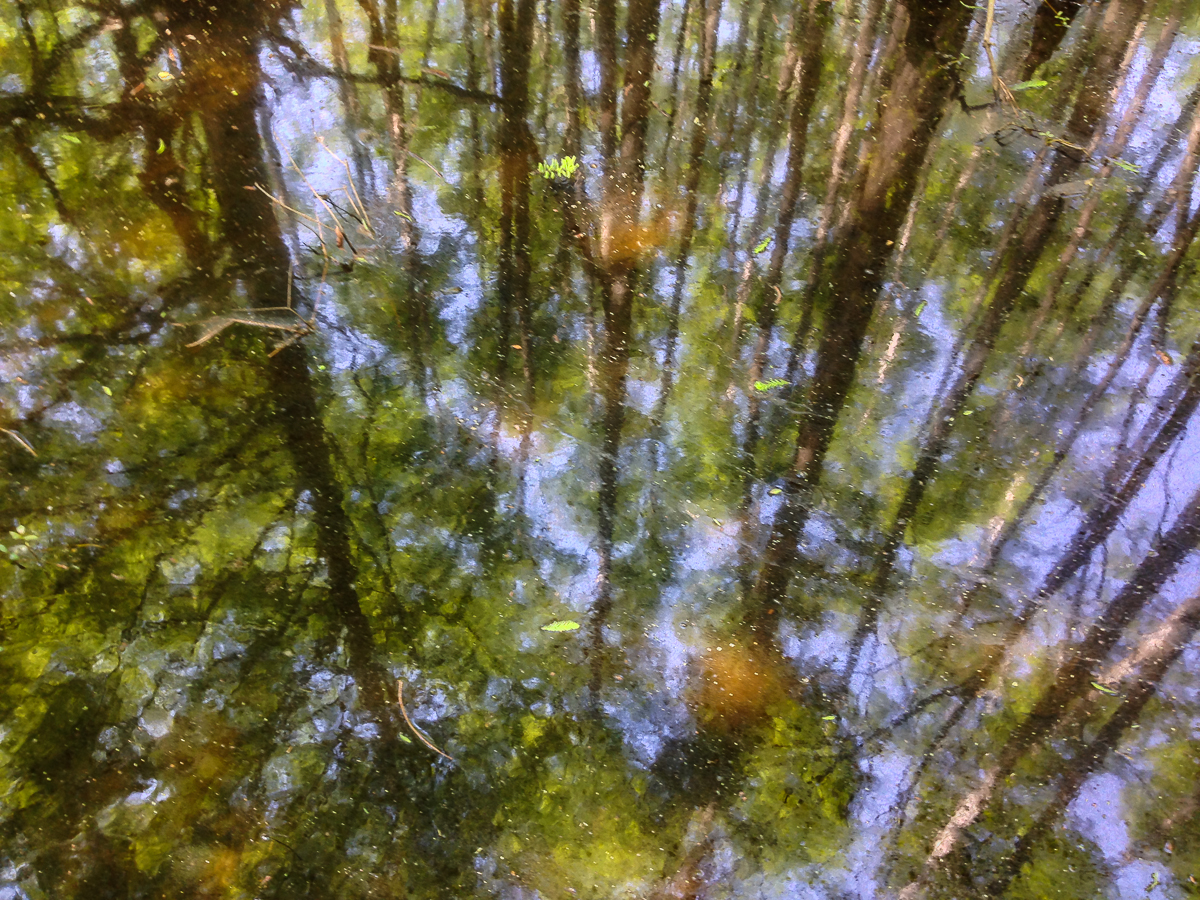
    The Black River originates in Sampson County and runs about 65+ miles before joining the Cape Fear. It is characterized by meanders, oxbows, artesian springs and mature swamp forests. The waters are clear but are stained a dark tea color due to tannins leached from decaying vegetation.  The water clarity allows you to see emerging aquatic vegetation and the sand bars as you drift along in the current. These make an interesting backdrop for the dark reflections of the forest and sky. Because of the good flow, the presence of so many artesian springs, and the relatively undisturbed nature of much of the waterway, the Black River is designated as Outstanding Resource Waters by the state.

    _-2
    The clear, dark waters allow glimpses of submerged vegetation and sand bars as you paddle.

    The Black was not always the quiet stretch of dark water it is today. Commercial activity on the Black River began over two hundred years ago with the transport of timber, cotton, and livestock. In the mid-1800’s there were numerous steamboats moving products up and down the river (hard to imagine given the shallow nature of the river today). But the advent of railroads and roads caused the river traffic to all but disappear by the early 1900’s. The Black was then left to the owls, ducks and the occasional fishermen and hunter. After 100+ years of relatively little human disturbance, the Black River is now one of the finest examples of coastal swamp forest in the southeast. Many landowners and conservation groups have recognized this and miles of the river shoreline are now protected through the efforts of groups like the NC Nature Conservancy.

    The Black River is wide in spots.
    The Black River is wide in spots.

    We arrived yesterday morning at Henry’s Landing along Hwy 210 and unloaded gear and then transported one vehicle down to the take out point at Newby’s Landing, a distance of approximately 10 river miles. We launched into the tea-colored waters a little after 10 a.m. The river is fairly wide at this point and there was a slight current. Almost immediately, a beautiful cypress swamp surrounds you on both sides of the river, hinting at the grandeur to come. A short ways downriver we flushed a few Turkey Vultures and then passed under others with wings spread, soaking in the morning sun. To someone more suspicious than I, this might be a bad omen as we enter the swamp.

    The sky was Carolina blue with a few puffy clouds and the banks were starting to reveal the palette of colors that trademark the arrival of spring in these forests – the lime green of emerging cypress and gum, the light orange-red of oaks, and the occasional splash of white flowers from a riverbank hawthorn (probably Parsley Hawthorn, Crataegus marshallii).  I heard a few calls from some swamp warblers fresh from their wintering grounds – the zeeeeee-up of Northern Parulas and the sew-sew-sew-sew-sew-sewEE of a Yellow-throated Warbler.  But spring has just arrived, and the only other warbler I saw was a Yellow-rumped.

    Leaf out along the Black River.
    Leaf out along the Black River comes in a palette of colors (click to enlarge).

    The first reptile was a large Brown Water Snake. This was the first of many such snakes we encountered. Brown Water Snakes are large-bodied snakes easily identified by their pattern of dark brown blotches down the middle of their lighter brown back. These blotches generally alternate, but do not connect to, dark blotches along the sides of the snake. These are the snakes you often see sunning above the water on limbs or trunks of fallen trees, sometimes as high as 15 feet. If a paddler goes under one and startles it, the paddler might get startled by a snake dropping into his or her boat, something that has happened to me only once in all my years (but once is enoughJ). Unfortunately, watermen who think it is a venomous cottonmouth often kill this harmless snake.

    Brown Water Snake
    Brown Water Snake sunning on a limb over the river (click to enlarge).

    About 5 miles downstream from Henry’s Landing it looks as though the river disappears. The main channel seems clogged by logs and vegetation as it bends to the left. The Jerry’s holler “follow us” and off through a maze of tiny channels they paddle, dodging cypress knees and tupelo gum saplings. This is the start of the famed Three Sisters area of the Black River. One story has it that in the days of commercial boating there were three distinct channels in the swamp area of the river, hence the name “The Three Sisters.”

    Now, this area is best known as the home of the oldest documented trees in the eastern U.S.  As part of a dendrochronology study in the southeast, researchers from the University of Arkansas cored several large Bald Cypress trees in the area in 1985 (core sampling does not seriously harm these ancient cypress). One tree turned out to be over 1700 years old. The researchers estimate others may be over 2000 years old, but cannot be accurately aged since most are hollow, making them impossible to properly core. Soon after this discovery, the recognition of the national significance of this stand of trees gave rise to efforts to preserve the forests along the Black River.

    The Jerry's paddle the Three Sisters Swamp.
    The Jerry’s paddle the Three Sisters Swamp.

    The current picks up a bit as the “river” breaks into a series of braids and weaves through dense vegetation. Jerry says the water level is good and we may be able to paddle the whole way instead of getting out and wading with your boat as he has often done. Seems to me this is an easy place to get lost, but they both say you just keep following the current and you’ll find your way out (although I notice they are both frequently checking their GPS units). I hear squawking off to my right and spot a Great Blue Heron standing on a nest with what must be very young chicks begging for food. Soon, large trunks of cypress and an army of cypress knees engulf me. Huge gray trunks hold flattened tops of cypress at a level that seems a bit too short for their size, as if they had hit an invisible ceiling. These are the ancient ones, the trees well over 1000 years old. I know I am in a special place. We all just sat in our boats, taking in the view that surrounded us.

    Looking up the trunk of one of the ancient ones.
    An ancient cypress.

    After spending several minutes with the ancient ones, we pushed and paddled our way along with the current until we hit what resembled a small channel which gradually lead to a bigger channel and finally something that looked more like a river. As we continued downstream, several side channels joined us, making me wonder how anyone can find their way to Three Sisters if they paddled upstream.

    Last night when I returned home I read an article by Dr. David Stahle, one of the researchers who discovered the antiquity of these incredible trees. He helped me understand some of what I felt while in the swamp…

    “In many areas along the Black it is possible to turn in a circle and see 10 to 20 bald cypress trees over 1,000 years old.  This density of millennium-old trees is rare in any forest worldwide.  Although a dozen or so species can live for more than 1,500 years, most of these old growth stands have very few individual trees in the oldest age class.  Not at the Black River.  There are literally hundreds of millennium-old trees at the Black River, which has the largest concentration of ancient bald cypress trees we have ever found after 30 years of searching in the southeastern United States, Mexico, and Guatemala. “ 

    Nearing the end of our paddle.
    Nearing the end of our paddle (click to enlarge).

    Although the wildlife diversity on this day (17 species of birds, three species of herps, and several butterflies and freshly emerged dragonflies) was not what I had hoped, it was still an incredible paddling experience. The feeling of isolation and of the beauty of an unspoiled swamp populated by ancient trees is something that will draw me back to this magical place again.

  • Merchants Millpond trip

    Merchants Millpond
    Merchants Millpond State Park

    Considering offering a canoe camping adventure to Merchants Millpond State Park in the next month or so. Check my trips page for details. More information coming soon.

  • Wood Duck nest

    Waterfowl wayside
    Wood Ducks pairing up in winter (click to enlarge)

    Wood Ducks begin courtship in the fall and continue throughout the winter and into the spring. A couple of years ago I photographed several ducks on the ice at Pungo Lake where you can see several Wood Ducks that appear to have already paired up. On my recent paddle at Merchants Millpond and surrounding swamps, I flushed several male wood ducks that were probably tending to their mate as she sat in a nearby nest cavity – a fact supported by the occasional flush of a female from a cavity. The male remains near the nesting female until the eggs are within a few days of hatching, which is longer than males of most other duck species remain with their mates.

    Wood Duck nest boxes
    Wood Duck nest boxes

    Although swamps are great places for cavity nesting birds due to the abundance of hollow trees and cavities, I often see artificial Wood Duck nest boxes placed along these waterways. This pair of boxes is along Bennett’s Creek and the one facing the creek had a fluff of down clinging to the entrance hole, indicating it might be occupied. Naturally, I wanted a peek…the box builder had done a good job so the side door easily opened and this is what the camera caught inside…

    Wood Duck eggs in nest box
    Wood Duck eggs in nest box

    Like most (if not all?) birds, Wood Duck females lay one egg per day until she finishes and begins incubating. Normal clutch size according to many sources ranges from 6-16 eggs with an average of 12. So, how many eggs do you see in this nest? Certainly way above the average number for a clutch. This may be an example of intraspecific brood parasitism, also called “egg dumping” or “dump nesting”. Egg dumping occurs when a female wood duck, frequently a first-year breeder (according to some references), follows another hen to a nest site during the egg-laying period and lays her eggs in with the other nest, presumably coming back each day while the original female is away foraging to keep laying until she has finished. This results in very large clutches that often cannot be effectively incubated. In a typical nest box, approximately 80% of the eggs hatch, but where egg dumping is common, it may drop to as low as 10% or the original female may abandon the nest altogether. Some suggest that in the wild, the impulse to egg dump is kept in check because wood ducks normally nest in fairly isolated locations. Artificial nest boxes that are placed too close together or in very conspicuous locations may lead to increased egg dumping (some reports are as high as half the nests). Several resources recommend trying to mimic the natural situation (single boxes placed in swamp habitats) as much as possible to help with nest success.
    Rat snake in wood duck box
    Rat snake in wood duck box (click to enlarge)

    The other thing people recommend is placing the nest box on a pole with a metal predator guard to help reduce predation from raccoons. But there are other species of predators that the ducks need to worry about as I once observed while paddling on the Scuppernong – a nest box with a guard had been placed a little too close to a small overhanging tree limb…

    If all goes well, after about 30 days of incubation the eggs hatch (usually in April in these parts). The tiny fluff balls may stay in the nest for several hours until coaxed out by the hen. If the nest is in a tall tree and away from water the ducklings take a dive out of the box and literally bounce on the ground before heading off in a line following Mom to the nearest waterway.

    Check out this site for live views (and recordings) of the inside of a nest box here in NC – http://woodiecam1.com/.

  • Merchants Millpond

    I enter the swamp as a sacred place

    Henry David Thoreau

    Merchants Millpond has always been one of my favorite state parks. When I was the East District Naturalist for the State Parks system oh-so-many years ago (1981-1986), I would go up to Merchants and canoe out after dark to the family camping area after giving a program in the trailer that was then the “visitor center”. The night sounds were always amazing as was the feeling of being in a different world as you paddled through the Bald Cypress and Water Tupelo trees laden with Spanish Moss. A lot has changed over the years and now the 3200+ acre park has a new visitor center, family and group campgrounds and two canoe launch areas as well as camping down Bennett’s Creek below the millpond. But much remains the same in this unique environment and because of that, it is still a magical place.

    Merchants Millpond
    Merchants Millpond State Park

    The millpond was created in 1811 to provide power for grist mills for farmers in the region and it became a hub of enterprise in the area, hence the name, Merchants Millpond. A.B.Coleman purchased the 760-acre millpond and some surrounding property in the 1960’s and then donated it to the state and it became a state park in 1973. The conditions of the millpond over such a long time period have created a unique ecological environment. The pond’s dark, still waters create beautiful reflections, one of the outstanding memories from any visit.

    Bald Cypress trunk
    Bald Cypress trunk

    Water Tupelo (Nyssa aquatica) and Bald Cypress (Taxodium distichum) living in wet conditions tend to have swollen trunks. Swelling may just be a reaction to permanent flooding, but it could also be an adaptation to keep the tree standing in soggy soil. A swollen base is wider and offers increased stability. You seldom see  either of these species toppled by wind. Branches and even the tops of the trunk may break off, but the whole tree remains upright. The difference between the two trunks is usually easily discerned – Bald Cypress trunks have buttresses or ridges at the base whereas tupelos lack the buttresses and are often relatively smooth.

    Surrounding the swamp are rolling ridges containing stands off American Beech, American Holly, various other hardwoods and pines. The canoe campground was once a magnificent open beech forest but was heavily damaged years ago by a hurricane. Now, the remnant beech trees are surrounded by thick undergrowth of Loblolly Pine, Tulip Poplar, and Sweet Gum. But it is still a beautiful spot to camp and the play of light on the trees at sunrise ad sunset is awesome.

    American Beech tree at Merchants Millpond
    American Beech tree on surrounding uplands

    The temperatures were anything but spring-like during my visit this past week, with lows in the 30’s and highs around 50, so many of the usual spring things were lacking, although there were a few slow snores from Pickerel Frogs each evening as well as a few Spring Peepers. One lonely Southern Leopard Frog added to the weak chorus, and only one snake was to be found – a Yellow Rat Snake curled on a log in the sun. Painted Turtles and Yellow-bellied Sliders started becoming more frequent log sitters as the days warmed and a Yellow-throated Warbler call means spring really should come soon. And to emphasize that fact I did see a bright splash of yellow flitting through the dark swamp on my last day (the warmest by far) – my first Eastern Tiger Swallowtail butterfly of the season. Over the 3 days I observed (or heard) 37 species of birds, 8 species of mammals, and 6 species of herps.

    Beaver lodge
    Beaver lodge

    My favorite area is still Lassiter Swamp, the so-called “enchanted forest” that lies at the head of the millpond. Paddling through the gnarled Water Tupelo and towering cypress trees, especially in winter or early spring, is like entering a fairyland populated with ghosts and goblins. Many of the strange shapes on the tupelo branches are caused by the trees’ reaction to mistletoe – a semi-parasitic plant that is common in the swamp. I’m not sure what causes some of the huge, grotesque trunk growths but mistletoe may have a role in those as well. As you enter the swamp the trees close in and wildlife seems to materialize from behind or in every tree. Three River Otter snorted and checked me out before disappearing into a beaver lodge. Beaver sign is everywhere in Lassiter Swamp and three large lodges greet you near the entrance.

    Nutria retreat
    Nutria retreat

    I got a surprise when paddling toward a tupelo with a hollow just above waterline. There was grass hanging out of the hollow and as I approached, first one, and then two large Nutria barreled out of the hollow. When I was right next to the entrance, a third came leaping out causing a slight increase in my heart rate. I guess it was a day bed or retreat of some sort. Nutria were not present in the park when I worked there 30 years ago, but are now common, although the fact that alligators now live in the park (they were not present 30 years ago either) may help control numbers of this introduced mammal.


    A highlight of Lassiter Swamp are the scattered virgin cypress trees in the upper end, many estimated to be over 1000 years old. I remember climbing inside the base of one that could hold about 8 people. All that remains of that giant is a broken section of hollow trunk, probably the result of hurricane damage.

    Broken old cypress trunk
    Broken old cypress trunk

    Far up in the swamp I spot a pile of white feathers – Great Egret feathers. A swamp mystery – what had happened?, where was the body? I looked at the beautiful feathers for clues. No obvious rips or tears as if a mammalian predator had plucked the feathers, but no clear beak marks either, although there was a dent or two on some of the sturdy feather shafts. My guess is that a Great Horned Owl, the flying tiger of the swamp, had taken the egret as a meal. Ironically, I found another pile of egret feathers a few miles downstream on Bennett’s Creek so perhaps this swamp is a dangerous place if you are a large white bird.

    Great Egret kill site
    Great Egret kill site
    Egret plume
    Egret plume

    The last night was spent on the Bennett’s Creek canoe trail, which flows below the dam at Merchants Millpond. It is a beautiful secluded paddle with the only signs of humans near the two camping areas (unfortunately) about 4 miles below the millpond. I noticed some shredded bark on a couple of huge cypress trees on the way down the creek and speculated that perhaps a bear had been climbing the trunks. One was broken out at the top about 70 feet above the creek and looked like just the sort of place a bear would hole up. On the return trip, I heard loud scratching sounds coming from deep inside the hollow trunk, undoubtedly from a bear climbing inside after hearing my approach. I want to go back and sit and wait for that bear!

    Merchants Millpond at sunrise
    Merchants Millpond at sunrise

    Merchants Millpond is truly a great destination. Etched in my memory are many sights and sounds from the trip – the drumming of Pileated Woodpeckers at sunrise and the golden light glinting on the underside of one of these majestic birds as it flies overhead; cries of Red-shouldered Hawks circling high above the treetops; the incredibly loud splashing as White-tailed Deer leap through the swamp when they spot a canoe; Barred Owls asking “who cooks for you, who cooks for you-all?”; the reflections, everywhere the reflections; the subtle colors and textures of the trees that drift by as you paddle; and in many places, the feeling that you are the only person here, a quiet, serene feeling that is hard to get in many places. So, I will be back and I hope to develop this as a trip I offer to others in the near future. Everyone needs to experience a swamp…

    Lassiter Swamp reflections
    Lassiter Swamp reflections

  • Marbled Salamander eggs

    Marbled Salamander eggs
    Marbled Salamander eggs under log

    Two friends from the Museum, Megan and Melissa, invited me to tag along with them yesterday, as they did some fieldwork for a future workshop. Megan made a great find as she and Melissa were turning over logs at the edge of a vernal pool, looking for salamanders – some viable Marbled Salamander eggs. It seemed really late to us for this species to still have viable eggs (when she looked closely, she could see the well-developed embryo moving inside the eggs) so she grabbed a couple to photograph.

    Marbled Salamanders have an unusual reproductive strategy compared to many other species in that the eggs are laid in the fall (usually October and November in this area). The female often scrapes out a little area near or at the edge of a vernal pool.  Vernal pools are fascinating and important habitats that may be dry much of the year and then fill with autumn and winter rains. The key is they have no fish, which makes them critical habitats for a number of species of amphibians, invertebrates and other animals. She then will stay with the eggs for some time (often a month or more) waiting for the water to rise so the eggs will hatch. If it remains dry for an extended length of time, she may abandon them and return to her underground burrows in the nearby woods until the next breeding season. Studies suggest that egg clutches where the female remains with them until they are covered by water have a higher offspring survival, perhaps because she helps protect them from predation or getting too dry.

    Marbled Salamander eggs
    Marbled Salamander eggs

    The 50 or 60 eggs Megan found were under a log at the edge of a large vernal pool. It was very moist under the log but the standing water was still a few inches away from the eggs. Embryos develop to the hatching stage within a couple of weeks after being laid, but do not hatch until covered by rising water. So these eggs were very well developed. You can see the front legs and feet, the larval gills, some of the diagnostic lateral spots, and the eyes in the waiting “larvae”. My salamander reference (Salamanders of the United States and Canada by James W. Petranka) states, “when covered by water the embryos become oxygen stressed…this triggers the release (from hatching glands on the snout) of digestive enzymes that dissolve the egg capsule and allow the embryo to escape”. Amazing!

    Marbled Salamander eggs
    A closer look

    We put a couple of eggs in some water in a bug box so I could photograph them. Megan called Jeff Beane, a herpetologist at the Museum, and told him about the find. He said he did not recall seeing any viable eggs this late in the spring so he wanted to document the location. We walked down into the woods to show him, photographed the eggs and then walked back to the car. In those 40 minutes or so, the two eggs had hatched. The reference said it usually takes a few hours to a couple of days after flooding for the eggs to hatch. Guess these guys had waited long enough. The last picture is one of a larva from last year that I pulled from another pool. It was much older and larger than the ones from yesterday.

    Marbled salamander larva
    Large Marbled Salamander larva

  • Hollow Log Bluebird House

    Bluebird nest box made with hollow log Bluebird nest box made with hollow log

    This is in response to a friend’s request for information on a natural-looking bluebird house. I have made several of these out of appropriate sized hollow tree trunks (just compare to a commercial bird house for approximate dimensions). After finding and cutting the hollow log into reasonable lengths, I use a large screwdriver to scrape out the interior (if needed) so as to have a decent cavity. The entrance hole is made with a one-inch diameter drill bit. I usually rough up the edges a bit to enlarge it slightly and to make it look more natural. The top and bottom of the house are made with rough lumber. I pre-drill and attach with wood screws. The roof has an overlap all the way around to provide some shelter from rain.

    The mounting bracket is made with a one-inch strip of aluminum (Lowes, etc. carry all of these pieces) cut to a length that allows it to be doubled over for inserting into the mounting pole. Drill two holes for the bracket to attach it to the back of the house. I am careful to use the shortest possible wood screws so there is not a sharp screw tip inside the nest cavity that might injure the birds. Then bend the bracket so the free end slides down into the mounting pole. I usually compress the top of the mounting pole with a hammer so the bracket slides easily down into the narrow slit. One and a quarter-inch diameter electrical conduit is used for the long top mounting pole (I usually use 10 ft lengths and cut them in half). It then slides over a shorter, smaller diameter rod or piece of re-bar driven into the ground with a sledgehammer. Strike the conduit with a hammer a foot or so from the bottom to create a dent that will act as a stop when it hits the top of the ground pole as you slide the conduit down over it. The location of the dent allows you to adjust the height of the unit as needed. The boxes tend to last a few years depending on the durability of the hollow log. I rarely clean out these boxes but they are used many times (after all, no one is cleaning out the natural cavities out there and some studies of nest boxes have hinted that parasites of nest parasites increase in number, thereby reducing nest parasite populations, if next boxes are not cleaned out frequently). Before setting in the box, I often finish the pole system off by slipping a length of 4 inch diameter PVC pipe over the mounting poles. Some say this may help deter snakes from climbing into the nest box. If I use it I always put sticks or grass or other debris down into the top of the PVC to prevent any birds from getting stuck in that pipe.
    All of this effort is to provide a natural-looking cavity for the birds and a photographic backdrop for me. I usually put a pop-up blind near the nest box and allow the birds to acclimate to it empty before I start entering and taking pictures. Below are a couple of images from one such nest box in late afternoon light.

    Bluebird at log nest box Bluebird at log nest box

  • Crawling on your back…doing the Grub

    June Beetle grub
    Green June Beetle grub

    Found this huge grub in the topsoil pile the other day as I was adding soil to some garden beds. When disturbed, it curls itself into a C-shape as do many grubs. But this one then did something that only a very few grubs do – it started crawling away on its back. I first saw this behavior years ago on a museum-sponsored teacher workshop…there were several large grubs at a pullout along the Blue Ridge Parkway that were crawling across the pavement surrounding a grassy area. A closer look revealed they were all crawling on their backs. A quick check in our field guides told us they were Green June Beetle larvae. Green June Beetles (Cotinus nitida) are large (up to 1 inch) beetles colored a beautiful velvety green, often with hints of bronze. I see them flying low over grassy areas and they are frequently encountered when I am picking ripe figs (another common name is Figeater beetle due to their fondness for these fruit). But today, it was the grub that had my attention.

    June Beetle grub
    Green June Beetle grub crawling on its back

    Green June Beetle grubs are different from most grub species in the Southeast in that they come out of the ground at night and move from one place to another. They also crawl on their backs with their legs in the air. Grubs of some related beetles in the genus Euphoria, or Bumble Flower Beetles, also crawl on their backs, but they are generally less common.
    Green June Beetle larvae have stiff abdominal and thoracic bristles, short stubby legs, and wide bodies. When I left this grub alone for a few seconds it started crawling on its back by undulating and using its dorsal bristles and ridges to gain traction. I was impressed at how quickly it moved as it covered several inches in a few seconds. Seems like an odd locomotion strategy but all the references I looked at said the legs are too small to be useful for crawling (especially relative to other species of white grubs).

    Green June Beetle grubs overwinter as larvae and may become active on warm nights throughout the winter. Their burrows can be several inches deep (the depth depending on temperature and soil conditions). Their primary food is dead and decaying plant material. They resume feeding once the ground warms in the spring and then pupate in late May or early June. The adults begin emerging a few weeks later. I’ll be on the lookout for the adults in a couple of months and try to learn more about their behavior.

    Oh, I almost forgot to mention that I have a long history with grubs of various sorts. My most memorable encounter was in the Amazon years ago, while leading a teacher workshop with the NC Museum of Natural Sciences (where I worked for 24 years as an educator and naturalist). There were two Peruvian teachers with our group and one morning, while bird-watching, one of them got excited when he heard something in a log next to the trail. He ran back to the village and returned with a machete which he expertly used to chop out several very large grubs (as I recall they were well over 3 inches in length, compared to almost two inches for the Green June Beetle grub here). He had heard them chewing in the log and realized what a treat he had found. As any polite person would do, he offered the first bite of one to the three leaders of the group (turns out the grubs were considered delicacies by the locals). Well, being the youngest of the three, I naturally got the tail end of the grub as my share…let’s just say I didn’t chew much. Later that evening the remaining grubs were roasted and served as a great protein snack. I definitely recommend the roasted grubs (which were somewhat nutty in flavor) over the raw ones, both in taste and texture:)

Search the Archives

Due to our site update, photos on older posts may not display correctly. Sorry for any inconvenience.


Recent Posts