
The sound is so low…it’s one that you feel more than you hear.
~Martha Fischer, Cornell Laboratory of Ornithology
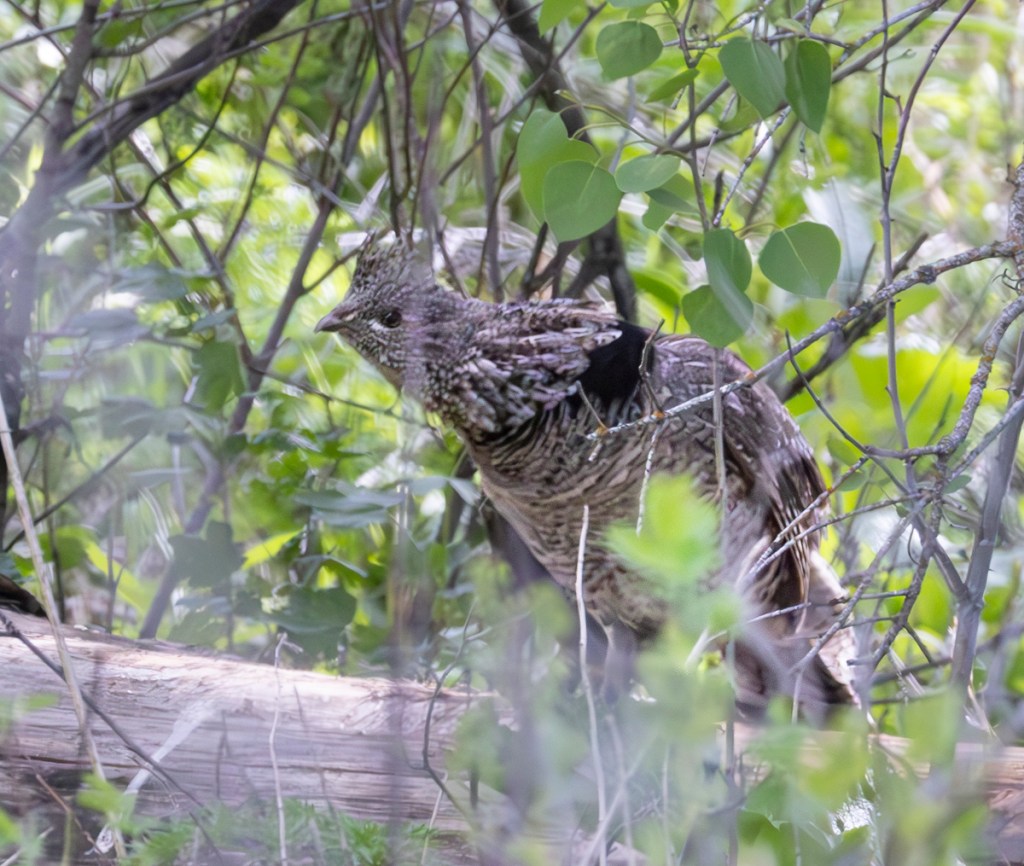
We took a 4-day road trip last week to various public lands in western Montana and eastern Idaho. Our goal was to see as many birds as possible in the different habitats we traversed. After camping in some beautiful country and enjoying the magnificent scenery, I’d say we accomplished our goal. A highlight for both of us was hearing several ruffed grouse drumming in an aspen grove near our campsite. We walked in a bit trying to find a particularly persistent one. We sat and listened and finally saw it fly a bit farther into the woods when we got up and were walking along the edge of the treeline. We decided to leave him to his pursuits and left. But as we started driving along the dirt road, Melissa spotted another grouse on a log in some aspens not far off the road. We watched it drum and then decided to back up for a better view. We have learned it is always a risk to back up for a better view of an animal once you have driven past it a bit (we think they know they have been seen and that makes them nervous and often they flee).
But this grouse was on a mission – drumming to establish his territory and hopefully attract a female. The vegetation was fairly thick so our first views were somewhat obstructed by leaves, but we sat and watched in awe as he drummed a couple of times. I finally decided to back up just a bit more and found a spot where I could film the bird without many leaves or twigs in the way.
If you have never seen a grouse drum, it is a truly remarkable sight. The drumming is performed by rapid (extremely rapid in fact) wing beats and contrary to what some people once thought, the wings don’t flap against each other or the log to create the sound. The deep drumming sound is actually created by the fact that the fierce beating of the wings creates a vacuum and as air rushes back in it creates a mini sonic boom. A drumming session typically lasts about 10 seconds and has roughly 50 wing beats. It starts slow and then gains momentum, trailing off at the end. We witnessed a couple of false starts consisting of one or two slow wing beats before the bird settled back into a more relaxed position.
Here is a short video showing the drumming in real time. Unfortunately, I didn’t have my external microphone on so the camera’s mic doesn’t really pick up the low sound of the wing beats. Here is a sample of their sounds from The Cornell Lab of Ornithology (click the display tab and watch their video of one drumming as seen from behind).
Now here is another clip of him drumming a different time in slow motion. When filming in slow motion with this camera there is no audio.
I remember hearing this unusual bird thunder in the mountains of Virginia and North Carolina years ago. I have only seen the bird in action one other time so spending several minutes with this avian percussionist was a real treat.


Leave a Reply