
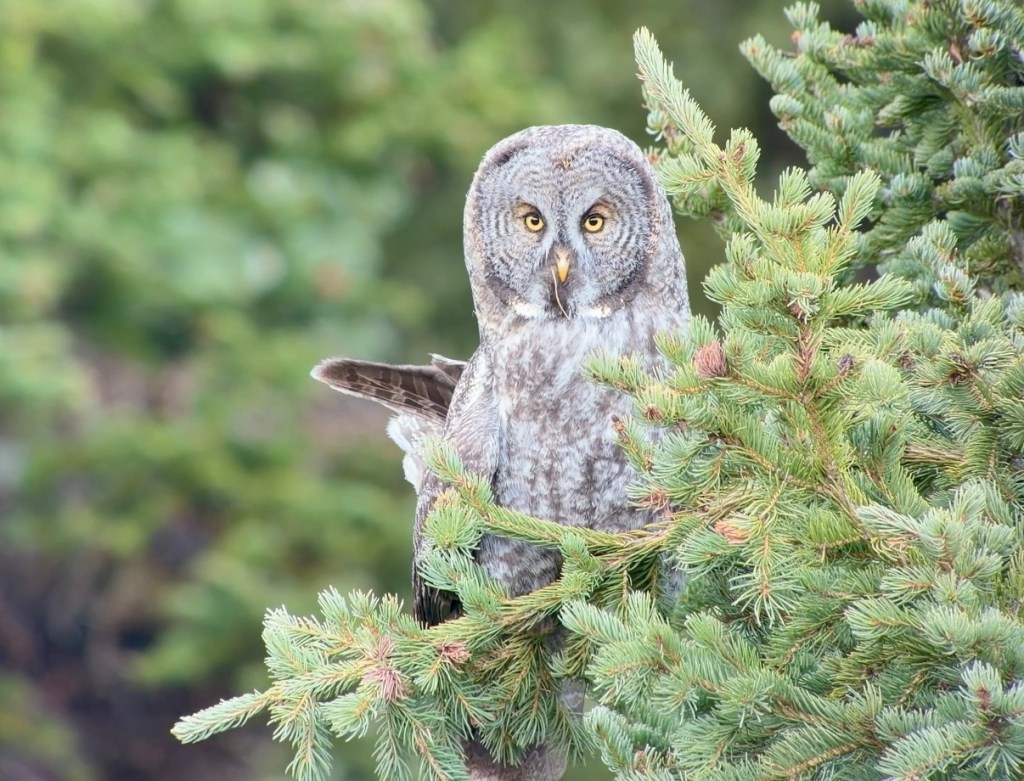
Halloween is the last day the roads into the interior of Yellowstone National Park are open. Come November 1, travel is restricted south of Mammoth Hot Springs and the East, South, and West Entrances to the park are closed. The only road that remains open for visitors to drive is the road from our hometown, Gardiner, to the Northeast Entrance at Silver Gate and Cooke City. Both last year and this year, Mike and I made an effort to visit the southern part of Yellowstone at the end of October before the road closure. We took a walk at Norris Geyser Basin, a spot we’ve rarely visited over the years (and were duly impressed… it’s cooler than I remembered it!). I headed to Canyon and Old Faithful with some middle school students visiting from NC with their awesome teacher Tonya Dobson. As you may have read in the last post, Mike visited Hayden Valley without me and got to witness some incredible grizzly activity (yes, I am very jealous). But the one thing we were missing that we had seen this time last year was an opportunity to observe the gray ghost: a great gray owl.
I was introduced to these immense, beautiful birds years ago by photographer and naturalist Dan Hartman, who lives in Silver Gate. He has spent years observing and studying owls, as well as guiding film crews to nests for some pretty famous nature documentaries. Over the years, he has been generous enough to share his love of these owls with numerous teacher groups that have visited the park with Mike and me. The moments when I’ve had the chance to be in the woods with him looking for one of these silent beauties have been some of the most “wild” feeling moments in this pretty-darn-wild place. And the chances I’ve had to see these birds… well, it’s hard to describe how special they are.
My favorite memory involving Dan and a great gray owl was on a trip about 20 years ago. We had some pretty serious birders in the group but didn’t have the good fortune to see a great gray with Dan. So he whipped out a piece of paper, drew about 4 or 5 circles, marked the location of a few random bits of old metal scraps, and then put about 5 Xs on the page. The circles were meadows, the metal scraps our landmarks, and the Xs were common perches for a great gray owl. I have to say, I didn’t feel super hopeful that we’d find an owl without Dan as we led a group of North Carolina teachers traipsing through super-muddy meadows, wet from snowmelt. We walked to the furthest “circle” on the map with no luck. But as we turned around to head back the way we had come, someone exclaimed excitedly. Sure enough, there was the owl, perched almost exactly where Dan had said it would be!
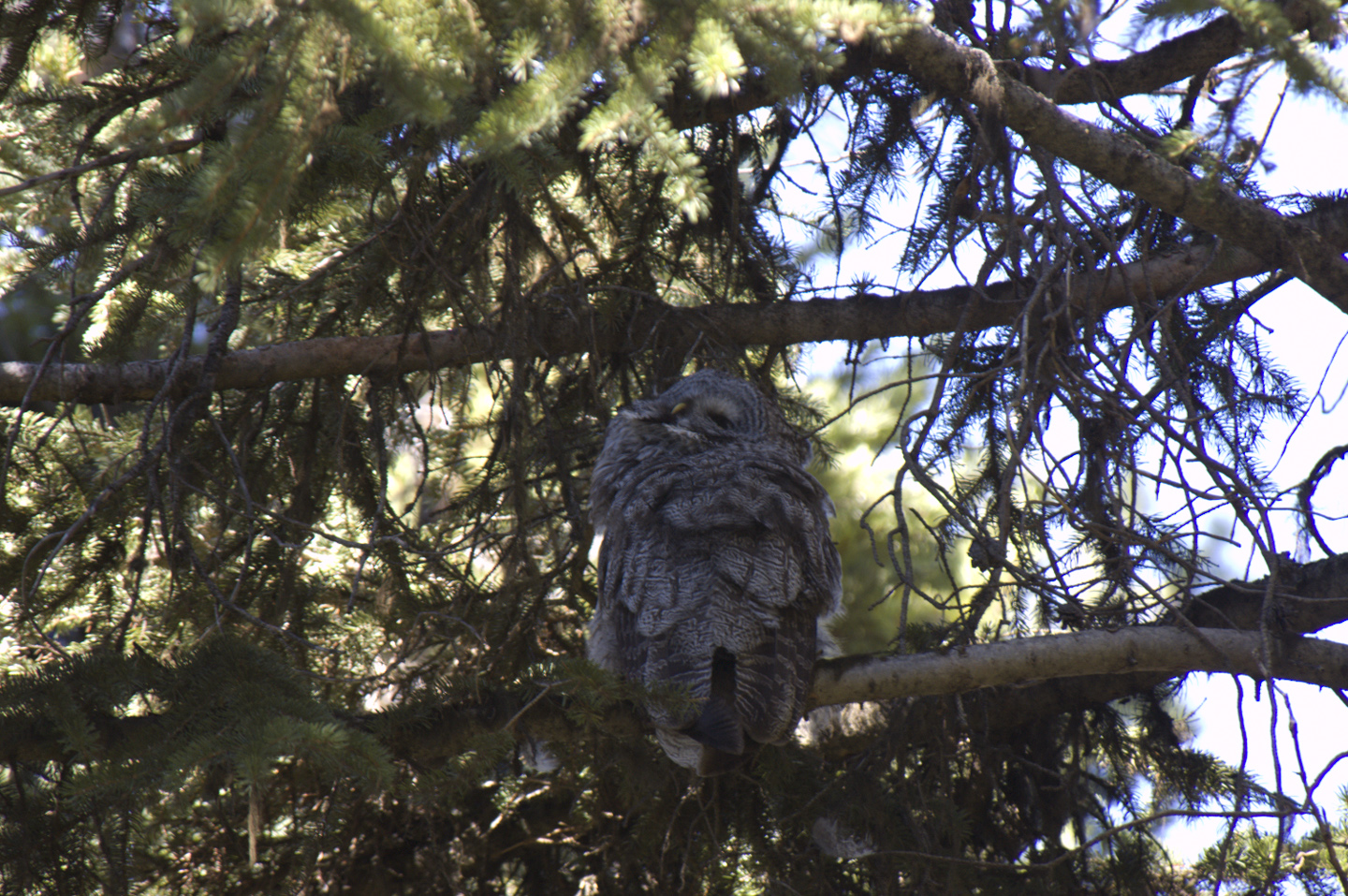
That was the first of just a few great gray owls I’ve seen without Dan pointing them out to me. The one Mike and I saw last Halloween was the second. We were hoping for a third this fall, and had some unexpected luck! A couple posts ago, Mike started telling about our birthday road trip at the beginning of October to the Tetons and then to a random spot in the National Forest near some beaver ponds. He hinted about seeing something other than the beavers (which were amazing, by the way). Well, as we were watching and hoping that one of the beavers would come back out of the pond to retrieve more aspen branches it had left strewn down the path, for some reason, Mike had turned around and was looking the other way. He saw something large fly across the road: a great gray owl. We quickly abandoned the beavers, grabbed scope and camera, and headed down the road. The owl was perched at the top of a conifer, backlit in the evening glow. Nonetheless, I put my phone on the scope and shot some video as it sat then took off and flew down and almost out of sight.
–Great gray owl taking off from its treetop perch
I kept my eye on it and spotted it through a gap in some trees where it had landed. Through a tiny and somewhat obscured gap, I watched and filmed as it turned its head from side to side, peering at the ground. When it flew again, this time to a more open spot, we slowly and carefully moved down the road to view the owl a bit more closely. It landed in first one, then another, small fir tree, sitting right at the very top. I guess when you only weigh about 2.5 lbs (in spite of a ton of feathers and a skeletal structure making you the tallest owl with the largest wingspan — up to almost 5 ft— in North America) you can sit in some pretty precarious spots. A couple ravens, disliking that a larger predator was hanging out in their space, got riled up and did a couple flybys of the owl in its perch. It was amazing to watch the owl swivel its head to track a raven as it buzzed by. At one point, the owl seemed to lose its balance and flapped its wings to regain its perch.
–Great gray owl being harassed by ravens
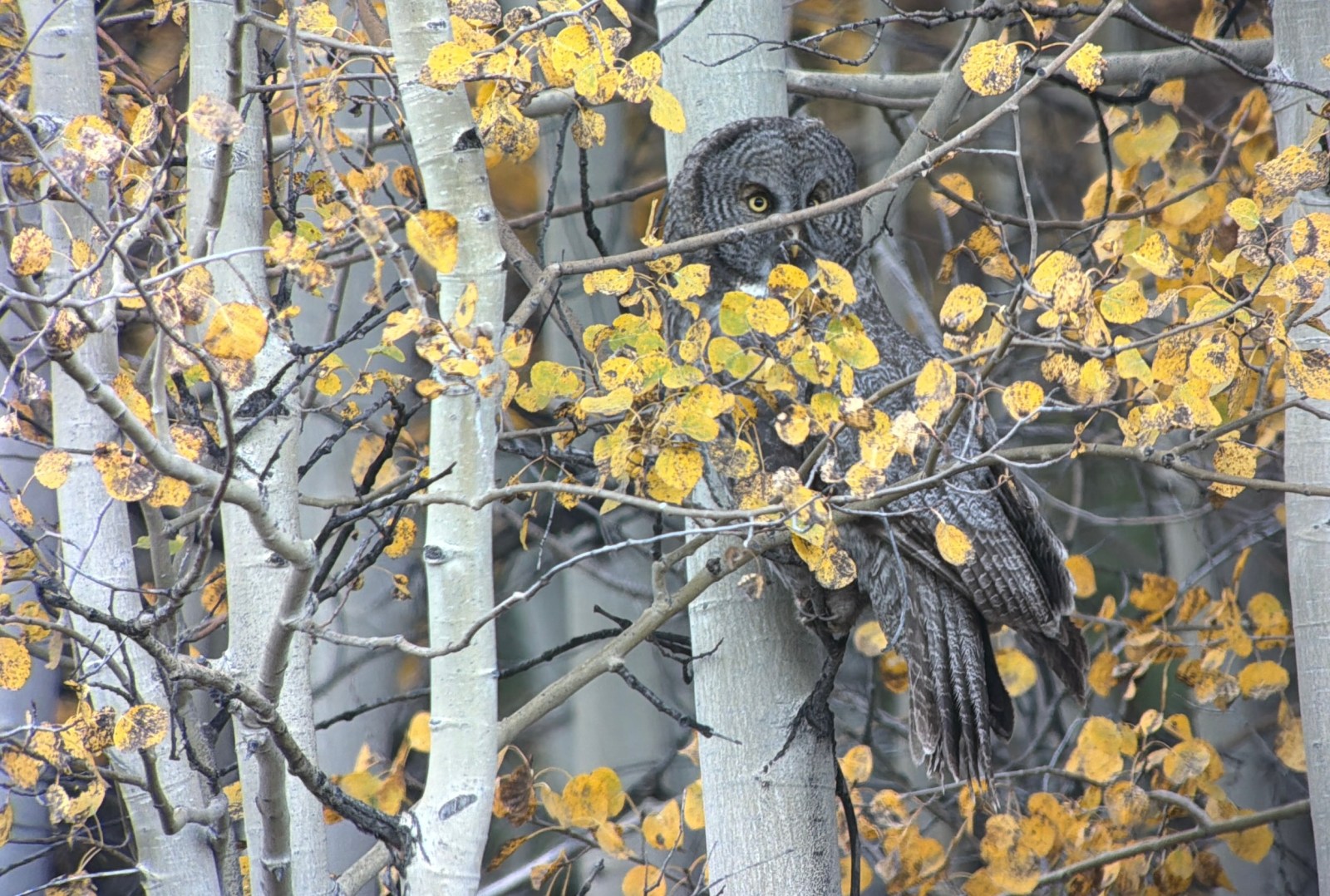
We watched as the owl moved between a few perches and tried, unsuccessfully, to catch some food, diving to the ground then looking up sheepishly before returning to perch in a tree. My favorite moment was when it flew across the meadow in absolute silence, then landed in a small grove of aspen trees still decorated with golden leaves. Though the view was obscured by a few branches, seeing the bird’s yellow eyes glowing along with the aspen leaves, the white feathers in its plumage highlighted next to the aspens’ white trunks… it was beautiful. And to know that we were the only people with the chance to witness this magical moment… that is something special.
Another favorite moment was when the owl flew a bit closer to where were standing in the road and looked right at us before taking off again. In this closer-up video, we could see that the goofball had a bit of something — maybe a piece of grass, though I’d like to imagine it was the tail of a mouse — hanging off the feathers just next to its yellow-orange beak. We could also see more clearly the fine feathers between its eyes and the white patches at the bottom of the facial disk.
Dan had taught us that younger great grays have pointed feathers, particularly on their tails. As Mike looked through the photos he had taken with his camera, it seemed this owl had pointed tail feathers, so we’re pretty sure it’s a juvenile, born earlier this year. Perhaps that’s why it seemed a bit clumsy?
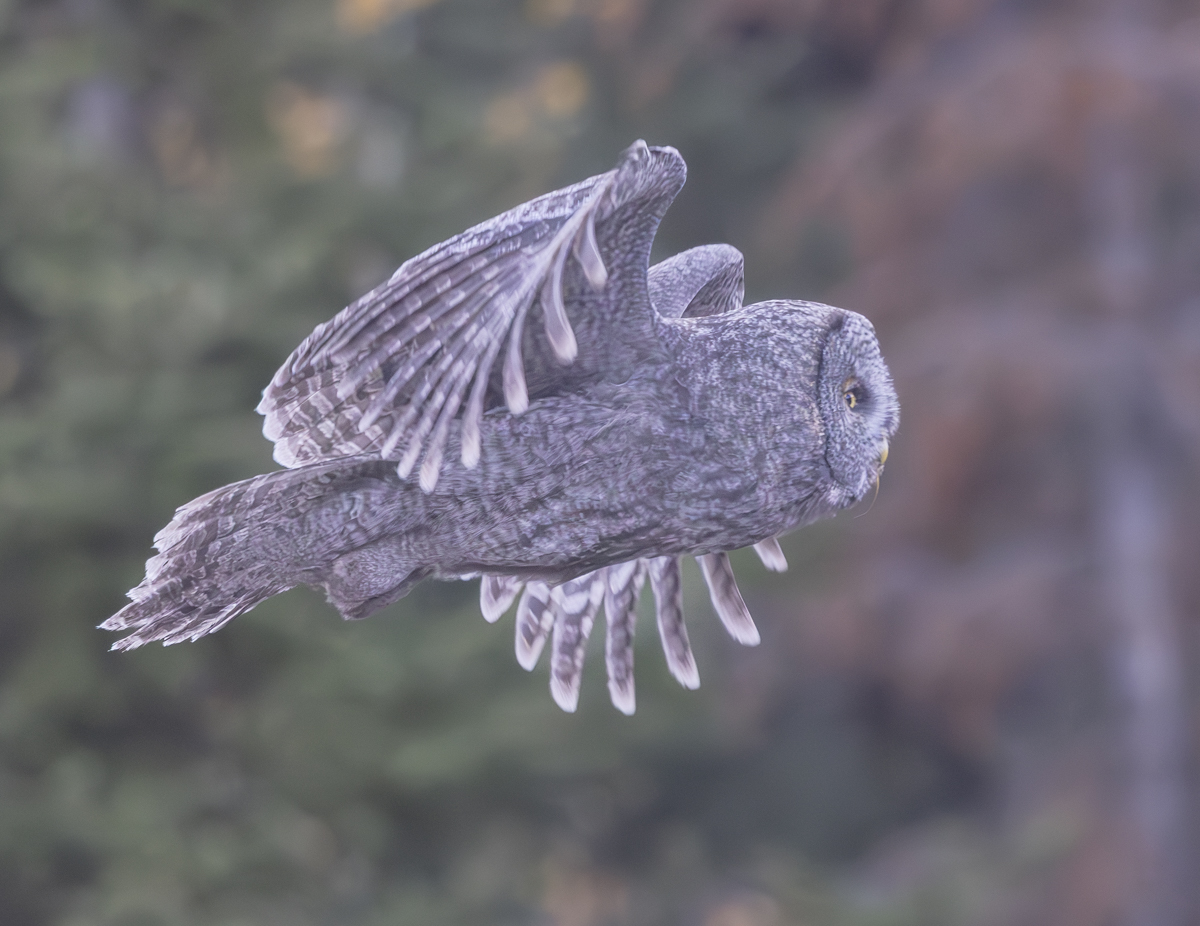
Fast forward to Halloween and our final trip into the interior of Yellowstone…
Much like last year, there were a lot of people out looking for great gray owls. Along roadside meadows, there would often be a handful of empty cars where folks were walking out, looking for these birds. I have to say, I don’t love the idea of so many people traipsing through the woods disturbing these birds, though Mike and I did walk out to a meadow at one point when no one else was around. We didn’t see an owl. Supposedly, great gray owls are at least somewhat susceptible to disturbance, so I feel uneasy about the pressure put on them, while also loving the chance to see something so beautiful and wild. This is the conundrum at the heart of so many conservation-related issues, right? As a naturalist and educator, I know that people need to care about wild places, and animals can be a great connector. If people don’t care, we won’t protect these valuable resources. But it is a double-edged sword. Because in trying to view or photograph these animals, in leaving the mark of our presence on wild places, we may be harming that which we are trying to protect. This is something I constantly struggle with. I try to be careful and respectful, while also learning and observing and sharing about these amazing creatures. And I hope the good outweighs any disturbance or harm. But it is a process of constant re-evaluation, a tension that will never go away.
On Halloween, as we were about to turn north and head home, we decided to take one more look from the car into a few more roadside meadows. We quickly came upon a big traffic jam and pulled in to see what was going on. There were multiple people in the woods, and I quickly spotted the reason for the crowd. There was a great gray owl sitting on the end of a log, just a couple feet above the meadow grasses. As we got out of the car and assessed the situation, I was happy to see that people were giving the owl a decent amount of space, they were being very quiet, and the owl didn’t look to be disturbed. In fact, as I watched from just below the roadside through the spotting scope, it launched into the grasses in an attempt to catch prey. It wasn’t successful, and relocated to a nearby snag. At that point, I crept further down the hill as quietly as I could for a different angle, staying well behind the rest of the crowd. That’s the beauty of a spotting scope — it has a much longer reach than a telephoto lens. I found a spot in the trees, behind a downed tree where I was hopefully disguised by its branches, and set the scope up again. I watched and filmed the owl for quite a while. It definitely heard noises and looked around at them, especially when a few folks pulled over on the road (about 50 yards away) and started loudly asking what was going on. But the folks in the woods were nearly silent, and I was grateful for that. Not only was the owl less disturbed, but it also made this moment more special. Most of the time, the owl seemed to be scanning and listening for sounds of prey in the meadow grasses.
My favorite moment was when I zoomed in on the owl’s face with the scope, just as it turned its head in my direction. I will say, the owl does look a little pissed off by human facial expression standards! But hopefully, that’s just an anthropocentric interpretation, and not the actual meaning of the look.
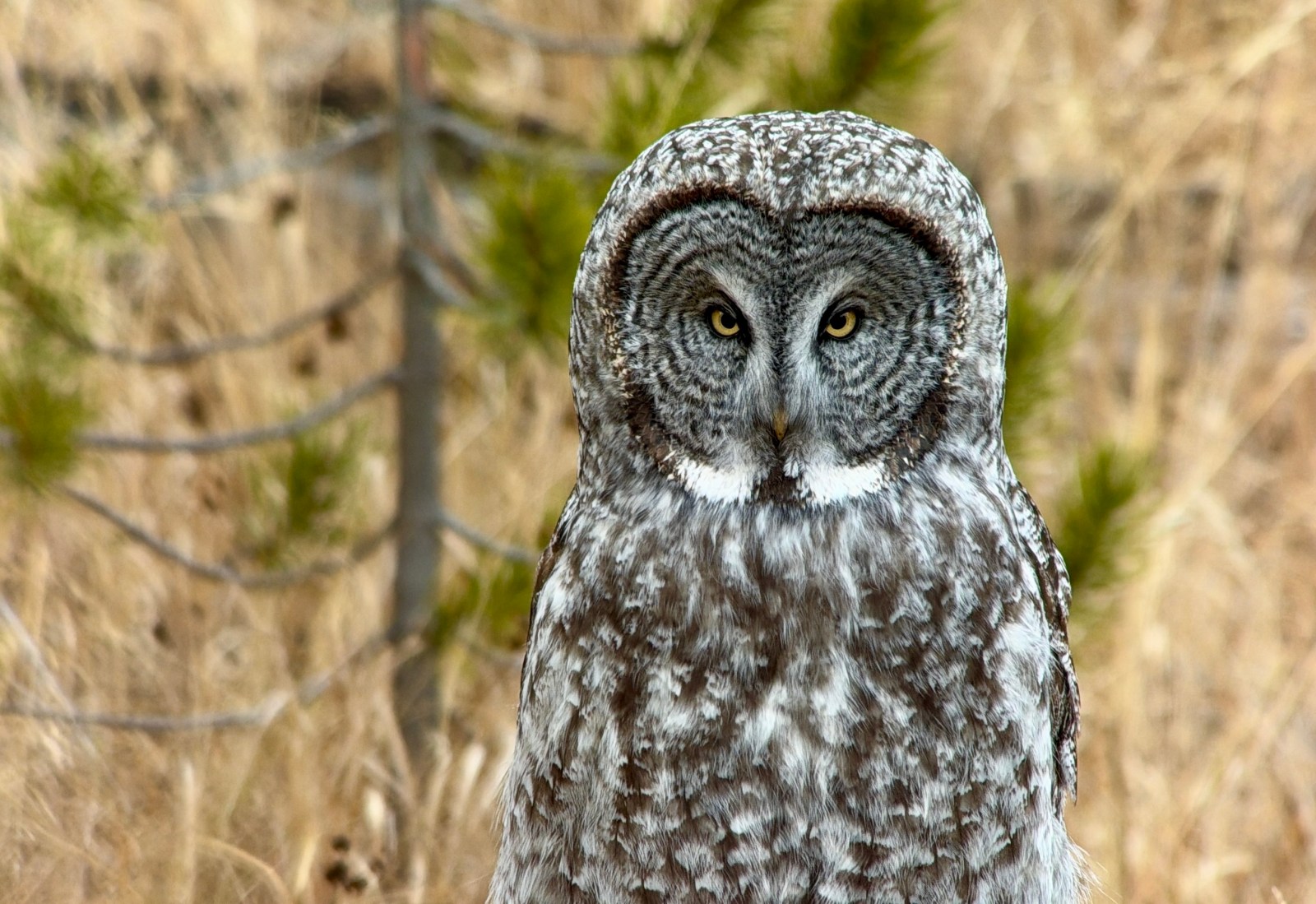
After one more unsuccessful attempt to capture a meal, the owl flew off to my right… and landed in a tree directly in the middle of the crowd of observers! From my perch on the hill, I watched as a guy, probably no more than 20 feet from the owl, filmed it with his cell phone. But again, everyone remained entirely still and silent. I don’t know that I would have wanted the guy to do anything different, because if he moved away, that might have been more disturbing than just remaining where he was. After a few minutes, the owl flew again, this time across the road and further away. The crowds dispersed a bit, and some folks watched from the road as the owl tried one more time for a meal, then flew off into the woods. No one followed. I was grateful. We headed home, excited that we had the chance to see such a special creature once more.
–This beautiful owl scanning the meadow for a meal
Now, the roads to that part of Yellowstone are closed. The great gray owls that call that area home will be left entirely alone for at least the next 6 months. I have to imagine they’re breathing a sigh of relief to just be able to live their lives, unobserved by those strange two-legged hairless creatures for a while.
Note that all the videos in this post were taken through a spotting scope and photos either through the scope or with a telephoto lens.


Leave a Reply