The bird already possessed a common name; and it is a pity that Latham did not know it. In its native land it was, and still is, commonly called, the log-cock…and because of its cackling cry, “wood-hen,” “laughing woodpecker,”…
~in Life Histories of Familiar North American Birds, Arthur Cleveland Bent, 1939
My father called them wood hens and taught me to pay attention to their distinctive call when we were out deer hunting. When they called, it usually meant something was moving in the woods nearby, maybe a deer. Their most accepted common name is Pileated Woodpecker, and I have enjoyed seeing and hearing them ever since those days as a kid prowling the woods. We are lucky to have several that make our slice of forest heaven their homeand we see them frequently, often very close to the house. The scientific name, Dryocopus pileatus, means tree cleaver with a crest, a great summary of its distinctive looks and habits. They are creatures of the forest, and prefer tracts of large trees, for both nesting cavities and foraging.
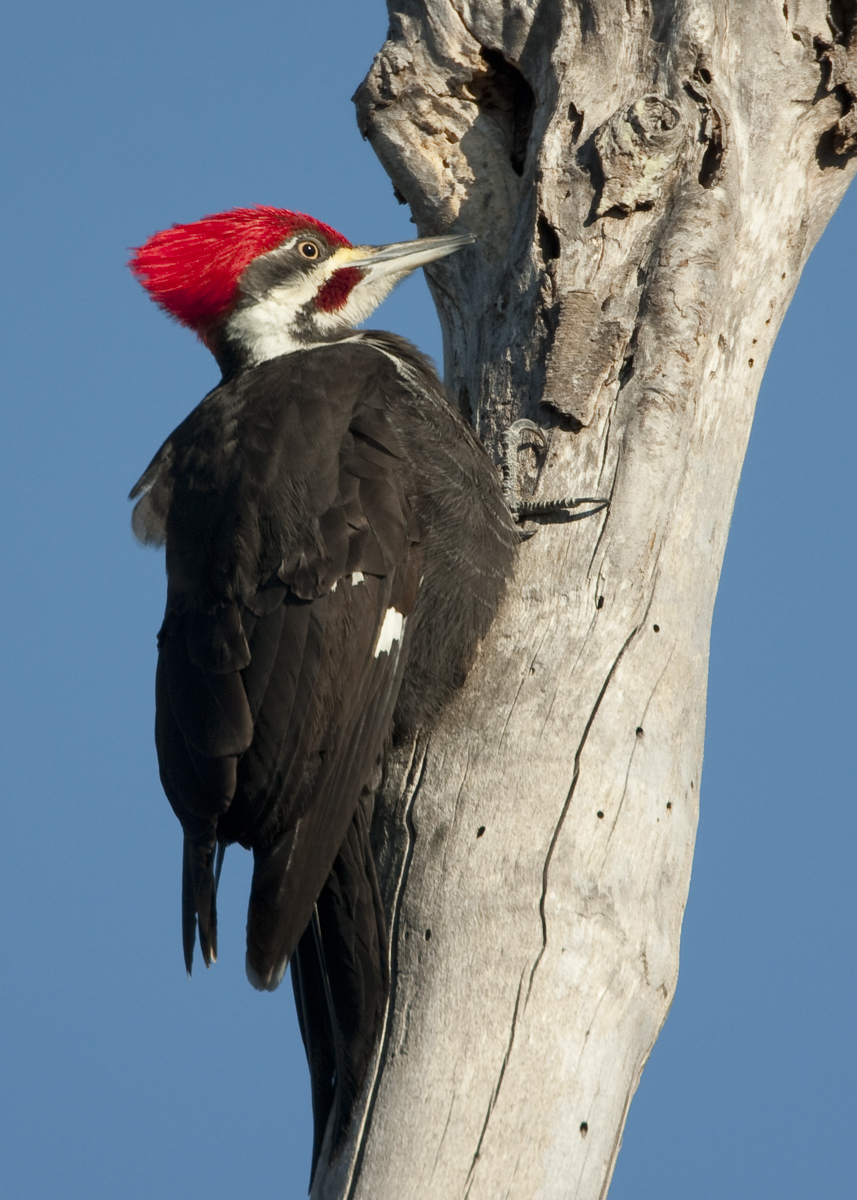
A male Pileated Woodpecker perched on a snag (click photos to enlarge)
They are our largest woodpecker, from 16-19 inches in length (about the size of a crow). The Birds of the World Online compendium describes them as a keystone species as they play a crucial role in many forest ecosystems in North America by excavating large nesting, roosting and foraging cavities that are subsequently used by a diverse array of birds and mammals—for shelter and nesting. They typically excavate nest holes near the tops of large standing dead trees which are later used by a variety of other woodland creatures like Wood Ducks, Southern Flying Squirrels, and Eastern Screech Owls. Their large size and stout, chisel-like bills enable them to break open tree trunks and fallen logs in search of their favorite prey, large ants (like Carpenter Ants) and beetle grubs. This incessant chipping away at forest pillars undoubtedly helps speed the process of decomposition and forest recycling of nutrients and provides access for a variety of other woodland creatures that might feed on invertebrates associated with decaying trees and logs. I have watched deer, robins, and squirrels scratch in the wood chips and poke into holes created by these woodpeckers as they search for a tasty morsel.
The chisel-like bill can blow apart a tree trunk like a shotgun blast
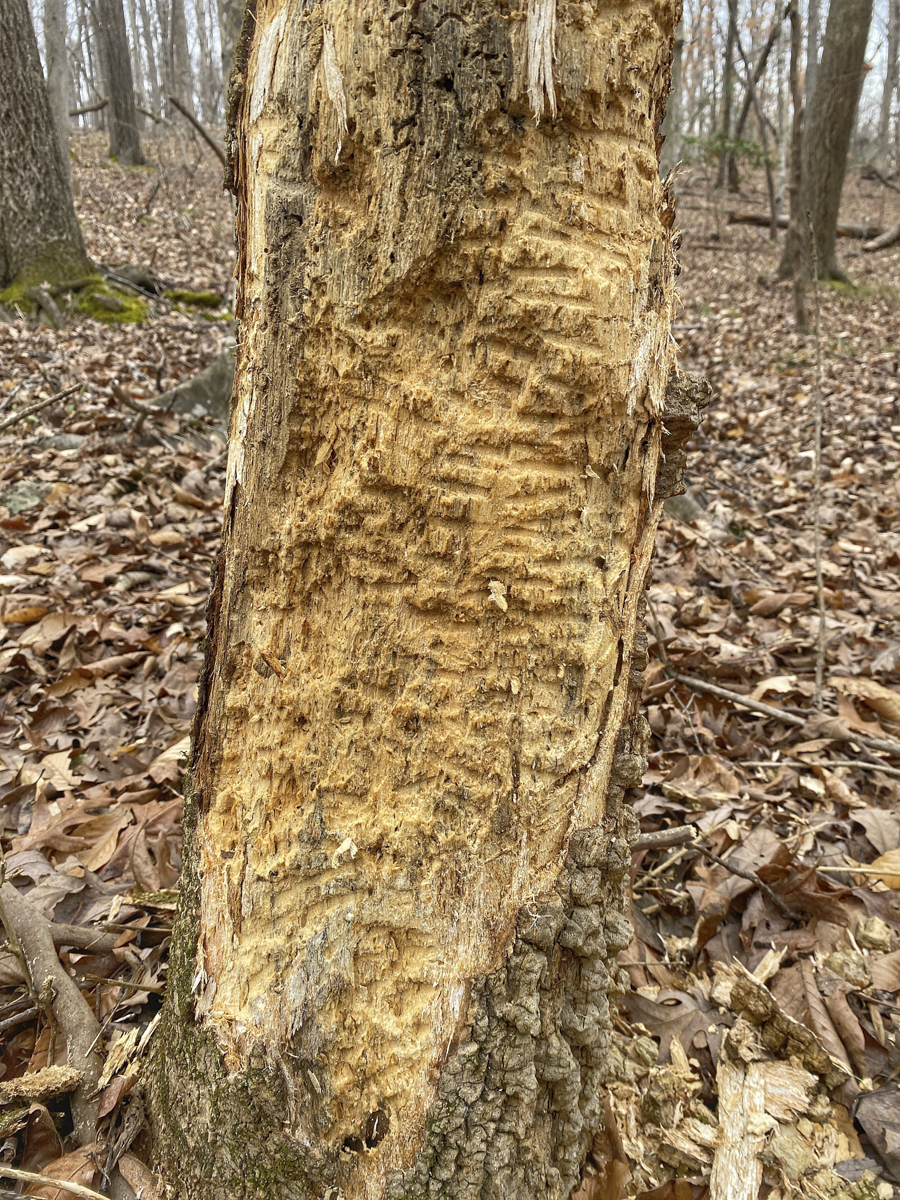
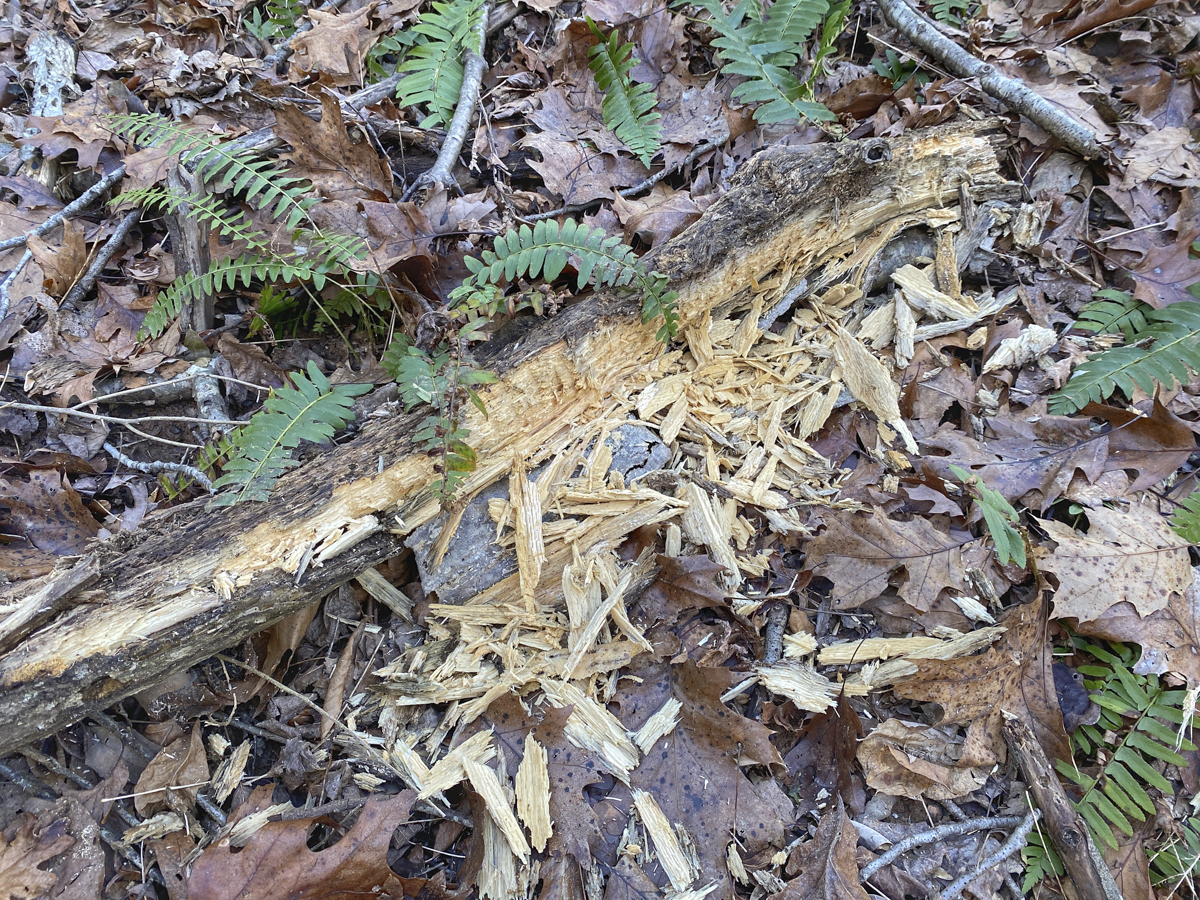
As we walk our woods, we find plenty of evidence of their presence even when we don’t see or hear them. We have many large dead trees and a substantial crop of fallen logs that provide feeding sites for our woodpeckers. I have recently found numerous big branches, stumps, and logs that look like someone took a hatchet to them and splintered them into hundreds of pieces with some of the wood chips measuring 4 and 5 inches in length.
A large branch on the ground splintered by woodpecker activityA small tree trunk has been chipped away by a Pileated Woodpecker
When I got my second trail camera (we have two Browning Strike Force PRO XD trail cameras), I was eager to set it up on a large log down slope from our house that had recent woodpecker activity. I left the camera up two days, attached to a tree about 6 feet from the log. When I retrieved it, I could tell the woodpecker had been there as there were new chips scattered along the length of the log. The camera captured over two hours of feeding activity by a male Pileated Woodpecker along with day-time visits by a few other species (American Robin, Dark-eyed Junco, and Gray Squirrel). I have included two clips that highlight some of the more interesting behaviors (view full screen with sound up)…
Pileated Woodpecker pounding on fallen log and calling
Slow motion clip of woodpecker eating a large beetle grub
At night, the log continued to draw the attention of forest neighbors including a Red Fox, White-tailed deer, Raccoon, and a very energetic mouse.
The nocturnal log is also active
The first few clips after dark showed nothing, but the next in the series revealed a very fast mouse was the culprit. In some clips it was triggering the camera but disappearing before it was recorded. And all this is happening on just one log in the forest. I can’t wait to see what else the cameras reveal.
Go to the winter woods: listen there, look, watch, and “the dead months” will give you a subtler secret than any you have yet found in the forest.
~William Sharp
Our two trail cameras have given me a new excuse to walk in our woods every couple of days (to retrieve images) and it has reminded me how lucky we are to live where we do. We have a little over 14 acres of hardwoods on fairly rugged terrain. There is a simple wooden bench (two boards) set on stones down slope from the house and it provides a nice view of the creek bottom and opposing south-facing slope in winter.
View from the bench looking down slope to a large bed of Christmas Ferns (click photos to enlarge)
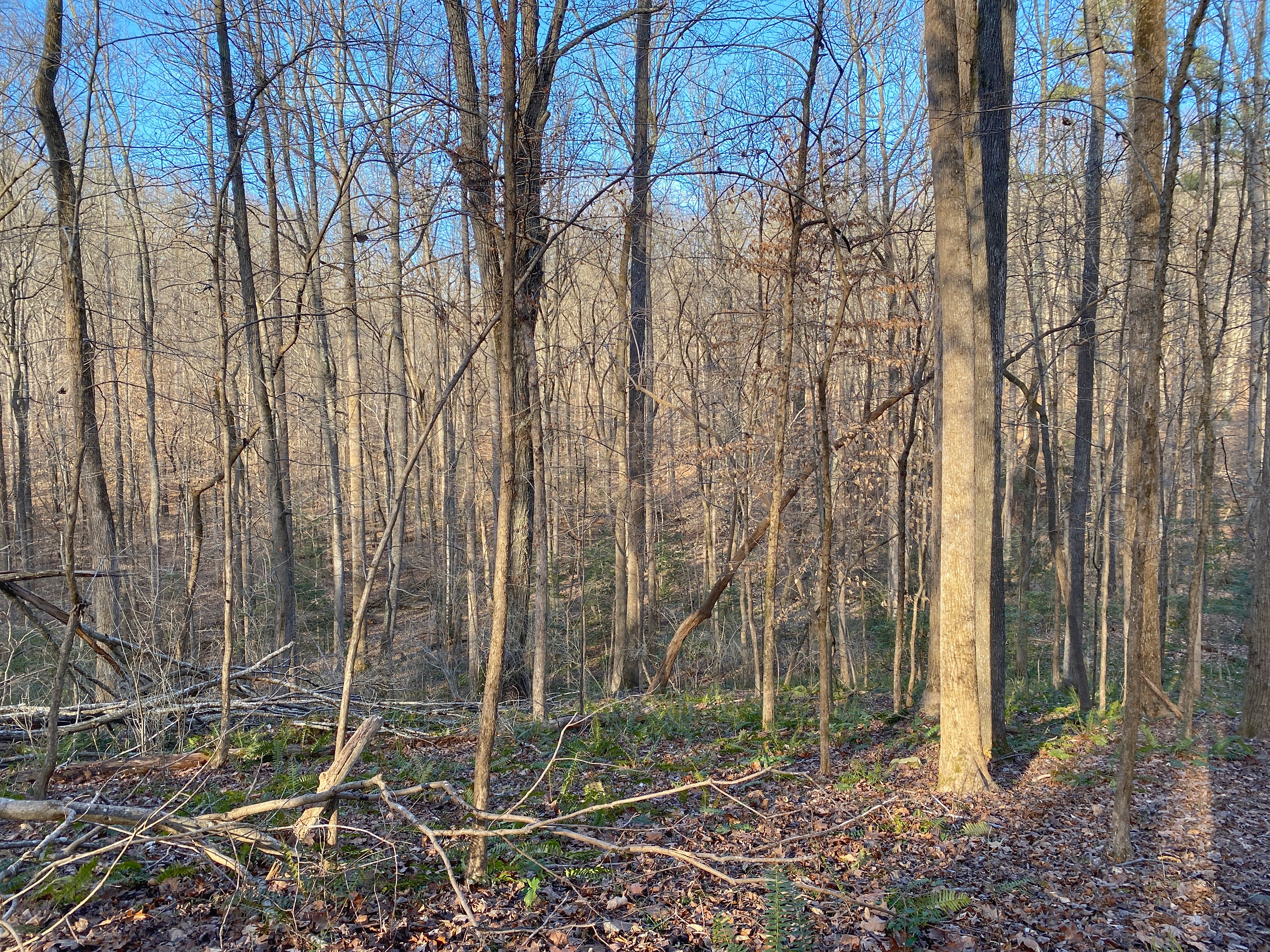
Yesterday, I wandered down to reset the cameras and took some pics with my phone of the winter woods. I like the expanded views in winter, the crisp air, the sounds of mixed flocks of birds moving through the trees, and the subtle signs of life that appear when you stop to look closely.
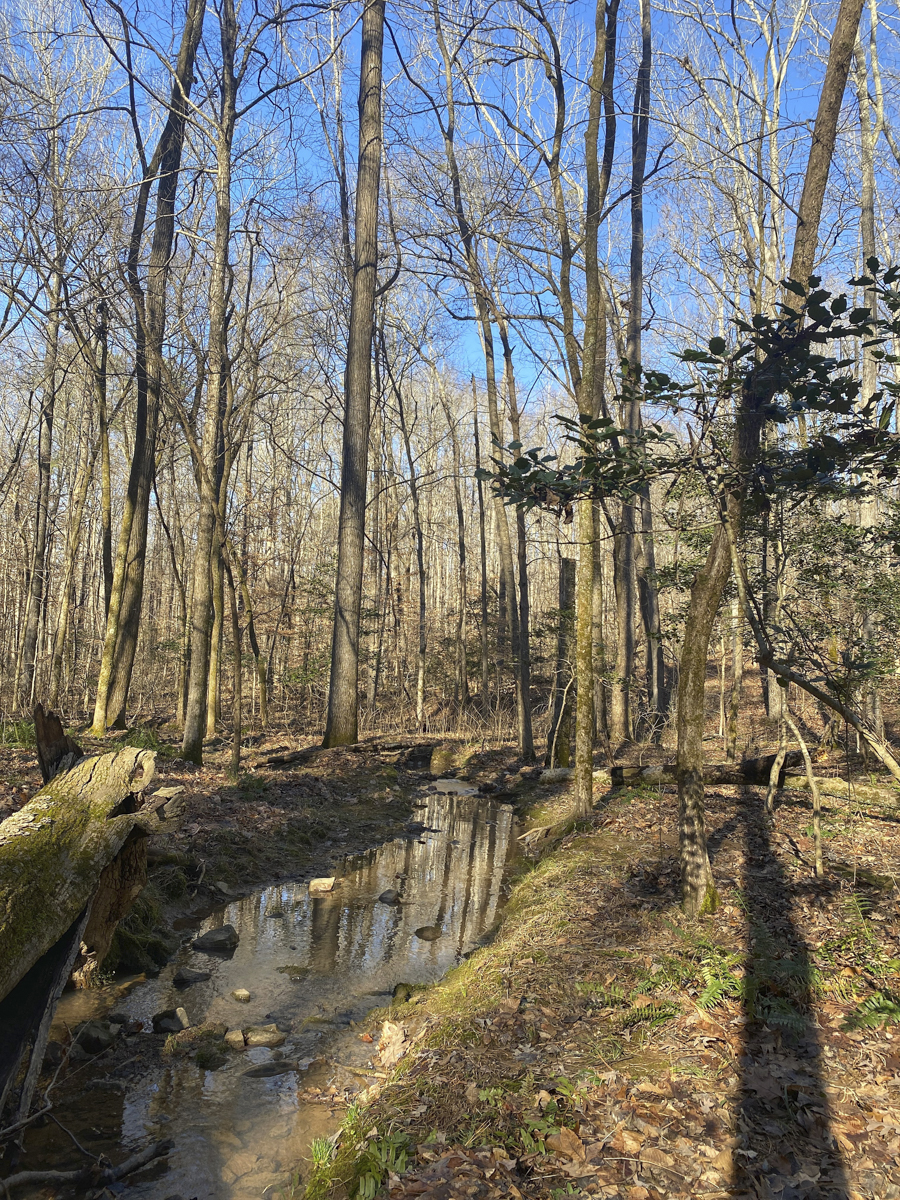
The creek on our property disappears underground for much of the summer, but flows nicely after winter rains
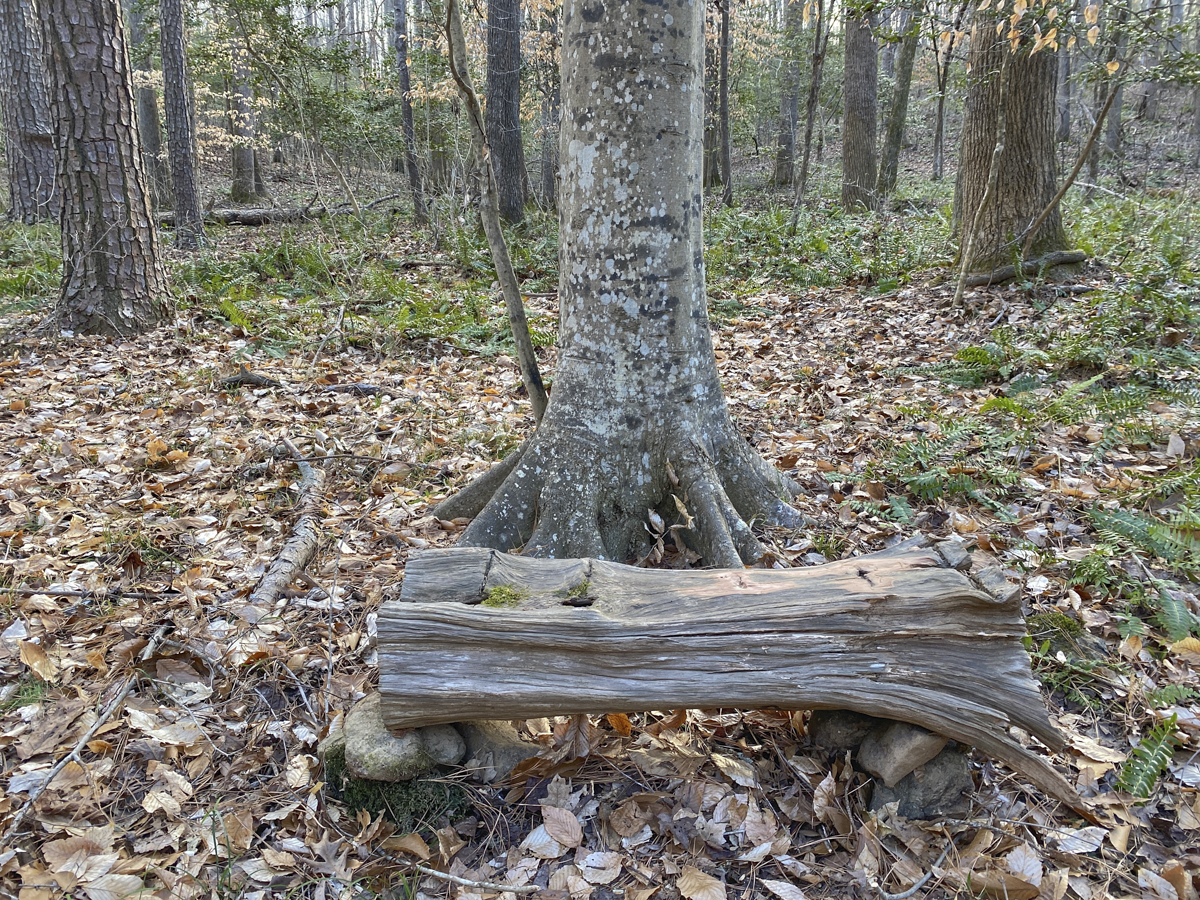
The creek bottom extends along the back side of a number of large wooded lots in two neighborhoods and offers an oasis for birds and other wildlife. It also provides a reprieve from many of the human noises we can hear from the ridge top (distant sounds of traffic on Hwy 64, neighbors out in their yards, etc.). For that reason, I decided to haul a cedar log from our yard down to the creek and create another sit spot. Again, nothing fancy, but rather something from the land that blends. This tree trunk had once stood along what I assume was a property line on our ridge and had barbed wire nailed to it (you can see the grooves in it from the years of wire being attached). It now sits on some of the countless irregular-shaped rocks scattered about the tract and is placed up against a beech tree facing the creek. I like to imagine we will spend many hours here contemplating the beauty that surrounds us.
Wooden bench along the creek
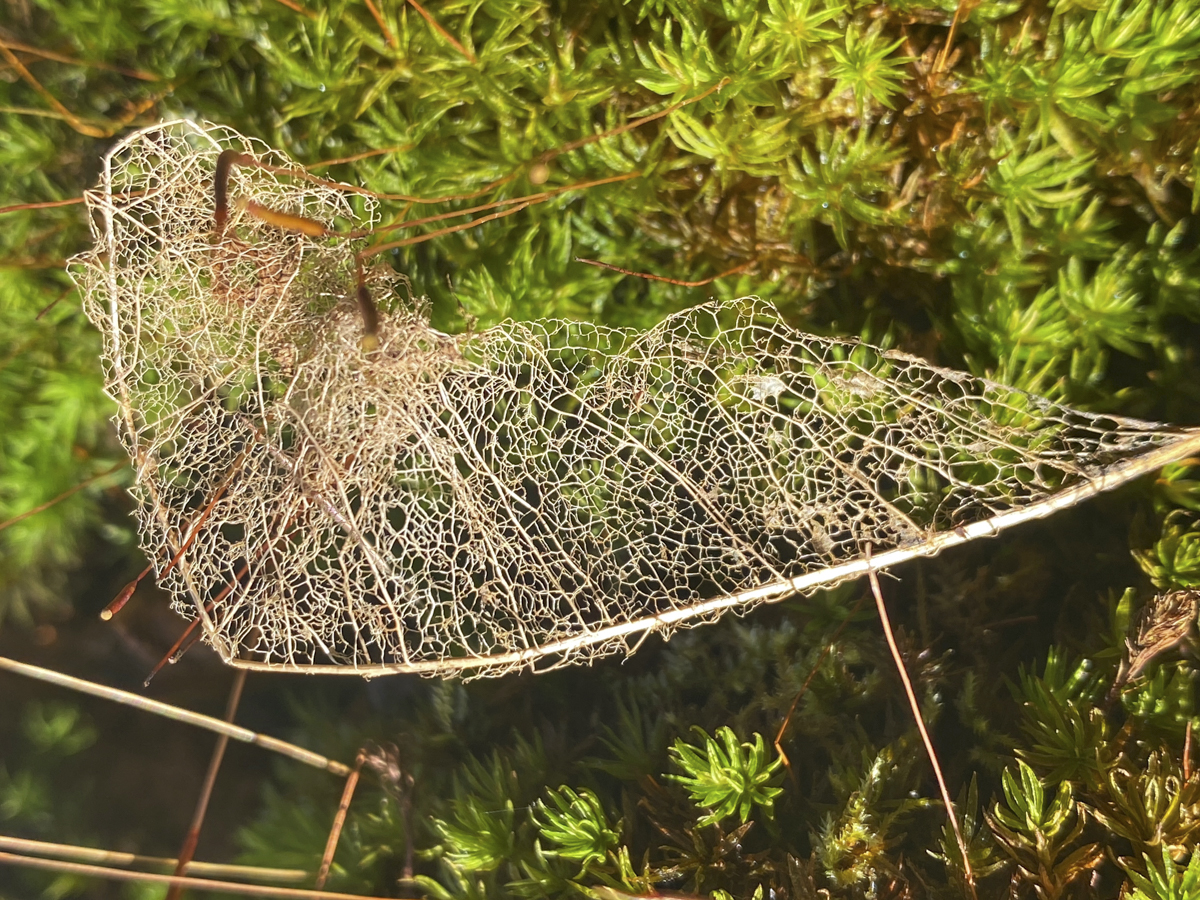
Sitting there, I started noticing things all around me that spoke of the quiet beauty of winter…
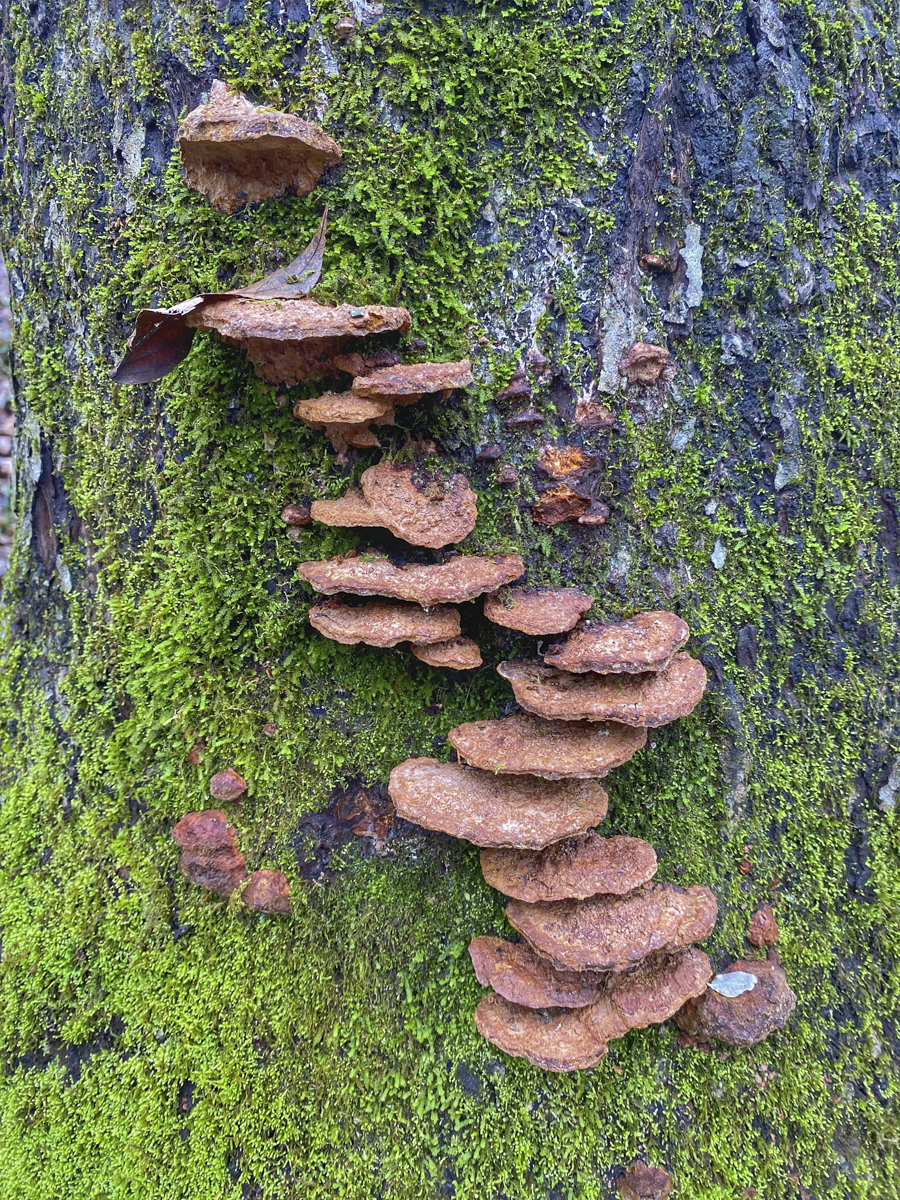
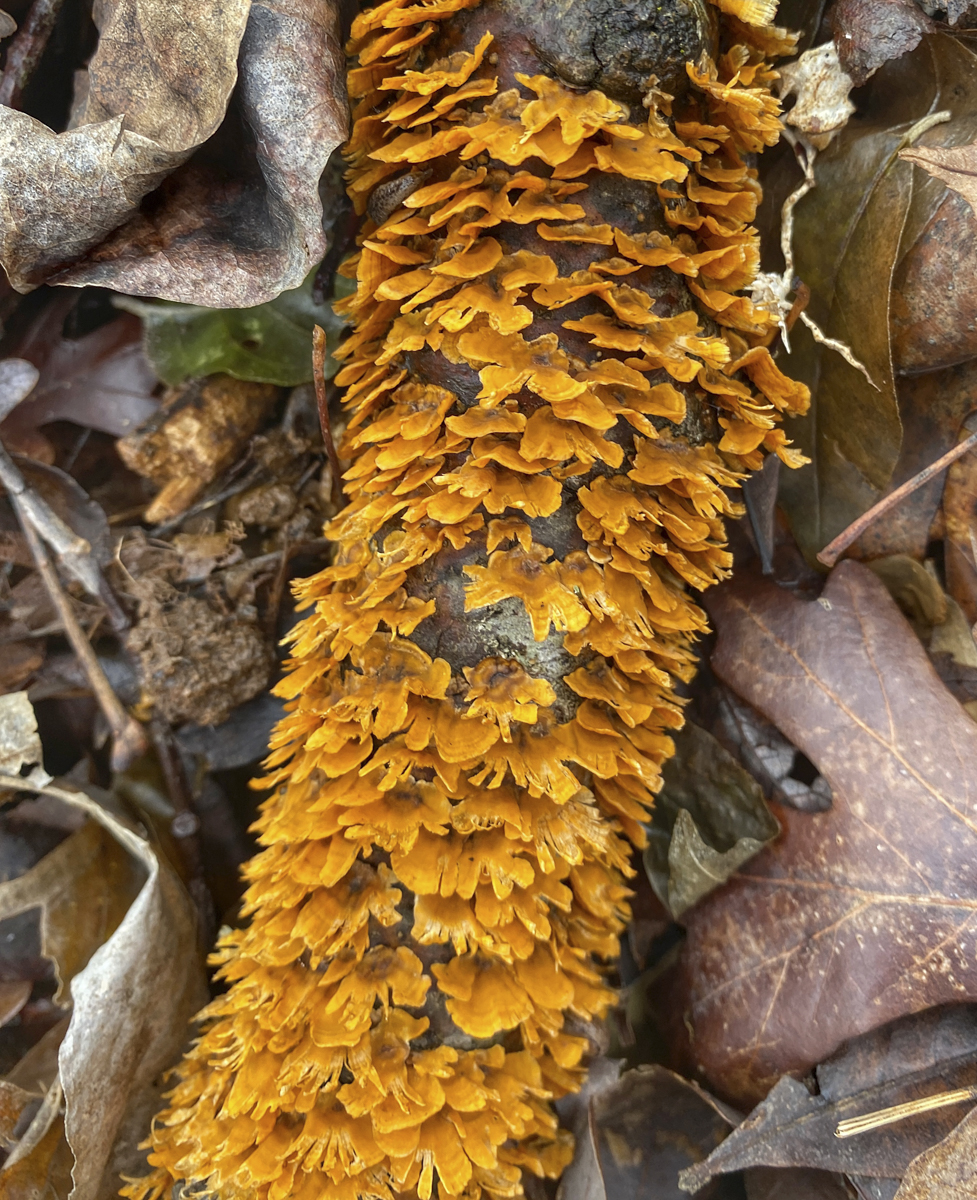
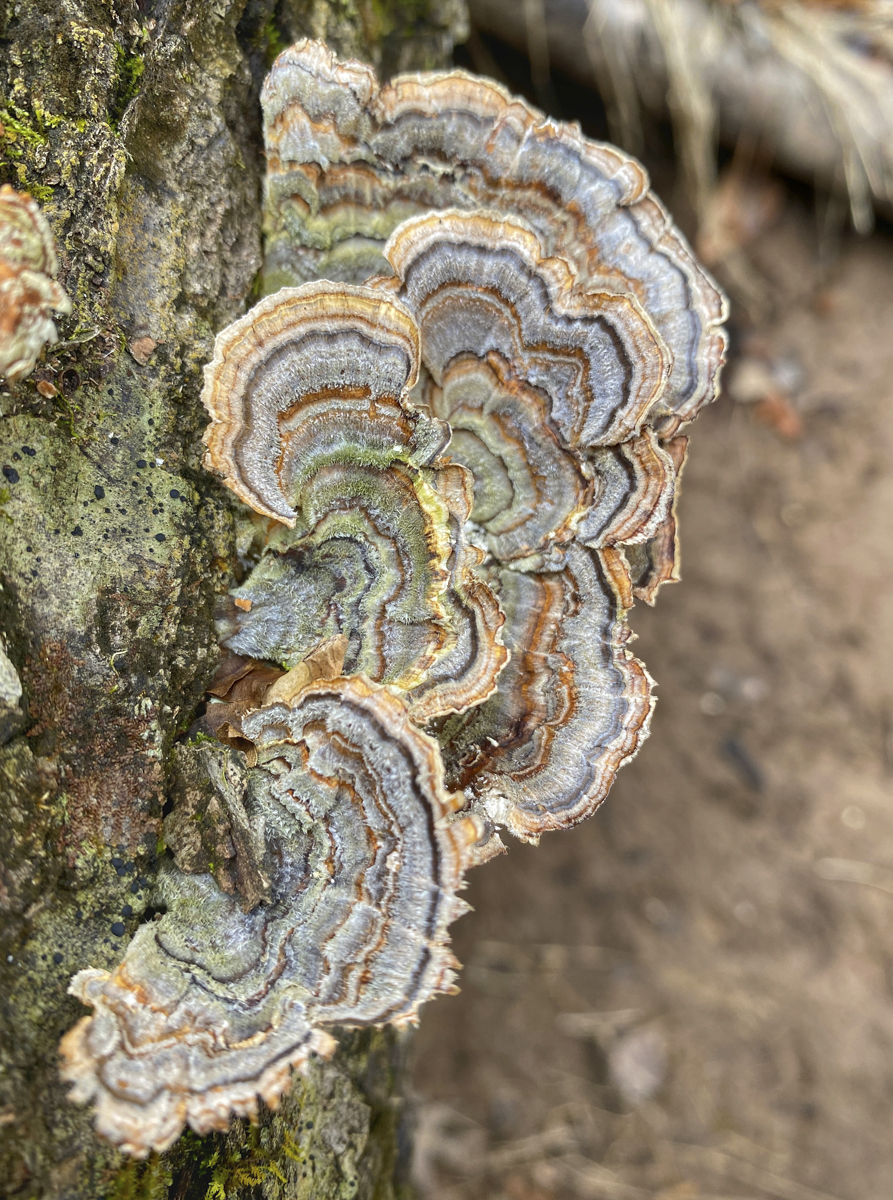
A skeletonized leaf on a bed of mossMushrooms on a mossy tree trunkVivid orange mushrooms on a fallen branch (perhaps Crowded Parchment, Stereum complicatum?)Artist patterns turned into mushrooms on a log (perhaps Turkey Tail, Trametes versicolor?)
When I returned to the house, I looked in some mushroom field guides, and reminded myself of the awe I feel for those that can easily identify our varied fungi. I plugged a couple of them into iNaturalist and labeled the photos as it suggested. If anyone has other ideas, please let me know.
Before I left, I noticed a group of tiny dancers, some sort of fly, probably involved in a mating flight, bobbing up and down in a small animated troupe highlighted by the sun. It reminded me that even in winter, life is striving to continue, to take advantage of any opportunity of warmth, of sunlight, of the future. Here’s a quick phone clip…
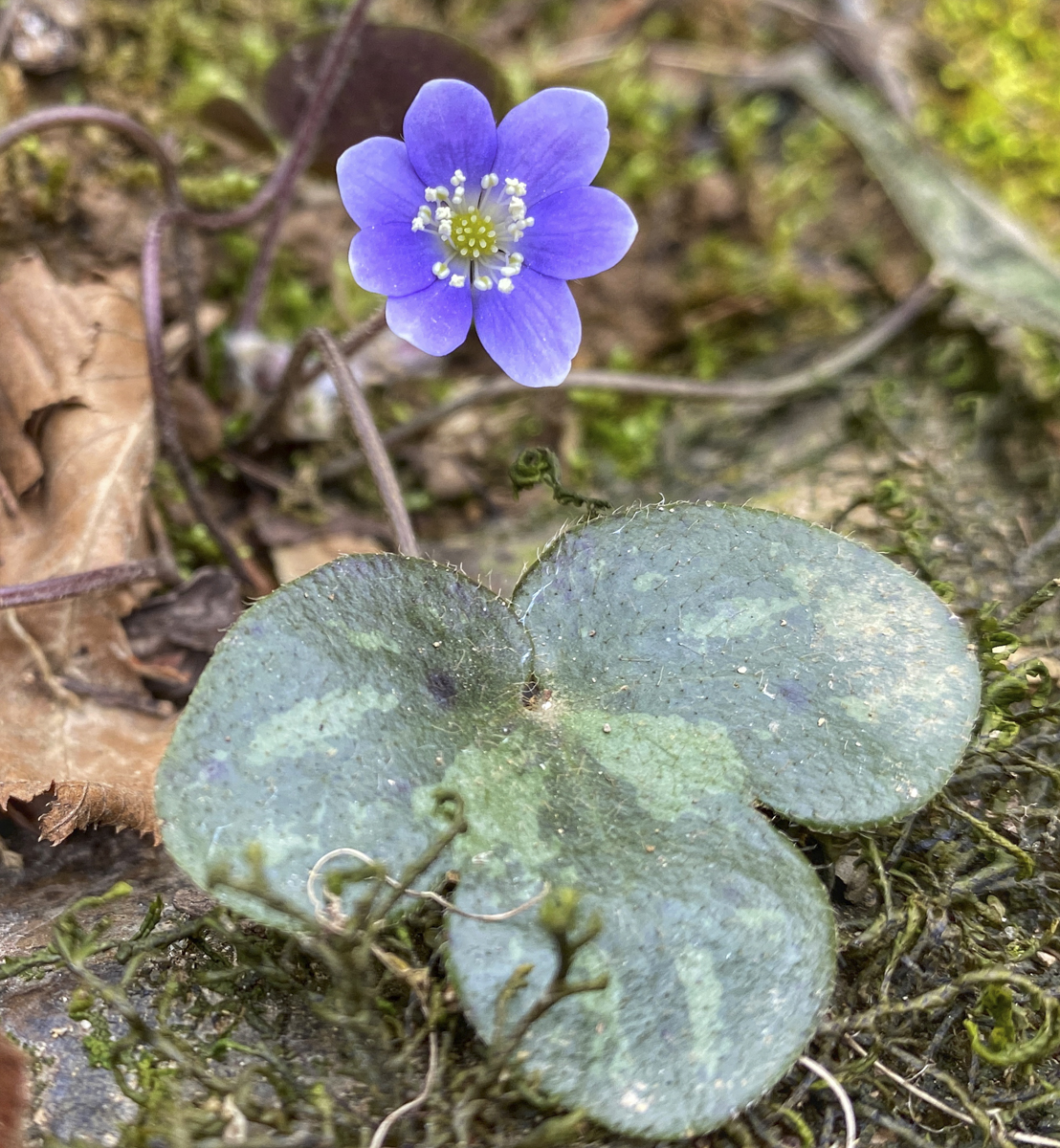
After spending time with the flies (it’s not often I get to say that), I walked along the creek, noticing the tracks of deer and raccoon, the diggings of squirrels, and then was startled to see a true sign of spring – the first wildflower of the season – a Round-lobed Hepatica, Hepatica americana.
Round-lobed Hepatica blooming along the creek
All the field guides talk about it blooming from February-March in the Piedmont, but here it is showing its striking purple colors in January. I had seen a friend’s social media post recently of one blooming elsewhere nearby…indeed, climate change in my lifetime. But, troubling as it may be, it is amazing what finding a hint of a season to come does to your mind. I think it is universal among observers of nature as this quote from 19th century naturalist and writer, John Burroughs, so eloquently states…
Nothing is fairer, if as fair, as the first flower, the hepatica. I find I have never admired this little firstling half enough. When at the maturity of its charms, it is certainly the gem of the woods. What an individuality it has! No two clusters alike; all shades and sizes. A solitary blue-purple one fully expanded and rising over the brown leaves or the green moss, its cluster of minute anthers showing like a group of pale stars on its little firmament, is enough to arrest and hold the dullest eye.
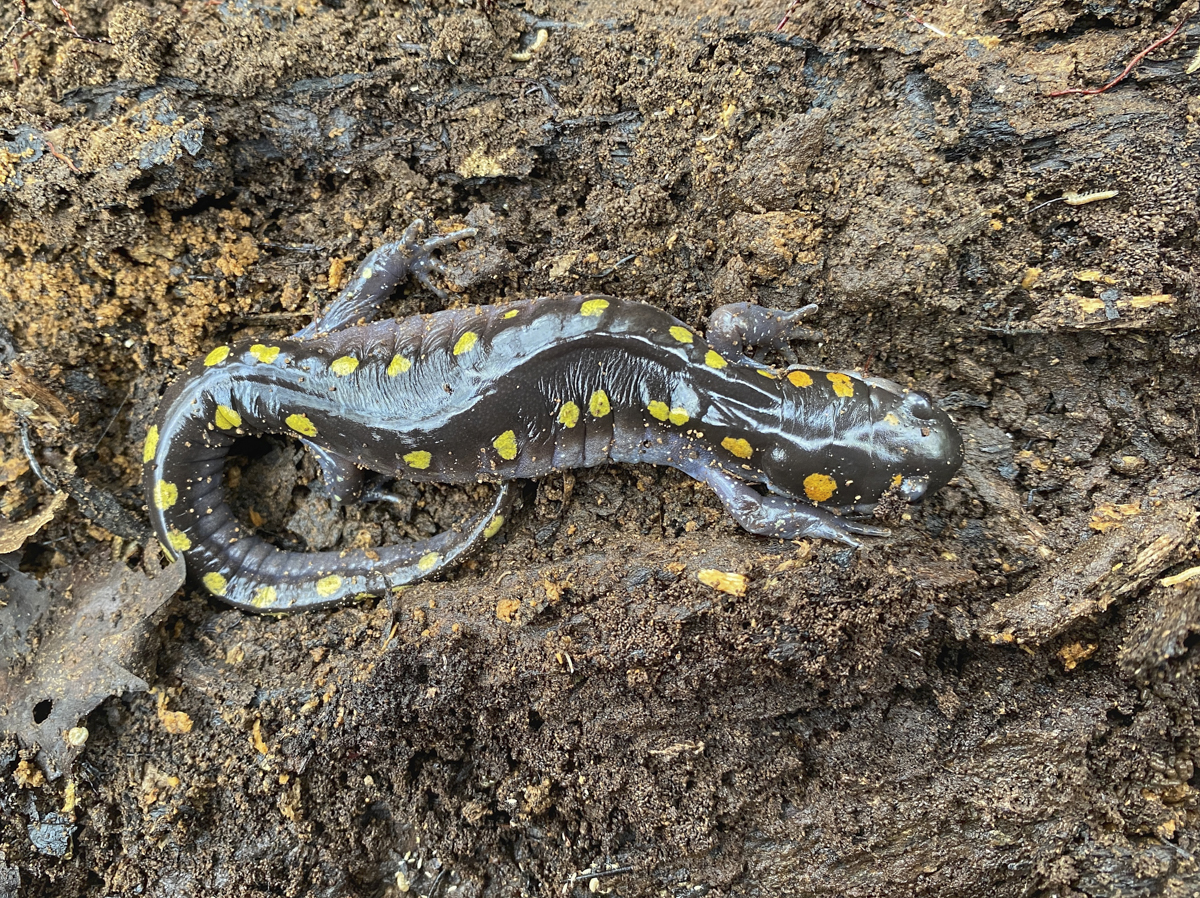
The hepatica reminded me we had found some other early signs of spring a few days ago – the first Spotted Salamander egg masses of the season in our small pools and an adult salamander waiting her turn for the next rainy night hiding under a rotting log just outside our deer fence. So, in spite of the abundance of winter birds at our feeders (the grosbeaks, siskins, and finches are still abundant), the march of time carries us toward the green and warmth of the next chapter in our wooded landscape’s story. I’m hoping to read many more pages as this year passes.
A chilly Spotted Salamander under a log near one of our gates
It has been a great year for those birds from up north (a so-called bird irruption). This occurs periodically when cone crops fail across vast stretches of Canadian boreal forests. Other factors can contribute, and different species may react differently, but those that migrate far from their normal range are usually just looking for food resources. It looked like it could be a good irruption year when we saw a Red-breasted Nuthatch early last fall. Then Pine Siskins started arriving along with Purple Finches (both of the latter species were absent here in our woods last year). And then I started hearing reports of Pine Grosbeaks in New Jersey and Evening Grosbeaks moving south. Evening Grosbeaks are sort of the holy grail of irruptive species (well, the Snowy Owl seen this winter on the OBX is probably a bigger thrill, but I have not seen Evening Grosbeaks in the Piedmont since 1998!).
To stoke the anticipation, friends in northeastern NC reported Evening Grosbeaks at their feeder back in November and I saw reports in Chapel Hill and other nearby locations in December. Why aren’t they here? I whined. Then a couple of weeks ago, a friend texted me he was just down the road watching them at a neighbor’s feeders and asked if I had seen them (NO!!!). After a couple of days they were seen at a closer neighbor’s house. I waited…
Then, this weekend, Melissa saw one at the feeder out back, but it spooked before I got there (but that counts, right?). Finally, on Monday, I saw them (and the wait was, indeed, worth it).
Five males and one female Evening Grosbeak (Coccothraustes vespertinus) on our platform feeder (click photos to enlarge)
These grosbeaks are hard to miss when they finally make an appearance. First, they are rather chunky, boldly patterned birds.
Female Evening Grosbeak
Females (and immature males) are mostly gray with bold black and white wings and a wash of yellow on their necks.
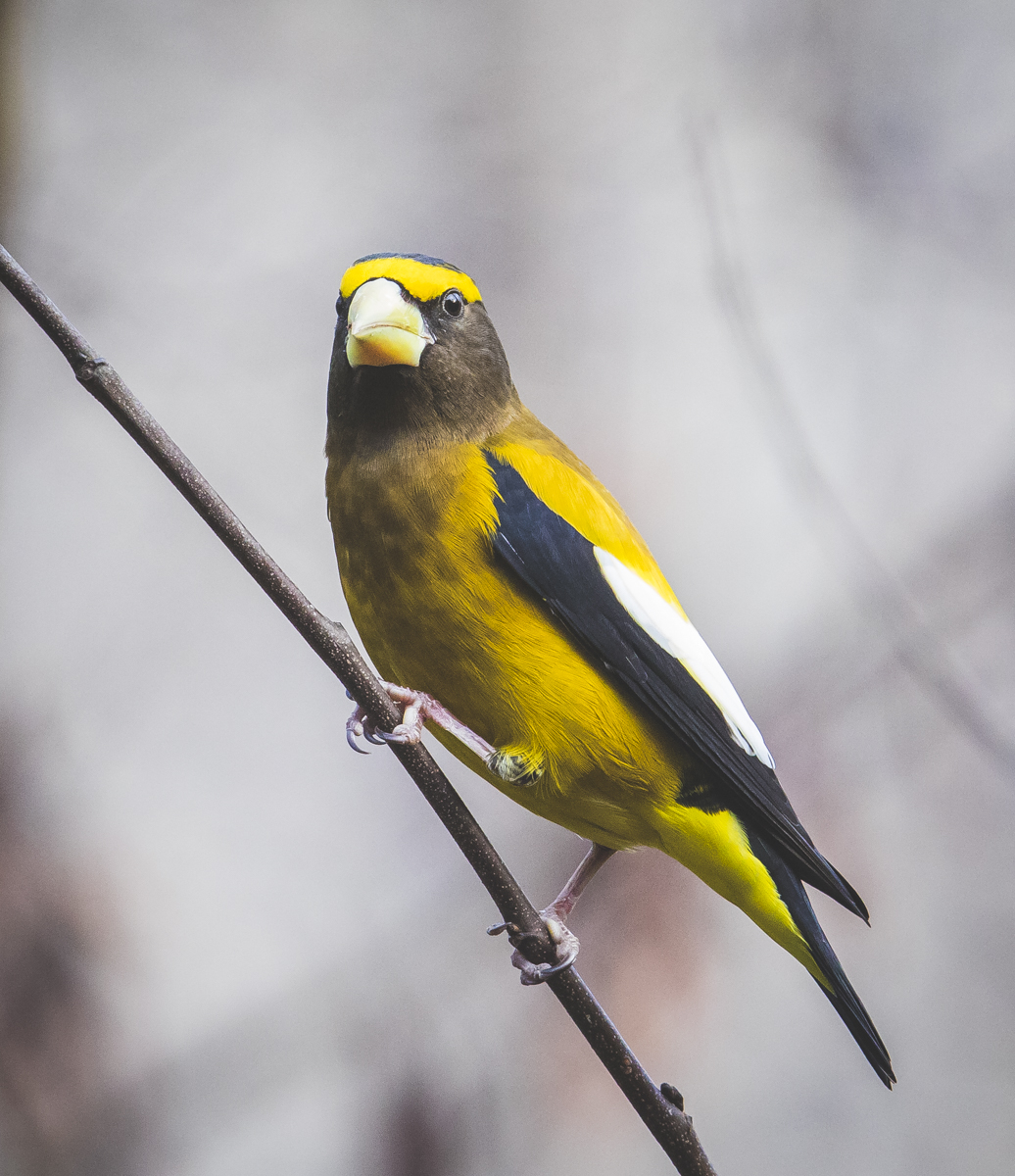
Male Evening Grosbeak
Males are even harder to miss – black and yellow with a very bold white wing patch and a bright yellow forehead and eye stripe.
And that bill…
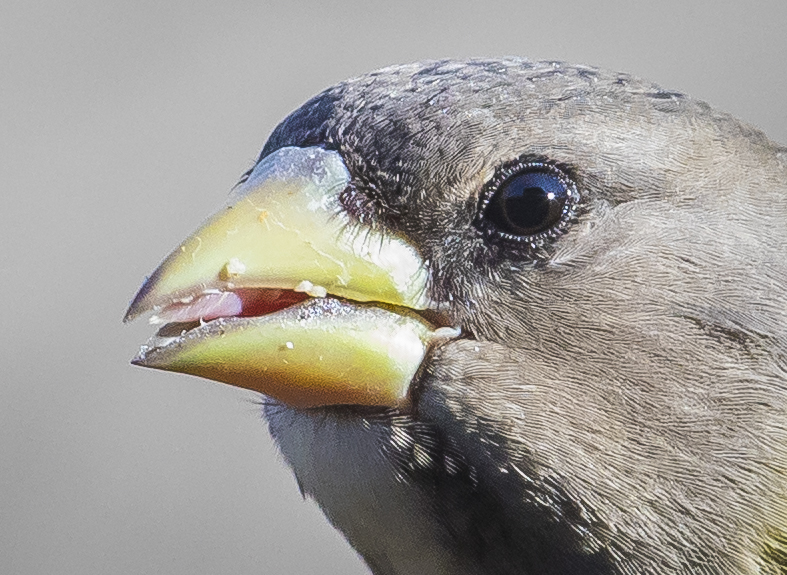
Grosbeak beak
A reminder that the name “grosbeak” comes from the French “gros bec”, which means large beak. That huge, conical beak is useful for crushing seeds (and no doubt inflicting a painful bite on bird banders). It turns out that the several types of grosbeak found in the U.S., though similar in their beak adornments, are not all related. Pine and Evening Grosbeaks are members of the finch family, Fringillidae, which also includes Pine Siskins, crossbills, and goldfinches. Rose-breasted and Blue Grosbeaks belong to the family Cardinalidae that includes Northern Cardinals, Indigo Buntings, and tanagers.
But, as I said earlier, of all the NC grosbeaks, the Evening Grosbeak is the toughest to regularly find in our state. Historically, Evening Grosbeaks were birds of the north and west, hardly ever seen in the eastern half of the U.S. much before the late 1800’s. Then, for reasons not totally understood (but probably related to Spruce Budworm outbreaks in eastern Canada and increased planting of Boxelder, another valuable food source), the breeding range expanded eastward. The number of wintering birds in the northeast peaked between 1940s and mid-1980s but has declined dramatically since then. And in NC, the Birds of North Carolina, Their Distribution and Abundance web site states that their status in the Piedmont is “erratic winter visitor; strongly declining.”
But this year, they are back, and in good numbers. I counted a maximum of 25 between our two feeding stations yesterday (and I am guessing I missed several as they are so active). They have been coming mainly in the morning, an ironic schedule given their name. In fact, In his Life Histories of Familiar North American Birds, Arthur C. Bent made this observation – Ordinarily the species is not crepuscular, and in fact it might better be called “morning grosbeak,” for it is most active early in the day.
A male waits is turn for a spot at the feeder
Each morning this week, they are going through a lot of sunflower seed and making it tougher for the usual group of Purple Finches to crowd in on the platform feeders. Most of the other bird species are either hitting the tube feeders or the suet when the black and yellow throng arrives, as the grosbeaks tend to be somewhat pugnacious at feeding time. Again, looking back to Bent’s Life Histories, he commented: Although evening grosbeaks are ordinarily gregarious and sociable, feeding harmoniously when scattered openly on the ground, their behavior is quite different when crowded on the feeding trays. There they are often selfish, hostile, and belligerent, pushing their way in, sparring with open beaks, and threatening to attack or drive out a new arrival. They are bosses of the tray and are intolerant of other species, driving away even the starlings; only the blue jay seems able to cope with them. Even the females of their own species are not immune to attack by the males. But, so eager are they for their food, that the tray remains crowded full of birds as long as there is standing room.
Well, I guess not all Canadians are kind…
Things can get pretty hectic when a flock of Evening Grosbeaks descends on your feeder
Now Bird-Lore proposes a new kind of Christmas side hunt, in the form of a Christmas bird-census. We hope that all our readers who have the opportunity will aid us in making it a success by spending a portion of Christmas Day with the birds and sending a report of their ‘hunt’ to Bird-Lore before they retire that night.
~Frank Chapman, originator of the Christmas Bird Count, 1900
It was a tradition in the late 1800’s for men and boys to gather into teams during the holidays and go out into the woods and fields and shoot as many birds, mammals, and other critters as they could find. Whichever team killed the most wildlife was the winner. These so-called side hunts often took a huge toll on local wildlife including many species of songbirds. In the winter of 1900, out of concern for the wanton destruction of so many birds, Frank Chapman, an ornithologist with the American Museum of Natural History, proposed an alternative – gather together and count birds instead of shooting them. He published the results of the first count in his magazine, Bird-Lore, which later became Audubon magazine. That first census had 27 volunteers in 25 locations in the U.S. and Canada, and tallied a total of about 90 species across all the counts. That tradition became what is now the Audubon Christmas Bird Count, with over 81,000 observers in 2646 count circles (participants divide up a set 15-mile diameter circle and estimate the total number of birds in that area) participating in the Americas in 2019. They tallied more than 42 million birds representing more than 2500 different species. This is the longest running citizen science wildlife census in the world and the collected data is used by scientists and conservation organizations for bird research and protection efforts.
So, as we have done for most of the past several years, this past week, we headed east the day before our count centered on Pettigrew State Park, and spent the night at the campground so we would be out early the next morning. Our portion of the count circle is the Pungo Unit of Pocosin Lakes National Wildlife Refuge, about a 40 minute drive from the campground, even though it is only about 8 miles as the soon-to-be-counted crow flies. The afternoon before the count was rewarding with lots of swans, Snow Geese, and more visitors than usual. We even ran into some friends that were watching five Sandhill Cranes feeding in a cornfield near the refuge entrance.
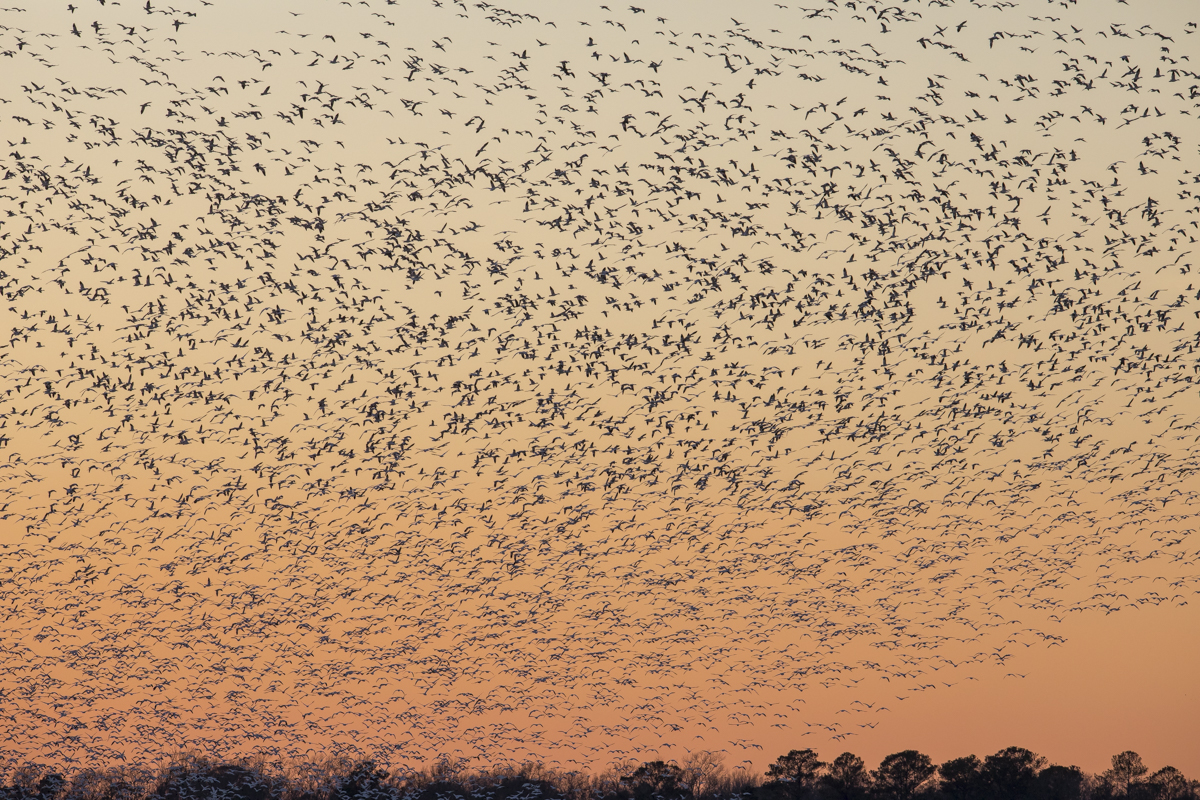
The sunset show the night before our Christmas Bird Count was spectacular with a cloud of Snow Geese swirling over the field (click photos to enlarge)
The next morning, we headed out before sunrise and arrived at Pungo as the birds were beginning to stir. We headed to a marsh impoundment to eat breakfast and search through the couple of thousand Tundra Swans for the Trumpeter Swan we had seen a few weeks before. Unfortunately, we neither saw nor heard this rare species, so it eluded us for our tally this year.
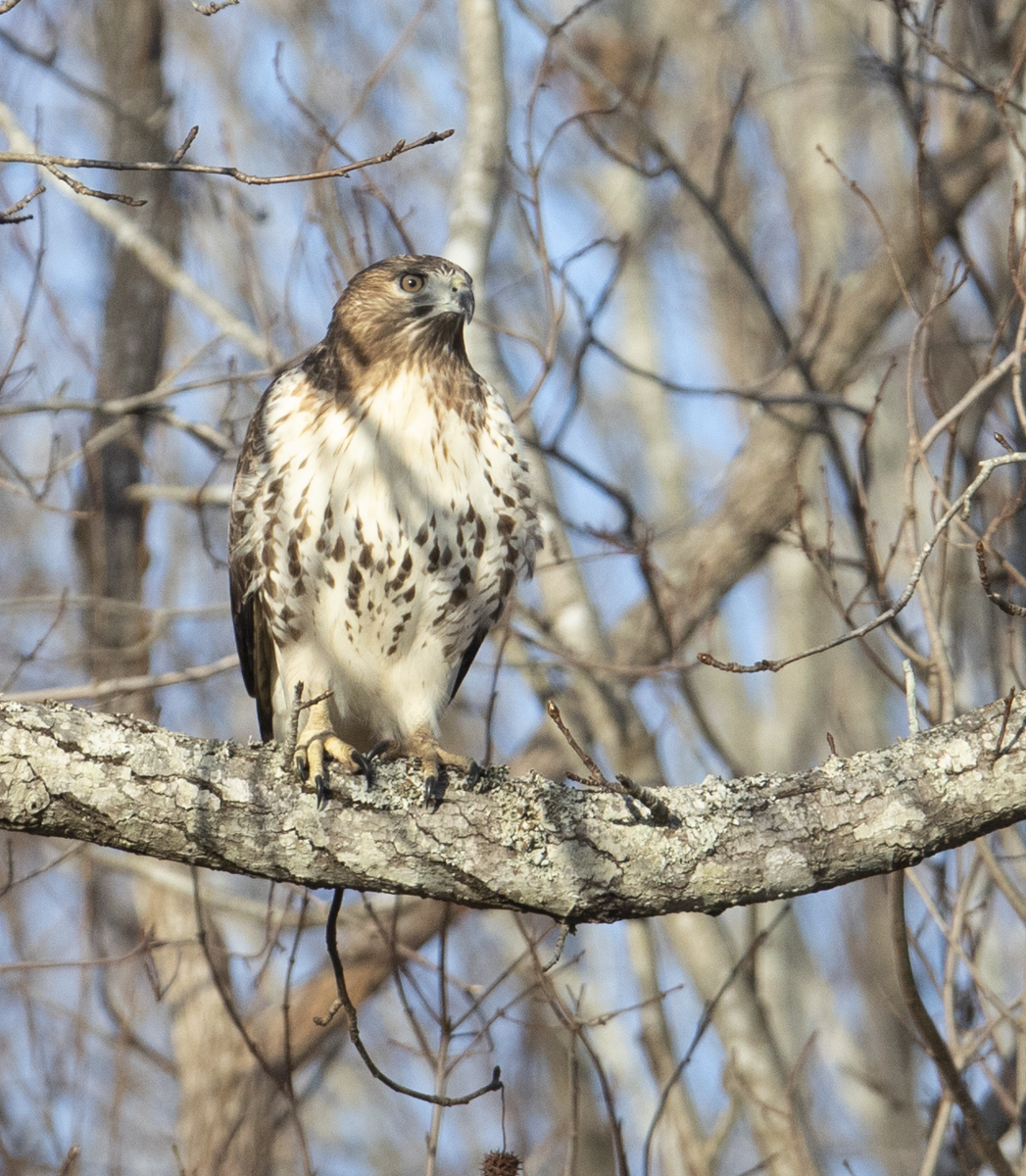
One of several raptors we observed on the count day, this Red-tailed Hawk (Buteo jamaicensis) was searching the nearby marsh for a potential meal
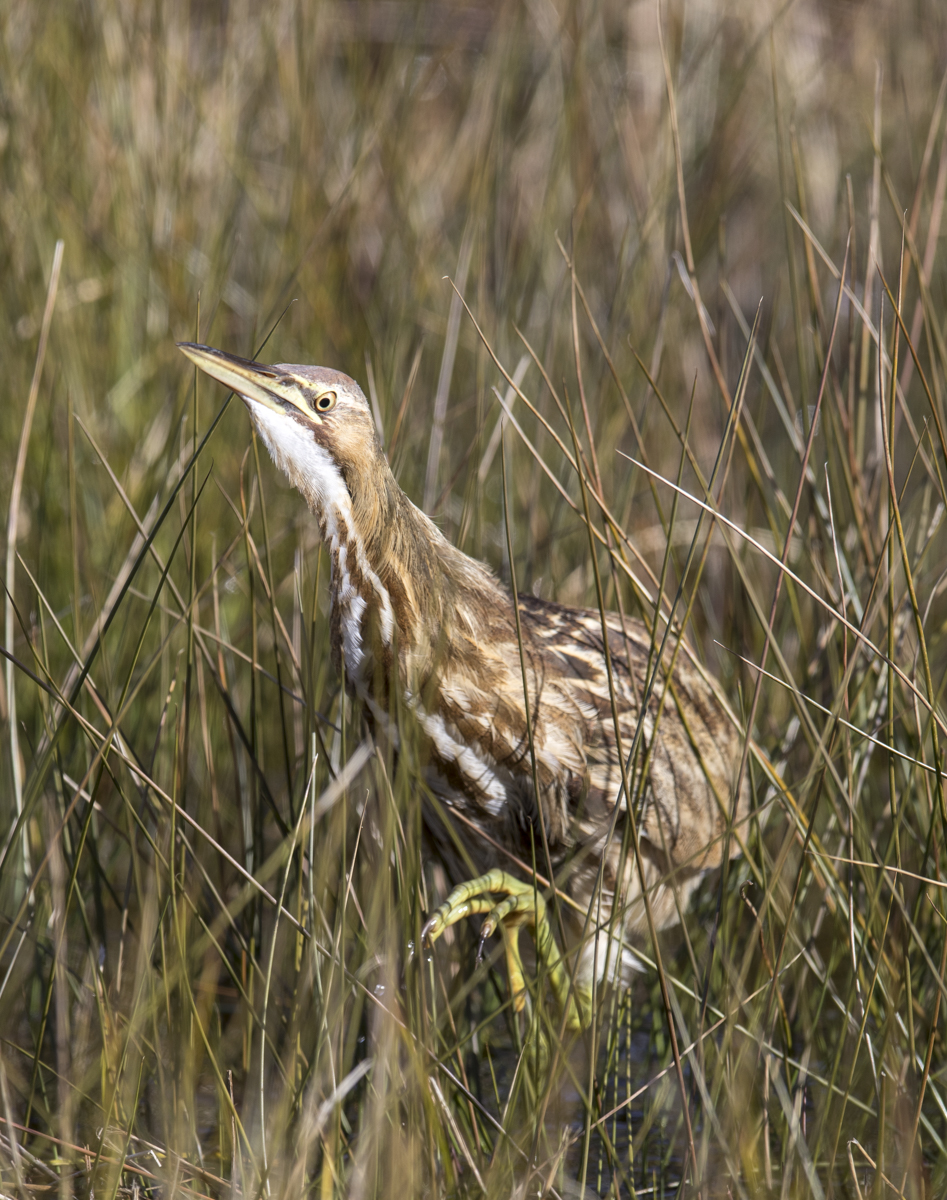
As visitors started arriving at the marsh, we decided to head over to the observation platform to estimate the swan numbers on the lake. We were in for a nice surprise in the canal next to the platform – an American Bittern! Somehow, we missed it as we drove in and parked, but Melissa spotted it alongside the canal when we climbed the platform.
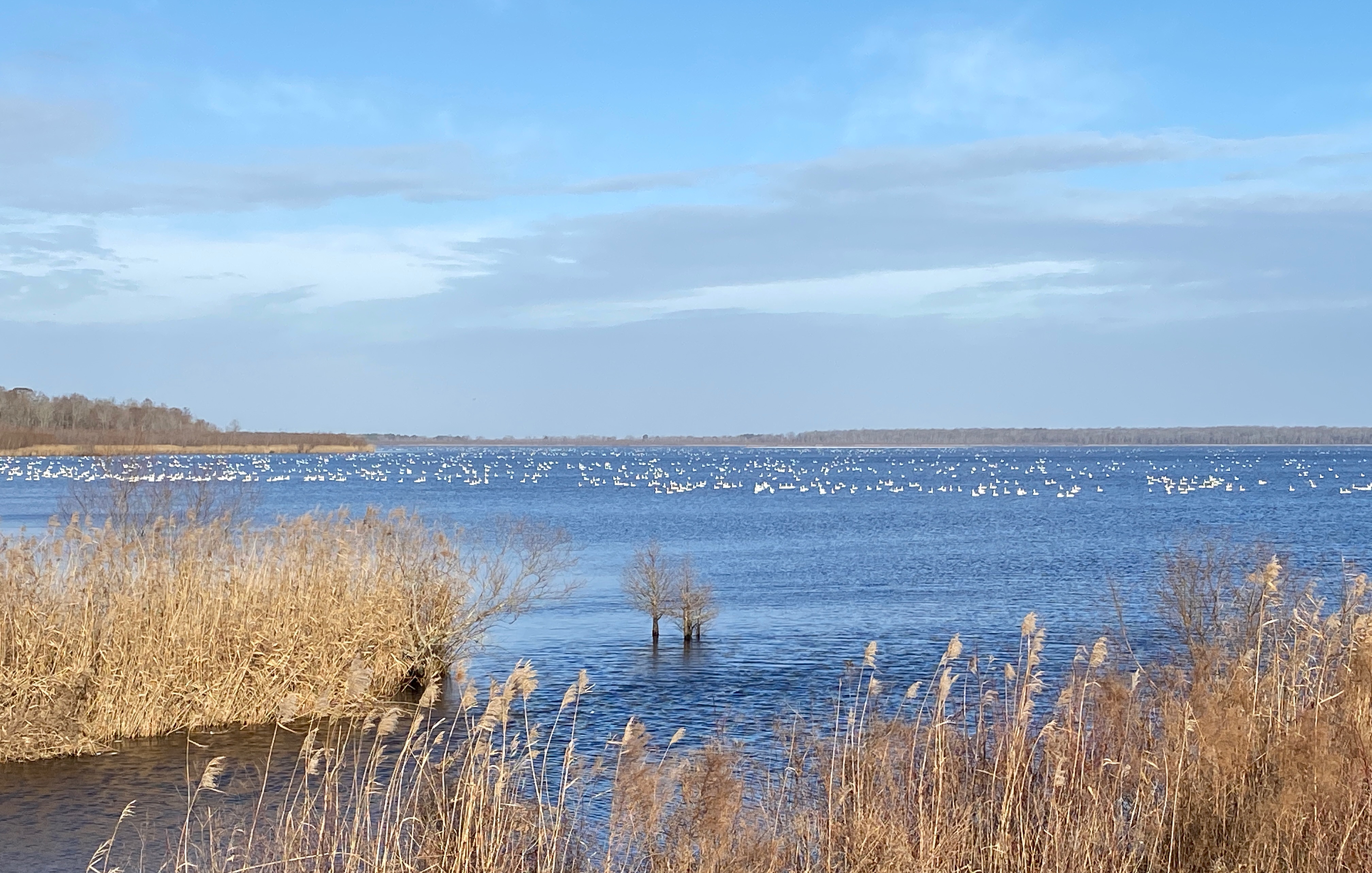
Pungo Lake was dotted with Tundra Swans (Cygnus columbianus) and a dense line of Snow Geese (Chen caerulescens) on the far side
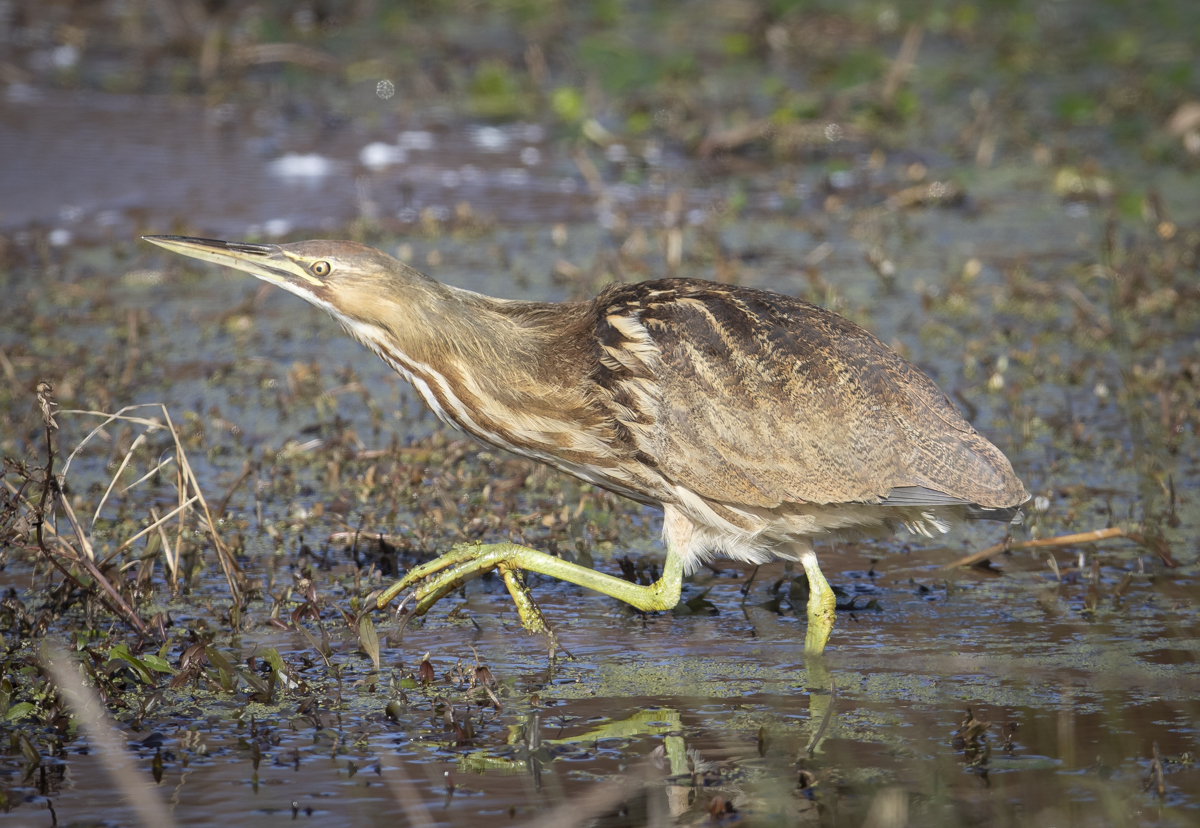
I eased down to the truck and grabbed my camera, and for several minutes the bittern provided us with a close up view of its hunting style and funky, neck-weaving movements through the grasses. Its long toes help support it as it strides atop aquatic vegetation and the striped neck helps it blend in to the grasses it calls home. This is a species we see occasionally at this refuge but one that is particularly welcome on count day. We told a friend about it later that day, and when he went to see it, there were two bitterns!
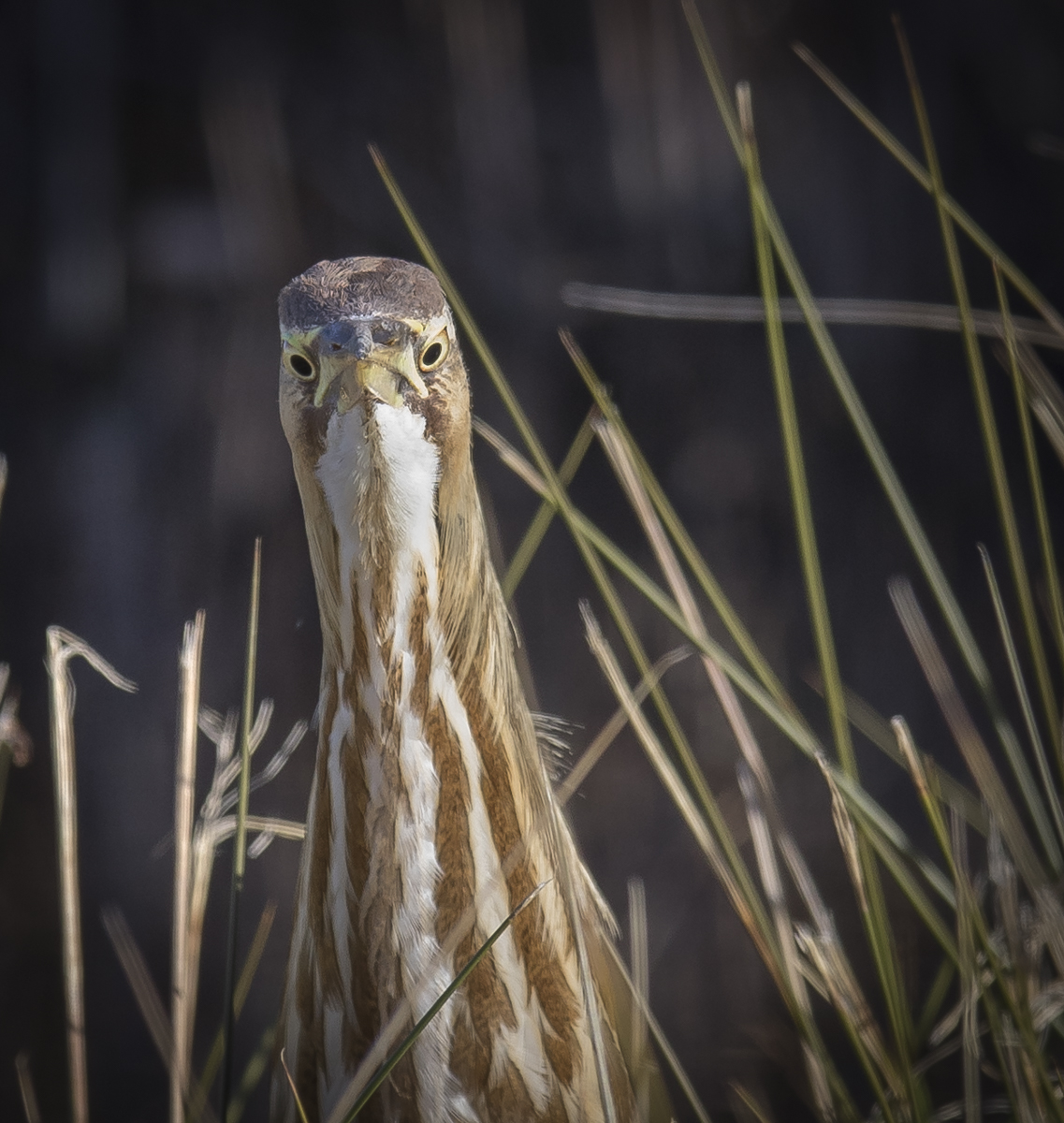
When we climbed to the top of the observation platform, Melissa whispered, There’s a bittern right thereThe bittern begins to assume the pose – Nothing but us marsh grasses here, move on…I have told people when looking for bitterns, to look for a clump of grass that has eyesThe bittern ignored our nearby vehicle and strutted through the marsh grasses searching for prey
One of the things I find fascinating about bitterns is their neck wriggle, which is particularly noticeable when they slink through the grass
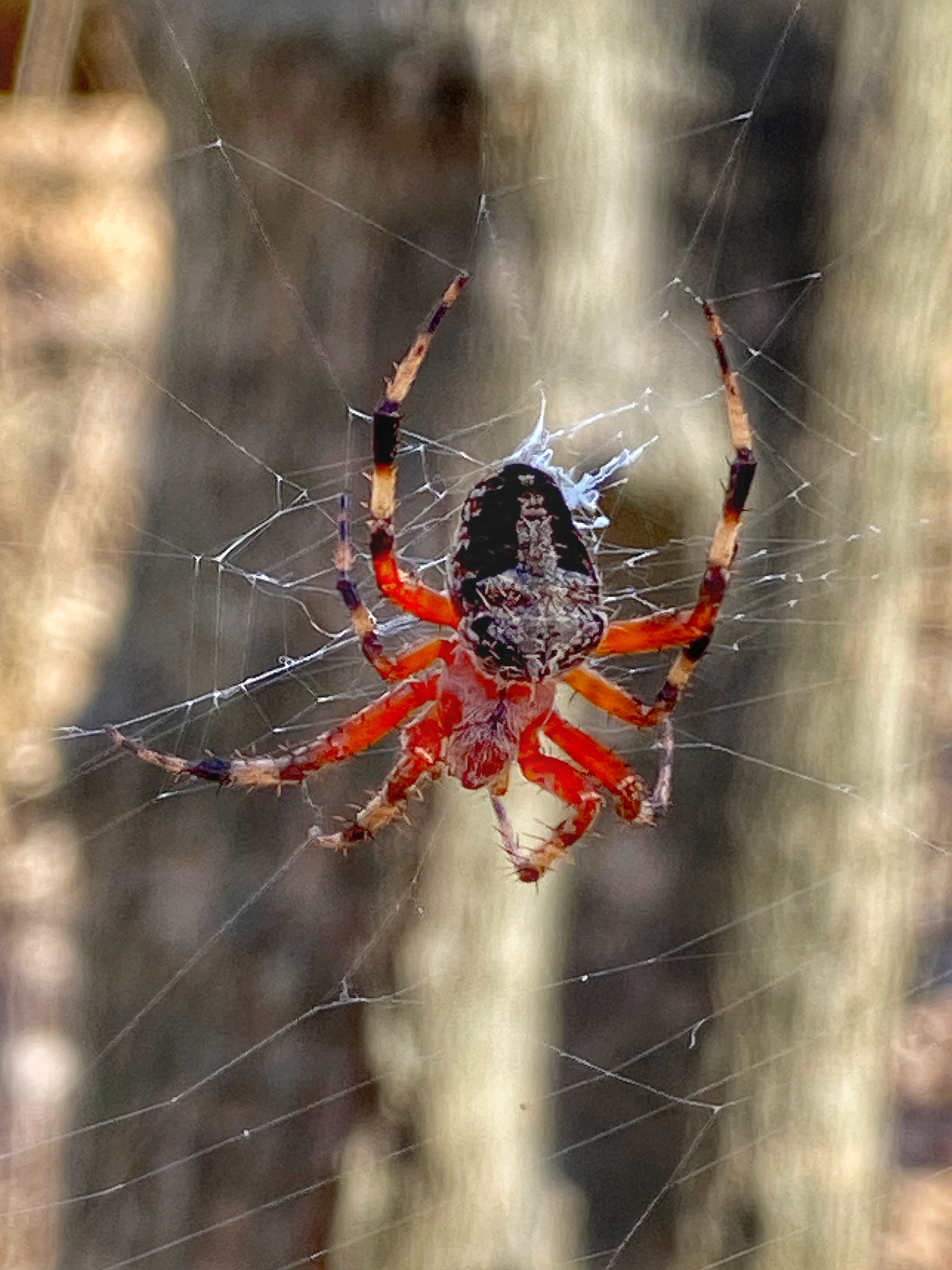
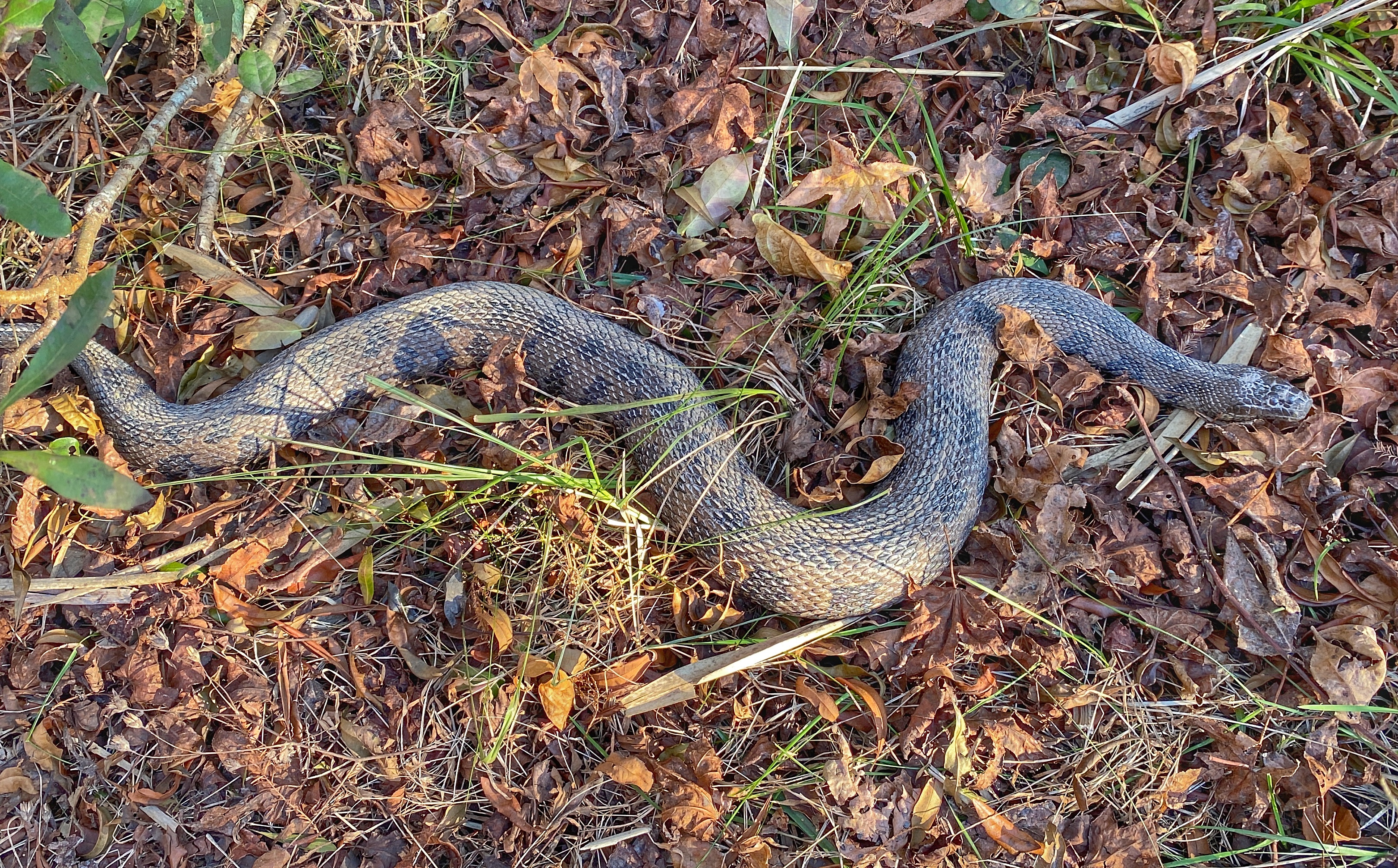
The day turned out much warmer than the previous one, and the good weather brought out all sorts of unusual wildlife (for December anyway). We saw a lot of spider silk floating through the air and a large adult orbweaver. And at one point, we were startled by a huge water snake along the edge of a canal. But, though we looked, “our” canebreak rattlesnake was not at its long-time hollow tree den site.
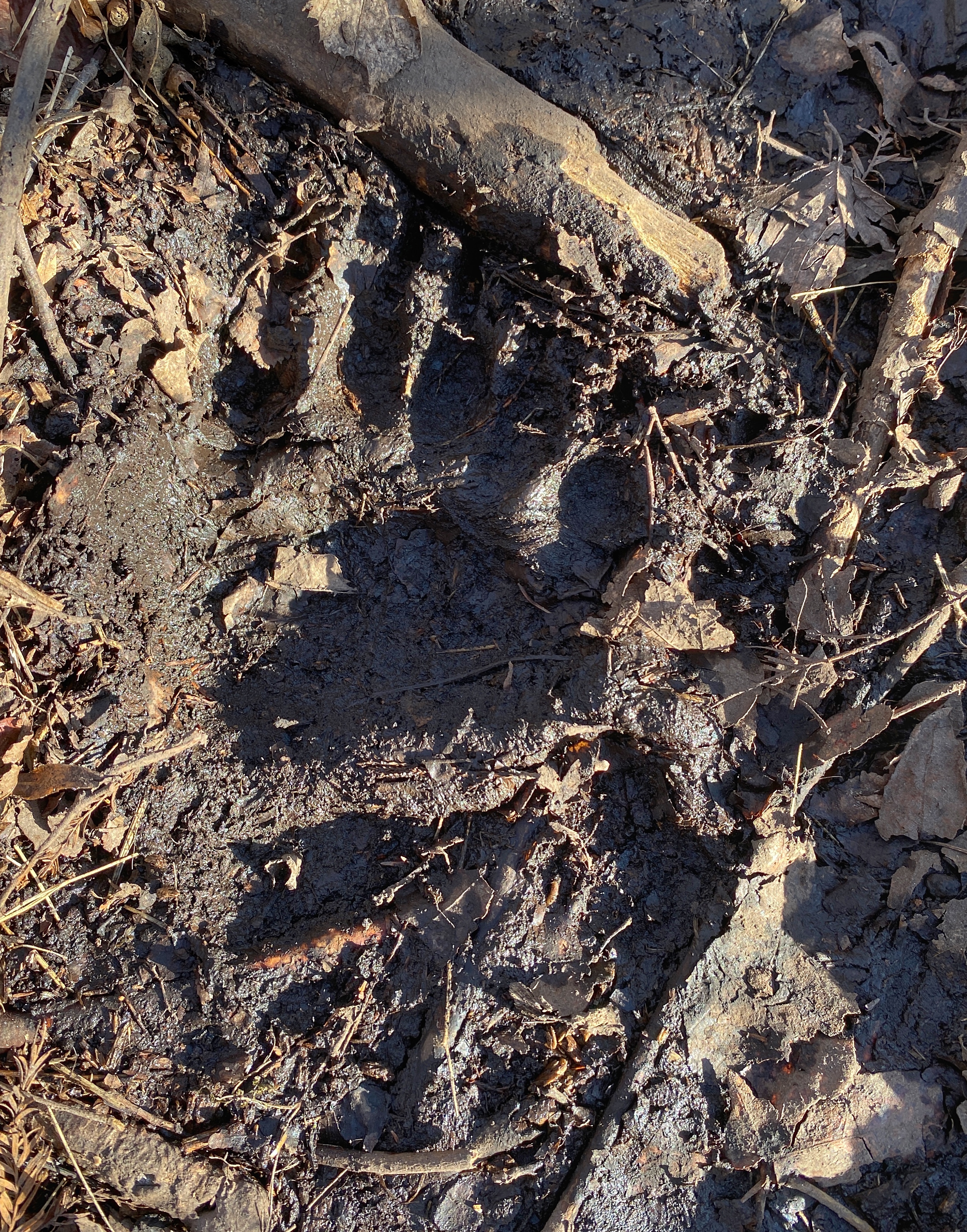
Can’t remember ever seeing a large Spotted Orbweaver (Neoscoma domiciliorum) on a Christmas Bird Count in the pastWalking in the woods on a very well used bear trailSurprised to see a very large Brown Water Snake (Nerodia taxispilota) out and about (although it looks like it had just emerged from a muddy retreat and it was very sluggish)
We have a disadvantage in getting a true assessment of the number of birds in this location because so many areas are closed to access when the waterfowl are present. And on this count day, we had an even bigger problem – crowds (not something we want during this time of Covid). The weather, the holidays, and perhaps weariness of being trapped inside during the pandemic, brought out a lot of visitors. Unfortunately, many of them were not obeying the rules. We saw multiple groups of people walking into closed areas, resulting in some disturbance to the birds and actually reducing the numbers of birds we saw and counted (especially ducks). Several times during the day, we attempted some on-site education about refuge rules and Melissa finally texted the refuge law enforcement person to make them aware of the unusual number of violations. I understand the desire to get closer to the birds to see them, and I actually wish the refuge had more accessible observation areas around the lake (maybe some day), but rules is rules, and the number of people ignoring or missing the signage for closed areas was the most I have ever witnessed.
We still ended the day with a reasonable number of birds. Compared to previous years, there were fewer duck species and fewer swan numbers (one area that was packed with swans had all the birds flushed by people walking in on them as we were approaching). Obviously, when counting birds in such a large area that has so much inaccessible habitat (dense pocosin vegetation, closed areas to protect the waterfowl, and flooded forests), we are only getting a sampling of the total number and types of birds present. But, the value is in looking at these trends over time and seeing changes. One notable change has been the number of Bald Eagles observed since I started the count back in the mid-1980’s. Back then, seeing one eagle in the entire count circle was a big deal. We had 3 just in our portion this day. Our complete list for our portion of the count circle is at the end of this post. Overall, the Pettigrew Count did pretty well, with some unusual species recorded in other sections (including Short-eared Owls, a Yellow-headed Blackbird, and some Evening Grosbeaks).
We camped that night back at the park and decided to run by the Pungo Unit the next morning before heading home. The Snow Geese were right on schedule, flying out from the lake about 8 a.m. to feed in the fields, and we were one of only two cars to witness it (what a difference a day makes).
Snow Geese setting their wings for a landing
The morning after the count, the Snow Geese gave us a great show, coming and going to the fields for corn. A Bald Eagle flew over part of the field, resulting in this classic blast off (sound on)
We went back to the platform, hoping to see the bittern(s) again, but no luck. However, we did have a nice encounter with a Beaver swimming in one of the canals. It didn’t seem to mind us slowly following along in our truck, but then it suddenly went under and disappeared when four River Otters showed up. Not a bad way to end a trip to our favorite wildlife watching destination.
Checklist of species for our portion of the Pettigrew Christmas Bird Count:
Snow Goose – 20,000; Ross’ Goose – 2; Canada Goose – 45; Tundra Swan – 10,000; Wood Duck – 3; Northern Shoveler – 40; Gadwall – 2; American Black Duck – 35; Green-winged Teal – 124; Ring-necked Duck – 6; Bufflehead – 6; Ruddy Duck – 13; Great Blue Heron – 6; Sandhill Crane – 4 (not sure where the fifth guy from the day before and after was); American Bittern – 2; Pied-billed Grebe – 1: American Coot – 6: Northern Bobwhite – 4; Wild Turkey – 8; Killdeer – 52; Ring-billed Gull – 3; Mourning Dove – 70; Turkey Vulture – 21; Northern Harrier – 4; Cooper’s Hawk – 1; Bald Eagle – 3; Red-shouldered Hawk – 2; Red-tailed Hawk – 1; American Kestrel – 1; Belted Kingfisher – 1; Yellow-bellied Sapsucker – 1; Red-bellied Woodpecker – 11; Downy Woodpecker – 4; Hairy Woodpecker – 3; Pileated Woodpecker – 3; Northern Flicker – 7; Eastern Phoebe – 12; Blue-headed Vireo – 3; Blue Jay – 1; American Crow – 24; Carolina Chickadee – 18; Tufted Titmouse – 5; Tree Swallow – 15; Ruby-crowned Kinglet – 4; Red-breasted Nuthatch – 1; Brown-headed Nuthatch – 3; House Wren – 1; Carolina Wren – 10; Gray Catbird – 8; Northern Mockingbird – 9; Brown Thrasher – 1; Eastern Bluebird – 6; American Robin – 48; Purple Finch – 5; American Goldfinch – 13; Song Sparrow – 39; White-throated Sparrow – 86; Savannah Sparrow – 87; Field Sparrow – 1; Swamp Sparrow – 8; Eastern Towhee – 1; Eastern Meadowlark – 10; Red-winged Blackbird – 1000; Rusty Blackbird – 8; Common Grackle – 10; Palm Warbler – 4; Yellow-rumped Warbler – 67; Pine Warbler – 2; Northern Cardinal – 20
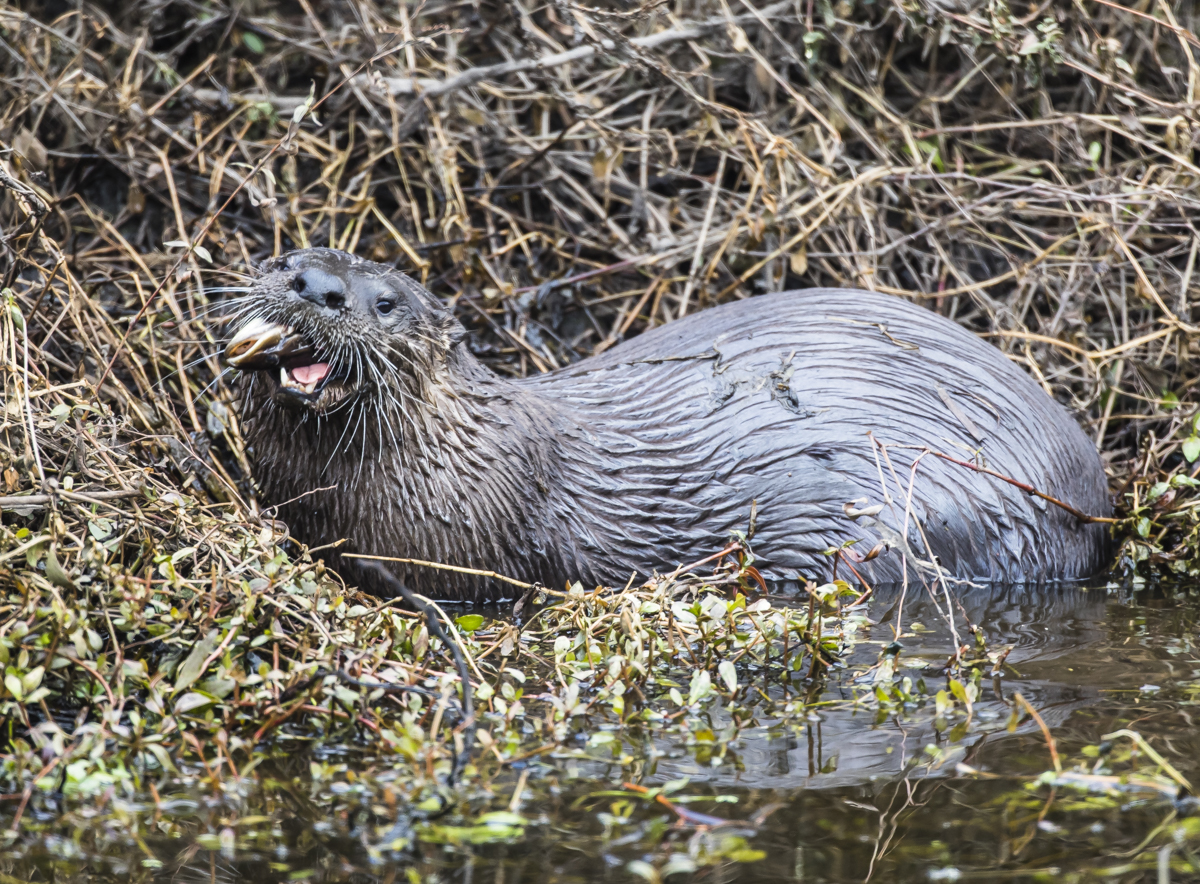
A few days after our virtual program outing, I decided to make a day trip to the refuges for some quiet time watching wildlife. I headed out last Friday about 6 a.m. and pulled into the Pungo Unit on what started as an overcast, drizzly morning. A refuge worker was just beginning to grade D-Canal road and there was a long row of debris in what would be the right lane of the dirt road. I veered over to the left, which turned out to be fortunate, as it gave me a better view down into the canal. As I passed what I call “New Bear Road”, I spotted movement in the canal. It was three River Otters, my second group of these amazing animals that week. They did their typical otter thing of undulating motions in the water while glancing up at me as I was trying to ease the truck into position for a photo. One otter suddenly emerged on the far bank with a decent-sized fish in its mouth. It moved quickly to subdue it while tossing its head back and forth and chomping down on the fish (it looked like a young Bowfin). The low light, their quick movements, and my excitement at seeing the otters, made for less than ideal images, so many of the shots are blurred. But, I enjoyed watching the one otter claim its catch and turn away when others came too close.
River Otter chowing down on a Bowfin caught in a canal on the Pungo Unit (click photos to enlarge)
Here’s a brief clip showing the otter enjoying its breakfast (and not wanting to share with another otter)…
The otters eventually swam to my side of the canal, making them difficult to see from he truck, so I slipped out to look where I last saw their ripples. They were gone! There is a large culvert under the road right there so I guessed they had swam under the road and disappeared into the much smaller canal leading away from the road. I looked, but didn’t see them…were they still under the road? I went back and forth a couple of times looking and finally saw them about a hundred feet away looking back at me. Nice move on their part!
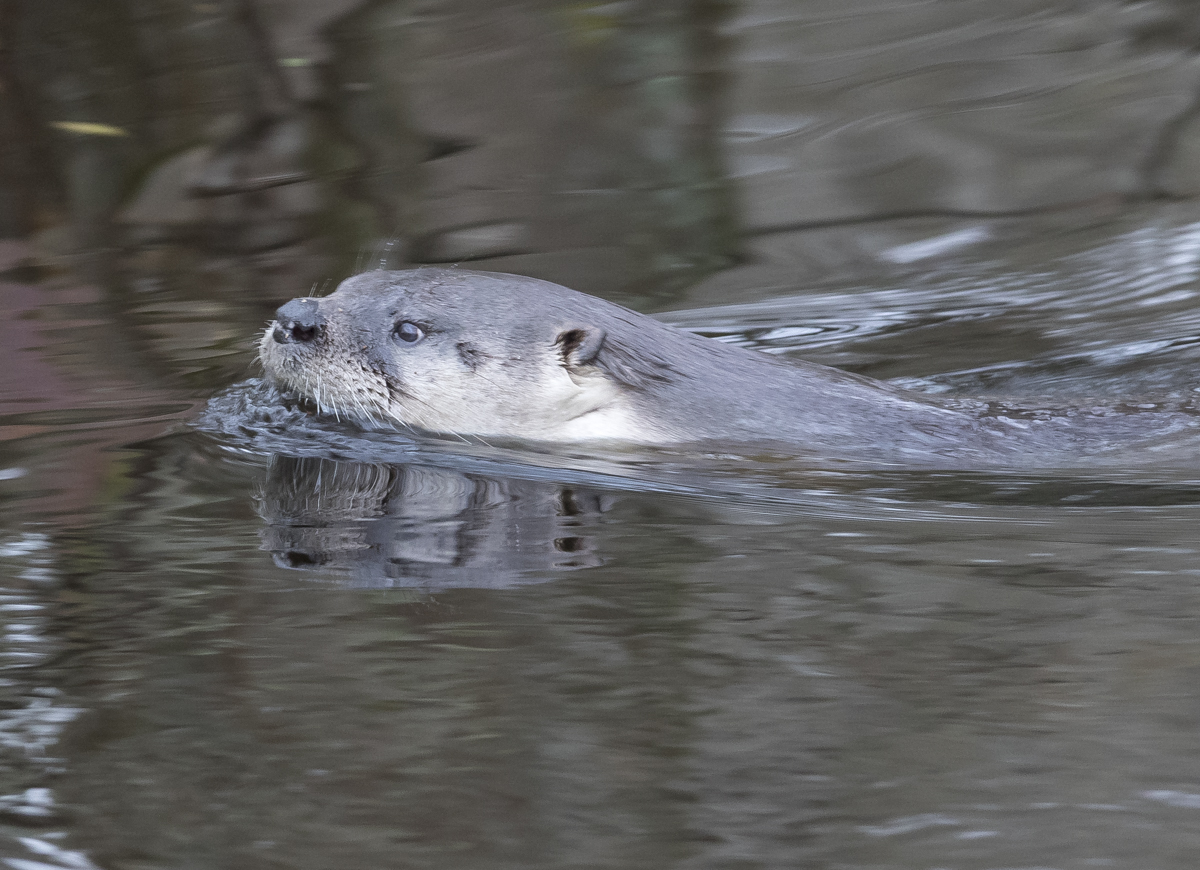
I continued driving down towards “Bear Road”, but saw several cars already there, so I decided to forego scratching my bear itch for the time being. I headed over to spend some time with the swans at Marsh A and saw a car stopped in the middle of the road with a photographer out looking into the flooded swamp along the canal. I didn’t want to disturb whatever she was seeing, so I stopped and looked down the road with my binoculars. Otter again! And again, three of them. I seriously doubt it was the same three otter because I was now a couple of miles from where they were last seen. The photographer finally walked back to her car and I drove on, seeing the wake of the otters as they swam down the canal and in and out of the trees. They kept diving and swimming great distances, their pathway marked by a trail of air bubbles at the surface.
An otter cruising the canal
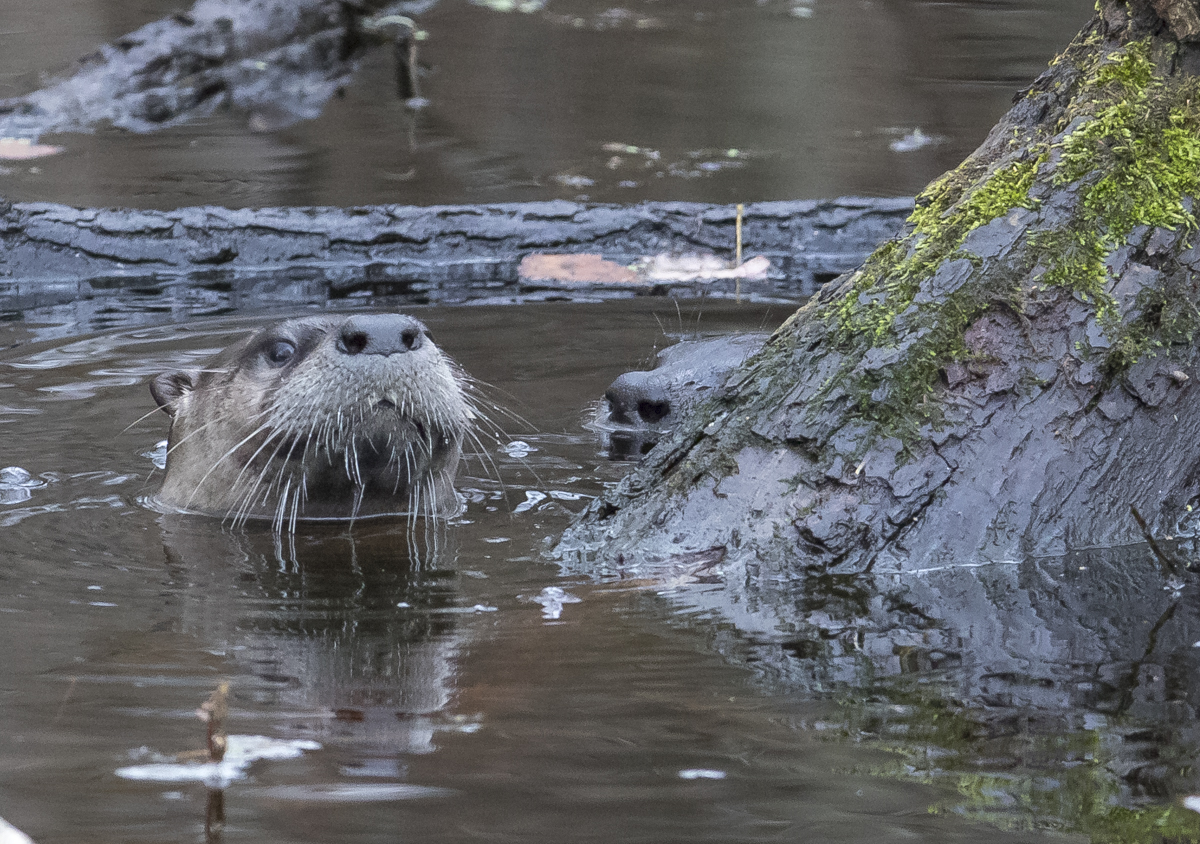
Then one would suddenly pop up, scan around, snort, and then take off underwater once again. I took a few photos and then drove on, leaving them to their otter doings
Two otters keeping a wary eye on me as they swim the forested edge of the canal
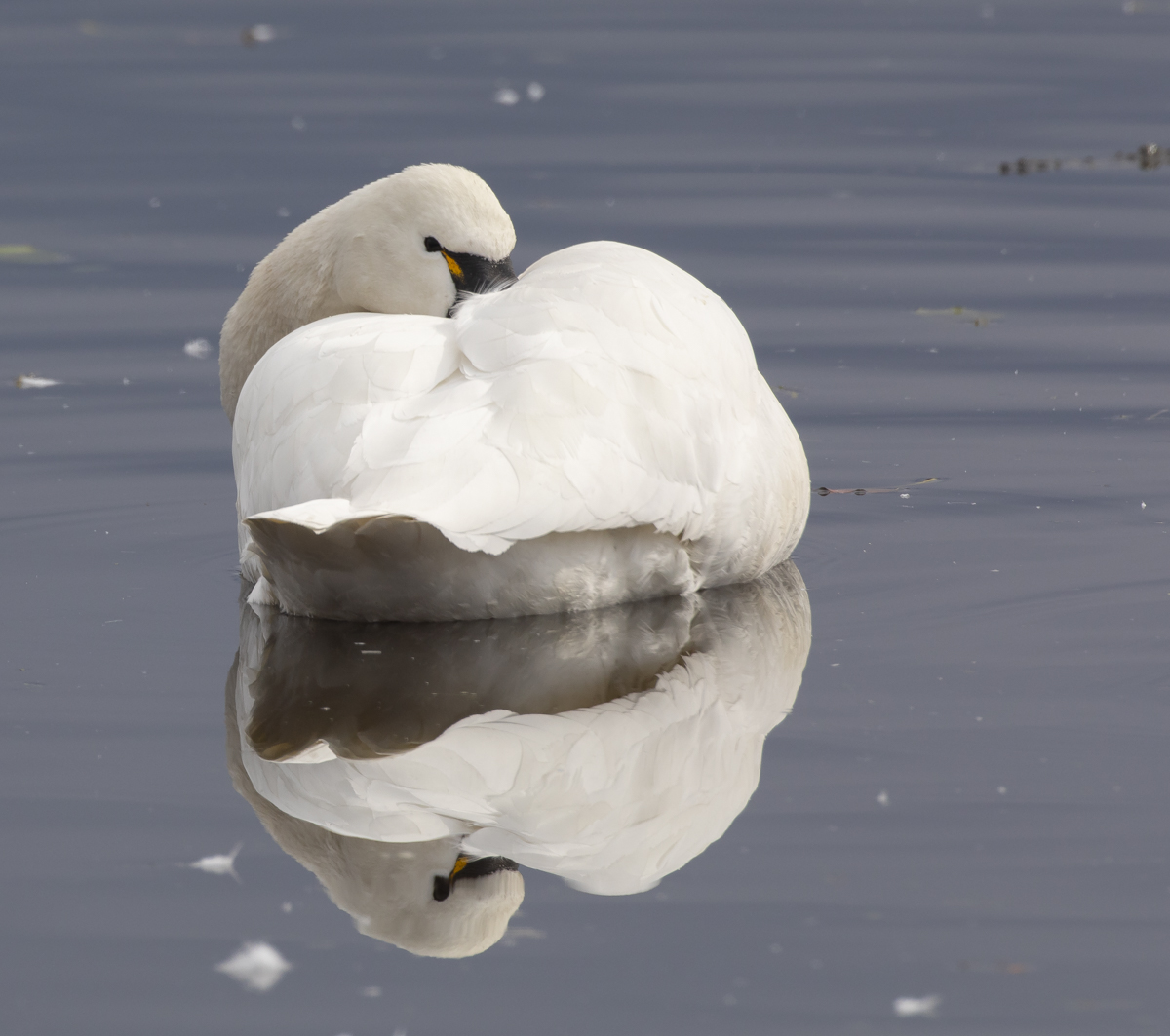
The gray skies and almost no wind made for some nice views of swans at Marsh A. I have found that if I park near the edges of the flock I have more time to view the swans by myself (most photographers go to where the flock is most dense), which causes them to relax more and just do what they do. I also stay in the vehicle, which causes less concern for any nearby birds. A group of three swans were close to the road and after I stopped, they settled back down and started napping again, with an occasional stretch for good measure.
Tundra Swan resting in soft lightEleganceNot so elegant
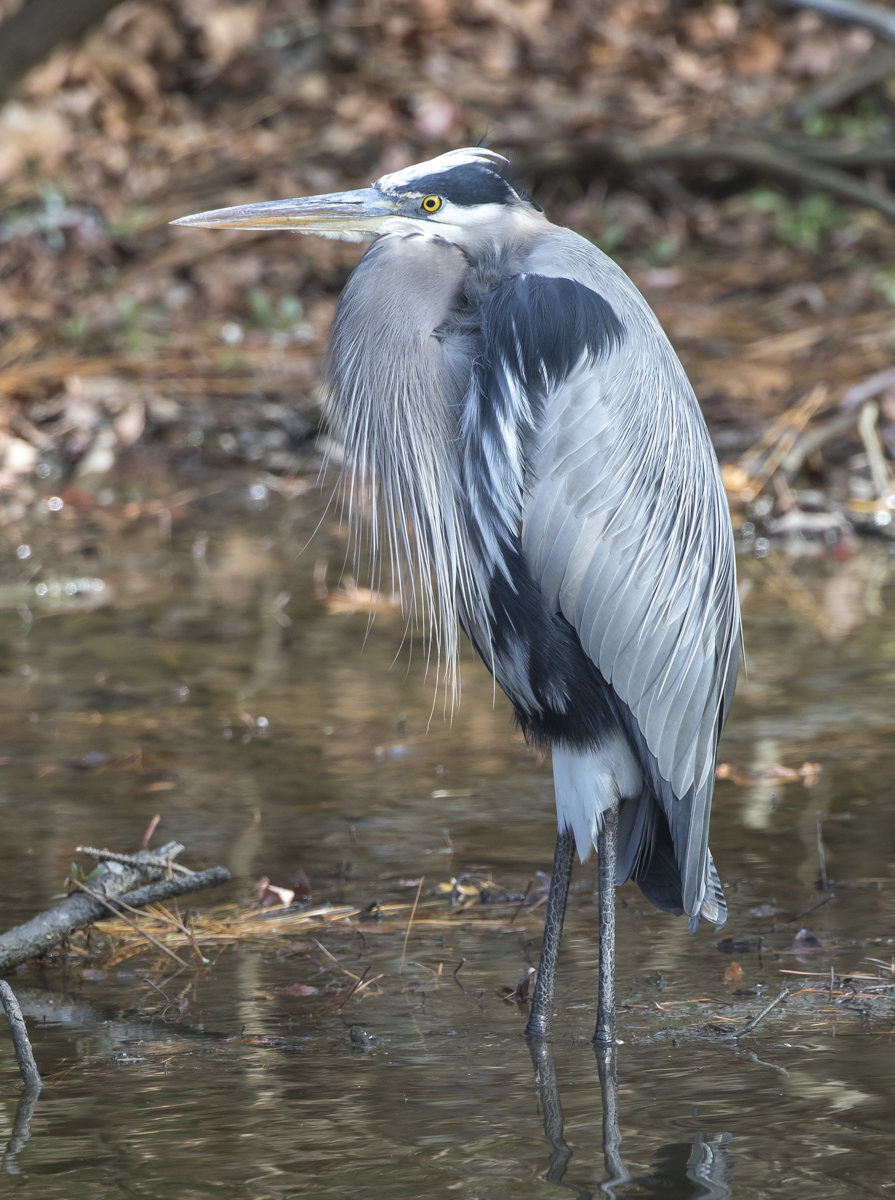
As usual, I could have stayed all day with the swans, but the sun started to pop out making the light much less appealing for images, and I wanted to head to Mattamuskeet to see what I might find over there. I’m always amazed at how different the wildlife can be in a place at different times. At Mattamuskeet, the waterfowl were further out in the marsh now compared to our virtual program day, and things were much quieter – no eagles scaring up the ducks, no kingfisher in its usual spot, but there was a nice Great Blue Heron standing quietly on a log.
A Great Blue Heron looking serene at Mattamuskeet
A large flock of American Coot were crowded in the canal along Wildlife Drive, feeding on submerged aquatic vegetation. I sat with them a few minutes, listening and watching their antics. Here is a brief clip…
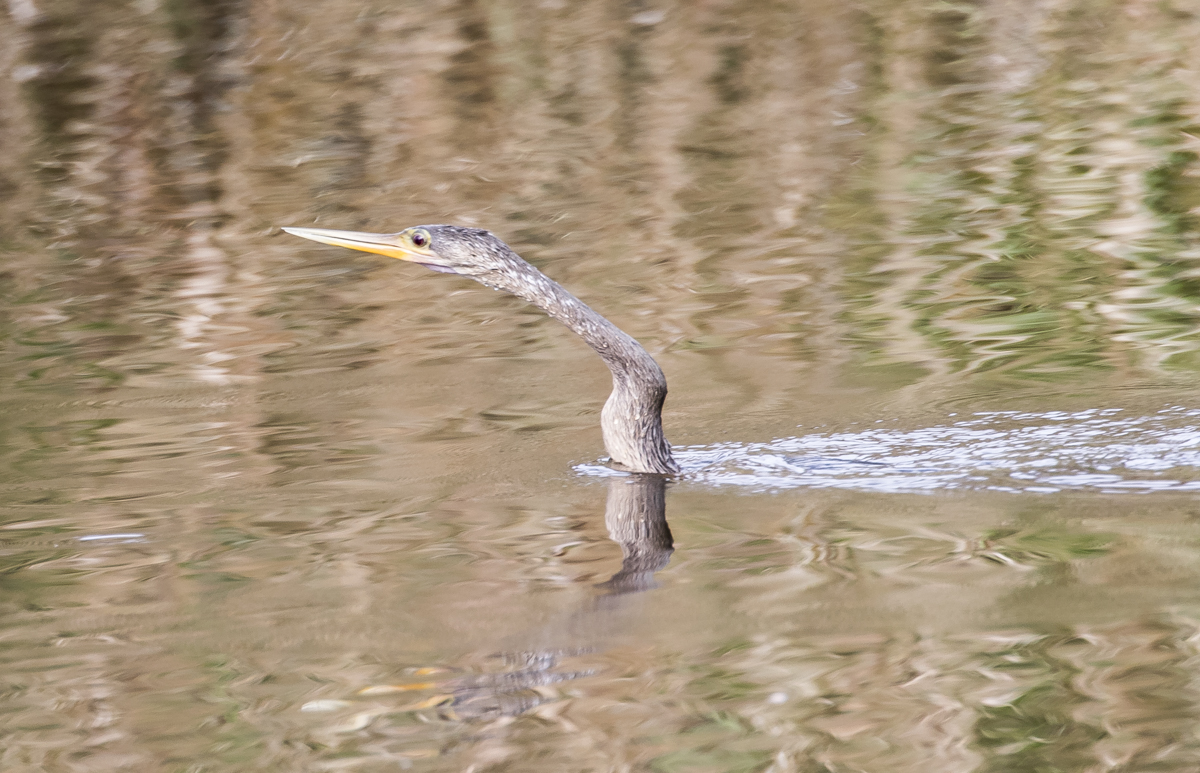
On my way back out, I spotted an Anhinga on a log in the canal. I drove by and parked, and, next thing I know, it comes swimming by me, with only half its neck and head above water. Snake bird is an apt moniker as that skinny neck bobs back and forth just above the water as they swim.
Anhinga swimming with just its neck above water. Like Pied-billed Grebes, Anhingas can submerge without diving, much like a submarine, by regulating their buoyancy. As I watched, the long neck and dagger-like bill seemed to just slide under the water as it swam.
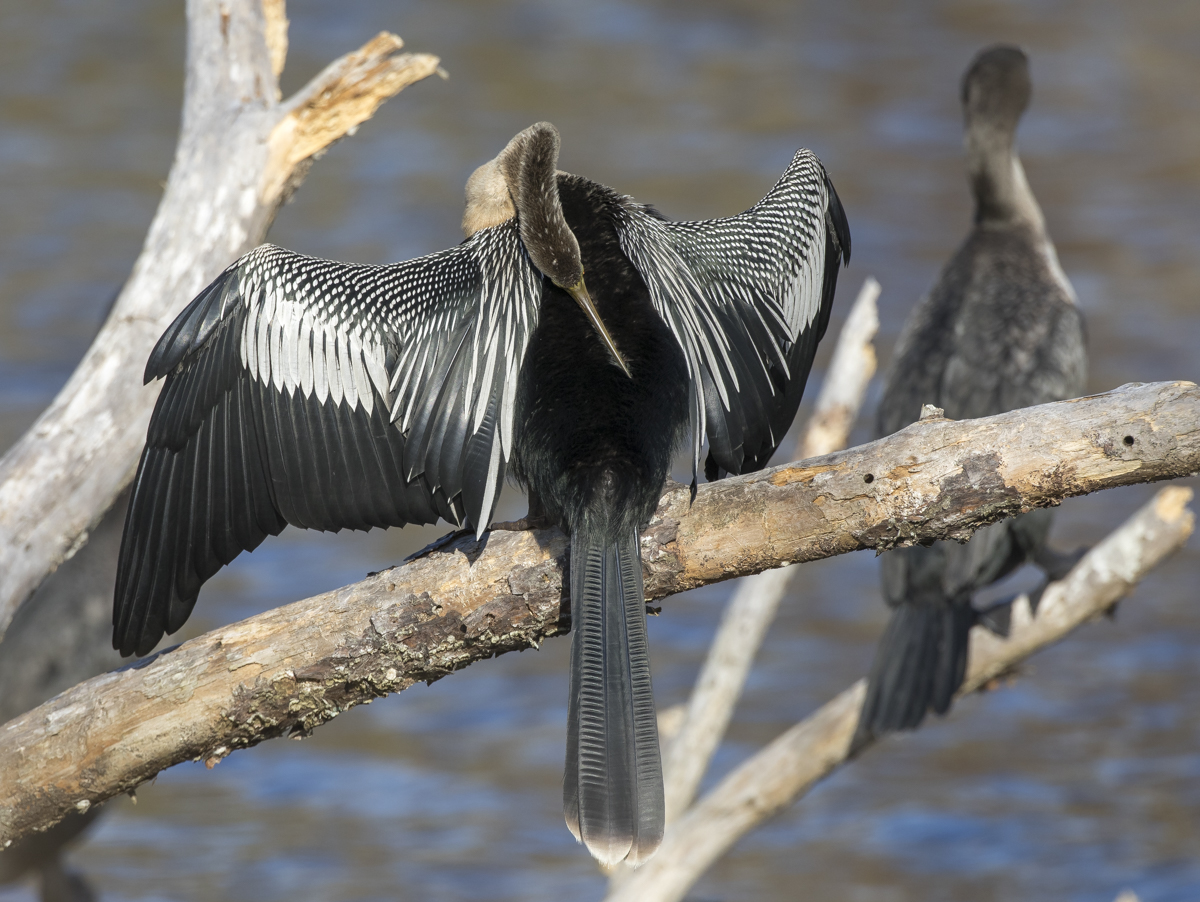
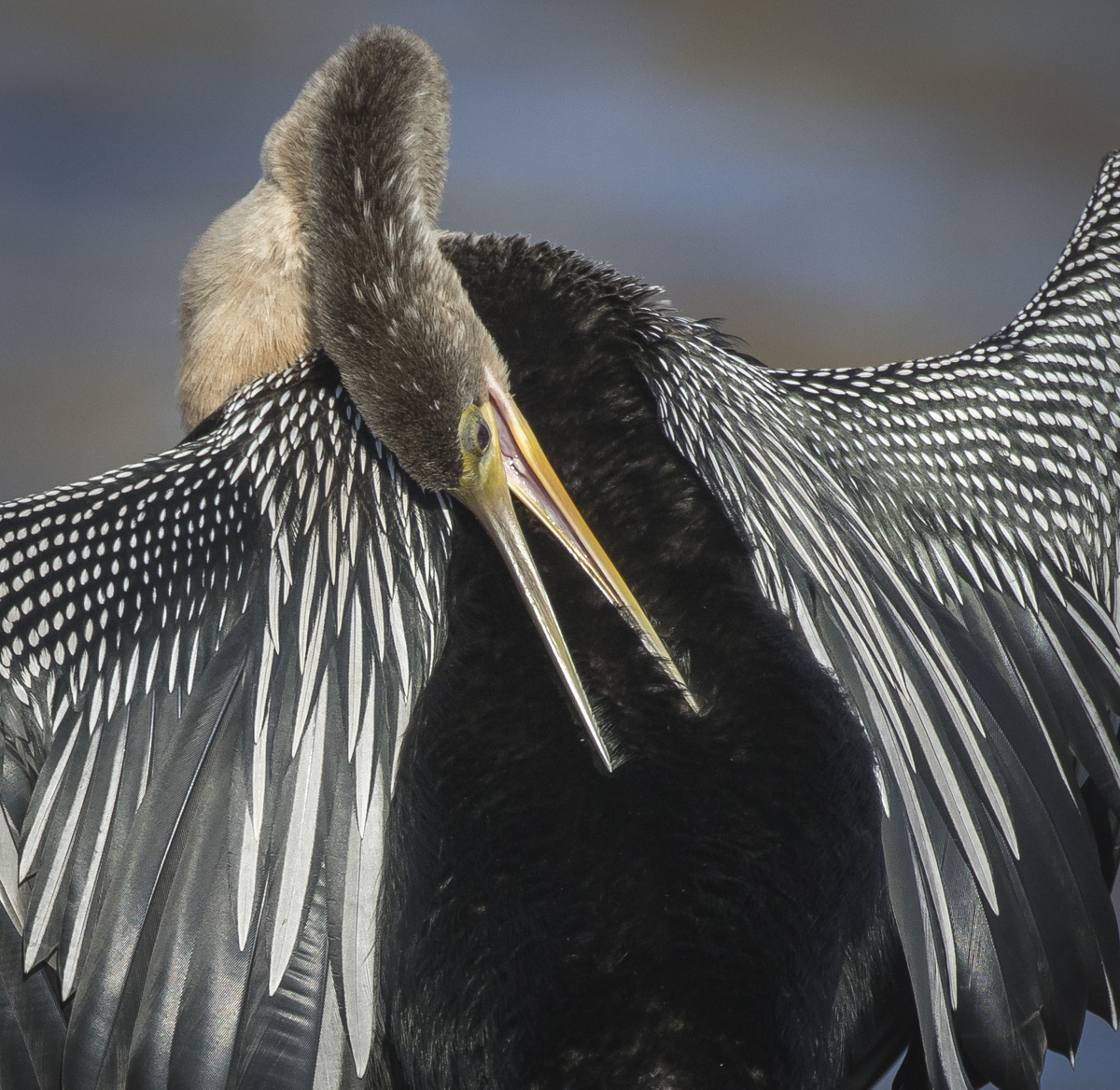
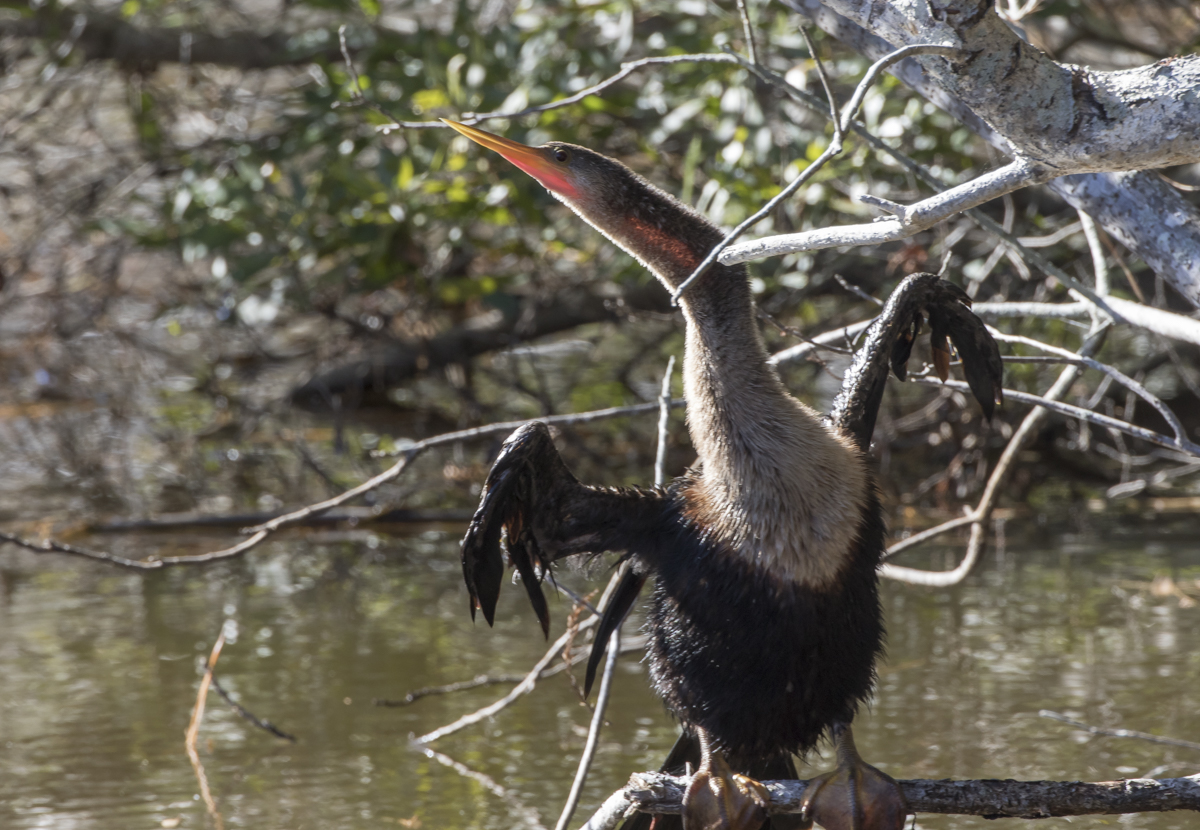
After another trip around Wildlife Drive, I came back to that downed log, hoping for another chance at one of two Anhingas I had seen. I got lucky and had what I think was an adult female on the log along with a few Double-crested Cormorants. It was busy sunning as I pulled up. Like the cormorants, Anhingas frequently display this wing-spreading behavior. Cormorants have a dense insulating layer of waterproof feathers against their skin, so wing-spreading is believed to be primarily for drying out their wing feathers. Anhingas, on the other hand, lack that insulating layer and have a different micro-structure to their feathers which allows water to penetrate through and decrease their buoyancy. This allows them to swim and hunt with most of their body submerged. And, in Anhingas, the wing-spreading is believed to be more for thermoregulation.
Anhinga with wings spread and a Double-crested Cormorant in the background
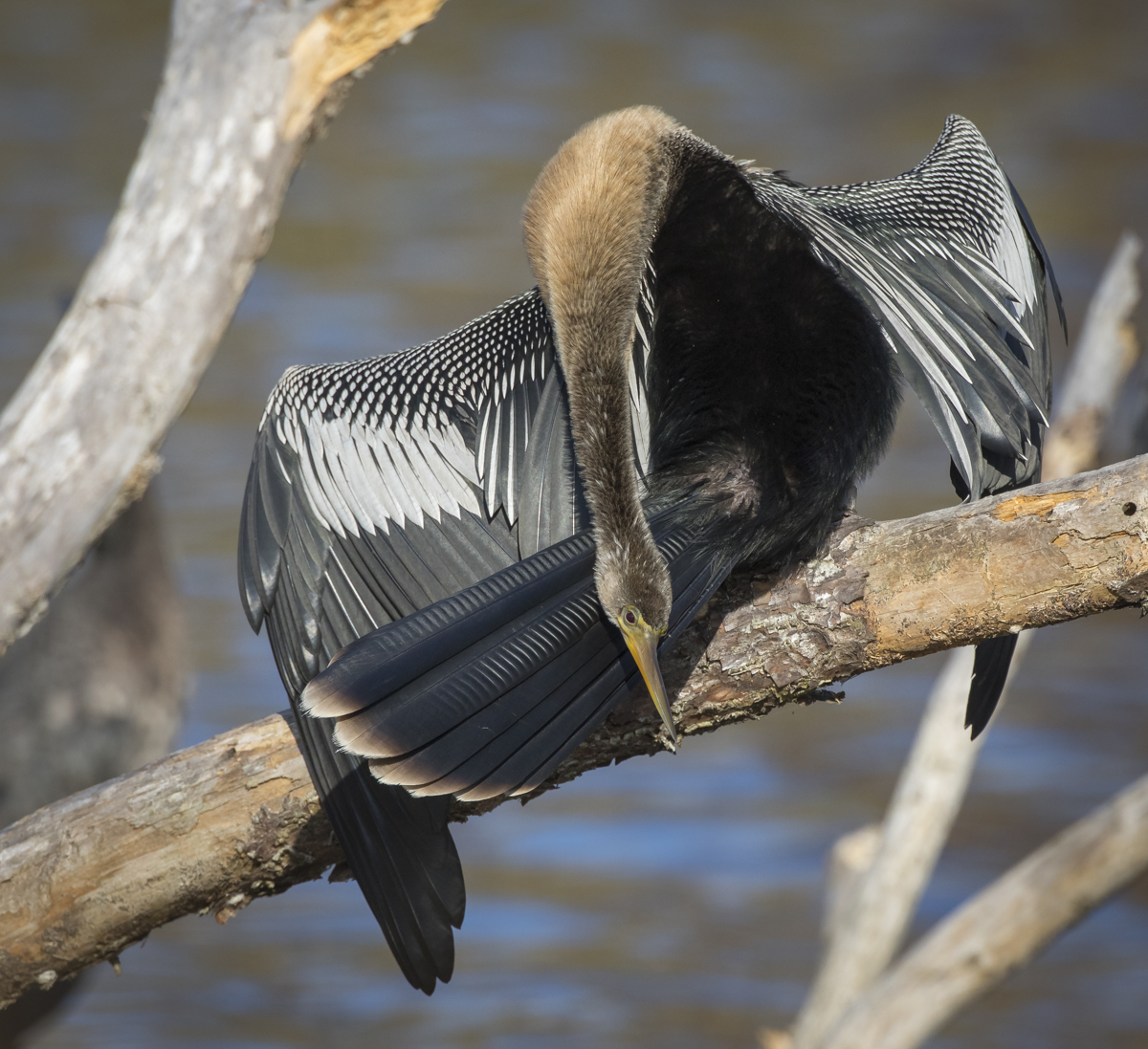
The sunning log was partially hidden from view by some tall vegetation between the edge of the canal and where I was parked. By slowly opening the truck door and standing on the running board with the camera resting on top of the open door, I was able to get some nice shots of this beautifully patterned bird as it preened.
The large fan-shaped tail resembles that of a Wild Turkey, giving rise to another common name for this unusual bird – Water TurkeyClose up of Anhinga preening
As is common with me, I took way to many photos of the Anhinga, so the sun was starting its downward trajectory when I headed back to Pungo for the last couple of hours of my trip. Though I really wanted to see bears, there were once again just too many cars and people at Bear Road, so I opted for some more quality time with the swans. The lighting was very different in the afternoon but I always enjoy the sights and sounds of these wonderful waterfowl.
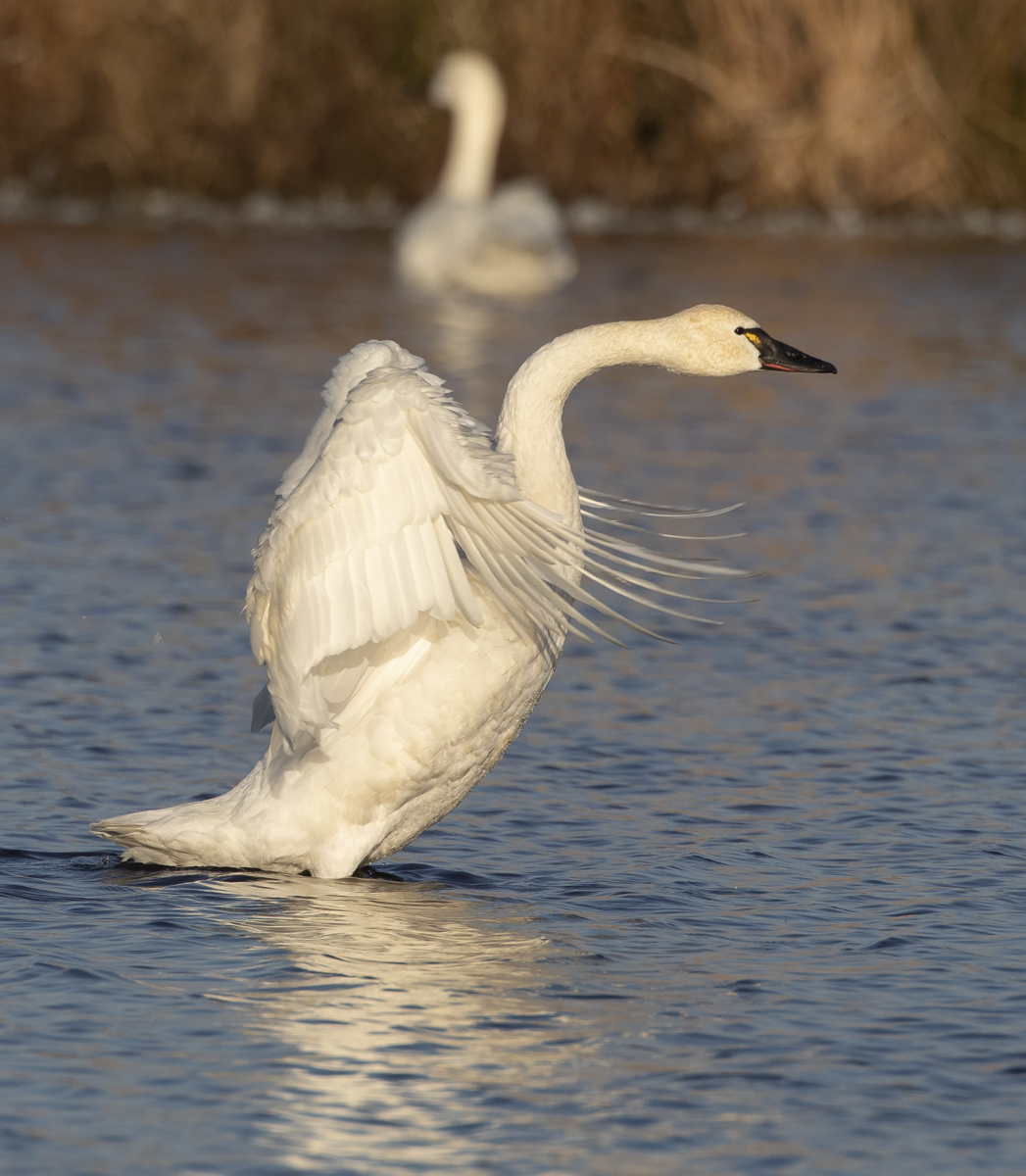
The elegant wing flap
The scene created some beautiful swan watching…
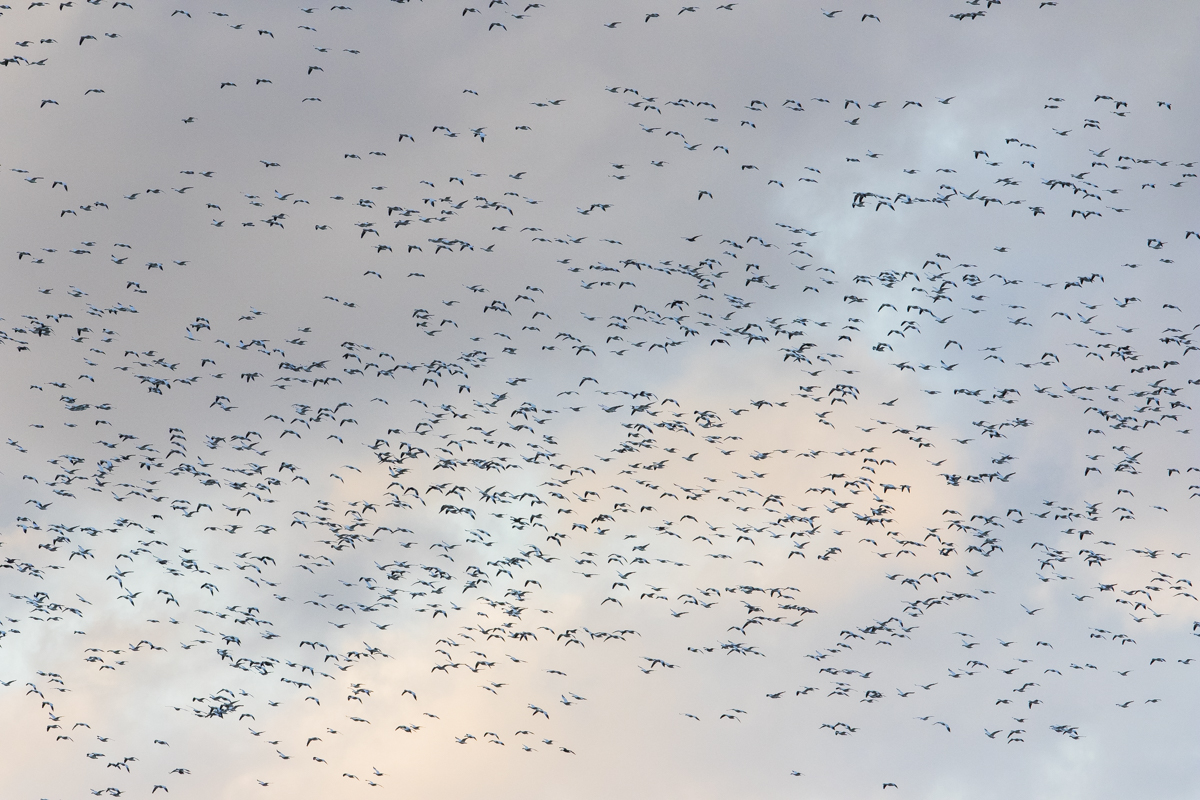
All of the corn in the fields near the refuge entrance had been knocked down for the birds since our trip earlier in the week, so I headed up there for sunset, hoping some Tundra Swans or Snow Geese would fly in for a late feeding (and hoping to see a bear). It wasn’t long until I heard them and then saw the sky filling with the silhouettes of a few thousand Snow Geese headed my way. As is common early in the season, they seemed very wary, and flew circles around the corn field a few times before starting to drop in to feed.
Snow Geese headed for the corn field for a late snack
After feeding for about 20 minutes, something startled them and they took to the sky, flying around a few times before heading back to the lake for the night. Here is a brief clip of one of the sights and sounds that make this place so special.
If it looks like a duck, quacks like a duck, it’s a duck.
~Robin Cook
Last week, I helped Melissa with a virtual program on waterfowl at Mattamuskeet National Wildlife Refuge. Titled Duck, Duck, Goose, the program was a team effort of museum staff designed for families with the goal of introducing people to the wonders of some of the waterfowl that spend winters in coastal North Carolina. We had scoped out our options the week before and found, not surprisingly, that access to cell phone service for the live feed was our biggest obstacle. We got decent service at the refuge’s photography blind on Hwy 94 and had seen quite a few birds there the week before, so we hoped for repeat for the program.
We camped at Pettigrew State Park the evening before the program so we could get an early start the next day. The weather was less than ideal with a chilly, light rain most of the day and into the evening. Overnight, the skies cleared and we had a good omen that the day could be full of birds when we heard a pair of Great Horned Owls at our campsite just before sunrise. They sounded really close, and the pair were calling a duet that I had only heard once before on a nest cam video of courting owls. I crept out of the back of the truck and saw an owl silhouette in a large tree in our campsite. There was a broken snag on one large branch and an owl flew out of it as I walked out from under the tarp. But the other owl, the smaller male, stayed on a limb and watched for several minutes until finally flying off to join its mate. A great start to our day.
When we drove into Mattamuskeet and stopped at the blind, there were no birds to be seen anywhere near it (nature often doesn’t seem to care what we had planned). So, we headed down Wildlife Drive, hoping for decent cell service and close birds. I pulled in to check out some open water near the entrance and saw an American Kestrel sitting near us on a fence surrounding a pumping station. As I pulled my camera up, it flew to the other side and glared back at me in a way only a fierce, little falcon can. I managed two quick pics and off it went.
American Kestrel gives me the stink eye for disturbing its morning quiet time (click photos to enlarge)
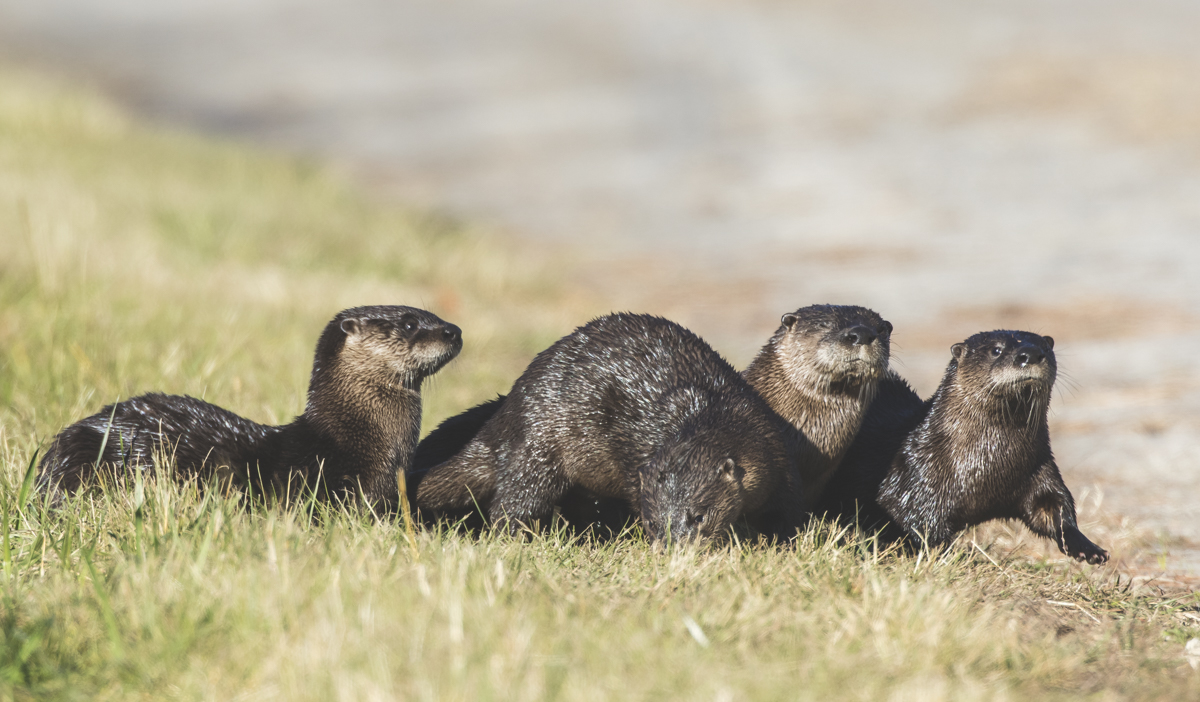
Melissa decided to stop part way down the entrance road and set up for the program since there were plenty of birds in the impoundment and the best cell service we had found thus far. It was still an hour or so until the live feed so I set up the tripod and camera and she started getting out all the gear to make the connection – two cell phones and her laptop and a bunch of cables. As we were setting up, I looked down the canal and saw something create a ripple. Otter! Four otter were cavorting in the canal and swimming our way. We were looking directly into the early morning sun, so I didn’t manage any decent photographs until they swam past us and climbed up on the bank. But then they looked like a pile of puppies, rolling on each other and the ground, a big furry ball of motion (so I managed to get several out of focus images of brown fur balls).
Four River Otter playing on the canal bank
Two otter managed to scent mark the area before they all ran up the hill and paused at the edge of the road and then bounded across, disappearing into the far side canal.
They loped up to the road and paused, just long enough for a family portrait
Melissa managed a quick phone video of the otter as they crossed…
Otter loping across the entrance road (video by Melissa Dowland)
Melissa was able to upload the video to her coworkers back in Raleigh and they used it as part of the virtual program to highlight some of the other wildlife that call this refuge home. The hour-long program went off without a hitch and we were able to live-stream images of large flocks of ducks, Canada Geese, and scattered Tundra Swans for the audience to enjoy. At the end of the Q&A period, i got a distant Bald Eagle in the camera view and then huge flocks of ducks (mainly Northern Pintails) flushing off the water and flying around the marsh before settling back down. A great visual for those that stayed online after the official program ending.
When we wrapped up, we decided to make one last trip around the refuge looking for wildlife. A Bald Eagle perched across the canal was the highlight and we managed to find a small open spot through the vegetation for a few photos.
An adult Bald eagle perched in a dead tree across the canalThe eagle gently scratches an itch using its long talons
On our way home, we stopped at the Pungo Unit to see what we might see. There were several cars on “Bear Road”, so we opted out of the “crowd” and headed over to Marsh A for some late afternoon swan watching. Once again, I could spend hours here watching these magnificent birds, but, as the sun set, many of them flew out to the fields for the evening meal, and we headed back home. While we wish everyone could have seen the refuge in person, we felt lucky to have been able to be a small part of this program bringing the wonders of winter wildlife to learners across the state.
A Tundra Swan family (the young cygnets are the ones with the gray head and neck)Watching the swans fly out before sunset is one of life’s simple pleasures
Birds have always had the ability to bring me out of a dark space and provide relief in bad times.
~Jason Ward
You may have noticed I have fallen way behind in my musings on the natural world this past month. I still haven’t even finished posting about our last road trip back in October! I guess there have been a lot of distractions lately (for all of us) – some good, some stressful. We are lucky to live in a place where we can connect on a daily basis with the beauty of nature so that has helped. But here lately, it has been too easy to get involved in some chore outdoors or a minor repair on the house, so it was good to have an excuse earlier this week to help travel back to my favorite wild place in North Carolina…Pocosin Lakes National Wildlife Refuge.
Melissa needed to test the feasibility of doing a remote broadcast for a museum program being planned for early December on some of the wonders of winter wildlife found on our coastal wildlife refuges. Limited cell phone service throughout the region would be the challenge and it requires a lot of gear and coordination with her co-workers, so she asked me to help. The plan was to hit both the Pungo Unit and Lake Mattamuskeet and try to broadcast live images and sound back to folks in Raleigh via Zoom. We would camp overnight in our trusty truck at Pettigrew State Park, to enable us to get both a sunset and sunrise to maximize our chances for seeing wildlife.
Canid tracks (most likely a Red Wolf based on their size) at the Pungo Unit (click photos to enlarge)
We arrived at Pungo mid-morning and drove toward the observation platform to check on the swans and the cell signal (not my usual combo on these trips). Melissa soon spotted some tracks in the sandy road and they turned out to be those of a large canid, most likely a Red Wolf, one of only one or two believed to still roam the refuge. Unfortunately, there was no service at the platform, but we could see swans far across the lake.
Tundra Swans have returned to Eastern North Carolina for another winter
The next stop was Marsh A, a managed impoundment that has been a hot spot for swans for many years and so it is again this winter. The signal here was weak and it kept dropping during the test, which is unfortunate because the birds were putting on a great show of both sights and sounds.
Black Bear sow and cubs far across the field
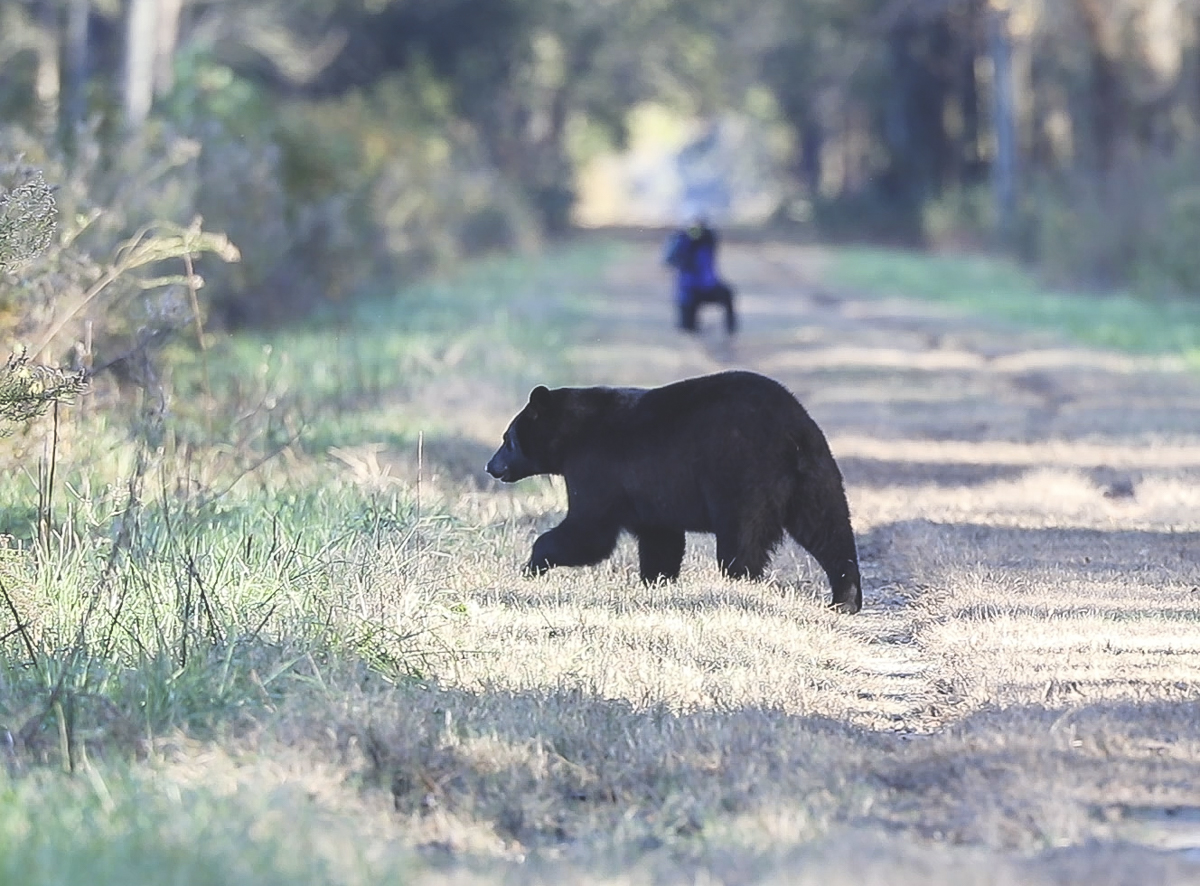
Our next stop was “Bear Road” which had a couple of other groups with cameras and long lenses out looking for bruins. They reported seeing a few that morning, and we soon spotted one, and then several, all far across the field. We did have a weak signal here and could send images, but the lack of swans and the great distances and unpredictability of seeing bears may make this location less than ideal for the broadcast. Of course, while we were focused on the bears off in the distance, I forgot one of the main lessons you learn about the bears at Pungo….always look behind you. Sure enough, a bear had come out of the woods behind us (quite close according to other people on the road) and walked away from us toward a path that leads over to the adjacent cornfield. When I turned and saw it, I managed a few seconds of video before it disappeared into the canal and up into the tall cornstalks of its dining room.
A bear heads for the corn across the canal (this is a screen capture from a video clip); note the photographer down the road looking back at the bear and us
We headed back to Marsh A hoping for a better signal since that spot provided the best bet for a sure wildlife moment for the broadcast. We drove along, checking our phone signal strength at various spots, but it was still weak and somewhat variable. Toward one end, I suddenly heard the distinctive bugling call of a Trumpeter Swan (it reminds me of a clown car horn from the cartoons) mixed in with the cacophony of Tundra Swan oo-oo-oo’s and hoots. For the past several winters, we have seen a few of these magnificent birds, the largest of our native waterfowl, at either Mattamuskeet or Pungo. I started scanning the seemingly endless sea of white necks and heads looking for the less discernible bill traits of a Trumpeter Swan (larger and straighter than that of a Tundra Swan and their eye is usually not distinctly separate from the bill as those of a Tundra Swan). I finally found one swimming and honking in the mix. I kept trying to make others nearby into trumpeters, but can’t say for sure, even after looking at my images. Trumpeters are larger than Tundra Swans (as much as a foot more wing span and up to 10 pounds heavier on average), but that is tough to tell in the field. Plus, to make matters more difficult, Tundra Swans can vary quite a bit in bill size, eye position, and whether they do or don’t have the usually diagnostic yellow patch on the bill near the eye. For more details on distinguishing between the two species, see this link.
A Trumpeter Swan (the bird on the right facing left)
Mid-day on our second day, we drove over to Mattamuskeet National Wildlife Refuge to scout for birds (and cell service). The problem with Mattamuskeet (as far as video or photography is concerned) is the lighting is very bad (harsh back-lighting) on the impoundment along Wildlife Drive for most of the day. There certainly are a variety of birds that are easily seen, but finding a good spot for the broadcast was a challenge, although in general, there is a better signal for sending images over most of the accessible parts of the refuge. We found a nice variety of birds and other wildlife and are now thinking that this may be the best spot for the program. The next few images show some of the highlights of the couple of hours spent at Mattamuskeet. One nice surprise we found that I didn’t have a chance to photograph was an American Bittern that flushed from the side of the boardwalk in the cypress swamp.
A juvenile Anhinga bobbed its head as we drove across the canal bridgeA huge Golden Orb Weaver along the boardwalkA vertical pano of the cypress swamp along the boardwalk lends a strange curvature to the treesBald Cypress needles carpet the water surface
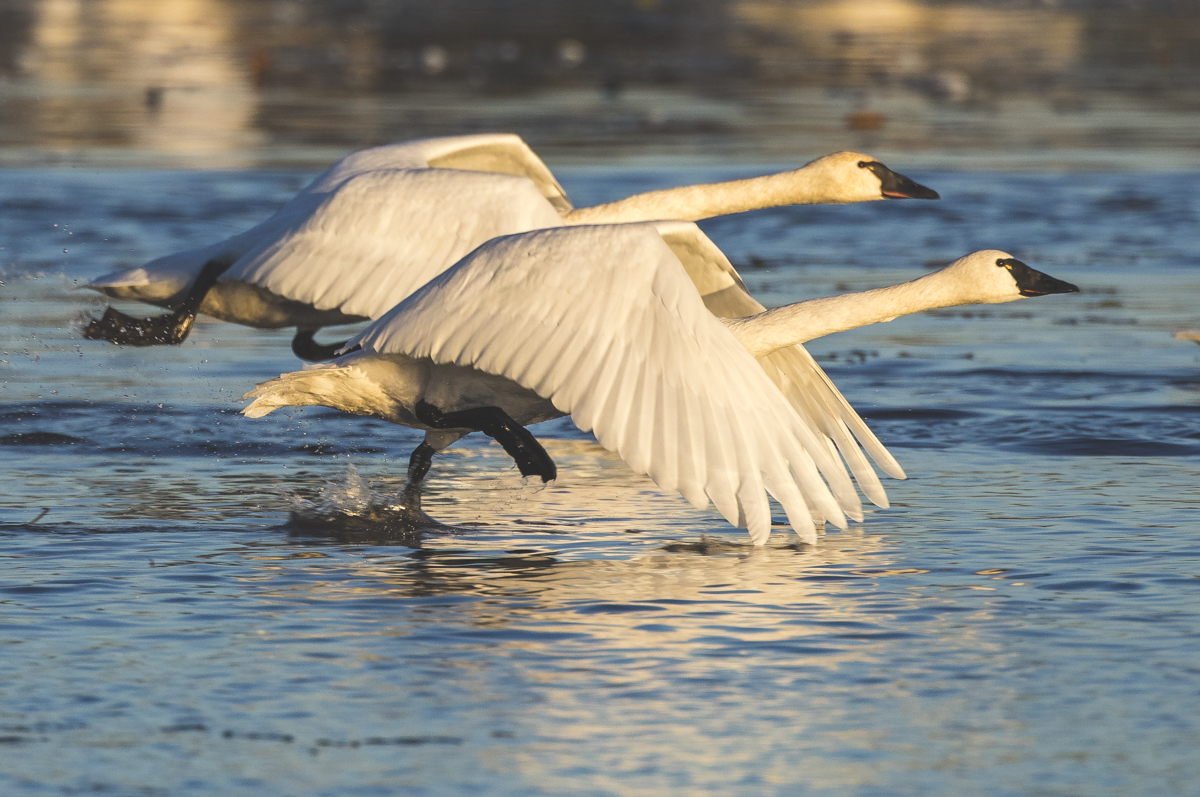
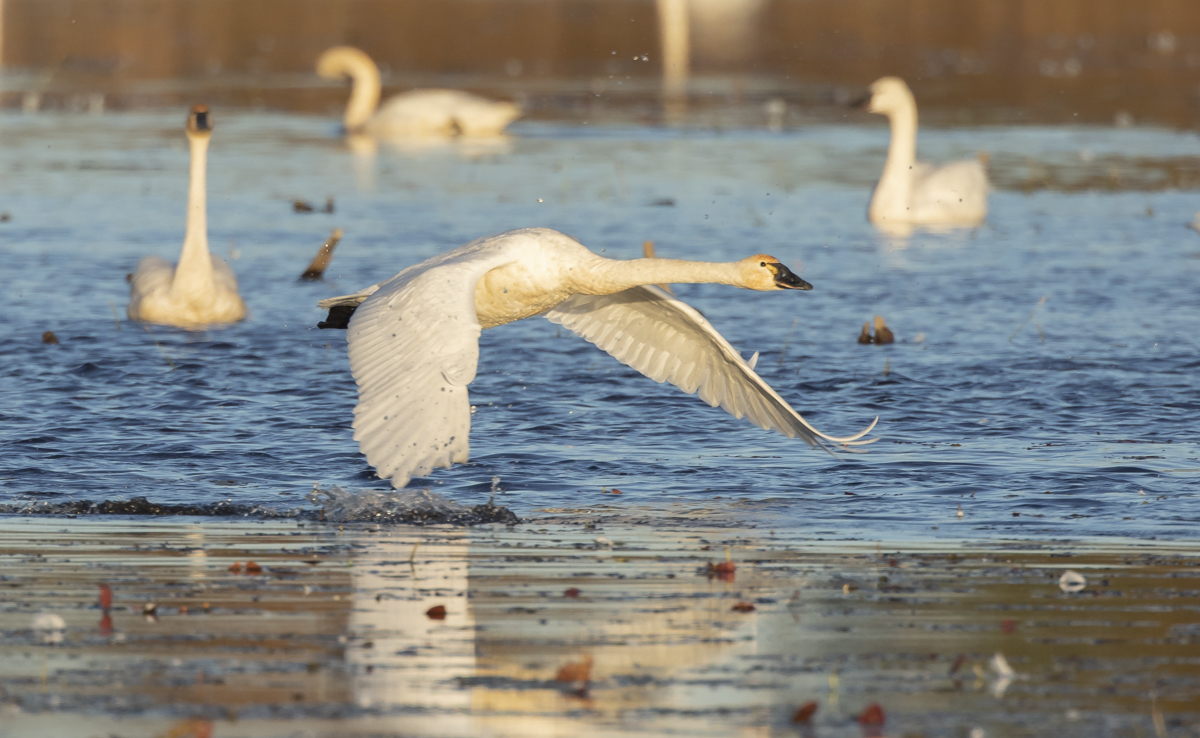
Our last stop was a return to Pungo, hoping to get some more bear footage. When we arrived at the spot, there were already 4 cars parked at the gate, so we decided to skip the bears and spend the rest of the day at Marsh A enjoying the sights and sounds of the elegant swans. Late in the day on both of our afternoons, the swans starting taking off in large numbers from Marsh A, presumably heading out to nearby fields for their last feeding of the day. With so many birds head bobbing (they usually do this as a prelude to take-off) and slapping their feet across the water to get airborne, I can’t resist the urge to capture some lift-off moments. The answer to Melissa’s question of How many pictures of swans taking off do you need? is…there’s never enough.
Looking forward to returning in a couple of weeks for the program (and hoping technology and weather will cooperate). Information and registration for the upcoming NC Museum of Natural Sciences virtual program on winter waterfowl in this region (which targets a family audience, including young children) is on their web site here.
The energetic take-off of a swan trailing behind one that left splashes in its wakeA pair of swans seem coordinated in their take-offAfter a long run and much flapping, a successful lift-off in the golden light of sunset
The surprise is that you continue to be surprised.
~Jill A. Davis
I interrupt the truck camping travelogue posts to bring you some current yard sightings. We have been gone quite a bit the past couple of months so the “yard” has taken on more of a jungle look. On Friday, I started some long overlooked chores like washing all the windows and trimming back some of the plants in front of said windows so I can get to them. Our dining room window has a Beautyberry growing in front of it (I know, not ideal placement, but I like to watch the birds feeding on the berries), so I started trimming it to allow access for the long-handled window squeegee. After a few cuts, I saw something on one of the remaining stems – a Green Treefrog! It was clinging to the branch with that typical Buddha-like expression that this species pulls off so well. Though it is likely the same individual I saw in this part of the yard back in August, I can’t be sure as I photographed them from different sides so I can’t compare the location of the few gold flecks of color (I’m not even sure if these gold spots are a constant over time on an individual treefrog).
Green Treefrog clinging to a Beautyberry branch (click photos to enlarge)
It surprised me that this little guy was still clinging to the plant I had been cutting on and jerking around, but perhaps the cool temperatures has made it more accepting of my intrusions.
That peaceful treefrog pose
As I moved around the plant to photograph the frog, I found another surprise – a late season sphinx moth caterpillar. Over the past few years, we have found several Rustic Sphinx Moth larvae feeding on Beautyberry, so we routinely scan these shrubs for signs of caterpillars.
A Rustic Sphinx Moth larva on Beautyberry
I had noticed some of the Beautyberry leaves had been eaten when we first got back home from our road trip, but assumed the caterpillar had already moved off to pupate, since most larvae are scarce by mid-October. Like the treefrog, this caterpillar did not move while I was shaking its habitat. In fact, I kept a check on it from Friday (when I first saw it) until late Saturday afternoon. It didn’t move for that entire time and then late Saturday, it was gone. Not sure if a bird found it or if it had had enough of my yard work and just crawled off to find a suitable place to pupate.
Wondering what the purpose of all those bumps might be
One last Beautyberry surprise was under a leaf near the Rustic Sphinx – a small “inchworm” of some sort. Needless to say, I carefully looked over the branches I had trimmed to make sure I wasn’t displacing any other inhabitants (I didn’t see any). This is one of the reasons I usually leave the yard a bit untidy (okay, I guess that is a bit of an understatement) until March or so – you never know what is using those standing dead flower stems and branches as habitat.
An unidentified Geometrid moth larva on Beautyberry
I found another late caterpillar yesterday afternoon as I was mowing, a tussock moth larva. Wasn’t sure at first which species as it lacked the usual hair pencils (tufts of setae) on the front end. But, after looking at BugGuide, it must be a Banded Tussock Moth caterpillar. One of the experts on that site speculated that these larvae may lose the hair pencils as they near pupation.
Banded Tussock Moth larva (it is missing the anterior hair pencils)
It will be interesting to see how these and other yard invertebrates (like the few remaining orb weaver spiders) will survive the next few predicted cold nights. But no matter, it is getting to be that time of year where change is inevitable, but a few surprises may linger. And these are the only types of October surprises I am in the mood for right now.
We are now in the mountains and they are in us, kindling enthusiasm, making every nerve quiver, filling every pore and cell of us.
~John Muir
After driving across the high plains for several days, we finally saw the sharp peaks of southern Colorado reaching for the hazy skies (fires in Wyoming brought smoky skies for our first few days in CO). The mountains at last…for many reasons, much more aligned with our spirits than the flat lands. Our main concern was that was a weekend, and, like us, people were flocking to these spiritual landscapes for relief during these trying times. Would we find a campsite? Melissa had picked a couple of areas in the Spanish Peaks, Bear Lake and Blue Lake, that had Forest Service campgrounds and some limited dispersed camping. The campgrounds were full, but a campground host recommended driving up a nearby rocky road and finding a spot. We passed one camper as we climbed until we reached the end of the road. As it was getting late, we settled for this less than ideal, but still beautiful, spot. The next morning as we headed out, the other camper had his truck hood up and, as we slowed, asked if we had jumper cables. Indeed, we did, and he was happy to have his engine running again (it would have been a long bike ride down to the campground fro assistance).
Blue Lake in the Spanish Peaks of CO (click photos to enlarge)
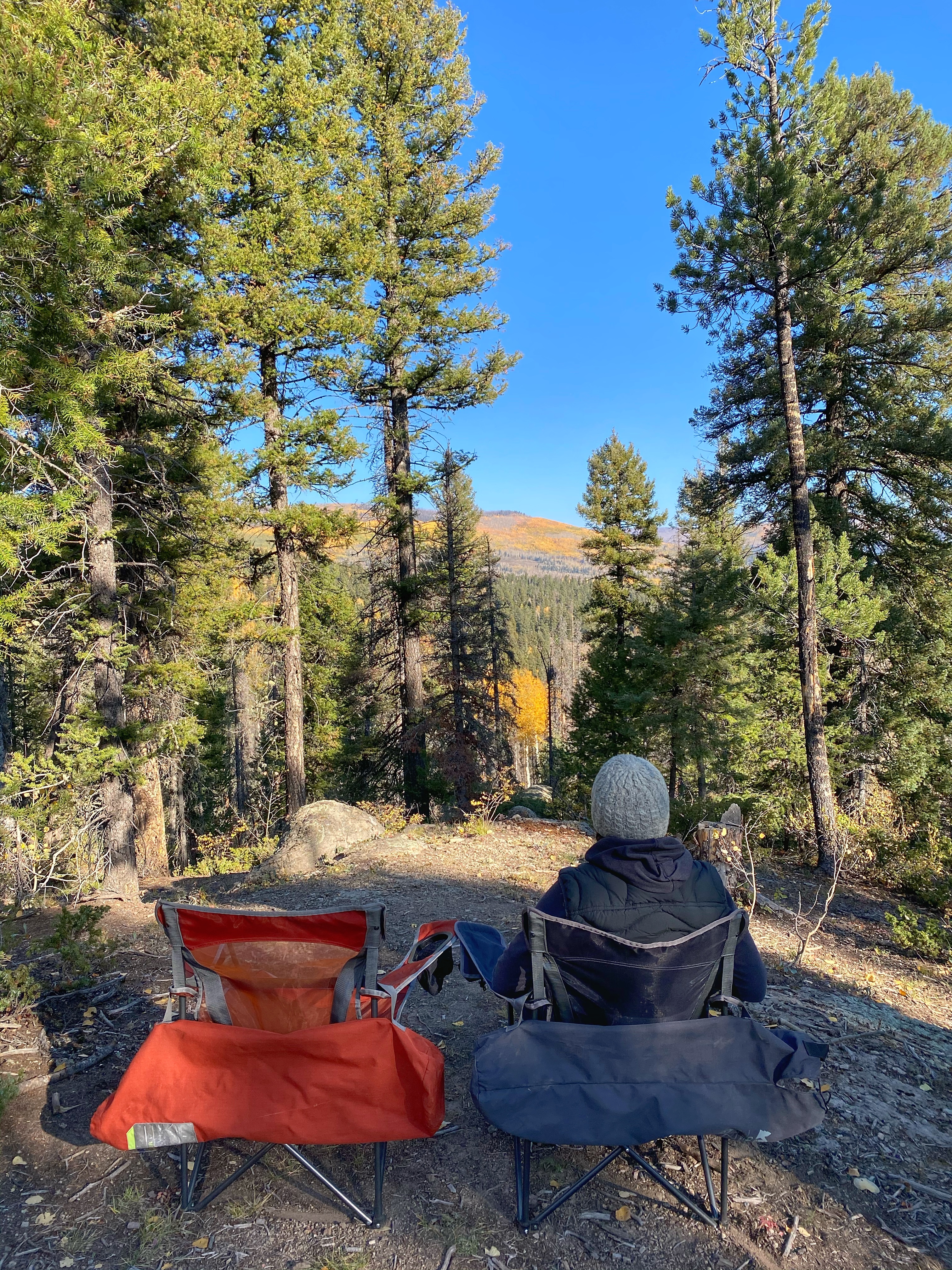
Our next stop was a beautiful area in the Rio Grande National Forest. We drove some back country roads looking for an isolated site but there were a lot of large RVs with 4-wheelers scattered throughout the valley along the creek. So, we took one of the high roads and found a pullout with a view through the trees of a nice peak with golden aspens illuminating its lower slope.
Our campsite along Fox Mountain RoadAspens were in peak color in much of southern ColoradoAspen cathedral
After passing through Durango, our route entered the San Juan Mountains and the glorious golds of fall aspens were a constant. Melissa steered us to what turned out to be one of the rockiest roads I have ever been on, Old Lime Creek Road, in San Juan National Forest. At about 3 miles we passed a small trailhead to Spud (actually Potato, but the locals call it Spud) Lake. We passed by hoping to find a secluded campsite and paused to ask a vehicle coming the other way about road conditions farther along as I was beginning to squeeze the steering wheel a bit too tightly. The driver, a local, said the road got worse and was mainly one lane with few good places to turn around. That convinced us to look for something back behind us. We both wanted something special since it was Melissa’s pre-birthday night campsite. We passed a small side road with huge ruts from when the area had been muddy. Melissa walked down it as I walked ahead on the main “road”, looking for a site. When we got back together, she thought we could make it past the giant ruts and camp in a grove of aspens on the side road. We carefully pulled in and set up camp and climbed a short hill above our site to a rock outcrop with a fabulous view of the surrounding peaks. This would do, indeed it would. The sunset and sunrise were fabulous and everything was perfect except for the mice that invaded our truck cab during the night. For some reason, this was the trip of the mouse, with several mice coming into the cab at night over the first several campsites…as much as I hated doing it, we ended up catching 5 mice total over several nights in a single trap I had brought along (the truck has had issues with mice ever since I accidentally left a bag of bird seed in it for a few nights in our driveway a few months ago).
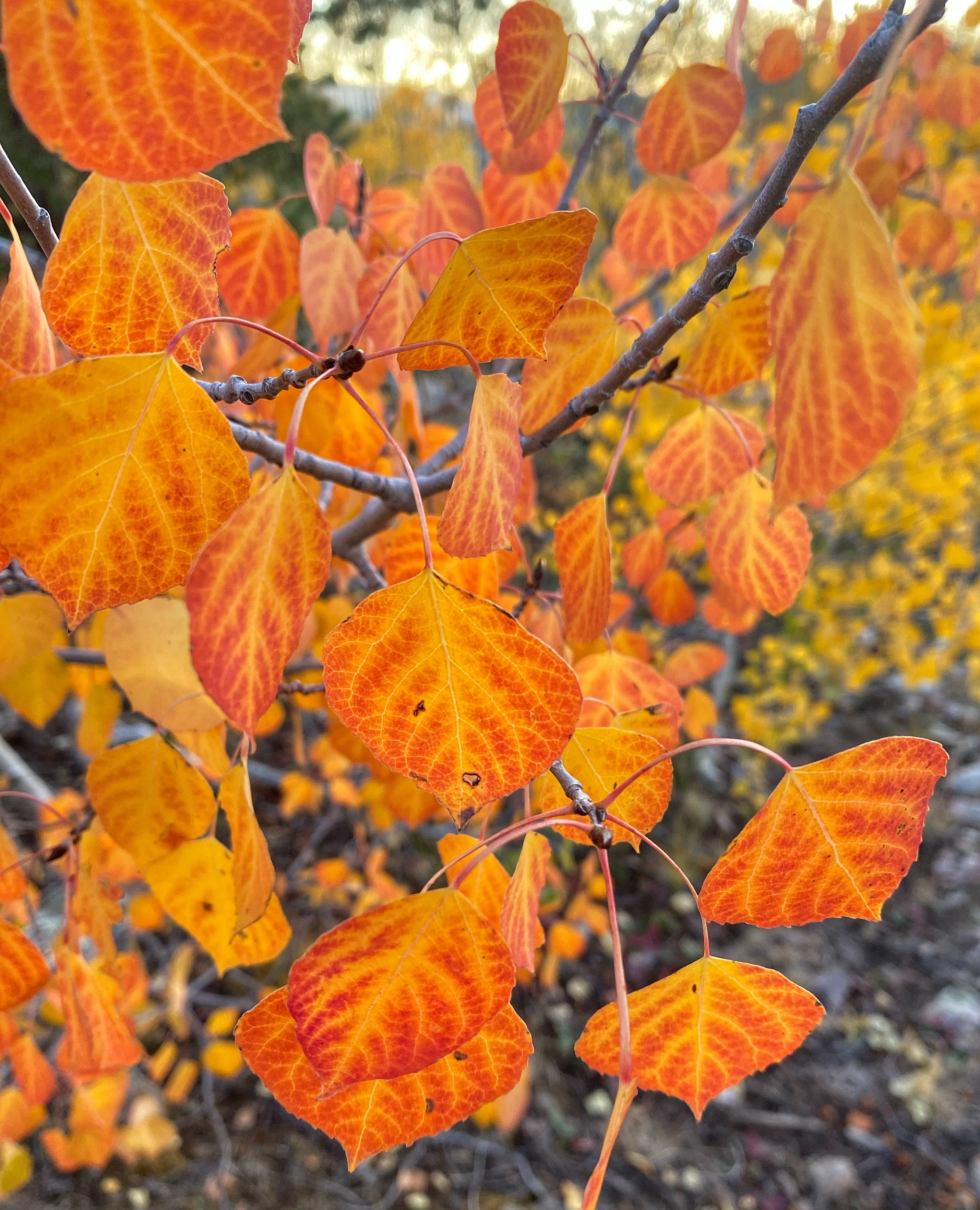
Sunset on the rock outcrop above our campsite Some aspens show distinct orange colors instead of the usual golden yellow
The same local that told us about the roadway also mentioned that the trail we passed was an easy 1-mile hike to a beautiful lake, so we headed up there the next morning. It turns out it is a very popular trail for locals and by the time we got out a few hours later (we walked all the way around the lake) several cars were parked at the trailhead and along the road (many people gave up driving the extremely rocky road all the way to the trailhead and parked a half mile or more down the road).
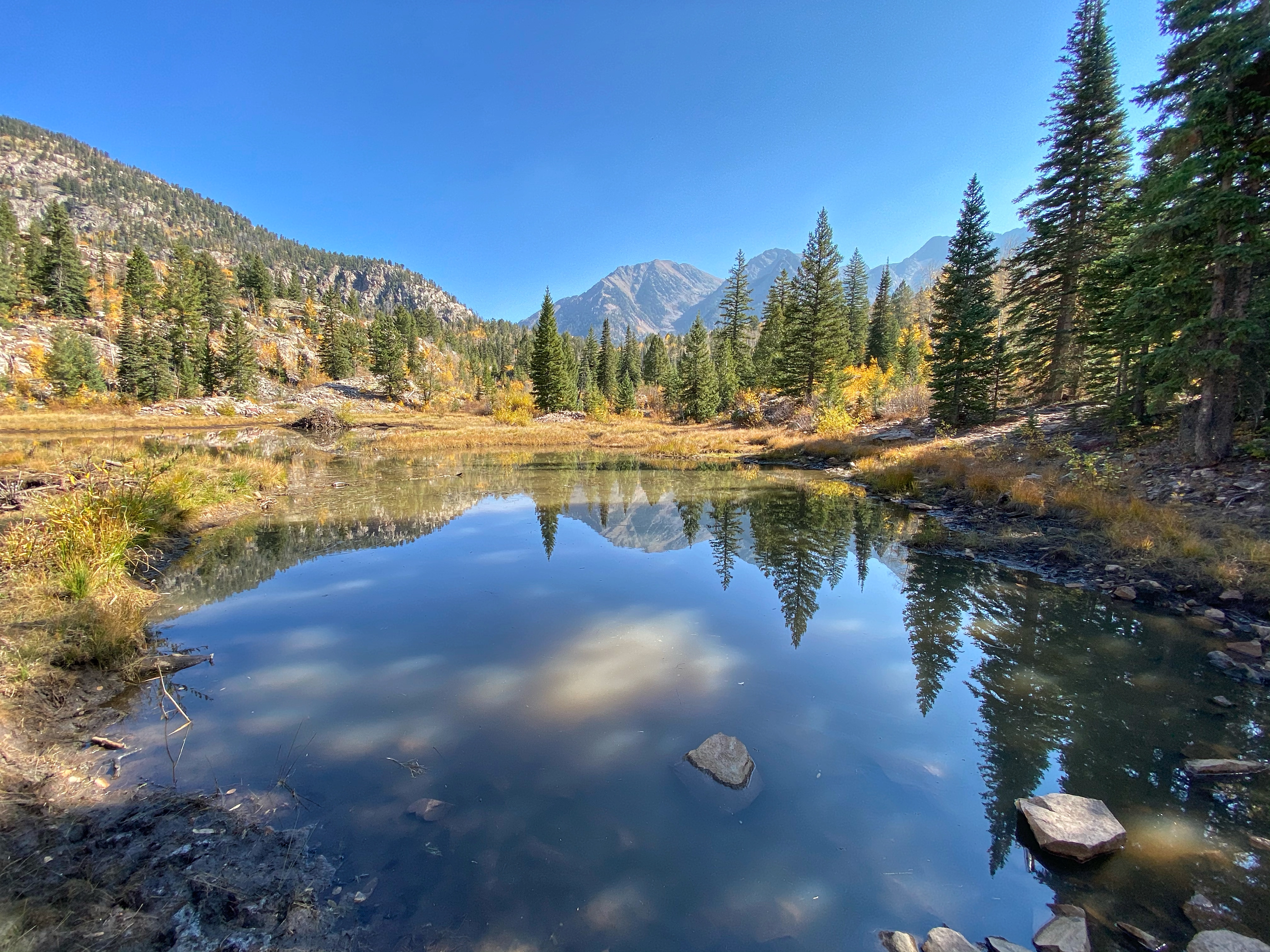
The beautiful reflections in Potato LakeBeaver pond along trail to Potato Lake
Next on our itinerary was a forest service road described as one of the most beautiful in the region – Last Dollar Road. Ironically, it runs through many vast private holdings where the ranches and homes look like their last dollar (if they even have one) is a couple of orders of magnitude greater than ours would be. Melissa spotted a young coyote hunting in the open near the road so we stopped and watched it catch a couple of rodents.
Young coyote hunting near roadThe only Elk we saw in Colorado (elk season started while we were there)
She also spotted the only Elk we saw on the entire trip emerging from the brush on a private ranch along the road.
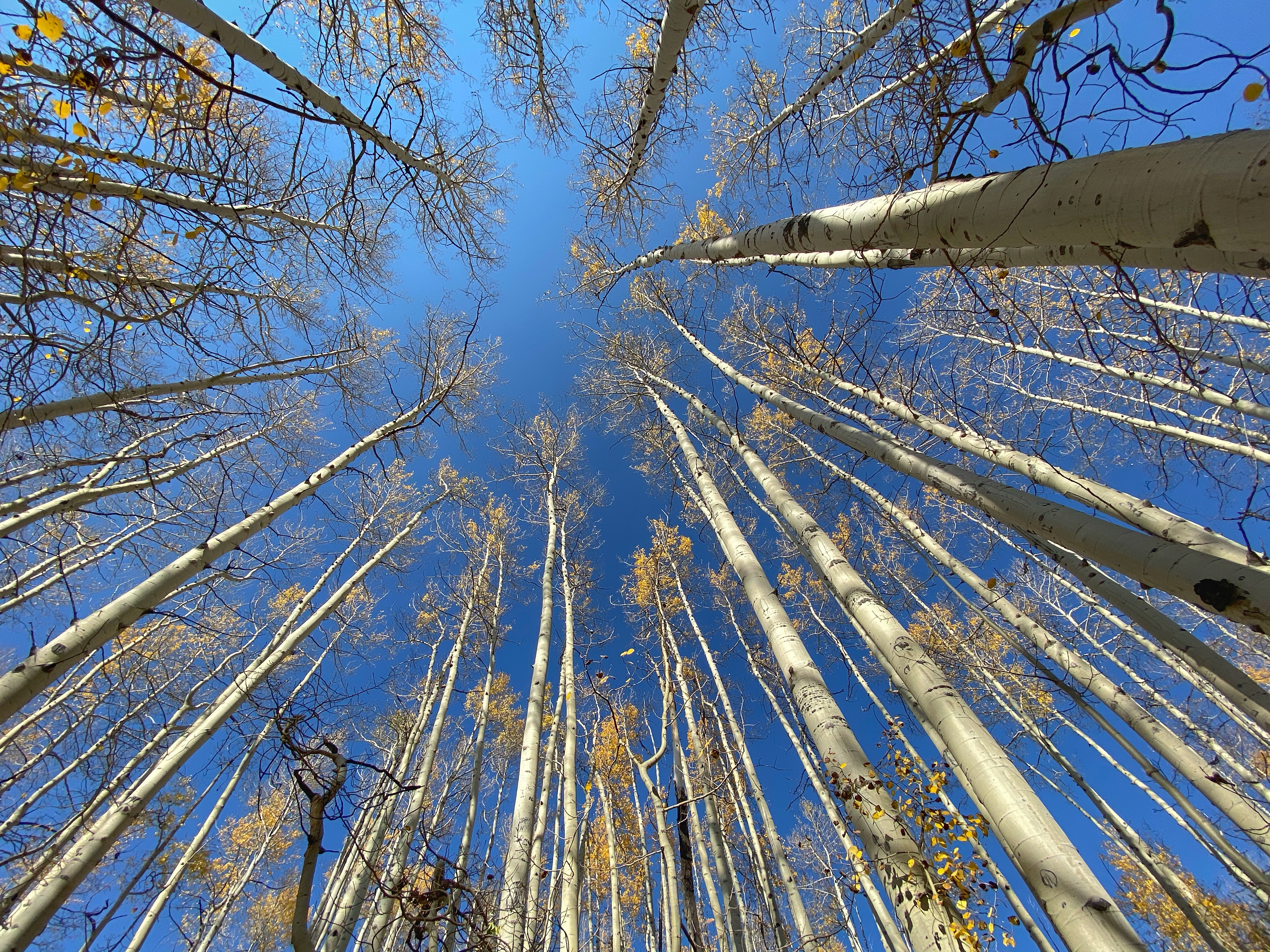
Vertical pano of aspen grove
All along the road were groves of beautiful aspens in their prime fall colors. And there were lots of people out enjoying it and camping in the best spots. We kept going, hoping for a place with a view. We came through a pass and then headed down what was the steepest dirt road I have traveled and eventually popped out to an opening in the trees with a wonderful vista of distant mountains. People had obviously camped here before even though it was basically just a flat spot on an expansive talus slope. There was a small area at the edge that had solid ground and some trees where we set up our table and chairs. Like most of our campsites thus far, the talus slope was above 9000 feet in elevation, so temperatures dropped quickly as the sun slid beneath the peaks.
Sunset at our talus slope campsite on Last Dollar Road
With so many crevices and hiding places among the field of rocks, it was a perfect habitat for small mammals (uh-oh, more mice), especially the ubiquitous chipmunks. There are 5 species of chipmunks in Colorado and everywhere we had camped, we had chipmunks that apparently had no fear of humans. While taking in the view at this site, one came up and touched my shoe, not in an aggressive way, but just curious. They can be tough to tell apart, but I think the ones we saw here were Colorado Chipmunks, Neotamias quadrivittatus. We commented on how this was also perfect habitat for one of our favorite western mammals, the Pika, but we had not heard their distinctive alarm call as we set up camp.
Extremely bold Colorado Chipmunk
At breakfast the next morning, Melissa spotted one of the little rock lovers scurrying nearby. It sounded its shrill alarm and was answered by several others scattered down the slope. The place was full of Pika!
Pika
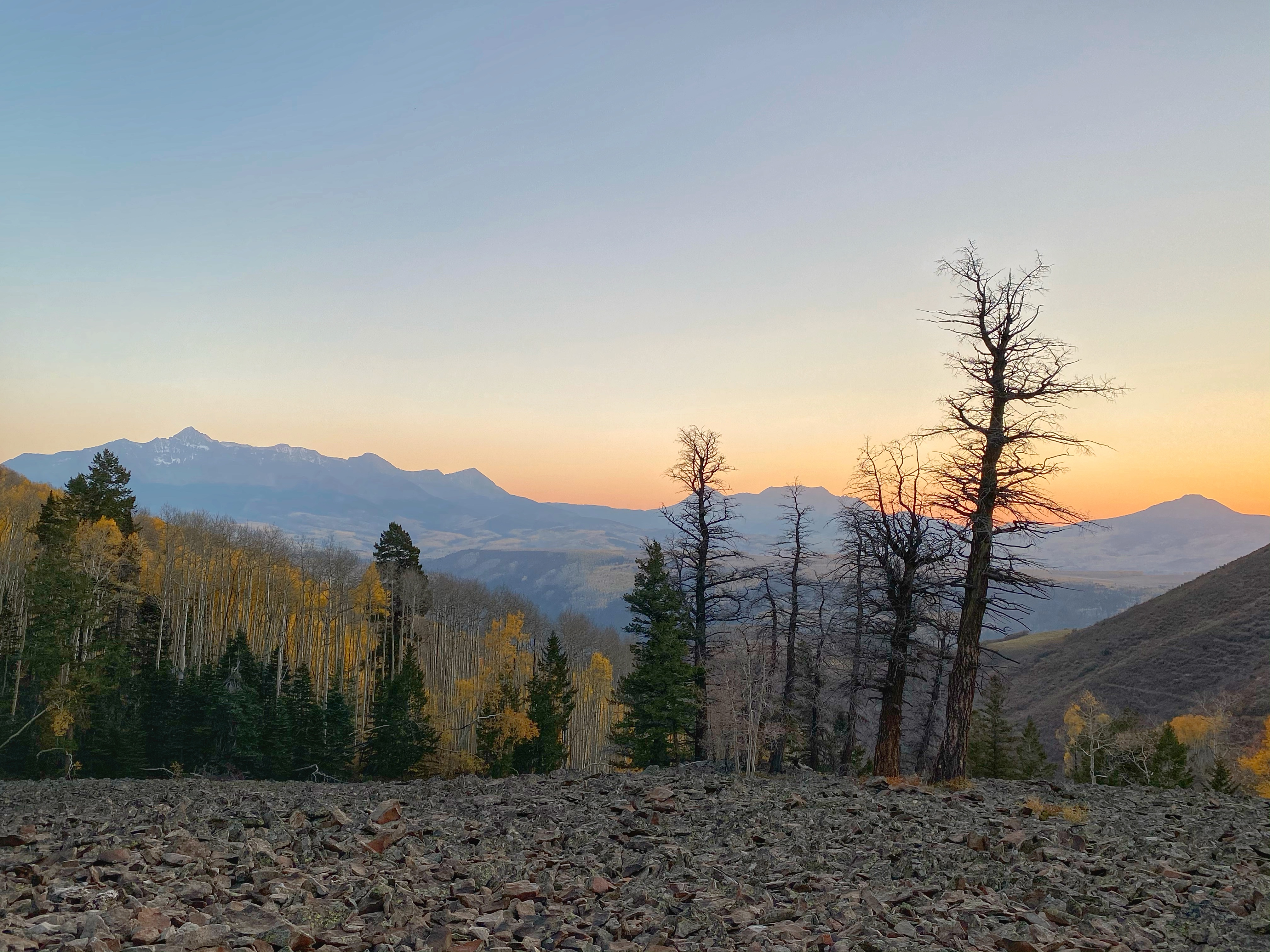
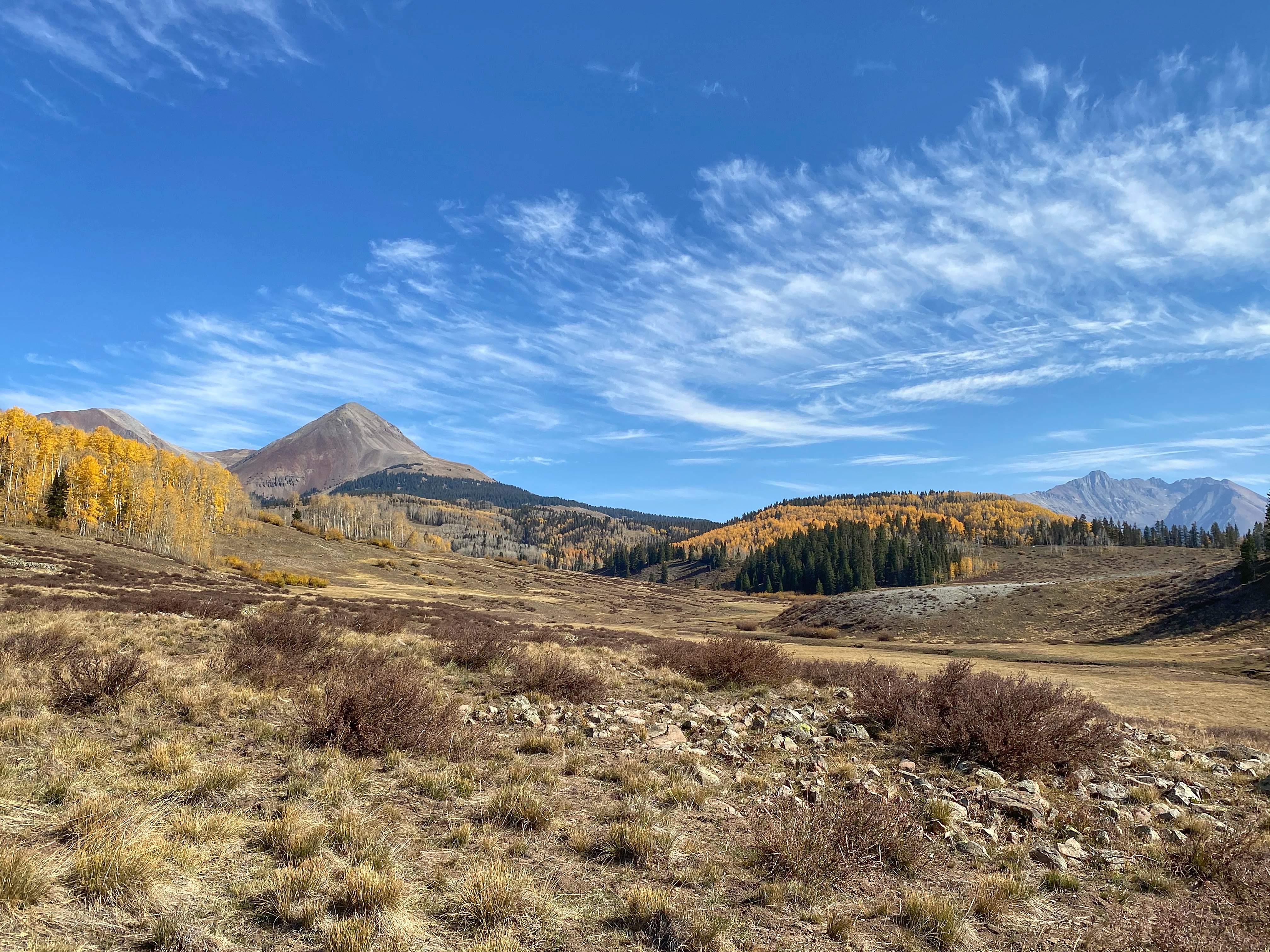
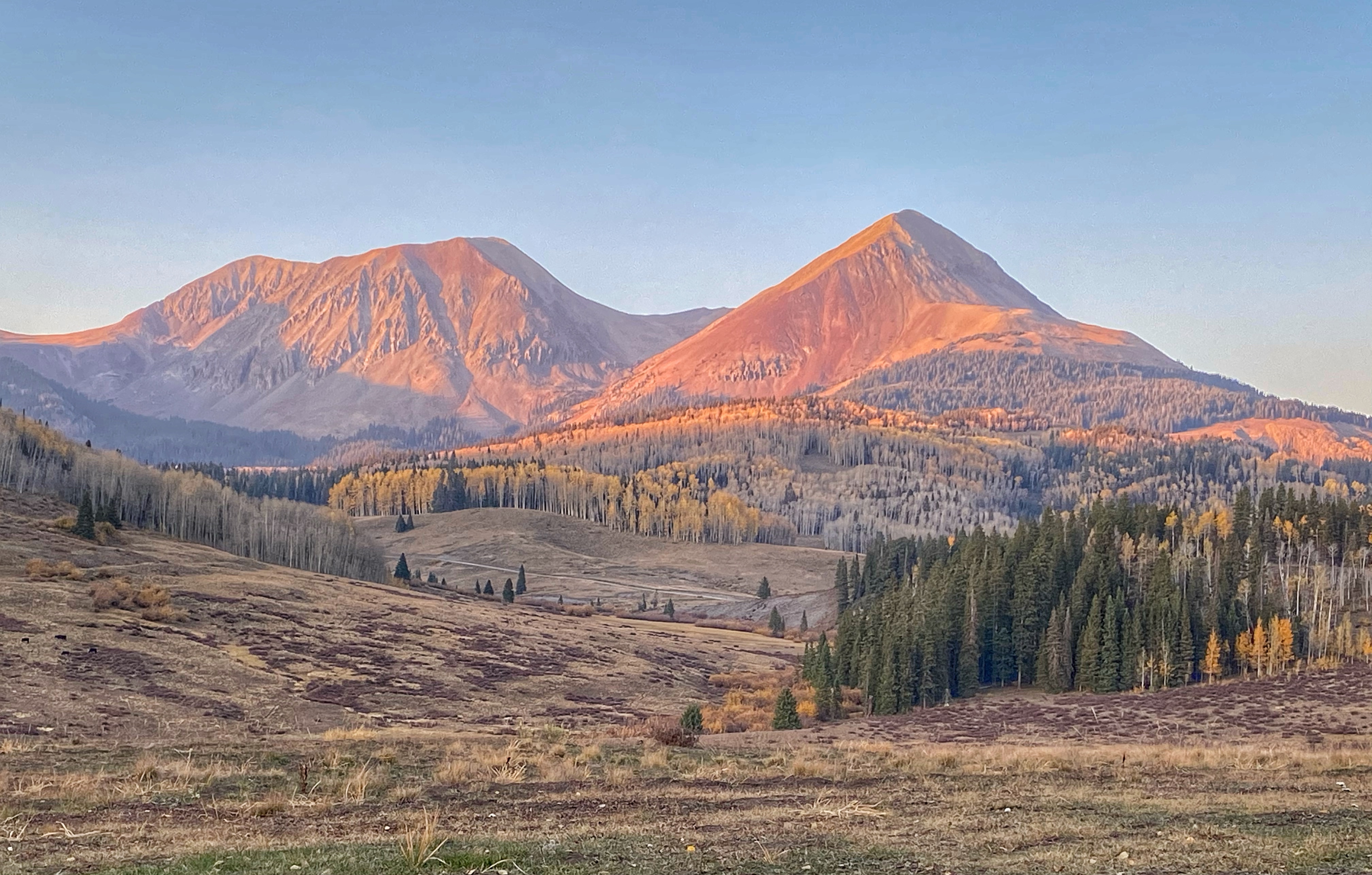
The end of Last Dollar Road takes you through Telluride, a beautiful small town that we both decided we could live in (if we came into large sums of money). Melissa’s research had found another location a short drive away that looked promising, one with open meadows and views of high mountains. The narrow road started off a bit hairy with steep drop-offs, but it wasn’t nearly as rough as some we had been on, until we finally took a rocky side road. We passed a public-access corral that had an unoccupied RV parked next to it and then we drove up a rutted path to the top of a knoll with an incredible vista. This would be our home for a couple of nights (one of the peaks in the picture below is even called Dunn Mountain!).
Camp robbers in action
After setting up camp, we were visited by one, then two more, Gray Jays (aka camp robbers). Formerly called Canada Jays, these birds are known for their boldness in approaching humans and carrying off food or other items from your camp. They hung out with us for a while, hopping around on the ground, then on our table and chairs, and the top of the truck. One even was temporarily confused when it got inside the back of our truck through the open tent screen. They checked in on us several times during our stay, no doubt hoping we would be a bit careless with our food.
Hiking above our campsite (set just off the gray-topped ridge on right side of image)
In addition to the jays, we had a ton of Dark-eyed Juncos, a couple of Coyotes, several raptors, and a small group of Mule Deer sharing our space (or vice versa I suppose). But no Elk, and this place just looked like great Elk habitat. After deciding to stay another night, we hiked up behind our campsite where we found plenty of sign. Elk season would start in a couple of days, so maybe they were all hiding back away from the roads due to the increase in human activity as hunters starting scouting the area. This spot had an incredible feel to it – wildness, openness, beauty, exactly what we had hoped to find on this journey.
Another mountain sunset at camp
Next stop, the dry, dusty canyon lands of the Utah desert.
The road is there, it will always be there. You just have to decide when to take it.
~Chris Humphrey
Two days before departing on our journey, we finally made plans to head toward Colorado. Why not, right? We had been there last year about the same time and it was beautiful, but this time we would try southern Colorado, a new area for us. But, from my mom’s place in the Virginia mountains, roads to Colorado cross the vast plains. Crossing the Midwest means long days of driving and searching for isolated campsites in areas other than national forests (for the most part). Once again, Melissa did some excellent online searching and came up with a couple of destinations for us for the first leg of the trip.
Sunrise looking across the Ohio River onto Kentucky farmland at Buzzard Roost Recreation Area (click photos to enlarge)
Our first day ended in Hoosier National Forest in Indiana at Buzzard Roost Recreation Area. Our first free camping site was an actual Forest Service campground with five campsites on a bluff overlooking the Ohio River. The site was named for the large numbers of buzzards (Turkey Vultures) that once roosted here when there was an operating meat smokehouse nearby in the late 1800’s. It was a quiet little campground and a short walk to the overlook provided us with a beautiful scene to start the first full day of our journey.
As we had learned on our last trip, Kansas offers free camping at most of its State Fishing Lakes (SFL), so Melissa charted a course to Chase SFL in eastern Kansas.
Our campsite at Chase State Fishing Lake, KS
We pulled in late in the day and found a secluded site at the far end of this small lake. Rolling grasslands surround the lake for miles, reminding us a little of the Sandhills of Nebraska from our last trip.
Sunset on the grasslands at Chase LakeDingy Cutworm Moths were abundant on plants near the lake
Great Blue Herons, some ducks, a Great Horned Owl, and Coyotes accompanied an incredible moonrise that evening. A Bald Eagle flew across the lake the next morning at sunrise before we loaded up and headed across the flat lands of Kansas once again.
Full moon rising over Chase Lake
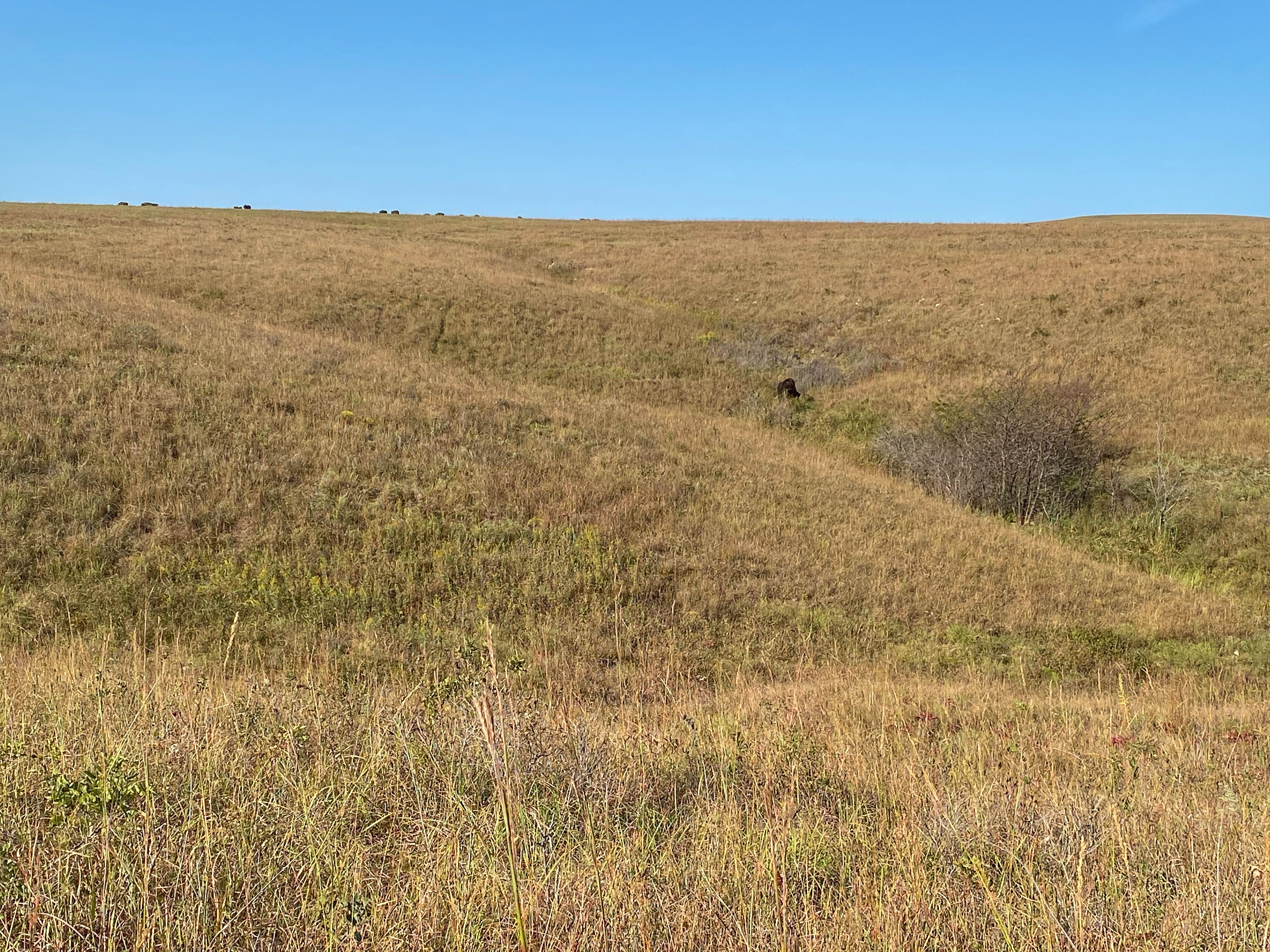
On our last trip, we fell in love with the patches of remnant prairie we visited in Nebraska, so this time we wanted to include more of that unique habitat. We made a side trip to the Tallgrass Prairie Preserve in the Flint Hills of Kansas. It is a joint project of The Nature Conservancy and the National Park Service. We hiked one of the trails out to see their herd of Bison. The views are expansive, with rolling hills of grasses (though not as “tall” as I had expected) and abundant evidence of wildflowers that had bloomed earlier in the season, plus the greatest number of meadowlarks in one place I have ever seen. It is no wonder the Western Meadowlark is their state bird.
Bison in the distance at the Tallgrass Prairie Preserve
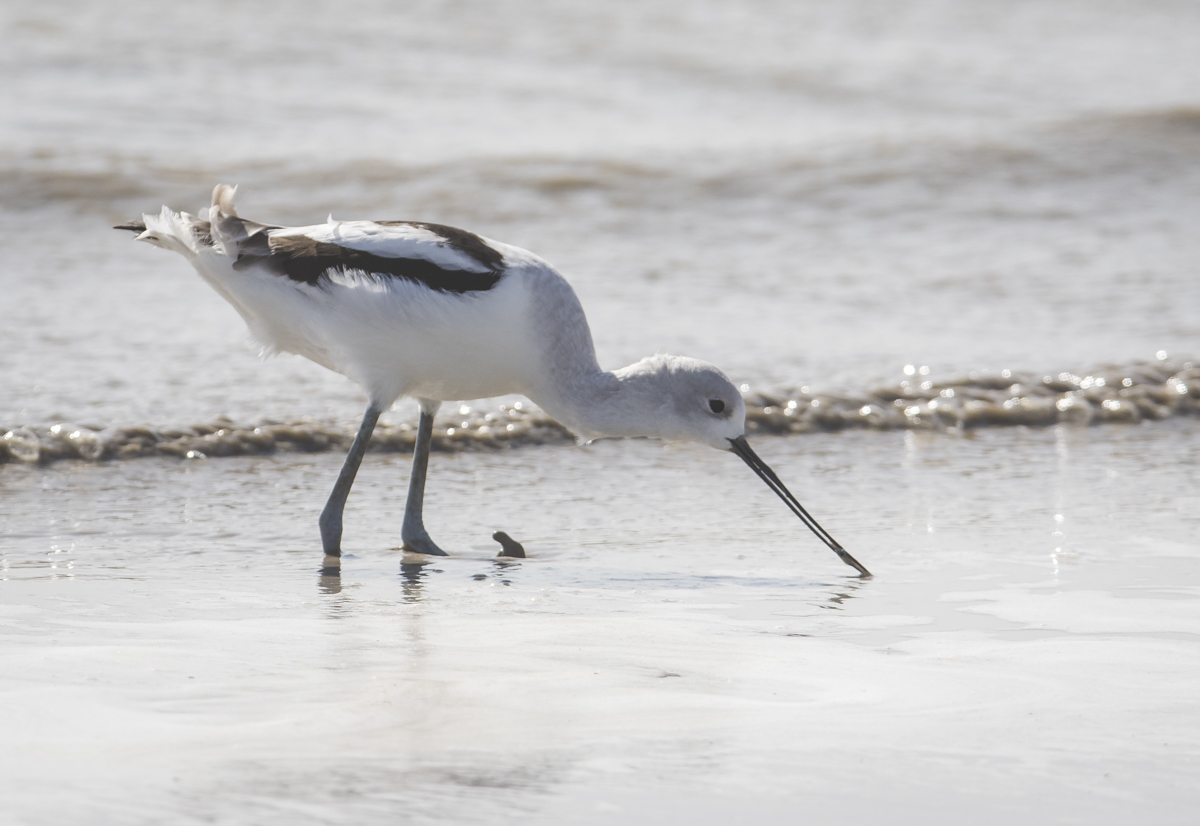
After a morning on the prairie, we headed to a couple of other public lands, Cheyenne Bottoms Wildlife Area and Quivira National Wildlife Refuge. We were sort of in between peak times for migrating shorebirds and Sandhill Cranes for these two areas but we saw a lot of gulls, waders, and shorebirds nonetheless (especial American Avocets, one of my favorite shorebirds). We first stopped at the Kansas Wetlands Education Center, a great starting point for a birding exploration of the region. I definitely would like a return visit in the future (Whooping Cranes are also regular visitors during migration).
American Avocet feeding in one of the ponds at Quivira National Wildlife RefugeRoadkill Massasauga (a small species of rattlesnake) on a refuge road
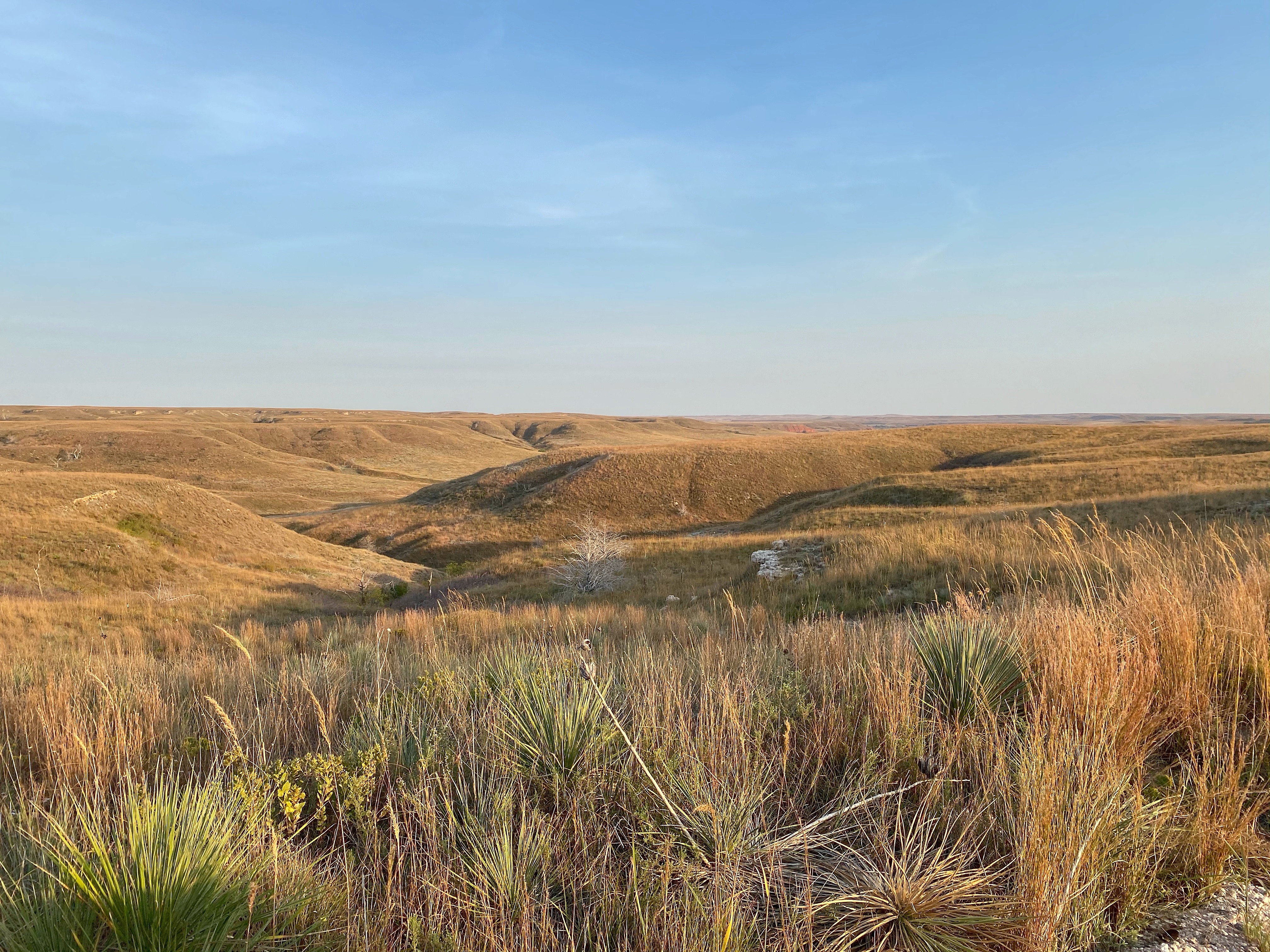
Driving through parts of Kansas involves incredibly straight stretches of highway through some of the flattest landscapes you will ever encounter, so it was quite a surprise to suddenly come upon a series of deep canyons as we approached our next campsite at Clark SFL.
The sudden appearance of canyons at Clark State Fishing Lake
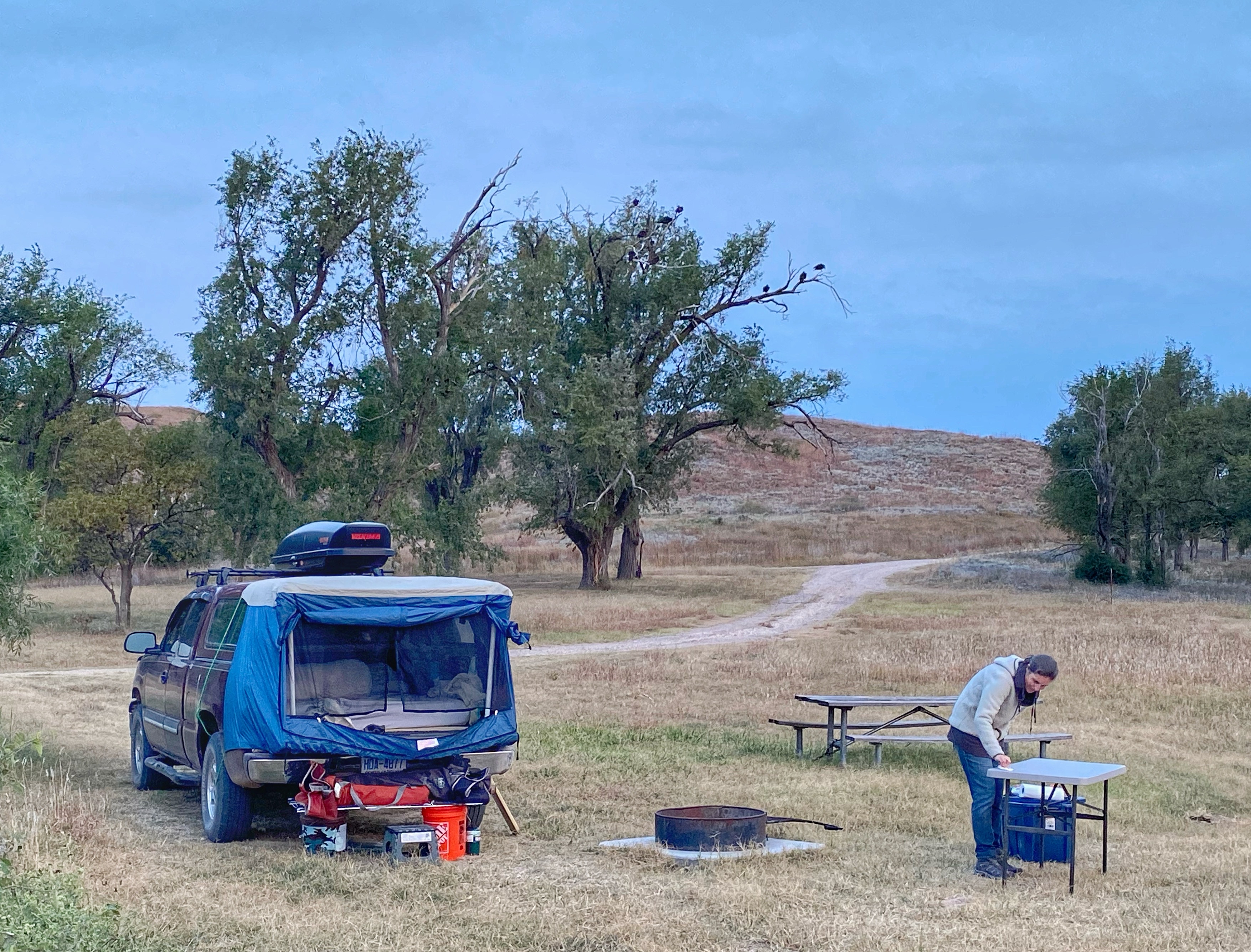
Once again, the campsites were beautiful and there was only one other camper on the lake. We settled on an isolated site that ironically had a vulture roost adjacent to our site (is that a bad sign?).
The real buzzard’s roost at this campsite (a large group of vultures roosted in the trees near us)
The next morning we drove the rough road up out of the canyon and headed out across the flat plains dotted with wind turbines and hay rolls. We eventually hit a landscape more suitable to raising crops, and drove for miles seeing almost no wildlife other than meadowlarks.
Making a living on the high plains
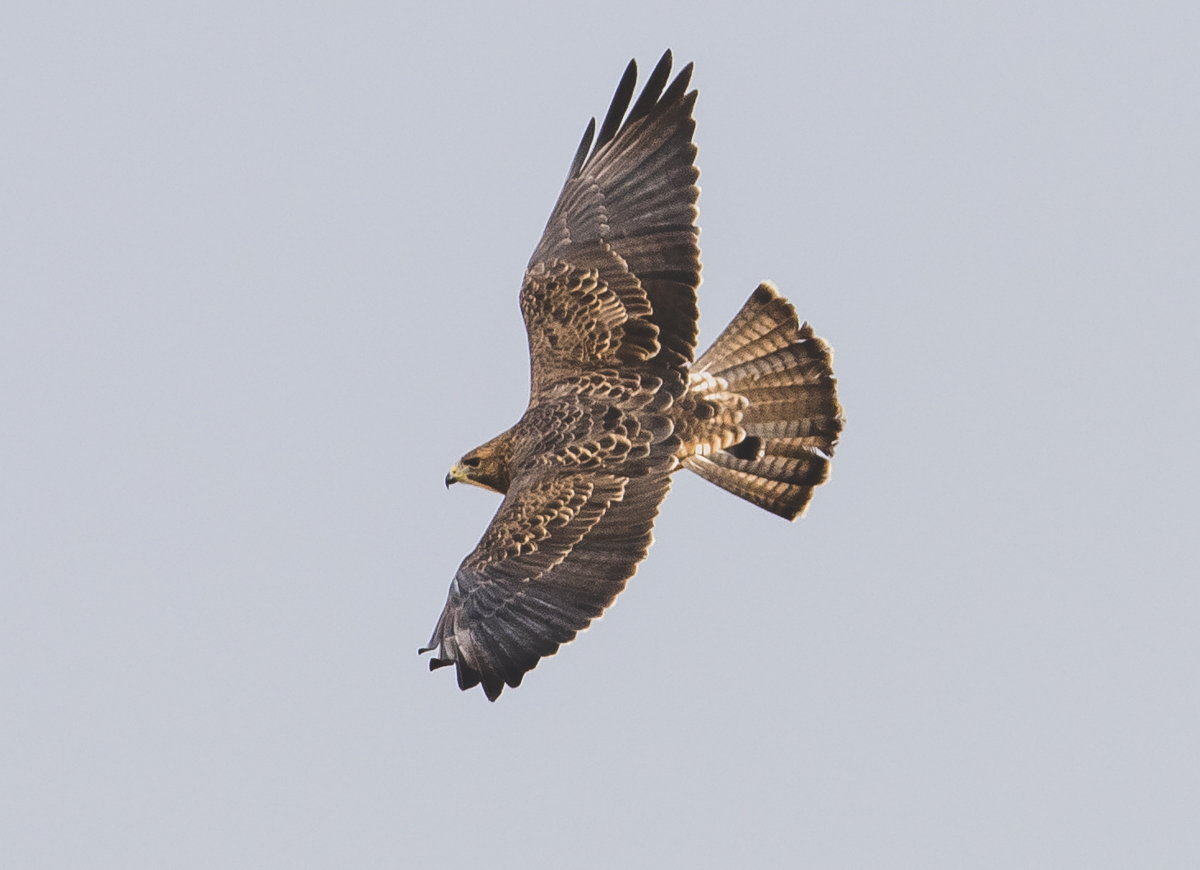
Then we hit a stretch of recently harvested cornfield with a large group of raptors soaring overhead. We pulled over and started glassing the birds to try to identify them. It turned out to be a huge group of migrating Swainson’s Hawks. This species tends to migrate in groups (called kettles) and are particularly common in October over the plains where they often can be seen doing just what this group was doing – feasting on insects and small rodents found in crop fields. The strong northerly winds blowing across the open landscape of this region undoubtedly help these birds in their long migration to their wintering sites in the vast grasslands of Argentina.
We pulled over to watch about a hundred hawks moving over and on the fieldsHawks (the dark spots) dotted the corn stubble, presumably feeding on grasshoppers and other insectsA Swainson’s Hawk in migration
We detoured a bit to visit Cimarron National Grasslands in southwestern Kansas, the largest tract of public lands in the state, and the only one in Kansas administered by the U.S. Forest Service. Let’s just say it was an interesting side trip. The bulk of the grasslands seemed to be dry and overgrazed, but did have some nice camping spots along the Cimarron River. One particularly interesting spot was what we decided was the Kansas equivalent of NC’s Pilot Mountain, a high point in the seemingly endless landscape of sage and grasslands. It had the unimaginative name of Point of Rocks, and, though it appeared as only a slight rise on the horizon as we approached, is the third highest point in the state at 3,540 feet.
Point of Rocks, KS
It was an important landmark along the famed Santa Fe Trail, an 800-mile wagon route that was an important trade link between Mexico and the eastern U.S. from 1821-1880. This “high point”, along the Cimarron River (note the greenery along the river corridor compared to the distant dry grasslands) was a critical stopping point due to the nearby water source for thousands of wagons that made this six to ten week journey across this seemingly endless and dry terrain. The wagon ruts from those trading caravans can still be seen in many places along the trail.
Look closely and you can see the wagon ruts cutting across the landscape on this portion of the Santa Fe Trail
This leg of driving in southwestern Kansas and southeastern Colorado was the most barren of our trip. At one point, we took a county road (dirt and gravel) where the speed limit was 55 mph and we drove that straight as an arrow for over an hour (passing only one other vehicle) across dry, flat fields and the occasional farmstead every 10 or so miles. I can’t imagine eking a living in such a place, but there are some hardy souls that seem to manage it. Our next campsite would be in the mountains of Colorado!


































 Roads End Naturalist