I wonder what it would be like to go into a forest where nothing had name. How would we act in a forest if there were no names for anything smaller than an ecosystem? How could we walk, if there were no way to talk about anything larger than a cell?
~Kathleen Dean Moore
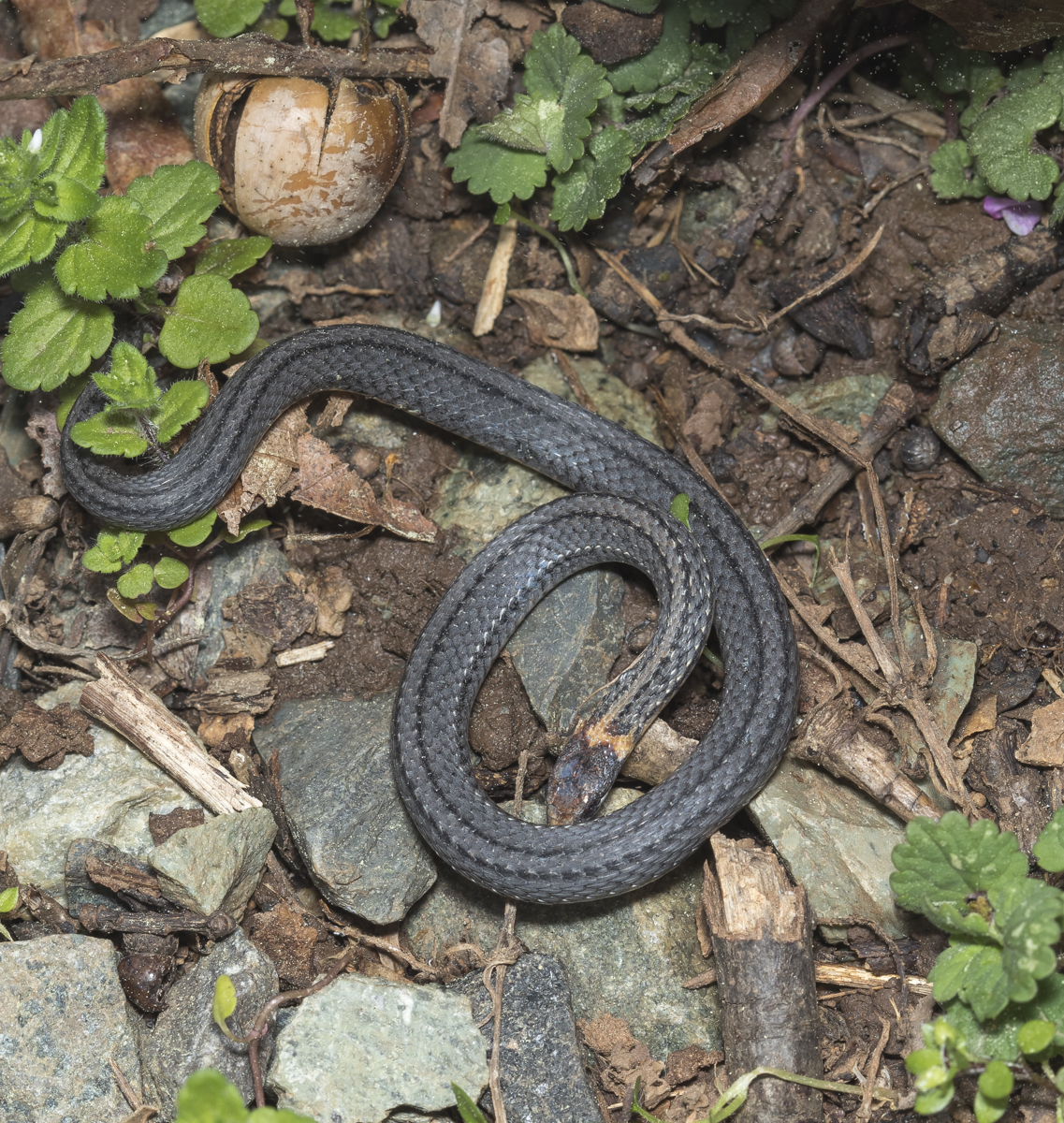
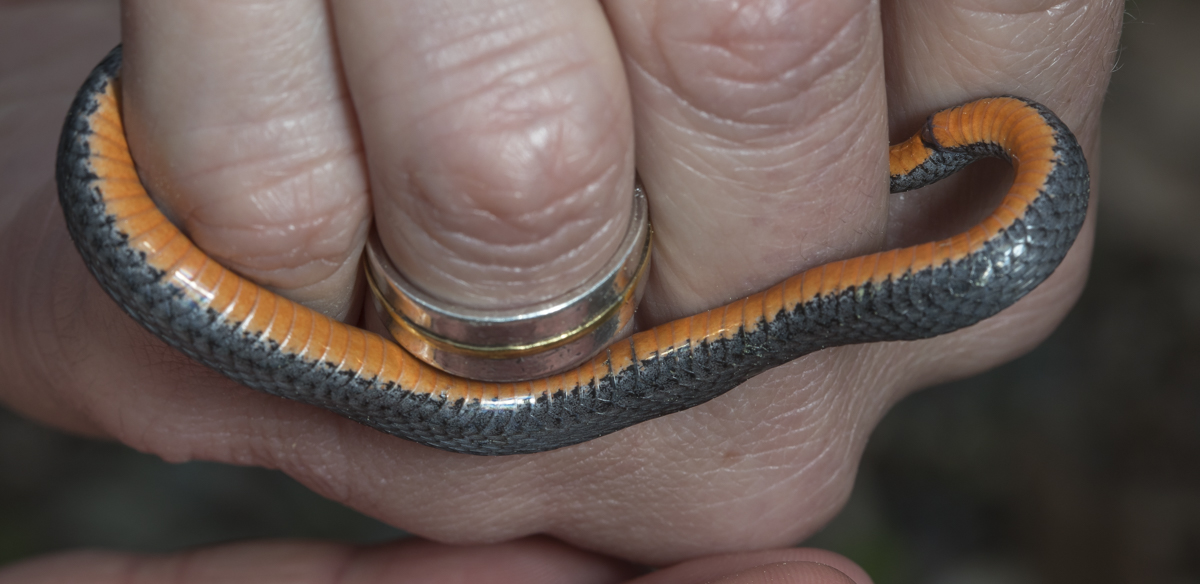
When I am trying to get people excited about the natural world, I like to help them find identities for the things we observe. To name something is to know it a bit better. To know it is to open the door for wondering about it, and, hopefully, caring about it. So, today we will try to learn the name of something Melissa found in our yard a couple of weeks ago. Perhaps you have seen one of these small snakes, or something similar, in your own yard. I want you to use your observation skills and see if you can identify this creature by either using one of your own field guides or looking it up online. Here are a couple of useful links that may help (Reptiles and Amphibians of NC and the Virginia Herpetological Society). Be sure to zoom in on the photos and take a closer look. The answer and more information tomorrow. You herp people out there, hold your answers until tomorrow.
Small snake Melissa spotted in our yard (click photos to enlarge)If you look underneath, some color is revealed
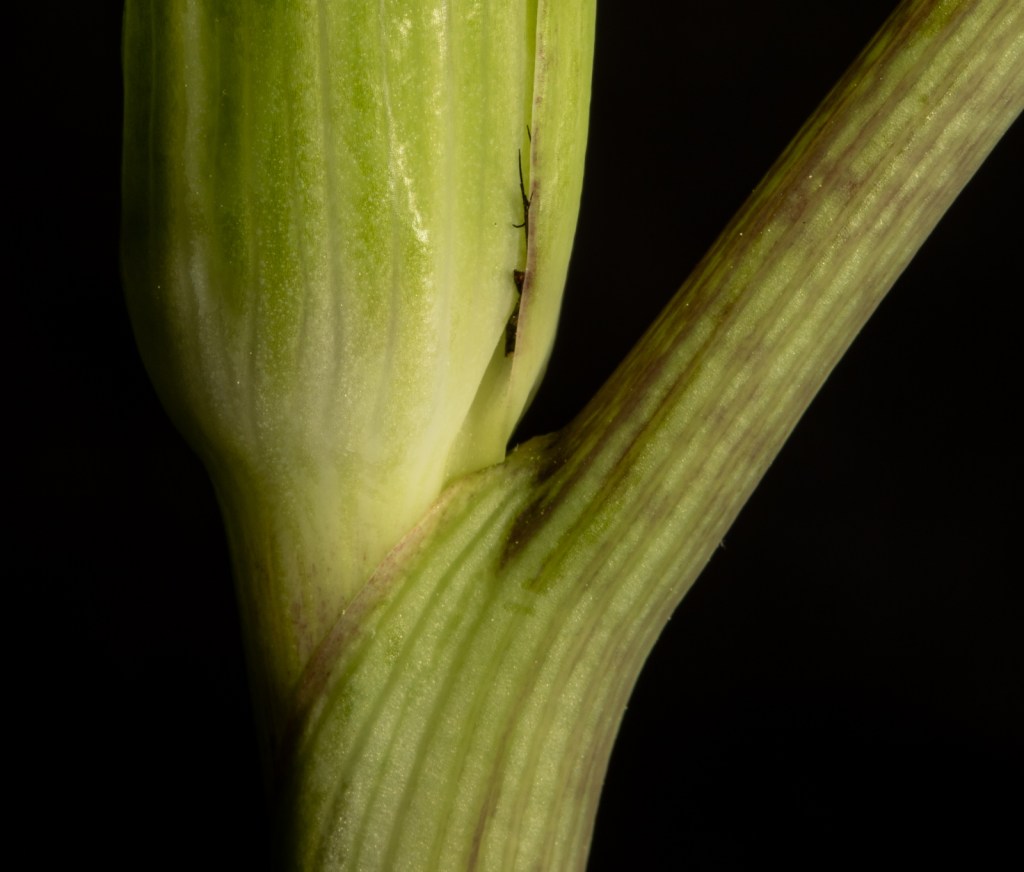
And now for another mystery…I saw this earlier this week in our yard…what is it?
The Lord chose to reveal his power and his love through two human faces: the face of his divine Son made man and the face of a creature, a woman, Mary. Women make their contribution to the Church in a way that is properly theirs, by making present the tender strength of Mary, the Mother… In a synodal Church, those women who in fact have a central part to play in Amazonian communities should have access to positions, including ecclesial services, that do not entail Holy Orders and that can better signify the role that is theirs.This would also allow women to have a real and effective impact on the organization, the most important decisions and the direction of communities, while continuing to do so in a way that reflects their womanhood.
~Pope Francis, on the ordination of women, in “Querida Amazonia”
Women may still not be allowed to be Catholic priests, but in the plant world, they’ve taken their place at the pulpit – Jack-in-the-Pulpit’s pulpit, that is! We have several clumps of this interesting native plant in our yard, and they’ve started to produce their strange blooms just in time for the Easter edition of the flower parts series!
Jack at his pulpit. And no, that’s not a heavenly light coming down… it’s just the camera flash!
Jack-in-the-pulpit (Arisaema triphyllum) is perhaps one of the strangest flowers I’ve examined to date. It’s dioecious, meaning it has male and female flowers on different plants. Not only that, but depending on how healthy the plant is, it will change its sex: it can produce no flowers, male flowers, or female flowers from one year to the next. Because producing fruit takes the most energy, only very healthy, well-stocked plants will produce female flowers. Typically, female flowers are borne on plants with two leaves. Male flowers take less energy to produce than female flowers, and they are typically borne on plants with only one leaf.
That’s not poison ivy! It’s the compound leaf of a jack-in-the pulpit plant. So make sure you double-check your identification so as to not remove one of these amazing, native wildflowers from your yard accidentally!
I was reticent to remove one of the blooms because we don’t have too many in our yard. A quick survey showed that we have about 10 male flowers and only 3 or 4 female flowers. But Mike found one that had been cut by a rabbit, which gave me a chance to examine it further.
Jack-in-the-pulpit male inflorescence
The two most noticeable parts of the Jack “flower” are the hood (the pulpit) and Jack himself, inside the pulpit. These two parts caused me to learn yet another few botanical terms. The pulpit is technically a spathe, which, according to the trusty Plant Identification Terminology: An Illustrated Guide (by Harris and Harris) is a type of bract that often encloses the flower. (Remember the dogwood bracts from my previous post?) Inside, “Jack” is technically called a spadix which is “a spike with small flowers crowded on a thickened axis.” (And I thought spadix were those tight shorts I used to wear under my soccer uniform…:)
One feature to note is the small hole at the bottom of the inflorescence, right where the bract meets the stem.
Hole at base of bract on a male flower
Mike knew that this hole was only a feature of the males. For comparison, here’s the base of a female.
Female flower – note the lack of a hole at the base of the bract.
More on this difference in a moment… For now, back to the male flower. Since the rabbit had done its dirty work of cutting the inflorescence, I went ahead and took advantage of having it in hand and dissected it to show the flowers inside.
Male flowers
With the spathe removed, you get a clear view of the spadix. The swollen bits at the bottom that look a little bit like snail eye tentacles are the male flowers.
Even closer view of the male flowers
The flowers are lacking sepals and petals. The tentacle-y bits are the stamens. Because they’re male flowers, they don’t have a pistil either. As the flower develops, the stamens will begin to produce pollen. I read on the New York Botanical Garden website that each male flower has 4 stamens. In my pictures, it looks as though there are two tentacles per flower, and if you click on the photo and enlarge it as much as possible, it indeed looks like there’s two round bits at the tip of each tentacle, which would mean 4 stamens per flower.
Mike and I went outside to take a look at a female inflorescence. This was a little tricky because I didn’t want to pick it, but still wanted to be able to show the flowers down inside the spathe. Here’s a female, rising from a plant with two leaves.
Female inflorescence
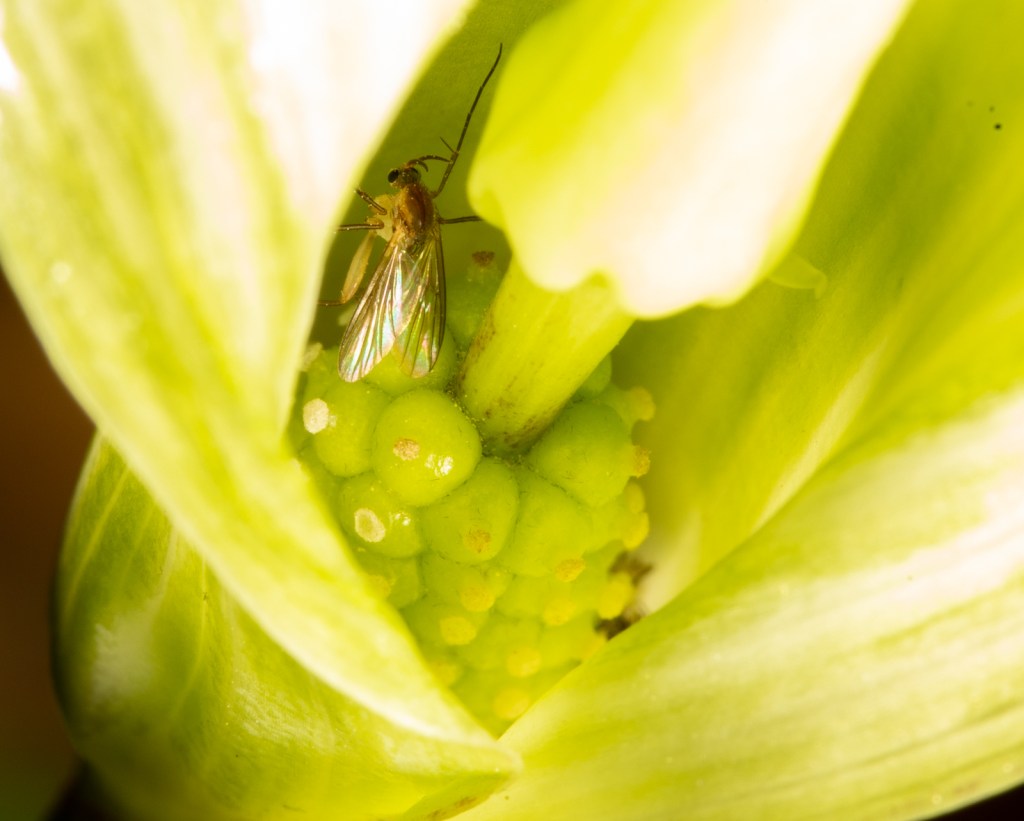
Again, note the lack of a hole at the bottom of the bract. We were in for a surprise as we began to examine the flower more closely. Mike helped me pull back the top of the spathe to take pictures down the gullet of the flower… and lo and behold, we found a cauldron of gnats!
I had read in the always-informative Stokes Nature Guides: A Guide to Enjoying Wildflowers by Donald and Lillian Stokes that there might be some flies, likely fungus gnats, inside of the flower. However, I wasn’t expecting quite the swarm we found! Apparently, the flowers emit an odor that mimics the scent of fungus, which is where these flies like to lay their eggs. The hooded spathe, with lines that guide insects toward the bottom and lighter coloration at the bottom, lures flies in. Think about how, if you have a fly in your house, it tends to hover around your windows – flies tend to seek light. So having more light at the bottom of the tube means the flies will fly to the bottom and get trapped. This plant functions very similarly to a hooded pitcher plant, which acts in much the same way (minus the fungus smell).
This is where that hole at the bottom of the bract comes in handy. On the male flowers, the gnats roam around and get coated in pollen… but most eventually find their way out via that hole. In the female flower, there’s no exit hole, and the gnats may never find their way out, poor souls. But this likely helps ensure that the female flowers are pollinated. Fortunately for the flies, though perhaps not the flowers, as we continued to manipulate the plant to try to expose the female flowers, many of the gnats were able to escape, though most stuck around and kept trying to get back in!
After much more uncomfortable kneeling and fingers and hands getting in the way of pictures, with Mike’s help I was able to get some photos of female flowers.
Female flowers
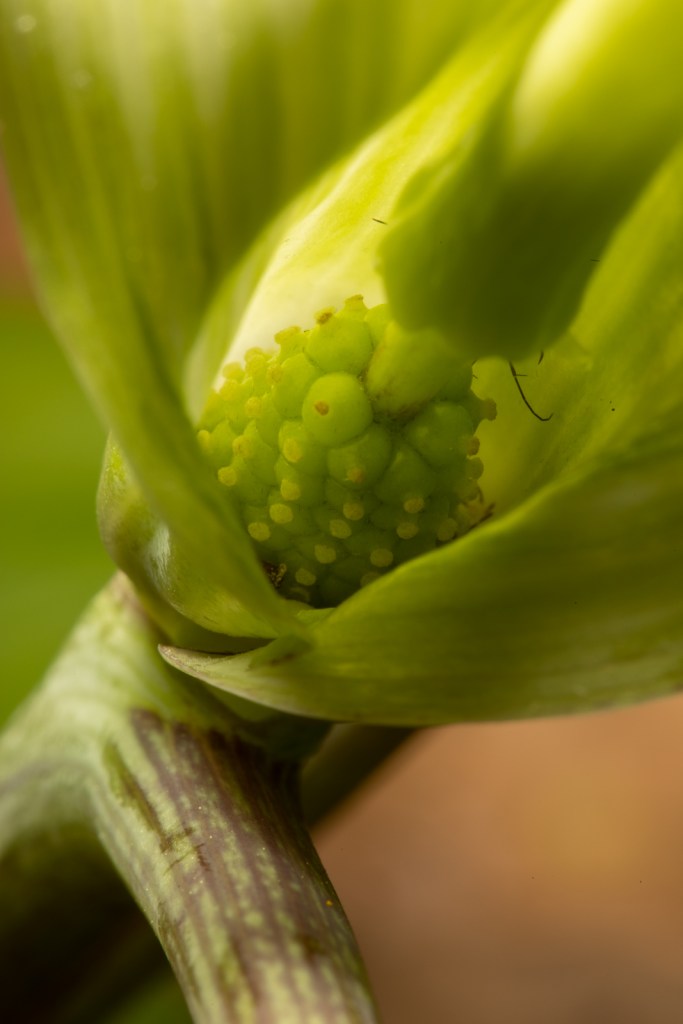
You can see in this image each female flower is basically a swollen green ovary with a yellowish knob protruding – the knob is the stigma.
I think I owe you all a note on botanical terminology here. In all of my flower parts posts, I’ve been careful in my use of the word “flower.” For instance, I called the dogwood “flower” a bloom, blossom, or inflorescence and NOT a flower because the flowers are actually the tiny parts in the middle. However, in this post, I’ve found it harder not to call the inflorescence a flower. The less-technical “bloom” and “blossom” just don’t seem appropriate in this case, and inflorescence is quite a bulky word. However, technically, this mostly green leaf-like thing is not a flower, it’s an inflorescence. The flowers are what’s at the bottom of the spadix: the tentacle-like male flowers or swollen, stigma-bearing female flowers. I hope the botanists of the world will excuse my imprecise use of terminology in this case!
Even closer look at the female flowers… and one of their pollinators!
Hopefully these female flowers got pollinated by the fungus gnats before Mike and I let them all escape. If so, this plant will produce a beautiful cluster of berries in the fall, when the spadix will wither at the top, and each ovary will swell and turn brilliant red.
Keep an eye out for these amazing plants on your next socially distant hike in the woods, and if you see one, take a careful look to see if it’s Jack, or maybe Jill, in the pulpit!
Its nest is composed of the frailest materials, and is light and small in proportion to the size of the bird.
~John James Audubon on the nest of what he called the Blue-grey Fly-catcher
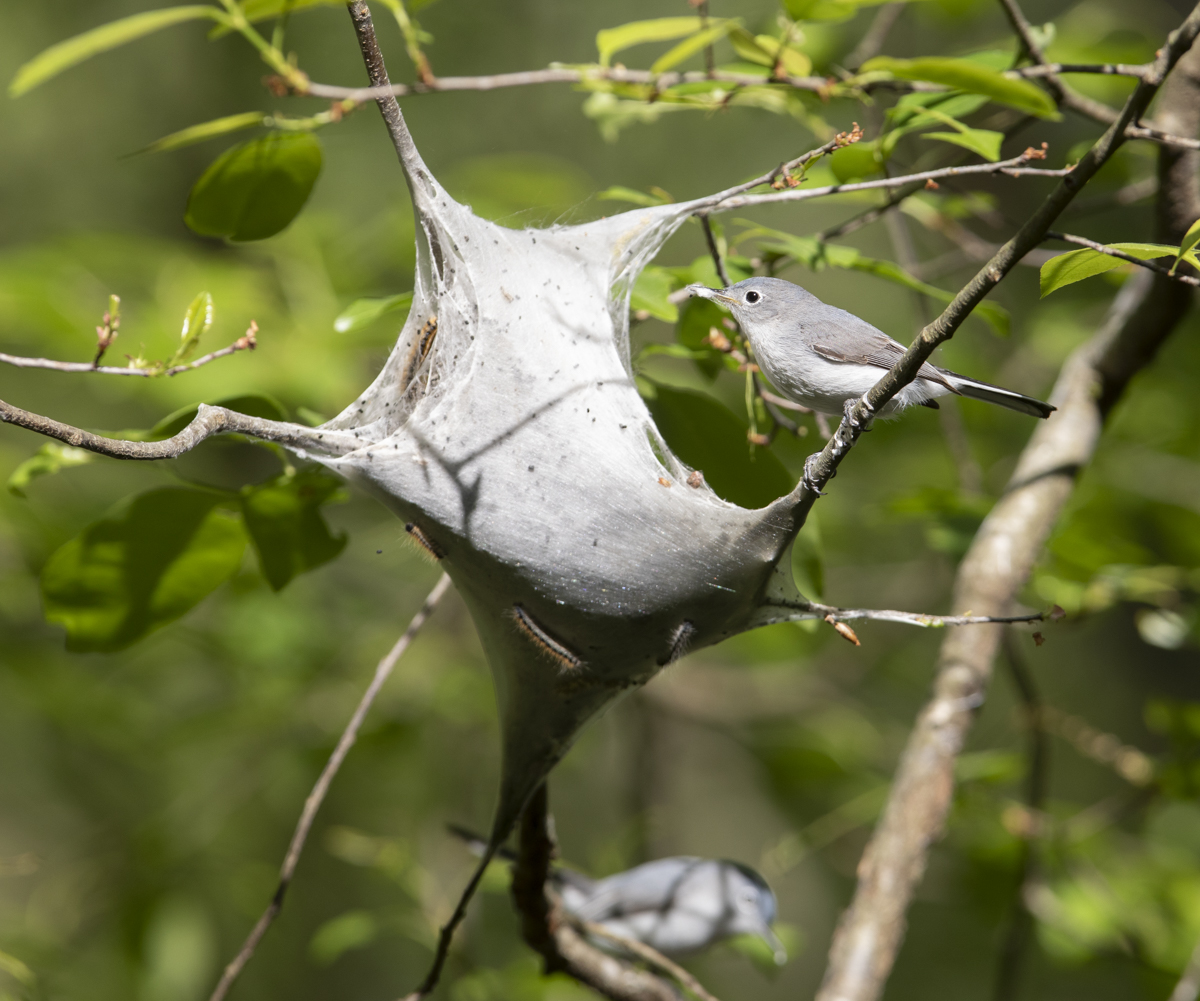
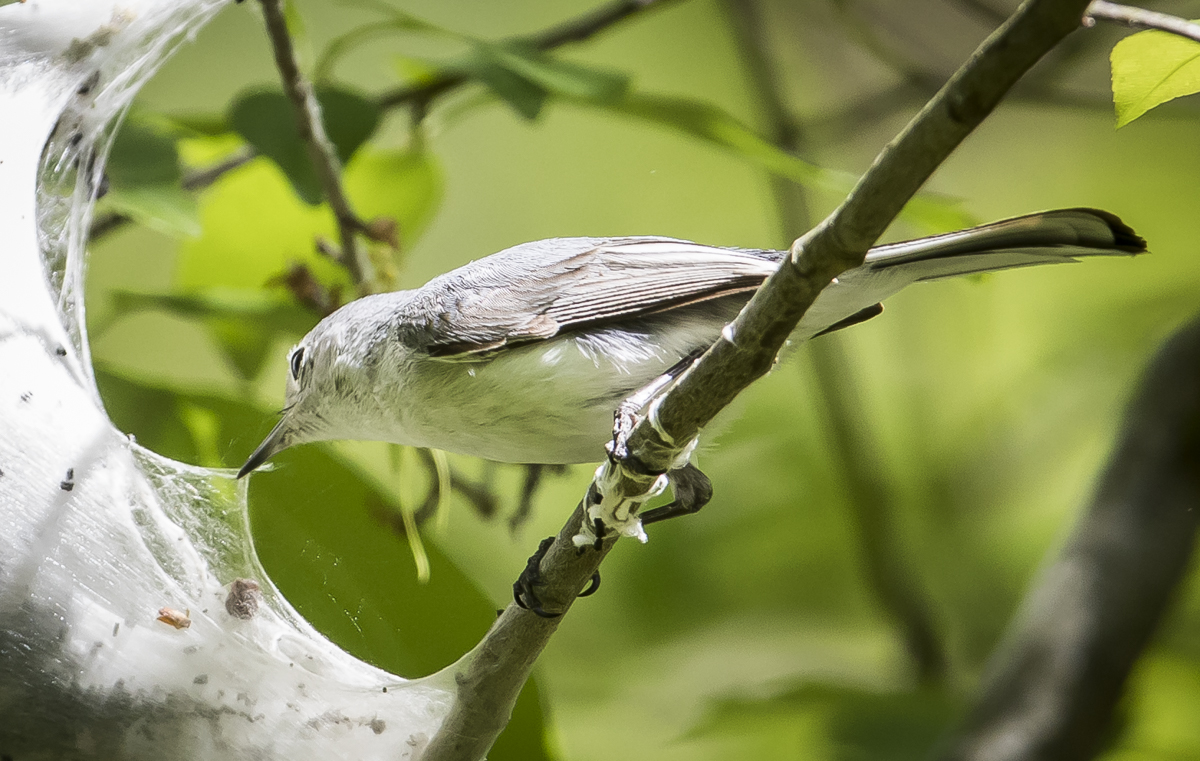
A friend and co-worker of Melissa says the wispy call of the Blue-gray Gnatcatcher (Polioptila caerulea) sounds like a faint “Steve”. So, a couple of weeks ago, when I heard Melissa call out, “Steve”, while scanning the treetops, I knew the little dynamos had returned. Their faint song is pretty much out of my hearing range these days, so it wasn’t until a few days later that I spotted my first one, flitting around some tree branches, waving its seemingly too long of a tail back and forth as it snapped up insects too tiny for me to see through my binoculars. Then, last week, we spotted two together at a small Eastern Tent Caterpillar nest on a cherry tree off our deck. The gnatcatchers were pulling silk from the caterpillar nest for use in their own. In the past two weeks we have also seen Tufted Titmice and Carolina Chickadees at these caterpillar structures, although I only saw the chickadee pull out a couple of the larvae and then drop them (they may be too hairy for their tastes). Gnatcatchers make a beautiful nest similar in construction to that of a Ruby-throated Hummingbird, but larger. I wrote about watching a nesting pair at the North Carolina Botanical Garden in an earlier post. Here is a photograph of that nest showing the cup-like structure made of lichens, lined with plant fibers, and held together with spider and insect silk.
Blue-gray Gnatcatcher in nest from an earlier post (click photos to enlarge)
A couple of days ago, Melissa was working on a museum project out on our porch and told me she noticed that the gnatcatchers had been making regular visits to the caterpillar webbing closest to our deck. I grabbed the camera, my 300mm lens, and a tripod, and took up a position on the deck steps. I spent the next two hours waiting and watching. A few times I was rewarded with a frantic minute or so of trying to capture the quick movements of their behavior as they gathered silk.
The tent caterpillar nest with both gnatcatchers collecting silk – the female at the main web, the male puling from the silk trails left on the branches by the foraging larvae
There were four silk-snatching visits during the time I sat there, mostly by the female. On two occasions, the male accompanied her and gathered some silk from nearby branches while she pulled from the main web structure.
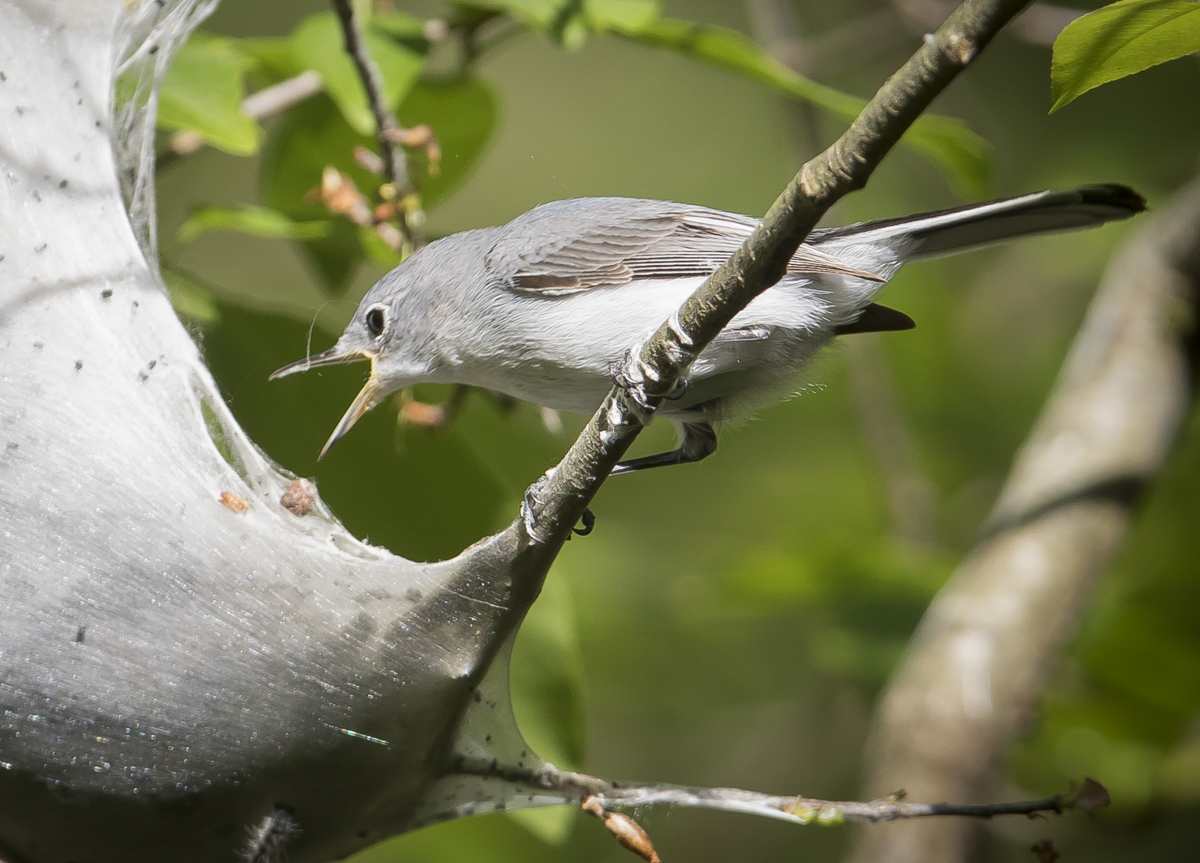
Gnatcatcher snapping up strands of silk
This look reminded me of how I feel with a mouthful of gooey campfire-roasted marshmallows
She pulled at the webbing from different vantage points on different visits
She usually snapped at the silk rather than picking at it with just the tip of her bill
Then she would pull until the silk broke free
After several pulls, she would fly off with the “glue” that holds her delicate nest together
The birds flew off in the same direction each time, so we will be looking for their nest in the coming days. But, I’m afraid the ones we have found here in the past (up to 75 feet up in the treetops) have not been as cooperative for viewing as the one at the garden.
Delicate, perfumed phlox; A mist of columbine, clinging to earth; Phoebe’s gravelly voice, Titmouse — tender, sweet; A dogwood cloud hover above Vibrant, fresh leaves.
Fleeting Falling flowers, already spent; A garden, no longer my own.
A spring, a garden, will come again; At home in the hope, the beauty.
Bittersweet and fast-fading.
Always returning!
Mike has shared some of my poetry on his blog in the past; the poem above is another of mine. In fact, it’s the first I wrote as an adult. I went to a poetry session at an Outdoor Classroom Symposium at the NC Botanical Garden that was taught by a couple of teachers from South Carolina. The teachers gave us a few templates to get started, and sent us out along the garden paths to write. I found a spot amid a patch of beautiful columbine flowers. The first activity was simple – use your senses to observe the world around you, and pay attention to how that makes you feel. The poem above is the result of that short, sweet writing exercise. I have used the same simple steps many times since then in my own writing, and I’ve shared that activity with numerous teachers through my work. I’m incredibly grateful to those two teachers for reintroducing me to the world of poetry-writing!
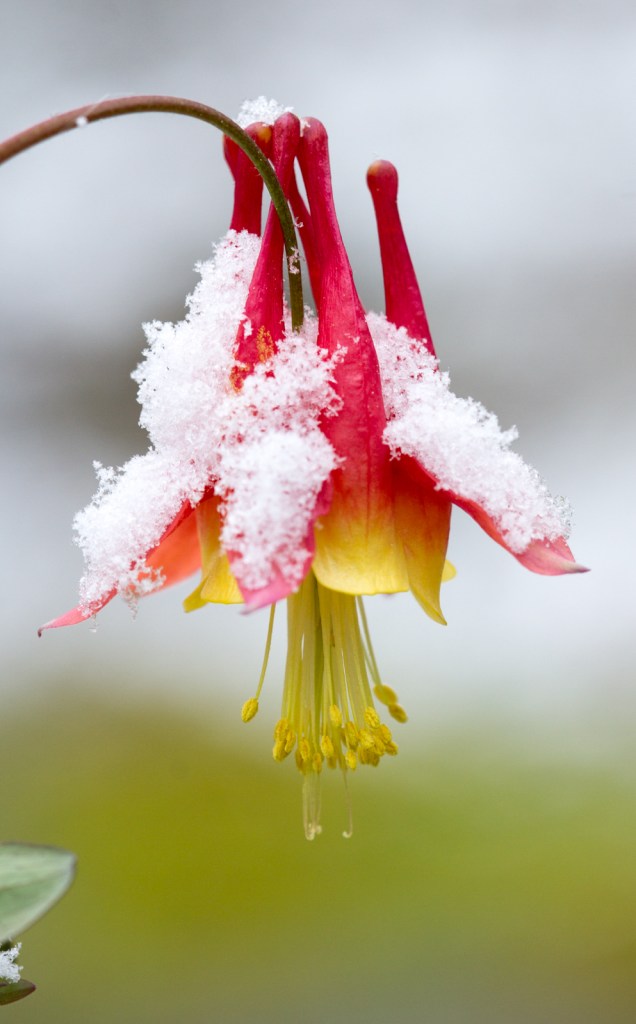
But now, it’s time for our next flower parts adventure… this time we’ll take a close look at wild columbine (Aquilegia canadensis). Wild columbine is one of my favorite spring wildflowers, and we have an abundance of it in our yard. The flowers hang on delicate stems and look like they’re floating above the ground. Each plant produces numerous blossoms over the course of at least a month in our yard. In fact, a couple of years ago, one of the earliest blooms managed to get caught in a late winter snowstorm…
Wild Columbine in snow, March 12, 2017
Because its so ubiquitous, it was an early target for my plant parts explorations – I didn’t feel too terrible taking a few blossoms off the plants when they were so numerous! Like the wood poppy, it is a simple flower, but because of the odd shape of some of its parts, it’s a little more challenging. As with the wood poppy and dogwood flowers, my first task was to find the sepals.
Columbine flower
Given the overlapping nature of the flower’s structure, this was tricky. Which are the sepals, which are the petals? I took off one of each to see if I could tell…
Columbine flower with 1 sepal and 1 petal removed… but which is which?
It was still difficult to tell which was which, even after removing one of each part, though it seemed as though the smaller, leaf-shaped parts were attached higher up on the stem than the long, spurred ones, which would make them the sepals. I looked for some flower buds for confirmation, and indeed, the leaf-shaped part enclosed the bud before it opened. Mystery solved!
Columbine flower buds
In these two images, you can see how the petals’ spurs extend and start turning red very early in the flower’s development. In the image on the right, you can even notice the developing stamens inside the flower bud; and in the right-hand image, the elongated stalks extending out of the flower bud are the undeveloped pistils (more on that in a moment). The spurred petals have a nectar reward in the bulb at the top where long-tongued pollinators like butterflies and hummingbirds can access it (while conveniently rubbing their bodies or heads on the stamens or pistils).
Since columbine blooms for so long in our yard, it was easy to trace the development of different parts of the flower by finding a sequence of ripening flowers.
Developing Columbine flower
In an early bloom, the stamens, with club-like yellow anthers on the end, slowly uncurl, with the interior stamens dropping first. Notice how, at this point, the stamens and pistils are about the same length. As the flower continues to develop, that changes.
The flower in the next two pictures is further along than the last one, and you can see how nearly all the stamens have fully uncurled. The pistils have also lengthened, and their tips have opened up as they’ve become receptive to pollen.
Mature Columbine flower
An interesting pattern among many flowers is that their parts often occur in multiples. The columbine is a great example of that. It has 5 sepals, 5 petals, and 5 pistils. And when I took the time to count the stamens on one flower, there were 40 of them (which is a multiple of 5!). Another example of this is with Easter lilies, a flower you might be familiar with, and perhaps appropriate to mention as we approach Easter weekend. Easter lilies (as well as other lilies) have 3 sepals, 3 petals, 6 stamen, and 1 three-pronged pistil. Maybe this is a new tool for teaching the multiplication tables for those of you who are now homeschooling your kids?
When the columbine flower is finished blooming, the sepals, petals, and stamens fall off, leaving only the 5 pistils behind. They slowly turn upright and the ovaries at the base begin to swell. Eventually, they will open up like 5-sectioned cups, full of dark-colored seeds that bounce out when you brush up against the plants. But for now, the seeds are still developing.
Upturned pistils with swelling/ripening ovaries
As with the wood poppy, I gently opened one of the one of the ovaries to see the seeds developing inside.
As with the other species, I was again fascinated by the way the columbine has adapted its structures to an entirely different arrangement. Flowers are so cool!
We are all naturally seekers of wonders. We travel far to see the majesty of old ruins, the venerable forms of the hoary mountains, great waterfalls, and galleries of art. And yet the world’s wonder is all around us; the wonder of setting suns, and evening stars, of the magic spring-time, the blossoming of the trees, the strange transformations of the moth…
~Albert Pike
We have a couple of species of native phlox (that I purchased at my last place of employment, the NC Botanical Garden) in our yard and this time of year it really puts on a show. It has also been attracting a few pollinators on these past few warm days. Most afternoons, the air space above our flowers is crowded with native bees, flies, butterflies, and other day-flyers.
Eastern Tiger Swallowtail nectaring at phlox (click photo to enlarge)
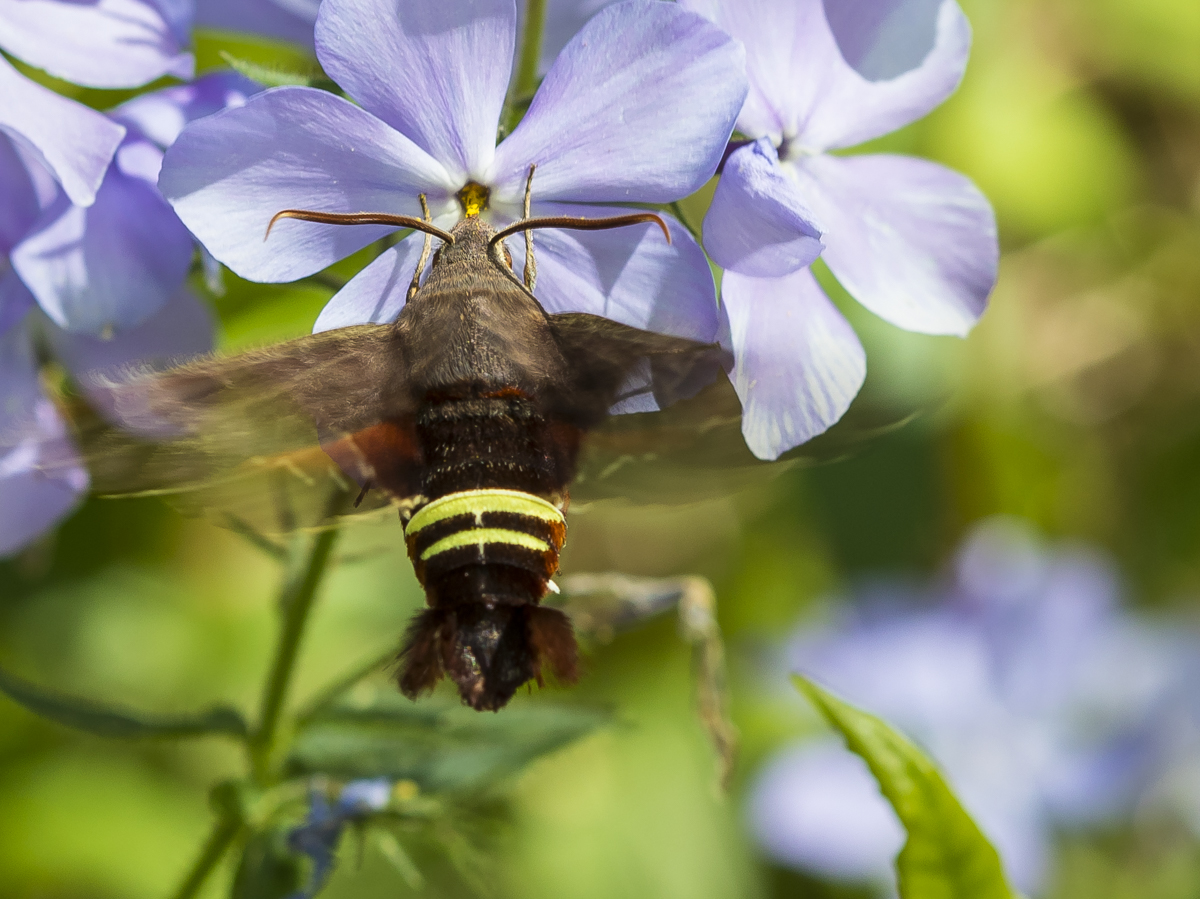
Recently, the warmth brought out a different group of day-flyers…the day-flying moths. One afternoon, while sitting on the front porch, we saw a large, dark insect hovering at the phlox flowers and then zipping on to the next. It resembled a bee from a distance, but moved faster than the usual bumblebee. As I approached, I could see it was a species of day-flying moth, a Nessus Sphinx.
I managed just a few pix of the Nessus Sphinx Moth (Amphion floridensis) before it whisked off
These rather robust moths are easily identified by their dark color and two bright yellow bands on their abdomen (which helps them look like a bee or wasp). Yesterday, I saw another one (same one?) hovering over the vegetation on our little slope of rock retaining wall that is a mish-mash of all sorts of vegetation, including two of this specie’s host plants – Virginia Creeper and Muscadine Grape. Here’s hoping for some larvae soon.
Freshly eclosed Hummingbird Clearwing Moth, Hemaris thysbe. Look at those blueish highlights along the segments of the abdomen.
My favorite day-flyer of the week was a Hummingbird Clearwing Moth that had just eclosed (emerged from its pupa). Last September, I was collecting a few caterpillars (as always) for programs and this little guy started wandering off from its plant one day, so I placed it in a butterfly cage with a little tub of dirt. After a couple of days of wandering, it formed a pupa in the soil. It spent the winter (along with a few butterfly chrysalids and some other moth pupae) in our unheated workshop so as to have exposure to the cold temperatures. About once a week, I spritzed the container with water to keep them from drying out. This is the first of the crowd to emerge. I took it outside and set it on one of the phlox flowers to warm up. This is probably the most intense colors I have ever seen on one of these moths (because it is so fresh) and you can see why some people can mistake them for tiny hummingbirds as they hover around flowers. After a few minutes of sunbathing, the moth flew off. We have lots of their host plants (Coral Honeysuckle and species of Viburnum) in our yard, so I expect to find some caterpillars later this summer.
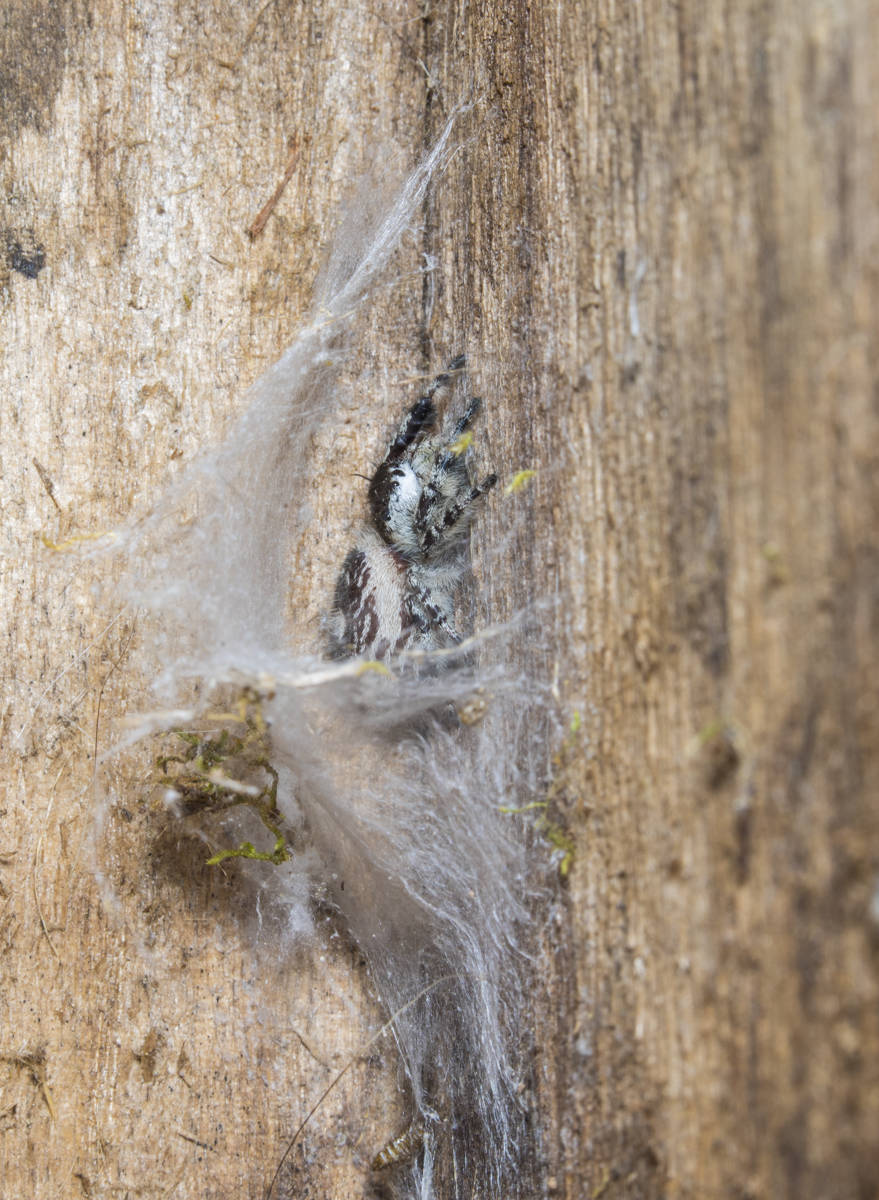
I hope you are enjoying Melissa’s wildflower observations. She will have more in coming days. But this morning I wanted to share something I found a few days ago and finally took the time to go photograph yesterday afternoon. We have a nest box out behind our fence in an open spot in the woods. Over the years it has had chickadees and wasps using it. I was walking by it a few days ago and opened it up to see if there was any nesting activity as yet. I pulled the nest cup out and it contained an old flattened chickadee nest (moss and hair on top). As I started to put the cup back in, I noticed movement in the back of the box – a huge jumping spider, probably the largest jumper I had ever seen. I made a mental note to come back with a camera. Well, it took two days for me to get back there and I assumed the spider might be gone, but when I opened it up…
Jumping spider in silk sac inside bird house (click photos to enlarge)
…she was still there! She (and I am guessing she based on her size, females are larger than males) had constructed a loose silk sac in one corner and was peaking out. I wanted to get a better image but I didn’t want to lose in her the leaf debris, so I had brought a large piece of white mat board to photograph her on. But, I had to gently coax her out first, which was not easy. She really did not want to leave that box. She finally climbed onto the stick I was using to gently herd her and I brought her out. Of course, being what she is, she then jumped and I was able to catch her in my other hand.
Jumping spider in my hand
She was a beauty, over a half an inch in length, bold markings on her abdomen, and the usual incredible jumping spider eyes. I lowered her onto the mat board, expecting her to dash off, but she just sat there and oriented toward me as I got down on the ground for a few shots.
A closer look at the exquisite jumping spider
She turned out to be en excellent model, allowing me to take several images while just moving slightly from time to time as I moved around her.
Here’s looking at you…
After a few minutes, I raised the mat board up to the entrance of the bird house, opened the door and gently blew on her. She took the hint and walked over and climbed back into the box. Back at my house, I picked up my copy of Spiders of the Carolinas, by L.L. Gaddy, and thumbed through the jumping spider section. It looks as though she is a Canopy Jumper, Phidippus otiosus. The large size and distinctive V-shaped pattern on the abdomen are diagnostic. This is a fairly common species in woodlands, so I am surprised I have never seen one (at least not one this large). I’ll be sure to check on her again, although, while I was trying to get her out of the box, a large queen bumblebee entered. I think she may be building a nest in the nest cup full of moss and hair. That may complicate my visits in the future.
Those eyes…and those lashes aren’t bad either.
Once again, there is so much beauty just outside our door.
Whereas, the Dogwood is a radiantly beautiful flower which grows abundantly in all parts of the State; and
Whereas, there is a great demand from all parts of the State that this Legislature adopt an official flower; Now, therefore,
The General Assembly of North Carolina do enact:
That the Dogwood be, and it is hereby, adopted as the official flower of the State of North Carolina.
In the General Assembly read three times and ratified, this the 15th day of March, 1941.
~H.B. 609, 1941
Most people are familiar with the flowering dogwood tree. Not only does it grow fairly abundantly in the wild, but it’s also frequently used in landscaping because of its beautiful white springtime blooms. It’s our state flower here in North Carolina, and also in Virginia (where it is both the state flower and the state tree). It’s the state tree in Missouri and the state memorial tree in New Jersey as well. While Virginia, Missouri, and New Jersey all specify that they’re referring to the flowering dogwood (Cornusflorida), North Carolina does not. But reading the declaration by the General Assembly, I’m going to go out on a limb (pun intended) and assume they meant the flowering dogwood, too.
Though I’m a proud transplanted North Carolinian, I must say that I think Missouri and New Jersey did a better job when they selected the tree rather than the flower for their state symbol. Because this is our state flower:
Dogwood flower
Yup, that’s it. Not only is it kind of unremarkable, but it’s only about 1/4″ long. Unless you’re a nature nerd, you might have been expecting to see a picture like this:
Flowering dogwood blossom
Because I am a nature nerd, I have heard many times that the white “petals” on a dogwood are not really petals; they are actually bracts. Back to everyone’s favorite Plant Identification Terminolog: An Illustrated Guide by Harris and Harris, a bract is “a reduced leaf or leaflike structure at the base of a flower or inflorescence.” Hmmm… those don’t look like leaves to me! But if you take a closer look at the center of the bloom, and refer back to my previous post about parts of a flower, you begin to see why.
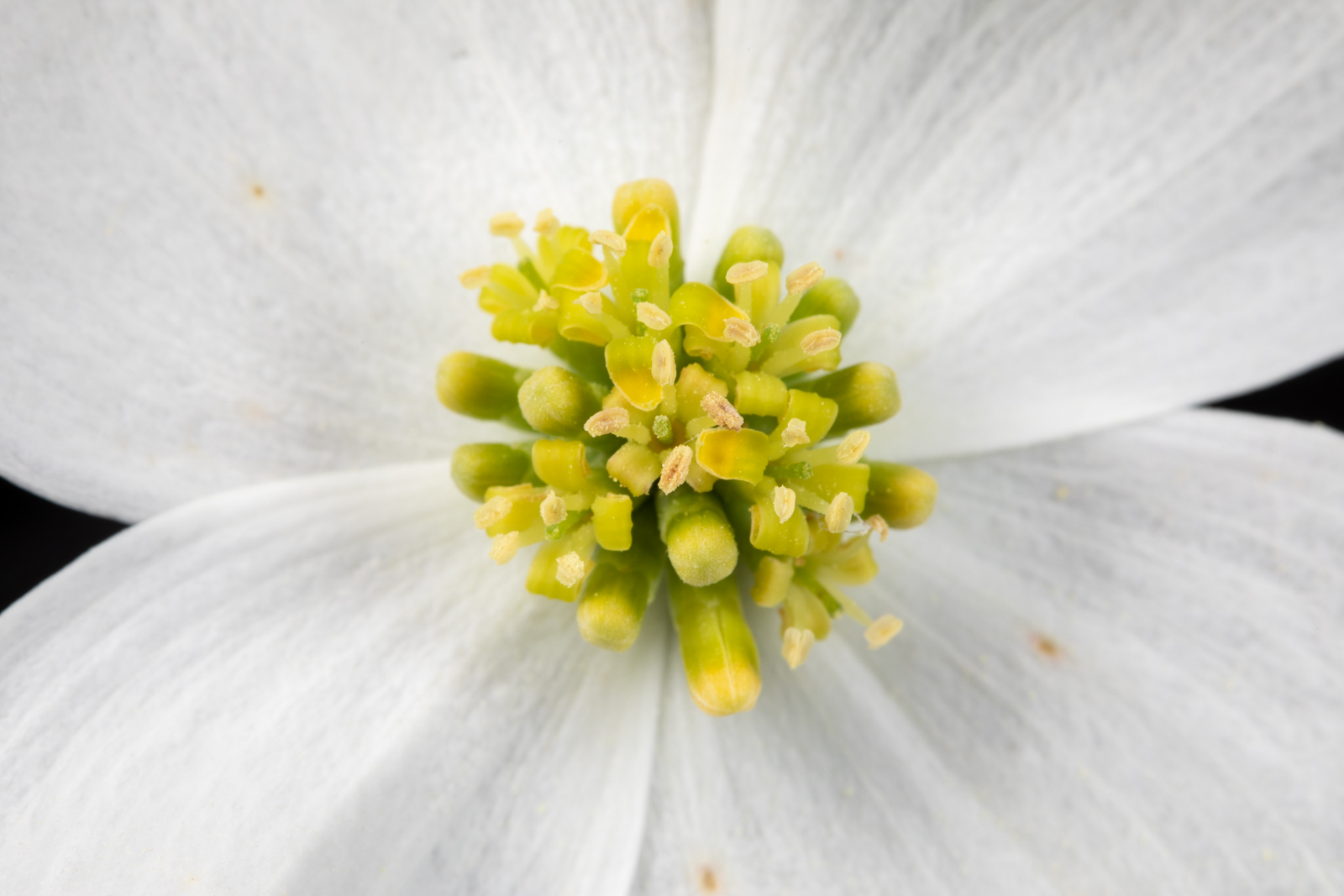
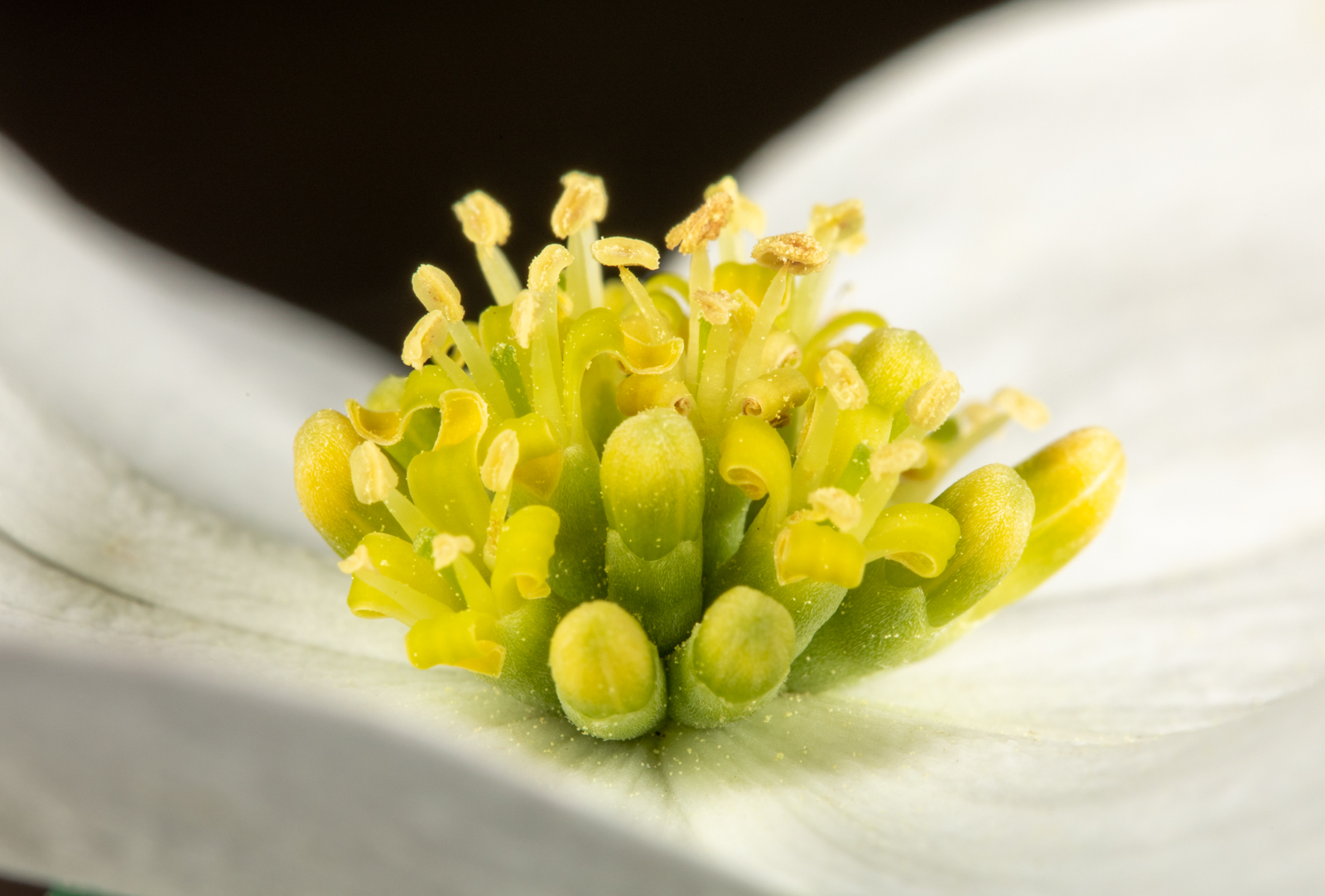
As we get closer, you begin to see the details of the real dogwood flowers.
The dogwood does not have a simple flower. Instead, it has a cluster of tiny flowers (florets) in the center of the inflorescence.
An even closer look at the dogwood flowers.
You can see in this image how some of the flowers are open, and others (notably the three right in front) are not yet open. Given my recent fascination with the parts of a flower, I couldn’t resist dissecting this flower to look more closely at it!
Cutaway of the dogwood blossom with 2 bracts and a few of the outer flower removed.
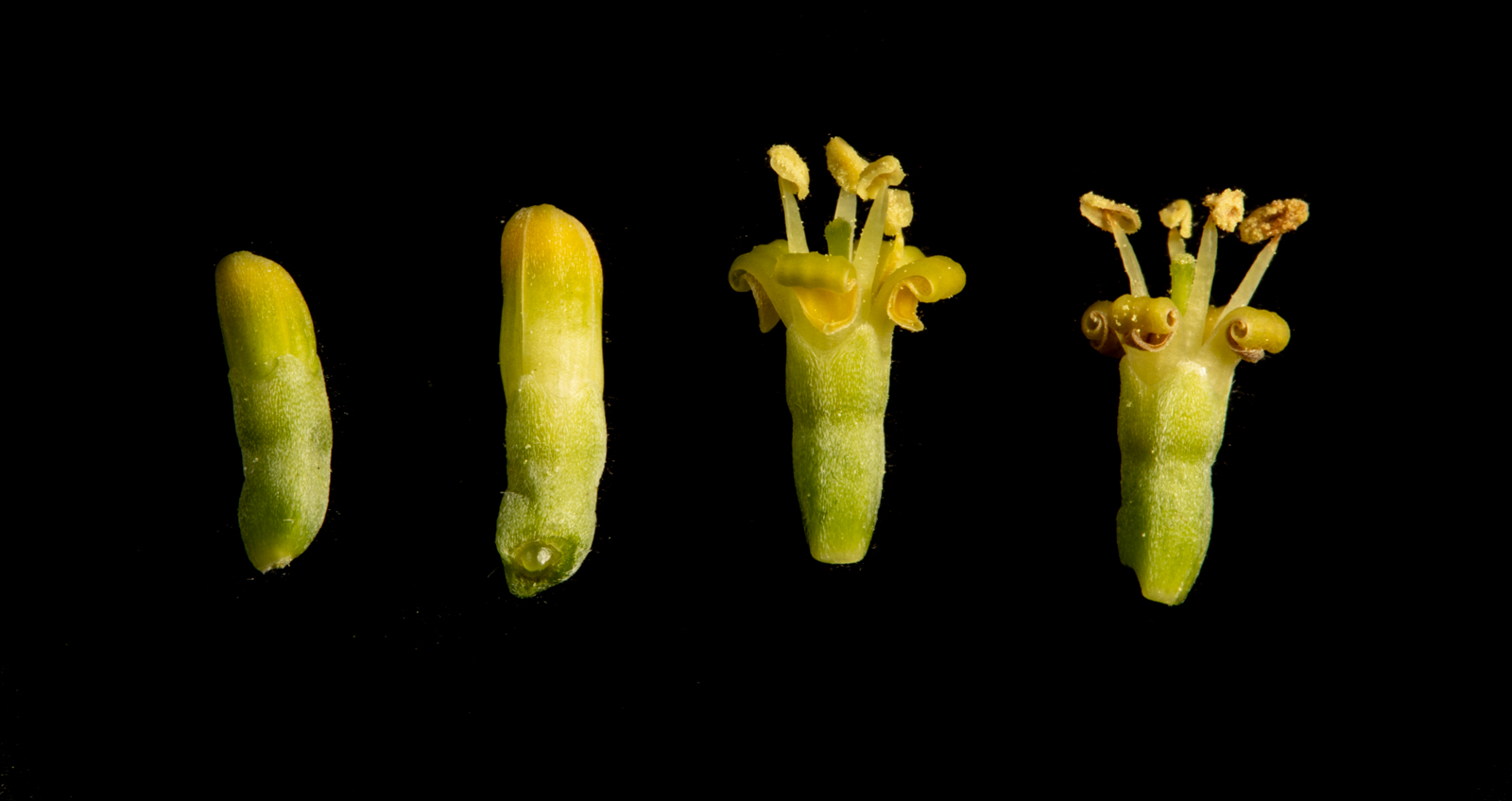
In the cross-section view, you can really begin to see the individual dogwood flowers. And on the flowers that I removed from the blossom, you can trace the development of the flowers as they open, and start noticing the flower parts.
Development of dogwood flowers. In the first two flowers pictured, the petals have not yet opened.
The petals curve back as they open, revealing 4 stamens and a greenish pistil in the center. But as I mentioned in my earlier flower parts post, I really enjoy the challenge of finding the sepals…
Super close-up of unopened dogwood flower
Getting even closer, you can see the downy green lip surrounding the unopened petals; I assume these are the sepals. I was very excited to notice this detail! (Yes, I am a nerd.)
Dogwood flower – the official state flower of North Carolina!
Here we are, back where we started: an open dogwood flower. Getting this close allows you to see the four pollen-producing stamen surrounding the pistil. It even looks like this flower has been pollinated as it appears there is some pollen on the stigma (though I’d say there’s a decent chance I accidentally pollinated it while manipulating the flowers).
So there you have it – North Carolina’s state flower!
When you take a flower in your hand and really look at it, it’s your world for the moment. I want to give that world to someone else. I want them to see it whether they want to or not.
~Georgia O’Keeffe
So far this spring, I’ve had to cancel workshops that I was planning for the North Carolina Museum of Natural Sciences taking educators to the swamp along the Roanoke River and to Great Smoky Mountains National Park. I’ve always been a huge proponent of sharing real experiences in the natural world with others, in large part because I learned the value of that so well from Mike. But in this challenging time when I’m no longer able to do that, I’ve decided to finally try to embrace the power of sharing things in a virtual way, while still encouraging people to get outside and experience the world around them. To that end, my colleague Megan and I have begun creating a series of online workshops for educators where we share some information through a video and then give them a couple nature journaling activities to guide their exploration of the nature in their backyards or local parks. My most recent endeavor in this series was to teach the parts of a flower and send folks out to apply that knowledge by observing flowers in their yard and recording what they notice. Looking closely into the world of flowers is fascinating, and particularly timely with the arrival of spring. So I wanted to share some snippets of what I’ve discovered with the Roads End Naturalist crowd!
Let’s start with a quick primer on flower parts. I spent time during a recent online meeting sketching one of the wild geranium flowers in our yard (ah, the wonders of turning off your video during a zoom meeting!) and created a diagram of the parts of a simple flower.
Parts of a wild geranium flower, as well as enlarged drawings of a stamen and the pistil.
The main parts of a flower are the sepals, petals, stamens, and pistils. Let’s take a look at the arrangement of these parts in a simple flower that is abundant in our yard right now, the wood poppy, or Stylophorum diphyllum. This species is native to the eastern US, though technically not the Carolinas. However, it is native to the surrounding states of Virginia, Tennessee, and Georgia. I chose this flower as a starting point because it’s one of the larger flowers blooming in our yard right now, and it demonstrates most of the flower parts well.
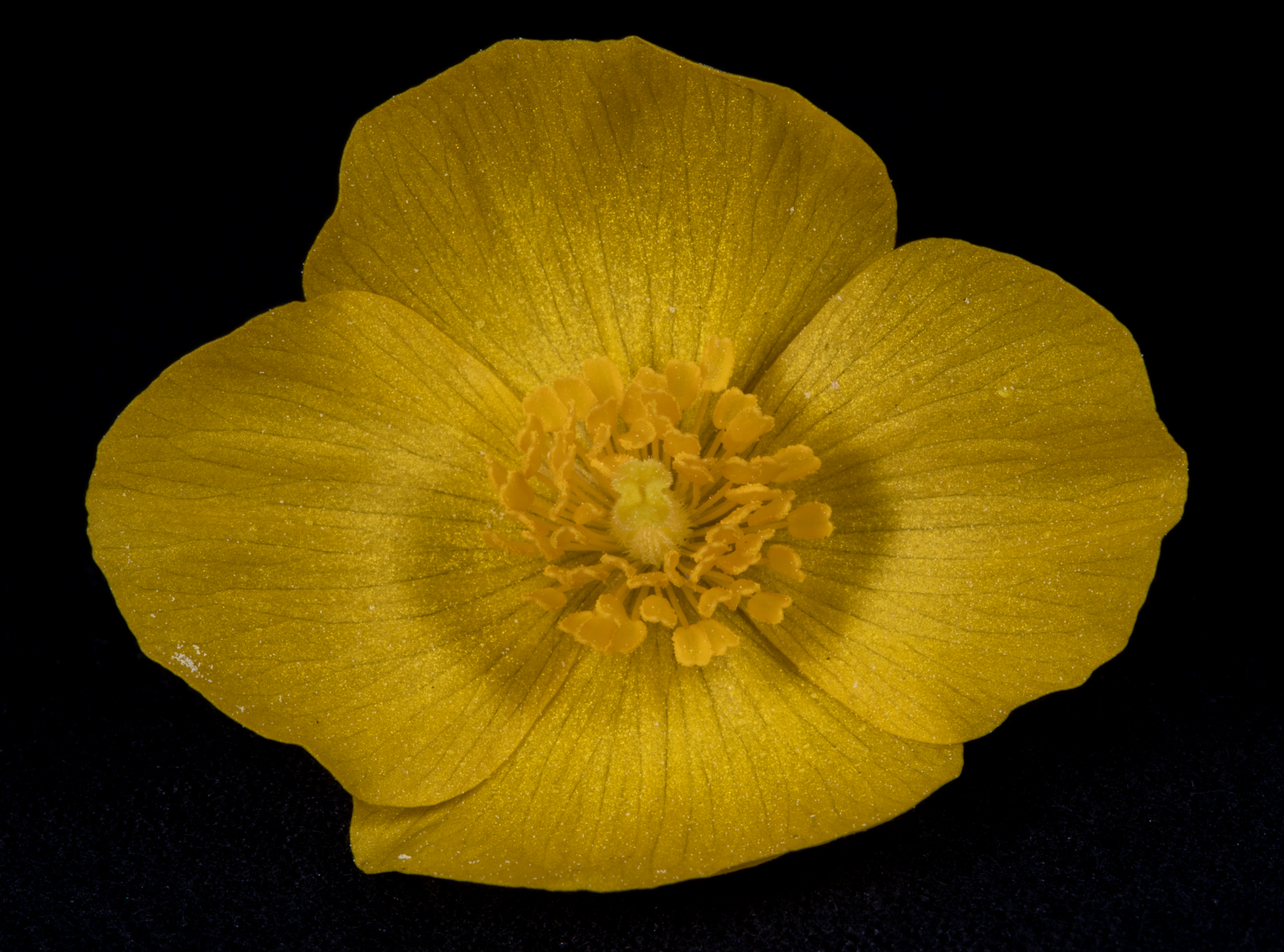
Here’s the wood poppy flower. It’s about 1 1/2 inches in diameter and displays four vivid yellow petals. Petals are perhaps the most recognizable part of the flower. They are typically the most colorful part of the flower and often play a key role in attracting pollinators.
Wood poppy flower
But what about the sepals? According to Plant Identification Terminology: An Illustrated Glossary by James and Melinda Harris (yes, we own a copy of this book… what does that say about us?), a sepal is “a segment of the calyx.” So what’s a calyx, you ask? “The outer perianth whorl.” And a perianth is “the calyx and corolla of a flower, collectively.” I still don’t know what a calyx is… but corolla? “The collective name for all the petals of a flower.” Ah… botanical jargon. (Picture the eye-roll emoji here.) It just might be worse that geologic jargon. (In case you don’t know, I am NOT a botanist – my degrees are in geology, and I like to joke that you have to like big words, as well as hitting things with hammers, to be a geologist). At least I know what petals are (“an individual segment or member of the corolla, usually colored or white”)! The easiest way I’ve found to explain it is that the sepals are arranged outside of the whorl of petals. Sometimes they are green, other times they look a lot more like the petals. And I’ve noticed that they often seem to enclose the flower bud before it opens, which can be a helpful clue in identifying them.
So where are the sepals on the wood poppy? Normally, they would be underneath the flower, and might even be visible from the top-down view (some sepals act more like petals when the flower is open). But the wood poppy flower presented a mystery because underneath the petals is just the stem – no sepals! So does this flower lack sepals? To solve the mystery, I went looking around the yard to find some unopened flowers.
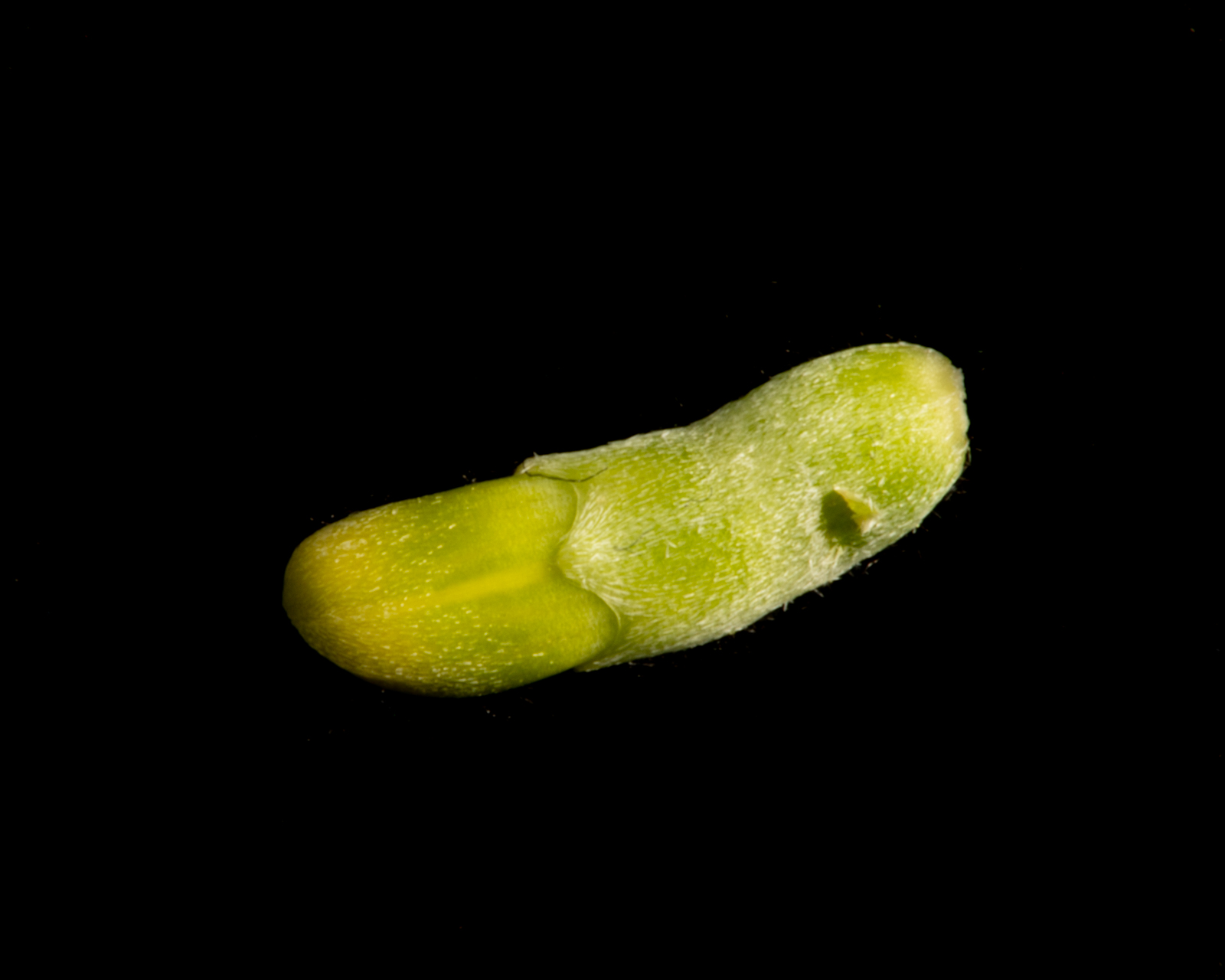
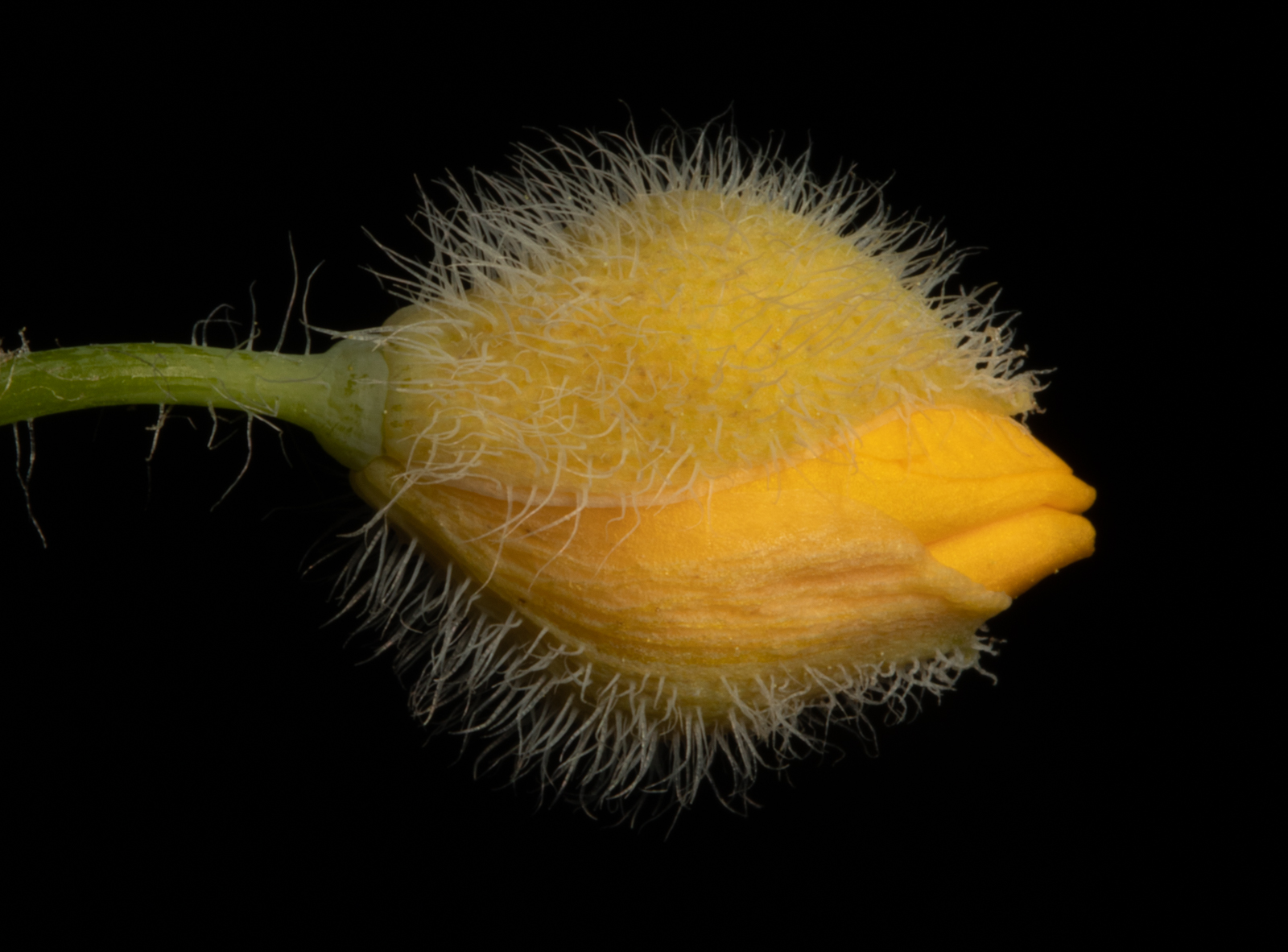
Notice the two hairy sepals surrounding the unopened yellow flower.
In this picture of a flower bud, you can see two hairy, translucent sepals just beginning to open, exposing the yellow flower inside. I also looked around underneath the flowers and found a few sepals lying beneath the plant. So it turns out that for this species, the sepals fall off as the flower opens.
I removed two petals and about half the stamens so that you can better see the structure of the wood poppy flower. Notice the lack of sepals underneath the petals.
So now we get to the important parts of the flower, the stamens and the pistil. Because why do we really have flowers, anyway? Not just to look beautiful in a vase on my kitchen counter. Flowers exist to produce new plants. Without flowers, there would be no fruits and seeds. Many flowers, like this one, rely on pollinators and put a lot of work into attracting them through vivid colors, nectar rewards, and sometimes even trickery (check out the part of this earlier post about the grass pink orchid). Other flowers rely on the wind to disperse their pollen (anyone else’s screen porch covered in pine pollen right now?), and some can self-pollinate. But back to the wood poppy, and most simple flowers…
Stamens are the male part of the flower that produce pollen. They are comprised of a stem-like filament and a pollen-producing anther. As the flower ripens, the anthers tend to shrink and shrivel as they produce pollen. An education student at East Carolina University once described a stamen as looking like an eye shadow applicator, and ever since then I’ve used that analogy, especially for ripe stamen that have granules of pollen (eye shadow?) on them.
This wood poppy flower has been open longer and is riper. The stamens are browned and shrunken, though a few at the center are still yellow.
In the center of the flower is the female part, the pistil. At its top is the pollen-receptive stigma. In some species, like the big star-gazer lilies that are often in grocery store bouquets, the stigma opens and has a sticky coating as the flower ripens, making it more likely that pollen grains will stick to it. Below the stigma is the thin style, connecting the stigma to the ovary, which is the swollen part at the base. When a grain of pollen reaches the stigma, it grows a pollen tube all the way down the style to the ovary, where it fertilizes an ovule (which I like to call a pre-seed).
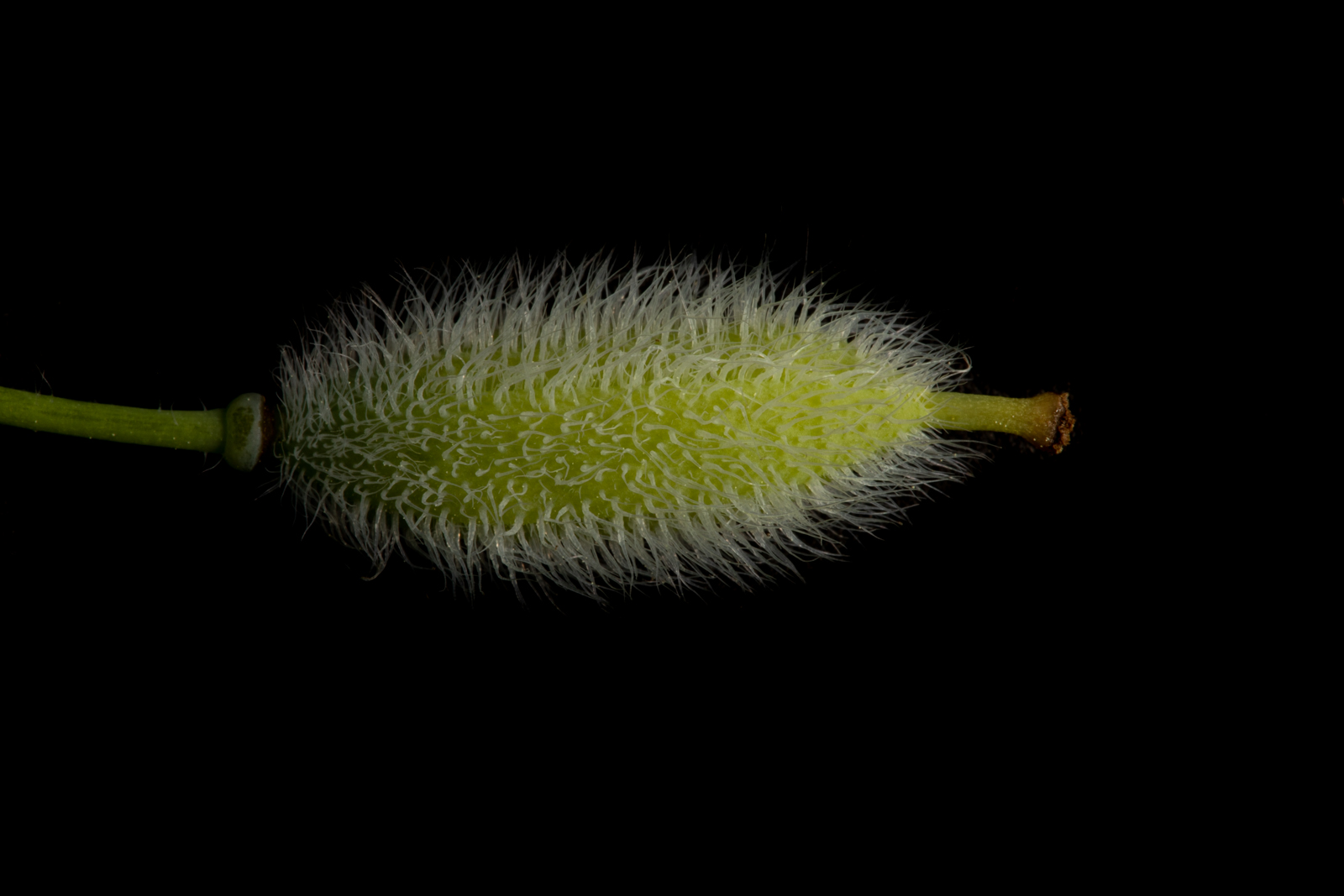
Wood poppy ovary that has begun to swell as it ripens. Notice the stigma and style still visible to the right side of the image.
Eventually, the wood poppy drops its petals and stamens, and the ovary begins to swell. Inside, the fertilized ovules are developing into seeds.
You can see the white ovules developing into seeds inside of this wood poppy ovary.
This ovary had swollen from about 1/4 inch long to about 1 inch long, and the ovules likewise had enlarged, making them much easier to see. In the closer, backlit photo below, the developing seeds are even more obvious, and you can notice how each one has a furry-looking edge on one side.
This backlit photo of the ovary shows the developing ovules in more detail.
Apparently, this species’ seeds are dispersed by ants and that furry bit is a fatty appendage called an elaiosome that ants like to eat. For more information on elaiosomes, check out a couple of Mike’s previous posts on seed dispersal by ants in bloodroot and trillium.
As I’ve refreshed my memory on flower parts, I’ve started looking at all the flowers in our yard with new eyes. Different species have developed fascinating takes on this basic structure. I’ll add more posts in the coming days highlighting some of the other flower species I’ve been examining. In the meantime, take advantage of this beautiful weather and head out into your yard with a magnifier and see if you can identify sepals, petals, stamens, and pistils on some of your flowers!
And if you’re an educator interested in the online workshops my team at the Museum has been creating, send me an email at melissa (dot) dowland (at) naturalsciences (dot) org.
First, the answers to yesterdays Attention to Detail post… I’m sure many of you already knew the answers, but, just in case, here is what each of the images in yesterday’s post depicted:
Sensitive Fern – the spore-containing capsules are round in this species.
Foamflower – looking down at the spike of flowers of one of my springtime favorites.
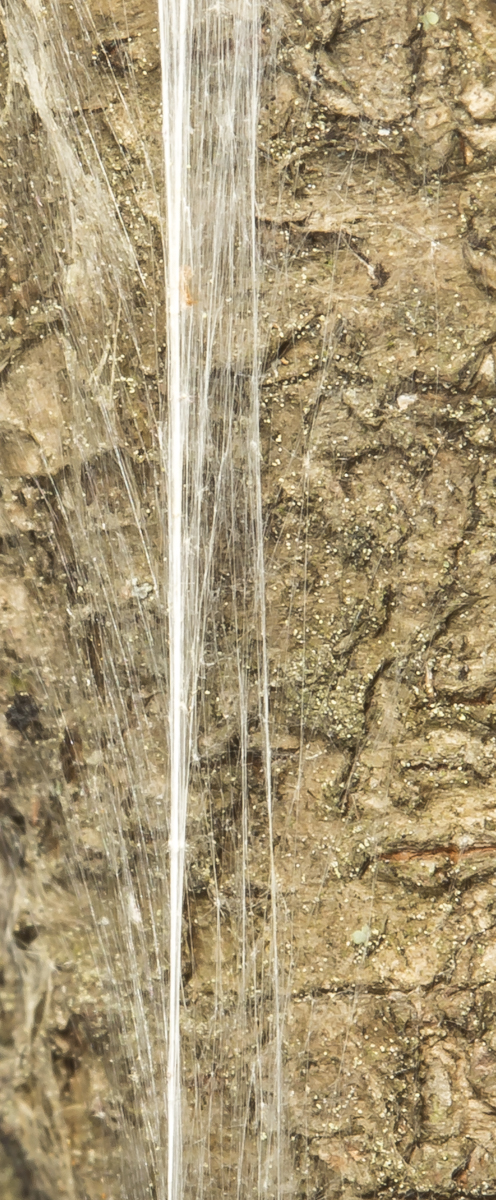
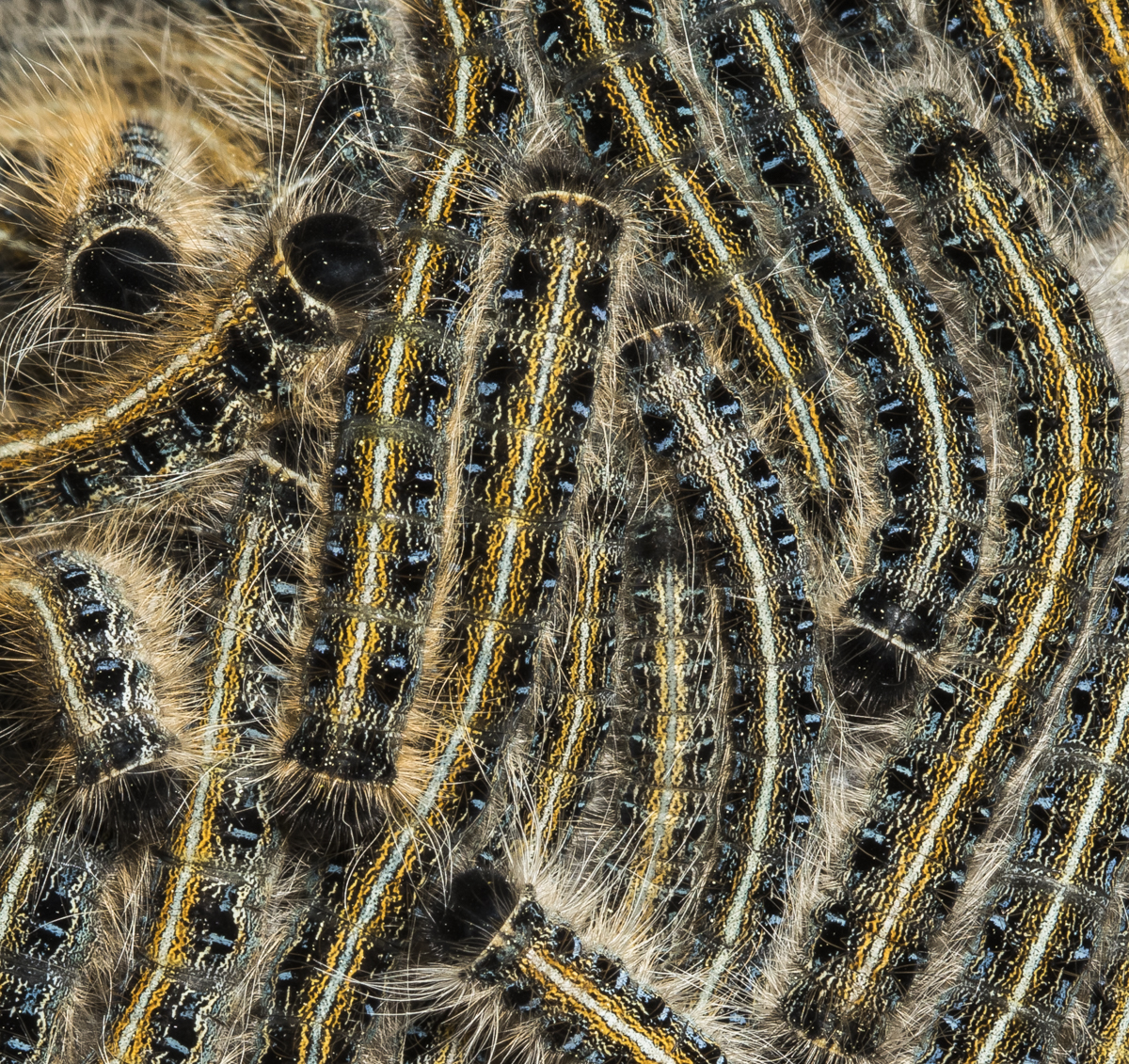
Silk highway left on a cherry tree trunk as a few hundred Eastern Tent Caterpillars venture out in search of feeding sites. They leave a trail of silk with chemical cues for others to follow to the best feeding areas.
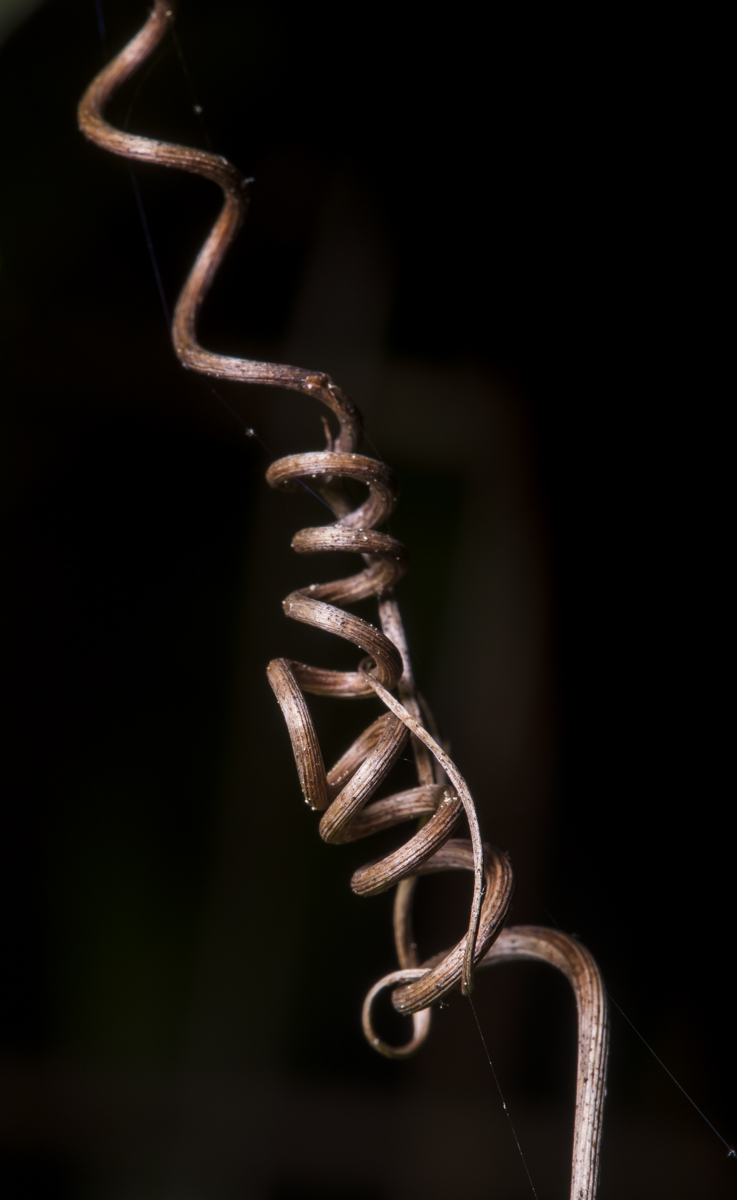
A twisted dried tendril from last year’s Muscadine Grape tangle on the fence.
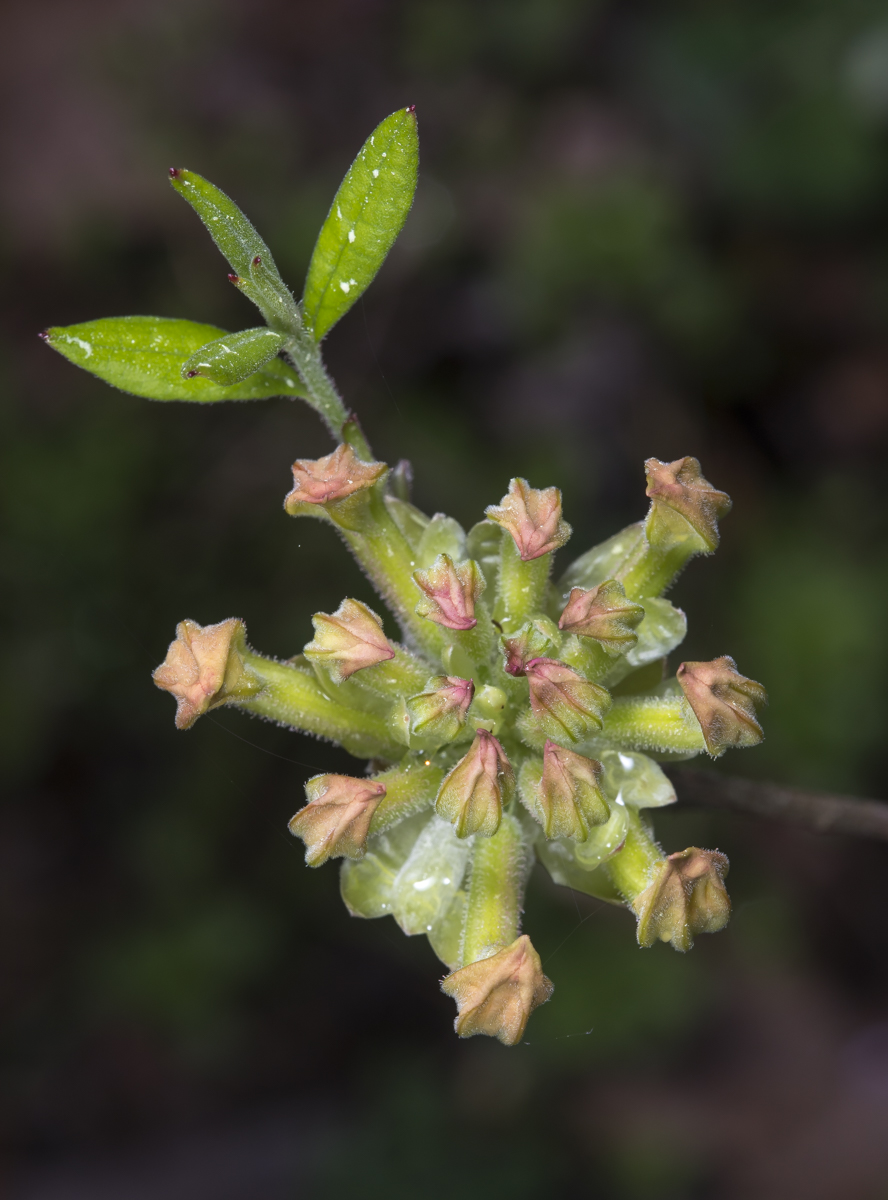
Looking down on some Flame Azalea buds about ready to burst into flower.
Close up of a Dandelion puffball (seed head).
A gathering of Eastern Tent Caterpillars on a Wild Cherry tree trunk.
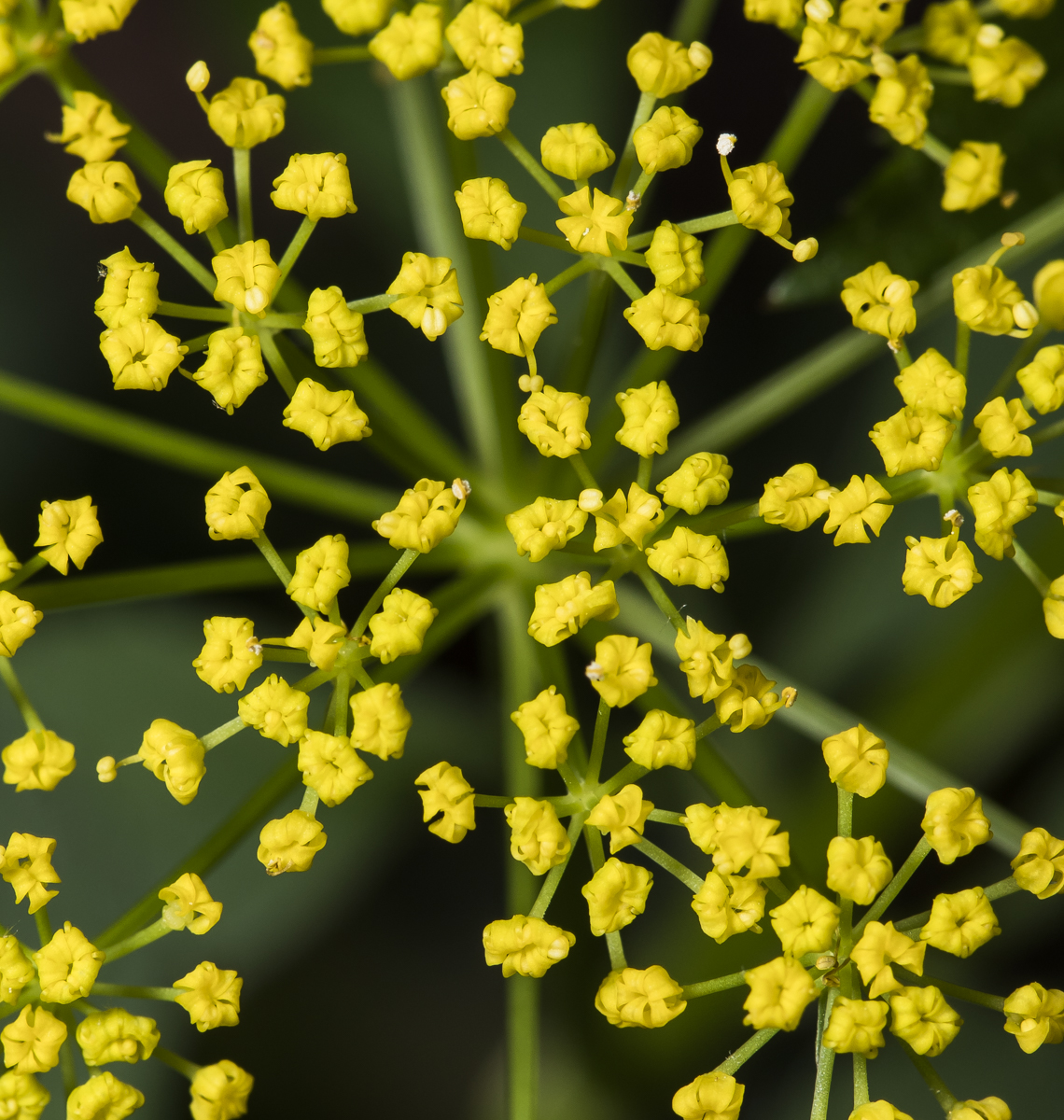
The tiny yellow flowers of Golden Alexander.
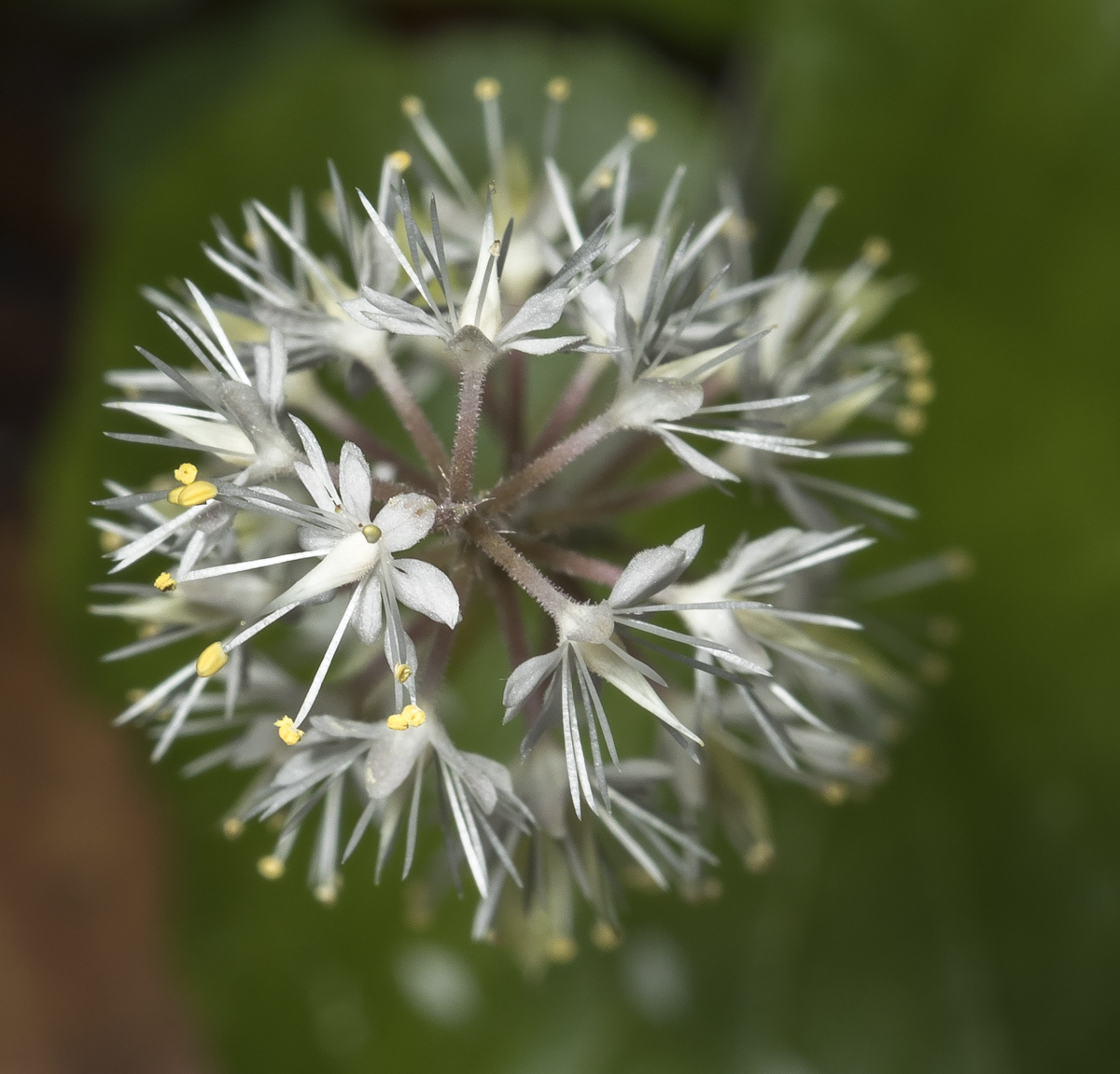
The tip of a single flower on a Red Buckeye flower stalk.
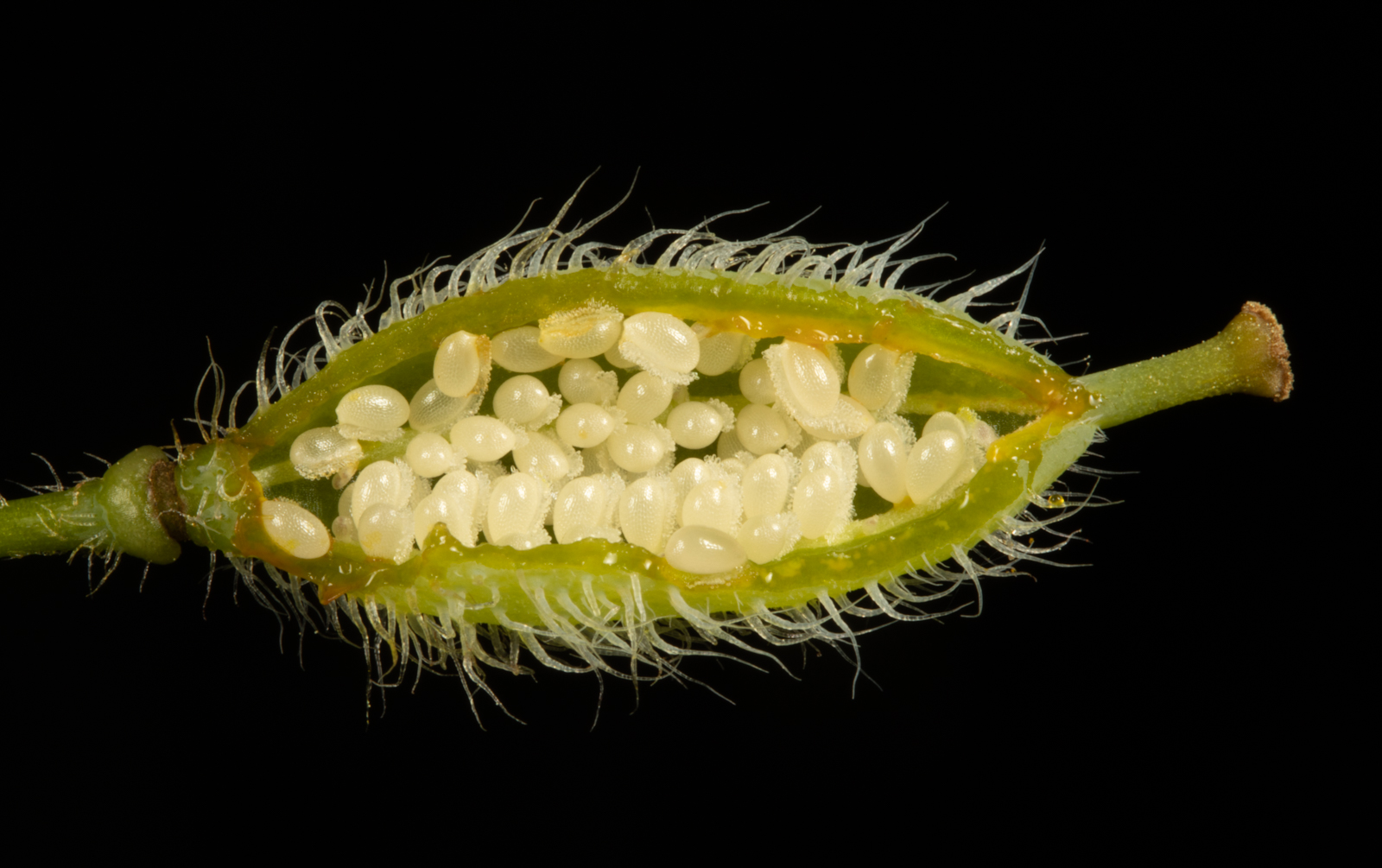
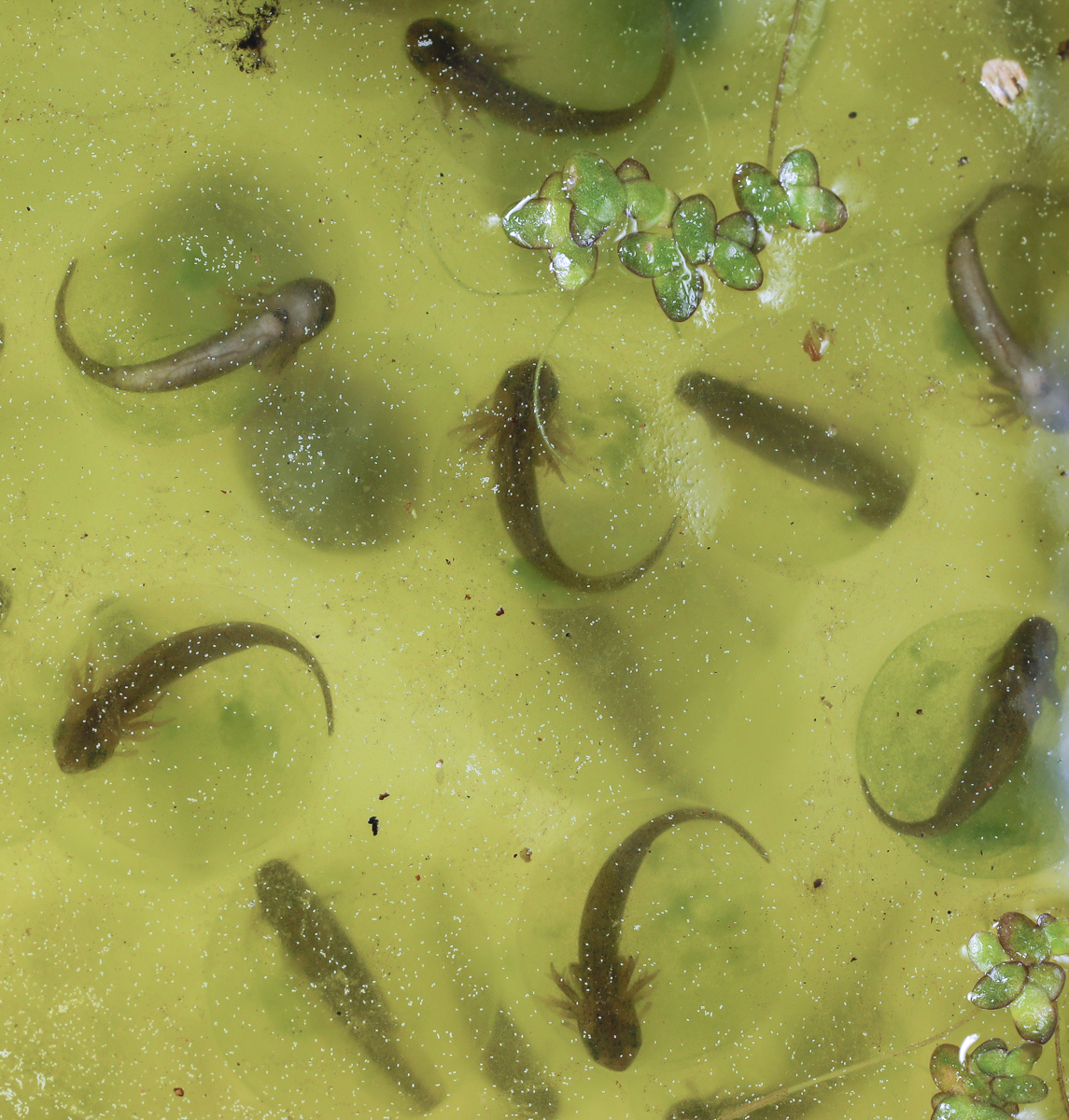
Larvae in a Spotted Salamander egg mass the day before they hatched.
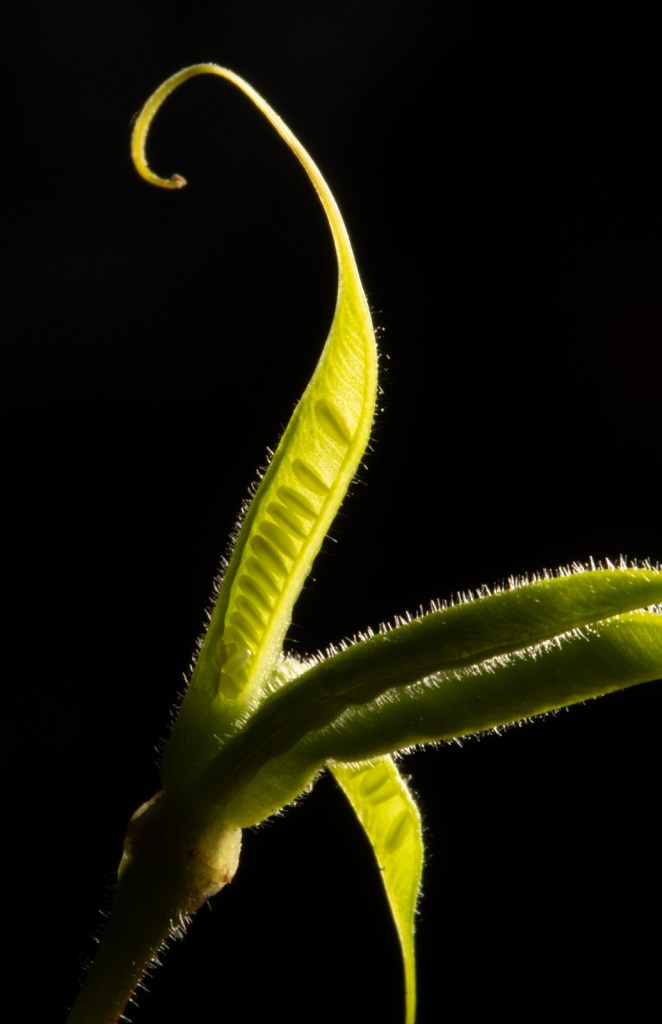
Cross Vine tendrils.
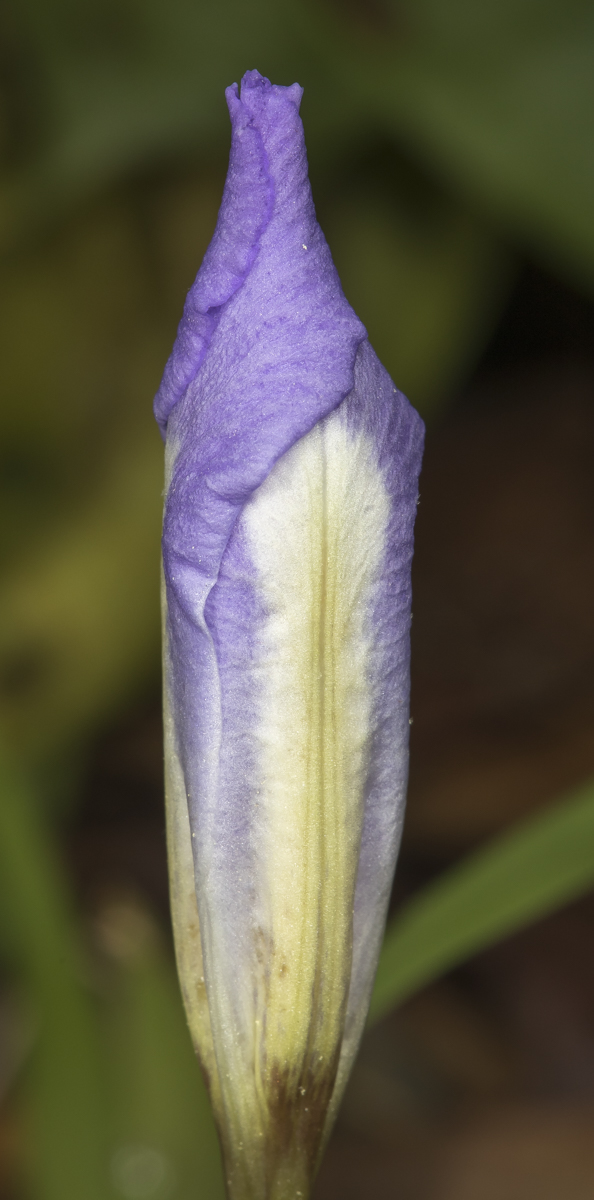
An unopened flower bud of Dwarf Crested Iris.
Today was a truly beautiful day so I spent most of it outside doing some chores and just admiring the wildflowers. Surprisingly, not many photographs taken, so I am sharing something from a couple of days ago that I saw again this afternoon.
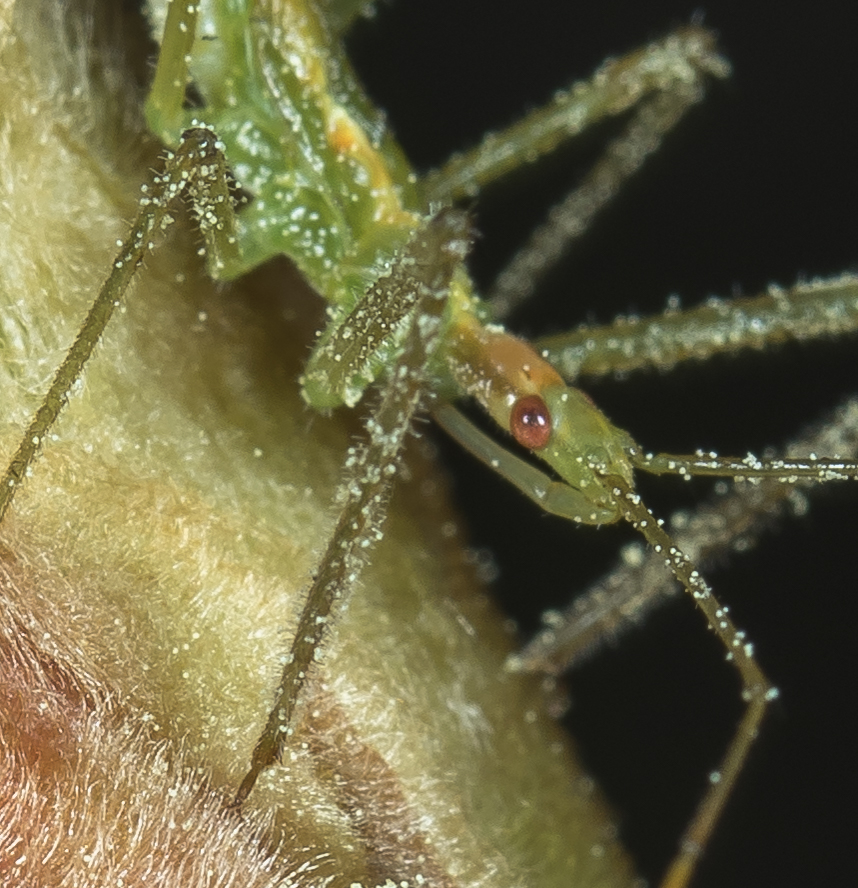
Nymph of a Pale Green Assassin Bug on a hickory bud (click photo to enlarge)
I spotted this little bug as I was walking past a hickory sapling. It seems I can’t walk by a leaf bud this time of year without pausing to glance to enjoy their amazing shapes and fullness as they prepare to burst. This one had a special treat, a tiny nymph of what I assumed was an assassin bug of some sort. I looked online and discovered it is most likely the nymph of a Pale Green Assassin Bug, Zelus luridus. Adults are a little over a half an inch long and prey on a variety of insects using that long beak to pierce them and suck out their fluids. But this group of assassins has a rather unique weapon in their bag of tricks – they secrete a viscous fluid from their front legs (and maybe also their second pair of legs), which helps secure their prey when they grab it. You can see a lot of pollen grains stuck to the legs (and other parts) of the nymph in the photo below.
Close up view showing the stalked hairs on the legs
I’m thinking this is not such a bad idea in these times of infrequent trips to the grocery store (our version of the assassin bug hunt). If you drop a cookie crumb it just sticks to your arm so you can retrieve it.
Back in the day, I worked for a truly remarkable visionary, Mary Ann Brittain. I learned a lot from her and (I think) we made a good team for the museum as educator/naturalists. I remember when I first started going on the road with her to do school grounds workshops all over the state, I was amazed at how she could take a long nap in the car (as I was driving), arrive about 15 minutes before the workshop, get out and race around the school building, and then be prepared to take a group of teachers out and show them what they could find and use to teach all sorts of subjects outside their classroom walls. Of course, I also figured out that I had to be sure to bring the essential supplies or they might get left behind. We soon came up with a moniker for ourselves – Broad-brush Brittain and Detail Dunn. Well, over the years, I learned some of her techniques for quickly assessing the potential subjects to share with others out in the field. I’m afraid I also started relying on others to help take care of the details (yes, Melissa, I know).
Though I occasionally (okay, maybe more than that) forget the details of a task, I still find the details of nature extraordinarily fascinating and beautiful. So, here are few up close looks at some details of spring in our yard. See if you can guess what each thing is before looking at the list at the end of the post. After your first guess, try to match a name on the list to a numbered photo (the names are not in the same order as the photos). Some are pretty obvious, others maybe not. Expect more of these nature in detail images in coming posts. Meanwhile, get outside and look closely at what nature is sharing each and every day.
#1 (click photos to enlarge)
#2
#3
#4
#5
#6
#7
#8
#9
#10
#11
#12
The photos above show details of the following (match an ID with a number – answers tomorrow).
Golden Alexander flowers
Muscadine grape tendril (a threadlike part of climbing plants that attaches to or twines around another object to support the plant)
Azalea flower buds
Dwarf Crested Iris flower bud
Sensitive Fern spore-containing structures on last year’s dried fertile fronds


























 Roads End Naturalist