There is beauty to be found in the changing of the Earth’s seasons, and an inner grace in honouring the cycles of life.
~Jack Cornfield
A recent post discussed the eclosure of several Cecropia Moths that had spent the winter with us as cocoons. There was a mated pair when I found them that morning. I released all but that pair, keeping those two one more night to try to get some eggs, which the female obligingly laid on the inside of the mesh butterfly cage.
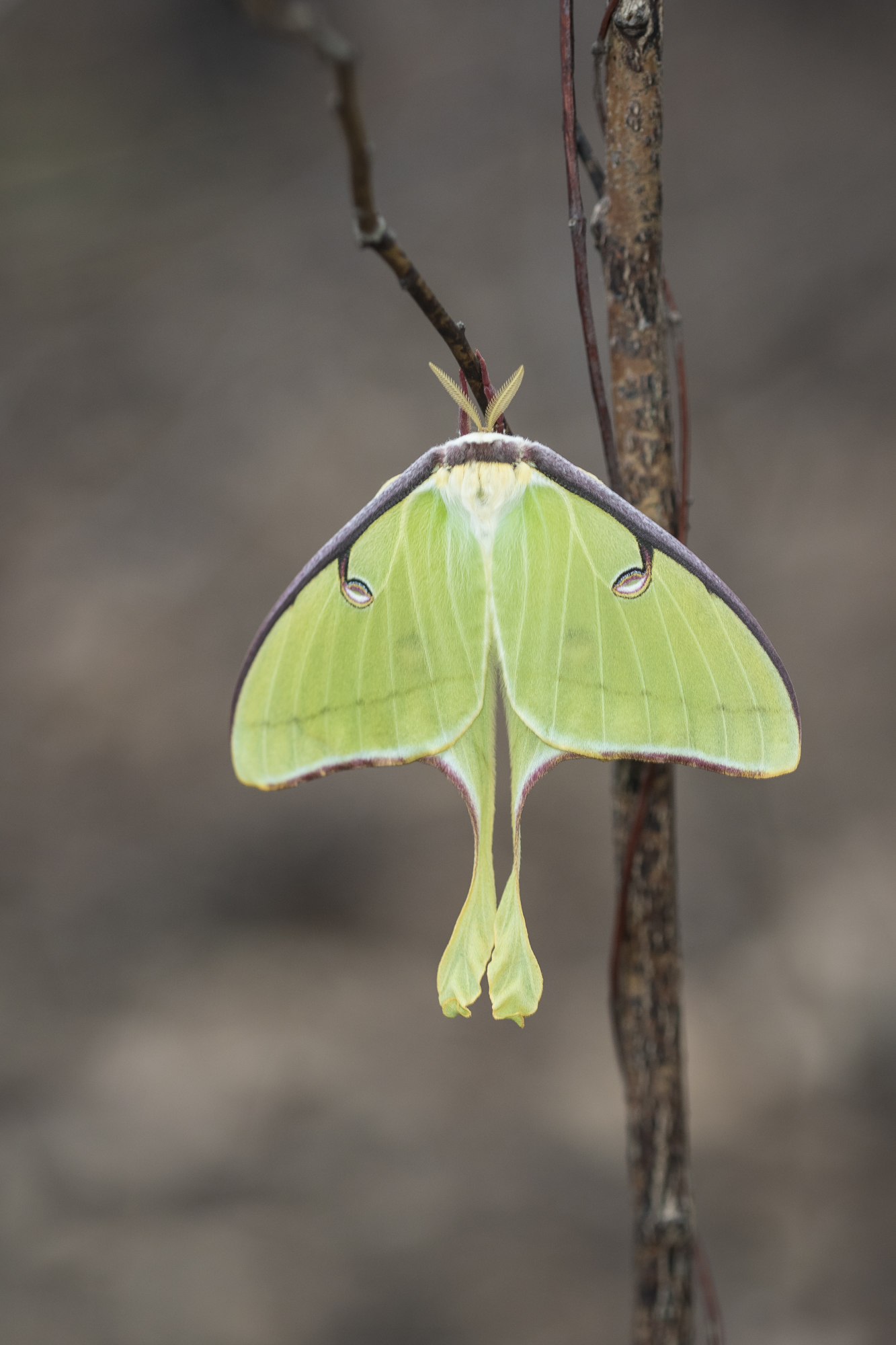
Cecropia Moth adult that emerged on May 29 (click photos to enlarge)
Yesterday, the eggs started hatching. Eggs were laid on May 30 and began hatching on June 10.
Hatched eggs
First instar larvae are gregarious feeders (I have put them on Black Cherry, one of their listed host plants). They are small (~3/8 inch), dark, and covered in black spikes. They will undergo five molts with each stage lasting about a week. So, for the next 4 or 5 weeks, we will be busy feeding some very hungry caterpillars. The changes will be amazing and I’ll be sure to share photos along the way.
First instar Cecropia Moth larvae on their first day
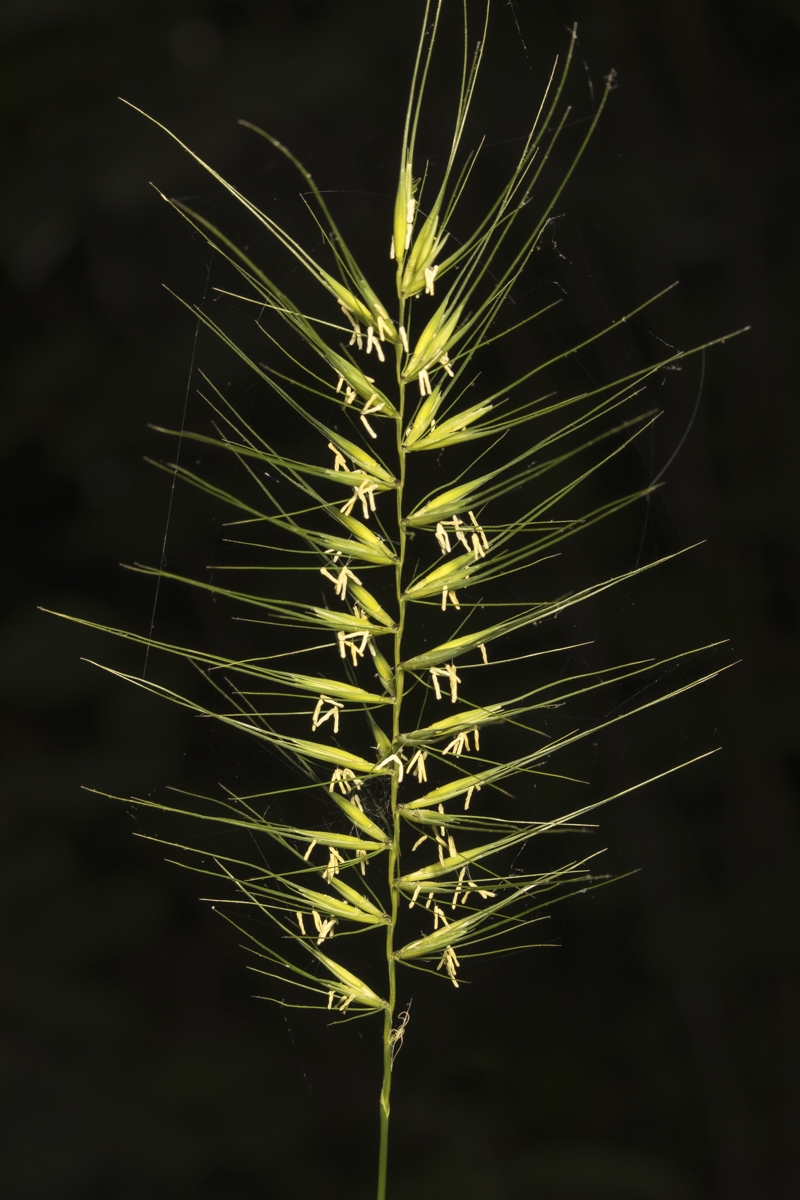
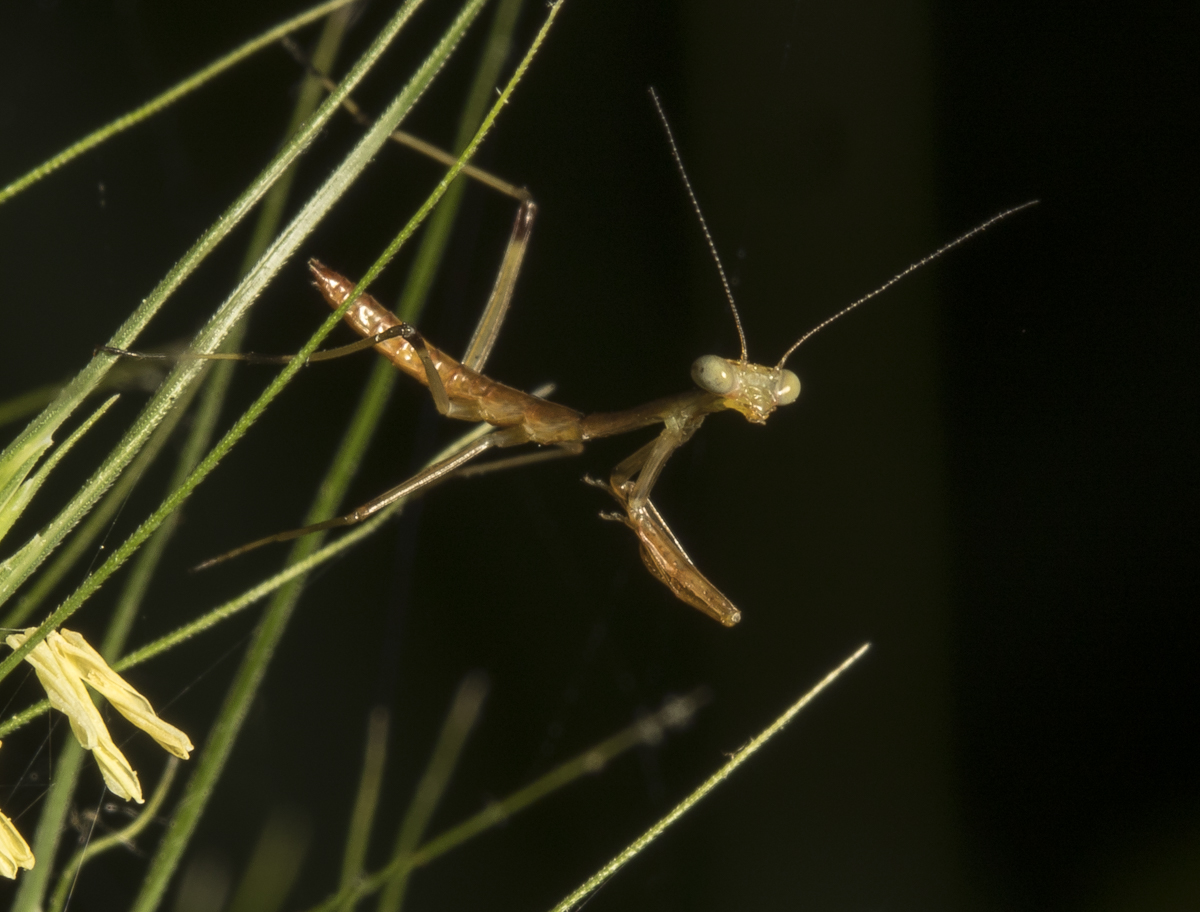
I was working in my shop yesterday when I saw something skitter across one of the work tables. I went over and looked, and found two baby mantids. I carried them outside and released them. A few minutes later, a couple more. Obviously, somewhere in my shop is a hatching egg case with perhaps a couple hundred tiny alien-looking insects ready to take on the world. I looked around but could not find a source (perhaps on some wood I brought in for the winter?). The last one I released in one of our wildflower beds. It quickly ran up one of my favorite native grasses – Bottlebrush Grass, Elymus hystrix. You can see the resemblance to a loose lab bottlebrush in the grass flower/seed head below.
Bottlebrush Grass in flower (click photos to enlarge)
The little guy ran up into the spiky flower head and started grooming, and then climbing among the thin plant filaments. Its slender, leggy shape blends in quite well.
Baby mantis checking out the world for the first timeAfter posing, the mantis headed out on patrol, looking for a meal
I’m not sure which species of mantis this is, although, for some reason I think it is probably a Carolina Mantis. They tend to be more common here in the woods than the much larger Chinese Mantids, and this one looks a little different than the Chinese Mantis babies I have observed in the past. Whichever one it is, it is well equipped to hunt creatures large and small and play an important role in the invertebrate jungle of our backyard.
You do not just wake up and become the butterfly. Growth is a process.
~Rupi Kaur
Eclosure = the emergence of an insect from the pupa case, or of a larvae from the egg…
Nature is always providing examples of remarkable survival and transformation. Witnessing eclosure is one of those magical things to me (must be because of my love for all things caterpillar). I have been lucky over the years to stumble upon freshly emerged butterflies and moths in the wild a number of times. It is always a special moment to see these fragile creatures as they begin their relatively short-lived winged lives. Here are a few of my favorites over the past few years…
Luna moth just after eclosure, Jones Lake State Park (click photos to enlarge)Red-spotted Purple butterfly in our yard, hardening its wings while resting on its chrysalisA stunning fresh Zebra Swallowtail discovered by a summer camper at the NC Botanical Garden a few summers ago
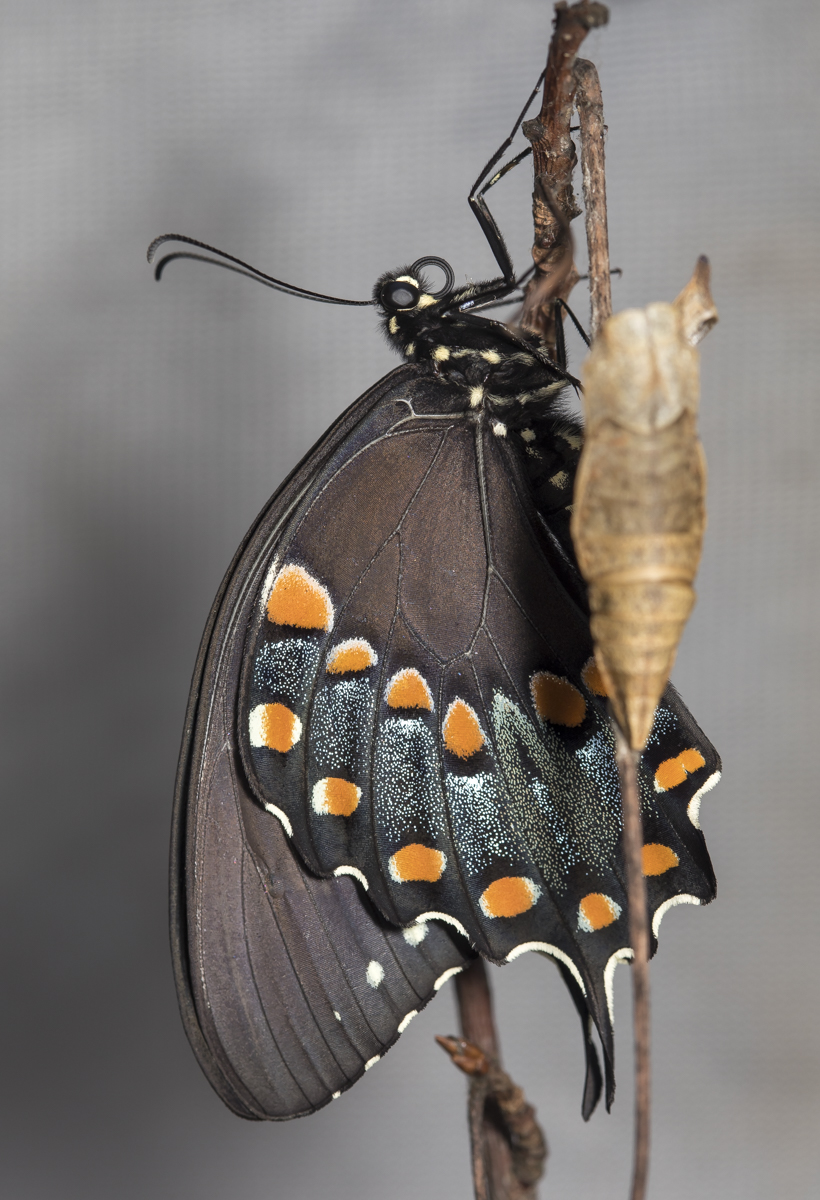
It is thrilling to find a fresh emergence in the wild, but most of my experiences with eclosure have been with caterpillars I have raised or pupa I have found and protected. We have some mesh pop-up butterfly cages that we raise larvae and house pupae in on our screen porch. This gives them the temperature changes and humidity needed for survival. The mesh sides (and plenty of sticks in the cage) allow the newly emerged adult to climb and hang until it can pump fluids from its swollen abdomen through the wing venation to pump up the wings and allow them to harden for flight. Last year, I had a Spicebush Swallowtail caterpillar create a chrysalis inside one of the chambers and overwinter. We were also given a few Cecropia Moth cocoons to rear. These have been with us since September, and, earlier this week, they all made their official entry into the world as winged beauties.
Spicebush Swallowtail butterfly with spent chrysalis in foreground
One of the best things about seeing these newly emerged butterflies and moths is being able to closely examine and photograph them as they complete their transformation. You can get details that are much more difficult to capture once they are capable of flight.
Close up of head and proboscisThe colors and patterns are at their most vibrant just after eclosureClose up of antennae of Cecropia Moth
The amazing thing about the Cecropia Moths is that they all emerged on the same night. We released 4 of the 6 the first night, but kept two that were mating, releasing them the following evening.
North America’s largest native moth (wingspan up to 7 inches) just after release
The female laid several patches of eggs inside the chamber so we now will have a bunch of hungry mandibles to feed in the coming weeks. I can’t think of a better summer pastime…
Camouflage is the most interesting of all the arts.
~Kris Saknussemm
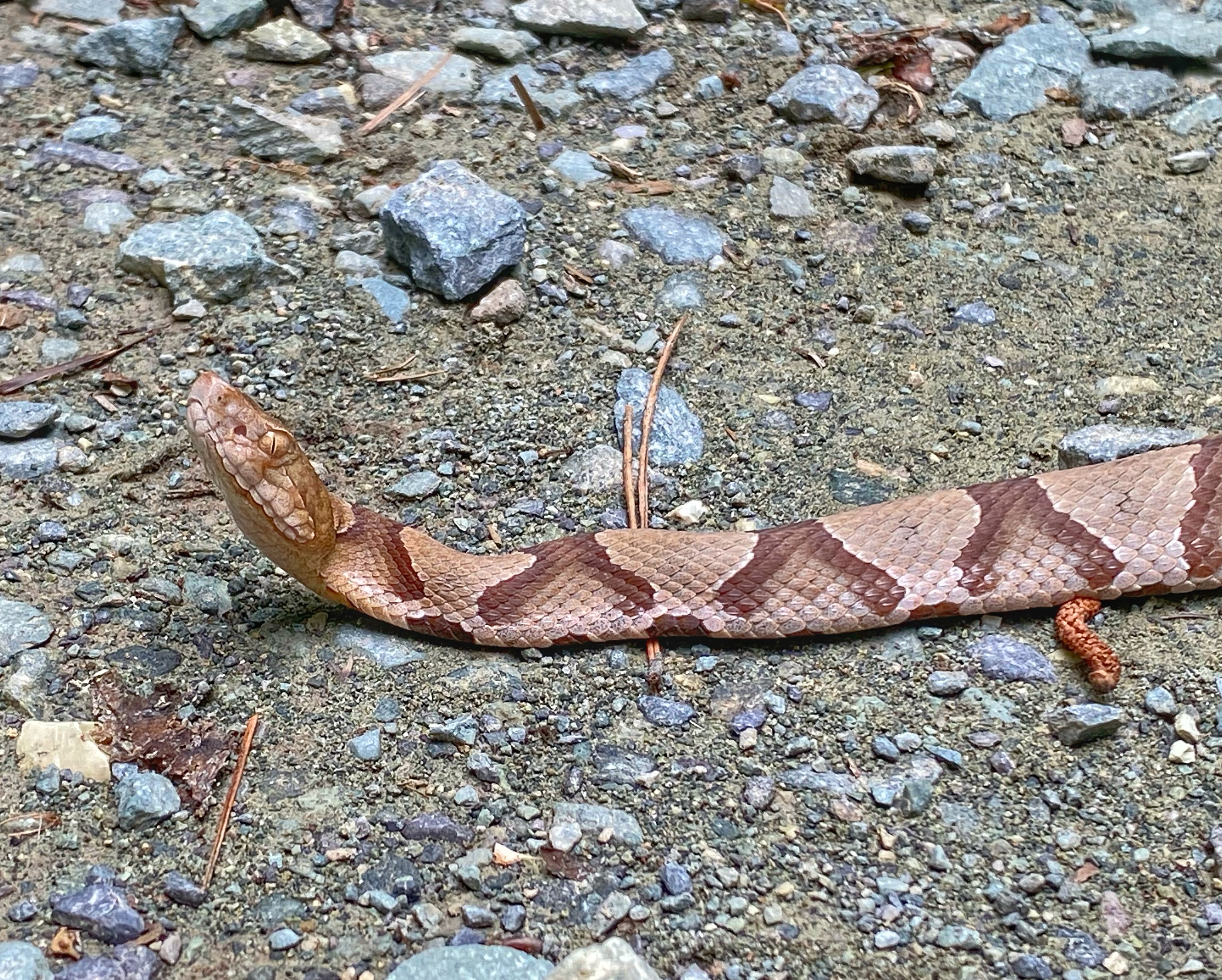
I sometimes feel like we live in the jungle. Looking out across the small sunny area around the house you see a green wall of vegetation before the tall trees of the forest begin. The yard itself is a tangle of all sorts of wildflowers and shrubs, layer upon layer, with years of accumulated leaves in between the green patches. Being at home so much this spring has given me a rare opportunity to actually do some tidying up (also known as weeding). Now, don’t get me wrong, I actually like the wild look, but there are unwanted species (like Microstegium) that tend to infiltrate everywhere and then some wanted species that like to take over if not watched. But, here in the hood, I try to be careful about where I put my hands and feet in this jumble of greenery because of one local resident in particular, the Copperhead. Yesterday found me repairing a patch of deer fence where a dead snag had fallen during the heavy rains. As I was walking through the woods dodging tree branches with my armload of tools I thought…Jeesh, it is hard to watch where you step in here, and they blend in so well with these leaves. Well, an hour or so later, I walked down the road to check on something, and on my way back, there was the first of the season, out in plain sight, where its usually incredibly effective camouflage was not so effective.
First Copperhead of the season (click photos to enlarge)
This one was particularly beautiful, with a bright, contrasting pattern of dark and light colors. As I approached, it flattened its body in what I assume is a defensive posture (to make it look bigger perhaps?) and remained motionless (one of their usual defensive modes). I took a few images with my phone and then walked back the hundred feet or so to the gate to our driveway to get my real camera. When I returned, the road was empty.
Distinctive traits include a vertical pupil, the pit between the eye and nostril, and the Hershey Kisses-shaped pattern along the sides (like hourglasses when viewed from above)
I walked into the woods where the snake had been headed, only to see nothing but leaves. At least, that was all I could perceive. The snake was now back in its element – advantage Copperhead.
Wide, curved, tall or long, so many shapes but none are wrong.
~Hermione Little
It is a little harder (or at least less pleasant) to explore our yard and woodlands during a deluge like we have had the past few days. But, I was out filling bird feeders in the rain when a light-colored shape in the flowers caught my eye.
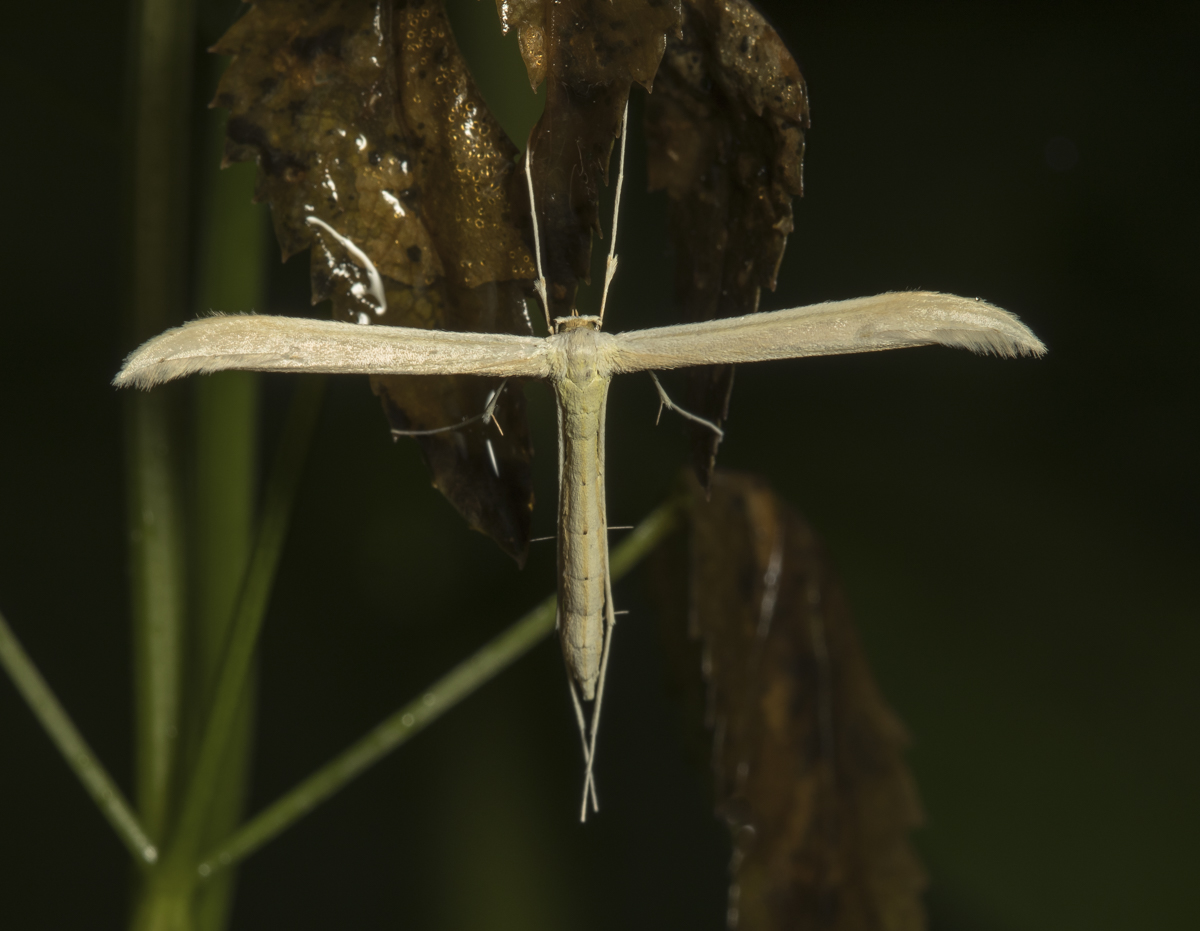
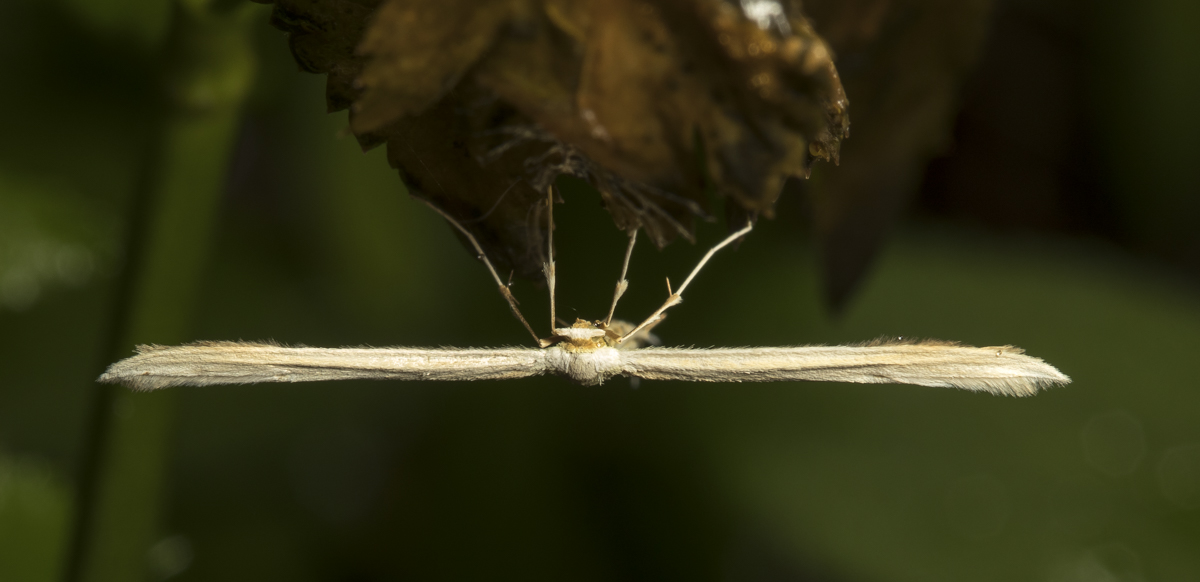
Plume moth resting in its characteristic T-shape position (click photos to enlarge)
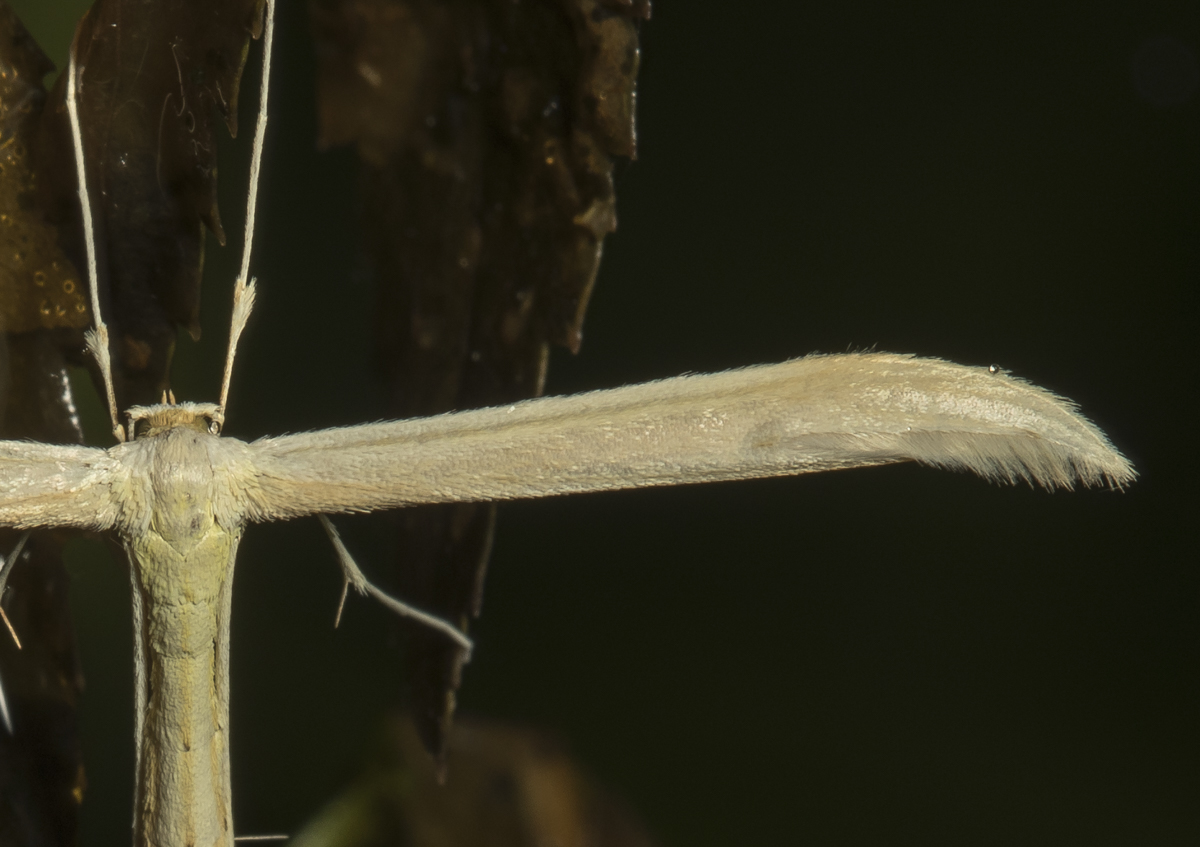
As I got nearer, I recognized its distinctive T-shape as belonging to a plume moth. These unusual moths rest with their wings held out at a right angle to their slender body looking somewhat like an old airplane profile. These narrow wings actually are pleated or lobed and fold out wider when in flight.
Detail of wing
I looked in my field guides and online and am pretty sure this is the Groundsel Plume Moth (aka Baccharis Borer Plume Moth), Hellinsia balanotes, due its large size. As a group, they can be difficult to identify to genus or species, but this one had a wingspan the size of a quarter (greater than 30mm). Most plume moths are half that size.
Looking down on this unusual moth
The larvae of many plume moths bore into the stems of various shrubs and wildflowers or are leafrollers. The unusual shape of the adults is said to help them camouflage themselves when at rest in vegetation during the day as they tend to look more like dried plant stems than a tasty moth. Whatever the reason, they make for an interesting discovery on a rainy day (this moth stayed in this spot all day in spite of my intrusion).
The art of teaching is the art of assisting discovery.
~Mark Van Doren
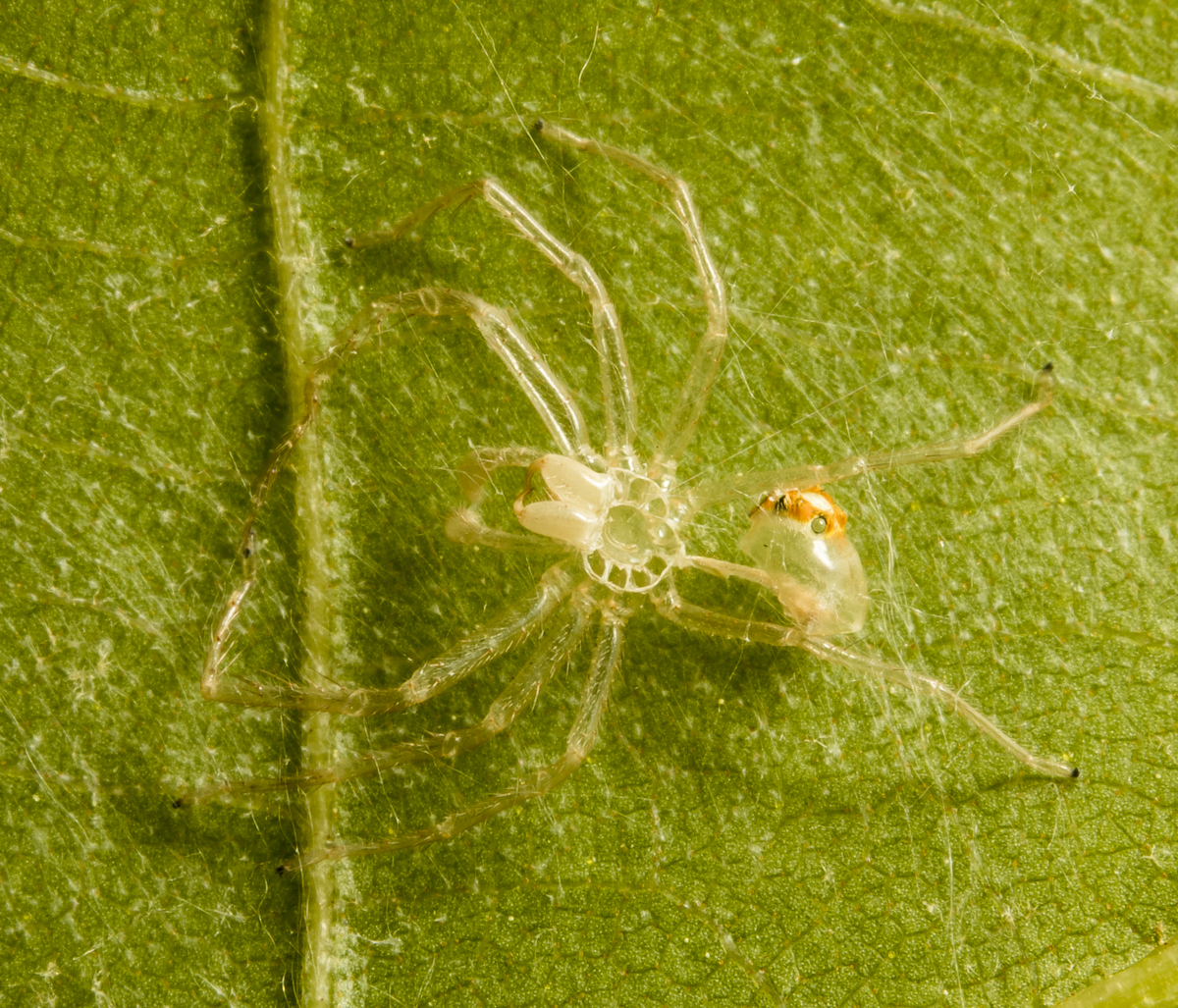
Melissa was producing a short video on trees as part of her museum educational offerings for teachers when she made a fascinating discovery. While filming the segment, she was encouraging folks to observe trees in their neighborhood and look for interesting things living on them. When she grabbed a hickory leaf and looked at it, she found one of my favorite spiders – a Magnolia Green Jumper (Lyssomanes viridis). We have a lot of these beautiful little jumping spiders in our yard and woods, but this was one even more exciting than usual as it has just molted.
Magnolia Green Jumper next to its old shed exoskeleton (click photos to enlarge)Recent shed of a Magnolia Green Jumper
I have posted on these amazing arthropods a couple of times in the past, But here was a spider shed and a freshly molted spider together on the leaf where this magic had just occurred. If you look closely, you can see how the spiders’ cephalothorax (the fused first two body parts) pops open during the molting process and the old legs split open. The spider is then able to pull itself out of its old skin as a larger version of itself. Some spiders hang from a silk thread when they do this, but it looks like this species makes a silk pad to anchor its old body, and then crawls out as a new spider.
Freshly molted male Magnolia Green Jumper
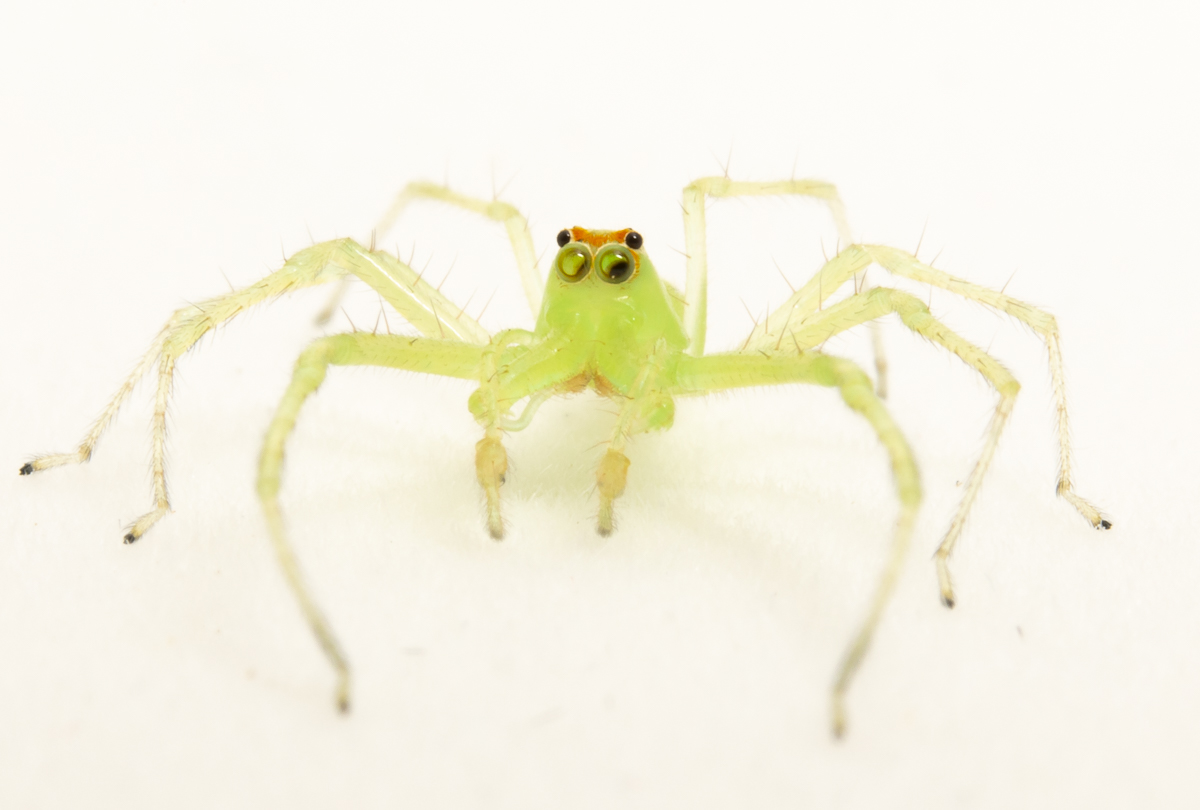
This one is a male as you can see by the enlarged tips to its pedipalps (those appendages that look like two short legs right in front of its face). Male spiders typically have swollen tips (often described as boxing gloves) that they transfer their sperm to before mating. I guess it is safer to keep your distance during courtship if you are a male spider (especially since you are usually smaller than your ravenous mate). After a couple of shots, I brought the spider inside for a photo shoot in my collapsible white box. I’m still learning the tricks of photographing on white backgrounds, but it does often highlight details you may not otherwise notice.
Magnolia Green Jumper posing inside a white box
One of the issues in a white box is the creatures don’t tend to take direction very well, but this little guy finally settled and looked straight at me for a couple of quick portraits.
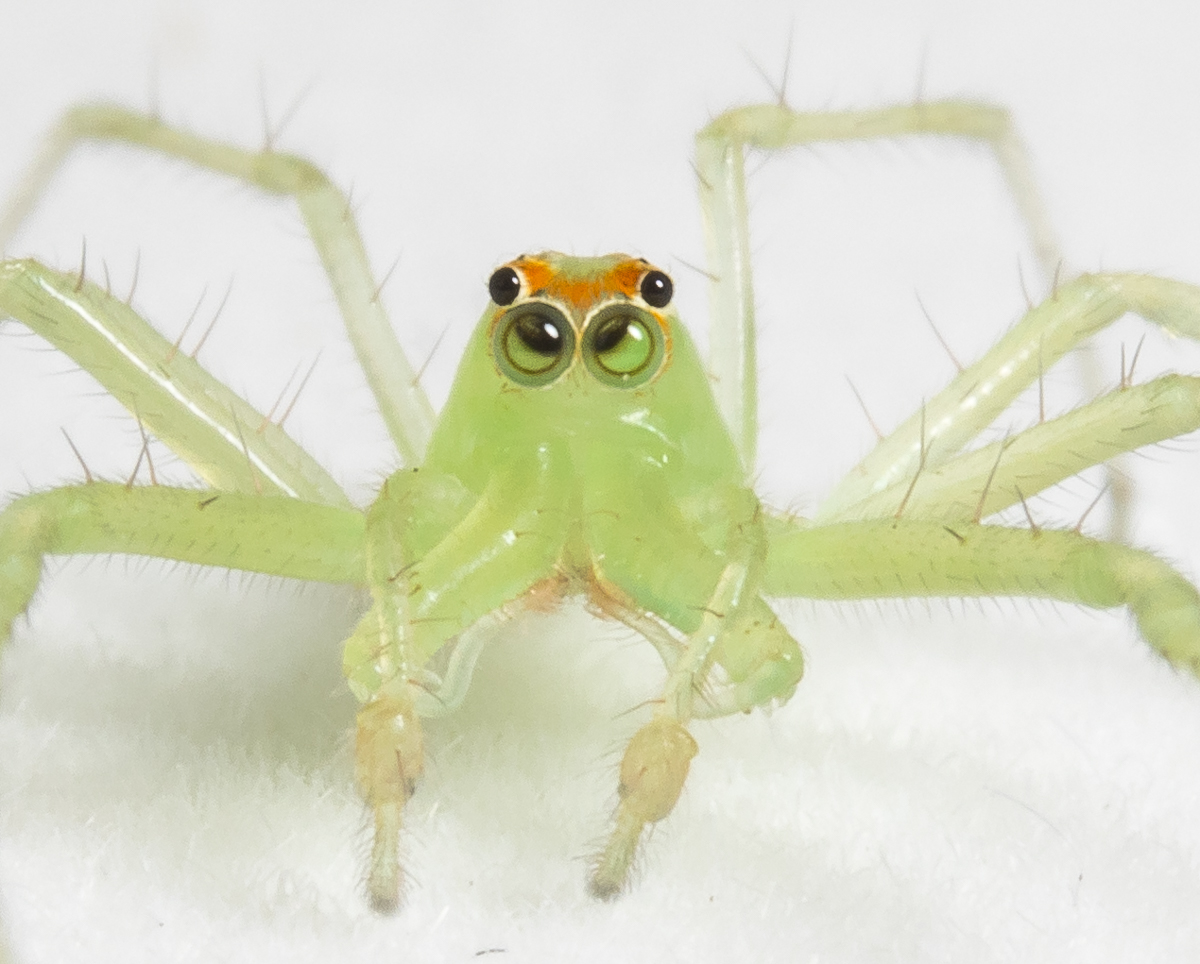
The impressively large anterior median eyes (those two large eyes on front) of a Magnolia Green Jumper
One of the things I love the most about these spiders is how it is really easy to see the retinas in the large eyes on front move around inside as they spider looks around (the lenses are fixed to the the carapace, but the retinas inside can be moved by tiny muscles). When the eyes become dark, the spider is looking directly at you (I think this guy is looking at my pandemic haircut). After a couple more shots, I took him back outside to patrol the yard in his new duds.
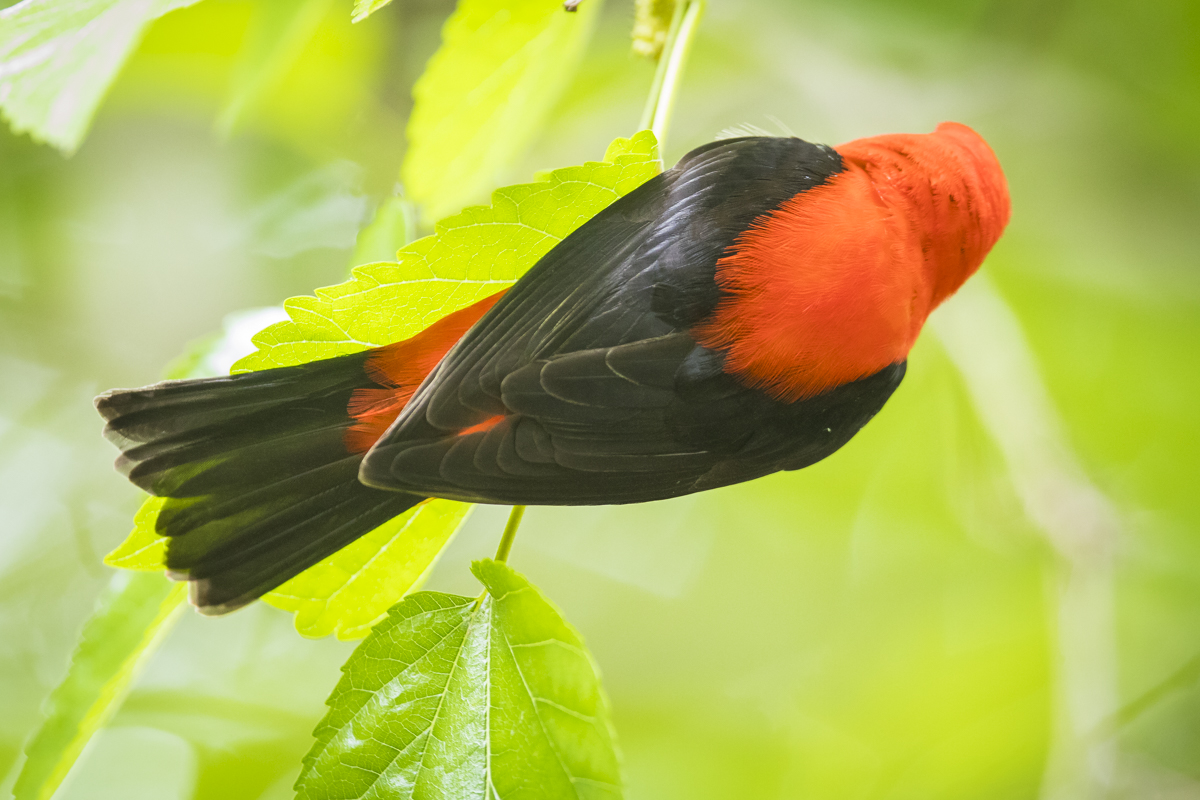
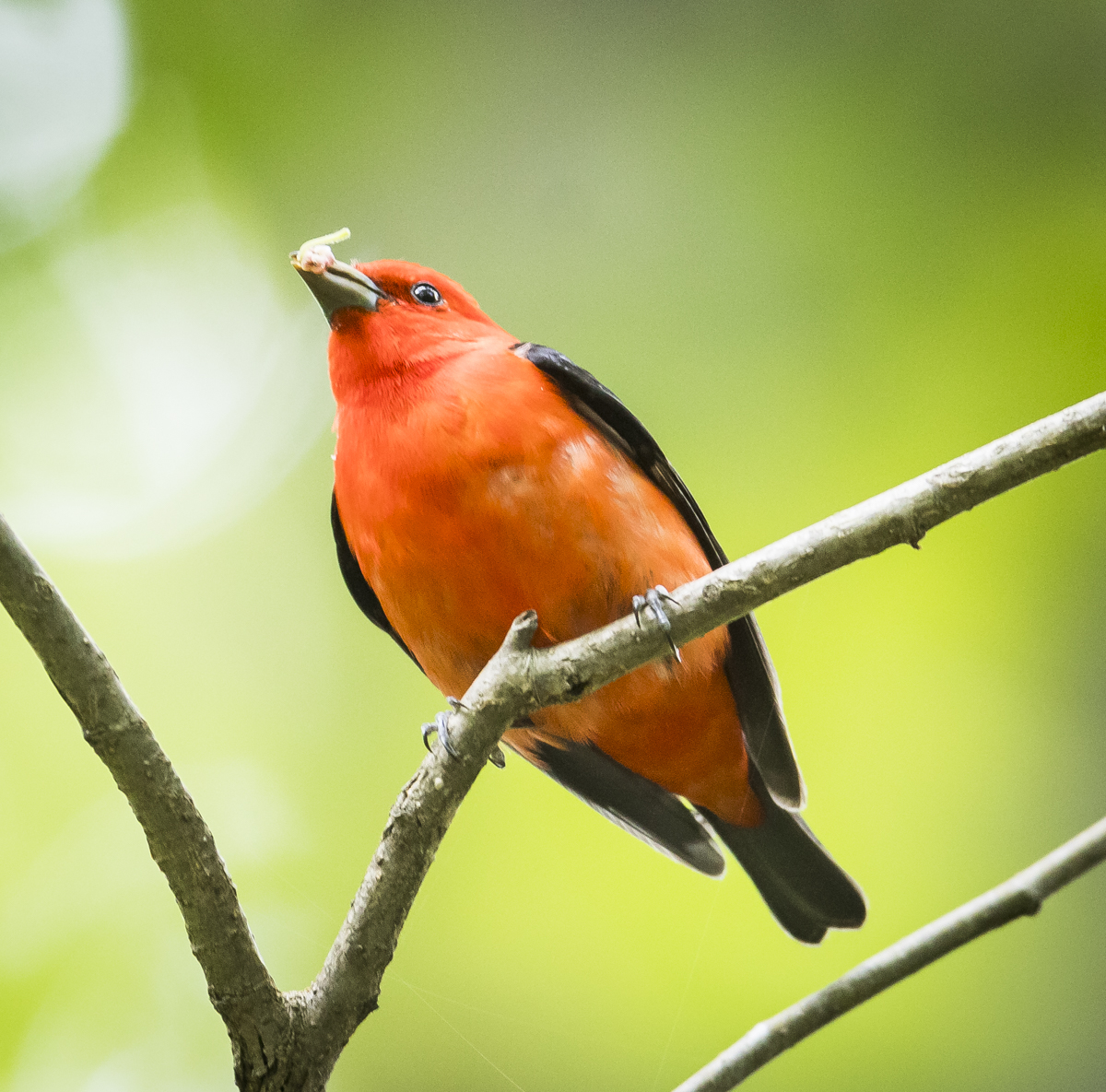
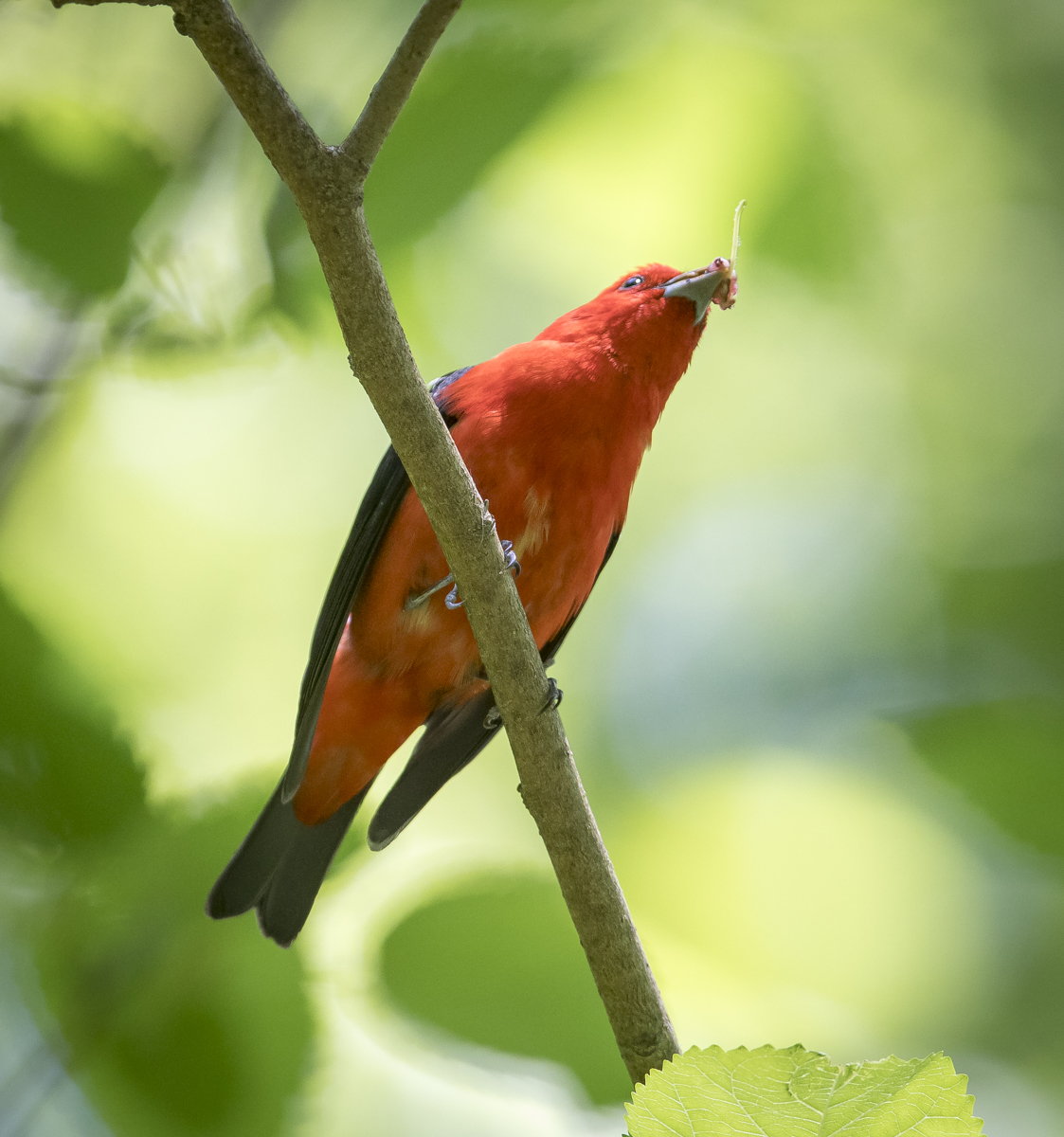
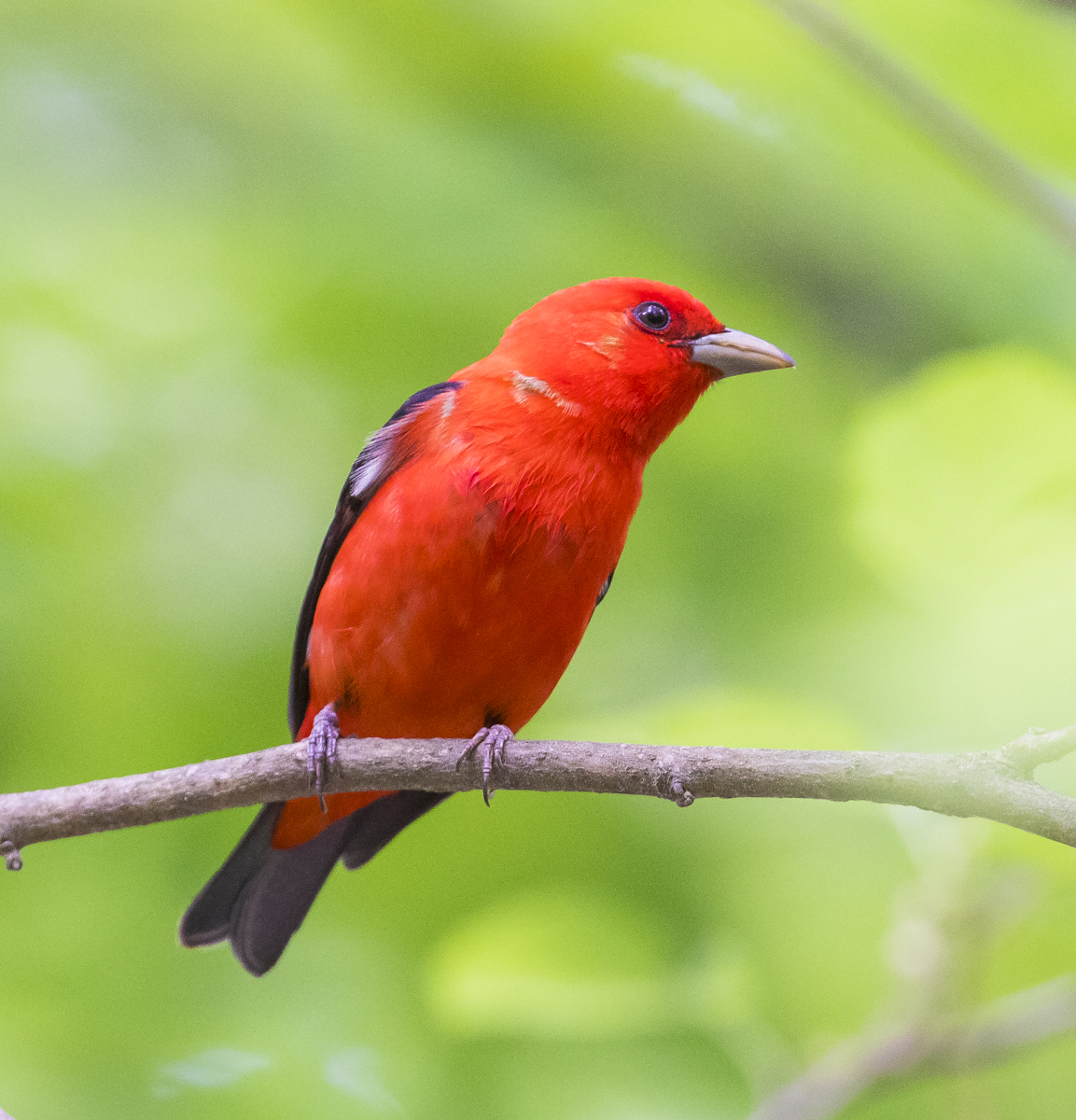
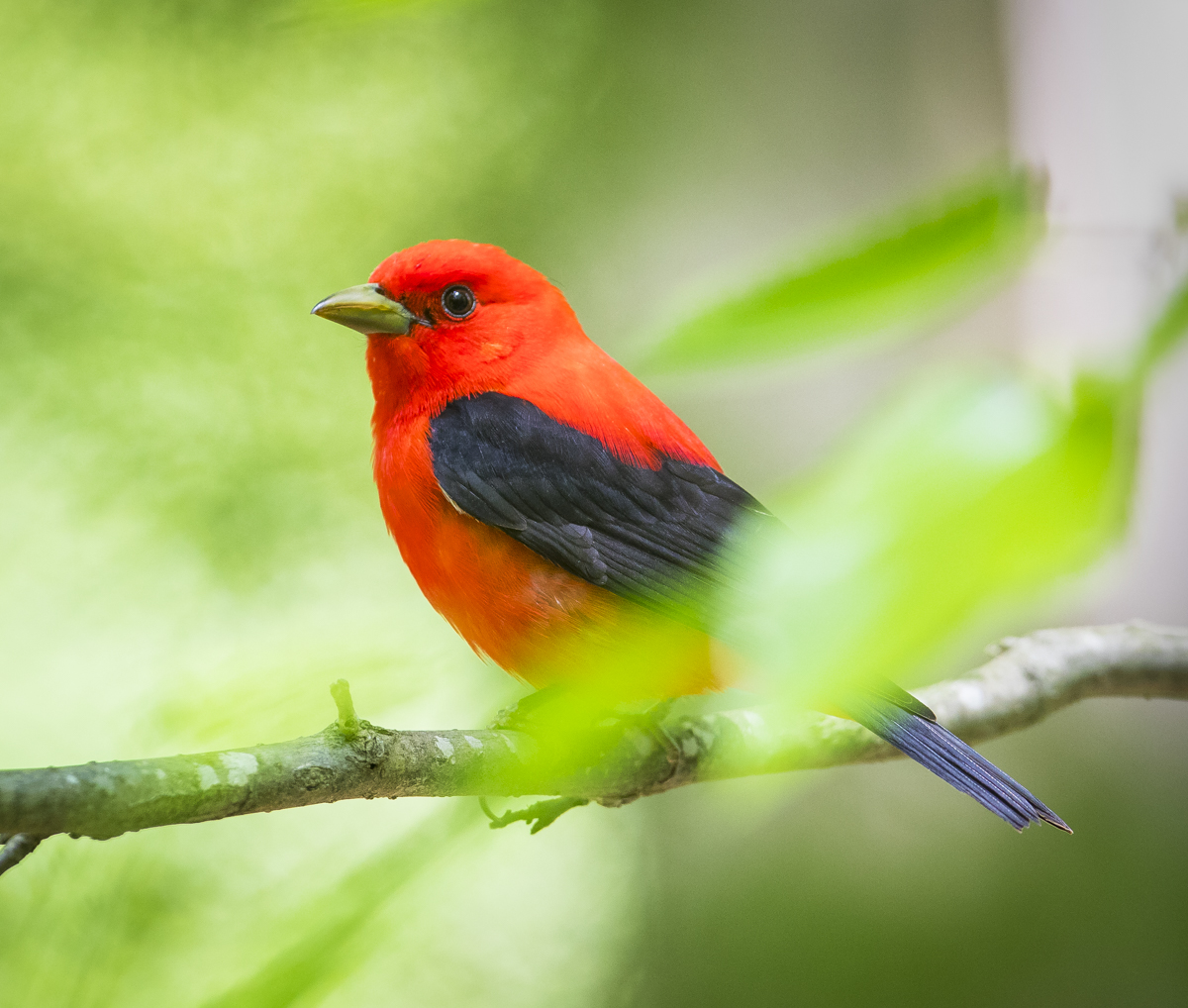
A simple post this morning of something I rarely see, a top side view of a male Scarlet Tanager. They are still visiting the mulberry tree out back and have consumed all the easy to reach berries, so they are exhibiting some impressive acrobatics to snag the remaining fruit. This provides some great views of their amazing color scheme.
Dorsal view of a male Scarlet Tanager (click photo to enlarge)
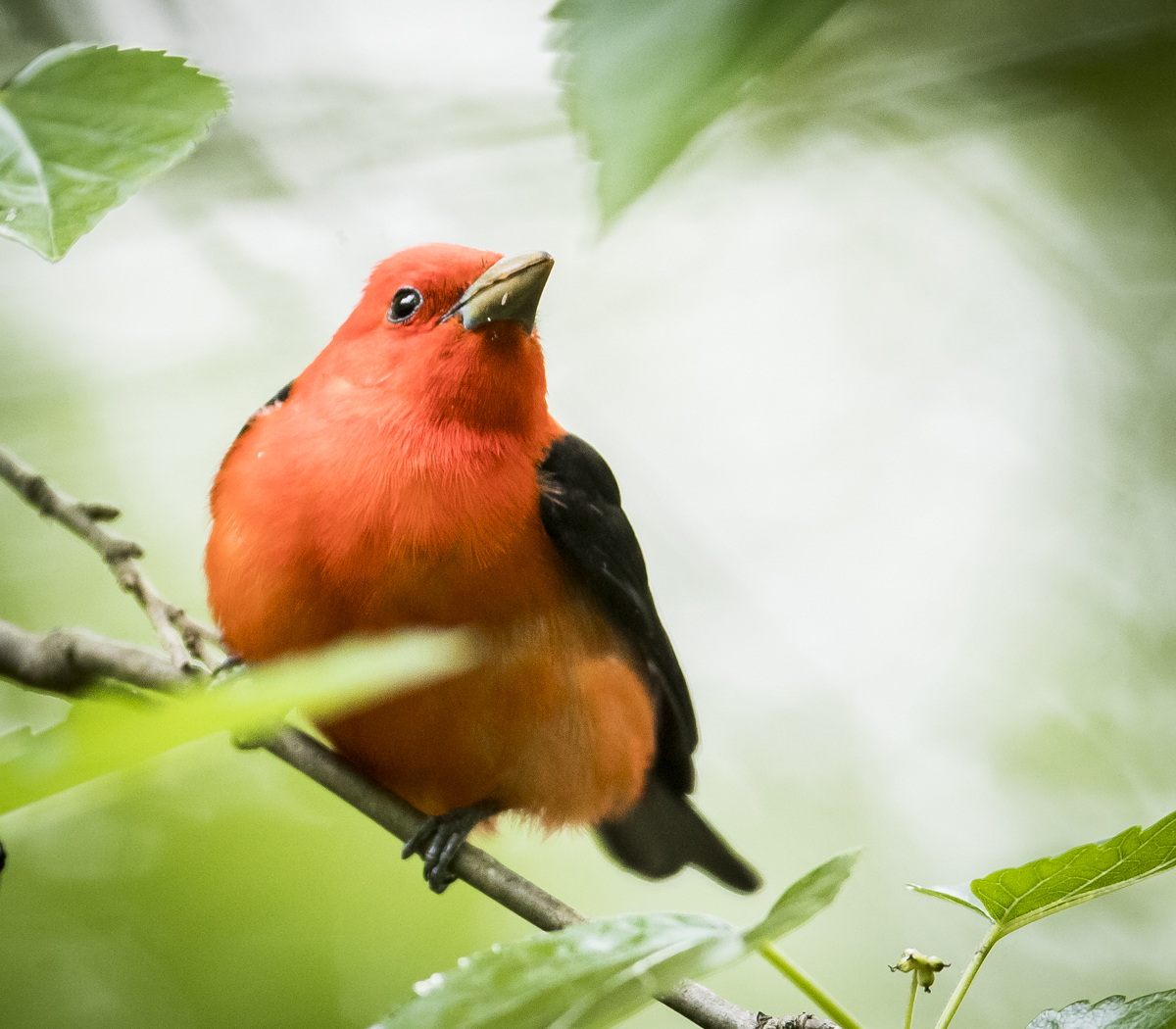
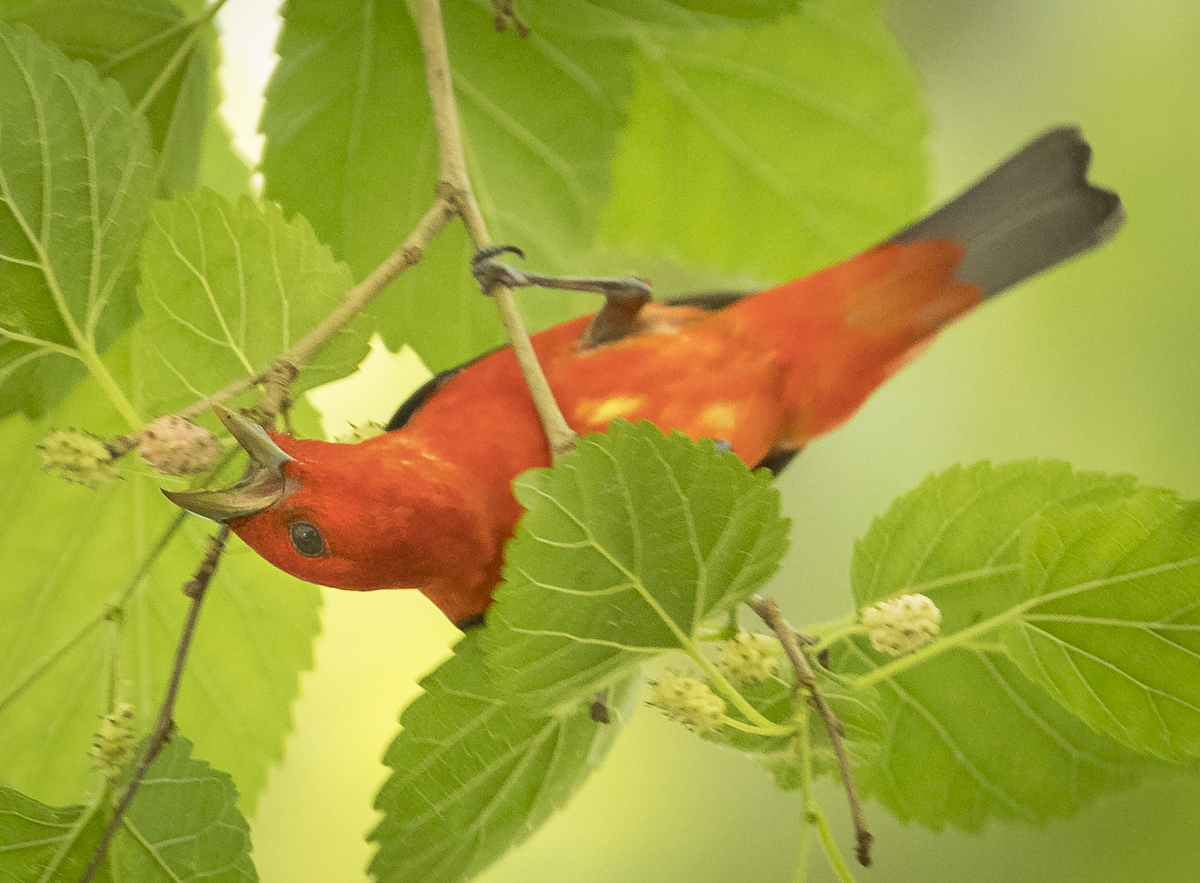
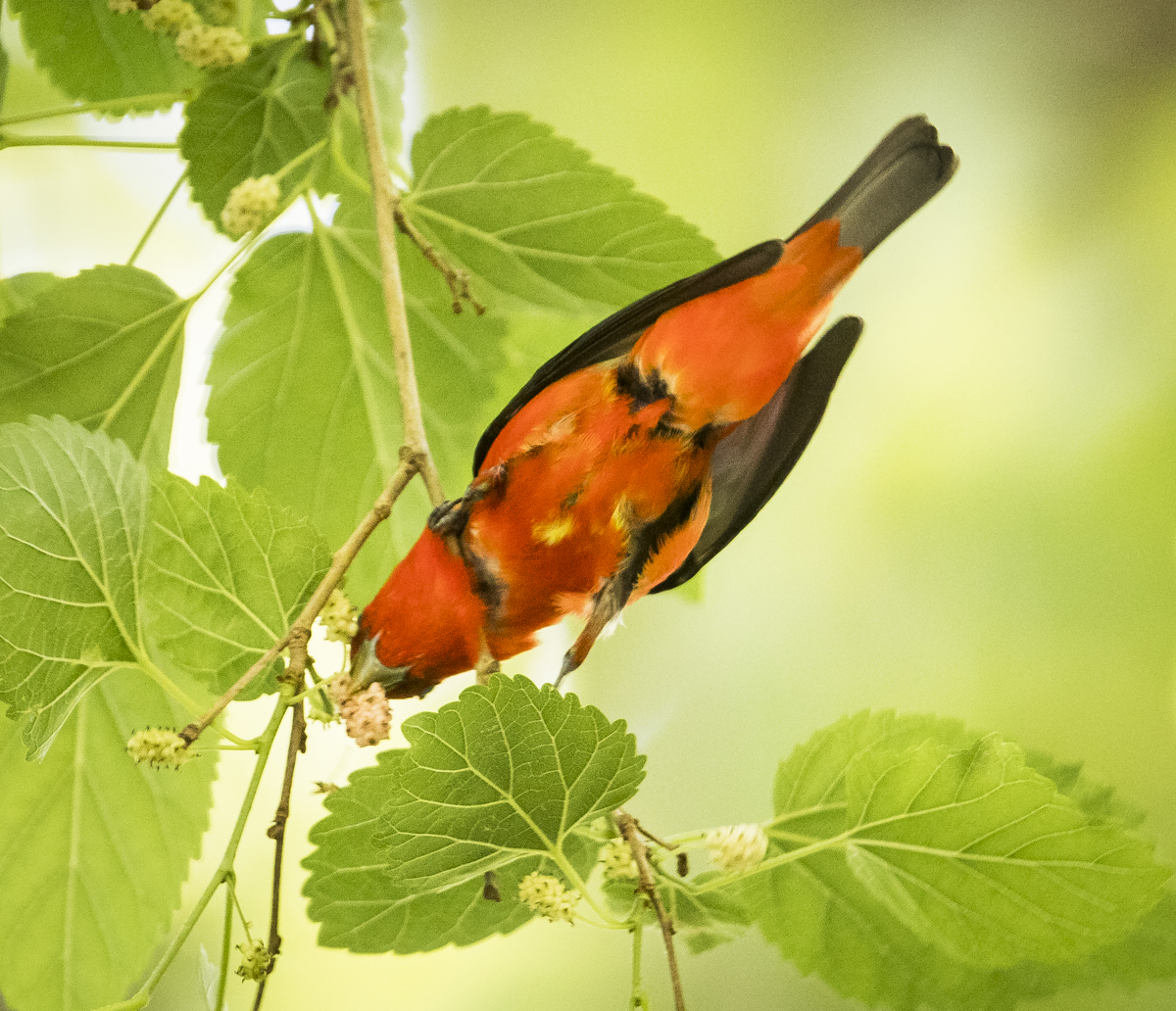
I’ve been working in the shop on a project and, as was the case last week, the tanagers are still at it, although the mulberry supply is dwindling fast. I am surprised at how tolerant they are as I walk to and from the shop door, but I am happy they allow me to take a break from my chores and admire their redness. Here are a couple of shots of a male Scarlet Tanager that was chowing down on the berries yesterday. By the way, I think I have now seen at least three separate males in this tree based on their slight differences in yellow patches.
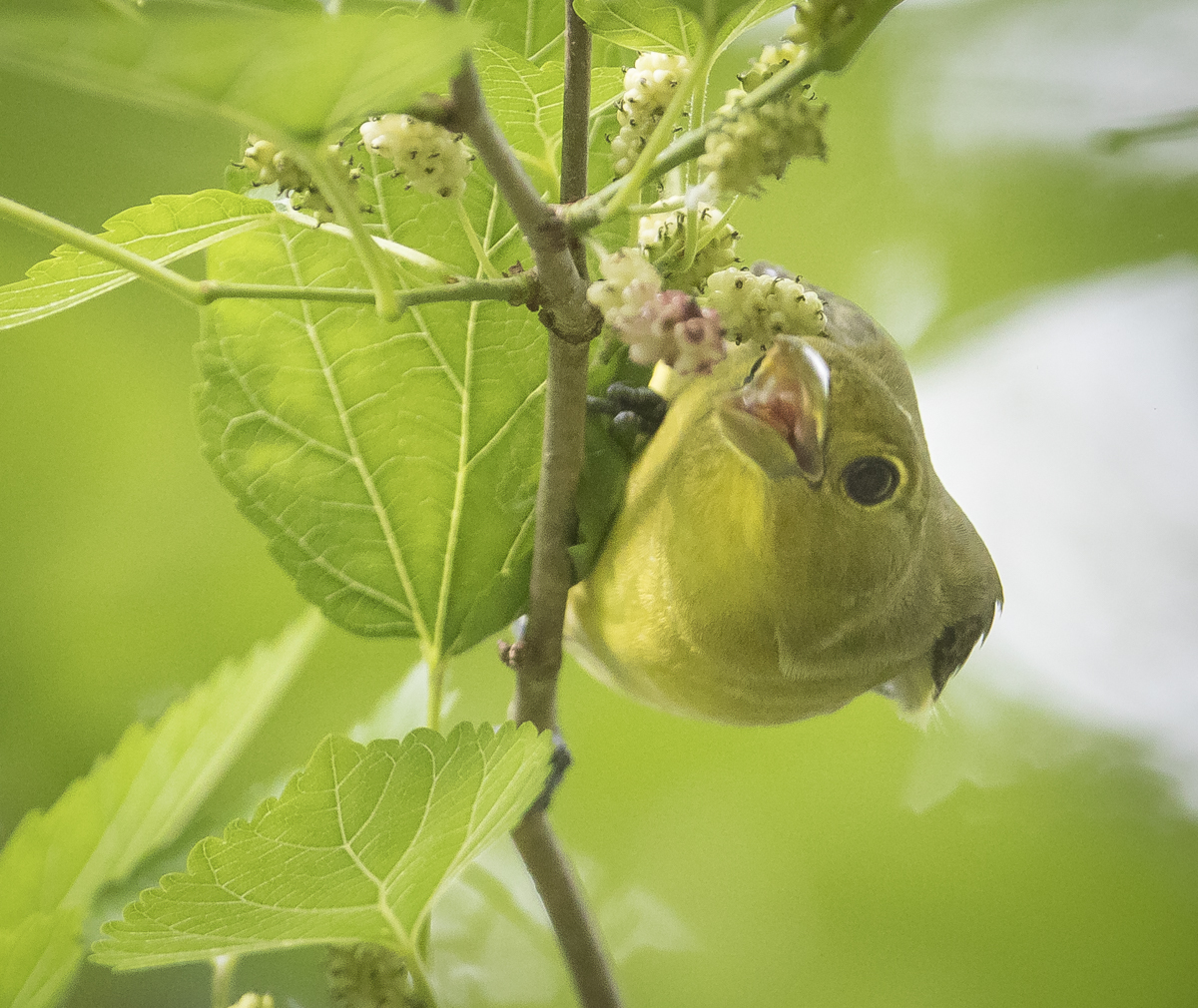
Male Scarlet Tanager scoping the branches for fruit (click photos to enlarge)The berries that were easy to reach are mostly gone now, so it requires a little extra effort to grab oneThe birds are hanging upside down or flying up from underneath the branch to grab berriesThey usually pull off berry and stem and then perch nearby to chew up the berry and spit out the stem
Green gives and red receives. Nature is colour coded!
~Sonali Mohan
Some of you may have known him, and, even if you didn’t, you may have one of his bluebird boxes in your yard. Jack Finch started a non-profit, Homes For Bluebirds, to help restore his beloved Eastern Bluebird to the skies of the southeast. He built thousands of quality bluebird nest boxes and was tireless in his efforts to promote ways to enhance bluebird populations. When I worked at the museum, I made frequent trips out to his farm to purchase nest boxes for schools and to talk about bluebirds. He was always experimenting with ways to provide more food for bluebirds from raising mealworms to selecting for late blooming dogwoods that would produce berries later into the season. For awhile, he promoted mulberry trees as a food source, and that is how I ended up with a sapling many years ago. I planted it in what was then a sunny spot near my shop, and now, the tree produces berries every spring for the local wildlife. I hope Jack would not be disappointed that his tree has more green and red than blue.
It turns out that Scarlet Tanagers are frequent visitors and berry pickers in this tree every spring. This week, as I was going in and out of the shop while tinkering on some woodworking projects, I kept seeing tanagers feeding. So, I brought out the camera, set up the tripod at the door, got comfortable in a chair, and waited.
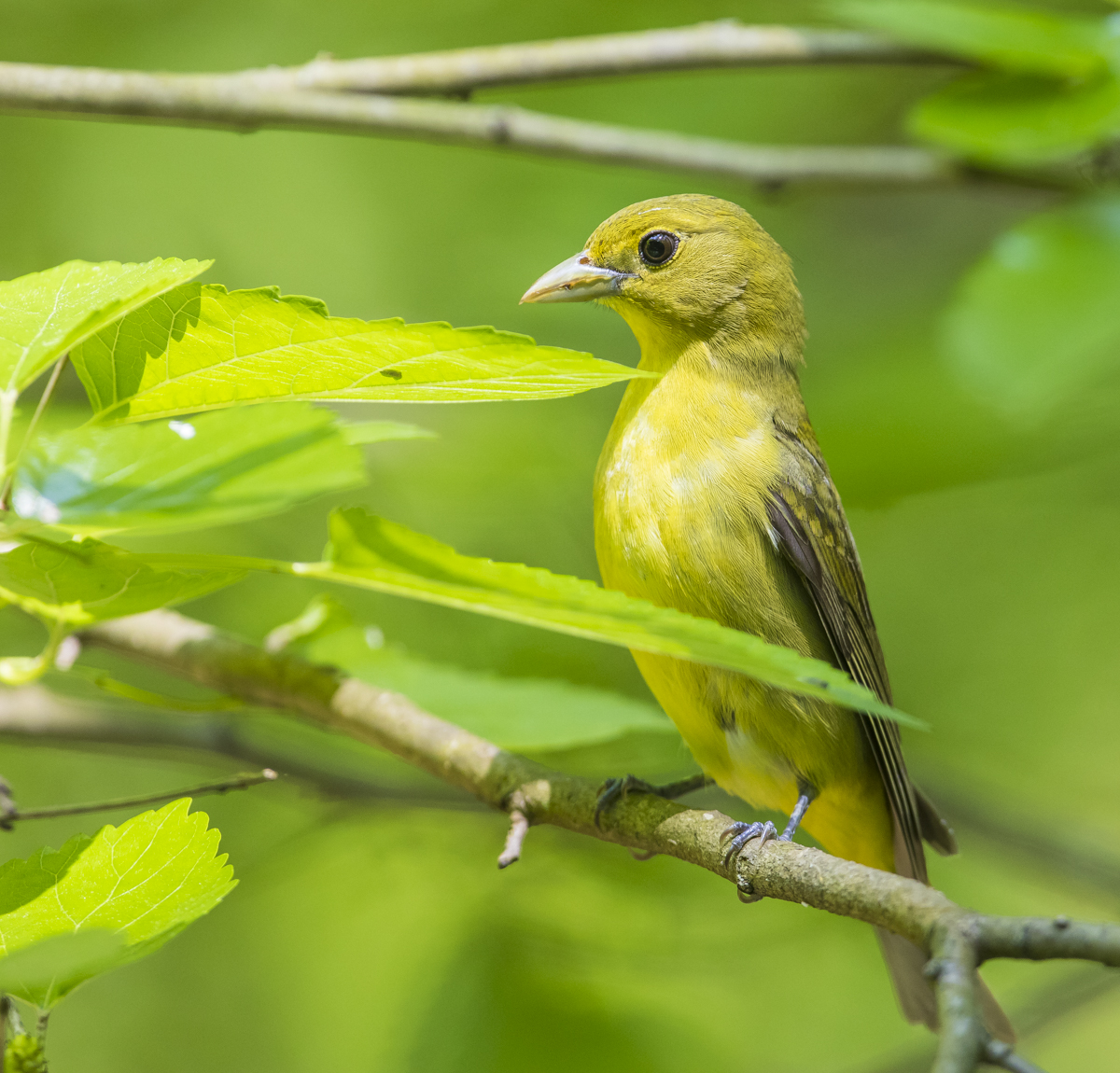
Male Scarlet Tanager eating a mulberry (click photos to enlarge)Female Scarlet Tanager reaching for a berryFemale Scarlet Tanager in a rare spot of sunlight in the branches
The tree leans out over the driveway and has one branch down low at eye level. There are only a few spots where a bird can perch that present a clear shot through the branches and leaves, but it was great fun watching them come and go. They are active feeders in that they often have to flutter their wings to maintain their balance while reaching out to the twig tips for berries, adding to the photography challenges.
This male landed in spot where the green background provided a nice contrast to his brilliant red plumage
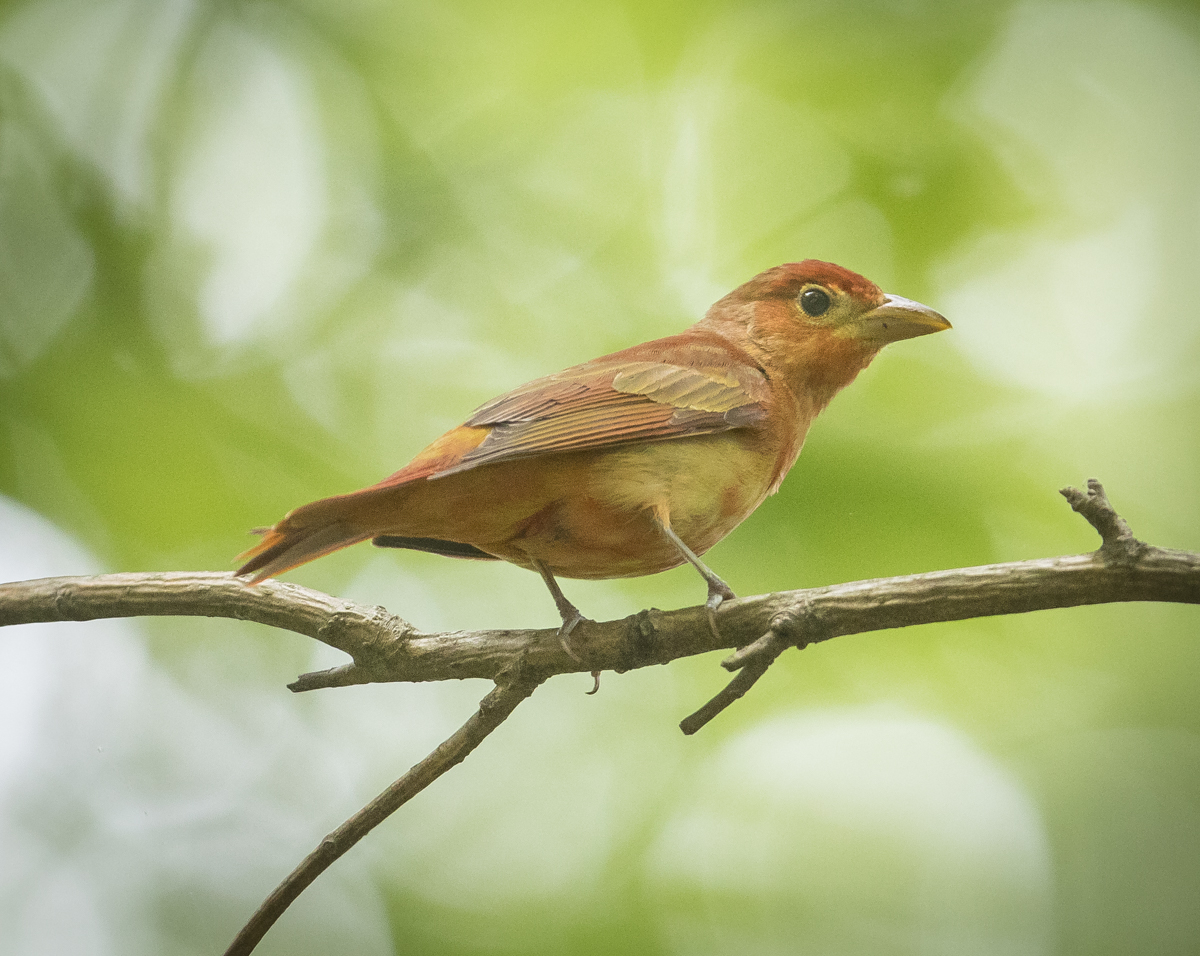
At first, I was usually seeing a pair, a male and female, coming together. On one visit, another male showed up! And a few seconds later, a male Summer Tanager flew in (but avoided having his picture taken), along with what I first thought was an immature male Summer Tanager. It had a lot of yellow coloration mixed with the red. In reading online, it seems that some older females may have a lot of red overtones (females are usually yellow), and this one’s colors are more blended than patchy. I’m not exactly sure which sex this one is, but now I’m leaning towards a female, as the immature males I have seen in the past were more splotchy.
A Summer Tanager with a lot of red and yellow coloration
That certainly was a highlight of my mulberry viewing – five tanagers at once! In between tanager feedings, I saw a lot of other species going about their daily routines.
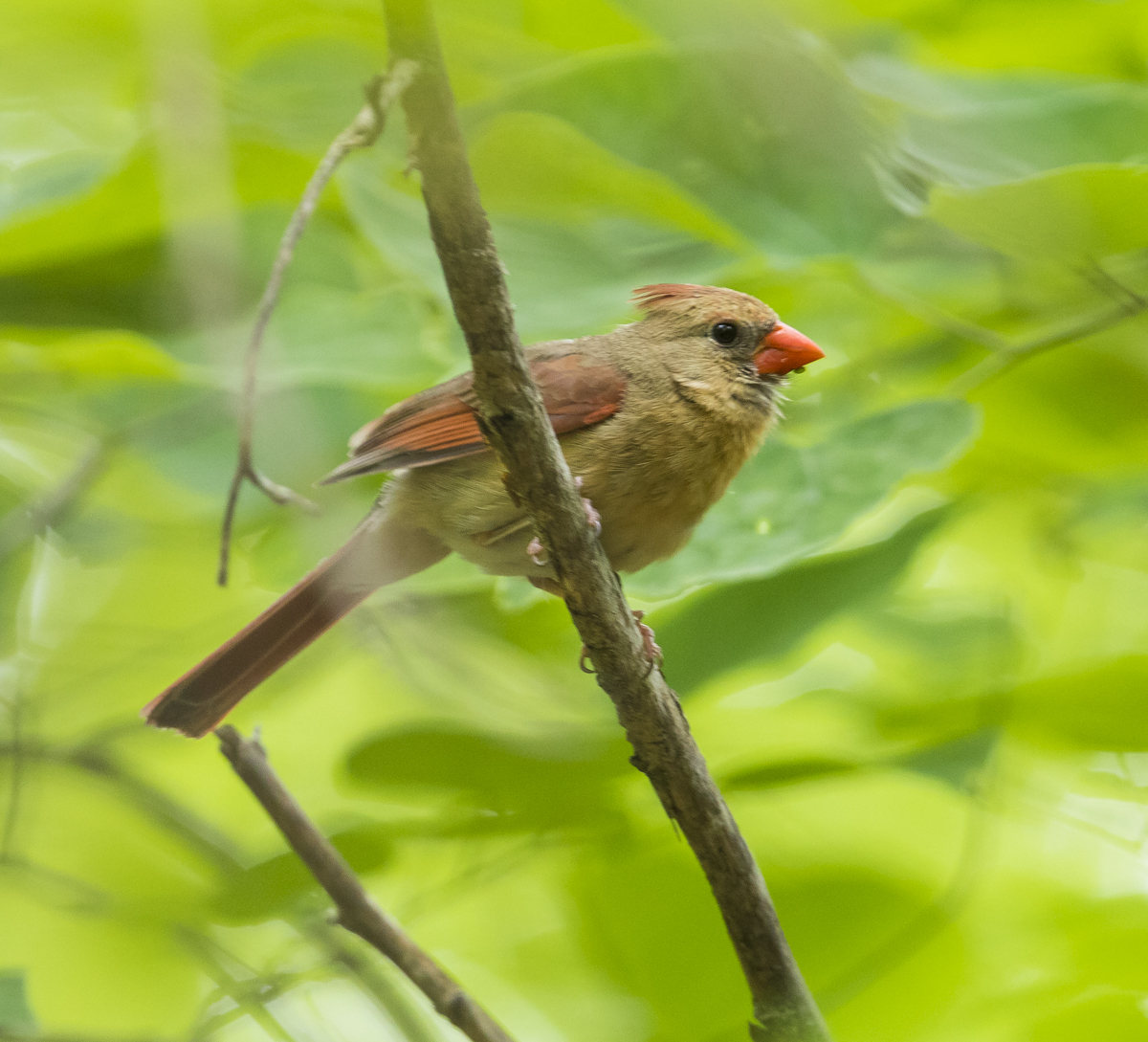
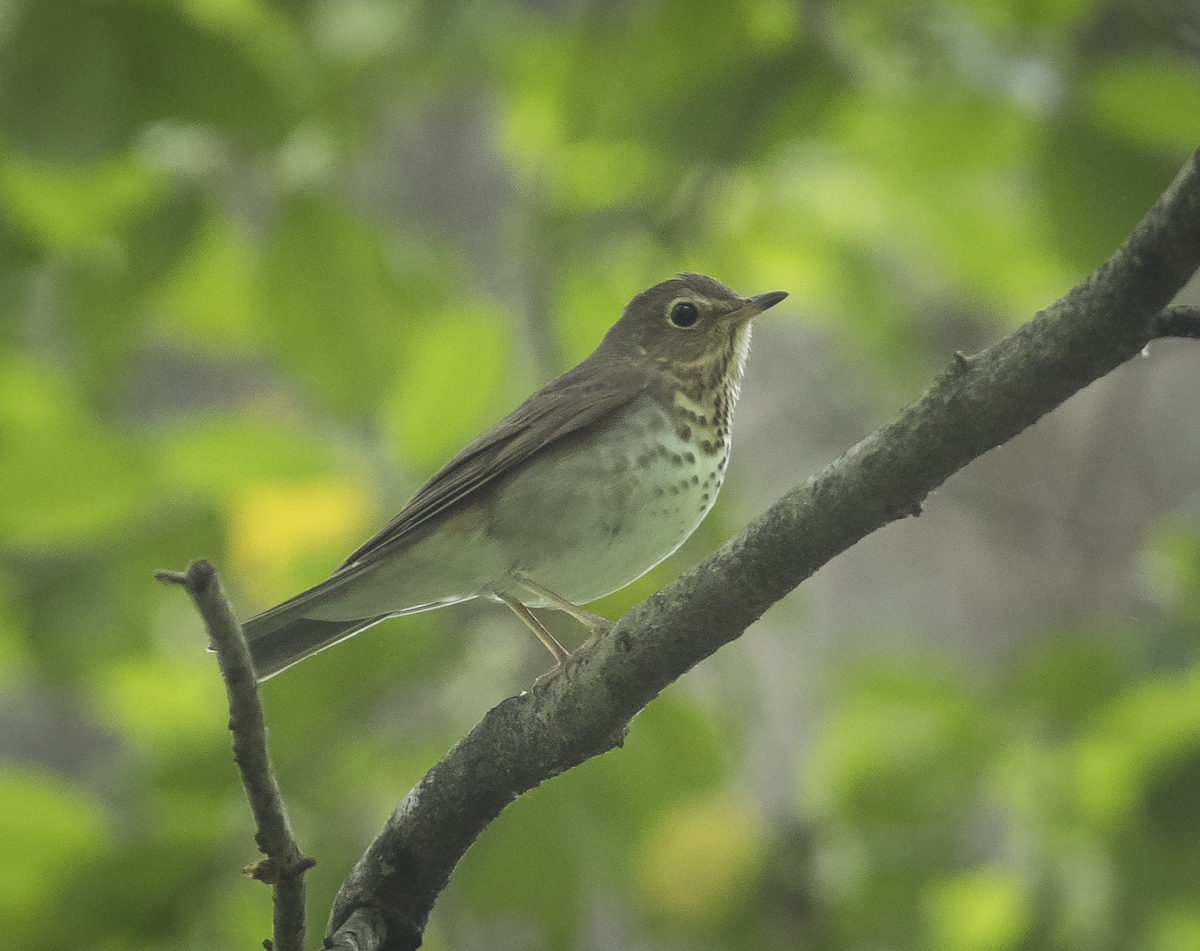
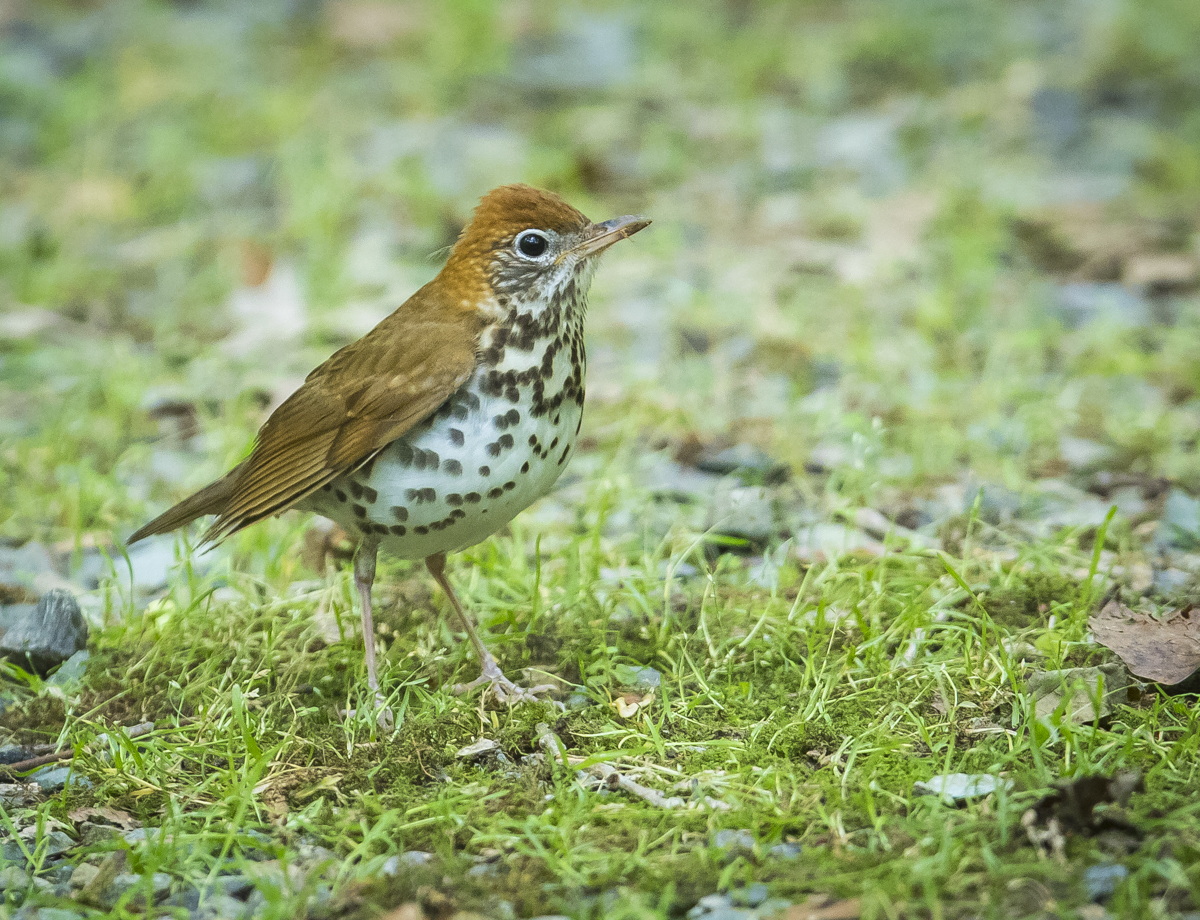
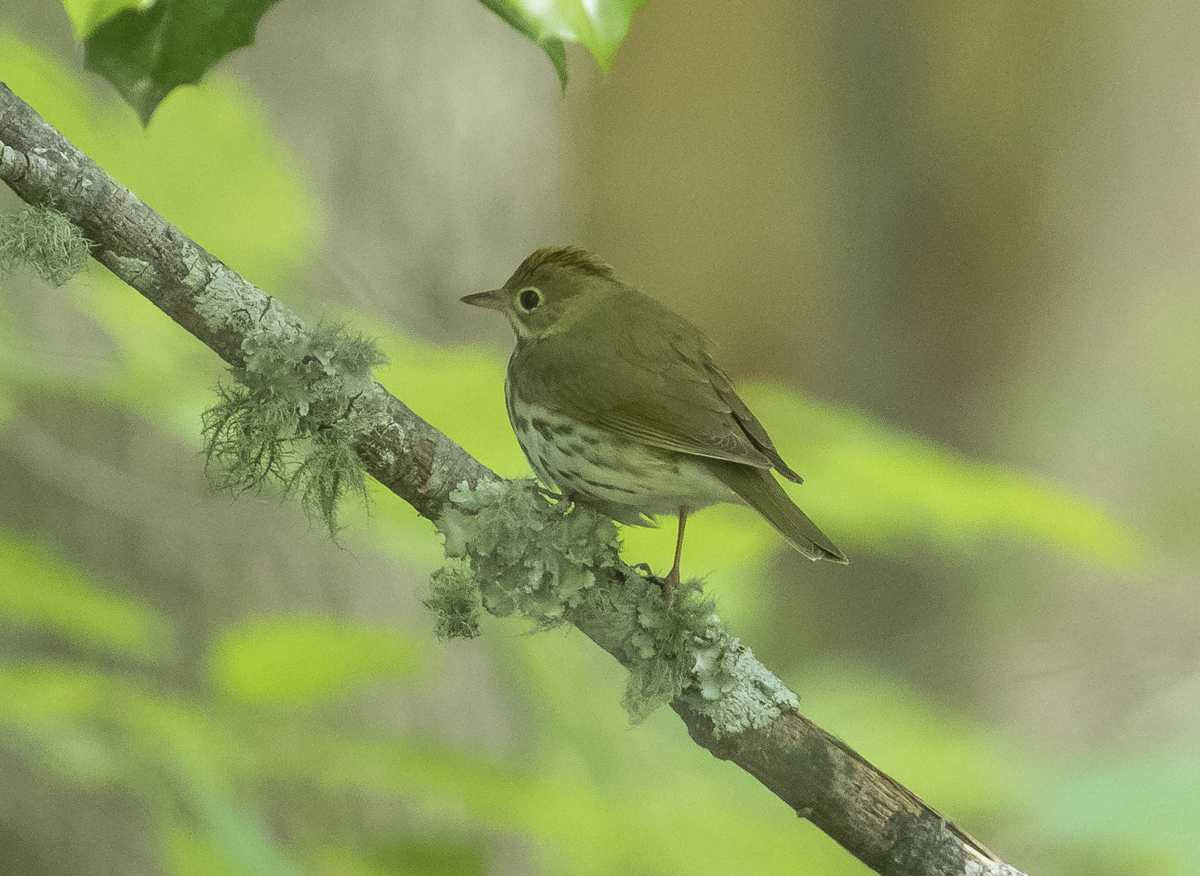
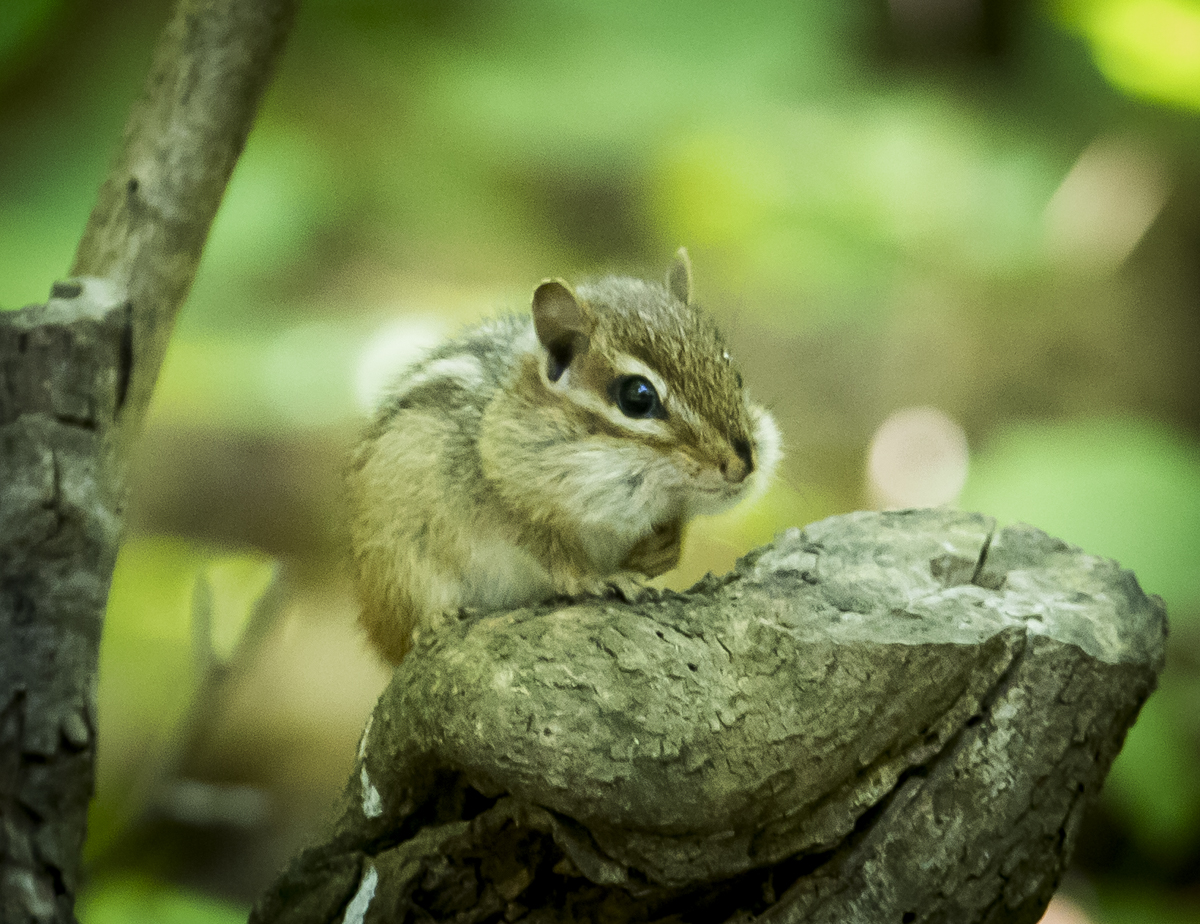
This female Northern Cardinal stopped in for a quick visitA Swainson’s Thrush was feeding on the few remaining American Holly berries on a nearby treeA pair of Wood Thrush made regular foraging trips to the area just outside the shopAn Ovenbird calling nearby finally came for a quick visitAn Eastern Chipmunk, with both cheeks full, sat and watched me for about 5 minutes before deciding I was safe and moving on
A few notables that I saw but didn’t get photos for included Chipping Sparrows, Carolina Chickadees, Tufted Titmice, the family of Carolina Wrens that fledged from inside my shop, Rose-breasted Grosbeaks, Blue Jays, a Red-tailed Hawk, and a Black-throated Blue Warbler. But, the stars of the show are definitely the male Scarlet Tanagers.
The red is so intense on a male Scarlet Tanager that it makes a cardinal almost seem pale
I think Thoreau summed it up nicely in his description of a male Scarlet Tanager…
The tanager flies through the green foliage as if it would ignite the leaves.
We delight in the beauty of a butterfly, but rarely admit the changes it has gone through to achieve that beauty.
~Maya Angelou
Remember how excited I was to finally photograph a chrysalis of a Falcate Orangetip butterfly in that post a few days ago? Well, I kept watch on the remaining caterpillars, hoping to catch one in the act of transformation, and got lucky again. One morning when I checked on the larvae, I found one in its prepupa stage. That is the stage between a free-living caterpillar and its pupa (chrysalis). A butterfly larva usually finds a sheltered spot and attaches itself to a twig or leaf (or whatever it usually forms its chrysalis on) with silk. In many groups, the prepupa hangs down below something (like a monarch in its J-shaped prepupa). For this species (and swallowtails), it attaches itself at the rear end with silk and then forms a loop of silk that it slips its head through. The position reminds me of a telephone line worker attached to a pole with a safety harness. The prepupa stage usually lasts about 24 hours for the species I have observed, so I set up a photo chamber with the prepupa in it, and waited.
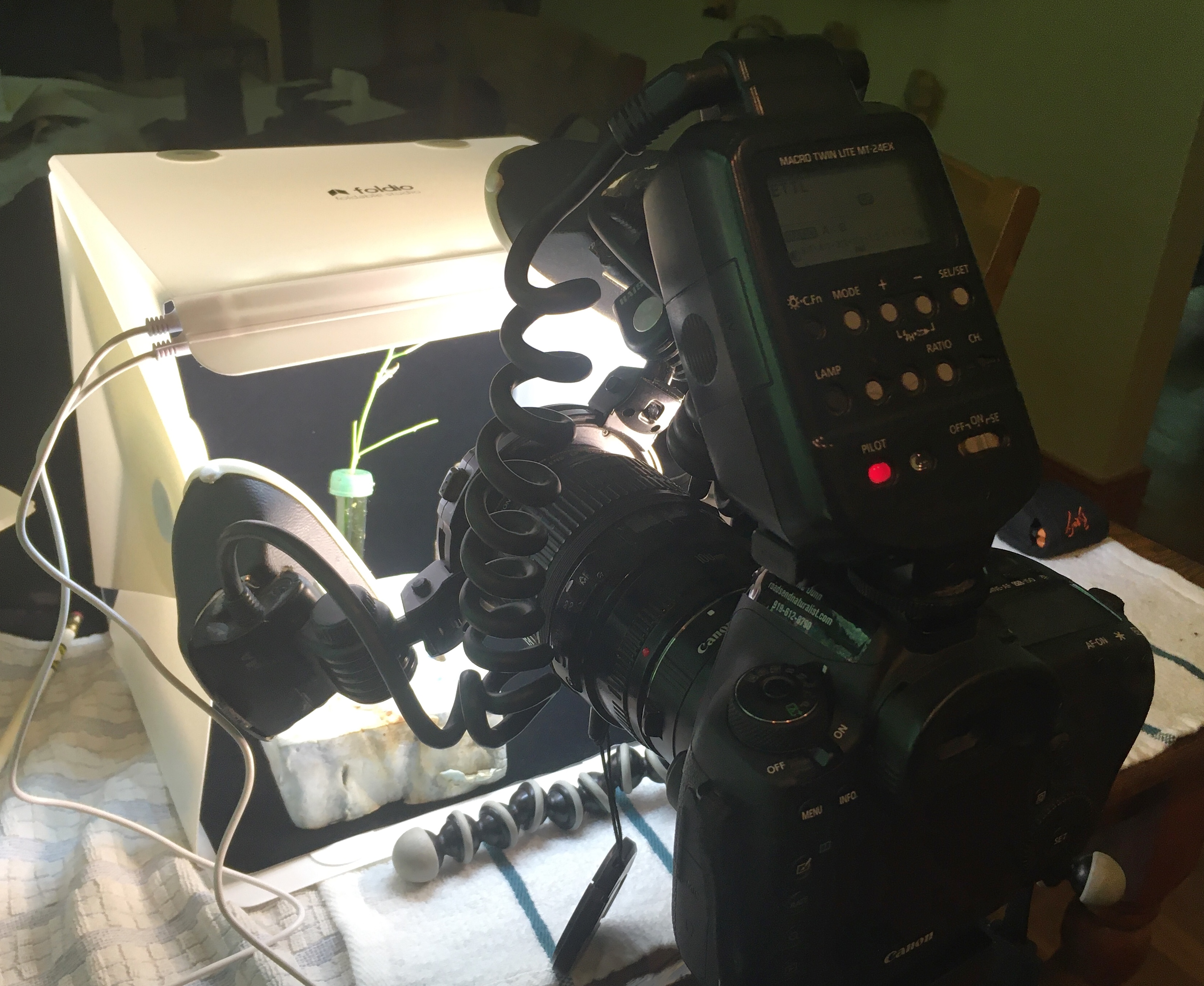
My dining room macro studio with light box, LED light for video, camera and flash for stills (click photos to enlarge)
By the way, I want to thank Sam Jaffe of The Caterpillar Lab for his suggestion of the Folio brand portable light box as a tool for photographing insects. It has its own LED light strips and changeable background colors. And it looks good on a dining room table in times when no one can come to dinner.
The prepupa had formed during the night, so I anticipated it would be the next morning before it transformed. The first one managed to transform during the early morning hours before even I get up. This one was more obliging, and the next morning was still a prepupa, but starting to move slightly. I got some coffee and waited…for the next 30 minutes or so it just made slight wriggles. Then the C-shape started to straighten out, and I knew, from watching swallowtail prepupa do this, that things were about to happen. The video clip below shortens what took about 15 minutes to occur into 1 minute. The footage is at 5X the actual speed and I edited out clips to shorten it. I’ll let this amazing act speak for itself…