• Getting Back To It

    Posted by

    It’s always good to get back to the places you love…

    Life has been way too busy these past many weeks and my blog entries have suffered, but I finally have a break this morning while I wait on some overdue car maintenance. With the busyness has been less time exploring outside, but this weekend saw a return to one of my favorite places, Pocosin Lakes National Wildlife Refuge. The occasion was the 5th annual Black Bear Festival in Plymouth, NC.

    Black Bear Festival
    The entryway to the Black Bear Festival in Plymouth (click photos to enlarge)

    The NC Museum of Natural Sciences was again assisting with the popular “bear tours” on the Pungo Unit of the refuge and I volunteered to help out. We did six 3-hour tours from Friday evening through Sunday afternoon, so it was busy schedule, but a good time nonetheless. It included severe weather before and during Friday’s tour that saw hail, lightning, strong winds, and heavy rains. In spite of all that, we managed two bears on that first tour.

    Black Bear tracks
    Fresh bear  and deer tracks

    The next morning, we headed out at 6 a.m. with a dense layer of fog limiting our viewing across the fields, but we managed a few bears once the fog started to lift. The plus side of the heavy rain was that we knew any tracks we saw were fresh!

    Black-bellied whistling duck
    Black-bellied whistling duck

    A rare find was a black-bellied whistling duck perched along one of the canals in the refuge. I have seen this species a few times in NC and FL, but never on the Pungo Unit. I was told by a friend that this one has been hanging around this area for a couple of weeks. They are a beautiful duck, more typically found in marshes from Texas to Florida, but seem to be slowly expanding their range northward.

    Dugoutr canoe in museum
    Dugout canoe in the Roanoke River Maritime Museum in Plymouth

    Between tours on Saturday, we visited the festival in downtown Plymouth. Lots of local food vendors, exhibits and talks about bears, and the usual crowd of knick-knack vendors and local organization booths that show up at such events. We visited the Roanoke River Maritime Museum to see some displays of wildlife photography and local boating history. Imagine my surprise when I came across something from my past – the section of dugout canoe I found years ago in Lake Phelps when I was working as the East District Naturalist for NC State Parks. I had no idea it was on display and was even more surprised to see what is probably the original exhibit text label made when this section of canoe sat on display in a make-shift exhibit shed at Pettigrew State Park.  When I started working at the NC Botanical Garden and was designing a program on uses of native pants (for example, bald cypress for dugout canoes), I tracked down the NY Times article from my 15 minutes of fame for being the guy that first stumbled upon this treasure trove of ancient canoes. The large canoe mentioned in the text is now on display at the NC Museum of History in Raleigh.

    Exhibit sign about dugout canoes
    A blast from the past

    Each tour yielded some wildlife surprises (king rails running down the road ahead of the bus, turtles being helped across the road, nutria in the canals, etc.), improving muddy roads, and visitors delighted to see their first bears in the wild. In between tours, we had a few moments to take in the sights and sounds of the town –  grab a bite to eat, check out the noisy southern toads and squirrel treefrogs in the retention pond at the hotel, and get ready for the next busload of people. With two buses running each tour, we shared the wonders of Pungo with over 180 visitors from all around NC (and a few other states).

    Southern toad calling
    Southern toad calling

    While every tour had its moments of adventure, one tour stood out for all of us, the Sunday morning 6 a.m. trip. We had just turned onto the refuge road when a bear went across the road, immediately starting us off with a bear encounter. Just down the road was standing bear…a medium-sized back bear with a propensity for standing up in the corn field to check us out.

    Black bear standing in field
    Black bear – “outstanding” in his field

    Once we hit the dirt of D-Canal Road, we spotted another bear feeding in a wheat field on private lands adjacent to the refuge. Bears love wheat and we saw them in this field on several of the tours. The golden color of the wheat provided a beautiful backdrop for the jet black fur of the bears.

    Black bear in wheat field
    Bear surrounded by delicious wheat, the breakfast of champions

    While we were all watching that bear, a young bear came out into another field on the refuge next to us and walked right in front of the bus and group of excited onlookers.

    Young black bear crossing road
    Young bear walking near our group

    Then, another young bear (these are probably last year’s cubs) strolled out behind the buses and disappeared into the woods.

    Young black bear crossing road 2
    Another young bear on the other side of our group

    Most of the people continued to watch the first young bear that was still wandering around in front of the buses, while a few of us were standing at the edge of the canal watching the bear in the wheat. Suddenly, I see a bear head pop up from the bank of the canal just a few feet from us. I whispered to the few people between me and the bear to move back and give it some room. It looked like the young bear that had crossed behind us and gone into the woods just a few minutes before. Apparently, it had gone to the canal and walked down the bank, climbing up in front of us.

    Black bear comes up next to group
    This one popped up right next to us

    The confused bear walked up, moved across in front of us, and passed in front of the buses and the rest of the group. Minutes later, another head popped up and followed the same path. It seemed like bears were everywhere around us. These young bears probably aren’t sure what they should do in these situations so you need to give them space to move freely. The second one started to climb a tree when it saw the large group gathered in front of the bus, but when they stepped back and remained quiet, it came down and hustled across the road.

    Black bear entering canal
    The wheat field bear entering the canal

    Meanwhile, the wheat field bear finished breakfast and angled toward us to cross the steep-banked canal. I positioned myself to get a good view, and as she slowly entered the water, I expected to get a nice shot of her swimming across.

    Black bear starts across canal 1
    Why swim when you can walk across?

    Instead, she surprised me and slowly stood up, holding her front paws above the water, In all my years of watching bears, I have never seen one cross a canal like this.

    Black bear walking across canal
    Keeping those front paws dry

    Just one more reason I love the Pungo Unit and love observing bears. They are a constant source of amazement, curiosity, and wonder.

  • Swamp Break

    Posted by

    Each mile on a river will take you further from home than a hundred miles on a road.

    ~Bob Marshall

    It has been a hectic spring at work so we decided to take a break last week and do something we both love to do – paddle in a swamp. We both blocked off 3 days some months ago to allow for a couple of nights camping on platforms on the Roanoke River, one of our favorite get-away spots. Turns out the weather had other plans, and, with the forecast for our second day calling for cold rain and wind, we almost canceled the whole trip. But my swamp queen convinced me that one night in the swamp is better than nothing, so off we went Monday morning to paddle Gardner Creek and camp on the Barred Owl Roost platform. As I have mentioned before, the platforms are part of an amazing (and underutilized) resource for outdoor enthusiasts along the Roanoke River. Information and reservations are available through the Roanoke River Partners web site.

    Melissa in canoe
    Melissa in her element – a canoe in a swamp (click photos to enlarge)

    We put in where Gardner Creek crosses under Hwy 64. Melissa arranged with a local teacher she had met on workshops for a quick shuttle (during the teachers’ lunch break). Melissa drove our car to to the take-out point at the boat ramp in Jamesville, and the teacher brought her back to our starting point (a 5-minute drive instead of a 5-hour paddle).

    Swamp along te Roanoke River
    Spring is just beginning to show in the swamp

    Gardner Creek is one of our favorite paddles, a narrow, winding blackwater stream. One side was clear cut several years ago, but there is a slight buffer. The other side is a beautiful huge cypress-tupelo gum swamp. April is a great time to paddle as things are just starting to green up, and the wildlife is more active.

    bald cypress leaf out
    Bald cypress needles starting to emerge gave the swamp just a hint of green
    red maple color
    Splashes of color from red maples
    red maple seeds 1
    Red maple seeds are firetruck red

    Scattered along our route were bright splashes of red from the strikingly colored red maple seeds. By the time I am writing this, there will be white patches from hawthorns and shadbush blooms, yellow streaks from the newly arrived prothonotary warblers, and the greens from leaf out will start to fill in the gaps. But we were there on the cusp of color in the swamp.

    Barred owl
    Barred owls were numerous along our paddle

    Our main companions along the way were the birds, both year round residents and new arrivals. At the launch site, we heard our first barred owls, a sound that would escort us along out route the next 24 hours. I had left my usual camera and lenses behind and just had my waterproof point-and-shoot for this trip, a decision I soon regretted with the great close-up views of some owls within the first few miles of our paddle. Several anhinga, osprey, red-shouldered hawks, a yellow-crowned night heron, and a plethora of pileateds made for pleasant birding both days (see bird list at end of post).

    Fragile forktail
    Fragile forktail damselfly
    beaver lodge along Devil's Gut
    A huge beaver lodge along Devil’s Gut

    Other wildlife included some basking turtles, a gorgeous damselfly, and a muskrat.

    river herring and swamp scene
    Our highlight was what was under the water’s surface

    But our highlight for the trip was what was just beneath the surface of the water…the fish, thousands of them. With the water level’s dropping, fish were coming out of the flooded swamps and feeding along the edges, often right at the surface. We talked to a few fishermen who were catching white perch and “bream”. We also saw a few huge fish jump clear of the black water, probably some carp and maybe bass. But the dominant fish, by far, were the river herring. It is spawning time on the Roanoke, and schools of herring were concentrated in the creeks, one of which was where our platform was located. They were breaking the surface as we paddled, becoming more common the farther up the creek we went. Finally, at our platform, we could see into the shallow water and watched in awe as hundreds of fish swam by in small swirling schools of silver-gray. With the onset of darkness, the activity intensified (do they spawn mainly at night, or was it feeding activity?) and the splashing was noticeable all around us.

    Nearing the platform
    A gnarled cypress trunk greets us as we near the platform
    Barred owl roost platform
    Home sweet home, Barred Owl Roost camping platform
    view from platform barred owl roost
    View from the platform

    We slept without the usual rain fly to see the stars twinkling through the treetops. Occasional barred owl choruses echoed through the swamp throughout the night. The temperatures dropped, and, by morning, cloud cover came in with the approaching storm. It was time to pack up and head for Jamesville.

    barred owl carcass tied in fishing line
    The tragedy of discarded fishing line

    The day before, we came across a particularly poignant tragedy. After enjoying close views of a couple of barred owls on the way in, we were heartbroken to find a dead owl that had somehow become entangled in some discarded fishing line. It looked as though a lure was tossed and wrapped around a tree branch. I imagine the fisherman yanked and broke the line, but left it dangling from the branch. The barred owl had it tightly wound around the tip of its wing, perhaps flying into the line or maybe the lure that swayed in the wind. We cut the owl loose, gathered the remaining line, and found ourselves trying to collect any discarded line we found along the rest of our route (and there was way too much of it tangled in tree branches). It is certainly one of those things that takes a toll on wildlife and just doesn’t disappear from the landscape if left behind.

    Huge Bald cypress along Gardner Creek
    Swamp sentinel

    We beat the approaching rain and got loaded up and headed home, sorry to be leaving but happy for our time in this great watery woodland. One slight disappointment was that our platform showed some signs of age, effects of high water this winter, and some abuse/negligence by previous campers (luckily, not a typical thing we see out here). Melissa mused that in a future life she would love to take on the job of maintaining the platforms and leading interpretive trips in the swamp. Who knows, there may be many more swamp trips in our future (and that will be okay by me).

    Bird list:

    Wood duck, Anhinga, Great blue heron, Yellow-crowned night heron, Barred owl, Osprey, Bald eagle, Red-shouldered hawk, Red-tailed hawk, Turkey vulture, Black vulture, Wild turkey, Belted kingfisher, Fish crow, Pileated woodpecker, Red-bellied woodpecker, Downy woodpecker, White-breasted nuthatch, Carolina chickadee, Tufted titmouse, Northern cardinal, Blue-gray gnatcatcher, Northern parula, Yellow-throated warbler, Common grackle, Red-winged blackbird, Eastern wood-peewee, Tree swallow

  • Grubosaurus

    Posted by

    The Eastern Hercules has a wing span up to half a foot, the armor of a knight, and the spots of a leopard.

    ~Orin McMonigle

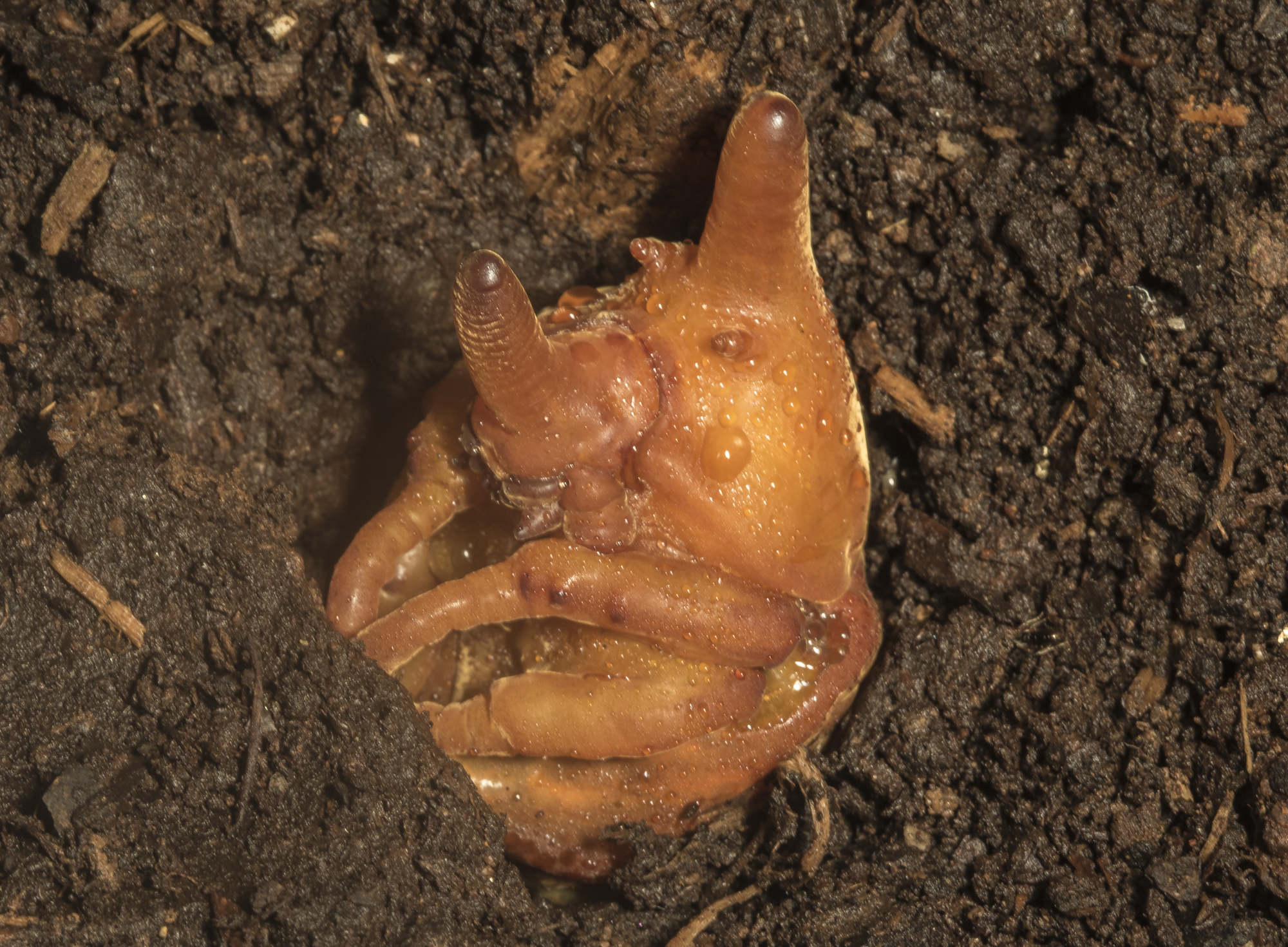
    I guess I should be honored that the front desk volunteer thought of me first. One day a little over a week ago, I got a call saying a woman was at the front desk with something she thought the Garden might want. She had a tree company take down a large tree in her front yard and the workers had discovered some Eastern Hercules beetle (Dynastes tityus) grubs in the rotten core of the tree. They had taken most of the grubs but she later discovered some still living in the rotten stump. So, she brought them to the place she knew cares for all things natural, and asked if anyone might want to keep them. Somehow, my name came up….go figure.

    Eastern hercules beetle grubs
    Eastern Hercules beetle grubs (click photos to enlarge)

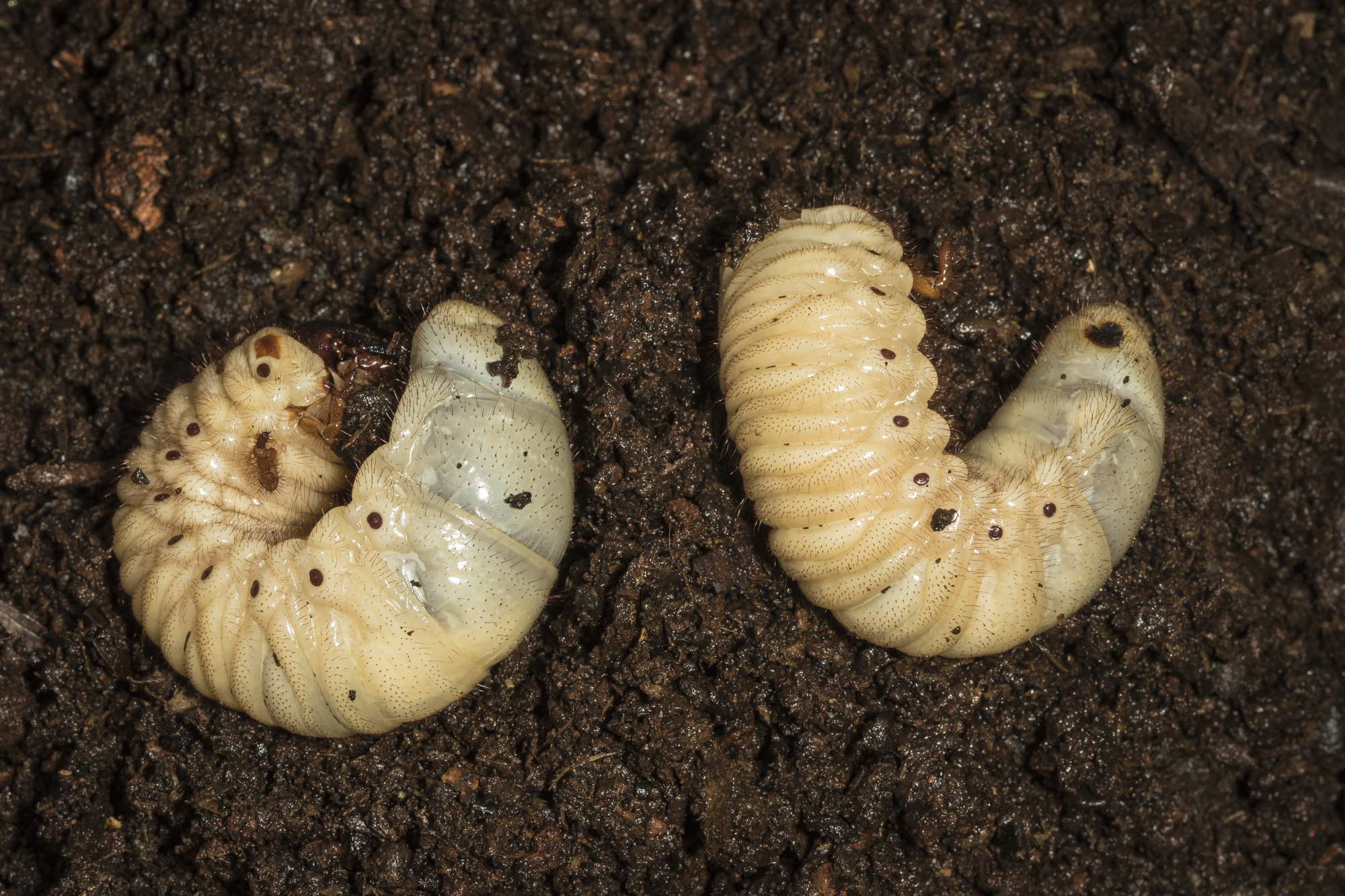
    When I went downstairs, the lady pulled out a flower pot filled with rotting wood from the stump and shook it around to reveal two huge grubs.

    Eastern hercules beetle grub
    They resemble the large grubs you frequently find under logs, only much larger!

    These grubs are as thick as my thumb and as long as my index finger. They resemble the large, curled beetle larvae I often find under logs, but these are much larger. The only other grubs I have seen that were this large were in the Amazon. Years ago, on a museum educator workshop, we were walking in the jungle along the river. One of our participants was a teacher from a local village. The group stopped next to a fallen tree to look at some birds in the canopy above. I noticed the local teacher leaning over the fallen tree trunk, listening. He then became very excited, ran back to his village and returned with a machete. He began to chop into the log, pausing, and listening, then chopping some more. He soon exposed a group of huge beetle grubs. He had heard them chewing inside the log and wanted to get them out as they are a prized food in that region. After explaining what they were, he proudly presented one grub to the three group leaders for us to take the first bites. Being the youngest of the three, I managed to get the back end of the larva. I can’t say I really recommend them raw (or maybe it was just the choice of my cut). On his recommendation, we took the remaining grubs back to the lodge as a side dish for dinner that night. The roasted grubs were much more palatable, with a somewhat nutty flavor.
    Eastern hercules beetle grub in hand
    And to think, I ate something like this once

    But not to worry, I have no intention of chowing down on these grubs. My interest is purely scientific. After bringing these not-so-wee-beasties home, I started searching the web for information on how to keep them. As is often the case these days when I search for what seems like an obscure topic, I found a wealth of information, including a link to purchase a guide to rearing Eastern Hercules beetles. Well, naturally, I had to have it.

    Raising Hercules Beetles guide
    You never know what you will find on our bookshelf

    The booklet arrived a few days later and has everything you need to know about breeding and raising these beautiful insects. Apparently, it has become a thing to raise these behemoths (or their close relatives) as pets, especially in Japan, where they are sold in many pet stores. I learned I may have my pets for awhile, as they remain larvae for 12-18 months! Based on the information in the book, I now have them in a large flower pot with some potting soil and rotten wood. The grubs feed on the decomposing wood and associated microbiota. The substrate needs to stay moist (not wet) and I will need to replenish the rotten wood from time to time and maybe enrich the substrate with some rotting fruit or dry dog food on occasion. After pupating, the adult beetles will emerge and can live for 6-12 months.

    Eastern hercules beetles adults specimens
    Female (left) and male (right) Eastern Hercules beetle specimens from our collection at work

    I have seen the adult beetles come to lights and have found a few dead ones over the years, but had never seen the grubs until now.

    Eastern hercules beetles adult male specimen
    Male Eastern Hercules beetles are adorned with prominent horns

    The adult males are among the largest and heaviest beetles in the United States. The horns are harmless to humans and are used for battling between rival male beetles. The spot pattern is distinctive for individual beetles. Adult beetles feed on rotting fruit and tree sap. The large horn on top has a lining of stiff  “hairs” underneath. I tried to find a purpose for this distinctive trait, but, as yet, have not found any information on it. If anyone reading this knows, please drop me a note.

    Here’s hoping I can successfully raise these larvae to adulthood. In the dedication to his book on rearing these beetles, the author thanked his wife for tolerating the beetles flying around the living room. Melissa and I are both looking forward to seeing and hearing that in a few months. Stay tuned…

  • This Bud’s For You

    Posted by

    There is April, in the swelling bud. There is Spring. There are the deep wonders of this season, not in the flower, but in the flower’s beginnings….the bud itself is the major miracle.

    ~Hal Borland, Sundial of the Seasons

    One of my favorite plants to watch this time of year is the Painted Buckeye, Aesculus sylvatica. It is a common shrub in our woods, and one of the few things the deer don’t seem to bother. It is also our first shrub to leaf out in Spring. We walked the property this weekend, looking for signs of Spring and possible nest cavity trees. Along the way, I stopped to admire and document the various stages of buckeye buds. There is so much life and hope contained in a single bud. I think Spring is finally here…
    Painted buckeye bud unopened
    Painted buckeye bud, swollen, but unopened (click photos to enlarge)
    Painted buckeye bud just opening
    A bud that has split open
    painted-buckeye-bud-with-flower-stalk.jpg
    The twisted emerging leaves surround a developing flower stalk
    Painted buckeye bud after opening
    Bud scales peeling back and textured leaves emerging
    painted-buckeye-bud-opening-wider.jpg
    Leaves beginning to unfurl
    Painted buckeye with flower stalk
    A flower cluster with a swirl of leaves around it
    Painted buckeye leaves showing
    The palmate leaves eventually spread out and continue to enlarge


  • Wild Places

    Posted by

    The world and the universe is an extremely beautiful place, and the more we understand about it, the more beautiful does it appear.

    ~Richard Dawkins

    Memories of Yellowstone are still lingering in my head…the scenery, the snow, the quiet, and the incredible wildlife. So, I did what I needed to do for my spirit last weekend, and headed to Pungo for the day. What better way to reinforce that feeling of wildness, the freedom that comes from being outside with countless wild creatures, than to go to my favorite spot in North Carolina, the Yellowstone of the East – Pocosin Lakes National Wildlife Refuge. Melissa was out of town, so I did a solo one day trip, leaving home at 4:30 a.m. to get down there close to sunrise. When I pulled in, the morning show had already started…

    Snow geese in field in morning light
    Snow geese feeding in a cornfield at sunrise (click photos to enlarge)

    Snow geese, mixed with a flock of tundra swans, filled one of the fields close to the maintenance area. I pulled down on the side of the field where the low angle morning sunlight was hitting the birds, stopped the car, and watched as thousands of white forms moved through the fresh corn stubble in a feeding frenzy. The birds were close to the road so I could hear that mechanical sound made by thousands of snow geese grunting, squabbling, and gleaning kernels of corn from the field.

    snow geese blasting off
    A blast off close to the road

    Suddenly, they all blasted off, circled the field a few times and started to land closer than before. I scanned the skies, and soon saw the cause of all the commotion…

    bald eagle flying through snow geese
    The cause of the blast-off, a cruising bald eagle

    An adult bald eagle was flying across the field, looking over the flock for any possible weaknesses. When it got to the other side I saw two more eagles, perched, waiting, hoping for a chance at a goose breakfast.

    snow goose in flight
    The light was perfect for photos

    A car drove by and spooked the eagles, so the snow geese quickly calmed down and started making short flights to leapfrog ahead of the moving mass of white to get to untouched spilled corn. This allowed me to get several nice views of them flying by and landing in beautiful light.

    Snow geese (dark morphs) landing 1
    Blue phase snow geese coming in for a landing
    Northern shoveler drake
    Northern shoveler ducks were abundant in the marsh impoundment

    I drove on to the lake and was surprised to see very few swans. The impoundment was also relatively quiet (only a couple of hundred swans), but the shoreline was crowded with ruddy ducks and northern shovelers.

    northern shoveler pair feeding
    Pairs of northern shovelers were feeding together in tight circles

    As I pulled in to a spot and parked, the ducks moved away in short flights, but soon returned as I sat in the car, camera out the window. This is where I see many people make a mistake and get out of their cars for a better view. If you use your vehicle as a blind, the birds will often return faster and you usually get a better image.

    Ruddy duck in canal
    A ruddy duck in a canal next to the road

    Mid-day found me over at Mattamuskeet. Things were very quiet there with high water in the marshes along Wildlife Drive leading to fewer waterfowl than usual. I did notice several swan carcasses in the shrubbery along the entrance road…bobcats perhaps?

    Trumpeter swan?
    Swan at Mattamuskeet – Trumpeter or Tundra?

    On the back loop of Wildlife Drive, I stopped to photograph some swans and in looking at the images a little later, found one that resemble a trumpeter swan – longish bill, no yellow on the bill (not always a guarantee it isn’t a tundra swan). What do you think?

    yellow-rumped warbler
    What are you staring at?

    I cruised slowly along the shrub zone, looking for song birds, and, at one point, found a group of yellow-rumped warblers moving through some wax myrtles and sweetgum saplings. They always seem to have a bit of an attitude when they stop and look at you.

    Sandhill cranes in cornfield
    Back at Pungo, the wintering sandhill cranes

    I returned to Pungo at about 4 pm, a little later than I hoped, but just in time for the start of the evening show. There were vehicles near the refuge entrance observing a few thousand swans out in the winter wheat so I drove on toward D-Canal Road where a local farmer had been cutting the last remaining standing corn in one of the refuge fields earlier. I hoped the birds would find this fresh food supply. I got down there and had several hundred swans in the field all to myself for awhile. A car finally pulled up and the occupants got out and walked into the field a short distance to take selfies with the birds in the background. You can imagine my thoughts…I pulled up to them, admonishing them for walking out toward the flock and spooking the birds. I suggested they should stay in their vehicle for a better look and not disturb the flock. To their credit, they offered an apology and got back in their car as I drove off. As I drove by the adjoining field, I saw the familiar stooped posture of feeding sandhill cranes in the fresh cut cornfield. No doubt the same three birds we had seen on the Christmas Bird Count several weeks ago.

    Sandhill cranes, swans, and rwb in cornfield
    Cranes sharing the field with swans and red-winged blackbirds

    The cranes were soon joined by several hungry swans and hundreds of red-winged blackbirds. As I watched, I heard the sound of approaching snow geese. I looked up and could see thousands of birds coming in from high up in the graying sky. This is why I keep coming back – this spectacle of the birds in winter at Pungo is unlike an other wildlife experience in North Carolina.

    snow geese descending into field
    Snow geese beginning their descent

    I love the sounds and sights of a huge flock of snow geese, swirling above a field, and gradually coming down.

    snow geese landing
    Landing in a swirl of wings

    I am always amazed they seemingly aren’t landing on top of their flock-mates, but maybe that’s what all the noise is about – snow goose warnings.

    snow goose blast off
    Late day blast-off of snow geese

    After feeding for many minutes, something caused the massive flock to explode from the field in a wall of black and white feathers. That sound is one of the most amazing, loud, whumpfs in nature. I may not get back down this winter before they all start their long journey northward, but am thankful for this incredible day in this amazing wild place.

  • Endings

    Posted by

    For this final post on our recent winter trip to Yellowstone, I share a poem that Melissa wrote on a previous trip and read to our group while snowshoeing one day. It seems like an appropriate ending for this incredible journey.

    Yellowstone (a poem by Melissa Dowland)

                I want so much

    To connect ever deeper

                With this place;

                Idolized,

                            But perhaps rightly so.

                I want to feel

    Home

                To become part

                Of all that I see

                            And hope

                That this special place

                Embodies

                            And is.

    Is it home? Not home maybe.

                I want to become the

                            Person who’s home this is.

    Who knows intimately

                Who connects deeply

    Who embodies the wild freedom

    Who glories in the spectacular

                And the common

    Who loves deeply

                (who never dulls)

                            who lives courageously

                                        who embraces wonder

    and who teaches others

                as this place itself teaches,

    to connect

                to glory

                            to live

    in that same way:

    something larger than oneself

    something as big as the whole world.

    People on boardwalk
    The boardwalk at Grand Prismatic Spring (click photos to enlarge)
    Ice-covered trees at Grand Prismatic 2
    Icy trees at Grand Prismatic
    Dead trees at Upper Geyser Basin
    Dead trees in the Upper Geyser Basin
    Ephydrid flies and eggs
    Ephydrid flies and their salmon-colored eggs in one of the thermal areas
    Bull moose in snow
    Bull moose at Round Prairie
    snowy cow elk
    Elk cow near the North entrance
    snowy bison 1
    Snowy bison face
    Baby bison - late calf
    A late-born bison calf, still sporting its reddish-orange coat
    Lamar hills
    Snowy hills in Lamar Valley
    Rocky moutain bighorn ram at confluence
    Bighorn ram near the Confluence
    coyote that was chased by ranger
    A coyote that had apparently been fed and was being harassed by a park ranger (moving toward it in her vehicle with flashing lights) in an attempt to keep it away from people
    Elk resting in snow - cow and bull
    Elk resting in a snow storm
    Mule deer buck
    Mule deer buck
    Golden eagle
    Golden eagle
    Almost mature bald eagloe
    Bald eagle (about 3 1/2 years old based on plumage)
  • Hayden Valley Highlight

    Posted by

    At this season Nature makes the most of every throb of life that can withstand her severity. How heartily she endorses this fox!

    ~John Burroughs, “The Snow-Walkers”, 1866

    Hayden Valley is one of my favorite spots in winter, with its gently rolling hills covered in deep, smooth snow, interrupted only by an isolated tree here and there and the tracks of some animal wandering across a seemingly endless blanket of white. As our snow coach pulled away from the river’s edge and started to climb a hill, we saw another coach headed our way that had stopped, photographers out along the road. Moving steadily away from them (and us) was a gorgeous red fox in great low angle winter light. The other group was headed back to their vehicle as we jumped out, and I admit I was frustrated that this beauty was soon to disappear over the hill toward the river.

    Red fox in Hayden Valley
    Red fox in Hayden Valley (click photos to enlarge)

    We waited, and watched. In a short while, the fox came trotting back over the hill toward us and then plopped down in the snow, eyes squinting against the bright light, looking incredibly regal in its luxuriant fur coat.

    Red fox sitting
    The fox sat for a few minutes, surveying the scene

    Most red foxes in the lower 48 states (especially East of the Rockies), are believed to be a subspecies introduced from Europe in the 1700 and 1800’s for hunting and fur farming. But, there are also native subspecies that occur at high elevations in Yellowstone (generally above 8000 feet in the park) and other northern regions. The latter tend to be lighter in color and are known as mountain foxes. This fox was full-on red – an incredibly beautiful animal, and the scene we were lucky enough to see it in was equally stunning.

    Red fox looking back
    As it moved across the snow, the light brought out the rich colors of the fox’s fur
    Red fox in deep snow
    Though it usually was able to walk on top of the snow, the fox sank deep at one point and paused for a few seconds

    As we walked along the road, the fox moved steadily across the snow field. Periodically, it paused, and I kept hoping for the classic fox snow pounce, an arching leap ending with a head plunge into the snow to grab an unsuspecting creature tunneling beneath the white surface. But, it never happened.

    Red fox walking on snow
    The fox continued walking, stopping occasionally to sniff and listen

    The closest we got was a nose plunge, but I’ll take it. Fox sightings have increased over the years since the reintroduction of wolves. Wolves keep coyote numbers in check, Coyotes kept fox numbers down. Fewer coyotes, more foxes.

    Red fox sticking snout in snow close up
    It paused, looked down, and stuck its snout into the snow
    Red fox sitting in snow
    Finding nothing, the fox sat back and looked around
    red fox strolling through snow as it leaves us
    After glancing back our way, this beautiful animal headed back over the hill

    These are the moments that stay with me, the chance to observe a beautiful wild creature going about its life, seemingly unconcerned by our presence. It is a rare treat enhanced by the fact that it happened in a spectacular location and was shared with good friends. How lucky for us all.


  • Sharing The Place We Love

    Posted by

    Through the weeks of deep snow we walked above the ground on fallen sky…

    ~Wendell Berry

    After a few days of hanging out with our friends in Gardiner and exploring the park on our own, we drove to Bozeman to pick up a group of friends from NC that would be joining us on our Yellowstone adventure. We both love sharing wild places with people and we have been fortunate to do it as part of our careers for many years. Sharing a love of place with others makes your own sense of place even stronger and more satisfying.

    img_6440
    Devil’s Slide just outside the northern entrance to Yellowstone (click photos to enlarge)

    Cloudy skies and light snow greeted our group as we drove towards the park, but there is a stark beauty in this landscape that those conditions tend to intensify. The crisp air gives more detail to the land than we are used to back home and the vastness provides a humbling backdrop to any outdoor experience.

    Pronghorn along dirt road
    Pronghorn along the road into Yellowstone

    We drove in on the dirt road that starts at the bridge over the Yellowstone River at Corwin Springs, a route we had never taken before, but that will probably be our go-to route in the future. It passes through some sagebrush and grasslands and is a haven for wildlife, like pronghorns, that migrate out of the park in winter to avoid the deep snow. You pass through some private property along the roadside and finally enter the park after a couple of miles. Right before we entered the park, we saw what would be our third ermine for the trip (amazing!). Unfortunately, we never managed a decent image of these beautiful little weasels as they are very fast and often disappear under the snow or in a log jam. One of our friends did grab a phone pic but all you see is a little white blur on the surrounding snow-free landscape.

    rooseveltarch
    Roosevelt Arch at the northern entrance

    We have a long tradition of driving through the iconic Roosevelt Arch on our first and last days in Yellowstone, stopping on the way in to admire its architecture and engraved words – For the Benefit and Enjoyment of the People. Those words are from the National Parks Organic Act that established Yellowstone National Park in 1872. The arch rises 50 feet and is constructed of columnar basalt rocks quarried nearby. President Theodore Roosevelt was visiting the park while the arch was being built and ceremoniously laid the cornerstone in 1903 and was thereby honored by having it named after him. It is a dramatic feature on the landscape and a powerful emblem of the value of what Ken Burn’s called “America’s Best Idea”, our national parks. And this year was a particularly poignant one for the parks. I want to take this opportunity to thank all the park employees (and all other Federal workers) that were furloughed for so long in the government shutdown. By the time we arrived, many had been called back to duty without pay to maintain the safety of the parks’ resources and visitors. This is a dedicated group of people that performed professionally in spite of the crazy politics of our time.

    Mule deer at entrance
    Mule deer near Arch

    Adjacent to the Arch were a few mule deer lying among the golden grasses, their huge ears surveying the scene. It is always a good sign to be greeted in such a beautiful fashion as you enter.

    Snowy bison face
    Snowy bison face

    Our first full day with our friends was spent traveling the northern range looking for wildlife on our way to visit our friends in Silver Gate, the Hartman’s. The fresh snow made for some photogenic portraits of the wildlife we saw, mainly bison and herds of elk.

    Bulll elk in snow
    Large bull elk feeding in snow

    A large bull elk drew a crowd at one point along the road. The down side of a fixed telephoto lens is you may have a hard time fitting it all in the frame if the animal is not off in the distance. A vehicle had run off the road at this point and was trying to shovel out so there was no place to park. We dropped our friends off to enjoy the view of this magnificent bull, drove a ways, turned around and picked them back up in time to see a furloughed park employee helping the stuck vehicle out of the ditch. In Silver Gate, I grabbed my camera as we walked up to our friends’ house as they often have a great variety of birds at their feeders in winter.

    Pine grosbeak male
    Male pine grosbeak

    Once again, the fixed lens proved a difficult choice as the birds darted back and forth among the feeders a short distance away from the window where I stood.

    Gray jay
    Canada jay (formerly called gray jay)
    Stellar's jay
    Stellar’s jay

    I did finally manage a decent image of the stunningly brilliant Stellar’s jay, a bird of the high elevation spruce-fir forests in this region.

    Clark's nutcracker
    Clark’s nutcracker
    Red squirrel
    Red squirrel

    Other creatures also visit the feeder area, including red squirrels, the occasional wild turkey, red foxes, and pine martens. They also have flying squirrels and various owls checking out the area on occasion.

    Snowshoeing
    Friends snowshoeing behind Dan and Cindy’s house

    After a show of some of Dan and Cindy’s incredible wildlife photos and videos, we headed out for the first of our snowshoe hikes on a trail behind the house. The fresh snow revealed tracks of martens, coyote, fox, ermine, and mice, along with some haystacks of pika up under some log overhangs.

    weathered log in snow
    Weathered log peeking out from the snow

    The scenery in Silver Gate is breathtaking with high mountain peaks in every direction, coupled with small points of beauty all around.

    Hike behind Dan's
    Scene behind Dan and Cindy’s house

    And snowshoeing is the perfect way to explore these woods, especially on a trail that has been walked before. It is easy and can be incredibly quiet when you stop to take it all in. Though it could be a tough life here, especially in winter, we all felt drawn to this place, to this lifestyle. Thank you, Dan and Cindy, for sharing it with us.

    Next post…into the park’s interior.
  • The Place We Love

    Posted by

    Sometimes you look at an empty valley like this, and suddenly the air is filled with snow. That is the way the whole world happened – there was nothing, and then…

    ~William Stafford

    We have returned from our special place – Yellowstone. Not all of us is back. We seem to always leave a little of each of us there to soak it in, to be ready to relive it at the slightest opportunity. Winter in Yellowstone is truly magical and we were lucky to spend ten days in our paradise.

    Cottonwoods in mist vertical
    Winter scene with fog in Lamar Valley (click photos to enlarge)

    The trip had been planned for over a year, with NC friends joining us for a while, and Melissa and I out there on our own a few days, spending some time with some of our Yellowstone friends. This is the first of a few posts on the trip, this one being the first few days before our NC friends joined us. The forecast looked snowy for most of our time, with only occasional breaks for sun. Forecasts can be iffy in Yellowstone, but this one turned out to be pretty accurate. The region needs snow, as it is only about 50% of the normal amount on the ground for this time of year in many places.

    Dead snag at Hitching Post
    Dead snag near Hitching Post on the edge of Lamar Valley

    Our first few days were spent traveling the Northern Range from Gardiner, MT (where our friends live) to Silver Gate and Cooke City (where other friends live). This is the only roadway open to cars in winter due to the isolated communities outside the Northeast entrance that would otherwise be cut off due to deep snows in the mountain passes to the East.

    Bull elk
    A couple of big boys in a band of bull elk chillin’ in the snow

    We saw the usual wildlife in the lower elevations – bison and elk – with larger herds of elk (especially cows, young bulls, and young of the year) than I have seen in a few years. As usual, we ran into a few bands of bulls peacefully hanging out together, even though they had battled fiercely for dominance just a few months ago.

    ungulate paths
    The snow reveals the well-worn paths of countless mammals that have moved through this valley over the years
    Round Prairie
    Round Prairie


    Reports online had indicated this is a good year for moose, especially in the area known as Round Prairie, out past the wildlife-rich Lamar Valley.

    Moose and calf lying down
    A pair of moose relaxing in Round Prairie

    Our first full day confirmed that – a total of five moose seen on out first visit out there. Two (possibly a cow and her calf from this year) were fairly close to the road bedded down. They seemed quite at ease until a young bull sporting only one antler (it is antler shedding time for moose) passed through, seemingly intent on something in the woods beyond the resting pair. They sprang up and stared in the direction he had disappeared.
    Moose and calf standing
    Something has their attention

    We never saw the object of all their attention but they soon calmed down and moved on to browse on vegetation sticking up out of the deepening snow. We were standing along the roadside when a truck pulled up, said something about the moose out in the meadow and then mentioned, “you know you have a moose up on the hill behind you, don’t you?”.

    Moose coming down hill
    Indeed, there is a moose above us on the ridge

    We looked behind us, and there it was, a huge moose standing along the ridge line, looking out toward Round Prairie. It was what one photographer out there called a “silver dollar moose” – a bull that has recently dropped its antlers, leaving two large circles of bone exposed on the head.

    Moose coming down hill 2
    Coming down the hill in deep snow

    The moose quickly came down the hill, moving gracefully through the drifted snow. Large hooves, long legs, and a special gait (due to the ability to swing out their legs over the snow) allow moose to move through deep snow more efficiently than most ungulates (hoofed mammals). This one made its way down the hill, across the road, and into the forest in a matter of seconds.

    One of Melissa’s goals on this trip was to cross country ski on our first few days, so we headed up the Tower Road, a groomed ski trail. My sore leg didn’t care for that activity, so she went solo on her next two trips, with me being her shuttle and waiting for wildlife in the interim.

    Old bison in winter
    An old bull bison that may not make it through this winter

    I hung out for a time at Soda Butte, where an old bull bison seemed not long for this world. A visitor told me a coyote had been sitting with it most of the morning, waiting its turn for a possible buffet. When I arrived, the coyote was across the road trying to extract a morsel form an old wolf-killed elk carcass. A pair of magpies kept hopping up on the old bull, wondering when they might have a chance at feeding. When one hopped on its face (they often go for the eyes on a fresh carcass), the bull shook its head to let us all know he wasn’t through quite yet.

    Coyote
    This coyote came toward the old bison by walking right past a few of us

    The coyote then decided to come back to the bison and check in. But, to our surprise, it chose a path that took it right past a small group of us standing at the pullout.


    Coyote approaching road 1
    Coyote made a bee line for the opposite side of the road, but we happened to be nearby
    Coyote looking sideways
    Something catches its attention away from us

    Once across the road, it went over, checked on the bull, and then walked away, stopping to listen for unknown sounds in the snow.

    Aspens in Little America
    Aspens in Little America

    The first few gray days were broken only occasionally by brief bursts of sunlight. The snow fell each day, a light, fluffy snow that accumulated faster than seemed possible.

    Little America
    Most days had at least a sliver of sunlight to illuminate the landscape for a few minutes
    Bighorn ram
    Bighorn sheep ram at the confluence (photo by Melissa Dowland)

    We drove back and forth along the Northern Range, watching wildlife (including scope views of wolves in Lamar Valley), with Melissa skiing through some gorgeous scenery, and me taking in the features of the landscape, from huge mountains, to wildlife, to delicate plant stems posing above the increasingly thick white blanket covering the ground. More in the next post…

    Cross country skiing
    Melissa’s cross country skiing backdrop
    Seed heads in snow
    Even the small things are beautiful if you stop to look
  • Winter Bliss

    Posted by

    When you leave a beautiful place, you carry it with you wherever you go.     

    ~Alexandra Stoddard

    I certainly carry certain places with me. And moments in those places have a way of adhering to my memory, reappearing when my mind wanders to sights and sounds of their wildness, their beauty, their mystery. And I now need these places and these memories even more. The beauty of nature has a way of helping us cope with the confounding issues of our times and gives us hope. One such place for me is what I usually simply call “Pungo”. Its official name is the Pungo Unit of Pocosin Lakes National Wildlife Refuge. I managed another trip last weekend, heading down after a program at work on Saturday, and meeting friends from work Sunday morning.

    Blackbirds flock
    Flock of blackbirds swimming through the sky above a corn field (click photos to enlarge)

    I arrived fairly late in the day on Saturday and went straight to North Lake Road. Flocks of blackbirds (mainly red-winged blackbirds and common grackles) were flying back and forth from the corn field to the trees, twittering as they flew in wave-like patterns in response to aerial predators (real or imagined) or some other cues. I ran into some friends and we had a nice flyover of snow geese that couldn’t make up their minds where to go. Melissa was down last weekend also, leading a Museum trip, and I found that group on the way out. We parked and watched swans returning to the refuge for the night along with the swarms of ducks (called ducknados by a young observer a couple of years ago) flying into the corn fields from the adjacent swamp.

    sunrise on Marsh A
    The quiet beauty of a sunrise at Pungo

    The next morning found me sitting in the quiet of a Pungo sunrise with the soft cooing sounds of swans. There is something magical about sunrises, the way they slowly change the landscape – the silence, the peacefulness.

    sunrise from Duck Pen
    Morning clouds over Pungo Lake from Duck Pen blind

    I decided to walk down to the Duck Pen observation blind hoping to see some swans in close. Instead, I was treated to a beautiful sky over the calm waters. A long swooshing sound turned out to be an approaching flock of red-winged blackbirds undulating westward to the corn fields.

    Swan preening 1
    The elegant moves of a Tundra Swan preening

    As the sun rose above the trees, I headed back to the impoundment known as Marsh A to spend some quiet time with the majestic swans. These birds are simply feathered elegance. The low angle of morning light produces sharp lines and highlights the gentle curves of these beautiful birds. They spend a lot of time preening their 25,000 feathers…

    Swan with feather on bill
    They look good even with a little feather stuck on their bill

    …and occasionally get one stuck on their bill (probably the equivalent of that piece of lettuce that your friend tries to tell you is stuck in your teeth). I truly enjoy spending time with the swans. But, my friends were going to arrive soon, so I decided to drive around and get a few pictures of other birds (or whatever I could find) while the light was so nice.

    Swamp sparrow 1
    A Swamp Sparrow feeding along the edge of a canal

    I drove slowly along the canal edges looking for brushy spots that often harbor a variety of small birds. The usually secretive swamp sparrows were feeding out in the open along the edge of the water. If you take the time to look at sparrows, they really are elegant little birds, each species with a distinct personality and a blend of subtle colors and patterns.

    Savannah sparrow
    Savannah Sparrows along the edge of a field

    As I drove along the field edges, groups of Savannah Sparrows flitted up from the corn stubble and grasses into the shrubs and trees lining the canals. I appreciated a chance to view them against the sky rather than camouflaged in the grasses.

    Turkey vultures
    Bright skies and warm temperatures made for a good day for vultures

    The calm winds and clear skies made for a good vulture day. There are a few large turkey vulture roosts along the road edges at Pungo, so it is common to see them perched in snags along the roadsides in the morning, waiting for the warmth of the day to create thermals for their efficient flight. One member of the pair above demonstrated a common vulture behavior – the spread wing posture. This is often seen early in the day as birds try to warm up or dry their feathers after a damp night.

    Turkey vulture head
    A Turkey Vulture close-up

    One vulture allowed me to drive up closer than most, so I was able to get a few portrait shots (maybe not your dream photo, but they are interesting nonetheless). There is a stark beauty in their ugliness, a lot of detail and character in their wrinkled faces. Adult turkey vultures have reddish skin (juveniles have blackish-gray skin) and an ivory bill. You can also see their huge nostrils (nares) which help them have one of the keenest senses of smell in the bird world. They also have a larger olfactory lobe in their brain compared to other species so they are well-equipped to detect dead animals as they soar above the landscape. As I drove along D-canal road, I spotted a few vultures squabbling over a duck or goose carcass in the private fields across the canal. As I watched, they suddenly took flight, along with a great blue heron that had been stalking prey in the nearby drainage ditch.

    Great blue heron flying
    As I watched the carcass, a Great Blue Heron flew by in a hurry

    The heron flew in an arc from one field to another across the road, squawking as it went. I turned and saw the reason for all this commotion…

    Bald eagle
    The reason the heron took flight

    …an adult bald eagle had flown into the trees behind me, no doubt alerted to the possibility of a meal by the gathering vultures. Though I waited patiently for 30 minutes, the cautious eagle maintained its perch, waiting for me to move on, which I finally did. When my friends arrived, we piled into one car and continued searching for wildlife. Our first stop was to view the swans. Warm days seem to make the wildlife lazy, content to hang out longer, making some species a bit tougher to find.

    Painted turtle basking
    Painted Turtle basking in Marsh A

    But lazy winter days also make some species, like turtles, easier to see. As we drove along, there were turtles (mainly a mix of painted turtles and yellow-bellied sliders) basking on almost every log. That made me both wary and excited as we entered the woods, for this is the kind of day you might see a snake, especially “my snake”. I had stumbled upon the large canebrake rattlesnake again last weekend during the Christmas Bird Count at the same hollow tree as 3 years ago. We hiked slowly to the tree, looking carefully around the surroundings in case the rattler was out enjoying the warmth. After looking all around the area without spotting it, I knelt down and shined my flashlight into the hollow – no snake. I moved to the right, and shined the light in the other hollow – nothing. Suddenly, my eye caught a familiar pattern…there it was, a few feet from me, curled up at the entrance, partially hidden behind the grass and vines that now block part of the hollow.

    rattlesnake
    Even after we knew where it was, the snake was tough to see (photo by Janna Starr)

    I seem to have a strange affinity (and partial blindness, apparently) for this snake. The others in my group couldn’t see it at first, and then, one by one, they spotted it.

    Canebrake rattlesnake at entrance to den tree
    Holding the camera high allowed a better view

    We all jockeyed positions to get a better angle to view the snake which was partially obscured by the vegetation in front of the hole. This rattler (it probably is the same one from previous encounters at this tree) has not lived up to its name, having never rattled in any of my encounters with it over the past few years. I must admit, I wouldn’t mind a little noise the next time we meet.

    Canebrake rattlesnake head shot
    The telephoto view from the side

    Even with all the commotion from its admiring crowd, the rattlesnake remained still, no doubt confident of its ability to defend itself from this group of interlopers. We wandered on, wishing it well until we meet again.

    Snow geese at sunset
    The last scene of the day – the magic of snow geese overhead

    We headed back out to the road, hoping for a flyover of birds from the lake. The evening before, the snow geese had flown out and around a few times, but not landed. As we walked back to the car, we heard them coming. We paused as they flew over toward the far corner of the corn field. At first, a few hundred. That flock went back to the lake and returned with a few thousand. More joined the flock as they began to circle the fields. Some would spin off toward the lake, but more kept coming in, until perhaps they felt they had enough critical mass to make a decision – to land in the field. They finally started to drop down into the corn and thousands more birds came in from the lake to join the circling mass. Finally, several thousand birds were feeding in the corn. After what seemed like a very brief meal (considering all the energy they burned flying around beforehand), they all lifted off and headed back to the refuge of the lake. There is nothing like this anywhere else in North Carolina (or anywhere else in the East for that matter)…thousands of birds filling the sky, golden light tinging their undersides as they noisily fly over you. The true meaning of spectacle, and the reason I keep returning to Pungo.

Search the Archives

Due to our site update, photos on older posts may not display correctly. Sorry for any inconvenience.


Recent Posts