Down in my woods grows a graceful old oak With a stout trunk and a crown of branches, Splitting like feathers, reaching for the sky. It has stood, thus, for centuries.
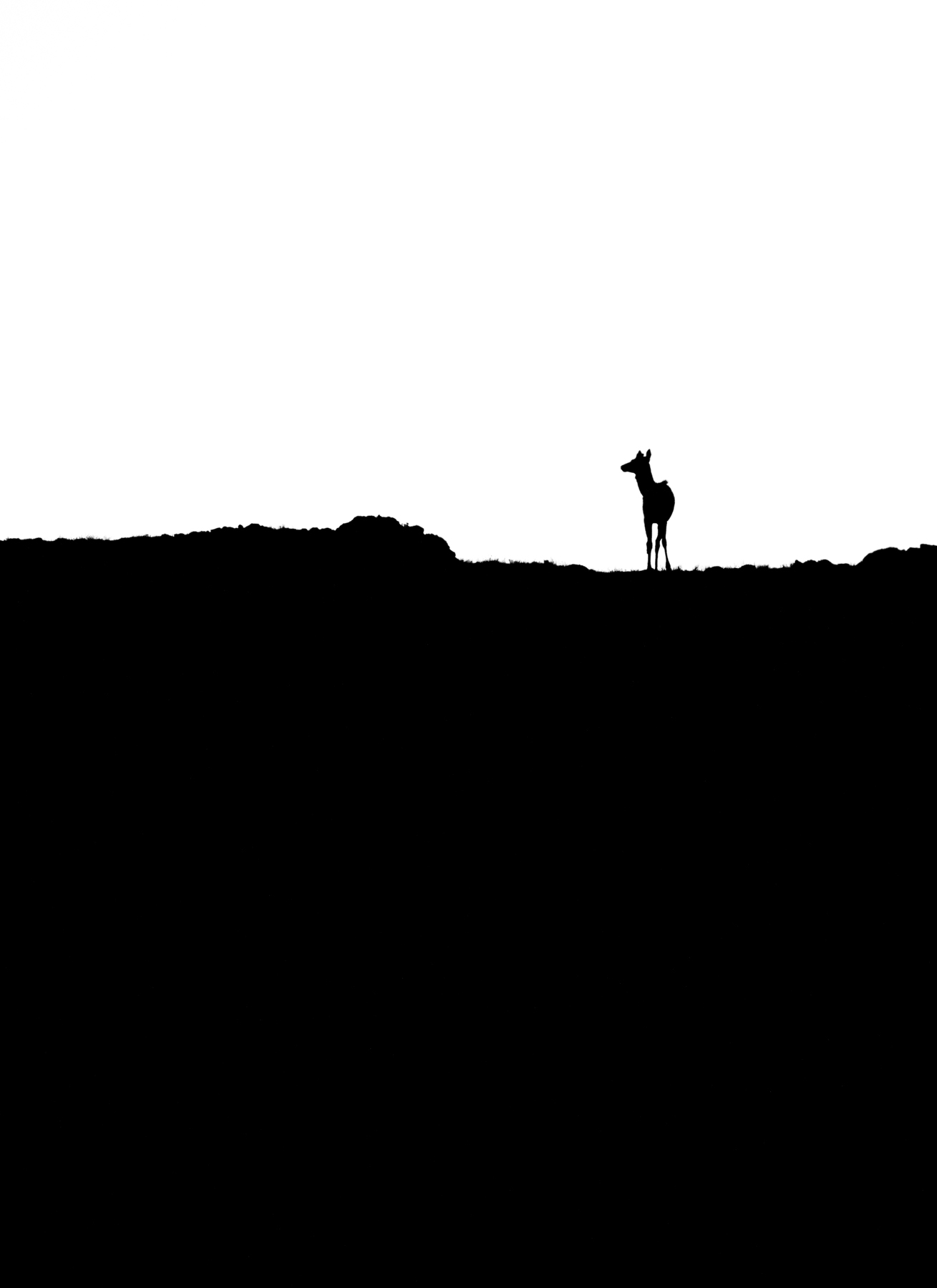
Nearby, a smaller maple. Its crown lost in an ice storm, A few broken branches strain upward with peeling bark remaining, like something partially remembered.
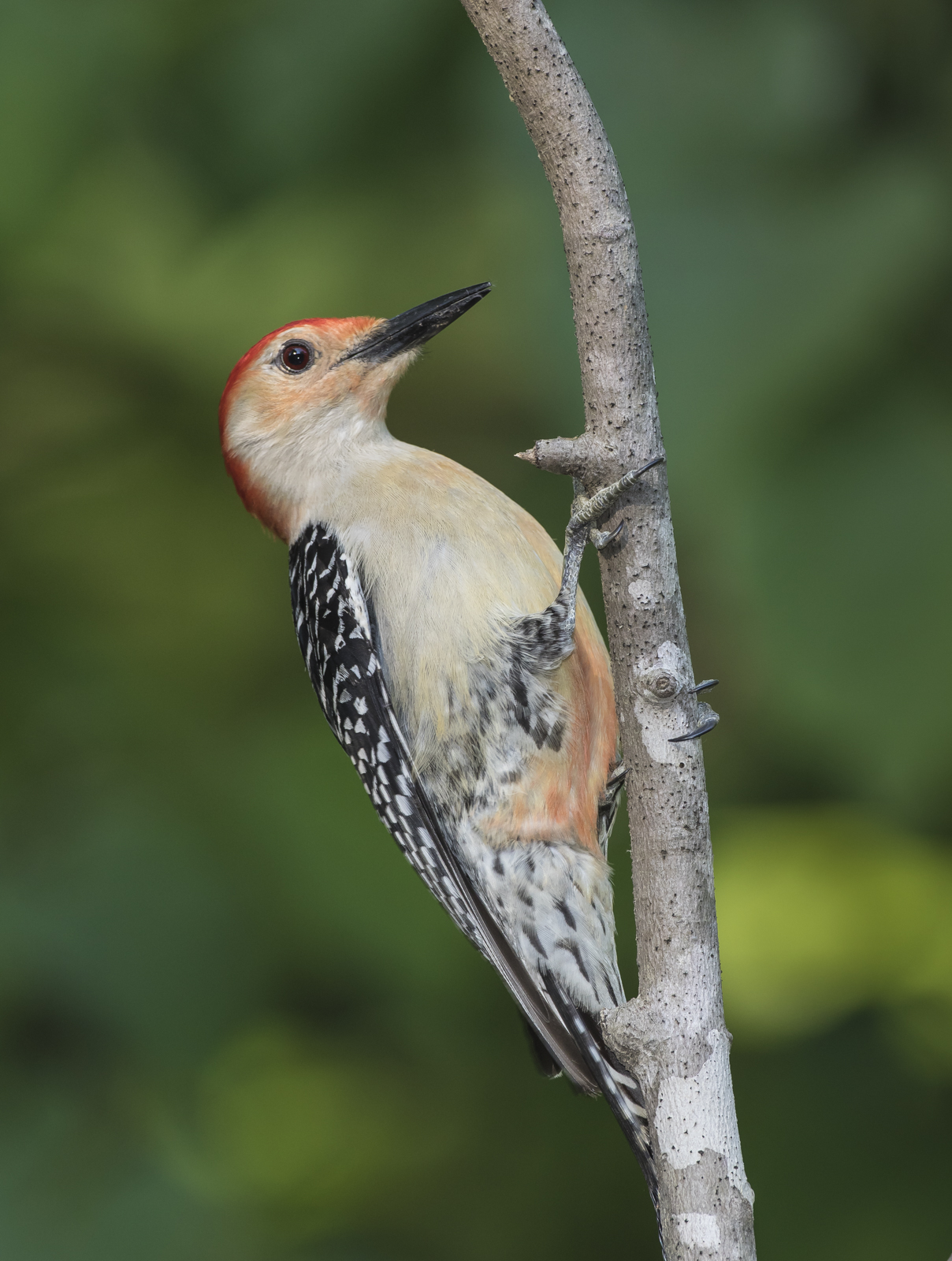
Guess— Which tree does the red-belly love? Which tree do I?
I have spent a lifetime trying to learn about the world around me. Not about the financial sector, or cars, or electricity (all of these, I now realize, might actually have come in handy), but about the natural world, the plants and animals that live around me. It is just who I am, what interests me. In his essay on the importance of fostering a connection to the natural world, Tim Beatley starts by saying – What we choose to name and the names we choose to remember, for the places, people and things around us, says a great deal about what is important to us. I have spent a lot of years trying to help people learn the names of things in nature and have come to realize that it takes time. On many of my field trips, I remember being frustrated when people could not remember the name of some interesting creature we had just observed. I finally realized that it often requires that the person is prepared to receive that information and that they want to learn it. In his 2013 article, Dr. Beatley offers numerous suggestions on how we can help foster a connection to nature through helping people become better acquainted with their natural surroundings. He also recognizes that new technologies and applications may of course help us here as well. I-birds and I-trees that make it easier and quicker to identify birds and trees. Well, it is happening…
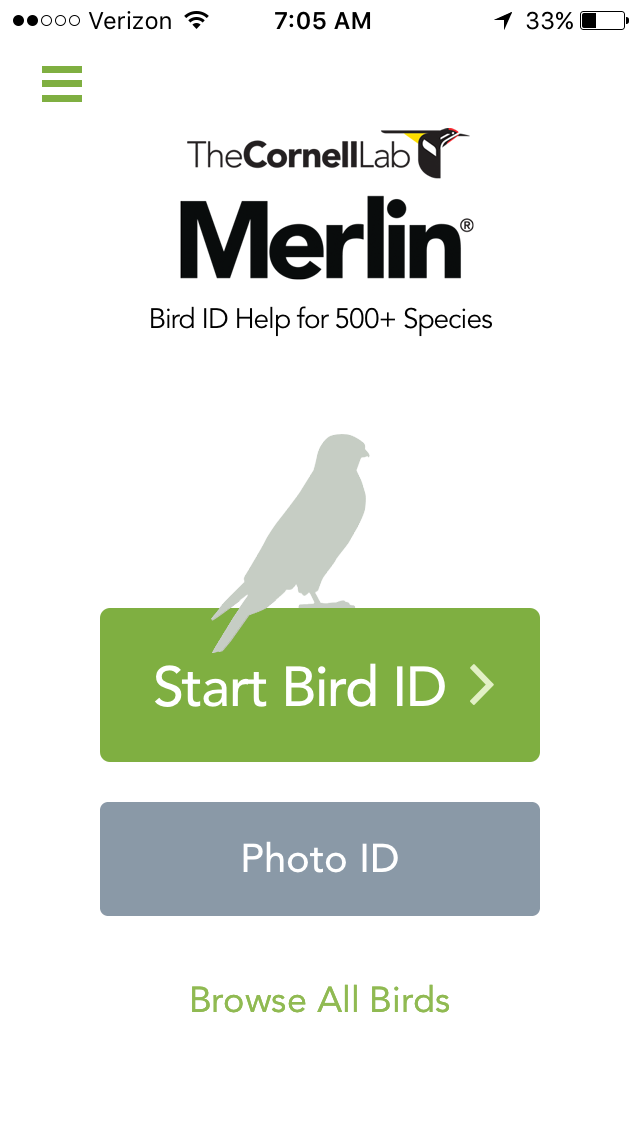
The Cornell Lab of Ornithology launched its popular Merlin App in 2014. It is billed as an online field guide assistant for beginning and intermediate birders. The app asks you a series of questions about the bird you just saw (such as the color, size, and behavior), much like an experienced birder would if they were trying to help you identify it. To be honest, I never downloaded that app, figuring I had enough experience to use field guides and figure most birds out on my own. But, late last year, a new feature was added – the Photo ID portion of the app. I heard about it from a couple of people I know, saw a review online by a fantastic wildlife photographer I follow, and then had a friend post about it on her blog. I decided to check it out and downloaded the free app to my iPhone (also available for Android devices; being developed for laptops and other non-mobile devices)..
The app has a simple and elegant design. You simply click the Photo ID tab and either take a photo or choose a photo from your files.
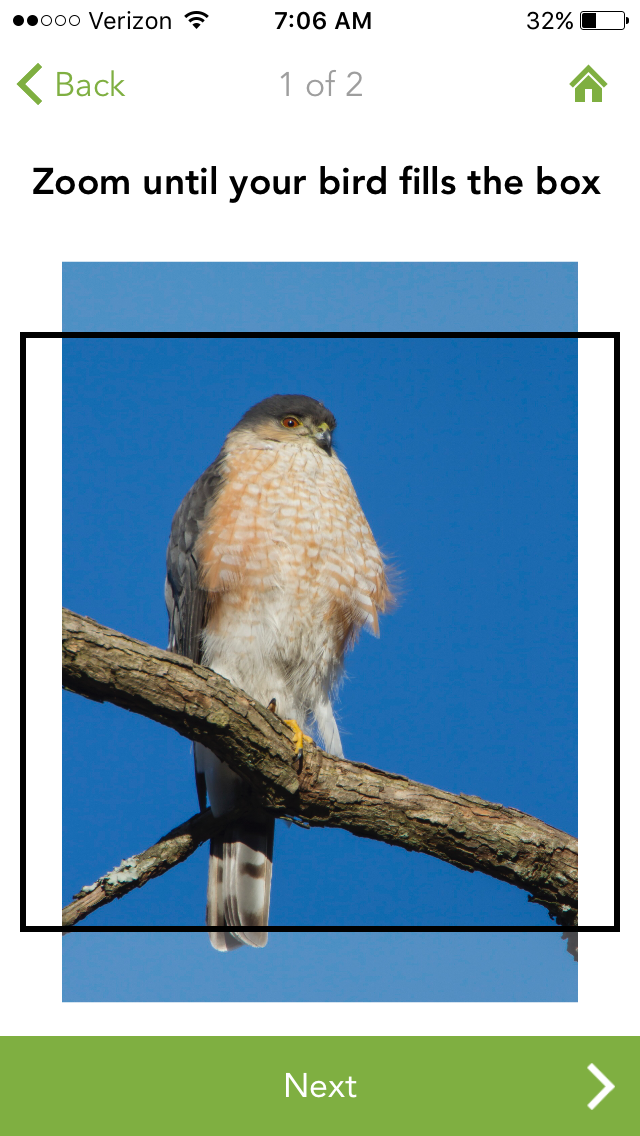
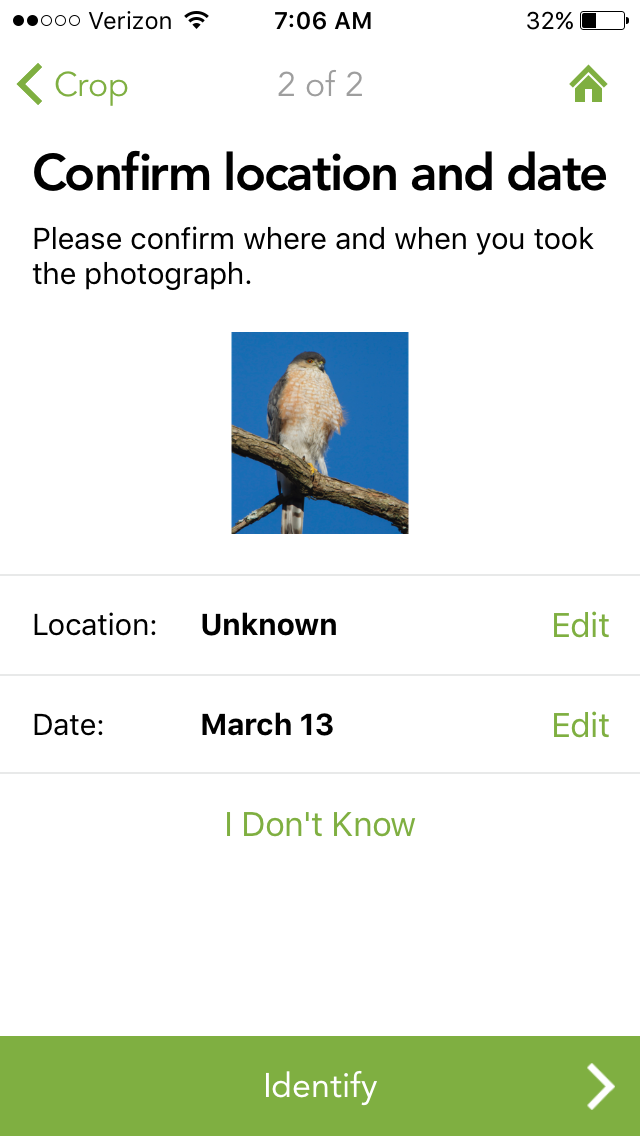
I used an image of a sharp-shinned hawk I had taken a couple of years ago at Roads End. Even good birders struggle with identifying this species from its larger cousin, the Cooper’s hawk. You zoom the image in until it roughly fills the box…
The app pulls information off your photo as to date and location. I had to fill in the location information since this was a photo I uploaded from a file on my computer, not one directly from my camera. Once I had added Pittsboro as the location, the app can compare my image to its database of images (I think it has at least 1000 images of each species covered) and then gives you an identification.
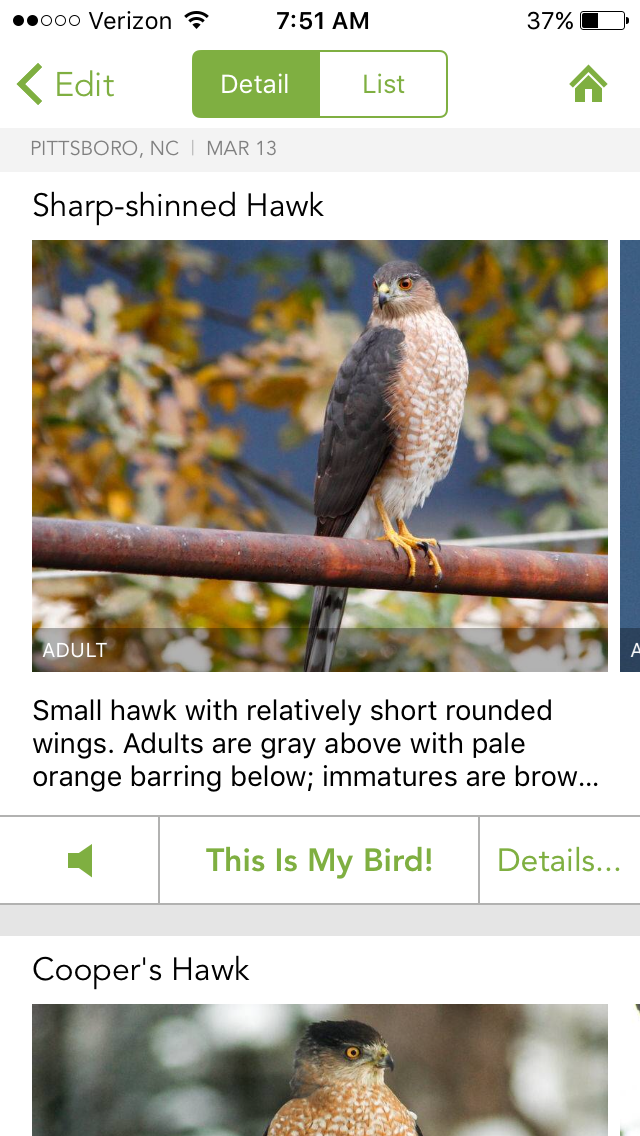
Boom! It got it right. It even gives alternative possibilities if you scroll down in the app. This can be very important for some species where confusion is likely (like this one), or if the photo you use is not that great.
I soon realized I didn’t need to transfer images from my laptop to my phone for identification, I could simply click the Take Photo tab and take a picture of my laptop screen with my phone and use that image. So, here is another. For these next few images, try to identify the species before you see the Merlin App identification. As this progresses, I intentionally use pictures of lesser quality, those that I normally would delete from my files, to see how the app performs.
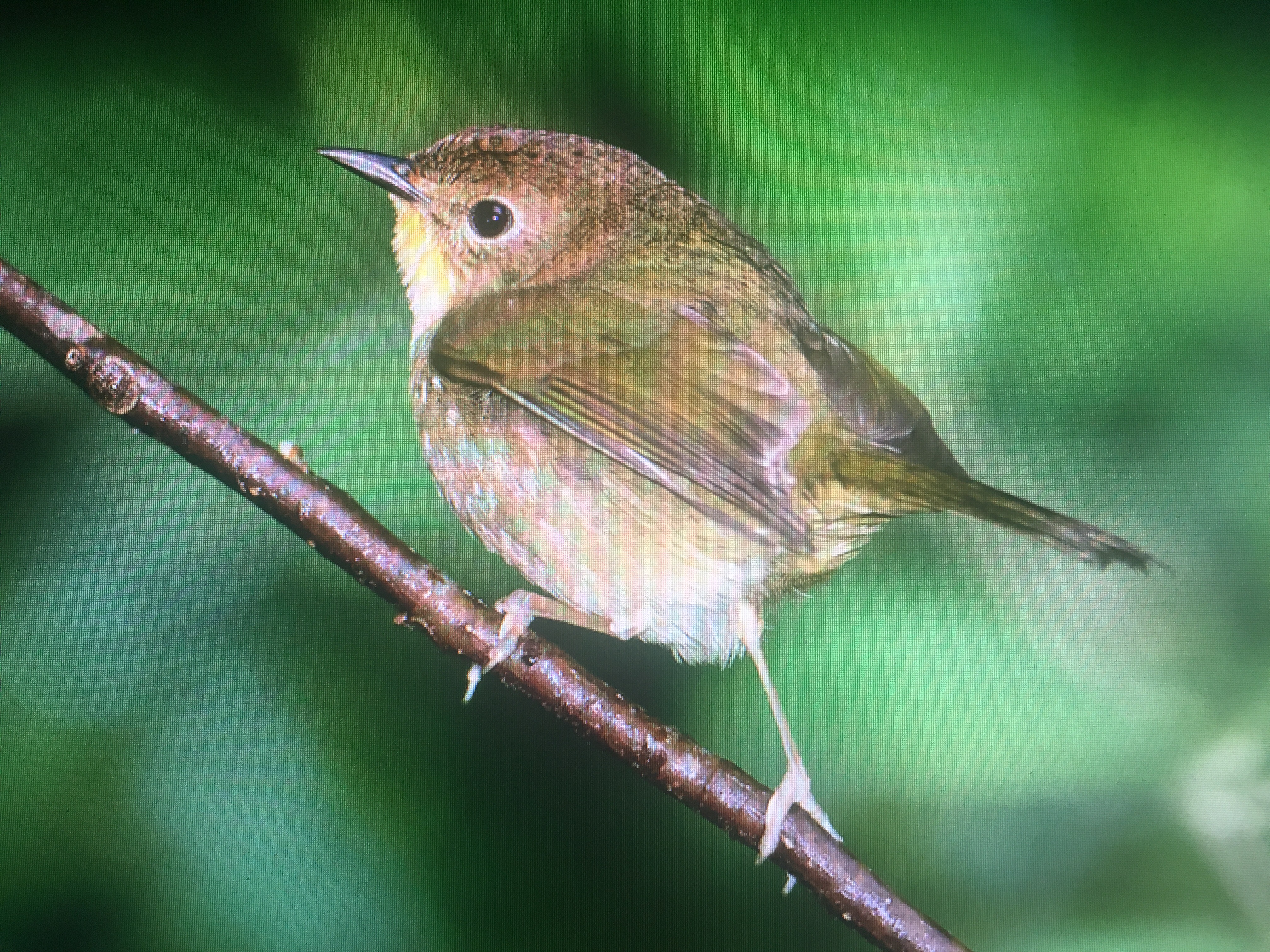
This first one is a photo of a pretty nondescript species (taken with my phone of a fairly good shot on file on my laptop, note some of the squiggly computer screen lines in the photo).
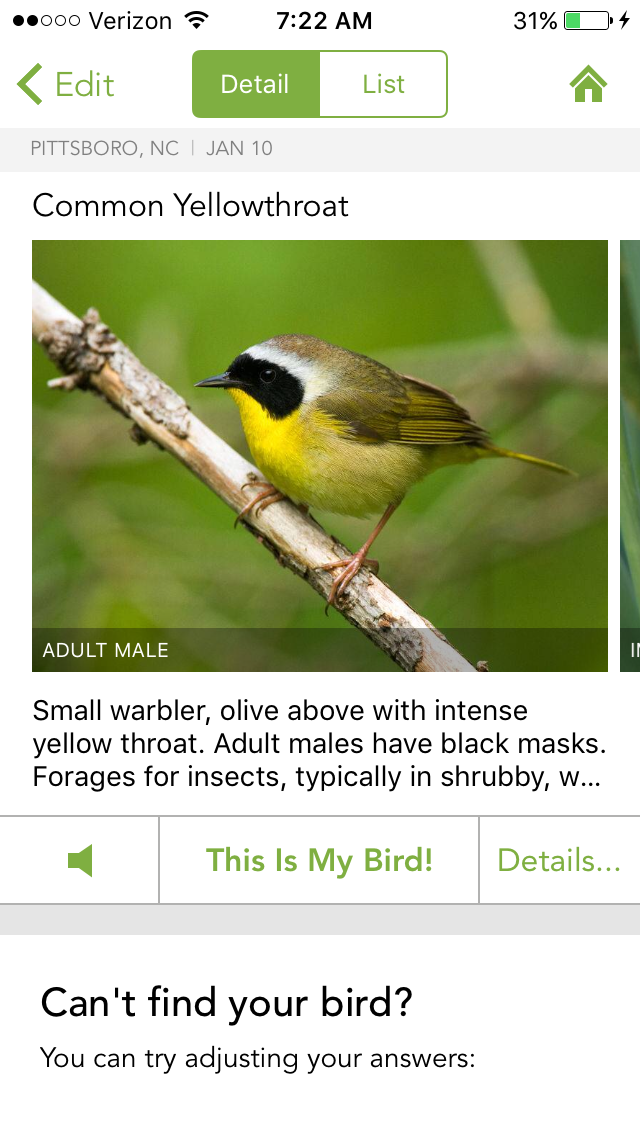
And here is what the app said it was…
Indeed, it is a female of a warbler, the common yellowthroat. The app gives you multiple images of each species so I swiped through and found an image of a female (turns out my image is better than the one they have on file). In all fairness, I knew what that bird was. If I hadn’t, it might have been tough for me to figure out based on the images the app provided. But, the beauty of this is it gives you a place to start in terms of looking up your bird in a field guide (book or online).
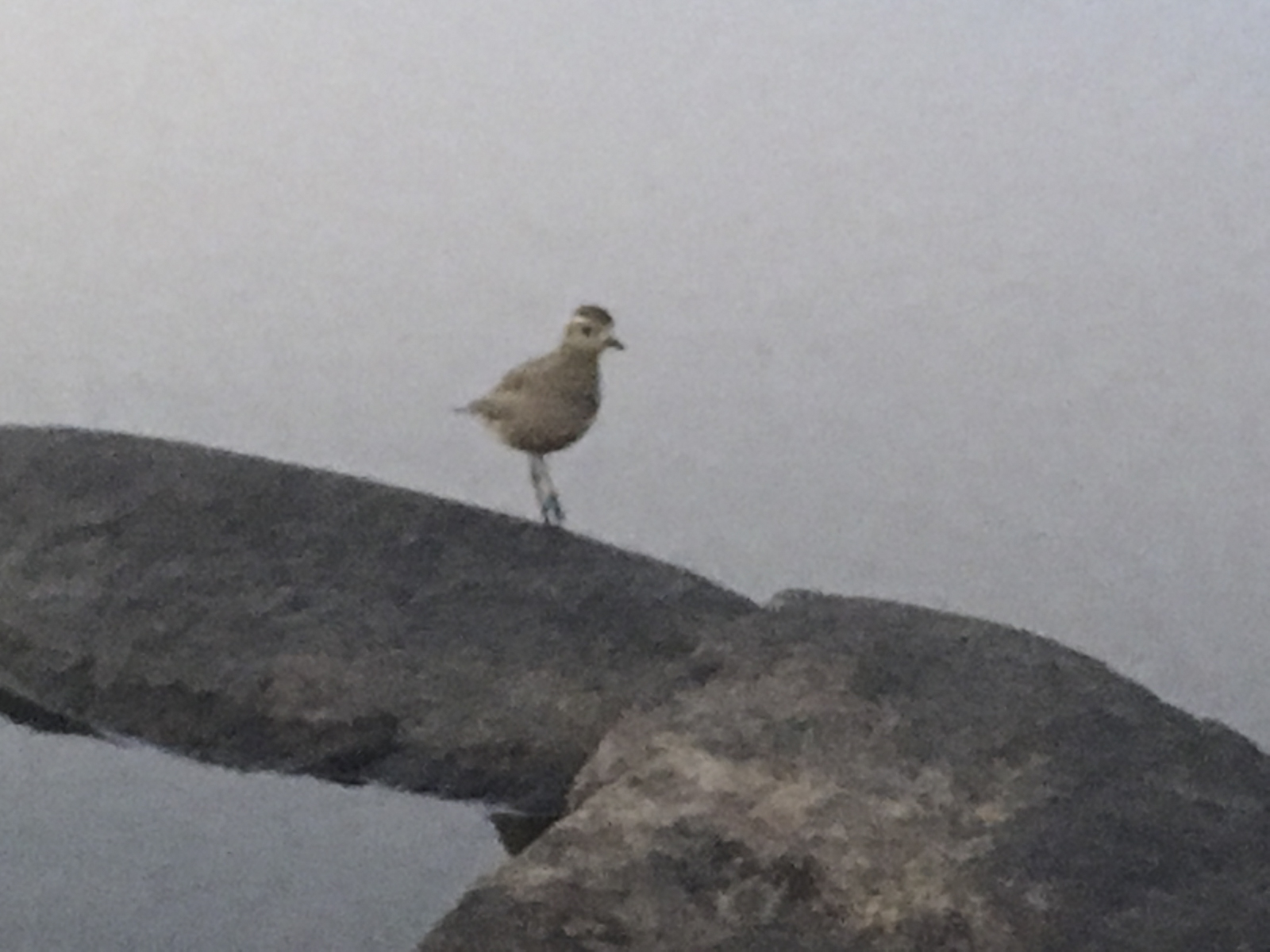
Here’s another, a bird I photographed with my iPhone as it was getting dark in the Boundary Waters last October. This bird landed next to us on a boulder and walked around, allowing me to get a good look, and this crummy photo. I did not know what species this was, as I had never seen this one before. Once we got back home, I identified it using my field guides, but the app got it on the first try.
Grainy iPhone photo of an unknown shorebird in Minnesota in October
An American golden plover, a new species for me. Once again, I had to swipe through the images to find the shot of the bird I saw in its non-breeding plumage.
Here are three more just for fun…
Black bird in NC mountains
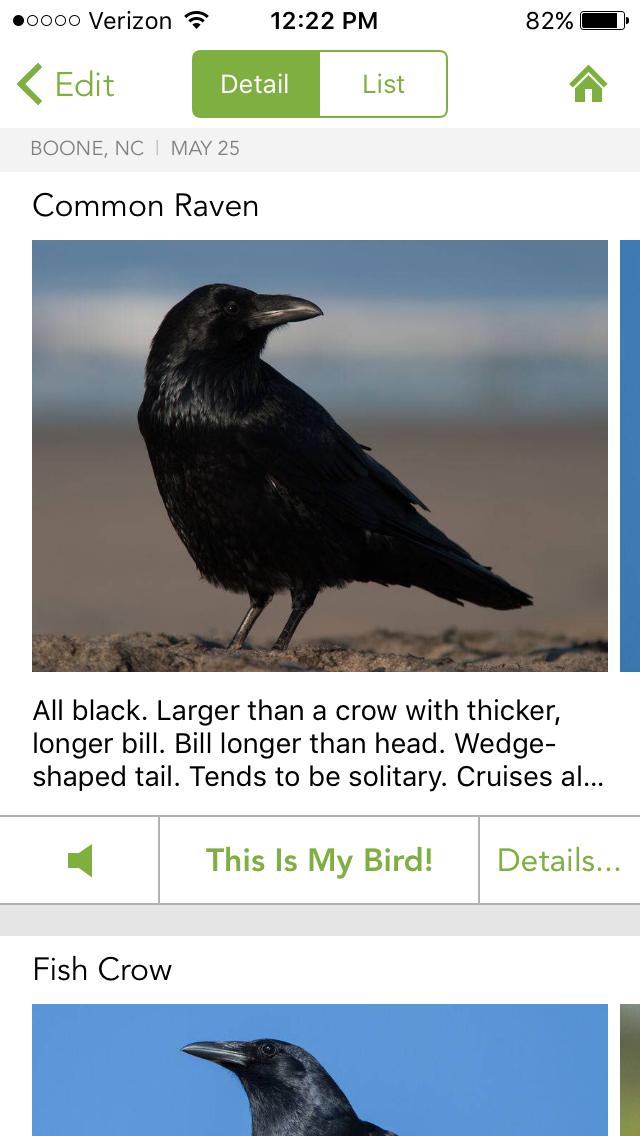
Merlin gave me the wrong answer the first time, calling this a fish crow. I zoomed in even more, tight on the bill, which is diagnostic of this species, and it got it right (did you?).
Notice that fish crow is the second option this time (other options are listed below the primary choice in the app). I found that zooming in and out did make a difference on some species. The first time I tried the next photo, I was in very tight on the whole bird and it gave me red-headed woodpecker as the answer.
Mystery bird in NC mountains in May
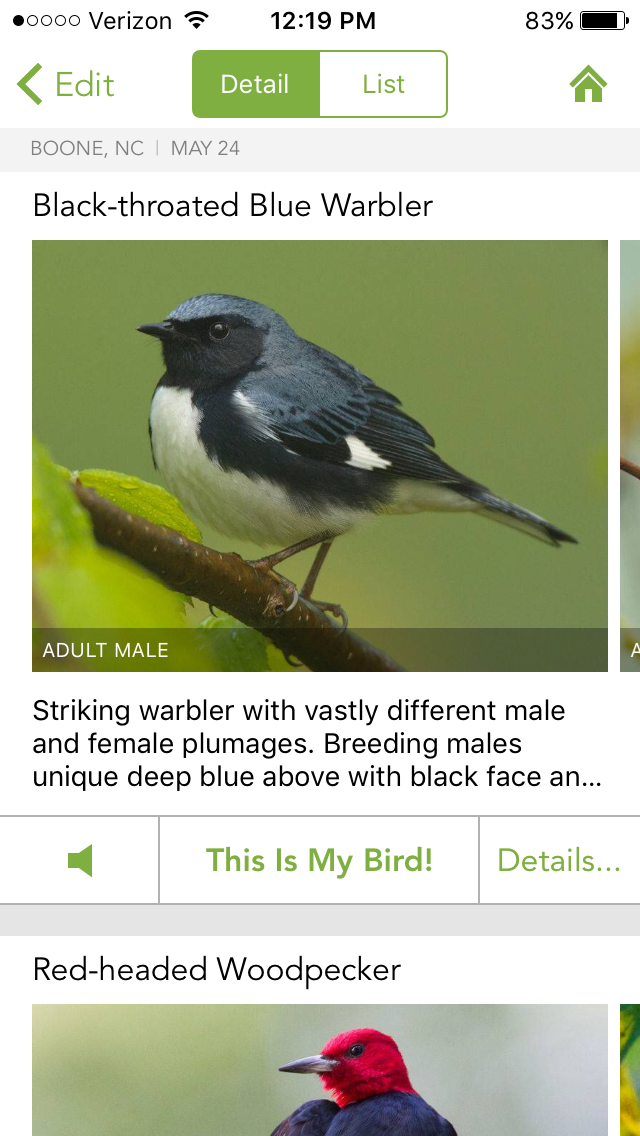
Zoom in on the photo and see if you can identify it. I edited my photo on my next try by backing off a little and, this time, Merlin was right.
It is a male black-throated blue throwing its head back in song.
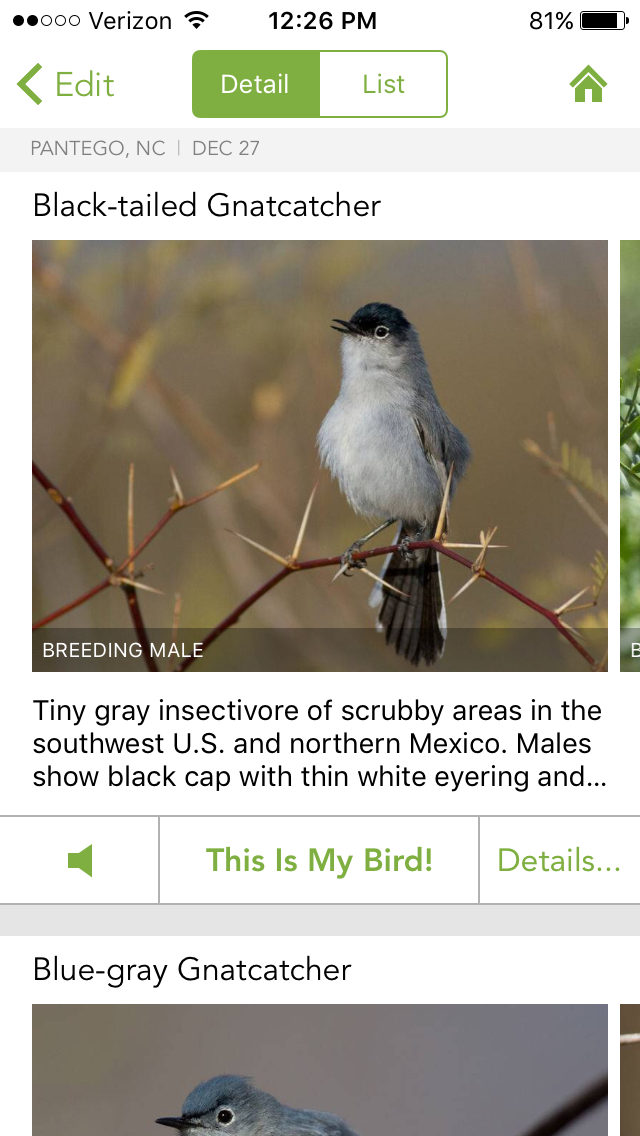
I tried a range of images of a variety of species differing in photo quality. They were all images where I knew the identification of the bird from other, better images, taken at that same time. Merlin did not get a black-capped petrel or the glaucous gull from the pelagic birding trip I took last winter. Turns out that species of petrel is not one in the database as yet, and the gull was misidentified as an Iceland gull. And, it surprisingly gave me a related species (correct species as second choice) on the following really terrible image I used from the Christmas bird count this year.
Mystery bird from Christmas bird count at Pungo
Guesses?
Yes, a blue-gray gnatcatcher, a species not often seen in winter in these parts (but also not an extreme rarity). Interesting that it gave me a species from the southwestern United States even though I put in the location information for our count. But, to get any gnatcatcher from that photo is pretty impressive if you ask me. The photo does not show the flitting behavior, nor the relatively small size I witnessed while watching the bird in person.
Overall, I think this app is a great tool for anyone that wants to identify the birds they photograph. I get asked a lot of questions about bird identification (which I enjoy tying to answer, by the way), but I will also be recommending this app for all those folks from now on. Give it a try, download Merlin and have some fun. While you are at it, I recommend making a donation to the Cornell Lab of Ornithology to help them continue to produce valuable information for all us folks trying to learn about, and conserve, the birds around us ( I just did).
Snow has made everything earthly clear and quiet. My mind is simple and patient.
– Tuomas Anhava, Finnish writer
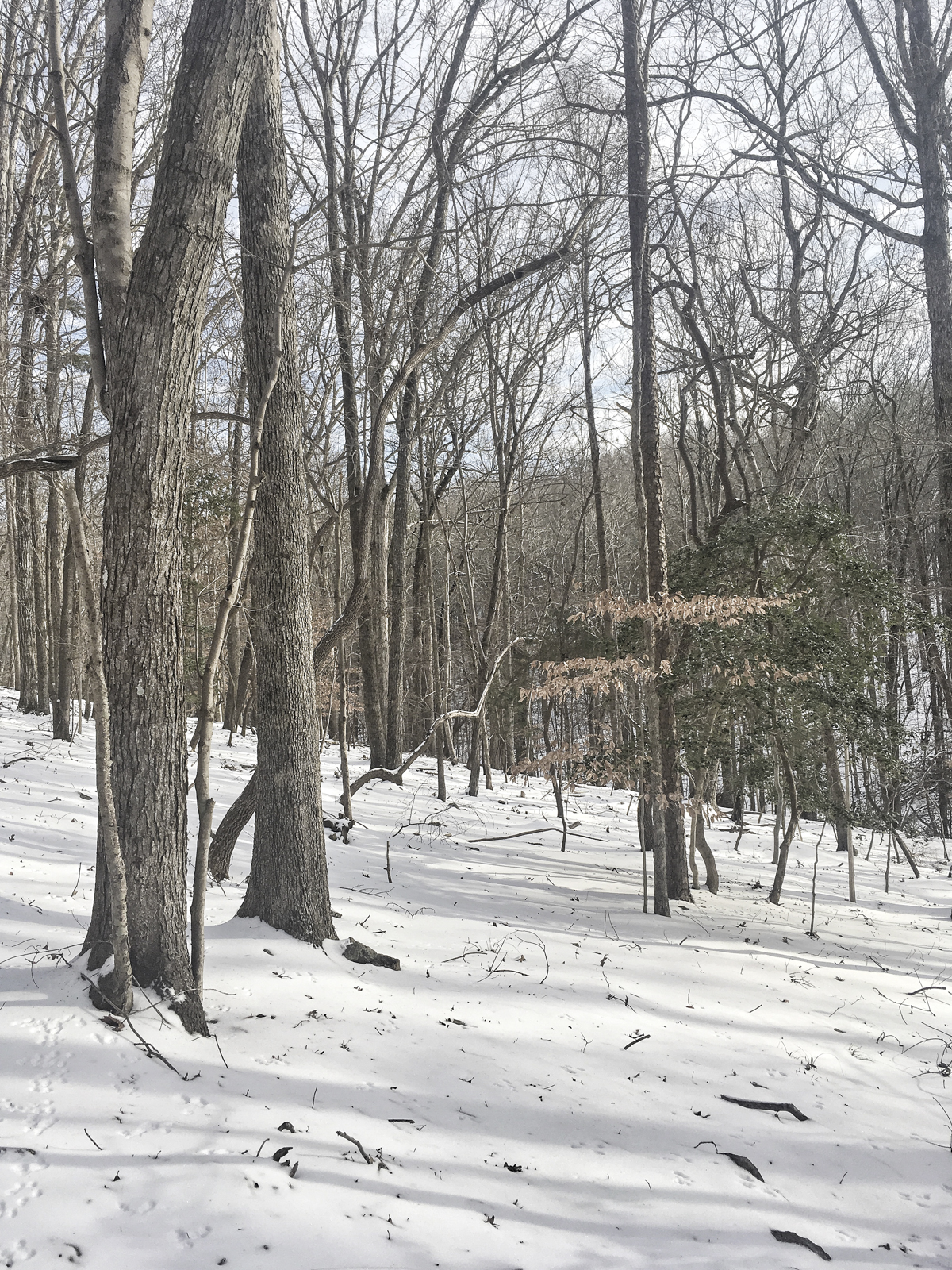
The predicted big storm fizzled once again. We certainly live in a region in which weather forecasters are challenged to get it right when it comes to predicting snowfall. Of the predicted 5 to 6 inches, with some maximum predictions calling for up to a foot of snow, we actually had about 2 inches of white stuff fall here in the woods – about 1 inch of sleet, and 1 inch of snow.
Snow scene in the woods on the far side of the property (click photos to enlarge)
But, no matter how much or how little, snow is always magical (and sometimes maddening). This storm combined with some very cold temperatures (it got down to 7 degrees here one night) so things have not melted at all until yesterday’s high of 38. The biggest problem we have here are the hilly roads that invariably turn to ice-covered ski slopes (great for sledding, not so much for trying to go anywhere in a car).
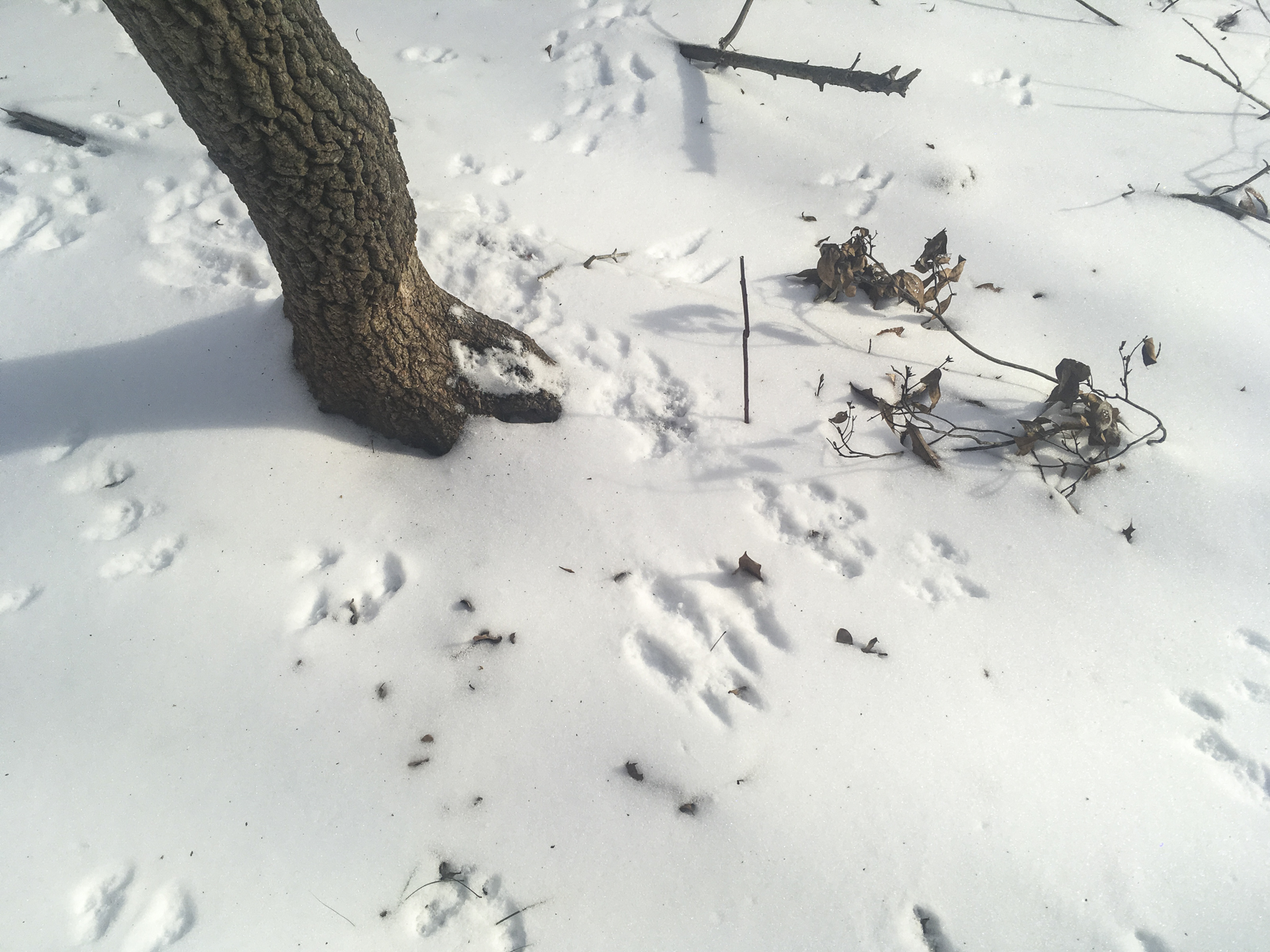
Busy intersection on the squirrel highway
For us, it is always fun to see what is out and about, moving in our woods that we might miss were it not for the repository of tracks left behind. It was shocking to see how many gray squirrels inhabit these woods based on all the tracks…more work for the resident red-tailed hawks for sure.
Deer tracks
The wanderings of the local deer herd are along their usual well-worn trails, especially just outside our deer fence, down in the ravine, and up on the south-facing slope.
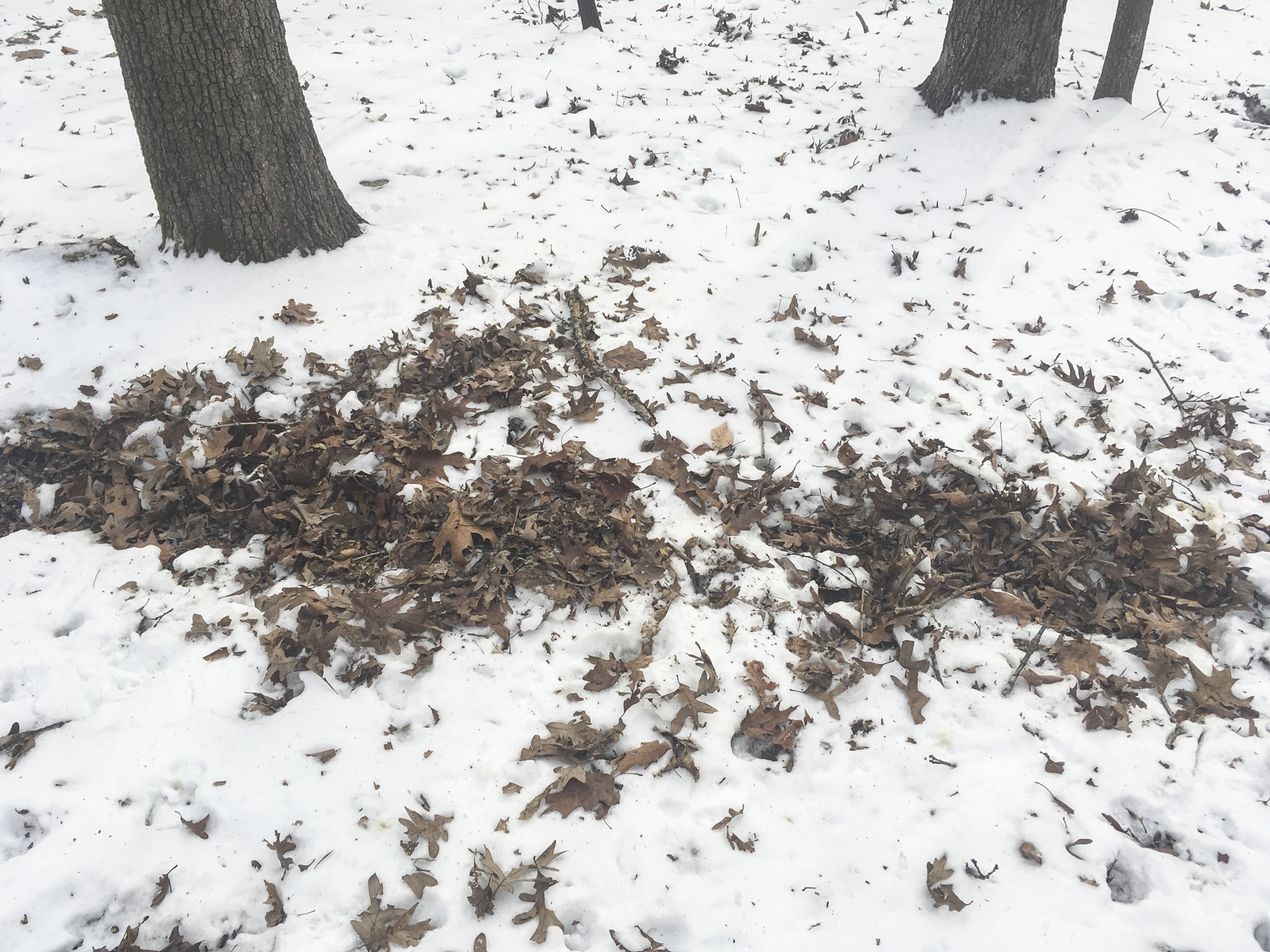
Deer have been digging for acorns
This being a good mast year, they have made the rounds and dug beneath some of the large white oaks throughout the property, with most of it happening on the south-facing slope on the far hill, where the ice accumulation may be less.
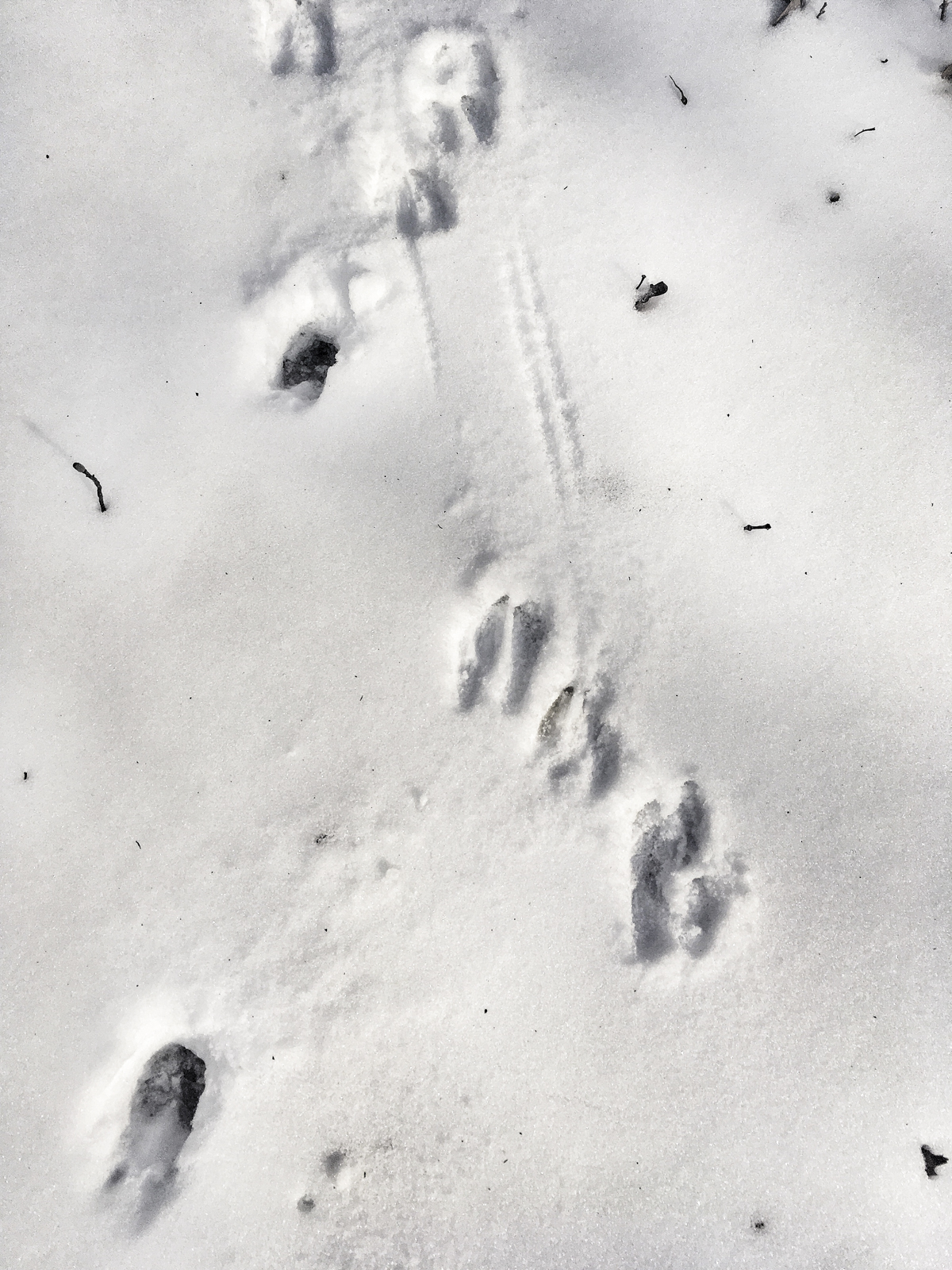
Rabbit tracks
Our yard bunny is still around, though I haven’t seen it in quite some time. Hoping it will be selective once the spring wildflowers start to emerge, but that seems a far off possibility right now.
Raccoon tracks
A lone raccoon has been at the huge hollow tulip poplar near the house, and it, or perhaps another, crossed the hillside over to a neighbors woods. I am surprised we have not seen it beneath the bird feeders, looking through the discarded seeds for a snack.
The typical pattern of fox tracks
We found a set of canid tracks inside the fence (they had crawled under the low bar of the side yard gate). Once inside, there were places where the pattern in the snow resembled that made by a cat, but these tracks had claw marks. Not sure whether it is a red or gray fox (both live in these woods), but I am betting red, since their numbers seem to be increasing.
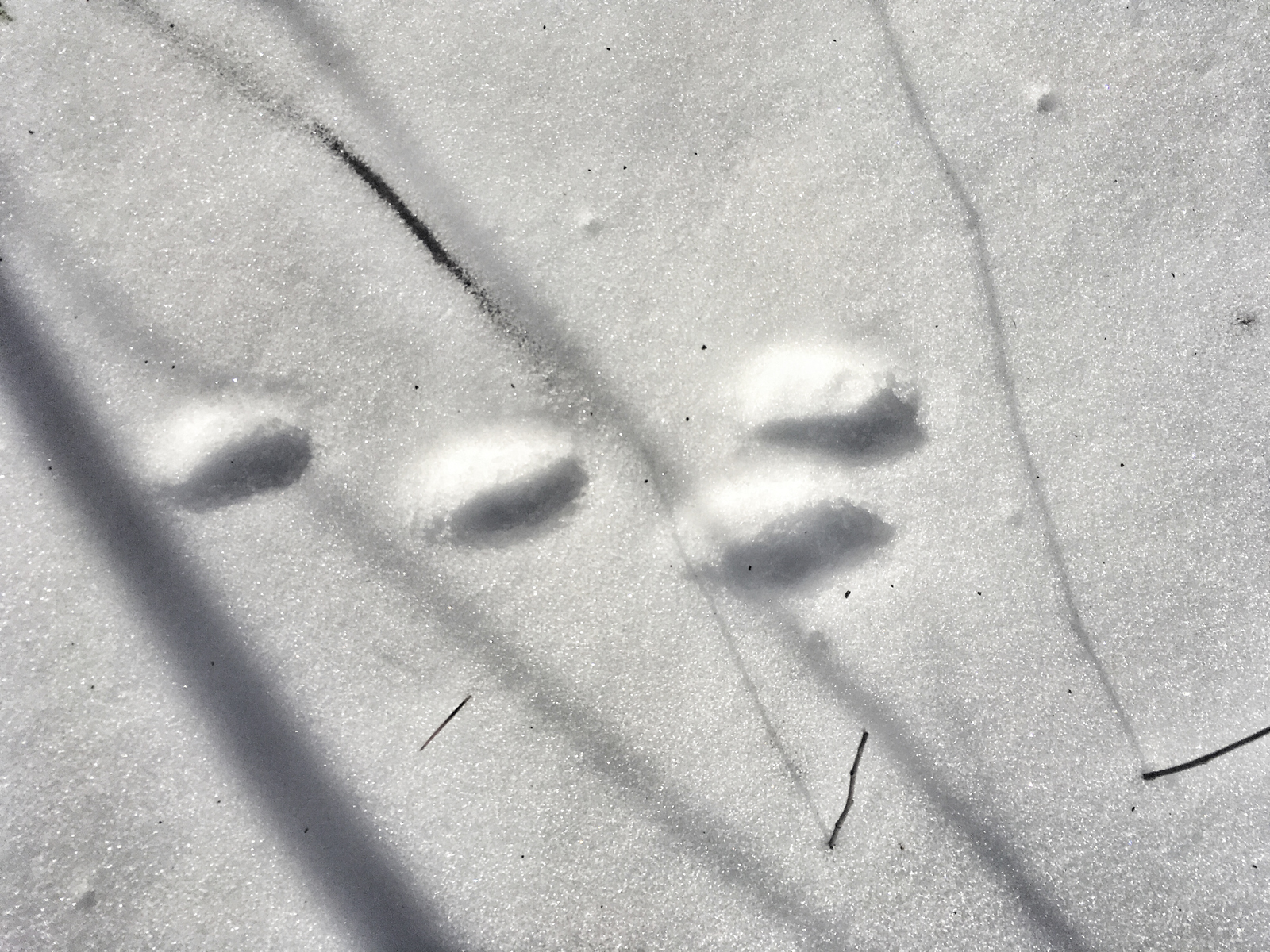
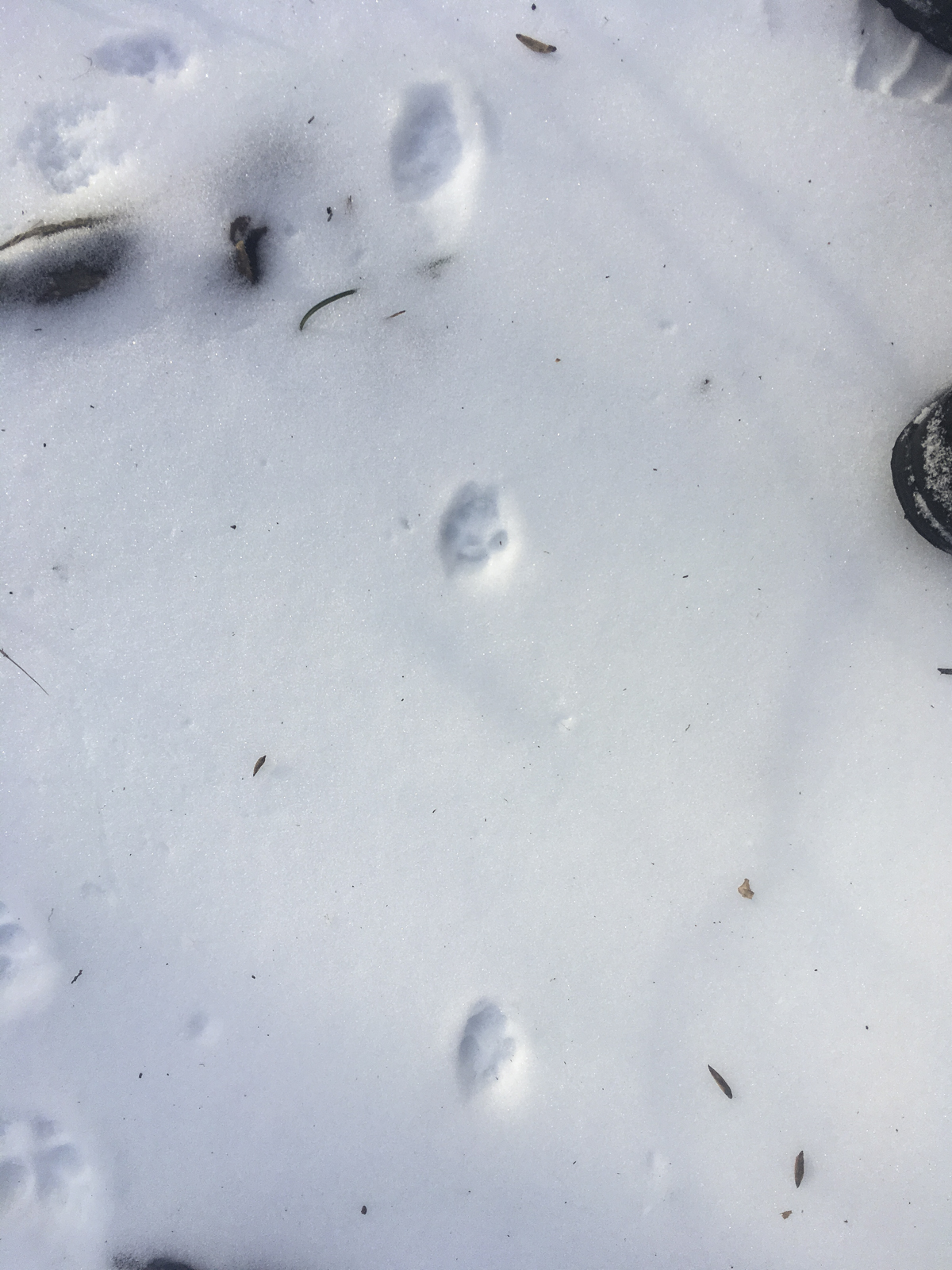
Unusual bird track
Among the many bird tracks, there was one set that stands out. It has a normal three toes forward, one toe back print, and then one with just a depression with one toe back.
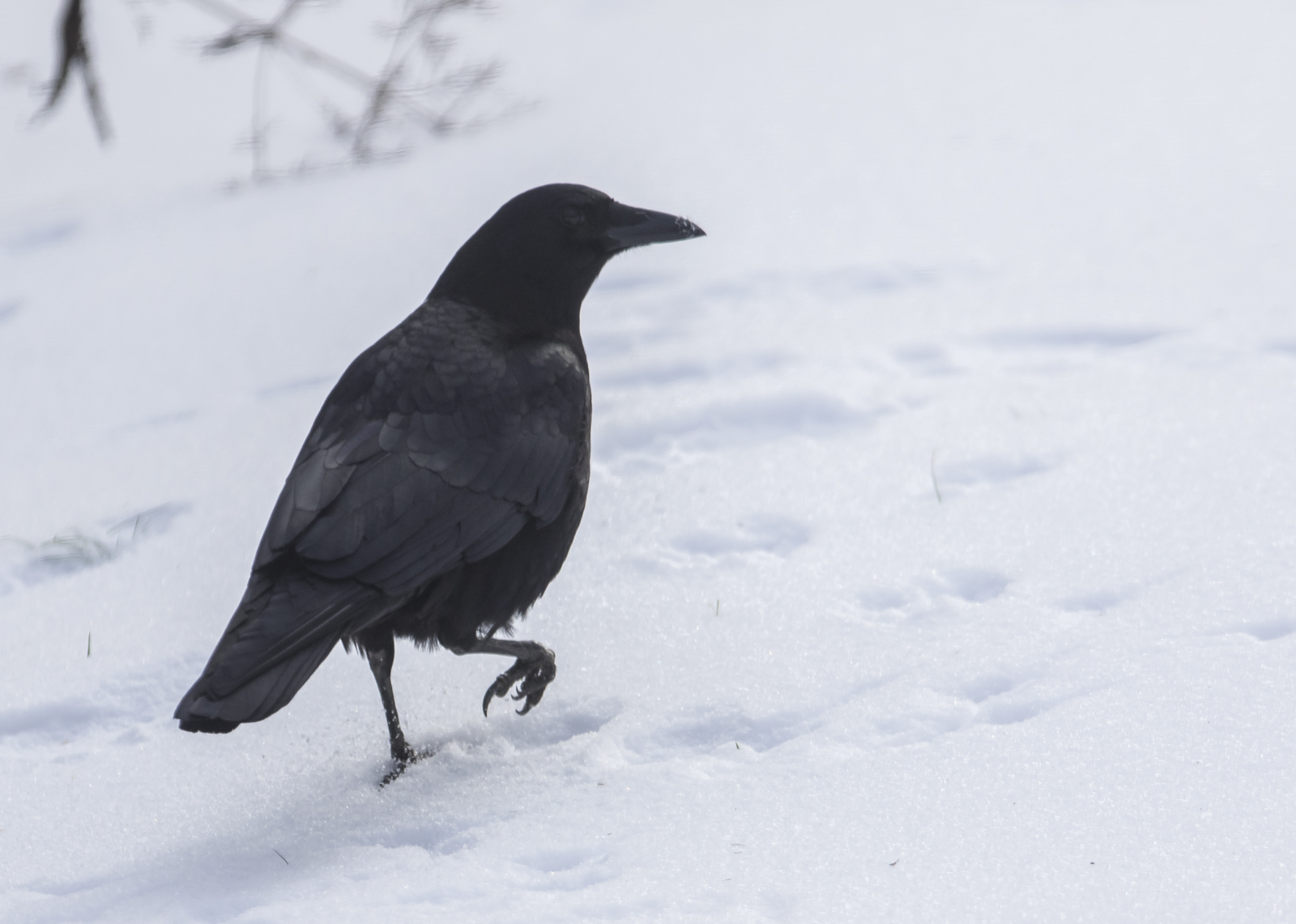
Crow with deformed right foot, with the front toes curling backward
We recognized it as the track trail of an American crow with a disabled right foot that we have seen the past two years. It is generally with another crow (presumably its mate), and seems to manage just fine.
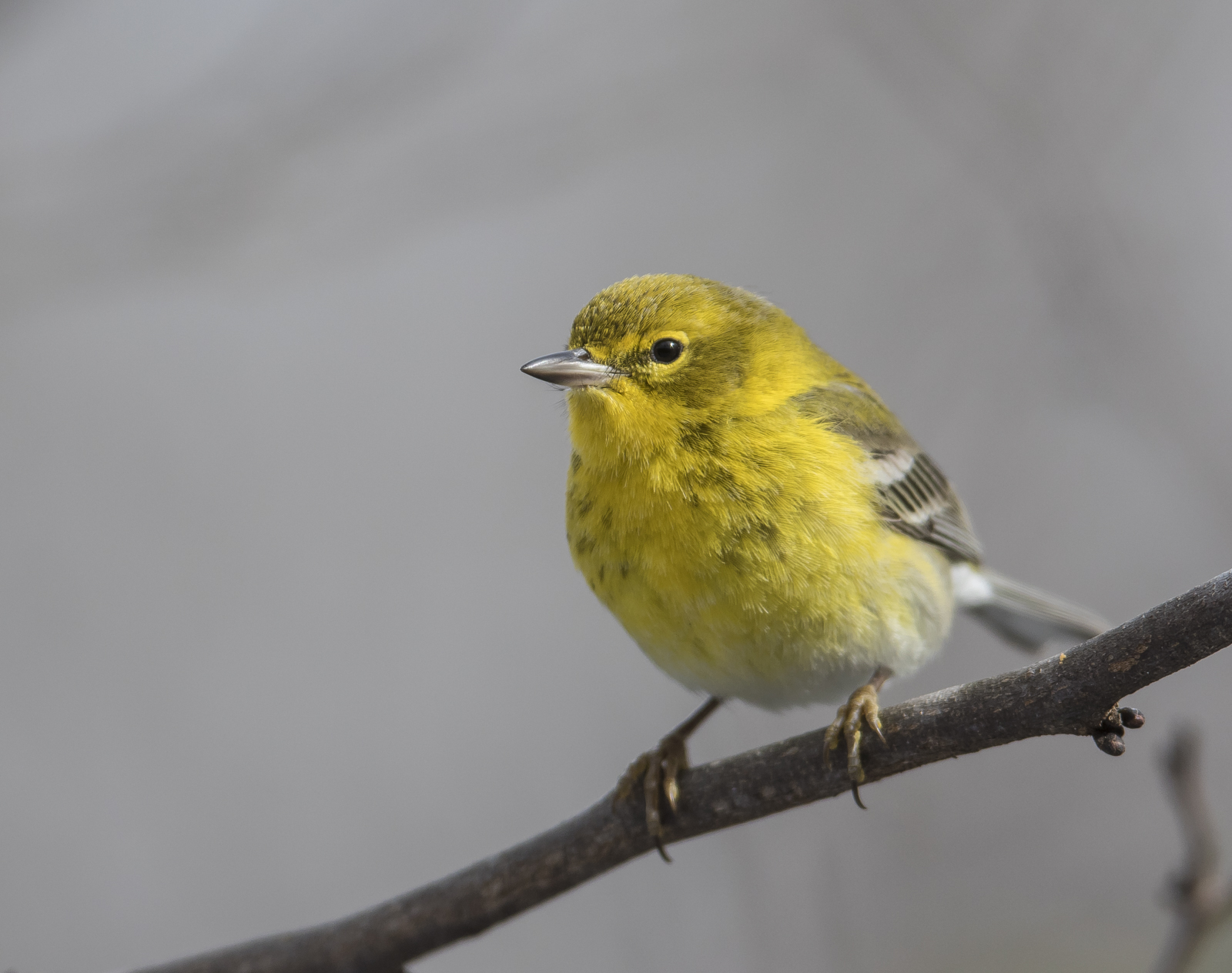
Pine warbler
The activity at the feeders has been frenetic, with American goldfinches, dark-eyed juncos, purple finches, and pine warblers mobbing the seed and suet, along with the usual appearances by downy and red-bellied woodpeckers, Carolina chickadees, tufted titmice, and a ruby-crowned kinglet.
Fox sparrow doing what they do in thick cover
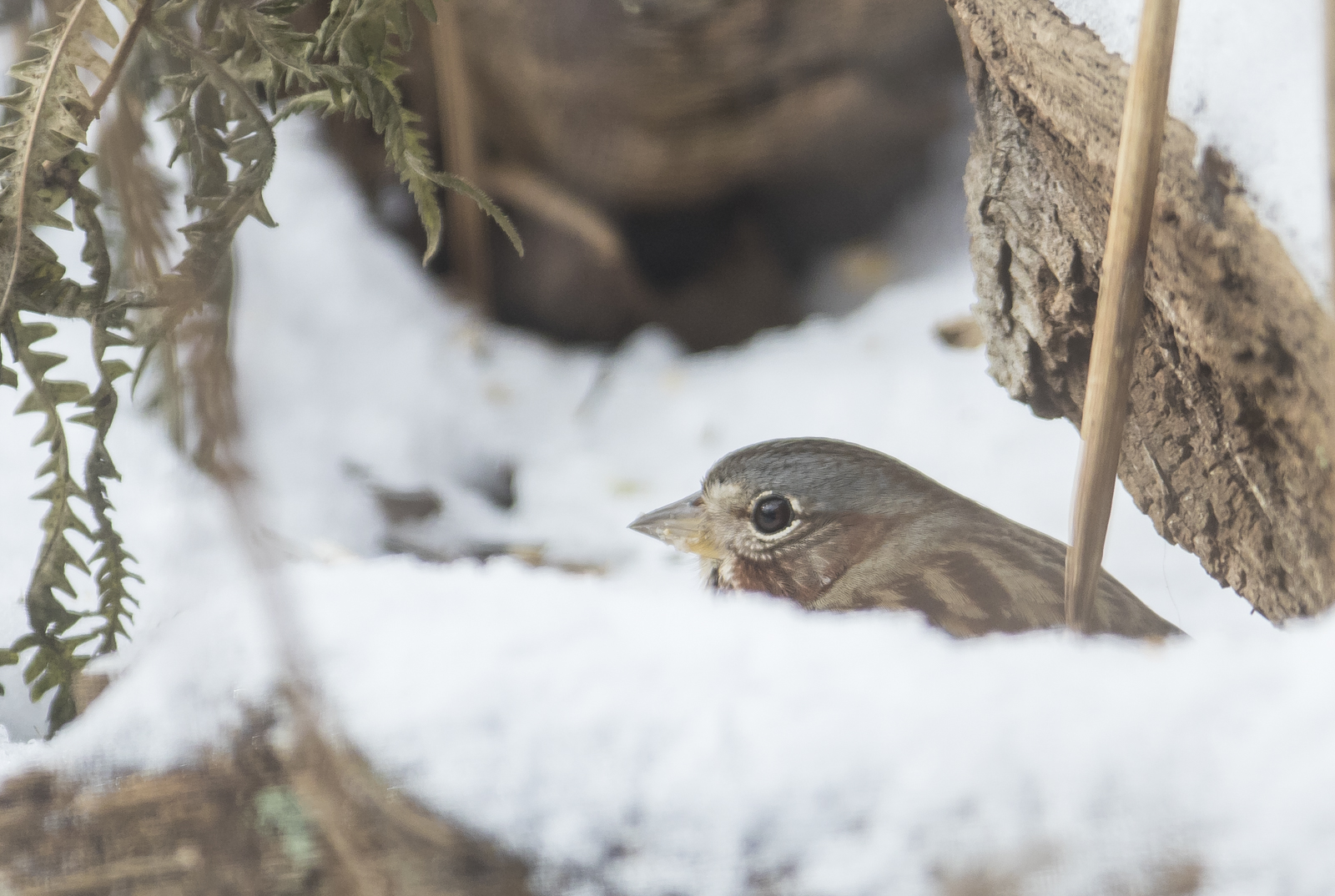
The hermit thrush has stopped by to grab some suet, and we had a rare visit by a fox sparrow, though it was reluctant to get out in full view, preferring to scratch through the snow and ice in the thicket of wildflower beds out front.
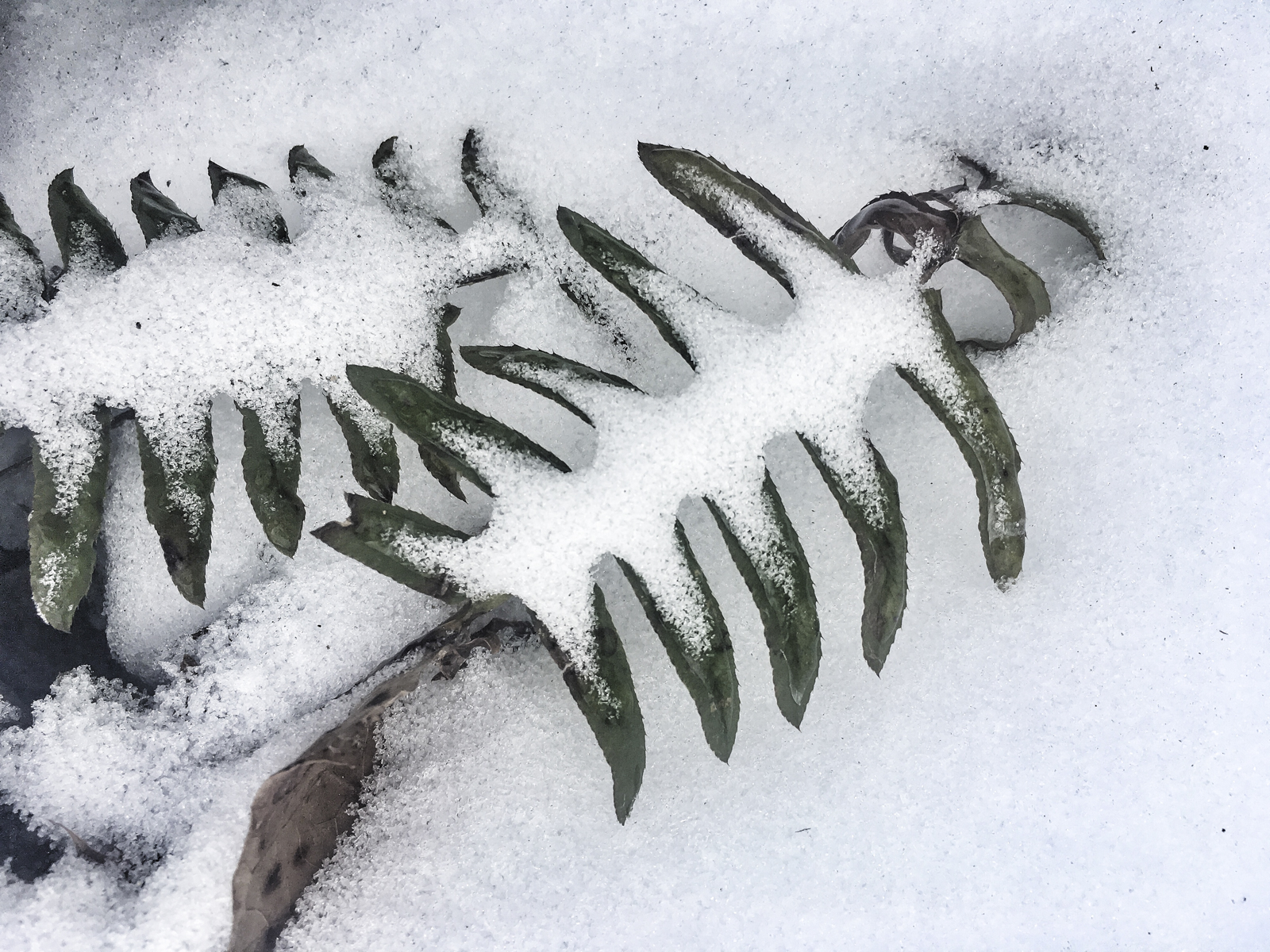
Christmas ferns
Walking in the winter woods is such a treat – the serenity and quiet, the small details of texture frozen in time, and the signs of life unseen.
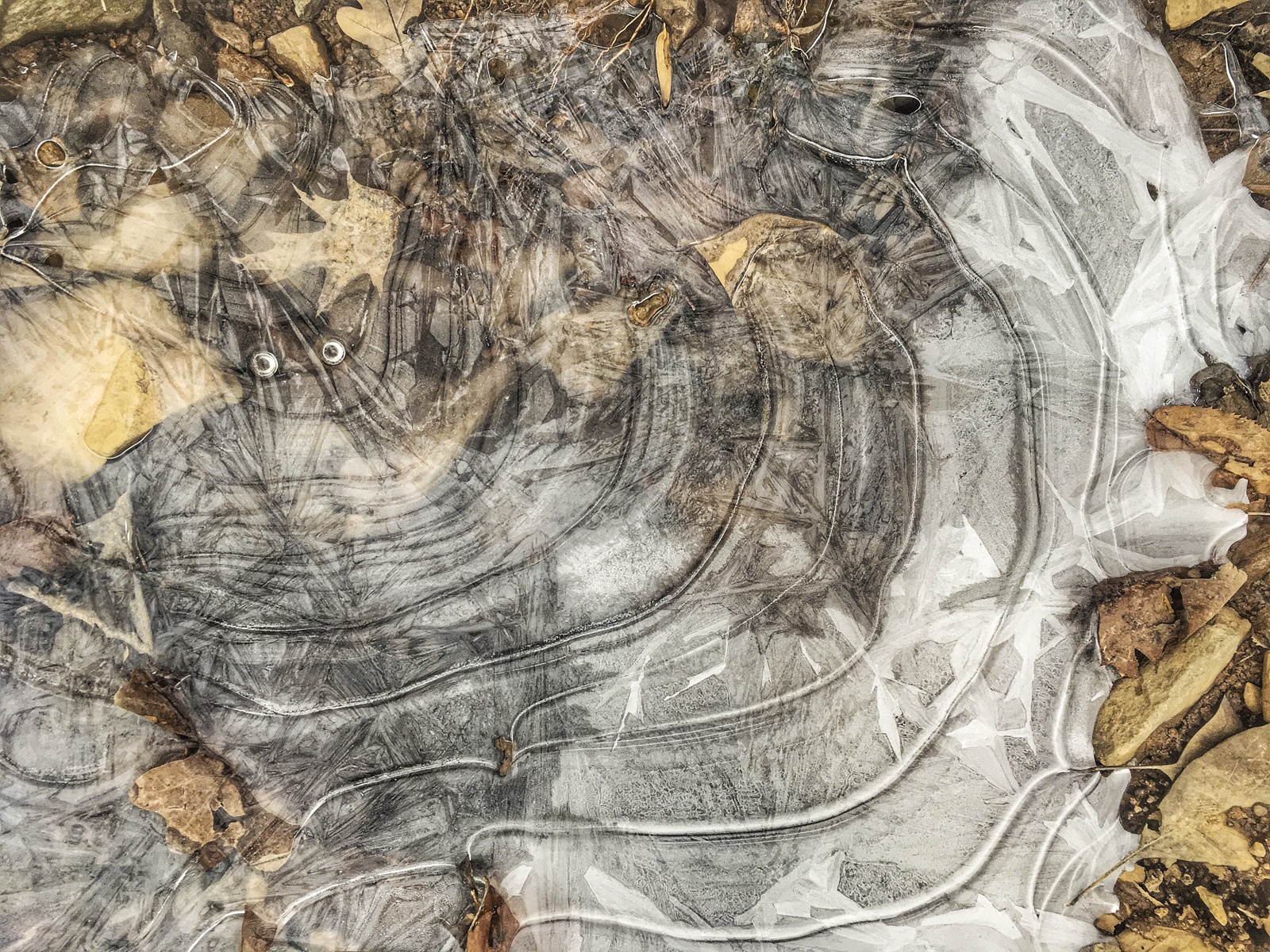
Ice patterns in the creek
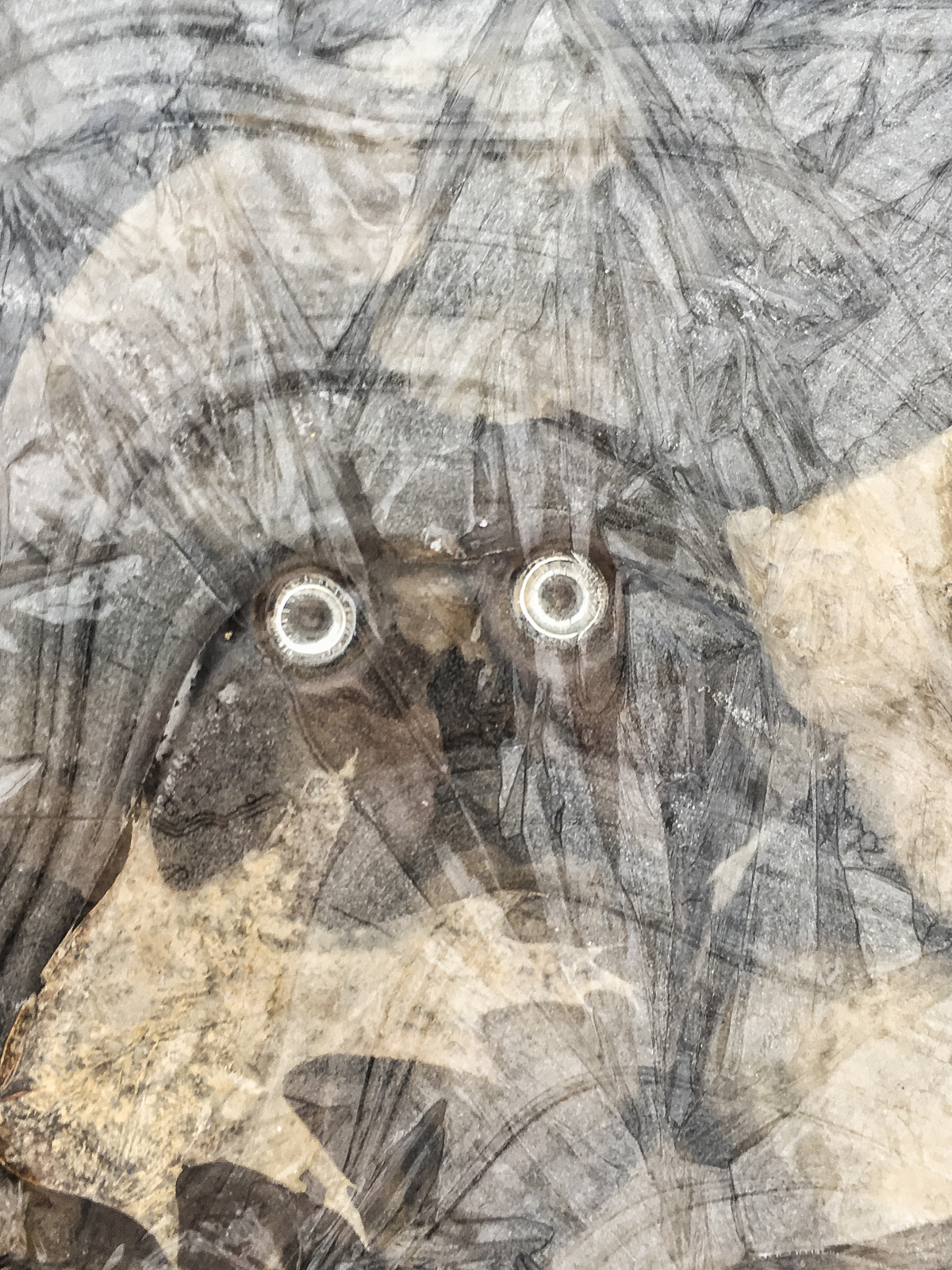
The intermittent stream below the house seems more intermittent than ever, but an ice artist left some unfinished work in one of the few shallow pools.
Ice art
The woods may be quiet after a snow event, but they are watching, and waiting for the sun to finish its work, until the next time. For us, we anxiously await both the ability to be able to get out of the neighborhood, and the next chance to experience this…
In such surroundings – occasional as our visits may be – we can achieve that kind of physical and spiritual renewal that comes alone from the wonder of the natural world.
~Laurence Rockefeller
It is the season of renewal for me, the season of experiencing some of the wild spectacles of this place I call home. I had a trip this past week to Pocosin Lakes and Mattamuskeet National Wildlife Refuges and, though we ended up leaving a bit early due to the predicted winter storm, it was still a refreshing reminder of why these places are so important – important to the amazing wildlife that can be found there, and important to those of us lucky enough to spend time in them.
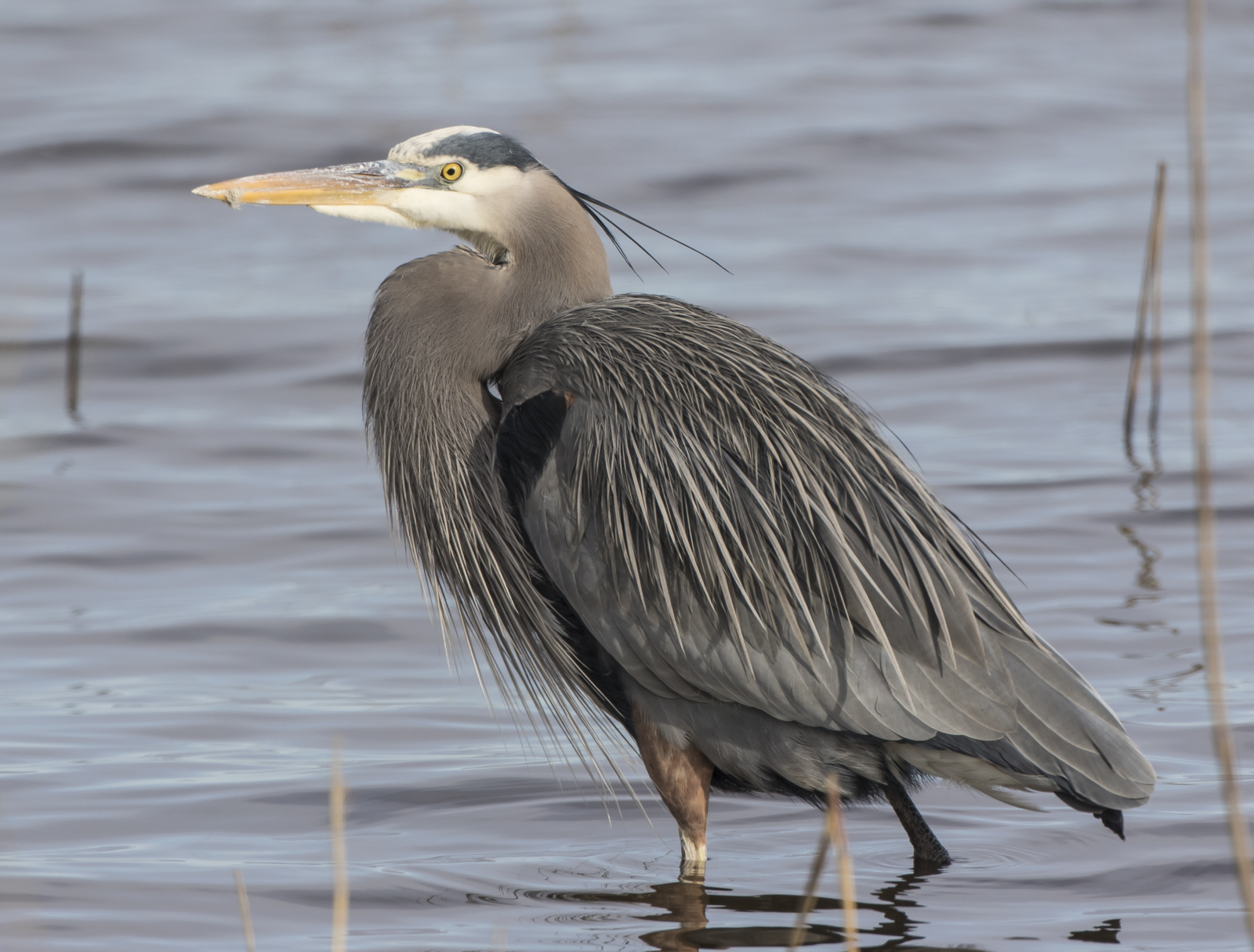
Great blue heron walking in shallows along causeway (click photos to enlarge)
I stopped by the Pungo Unit on my way down Wednesday. Very quiet and the roads were pretty muddy. We started our tour at sunrise the next morning at Lake Mattamuskeet. There are relatively few birds out along the causeway this year, due to the wet year and resulting high lake levels, and the decline in the submerged aquatic vegetation (see recent Wildlife in North Carolina magazine article). You can still usually find a couple of birds near the south end of the causeway, especially some waders like the great blue heron above. I love the textures of their feathers, which seem even more prominent in cold weather.
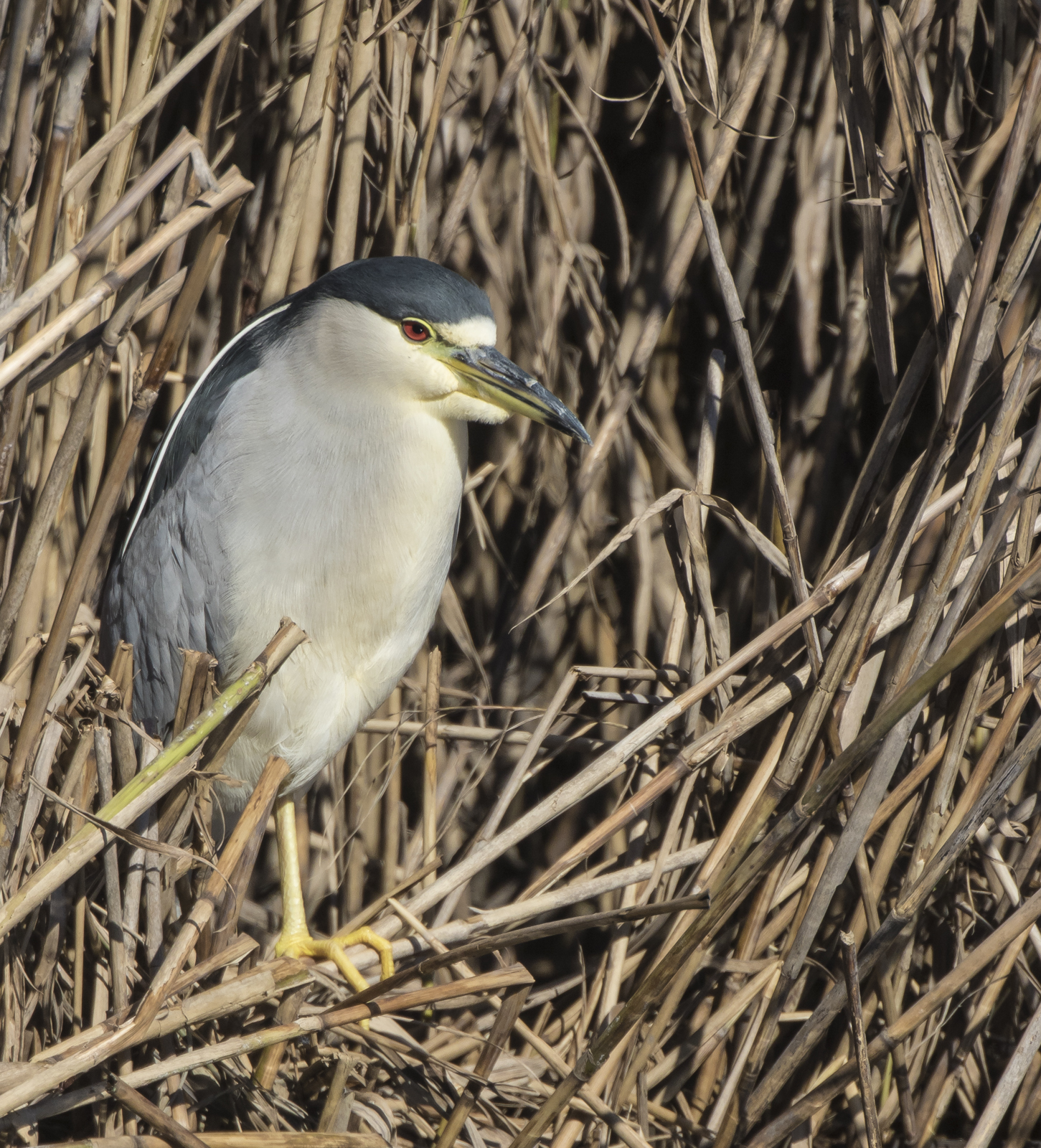
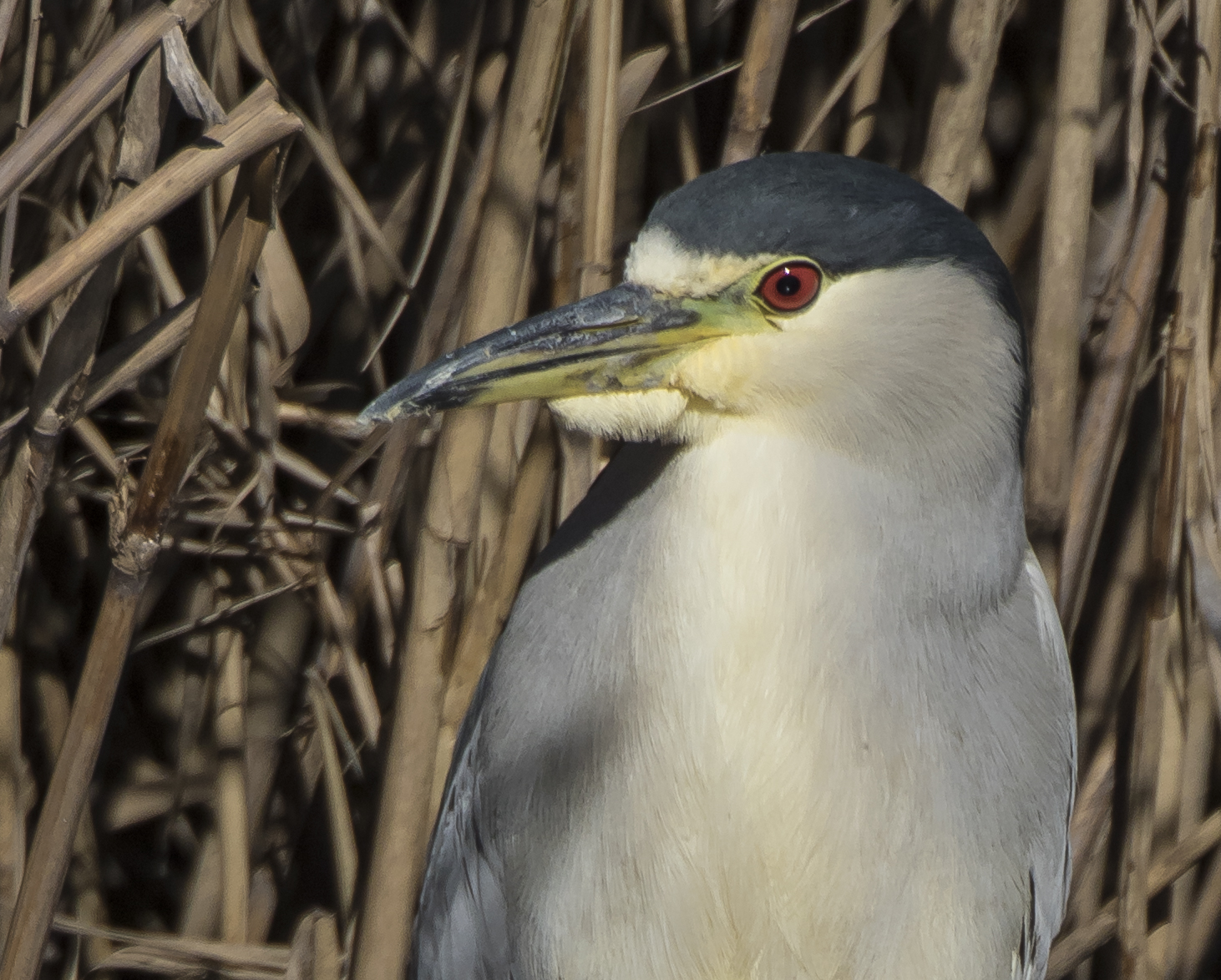
Black-crowned night heron adult
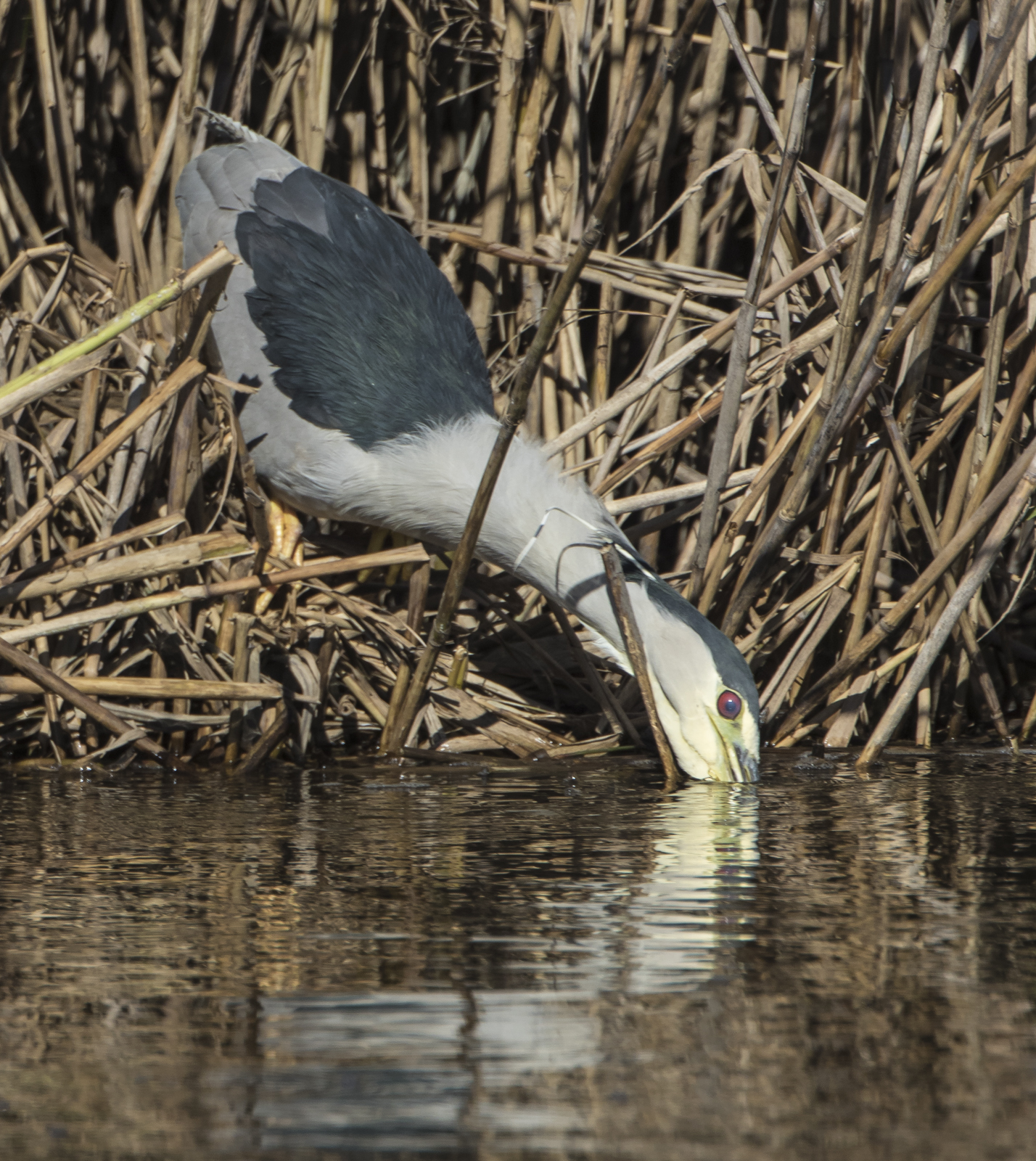
I always look for a heron or black-crowned night heron on the pilings in the marsh pool just inside the gate to the refuge, but they were empty. But, at the next pool, an adult night heron was out in plain view, and was hunting. I have never seen a night heron at this particular pool in all the years I have been going to the refuge (and haven’t seen much else here the past couple of years since the Phragmites grass has taken over the edge of the pool).
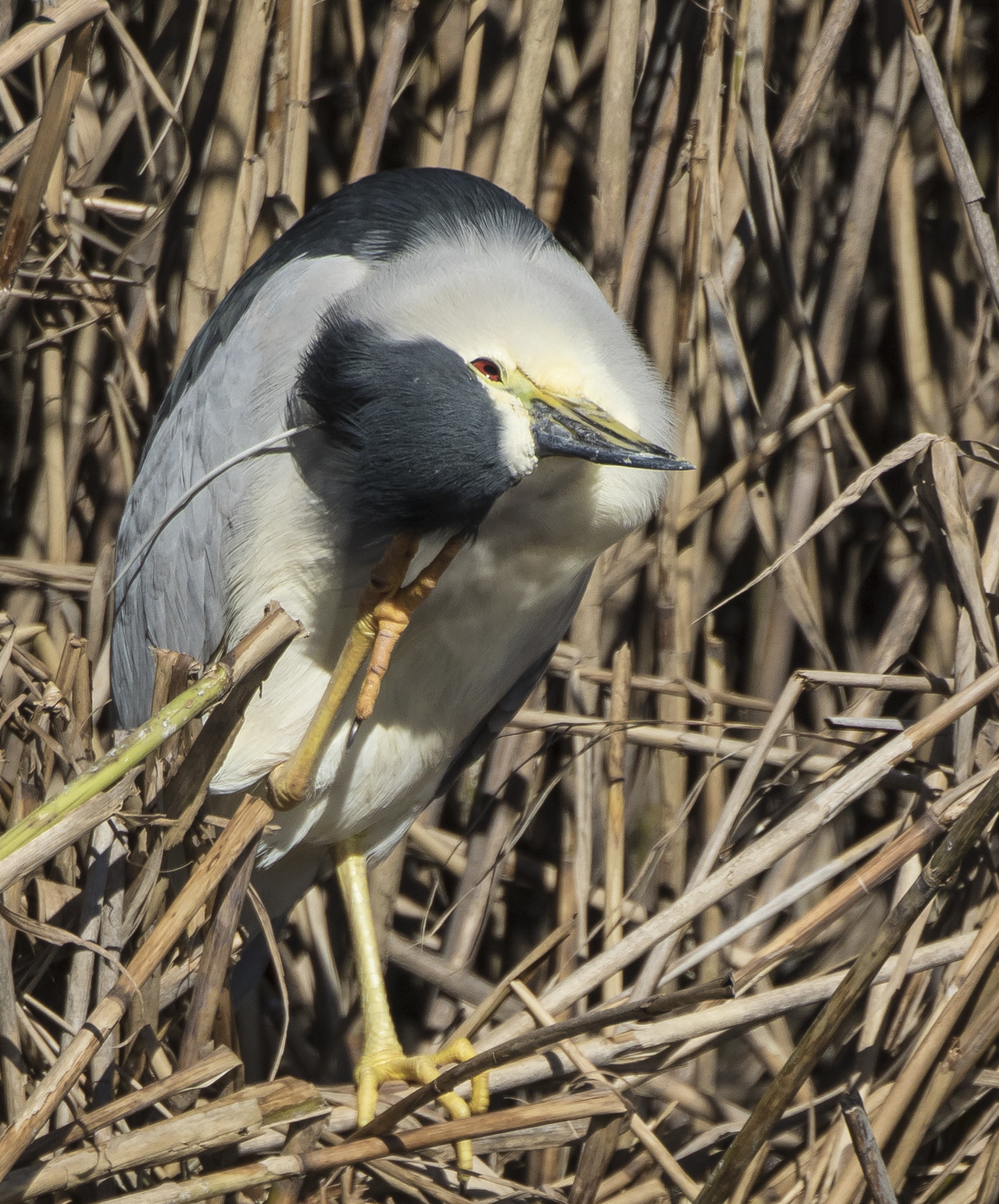
Night heron strikes and catches a small fish (note nictitating membrane to protect eye)Nothing like a good scratch after a mealThe red eye of an adult black-crowned night heron is spectacular
Their red eye is stunning in sunlight. Young black-crowned night herons have yellow eyes, that gradually change to orange, and then red as they mature. Though many species of birds show a change in eye color from young to adult, no one seems sure what the evolutionary significance of this may be.
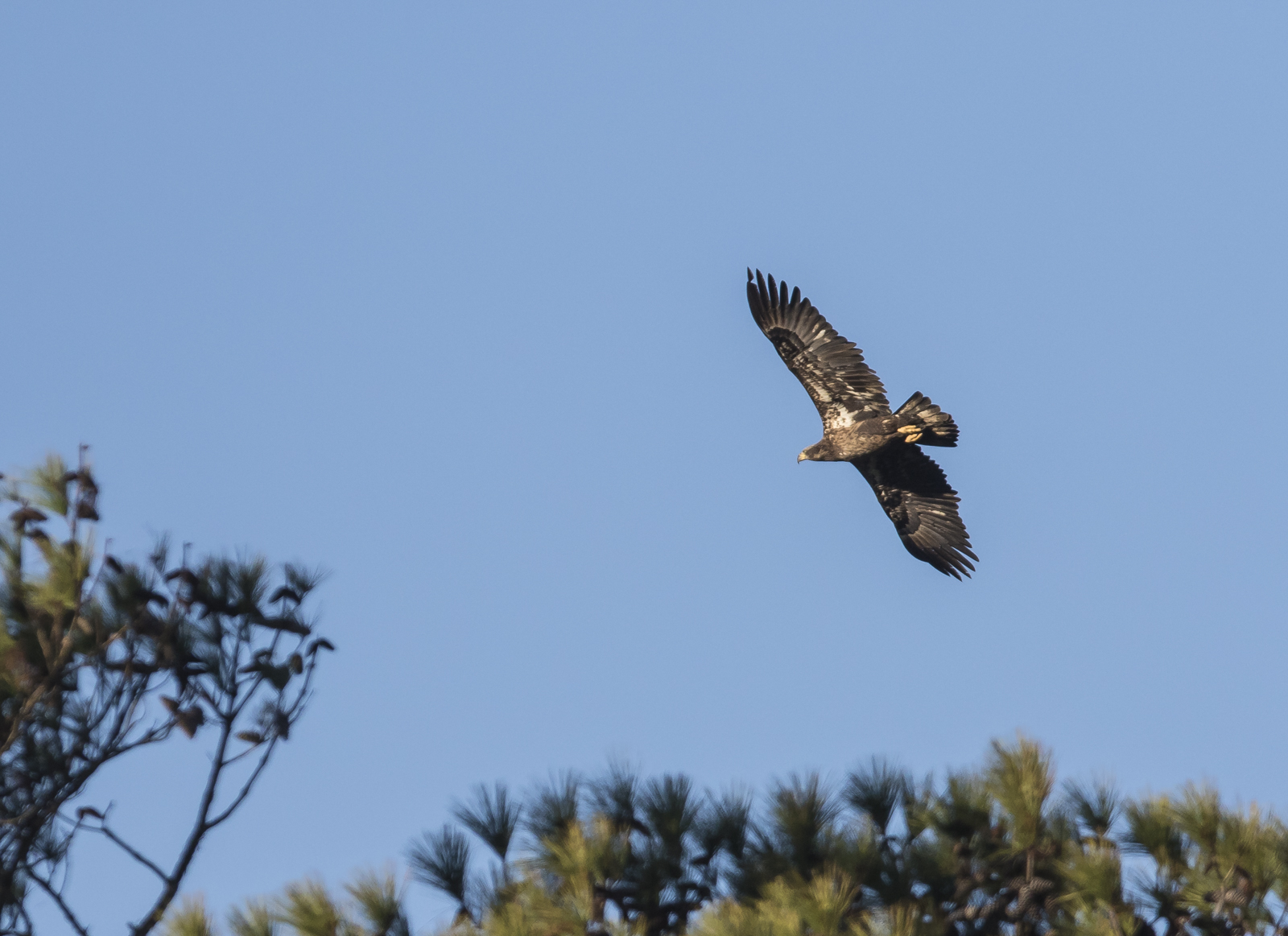
Immature bald eagle
Among the many birds we saw, there were the usual bald eagles perched along the edges of the lake and marshes scanning the areas for weakened waterfowl that make an easy meal. At one point, we had two immature eagles and a red-tailed hawk all soar out over us.
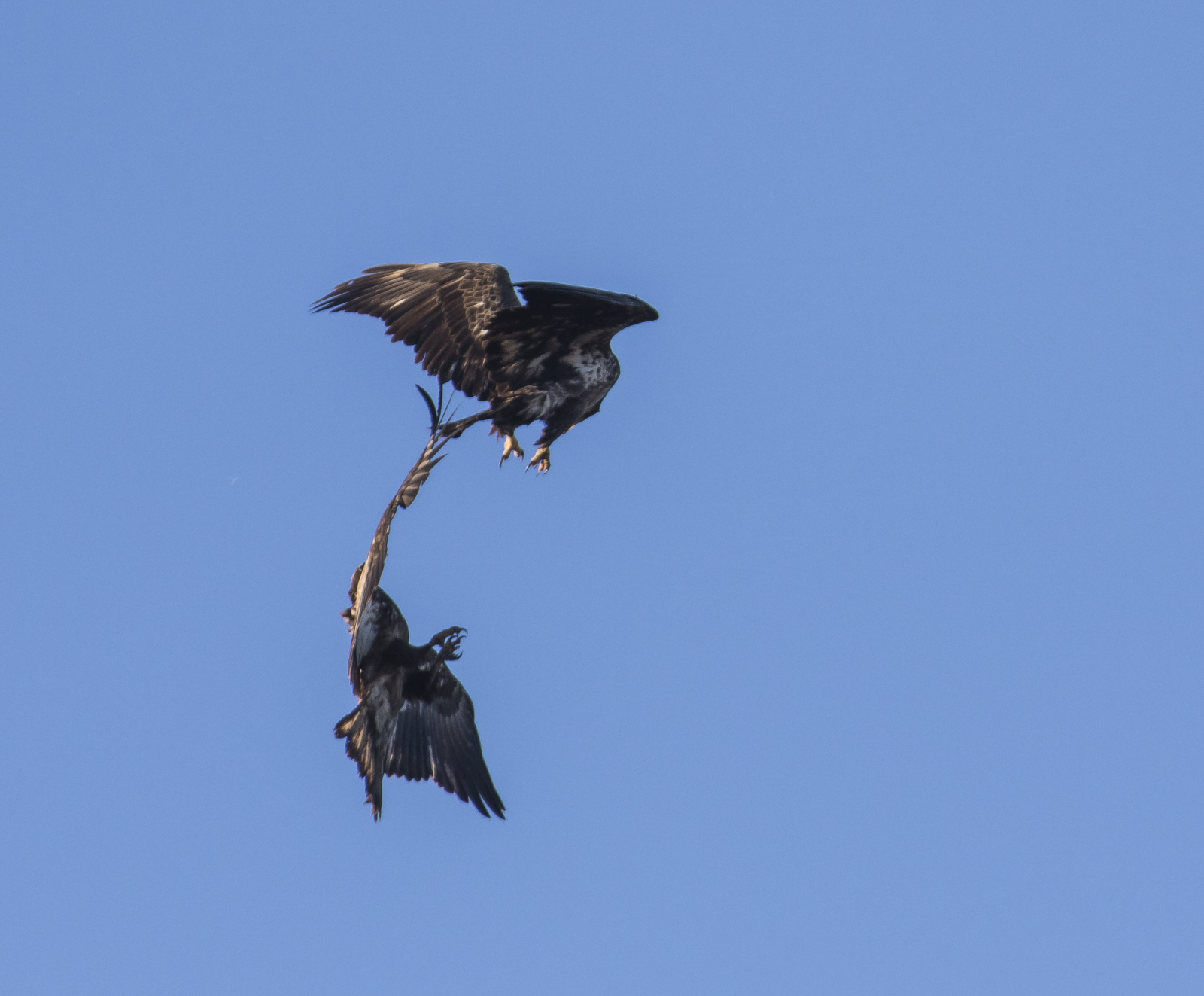
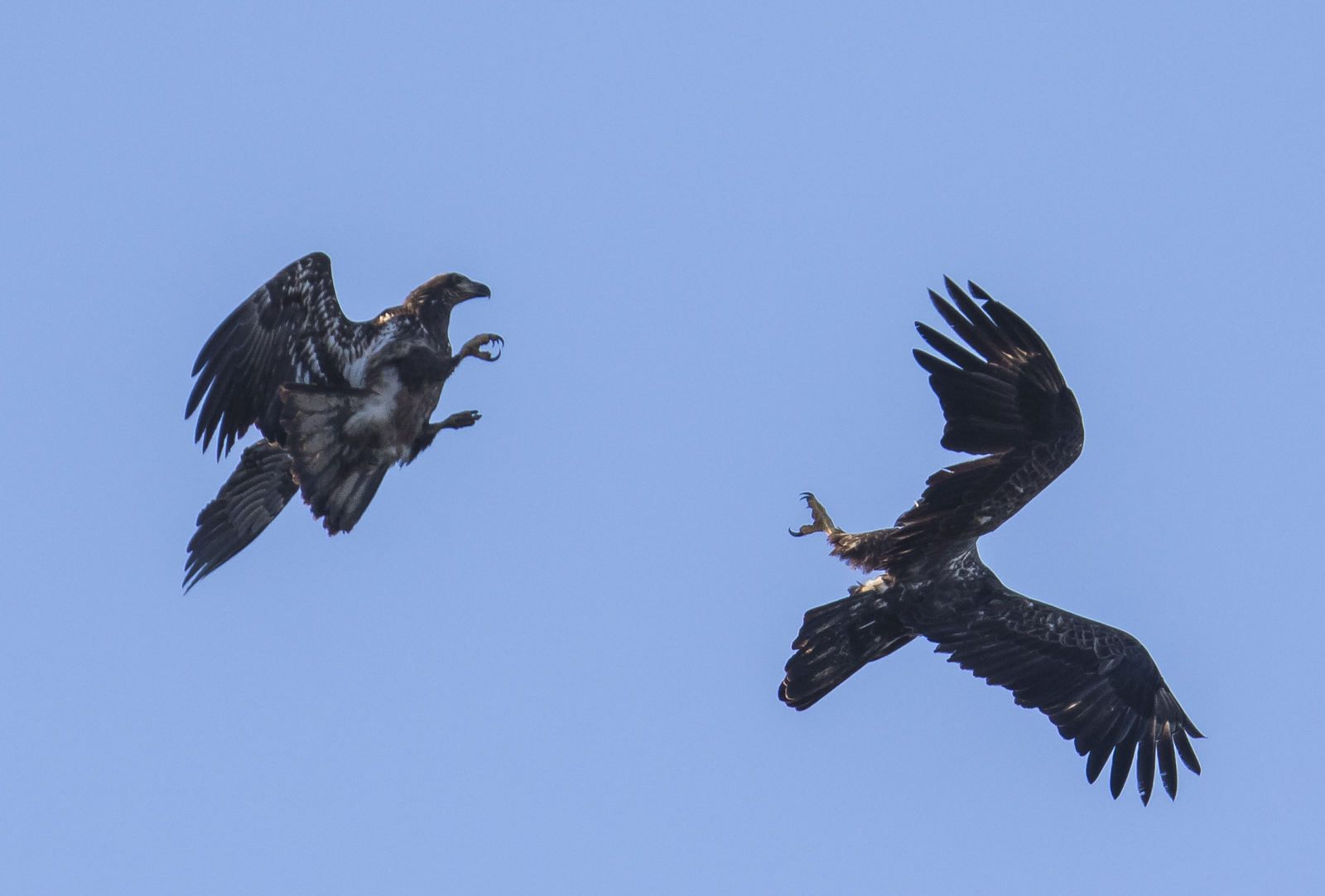
The eagles engaged in aerial combatOne eagle rolled over, extending its talons
Suddenly, the two eagles started to chase one another and were soon performing some serious acrobatics. This may be a territorial battle, or simply their form of play, I’m not sure. Almost as quickly as it had started, it was over. We saw some more of this over at Pungo the next day involving three eagles, two adults chasing one juvenile through the woods.
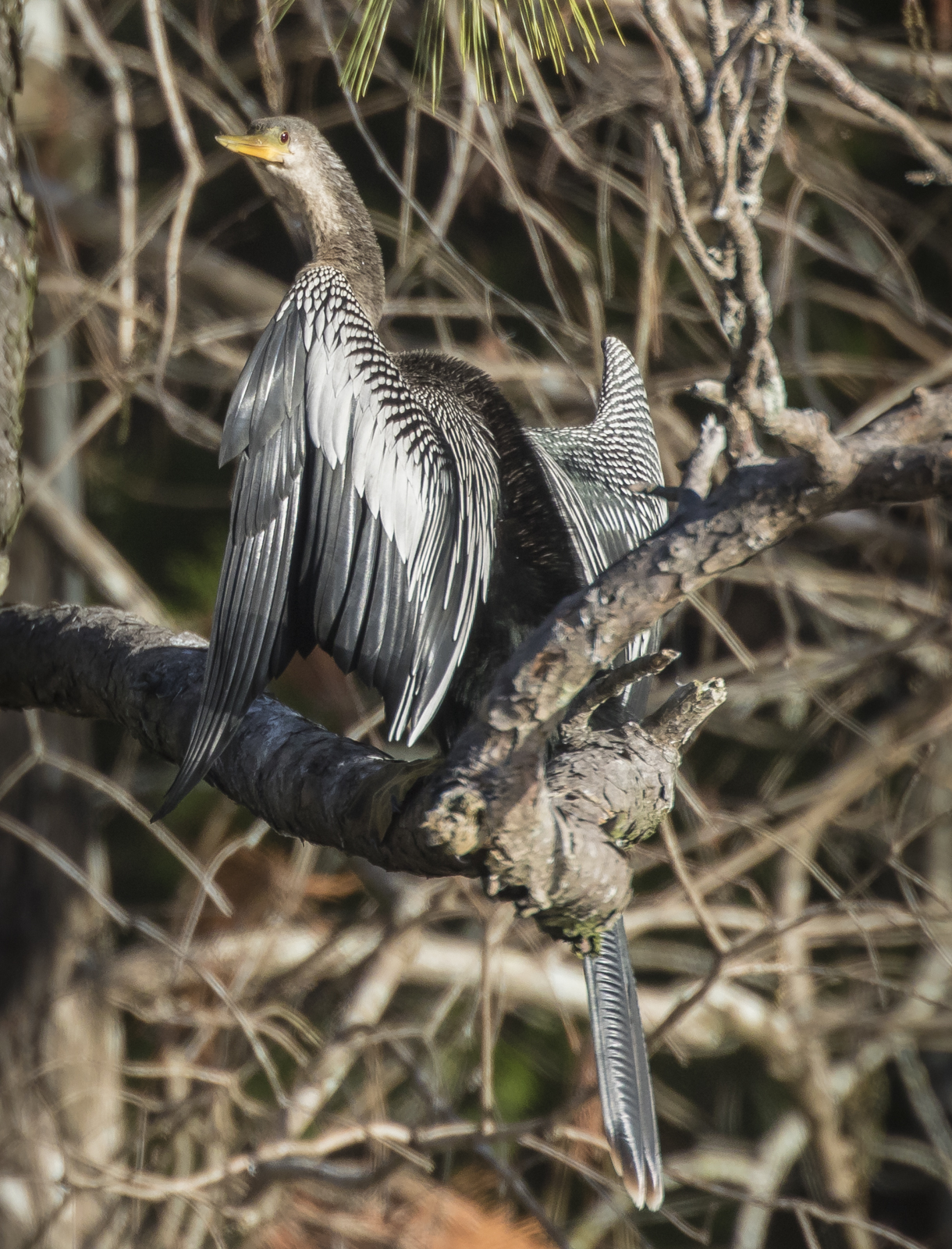
An anhinga sunning itself
I had seen an anhinga in the Mattamuskeet canals on a visit in December, so I was looking for it again. We found it sunning itself in a tree across the canal from the lodge. Interestingly, this spot used to be the best place on the refuge to see black-crowned night herons (especially juveniles), but the past two winters they have been scarce.
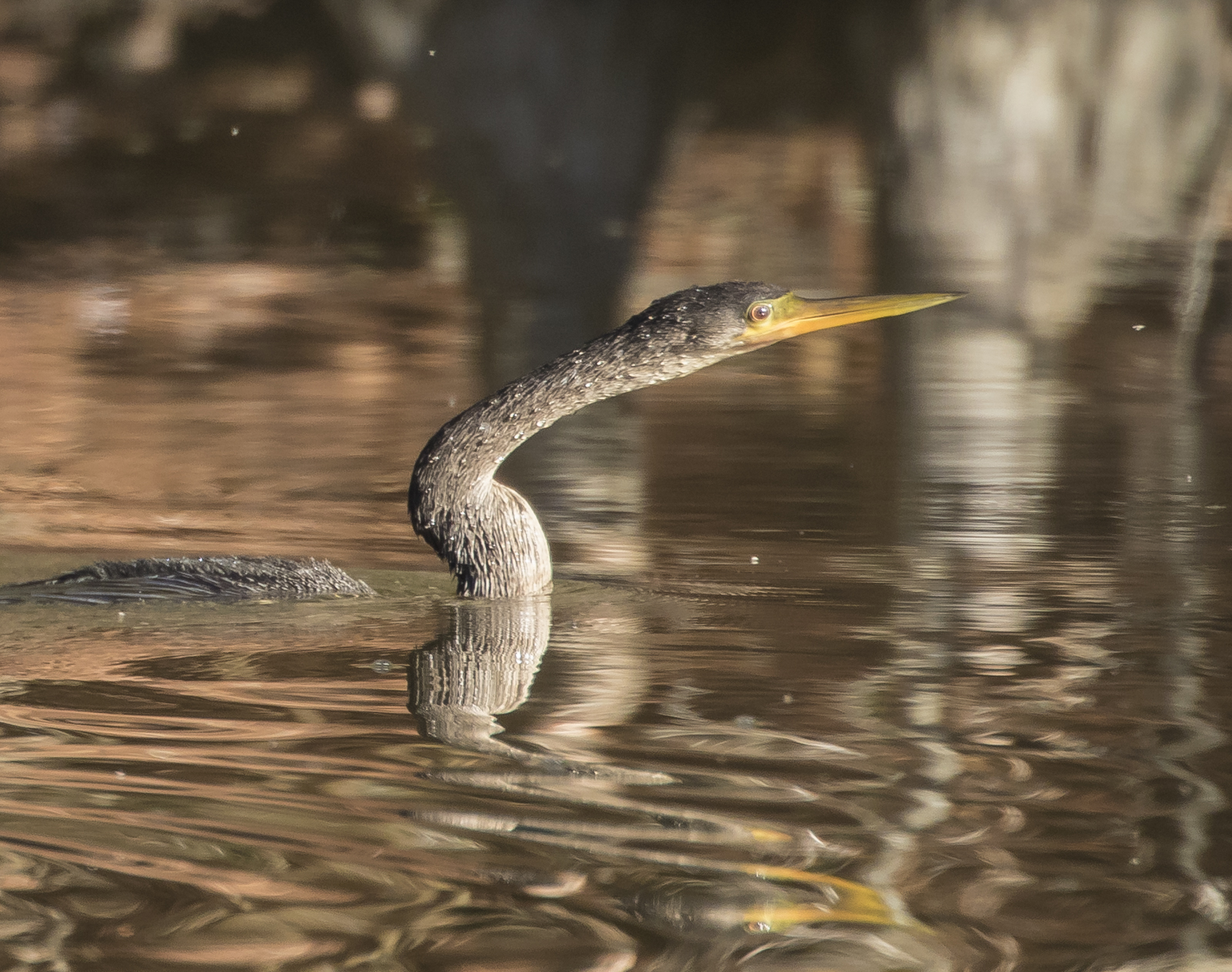
Anhinga, often called the snakebird, for its swimming style
As we admired the anhinga through my scope, another one came swimming down the canal. I think this is the first time I have ever seen two at once on the refuge.
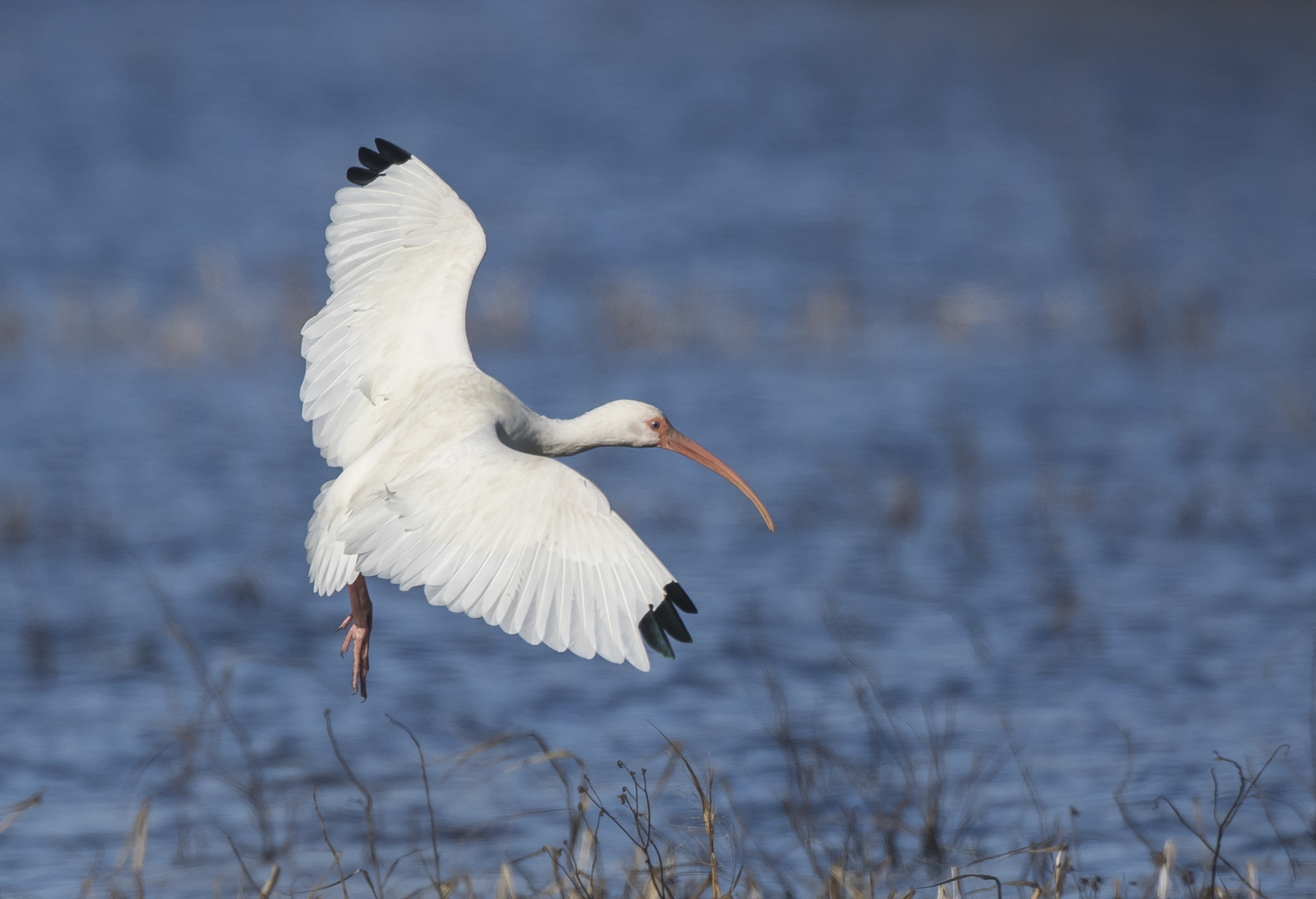
White ibis landing in marsh
We continued looking for wildlife throughout much of the day, with many of the usual suspects being observed. We found almost 100 white ibis feeding in a field at Lake Landing, and felt lucky to see a group of American white pelicans soaring over us. We also had a couple of good warbler sightings – a cooperative common yellowthroat male and an orange-crowned warbler. Overall waterfowl numbers seemed low, but there is still enough diversity to get some good looks and decent photos.
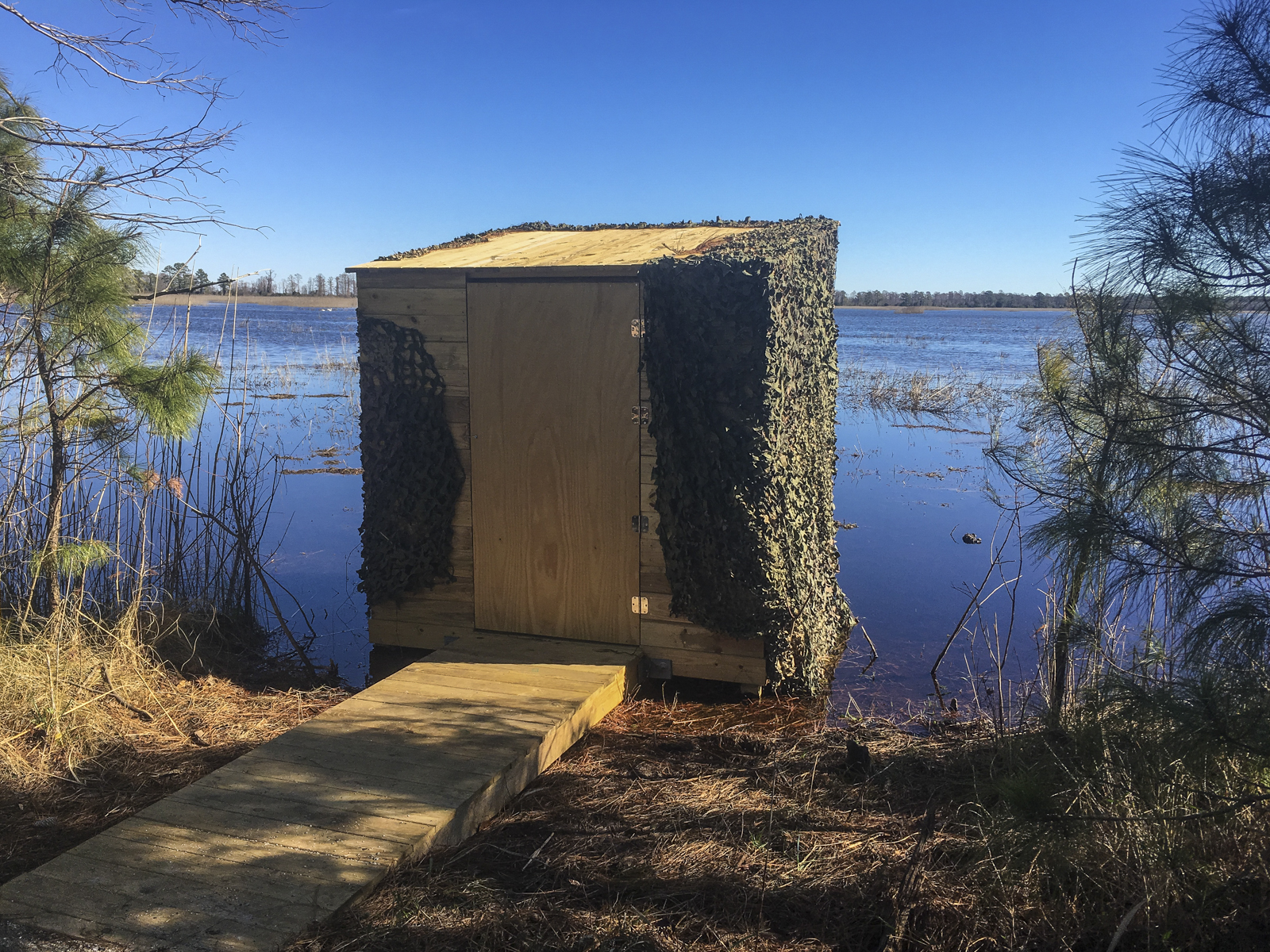
New photo blind at Mattamuskeet
It wasn’t until late in the day we discovered the new photo blind on the refuge. It is located along Hwy 94, between the entrance and exit points of Wildlife Drive. Kudos to those responsible – it is a great design with good viewing ports covered by camouflage netting. When we drove up, there were several species of waterfowl just off the front of the blind. They swam off as we walked in, but I think if you spend some time in this spot, you could get some good results once the birds return (you can’t really sneak in without nearby birds seeing you; bring a seat or bucket if you plan to spend time in it). I look forward to returning on a future trip. I hope other public land managers will consider putting up similar structures. This one was funded, at least in part, by a grant from the North American Nature Photography Association.
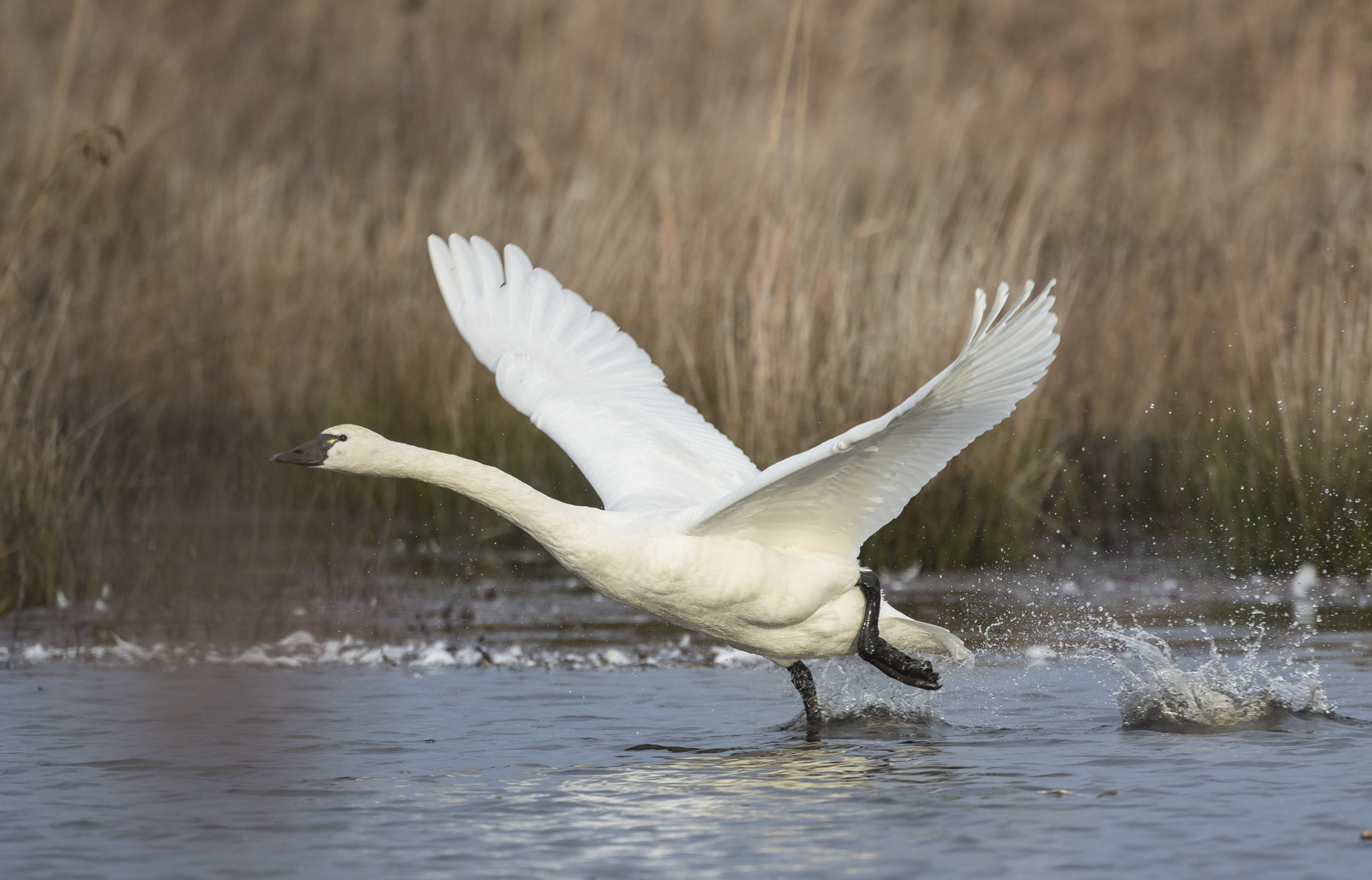
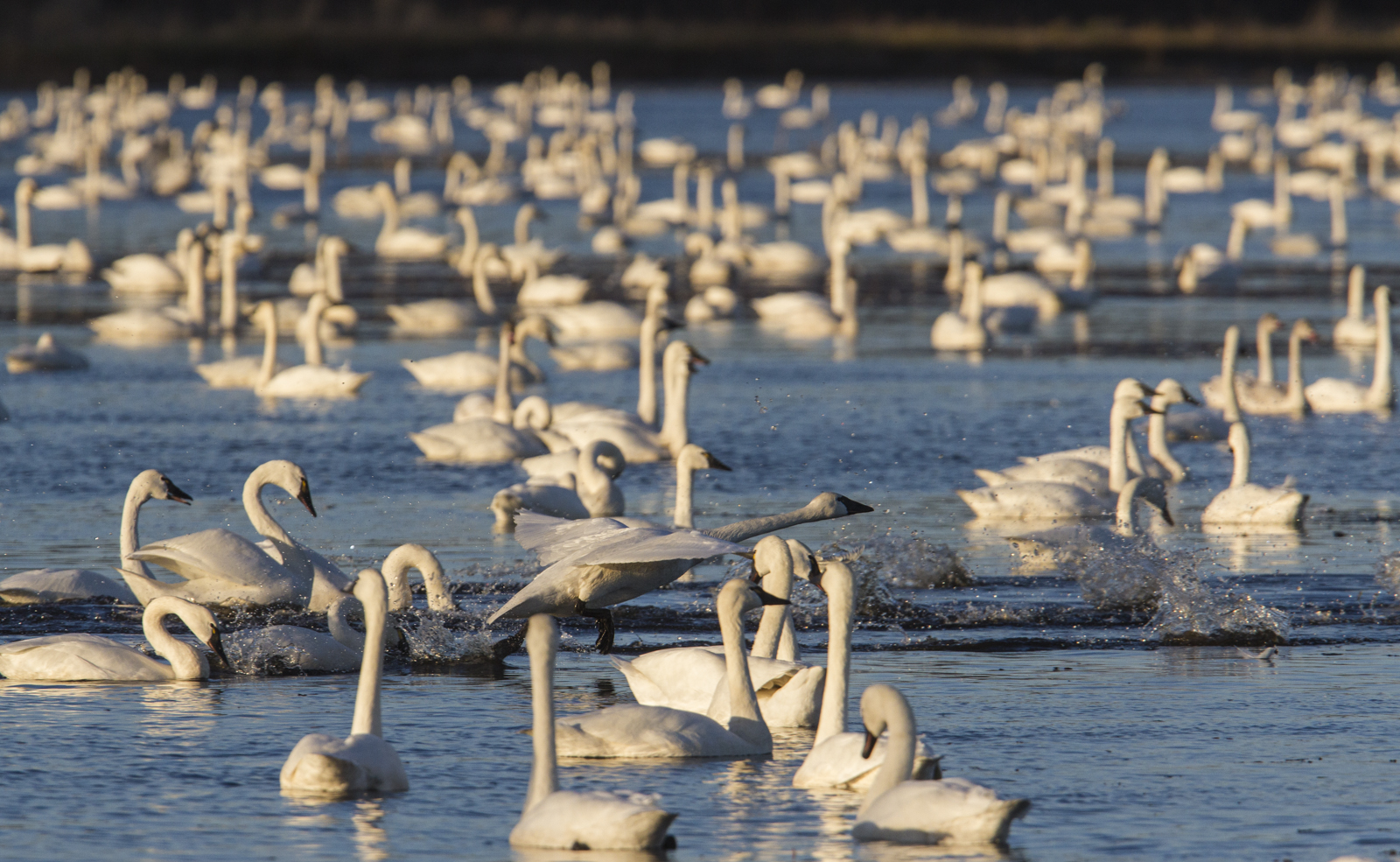
Tundra swan taking off
That afternoon, we headed over to the Pungo Unit to hopefully enjoy the evening show of swans and snow geese returning to Pungo Lake. As I mentioned in my last post, the swans have been amazing this winter, and they did not disappoint.
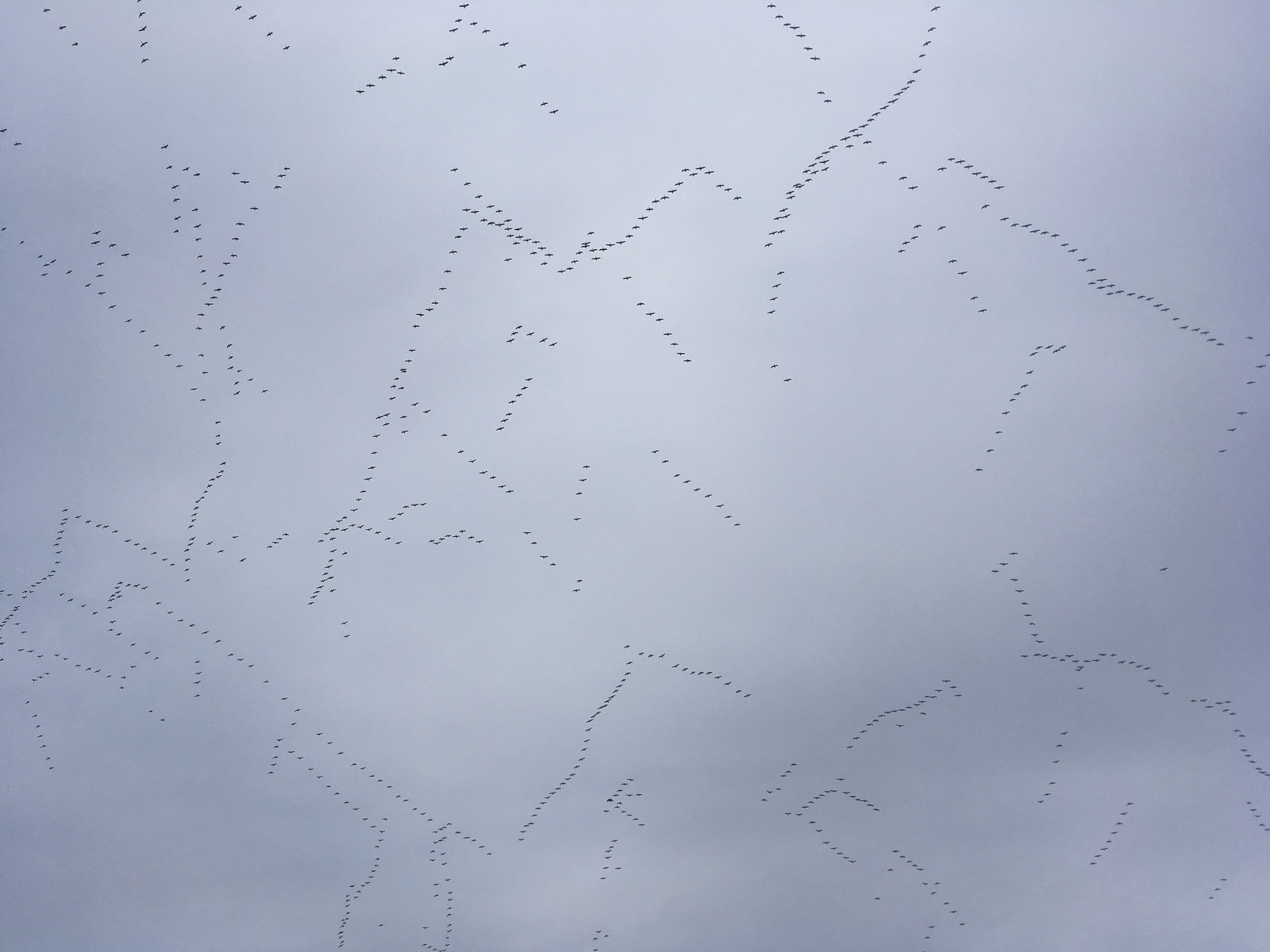
Snow geese flying high overhead
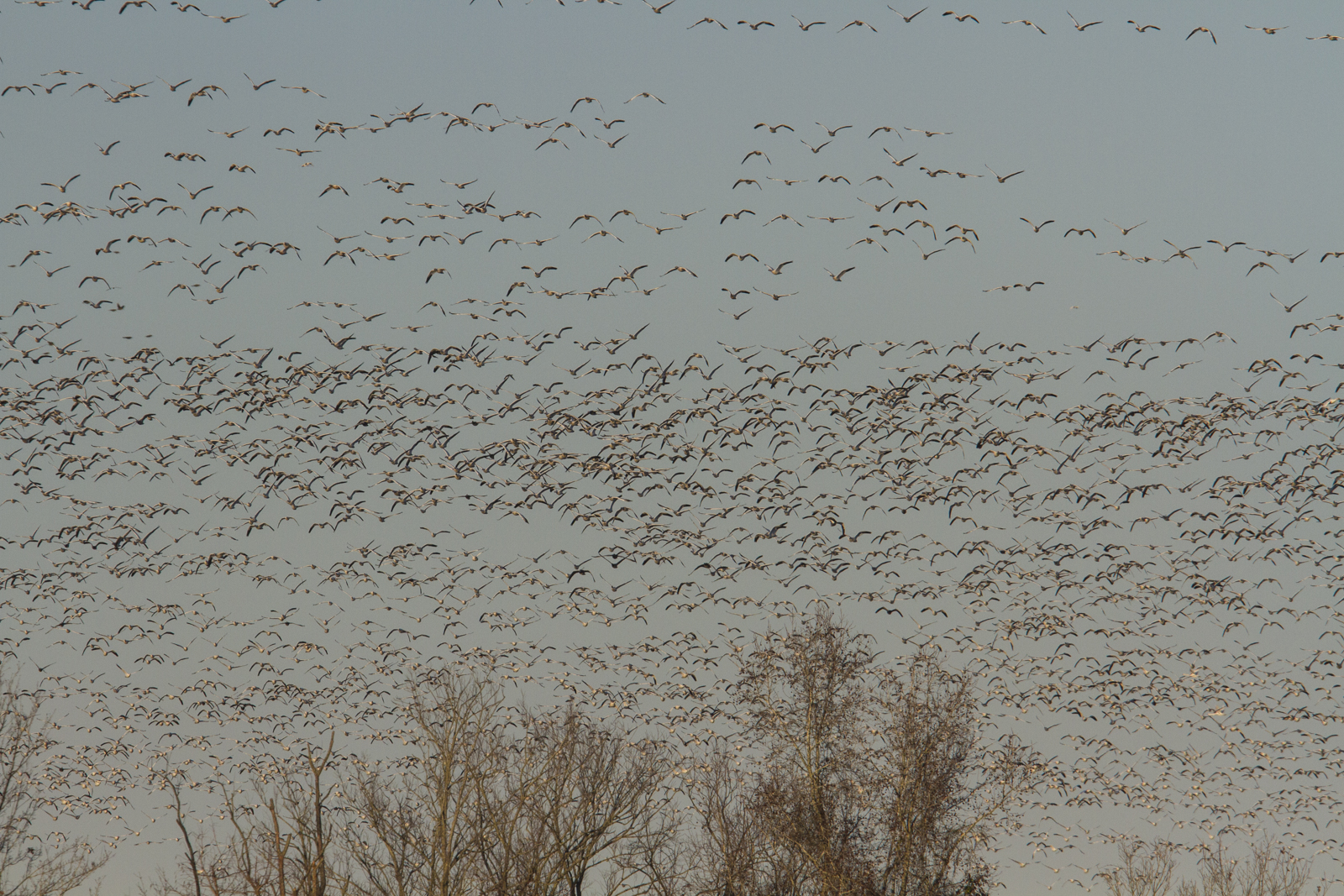
In our almost two days on the Pungo Unit, we did see the elusive snow geese flying far off the refuge to feed, returning a relatively short time later. A few thousand (of the estimated 15-20,000 birds) flew over us as walked down North lake Drive on our second day out, coming in at a very high altitude as they approached the lake. They continue to be unpredictable in their movements, although I think they will be closer to the refuge roads once some of remaining corn on refuge lands is knocked down (I expect that to happen very soon).
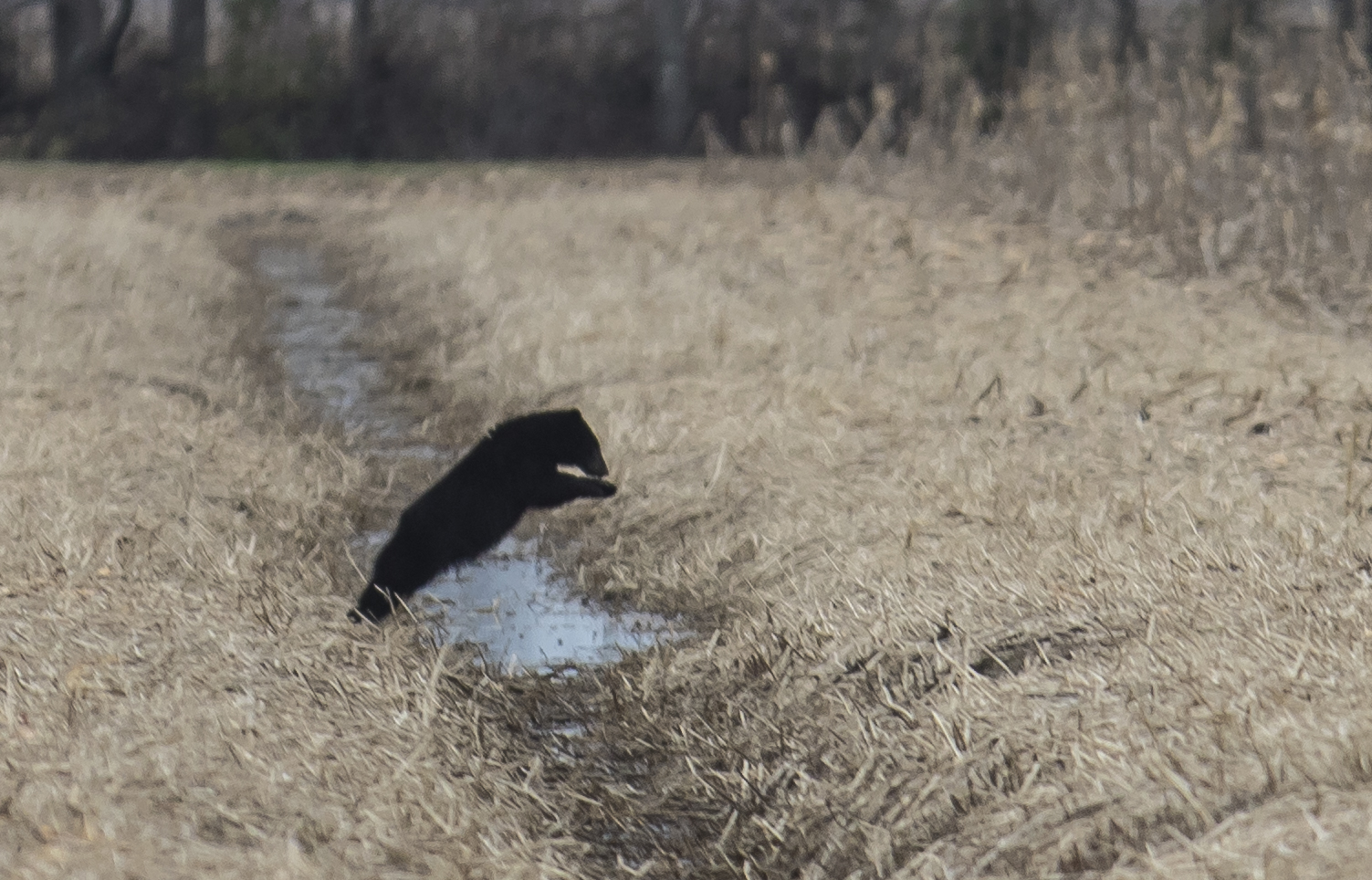
A young bear jumps over a drainage ditch
This has been a strange winter for the black bears at Pungo. We saw what seemed the usual number on our trip in mid-December (8, as I recall). But since then, sightings have been few and far between, including being skunked in bear sightings on our Christmas Bird Count the last week of December (maybe the only time that has happened in over 30 years of doing that count). On this trip, I saw three (a sow and two yearlings) my first afternoon, and then we saw only three others in two days – one in the front fields coming out of the corn at sunrise, one feeding in corn and one cruising across the corn fields along North Lake Road.
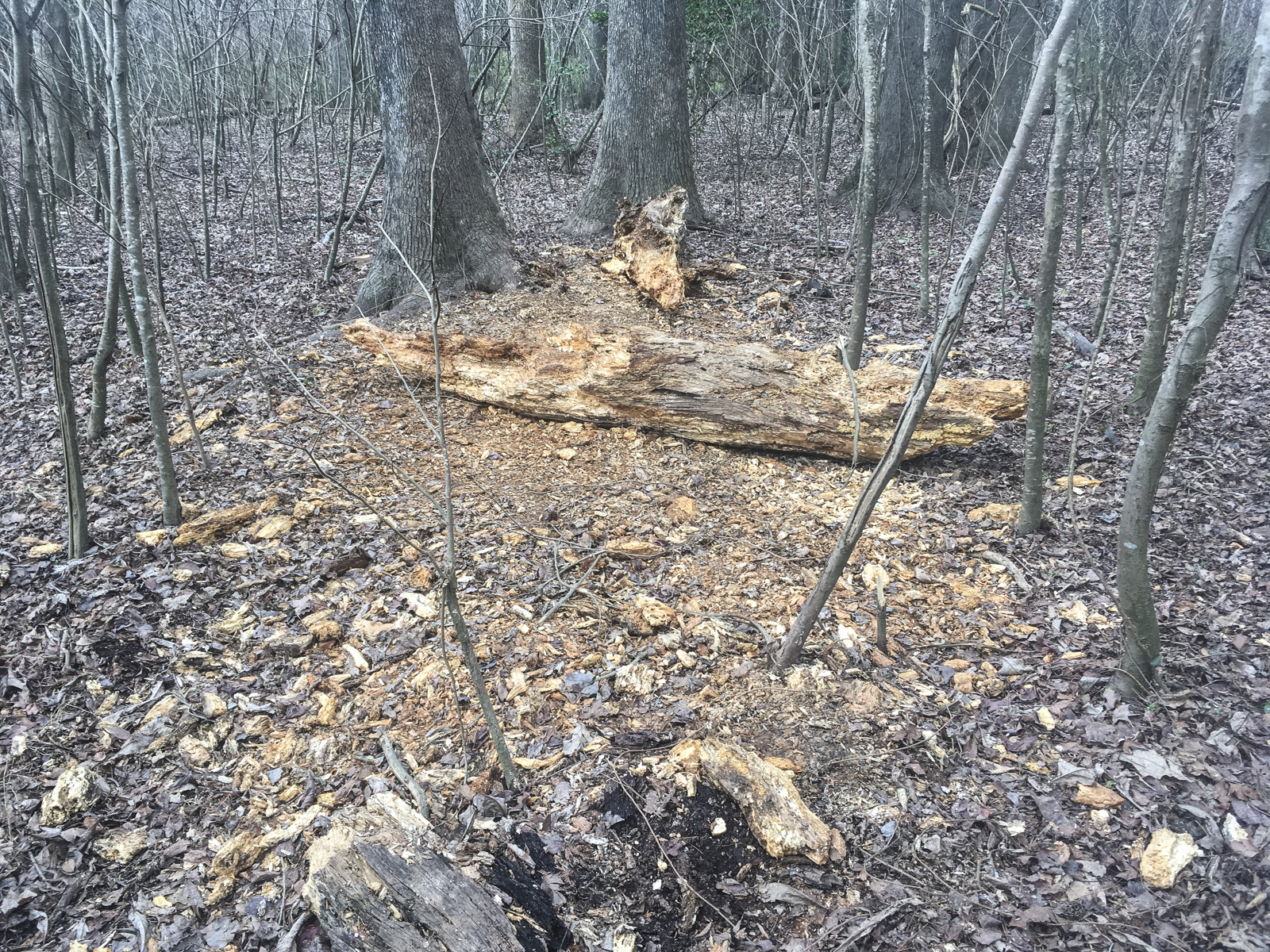
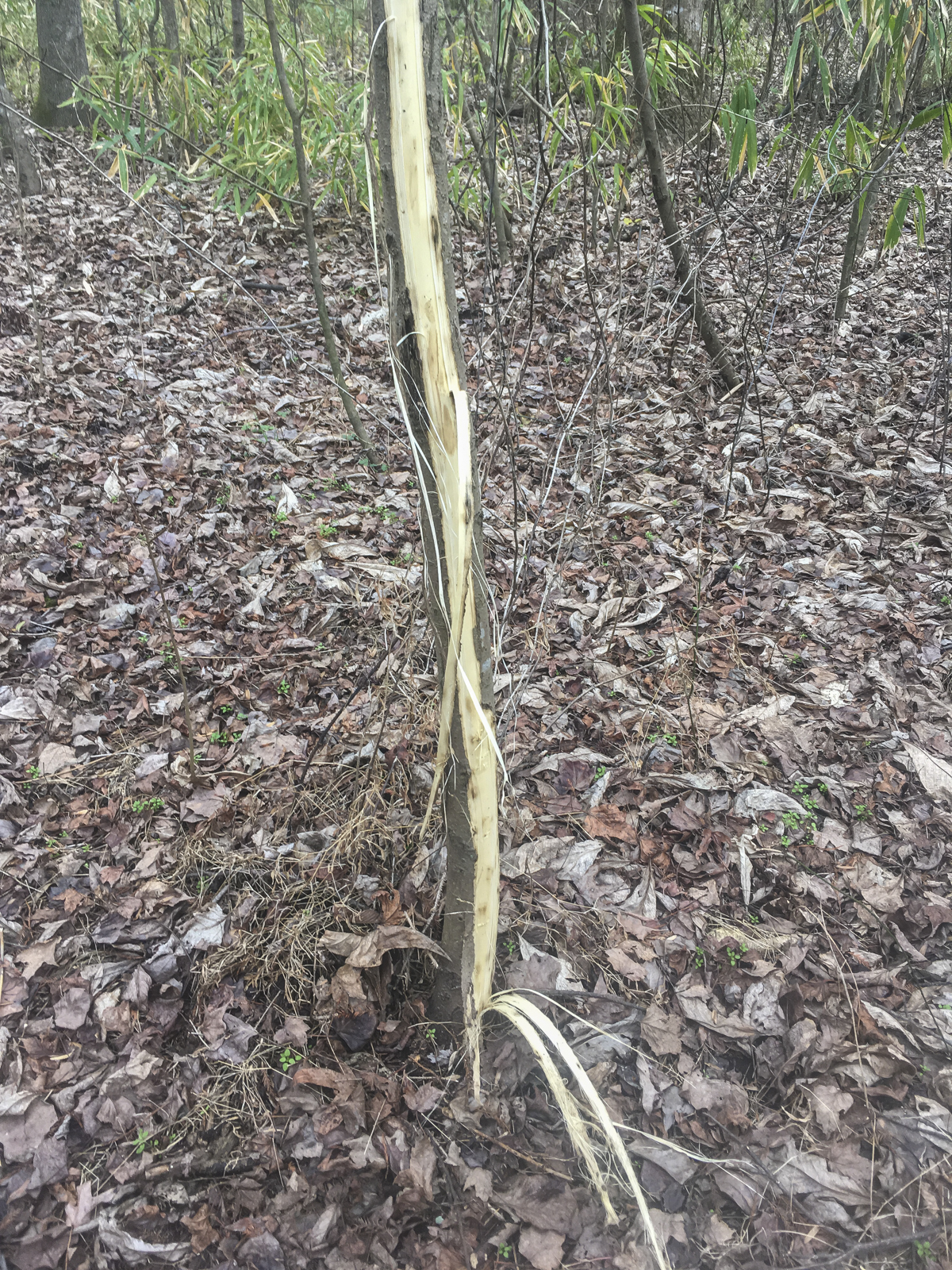
What looks like a bear play area in the woodsBark stripped from a pawpaw tree by a bear
There seems to be plenty of fresh bear sign in the woods and along the edges of the fields (although not as much scat in the roads as usual), so I am not quite sure what is going on. I think there may be increased hunting pressure on local bears at the edge of the refuge and this may be altering their behavior and making them more secretive, as well as reducing their numbers with greater numbers of bears that venture off the refuge being taken.
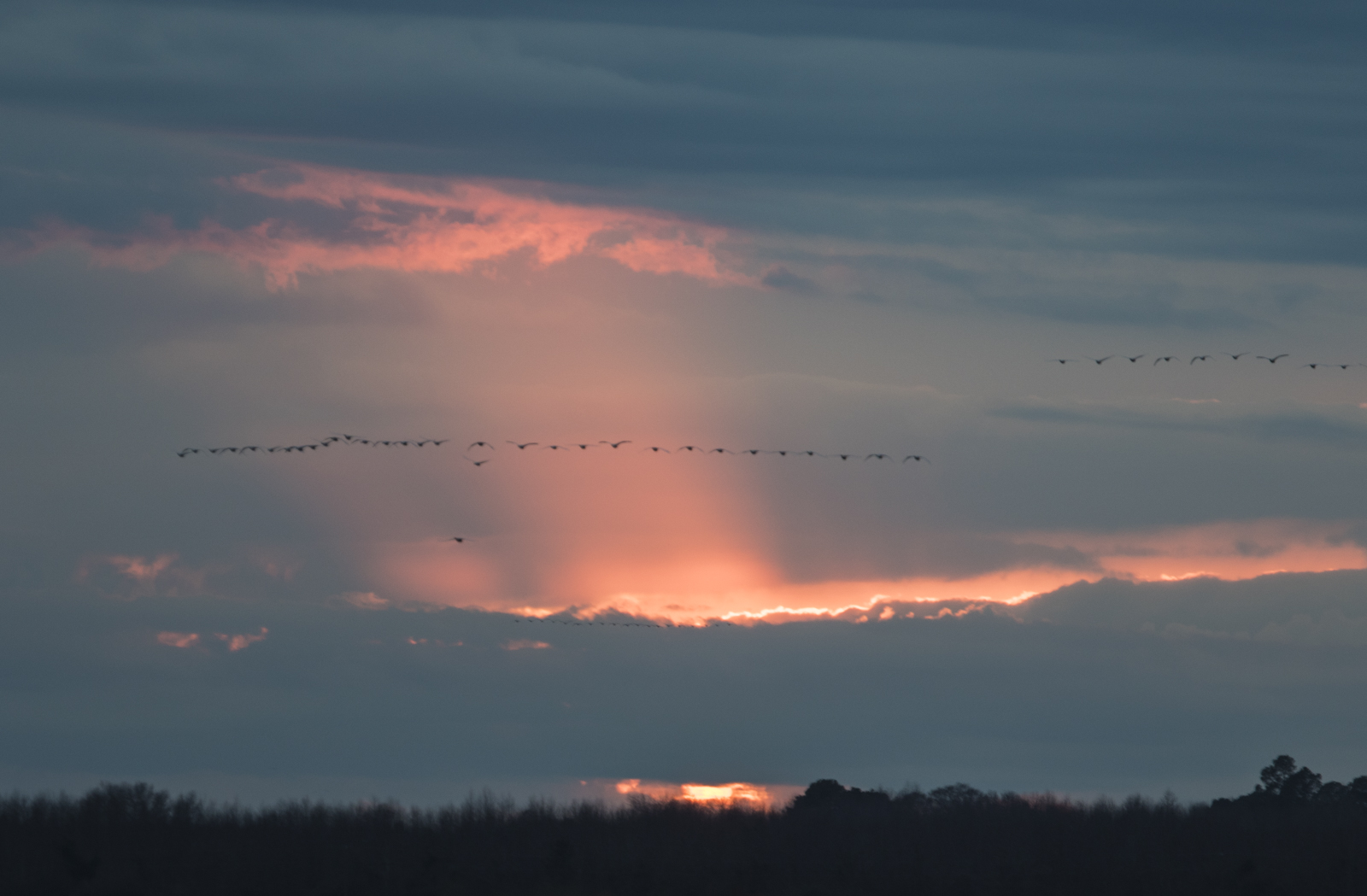
Sunset with swans returning to the refuge
It is still a magical place, especially at sunrise and sunset. The swans fill the evening sky with magical sounds and the graceful lines of returning birds. I’ll leave you with a video clip from our sunrise at Pungo and the swans that make this refuge such a place of renewal for myself and so many others that spend any time in it.
Any glimpse into the life of an animal quickens our own and makes it so much the larger and better in every way.
~John Muir
Tundra swans at sunset on Marsh A on the Pungo Unit (click photos to enlarge)
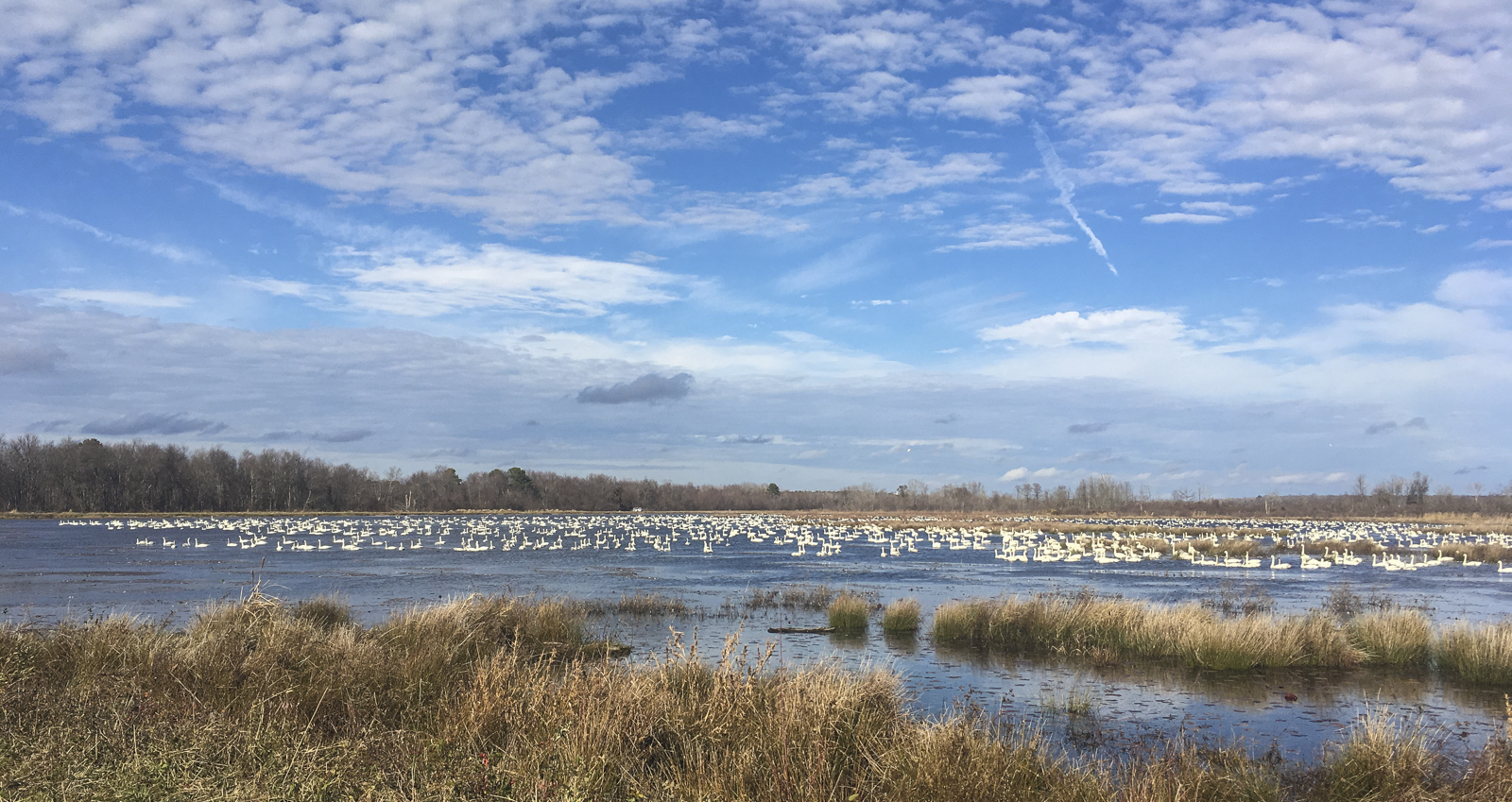
I’ll just say it…I love being around the swans at Pungo. There is something magical about these birds and every winter I find myself drawn to them and wanting to spend time in their elegant presence. While the snow geese tend to provide more of a spectacle with their huge noisy flocks swirling overhead, the swans of Pungo are a constant in winter, providing the musical score for a play I have seen hundreds of times and yet continue to find fascinating.
A flock of swans returning to Pungo Lake at sunset
There are an estimated 100,000 tundra swans in the Eastern population. Most breed in northern Alaska and then migrate 3000 or so miles to spend the winter along the East Coast, with about 70% spending much of their time in North Carolina. And one of the best places to observe them is the area around the Pungo Unit of Pocosin Lakes National Wildlife Refuge.
A swan with landing gear down
The birds start arriving in November and will stay through much of February, roosting at night on large bodies of water like Pungo Lake and Lake Phelps, and flying out to surrounding agricultural fields during the day to feed on waste corn and winter wheat. Adult swans weigh 15-20 lbs and have a wingspan of over 5 ft, so they are easy to spot as they go about their daily routine. For the past several years they have found the managed impoundment along West Lake Road at the Pungo Unit to be to their liking and it has provided a great spot for swan watching. So that is how I spent almost a full day last week, standing next to a dead snag and observing swans (it helps to try to blend in with your vehicle or something like a tree to reduce your human form and put the birds a bit more at ease – they tend to swim away or take flight if you are out of your car walking around near them). Below are just a few of the hundreds of photos I took of a day in the life of these majestic waterfowl.
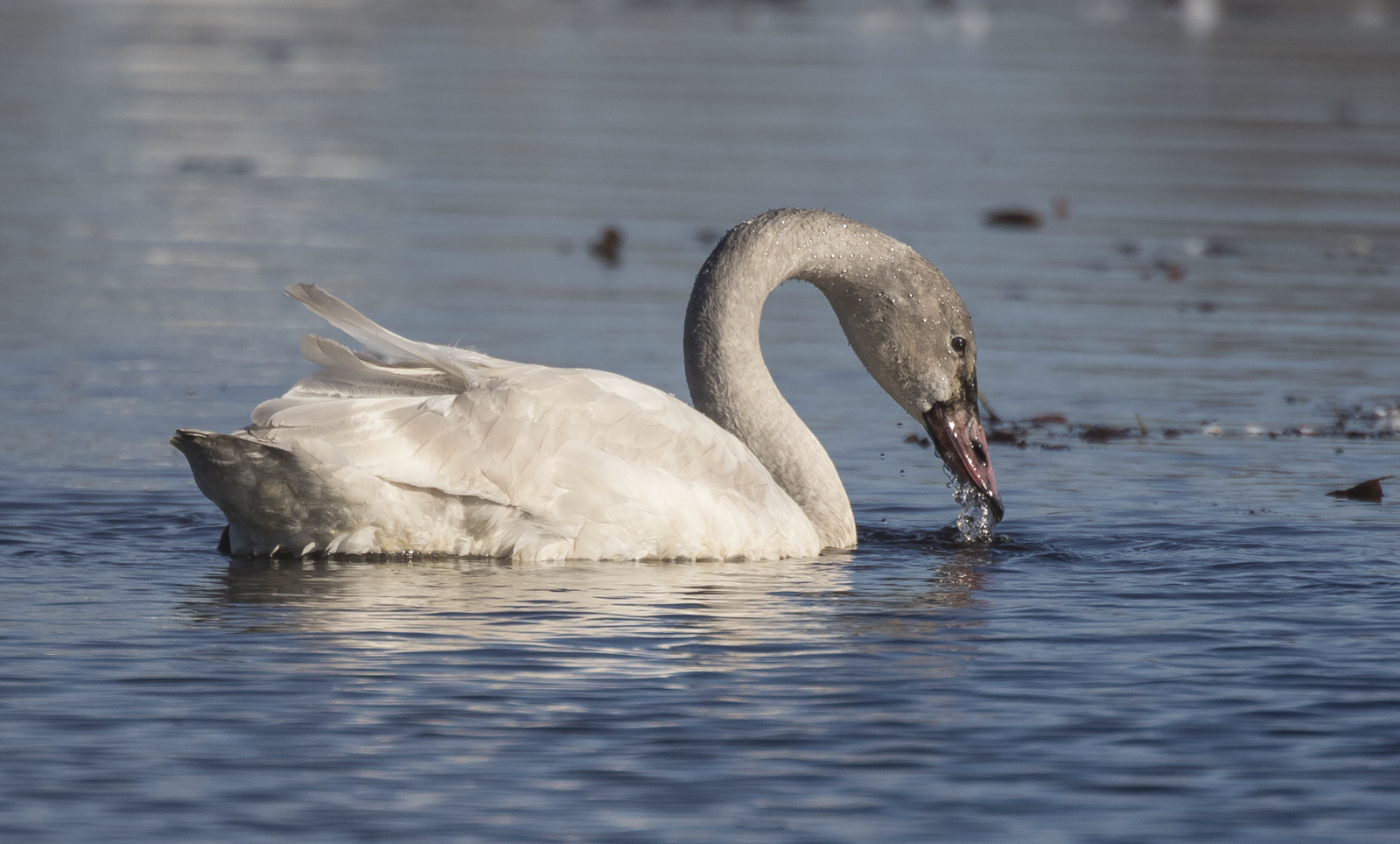
Juvenile swans have gray heads and necks and varying amounts of pink on their bills
It looks like it was a good year on the breeding grounds as there seem to be more juvenile swans this year. Juveniles follow their parents to the wintering grounds and can be distinguished from the adults by the gray plumage on their head and neck, and patches of pink on their bills.
Immature swan feeding on aquatic vegetation
Juvenile swans tend to stick pretty close to their parents on the wintering grounds, but you occasionally see one off by itself, like this one that was picking at some aquatic vegetation. There is so much commotion on the water that I wonder how they all manage to find and stay with each other.
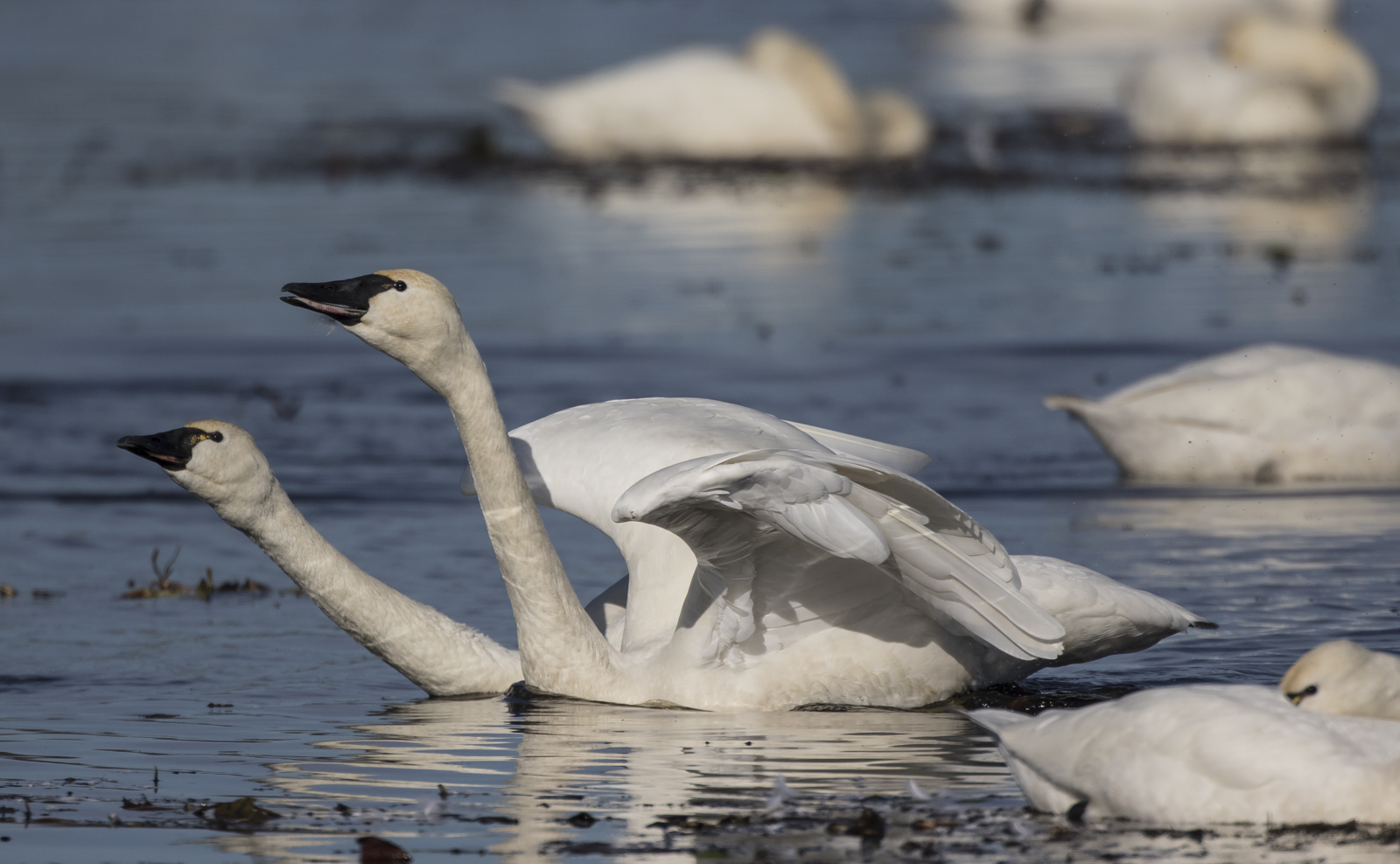
Swans calling
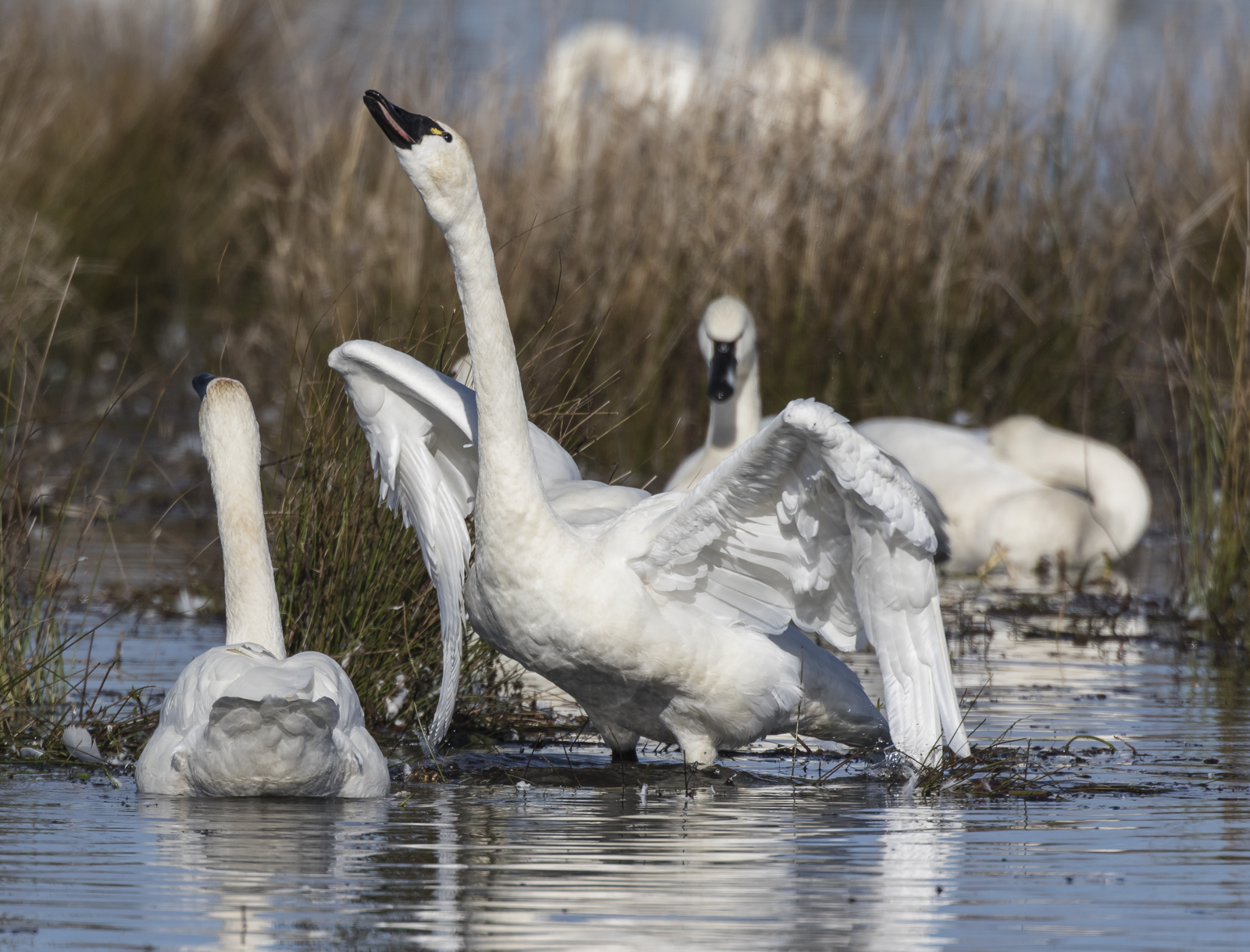
While the swans give the initial impression of being regal and serene compared to the huge flocks of boisterous snow geese, at times they can actually be quite aggressive towards one another. These agnostic interactions often start with adult swans giving a distinctive trumpeting three-syllable call – oo-ou-oo. This is usually accompanied by a forward-leaning outstretched neck.
A pair moving in to challenge another pair of swans
It can then escalate to a wing-quivering display.
A classic wing-quiver display
These threatening displays probably help avoid actual physical interactions that could lead to injuries. It seems more often than not, that one of the interacting groups often backs down in the face of these threats.
Fights and bites do occur
But fights do occur…and when they do, it can be quite impressive as the huge birds flail with their wings and bite each other until one group has been vanquished.
Swans fightingFights involve a lot of wing beating and splashingCombatants can even become airborneSometimes all it takes is a quick bite to defeat an opponent
Most fights are over quickly with no apparent harm done. It’s hard to tell what all the fuss is about…most likely territory or personal space. I often saw a preening swan get chased off of a small clump of underwater vegetation that seemed to provide a platform on which to stand. I guess a place to stand in water world is something of a premium. Studies have shown what you might expect from these aggressive encounters – larger groups tend to dominate in fights; larger swans (most often males) tend to dominate smaller ones; and juveniles almost never win (I rarely saw them even get involved in fights except some nips with other juveniles).
A wing flap often follows an aggressive encounter
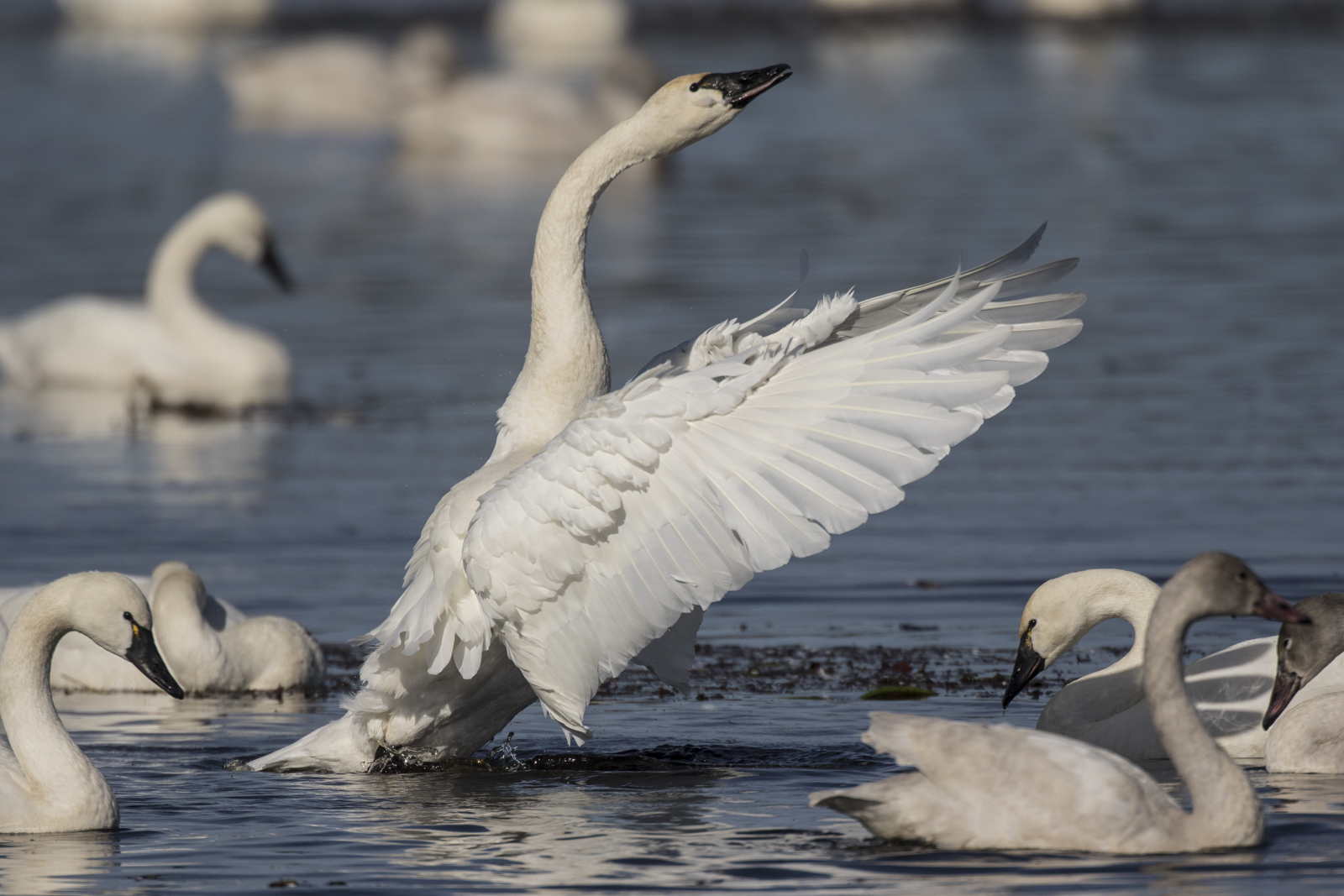
Following an aggressive encounter, group members often engage in another bout of wing-quivering and calling, which is sometimes called the triumph ceremony. This is similar to the display given when family members reunite. After a successful bout, there is often a wing flap by one or more of the group members (usually the victors, but occasionally even by the defeated swans). The wing flap is certainly one of the more striking behaviors these magnificent birds can perform, as they tend to rise up and flap 3 or 4 times, exposing amazing “sculptural details” in their wings.
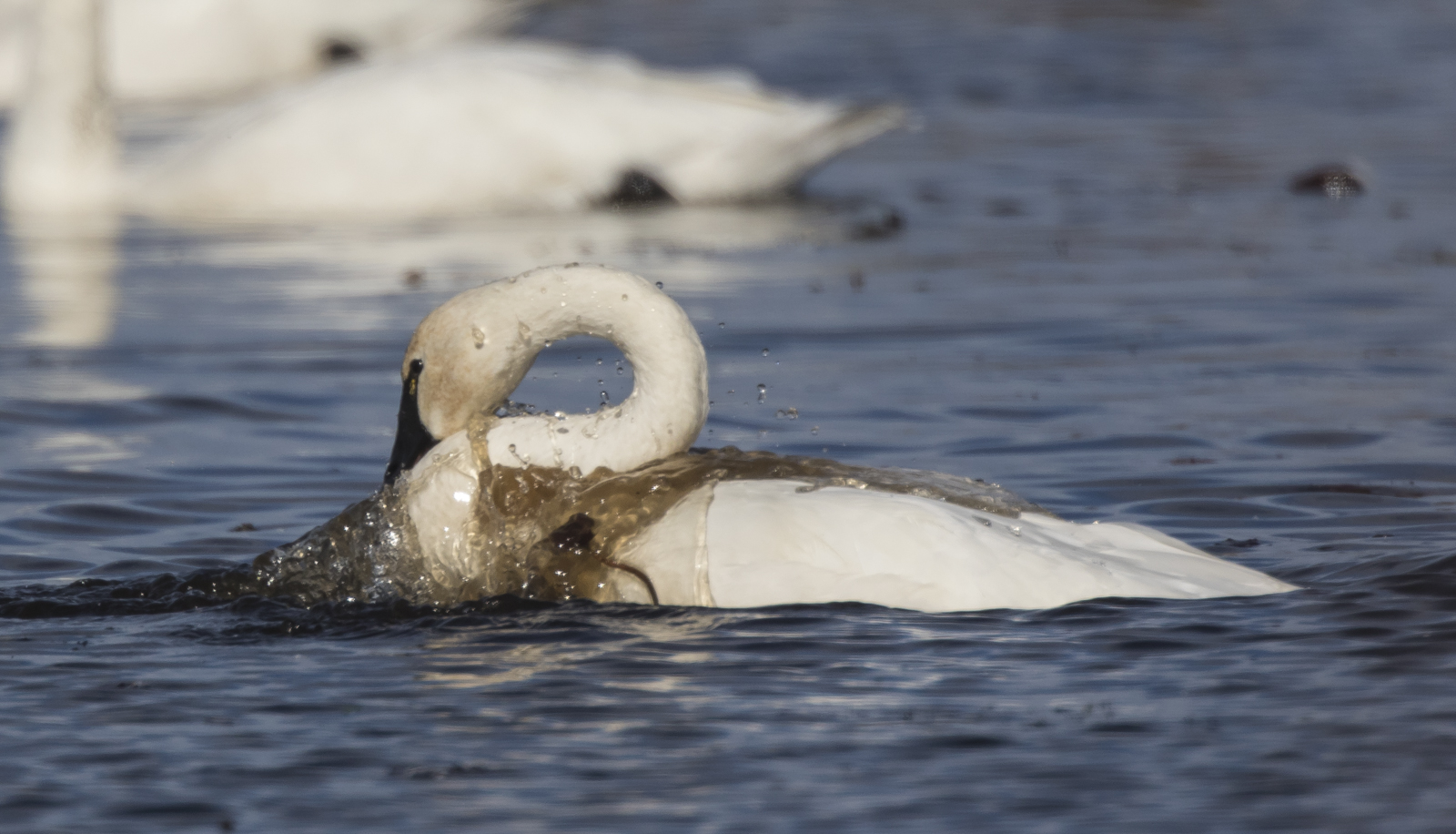
Swans bathe by dunking their head and body under the surfaceThey often preen and do a wing flap after bathing
Swans often also do a wing flap after a nice long bout of preening and bathing.
The start of a wing flap
It begins with a slight raising of their breast, and then a full extension of the body and neck.
The wing extension is dramaticEvery feather on the wings looks extended during a wing flapI like to capture the shadow of the wings on the swan’s bodyMy favorite photo is one where the swan is facing the camera during a wing flap
Needless to say, I tend to snap way too many images of swans flapping their wings. Most of my pics have another swan partially obscuring the flapping bird, or the wing-flapper is facing the wrong way. But, I apparently can never get enough of these images as I keep trying every year to get that “perfect” wing flap.
Swan running across the water to get airborne
Another swan sound I love hearing is the slap, slap, slap of their huge feet hitting the water surface as they run and flap to take off. It is tough to get a decent photo of one as they are invariably in a crowd of other birds, but they do usually give you a “heads-up” so you can prepare yourself for the shot. Swans typically will swim a short distance with the direction of the wind, and then turn into the wind before taking off (for greater lift). They also do a series of head-bobs (or quick head-pumps) that intensify and get more frequent right before they raise their wings and start running across the water. Many of the swans I was watching in Marsh A took off less than an hour before sunset, presumably to feed in the fields for a little while before returning to the safety of open water for the night.
Swans preening
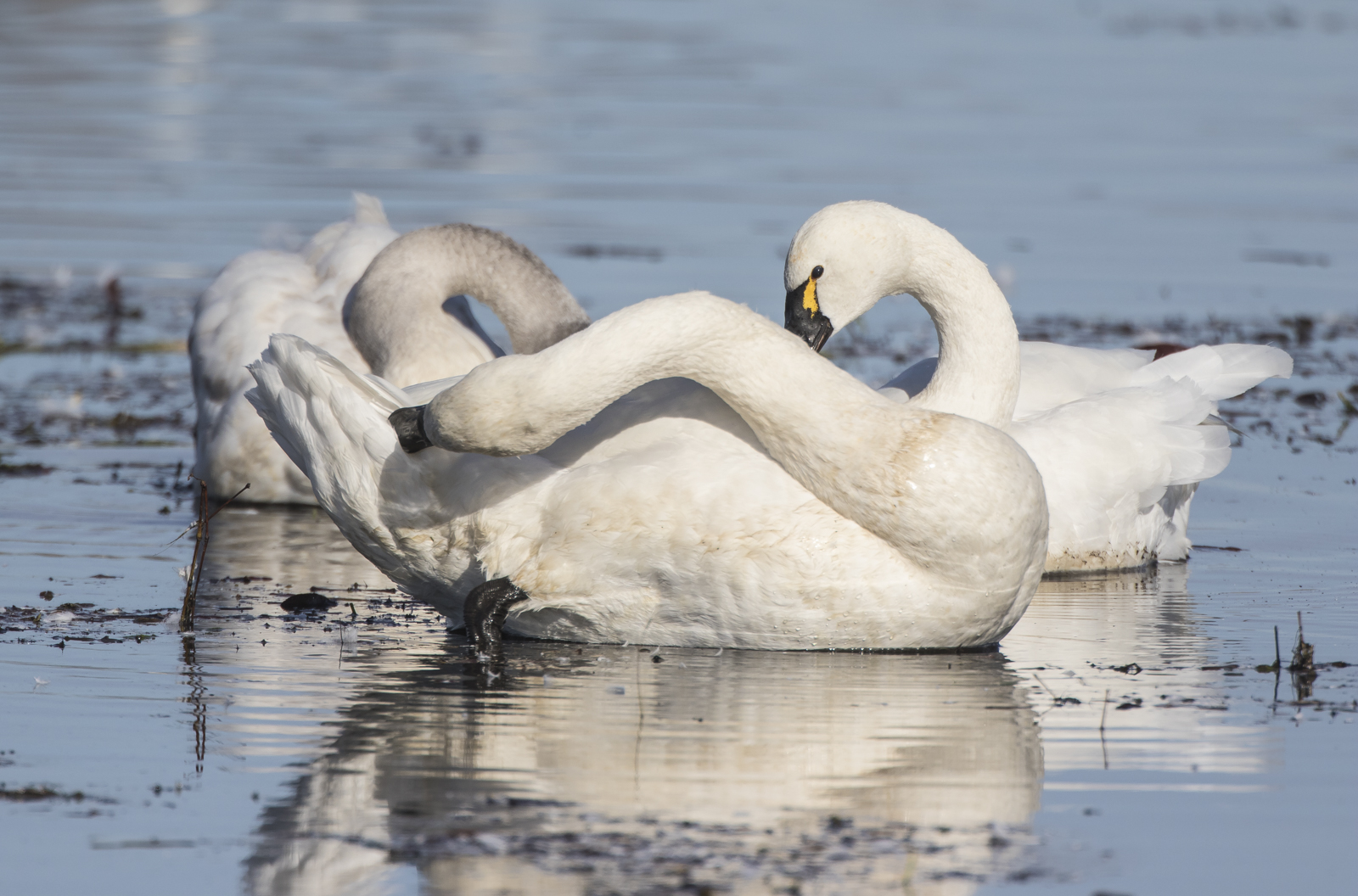
Swans, like most birds, preen extensively to help keep their feathers in good shape. If they weren’t squabbling with their neighbors, they were preening or resting during much of the time I spent with the flock.
With so many feathers, it takes a lot of time to keep them looking good
It seems that tundra swans have a lot of feathers to keep up, more than most birds, in fact. The number I keep seeing in various sources is about 25,000 feathers on a swan, compared to 14,000 for a Northern pintail, 7,000 for a bald eagle, and around 3,000 for an American robin. No wonder that preening seems to be the primary thing the swans are doing during the middle of the day.
The elegance of a tundra swan
A swan’s long neck, white feathers, and jet black facial markings give it an air of elegance. To watch and listen to tundra swans for a day is a privilege and is a certain way to help you feel connected to the natural world, and realize that there are things in this world more beautiful, wonderful, and important than anything you see on a screen or read in the news. I am always thankful for the opportunity to renew my optimism and recharge my batteries by spending time with these majestic creatures.
A poem for the new year, accompanied by a short video clip of a sunrise with tundra swans at the Pungo Unit of Pocosin Lakes National Wildlife Refuge last week. May we all find peace in the coming year.
The Peace of Wild Things, by Wendell Berry
When despair for the world grows in me and I wake in the night at the least sound in fear of what my life and my children’s lives may be, I go and lie down where the wood drake rests in his beauty on the water, and the great heron feeds. I come into the peace of wild things who do not tax their lives with forethought of grief. I come into the presence of still water. And I feel above me the day-blind stars waiting with their light. For a time I rest in the grace of the world, and am free.
It’s never been easier to be a citizen scientist and it’s never been more important to be one.
~David Yarnold, President and CEO, National Audubon Society
Earlier this week, we participated in one of my favorite holiday traditions, the annual Audubon Society Christmas Bird Count at Pettigrew State Park. I helped start this particular count over 30 years ago when I was East District Naturalist for the NC State Parks System. My good friend, and naturalist extraordinaire, Paris Trail, was the count coordinator. The Pettigrew Count is centered on Lake Phelps and the standard 15-mile diameter count circle includes surrounding farmlands and forests as well as a portion of the Pungo Unit of Pocosin Lakes National Wildlife Refuge. It is that latter portion that I have counted in for all these many years. This year, it was officially just Melissa and I, although we did run into some of her museum co-workers and another excellent young birder that helped us with a couple of species we missed seeing (most notably the merlin and American bittern).
Tundra swans are very abundant again this year on the Pungo Unit (click photos to enlarge)Swans on the marsh impoundment on the Pungo Unit
The day began with clouds and warm temperatures, but the skies soon cleared, and we had another of those crazy “Christmas” counts with temperatures soaring to the low 70’s. Tundra swans were the bird of the day and we estimated about 14,000 on the lake, although I am guessing this may be an underestimate based on the tremendous flyovers at sunset.
Tundra swan flyover
Swans were literally everywhere – in the fields, on the lake, in the impoundments, and in the sky. And I must admit, I could watch and listen to them all day. In fact, I did on the day after the count (more on that in a future post).
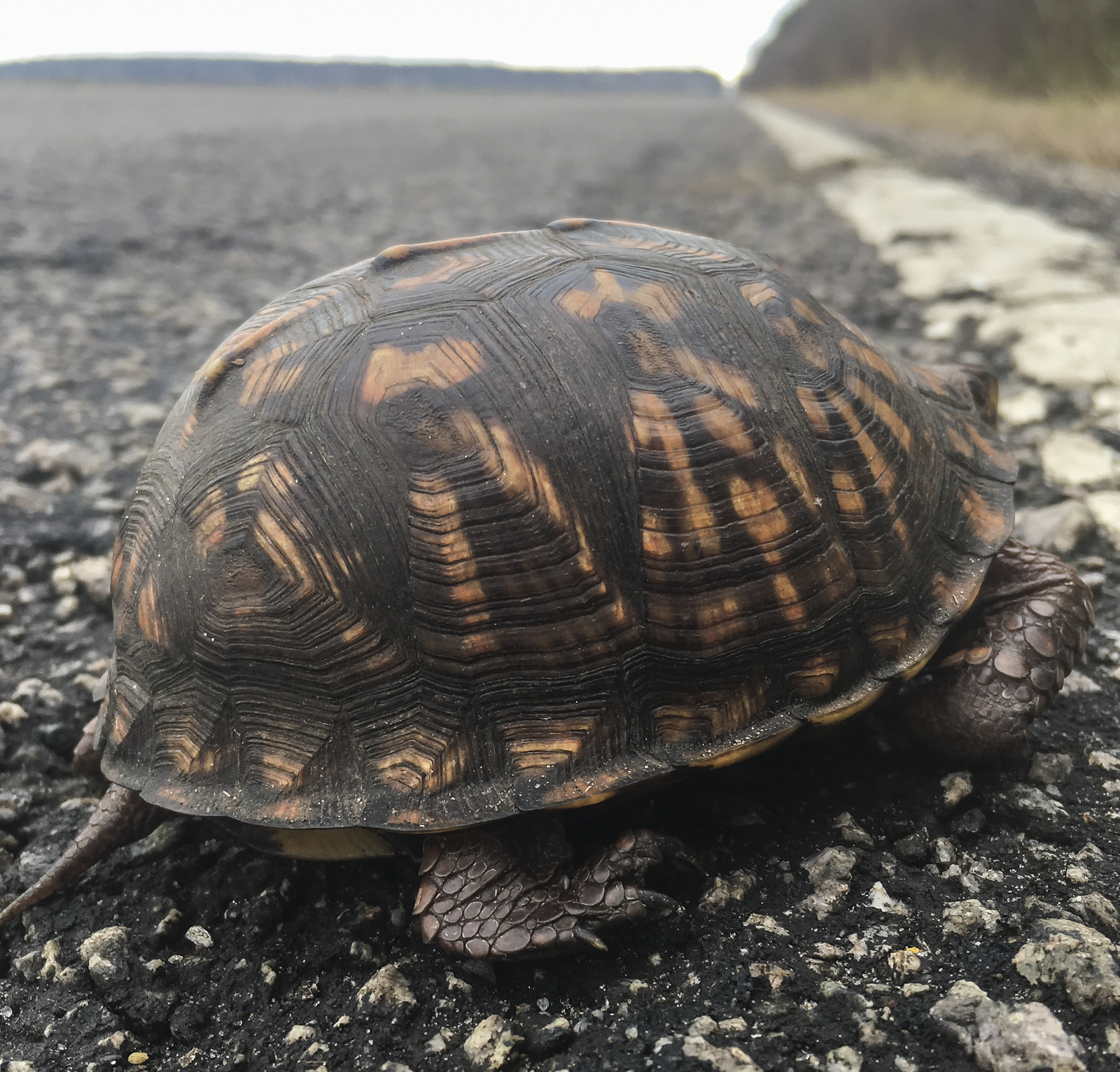
Eastern box turtle out for stroll on the Christmas Bird Count
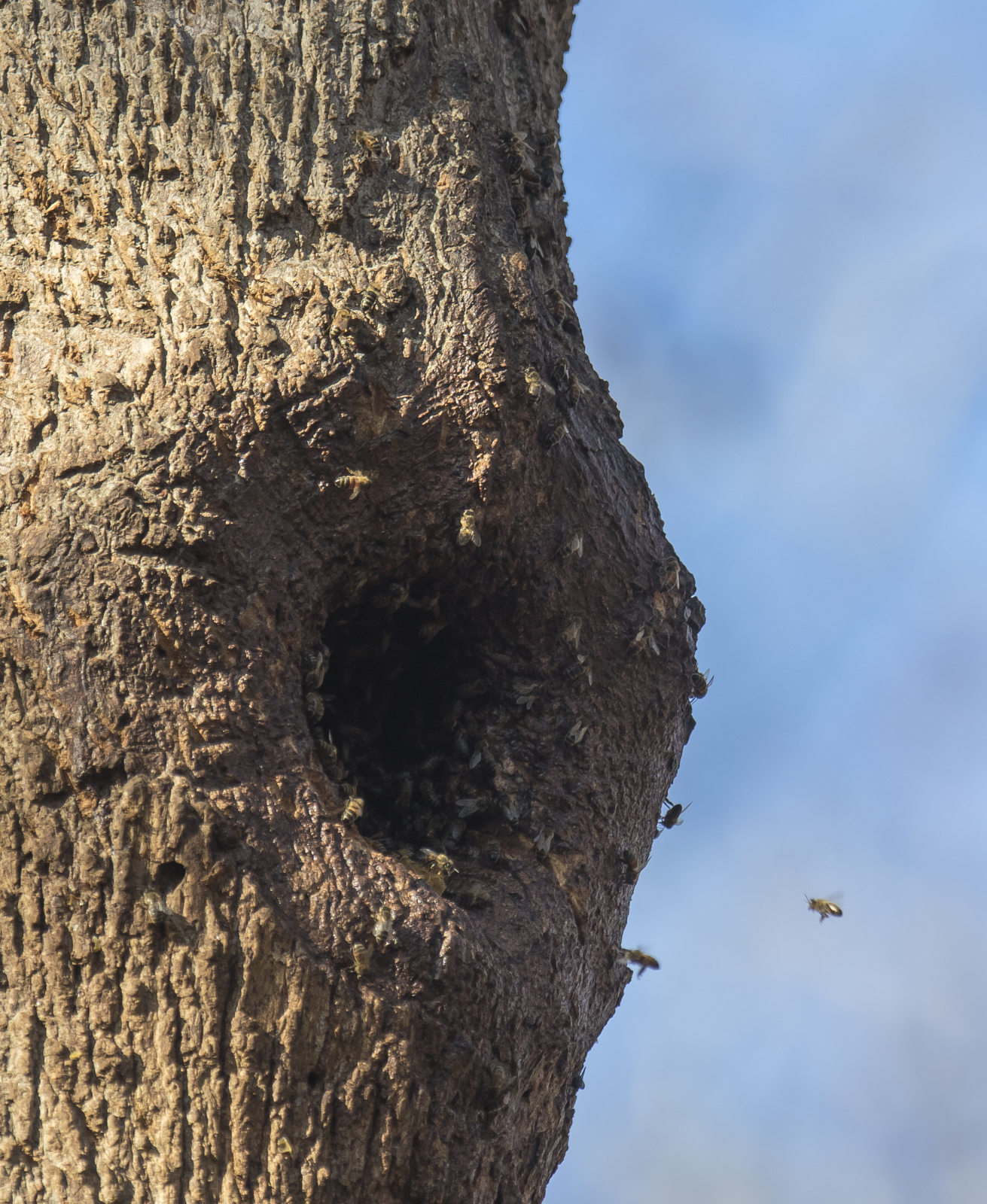
The warm temperatures made for some unusual companions for a Christmas Bird Count. There were plenty of aquatic turtles sunning themselves in the canals (which is not really all that unusual on sunny days in winter) plus an Eastern box turtle we helped off the road. There were also several buckeye butterflies, a Carolina anole, and Melissa spotted a very active bee hive high up in a tree.
Bee hive in a knothole
If you look closely, you can see where bears have clawed around the hole trying to get at the tasty treat inside. Not sure what these bees were foraging on, although I did see a few henbit weeds in bloom along the edge of the road.
Snow geese flying out of Pungo Lake
The snow geese continue their pattern of erratic and unpredictable behavior of the past few years, with a much reduced flock splitting up and flying off the refuge in different directions to feed. Perhaps when the remaining corn on refuge lands is knocked down, they will provide a brief display of massive flocks coming into feed as in past years.
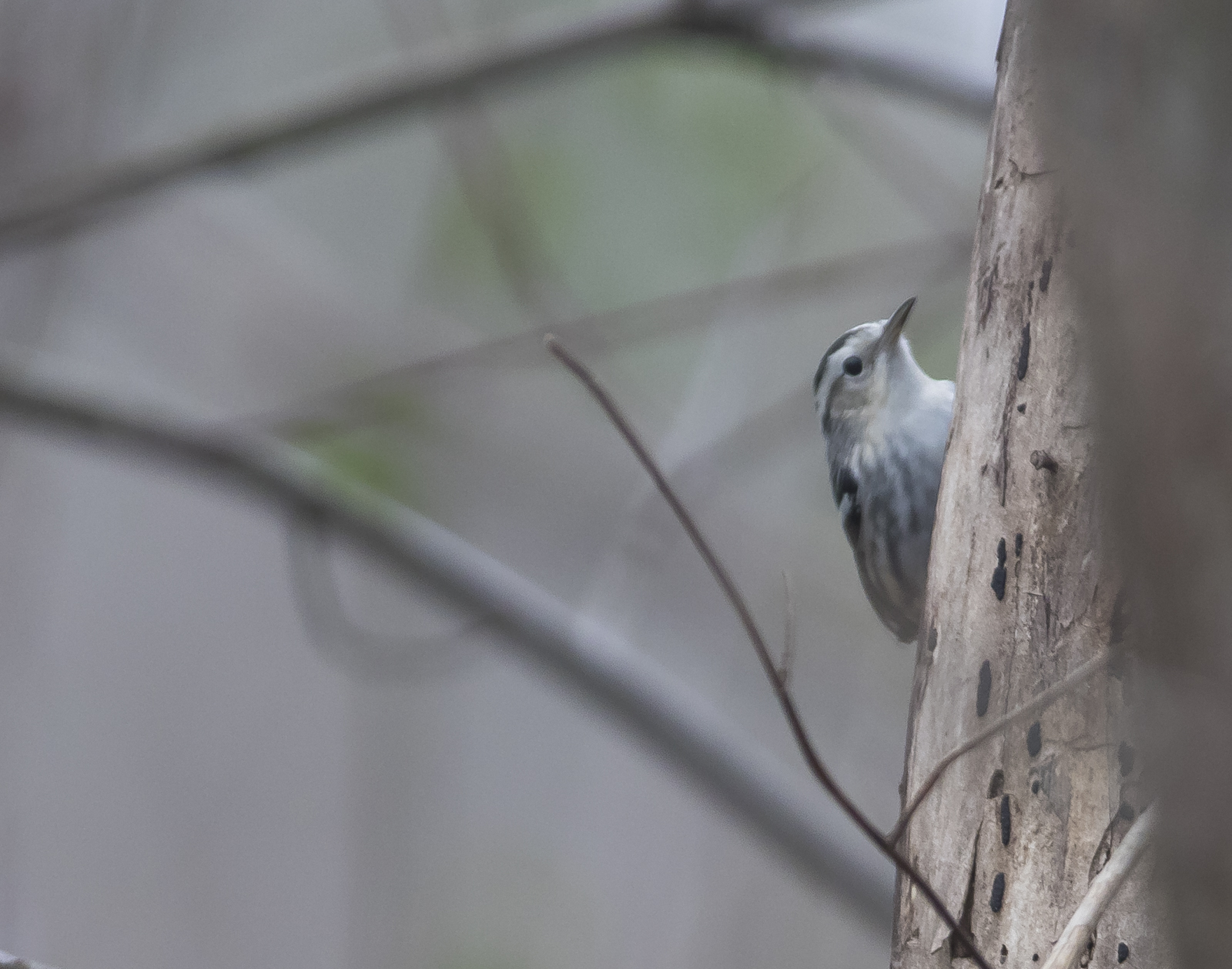
A black-and-white warbler was one of our highlights for the day
We managed to spot quite a few species (76 in our portion of the count circle – see our complete list below) with a few that are not regularly seen, including a black-and-white warbler, an orange-crowned warbler, a pair of blue-gray gnatcatchers, and a peregrine falcon chasing a duck.
A trio of sandhill cranes closed out our day
My favorite species of the day came just as the sun was setting. I looked up and saw what I first thought were three great blue herons flying in tight formation. That unusual pattern caused me to take a second look and I could see the outstretched necks that indicated something other than herons – three sandhill cranes! This is the second Christmas count over the years where we have spotted these magnificent birds. A great way to close out another wonderful day spent in our favorite place.
Pair of tundra swans against an orange sky at sunset
December 27, 2016 data – Pungo Unit portion of annual Pettigrew State Park Christmas Bird Count (76 species for our team; 109 species for the total count circle with one team report still out):
To be standing together in a frosty field, looking up into the sky, marveling at birds and reveling in the natural world around us, was a simple miracle. And I wondered why we were so rarely able to appreciate it.
~Lynn Thomson
While visiting Melissa’s family in Richmond, I often take walks around a section of shoreline of Swift Creek Reservoir adjacent to where they live. I am always amazed at the abundance and diversity of birds in a relatively narrow natural shoreline designated as a Resource Protection Area in the Chesapeake Bay watershed. Below are some of the birds spotted on a few walks this week…
Eastern bluebird (click photos to enlarge)
There are at least 15 to 20 bluebirds foraging through the natural area, often returning to a few American holly trees to glean what must be the last few berries. They also spend a lot of time sitting and watching, then dropping down to the ground like small hawks, picking up unseen morsels (maybe some insects moving about in a sunny spot).
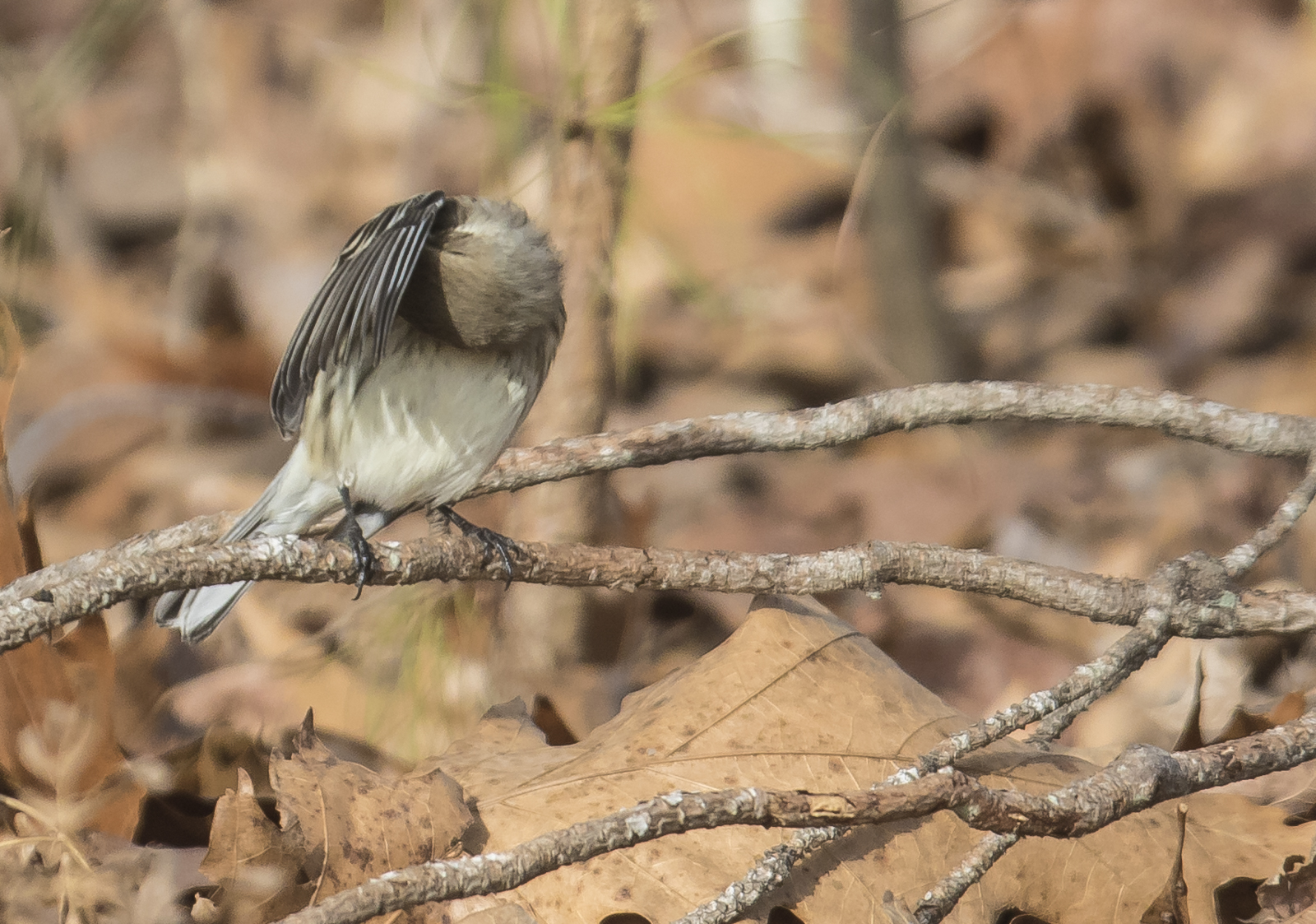
Yellow-rumped warbler preening
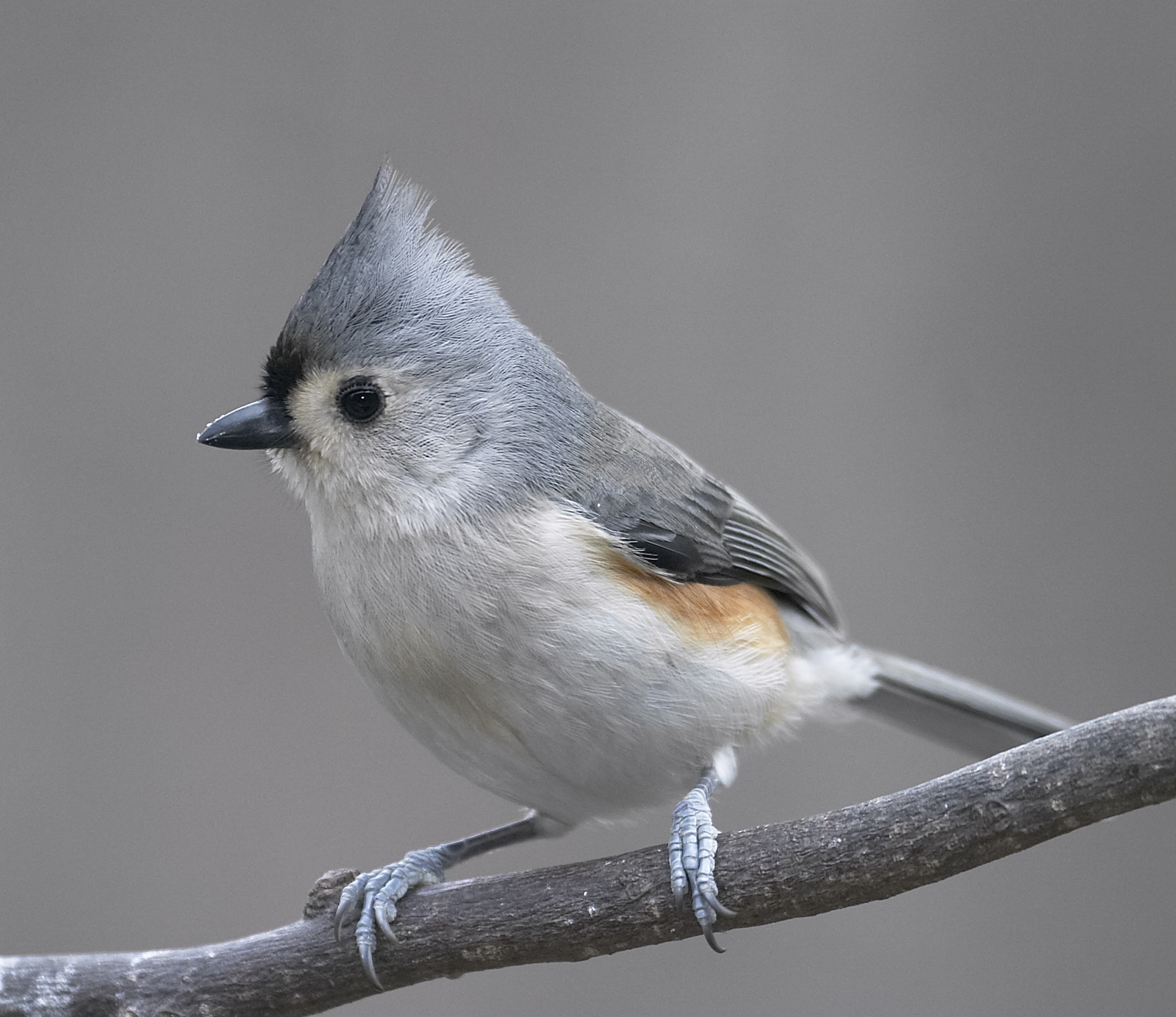
Numerous small birds move through the woods, often together in a mixed feeding flock. In addition to yellow-rumps, I saw ruby-crowned kinglets, Carolina chickadees, tufted titmice, song sparrows, dark-eyed juncos, and American goldfinches.
Northern flicker female
It was the woodpeckers that really had my attention in one particular patch of woods. There was a downy woodpecker, red-bellied woodpeckers, and several Northern flickers. I watched one female flicker (she lacks the black mustache of a male) repeatedly poking her bill into a small knothole on a tree. Others were doing what flickers often do, hopping around on the ground probing for one of their favorite foods – ants.
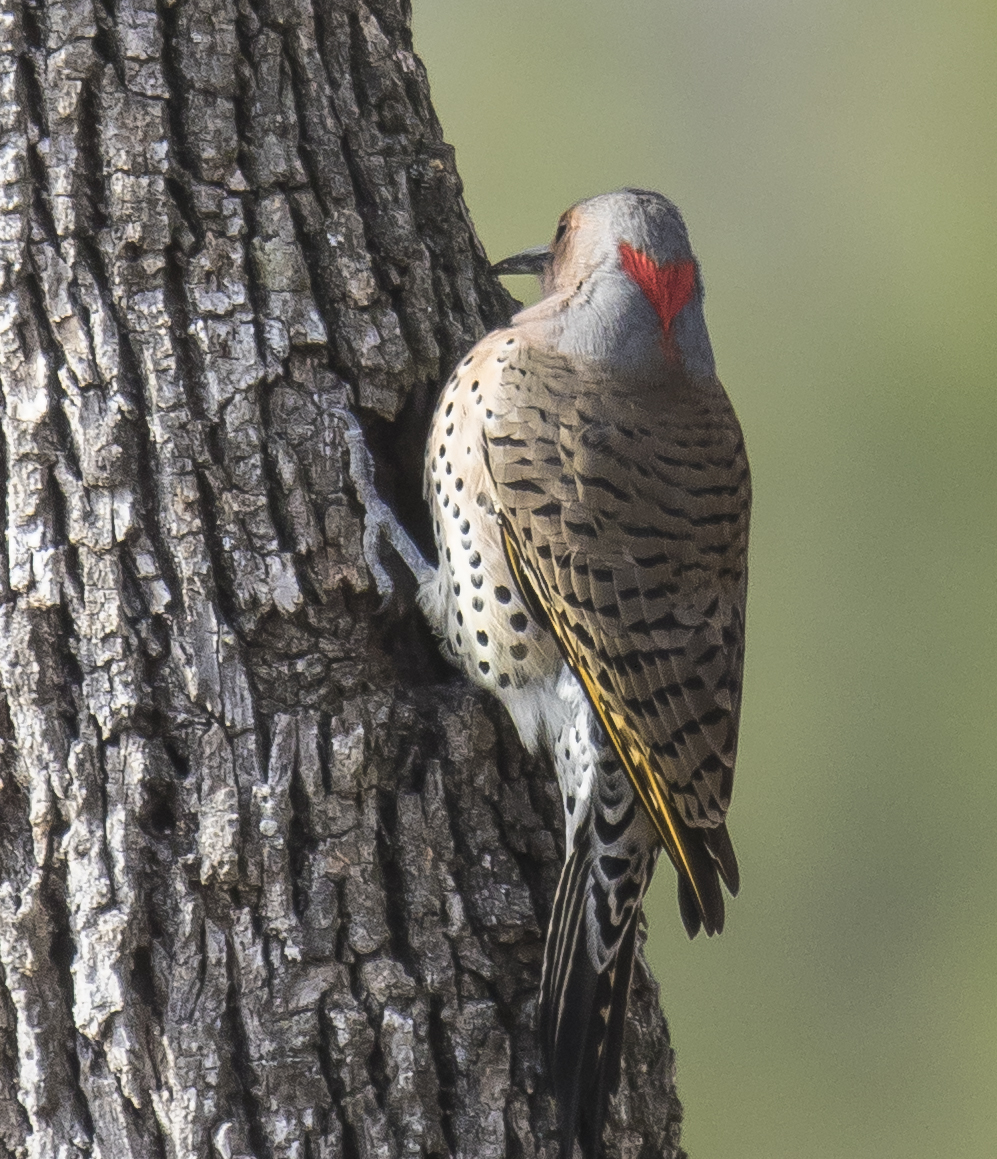
Northern flicker – back view
Flickers really are beautiful birds when you get a chance to study their varied plumage. The red heart-shaped patch on the back of the head is particularly pleasing. Many of the small black dots on the breast are also heart-shaped. Perhaps a bird better suited for Valentine’s Day than Christmas.
Red-headed woodpecker adult
The highlight of my walks was the chance to watch several red-headed woodpeckers forage, chatter, and chase one another. I don’t see them often where I live, as they seem to prefer places with lots of standing dead trees in relatively open habitat, like beaver swamps. They are one of noisier woodpeckers, chattering frequently, allowing me to find them easier than many other species. Adult males and females look alike, with bright red heads and a boldly patterned black and white body.
Immature red-headed woodpecker
Juveniles differ in having a brownish or splotchy red/brown head. This one had a small territory amounting to a couple of hundred feet of shoreline containing a narrow strip of trees. It kept going back to one dead snag, so I finally worked my way over to where I could see what it was doing…
Red-headed woodpecker preparing to fly off with acorn
It was digging out acorns that it presumably had stashed in the loose bark of the snag. Red-headed woodpeckers are one of the few species of woodpecker that regularly cache food. It is also considered our most omnivorous woodpecker with a diet that includes seeds and nuts, insects, berries and fruits, birds eggs and nestlings, and even mice.
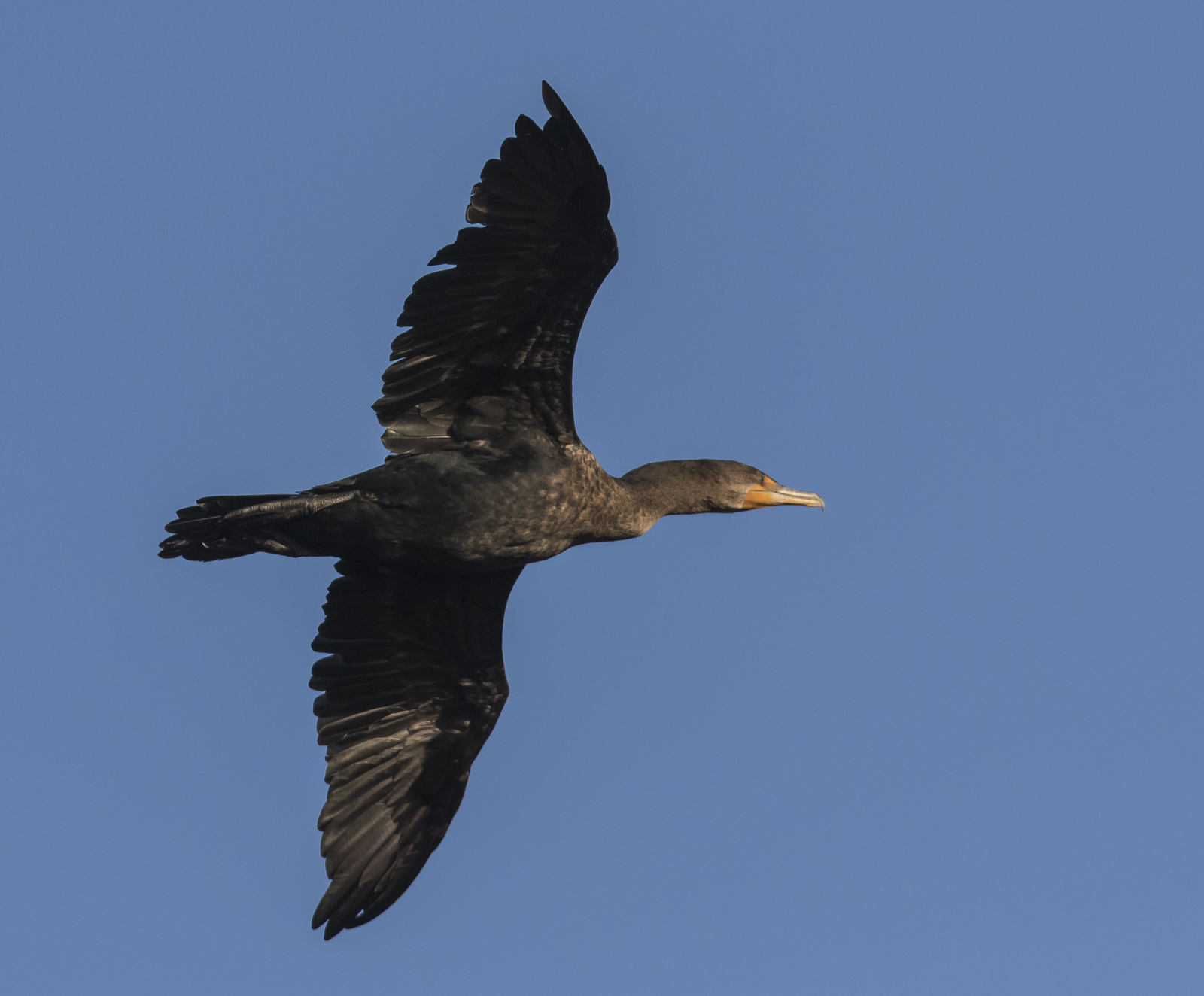
Double-crested cormorant
The most noticeable birds along the reservoir were the hundreds of double-crested cormorants that flew in and out every afternoon and morning. I stood at the edge of the water and watched them fly by me, turn back into the wind and land, either on the lake, or in the trees on an island a few hundred yards away.
Cormorant roost
The cormorants have used this island as an evening roost for at least the past few years. They make a lot of noise at the roost – various squawks and grunts, plus a lot of splashing and washing in the water near the island. A fleet of ring-billed gulls swam nearby, as well as several species of waterfowl including pied-billed grebes, ruddy ducks, buffleheads, mallards, hooded mergansers, Canada geese, and a few ring-necked ducks.
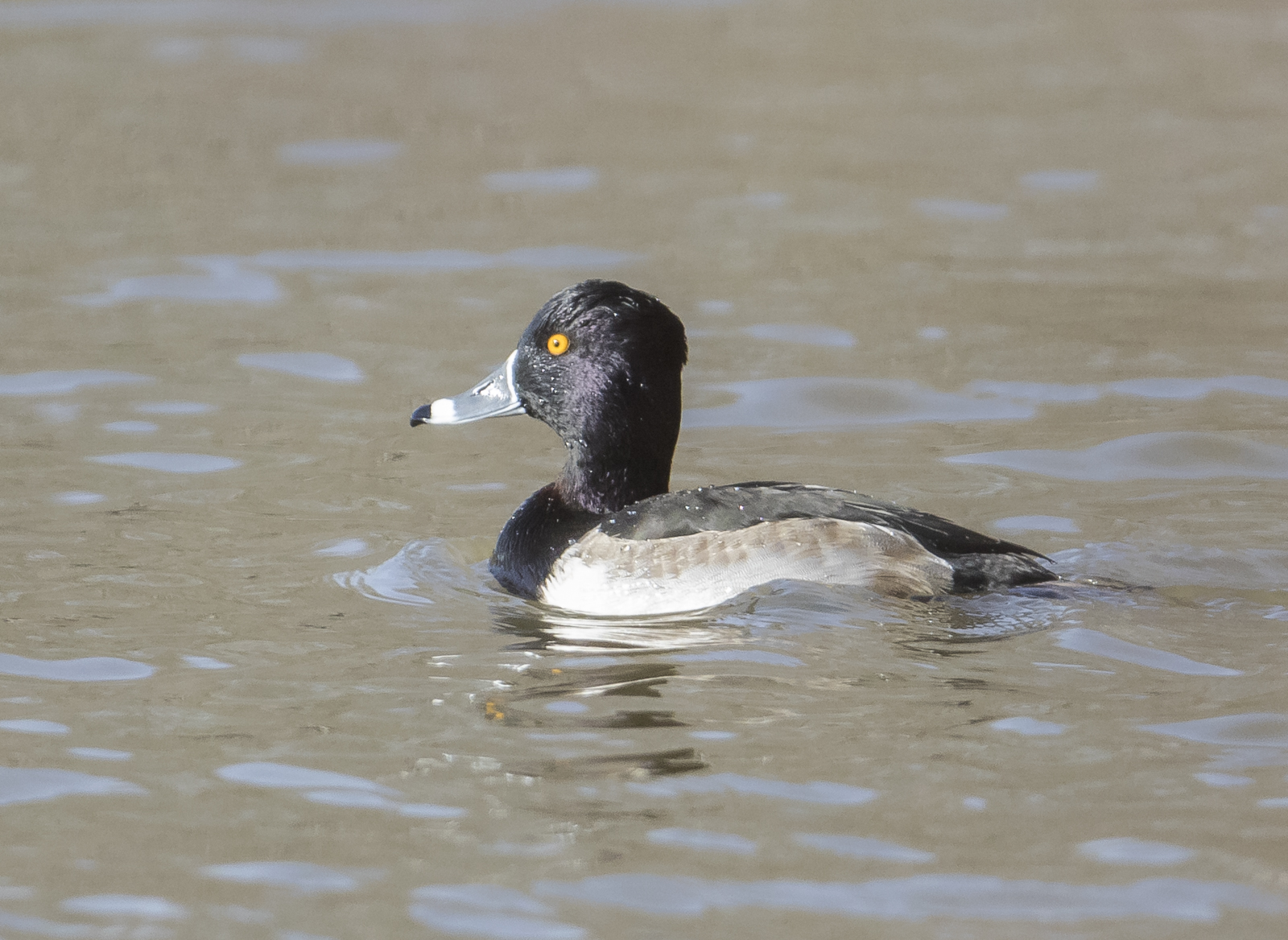
Ring-necked duck drake
I always enjoy seeing ring-necked ducks with their distinctive ringed bill and bold color pattern (that head can be quite purplish in the right light). Surely, the bearer of one of the least descriptive common names for a bird, the ring-necked duck is known to hunters by the much more reasonable common name of ringbill. There has even been a recent attempt, perhaps tongue in beak, to rename this beautiful duck to more accurately reflect its appearance (see http://www.audubon.org/news/its-time-rename-ring-necked-duck). The actual ring on the neck is a narrow chestnut brown band separating the dark head color from the dark breast feathers in the males only. Not a very useful field mark at all.
All of these birds are all a delight to see on a cold winter morning (especially the two immature bald eagles that sailed by). So, this holiday season, be sure to get outside and give yourself the gift of “…marveling at birds and reveling in the natural world around us”.
Another of Melissa’s poems about birds (and one of the few rhyming ones she has written)…
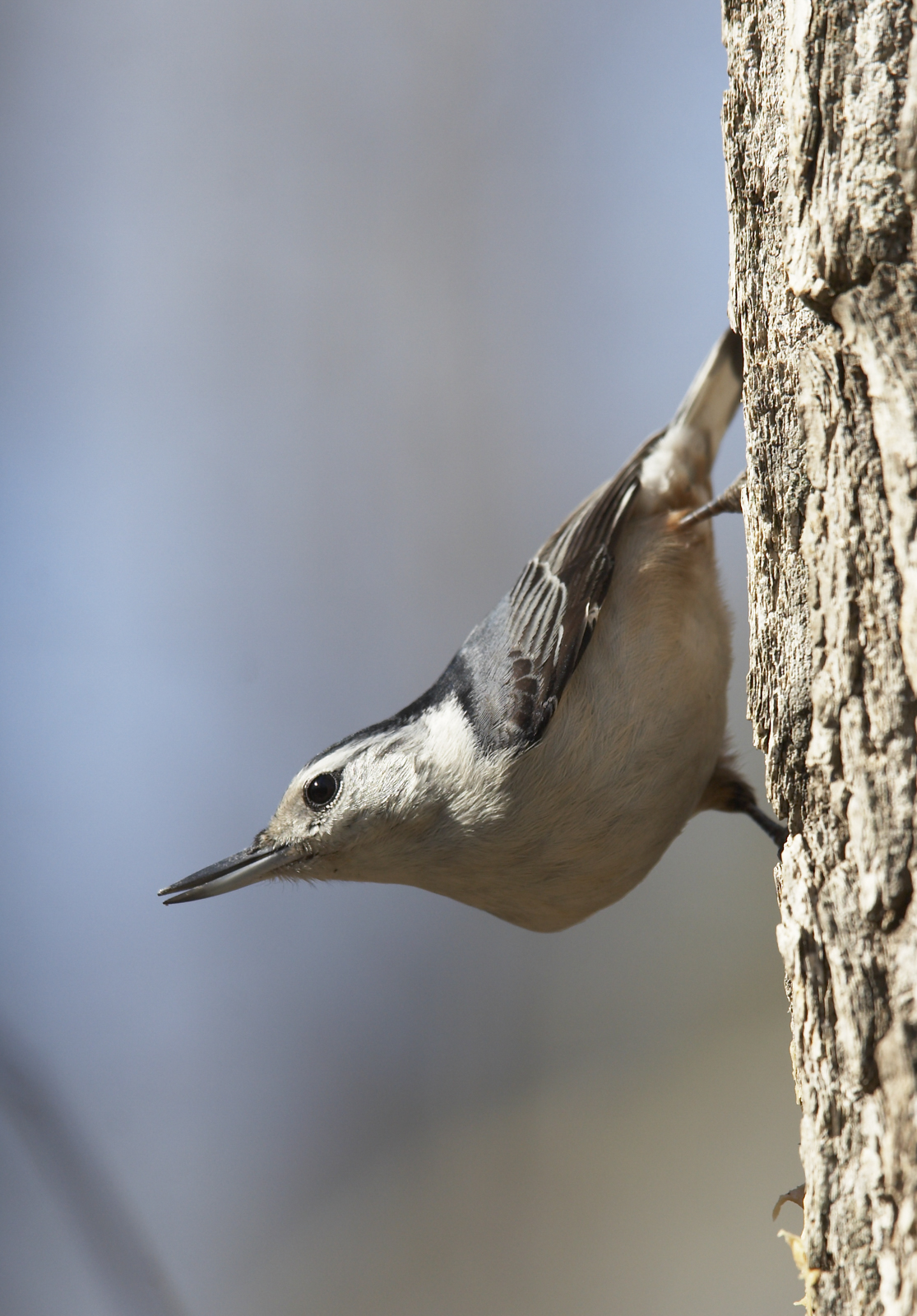
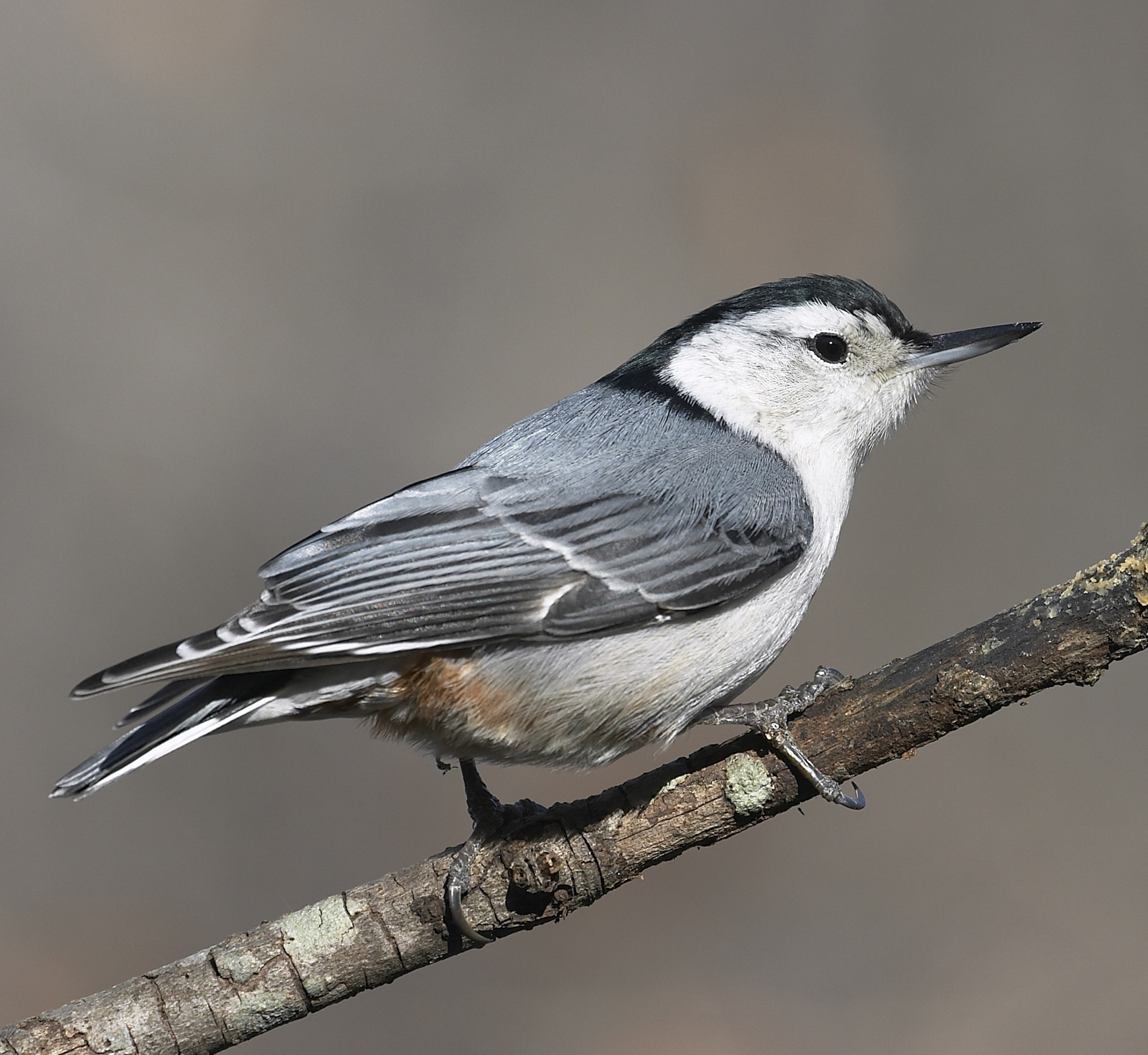
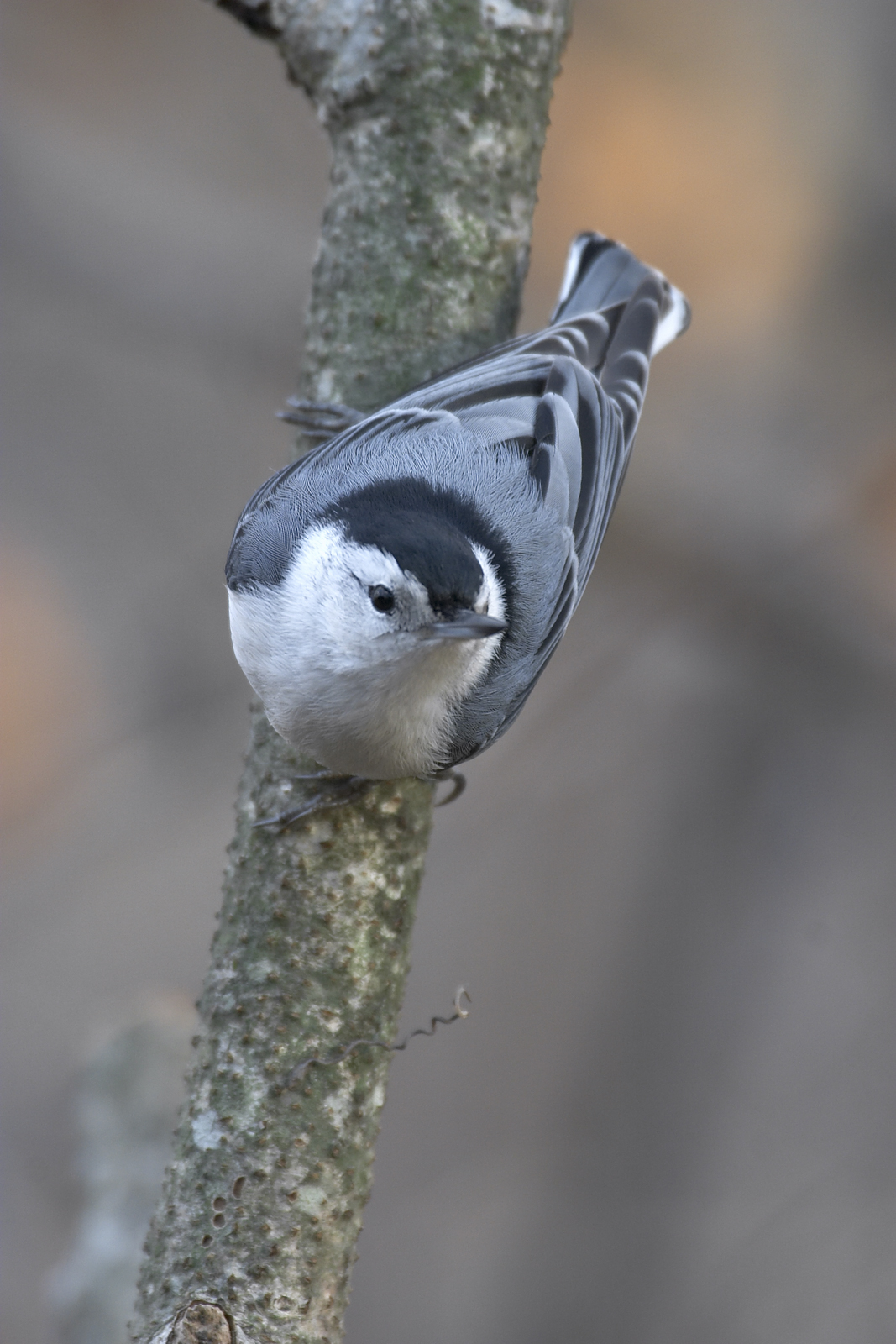
Follow the Nuthatch by Melissa Dowland
When searching for a bird of prey
On a fall or winter’s day
Never trust the noisy titmice
Only the nuthatch will suffice.
The titmouse is a busy soul
Forever making a dreadful scold.
He flits about the whole day long,
Rarely pausing in singing his song.
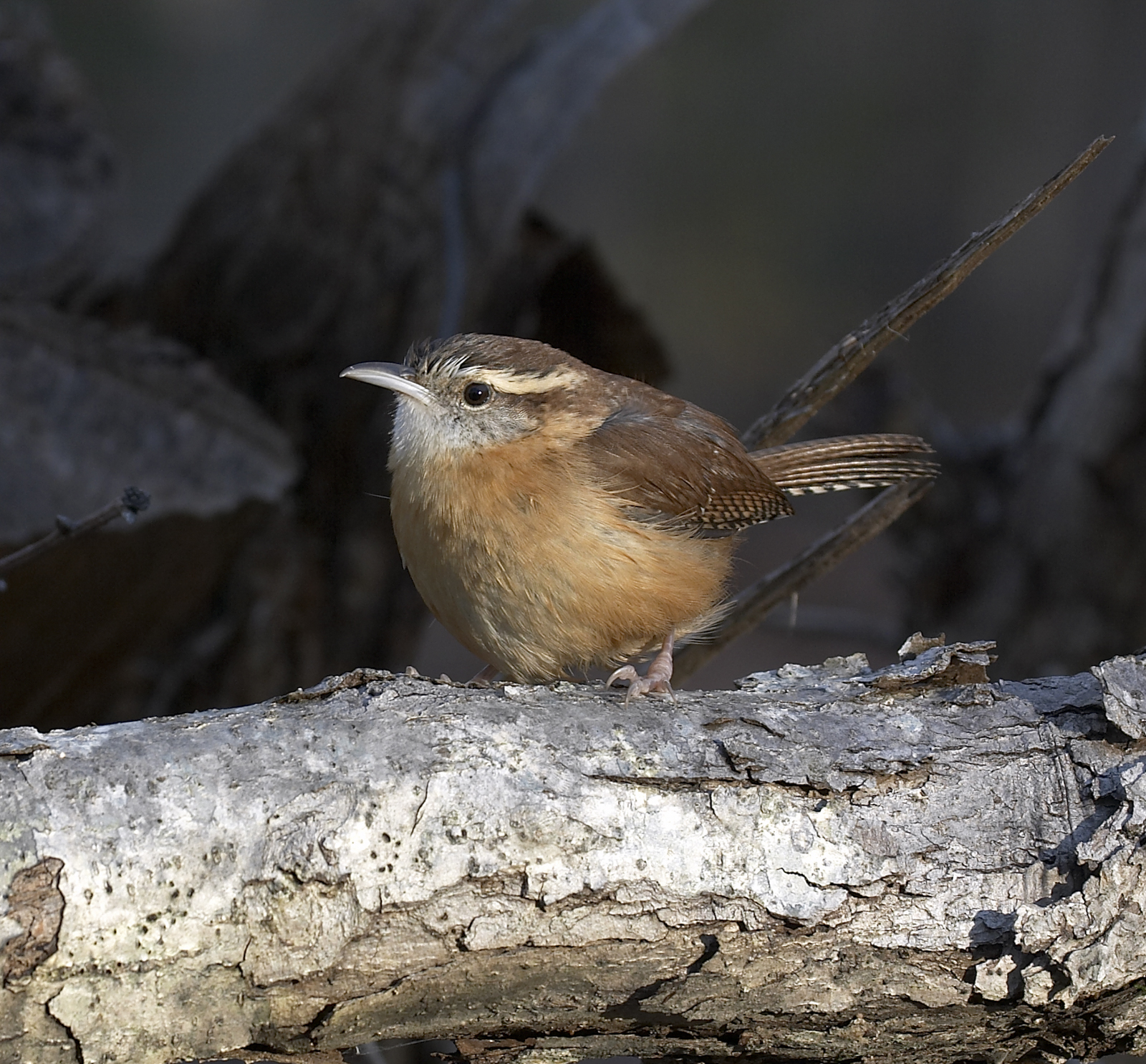
The busy wren, he too will cry
So loud, he calls, though small in size.
But he is easily distracted by
The lonely squirrel who wanders nigh.
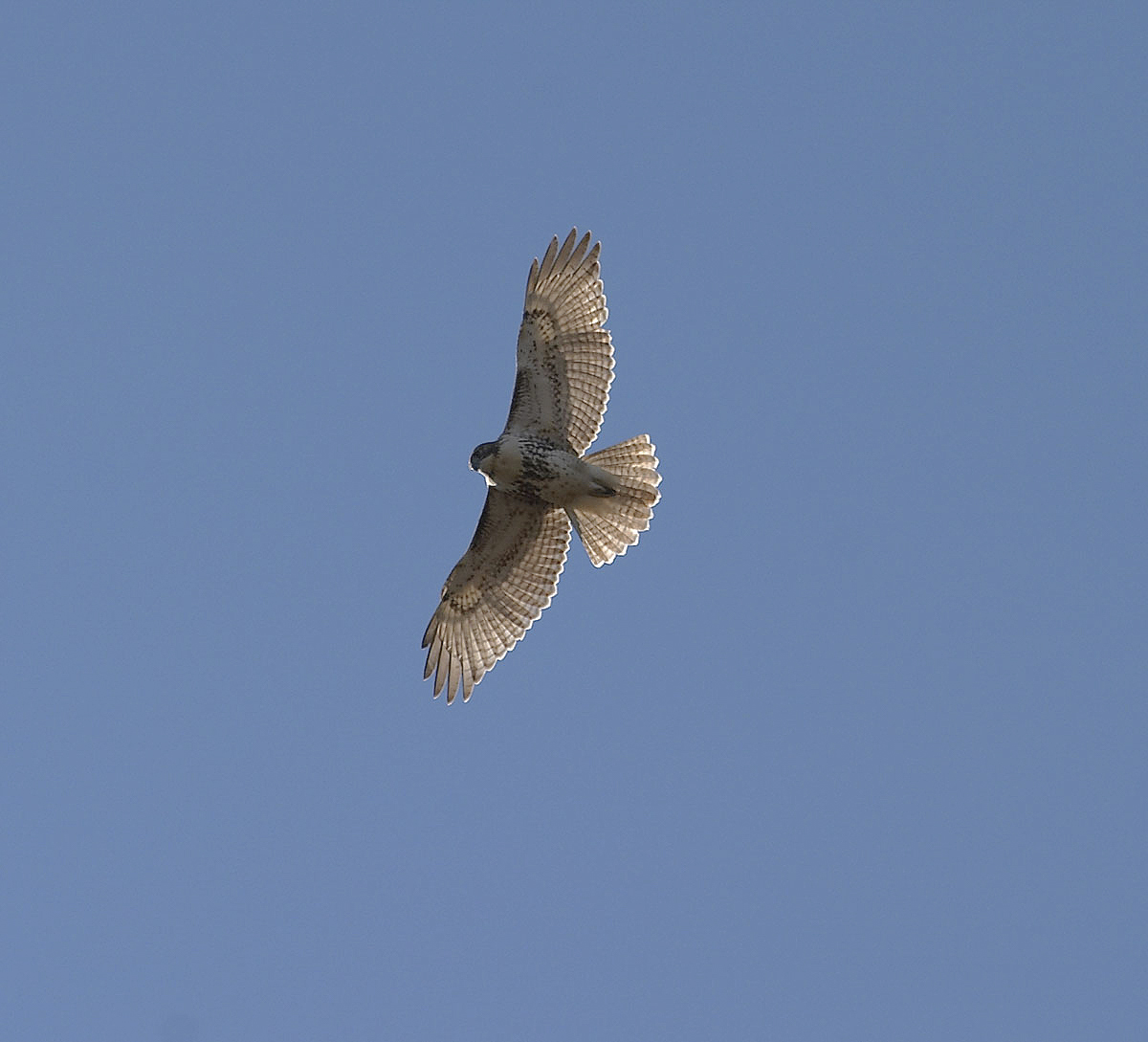
So would you like to spot a hawk
On your hike or winter walk?
Then heed the nuthatch’s nasal cry.
For when the hawk his eye does spy
Out rolls his nasal, cranky ‘yank’
Heard over hill and down the bank.
The nuthatch is a wise old bird
So listen closely to his words.
“There goes the hawk, warn one and all!
Oh forest, listen to our call!”
So look, oh wanderer, for the source of that sound
Up in the trees and on the ground.
If you’re lucky you might be blessed
If the nuthatch and hawk make you their guest.
The sparrow flying behind the hawk thinks the hawk is fleeing.
~Japaneseproverb
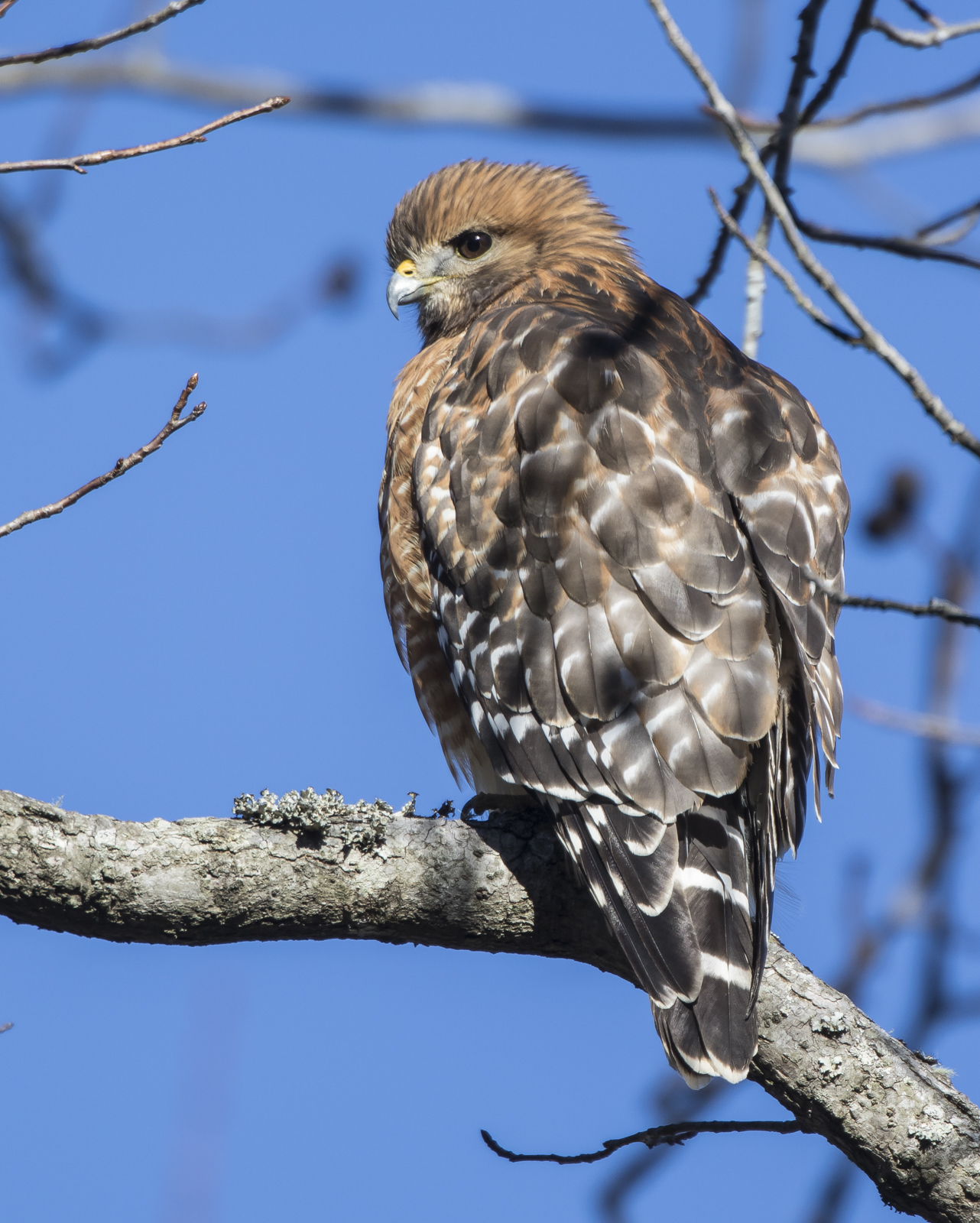
Red-shouldered hawk at the NC Botanical Garden (click photos to enlarge)
Last Saturday, I had the opportunity to work with my friend, Mary, to provide an introductory bird photography class at the NC Botanical Garden (NCBG) in Chapel Hill. It was next to the last in a series of programs that were part of the Saving Our Birds program initiative the Garden has sponsored this year. For part of the program, we went outside into the brisk morning air, spending time in their very active bird blind area, and the rest of the time walking around the native plant display gardens, looking for birds to photograph. The highlight of the day was a beautiful red-shouldered hawk (Buteo lineatus), that was most obliging to our group.
Back view of red-shouldered hawk
Red-shouldered hawks are medium-sized buteos (soaring hawks) easily recognized by their rusty, barred breast, and the bold black-and-white bands on their tail. Immature birds are a bit tougher to identify – their tail is dark brown with several narrow brown bars and they have a pale breast with thick dark streaking that somewhat resembles several other common raptors. The area around the display gardens at NCBG has been home to at least one pair of red-shouldered hawks for several years. They seem well-adjusted to the comings and goings of people at the Garden. This one was perched in a tree near the building complex for much of the morning and early afternoon. This allowed our class to photograph it from many angles so we could try to avoid the cluster of twigs and branches that surrounded the hawk. The light was perfect and the bird cooperative, a perfect scenario for photographers.
They have rusty red coloration on the feathers on their shoulders (lesser upperwing coverts)
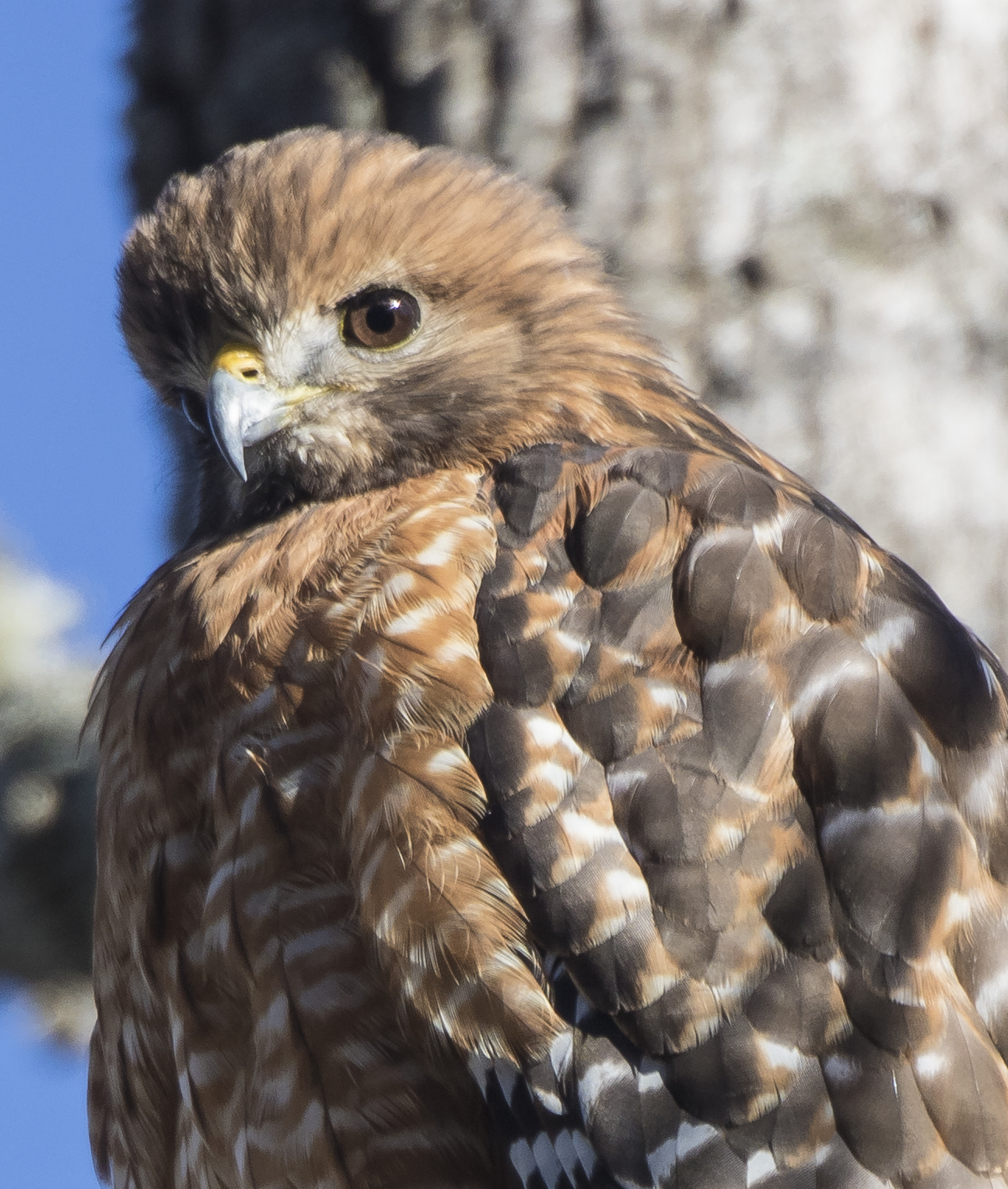
After the program, I went back out to the tree with my 500mm lens and spent over an hour with this beautiful bird, watching it, and taking way too many photos. I appreciated the chance to simply observe this raptor and take notice of its many traits and adaptations. The light was so rich that I could clearly see the reddish colors of their shoulder feathers that gives this species its common name.
“Eyes like a hawk” means someone with exceptional vision
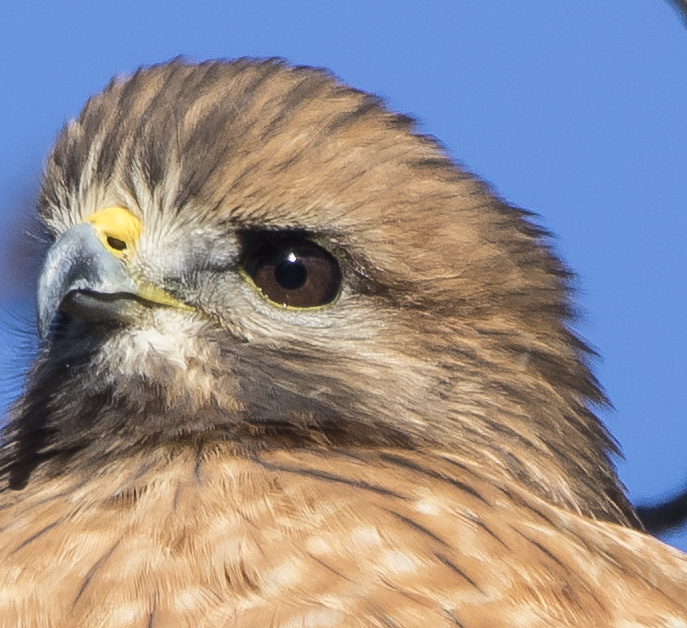
The feature that stood out for me was its eyes…so intense, so fierce. According to several online resources, raptors can see anywhere from four to eight times better than the average human. This is accomplished by a couple of adaptations. The eyes of a hawk are proportionally larger than a human eye, occupying some 10-15% of the weight of the head, compared to about 1% in humans. Hawks also have more concentrated areas of rods and cones than we do, giving them higher resolution (sharper) vision. They have two fovea (one central and one peripheral) compared to just a central one in humans. The fovea is the spot on the back of our eye with the highest concentration of rods and cones.
Like us, raptors have binocular vision, with the eyes placed facing forward on the head. This allows them (and us) to judge distances better and to focus on something with both eyes at once. Hawks can also reportedly perceive more colors than us, and can also see ultraviolet light (which may help in tracing urine trails of small mammals in vegetation).
The nictitating membrane sweeps from front to back
A bird also have some extra protection for their eye, a third eyelid called a nictitating membrane. This is a thin, translucent membrane that is used for protecting, lubricating, and cleaning the eye. A bird can still see when this membrane covers the eye, whereas we cannot when our eyelid closes. Birds also have a moveable upper and lower eyelid. The upper eyelid moves downward when a bird blinks. The lower eyelid moves upward when a bird sleeps. The nictitating membrane moves horizontally across a bird’s eye, sweeping from front to back. Based on my afternoon of hawk-watching, birds must use the nictitating membrane much more frequently than they do their upper eyelid. I took about 680 images (see what I mean, way too many) of the hawk that afternoon and captured 6 sweeps with the nictitating membrane, and no blinks with the upper eyelid.
Talons are long, sharp claws
Red-shouldered hawks feed on a variety of prey including reptiles, amphibians, and small mammals. Their feet and talons are used to capture and hold struggling prey.
A hawk profile showing the sharp hooked beak
Hawks have sharp, hooked beaks used to grab prey, pull off fur, skin, or feathers, and tear the meat into bite-sized chunks. I kept hoping this hawk would sail down to capture something, but all it did was occasionally focus on some unseen item of interest in the vegetation around me.
Scratching an itchPreeningChecking out the back side
In addition to watching everything around it, the hawk occasionally did what all birds spend a lot of time doing – preening its beautiful feathers. Preening is accomplished by running the feathers through the talons or beak, gently pulling and realigning feathers for their optimum condition. This feather grooming can also help rid them of parasites, debris, and make them look their best for attracting mates. Mutual preening is also a part of the courtship ritual in some species.
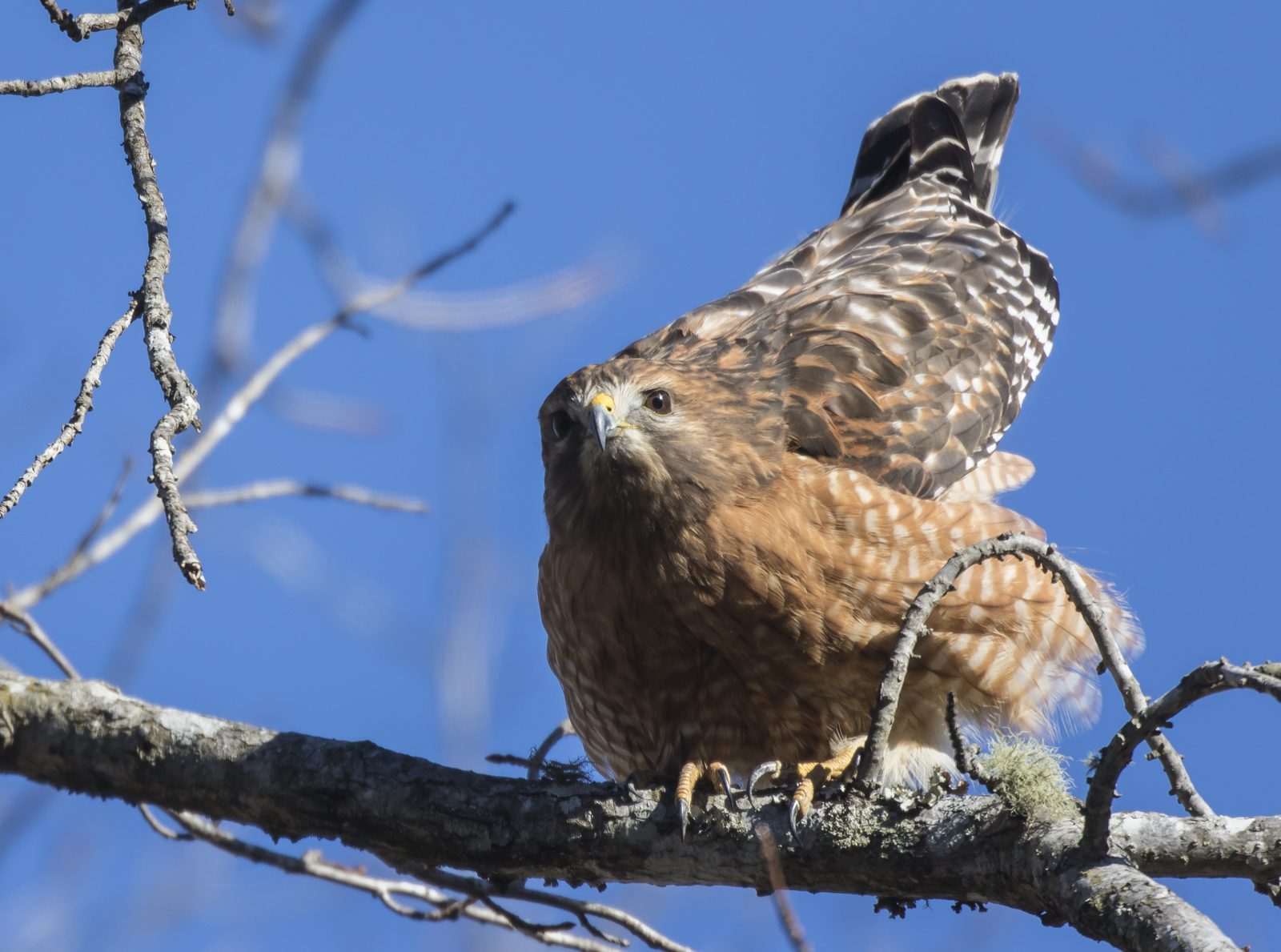
Hawk wing stretchThe forward lean……and let it fly!
I suppose it is fitting that toward the end of my time with my hawk, I witnessed the other end of the meal process, its elimination. After stretching its wings, the hawk leaned forward, raised its tail, and let fly with a white mass of bird poop that shot downward with considerable force. I often see them do this right before taking flight (it makes sense to lighten the load before take-off). Maybe this was just a commentary on my presence (or perhaps current events), but I decided to take the hint and pack up my camera and tripod and let the hawk go about its business for the rest of the afternoon. But I will be back and will photograph it again, hoping to capture some more behavior of this regal “garden” bird.
































 Roads End Naturalist