In summer the empire of insects spreads. ~ Adam Zagajewski
Spiny Oak-Slug (click photos to enlarge)
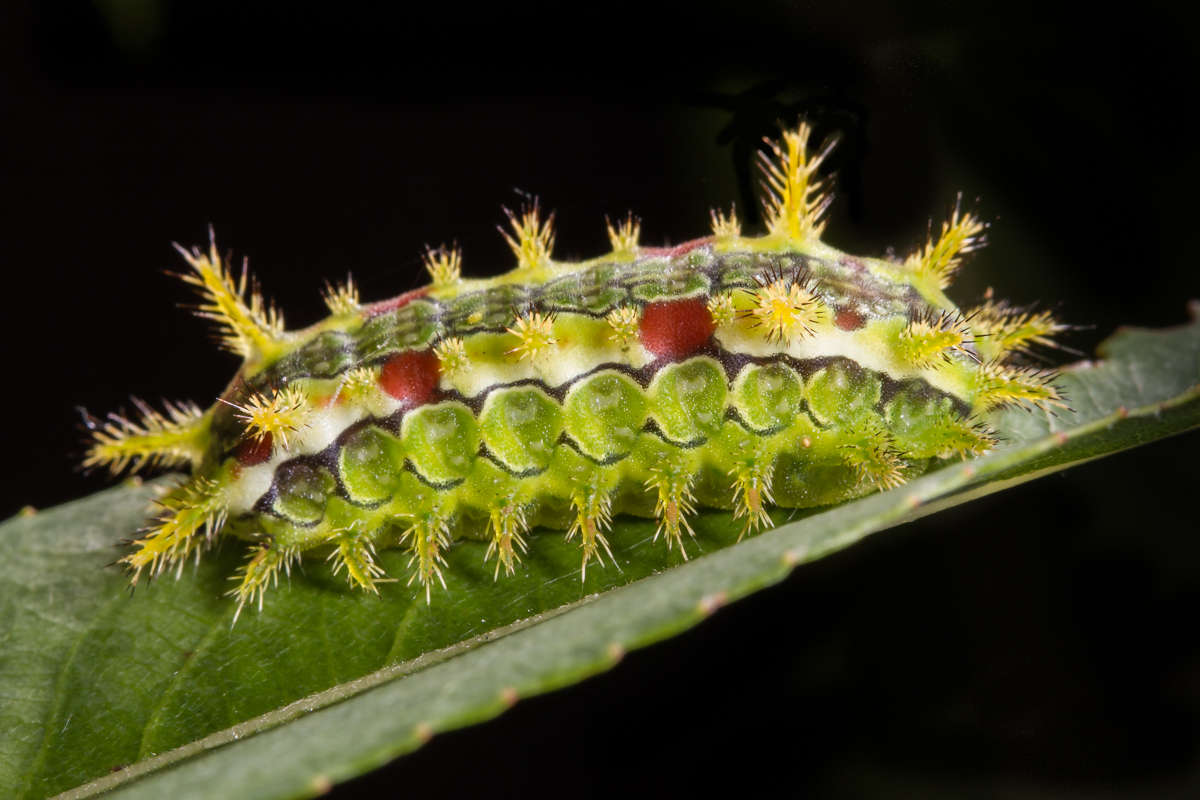
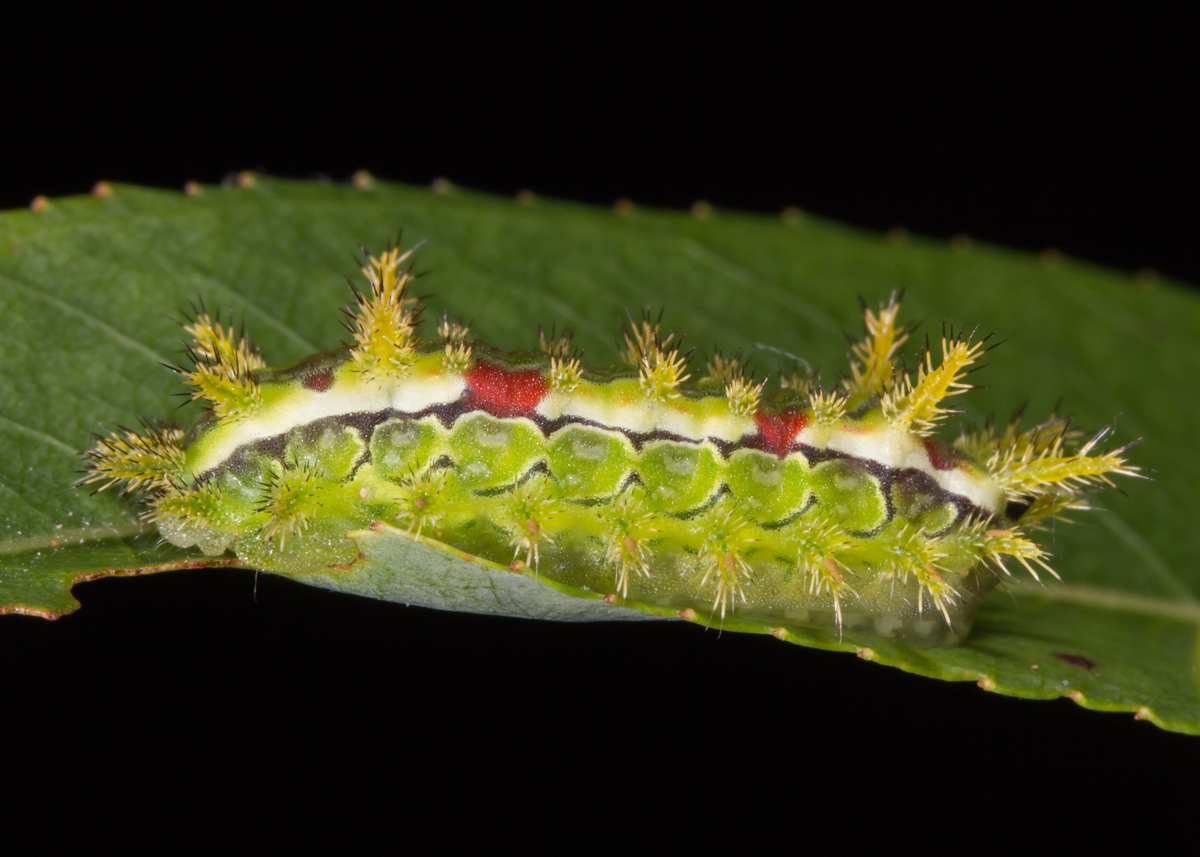
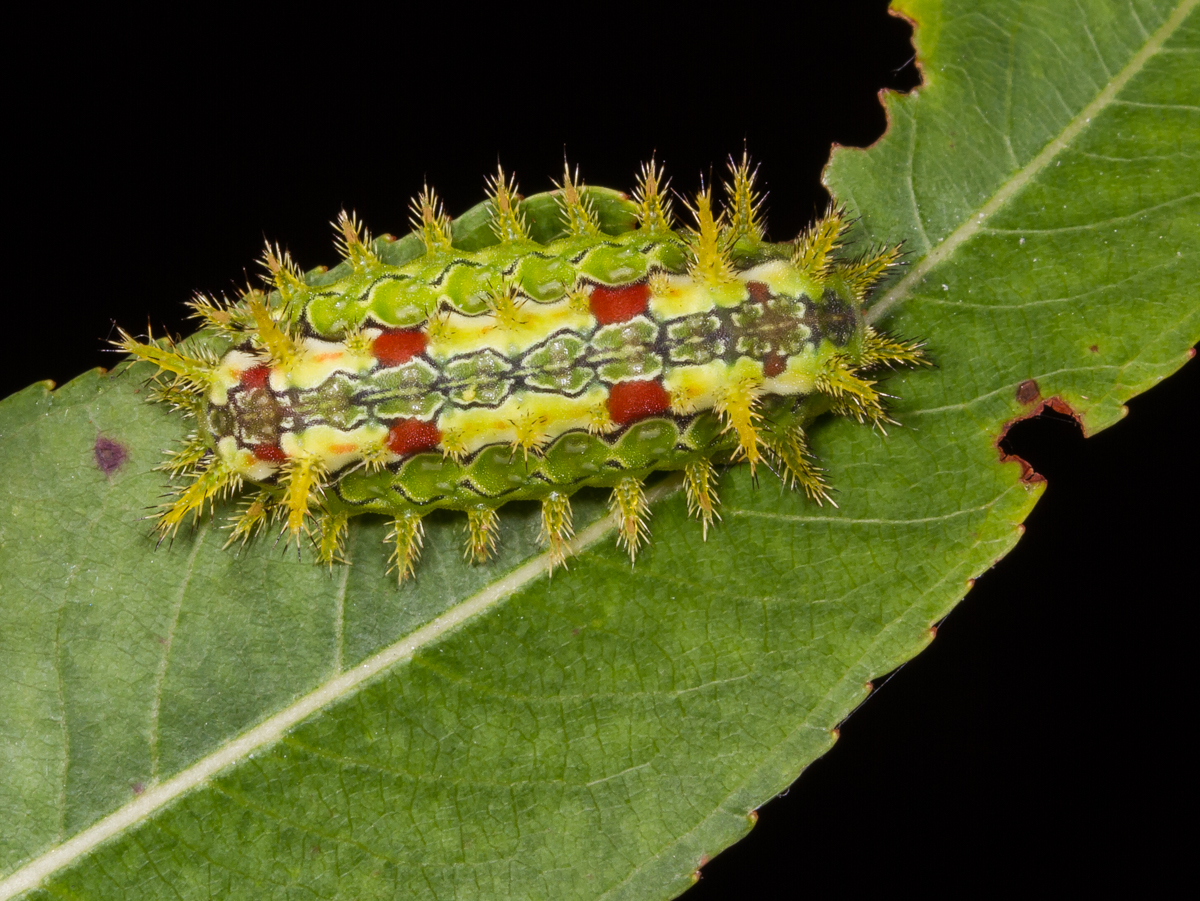
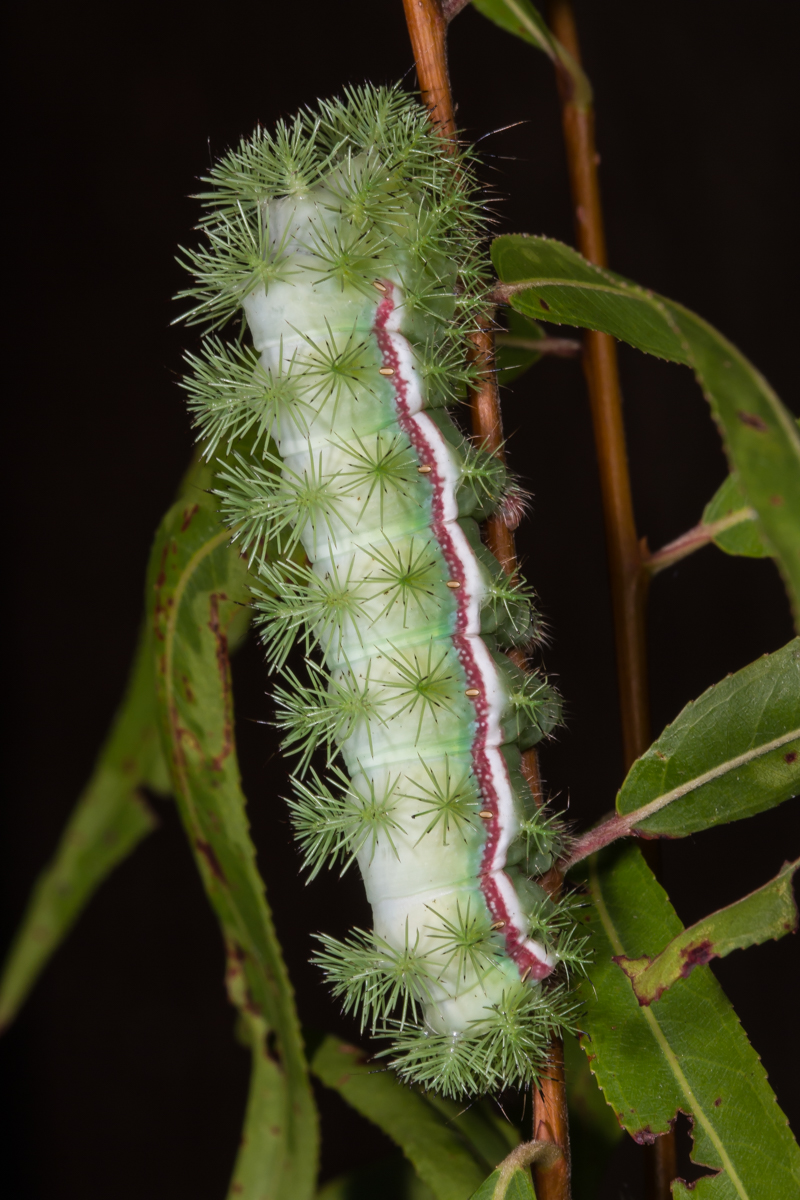
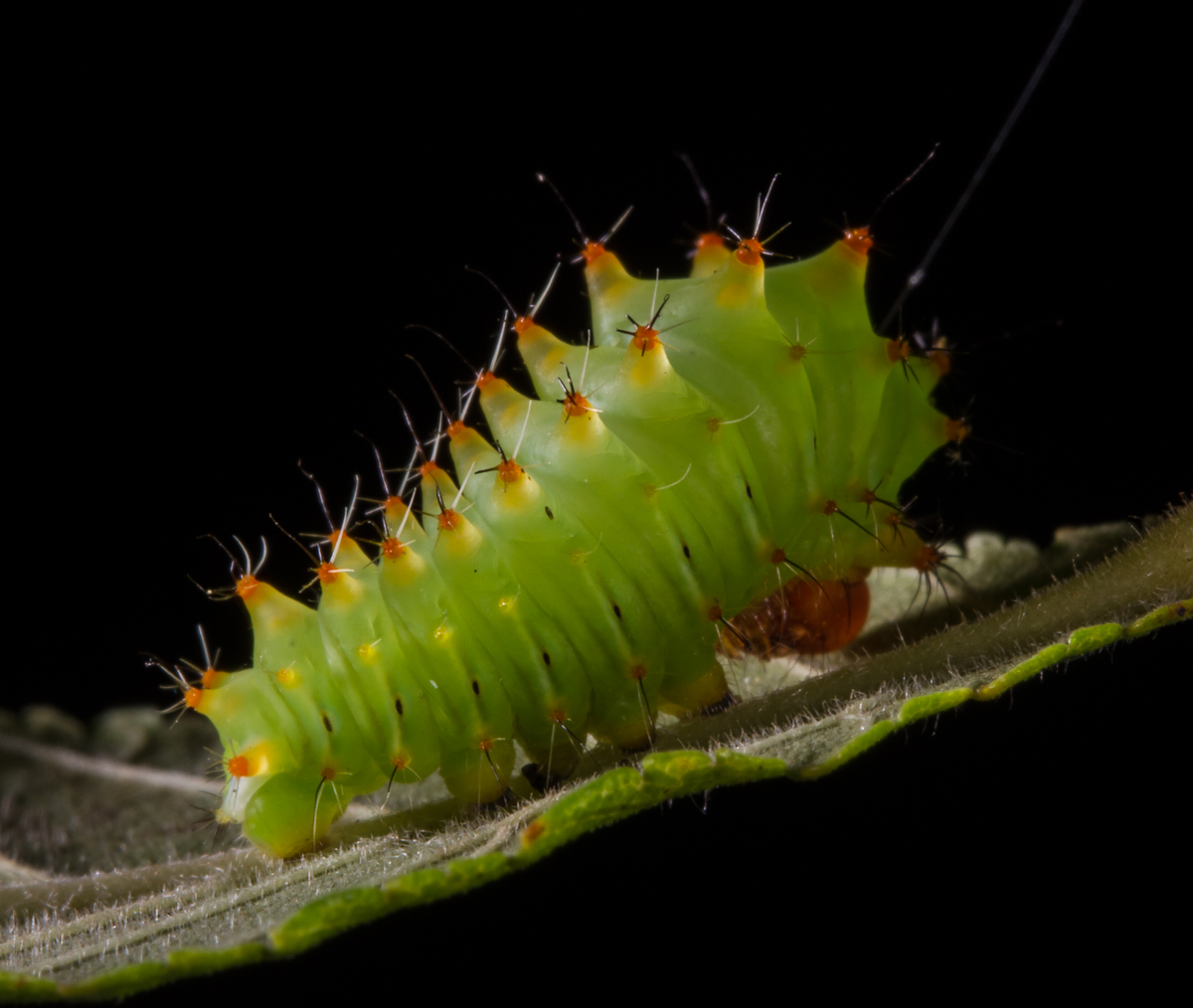
In honor of BugFest happening today, I thought I would post another unusual caterpillar portrait – the Spiny Oak-Slug, Euclea delphinii.
Slug caterpillars move in a gliding fashion rather than the usual larval crawling motion
As a member of the slug caterpillar group, the Spiny Oak-Slug lacks the usual paired prolegs of most caterpillars and, instead, has medial sucker-like appendages on the first seven abdominal segments. This causes them to move in a gliding fashion, much like a slug, rather than the crawling motion of most caterpillars.
Both a beauty and a beast, the Spiny Oak-Slug is well armed with urticating spines
As you might suspect by its appearance, it is another of the stinging caterpillars, and can impart a painful stinging sensation to anyone that touches it. This species is highly variable in color, but all are well-armed with three pair of elongate spiny lobes on the front end and two pair on the rear. I have read that their sting is not quite as painful as some, but I think I’ll just take that as fact without any further testing. There are two generations per year in the south and the larvae feed on a variety of deciduous trees and shrubs (this one is on a species of willow). When you take a close look at this spiny mini-beast, you can’t help but admire the intricate detailing and patterns – such beauty in such an untouchable package.
…mysterious and little known organisms live within walking distance of where you sit. Splendor awaits in minute proportions.
~E.O. Wilson
Io Moth caterpillar (click photos to enlarge)
Here is another of my favorite caterpillars, the Io, Automeris io. Beautiful, but it is also one of the so-called “stinging caterpillars”. The urticating spines contain a venom that can cause a painful sting. I have found this species several times on a variety of host plats, this time on a willow here in Chatham County.
The bristly appearance of an Io larva from above
If ever there was a caterpillar that you should think to yourself, maybe I shouldn’t touch this, the Io is it. The large spines are in distinct clusters and are found over the entire dorsal surface of its body. They do not try to hide since they are well-armed against most predators.
Close up of caterpillar head showing ominous-looking clusters of spines
This one in in its last instar, and has crawled off the willow, indicating it may be ready to pupate. They form a loose, papery cocoon on the ground. I am hoping it waits until after BugFest, but only the Io knows for sure.
Never touch anything that looks like Donald Trump’s hair.
~Gwen Pearson
Puss Caterpillar, or is it? (click photos to enlarge)
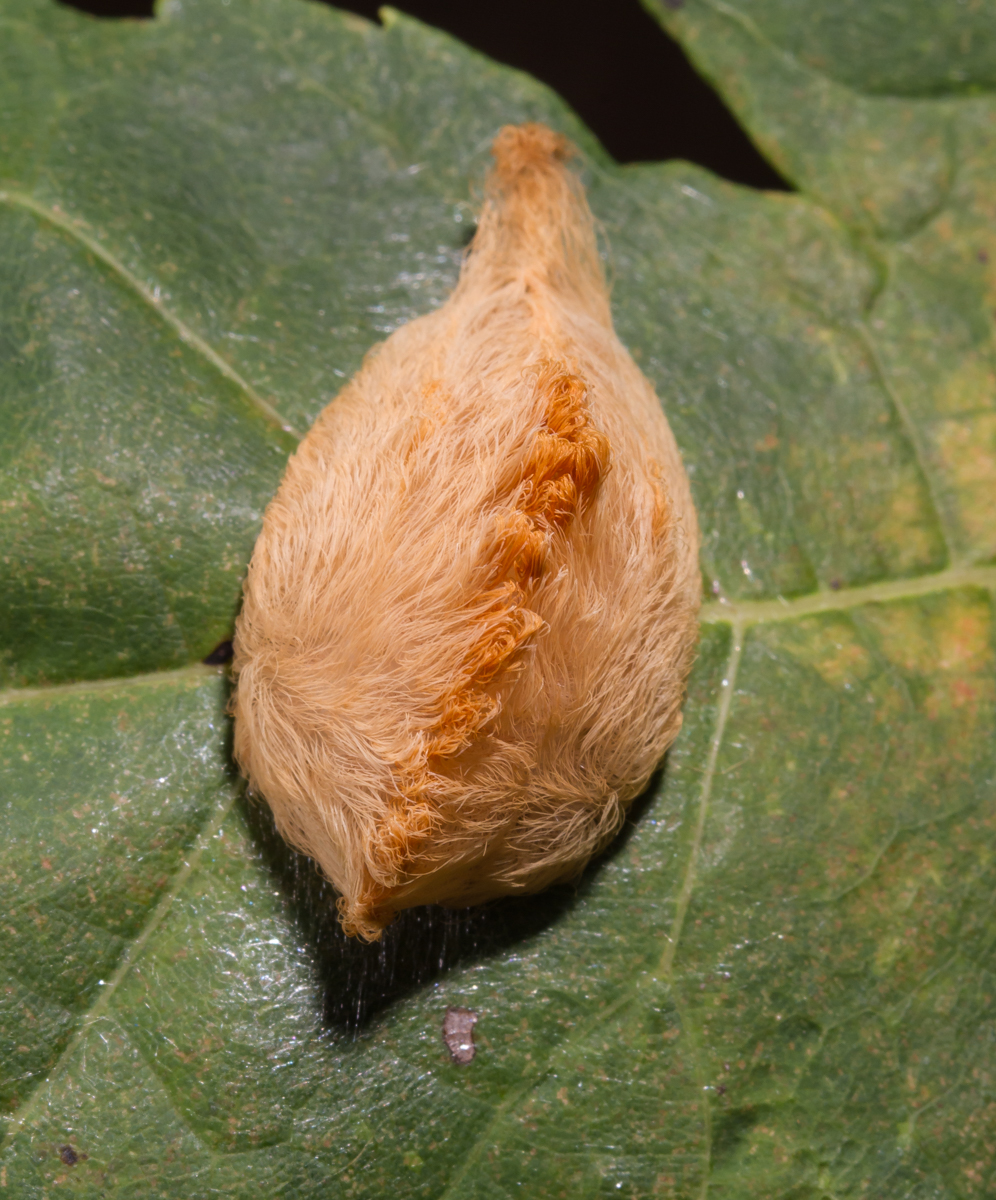
I just love that quote. It is the title of an article in WIRED last week on a particularly painful caterpillar known by various names – Puss Caterpillar, Asp, and Southern Flannel Moth Caterpillar, Megalopyge opercularis. I find one of these every couple of years as I wander the woods and fields, especially in early September in preparation for the NC Museum of Natural Sciences’ biggest special event, BugFest. Years ago, I started a caterpillar tent at BugFest as a way to share my passion for all things caterpillar and now I volunteer at the event. People really do love to look at (and learn about) caterpillars. Most of the larvae are fun to raise, identify, and are totally harmless. But, there are a few that can inflict pain when touched. They have “urticating hairs” that contain venom. And this one is supposedly the most painful of all.
Next to last instar of Puss Caterpillar
I found one last week on a Red Maple. This species feeds on a variety of tree leaves, which fortunately makes it less likely someone will accidentally encounter one unless it falls out on you or you are climbing up there amongst them. This one looked a little different than most I have found, especially in its more strawberry-blonde coloration. But there was something else I couldn’t quite peg. I found an incredible online resource on these moths and their larvae that helped me see the reason (see http://entnemdept.ufl.edu/Creatures/MISC/MOTHS/puss.htm). Turns out, the color can vary from grayish-brown to tan. The big thing I learned was about the different looks of this caterpillar as it goes through its various molts (instars). The caterpillar had become still a couple of days ago and made a silken pad for itself on a leaf. This is usually a sign of impending change, a molt. After reading more about it and seeing pictures of the last two instars of these larvae, I went out to look at my Puss Caterpillar again.
Puss Caterpillar, last instar
It had molted and, did indeed, look different, more like the pictures you usually see in field guides (most guides use an image of the caterpillars in their last instar as the key for identification). The color was slightly darker, with more tints of gray. It had some noticeable tufts on each side, tipped in white. And the whole effect was as if someone had given the furry little guy a good combing and maybe put some mousse in to tidy up the hairs, especially along the dorsal crest and “tail”. I looked for the shed, but, as the reference stated, most usually eat their shed skin, and it appears mine followed suit.
Top view of next to last instarTop view of last instar
While transferring the caterpillar back into its cage, I did what I really did not want to do – I accidentally touched it. Just a glancing brush, with my knuckle. I immediately pulled away and said a few choice words, expecting the worst. I have been “stung” by a few other species in the past, and most felt like a wasp sting, the pain usually dissipating in a few minutes. This one started out with a mild stinging sensation, but then seemed to move deeper. Soon, it felt as if my knuckle bones had been shot with some painful solution. Luckily, I had apparently just barely touched it, so the pain did not spread as I have read it often does. The knuckle soreness lasted several hours and then finally faded. I made a promise to myself to be extra careful when anywhere near these little “fur balls”. There is a lot of good information on the referenced site, so rather than repeating it all here, I refer you to the Featured Creatures page on this species from the University of Florida. If you want to see this, other cool caterpillars, and lots of interesting displays on all things arthropod-ish, be sure to come to BugFest at the NC Museum of Natural Sciences in downtown Raleigh this Saturday, September 20. And remember, if you see something that looks like a crawling eyebrow or that rich guy’s windblown coiffure, don’t pet it.
This weekend, while I was picking beans in the garden, I felt I was being watched. I looked around, and, sure enough, had a visitor.
Eastern Box Turtle in garden puddle (click photos to enlarge)
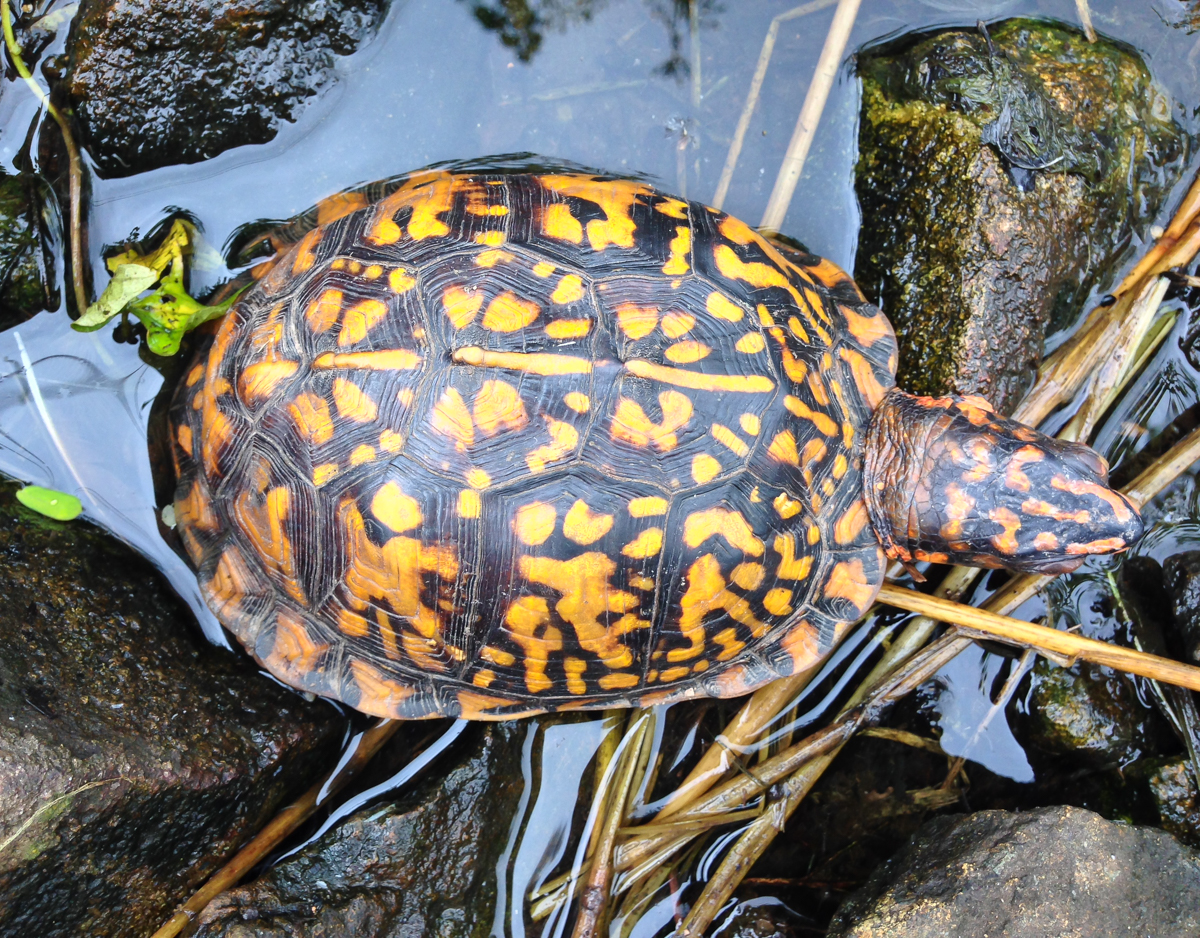
It was a beautiful Eastern Box Turtle, Terrapene carolina. This one was particularly striking, with a bright, bold pattern on both its shell and head.
Close up of the head of male Eastern Box Turtle
I suspected it was a male just from the bright colors (they often are brighter), and as I got a closer look, I saw another indicator of maleness in Eastern Box Turtles, red eyes. Males usually have red irises, females have yellow or brown irises. Of course, the best indicator is a concave area on the underside of its shell (plastron) if its a male; females are flatter.
Intricate patterns of an Eastern Box Turtle from above
Archie Carr, the famous Florida naturalist, once wrote, “Everyone likes box turtles”. I think he is right. Everyone I know pauses when they see one and many will stop a car and rush to help one across a road (cars are one of the primary causes of death in box turtles). Perhaps because of their endearing qualities, they were named the state reptile of North Carolina in March of 1979. I was looking for a quote about box turtles when I came across a newspaper article published the day after the NC Senate approved the bill making that designation official. Some members of the House had spoken in favor of box turtles while a few of the representatives from the mountains questioned an eastern turtle’s ability to represent our state’s western region (I guess the name Eastern Box Turtle overshadowed the fact that the turtles are found throughout the state). The bill’s sponsor, Rep. Chris Barker, wore a turtle embroidered vest, had a small child bring in two turtles in a box, and spoke highly of the turtle’s qualities that would make it a good representative of our state. “In order for a turtle to make progress, he must stick his neck out. I think state officials and the General Assembly should emulate this”. Of course, it should come as no surprise that there were some dissenting opinions, although it was only one no vote in the Senate. That Senator explained it this way – “I don’t feel we should be represented by something that sticks its head in a shell and forgets what’s going on”. Hmmm, guess it always depends on how you look at something. At least most people like the turtle…
…a wonderful creature, when we consider his form, nature and disposition…he is never known to strike until he is first assaulted or fears himself in danger, and even then always gives the earliest warning by the rattles at the extremity of his tail.
~William Bartram, 1791
I made some time last week to do a day trip down to eastern North Carolina for some wildlife viewing. Spent the morning at the Pungo Unit at Pocosin Lakes NWR, but saw only a few butterflies and birds, along with a friend from the area. We chatted for awhile and exchanged notes on our lack of wildlife encounters that morning. After that, I decided to head over to Alligator River NWR and see what might be moving around over there. I did eventually spot a couple of bears and some cool insects (more on the bugs in a later post). I also came across a roadkill Cottonmouth. It saddens me anytime I see animals hit by cars, but especially on these wildlife refuges, where the gravel roads, and the purpose of the place, should slow people down enough that they can avoid most animals before making them a casualty. I was headed out for the long trip home when I came across what looked like another roadkill snake. As I opened the door, I thought I saw a flicker of movement, so I got out and took a closer look.
Young rattlesnake in road (click photos to enlarge)
I could see it was a small rattlesnake, about 13 or 14 inches total length. It had flattened its body but was not moving. I grabbed a twig from the roadside and gently touched its tail…the head jerked toward the twig. The little guy was alive after all. The grayish color and small size at first made me think this could be a Pygmy Rattlesnake, a species of small rattler found primarily in this part of the state. But the pattern didn’t seem right from what I remembered seeing before. It took comparing the images with some field guides and consulting a herper friend when I got back, to confirm that it was, instead, a very young Canebrake Rattlesnake, (Crotalus horridus). Canebrakes are what most people call the Timber Rattlesnakes that are found in the Coastal Plain. Those in the Coastal Plain tend to be lighter in color than those in the mountains and usually have an orange or brown stripe running down the middle of the back.
A young Canebrake Rattlesnake
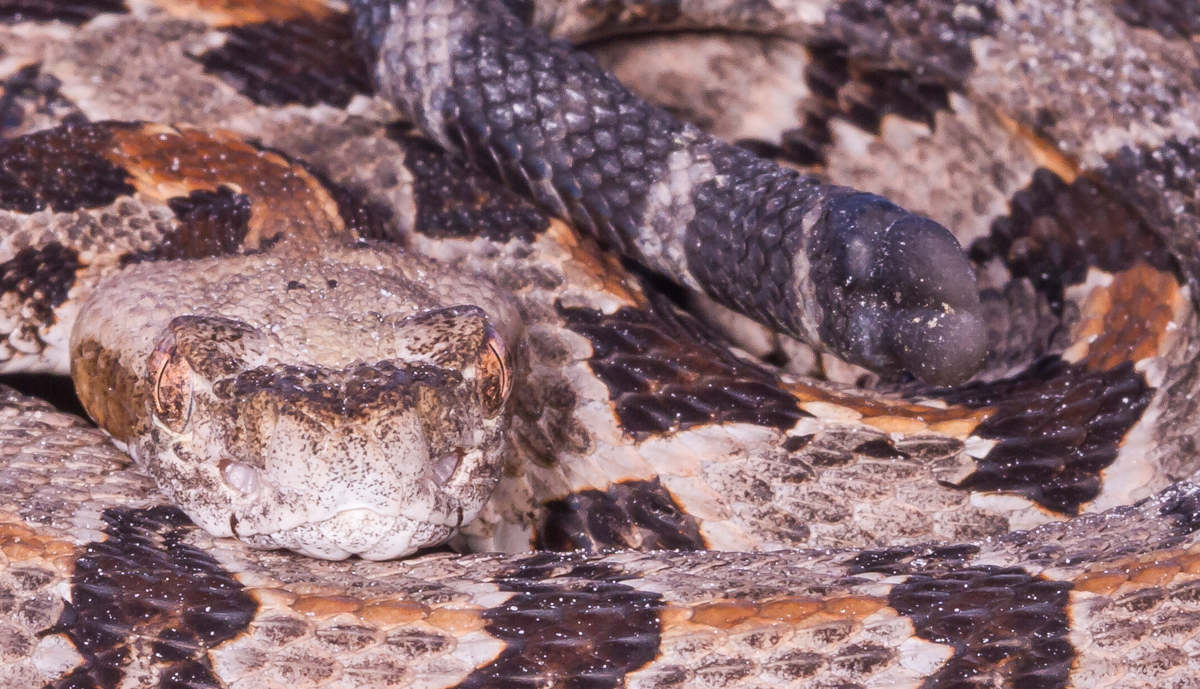
After reading more about this species, I think this one could have been a very young Canebrake. Females typically give birth in August or September, to anywhere from 4 to 20 young, that average about 13 or 14 inches in length.
Closeup of head and button of young Canebrake Rattlesnake
Young snakes usually have very conspicuous body patterns and an enlarged button at the end of their tails instead of the segmented rattle of larger specimens.
The snake was very docile as I tried to help it get out of the road
As I gently nudged the snake back toward the woods with the twig, it occasionally curled up in a defensive posture, but never struck. When it finally reached the vegetation, it picked up speed and disappeared into the thicket. It was a privilege to see this, my first young rattlesnake, and to ensure that it made it at least one more day in what could be a long life. Studies have shown that female Timber Rattlesnakes may not reach sexual maturity for 5-10 years and then may only have young every 3 or 4 years. Populations are believed to be declining throughout much of their range due to habitat destruction and human-related activities, so I’m glad this one is in a relatively safe habitat…maybe I’ll see it again on a future visit.
Morning Glory is the best name, it always refreshes me to see it.
~Henry David Thoreau
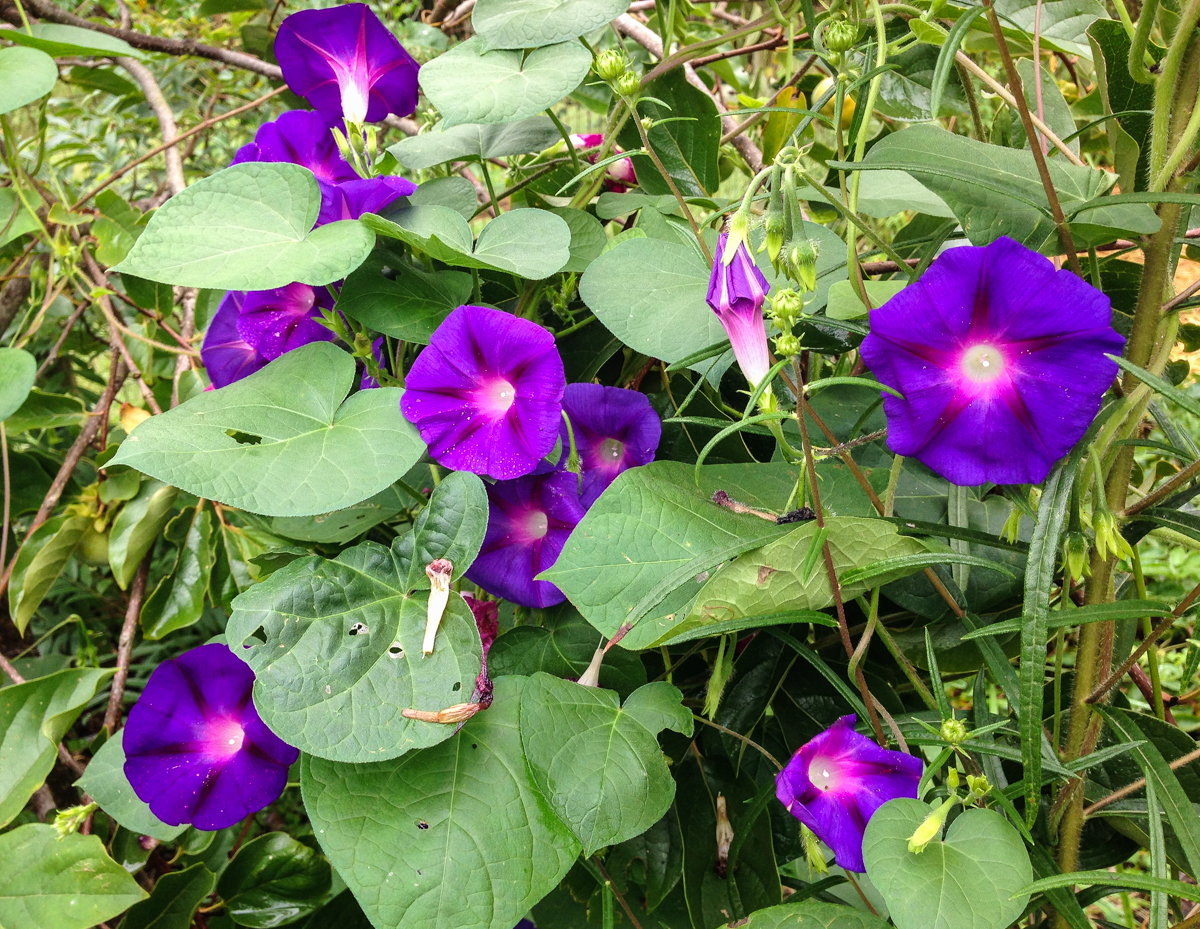
Some parts of the garden are starting to wind down now, but the wilder side is still full of life and beauty. The cooler nights and recent rains have perked things up a bit, the scattered wildflowers are in full bloom, the bean plants are still producing, and the fall garden veggies are just coming into their own. But twining everywhere along the fences and any place I haven’t weeded in the past few weeks are the tubular flowers of Morning Glory.
Common Morning Glory twining in the garden (click photos to enlarge)
Morning Glories belong to the family, Convolvulaceae. The largest in my garden are the deep purple flowers of the Common Morning Glory, Ipomoea purpurea.This genus also contains one of my favorite food plants, Ipomoea batatas, the Sweet Potato. That important North Carolina crop forms roots as it trails along the ground. The edible “potatoes” are food storage structures on the roots. Sweet Potatoes are not related to our other types of edible potatoes. Interestingly, the seeds of certain species of Morning Glory are considered toxic, but have been used by some native peoples as ceremonial hallucinogens and for medical purposes.
Common Morning Glory flowers are up to 3 inches across
Common Morning Glory is a strikingly beautiful species believed to be native to Central and South America. It has naturalized throughout most of the temperate portions of the world. Considered a noxious weed by many, it is also planted as an ornamental and has many cultivars. I allow mine to grow and bloom, but usually do a heavy weeding in the Fall. Seeds are still scattered over the garden and require frequent weeding, but the beauty of the flowers and their attractiveness to bees, butterflies, and hummingbirds must help soften my outlook a bit.
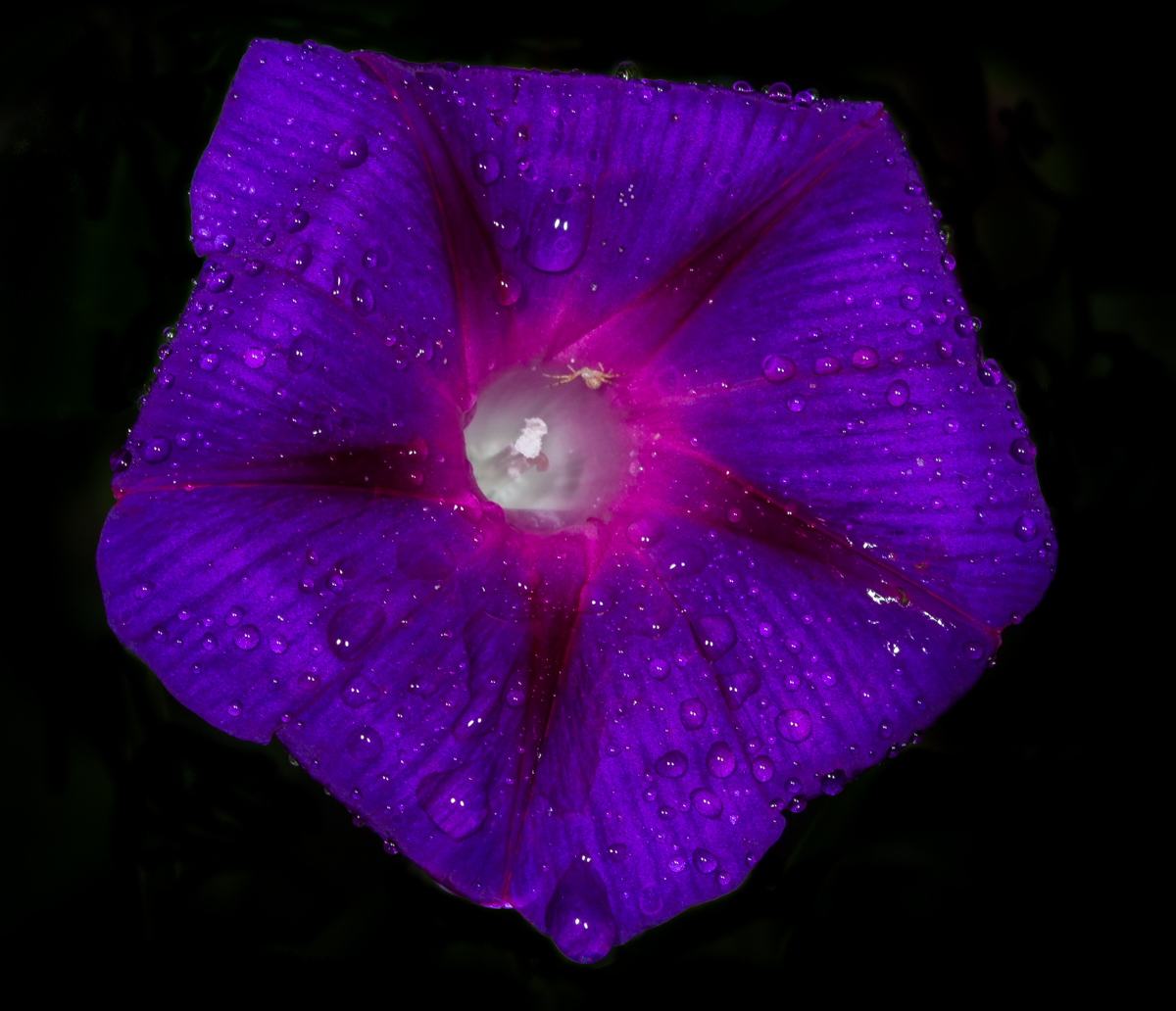
Morning Glory flower with rain drops
As the name implies, Morning Glory flowers open for a few hours in the morning and then start to close later in the day. Most flowers open for only one day.
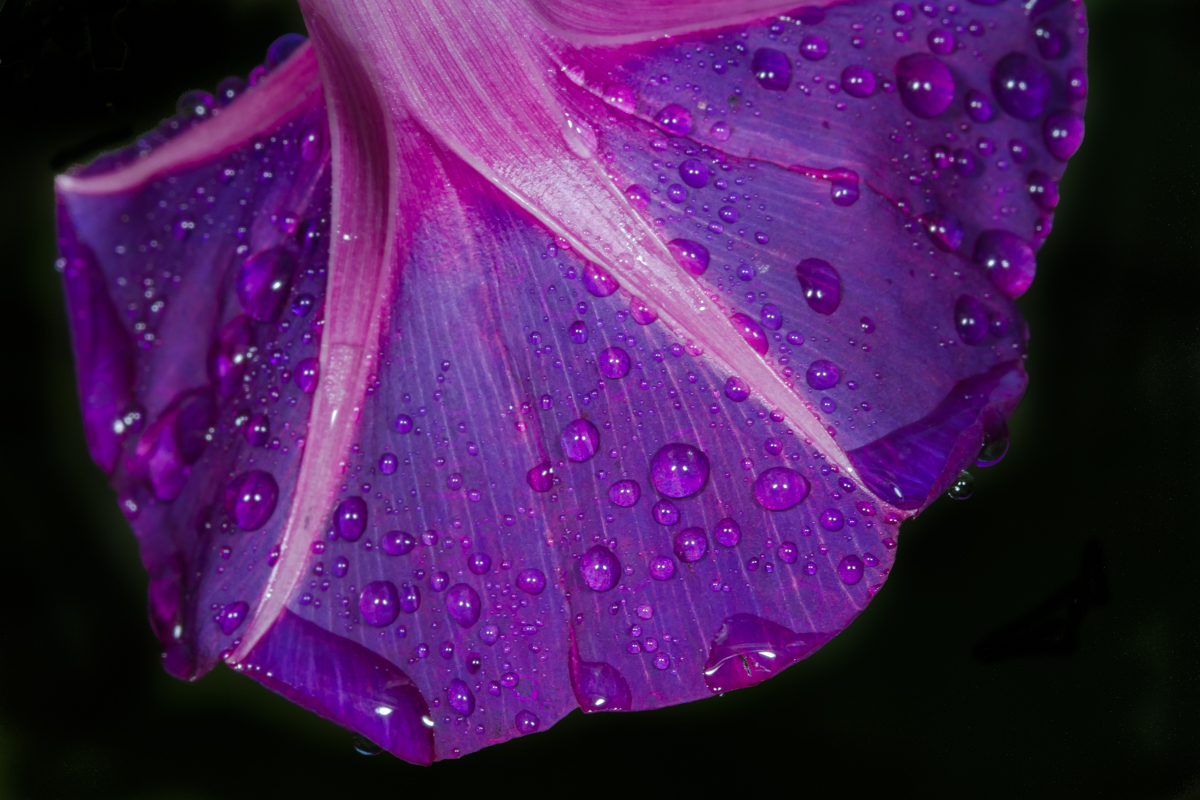
Back side of flower
These past couple of days, the flowers have been coated with rain drops, adding to their beauty. The flowers are simple, yet elegant, even when viewed from the back side.
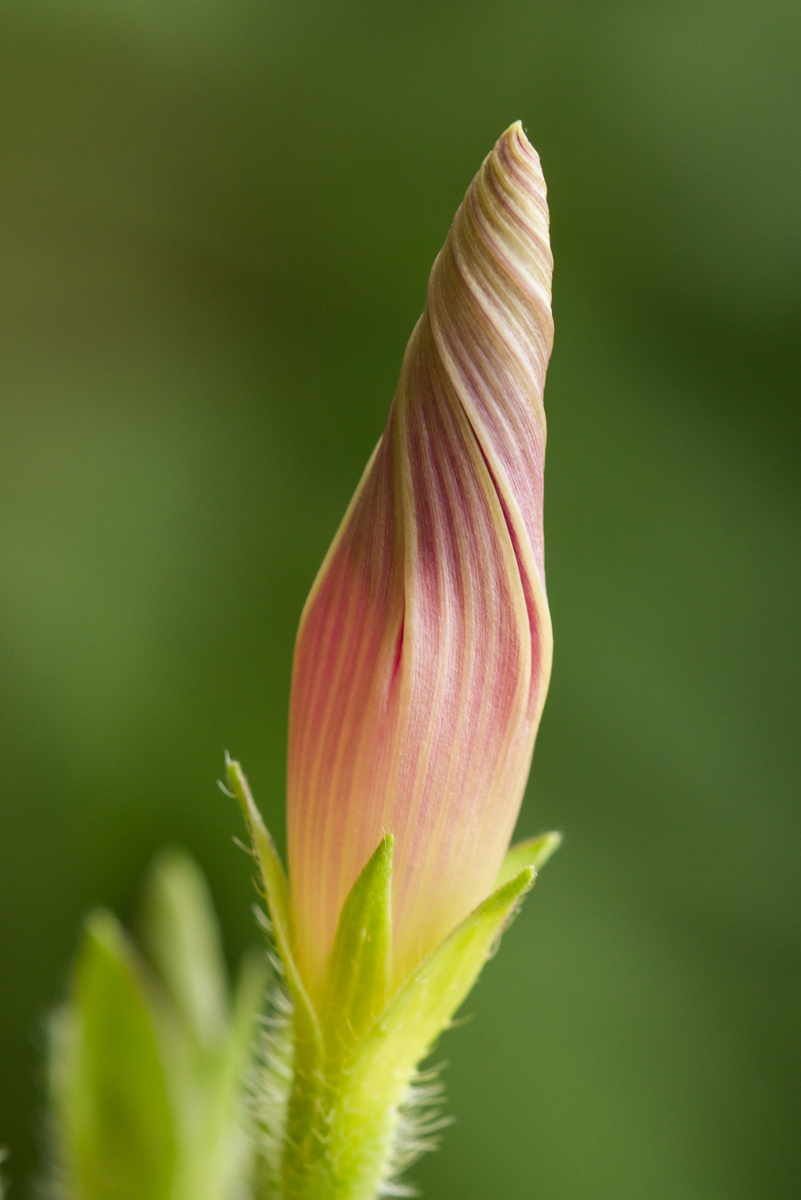
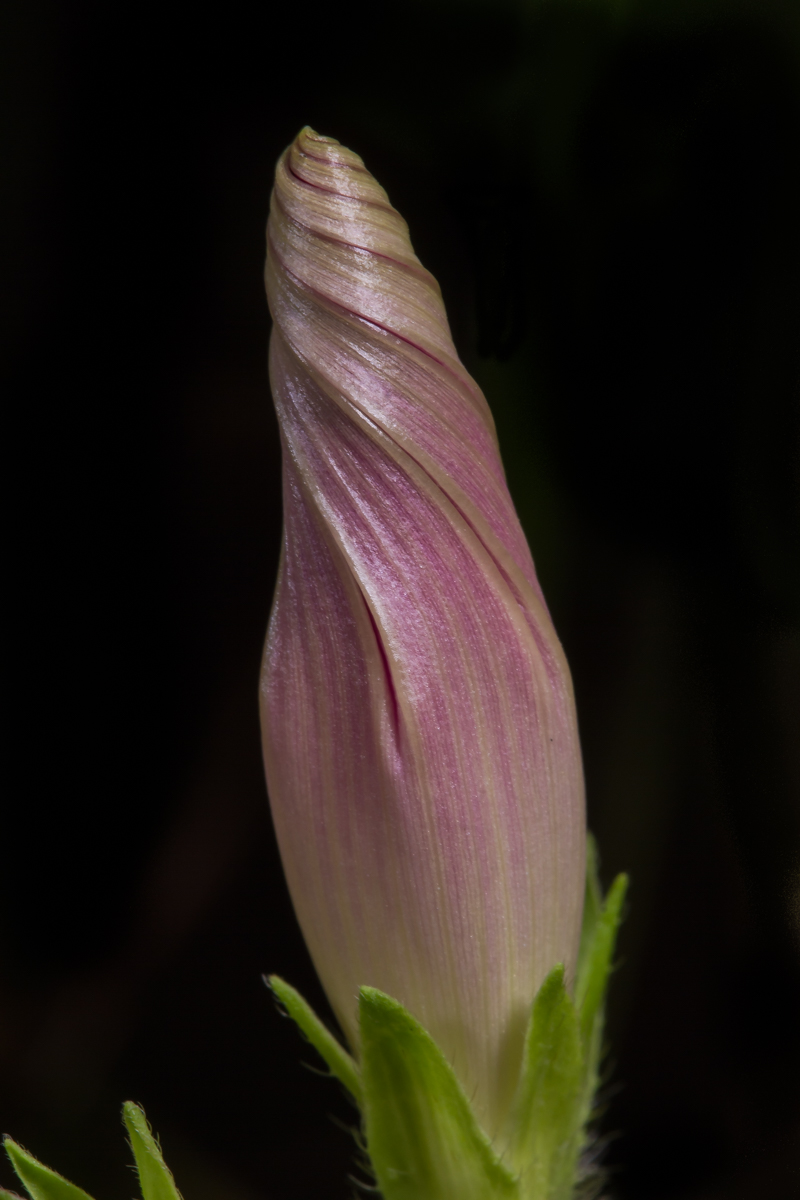
Morning Glory flower bud, aperture priority, no flash
The creases and bold lines are remnants of the curved folds in the flower in its bud stage.
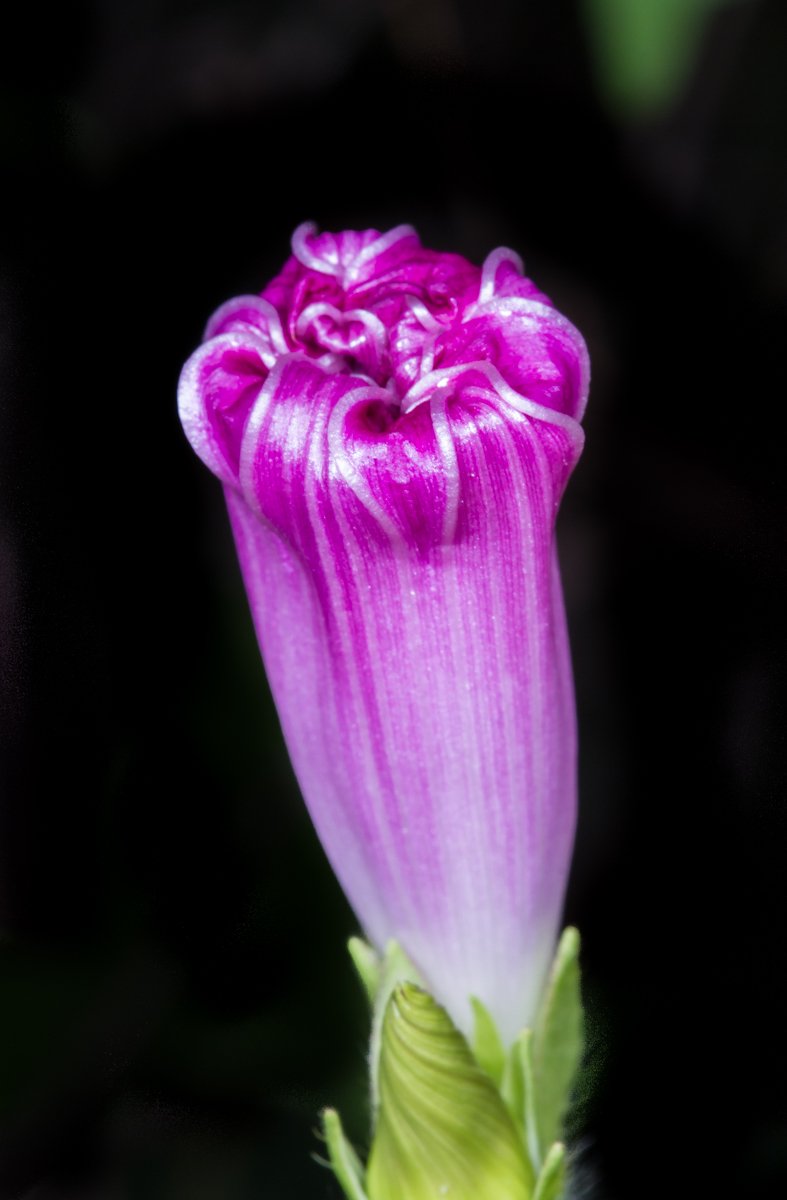
Morning Glory flower bud, manual mode with twin flash
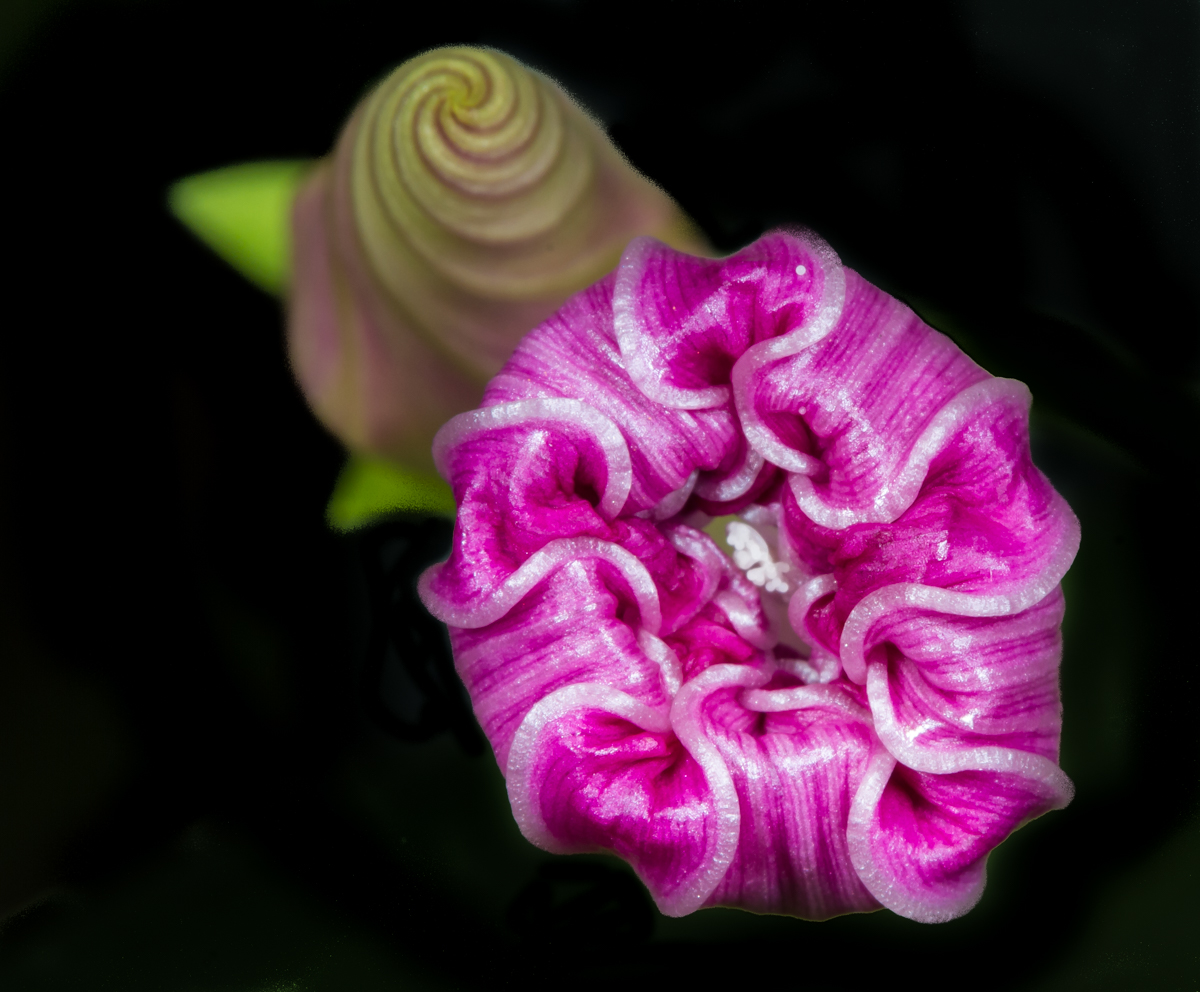
The flower buds are beautiful structures, reminding me of some sort of cherry-flavored soft serve ice cream in a green cone.
Flowers close late in the afternoon
I went out a little while ago and the flowers I had looked at earlier today were all closed. I am guessing that these will fall off before tomorrow morning, but maybe some will live to open another day…we will see.
One flower may be finished while another waits its turn
When I was out checking on the status of the blooms, a hummingbird was busy nectaring at the few flowers that remained open. Even when closed, the patterns are intriguing if you take the time to give them a closer look.
Salmon abound in great quantities at certain seasons of the year, when the water in every direction seems to be filled with them…
~James Alden, U.S. Coast Survey, 1853, describing the waters around San Juan Island
After camping and hiking in Olympic National Park, the next leg of the journey was by ferry, to San Juan Island. Quite a contrast, in terms of the number of people and the general feel of the place – less wild at first, but still beautiful.
View from the ferry headed to San Juan Island (click on photos to enlarge)
There are islands, large and small, everywhere in this part of Washington. I wanted to go to San Juan Island for one thing – to see Killer Whales, now commonly referred to as Orcas, from their scientific name, Orcinus orca. After riding a couple of ferries to reach the island, the drive to the lodging was quite a contrast to the busy, tourist-oriented town of Friday Harbor. The marina crammed with huge sailboats and yachts gave way to rolling farmland and patches of forest.
A quiet cove offers a respite from the winds and waves in the channel
The goal the next morning was a 5-hour sea kayak trip from Roche Harbor to hopefully see some wildlife. I knew it was a long shot, but seeing these graceful marine mammals from a kayak would be magical. Unfortunately, the weather did not cooperate. It was pleasant paddling out of the harbor and through the channel, surrounded by unbelievable homes along the shore, but when our group headed out and around the island where the whales would most likely be, the wind was ferocious and the waves made us all struggle in our tandem kayaks. I was impressed by how much wave action these kayaks could handle, but the guide wisely decided to turn back rather than expose everyone to a long paddle across such choppy conditions.
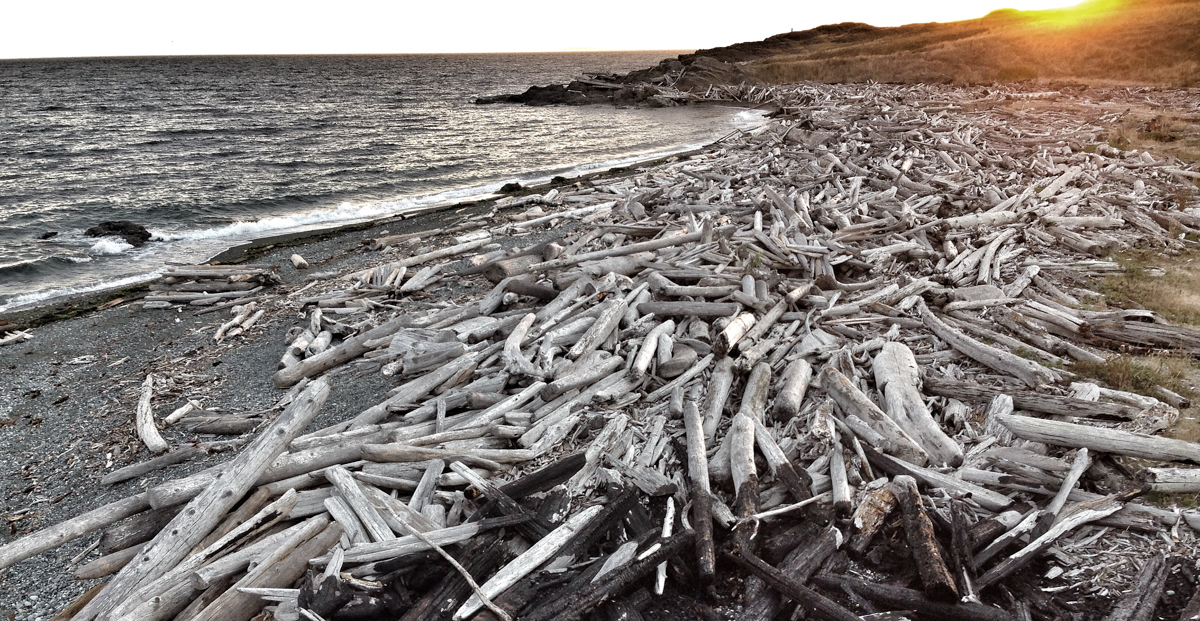
Enormous piles of driftwood line the cove at South Beach
The proprietor of the lodging had recommended a sunset trip to South Beach and it turned out to be a good recommendation. South Beach is well known for the large piles of driftwood washed in from the sea, and grasslands stretching down the the rocky headlands. A beautiful scene surprisingly shared with only a few people that evening.
The next morning, the last in this part of the state before heading home, was spent on a whale watch boat. The boats have a higher probability of seeing whales than the kayak tours because they can obviously travel greater distances in search of these highly mobile marine mammals. An added bonus was having a pair of naturalists on board to answer any questions and give background on the whales we saw (if any). At check-in, they said there had been whales sighted earlier that morning so things looked promising. I finally had my 300mm telephoto along (for the first time on the trip) so I was anxious to head out.
The high dorsal fins of Orcas can be seen at considerable distances
We soon could see a gathering of a few other boats and the captain announced there was a pod of Orcas up ahead. Then we saw the tell-tale large dorsal fins slicing through the water. Killer Whales are impressive animals, boldly patterned in black and white, and reaching lengths up to 30 feet and weights of 6 tons. They are the most cosmopolitan group of marine mammals, being found in all the worlds oceans.
One of the on-board naturalists explained that these were a group of transient Orcas. In the 1970’s, a whale scientist named Michael Bigg, was the first to document that there was more than one population of Orcas in the area, and that the different populations did not behave the same, or interact with each other. He used the terms resident and transient to describe the different groups in the Pacific Northwest (they now also recognize a third group called offshores). A major distinguishing factor between these two types is their diet. Residents are fish-eaters, and not just any fish, but salmon, and not just any salmon, but primarily Chinook Salmon. The two groups of resident Killer Whales are in near-shore waters from spring until fall. Their whereabouts in winter are still being uncovered using satellite tags. Transients tend to travel in smaller pods and are warm-blooded meat-eaters, primarily hunting seals, porpoises, and whales. The different populations of Killer Whales speak different languages, do not generally interact, and are not known to interbreed.
Members of a transient Orca pod swim near our boat
We eased into position as the whales swam amongst the viewers. They seemed to be just cruising along, not hunting, even though this channel is known as one of the prime feeding areas for the transient groups due to the abundance of seals and porpoises. Killer Whales can remain submerged for several minutes, so once they dove, it was always amazing to see where they would surface.
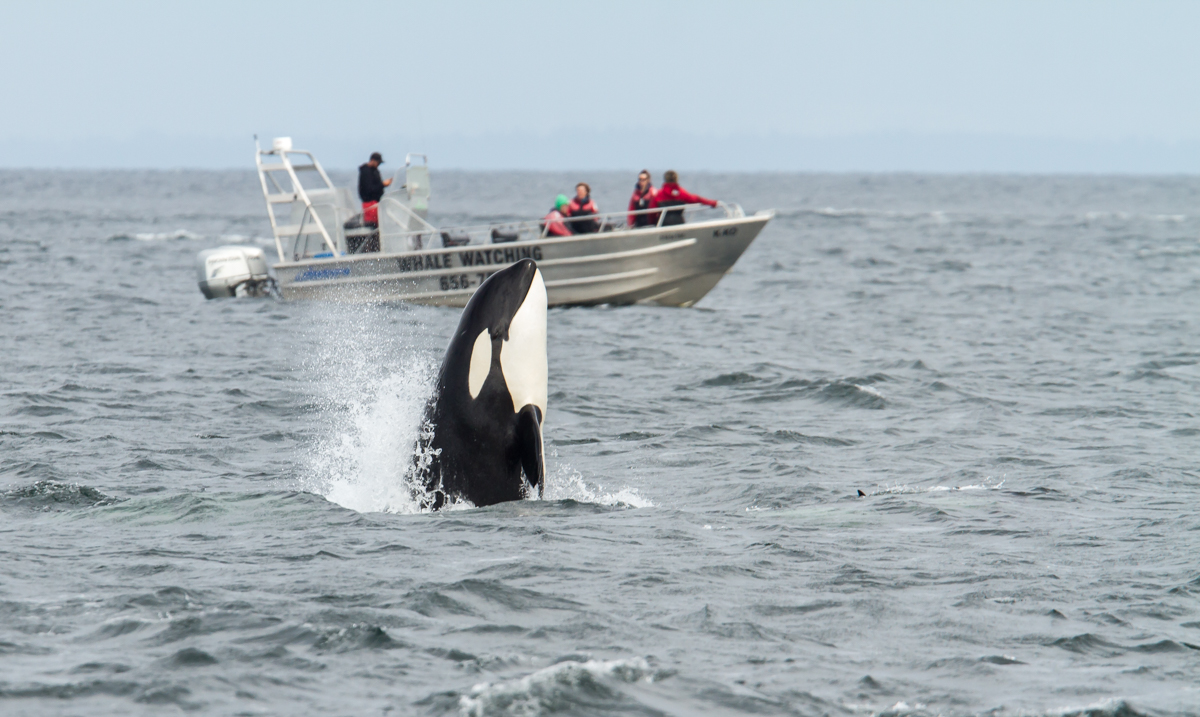
The action was quick and happening all around the boat, so it was tough getting good photos. While watching one small group, one of the whales suddenly came straight up out of the water in a behavior known as spyhopping. Observers say that Orcas often spyhop when near boats and it is believed to simply be a way for them to look around. Whatever the reason, it is a dramatic behavior and brought a chorus of oohs and aahs from our boat.
An Orca approaches our boat
The next few minutes brought another chorus of exclamations as a group of three Orcas turned and swam directly at our boat. Rules state that whale watching boats must stay 200 yards away from Killer Whales but you can’t always regulate what the whales do. This group seemed curious and passed right by the boat. I just looked as they passed by the bow, as the telephoto was too much lens, but what an experience for all on board.
The captain finally gave us a five minute warning and we watched the whales swim near some other boats before we turned toward home. Along the way, we stopped to see some other wildlife, including a Bald Eagle, and a bonus sighting of a Mink running along the shoreline.
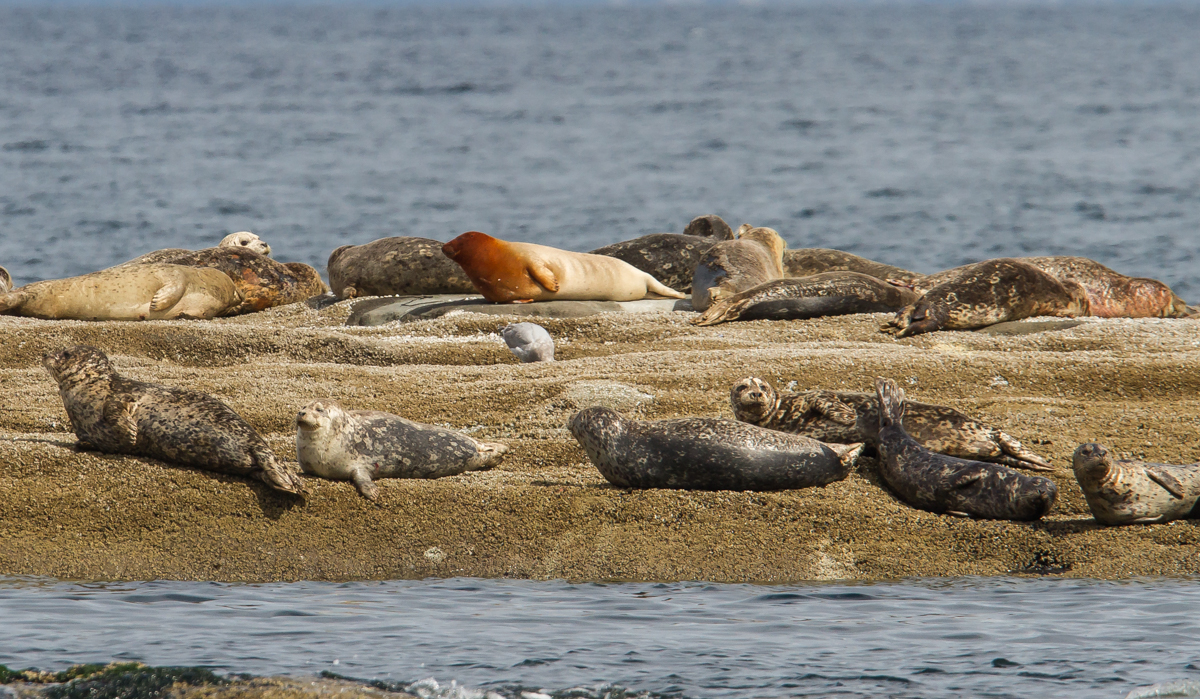
Harbor Seals hauled out on rocks at low tide
We also stopped at a rock island with a large number of Harbor Seals, one of the primary food items of the Orcas we had just observed. Harbor Seals haul out on rocks at low tide to thermoregulate and rest. They vary in color from gray to brown and are distinguished by their splotchy color pattern.
One seal had unusual coloration
But one of the seals stood out, as it had a very rust-colored head and light body color. References state that this color is probably due to iron oxidation of sediments these individuals accumulate on their fur.
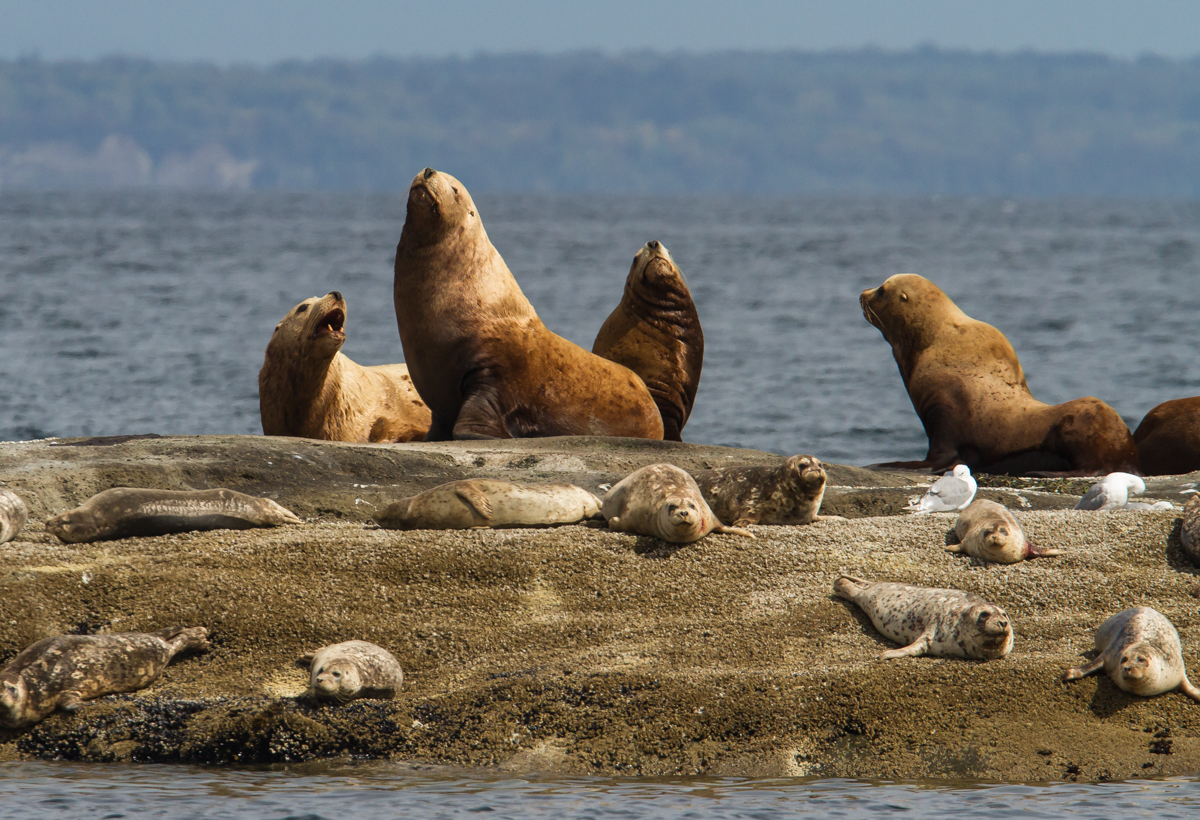
The seals shared their rock with a group of Stellar Sea Lions
Sharing the rock, and dwarfing the seals, were a group of Stellar Sea Lions. Harbor Seals weigh in at 200-300 pounds, whereas the Stellar Sea Lions attain weights of up to a ton or more for large males. Seeing them lounging on the rocks made it even more surprising that they were food for the whales. I didn’t notice until looking at the images, but if you look closely at some of the seals you can see small wounds surrounded by patches of blood. I don’t know what caused these, but it could be something as simple as scrapes from hauling out on barnacle-encrusted rocks, or it could be near misses in encounters with Orcas or other predators. Either way, I think I might find anther place to swim if I was them, given what we had just seen.
Of all the paths you take in life, make sure a few of them are dirt.
~John Muir
I just returned from a wonderful trip to the Pacific Northwest where I had two main goals – visit Olympic National Park, and try to see Orca Whales. The first part of the trip was to the incredibly diverse habitats of Olympic National Park. The park brochure touts it as being three parks in one, and I wanted to visit all three major ecosystems – the mountains, the primeval forests, and the coast. Looking at the park map you see that there is no road that cuts through the park. Instead, Highway 101 skirts around the outer edges of the park, with a few spur roads penetrating to some of the more scenic spots. The central interior of the park is thus isolated from roads and contains impressive wild lands. In fact, 95% of the almost one million acres comprising this magnificent park is designated as wilderness.
Hurricane Ridge in Olympic National Park (click photos to enlarge)
It seems as though the park was designed for folks that want to hike, to experience the environment in the simplest fashion, the one way to truly immerse yourself in the wildness of a place. First stop was one that I had read could be very crowded – Hurricane Ridge. There is a partially paved trail heading up slope from the Visitor Center that traverses a ridge line offering spectacular views of the surrounding mountains. At an elevation of about 5200 feet, the habitat here is considered sub-alpine, with species such as Douglas-Fir and Subalpine Fir dominating.
Sunset from Hurricane Ridge
The ranger had said the crowds thinned considerably late in the day, and so it was. Surprisingly so, since the sunset scenery was pretty spectacular, and set the tone for the next several days in the park.
Lowland forest in the Sol Duc Valley
The first stop the next morning was along the road to Sol Duc. Since it was early, there were almost no cars to be seen (or heard). A pull out signaled a trail head and it turned out to be a short magical loop trail through a forest of giants. These lowland forests are found in a few of the park’s river valleys like Sol Duc. They have a mild climate, abundant rainfall, and deep soils. This produces a multi-layered forest with huge old growth trees of Western Hemlock, Western Redcedar, and Douglas-Fir. The walk through the aptly-named Ancient Groves Nature Trail, was silent, solemn, and spell-binding. I didn’t want to leave this green cathedral, but it was still a long drive to the campground.
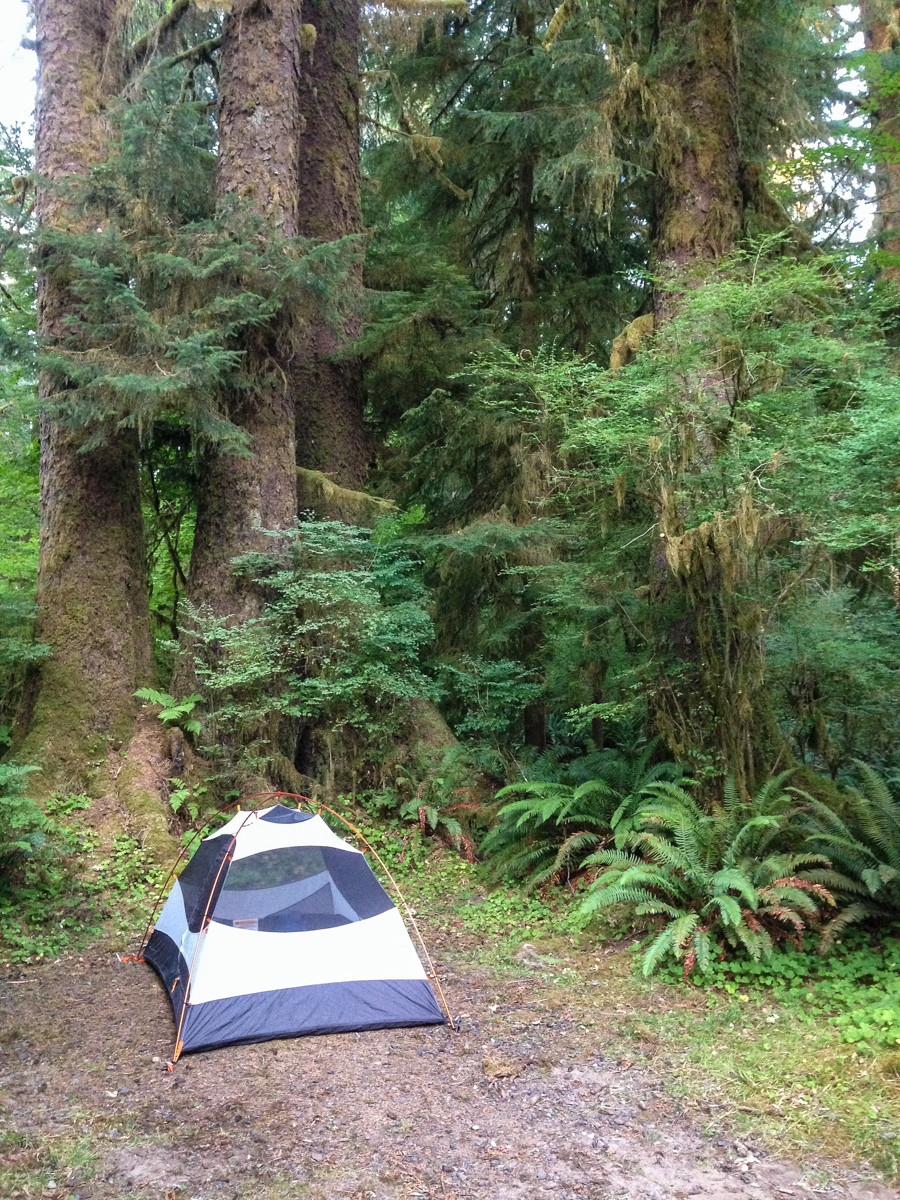
Campsite amongst the giants of Queets (iPhone)
One site remained after driving the several miles of dirt road to reach the Queets campground. But what a campsite! Near the river and surrounded by the giant trees of the temperate rainforest. Huge Sitka Spruce, Western Hemlocks, Douglas-Fir, and Western Redcedar towered skyward, with a blanket of sprawling Sword Ferns covering the ground beneath.
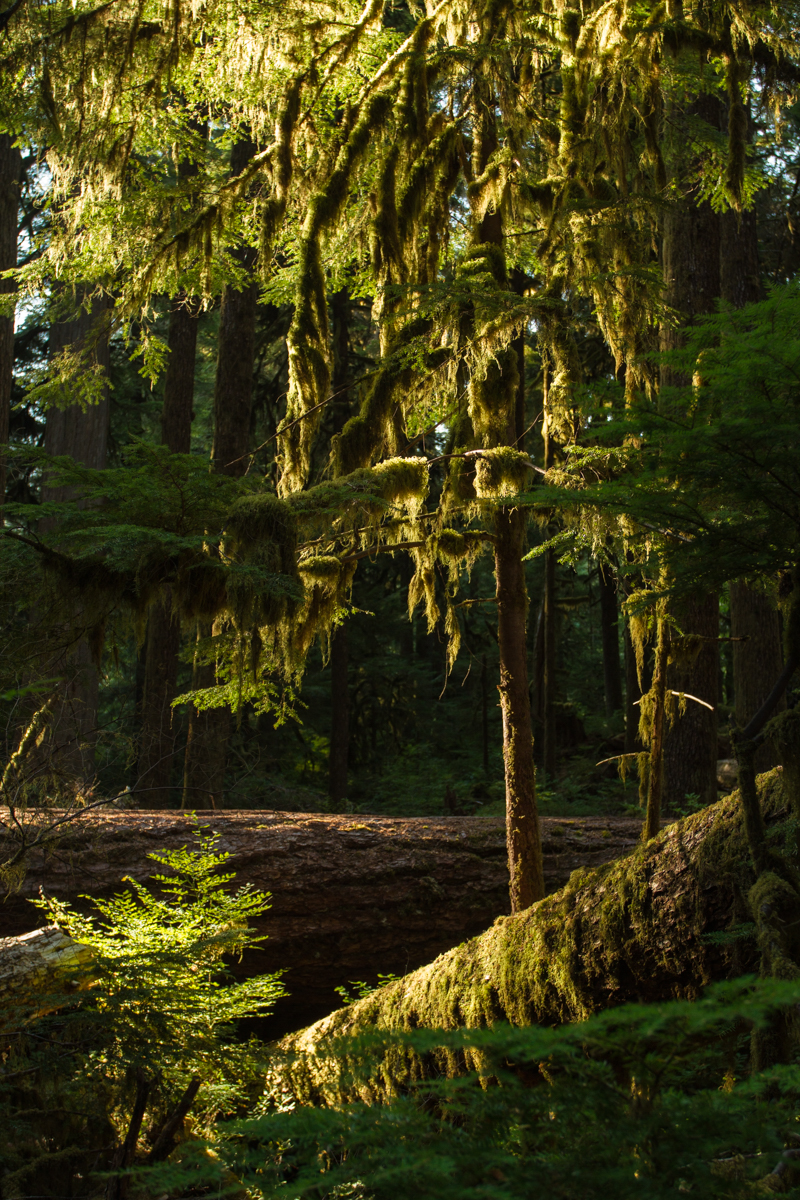
Lush growth and giant logs in the temperate rainforest
The temperate rainforests protected in this park are among the few survivors of old growth forests that once stretched from coastal Oregon to southeast Alaska. Forests like these are found in only a few other locations in the world, so to walk beneath their canopy is a privilege. These unique environments are the result of some very special factors brought on by their westward facing location along the coast – abundant rainfall (up to 12 to 14 feet per year from storms rolling in off the Pacific) and moderate temperatures (rarely going below freezing or above 80 degrees). Many of the trees are hundreds of years old, attain heights of over 250 feet, and may be over 50 feet in circumference. With the lush ground cover and profuse coating of lichens and mosses on the tree trunks and limbs, I felt as if I was back in the tropical rainforests of Belize or the Amazon, but with the air conditioning turned on.
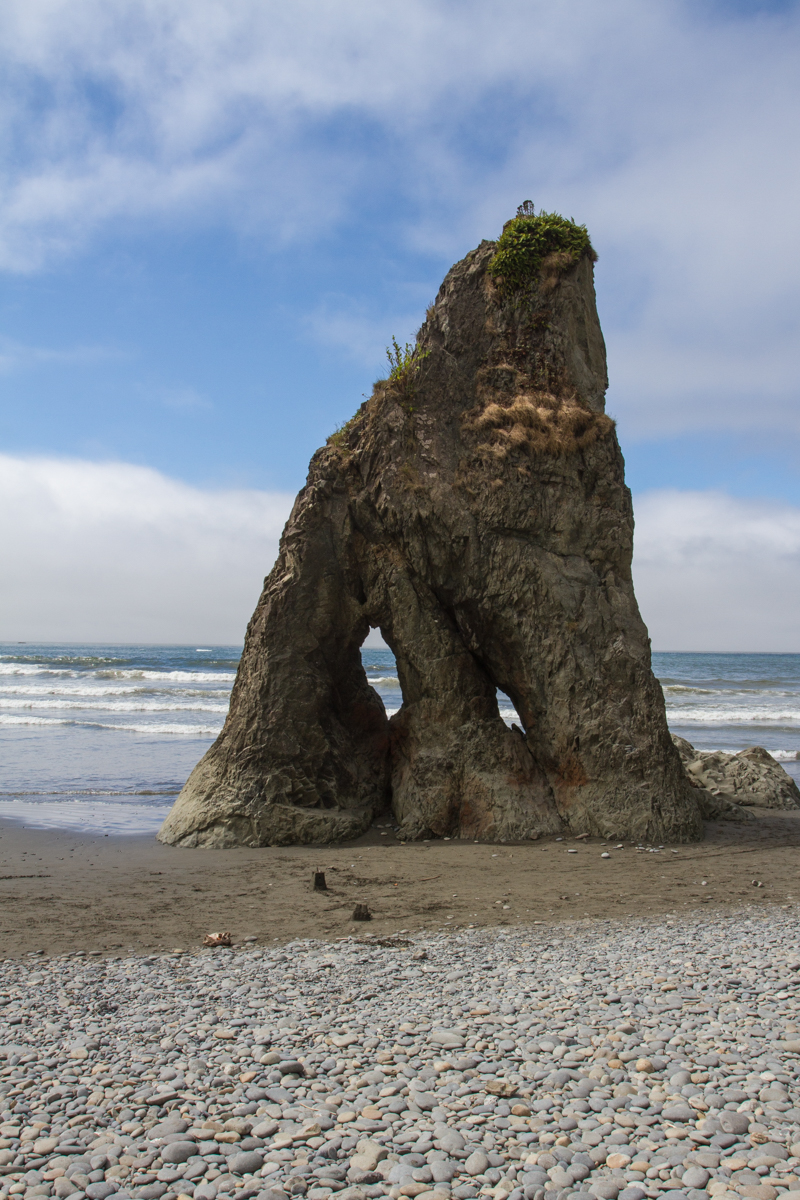
Sea stack at Ruby Beach
After soaking in the beauty of the forests in several locations, it was time to experience the unique coastline of the park. It is separated from the bulk of the park by private lands, several Native American reservations, and state and national forests. One of the more accessible beaches is Ruby Beach, so a quick stop was in order when the sign appeared along the road. Due to the easy access, it was predictably crowded, but it was stunning nevertheless.
Rocks along the tide line at Ruby Beach (iPhone)
And I experienced what was to become one of my favorite sounds in the park, the clacking of rounded rocks being washed by incoming ocean waves. That set the stage for what was probably my favorite experience in the park, a backpacking/camping trip starting at Third Beach.
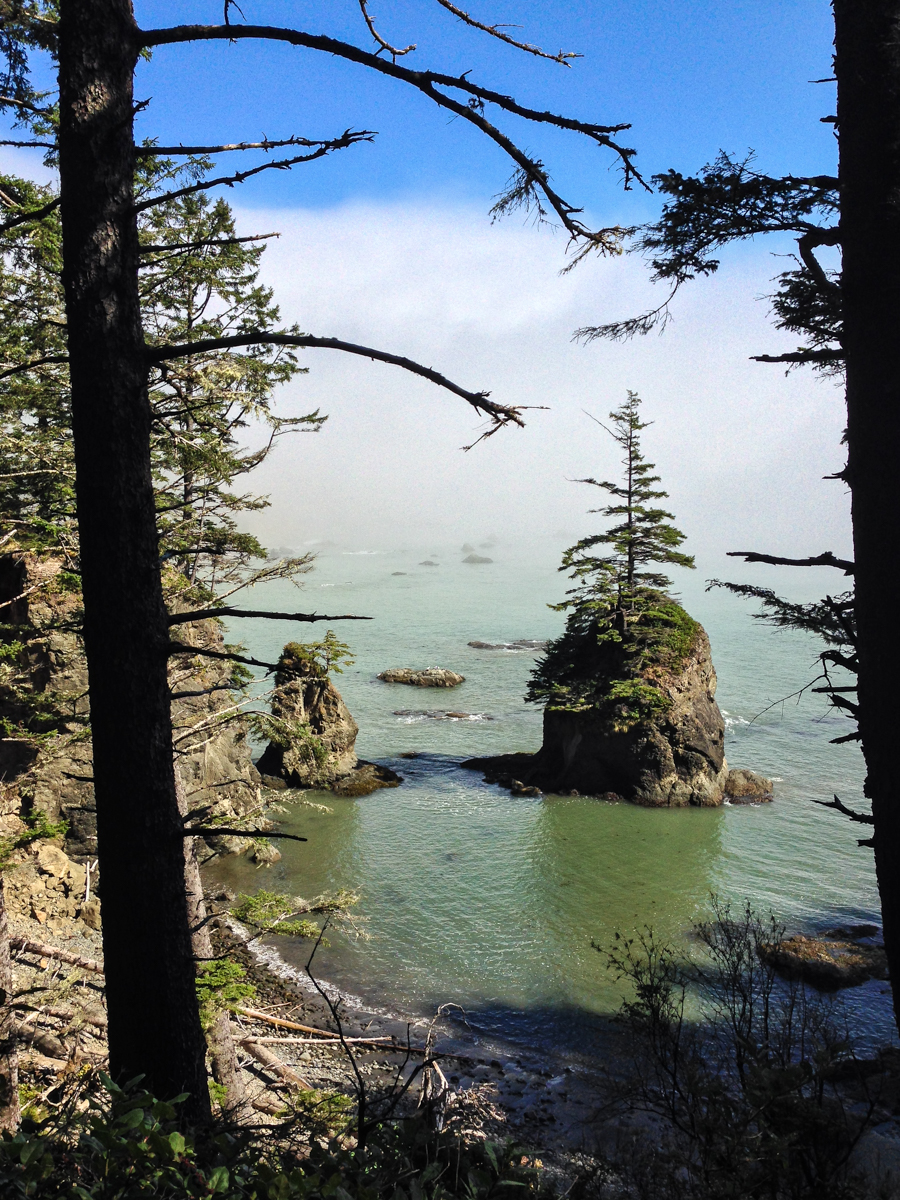
Sea stack along headland at Third Beach
While it was my favorite, it certainly wasn’t the easiest. Turns out that tides along these beaches are a lot greater than I am used to – up to 8 feet, making it impossible to simply walk along the beach to most campsites. Instead, you must climb and hike over the many headlands that just out to meet the ocean, often climbing steep inclines with the aid of knotted ropes put there for that purpose.
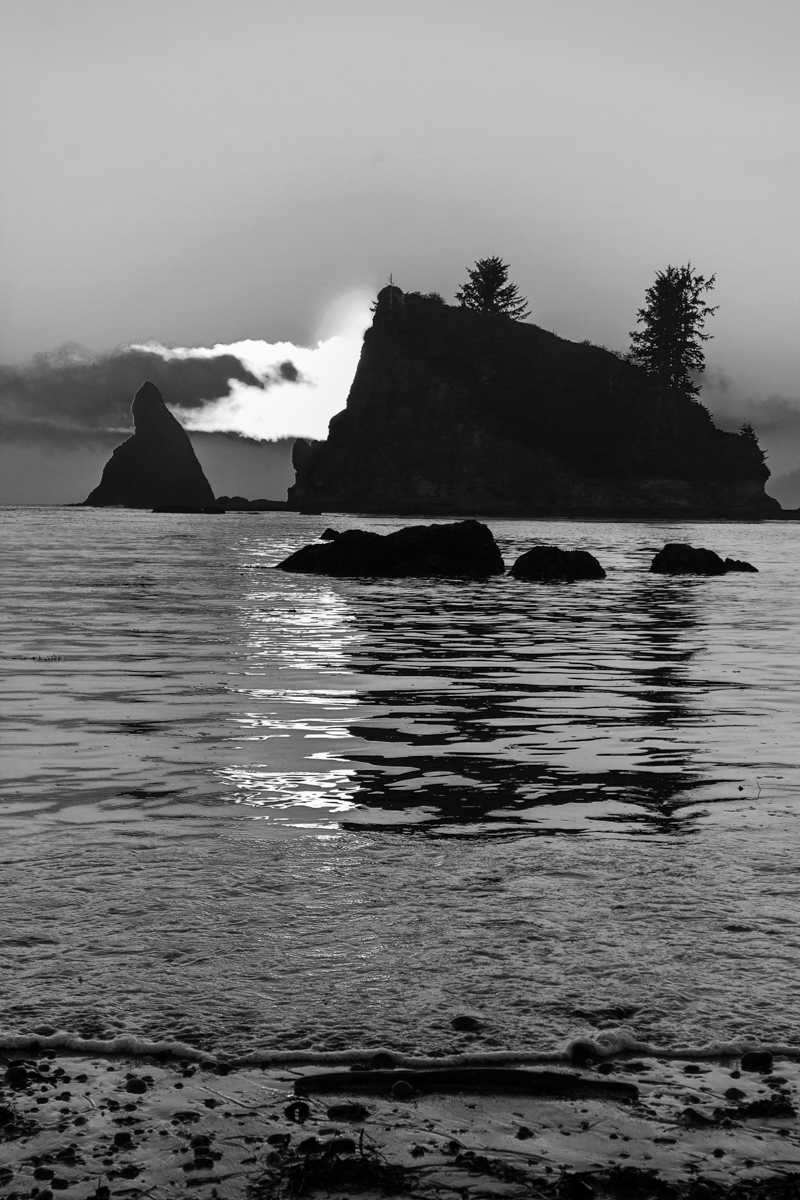
Sea stacks at sunsetSea stacks silhouetted by twilight over the ocean (iPhone)
After questioning the decision a few times, it soon became apparent why it was worth it as the sun started to drop into the ocean.
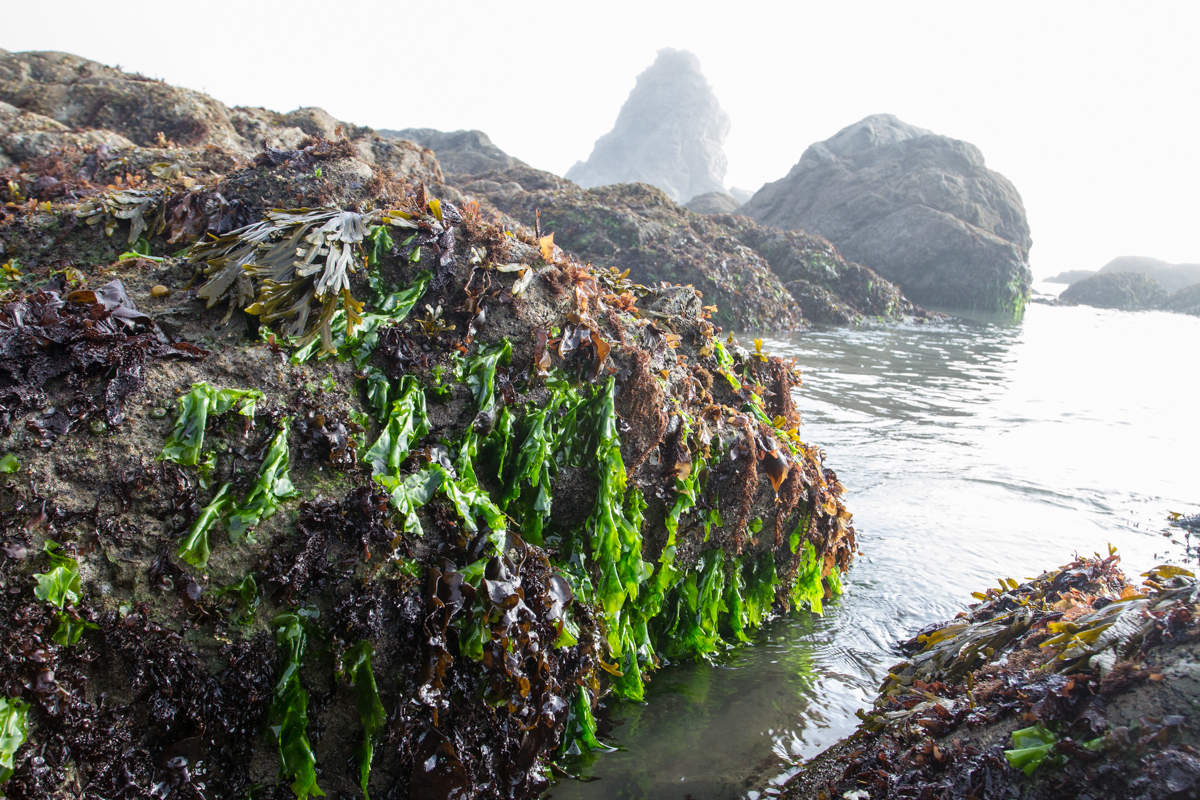
Low tide along the beach at Scott Creek
Low tide exposes rocks and tide pools and a host of associated life.
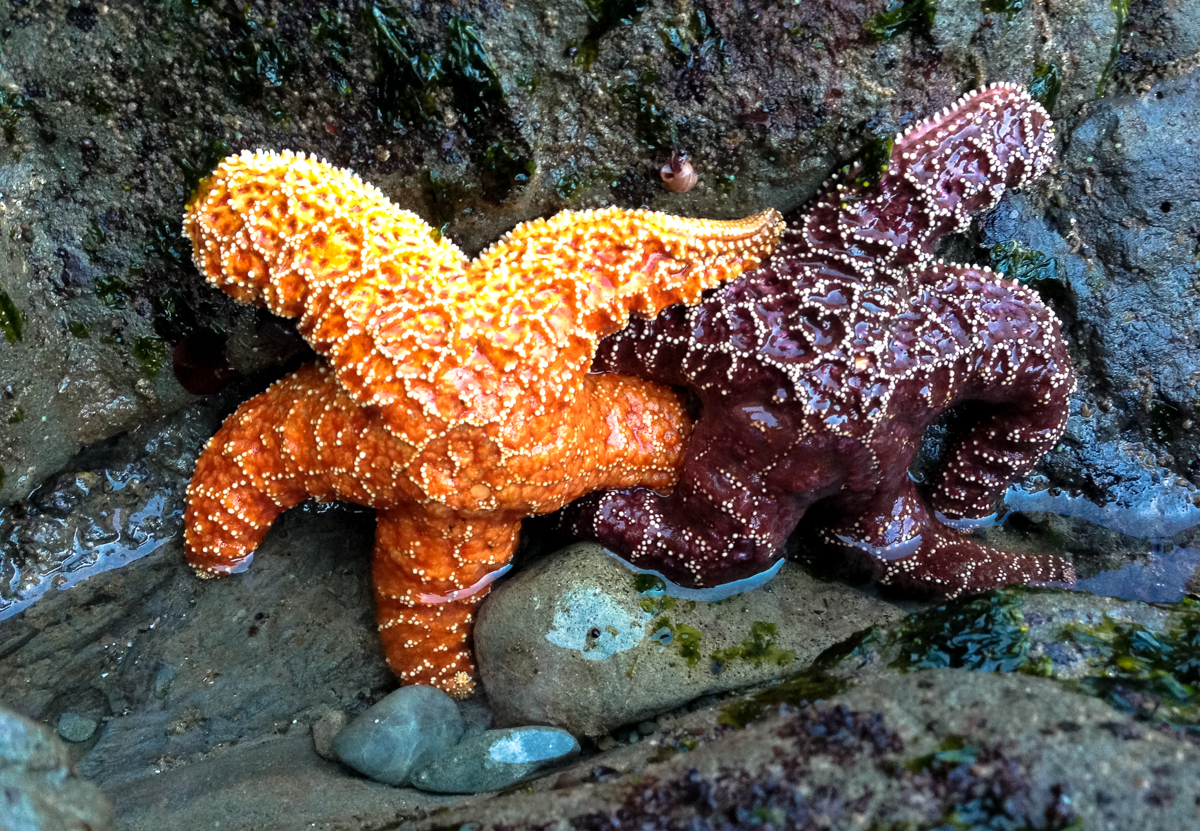
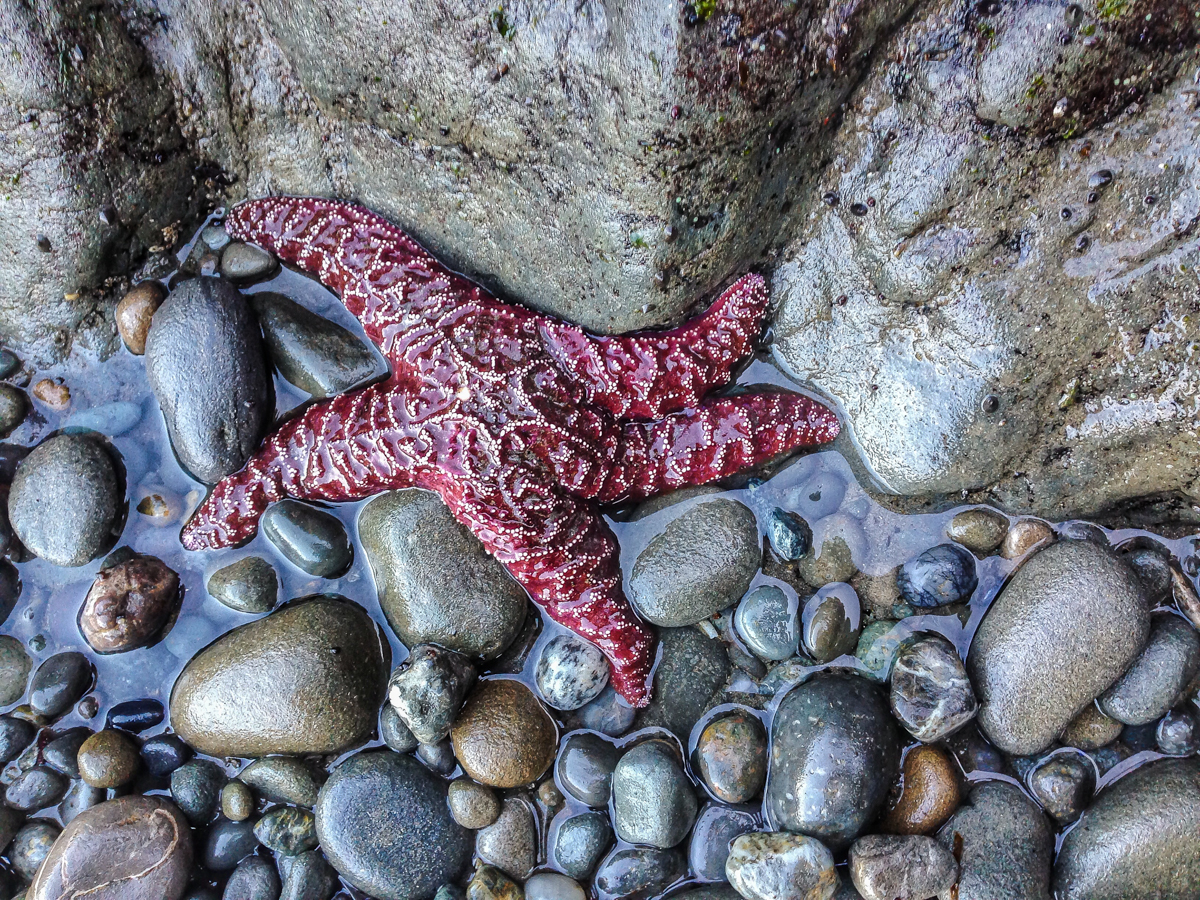
Ochre Sea StarThe Ochre Sea Stars come in a variety of colors (iPhone)
Scattered amongst the rocks and pools were so many creatures and plants that I was not familiar with…but one organism was quick to catch your attention – the Ochre Sea Star. The variety of colors in this common species ranges from bright purple, to maroon, and, to what seemed to be the dominant color morph, bright orange.
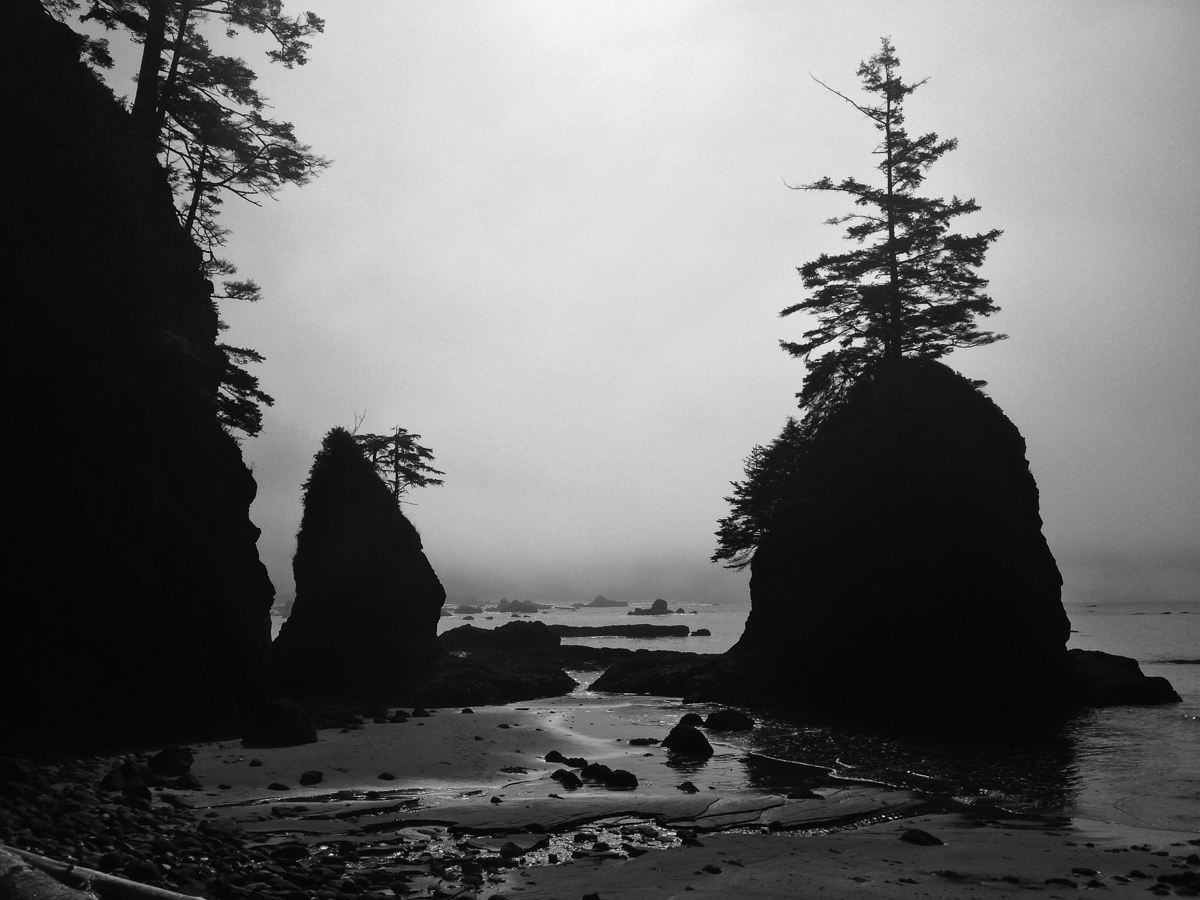
Morning fog rolling in along the beach
As beautiful as sunset was, the sunrises along the coast were even more breath-taking. The early morning fog bank played cat and mouse with the sea stacks giving the entire scene a mystical feel.
Sea stacks at sunrise (iPhone)
When the first light hit the sea stacks, the contrast with the dark waters and rocks at low tide was stunning.
In addition to the tidepool creatures , there was a lot of other wildlife along the beach, although my lack of a telephoto lens prevented photographs. A pair of Bald Eagles graced the sea stacks, as did numerous Double-crested Cormorants, and Western Gulls. A family of River Otters came out onto the beach from Scott Creek and played in the ocean under the watchful gaze of thirty or more distant Harbor Seals lounging on the rocks at low tide. And one morning, one of the Raccoons they warn you about as possible camp raiders, picked its way along the rocks at low tide looking for an easy meal. The return hike was timed to coincide with low tide, eliminating the scramble over one small headland. The others required a climb – but it turned out to be worth every weary step.
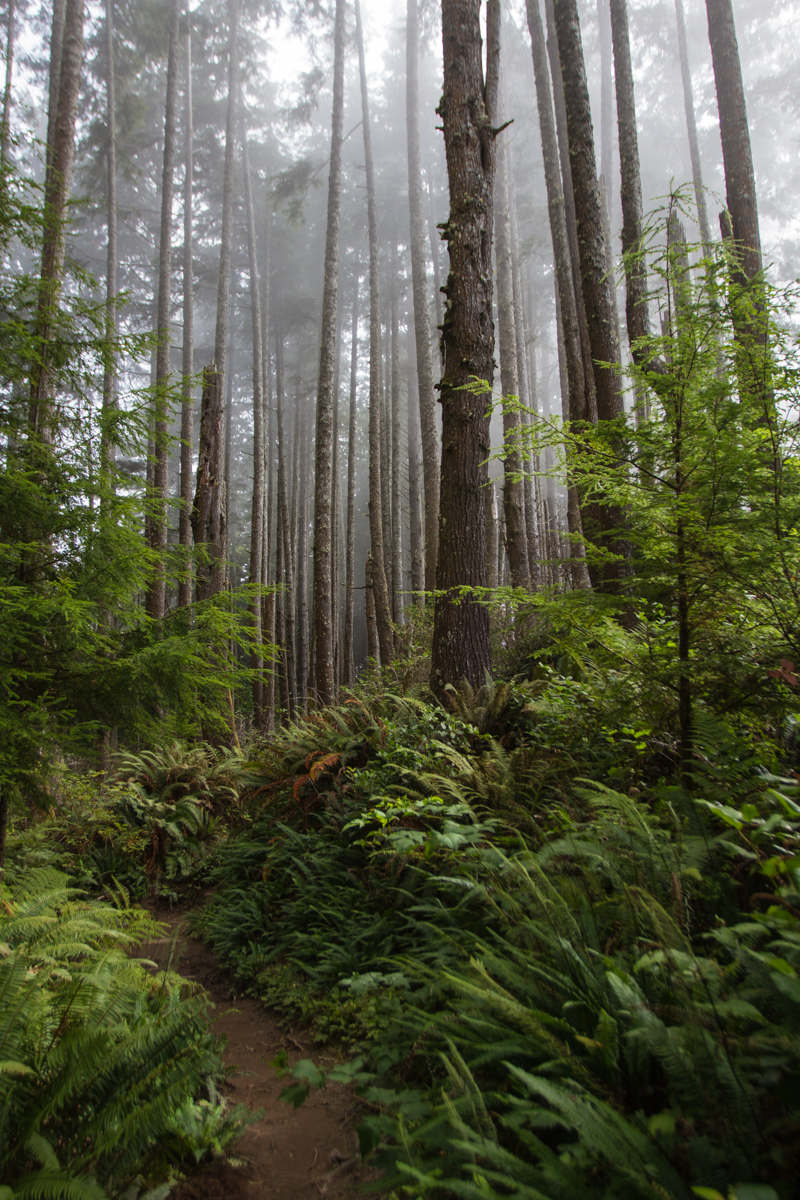
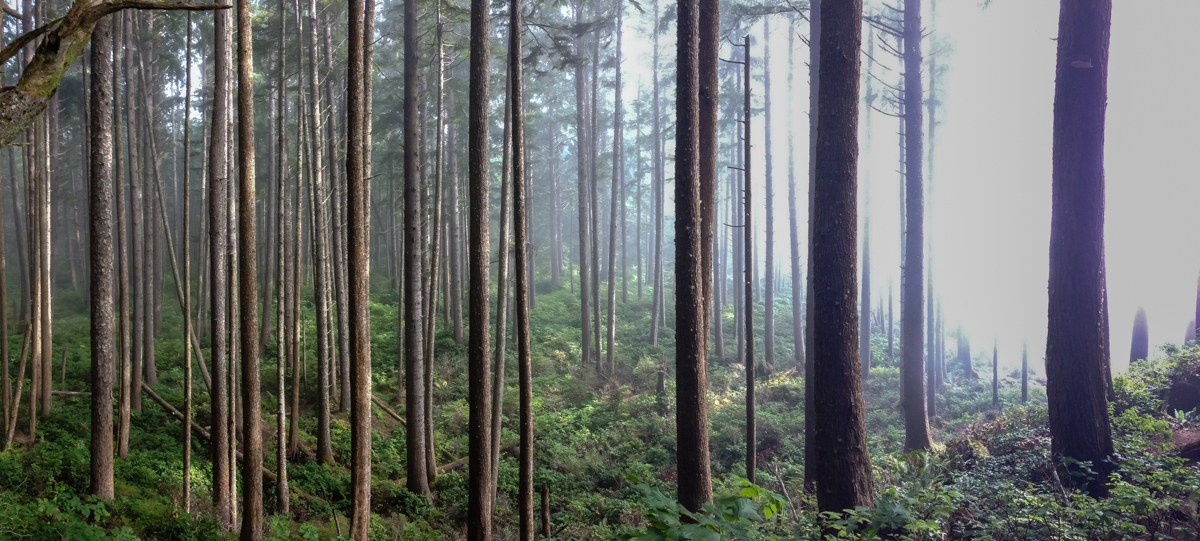
Morning fog rolling into the forest on the return trail
The fog gave the whole scene the feel of a soft painting.
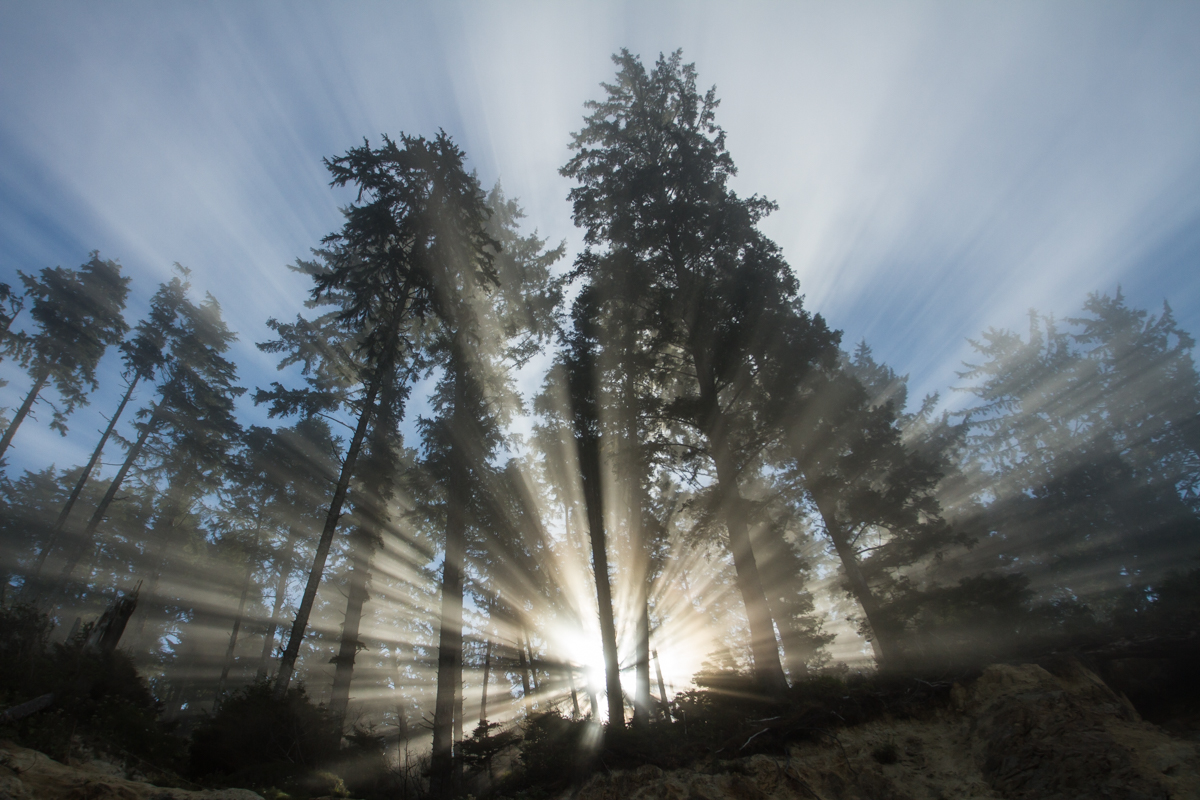
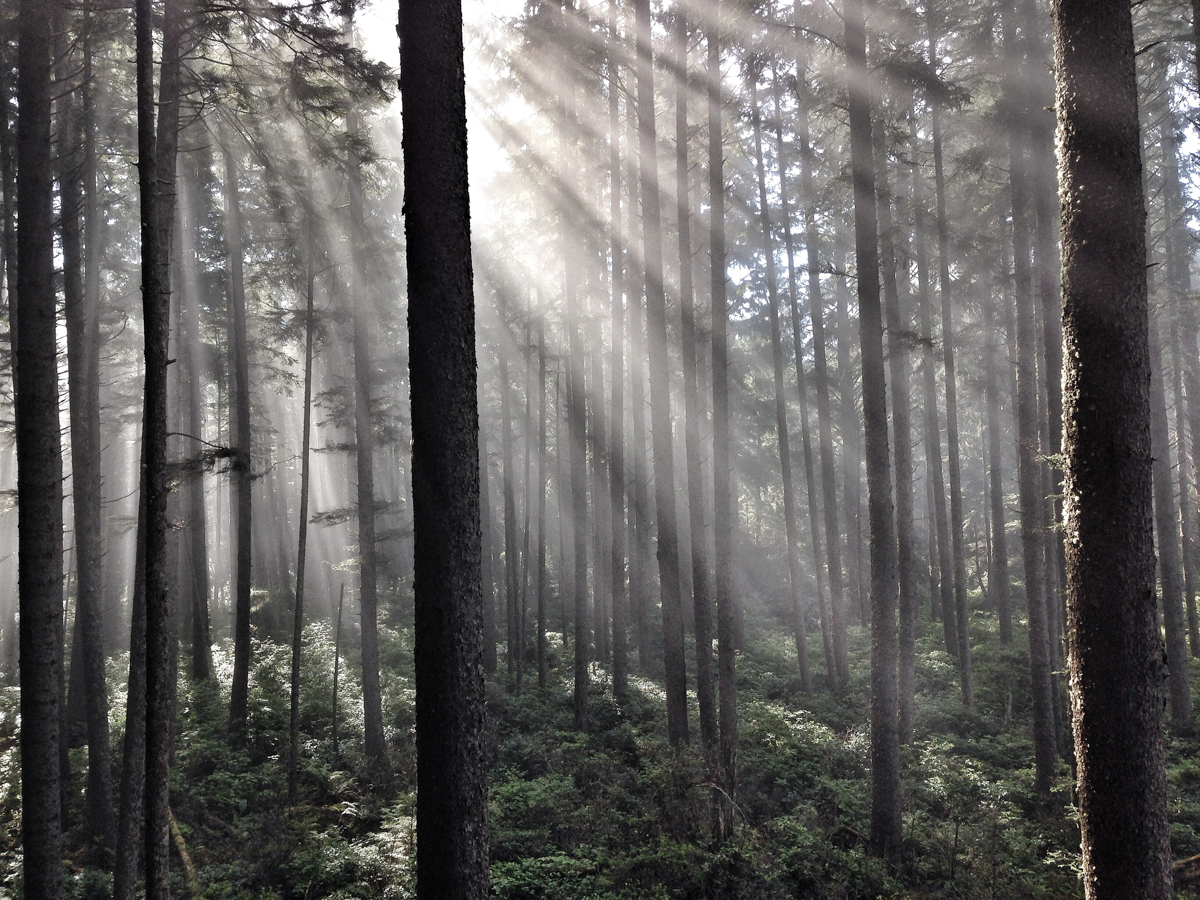
Sunlight highlighting the forest from the beachSunrise through the fog in the forest (iPhone)
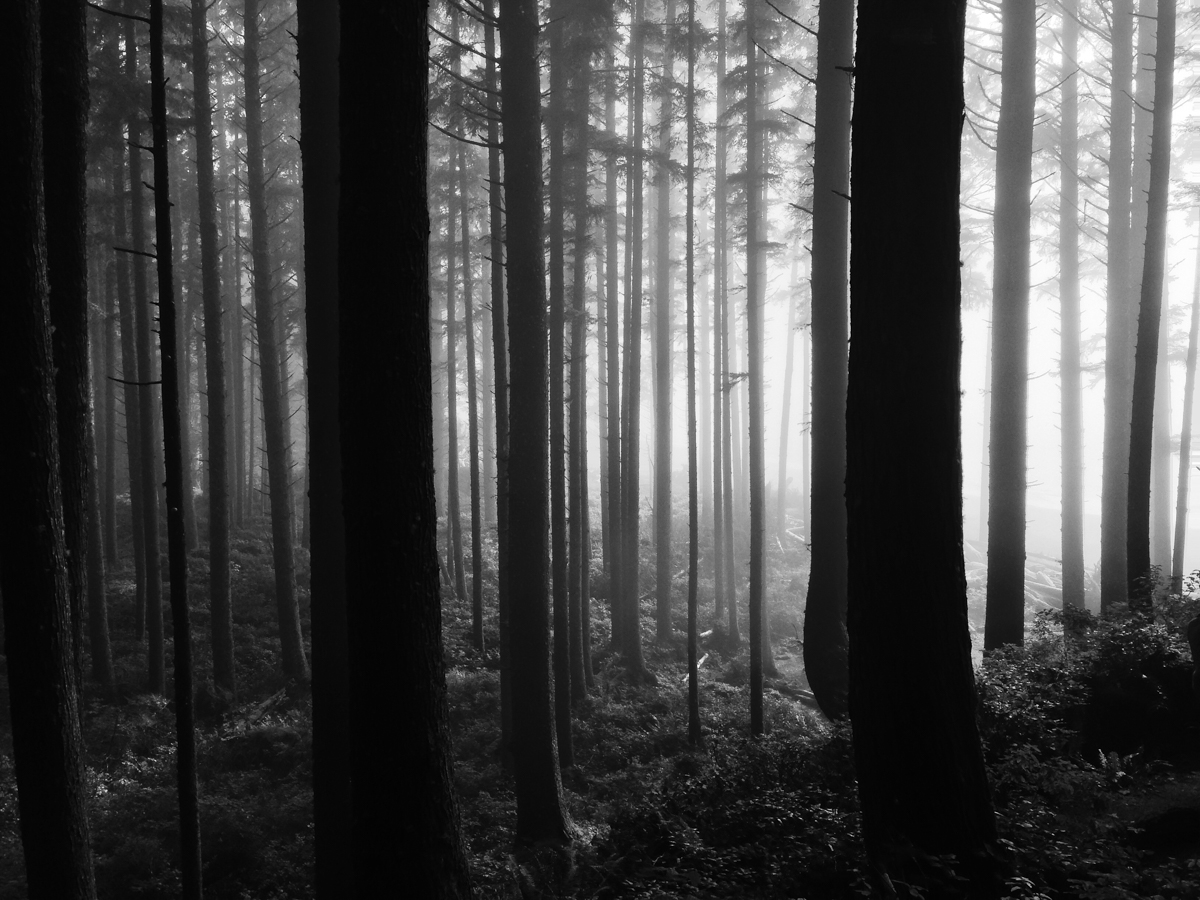
Then the sun rose high enough to pierce the grayness with shafts of light streaking through the looming tree trunks…unforgettable.
It was a long drive to the last campsite in a totally different environment – the treeline in the mountains at a place called Deer Park.
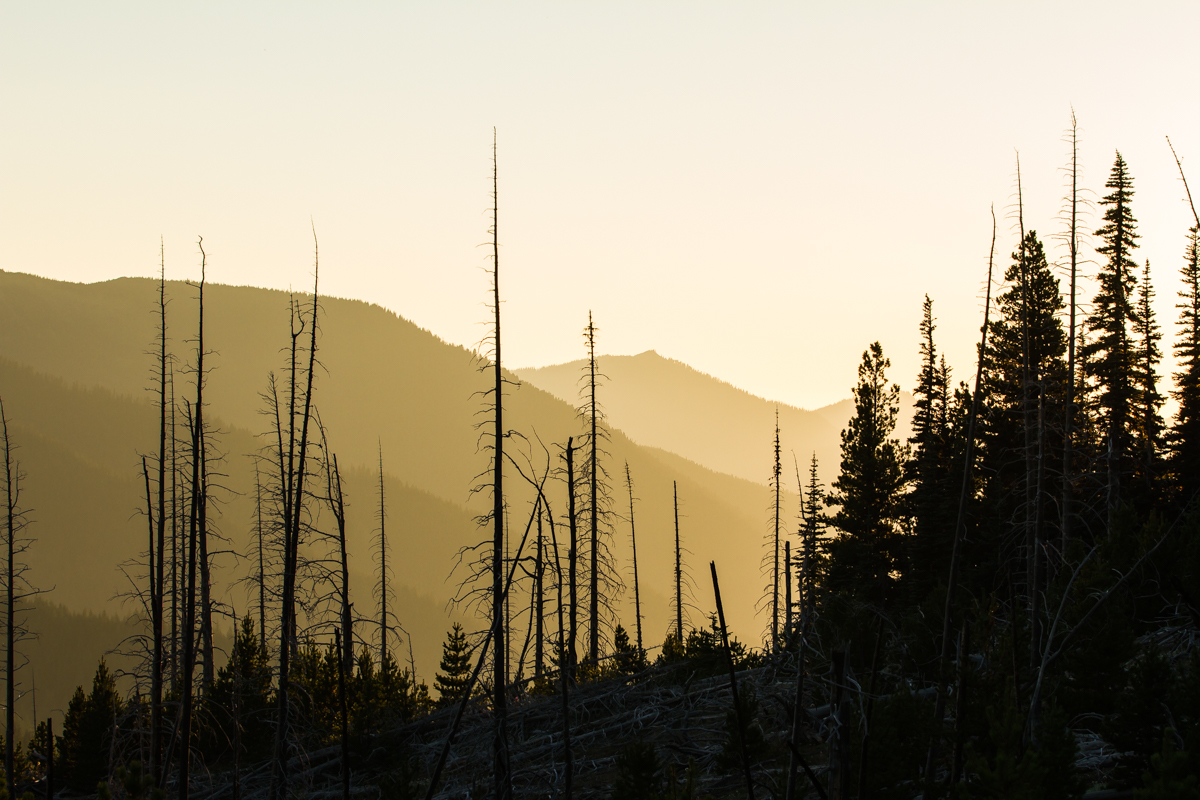
Deer Park at sunset
At an elevation of 5400 feet, Deer Park is reached by a long, narrow, winding gravel road that leaves you wondering if you will ever reach your destination. The quiet of the space and silhouettes of the trees against the receding waves of mountains made for a beautiful sunset. The sky was clear, so the stage was set for an incredible night sky.
Milky Way from Deer Park campground
It did not disappoint. Wish I had learned about night sky photography before this trip, but I am definitely going to learn now for the next time I am in such an amazing skyscape.
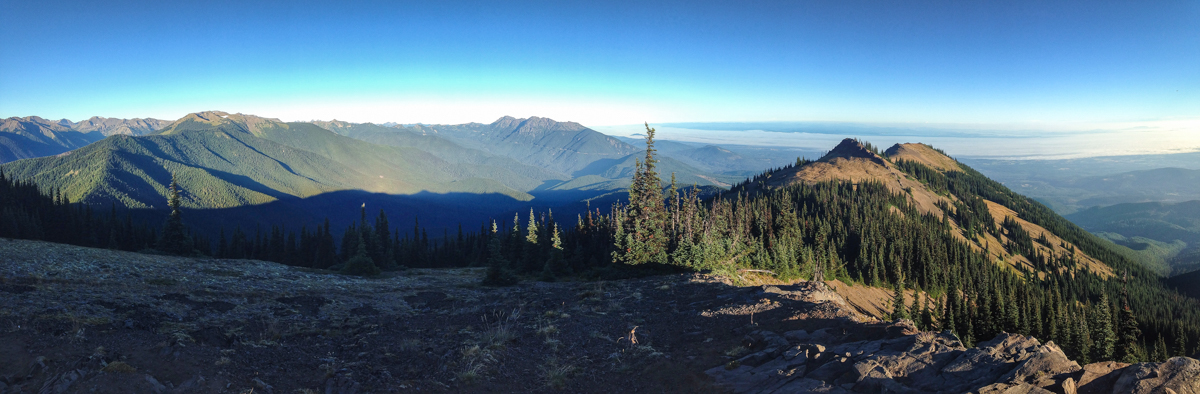
Panorama from above the Deer Park campground (iPhone)
The next morning, the view seemed endless, and the combination of mountain peaks and the fog-covered waters of the Strait of Juan de Fuca was spectacular.
Over the span of several days it it would be easy to think you had traveled hundreds of miles to a variety of stunning landscapes from the coast to the mountains. But, instead, it was a series of short drives and walks in some of the most stunning places I have been and all in one awe-inspiring place, Olympic National Park.
Here are a few more images from this beautiful park.
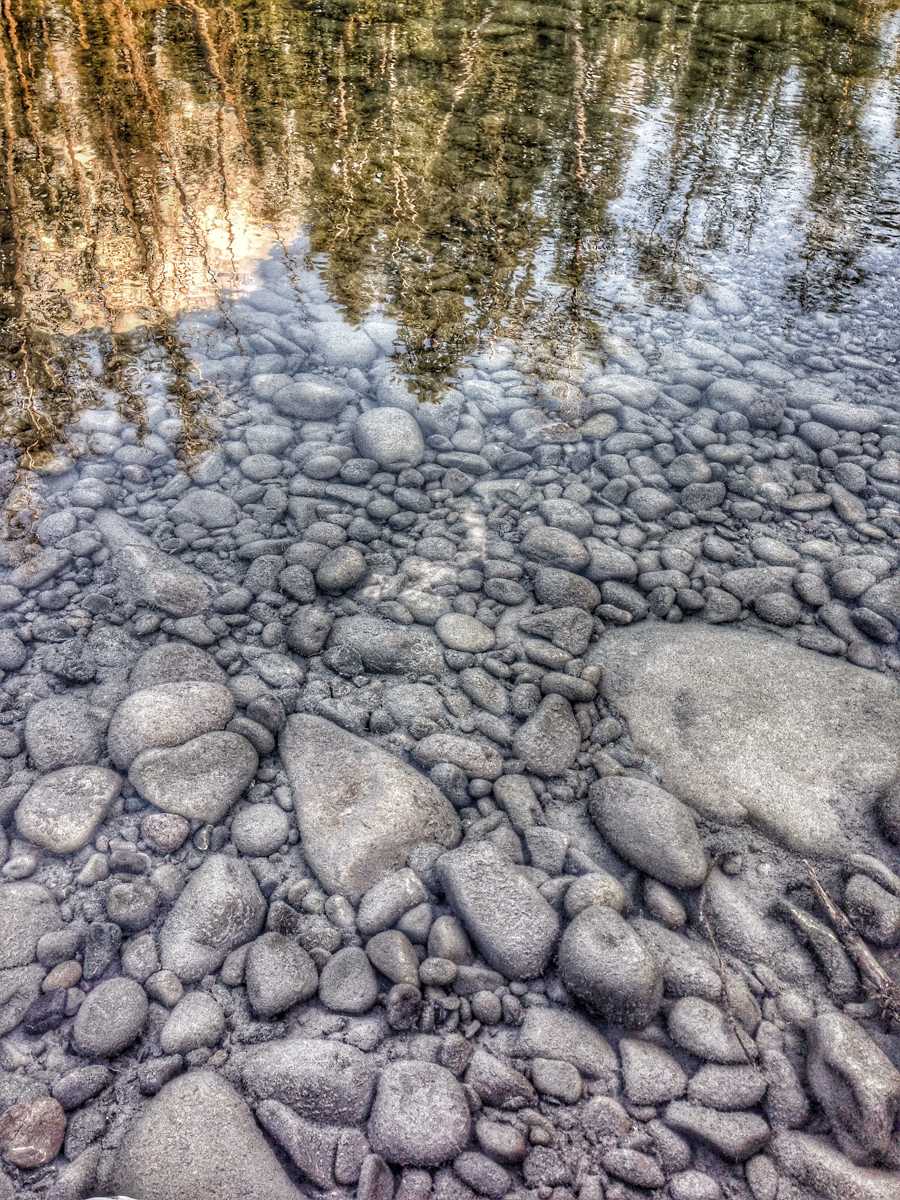
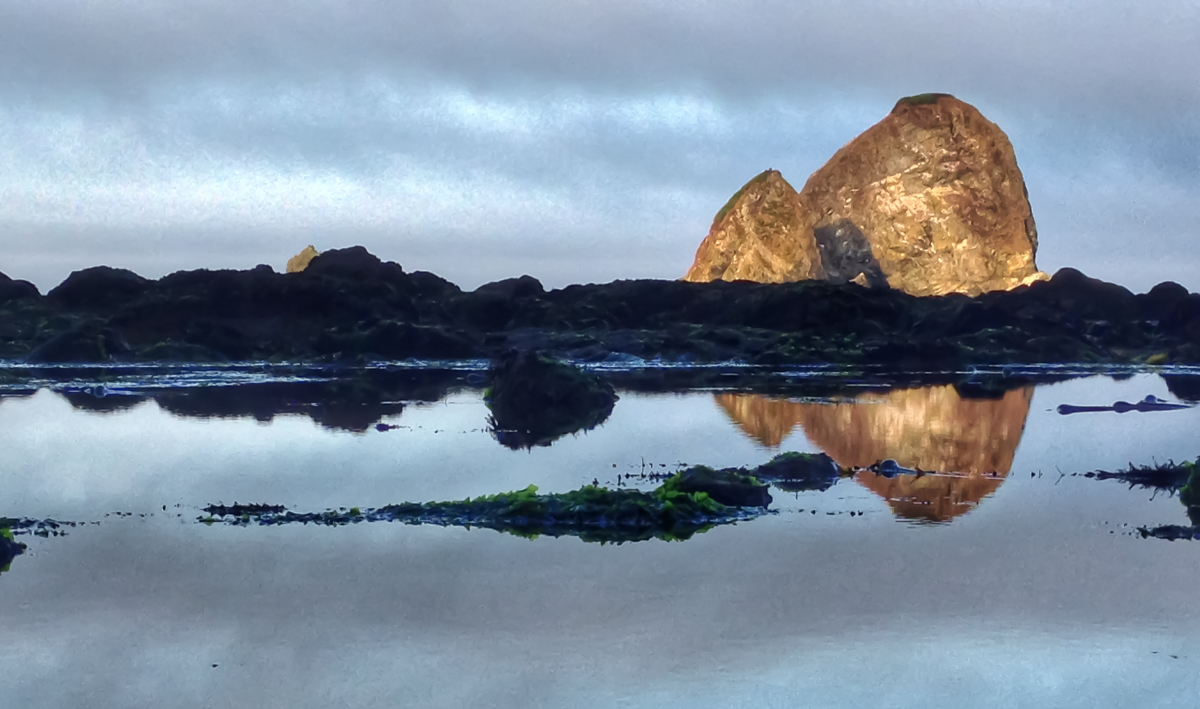
Deer Park sunrise above the tree line (iPhone)Patterns in the tidepoolsOchre Sea Star at low tide (iPhone)Reflections in a pool along the Queets River (iPhone)Sea stack in cove in black and whiteSea stacks at sunrise (iPhone)Sea stacks at sunset in black and whiteThird Beach headland forest panorama (iPhone)Third Beach headland forest in black and white (iPhone)
It’s always remarkable how much we each see when we slow down, cast our gaze narrowly but intently, and just watch.
~Zoe Weil
I was out walking a country gravel road the other day, hoping to find some caterpillars. I did see some signs of Luna Moth larval feeding on the ubiquitous Sweet Gums, but not much else. Fnally, I caught something out of the corner of my eye…
Early instar, Polyphemus Moth larva (click photos to enlarge)
A tiny green eating machine, sort of chunky, with small clusters of bristles on red-tipped tubercles. It was on a small Winged Elm tree. I had never seen a larva like this on that tree species, but it looked like an early instar of a moth species I have seen many times in the past. When I checked Bug Guide, it was, indeed, a Polyphemus Moth caterpillar, Antheraea polyphemus.
Polyphemus Moth larva, lit from side with twin flash
I am guessing it could be a late first, or early second instar, so this little fella has a few more weeks of eating and growing before it becomes the large, plump, bright green caterpillar I have seen and used in programs so many times before . They resemble the larvae of Luna Moths, but lack the long stripe that runs most of the length of the abdomen, and, instead, have a series of oblique stripes that pass through the spiracles along the abdomen. Polyphemus larvae feed on a variety of deciduous tree leaves, but I have found them most often on various oaks and River Birch. Hopefully, this little guy will still be feeding by the time BugFest rolls around on September 20.
Some of these resemblances are perfectly staggering – to me they are a source of constant wonder and thrilling delight.
Henry Walter Bates, in letter to Charles Darwin, 1861
In one of my nightly checks of the visitors at my screens, a small wasp-like creature caught my eye. But a closer look revealed some interesting details.
At first glance, it looked like some sort of wasp (click photos to enlarge)
The patterns and colors looked wasp-like, but the wings, lack of a constricted waist, feathery edges to the back of the wings, and the odd tip of the abdomen certainly did not. I decided it must be some sort of moth that was a mimic of a stinging insect. This type of mimicry, known as Batesian Mimicry, is named after English naturalist, Henry Walter Bates. It is quite common in various insect groups with various types of flies, moths, and some beetles being the leaders in the field around here of wasp and bee look-a-likes.
Many predators that attack bees or wasps suffer painful stings. This is why many have learned to avoid insects with clear wings and yellow and black bands around their bodies. By mimicking stinging insects, the clearwing moths are able to avoid many predators and thus fly even during daylight hours. But, they are also attracted to lights, as was my visitor.
Dogwood Borer Moth
Scanning the field guides I think this one is a Dogwood Borer Moth, Synanthedon scitula. It is a member of the Clearwing Moth family, Sesiidae. I have reported on another group that often are called clearwings, the Snowberry Clearwing and Hummingbird Clearwing moths. But they are members of a different family, the Sphingidae (Sphinx Moths). This species is characterized by transparent wings with some dark scales near tips, a steely blue/black body with yellow stripes on the abdomen, and a rounded anal tuft on the end of the abdomen.
Female moths lay their eggs in wounds on trees. Most of the larvae of this family of clearwings are borers in the limbs, trunks, bark, or roots of trees, shrubs, herbs and vines. The Dogwood Borer Moth’s larvae tunnel beneath the bark of a wide variety of deciduous trees such as beech, hickory, elm, dogwood, apple, and pecan. The galleries made by feeding larvae can cause a lot of damage to the host tree, plus it may give access to other potentially harmful species such as certain fungi.
Dogwood Borer Moth
One reference stated that this group of moths take their deception one step further in that some species have legs with conspicuous tufts of hairs that are tipped with yellow scales. These resemble the pollen baskets on the hind legs of honeybees. He also commented on not knowing the deception value of the prominent tufts of feathery scales at the tip of the abdomen. I was unable to find anything that gave a clear function for these so-called anal tufts, although I wonder if it has something to do with pheromone distribution since they tend to be slightly different shapes in male and females. But, in spite of the tufts, the overall impression of this beautiful mimic is one of leave me alone or else, so, mission accomplished.






























 Roads End Naturalist