Green is the prime color of the world, and that from which its loveliness arises.
~Pedro Calderon de la Barca
Just finished a very wet weekend with a wonderful family from the Netherlands down at Pocosin Lakes and Alligator River National Wildlife refuges. Since it was raining most of Friday afternoon, I didn’t even take out the camera. But Saturday morning was a bit more cooperative. I challenged the group to find Green Treefrogs in the vegetation along the canoe launch at Milltail Creek, and when we started finding one every few feet, I couldn’t resist snapping a few images.
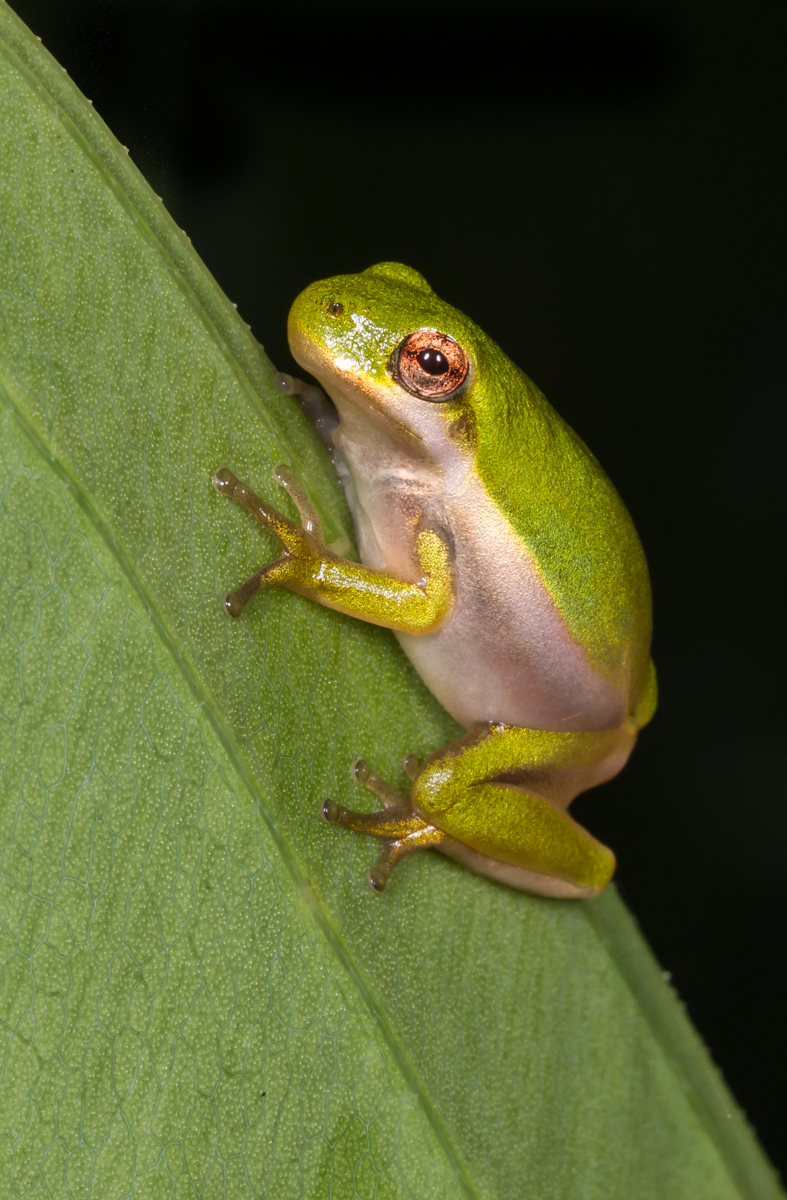
Juvenile Green Treefrog (click photos to enlarge)
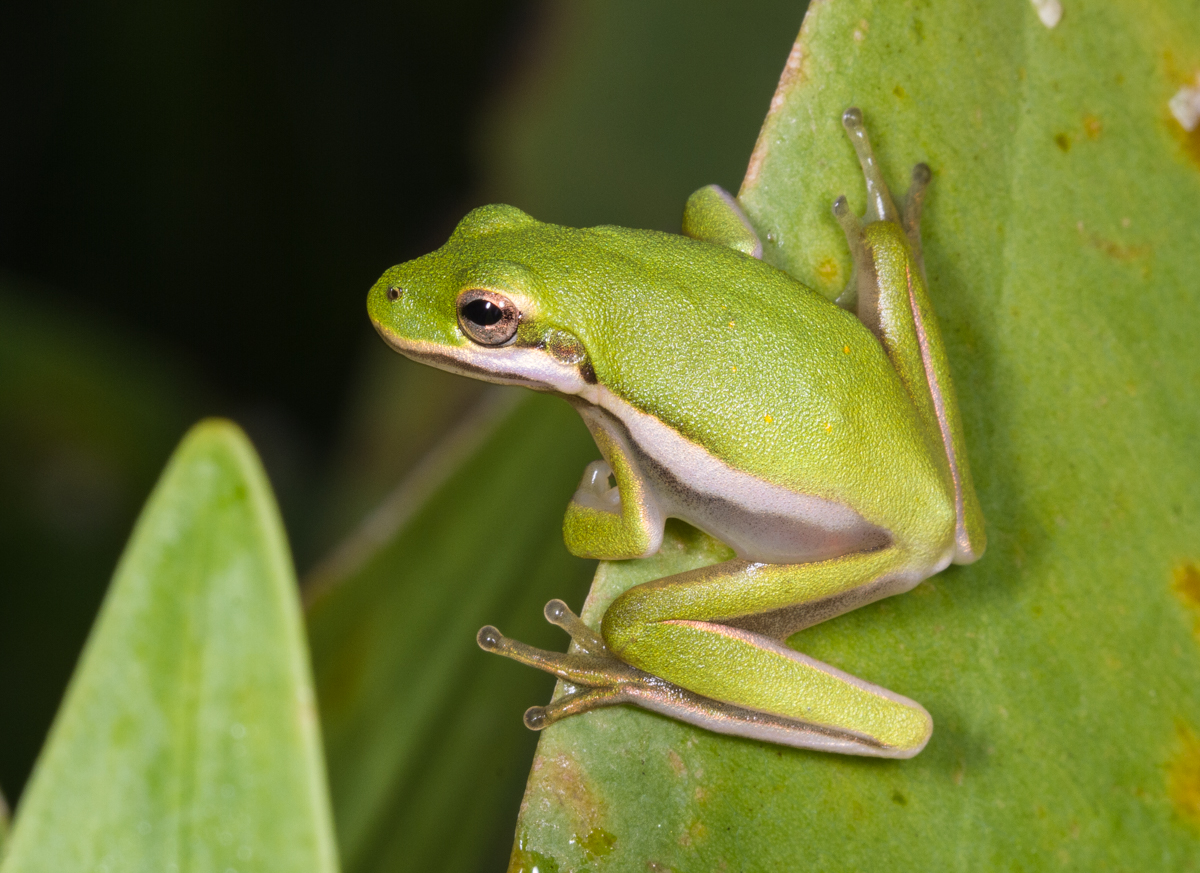
As we looked, we found frogs of all sizes, from one inch long “juvies” to the mellow-looking adults. The smallest ones were recently transformed from the tadpole stage and showed the blunter nose of the juvenile frogs.
Young Green Treefrog in the classic “I’m about to jump” pose
I kneeled down to get closer views of several frogs – I never tire of looking at these guys. There is something about their form that is so very appealing to the eye.
Adult Green Treefrog
And when eyeball to eyeball, I really appreciate these green beauties.
Eye of newt, and toe of frog, Wool of bat, and tongue of dog, Adder’s fork, and blind worm’s sting, Lizard’s leg, and owlet’s wing, For a charm of powerful trouble, Like a hell-broth boil and bubble. Double, double, toil and trouble; Fire burn, and cauldron bubble.
~William Shakespeare
I went camping last weekend with friends in the mountains of Virginia in Jefferson National Forest. We hiked a few trails in the area near Mountain Lake and I carried my macro set-up (Canon 7D, Canon 100mm lens, and Twin Light) on every trail in hopes of capturing a few close ups. After a heavy downpour Saturday night, we broke camp Sunday morning and headed to a beautiful spot called Glen Alton.
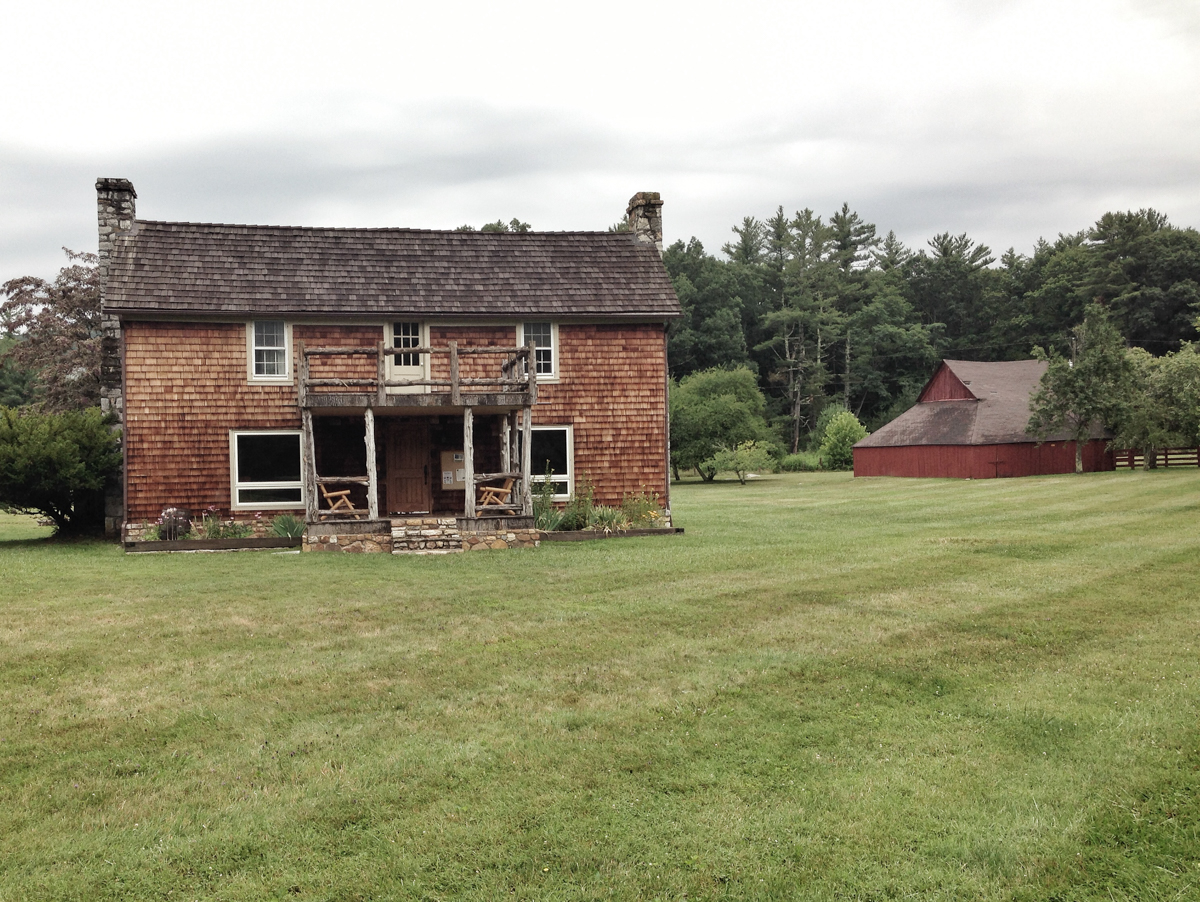
Restored buildings at Glen Alton (click photo to enlarge)
This area had been the farm and weekend retreat of a local businessman until the Forest Service acquired it in 1999. The buildings have been restored and it is beautifully maintained with a nice trail system and several wetlands and ponds, a true hidden jewel.
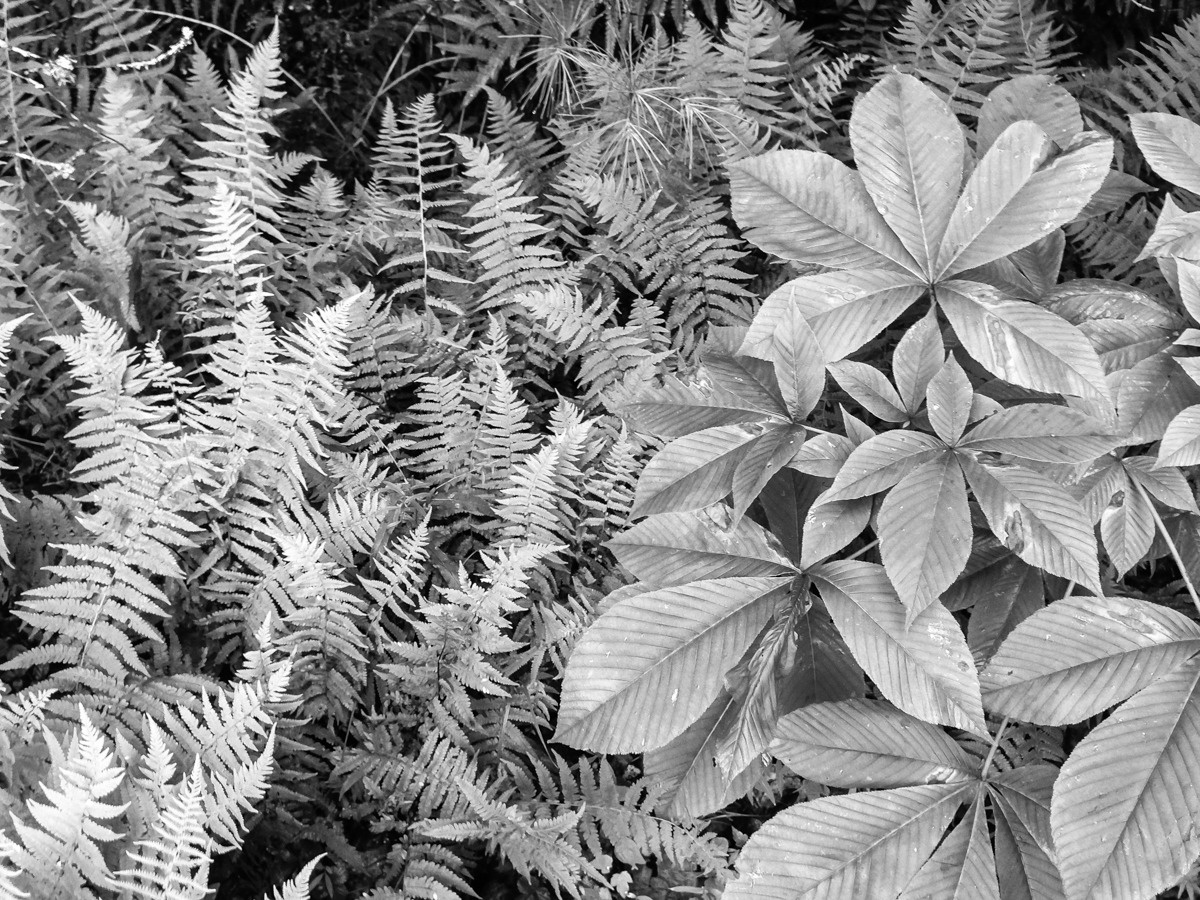
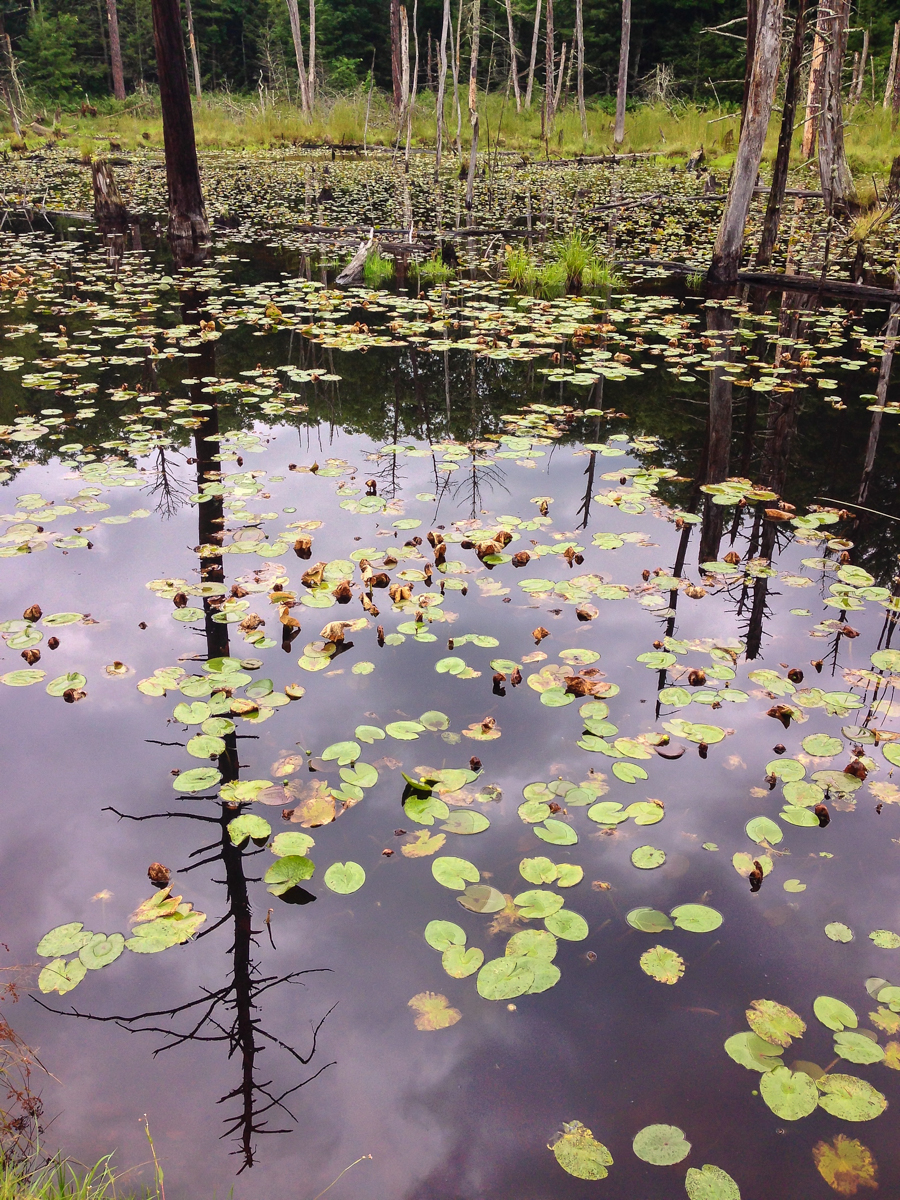
Lush vegetation along one of the trails at Glen AltonThere is an impressive wetlands about a mile down the trail at Glen Alton
Rain clouds began moving in as we headed back to the cars Sunday morning, giving the landscape a certain moodiness in colors and shapes.
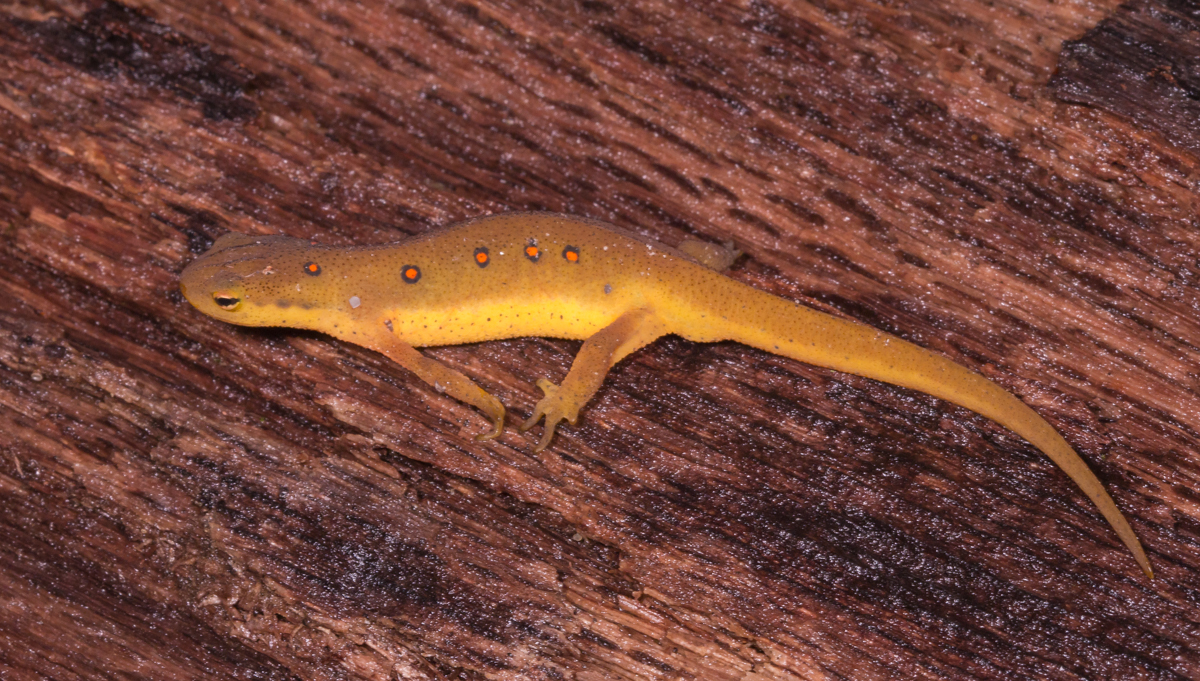
Red-spotted Newt crossing the trail
As we walked, someone spotted something in the trail – a red eft, the juvenile stage of the Red-spotted Newt, Notophthalmus viridescens. After hatching from eggs in water, newt larvae exist as aquatic animals with gills for a few months before transforming to the terrestrial efts. The eft stage can last up to several years before they again transform to a more aquatic adult phase which is olive green/brown in color. I bent down to take a couple of images and when I looked at the camera screen I noticed something I had never really paid attention to before…
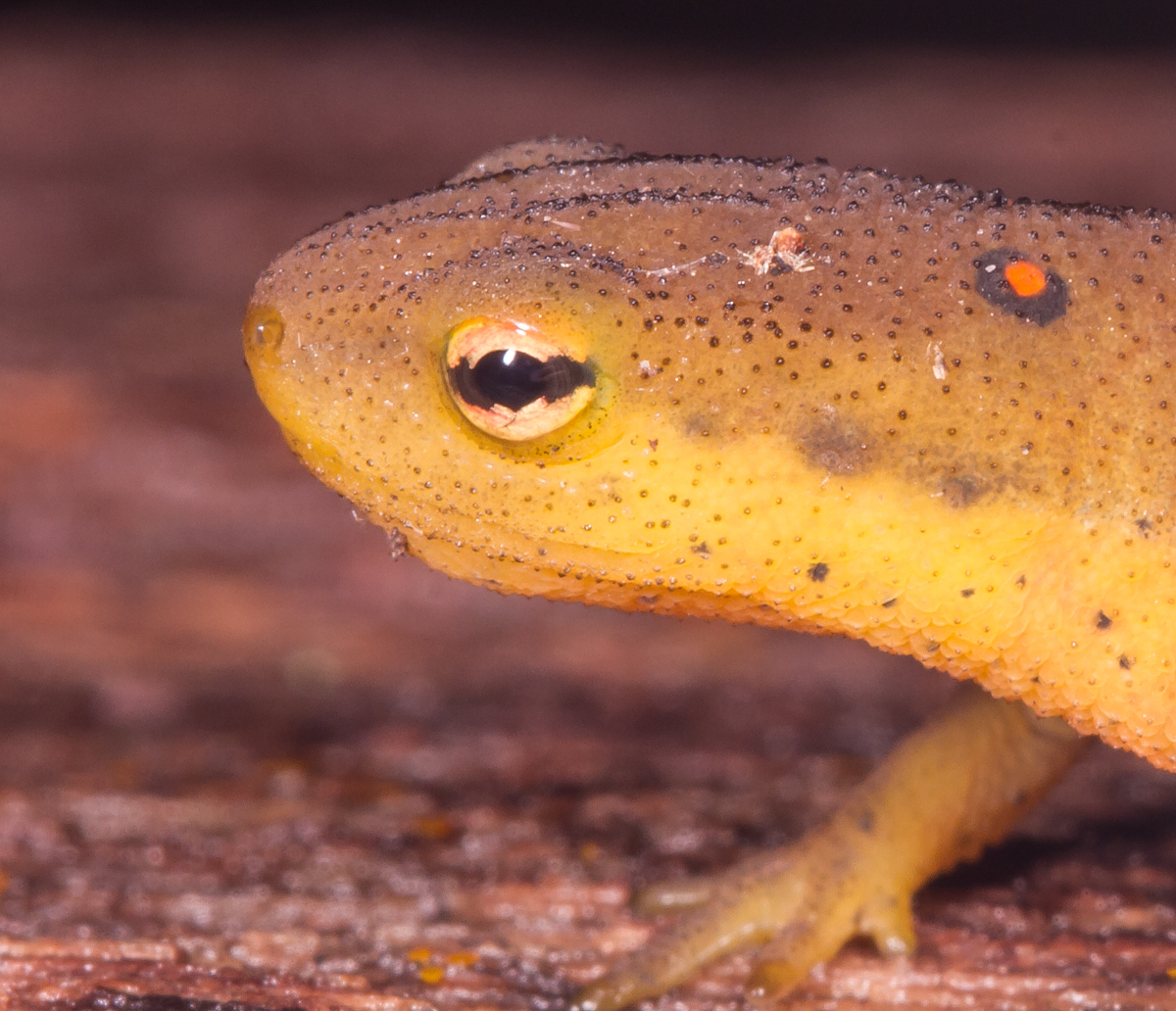
Close up of newt eye
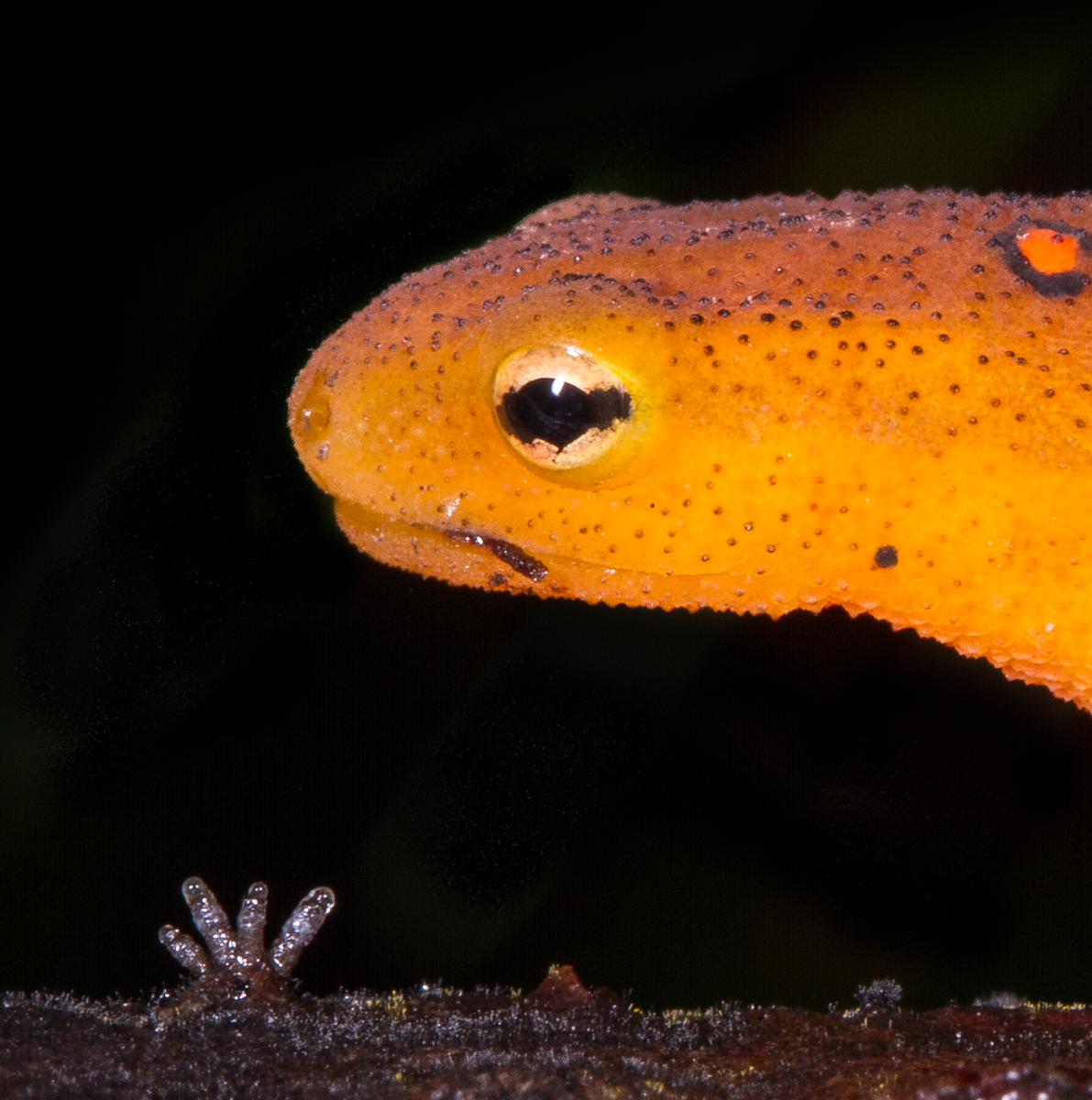
Their eyes are so strange-looking. My first reaction was that it looks like a tiny open set of black jaws. The pupils have jagged horizontal streaks running through them….how strange is the eye of newt (no wonder it was used in potions). The generic name, Notophthalmus, is likely derived from the Greek ophthalmos, meaning eye, and may be a reference to the eye-like red spots on the dorsal surface of both the adult and juvenile forms, or perhaps just pays homage to their odd eyeballs.
A few steps down the trail we ran across another, brighter orange, red eft.
We saw several red efts in the next few minutes, some much brighter orange than the first, and all with the weird eyes. It just goes to show you, even someone that spends a lot of time outdoors can always find something new when you simply look more closely at something. I have seen many newts in the past, but just never paid attention to their unusual eyes. When I got home, I Googled newt eyes and horizontal pupils, but never really found anything that discussed the function of the unusual pupil shape. What I did learn was that the eye of newt in the witches’ recipe in Macbeth probably referred to a eye-like seed of a medicinal plant, rather than an actual salamander eye. And, researchers have shown that one species of newt has an amazing ability to regenerate eye lens tissue repeatedly over a span of many years. Research of tissue regeneration in newts may even hold promise for studies on human cell regeneration.
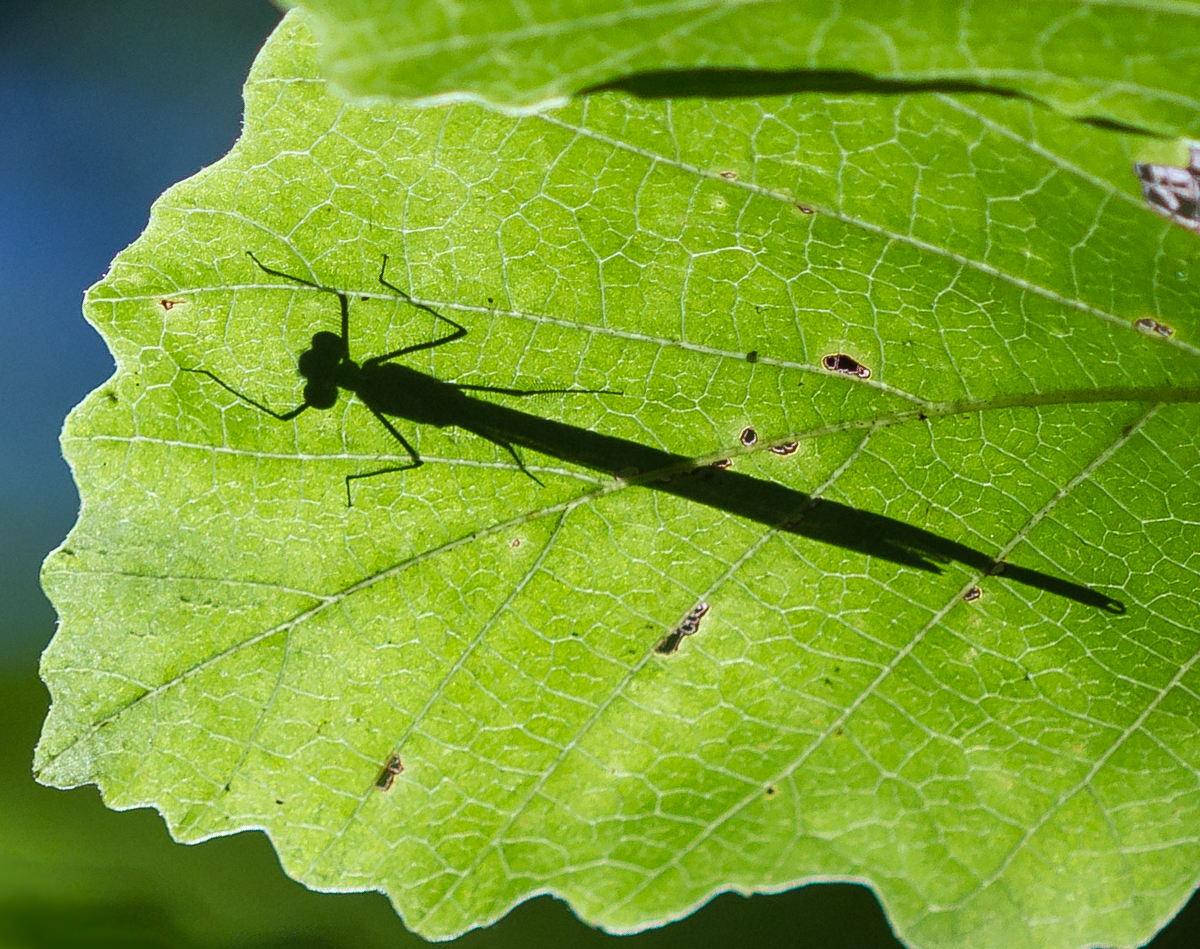
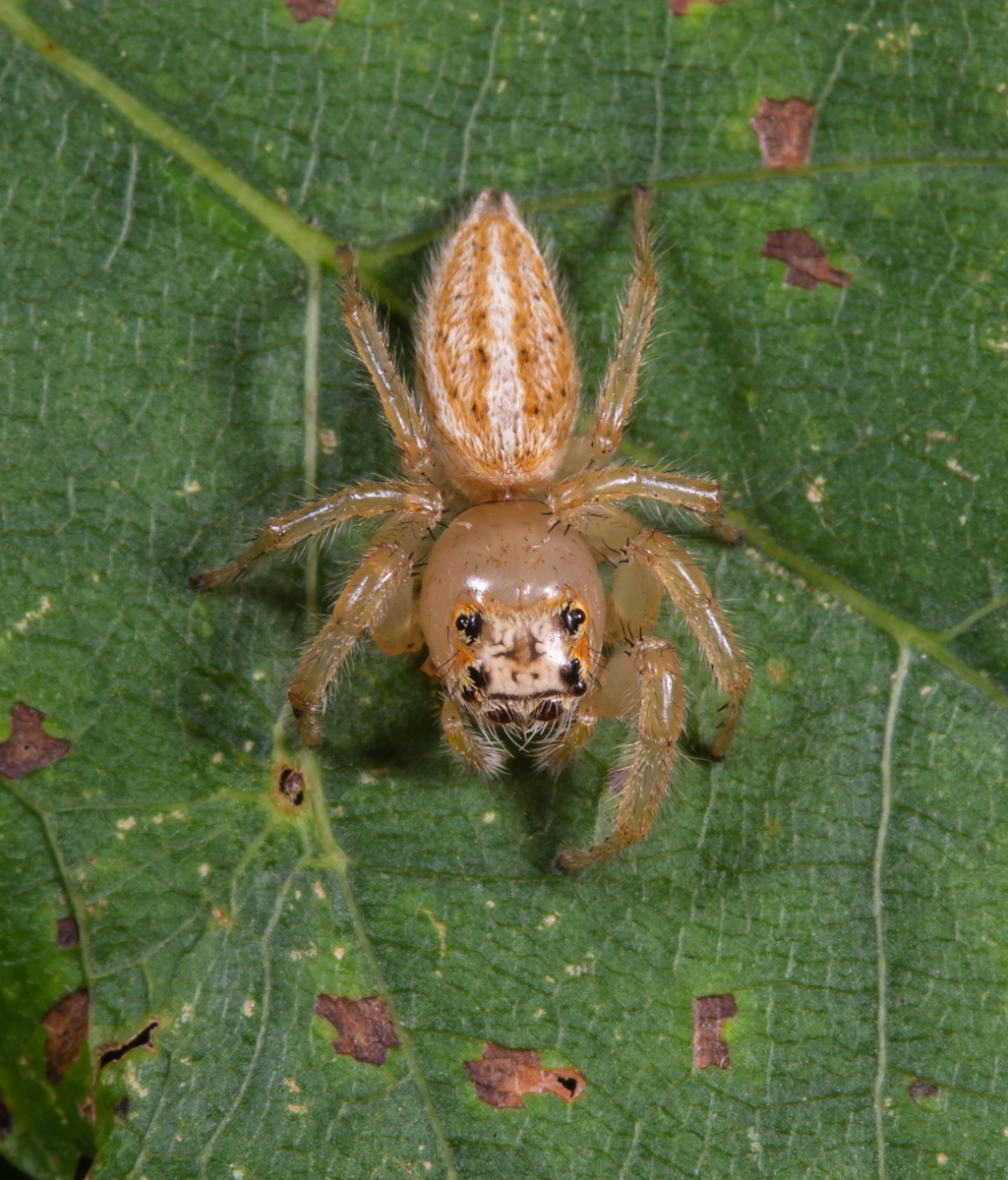
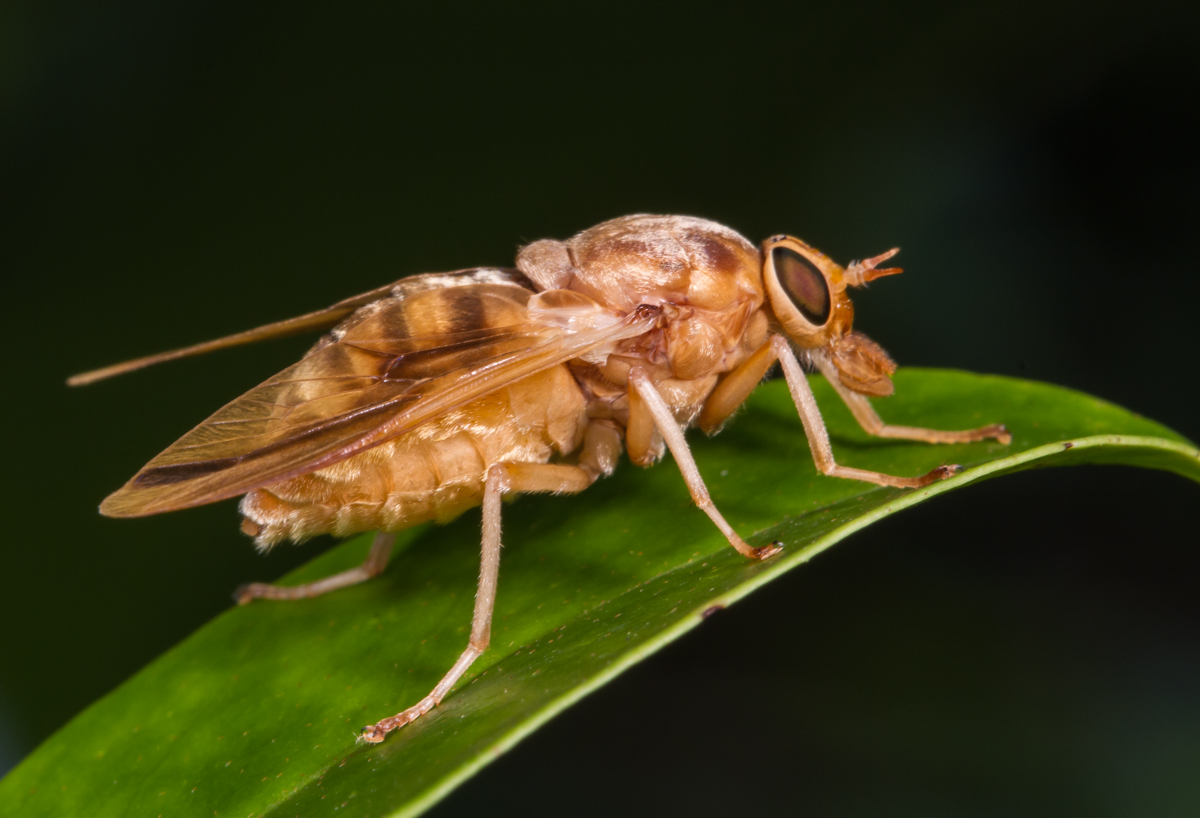
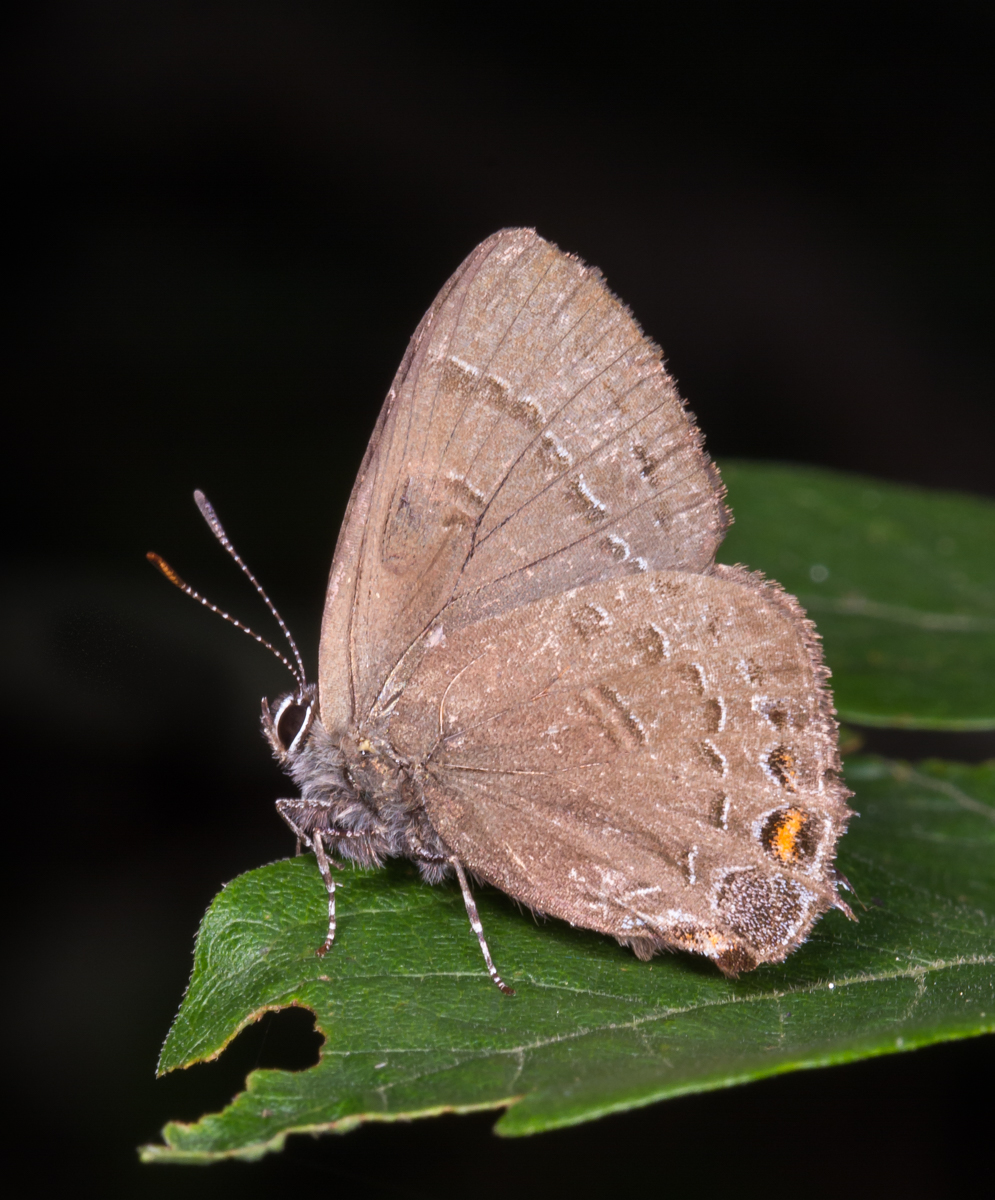
So, with all that focus on newt eyes, it caused me to look at my other images from the trip in a different light. I found that there was almost a theme of eyes in the images my lens had captured. So, let’s take a peek at a few of the eyes I encountered on the trails last weekend…
Bulging eyes of an Ebony Jewelwing damselfly silhouetted on a back lit leafRed eye of a male Eastern Box TurtleMultiple eyes of a Jumping Spider, genus ThiodonaUnidentified fly eyesThis faded hairstreak butterfly (probably a Striped Hairstreak) has fake eye spots and antennae on the hind wings (the antennae are almost worn off and the eye spots are very faint). Hairstreaks even rub their hind wings back and forth to make their fake antennae more life-like. This may provide some protection by fooling predators into striking a less vital part of the butterfly, allowing it to escape.
The more you know, the more beautiful everything is.
~George Santayana
I awoke early this morning, too early. What to do? I looked out and saw a moth at the lighted kitchen window. My brain drifts to my recent sightings of moths and their seemingly endless variety. Perhaps I will learn a new one today. I know something about some groups of moths, especially their caterpillars, but have never taken the time to get to know many of the adults. So, I sat down and looked at some moth images taken last week when I left the porch light on all night in hopes of attracting a few to the screen. Some of them stood out for their odd posture – they were perched with their abdomens curved up over their backs. I have seen this on many occasions, but never took the time to try to identify them. I have always assumed this has something to do with releasing pheromones for mate attraction. But, In researching this online, there doesn’t seem to be a clear explanation for this behavior. I was, however, able to learn a bit about the identity of my odd visitors.
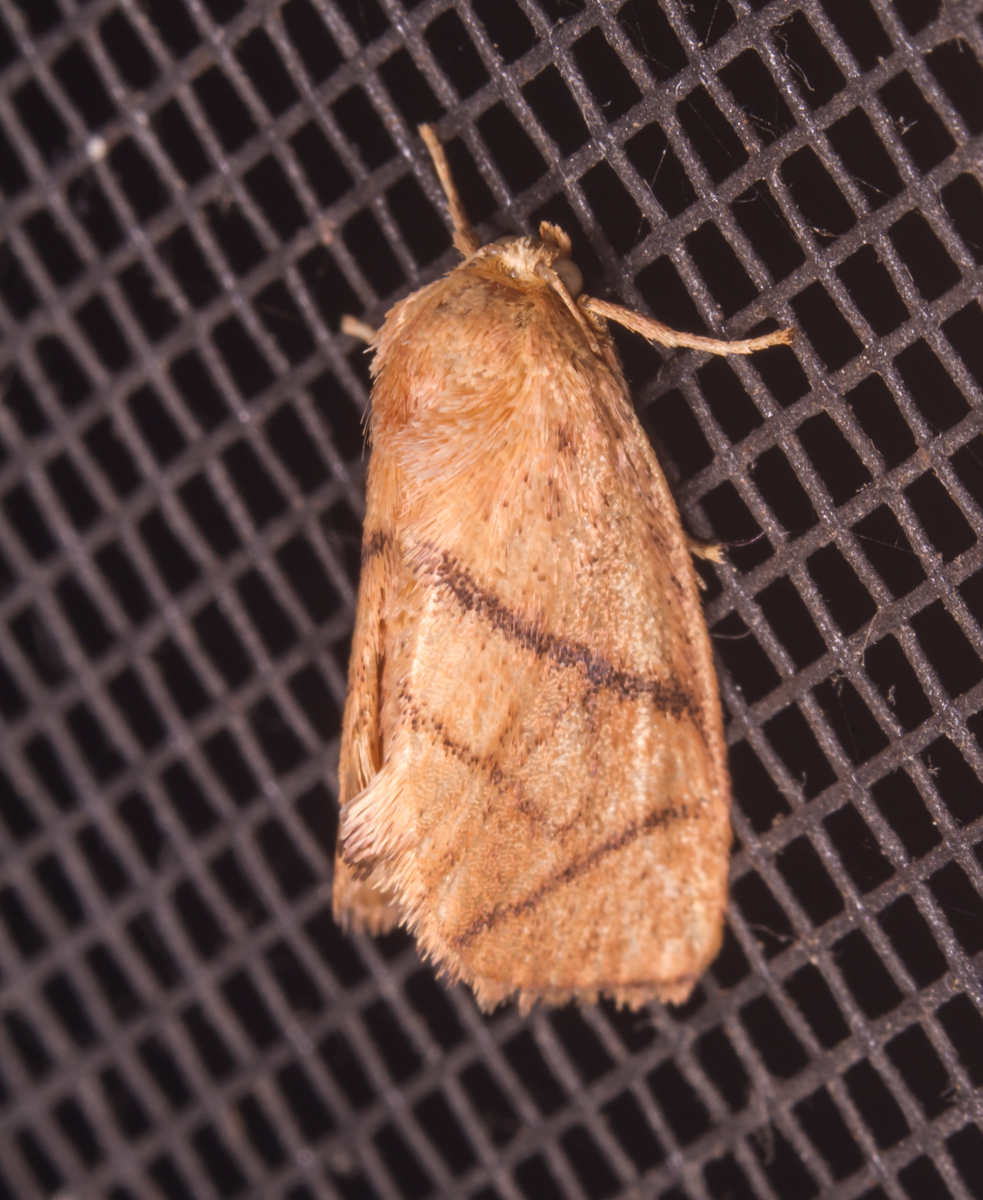
Slug Moths often perch with their butts pointed skyward – this rather plain one is most likely a Red-crossed Button Slug Moth, Tortricidia pallida (click photo to enlarge)
This “moth mooning” is common in several families of moths, but one, in particular, seems to make it a habit – the Slug Caterpillar Moths (or just Slug Moths), Family Limacodidae.
Nason’s Slug larva
The group is named for their larvae, the so-called slug caterpillars. They are a fascinating and bizarre bunch which lack the usual paired prolegs found on most caterpillars, and, instead, move about in a slug-like gliding motion. They are one of my favorite groups of insects, as many of the larvae have odd shapes, colors, and armaments (several species have urticating spines which can inflict a painful “sting” if handled carelessly). But, I know relatively little about the adult moths of this group, so I dove into a few online resources this morning to try to figure them out.
Shagreened Slug Moth, Apoda biguttata
The North American Moth Photographer’s Group has a set of color plates that let beginners “walk through the moth families” as a way to get started on moth identification. You can scroll through the plates until you find a moth that resembles the one you have and then click on it for more species. I did that and quickly found that these moths belonged to the Slug Moth family. I then turned to my favorite online invertebrate resource, Bug Guide, and began to scroll through the images of Limacodid moths. I found what I think were all of the species resting on my screens that morning. The oddball name winner was the Shagreened Slug Moth. Shagreen is a name for untanned leather and must refer to the rough texture and color of this little beauty. Another common name is the Two-spotted Apoda. The genus name, Apoda, means lacking feet (the slug-like larvae); biguttata means two spots.
Yellow-shouldered Slug Moth, Lithacodes fasciola
I quickly identified the other species and then noticed that not all of the online images had these moths in that pointy-butt pose. So, I took a look at one moth I had found that seemded similar in size and shape, but that was apparently more demure and kept its derriere covered on my screen.
Inverted Y Slug Moth, Apoda Y-iversum
If I identified it correctly, it is another one with a strange name – the Inverted Y Slug Moth. It turns out that most of these species may rest with their abdomen tip curved up or tucked beneath the wings. The exposed abdomen tip posture may be an adaptation to avoid detection by predators that use sight to find food. The odd posture makes for an odd outline that may resemble a broken twig or piece of vegetation more than a moth. Whatever the reason, it did help me get started on a quest to learn more about the night-time visitors at my windows. Now that I know a little more about them, I look forward to seeing them and their kin on a more regular basis.
…wings large and splendid, which were designed to bear a precious burden through the upper air.
~Henry David Thoreau commenting on a pair of moth wings floating down as a bird ate the moth
As National Moth Week comes to a close, I found a moth that I definitely wanted to share. I found it in a most unglamorous place – the window screen of a campground restroom in the mountains of Virginia. But the moth was a large and striking one, with an unusual set of wings.
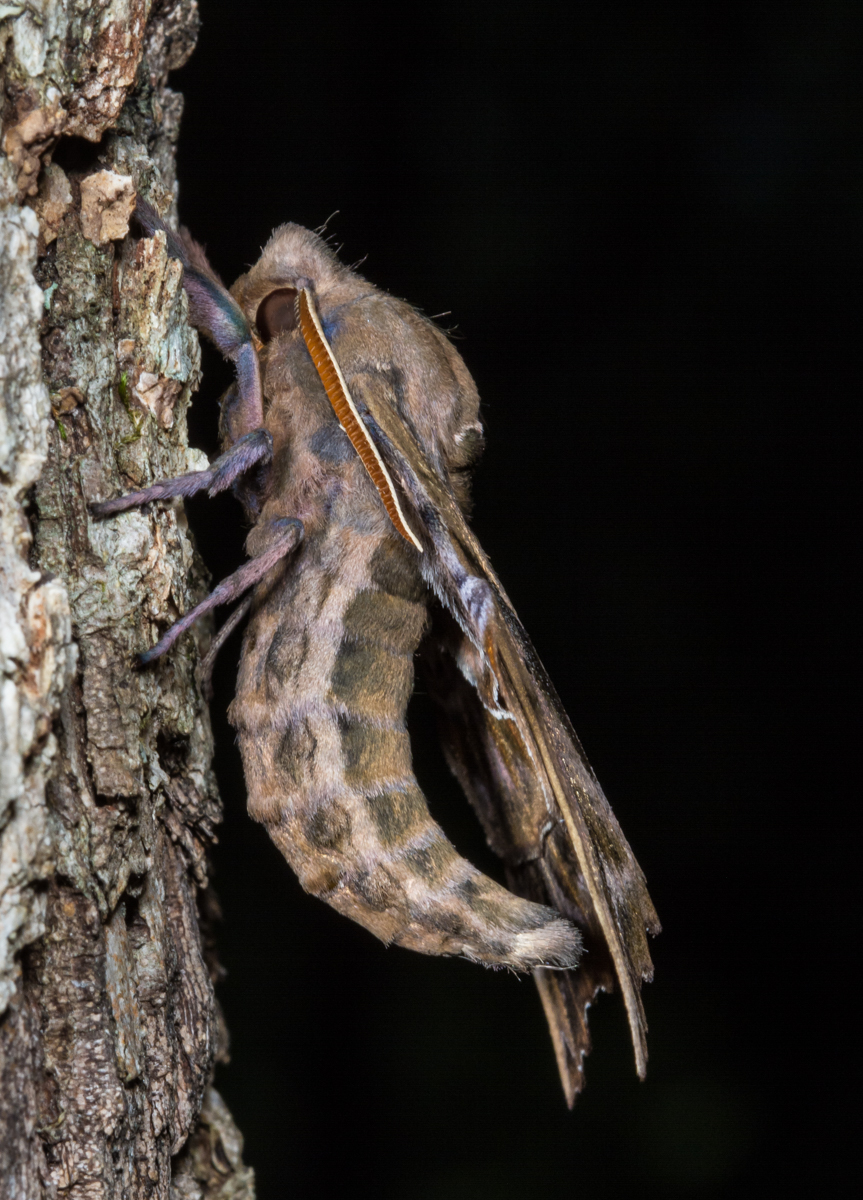
A Blinded Sphinx moth blends well with tree bark (click photos to enlarge)
As soon as I saw it, I gently placed my finger under it to allow it ti climb up so I could move it back to camp for some photographs. The moth cooperated and I admired its unusual scalloped wing edges as we walked back to the car and my camera. I placed it on a tree trunk and was impressed by how well its striking pattern suddenly blended in with the textures of tree bark. Looking in the moth field guide I had conveniently brought along showed this specimen to be the Blinded Sphinx, Paonias excaecata.
Blinded Sphinx perched with upturned abdomen
These are large, somewhat common, moths of open deciduous woodlands and are found throughout much of the United States and Canada. But, this was my first, so I spent several minutes photographing it from several angles. Its abdomen curled upward when viewed from the side, a pose I have seen in many other species.
The moth was patterned in various shades of brown with a slight purplish cast in some areas
Key features for identification include the black stripe down the middle, the wavy edge on the hind part of the fore-wings, the purplish cast to the upper portions of the body, and a black area on the hind wings containing a blue spot with no black spot in it. This blue spot on each hind wing is said to resemble an eye iris. The lack of a black spot (or pupil) in that iris makes this a “blind” sphinx (hence the common name), when compared to other species that contain a black spot. But, my moth was apparently shy, and I was having trouble getting it to show me its “eyes”.
It gave me a partial glimpse of its hind wings before zooming off
I touched it a few times on the edge of its wings, blew on it, and all I got was it starting to climb the tree trunk and then the characteristic shaking that moths often do before taking off. Apparently, when they have been still for quite some time as was the case with my moth, they need to warm their flight muscles a bit before taking wing. The moth quivered (akin to us shivering when cold to warm up our muscles) for about a minute, and then zoomed off into the forest at the high rate of speed typical of Sphinx Moths, the fighter jets of the moth world. I got a quick shot of a bit of its beautiful eye spots, and you can see the blurring in the wings from the quivering. I’d say that was a fitting way to end National Moth Week. And I will continue to watch for and photograph them in the coming weeks, as they are an incredibly diverse and interesting group of organisms.
Frogs are strange creatures. One would describe them as peculiarly wary and timid, another as equally bold and imperturbable. All that is required in studying them is patience.
~Henry David Thoreau
My plans to post on moths during National Moth Week have been easily waylaid – it appears as though I am easily distracted whenever I go outside. And so it was yesterday afternoon. I was taking a few images of a couple of moths clinging to the screen porch when I noticed a flower blooming on the Jewelweed near the porch. I had thrown a few seeds out two years ago in a small patch of ground out back that normally stays damp due to runoff from the slope above. I had also planted a few Netted Chain Ferns and called it my backyard wetland. In actuality it is only about 5 feet across and tends to wither during times of dry weather, but it has produced a few interesting insects and an occasional hummingbird visitor. When I walked over to check out the flower, I was surprised to see an unusual visitor perched high on a Jewelweed stem – a Green Treefrog, Hyla cinerea.
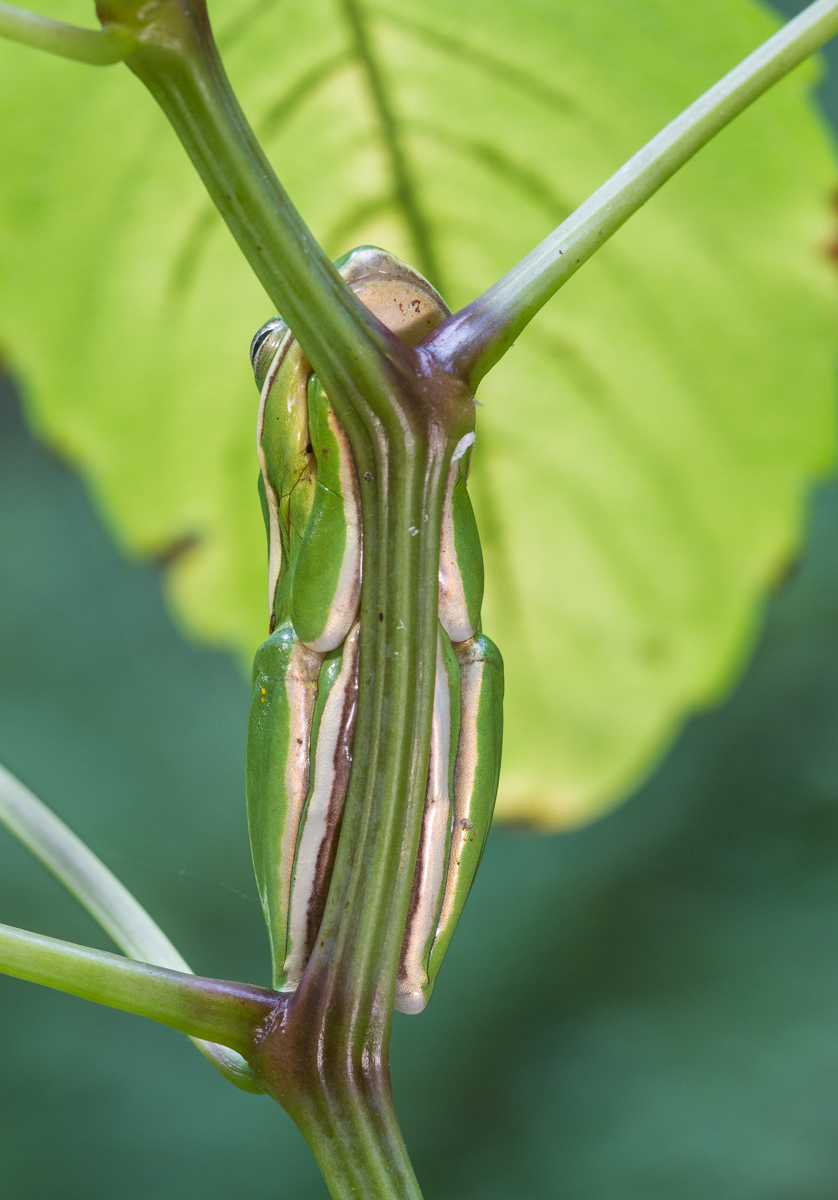
Green Treefrog clinging to a Jewelweed stem (click photos to enlarge)
By day, they often perch on vegetation in a very sedate pose, their legs folded tight against their body. They can sit like this for hours and seem to blend into their chosen plant perch.
They often look like a swelling on a plant stem, until you give them a closer look
The unmistakable bright green color and the white “racing stripe” down the sides are distinctive for this species.
Green Treefrogs often have gold flecks on their backs
They frequently have small golden splotches on their dorsum, which may serve some camouflage function in a sun-dappled environment.
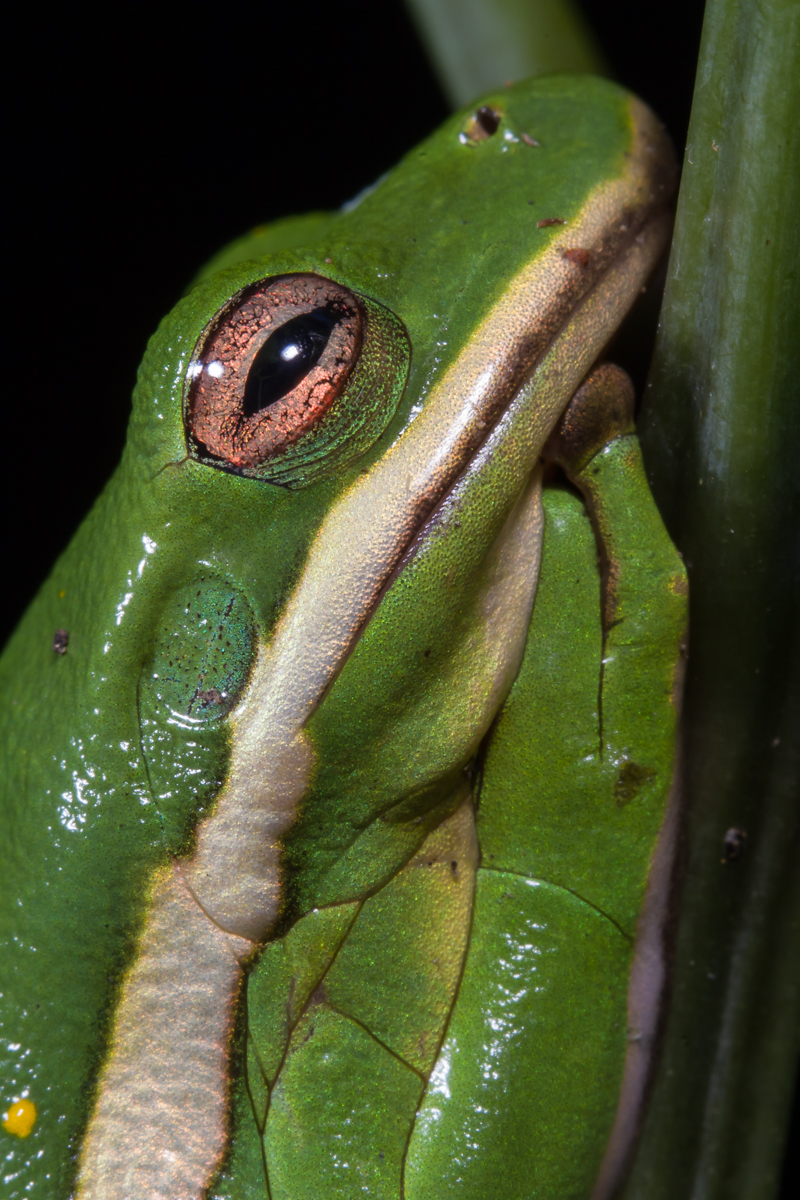
The eyes of frogs and toads are incredibly beautiful up close
This is the first Green Treefrog I have seen at the house. And it comes as a bit of a surprise, since there are no wetlands up here on the hill. The closest suitable habitat is about a half mile down the power line, but I have never heard their distinctive “queenk” call anywhere out here. About a decade ago, I reported this species near a water garden at the place I used to live in Chatham County. That proved to be a new county record for this species, which is much more common in our Coastal Plain than in the Piedmont, although they seem to be expanding westward.
The frog was calm as I photographed it from several angles and even got up close and personal to appreciate the details of its skin
This little guy was very calm, or, as HDT might say, imperturbable. I photographed it from several angles and it remained peaceful, thinking its froggy thoughts, or perhaps just pretending to be part of a plant. A close look revealed intricate details in the patterns of its eye and the folds of its moist skin.
This morning, my rare visitor had vanished
After about an hour, it started raining, so I reluctantly went back inside. This morning when I checked, my visitor had vanished. Whatever the reason, I am glad it paid a visit to my “wetland” and made me stop and appreciate its beauty. Now, about those moths…
Fog droplets bathed much of the vegetation yesterday (click photos to enlarge)
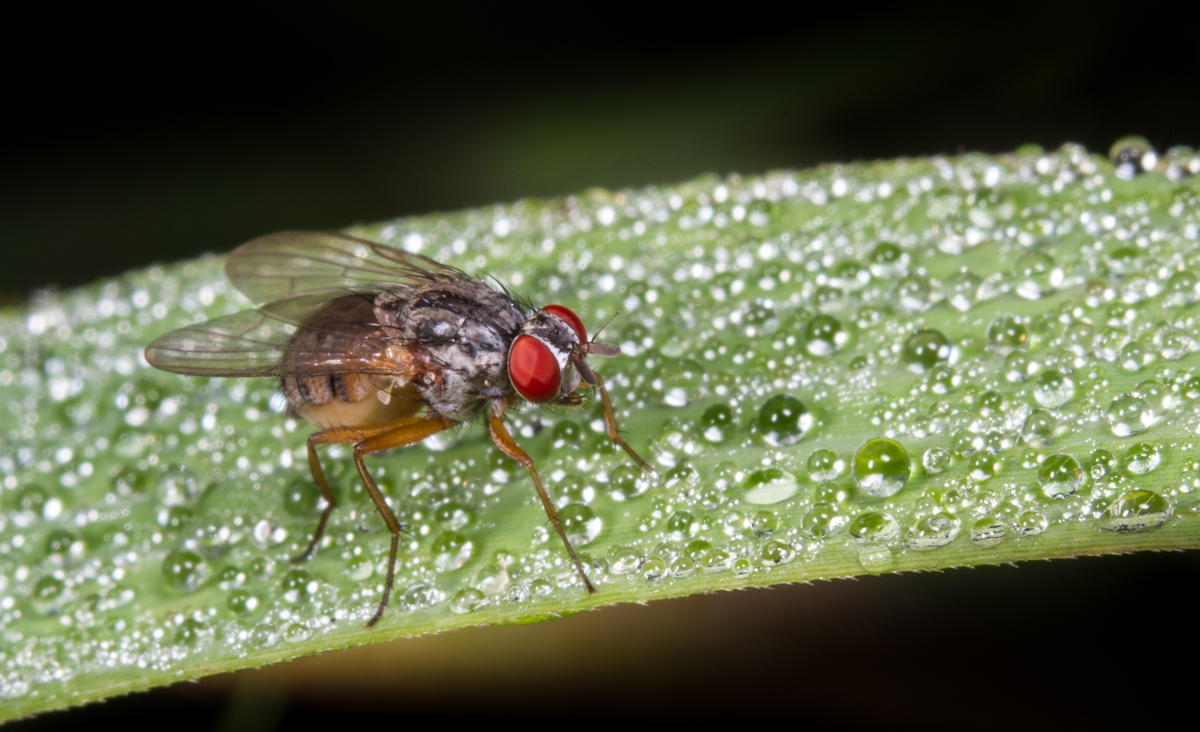
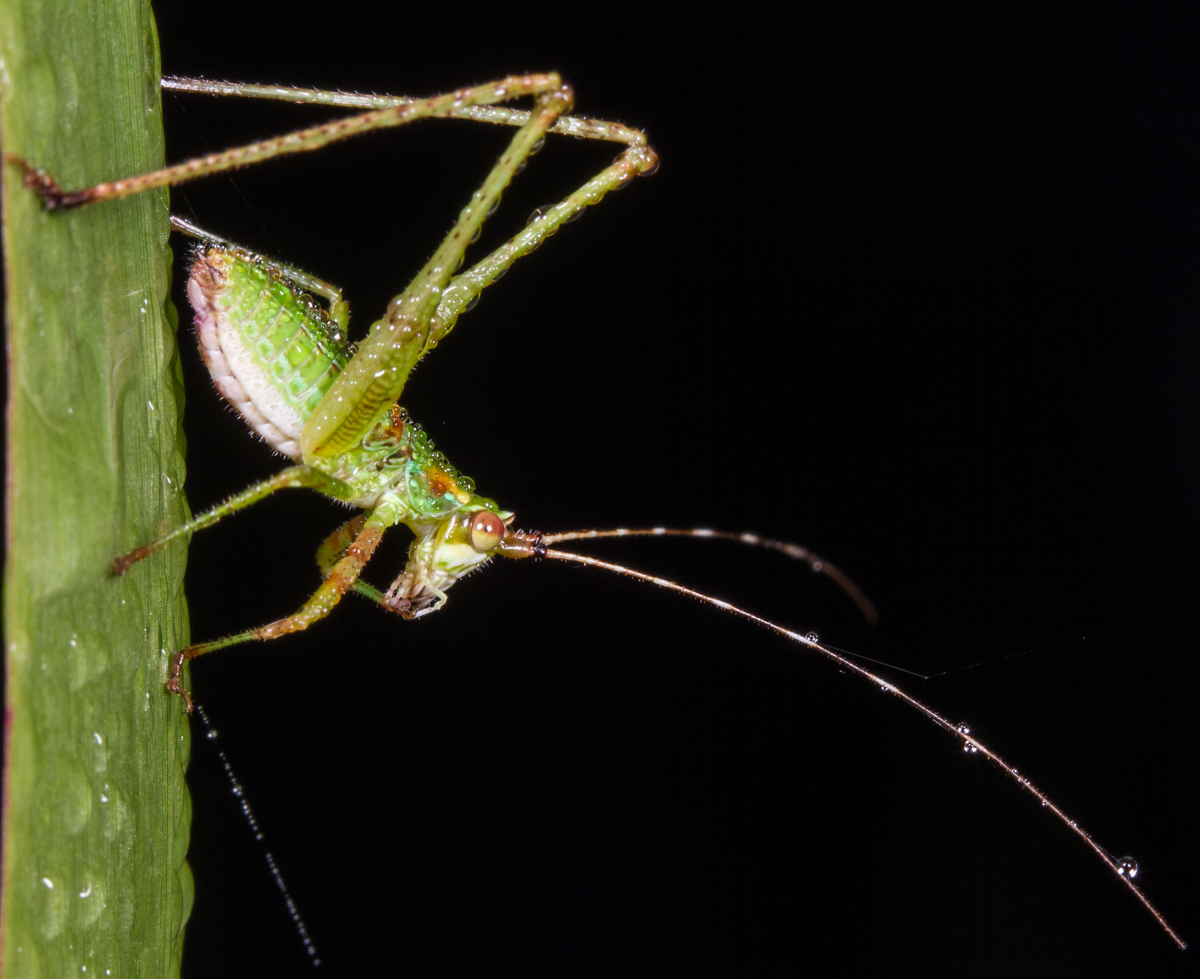
Yesterday morning’s fog left not only pearl-strung silk necklaces strewn across the meadow, but also vegetation, and the insects hiding amongst it, covered in shimmering beads of water. I can’t resist trying to capture images of these bejeweled beauties on such a morning. Droplets of water seem to make everything more worthy of our attention.
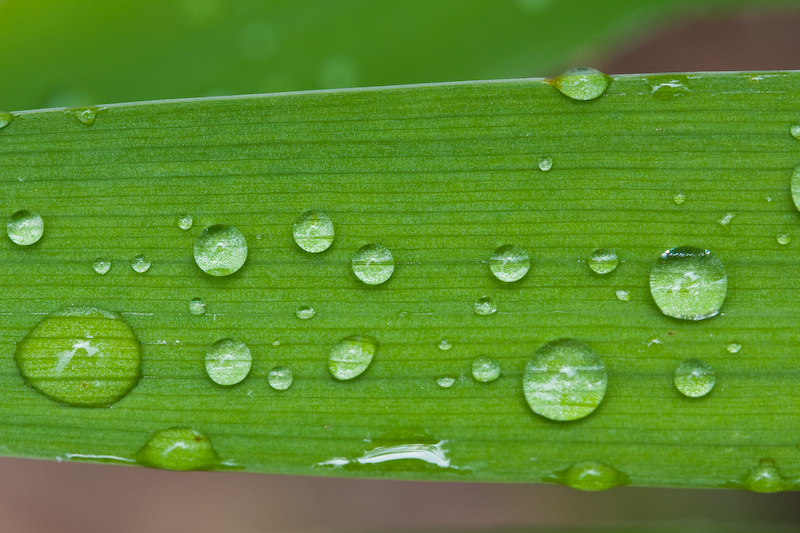
A cosmic galaxy on an iris leafTwo-striped Planthopper on a dewy grass stemDroplets make even a Flesh Fly (at least I think that is what this is) more appealingA Flesh Fly walks on a pathway of glass bubblesBush Katydid nymph cleans some of the water and spider silk from its legsThis nymph appears to be wearing a bead-studded suit
Take time to see the quiet miracles that seek no attention.
~John O’Donohue
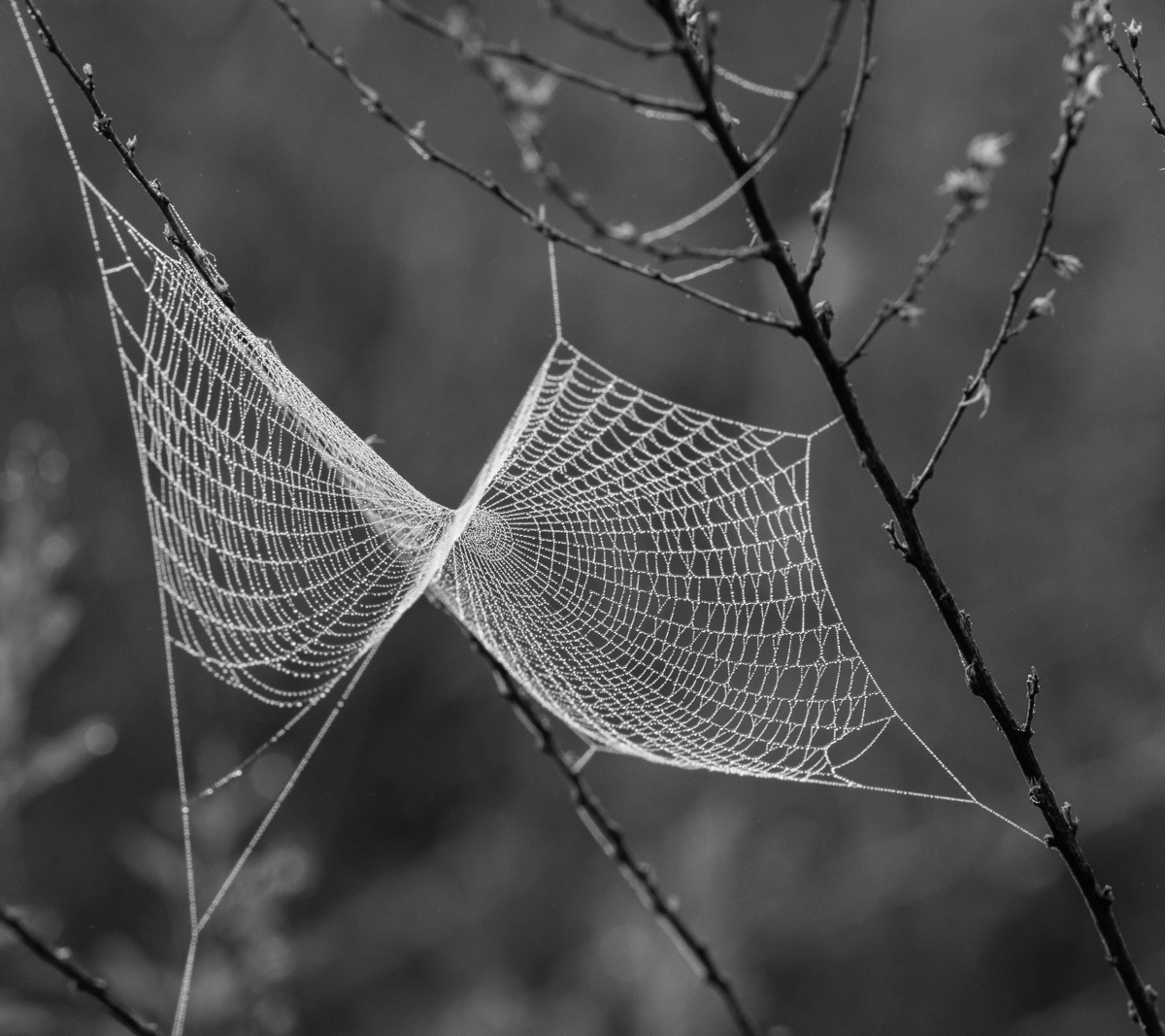
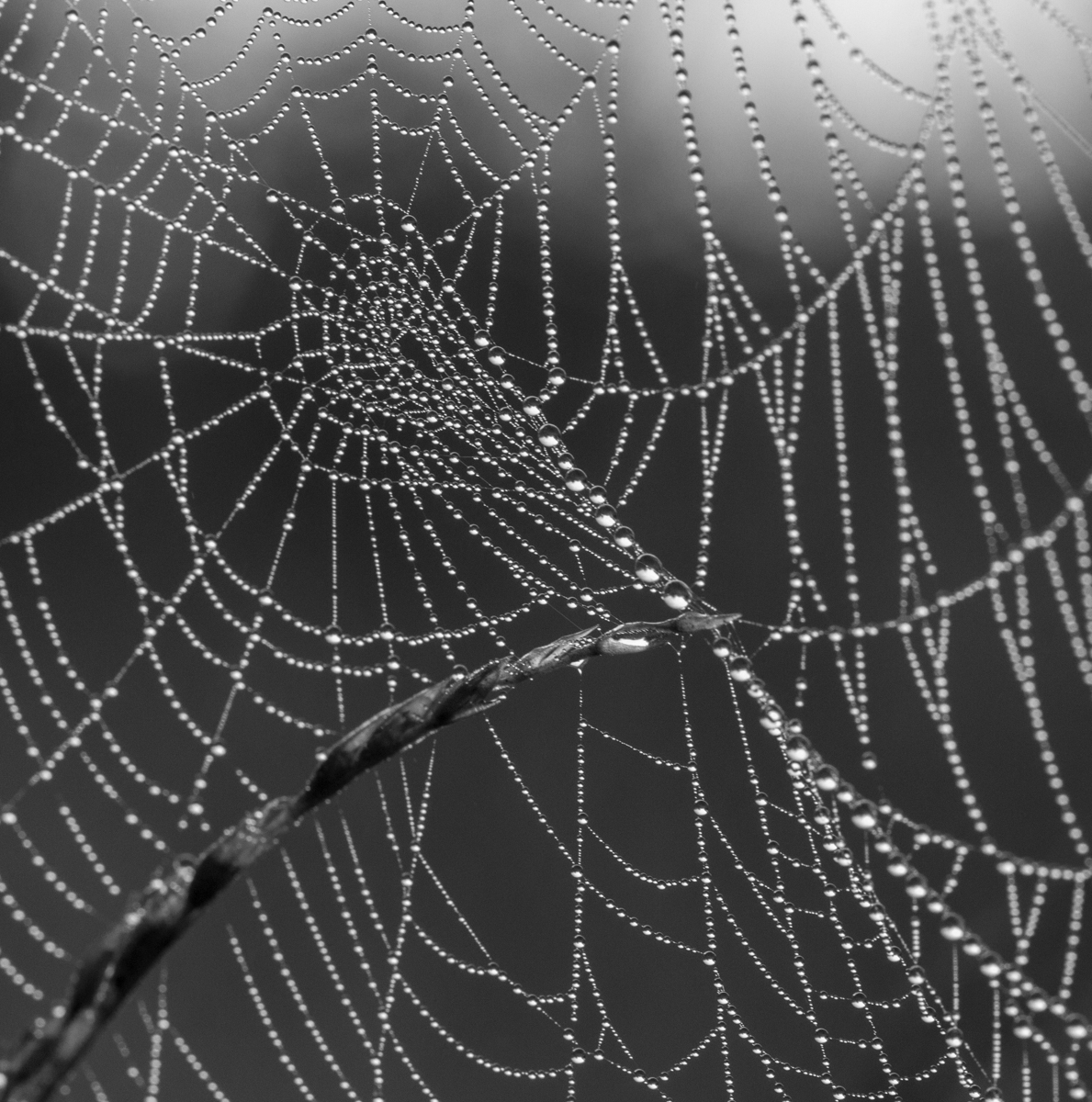
I awoke this morning to a dark cast out my window. Where normally there are sunbeams streaming through the trees, there were none. As I sipped the first mug of coffee, the news warned of dense fog for those who must commute. I thought to myself…this would be a good morning to get wet on a walk…so I grabbed the camera and took a stroll in the meadows under the power line. Spiders had been busy, creating art for any to appreciate, if you only take the time.
Large web on a dead branch (click photos to enlarge)Silk encased pine tipSpider tent on a dead weedThere were many orb webs in the fogThe artist is inA hint of a nautilus designA horizontal orbAn orb with a twistSilk pearlsA silk bowlA silk explosion
~from Nature Conservancy promotional article on National Moth Week
It is, indeed, the third annual National Moth Week (July 19-27, 2014). National Moth Week’s main goal is to promote awareness of moths, and to encourage people to observe and report their findings on this fascinating and little known (to most of us) group of insects. More information can be found on their web site at http://nationalmothweek.org/. So, in honor of this event, I thought I would do a couple of posts this week on moths and their caterpillars.
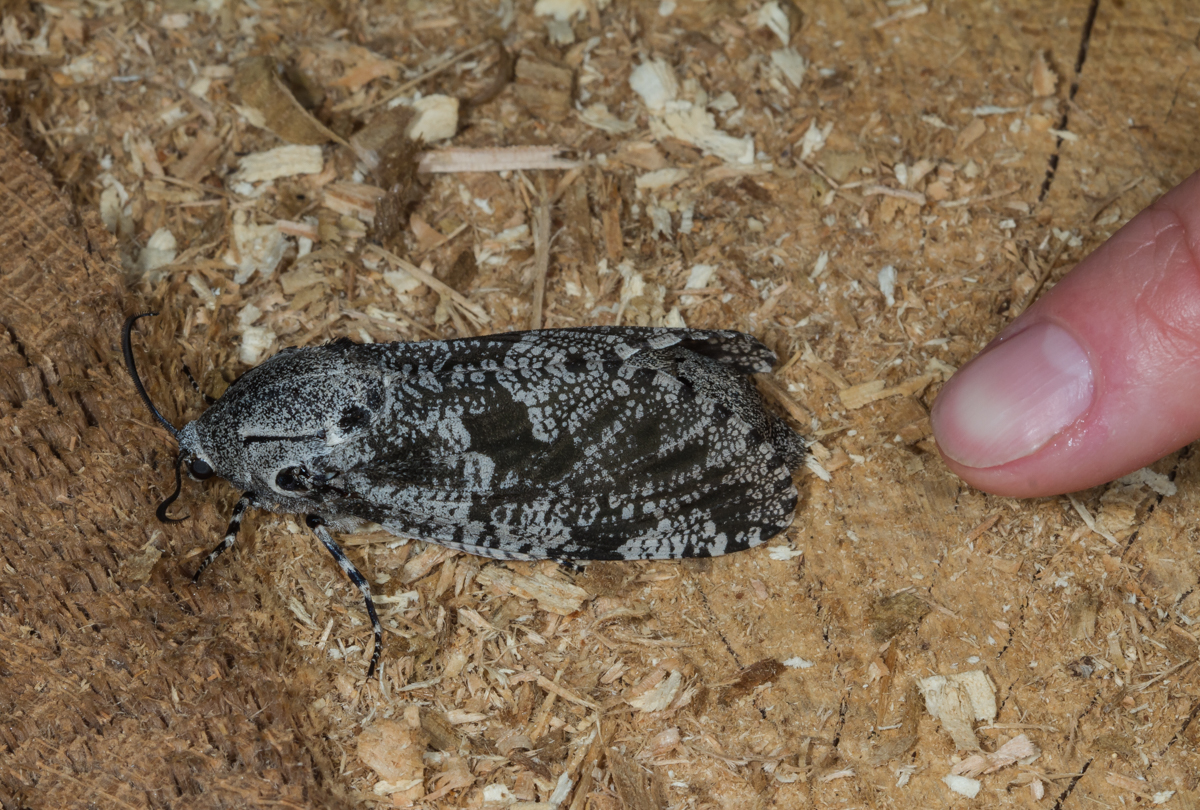
Carpenterworm Moth on oak stump (click photos to enlarge)
A few weeks ago, a large oak out front had to be taken down because it was showing signs of imminent death – the bark splitting off, a large dead limb hanging out over the driveway, and sap oozing from some cracks near the base. One evening as I walked by the stump, I saw a large gray moth sitting on top. I wasn’t sure what it was, but then noticed something laying on the ground below.
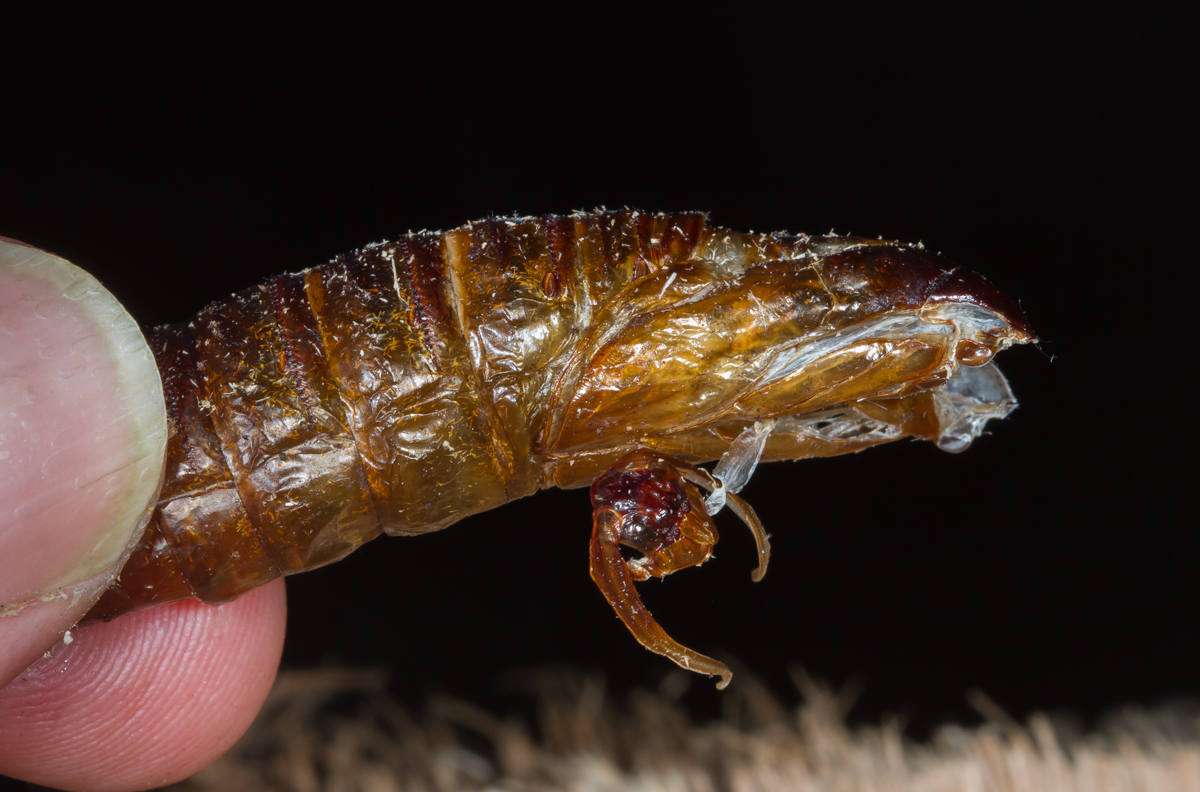
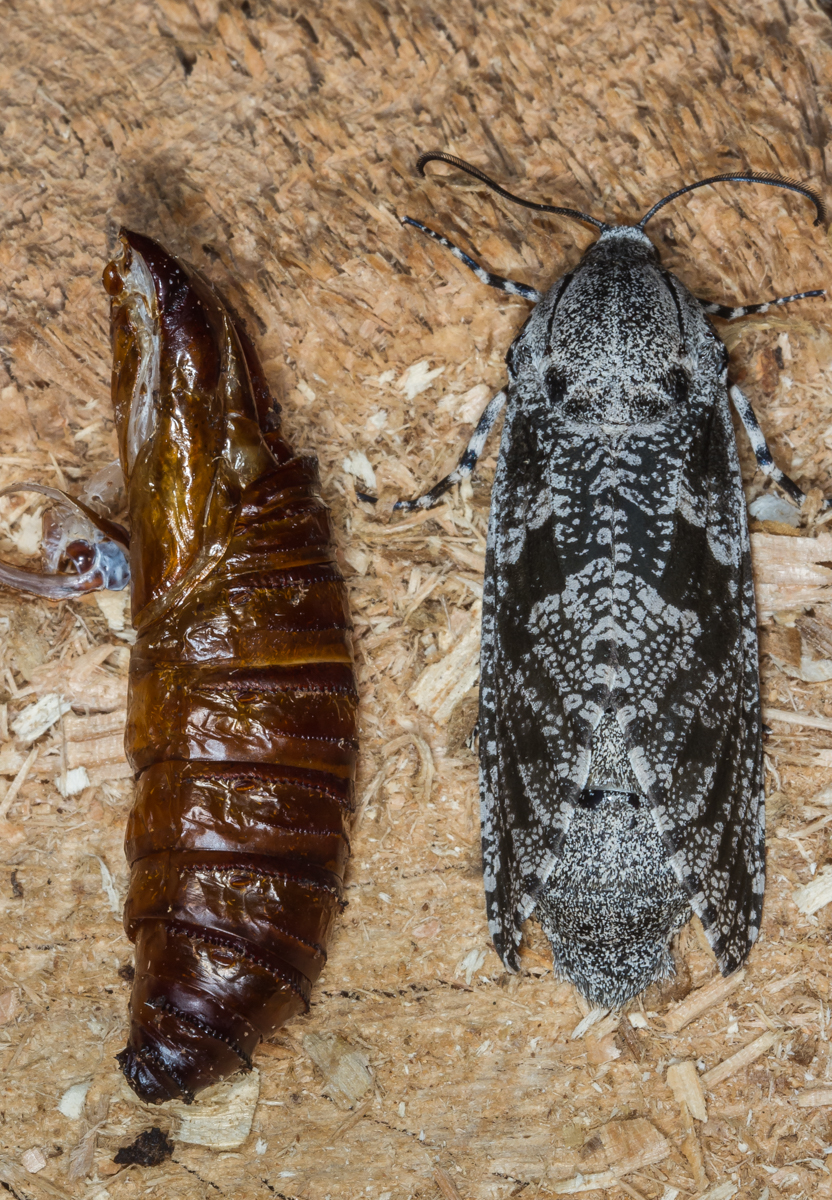
Carpenterworm Moth pupal skin
It was a large brown pupal skin that I recognized. I had seen these once before, but instead of lying on the ground, they were sticking out of holes at right angles to the trunk of a large oak. I had identified them then as the pupal sheds of a Carpenterworm Moth, and now I had found a live adult.
A Carpenterworm Moth blends in with the colors of tree bark
It was probably lucky that this moth had crawled up to the recently cut surface of the stump, as I might otherwise have missed it. Their camouflaged coloration helps them blend nicely with the patterns of tree bark.
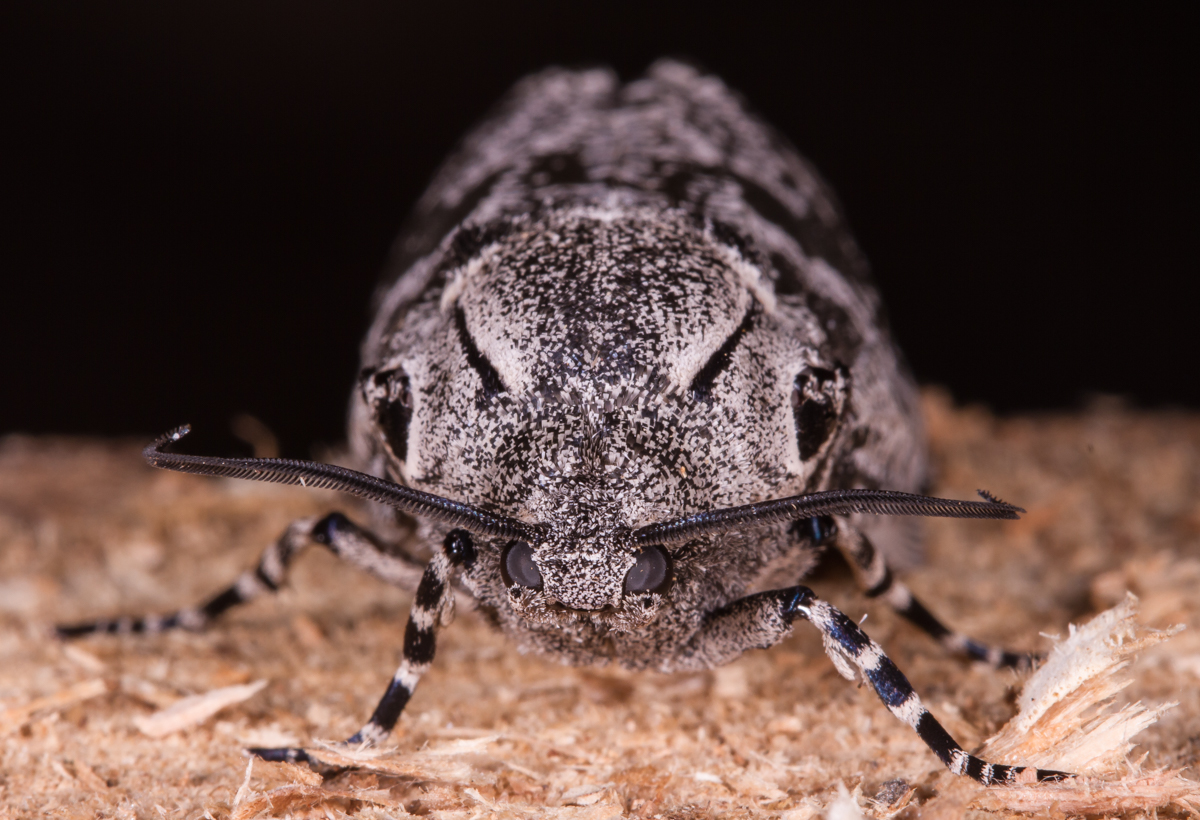
Carpenterworm Moth view head on
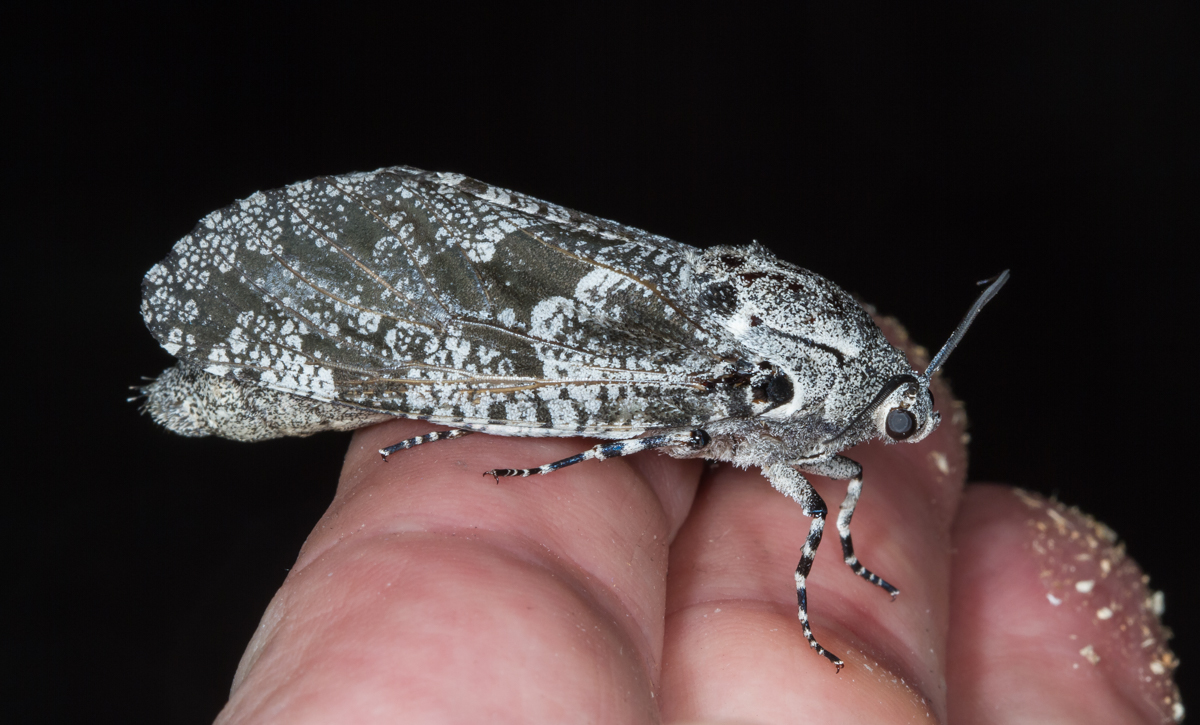
I believe this specimen was a female – they are larger than the males and lighter gray in color overall. She was close to 2 inches in length and must have just recently emerged as she allowed me to pick her up without taking flight.
Female Carpenterworm Moth
These moths are quite large, despite being members of the so-called Micromoth family. After looking in some field guides and online, I think this one is called Robin’s Carpenterworm, Prionoxystus robiniae.
Carpenterworm Moth and pupal skin
The larvae bore into the trunks of various hardwoods, creating large tunnels. They require up to 4 years to complete their life cycle. I still have never seen a larvae, but they must be quite large given the size of the pupal case and the resulting moth.
This is just one of the thousands of fascinating species of moths you might encounter here in North Carolina. Leave a porch light on or look for National Moth Week events in your area, and get outside to learn about this amazing and beautiful group of insects.
Driving down a dirt road last week on the Pungo Unit, I spotted something up ahead. It wasn’t a critter, but rather a distinctive sign made by an animal.
River Otter scent-marking and rolling area (click photos to enlarge)
As I got closer, I could see it was a very large area that had been marked by a River Otter, although by the looks of it, undoubtedly more than one animal. River Otters are common in the canals at Pocosin Lakes National Wildlife Refuge and have regular spots they use to cross the roads from one canal to another. I had seen tracks and scat in this general location before, but never this large of an area with this much sign. There were a bunch of squiggles in the sandy substrate indicting the otters had rolled around in a patch of road measuring about 6 or 7 feet across. River Otters roll to maintain their fur. Rolling fluffs it up, cleans and dries the fur, and helps distribute the oils that are critical to maintaining its insulating and waterproofing qualities.
River Otter scat and urine at the rolling location – notice the tracks on the lower edge of wet area
Rolling also serves as a means of communication amongst otters by scent-marking as they roll. They frequently defecate and urinate in or adjacent to these areas (and regularly used haul-outs) as a means of scent-marking. To make sure other otters know they have been in the neighborhood, River Otters have scent glands on their hind feet as well as highly developed anal scent glands (the latter is typical of all members of the weasel family).
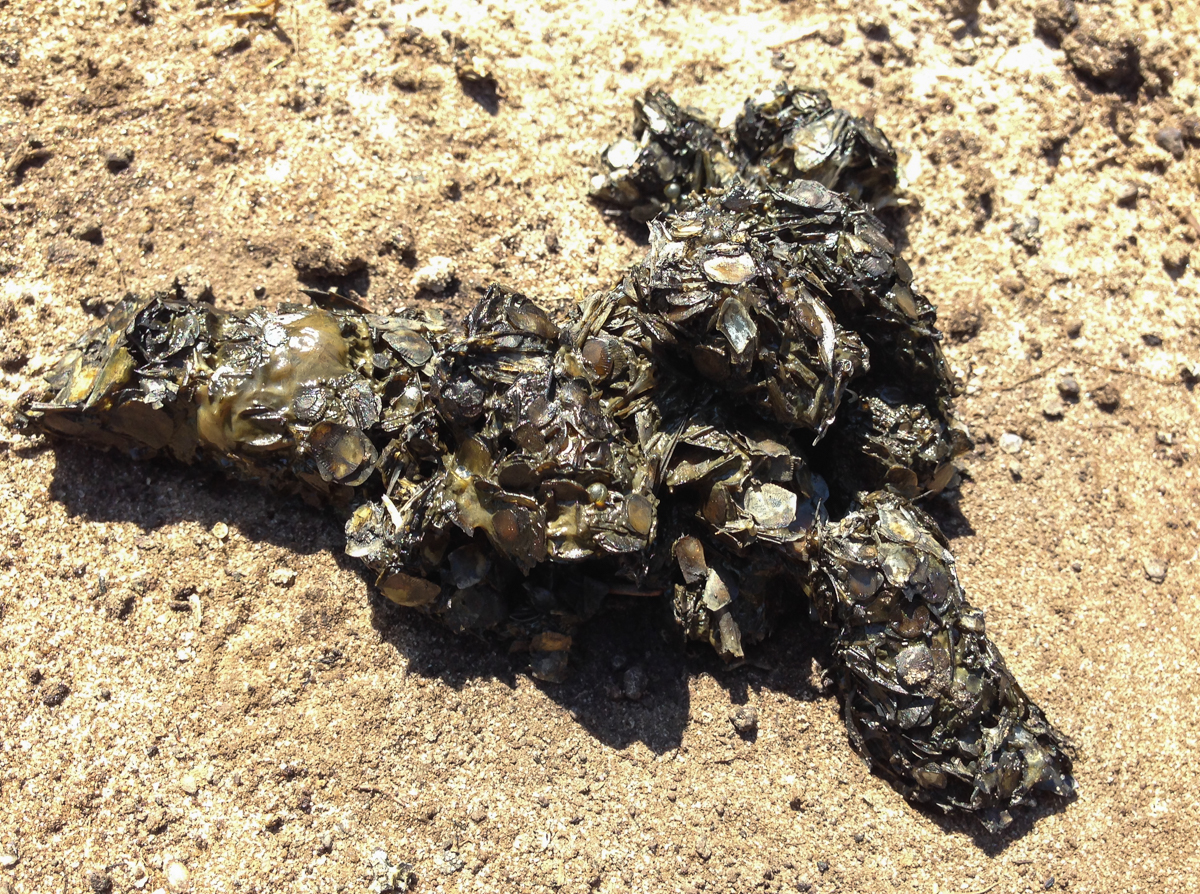
River Otter scat usually is full of fish scales
A common indicator of their presence are small mounds of vegetation and debris scraped into a pile by an otter and topped with scat in locations where they regularly haul out or have pathways to water.Their scat is usually composed of fish scales and is tubular in shape, although you often see it simply in a small pile.
River Otter scat with crayfish parts
Another common component are bits and pieces of crayfish, which usually have a reddish-pinkish tint. There is usually a distinctive musky-fishy smell associated with these locations, especially if recently used. With so many ways to scent mark, River Otters must be constantly checking on the comings and goings of friends, relatives, and potential competitors in their neighborhood.
While I did not see an otter on that day, they left ample evidence of their presence. It was fun to imagine three or four of them laying and rolling in the road, leaving their calling card for the next otter to come by. And they probably did it in that playful manner we so often associate with these beautiful animals. I have seen otter here several times and had the privilege of watching them hunt and go about their business in many other areas around the country. Whenever I see them, it always brings a smile to my face…they just seem to have that affect on people.
River Otter catching a quick nap at Lake MattamuskeetPair of River Otter at Chincoteague National Wildlife Refuge
The name “raccoon” is drawn from the Algonquian term “arakun” and roughly translates to “he who scratches with his hands”.
~Samuel I. Zevelof, in Raccoons: A Natural History
Between the Bobcat and the Black Bear cubs the other day, I had another interesting wildlife encounter. Most of the dusty miles of gravel roads at Alligator River National Wildlife Refuge are accompanied on at least one side, by many miles of canals. These dark waterways are home to a diversity of wildlife including substantial populations of aquatic turtles (mainly Yellow-bellied Sliders and Painted Turtles). Driving along on a sunny day reveals many turtles basking on the canal banks or lined up on any partially submerged log. Last Monday, there were plenty of turtles basking, plus two crossing the road, and one was even laying eggs in a shallow nest in the gravel road. I thought that was a poor choice for a nest location, but, shortly thereafter, I saw that choosing a good nest site is probably not easy in this predator-rich environment.
Raccoon crossing road (click photos to enlarge)
Driving around a curve, I spotted a female Raccoon scurrying across the road. She ended up in a grassy area near the junction of two roads and their neighboring canals. I quickly pulled over, expecting her to just disappear into the brush, but she had other things on her mind.
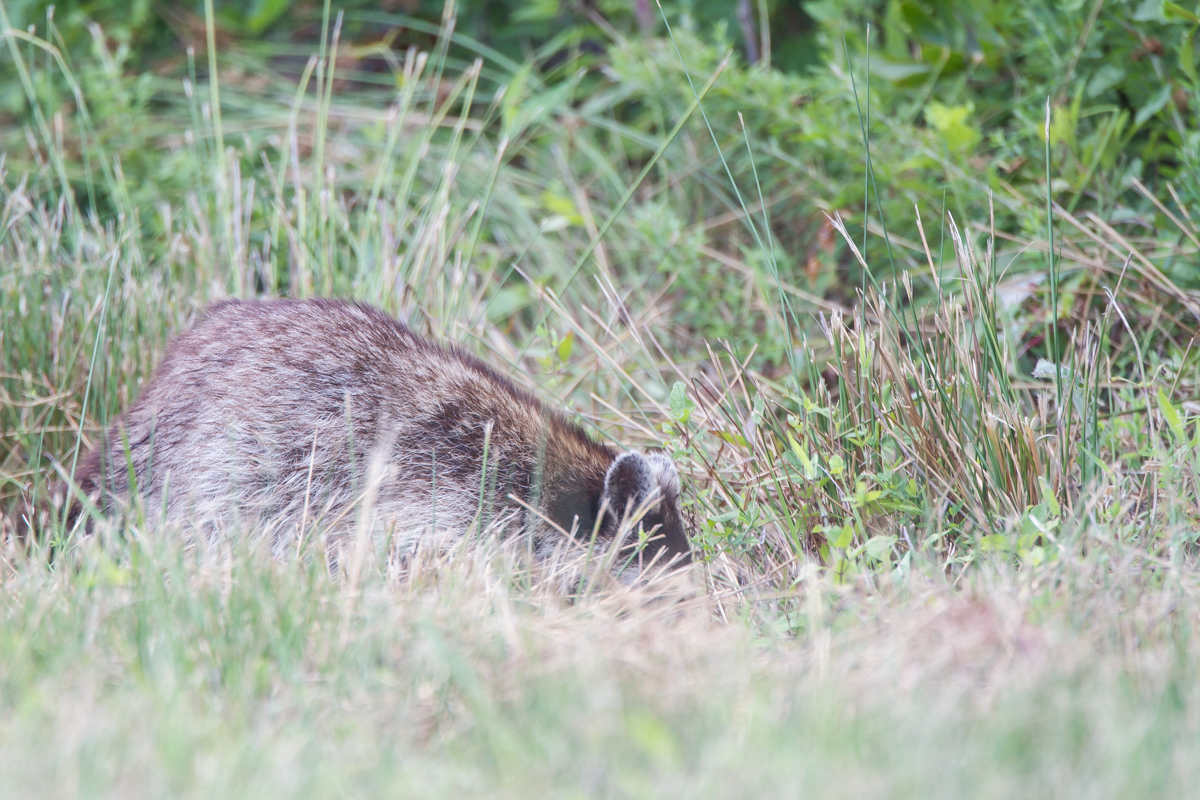
Raccoon sniffing in grass
She moved quickly along the back edge of the opening, swinging her head and sniffing, pausing every now and then when she smelled something interesting.
Raccoon digging
Suddenly, she stopped, spun around a couple of times with her nose to the ground, and began digging with those incredibly dexterous front paws. If you have ever seen their distinctive tracks in the mud, you know their front paws resemble tiny human hands, without an opposable thumb. One reference stated that the front paws contain four times the touch receptors as there are in their hind feet. Plus, a Raccoon’s brain supposedly has a major portion of the cerebral cortex devoted to these paws and the sense of touch.
Raccoon removing something from the hole she has just dug
After digging for about a minute, she hunched over a bit more and then gingerly lifted something out of the hole – an egg, a turtle egg. She held it between her paws, not grabbing it with the “fingers” as I expected, but holding it cupped in her paws like we would hold a tennis ball if our fingers were taped together. She gently roiled it into her mouth and began to chew.
She lifted her head as she manipulated each egg in her mouth
As she chewed, she lifted her head, and it looked as if she was moving the egg around inside her mouth to get the contents out, perhaps without swallowing the egg shell (which, in a turtle, is somewhat leathery instead of brittle like a bird egg). This routine was followed for each egg dug out of the hole.
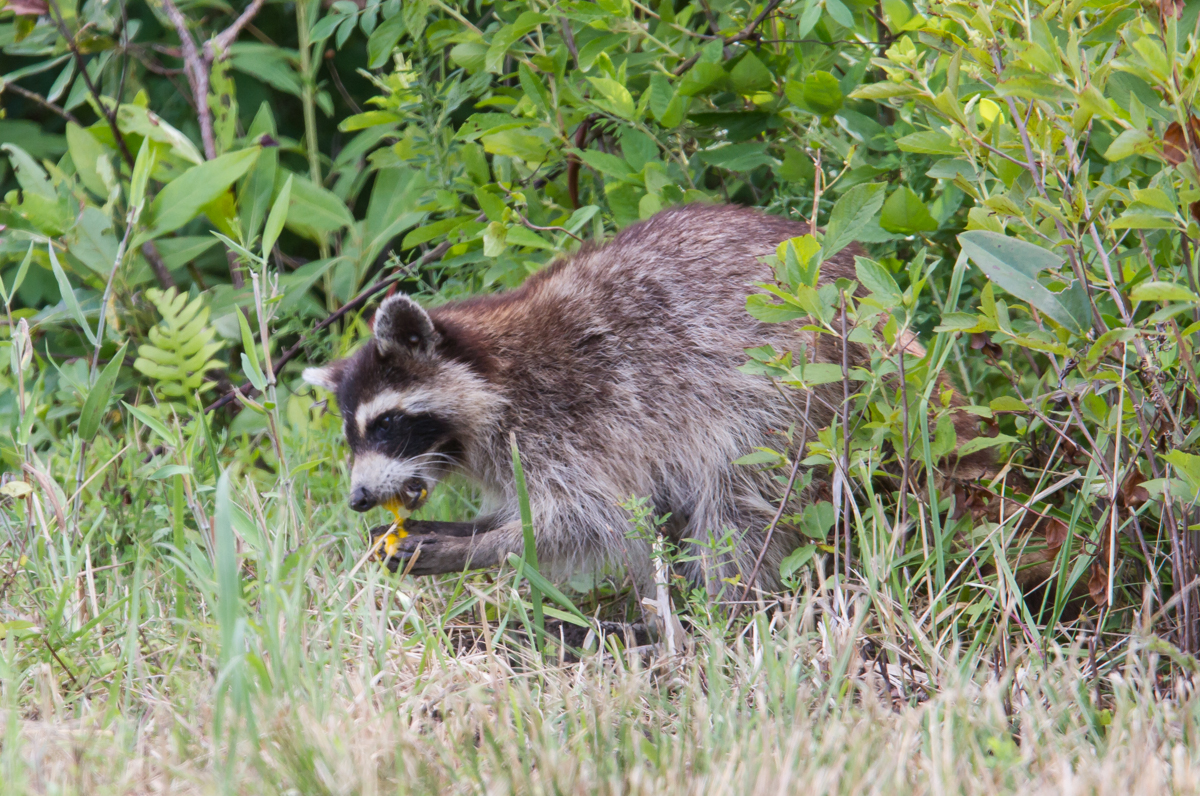
Holding an egg to get the last drop of goodness out
She manipulated each egg for 15 to 30 seconds, then her head would drop back down, and she would pick up another egg and move it to her mouth. Her head was always low when she first got the egg, and then she would always raise it as she extracted the yolk.
Raccoon pulling out the last egg from the turtle nest
She finally ate the last egg, looked over at me, and started walking back across the road. It was as if she knew she might get a meal in that spot and had made a quick run to the store to pick up a few things and was now heading home. And I’m betting she has had success in that location the past. Favorable turtle nesting sites are hard to come by in a swamp, which is what most of the land is around that road juncture. This wide grassy patch has probably served as a turtle nesting area for years, and the local Raccoon population has learned to periodically check it for the possibility of an egg breakfast.
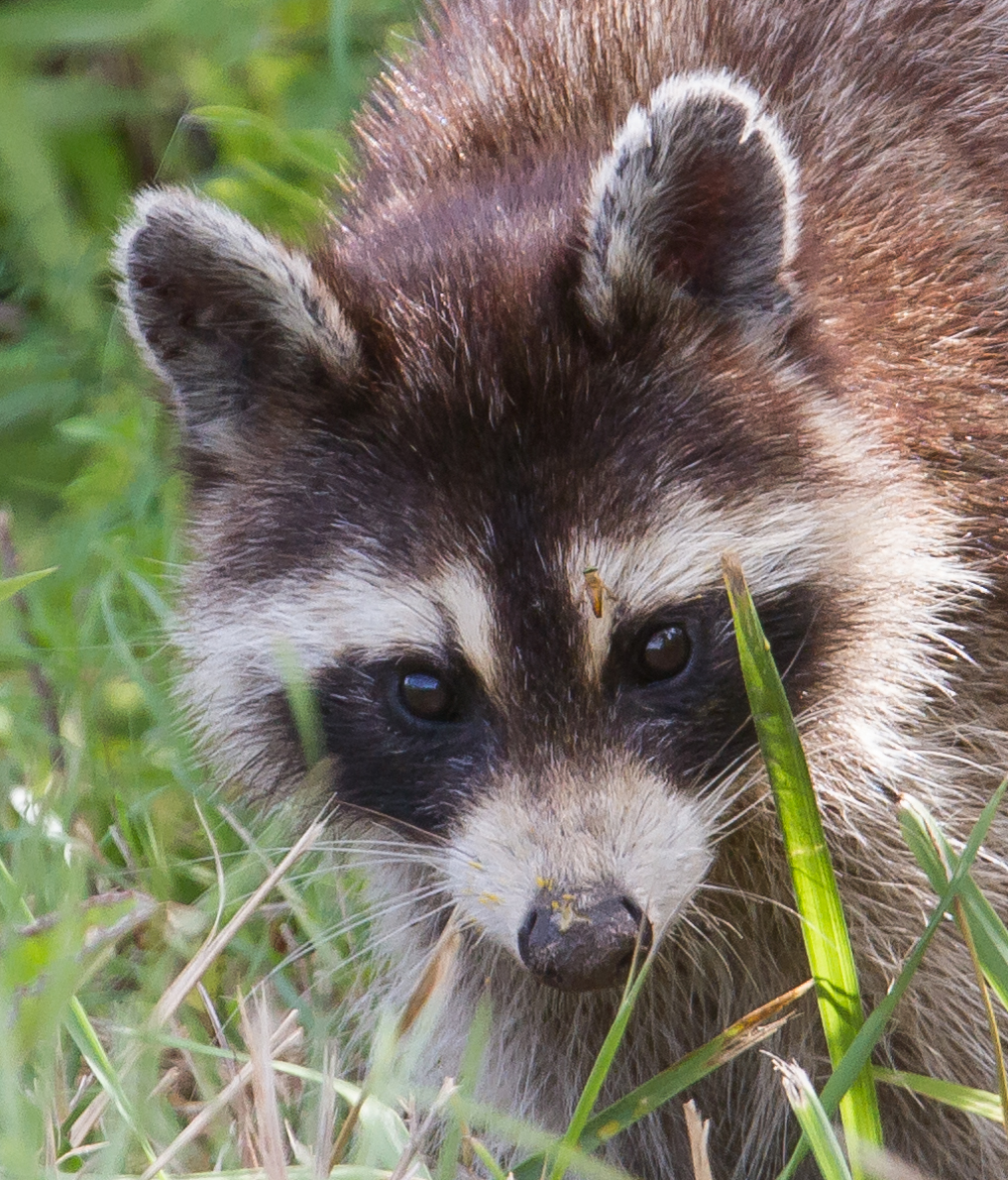
The Raccoon was not the only one getting a meal
When I later looked at the image of her after she ate the last egg, I saw that she was not the only one getting a meal at that moment. In fact, in almost every image I took that day, I could see one or more biting flies somewhere in the image. She has one above her left eye in the photo above. And a close look at one of the earlier photos will show a tick in her left ear. Everything needs to eat I suppose.
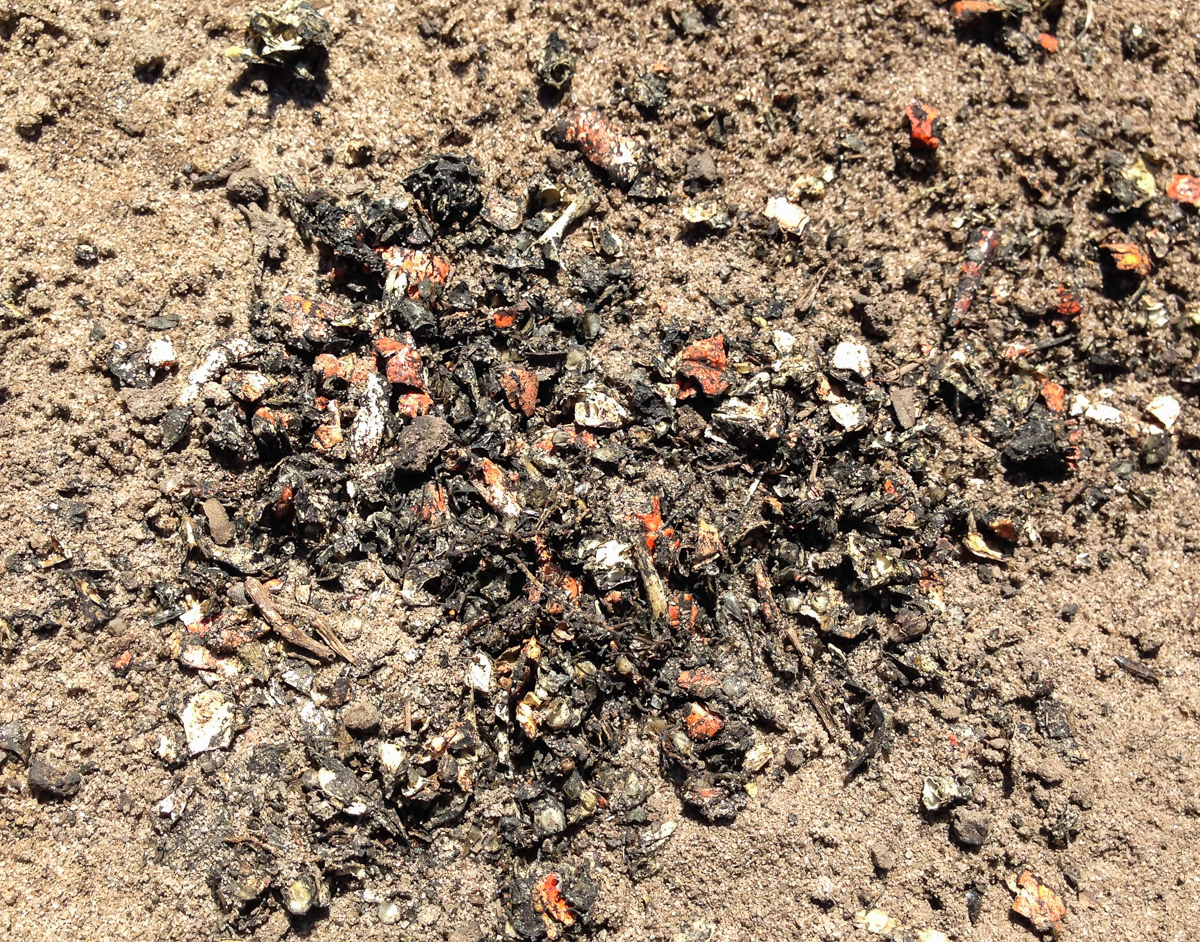
Raccoon-raided turtle nest
After she departed, I walked over to inspect the nest. I have seen this crime scene many times after the fact, but this was the first time I have witnessed the egg thief in action. There were 8 egg shells scattered about the hole. Sliders may lay two or three clutches per year of up to 15 or more eggs, so there are plenty of chances for a little one to at least hatch, although there are still a lot of predators to get past before becoming a fairly well-protected adult turtle in one of these canals. Meanwhile, that female Raccoon is probably returning to a tree to gather her family of babies after a good breakfast. As always, I am thankful to have been there to witness part of the cycle.


























 Roads End Naturalist