The mountains are calling and I must go.
John Muir
For my birthday a couple of weeks ago, I decided to revisit one of the most beautiful places I have been in the East, Dolly Sods Wilderness in West Virginia. Many years ago I had read about this unique highlands area and had wanted to visit ever since. Last year I finally made it and it was worth the wait.
Dolly Sods is a 17,000+ acre wilderness in the Monongahela National Forest in West Virginia. It is an unusual environment in that it contains bog and heath bald habitats which are much more typical of southern Canada.
Dominant trees include Red Spruce, Sugar Maple, and Quaking Aspen. On some trails I feel like I am walking in Yellowstone, Alaska, or Canada.
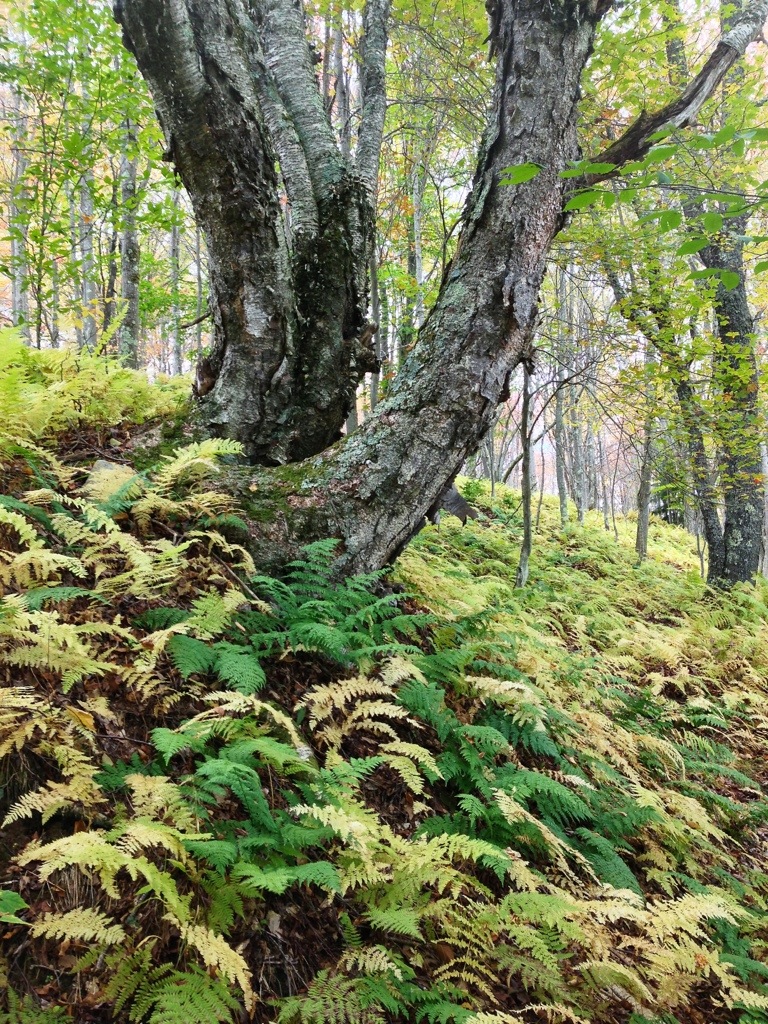
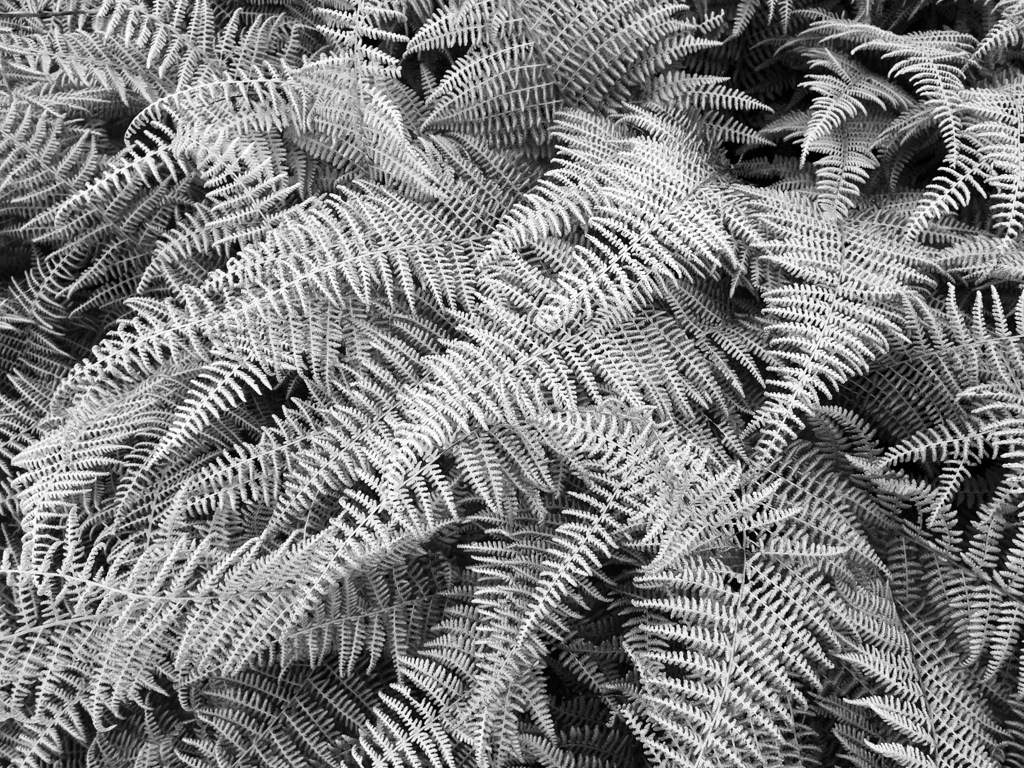
There are miles of well marked and easy to hike trails. They take you through a variety of habitats as you pass from open bald into forest. To me, one of the more amazing things about this beautiful place is the abundance of ferns. Hay-scented and Bracken Ferns seem to dominate, and they occur in huge patches in the balds and the forest understory.
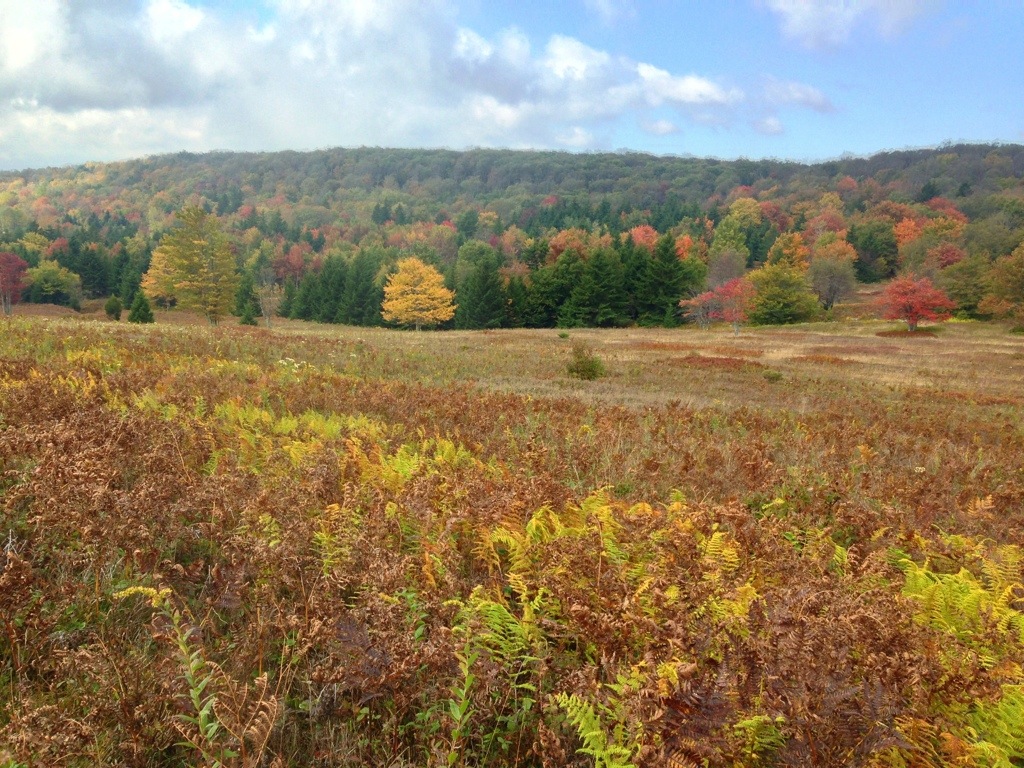
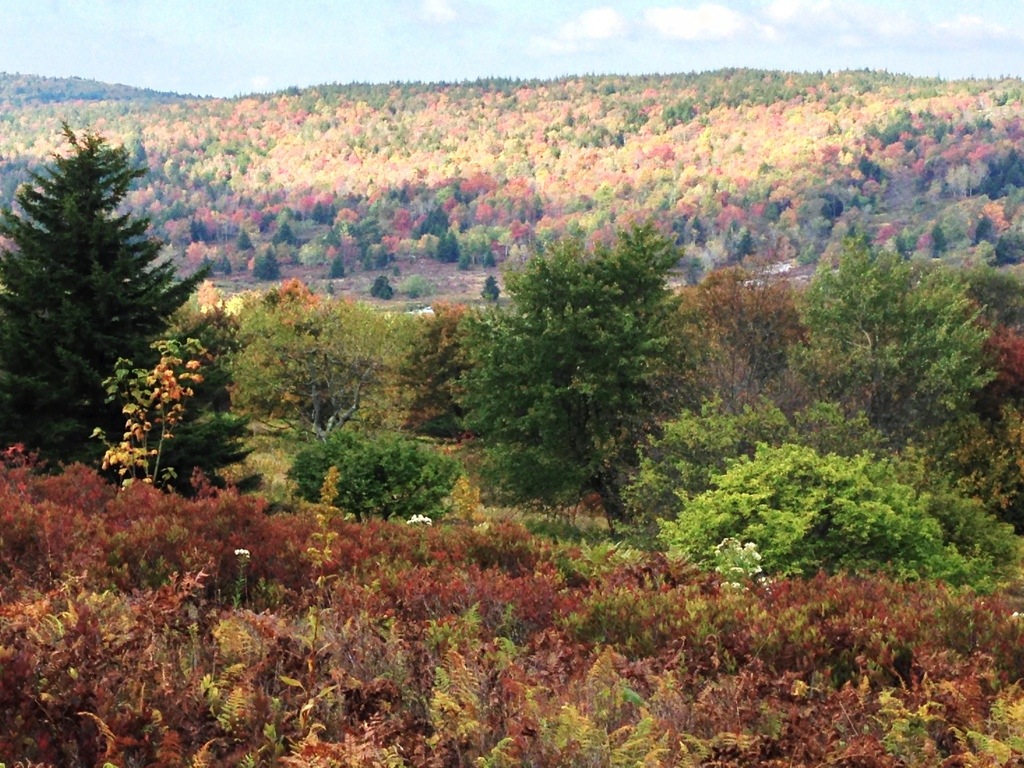
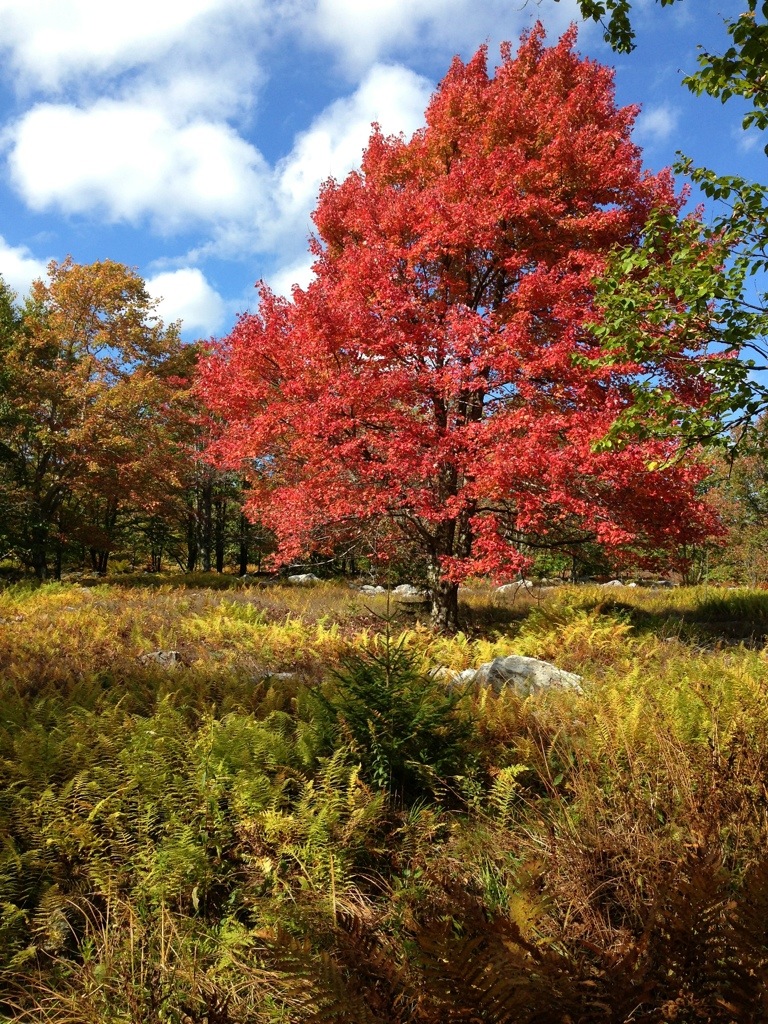
Fall color was at its peak when I was there, and the highlands of Dolly Sods are absolutely incredible with a variety of colors from blazing red to bright yellow both on the ground and in the trees. Last year I was there a week later and had to leave a day early because it started snowing. This area is known for harsh weather conditions, so visitors need to be aware of changing conditions and come prepared.
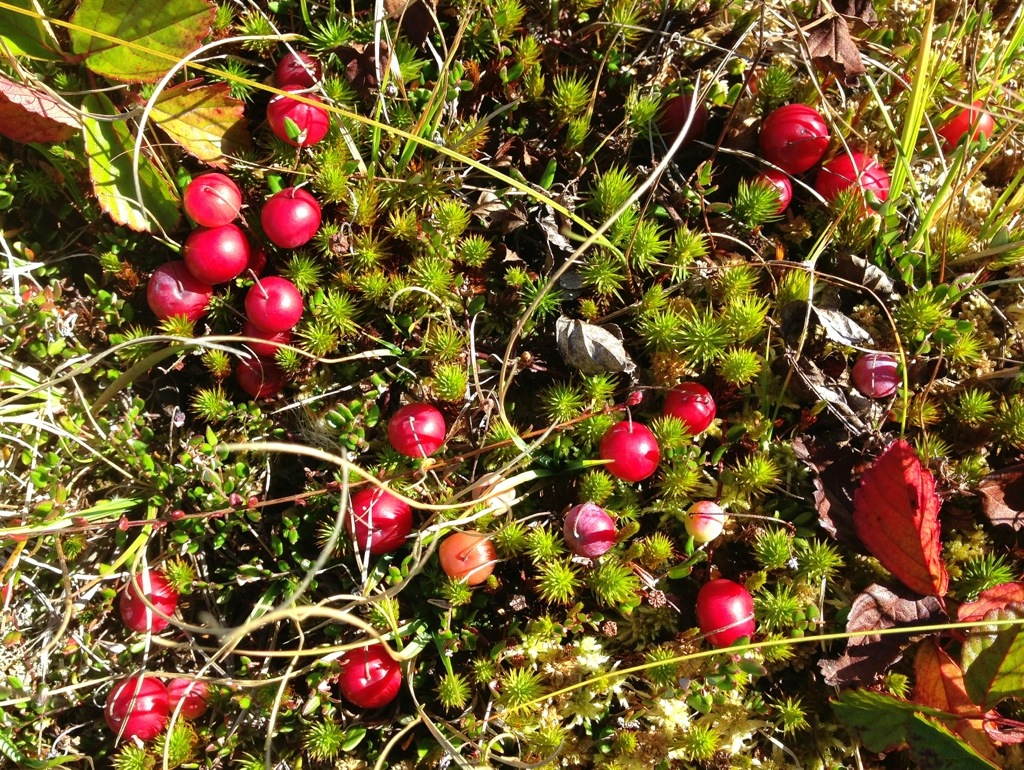
The area is rich in fruiting shrubs and groundcover including many species of blueberries, huckleberries, and cranberries. The tart cranberries made a delicious addition to breakfast oatmeal.
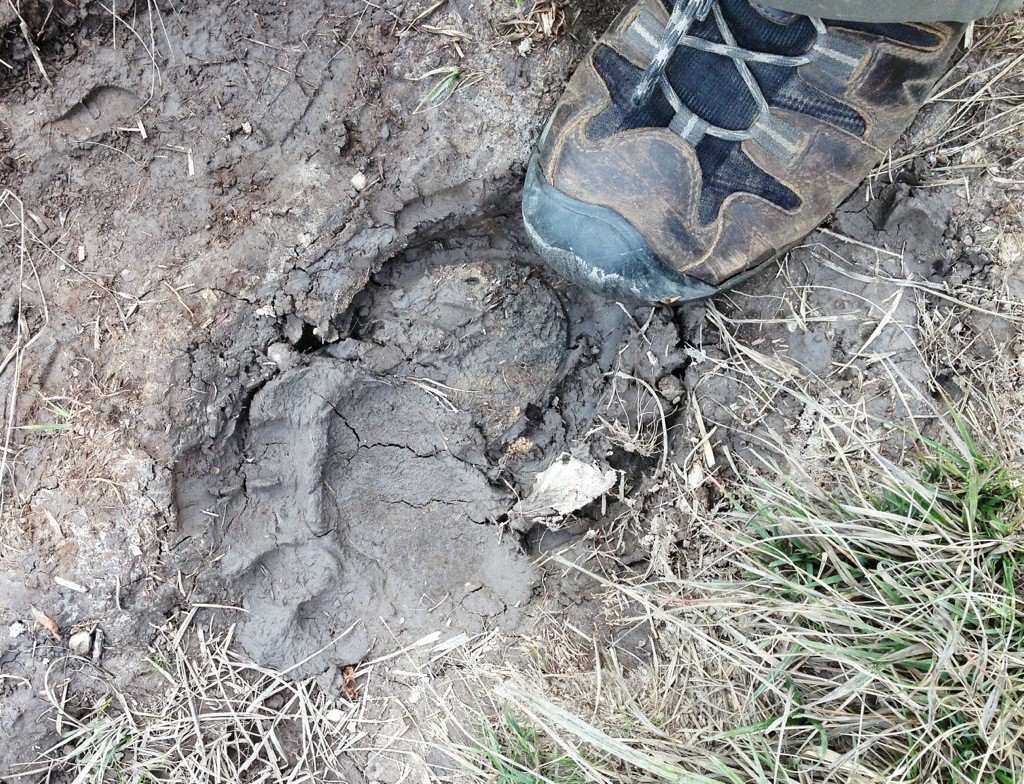
The area reportedly has some unusual wildlife such as Fisher and Snowshoe Hare, again, much more like northern forests than other areas of the Appalachian Mountains. I did see some evidence of Black Bears this time and heard the howls of Coyotes and hoots of Barred Owls late at night.
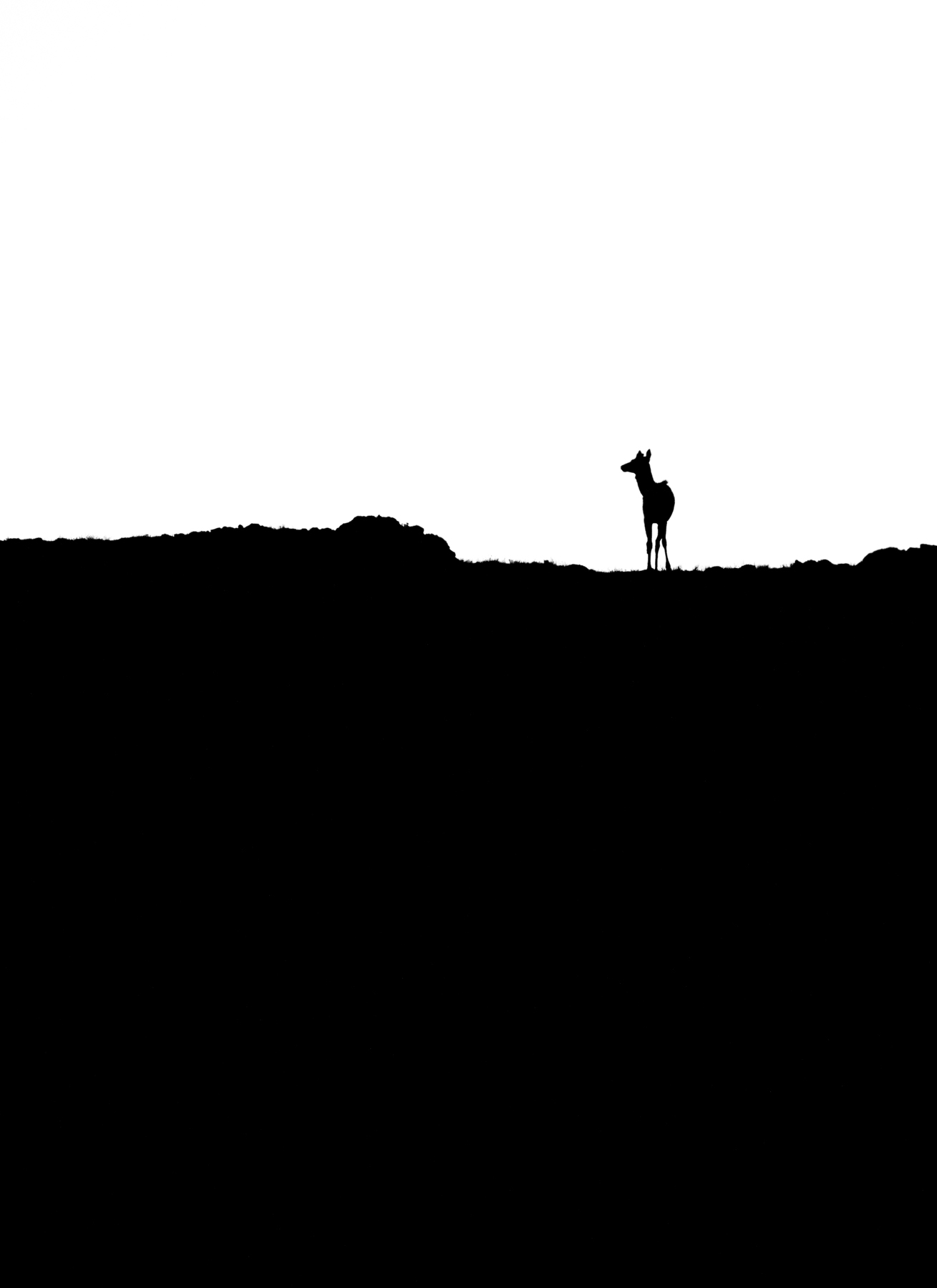
Throughout the trail system there are a number of well established campsites. The area is pretty heavily used so I recommend camping in these locations so as not to create more disturbance to this unique environment. Since I was backpacking I did not carry my usual assortment of camera gear but relied on my phones’ camera instead. I leave you with a few images of this beautiful area that I will surely visit again.
The abundance of insects feeding on pollen and nectar in the goldenrod patch out on the power line has naturally attracted an array of predators.
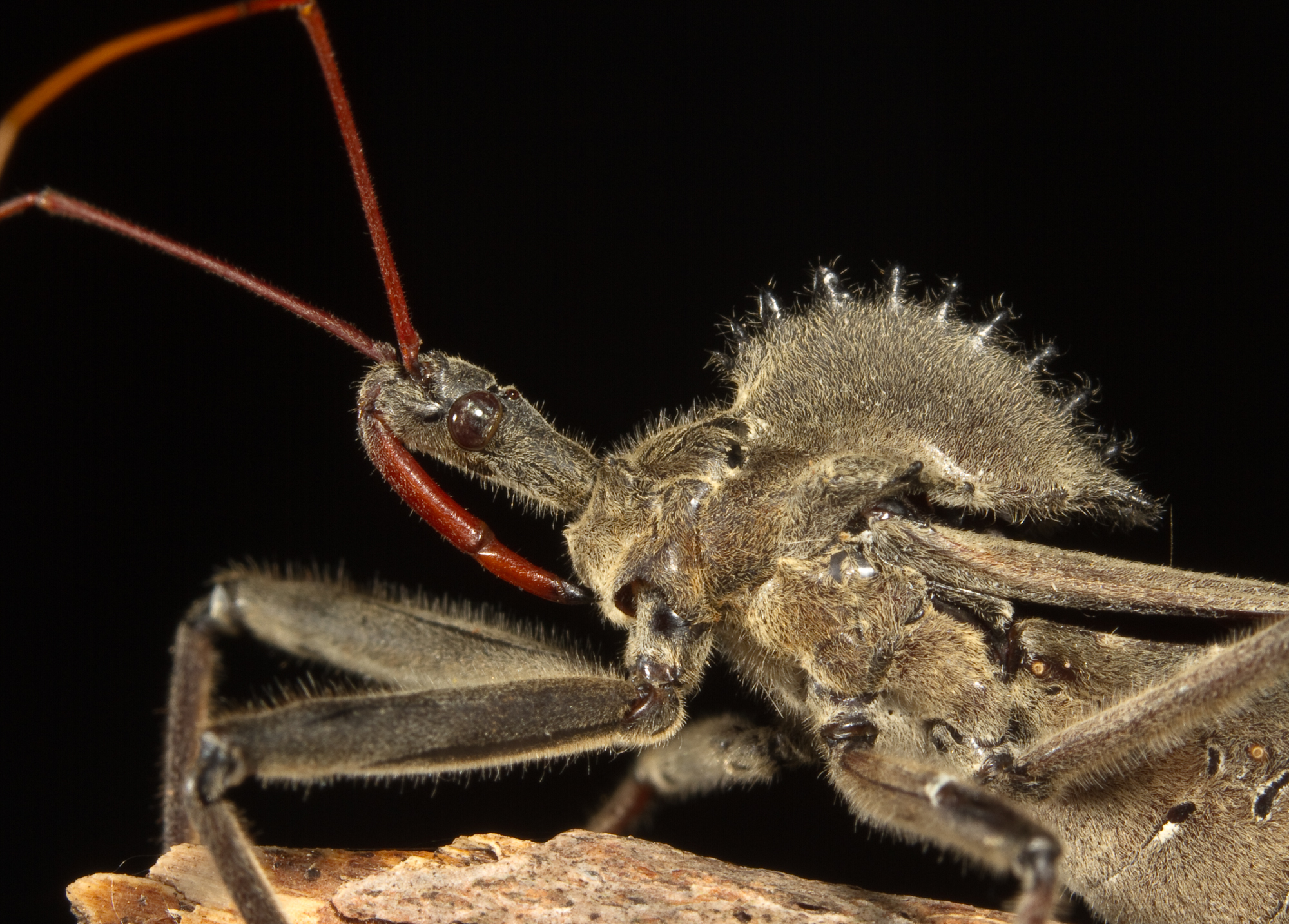
Wheel Bug (click on photos to enlarge)
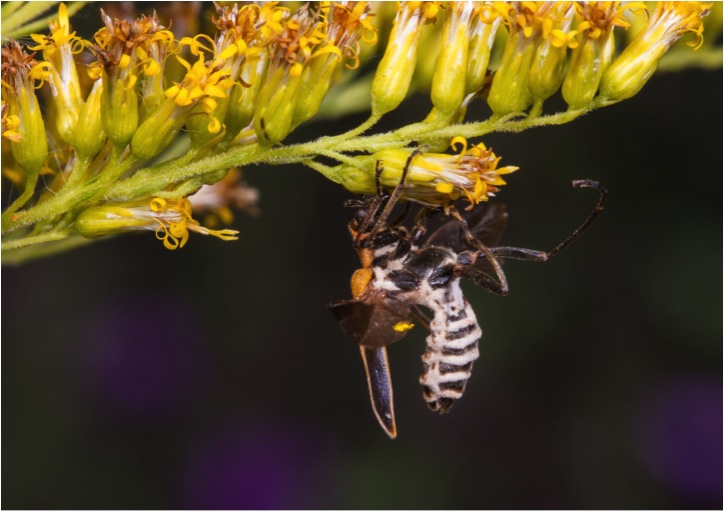
One of the more formidable-looking of these is the Wheel Bug, Arilus cristatus, our largest member of the so-called Assassin Bug group. Wheel Bugs are named for the unusual gear-like projection on the dorsal surface of the thorax of the adult insects. They are efficient predators of many types of insects including caterpillars, beetles, and bees. Wheel Bugs move slowly through vegetation like goldenrod searching for prey which they grab with their long front legs and then pierce with their stout beak. Their saliva contains a toxin that immobilizes and kills its victims within a minute or less. They then drain the body fluids from the victim. That same beak can inflict a painful bite on a human if you accidentally grab a Wheel Bug, but, left to their own, they will not bother us. In fact, Wheel Bugs are considered beneficial garden insects as they prey on a number of bugs we consider pests.
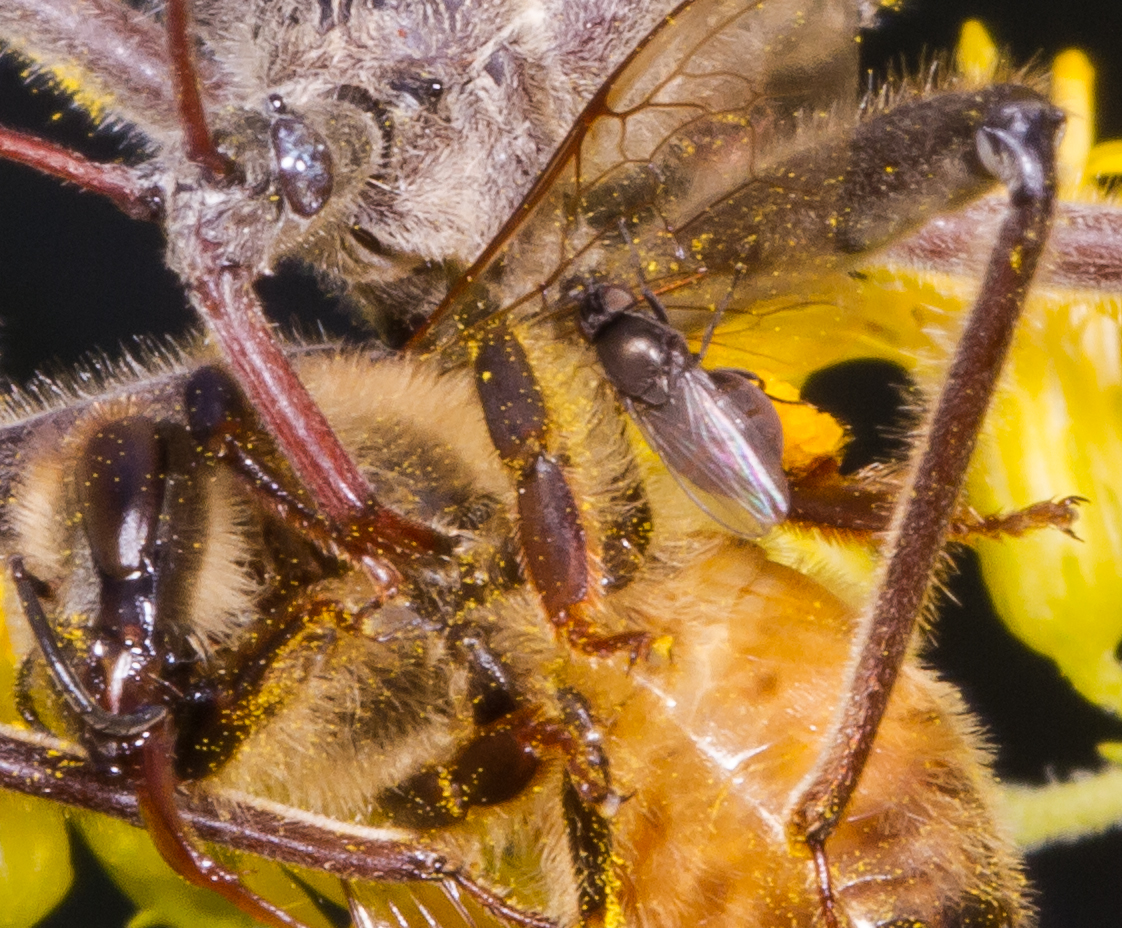
Wheel Bug and Honeybee prey
I encountered a couple of these impressive insects while walking through the goldenrod last week. One was hunting on some flowers, the other had successfully captured a Honeybee. I grabbed a few quick photos and moved on. When I looked at the images later I noticed something I had missed in the field.
Wheel Bug with bee with Freeloader Fly
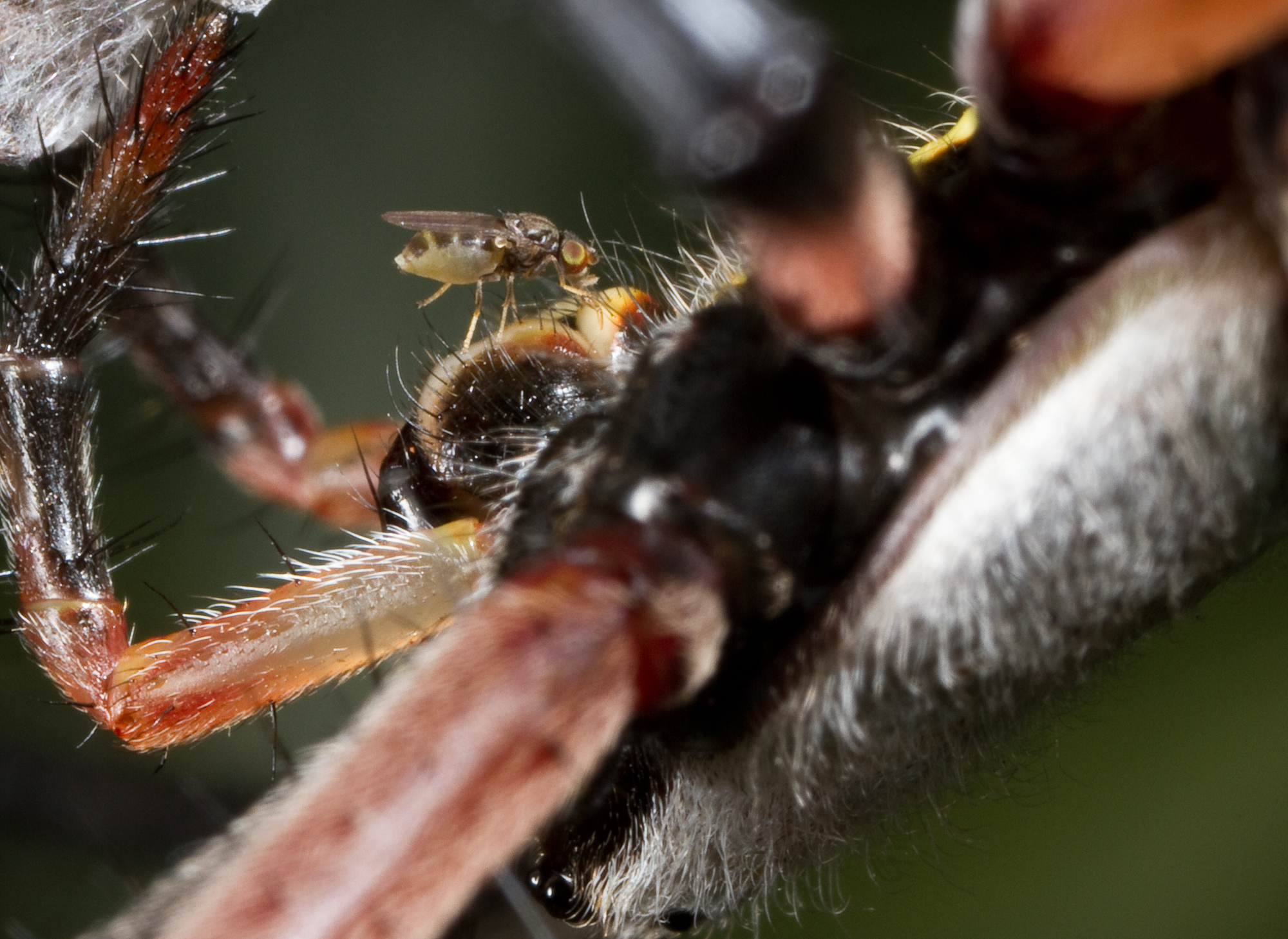
There was a tiny fly on the bee near the point where the Wheel Bug was feeding. I recognized it as one of an interesting group of flies known as Freeloader Flies. These tiny marauders are kleptoparasites and steal a meal from the jaws of predators such as Assassin Bugs and various spiders. I had seen them once before in the garden when I photographed a Black and Yellow Argiope Spider feeding on a Stink Bug.
Black and Yellow Argiope with prey
On that day, I once again did not see the tiny flies until I had taken a few images. At that time I had no idea what these miniature thieves were and was not even sure what they were doing other than living dangerously. A web search helped me discover the amazing world of kleptoparasitic flies.
Freeloader Fly stealing a meal at the jaws of an Argiope Spider
Other names for this interesting group of insects include Jackal Flies and Filth Flies (their larvae feed on decaying organic matter and some species may develop in manure). They apparently are attracted to their meal by chemical odors released by the victims. And it is unclear whether they are merely licking spilled fluids from the victim or whether they may actually penetrate the cuticle of the prey and ingest tissues that the predator has liquified by its injections into the dead prey. The adults of some species of Freeloader Flies have been observed to follow a particular predator in order to partake of its meals. I guess in this case, it is a different sort of meals on wheels:)
I love nature, I just don’t want to get any of it on me.
Woody Allen
I gave a talk the other night to the Raleigh Chapter of the Carolina’s Nature Photographers Association. They were a great group and seemed to enjoy my topic about macro photography. One story, in particular, raised a few eyebrows. It was about something I see going on right now out in the patch of goldenrod under the power line.
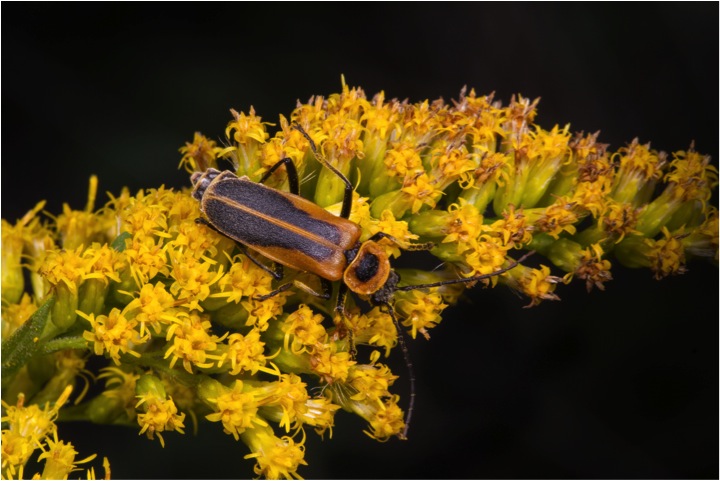
Soldier Beetle feeding on Goldenrod (click photos to enlarge)
The patch is abuzz with all sorts of insects feeding on the copious quantities of nectar and pollen to be found in the golden buffet. Among the many foragers are a group of common beetles known as Soldier Beetles (also known as Leatherwings), Chauliognathussp. They are busy feeding on pollen and mating and are frequent visitors to various species of goldenrod and boneset that occur on the power line. In the past couple of weeks I have noticed something strange happening amongst their ranks…
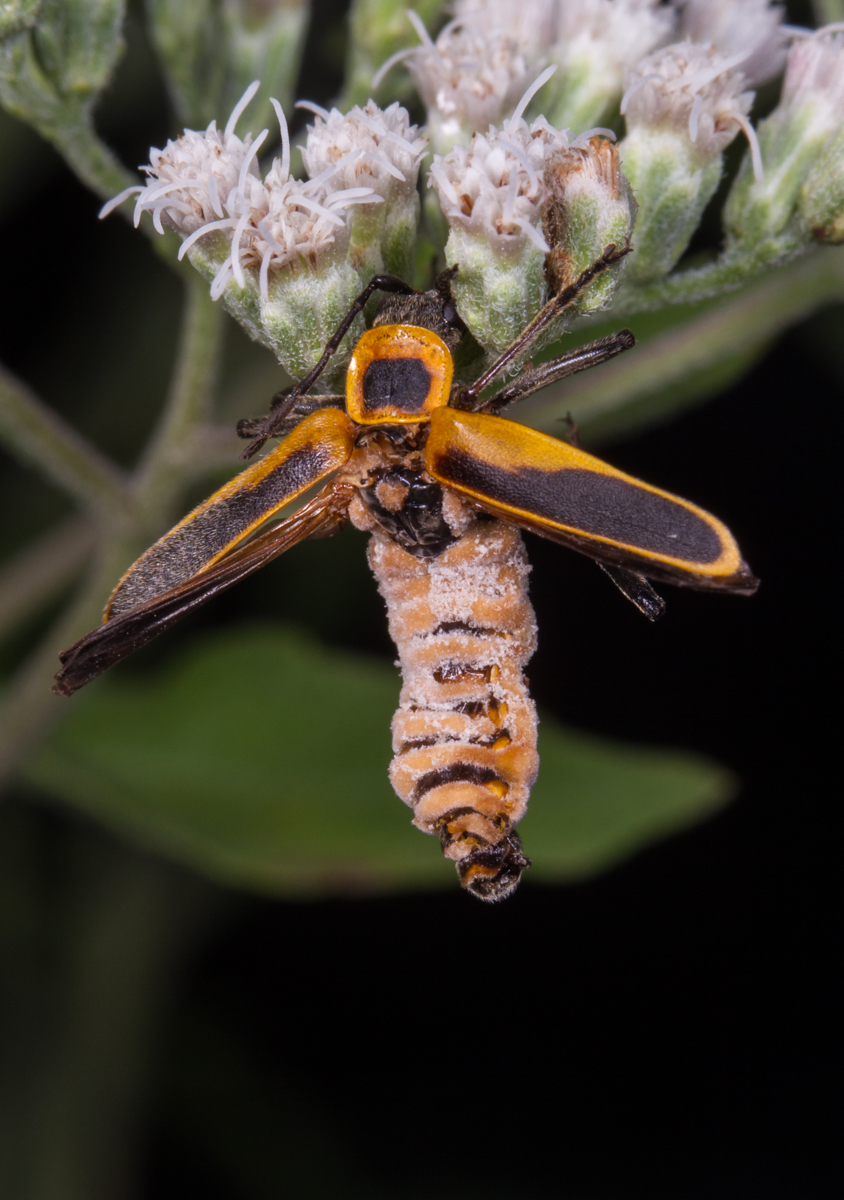
Dead Soldier Beetle on goldenrod
The beetles are hanging down underneath the flowers with their wings askew in what looks like some strange circus acrobat position, but with a decidedly non-circus look about them. They look and are, in fact, dead.
Soldier Beetle on boneset
And there are lots of them this year – a large die-off of these beetles in what is certainly one of nature’s more bizarre local stories.
Group of dead Soldier Beetles
A close look at the dead bug shows a fuzzy white coating coming out between the segments of the lifeless body. The culprit is one of a group of arthropod pathogenic fungi. There are apparently many species of these insidious fungi, and many are host specific. The general life cycle is that an insect picks up a spore of the fungus on its exoskeleton while moving about in its environment. The spore then germinates and penetrates into the exoskeleton of its host via mechanical pressure and the production of enzymes which help dissolve an entry hole. Once inside, the fungus grows and divides. There is often an attack on the nervous system of the host which causes a change in its behavior near the time of death. In the case of these Soldier Beetles, they clamp onto the vegetation with their mandibles. In one study in Arkansas, an estimated 20% of the beetles surveyed in a field were infected by the fungus. And in an interesting finding, the researchers observed “by an unknown mechanism the fungus causes the dead beetles to raise their elytra between 2400 and 0700 hours during the night”. The position of the raised wings presumably provides a more efficient means for the fungus to disperse its spores from the dead insect.
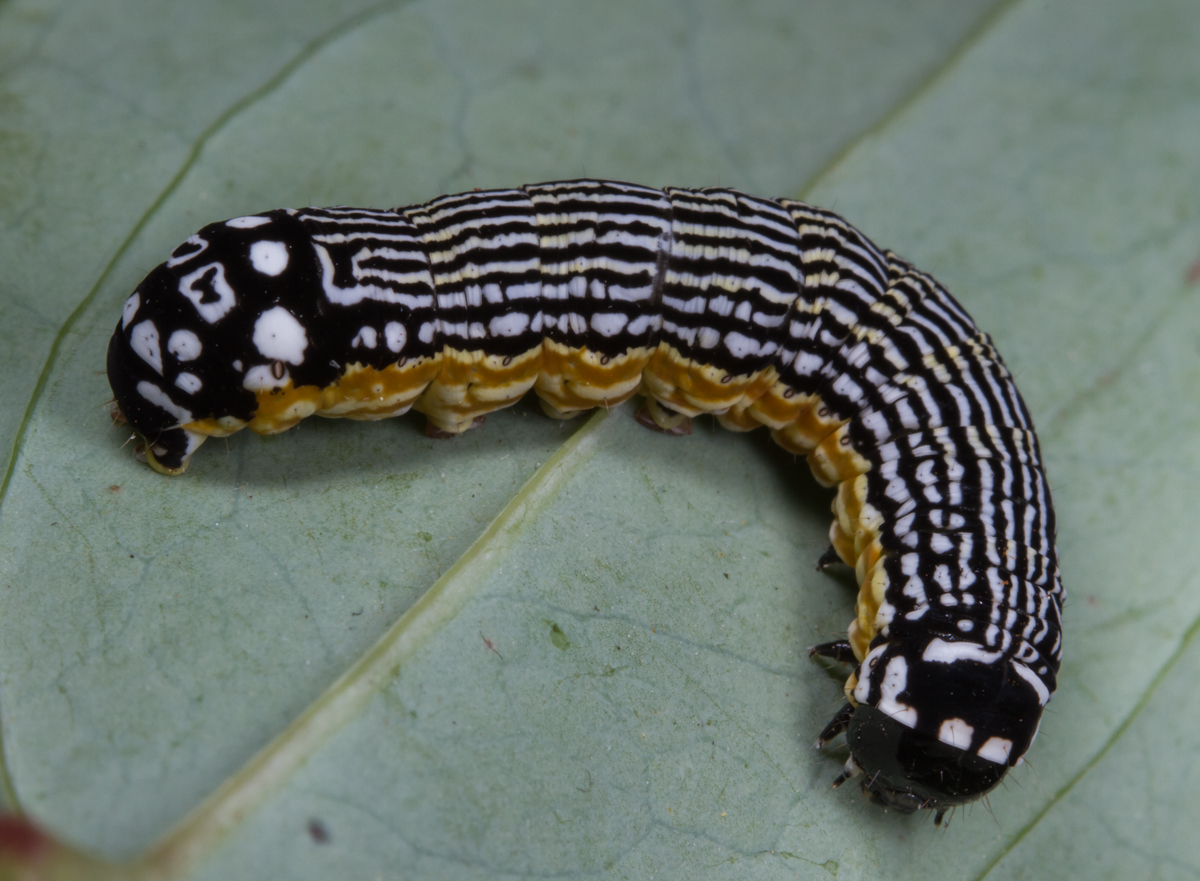
I have been away a few days celebrating a major birthday (hard to believe it is that number) and returned to find a few caterpillars from BugFest still active (most were released the day after the event). I was particularly pleased to see the snappily-attired Turbulent Phosphila munching away on its host plant, Greenbrier (Smilax sp.). I remember the first time I found one of these pin-striped beauties I could not decide which end was which, a common caterpillar conundrum. A frequent defense strategy of many types of insects is to present a false head to would-be predators. This usually involves eye spots of some sort since we, and most vertebrate predators like birds, associate eyes with the head of an animal. By going after the head first, a bird is likely to immobilize its prey quickly and cut off any escape attempt.
Turbulent Phosphila – which end is which?
A close look reveals the truth – the last three segments of the rear of the caterpillar are somewhat enlarged and have prominent white spots suggesting eyes. Ironically, the true head end of the larva also has false eye spots on the thorax. The true eyes, like those of most caterpillars, are diminutive and arranged in arcs on the side of the caterpillar’s true head capsule, which is tucked on the right side of the larva in the image above (note the presence of the short antennae and true legs on that end). Maybe it is no accident that referee shirts look like the bold patterns of this larva – many of us question where their eyes are as well.
Turbulent Phosphila on Smilax sp.
David Wagner (Owlet Caterpillars of Eastern North America) states that “the bold coloration is suggestive that the insect is chemically protected, although it remains to be shown if the Turbulent Phosphila is in fact unpalatable, or if its patterning is largely a ruse”.
Grouping of Turbulent Phosphila larvae
Young caterpillars are gregarious feeders on various species of Greenbrier, but as they grow older, they become more solitary. Finding a group of them on the underside of a Greenbrier leaf or clumped on a vine is a caterpillar-lover’s (and perhaps graphic artist’s) delight. The moth has two generations per year throughout much of our region and can often be found as late as November in the coastal plain. Finding the Curve-lined Owlet caterpillar, and now these interesting larvae, on Greenbrier, gives me a reason to appreciate this often maligned vine.
While out searching for caterpillars last week I came across a tiny juvenile Gray Treefrog in the bushes alongside the road. I walked back to the car to get my camera but when I returned, the frog had disappeared. As I looked for it I caught a movement out of the corner of my eye. A closer look revealed a tale of tragedy and beauty. I recognized the victim as a Golden Tortoise Beetle, a beautiful insect I have seen in the garden several times. But I wasn’t sure who the colorful predator was other than some sort of stinkbug. As I watched, it moved around to the underside of the leaf where its colors stood out more against the lighter background.
The long proboscis of a Florida Predatory Stinkbug with prey
The batteries in my flash were almost dead so I took just three pictures before giving up as the rain moved in. This critter was indeed strange as it walked around the leaf balancing its prize at the end of an incredibly long beak. A web search showed the vivid predator to be a Florida Predatory Stinkbug, Euthyrhynchus floridanus. When they jab their prey with their proboscis, they inject a toxin that slowly immobilizes the prey.
Florida Predatory Stinkbug
I was watching it move around with its prey when I noticed several more stinkbugs clustered in a folded leaf nearby. Juveniles (and, less often, adults) often aggregate, and are known to attack larger prey as a group. This aggregation behavior apparently allows them to successfully attack prey too large to be subdued by a single stinkbug, much like why wolves hunt in a pack. Imagine packs of tiny, brightly-colored wolf insects with jointed swords on their noses stalking prey in your backyard! I am constantly amazed by the complex life cycles and beauty to be found in nature.
“The caterpillar does all the work but the butterfly gets all the publicity”
George Carlin
I’m sure that’s just how some caterpillars feel, under-appreciated at best, reviled by many a homeowner at worst. Caterpillars are often seen as those critters that “eat my plants” without the person making the connection to their necessity in order to have the beautiful butterflies (and moths) that visit our gardens and pollinate so many plants. But I think caterpillars are just as beautiful as their adult forms and here are a few images that I hope will convince you of that as well.
Curve-lined Owlet backlit
By moving my light source around using my macro twin lights, I can get dramatically different results.
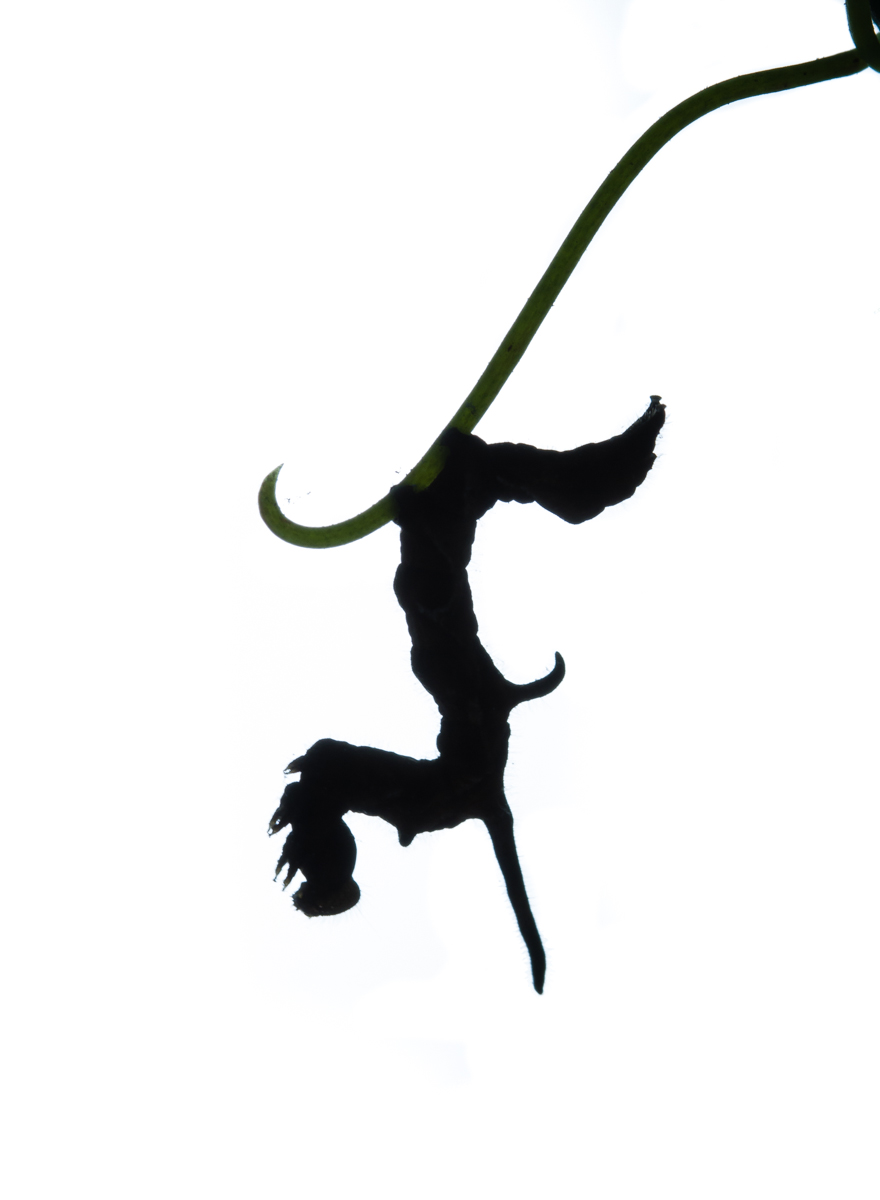
Curve-lined Owlet silhouette
By placing a white piece of foam core as a backdrop, you can highlight the outline.
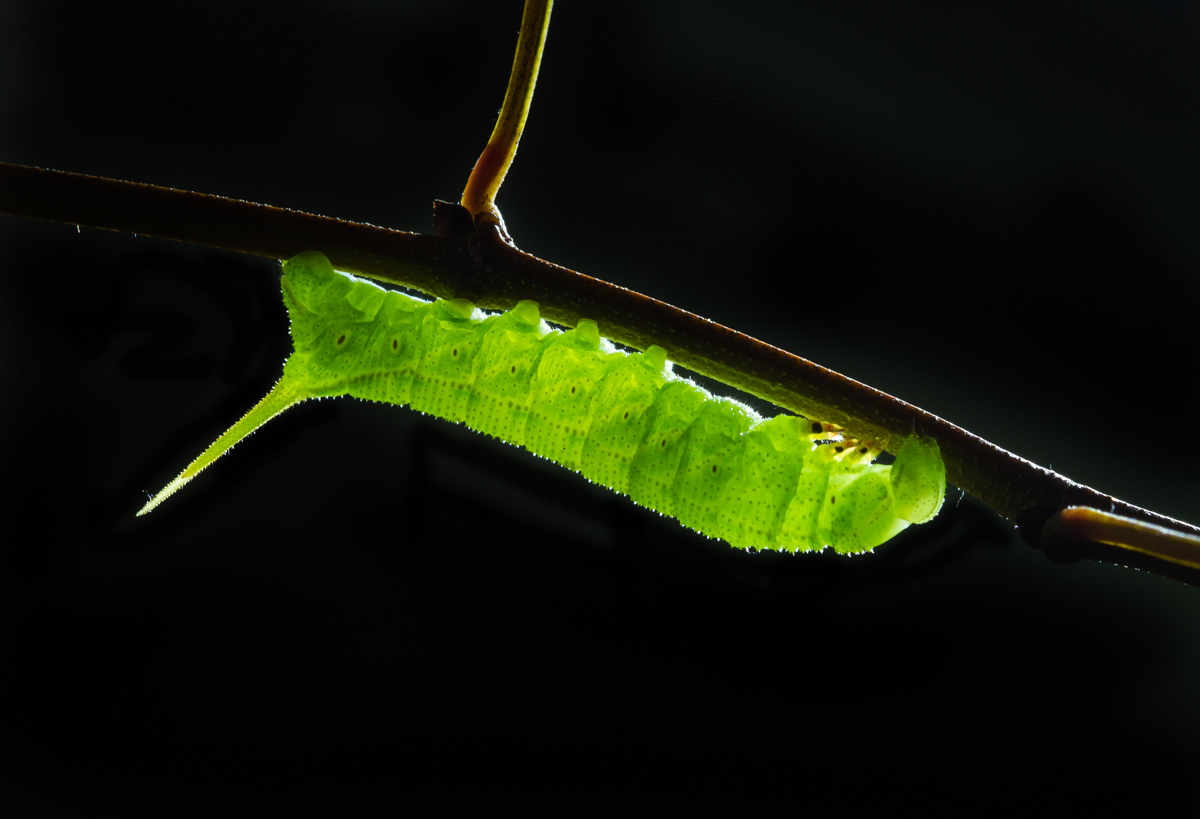
Hog Sphinx
Some species have a translucent quality when light is shined on them from behind or the side.
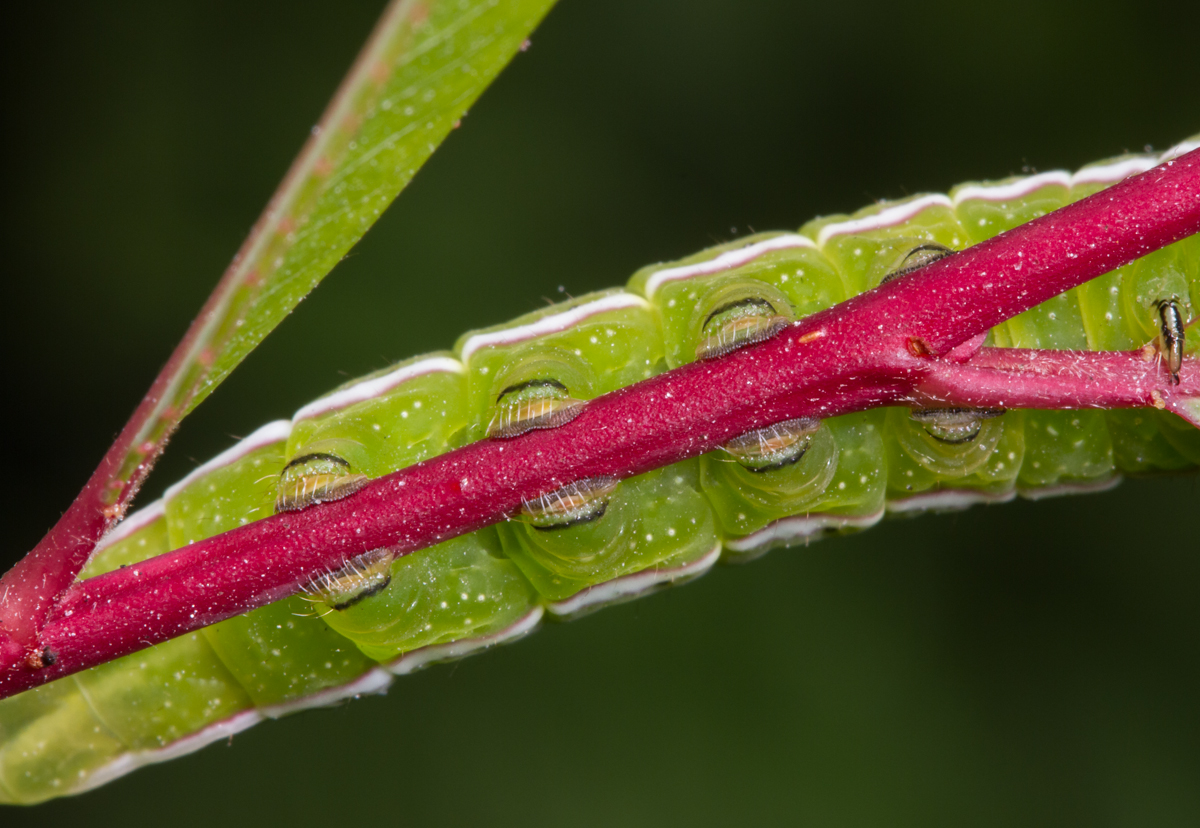
Black-etched Prominent close up of prolegs
A close up shot often reveals beautiful combinations of the larva and its plant.
Spicebush Swallowtail caterpillar
And the winner in the make-up artist category is….the Spicebush Swallowtail. This is one caterpillar that looks like an artist painted it with bright colors and patterns. It hides in a leaf shelter pulled together by stretching silk across the leaf. Then it tucks its real head and arches making the fake eyes more pronounced to discourage predators.
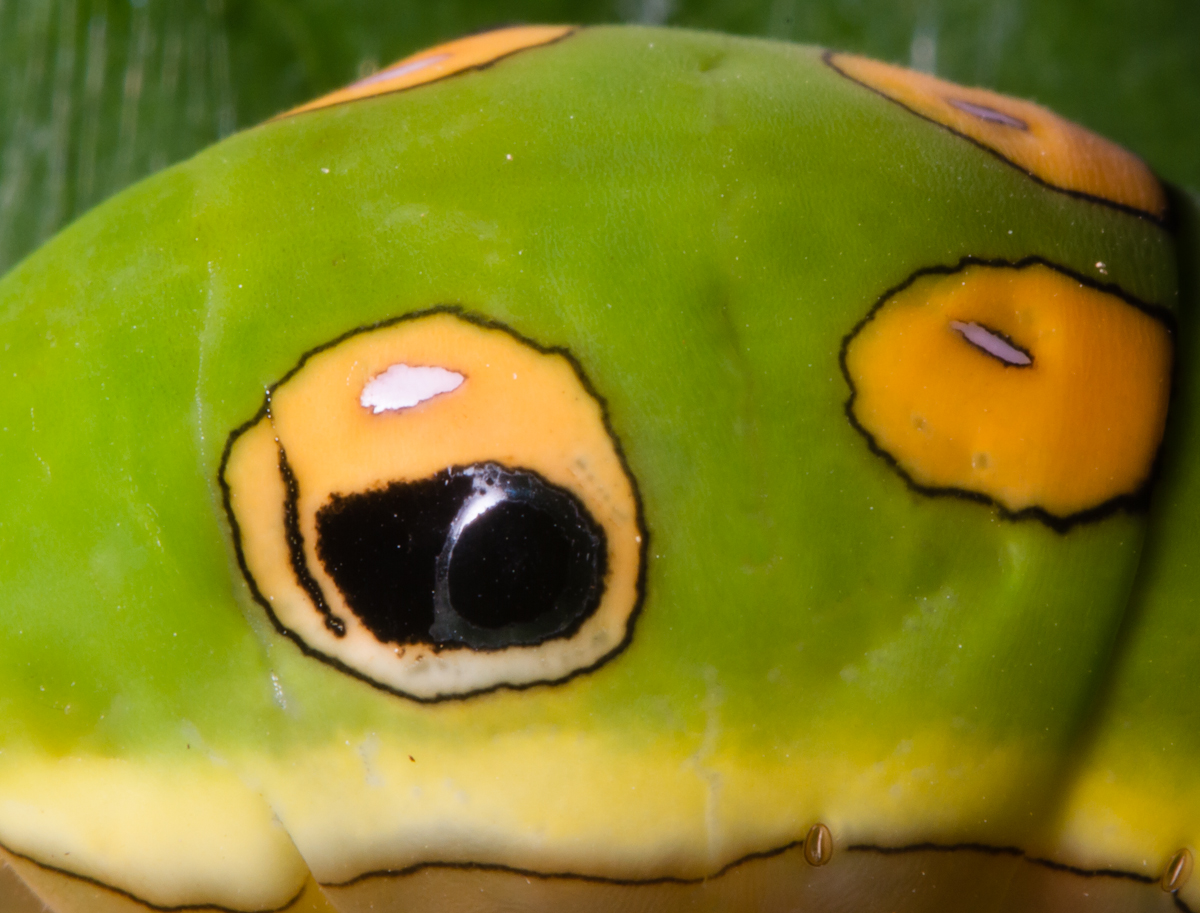
Spicebush Swallowtail fake eye
The level of artistic detail on the fake eye is what amazes me – there is a light spot that makes the “eye” seem moist, heightening the illusion.
So, get outside this weekend and take a moment to look closely and appreciate the wonder and diversity that surrounds us. Take a moment to sit with a caterpillar and admire it. Prepare to be amazed.
“Teaching a child not to step on a caterpillar is as valuable to the child as it is to the caterpillar.” Bradley Millar
Caterpillars are cool. I have been fascinated by these diverse and sometimes outlandish creatures for decades and have found them to be one of the best gateways for introducing people to the wonders of nature. I have used them effectively in teaching teachers, students, and the general public in my thirty year career with state parks and the museum. Their often unusual shapes and behaviors make them instantly appealing, they are fun to raise, and almost everyone that witnesses the miracle of metamorphosis is changed in some way. Tomorrow is the annual special event at the museum, BugFest, where we get to showcase caterpillars (and lots of other types of interesting invertebrates) with thousands of visitors. Several staff plus a few volunteers like me have been out looking for caterpillars this past week to share at BugFest. We have found a good variety but I want to highlight three of my favorites.
Yellow-shouldered Slug (click on photos to enlarge)
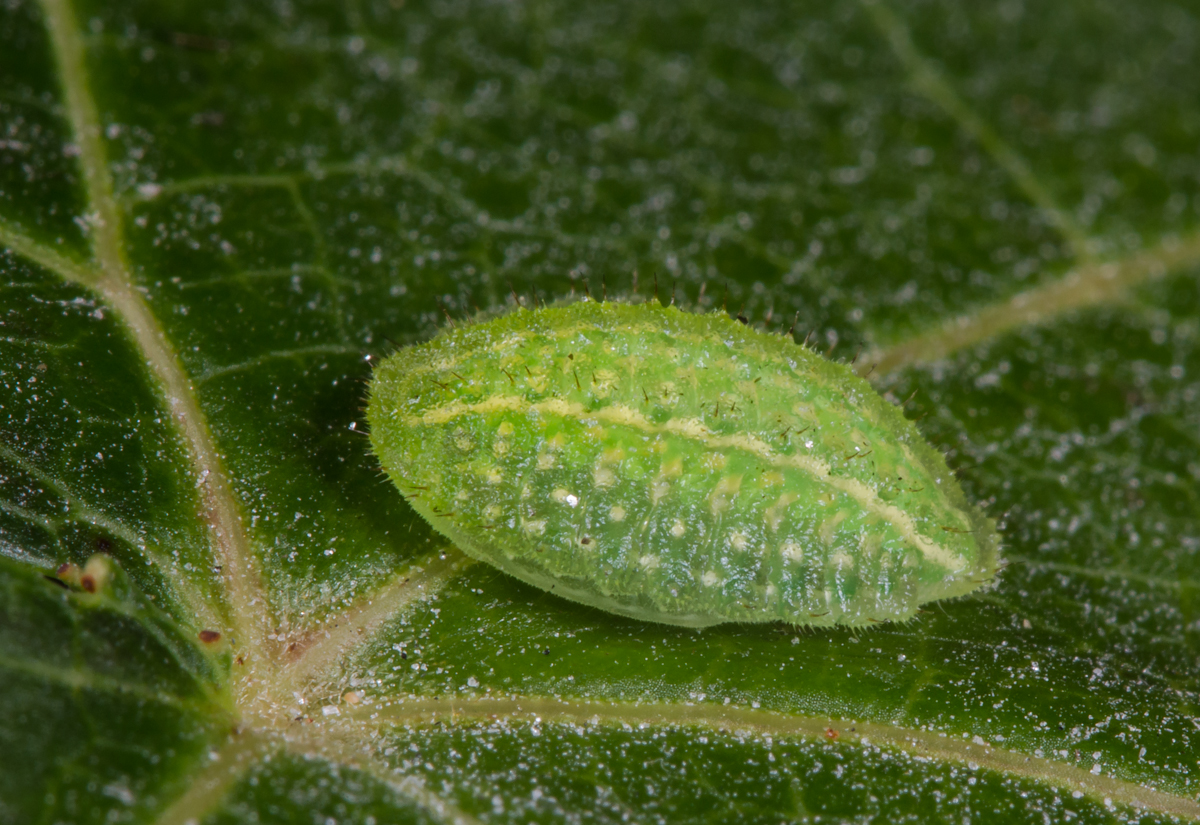
I posted on one of the more exotic slug caterpillars last week, the Saddleback. There are more than twenty species of slug caterpillars in our region, and there are some that do not have the stinging spines of the Saddleback. The Yellow-shouldered Slug is actually one of the more mundane of the group in appearance, but I always enjoy finding any of this peculiar clan. This species apparently has stinging spines in early instars (an instar is the stage between molts), but lacks them in the final one. Slug caterpillars tend to have more instars than most caterpillars – from 7 to 9, instead of the usual 5 of most species. Not sure where this one is in the process although it is still pretty small.
Black-etched Prominent
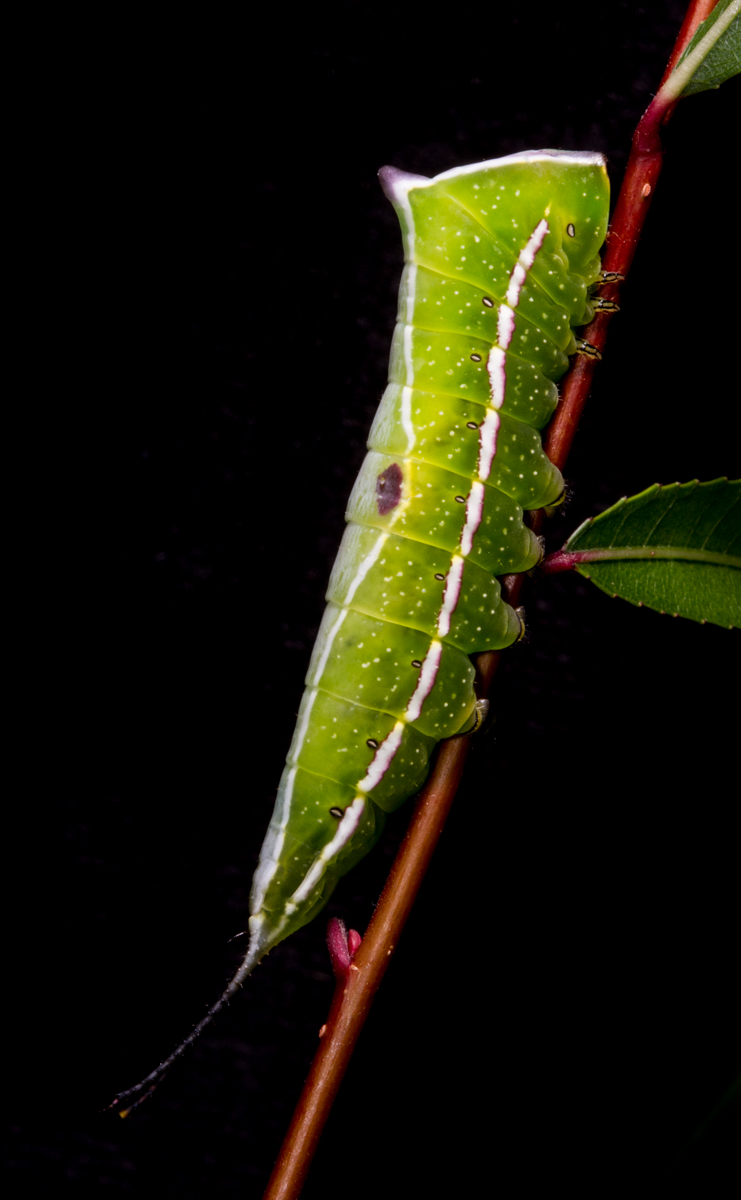
The Prominents are another interesting group. Several have greatly elongated anal prolegs which resemble two tails. This Black-etched Prominent was feeding on a willow when it was discovered due to the presence of chewed leaves.
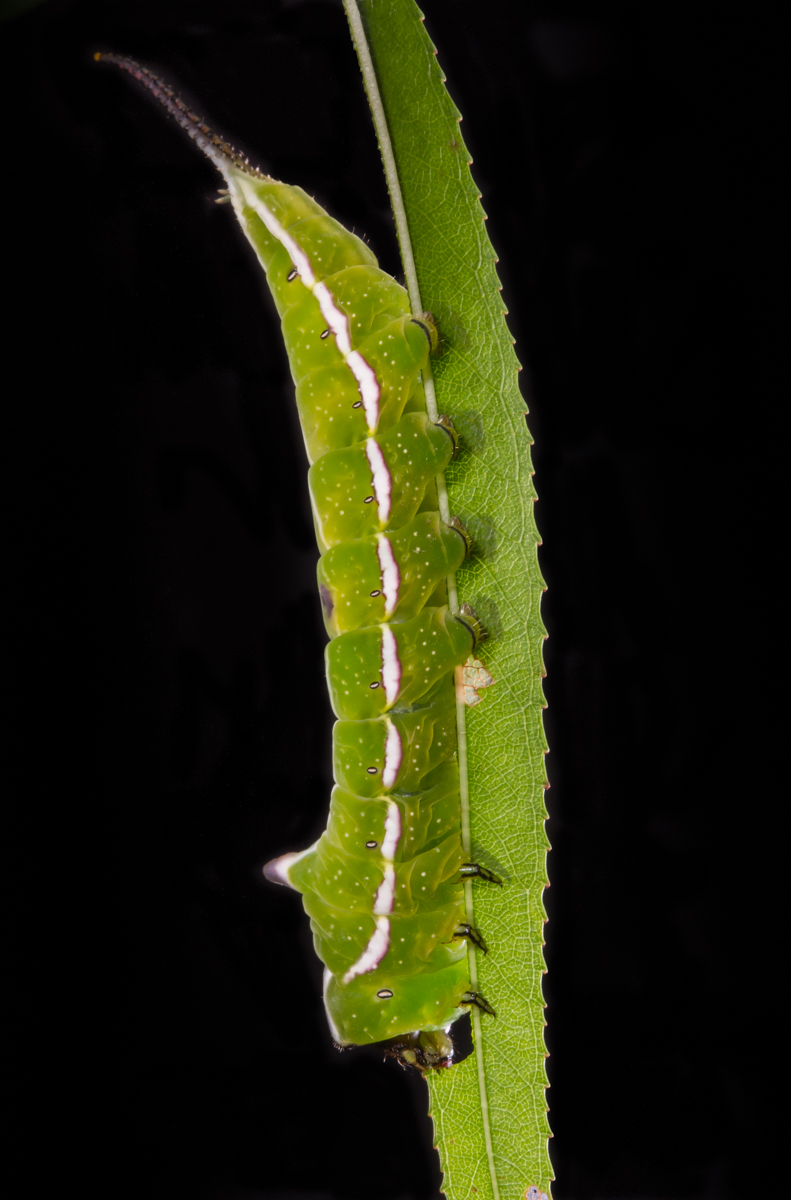
Black-etched Prominent feeding on willow leaf
They do have a remarkable camouflage that mimics the leaf color and shape, even to the detail of having a faux mid-vein-like stripe along their sides. But if pretending to be a leaf doesn’t fool a potential predator or parasite, this prominent has a couple of other defenses in its arsenal. The caterpillar can rapidly pump fluid into the two “tails” when it is agitated thereby greatly increasing their length. It quickly arches them over the body and whips the air with them which is probably especially effective against small flying parasitic wasps and flies.
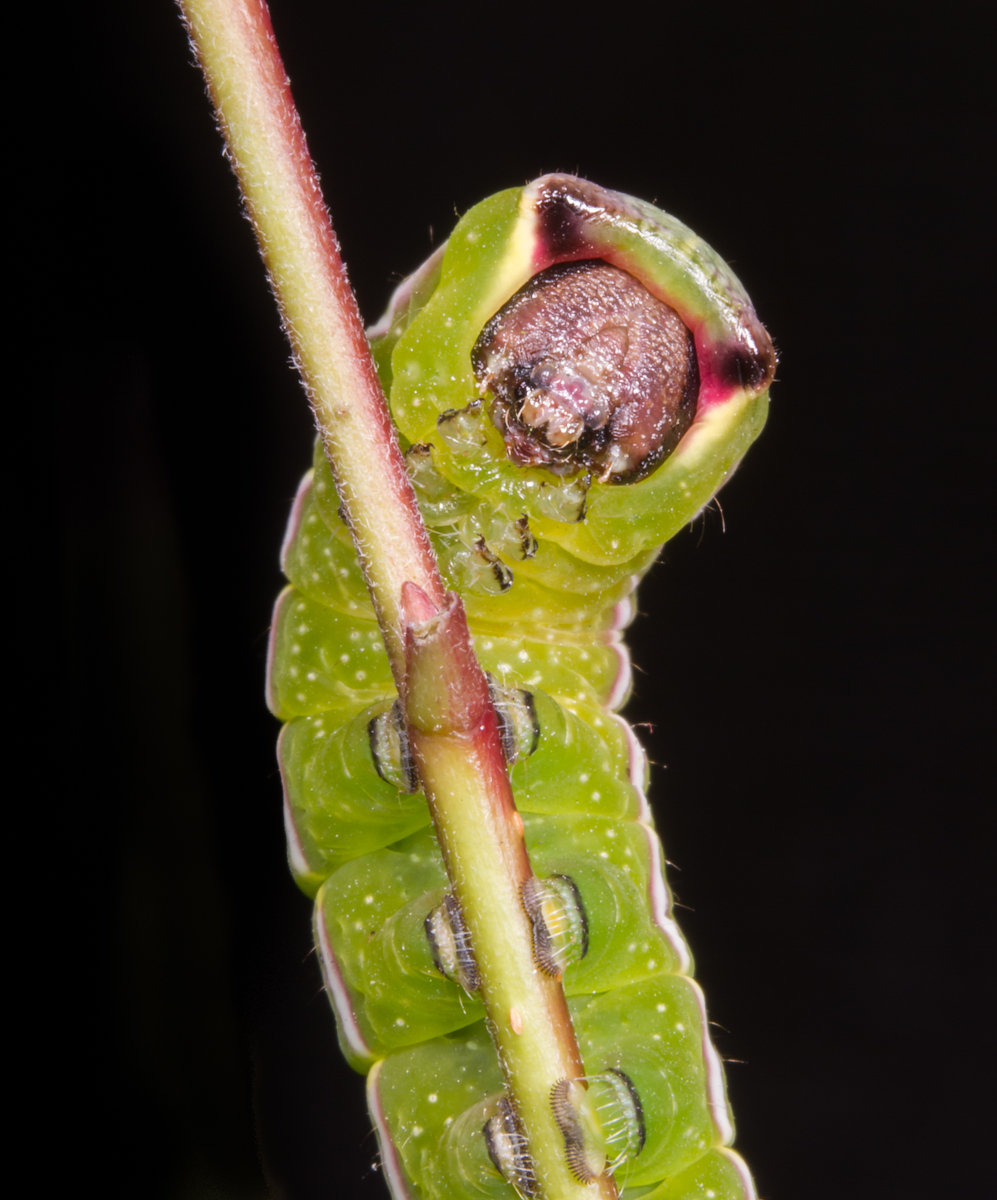
Black-etched Prominent “face”
If further alarmed, the caterpillar rears back and arches its head toward the intruder, revealing markings that look like a large false head with dark eyes. It also opens and closes its mandibles in a threat display. Ultimately, this, and several other prominents, may result to chemical warfare. They can shoot an acid spray from a gland underneath the head region. I have not yet experienced this so am unsure if it deters something like a large mammal with a camera, but will let you know if and when.
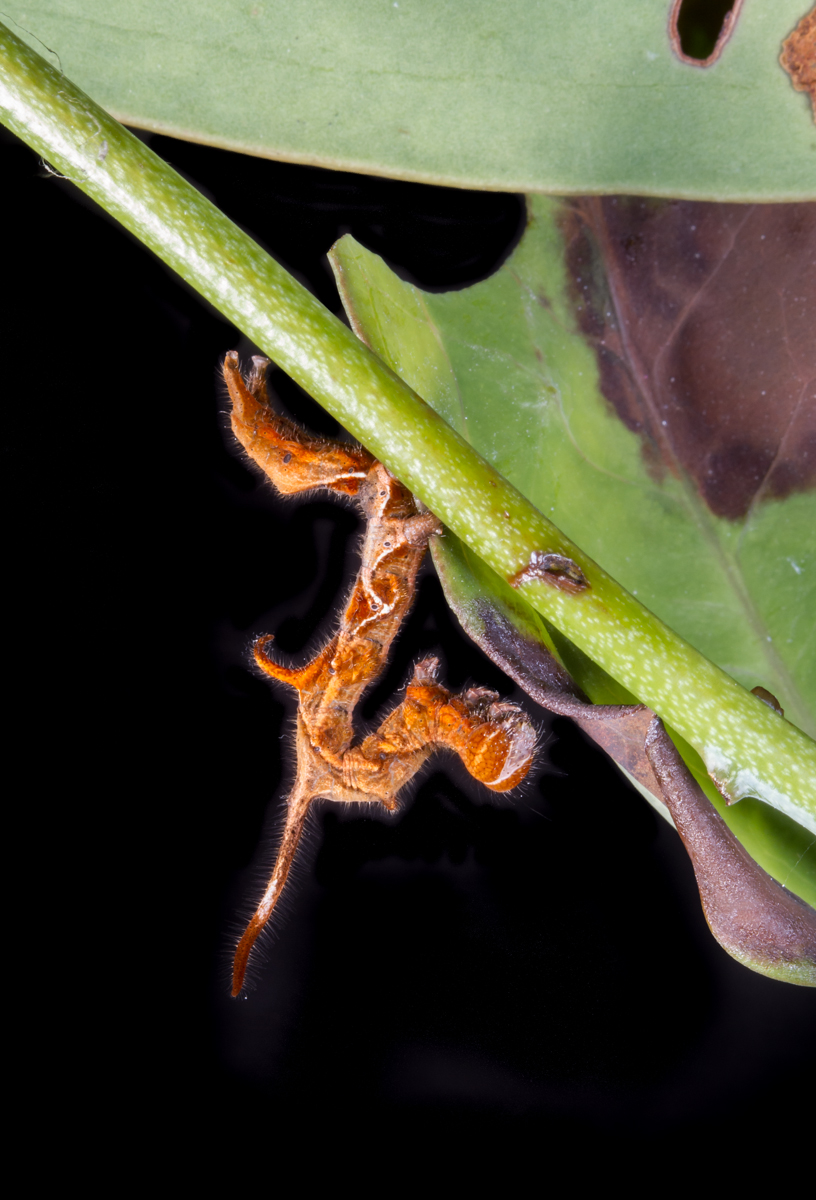
Curve-lined Owlet as dead leaf mimic
Then there are the caterpillars that I have seen in David Wagner’s field guide, Caterpillar’s of Eastern North America, and wished I could see first hand because they are so beautiful or bizarre (yeah, it’s true, I do think about such things). The Curve-lined Owlet is one of those species. And then, on the same day as the encounter with the Bobcat I reported in the last post, my friend found one of these Owlets on its host plant, Greenbrier (or Catbrier, Smilax sp.). And bizarre it is.
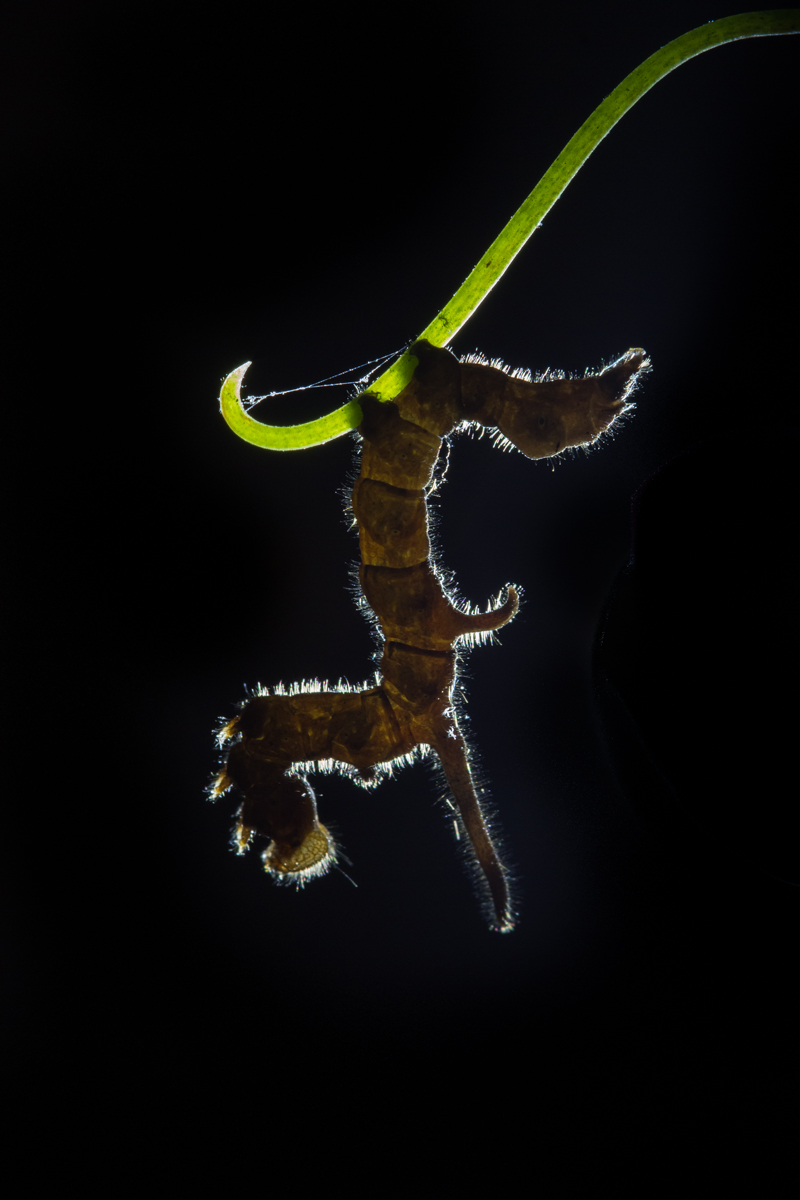
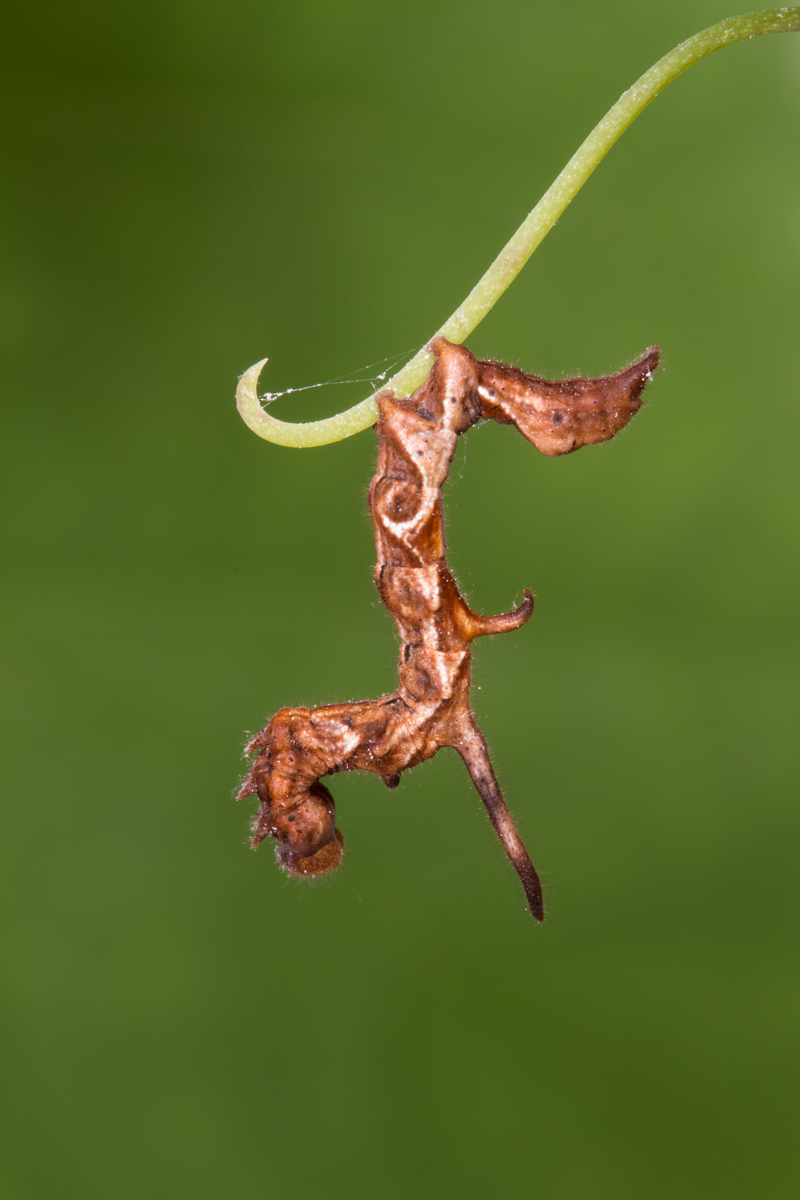
Curve-lined Owlet on Greenbrier tendril
This caterpillar is a dead leaf mimic. It is very slow in its movements and will gently quiver from side to side when disturbed, much as a dead leaf would do in a slight breeze. The unusual elongate projections coming off the dorsal side make sense when you see the caterpillar in its environment – the tendrils of its host plant, Greenbrier, have similar curves, and the rolled edges of dying leaves are similar in color and shape. After BugFest, I will return this and a couple of the other caterpillars found down east to their rightful home (either as larvae or pupae). Every effort is made to return the larvae to the proper environment after they are used for educational purposes. Now, if I could only find that one on page 270 that mimics the color and shape of a cluster of green grapes.
Hummingbirds challenging one another (click photos to enlarge)
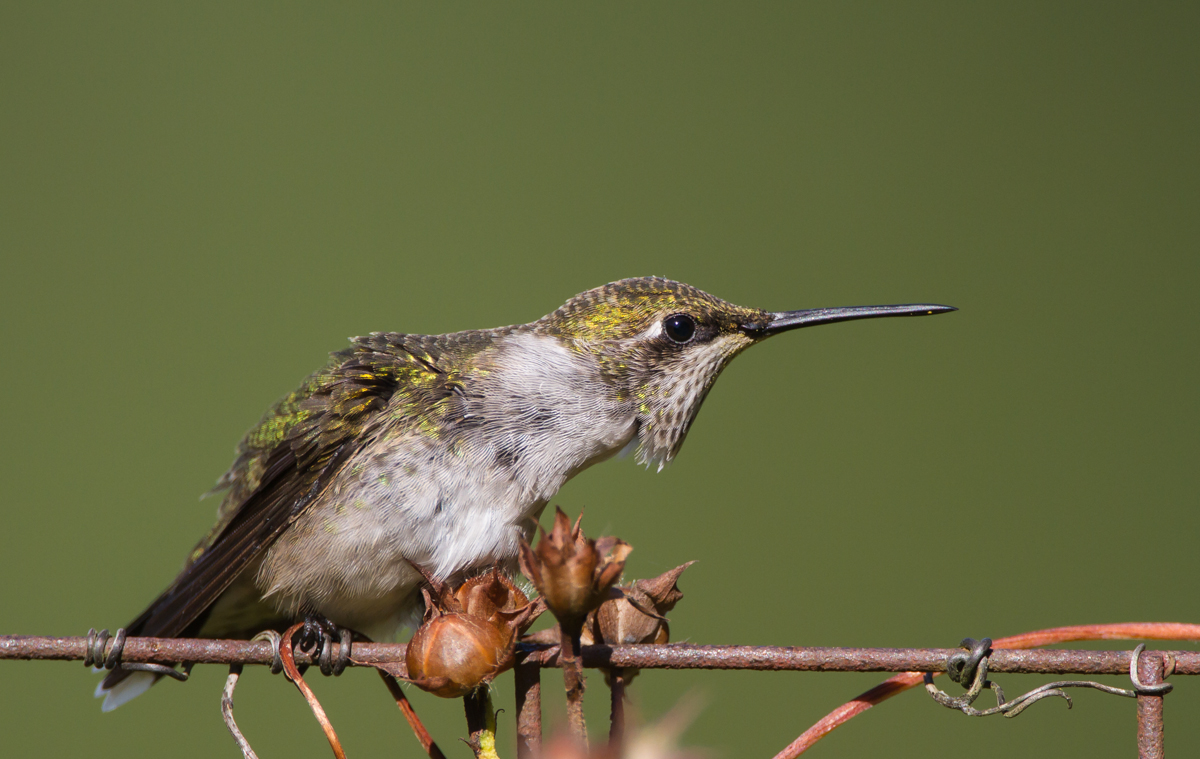
The past few weeks have been amazing in the garden – a daily display of aerial acrobatics from the remaining group of Ruby-throated Hummingbirds. There are four birds feeding on various wildflowers and the three feeders I have out in the garden. Every time I am out there I see and hear the squabbles as these winged bullets streak over and around me chasing one another in a seemingly endless game of tag. It just seems so energy inefficient to spend this much time and effort zooming around as they prepare for their upcoming migration. But, hummingbirds may almost double their weight prior to migration, so they must be getting enough in spite of all the ruckus. Each morning for the past few days I have spent some time sitting and attempting to photograph the goings-on. These tiny bundles of energy have some fascinating habits.
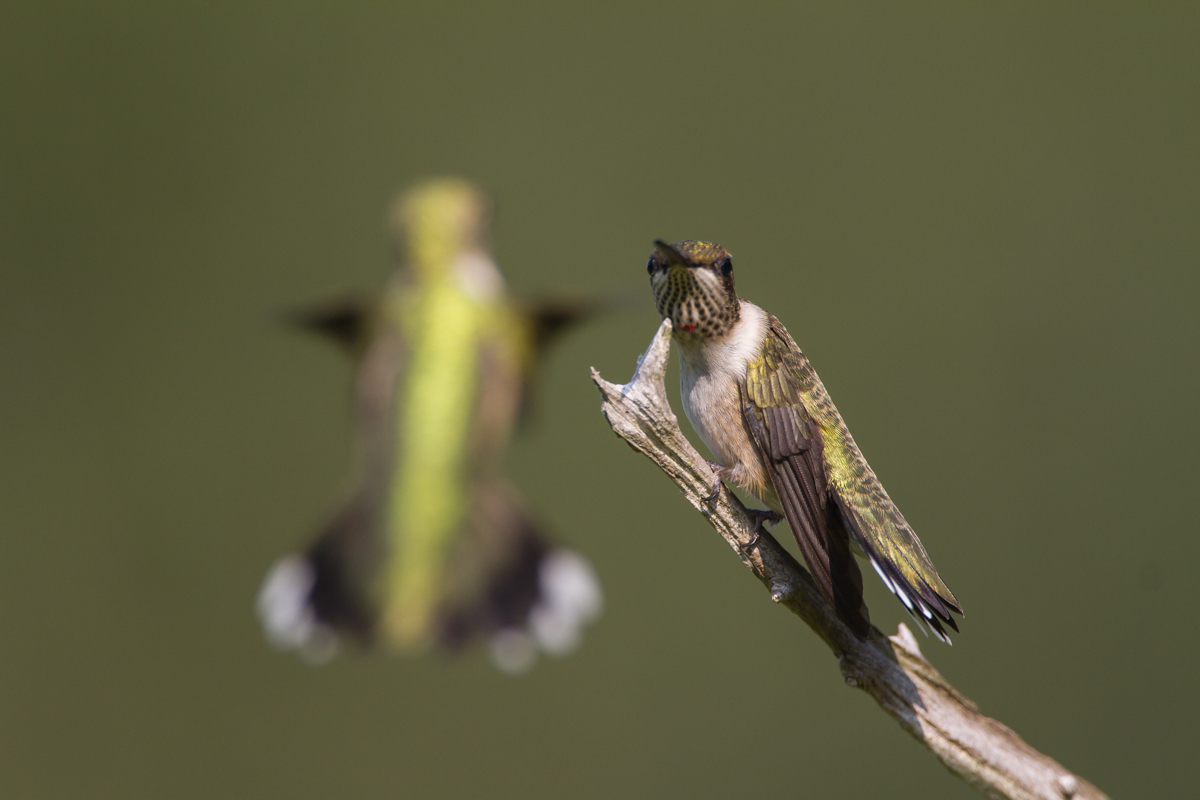
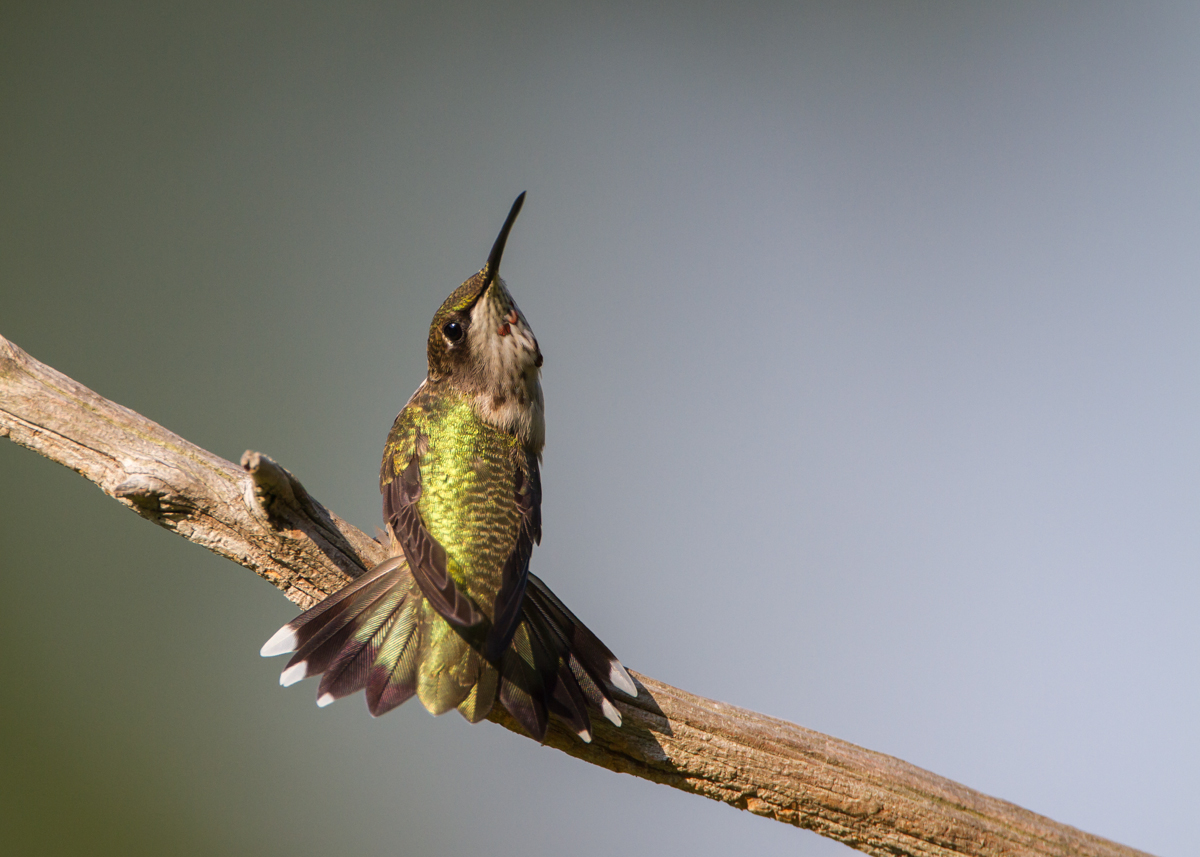
Ruby-throated Hummingbird immature male
There are at least two immature males in the bunch and they seem to be the most active. The adult males are the first to leave for their wintering grounds (and the first to arrive back in the spring). I have not seen an adult male for at least three weeks. The immature males mimic females in their plumage (including the white patches on the tail, which mature males lack). But they are beginning to have a few red feathers that will comprise the adult male’s stunning red throat (called a gorget) at maturity. Males develop their full colors on the wintering grounds and will return next spring with their flashy attire.
Hummingbird threat display
Much of their daily routine involves either active chasing or threat displays. The young male above contorted himself as another flew overhead and then gave chase.
Hummingbird threat display
This one was puffing up and leaning toward another bird that dared to land less than a foot away on the garden fence. These threat displays often end with a burst of speed that I am currently unable to capture with my camera. I have had them buzz me and almost fly into my car window which is what I am using as a “blind” for these photographs. They will often fly straight up for 30 or 40 feet in an aerial standoff before jetting off into the tree tops.
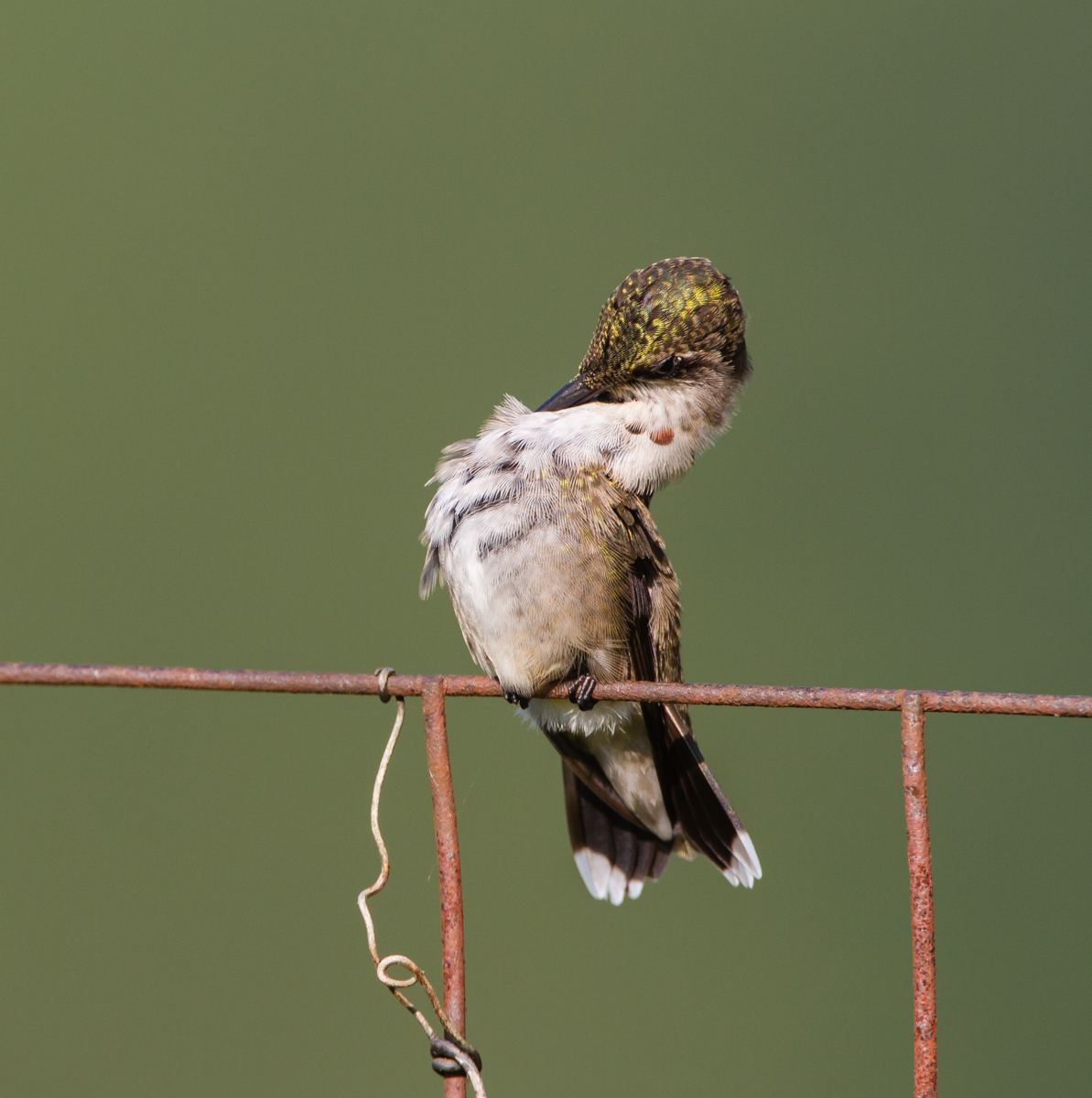
Hummingbird preening
When not fighting, they often settle on a favorite perch (this can change daily) and tend to self-maintenance issues.
Hummingbird scratchingHummingbird scratching
They preen and ruffle their feathers and they spend a lot of time scratching with those tiny feet.
Hummingbird rubbing bill
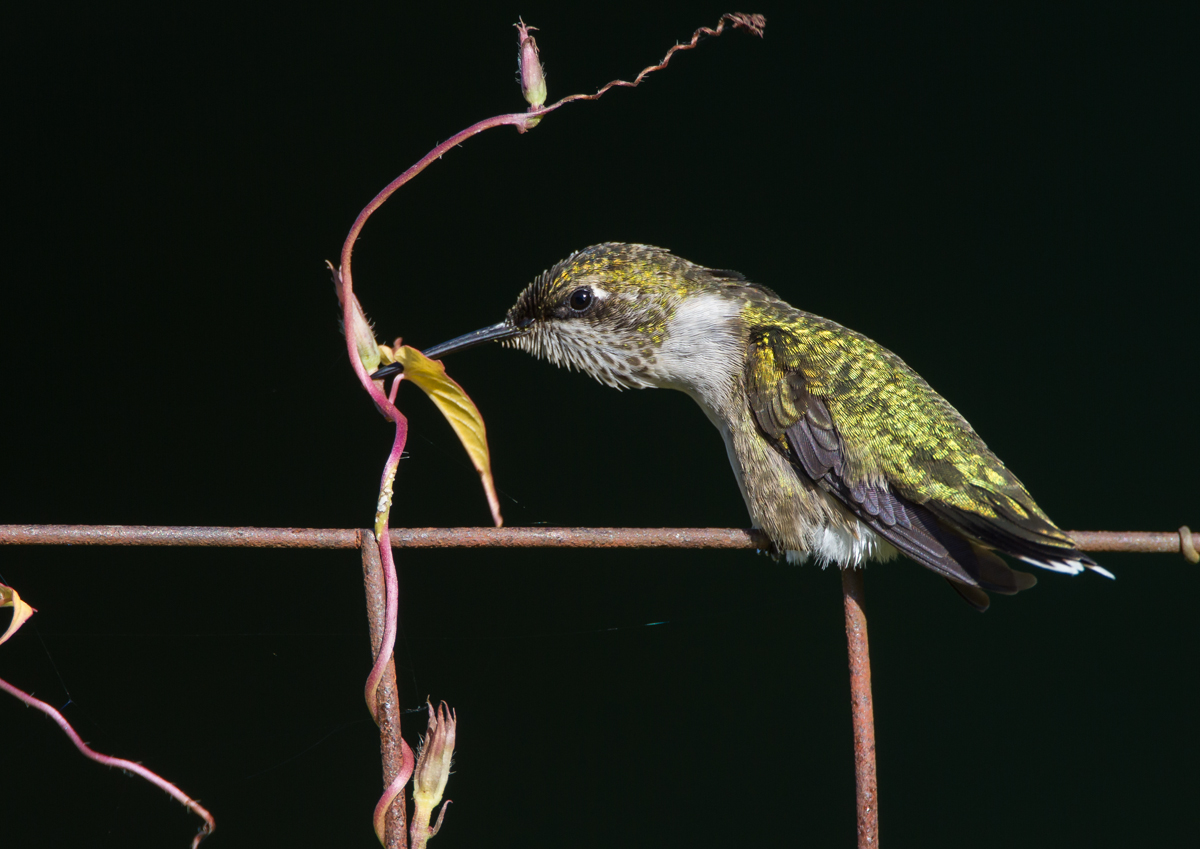
They often rub their bill against the wire fence, a twig, or anything handy. One bird often sits near a morning glory vine and seems to probe the various parts of the plant with its bill as if checking for something.
A Hummingbird’s long tongue moves in and out rapidly
Following a short bout of preening they often flick their tongue in and out a few times before moving on. You can certainly see how they can reach deep into tubular flowers for a meal.
Hummingbird approaching flower
Their hovering ability is one thing that makes hummingbirds so magical. Their wings beat and incredible 60 to 80 times per second in normal flight, faster in courtship dives. The thing most of us see them do is hover and feed, either at a feeder or a flower. Over the summer they have fed at a variety of plants in the garden including Crossvine, Larkspur, Bee Balm, Cardinal Flower, Coral Honeysuckle, and Morning Glory, the latter two being their primary source of nectar this week.
Hummingbird nectaring at small morning glory
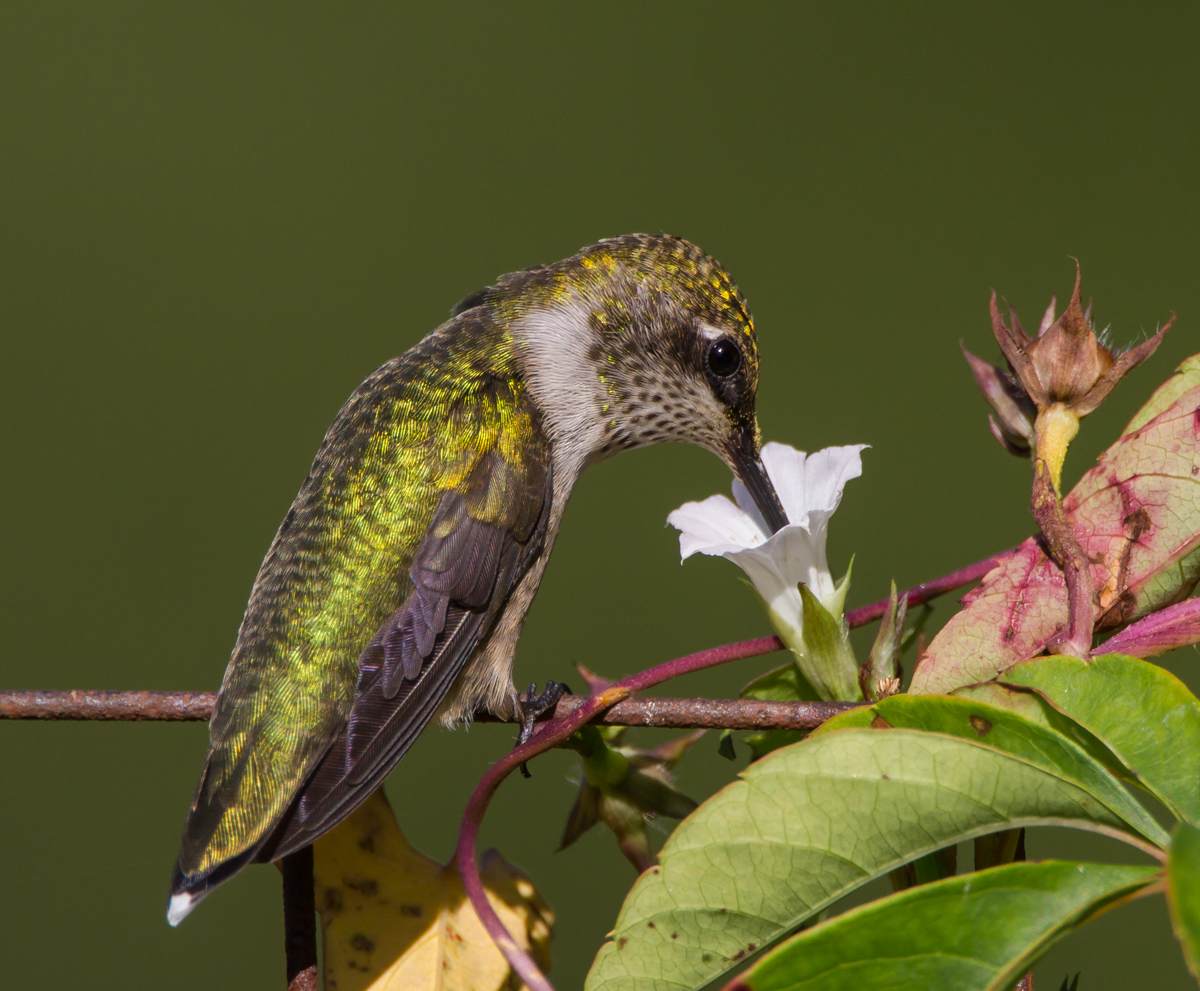
While they usually prefer take-out at the drive-thru, they will sit and eat in if there is a convenient perch near a nectar source. This young male visited this flower several times yesterday morning, always feeding at it while perched.
Hummingbird landing
My garden guests will be checking out soon and headed for their winter homes. Most Ruby-throated Hummingbirds spend the winter in Mexico and Central America. The Ruby-throated Hummingbird is North Carolina’s only breeding hummingbird species but recent research has documented several species (eleven the last I heard) that occasionally occur in our state, especially in winter. But most likely, once these few are gone, I won’t be seeing another hummingbird in my garden until the adult male’s arrive next March or early April. The garden won’t be the same without them.
“The soul is the same in all living creatures, although the body of each is different.” Hippocrates
I take a break from the caterpillar posts to share a truly incredible moment with you. A friend and I traveled east over the weekend to search for caterpillars for the upcoming museum event I have mentioned in recent posts. Anytime I am down that way, of course, I always hope to observe bears or something else that is hard to find here in the more developed Piedmont. The day started out with driving on dirt roads near my favorite refuge, Pocosin Lakes, looking for caterpillars. Years ago I had learned the ways of caterpillar hunting by car from my friend, Paris Trail. He would drive very slowly down an isolated dirt road looking for chewed leaves in the vegetation along the edges, stopping to check out anything promising. We had good success finding some interesting caterpillars for BugFest on country roads out near Columbia (more on that in another post). We headed back toward Raleigh late in the day and I decided to drive through the refuge in hopes of seeing some bears. We had already had some great non-caterpillar sightings – hundreds of Bobolinks, a bird I don’t see that often, feeding in the fields at another refuge, Alligator River. We had also seen a Black Bear sow with three cubs and the largest King Snake I have ever seen as it crossed a dirt road in front of us.
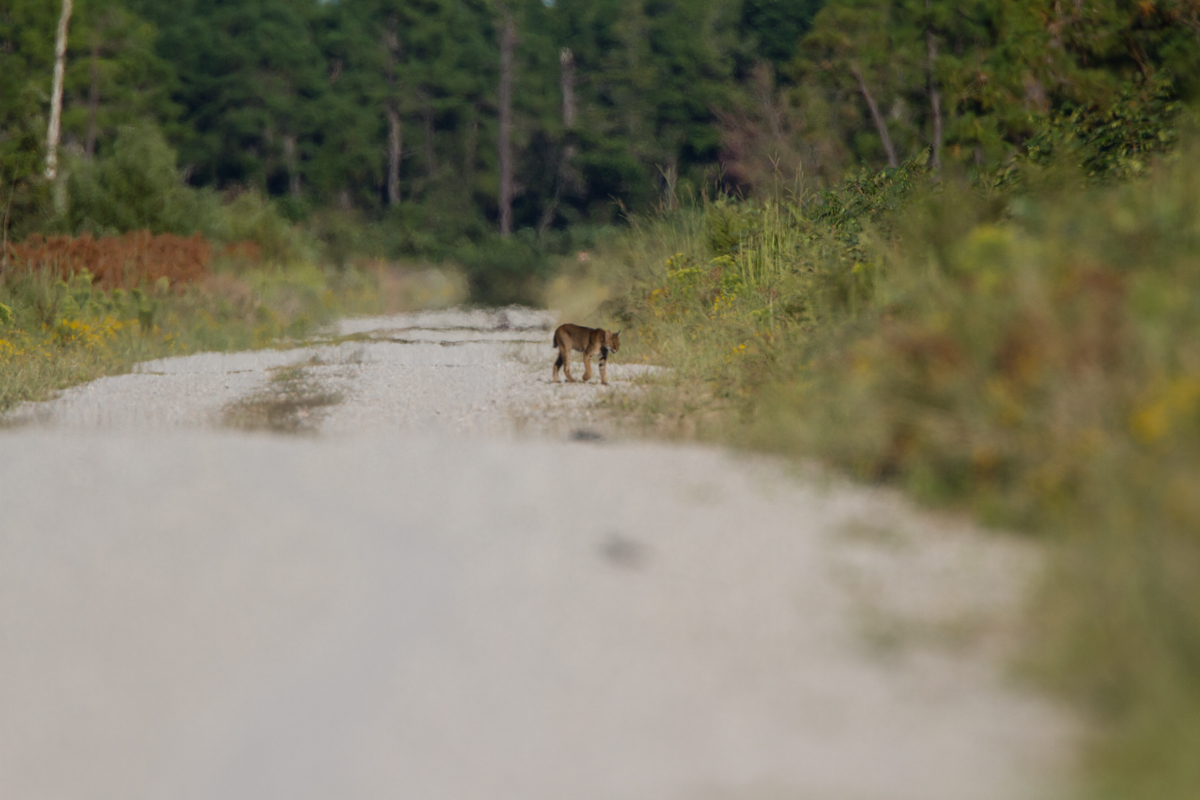
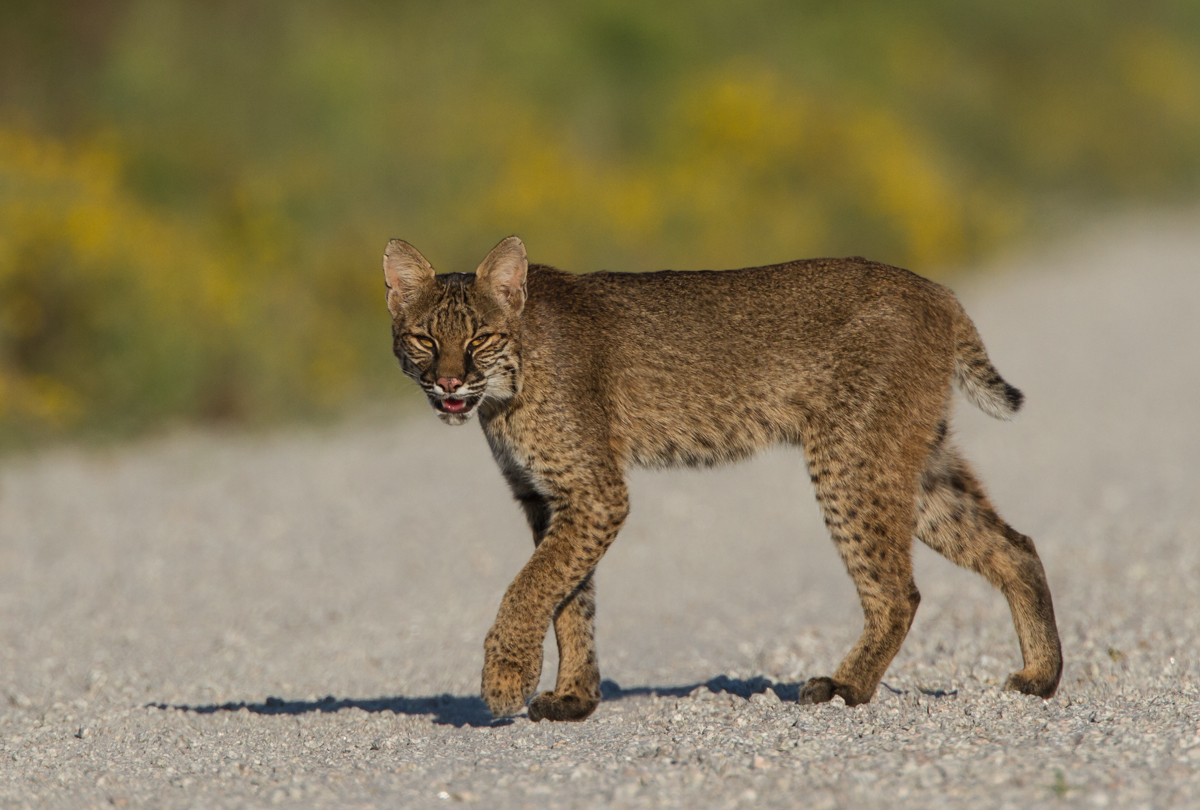
There are miles of gravel roads in the eastern section of Pocosin Lakes National Wildlife Refuge that pass through thousands of acres of seemingly endless shrub thickets, pines, and flooded forests. I have only been through this part of the refuge a couple of times and seen mainly Quail, Wild Turkey, a few deer, and some snakes. But yesterday afternoon I spotted something a few hundred yards down the road walking away from us. I stopped to check it out through binoculars. It was tough to tell at first, maybe a Coyote, maybe a Red Wolf, but then it turned and I could see the distant outline had only a short tail – a Bobcat!
We watched it for a few minutes as it walked away and then I began to drive towards it at a very slow pace. The Bobcat turned, looked our way and resumed walking down the road, eventually wandering off into the vegetation. We sat a few minutes, and then drove slowly past the spot we had last seen it. It was nowhere in sight, although I knew it might just be sitting in some thick vegetation watching us. I have been fortunate to see many Bobcats over the years, mainly down east at Alligator River and Pocosin Lakes, along with a few in the mountains, and one much closer to home at Mason Farm in Chapel Hill. I have often seen them just sit and watch, confident in their camouflage and the ability to disappear in an instant if warranted. Down the road was a lone pine tree that cast a dark shadow across an otherwise bright gravel roadway. We drove down and parked in the shadow, figuring it would help hide us, and we got out with our cameras (I had my 500mm lens with a 1.4X teleconverter), sat down behind the car to hide our outlines, and waited.
Bobcat after it came back out on the road (click photos to enlarge)
Within a minute or two, the sleek form materialized again. The Bobcat was now a little over 100 yards away but continuing in its original path which meant it was now headed our way. The scene was bathed in late afternoon light as we watched the Bobcat through binoculars. We could only hope it would continue walking down the road. As it did, it occasionally stopped and looked or listened for something in the grasses along the edge before slowly resuming its path toward us. At one point, it stopped, cocked its head, crouched, and then pounced off into the vegetation, disappearing from our view. It stayed hidden for a couple of minutes, and did seem to lick around its mouth as it walked back out, perhaps satisfied with some quick snack – a rodent? a frog?, a small bird?…who knows.
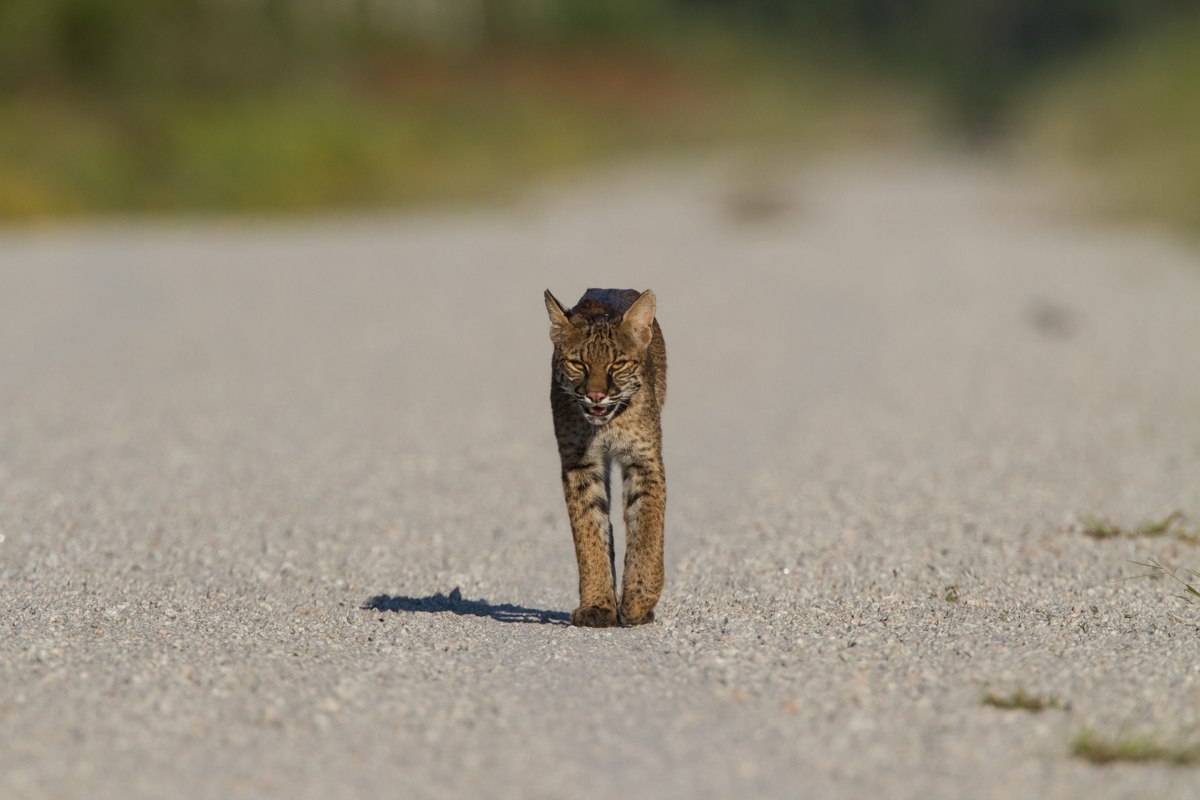
Bobcat walking toward us
Over the next several minutes, the Bobcat slowly made its way toward us, occasionally looking our way, but mainly checking out who-knows-what along the road edge. We both tried to keep our camera firing to a minimum because at times like these you realize how loud a camera shutter can be.
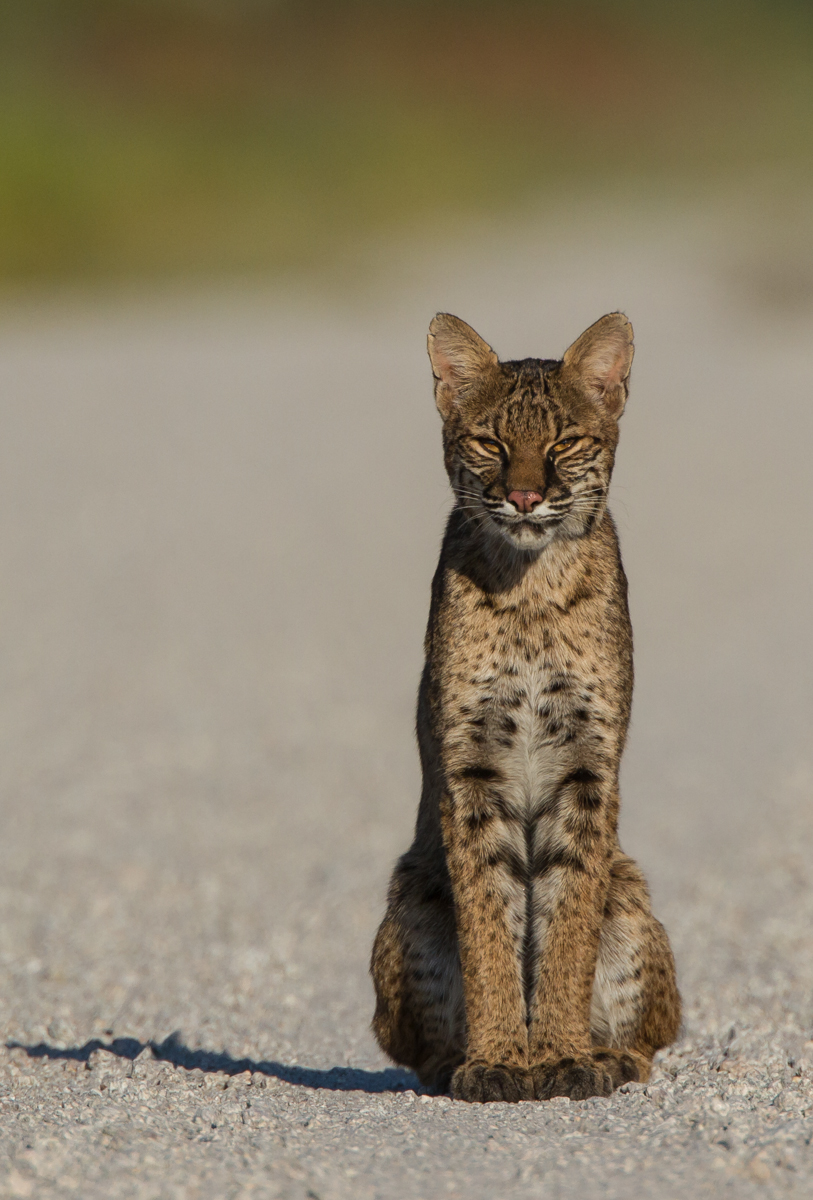
Bobcat sitting in road
It finally just plopped its hindquarters down in the middle of the road, looked around, and then stared straight at us.
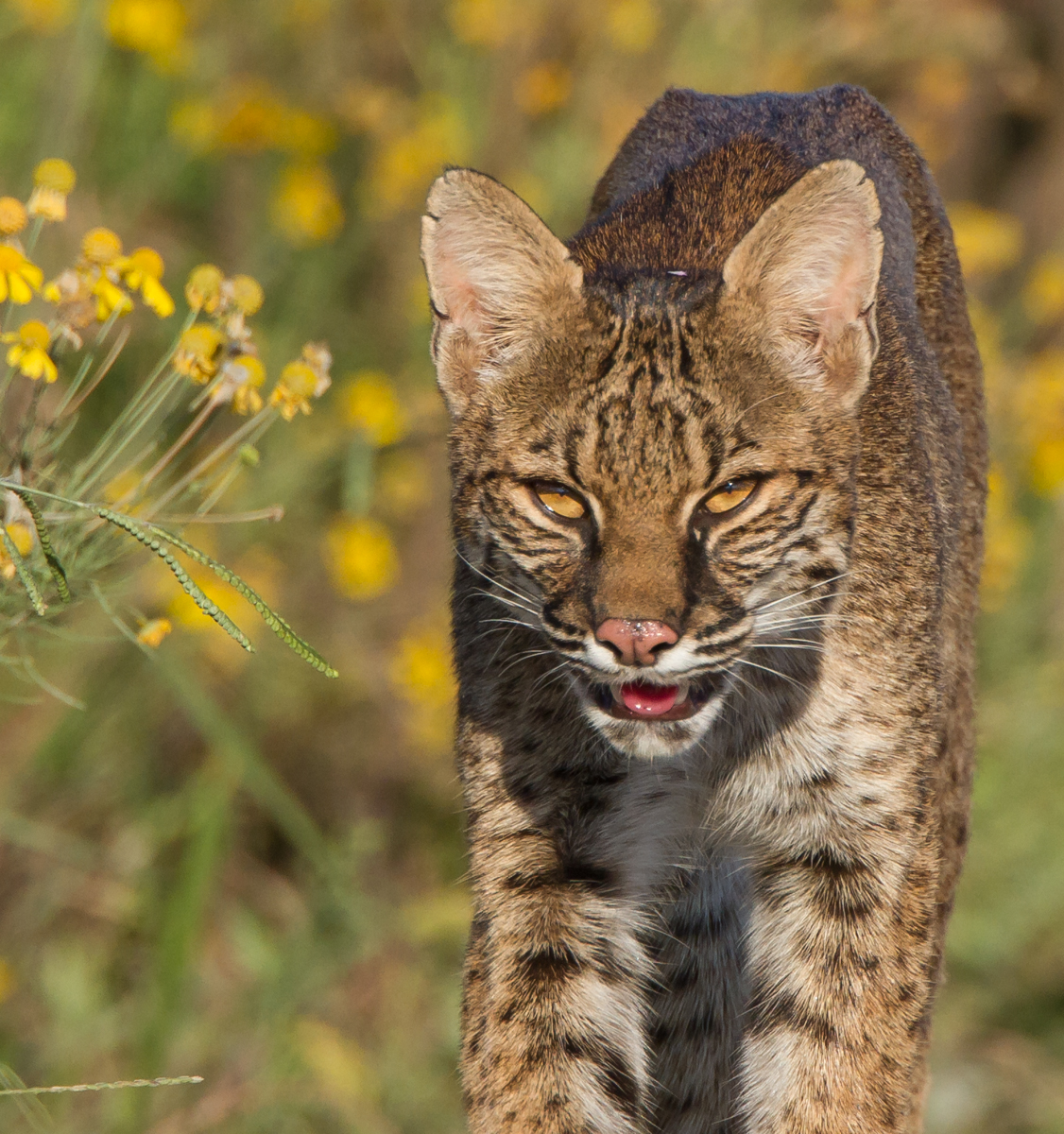
Bobcat looking right at us
We both were holding our breath, admiring this beautiful wild creature that was sharing a part of its day with us.
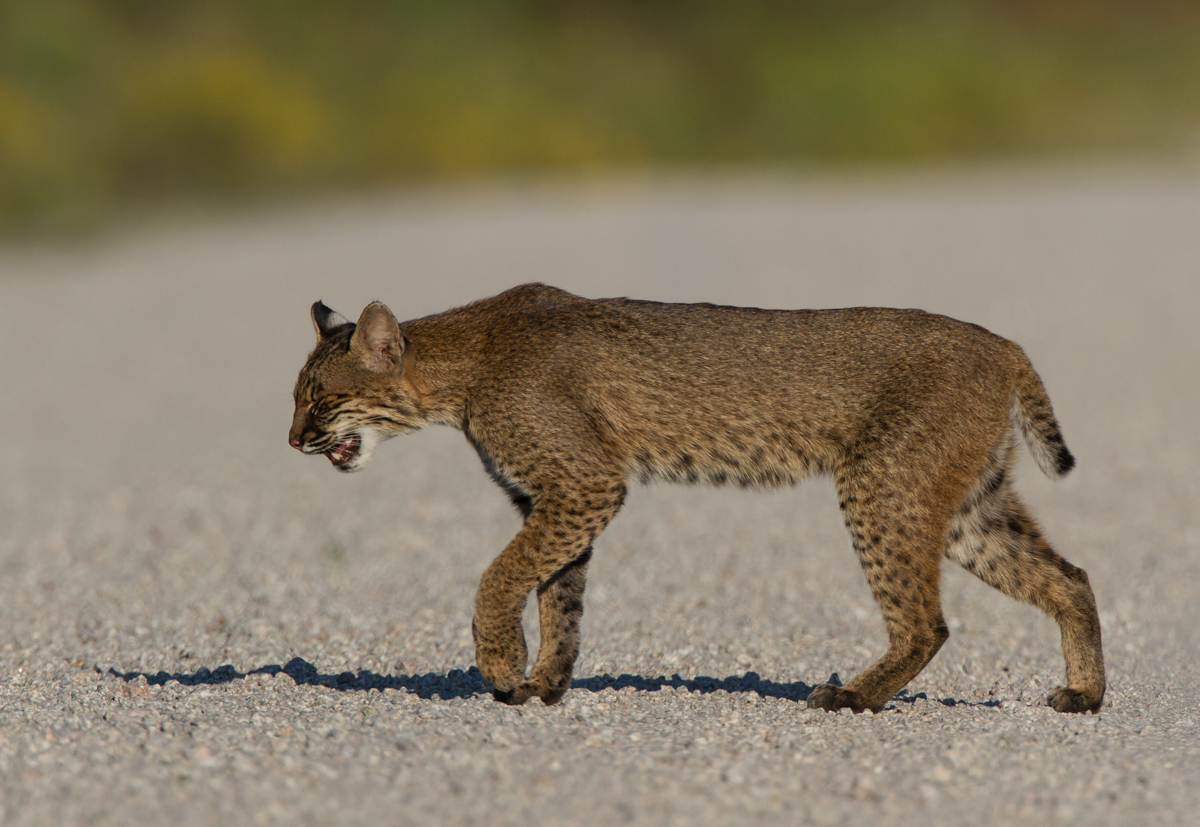
Bobcat walking toward road edge
It then slowly stood up and started to walk toward the opposite side of the road. This gave us a glimpse of its supple power, the combination of a gliding walk with a muscular frame. We both commented later on how all felines from house cats to lions have that same smooth, graceful movement.
Bobcat walking toward road edge looking at us
As it continued, it angled back toward us, looking our way and then peering over into the nearby shrubs.
Bobcat right before it heads into brush
There is something magical about looking into the eyes of another animal, especially one as elusive and majestic as a Bobcat. It is a rare privilege to spend ten minutes or more with a predator, or any wild animal for that matter, observing it as it goes about its life, allowing you to glimpse into its mostly hidden world.
Bobcat steps into vegetation
And then, it turned and silently vanished into the vegetation. We were speechless. We waited a few minutes, straining to hear a sound or see a movement that might indicate the Bobcat was still nearby. Nothing. We whispered wondering how close it had been when we last saw it. My friend finally paced it off – the Bobcat had been about 100 feet from where we sat. She turned to walk back toward me and the Bobcat slinked off, rustling a few branches as it went, unseen, into the safety of the forest. Neither of us had seen it while it apparently sat and watched us from maybe 30 feet as we walked and talked about the incredible, unforgettable encounter.
Black Swallowtail caterpillar after molt (click to enlarge photos)
There has been a spate of caterpillar sightings the past few days, especially of the big green kind. I know this is just to get me overly hopeful that some of them may actually still be around for use at the caterpillar tent this coming Saturday at the NC Museum of Natural Sciences big special event, BugFest ( see http://bugfest.org/ for details). Indeed, the timing of BugFest this year has me worried that many of the cooler cats that have been out and about will decide it is time to pupate a day or two before the event, leaving us with a precious few to entertain and educate the thousands of visitors expected to attend. It has been a great year for Black Swallowtals in the garden, but suddenly, the caterpillars have all but disappeared, as has their food supply of parsley and fennel. I saw one female laying eggs late last week, so I am hopeful a few of them make it, but most are busy feeding and molting their way to pupation in a hurry as the cooler weather sets in.
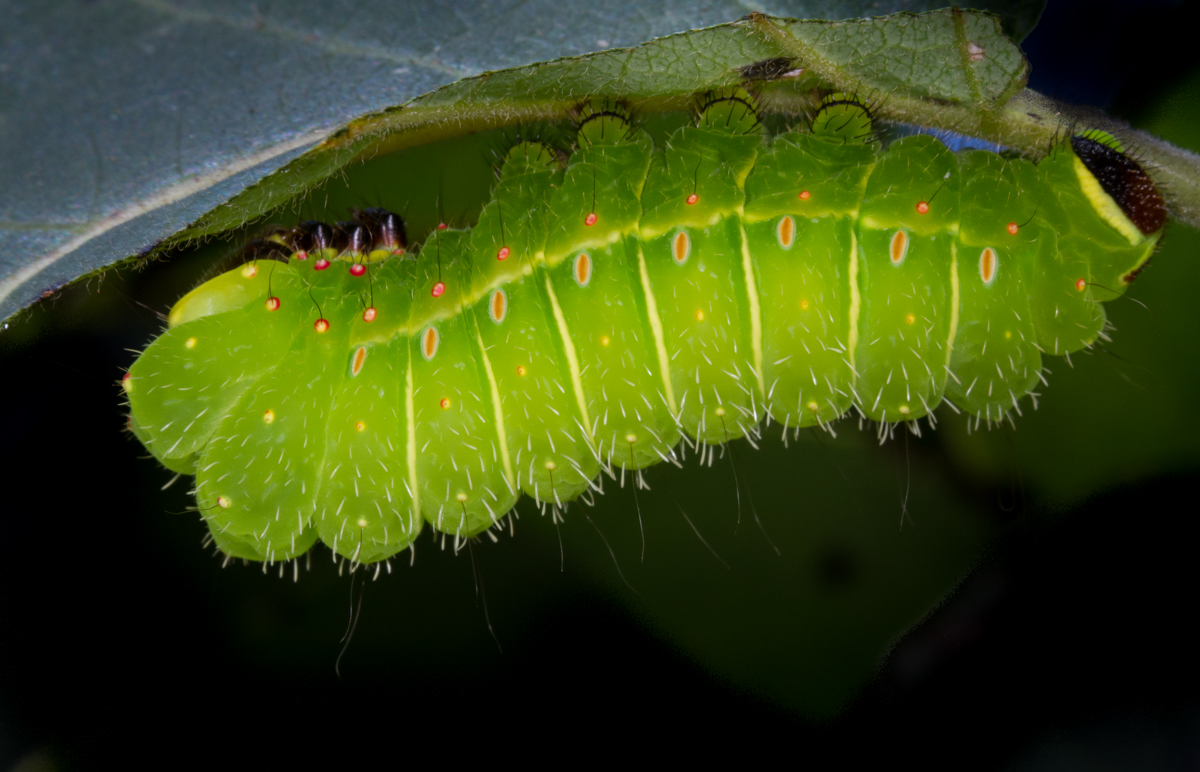
Luna Moth caterpillar on Persimmon
I was checking a Persimmon tree late last week and was surprised to find this guy, one of my favorite caterpillars, feeding on it. This is the larva of one of the most beautiful moths in our area, the Luna Moth. I usually find them on Sweet Gum so I initially thought this was a Polyphemus Moth caterpillar as my experience has been that species favors a wide variety of tree leaves. But a closer look revealed the tell-tale yellow stripe along the length of the abdomen and the stripes at the trailing edge of each abdominal segment that separates the Luna from the Polyphemus (whose oblique stripes run through the spiracles along the sides).
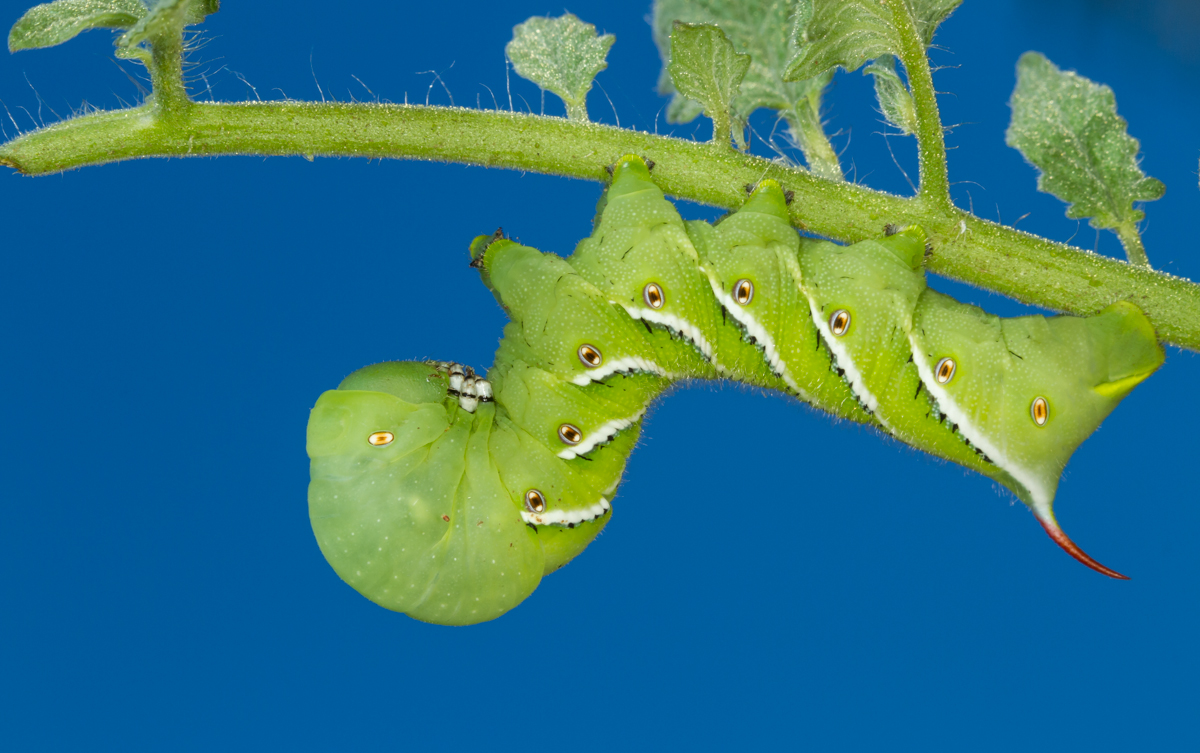
Tobacco Hornworn on tomato
The final big-green-eating-machine found last week was a Tobacco Hornworm on one of my few remaining tomato plants. This has not been a good year for tomatoes in my garden as the excessive early rains may have encouraged the blight, so there have been relatively few of these common garden caterpillars around. When disturbed, this one pulled into the characteristic posture that gives this family its name—they elevate the front part of their body and assume a posture reminiscent of the Egyptian Sphinx. Unfortunately for me, this one is large enough that it most certainly won’t last until BugFest. But, I will be out and about looking for more (hopefully successfully) the next few days so I hope you will tolerate a few more posts on caterpillars. They are one of my favorite subjects to photograph and I have found them to be one of the best ways to help get people of all ages excited about nature. If you are in Raleigh on Saturday, September 21, be sure to stop by the caterpillar tent outside the main museum and let us share the excitement with you.
And a late note…I had this prepared to post tonight but went out today looking for caterpillars and had quite a day – more in a future post later this week.




















 Roads End Naturalist