• Success

    To pay attention, this is our endless and proper work.

    ~Mary Oliver

    twig with chrysalis
    This is what I am very excited about (read on) (click photos to enlarge)

    I imagine many of you already suspect me to be, shall we say, a nature nerd. This post probably will prove that beyond a shadow of a doubt. You may recall a post a few weeks back where I photographed a pair of one of my favorite spring butterflies, the Falcate Orangetip, doing some courtship flights, and, later, finding where a female had laid eggs.

    Falcate orangetip butterflies mating behavior 1
    Courting pair of Falcate Orangetip butterflies from late March

    I mentioned I have always wanted to find and photograph one of their unusual chrsyalids, but, in spite of searching for them near some of their host plants (the wild version is Cutleaf Toothwort) on our property most springs, I had yet to succeed. So, when I found a female laying eggs back in March, I dutifully collected a couple of their weedy version of host plant (Hairy Bittercress) containing eggs, potted up the plants, and brought them inside to observe. Finally, on March 30, the first of what I thought were two collected eggs, hatched. Here is that post. What I learned over the next few weeks is that these guys are very slow eaters, and that the bittercress starts to dry up in the pots and yard before the caterpillars seemingly have time to complete their cycle.

    Falcate Orange-tip caterpillar late stages on white background
    Falcate Orangetip caterpillar, two weeks after hatching

    So, I started collecting bittercress plants from the yard and putting them in floral tubes with water as a food source for what I soon discovered were five larvae. The two eggs I had originally collected hatched first, but there were some unseen eggs that hatched later, perhaps on plants I brought in as food.

    Falcate Orange-tip caterpillar late stages
    They fed for another two weeks and then…

    The two large larvae kept feeding and growing and I was worried I would run out of decent bittercress plants as a food source. Then, on April 29, I checked the plants and found one of the large larvae had formed a prepupa (the stage between a caterpillar and a chrysalis). It was in a pose similar to a swallowtail prepupa, with the rear attached to a silk pad, the front of the caterpillar passing through another silk loop, and the whole body curled in a C-shape (or maybe more like an apostrophe)..

    Falcate Orange-tip prepupa
    On April 29, I found one caterpillar had made a prepupa

    Over my years of raising caterpillars for programs, I have witnessed many prepupa transform to the chrysalis (it is really magical to watch). The prepupa stage usually lasts about 24 hours, so I Imagined it would transform overnight or early the next morning. I photographed it and left it sitting out on our dining room table/macro studio, hoping to catch it in the act of transforming. I checked on it once in the middle of the night, but it was still in the same position. Close to the time they shed the last caterpillar skin to reveal the newly formed chrysalis underneath, the prepupa starts to shudder and then straighten out. Then it happens quickly, usually within a matter of minutes. As it turned out, this prepupa decided to complete its performance sometime in the wee hours of the morning, so when I awoke and checked on it about 7 a.m., the chrysalis was already there.
    Falcate Orange-tip chrysalis
    When I woke up the next morning, success!

    But, I had finally succeeded in seeing one of their strange thorn-mimic chrysalids. No wonder I have never found one. Look at the first photo in this blog again and you can see how well this chrysalis blends in to a tree trunk or twig, the usual places in the forest where it is formed.
    Falcate OrangeTip chrysalis with pencil eraser for scale
    The chrysalis with a pencil eraser for scale

    Plus, it is a pretty small, cryptically-colored chrysalis, making it even more challenging. Needless to say, I was geeking out when Melissa came into the dining room (the things she puts up with…although she thought it was pretty cool as well). With a few larvae still feeding, I might have a shot at witnessing the transformation, I’ll keep checking and building my nerd street cred.

  • Beginning as Poop

    Question: What is the white stuff in bird poop?

    Answer: That is bird poop, too.

    ~Kurt Vonnegut

    This is an update to an image I posted a week or so ago about new beginnings in the yard this spring. I found and photographed an egg of an Eastern Tiger Swallowtail on a Tulip Poplar leaf (their most common host plant in our woods)…

    eastern tiger swallowtail egg on tulip poplar
    Eastern Tiger Swallowtail egg laid on Tulip Poplar leaf on April 12 (click photos to enlarge)

    I was surprised how long it took for the egg to hatch, but hatch it did on April 28. It turned dark a day or two before hatching. I went out this morning to check on the larva and it has spun a tiny silk pad on top of the leaf where it stays put much of the day. You can see from the picture that it crawled off an inch or so to feed.

    Eastern tiger swallowtail first instar larva
    This little larva is now 3 -days old

    The larva is currently about the size of a pencil point and has the characteristic black and white markings of early instar swallowtail caterpillars. This is believed to be a bird poop mimic coloration. By sitting still most of the day, they really do look like a little bird turd (and what self-respecting bird would want to eat that?).

    Over the next couple of weeks, if all goes well, the caterpillar will dine at the Tulip Tree Cafe, molt a few times, and grow up to be a snake mimic larva with small fake eye spots.

    Eastern Tiger Swallowtail larva late instar swelling anterior po
    Late instar larva changes from being bird poop to a snake mimic


  • Singing in the Rain

    I’m happy again
    I’m singin’ and dancing in the rain
    I’m dancing and singin’ in the rain

    ~Lyrics from Singing in the Rain by Arthur Freed & Nacio Herb Brown

    I will admit to not quite feeling that happy to wake up to the downpour this morning, but somebody did. At least, they seemed happy right after the deluge stopped. I looked out the kitchen door to check on our little vegetable garden (one of the few down sides of living in our woods is a lack of sun for vegetables, so the garden is small) and spotted something on one of the fence posts.

    Garden
    Our veggie garden as seen from the kitchen door (click photos to enlarge)

    It was our resident male Carolina Wren singing his little heart out. He looked a bit ruffled after all the rain, but he was determined to let everything know he was in good spirits. I grabbed the camera with the telephoto on it and eased out onto the side porch. The only view of him I had was through a small circular gap in the pea plants growing on the line trellis. He serenaded the world for a couple of minutes, dancing his way around the fence top to make sure no matter where you were in the yard, you could hear his loud tea- kettle, tea-kettle, tea-kettle lyrics. So, here is Mr. Wren, singin’ and dancing in the rain…

    Carolina wren singing right
    Carolina Wren in full song mode
    Carolina wren singing right 1
    After a brief shake (in which he lost a feather), the song resumes
    Carolina wren singing
    Here’s looking at you
    Carolina wren singing left
    Okay, I can move on now


  • Suet Sampler

    I don’t feed the birds because they need me; I feed the birds because I need them.

    ~Kathi Hutton

    Sunday was a gray, chilly day here in the woods and the birds were quite active at the feeders. One group of birds, in particular, had my attention, the gorgeous Rose-breasted Grosbeaks. The Rose-breasted Grosbeaks have been back about two weeks. They make a stop of a few weeks every spring on their way to their breeding grounds further north (and in our mountains), and then again in the fall as they head to their wintering grounds in Central and South America. I decided to set up the camera and tripod in our bedroom, open the door to the deck, and record who came to visit the suet feeder mounted on the deck rail. I did something similar a few years back and shared images in another post. This time, I sat for a little over an hour, and tried to take pictures of everything that came in to the feeder. Enjoy the view from our deck…

    Rose-breasted grosbeak male
    Male Rose-breasted Grosbeak (click photos to enlarge)

    It started with a single male and we are now up to our usual number of 9 grosbeaks visiting the feeders – 7 males and 2 females. They tend to come in all at once and spread out between our two feeding stations. Their favorite treat seems to be the sunflower seeds at the platform feeders (they have trouble balancing on the tube feeder). But they are also frequent the suet feeders as well, especially the one on the deck which has a branch underneath where birds can perch and reach up to the suet. Because of our superabundance of squirrels, we use only hot pepper suet, which is a deterrent to mammals, but not birds.

    Rose-breasted grosbeak males at feeder
    Lining up at the suet.
    Rose-breasted grosbeak female
    Female Rose-breasted Grosbeaks are brown with striping and a bold eye stripe.
    Blue jay
    The undisputed piggies at the suet are the Blue Jays. They can quickly take chunks away, but they are a bit skittish, and flush easily if we are outside or walking near widows inside.
    Red-bellied woodpecker female
    A pair of Red-bellied Woodpeckers (this is the female which lacks a full red head) are regular year-round visitors to the suet.
    Downy and chippie
    Downy woodpeckers are also regular visitors, but this spring we also have a pair of Chipping Sparrows feeding in the yard.
    White-breasted nuthatch
    White-breasted Nuthatch.
    Tufted titmouse
    We have a gang of Tufted Titmice that make regular rounds throughout the yard.
    Carolina chickadee
    Carolina Chickadees are with us all year.
    Northern cardinal 1
    A pair of Northern Cardinals visit the feeders every day, but it is mainly the male that feeds on suet.
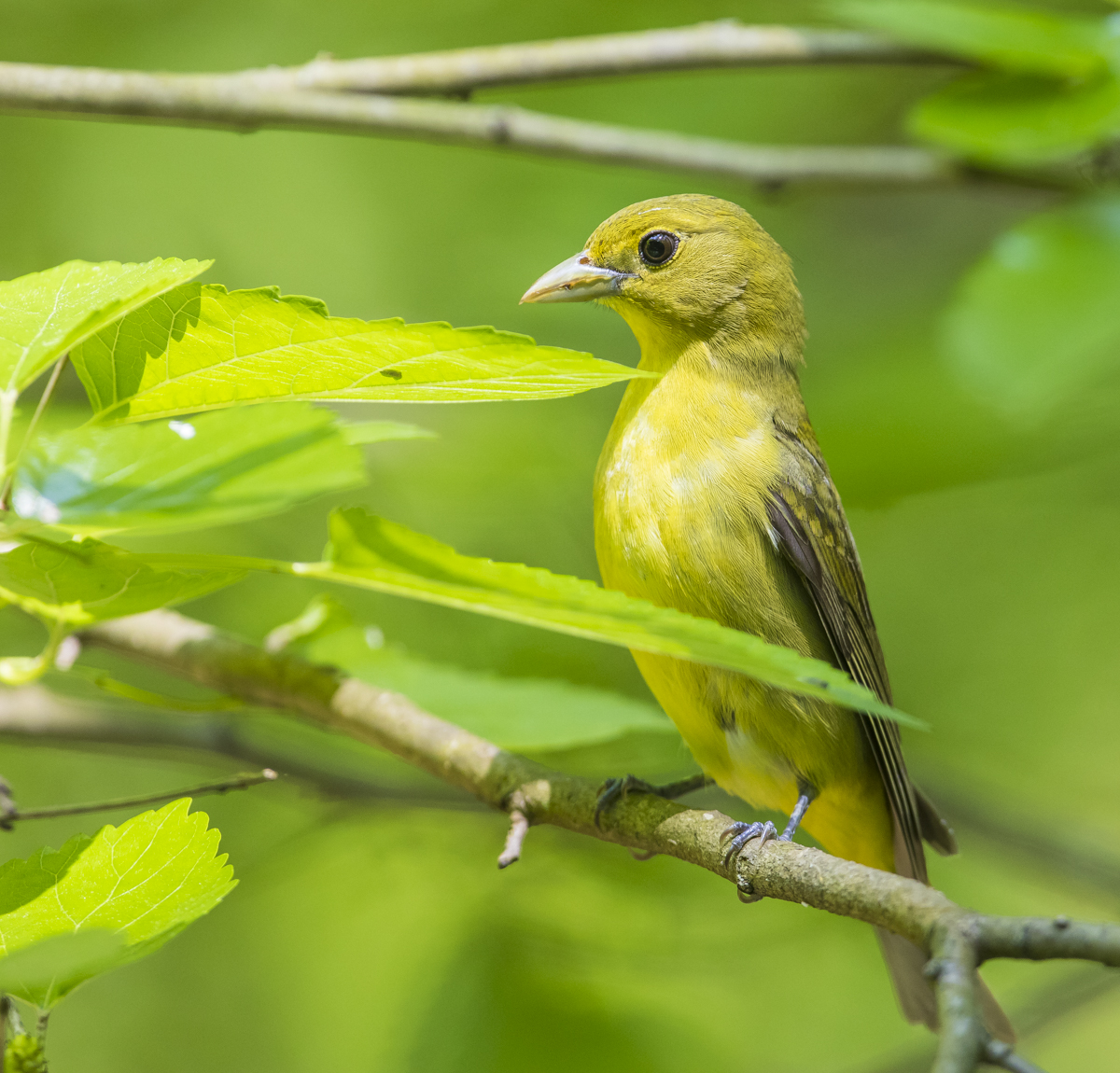
    Summer tanager
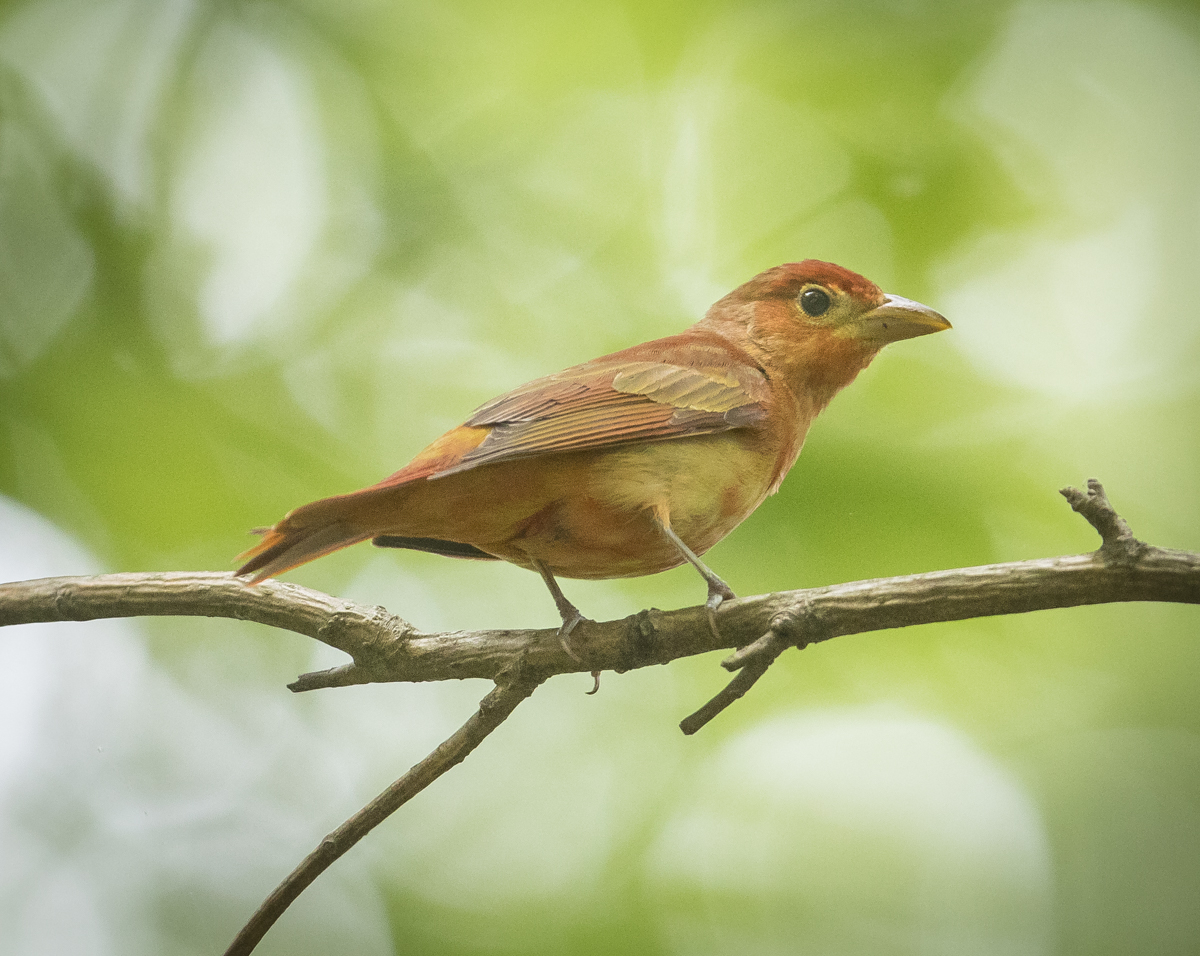
    Another of our special suet visitors is a pair of Summer Tanagers (we have only seen the male thus far).
    Pine warbler with caterpillar
    Pine Warblers are common at our suet in winter but not this time of year. This one stopped by his old diner with a side dish of caterpillar.

    I missed photos of two other birds that eat the suet this time of year – American Crows (who are too savvy to come in while I’m sitting there), and our local pair of Carolina Wrens. They are busy feeding their newly fledged young and don’t have time for an appearance.

    There have been some other good bird finds this week away from the feeders as spring migration is in full swing and our newly arrived breeding birds are setting up territories or starting to nest. I stumbled across an Ovenbird nest with eggs down in our woods while clearing some invasive shrubs (the dreaded Eleagnus). She flew out of her dome-shaped ground nest doing the broken wing act to lure me away. And we have seen and heard a variety of migrants all week long, some that will stay with us through the summer…

    Red-eyed vireo
    A bonus visitor just off the deck – a Red-eyed Vireo, foraging for insects.
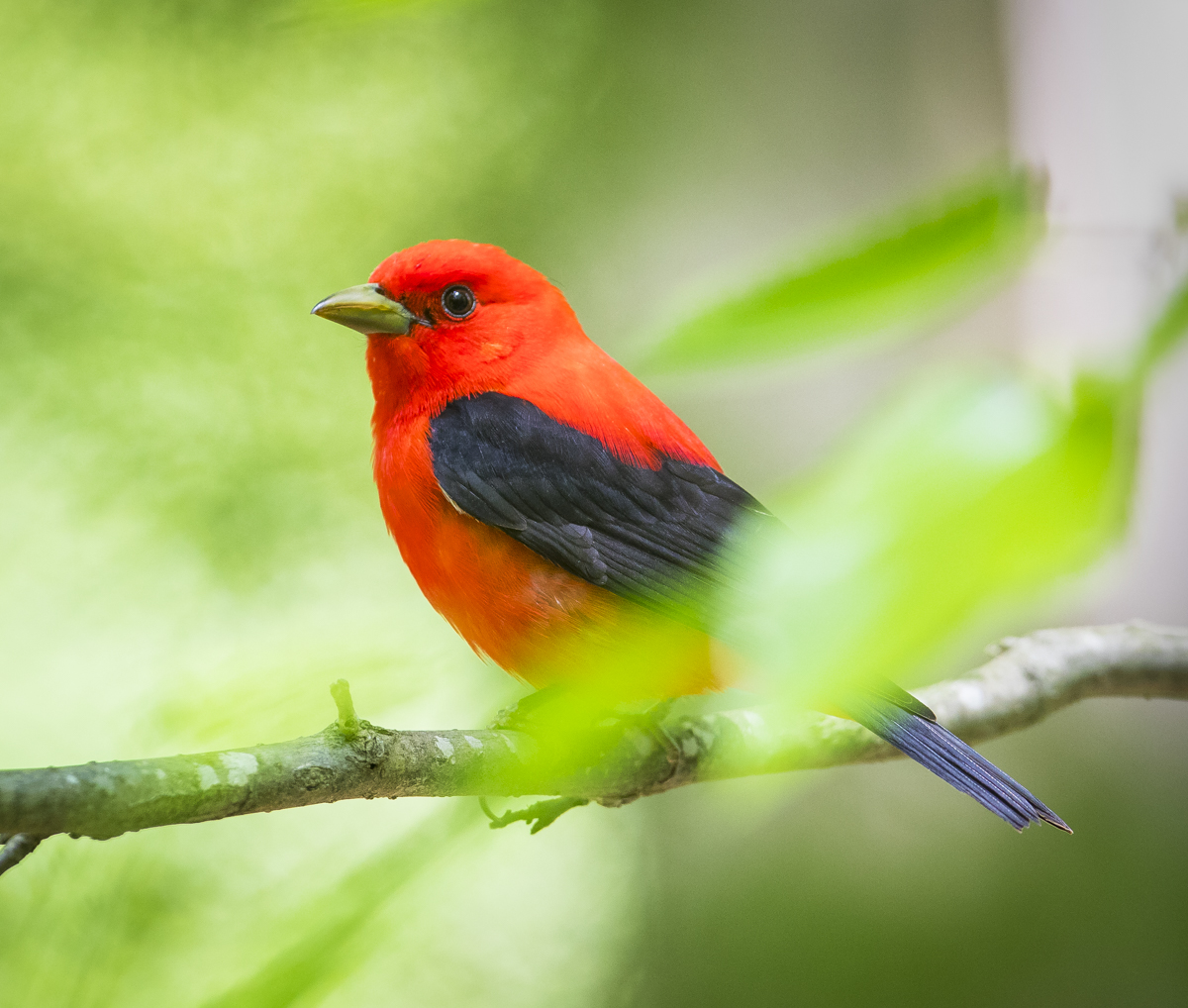
    Scarlet tanager
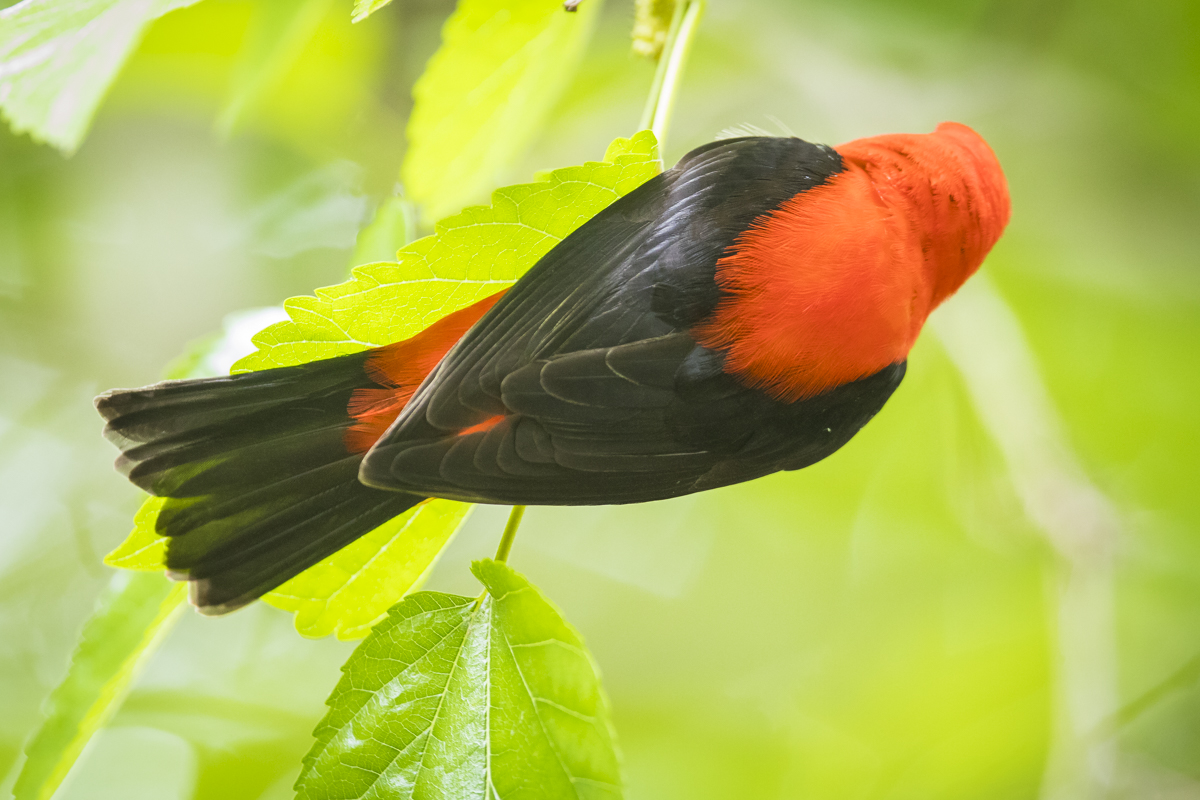
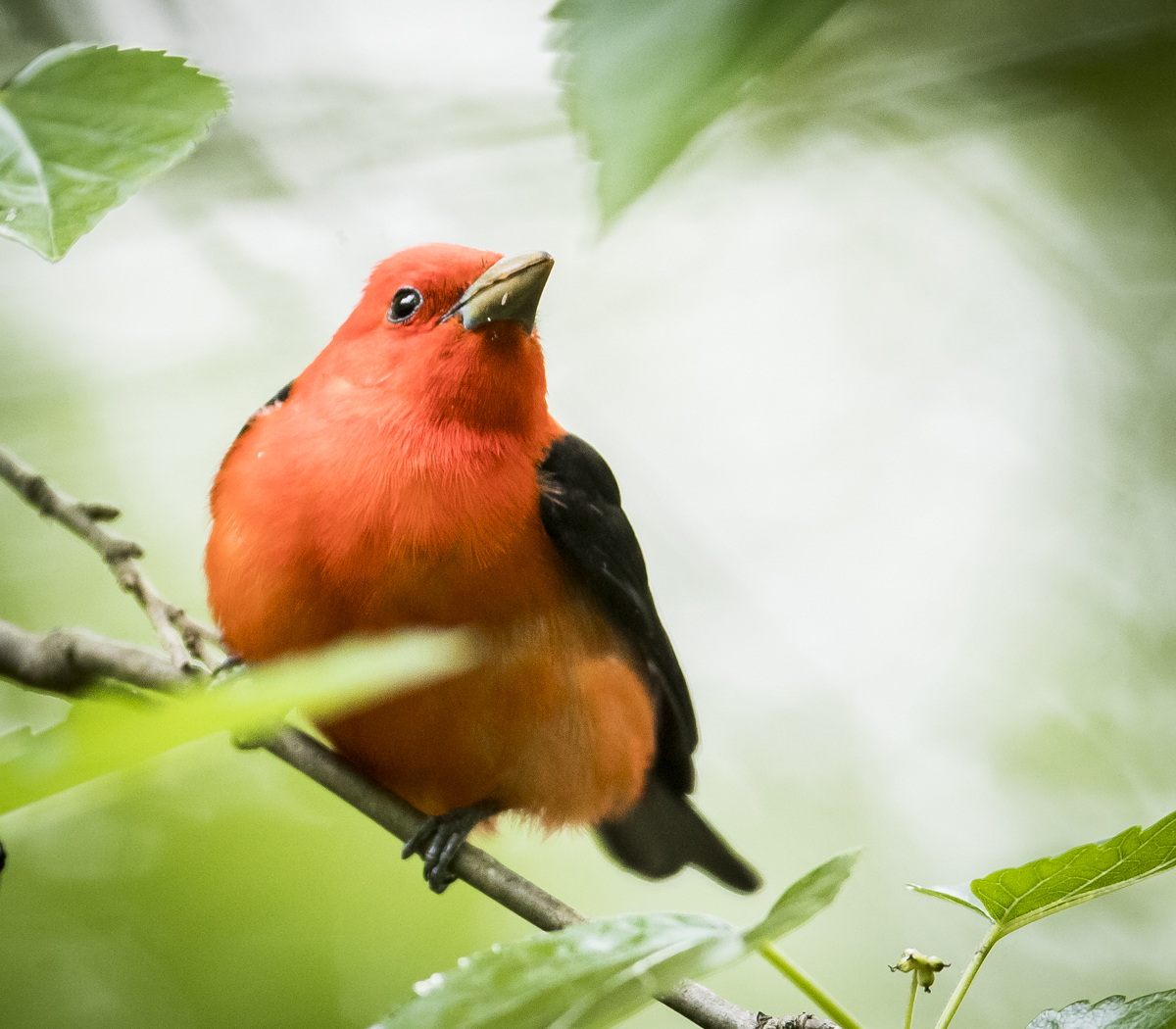
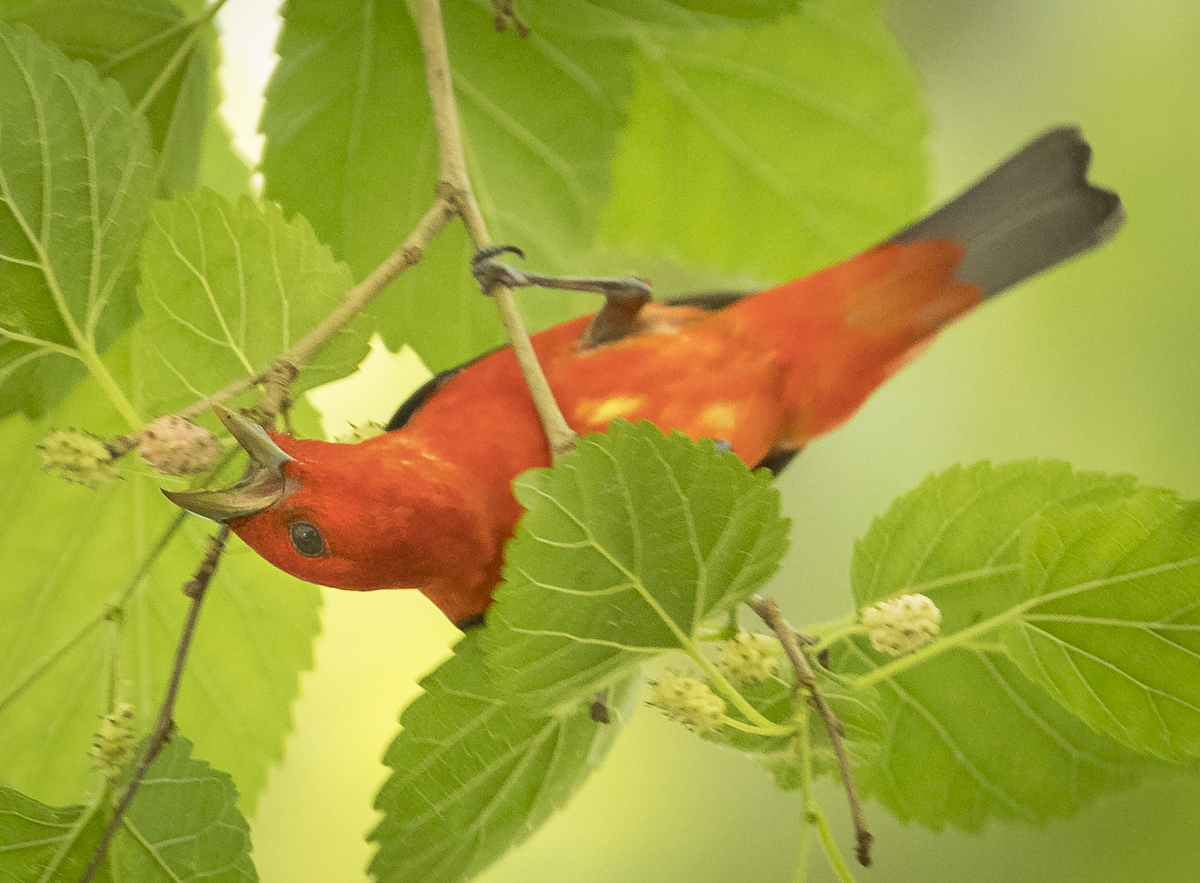
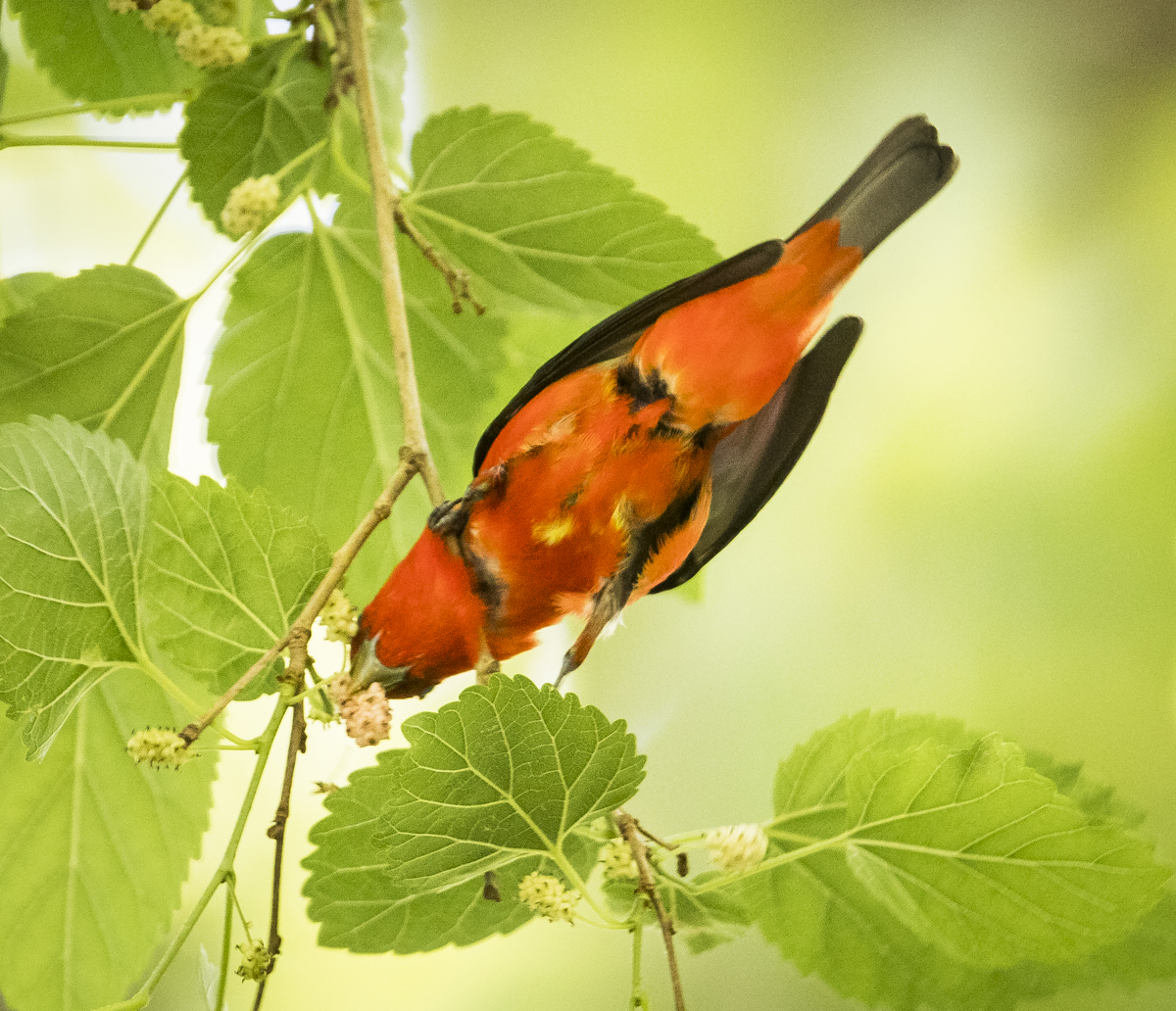
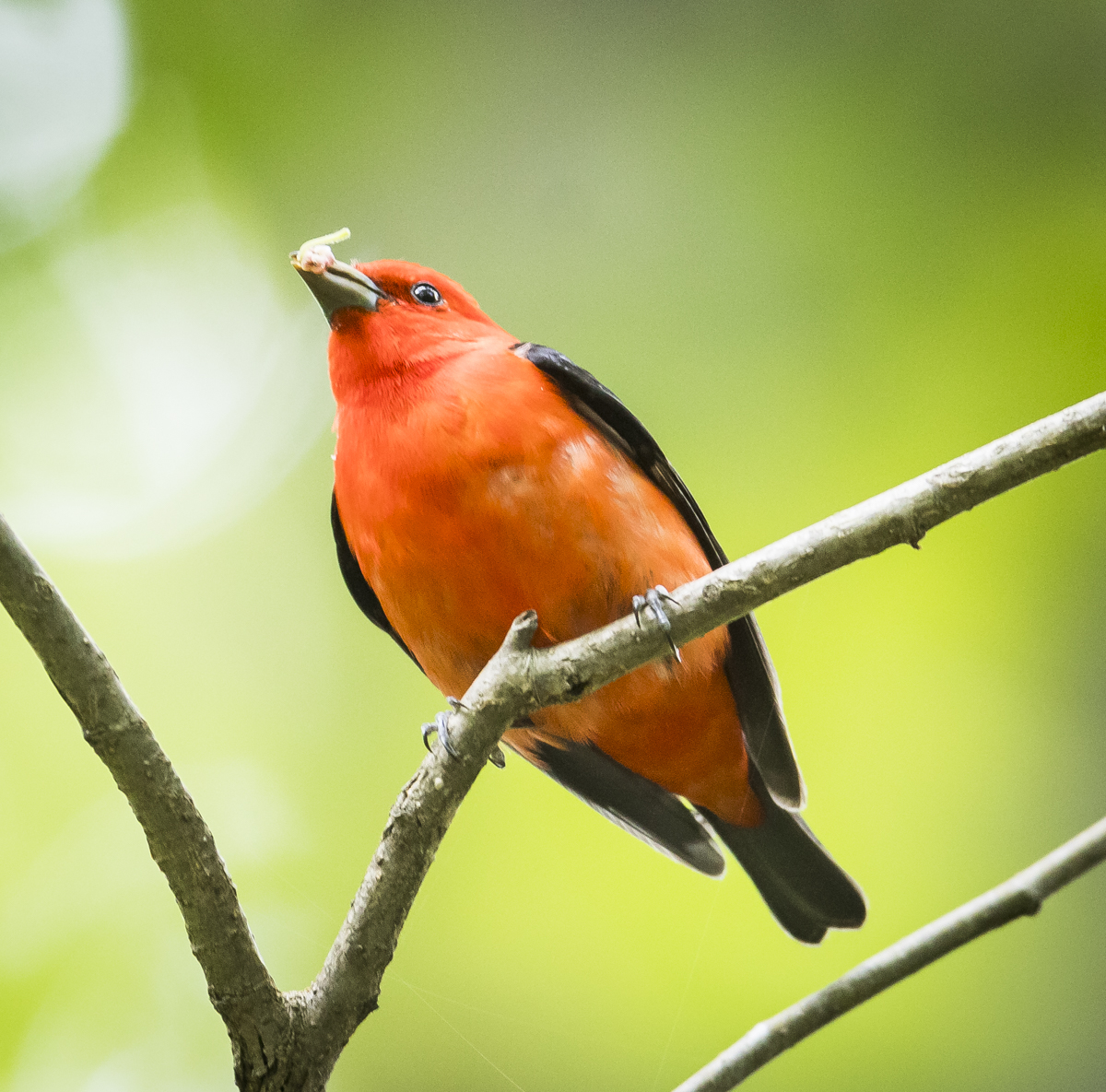
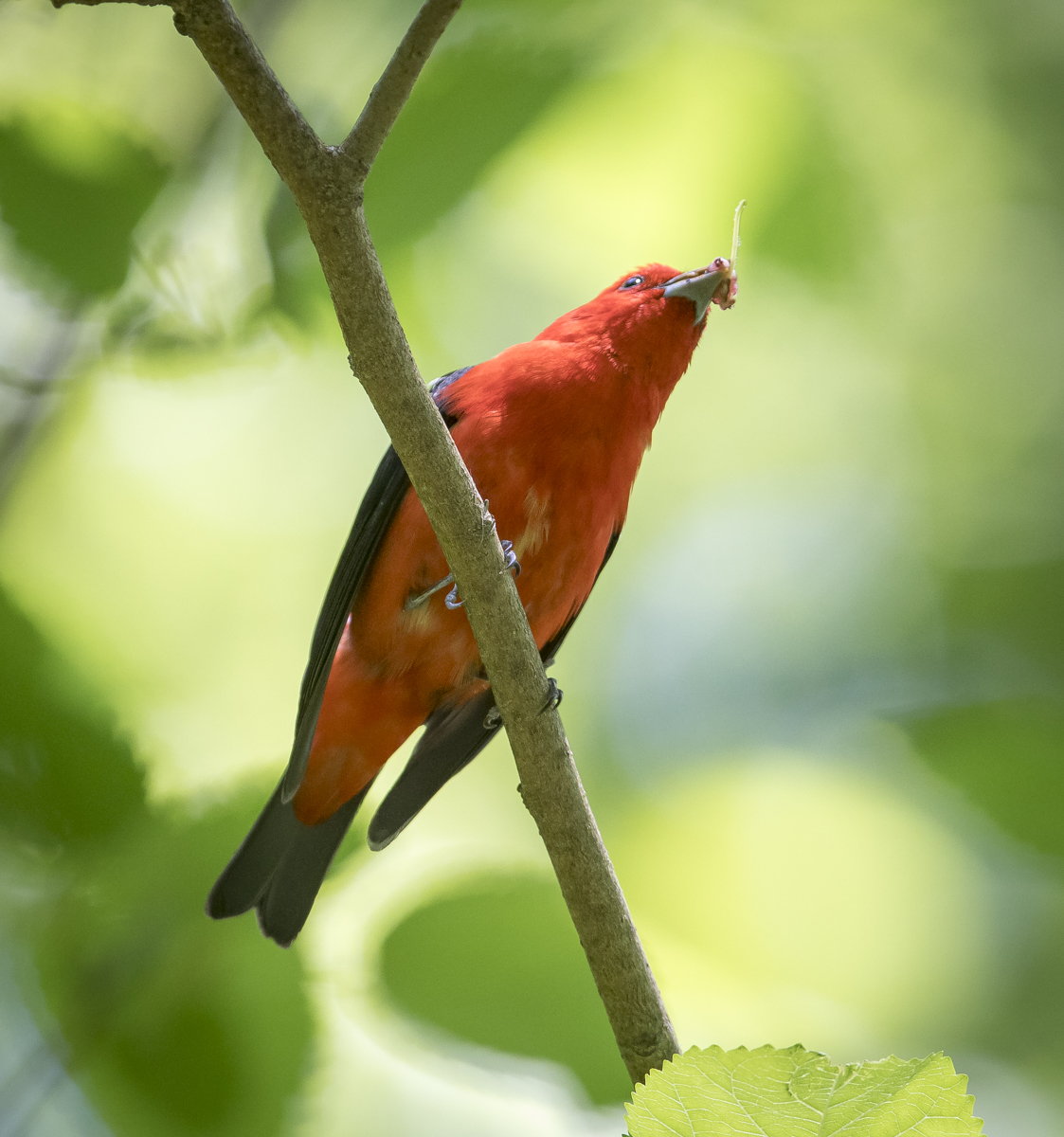
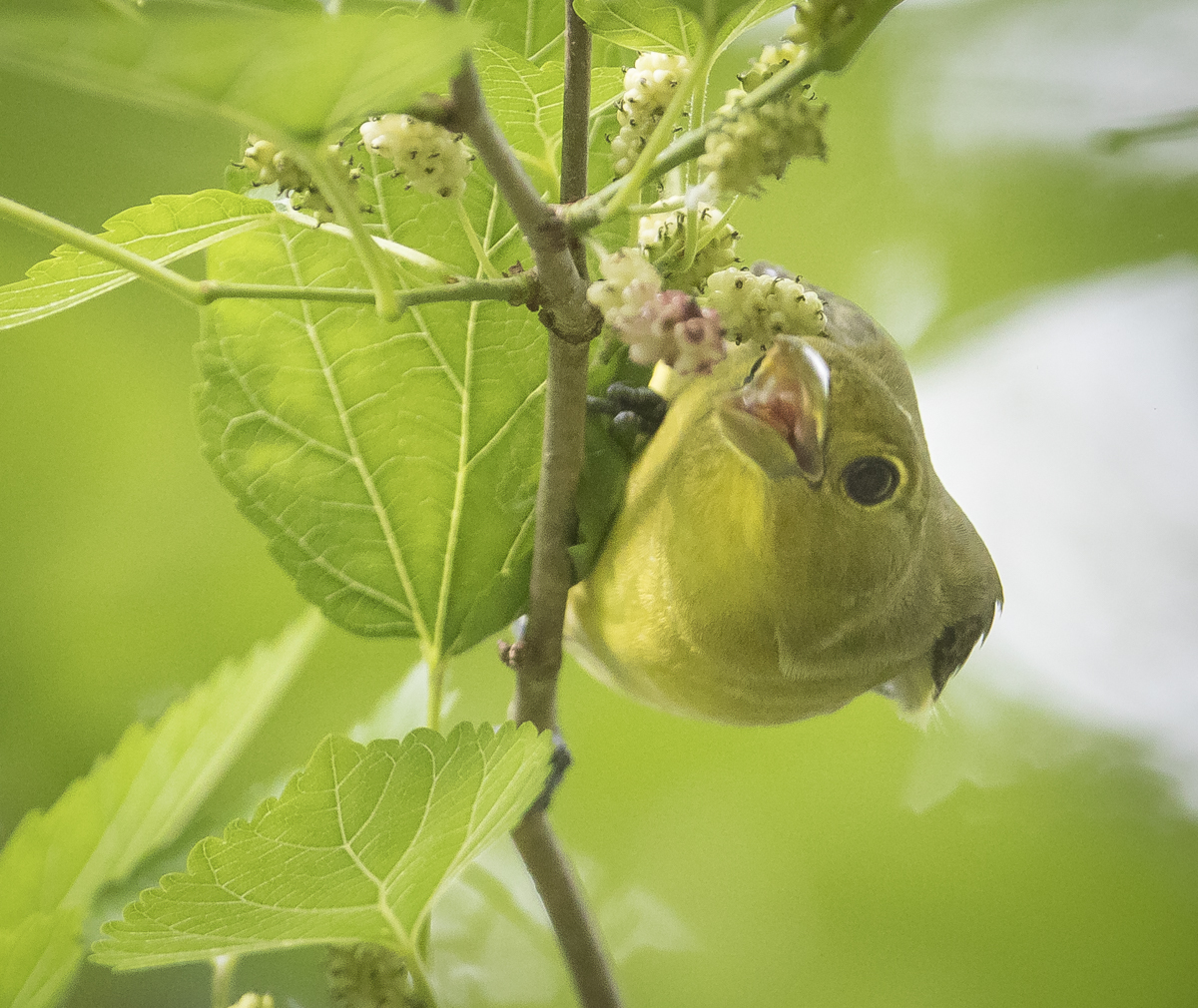
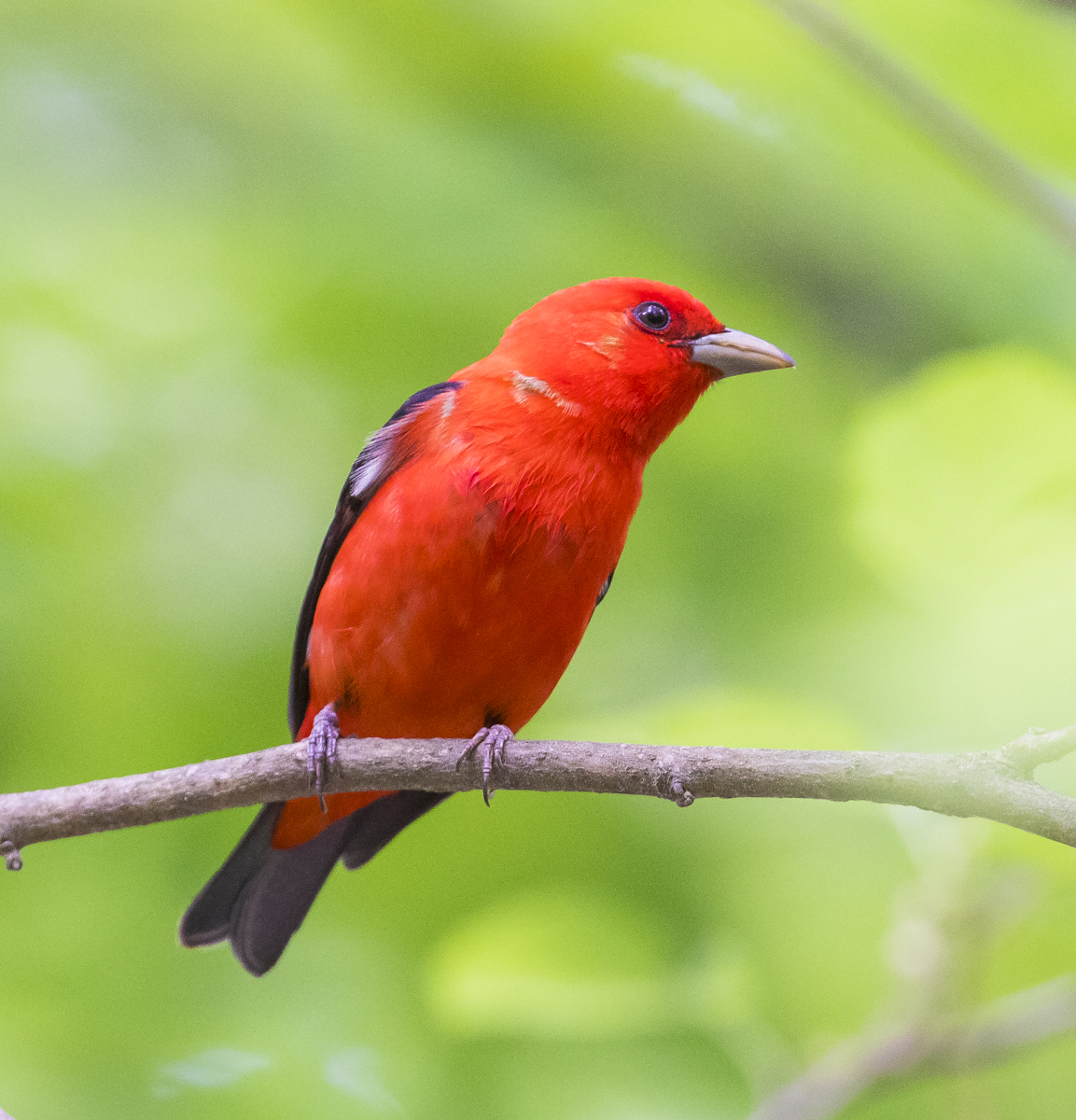
    This is the best I could do with one of my favorite summer species, the vibrant Scarlet Tanager. They tend to be up high in the canopy but should come down lower in a few weeks when the mulberries ripen (a treat for both species of tanagers in our woods).
    Yellow-throated warbler in yard
    Remember how excited we were to see the Yellow-throated Warbler down low along the Roanoke River? Well, the other day one was hopping around in our garden. While this was happening we saw and heard American Redstarts, a Black-and-white Warbler, a Hooded Warbler, and Black-throated Blues. Ah, spring!
  • Warbler Watching

    The real jewel of my disease-ridden woodlot is the prothonotary warbler … The flash of his gold-and-blue plumage amid the dank decay of the June woods is in itself proof that dead trees are transmuted into living animals, and vice versa.

    ~Aldo Leopold

    This final post on our recent swamp trip is about one of spring’s most enjoyable wildlife experiences, the return of the warblers. As my high frequency hearing has waned, I rely more and more on Melissa’s abilities to hear their songs and locate them. And on this trip, she was hearing them throughout our paddle. And she had her spotting skills in high gear as she came up finding what I thought were the trip highlights – a swimming Mink, two Barred Owls close enough to photograph, some cute Raccoons, the flying squirrel, and a few nesting birds. My challenge was to try to photograph them.  And I find warblers to be a particularly challenging subject.

    bad warbler shot
    My usual warbler image, mostly of where one used to be – note tail feathers exiting top left of image (click photos to enlarge)

    But this trip had waves of warblers moving through the swamp at times. On our second platform at Three Sisters, we had birds all around us our last morning, including a swarm of migrating Yellow-rumped Warblers. The rather drab colors we see on this species in winter have now been replaced by bold black and white and intensified yellows. A throng of butter-butts came though our camp that morning, but most were either obscured in the thick understory brush or high in the tree tops, foraging on insects.

    Yellow-rumped warbler
    Yellow-rumped Warbler showing off its spring attire

    Melissa heard and then found a Prairie Warbler just off our platform and I finally managed a few pictures in the dappled sunlight.

    Prairie warbler
    Prairie Warbler skulking through the brush

    Northern parula warbler
    Northern Parula Warblers were everywhere in the swamp, but difficult to photograph on this trip

    It turns out, the real photographic test was shooting warblers from a moving canoe. I had my 300 mm telephoto and 1.4x teleconverter on my older camera body with us. Needless to say, I was trying to be careful with the gear and, when paddling, often had it secured in a dry bag in front of me. When we saw something, I would have to open the bag, pull out the camera and then try to shoot from a wobbly canoe (usually in a current) while Melissa positioned us. For some shots, I carefully passed the gear up to her if we could not get the back of the canoe into position. Prothonotary Warblers were singing and displaying all along our route, but when she spotted one carrying nesting material, we pulled over and steadied the canoe on a log in the shallows. The bird did not disappoint.

    Prothonotary warbler gathring moss on nearby tree
    This bird really liked the moss on one particular tree trunk and made several trips to gather a beak full while we watched.

    Prothonotary warbler with moss in bill
    Most trips back to the nest were quick, with a brief landing, and then darting directly into the cavity. On this one though, he (I think it is a he because it is very brightly colored) paused on top of the snag for just a moment.

    Prothonotary wwarbler head stickig out nest cavity
    After depositing the moss, he would come out, look around, and then fly off for more. This time, he stuck his head out far enough so that the sun highlighted his face.

    Prothonotary warbler gathring moss on cavity tree
    On one exit, he noticed a little piece of moss just below the cavity

    Prothonotary warbler gathring moss on cavity tree 1
    My favorite pose

    Male prothonotaries arrive first on the breeding grounds and begin setting up territories which they defend. They will select a few choice nesting cavities (and the swamp is full of potential nest holes) and gather and stuff them with moss, hoping a female will approve. We wished him good luck, and moved on as this was a big paddle day for us.

    The current was stong and the wind was at our back out on the river proper when Melissa saw what she at first thought was a Northern Parula exiting a clump of Spanish Moss dangling on a low branch over the river (their preferred nest site). We turned and started paddling back upstream when she saw the bird return – it was a Yellow-throated Warbler!

    Yellow-throated warbler at nest in Spanish moss
    A Yellow-throated Warbler bringing material back to its nest site in a clump of Spanish Moss

    This beautiful warbler is one of Melissa’s favorites, but frustratingly so, since they tend to be treetop dwellers and, though she hears them often (even at our woodland home in Chatham County), we rarely get a decent look at one. And here she finds one nesting, and down low. Cornell’s excellent online Birds of the World resource (for a subscription fee, but well worth it), states It nests and performs most of its daily activities high in the canopy of these forests. The exact location of nests is usually hard to determine.

    Yellow-throated warbler at nest in Spanish moss closer view
    Melissa did a great job keeping the canoe in place while the bird came and went with nesting materials

    Yellow-throated warbler looking at us
    A good view of that brilliant yellow throat that gives this warbler its common name

    Yellow-throated warbler just going into nest
    Entering the entrance hole in the Spanish Moss with nesting material (photo by Melissa Dowland)

    Yellow-throated warbler coming out of nest jusy head
    Peeking out of the nest entrance (photo by Melissa Dowland)

    Yellow-throated warbler coming out of nest
    Our final look at an extraordinary bird

    Research shows they usually nest out on horizontal branches high in the canopy in mature forests. In coastal areas with Spanish Moss, they prefer to nest in clumps hanging below branches (like Northern Parulas). But the nests of Yellow-throated Warblers tend to be an average of 30-45 feet above ground in coastal swamps. I’d say we were pretty lucky to find this one at about eye level from our canoe. As it turned out, we didn’t have a decent look at another of these beauties on our entire trip. So, thanks for a special moment in a very special place.


  • Bird Spot

    Simply wait, be quiet, still. The world will freely offer itself to you.

    ~Franz Kafka

    Yesterday’s post mentioned the excellent birding we experienced on our recent paddle trip on the Roanoke River. When we arrived at our second camping platform, Three Sisters, the late day light was gorgeous and the sky was filled with all sorts of birds. After setting up camp (and shooing away the vultures dining on the fish skeletons) we sat out on the small dock by the creek for over an hour watching the parade of birds go by. I decided to practice some birds in flight photography to see what I could capture. Here are a few of the results…

    anhinga overhead
    The distinctive cross-shape of Anhingas soaring overhead was a common sight on the blackwater tributaries of the Roanoke (click photos to enlarge)

    anhinga fly by
    An Anhinga flying low over the creek. We commented on how many of these unusual “snakebirds” we saw on this trip compared to our previous outings.

    wood duck female
    A female Wood Duck blasts past our dock in late afternoon light.

    wood duck male
    Almost all the ducks we saw were in pairs. This is the male Wood Duck escorting the one above.

    chimney swift
    The real challenge was tying to photograph Chimney Swifts in flight. As you can see, I never really got it right as they are just too darned fast and erratic. It is comforting to know that they are no doubt nesting in many of the giant hollow Bald Cypress trees scattered throughout the swamp.

    great blue heron overhead
    A Great Blue Heron flying to roost.

    great egret overhead
    We saw more Great Egrets on this trip than in the past. This one’s wing bones showed through its backlit feathers.

    white ibis in flight
    As the sun set, large flocks of White Ibis started flying in to the next creek and surrounding wetlands.

    I had planned to do some more dock sitting the next morning, but after the water came up during the night, I ended up strolling the short walkway to the platform and trying to photograph the many birds that were active all around us.

    blue-gray gnatcatcher
    Blue-gray Gnatcatchers are always a treat to see up close.

    summer tanager singing
    This male Summer Tanager sang for much of the morning from high atop a partially defoliated Water Tupelo.

    White-breasted nuthatch
    A White-breasted Nuthatch knocked off some bark that fell on my head, alerting me to his presence right above me.

    White-eyed vireo
    A male White-eyed Vireo was loudly singing in thick brush out near the creek. I kept stalking him, hoping for a clear shot.

    white-eyed vireo singing
    He finally obliged and came out on an open twig for a few notes of pick up the beer check quick, before disappearing back into a thicket.

    These images represent just a fraction of what we saw on this trip. Below is a checklist of species we observed/heard during our time in this magical swamp. Tomorrow, I’ll share some highlights of our warbler watching.

    Birds: Great Blue Heron; Great Egret; White Ibis; Spotted Sandpiper; Double-crested Cormorant; Anhinga; Wood Duck; Mallard; Canada Goose; Turkey Vulture; Black Vulture; Red-shouldered Hawk; Bald Eagle; Osprey; Barred Owl; Belted Kingfisher; Great Crested Flycatcher; Blue Jay; American Crow; Fish Crow; Common Grackle; Red-winged Blackbird; Red-bellied Woodpecker; Downy Woodpecker; Hairy Woodpecker; Pileated Woodpecker; Chimney Swift; Barn Swallow; Eastern Towhee; Northern Cardinal; Mourning Dove; Gray Catbird; Swamp Sparrow; Carolina Chickadee; Tufted Titmouse; Carolina Wren; Blue-gray Gnatcatcher; White-eyed Vireo; Red-eyed Vireo; Yellow-throated Vireo; Eastern Bluebird; White-breasted Nuthatch; Summer Tanager; Yellow-billed Cuckoo;Northern Parula Warbler; Black-and-white Warbler; Prairie Warbler; Prothonotary Warbler; Yellow-throated Warbler; Common Yellowthroat; Yellow-rumped Warbler

    Mammals: White-tailed Deer; Gray Squirrel; Southern Flying Squirrel; Nutria; Mink; Raccoon; (active Beaver lodges)

    Herps: Painted Turtle; Yellow-bellied Slider; River Cooter: Brown Water Snake; American Bullfrog; Southern Cricket Frog


  • Social Distancing – Swamp Style

    Yes, though you may think me perverse, if it were proposed to me to dwell in the neighborhood of the most beautiful garden that ever human art contrived, or else of a Dismal Swamp, I should certainly decide for the swamp.

    ~Henry David Thoreau

    I will admit to feeling a little guilty about this, but we recently returned from a two-night camping and paddling trip on the Roanoke River. For the month of April, we had previous plans for two trips to the swamp with friends, and Melissa had one for work. Though we are very fortunate to live in a beautiful wooded setting, we are missing our spring swamp time. So, after discussing if we could manage a trip without putting ourselves (or anyone else) at risk, we decided to go. We both agreed that there is no better place to self-isolate than the camping platforms on the Roanoke. We departed Monday afternoon, following a storm front that left us with a bit of rain and wind for the start of our journey. Our plan was to put in at Gardner Creek between Williamston and Jamesville on Monday afternoon and paddle to the Barred Owl Roost platform the first night. We arrived at the launch site about 4 p.m. with just a slight drizzle. As we paddled away from the highway, the sounds soon became those of the swamp…a peaceful quiet interrupted only by the wind in the trees, a squawk of a Great Blue Heron, or Wood Ducks exploding off the water.

    Raccoon in tree
    Our first major wildlife spotting was a pair of Raccoons up in a skinny tree along Gardner Creek (click photos to enlarge)

    Melissa soon spotted two Raccoons halfway up a skinny tree surrounded by water. One was trying to ignore us by hugging a branch while the other managed to stay partially hidden alongside a clump of Spanish Moss.

    devil's Gut after the storm
    The sun finally broke through the dark clouds and lit up the trees along Devil’s Gut

    Our three-hour paddle seemed to go quickly and we soon were at our home for the night – Barred Owl Roost. This platform is always surrounded by black water, so you really feel isolated and a part of the swamp. And true to its name, we heard Barred Owls cranking up their Who cooks for you calls soon after we arrived. There were also a lot of other birds in, and flying above, the trees – Prothonotary and Northern Parula Warblers, Common Grackles, Great Blue Herons and Great Egrets, and lots of Wood Ducks.

    Berred Owl Roost
    One of our favorite camping platforms – Barred Owl Roost

    Prothonotary warbler in tree
    Prothonotary Warblers seemed to be everywhere in the swamp

    Sunrise at Barred Owl
    Sunrise looking up through our tent – a Prothonotary Warbler greeted us by delivering his dawn song from the top of the tent

    Many of the Water Tupelo trees have been stripped again this spring by the huge population of Forest Tent Caterpillars. In some sections of the swamp, the majority of the trees are bare and look dead at first glance. And leaf debris from the feeding caterpillars literally covers the water surface in some areas.

    Forest tent caterpillar
    A Forest Tent Caterpillar doing what it does best – chewing on the leaves of a Water Tupelo 

    The next morning, we headed down the Gut and out into the river proper for a long day of paddling. Melissa even did an online program with a school class that would have been participating in the Museum’s Shad in the Classroom program this spring as we drifted downriver, giving the students a unique look at where the American Shad live for part of their life cycle. Along the way we saw lots of eagles, herons, and many songbirds (more on those in a future post).

    Juvenile bald eagle
    Juvenile Bald Eagle taking flight as we drifted by on the river

    The wind was at our back and the current was strong so we made good time until we got to Broad Creek, where we headed upstream for a few miles to our next platform. This section proved to be a tough paddle with not only the current against us but the wind as well. The slow pace allowed us good views of a variety of wildlife from White-eyed Vireos (Melissa spotted one in the early stages of building its nest) to a lot of snakes hanging out in tree branches.

    Brown water snakes in tree
    One of many congregations of Brown Water Snakes in shrub and tree branches along the water’s edge. There were nine snakes in this one tree!

    Black vultures at platform
    This is not the welcoming committee we were hoping for at our next camping platform

    After a tiring paddle, we finally pulled up to our next camping platform, Three Sisters. But all was not as we would have wanted. Someone had caught and cleaned several large fish, including a monster catfish, on the dock at the platform, leaving the skeletons along the shore, This bounty had attracted several vultures (both Turkey and Black) who didn’t care for us interrupting their fish dinner. We used our paddles to push the carcasses into deeper water, hoping the smell would go way (along with the birds).

    Three Sisters platform view
    The view from our dock

    The wind helped dissipate the aroma and we were able to finish our day relaxing on the dock at our campsite, watching the comings and goings of an amazing variety of birds.

    smilax berries
    The vegetation surrounding our campsites was diverse and beautiful…here are the bright red berries of Coral Greenbrier (Smilax walteri) and flower buds on Virginia Sweetspire (Itea virginica)

    While we sat enjoying the late day light, Melissa heard something back in the forest that concerned her…a growing whining noise (no, not me), reminiscent of a cloud of mosquitoes we had once experienced. We gathered our gear and headed for the tent, expecting to be swarmed, but nothing happened. We discovered the sound source later that evening as our tent light attracted literally thousands of the tiniest mayflies (non-biting) I have ever seen.

    Three Sisters dock after water rise
    During the night, the water level rose about 6 inches, flooding our dock

    The next morning, the birds put on an amazing show for us (again, more pics in the next post) and we finally dragged ourselves away and headed out for another long paddle day.

    barred owl
    Barred owl scanning the shallows for a meal

    The route Melissa chose included a 2+ mile paddle upstream on what is known as the “Cut” (Cut Cypress Creek). This is a narrow creek that connects Broad Creek to the Roanoke River upstream of Devil’s Gut and allows us to do a circuit route without paddling against the much stronger current on the river. The Cut has an intimate feel and is a great place to see wildlife because it is only about 20 feet wide in most places. Though we had heard many owls, we had not been close enough for a photograph so at one point I asked Melissa to find us a close owl in sunlight. Literally 30 seconds later, she spots one down low (in the shade, but still…). She was proving her naturalist skills throughout the trip, spotting amazing critters everywhere and hearing tons of songbirds. One of the coolest finds was a Mink swimming across Broad Creek. It disappeared into the swamp forest before I could get my camera out of the dry bag, but it is always a good day when you see a Mink.

    adult bald eagle
    Adult Bald Eagle on the river

    Once we hit the river, we could relax and let the current help carry us. A few miles passed quickly and the we headed back upstream along Devil’s Gut. Once again, our pace slowed, and we saw more wildlife as we paddled along the edges of the swamp.

    osprey in flight
    Osprey taking flight as we paddle underneath

    turtles
    Basking turtles were a common sight

    Melissa spotted another Raccoon feeling its way along the edge of the swamp. We drifted over for a closer look and spent the next 15 minutes watching it search for food. It barely even looked at us the entire time and was focused on digging and sniffing in the shallows.

    raccoon with meal
    A Raccoon snacks on a tasty treat found on a log

    It seemed to make a point of walking along every log it encountered and on one, it found something to snack on. We could see what looked like a red rope that it grabbed and was loudly crunching. Close looks at the images once we returned show what looks like an amphiuma (an aquatic salamander common in these swamps) that something else may have caught and partially consumed.

    raccoon on log
    The Raccoon traversed every log in its path and this one brought it close to our canoe

    As we neared the end of our paddle, I once again asked Melissa to find me another owl to photograph. This time it look a little longer (maybe a minute) and she spotted one sitting inside the edge of the swamp in a cypress tree.

    barred oiwl 1
    A more cooperative Barred Owl allows me to capture a quick portrait

    Just before we reached our launch site, she saw something down low on a tree trunk on one of the few spots of dry land we saw on the entire trip. It was a flying squirrel clinging to the tree, out in broad daylight. We watched it for several minutes and it moved a little, but mainly just clung to the tree. Not sure what was happening, but it added another species to our impressive list of wildlife along the river.

    flying squirrel
    A mystery as to why this Southern Flying Squirrel was out in daylight (photo by Melissa Dowland)

    We paddled over 30 miles and had been totally isolated on the river for two and a half days, seeing only some fishermen at very safe distances. It was the perfect way to self-isolate and get some much needed outdoor recreation. We give thanks to those with the foresight to preserve this magical place and to create the paddle trail that allows such great access. More on the trip in the next two posts.

  • Keepin’ On, Goin’ On

    No matter what happens, or how bad it seems today, life does go on, and it will be better tomorrow.

    ~Maya Angelou

    There has been a lot of talk these past few weeks of the value of connecting with nature, especially during these stressful times where everything “normal” seems unattainable. There is definitely solace in knowing that nature continues on its march toward new life. By going outside and seeing the progression of spring, the greening of the forests, the blooming flowers, and the awakening of our fellow creatures, we feel reassured that life is continuing, that the planet is still breathing. One afternoon last week, I walked around the yard looking for signs of new beginnings. Here are a few highlights…

    caterpillar after molting with shed skin
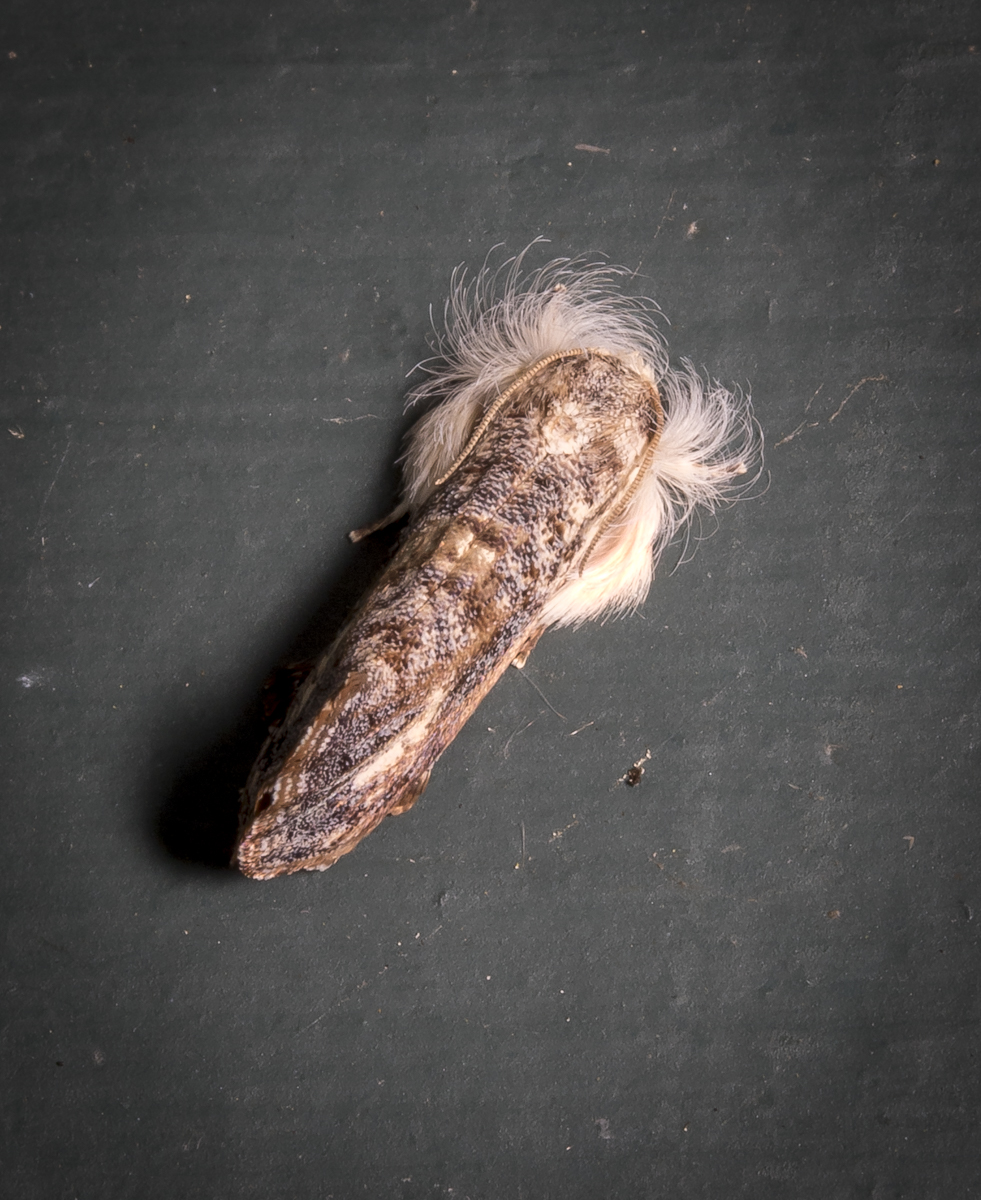
    Caterpillar (a species of pinion moth, I believe) just after shedding its skin (click photos to enlarge)

    It is a season of firsts…the first clutch of Carolina Wrens fledged this past week in their protected nest area inside my workshop. As I did last year, I removed a window screen so the little ones could get outside to join their anxious parents (the parents have learned to come and go through a small gap in the metal roof, but the young have a tough time finding that and just cluster at the window); the first Summer Tanager and first Rose-breasted Grosbeak appeared last week; the first Zebra Swallowtail of the season, and so much more.

    zebra swallowtail laying egg
    The first Zebra Swallowtail of the season was flitting around our Pawpaw trees (her host plant), laying eggs

    zebra swallowtail resting
    She would lay an egg or two and then go land in a sunny spot for a minute or so, and then return to lay more eggs

    zebra swallowtail laying egg 1
    She curls her abdomen and glues an egg to a Pawpaw leaf

    eastern tiger swallowtail egg on tulip poplar
    I also found a few Eastern Tiger Swallowtail eggs on Tulip Poplar leaves (Zebra Swallowtail eggs are similar in shape but lighter i color)

    Sitting on the porch one afternoon, Melissa saw another Nessus Sphinx Moth hovering near the ground. Virginia Creeper is a host plant and we have an abundance of it scattered around the yard. We finally saw the moth touch down twice on a leaf over the span of a few minutes. We gently turned over the leaf and found 3 eggs (she or another moth had been there before).

    Nessus sphinx eggs on VA creeper
    Nessus Sphinx Moth eggs on the underside of a Virginia Creeper leaf

    There’s a lot to look forward to with the new beginnings all around us. Stay safe.

  • Naming Nature Part 2

    Here is the answer to yesterday’s quiz along with things to note as you make your observations. The snake is a Red-bellied Snake (Storeria occipitomaculata). It is a small snake with adults ranging up to about 12 inches in length. They are fairly common, but somewhat secretive, in wooded areas and edges of old fields. They are harmless, and don’t bite, even when handled. Their diet consists primarily of slugs and small snails. They are quite variable in coloration as you will see if you peruse a field guide or online source, ranging in color on their dorsal surface from gray (can be almost black) to brown to reddish.

    red-bellied snake 2
    Red-bellied Snake (click photos to enlarge)

    Their common name stems from the reddish coloration of their underside. They can be confused with a number of other local snakes. Just in terms of their name (and reddish underbelly) some may think they are Red-bellied Water Snakes (Nerodia erythrogaster), another common (but much larger) species in our area that is usually found near waterways.

    red-bellied snake belly
    The underbelly of a Red-bellied Snake is red or orange, often with some dark dots along the edge

    People also often mistake this snake with two other small species – the Brown Snake (Storeria dekayi) and the Ring-necked Snake (Diadophis punctatus). I will admit to occasionally having called these guys ring-necks on first seeing one as they tend to have a yellow or orange collar behind the head, much like a Ring-necked Snake. But, with a closer look you can see some distinctive characteristics that will separate them…

    red-bellied snake 2 close up of head
    A close up of the head showing the distinctive white dot

    Red-bellied Snakes have a conspicuous white spot under, and just behind, the eye. They also have keeled scales (scales that have a small, raised ridge, running down the middle). The Ring-necked Snake has smooth scales (no keel). The Brown Snake lacks the reddish underside and the yellowish spots behind the head.

    red-bellied snake keeled scales
    The keeled scales can be seen in this photo and in the way a Red-bellied Snakes seems to have a rougher texture than non-keeled snakes

    And speaking of keeled scales, that is what the mystery photo from yesterday was – a close up view of a beautifully patterned Eastern Garter Snake (Thamnophis sirtalis).

    mystery skin
    Close up view of the scales of an Eastern Garter Snake

    Garter snakes are another common species in this area and can grow to over 3 feet in length. We often have them around our small water gardens since amphibians are a favorite food item. They are not venomous, but will emit a strong musk, and may bite, if handled. This particular snake is a beauty and is hanging out near a decaying log in the front yard.

    Eastern garter snake
    This snake seems to have an opinion of me and my macro lens

    Whatever your opinion of snakes, they are an important part of our ecosystem and deserve to be left alone. You might even find them fascinating and beautiful if you give them a closer (but not too close) look.


  • Naming Nature

    I wonder what it would be like to go into a forest where nothing had name. How would we act in a forest if there were no names for anything smaller than an ecosystem? How could we walk, if there were no way to talk about anything larger than a cell?

    ~Kathleen Dean Moore

    When I am trying to get people excited about the natural world, I like to help them find identities for the things we observe. To name something is to know it a bit better. To know it is to open the door for wondering about it, and, hopefully, caring about it. So, today we will try to learn the name of something Melissa found in our yard a couple of weeks ago. Perhaps you have seen one of these small snakes, or something similar, in your own yard. I want you to use your observation skills and see if you can identify this creature by either using one of your own field guides or looking it up online. Here are a couple of useful links that may help (Reptiles and Amphibians of NC and the Virginia Herpetological Society). Be sure to zoom in on the photos and take a closer look. The answer and more information tomorrow. You herp people out there, hold your answers until tomorrow.

    red-bellied snake
    Small snake Melissa spotted in our yard (click photos to enlarge)

    red-bellied snake belly
    If you look underneath, some color is revealed

    And now for another mystery…I saw this earlier this week in our yard…what is it?

    mystery skin
    Mystery item – answer tomorrow


Search the Archives

Due to our site update, photos on older posts may not display correctly. Sorry for any inconvenience.


Recent Posts