I am a native plant promoter and have been for many years. While there is nothing wrong with planting ornamentals in the landscape (as long as they are not potential problematic invasives) I appreciate getting to know our native species and encouraging them in my landscape and in those of schools and other public areas where I work. A connection with native species is just one more way to help people become better stewards of our natural areas. And I have a particular fondness for spring blooming species like Crossvine, Bignonia capreolata.
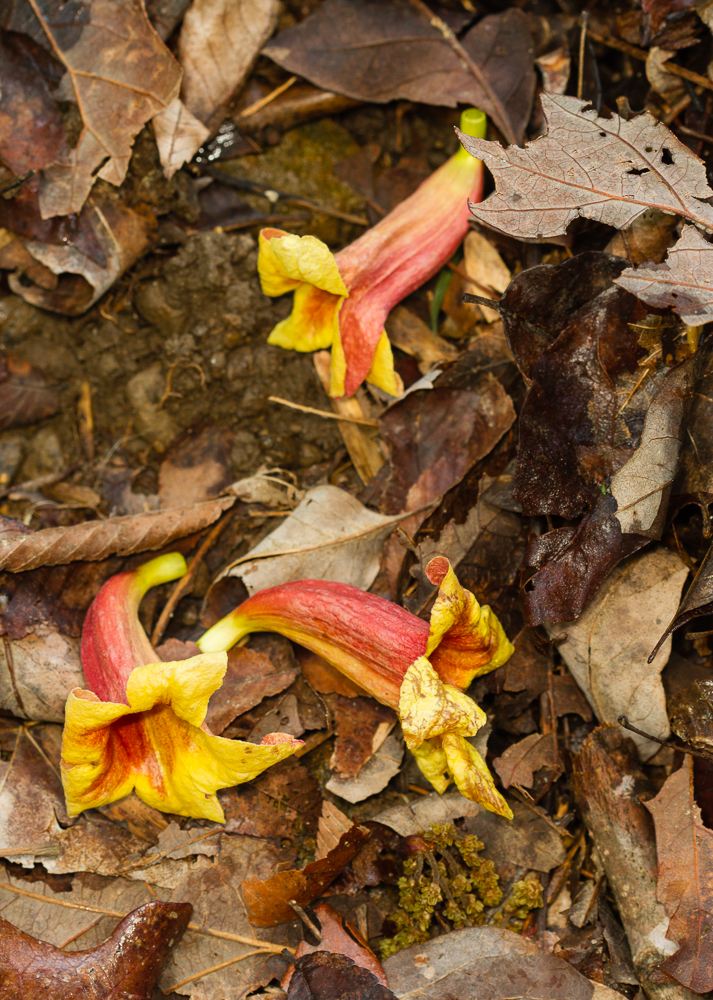
Crossvine flowers on ground beneath vine
I remember seeing my first Crossvine blossoms many years ago – lying on the ground, not hanging on the vine. I looked up and finally saw the vine with attached blooms way up in the top of an ash tree. This may be why this beautiful vine has not caught on more with homeowners – relatively few people see it in its glory because it often grows 50 feet or more into the canopy.
Crossvine planted on cedar snag
But if planted along a fence, trellis, or even a dead snag where we ground-dwellers can appreciate it, Crossvine can be spectacular. I once stuck a cedar snag in the ground and planted a variety of Crossvine that had more orange than most wild specimens and it provided a beautiful spray of flowers every April and early May.
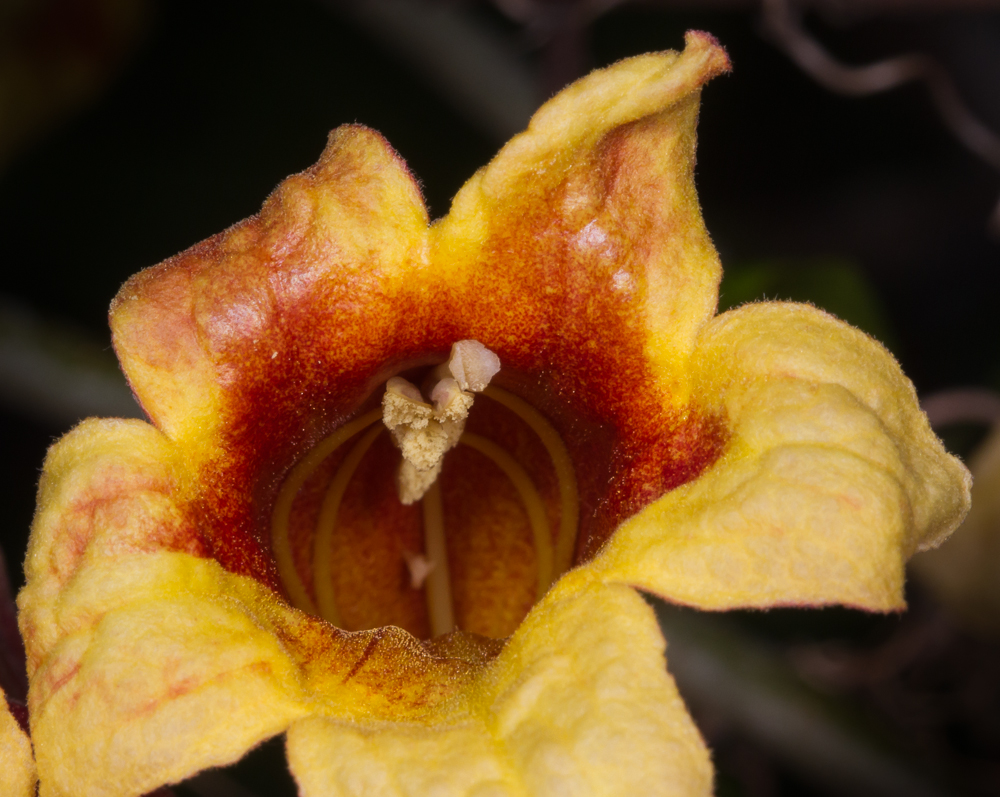
Crossvine flower close-up (click to enlarge)
The bloom time, color and shape of the flowers hint that Crossvine is a favorite of Ruby-throated Hummingbirds returning to their breeding grounds in the southeast. When a hungry hummer pokes its head and bill into the flower it is likely to touch the flower parts, which are clustered near the roof of the flower tube.
Cut-away of Crossvine flower to show pollination
This transfers any pollen on the hummingbirds’ head to the pistil (female part) and dusts its forehead with new pollen from the anthers (male part of flower) as it exits and zips to the next Crossvine blossom. I have also watched bumblebees and a few swallowtails visit the blossoms. It is also a host plant for the Rustic Sphinx Moth, although I have never seen one feeding on it (yet).
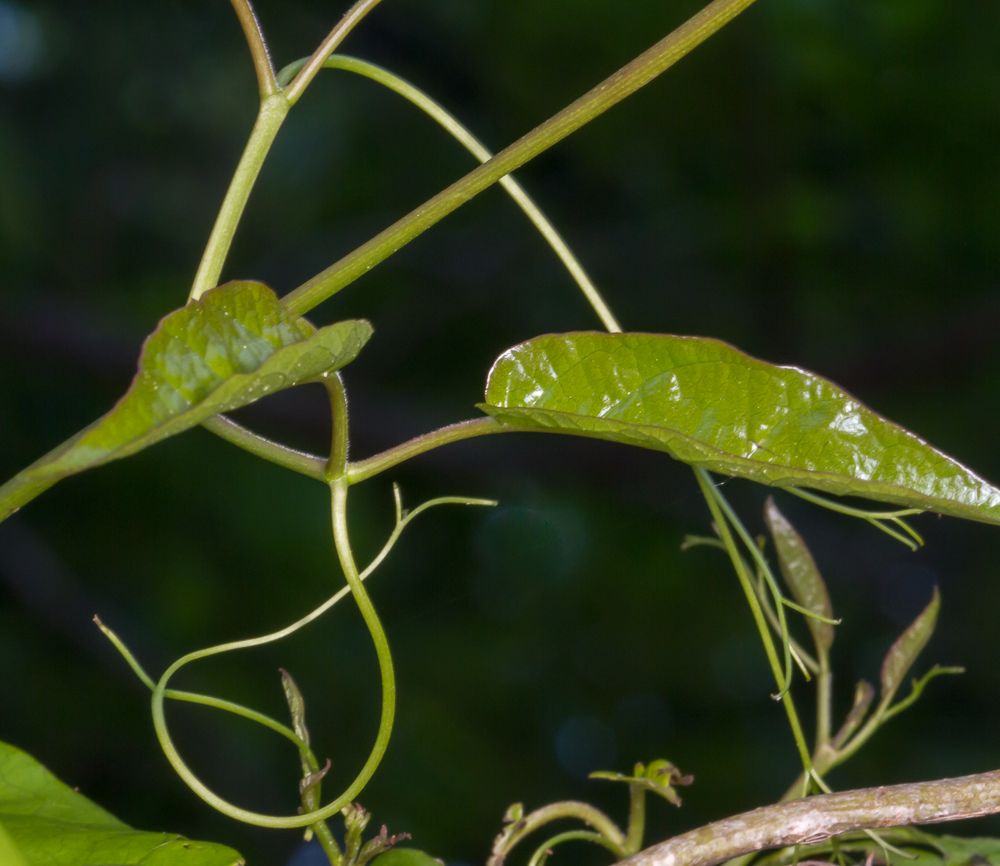
Crossvine leaflet (click to enlarge)
Like its close relatives, Trumpet Creeper and Catalpa, the flowers of Crossvine produce long pods filled with flat, winged seeds that are wind-dispersed. It also spreads from root sprouts and can be found creeping along the ground in many places in the Piedmont and Coastal Plain, especially bottomland forests. The leaves are a bit unusual in that they are really leaflets divided into three parts – two shiny, semi-evergreen leaves, and between them, a leaflet that is modified into a coiling tendril, which allows the vine to cling to tree trunks, fences, and almost anything else it touches. The leaves are a dark green in summer and often turn purplish-green in winter before falling right before the new bright green spring growth appears.
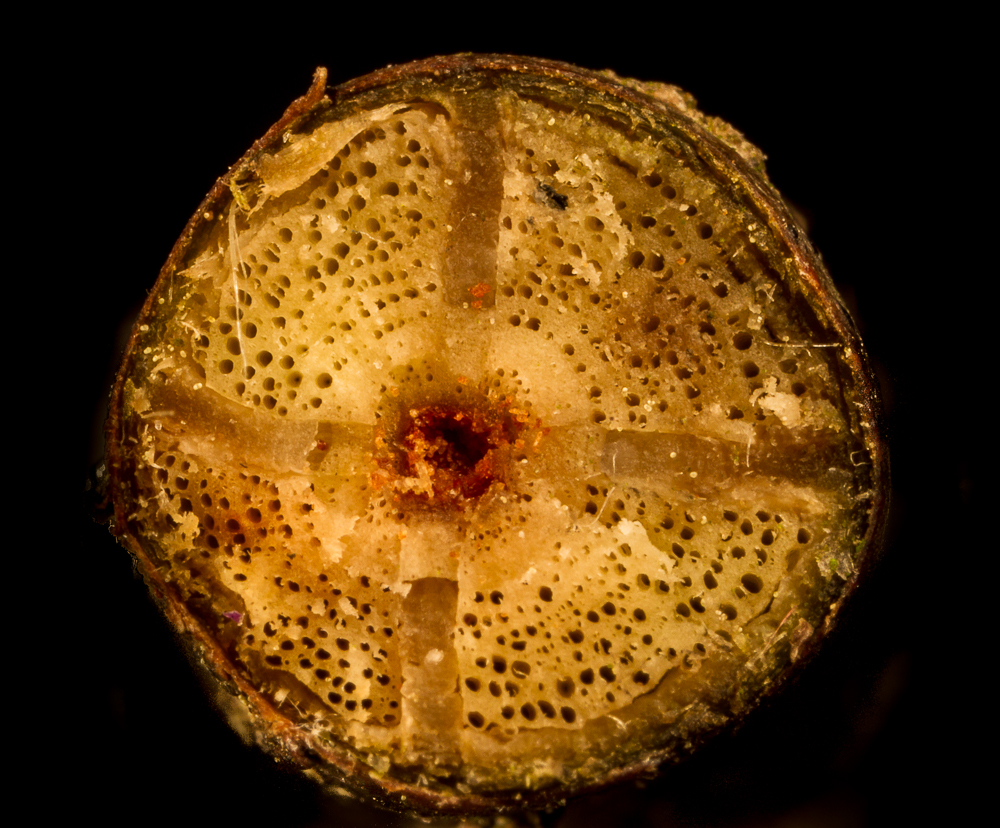
Crossvine cross-section (click to enlarge)
While I think the leaf arrangement as the vine climbs up a tree trunk has a resemblance to a cross or a bent “X”, the plant is supposedly named for the cross pattern seen in the pith when you cut a cross section of the vine.
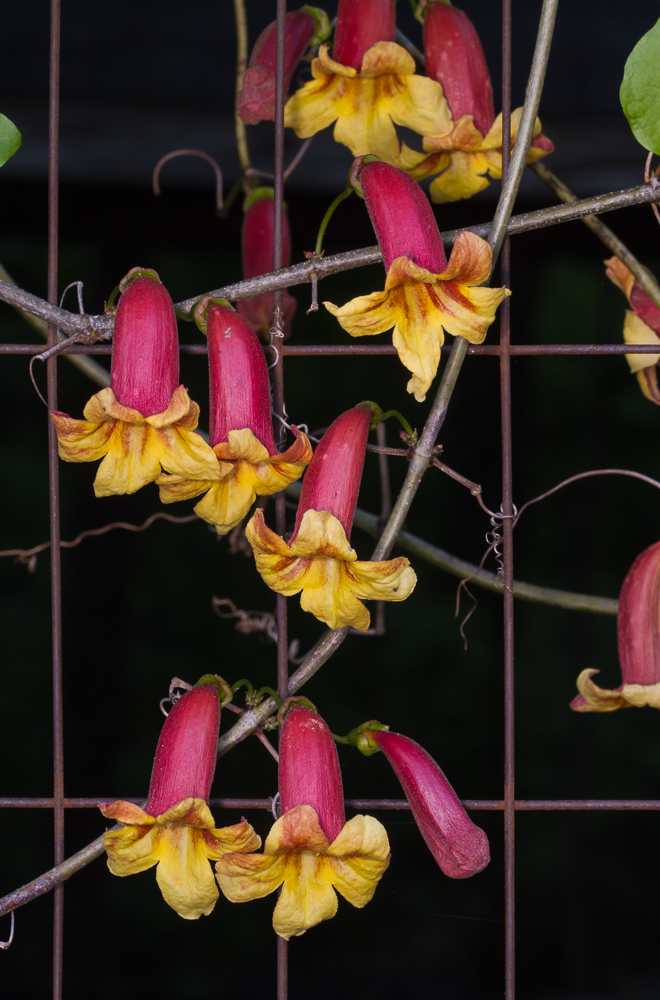
Crossvine flowers on garden fence
Do yourself and your hummingbirds a favor and plant one of these beautiful native vines in your landscape this season and you can enjoy it for years to come.
While looking for critters in the garden last summer I noticed a bug I had never seen before – an odd-shaped little brown insect. I looked in my insect guides but didn’t see anything that was a match and then something probably came up to distract me and it was filed under “things to look up some day”. Then as cooler weather approached I started noticing clusters of these bugs congregating on the tips of the fig tree branches and I became worried. Spending a few minutes on Google enlightened me as to this new critter that I am now seeing again this spring in my garden.
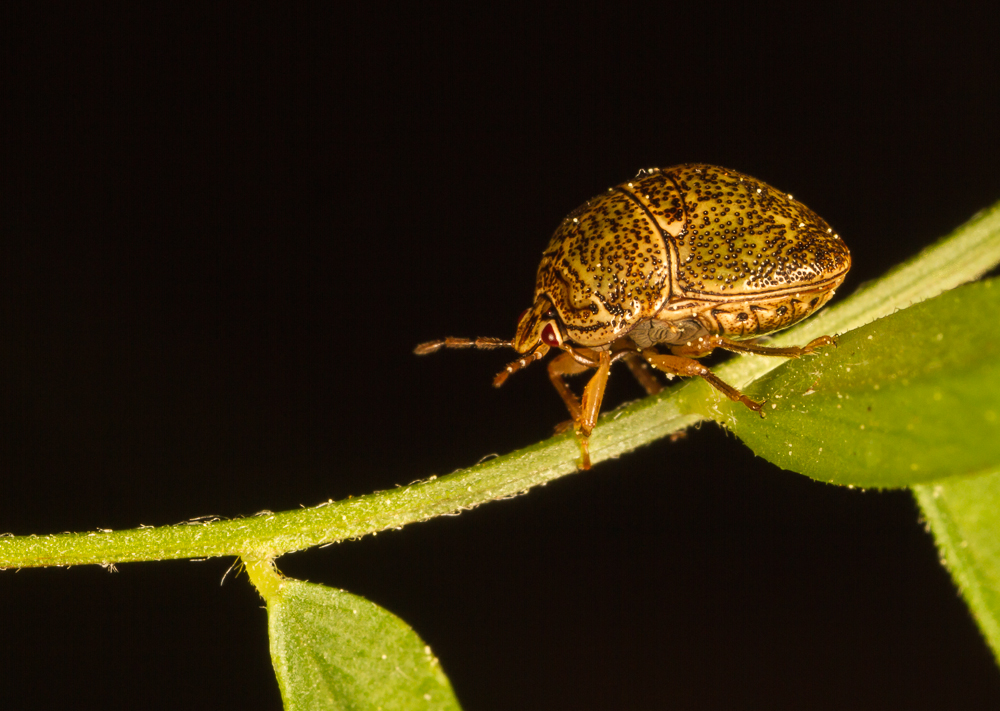
Kudzu Bug (click to enlarge)
The Kudzu Bug, aka Megacopta cribraria, is native to India and China. It was first spotted in the U.S. in October of 2009 in a few counties in Georgia. A year later, the insect was confirmed to be present in more than 60 north and central Georgia counties as well as limited distributions in North and South Carolina. By last year, when I first saw it, it had been confirmed in almost all of North Carolina and three other southern states. The rapid spread is amazing.
Kudzu bugs are so-called because they feed on plants in the legume family including invasive plants such as kudzu and non-native wisterias. But they also can cause significant damage to soybeans and other bean crops and this is very worrisome to farmers throughout the south (and maybe beyond).
These new invaders also pose a potential nuisance to homeowners, especially when cold weather approaches and large numbers of the insects look for places to overwinter. In fact, the first reports of this species from Georgia were because large numbers were congregating on warm, sunlit walls of homes in a few counties. Calls to pest control and extension agents’ prompted further investigations into this unusual insect. And it turns out, Kudzu Bugs, like Kudzu vines, proliferate unchecked because they have no natural enemies in North America.
Kudzu Bug – note flattened posterior, a key diagnostic feature (click to enlarge)
Their olive to brown coloration, nearly hemispherical body shape and their flattened posterior edge easily identifies the bugs. Some similar-looking native species have a rounded posterior.
Kudzu Bug, ventral view (click to enlarge)
In addition to crop damage, Kudzu Bugs are problematic because they can exude a chemical that smells bad, can stain surfaces and cause skin irritations in susceptible individuals (so it is best not to crush them). Researchers at North Carolina State University and other venues are working to learn more about the life history of this species and how to control it. For more information, check out this web site – http://www.kudzubug.org/.
Yesterday morning I sat out by the garden with a cup of coffee to listen and watch for birds – spring migration is in full swing. Here are the species seen or heard in about 45 minutes of sitting and sipping:
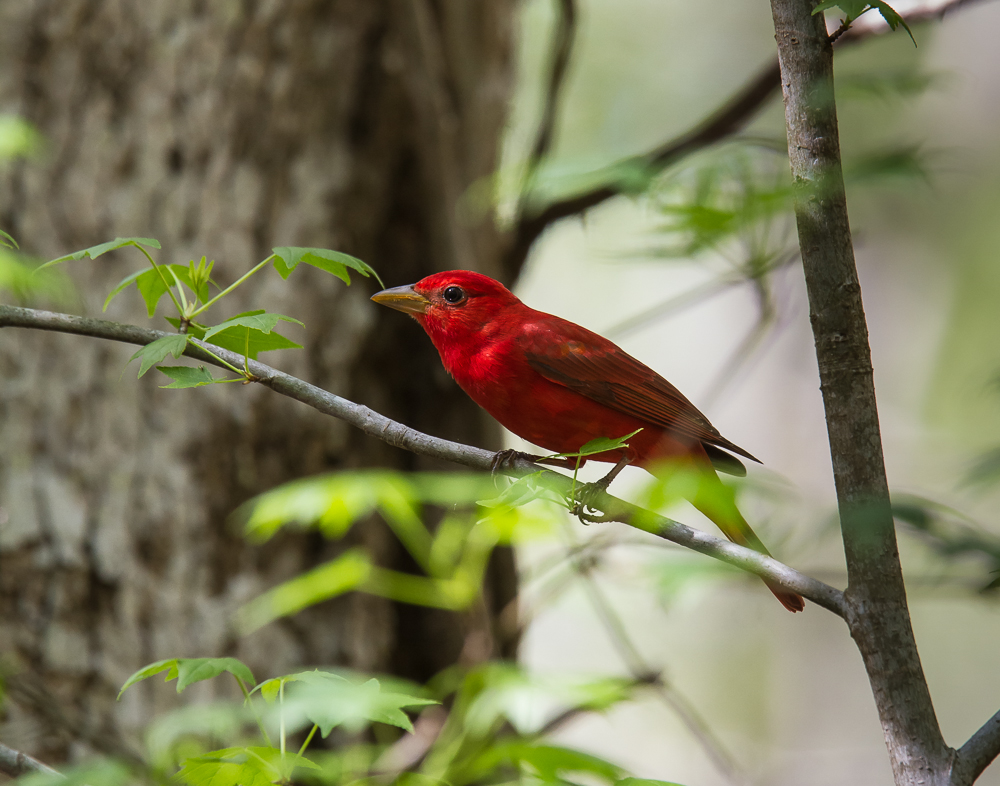
Red-tailed Hawk, Red-shouldered Hawk, Turkey Vulture, Yellow-billed Cuckoo (first of season), American Crow, Blue Jay, Red-bellied Woodpecker, Downy Woodpecker, Mourning Dove, White-breasted Nuthatch, Pine Siskins (still a few around surprisingly), Summer Tanager, Scarlet Tanager, Eastern Bluebird, Wood Thrush, American Goldfinch, Chipping Sparrow, White-throated Sparrow, Field Sparrow, Indigo Bunting, Carolina Chickadee, Tufted Titmouse, Northern Cardinal, Yellow-rumped Warbler, Black and White Warbler, Northern Parula Warbler, Blue-gray Gnatcatcher, Ruby-throated Hummingbird, Eastern Wood Peewee, Great Crested Flycatcher, Red-winged Blackbird.
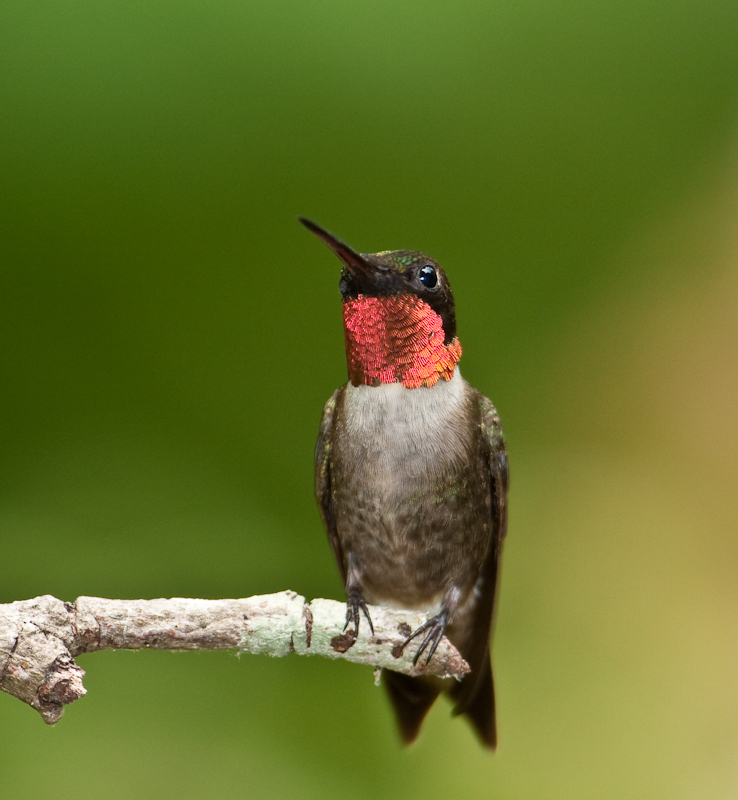
Ruby-throated Hummingbird (click to enlarge)
Not a bad list for one cup of coffee…
The afternoon before there were two Rose-breasted Grosbeaks at one feeder and this evening I also heard a Great Horned Owl. I love spring (and good coffee).
Black Swallowtail egg on parsley on day 1 (click to enlarge)
Since I have what might be considered by some an abnormal fascination with caterpillars, I decided to keep track of the development of the Black Swallowtail eggs from the garden. The photo above is what a typical egg looks like shortly after it is laid.
Black Swallowtail egg just prior to hatching (click to enlarge)
Yesterday I was watering the garden and found an egg that was darker, indicating it might be close to hatching. I brought it in and took a closer look. You can see the larva inside if you look closely. The larva appears to be curled on the lower and right side of the egg with the head capsule near the top. There is also a dent in the egg so I was a bit worried that something had happened to it (or is this typical prior to hatching?).
I started taking photographs every few minutes and checking the egg for changes in between dinner ad catching up on some Daily Show episodes I had missed. Well, as my luck would have it, I looked at one point and the little guy had chewed his way out already….I had missed it.
Black Swallowtail larva just after hatching (click to enlarge)
As most species do, the larva began to consume the egg shell. There are no doubt valuable minerals and maybe even symbiotic bacteria associated with it so it makes sense to recycle the shell. The tiny caterpillar was eating very slowly so the shell was not completely consumed for over an hour after it hatched.
Black Swallowtail first instar larva consuming the egg shell (click to enlarge)
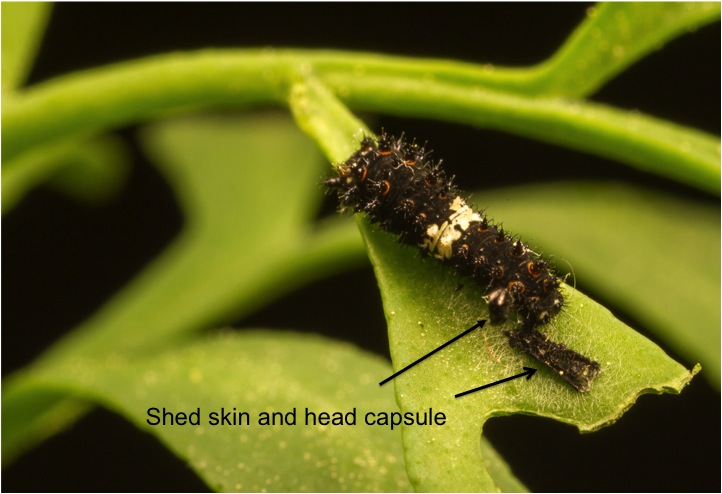
Meanwhile, the caterpillar I had photographed a little over a week ago has undergone its first molt. This one is feeding on rue and it seems the larvae tend to grow more slowly on that host plant than on fennel, parsley or carrots. Most caterpillars molt their skin five times from hatching to becoming a pupa. When ready, they typically spin a silken pad and attach themselves with their prolegs and become still for a day or two as changes take place for the molt. They then crawl out of their old skin and rest for an hour or two while their new skin hardens. Just like with the egg shell, they often eat their old skin for the nutrients. In the photo below you can see the shriveled first instar skin (excuvia) and detached head capsule lying alongside the newly molted and much larger second instar larva.
Second instar larva next to shed skin and head capsule (click to enlarge)
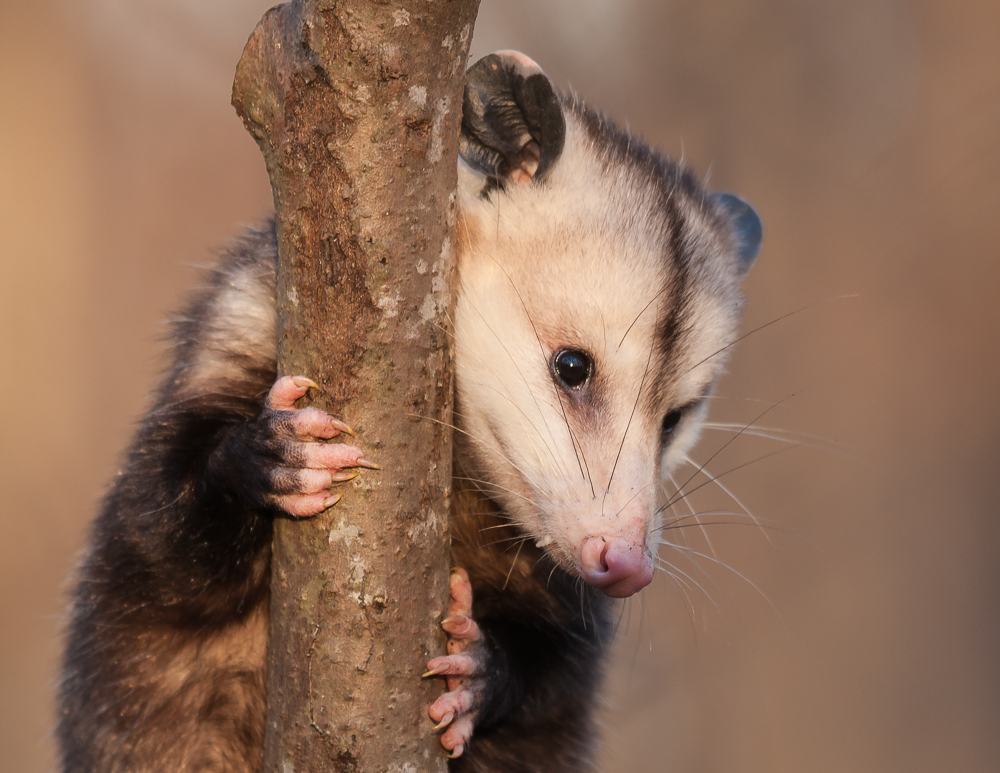
I promised a post on this unusual encounter last weekend at Pocosin Lakes so here goes (I should warn you this may be for mature audiences only)…I started my morning with a sighting of a pair of Virginia Opossums (aka ‘possums) mating at the edge of a field just after sunrise. I have been “fortunate” enough to run across mating ‘possums three times in my woods wanderings over the years and each time noticed a behavior that I had once read about and to this day still don’t quite understand – but more about that in a second.
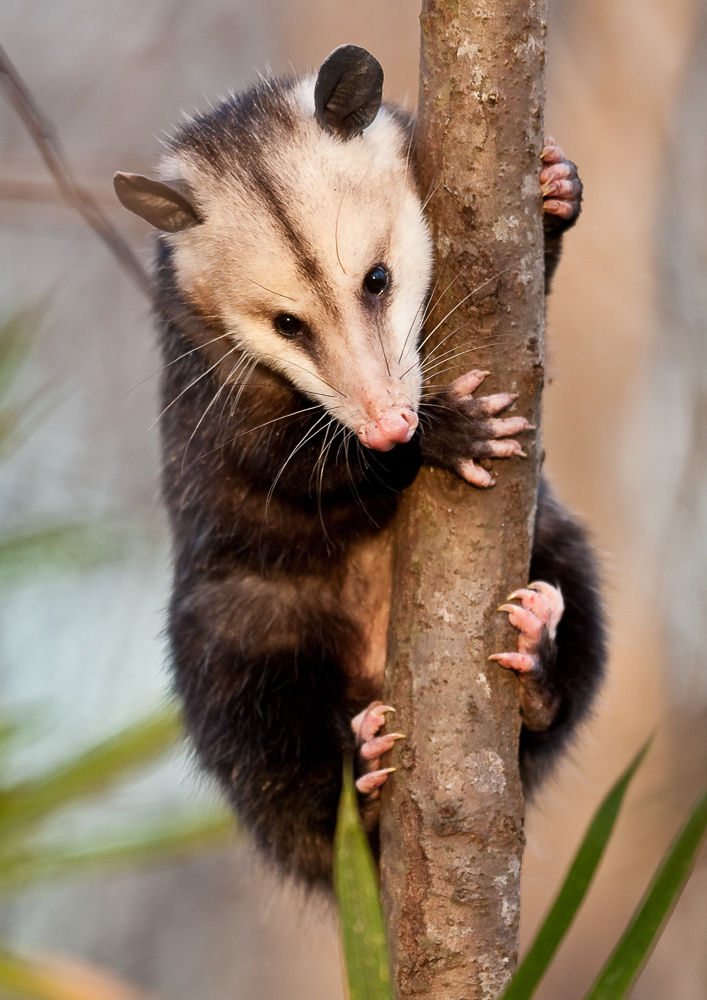
Opossum in tree (click to enlarge)
Possums are definitely unusual mammals. Here are a few reasons why:
They are North America’s only marsupial (pouched mammal, like Kangaroos)
When confronted by a dog or potential predator they often feign death (play ‘possum)
Their skull contains the most teeth or any North American land mammal (50)
They appear immune to the venom of pit vipers like rattlesnakes and copperheads
Opossums, for their size, are one of the shortest-lived animals in the world with few in the wild making it into their second year
They have a notoriously tough time crossing roads (related to above?)
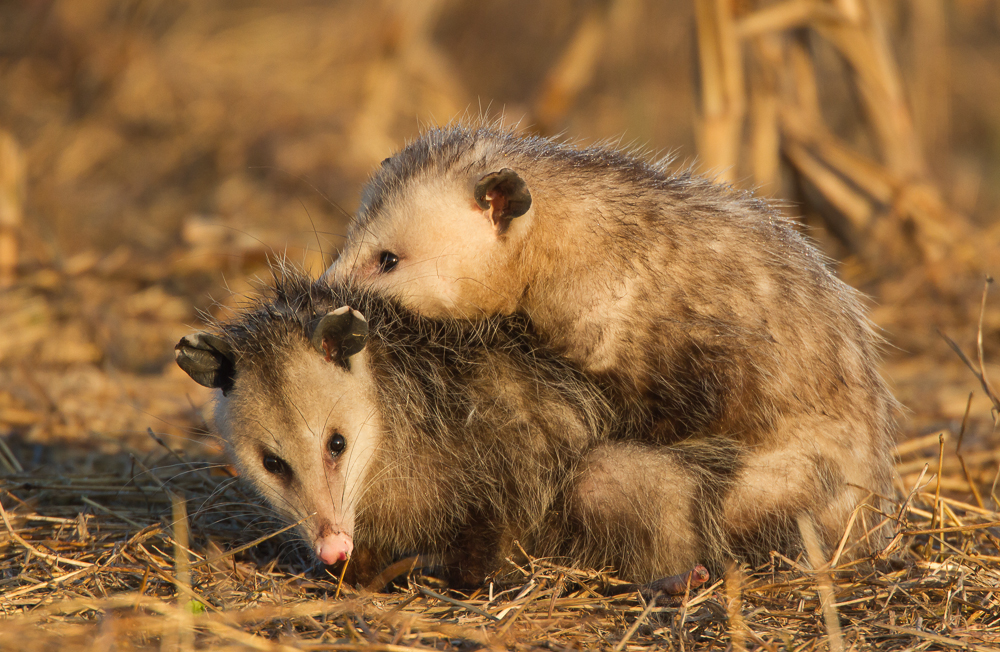
But their uniqueness is most noticeable when it comes to their unusual reproductive habits. Female opossums generally raise two litters per year with the breeding season running from January through early summer. Males are known to make a peculiar constant clicking noise as they amble in pursuit of females. Females are only receptive for a short period of time and will hiss, click their teeth and threaten biting if not ready. When at last he does find a receptive female, he bites the fur on her neck and then climbs on her back (you can see wet matted fur on the top of the females’ neck if you look closely at one of these pictures).
Opossums mating (click to enlarge)The right side roll (click to enlarge)
He then grasps her hind legs with his hind feet and then they both roll over on their right sides to copulate (this is the behavior I have witnessed all three times I have seen it – the “right side roll”). Studies have shown (I just love it when this phrase is used…who studied this and why?) that if for some reason the mating pair remains upright or falls over to the left, mating is less likely to be successful. Apparently a researcher in the 1950’s failed to find sperm in the female’s genital tract after the pair remained upright or fell to the left…go figure. Copulation lasts 20-30 minutes.
There are a few other oddities about ‘possum mating that have led to some interesting folklore. Turns out the male ‘possum has a bifurcate (forked) penis. Since early observers could not find a corresponding dual opening in the female they deduced that male ‘possums must mate with a female in her nostrils and she impregnates herself with a sneeze…this is actually part of mountain folklore. But, it turns out that the female has a double set of everything as well. And even though male opossums deliver a low sperm count (~3 million sperm compared to a male rabbit that inseminates a female with ~150 million sperm), the sperm are remarkably efficient. They, too, are paired. That’s right, ‘possum sperm pair up by sort of fusing their “heads” together then beating their tails together, making them far more efficient at reaching their goal. Another go figure.
All of this rather unusual reproductive ability naturally leads to an unusual birth, with baby opossums being born a scant 12-13 days after their parents mate. The bean-sized “embryos” then must crawl from the birth canal to the mother’s pouch, where they will remain for about two months as they develop into something that looks more like a ‘possum baby.
Virginia Opossum (click to enlarge)
So, the next time you see one of those “grinning ‘possums”, think about all the amazing traits that go into making them one of our more endearing woodland critters.
Two wonderful references provided much of the information related here:
THE OPOSSUM: ITS AMAZING STORY
By William J. Krause and Winifred A. Krause
Published by the Department of Pathology and Anatomical Sciences, School of Medicine, University of Missouri, Columbia, Missouri (available online as a pdf)
and…
Advanced ‘Possumology in
Wildwoods Wisdom, Encounters with the Natural World
This weekend I decided to get back to my favorite North Carolina wildlife area – Pocosin Lakes National Wildlife Refuge. When I first started going there back in the early 80’s, it was known as Pungo National Wildlife Refuge and it was centered on Pungo Lake, an important wintering area for waterfowl. In the early 90’s the refuge added over 90,000 acres and changed the name to Pocosin Lakes National Wildlife Refuge (although I still often refer to it as just Pungo). I usually make 10 or more trips a year to the refuge, most in winter when the thousands of wintering waterfowl provide an unsurpassed wildlife spectacle. But in the past few years I have enjoyed visiting in the warmer months to see another side of this unique area. On this trip I was hoping to see and photograph some of the Black Bears that are so abundant at Pungo. The weather was perfect – crisp air and very still. It was obvious that the storm the previous night had dumped a lot of rain as the fields contained standing water and the often-problematic dirt roads were still a bit slippery.
I looked for wheat fields, as I know that bears love to graze on wheat. The refuge has an agreement with local farmers who plant hundreds of acres of refuge land with crops (mainly corn, soybeans, and winter wheat) and in exchange they leave a certain percent for the wildlife, especially the wintering waterfowl. No bears yet in the small amount of wheat on the refuge so I kept driving to check out more areas.
I pulled over at one of their managed marshes and got out to see if I could see or hear anything. There were a couple of late American Coot, a Greater Yellowlegs, and a Great Egret. I then heard a clucking sound a few feet from me in the marsh grass, but I couldn’t see anything. It sounded like a bird – I was guessing some sort of small rail. It moved away so I assumed it might be an alarm note and I had disturbed it.
American Bittern calling in marsh at Pocosin Lakes NWR (best with volume turned up)
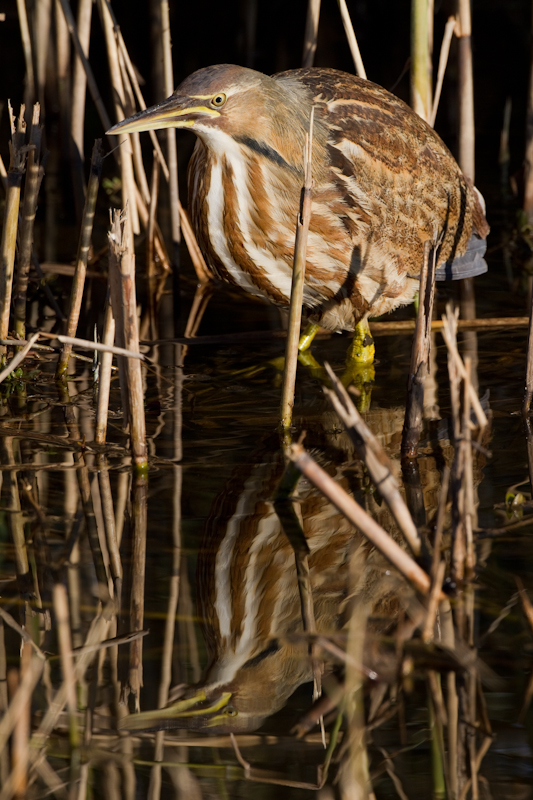
Then, from farther out in the marsh, came a sound I knew only from audio recordings – the bizarre mating call of the American Bittern. It reminds me of the sound of large bubbles in the office water cooler. I was amazed to hear one call, then another, and another. Three bitterns calling, and I could not see any of them. They kept calling back and forth and I kept looking, but no luck on spotting the callers, although I did see four bitterns fly into the marsh during that time. Surprised to see so many bitterns in one small marsh, I did some research online that night and found a great web site for this type of information – Birds of North Carolina (http://www.carolinabirdclub.org/ncbirds/accounts.php). It says that bitterns are most numerous in our state during migration (in April and May for spring migration). Below is a pic of one at Mattamuskeet from last winter, when they are not nearly as abundant.
American Bittern taken at Lake Mattamuskeet last winter (click to enlarge)
After about an hour of enjoying the scene, I decided to go look for what I had come for – bears. I could see two bears out in the wheat fields but I drove to North Lake Shore Drive (aka Bear Road – before they had road signs on the refuge I made up names for some of the more memorable ones) to see if any were out in that usual hot spot. As if on cue, one bear came out of the woods a few hundred feet beyond the gate. But there is no wheat in the fields along Bear Road this year so I went back to the other location and now there were six bears out feeding. It was still overcast and the bears were over one hundred yards away so not a good photo opportunity.
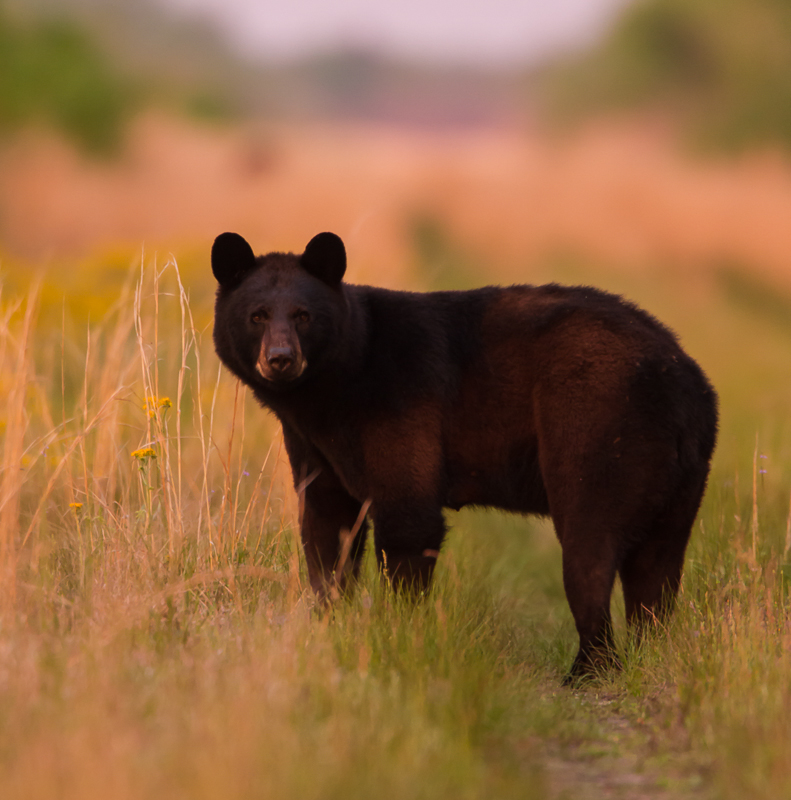
Black Bear at sunset along “New Bear Road” (click to enlarge)
I drove a little further and saw a bear silhouette down a grassy side road – this one has been dubbed New Bear Road since it tends to produce bear sightings almost as regularly as the original Bear Road (I know, not very inventive names). And, as luck would have it, just then the sun dipped below the cloud cover flooding the area with a golden light that looked like it would last the 15 minutes or so until sunset. So, I grabbed the camera and scrambled down the side road. The bear was so busy eating grass that it never looked up. I was able to get close enough for a couple of shots before the sun set, Turns out there was another bear off to the side of the road and they both gradually ambled away as I headed back to the car.
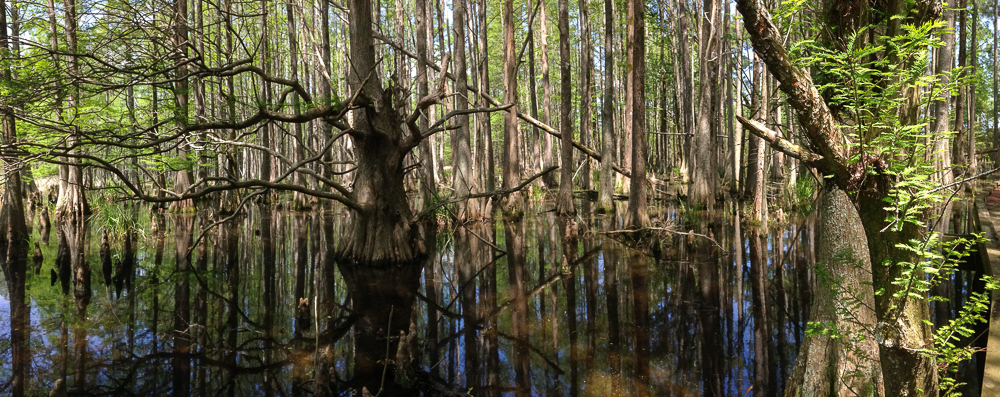
Swamp scene from Mattamuskeet boardwalk (click to enlarge)
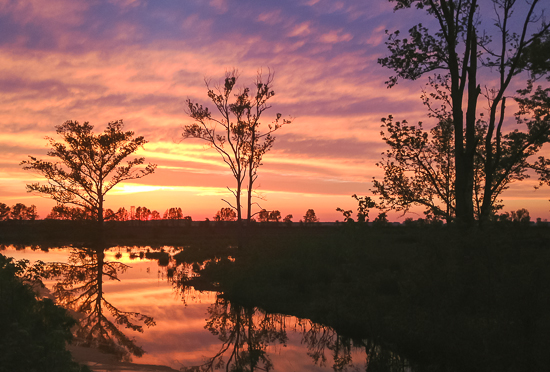
The next morning started off with a beautiful sunrise and the unusual site of a pair of opossums mating at the edge of a cornfield (more on that in a later blog). The wind picked up and after driving slowly around the Pungo Unit for an hour I had managed only one bear butt, so I decided to head for Mattamuskeet National Wildlife Refuge about 30 minutes east. By the time I got to Mattamuskeet, the wind was howling and there just were not many birds or other critters to be seen. I got out and walked some of the short boardwalks and experimented with the camera on my iPhone.
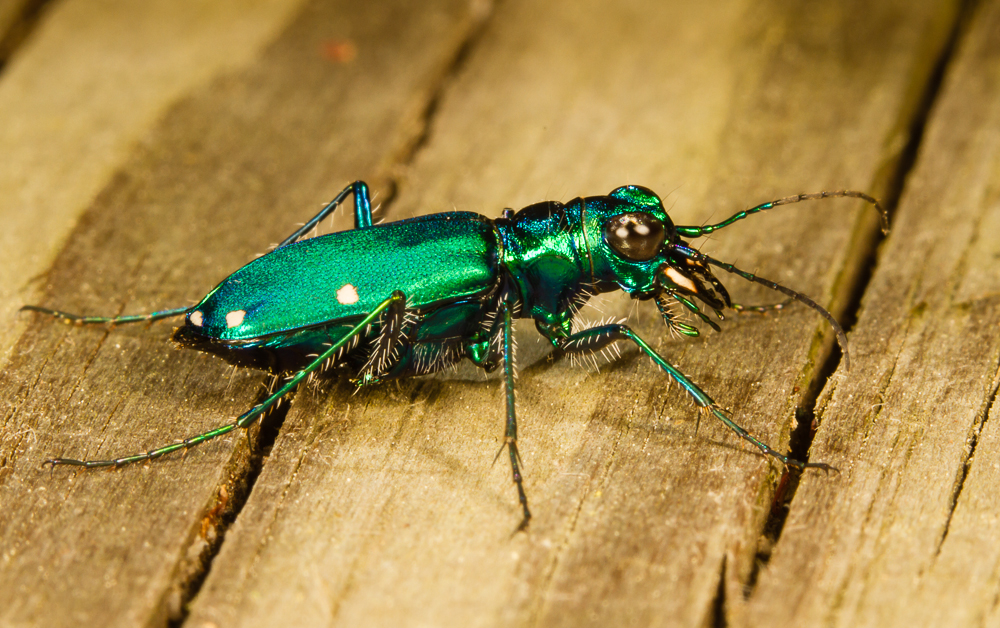
Six-spotted Tiger Beetle (click to enlarge)
At one point I crawled around on my belly on a boardwalk for about 30 minutes “chasing” several Six-spotted Tiger beetles, hoping to get a close-up of these beautiful beetles. And this was after I had been checked by the federal game warden who thought I was acting a little suspicious! Turns out they have problems with people illegally collecting snakes and other critters on the refuge for the pet trade, etc. and when he saw me driving slowly along the road and getting out to look at things in the bushes, he thought he better check it out. He was a very nice guy and it is good to know there are people out there keeping an eye on things.
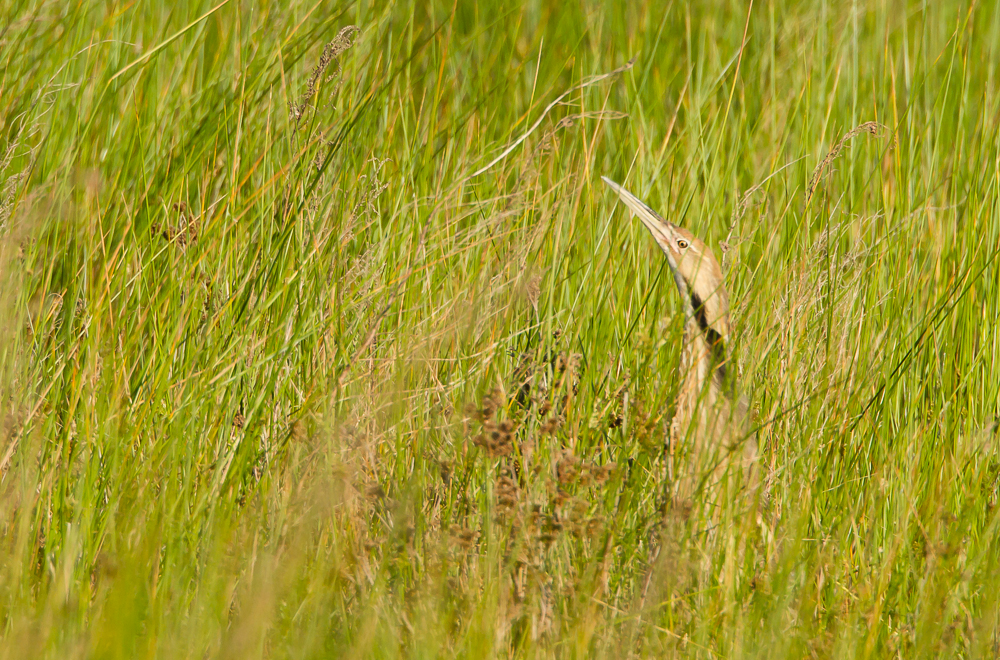
American Bittern – the one calling about 50 yards away (click to enlarge)
Returning to Pocosin Lakes I went straight to the bittern marsh determined to find one of the callers. The wind may have subdued them a bit but I finally had two calling in front of me, one off in the distance and one so close yet invisible that it was over-the-top frustrating. Finally I found one – the one off in the distance at about 50 yards. After watching his behavior, it was even more excruciating that I could not find the close one, who could not have been more than ten yards from me. The caller was standing upright in the marsh, turning his head from side to side, then he would lower his head, giving the clucking sound a few times, and then launch into the water cooler call and with each “bubble release” he would snap his head up and down rapidly with bill wide open. He repeated this 3 to 5 times and then returned to the upright stance. The closer bird must have been behind the one tall clump of mash grass and remained invisible.
Having satisfied that goal I debated whether to stay and try to capture a picture of the close one if he ever moved, or go try for bears. The wind was still blowing hard but it was from a good direction as far as getting close for some possible bear photos so I decided to give it a try. I parked at the start of new bear road and hiked in about a mile to the edge of the wheat field. The bears were coming out of the woods into the field and I positioned myself at the boundary of the two in hopes of getting them crossing over. Ironically, I sat next to a large bed that had been scooped out of the side of the dike by a bear. I then waited (which is what a lot of wildlife photography is about)…and waited. One bear had made it into the field before I got settled, but for the next hour, only one deer and a Bald Eagle came close. When I checked the wheat field, there were now four bears in it – three had managed to come in at the far end of the woods where I could not see them from my low position.
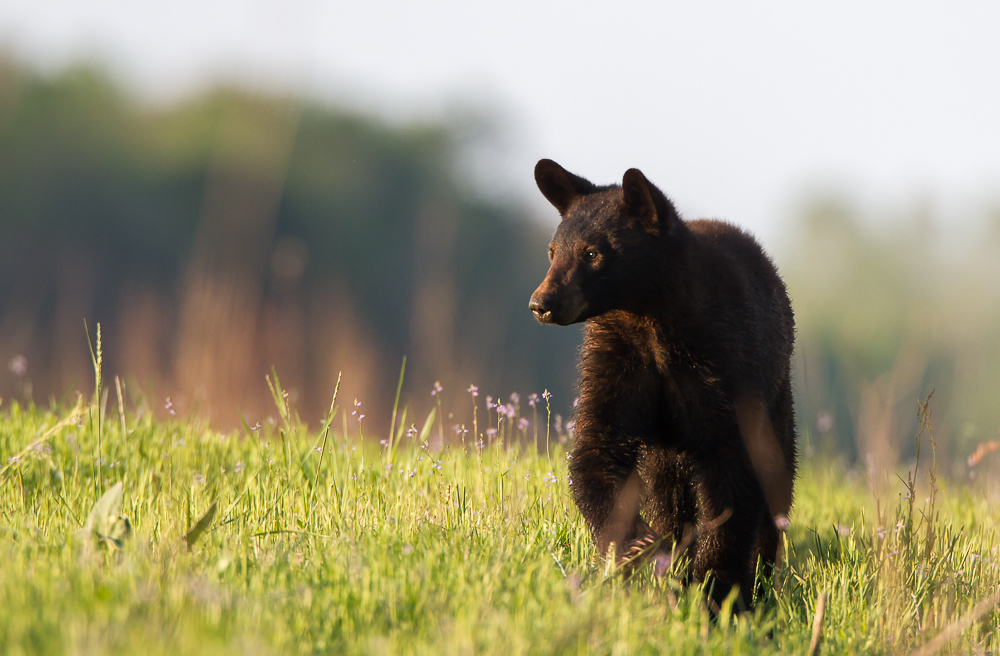
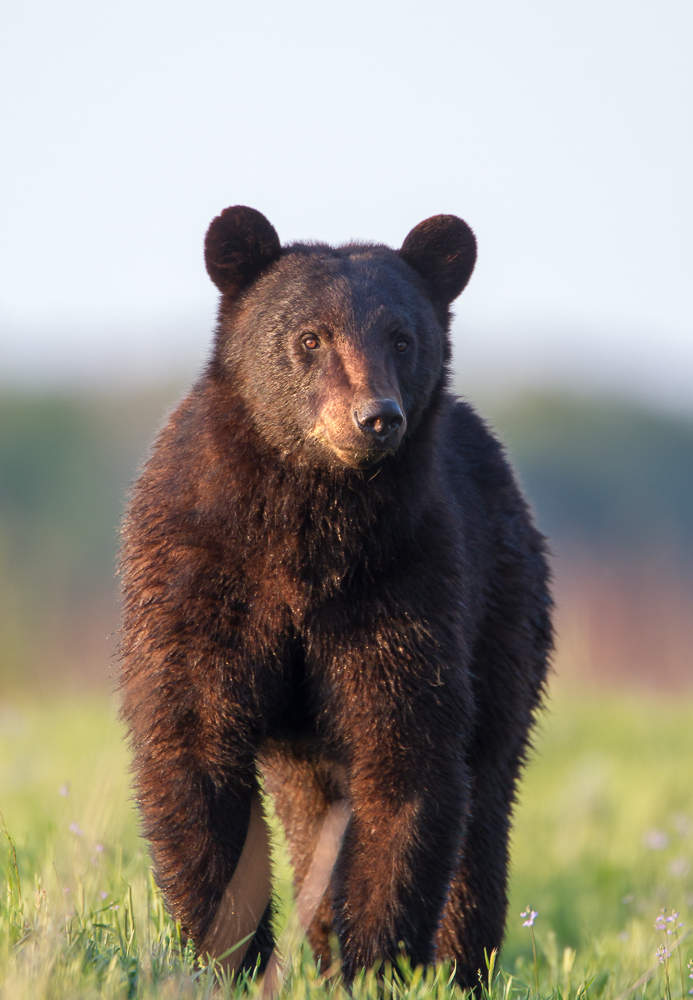
Young Black Bear walking on dike (click to enlarge)
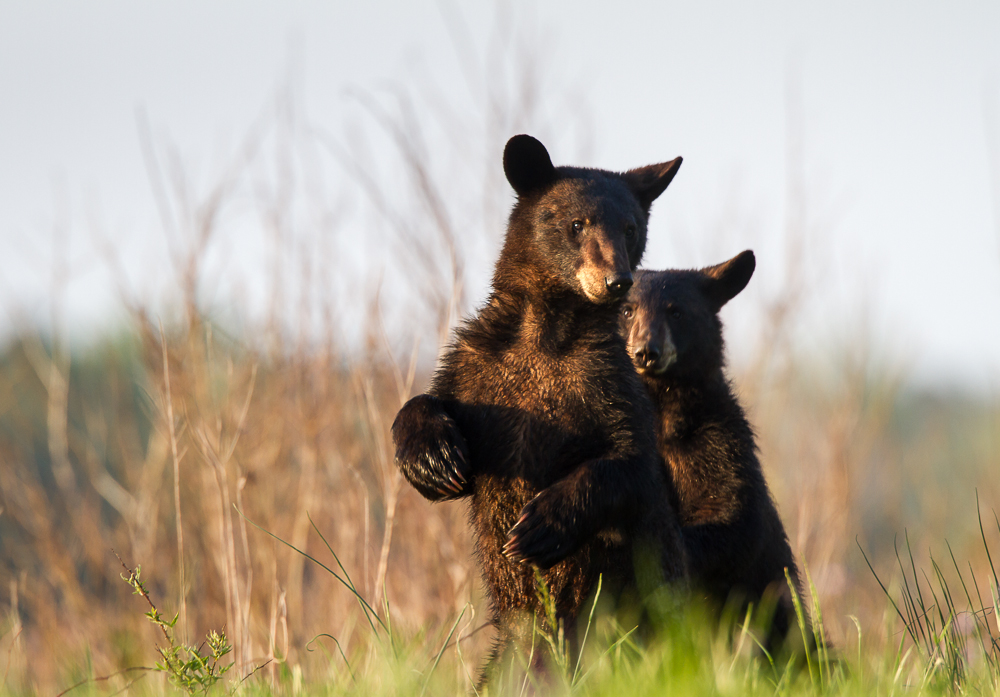
Then I saw one headed my way. It was a youngster from last year. Soon a sibling joined this bear and they began running around and playing, then back across the dike into the wheat field (which was out of my view on the other side of the dike, so in order to check it, I had to slowly stand up and look over).
One young bear tries to stand and look around, the other wants to play (click to enlarge)
The young bears came back. One was curious about either my shape or the camera shutter noise and would stand and look in my direction but its playful sibling would jump on it every time it started to stand. Then they would amble back to the wheat field and continue to play. For the next 30 minutes I had bears crossing back and forth on the dike from woods to wheat field. I was about to leave when a larger bear (still not a huge one by Pungo standards) came walking down the dike toward me. As he approached, he kept looking in my direction and finally decided something was not quite right. He slowly turned and ran about fifty feet, and then with one more glance back at me, went down into the wheat field for dinner.
Last Black Bear of the evening (click to enlarge)
As I crouched and walked away I glanced back at the wheat field. There were all six bears out feeding in the golden light…simply beautiful. My goal is always to get a decent image without disturbing the wildlife. That is sometimes easier said than done. Tonight, the wind was in my favor and it allowed me to get close enough and yet the bears could not smell me. While they seemed curious a couple of times, I don’t think they were ever really spooked. I really like sharing wildlife encounters with people, but it is difficult, if not impossible, to provide a group with the type of experience I had yesterday. The good news is it is possible to give people a great experience in a place like Pungo by allowing them to see bears and other wildlife through binoculars and spotting scopes. I have been lucky enough to do that for the past 30 years and I look forward to sharing more experiences in these special places in the years to come. But getting close-ups of wildlife often requires lots of patience, the right gear (in this case a long lens), a little luck, the right environmental conditions, and sometimes, just being out there alone so you can blend in and become part of the landscape.
Black Swallowtail egg on Bronze Fennel (click to enlarge)
As I was planting some veggies yesterday, I saw a female Black Swallowtail butterfly in her characteristic search and hover mode as she investigated various plants in the garden. I knew from this fluttery flight behavior that she was searching for the right type of plant on which to lay an egg (aka host plant). As with many species of butterflies and moths, Black Swallowtail females tend to be discerning when it comes to which plants they choose for their eggs. Host plants of the caterpillar include members of the parsley family (Apiaceae) including Carrot, Parsley, Dill, Fennel and Queen Anne’s lace and some members of the Rutaceae such as common garden Rue (Ruta graveolens).
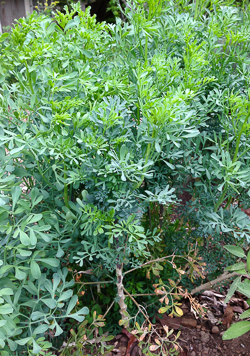
I have four of these in the garden right now: Parsley, Bronze Fennel, Sweet Fennel, and Rue. From my experience, the Bronze Fennel seems to be the preferred host, especially early in the season. The tops of the Carrots I grew last year were also very popular with the caterpillars. As any herb gardener knows all too well, Parsley is also immensely popular as a host plant, with the larvae often totally denuding your herb supply if you only have a few plants. That is one reason I plant the fennels as they tend to get tall (3 or 4 feet) which is usually enough to provide an adequate food supply. Rue becomes especially important as a host plant in my garden in the late summer and early fall as Black Swallowtails complete their final generation before winter. Last year I had one large rue plant with over 20 caterpillars on it and rue tends to be less completely devoured compared to some of the other hosts. Rue stems also tend to sprout quickly after being eaten. But I have also read that Rue can cause skin irritation in sensitive people, so be cautious if you plant it.
Bronze Fennel (click to enlarge)Sweet Fennel (click to enlarge)Parsley (click to enlarge)Rue (click to enlarge)Close-up of Rue foliage (click to enlarge)
Naturally, I was excited to see what I thought were the first butterfly eggs of the season in the garden. I grabbed my camera and took a few shots after finding eggs on several fennel and parsley plants. The eggs are spherical and cream-colored (or slightly yellowish). The other swallowtail species eggs I have seen are also spherical although different species tend to have different colors. The eggs of other butterfly and moth groups can be quite ornate with many shapes, colors, and ornamentations (perhaps a blog topic later this season). Each butterfly egg is surrounded by a hard outer shell, called the chorion, to protect the developing larva. The shell is lined with a layer of wax, which helps keep the egg from drying out. There is a small opening near one end called a micropyle, which allows sperm to enter the egg for fertilization. The egg shell also is dotted with microscopic pores called aeropyles which allow gas exchange. The butterfly glues the egg to the plant leaf using an adhesive-like substance produced in the colleterial glands. Black Swallowtails lay the eggs singly (generally on the top of leaves) although she may lay several eggs on the same plant.
Black Swallowtail egg on parsley (click to enlarge)
As I wandered the garden looking for more eggs, I realized the one I photographed is not the first of the season…I found a tiny caterpillar on one of the Rue plants. Since it takes 3-5 days for these eggs to hatch, I had apparently missed a few from the past weekend.
First instar Black Swallowtail larva (click to enlarge)
This is what is known as the first instar larva, the stage after emergence from the egg. It looks quite different from how this species is pictured in most caterpillar field guides. As is common with many species, Black Swallowtail caterpillars undergo a noticeable change in appearance as they molt five times on their way to becoming a chrysalis. This early stage is considered a bird poop mimic, with a dark background color containing a whitish splotch, just like a bird dropping. Many other species have this basic color scheme, especially as early stage larvae.
Black Swallowtail caterpillar next to pencil point (click to enlarge)
I’ll hang onto this little guy and try to photograph it as it develops over the next couple of weeks. I think I’ll have plenty of opportunity to get the various life stages as I found 11 eggs (and two more first instar larvae) on one Bronze Fennel plant this morning. While searching the Internet for a few details on these eggs, I found what could be my moneymaker in retirement – seem like a few companies sell butterfly eggs for people to raise and I saw one site that had Black Swallowtail eggs for $2 each! If I had the time and inclination, it could be a busy (and profitable) summer.
I have always had a fondness for the wildflowers of spring woodlands and have planted them in shady spots as a harbinger of my favorite season. One of the hardiest of the spring ephemerals is Crested Dwarf Iris, Iris cristata. I have purchased many of these (and other native wildflowers) over the years from the NC Botanical Garden (http://ncbg.unc.edu/) in Chapel Hill. They run an honor system plant sale from April through October and usually have a large sale event in September. I have also transplanted some from areas that were being developed by digging a few of the stubby rhizomes and planting them in shallow soil. It seems these tiny plants do best on rich wooded slopes, ravines, stream banks and other places where their rhizomes remain partially exposed and the beautiful sword-shaped leaves are not covered by deep leaf litter. If you have typical garden varieties of iris you may do a double take when you first see this one – a tiny plant reaching only 3-5 inches in height. The flowers are usually some shade of blue or violet (occasionally white) and they tend to grow in patches, offering a visual delight to the spring woods walker.
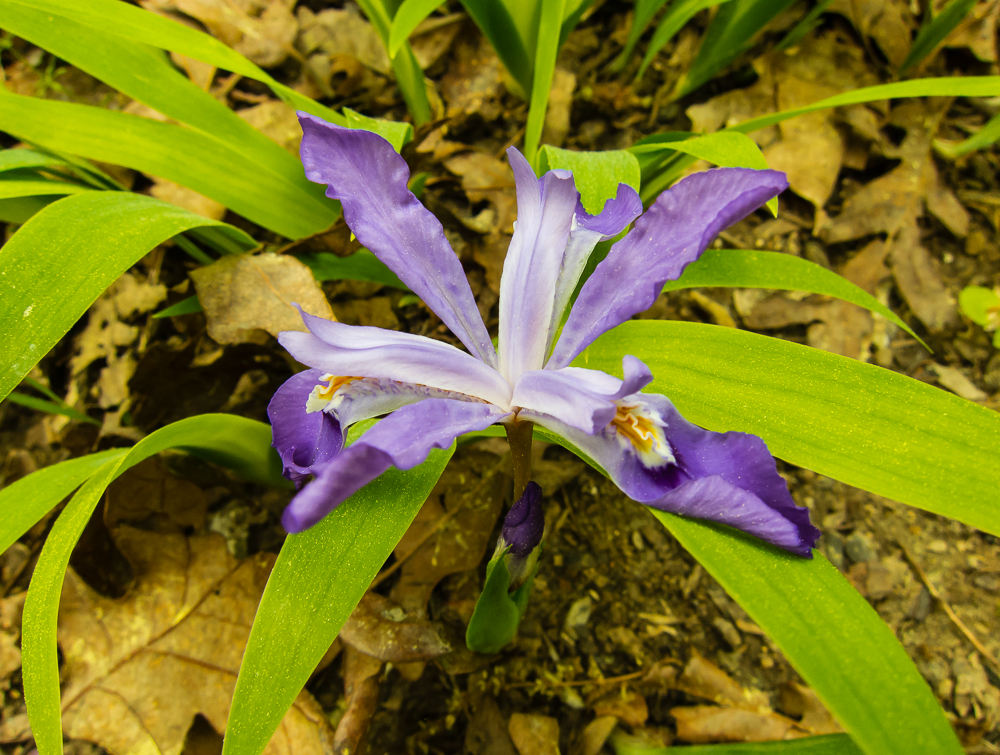
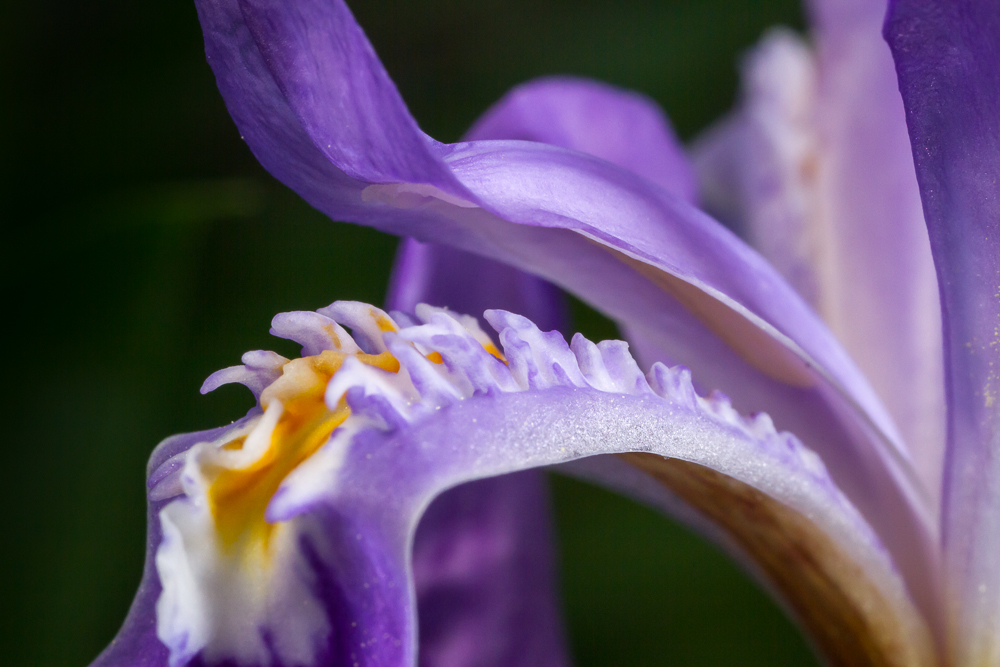
Crested Dwarf Iris flower (click to enlarge)
They are named for the yellow crinkled crest on the sepals, which serves to guide pollinators (mainly bees) to the nectar deep within the throat of the flower (although I have also read it may give the bee something to grasp onto while navigating toward the nectar). If you look closely at an iris, you will notice it has an unusual flower structure. The three largest petal-like structures are actually sepals (which enclose and protect the flower bud before it opens). In iris flowers, they are also called the falls. The wide tip of the fall provides a place for pollinators to land.
Crested Dwarf Iris style arm (click to enlarge)
Arching over each fall is a modified reproductive part called the style arm. This is probably the most unusual part of an iris flower. I had read about this but decided to take a closer look which required lying down and propping the flower parts open with a tiny twig to better view and photograph them (the things you have to do for science).
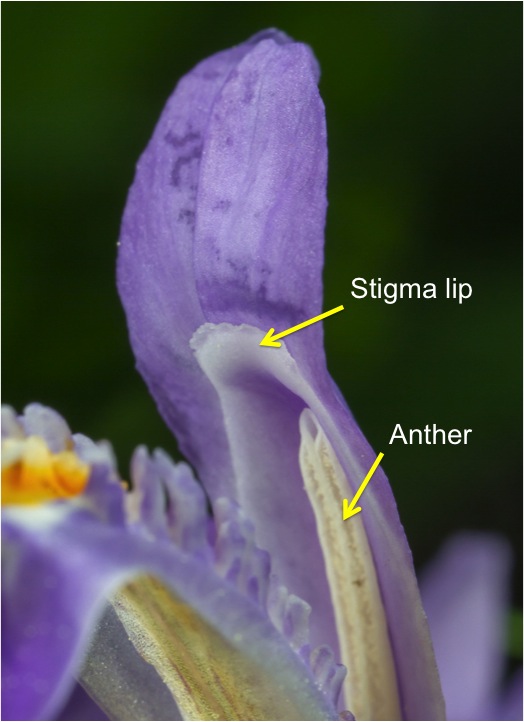
Dwarf Crested Iris flower parts
Just under the tip of the style arm is the stigma lip. This is the area that receives the pollen. It is a light-colored exposed curved edge just under the arch. A visiting bee must push under this style arm in order to access the nectar that is deep inside the throat of the flower. While crawling down toward the nectar glands, pollen is scraped off the back of the bee by this edge and attaches to the sticky stigmatic lip. The anthers (male, pollen-producing parts) are elongate structures behind the stigma lip. After the bee gets scraped of pollen, it then brushes up against the anther and gets fresh pollen. That pollen is unlikely to be transferred to this particular stigma lip as the bee backs out (they often exit through the gap in the arch). Bees are the primary pollinators as few other insects have the strength to push under the style arm.
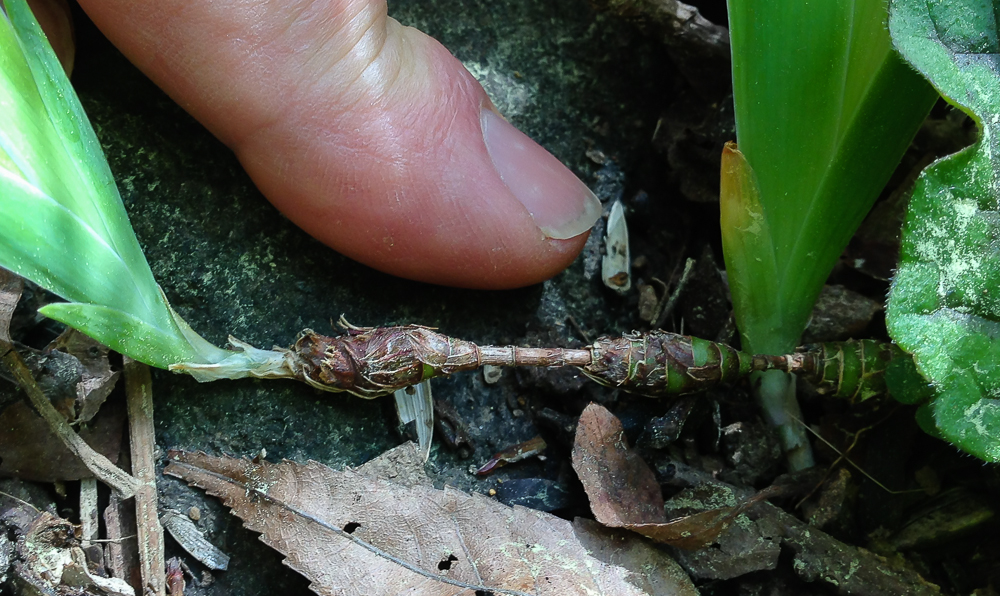
Crested Dwarf Iris rhizomes (click to enlarge)
The rest of the plant parts are a bit more the usual…the true petals (often called standards in iris) are the smaller of the colorful parts, and most often stand in a more upright position than the falls. Like in most flowers, they serve to attract pollinators. The rhizomes are short and chunky and connected to one another by slender runners. The sword-like leaves are attractive even when no flowers are present.
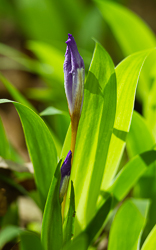
Crested Dwarf Iris flower bud
One thing I noticed yesterday is how quickly the flower opens. Here is a picture of the flower bud on one iris at 10:37 a.m. yesterday. When I returned from some errands at 3:00 p.m., the flower was fully opened.
The modern name for the iris flower is believed to have originated in ancient Greece. There, the flower was associated with the goddess Iris, a divine messenger who traveled from heaven to earth on rainbows. Throughout history, iris have represented wisdom, faith, and courage and been used as a royal symbol of king and queens. While that glory most probably went to their larger cousins, the diminutive Crested Dwarf Iris also deserves recognition and appreciation as we wander the spring woods.
Migrations speak to us, not just as observers of nature but as integral parts of it. The world moves and, deep inside, we long to move with it. Mike Bergin
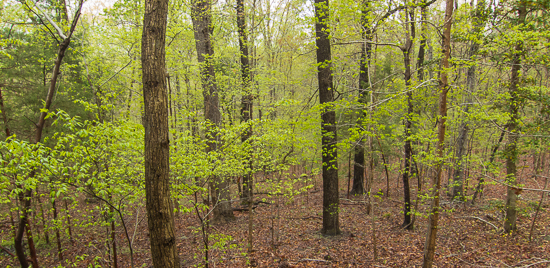
Spring scene in the woods out my door
Spring is truly here. I look out the door and see the rapid changes, the appearance of so many new things. But I can also tell by what is missing…the smell of the smoke from my wood stove, the chill in the morning air, and the dominant feeder birds from the past few months. I was going to post something on this last week to encourage you to watch for their disappearance as the warm weather of the past week moved in. But, I was gone a few days and when I returned, they were all but gone, just like that, as if the pale spring green of leaf-out had sent them packing. It is much easier to document the first arrivals. The last departures do not resonate in my brain as well. One day the birds are here, and a week later I realize I haven’t seen them for awhile. But this changing of the guard is as sure a sign of spring as the growing palette of greens.
Are any of these birds still at your feeders?
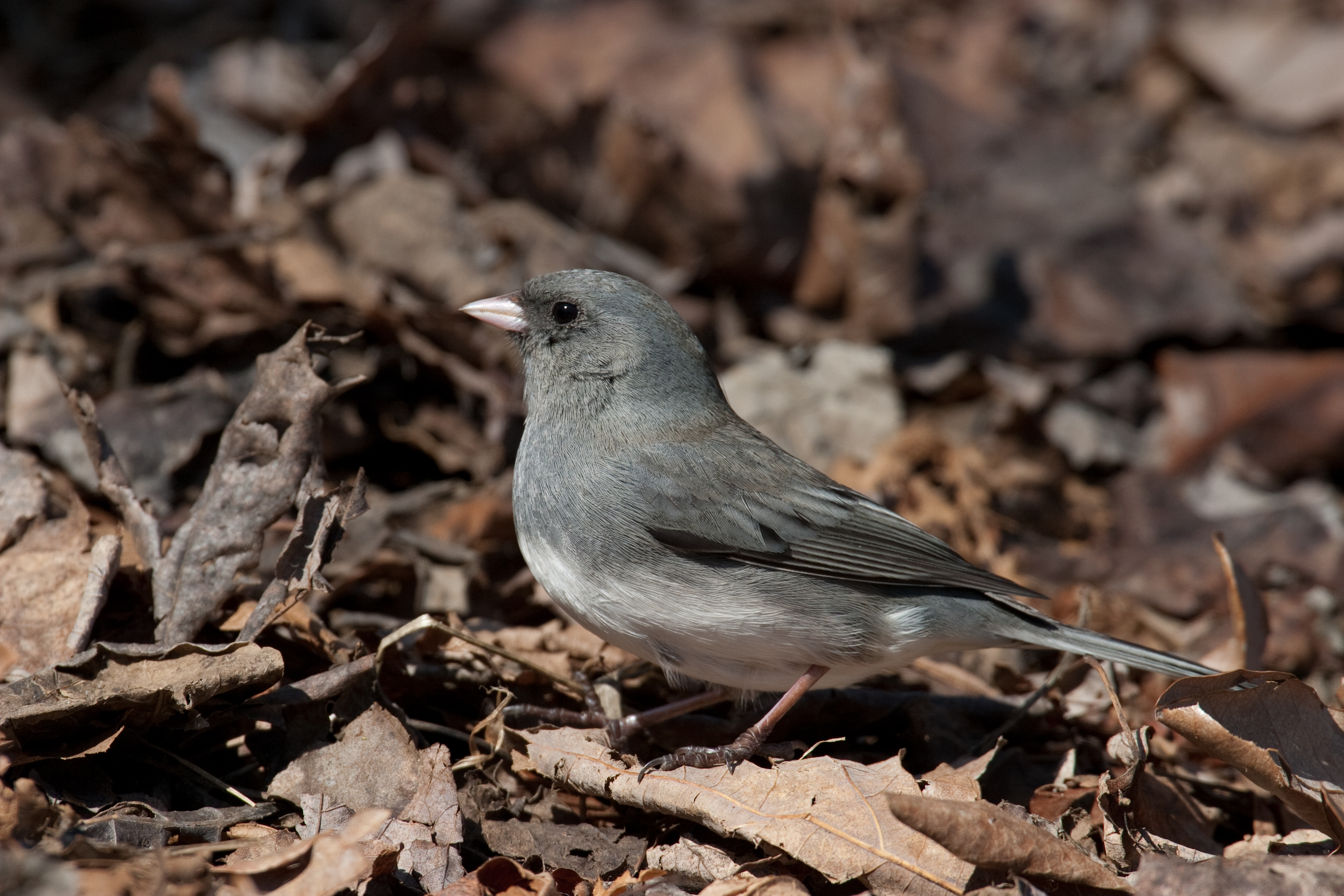
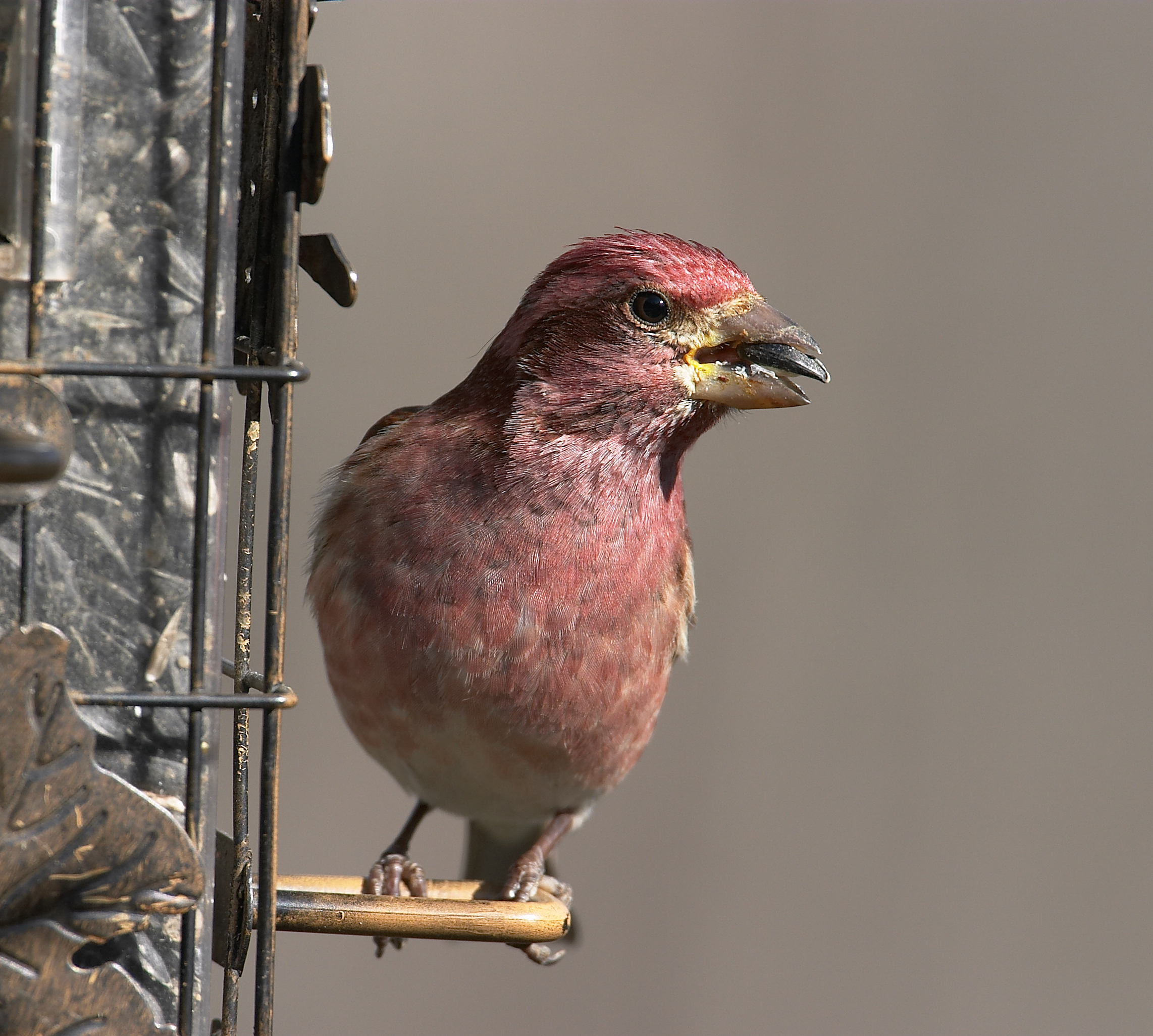
Dark-eyed Junco (click to enlarge)Purple Finch male (click to enlarge)
The Juncos, (many people call them Snow Birds) are our classic winter feeder bird although at my feeders they tend to stay mostly on the ground beneath the feeders. Peak abundance in the Piedmont is mid-October to mid-April. They move north or to higher elevations in our mountains to breed. I always enjoy finding their nests along the trails at Mt. Mitchell each summer.
Ruby-crowned Kinglet (click to enlarge)
Purple Finches are one of winter finches that tend to vary in abundance from year to year. Roger Tory Peterson described males of this species as a “sparrow dipped in raspberry juice.” Females are streaky brown with a distinct white eye stripe. Purple Finches are often confused with House Finches, a year-round resident in our area. Purple Finches are far more common out here in the woods.
One of my favorite visitors to the suet feeders is the energetic Ruby-crowned Kinglet. Unlike its cousin, the Golden-crowned Kinglet, this species does not breed in our high mountains but moves to the far northern U.S. and Canada to nest. Male Ruby-crown’s only occasionally show their reddish crown. These tiny birds are easily recognized by their habit of wing flicking.
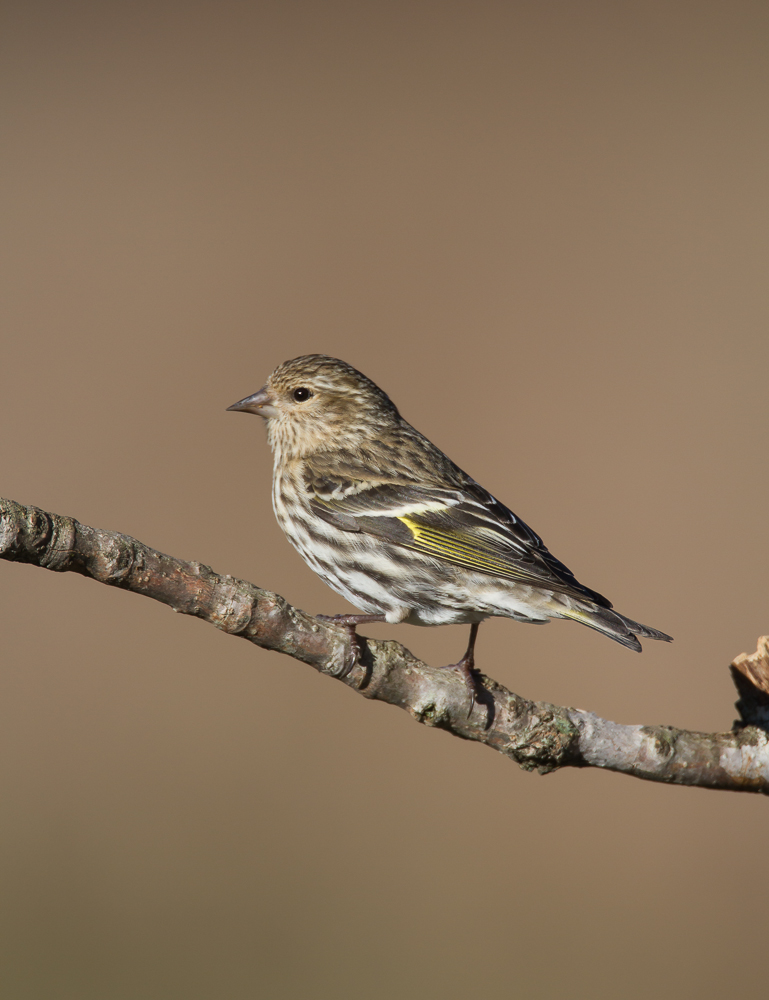
Pine Siskin (click to enlarge)
The only one of these winter birds still at my feeder as of yesterday is the Pine Siskin (although I have not seen one this morning, so they, too, may be gone). They are one of the so-called irruptive species, whose numbers on the wintering grounds can fluctuate greatly from year to year depending on food resources and weather in their northern forest habitats. And this has been an amazing year for siskins – on my Great Backyard Bird Count this past February, I had 62 siskins at once at one feeder. I’m sure there were well over a hundred between all three feeders, but their squabbling and rapid comings and goings made them tough to count. Although they do gulp down the black oil sunflower seeds, siskins are especially fond of thistle seed. My bank account will appreciate the rest once they are gone.
And this week has also brought some members of the new guard – the return of a Brown Thrasher to my garden, the teach, teach, teach song of an Ovenbird down in the woods, and my first Ruby-throated Hummingbird this morning. It has begun…
Last week, my friend, and former co-worker, Jerry Reynolds asked if I wanted to go along with he and another friend on a paddle along the Black River as he prepped for an upcoming program. I jumped at it since it has been years since I paddled the Black (I did go upriver last year in a power boat, but that is a very different experience).
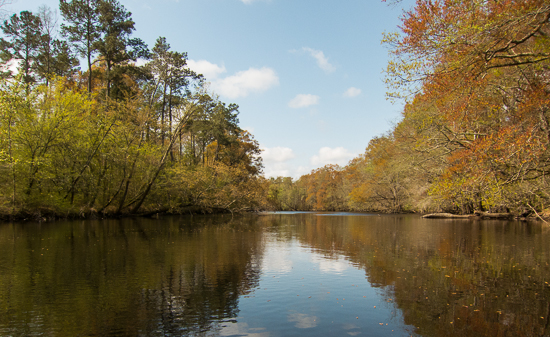
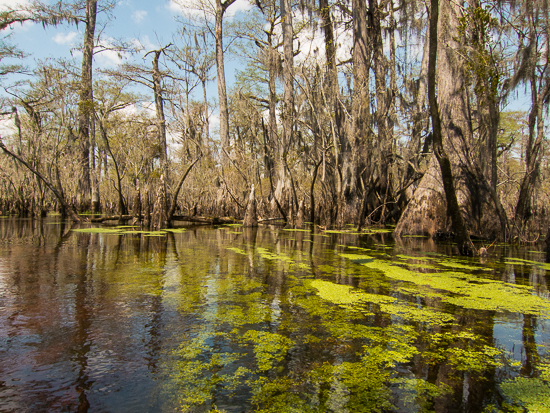
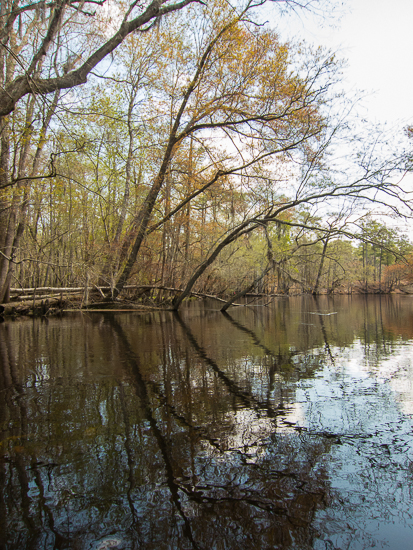
The Black River originates in Sampson County and runs about 65+ miles before joining the Cape Fear. It is characterized by meanders, oxbows, artesian springs and mature swamp forests. The waters are clear but are stained a dark tea color due to tannins leached from decaying vegetation. The water clarity allows you to see emerging aquatic vegetation and the sand bars as you drift along in the current. These make an interesting backdrop for the dark reflections of the forest and sky. Because of the good flow, the presence of so many artesian springs, and the relatively undisturbed nature of much of the waterway, the Black River is designated as Outstanding Resource Waters by the state.
The clear, dark waters allow glimpses of submerged vegetation and sand bars as you paddle.
The Black was not always the quiet stretch of dark water it is today. Commercial activity on the Black River began over two hundred years ago with the transport of timber, cotton, and livestock. In the mid-1800’s there were numerous steamboats moving products up and down the river (hard to imagine given the shallow nature of the river today). But the advent of railroads and roads caused the river traffic to all but disappear by the early 1900’s. The Black was then left to the owls, ducks and the occasional fishermen and hunter. After 100+ years of relatively little human disturbance, the Black River is now one of the finest examples of coastal swamp forest in the southeast. Many landowners and conservation groups have recognized this and miles of the river shoreline are now protected through the efforts of groups like the NC Nature Conservancy.
The Black River is wide in spots.
We arrived yesterday morning at Henry’s Landing along Hwy 210 and unloaded gear and then transported one vehicle down to the take out point at Newby’s Landing, a distance of approximately 10 river miles. We launched into the tea-colored waters a little after 10 a.m. The river is fairly wide at this point and there was a slight current. Almost immediately, a beautiful cypress swamp surrounds you on both sides of the river, hinting at the grandeur to come. A short ways downriver we flushed a few Turkey Vultures and then passed under others with wings spread, soaking in the morning sun. To someone more suspicious than I, this might be a bad omen as we enter the swamp.
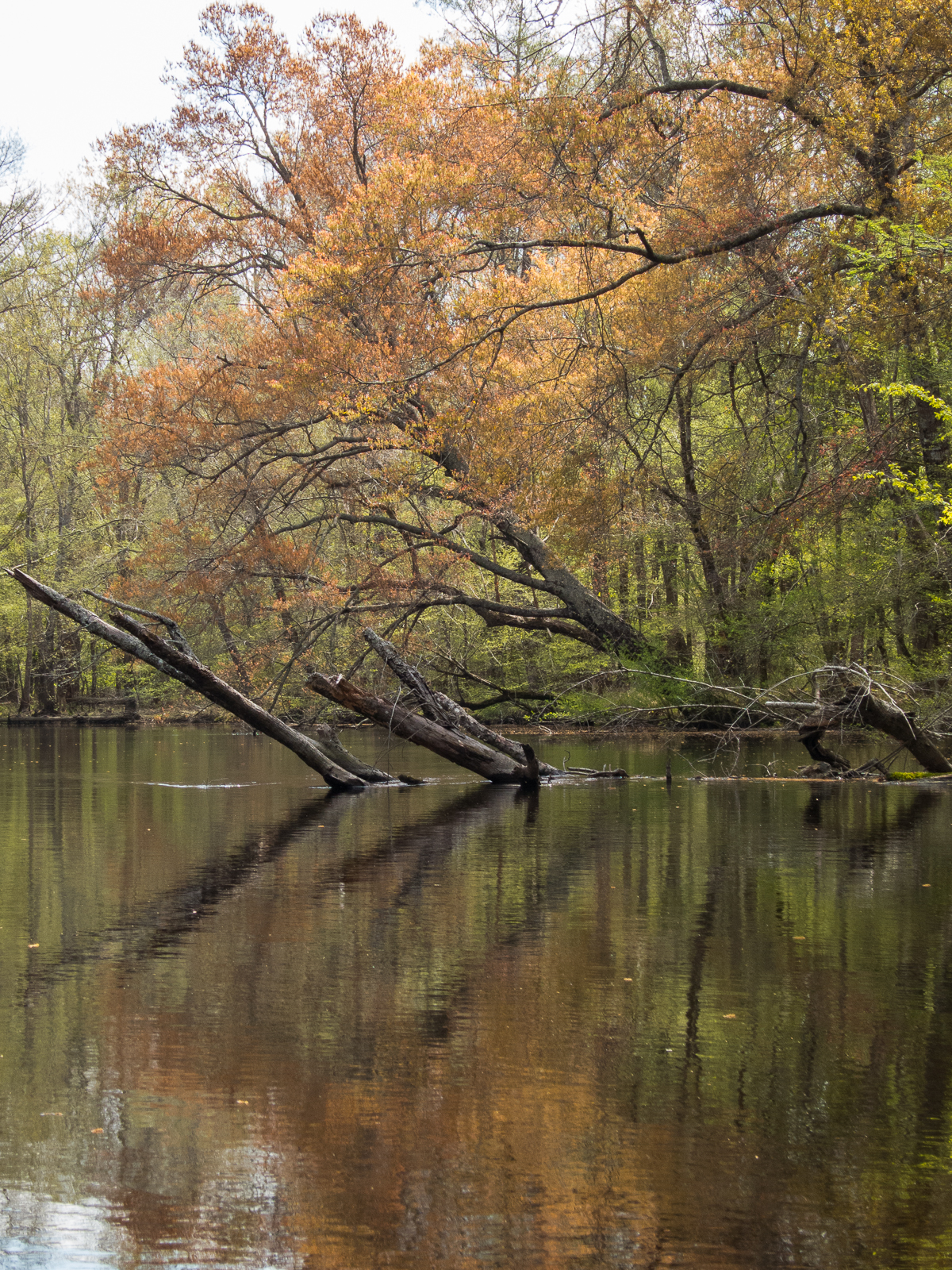
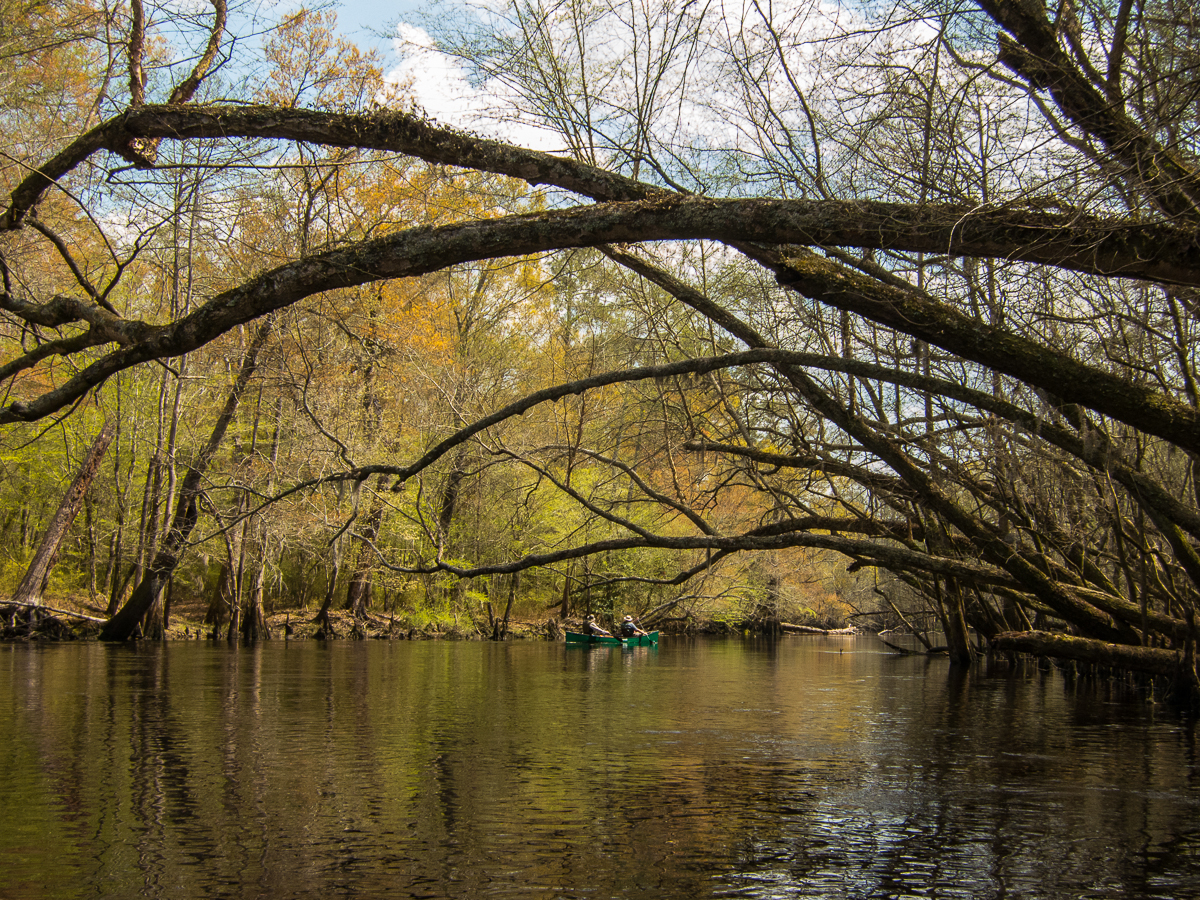
The sky was Carolina blue with a few puffy clouds and the banks were starting to reveal the palette of colors that trademark the arrival of spring in these forests – the lime green of emerging cypress and gum, the light orange-red of oaks, and the occasional splash of white flowers from a riverbank hawthorn (probably Parsley Hawthorn, Crataegus marshallii). I heard a few calls from some swamp warblers fresh from their wintering grounds – the zeeeeee-up of Northern Parulas and the sew-sew-sew-sew-sew-sewEE of a Yellow-throated Warbler. But spring has just arrived, and the only other warbler I saw was a Yellow-rumped.
Leaf out along the Black River comes in a palette of colors (click to enlarge).
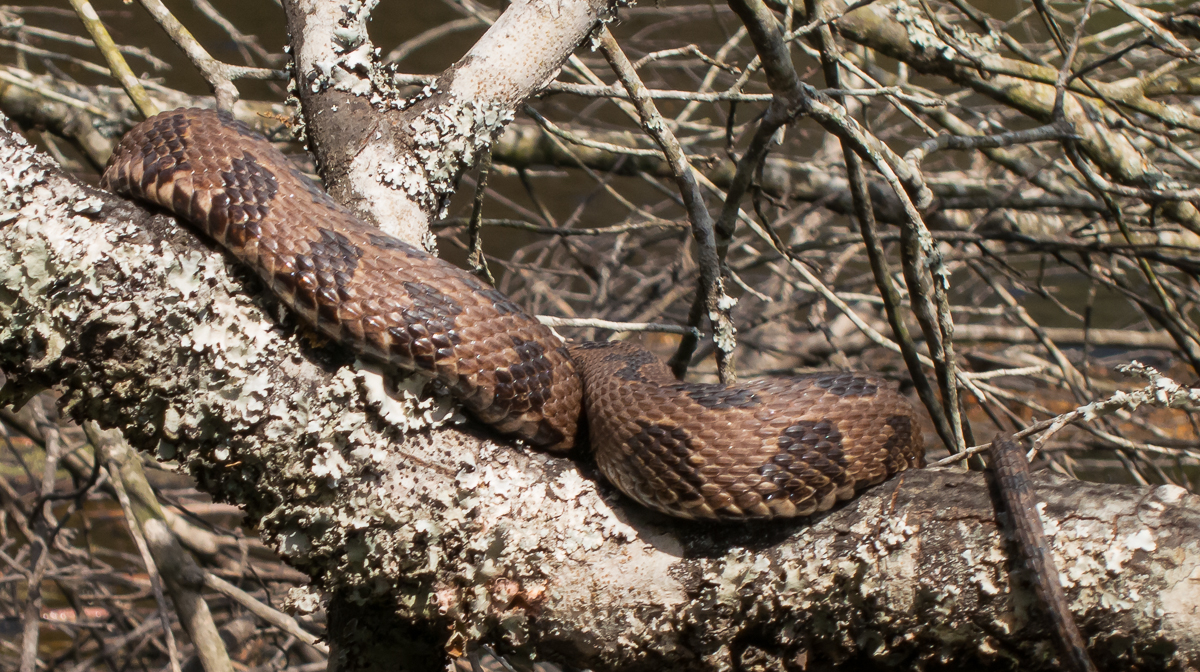
The first reptile was a large Brown Water Snake. This was the first of many such snakes we encountered. Brown Water Snakes are large-bodied snakes easily identified by their pattern of dark brown blotches down the middle of their lighter brown back. These blotches generally alternate, but do not connect to, dark blotches along the sides of the snake. These are the snakes you often see sunning above the water on limbs or trunks of fallen trees, sometimes as high as 15 feet. If a paddler goes under one and startles it, the paddler might get startled by a snake dropping into his or her boat, something that has happened to me only once in all my years (but once is enoughJ). Unfortunately, watermen who think it is a venomous cottonmouth often kill this harmless snake.
Brown Water Snake sunning on a limb over the river (click to enlarge).
About 5 miles downstream from Henry’s Landing it looks as though the river disappears. The main channel seems clogged by logs and vegetation as it bends to the left. The Jerry’s holler “follow us” and off through a maze of tiny channels they paddle, dodging cypress knees and tupelo gum saplings. This is the start of the famed Three Sisters area of the Black River. One story has it that in the days of commercial boating there were three distinct channels in the swamp area of the river, hence the name “The Three Sisters.”
Now, this area is best known as the home of the oldest documented trees in the eastern U.S. As part of a dendrochronology study in the southeast, researchers from the University of Arkansas cored several large Bald Cypress trees in the area in 1985 (core sampling does not seriously harm these ancient cypress). One tree turned out to be over 1700 years old. The researchers estimate others may be over 2000 years old, but cannot be accurately aged since most are hollow, making them impossible to properly core. Soon after this discovery, the recognition of the national significance of this stand of trees gave rise to efforts to preserve the forests along the Black River.
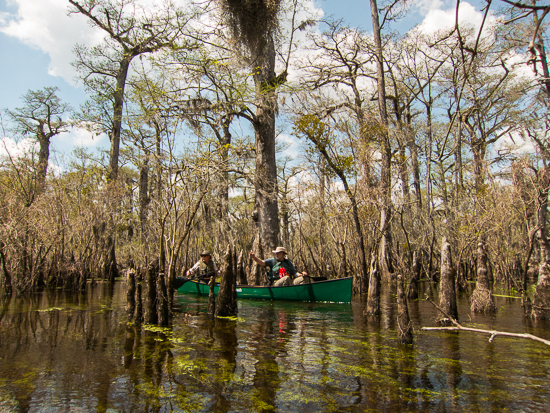
The Jerry’s paddle the Three Sisters Swamp.
The current picks up a bit as the “river” breaks into a series of braids and weaves through dense vegetation. Jerry says the water level is good and we may be able to paddle the whole way instead of getting out and wading with your boat as he has often done. Seems to me this is an easy place to get lost, but they both say you just keep following the current and you’ll find your way out (although I notice they are both frequently checking their GPS units). I hear squawking off to my right and spot a Great Blue Heron standing on a nest with what must be very young chicks begging for food. Soon, large trunks of cypress and an army of cypress knees engulf me. Huge gray trunks hold flattened tops of cypress at a level that seems a bit too short for their size, as if they had hit an invisible ceiling. These are the ancient ones, the trees well over 1000 years old. I know I am in a special place. We all just sat in our boats, taking in the view that surrounded us.
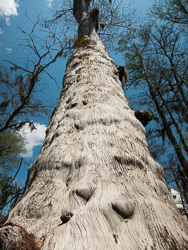
An ancient cypress.
After spending several minutes with the ancient ones, we pushed and paddled our way along with the current until we hit what resembled a small channel which gradually lead to a bigger channel and finally something that looked more like a river. As we continued downstream, several side channels joined us, making me wonder how anyone can find their way to Three Sisters if they paddled upstream.
Last night when I returned home I read an article by Dr. David Stahle, one of the researchers who discovered the antiquity of these incredible trees. He helped me understand some of what I felt while in the swamp…
“In many areas along the Black it is possible to turn in a circle and see 10 to 20 bald cypress trees over 1,000 years old. This density of millennium-old trees is rare in any forest worldwide. Although a dozen or so species can live for more than 1,500 years, most of these old growth stands have very few individual trees in the oldest age class. Not at the Black River. There are literally hundreds of millennium-old trees at the Black River, which has the largest concentration of ancient bald cypress trees we have ever found after 30 years of searching in the southeastern United States, Mexico, and Guatemala. “
Nearing the end of our paddle (click to enlarge).
Although the wildlife diversity on this day (17 species of birds, three species of herps, and several butterflies and freshly emerged dragonflies) was not what I had hoped, it was still an incredible paddling experience. The feeling of isolation and of the beauty of an unspoiled swamp populated by ancient trees is something that will draw me back to this magical place again.














 Roads End Naturalist