Made an early morning trip into the park to look for some wildlife highlights for my group in a few days but headed back through the northeast entrance by mid-morning. I stopped in Silver Gate at the home and gallery of my friends, Dan and Cindy Hartman, wildlife photographers and naturalists extraordinaire.
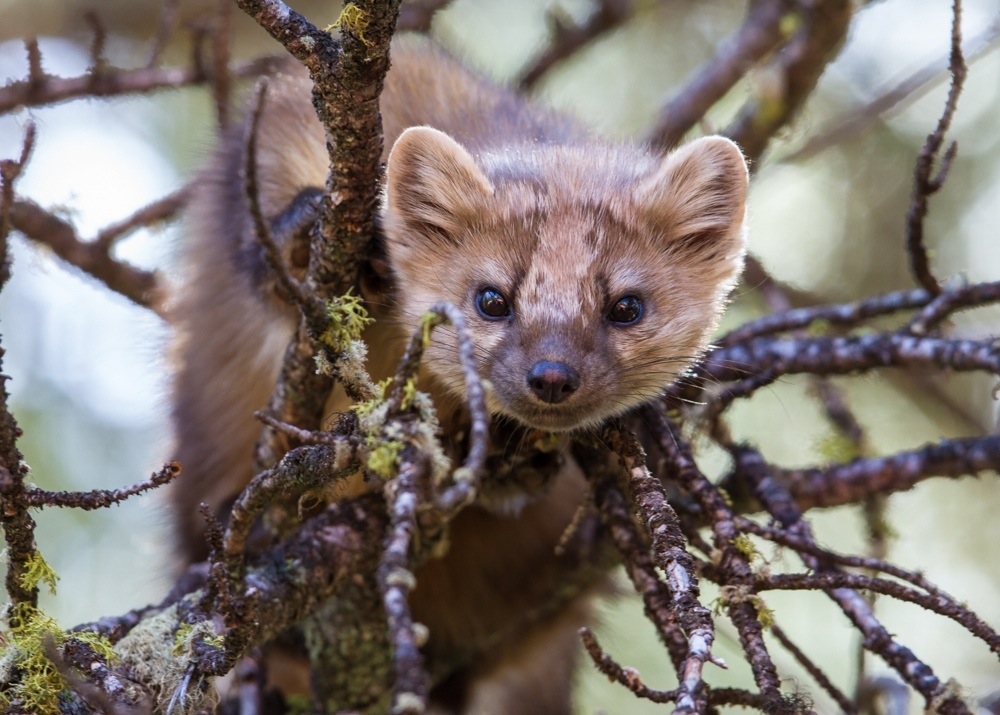
Dan was up in the Beartooths photographing pikas, but Cindy mentioned a pine marten had just been in the trees out front. A quick look around and I found it.
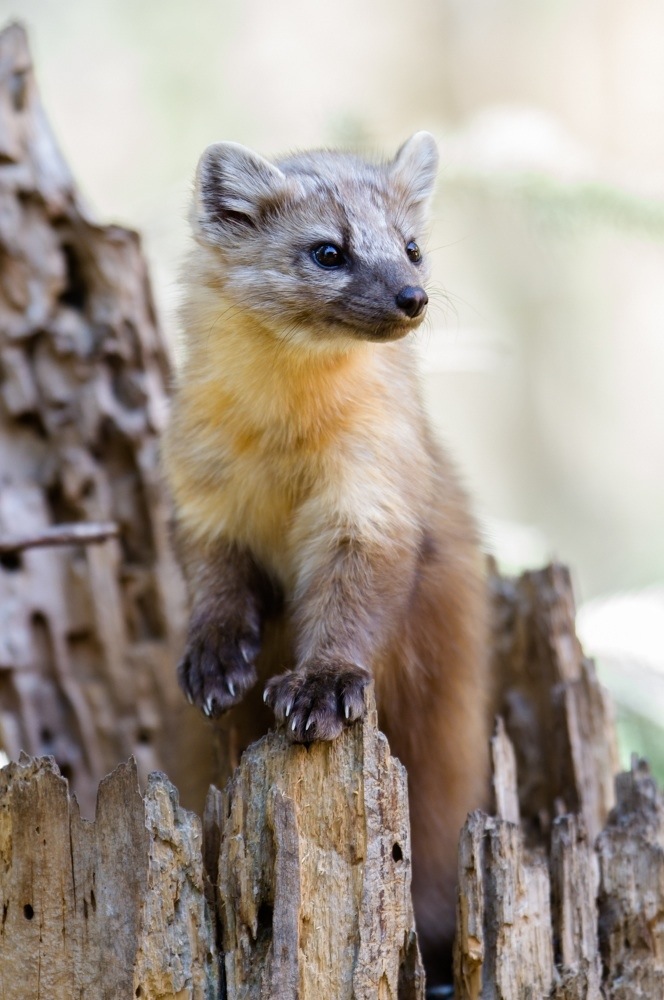
Martens are members of the weasel family, larger the our mink, smaller than our otter and found in forested habitats. They have beautiful brown fur with a bushy tail and orange patches on the throat. Their large paws allow them to run on top of the snow. They hunt voles, mice, small birds and eggs and are very efficient predators.
The Hartmans often have martens hanging around their house, lounging in the trees and working their wood pile for a meal. This marten proved to be very cooperative and made itself comfortable in a hollow snag. We watched it for 30+ minutes while it yawned, napped, and made use of every nook and cranny in that snag.
When she finally woke up and began to hunt she worked her way around the house and into the forest where Cindy thinks she may have young.
If you are in the area, visit the Hartmans at their gallery, Wildlife Along the Rockies, in Silver Gate just outside the northeast entrance to Yellowstone. You will undoubtedly learn something, see some interesting birds at their feeders, and you can buy a beautiful wildlife print. And you might even get lucky and see a marten.
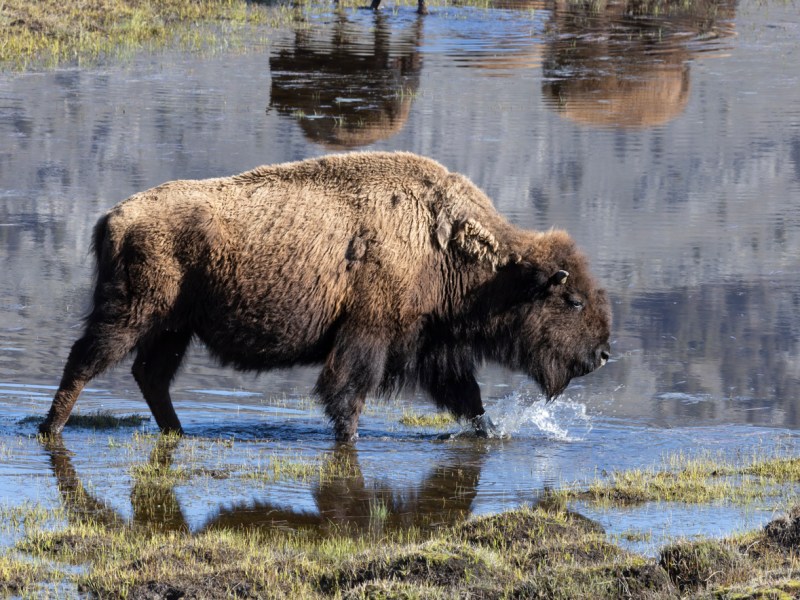
It is spring in Yellowstone and there are babies everywhere, especially bison calves. Cute and frisky are the best words to describe these orange-furred bundles of energy – not the usual naturalist terms, but appropriate for these guys. And it has been a very good year for bison births – every herd has dozens of calves either frolicking or sacked out in the grass. And the sounds of being close to a herd are amazing – grunts and snorts, bawls of the calves, and even the munching of grass when they are close to your car.
And there’s the promise of yet more babies to come. I’ve seen several pregnant pronghorn and mule deer. And then there are the nests – a bald eagle nest, a golden eagle nest, an osprey nest, and I’m sure many more yet to be discovered.
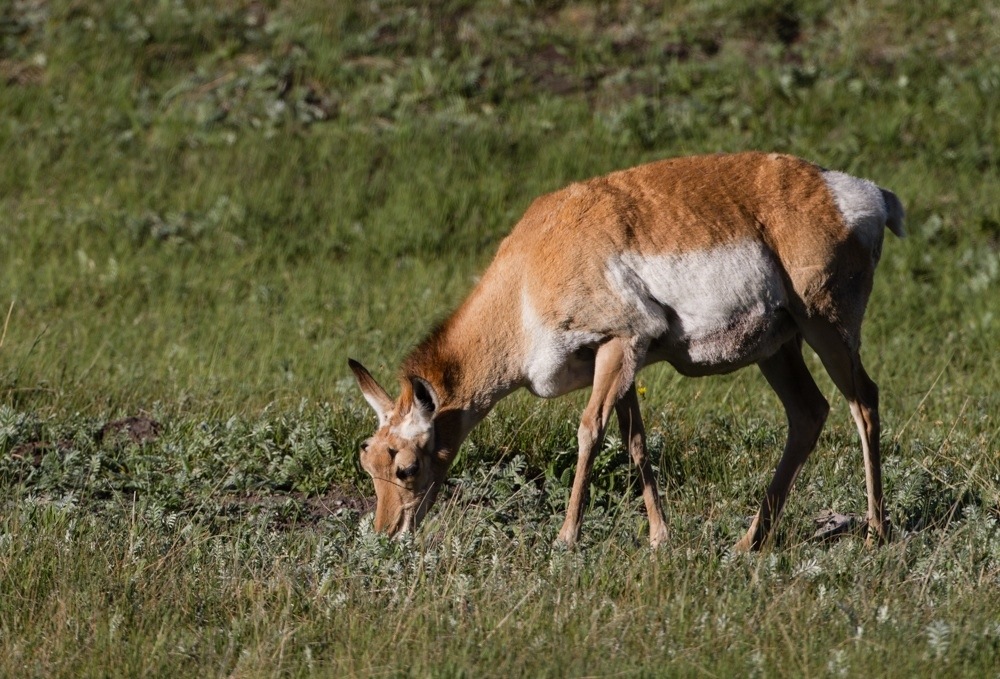
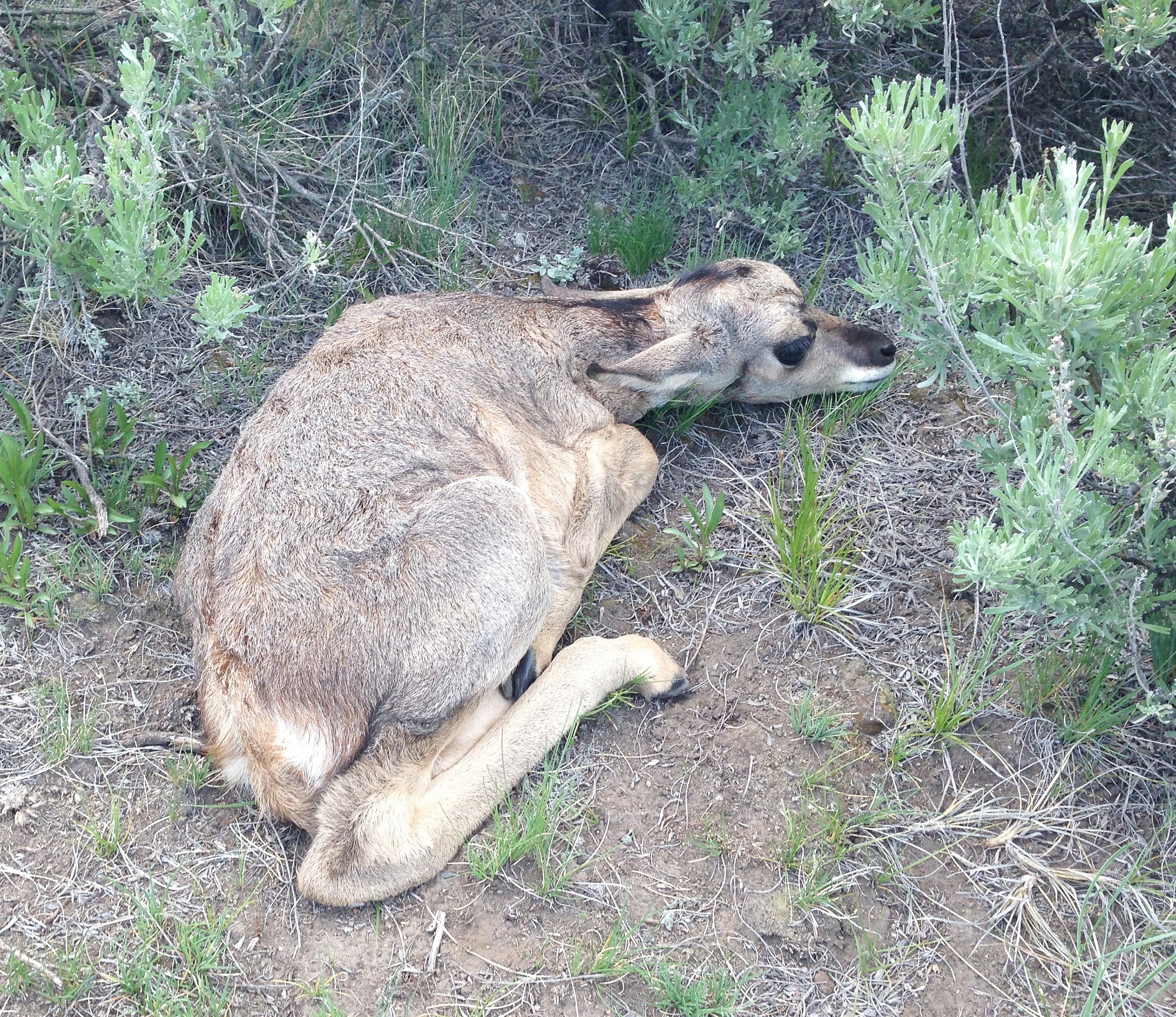
But the most amazing thing I’ve seen was a pronghorn fawn. I just walked out onto a small hill to take a look at a distant bison herd. I didn’t even have my camera with me because I was only 20 yards from the car. But I looked down and right at the edge of the sage was a young pronghorn fawn doing what its’ instinct tells it to do – lie perfectly still to avoid predators. I took one quick picture with my phone and moved away so as not to disturb it. I looked around when I got back to the car and I could see two pronghorn females about 100 yards away, one of them undoubtedly the mother. In a week or two that little pronghorn will be able to run and avoid many of the predators out here in Lamar. Until then it will need to rely on camouflage and it’s relative lack of scent to avoid detection. I wish it well.
I was looking forward to the final stop on the refuge tour, Chincoteague National Wildlife Refuge, as I had seen a ton of wildlife there a couple of years ago on a winter visit. But the afternoon I arrived, it was gray, rainy, and windy. Turns out the theme of the next 24 hours was gray and misty. I decided to wait until the next morning to venture in and the first critter seen was a large gray squirrel that wasn’t a Gray Squirrel – it was an endangered Delmarva Fox Squirrel. It is roughly twice the size of our Gray Squirrel and lives in mature forests of mixed hardwoods and pines with a closed canopy and open understory. Habitat loss and probably over-hunting contributed to population declines that led to this species being placed on the Endangered Species List. From 1969 to 1971, biologists relocated 30 Delmarva Fox Squirrels to Chincoteague NWR and released them. The population of squirrels at the refuge has since grown to over 300 and Chincoteague remains one of the best places to see this beautiful animal.
Snowy Egret (click to enlarge)
Driving on I could see a gathering of white birds in a roadside marsh channel. There were a half dozen Snowy Egrets running around catching something and interacting with one another when one egret would impinge on another birds’ space. I pulled over to a nearby safe spot and the birds could have cared less.
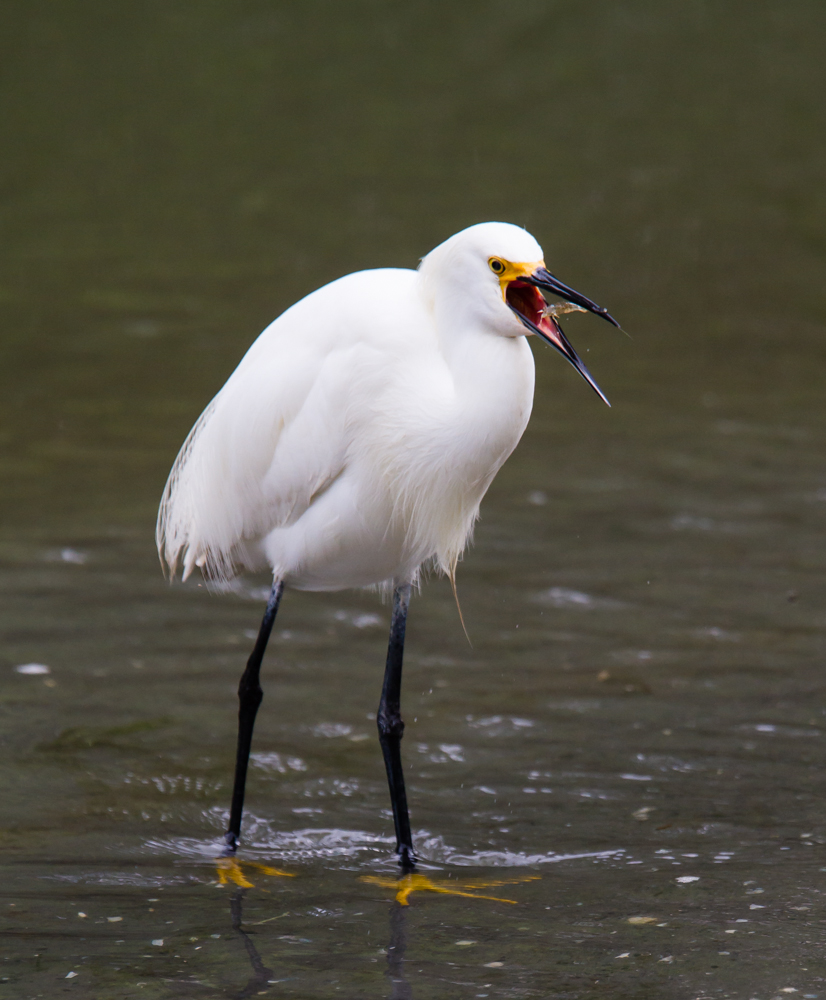
Snowy Egret catching shrimp (click to enlarge)
Turns out there was shrimp for breakfast! The tide was moving water rapidly in the channel and shrimp were flowing with it past a shallow spot that made for easy pickings for the sharp-eyed egrets. They were all dashing about, grabbing and swallowing shrimp.
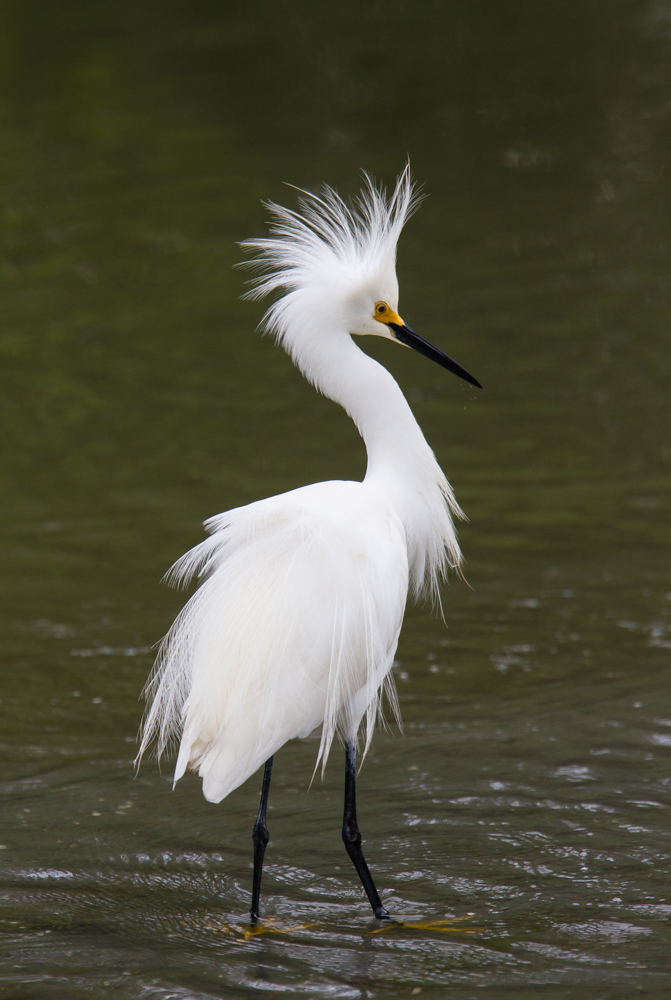
Snowy Egret with crest flared in threat display (click to enlarge)
A couple of the egrets were apparently higher on the pecking order and would fluff up their feathers and chase other birds away anytime they would get into a prime shrimping spot so there was a lot to see and photograph. Crest raising is an important threat and territorial display in egrets and one guy in particular was using it to the fullest.
Great Egret preening (click to enlarge)
Just down the channel a Great Egret stood on a fallen tree and was making itself more presentable for the tourists. It was methodically preening every feather, including the long nuptial plumes, or aigrettes. Early in the breeding season adults grow long plumes on their backs, which they raise in courtship displays. Those plumes were considered fashionable for ladies’ hats in the late nineteenth and early twentieth centuries and, shockingly, it is estimated that more than 95 percent of the Great Egrets in North America were killed for their plumes in those decades. In 1903, plume hunters were getting $32 an ounce for the ornate feathers. Plume-hunting was banned, for the most part, around 1910, and Great Egret populations started to recover. The Great Egret is the symbol of the National Audubon Society, one of the oldest environmental organizations in North America, which was founded to protect birds from being killed for their feathers.
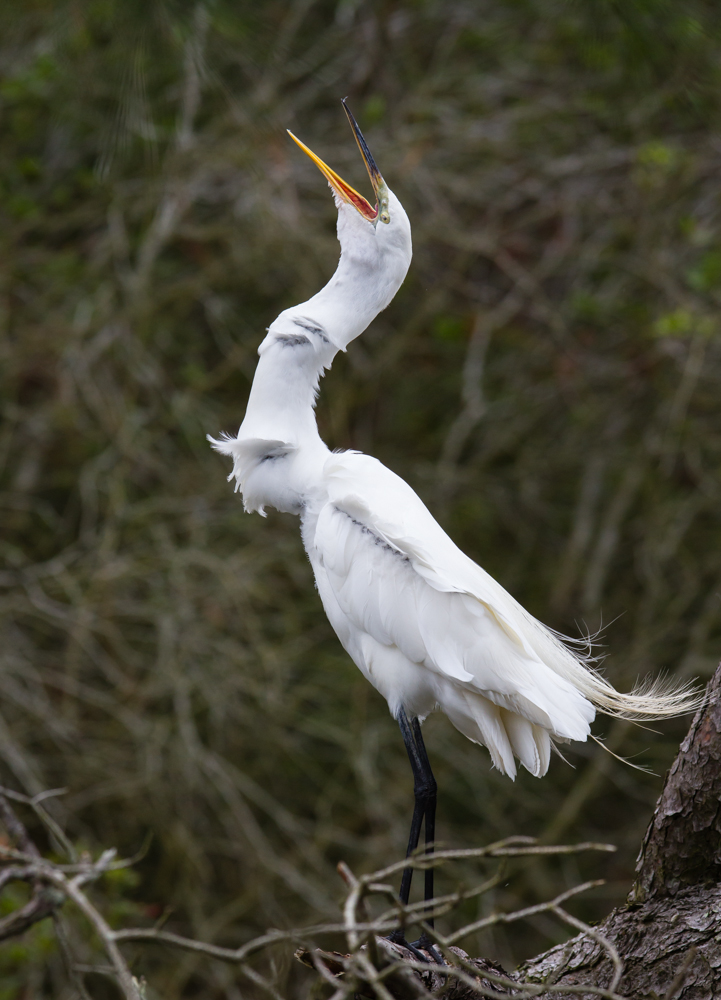
Great Egret gulping (click to enlarge)
I watched this bird delicately preen itself for many minutes before it made one quick move that showed it was not all grace and elegance. I’m betting it wishes the shutter had not been firing at that moment.
Blue Grosbeak male (click to enlarge)
During a brief few minutes of sunshine, I walked part of the Wildlife Loop, a paved 3.5 mile loop through managed wetlands that is kept closed most of the day for hikers and bicyclists to enjoy and then opened for cars later in the afternoon. It is a great place to see a variety of wildlife and it started of with a Bald Eagle flying overhead. Next, a gorgeous male Blue Grosbeak jumped out of the grass. Then, uncharacteristically for this species when it is anywhere close to me and my camera, it landed close enough and stayed long enough on a perch for me to grab a few quick shots.
Black Skimmer flock at rest (click to enlarge)
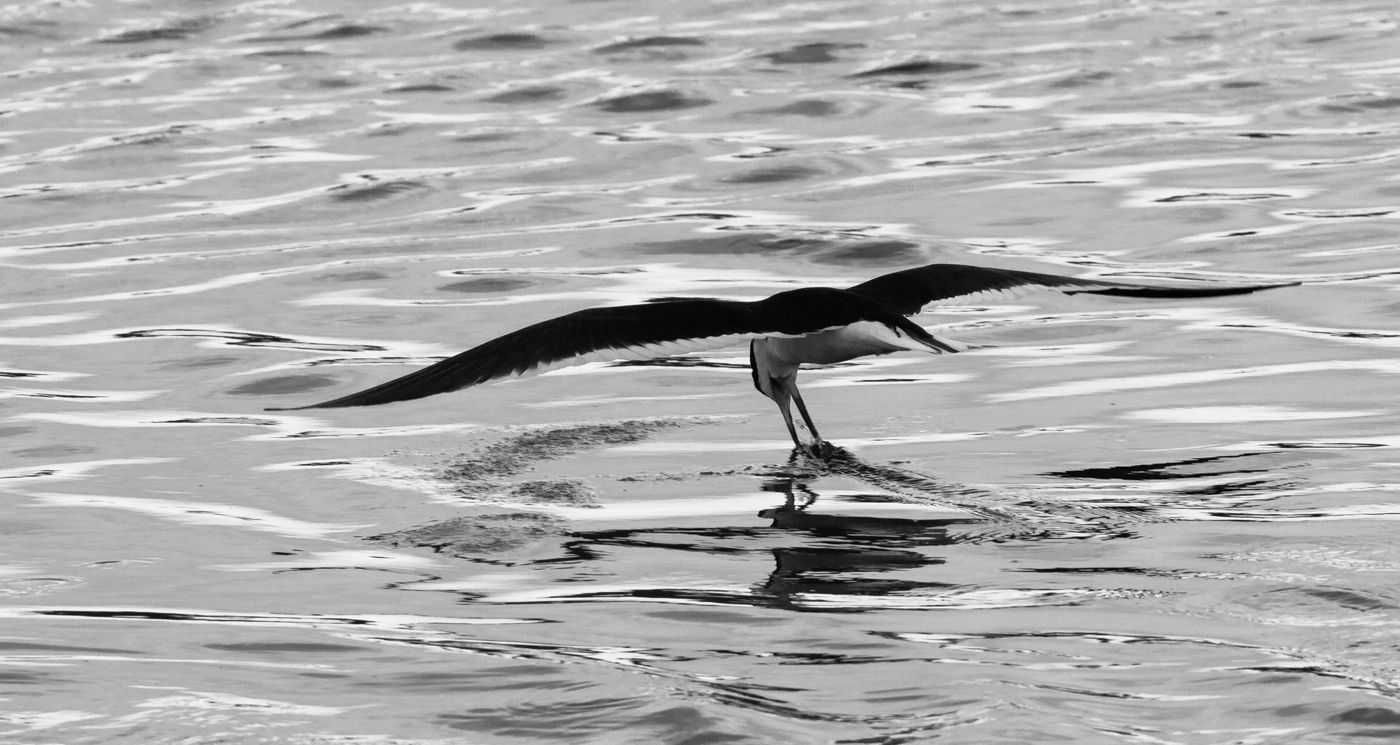
Driving back out toward the beach I came across a flock of Black Skimmers resting on a shallow sand bar. They are such comical-looking, yet beautiful, birds. As I have mentioned before, they ae a favorite of mine, so I spent the last hour of my time on my “refuge tour” hanging out with the skimmers, trying to capture their beauty and precision as they sliced through the shallow water searching for a meal.
Black Skimmer flock (click to enlarge)Black Skimmer skimming (click to enlarge)
Check out the lateral compression of this bill – it really looks like a knife blade slicing through the water.
Black Skimmer flock landing (click to enlarge)Black Skimmer in black and white (click to enlarge)
My time in a few of the refuges of NJ, DE, and VA was awesome but now I am headed to my favorite place on the planet, Yellowstone, for a couple of weeks. I imagine the blog posts will be less frequent and perhaps a bit shorter due to limited internet access and cellular service throughout much of the park. But I’m sure I’ll have some images and adventures to share when I return.
Horseshoe Crabs on Slaughter Beach, DE (click to enlarge)
I borrowed the title of today’s blog from another blogger I ran across while reading about Horseshoe Crabs. Turns out there are lots of people fascinated by these ancient creatures, and The Beach Chair Scientist (http://beachchairscientist.com/) is one of them, so check her out for more information on these fascinating creatures and other topics of the sea. The blog title refers to part of the scientific name of Horseshoe Crabs, Limulus polyphemus, and the fact that this is the time of year when Horseshoe Crabs migrate to beaches for mating and egg-laying. The Delaware Bay region is believed to be home to the largest population of this species of Horseshoe Crab (there are 3 other species in the Pacific) and is therefore the place to be in late spring if you want to witness Limulus Love.
Horseshoe Crab male (click to enlarge)
Horseshoe Crabs are ancient arthropods, dating back perhaps as much as 300 million years (way before the dinosaurs). They not true crabs but are more closely related to spider and scorpions. Their anatomy is fascinating and you should check out some of the other web sites for details (also http://www.ceoe.udel.edu/horseshoecrab/index.html). They use their tail (telson) to right themselves when flipped over (although it is not always successful). Two large compound eyes are located on the front part of the shell (prosoma), with other light receptors scattered elsewhere over the body. The eyes are quite sensitive to low light and can help them find mates in the dark waters. Underneath are five pairs of legs, the first pair modified in males to be claspers for grabbing the edge of a female’s shell during mating. The last pair of legs are called pusher legs and have a leaf-like structure at the tip used for pushing and clearing away sediments as the crab burrows. There are two small chelicera in front of the walking legs that help guide food to the mouth, which is the bristly area between all the legs.
Horseshoe Crabs on Slaughter Beach (click to enlarge)
Horseshoe Crabs shed their chitinous exoskeleton as they grow, increasing in size about 25% each time they shed. It takes 16-17 molts over a period of 9-11 years to reach sexual maturity, with females being much larger than males.
Horseshoe Crabs on Slaughter Beach at high tide (click to enlarge)
For most of the year, Horseshoe Crabs are out at sea, feeding on marine worms and softer shellfish such as Razor Clams. But every spring, adult Horseshoe Crabs migrate to shallow waters to breed. Annual census data highlights Delaware Bay as the most important spawning ground in the world for American Horseshoe Crabs. The 2011 survey estimated well over a million Horseshoe Crabs utilized these critical beach habitats. The peak of spawning activity usually occurs several days around the new and full moons of May and June and coincides with the high tides.
During breeding, the smaller males couple onto a unattended female as she digs a shallow nest at the tide line. There may be several males in attending each female since the ratio of males to females on the beaches is about 3 to 1. The female releases several thousand eggs while the male(s) release sperm and the eggs are fertilized externally. Each mature female lays up to 20 clutches totaling up to 90,000 eggs during the spawning season, of which fewer than 1% will make it to adulthood.
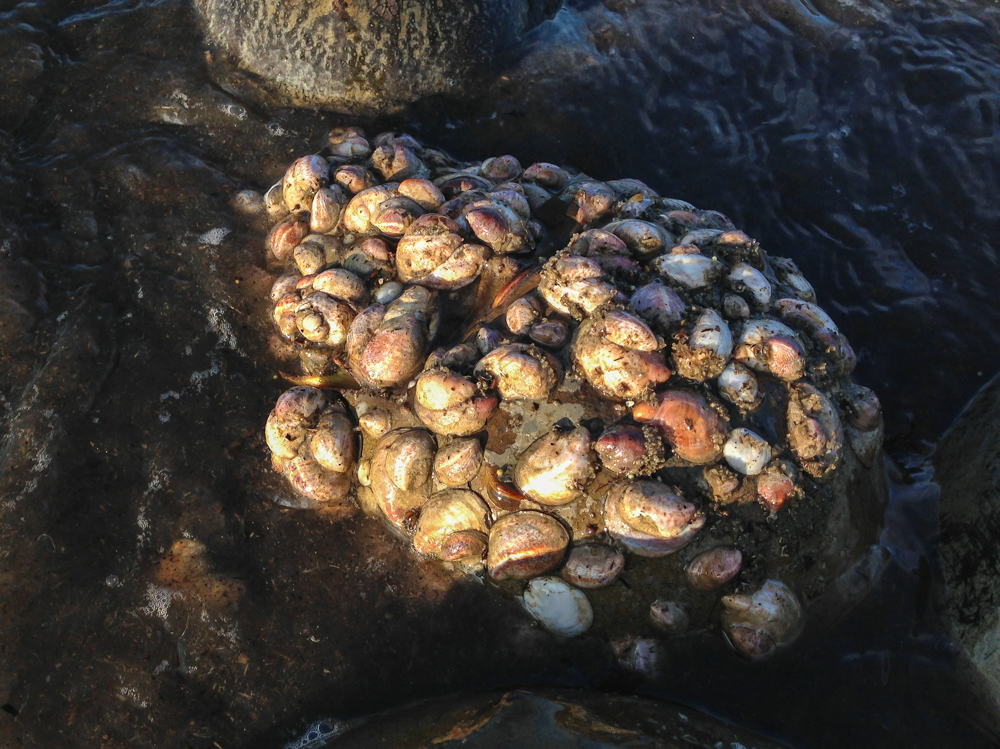
Horseshoe Crab egg cluster photographed in aquarium at DuPont Nature Center (click to enlarge)Horseshoe Crab eggs (click to enlarge)
The eggs are laid in clumps, but I only saw one on the beach. The tidal action plus all the digging from mating crabs tends to bust up the clusters so the beach is covered by millions of loosely scattered greenish eggs about the size of a sand grain.
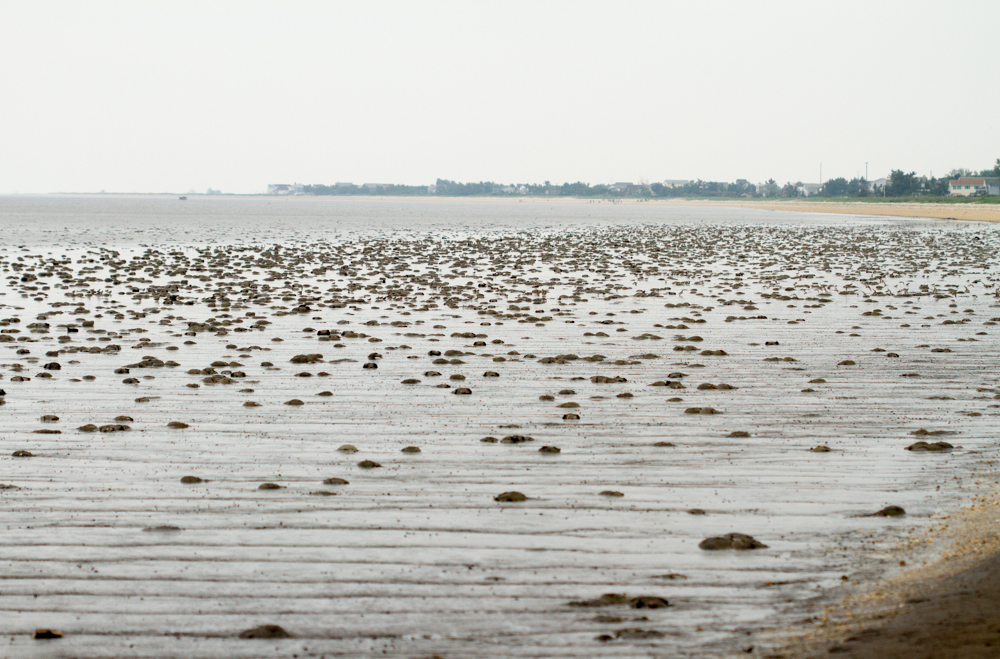
Horseshoe Crabs at low tide on Slaughter Beach (click to enlarge)
Back at Slaughter Beach the next morning it was low tide with a windy, gray sky. The stark scene had the look of devastation, with dark, motionless clumps scattered as far as the eye could see. But most of the crabs were still alive and with the next rising tide, would begin the ancient ritual again.
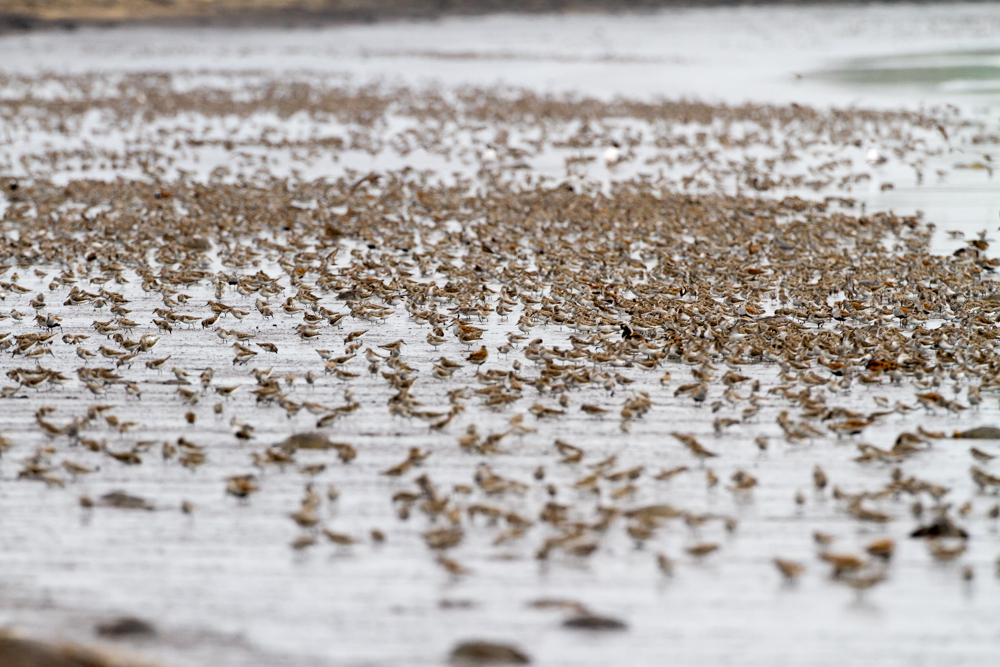
Shorebirds on Slaughter Beach feeding on Horseshoe Crab eggs (click to enlarge)
This superabundance of fat and protein rich granules sets the table for one of the greatest bird feasts in North America – the annual migration of hundreds of thousands of shorebirds through Delaware Bay. This area is a critical staging area as these birds make their way thousands of miles from their wintering grounds on the beaches of South America to their nesting grounds in the Arctic. The birds gorge on the Horseshoe Crab eggs as well as various worms and invertebrates in the tidal flats and beaches. In their two to three week stopover, they may double of triple their weight, which fuels them for the remainder of their long flight. It was a privilege to sit on the beach with almost no one else around, watching and listening to this grand event.
Researchers processing captured shorebirds (click to enlarge)
The migrants are made up of primarily four species: Semipalmated Sandpipers, Dunlins, Ruddy Turnstones, and Red Knots. The latter species is one facing steep declines in their population over the past decades. Researchers were on a distant beach the first afternoon of my visit as they have been for many years – capturing, weighing, and tagging Red Knots and other shorebirds to learn more about their needs in their perilous journey in the hopes of helping populations recover.
Statue of Red Knot B95 outside the DuPont Nature Center 9click to enlarge)
An unusual and fun statue greets visitors to the DuPont Nature Center in Mispillion Harbor Reserve. It is a tribute to the most famous Red Knot, known as B95, for the bright orange leg band with that code attached by an Argentinian researcher in 1995. During my visit, news broke that B95 had been spotted once again in Delaware Bay. Scientists estimate this Red Knot to be 20 years old (it was already an adult when banded), making it the oldest Red Knot known. And because its annual journey from the tip of South America to the Arctic spans about 9,000 miles one way, in its lifetime, this amazing bird has flown a distance equal to going to the moon and halfway back. That feat has earned B95 the nickname, Moonbird, and it is the subject of an award-winning children’s book by the same name. During its lifetime, B95 has seen the population of his kind crash from over 100,000 birds to about 15,000 today. There are great concerns over the decline in Horseshoe Crab eggs due to over-harvesting of the adults crabs for bait and available habitat for both crabs and birds due to development. Red Knots were scarce during my visit and I spotted only a handful amongst the thousands of other shorebirds.
And while the natural connections of Horseshoe Crabs are amazing, they also have important connections to humans. They have been used for food and fertilizer in earlier cultures, and are now harvested as bait for the eel and conch fisheries (regulations now restrict this harvest to ensure enough egg-laying adults to maintain the shorebird connection). Scientists have learned a lot about the human eye from studying the electrical impulses in the compound eyes of Horseshoe Crabs. And chitin from Horseshoe Crabs is used in the chitin coating of surgical sutures and wound dressings for burn victims. But the main human connection now comes form the creatures’ blue blood (their blood contains a copper-based respiratory pigment and turns blueish when exposed to air). An extract of the Horseshoe Crab’s blood is used by the pharmaceutical and medical device industries to ensure that their products (any intravenous drugs, vaccines, and medical devices), are free of bacterial contamination. So, if you or anyone you know has ever been hospitalized, you owe a lot to Horseshoe Crabs.
Horseshoe Crabs on Slaughter Beach at sunset (click to enlarge)
The experience at Slaughter Beach is something that I will never forget – the sights and sounds of thousands of Horseshoe Crabs clambering over each other at the tide line at sunset followed by tens of thousands of birds feeding on the eggs the next morning is one of the great wildlife spectacles in America. I recommend a stop at the DuPont Nature Center (http://www.dupontnaturecenter.org/index.html) if you are in that area. It has excellent displays on the incredible story of Horseshoe Crabs and the staff are very knowledgeable. You will come away appreciating these “living fossils” as much as I now do. Although it is a long drive from NC, I am considering offering a trip to this area in the future to witness this natural wonder. Let me know if you are interested.
A gallery of sights on the Horseshoe Crab beaches of Delaware…
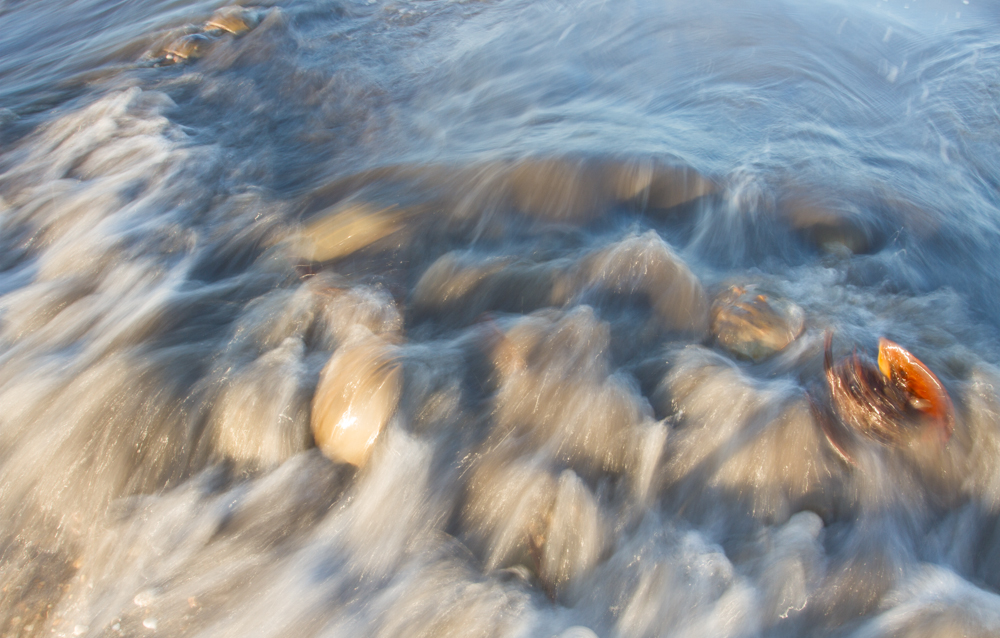
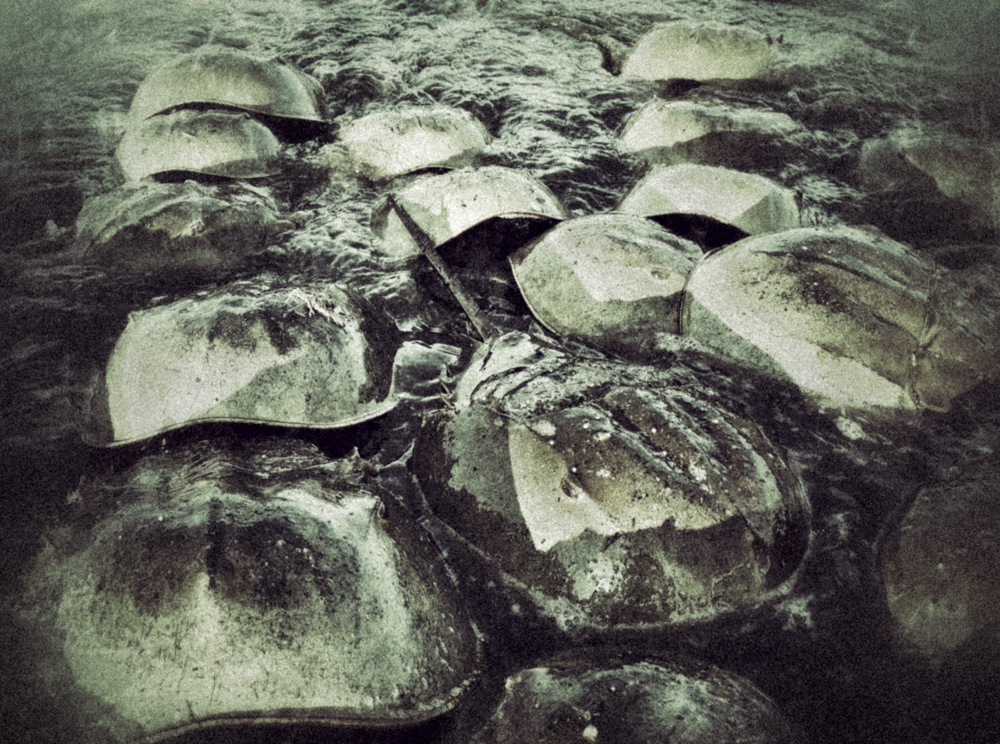
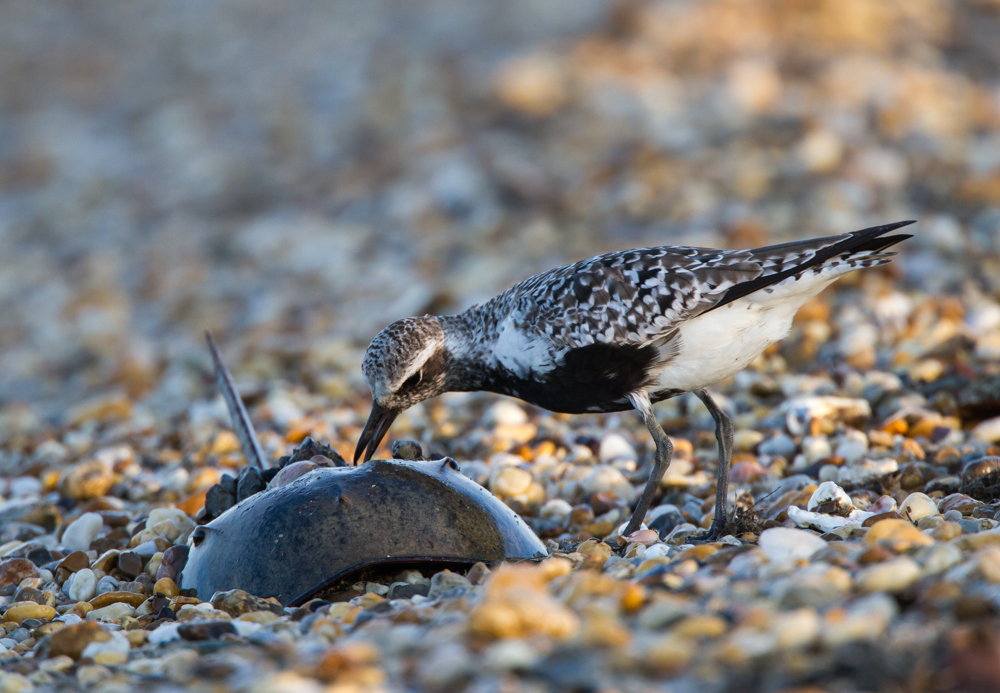
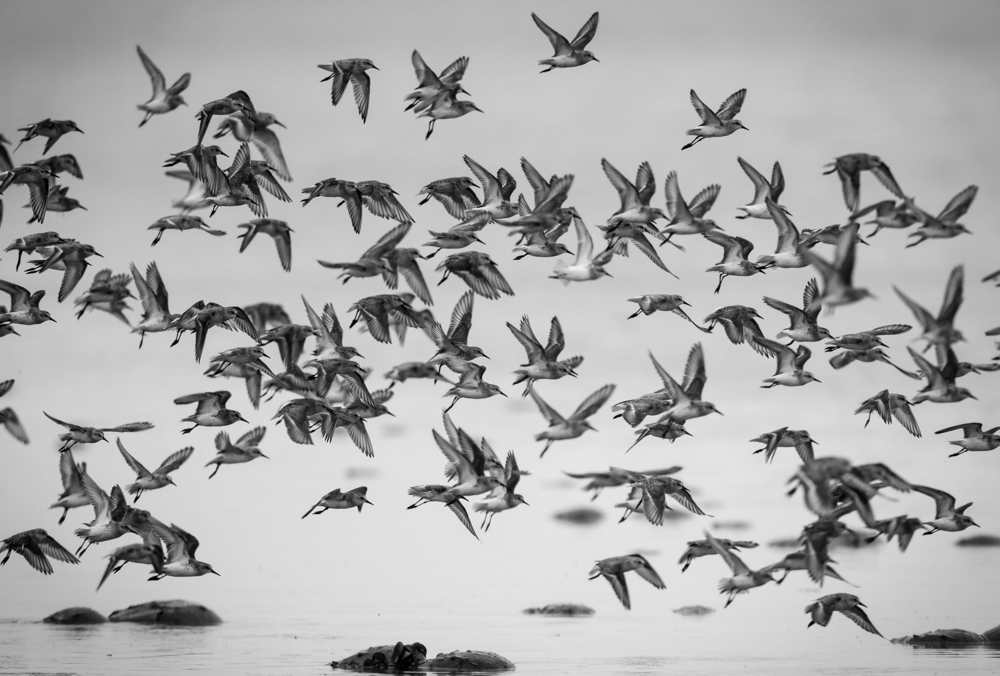
Horseshoe Crab burying in sand (click to enlarge)Horseshoe Crabs on Slaughter Beach with overturned crab (click to enlarge)Slipper Shells on Horseshoe Crab (click to enlarge)Short-billed Dowitcher (click to enlarge)Horseshoe Crab over-wash (click to enlarge)Horseshoe Crabs stylized (click to enlarge)Black-bellied Plover gleaning food from a Horseshoe Crab shell (click to enlarge)Shorebirds in flight at Slaughter Beach, DE (click to enlarge)
Another post about my trip last week to NJ, DE, and VA refuges….
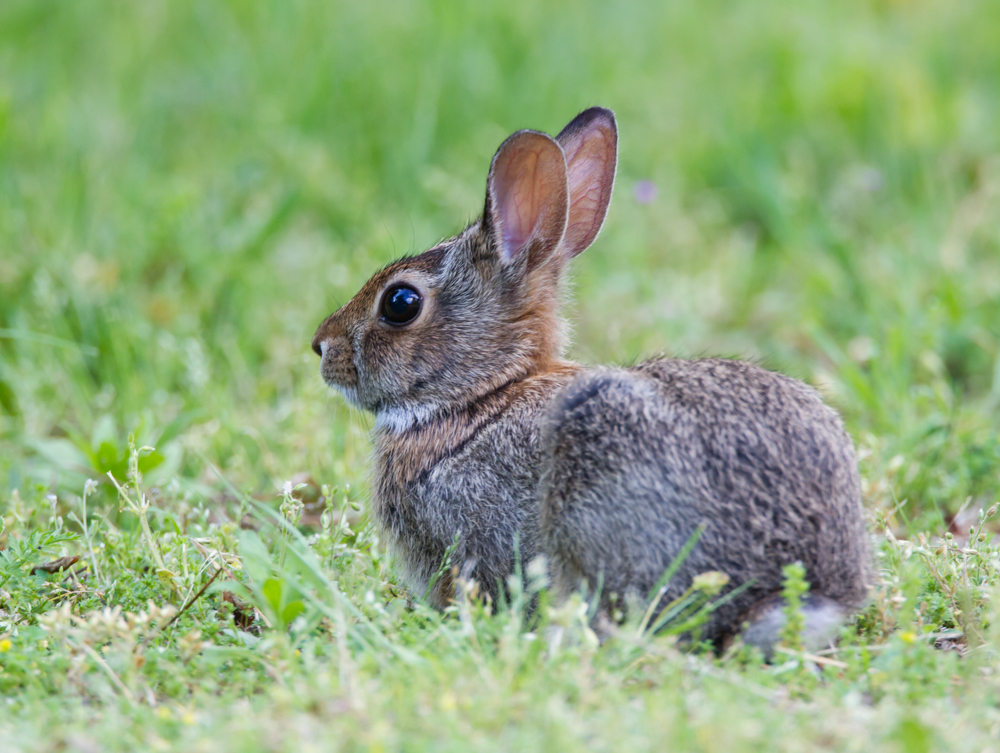
After getting off the ferry from Cape May to Lewes, the first stop was Prime Hook National Wildlife Refuge. The first critter seen, and one that would be seen over and over again in Delaware, was a bunny. So many rabbits along the refuge roadsides – where all all the predators? Surprisingly, in a week’s worth of refuge visits, I did not see the one mammal I would expect – White-tailed Deer. The mammal fauna, other than rabbits, muskrats, and a couple of Chincoteague species, remained hidden for the week. There was a clue though as to why warm-blooded critters might be hiding – deer flies and no-see-ums were out in force. So, after a quick walk around some refuge trails, it was on to Slaughter Beach to check on the Horseshoe Crabs, one of the main reasons I had made this trip at this time of year.
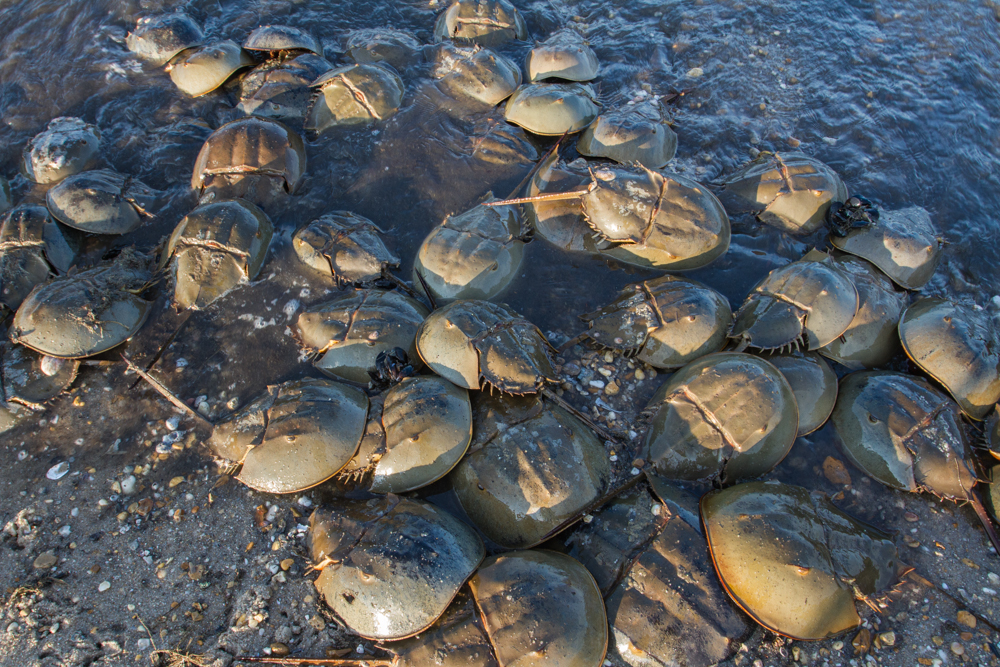
Horseshoe Crabs on Slaughter Beach (click to enlarge)
The tide was coming in and the moon close to full in May, perfect timing to see the annual spectacle of Horseshoe Crabs coming ashore to mate in Delaware Bay. I made a lucky stop at the DuPont Nature Center in Mispillion Harbor where I met some birders getting ready for a shorebird program. A couple gave me a tip on a local beach access where the crabs were mating in large numbers. A short drive and there they were, Horseshoe Crabs by the thousands lining the beach. There is so much to share I will do a separate post on this incredible phenomenon later this week.
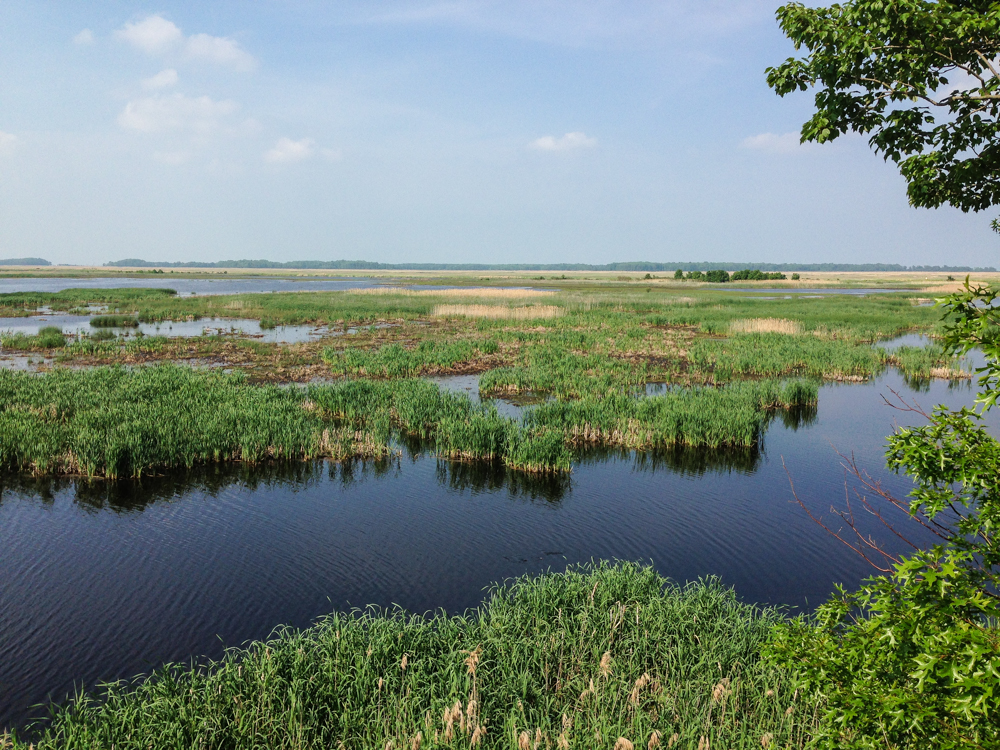
The next day I spent a cloudy morning with the Horseshoe Crabs and shorebirds at Slaughter Beach and then headed to Bombay Hook National Wildlife Refuge about 40 minutes north. The sun came out (eventually), the wind picked up, so life was good. Bombay Hook National Wildlife Refuge protects one of the largest remaining expanses of tidal salt marsh in the mid-Atlantic region. The refuge’s 16,000 acres are mostly marsh, but also include freshwater impoundments and a variety of upland habitats that are managed for other wildlife. Most visitor opportunities are located along the 12-mile Wildlife Drive so that was the main part of the visit.
Snapping Turtle (click to enlarge)
Instead of the cute bunnies seen at Prime Hook, the greeting committee at this refuge was a bit more formidable – a huge Snapping Turtle near the Visitor Center, the first of several to be seen along the roadsides here.
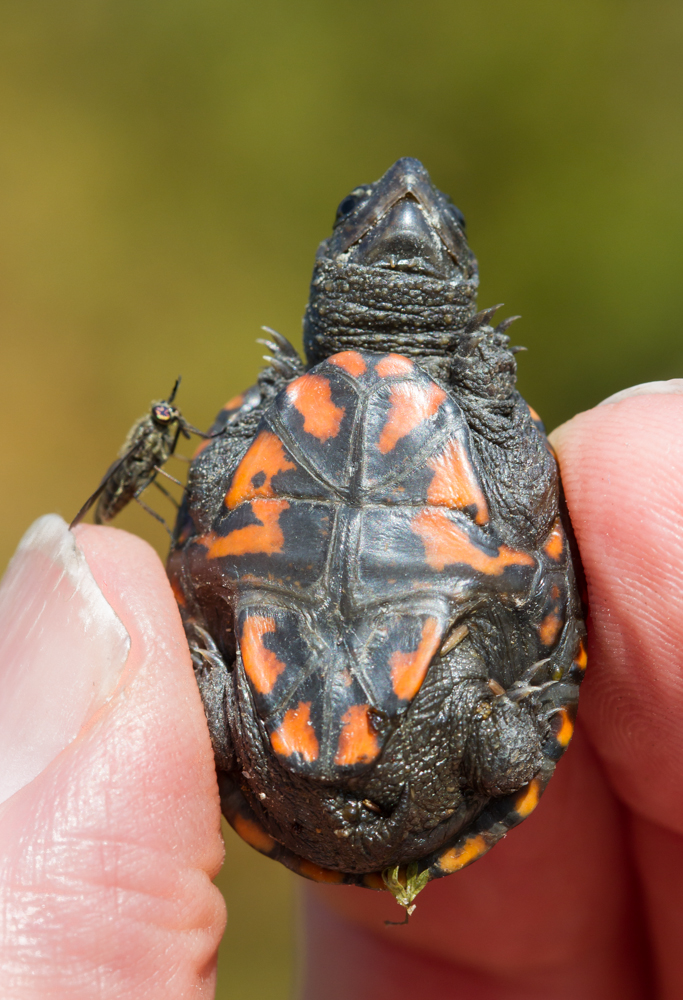
Baby Mud Turtle (click to enlarge)
Not all the turtles on the roads were quite as large as that snapper – this tiny baby Mud Turtle was crossing at a culvert between swampy areas. One of the ever-present deer flies stopped in for the pic as well.
American Redstart (click to enlarge)
I picked up a copy of the Delaware Birding trail map and guide (see also http://www.delawarebirdingtrail.org/). The description for the Boardwalk Trail at Bombay Hook reads – “the woods at the beginning of the boardwalk trail can be particularly good for migrant songbirds. The boardwalk trail itself is a great place to see breeding Marsh Wrens…” Talk about truth in advertising! Right after getting out of the car there were birds everywhere – Orchard Orioles, a Yellow Warbler, Common Yellowthroat, House Wren, Northern Flicker, male American Redstart, Tree Swallows, and the ubiquitous Gray Catbird.
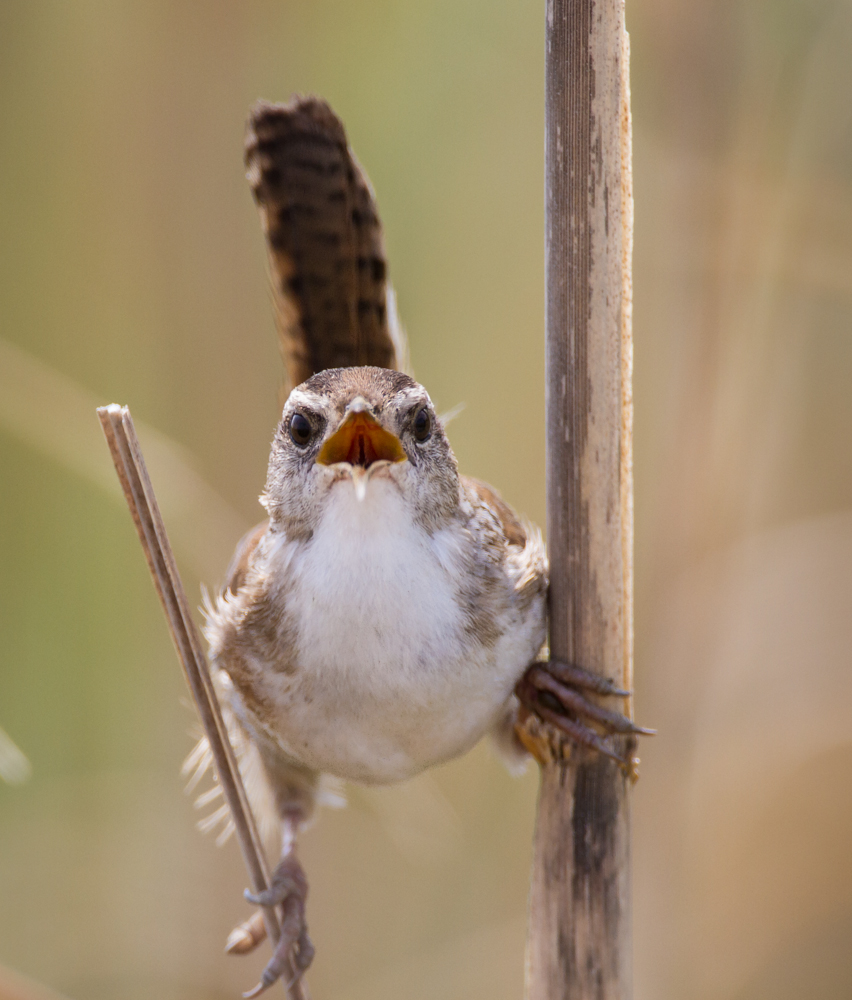
Marsh Wren male singing (click to enlarge)
A walk out the short trail led to some shorebirds and the first Black-necked Stilt of the day. But it was the songs of the Marsh Wrens that caught your attention. A photographer coming off the boardwalk told me he had seen tons of “baby Carolina Wrens, and they had let him get close for photos”. Turns out the boardwalk over the marsh was instead full of the warbles and displays of male Marsh Wrens. Territorial males have an interesting behavior that makes them quite visible – they vigorously sing from one side of their marshy territory for a few minutes and then fly over to to the other side and sing there for awhile. Once in awhile they perform a so-called song flight display, where they fly up a few feet above the grasses, and then flutter down and straddle some plant stalks giving their song all the while. If you just stand within the territory boundaries, you will be serenaded and displayed to at close range.
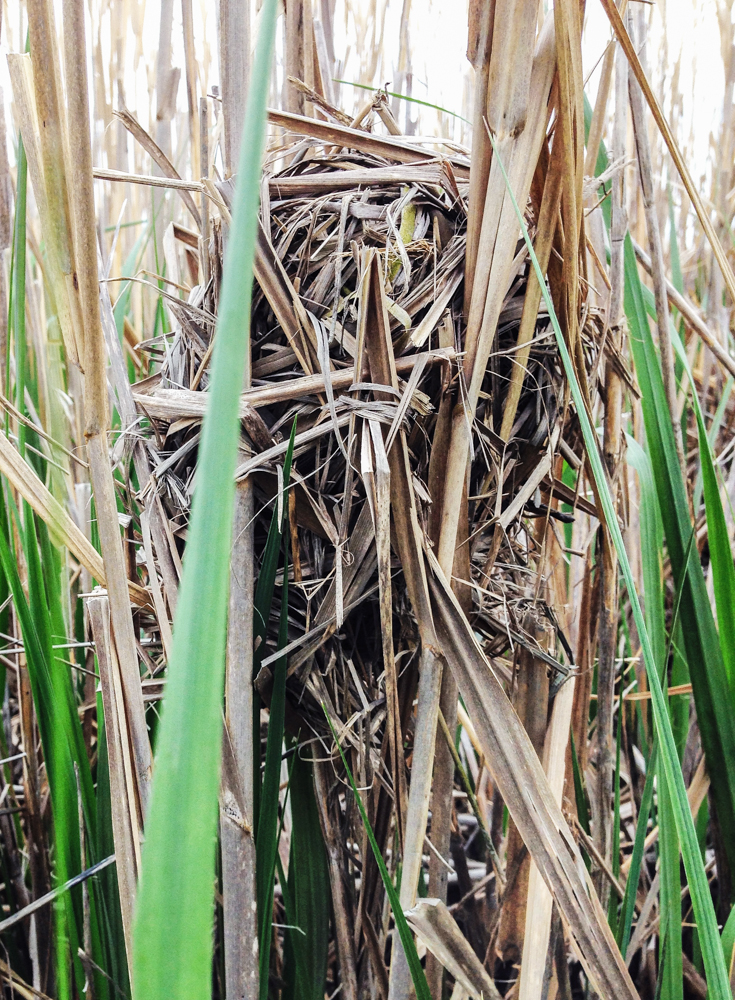
Marsh Wren nest (click to enlarge)
Male Marsh Wrens construct several partially completed nests within their territory (much like our Carolina Wrens back home) in the hopes of seducing a female (or two – male Marsh Wrens are polygamous). The nests are readily visible as balls of grasses and reed woven together (about the size of a softball) a few feet off the ground with an entrance hole in one side. If a female finds one to her liking she will finish it off with soft liner materials. If not, she will make her own within a male’s territory. I could have definitely spent more time watching and listening to these energetic songsters (and hoping for some sunshine for photos), but there was still a lot of ground to cover.
Black-necked Stilt (click to enlarge)
Along one of the impoundments I saw the bold black and white of a Black-necked Stilt feeding in the marsh. This is one of my favorite shorebirds although I have seen them only a few times. They are just so boldly patterned and they look like they shouldn’t function quite right with those long skinny reddish-pink legs. They supposedly have the second-longest legs in proportion to their bodies of any bird (flamingos are the winner in the proportional long-legged bird department). A couple of nests could be seen on the marsh flats and watching a stilt fold its legs up to sit on the eggs is entertaining. One pair aggressively approached a Great Egret that walked too close to their nest until the much larger bird shied away. I wish I could go back in a week and see the tiny speckled tan fluff balls on sticks that are the young birds.
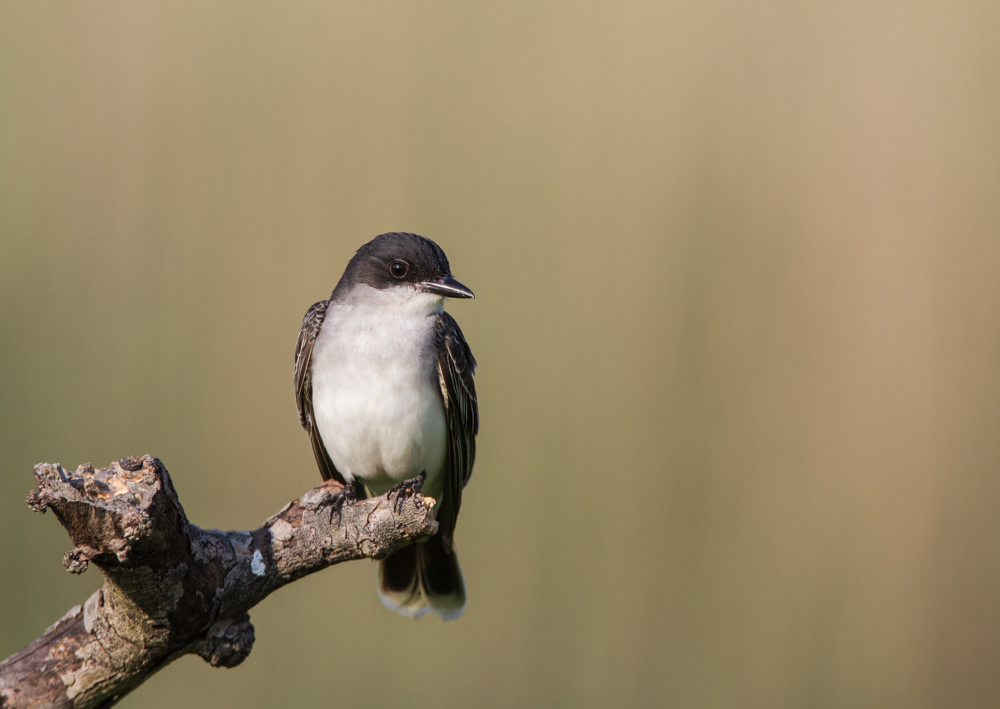
Common Yellowthroat male (click to enlarge)Eastern Kingbird (click to enlarge)
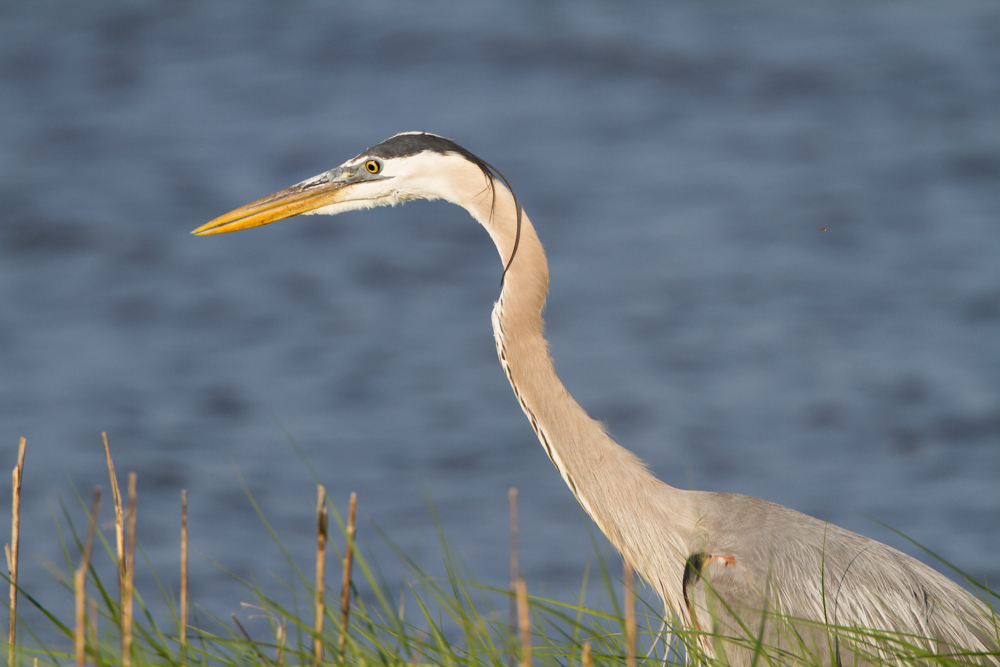
The marshes and impoundments along Wildlife Drive produced great views of a number of other species including Common Yellowthroat, Eastern Kingbird, Black-bellied Plover, Semipalmated Sandpiper, Great Egret, Great Blue Heron, Osprey, and, of course, hundreds of Red-winged Blackbirds.
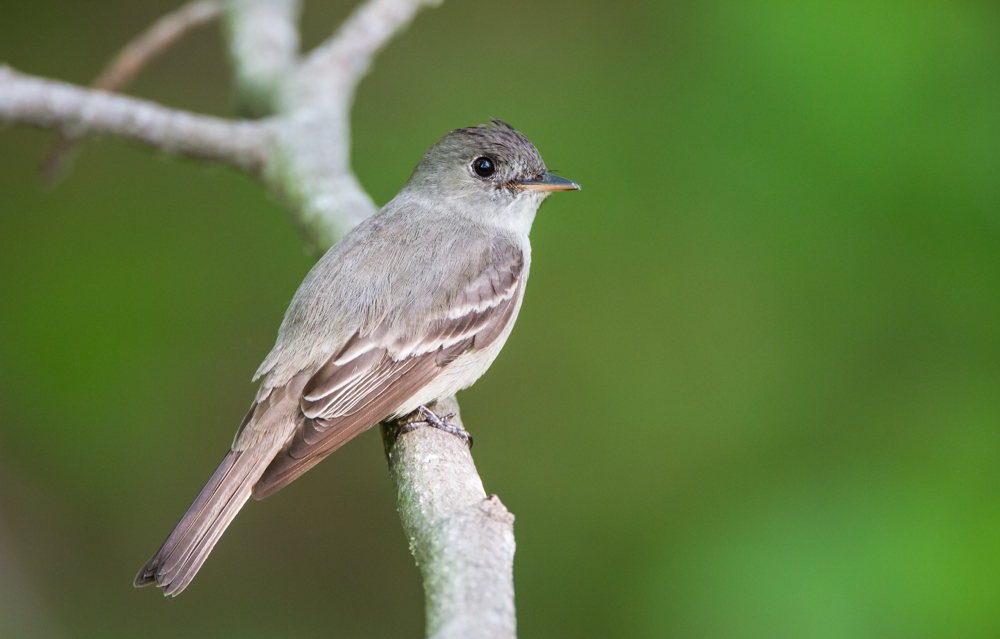
Eastern Wood-peewee (click to enlarge)
The woodland and forest edge portions of the drive were also productive – Eastern Wood-peewee, Great Crested Flycatcher, Wood Thrush, Ovenbird, and a Northern Waterthrush.
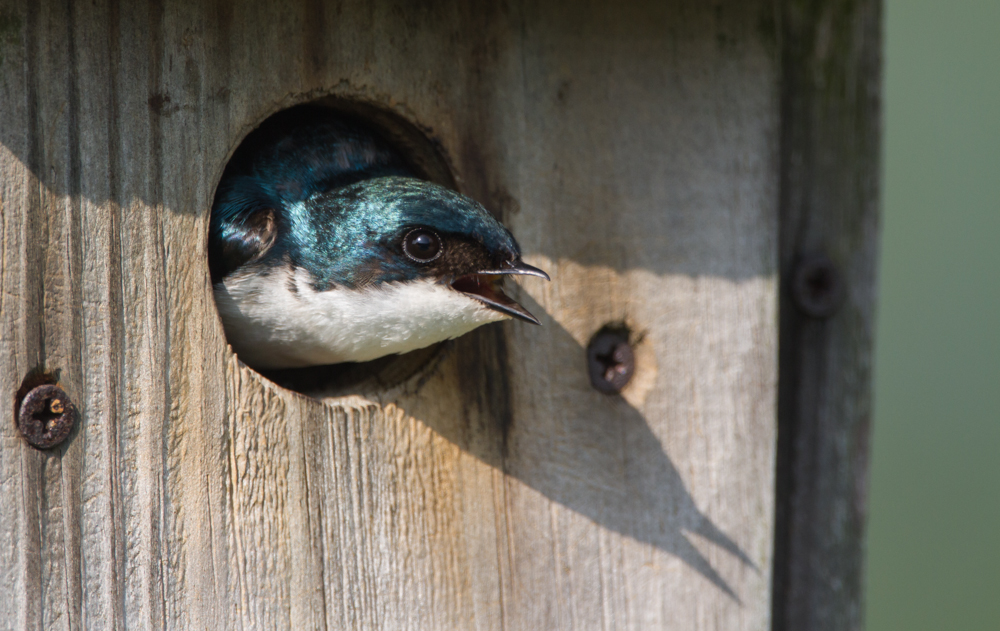
Tree Swallow in nest box (click to enlarge)
The road through the open fields produced more Common Yellowthroat, Indigo Bunting, American Goldfinch, Blue Grosbeak, Northern Bobwhite, a Grasshopper Sparrow, Eastern Bluebird, and Tree Swallows at almost every nest box.
Great Blue Heron in marsh along Wildlife Drive (click to enlarge)
Bombay Hook NWR is, indeed, a delight, and a place I look forward to revisiting.
Okay, I admit it, I wasn’t that convinced that I would have a great natural history vacation in New Jersey. I had heard of the wilds of the Pine Barrens, but knew little of the rest of the state except what Jon Stewart and the southerners I grew up around joke about. I do know several folks from NJ (one even met up with me for this trip) and they love the outdoors like I do so maybe…Then I started reading The Freiday Bird Blog by Don Freiday about all of the great bird sightings around Cape May, NJ, so I decided to give it a try. The Garden State did not disappoint.
Black-bellied Plover in one of the impoundments (click to enlarge)
The first stop was Edwin B. Forsythe National Wildlife Refuge along the shores of southern New Jersey. Forsythe totals about 47,000 acres of mainly salt marsh wetlands and tidal coves and bays managed for waterfowl (especially Black Ducks and Atlantic Brant), migrating shorebirds and song birds, and other wildlife. The refuge has also created a series of fresh and brackish water impoundments to create a diversity of wildlife habitats.
Salt marshes and shorebirds along Wildlife Drive at Edwin B. Forsythe NWR
The easiest way to see wildlife is the popular 8-mile one way auto loop called Wildlife Drive. The loop passes by a series of impoundments in the middle with salt marshes along the outside and then finishes by passing through some forested habitats. Last week was about peak numbers for the migrating shorebirds so there were great views of many species such as Semipalmated Sandpipers, Short-billed Dowitchers, and Black-bellied Plovers.
Black Skimmer (click to enlarge)
A highlight was watching a pair of Black Slimmers feeding in the canal next to the road. Their strange bill, unusual feeding behavior, and striking colors make them one of my favorite coastal birds to watch. They drag the knife-like lower mandible of their bill through the water as they fly back and forth in search of prey. When the mandible touches a fish, the upper bill snaps down instantly to catch it. This bill is their most unusual feature – it is the only North American bird where the lower mandible is longer than the upper. At hatching, the two mandibles are equal in length, but by fledging, the lower mandible is longer than the upper.
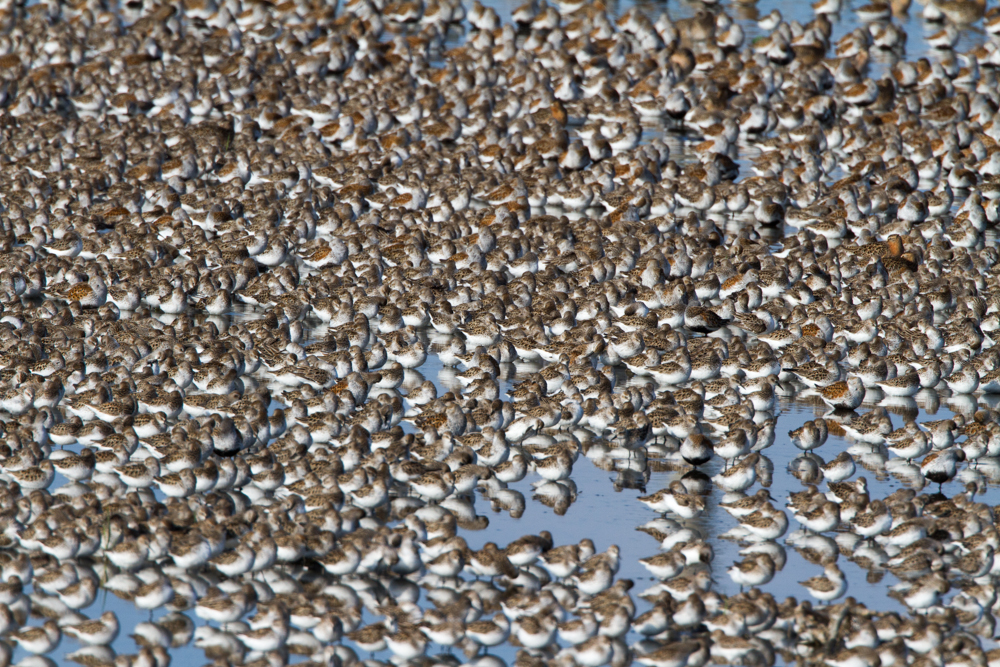
Huge flock of shorebirds at Heislerville Wildlife Management Area (click to enlarge)
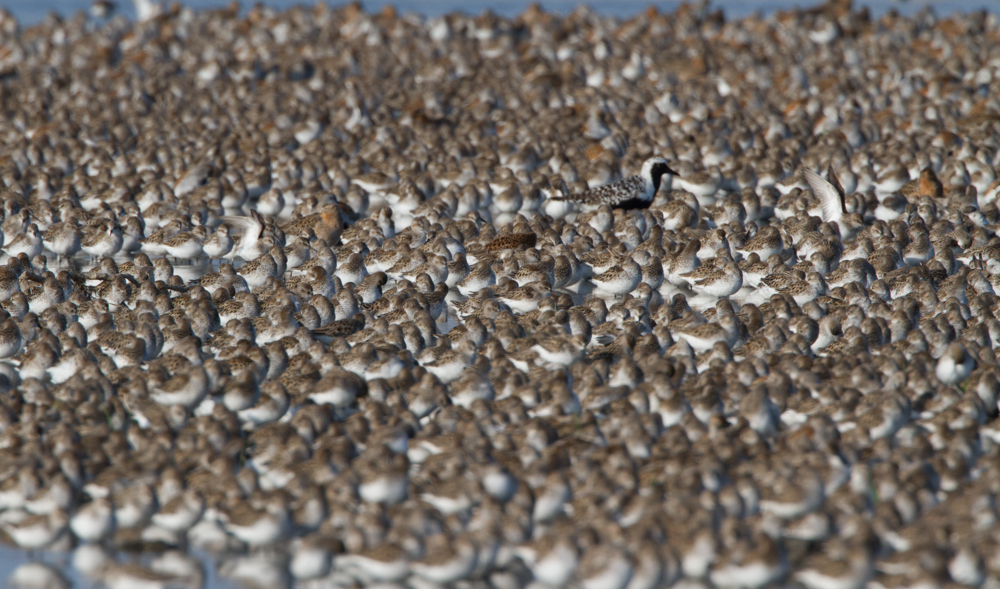
Next stop was Heislerville Wildlife Management Area which is renowned for its migrating shorebirds. Driving down the rutted dirt road it did not look promising, but up ahead a good sign – a group of people with spotting scopes. It was a Nature Conservancy outing scoping the tens of thousands of shorebirds for some unusual species. The vast majority were Semipalmated Sandpipers along with fair numbers of Dunlin and Short-billed Dowitchers.
Image of Curlew Sandpiper (the reddish shorebird) through the spotting scope (click to enlarge)
But the target of the day for the birders was a rare Curlew Sandpiper. This is a Eurasian species which nests on the tundra in northern Russia and winters in southern Asia, Australia, and Africa. But almost every year, a few end up somewhere along the coast of North America. The Curlew Sandpiper had just gotten lost amongst the thousands of other shorebirds when we arrived. But on a second pass later that afternoon, a knowledgeable birder (turned out to be Don Freiday whose blog I follow) kindly pointed it out. Luckily, it was in its brick red breeding plumage so it stood out in the afternoon light even at a great distance through the scope.
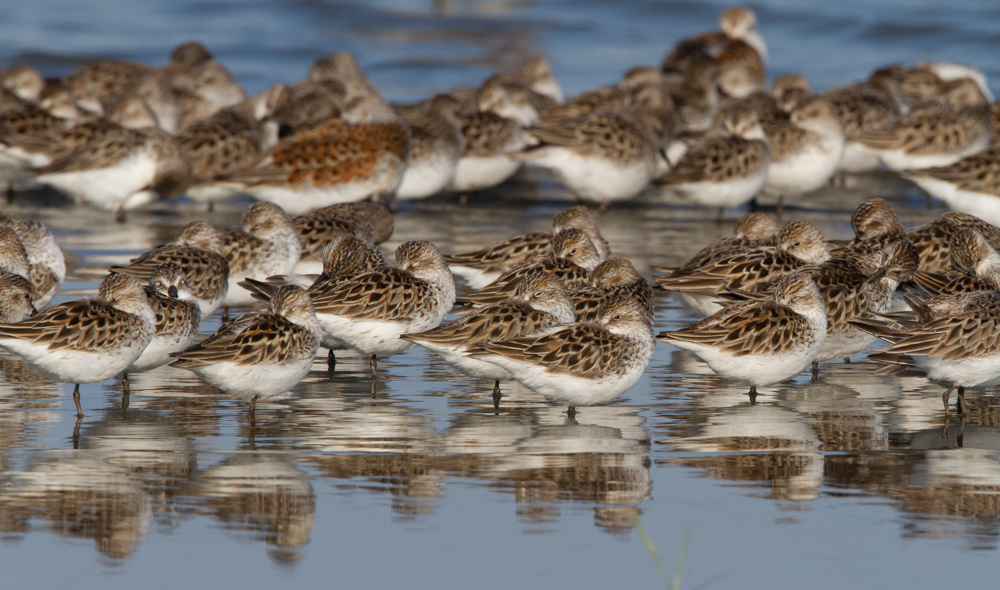
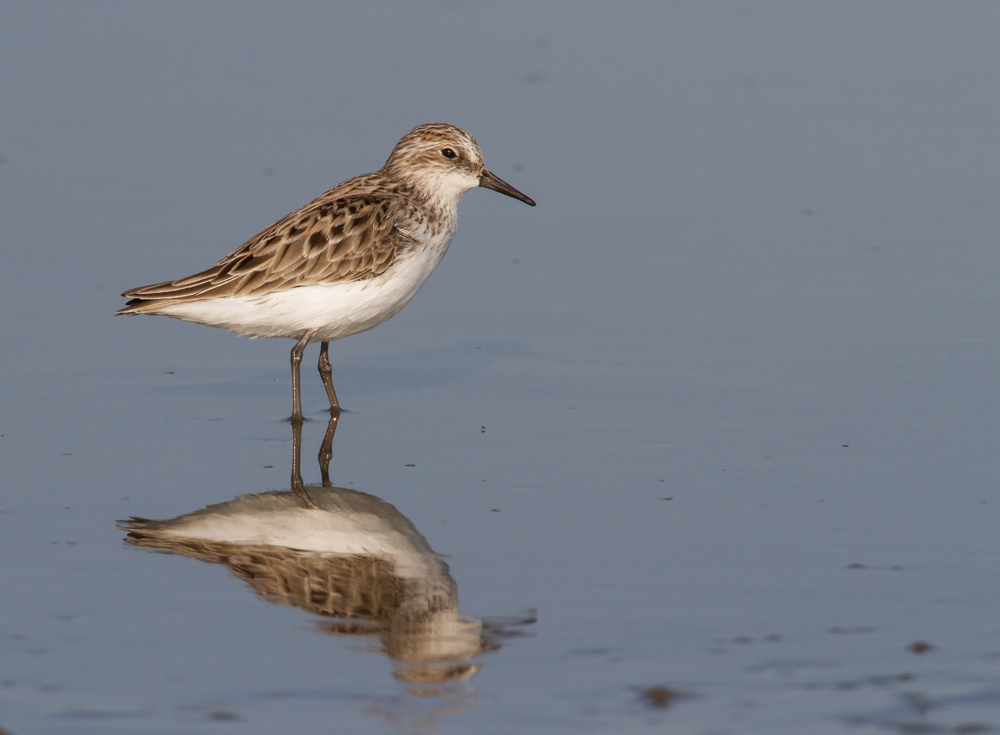
Shorebirds in late afternoon light at Heislerville (click to enlarge)Semipalmated Sandpiper (click to enlarge)
The second impoundment at Heislerville also contained thousands of Semipalmated Sandpipers and the low angle light made for some great photographs as the birds fed, preened, and rested. The Semipalmated Sandpiper gets its common name from the short webs between its toes (“palmated” means webbed). This species is by far the most abundant shorebird during migration in these parts – they spend the winter in South America and are now migrating the thousands of miles back to their Arctic nesting grounds.
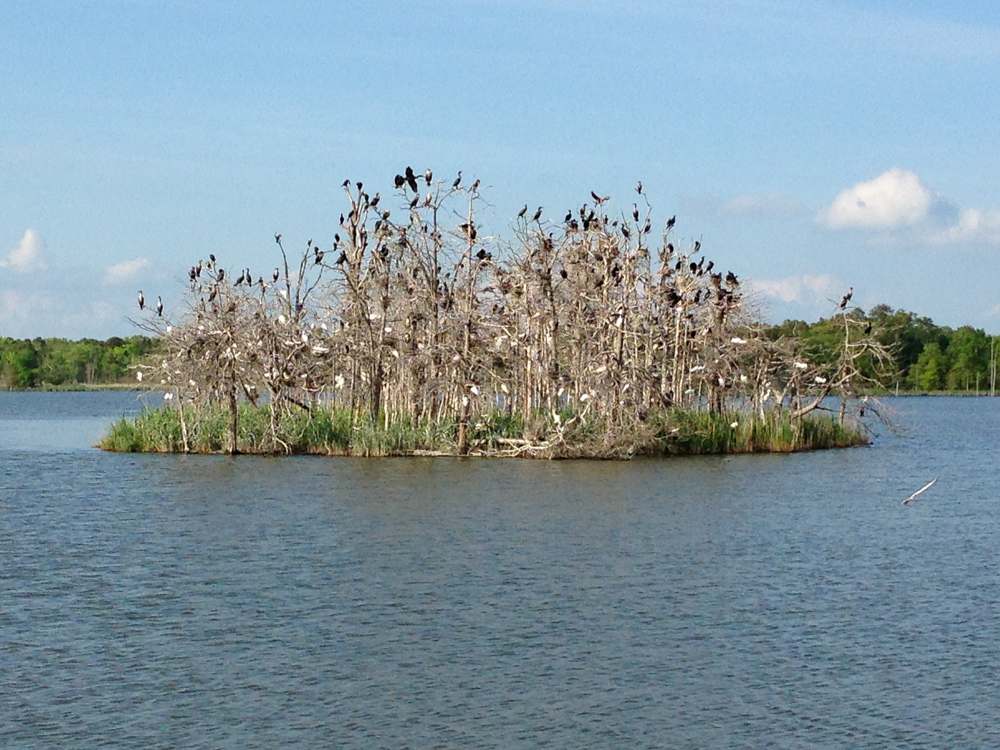
Rookery at Heislerville WMA (click to enlarge)Double-crested Cormorant nests in rookery (click to enlarge)
Adjacent to one of the shorebird impoundments at Heislerville was a small island containing a rookery of what seemed to be hundreds of nests of Double-crested Cormorants, Snowy Egrets, and Black-crowned Night Herons. The guttural squawks and other non-stop sounds made me appreciate my quiet neighbors back home. When viewed through the scope, I was amazed at the striking bright blue color of the throats of the Double-crested Cormorants.
After a long day, I spent the night in the beautiful beach-side town of Cape May. The next morning was overcast and time was limited (had reservations on the ferry to Delaware in early afternoon) so I made several stops at local hot spots including Belleplain State Forest, Cape May NWR, and Cape May Point State Park.
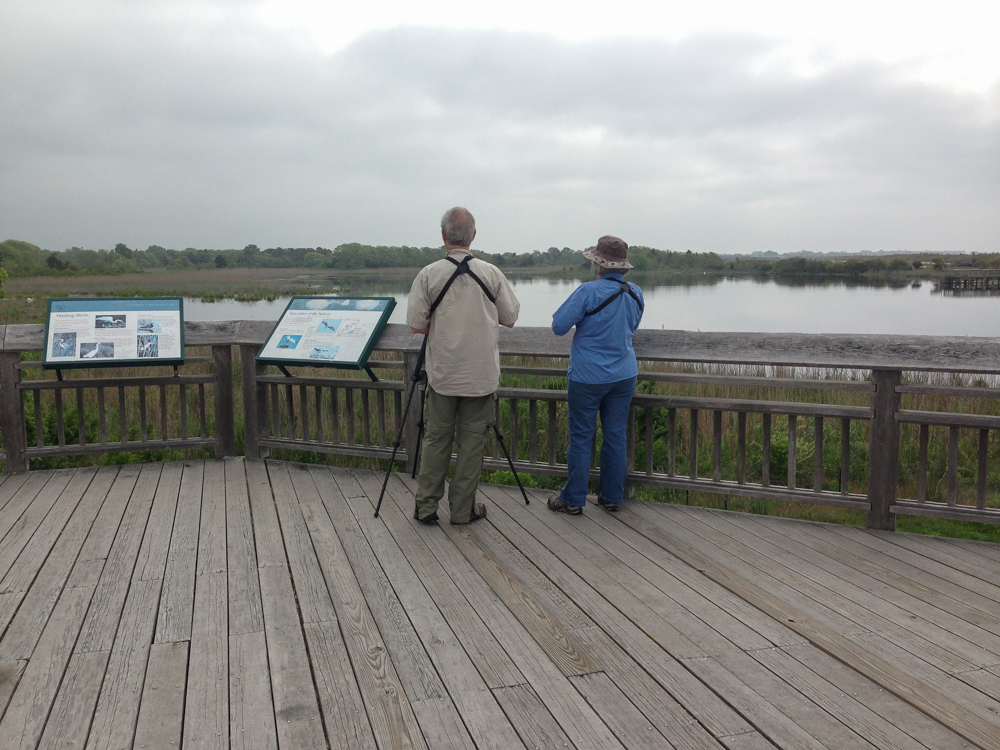
Hawk Watch platform at Cape May Point State Park
I’m sure it is different once the summer beach season gets rolling, but during migration, Cape May is like Disney World for birders. Everywhere you look there are people with binoculars and vanity license plates with some bird-related moniker. It should be no surprise that the World Series of Birding is held here every May.
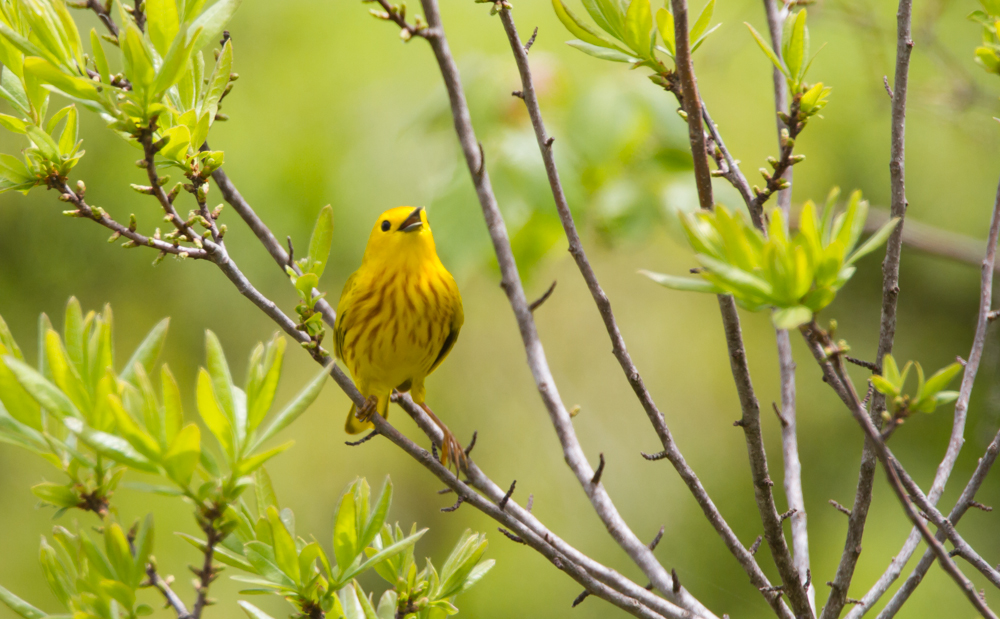
Yellow Warbler male at Cape May NWR (click to enlarge)
There were plenty of song birds in evidence although I think I missed the peak of warbler migration by a couple of weeks. The most common warblers seen were the beautiful Yellow Warblers. They were feeding in the shrub thickets at almost every stop and offered good views as they sang and foraged. Cape May is indeed a birder’s paradise in spring. And they say the Fall migration is even more spectacular as thousands of song birds, raptors, and monarch butterflies gather at the point before heading across Delaware Bay on their way south. I guess I will venture to the Garden State again this Fall and see what all the fuss is about.
Red-winged Blackbird male on marsh grass (click to enlarge)
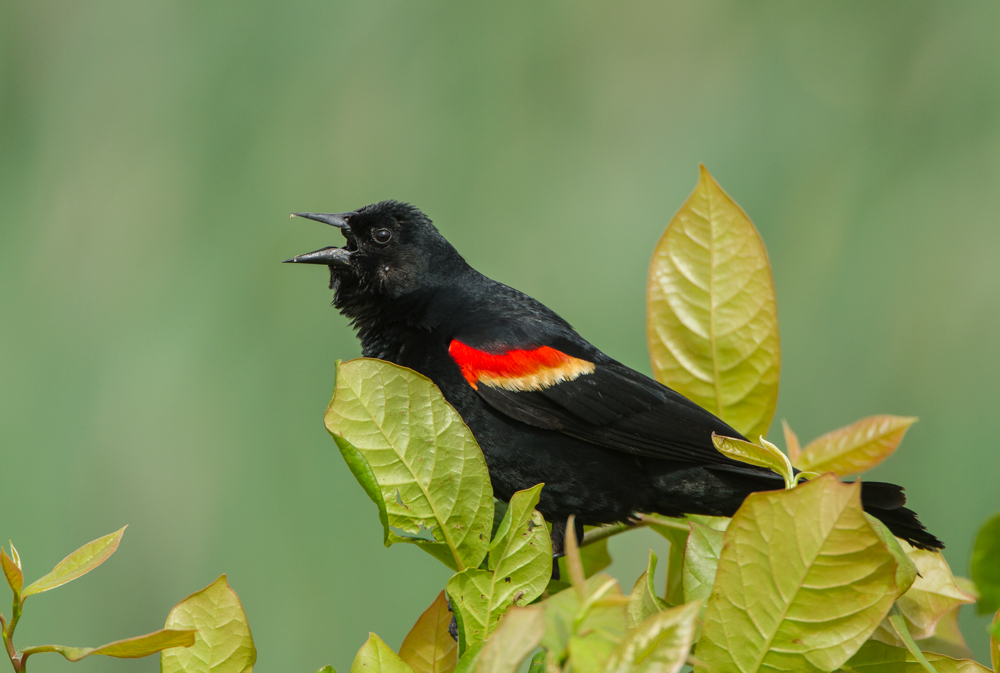
I think Delaware got it wrong. The Blue Hen is the official state bird of this fine state, but in both color and species they have missed the boat. My vote would be for the Red-winged Blackbird. Displaying males are the most common species seen at Prime Hook and Bombay Hook National Wildlife Refuges. They are much easier to approach and identify than the other most common birds, a couple of species of shorebirds, which number in the thousands for the next couple of weeks.
Male Red-winged Blackbird displaying (click to enlarge)
Male Red-winged Blackbirds have jet-black bodies with a bright red shoulder patch (epaulet) bordered by a yellow stripe at the bottom. And to make it even easier to find them, the males are almost always displaying this time of year. The most noticeable display is the so-called song spread where a perched male arches forward, spreads its wings to the side and exposes his red epaulets while letting out his distinctive song (usually described by a variation on the phrase konk-a-ree!). This display is meant to defend his territory from rival males and attract a female.
Red-winged Blackbird male displaying (click to enlarge)
I was also able to watch some other interesting behaviors: the sexual chase where a female flies erratically while being pursued by one or more males – this serves to bond the female with her mate; and the song flight – a slow, stalling flight by the male with epaulets exposed, tail spread, accompanied by his song.
Red-winged Blackbird female (click to enlarge)
While displaying males were everywhere along the refuge roadsides, the females were much harder to find. They could be seen briefly darting across the roads pursued by males as described above. And occasionally you could spot one skulking about in the reeds beneath the watchful eyes of the resident male. Once they start feeding young in a few weeks, they will become much more visible as they tend to be the primary caregivers of the nestlings and will be coming and going to the nest with beaks full of bugs.
Red-winged blackbird flock at Pocosin Lakes in winter (click to enlarge)
I now have an even greater appreciation of one of my highlight birds at my favorite North Carolina refuge, Pocosin Lakes, Each winter, Red-winged Blackbirds congregate on the refuge fields by the tens of thousands and put on an amazing display of synchronized take-offs and flights as they forage and elude the many raptors hunting the refuge. Now I know where at least some of those magnificent flyers get their training.
A quick post to share a highlight of the trip thus far to New Jersey, Delaware, and the Virginia Eastern Shore – huge flocks of shorebirds seen at Heislerville Wildlife Management Area in NJ. How many species can you see?
Spring scene along swamp boardwalk at Lake Mattamuskeet (click to enlarge)
Spent a windy, dusty day in the field with friends on Wednesday exploring my two favorite refuges in NC – Mattamuskeet and Pocosin Lakes. It has been two weeks since I was last down that way and things have changed dramatically – the heat is here as are the deer flies (both of which have to count as being among my least favorite things).
But, as always, these incredible wildlife hot spots did not disappoint. The day started with sightings of large numbers of wading birds at Mattamuskeet in the impoundemnts which have become more mud and grass flats than water-filled marshes. Lots of egrets and herons were concentrated out in the flats, undoubtedly feasting on fish and tadpoles. Looking out over the vegetation we could see some very large white birds and when they took off there was no doubt as to their identity – American White Pelicans! They are becoming more common in winter at Mattamuskeet (last winter I saw over 40 in one flock) but I have never seen this many in late spring (we counted 11). Their appearance in our state has increased greatly in the last decade. I also see them every summer in Yellowstone where they breed on islands in Yellowstone Lake, but, as of yet, they are not known to breed here. They are always impressive, with black wing tips on wings that, at nine feet, are the longest wingspan of any regularly occurring North American bird.
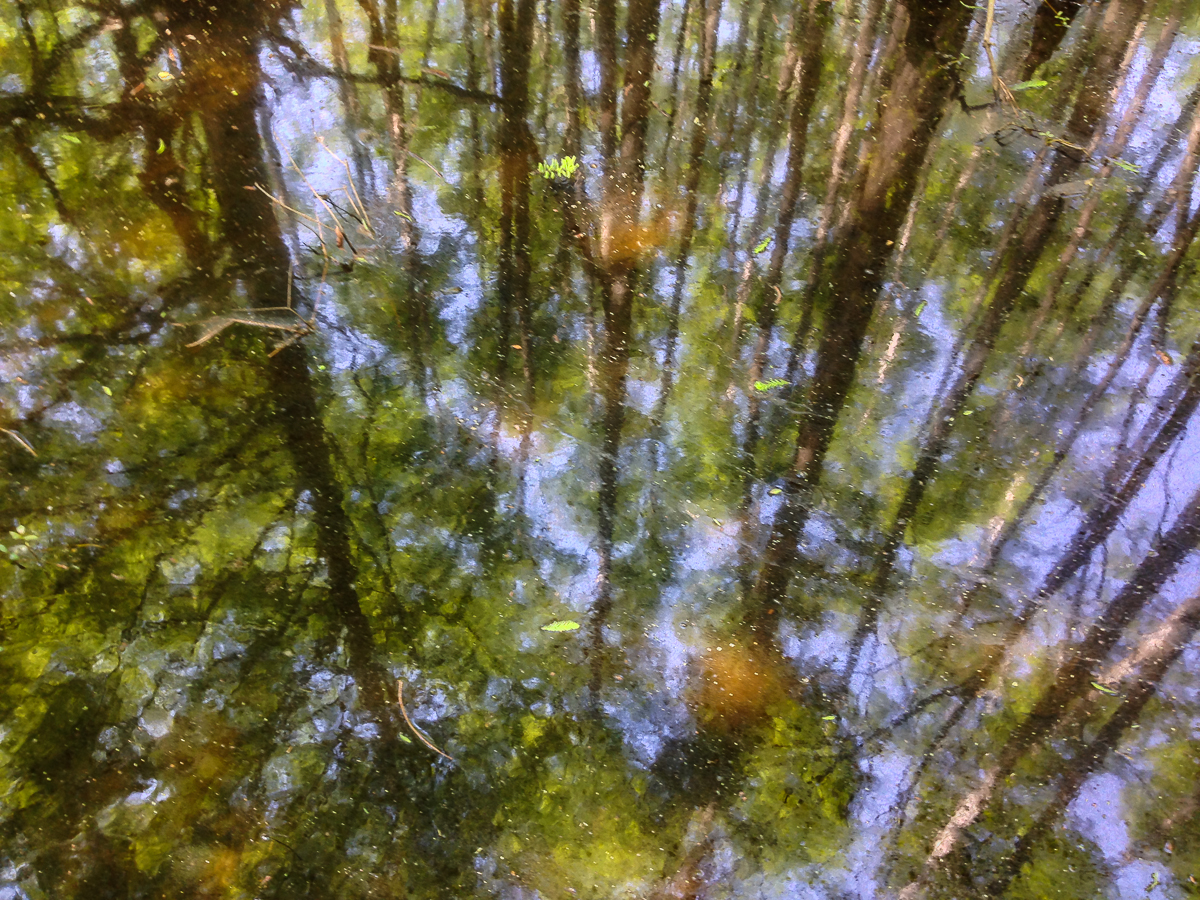
Reflections along swamp boardwalk (click to enlarge)
Other highlights at Mattamuskeet included an abundance of dragonflies, a walk on the swamp boardwalk, a large number of turtles out along every bank, and three gray foxes.
Rat Snake in road (click to enlarge)
Toward mid-afternoon, we drove over to the Pungo Unit of Pocosin Lakes National Wildlife Refuge for bears and anything else we might see.We quickly encountered a snake crossing one of the sandy roads and got out for a closer look – it was a beautiful Rat Snake, and it quickly decided to turn and headed back for cover. When we got out in front it assumed the classic defensive posture that would keep almost any mammal at bay.
Rat Snake in defensive posture (click to enlarge)
Rat Snakes are a highly variable species with individuals in much of the Coastal Plain being a greenish or yellowish color with four dark stripes running the length of the body. In most of the rest of the state they tend to be blackish in color. This one was a little over three feet long but looked like it had retained some of the juvenile coloration consisting of some dark blotches instead of the cleaner dark stripes.
Driving through the refuge we saw a few bear (ended up with nine bears for the afternoon) and birds of various sorts including an American Bittern in the marsh where I had photographed them calling a couple of weeks ago.
American Bittern calling late last month at Pungo (click to enlarge)
After getting out and listening at various points along the marsh, we did not hear any calls or see any other bitterns, so perhaps most have migrated on toward their breeding areas further north.
Greater Yellowlegs in impoundment (click to enlarge)
Late in the day we decided to walk out toward the Jones Pond impoundment along the dike since it had produced so much wildlife a couple of weeks ago. This is where the deer flies decided to remind us this was their turf, but we plowed ahead and soon startled a small bear who made a quick retreat off to our right in the woods. As we walked we saw several deer, a Raccoon, two River Otter, and lots of birds feeding around the rapidly drying pools scattered across the impoundment. The refuge manages these so-called Moist Soil Units to maximize food availability to overwintering waterfowl and this is the time of year when the impoundments are drained so seed-producing vegetation can grow and supply a food source within reach of dabbling ducks next winter when the area is again flooded. These areas also provide a valuable resource for shorebirds (such as this Greater Yellowlegs) and waders as well as raccoon, otter, and hungry bears. The pools are teeming with tadpoles (and perhaps small fish) as they get concentrated by the dropping water levels, making for an easy meal for various predators.
And, as I always like to do, we ended the day spending some time with bears. First, a familiar group of three (mom and two yearling cubs with distinctive stripes on their sides – from lying in mud?), and then a single adult bear that was busy eating the emerging vegetation from the growing mud flats. Not sure what caused the bear to jerk its head back a couple of times while feeding – crayfish encounter, snake, bee??, but it was both fun and peaceful to watch.
Yet another satisfying refuge visit.
Species list for Mattamuskeet NWR May 15, 2013:
Mammals:
White-tailed Deer, Gray Fox
Birds:
American White Pelican, Double-crested Cormorant, American Coot, Mallard, Canada Goose, Wood Duck, Great Blue Heron, Great Egret, Snowy egret, Tri-colored Heron, Little Blue Heron, White Ibis, Glossy Ibis, Greater Yellowlegs, Lesser Yellowlegs, Spotted Sandpiper, Killdeer, Solitary Sandpiper, Laughing Gull, Forster’s Tern, Common Tern, American Crow, Bald Eagle, Turkey Vulture, Black Vulture, Pileated Woodpecker, Red-headed Woodpecker, Downy Woodpecker, Northern Flicker, Mourning Dove, Carolina Wren, Northern Cardinal, Brown Thrasher, Blue Jay, Tufted Titmouse, Northern Mockingbird, Blue Grosbeak, Indigo Bunting, Common Yellowthroat, Prothonotary Warbler, Yellow-throated Warbler, Chipping Sparrow, Red-winged Blackbird, Common Grackle, Barn Swallow, Tree Swallow, Summer Tanager, Eastern Bluebird, American Robin, Eastern Kingbird, Great Crested Flycatcher, Eastern Wood Peewee
The question is not what you look at, but what you see.
Henry David Thoreau
The forest floor in early May at Elk Garden, VA (click to enlarge)
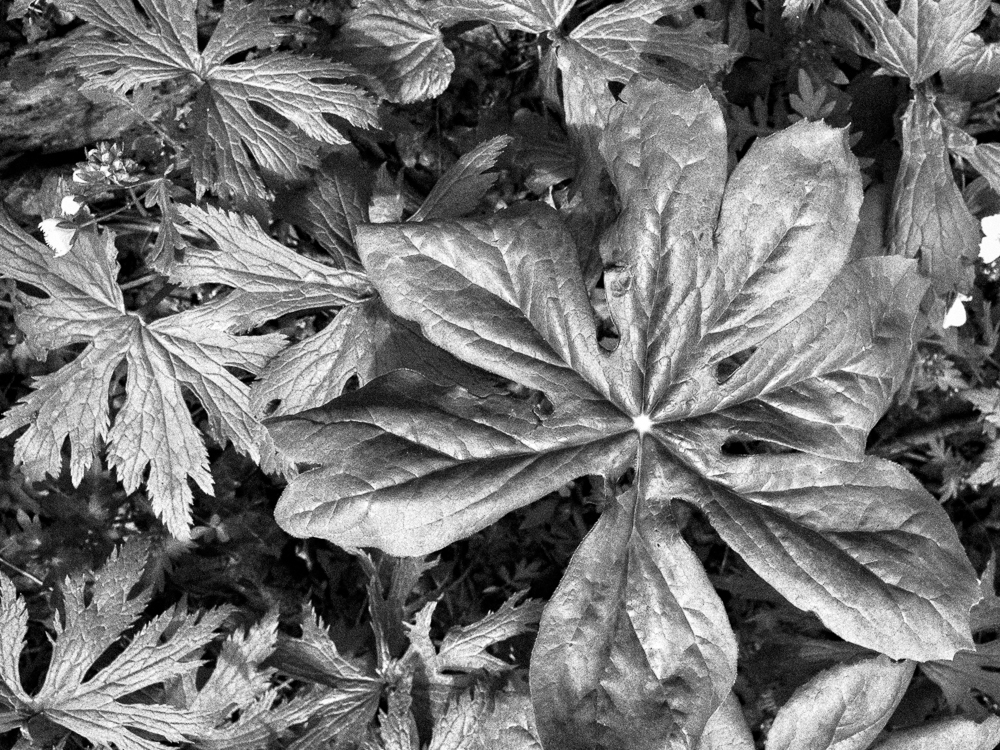
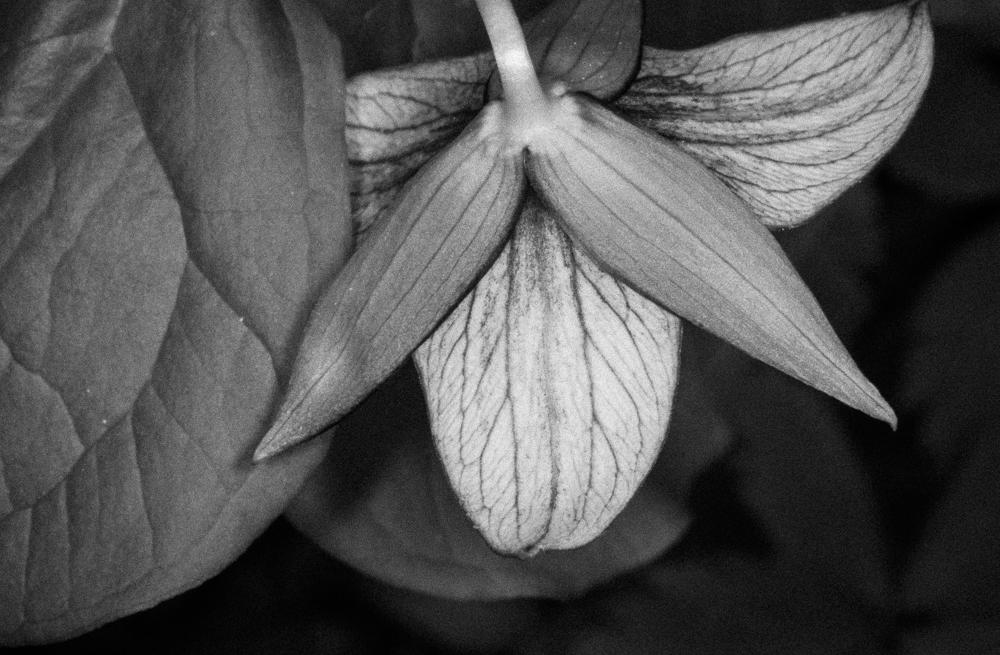
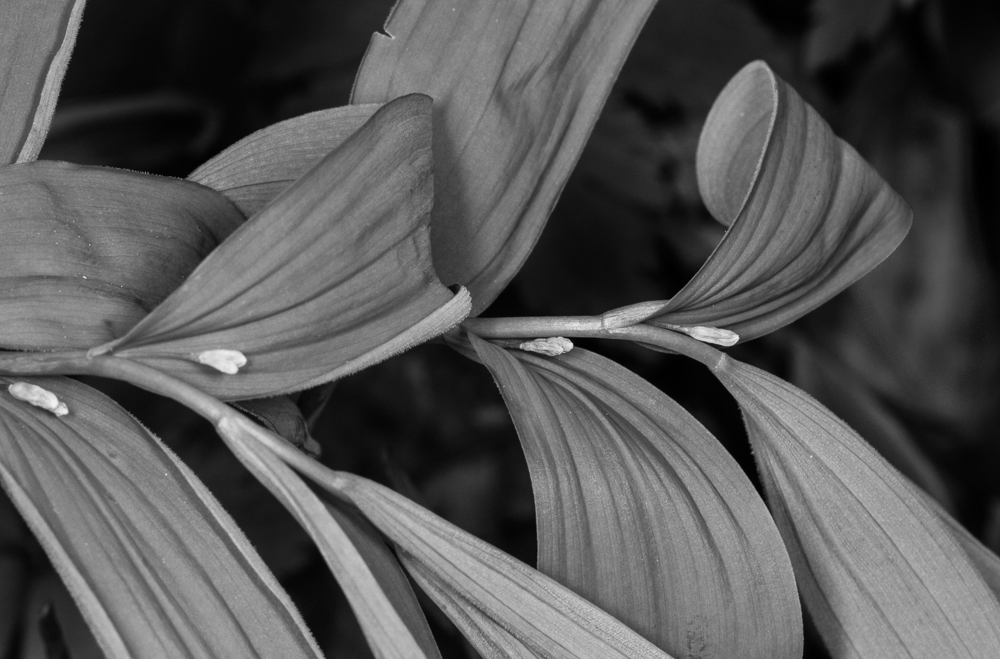
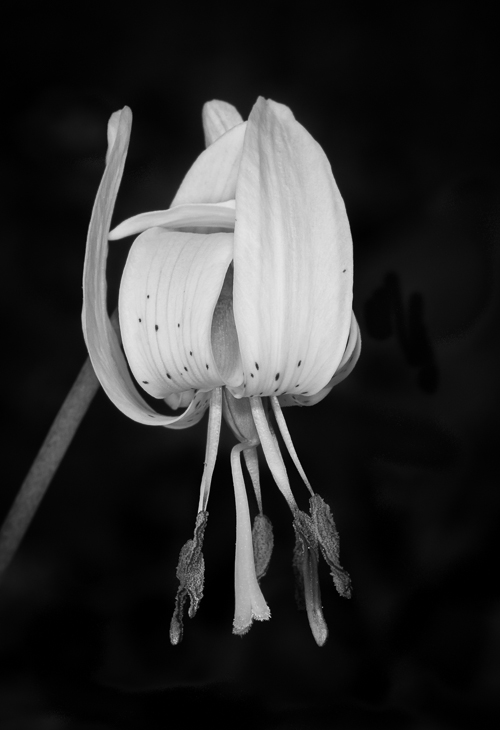
Winter is usually thought of as gray and stark. Spring is viewed as a time of color – the varied greens of leaf out and the splashes of color from the unfolding display of wildflowers. But there are times even in spring when something catches my eye – a pattern, a texture, a shape – and I stop and look at it in a different way, aim the camera, and focus on the essence of the subject, which is often best relayed through colorless glasses. Here are some examples from my recent trip to Elk Garden, Virginia:
Wake Robin trillium (click to enlarge)Fern fiddlehead (click to enlarge)Fern fiddlehead (click to enlarge)Solomon’s Seal flower buds (click to enlarge)Unfurling leaves (click to enlarge)Violet (click to enlarge)Squirrel Corn (click to enlarge)Trout Lily (click to enlarge)Mayapple leaf (click to enlarge)
Take a moment on your next stroll though the woods and stop and look with a new set of eyes and see what you see.

































 Roads End Naturalist