“In All Things of Nature There is Something of the Marvelous” – Aristotle
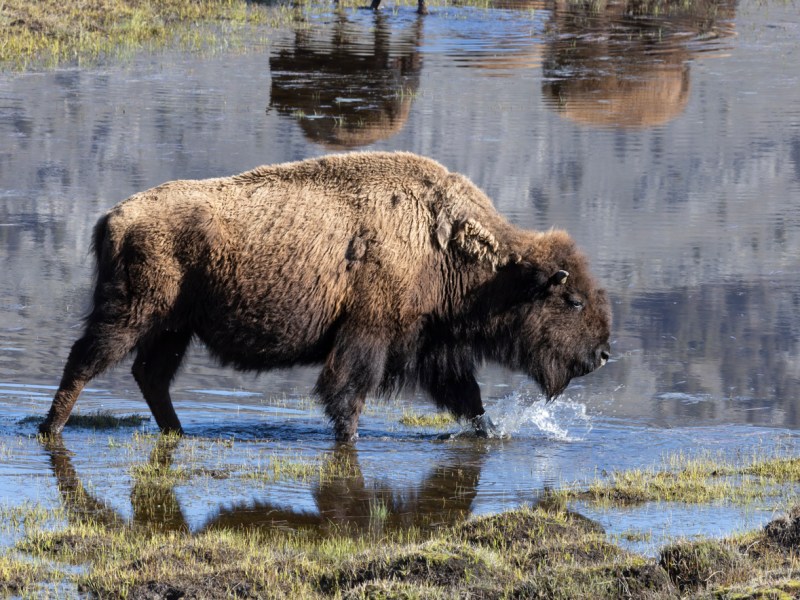
I have always loved that quote as it states in simple terms why I find everything around me so fascinating. I marvel at spectacles such as the Snow Geese at Pocosin Lakes National Wildlife Refuge or the Bison in Yellowstone, but I can also spend hours walking around the garden looking at tiny things. Last week, this critter rode in from the garden on some basil leaves so I took a few moments to obsreve and photograph it.
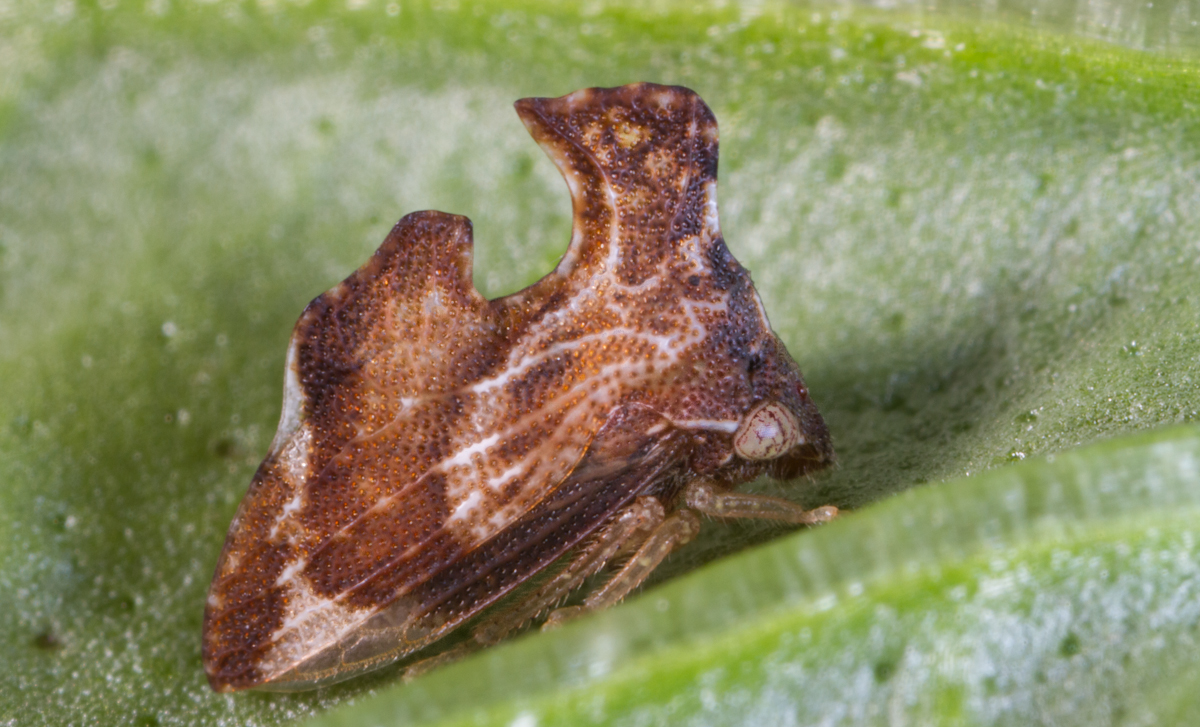
Treehopper
A quick search on bugguide.net revealed it to be a common species of Treehopper, Entylia carinata. It has no official common name, although one writer dubbed it the Keeled Treehopper for its appearance and for the fact that its species name is Latin for keeled. I think it should be called the Bottle Opener Treehopper as it sure looks like something useful you should have on your key chain if it were a bit bigger (it is tiny, only about 5 mm long). They can be variable in color but the keeled notch is distinctive for this species.
Treehopper, Entylia carinata
Like most of its kind, they feed on plant juices and secrete honeydew (a nutritious waste product) that is sought after by ants and other insects. This species is often seen accompanied by ants and one researcher observed that the maturing of eggs and nymphs was much more successful when both the mother and attending ants were present; both acted to drive off potential predators. I found some really cool images online of a female with her eggs and nymphs (http://www.marylandbiodiversity.com/viewSpecies.php?species=6252). I will be out looking for those in the coming weeks.
So, wherever you are today, take a moment, go outside, and be amazed at the marvelous in nature.
During my career at the NC Museum of Natural Sciences I once was forwarded a call from someone that was curious about something they had seen in their yard. She wanted to know what species of tiny hummingbirds were visiting her flowers. After a brief discussion, we came to the conclusion she was seeing one of a group of day-flying moths collectively known as Clearwing Moths, and based on her description of the colors, most likely the aptly named Hummingbird Clearwing.
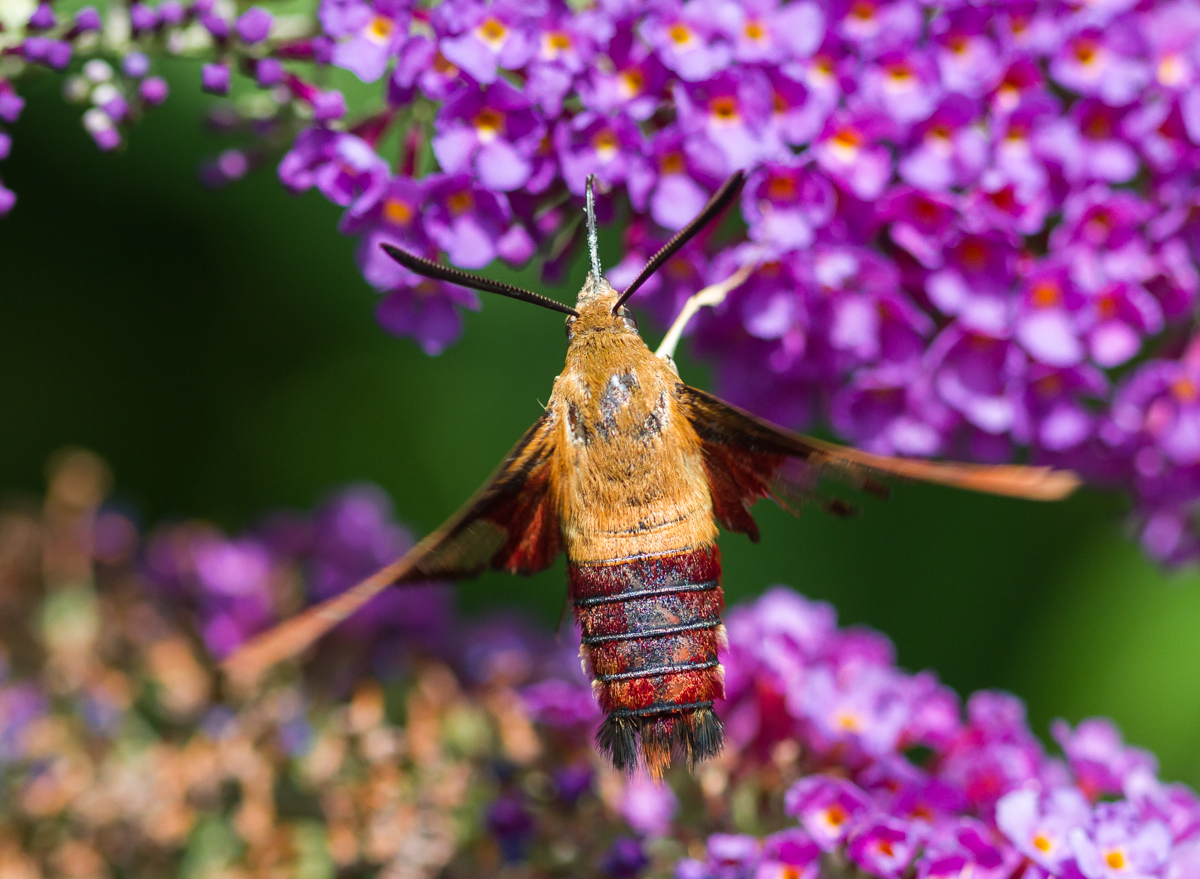
Hummingbird Clearwing at Butterfly Bush
This common eastern species, Hemaris thysbe, has coloration and foraging behavior reminiscent of a Ruby-throated Hummingbird, but is much smaller. A Hummingbird Clearwing Moth has a wingspan of about 1.5 – 2 inches, whereas the bird, the Ruby-throated Hummingbird, has a wingspan of 4.5 inches. Yet it is easy to see how people could mistake these diminutive rapid fliers for the bird. They hover and flit from flower to flower sipping nectar with their long proboscis. Their wings have reddish borders and they often have a greenish hue to the “hairs” on their stout bodies. These photographs of the adult moths were taken last week while visiting my parent’s in southwest Virginia. They have several Butterfly Bushes (Buddleia sp.) which are magnets for these beautiful moths.
Hummingbird Clearwing wingbeat
One thing you notice when you watch one of these moths is the blur of their wings as they hover and feed. Try as I might, I could only occasionally get part of both wings in focus even at high shutter speeds. No wonder, as it is estimated they beat their wings 30-35 times per second (compare that to a Ruby-throated Hummingbird with an average of 50-60 beats per second). One thing the rapid burst of photos did reveal is the pattern of movement in the wings – the figure-8 motion (the photo above shows the start of the backward sweep of the figure 8), which provides lift in both directions.
Snowberry Clearwing
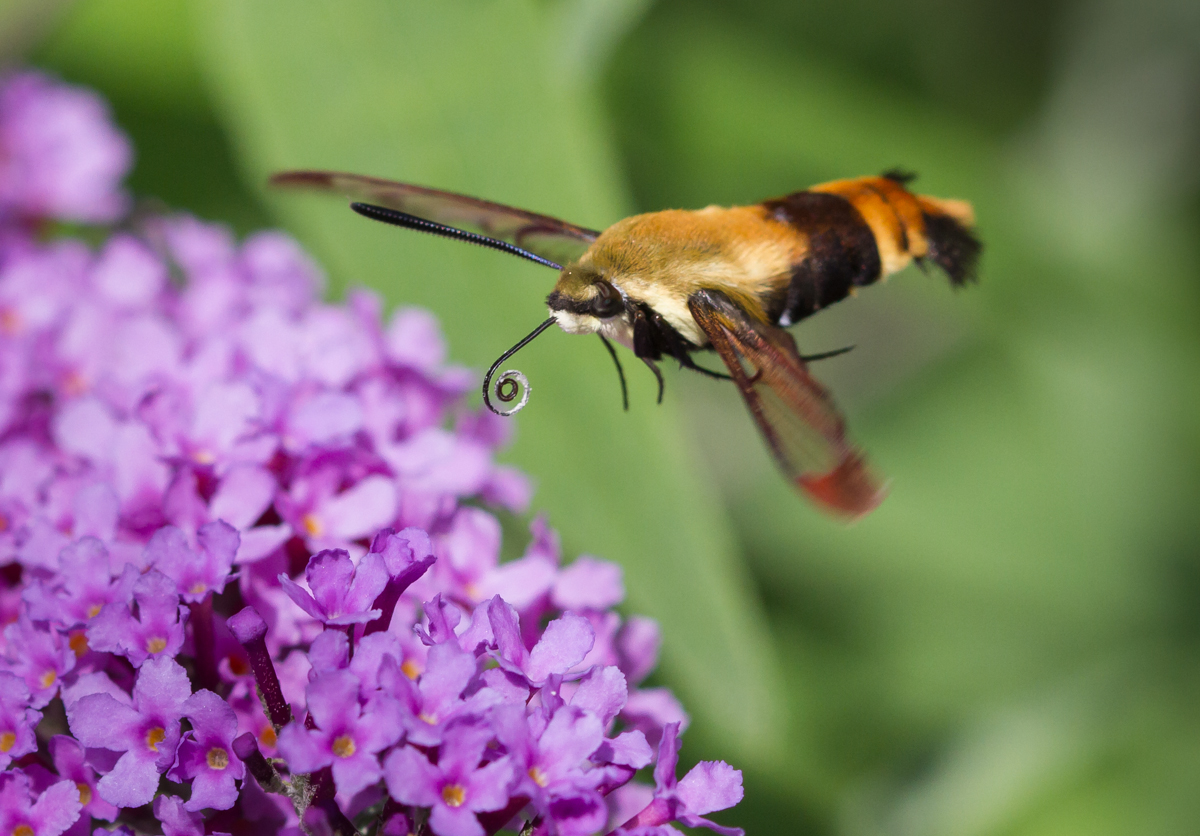
I also noticed several individuals of the similar-looking Snowberry Clearwing (Hemaris diffinis) feeding on the Butterfly Bushes. They closely mimic bumblebees in coloration and are often called Bumblebee Moths. In one online discussion forum I even saw someone refer to these as looking half hummingbird, half bumblebee – a bumblebird! The main differences between them and the Hummingbird Clearwing is that this species tends to be slightly smaller and has a blackish abdomen with a yellow band (sometimes not complete) near the tip.
Snowberry Clearwing on Butterfly Bush
Both species have a long proboscis they insert into flowers to obtain nectar. They often place their front pair of legs on the flower as they hover and feed.
Hummingbird Clearwing caterpillar
Both Hummingbird and Snowberry Clearwings are members of the hawk moth or sphinx moth family, Sphingidae. They are among the few strictly diurnal (day-flying) members of that family and are found throughout most of the eastern United States and Canada. Their caterpillars are similar to many other sphinx moth larvae in that they have a distinctive curved horn on their posterior end (caterpillars of this family are often called hornworms). The Hummingbird Clearwing’s horn is often bluish and they have a row of orange and white spots along each side surrounding the breathing pores (spiracles).
Snowberry Clearwing caterpillar
Snowberry Clearwing larvae have blackened dots along their spiracles and a horn that is yellow at the base with a black tip. Both species use various species of Haw (Viburnum sp.) and Honeysuckle (Lonicera sp.) as host plants. I always look for them on Arrowwood Viburnum and Coral Honeysuckle in my area.
Snowberry Clearwing cruising in toward a meal showing curled proboscis
If you have either of these host plants in your garden or woods, be on the lookout for the adults as they cruise and hover at your flowers in search of nectar. I see them at a wide variety of plants from non-natives like Butterfly Bush to native beauties such as Bee Balm and Phlox. Every time I see one I can’t help but pause and enjoy…and sometimes I even stalk them for an hour or more trying to get just the right photo, but I always want a better one…
And what’s a butterfly? At best, He’s but a caterpillar, drest. John Grey
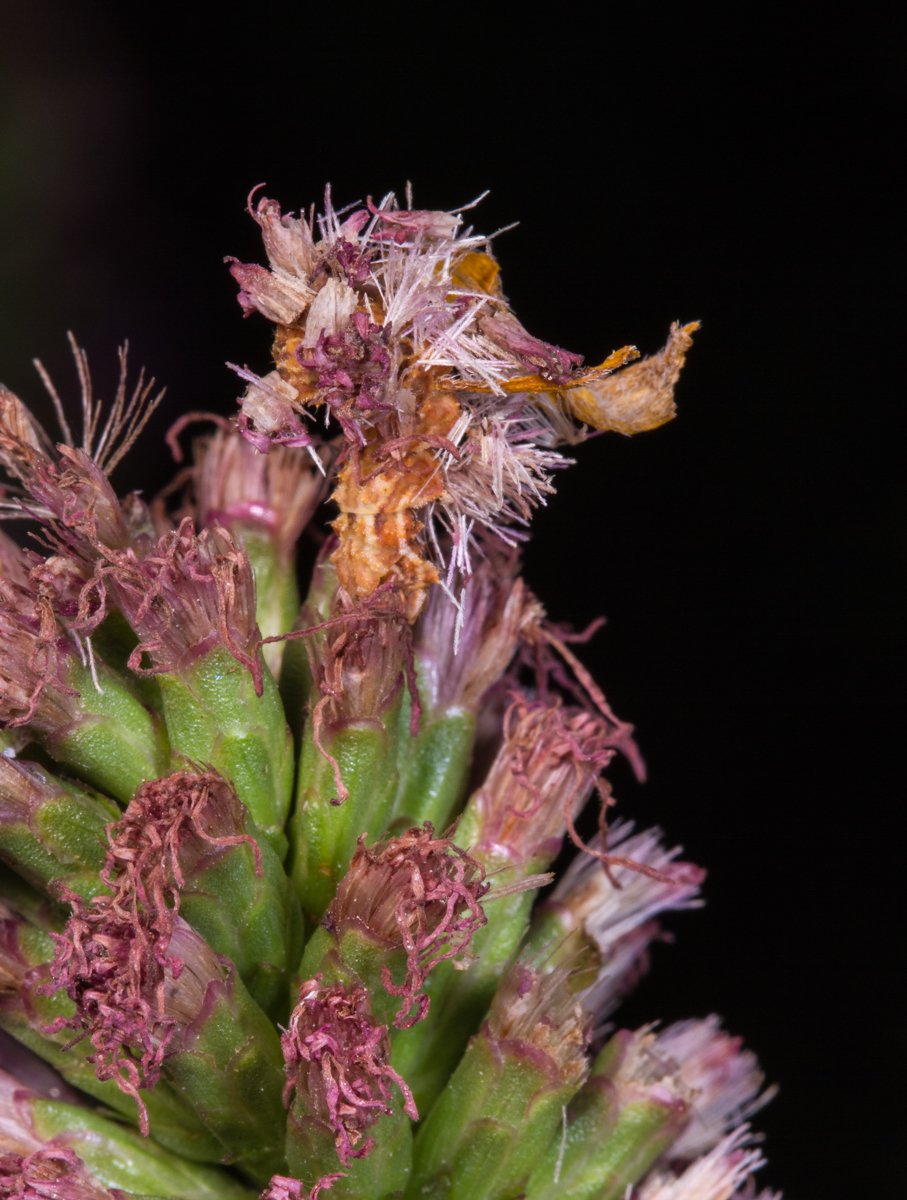
And there is one species of caterpillar that dresses better than any other – the Camouflaged Looper, Synchlora aerata. This is the unusual larva of the Wavy-lined Emerald Moth (okay, the quote isn’t quite right in this case…).
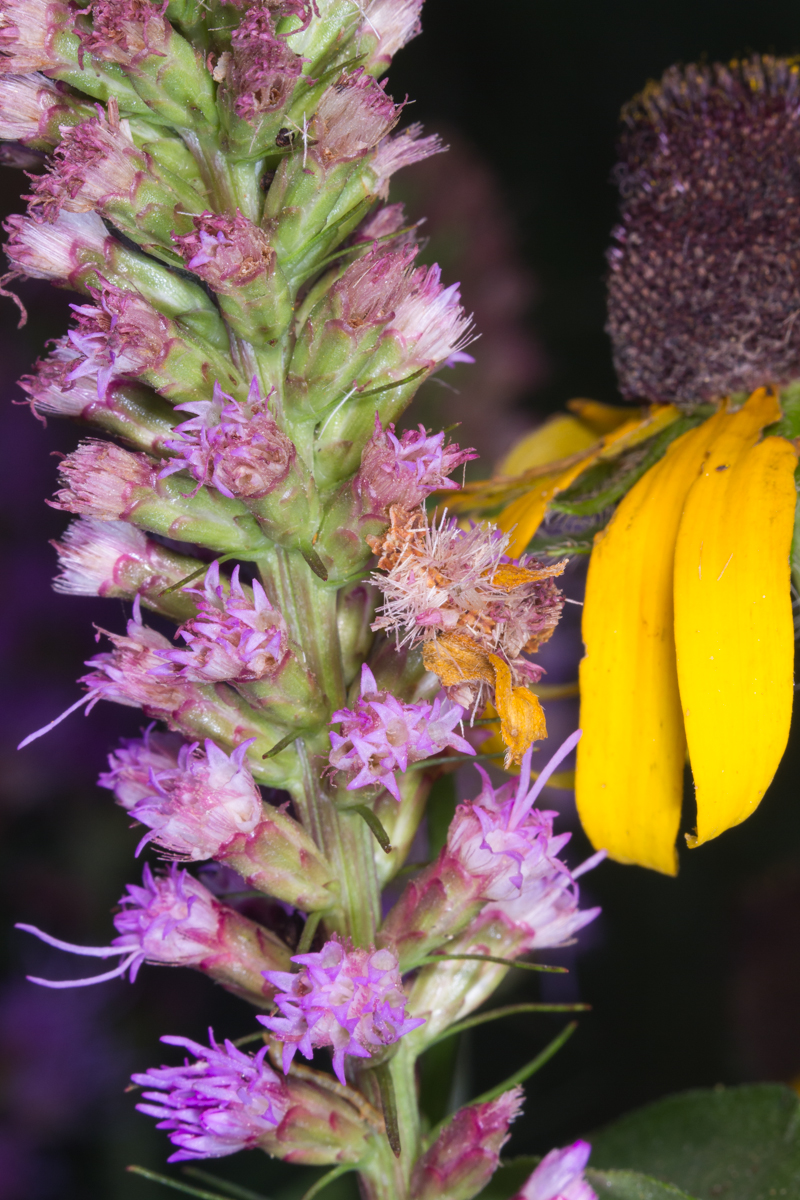
Can you see the caterpillar?
Every time I am out in the garden I always take a few moments to just look around for interesting critters. As I watched a few pollinators on the Blazing Star (Liatris sp.) yesterday, I noticed something move. But there was nothing there…then it moved again, and I knew what it was – a Camouflaged Looper. This caterpillar has the unusual habit of disguising itself by cutting plant parts from the flowers on which it is feeding and sticking them onto its dorsal surface. The larvae feed on a wide variety of plants although I have most often found them on Blazing Star, Black-eyed Susan, and a few other yellow composite flowers.
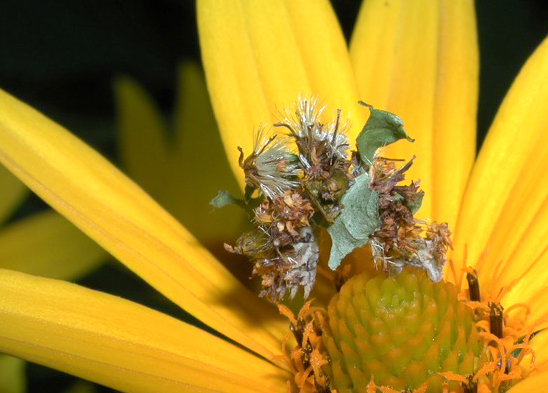
Camouflage Looper and its “costume”
In a 1979 article in The Journal of the Lepidopterists’ Society, Dr. Miklos Treiber, of the University of North Carolina, wrote about the camouflage abilities of these inchworms. The larvae cut off flower parts, seeds, and even entire flowers, and attach them to needle-like projections on their upper body surface. In a series of experiments he removed their floral covering and they immediately began to replace the camouflage.
Camouflaged Looper on yellow composite
Furthermore, when moved from one flower type to another (purple to yellow in his case) the larvae began to replace their old camouflage with flower fragments from the new plant.
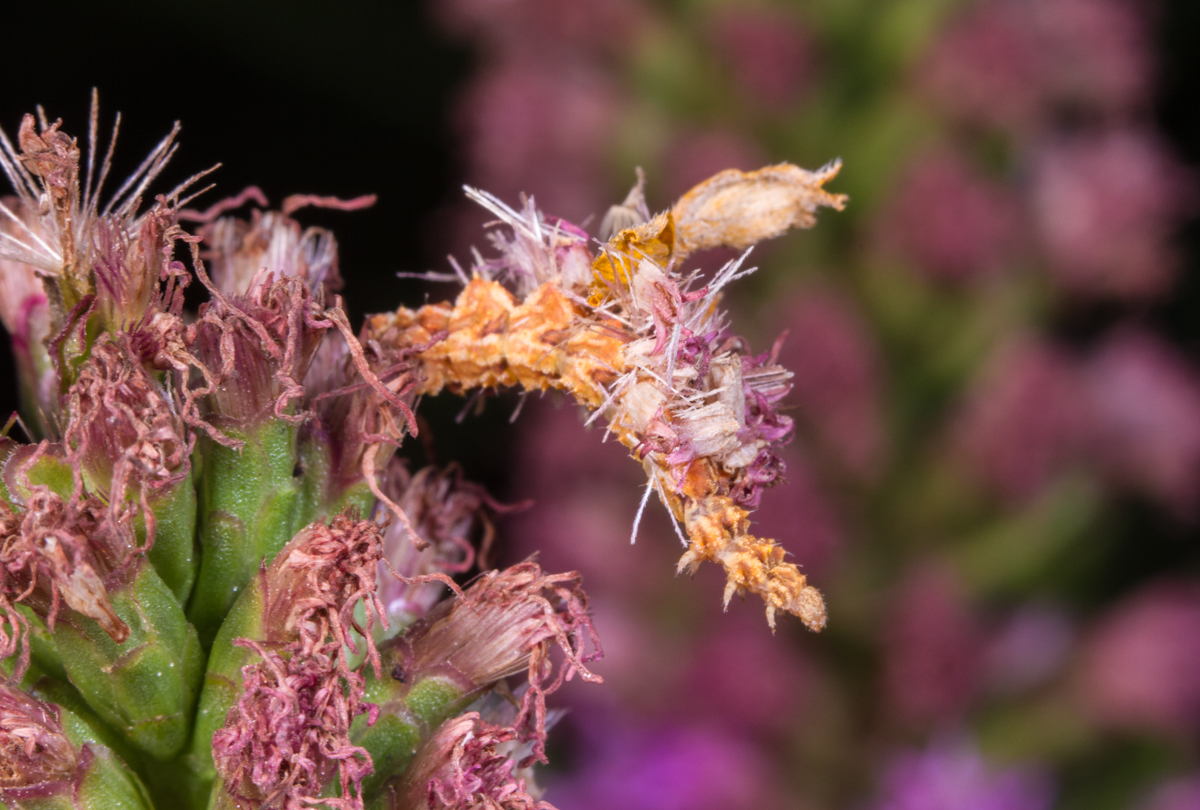
Camouflaged Looper on Blazing Star
He also noted that the fragments are passed through the mouth of the larva before being attached and that a mucilaginous substance (aka “caterpillar spit”) was secreted by the larva onto the fragments. He speculated that this substance seems to play a role in maintaining the freshness in these fragments. The caterpillars also maintain the effectiveness of the covering by replacing withered floral parts with fresh ones.
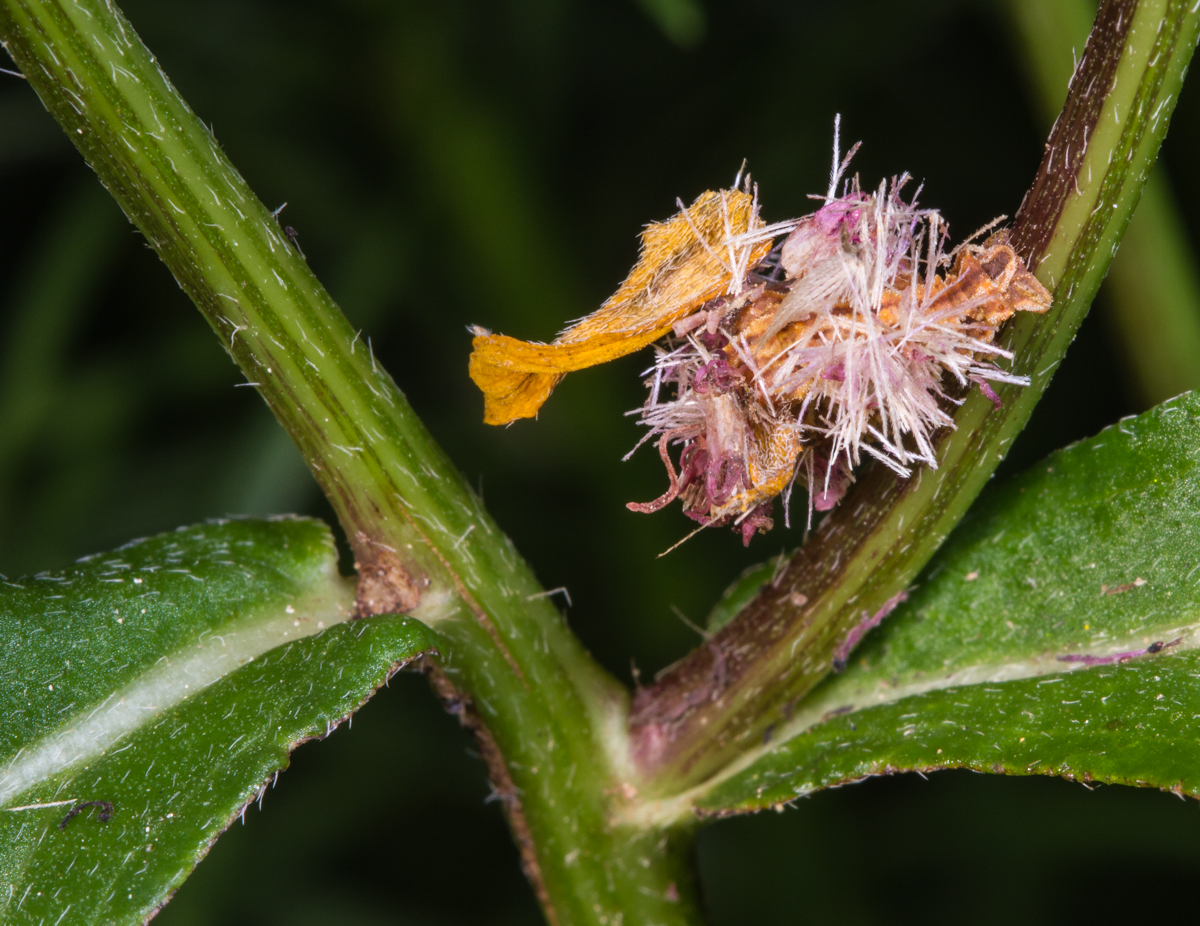
Camouflaged Looper looks like plant debris when not on matching flower
Dr. Treibe hypothesized that this looper’s ability to change disguises allows it to have a much more varied diet than some other caterpillars because it isn’t restricted to eating only those flowers or plant parts that it resembles in appearance. And I noticed that even when it is moving between flowers and is on a stem, leaf or other background, the caterpillar simply looks like some plant debris rather than a potentially tasty meal for any passing bird.
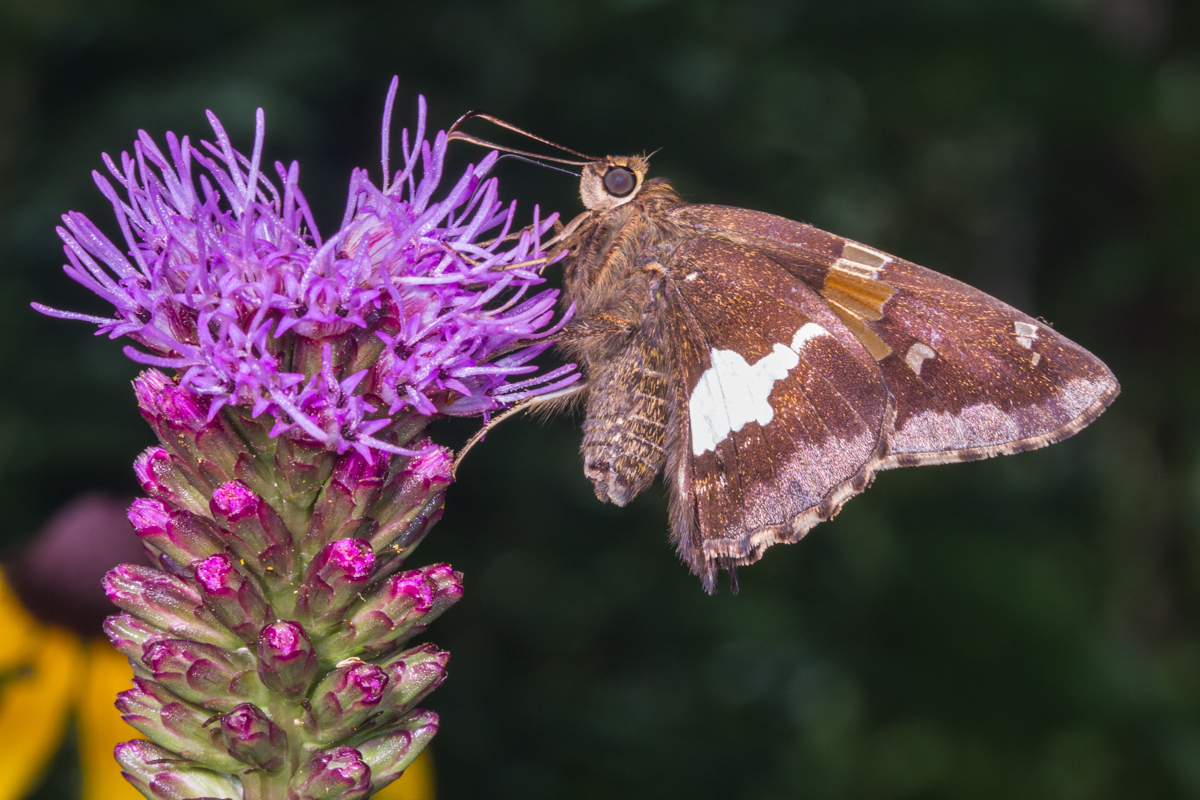
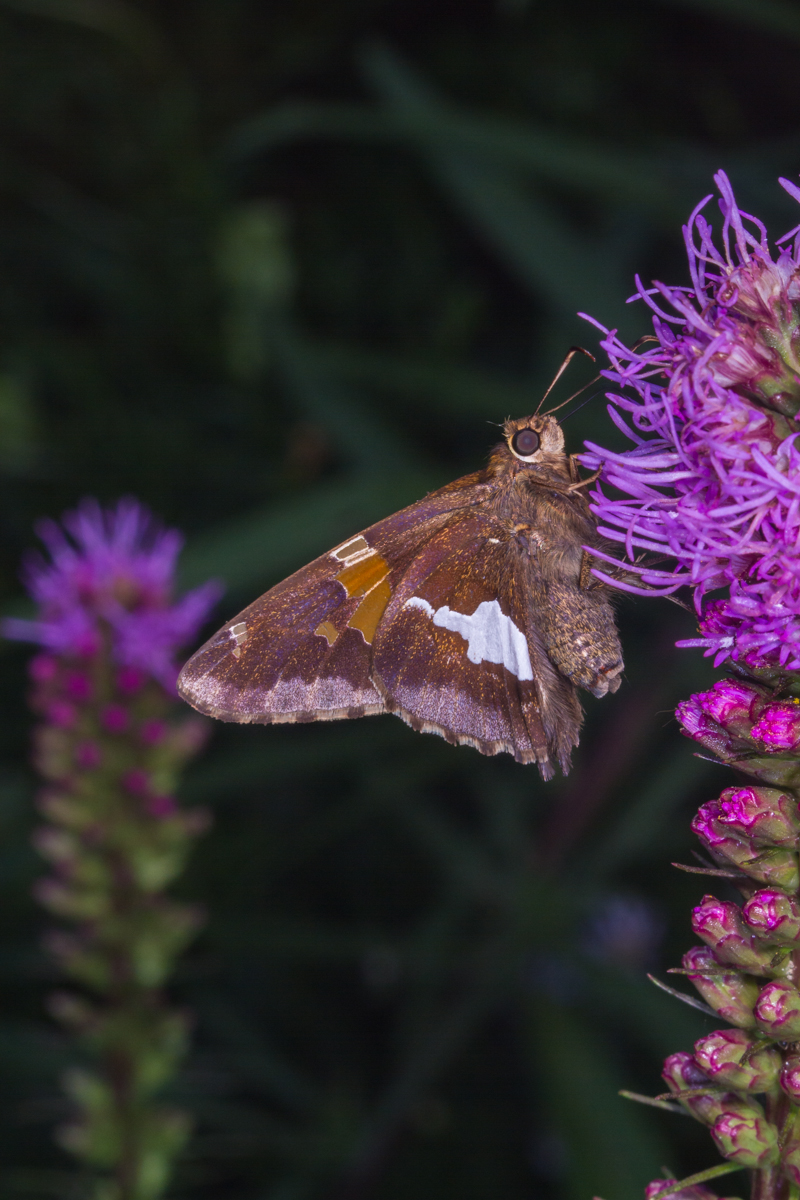
It may seem like an odd title for a post on one of our more common backyard butterflies, but I promise I’ll explain it in a moment. You may have seen this distinctively marked species as it darts about your yard from flower to flower. It is the Silver-spotted Skipper, one of, if not the, largest of our skippers. Skippers are small to medium-sized insects in the family Hesperiidae. They are named for their fast, darting flight. Although more closely related to butterflies than moths, skippers more closely resemble many moth species in appearance by having stout, somewhat “hairy” bodies that are rather dull-colored.
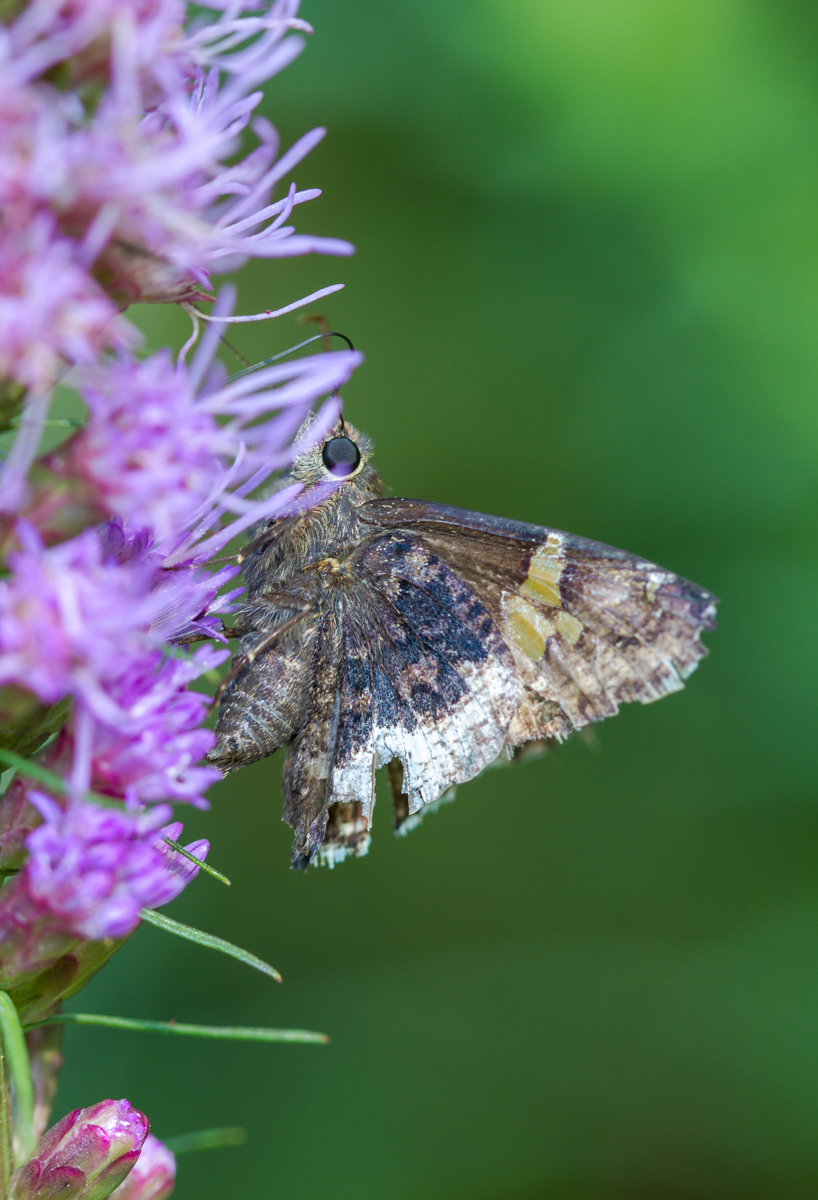
Hoary Edge Skipper with tear in hind wing
For me, skippers have always been the sparrows of the lepidopteran world – those dull-colored, similar-looking small fliers that are difficult to tell apart. One reference put it succinctly – many species of skippers look frustratingly alike. Luckily, this species is a good one to practice your skipper observation skills on as there is really only one other skipper in our area that can be confused with the Silver-spotted Skipper. The Hoary Edge Skipper is slightly smaller and much less common than the Silver-spotted Skipper. A close look shows the diffuse white patch on the Hoary Edge Skipper is further back on the hind wing whereas the Silver-Spotted Skipper has the white more in the center of the hind wing.
Silver-spotted Skipper
The Silver-spotted Skippers are nectaring primarily on the Blazing Star and Bee Balm in the garden. They apparently almost never visit yellow flowers of which I have many species blooming right now.
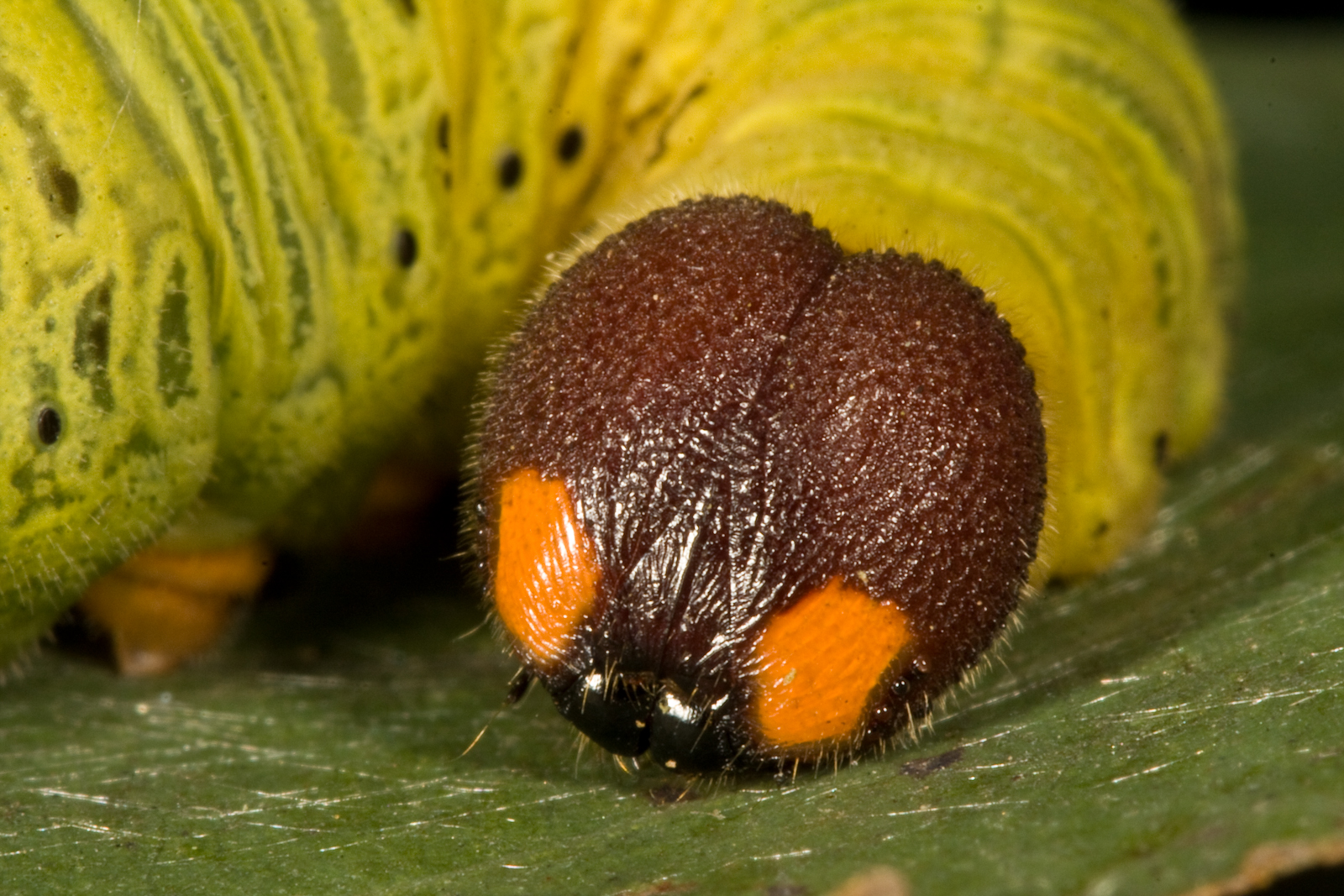
Silver-spotted Skipper larval head capsule showing false eye spots
But, as is often the case for me, it is the caterpillar which I find most interesting. Like most skipper larvae, they are rarely seen because they spend much of the day in folded leaf shelters and come out to feed primarily at night. The caterpillar chews and pulls together leaf fragments with silk to form a shelter. This provides some protection from many predators. When you do find one, the first thing you notice about later instar larvae are the bold orange false eye spots.
Silver-spotted Skipper larva in exposed leaf shelter
But the really amazing thing is the other strategy they employ for avoiding predators (and hence the unusual title of this post). Studies have shown that many potential predators of caterpillars (such as wasps, who feed them to their own larvae) are attracted to the chemical cues in frass (the fancy word for insect poop). So, if you build a little shelter to hide in, you had better fling your frass out the door if you don’t want want hungry wasps to come knocking. Turns out these skipper larvae have a structure with the unpleasant-sounding name of anal comb. They use it to launch their frass pellets an impressive distance away from the shelter. One researcher showed that a 4-cm long Silver-spotted Skipper larva could launch a pellet an incredible 153 cm, or 38 times its body length. I’ve heard of tossing buffalo chips out west, but frass flinging? You just never know what potential new sport you might find right outside in your garden.
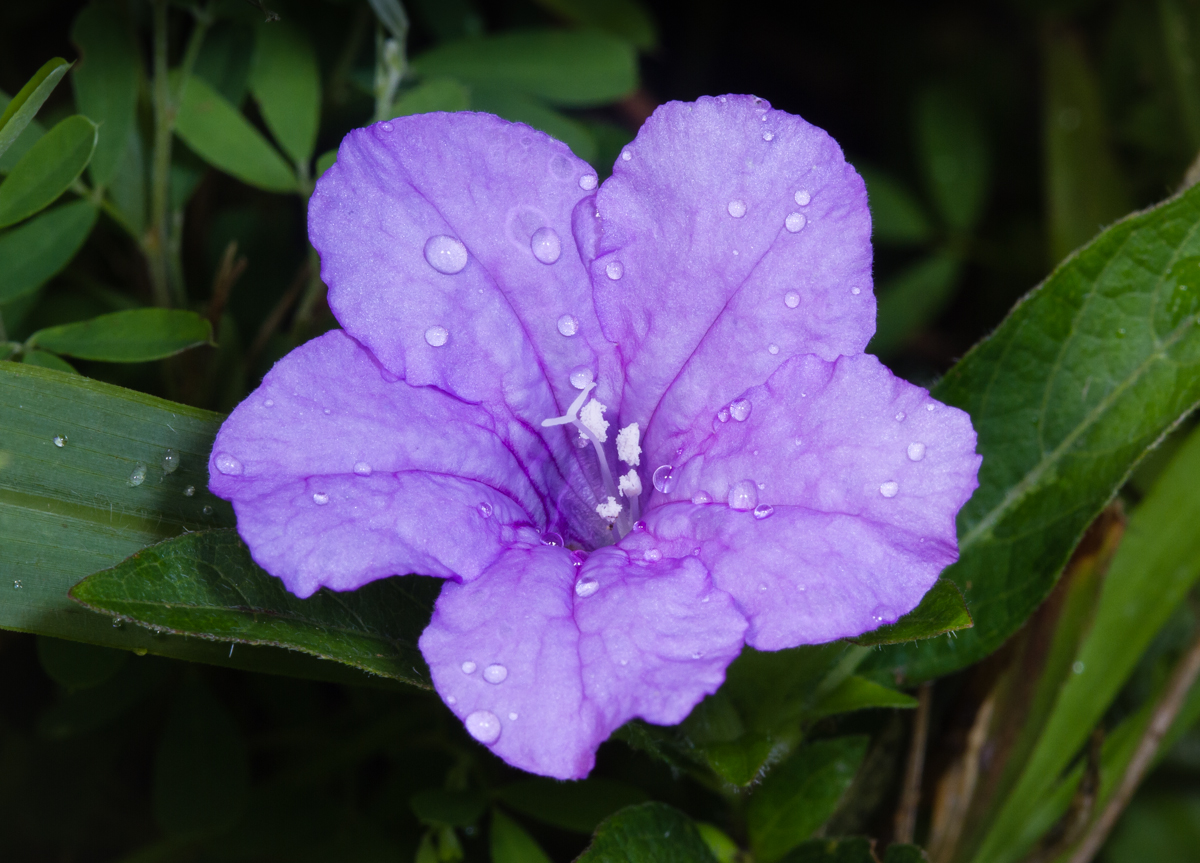
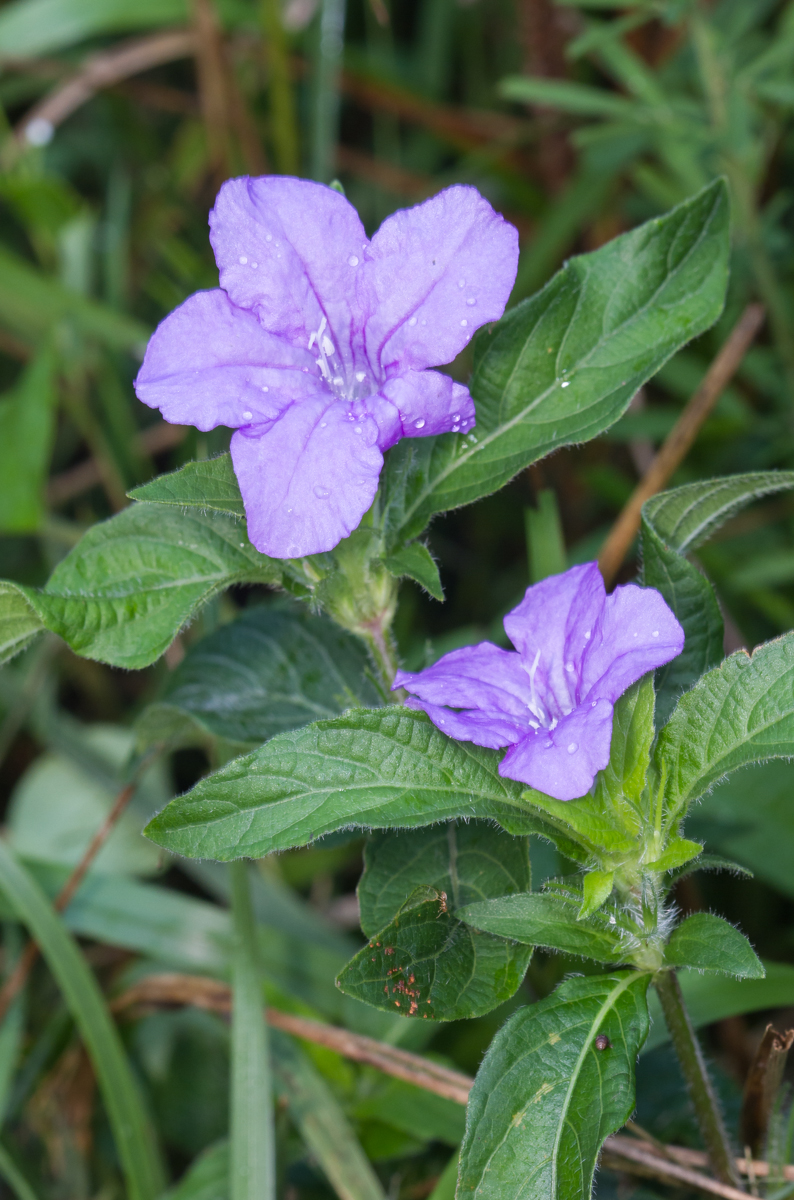
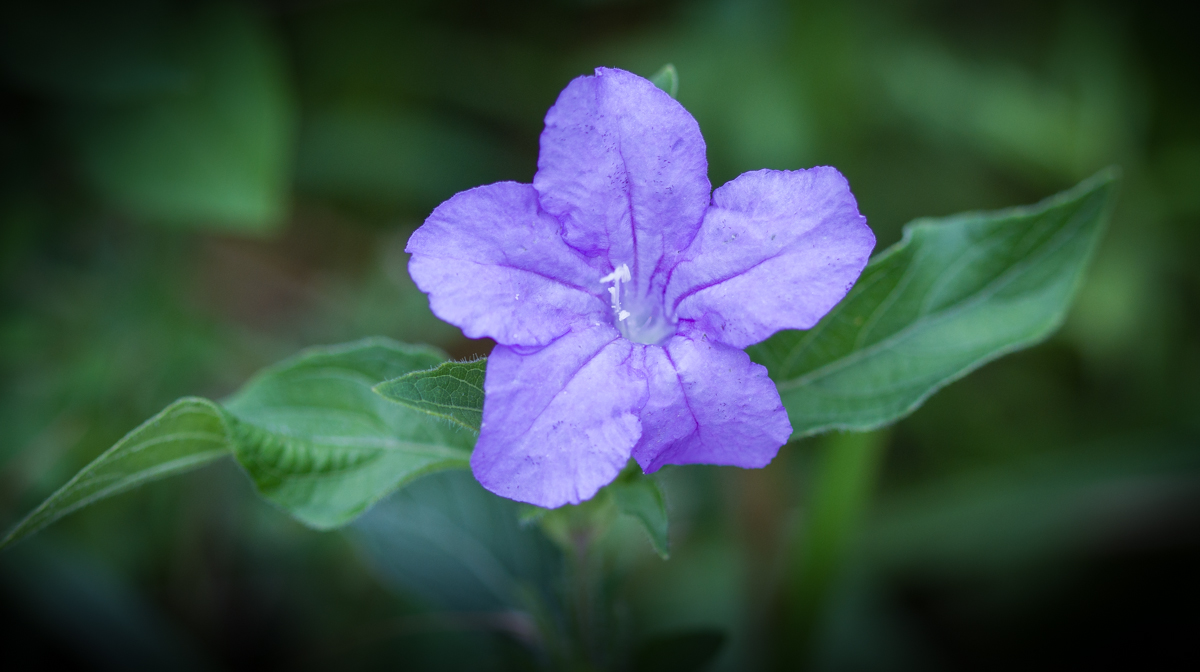
I spotted this beautiful flower last week while mowing a path down the power line. You have to look for it out there because, being only a foot or so in height, it appears to be peeking at you from the tall grasses. But it is actually quite common. Carolina Wild Petunia, Ruellia caroliniensis, is a southeastern U.S. native wildflower that resembles the familiar ornamental petunias, but is not related. It grows well in sun to partial shade and tolerates a wide range of soil conditions, although does best in well drained sites. I found it scattered out in the open sun under the power line and under the shade of trees along the edge.
Wild Petunia
The one inch wide flowers are lavender or blue in color and have a narrow tube connecting them to the stem. They often occur in pairs and are short-lived, blooming only a day or so each. But the plant has a long blooming period from late spring to early fall. They apparently are good nectar sources for butterflies and are reported as a host plant for the larvae of Buckeye butterflies, a common species in this area.
The seeds are produced all summer long in small capsules that dry and then explode, shooting the seeds away from the parent plant. After reading about this shy beauty, I plan to gather a few seed capsules and spread them closer to the house to see if I can get this hardy wildflower growing where I can enjoy it every day next summer.
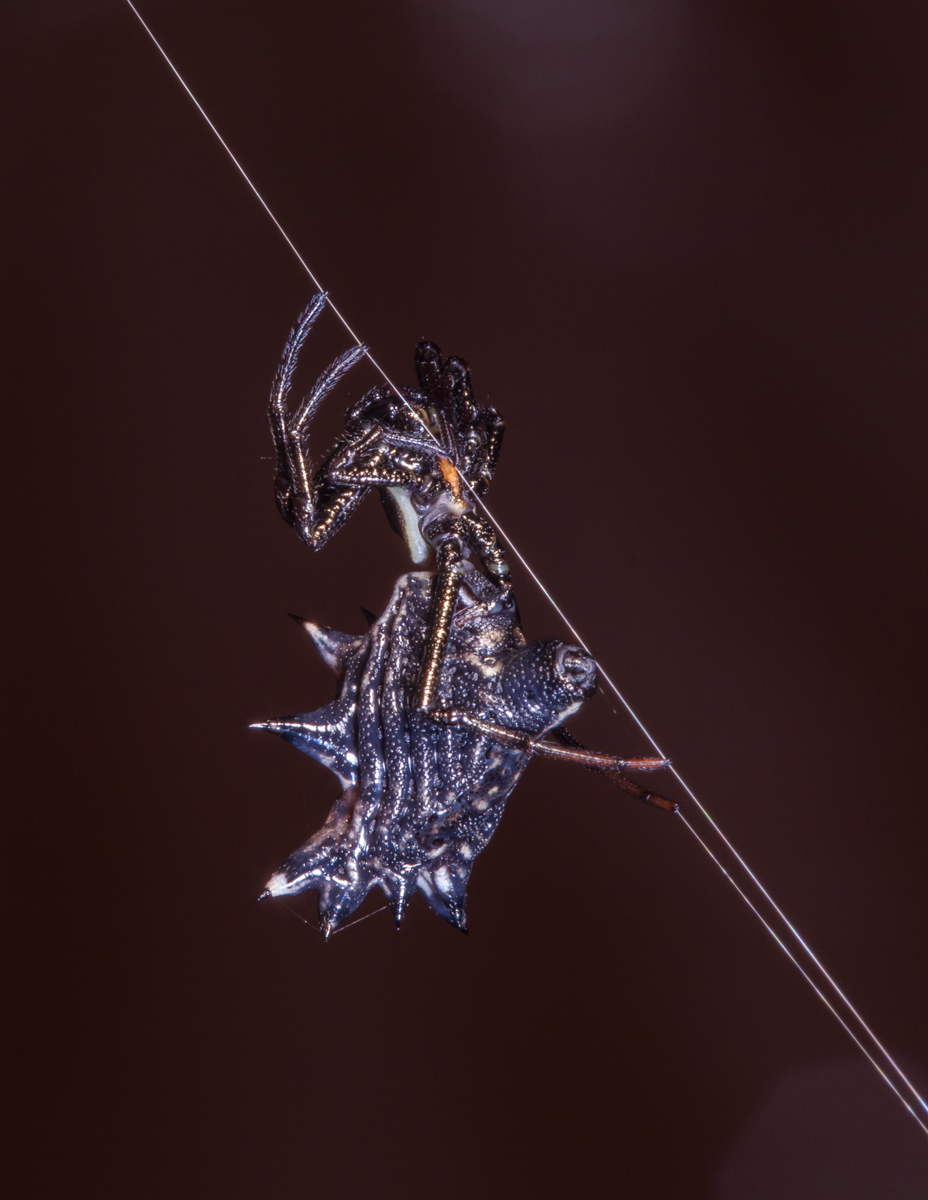
Yesterday while walking along a path in the woods, I encountered a spider web at about head height along the trail. I suppose it is one of the “hazards” of summer woods-walking around here. But I always enjoy seeing who the maker is and what they have had for dinner. This one was the tightly woven web of one of the most common, and unusual, spiders in this area – the Spined Micrathena. Females of these oddly-shaped spiders are adorned with stiff spines along the abdomen, presumably as protection against predators. Males are much smaller and lack the spines. Webs are typically 3 to 7 feet off the ground and strung between small trees and shrubs, often along pathways, perfect for ensnaring small flying insects or distracted woods-walkers. Luckily, these beautiful creatures are harmless, unless you are the size of a leafhopper.
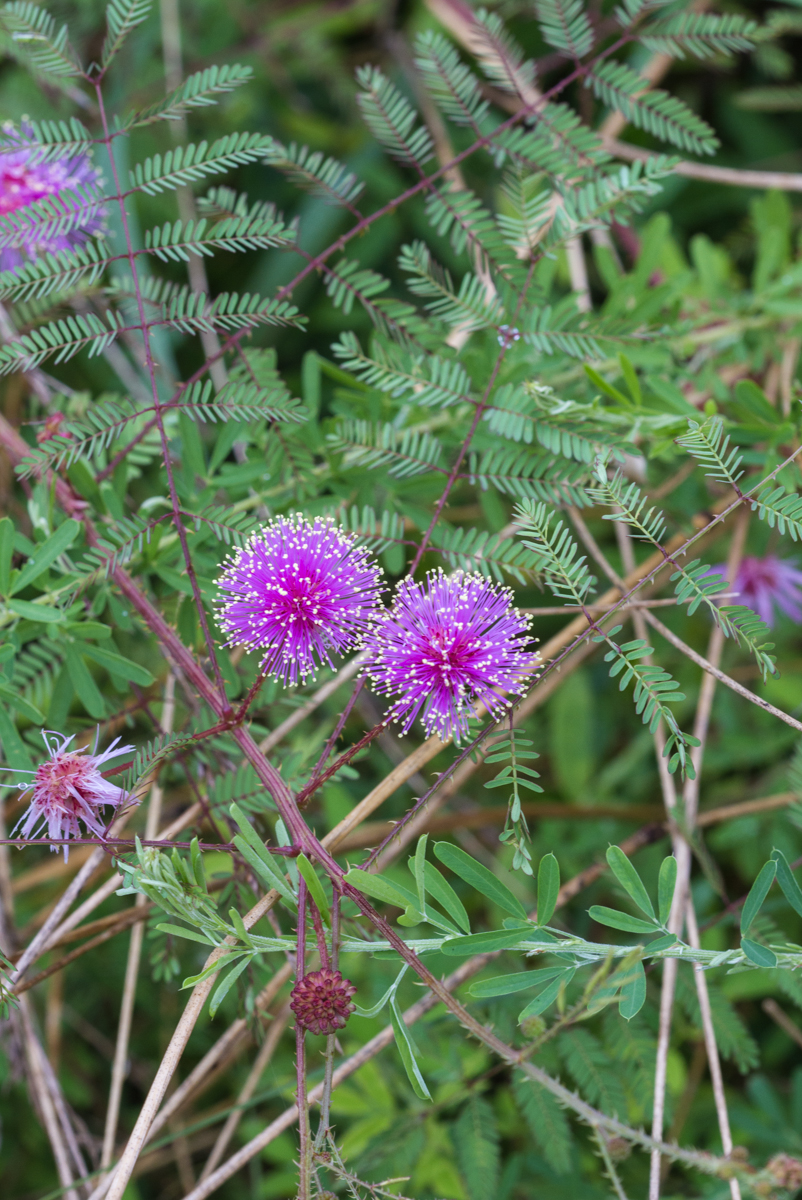
While mowing a path through the meadow this week I noticed a bright pinkish-purple flower in the grasses. I remember seeing the unusual flowers of Eastern Sensitive Briar a few years ago in the Sandhills habitat at the North Carolina Botanical Garden in Chapel Hill. And now I am thrilled to discover it here, growing in several patches under the power line. This native species, Mimosa microphylla, grows throughout the southeast in sandy or gravelly soil in open woods, fields, and disturbed habitats like roadsides and power lines. And yes, this is related to the non-native invasive tree we call Mimosa, and both are members of the pea family.
Sensitive Briar flowers and leaves
Unlike its invasive tree cousin, Sensitive Briar is a semi-woody plant that spreads in a vine-like manner among other vegetation. Stems are 3 to 4 feet long. The delicate-looking leaves are bipinnately compound, meaning that each leaf is divided into leaflets, which further are divided into leaflets, giving the plant a somewhat airy or lacy appearance.
Sensitive Briar flowers
Initially, the flower is the most noticeable part of the plant. The round flower head is pinkish to purplish and about the diameter of a nickel. The flowers consist of clusters of individual tube-shaped flowers. Long, brightly-colored stamens tipped with yellow pollen protrude from these flowers, giving them a puff-ball appearance. Unopened flowers look like an unripe blackberry.
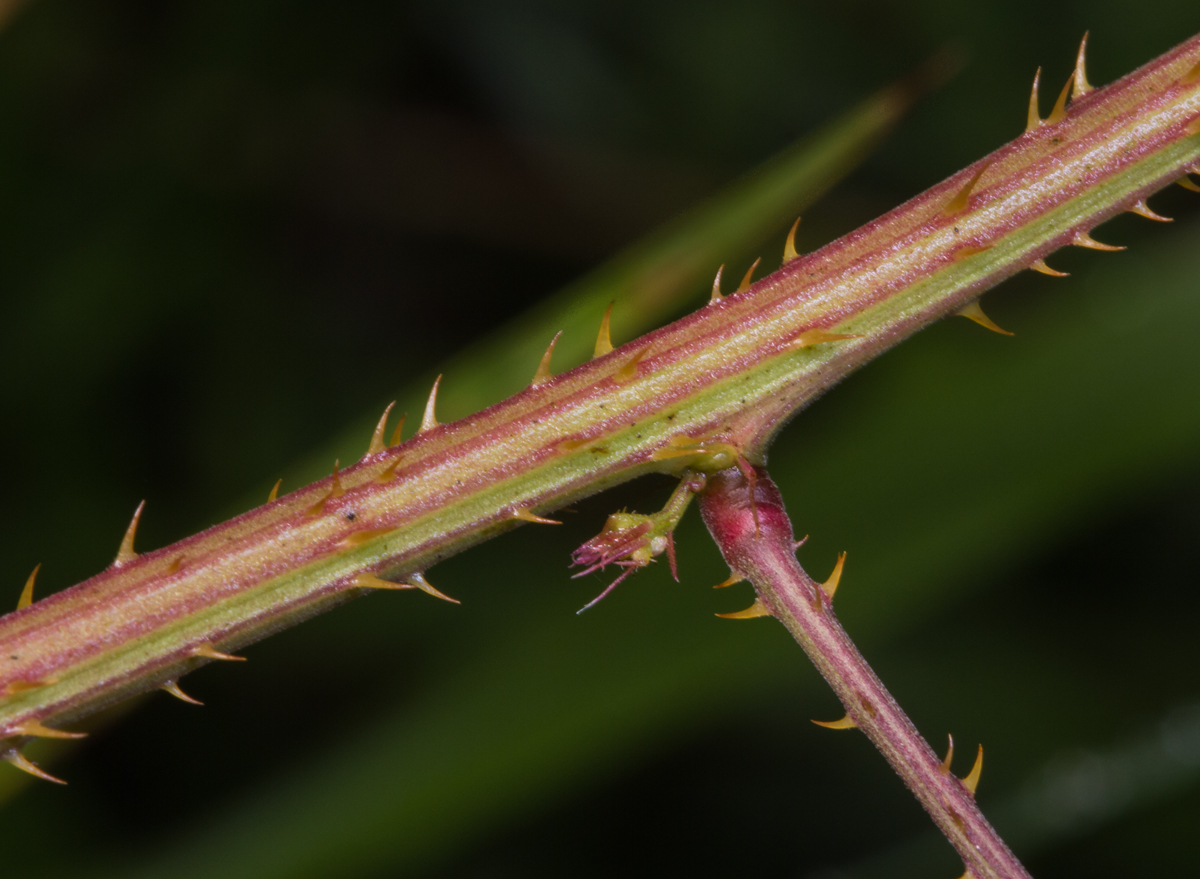
Sensitive Briar stem
Another common name for the plant is “Cat’s Claw”. A close look at the re-curved spines that cover the stems, leaf petioles, and even the seed pods, and you can see how it got that name. These tiny thorns may also play a role in how this plant got its other common name, Sensitive Briar.
The reason for this plants’ name is because the leaves curl closed when touched. The left photo above shows the typical leaf position – the right shows that same leaf after it has been lightly touched. This is a prime example of what is called rapid plant movement. This movement of the leaf is caused by the rapid movement of water in the cells of the leaf. When touched, the affected leaflets quickly lose water pressure (osmotic cell pressure or turgor) and the leaflets collapse or seemingly wilt. So why would the plant bother to do this? One theory relates to the re-curved spines. As soon as a plant-eater trying to make a meal of the Sensitive Briar touches it, the leaflet collapses out of the way, exposing the sharp prickles to the would-be diner, making the plant much less appealing. The closure takes only a second or so. Collapsed leaflets will regain their position within a few minutes if left alone.
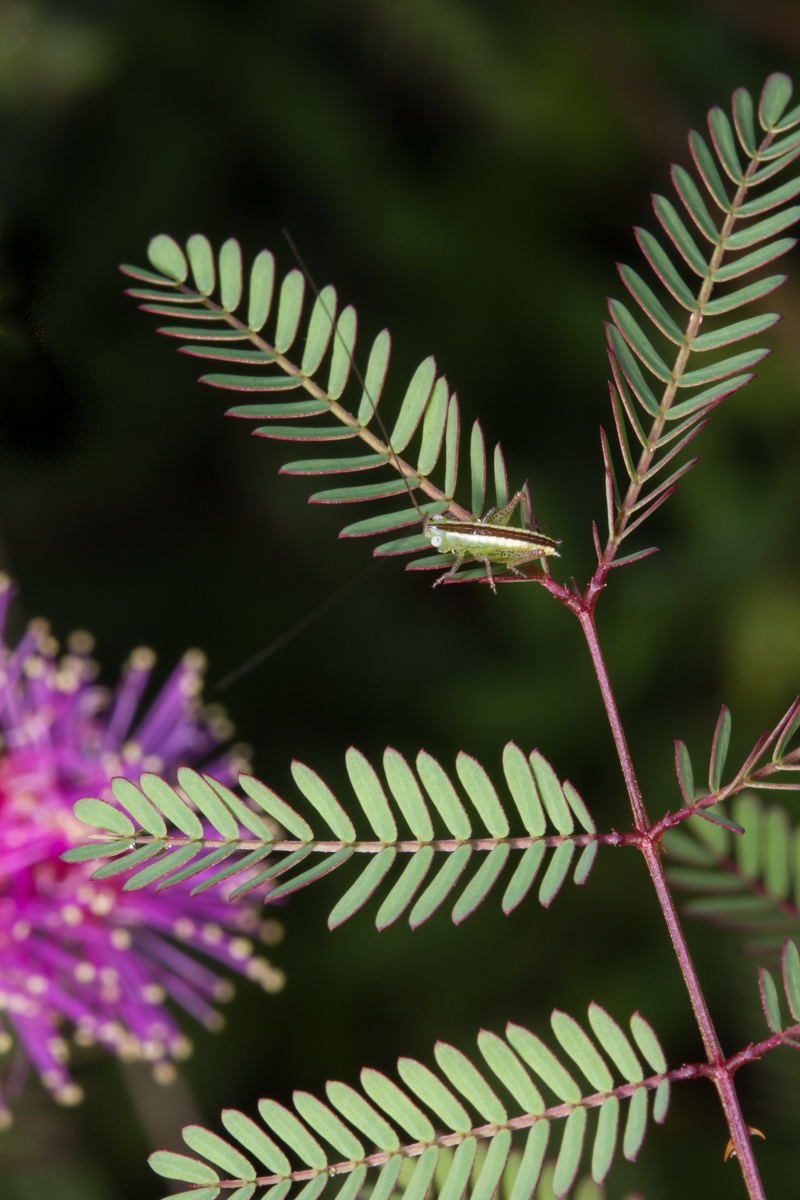
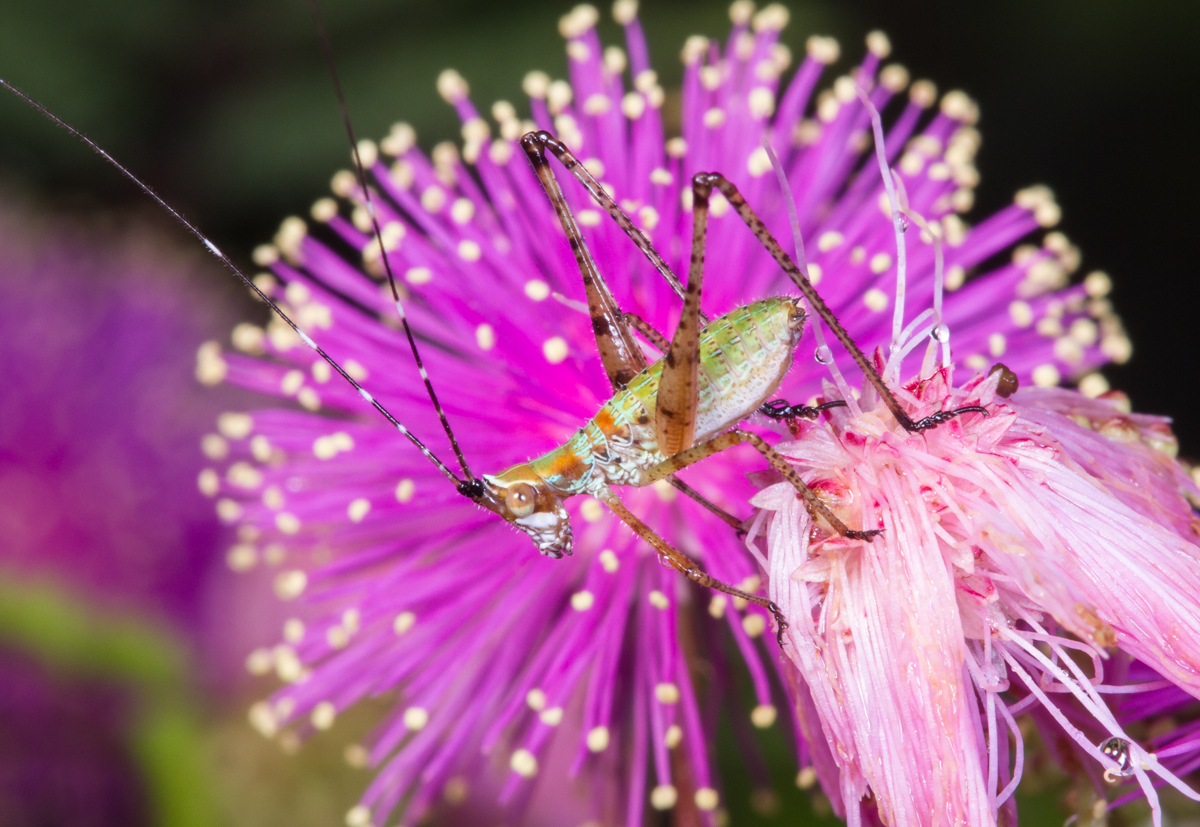
Bush Katydid nymph on Sensitive Briar
While I was photographing the plant, I noticed several insects on the flowers – a hover fly, a tiny grasshopper, and a brightly colored nymph with black and white bands on its antennae. A quick search on Bug Guide ( a great web site for insect identification) leads me to believe this is the nymph of a Bush Katydid. The unusual flowers of this plant made a perfect back drop for this tiny bug – both look like they are dressed for a festive occasion.
Spending some time with this unusual plant and the associated fauna made for a pleasant hour on an otherwise hot and humid morning. I’ll be checking the plant in a few weeks for the seed pods in the hopes of getting some Eastern Sensitive Briar started near my garden.
Okay, monster is a bit too strong a term for this beauty, until you have been bitten by one, that is. Luckily, most horseflies are merely bothersome to me relative to the many other types of flying biting things that attack us here in the southeast – mosquitoes and deer flies being much more aggravating in my opinion. The reason being that most horseflies are both noisy fliers and are relatively slow to react, so you can hear them coming and swat them. They also tend to come at you in smaller numbers than the squadrons of deer flies and swarms of mosquitoes that occasionally partake of my blood. This is all true unless you happen to have both hands occupied when they attack. Such was the case last week when I was working to replace the worn out screening on the porch. Two hands and my mind occupied with holding and stapling equals horsefly advantage. That moment when the painful bite hits you is when they become a monster.
Horsefly mouth-parts – the serrated edges are along the long center column
Male horseflies are nectar feeders and are incapable of biting, as they lack the modifications of the mouth-parts found in females. But a female horsefly has a Swiss Army knife of adaptations for slicing into your flesh. One writer said the mouth-parts of the female are modified into the equivalent of miniature scalpels or steak knives ideal for cutting the skin. That pretty much sums up the strategy – rip open the flesh and then lap up the blood of the victim. This is why a horsefly bite is so much more painful than that of a mosquito – the mouth-parts are for tearing and lapping, not piercing.
Horsefly showing mouth-parts
As in many other blood-sucking insects, the female’s saliva contains anticoagulants which help the victim’s blood flow so she can secure enough nourishment for egg laying. In spite of the impressive “jaws” of horseflies, what I notice about this particular species (I think this is probably Tabanus fuvulus) are its eyes – incredibly complex and beautiful green eyes.
Green eyes of Horsefly
While trying to find some information on the unusual stripes in their eyes, I came across some interesting research on the vision of horseflies. In a paper published in March 2012 in the Journal of Experimental Biology, researchers investigating the evolution of the striped patterns of Zebras made a fascinating discovery. Horseflies use polarized light hitting water as a guide to places to mate and lay eggs. They also use such light hitting dark mammal hides as a way to find a blood meal. By setting up models of varying colors and stripe patterns, the researchers demonstrated that a zebra-striped horse model attracts far fewer horseflies than either black, brown, grey or white equivalents. Because the coat reflects light in alternately polarized and non-polarized patterns, the Zebra “is more difficult to single out relative to the surroundings.” It is, in effect, camouflaged to flies as well as to lions.
I know what I am wearing the next time I screen a porch.
During a brief respite from one of the downpours this past week I went out to the garden to see what was out and about. I noticed some movement on a flower stem and a close look revealed this well-camouflaged insect, a planthopper. Planthoppers appear to be less common than the generally smaller leafhoppers in my garden and meadow. And though they can hop to escape, they often walk with a slight waddle along their plant stem or remain motionless to hide. I coaxed this specimen onto my finger and brought it inside for some pictures.
Green Cone-headed Planthopper
This particular species appears to be the Green Cone-headed Planthopper, Acanalonia conica. They feed on a variety of plants by piercing them with their mouth-parts and ingesting the plant nutrients. Females lay eggs in the stems of various plants in late summer.
Green Cone-headed Planthopper
It is amazing how well the intricate wing patterns resemble the venation in a leaf. By setting the camera on a tripod I was able to move the lights around to better highlight the textures. This little guy was a cooperative subject and stayed on the stem all afternoon, probably thankful to be out of the monsoon that was happening out in the garden. I returned it at days end to continue its plant hopping ways.
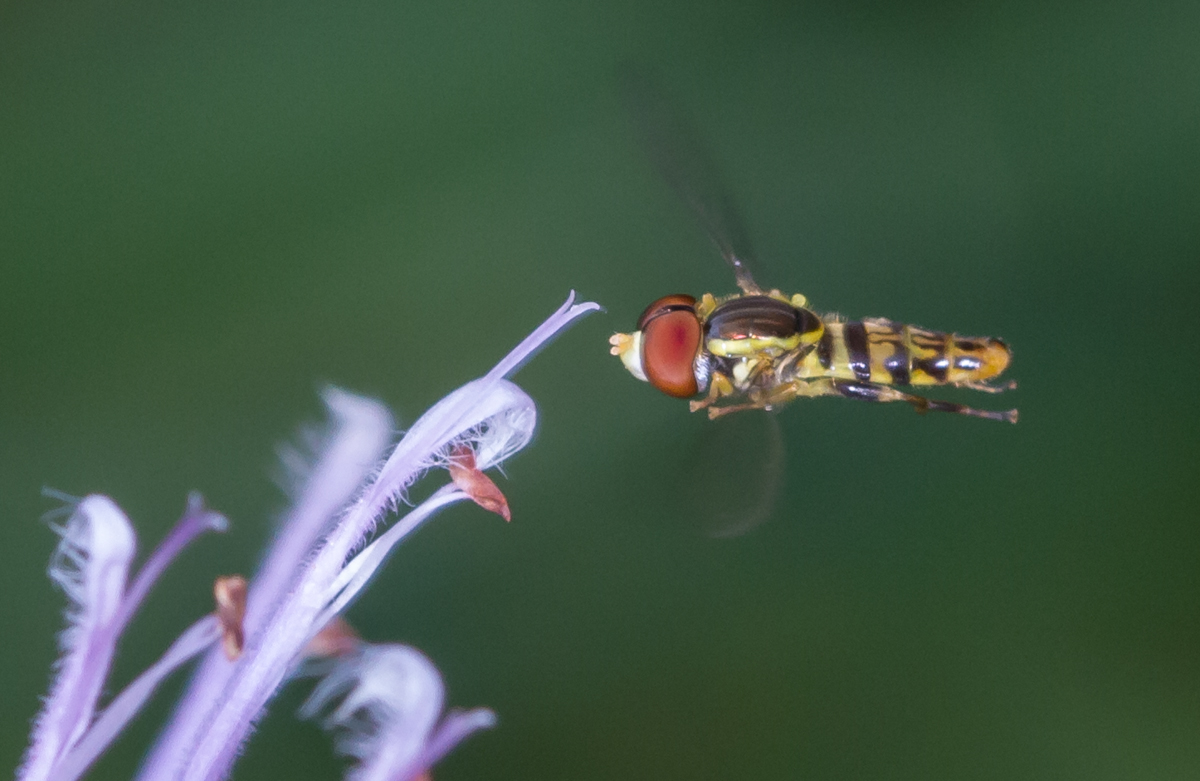
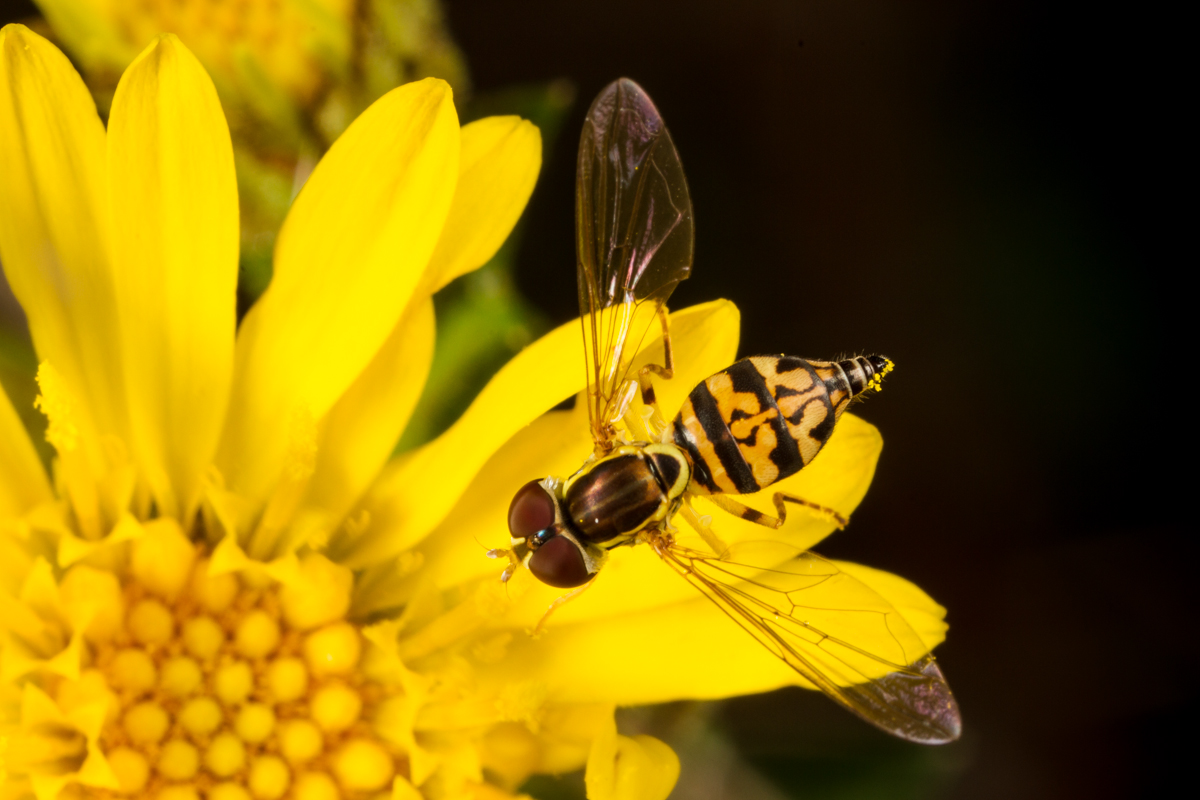
They look like tiny bees or wasps zipping around the garden flowers, but they are Flower Flies. They are also known as Hover Flies for their ability to hover and even fly backwards, a feat that few other insects can match. Their resemblance to insects that sting most likely affords them some protection as they go about their business…and their business is quite useful in the garden and elsewhere.
Flower Fly showing halteres
By the way, you can distinguish these flies from their look-alike bees by their wings – Flower Flies have two wings (as do all flies) and bees have four. If you look closely, you can even see the halteres, the highly modified hind wings of flies (consisting of a stalk and knob at the end) which vibrate up and down in time with the wings and act as gyroscopes in flight.
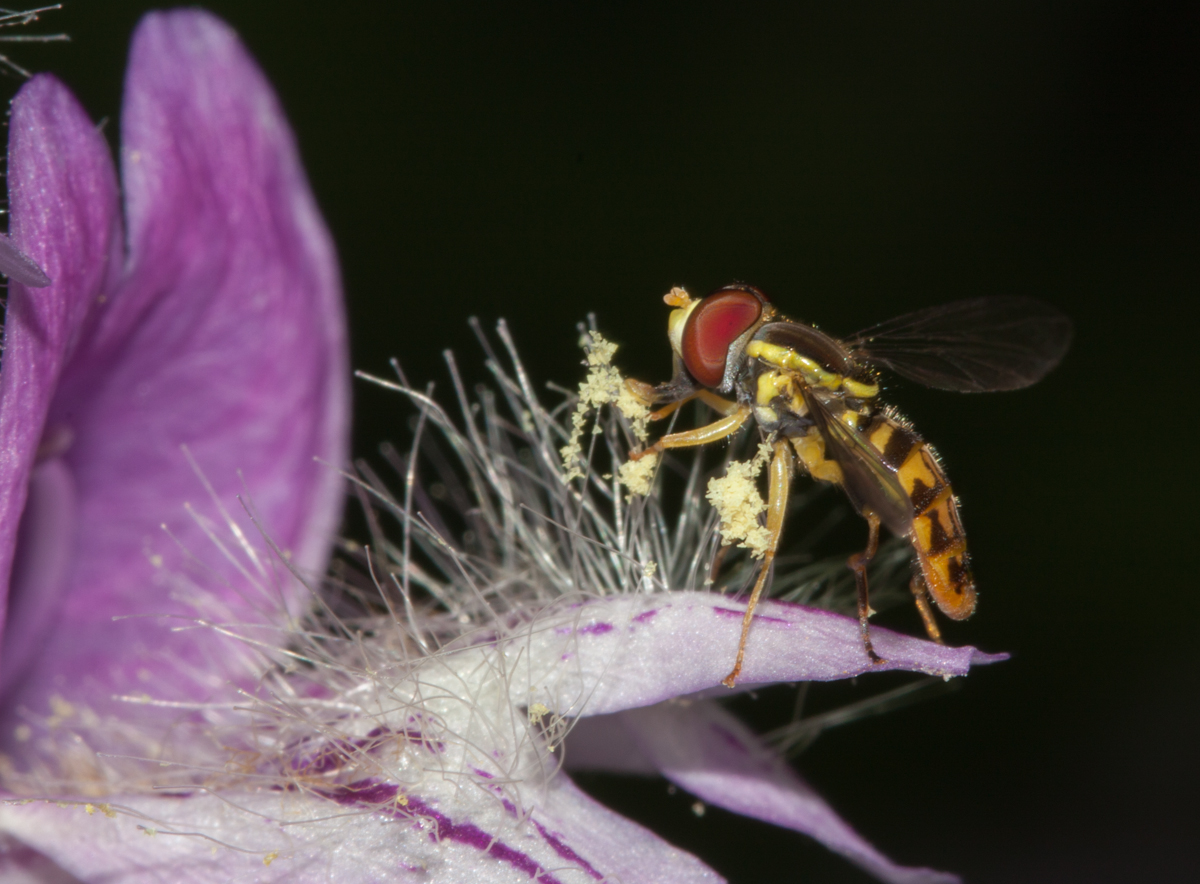
Flower Fly on Beardtongue flower
As a group, Flower Flies are considered important pollinators for a variety of flowers, both in our gardens and in the natural landscapes around us.
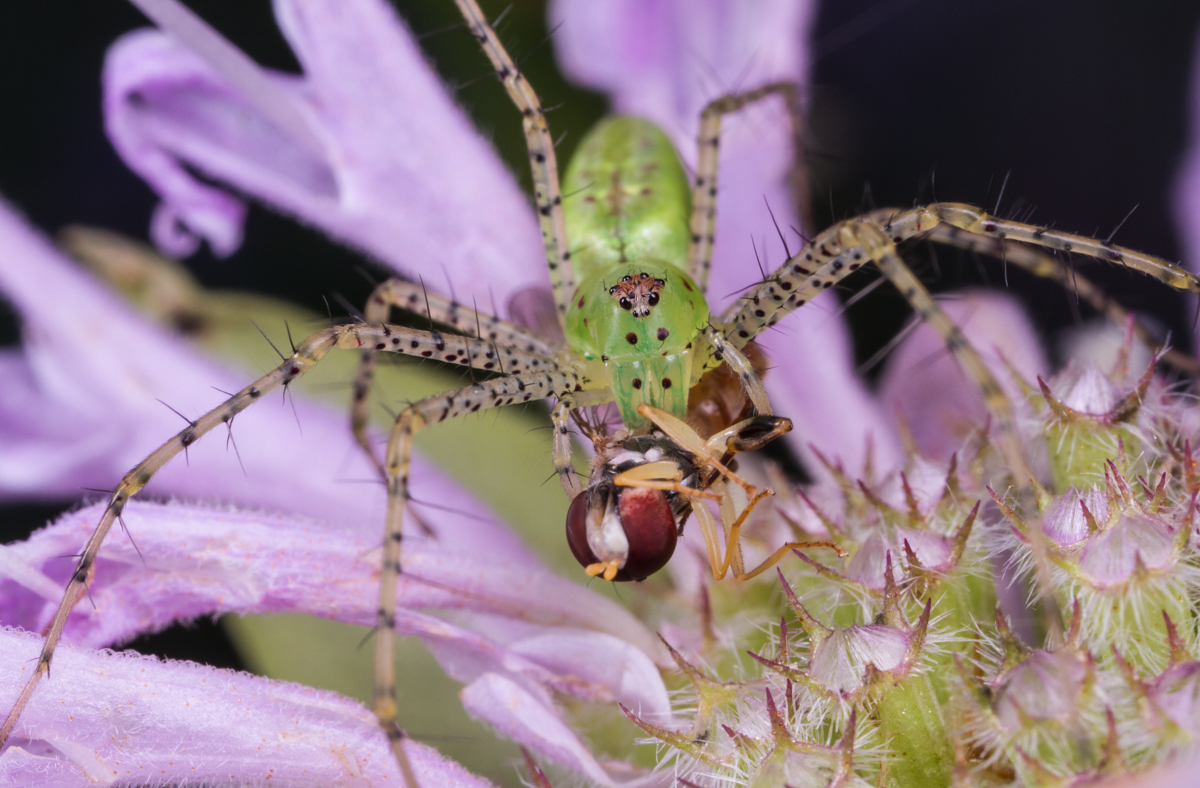
Immature Green Lynx Spider with Flower Fly prey
Adults feed on nectar from a variety of flowers and often fall victim to sit-and-wait predators like Ambush Bugs, Crab Spiders, and other spiders. Earlier this week, in a rare moment of sunshine, the garden was alive with insects visiting the various wildflowers. I found three immature Green Lynx Spiders lurking in the blossoms – two had captured Flower Flies and one a small bee.
Flower Fly looking for nectar
The larvae of many species of Flower Fly are major predators of aphids and thus perform valuable pest control services on many species of our ornamental and crop plants. Pollination services, pest control, superb flying ability, mimicry, beauty, variety…the next time you are out among your wildflowers take a few moments to look for, and appreciate, these tiny beneficial insect hovercraft.














 Roads End Naturalist