I don’t feed the birds because they need me; I feed the birds because I need them.
~Kathi Hutton
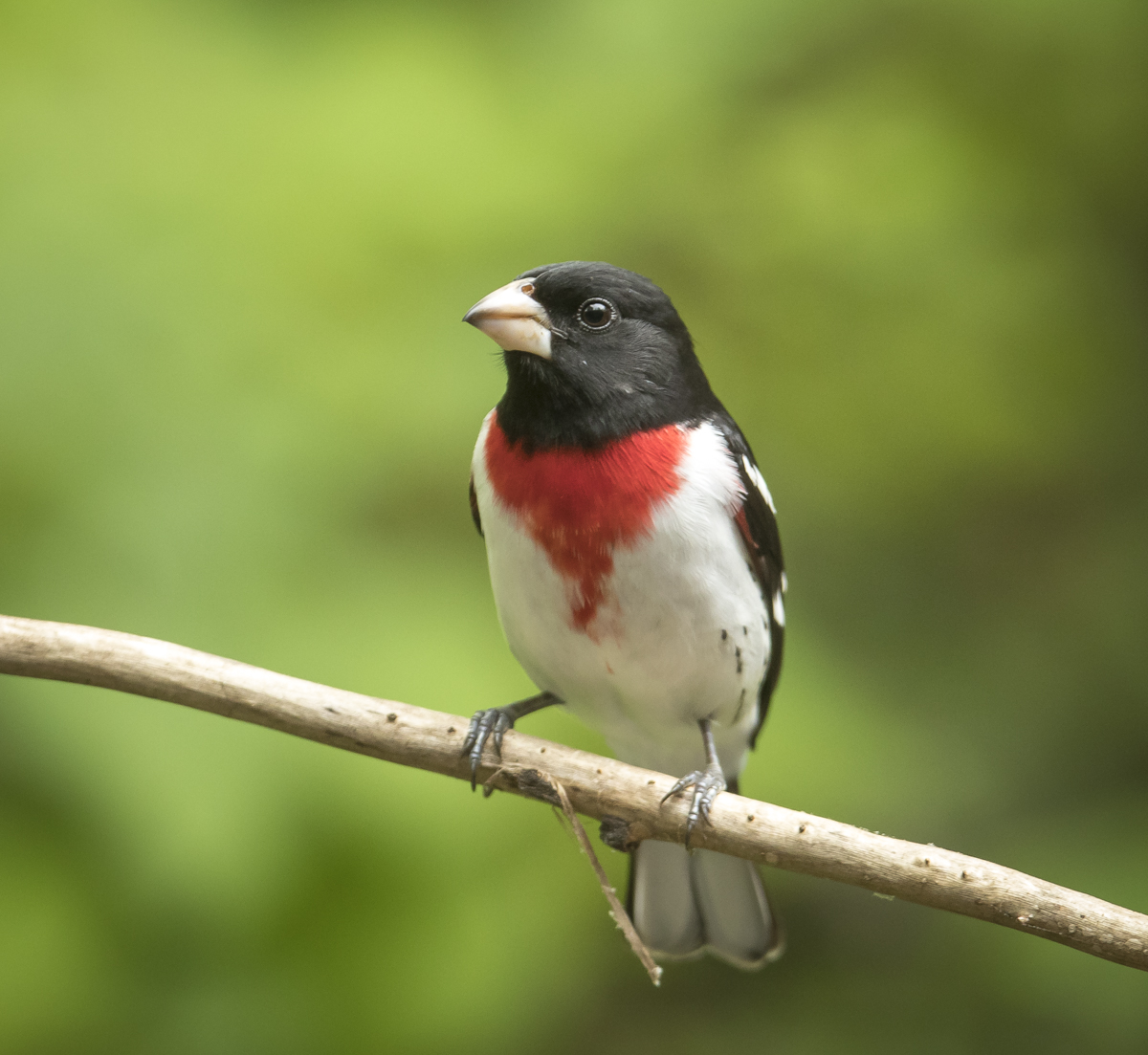
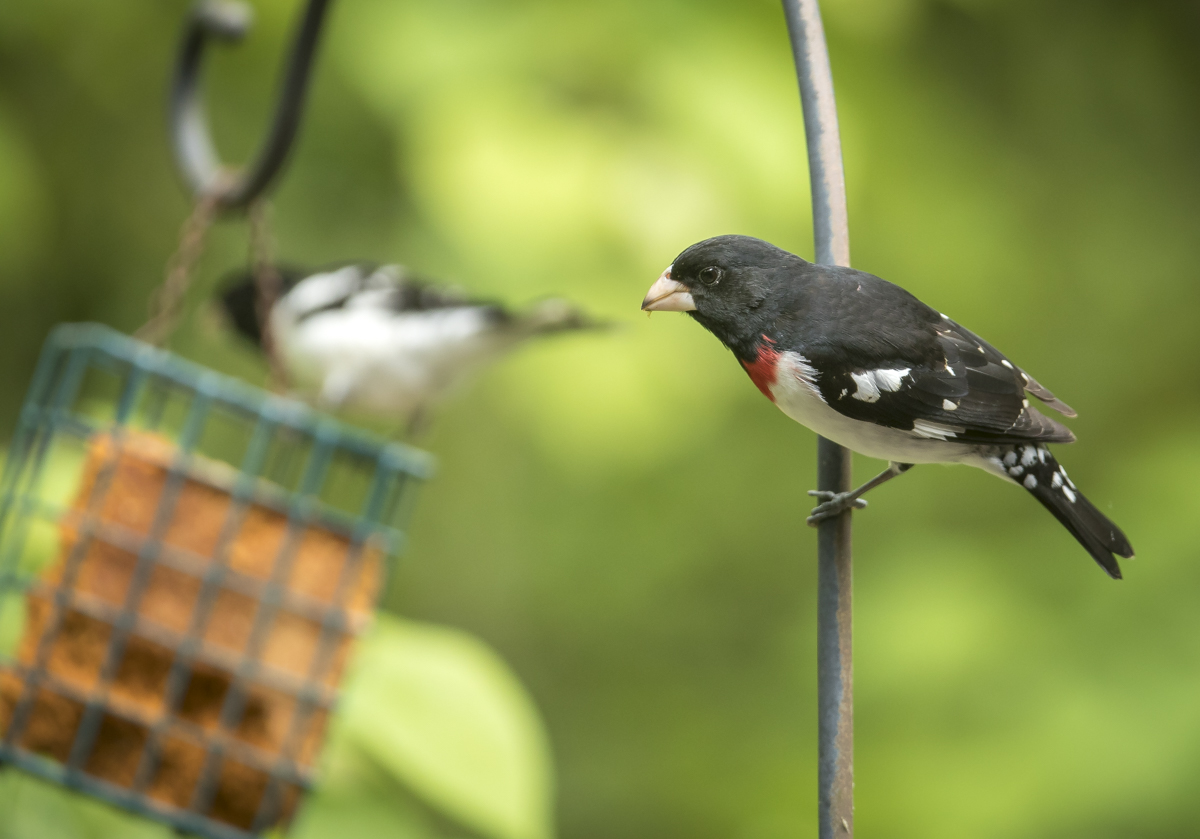
Sunday was a gray, chilly day here in the woods and the birds were quite active at the feeders. One group of birds, in particular, had my attention, the gorgeous Rose-breasted Grosbeaks. The Rose-breasted Grosbeaks have been back about two weeks. They make a stop of a few weeks every spring on their way to their breeding grounds further north (and in our mountains), and then again in the fall as they head to their wintering grounds in Central and South America. I decided to set up the camera and tripod in our bedroom, open the door to the deck, and record who came to visit the suet feeder mounted on the deck rail. I did something similar a few years back and shared images in another post. This time, I sat for a little over an hour, and tried to take pictures of everything that came in to the feeder. Enjoy the view from our deck…
Male Rose-breasted Grosbeak (click photos to enlarge)
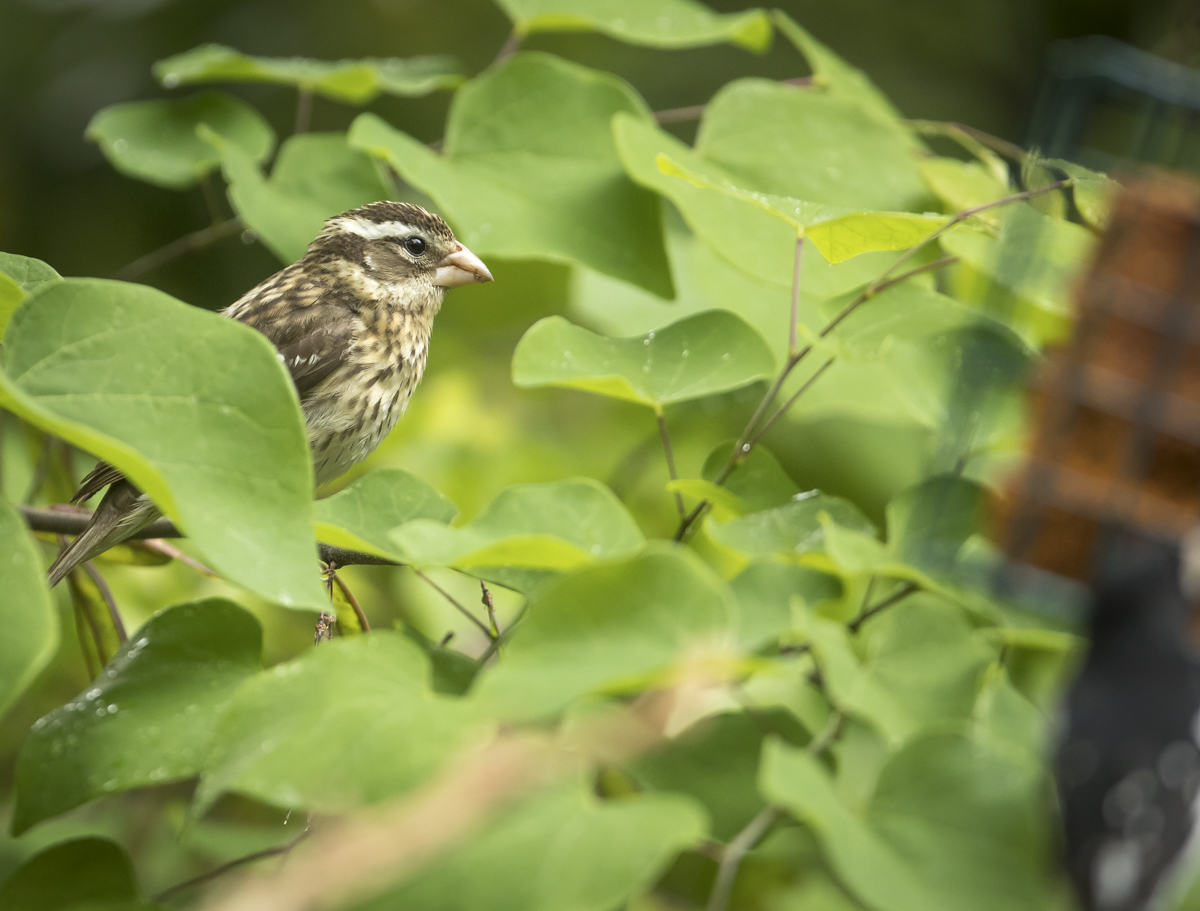
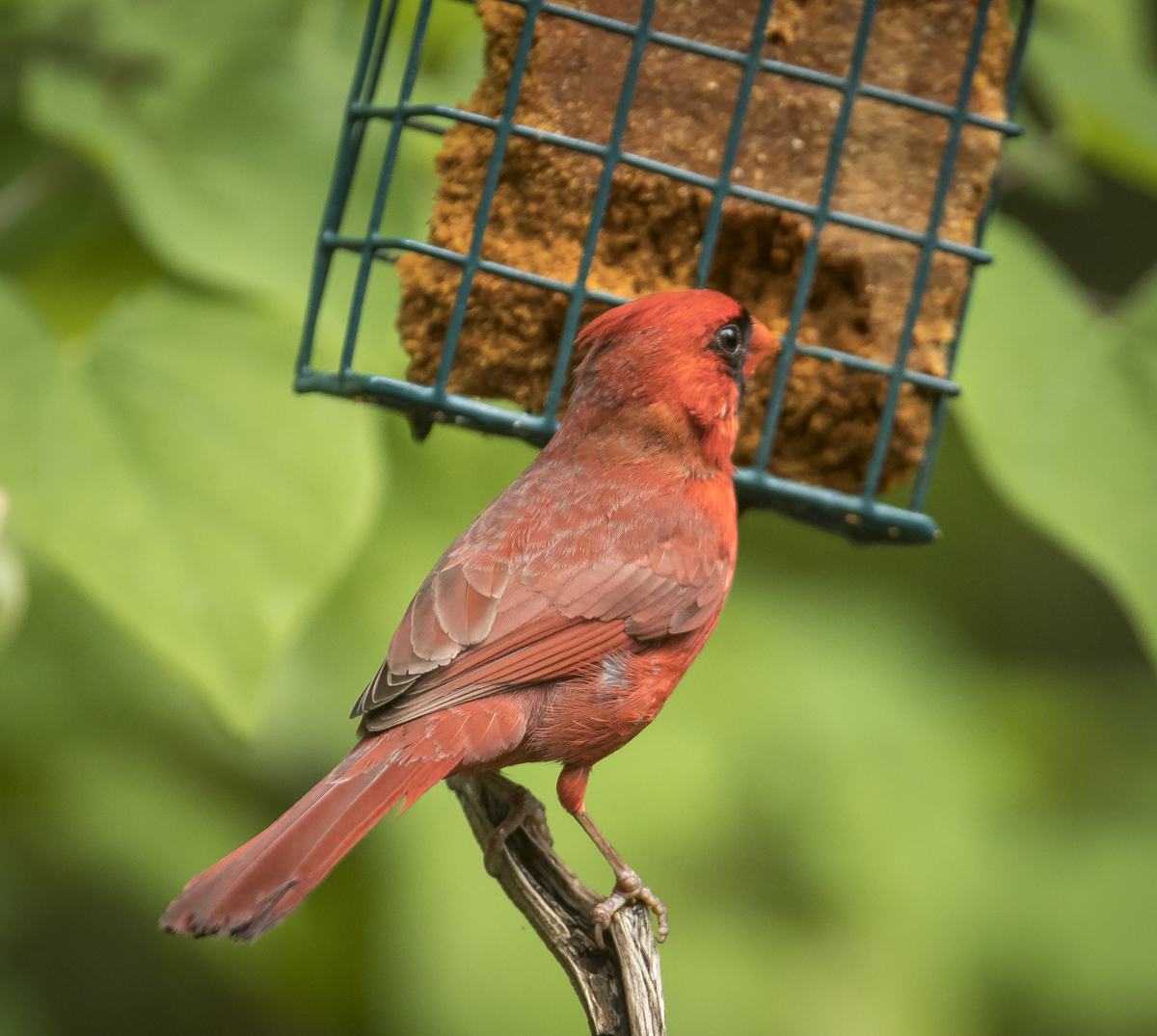
It started with a single male and we are now up to our usual number of 9 grosbeaks visiting the feeders – 7 males and 2 females. They tend to come in all at once and spread out between our two feeding stations. Their favorite treat seems to be the sunflower seeds at the platform feeders (they have trouble balancing on the tube feeder). But they are also frequent the suet feeders as well, especially the one on the deck which has a branch underneath where birds can perch and reach up to the suet. Because of our superabundance of squirrels, we use only hot pepper suet, which is a deterrent to mammals, but not birds.
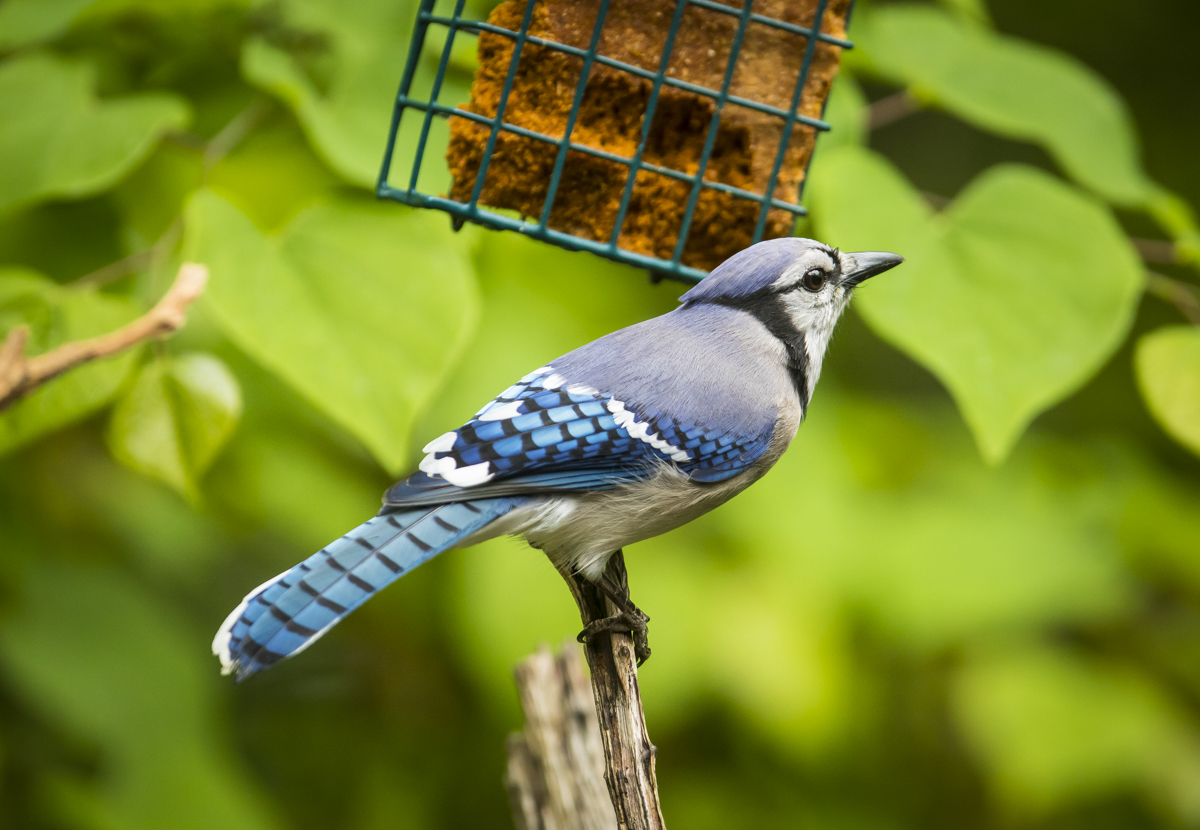
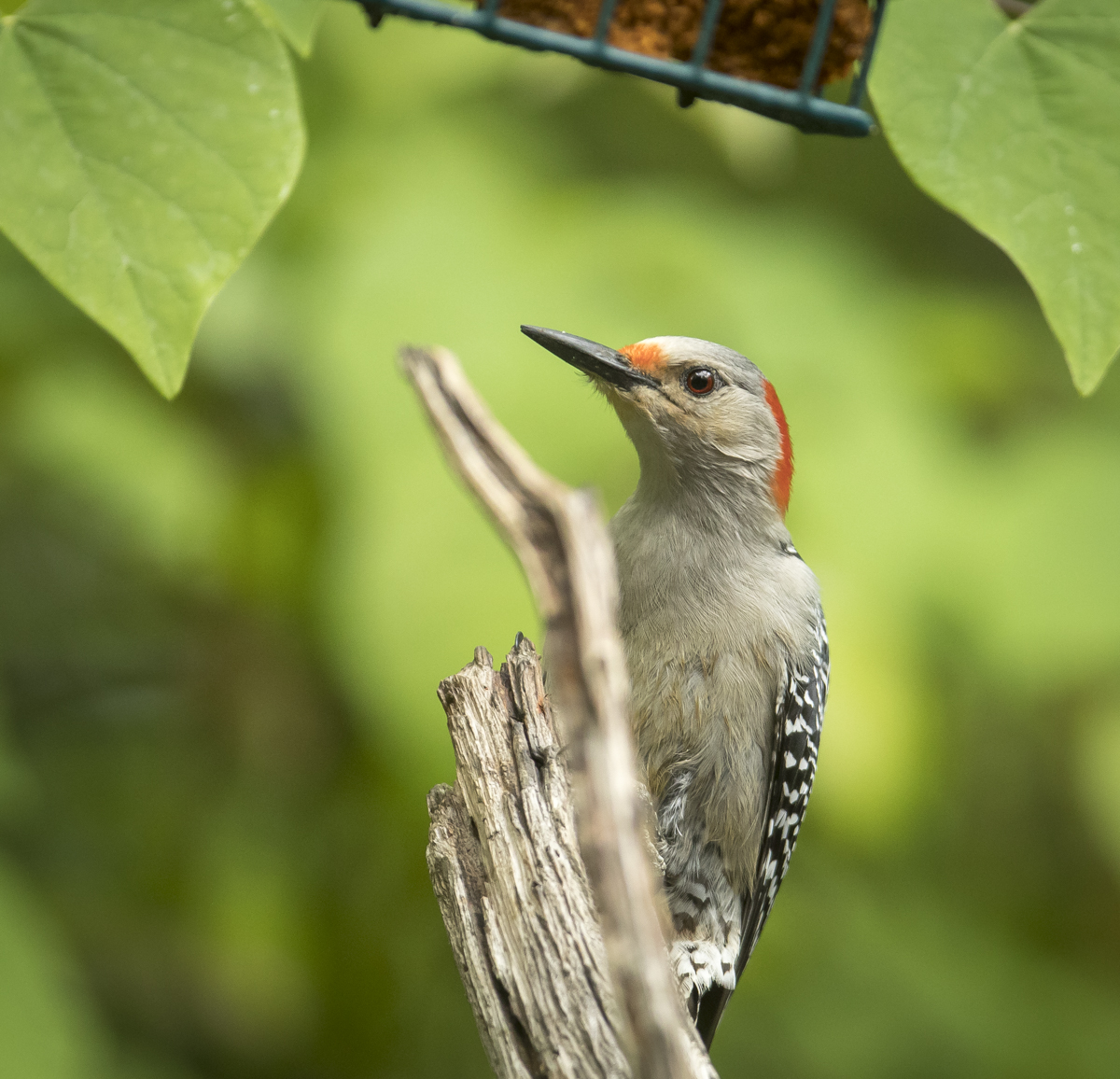
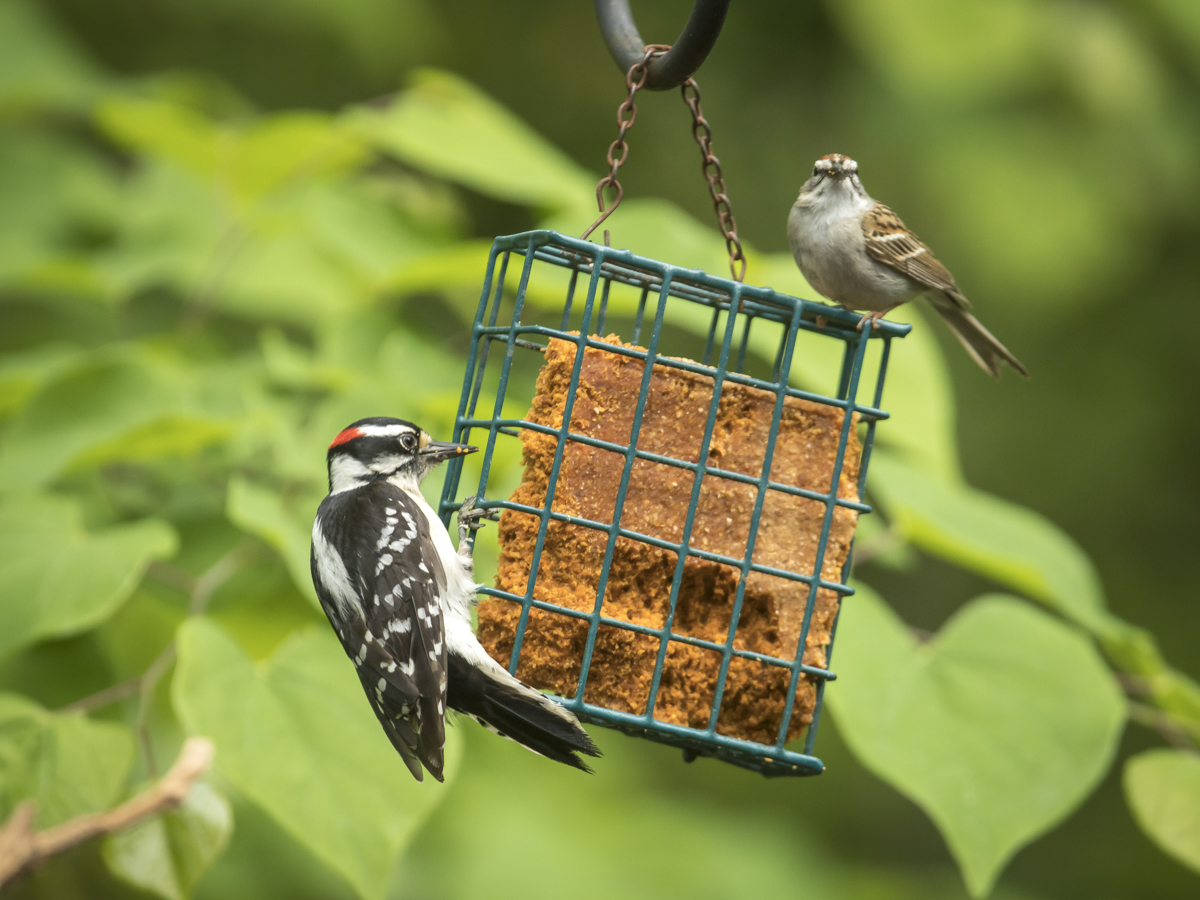
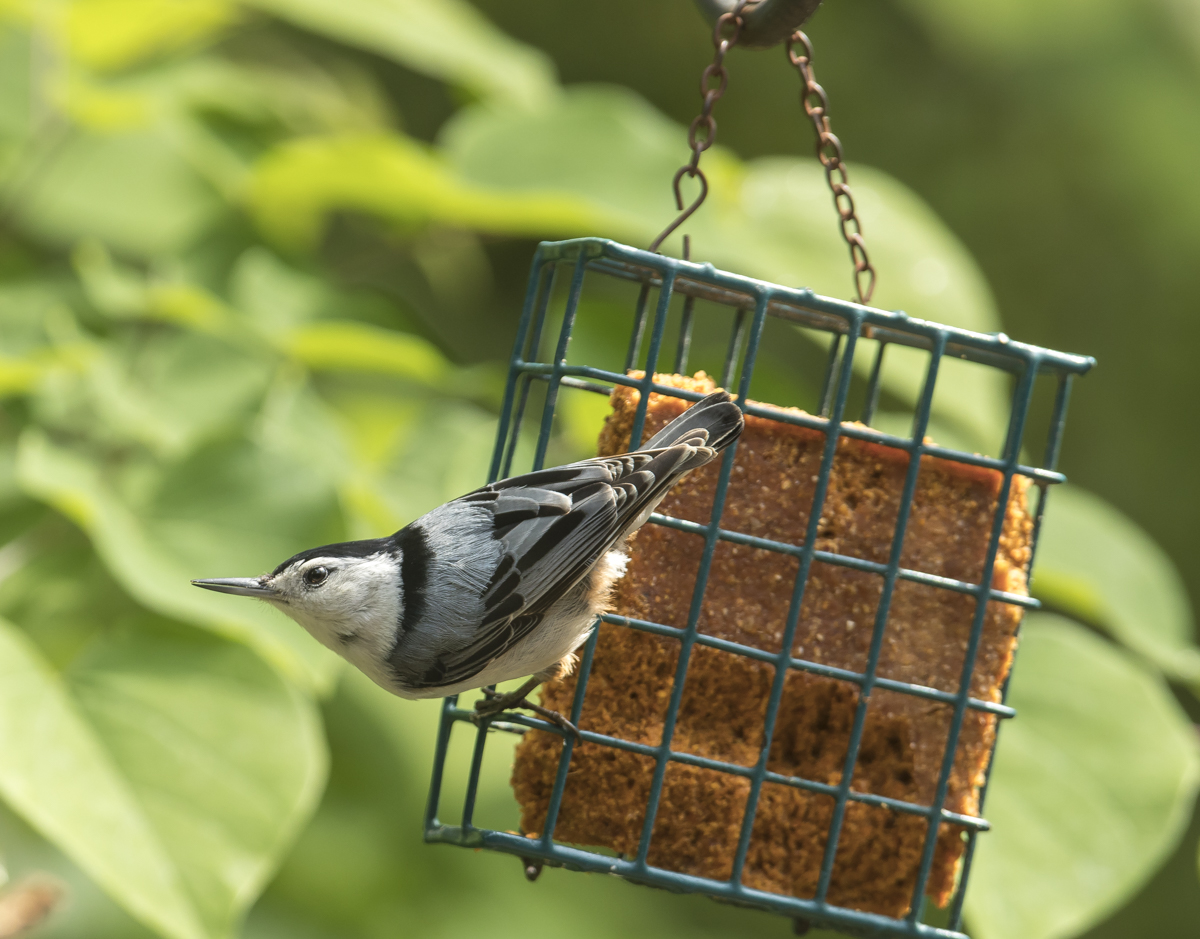
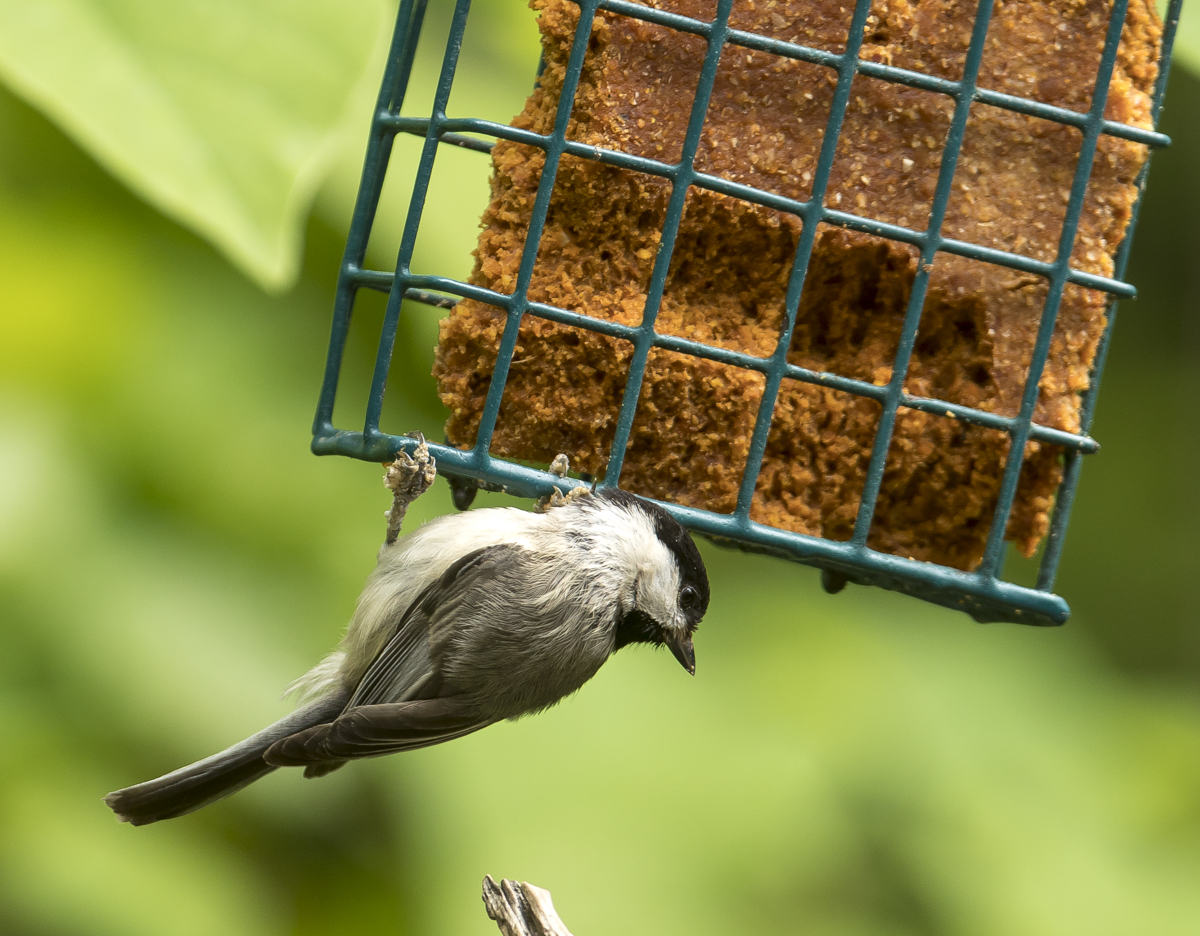
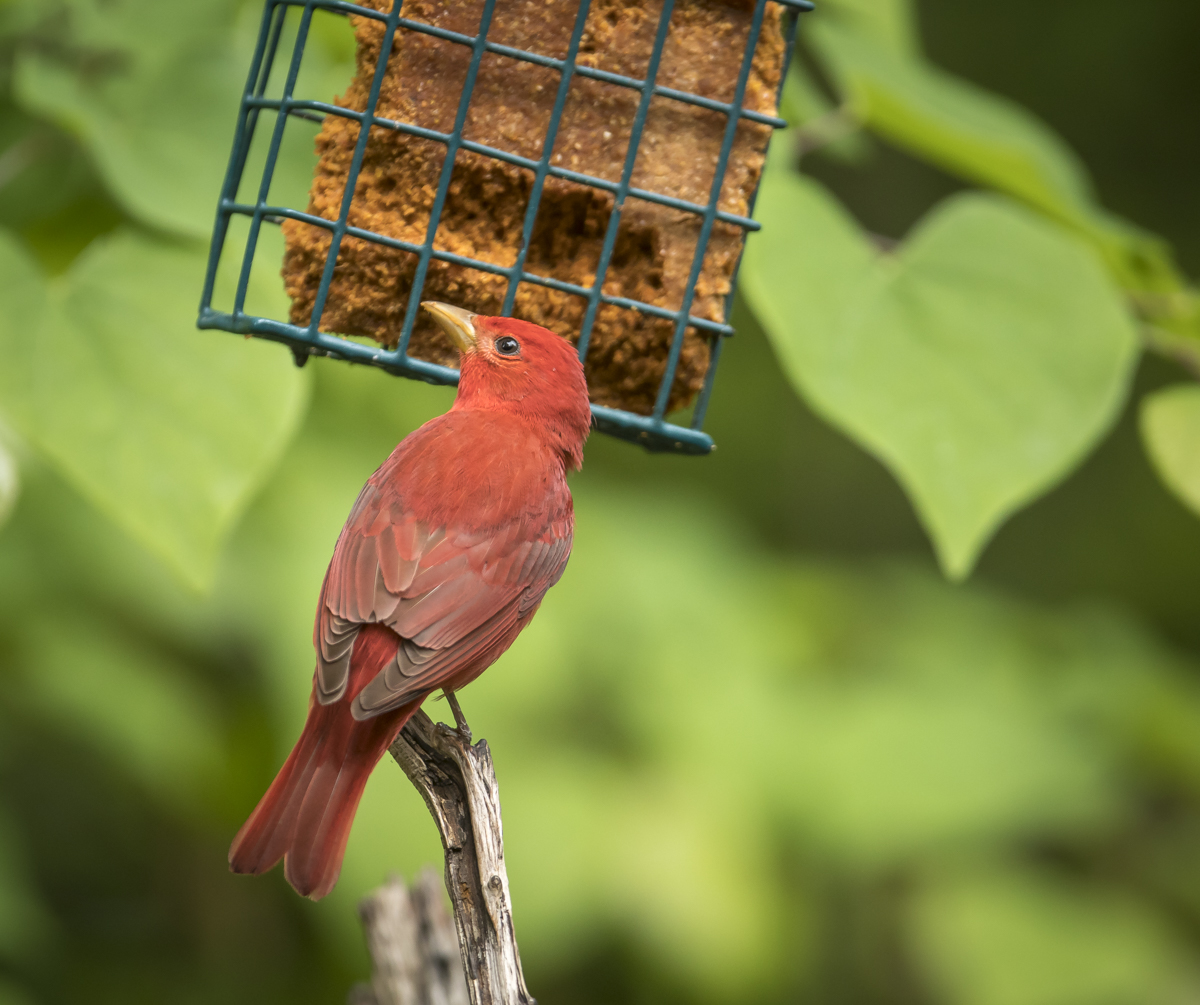
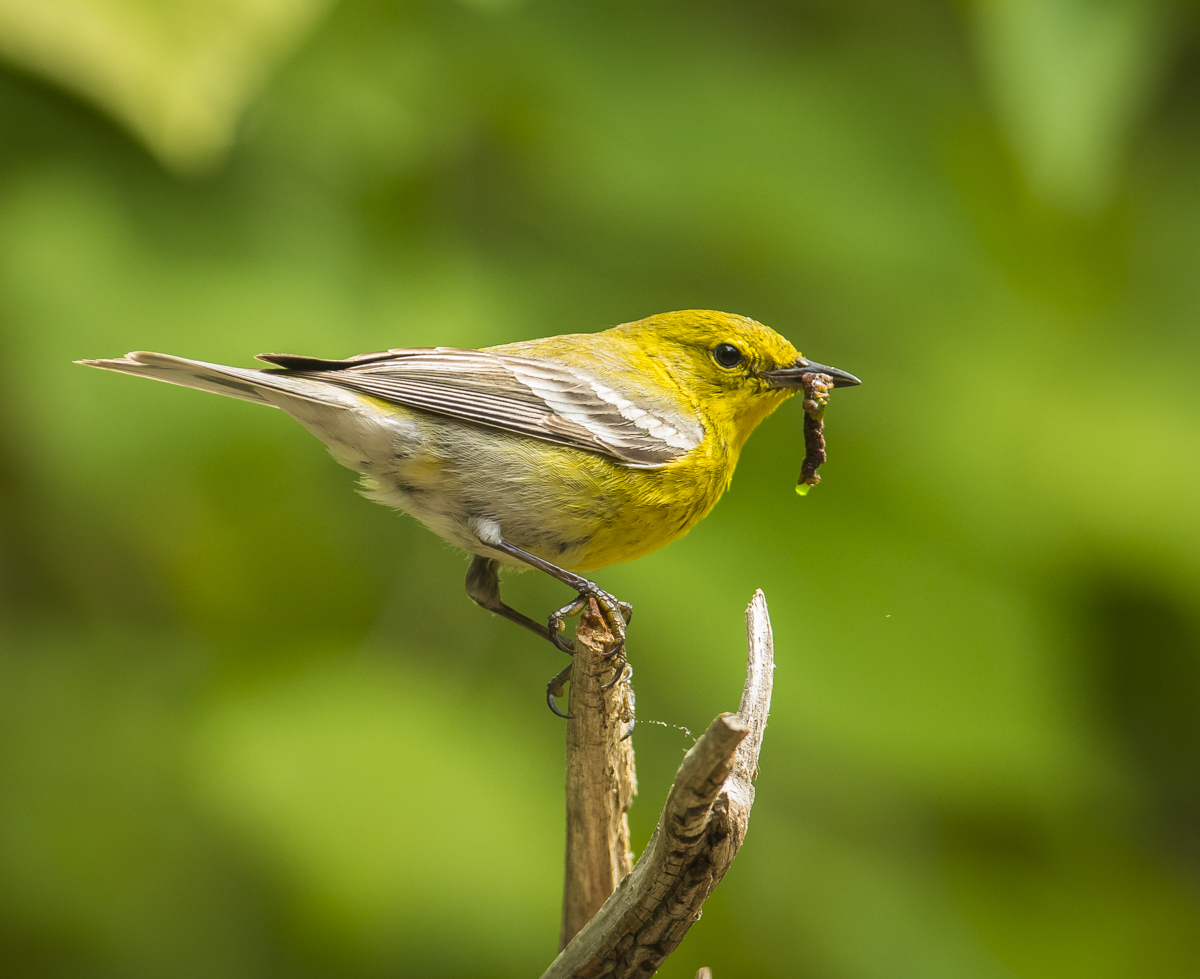
Lining up at the suet.Female Rose-breasted Grosbeaks are brown with striping and a bold eye stripe.The undisputed piggies at the suet are the Blue Jays. They can quickly take chunks away, but they are a bit skittish, and flush easily if we are outside or walking near widows inside.A pair of Red-bellied Woodpeckers (this is the female which lacks a full red head) are regular year-round visitors to the suet.Downy woodpeckers are also regular visitors, but this spring we also have a pair of Chipping Sparrows feeding in the yard.White-breasted Nuthatch.We have a gang of Tufted Titmice that make regular rounds throughout the yard.Carolina Chickadees are with us all year.A pair of Northern Cardinals visit the feeders every day, but it is mainly the male that feeds on suet.Another of our special suet visitors is a pair of Summer Tanagers (we have only seen the male thus far).Pine Warblers are common at our suet in winter but not this time of year. This one stopped by his old diner with a side dish of caterpillar.
I missed photos of two other birds that eat the suet this time of year – American Crows (who are too savvy to come in while I’m sitting there), and our local pair of Carolina Wrens. They are busy feeding their newly fledged young and don’t have time for an appearance.
There have been some other good bird finds this week away from the feeders as spring migration is in full swing and our newly arrived breeding birds are setting up territories or starting to nest. I stumbled across an Ovenbird nest with eggs down in our woods while clearing some invasive shrubs (the dreaded Eleagnus). She flew out of her dome-shaped ground nest doing the broken wing act to lure me away. And we have seen and heard a variety of migrants all week long, some that will stay with us through the summer…
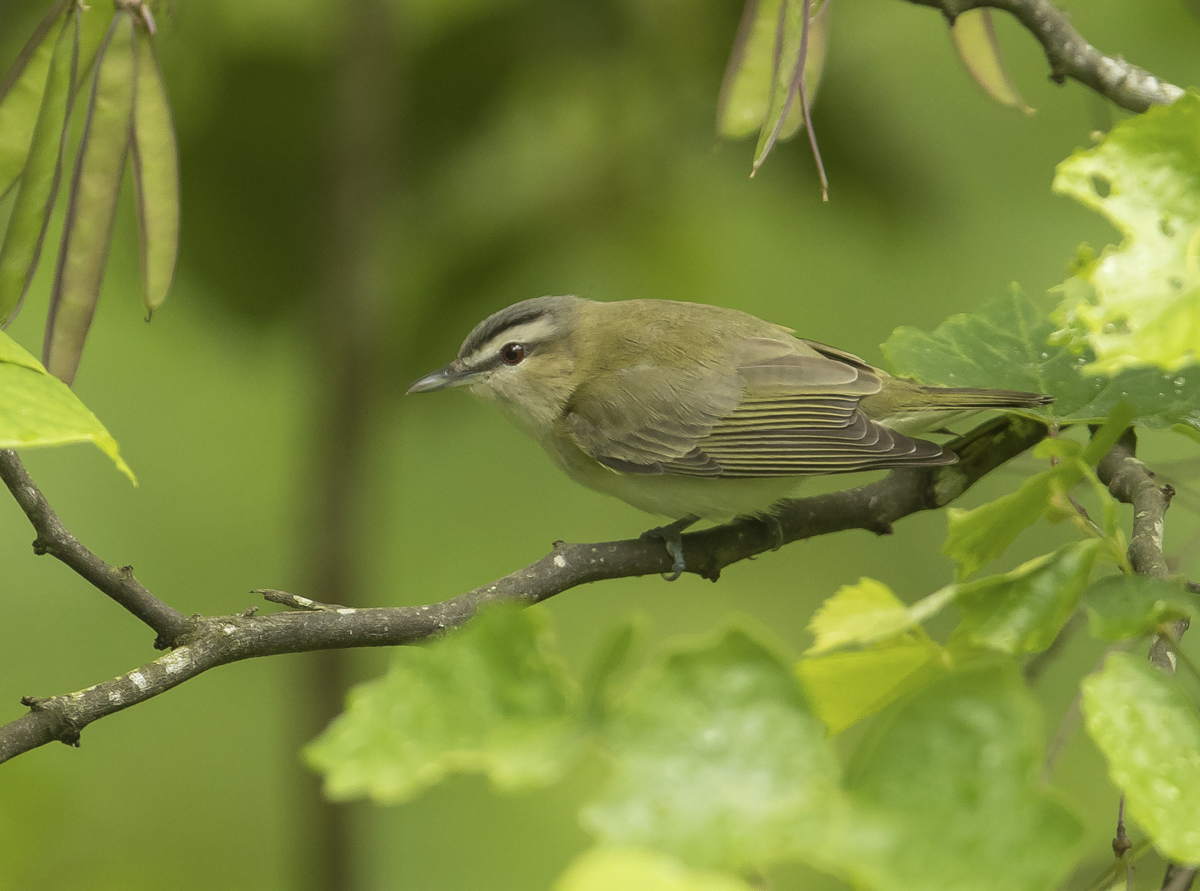
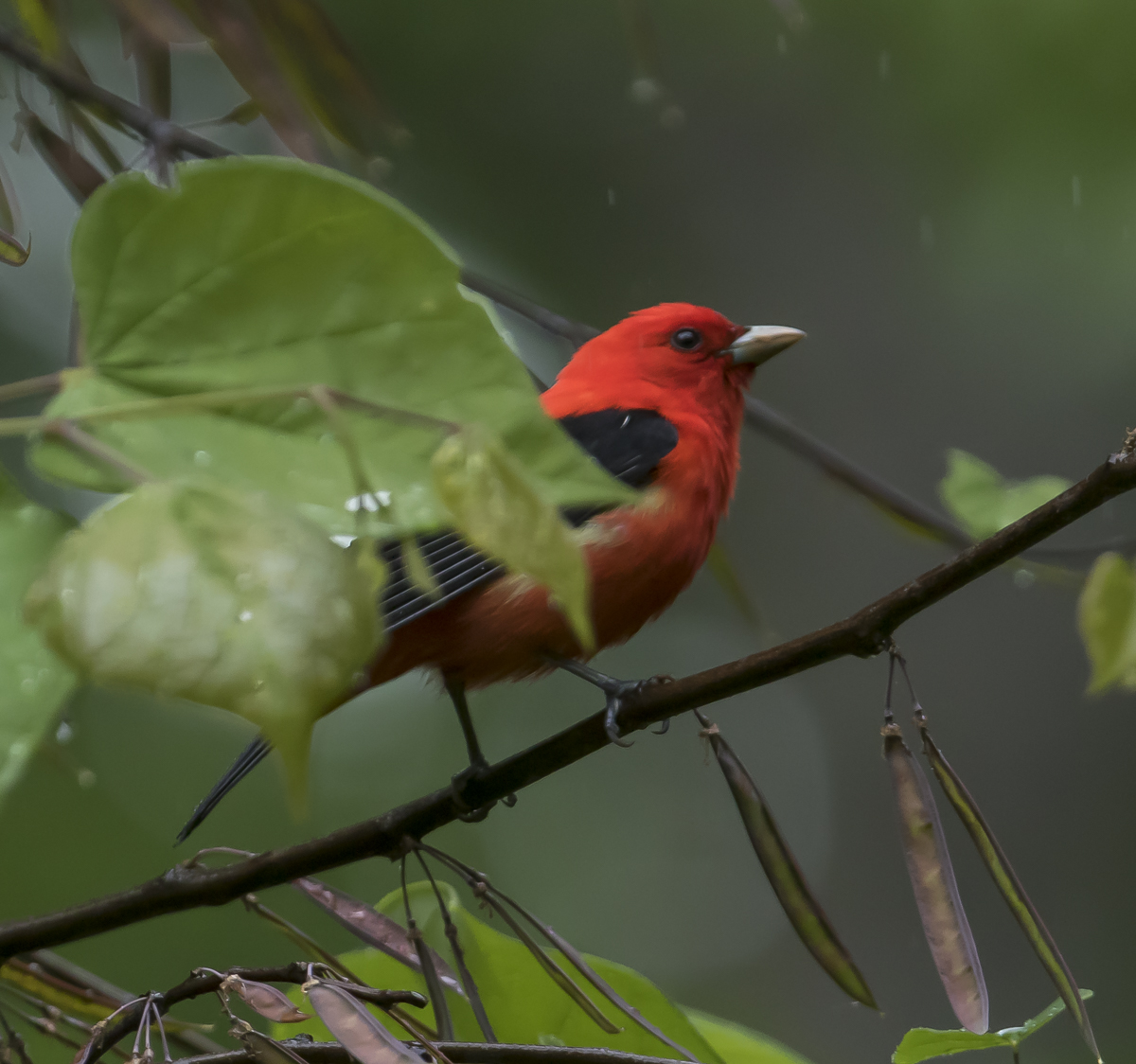
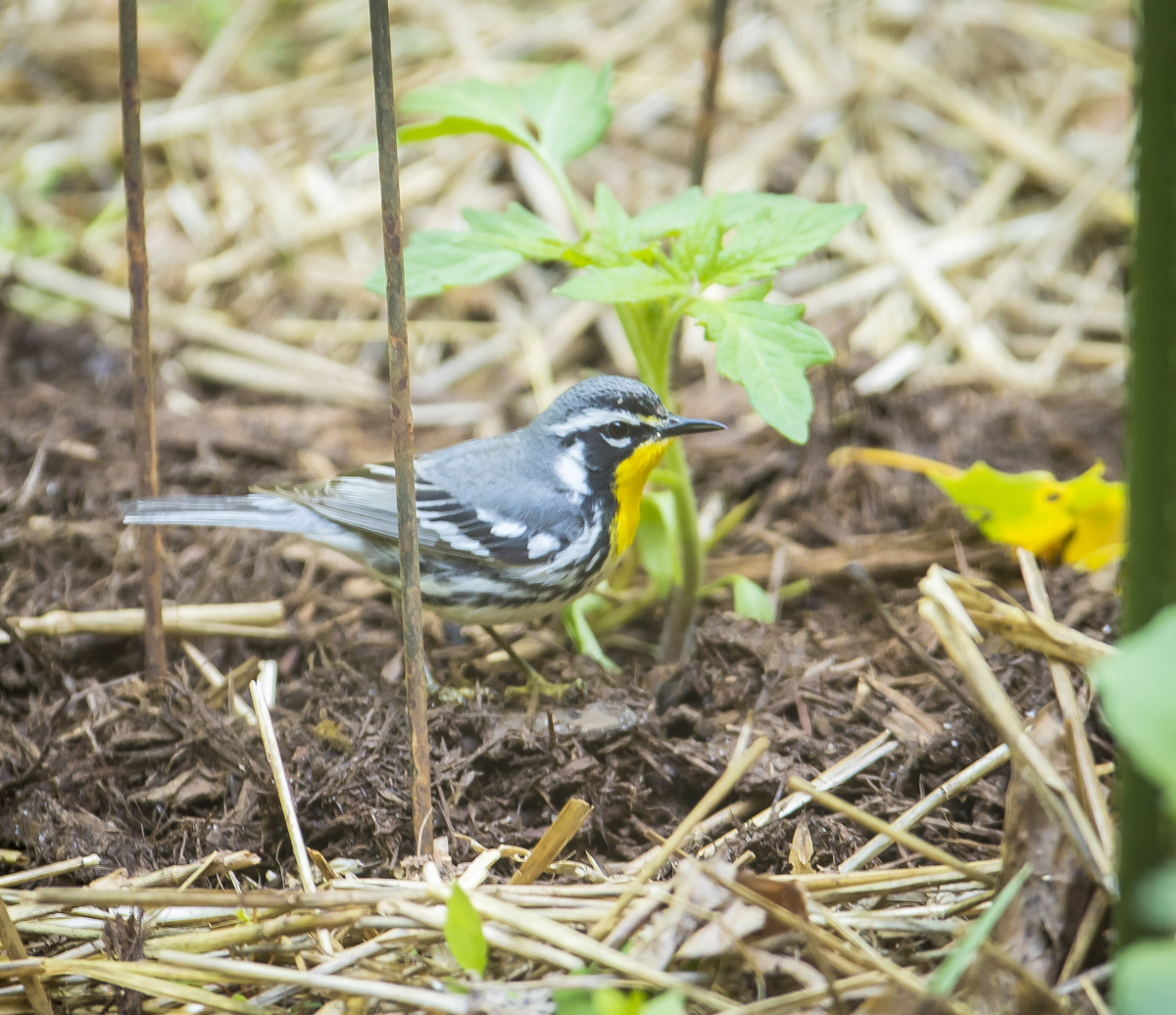
A bonus visitor just off the deck – a Red-eyed Vireo, foraging for insects.This is the best I could do with one of my favorite summer species, the vibrant Scarlet Tanager. They tend to be up high in the canopy but should come down lower in a few weeks when the mulberries ripen (a treat for both species of tanagers in our woods).Remember how excited we were to see the Yellow-throated Warbler down low along the Roanoke River? Well, the other day one was hopping around in our garden. While this was happening we saw and heard American Redstarts, a Black-and-white Warbler, a Hooded Warbler, and Black-throated Blues. Ah, spring!
The real jewel of my disease-ridden woodlot is the prothonotary warbler … The flash of his gold-and-blue plumage amid the dank decay of the June woods is in itself proof that dead trees are transmuted into living animals, and vice versa.
~Aldo Leopold
This final post on our recent swamp trip is about one of spring’s most enjoyable wildlife experiences, the return of the warblers. As my high frequency hearing has waned, I rely more and more on Melissa’s abilities to hear their songs and locate them. And on this trip, she was hearing them throughout our paddle. And she had her spotting skills in high gear as she came up finding what I thought were the trip highlights – a swimming Mink, two Barred Owls close enough to photograph, some cute Raccoons, the flying squirrel, and a few nesting birds. My challenge was to try to photograph them. And I find warblers to be a particularly challenging subject.
My usual warbler image, mostly of where one used to be – note tail feathers exiting top left of image (click photos to enlarge)
But this trip had waves of warblers moving through the swamp at times. On our second platform at Three Sisters, we had birds all around us our last morning, including a swarm of migrating Yellow-rumped Warblers. The rather drab colors we see on this species in winter have now been replaced by bold black and white and intensified yellows. A throng of butter-butts came though our camp that morning, but most were either obscured in the thick understory brush or high in the tree tops, foraging on insects.
Yellow-rumped Warbler showing off its spring attire
Melissa heard and then found a Prairie Warbler just off our platform and I finally managed a few pictures in the dappled sunlight.
Prairie Warbler skulking through the brush
Northern Parula Warblers were everywhere in the swamp, but difficult to photograph on this trip
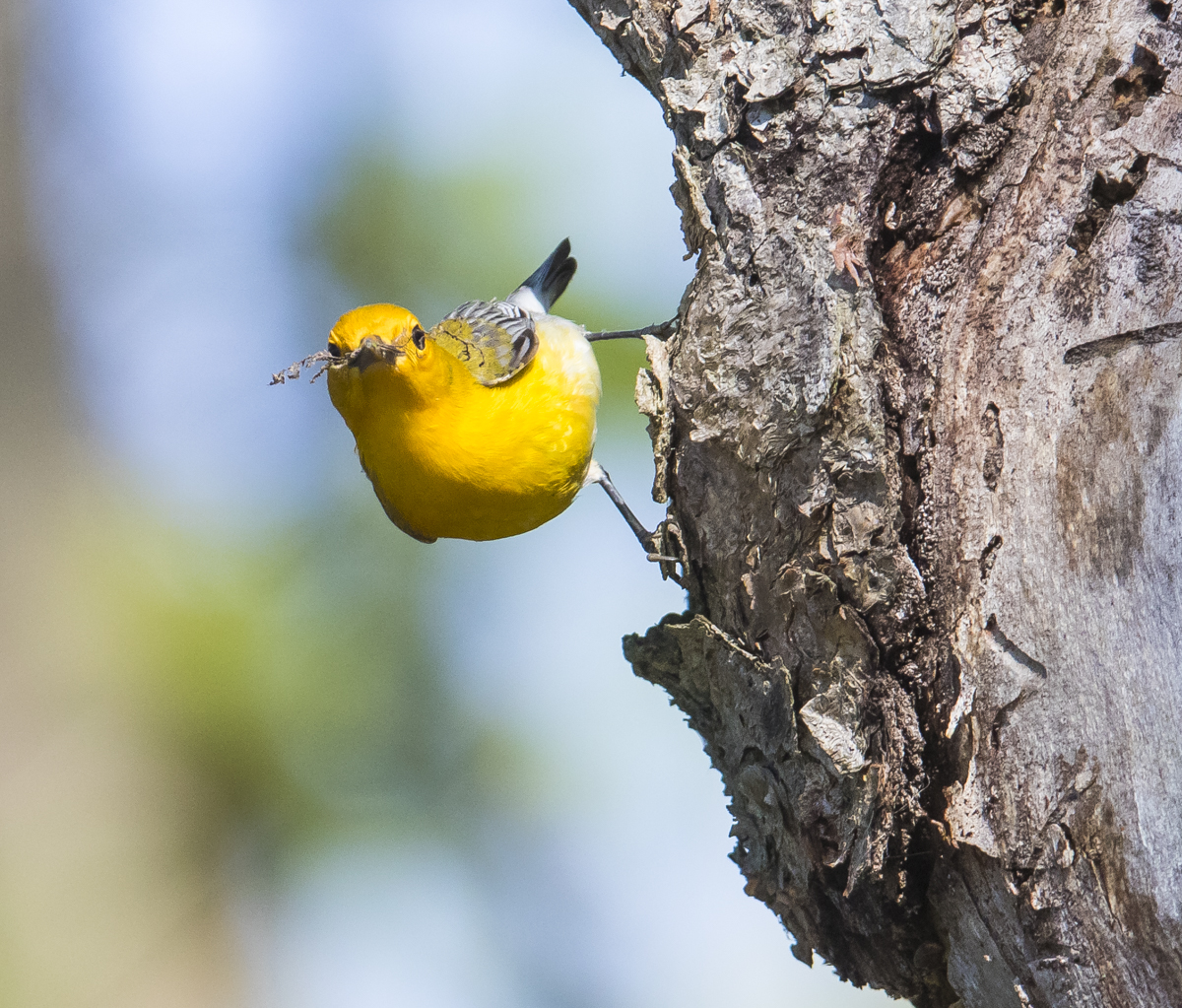
It turns out, the real photographic test was shooting warblers from a moving canoe. I had my 300 mm telephoto and 1.4x teleconverter on my older camera body with us. Needless to say, I was trying to be careful with the gear and, when paddling, often had it secured in a dry bag in front of me. When we saw something, I would have to open the bag, pull out the camera and then try to shoot from a wobbly canoe (usually in a current) while Melissa positioned us. For some shots, I carefully passed the gear up to her if we could not get the back of the canoe into position. Prothonotary Warblers were singing and displaying all along our route, but when she spotted one carrying nesting material, we pulled over and steadied the canoe on a log in the shallows. The bird did not disappoint.
This bird really liked the moss on one particular tree trunk and made several trips to gather a beak full while we watched.
Most trips back to the nest were quick, with a brief landing, and then darting directly into the cavity. On this one though, he (I think it is a he because it is very brightly colored) paused on top of the snag for just a moment.
After depositing the moss, he would come out, look around, and then fly off for more. This time, he stuck his head out far enough so that the sun highlighted his face.
On one exit, he noticed a little piece of moss just below the cavity
My favorite pose
Male prothonotaries arrive first on the breeding grounds and begin setting up territories which they defend. They will select a few choice nesting cavities (and the swamp is full of potential nest holes) and gather and stuff them with moss, hoping a female will approve. We wished him good luck, and moved on as this was a big paddle day for us.
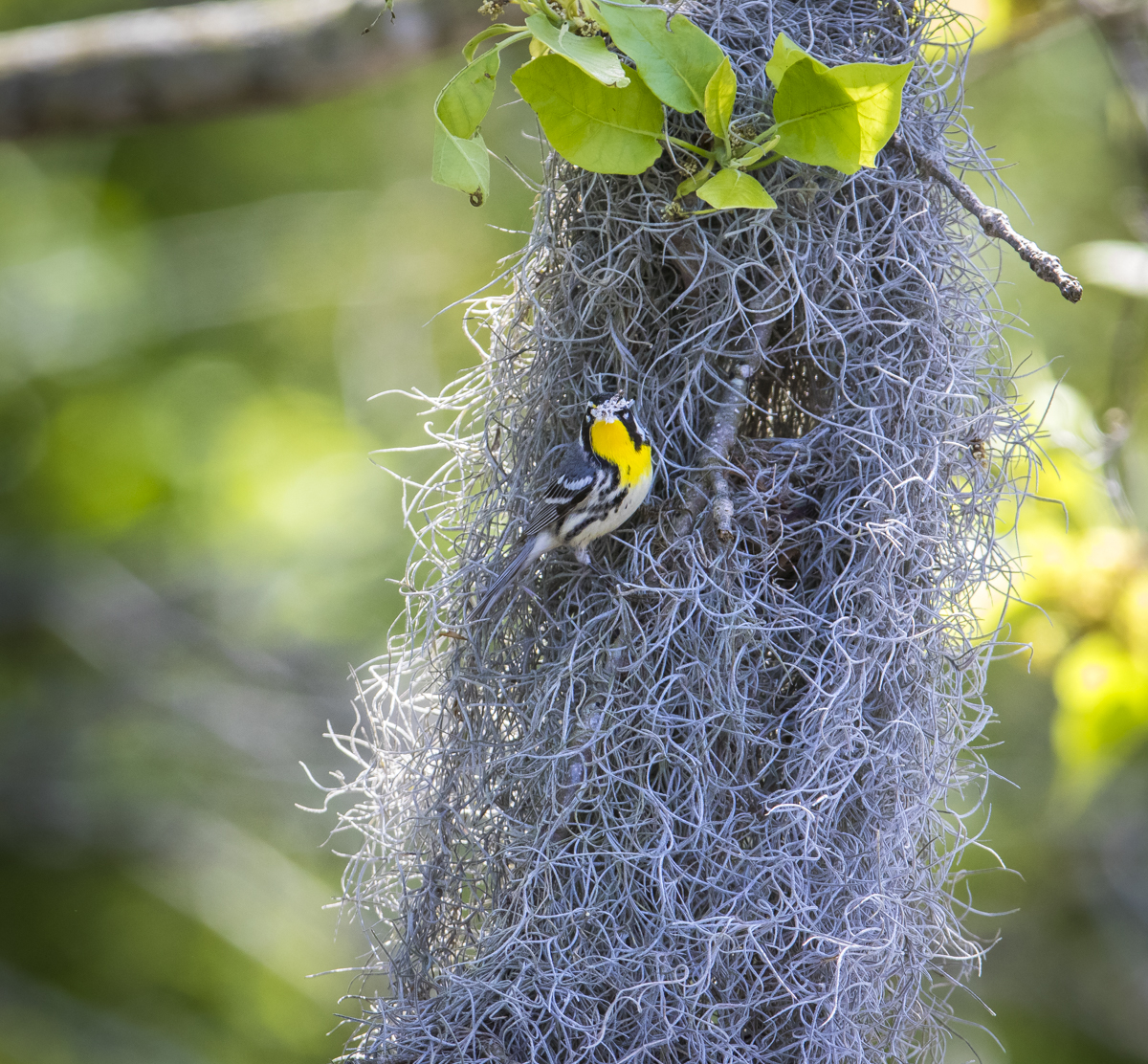
The current was stong and the wind was at our back out on the river proper when Melissa saw what she at first thought was a Northern Parula exiting a clump of Spanish Moss dangling on a low branch over the river (their preferred nest site). We turned and started paddling back upstream when she saw the bird return – it was a Yellow-throated Warbler!
A Yellow-throated Warbler bringing material back to its nest site in a clump of Spanish Moss
This beautiful warbler is one of Melissa’s favorites, but frustratingly so, since they tend to be treetop dwellers and, though she hears them often (even at our woodland home in Chatham County), we rarely get a decent look at one. And here she finds one nesting, and down low. Cornell’s excellent online Birds of the World resource (for a subscription fee, but well worth it), states It nests and performs most of its daily activities high in the canopy of these forests. The exact location of nests is usually hard to determine.
Melissa did a great job keeping the canoe in place while the bird came and went with nesting materials
A good view of that brilliant yellow throat that gives this warbler its common name
Entering the entrance hole in the Spanish Moss with nesting material (photo by Melissa Dowland)
Peeking out of the nest entrance (photo by Melissa Dowland)
Our final look at an extraordinary bird
Research shows they usually nest out on horizontal branches high in the canopy in mature forests. In coastal areas with Spanish Moss, they prefer to nest in clumps hanging below branches (like Northern Parulas). But the nests of Yellow-throated Warblers tend to be an average of 30-45 feet above ground in coastal swamps. I’d say we were pretty lucky to find this one at about eye level from our canoe. As it turned out, we didn’t have a decent look at another of these beauties on our entire trip. So, thanks for a special moment in a very special place.
Simply wait, be quiet, still. The world will freely offer itself to you.
~Franz Kafka
Yesterday’s post mentioned the excellent birding we experienced on our recent paddle trip on the Roanoke River. When we arrived at our second camping platform, Three Sisters, the late day light was gorgeous and the sky was filled with all sorts of birds. After setting up camp (and shooing away the vultures dining on the fish skeletons) we sat out on the small dock by the creek for over an hour watching the parade of birds go by. I decided to practice some birds in flight photography to see what I could capture. Here are a few of the results…
The distinctive cross-shape of Anhingas soaring overhead was a common sight on the blackwater tributaries of the Roanoke (click photos to enlarge)
An Anhinga flying low over the creek. We commented on how many of these unusual “snakebirds” we saw on this trip compared to our previous outings.
A female Wood Duck blasts past our dock in late afternoon light.
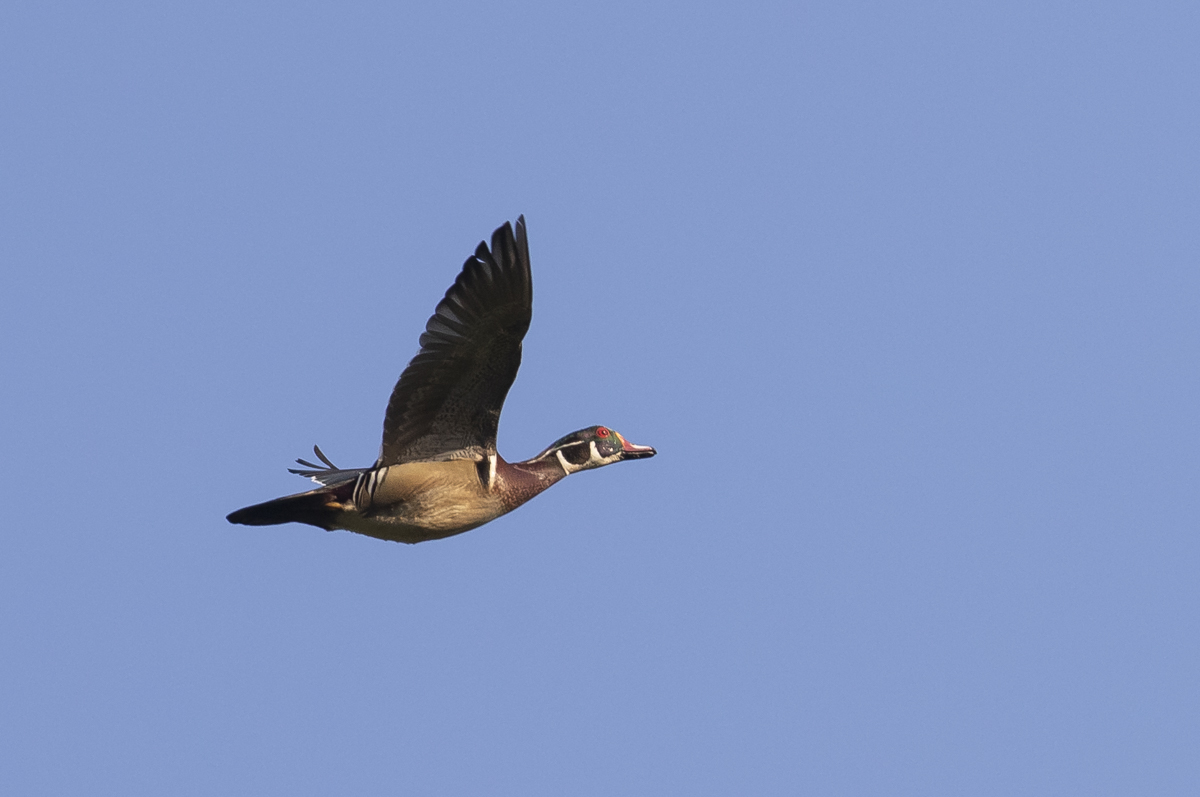
Almost all the ducks we saw were in pairs. This is the male Wood Duck escorting the one above.
The real challenge was tying to photograph Chimney Swifts in flight. As you can see, I never really got it right as they are just too darned fast and erratic. It is comforting to know that they are no doubt nesting in many of the giant hollow Bald Cypress trees scattered throughout the swamp.
A Great Blue Heron flying to roost.
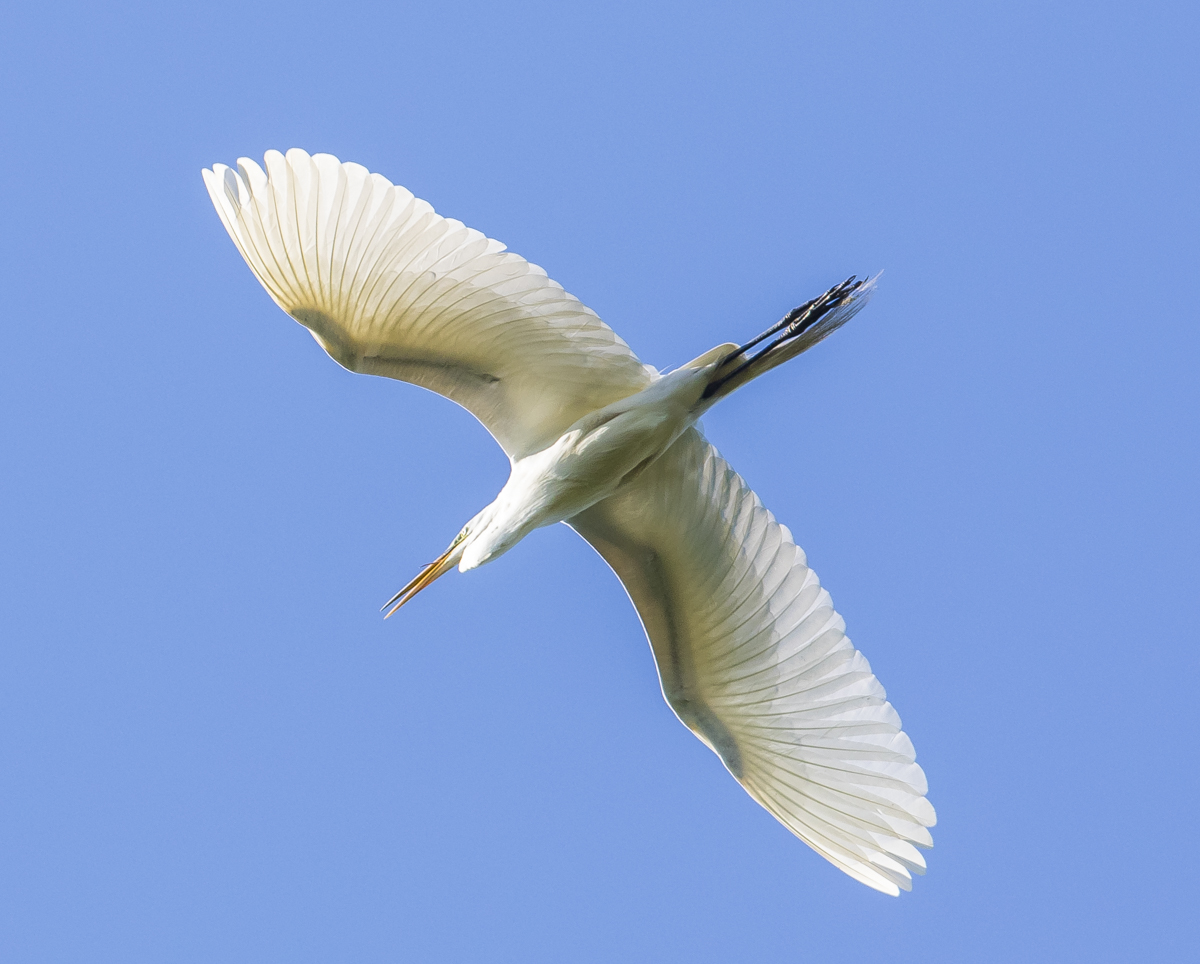
We saw more Great Egrets on this trip than in the past. This one’s wing bones showed through its backlit feathers.
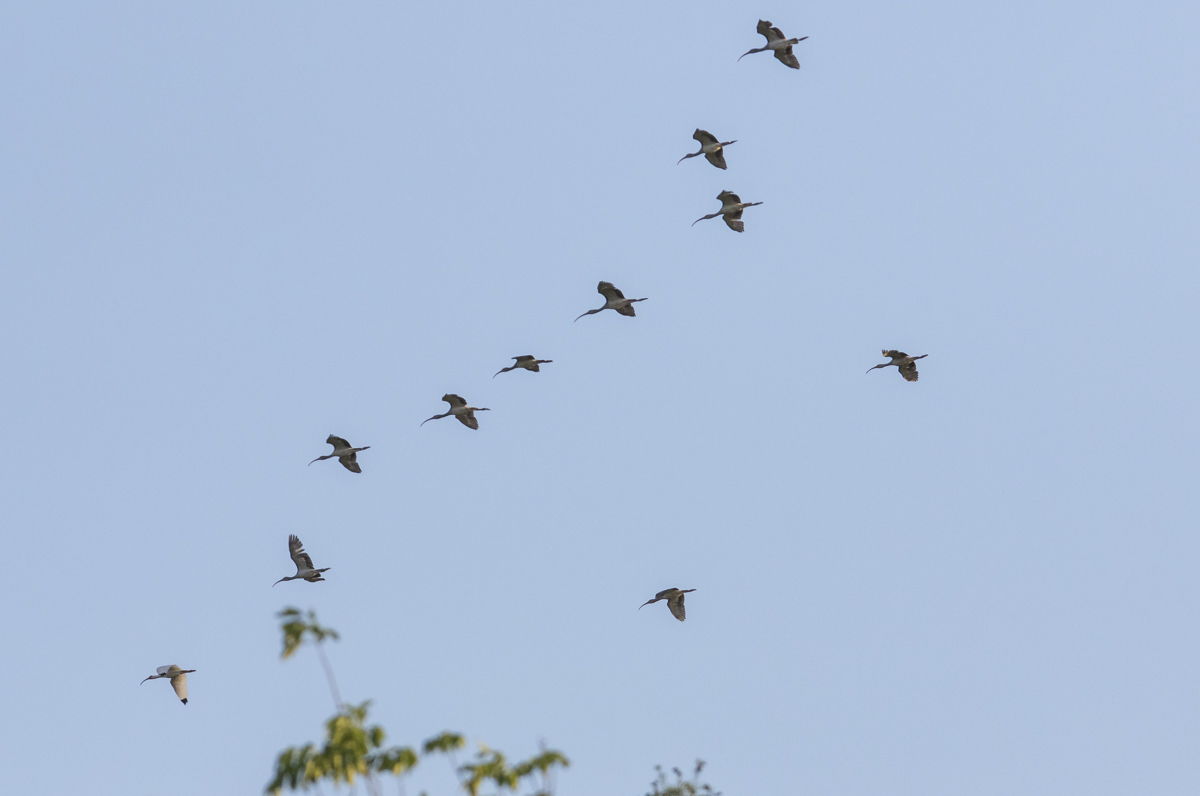
As the sun set, large flocks of White Ibis started flying in to the next creek and surrounding wetlands.
I had planned to do some more dock sitting the next morning, but after the water came up during the night, I ended up strolling the short walkway to the platform and trying to photograph the many birds that were active all around us.
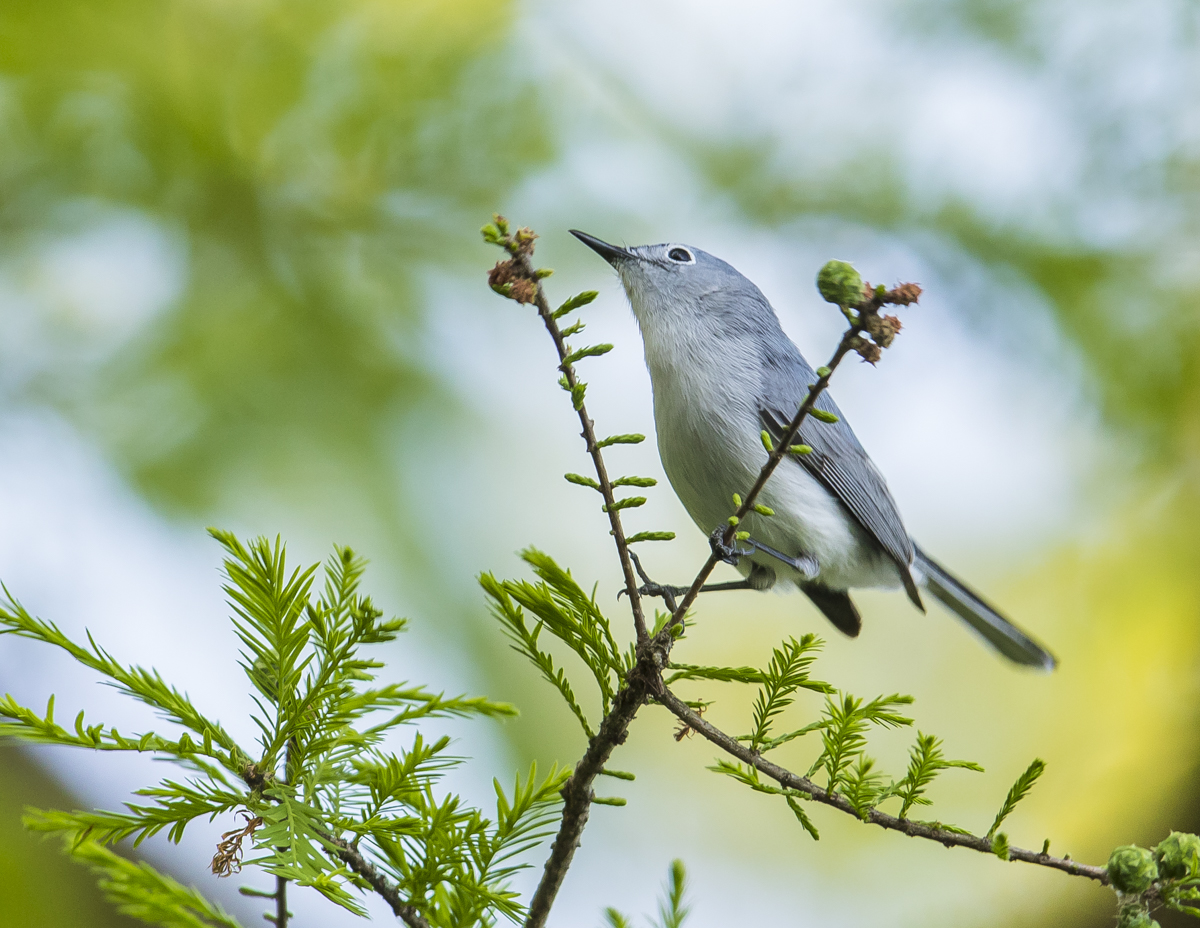
Blue-gray Gnatcatchers are always a treat to see up close.
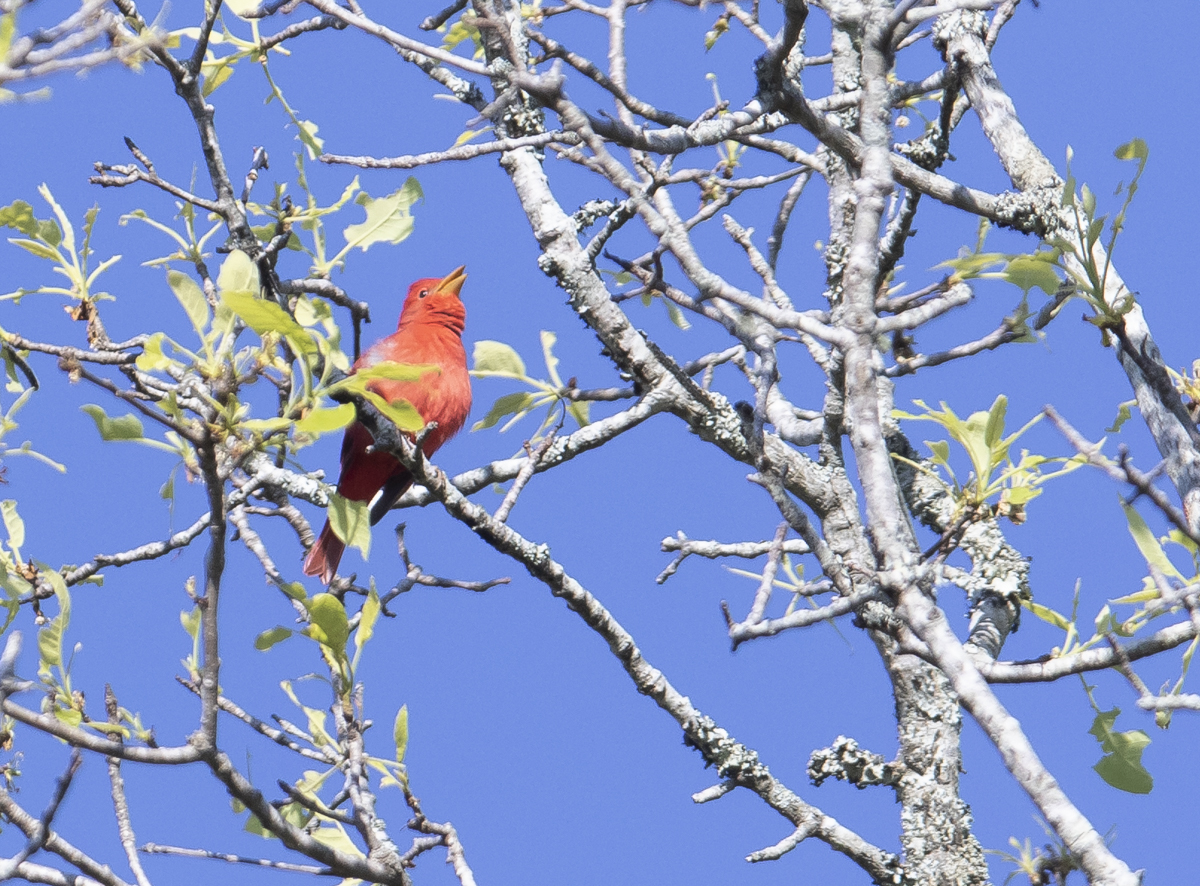
This male Summer Tanager sang for much of the morning from high atop a partially defoliated Water Tupelo.
A White-breasted Nuthatch knocked off some bark that fell on my head, alerting me to his presence right above me.
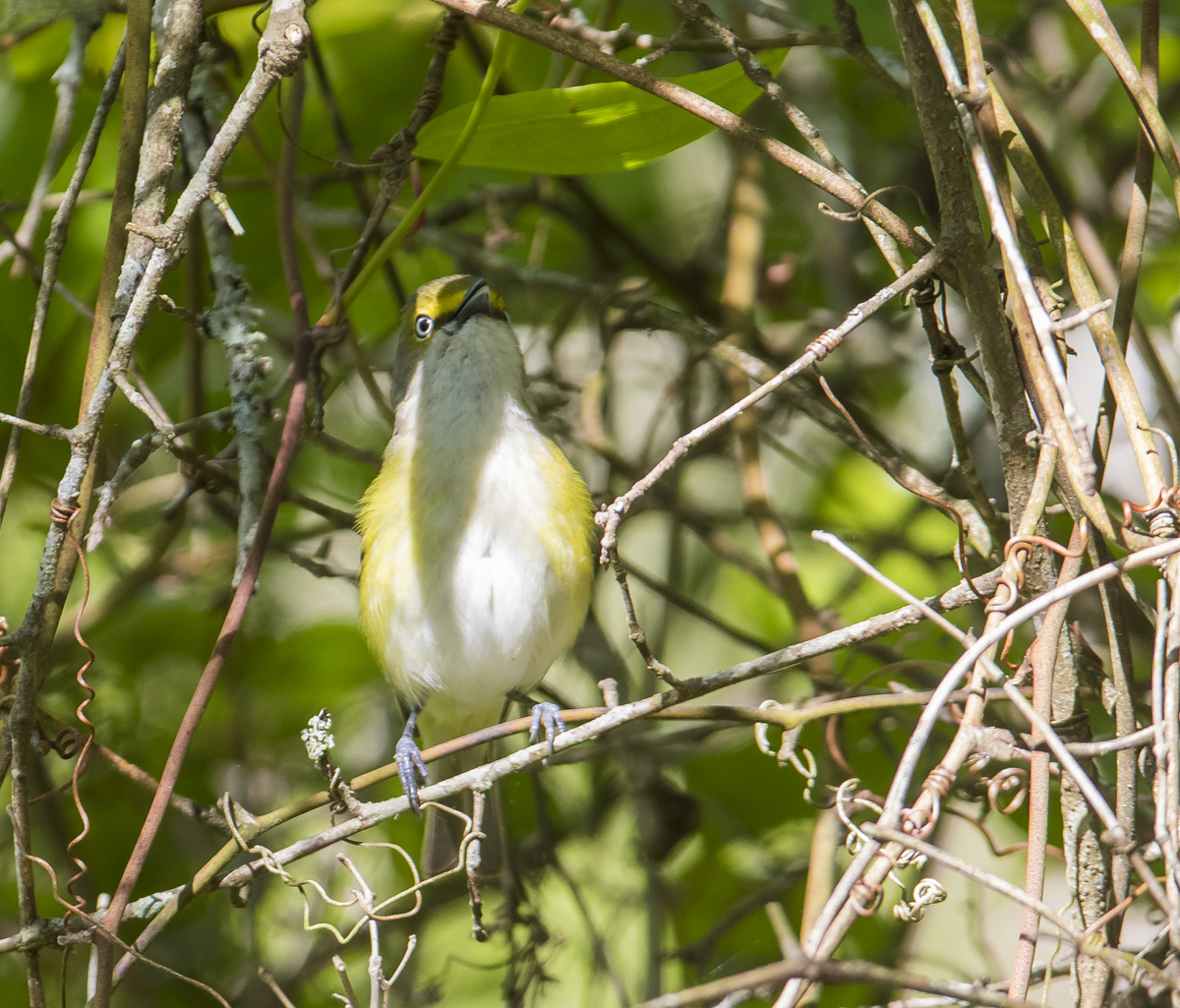
A male White-eyed Vireo was loudly singing in thick brush out near the creek. I kept stalking him, hoping for a clear shot.
He finally obliged and came out on an open twig for a few notes of pick up the beer check quick, before disappearing back into a thicket.
These images represent just a fraction of what we saw on this trip. Below is a checklist of species we observed/heard during our time in this magical swamp. Tomorrow, I’ll share some highlights of our warbler watching.
Birds: Great Blue Heron; Great Egret; White Ibis; Spotted Sandpiper; Double-crested Cormorant; Anhinga; Wood Duck; Mallard; Canada Goose; Turkey Vulture; Black Vulture; Red-shouldered Hawk; Bald Eagle; Osprey; Barred Owl; Belted Kingfisher; Great Crested Flycatcher; Blue Jay; American Crow; Fish Crow; Common Grackle; Red-winged Blackbird; Red-bellied Woodpecker; Downy Woodpecker; Hairy Woodpecker; Pileated Woodpecker; Chimney Swift; Barn Swallow; Eastern Towhee; Northern Cardinal; Mourning Dove; Gray Catbird; Swamp Sparrow; Carolina Chickadee; Tufted Titmouse; Carolina Wren; Blue-gray Gnatcatcher; White-eyed Vireo; Red-eyed Vireo; Yellow-throated Vireo; Eastern Bluebird; White-breasted Nuthatch; Summer Tanager; Yellow-billed Cuckoo;Northern Parula Warbler; Black-and-white Warbler; Prairie Warbler; Prothonotary Warbler; Yellow-throated Warbler; Common Yellowthroat; Yellow-rumped Warbler
Yes, though you may think me perverse, if it were proposed to me to dwell in the neighborhood of the most beautiful garden that ever human art contrived, or else of a Dismal Swamp, I should certainly decide for the swamp.
~Henry David Thoreau
I will admit to feeling a little guilty about this, but we recently returned from a two-night camping and paddling trip on the Roanoke River. For the month of April, we had previous plans for two trips to the swamp with friends, and Melissa had one for work. Though we are very fortunate to live in a beautiful wooded setting, we are missing our spring swamp time. So, after discussing if we could manage a trip without putting ourselves (or anyone else) at risk, we decided to go. We both agreed that there is no better place to self-isolate than the camping platforms on the Roanoke. We departed Monday afternoon, following a storm front that left us with a bit of rain and wind for the start of our journey. Our plan was to put in at Gardner Creek between Williamston and Jamesville on Monday afternoon and paddle to the Barred Owl Roost platform the first night. We arrived at the launch site about 4 p.m. with just a slight drizzle. As we paddled away from the highway, the sounds soon became those of the swamp…a peaceful quiet interrupted only by the wind in the trees, a squawk of a Great Blue Heron, or Wood Ducks exploding off the water.
Our first major wildlife spotting was a pair of Raccoons up in a skinny tree along Gardner Creek (click photos to enlarge)
Melissa soon spotted two Raccoons halfway up a skinny tree surrounded by water. One was trying to ignore us by hugging a branch while the other managed to stay partially hidden alongside a clump of Spanish Moss.
The sun finally broke through the dark clouds and lit up the trees along Devil’s Gut
Our three-hour paddle seemed to go quickly and we soon were at our home for the night – Barred Owl Roost. This platform is always surrounded by black water, so you really feel isolated and a part of the swamp. And true to its name, we heard Barred Owls cranking up their Who cooks for you calls soon after we arrived. There were also a lot of other birds in, and flying above, the trees – Prothonotary and Northern Parula Warblers, Common Grackles, Great Blue Herons and Great Egrets, and lots of Wood Ducks.
One of our favorite camping platforms – Barred Owl Roost
Prothonotary Warblers seemed to be everywhere in the swamp
Sunrise looking up through our tent – a Prothonotary Warbler greeted us by delivering his dawn song from the top of the tent
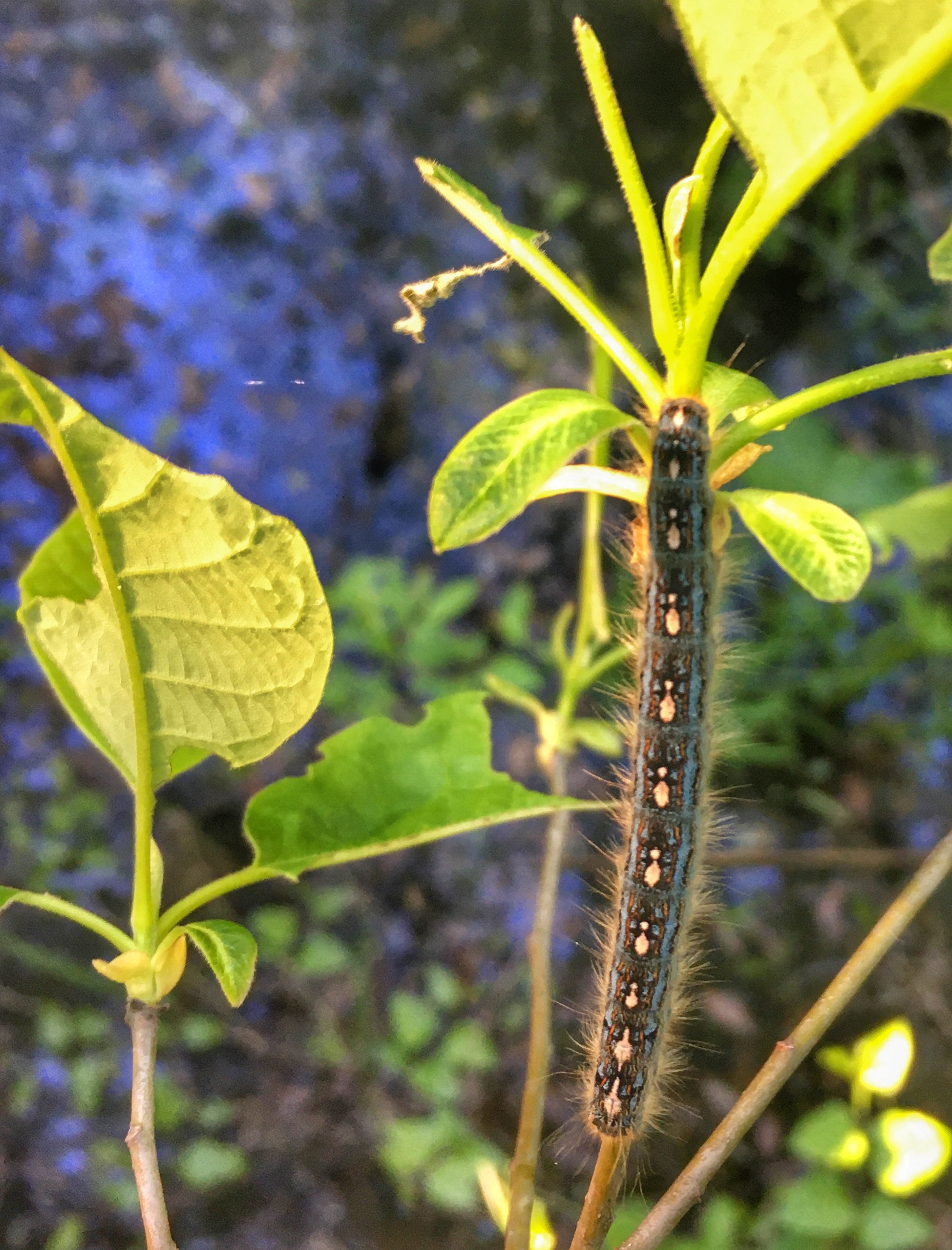
Many of the Water Tupelo trees have been stripped again this spring by the huge population of Forest Tent Caterpillars. In some sections of the swamp, the majority of the trees are bare and look dead at first glance. And leaf debris from the feeding caterpillars literally covers the water surface in some areas.
A Forest Tent Caterpillar doing what it does best – chewing on the leaves of a Water Tupelo
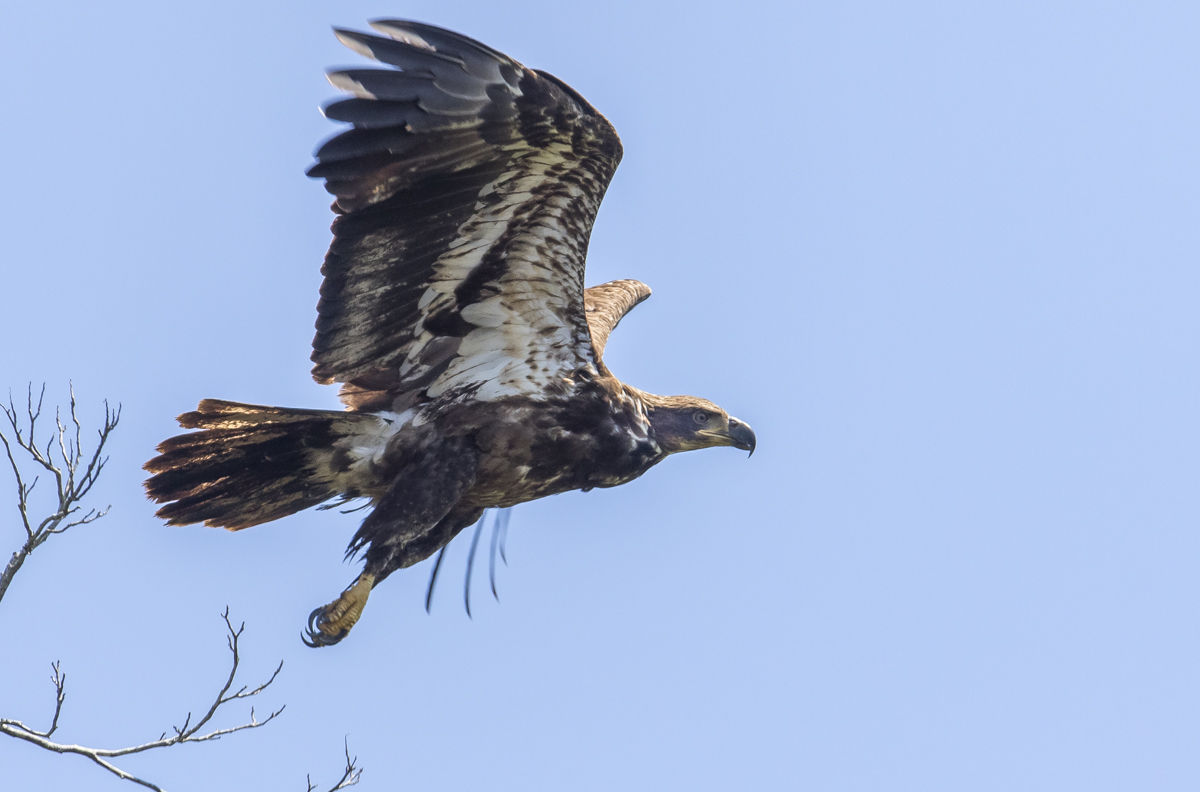
The next morning, we headed down the Gut and out into the river proper for a long day of paddling. Melissa even did an online program with a school class that would have been participating in the Museum’s Shad in the Classroom program this spring as we drifted downriver, giving the students a unique look at where the American Shad live for part of their life cycle. Along the way we saw lots of eagles, herons, and many songbirds (more on those in a future post).
Juvenile Bald Eagle taking flight as we drifted by on the river
The wind was at our back and the current was strong so we made good time until we got to Broad Creek, where we headed upstream for a few miles to our next platform. This section proved to be a tough paddle with not only the current against us but the wind as well. The slow pace allowed us good views of a variety of wildlife from White-eyed Vireos (Melissa spotted one in the early stages of building its nest) to a lot of snakes hanging out in tree branches.
One of many congregations of Brown Water Snakes in shrub and tree branches along the water’s edge. There were nine snakes in this one tree!
This is not the welcoming committee we were hoping for at our next camping platform
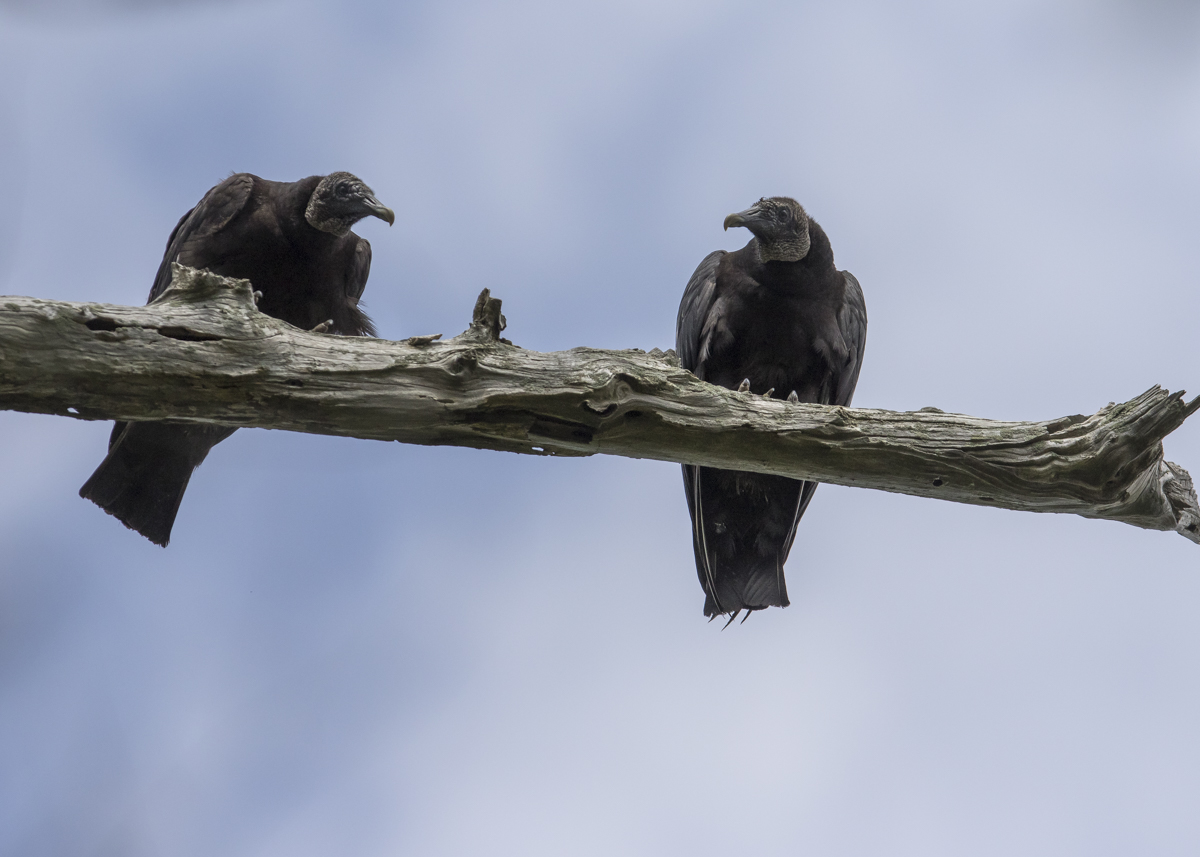
After a tiring paddle, we finally pulled up to our next camping platform, Three Sisters. But all was not as we would have wanted. Someone had caught and cleaned several large fish, including a monster catfish, on the dock at the platform, leaving the skeletons along the shore, This bounty had attracted several vultures (both Turkey and Black) who didn’t care for us interrupting their fish dinner. We used our paddles to push the carcasses into deeper water, hoping the smell would go way (along with the birds).
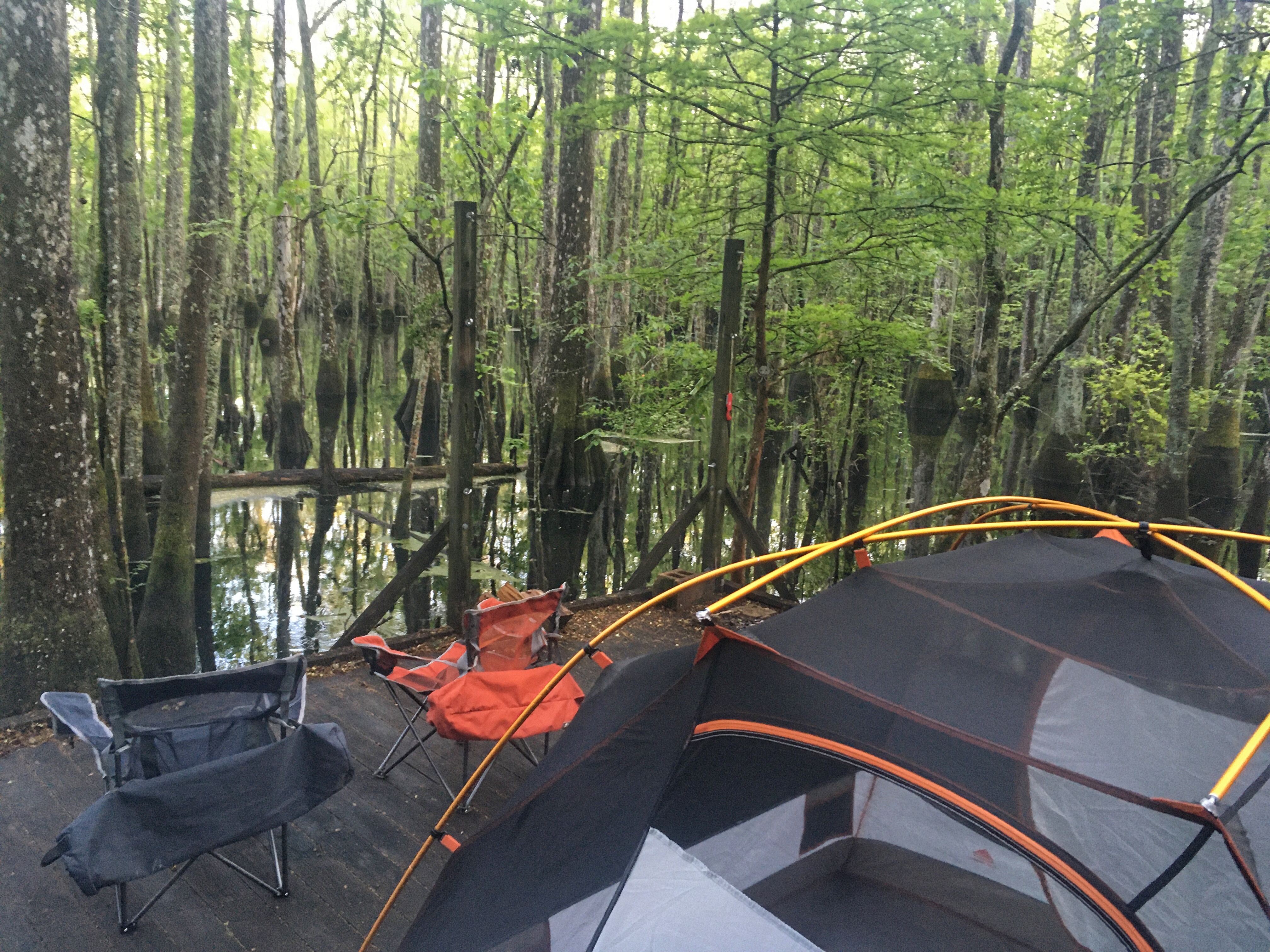
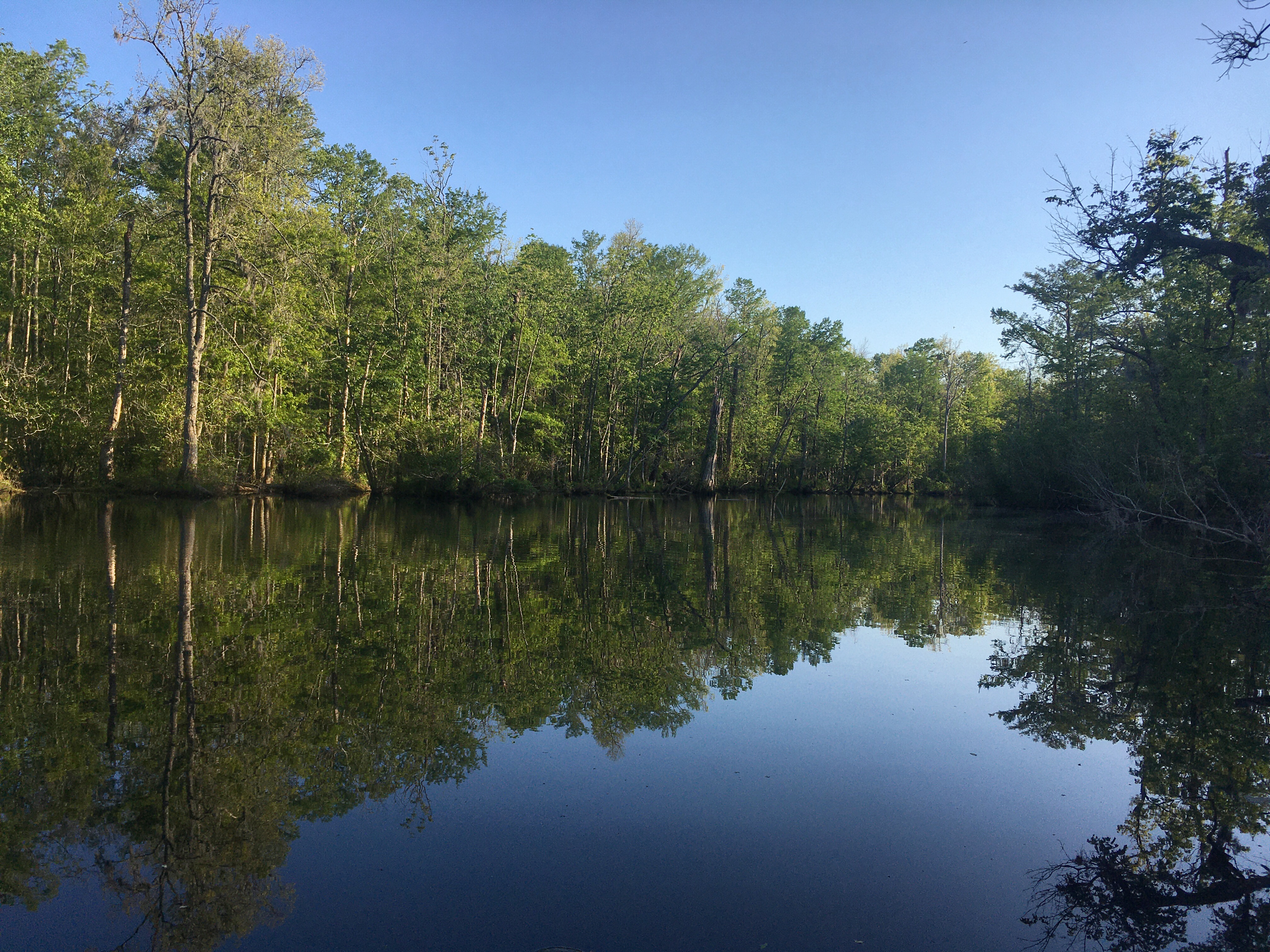
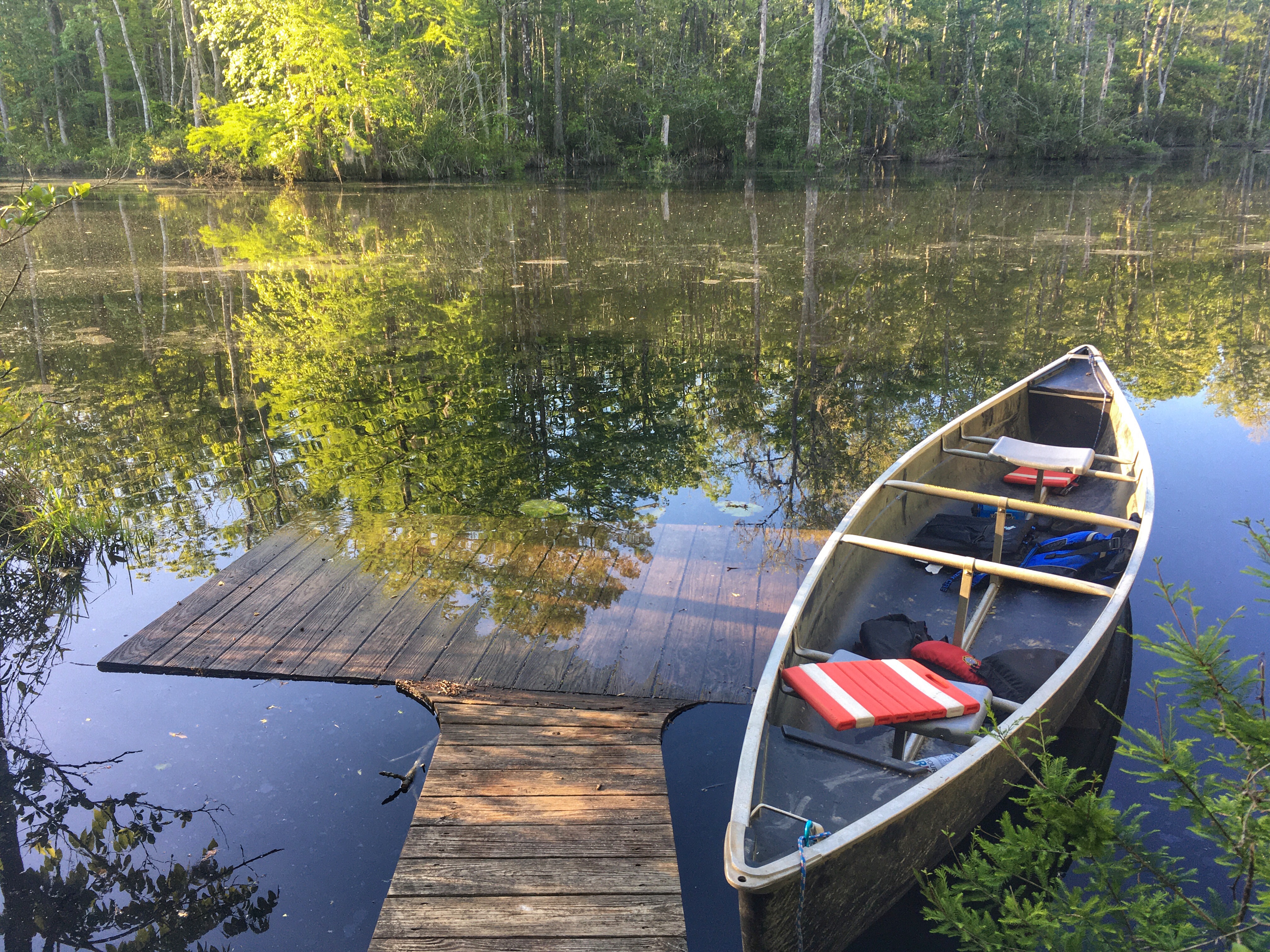
The view from our dock
The wind helped dissipate the aroma and we were able to finish our day relaxing on the dock at our campsite, watching the comings and goings of an amazing variety of birds.
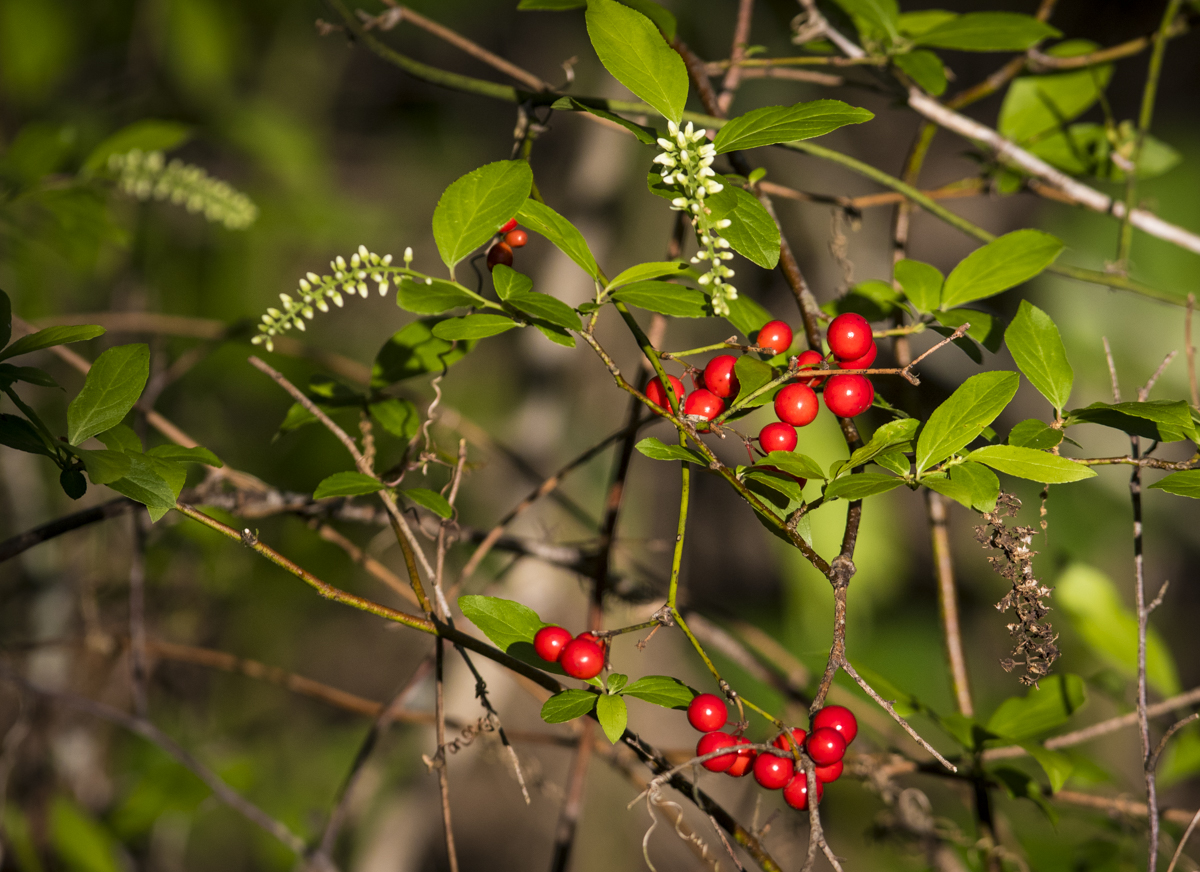
The vegetation surrounding our campsites was diverse and beautiful…here are the bright red berries of Coral Greenbrier (Smilax walteri) and flower buds on Virginia Sweetspire (Itea virginica)
While we sat enjoying the late day light, Melissa heard something back in the forest that concerned her…a growing whining noise (no, not me), reminiscent of a cloud of mosquitoes we had once experienced. We gathered our gear and headed for the tent, expecting to be swarmed, but nothing happened. We discovered the sound source later that evening as our tent light attracted literally thousands of the tiniest mayflies (non-biting) I have ever seen.
During the night, the water level rose about 6 inches, flooding our dock
The next morning, the birds put on an amazing show for us (again, more pics in the next post) and we finally dragged ourselves away and headed out for another long paddle day.
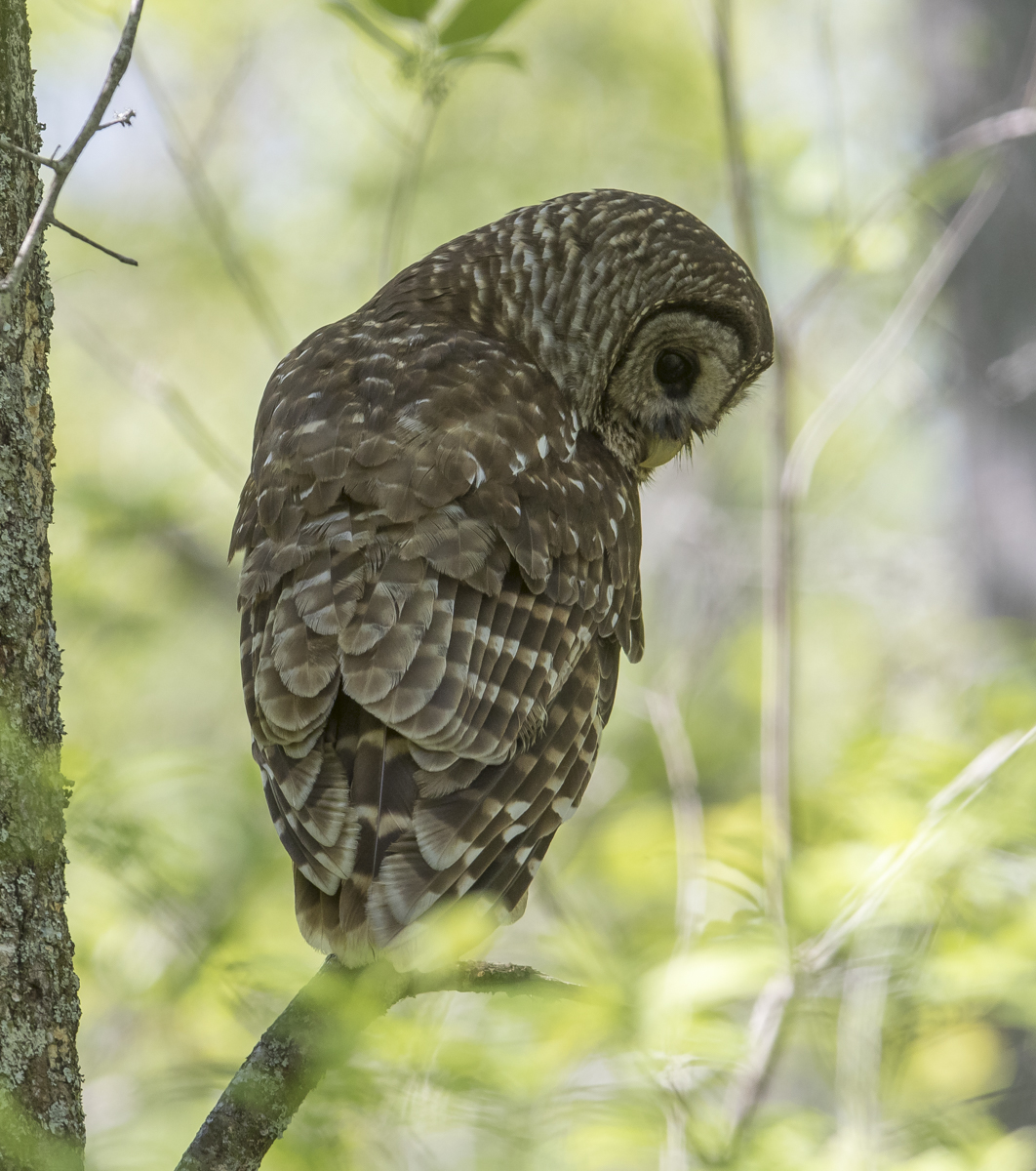
Barred owl scanning the shallows for a meal
The route Melissa chose included a 2+ mile paddle upstream on what is known as the “Cut” (Cut Cypress Creek). This is a narrow creek that connects Broad Creek to the Roanoke River upstream of Devil’s Gut and allows us to do a circuit route without paddling against the much stronger current on the river. The Cut has an intimate feel and is a great place to see wildlife because it is only about 20 feet wide in most places. Though we had heard many owls, we had not been close enough for a photograph so at one point I asked Melissa to find us a close owl in sunlight. Literally 30 seconds later, she spots one down low (in the shade, but still…). She was proving her naturalist skills throughout the trip, spotting amazing critters everywhere and hearing tons of songbirds. One of the coolest finds was a Mink swimming across Broad Creek. It disappeared into the swamp forest before I could get my camera out of the dry bag, but it is always a good day when you see a Mink.
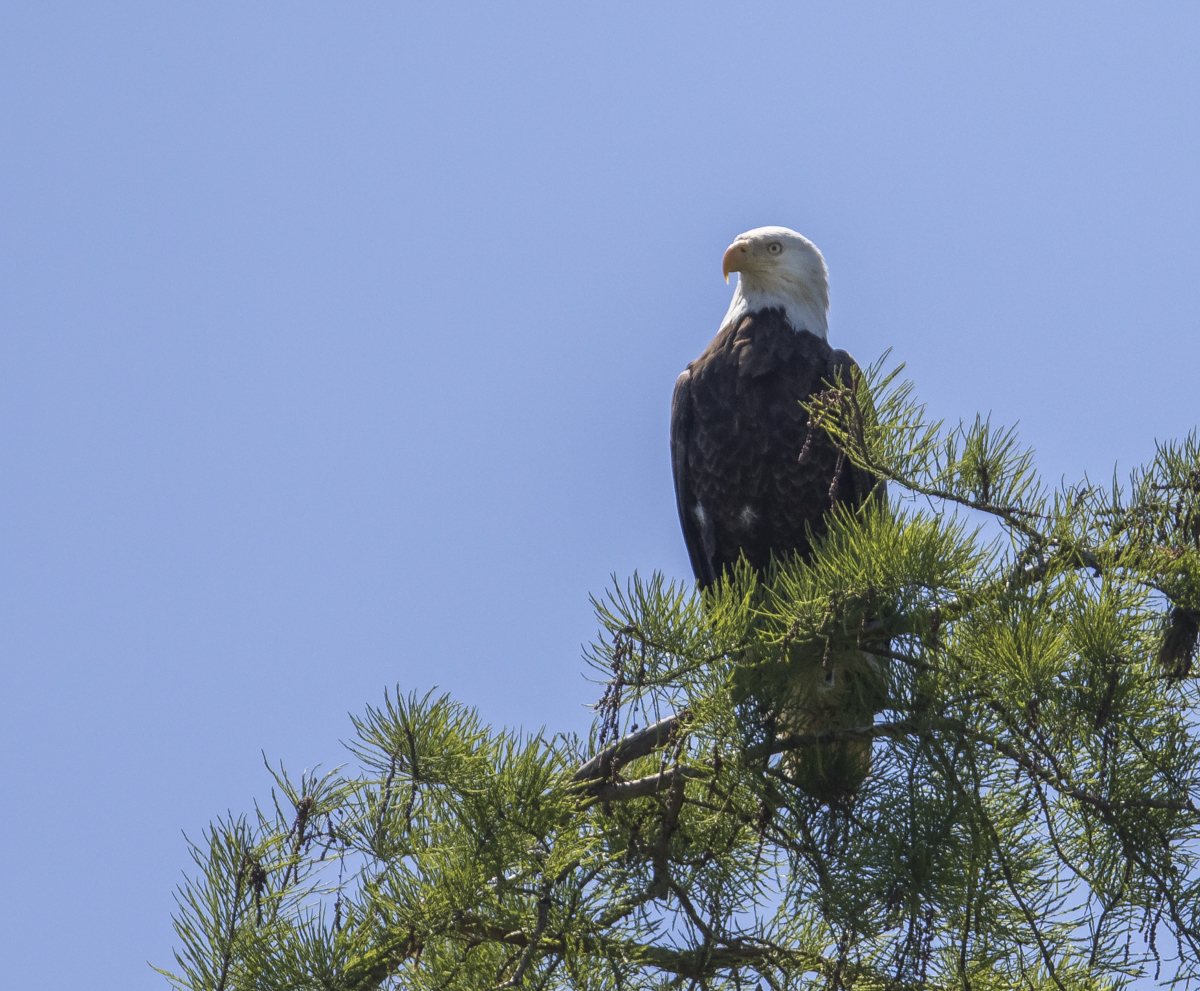
Adult Bald Eagle on the river
Once we hit the river, we could relax and let the current help carry us. A few miles passed quickly and the we headed back upstream along Devil’s Gut. Once again, our pace slowed, and we saw more wildlife as we paddled along the edges of the swamp.
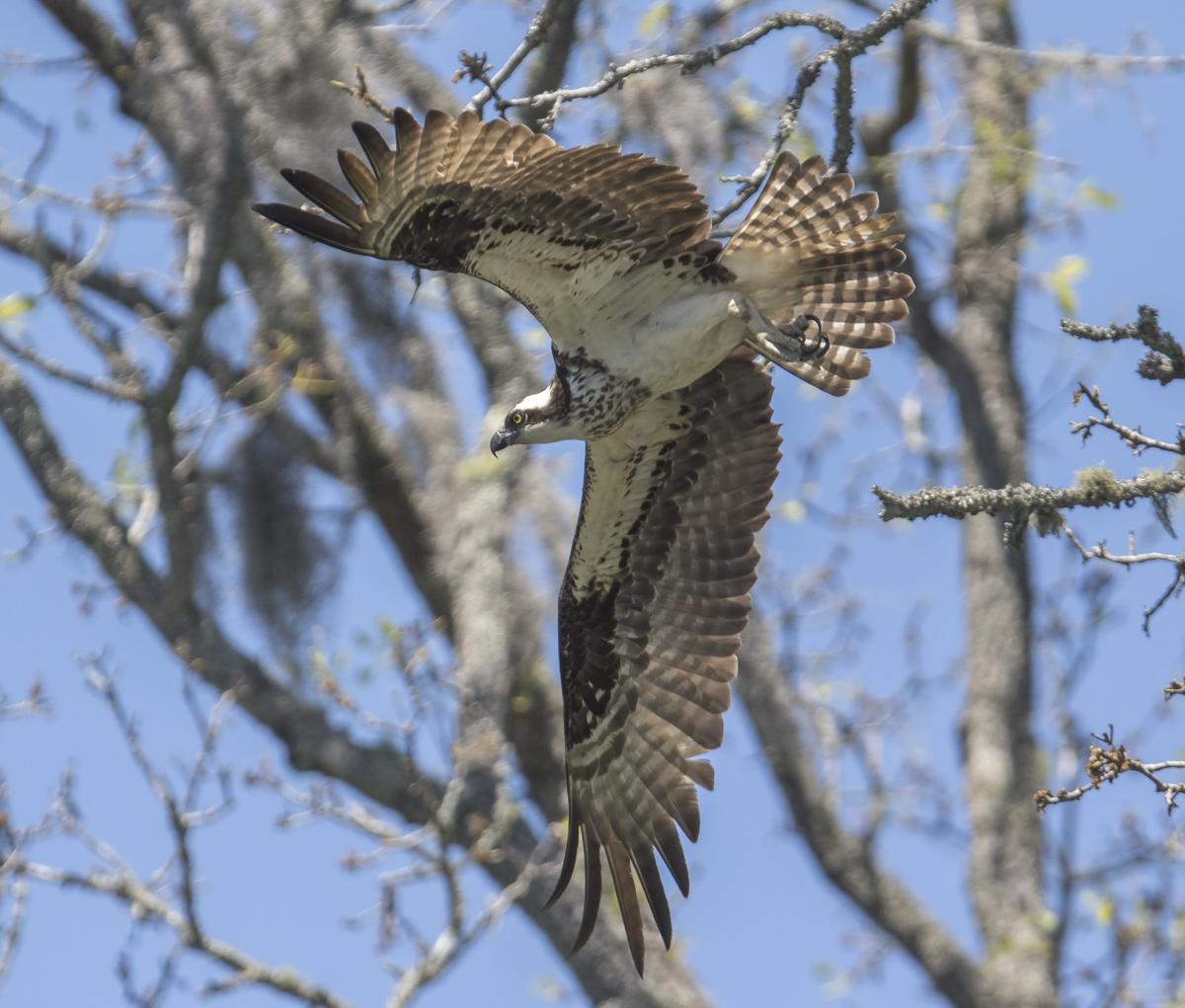
Osprey taking flight as we paddle underneath
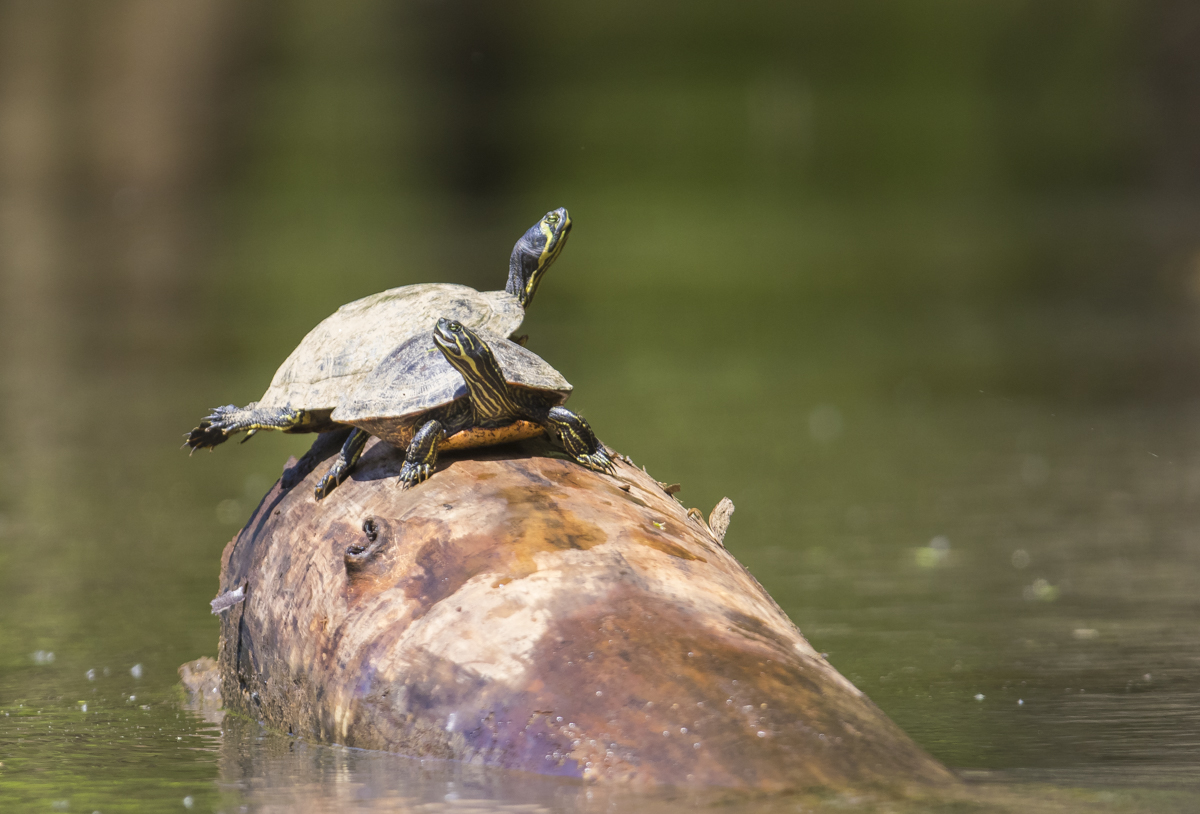
Basking turtles were a common sight
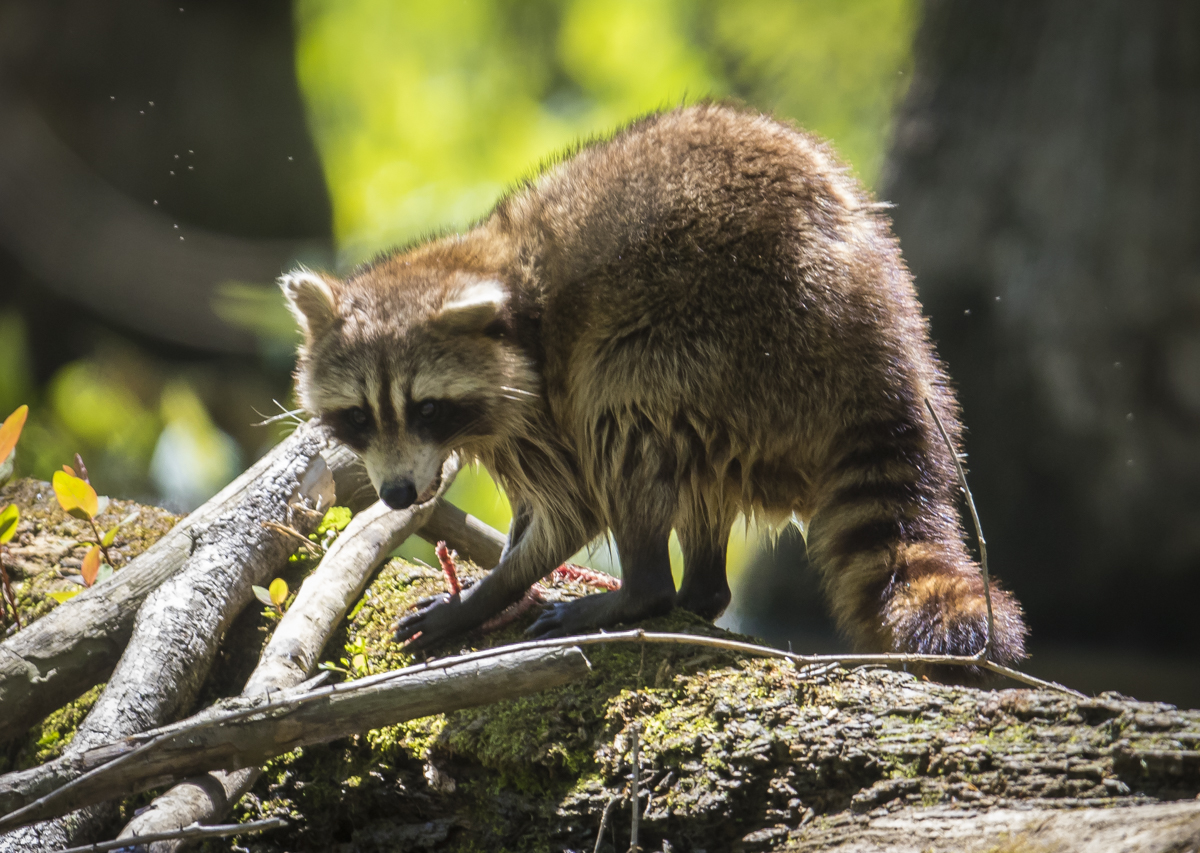
Melissa spotted another Raccoon feeling its way along the edge of the swamp. We drifted over for a closer look and spent the next 15 minutes watching it search for food. It barely even looked at us the entire time and was focused on digging and sniffing in the shallows.
A Raccoon snacks on a tasty treat found on a log
It seemed to make a point of walking along every log it encountered and on one, it found something to snack on. We could see what looked like a red rope that it grabbed and was loudly crunching. Close looks at the images once we returned show what looks like an amphiuma (an aquatic salamander common in these swamps) that something else may have caught and partially consumed.
The Raccoon traversed every log in its path and this one brought it close to our canoe
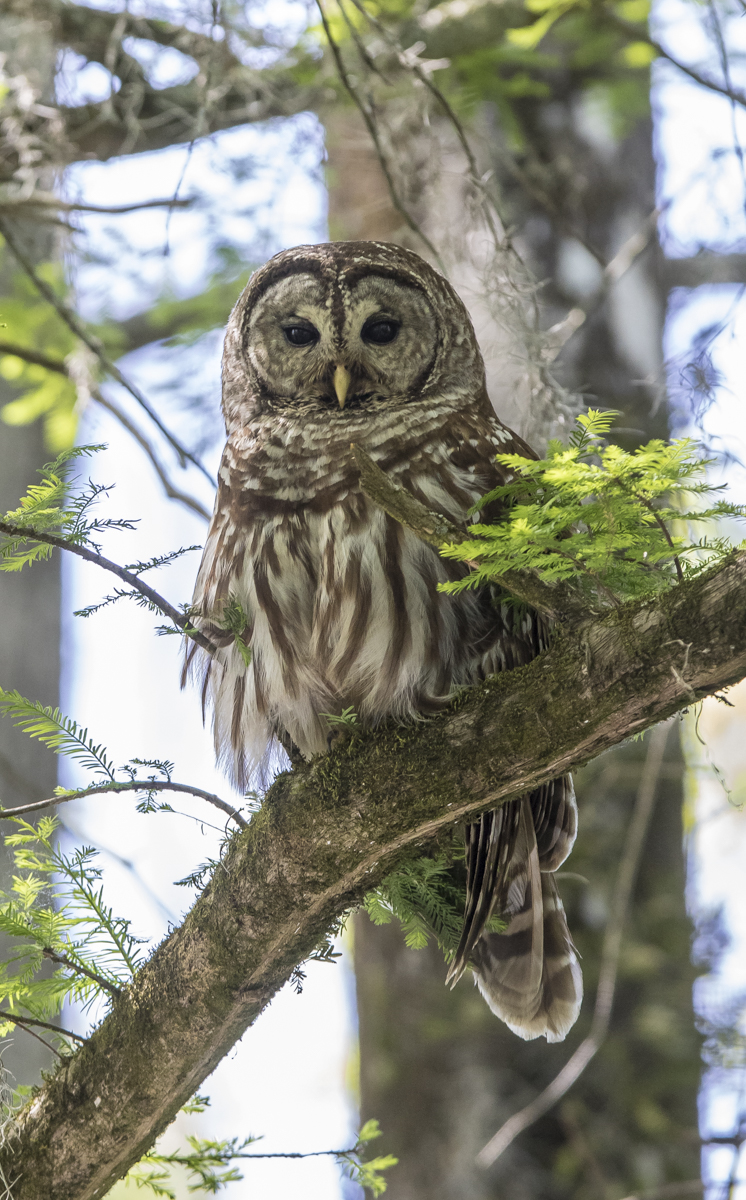
As we neared the end of our paddle, I once again asked Melissa to find me another owl to photograph. This time it look a little longer (maybe a minute) and she spotted one sitting inside the edge of the swamp in a cypress tree.
A more cooperative Barred Owl allows me to capture a quick portrait
Just before we reached our launch site, she saw something down low on a tree trunk on one of the few spots of dry land we saw on the entire trip. It was a flying squirrel clinging to the tree, out in broad daylight. We watched it for several minutes and it moved a little, but mainly just clung to the tree. Not sure what was happening, but it added another species to our impressive list of wildlife along the river.
A mystery as to why this Southern Flying Squirrel was out in daylight (photo by Melissa Dowland)
We paddled over 30 miles and had been totally isolated on the river for two and a half days, seeing only some fishermen at very safe distances. It was the perfect way to self-isolate and get some much needed outdoor recreation. We give thanks to those with the foresight to preserve this magical place and to create the paddle trail that allows such great access. More on the trip in the next two posts.
No matter what happens, or how bad it seems today, life does go on, and it will be better tomorrow.
~Maya Angelou
There has been a lot of talk these past few weeks of the value of connecting with nature, especially during these stressful times where everything “normal” seems unattainable. There is definitely solace in knowing that nature continues on its march toward new life. By going outside and seeing the progression of spring, the greening of the forests, the blooming flowers, and the awakening of our fellow creatures, we feel reassured that life is continuing, that the planet is still breathing. One afternoon last week, I walked around the yard looking for signs of new beginnings. Here are a few highlights…
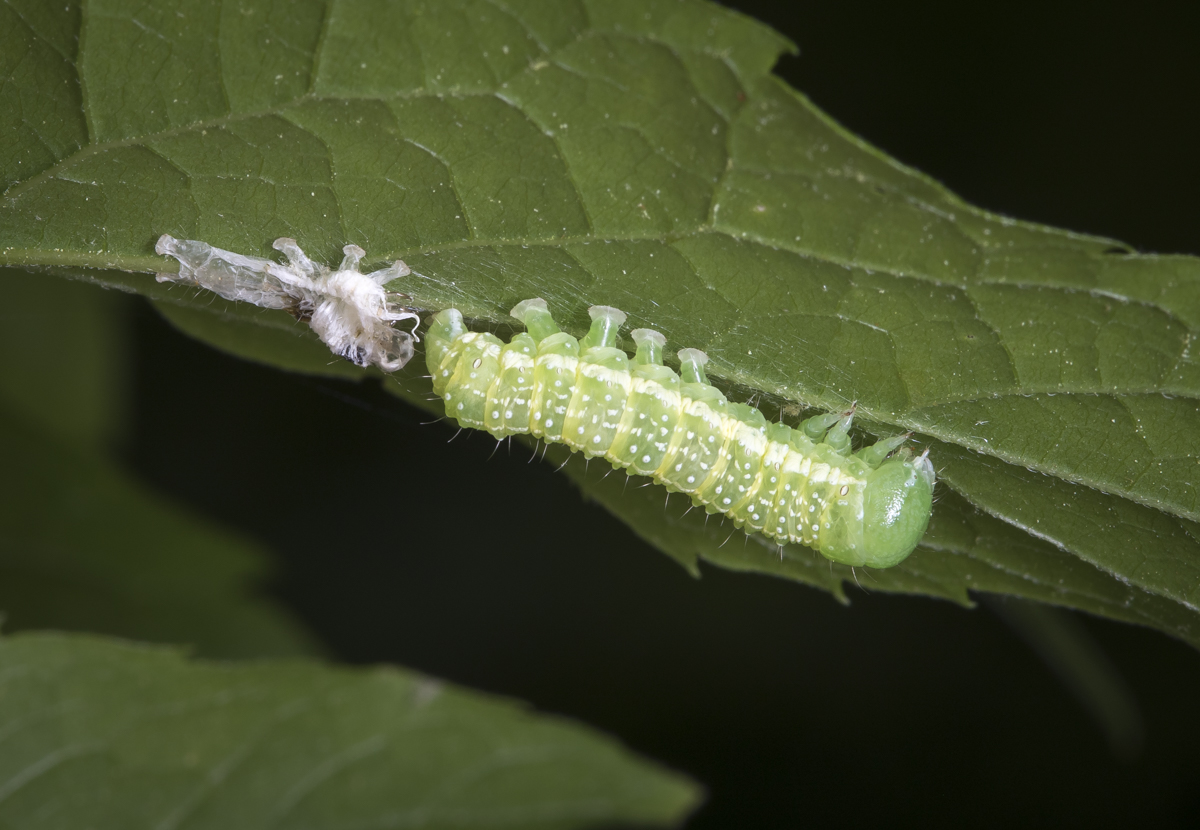
Caterpillar (a species of pinion moth, I believe) just after shedding its skin (click photos to enlarge)
It is a season of firsts…the first clutch of Carolina Wrens fledged this past week in their protected nest area inside my workshop. As I did last year, I removed a window screen so the little ones could get outside to join their anxious parents (the parents have learned to come and go through a small gap in the metal roof, but the young have a tough time finding that and just cluster at the window); the first Summer Tanager and first Rose-breasted Grosbeak appeared last week; the first Zebra Swallowtail of the season, and so much more.
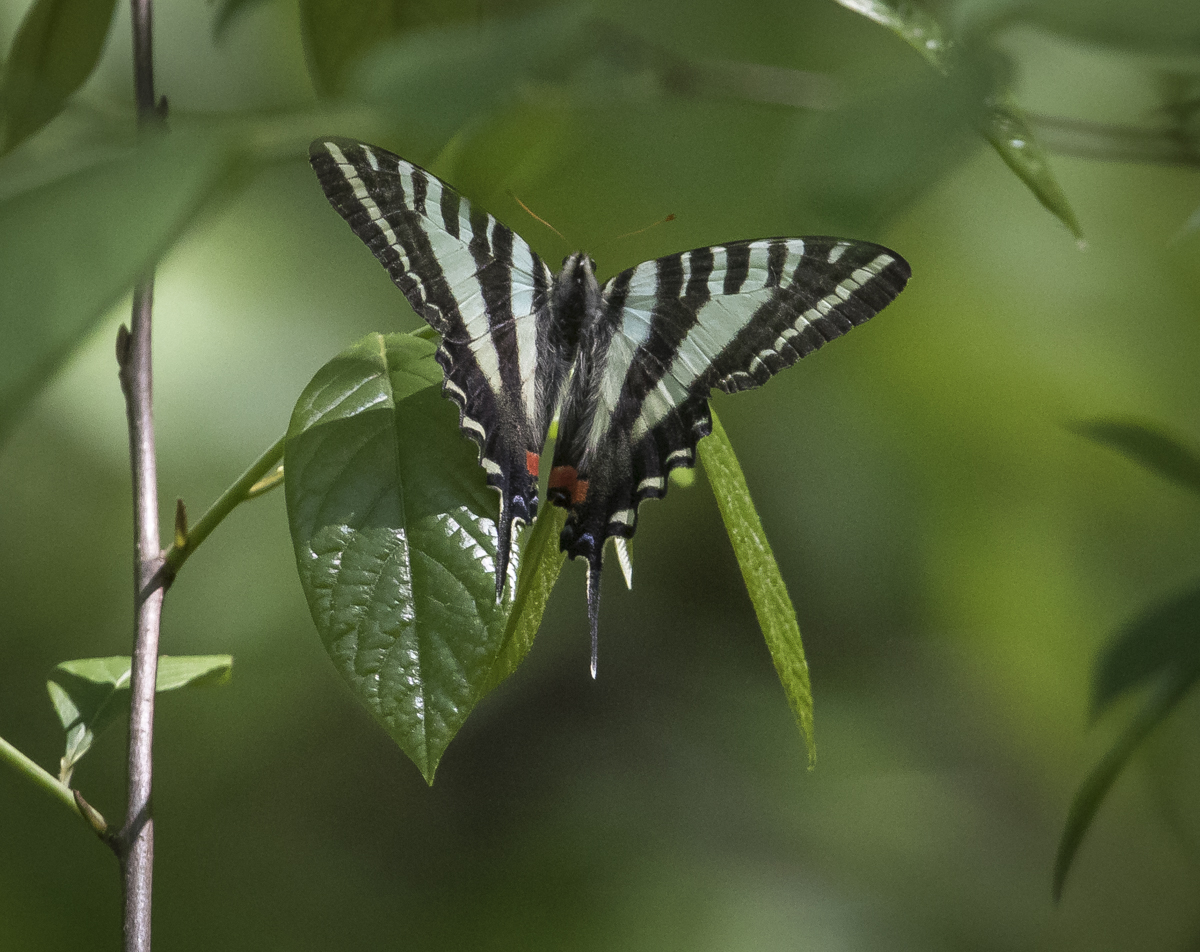
The first Zebra Swallowtail of the season was flitting around our Pawpaw trees (her host plant), laying eggs
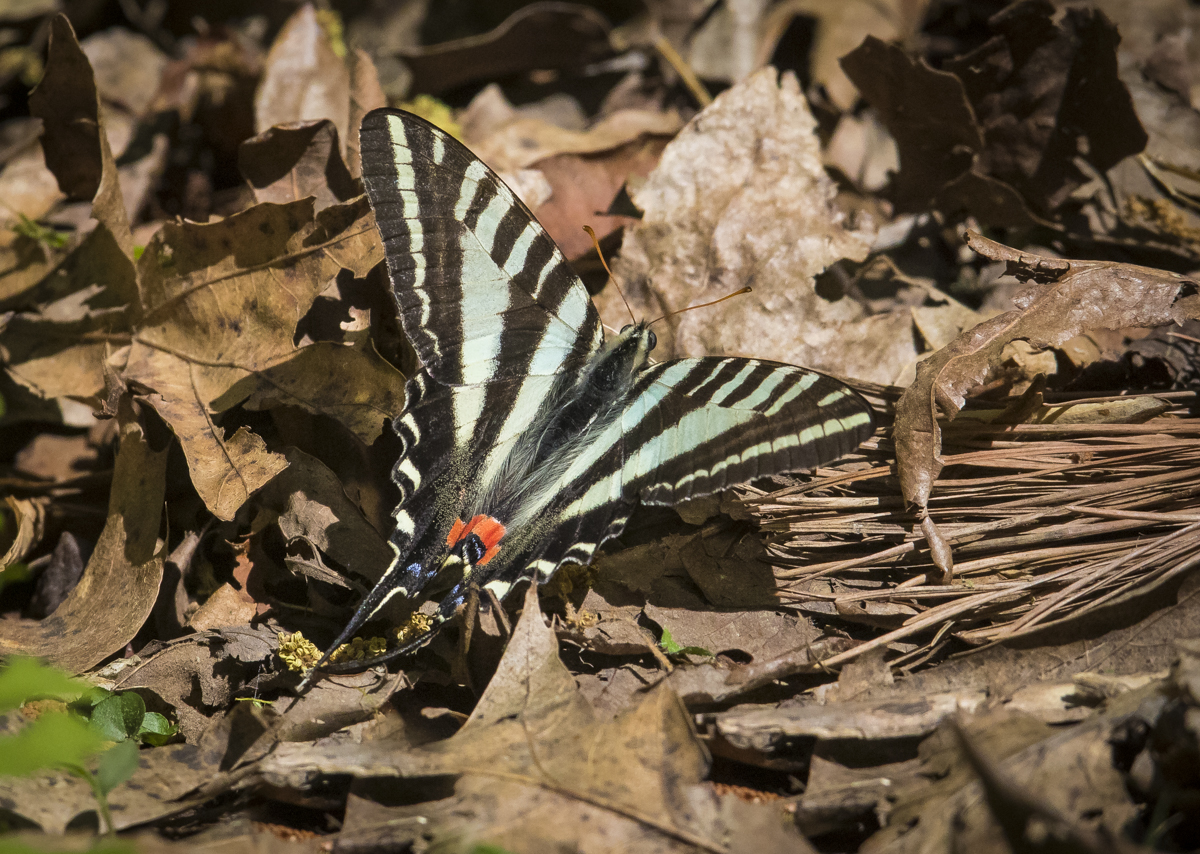
She would lay an egg or two and then go land in a sunny spot for a minute or so, and then return to lay more eggs
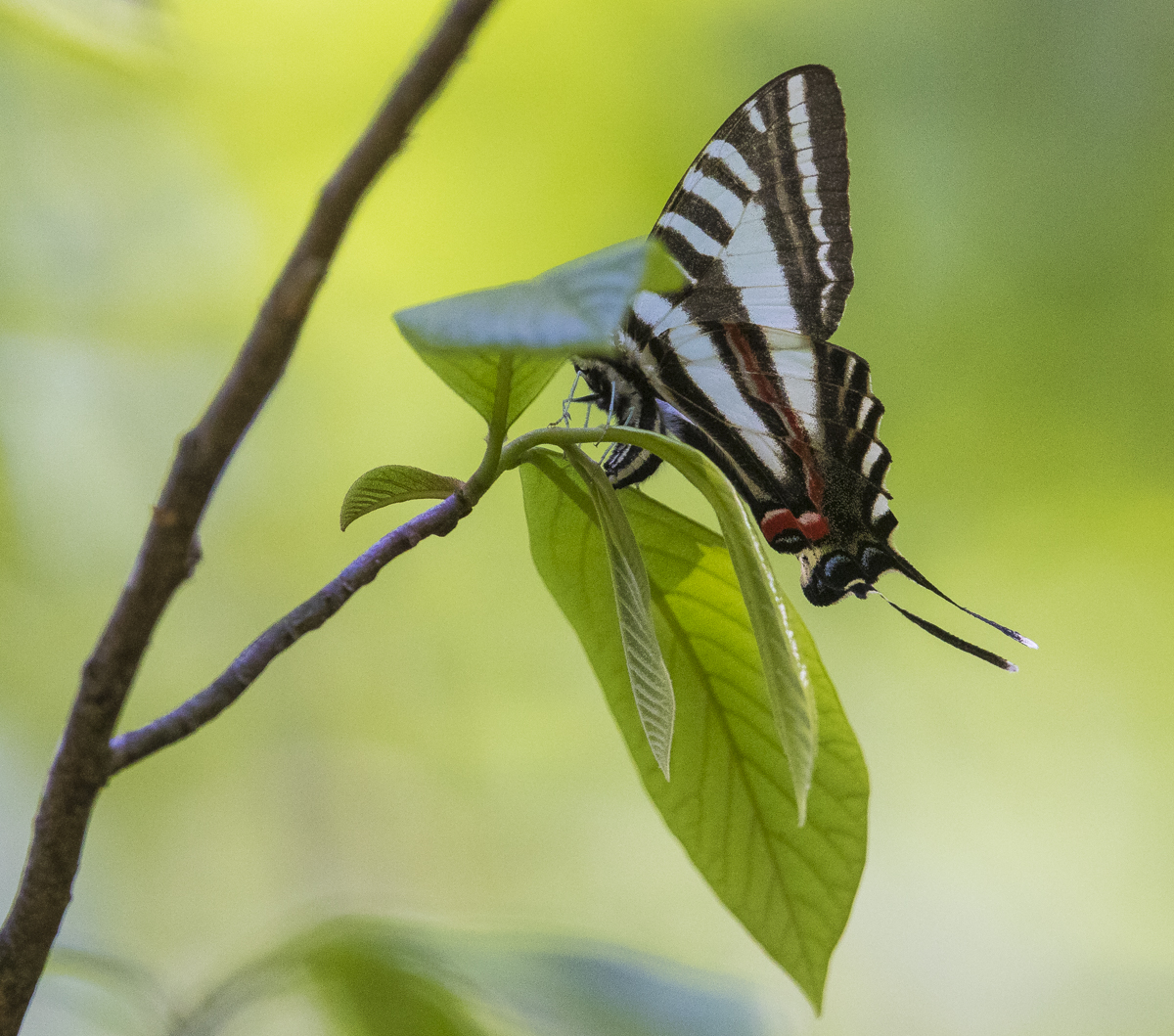
She curls her abdomen and glues an egg to a Pawpaw leaf
I also found a few Eastern Tiger Swallowtail eggs on Tulip Poplar leaves (Zebra Swallowtail eggs are similar in shape but lighter i color)
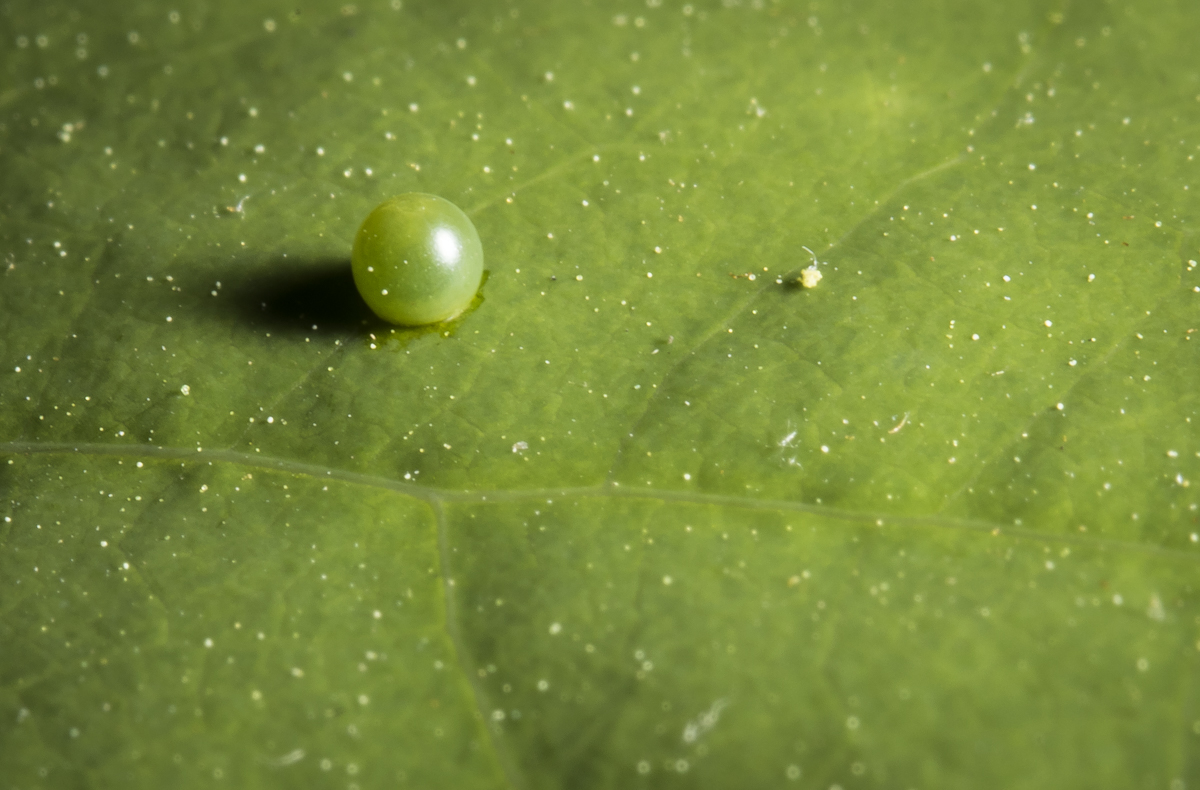
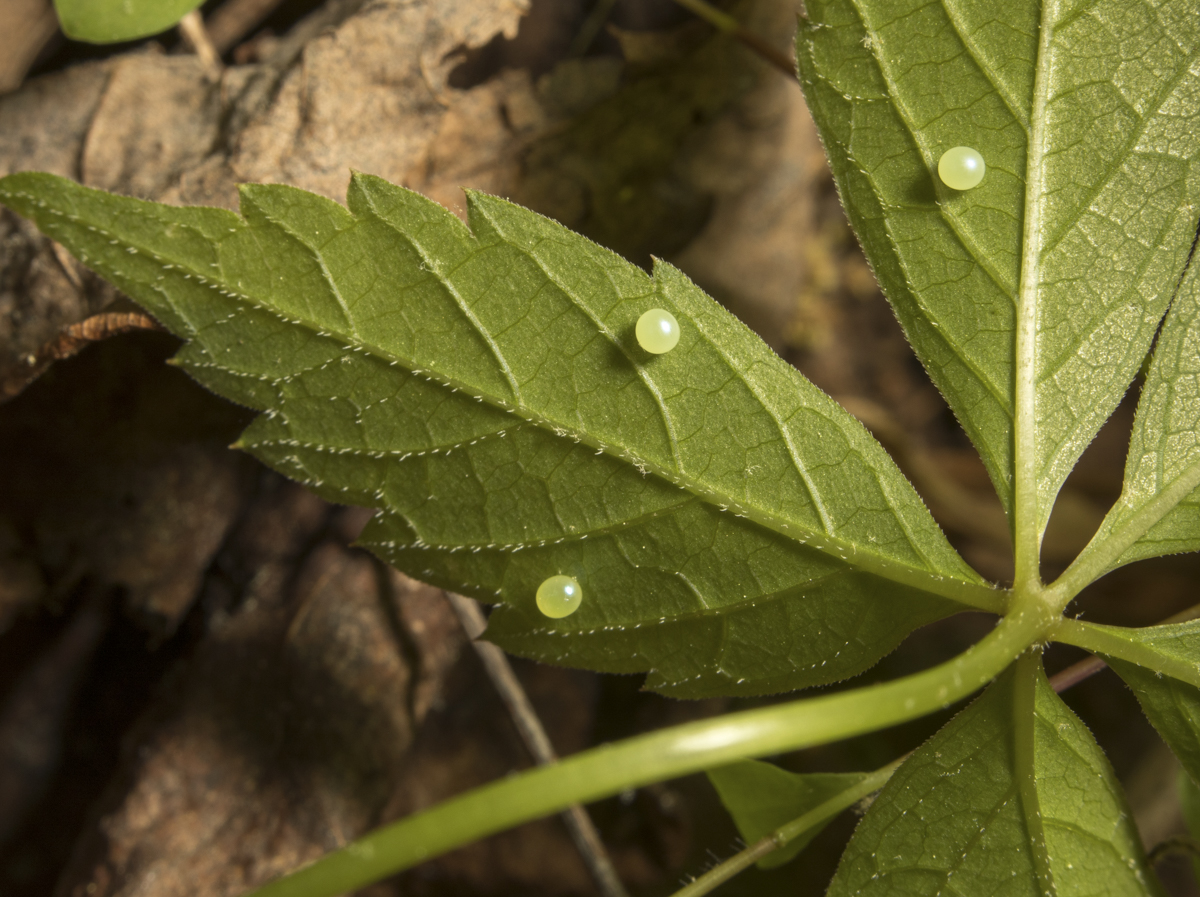
Sitting on the porch one afternoon, Melissa saw another Nessus Sphinx Moth hovering near the ground. Virginia Creeper is a host plant and we have an abundance of it scattered around the yard. We finally saw the moth touch down twice on a leaf over the span of a few minutes. We gently turned over the leaf and found 3 eggs (she or another moth had been there before).
Nessus Sphinx Moth eggs on the underside of a Virginia Creeper leaf
There’s a lot to look forward to with the new beginnings all around us. Stay safe.
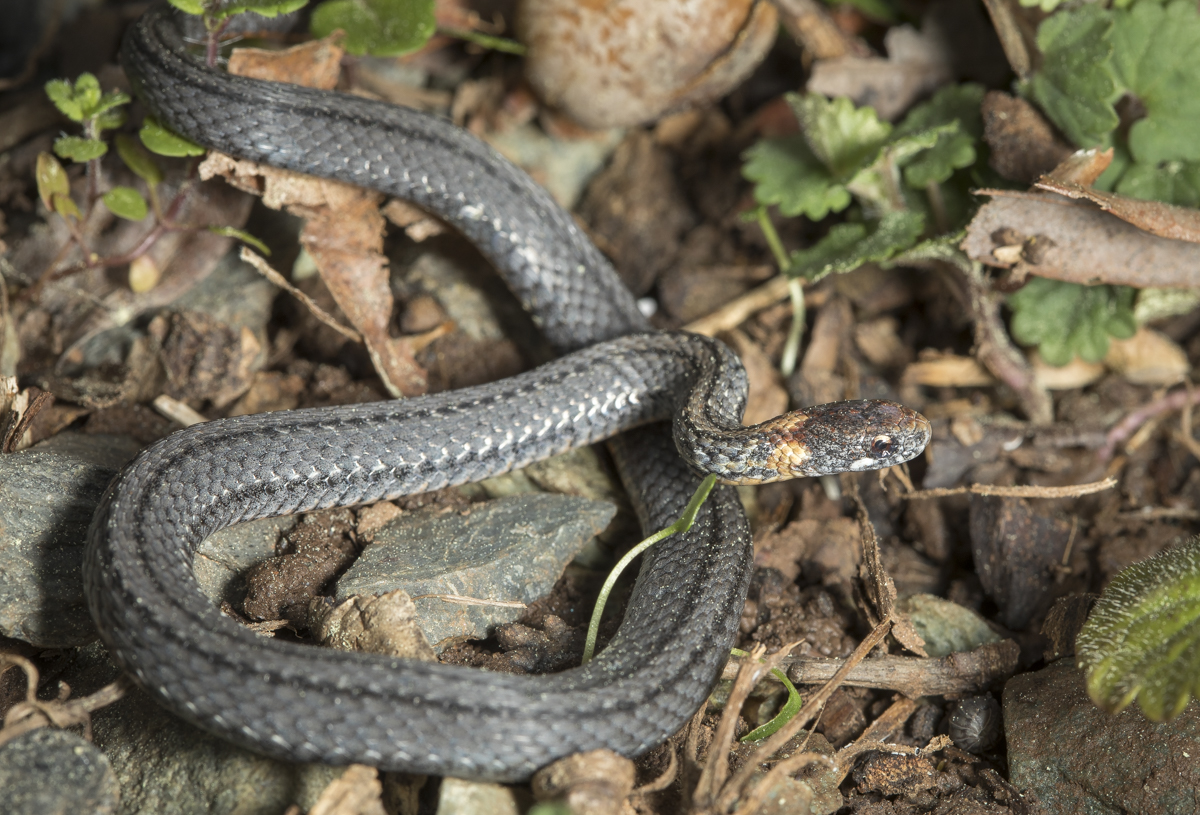
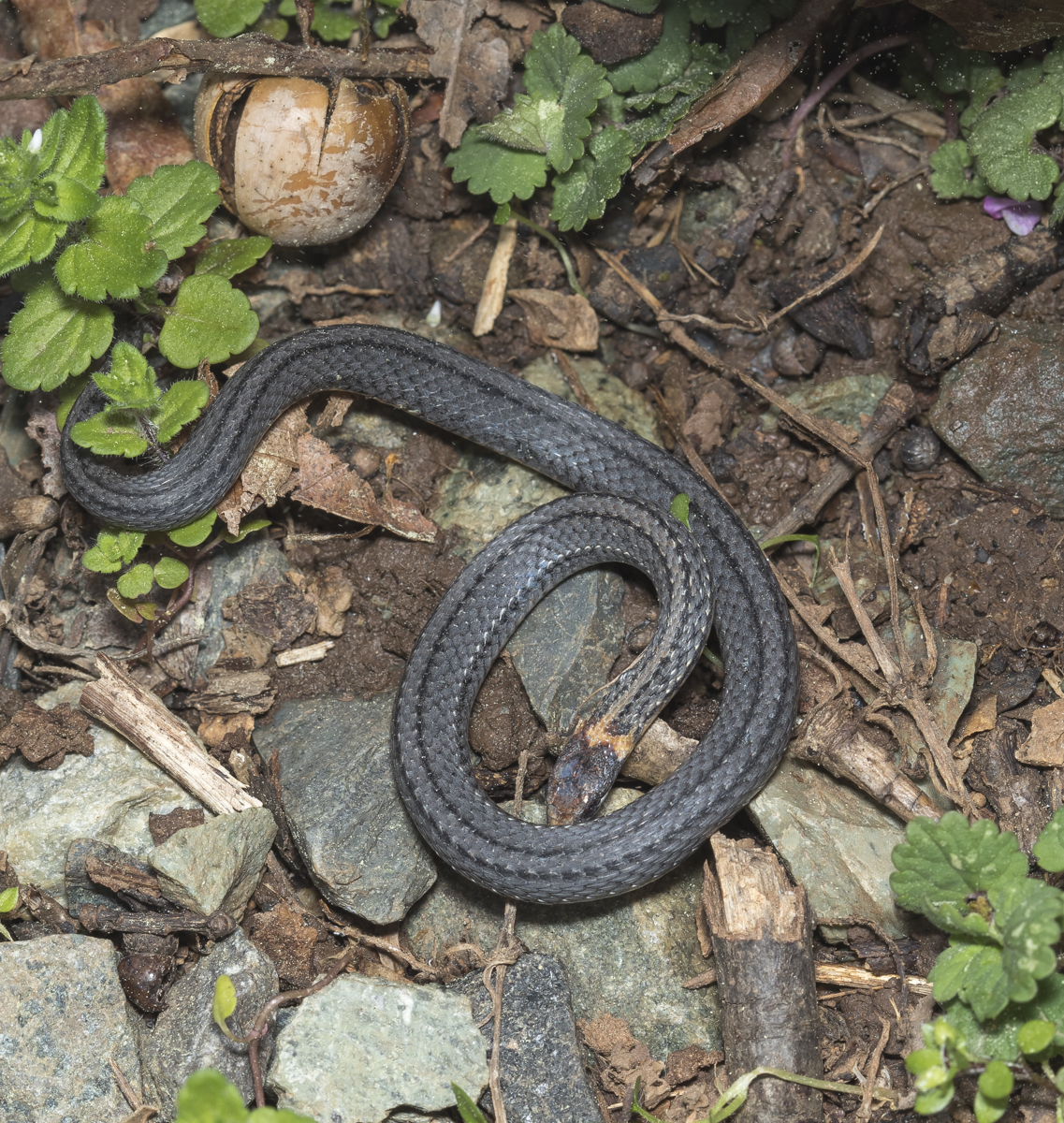
Here is the answer to yesterday’s quiz along with things to note as you make your observations. The snake is a Red-bellied Snake (Storeria occipitomaculata). It is a small snake with adults ranging up to about 12 inches in length. They are fairly common, but somewhat secretive, in wooded areas and edges of old fields. They are harmless, and don’t bite, even when handled. Their diet consists primarily of slugs and small snails. They are quite variable in coloration as you will see if you peruse a field guide or online source, ranging in color on their dorsal surface from gray (can be almost black) to brown to reddish.
Red-bellied Snake (click photos to enlarge)
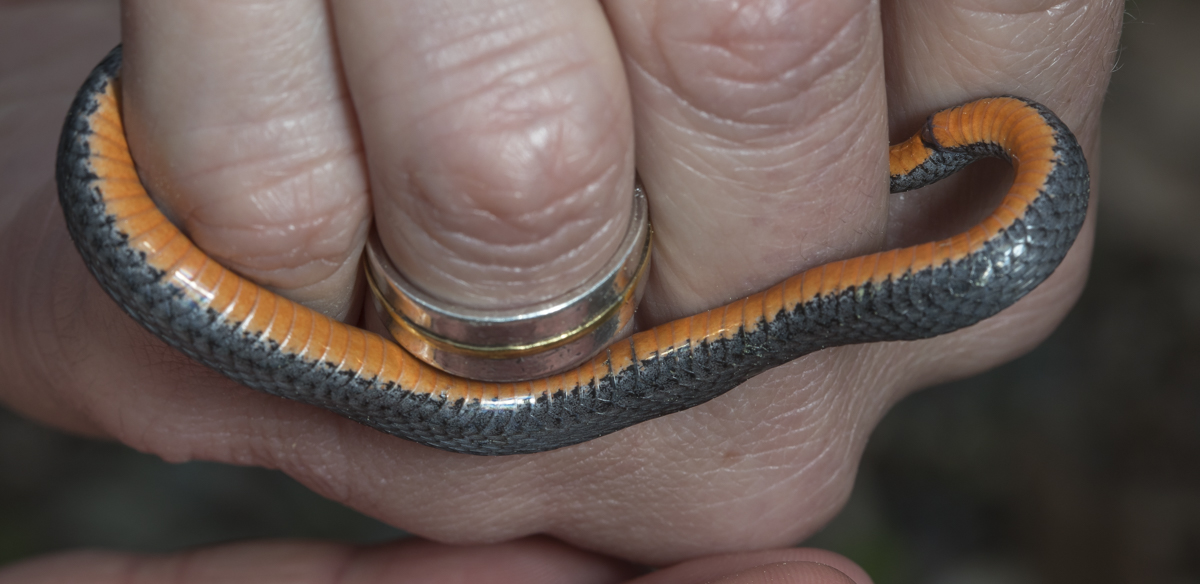
Their common name stems from the reddish coloration of their underside. They can be confused with a number of other local snakes. Just in terms of their name (and reddish underbelly) some may think they are Red-bellied Water Snakes (Nerodia erythrogaster), another common (but much larger) species in our area that is usually found near waterways.
The underbelly of a Red-bellied Snake is red or orange, often with some dark dots along the edge
People also often mistake this snake with two other small species – the Brown Snake (Storeria dekayi) and the Ring-necked Snake (Diadophis punctatus). I will admit to occasionally having called these guys ring-necks on first seeing one as they tend to have a yellow or orange collar behind the head, much like a Ring-necked Snake. But, with a closer look you can see some distinctive characteristics that will separate them…
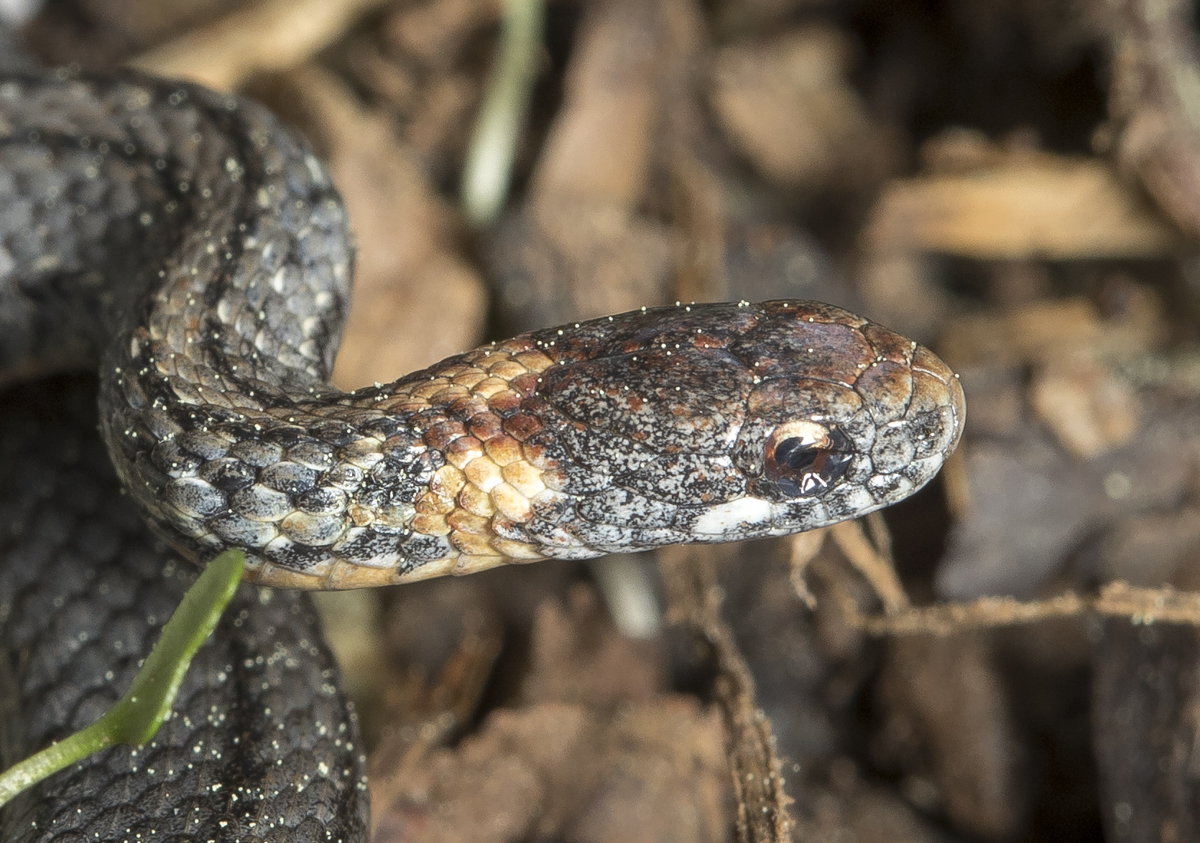
A close up of the head showing the distinctive white dot
Red-bellied Snakes have a conspicuous white spot under, and just behind, the eye. They also have keeled scales (scales that have a small, raised ridge, running down the middle). The Ring-necked Snake has smooth scales (no keel). The Brown Snake lacks the reddish underside and the yellowish spots behind the head.
The keeled scales can be seen in this photo and in the way a Red-bellied Snakes seems to have a rougher texture than non-keeled snakes
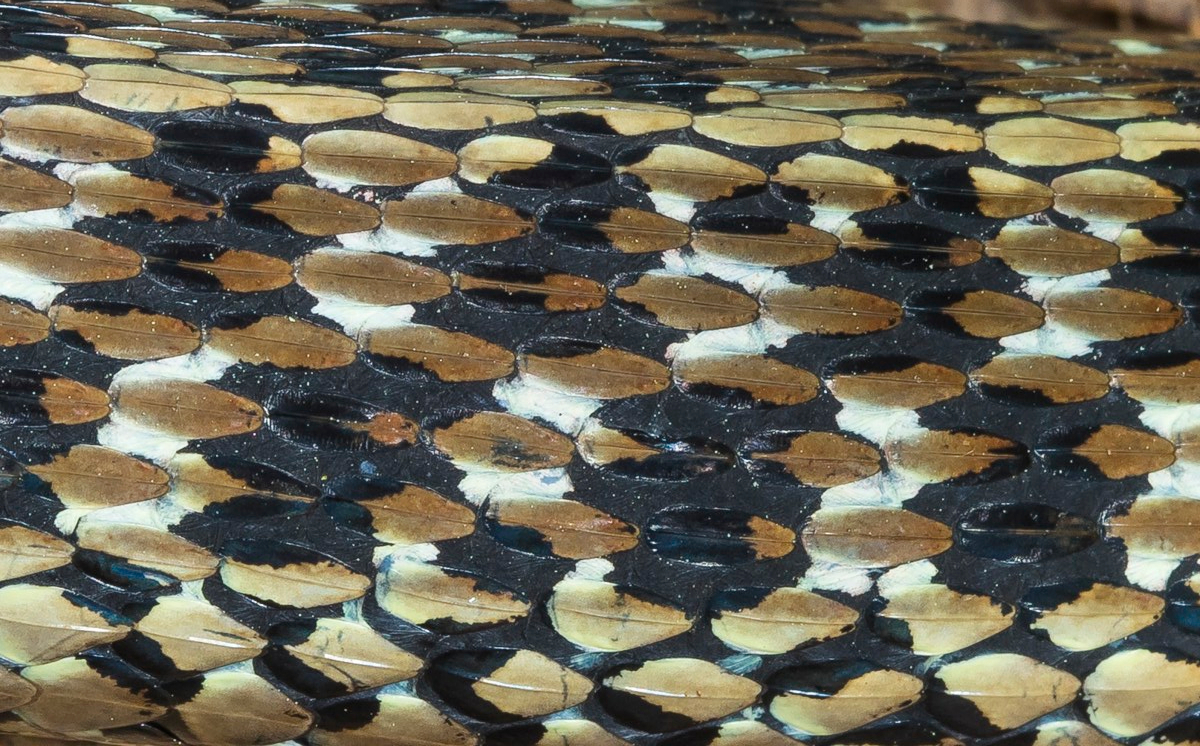
And speaking of keeled scales, that is what the mystery photo from yesterday was – a close up view of a beautifully patterned Eastern Garter Snake (Thamnophis sirtalis).
Close up view of the scales of an Eastern Garter Snake
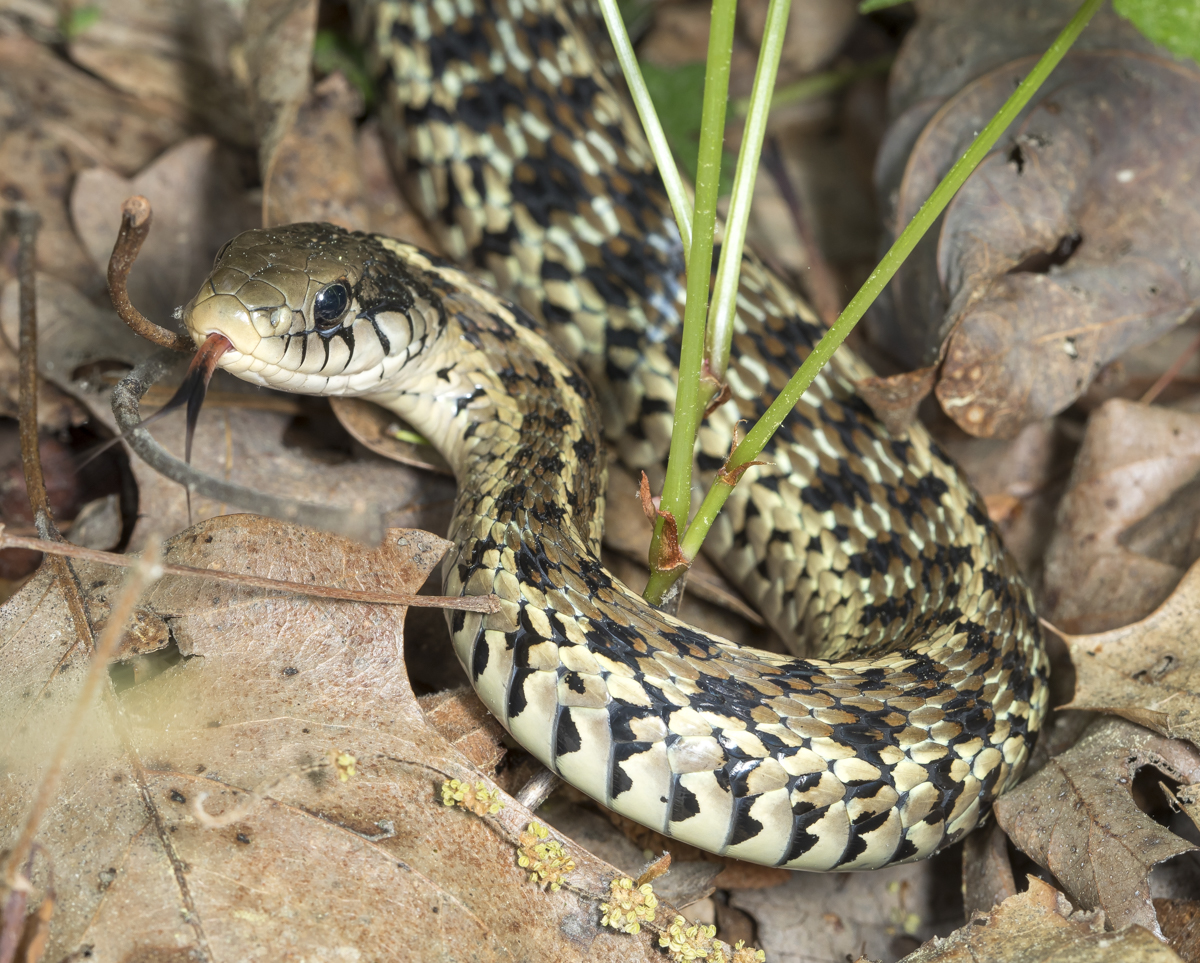
Garter snakes are another common species in this area and can grow to over 3 feet in length. We often have them around our small water gardens since amphibians are a favorite food item. They are not venomous, but will emit a strong musk, and may bite, if handled. This particular snake is a beauty and is hanging out near a decaying log in the front yard.
This snake seems to have an opinion of me and my macro lens
Whatever your opinion of snakes, they are an important part of our ecosystem and deserve to be left alone. You might even find them fascinating and beautiful if you give them a closer (but not too close) look.
I wonder what it would be like to go into a forest where nothing had name. How would we act in a forest if there were no names for anything smaller than an ecosystem? How could we walk, if there were no way to talk about anything larger than a cell?
~Kathleen Dean Moore
When I am trying to get people excited about the natural world, I like to help them find identities for the things we observe. To name something is to know it a bit better. To know it is to open the door for wondering about it, and, hopefully, caring about it. So, today we will try to learn the name of something Melissa found in our yard a couple of weeks ago. Perhaps you have seen one of these small snakes, or something similar, in your own yard. I want you to use your observation skills and see if you can identify this creature by either using one of your own field guides or looking it up online. Here are a couple of useful links that may help (Reptiles and Amphibians of NC and the Virginia Herpetological Society). Be sure to zoom in on the photos and take a closer look. The answer and more information tomorrow. You herp people out there, hold your answers until tomorrow.
Small snake Melissa spotted in our yard (click photos to enlarge)
If you look underneath, some color is revealed
And now for another mystery…I saw this earlier this week in our yard…what is it?
The Lord chose to reveal his power and his love through two human faces: the face of his divine Son made man and the face of a creature, a woman, Mary. Women make their contribution to the Church in a way that is properly theirs, by making present the tender strength of Mary, the Mother… In a synodal Church, those women who in fact have a central part to play in Amazonian communities should have access to positions, including ecclesial services, that do not entail Holy Orders and that can better signify the role that is theirs.This would also allow women to have a real and effective impact on the organization, the most important decisions and the direction of communities, while continuing to do so in a way that reflects their womanhood.
~Pope Francis, on the ordination of women, in “Querida Amazonia”
Women may still not be allowed to be Catholic priests, but in the plant world, they’ve taken their place at the pulpit – Jack-in-the-Pulpit’s pulpit, that is! We have several clumps of this interesting native plant in our yard, and they’ve started to produce their strange blooms just in time for the Easter edition of the flower parts series!
Jack at his pulpit. And no, that’s not a heavenly light coming down… it’s just the camera flash!
Jack-in-the-pulpit (Arisaema triphyllum) is perhaps one of the strangest flowers I’ve examined to date. It’s dioecious, meaning it has male and female flowers on different plants. Not only that, but depending on how healthy the plant is, it will change its sex: it can produce no flowers, male flowers, or female flowers from one year to the next. Because producing fruit takes the most energy, only very healthy, well-stocked plants will produce female flowers. Typically, female flowers are borne on plants with two leaves. Male flowers take less energy to produce than female flowers, and they are typically borne on plants with only one leaf.
That’s not poison ivy! It’s the compound leaf of a jack-in-the pulpit plant. So make sure you double-check your identification so as to not remove one of these amazing, native wildflowers from your yard accidentally!
I was reticent to remove one of the blooms because we don’t have too many in our yard. A quick survey showed that we have about 10 male flowers and only 3 or 4 female flowers. But Mike found one that had been cut by a rabbit, which gave me a chance to examine it further.
Jack-in-the-pulpit male inflorescence
The two most noticeable parts of the Jack “flower” are the hood (the pulpit) and Jack himself, inside the pulpit. These two parts caused me to learn yet another few botanical terms. The pulpit is technically a spathe, which, according to the trusty Plant Identification Terminology: An Illustrated Guide (by Harris and Harris) is a type of bract that often encloses the flower. (Remember the dogwood bracts from my previous post?) Inside, “Jack” is technically called a spadix which is “a spike with small flowers crowded on a thickened axis.” (And I thought spadix were those tight shorts I used to wear under my soccer uniform…:)
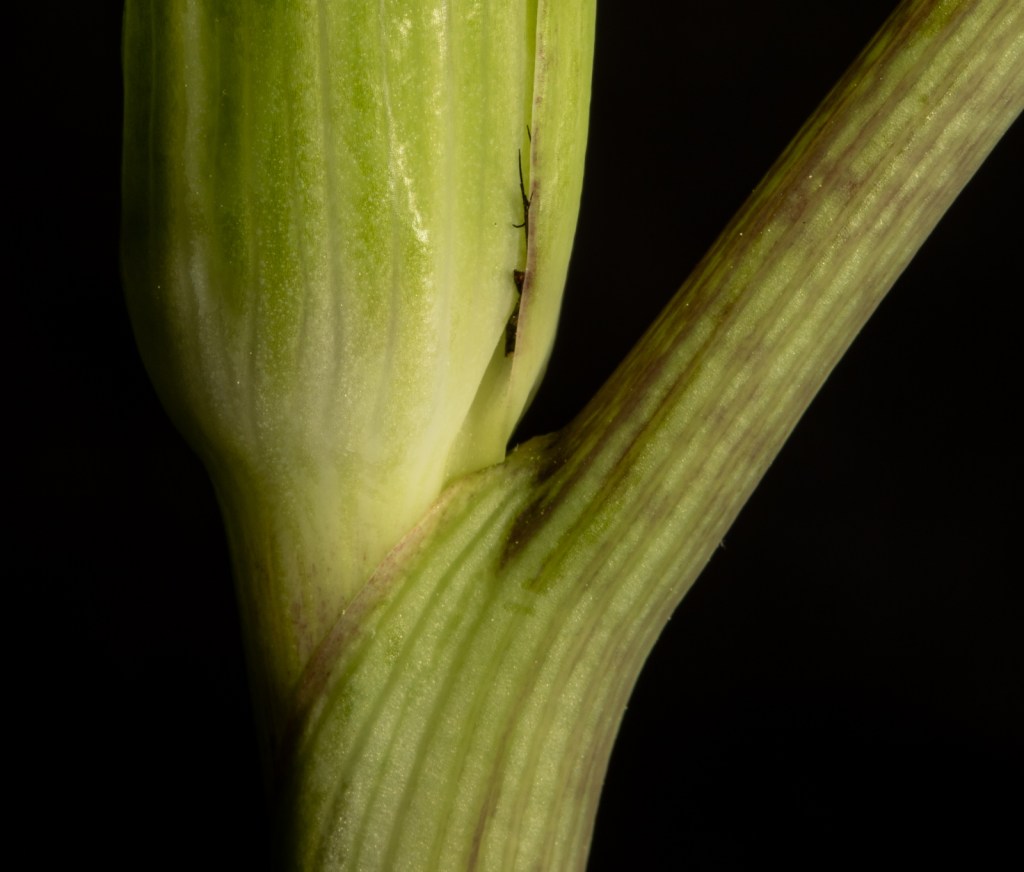
One feature to note is the small hole at the bottom of the inflorescence, right where the bract meets the stem.
Hole at base of bract on a male flower
Mike knew that this hole was only a feature of the males. For comparison, here’s the base of a female.
Female flower – note the lack of a hole at the base of the bract.
More on this difference in a moment… For now, back to the male flower. Since the rabbit had done its dirty work of cutting the inflorescence, I went ahead and took advantage of having it in hand and dissected it to show the flowers inside.
Male flowers
With the spathe removed, you get a clear view of the spadix. The swollen bits at the bottom that look a little bit like snail eye tentacles are the male flowers.
Even closer view of the male flowers
The flowers are lacking sepals and petals. The tentacle-y bits are the stamens. Because they’re male flowers, they don’t have a pistil either. As the flower develops, the stamens will begin to produce pollen. I read on the New York Botanical Garden website that each male flower has 4 stamens. In my pictures, it looks as though there are two tentacles per flower, and if you click on the photo and enlarge it as much as possible, it indeed looks like there’s two round bits at the tip of each tentacle, which would mean 4 stamens per flower.
Mike and I went outside to take a look at a female inflorescence. This was a little tricky because I didn’t want to pick it, but still wanted to be able to show the flowers down inside the spathe. Here’s a female, rising from a plant with two leaves.
Female inflorescence
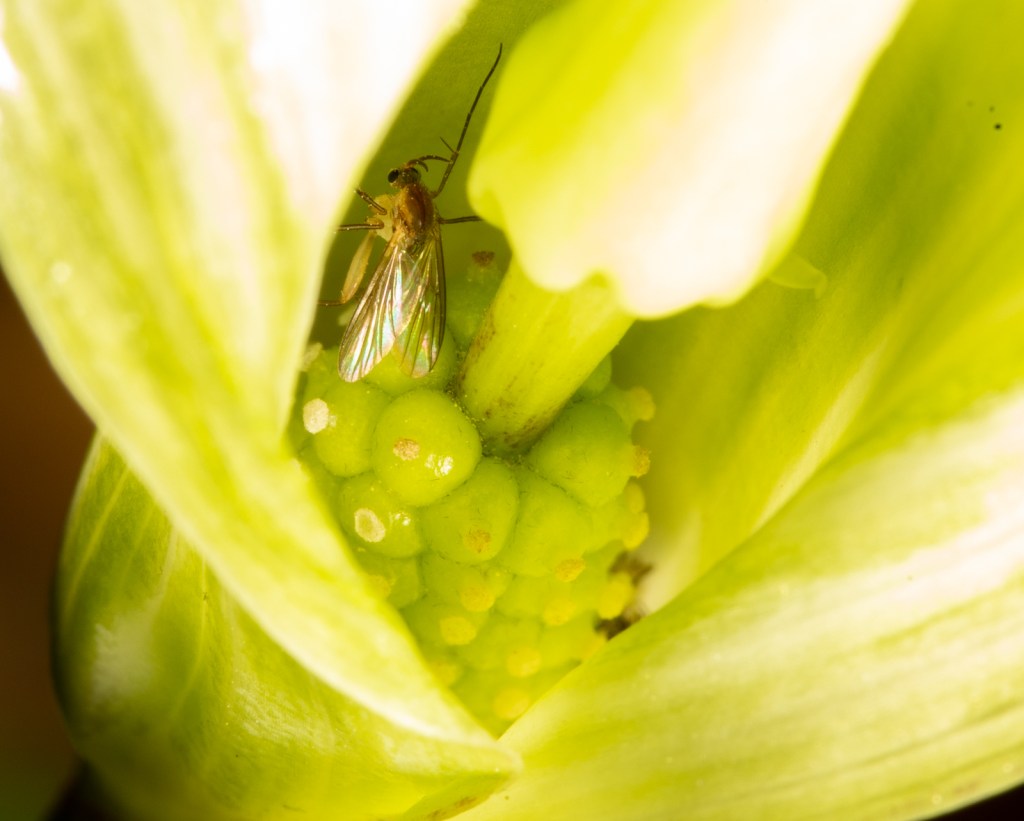
Again, note the lack of a hole at the bottom of the bract. We were in for a surprise as we began to examine the flower more closely. Mike helped me pull back the top of the spathe to take pictures down the gullet of the flower… and lo and behold, we found a cauldron of gnats!
I had read in the always-informative Stokes Nature Guides: A Guide to Enjoying Wildflowers by Donald and Lillian Stokes that there might be some flies, likely fungus gnats, inside of the flower. However, I wasn’t expecting quite the swarm we found! Apparently, the flowers emit an odor that mimics the scent of fungus, which is where these flies like to lay their eggs. The hooded spathe, with lines that guide insects toward the bottom and lighter coloration at the bottom, lures flies in. Think about how, if you have a fly in your house, it tends to hover around your windows – flies tend to seek light. So having more light at the bottom of the tube means the flies will fly to the bottom and get trapped. This plant functions very similarly to a hooded pitcher plant, which acts in much the same way (minus the fungus smell).
This is where that hole at the bottom of the bract comes in handy. On the male flowers, the gnats roam around and get coated in pollen… but most eventually find their way out via that hole. In the female flower, there’s no exit hole, and the gnats may never find their way out, poor souls. But this likely helps ensure that the female flowers are pollinated. Fortunately for the flies, though perhaps not the flowers, as we continued to manipulate the plant to try to expose the female flowers, many of the gnats were able to escape, though most stuck around and kept trying to get back in!
After much more uncomfortable kneeling and fingers and hands getting in the way of pictures, with Mike’s help I was able to get some photos of female flowers.
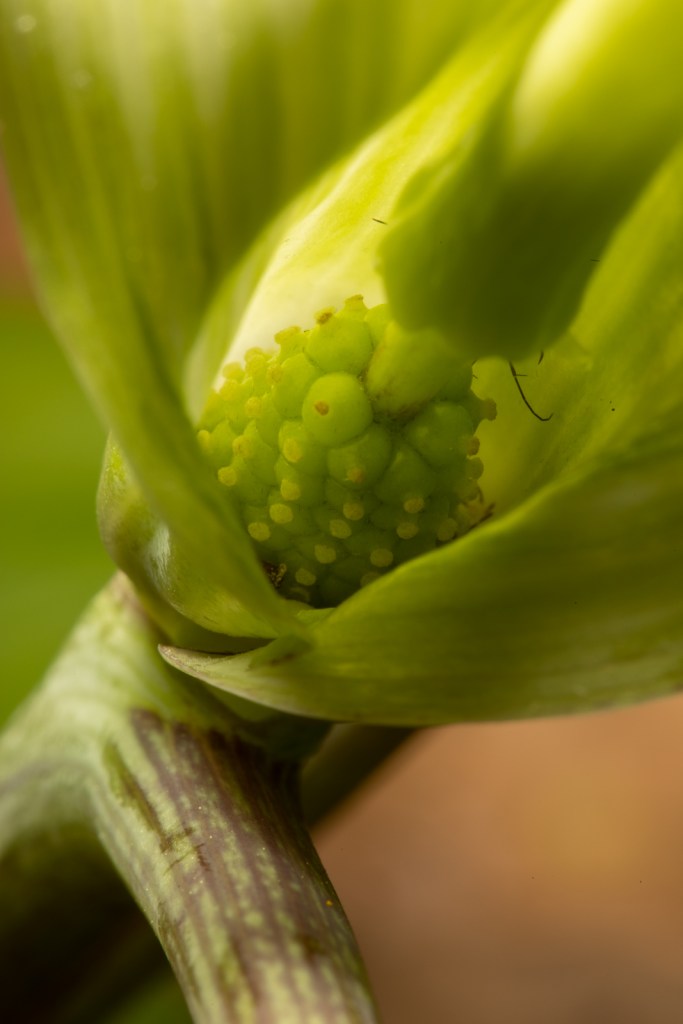
Female flowers
You can see in this image each female flower is basically a swollen green ovary with a yellowish knob protruding – the knob is the stigma.
I think I owe you all a note on botanical terminology here. In all of my flower parts posts, I’ve been careful in my use of the word “flower.” For instance, I called the dogwood “flower” a bloom, blossom, or inflorescence and NOT a flower because the flowers are actually the tiny parts in the middle. However, in this post, I’ve found it harder not to call the inflorescence a flower. The less-technical “bloom” and “blossom” just don’t seem appropriate in this case, and inflorescence is quite a bulky word. However, technically, this mostly green leaf-like thing is not a flower, it’s an inflorescence. The flowers are what’s at the bottom of the spadix: the tentacle-like male flowers or swollen, stigma-bearing female flowers. I hope the botanists of the world will excuse my imprecise use of terminology in this case!
Even closer look at the female flowers… and one of their pollinators!
Hopefully these female flowers got pollinated by the fungus gnats before Mike and I let them all escape. If so, this plant will produce a beautiful cluster of berries in the fall, when the spadix will wither at the top, and each ovary will swell and turn brilliant red.
Keep an eye out for these amazing plants on your next socially distant hike in the woods, and if you see one, take a careful look to see if it’s Jack, or maybe Jill, in the pulpit!
Its nest is composed of the frailest materials, and is light and small in proportion to the size of the bird.
~John James Audubon on the nest of what he called the Blue-grey Fly-catcher
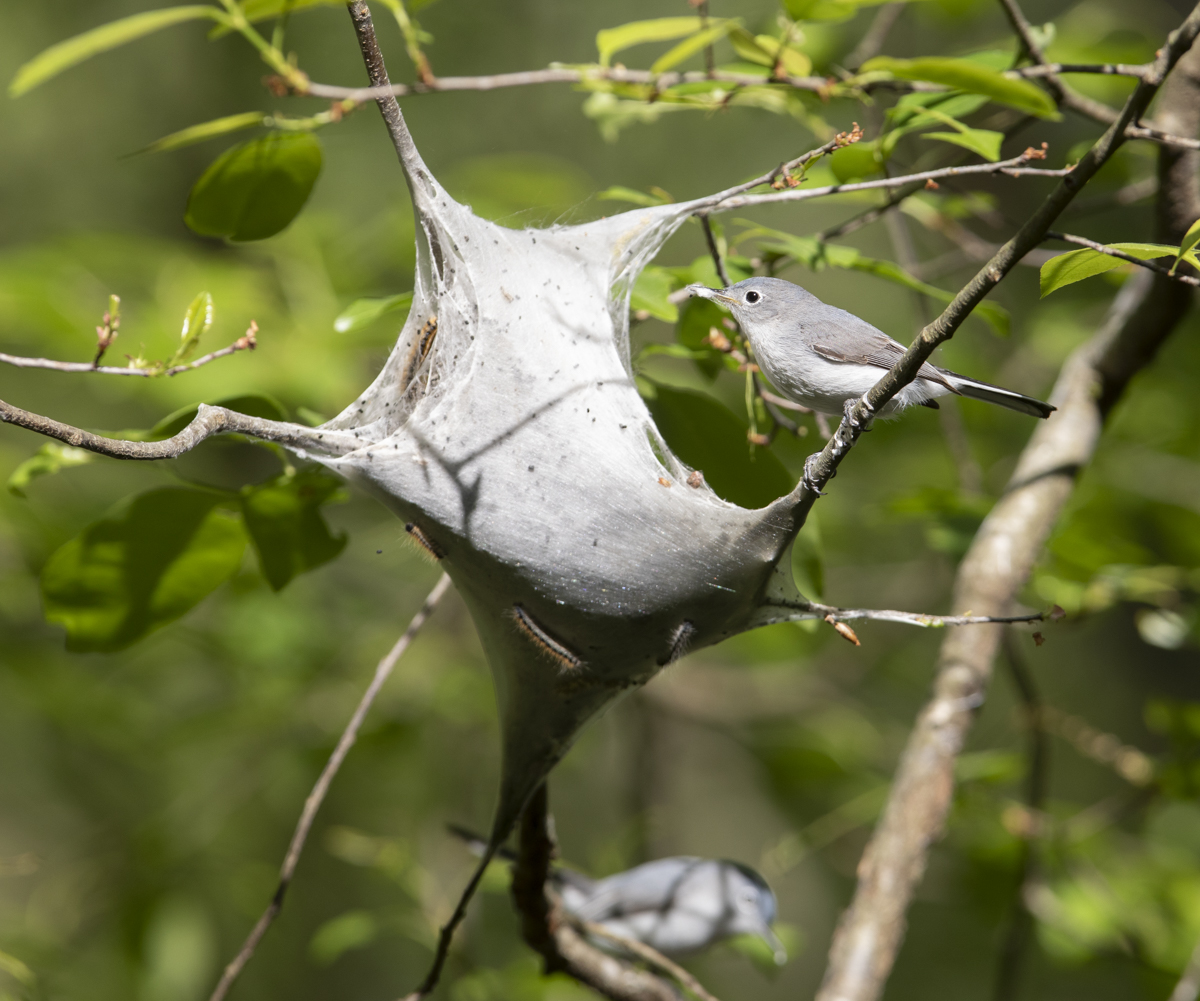
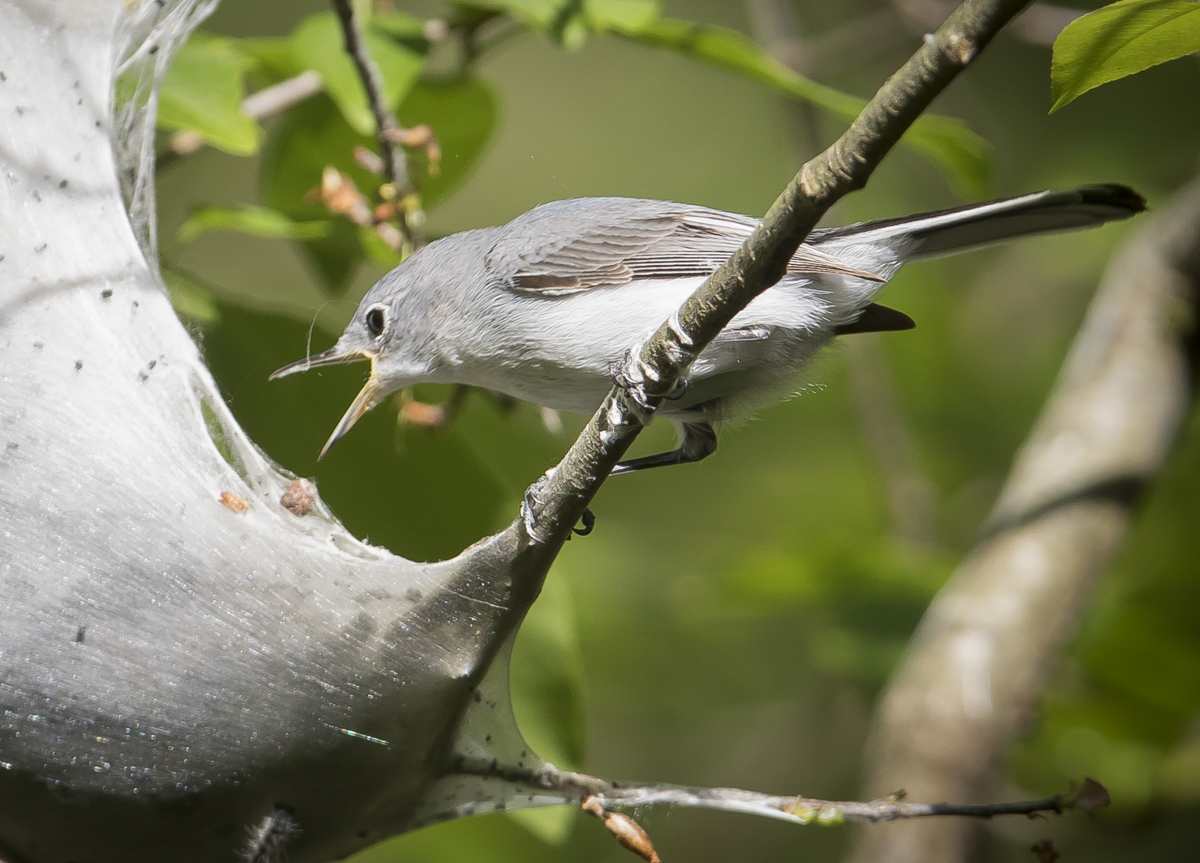
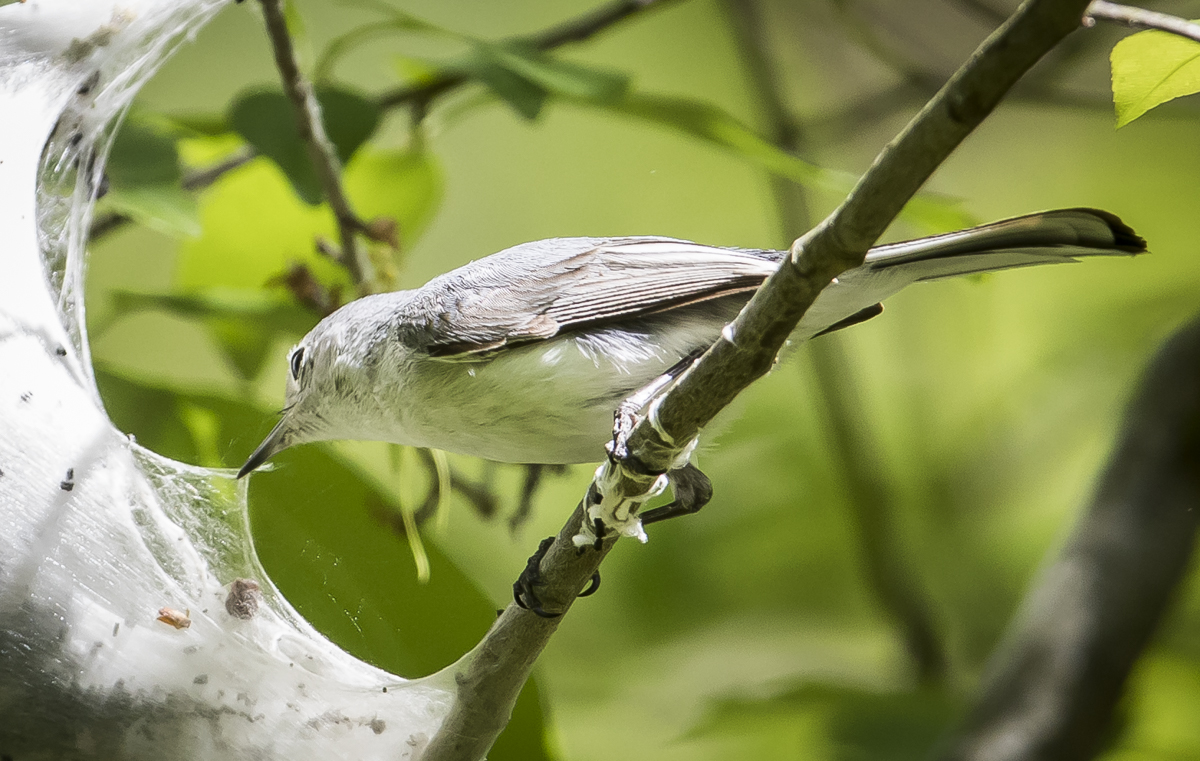
A friend and co-worker of Melissa says the wispy call of the Blue-gray Gnatcatcher (Polioptila caerulea) sounds like a faint “Steve”. So, a couple of weeks ago, when I heard Melissa call out, “Steve”, while scanning the treetops, I knew the little dynamos had returned. Their faint song is pretty much out of my hearing range these days, so it wasn’t until a few days later that I spotted my first one, flitting around some tree branches, waving its seemingly too long of a tail back and forth as it snapped up insects too tiny for me to see through my binoculars. Then, last week, we spotted two together at a small Eastern Tent Caterpillar nest on a cherry tree off our deck. The gnatcatchers were pulling silk from the caterpillar nest for use in their own. In the past two weeks we have also seen Tufted Titmice and Carolina Chickadees at these caterpillar structures, although I only saw the chickadee pull out a couple of the larvae and then drop them (they may be too hairy for their tastes). Gnatcatchers make a beautiful nest similar in construction to that of a Ruby-throated Hummingbird, but larger. I wrote about watching a nesting pair at the North Carolina Botanical Garden in an earlier post. Here is a photograph of that nest showing the cup-like structure made of lichens, lined with plant fibers, and held together with spider and insect silk.
Blue-gray Gnatcatcher in nest from an earlier post (click photos to enlarge)
A couple of days ago, Melissa was working on a museum project out on our porch and told me she noticed that the gnatcatchers had been making regular visits to the caterpillar webbing closest to our deck. I grabbed the camera, my 300mm lens, and a tripod, and took up a position on the deck steps. I spent the next two hours waiting and watching. A few times I was rewarded with a frantic minute or so of trying to capture the quick movements of their behavior as they gathered silk.
The tent caterpillar nest with both gnatcatchers collecting silk – the female at the main web, the male puling from the silk trails left on the branches by the foraging larvae
There were four silk-snatching visits during the time I sat there, mostly by the female. On two occasions, the male accompanied her and gathered some silk from nearby branches while she pulled from the main web structure.
Gnatcatcher snapping up strands of silk
This look reminded me of how I feel with a mouthful of gooey campfire-roasted marshmallows
She pulled at the webbing from different vantage points on different visits
She usually snapped at the silk rather than picking at it with just the tip of her bill
Then she would pull until the silk broke free
After several pulls, she would fly off with the “glue” that holds her delicate nest together
The birds flew off in the same direction each time, so we will be looking for their nest in the coming days. But, I’m afraid the ones we have found here in the past (up to 75 feet up in the treetops) have not been as cooperative for viewing as the one at the garden.
Delicate, perfumed phlox; A mist of columbine, clinging to earth; Phoebe’s gravelly voice, Titmouse — tender, sweet; A dogwood cloud hover above Vibrant, fresh leaves.
Fleeting Falling flowers, already spent; A garden, no longer my own.
A spring, a garden, will come again; At home in the hope, the beauty.
Bittersweet and fast-fading.
Always returning!
Mike has shared some of my poetry on his blog in the past; the poem above is another of mine. In fact, it’s the first I wrote as an adult. I went to a poetry session at an Outdoor Classroom Symposium at the NC Botanical Garden that was taught by a couple of teachers from South Carolina. The teachers gave us a few templates to get started, and sent us out along the garden paths to write. I found a spot amid a patch of beautiful columbine flowers. The first activity was simple – use your senses to observe the world around you, and pay attention to how that makes you feel. The poem above is the result of that short, sweet writing exercise. I have used the same simple steps many times since then in my own writing, and I’ve shared that activity with numerous teachers through my work. I’m incredibly grateful to those two teachers for reintroducing me to the world of poetry-writing!
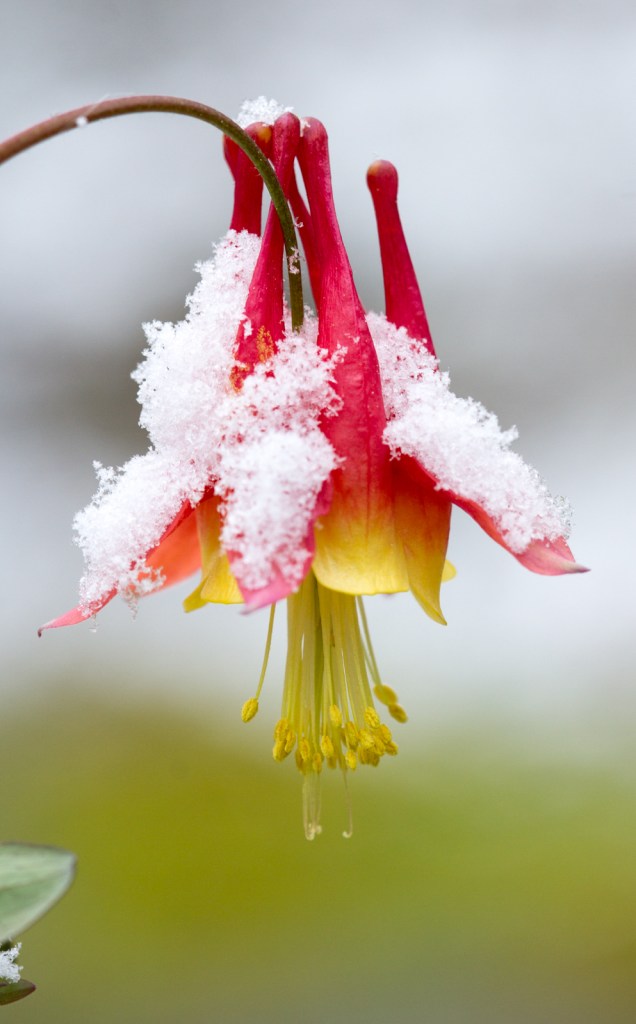
But now, it’s time for our next flower parts adventure… this time we’ll take a close look at wild columbine (Aquilegia canadensis). Wild columbine is one of my favorite spring wildflowers, and we have an abundance of it in our yard. The flowers hang on delicate stems and look like they’re floating above the ground. Each plant produces numerous blossoms over the course of at least a month in our yard. In fact, a couple of years ago, one of the earliest blooms managed to get caught in a late winter snowstorm…
Wild Columbine in snow, March 12, 2017
Because its so ubiquitous, it was an early target for my plant parts explorations – I didn’t feel too terrible taking a few blossoms off the plants when they were so numerous! Like the wood poppy, it is a simple flower, but because of the odd shape of some of its parts, it’s a little more challenging. As with the wood poppy and dogwood flowers, my first task was to find the sepals.
Columbine flower
Given the overlapping nature of the flower’s structure, this was tricky. Which are the sepals, which are the petals? I took off one of each to see if I could tell…
Columbine flower with 1 sepal and 1 petal removed… but which is which?
It was still difficult to tell which was which, even after removing one of each part, though it seemed as though the smaller, leaf-shaped parts were attached higher up on the stem than the long, spurred ones, which would make them the sepals. I looked for some flower buds for confirmation, and indeed, the leaf-shaped part enclosed the bud before it opened. Mystery solved!
Columbine flower buds
In these two images, you can see how the petals’ spurs extend and start turning red very early in the flower’s development. In the image on the right, you can even notice the developing stamens inside the flower bud; and in the right-hand image, the elongated stalks extending out of the flower bud are the undeveloped pistils (more on that in a moment). The spurred petals have a nectar reward in the bulb at the top where long-tongued pollinators like butterflies and hummingbirds can access it (while conveniently rubbing their bodies or heads on the stamens or pistils).
Since columbine blooms for so long in our yard, it was easy to trace the development of different parts of the flower by finding a sequence of ripening flowers.
Developing Columbine flower
In an early bloom, the stamens, with club-like yellow anthers on the end, slowly uncurl, with the interior stamens dropping first. Notice how, at this point, the stamens and pistils are about the same length. As the flower continues to develop, that changes.
The flower in the next two pictures is further along than the last one, and you can see how nearly all the stamens have fully uncurled. The pistils have also lengthened, and their tips have opened up as they’ve become receptive to pollen.
Mature Columbine flower
An interesting pattern among many flowers is that their parts often occur in multiples. The columbine is a great example of that. It has 5 sepals, 5 petals, and 5 pistils. And when I took the time to count the stamens on one flower, there were 40 of them (which is a multiple of 5!). Another example of this is with Easter lilies, a flower you might be familiar with, and perhaps appropriate to mention as we approach Easter weekend. Easter lilies (as well as other lilies) have 3 sepals, 3 petals, 6 stamen, and 1 three-pronged pistil. Maybe this is a new tool for teaching the multiplication tables for those of you who are now homeschooling your kids?
When the columbine flower is finished blooming, the sepals, petals, and stamens fall off, leaving only the 5 pistils behind. They slowly turn upright and the ovaries at the base begin to swell. Eventually, they will open up like 5-sectioned cups, full of dark-colored seeds that bounce out when you brush up against the plants. But for now, the seeds are still developing.
Upturned pistils with swelling/ripening ovaries
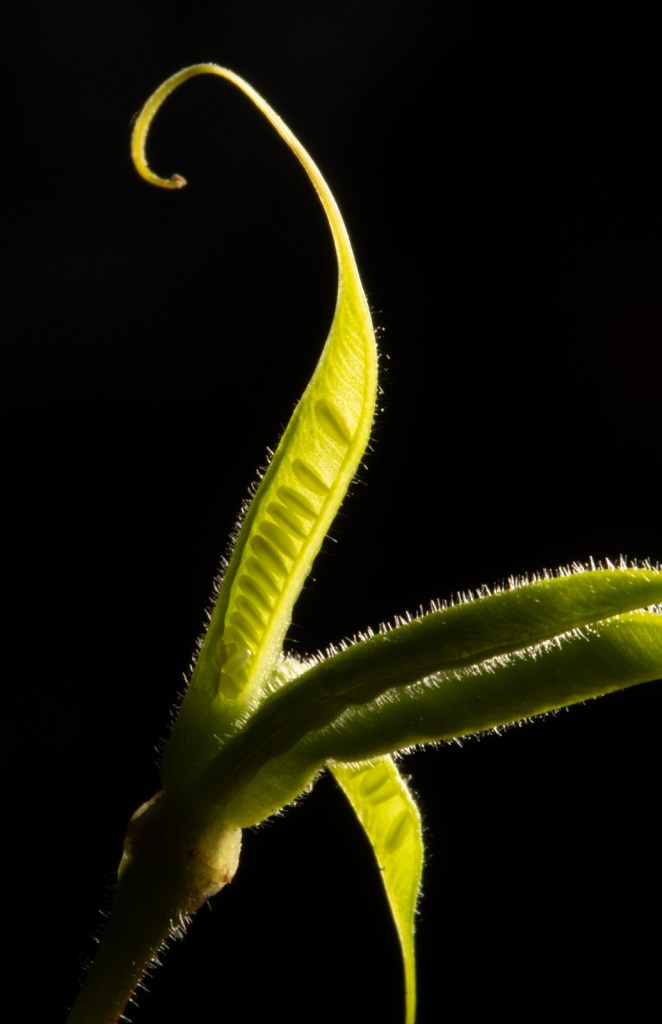
As with the wood poppy, I gently opened one of the one of the ovaries to see the seeds developing inside.
As with the other species, I was again fascinated by the way the columbine has adapted its structures to an entirely different arrangement. Flowers are so cool!


























 Roads End Naturalist