The happiness of the bee and the dolphin is to exist. For man it is to know that and to wonder at it.
~Jacques Yves Cousteau
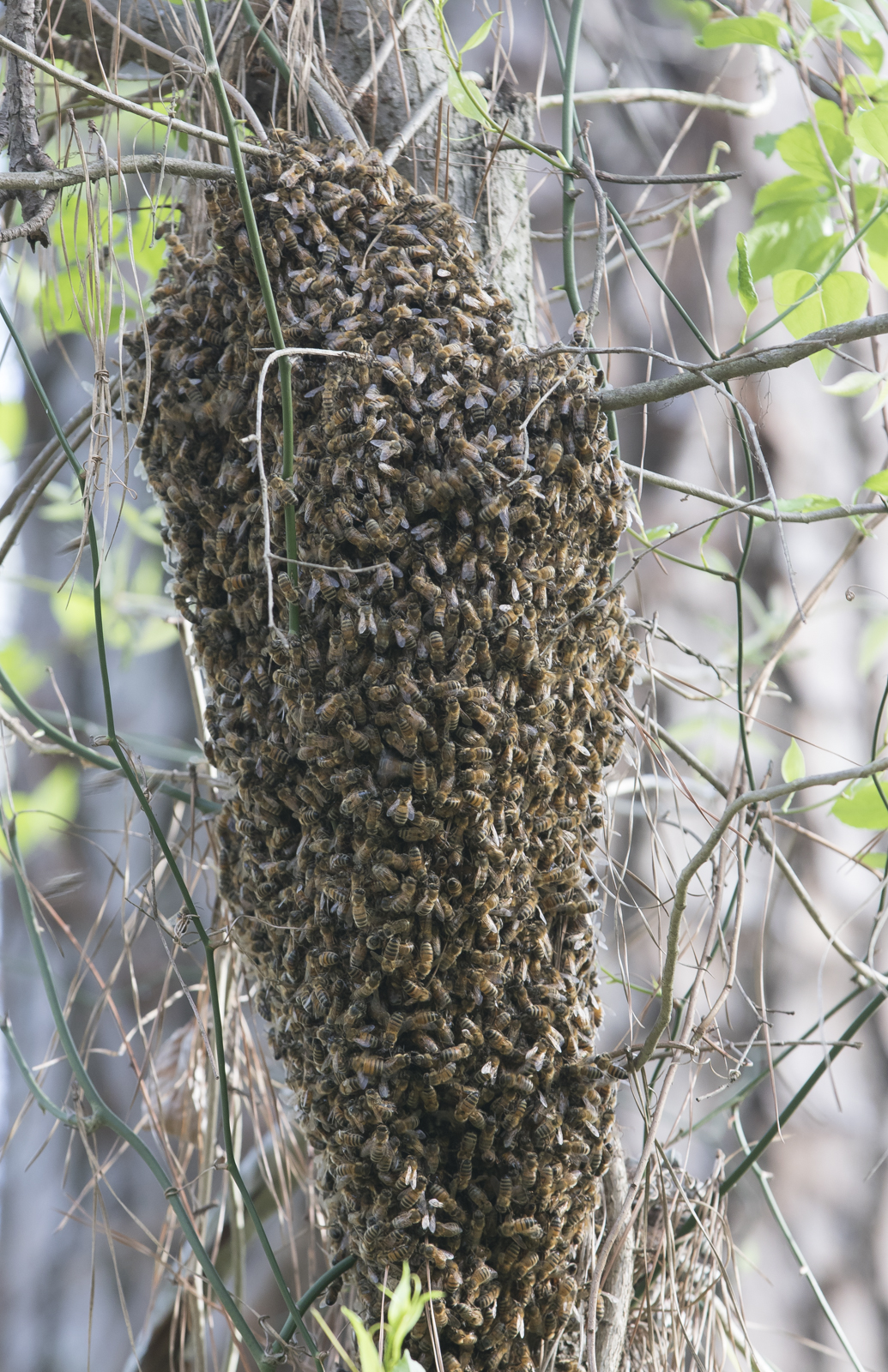
Just at closing one day this week, a coworker at the Garden sent an email alerting everyone to a swarm of honeybees just outside the back gate. I was getting ready for programs the next day so wasn’t able to get down there for an hour or so, but finally grabbed the camera and went out to see if I could find it. I asked a couple of people that were standing there talking if they knew the location of the swarm, but they had not seen it. About then, I saw some flying insects, and quickly found a ball of bees about 12 feet up on a small tree trunk.
Honeybee swarm
I’m always amazed when I see one of these swarms…a buzzing blob that may contain hundreds to thousands of honeybees. Beneath all that is royalty, the queen. Swarms usually occur from late spring into early summer and appear more common after a mild winter and an early spring, like this year. A swarm is the process by which honeybees form a new colony. When the colony needs room to grow, the bees will raise a new queen. The old queen then leaves the hive with several thousand of her followers, leaving enough workers behind to take care of the new queen and the business of the old hive.
Scout bees are looking for a new hive location
The swarm usually flies a short distance away from the old hive and settles on some object (it can be a tree branch, a light pole, or even some part of a house). The queen is usually somewhere near the center of the cluster. Bees in a swarm are usually docile so there is no need to panic should you find yourself near one. The swarm stays in that temporary location anywhere from a few hours to a couple of days until scout bees locate a suitable new hive location, like a hollow tree or other protected spot. In the case of these bees, a local beekeeper was contacted and he came by the next day (unfortunately I had programs so did not get to witness this). He used a “bee vacuum” (a contraption that looks like a shop vac hooked to a box) to literally suck up the swarm so he could then relocate them to a backyard hive for honey production. Apparently, there is a network of beekeepers that can be called on for just this sort of service, which becomes even more valuable if bees decide to set up their new hive inside a dwelling or some other unwanted space. In this case, both bees and human benefit from a sense of swarm on a late spring afternoon.
Things have been so busy at work that I have failed miserably at getting outside with camera in hand to document some of the beauty around me. I made amends Saturday afternoon, and spent a few hours just wandering around the yard, observing and enjoying. I highly recommend it, especially this time of year. It is good for the spirit.
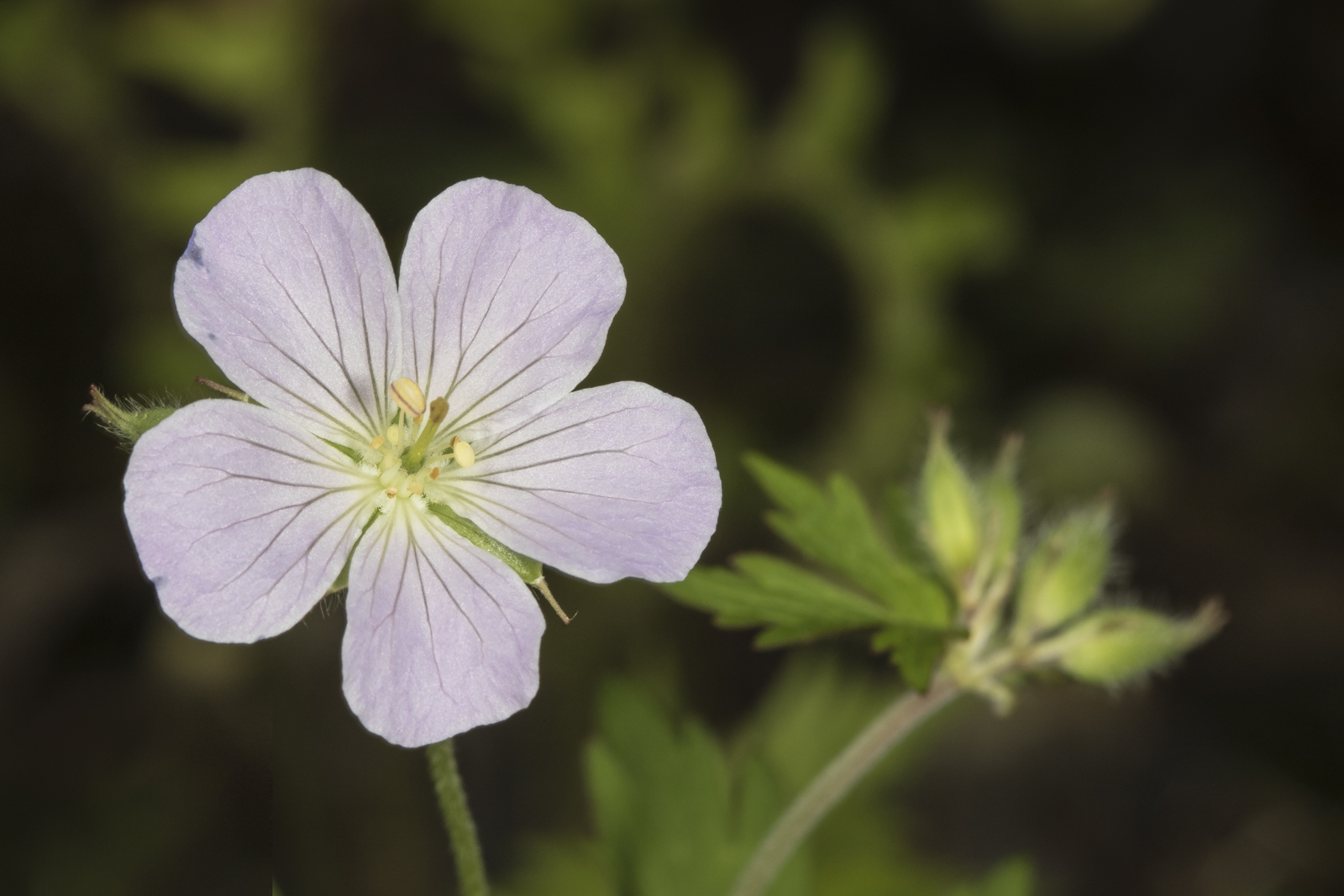
One of my favorite spring wildflowers, wild geranium can vary quite a bit in the intensity of flower color. The ones in the yard are pale compared to those at work.
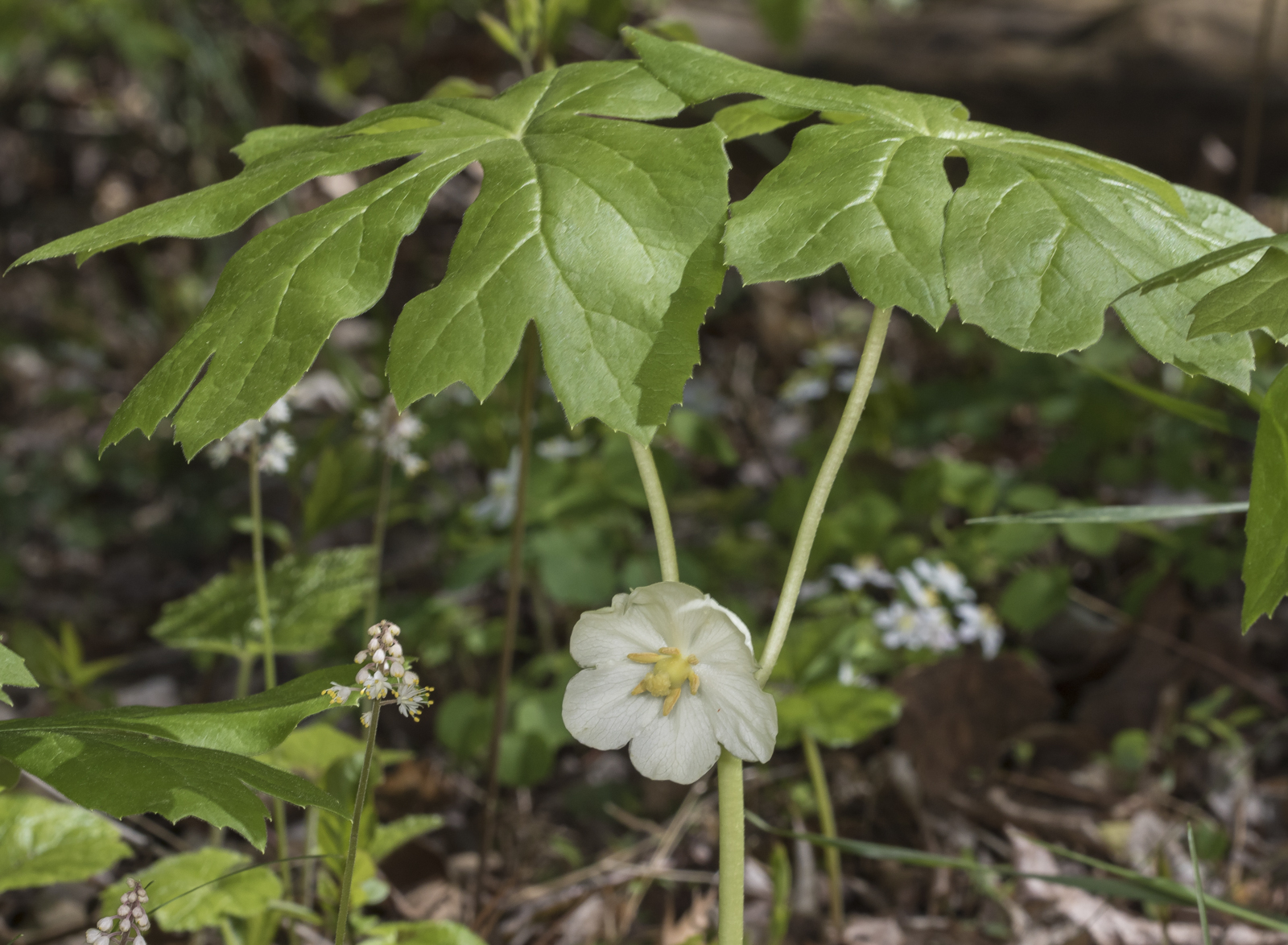
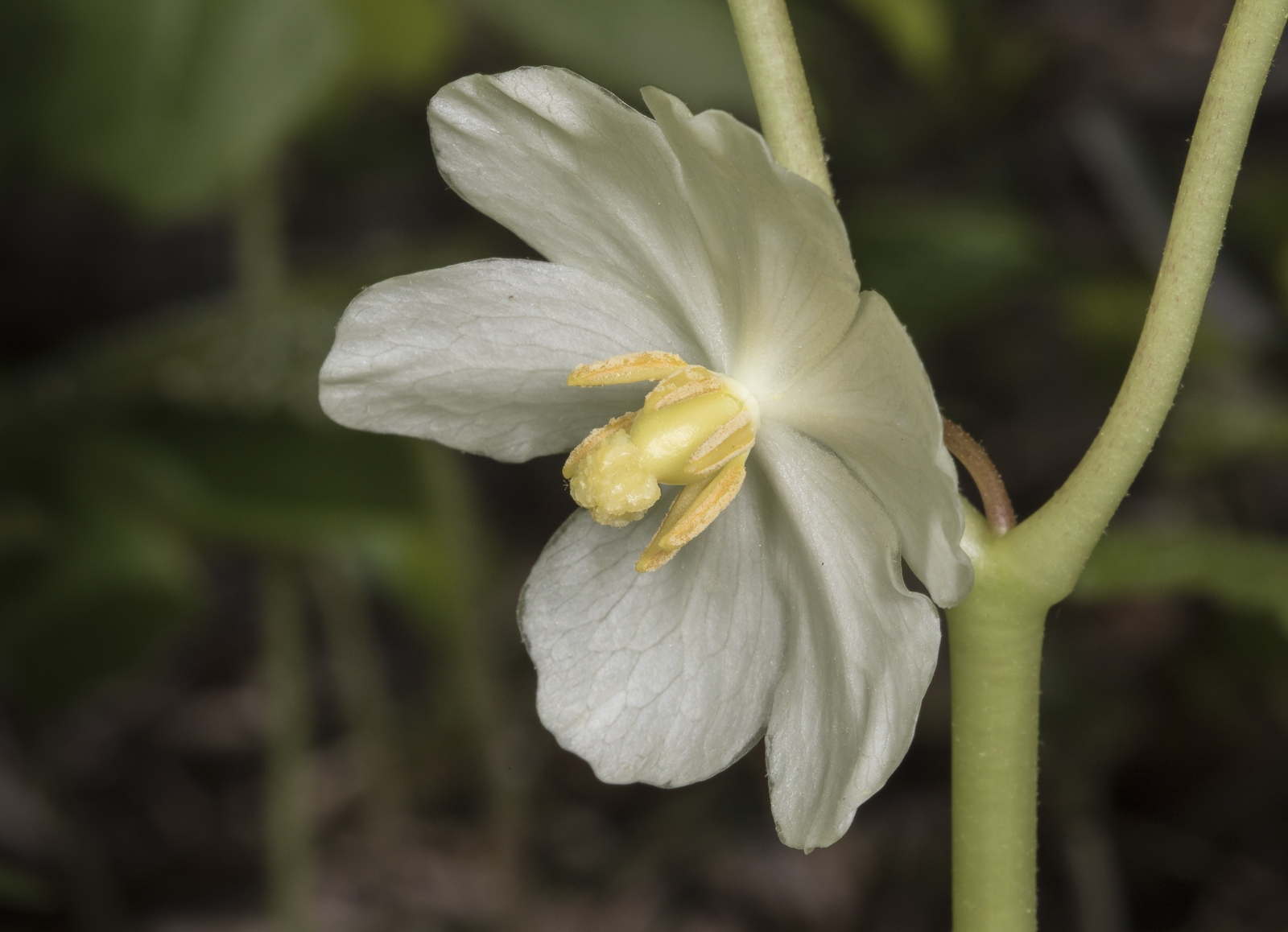
When viewed from above, a patch of mayapples looks like a crowd of ornate umbrellas. Kneel down and you see something quite different this time of year. If the plant has two leaves, it can produce a large white flower.
The common name comes from the small, apple-like fruit produced on fertile plants. These fruit are eaten by box turtles and mammals such as opossums, and the seeds dispersed in their droppings. Ripe fruits are edible, but all other parts of the plant are poisonous. Extracts from this species are being used to treat some forms of cancer.
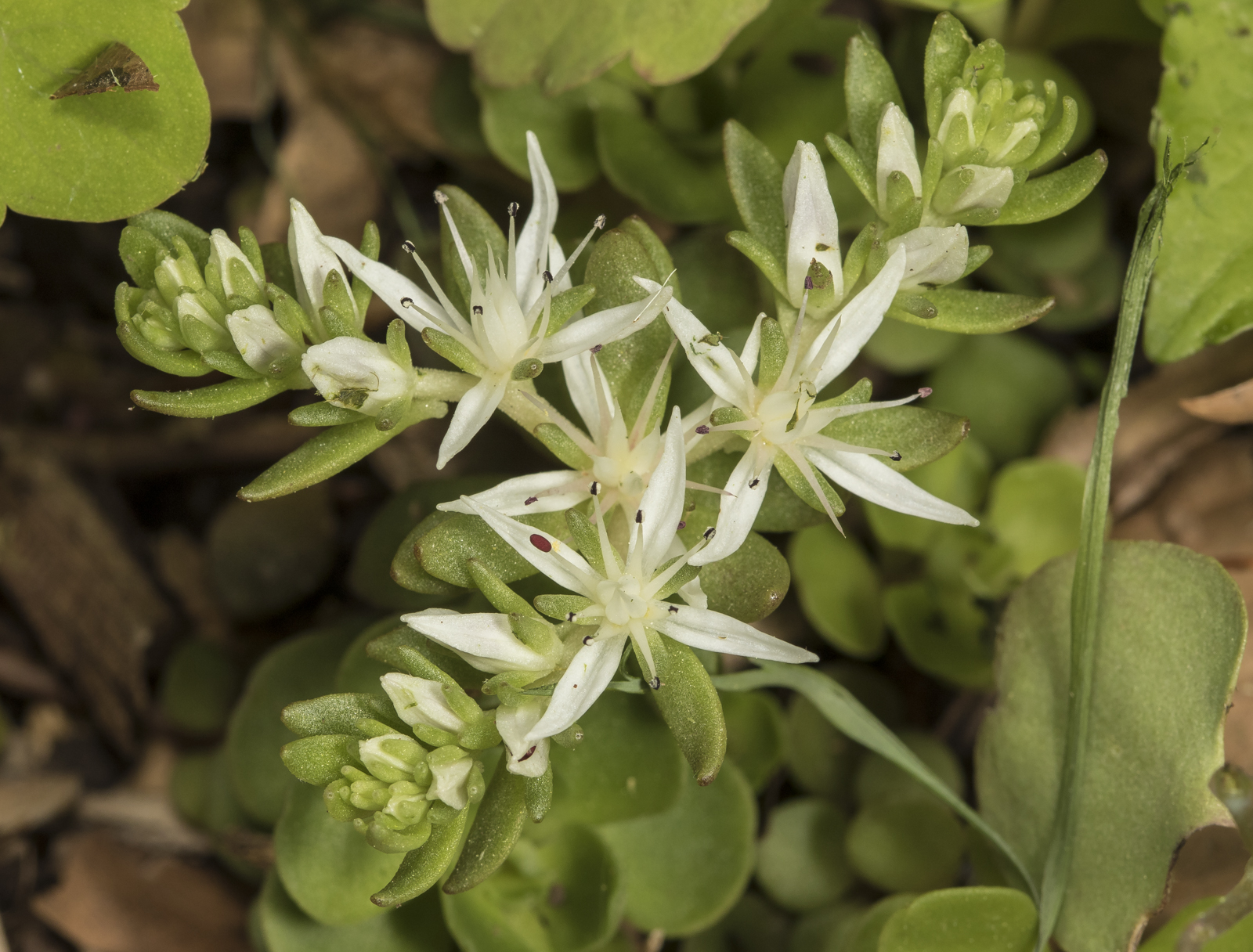
This small creeping wildflower is easily overlooked, but is well worth the effort once you find it. I planted some in a soil-filled split in a log and it has now started to spread out on the ground around it.
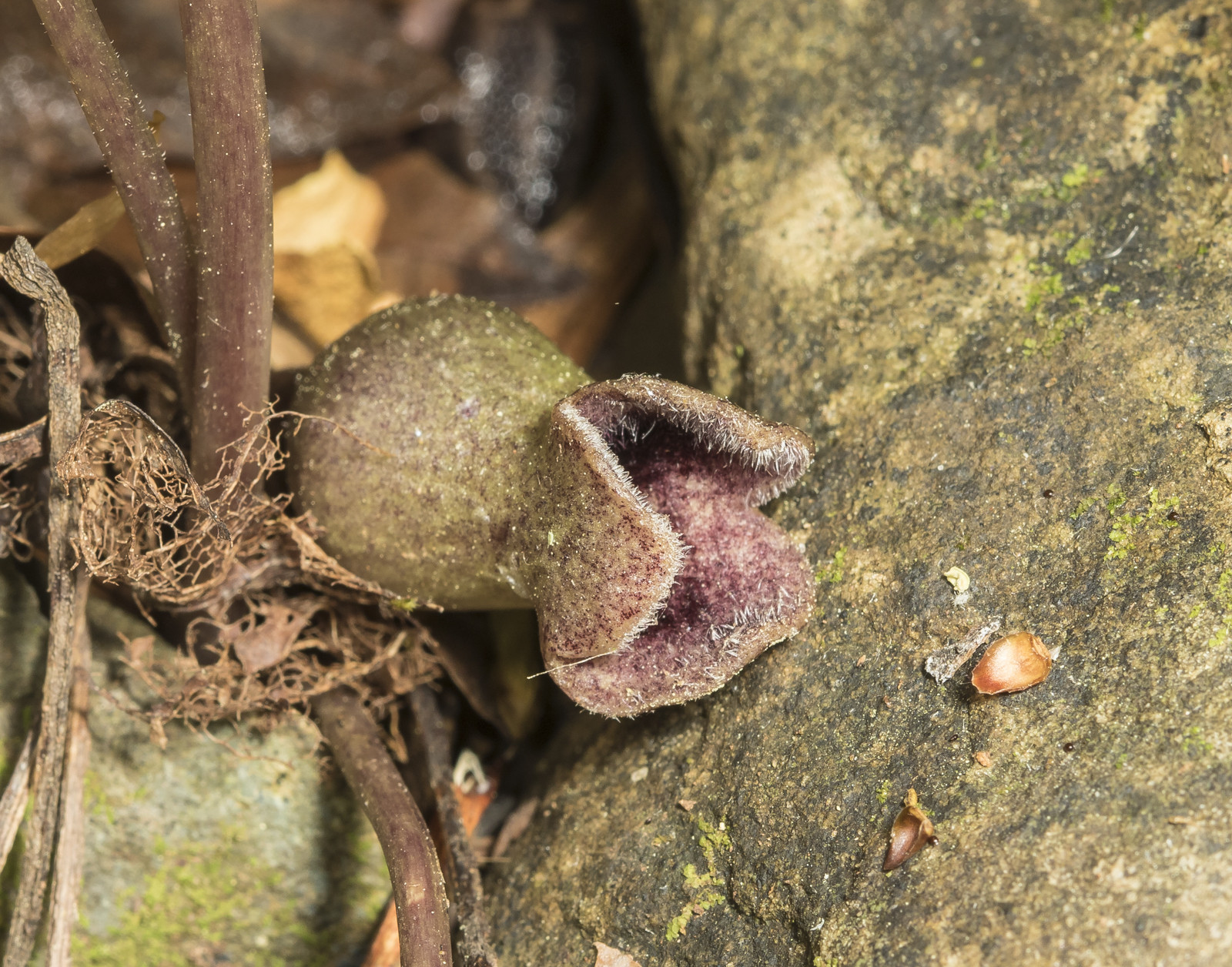
Hexastylis arifolia – Little brown jug (also called heartleaf, and wild ginger)
The distinctive heart-shaped leaves always give me pause to scrape away some leaves to see if I can find the flower that gives this widespread woodland plant one of its common names, little brown jug.
This wildflower is quickly becoming one of my favorites. I bought a few plants from the NC Botanical Garden and the combination of unusual leaves and abundant flowers is a great addition to any woodland garden.
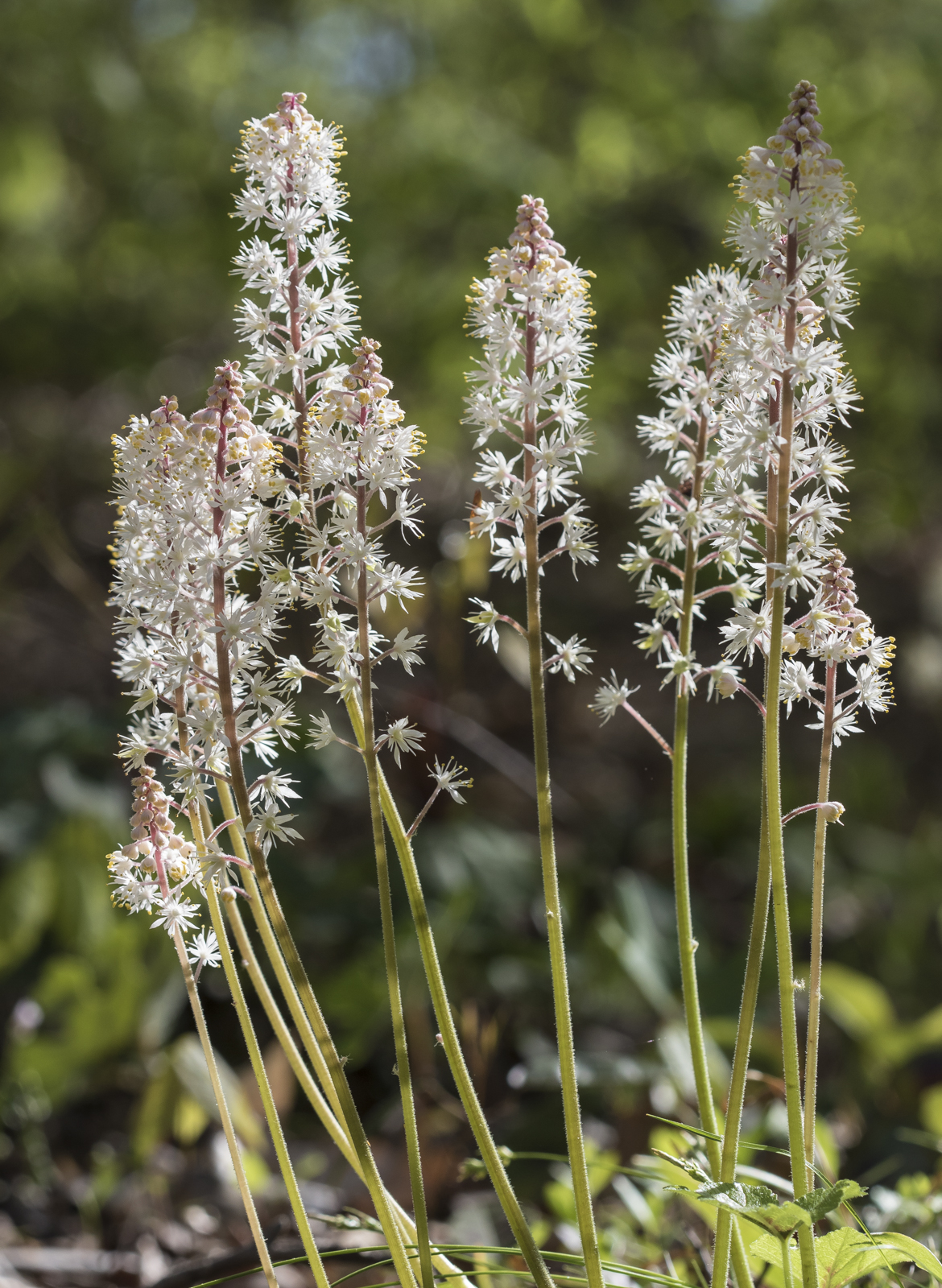
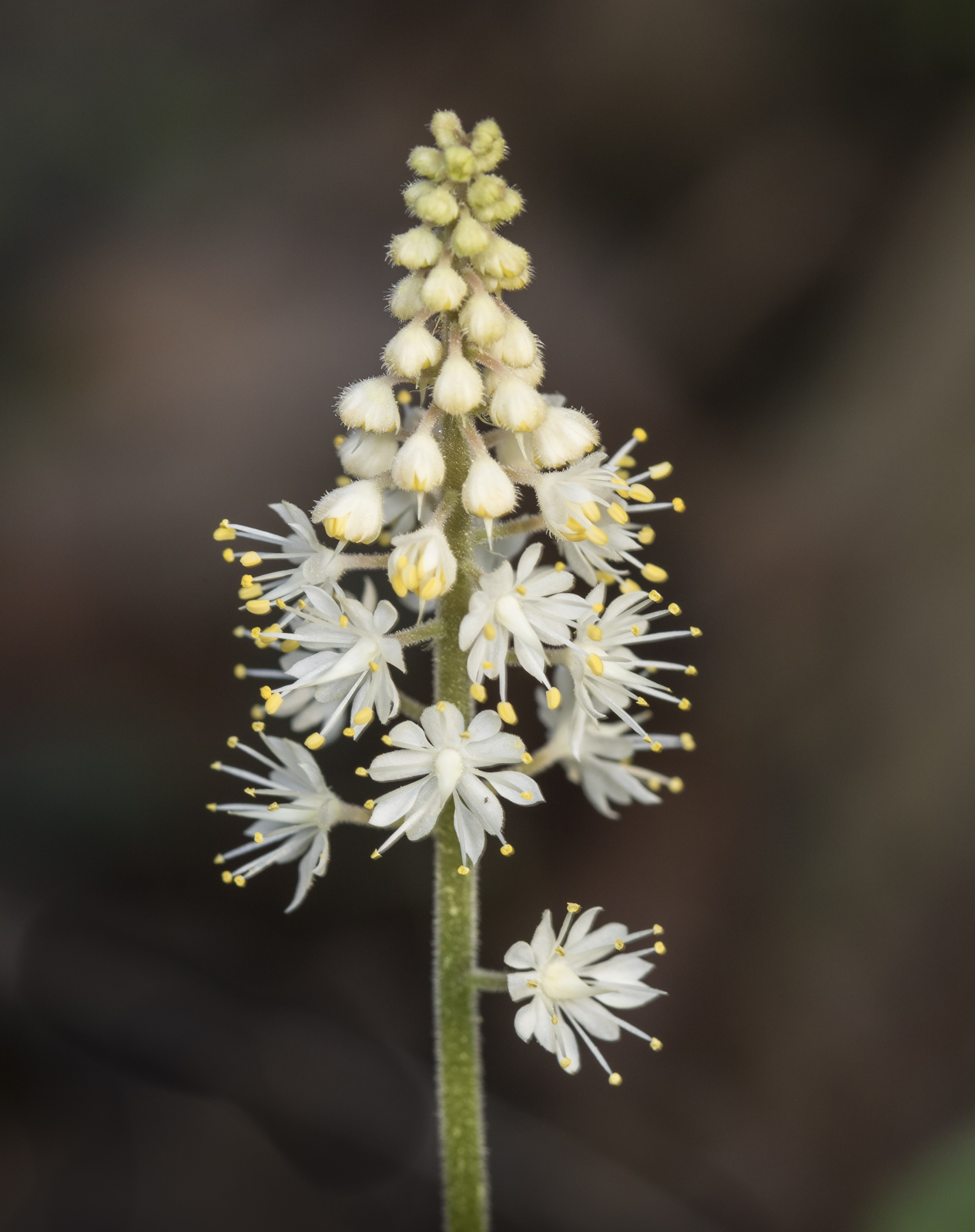
The airy nature of its abundant white flowers, coupled with long stamens, gives this beautiful wildflower its “foamy” appearance (and common name). I enjoy watching large bumblebees grab onto the column of small flowers and take a rapid dip toward the ground as their weight bends and bounces the stalk, providing some nectar, pollen, and a joy ride to the foraging bees.
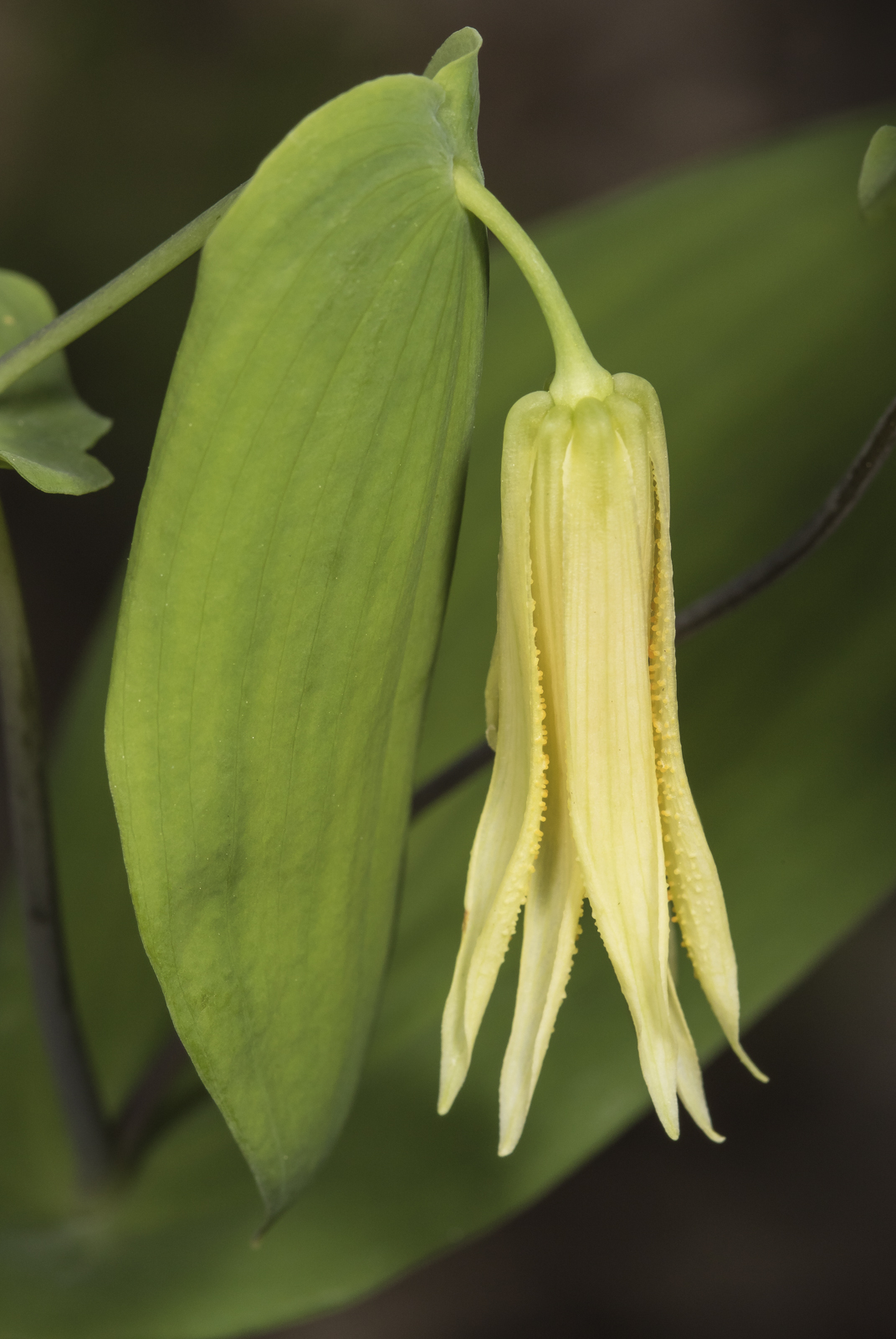
The nodding yellow flowers of this plant have warty knobs on the inside of the petals. The protuberances may help bees get a better grip on the flowers as they climb in for nectar and pollen.
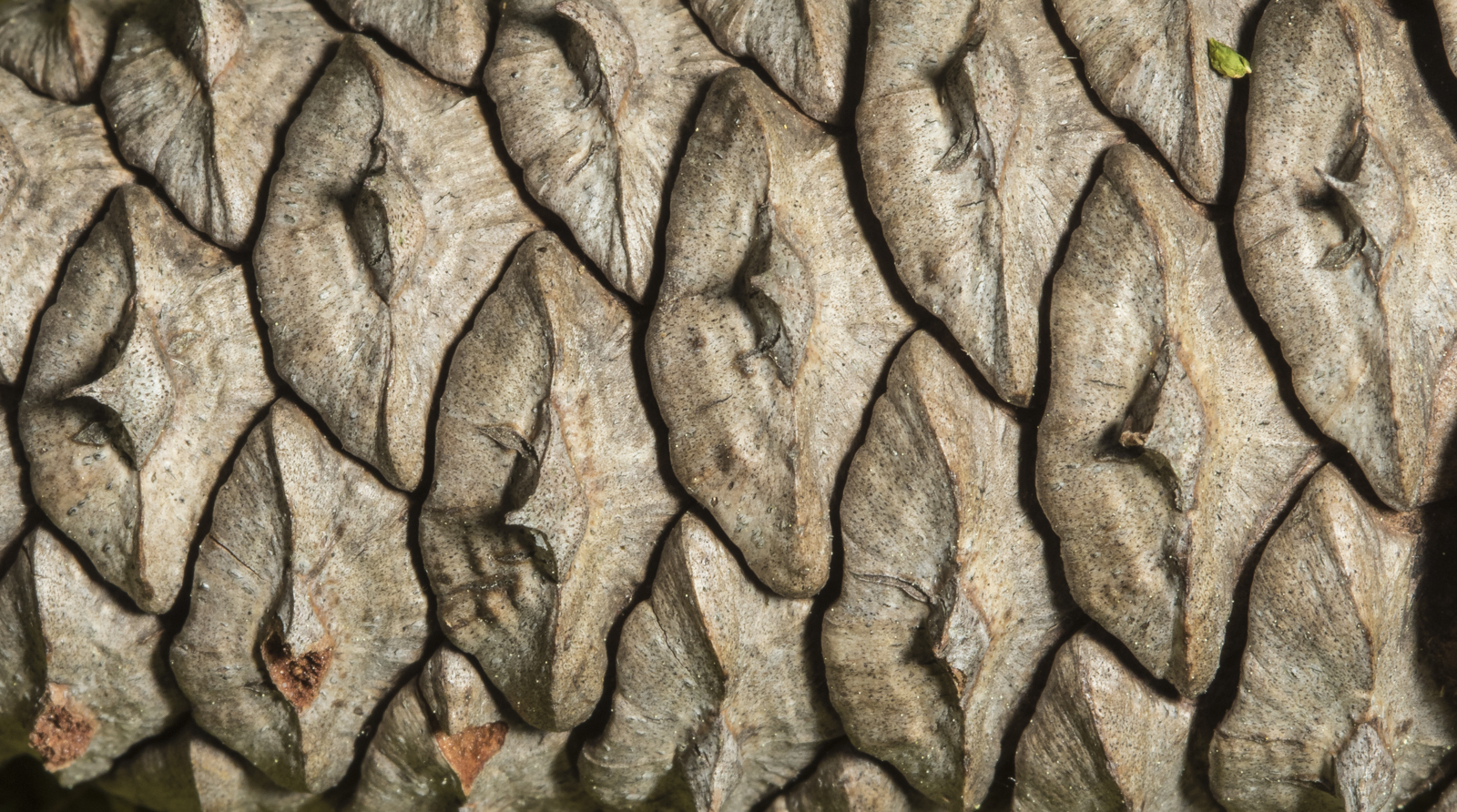
Sometimes, when you take the time to look around you, the familiar things take on a new beauty that helps you appreciate them. A pine cone among the wildflowers caught my eye and helped me appreciate the many patterns in nature.
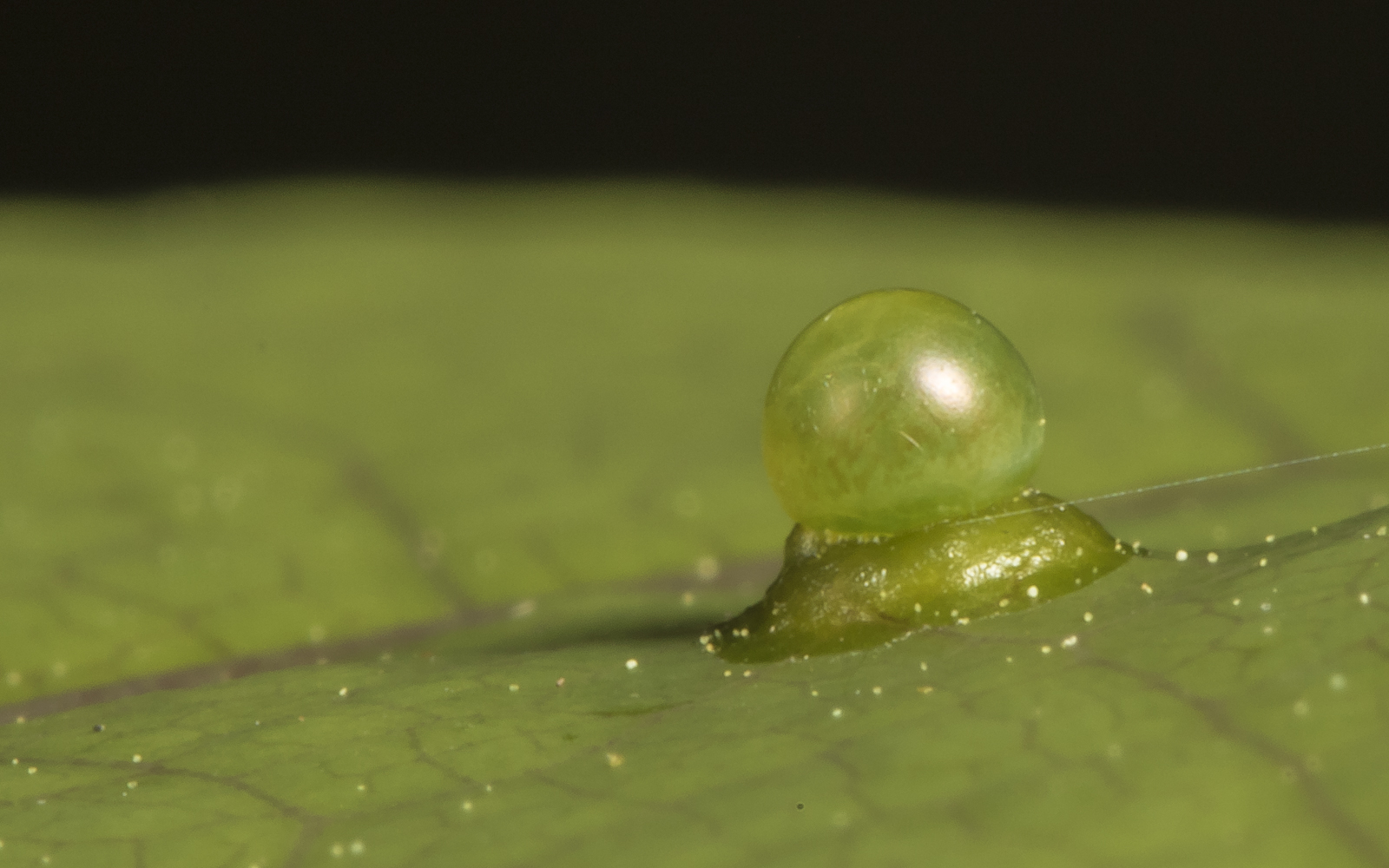
Tree seedlings are a constant source of work in any woodland wildflower garden. If allowed to grow, they may quickly overtake and shade out many of the plants we hope to grow. But, I occasionally leave some as potential host plants for passing butterflies and moths. One tulip poplar sapling, growing at the corner of the house, managed to entice a passing female tiger swallowtail to pause and lay an egg. This egg seems to have an extra supply of whatever it is she uses to “glue” the egg to the leaf surface. Sometimes, less weeding pays off.
Now is the time of the illuminated woods… when every leaf glows like a tiny lamp.
~John Burroughs
Sharp-shinned hawk (click photos to enlarge)
Things happen so fast this time of year… it is the time of change. Old things moving on, new things appearing. Many of the birds of winter are heading north and are being replaced by bright and beautiful breeders from the tropics – the first ovenbird yesterday, the first Louisiana waterthrush earlier this week. The juncos disappeared over the weekend, but not before being terrorized by a sharp-shinned hawk one evening out back. There had been a rash of window strikes over the past two weeks, and now I think I know why. This fierce predator appeared late one day and chased a junco and tufted titmouse around and around a holly tree out near one of the bird feeders. The hawk had left some evidence (plucked feathers) that it was the probable cause of many of our yard birds leaving their wing imprints on windows in spite of the reflective stickers that adorn them. But this time, the birds eluded him.
Red-bellied water snake (shot with iPhone)
At work, things not seen in many months have been exploding onto the scene. The resident water snake curled next to a path…
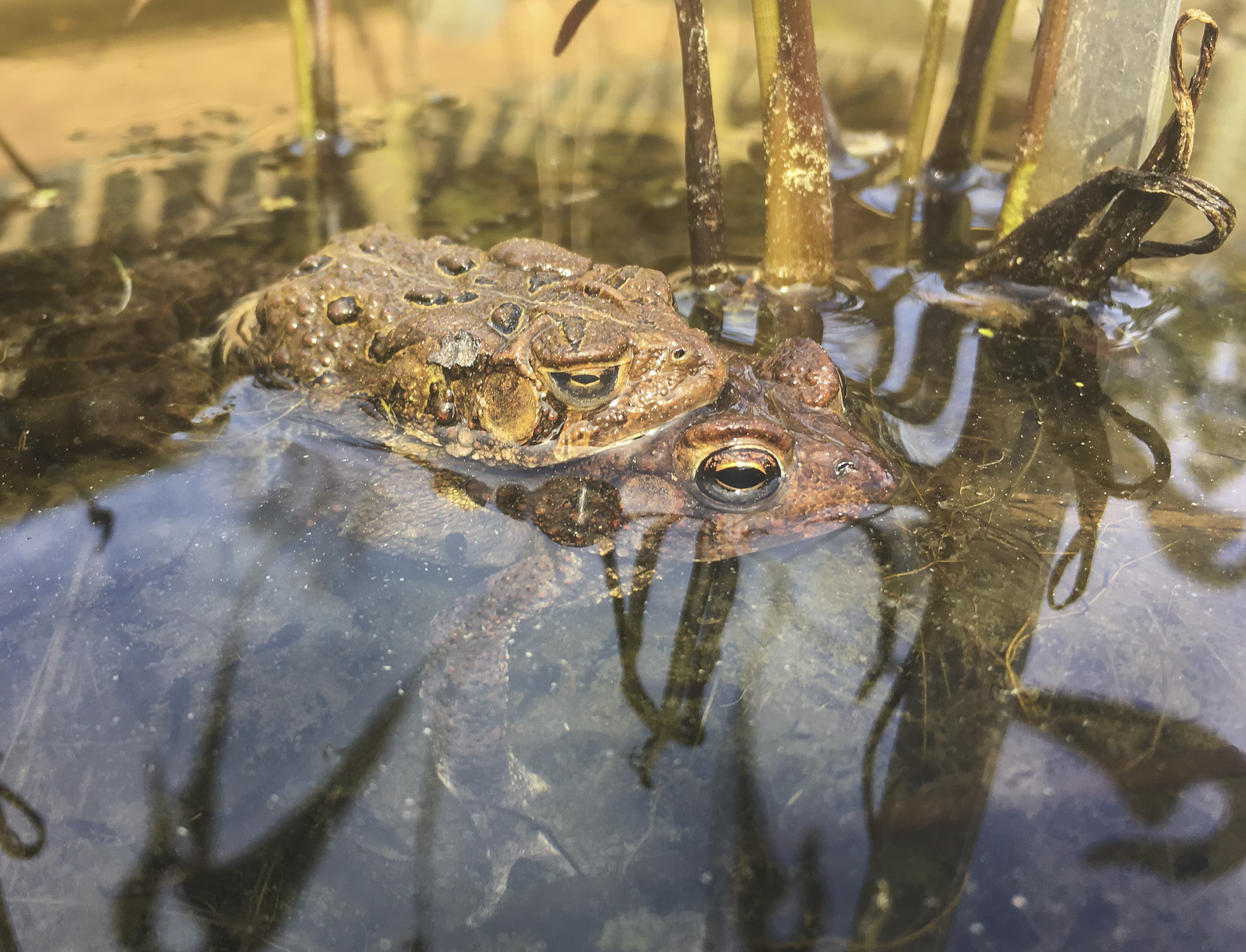
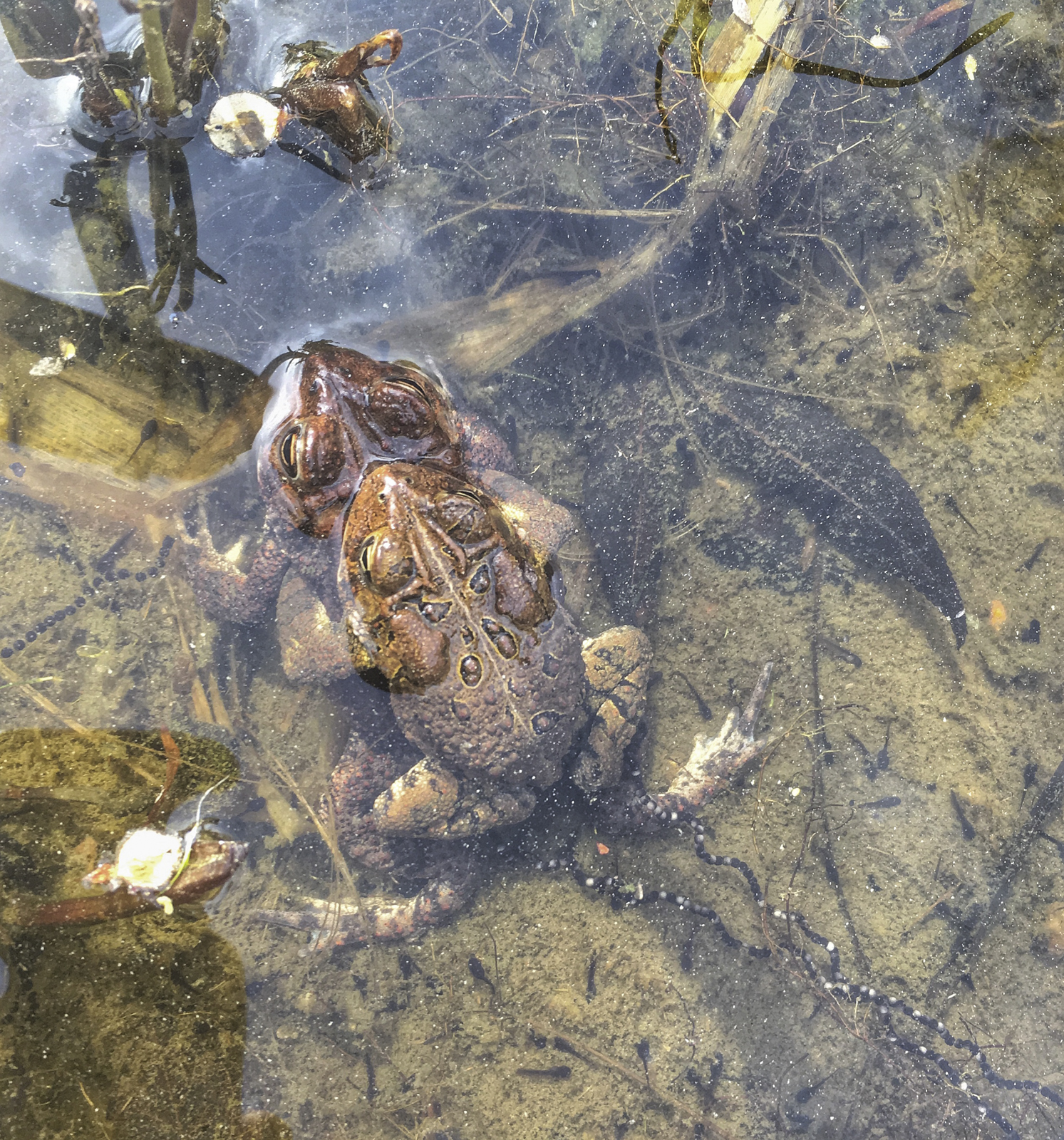
American toads in amplexus (shot with iPhone)
American toads breeding in a small shallow pool already filled with many tiny black tadpoles from a previous amorous night…
Laying eggs (shot with iPhone)
…leaving strands of eggs stretched across the mud.
Spring peeper calling
At home, the pleasing high-pitched calls of spring peepers each night. Things must be just right for them this week as the usually difficult-to-find songsters just keep calling, even when we approach them, flashlight and camera in hand.
Foamflower
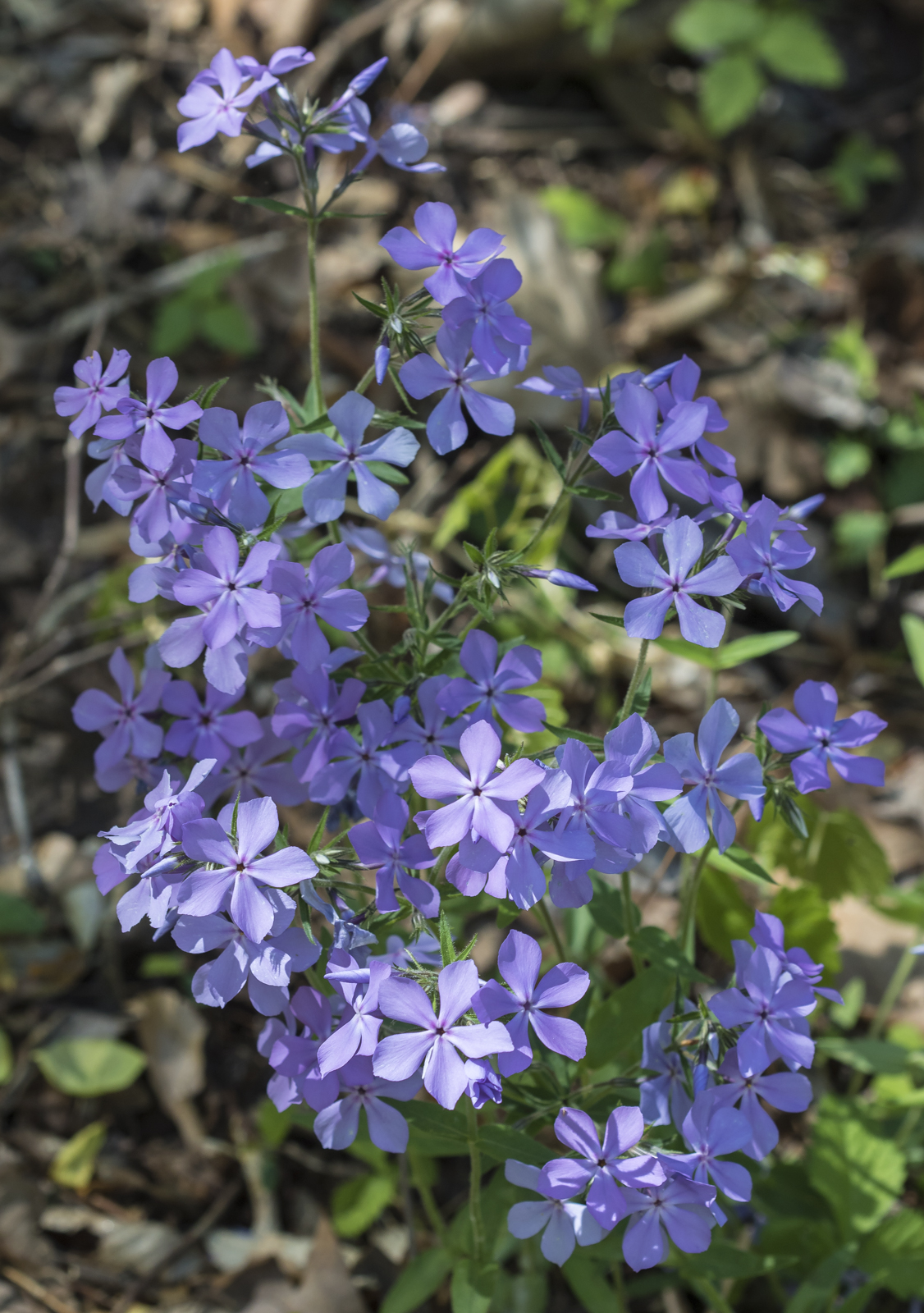
And, while there are splashes of color appearing throughout the yard (columbine reds and yellows. the blue-purples of phlox), the white flowers dominate our spring woodlands.
WindflowerA pale pinxter azalea
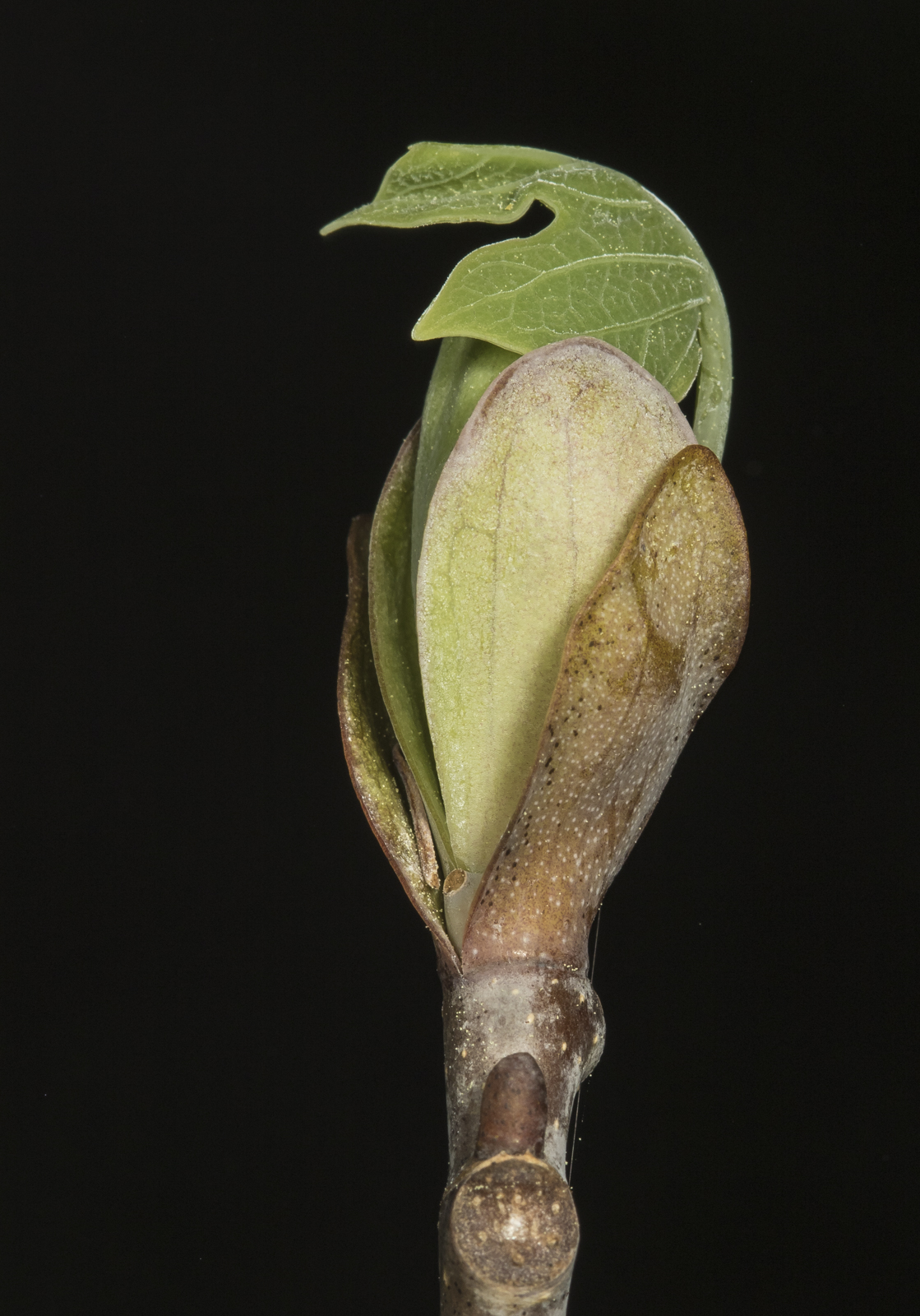
A tulip poplar leaf bursts forth
Soon, the dominant color will be green, the pale illuminated green of leaf out…my favorite woodland color. This is the week…get outside and enjoy the show.
The power of the ocean
in what does it lie?
In the endless, timeless roar of the surf?
In the immense vistas – the view to the end of the world?
In the glowing spray as it diffuses
the light of the rising sun?
In the power and mystery of its
dark depths?
No matter—
it brings one to scale
it breathes into one serenity
it insists that one pause…
Once—
was the world filled with
such wild landscapes?
With these tests and salves for the
human spirit?
Before we spent what we did not own?
Were the monarchs of the southeastern forest
as the ocean?
The longleaf pines—
In their endless and timeless ranks
With their immense vistas—
views of waving grasses
as far as the eye could see?
In the power and mystery of their length and breadth?
Would one have found scale? Serenity?
Would one have been impelled to pause?
Do we mourn for what we have not known
but by glimpses
through another lens?
Here’s to the land of the longleaf pine,
The summer land where the sun doth shine,
Where the weak grow strong and the strong grow great,
Here’s to “Down Home,” the Old North State.
~North Carolina State Toast
In my last post, I talked about some of the amazing, small plants that grow beneath the longleaf, but not so much about the longleaf itself. It, too, is well-adapted for poor, sandy soils and thrives in an environment frequently visited by fire, and has some amazing strategies for surviving under those conditions.
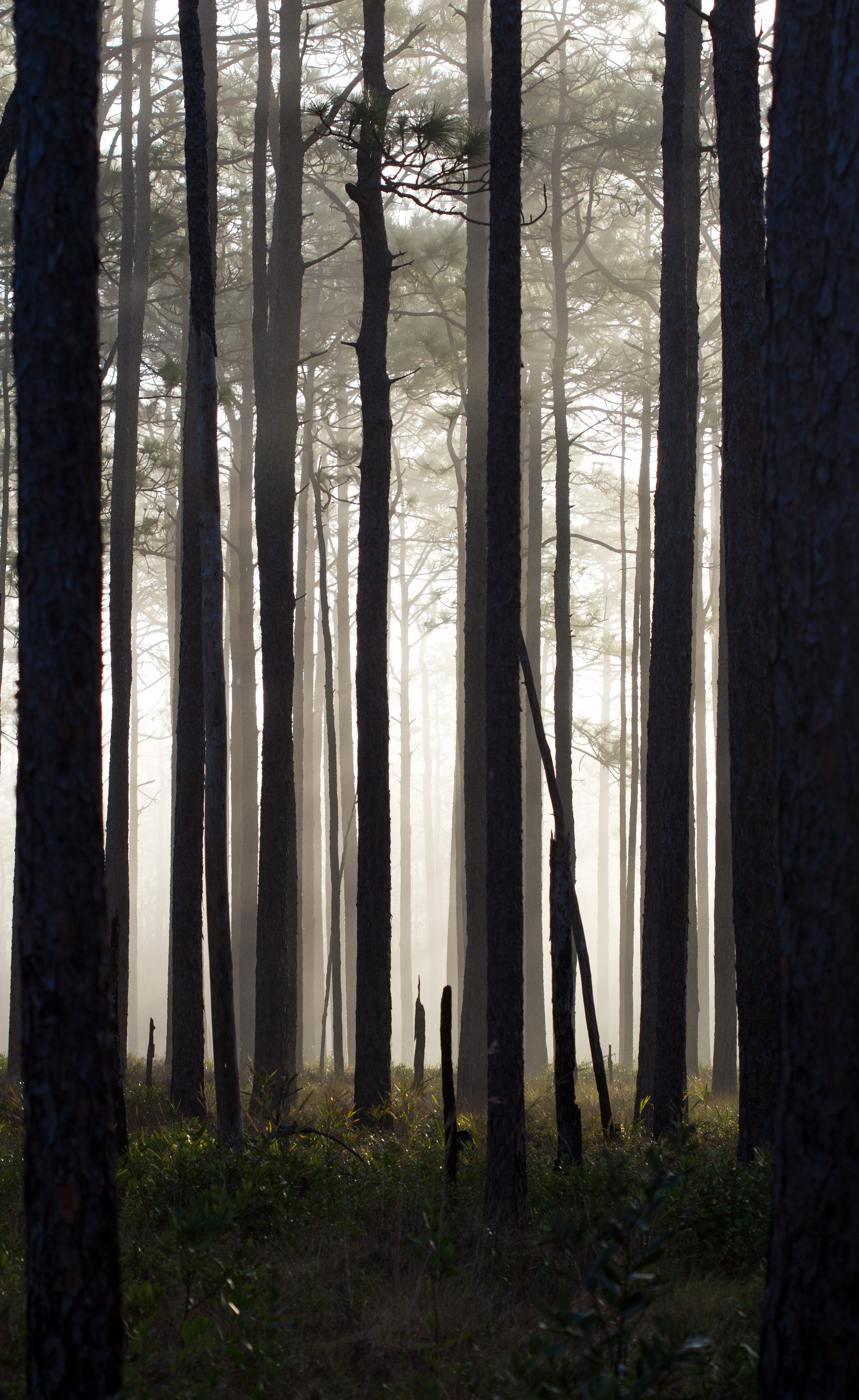
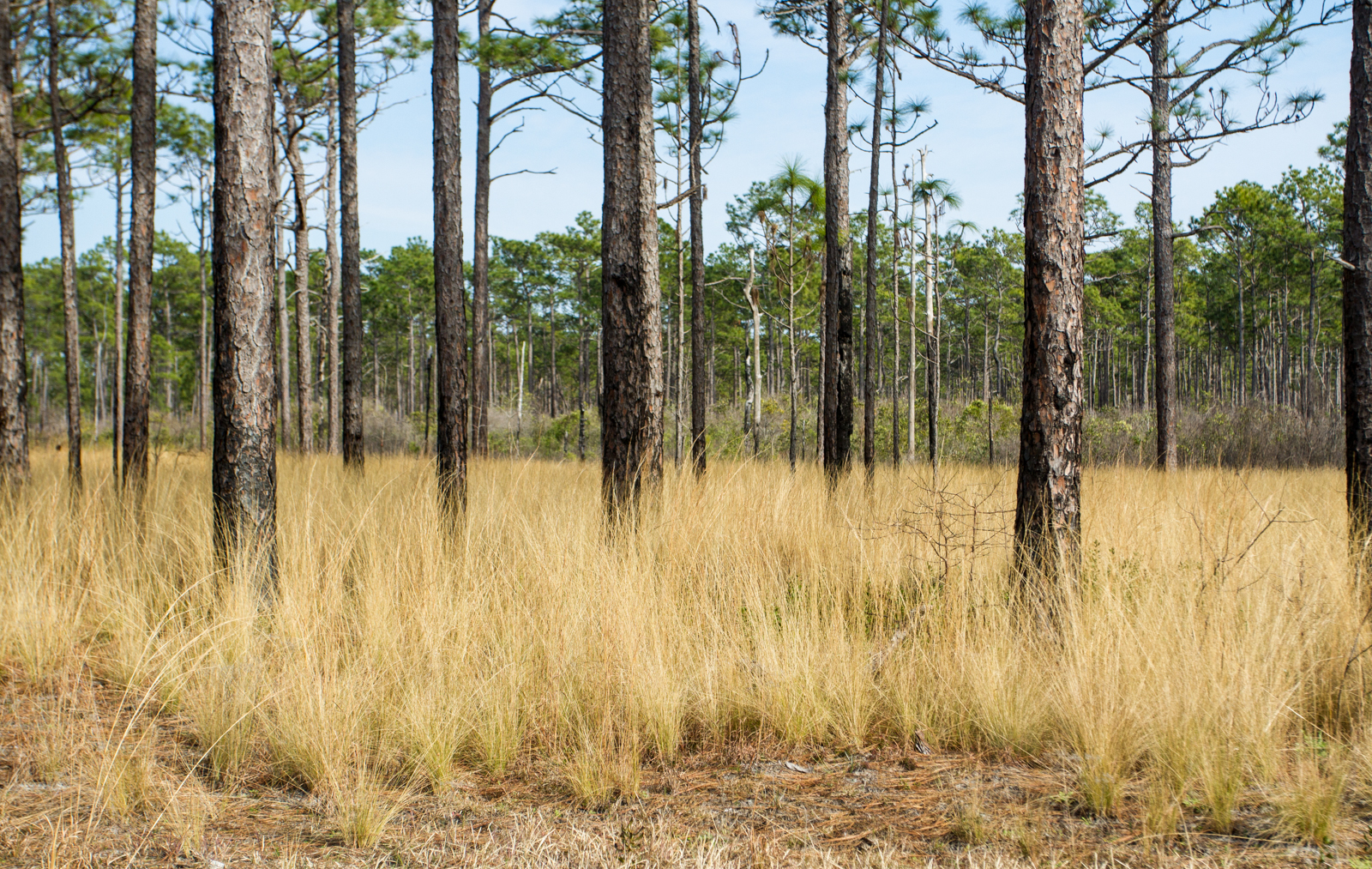
Stand of longleaf in Croatan National Forest; the tall golden grasses are wiregrass which has seeded after a fire (click photos to enlarge).
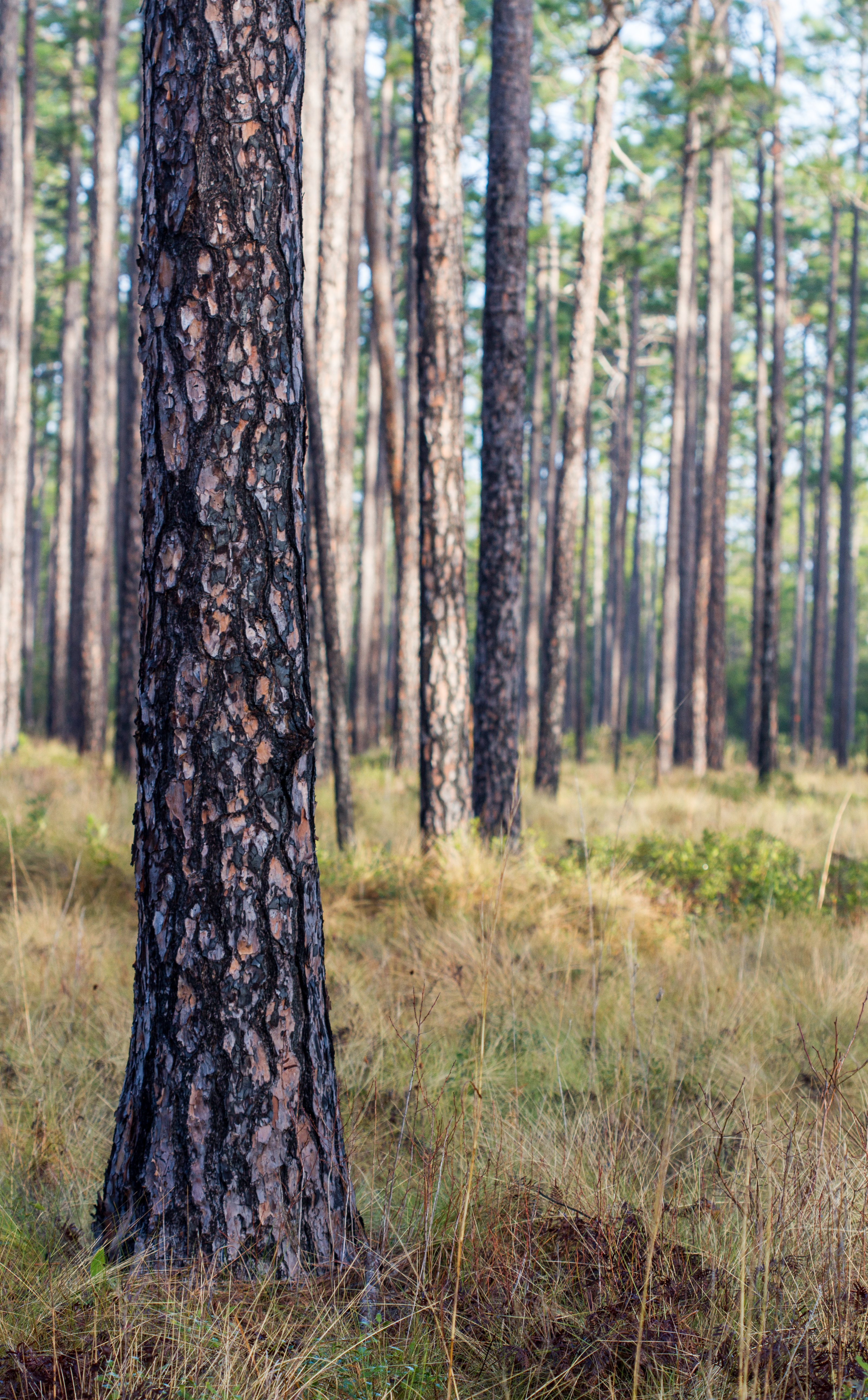
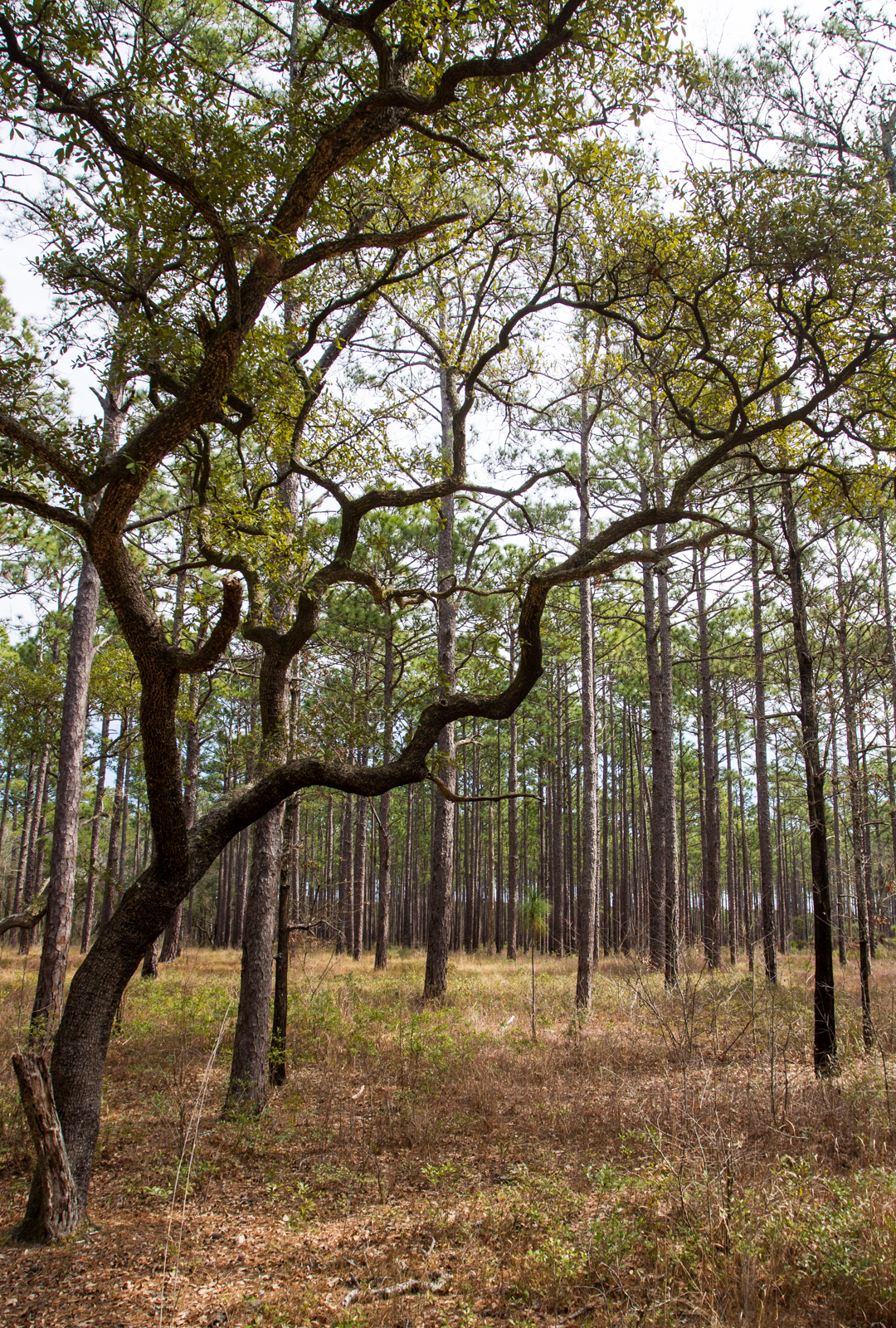
Longleaf are not tolerant of shady conditions. In a mature savanna, they grow spaced fairly far apart so that each needle on each branch can receive as much sunlight as possible. They lose their lower limbs as they grow larger, and viewed from the ground seem to provide a loose, permeable canopy held aloft by elegantly arranged poles. This openness is one of the reasons that the savanna has such a diversity of low-growing species. The other is fire. Fire clears away other shrubs and trees, like turkey oak and gallberry, that typically grow beneath longleaf pine, and opens the forest floor for shorter species, like carnivorous plants, as well as seedling longleaf. Mature longleaf trees have thick bark that makes them resistant to all but the hottest fires. But with fire occurring every 3 years or so, historically, how would that allow new longleaf to sprout? Well, their growing stages are also perfectly adapted to this sandy, fire-prone habitat.
Recently burned longleaf stand in Croatan National Forest
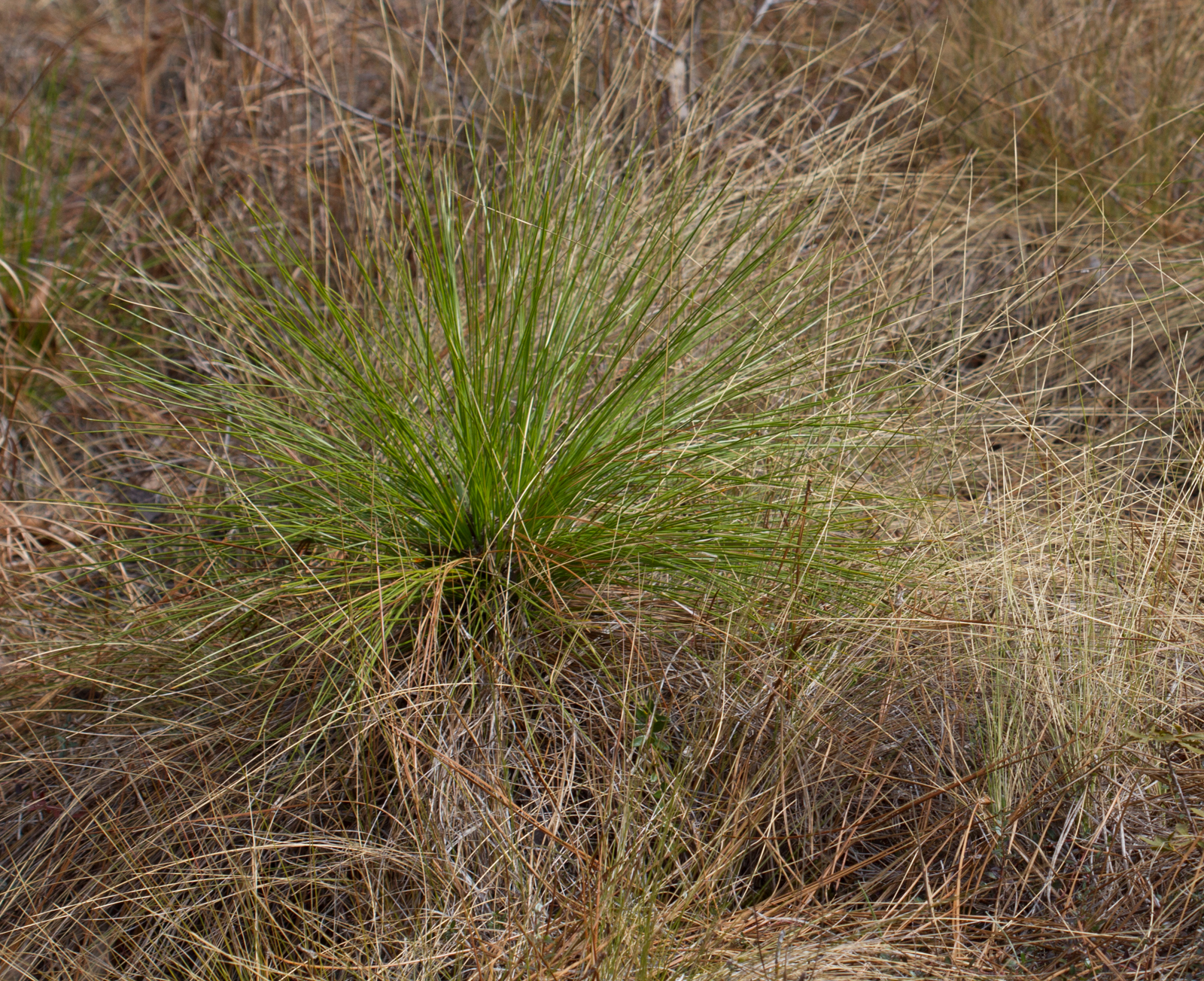
A longleaf seed is most likely to be successful if it germinates in a relatively open area where it receives a lot of sunlight… which is just what you would find in a longleaf savanna just after a fire. The seedling develops into a special phase of life, unique to longleaf, called a grass stage. At this stage, the “tree” is just a tuft of needles at ground level that looks very much like the surrounding wiregrass. For a period of around 3 years (sometimes shorter, but sometimes much longer), the longleaf grows downward rather than upward, sending a taproot deep into the soil to fuel future growth. During this stage, it is, perhaps surprisingly, fairly fire resistant. The thick needles protect the all-important growing tip at the heart of the grass stage. Even if the needles are mostly burned, the tree can still make it!
Grass stage longleaf trying to blend in with the surrounding wiregrass
When the time is right, the longleaf moves out of the grass stage with rapid vertical growth. It develops a thick, white bud-like tip, sometimes called a candle, and from there begins its growth.
The growing tip or “candle” of a longleaf
Its goal during this time is to get tall enough and develop thick enough bark to survive a fire. This is no time to worry about branches, so the young tree looks much more like a bottlebrush than anything else; this stage is often called the “bottlebrush stage.” Though an educator on a workshop once suggested that it should be named the “truffula stage” after the crazy-looking multi-colored trees in Dr. Seuss’ The Lorax. During this phase the young longleaf is most susceptible to fire.
Bottlebrush longleaf striving to grow as tall as its neighborsBottlebrush longleaf after a fire – notice that it is still green around the growing tip!A group of young longleaf burned in a recent fire. Many still have green needles visible in the center.
But a tree just can’t grow up, and eventually the longleaf begins to grow out as well. The graceful side branches reach out horizontally and then turn up toward the sky. The “candelabra” stage is well-named! Longleaf tend to grow their 8-18″ long needles in clusters near the ends of branches, adding to the visual appeal of the tree.
At about 25-30 years, longleaf reach maturity and start producing cones. Though the species is fire-adapted, it does not have serotinous cones – cones that open in the heat of fire. A neighbor to the longleaf, the pond pine, which commonly grows in boggy pocosins adjacent to longleaf savanna, does have serotinous cones. My coworker Megan decided we needed to observe this phenomena for ourselves; so, armed with a lighter and a closed pond pine cone, we did! With the heat from the lighter, the scales of the cone opened with an audible pop, kind of like the popping of popcorn. Inside each scale were two winged seeds, as with other pines. Pond pines also grow best after fire, so their serontinous cones are a great adaptation to promote growth when the conditions are right. Longleaf don’t use that strategy even though they depend on similar conditions for germination. But their cones are equally impressive. The largest pine cones in North Carolina, they can be up to about 12″ long!
Pond pine cone, opened after a fireLongleaf cone with my size 9 (men’s 7) rubber boot for scale
The oldest documented longleaf in North Carolina is found in Weymouth Woods State Park and is more than 465 years old! Though perhaps at one time there were many such old monarchs of the forest, that’s rare now. But mature longleaf play a very important role in the ecosystem, particularly for red-cockaded woodpeckers. As longleaf age, they become more susceptible to red heart fungus, which softens the (very hard) heartwood of the tree. Red-cockaded woodpeckers are our only species of woodpecker that seek out live trees for nesting, and they prefer mature longleaf pine that are infected with red heart fungus. This is because they hollow out nest cavities in the living trees, and the softening due to red heart makes that easier. They also peck holes in the tree surrounding their cavity that draw out the tree’s sticky resin. This acts as a defense against a common predator, rat snakes. If you’re visiting a longleaf forest and spot trees painted with white rings, look up for the cavity! Biologists studying RCWs mark their nest trees in this way to make them more visible.
RCW cavity – this one doesn’t have extensive resin wells drilled around it.The distinctive white band of an RCW cavity tree. I like to joke about the endangered woodpeckers who fly around with a paintbrush in their little feet to mark their homes so they can fine them again later…
The longleaf pine savanna is an amazing diverse habitat, and the longleaf pine is well-adapted to live there. If you have the chance to visit, see if you can spot each stage of its life – grass, bottlebrush, candelabra, and mature tree!
“This plant, commonly called Venus’ fly-trap, from the rapidity and force of its movements, is one of the most wonderful in the world” and “is one of the most beautifully adapted plants in the vegetable kingdom.”
~Charles Darwin
One of the tree species Mike didn’t include on his recent tree bark quiz, probably because it’s much less common in our area than the loblolly pine, is the longleaf pine. It has the thickest and most resinous bark of any of our pines, the longest needles, and the largest cones. But perhaps most interestingly, at least to me, is the ecosystem that grows up around it.
Longleaf savanna in the Green Swamp Preserve
Longleaf forests once covered up to 60 million acres in the southeastern US, stretching from southern Virginia to eastern Texas. Early explorers and colonists saw dollar signs when they gazed upon the ‘endless’ forest: a source for all sorts of exportable products. The first major economic driver in North Carolina was the naval stores industry – the production of lumber, tar, pitch, and turpentine. Longleaf grow straight and true, making fantastic masts. Their resinous heartwood, called fatwood or lighterwood, was slowly burned under piles of earth, releasing pungent tar. Tar was boiled to thicken it into nearly-solid pitch. Tar and pitch were essential to the sea-worthiness of wooden ships: ropes and sails were soaked in tar, seams in the hull (and pretty much all other wood on a ship) were coated in pitch. The bark of living trees was scraped away, releasing the tree’s natural defense, resin, which was collected and distilled into turpentine. Turpentine had numerous uses, including as a remedy for colds (probably not the best idea). Though the longleaf forest must at first have seemed vast and limitless, after a century or more of harvesting, the once extensive blanket of longleaf pine in the southeast was reduced to about 3% of its original range.
Cat-faced tree in Croatan National Forest; longleaf trees were cut in a distinctive “cat face” pattern to promote the production and allow the collection of resin for distilling into turpentine and rosin.
I’ve never been a huge fan of pines. When I lived in Durham, my house was surrounded by huge loblollies, and the yard was ALWAYS covered in pine needles. But a trip to a longleaf pine savanna can change that perspective fairly quickly. Longleaf are so successful in their habitats that they form what at first seems to be almost a monoculture – longleaf, and only longleaf, growing rank on rank as far as the eye can see. They are straight trunked with a waving crown – their lower branches drop off as the tree grows. But if you look a little closer at the dense ground cover, you’ll soon find that the longleaf pine forest is a surprisingly diverse ecosystem.
Row upon row of longleaf, with a live oak standing out in the foreground. The oak is growing in a slightly wetter area at the edge of an ephemeral pool.
Some surveys of the ground cover in longleaf savannas have revealed more than 50 species of plants within one square meter. That is more diverse than a rainforest, at a small scale! And in North (and South) Carolina, we have some amazing species that live in that niche. Because of the nutrient poor soils found in longleaf habitats, plants need to have a good strategy for gathering the nutrients they need to thrive. Carnivorous plants have adapted some amazing ways to get nutrients from the ubiquitous insects that also live in this ecosystem. There are 4 primary groups of carnivorous plants in the savanna: sundews, butterworts, pitcher plants, and the most famous of all, the Venus fly trap.
When I saw my first fly trap, I must admit that I was a little disappointed. My high school put on “Little Shop of Horrors” when I was a student there, and Audrey was a pretty impressive, man-eating fly trap. In contrast, the traps of the real plants only get to be about 1 inch in diameter. But if you get down close to them and watch them in action, they are still impressive! The traps are actually modified leaves. They have green or red centers, the mid-rib of the leaf, each with 2-3 “trigger hairs” on the inside of the trap. The traps secrete sweet sap to lure their prey in and are rimmed with thin spines that will prevent escape. The spines look quite vicious, but are in fact more hair-like and won’t hurt you at all if you touch them. When an insect (or a pine needle yielded by a curious observer) touches two trigger hairs in quick succession, the leaf closes, trapping the insect. The repetition is important because the fly trap doesn’t want to be confused and close during every rainstorm! I hadn’t “tickled” a fly trap in a while, so on a recent trip to the savanna, I decided to try it out. Though I’ve done this before, I had forgotten just how quickly the leaf can close! Within less than 1 second it was shut. Apparently, this is one of the most rapid movements in the plant kingdom. Fly traps will reopen after a false trigger like mine, but it may take as much as a day for them to do that. And, they will only close so many times before turning black and dying, so it’s important not to “tickle” fly traps too often. But we typically encourage groups of teachers to try it, as it is an unparalleled educational opportunity to observe this amazing plant species. I filmed this video of a flytrap closing on a recent teacher workshop visit to a longleaf savanna.
Venus fly traps only grow within about a 100-mile radius of Wilmington, NC. Like longleaf, they depend on fire to keep their growing areas clear of taller species that will shade them out (more on fire later). They thrive in ecotones (areas of transition from one plant community to another) at the border between longleaf savanna and pocosins (shrubby bogs of the coastal plain). Because they are so interesting, and so rare, poaching has become a problem for fly traps. About two years ago, North Carolina increased the stakes for fly trap poachers – it is now a felony in NC.
Venus Fly Trap
But fly traps aren’t the only show in town. Other types of carnivorous plants also thrive at the edges of the pine savanna, including pitcher plants, sundews, butterworts, and bladderworts. The insect-trapping strategy for each of these is different. Pitcher plants lure insects inside and then trap them in their tubular leaves which are slippery and lined with downward-pointing hairs. The insects can’t escape and the plant exudes digestive juices to claim its nutrients. Purples pitcher plants, Sarracenia purpurea, are a little different – they drown their prey in pools of water.
The open leaves of the purple pitcher plant fill with water and drown insects… but inside of this one there was a small mosquito larva swimming around!
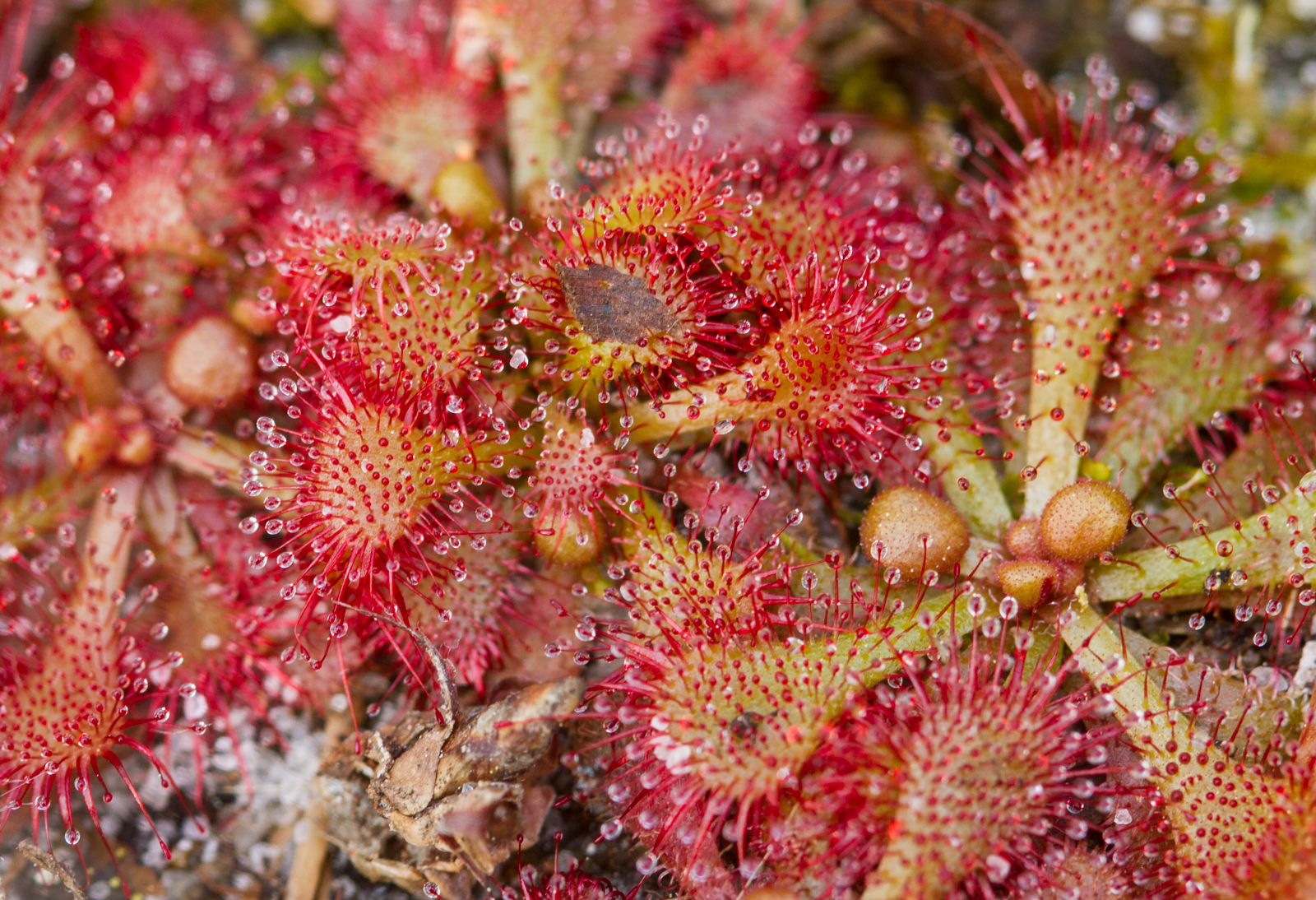
But even a pitcher plant can’t eat everything that falls in. Frogs sometimes hide out in them, a few species of caterpillar feed on the inner surface of the pitcher, and there’s even a species of wasp that lays its eggs in the shelter of the pitcher. Sundews look a bit like pin cushions that were left out overnight and have been coated by dew. The sweet-smelling droplets are both the lure for prey and the reason for its demise. It is entrapped in the sticky substance, and the leaf rolls up around it. The same sticky secretions also contain enzymes that digest the insect, providing the nutrients the plant is not getting from its environment.
Notice the vivid, red sundews and the sandy soil in which they’re growing.We have 5 species of sundew in NC, 4 of which occur in eastern NC (the other prefers mountain bogs and a few sites in the Sandhills). I think this species is Drosera capillaris, but I’m not entirely sure without seeing a flower or seed.
Butterworts are a startling yellow-green color that stands out from the golds and browns of surrounding species in late winter/early spring. Their strategy for capturing prey is similar to sundews. They secrete a sticky substance on the surface of the leaf that lures, traps, ensnares, and digests small insects.
There are 3 species of butterwort reported in NC. According to Radford’s maps of their ranges, I think this is Pinguicula caerulea.
The final group of carnivorous plants found in this type of habitat are bladderworts. Bladderworts are the most varied (species-wise) of our carnivorous plants – there are 14 or 15 species in NC! The bladderworts I have seen in the past are aquatic. Their underwater roots have bladders that suck prey in to be digested. Apparently, there are also terrestrial bladderworts that live in boggy peat soils or moist sand. I didn’t realize this before my trip, so I’ll have to search them out when I return!
Though fly traps have the most limited range of our carnivorous plants, each type is remarkable in its own way and well-worth seeking out in some of the remaining longleaf pine savannas. They’re easy to miss when not in flower, but if you scour the edges where pocosin meets savanna, you might be fortunate enough to find some!
Sunshine is delicious, rain is refreshing, wind braces us up, snow is exhilarating; there is really no such thing as bad weather, only different kinds of good weather.
~John Ruskin
We have had a variety of “good weather” lately, including a brief return to winter white yesterday morning. It had been predicted for several days, but when I awoke, it was just cloudy and cold. As I sat sipping some coffee, I noticed the first few tiny flakes. There was soon a dusting covering everything but the stone steps and gravel driveway, which must have retained enough heat to prevent the snow from sticking.
The view across the road after the “snow” (click photos to enlarge)
Spring has arrived a few weeks early this year so many flowers are in full bloom that would normally just be flirting with opening. It made for some odd sights as we walked the property. But, by the time we finished the walk about an hour later, the skies had cleared and almost all of the snow had melted. March in North Carolina…
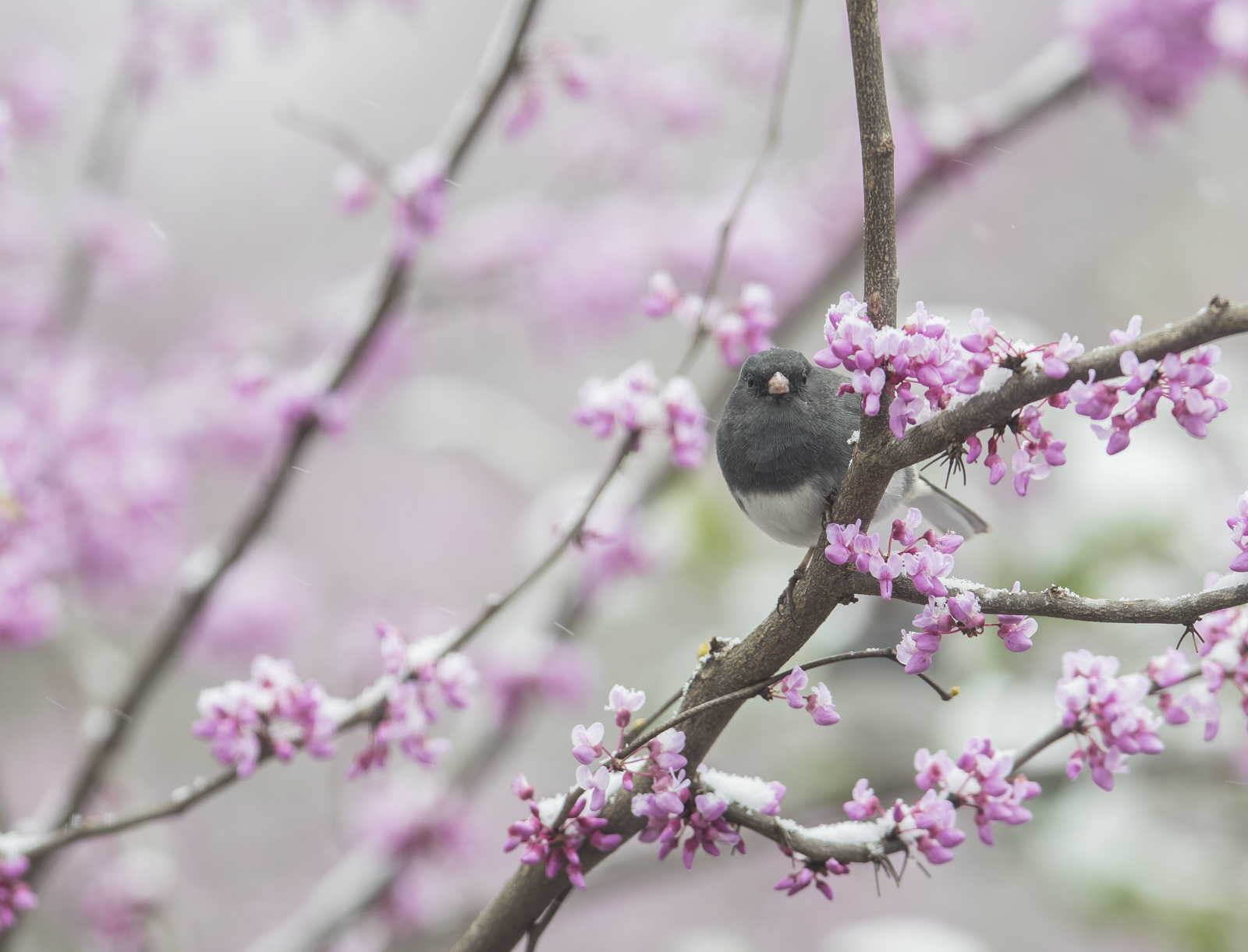
Strange photo partners – a dark-eyed junco and redbud flowers, with a dusting of snow
A ruby-crowned kinglet was busy at the suet feeder
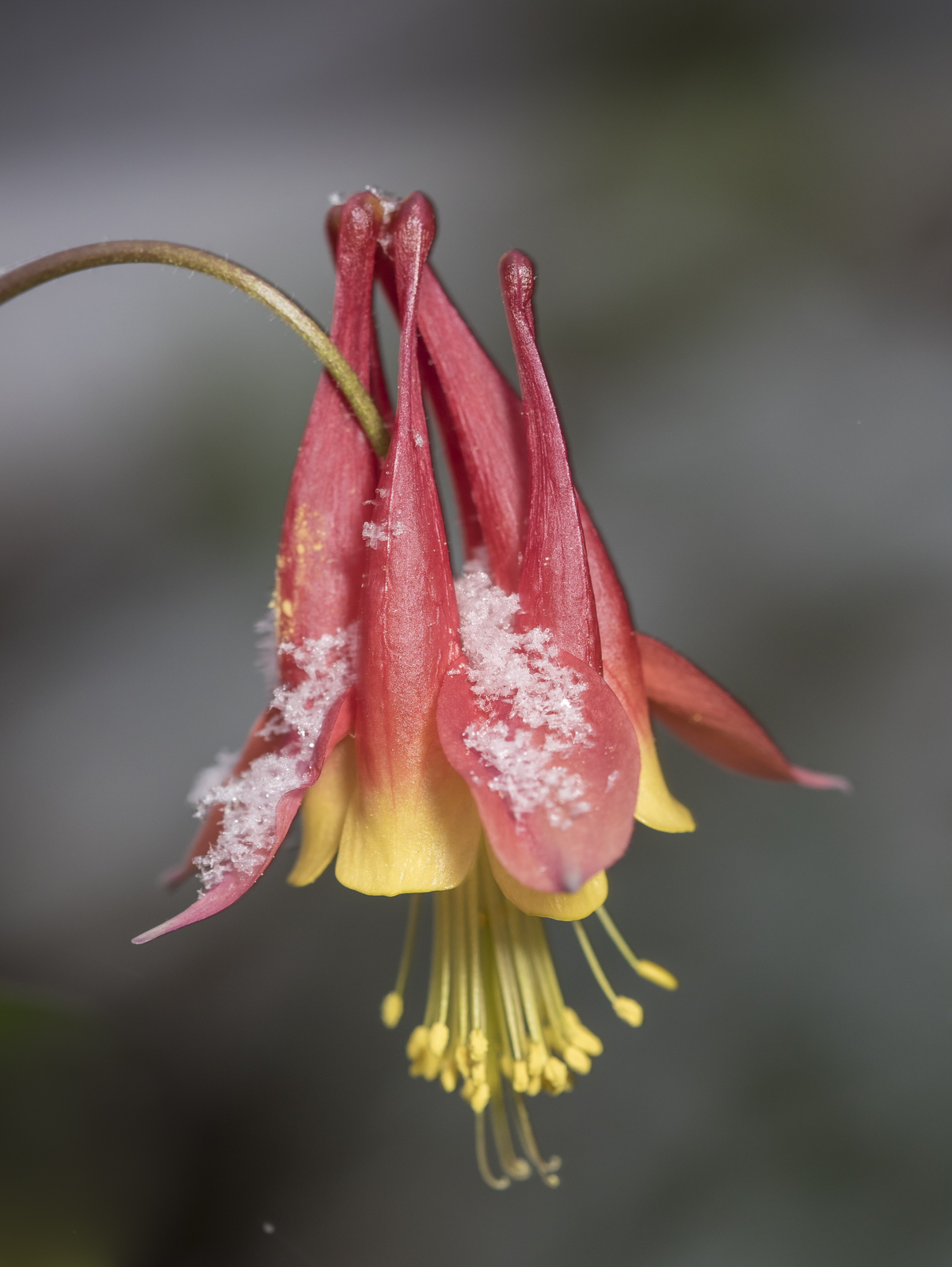
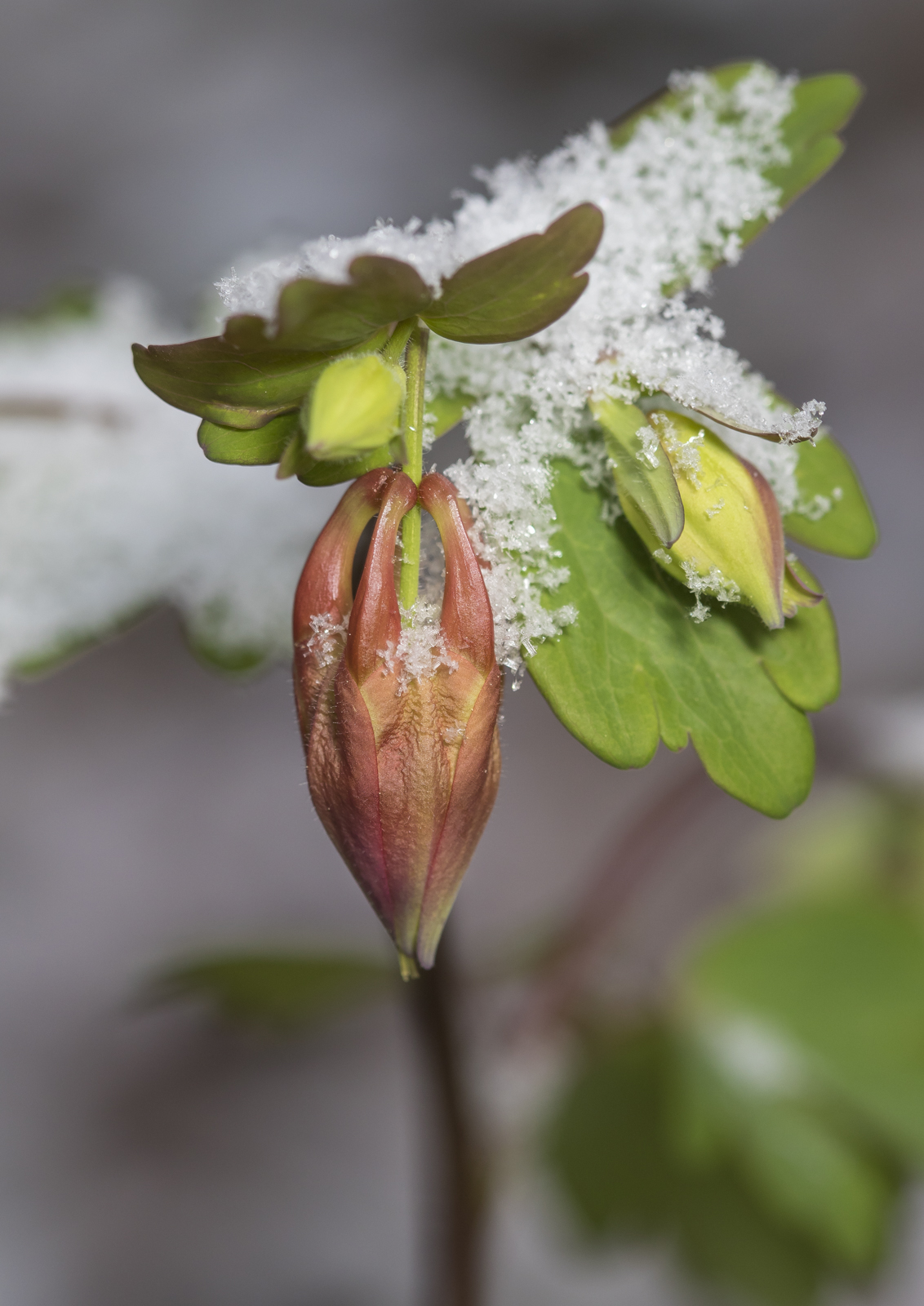
Wild columbine with snow crystals
Maybe I should stay closed
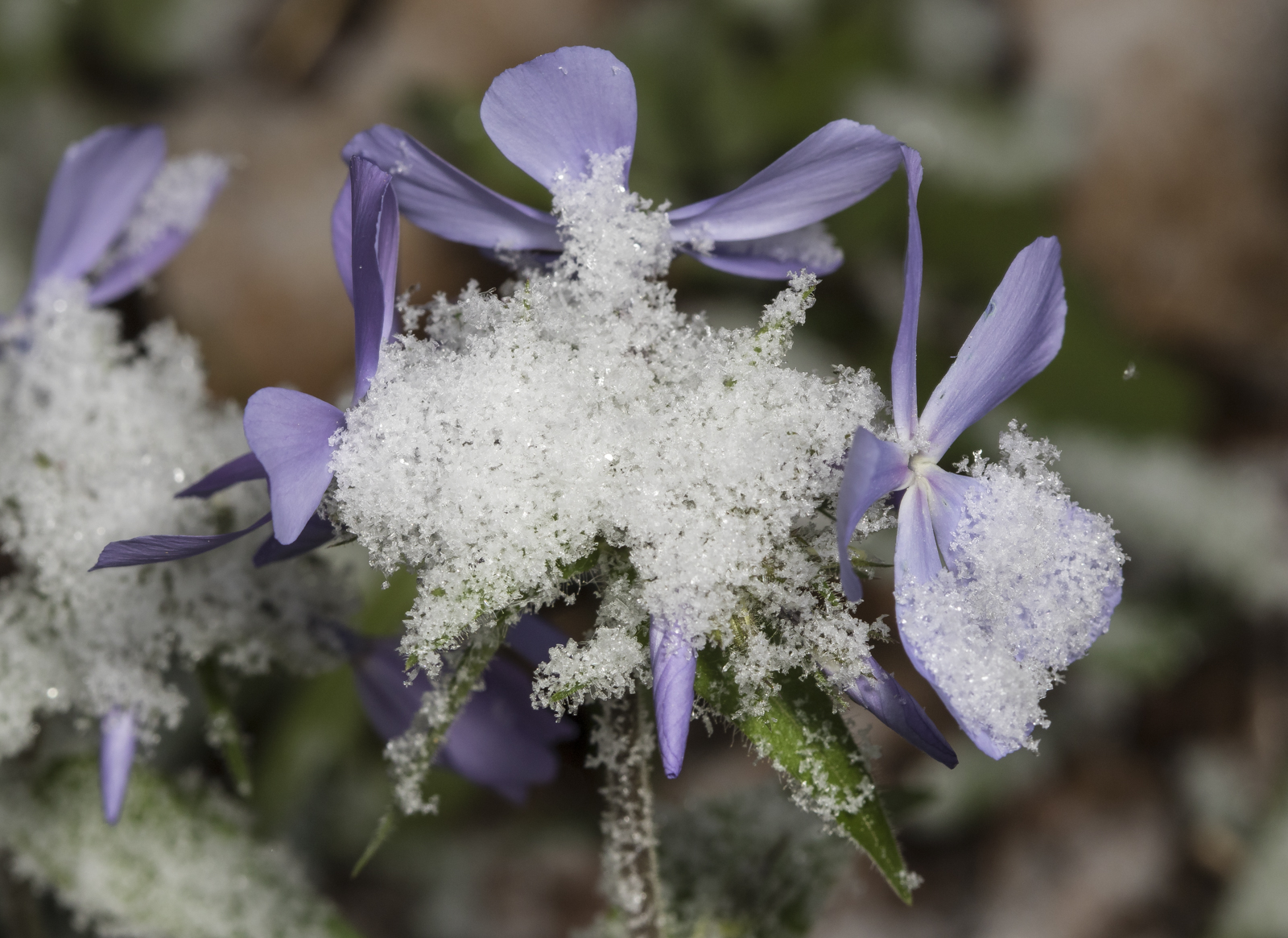
The first phlox are rethinking their opening
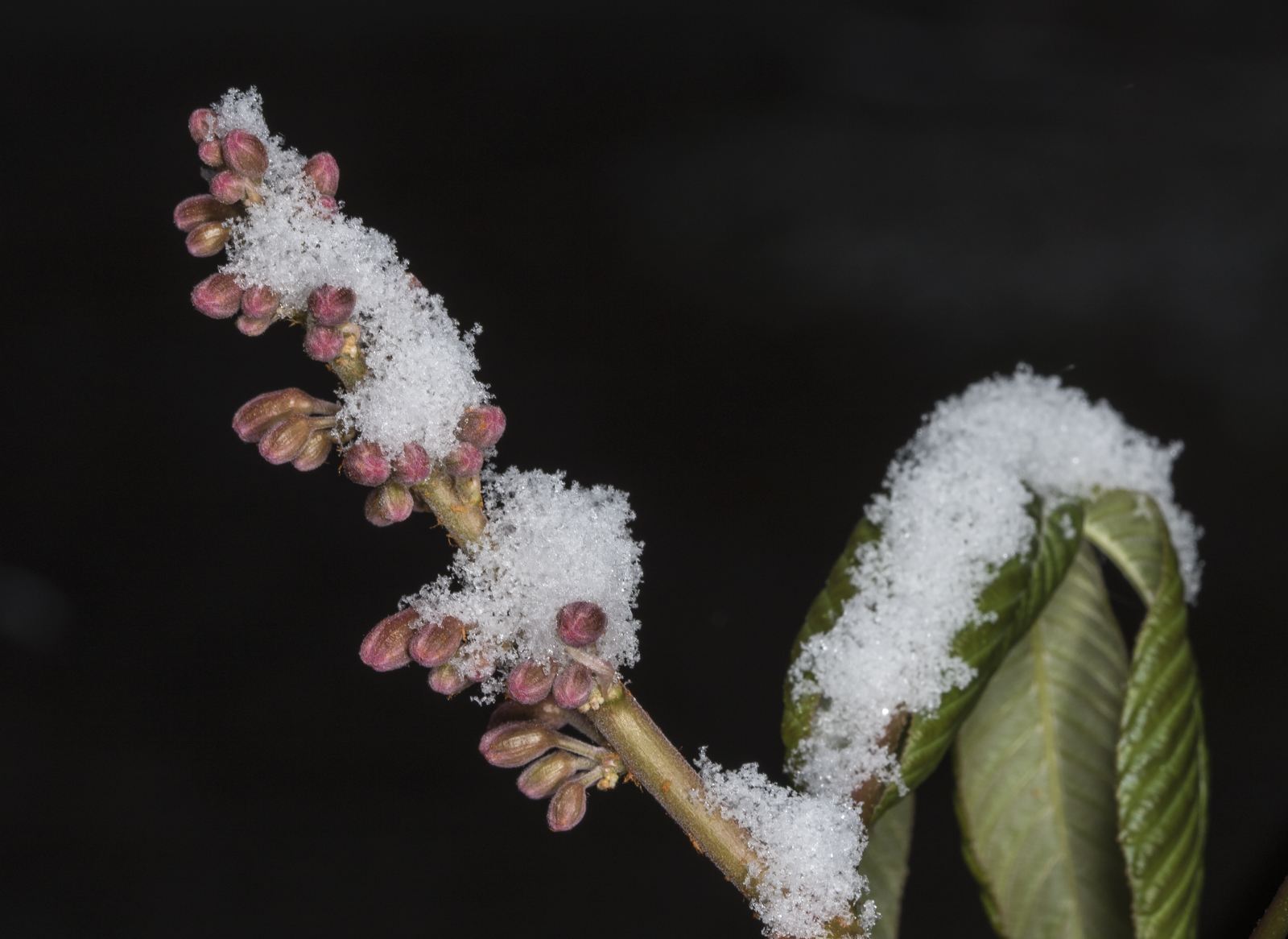
Red buckeye about to open
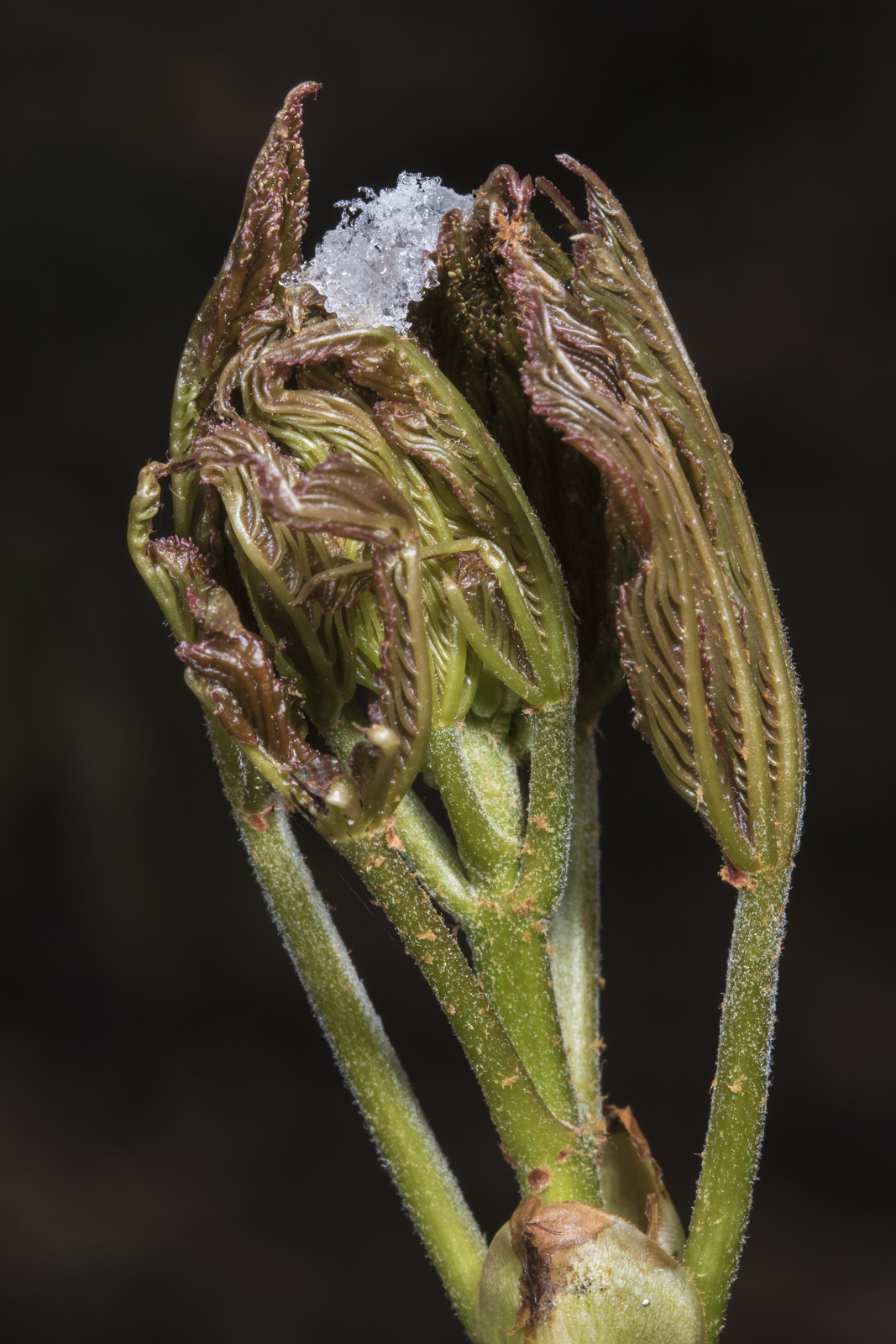
Painted buckeye bud beginning to open
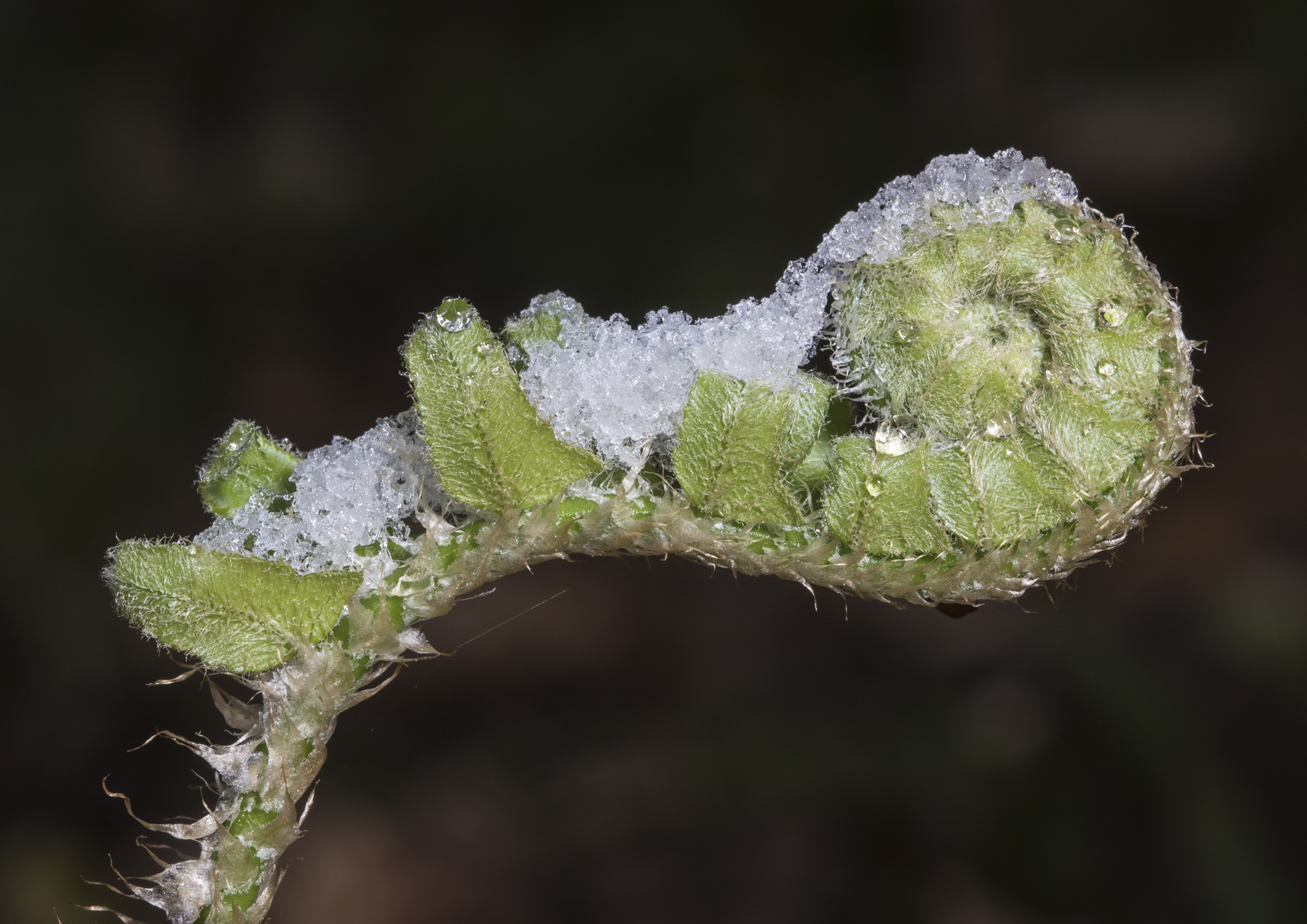
Christmas fern fiddlehead
Unfurling with a blanket of snow
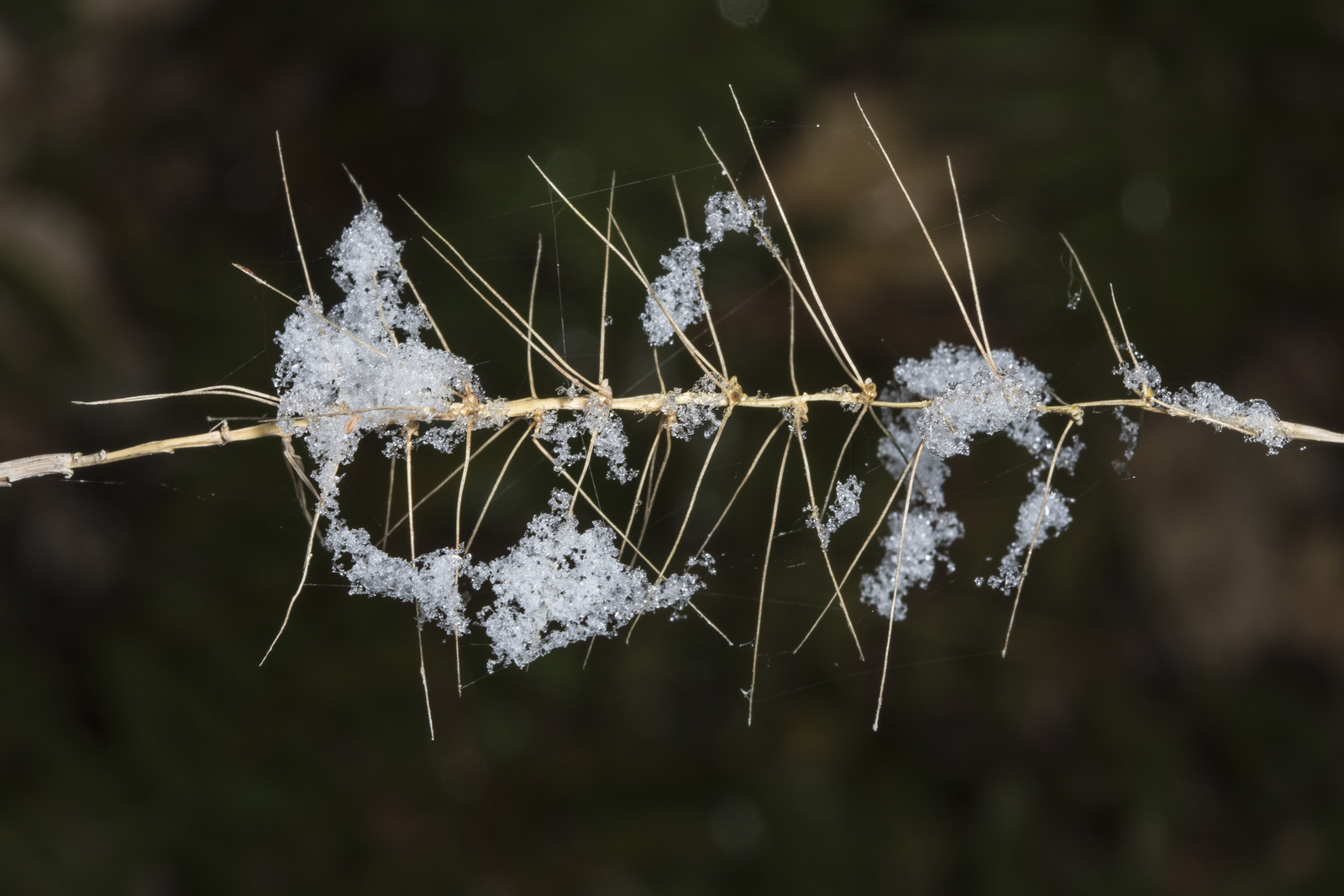
Bottlebrush grass seed head from last season bent over with the weight of some snow
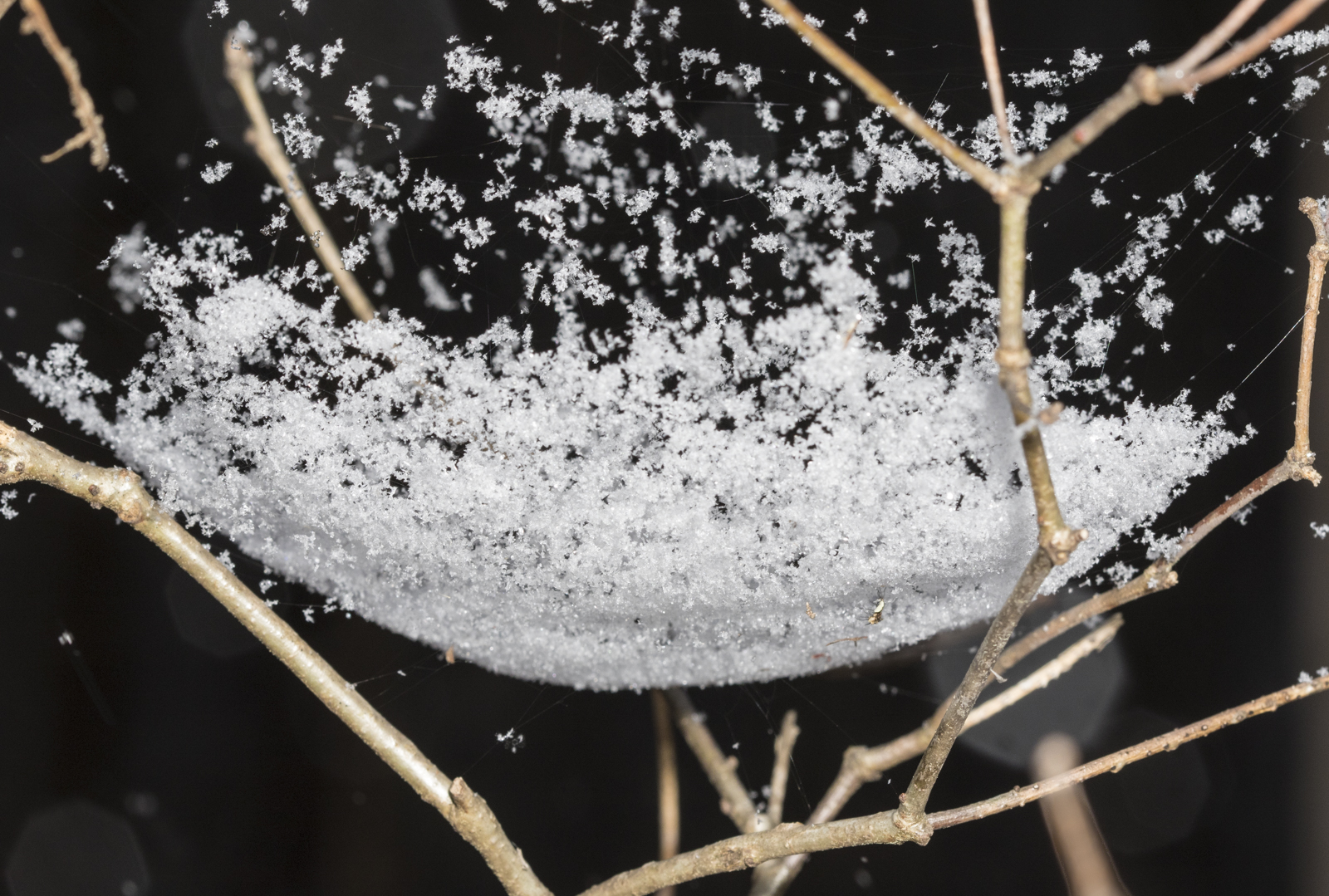
Bowl and doily spider web with snow. These were the last places the snow melted and as we returned, the woods looked like someone had dropped white rags everywhere in the low branches. Perhaps having the cold air swirl all around these little snow platforms allowed them to retain their wintry prize a little longer.
I put 100 hickory nuts on my bureau at dusk one fall evening…by midnight, she had stored them all. At midnight…counted another 100 hickory nuts and spread them. The next morning, every nut was gone. She had picked up and stored 200 in one night.
~John Terres, on how many nuts his captive flying squirrel could store in one night
We had a gathering of friends at the house this past weekend, complete with campfires, and basic outdoor foods like hot dogs, beans, and coleslaw (did I mention S’mores?). It was a beautiful, crisp evening and good conversations and laughter were heard in our woods for several hours. Natural history highlights included seeing a couple of spotted salamanders laying eggs in one of our pools, and listening to the resident screech owl wailing across the ravine. But, the event that drew the biggest gasps and sounds of joy was a surprise sighting I had out back after several guests had already called it a night. I took some bottles and cans out onto the back deck where we had put our recycle bins and the bottles clanked loudly as I dropped them in. A few feet away, some people were laughing just inside the screened porch. I turned to join them, when something caught my eye…
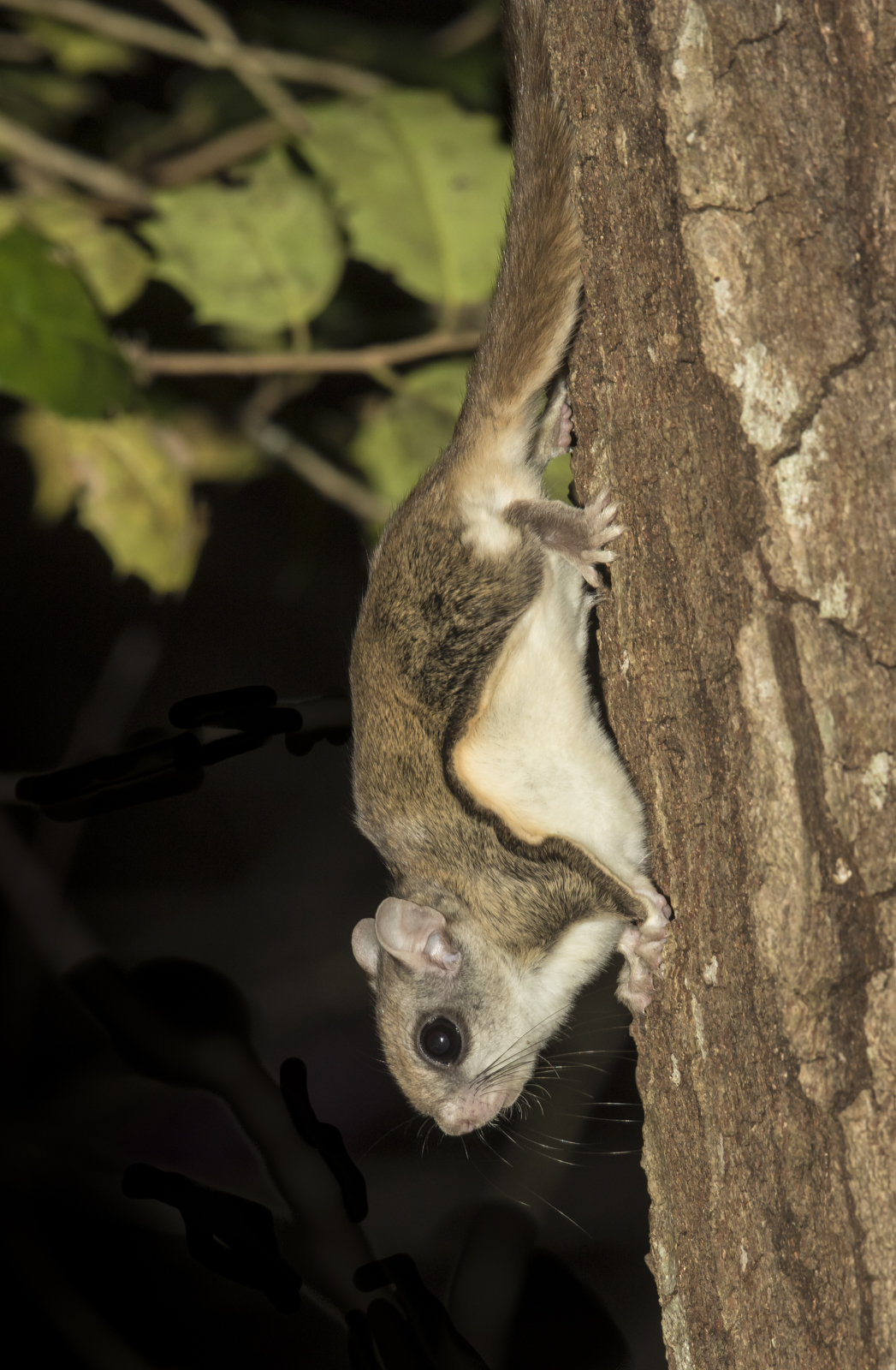
Southern flying squirrel in my bird feeder (click photos to enlarge)
I noticed a shape sitting in the bird feeder that hangs suspended between the house and a nearby tree. A bird this time of night???…nope, a flying squirrel! I have seen and heard them (they make high-pitched chirps that sound like birds at night) in these woods before, but never seen one on the feeder (probably because I rarely turn on the lights on the deck). This little guy didn’t seem to care that I was only a few feet away staring at him. I whispered to the folks on the porch and they came out…the noise level increased, but still no sign of stress. I went out to the campfire circle and told folks about my find, and soon there were close to a dozen people gathered on the deck excitedly watching this beautiful little creature.
Close up of flying squirrel
In spite of the increased noise, and a flashlight beam shining on it, the squirrel continued to chow down on sunflower seeds and glance back at us with those large dark eyes. Of course, those big eyes are an adaptation for their nocturnal lifestyle. Combined with a keen sense of hearing, flying squirrels use their oversized eyes to help find their way in the darkness and avoid dangers like owls and terrestrial mammals. I was surprised to read that these abundant little squirrels actually spend a fair amount of time foraging on the ground at night, where they are much more vulnerable to predators.
The fold of skin that allows a flying squirrel to glide
As you probably know, flying squirrels don’t really fly, they glide. The special adaptation that gives them this unique ability is a fold of furred skin (patagia,; singular patagium) that stretches on either side from the wrist to the ankle. The photo above shows the edge of one of these folds. When a flying squirrel leaps off of a tree, it stretches its legs wide, and the the patagia form a wing-like structure that enables the squirrel to glide downward. Using small movements of the feet and tail, they have remarkable skill in directing their glides and can make sharp turns and precisely hit targets (like a suspended bird feeder). Though usually from tree to neighboring tree, their glides can cover much larger distances (well over 100 feet).
Flying squirrels have wide, flattened tails
Another useful body trait for a gliding mammal is a long (about half their total body length) flattened tail that can act as a rudder in flight. Right before landing on a tree trunk, flying squirrels assume a vertical position, legs spread and tail down, which helps serve as a brake in their glide.
Hickory nuts in flying squirrel “nest”
So where are they going with this special talent? Usually in search of food (or to escape predators). Flying squirrels are omnivores, eating a wide range of vegetable and animal materials. They are especially fond of nuts and seeds, but will also dine on insects and birds eggs and young. Most people don’t realize how common our flying squirrels are, even in urban settings (they are often as common as the more noticeable Eastern gray squirrels). A sure-fire clue is the presence of nuts that have a hole chewed in them like the ones pictured above. A recent visitor to the Garden brought in this “nest” from a bluebird box in her yard that she had cleaned out. The nest contained four hickory nuts and she wondered what was using the box. Flying squirrels use tree cavities, nest boxes, attics, and my storage shed, among other places, as nesting spots and retreats. This nest was lined with shredded cedar bark (a favorite of flying squirrels) and contained the tell-tale evidence of nuts with a hole chewed in them.
A Southern flying squirrel, one of our cutest mammals
We have two species of flying squirrels here in North Carolina – northern and southern. The latter is what we have here in the Piedmont and throughout much of the region. Northern flying squirrels are slightly larger and are restricted to higher elevations in our mountains and habitats further north. Our party squirrel finally decided it had had enough of the gawkers, and nimbly darted up onto the wire and glided over to the nearby oak tree, dashing around to the side of the trunk when it landed. It paused there and stared at the crowd before retiring into the darkness, giving us all a fantastic look at one of our most endearing mammals and a lasting memory of a gathering in the woods.
“And Adam named his wife Eve, because she was the mother of all living.”
Genesis 3:20
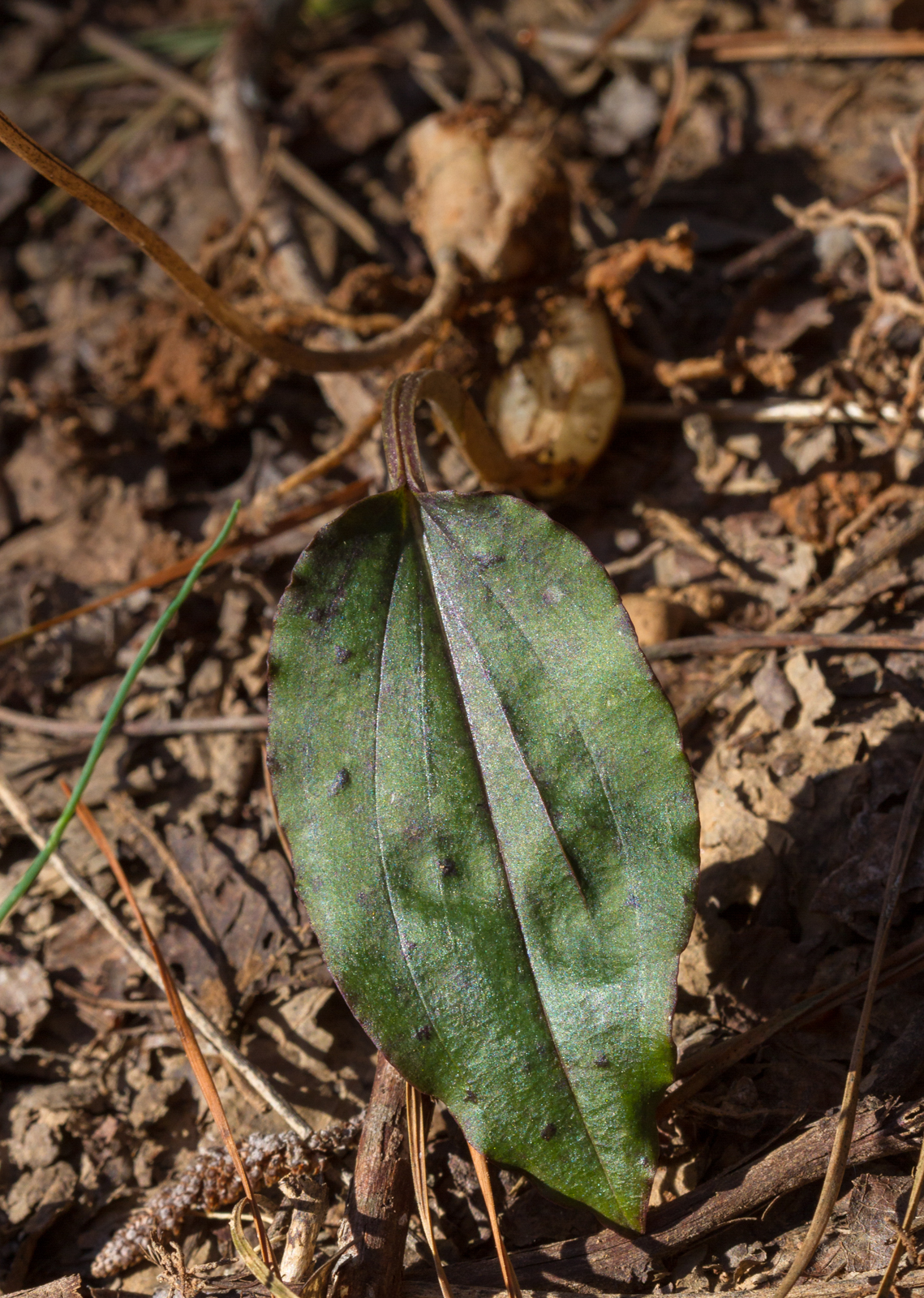
With Mike back at work, I’m going to try to contribute to the blog occasionally. I came upon the perfect topic while out on a “field day” with a coworker, Megan, last week. One of the things I never fail to notice in winter has always been the few small, ground-hugging plants that provide a flash of green in winter. One of the my favorites is cranefly orchid, Tipularia discolor.
The cranefly orchid has a noticeable, single green leaf in winter. This one is dug up – more on that in a moment.
Just the other day Megan and I were at a school for a workshop. I was off by the creek, and she had the group of teachers in tow. All of a sudden, I heard a “wow” echo through the woods. Megan had just pointed out the somewhat-innocuous, green leaf of the cranefly orchid – and then flipped it over to show them the startling purple color of the backside of the leaf.
I’m not in good practice taking pictures with a blog in mind, so this is the best shot I have of the back of the cranefly leaf – hopefully, you can notice the brilliant purple color, even if the details are a little fuzzy…!
I’ve heard a couple different theories to explain the purple color of the leaf’s underside. One idea is that it may help reflect light back into the leaf. This makes sense given that it is photosynthesizing in winter when sunlight hits the earth at a shallower angle, and therefore with less energy per unit area than in the summer.
Another theory is that the purple color acts kind of like sunscreen to protect the chloroplasts from too much sun – which also makes sense because with no leaves on trees in winter, there is certainly more sunlight! I’ve heard of something similar in Yellowstone in the microorganisms that thrive in the hot springs – in summer many are orange in color due to “sunscreen” carotenoids; in winter, the same microorganisms have a much more greenish cast (you can also see this in summer by carefully peering underneath the boardwalk where the shaded bacterial mats are much less orange-colored).
A final idea about the purple coloration in cranefly orchid is that perhaps the underside of the leaf is darker-colored to help it absorb more of the heat radiating from the ground to keep it just a little bit warmer in winter. I’m not sure why the leaves are purple underneath, maybe it’s a combination of factors, but it is certainly a beautiful color and a wonderful surprise in the winter woods.
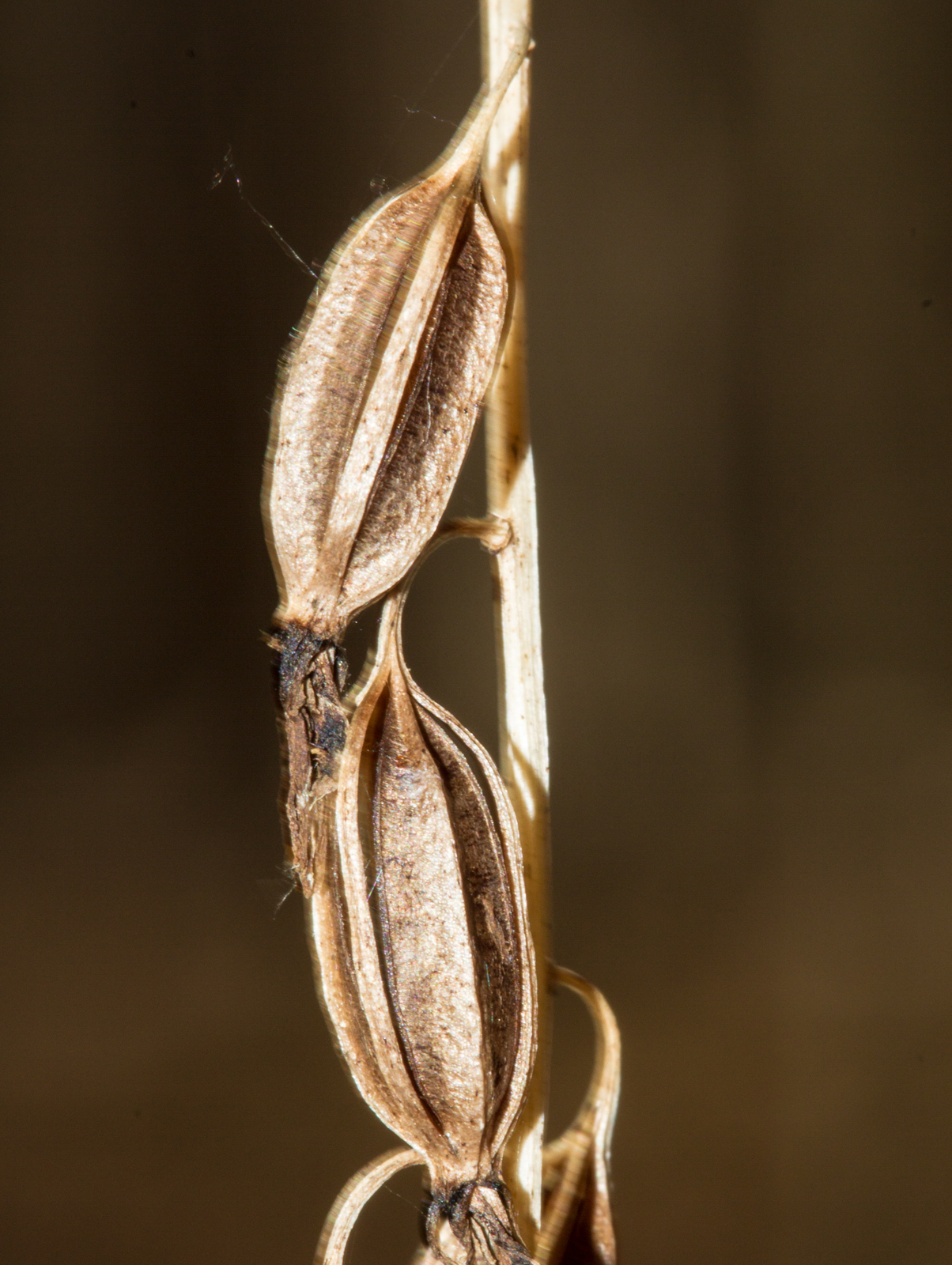
Cranefly orchid has an interesting habit of producing a leaf in the fall that persists through winter, and producing a flower in the summer. The flower is not particularly showy (unless you take a very close look), and can even be hard to spot – especially because the bright green leaf is absent while the flower is in bloom. In fall, after the flower is done blooming, a single leaf grows. Typically in winter you will see only the leaves, but occasionally you may spot a plant that still has the flower stalk with seed capsules attached like a few we found on our walk. The seeds are beautiful small pods and worth a look with a magnifier.
Close-up of cranefly orchid seed capsules
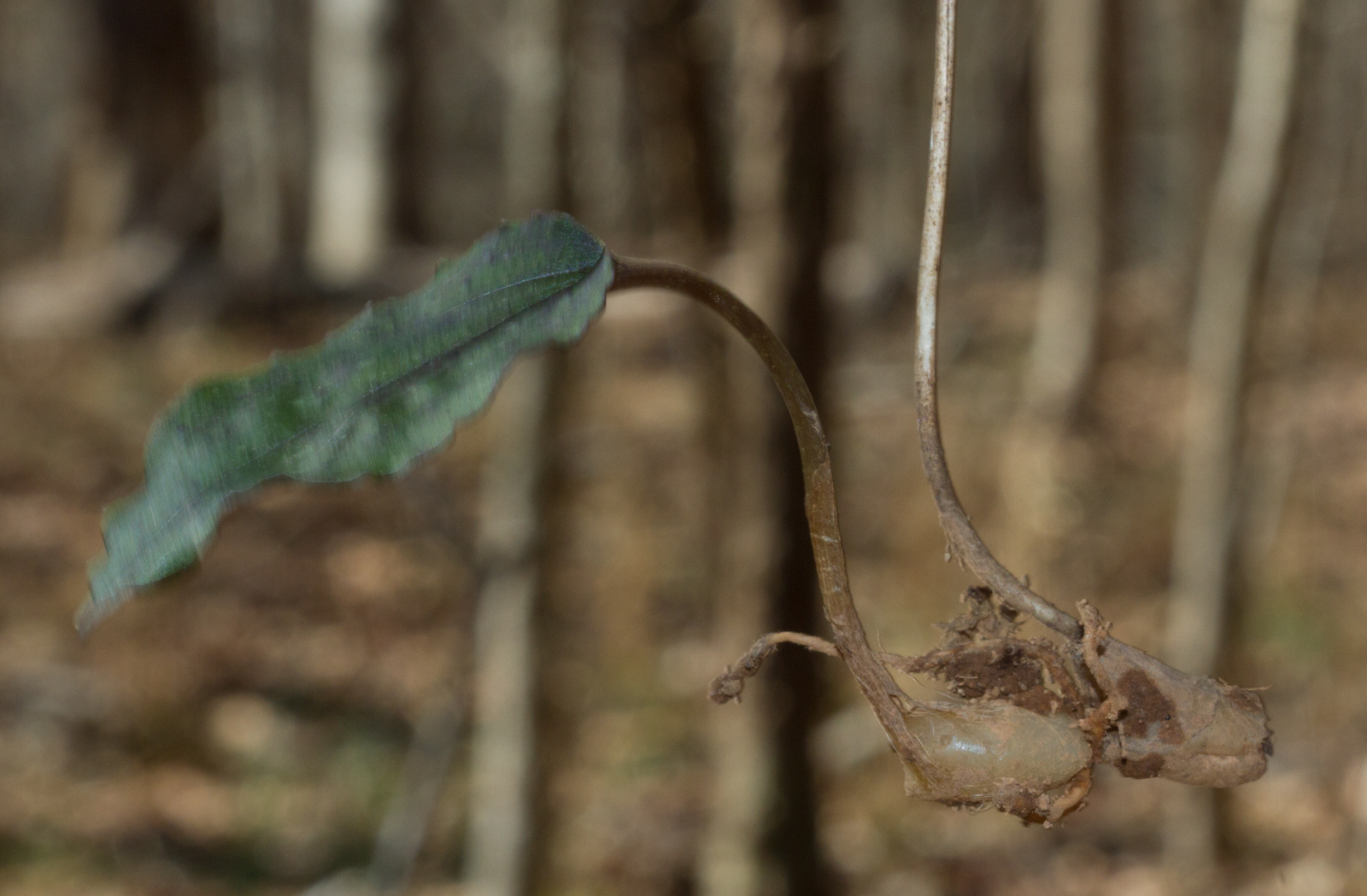
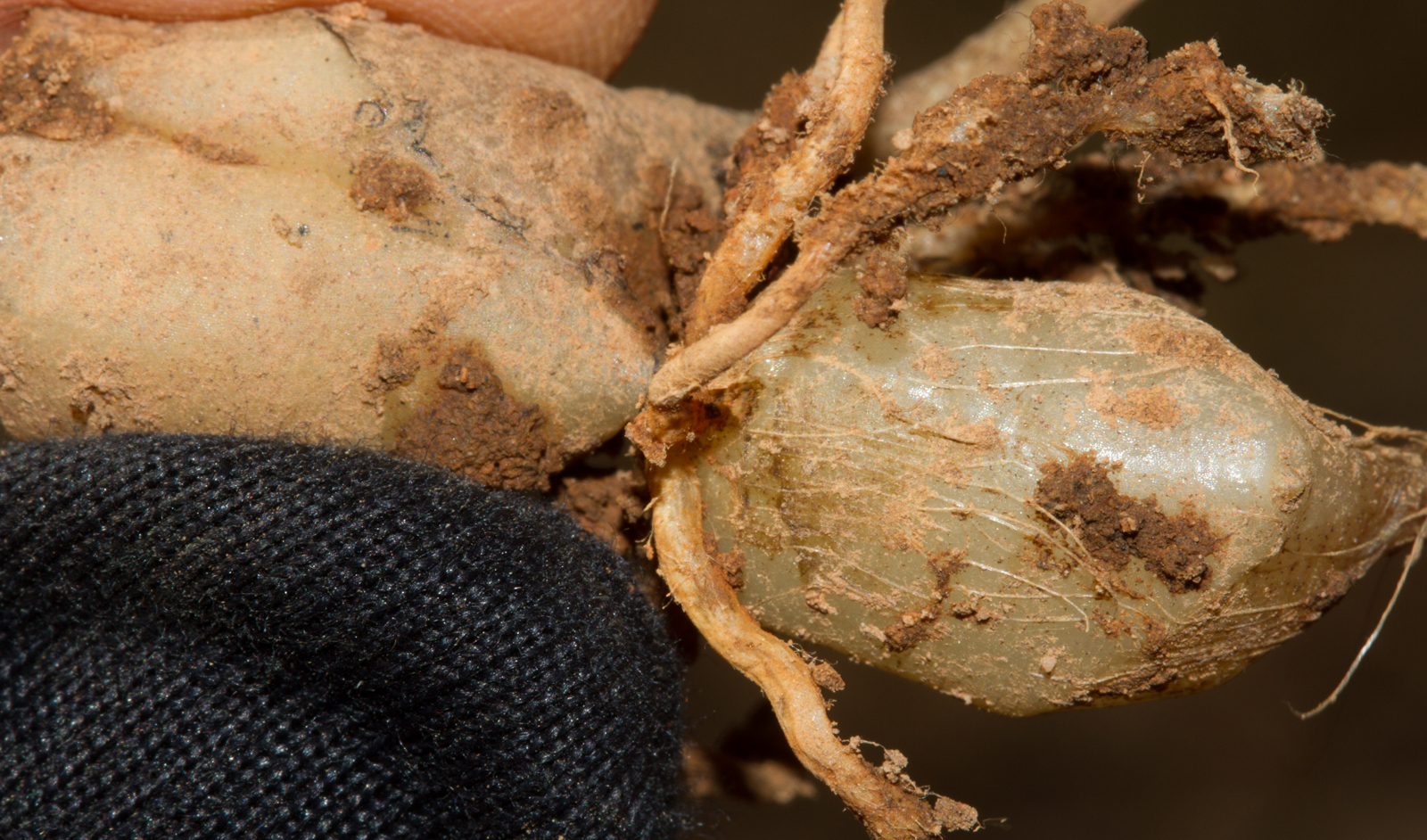
I remembered learning something interesting from Doug Elliot, a renowned naturalist in the mountains of NC, about the roots of this plant, so Megan and I decided to dig up one of the plants that still had its flower stalk and take a closer look (hence the earlier pictures of an unearthed plant).
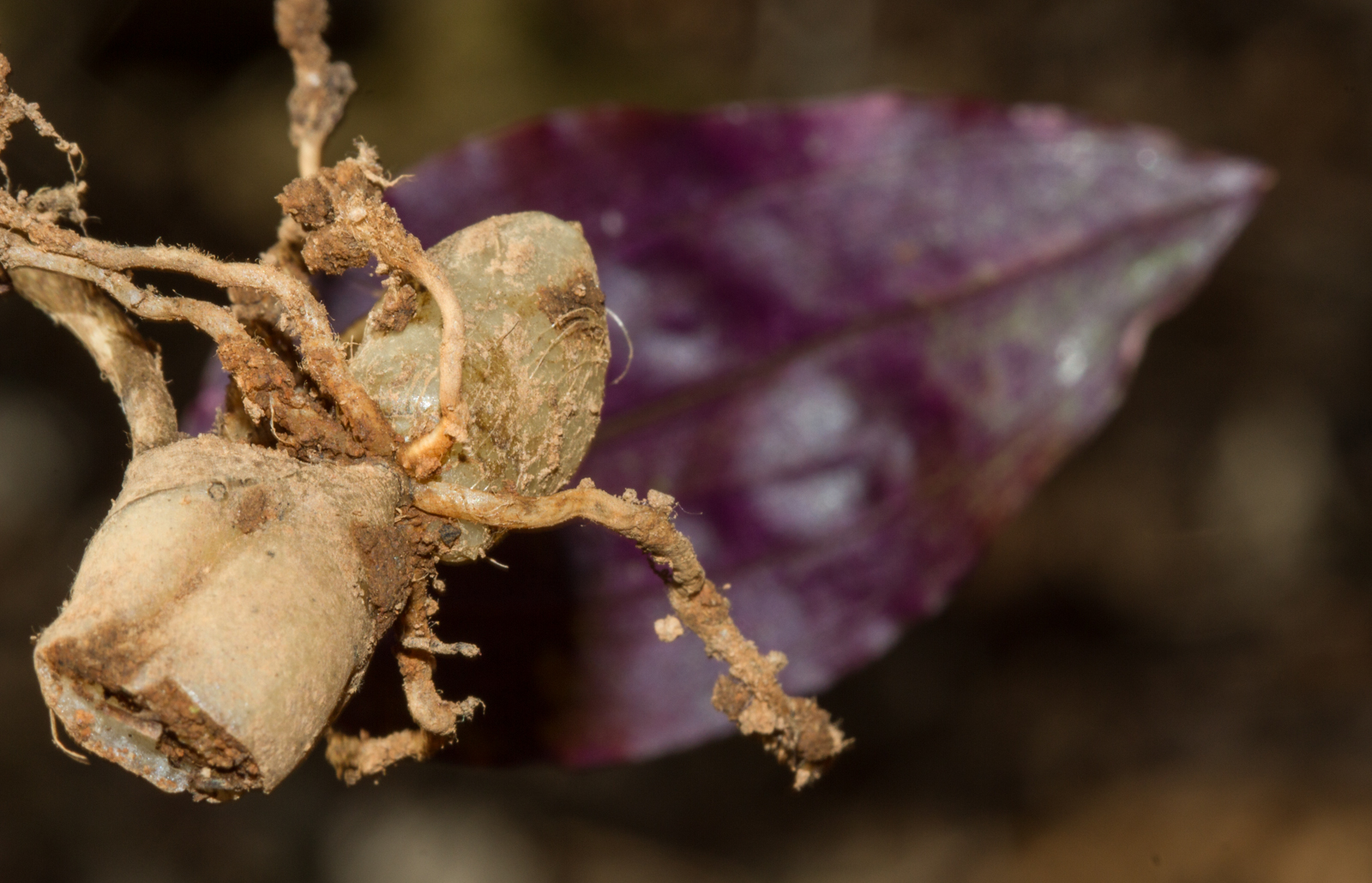
Two corms on root of cranefly orchid; the stalk on the right is last summer’s flower stalk
After some careful digging, we gently pulled the plant from the soil and cleaned off the roots and corms. As I suspected, we found two corms. Out of one sprouted the flower stalk; out of the other sprouted the leaf. Here’s how I think it goes: the leaf photosynthesizes through the winter and stores energy in the corm (the one it’s attached to in this picture). Come spring, the leaf will die and that same corm will sprout a flower stalk, using the energy stored from the winter sun. Sometime during or after blooming in summer/fall (guess I’ll need to dig up another plant at that time to figure out exactly when!), the plant produces a new corm from which another leaf will grow. Seems like a pretty smart strategy to take advantage of the open canopy in winter, when sunlight will hit its home on the forest floor much more so than in summer!
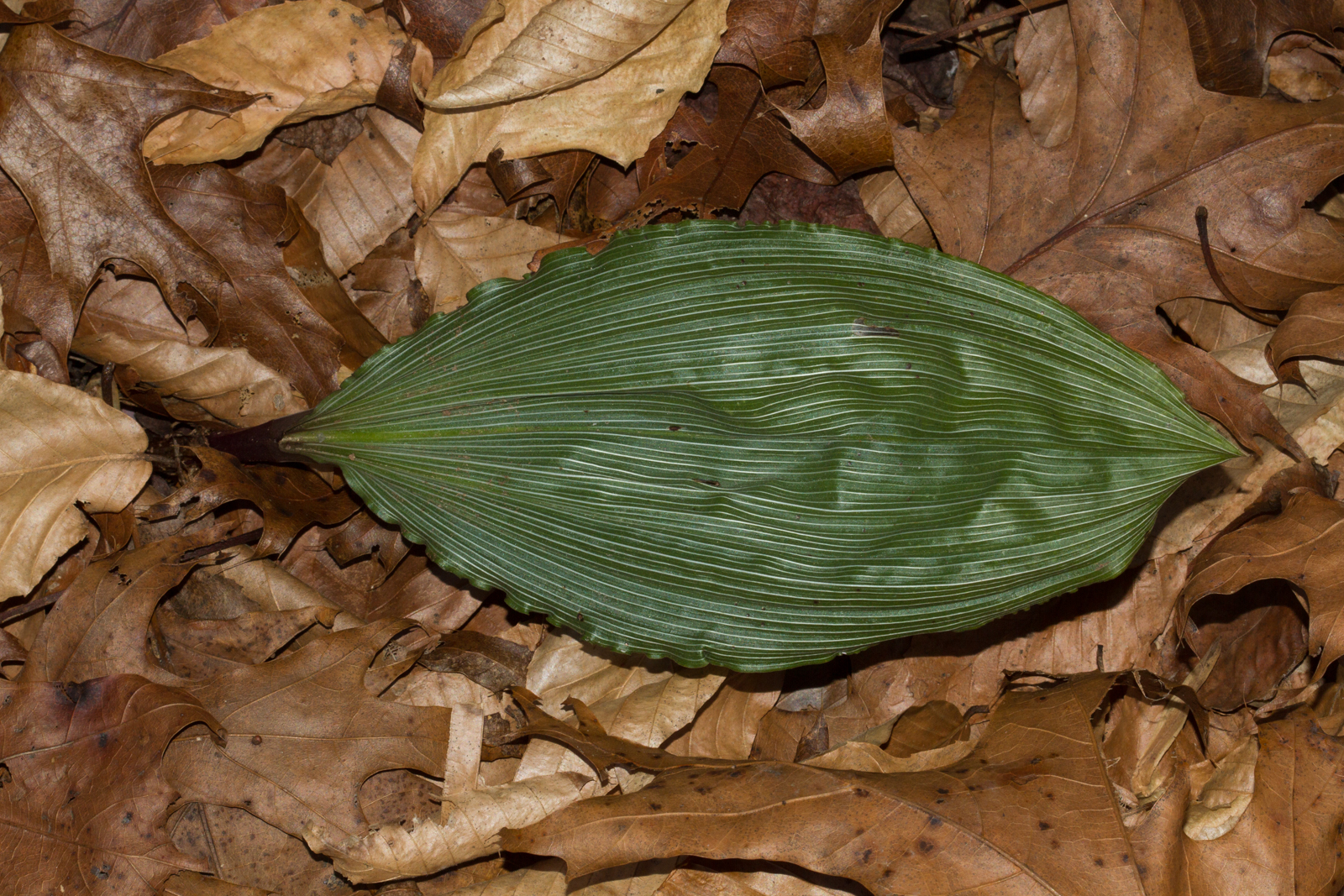
Cranefly orchid is related to another plant called putty-root, Aplectrum hyemale. It has a larger leaf with thin white stripes running longitudinally down it. It’s another hint of green in winter, though much rarer than cranefly orchid, at least around here. The underside of putty-root can be purplish, but sometimes it is green; if purple, it is typically not as vibrant in color as cranefly orchid. Putty-root is known to be found in woods with sugar maple and American beech, and indeed, this plant was located in a beautiful beech grove.
Puttyroot leaf
Another common name for putty-root is Adam-and-Eve root, in reference to the fact that it has paired corms like the cranefly orchid, though I’m not entirely sure which one is Adam and which one is Eve! A quick internet search on this turns up a wide variety of results – apparently, this plant is known for its ability to bring love your way, keep your lover true (the man carries the Adam root and woman the Eve root), and even encourage a marriage proposal. With a little wading through some interesting websites, I now suspect that the corm from which the leaf is growing is the Eve root: she will “give birth” to the new flower stalk in spring. That means the older corm with last year’s flower stalk is for Adam, poor guy.
Whether or not putty-root or cranefly orchid bring you love, they can at least bring you a moment of joy on your winter woods walk and remind you that the green of spring is never far away!
Poor indeed is the garden in which birds find no homes.
~ Abram L. Urban
This garden (NC Botanical Garden) is anything but poor if the birds are any indication. Bird activity seems to have increased dramatically the past few weeks. Many seem to be thinking of the coming nesting season…bluebirds singing from atop nest boxes, a house finch gathering nest materials, and a brown-headed nuthatch checking out a cavity in a snag. And bird activity in the feeding station near the bird blind has really picked up. We moved the feeders closer to the blind this week and I went down yesterday for about 15 minutes to see what was happening. The late afternoon light is not conducive to photography from the blind itself, so I was just standing out near the feeders with the light coming in over my shoulder. It didn’t take long for things to get busy, very busy. In 15 minute I saw 16 species, with some great views of most. I’m hoping to create some interpretive information so I grabbed a few photos while standing in the midst of the avian mess hall.
It’s not every day you see these two species at the same feeder (click photos to enlarge)
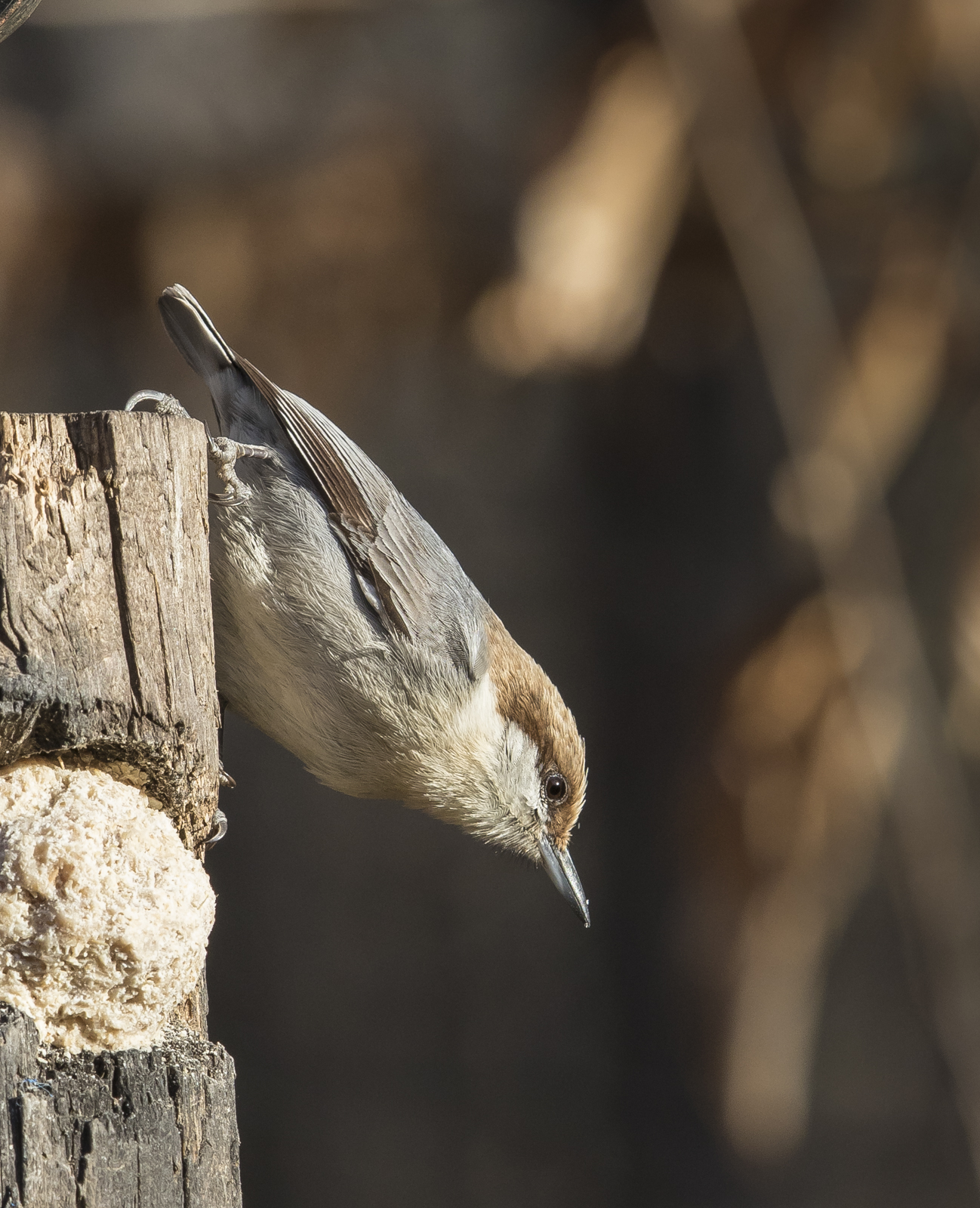
Brown-headed nuthatch on suet log
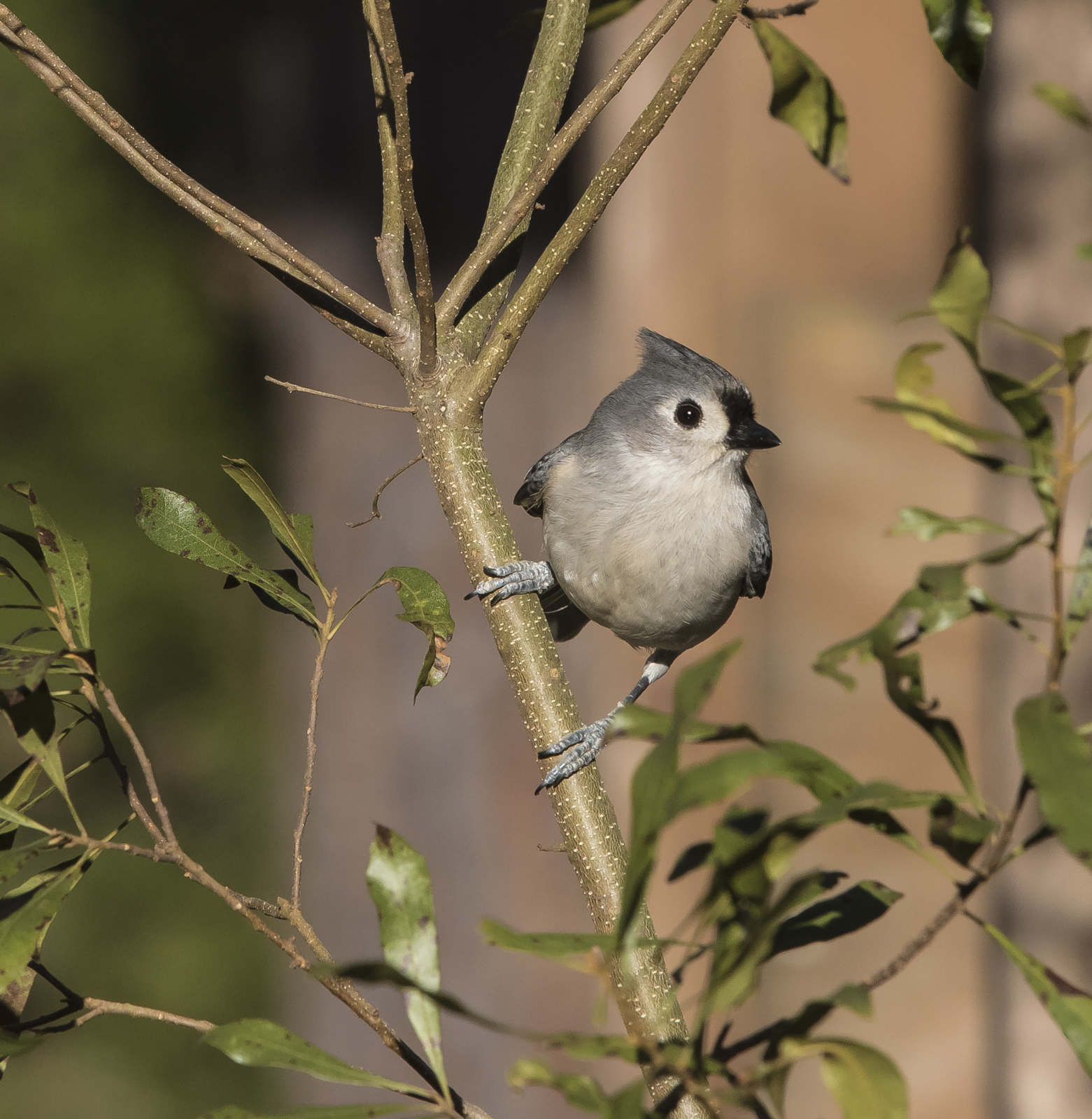
Tufted titmouse
White-breasted nuthatch
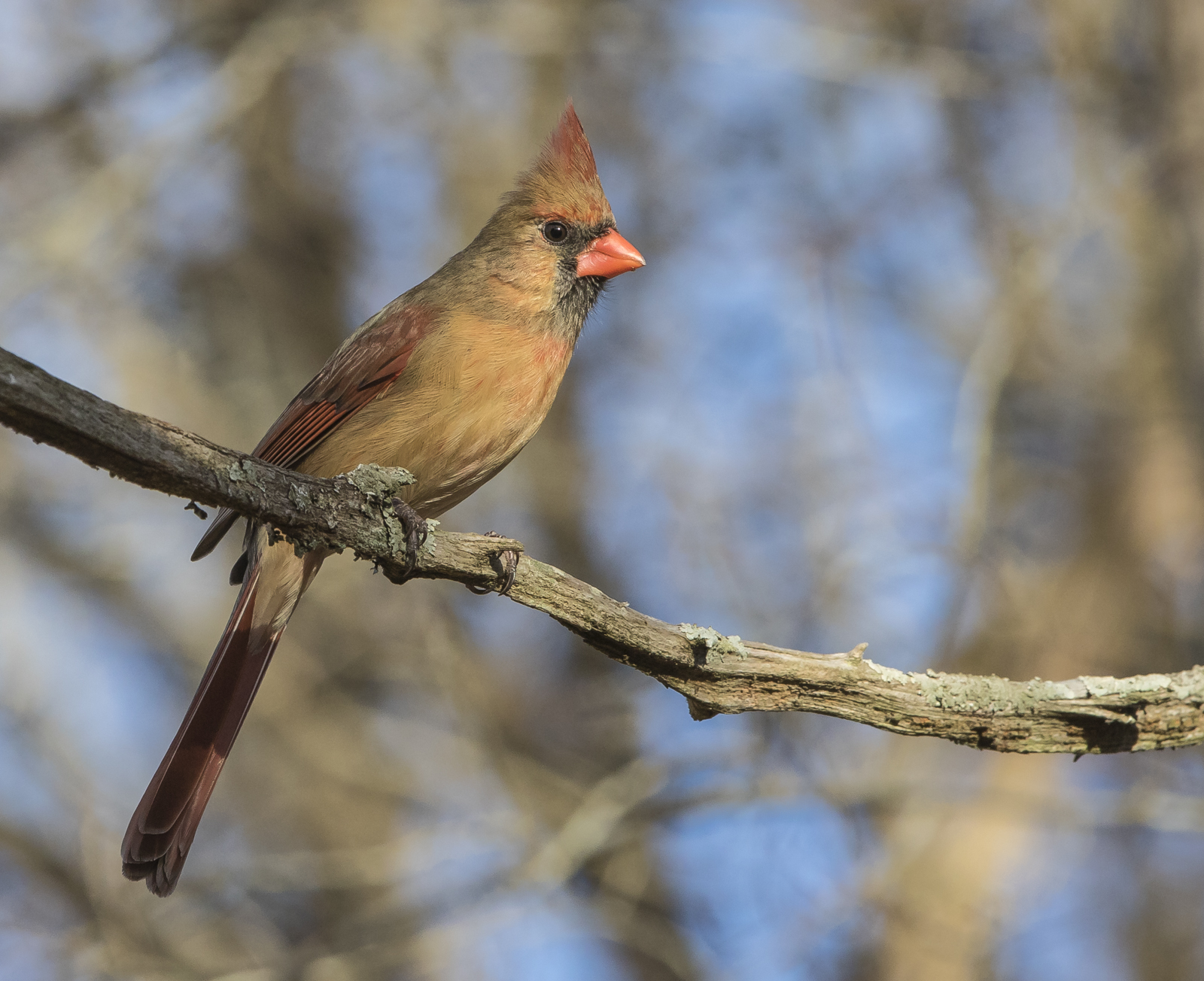
Northern cardinal female
Downy woodpecker
Pine warbler
Here is a list of species seen yesterday in the bird observation area (not bad for 15 minutes):



























 Roads End Naturalist