If you have a chance to play in nature, if you are sprayed by a beetle, if the color of a butterfly’s wing comes off on your fingers, if you watch a caterpillar spin its cocoon– you come away with a sense of mystery and uncertainty.
~Michael Crichton
BugFest, the NC Museum of Natural Sciences’ premier special event, is over. Somewhere around 29,000 people visited this year, and, as always, we talked to a lot of them about the caterpillars we collected in the days leading up to the event. A lot of effort goes into preparing for the event, by everyone involved. For us caterpillar wranglers, it means finding and caring for a variety of fascinating critters, and then releasing them all back into the wild. Every year we have specimens that never make it to the big day because they either pupate or have been parasitized and die. So, there are many things that our visitors miss seeing. Here is something that only a few us were privileged to witness this year.
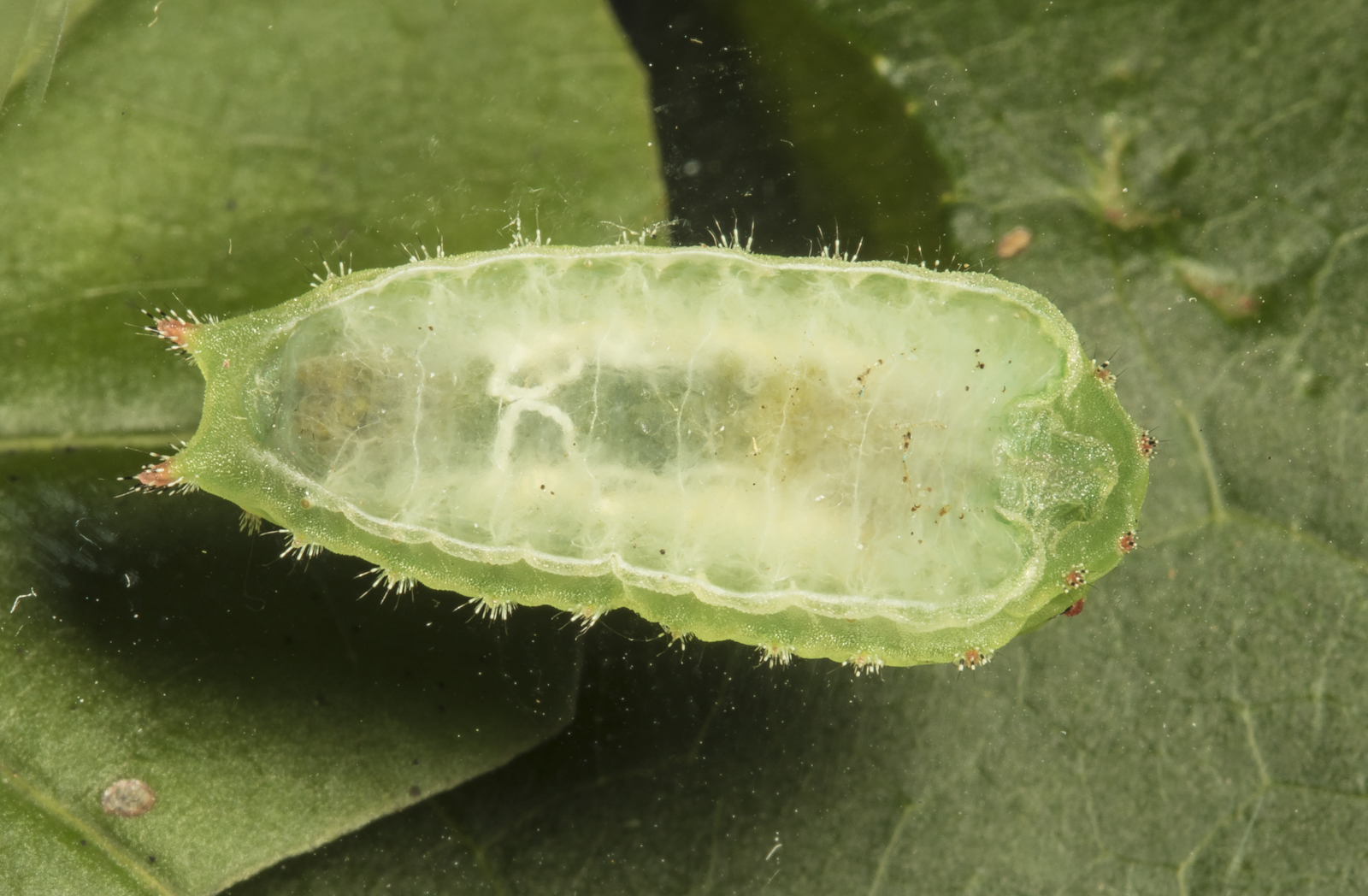
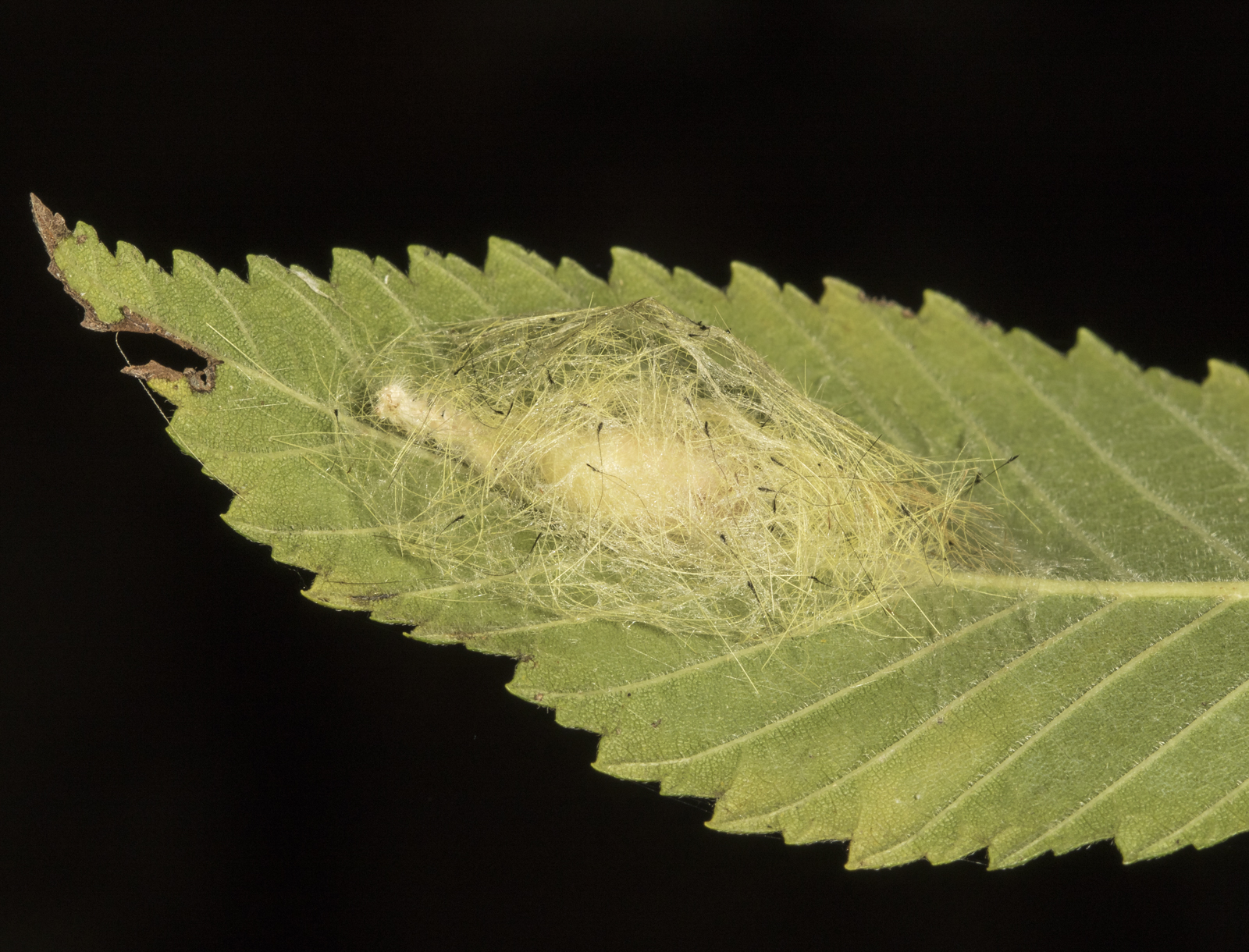
Mystery cocoon (click photos to enlarge)
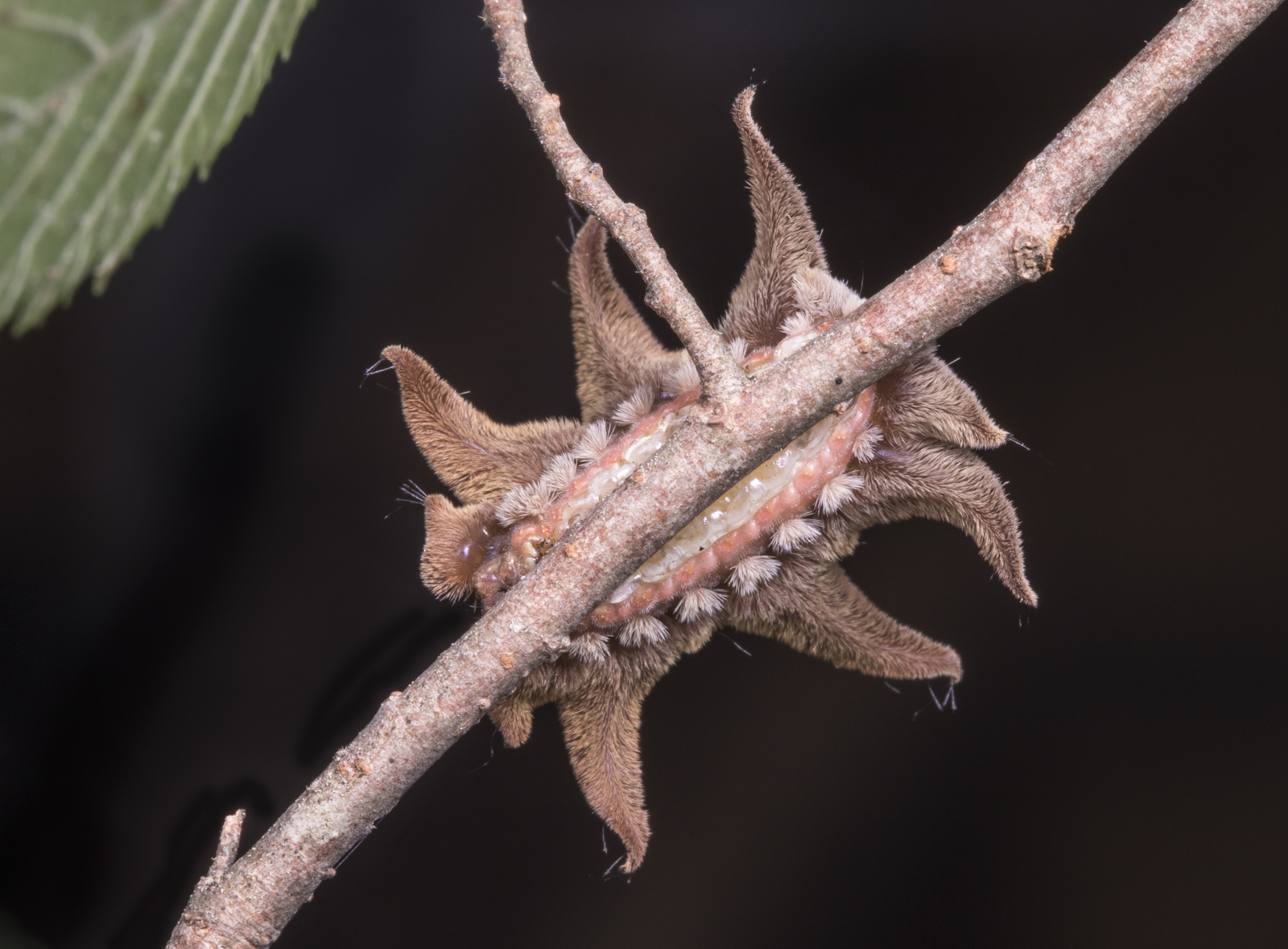
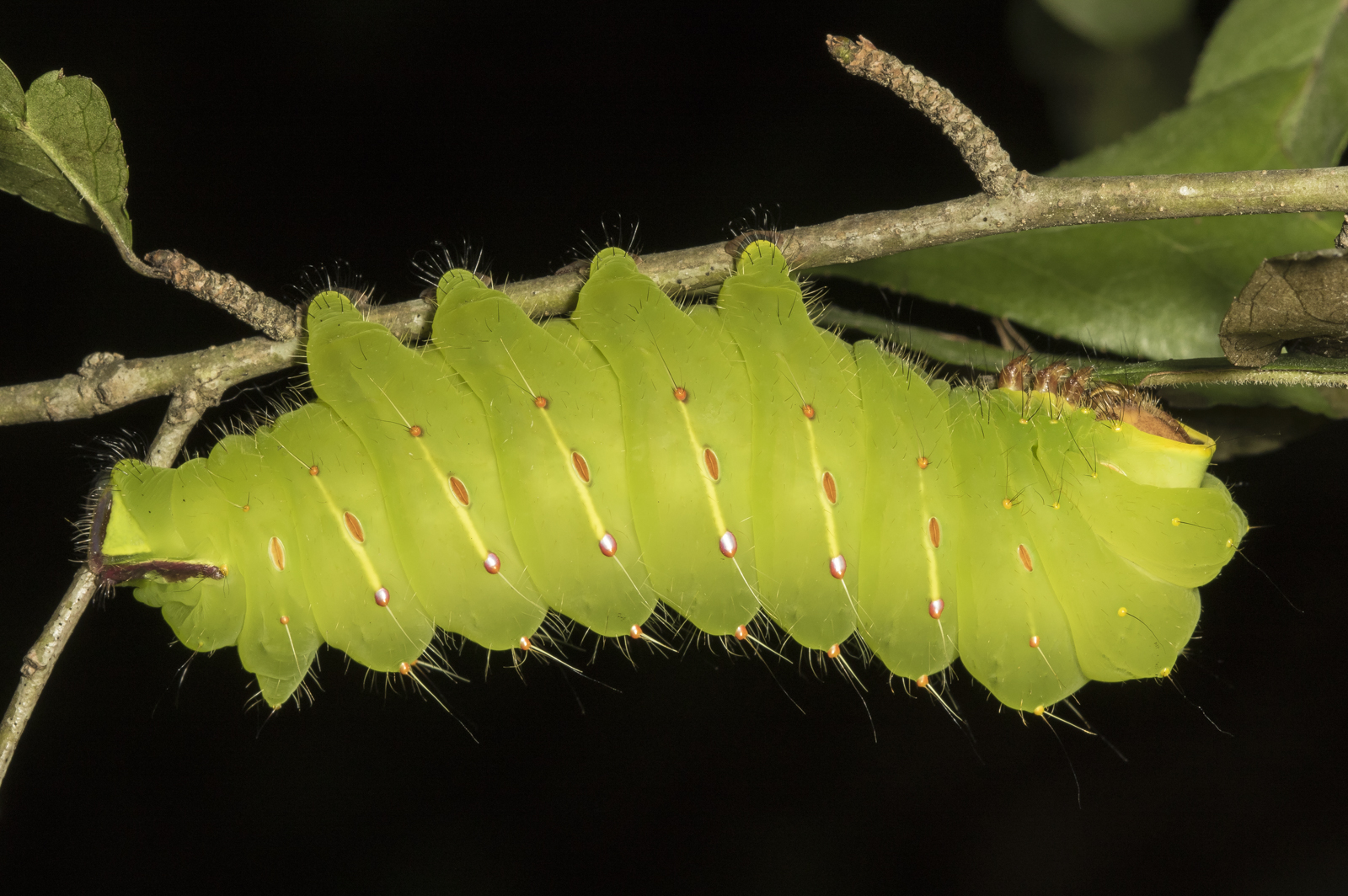
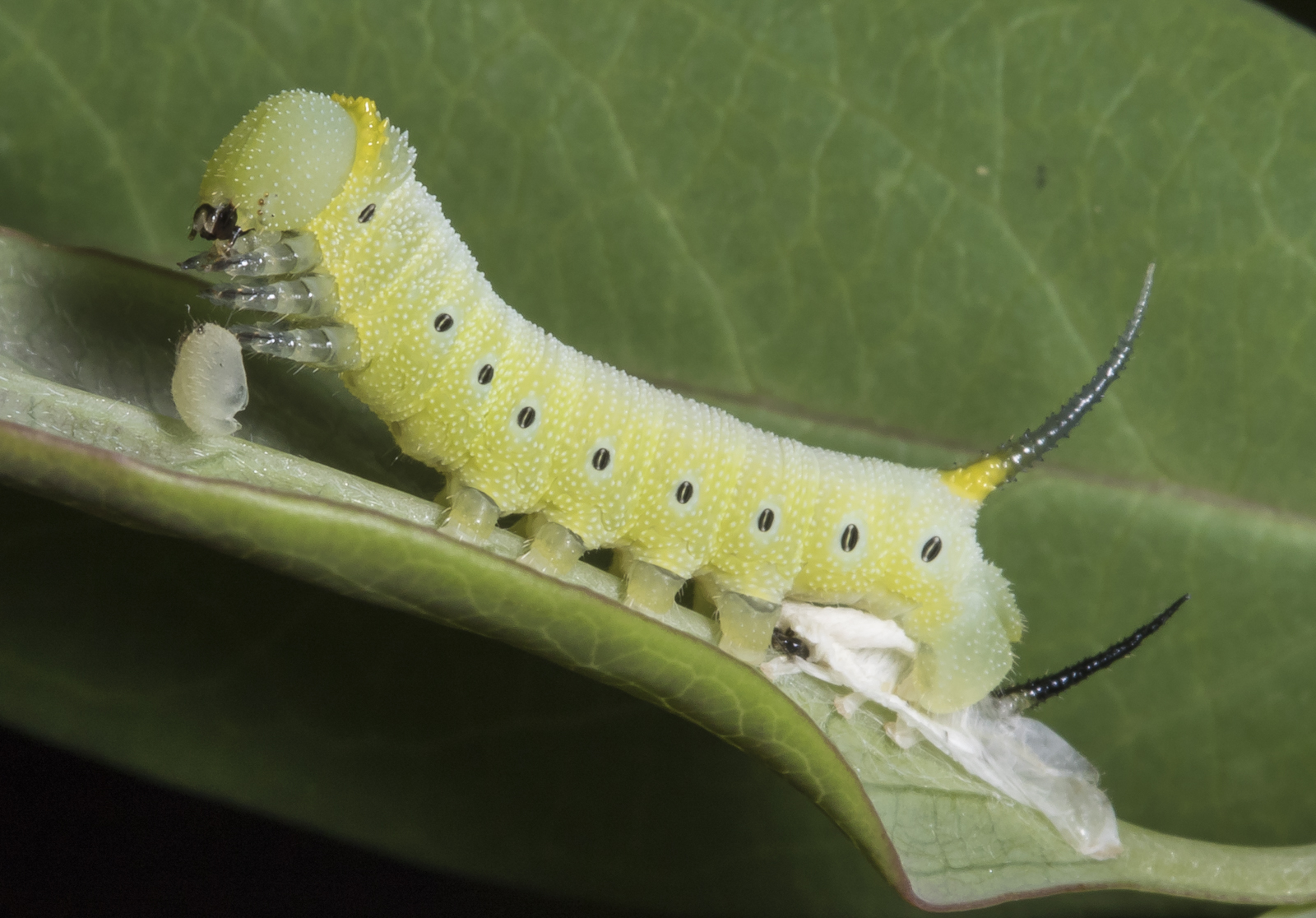
Let’s start with a mystery. I found this cocoon on a leaf in one of the cages with multiple species of larvae we collected right before BugFest. It reminded me of a tussock moth cocoon of some sort since it appears some of the “hairs” from the caterpillar have been incorporated into the cocoon covering. I didn’t have time to do much with it until after the event. I looked at it more closely, and then remembered we had collected a very nice spotted apatelodes (Apatelodes torrefacta) caterpillar who had started to shed its setae the day before BugFest.
Spotted apatelodes caterpillar
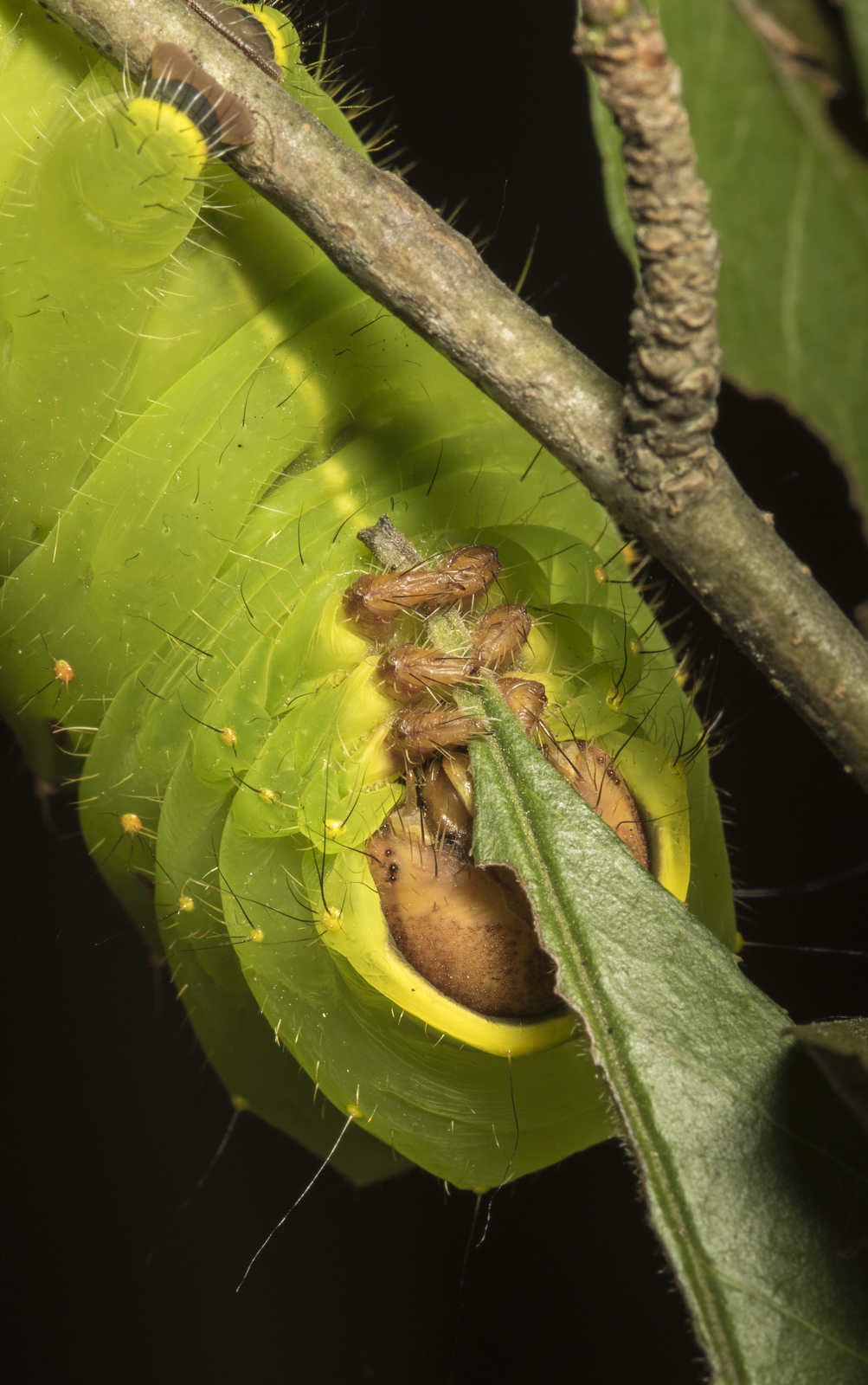
I was disappointed at the time, because these large larvae are certainly in the cute category of caterpillars, especially if you manage to get a look at their undersides…
This caterpillar looks like it is wearing red socks
They are one of the only larvae I know that dress like a friend of mine from my museum days (you know who you are) and wear outlandishly bright “socks” (in this case, red, instead of the purple ones my friend still wears). When I realized I had not seen the pupa of this particular specimen, I googled it, and there it was, mystery solved – it is a spotted apatelodes cocoon.
I’ll share a few more of the leftovers from our caterpillar collecting efforts in the next post.
The insect world is nature`s most astonishing phenomenon. Nothing is impossible to it; the most improbable things occur there.
~Rachel Carson
Last week we were looking for caterpillars for this past weekends’ BugFest event, and ended up making a couple of nocturnal excursions (it is often easier to see cryptic caterpillars at night by the light of a flashlight or UV flashlight). One location had a mix of meadows and forest along a gravel road. As I scanned the edge, a bright spot caught my eye.
Cloudless sulfur butterfly resting under a leaf after dark (click photos to enlarge)
It was a cloudless sulfur butterfly perched under a sweet gum leaf for the night. I don’t often get a chance to see roosting butterflies, so this was a treat. The flash didn’t seem to bother it, but it did illuminate something else just to the side of the sleeping sulfur.
From this angle, it was hard to tell what it was (can you?)…
At first glance, all I could tell was that some insect was molting, but it was very odd-looking from the ventral side.
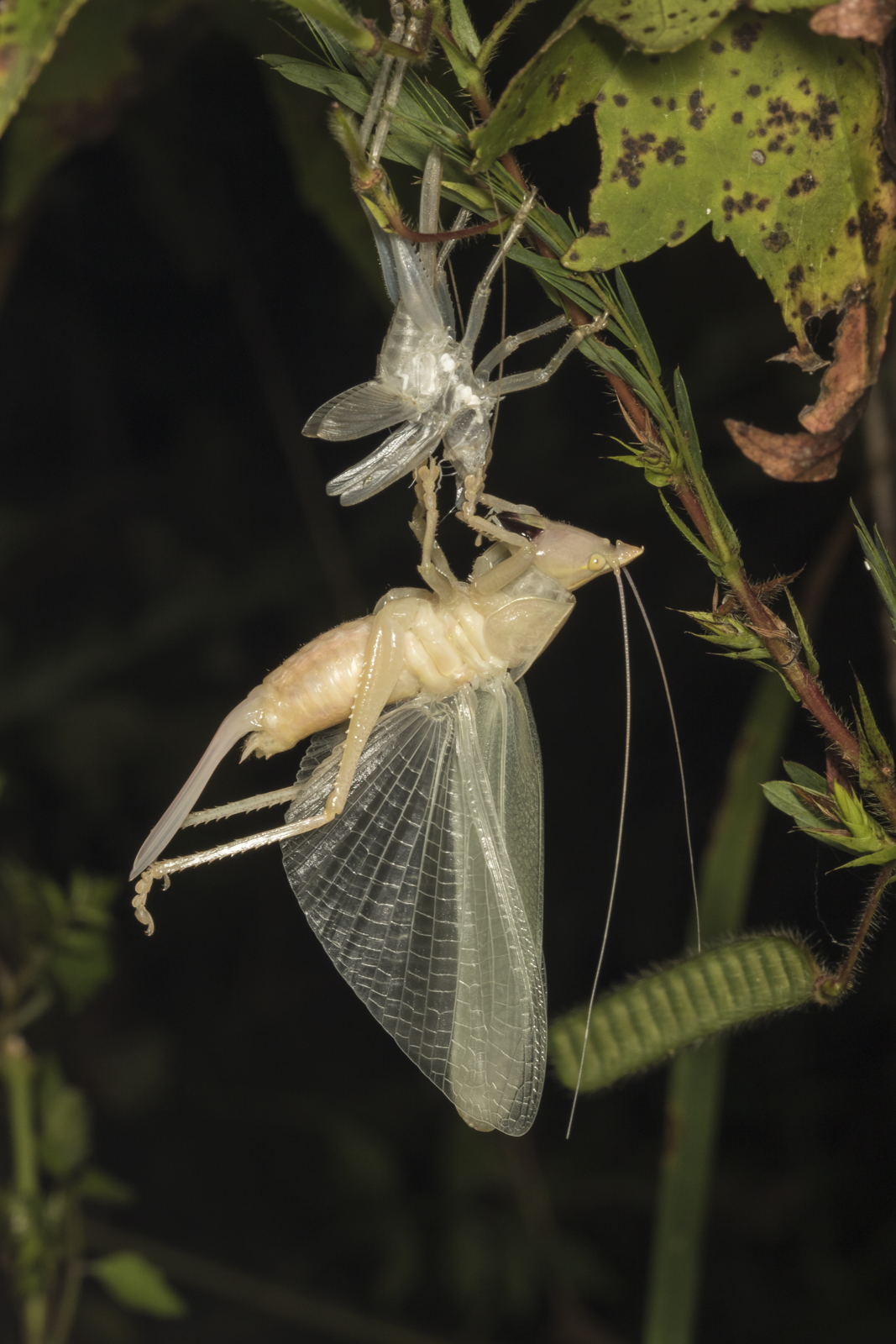
Another view and it looked like some sort of katydid in the process of shedding
I moved to get a better view of the side of the insect and guessed it to be some sort of katydid caught in the act of shedding its exoskeleton. Arthropods must shed their hardened exterior “skin” in order to grow, a process we call molting, or ecdysis. The process is initiated by hormones and involves growing a new cuticle under the old one, then increasing the internal pressure, so that the outer skin splits. The katydid then pulls itself out head first, and hangs underneath until the new skin hardens. These insects undergo what is known as incomplete metamorphosis that progresses from egg to nymph to adult. The young stages resemble the adults, but usually have incomplete wings, and often disproportionate body parts relative to the final stage. Butterflies, in contrast, undergo complete metamorphosis with 4 stages – egg, larva, pupa, adult. Molting is both a necessary and a hazardous process – necessary in order to grow and mature; hazardous in that things can go wrong. Molting takes time, and the insect is very vulnerable during this process due to its inactivity and softened cuticle. This is why many insects tend to molt at night or early in the morning, when there is less chance of being seen by potential predators. I stumbled upon this one shedding at about 8:51 p.m. I took a couple of images and continued on our caterpillar quest. I returned via the same path and stopped to check on the katydids’ progress.
It had pulled all the way out of the old skin by 9:32 p.m.
About 40 minutes had passed, and the katydid was all the way out of its old skin, but still had a ways to go to harden its new exoskeleton and change into its adult color. I did see that is is a female with a long sword-like egg-laying appendage (ovipositor) protruding out its back end. This looks like the final molt based on the ovipositor and the size of the new wings. By the looks of it, I am guessing this whole procedure may take a few hours before the katydid is ready to resume normal activities. I wished her well, and we headed back to the car, a few caterpillars in hand, and a memory of another astonishing phenomenon of the insect world.
One minute poised in midair, apparently motionless before a flower while draining the nectar from its deep cup—though the humming of its wings tells that it is suspended there by no magic—the next instant it has flashed out of sight as if a fairy’s wand had made it suddenly invisible.
~Neltje Blanchan, 1923
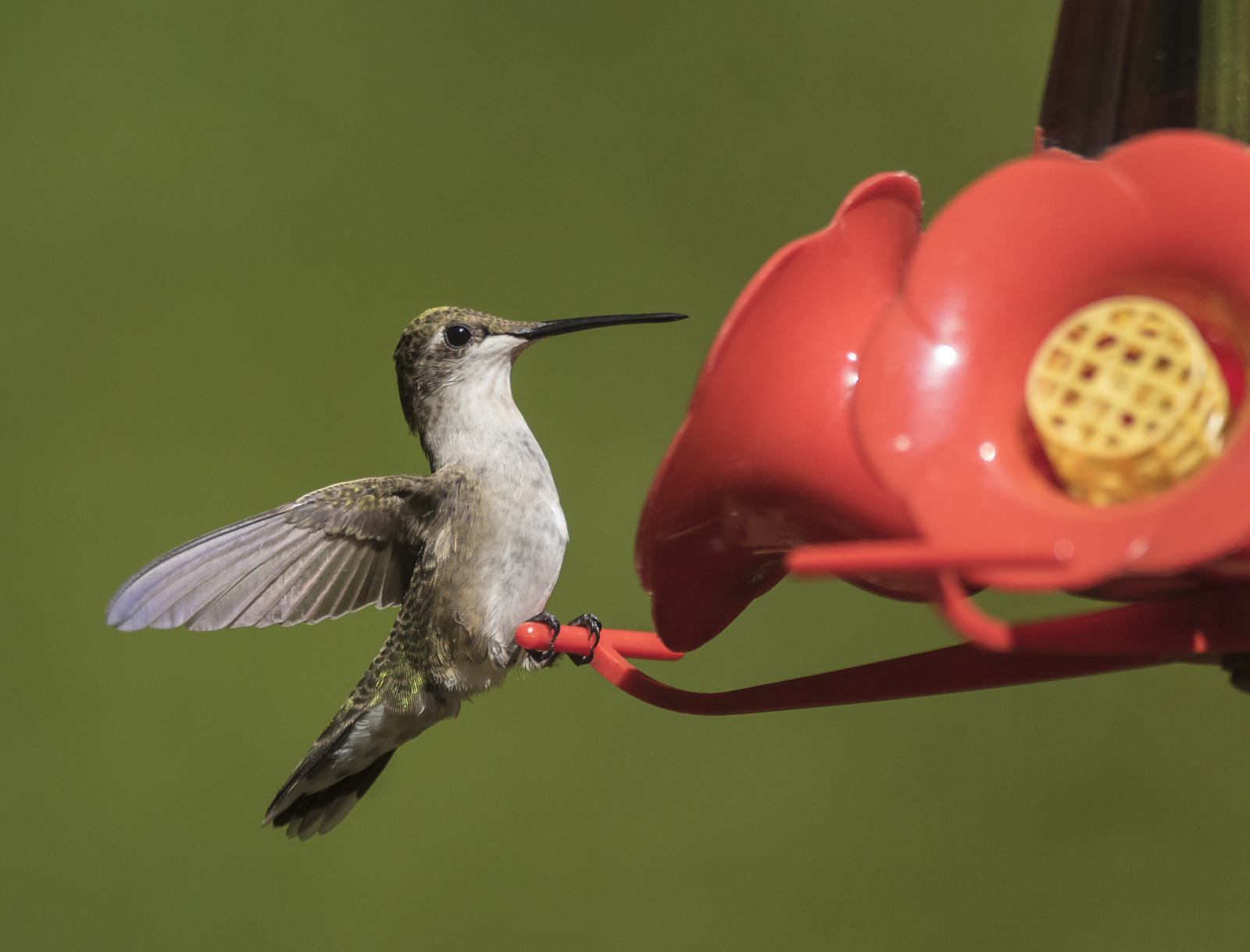
Hummingbird on a feeder (click photos to enlarge)
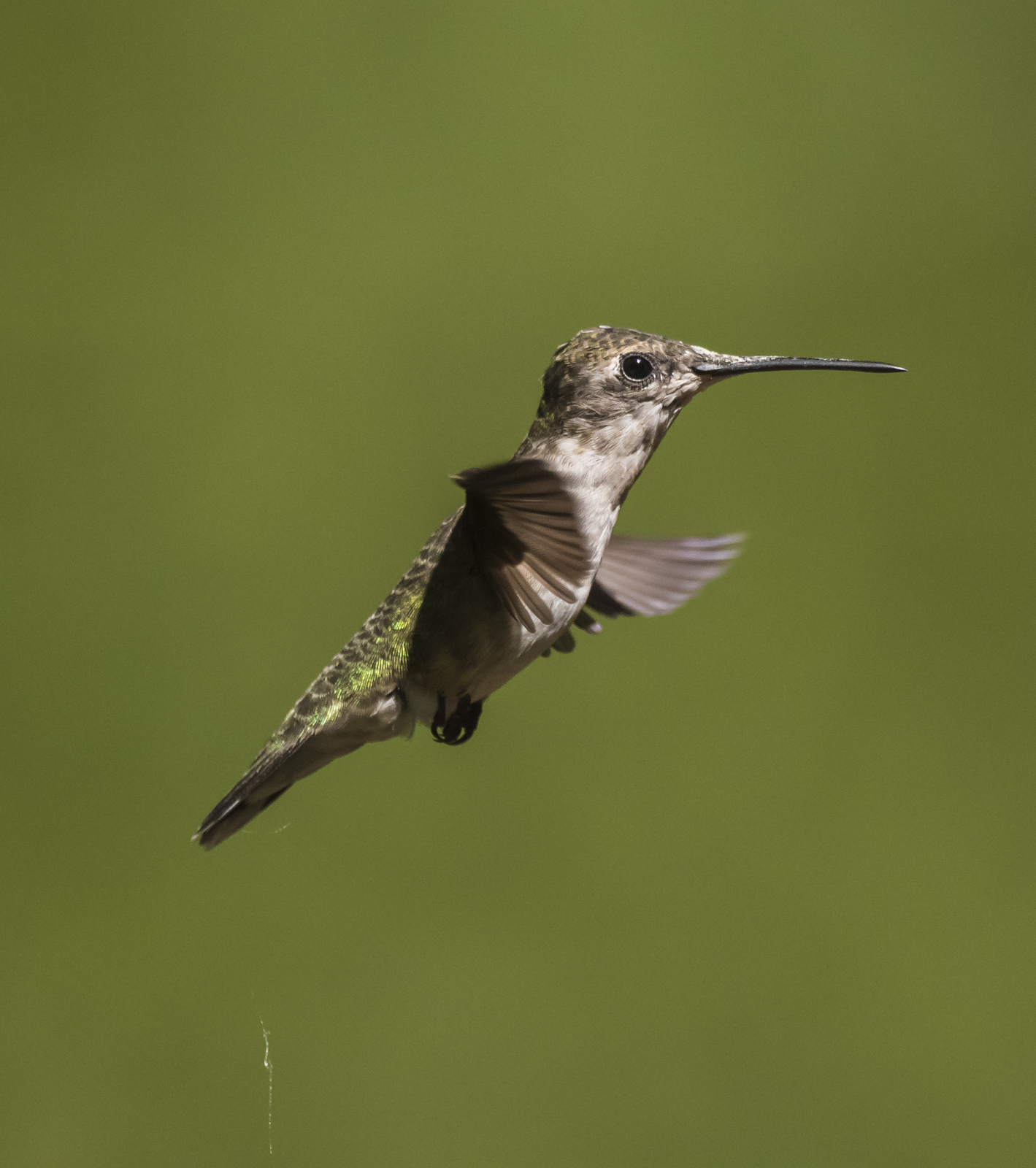
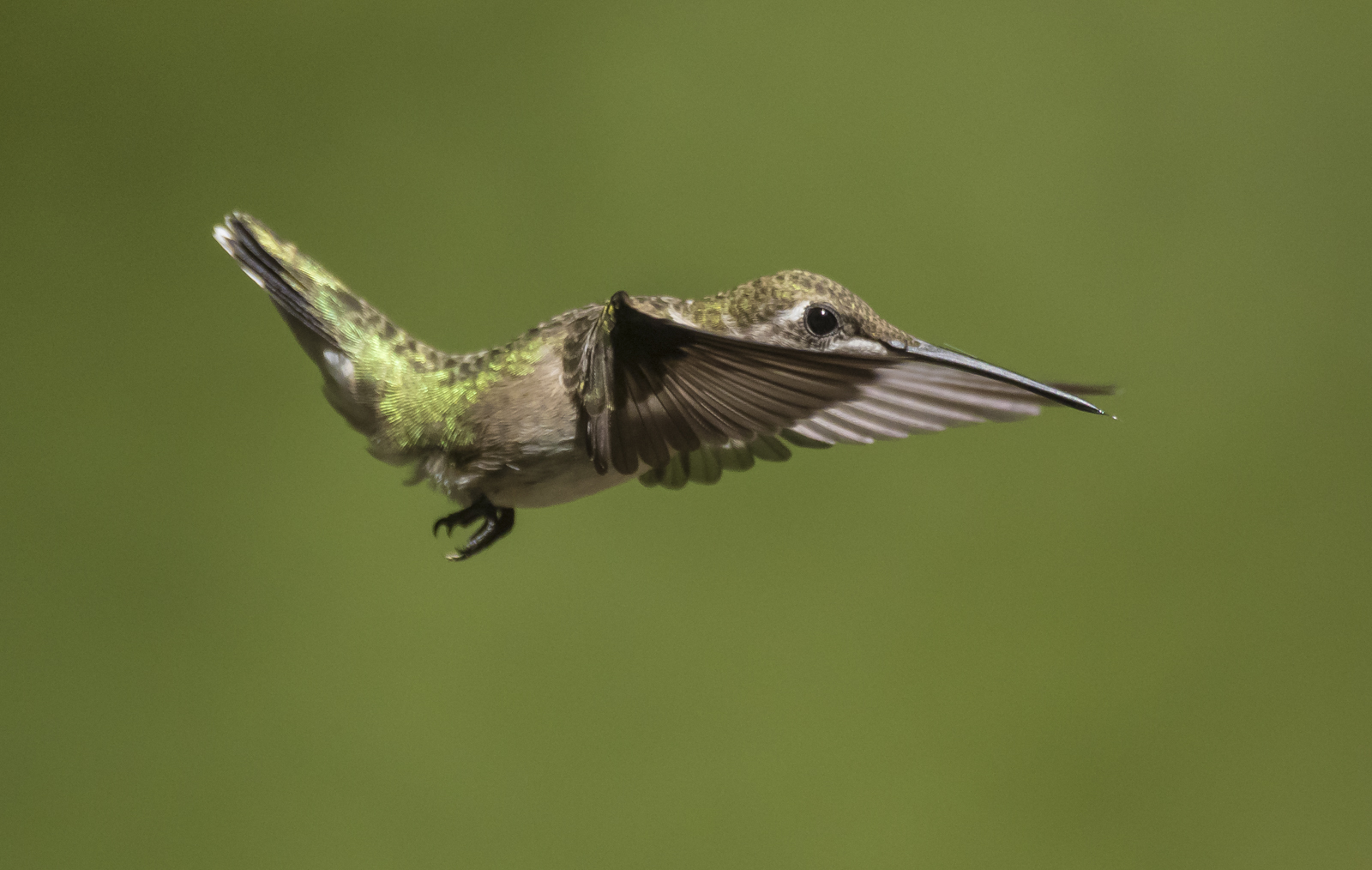
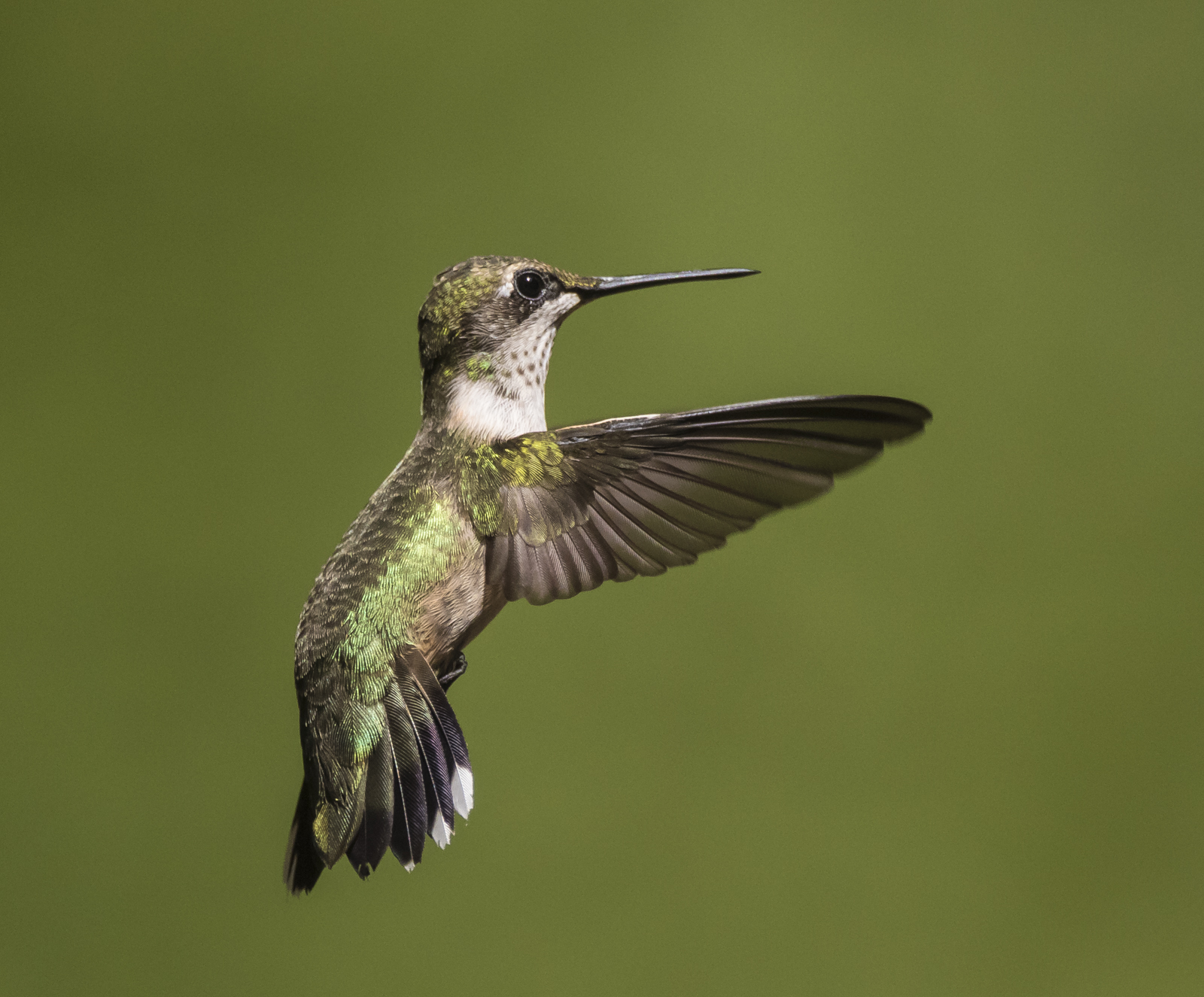
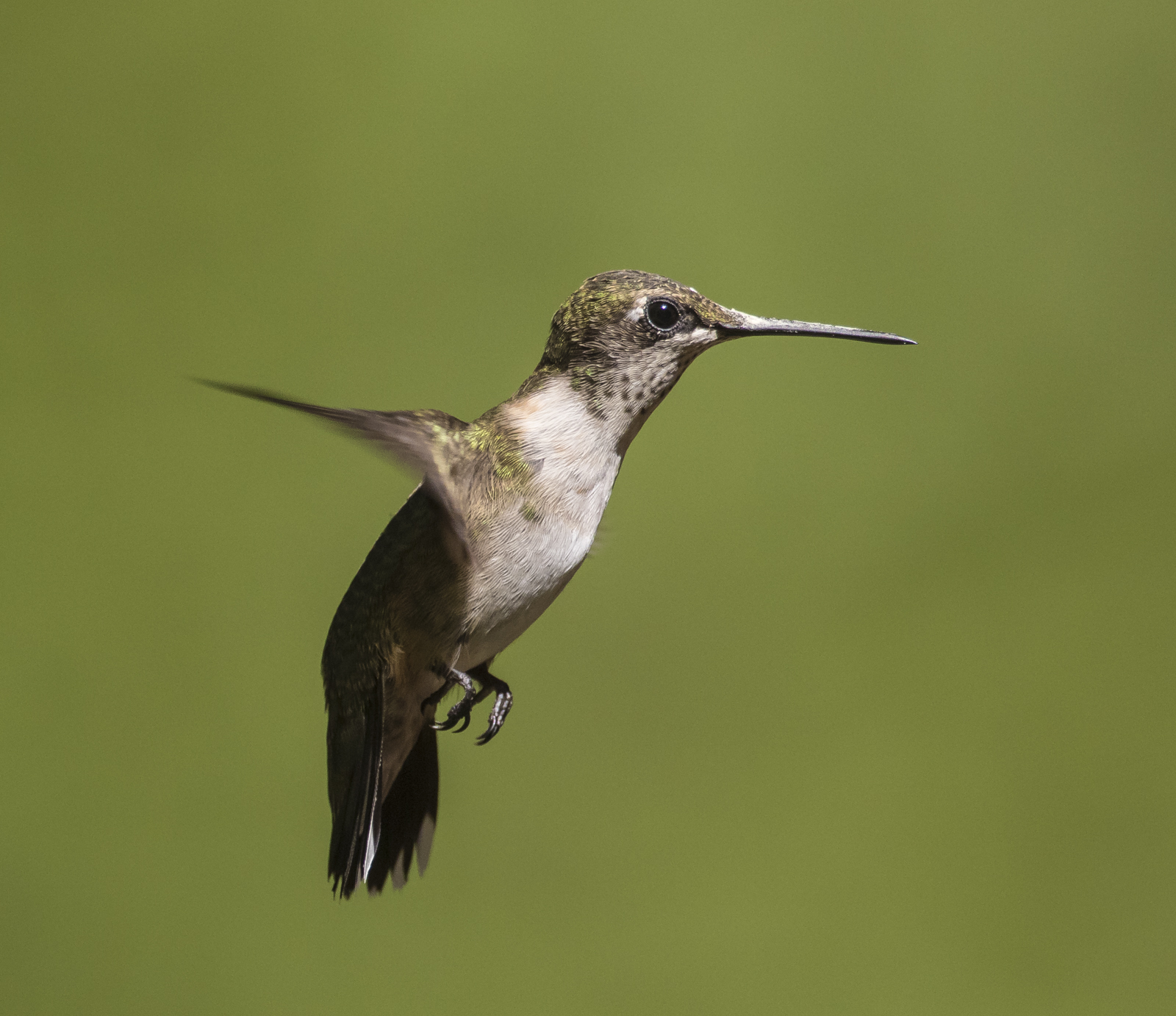
It seems the hummingbirds have been zipping about the yard with added intensity these past couple of weeks. Maybe they are like me and it is the heat that is making them grumpy. Or maybe they know the season is about to change, and that they will soon need to move on, so they had better stock up for the long flight. Whatever the reason, it has been quite a show at the feeders and flowers scattered around the yard. I typically see 4 or 5 of the tiny jet fighters at once, meaning there are probably 4 or 5 times that many around the yard. Our place is so shaded that it is hard to find a good sunny spot to photograph them other than in the morning, when the sun highlights the pathway to one of the feeders on the front porch. The past few days have found me standing out in the yard, watching their comings and goings, and trying to capture a few moments of their hectic lives.
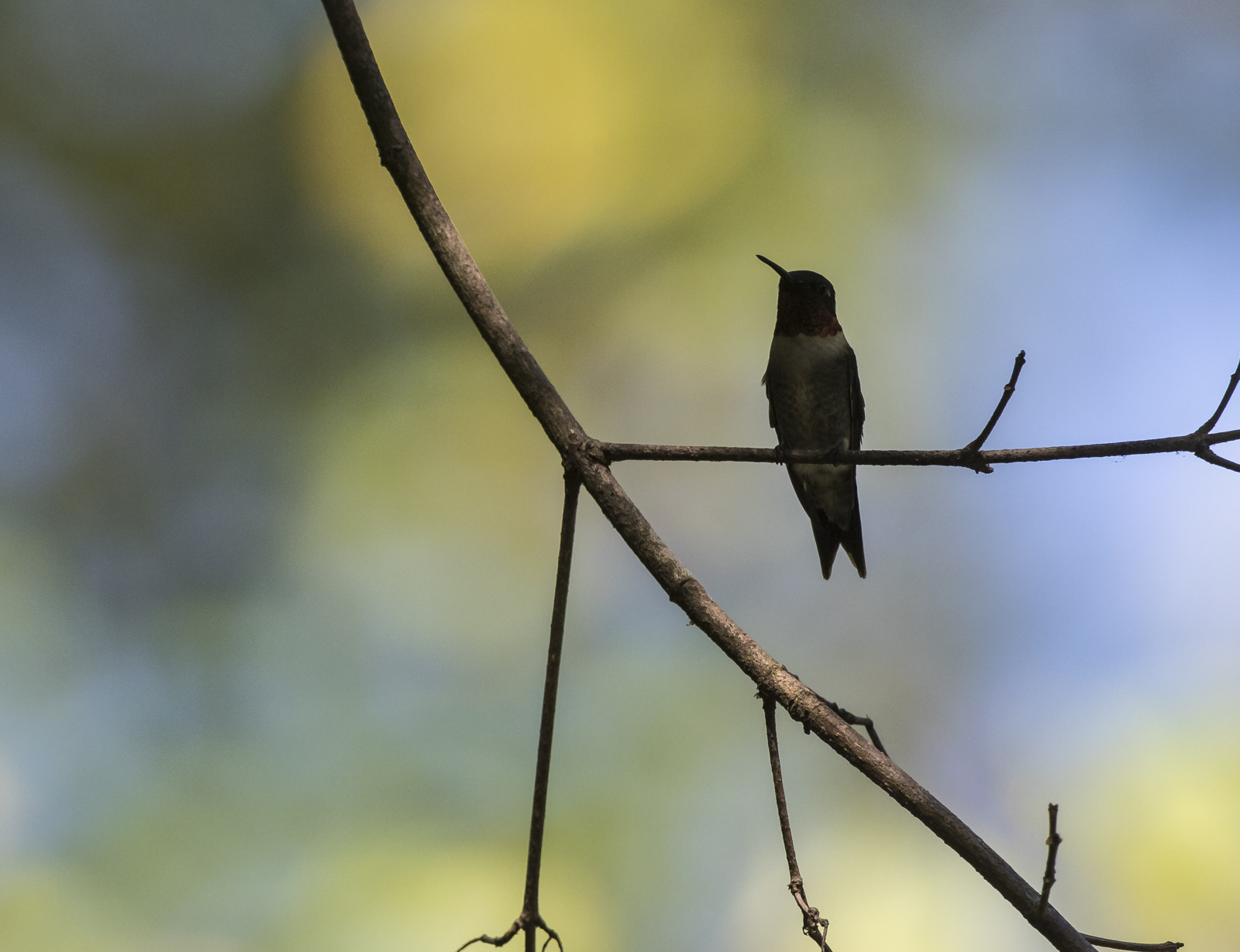
Hummingbird surveying his domain
Hummingbirds tend to perch near their favorite feeders/flowers, guarding them against interlopers that might get some of “their” nectar. One bird likes a particular dead branch hanging out over the front walkway.
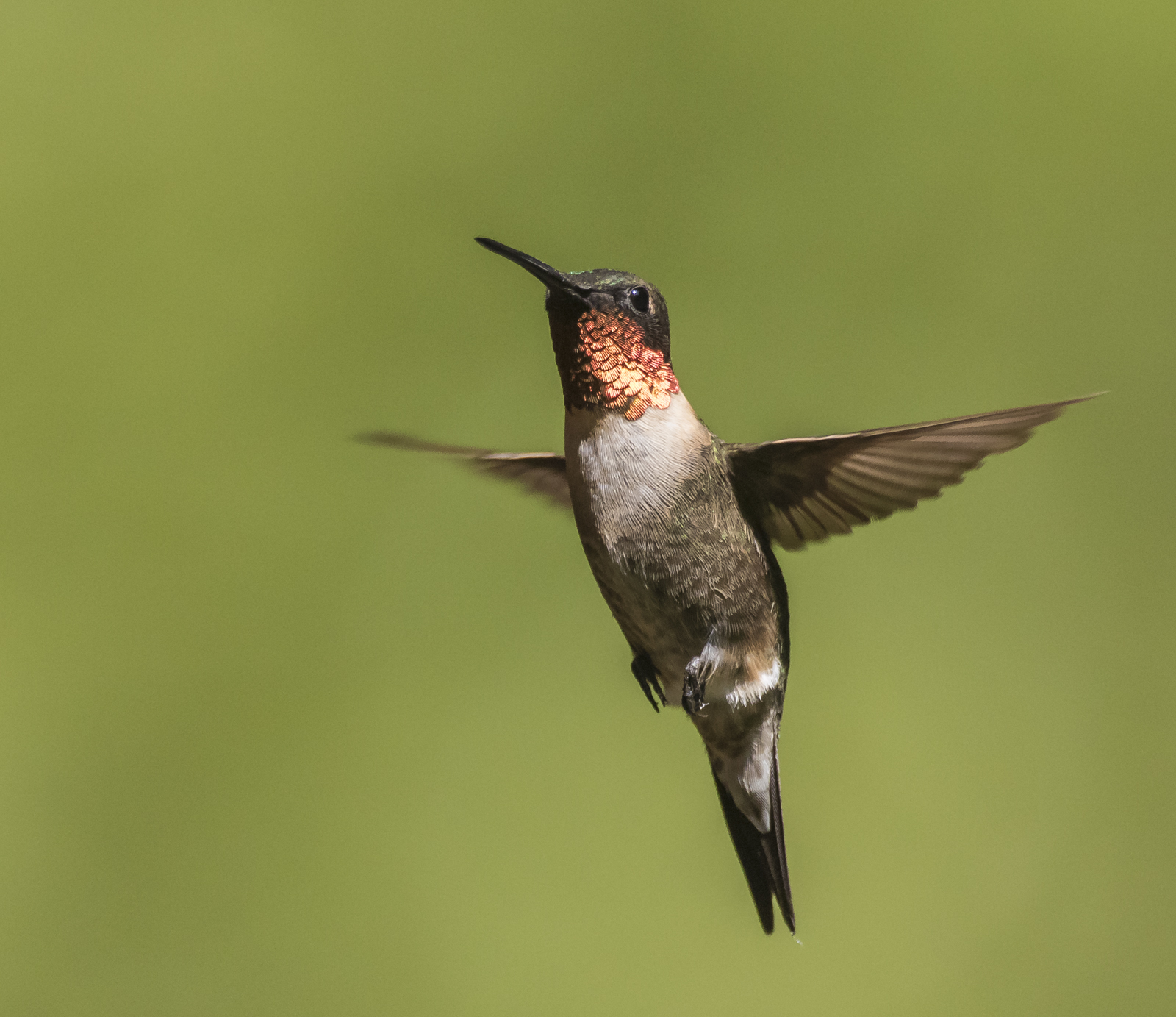
Hummingbird in mid-air (note – it is excreting as it hovers)
While things at the feeder can be frenetic, I spent a lot of time standing and waiting. Studies have shown that hummingbirds feed, on average, 5-8 times per hour, but only for 30 – 60 seconds at each feeding.
This one has kicked it in to overdrive as it approaches a feeder
But when they do move in, they do it with gusto. There is nothing subtle about their flight. They are pure aerial acrobats, and a joy to watch. Here are some incredible facts about hummingbirds from two sources: The Hummingbird Book, by Donald and Lillian Stokes; and Operation RubyThroat: The Hummingbird Project.
A hummingbird hovering
Hummingbirds have the amazing ability to fly forward at speeds up to 50 miles per hour, can hover, fly backward, and even upside down briefly. The number of wing beats is also impressive – 60 times per second in normal flight; up to 200 times per second in courtship flight dives.
Hummingbirds hover better than other birds
Their unusual wing structure allows hummingbirds to hover better than most other species. Unlike other birds, the bones in the wing of a hummingbird are fixed, except at the shoulder joint, which can move in all directions.
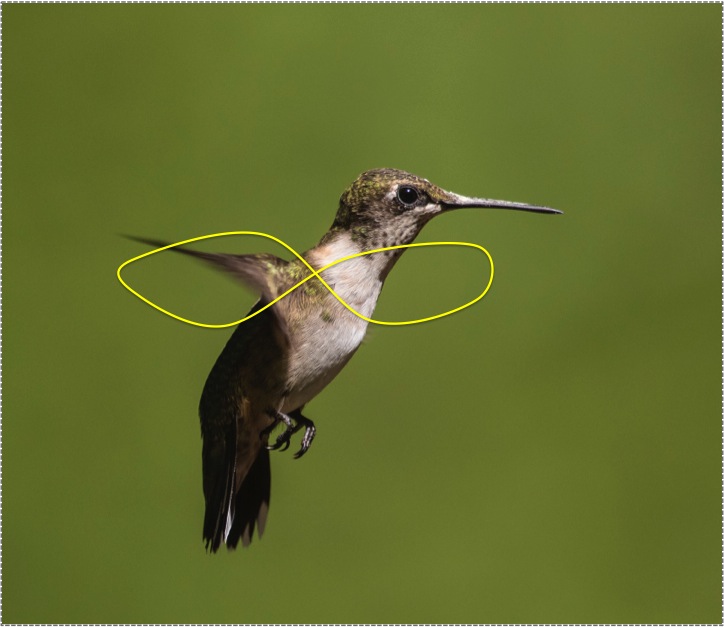
Wing motion of a hovering hummingbird
While hovering, a hummingbird’s wing moves forward and then the leading edge rotates almost 180 degrees, and moves back. As this motion is repeated, the tips of the wings trace a horizontal figure eight in the air.
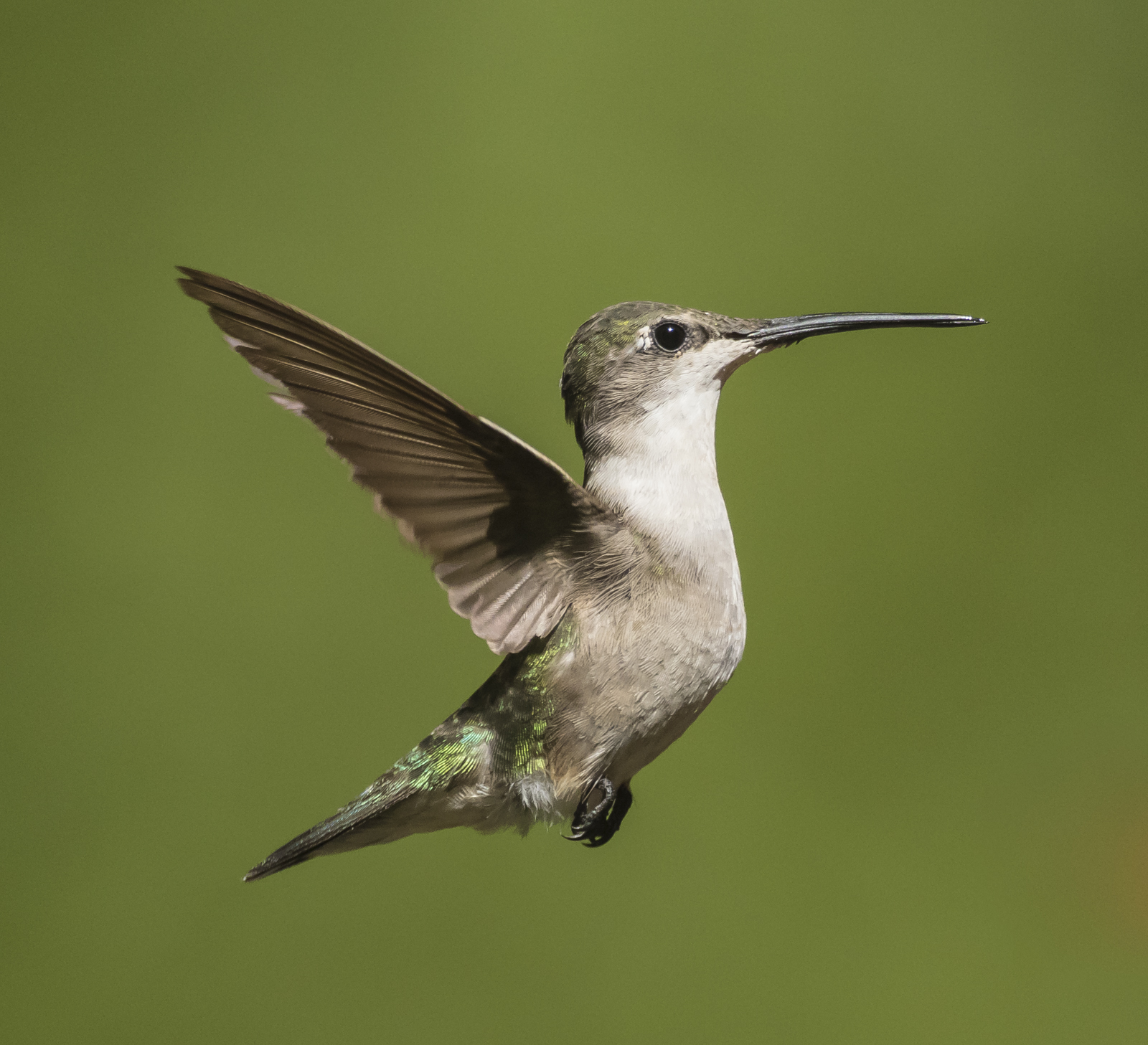
Female ruby-throats generally have white bellies and throats, and are slightly larger than males
Female ruby-throats are often more aggressive at feeders than males, since they are usually slightly larger. The average male weighs about 3 grams, or about the same as a penny. The average female is slightly larger, weighing in at about 3.5 grams. But both sexes can put on considerable weight this time of year in preparation for the migration south (often almost doubling their mass prior to flying south).
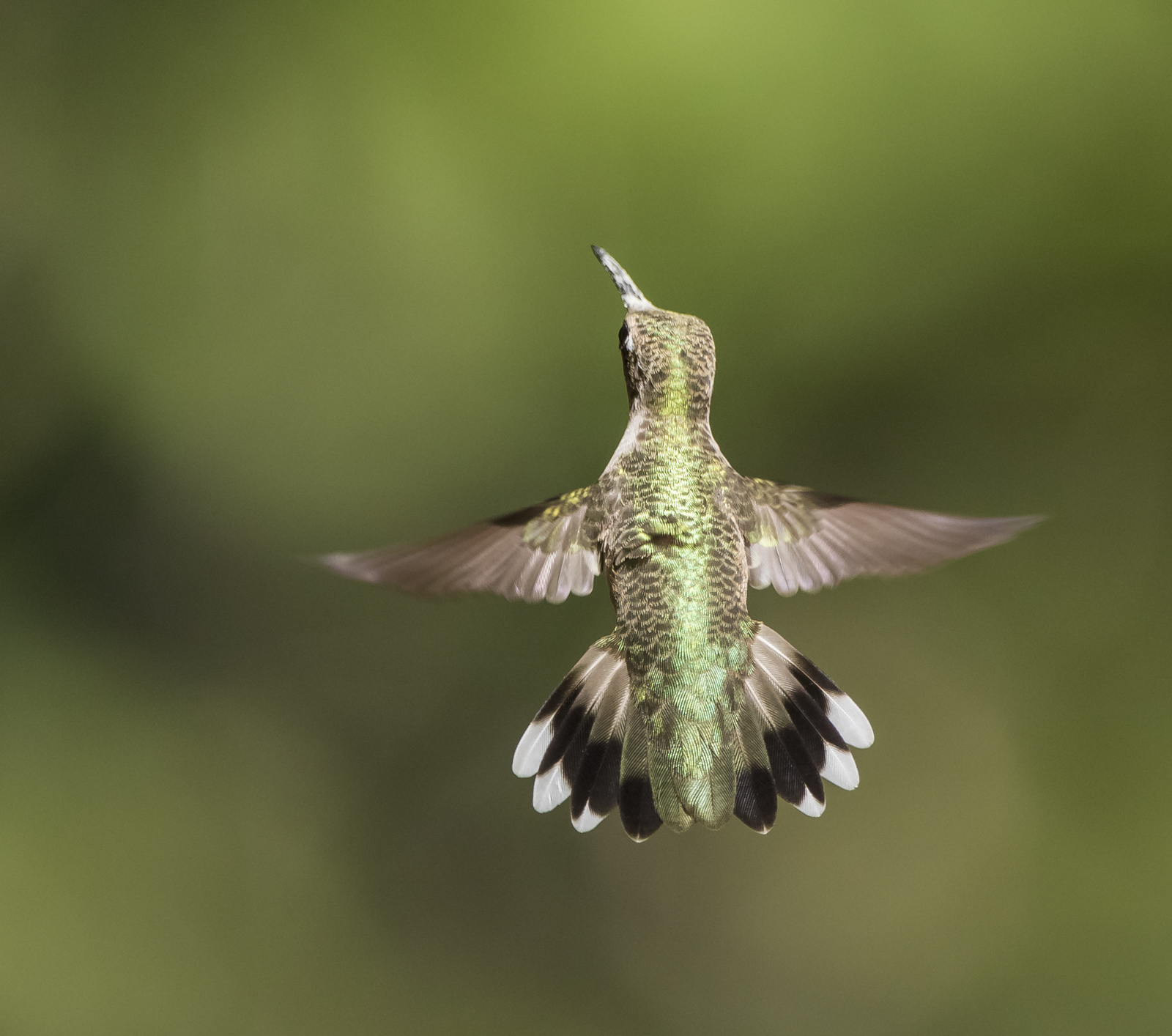
White-tipped, rounded tail feathers, belong to female or immature male ruby-throated hummingbirdsAdult males have pointed, dark-tipped tail feathers
Male ruby-throated hummingbirds are the first to arrive on the breeding grounds in spring, and the first to leave to return to their winter homes in late summer. Many of the adult males have already headed south, so, at first glance, it may look like a bunch of females in your yard. But, a closer look may give you some insights. While the tail feathers of adult males are dark-tipped and pointed, those of young males resemble the female, being rounded and white-tipped.
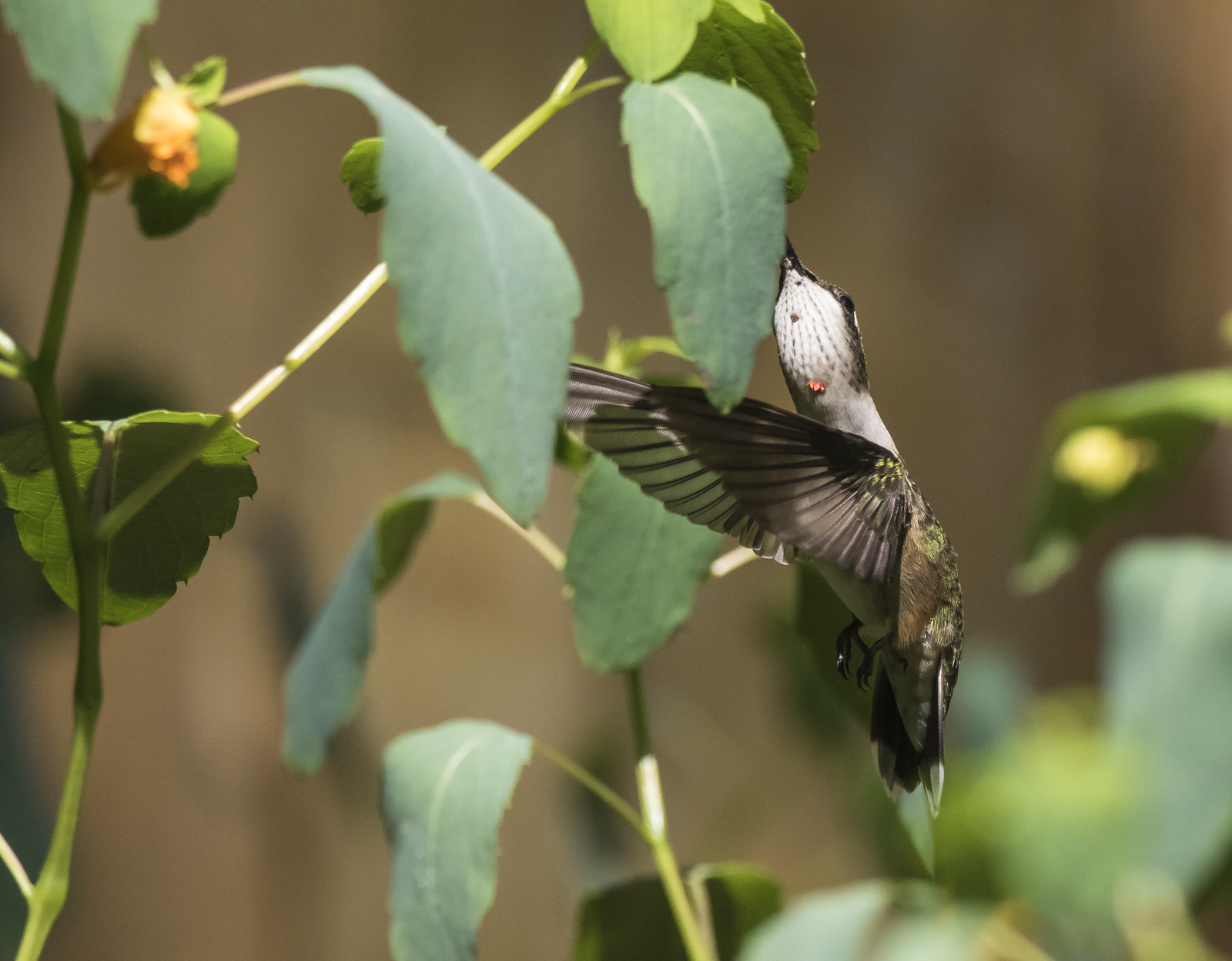
Young males often have streaked throats and just a few feathers showing red color
A better way to distinguish the sexes is to look at their throats. First-year males often have streaked throats (some females can as well), and frequently will have a few red feathers in their throat patch (or gorget) by this time of year.
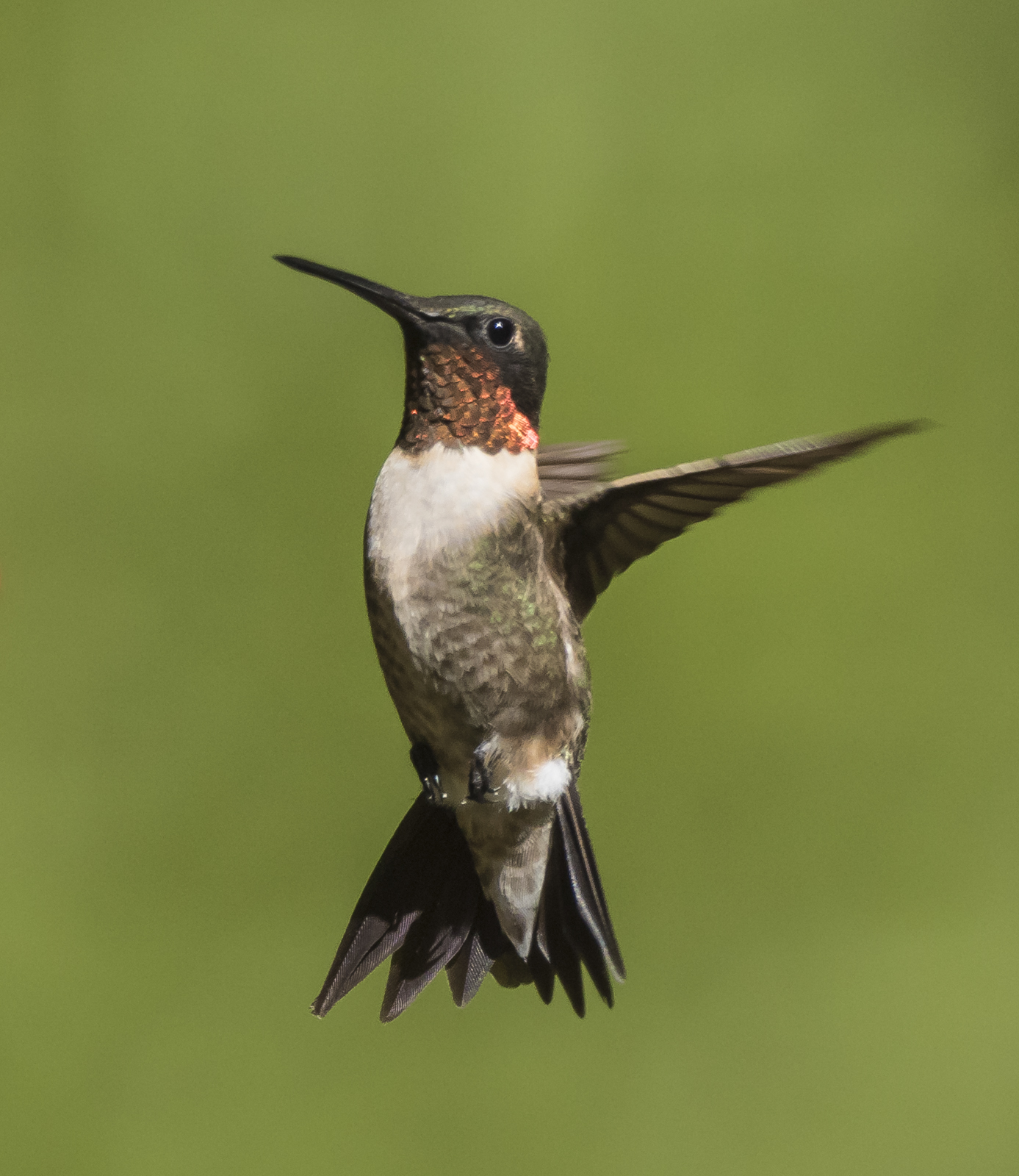
Adult male ruby-throats have a brilliant red gorget, that can vary in intensity according to the light
Adult male ruby-throats have about 200 specialized feathers on their throat patch, which is called the gorget. The outer third of these feathers are iridescent. They have microscopic grooves and air bubbles that scatter and refract incoming light to make the feathers appear red. But, the iridescent part of the gorget feathers are flat, and only reflect light in one direction.
Adult males have dark throats (color varies according to how the light hits the feathers)
You have to be looking at the feathers from the right direction in order to see the flash of iridescent red. From other viewing angles, the feathers appear dark, or even black.
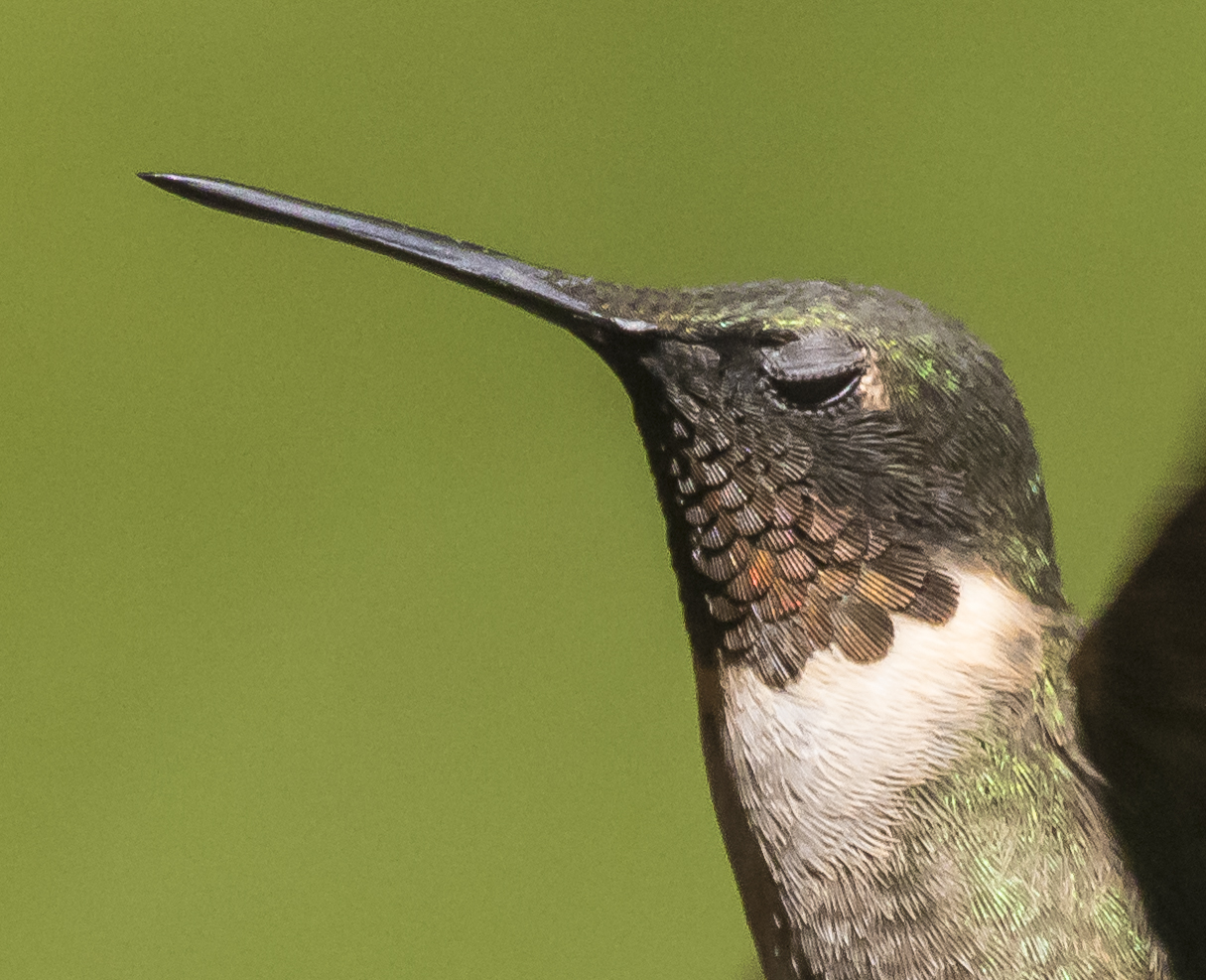
Hummingbirds have “eyelashes”
In looking at my images, I found several where the hummingbird was blinking. It almost looked like they had eyelashes. Well, in a way, they do. They have short bristle-like feathers along the edge of their eyelids. They probably function similar to our own by helping keep objects out of the bird’s eyes.
Hummingbirds in my yard feed from a variety of wildflowers, in addition to the sugar water feeders
Ruby-throated hummingbirds are believed to ingest at least half their weight in sugars each day. If you watch them closely, you can see they also feed on small insects and spiders, often snatching tiny flying insects out of the air.
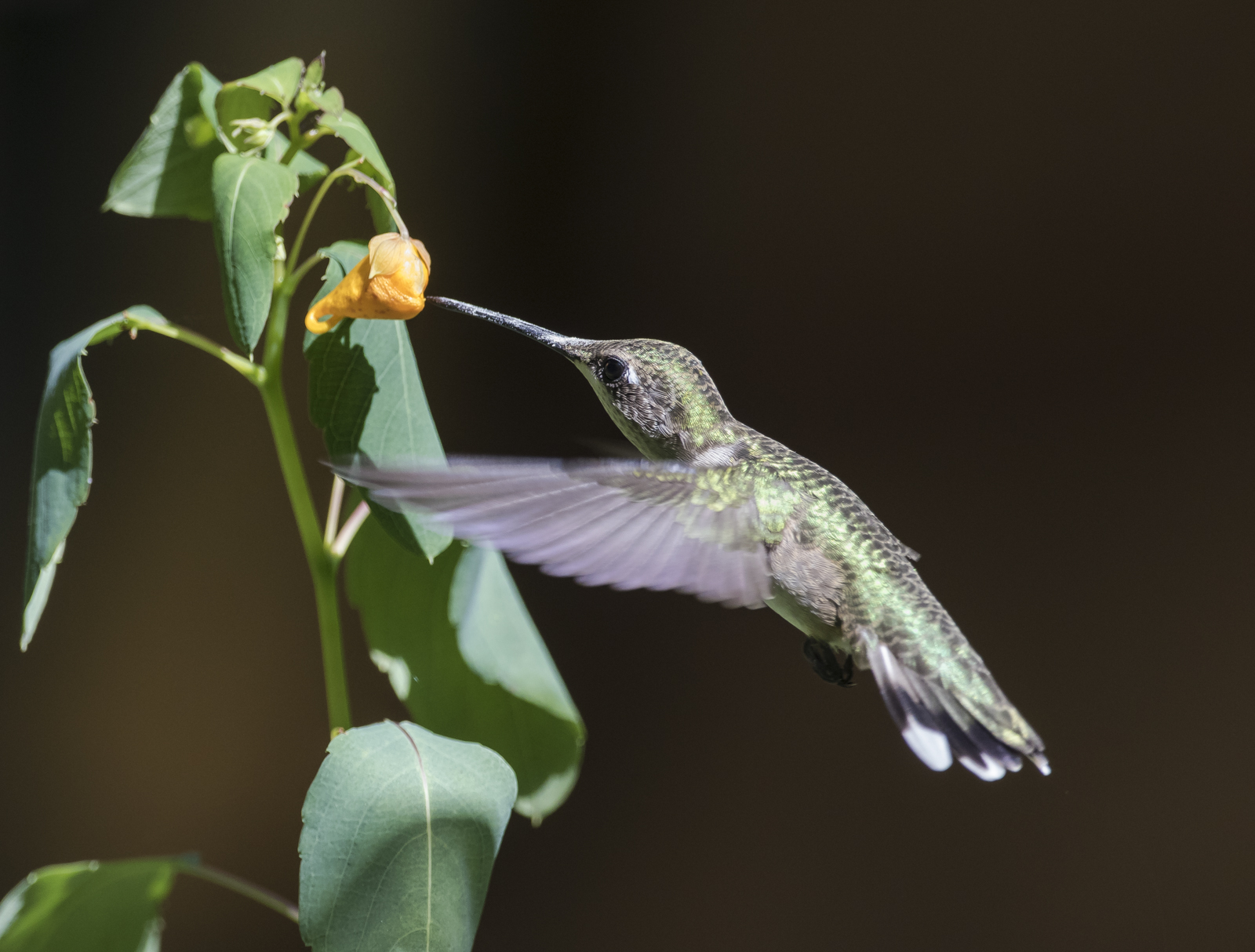
Young male hummingbird hovering and feeding below a jewelweed flower
Dining on the wing as they do, hummingbirds have significant flight muscles, which account for about 25% of their body weight. Compare that to the analogous pectoral muscles of a human which make up a mere 5% of most humans.
Even at rest, they are humming along at a fast pace
A hummingbird is fast-paced even at rest – their heart rate is about 1250 beats per minutes and they breathe about 250 times per minute while perched. And what about that tongue! They can extend it a distance about equal to the length of their bill. And when lapping up nectar or sugar water at your feeder, their tongue flicks in and out about 13 times per second. They are truly remarkable birds, the flying jewels of our gardens. Enjoy them while they are still here, humming along at the flowers and feeders wherever you live.
~Quote attributed to a student in an introductory entomology course
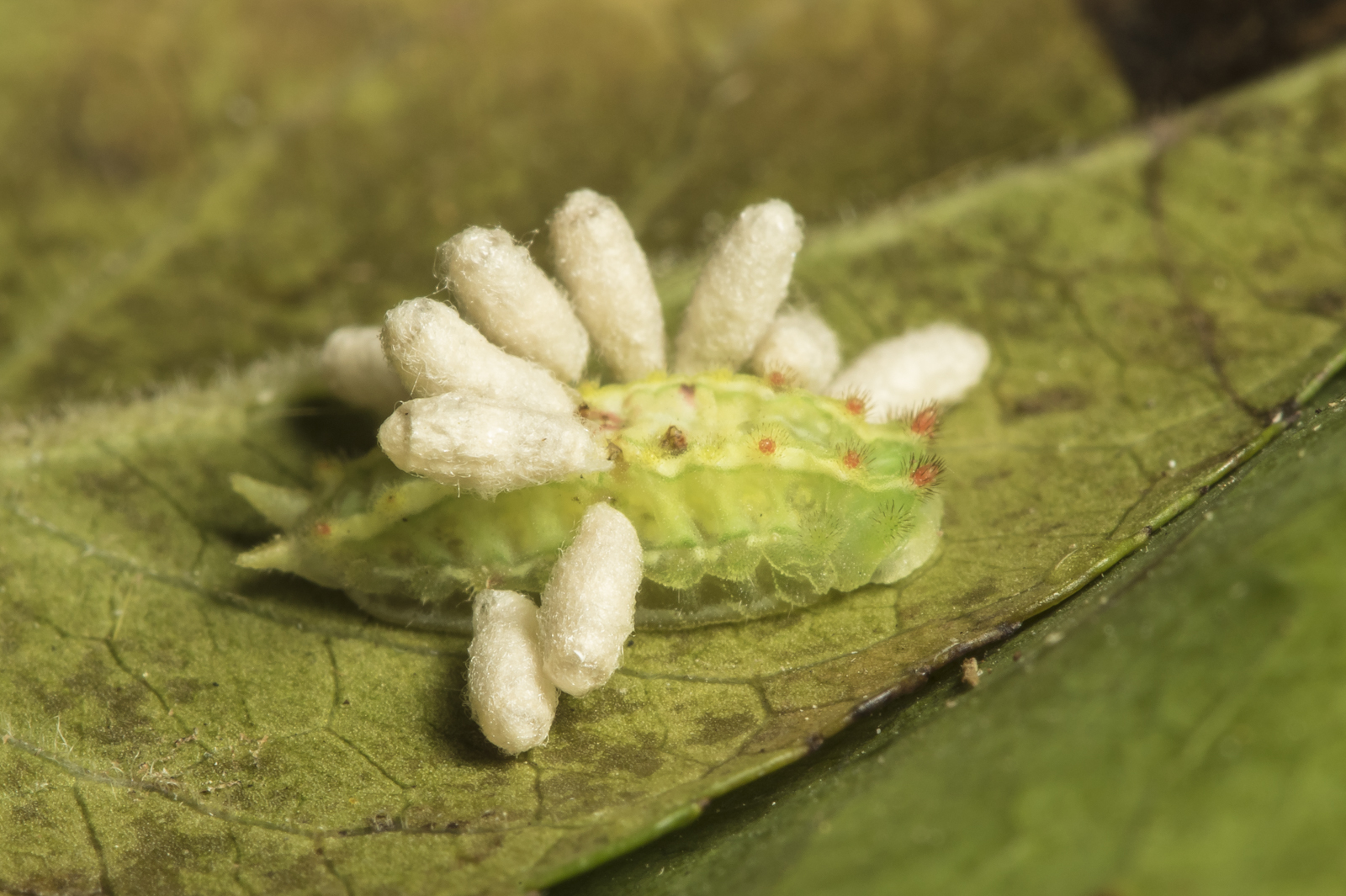
We discovered a small caterpillar last week that was adorned with some unusual accessories, and that usually isn’t a good thing if you are a caterpillar. I think it was either a variable oakleaf, or a double-lined prominent caterpillar. Both are common species that feed on a wide variety of trees and shrubs.
Caterpillar adorned with green accessories (click photos to enlarge)
I have seen these bright green baubles attached to a few other caterpillars over the years, and it never ends up well.
Not the type of fashion accessory you want if you are a caterpillar
They really are beautiful in shape and color when you take a closer look. The first time I saw a caterpillar with these green blobs on its side was a few years ago. I thought they might be some sort of strange cocoon of a parasitic wasp. I was close…they are actually the larvae of a tiny parasitoid wasp in the family Eulophidae.
Eulophid wasp pupae next to the dead host caterpillar
After watching the caterpillar for a few days, I came back to find a strange array of tiny black blobs near the shriveled caterpillar carcass.
The small piles of yellow “stones” near the pupae are actually waste products
When I looked at my macro images, the small black blobs looked like some sort of macabre lawn recliner, with a tiny pile of rocks at the base. The black blobs turned out to be wasp pupae lying on their backs, and the piles of rocks are the waste products excreted by the wasp larvae prior to pupating. These are parasitoid wasps in the genus Eulophis. They feed inside their caterpillar host, mature, and then pupate in a group near the carcass of their victim. The excellent reference by Eiseman and Charney, Tracks and Signs of Insects and Other Invertebrates, refers to these bizarre creatures as “tombstone pupae”. I find a lot of these clusters of Eulophis pupae on the undersides of sycamore leaves this time of year.
Another strange way to go
A few days ago I found another caterpillar that had met what seemed like an unusual death.
At first, I thought a fungus had attacked this caterpillar
The fuzzy texture initially caused me to think some sort of fungus had killed it.
And what are these tiny black pellets?
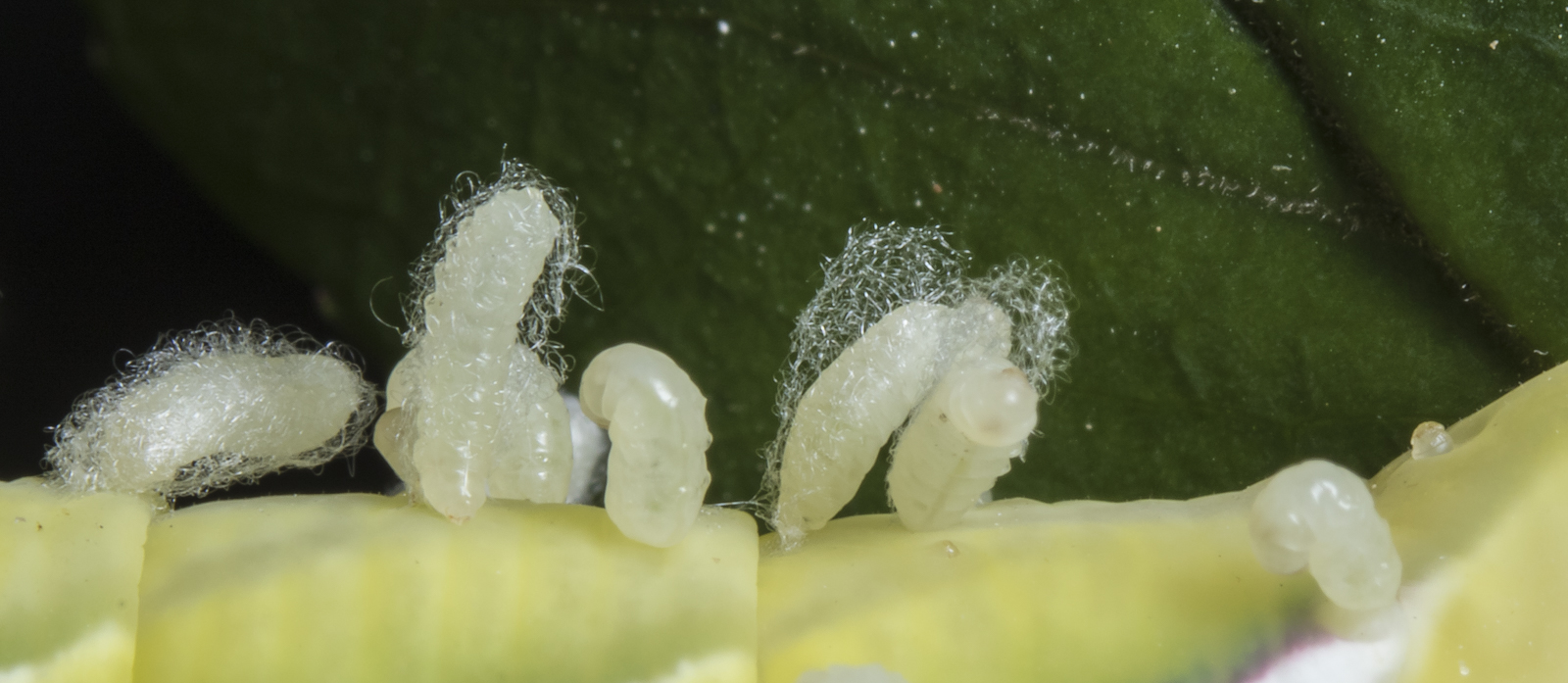
But when I knelt down and took a closer look, I could see what looked like pupae inside the fuzz, as well as some tiny black pellets or balls stuck to the threads. What the heck is this? Going back to my reference book (mentioned above) for all things strange in the invertebrate world, I found a plausible answer. This caterpillar had been killed by another type of parasitoid wasp in that same family, but most likely in a different genus, Euplectrus. These larvae tend to form a cluster on the dorsal surface of the living caterpillar. When they finish feeding, they move to the underside of their deflated host, and arrange themselves in a row, and prepare to pupate. They create a gauzy, web-like cocoon, which attaches the caterpillar remains to the plant and provides a protective covering. The black pellets are the meconium, or waste products, cast out by the prepupa. It looks as though there wasn’t quite enough room under the carcass for all the wasp larvae to pupate, so some had to be elsewhere in the fuzzy covering.
How bizarre…and it is all happening just outside my door!
Red-spotted purple butterfly (click photos to enlarge)
Well, that is certainly the case for at least one species of butterfly here in the woods… the red-spotted purple, Limenitis arthemisastyanax. This common species is probably not considered beautiful by most observers during its pre-butterfly stages.
Early instar of red-spotted purple caterpillar
It is a bird poop mimic throughout its early life, especially from the third instar larva all the way through the chrysalis stage.
The larval stages are bird poop mimics with light splotches on a dark background
Last instar red-spotted purple caterpillar
I found a late instar caterpillar on a wild cherry recently and decided to watch it in hopes of finding the chrysalis when it crawled away.
Pre-pupa of red-spotted purple (note silk pad attachment point at rear of body – top in this photo)
The next day the larva was gone. They often crawl off the plant where they have been feeding and look for a vertical surface to climb. They make a silk pad, attach themselves and hang from it, forming a pre-pupa that lasts about 24 hours. Then, the last molt of the caterpillar skin occurs, revealing the chrysalis. Luckily, I discovered the pre-pupa attached to the basement door frame. The caterpillar had crawled a distance of about 25 feet. The next morning I hoped to see the chrysalis.
Dead pre-pupa the next morning
But, what I found instead was a dead, blackened pre-pupa. I have seen this shriveled black appearance in other caterpillars when they have been parasitized by various things from tachinid flies to a virus. I watched it the next couple of days and never saw any sign of something emerging, so I am guessing this is a viral infection of some sort that killed this particular larva. I was disappointed, but, to my surprise, I discovered a chrysalis a few days later while pulling weeds in the front yard.
Red-spotted purple chrysalis (still a bird poop mimic)
The red-spotted purple chrysalis looks like damp bird poop hanging from a twig. One odd feature is the small round disc that sticks off the side of the chrysalis at about the mid-point. I have never been able to figure out what this is in relation to the butterfly that emerges. I decided to try to keep tabs on this pupa over the next few days to see if I could get lucky and photograph the newly emerged butterfly.
Freshly emerged red-spotted purple butterfly
Sometimes you just get lucky, and the next morning when I checked, there was a freshly emerged butterfly clinging to the shell of its chrysalis. They usually hang on for an hour or so while they pump fluid into their wings (via the veins), and allow the wings to become firm for flight. This one’s wings were fully formed, so I found it just in time to get a few images.
A closer look at the head of the butterfly shows a coiled proboscis
I moved around taking photos. The butterfly occasionally moved in response, flapping its wings in preparation for its initial take-off. The colors on fresh butterflies are so vibrant!
The colors don’t quite match the butterfly’s name
But, admiring this fresh beauty reminded me that the colors don’t really match the rather odd name of this common species – the red-spotted purple. I wonder why it isn’t called the orange-spotted blue butterfly instead. And, come to think of it, while I am renaming things, perhaps I should change the title of this post to From Poop to Pretty. Both changes are perhaps a bit more descriptive of the unusual life history of this fascinating insect.
Nature taking its course – hunter and prey, the endless circle of life and death.
~Stephanie Meyer
Melissa found some cool caterpillars on a Viburnum this weekend while we were walking in a city park in Richmond.
Hummingbird clearwing caterpillar on Viburnum sp. (click photos to enlarge)
I walked over to take a look and saw a beautiful hummingbird clearwing larva, Hemaris thysbe, in the classic defensive pose of most sphinx moth caterpillars – front of body reared up, head tucked in, body aligned along the twig or mid-vein of a leaf. Suddenly, a huge European hornet, Vespa crabro, appeared and went straight for another caterpillar on the shrub, another hummingbird clearwing.
European hornet attacking a caterpillar
I managed two quick pictures, and the hornet flew off, carrying its prize back to its nest, where the defeated caterpillar was sure to be chewed up and fed to some hungry wasp larvae. We just stood there, amazed at what we had witnessed. When I looked at the image the next day, I noticed there was another, smaller caterpillar on the same leaf (look just to the left of the clearwing’s “horn” and you can see another small, green caterpillar).
European hornets first appeared in the United States in the mid-1800’s and have since spread throughout most of the East. They look like a very large (up to 1.5 inches) yellow jacket, but are more brownish yellow in overall appearance. We didn’t have time to stick around, but I would not be surprised if that same hornet didn’t come back and search that shrub again, perhaps finding one or more other victims to carry back to the nest. Amazing how a scene in nature can change in an instant.
The most beautiful gift of Nature is that it gives one pleasure to look around and try to comprehend what we see.
~Albert Einstein
There is a wild cherry (Prunus serotina) sapling just outside our screen porch that is a favorite spot for all sorts of natural events. Wild cherry is a great host plant for a variety of moths and butterflies so I let this young tree grow in a spot too close to the house to ever reach any height just so I can keep track of the comings and goings of its tenants. It has been a busy place these past few days.
Red-spotted purple early instar larva (click on photos to enlarge)
Throughout the year, I can always count on seeing some sign of one of the primary occupants of this species of tree, the red-spotted purple butterfly, Limenitis arthemis. They lay their eggs at the tip of cherry leaves, and the larvae feed on the leaves through their entire caterpillar and chrysalis stage, appearing as bird poop mimics. And they even overwinter on the plant, with the third instar larvae of the fall generation making tiny sleeping bags, or hibernacula, by cutting away much of a leaf and rolling the base into a hollow tube where they spend the winter. Next spring, when the cherry leaves first sprout, the tiny larvae will emerge form their tube, begin feeding on the fresh leaves, and begin the whole cycle again. In the photo above, the larvae has already attached the leaf to the twig with silk (so the leaf fragment remains on the tree all winter) and is just beginning to curl the base of the leaf with even more silk (silk strands shrink as they dry, pulling the leaf together).
One day later, a hibernaculum!
By the next day, the larvae had finished constructing its hibernaculum and was resting inside. I’m a bit surprised it has constructed this so soon as there is still plenty of time for it to grow, pupate, and start another generation before cold weather. But, there are not many leaves left on this tree at this point, so maybe caterpillars can take a cue from food availability and go ahead and go into a resting phase for the winter.
Last instar red-spotted purple caterpillar on a different sapling
On a nearby cherry sapling, I found a much larger red-spotted purple larva which will soon, no doubt, form a chrysalis.
White-marked tussock moth larva, early instar
Back at the original tree, there were a couple of other caterpillars to observe. One of my favorite finds this time of year is the white-marked tussock moth caterpillar, Orgyia leucostigma . They remind me of a combination caterpillar and toothbrush, due to the four prominent tufts protruding near the head, plus the two black-colored tufts of setae out front that resemble some fancy flossing tool.
White-marked tussock moth larva and shed skin
Nearby was another one that had just molted. This species is a generalist feeder, so I find it on a variety of plant species around the yard.
An early instar unicorn caterpillar
Nearby was another of my favorites, an early instar of the unicorn caterpillar, Schizura unicornis. These guys do an amazing job of blending in with the edges of the leaves of whatever they are feeding on. As I looked around, I found a few more…and that will be some fodder for my next post.
I seemed to have reached a new world, so wild a place…far away from human society.
~Henry David Thoreau, on swamps
Sunset from the town dock in Columbia, NC (click photos to enlarge)
Columbia, North Carolina, that is. We spent several days in this beautiful little town last week, part vacation, part getting out to see some of the region for the trails project I am working on with NCLOW. It didn’t help that it was one of the hottest weeks of the summer, but it did help that we spent much of it on the water. And this region has lots of water, from Lake Phelps, the second largest natural lake in North Carolina, to the Scuppernong River, to the numerous creeks and sloughs that beckon paddlers to explore. So, we decided to take our kayaks, throw them in where we could, and see what we could see in a few days on the water. First stop, was the NW Alligator River.
NW Alligator meanders up into Pocosin Lakes National Wildlife Refuge from Hwy 94
I had scouted out some potential put-in points (they are few, unfortunately) so we decided to put in at what looks like an old boat ramp near where Hwy 94 crosses this section of river, about 14 miles south of Columbia. The access is now flooded, but there is a substantial old dock at the site, indicating its past use, perhaps in logging or fishery operations.
We launched on the east side of Hwy 94 at an old boat ramp area
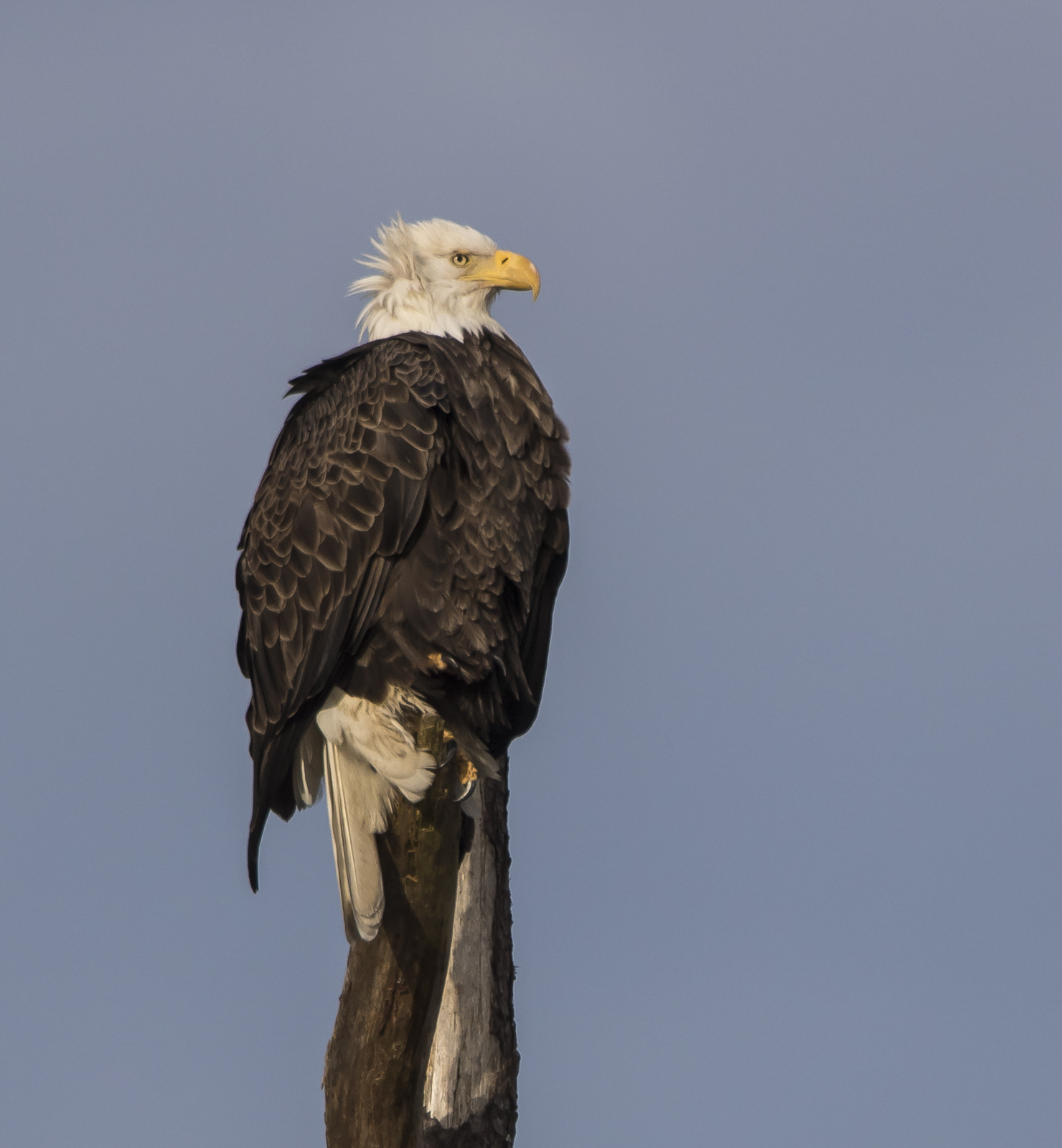
The lands surrounding this waterway have scattered trees, low pocosin vegetation, and a border of marsh grasses, including pockets of wild rice. Shortly after we passed under the Hwy 94 bridge, we spotted a bald eagle, who managed to stay with us much of the morning. The other wildlife highlight were several red-headed woodpeckers, flying between the many standing dead trees along the route.
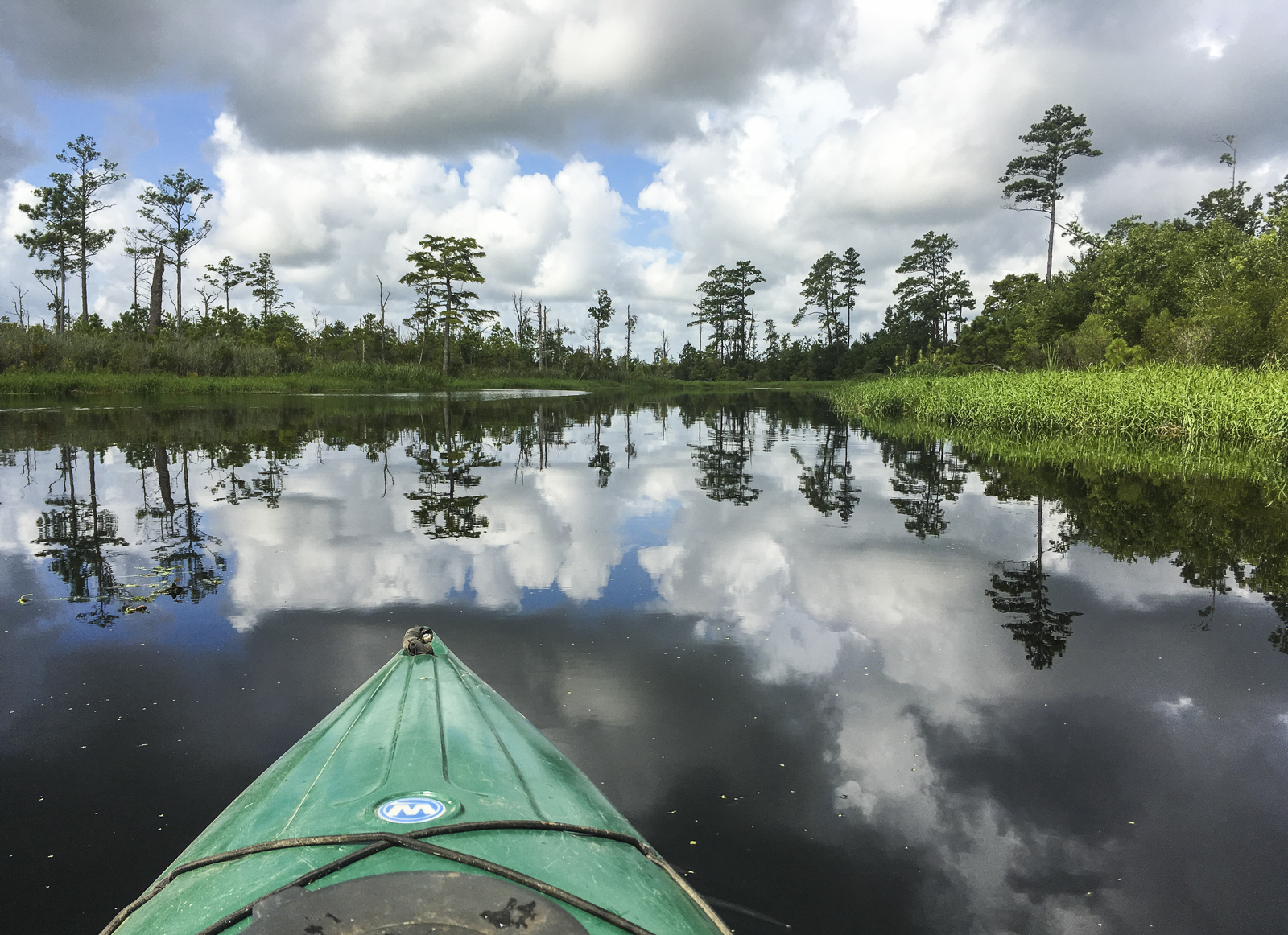
A perfect day for paddlingDragonflies were our constant companionsCalm winds made for great reflections
An abundance of clouds made for beautiful reflections and a respite from the heat. After paddling about 1.5 miles, we came to the juncture of the SW and NW branches of the Alligator, and headed north. The path narrows after this, and we found ourselves going through patches of alligator weed and a grass of some sort, most likely maiden cane. Patches of the alligator weed looked as though they had been treated (this is an invasive species that can clog small waterways and is often treated chemically by local agencies).
Large patches of maiden cane finally blocked our path
After paddling another couple of miles, we finally reached a patch of the maiden cane that seemed too large to easily push through, so we turned around and headed back. Our total paddle was about 5 to 6 miles. The only sounds, other than fish jumping, dragonflies buzzing, and woodpeckers drumming, was the distant hum of some crop dusters spraying some of the huge farm fields down the road. I want to go back in colder weather , once some of the vegetation dies back, and see if I can make it all the way up to the refuge road system.
Friends recommended we try Riders Creek, near Columbia. It enters the Scuppernong River on the far left.
The next day we hit Riders Creek, a small tributary to the Scuppernong River about 2 miles south of Columbia. Finding a suitable launch site was again the challenge. The two road bridges didn’t offer much so we drove down a side road after looking at Google Earth and Melissa tested a large log on the bank of a roadside canal as a potential launch site. Nothing fancy, but it worked. This day, we had help, and another paddler, and were dropped off (there is no place to park at this makeshift put-in) and planned to paddle back to the canoe/kayak launch behind the Pocosin Lakes Visitor Center in town, a total paddle distance of a little over 5 miles.
The narrow creek is a beautiful paddle
The upper portion of the creek was my favorite as it is narrow and intimate, allowing us to see and hear the many bird species (prothonotary warblers, woodpeckers, and a great horned owl) and appreciate the small things along the way (an owl feather floating on the black water, the distinctive webs of the many black and yellow argiope spiders, and a clump of blooming cardinal flower adding a splash of brilliant red to the sea of green around us).
Large bald cypress trees are scattered along the creekRiders Creek joins the Scuppernong River about 1.5 miles south of Columbia
It was another great paddle, only a couple of hours long, but through a beautiful swamp forest, into the wide waters of the lower Scuppernong, and ending back in the picturesque town of Columbia. And, we were the only ones on the water, probably not unusual in this underutilized area of rich scenery and wildlife.
A group of palamedes swallowtails gathering nutrients from a somewhat unsavory source – scatA large canebrake rattlesnake along a back road
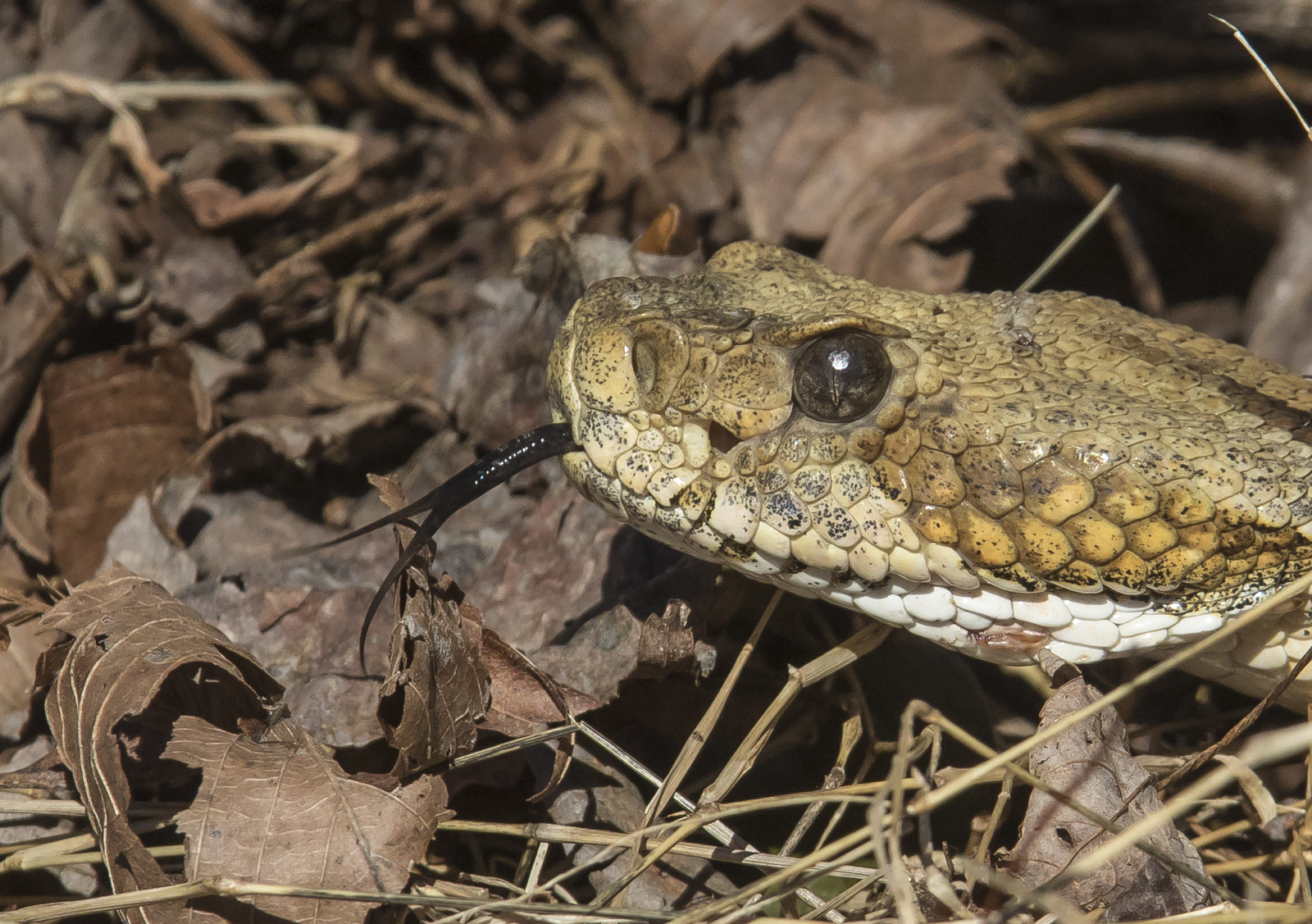
The palamedes swallowtails were out and about everywhere, and we managed to find a large canebrake rattlesnake crossing one of the refuge roads. I never tire of seeing this magnificent reptiles, and the refuge seems to have a healthy population.
The south shore of Lake Phelps
Our last stop was at the pocosin overlook at Pettigrew State Park, along the south shore of Lake Phelps. The clear water at Lake Phelps is such a surprise after spending a couple of days in the dark, tannin-colored waters of the region. It made for a refreshing dip on a hot afternoon.
NCLOW is looking at how we might help bring more tourists into this region to explore and enjoy its rich natural and cultural heritage. The waterways here offer scenic beauty, abundant wildlife, and the chance for quiet and uncrowded paddling. And Columbia is a beautiful town with a rich history and great potential. It is also home to Pocosin Arts, a real treasure of eastern North Carolina, whose mission is to connect culture to the environment through the arts. They offer a range of classes year-round, and are looking at ways to incorporate even more of their unique natural surroundings into their offerings.
One area that does seem to be getting a lot of attention from tourists is nearby Alligator River National Wildlife Refuge. Situated only about 15 minutes from the Outer Banks certainly helps fuel the busy summer tourist season on this refuge. It is known for its large population of black bears and for paddling opportunities along Milltail Creek. Several OBX outfitters provide canoe/kayak rentals and guided trips on the refuge. We decided to spend our last paddle day checking out this area. We drove to the main launch site at Buffalo City and were surprised to see 10+ vehicles, a crowd of people, and probably 20+ kayaks and canoes. Most people probably go downstream along Milltail Creek, so we decided to drive to another, lesser-known launch site upstream to seek some solitude.
Milltail Creek is obviously a popular paddle destination (Alligator River is on the far left of image)We launched upstream where Milltail Road crosses the creekFloating dock at the launch site
Besides the advantage of proximity to a large tourist population on the Outer Banks, the refuge also has two well-maintained launch sites on Milltail Creek. Ours had a neat floating dock that makes for a very easy launch. As we put in, a trailer with 6 boats pulled up, so I guess this site is not as unknown as I had thought. We quickly got out ahead of the group and for a few hours felt like we were the only people anywhere near this beautiful swamp.
Milltail Creek starts out narrow at this launch
Swamp iris occur in many places along the creekAnother beautiful day for paddling
We paddled for a few hours, traveling a total of about 7 miles out and back. The creek is rich in bird life and we saw lots of wood ducks, herons, and a few anhinga. My highlights were seeing a large alligator and a black bear along the route. The scenery is beautiful, it is incredibly quiet (if the jets are not buzzing overhead), and it is a great combination of solitude, ease of access, and abundant wildlife. I can see why it is such a popular destination.
A large bald cypress beckoned us over for a closer look
At one point along the way, I noticed a large bald cypress tree hugging the shoreline. Its large limbs draped down, seemingly embracing the dark water, making it look like a perfect place to pull in and escape the sun.
The giant trunk looked invitingA great place to relax in the shade
Sure enough, it offered a chance to climb out of our boats, relax for a lunch break, and it provided a Swiss Family Robinson moment for a couple of thankful paddlers.
Our three days of paddling showed me the great potential for the Scuppernong region, truly one of the jewels of wildness in our state. I hope we can help foster an awareness and appreciation of the incredible resources of this unique area, provide some economic opportunities for local entrepreneurs, and maintain the incredible natural heritage and beauty of this wild landscape. On our way home, we decided to check out an area that is making a strong effort to do just that.
Recently completed tree houses along the Cashie River in Windsor
The town of Windsor is located along the Cashie River, between Williamston and Edenton. The town is making a commitment to ecotourism along its waterways (see Destination Windsor) with kayak and canoe rentals, pontoon boat tours, a wetlands walk, and the recently completed tree houses. These two tree houses, funded in part by grants, are to be the start of a village along the river including a few more tree houses and a renovated campground. They hope to have these available for rent starting this fall. It looks like a great start to getting visitors to come to appreciate their natural surroundings. Let’s hope they prove successful and can pave the way for more such ventures in the wilds of eastern North Carolina.
The month of August had turned into a griddle where days just lay there and sizzled.
~Sue Monk Kidd
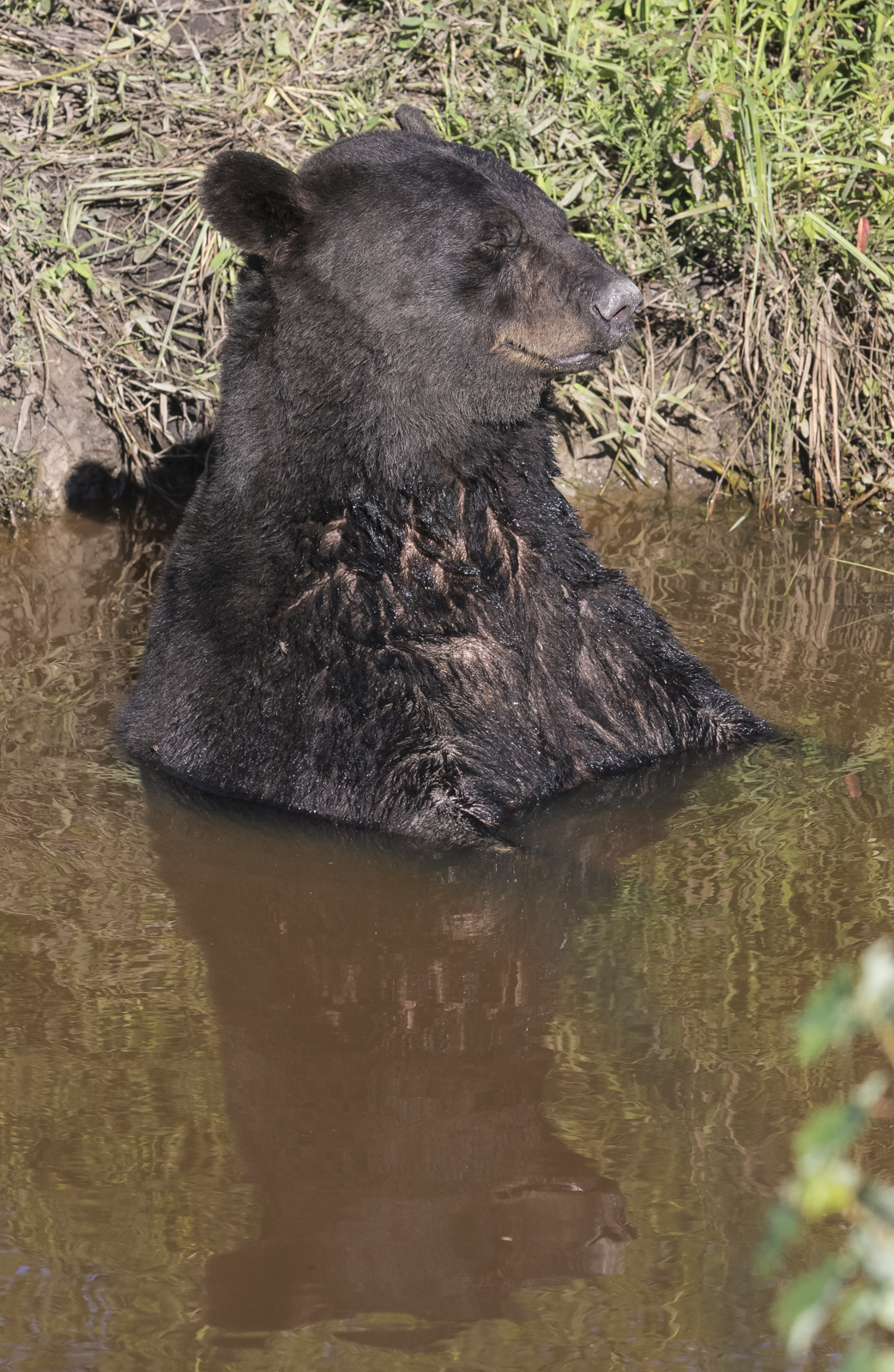
Last week, we spent 5 days in the wilds of eastern NC, a combination mini-vacation and working trip to further investigate the area around the Scuppernong River for the project I am working on with NCLOW. As you might expect, it was a tad warm (especially for the guy that loves cold weather), but we planned to be on or near water most of the week. Turns out, we are not the only ones that think that way. Returning to Columbia after a short excursion to the Outer Banks, we drove through Alligator River National Wildlife Refuge, in the hopes of seeing some wildlife. Temperatures had been hot all week with high humidity adding to the discomfort. We entered the refuge about 5:30 p.m., that time of day when wildlife begins to come out of the forest in search of an evening meal. Driving down one of the main gravel roadways, Melissa spotted something off to the side in the canal…a bear cooling off in the water, a bear bathtub.
Black bear cooling off in a canal on a hot August afternoon (click photos to enlarge)
It was a big bear, and it was just chillin’. When we pulled up, it glanced our way and then quickly went back into that chillin’ mode, eyes closed, almost a grin of cool relief on its face.
We could almost hear a sigh of relief in that look
The afternoon temperatures reached into the low 90’s that day, so I am sure this water, in spite of its less than desirable look, was quite satisfying. A black bear’s normal body temperature isn’t far from our own, around 98 to 100 degrees Fahrenheit (it is less during hibernation). The thick black fur is a good insulator, but can present problems in the heat of summer. And, like dogs, bears lack sweat glands, so they must use other means to cool off – panting, lying in the shade, digging day beds to lie on the cool ground, or taking a nice plunge in the water. I have seen bears cooling off before in canals at Pocosin Lakes NWR, but have never been this close to one seemingly so relaxed in the cool water.
The bear relaxed onto all fours when another car pulled up
Another vehicle soon pulled up, but the large bear did not seem concerned. It did shift its posture and sat down in the water with all four paws presumably on the muddy bottom.
The bear began to scrunch up its nose
After remaining almost motionless for a few minutes, the bear began to scrunch up its nose, revealing more of its teeth and tongue. We wondered what it was up to…trying to smell us (a third car had driven up at that point)? When I got home and looked at the images, I think I now know what was happening.
Was this face in response to biting flies?
The photos taken when the bear was scrunching up its nose show a couple of biting flies on its snout. Pictures prior to that (like the first three photos above) show none of the irritating insects.
A trickle of blood from a fly bite on his nose
The last few photos showed a tiny trickle of blood running off his nose. Look carefully at the previous image and you can see there was a fly in that spot. Guess I, too, would scrunch up my face under those conditions.
The big fella finally departs for the corn fields
After spending nine minutes with this big guy (no telling how long he was chillin’ in the canal before we arrived), he finally decided to head back up into the fields. I suppose he was headed for a nice corn dinner, and maybe some dense vegetation where those pesky flies couldn’t get to his sensitive nose.
It was a dark and stormy night, the rain fell in torrents…
~Edward Bulwer-Lytton, 1830
And indeed it was…last night. We barely beat a fierce thunderstorm as we drove back from dinner with friends in Chapel Hill. The sky was flashing with rapid-fire lightning when we arrived at our gate. I must have done something right recently, as just when I stopped at the gate, my driver’s side windshield wiper arm came apart. That would have been very problematic a few minutes earlier as we drove through a downpour. The rain let up just long enough for us to get inside, and then the sky opened up, and down it came. Something else must have come down somewhere as it wasn’t long before the power flickered, and then went out. A reminder of how really dark it can be out here in the woods…incredibly lively as well. Outside, I could hear another chorus of Cope’s gray tree frogs cranking up, another attempt at spreading the genes around. Most of the sound was coming from the water garden that sits half-empty, awaiting repair. I mentioned it in an earlier post as the source of the abundance of transforming tree frog tadpoles in the yard. And it looked like this would be another night for creating the start of many mini-frogs.
The rain let up so i wandered outside (sans camera, unfortunately) to see what all the fuss was about. I discovered a couple of reasons why it isn’t easy being a tree frog in love. A huge bullfrog was sitting over by one pool, the one without the breeding tree frogs. A guy that big can easily grab and swallow any tree frog that comes his way. That may be one reason the tree frogs are using the other pool, although I think it also has something to do with the thick cover of duckweed and other vegetation in the bullfrog pool. When I walked over to the tree frog pool, I saw another potential hazard to romancing frogs – a copperhead was dangling out over the pool, no doubt waiting for a love-struck frog to venture too close. By the way, that is one reason that pool will remain in a state of disrepair until colder weather arrives. I prefer moving all those stones after certain species are retired for the year.
The rain started up again so I retreated indoors. I soon heard a frog calling from out front, sounding like it was just outside the front door. I grabbed the camera and stepped out underneath the covered entrance way. The rain paused and I heard the frog call again, very close.
Cope’s gray tree frog sitting on walkway (click photos to enlarge)
I knelt down, and spotted the caller perched on the edge of our wooden walkway into the house. He was facing the to-be-repaired pool, the source of all of the other calling. Suddenly, he puffed his body a couple of times, as if taking a deep breath…
Gray tree frog calling
…and let go with a loud trill. His vocal sac extended for a second or so, just long enough for me to fire off a shot. I sat and watched him call a few more times before heading back inside. I figured he would soon hop off toward the other pool and join in the breeding frenzy. It is getting a little late in the summer for a full-on bout of tree frog breeding (the peak of activity is usually from late May – July), but you wouldn’t have known it last night. It has been a wet summer, and the frogs are taking advantage of every last storm, and last night it really seemed like it was raining cats and dogs (or frogs and toads at least). We probably had close to 2 inches of rain in the storm, and power remained out until about 5:30 this morning.
Right before heading to bed, I looked out the front door again. The calling frog had turned and was now facing me. I couldn’t let that obvious invitation go unanswered, so out I went with my camera one more time.
Catching his breath before another trill
I bent down a couple of feet away and he sized me up, but apparently had more important things on his mind…trilllllll!
Nice trill…
About that time, my camera battery died, so I headed back inside to a darkened house. I don’t know whether his efforts eventually paid off or not, but I felt lucky to have shared a few moments of darkness with such good company.