…on the first warm night I stepped out to the back porch and heard in the distance a wonderfully high, thin sound, as clear as the first stars over the bare black trees.
~Kathleen Kilgore
They have been calling off and on for awhile now. That distinctive, high-pitched, clear call that means the end of Winter is near. It had been a single peep out front, maybe two at most, until Sunday night. Something was different, maybe warm weather really is here at last. I could hear them from the living room, from the kitchen, from anywhere in the house, and there was an urgency in their calls. So, I tried sneaking out the front door, only to cause a sudden silence. I walked over to the edge of the small pool in the yard and sat, and waited. Only a few seconds passed before the calls started again, first one somewhere in front of me, then one to the left, then another behind. Urgent indeed. I picked out the sounds of about four or five different male callers, but, try as I might, I could not find a single one in my flashlight beam. I have often been frustrated in this quest. I swear they can throw their shrill voices, making it difficult to locate their tiny, camouflaged bodies.
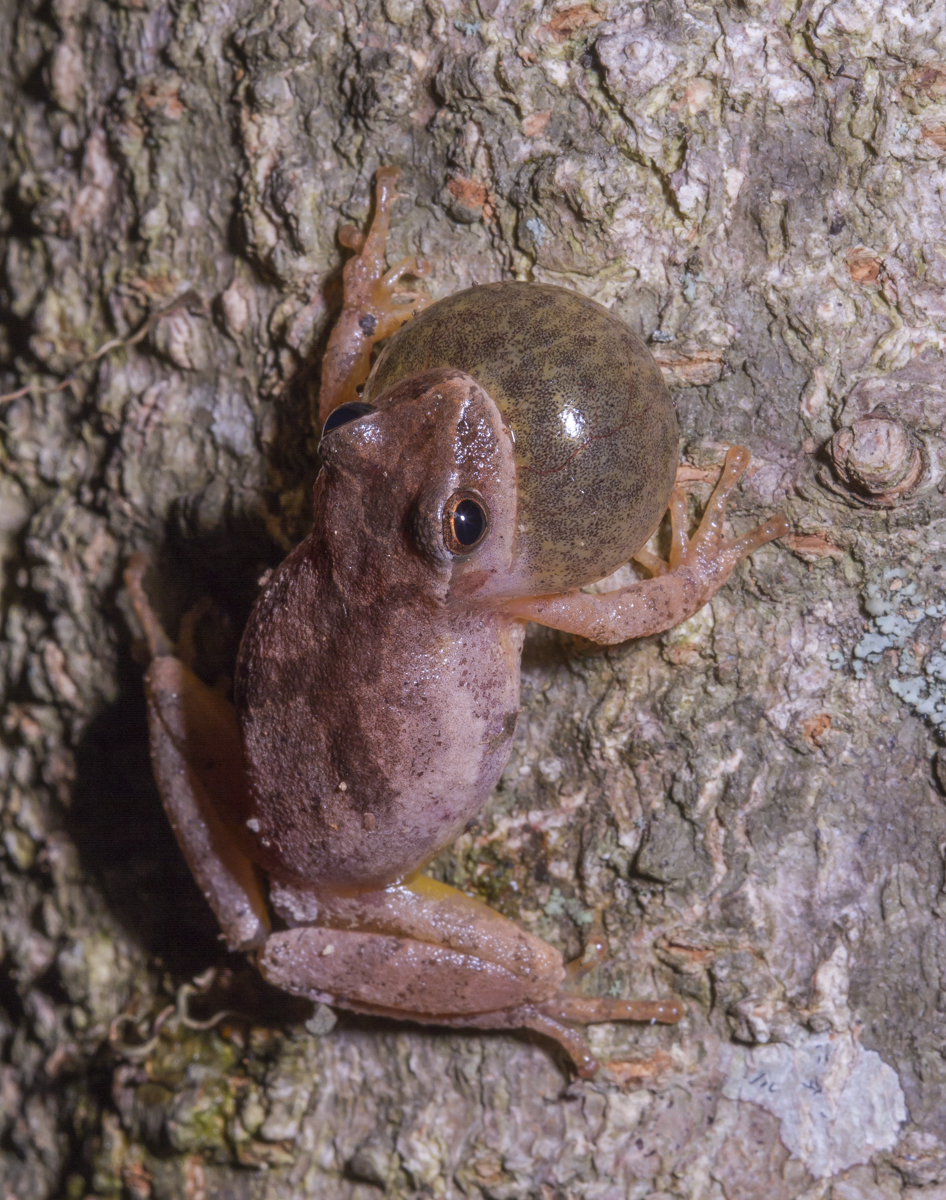
Spring Peeper calling (click photo to enlarge)
Spring Peepers (Pseudacris crucifer) are diminutive members of the treefrog family, with males averaging only about 3/4 of an inch in length. Most are marked with a distinctive X pattern on their light brown back. They often call from branches of vegetation a few feet off the ground, so I started looking in the shrubs and small trees surrounding the pool. The sweep of the flashlight beam silenced them for a few seconds, and then they started up again. I stood and moved a few feet to look around, and, finally, there was one of the songsters. He was calling from the back side of the trunk of a Red Buckeye tree about four feet from the pool. As I moved closer, he stopped. I made what seemed to me a poor imitation whistle of a peep, and they all started up again. Really urgent it seems. I took a few quick images and then went inside, leaving them to their compelling task of finding a female. I had planned to go back out last night, but the drop in temperatures seems to have put a temporary halt to the calling…maybe Spring really isn’t here quite yet.
Every spring is the only spring – a perpetual astonishment.
~Ellis Peters
The astonishment starts slowly, almost imperceptibly. The temperatures in this part of the world tease, and then take away the warmth, only to bring it back in a day or two. But the woods are more predictable than the thermometer. One of the first hints is that reddish tinge in the trees you see, usually while driving somewhere. The Red Maple flowers are amongst our earliest, and they signal the true change in season. The tiny red flowers lay scattered here in the yard now, mostly done for this year. But they awaken the spring consciousness in me, and I start to notice the other changes happening all around.
Spicebush flowers appear before the leaves (click photos to enlarge)
The tiny yellow puffs of flowers of the Spicebush, Lindera benzoin, appeared more than a week ago, a couple of weeks before the first leaves of this naive shrub. Spicebush can be found throughout our region, especially in the fertile soils along rivers and streams.
Spicebush flowers up close
Male and female flowers occur on separate shrubs, with only the female plants producing the bright red berries in Fall. Birds relish the fruit, and, dried and pulverized, the drupes were once commonly used as a substitute for allspice. The twig bark and leaves can be brewed into a tasty tea that purportedly has medicinal properties.
Spicebush Swallowtail caterpillar on its namesake plant
But I love this plant for another reason – one of its associates. The Spicebush Swallowtail butterfly lays its eggs on this shrub and on the leaves of Sassafras. This beguiling bug is one of my favorite caterpillars, complete with large fake eye spots, and a habit of folding the leaves to make a shelter, making it one of the easier caterpillars to find each Fall to delight visitors at the museum’s annual BugFest event. On our stroll last weekend, I was surprised to see very few of these supposedly deer resistant shrubs down in the creek bottom. It looks like they have been heavily browsed.
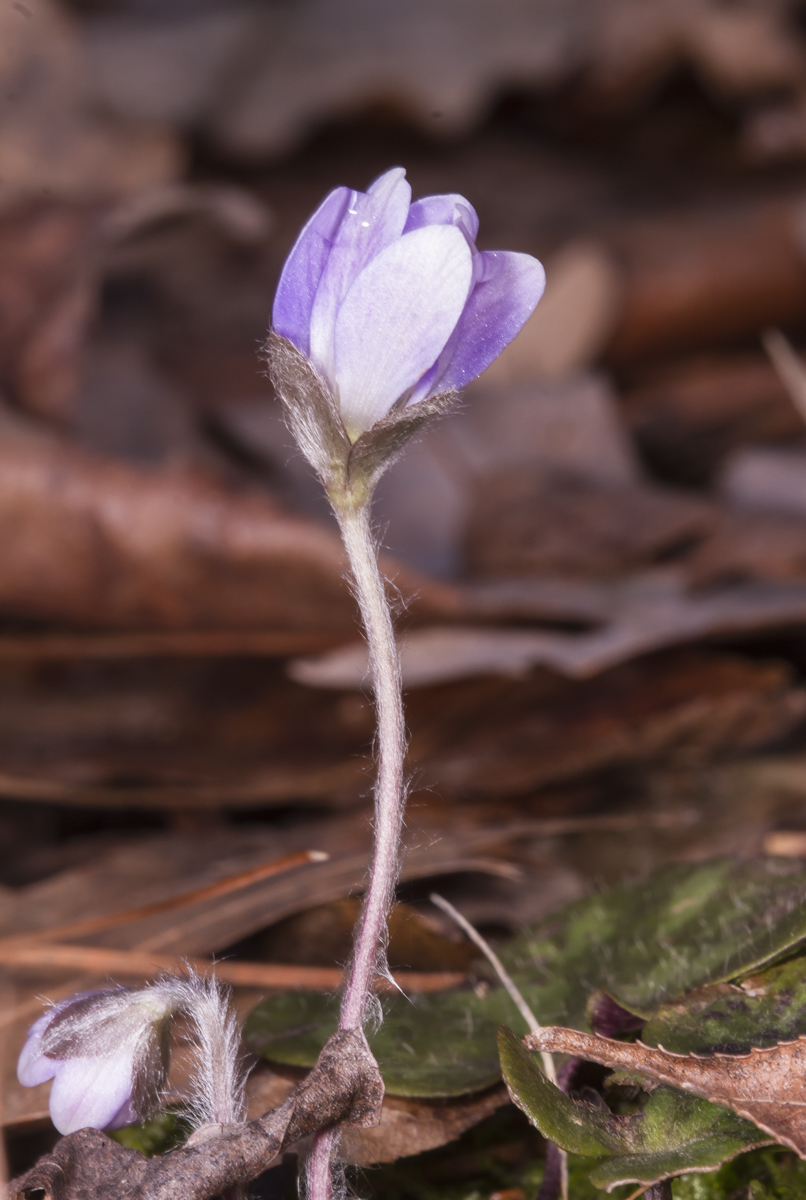
There were a few Hepatica flowers in bloom last week
But, to my delight, we did find a few Hepatica (Hepatica obtusa var. nobilis or Hepatica americana) flowers in bloom.
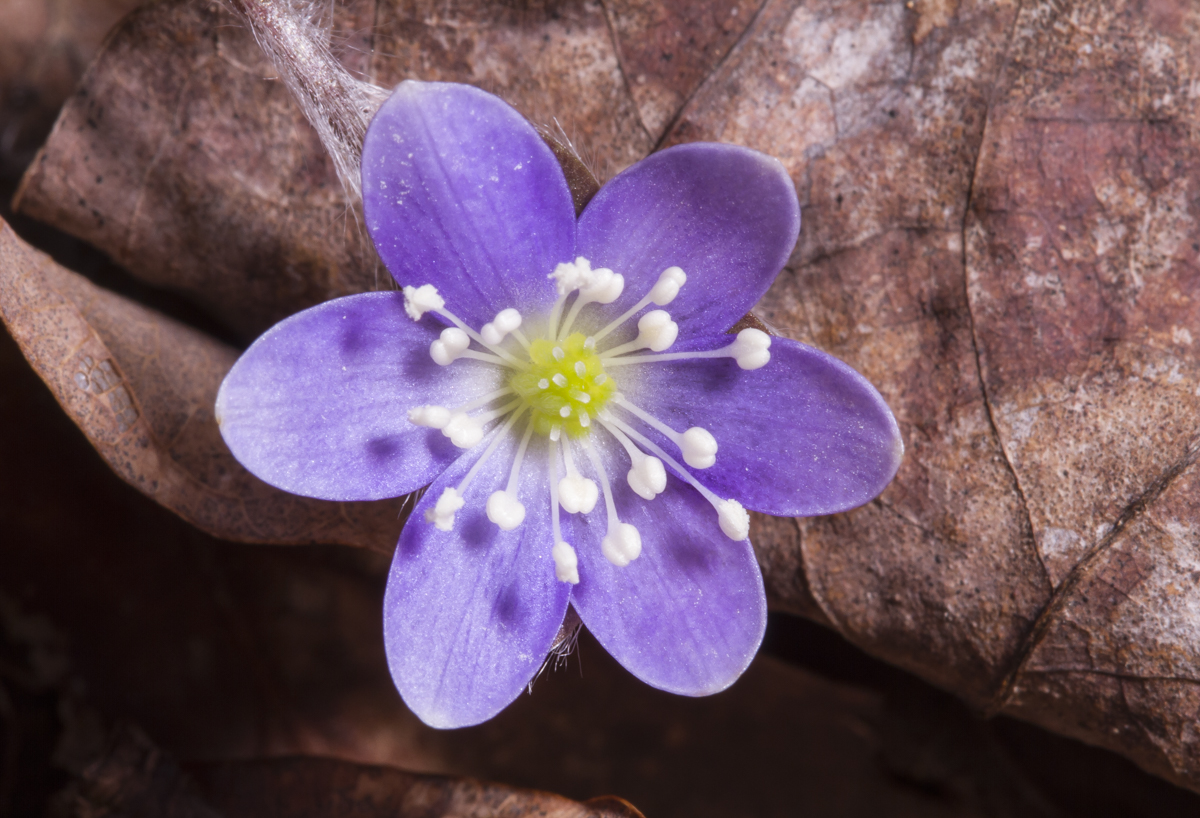
Hepatica flower
These tiny bluish-purple flowers are amongst the earliest of the spring ephemerals, barely poking their blossoms above the leaf litter. We probably found a half dozen flowers in our walk last weekend, so at least a few have survived the deer.
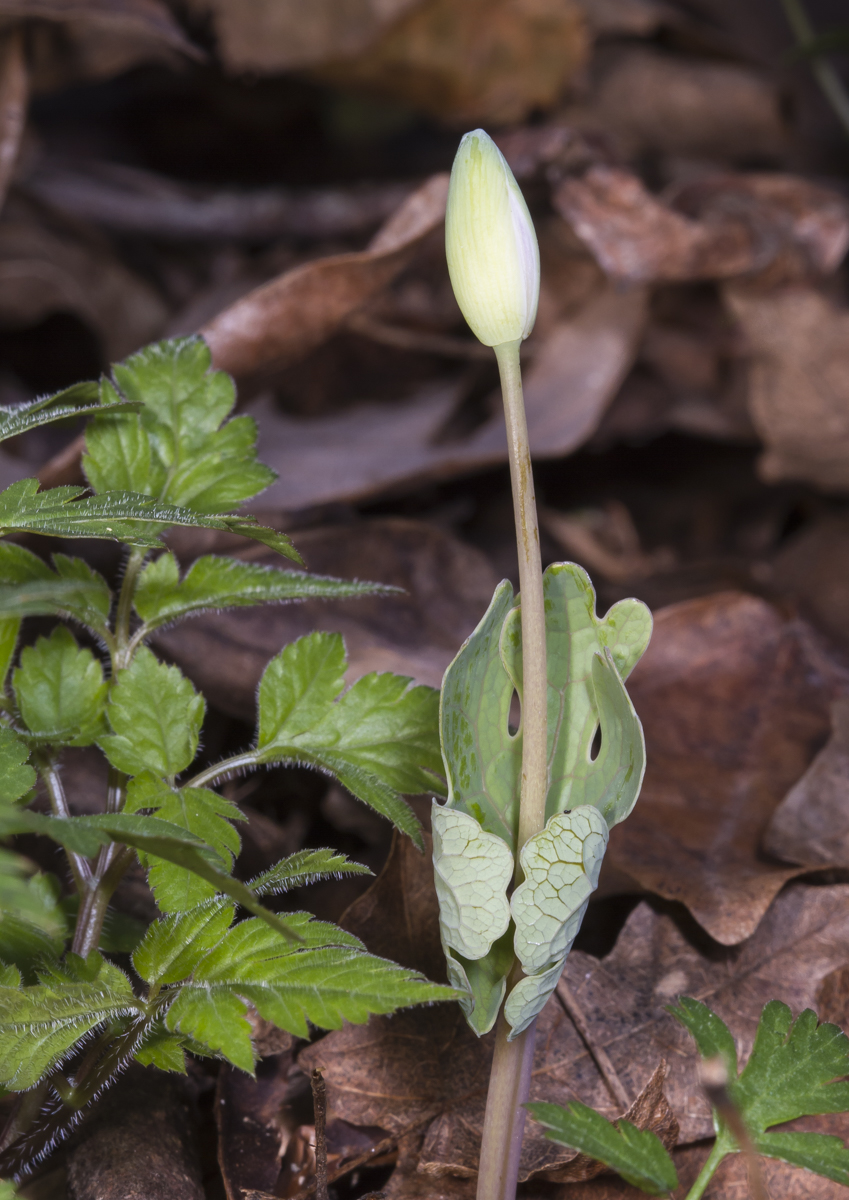
Bloodroot leaf is tightly furled before opening
A neighbor posted something on our list serve about Bloodroot (Sanguinaria canadensis) being in bloom this week. We did not see any leaves or flowers on our walk last weekend, but I did find a couple inside the deer fence yesterday. The single basal leaf pokes out of the ground tightly furled like a tiny textured flag wrapped around a pole.
Bloodroot flower bud
Each single flower stalk emerges wrapped in a single leaf. When the flower blooms, the leaf unfurls. The short-lived flowers remained tightly closed yesterday, perhaps awaiting a sunny day before opening up to potential pollinators.
Trout Lily clump in the yard
One of my favorite spring ephemerals is the Trout Lily (also called Dimpled Trout Lily), Erythronium umbilicatum. Blooming in early to mid-March, it can form dense colonies in areas like Eno River State Park and Johnston Mill Nature Preserve. There are a few plants that were transplanted into this yard during a plant rescue organized by the NC Botanical Garden. These volunteer efforts help rescue plants from a development prior to the bulldozers commencing their work. This is a great way to get plants for your yard and to save a bit of our native flora. Be sure to get permission from the landowners before doing any plant rescues.
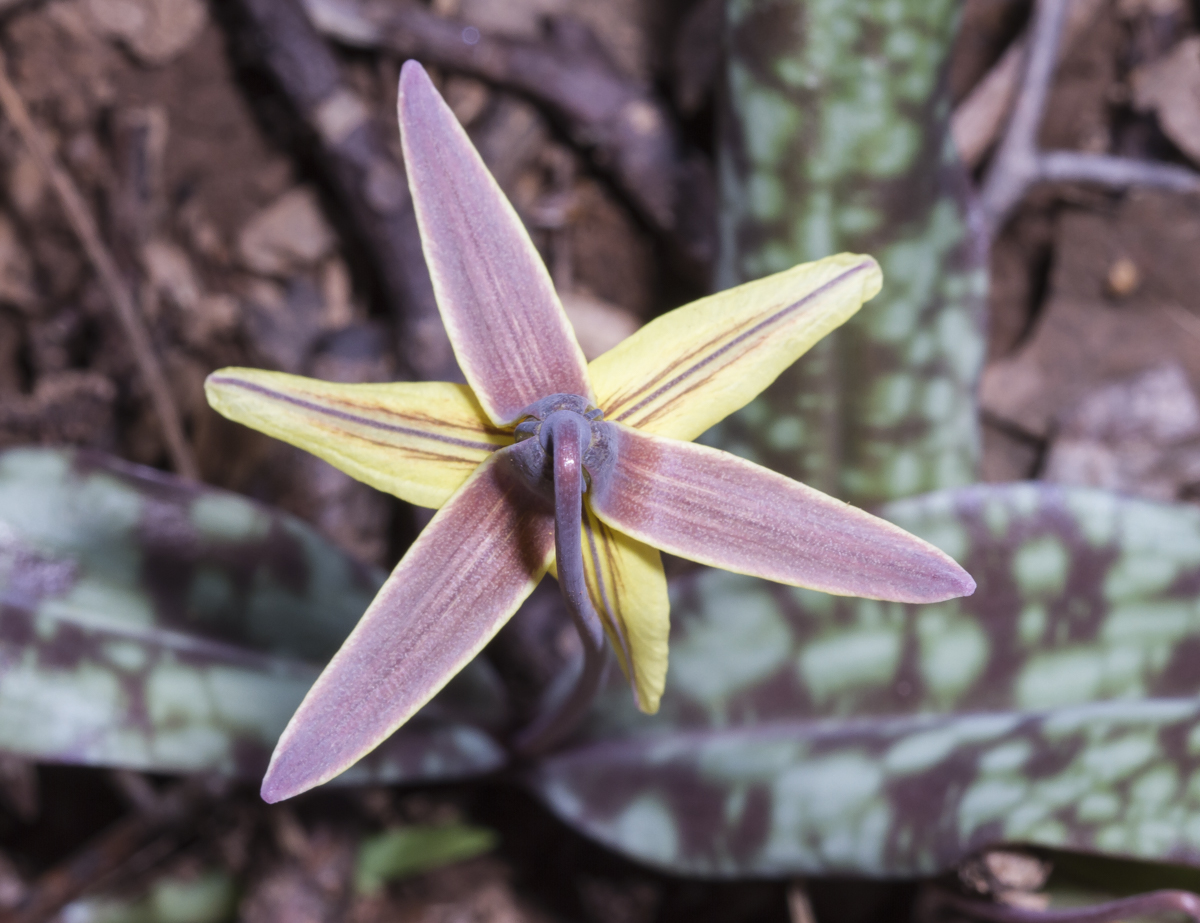
Looking down on Trout Lily flower
The common name, Trout Lily, comes from the dappled leaves which are said to resemble the skin pattern of a Brook or a Brown Trout. Plants that will not flower have a single leaf, those producing flowers will have two leaves. I enjoy looking down on the flowers to appreciate their pattern.
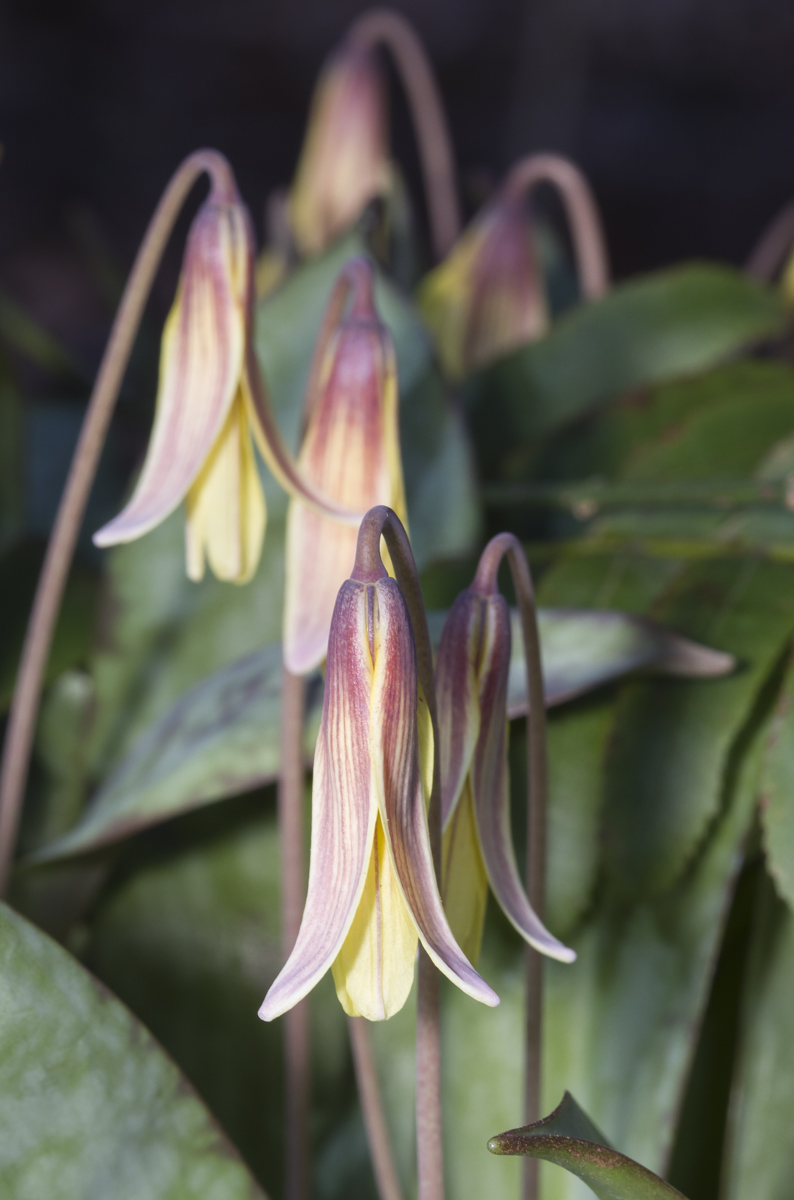
Trout Lily flowers are closed early in the morning
Besides, you really have to almost lay on the ground to get a good photo of a flower due to their drooping habit. As with many spring flowers, Trout Lilies close each evening and may remain closed on rainy or cloudy days. This probably serves to protect their pollen and have it ready on warm, sunny days, when pollinators are apt to be more active.
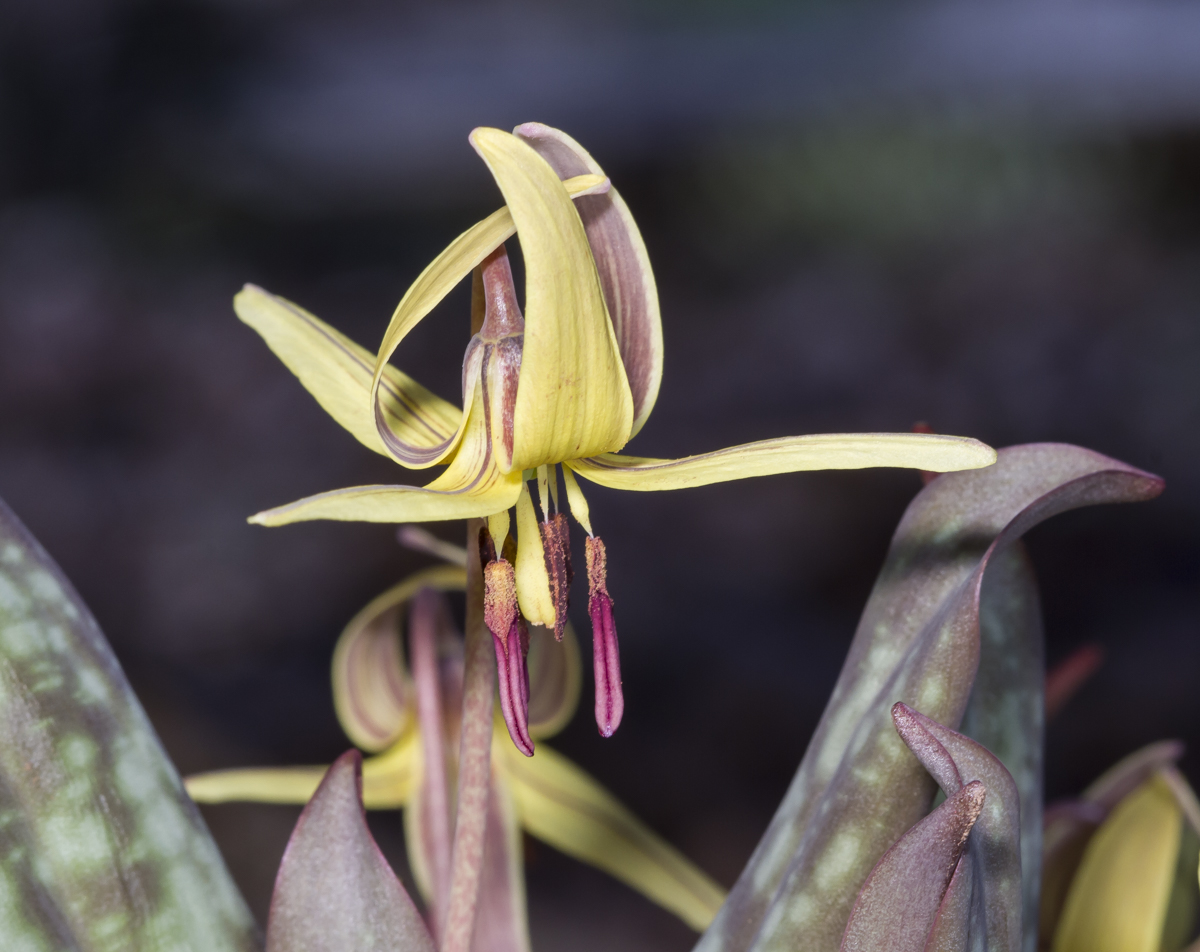
Trout Lily flower
When fully open, the petals and sepals reflex upward, revealing the flower parts hanging beneath.
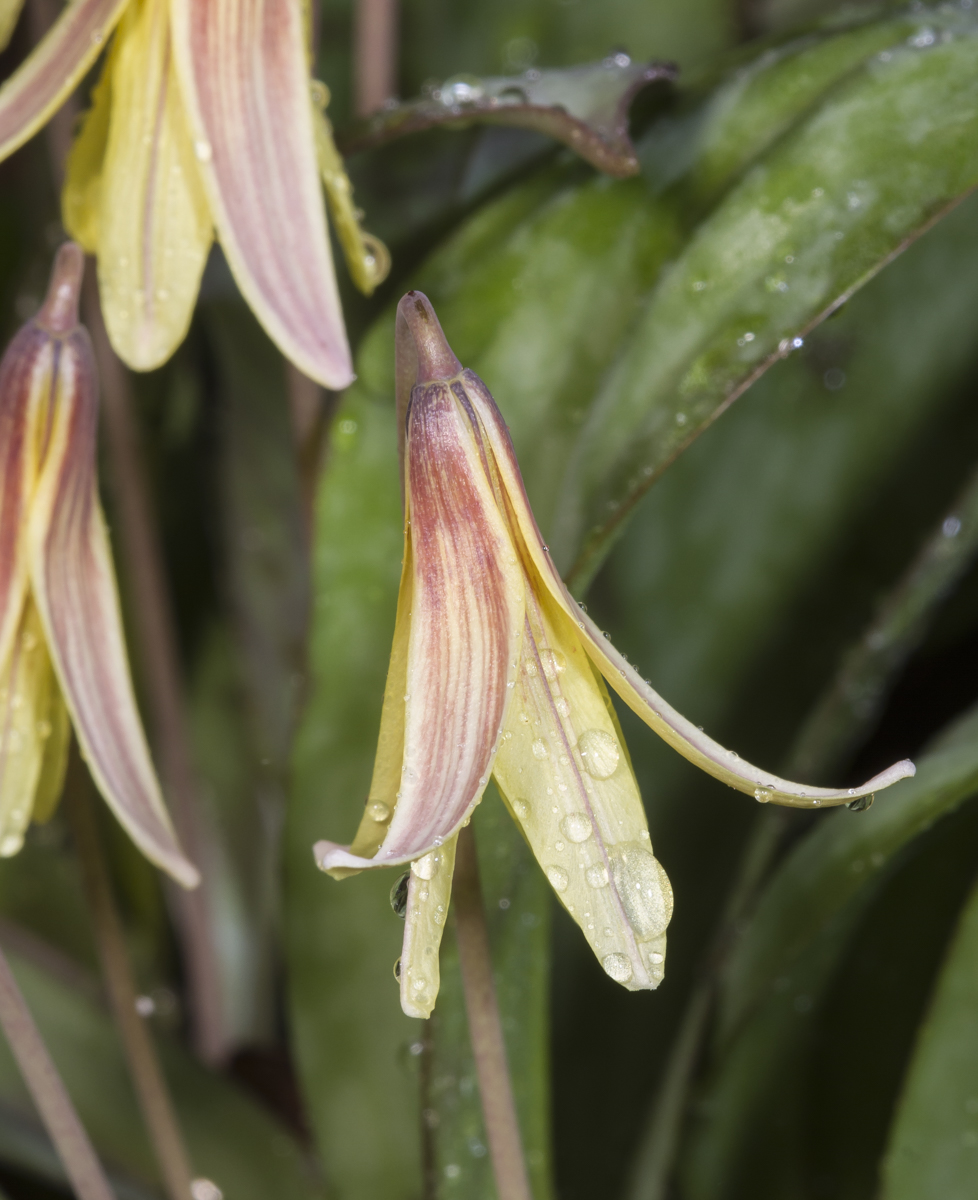
Trout Lily flowers remained closed in the rain yesterday
Yesterday, the flowers in the yard remained closed. The cool rainy weather may have slowed spring for a bit, but the next few days promise more astonishment. There is a noticeable reddish-pink cast to the twigs of the Redbud trees surrounding the house. Once they bloom, and that curtain is raised, the stage is set for the grand show to begin in earnest. If you get too busy for a day or two, you may miss some of it. Be sure to take some time to look around you these next few weeks, to observe and listen, and enjoy the arrival of the new season. It is truly a magical time to be a woods-watcher.
If Spring came but once in a century, instead of once a year, or burst forth with the sound of an earthquake, and not in silence, what wonder and expectation there would be in all hearts to behold the miraculous change!
~Henry Wadsworth Longfellow
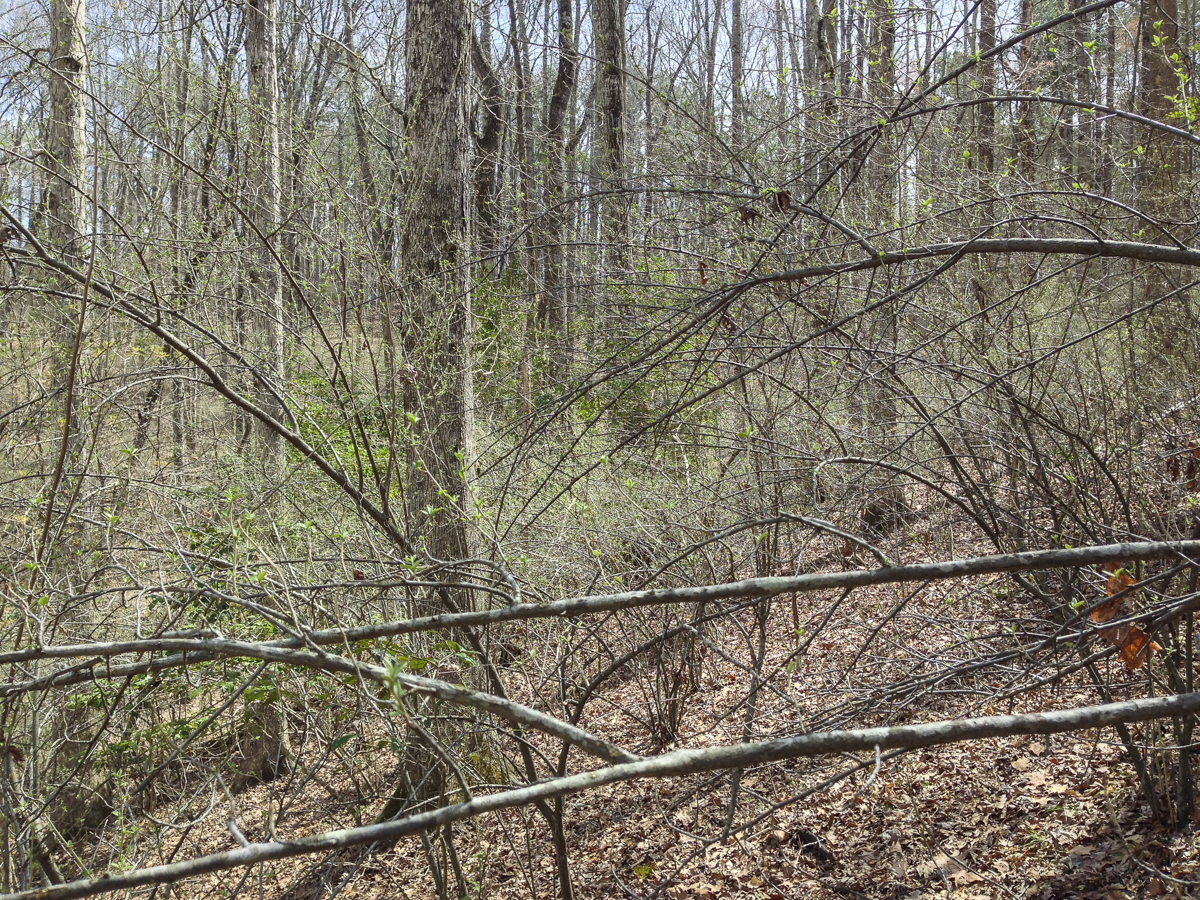
This past weekend, a few of us took a stroll on the property to see what might be stirring in these first few warm days of March. The tree canopy is still absent but things are stirring in the understory, or what is left of it here in this heavily deer-browsed habitat.
Eleagnus leaf out (click photos to enlarge)
The exotic invasive shrub, Eleagnus umbellata, dominates several slopes on this property, creating thickets that are difficult, if not downright painful, to navigate.
Eleagnus leaf out gives the understory in heavily infested areas a light green band about head high
It is starting to leaf out, giving the slopes a light green tint from 3 to 7 feet off the ground. Unfortunately, deer do not seem to browse on this plant except in times of severe food shortages, so it has become well-established in much of the Piedmont since its introduction to this country in the 1830’s. Eleagnus crowds and shades out many of our native plants, causing a reduction in the diversity of our woods.
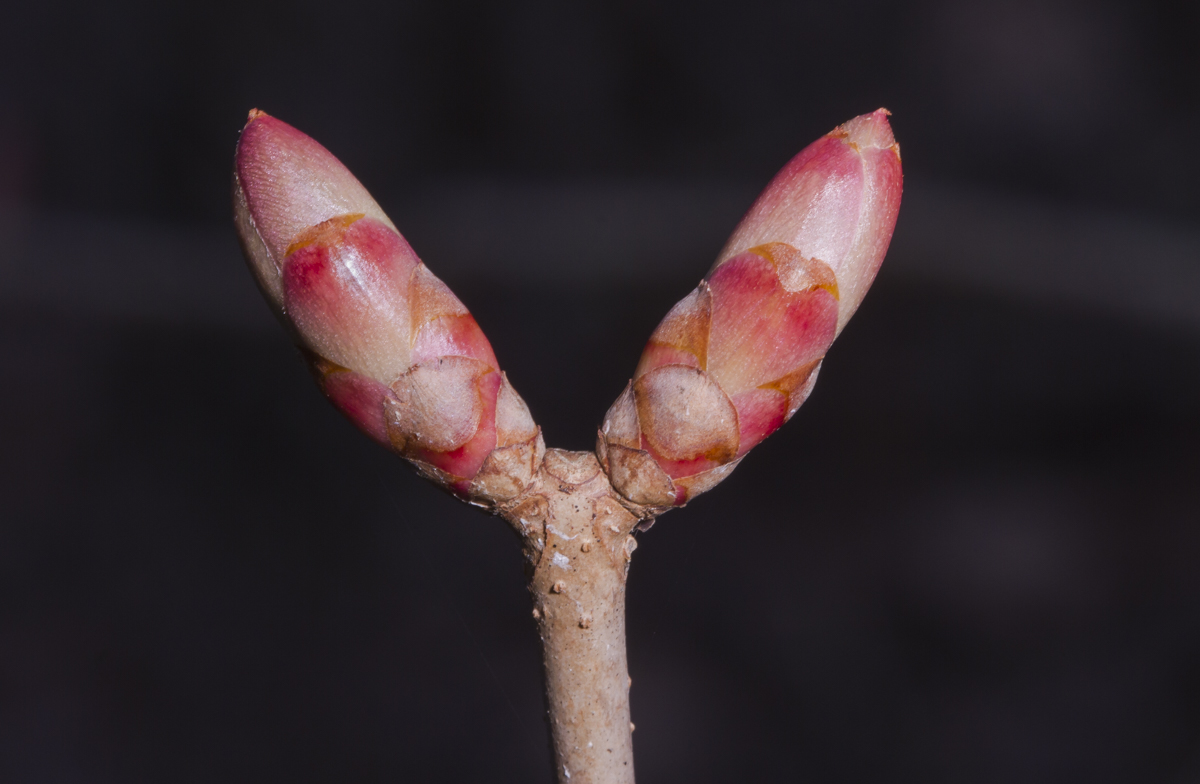
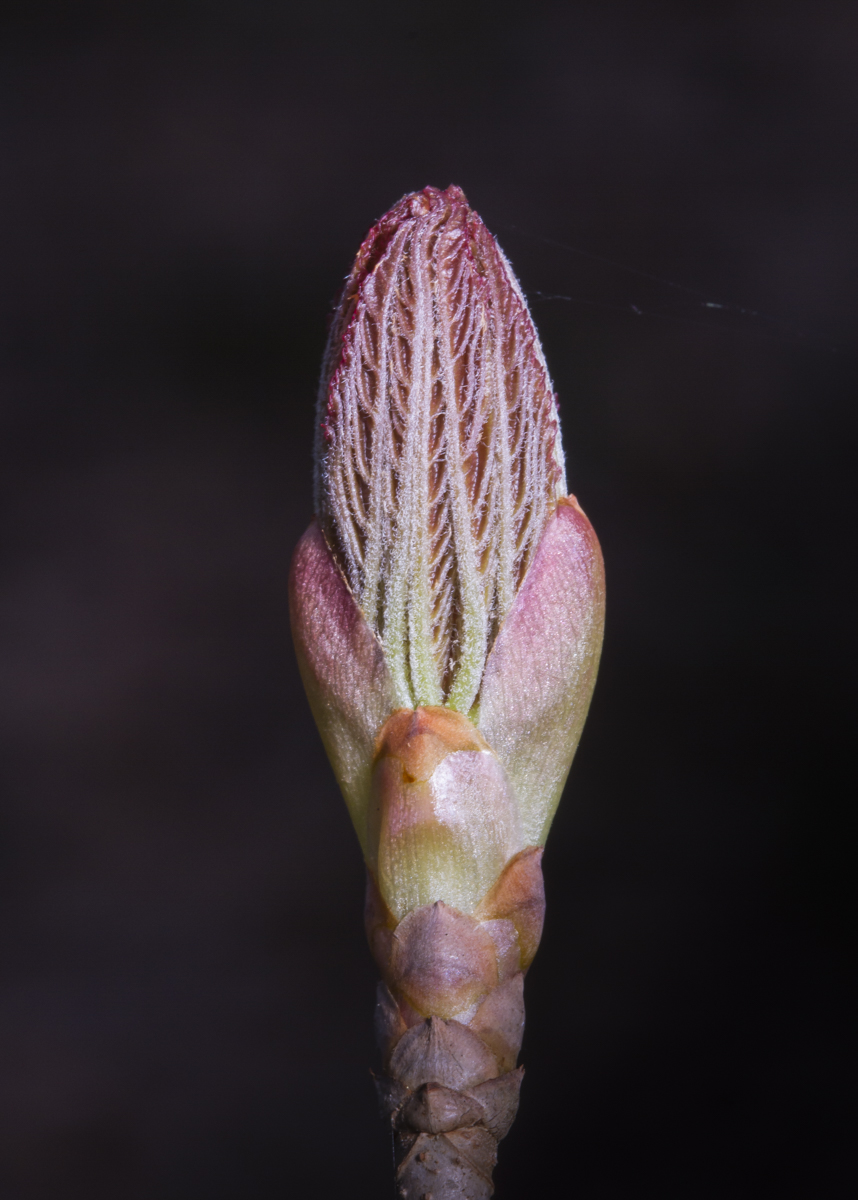
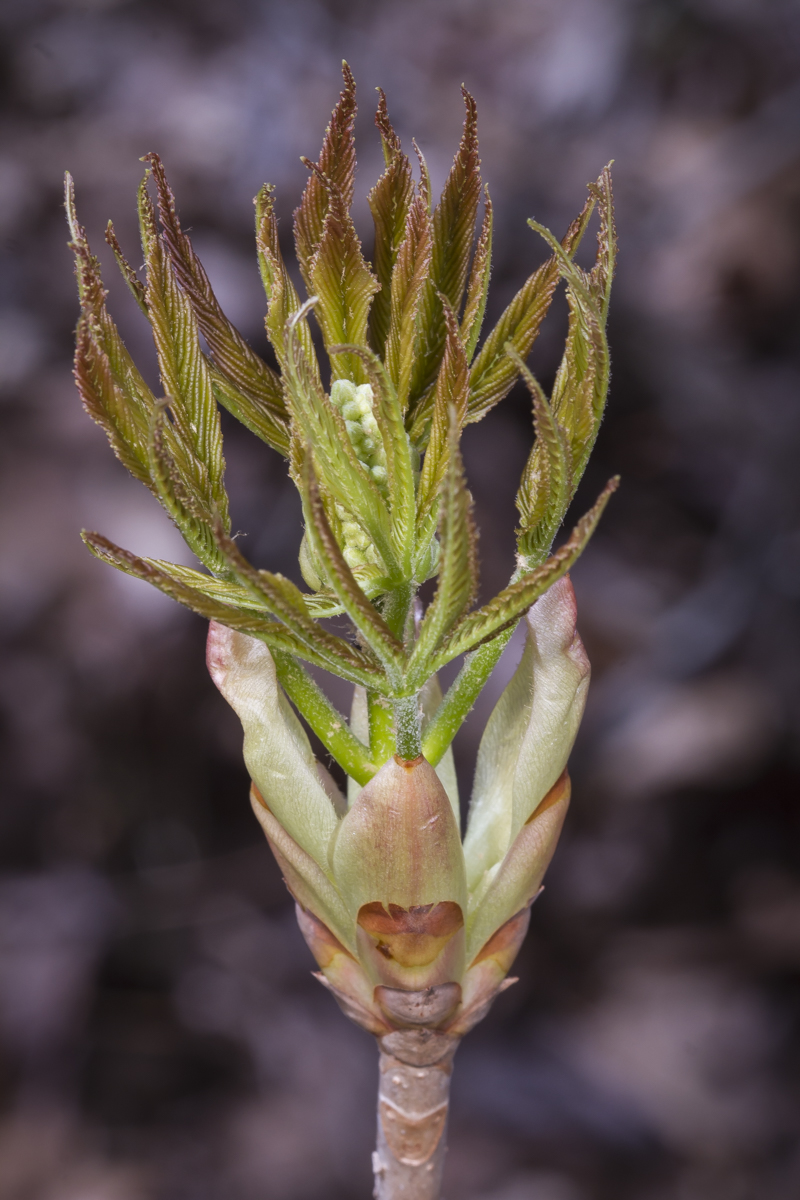
Painted Buckeye buds
But if you look closely, especially in the habitats approaching the creek bottoms or drainage areas, you will find one of the earliest native species to leaf out. Painted Buckeye, Aesculus sylvatica, is one of the dominant shrubs (or small trees depending on your viewpoint) in this part of the Piedmont. It begins to leaf out most years by mid-March, and last weekend it seemed to be right on schedule. The large terminal buds begin to swell noticeably in early March.
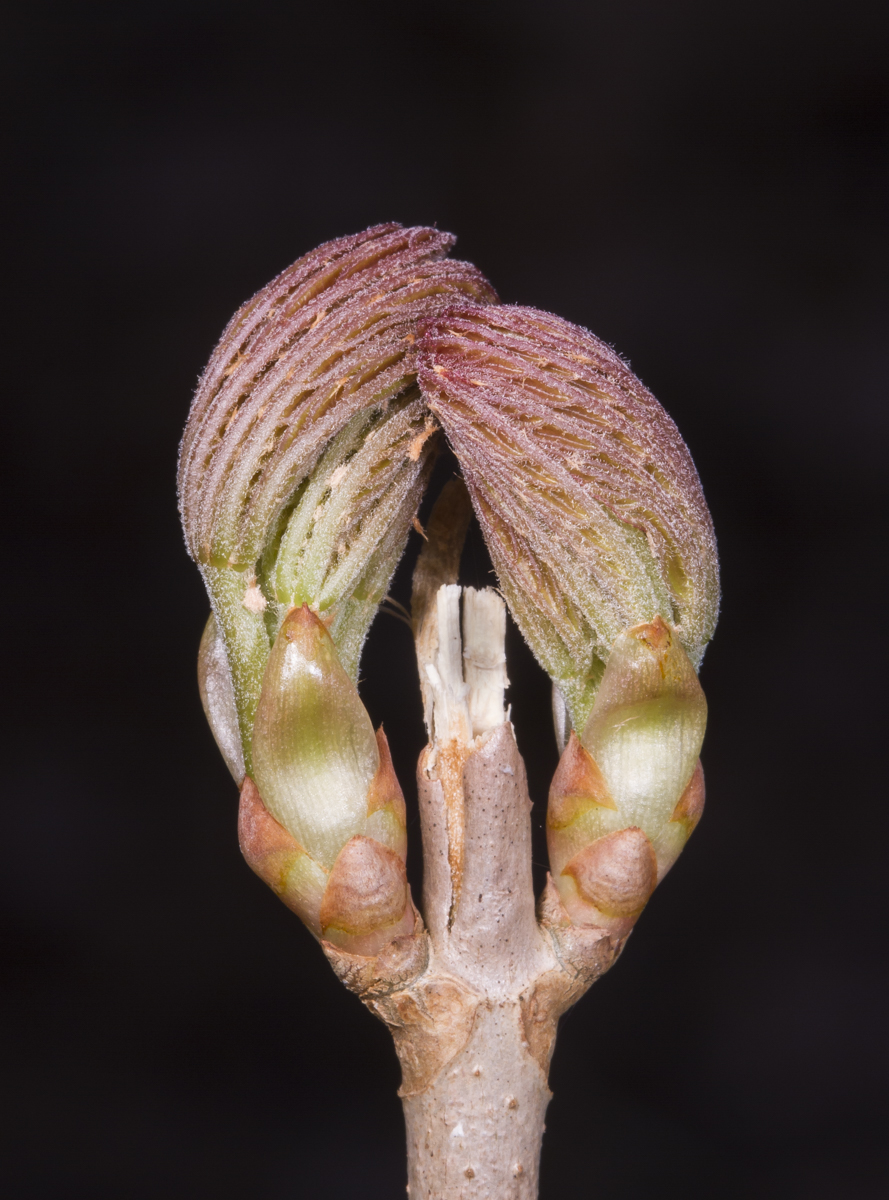
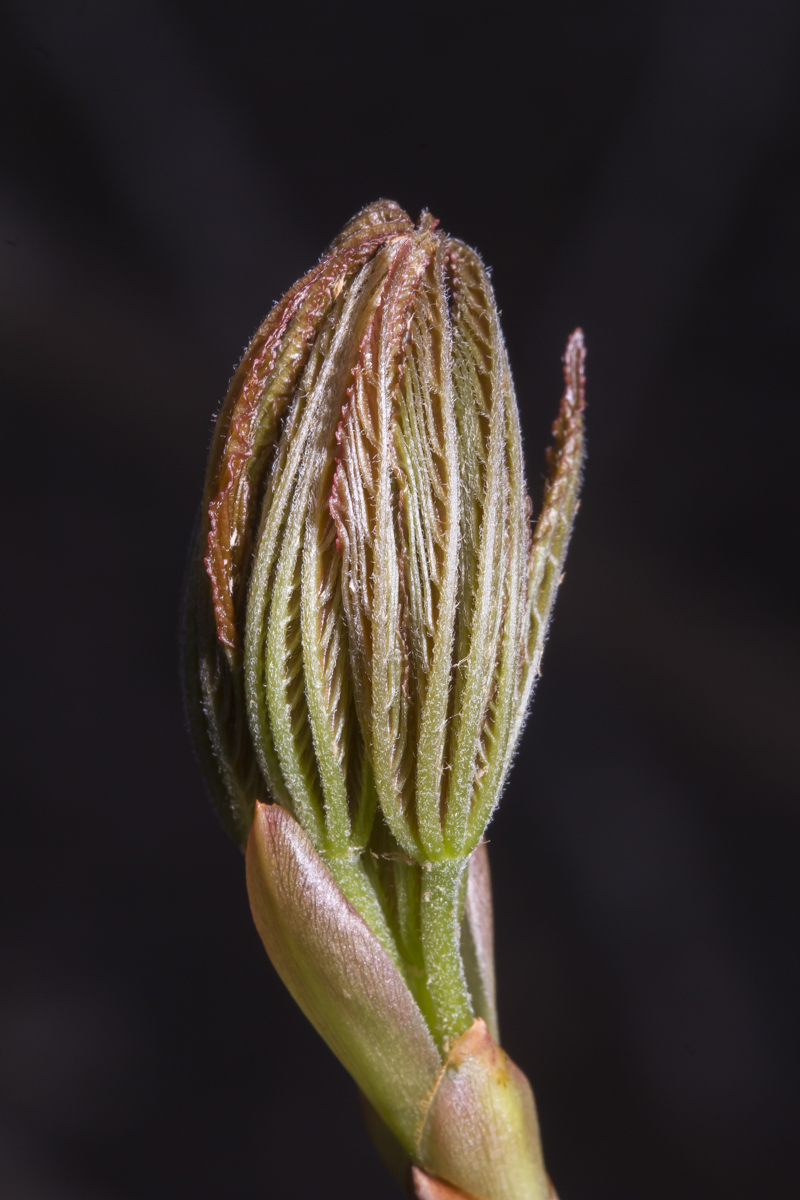
Painted Buckeye buds beginning to open
I love to observe and photograph the patterns of these beautiful buds and emerging leaves.
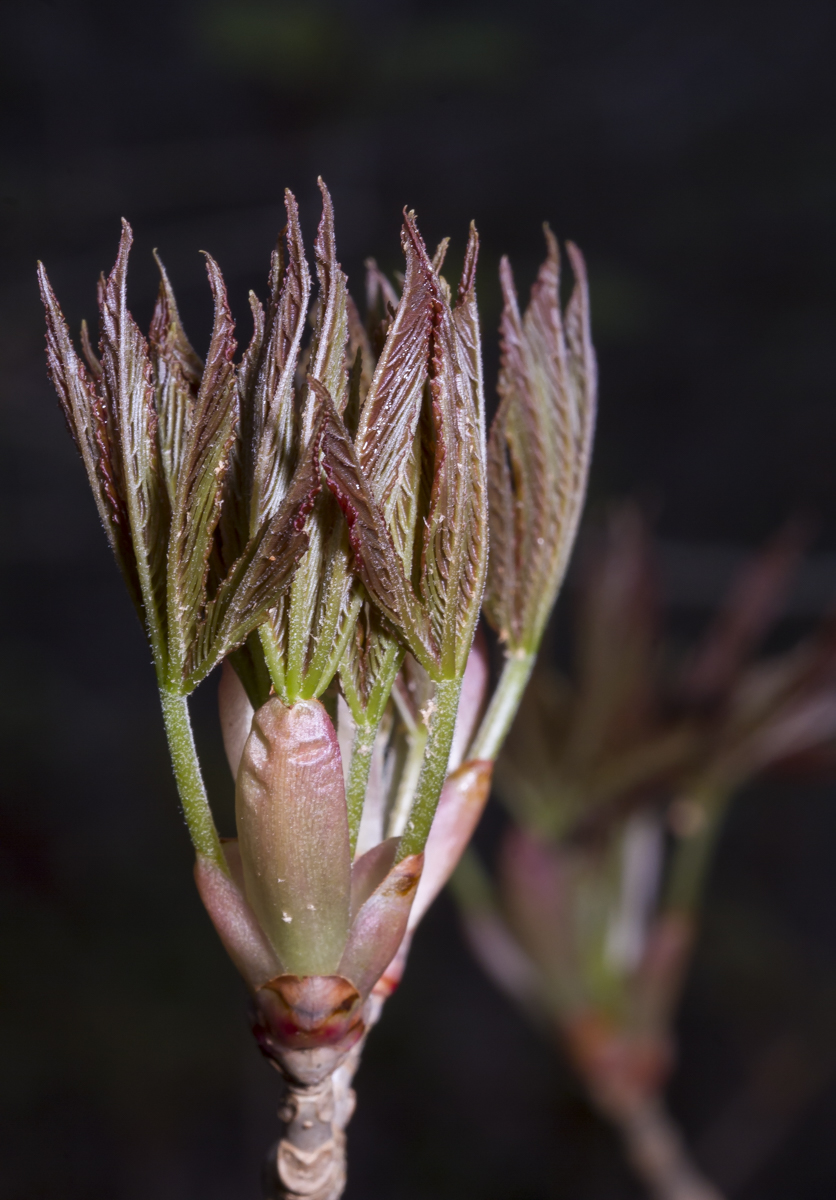
Painted Buckeye terminal bud openingTexture and detail define a Painted Buckeye leaf out
The textures and details of buds as they swell and open are incredible and contain so many facets, if you give them a closer look.
Buckeye leaves reaching skyward
Then the leaves begin to emerge, looking like a cross between ancient carvings and elegant architecture.
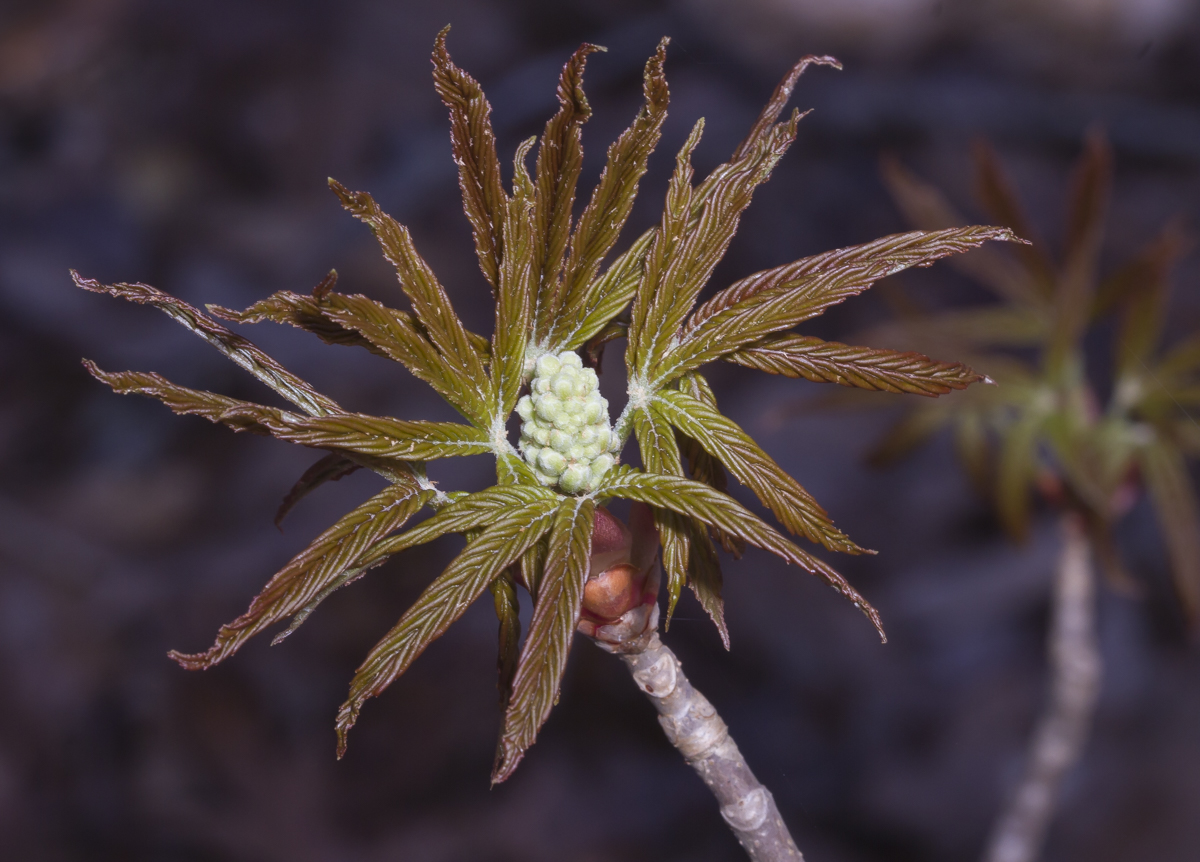
Painted Buckeye flower bud
On Sunday, only a few plants had the first hint of their yellow to cream-colored flower cluster peeking out from the umbrella of emerging leaves.
After two days, many shrubs now have visible flower buds
I went back out yesterday, after two warm sunny days, and the buckeye landscape had changed dramatically. On my short walk I saw only one unopened bud. Now there are flower buds on many of the stout twigs.
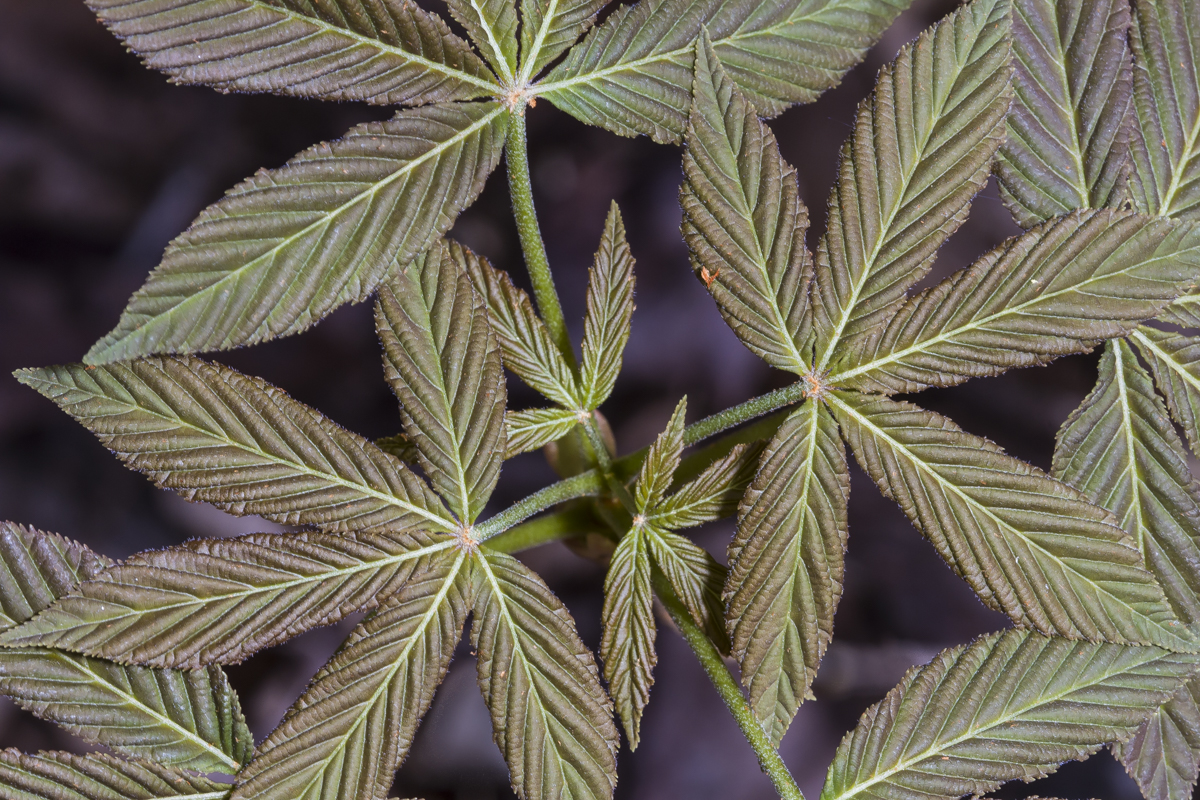
Painted Buckeye leaves are distinctive
And the distinctive palmately divided leaves have unfurled on the majority of plants. Since most of the parts of a Painted Buckeye have toxic properties, it is resistant to browsing by deer and most other mammals. The flowers do provide a valuable early nectar source for bumblebees, butterflies, and the first hummingbirds arriving back in our area. Look for these unusual flower clusters the next couple of weeks throughout our region, and be sure to stop and admire this hardy native plant on your next woodland walk.
If they aren’t the cutest critters and the perfect poster-child for vernal pool protection, I just don’t know what is!
~David Markowitz describing Spotted Salamanders
A friend and fellow naturalist came by this weekend and we went out Saturday night to have a look at the small pool out in the front yard. It is a shallow water garden, probably no more than six feet in diameter. These past few nights a couple of Upland Chorus Frogs have been calling as well as the occasional Spring Peeper. But we hoped to catch a glimpse of some of the Spotted Salamanders that have been laying eggs the past few weeks. As we approached the edge of the pool, a Green Frog jumped into the water, and the finger-nail-running-over-the-teeth-of-a-comb trill of a chorus frog became silent. Our flashlight beam caught some movement – a Spotted Salamander! Then another, and another, their sleek, dark bodies covered in bright yellow and orange spots. Then we noticed one clinging to a small twig beneath the surface and we crowded in for a closer look.
Spotted Salamander laying eggs (click photos to enlarge)
A female laying eggs! I had placed this particular small tree branch in the pool a couple of weeks ago as a potential egg-laying site for the salamanders that had already gathered after one of our earlier rainy nights. A day or two after picking up a spermatophore deposited by a male salamander, female Spotted Salamanders will begin to lay egg masses. She usually waits until after dark and then searches for a suitable site – small underwater twigs seem to be a preferred location. The female slowly crawls along the stick and then grasps it with her hind legs. She then presses her body against the twig as she extrudes the eggs, s few at a time, all in a gelatinous mass. Our female seemed to stop as we shined the light into her world, perhaps disturbed by this unusually bright bit of moonlight. After photographing and watching her for a few minutes, she crawled off into the leaf debris in the bottom of the pool.
Adult Spotted Salamander in hand
Another female was just out of the water on a mat of vegetation. We briefly held her for a picture, then released her back onto the safety of the water. I imagine these adult salamanders will be in the pool another week or two before heading back to their terrestrial habitat in the rich woods around the house, until next winter, when the rains of a January to March evening beckon them back to renew their mission to add more of their kind to our woods.
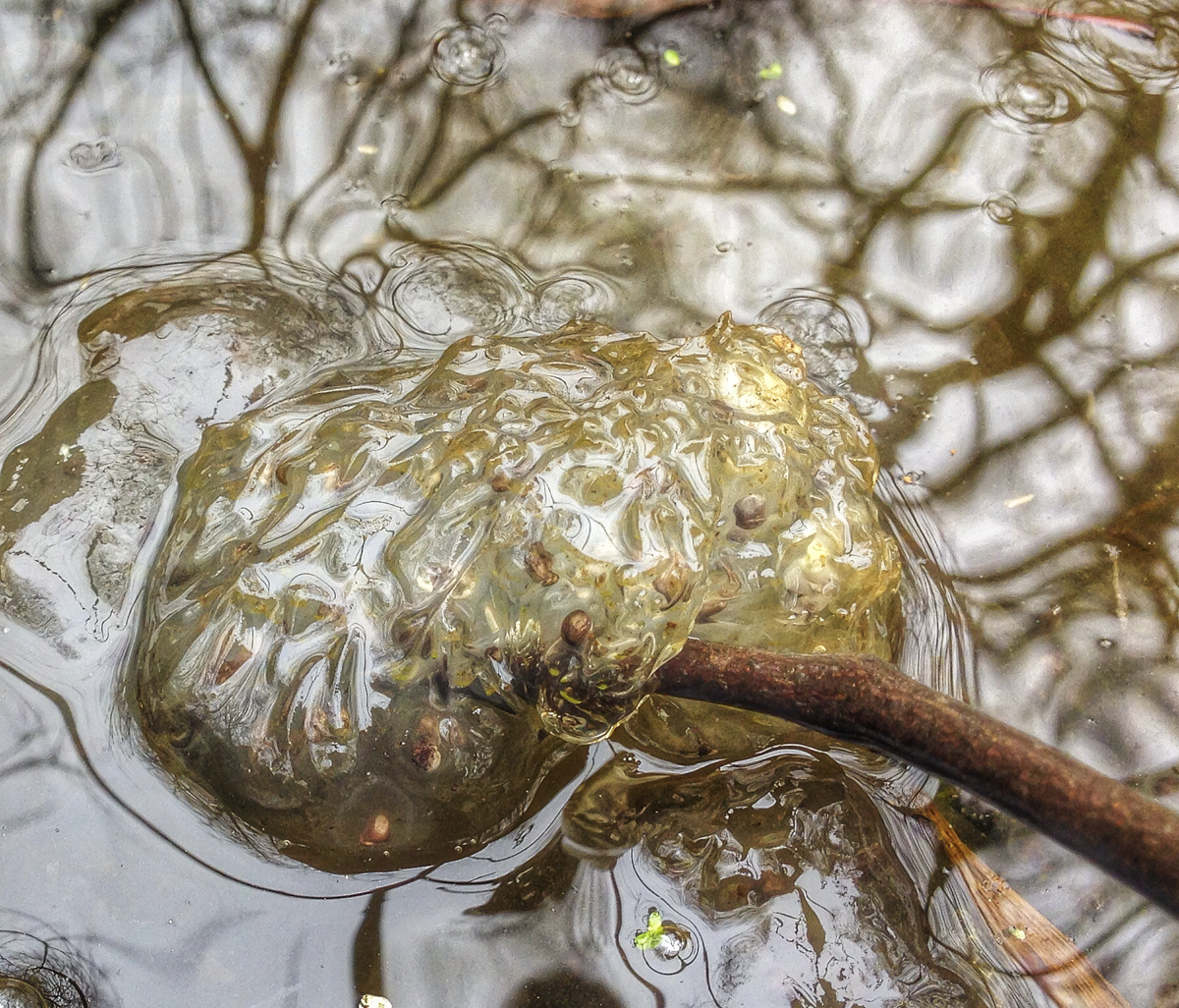
Spotted Salamander egg masses on the same twig from Saturday night
I went out this morning to check on the eggs and it looks as though our disturbance Saturday night was only a minor one, as there were many more small egg masses on that same twig. Now, to wait for the warm temperatures to hasten the development and hatching of the eggs into hungry salamander larvae. These fish-less pools are truly amazing habitats and ones worth protecting or creating.
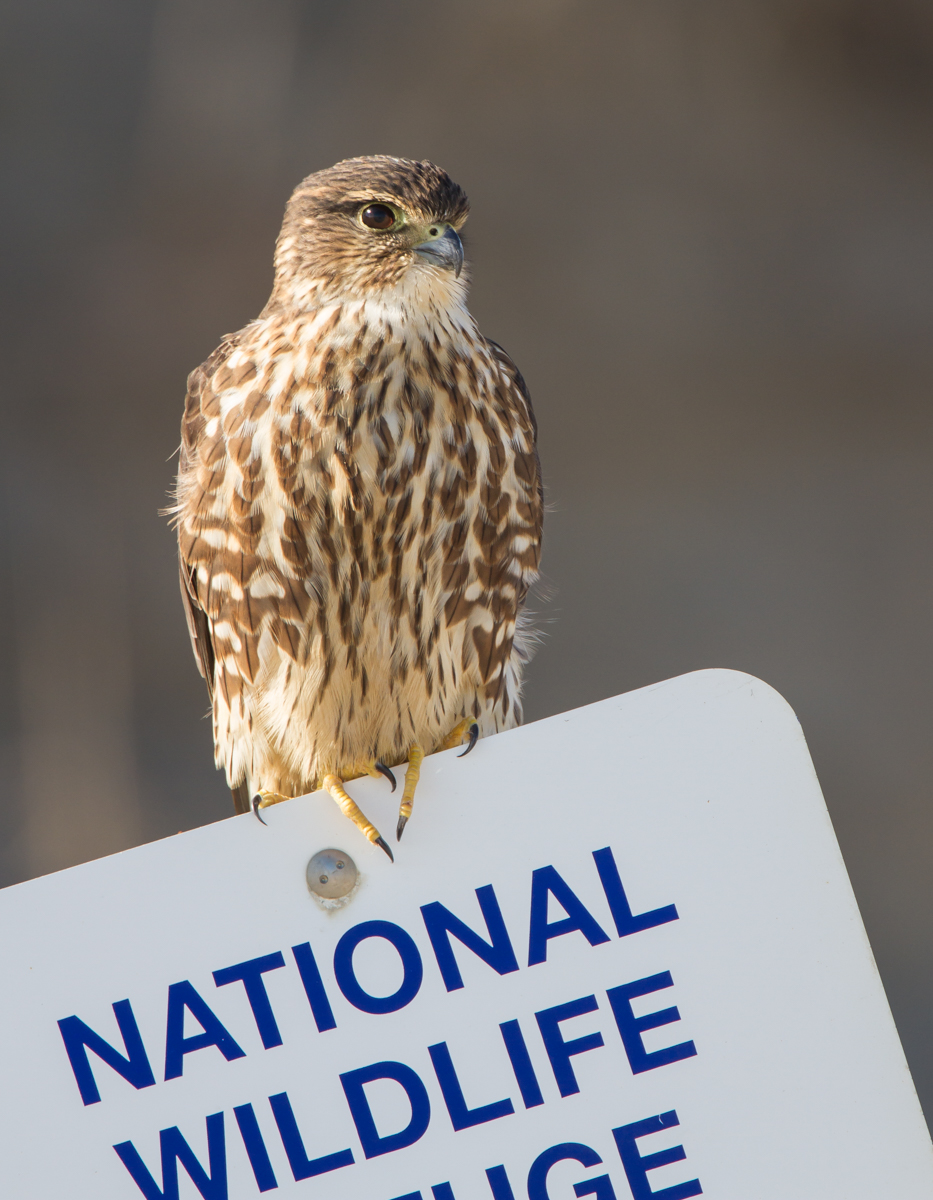
Wherever you meet this sign [National Wildlife Refuge sign], respect it. It means that the land behind the sign has been dedicated by the American people to preserving, for themselves and their children, as much of our native wildlife as can be retained along with our modern civilization.
Wild creatures, like men, must have a place to live. As civilization creates cities, builds highways, and drains marshes, it takes away, little by little, the land that is suitable for wildlife. And as their space for living dwindles, the wildlife populations themselves decline. Refuges resist this trend by saving some areas from encroachment, and by preserving in them, or restoring where necessary, the conditions that wild things need in order to live.
~Rachel Carson
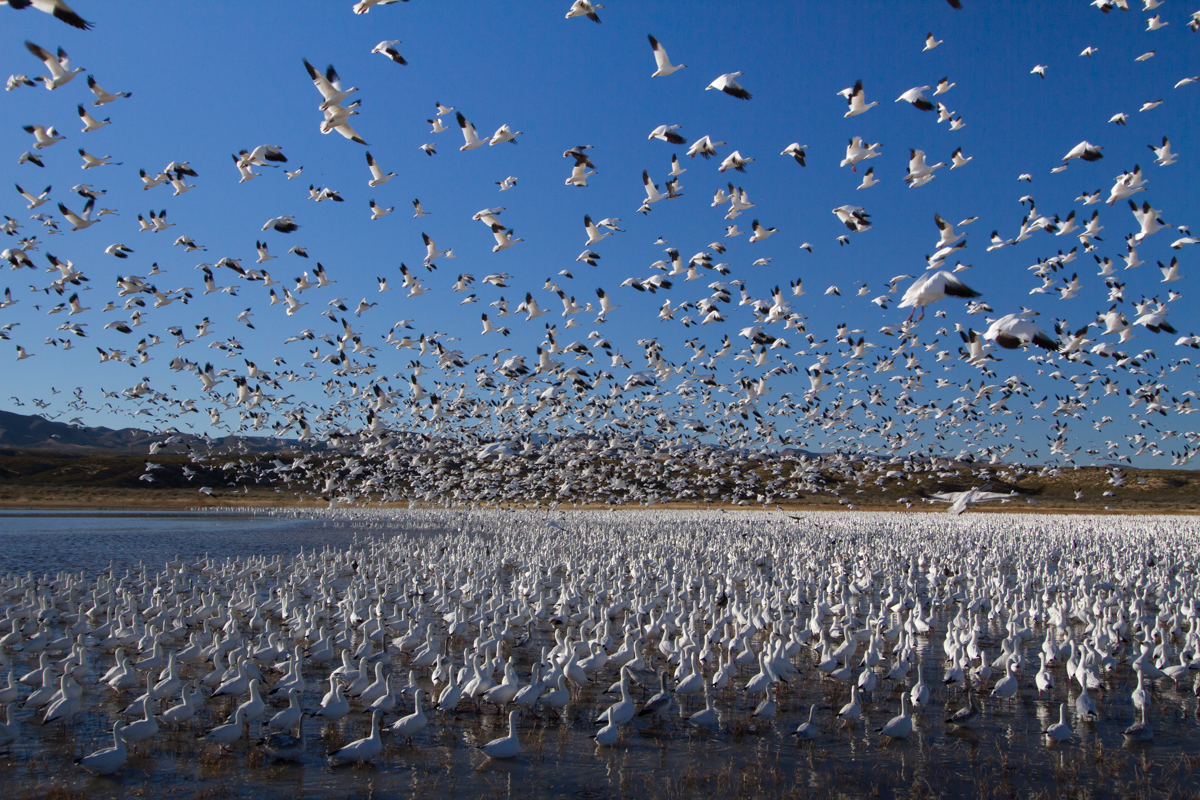
Snow Geese at Bosque del Apache NWR, NM
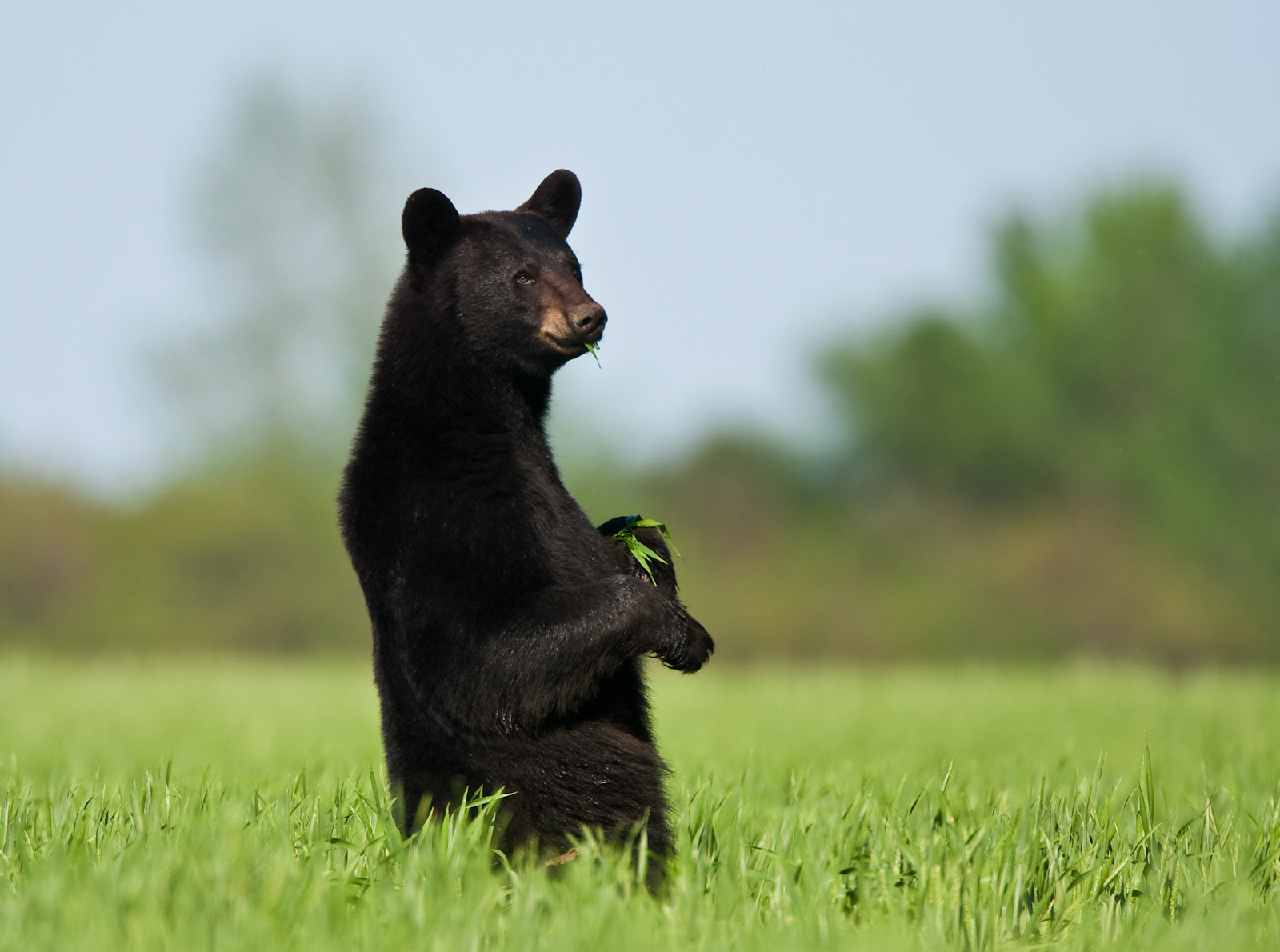
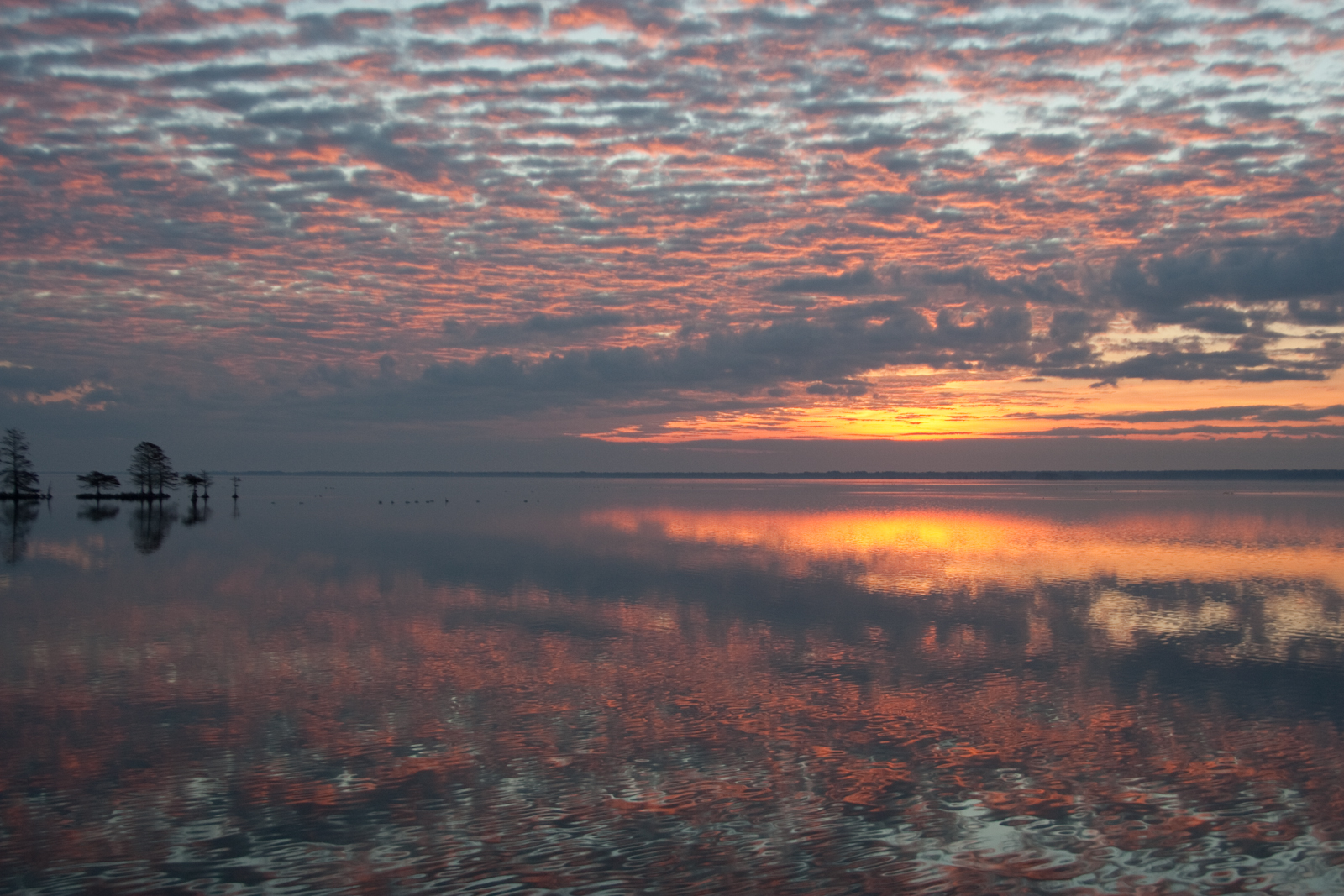
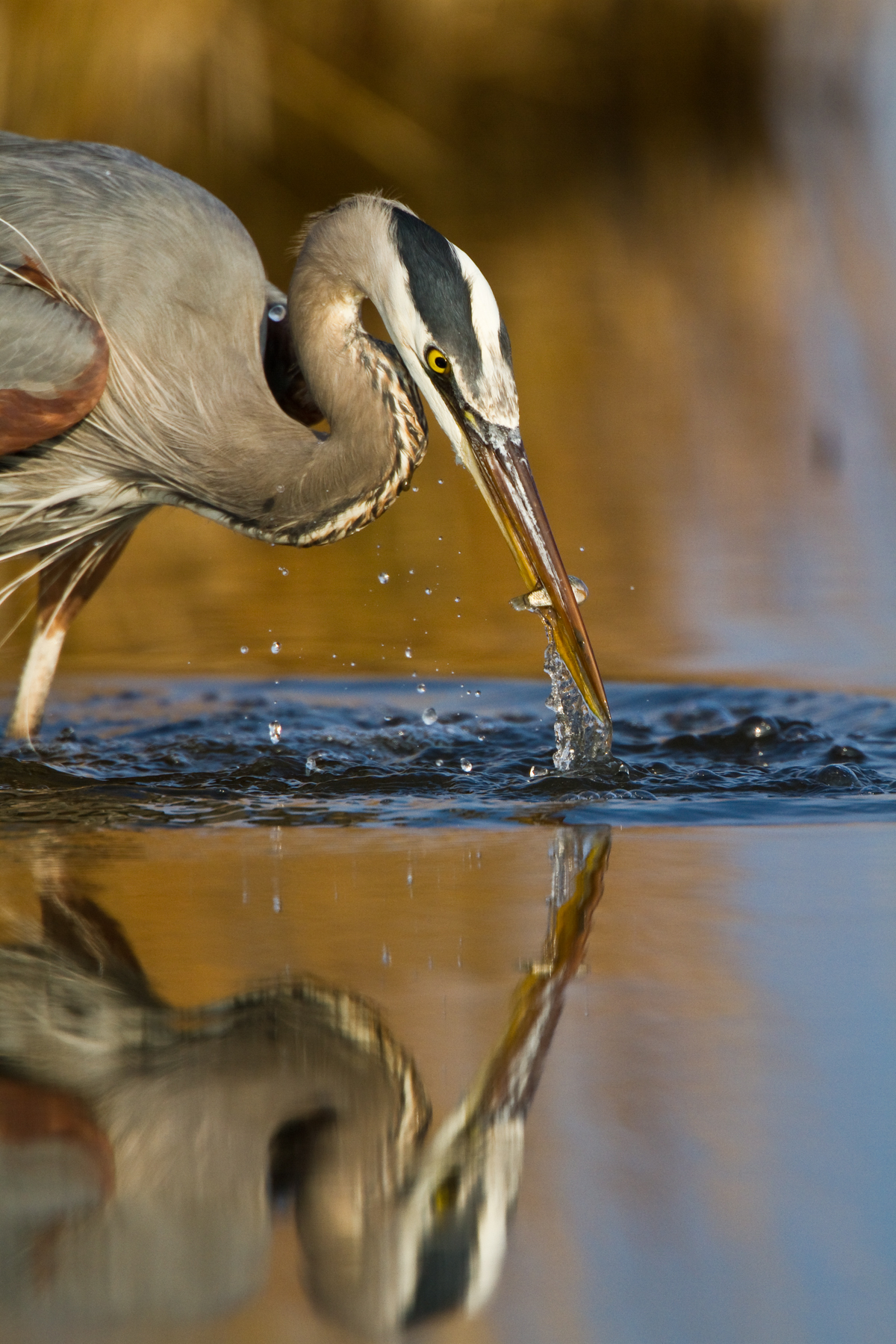
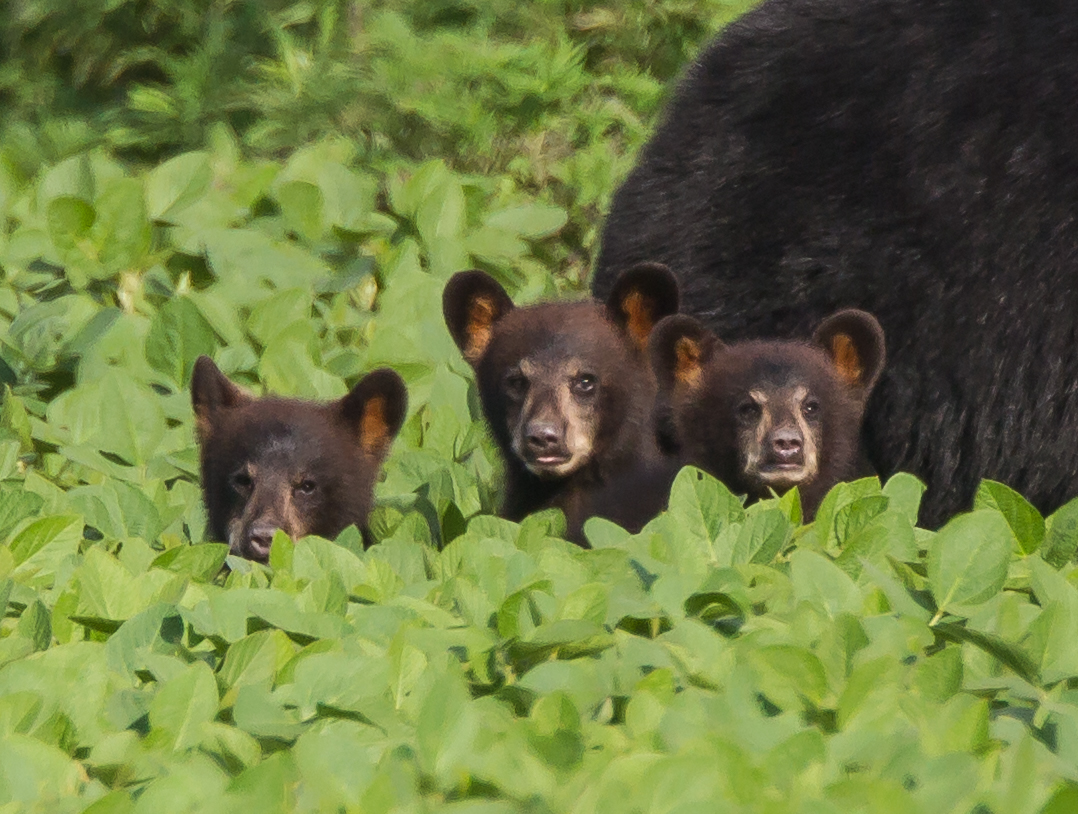
I never realized how special the month of March truly is…of course, much of the nation is caught up in so-called March Madness right now with the end of the regular college basketball season. Now, I like college hoops as much as the next person, but, given my preferences, I would probably rather be in some remote place enjoying wildlife or hiking or just being outside. And it turns out March has been a very important month in our history for people like me, people that enjoy using our public lands of parks and refuges. March 1 was the birthday of Yellowstone National Park, and therefore of the National Park System. March 3 was the birthday of Mt. Mitchell State Park and of the North Carolina State Park System, a former employer of mine, and the caretaker of many of our state’s premier natural landscapes. And I just found out that March 14 is the birthday of the organization that presides over my other favorite group of natural settings – the National Wildlife Refuge System – our refuge system turns 112 years old today. By Executive Order of March l4, l903, President Theodore Roosevelt established Pelican Island National Wildlife Refuge, along Florida’s central Atlantic coast, as the first unit of the present National Wildlife Refuge System (NWRS). I am a huge fan of NWRS as you may have guessed if you follow this blog. My favorite wildlife watching spot in my home state is Pocosin Lakes NWR, and I have shared the wonders and beauty of this wild place with hundreds of people over the years. But our public lands are facing many threats, from budget cutbacks to environmental challenges, and in our age of increasing population and increasing development pressures on our wild lands, the mission of the NWRS is becoming more critical to the wildlife they protect and to our own well-being. In honor of their birthday, I am sharing a few of my favorite images taken at refuge units in recent years. I encourage everyone to get out and visit a refuge (or several) in the coming months. I intend to do just that, so stay tuned. Happy birthday to a very good idea.
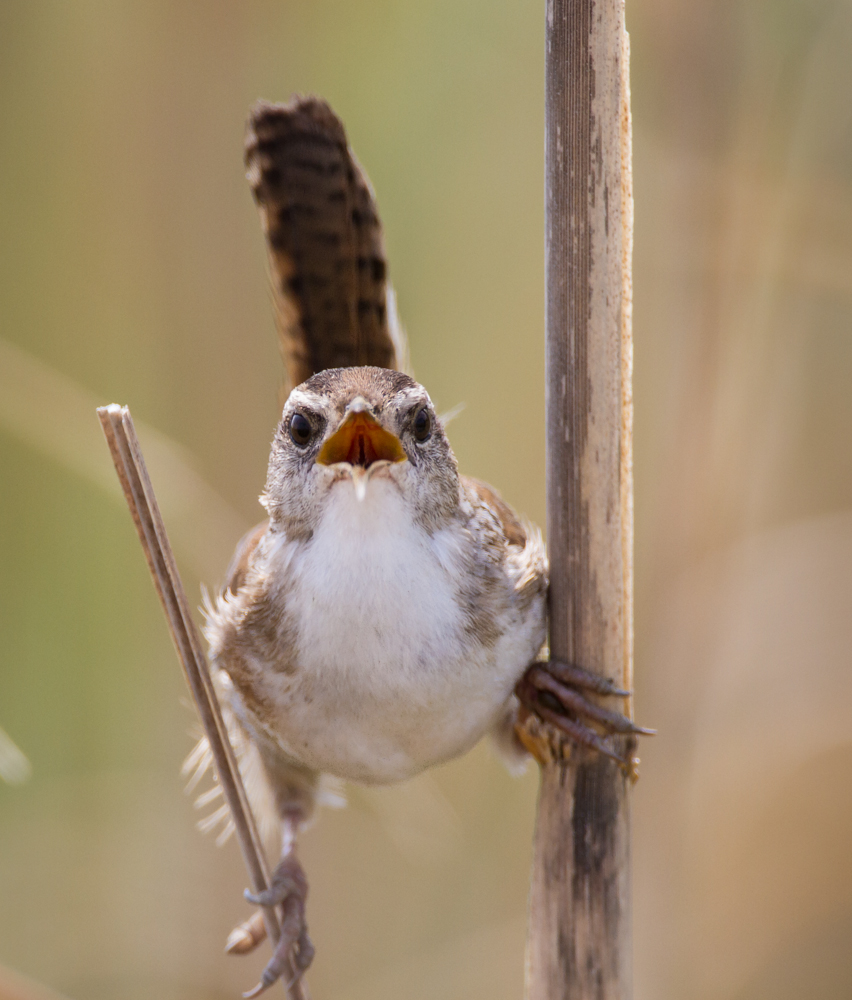
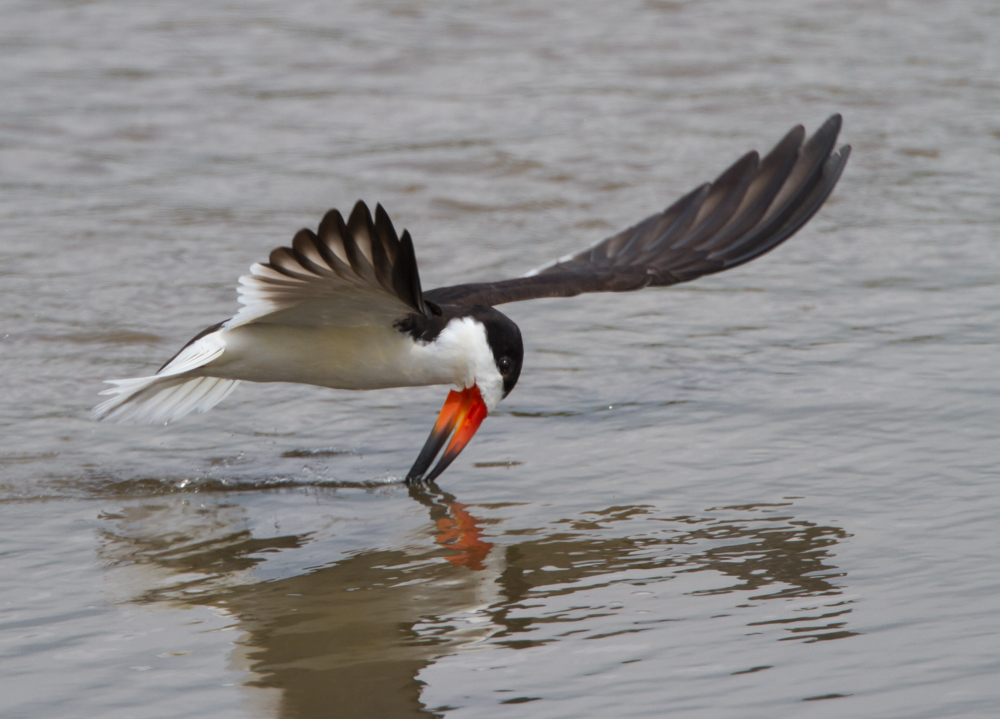
Black Bear in wheat at Pocosin Lakes NWR, NC (click photos to enlarge)Sunrise at Mattamuskeet NWR, NCGreat Blue Heron strike at Chincoteague NWR, VAMerlin on refuge sign at Currituck NWR, NCBlack Bear cubs at Alligator River NWR, NCRoseate Spoonbill and Northern Pintails at Merritt Island NWR, FLSandhill Cranes landing at sunset at Bosque del Apache NWR, NMMarsh Wren singing at Bombay Hook NWR, DEBlack Skimmer at Edwin B. Forsythe NWR, NJ
A change in the weather is sufficient to recreate the world and ourselves.
~ Marcel Proust
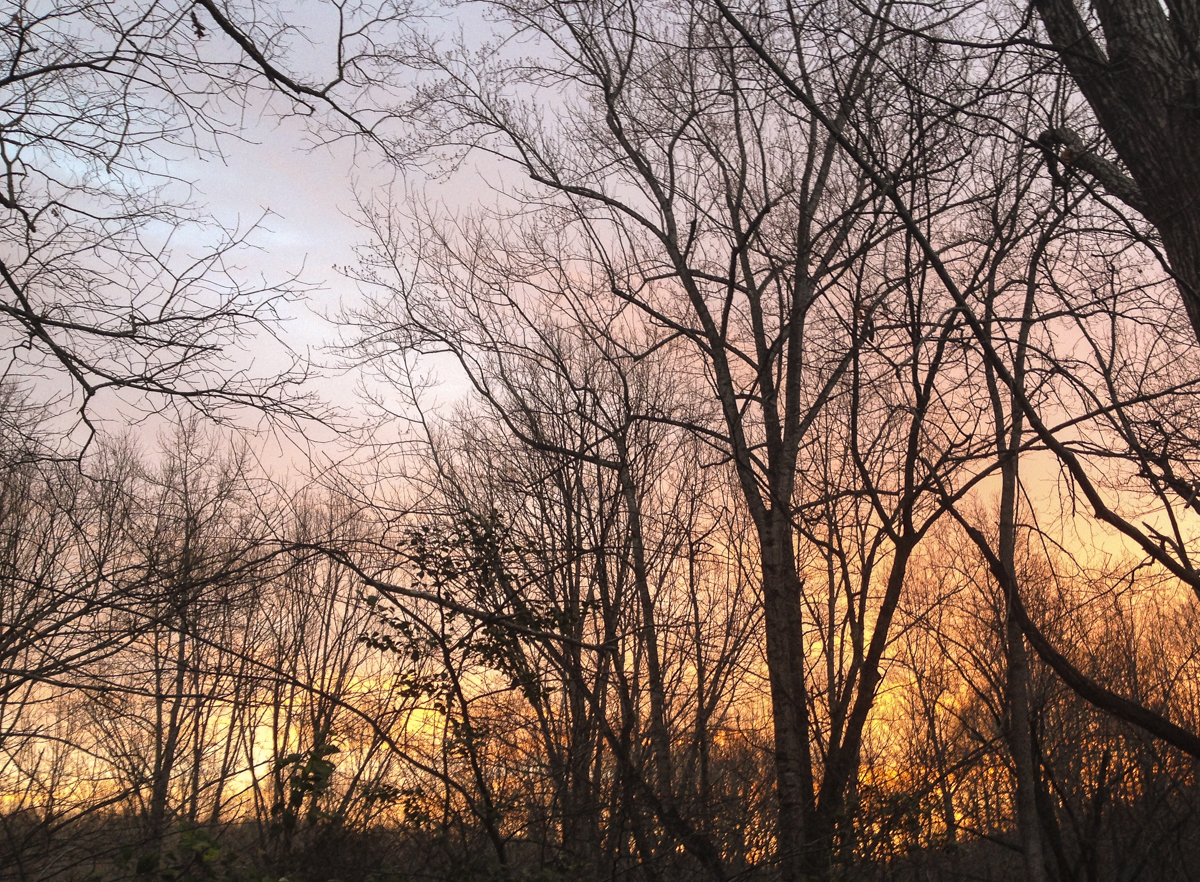
Red sky in morning, sailors take warning (click photo to enlarge)
It lasted only a few minutes…starting as a flame of orange in the East, then spreading and growing in intensity to become a contrasting backdrop to the black lines of the trees. Within 15 minutes, it started to fade. Sleep late, or sip coffee while glancing at an electronic glow, and you might have missed it. But it foretells a change, one that ancient mariners knew, and one that the amphibians in the pool in the yard will undoubtedly take advantage of this evening.
The flowers of late winter and early spring occupy places in our hearts well out of proportion to their size.
~Gertrude S. Wister
The change in our clocks this past weekend is one of the ways most of us know that spring is on the way in spite of the cold the past few weeks. Another are the first truly warm days like we are now having. But, for me, I know it is spring when I discover the first wildflowers of the season in our woods. One of the earliest is one of my favorites, the diminutive Spring Beauty, Claytonia virginica.
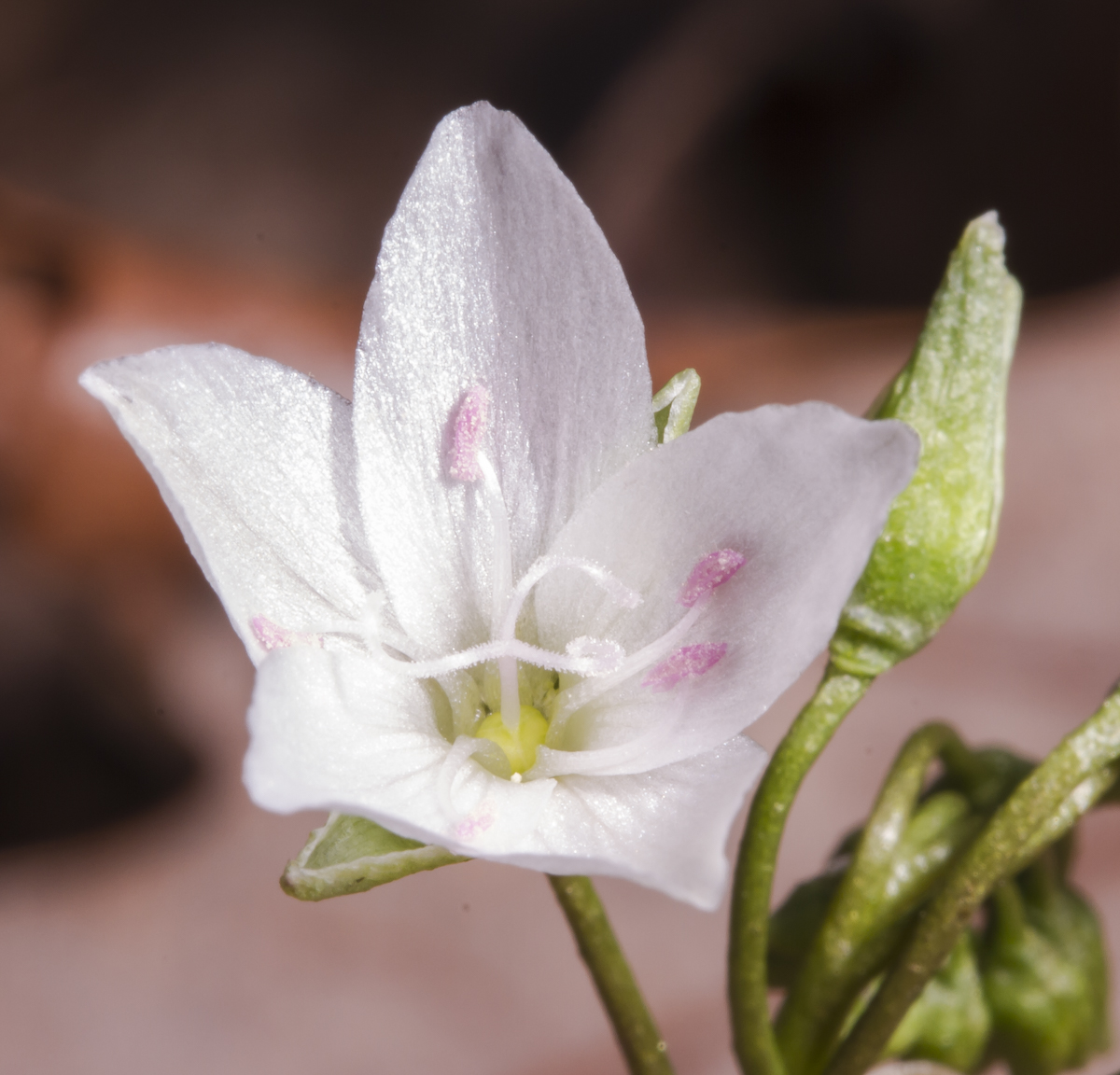
Spring Beauty (click photos to enlarge)
I saw this one yesterday afternoon, just barely poking its flower head above the leaf litter as I was walking through the yard. I immediately stopped and thought, it really is Spring! I got down on my hands and knees to take a closer look at the delicate beauty of the plants’ five petals. The petals can be quite variable, ranging in color from white to pink, but almost all have pinkish lines which appear to converge on the center of the flower. My flower has very faint lines, the so-called “bee guides”, which pollinators can see better than us. Research has shown that these lines on flower petals are used to guide the pollinators to the nectar when they visit a flower. A small ground-nesting bee collects the pollen from this plant and feeds it to its larvae. The aptly-named Spring Beauty Bee, and a few other species of small insects (especially a species of Bee Fly around here) are the primary pollinators.
And the pollen is quite noticeable on this species of flower – it is pink. You can see the pink pollen in the pollen baskets on the legs of the Spring Beauty Bee as it goes from plant to plant on warm, sunny days. The flowers tend to open mid-morning and close by late afternoon, and may remain closed all day on cloudy or rainy days. This helps preserve the pollen to increase the chances that a bee will visit on a sunny day and cross pollinate the plant.
Spring Beauty is one of the earliest of our spring wildflowers
In addition to the beauty and complexity of the flowers of Spring Beauty, it also has an edible small tuber which is quite tasty to us, and a variety of wildlife. It is a great small plant for your home garden as it is deer-resistant. It can add a splash of color to your woodland garden for a few weeks each spring, before the whole plant goes dormant. It then remains most of the year as only an underground tuber until you need another pick-me-up glimpse of a delicate spring flower after next year’s long winter. This tiny, often overlooked flower, is a perfect example of why we all need to become more aware of our native species and why we should try to plant local natives whenever possible. In today’s New York Times, there is a great op-ed by native plant guru, Doug Tallamy, on why natives are important, Take a look, it is a good read. Then get outside and learn more about native plants in your area, and consider planting some for yourself, and for your local wildlife.
There is something that can be found in one place. It is a great treasure which may be called the fulfillment of existence. The place where this treasure can be found is the place where one stands.
~Martin Buber
Indeed, there are beauties all around us, so it really doesn’t matter where you stand, or live. I have not posted as much lately as I would have liked, and one of the reasons is that I have changed that place where I will stand and live. It is not far from my beloved Roads End (yes, I really did live at the end of Roads End, hence the name of this blog) and it, too, is a place of beauty, but without quite as much habitat diversity as the power line corridor at Roads End provided. The woods are older here, comprised mainly of towering Tulip Poplars, White Oaks, and various hickories. One added natural feature is that there is a little water here – some woodland pools and an intermittent wet-weather stream. With that, and the appropriate upland habitat, comes a special group of animals.
Spotted Salamander egg mass (click photo to enlarge)
I had seen a few Spotted Salamander egg masses in the pool right before all the cold weather hit and was anxious to see how they would fare after their home was frozen for the past 2+ weeks. Since the female salamander had attached most of the egg masses to twigs well below the water surface, almost all of the eggs seem to have survived quite well. I lifted one of the twigs to show the egg mass for the photo above. This is a great sign of things to come here in these woods.
And, as if to help in the transition, there have been a few other special wildlife moments – a Red Fox trotted through the woods behind the house during the snow; a Barred Owl was hunting one morning in some trees near the porch; and this morning when I drove in, an adult Red-shouldered Hawk flew from a perch above the salamander pool. The hawk was surveying this mini-wetland for a possible amphibian meal, no doubt. All good signs indeed of the treasures to come. Now to capture some with my camera. Stay tuned…
But if one steps off the road, even a few hundred feet, and listens, there is a calm to the land, a certain wild rhythm that is closer to the surface than in most places.
~Renee Askins, speaking of Yellowstone
My favorite place had a birthday this week. On Sunday, March 1, Yellowstone turned 143 years old. Looking pretty good for that age, I must say. It was the beginning of what Ken Burns called, America’s Best Idea, the National Park System. Help me celebrate this grand idea by joining me on an unforgettable outing this June in Yellowstone National Park. Details are available on my Trips page. There are still spaces in both trips, but I will need to finalize details soon. Please contact me for additional information or to request a registration form. And please share this with others you think might be interested. Join me, step off the road a ways and listen, feel that calm and wild rhythm for yourself.
Here are a few more images to whet your appetite…
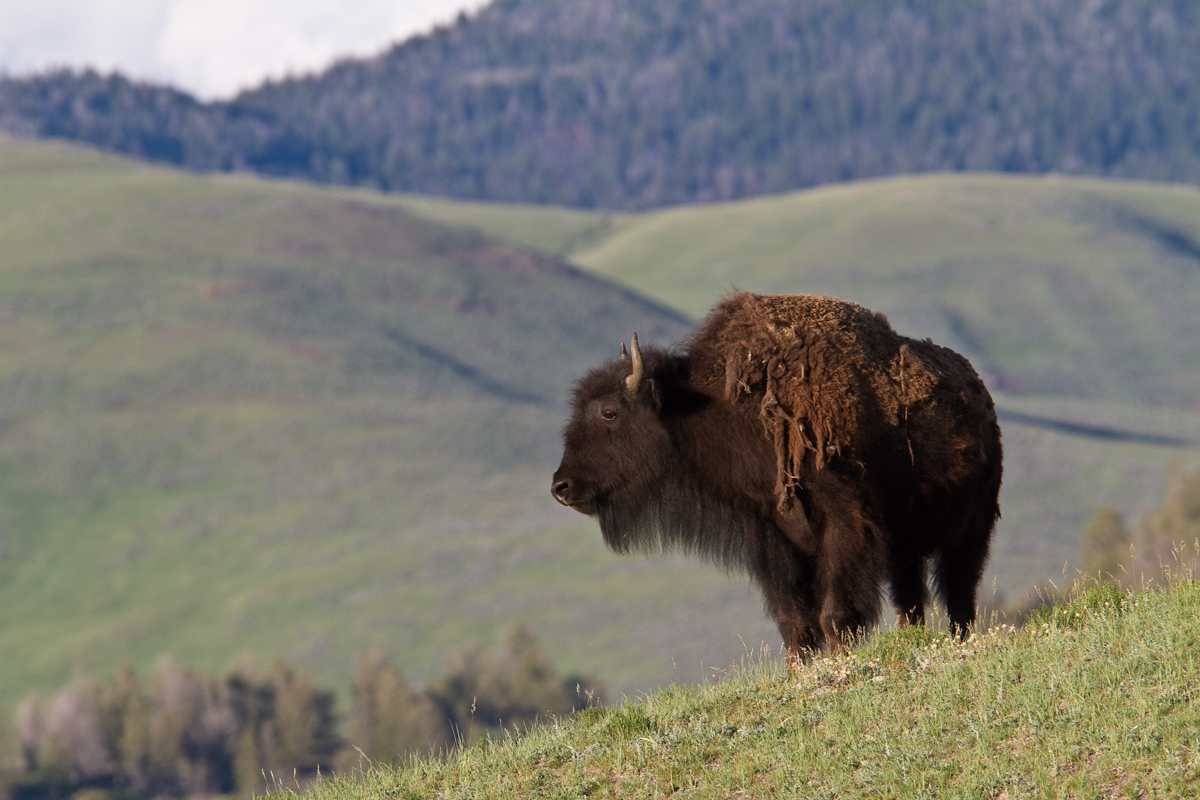
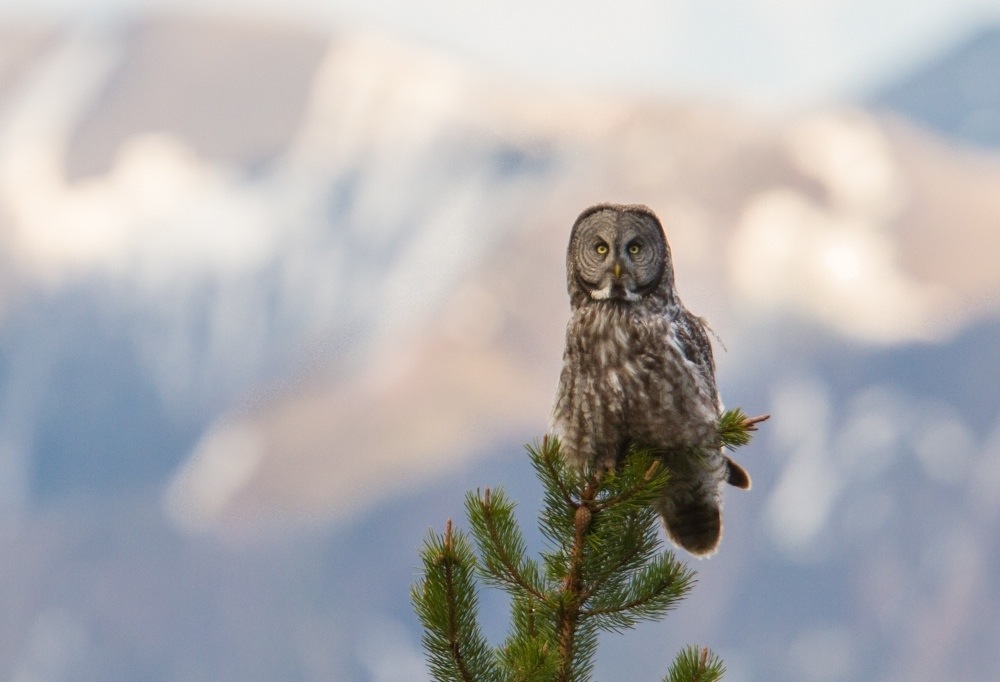
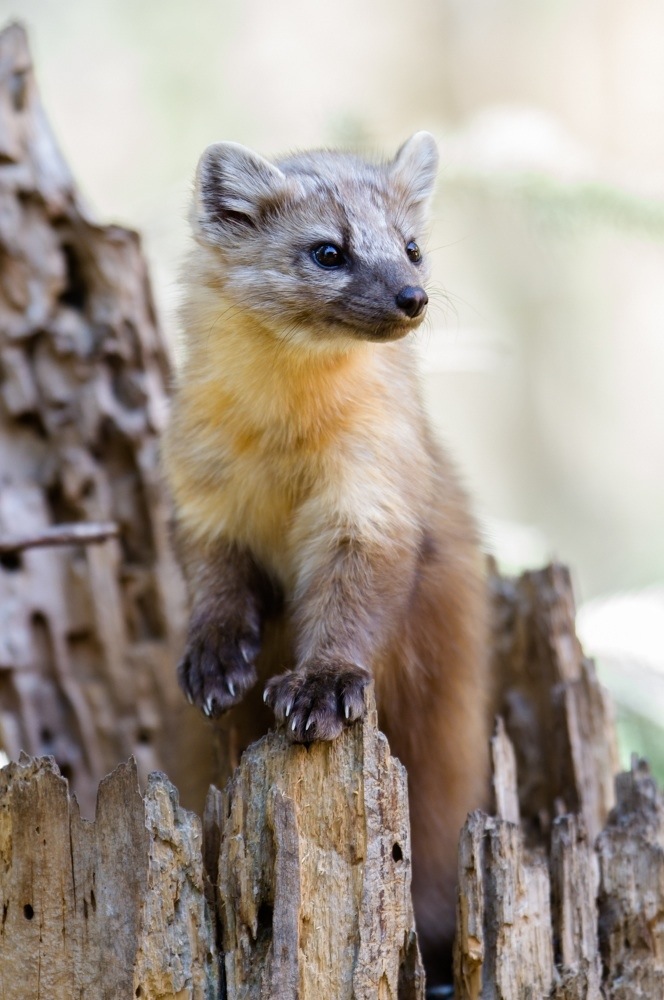
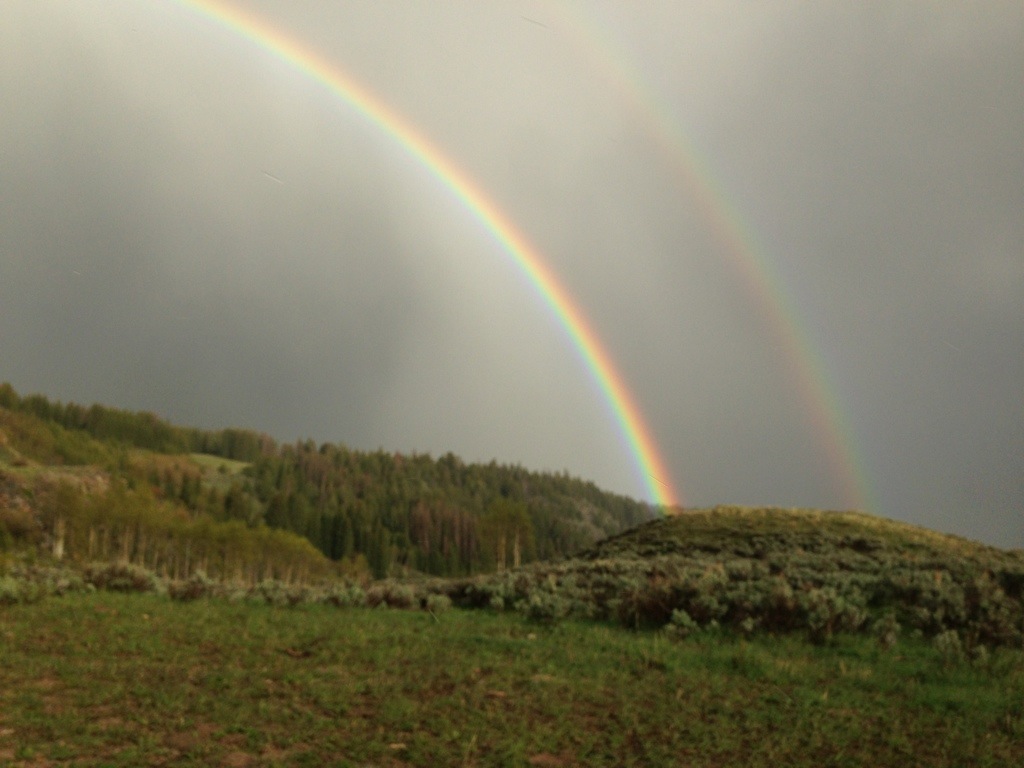
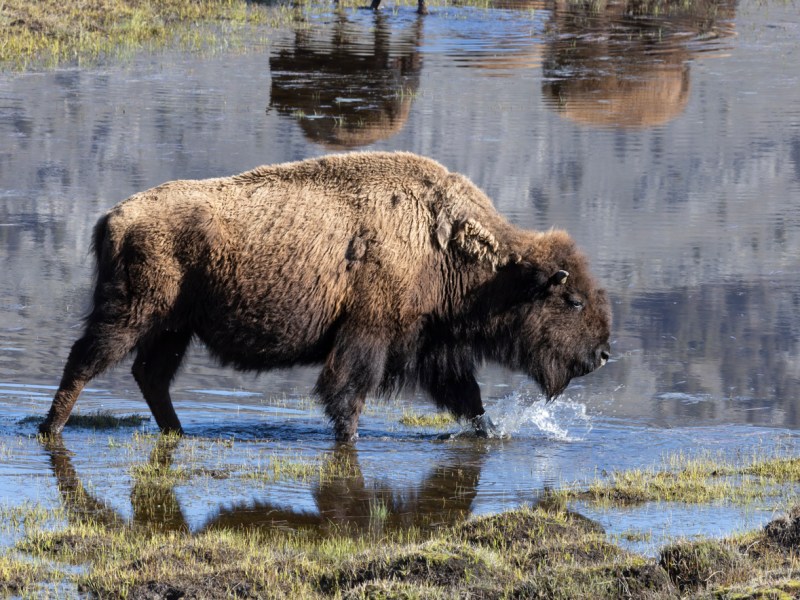
Foggy sunrise in Hayden Valley (click photos to enlarge)Yellow-headed BlackbirdGray Wolf departing Elk carcass with a scrapCastle GeyserBison in Little AmericaGray Wolf at Soda Butte CreekMountain Bluebird at nest cavityElk skull and antlersBull Moose browsing on aspen saplingsHarlequin Ducks at LeHardy RapidsGreat Gray OwlPine MartenDouble rainbow near Mammoth
Only with winter-patience can we bring the deep-desired, long-awaited spring.
~ Anne Morrow Lindbergh
I think I should have been more precise in my wishes in my last post, Until Next Winter….what I meant to say was I can’t wait until next winter at Pungo. I think I have had enough of whatever is happening out there right now here in the Piedmont and many of us are getting thin on our winter-patience. The snow this week was nice, although it prevented travel for many in this neighborhood because of icy roads, especially on the shady hills. But the freezing rain this morning, and now the cold rain, well, I could use a break from this as I am sure most of you could.
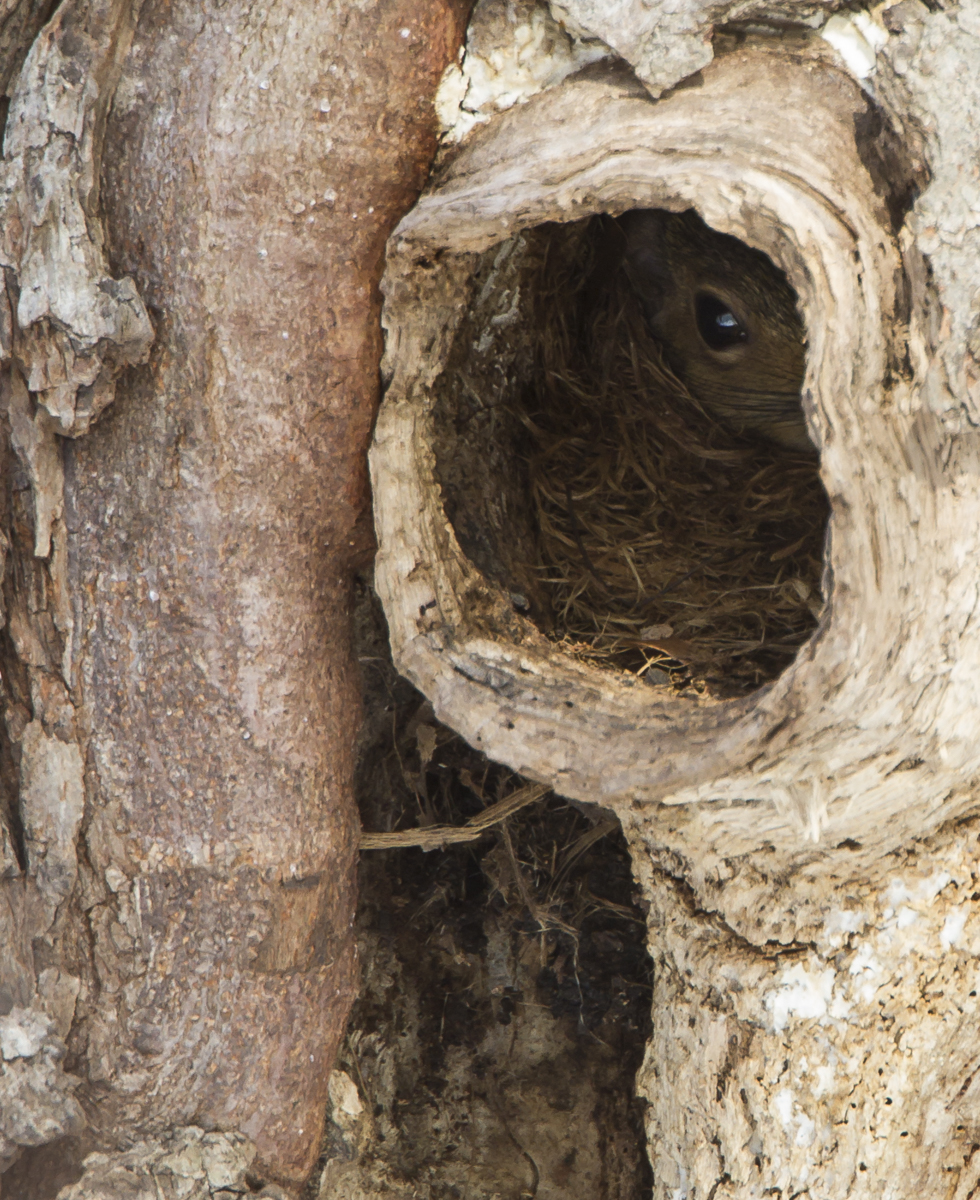
Cavity in maple tree (click photos to enlarge)
Yesterday afternoon I went out looking for a photo opportunity and ran across this cavity in a maple tree out front. I have seen squirrels running in and out on occasion, so I decided to wait awhile and see what might happen.
Gray Squirrel peeking out of tree cavity
After about 20 minutes, a tiny head popped out of the hole and stared blankly at the outside world. A young Gray Squirrel surveyed the scene, probably thinking the same thing I was…boy, it’s cold out here.
Squirrel glances at me
The squirrel then turned and faced me for a few seconds, no doubt wondering what I was doing out in these conditions.
Squirrel retreats inside nest cavity
The youngster quickly retreated back into the warmth of its shredded bark-lined domicile inside the safety of the tree trunk. I then heard that raspy chirring tone they use when upset. I’m not sure, but I think it was saying, enough already…I am guessing it had heard the forecast for today.

















 Roads End Naturalist