Bird migration is the one truly unifying phenomenon in the world…
~Scott Weidensaul
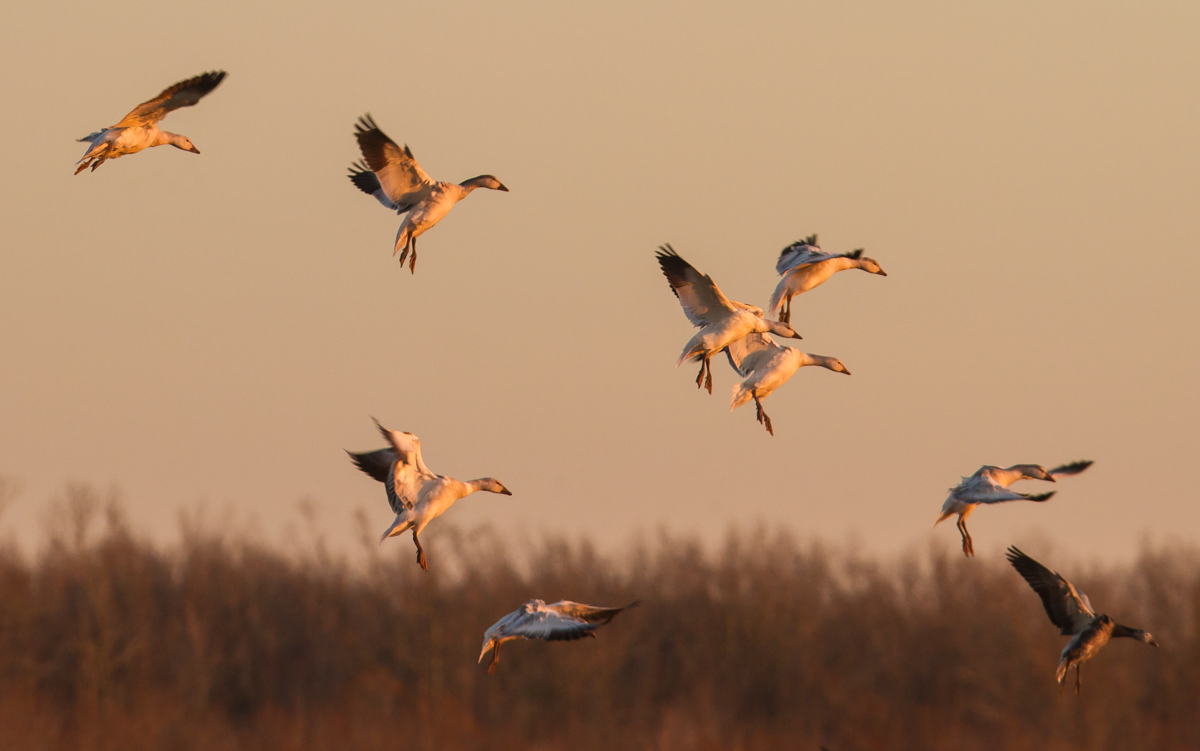
Snow Geese landing in a corn field on their wintering ground at Pocosin Lakes NWR (click photos to enlarge)
Having been stuck in the Piedmont the last two weeks with other priorities, I imagine the Snow Geese have left their winter home at Pocosin Lakes NWR and started their long journey north. The Tundra Swans have probably started as well, but my guess is that some are still hanging around with all this cold weather we have had lately. But, soon, they will all be gone, not to return until next winter. On a recent trip, some of the local weather experts, the trees, were telling me it was almost time for the birds to leave.
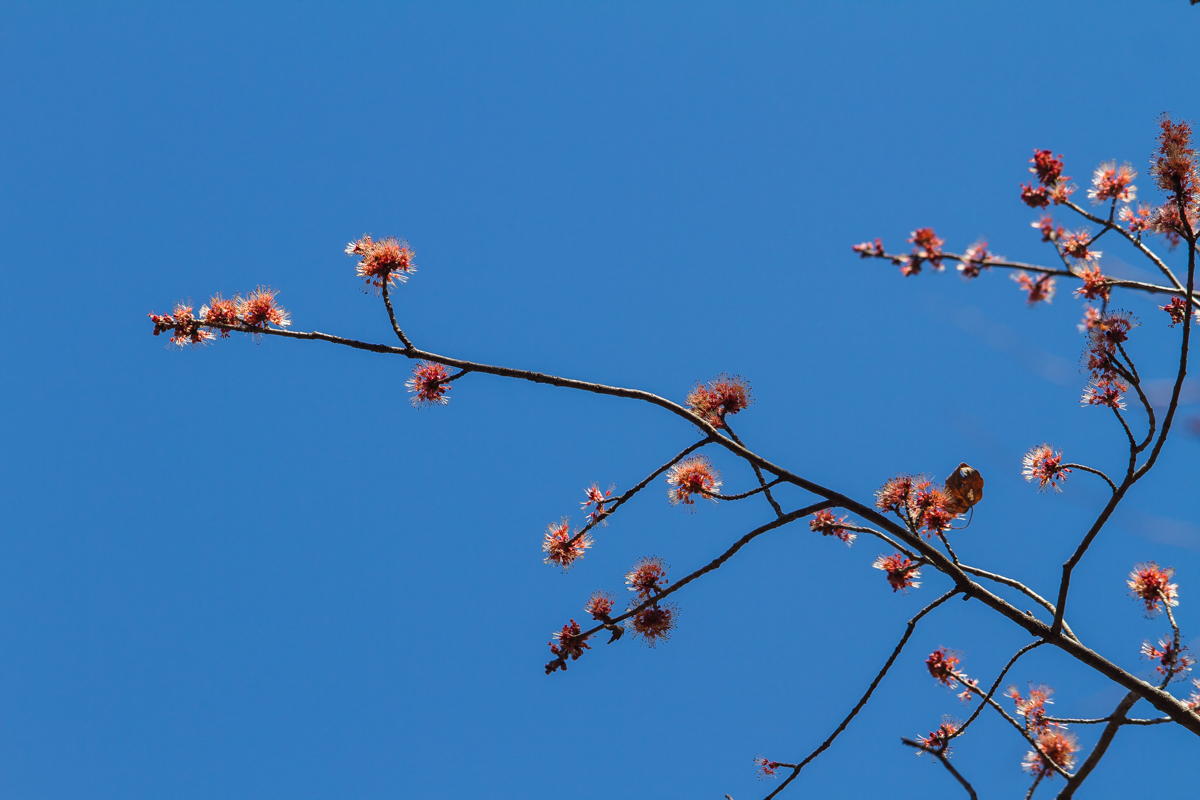
Red Maple flowers
And when the Red Maple flowers start to bloom, it won’t be long until the frogs are calling (actually, we heard some back in January) and the winter waterfowl start winging their way to the breeding grounds. So, as I sit here in the Piedmont on a snowy day when others are wishing for the sixty degree days of early Spring, I am thinking of the first cold blasts of air in November and December next year that will bring with them the amazing birds of winter.
Here is a short video of the last flock of Snow Geese I saw this winter, shot on my last trip two weeks ago, They remind me of animated snow flakes falling into the corn field…I hope those of you that are sick of the cold, ice, and snow can forgive me, but I can’t wait until next winter.
The sky is that beautiful old parchment in which the sun and moon keep their diary.
~ Alfred Kreymborg
Sunrise at Pungo Lake (click photos to enlarge)
One of my favorite things about eastern North Carolina is the big sky (maybe that’s why I like Montana so much as well). And I have seen some wonderful big skies at Pungo this year, especially at sunrise…
Snow Geese in front of the moon in the golden light of sunset
…and sunset. And so it was on my last trip. The morning had been spectacular at the swan impoundment. I wasn’t paying much attention at first to the goings on in the sky as I was so focused on the swan silhouettes on the water in the orange-gold glow of sunrise.
Tundra Swan in early morning light
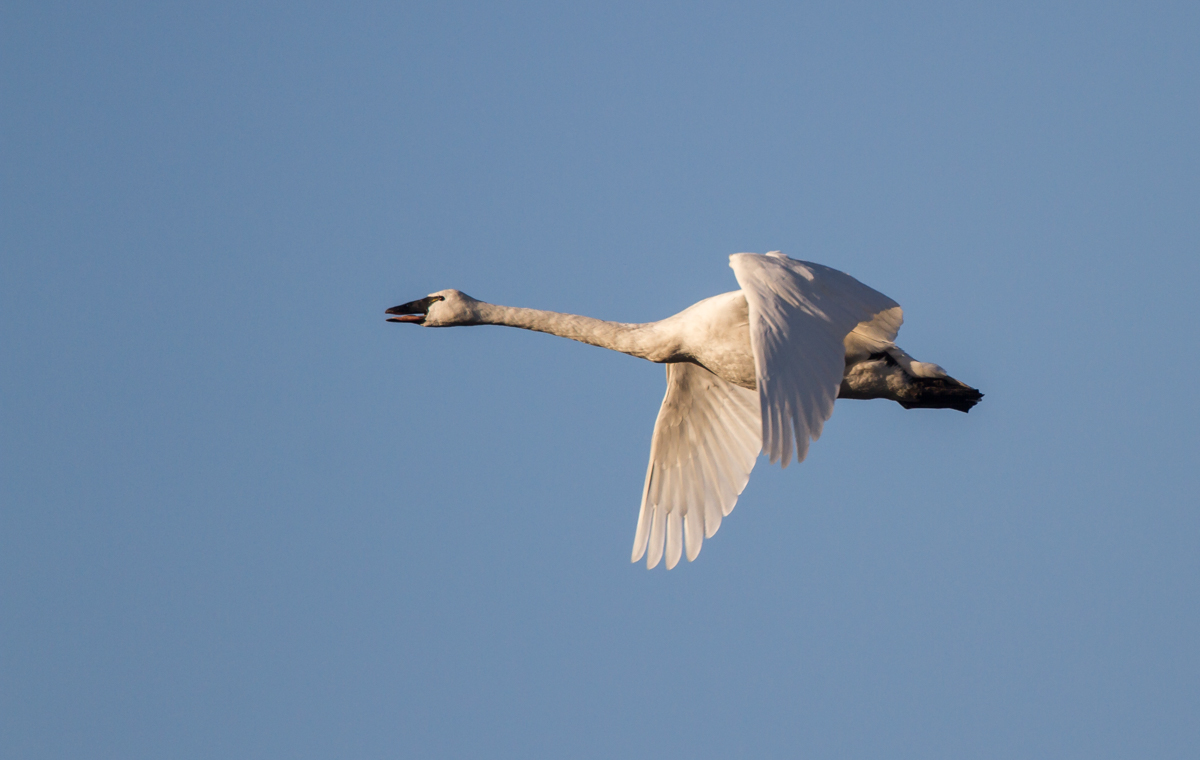
After photographing the swans swimming and preening, I finally turned my attention to those starting to fly out of an adjacent area. The last bits of golden light soon faded, but not before I caught an image or two with it bathing the undersides of a passing swan.
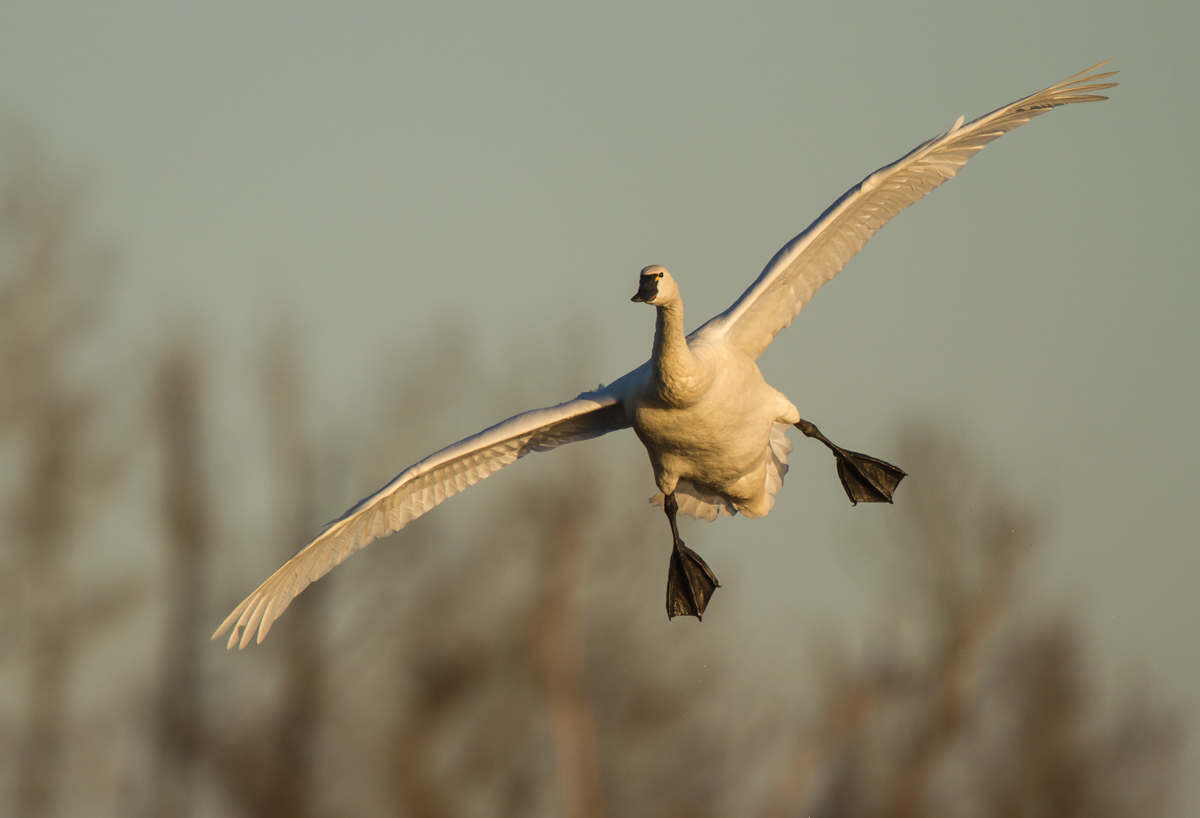
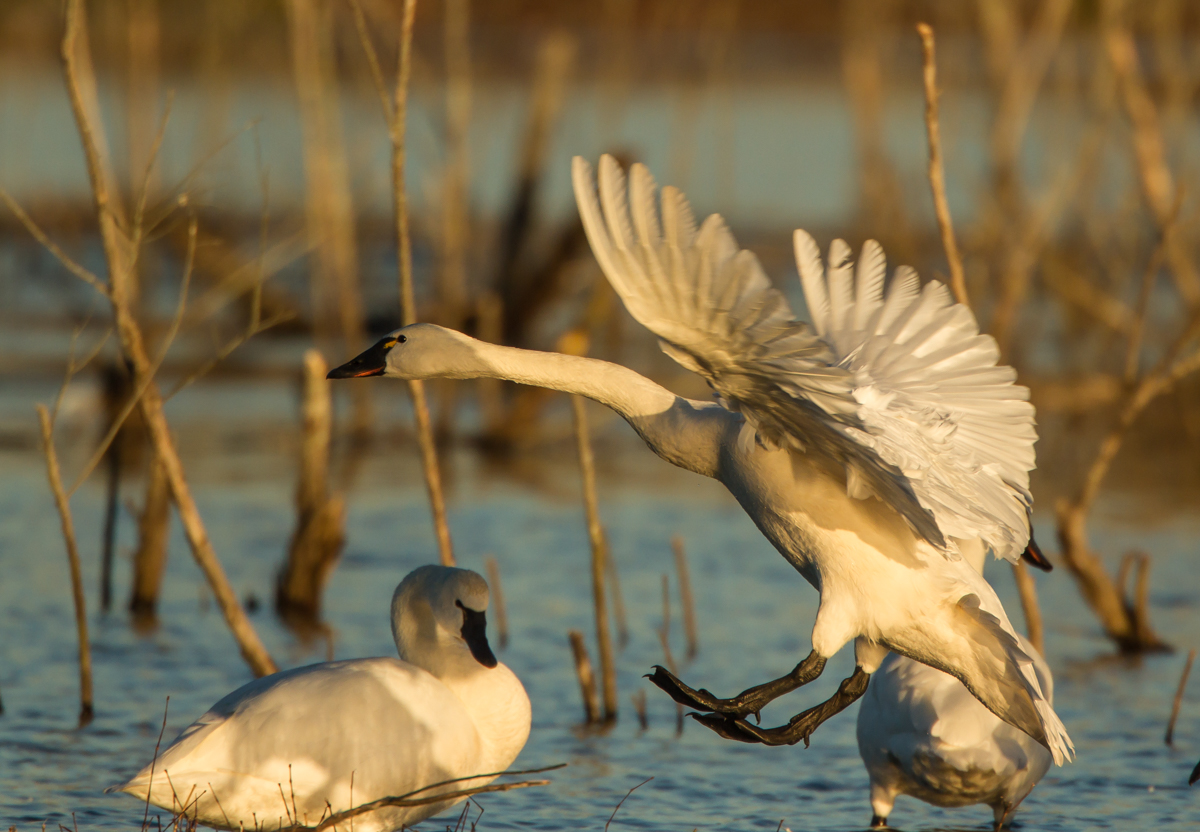
Swans coming in for a landing
High clouds soon moved in and the light changed dramatically. Now a few small groups of swans were starting to land in the impoundment to join the hundreds of others already enjoying the swan spa. I love to watch them as they prepare for a graceful touch down.
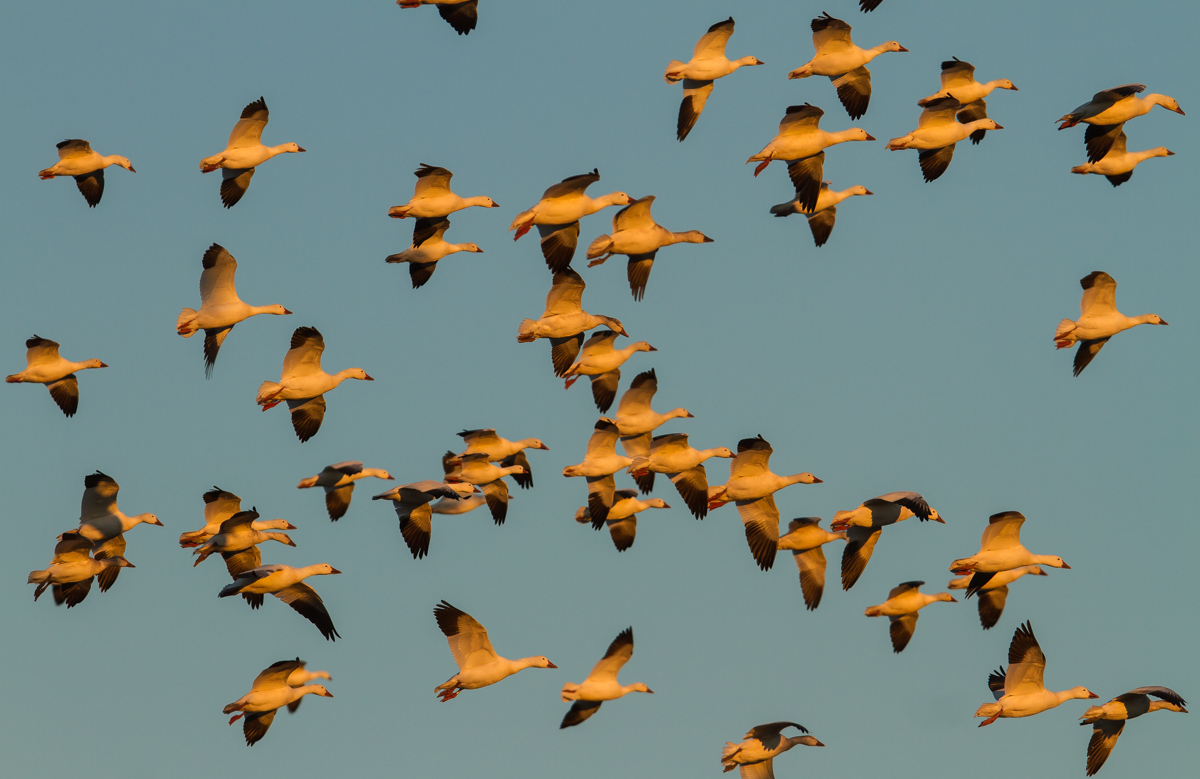
Snow Geese circling the field
I left to head towards a favorite area and was surprised to see no cars in spite of it being a beautiful (albeit cold) Saturday morning. The Snow Geese had already flown off the lake by the time I arrived and were circling the fields in their usual erratic attempt at settling down. I took a few shots as they circled far across the corn and then started walking down the road.
Snow Geese blasting off from corn field
Suddenly, they all blasted off with the distinctive whoosh sound of thousands of wings. I stopped, hoping to see what might have spooked them. It can be anything, or seemingly nothing at all. I scanned the field edge for bears and the sky for any sign of a predator.
It was hard to tell what had flushed the flock at firstThe Bald Eagle finally came out into clear view
One thing that will always flush the flock is an eagle. Finally, from behind the cloud of flapping white and black, a flapping black and white appeared – a Bald Eagle.
Bald Eagle lowering its landing gear
The eagle cruised past the scattering Snow Geese and seemed intent on a particular spot on the ground in between the rows of standing corn. I had seen a few vultures in that area when I had walked by, and the eagle dropped down in the same area and disappeared behind the corn. Undoubtedly, the vultures and eagle had found a carcass of some sort.
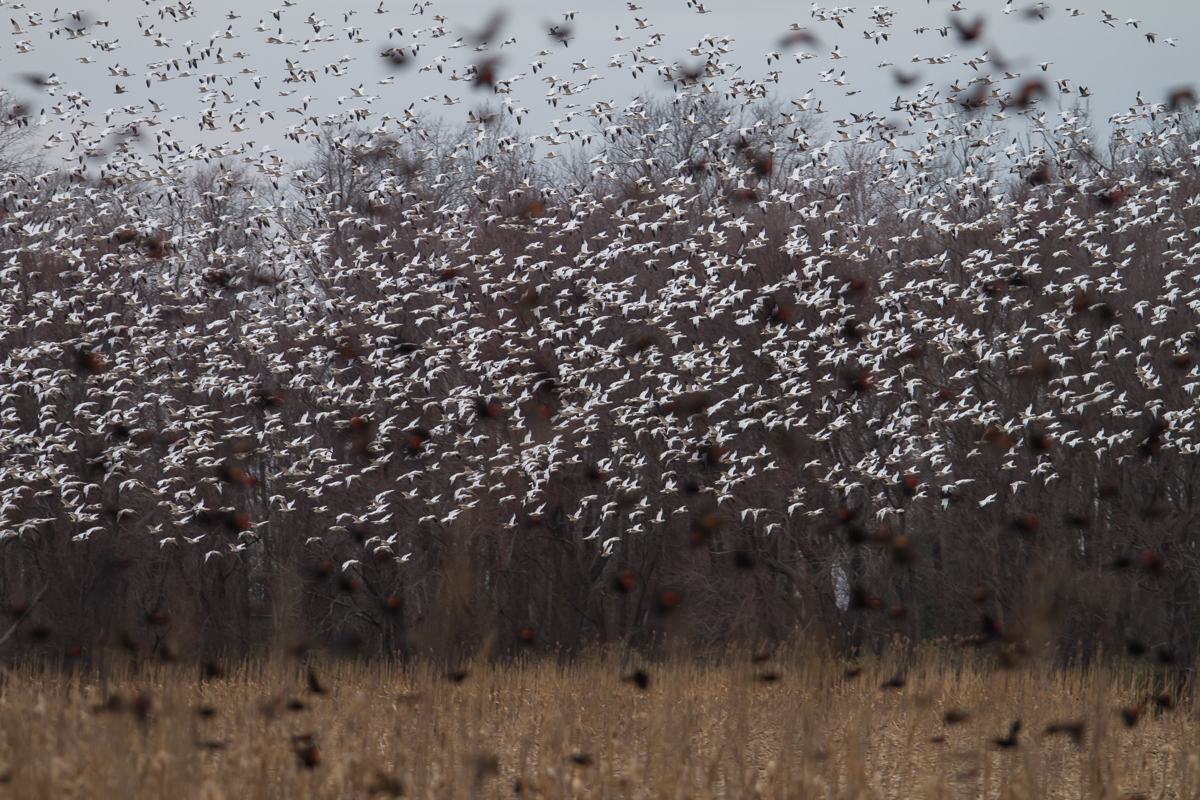
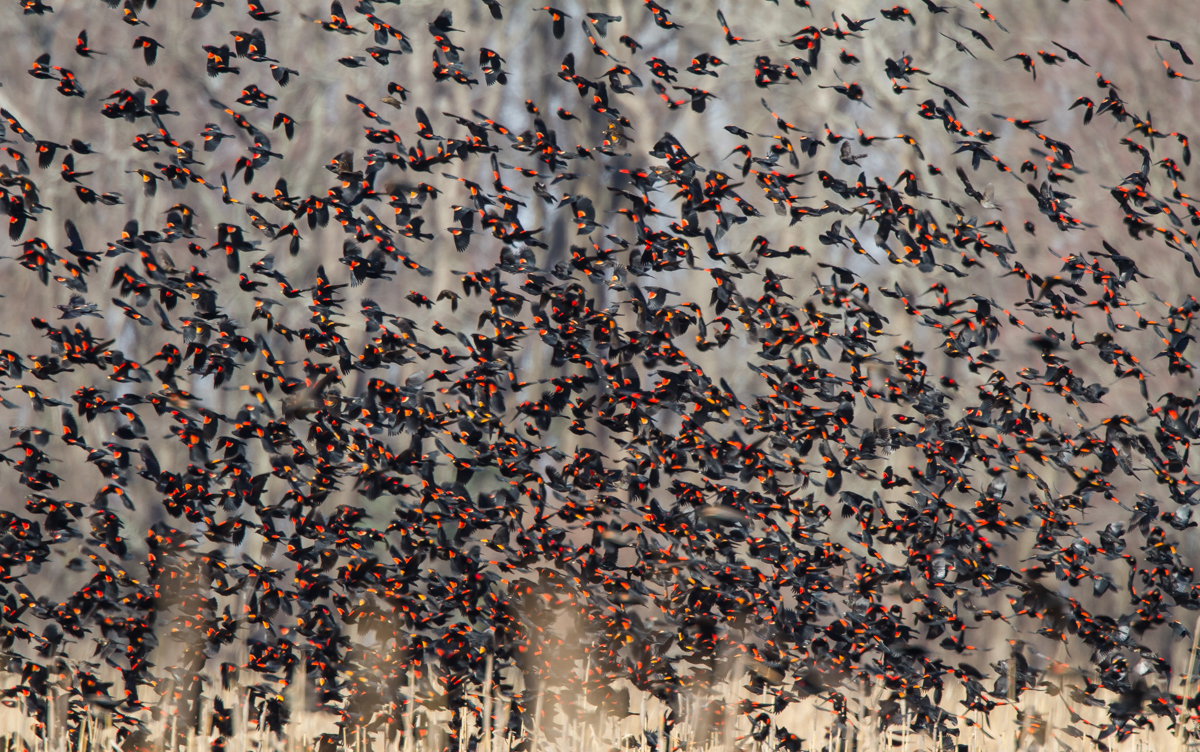
Red-winged Blackbirds in dense flockSnow Geese and Red-winged Blackbirds
Now a new flock was added to the aerial commotion – Red-winged Blackbirds. The sky was soon a swirl of tiny black spots and noisy white blobs.
Red-winged Blackbirds showing their flashy sideRed-winged tornado
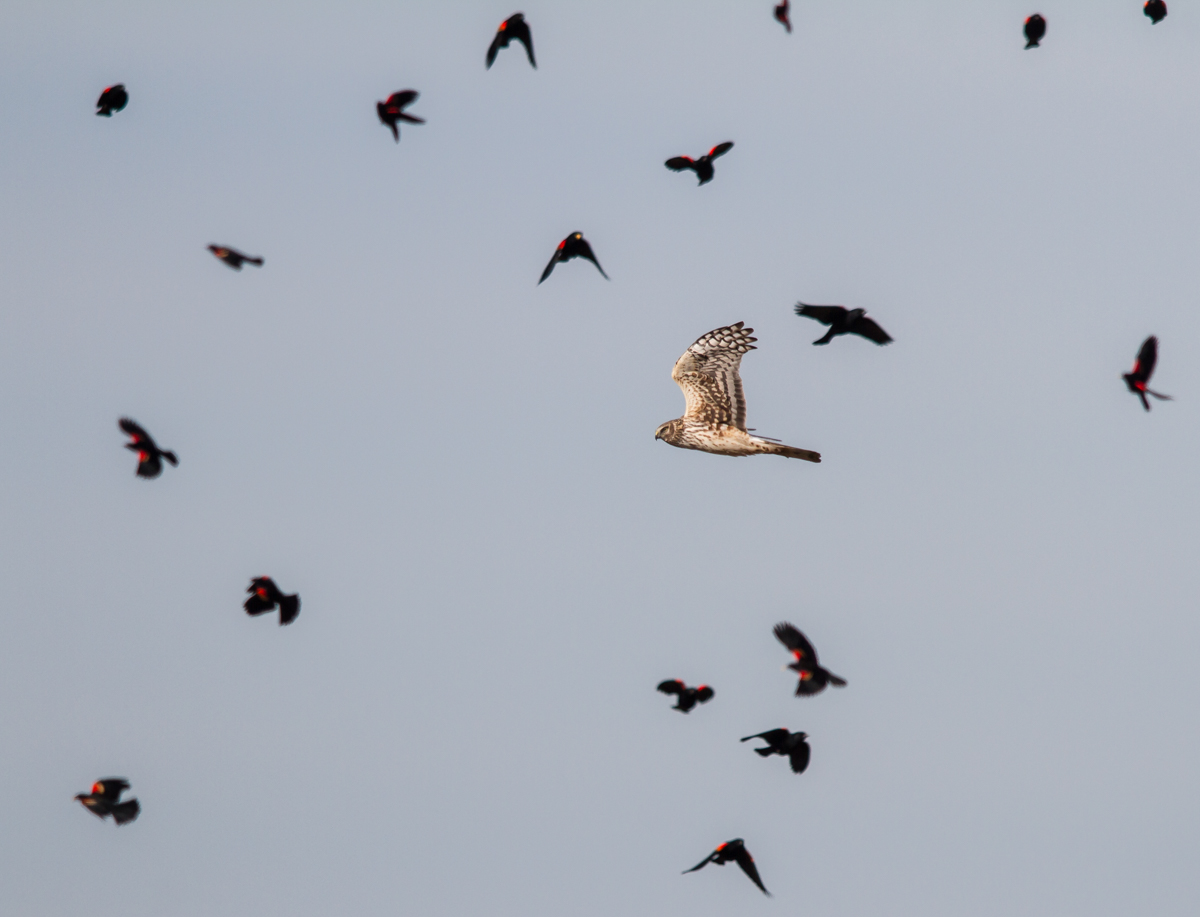
These huge flocks of Red-winged Blackbirds (and usually some other species mixed in) are one of my favorite things about Pungo in winter. There were probably close to ten thousand birds sweeping across the corn, and flying to and from the trees. The sound was incredible. And every now and then a tornado of red wings erupted from the field. As with the Snow Geese, this was usually caused by an aerial predator.
Northern Harrier and potential prey
In the case of the blackbirds, it is often a Northern Harrier cruising the fields looking for a meal. I could see two of them canvassing the corn so I set up my tripod and waited, hoping for a passing shot, especially of the male I could see on the far side. I have tried to get an image of one of the ghostly gray adult males for several years but they have always eluded me.
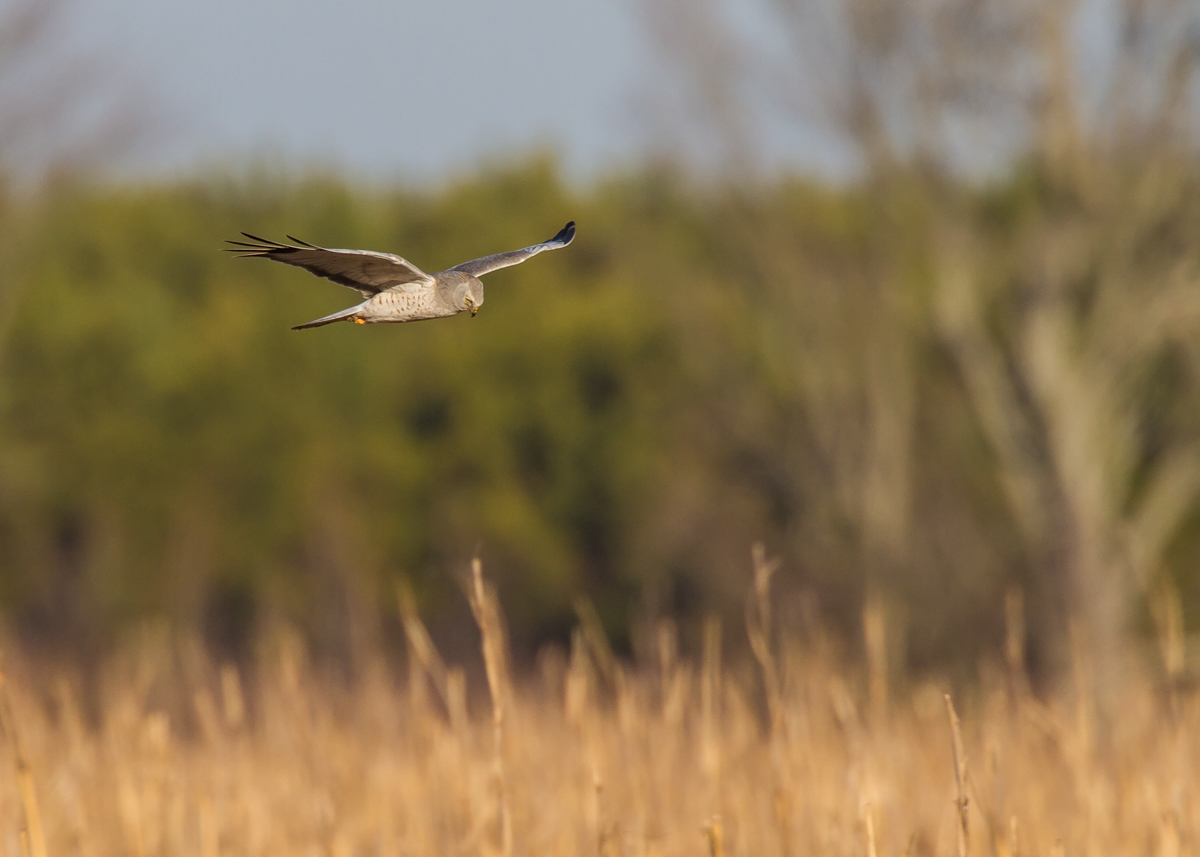
Male Northern Harrier looking for a meal
The male Northern Harrier finally sailed by my side of the field, gliding on his large wings, head down, looking for a bird or small mammal.
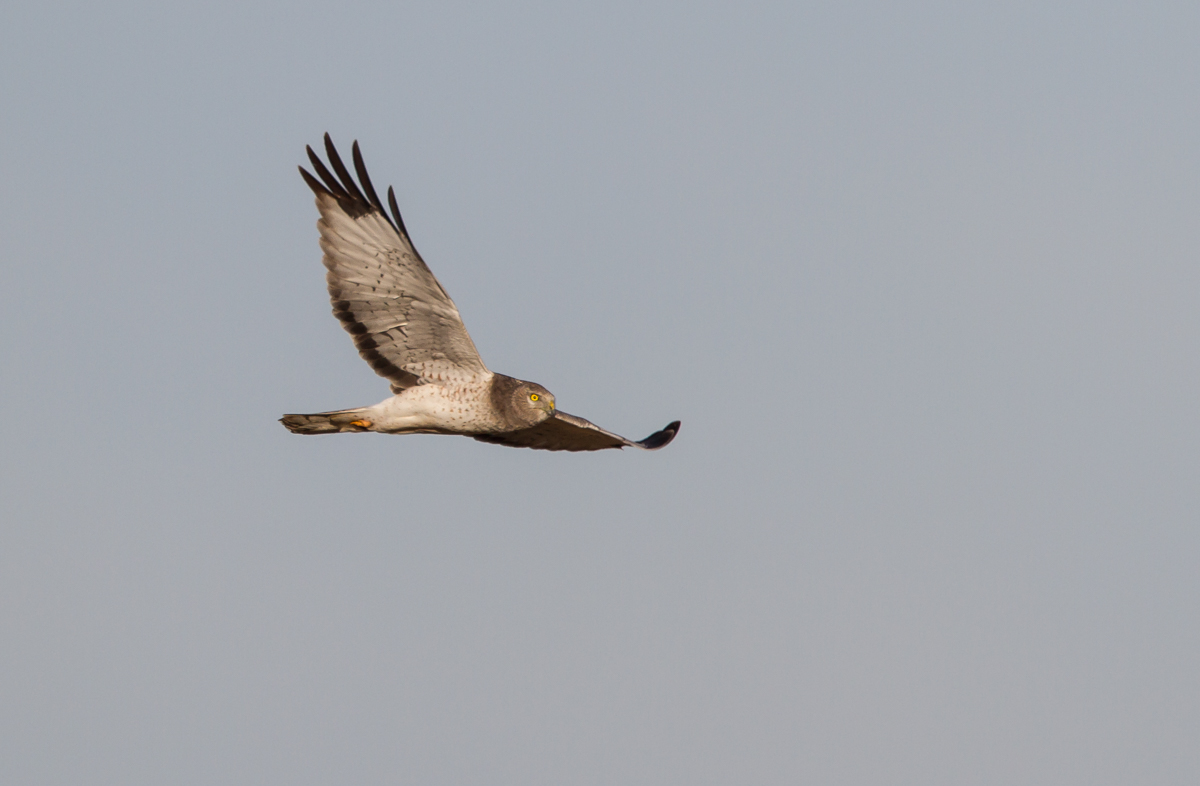
Male Northern HarrierA close pass by a male Northern Harrier
He swung by close enough for a few good shots, the sunlight catching his contrasting feathers and highlighting his bright yellow eyes.
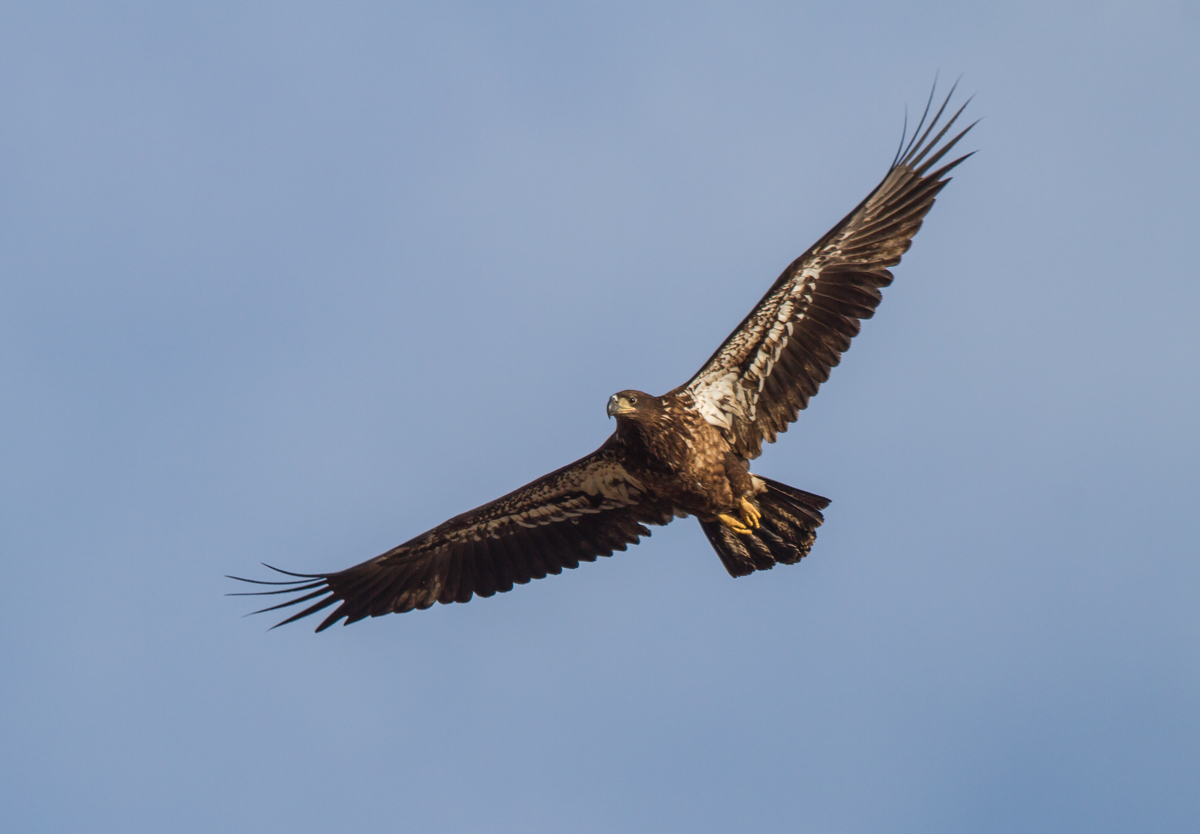
Immature Bald Eagle
I soon encountered the Black Bear and Raccoon from my previous post and spent a couple of hours watching things in the trees instead of the sky. But I finally I headed back out to the fields to see what was going on. There were several eagles perched in trees around the field edges. A couple of people were now walking on the road, and they spooked a couple of the eagles, one of which flew close by me for a nice look. It was an immature Bald Eagle, recognized by the mottled whitish “arm pits” as it flew over my head.
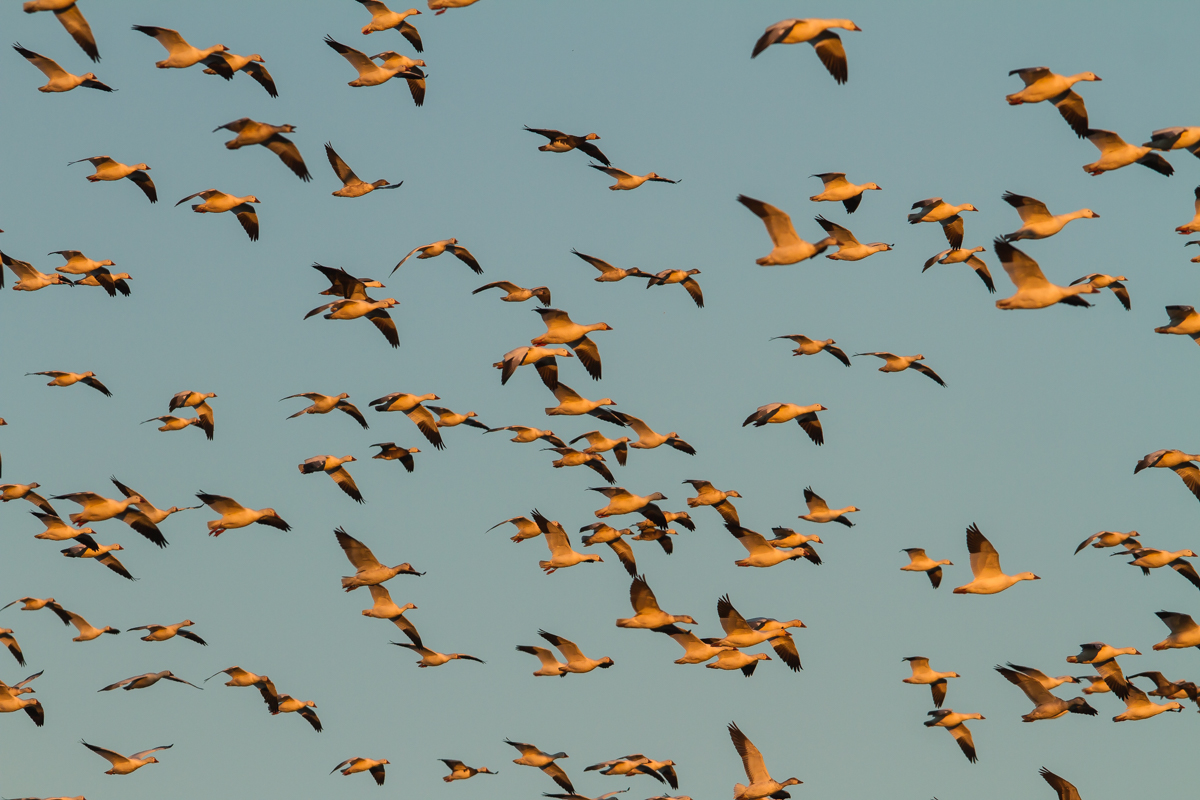
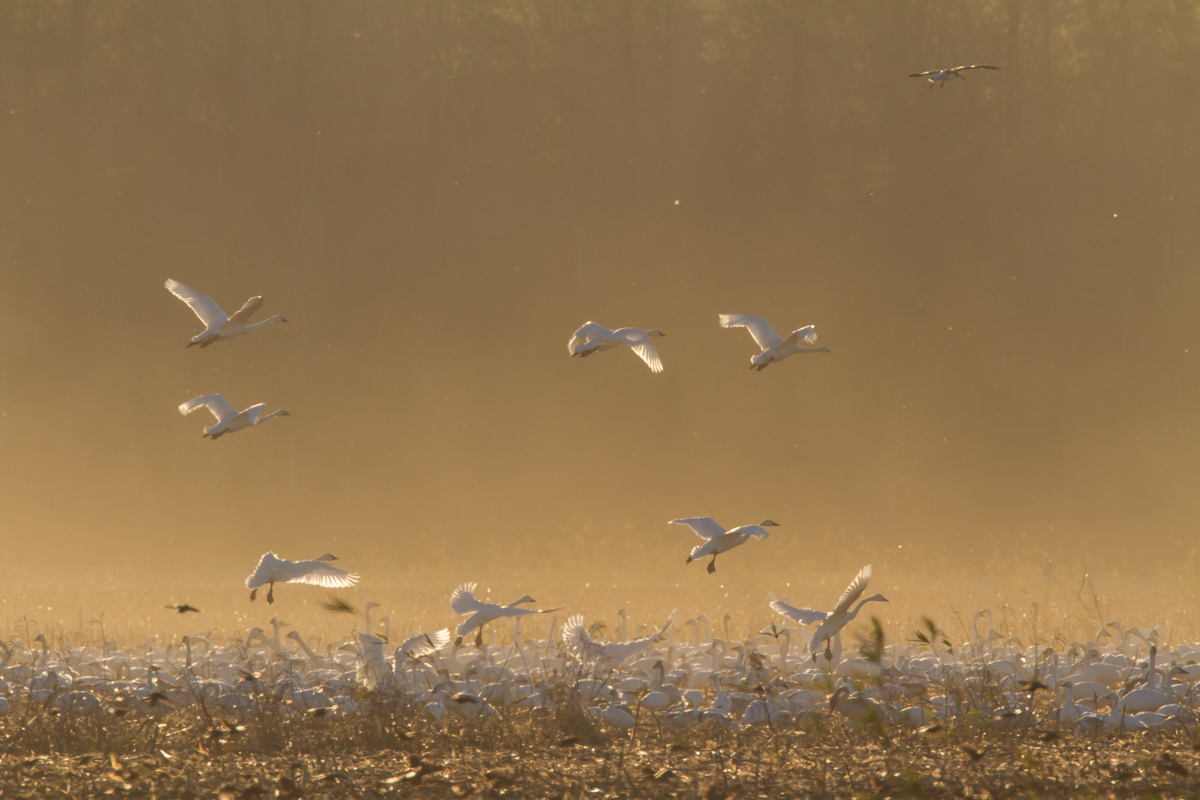
Snow Geese in golden light
The light was getting beautiful, a golden glow from the low angle of the sun. I soon heard the loud, low whoosh made by the wings of the Snow Geese lifting off the lake. The show was about to begin. I could hear them coming and then the first of the birds flew over the tree tops, headed out to the corn. The light was gorgeous, turning the flock into a gilded swarm. The people on the road stopped to watch the birds fly overhead and then headed back down the path once the flock was across the field. I knew there were a couple of more eagles ahead of them and I figured these birds would soon fly, so I stepped up against a tree trunk to help hide my outline and waited, hoping one of the adult birds would fly by me.
Bald Eagle in late afternoon light
Sure enough, I saw the remaining two eagles head out over the field and one banked and headed my way. Then I heard more Snow Geese flying in from the lake. If only….
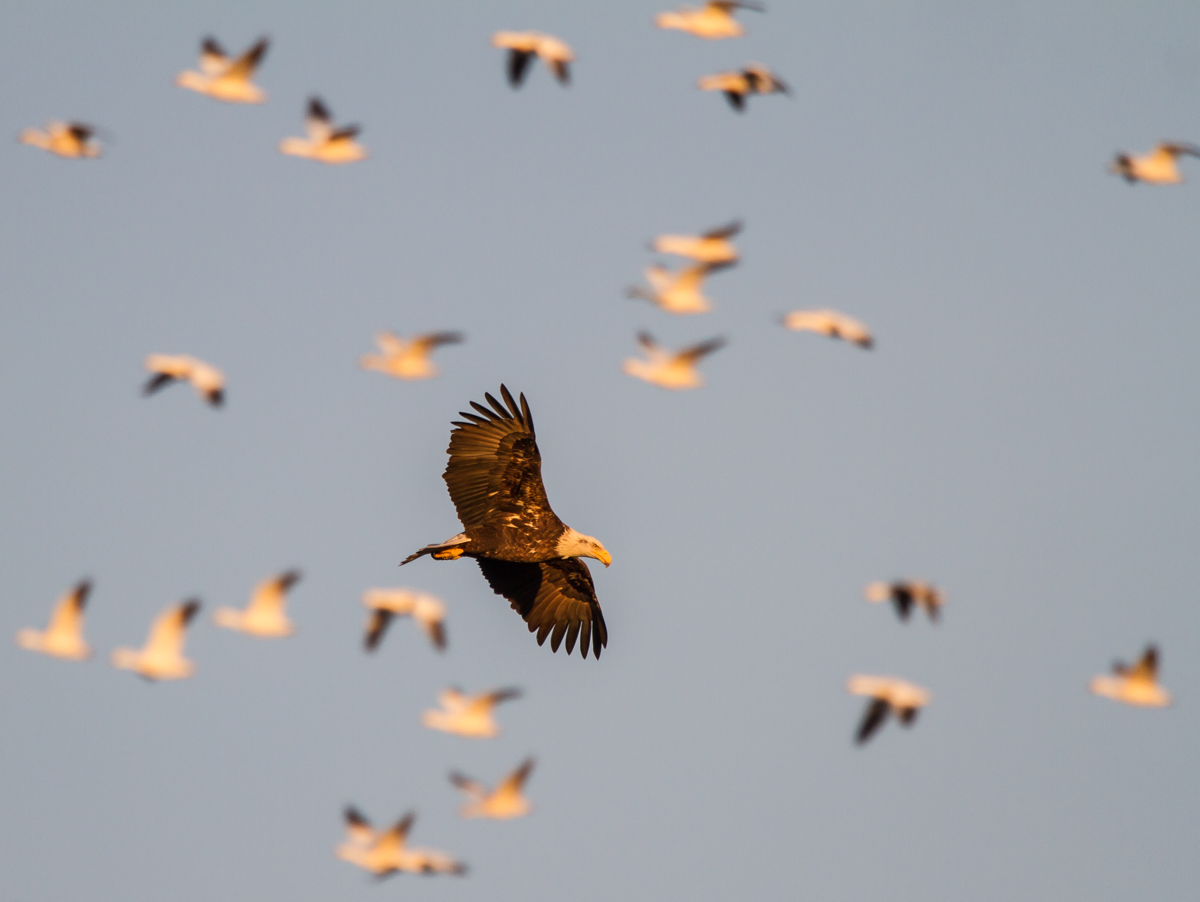
Bald Eagle and Snow Geese sharing the golden light
As luck would have it, the eagle circled back just in time for the Snow Geese to fly behind it, giving me a rare opportunity to see and photograph this spectacle three times in one day, predator and prey sharing the sky. But this light was by far the best of the day. The eagle spotted me and flew out over the tree tops, leaving me to watch in awe as thousands of Snow Geese flew into the field for one last feeding before nightfall.
Snow Geese returning to lake
Thirty minutes passed with the flock in a feeding frenzy on the far side of the field. Another eagle flew out near the restless birds and they once again exploded into the now pinkish-purple sky. Thousands of birds circled and then headed back to the lake for the night. It had been an amazing day of colors and sounds, with my focus on the water, forest, and sky of Pungo. While this is not a wilderness, it is a very special wild place to me. And I think it is important for us all that these wild places exist. Spending time in them helps us understand ourselves, and gives us insights into the workings of the world and our place in it. I found this quote by former Supreme Court Justice William O. Douglas that does a good job of putting into words what a day like this means to me…
Wilderness helps us preserve our capacity for wonder
the power to feel, if not so see,
the miracles of life, of beauty,
and of harmony around us.
I will carry this sense of harmony for a long time to come.
Each of us needs to withdraw from the cares that will not withdraw from us. We need hours of aimless wandering…observing the mysterious world of ants and the canopy of treetops.
~Maya Angelou
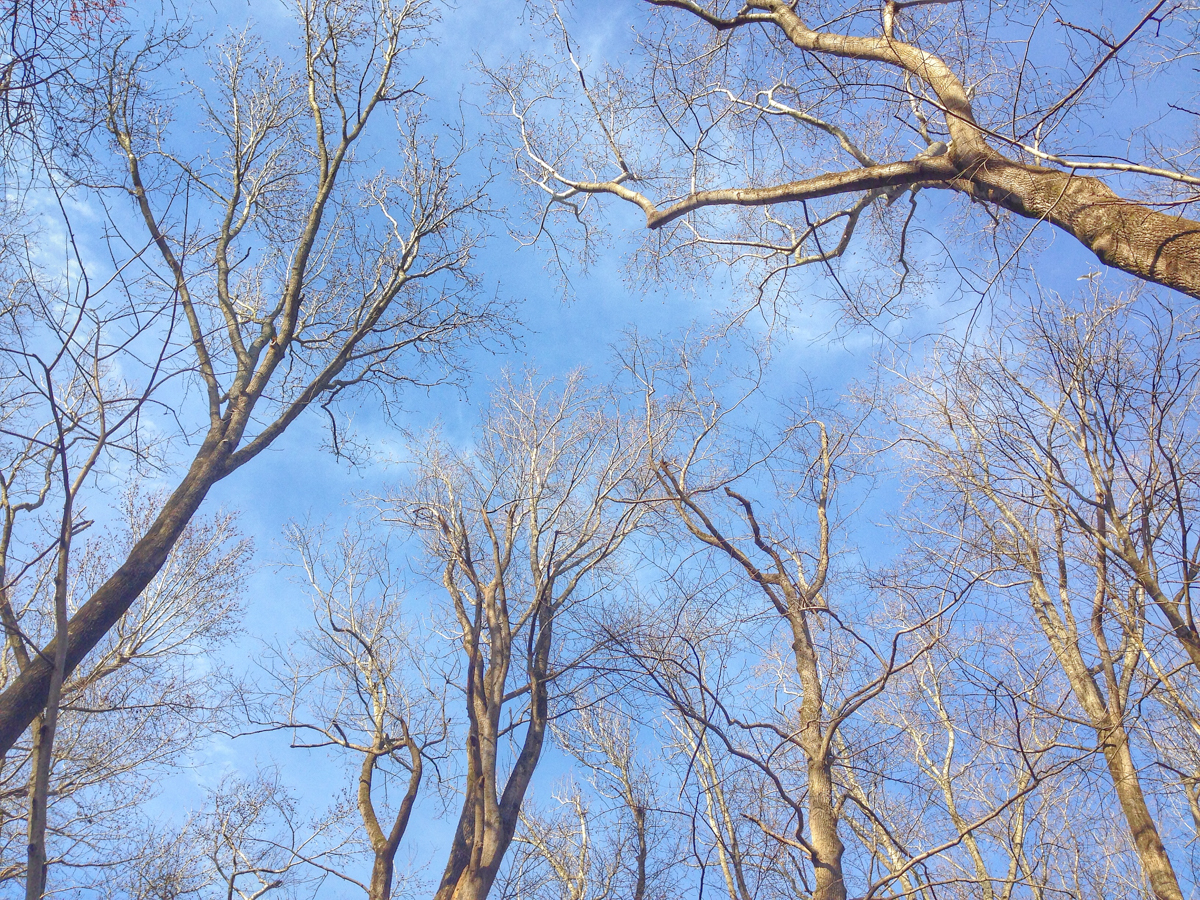
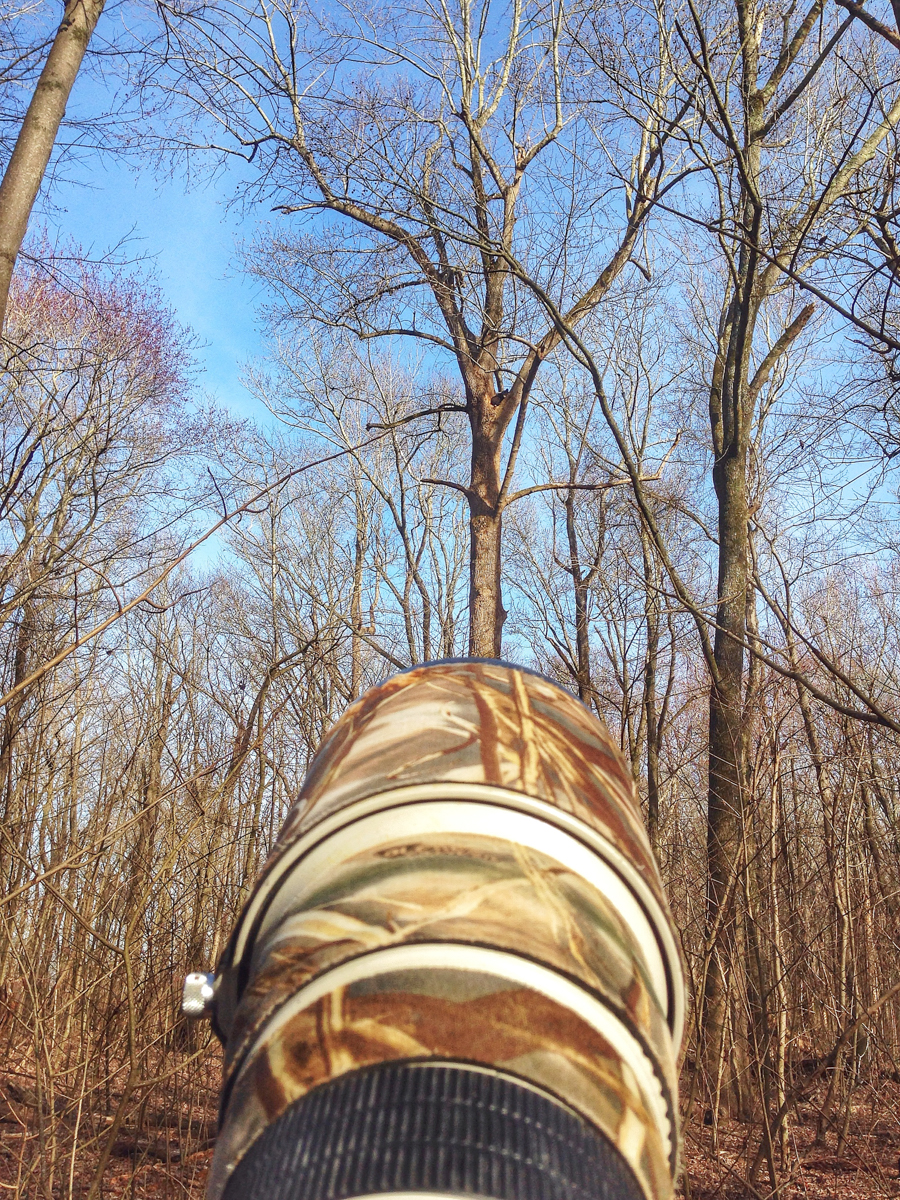
Looking up through the trees at Pungo (click photos to enlarge)
It was certainly too cold for ants on my last trip, but not for enjoying the treetops. On my trips with clients I often feel the pressure to keep moving, to cover as much of the refuge as possible to increase our chances of seeing wildlife. When I have my own Pungo Time, I tend to wander and linger in an area for longer, just observing. I enjoy being a woods-watcher, looking closely at the details of a place, listening, sitting quietly and letting nature come to me. The forests of Pungo are challenging – there are relatively few places you can walk in them during the winter waterfowl season as many areas are closed to minimize human disturbance to wildlife. Other areas are so dense or so wet as to make walking next to impossible. But, there are a few paths where you can stroll along a dirt road next to the woods and peek in and see what is, or has been, going on in the forest.
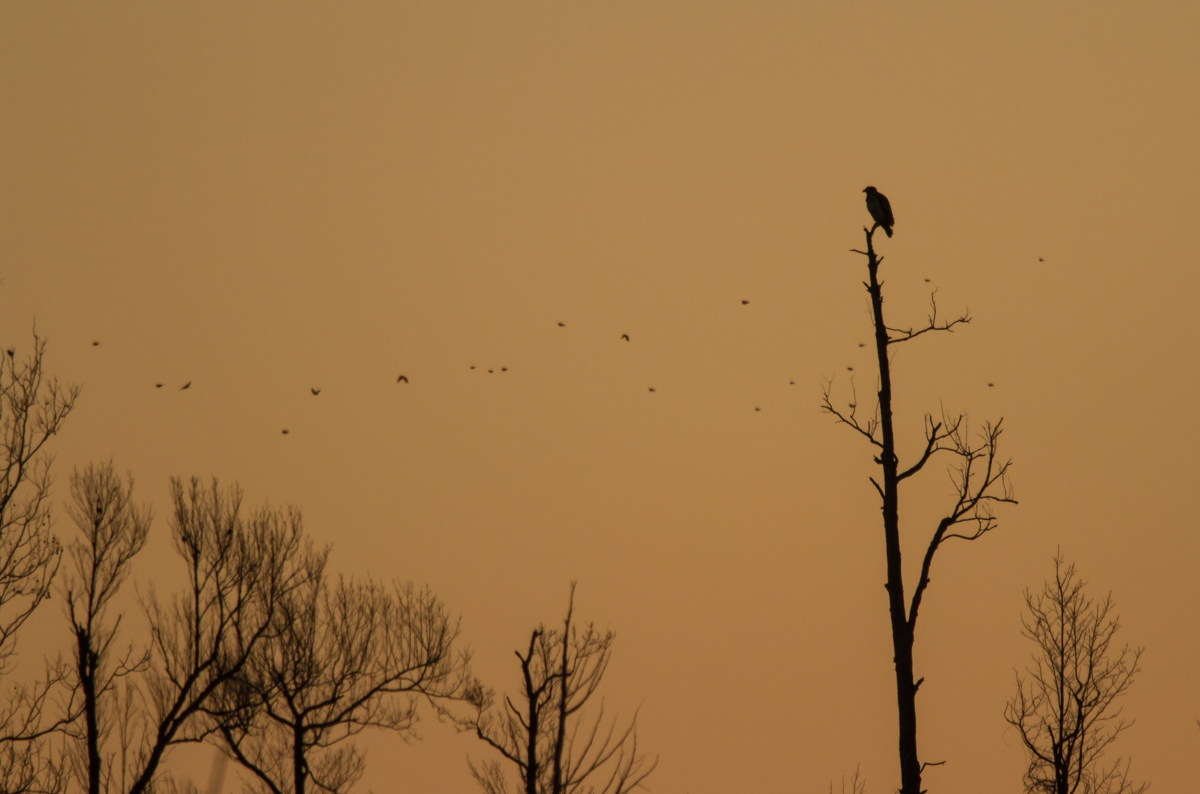
Bald Eagle in dead tree at swan impoundment at sunrise
Of course, I also survey the edges of the forest as I am driving the refuge roads, and these trees, especially dead snags, are often quite productive. Bald Eagles like to perch in large trees at the edges of impoundments or fields where waterfowl congregate. Here, they can survey the scene in the hopes of spotting a weakling in the flock that might make an easy meal.
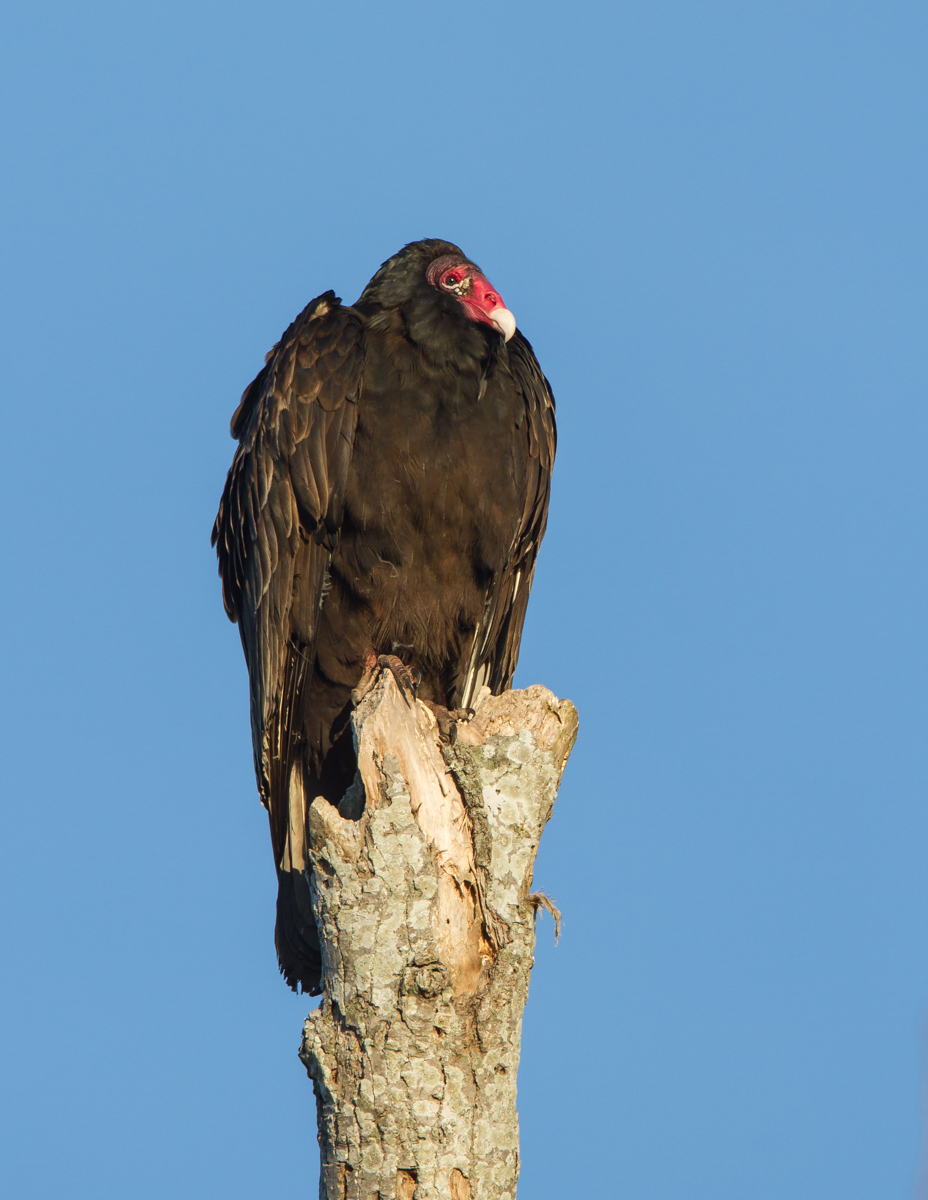
Turkey Vulture in early morning light
One section of forest edge has also been good for vultures early and late in the day, so I assume they have been roosting in this spot this winter. Even at some distance, their silhouettes can be distinguished from those of eagles because of their somewhat hunched appearance and the way they tend to hold their heads at a downward angle. If you can get a beak profile in your binoculars you can definitely discern the difference between the two species since an eagles’ beak appears much stronger and more massive.
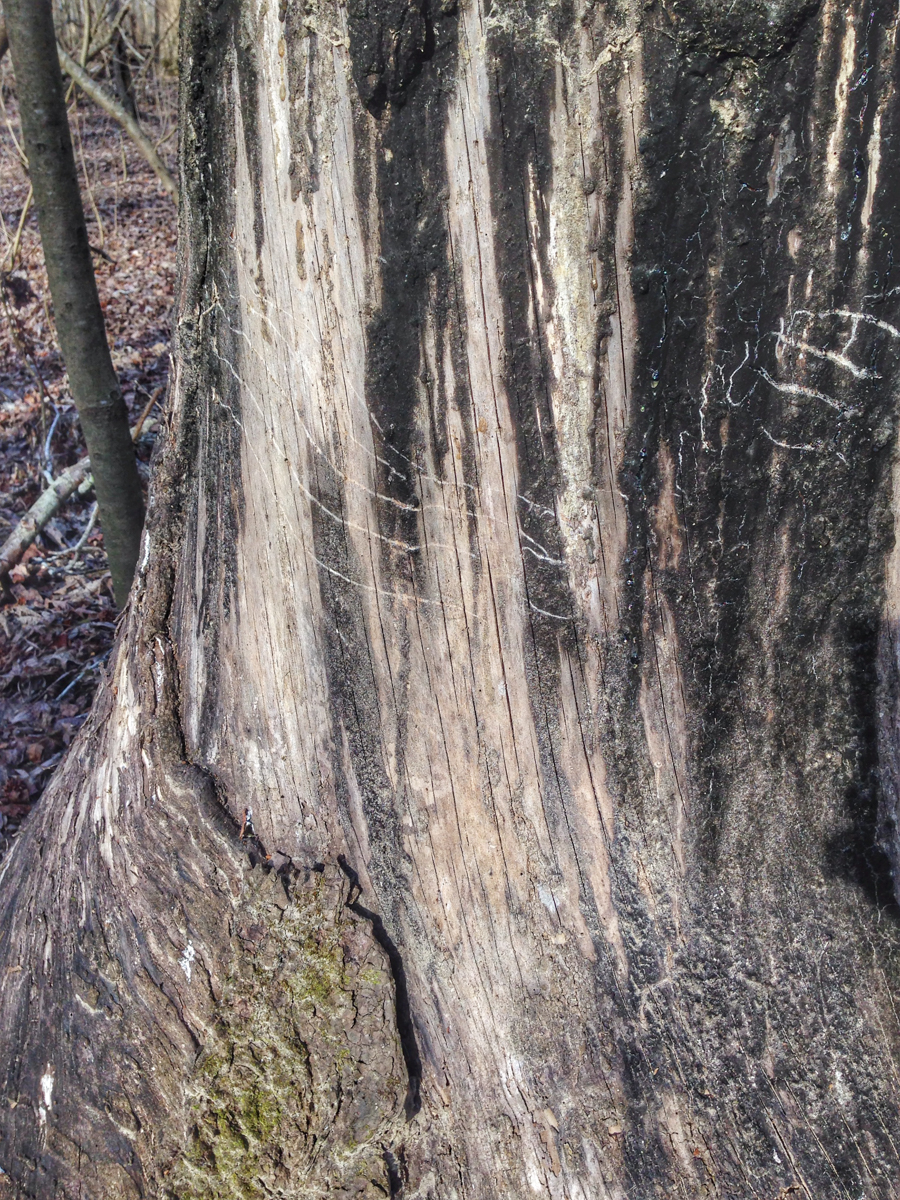
Bears must love the sap and cambium of Sweet Gum trees
After an early morning drive through the refuge, I decided to head down one of my favorite paths and spend some time along the edge of the forest. This area is well known for the population of Black Bears that frequent the corn fields and associated woodland borders. There is so much bear sign here – almost every large tree has claw marks from scratching or climbing. Large Sweet Gum trees are particularly susceptible to bear activity and many show scars where bears have torn off sections of bark near the base. There are usually vertical teeth marks and often some horizontal claw marks. I think the bears must be going after the sweet sap and perhaps the cambium layer of these trees. It looks like this past year (I assume it happens mainly in spring when the sap is rising) has been a particularly busy one for bears with a sweet tooth. Surprisingly, I see most of these trees surviving years after this happens.
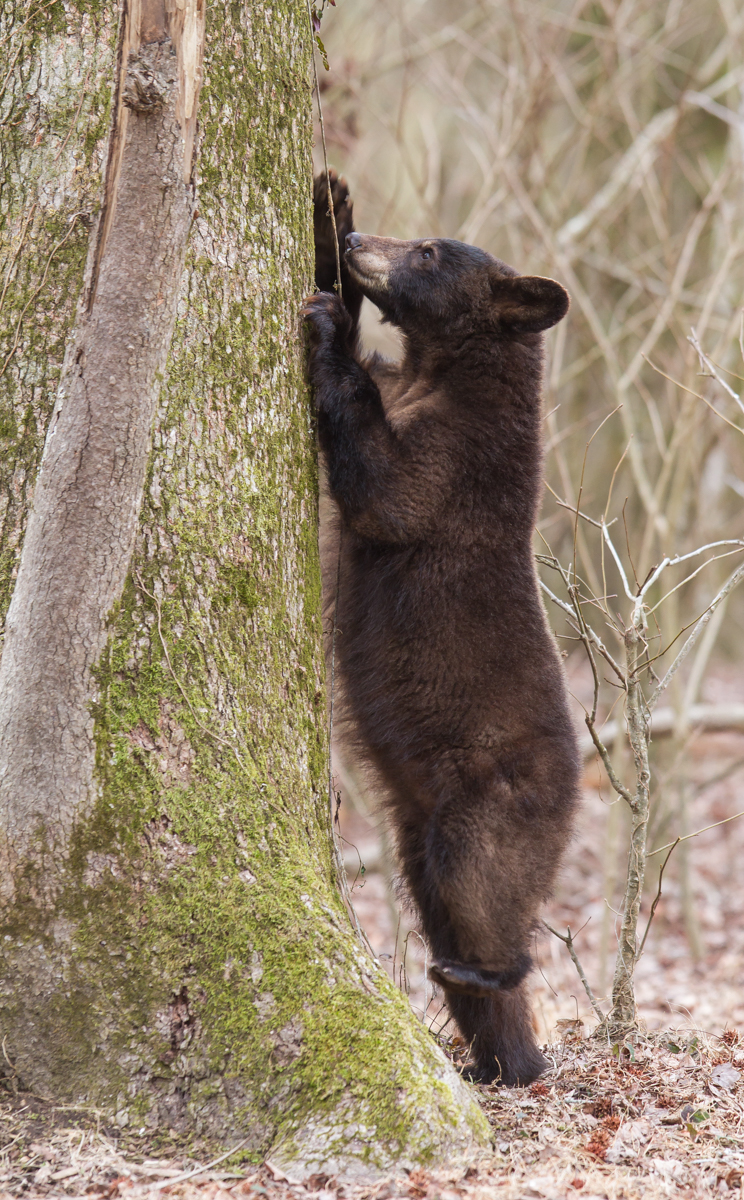
Young Black Bear standing next to tree
On a recent trip, I encountered a young bear as he was standing up against a large tree near the forest edge. I have seen this same young Black Bear several times this season in this same general area. But here he was apparently hugging a tree as if he wanted to climb it but was hesitant. He really paid me little mind but rather seemed more interested in something on the tree.
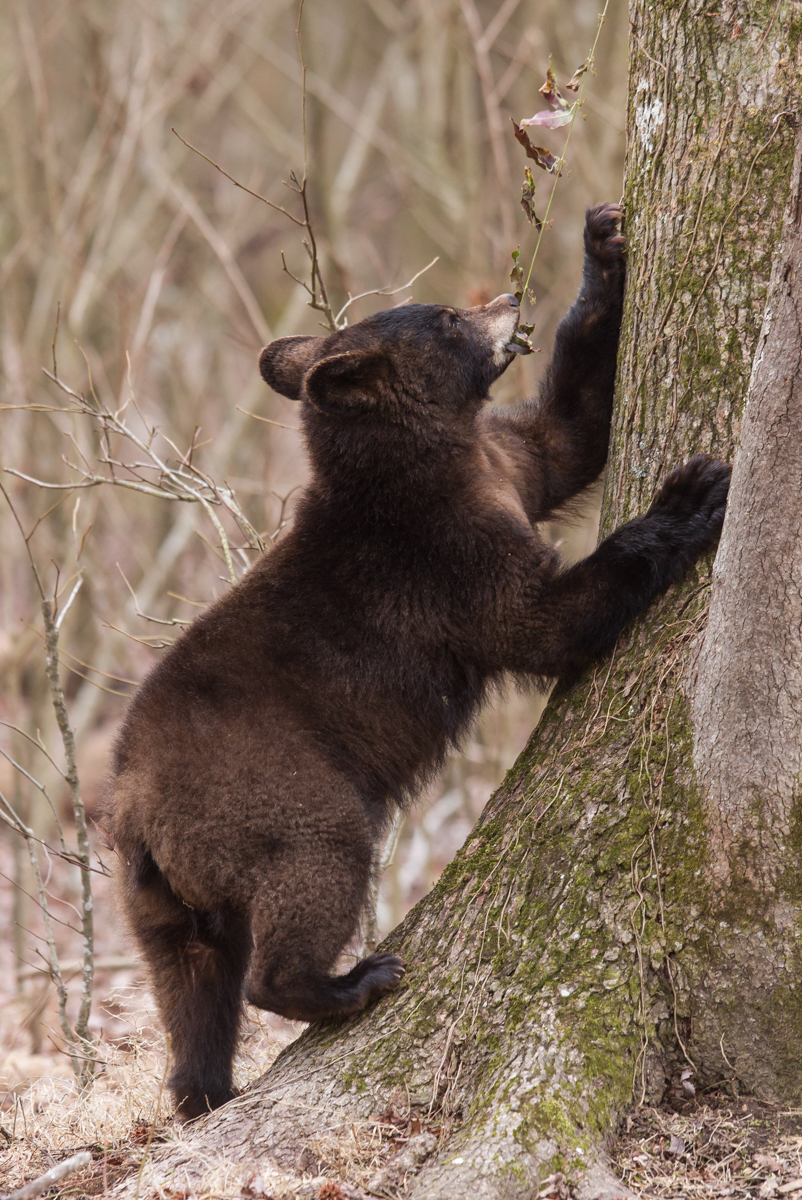
Bear puling at vine on tree
As I watched, I could see him sniff, then start mouthing something just out of my view around the trunk of the tree. It really wasn’t until I put down the camera and looked with binoculars that I could tell what it was – he was pulling at a Crossvine, a common semi-evergreen native vine of this area, and one I blogged about in 2013.
Bear puling at Crossvine
The bear walked part-way around the tree trunk, yanking and pulling the vine.
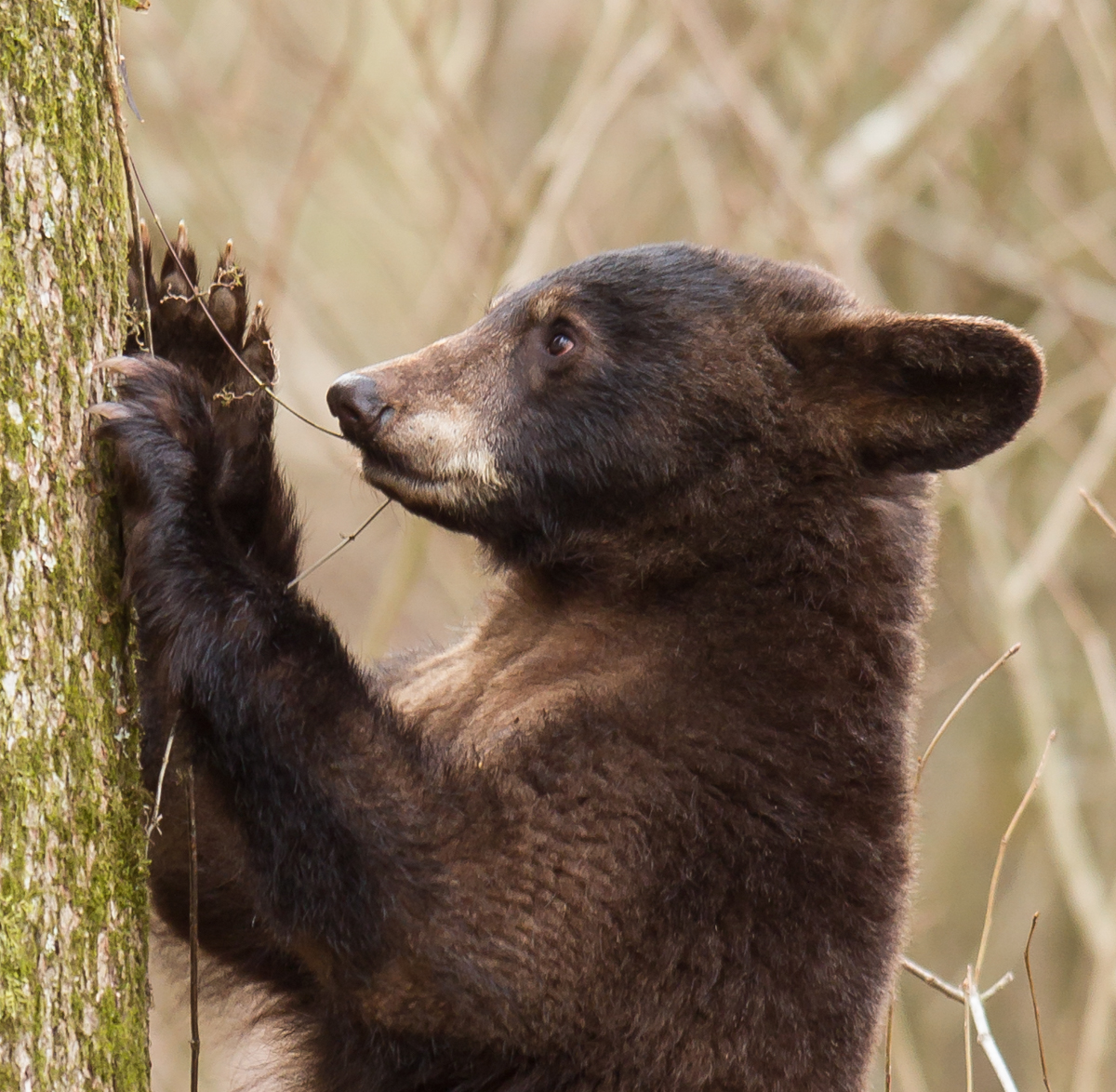
Bear eating Crossvine leaf
Once he got some of it down, he pulled it back around and stood up and appeared to eat a few of the leaves. Seems like a lot of effort for little reward to me, and, while I have heard deer will eat the leaves, I had not heard of bears eating them. But, young bears are particularly curious, so, even though there was a field of corn less than 200 feet away, this was perhaps a more pleasant way to spend some time while trying new things. On my next visit, I took my clients to this area, hoping to see the young bear again. Instead, we were privileged to spend some quality time quietly observing a mother bear with her two young cubs. The next day I went back to this area with high hopes for bears.
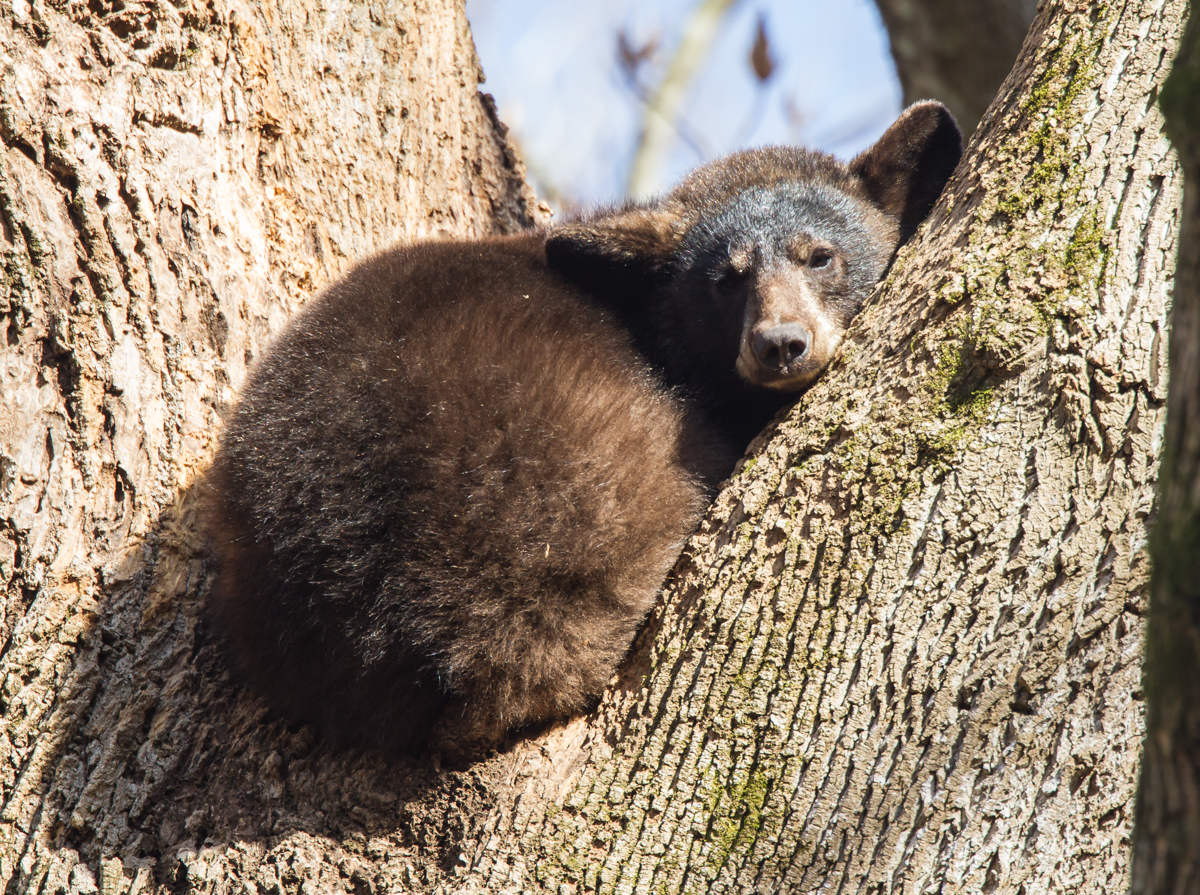
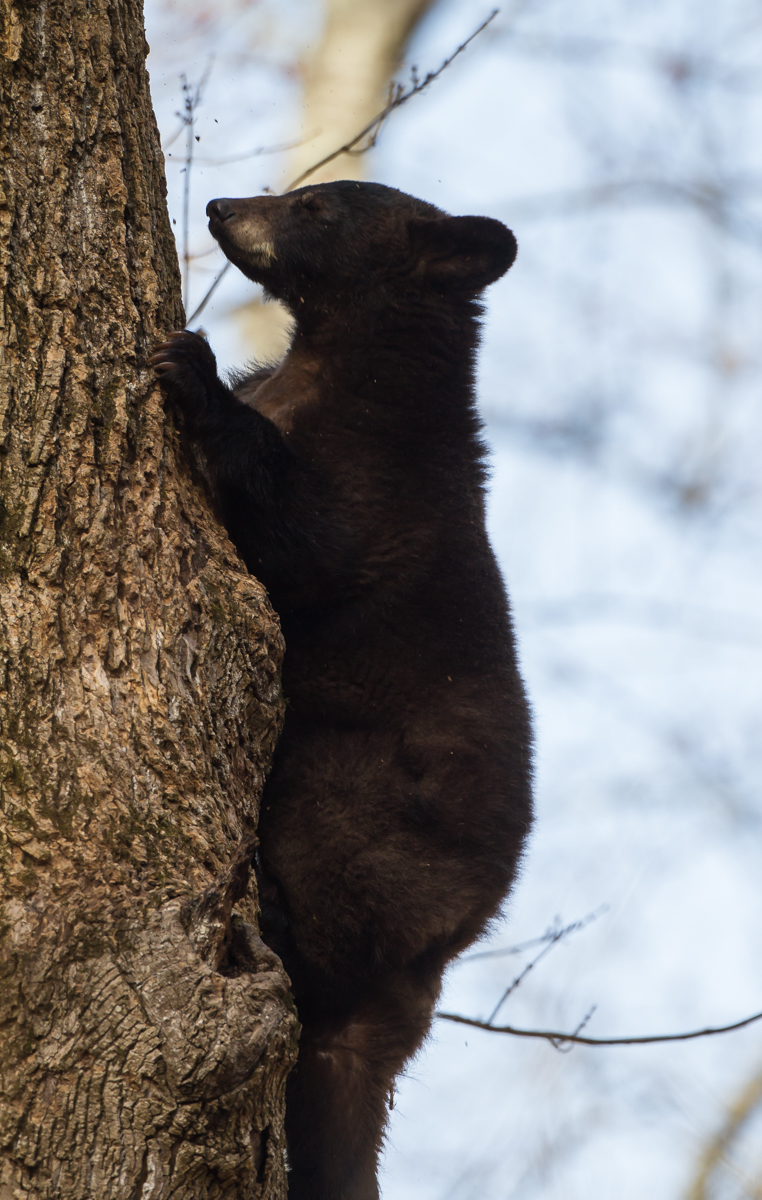
A young Black Bear sleeping in a tree
After walking a short distance I caught something out of the corner of my eye up in a large Tulip Poplar tree along the edge. Sure enough, it was the same young Black Bear I had seen on a few previous trips. This time, he seemed to be sound asleep high in a tree.
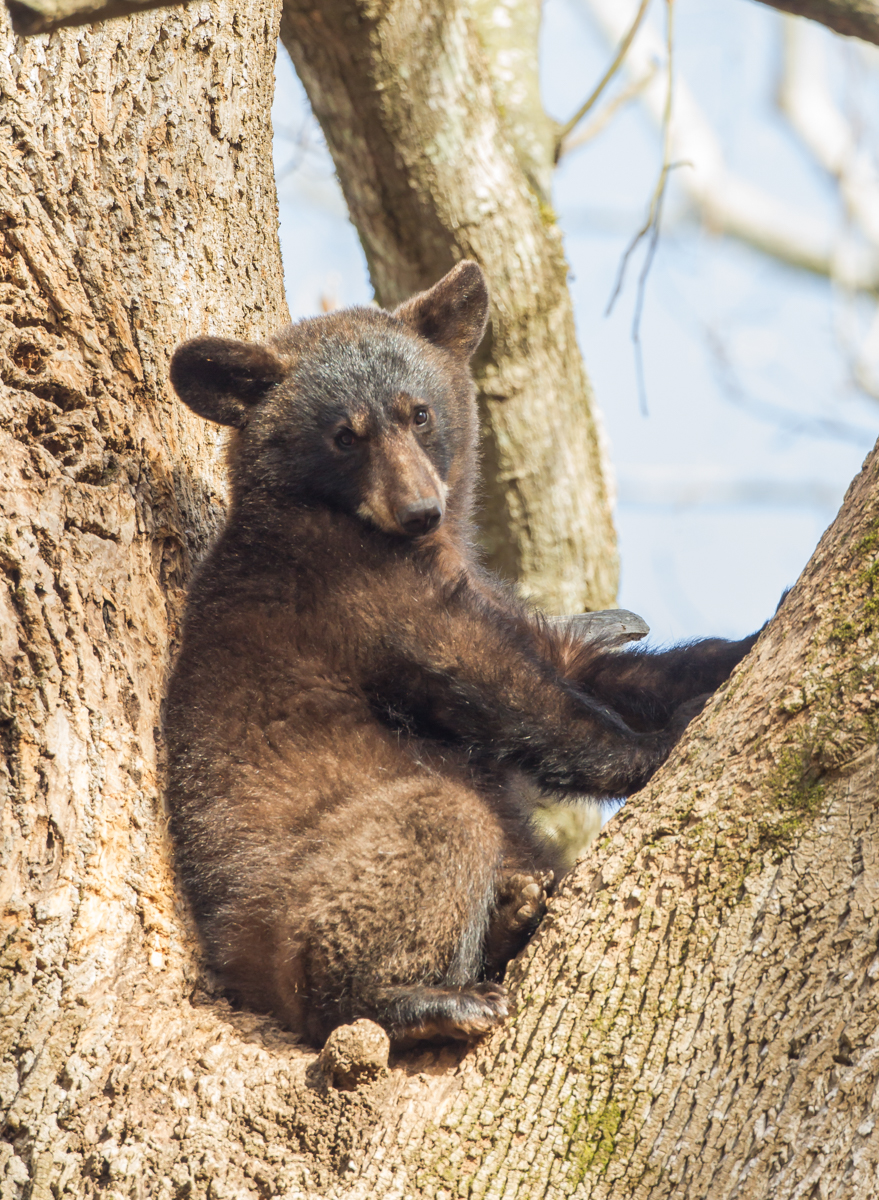
Looking back at me
When I walked around the tree for a closer look, the bear gave me one as well, peering down to see what was rustling leaves beneath its bed.
The young bear finally turned around and was in the sun
Not wanting to disturb its sleep, I went back around to the sunny side of the tree and waited. After about twenty minutes, the bear moved a bit, stood up, turned so its head was on my side of the tree, and laid back down.
Waking up
Another ten minutes went by as I watched the bear doze off and then open one eye to glance around. Finally, it raised up, checked on my whereabouts, and began to groom.
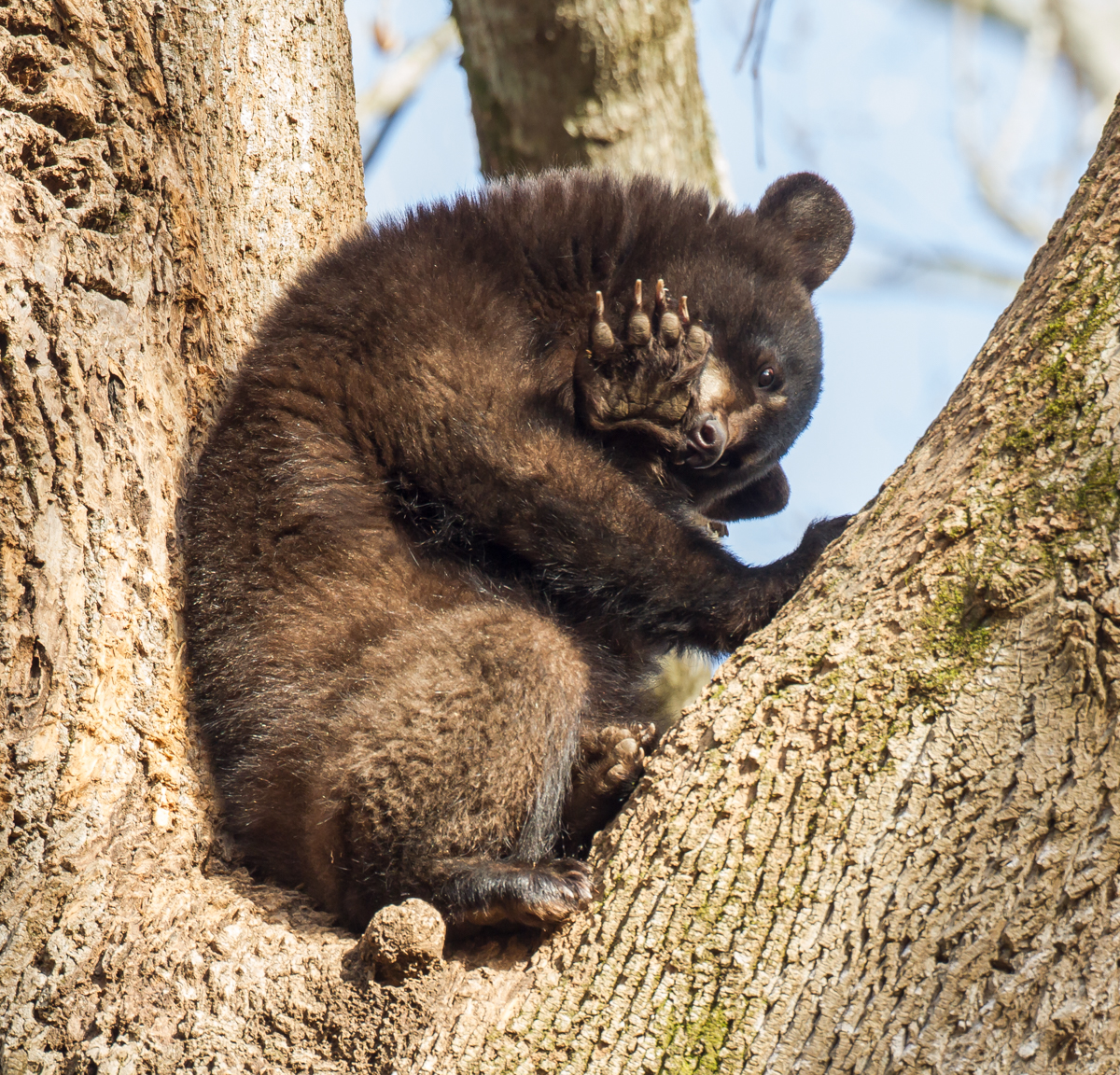
Time to groom
It apparently doesn’t take too long to ready yourself for an afternoon out in the forest (about 8 minutes for this bear after waking up). The short video below shows a few of the bear’s primping techniques.
During that time, the bear raised up, laid down, chewed its paws and belly, scratched a few times, and looked pretty relaxed while accomplishing all of this about 40 feet off the ground. The screechy sounds you hear in the video are from thousands of Red-winged Blackbirds that were sitting in nearby treetops. How did that bear sleep through all that?
Coming down
Finally, about 40 minutes after I first spotted the bear sleeping in a tree, it decided to climb down to spend time foraging on the forest floor below. That was my signal for me to move on and let the bear go about its business. I don’t want this young bear to become too comfortable around people, so I thought it better to let it be.
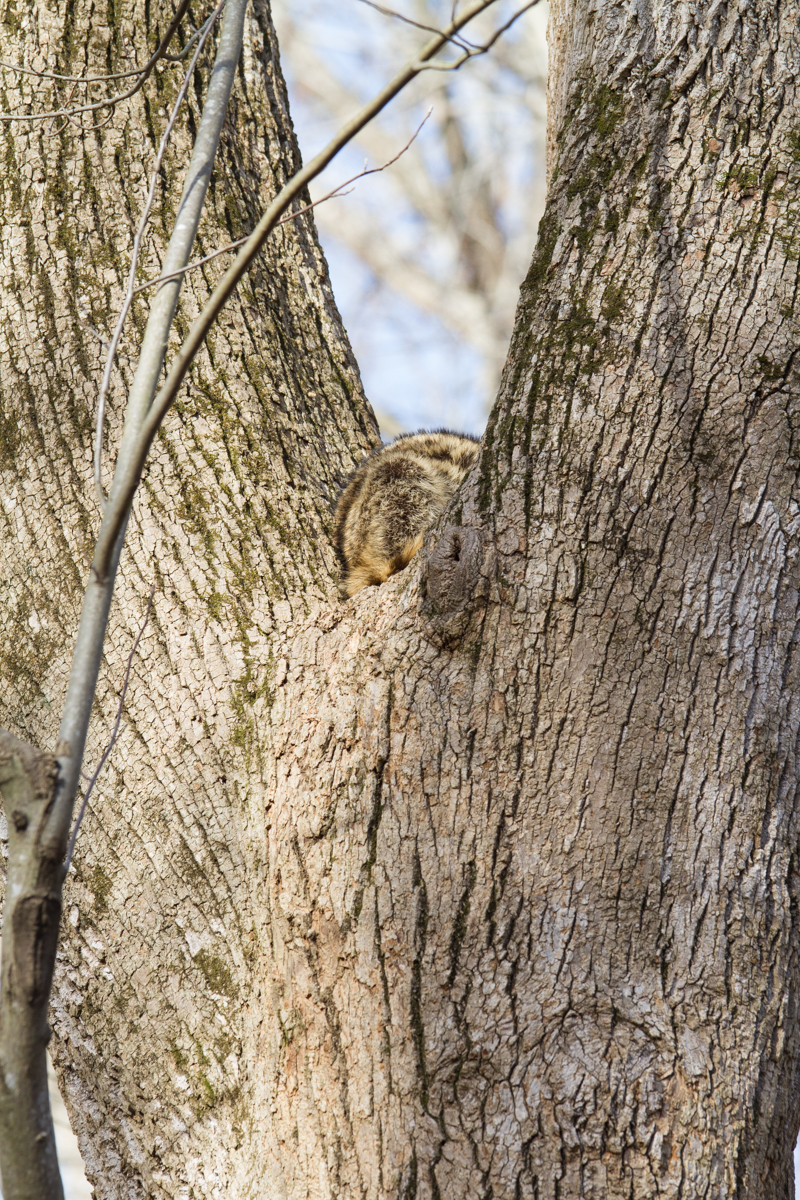
Another tree napper
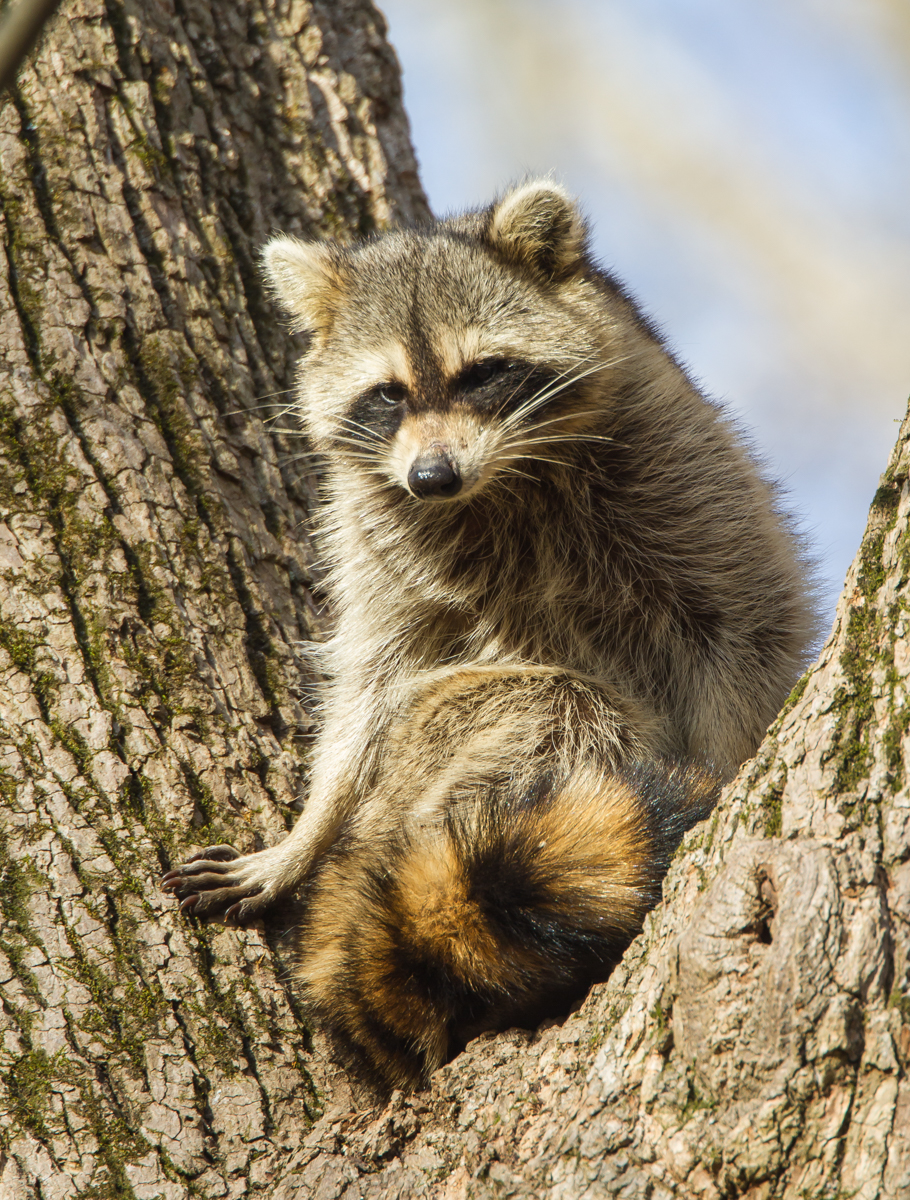
I walked less than a hundred yards and noticed a well-camouflaged blob in a tree- this time a young Raccoon. I frequently advise clients to keep an eye out for sleeping Raccoons on our winter walks. I have found two others this winter, but they were both crammed into what seemed like uncomfortable positions in cracks and crevices of hollow trees. This one was out in the open, resting in the fork of a large tree trunk. I have noticed over the years that Raccoons like to sleep out in the open more on cold days with lots of sunshine and little wind.
Looking down at me
Like the bear, this little guy also had its best side toward me, so I walked around to look up and, once again, the tree-napper looked down the trunk at me.
The Raccoon turns around and faces the sun after being awakened
The young Raccoon slowly turned around and then began the same pattern of afternoon preparations that the nearby bear had done – a sequence of grooming. But, apparently, it takes a Raccoon a lot longer than a bear to get ready to head out.
This little guy had a lot of itchesYou sometimes really have to reach to get that itch
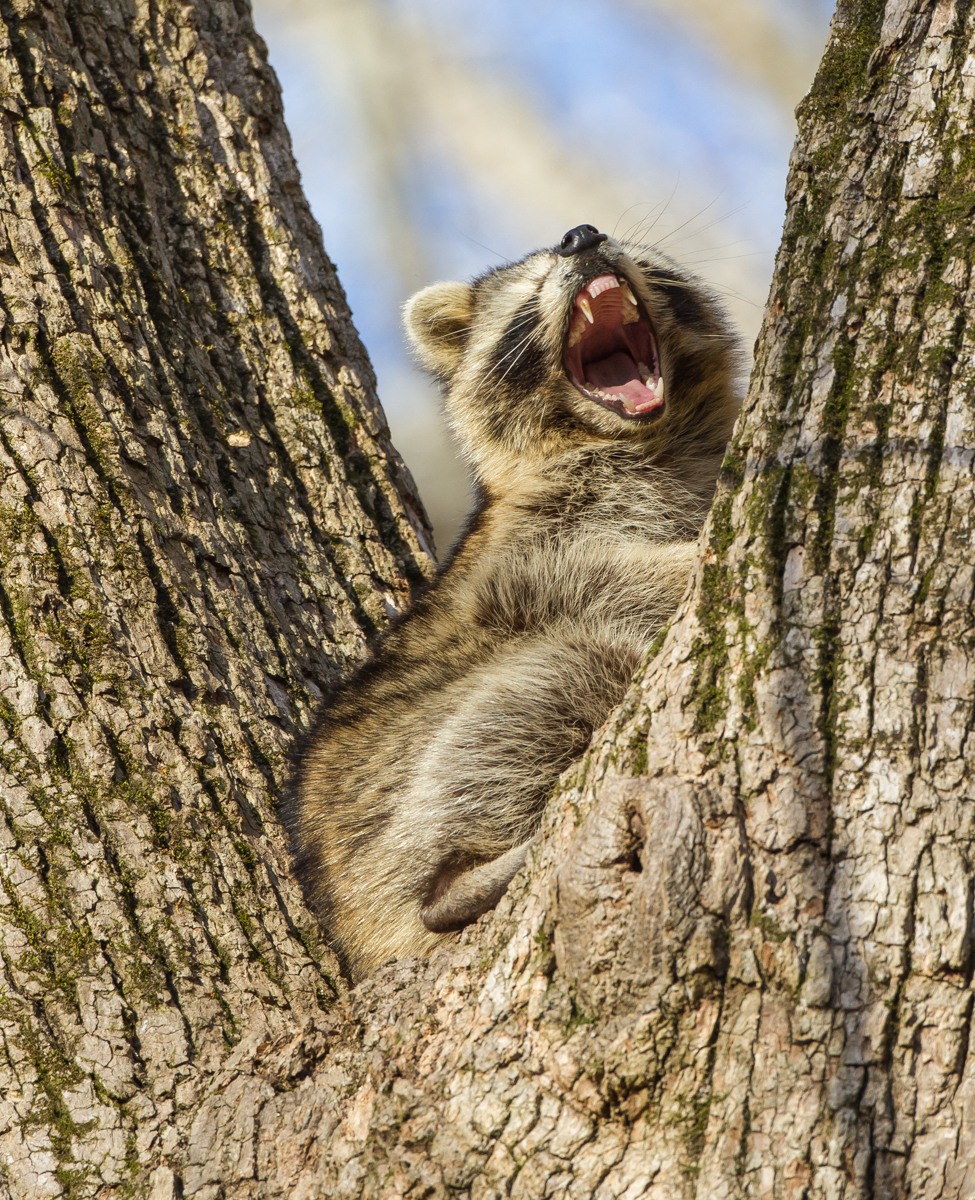
I sat and watched the Raccoon take care of business for 45 minutes.
The big yawn
After all that, we were both a little tired, so I decided to continue on. I could hear the Tundra Swans and Snow Geese out on the lake starting to stir, so I headed back out into the open where I could more clearly view another component of this amazing habitat – the sky.
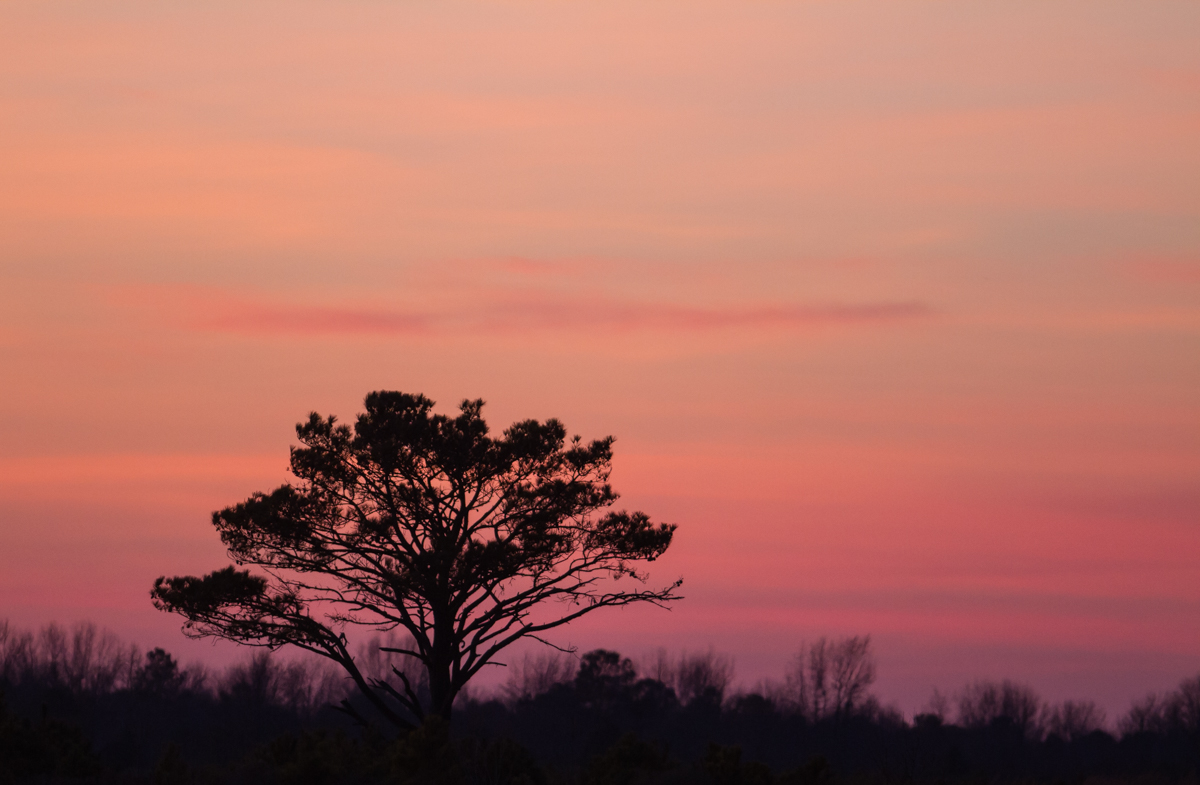
And the sky did not disappoint (more on that in the next post). The pink sky directed me to my car after what had been an incredible day at Pungo. A lone pine provided a stark silhouette to guide me back. It reminded me of a quote I found some time ago by an unknown author…
The young pine knows the secrets of the ground, the old pine knows the stars.
The old trees also know the habits of many of the forests’ wild creatures, and at least one woods-watcher on this day, one who is very grateful for the presence of these stately trees, and for the company they keep.
Live in the sunshine, swim in the sea, drink the wild air.
~Ralph Waldo Emerson
Due to a crazy schedule at home this month, my last refuge tour of this winter waterfowl season was the first weekend of February. I had a great group of three clients that all had experience with our national wildlife refuge system and were excited to spend a day at the Pungo Unit of Pocosin Lakes NWR. We had a fabulous day of woods walking, blue skies, birds, and bears (which was one thing these folks really wanted to see). As usual, when leading a trip, I don’t take many photos. But, since it had been such a great trip, I stayed an extra day for some Pungo Time for myself…and I am glad I did! I had an entire day, with surprisingly few other people around, to enjoy the sights and sounds of my favorite refuge. As I looked back on the images, the day seemed divided between observations of three components of this incredible wildlife habitat – the water, the forest, and the sky. So, I decided to present them to you in that order – first, the waters of Pungo…
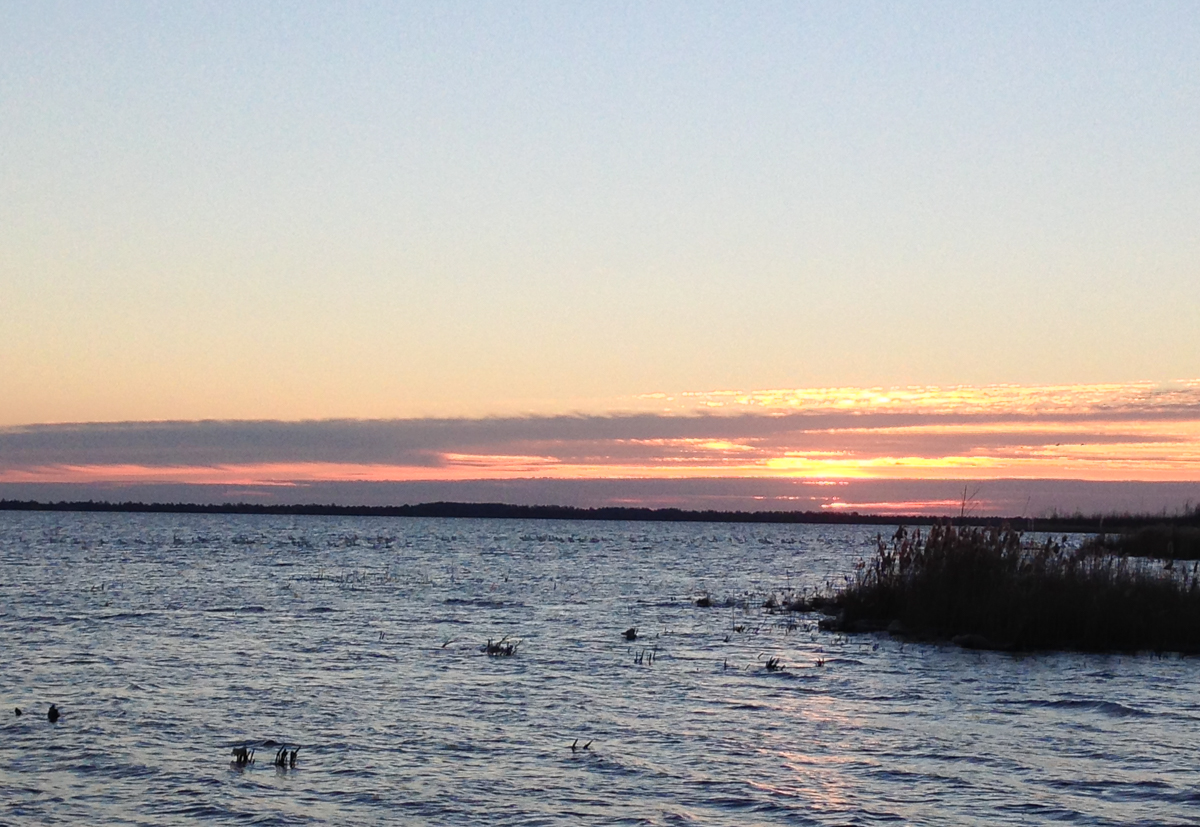
Sunrise over Pungo Lake from Duck Pen observation area (click photos to enlarge)
The centerpiece of this portion of Pocosin Lakes NWR is Pungo Lake. it is approximately 2800 acres, making it much smaller than nearby Lake Phelps (~16,600 acres) and Lake Mattamuskeet (~40,000 acres). All are shallow with average depths of no more than 5 feet, but Pungo Lake is very different in one important aspect. Unlike the other two, which have sandy bottoms, Pungo Lake has a peat base. This makes these waters very dark due to both suspended particulate matter and the tannic acids associated with peat. Very little sunlight penetrates these waters which means little or no aquatic vegetation grows in the lake. This, coupled with the acidity of Pungo Lake, means that there are few fish to be found in its waters. All of this dictates that this lake is used primarily as a resting and roosting area by the winter waterfowl, whereas Lake Mattamuskeet and Lake Phelps are also used as feeding areas. This also explains why you rarely see diving ducks, like Canvasbacks or Bufleheads, or fish-eating species, like Common Loons, on Pungo Lake.
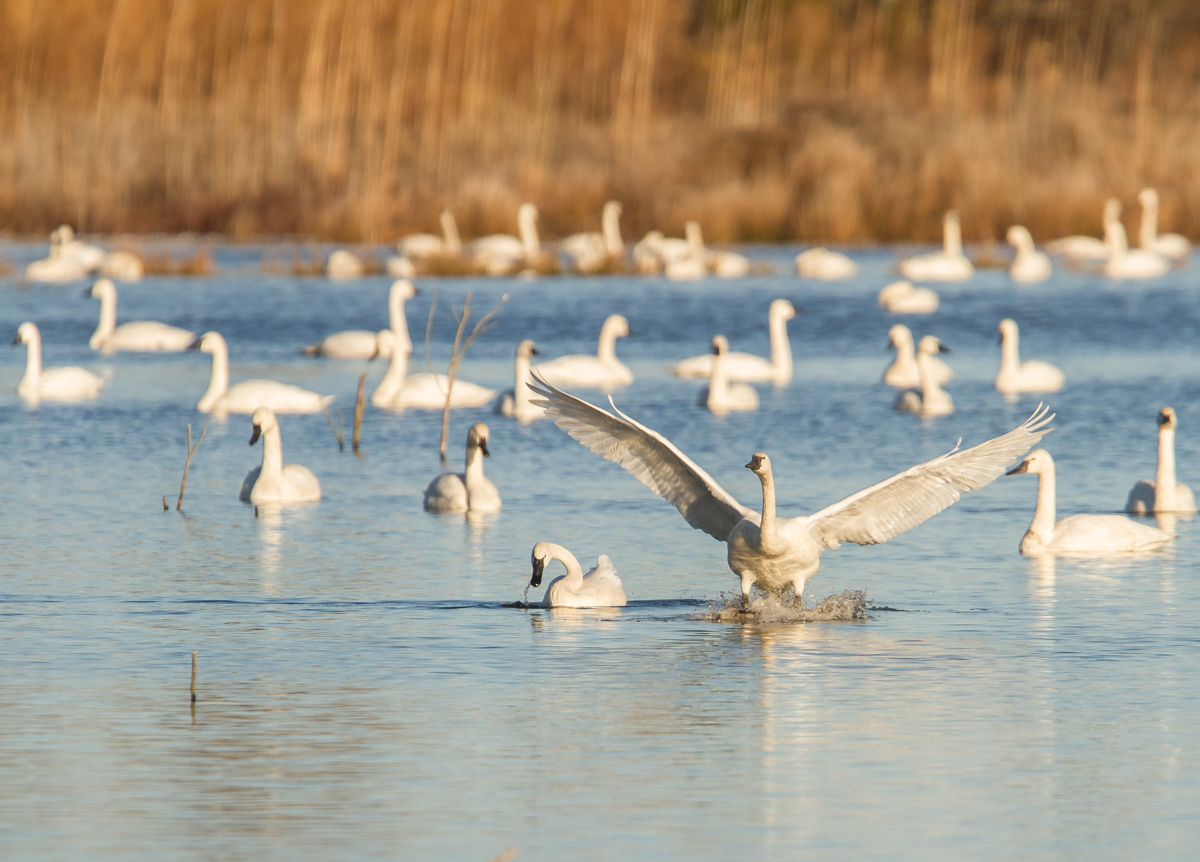
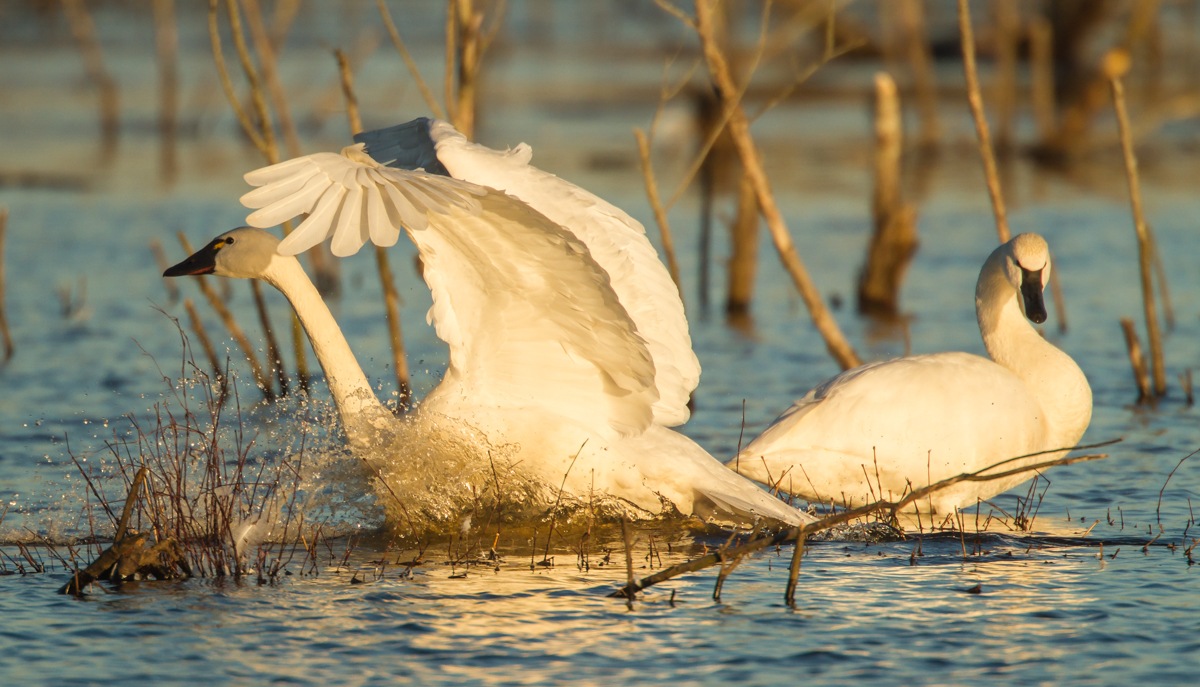
Swan splash down on one of the managed impoundments at Pungo
In addition to the open waters of the lake, there are over 400 acres of so-called Moist Soil Units (MSU’s) and over 500 acres of forested wetlands in the Pungo Unit. The MSU’s usually harbor thousands of waterfowl each winter as they provide an ideal combination of available food (in the form of aquatic vegetation, fish, and aquatic invertebrates) and shallow water. This winter, one of the MSU’s that is alongside a refuge road has been a great place for observing and photographing Tundra Swans. I have shared many photos from this particular spot in previous posts but was looking for something different.
Sunrise from the observation platform on Pungo Lake
I usually start my days with clients at the observation platform on the south shore of the lake. It is a great place to watch the changing light and get some perspective of the lake and the surrounding landscape. As the sun starts to rise above the horizon there is often a parade of Red-winged Blackbirds flying out to the fields, along with the occasional Northern Harrier flying westward. This means I rarely see other areas of the refuge at that moment of the magic light of sunrise. But I started this day in a different spot, the impoundment known as Marsh A, a location I hoped would provide some striking silhouettes of Tundra Swans. The key is to get to your site well before the sun comes up. So, I positioned my car where the sun would come up behind a large flock of swans on the impoundment. Some of the swans were slowly swimming about, perhaps claiming their favorite spots. The changes in light start out slowly at first with the scene initially dominated by a blue-gray palette having only a hint of gold.
American Coot at sunrise
As an American Coot swims by in front of the swans, the golden hues start to cover more of the water surface.
Tundra Swan claiming some territory
The glow soon begins to flood the sky and the water below, giving the swans a more perfect shadow of themselves. They seem to respond with an increase in activity and interaction.
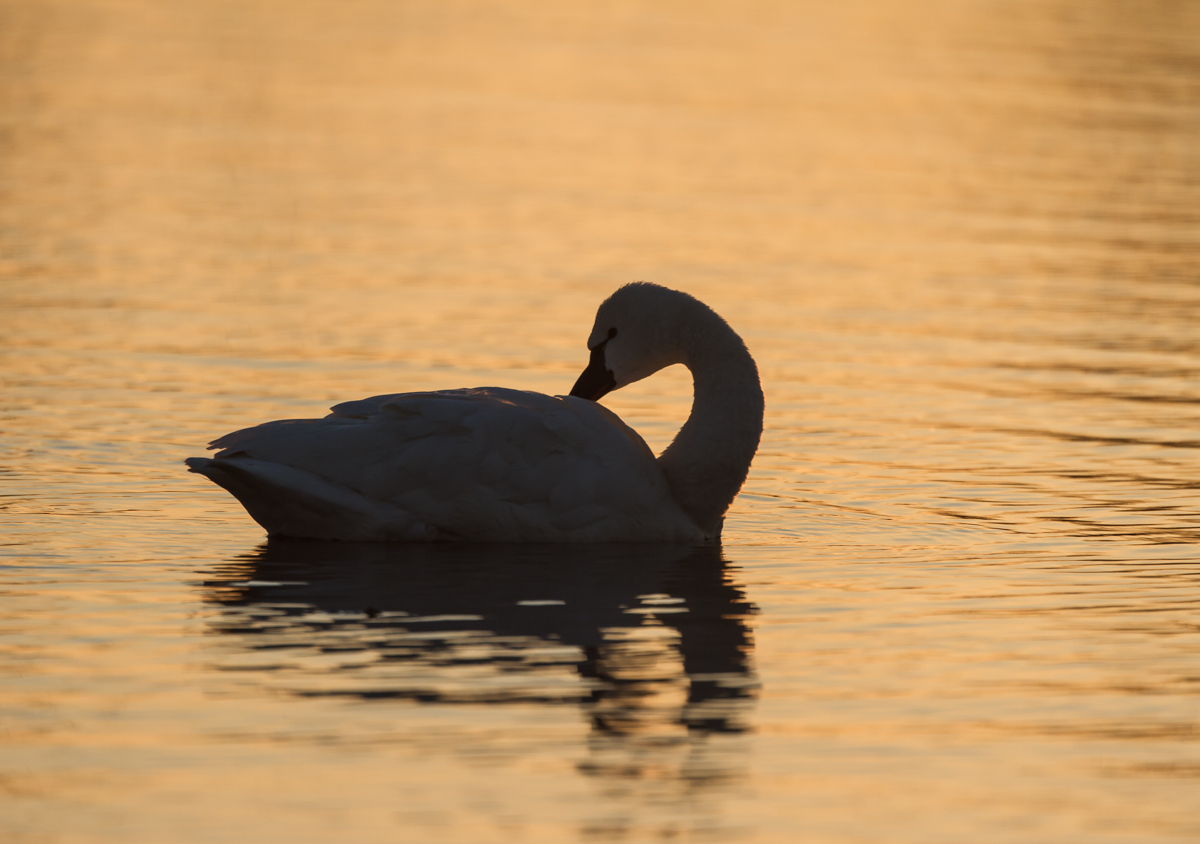
Swan preening just before sunrise
As I scan the flock, a few are preening, readying their feathers for the start of a new day.
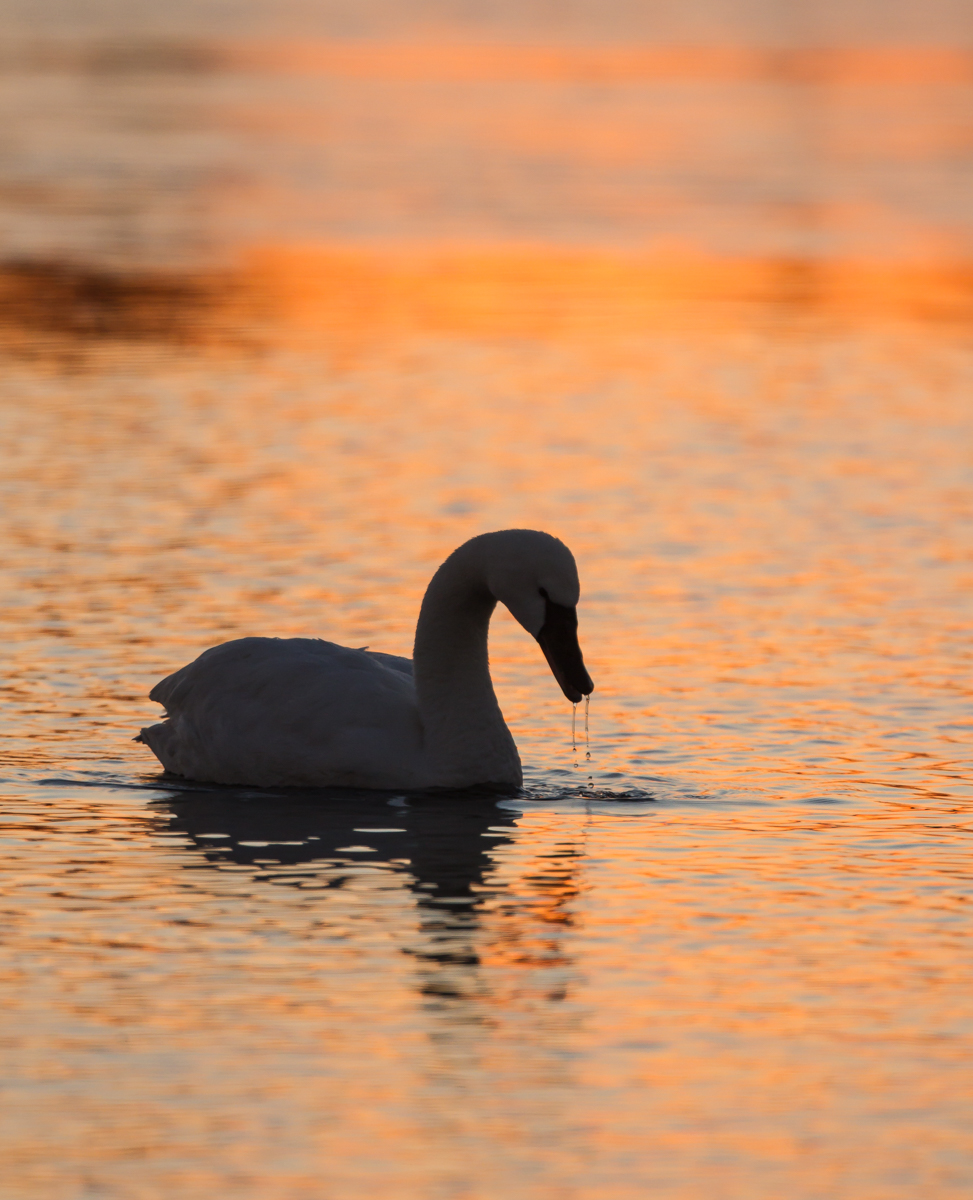
Swan dipping its beak into the water with the sun just below the horizon
As increasing tones of orange signal the approach of the sun, I swing the camera back and forth looking for a subject before the bright beam of morning light breaks above the thin dark line of marsh bordering the far edge of the marsh.
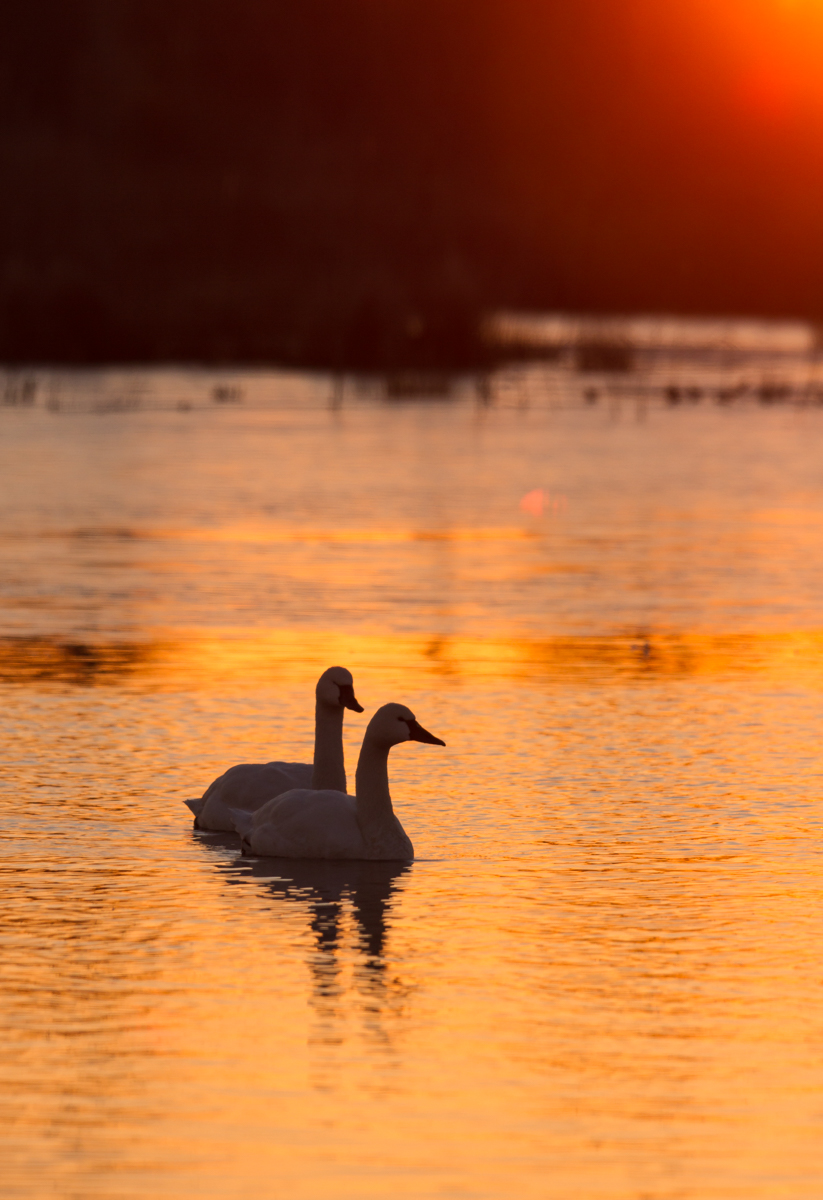
A pair of Tundra Swans swim together as the sun rises
Before I can fully capture the fleeting radiance of the rapidly adjusting scene, the first rays of sunlight pierce through the trees lining the edge of the lake.
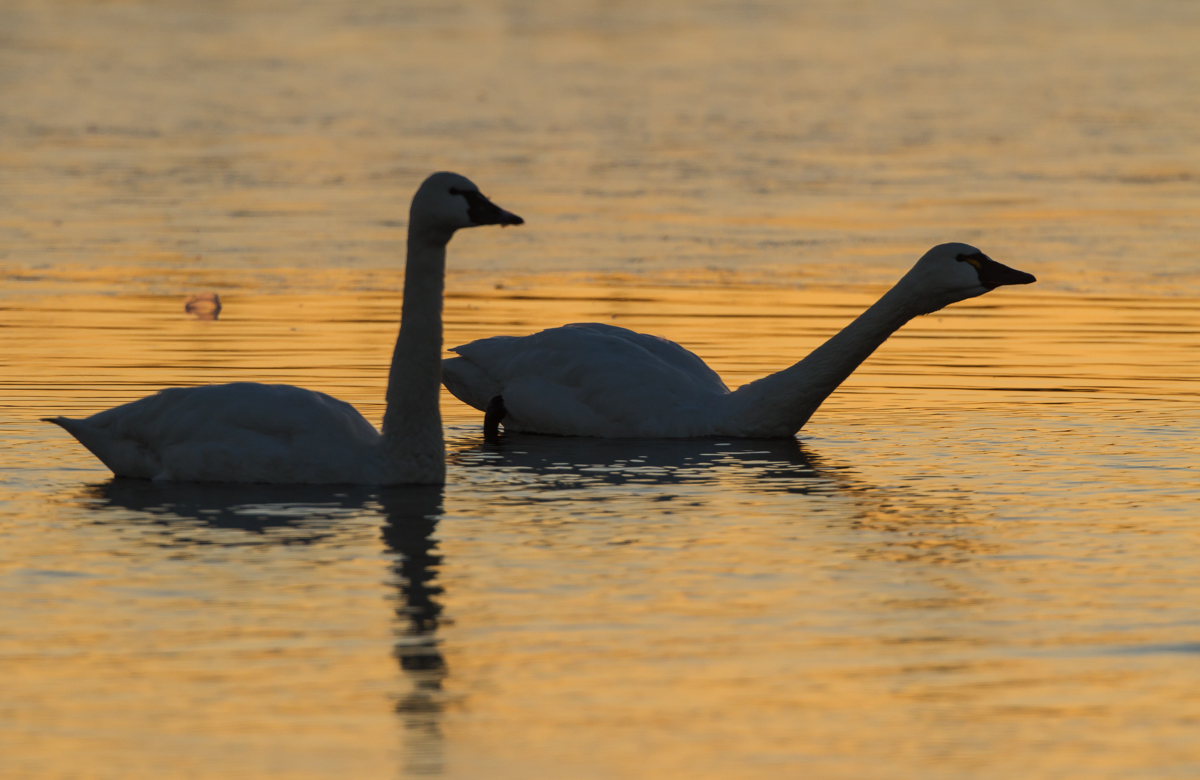
Swan silhouettes highlighted by the glow of the rising sun
Suddenly, there is a dazzling golden-orange stripe on the water. Swans swimming near the reflected beam now appear extra black. Their curved necks seem even more elegant in this light and their movements even more graceful.
Tundra Swans at the same location about an hour after sunrise
In less than fifteen minutes after the first orange beams struck the surface, the golden glow of a spectacular sunrise had faded. I decided to move on, looking elsewhere for some of the many species that tend to move about at this time of day. When I drove back by the impoundment about an hour later, the swans had settled into their morning routine of napping, preening, and discussing their plans for the day. And now the light was totally different.
A classic winter sunrise scene at Pungo
Their fleeting nature is one of the things that make sunrises so special. Each one different, each scene memorable, but brief. And on this morning, as is often the case, I had it to myself. While I love sharing these moments with others, there is also something special about being the lone witness to the start of another day in a wild place like Pungo.
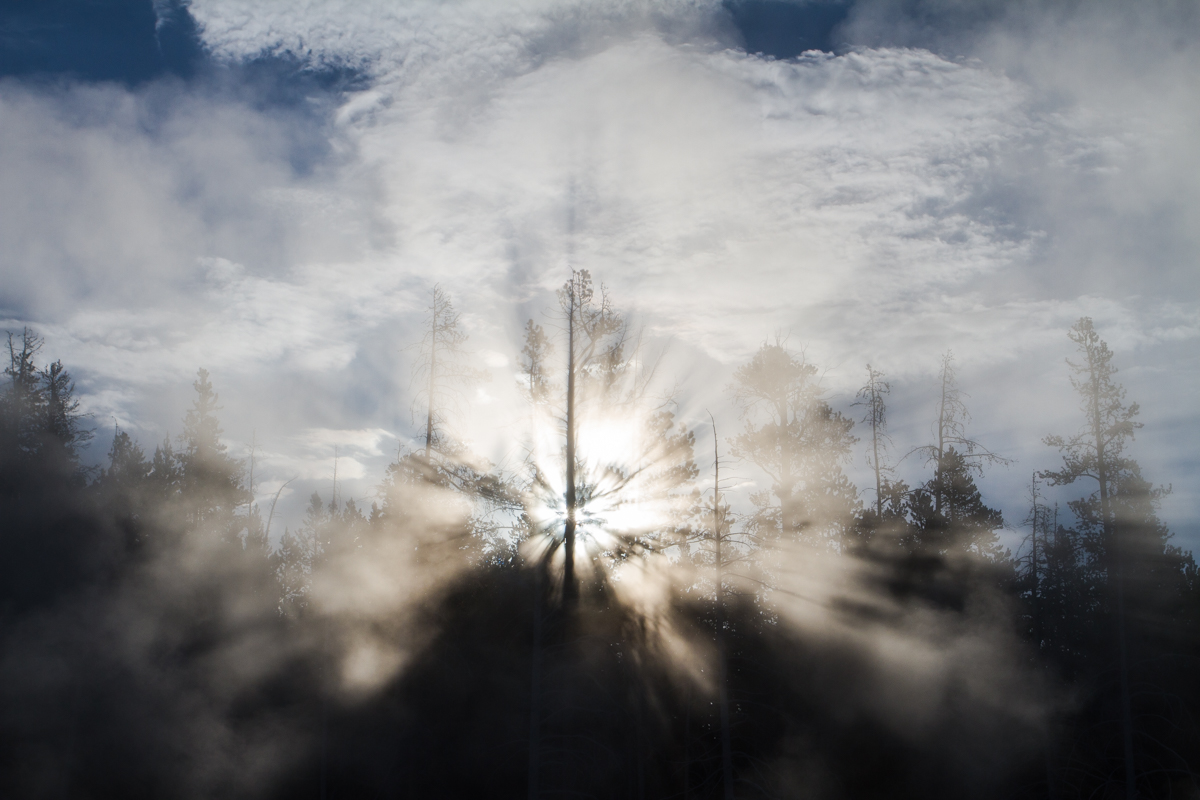
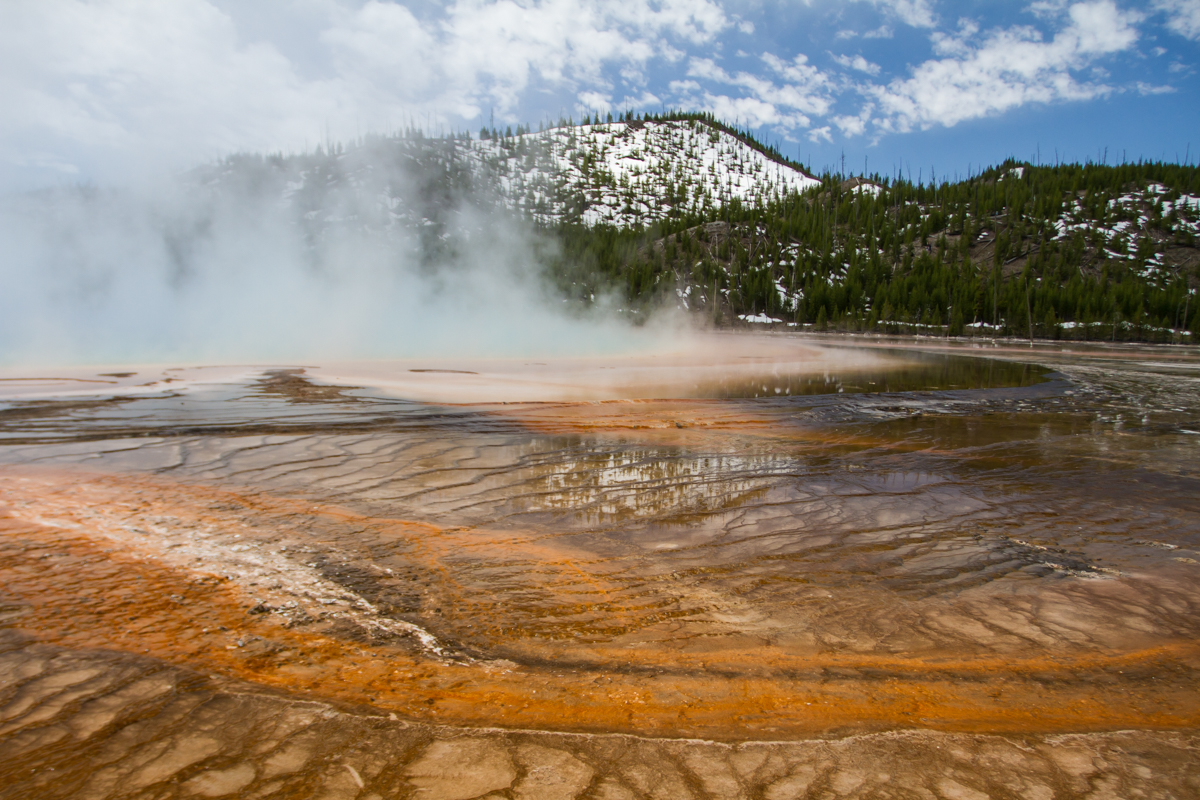
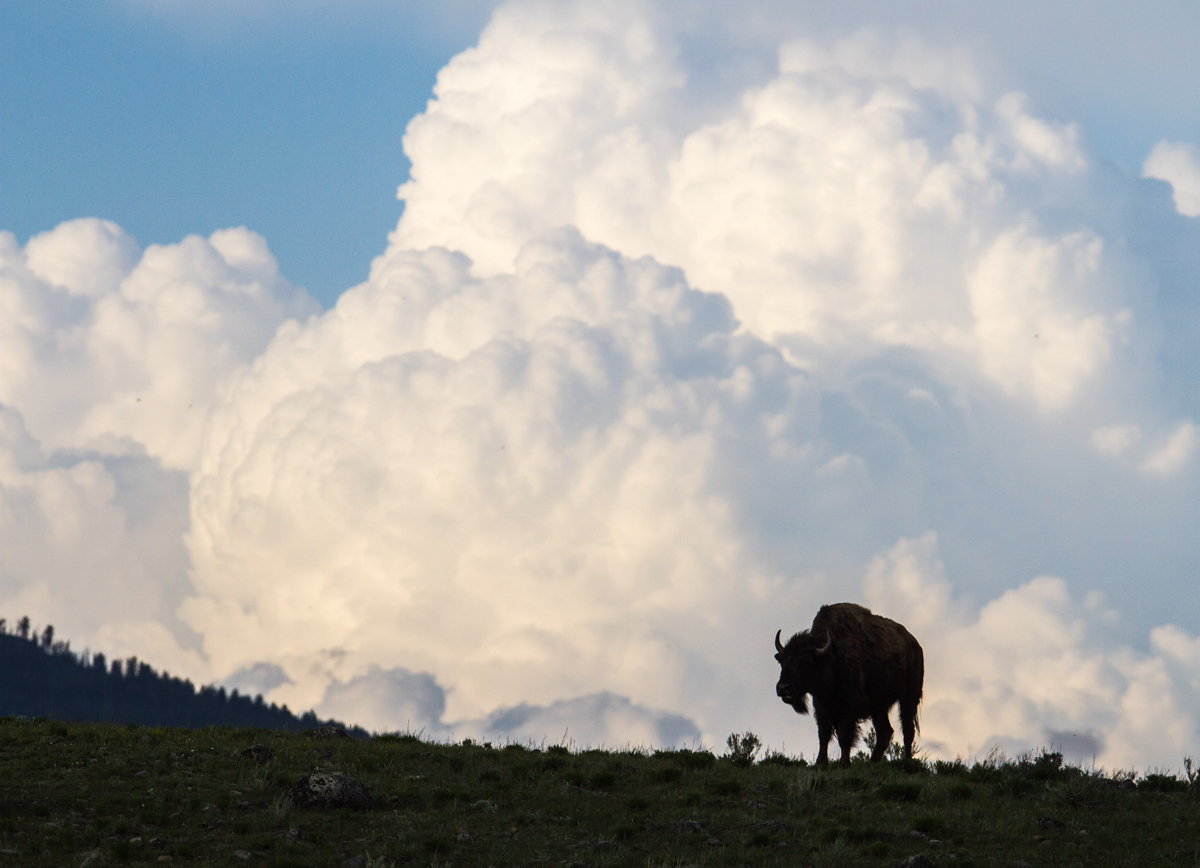
Join me for an unforgettable experience in the world’s first national park, Yellowstone! I am offering two trips this summer – both in June. One includes an extra night in the park’s Northern Range plus an overnight to Grand Teton National Park. Both trips offer small group (4 to 6 participants) field experiences. We will spend our days exploring the unique thermal areas of the park and the wildlife-rich landscape of the famed Northern Range of Yellowstone, home to many of the park’s large herds of Elk, Pronghorn, and Bison. And where there are prey, there are also predators such as Coyotes, Grizzly Bears, and Gray Wolves. Visit my Trips page for more information and to request a registration form. Hurry, space is limited.
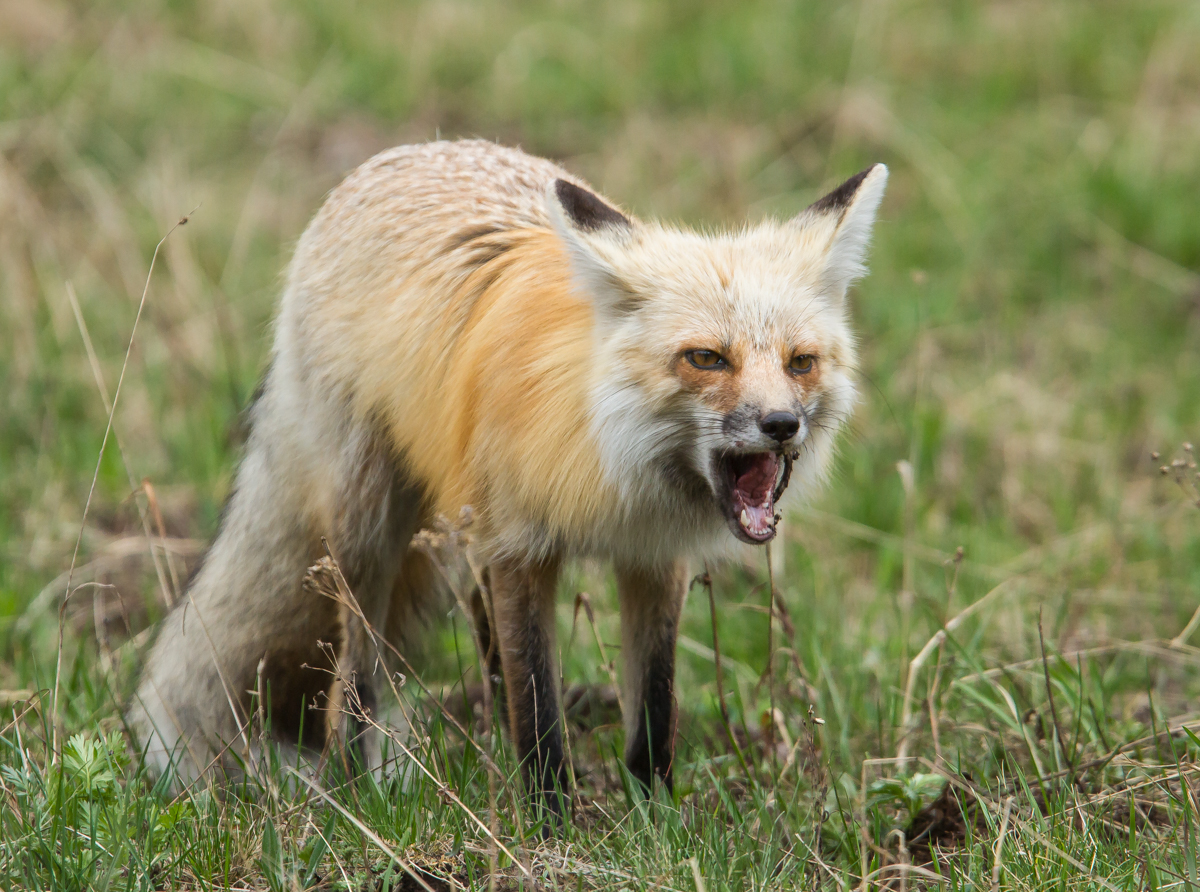
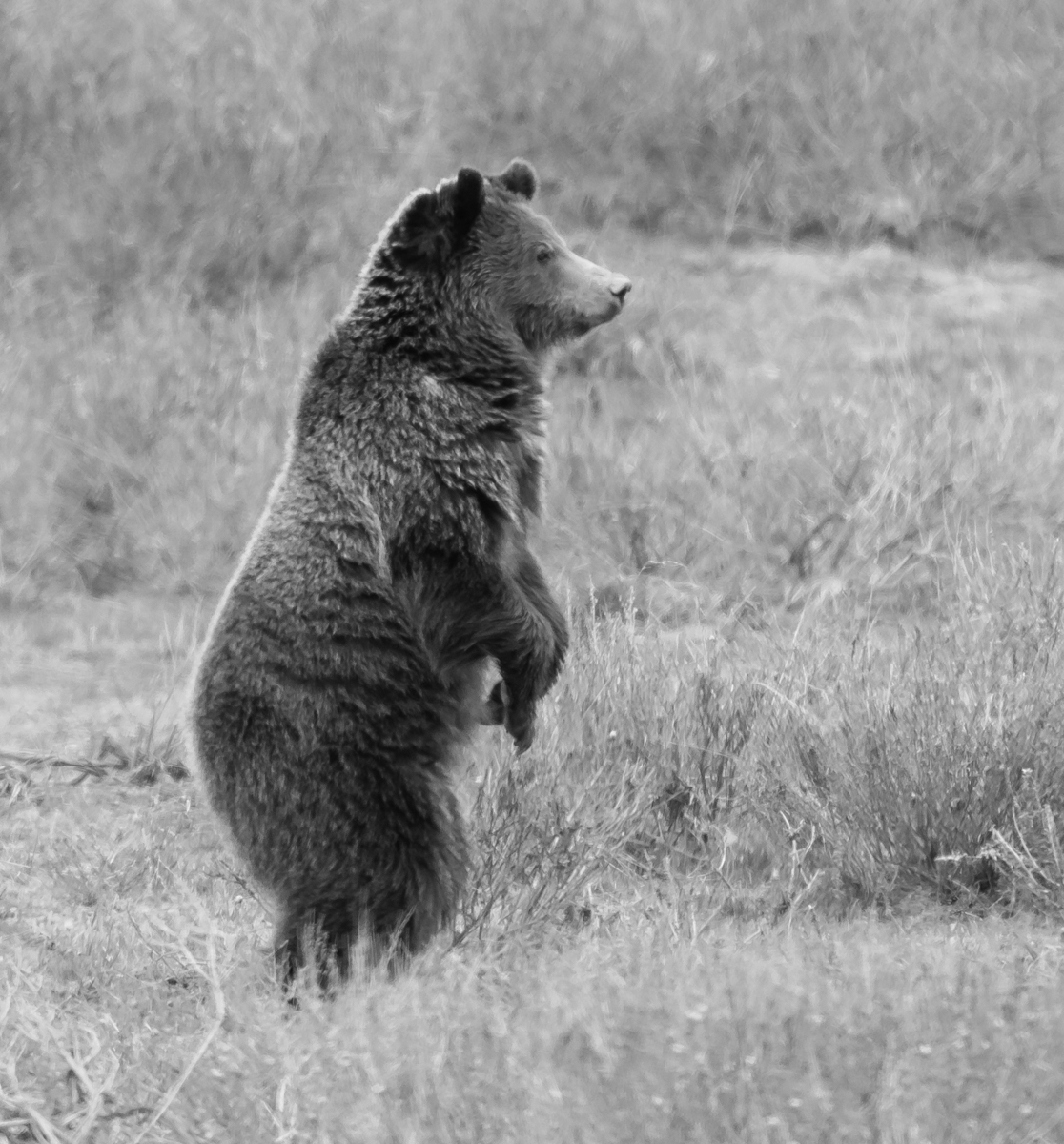
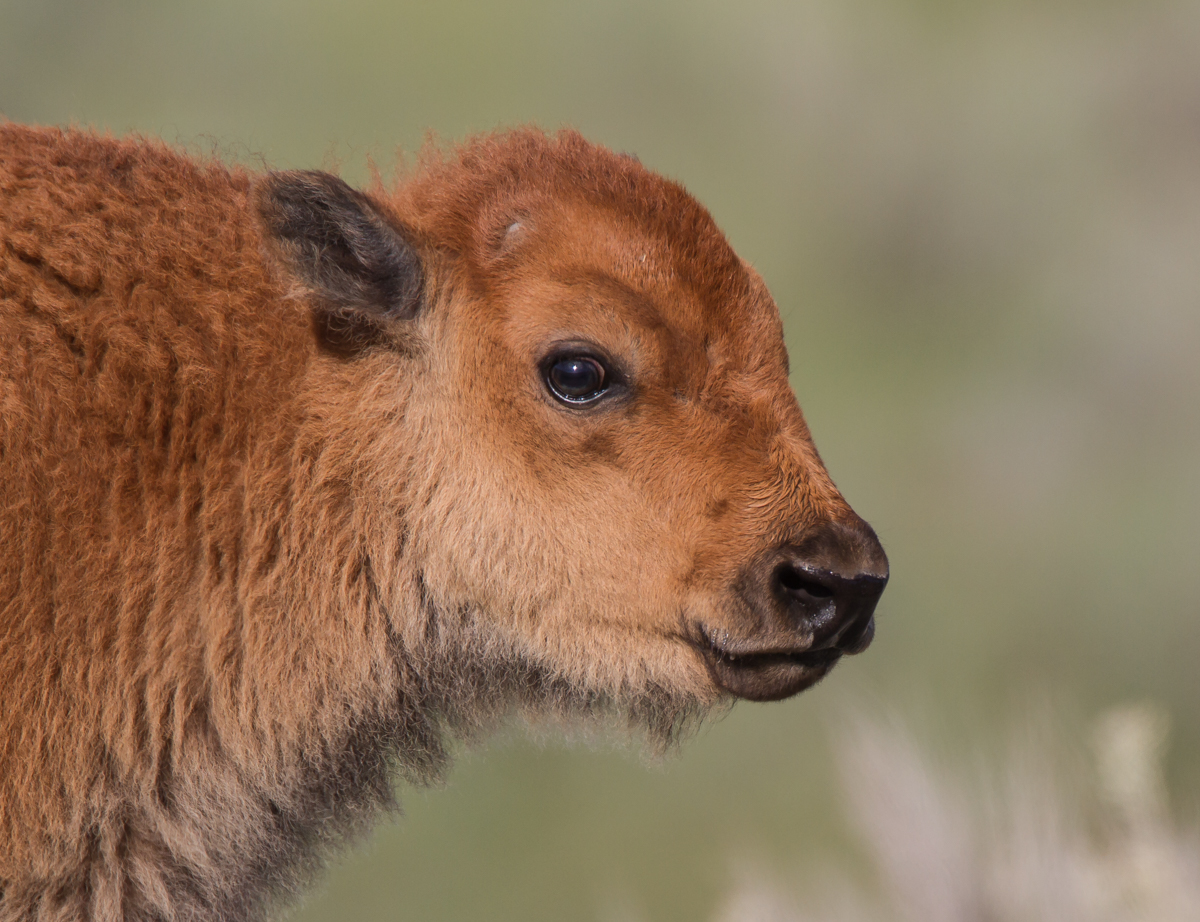
Here are a few images from previous trips…
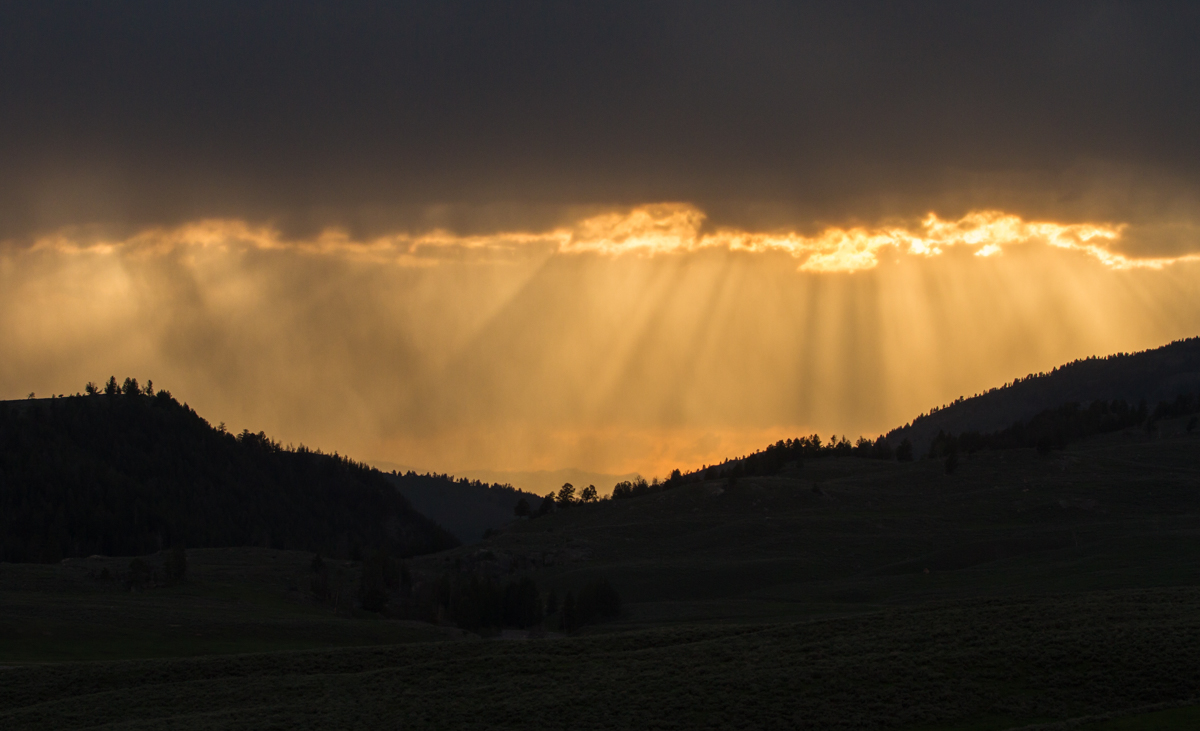
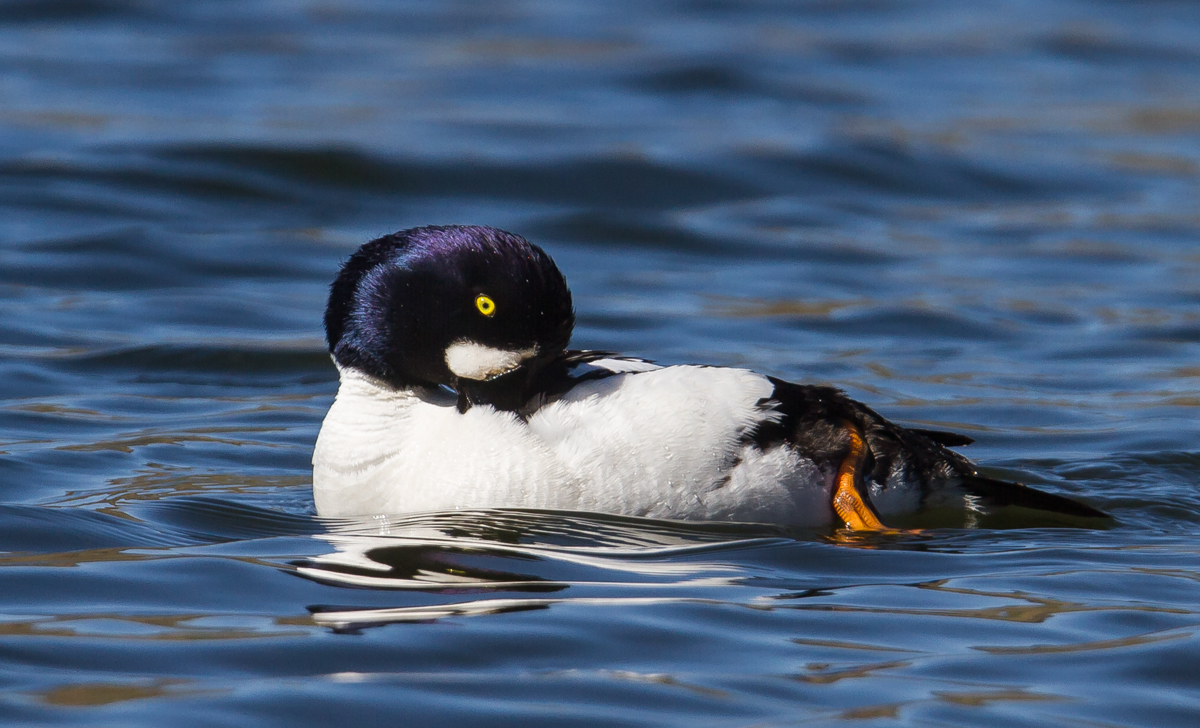
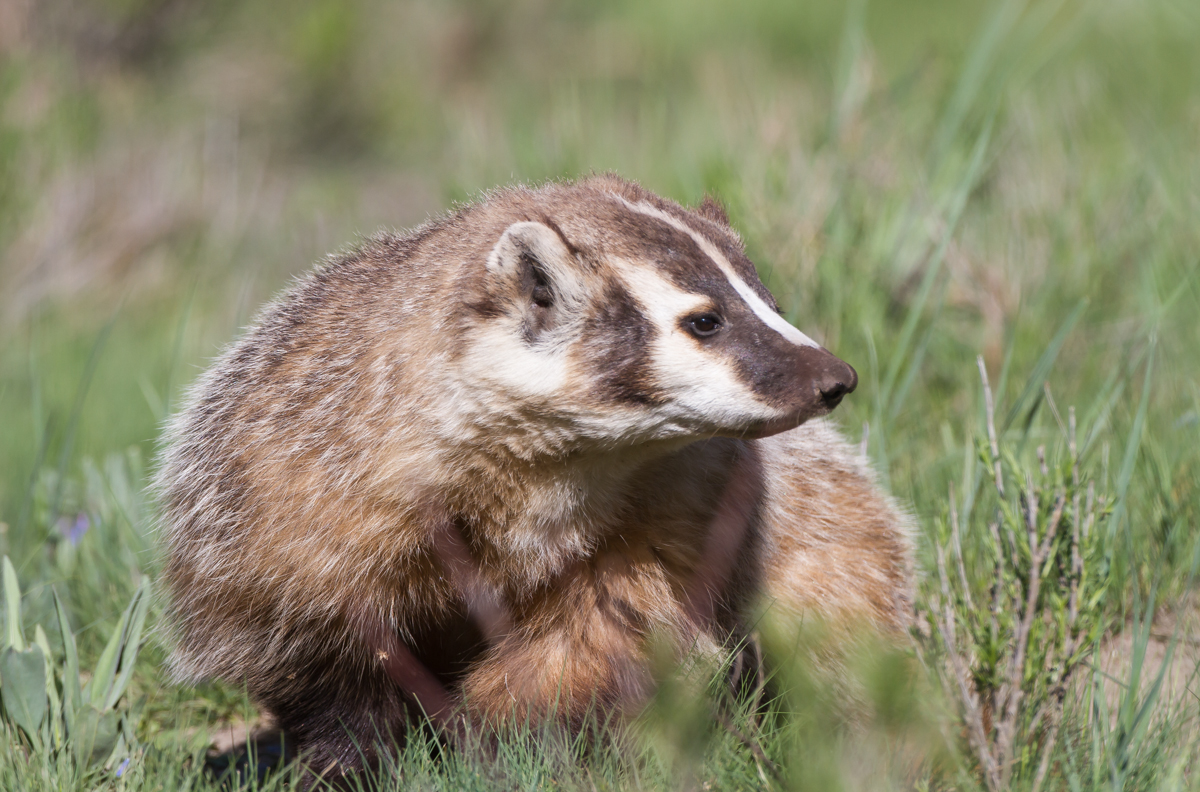
Steam at Grand GeyserShooting Star in bloomRed Fox snacking on a rodentGrizzly Bear checking out the surroundingsThermal feature known as mud potsBaby BisonGrand Prismatic SpringBison silhouetteSunset in Lamar Valley after a brief thunderstormBarrow’s GoldeneyeBadgerGray WolfOld Faithful
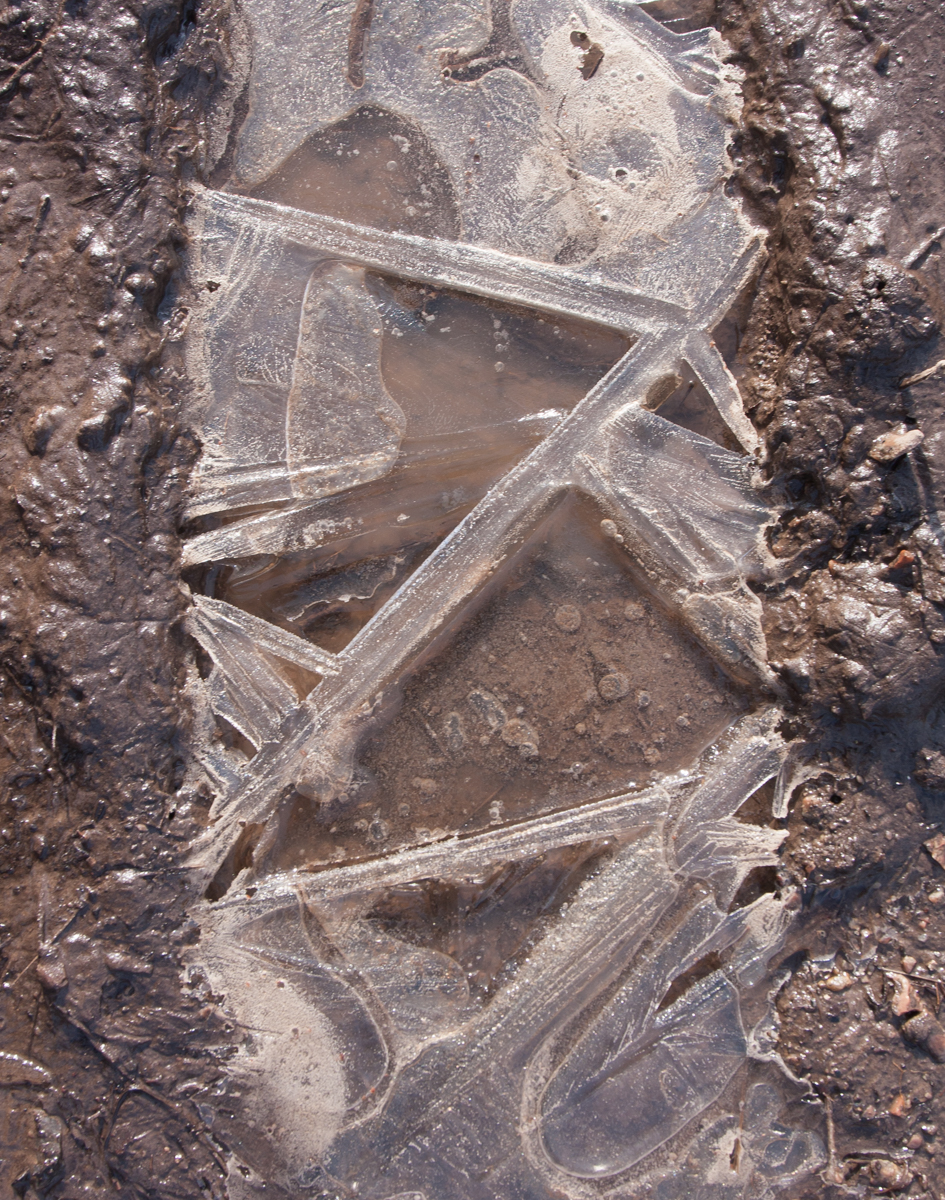
Weather changes quickly this time of year. When venturing out, we need to be prepared. Imagine if you live out in it all winter. While snow is relatively rare in our eastern wildlife refuges, ice is common. A sudden drop in temperature on a still January night can lead to quick freezes in all the puddles, ditches and other waterways.
Ice formed overnight in puddles and the edges of open water (click photos to enlarge)
Such was the case last week at the Pungo Unit when an overnight cold snap turned what had been a wet field full of hungry Wilson’s Snipe and Killdeer the previous afternoon, into a skating rink the next morning.
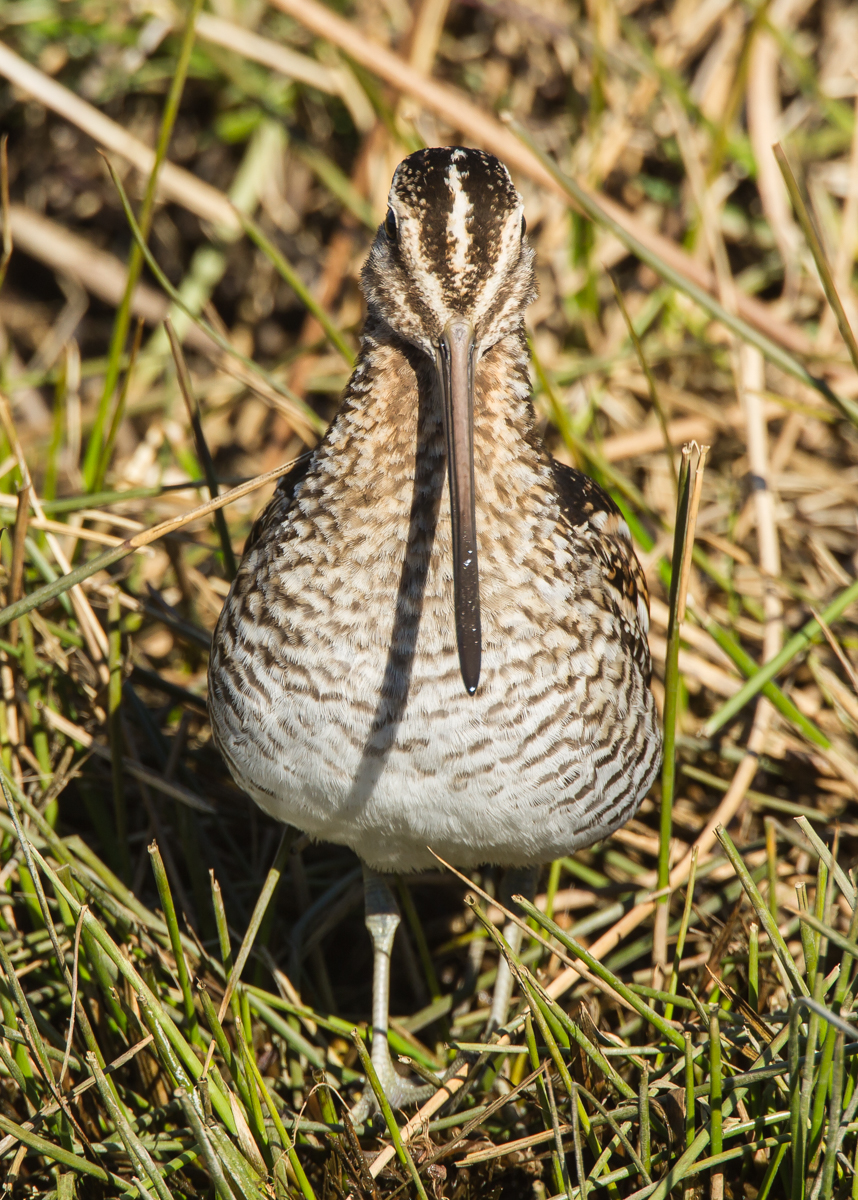
Wilson’s Snipe are difficult to see in grassy areas
The day before I had counted 18 Wilson’s Snipe in this flooded portion of an old soybean field. The next morning, the pool was frozen and, at first, I didn’t see a singe bird. Then, as I opened the car door, a snipe stood up and ran. So, I got back in the car and waited.
Wilson’s Snipe hidden in grass
Soon, I started seeing lots of lumps in the grass – snipe lumps. The key was to look for dark clumps of “grass” and then check them out with binoculars. Most turned out to be Wilson’s Snipe, apparently waiting for a little warmth before venturing out to feed.
A cautious Wilson’s Snipe ventures out onto the frozen puddle
I watched the first snipe approach the ice rink. It moved out across the frozen surface slowly, much more slowly than their usual walking pace.
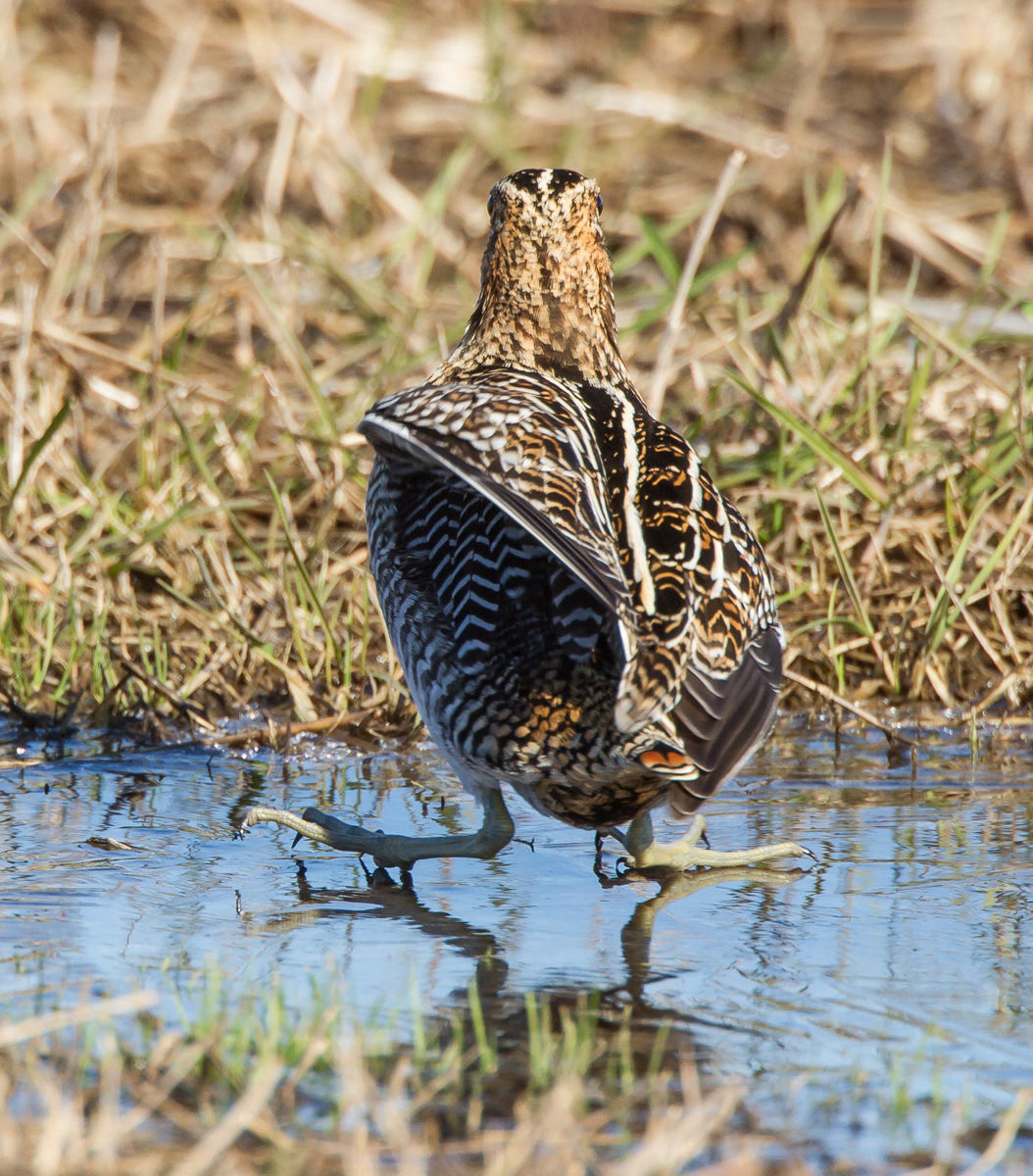
Wilson’s Snipe slipping on ice
The first few steps were almost graceful. But that quickly turned comical as almost every snipe that attempted to cross the ice found itself slip-sliding away. There was usually a quick wing assist to try to stay upright. A few even abandoned the attempt altogether and flew over the ice to the grassy area on the other side.
The snipe slip and squat pose
One bird did a butt flop on the ice with both legs shooting out in opposite directions.
Better to sit in the grass than try to skate on a frozen puddle
When that bird finally made it across, it seemed to express the embarrassment for itself and the rest of its clan with a slight look of disgust, or maybe it was contemplating another use for that long bill besides just probing the mud for worms.
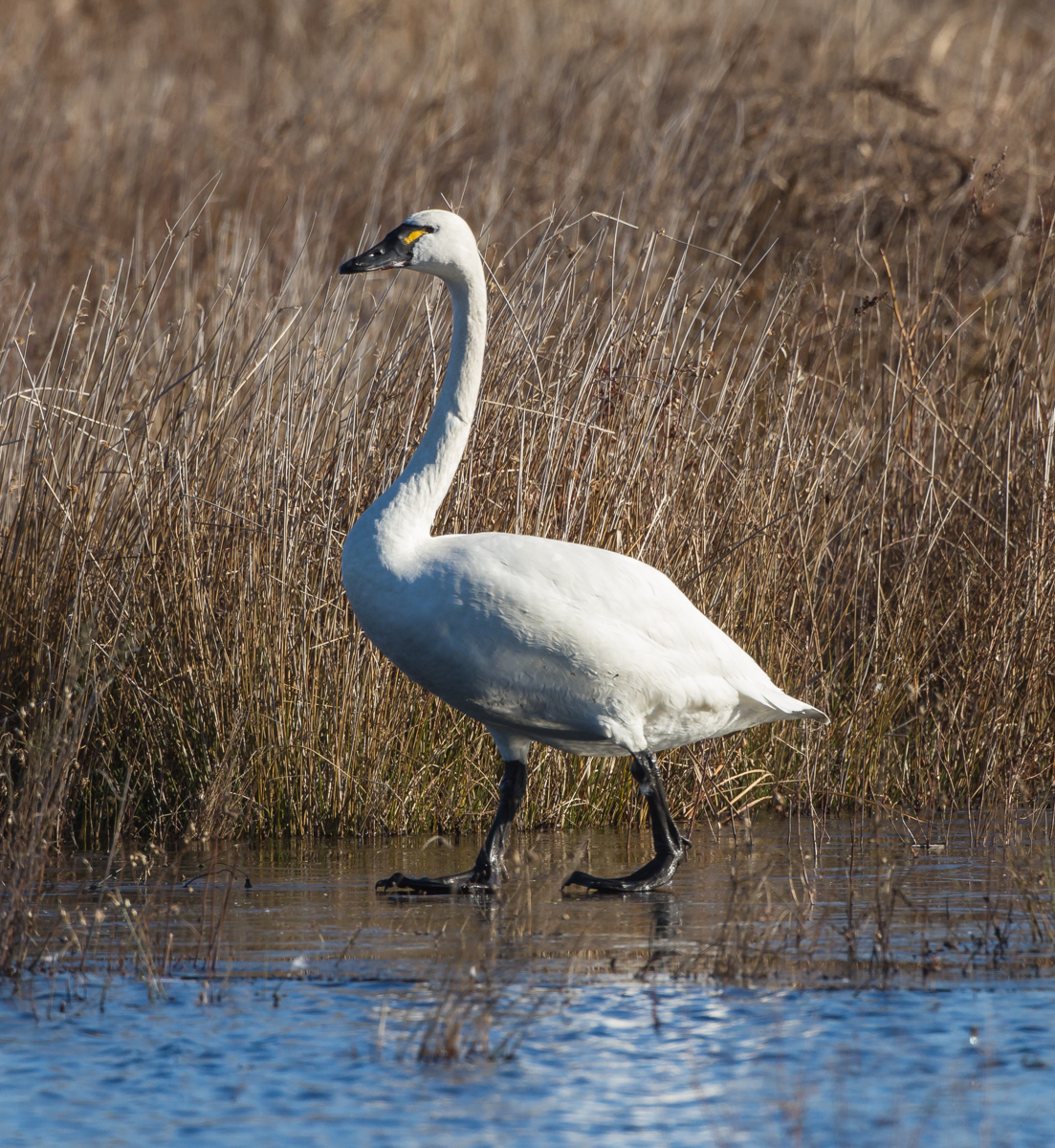
A Tundra Swan stands on the frozen edge of the impoundment
After several good laughs, I drove over to the impoundment that has been so productive this season for swan watching. Most of the water was open out in the middle of the impoundment, but I noticed some swans along the edge that seemed to be standing.
No problems walking on ice
I moved to an open spot with a good view and could see several Tundra Swans were gingerly walking on the skim of ice along the marsh edge. Their broad webbed feet have distinctive claws at the the tips of each toe. Perhaps this combination provides greater surface area contact with the slippery substrate and allows the seemingly always elegant Tundra Swan to walk gracefully atop the ice.
Check this out, Mr. Snipe
As if to reinforce their one-upmanship of the snipe in their ice skating abilities, one swan performed a regal wing flap at the conclusion of a short session of preening, leaving no doubt which species would receive the higher score in the marsh bird ice capades.
Tundra Swan elegance
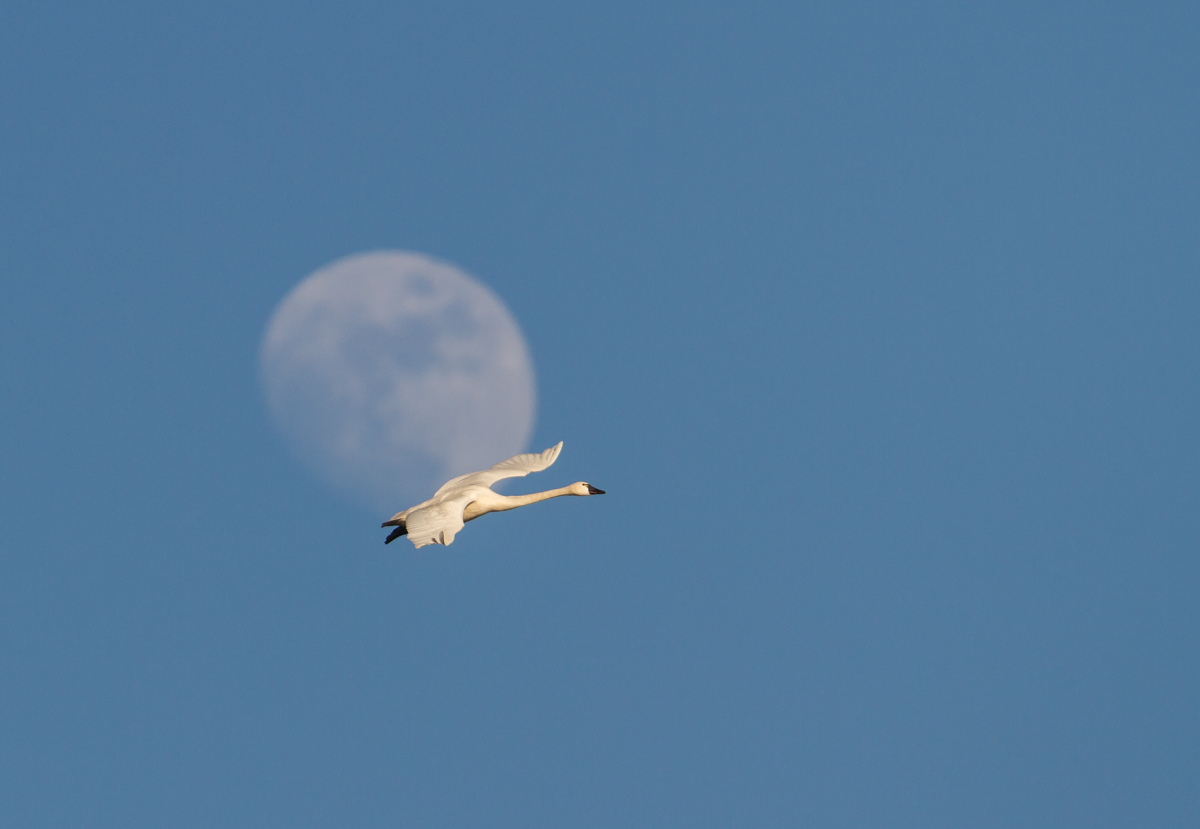
And, if there was any doubt of who is the most graceful and artistic of the birds of Pungo, a lone swan flew by the rising moon that afternoon, reminding me one more time of why these beautiful animals are my favorite bird of winter.
When I saw this quote, I said, yup, they nailed it. On almost any day from mid-December through early February, you have a good chance of seeing large flocks of Snow Geese as they fly to and from various roosting areas (usually Pungo Lake) and the fields where they feed. But what you want is to be standing next to the field they choose to land in, especially after sunrise or close to sunset. Then you have a chance to experience what I call, The Show.
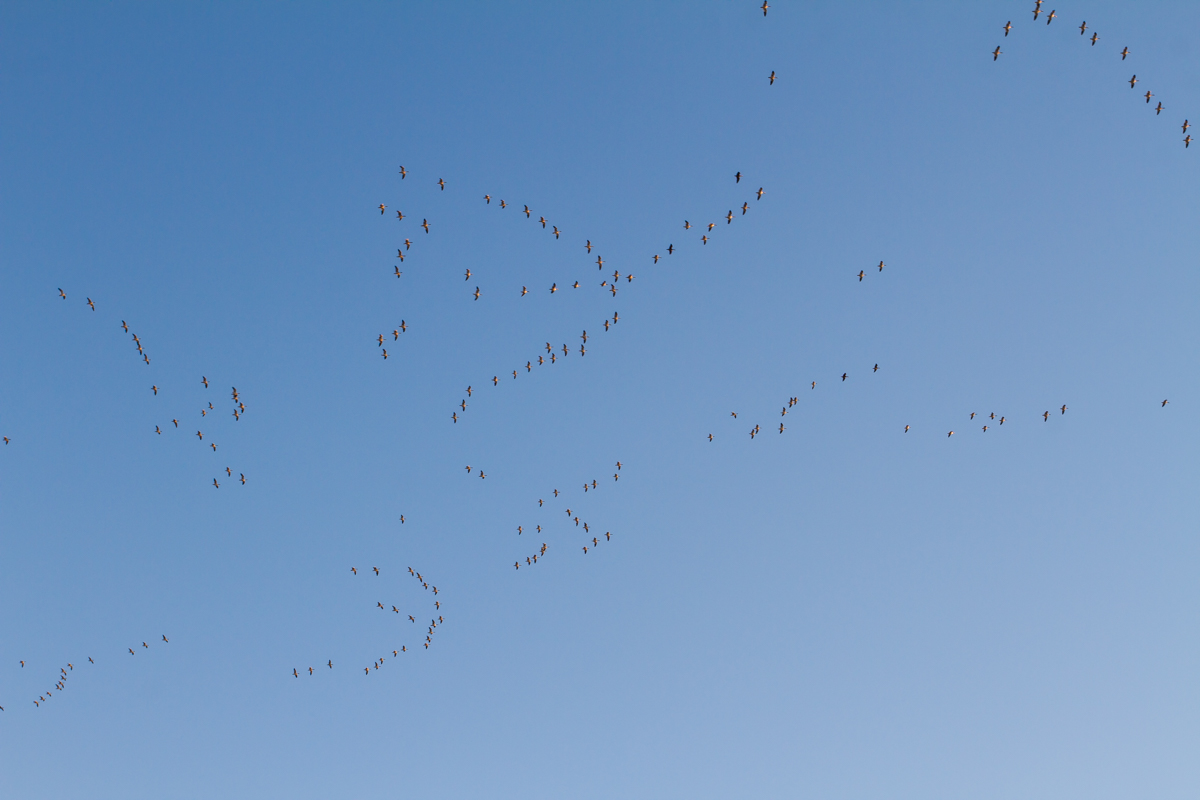
Snow Geese flying high overhead (click photos to enlarge)
Last weekend I had two groups, one in the rain and clouds on Saturday, and one on a beautiful sunny day on Sunday. It truly was weather fit for ducks on Saturday, and, true to its name, the birds were very active all day. Based on the number of gunshots heard just off the refuge, the local hunters were having a good day as well. The Snow Geese came in to a field later than usual that morning and stayed a long time before heading back to the lake. Sunday was very different – after an early morning departure, the Snow Geese returned after about an hour and spent much of the day on the lake.
Tundra Swans in corn field
The swans, meanwhile, took their time getting out to the fields to feed, and by late afternoon when we returned from Mattamuskeet, there were a few thousand Tundra Swans in some corn fields near one of the refuge roads. This is always a good sign. Snow Geese seem to like to land in fields where there are a lot of swans feeding, but this was not the field they had been in the evening before. It has been a little harder this year to predict where The Show will be as the fickle Snow Geese have been splitting up in smaller flocks and moving around a lot more than in years past. But, as we watched the swans, I saw the thin, wavy lines of Snow Geese on the horizon. So, we waited. After circling a bit over the lake, it looked as though they were headed our way.
Snow Geese coming into field at sunset
As we watched, the leading edge of the flock streamed our way and started to circle the field, the late afternoon light casting a golden glow on the underside of the birds. Looking back at the horizon, I could see thousands of Snow Geese headed our way, and we seemed to be in just the right place….let The Show begin.
The sights and sounds change as the birds swirl down into the fieldThe flock continued to swirl around us in the golden light
For the next 30 minutes, we stood there, mesmerized by thousands of birds flying around us and feeding in the field right next to the road. Every now and then a car would drive by, pushing the birds farther back into the field or causing large numbers to lift off and circle over us again before settling back down to their dinner of corn kernels.
Can you spot the Ross’s Goose in the flock?
I wanted the group to see some of the smaller Ross’s Geese and we soon found several on the front edge of the flock in the field next to us. We also tried to spot their smaller size in the birds flying low over our heads. Look at the photo above (best to click on it and enlarge) and see if you can find at least one Ross’s Goose – it is smaller in size, lacking the “black grin lines” found on a Snow Goose bill, and has a shorter, stubbier bill.
The flock finally blasted off to fly back to the lake for the night
As darkness approached, small groups of Snow Geese began to head back to the lake along with an increasingly steady stream of swans. Finally, a car came by with its headlights on, and the rest of the Snow Geese blasted off in a blur of wings. It had been a phenomenal afternoon and The Show had been superb, with thousands of birds right on top of us. There really is nothing else like it anywhere in our region. The Snow Geese should be around a couple of more weeks before they start their long migration back to their breeding areas. One Snow Goose we reported this year had a neck collar with the code TC84. We heard back from a USFWS biologist that it was banded on its breeding area on 8/15/2011 at the South Plain of Bylot Island, Nunavut, Canada…a long way from this corn field in eastern North Carolina.
I have tours this weekend and have some availability next weekend. Contact me if you are interested in trying to get seats to The Show before the curtain closes for this year. As Chris Early writes in his excellent field guide, Waterfowl of Eastern North America…
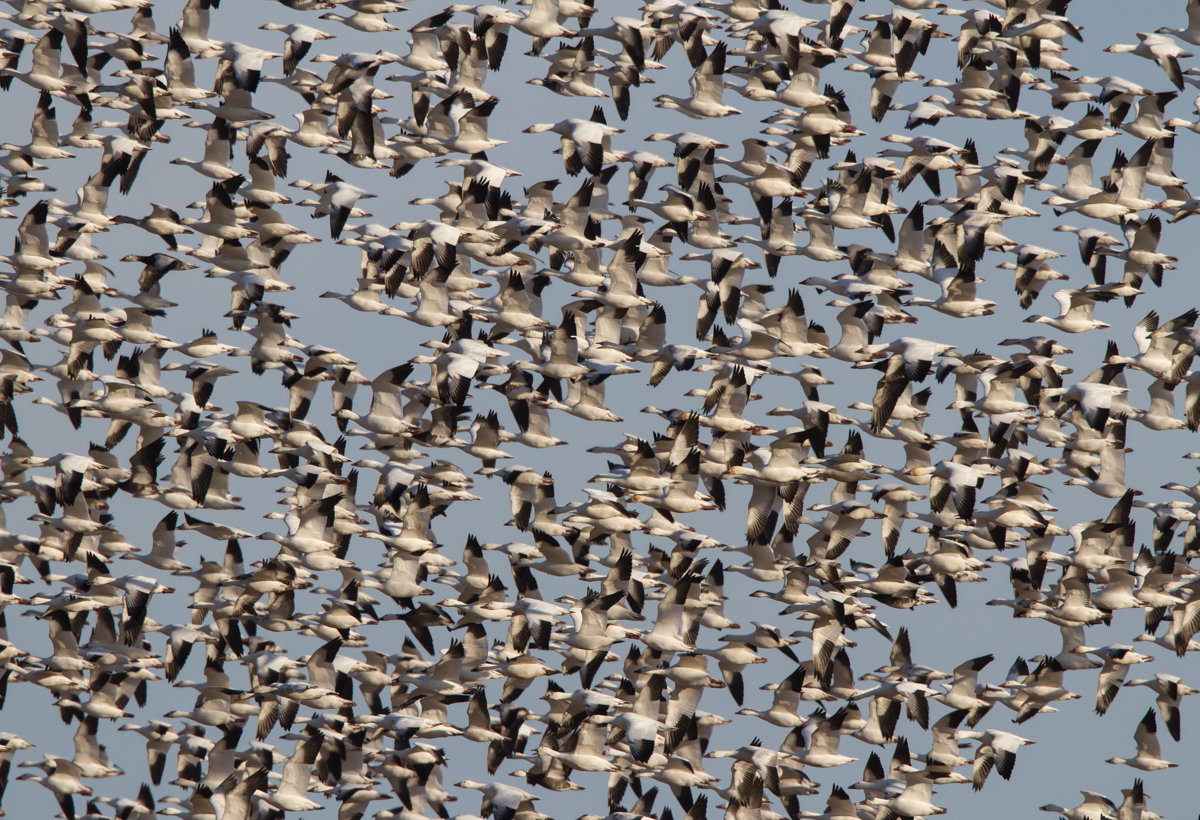
Hundreds of these geese flying together really convey why their name is so appropriate – they look like a flurry of snowflakes. But they’re very noisy snowflakes; the sound that these flocks make is an experience in itself. A huge flight of Snow Geese is something that everyone should see (and hear) at least once in their lifetime.
…for many of us the world would be a poorer place without bears. We keep bears because they are a part of nature and because of what they do for the human mind, body, and soul.
~Steve Herrero
Young Black Bear in large Bald Cypress tree (click photos to enlarge)
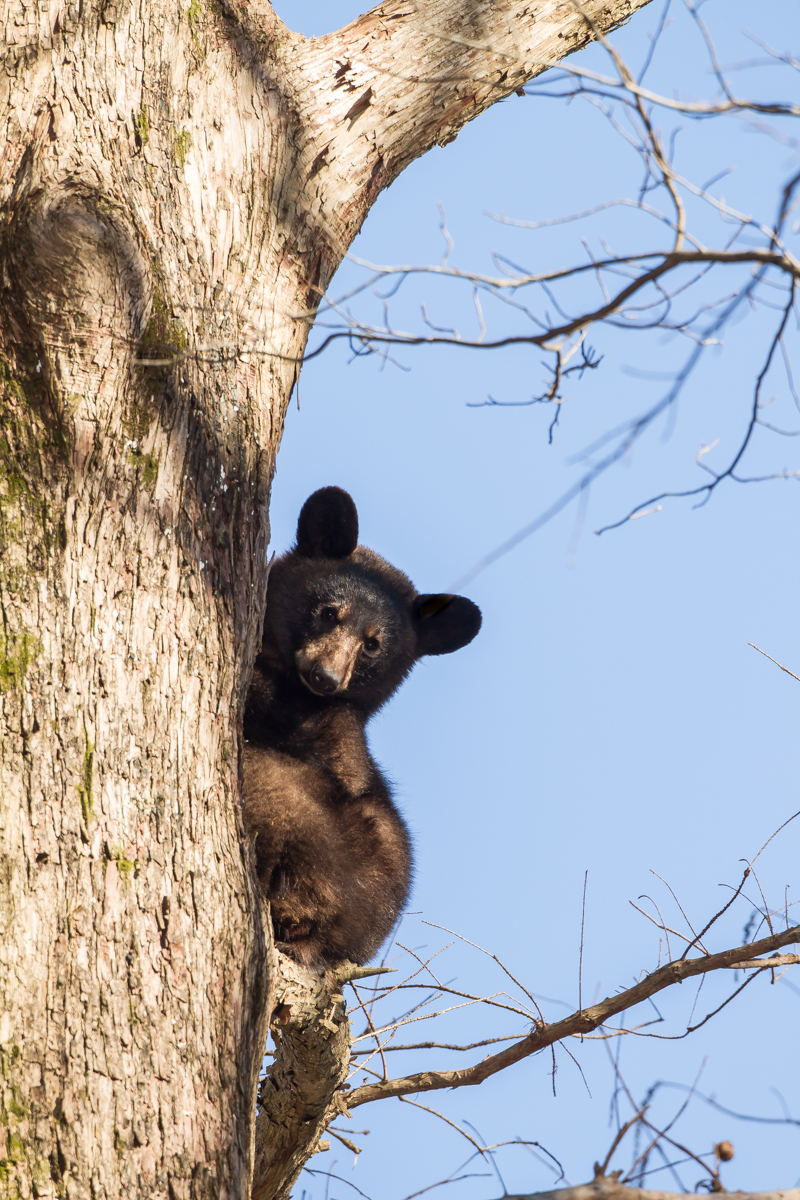
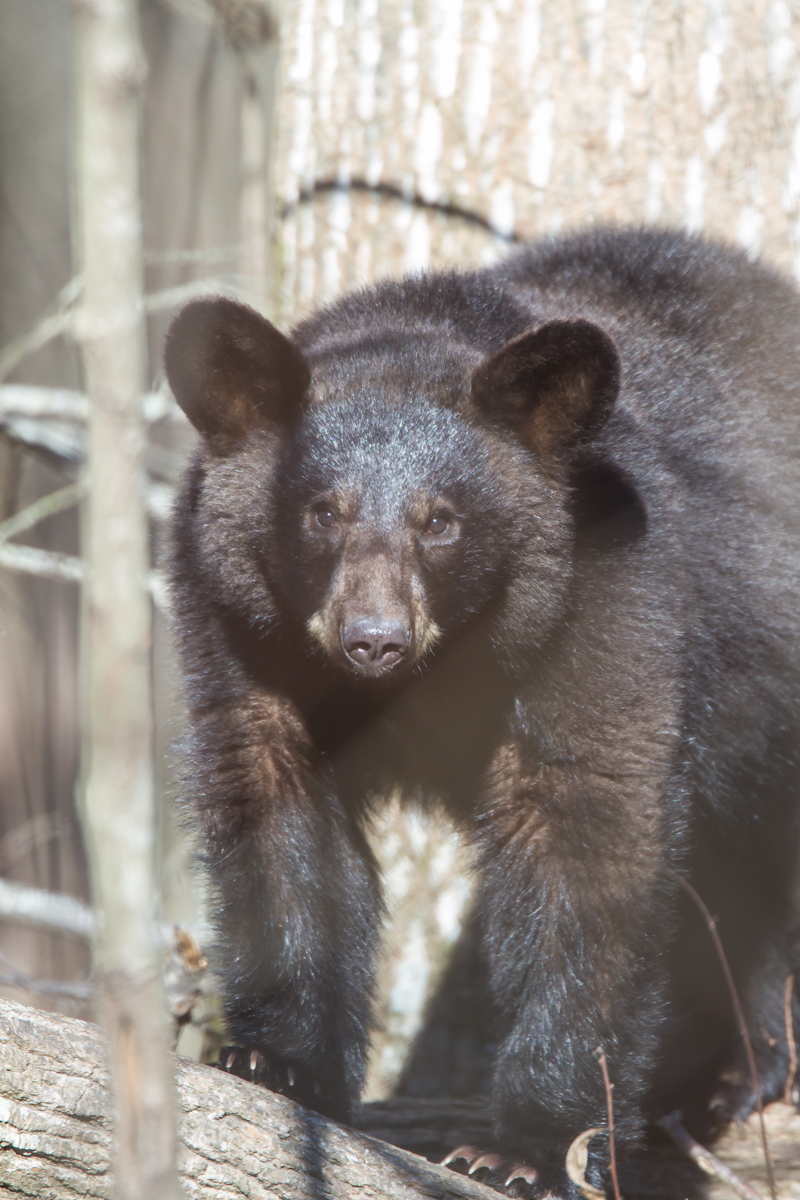
I have seen several bears in trees this winter, even a couple with my groups, which is always a thrill. A couple of weeks ago, I went down to Pocosin Lakes NWR the day before one of my tours and just spent some time wandering and looking. It was a beautiful afternoon and much of the wildlife seemed to be taking it easy, and even I was contemplating a nap in the sun. As I walked, I just happened to look up and I discovered a young Black Bear about forty feet up in a Bald Cypress tree. The bear’s silhouette was hidden from view as I approached the tree and without a glance over my shoulder, I might have missed it. Makes me wonder how many I have walked by in the past.
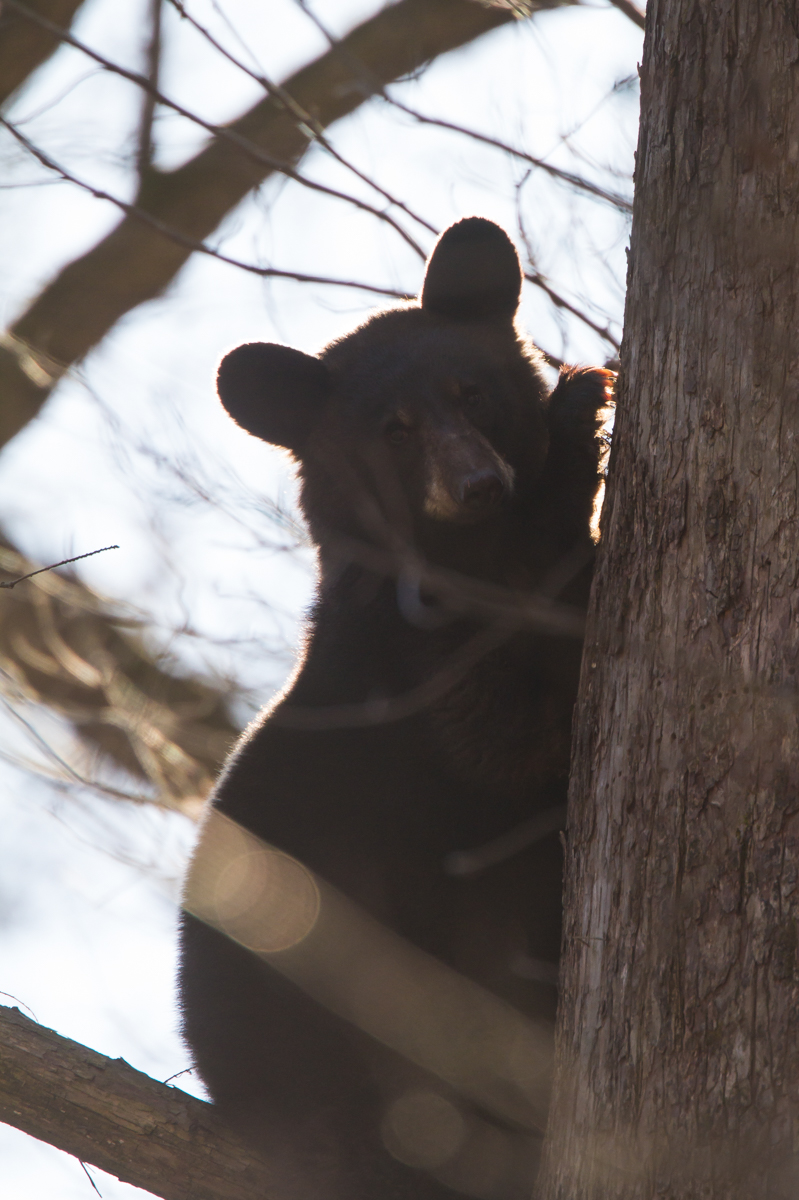
The bear turned and looked down at me
I walked around the tree to get some better light on the bear and it turned and looked down at me.
We watched each other for several minutes. I was intent on watching every movement it made, but the bear took its eyes off me frequently to look around and occasionally groom itself.
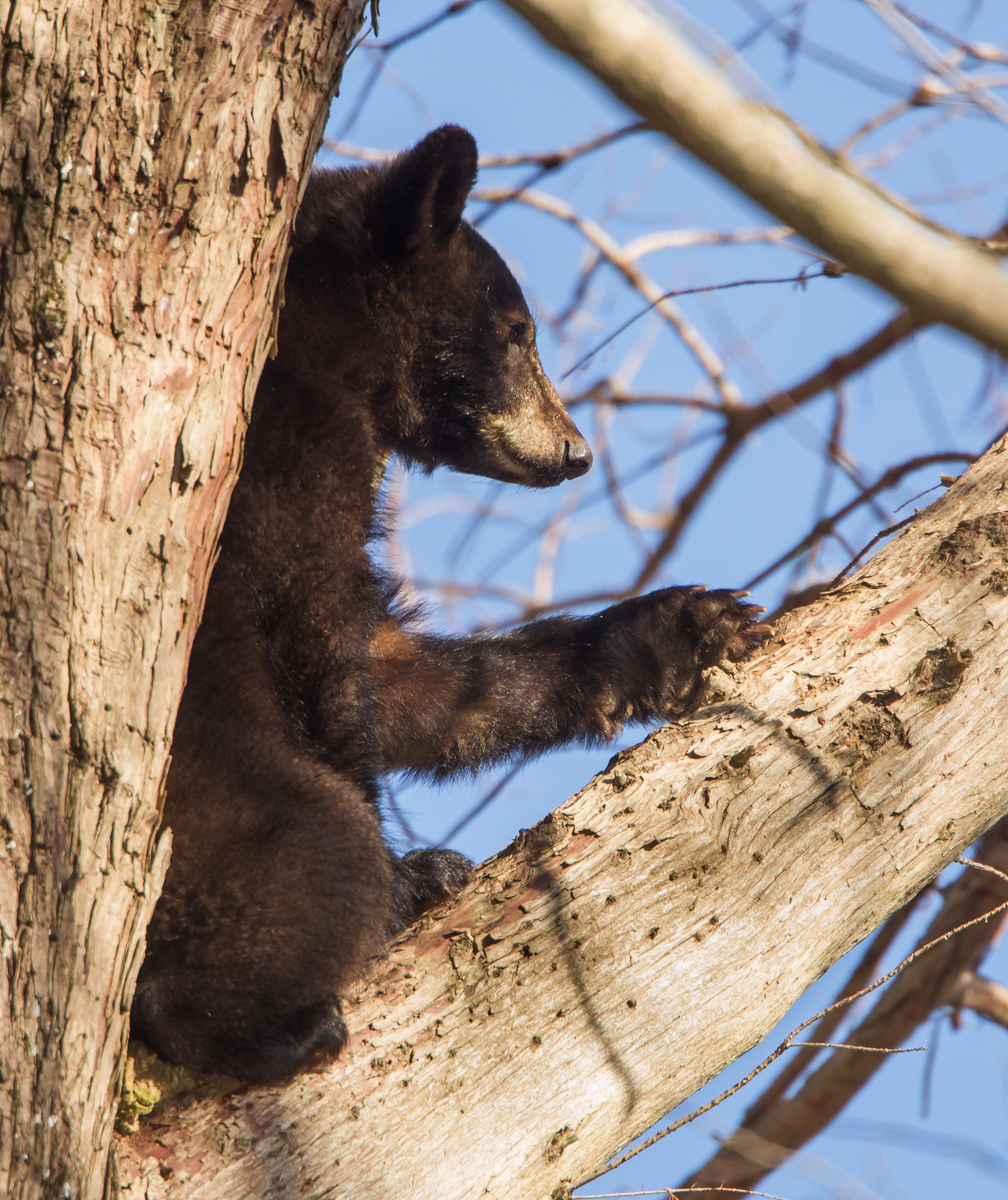
Bears have short, curved claws for climbing
The bear then decided to climb a bit higher. Black Bears have curved claws about two inches long which allow them to easily climb trees. Their stocky stature and incredible strength also aid their climbing skills.
Bear checking on my position after climbing to a large limb
The bear seemed more comfortable on the larger limb, and, after checking on my whereabouts, sat down against the trunk and soaked in some of that warm afternoon sun.
Relaxing in the sun
I envy the bear the view from up there. I imagine it must be fun to be in the trees with the birds. This young bear (I am guessing it was less than 100 pounds) may have climbed for a degree of protection from some of the larger bears (and humans) in the area, or it may just be nice to have that penthouse view.
Making its way down the trunk
Finally, after about fifteen minutes, the young bear decided to head down the trunk. It went around to the back side of the tree and began its descent. I stayed where I was so as to not spook it.
Sniffing the air from the base of the treeA parting glance
Once on the ground, the bear came around the trunk, sniffing the air, sizing up the surroundings. It gave me one glance, and then slowly turned and ambled off into the woods. I watched it through the thick vegetation for a few minutes as it nosed the ground, occasionally digging in the soft earth, and then disappeared into a wall of River Cane, tree saplings, and vines. I’m not sure what impact I had on the bear in the time we spent together, but I know it left a lasting impression on me.
…this harsh sound softened and modulated by distance, and issuing from the immense void above, assumes a supernatural character of tone and impression, that excites, the first time heard, a strangely peculiar feeling.
~Dr. Sharpless, 1844, on the sound made by Tundra Swans during flight
Tundra Swan calling as it flies out of Pungo Lake (click photos to enlarge)
It is a magical sound, that first haunting note of a Tundra Swan each season. This year, I heard my first call on a November trip down to Pocosin Lakes National Wildlife Refuge. In subsequent trips, I have listened to it countless times, always a mesmerizing call – often a soft honking sound, reminiscent of the baying of hounds in the distance.
Other sounds include a mellow hoot, with an occasional squeak or a whistle thrown in for good measure.
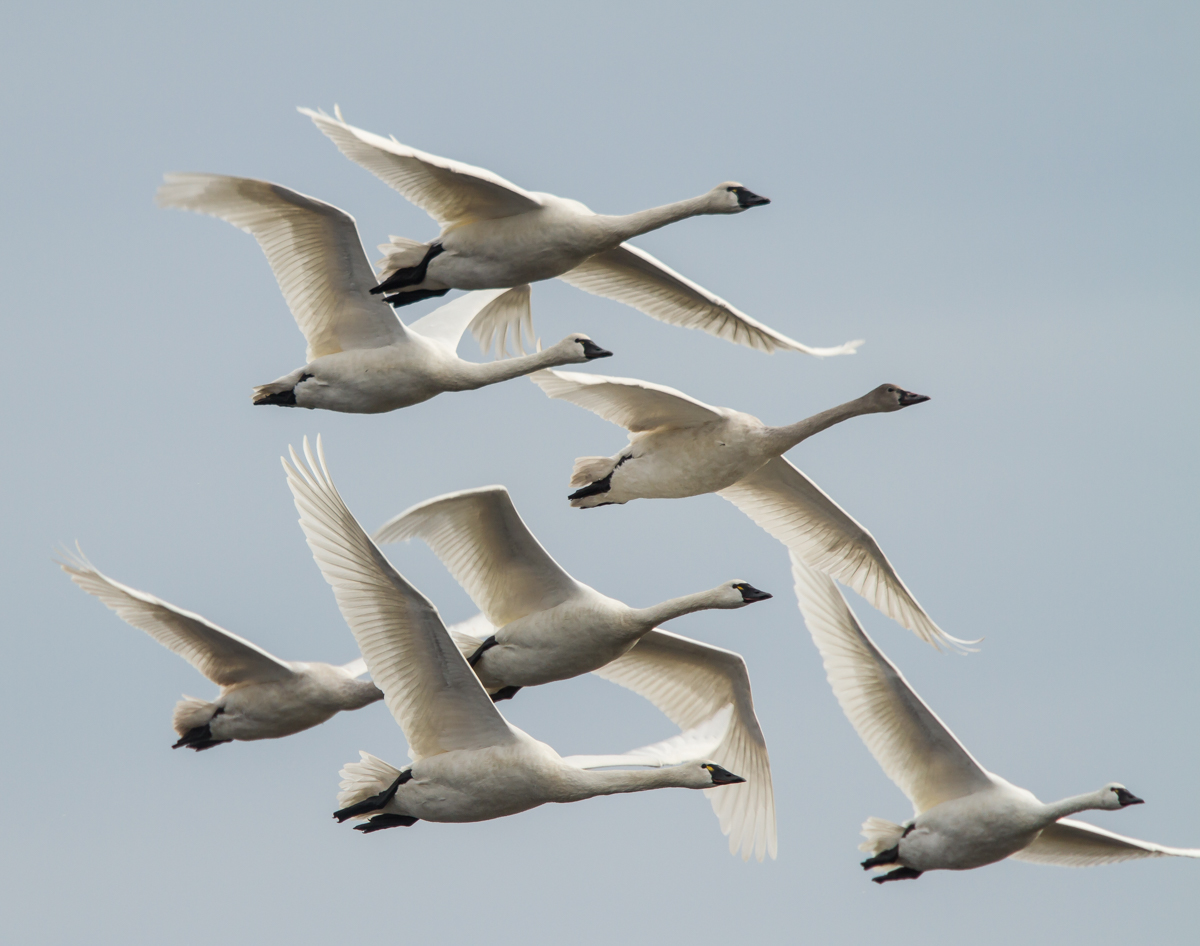
Swans flying in tight formation against a gray sky
And then there is the sound of the wings overhead, one of my favorite swan sounds.
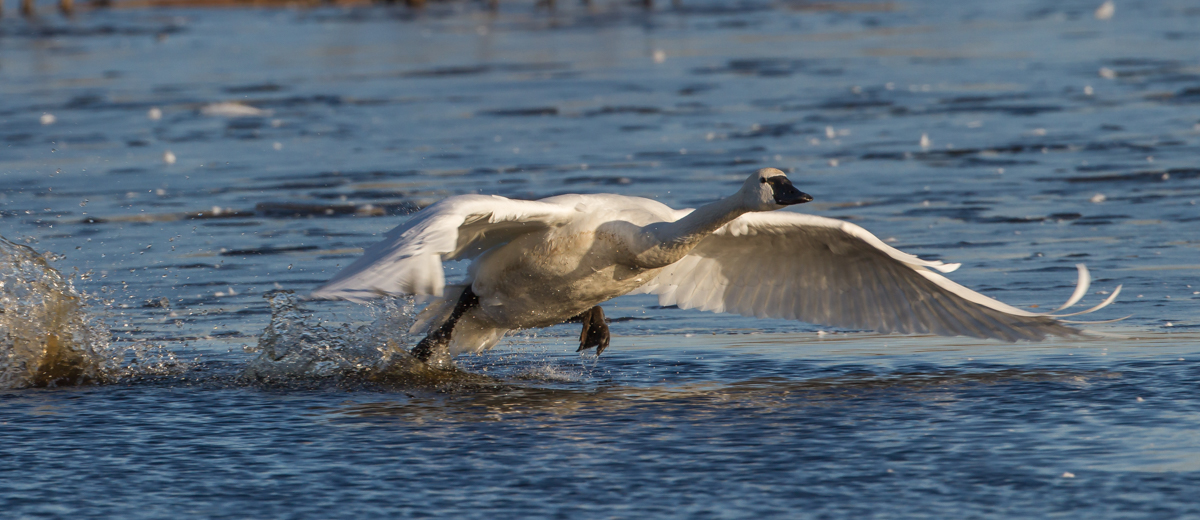
Swans must run across the water to take off
If you are reasonably close, you can also hear the slapping sound made by their huge webbed feet as they they run across the water to take off.
Swan coming in with landing gear downSwans ready for touch downThe gentle splash as a Tundra Swan lands
You have to be much closer to hear the gentle, prolonged splash as these graceful birds come in for a landing.
Tundra Swans feeding in a corn field on the refuge
The season of the swan is a magical time in Eastern North Carolina. Tundra Swans occur in two population groups, a western population (WP) and an eastern one (EP). The EP is estimated to be about 107,000 birds as of mid-winter, 2013 (the WP is lower at about 75,000 birds). An estimated 70-80% of the EP overwinter in North Carolina, making the refuges and fields of eastern North Carolina a critical habitat for a large portion of the Tundra Swans in the world.
Swans bunched together in corn field
When I am leading groups to view swans, we often see other groups that are hunting swans. North Carolina is one of eight states that allow swan hunting. Swan meat is supposedly good to eat, and Dr. Sharpless commented that if less than six years old swans are very tender and delicious eating. Federal rules dictate that states limit the number of permits issued and generally limit the annual harvest to one bird per permittee. In our state, 5000 permits are issued each winter, by far the most of any other state. In a typical winter, about half result in a kill. A quick check online revealed prices of about $400 to $450 per hunter per day for a swan hunt in eastern NC, which obviously brings income into this area. And, of course, there is the income brought in by ecotourism – bird watchers, wildlife watchers, and others that just want to get out and enjoy the sights and sounds of the winter wildlife.
A sunset cloud of dust created by wind and the presence of thousands of feeding Tundra Swans and Snow Geese
Our group was interviewed this past weekend by a graduate student looking at possible economic impacts to the region due to the presence of large numbers of swans each winter. I know that the hotel we stay at in Plymouth is often crowded on weekends with a combination of swan hunters and swan watchers, so there must be a considerable impact on local economies to the presence of so many wintering birds in this region.
Tundra Swan adults and young
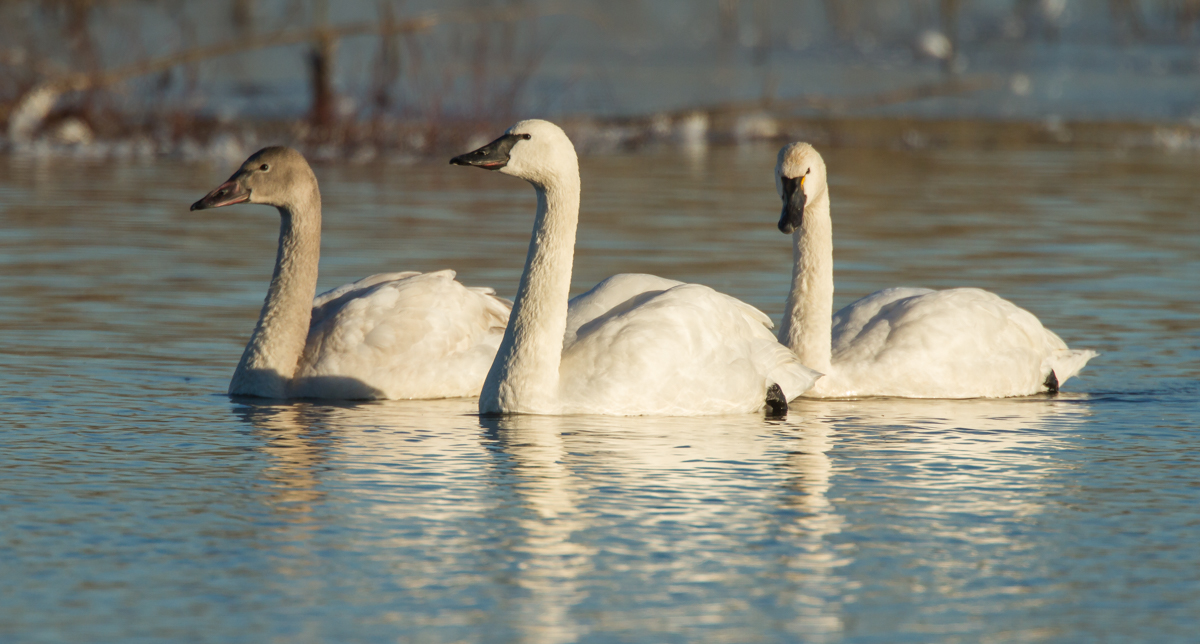
Tundra Swans are often seen in family groups on the wintering grounds. Adults are all white (although they sometimes have rust-colored stains on their head and upper necks from the ferrous minerals in the soils where they feed). Immature birds are dirty white or grayish, especially on the head and neck, and often have a pinkish bill. These juveniles will be all white by the time they come back next winter.
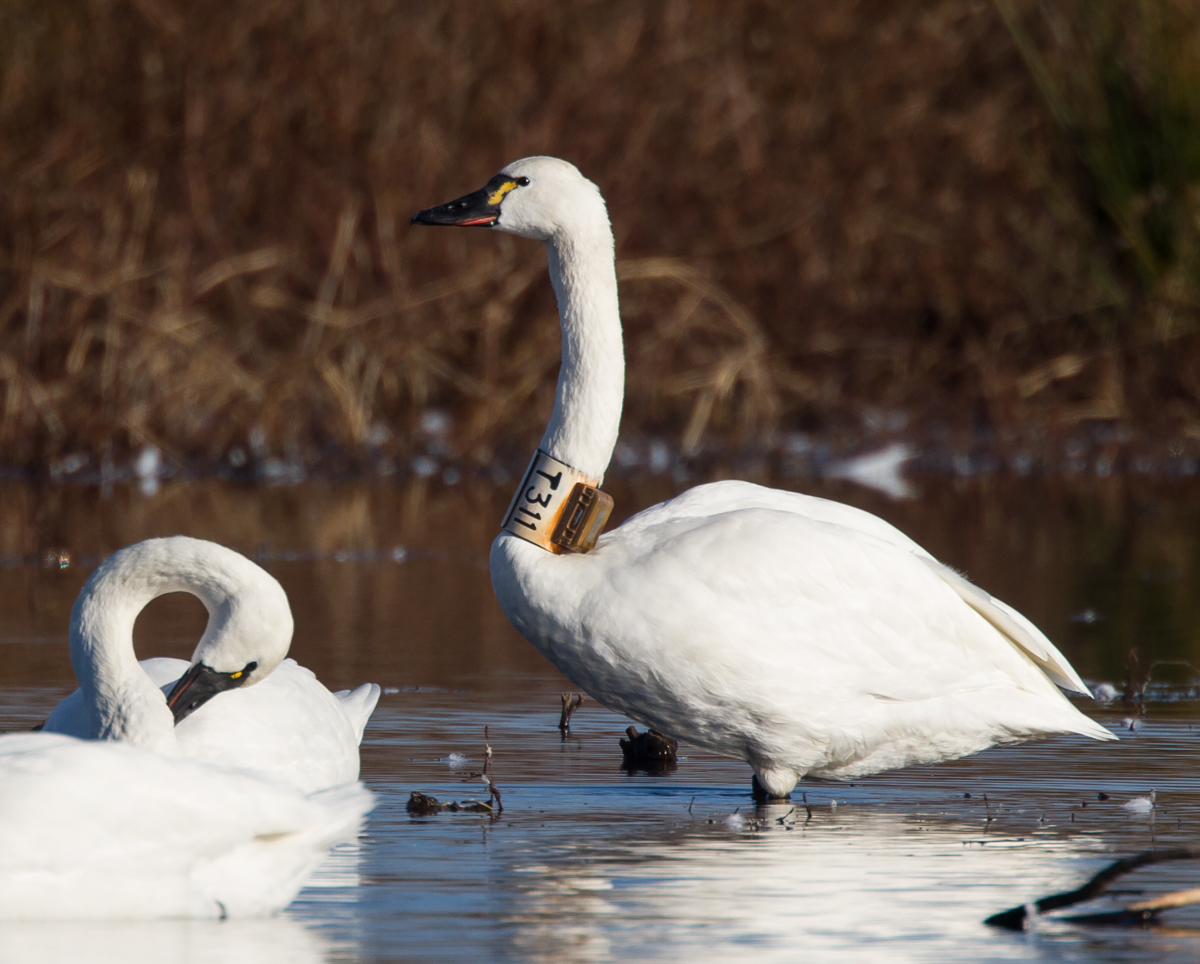
On an earlier trip this year we observed a swan sporting a different color – a neck collar similar to the ones I had assisted the refuge in putting on birds they banded several years ago. This one also had what appeared to be a microwave transmitter on the collar which would have provided even more information on the movements of this particular bird, T311. The advantage of neck collars is that observers can report the whereabouts of a collared bird using just binoculars or a spotting scope, whereas to get data from the traditional leg bands requires that the bird be in hand, usually as the result of being shot in a hunt. After turning in the observation of T311 to a USFWS biologist in the region, the preliminary information indicates that this number series corresponds to birds that were collared on their nesting grounds on the North Slope of Alaska in 2006. I hope to get more definitive information on this bird soon.
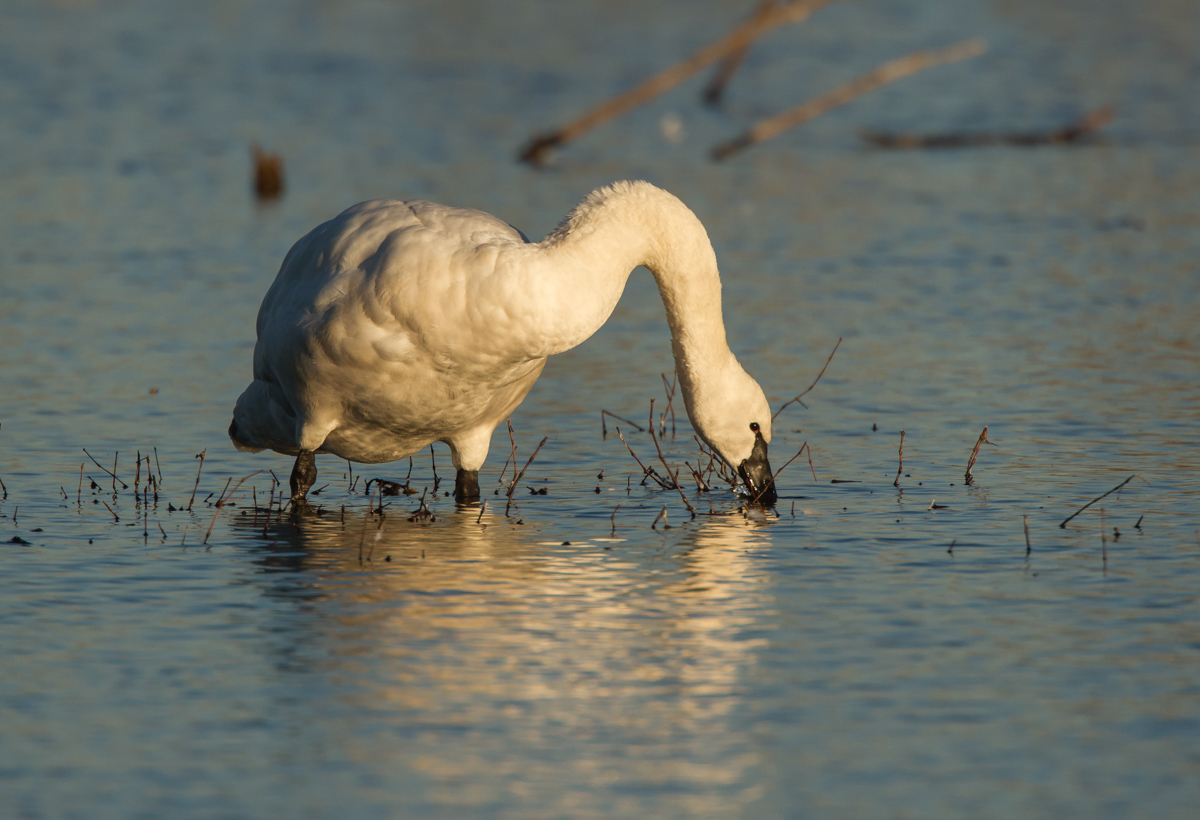
Tundra Swan getting a drink of water
In between groups on a recent trip, I spent some quality time observing swans in one of the impoundments at the Pungo Unit of Pocosin Lakes National Wildlife Refuge. This area has contained many swans this winter and they seem to tolerate cars stopping to observe and photograph them.
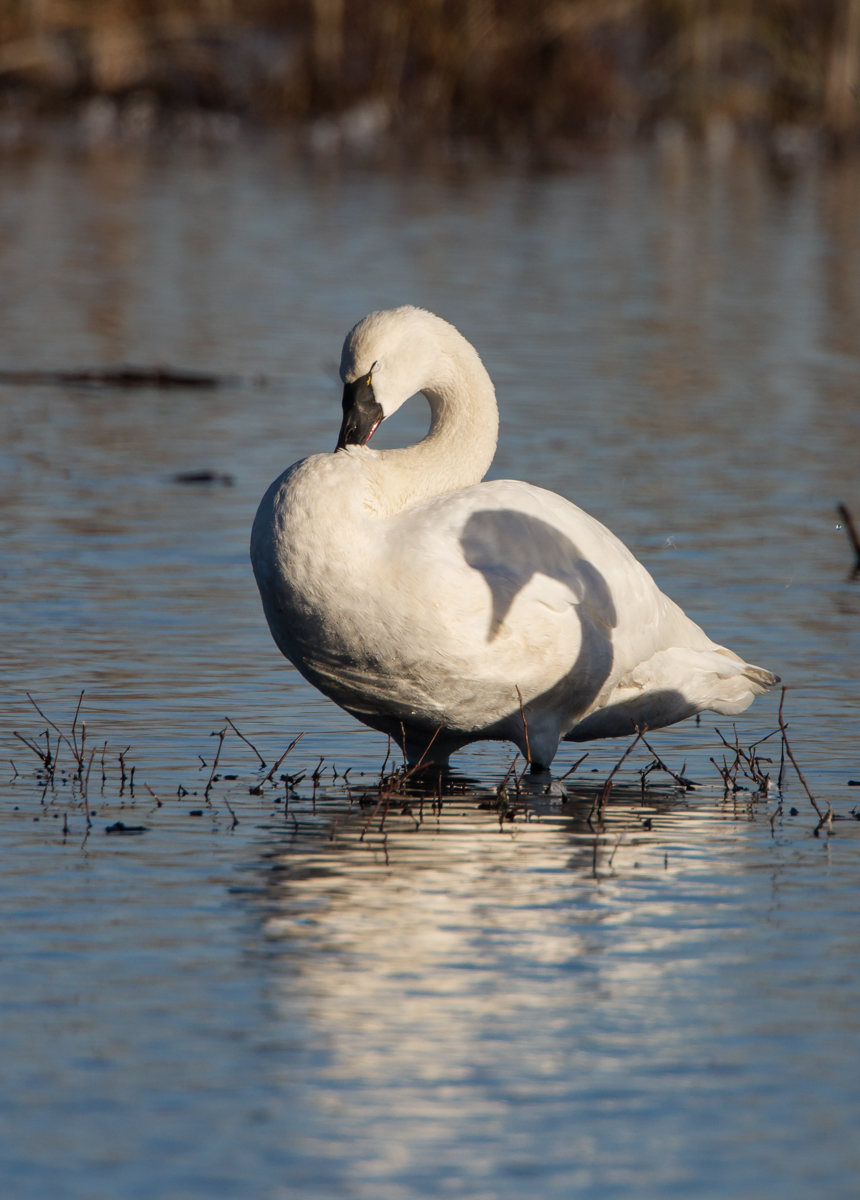
With more than 25,000 feathers on a swan’s body, it makes sense that these birds spend a lot of time each day preening. One of my favorite scenes is when the shadow of one bird is cast upon the body of another bird.
Swan flapping after preening
After a good bout of preening, a swan will often raise up and flap its wings a couple of times as if to get all those feathers in working order again. Late afternoon is a great time to watch and photograph swans as they are relaxed and the low angle light starts getting that golden hue that makes these majestic birds even more beautiful.
Swan in flightSwan gaining altitude after take-off
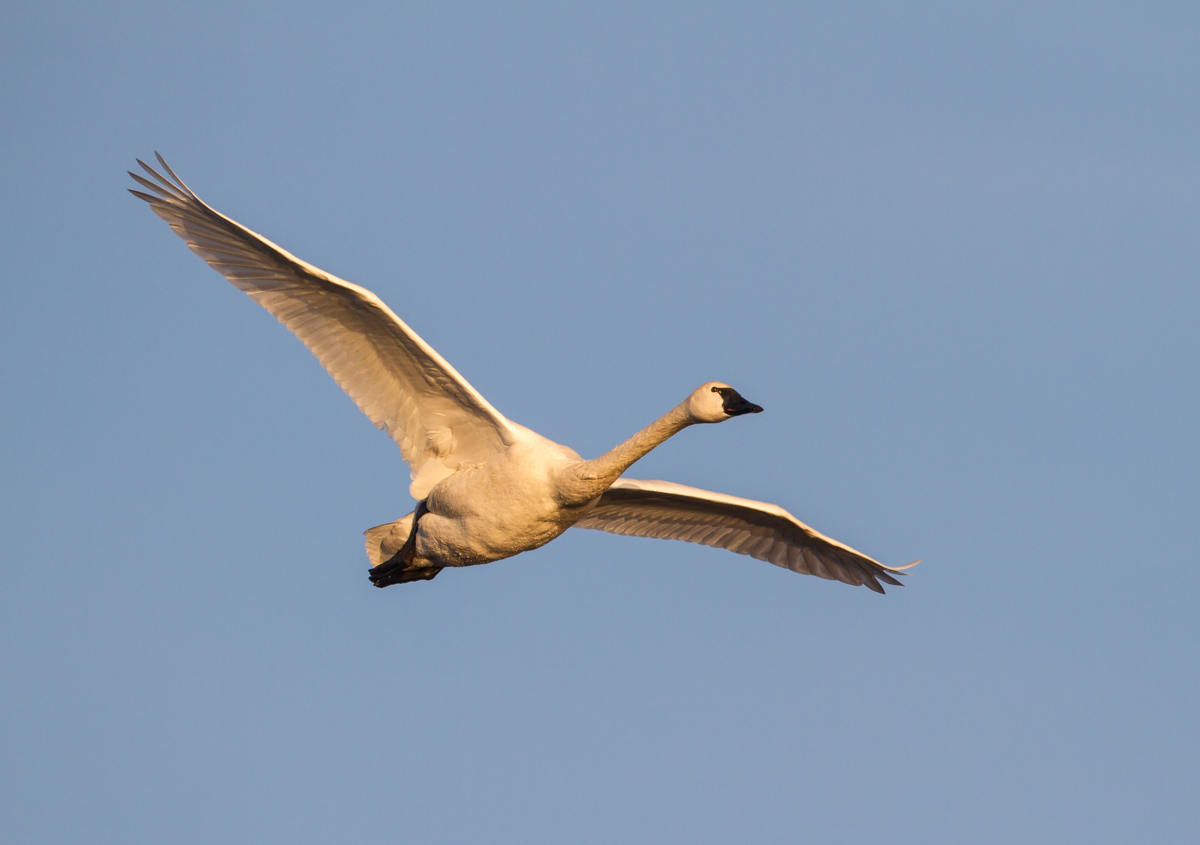
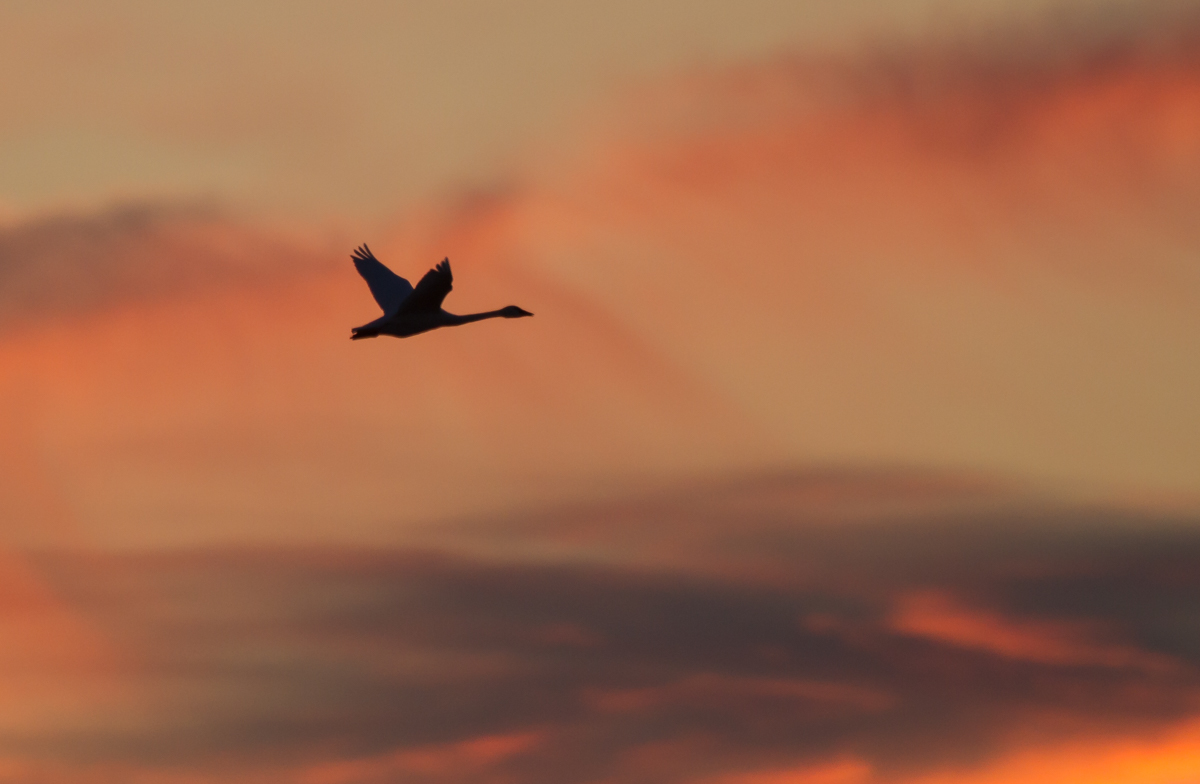
The flight of Tundra Swans is a magical thing to witness. Their long necks and strong wing beats on a wing span of almost 6 feet gives them an appearance of grace and power. Average flight speeds are in the neighborhood of 30 mph. This serves them well on their incredibly long migrations between their breeding grounds on the tundra of western Canada and Alaska to their wintering grounds here in North Carolina, a distance of over 3500 miles. Satellite tracking has shown that although they could fly that distance in a little over 100 hours straight, it actually takes much longer since they use so-called staging areas along the route as they migrate to feed and rest. The spring migration is usually longer than the fall one, lasting about 100 days. In a typical year, Tundra Swans spend about 20% of the year on the wintering grounds, 29% on the breeding grounds, and the rest in migration on the staging areas (with spring migration lasting longer than fall). This shows how important it is to identify and protect all components of a migratory bird’s habitats throughout its annual cycle.
In a little over a month, the Tundra Swans and most of the other waterfowl will be headed north to their breeding grounds. The refuges in eastern North Carolina will seem silent and empty, although they are really anything but, since a new set of migrants will arrive to breed and raise their young along with all of our resident wildlife. But I will still look forward to next year, when there is a chill in the air and a sound I love that will signal the beginning of a new season of the swan.







































 Roads End Naturalist