Most gulls don’t bother to learn more than the simplest facts of flight how to get from shore to food and back again.
~Richard Bach
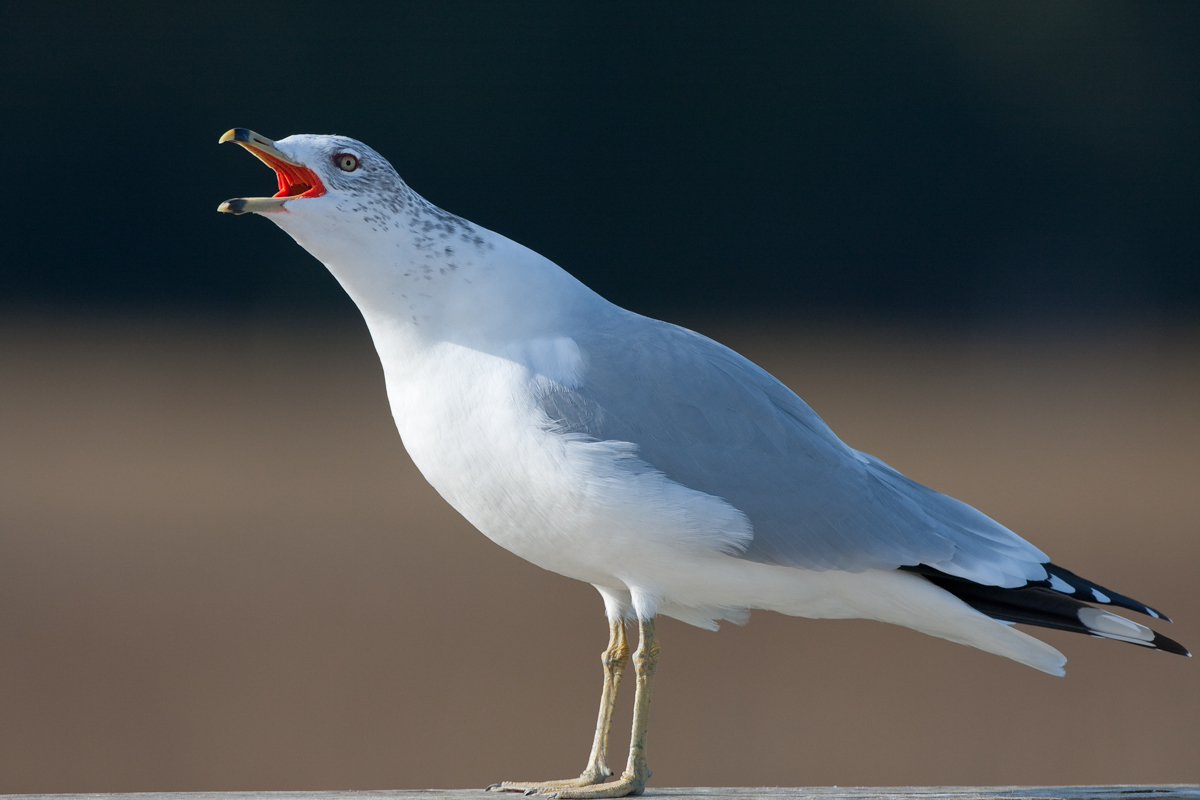
Ring-billed Gull calling
Ring-billed Gulls are very adaptable creatures. They are a common inhabitant of our inland reservoirs in winter where they often fly out each day to forage in landfills or other food rich habitats. They are also a frequent sight in large parking lots of big box stores or shopping malls. This often raises the question by shoppers – What are all these “sea gulls” doing here?
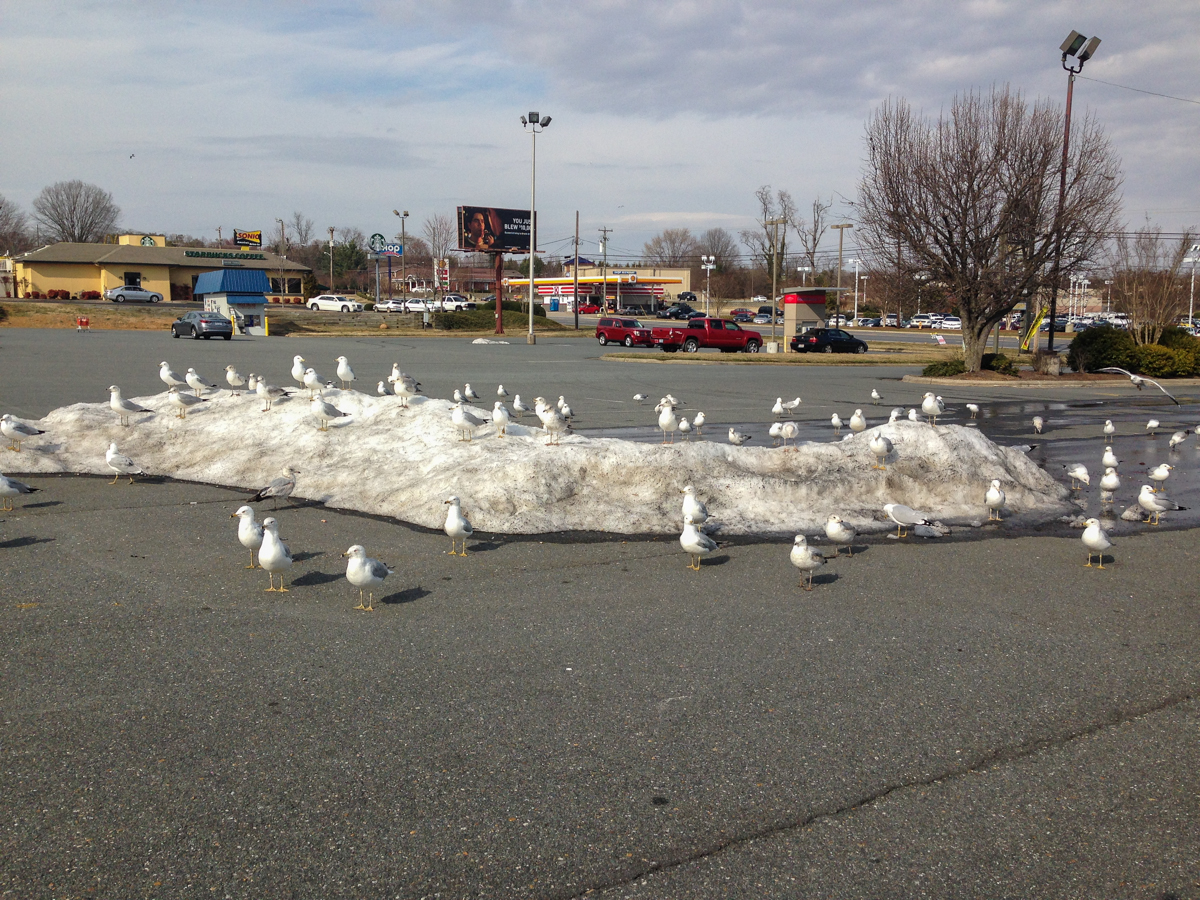
The usual theory is that these birds prefer to roost in open habitats where they can easily see the approach of potential predators. Before large parking lots were near landfill feeding buffets, Ring-billed Gulls probably roosted primarily on large open bodies of water or adjacent sand bars. Our modern-day parking lots offer that plus the opportunity to forage on the all-too-often-left-behind scraps of fast food or other human food garbage. While I am used to seeing gulls in parking lots, I was surprised on Sunday to see a group of large white birds claiming a remnant pile of snow in a parking lot as their domain. This was just north of Winston-Salem and there were scattered areas of snow where crews had cleared the parking lots and pushed it into huge piles that were still clinging to life in our recent cold weather.
Ring-billed Gulls claiming a parking lot snow pile as their domain
So, why claim the snow? Perhaps it is an area where the birds are assured of no cars driving through. Or maybe there is something cool about being “Gull of the Hill”. It looked like the highest density of gulls that were not actually standing on the snow pile was found down-slope from the pile where the melt water was flowing…so, are they using this as a water source? Who knows, but it made me drive through and grab a quick picture, and I saw a lot of other folks looking as if to say – What are all these “sea gulls” doing here?
I once had a sparrow alight upon my shoulder for a moment, while I was hoeing in a village garden, and I felt that I was more distinguished by that circumstance that I should have been by any epaulet I could have worn.
Henry David Thoreau
Sparrows….seems like people either love them or hate them. And most people tend to lump all of the three dozen or so North American species of sparrows together as if they were one. But that does not do them justice. Even though they can be difficult to distinguish in the field, they are a diverse and subtlety beautiful group of birds. One of my favorites is the tiny Chipping Sparrow, Spizella passerina.
Chipping Sparrow on garden fence
Chippies, as they are often called by birders, are a gregarious species, sometimes forming flocks of twenty or more birds that feed together in winter. These flocks are common right now out along the roadsides, the power line right of way, and at my feeding stations. When disturbed, they quickly fly to cover in shrubs and low branches. Adults can be distinguished by the lack of streaking on their breasts, the black line through their eye, and their rusty cap. Soon, I will hear the trill of chip notes of the male as they set up nesting territories. Chipping Sparrows build a flimsy nest placed low in a shrub or small tree, often an evergreen. The nest is made of grasses or root fibers woven into a small cup and is often lined with fine hair like horse or dog hair. With the approach of their breeding season, Chippies will take a back seat to many of the other common birds here in summer. But, with the approach of cold weather next year, they will once again flock together and be one of the more common birds I enjoy.
There is something magical about the sounds of frogs and toads. In my museum days, I used to do a workshop activity where participants got a call sheet for a local frog or toad species. Each sheet had a photo and a description of the amphibians’ song. Teams imitated their call and then we would listen to a recording, and each group would try to identify their species’ real call. People always loved imitating the sounds and hearing the recordings, but few could match the quality of the actual amphibian voice.
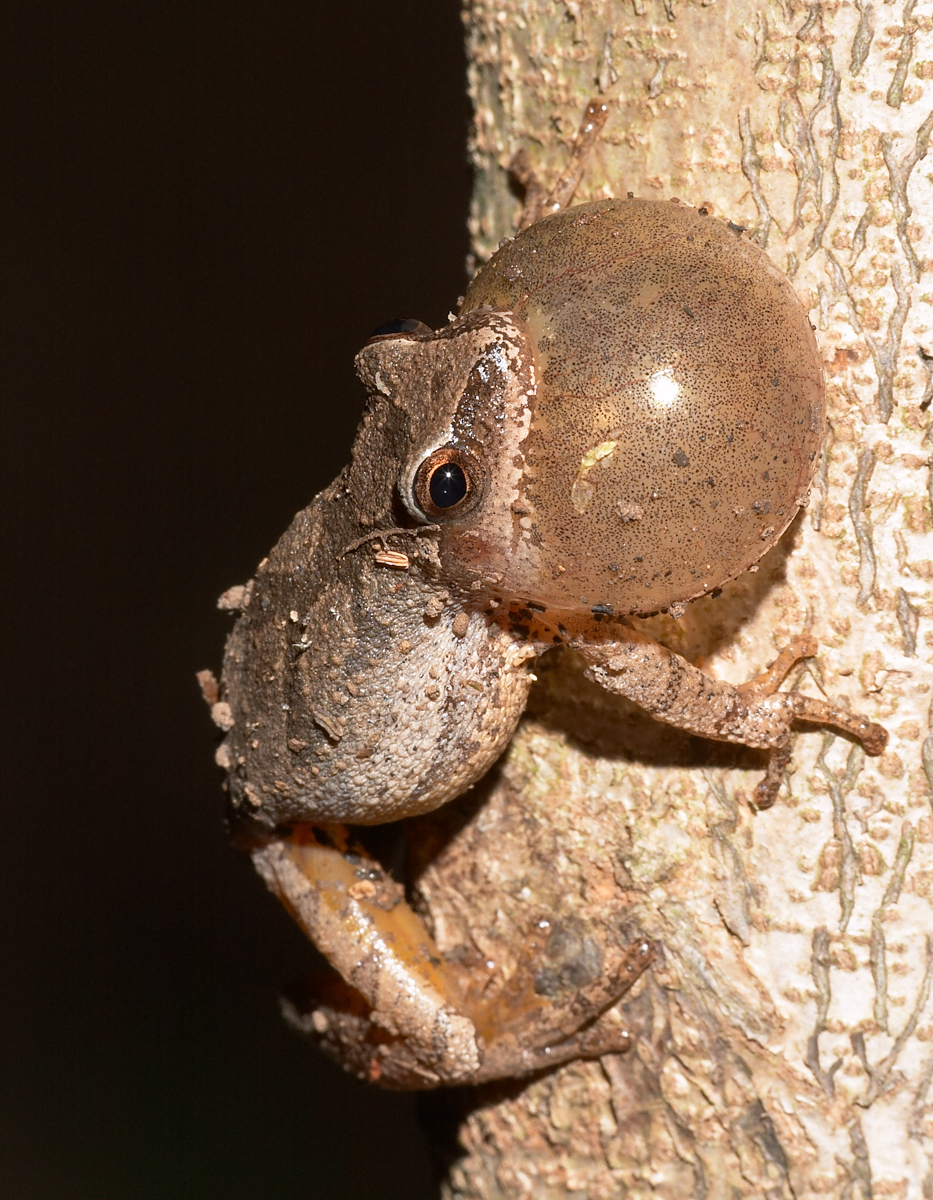
Part of the reason may be the special adaptations that frogs and toads have for communicating with one another. The most visible asset is their vocal sac.
Upland Chorus Frog calling (click photos to enlarge)
The vocal sac is an elastic membrane originating from the floor of the mouth of most male frogs. It tends to be thinner on many of the smaller frog and toad species that call in air, and more thick-walled on the larger species, like Green Frogs and Bullfrogs, that call in water. Vocal sacs come in a variety of shapes and sizes, and can be single or paired. To initiate a call, a frog inflates its lungs, and closes its mouth and nostrils. Air is then forced out of the lungs through the larynx and into the vocal sac, which then enlarges. To create the series of sounds typically categorized as the advertisement or mating calls, the air is passed back and forth from the vocal sac to the lungs without being expelled. While it appears that the vocal sac helps to radiate and amplify the sound, studies have shown that other body parts, especially the “ears”, or tympanic membranes, also play an important role in amplifying the call notes of certain species.
When seen from behind, as in the short video clip below, it is clear that this sound-producing activity must be a lot of work for a male frog.
Some scientists also speculate that the act of calling is both the most energy-draining and predation-risky behavior that a male frog or toad exhibits. But, aren’t we glad they do? It is a fascinating behavior to observe, and the sounds produced are a wonderful addition to our natural sound-scape. I imagine the female frogs and toads appreciate it as well.
Below are a few photos I have taken over recent years of frogs and toads calling in a variety of habitats in North Carolina. I look forward to adding photos of more species in the coming months.
The Pickerel Frog has paired lateral vocal sacs that produce a low-pitched call sounding like a human snore.
Pickerel Frog
One of our earliest frog songsters, the Spring Peeper repeats his high-pitched note about once every second. One reference stated that researchers estimate a male Peeper may repeat his call up to 4,500 times in a single night.
Spring Peeper
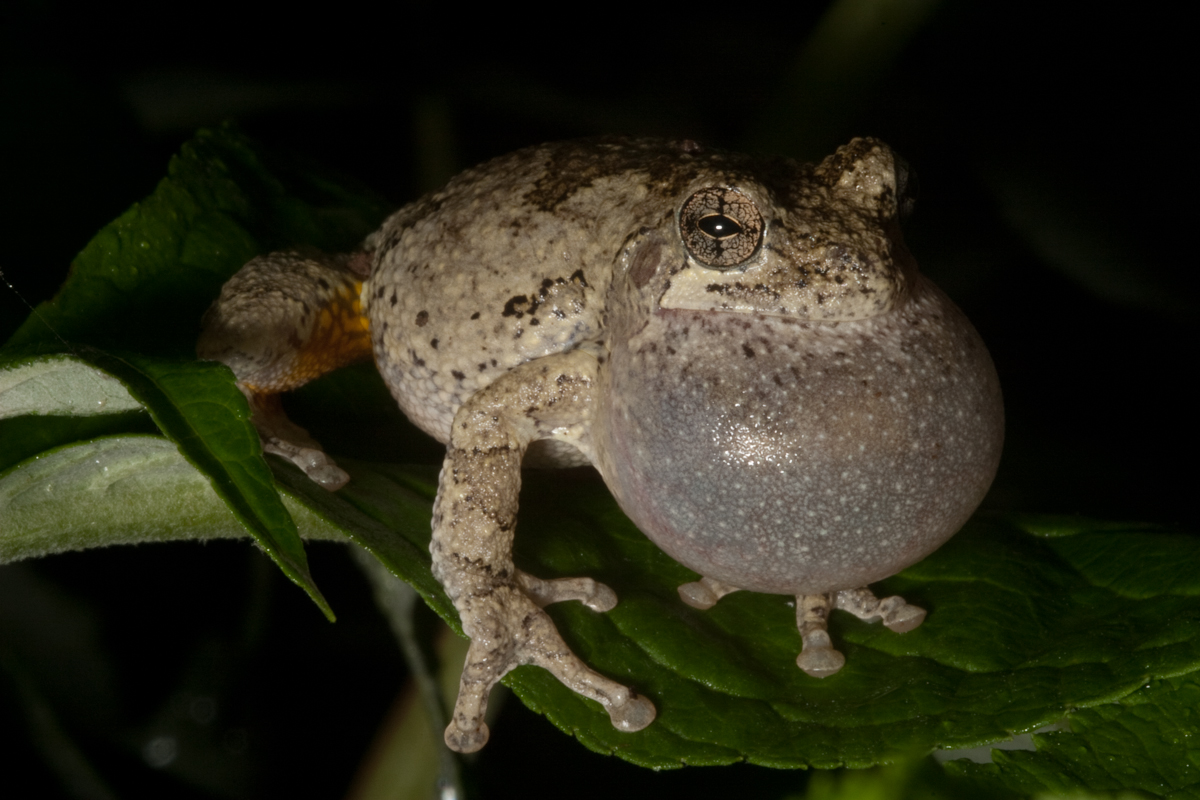
The harsh trills of the Cope’s Gray Treefrog can be heard in many North Carolina forests and neighborhoods throughout much of the summer.
Cope’s Gray Treefrog
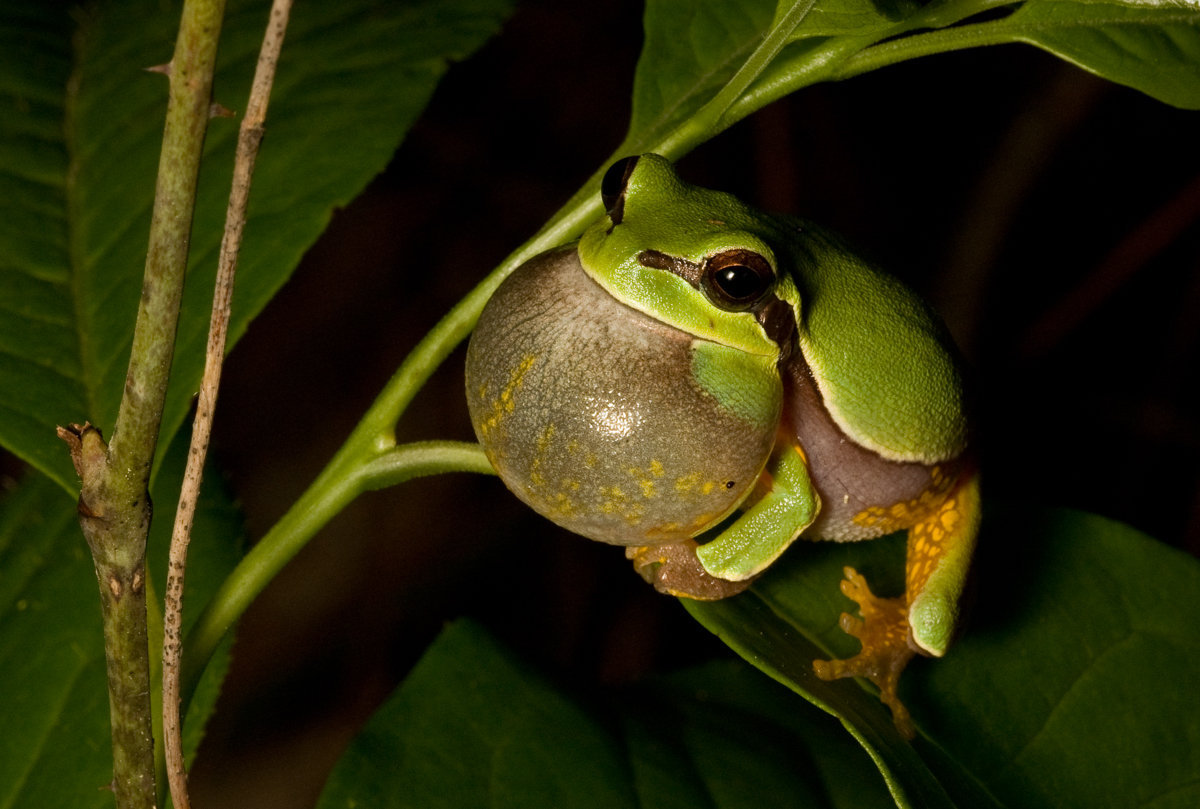
Considered by many to be our most beautiful frog, the Pine Barrens Treefrog is found primarily in the Sandhills. It became the Official State Frog in North Carolina in June, 2013.
Pine Barrens Treefrog
Fowler’s Toads are abundant in the Piedmont. Their nasal call (“waaaaah”) can be heard from about April through July.
Fowler’s Toad
A chorus of trilling American Toads always reminds me of what a group of distant alien space ships might sound like in early sci-fi films.
American Toad
Thoreau (no surprise here) had a more eloquent take on the sound of the American Toad…
Close by, it is an unmusical monotonous deafening sound, a steady blast (not a peep nor a croak – but a kind of piping). But far away, it is a dreamy, lulling sound, and fills well the crevices of nature.
American Toad reflection
Thoreau also had some intriguing insights on how we may share some similarities with the amphibians singing in our neighborhood wetlands…
I see the relation to the frogs in the throat of many a man. The full throat has relation to the distended paunch.
Not sure where ol’ Henry was going with that one, but this final thought seems clear enough…
The music of all creatures has to do with their loves, even of toads and frogs. Is it not the same with man?
What is the earliest sign of spring? The motion of worms and insects? The flow of sap in trees and the swelling of buds? Or are there earlier signs in the water? – the tortoises, frogs…
Henry David Thoreau, March 7, 1853
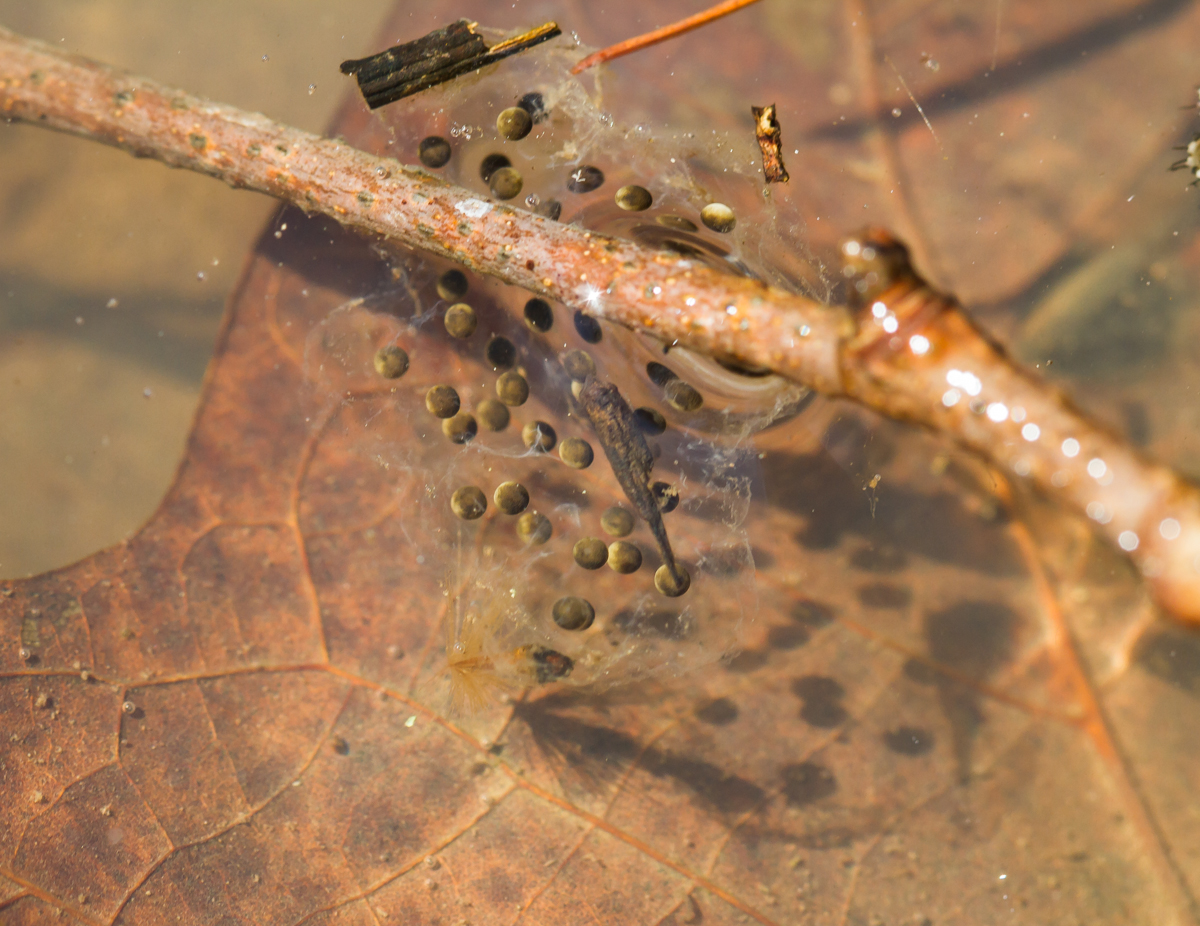
I think the sounds of the coming spring are amongst the first things I notice. The bird songs, the whir of insect wings, the busy rustling of leaves as squirrels begin making their spring nests. Even the breeze sounds different on a warm, late winter day. But one of the surest signs of the warmth to come are the calls of our early amphibians. Here in the forests of the Piedmont of North Carolina, that role is usually handled by Spring Peepers and Upland Chorus Frogs. I started hearing the chorus frogs a few weeks ago, before the last snow and deep freeze. They took a break while their world turned white, but now they are back on duty, proclaiming a change is in the air. I have spent some time over the past several years trying to photograph various species of frogs and toads as they fill the air with their distinctive mating calls. I have had some good success, but one species has managed to elude me – the Upland Chorus Frog, Pseudacris feriarum. I find it both difficult to approach and difficult to observe when calling. They tend to call from shallow water in vegetated pools, often hiding amongst the vegetation as they sing. At my approach, they invariably fall silent, requiring a quiet sit and wait strategy on my part before they call again, if at all. So, I was determined to try again this week after hearing a fair number of them calling in several woodland pools while on my walk this past Sunday. Using binoculars, I watched a few calling at a distance of 30 or more feet in one large pool. I also found several of their small egg clusters attached to some twigs and grasses in the water.
Upland Chorus Frog eggs (click photos to enlarge)
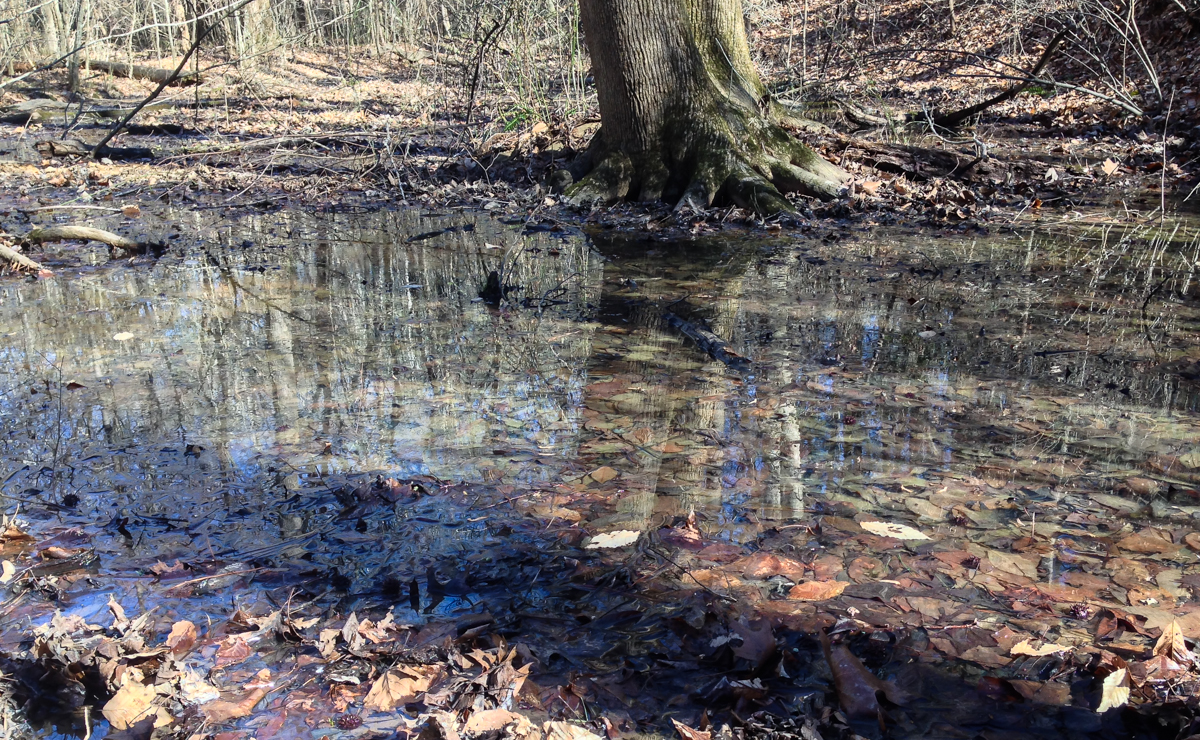
I even saw a pair in amplexus, that amphibian embrace where the male clasps the female from above and fertilizes the eggs externally as she releases them. But, the calling frogs were either too hidden in thick vegetation or too far out in the pool for a good photograph. Walking down through the floodplain I soon heard another loud chorus coming from behind a ridge line that angled toward the stream. As I climbed over the top for a look, I saw a small pool that contained a dozen or more calling frogs.
Woodland pool with Upland Chorus Frogs
I sat and watched and decided this pool had potential – there was a large tree on one edge that wold provide a bit of cover. The pool was small and the sun would be coming over my shoulder late in the day, so the chances for good photographs seemed likely. Even though the frogs had started calling again shortly after I initially walked up, I was a bit concerned that when sitting against the tree trunk, I might be too close, and that might really spook them. So, the next afternoon I brought my Kwik Camo blind (http://www.outdoorphotogear.com/store/kwik-camo-photography-blind.html). I thought it would allow me to better blend in, so the frogs might start calling again even after I brazenly walked into their concert hall. The blind fits nicely in a belt pouch and is lightweight, so it is easy to strap on and carry for long hikes. Plus, it drapes over my camera, tripod, and my human form, and turns me into an amorphous bush that hopefully looks less threatening than a person armed with photography gear.
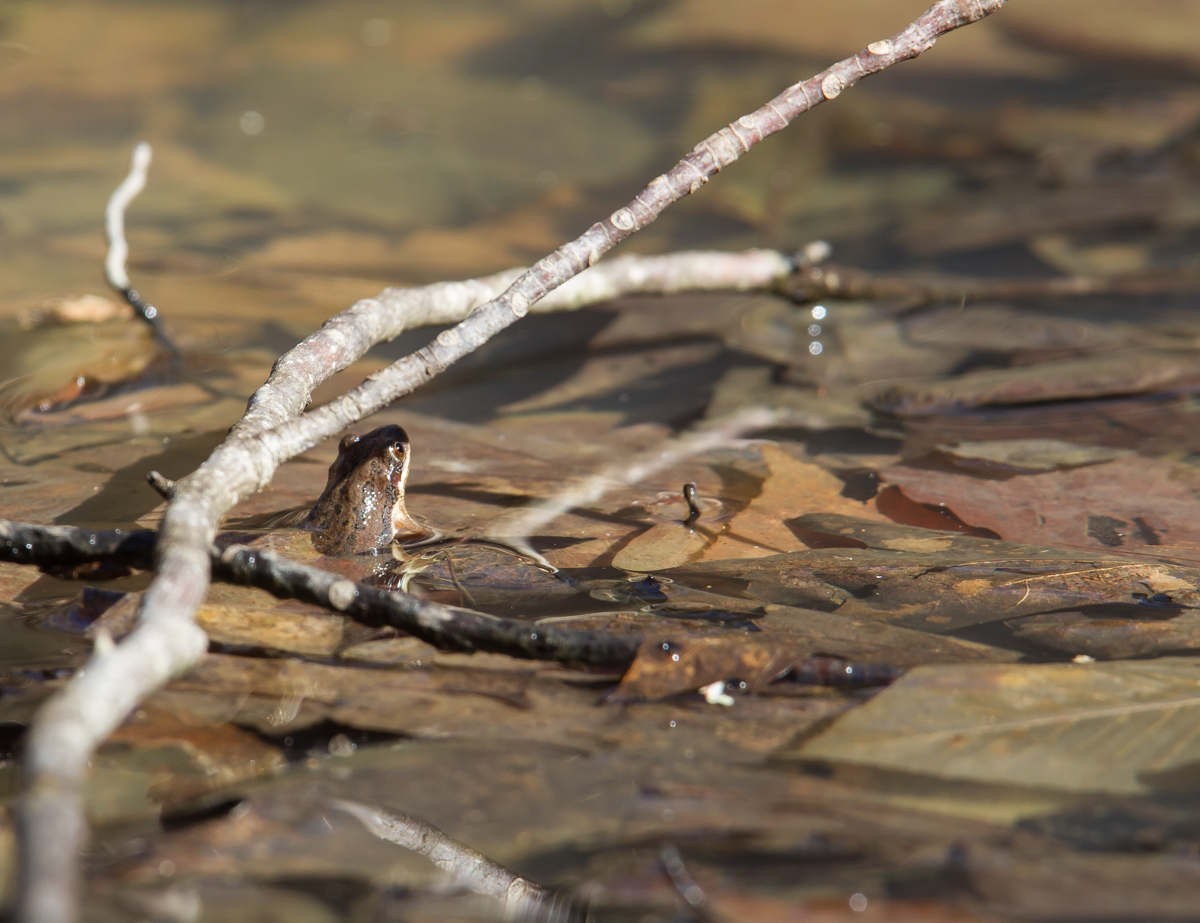
As suspected, my approach and settling in quickly silenced the almost deafening chorus, so I got situated under the blind, leaned against the tree trunk, and waited. And then waited some more. About thirty minutes went by without a sound except for leaves blowing in the wind. And I could still only see one frog in the pool, and even that one was low in the water and partially hidden by a stick. I decided to try to coax a reaction by using my phone to search the web and play a recorded call. I used the Amphibians and Reptiles of North Carolina web site created by Davidson College at http://www.herpsofnc.org/. I played the call twice. No response. I looked through my viewfinder at the one visible frog and played the call again. This time, that frog raised up so that the top half of its body was out of the water. I suppose he was trying to figure out where this caller was hiding. But he did not answer.
Upland Chorus Frog checking the scene
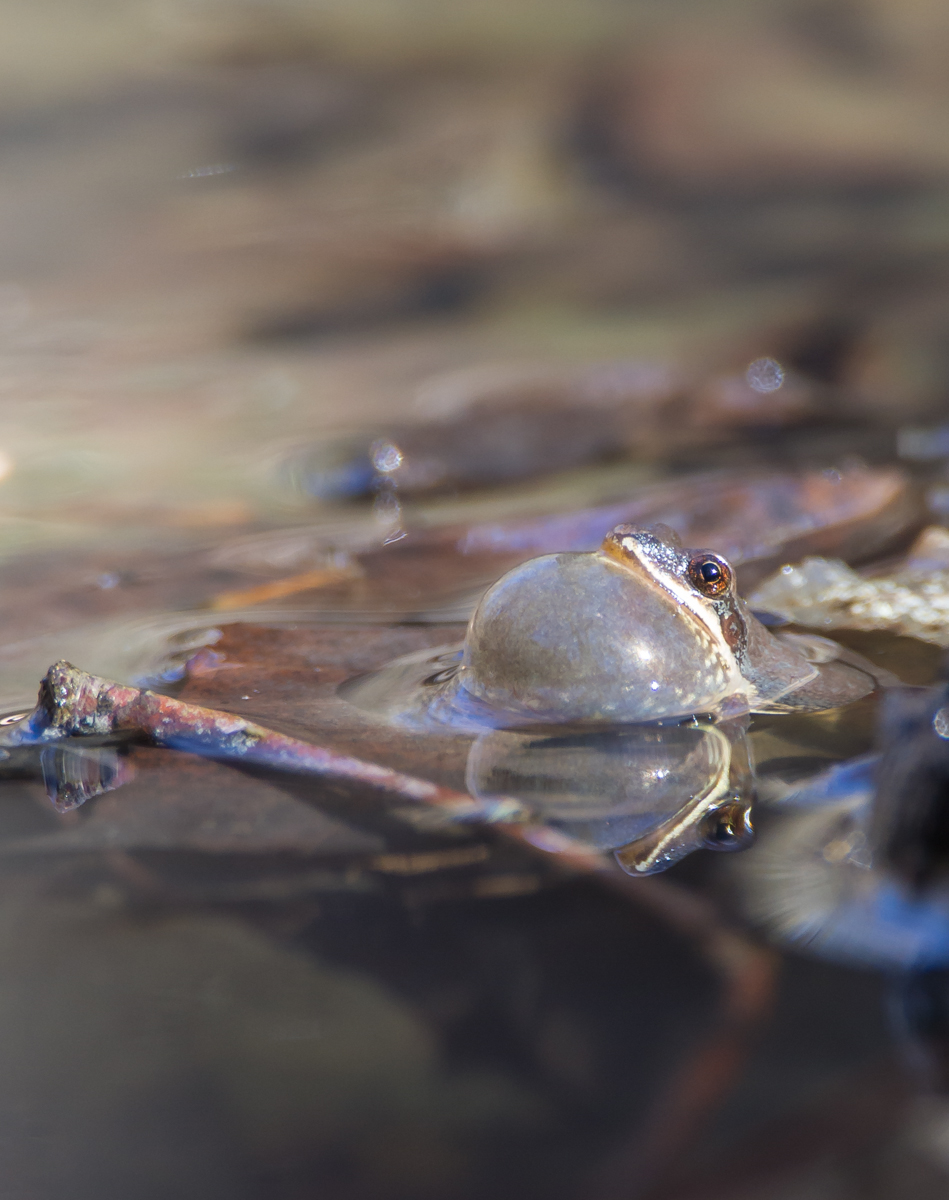
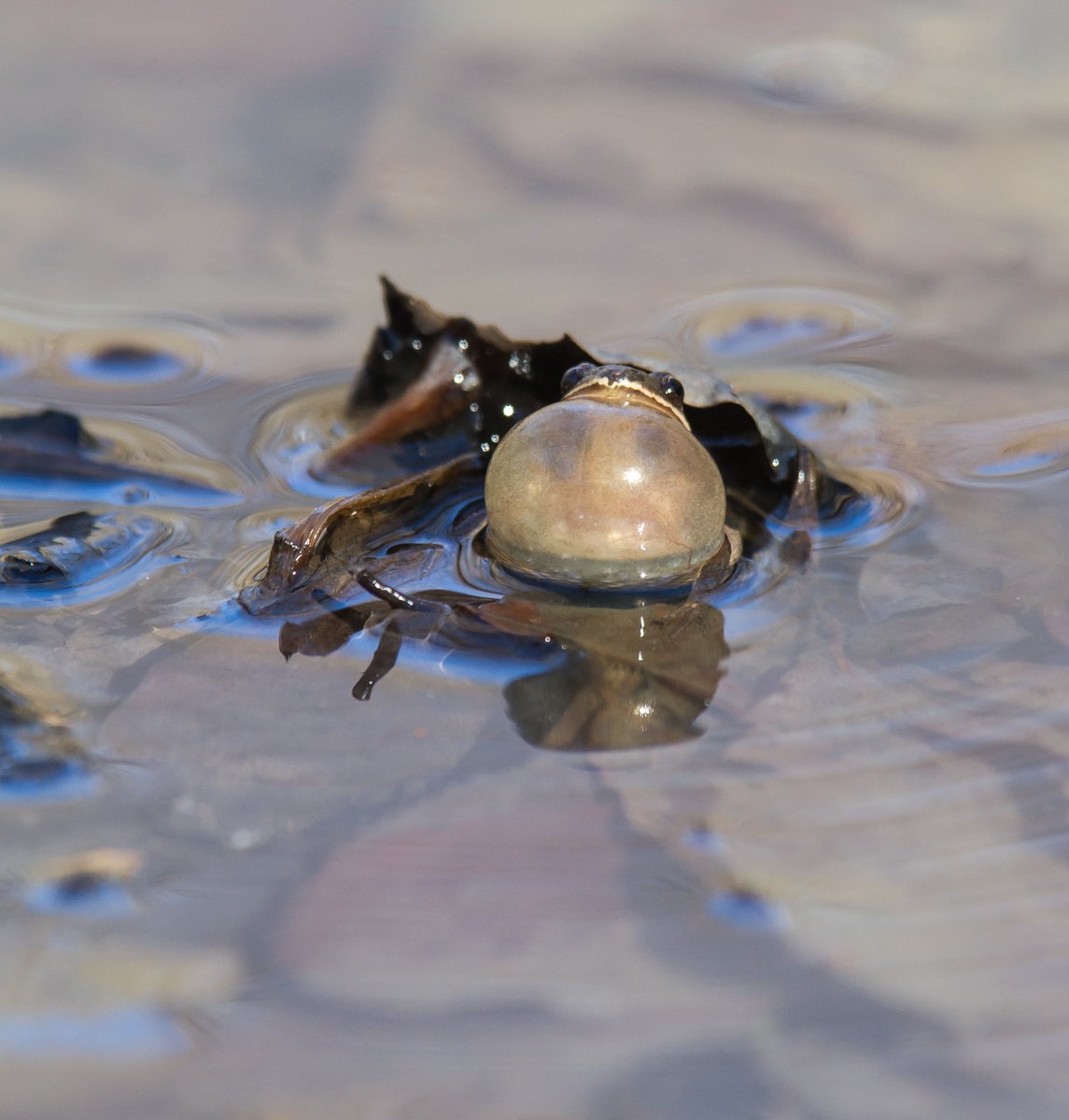
So, I waited some more. Another 15 minutes went by and I was beginning to wonder if I had simply tried to get too close and they were having nothing of it. Then a sound – a partial call. The call of the Upland Chorus Frog sounds something like the noise made by running your fingers over the teeth of a comb – a regularly repeated “crrreek”. This was just one crrreek. But that was enough to stimulate another, then another, and soon the pool sounded like a bunch of busy fingers in a comb factory. Ten or more heads suddenly appeared from the pool and started calling, with the tell-tale enlargement of their vocal pouch keeping time with their crrreeks. The first few callers were partially hidden, either barely out of the water or using some nearby object as cover.
Upland Chorus Frog calling while barely out of the waterUpland Chorus Frog calling with a leaf shelter behind it
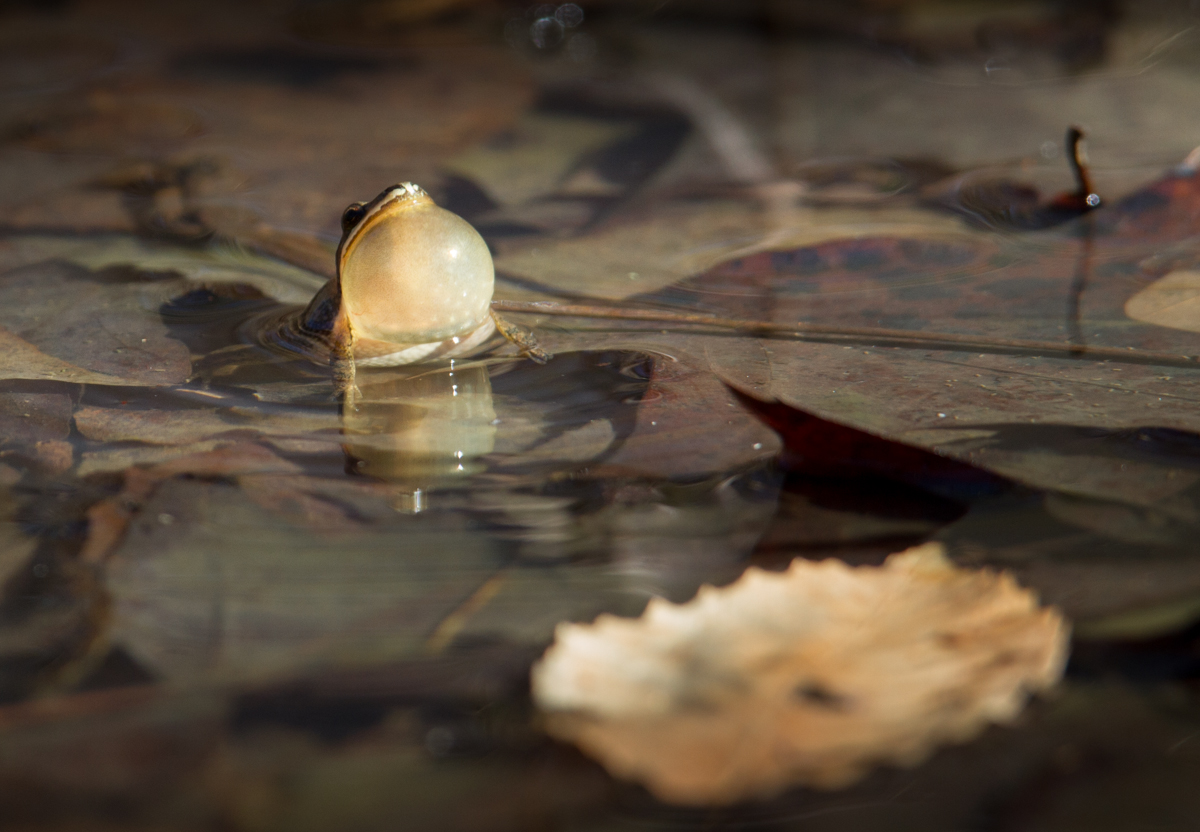
But, in less than a minute, it was a frog calling cacophony.
Upland Chorus Frog callingUpland Chorus Frog calling out in the open water of a shallow pool
Here is a short video so that you can share in the amazing sights and sounds of this anuran symphony.
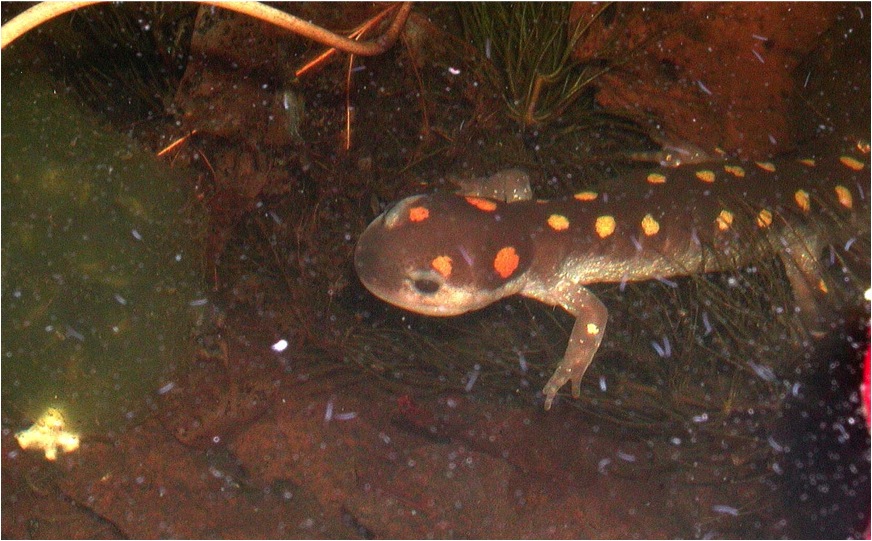
Spring is here. Maybe not in its totality of warm days and flowering plants, but there are signs – signs of new life. This week I heard the first dawn chorus in my woods – the songs birds sing, especially in spring, at the first light of day. The lilting notes of the Bluebirds are particularly noticeable after having been so quiet for many months. And the first frogs have been heard calling from what should be woodland pools full of water after our wet winter. Sunday was one of the first spring-like days we have had in these parts in quite some time, so it demanded a walk in the woods. My walk ended up along the creek that flows across the power line a half mile or so from the house. In its lifetime, the creek has created several oxbows and pools in the floodplain and these are home to some of my favorite living things, the creatures of vernal pools. These often ephemeral pools are home to a host of amphibians and invertebrates that are found only in waters that contain no fish. One of the most interesting to me is the Spotted Salamander, Ambystoma maculatum.
Spotted salamander in woodland pool (click photos to enlarge)
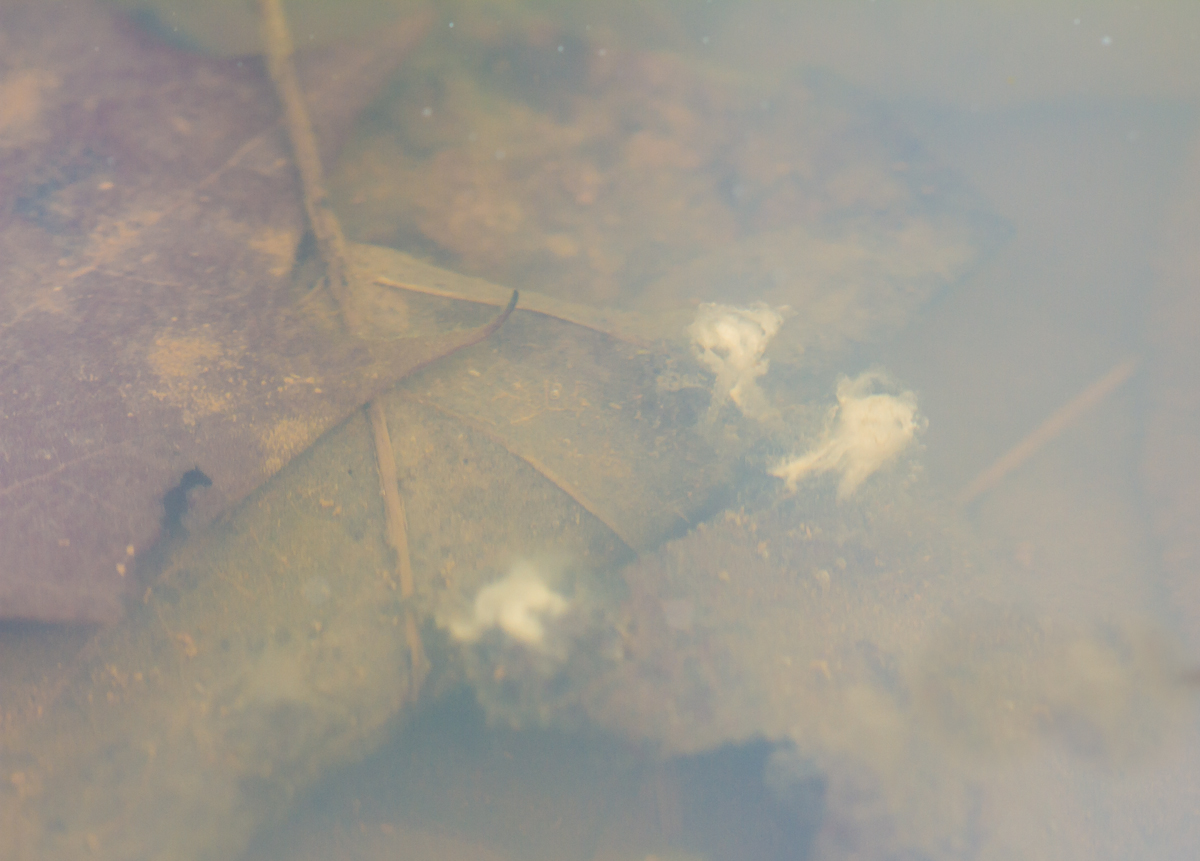
These large woodland salamanders make their way to vernal pools on warm, rainy nights in late winter and early spring, to breed and lay eggs. They are most easily seen by flashlight at night or by gently turning over logs near the edges of the pools. During the breeding frenzy, male salamanders deposit specialized structures, called spermatophores, on the bottom of the pool. At first glance, the spermatophores may look like bird droppings littered about on the leaves in the pool.
Spermatophores in pool
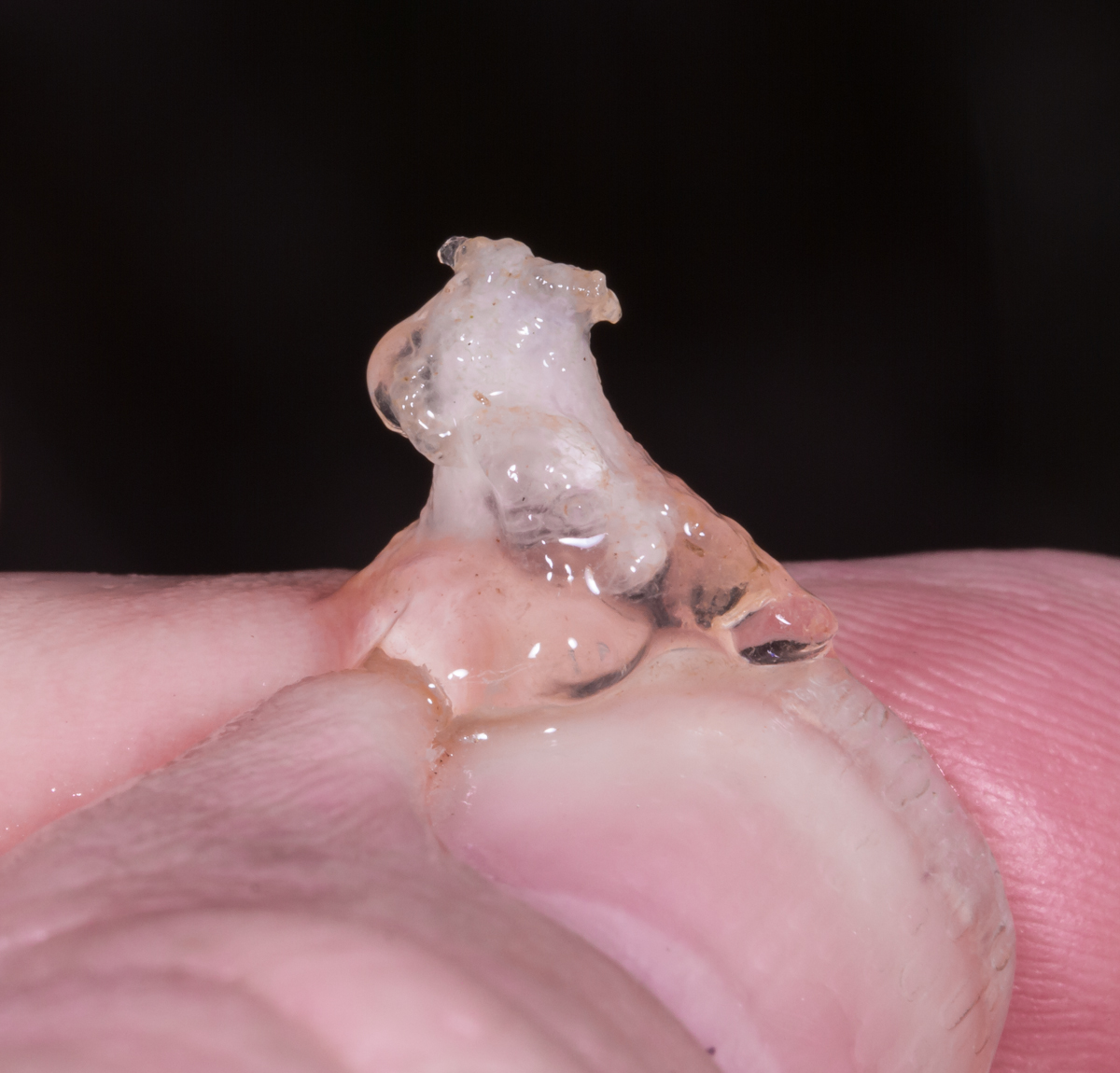
But a closer look reveals something quite different. I remember thinking they resembled a gelatinous Hershey’s Kiss the first time I picked one up. These salamander candies are about 6-8 mm tall, with a clear, gelatinous base, and a multi-pronged whitish stalk on top of which is a cap containing the sperm.
Spotted Salamander spermatophore close up
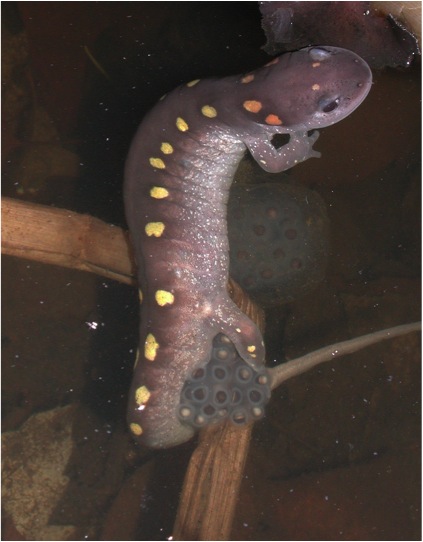
I have watched pools and noticed that usually about two to three days after I first see the spermatophores on the bottom, I find the first egg masses. After the courtship bout, the female salamander picks up the spermatophore in her cloaca and about two nights later starts laying egg masses.
Spotted Salamander laying eggs
The heavy rain had been on Friday night, but the pool I saw on Sunday contained no eggs and it was getting very shallow, so it started me wondering about the spermatophores. I had always assumed the female picked up the entire gelatinous packet. But I decided to check it out before posting something about this whole process. I quickly turned to an excellent salamander resource on my bookshelf, Salamanders of the United States and Canada, by James. W. Petranka. I had a chance meeting with Dr. Petranka at sunrise this past winter on the viewing platform at Pungo Lake. After observing and discussing the birds for a few minutes, he introduced himself, and I excitedly blurted out, “Oh, you’re the salamander guy”! His book is an amazing compilation of detailed information on the life histories of salamanders and I have referenced it countless times, so it was an honor to meet him in person, and he was gracious to not laugh at my enthusiasm. Petranka referenced the females “picking up sperm caps”. That implies that maybe they do not take in the entire spermatophore. So, I emailed another excellent resource on all things natural history, Jeff Beane, Collection Manager for Herpetology at the NC Museum of Natural Sciences. He responded saying the female squats over the spermatophore and takes up seminal fluid from the top with her cloacal lips, leaving behind most of the gelatinous structure. She may do this with several different spermatophores. And the gelatinous base may remain visible in the water for a few days afterward before decaying. Mystery solved. Yesterday, three days after the presumed breeding bout during the rains of Friday, a few spermatophores were still visible in the pool. These may either not have been utilized by a female salamander, or, they may just be the bases slowly decaying. Later this week, I will check that and other nearby pools to see if there are any egg masses. I always look forward to seeing the “globs of jelly” that result from the nights of salamander candy.
The story of bird migration is the story of promise – a promise to return.
~the movie, Winged Migration
A week ago, we had a snow storm that crippled much of the south. Today, the temperatures soared into the 70’s. Less than two weeks ago, I stood in awe as thousands of Snow Geese swirled overhead and then landed amongst thousands of Tundra Swans feeding in a field at Pocosin Lakes National Wildlife Refuge. Two days ago, I could only find 8 Snow Geese amidst a flock of a few hundred swans. And even more telling was the view from the observation platform when we arrived.
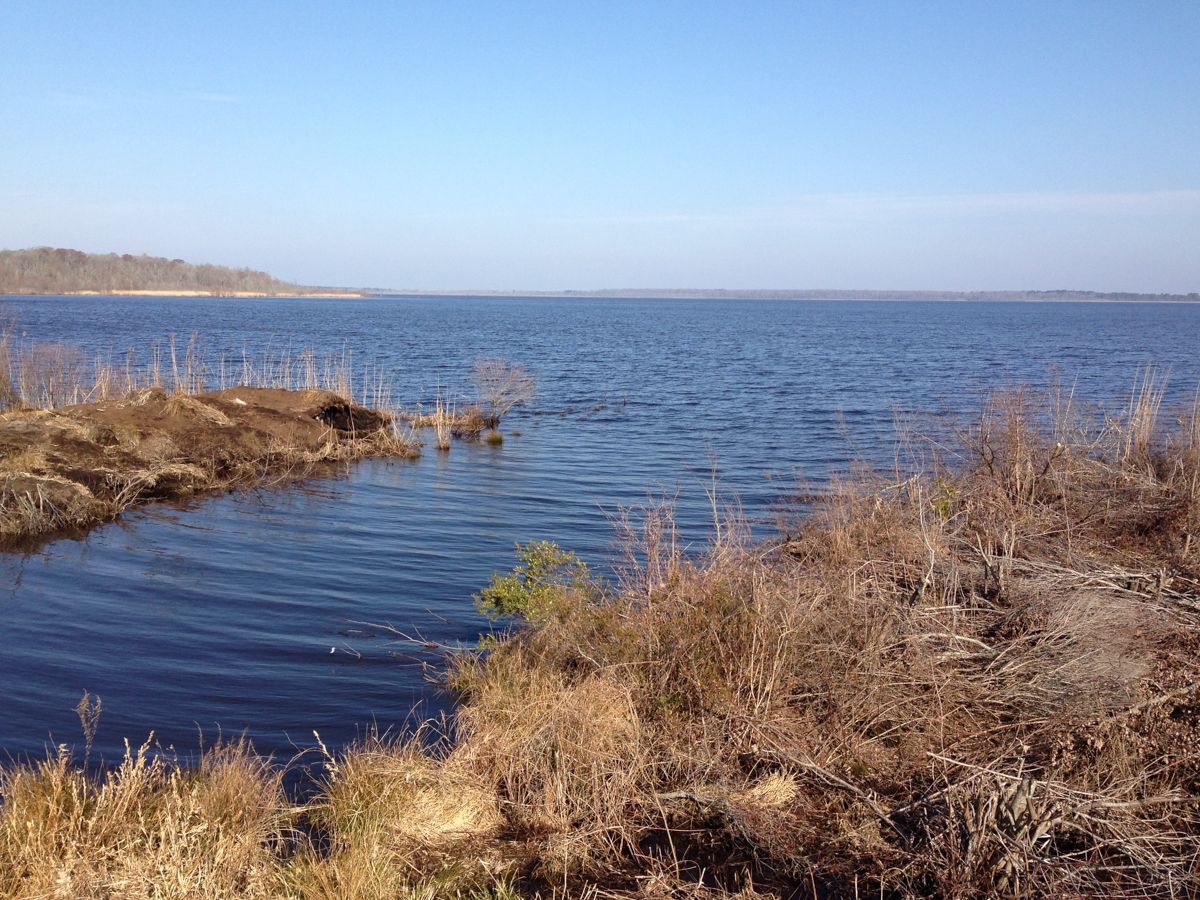
Pungo Lake after the birds have gone (click to enlarge photos)
Where thousands of white specks had dotted the lake only a couple of weeks ago, there was now not a single one. No duck, goose, or swan could be seen anywhere on the lake. We altered our plans to hike and drove through the refuge looking for birds. A few swans flew overhead, but we only saw two eagles – on my last visit there had been over twenty. The eagles follow the flocks of large birds when they are on the refuge…no eagles, no flocks.
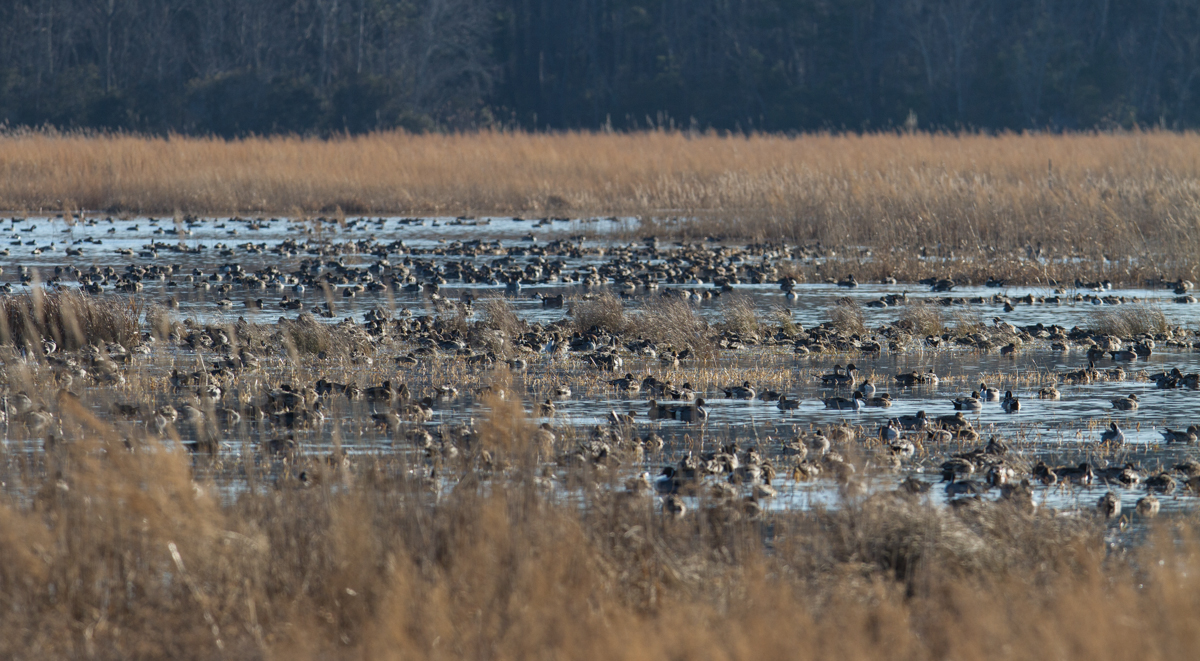
We drove to Mattamuskeet to see if that refuge was more to their liking. Crossing the lake, we could see a few Canada Geese, but no swans. But the impoundment along Wildlife Drive was full of ducks, more than I had seen in there all winter.
Large flock of ducks in impoundment at Mattamuskeet
Most were Northern Pintails, although there were also large numbers of American Wigeon, Northern Shovelers and Blue-winged Teal. A few Tundra Swans were mixed in, but it appears as though most have headed out from here as well.
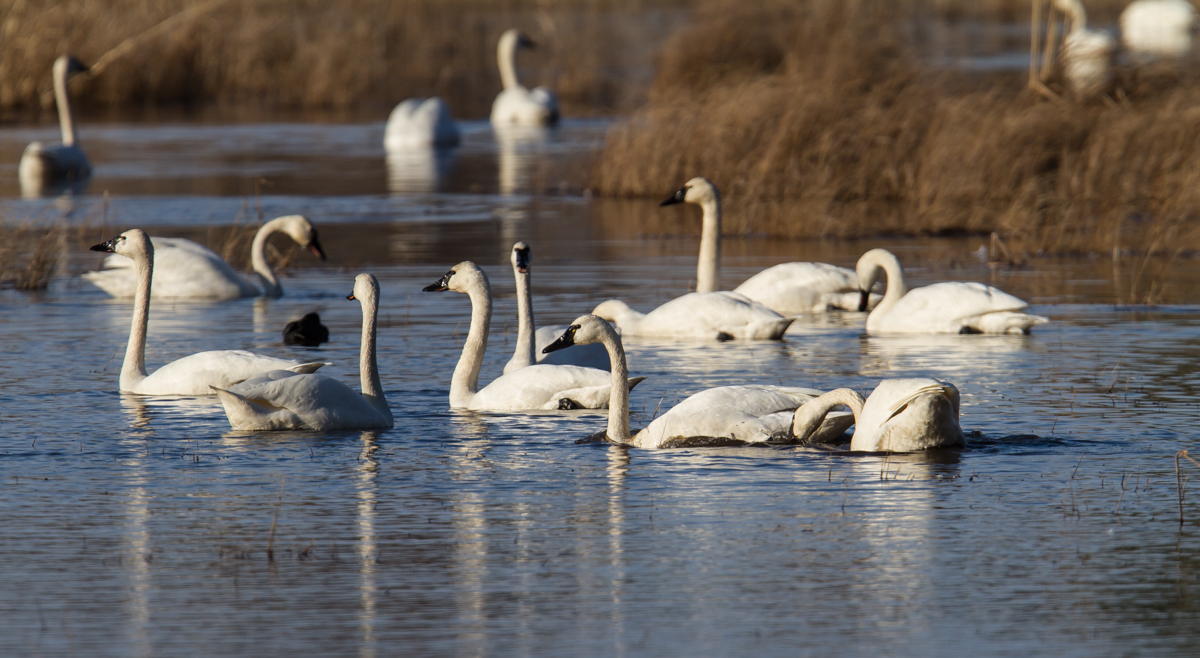
A few remaining swans at Mattamuskeet
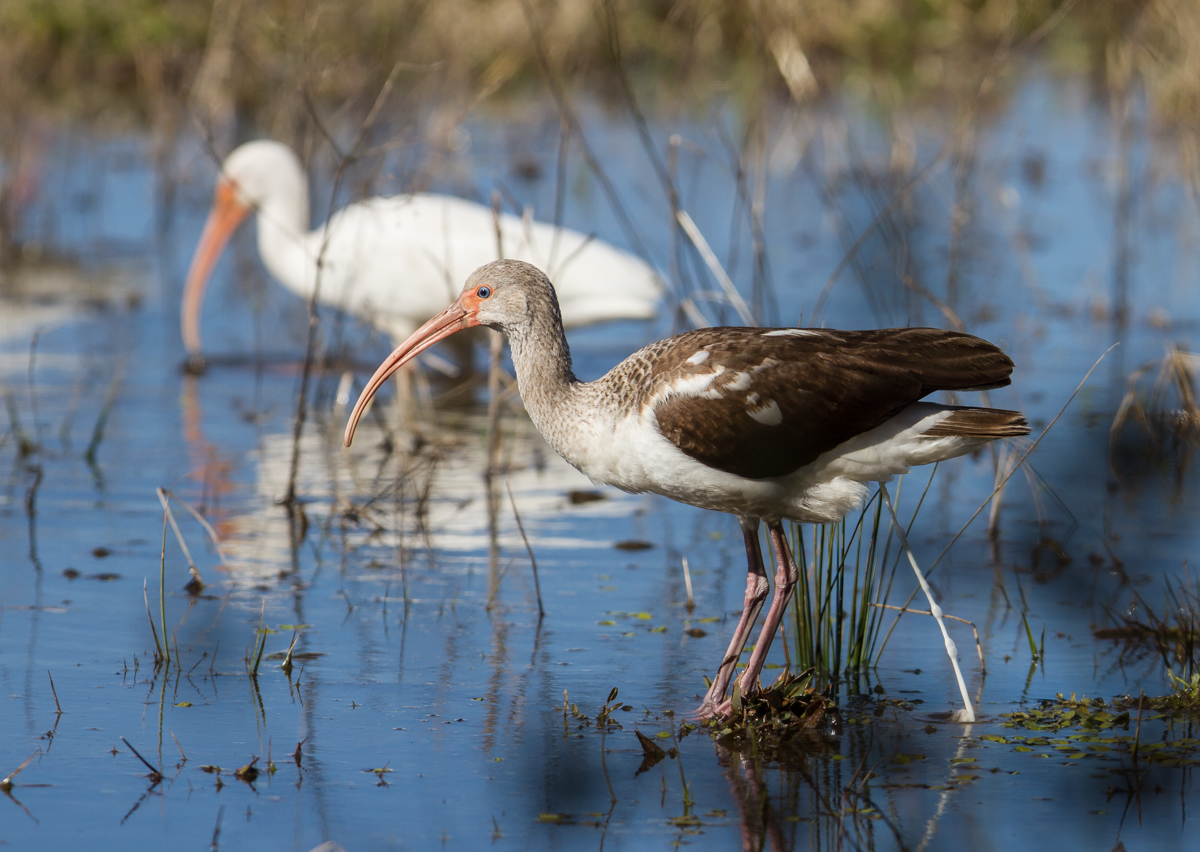
Driving through Mattamuskeet, we spotted several Great Egrets, Great Blue Herons, Black-crowned Night Herons, more ducks, a few more swans, and a sizable flock of White Ibis.
Immature and adult White Ibis
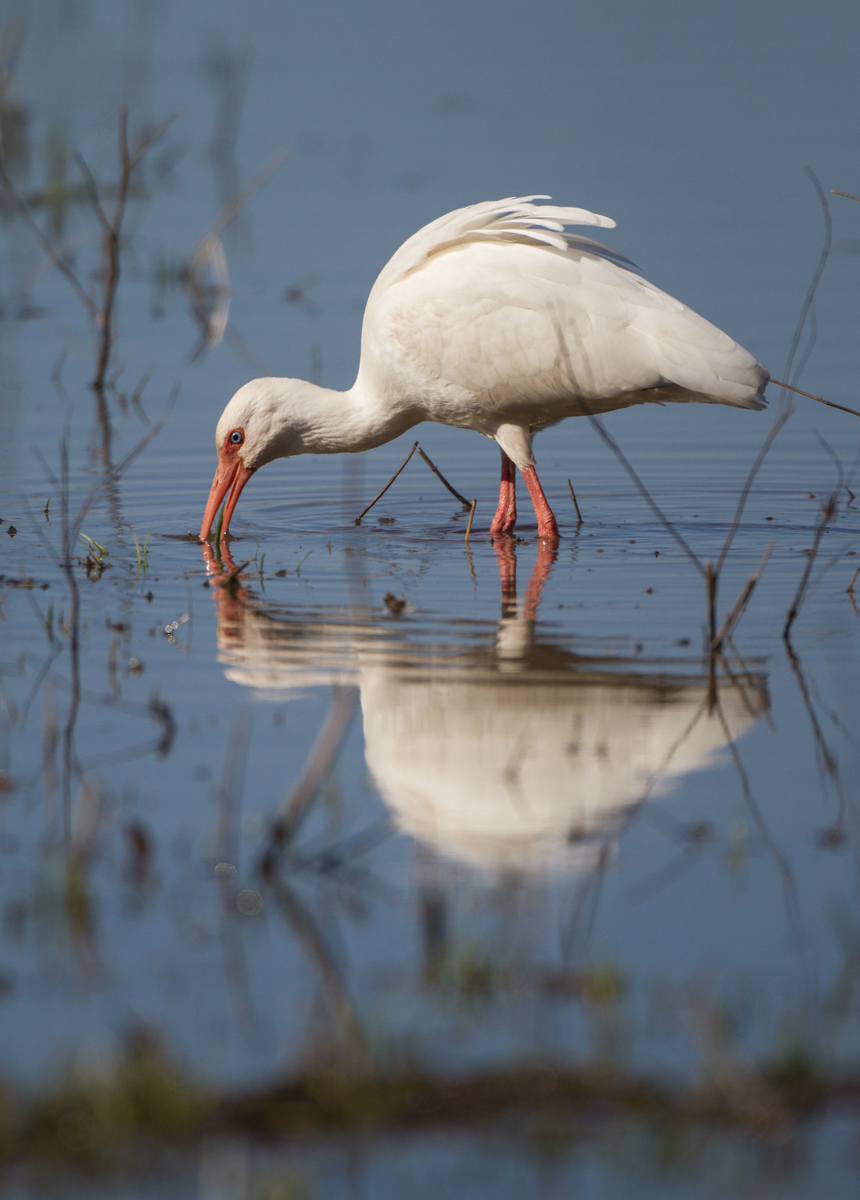
Most were actively feeding, probing the soft mud and shallow waters with their long bills, looking for small fish, or crayfish, worms, and other invertebrates.
White Ibis feeding
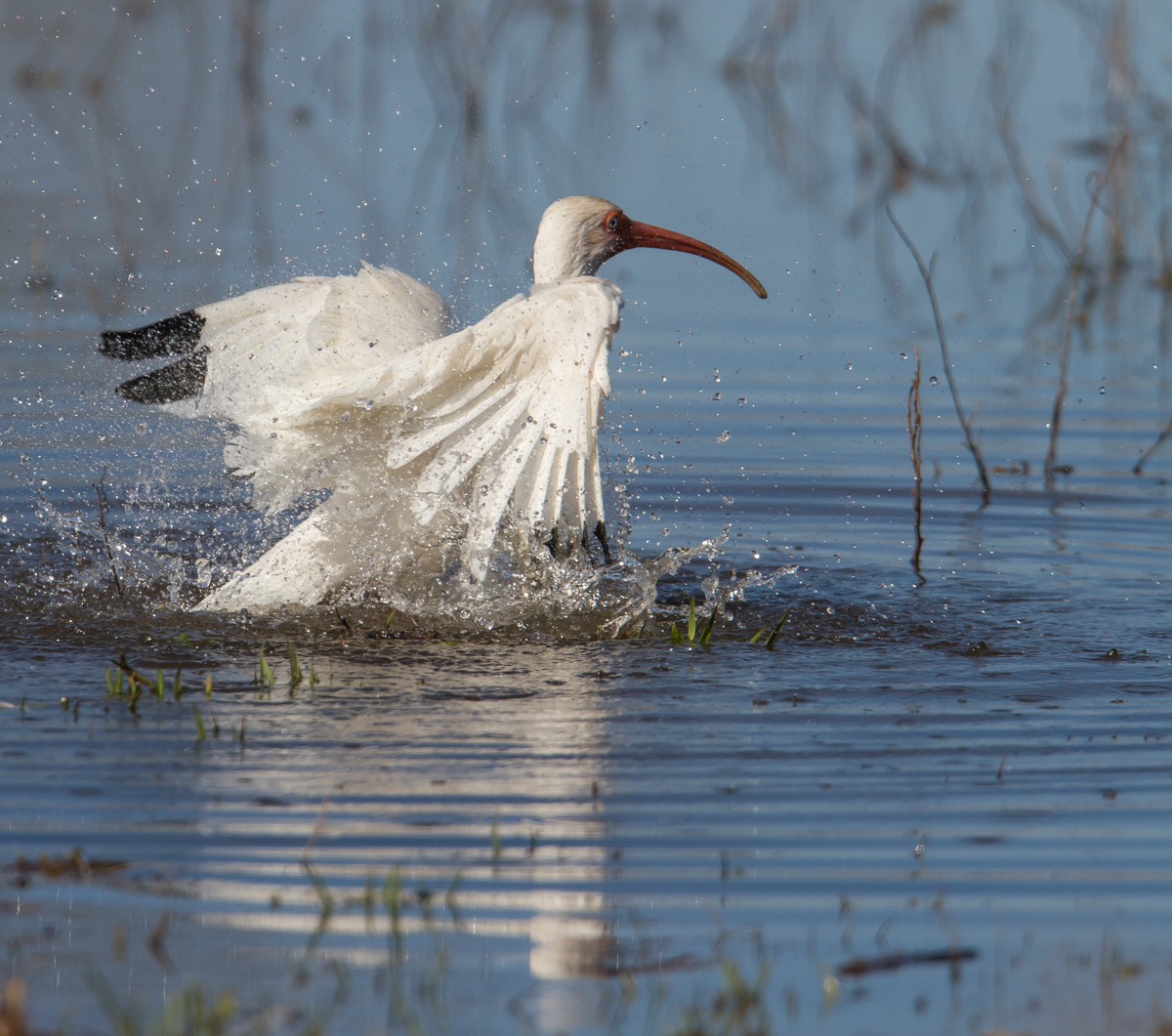
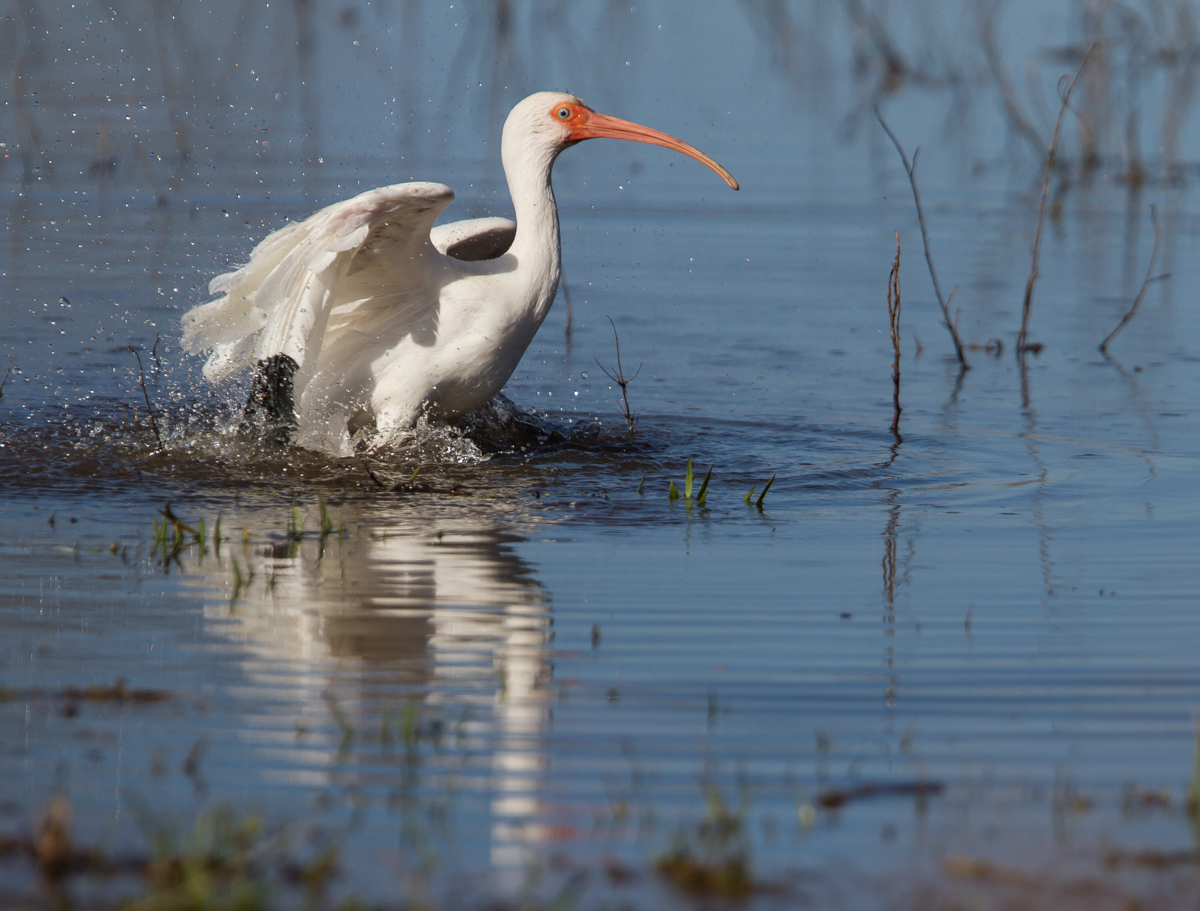
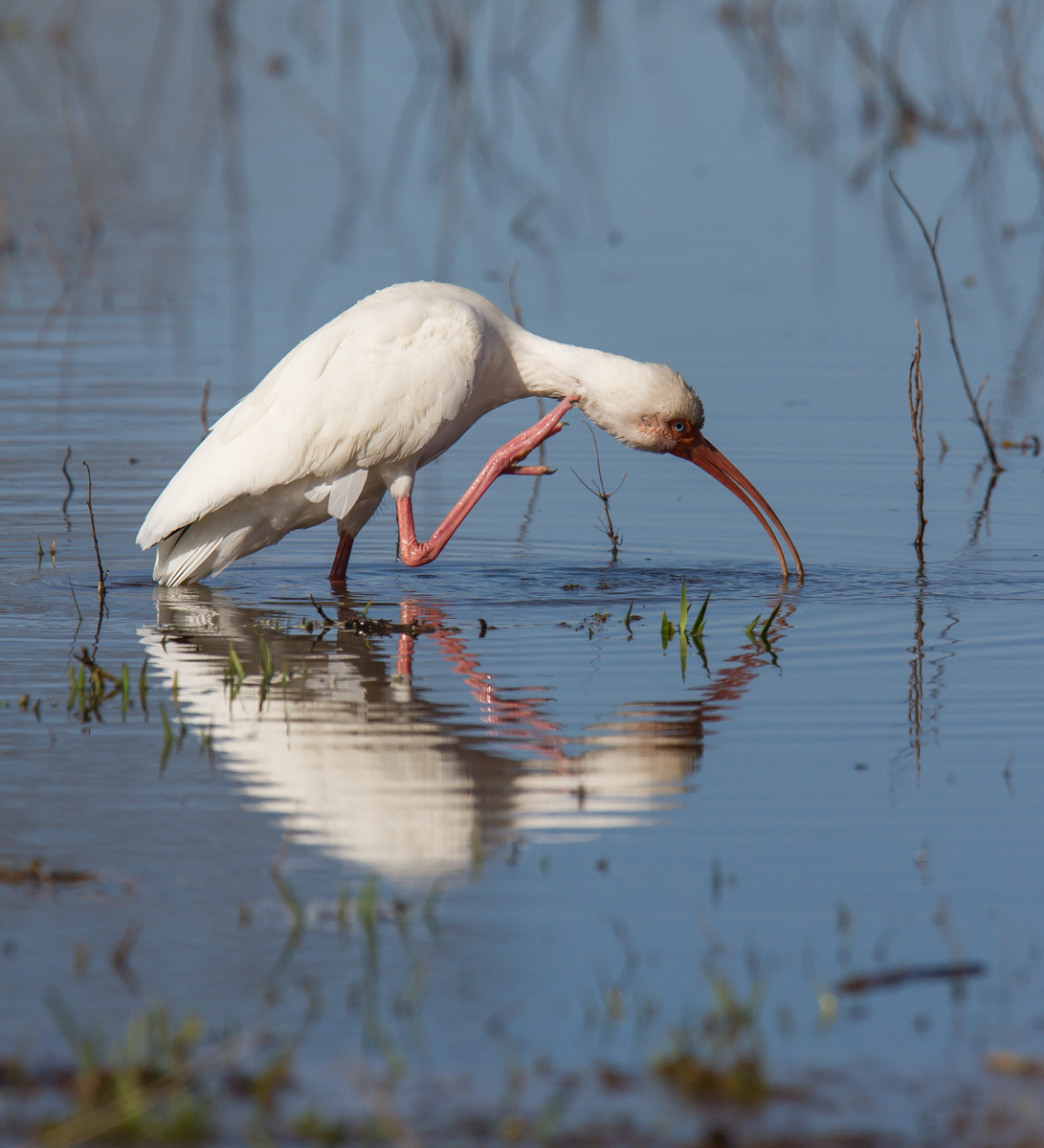
A few were off by themselves and were busy bathing and preening.
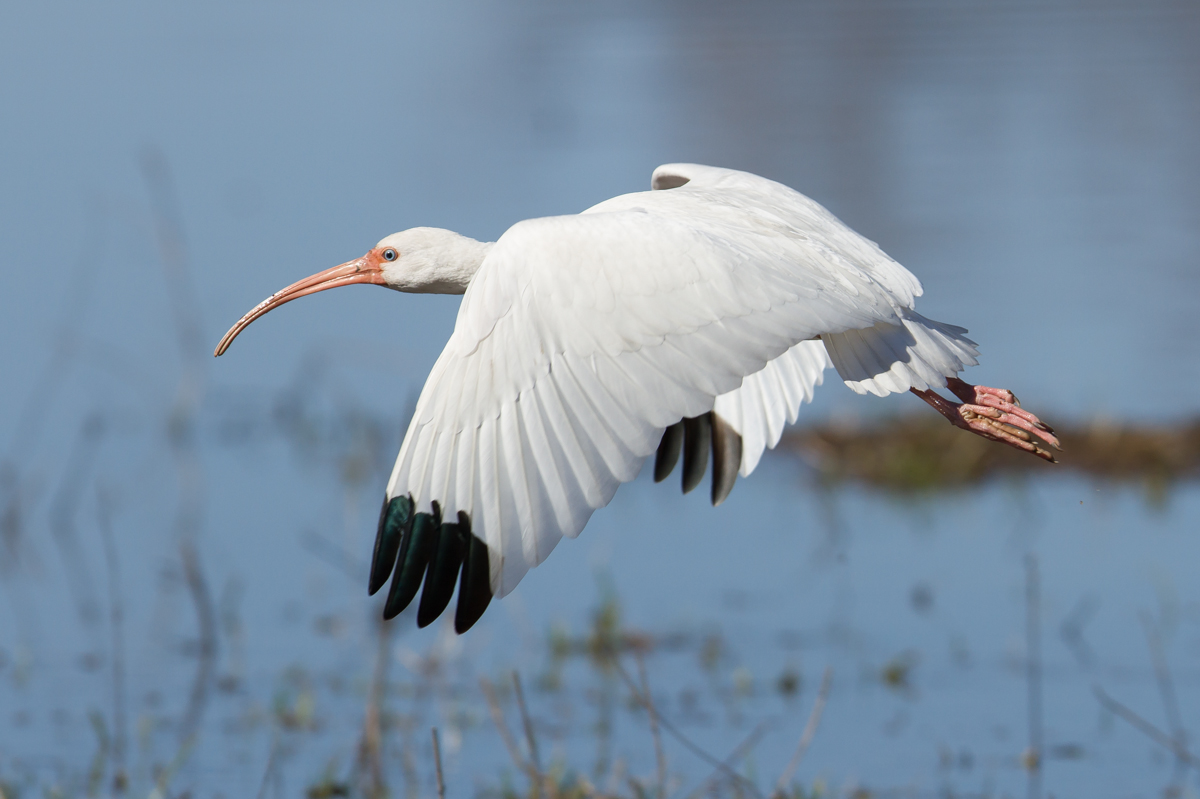
White Ibis bathingWhite Ibis splashing and bathingWhite Ibis scratchingWhite Ibis preeningAfter preening, a White Ibis flies off to feed
Driving back to Pungo on the way home, we saw a few flocks of swans returning to the lake for the night, but no Snow Geese. Looking back at my notes from the past few months, I found that I had seen the first of the Snow Geese back on November 23. That was a lone bird mixed in with a flock of Tundra Swans, who had started arriving a few weeks earlier. Thousands more arrived soon after, providing myself, and many other visitors, with incredible sights and sounds all winter. Now, in mid-February, most were gone. They are returning to their nesting grounds in northern Canada and Alaska, a few thousand miles from here.
Another amazing season of wildlife spectacles at Pungo and Mattamuskeet has drawn to a close. And a new season begins. This morning I heard a loud dawn chorus of birds in the woods outside my house. Last night, the calls of Upland Chorus Frogs filled the night air. It is one of the things I love most about this region, the progression of the seasons and the accompanying ebb and flow of life. I’m sure I will find something to keep me occupied until next winter when the first Snow Goose wings its way south and lands at Pungo Lake. Just as the waterfowl are flying north, our spring is moving north and will be here soon, bringing a new burst of life to my woods. Be sure to make some time to get outside in the next few weeks and enjoy its return.
Several of you have asked about the possibility of buying some of the images you see in this blog. So, I looked around and found a site that offers quality images in a variety of sizes and formats at a reasonable cost. That site is Fine Art America. I really like the fact that they offer image products at a variety of price points and styles from greeting cards to large framed prints. Those of you on my Facebook page have probably been inundated with some posts as I add new images to my gallery at the Fine Art America site, as they link to my FB page each time I upload a new image. But I wanted to make those of you reading the blog aware of this as well. To make sure I liked the quality of their products, I ordered an 11×14 metal print of one of my images and a card of another and was very pleased with the results. They also have a money-back guarantee for your satisfaction. If you are interested in seeing what is available for purchase, check out the Image Gallerypage on this blog at https://roadsendnaturalist.wordpress.com/gallery/. From there you can go directly to images I have available on my Fine Art America site. If you see something on my blog you would like, but it isn’t on the Fine Art America site, just email me and I can add it in most cases. I occasionally do some heavy cropping of images for posting on the blog if I am trying to emphasize a particular point, and while that amount of cropping often holds up fine for posting in a blog, it may not hold up well for a large print, so that would be the only restriction. Otherwise, I am happy to make any of these images available for purchase.
The geysers and hot springs . . . display an exuberance of color and strange motion and energy admirably calculated to surprise and frighten, charm and shake up the least sensitive out of apathy into newness of life . . . You will be brought to a standstill, hushed and awe-stricken before phenomena wholly new to you.
~John Muir, in Yellowstone
Castle Geyser (click photo to enlarge)
I am offering a trip this May to my favorite place on the planet, Yellowstone National Park. Join me May 21 – 28 for an unforgettable experience in the world’s first national park. I’m excited to share the wonders of Yellowstone at a time of year when wildlife is abundant and crowds of visitors are not! More details can be found on my trips page – https://roadsendnaturalist.wordpress.com/trips/. If you have any questions, please contact me at roadsendnaturalist@gmail.com.
Here are a few pictures from recent trips…
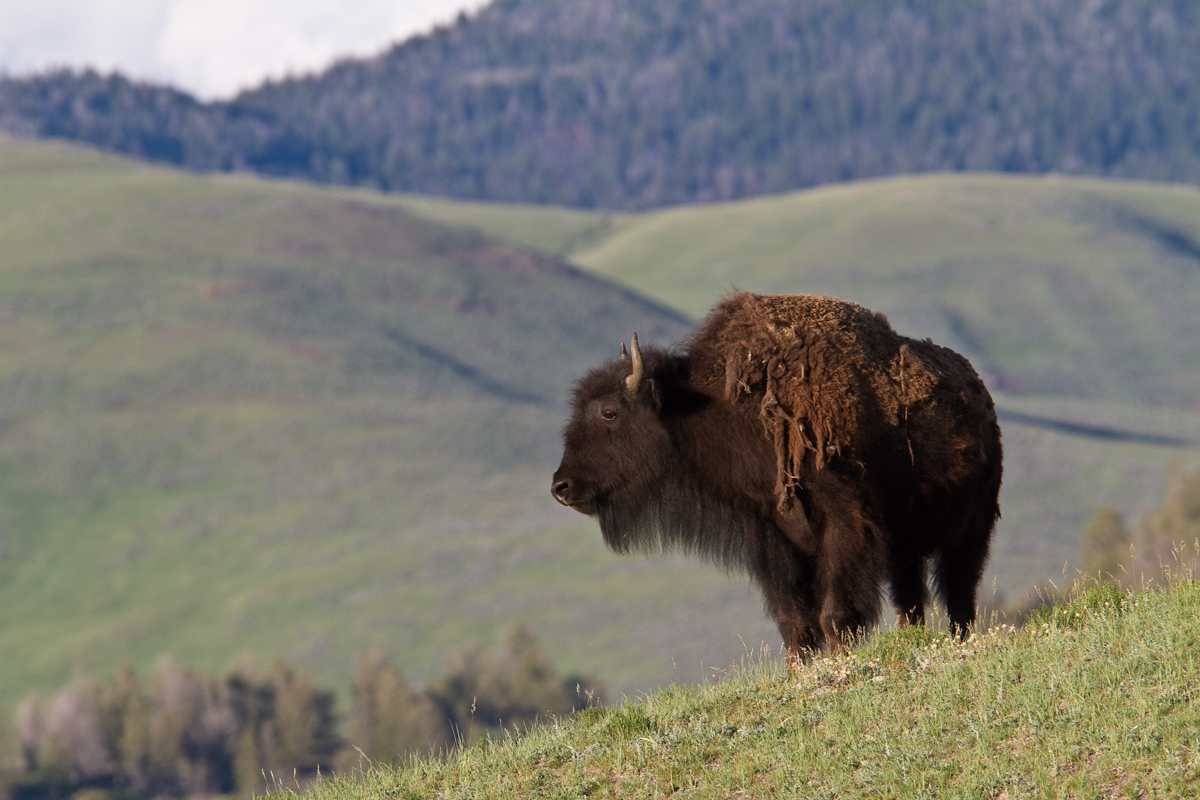
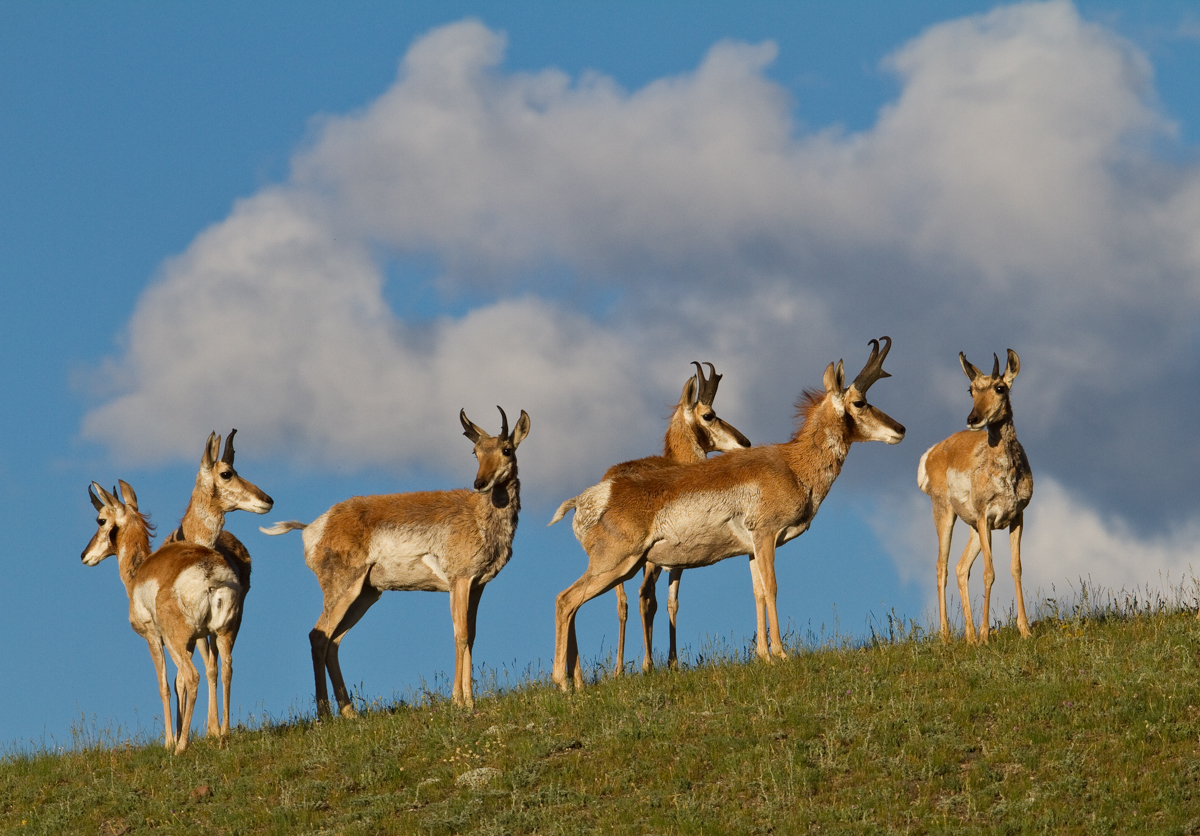
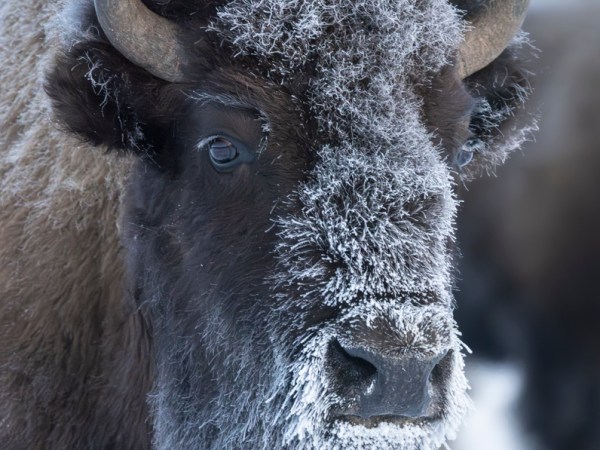
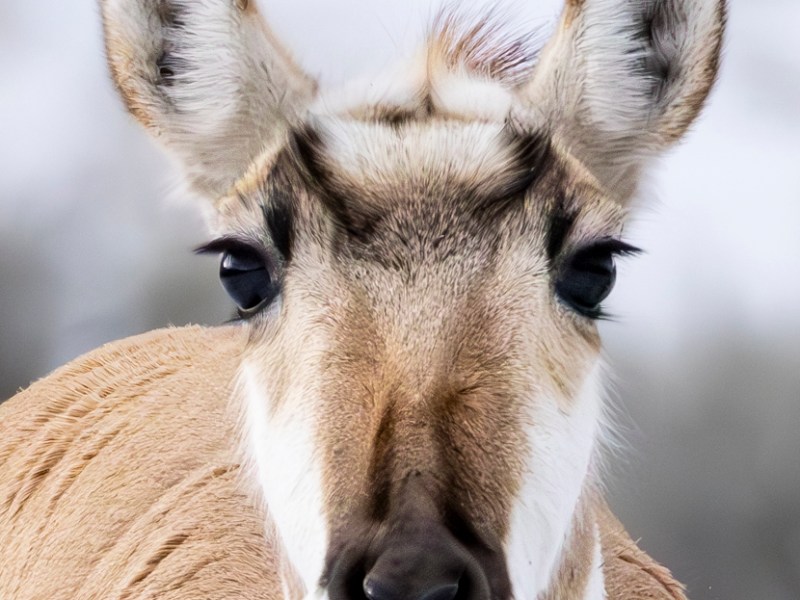
Formations at Palette SpringThe iconic animal of Yellowstone, a BisonReflections at Grand Prismatic SpringPronghorn bucks on ridge
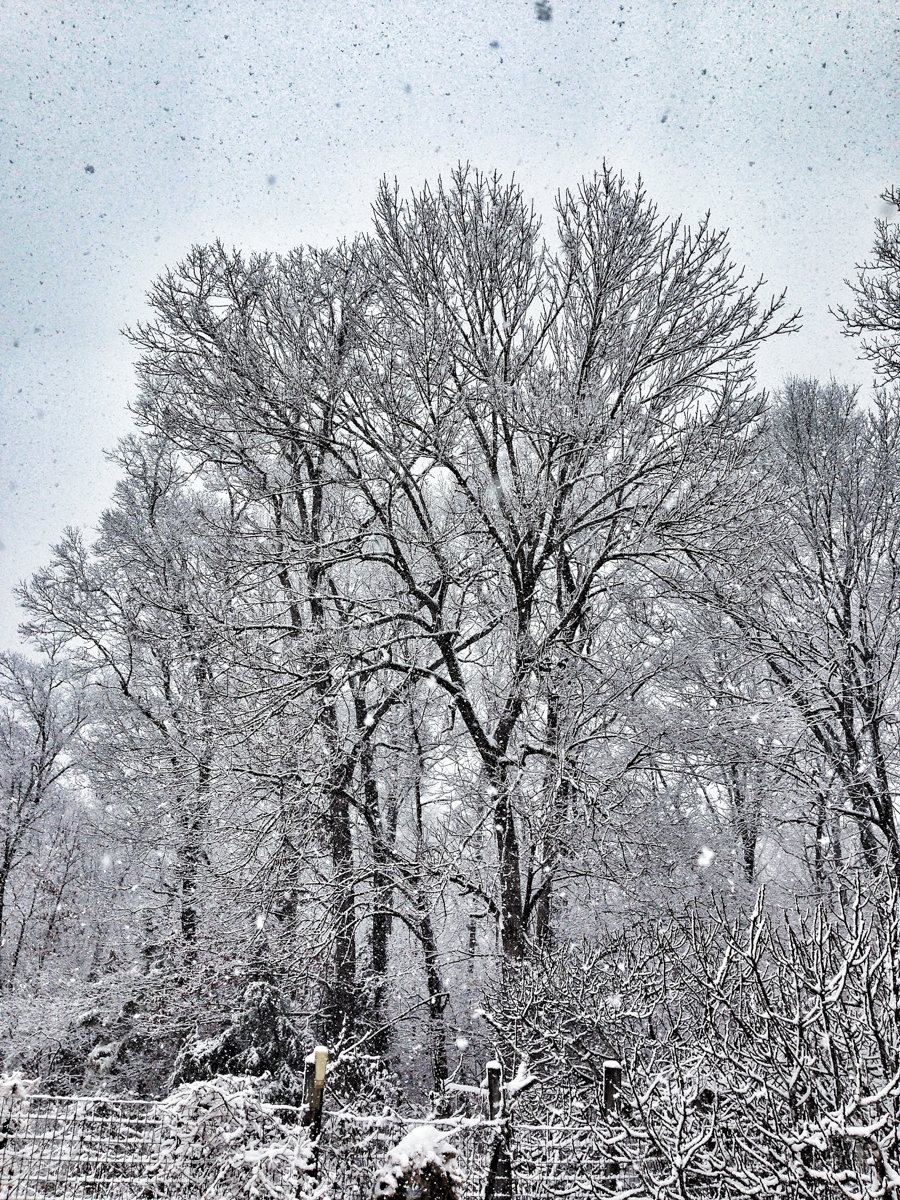
They all said it was going to be a bad storm. And it started right as predicted, and created havoc on the roads in this area unaccustomed to dealing with it. It snowed much of Wednesday afternoon. Thursday dawned gray and cold, and then it started snowing again…heavy. It was the kind of snow that clings to everything – the porch screens, the fence wire, the tree trunks, the branches. The woods didn’t care, and I loved it. There is something magical about a snowfall – the silence, the blanket of beauty spread across the landscape, the way the often hidden or subtle can now become bold against the white backdrop.
The woods in snow
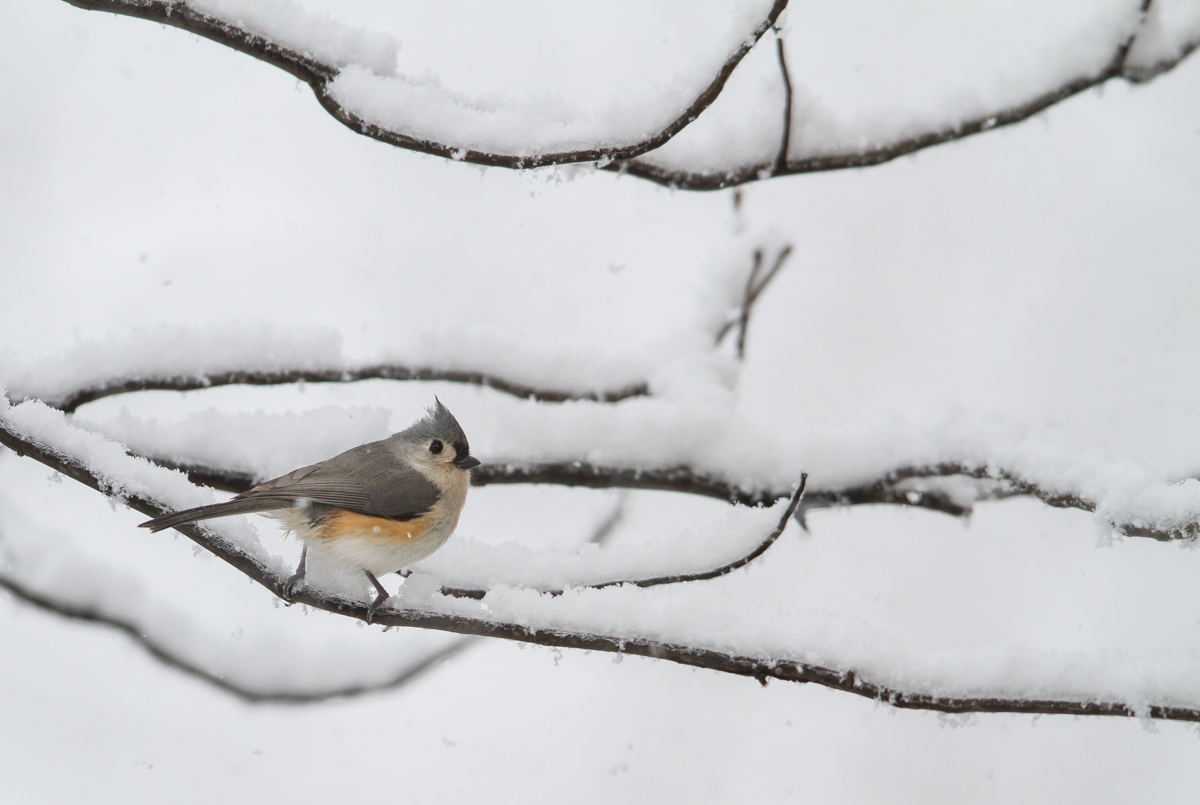
The birds also knew it was coming long before it started. They remained very active at the feeders throughout. During a strong burst of snow, I stood outside and watched as they came and went, cautious at first, and then paying me no mind as they stocked up on seed and suet. Birds the color of the winter woods now can be seen amongst the patterns of snow-covered branches.
Carolina ChickadeeTufted Titmouse
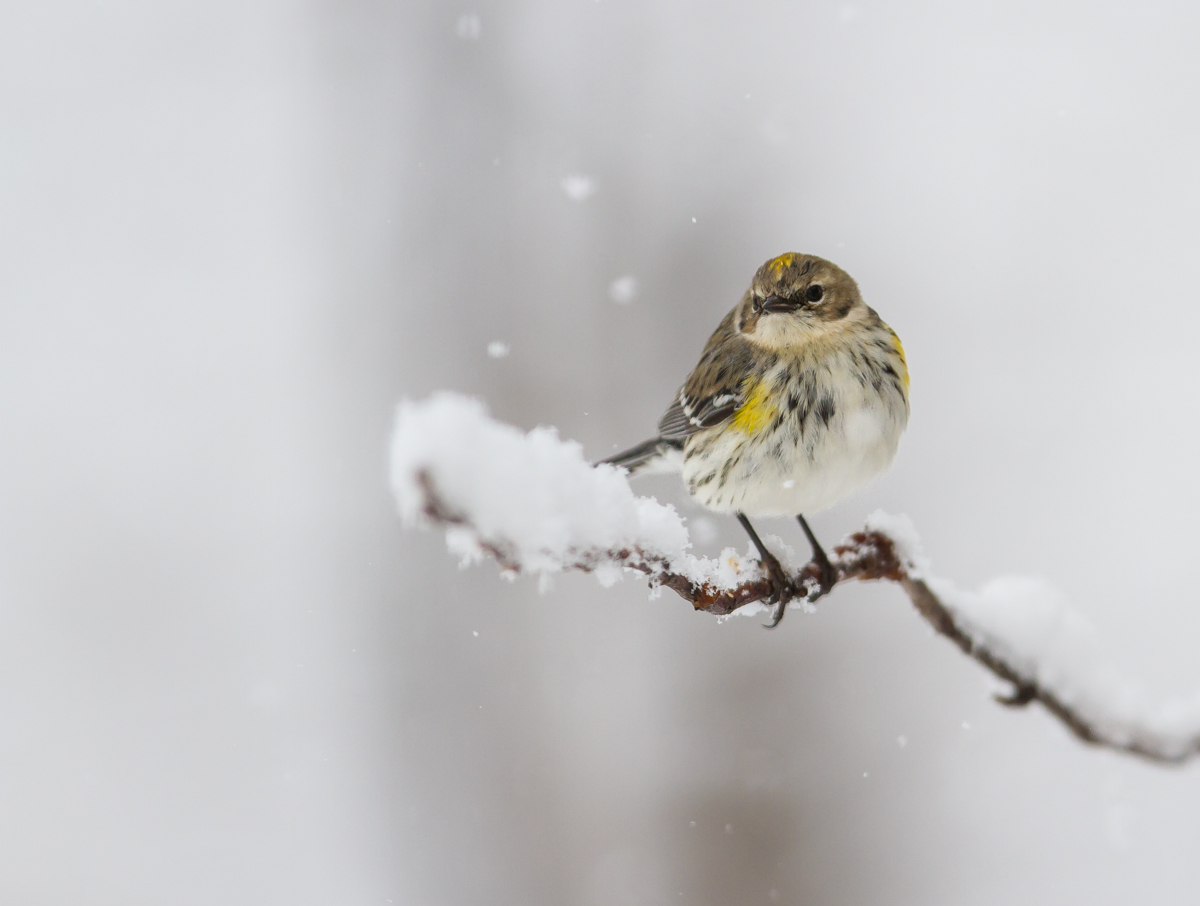
A hint of color is quite an accessory amongst the whiteness.
Yellow-rumped warbler
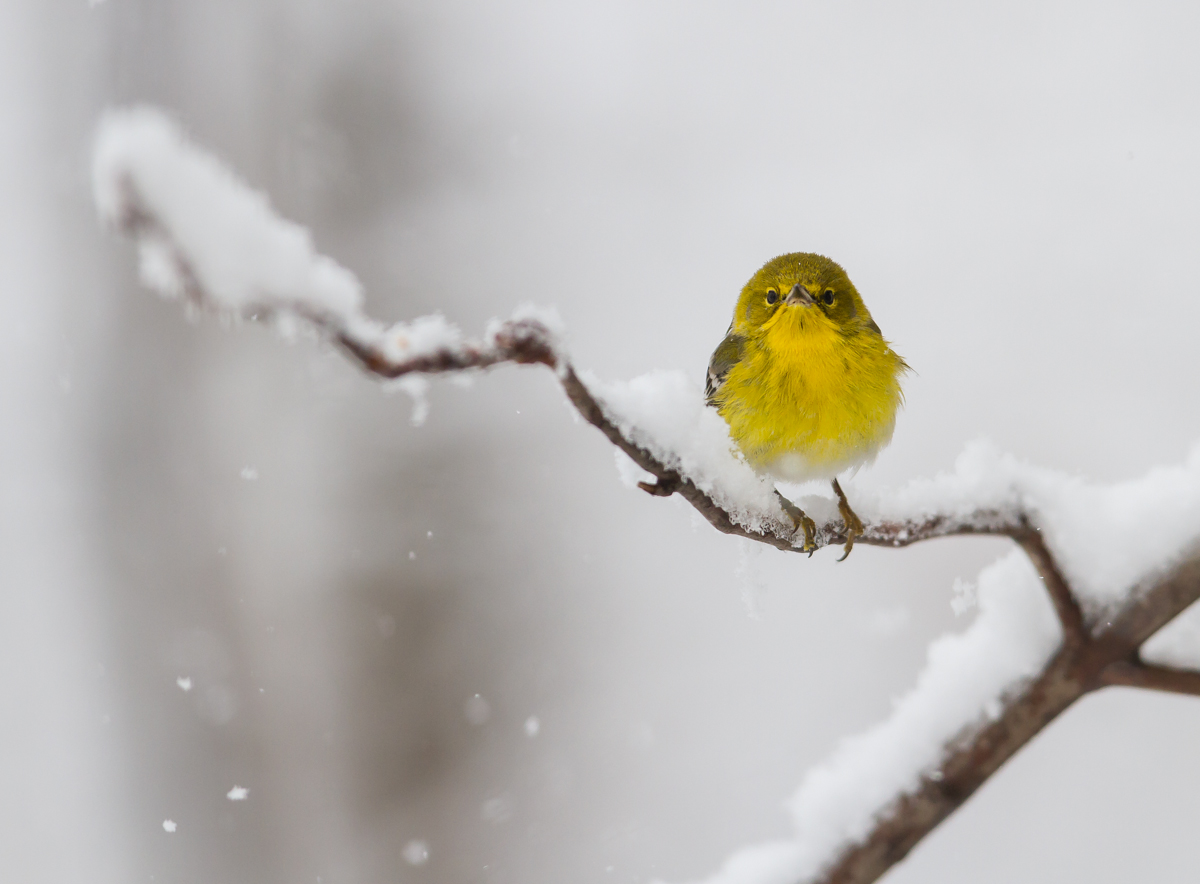
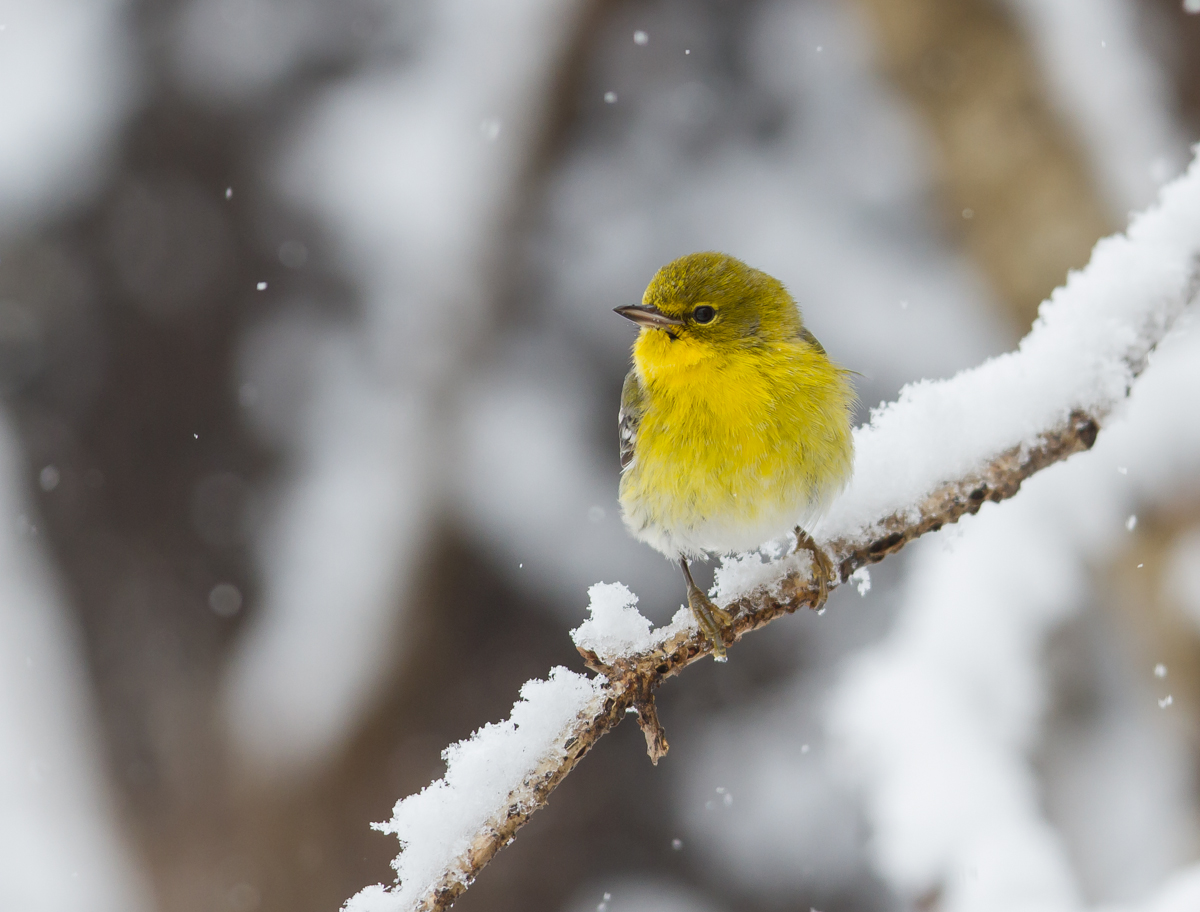
And what have we been told about yellow in snow? It can be beautiful…
Pine WarblerA Pine Warbler waits his turn at the suet feeder
But to make a statement, wear something bold.
Northern Cardinal male amongst snow-covered branchesNorthern Cardinal maleThe colors of winter
A day later the sun is beating back the whiteness. It will probably stay another day or two, but the snow cannot sustain itself against the onslaught of blue sky and warmth that will be coming this week. This may be its last appearance for this winter. School administrators, road crews, power companies, and many commuters will rejoice. I will anxiously await its return.
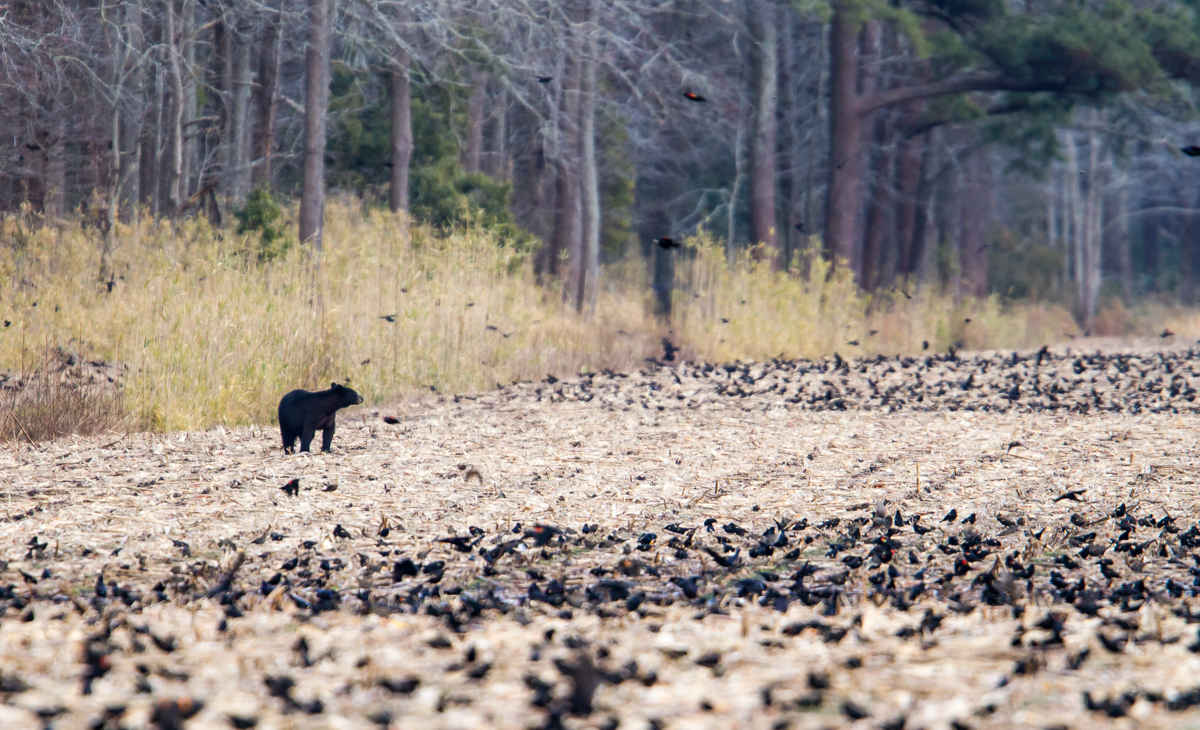
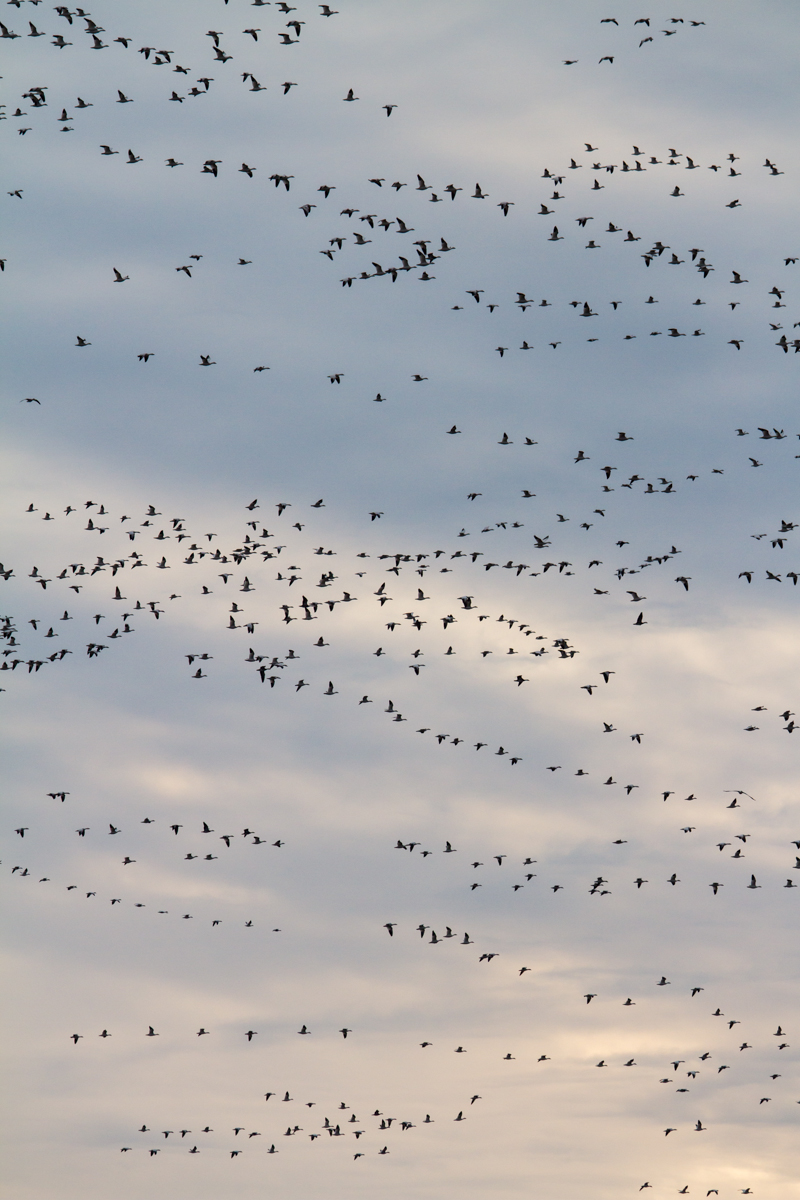
Last week I had another group going to the Pungo Unit of Pocosin Lakes National Wildlife Refuge. They had been scheduled for the prior week, but the rare coastal snow storm had made it impossible for them to get to Pungo. I headed down the day before to scout the roads that had been so difficult to navigate the weekend before. It is amazing what a dry day can do for road conditions and I was pleased they had improved greatly, although there were still a few pretty difficult mud holes to navigate. A quick drive through in late afternoon and I had the usual thousands of Tundra Swans, Red-winged Blackbirds, 15+ Bald Eagles, and a few bears. The Snow Geese were not in the fields with the swans as they had been last week, but, instead, flew over and back several times, but refused to settle down. They ended up landing briefly in some fields on private land a couple of miles to the north, but as I drove toward them, hunters opened fire, sending the flock scurrying back to the lake for the evening.
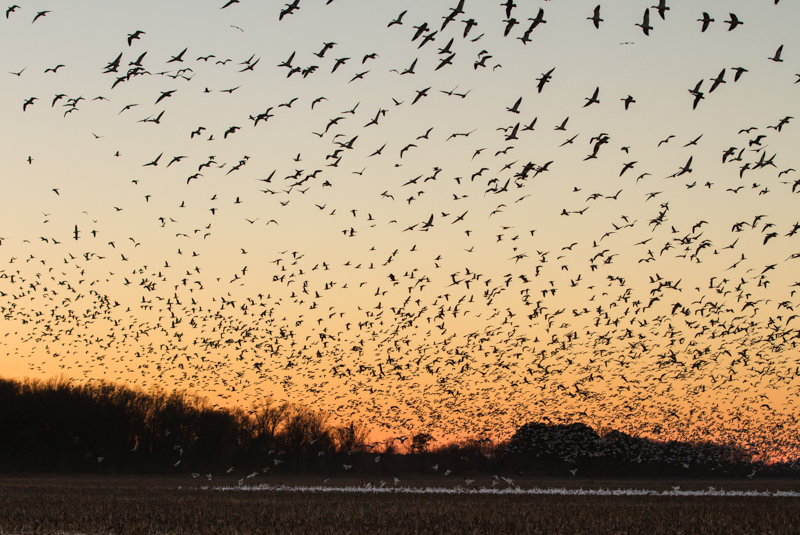
Black Bear ventures out into corn field surrounded by hundreds of hungry Red-winged Blackbirds (click photos to enlarge)Snow Geese flying at sunset
We met at 6:15 the next morning and headed to the refuge. Leaving one car at the maintenance area, we drove to the observation platform on the south shore of Pungo Lake. A chilly north wind greeted us, but relatively few birds compared to previous sunrises. But the Red-winged Blackbirds did not disappoint. Right on schedule, they streamed over us by the thousands, flying in from the east, and continuing on to the fields to our west to feed.
Red-winged Blackbirds at dawn
The morning was relatively quiet. The Snow Geese flew out of the lake at 7:30 a.m., right on schedule, but headed north to places unknown. Swans continued flying out most of the morning as we drove the refuge looking for bears and other wildlife. The reflections in the canals were beautiful, so we stopped a few times for photo ops, but mainly kept looking for some place where wildlife was abundant and active.
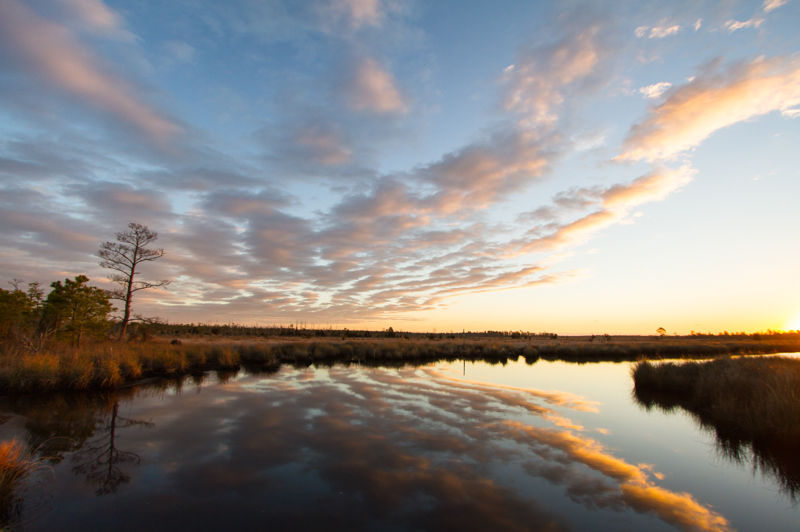
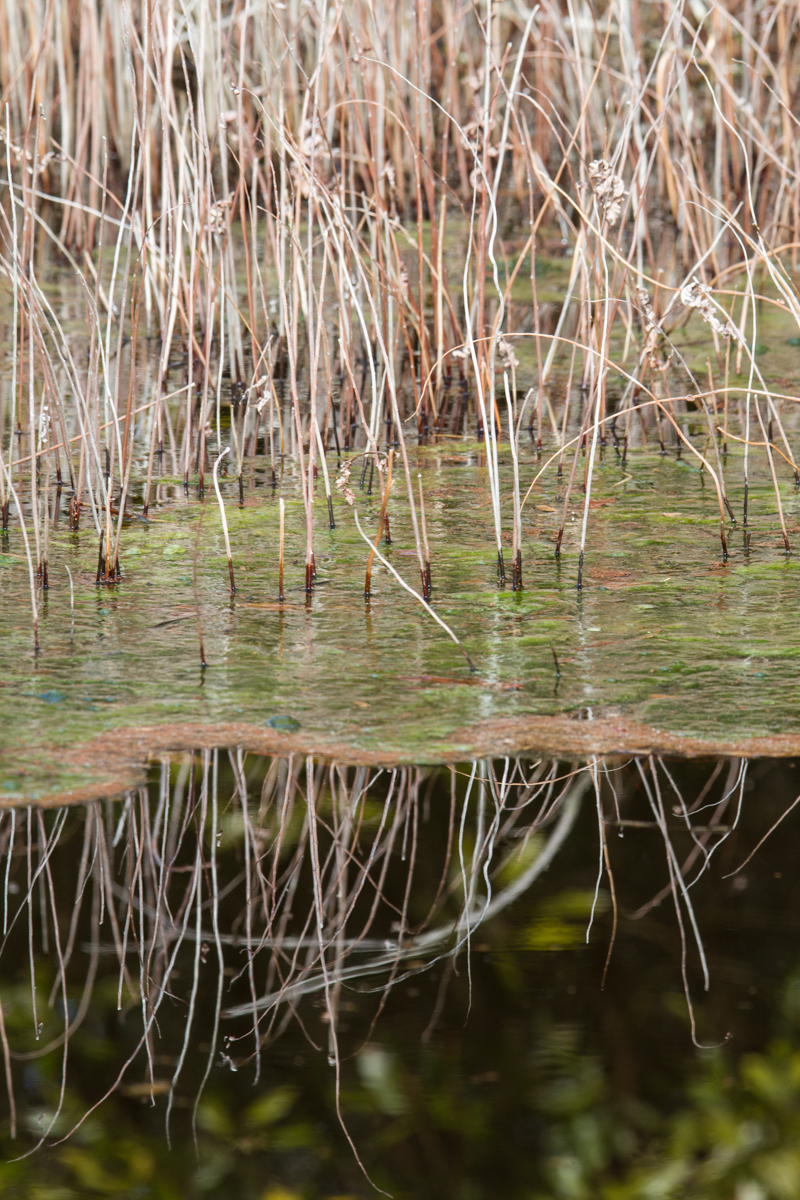
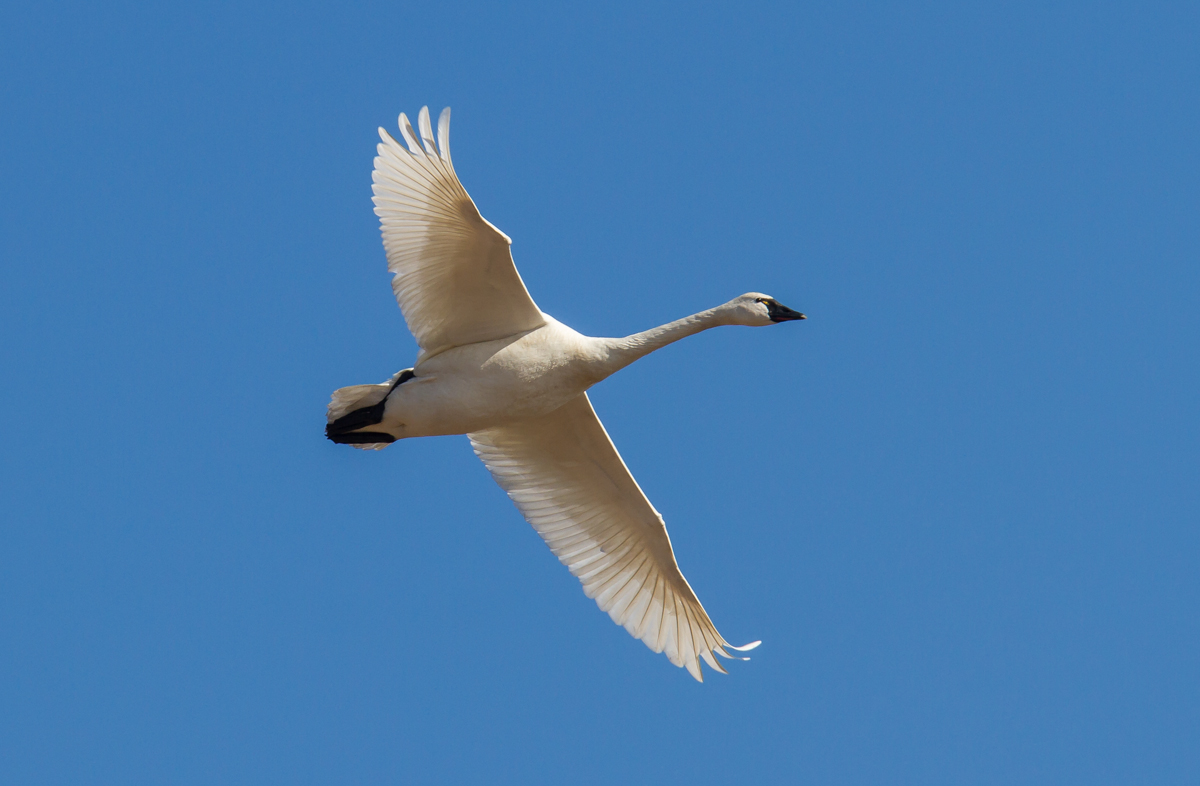
Canal reflectionsGrasses bordering the canals make for interesting reflectionsTundra Swan in flight
While observing a large group of swans in a flooded corn field, I suddenly spotted some unusual visitors – Sandhill Cranes! Two small groups, totaling five cranes, flew by us out toward private farm fields to the west. While they were a considerable distance from us, there is no mistaking the distinctive flight pattern. I managed a few quick shots of one group before they disappeared. I have only seen Sandhill Cranes here one other time in all the years I have been coming to the refuge.
Sandhill Cranes at Pungo
The Sandhills were the first of two surprises our group encountered. Later in the afternoon we heard and spotted another Trumpeter Swan as it (or perhaps two) flew by us, mixed in with a few Tundra Swans. I had heard the distinctive call of a Trumpeter while leading another group a week ago, and here was another flying by. When I contacted a friend and USFWS biologist about it after hearing the first Trumpeter last week, she told me they had observed a few last winter while conducting a waterfowl survey in the area and she reminded me they had captured a few several years ago while banding Tundra Swans. She suggested they may be part of the group that was released a few years ago as part of a reintroduction effort in Ohio.
Part of the afternoon was spent hiking the woods along “Bear Road” and observing the abundant bear sign. We did see a Great Horned Owl and later heard a Screech Owl, but overall, the woods were very quiet and even the lake lacked the usual background sounds of hundreds of swans. They all seemed to be out in the fields feeding, so that’s where we headed for the end of the day.
After looking at several Bald Eagles overlooking fields full of swans and blackbirds, we finally saw a couple of bears emerge from the trees. But soon, they rushed back in and, to my dismay, I soon saw the reason why – two dogs were patrolling the field and running at everything in sight. I had seen these same two dogs the day before on a road miles from here on the other side of the refuge, and, later, in this same field. I think they belong to one of the houses along the paved portion of road, but it is unfortunate that they are running loose on the refuge, spooking the few animals that were out on this day.
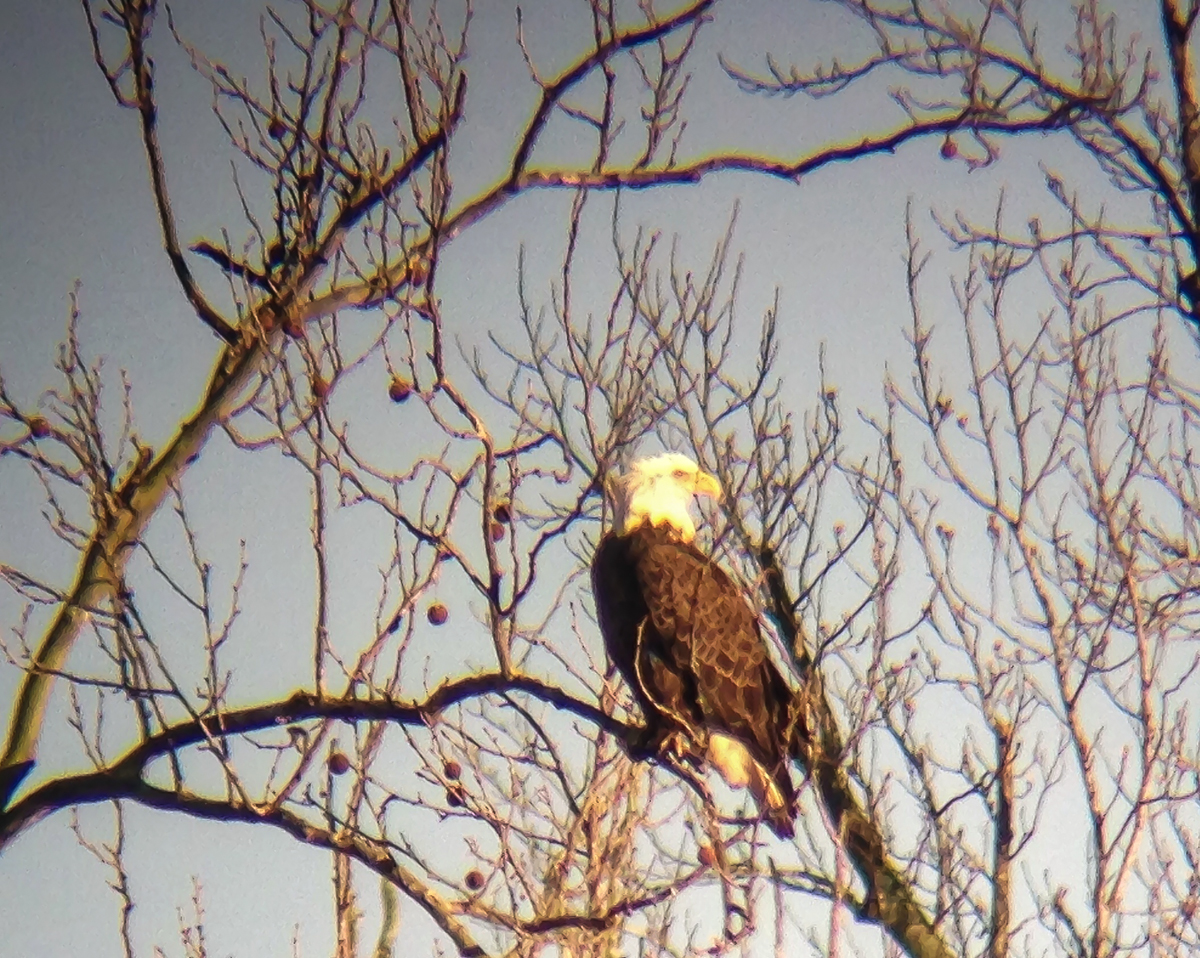
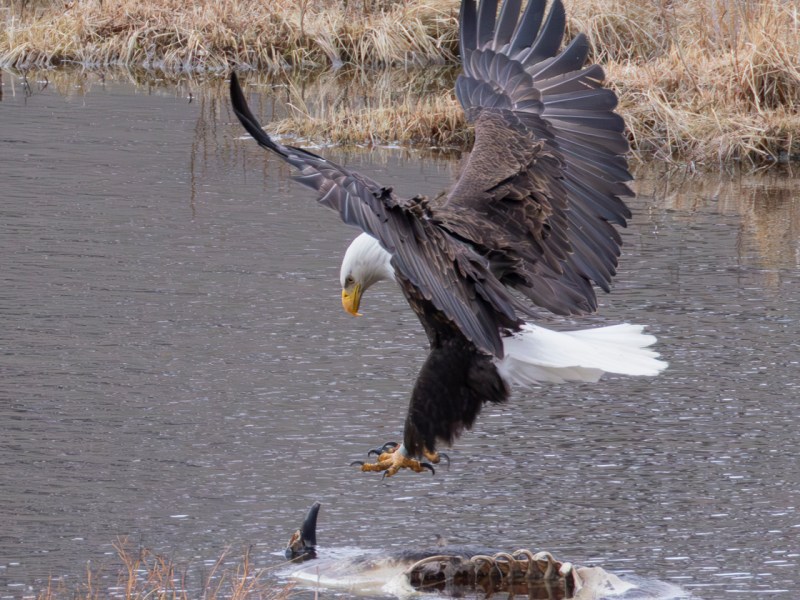
Digiscoped image of adult Bald Eagle
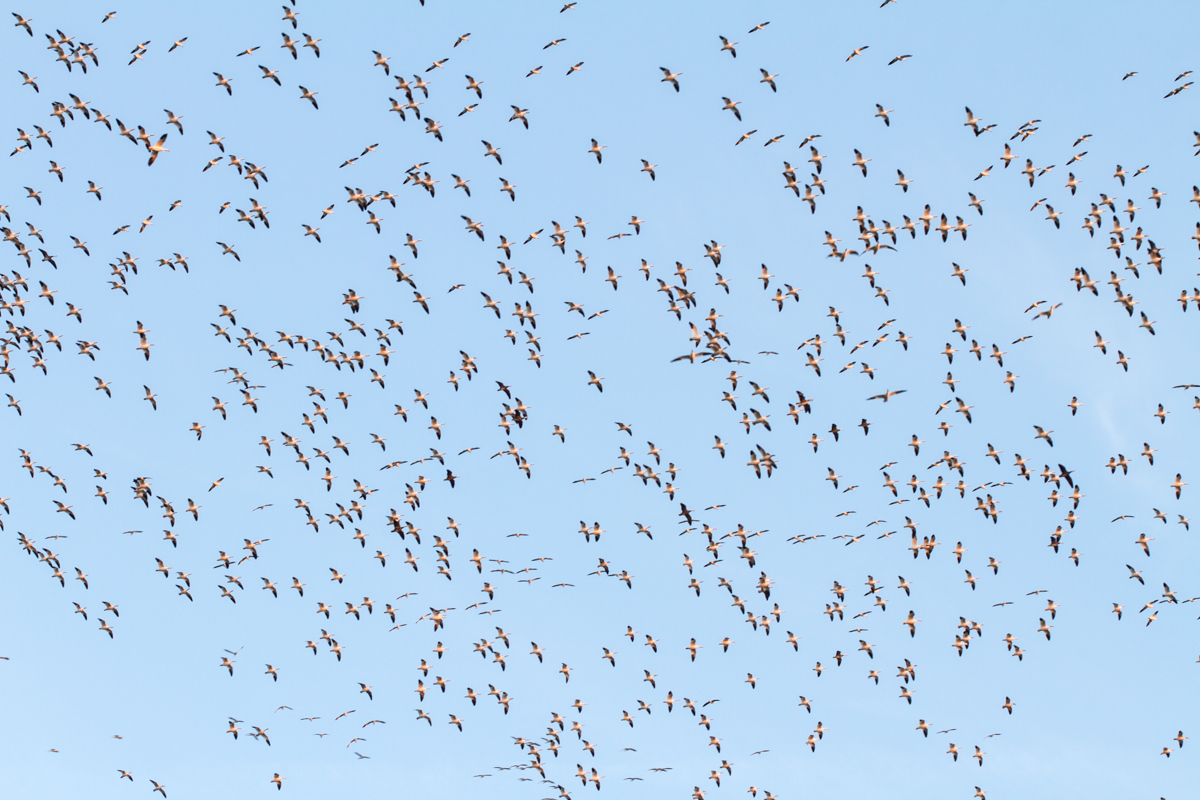
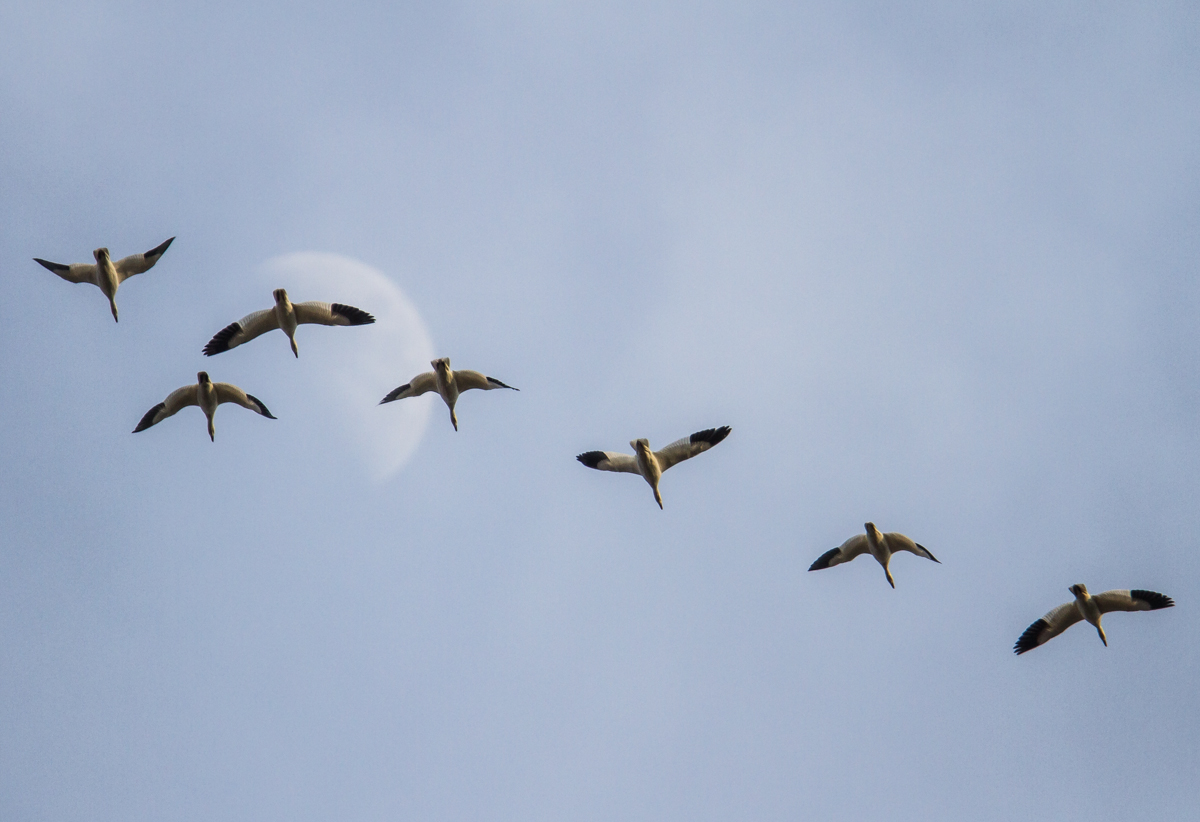
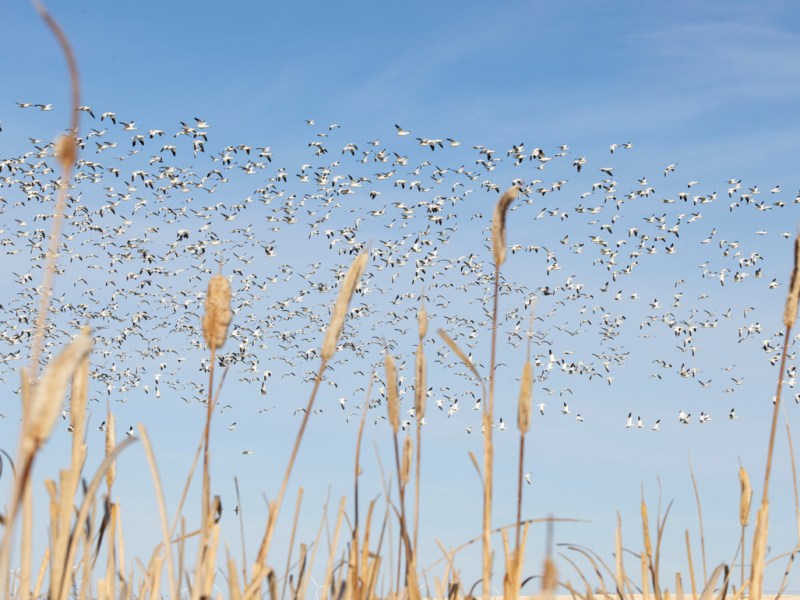
With the dogs being in this field, I decided to move up the road to where a few thousand swans were feeding. As we watched and listened, a few hundred Snow Geese flew in…a good sign. Shortly afterward, several thousand Snow Geese came flying in very high up and then began to swirl around the wheat field in their classic group landing.
Snow Geese swirling as they get ready to land
Once again, we stood in awe as the sky was filled with thousands of beating wings slowly descending to the fields. Here is a brief video of thousands of Snow Geese settling into the wheat fields, where hundreds of Tundra Swans are already feeding.
The prime season at Pungo is beginning to wind down, and one day soon, in a week or two, or three, the Snow Geese will all lift off and head north. For days following that, the Tundra Swans will drift off to the north in smaller flocks until, in a few weeks, the lake will be silent once more. Many of the eagles will disperse, with just a few remaining behind all summer. The giant flocks of Red-winged Blackbirds will break up and move to breeding territories to the north. But new species of song birds will arrive, and the bears will start being more active, new cubs will appear, a diversity of reptiles, amphibians and invertebrates will be out and about, and the cycle of life at the refuge will continue. I plan to be there through it all, and hope you can join me.
















 Roads End Naturalist