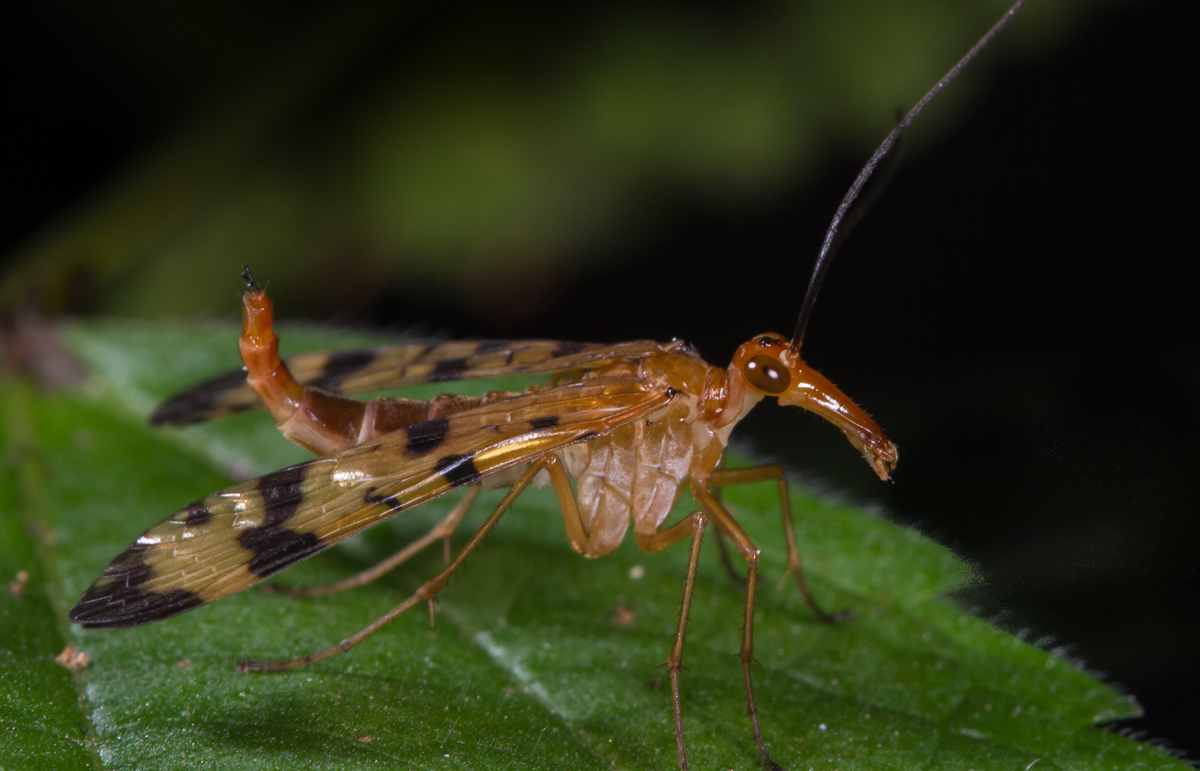
Okay, maybe not the best pick-up line, but if the nose fits…This is another strange insect I found this week, a Scorpionfly, (Panorpa sp.). One morning I found two females out back in a small patch of ferns and False Nettles. They were perched atop some leaves and, in what is typical behavior, would allow me close enough to get one or two pictures before flying several inches away to perch on another leaf. Unfortunately, there were no males present, as it is the unusual “tail” of the male that gives the insect its name. The male’s abdomen ends in a coiled appendage that resembles a scorpion’s stinger. It contains his genitalia and a notal organ, which helps him hold the female’s wings during mating. The tip of a female’s abdomen is just slightly up-curved.
Scorpionfly head close-up
The other unusual anatomical trait of this insect group is the elongated “nose” or rostrum. The mouth parts are located at the tip. Scorpionflies feed on dead insects, nectar, decaying organic matter, and the occasional slow-moving live prey.
Scorpionfly female
As if being odd-looking at both ends isn’t enough, these insects also exhibit some extraordinary mating behavior. Unlike most insects, it s the male Scorpionfly which may release reproductive pheromones to attract a mate. He then offers her a nuptial gift consisting of a dead insect or, often, a glob of spit that hardens as it dries. If she accepts, he grabs her with special claw-like structures in that scorpion-like appendage and mates while she is feeding. Who needs a pick-up line?
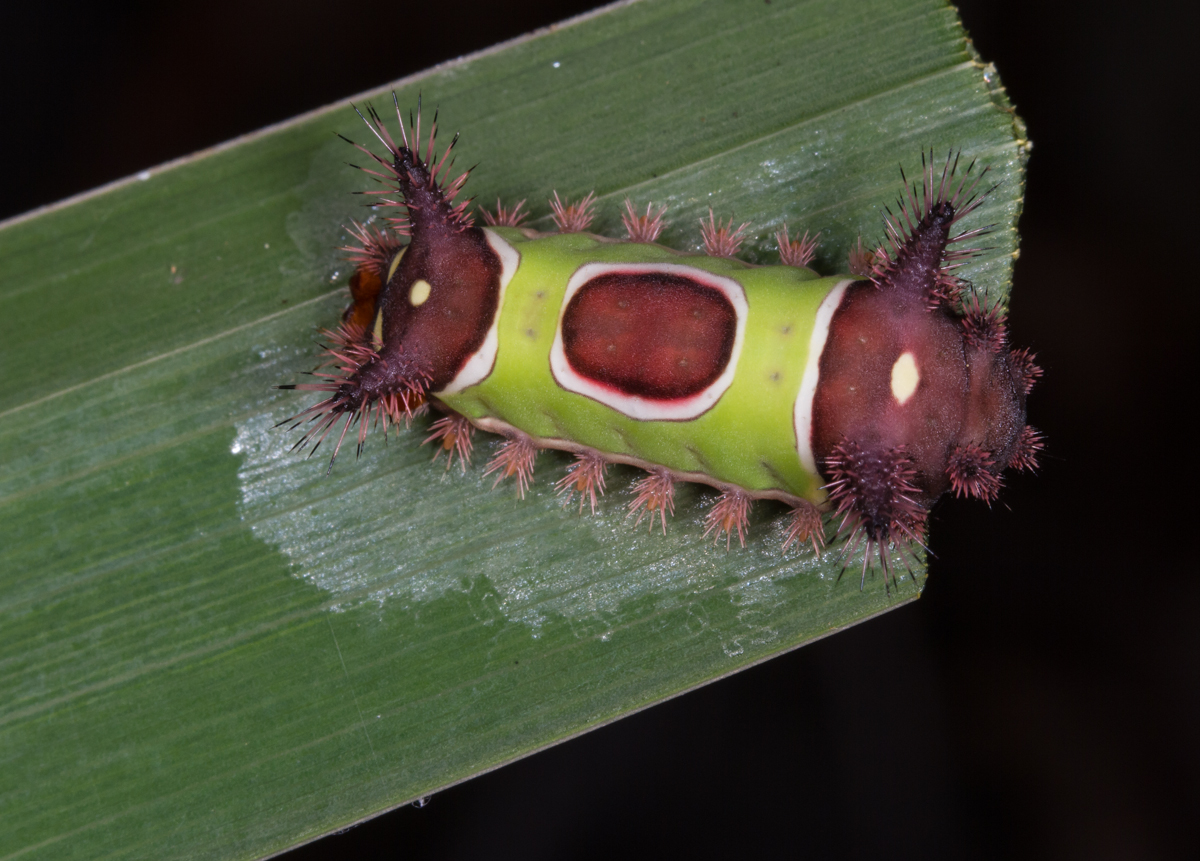
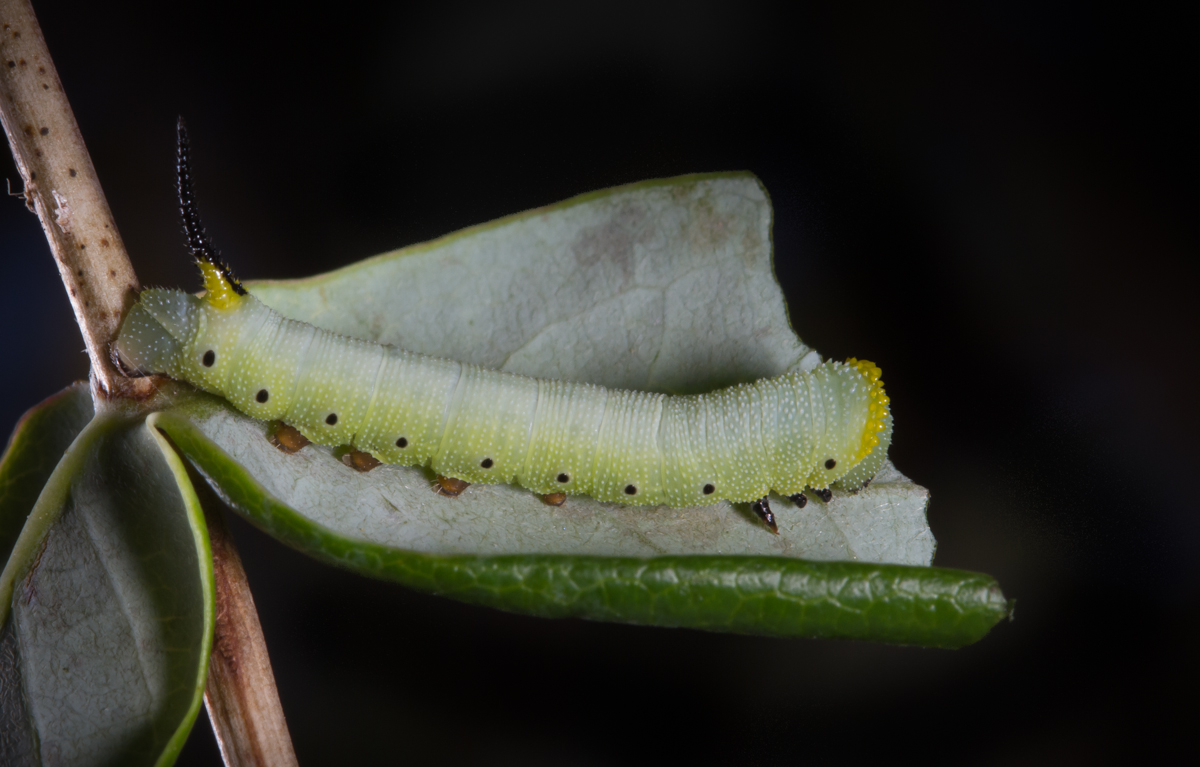
Well, it isn’t really a good idea to touch this, even though I have a few times. This is one of my favorite caterpillars, the Saddleback. It is the larva of an inconspicuous brown moth, Acharia stimulea. The larva is named for the saddle-like pattern (green around the middle “saddle blanket”, with a brown oval spot “saddle” edged with white) in the center of the back.
Saddleback caterpillar on Iris leaf
This distinctive larva is one of the unusual group of moth larvae known as slug caterpillars, family Limacodidae. Instead of having paired prolegs on their abdominal segments like most caterpillars, the slug caterpillars have suckers on the first seven segments. Larvae also secrete a semi-fluid silk as they move to help increase body contact and adhesion with the leaf (this can be seen in the first image). So, instead of crawling, they glide. I love the quote by David Wagner in his classic reference, Caterpillars of Eastern North America – “relative to other caterpillars, slug caterpillars seem more fantasy than reality”. Indeed, they are a strange lot, and this one is one of the strangest, and most painful when touched.
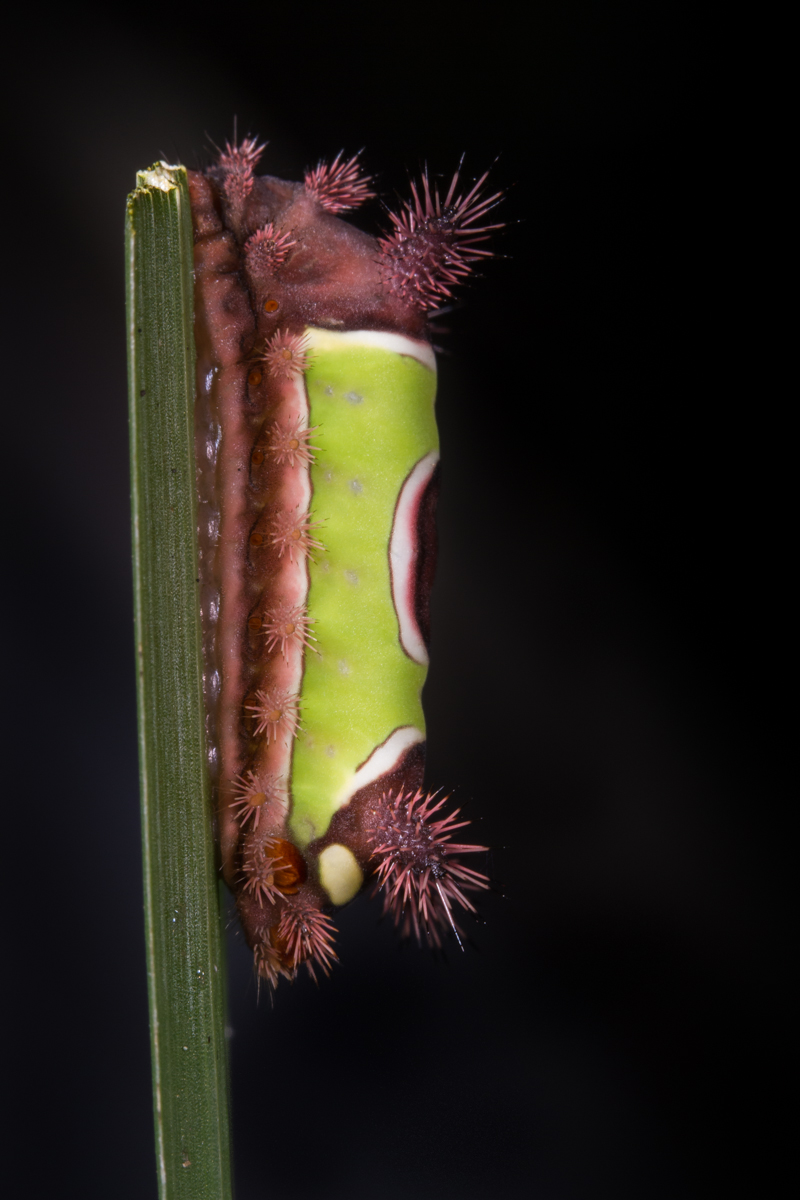
Saddleback caterpillar showing spines
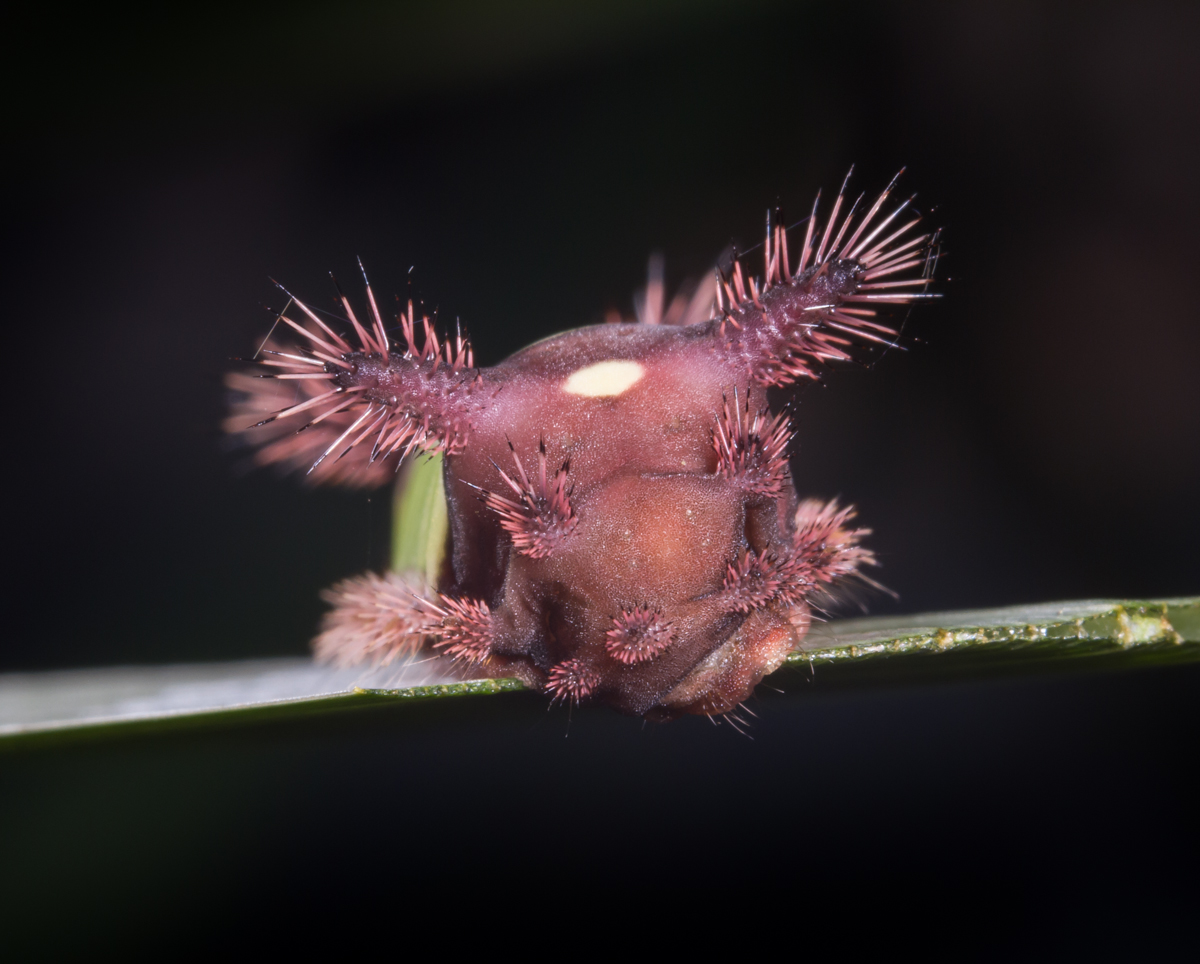
Several members of this family have the ability to inflict painful “stings” by means of sharp spines, which, on some species, have associated toxins to enhance the pain to the recipient. These stinging spines, known as urticating spines, are most numerous on the fleshy tubercles, or “horns”, adorning both ends of the caterpillar body. I have often found a caterpillar quite by accident when weeding in the garden or moving a plant leaf and then receiving a series of stings and resulting small welts where I brushed up against the spines. It feels a lot like a wasp sting but, for me, dissipates more quickly, although the reddish welts may persist for many minutes. But susceptible people may experience intense pain and allergic reaction, so caution is advised when you encounter these unusual beauties.
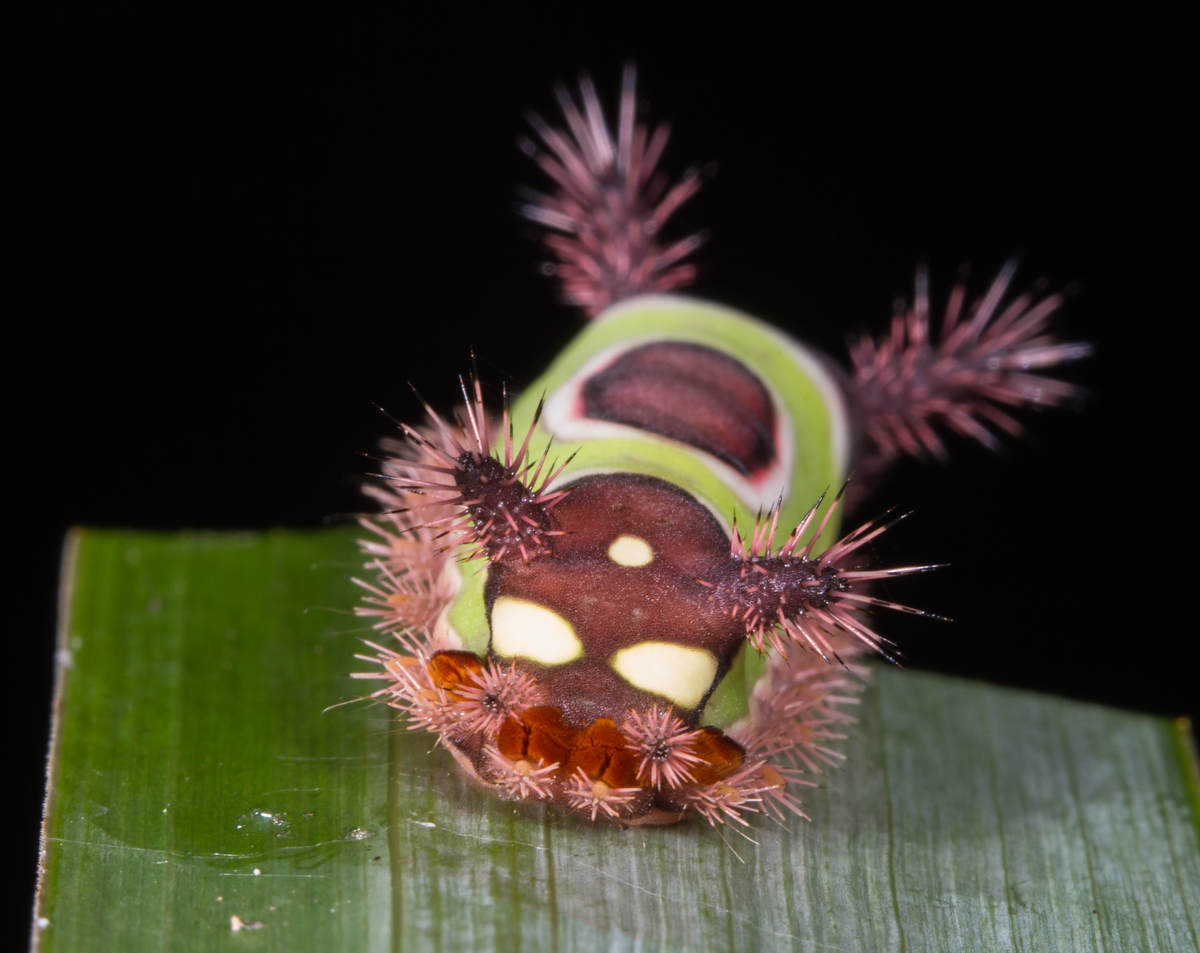
Saddleback caterpillar posterior view
When disturbed, the larvae often arch their body upward, exposing the intruder to more of the spines. They also have a false face on the posterior end, created by a pattern of light-colored spots. Even the cocoon should be handled carefully as they incorporate some of the irritating spines into the silk covering. These are generalist feeders found on a wide variety of plants, although I often find them on iris leaf blades in the garden. But, in spite of their formidable protection, I always enjoy finding these interesting caterpillars. Now, if only it will stay this way another week until the Museum’s largest special event of the year, BugFest (I’ll be volunteering at the caterpillar tent). I have a feeling I’ll be wishing that a lot in the next few days as I find various caterpillars about ready to pupate…what a difference a week makes!
It seems like just yesterday they were just a gleam in their parents multifaceted eyes, and then, before you know it, they are off to pupation college. I reported on some egg-laying of butterflies and moths in recent posts and decided yesterday to go out and look for the young ones out in the garden. It has been about three weeks since I photographed the eggs. Most lepidopteran eggs hatch within 3-5 days after being laid and many species of butterflies and moths have larval stages that last about two to three weeks. So, I expected to find some caterpillars that were in the mid to late instar stage of development. I did find a couple, and while I can’t be sure they are the ones from the eggs I photographed, they probably are from eggs laid about the same time.
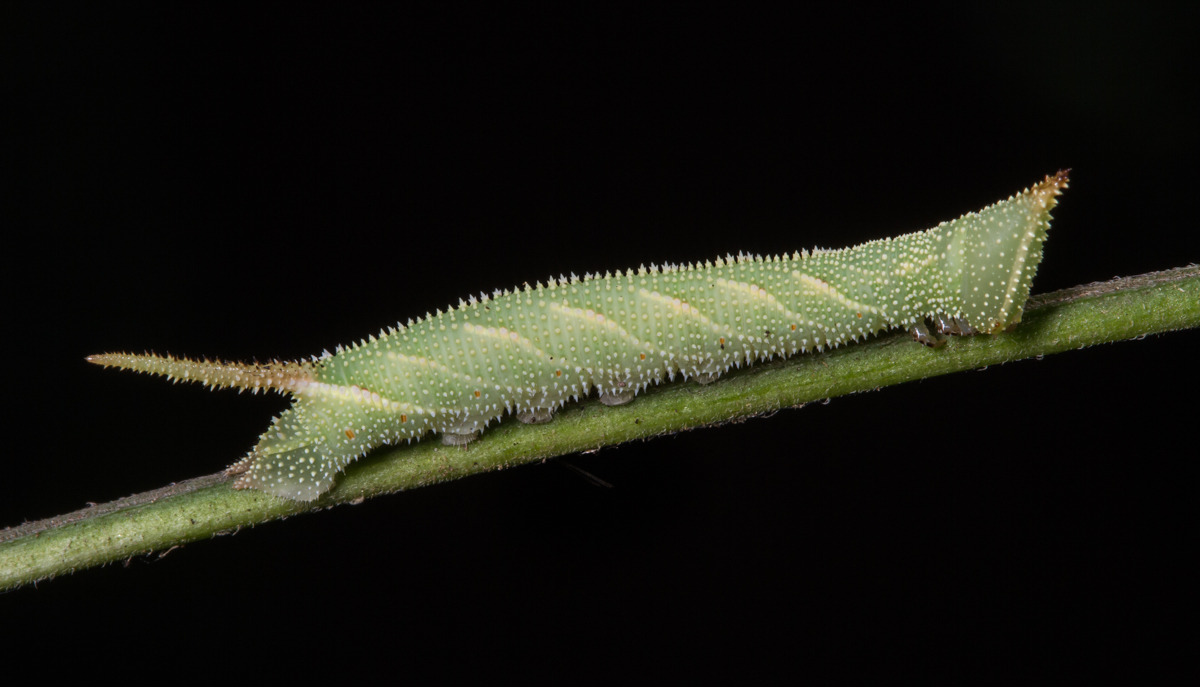
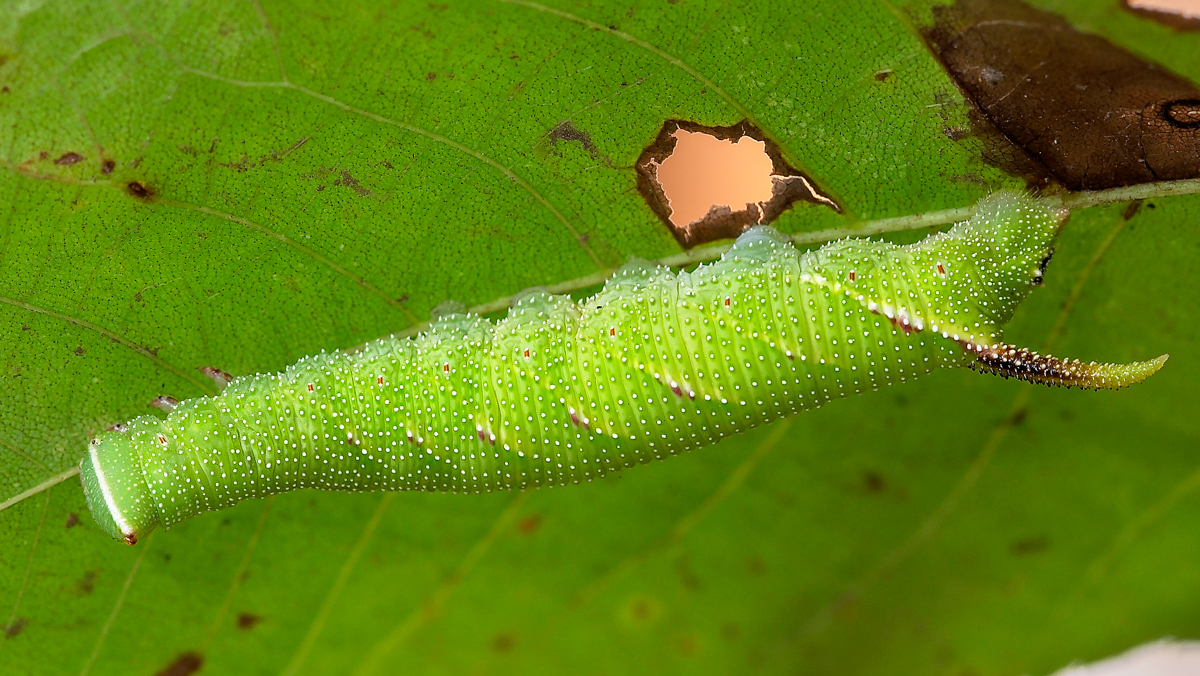
Snowberry Clearwing larva
The species I nicknamed Little Spike (a Snowberry Clearwing Moth larva) has become more proportional to its caudal horn (tail spike) and changed color. I cannot find any reference as to the function of the tail spike found on most sphinx moth larvae, other than one tongue-in-cheek mention that it must be to scare gardeners. Indeed, there is a common misconception that these types of caterpillars can sting you with that horn (they cannot). Perhaps it is similar to the angled stripes that many species have along their sides and serves to help break up the typical caterpillar outline or shape by blending in with leaf veins, petioles, etc. Notice that this larva does exhibit a form of counter-shading, with the color becoming fainter as you move from the bottom to the dorsal side of the body. Since this species often feeds on the underside of the light-colored leaves of honeysuckle plants, this color scheme makes sense, especially when viewed from below the leaf, causing the caterpillar to blend in more with its surroundings.
Question Mark larva late instar
Next I looked over the elm sapling where I had found the Question Mark or Eastern Comma eggs (they are identical). It turns out they were laid by a Question Mark. The caterpillar is a rather fierce-looking larva armed with branching spines (scolia). I had to check the field guide to make sure it is not one of the so-called stinging caterpillars (like Io Moth or Saddleback Caterpillars) whose stiff spines contain venom which can cause severe irritation when touched. This species is, indeed, harmless, but the spines undoubtedly serve to protect it from many invertebrate predators and perhaps deter others.
Question Mark larva posture
This particular caterpillar also had an interesting behavior when disturbed. It arched its body in a tight curve and stuck out the posterior end. I have seen some caterpillar species do this that can exude distasteful chemicals from their anus, or that have fake heads on their backside. I’m not sure if this is a species level behavioral trait or what the function might be if it is, but anytime I am faced with an array of sharp spines, I think twice before grabbing.
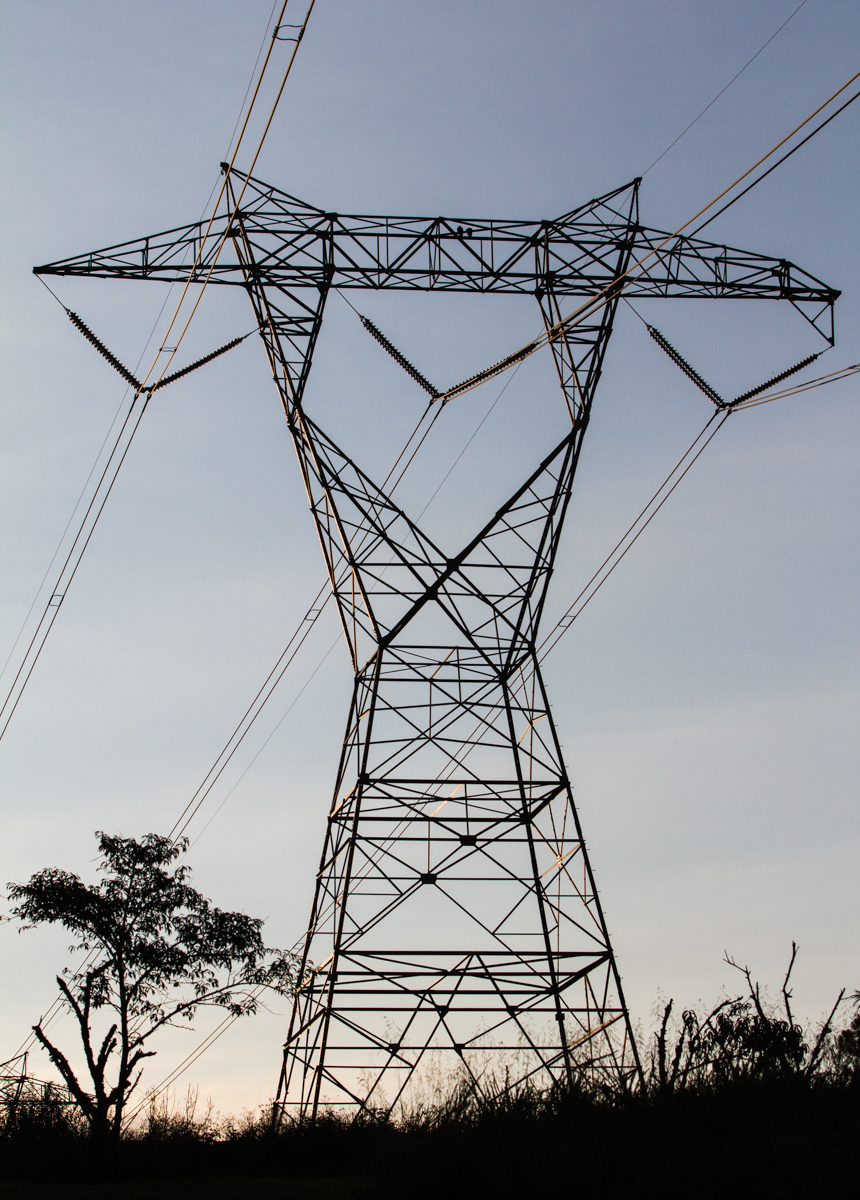
Power line tower at sunrise (click photos to enlarge)
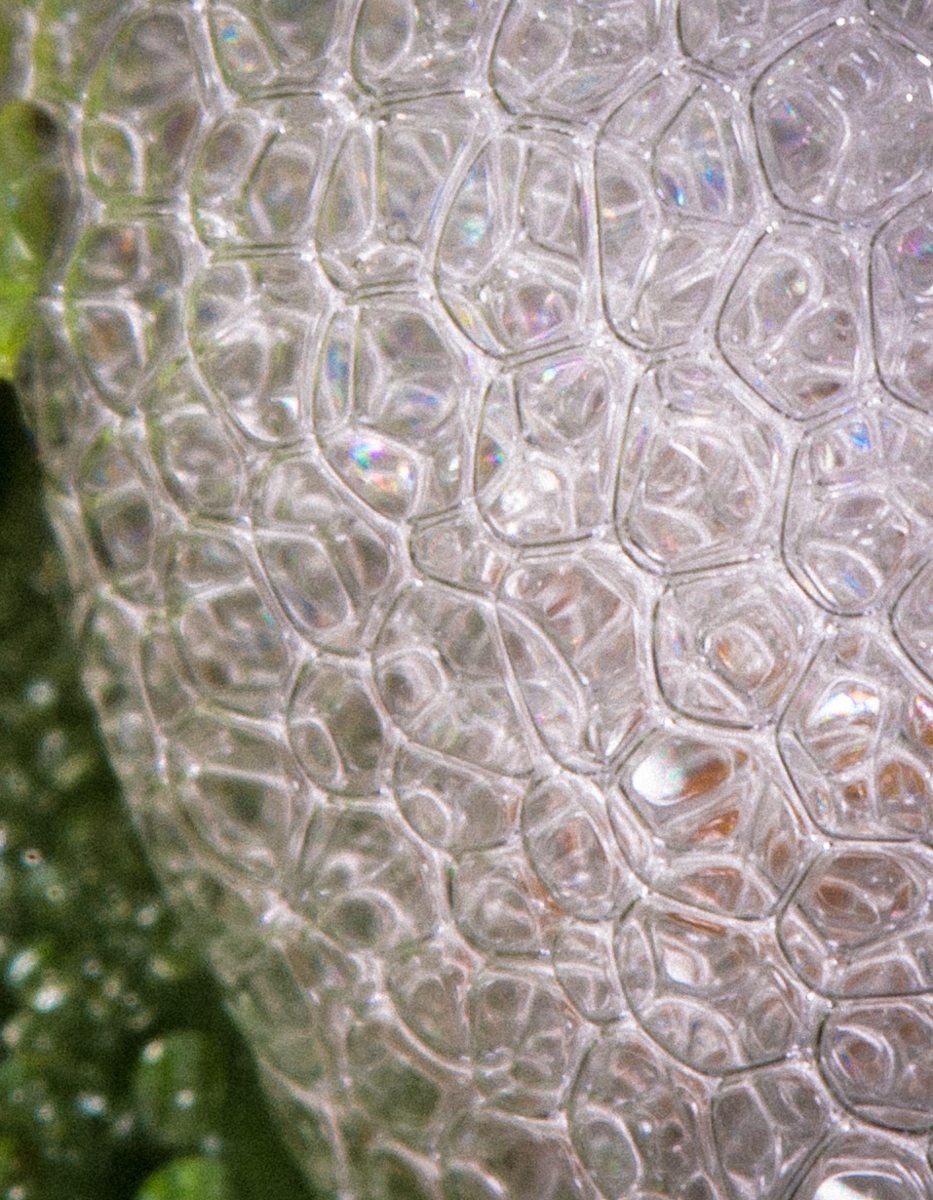
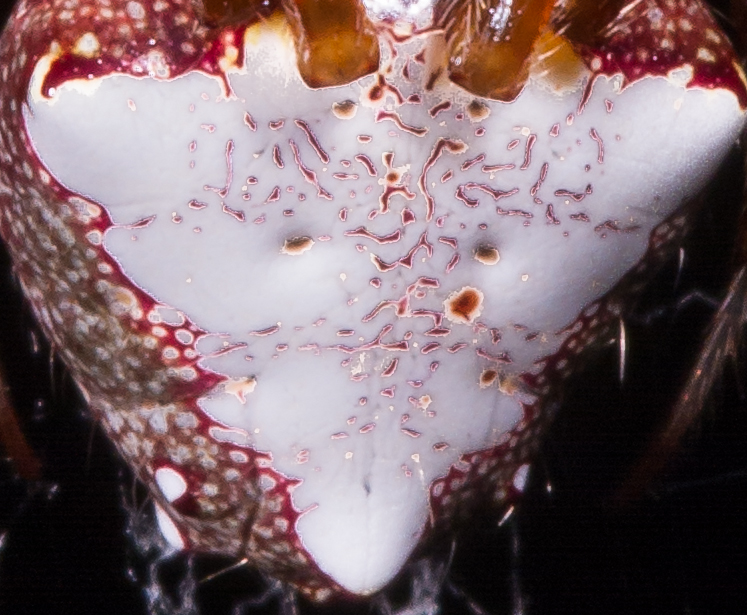
The past few mornings I walked down the power line looking for potential subjects to photograph or something to learn more about. I’m always curious about plants I haven’t seen before or some interesting behavior of an animal. But often it is the simple beauty of something that catches my eye. The low angle light of early morning provides highlights and contrasts, dark background shadows, dewy grasses, calm conditions, and eventually a soft light that bathes an object allowing you to glimpse its essence. The meadow and woods edge habitats embrace the light and invite me to move slower, look closer, and appreciate the subtleties of the commonplace…the shapes and patterns that comprise the natural world around us. Here are a few images from my wanderings.
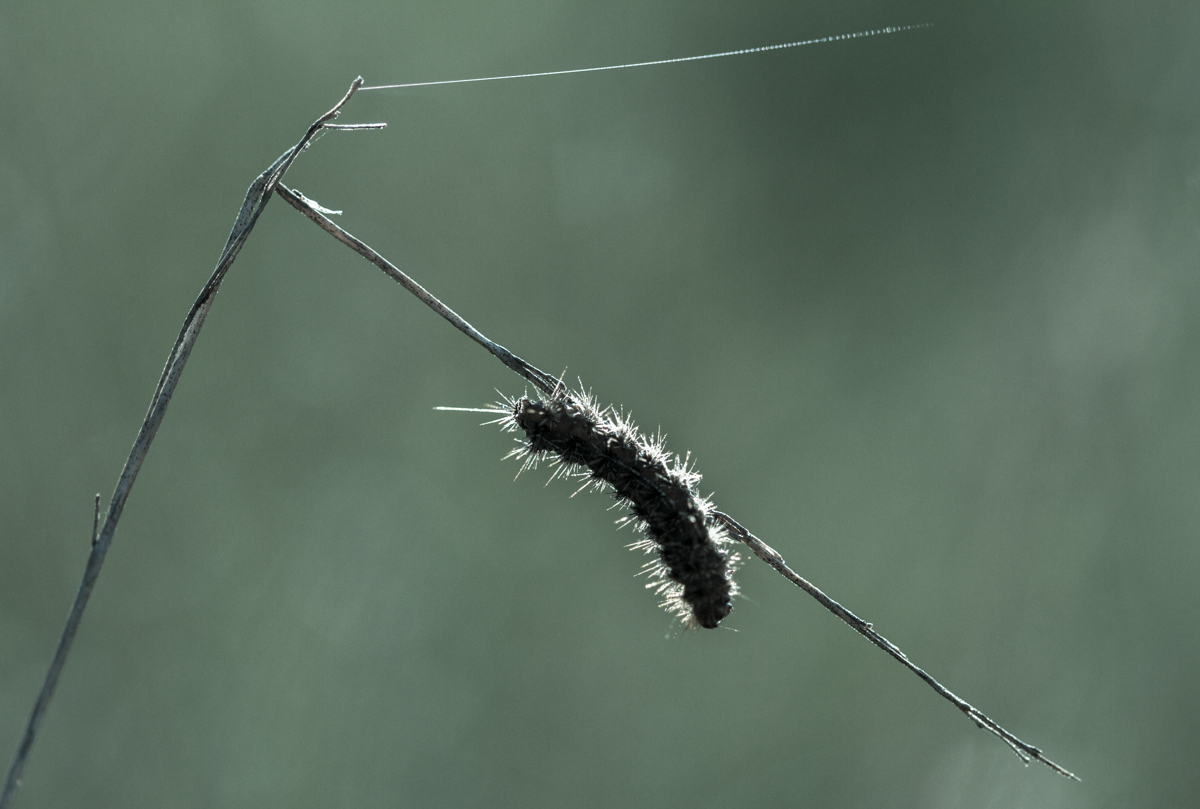
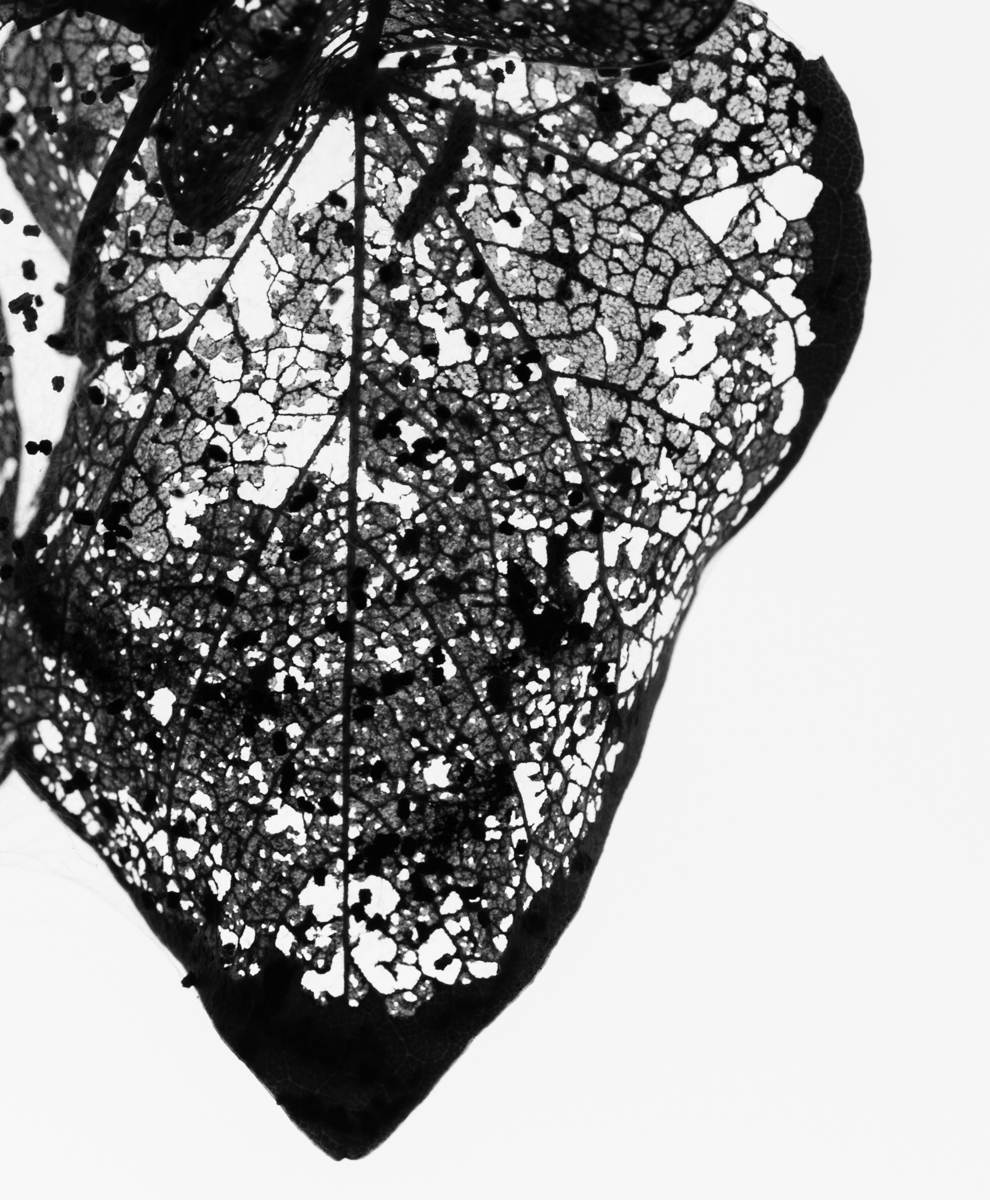
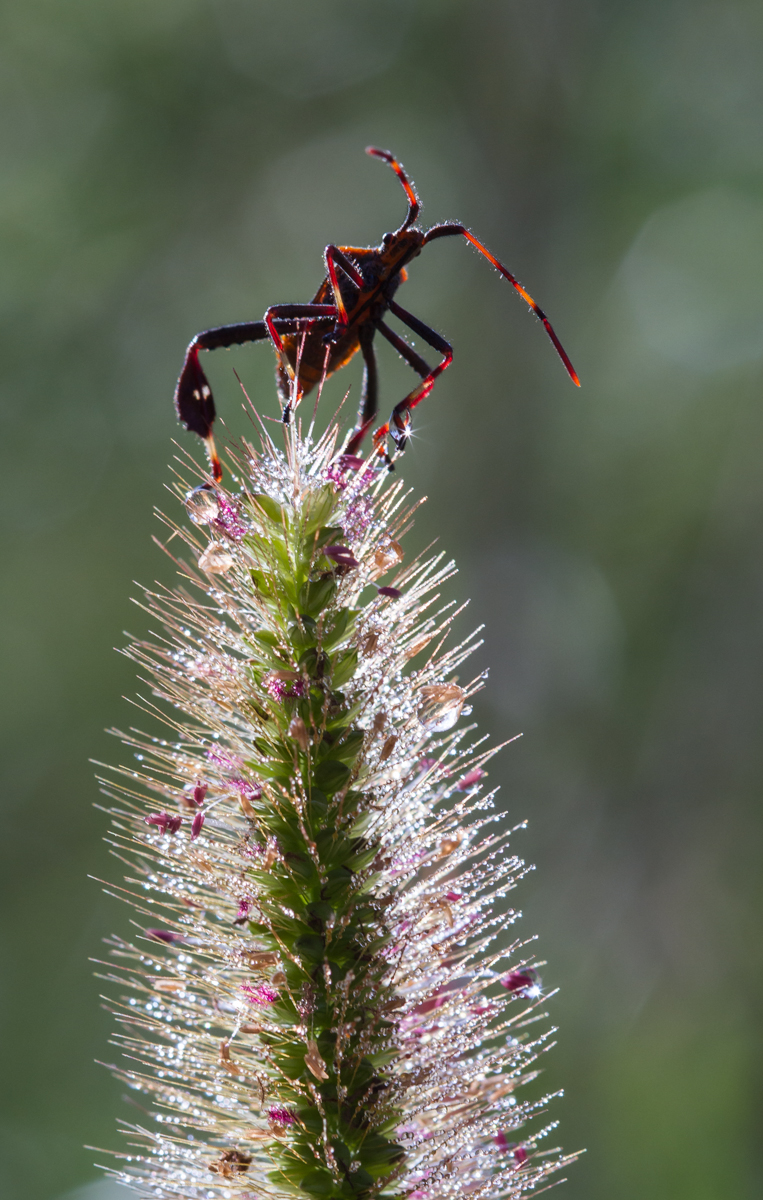
Backlit grass seed headSpittle Bug bubbles on grassTriangulate Orb Weaver abdomenFalse Dandelion after seeds have dispersedBack view of False Dandelion flower as it faces the morning sunCaterpillar on bent grass stemRedbud leaf skeletonized by Fall Webworm larvaeLeaf-footed Bug on grass seed headVirgina Creeper fruit hanging from snagEastern Tiger Swallowtail hind wings close-up
With the approach of autumn, treat yourself to a morning meander and look for the patterns of life that make our world so wonderful.
“To find the universal elements enough; to find the air and the water exhilarating; to be refreshed by a morning walk or an evening saunter… to be thrilled by the stars at night; to be elated over a bird’s nest or a wildflower in spring – these are some of the rewards of the simple life.”~ John Burroughs
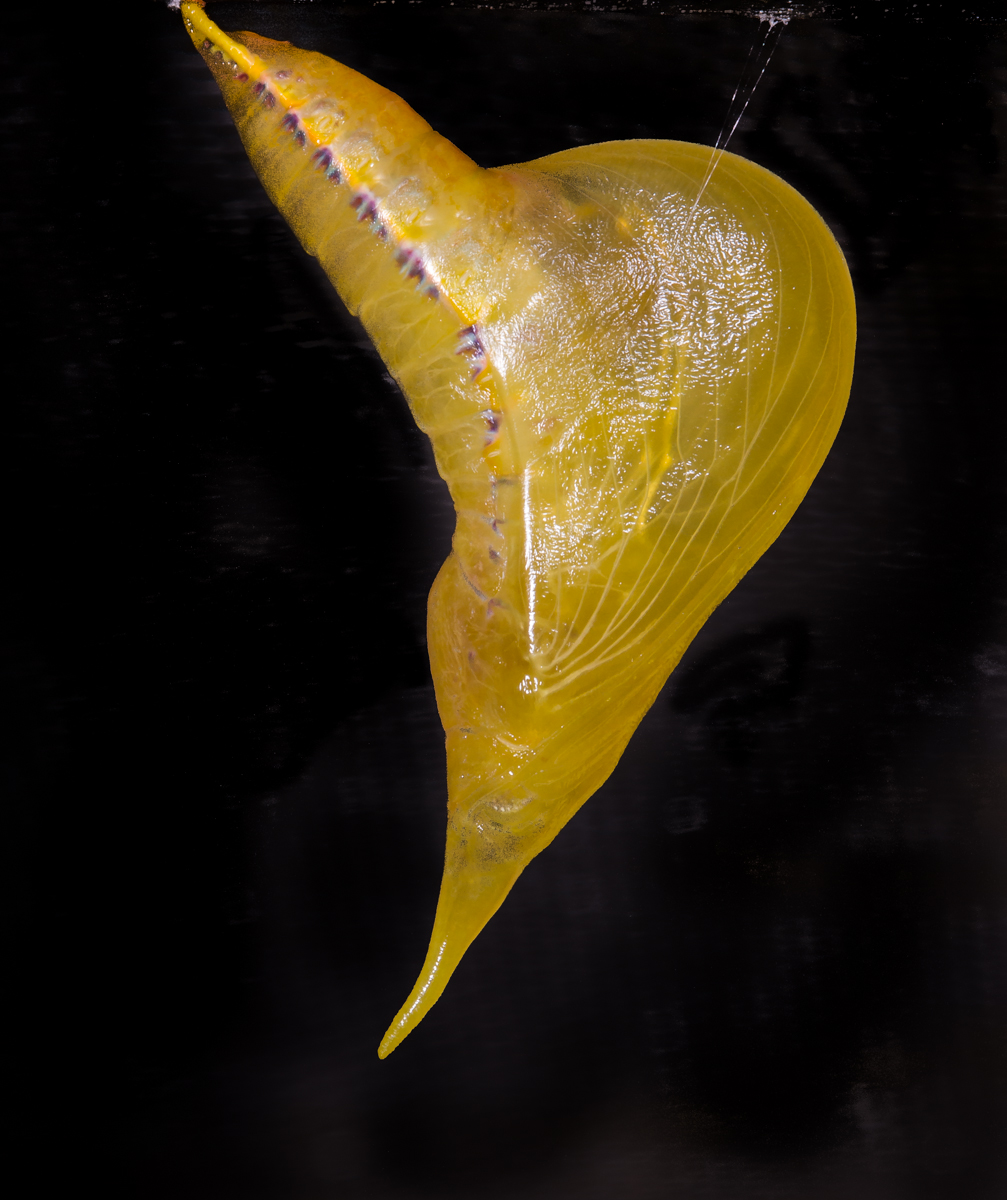
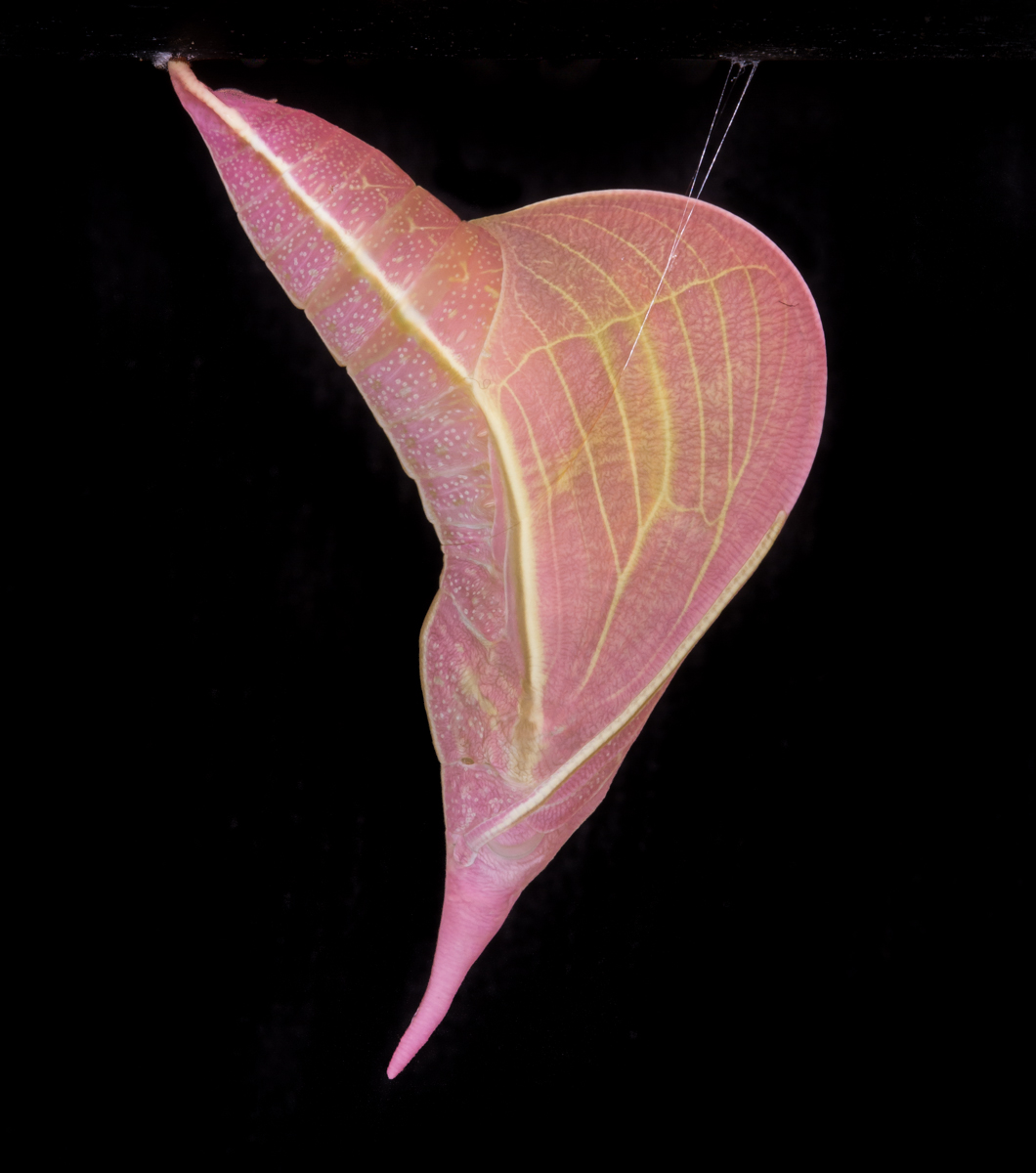
Cloudless Sulphur chrysalis shortly after caterpillar’s last molt (click photos to enlarge)
I blogged last week about the Cloudless Sulphur butterflies I have been seeing down east and in my Piedmont garden lately. I included the photo above of a fresh chrysalis. I have only seen one other chrysalis of this species and it was much more colorful, but the field guides said their color can be quite variable so I didn’t give it much thought. The caterpillar had been placed in a mesh cage just before pupating as it had stopped feeding and was crawling off the cut plant I had brought it in on, sure signs that it was getting ready to transform. And, as they often do, the caterpillar had again crawled off the plant material I had provided in the cage and pupated under the edge of the lid of the container, making for a less than ideal photo backdrop, and requiring me to pin some black felt behind it for the photographs.
Cloudless Sulphur chrysalis a few days later
I checked on it again a couple of days later and was amazed at the color change, much more like the one I had found a few years ago in a patch of host plants down east. The colors are beautiful – a faint pink, tinged with yellow highlights, and the whole thing being a odd obliquely stretched form suspended by a silken girdle. The color change should not have surprised me as I have seen several species which undergo a shape and color change in the chrysalis within a short time after they form. There is usually some adaptive advantage for even unusual forms and colors in nature but I was initially at a loss as to how this odd combination might serve the pupa.
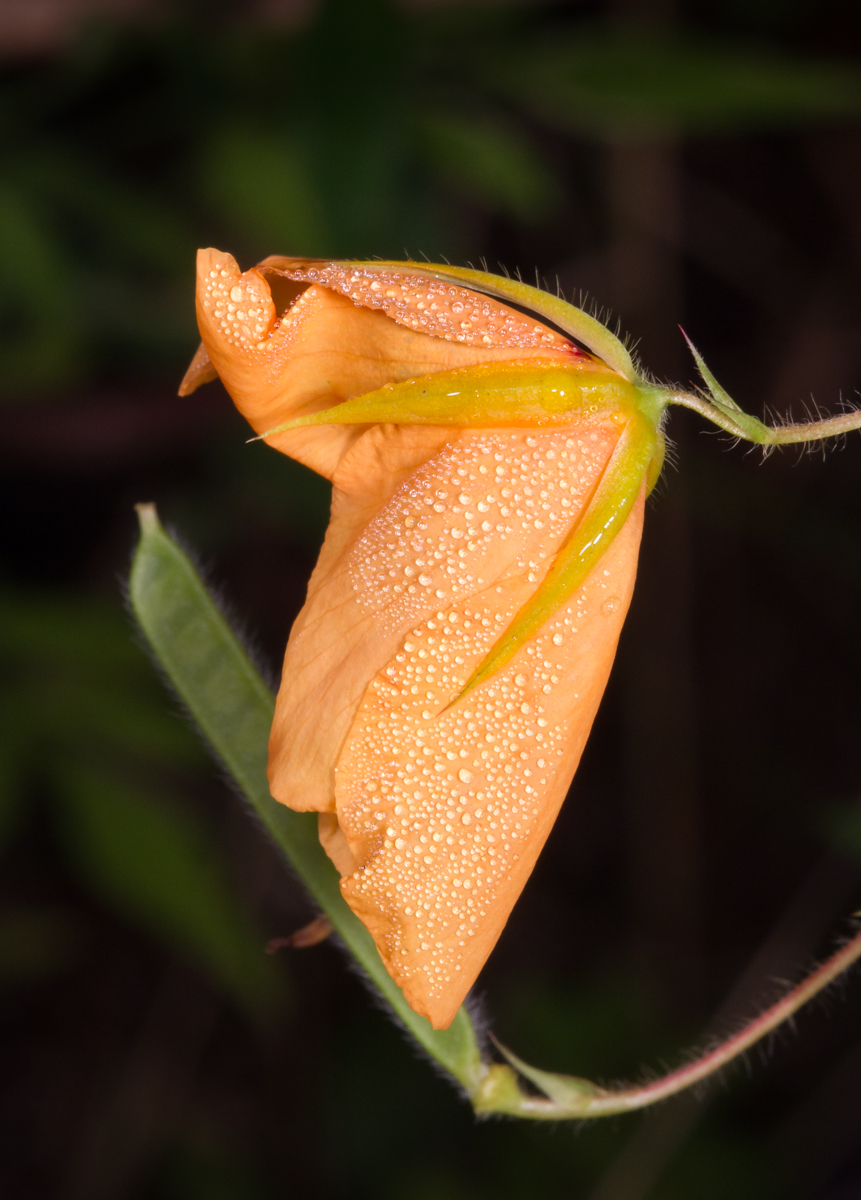
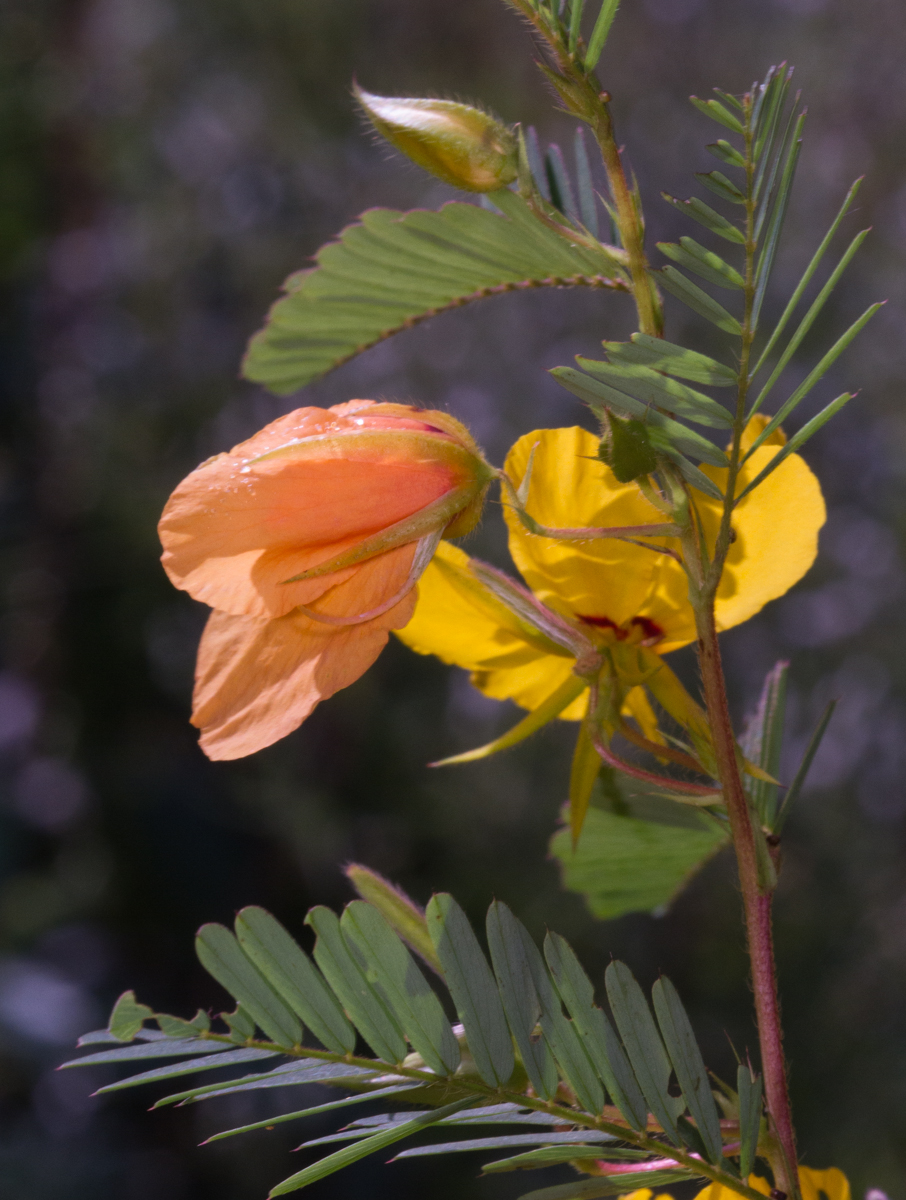
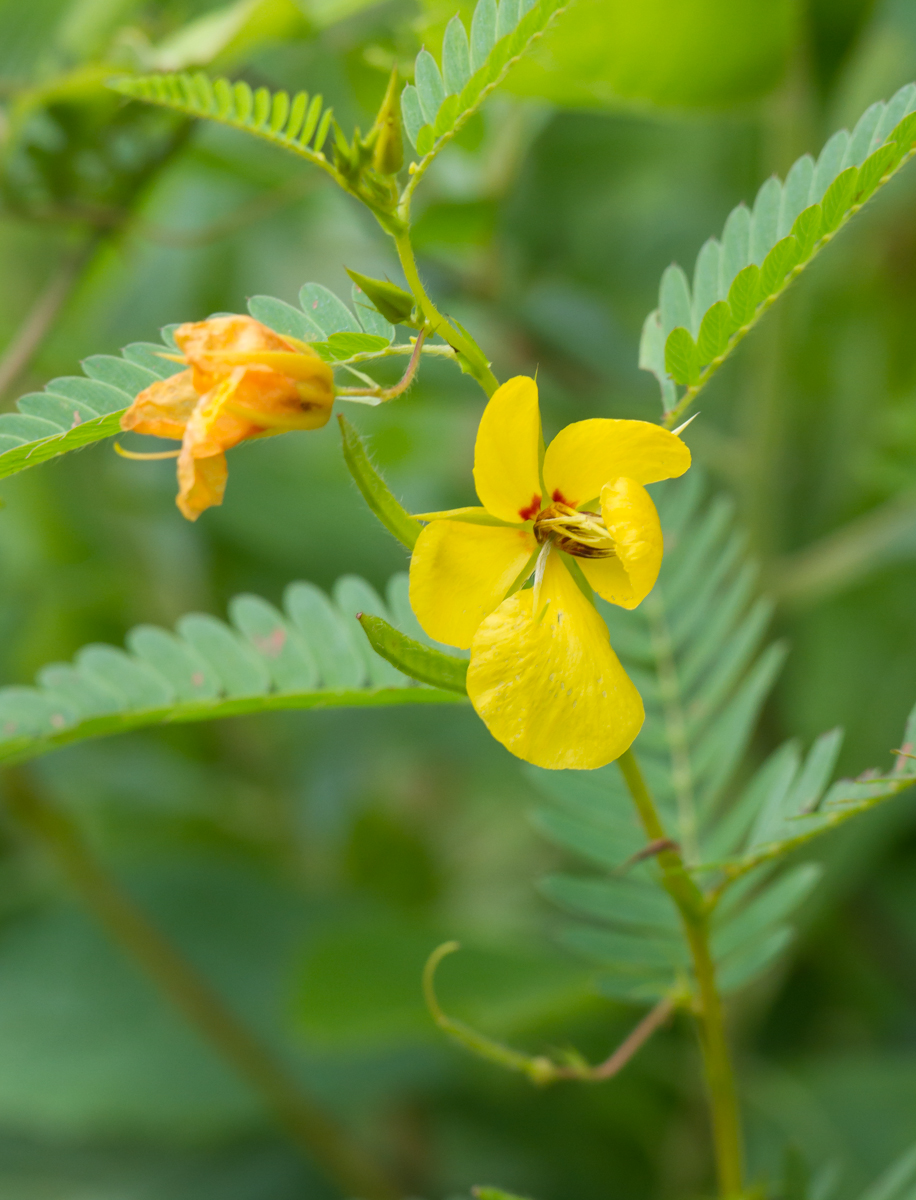
Partridge Pea flower after blooming
So, I went back out to the power line this morning and looked at the plants. The explanation may lie in the fading blossoms. As the bright yellow flowers fade, they droop, and when viewed from the side have a shape similar to the chrysalis.
Partridge Pea flower as it fades
They also start changing color to an orange-yellow, and then, gradually, to a somewhat pinkish-yellow hue. The lines on the chrysalis may mimic the sepals and folds in the fading flower petals as well. I also noticed a few pinkish leaves of other nearby plants as they begin to turn color for the onset of autumn. Online, I found images of a chrysalis from this species that was light green and the lines resembled the veins of a leaf. Perhaps this species can have a chrysalis that is variable depending on the surrounding plants. Whatever the case, it is certainly one of the more unusual and beautiful chrysalises I have found.
Snowberry Clearwing Moth egg on Japanese Honeysuckle (click photos to enlarge)
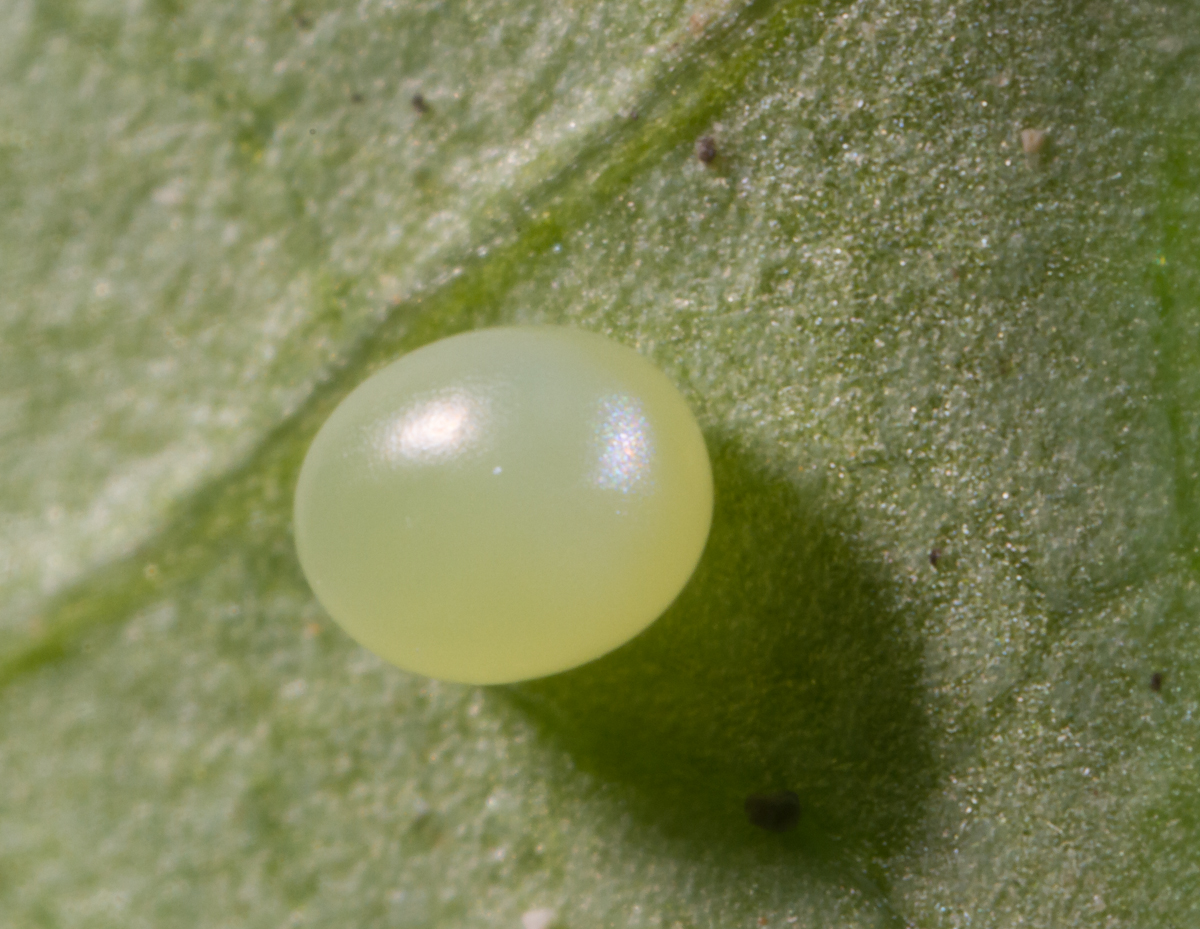
On a short hike through the neighborhood a week ago, I saw a Snowberry Clearwing moth (I posted a blog on these day-flying moths on July 29) hovering near the ground and briefly touching leaves of various plants. This is classic behavior for female moths and butterflies searching for their host plant in order to lay an egg. She hesitated momentarily on a Japanese Honeysuckle leaf (one of her host plants) and deposited a single egg. I collected the stem of honeysuckle, found a discarded cup along the gravel road, and added some water from a nearby puddle to keep the plant fresh until I got home. I often carry a plastic bag with me on walks in case I find an interesting caterpillar I want to photograph. You can cut a portion of the plant the caterpillar is on and enclose it in a plastic bag and it will stay fresh for several hours as long as you don’t leave it in direct sunlight. The flimsy bags that newspapers are delivered in make great collecting bags as they are long and skinny and scrunch down to fit in your pocket. But I had left home without one that day so had to improvise. Back at the house I put the stem in a water-filled floral vial to keep the plant fresh for a few days until the egg hatched (vials are available at florists or craft stores like Michaels).
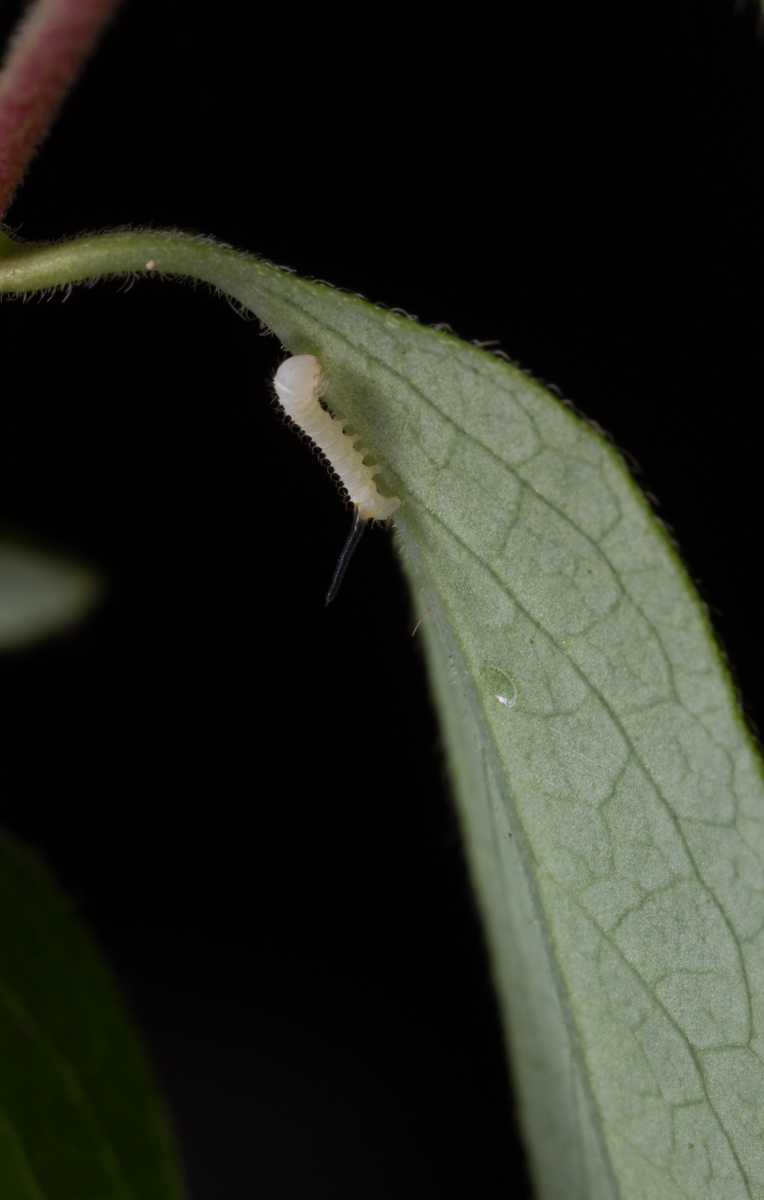
Newly hatched larva of Snowberry Clearwing Moth
I checked the egg every morning and on day 6 from the day it was laid the egg hatched. I grabbed my camera (Canon 7D), the 65 mm macro lens, and the macro twin lights and took a number of shots, moving the lights around to get different highlights.
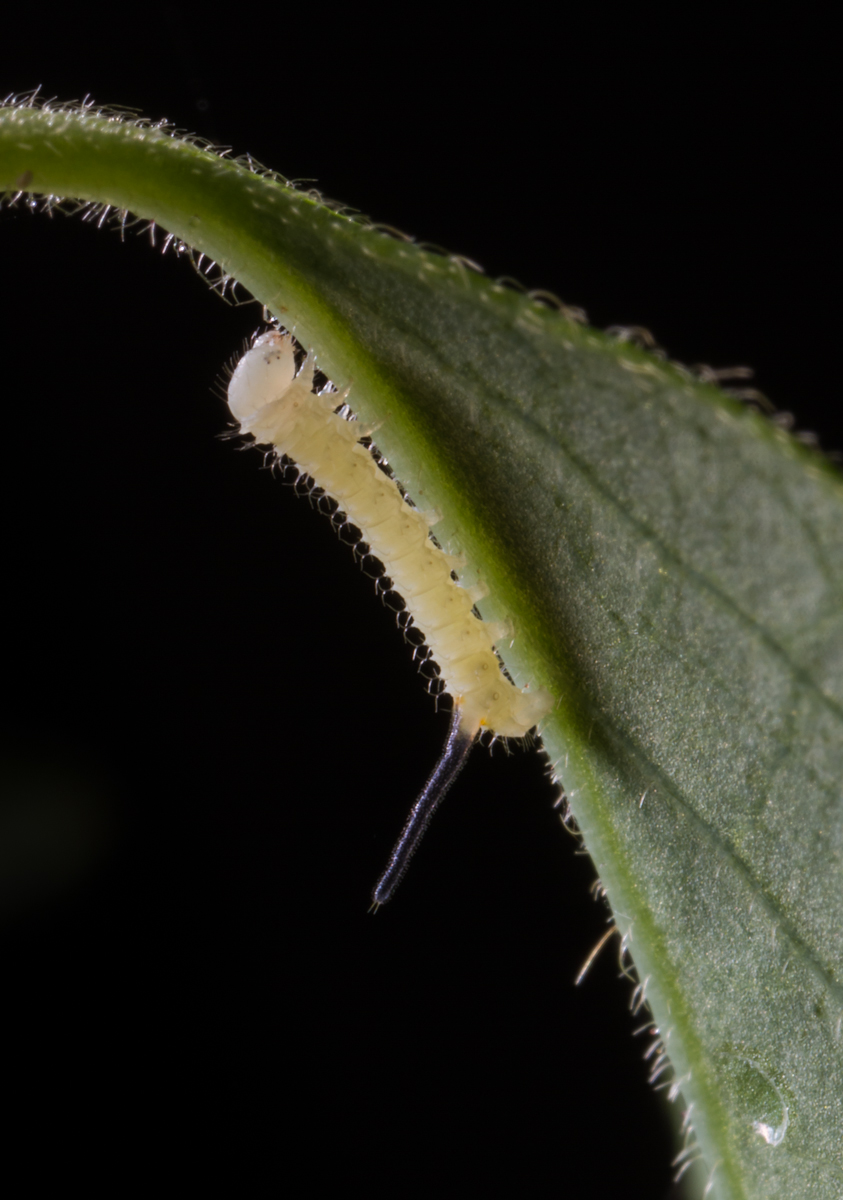
First instar Snowberry Clearwing larva a few hours after hatching
I zoomed in on the larva and took several more shots. This image is one of my favorites as it brings out the texture of this little guy and shows the remains of the egg in the lower right corner of the picture. Many caterpillars eat their egg shell as their first meal soon after they hatch. One feature of this tiny caterpillar surprised me since I have photographed them before in their later instars – the tail spike seemed really long relative to the overall body length. This apparently changes and becomes more proportional as the caterpillar grows and molts. After getting all the shots I thought I needed (if there really is such a thing) I released the caterpillar in my garden. The easiest way to do this is to attach the cut stem with the larva onto another host plant growing outside using a clothes pin or paper clip. The larva should crawl off the original plant onto its new food source as the older plant begins to wither. I hope to find Little Spike in a week or so after a couple of molts to photograph it again.
Walnut Sphinx caterpillar (click photos to enlarge)
Last week I found this little guy crawling on the ground outside the screen porch. I picked it up and it thrashed around until I placed it on a nearby hickory sapling. I recognized it as the larva of the Walnut Sphinx Moth from the unusual angled head capsule and the numerous raised spots arranged in rings around the body. This individual is a mid-instar as the head is very elongated.
Walnut Sphinx caterpillar late instar
A few years ago I found the late instar larva pictured above. The head is less elongated and the white stripe alongside the head capsule is more pronounced as pictured in the field guides (most field guides showing caterpillars show only the last instar which can be quite different from the earlier ones, but, in this case, Wagner’s Caterpillars of Eastern North America also has an inset showing the pronounced head of the early instar). These caterpillars, as is the case for many others, are easier to find at night by flashlight when they are actively feeding. During the day, they often rest on the underside of a leaf along the midrib.
Walnut Sphinx caterpillar after thrashing about when touched
The thing I find incredible about this species is it is one of the few caterpillars that makes sounds. When touched it thrashes about violently and can hiss or whistle by forcing air out of the spiracles (the small openings of the respiratory system found along the side of the caterpillar). How cool is that! So, if you see me along the woods edge with my ear down at a hickory or walnut leaf, just assume I am listening for a larval tune.
Cloudless Sulphur on small red morning glory (click photos to enlarge)
This time of year I often see a bright, clear flash of yellow in the garden and know it is a wanderer, a Cloudless Sulphur butterfly. On my trip to some refuges down east earlier in the week I saw plenty of these vibrant yellow beauties as they are a common species in the coastal plain. They can be found statewide, especially in late summer and early fall, when they tend to migrate in large numbers northward and inland from the coast.
Partridge Pea or Senna
The primary host plant is Partridge Pea or Senna, a legume common in disturbed areas like roadsides and power lines throughout the eastern U.S. I learned the genus as Cassia 20+ years ago but it has since been reclassified (as have so many of the pants I struggled to learn in my state park days) as Chamaecrista fasciculata. Partridge Pea is a shrubby plant with loose bright yellow flowers and pinnately compound leaves.
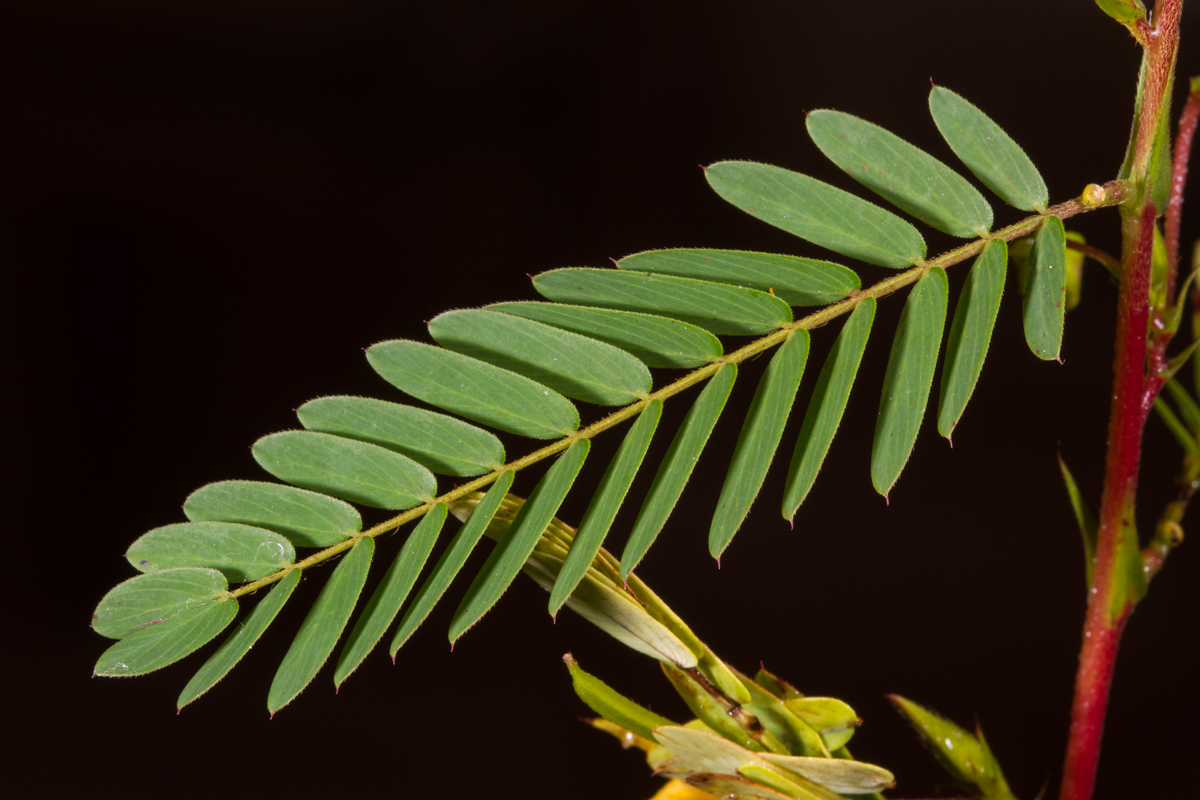
Partridge Pea open leaf
The leaves close at night giving rise to another of its common names, Sleeping Plant. There is also a noticeable raised gland at the base of the petiole, although I did not find any reference as to the function.
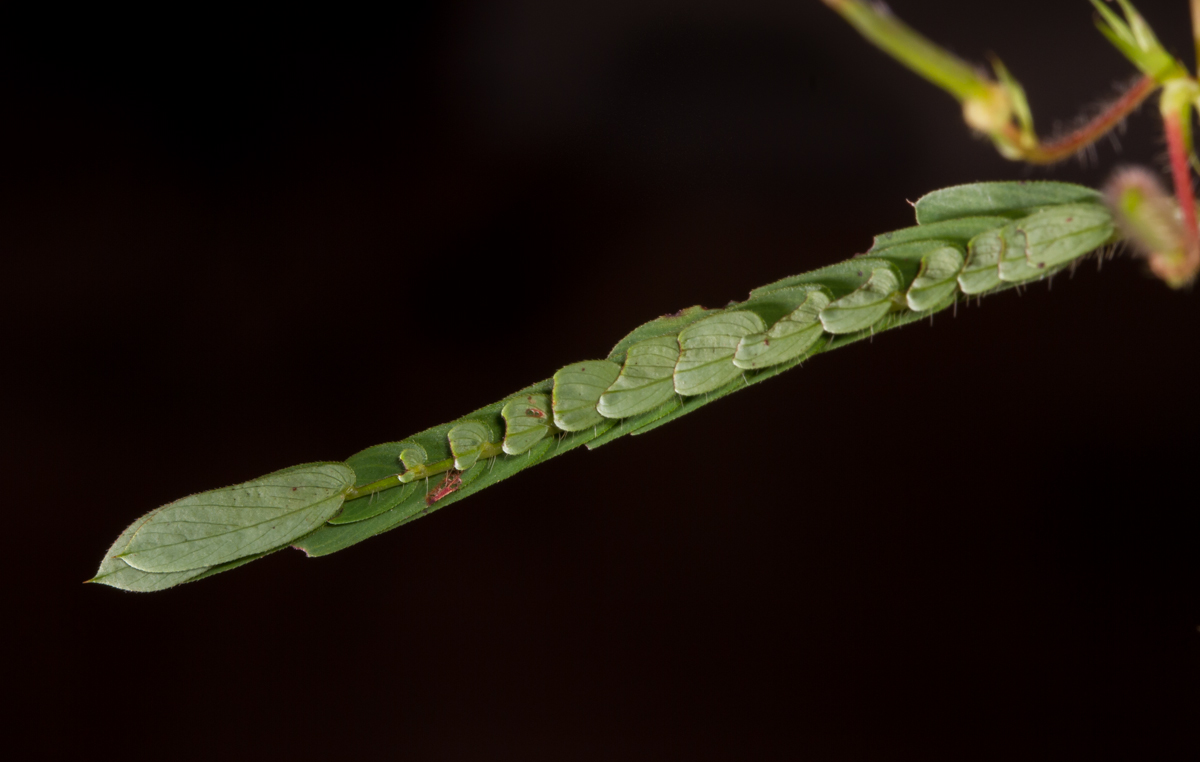
Partridge Pea closed leaf
The plant is also host for some other species of butterflies including the Orange Sulphur, Sleepy Orange, Little Yellow, and Gray Hairstreak.
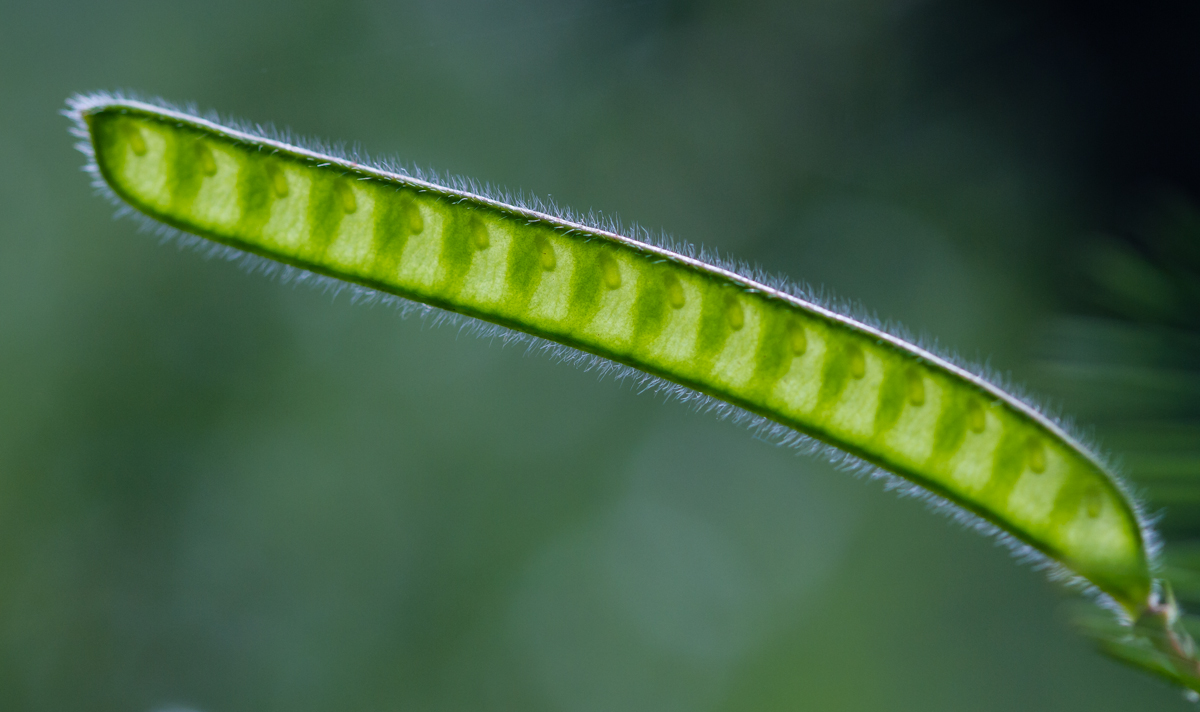
Partridge Pea seed pod
The seeds are contained in a typical legume seed pod and are eaten by a variety of birds.
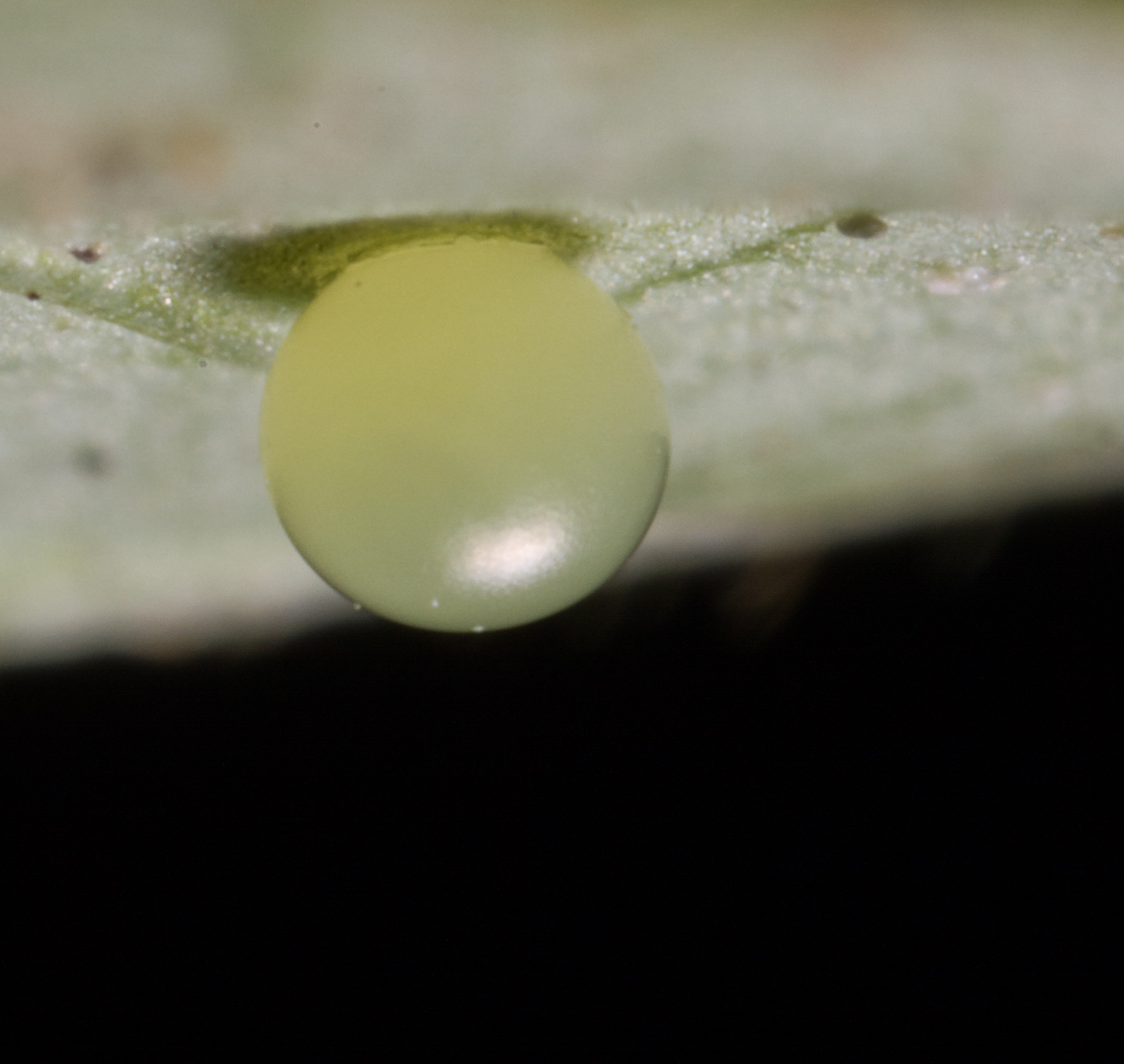
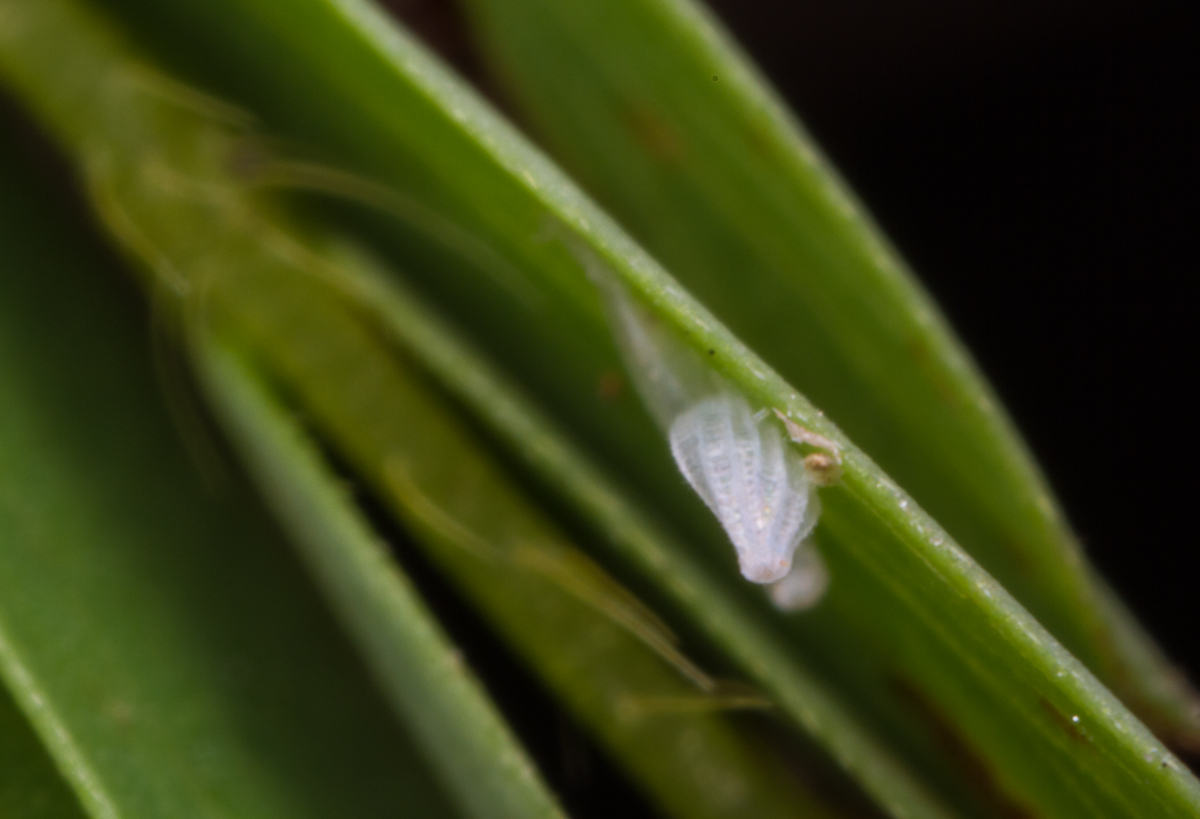
Cloudless Sulphur egg
Eggs are minute and sculpted and laid on flower buds or leaves.
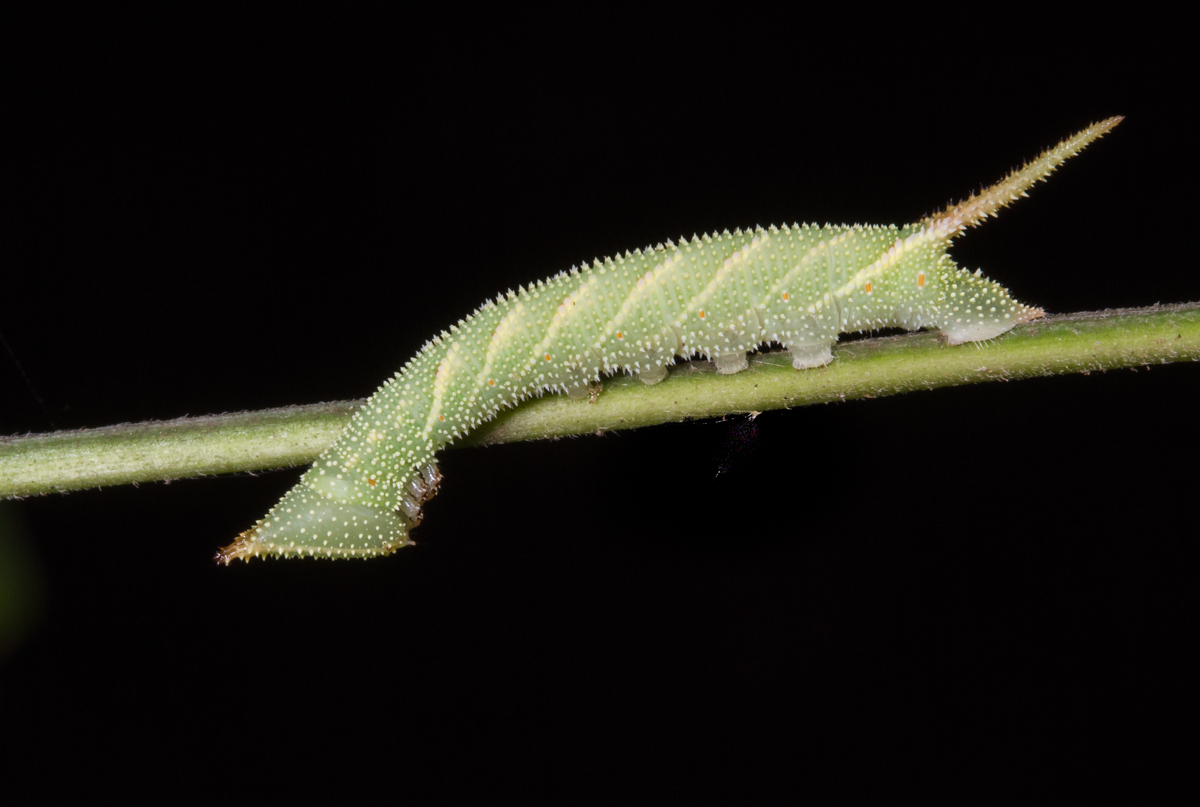
Cloudless Sulphur larva
The caterpillars are brightly colored and I have seen them most often feeding on the flowers or flower buds, especially in the later instars.
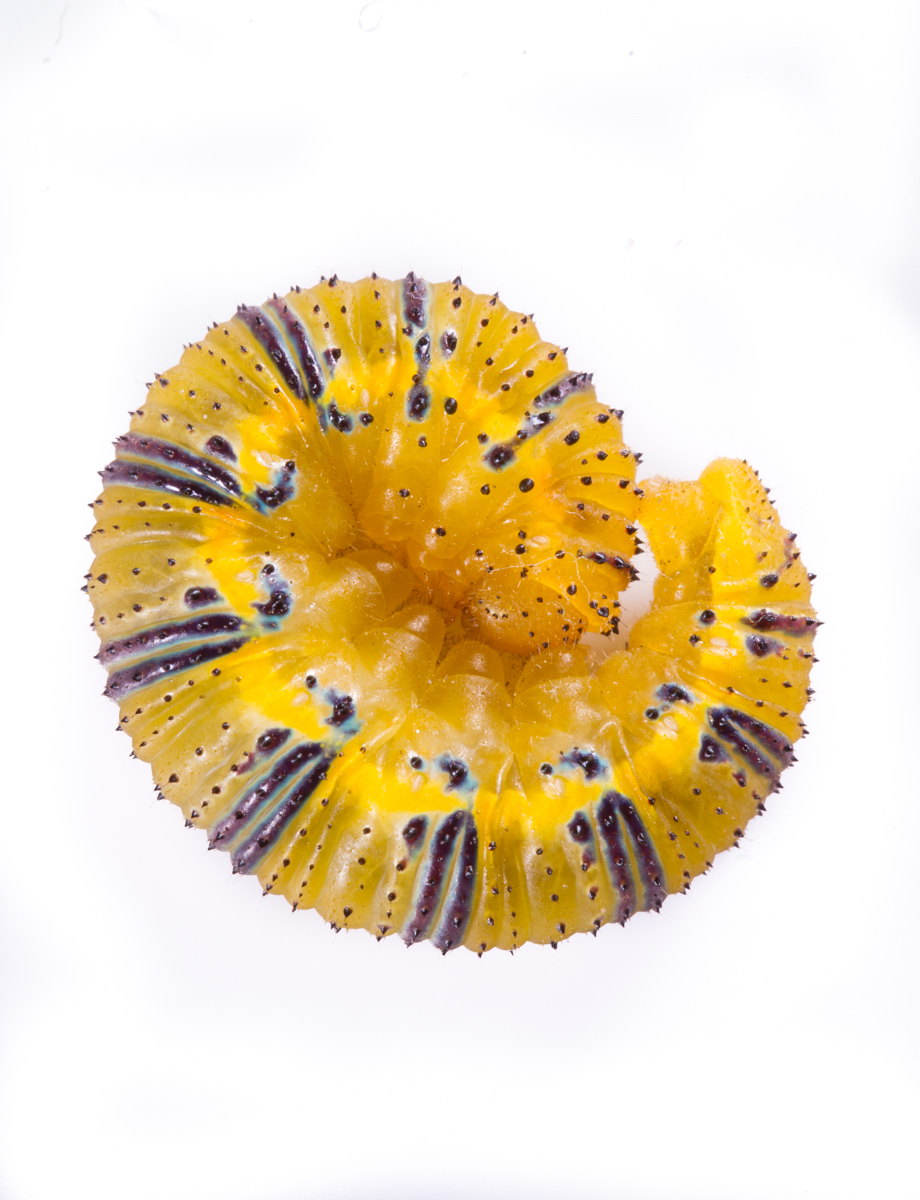
Cloudless Sulphur larva curled in defensive posture
When disturbed, the caterpillar will often drop from the plant and curl into a tight ball.
Cloudless Sulphur chrysalis
Their chrysalis is one of the most unusual and beautiful of any I have seen. It can be a variety of colors and is oddly elongated in two directions. Apparently, most of the Cloudless Sulphurs that migrate leave few, if any, offspring behind as the species tends to be intolerant of cold conditions so does not fare well far from the coastal plain. I plan to monitor this chrysalis and see its fate, although I am guessing a butterfly may emerge in a couple of weeks rather than the chrysalis overwintering.
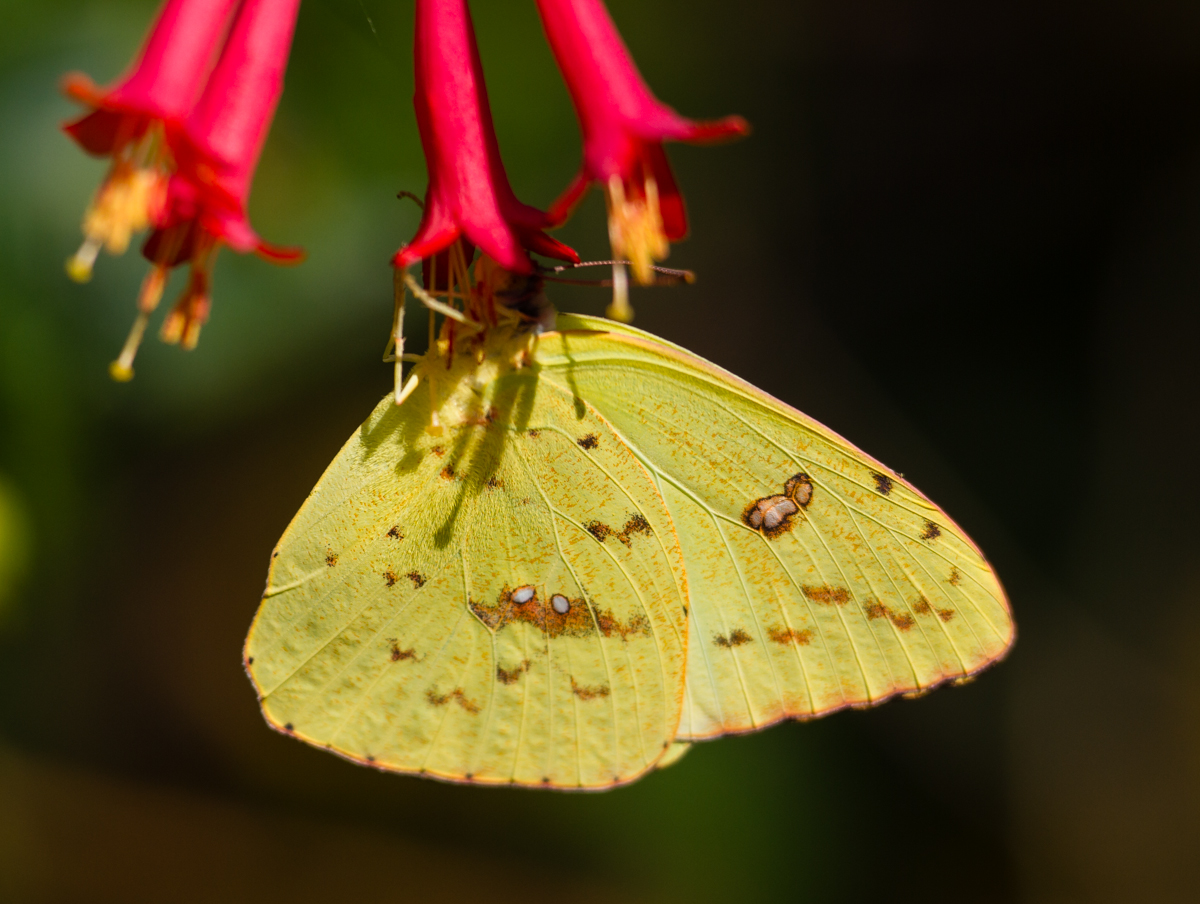
Cloudless Sulphur on Coral Honeysuckle
The butterflies are said to nectar at a wide variety of plants but they seem to prefer red flowers in my garden, especially Coral Honeysuckle and Cardinal Flower. I may try throwing a few seed pods of their host plant along the edge of the garden this fall in the hopes of attracting even more of these dazzling fliers next season.
One of the great things about retirement is the freedom to take advantage of good weather and make a wildlife watching trip on the spur of the moment. Yesterday was one of those days and I spent it in my favorite area in NC – Pocosin Lakes National Wildlife Refuge. I arrived about 8 a.m. and was going to scout the area for bears. The rains this season (and perhaps some Federal budget cuts) have made for tall vegetation along many of the roadsides so it is a little tough to see while driving in certain areas but I soon found one bruin waddling along a dirt road. It wandered off as I approached and I could hear it walking through the swamp when I stopped and got out. I continued over to one of my favorite spots and was surprised to see two other vehicles at the gate. Turns out one was a couple of friends who were down the road looking for bears and the other was a man that knows an old friend of mine from graduate school – small world. The last thing I thought I would be doing at Pungo yesterday was socializing!
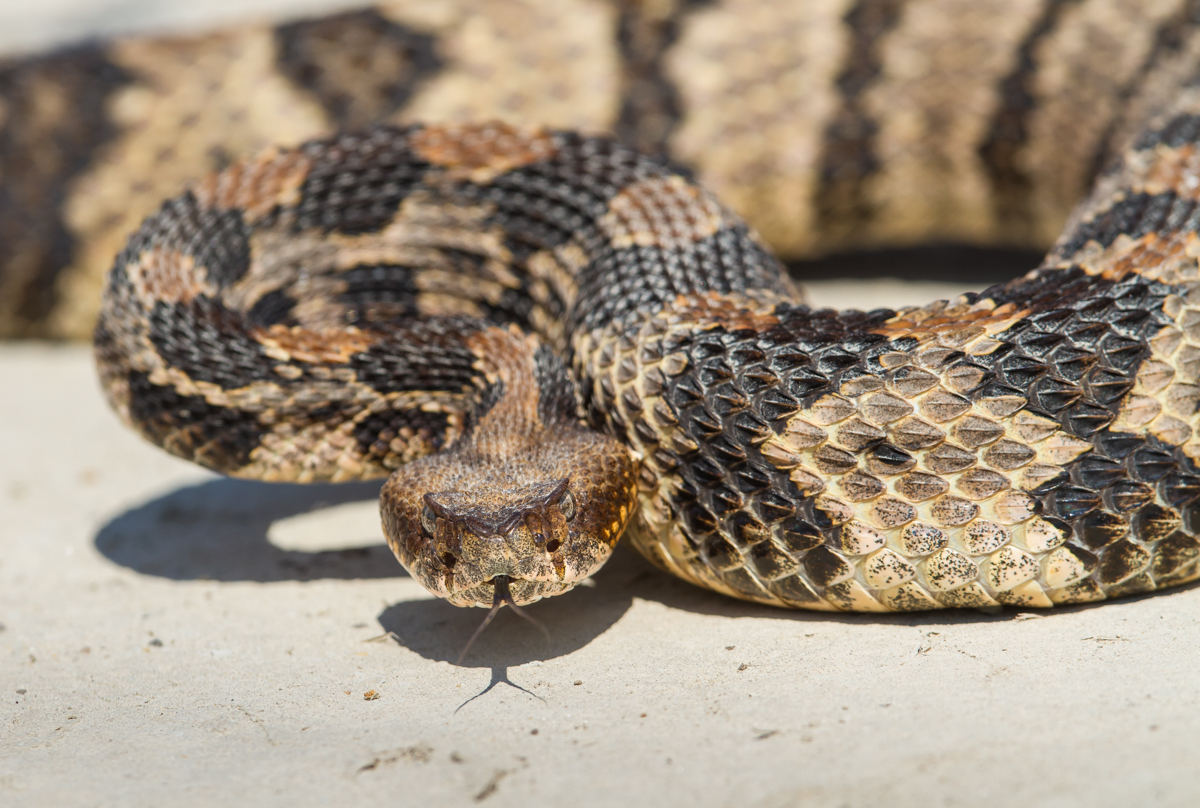
Canebrake Rattlesnake crossing dirt road on refuge (click on photos to enlarge)
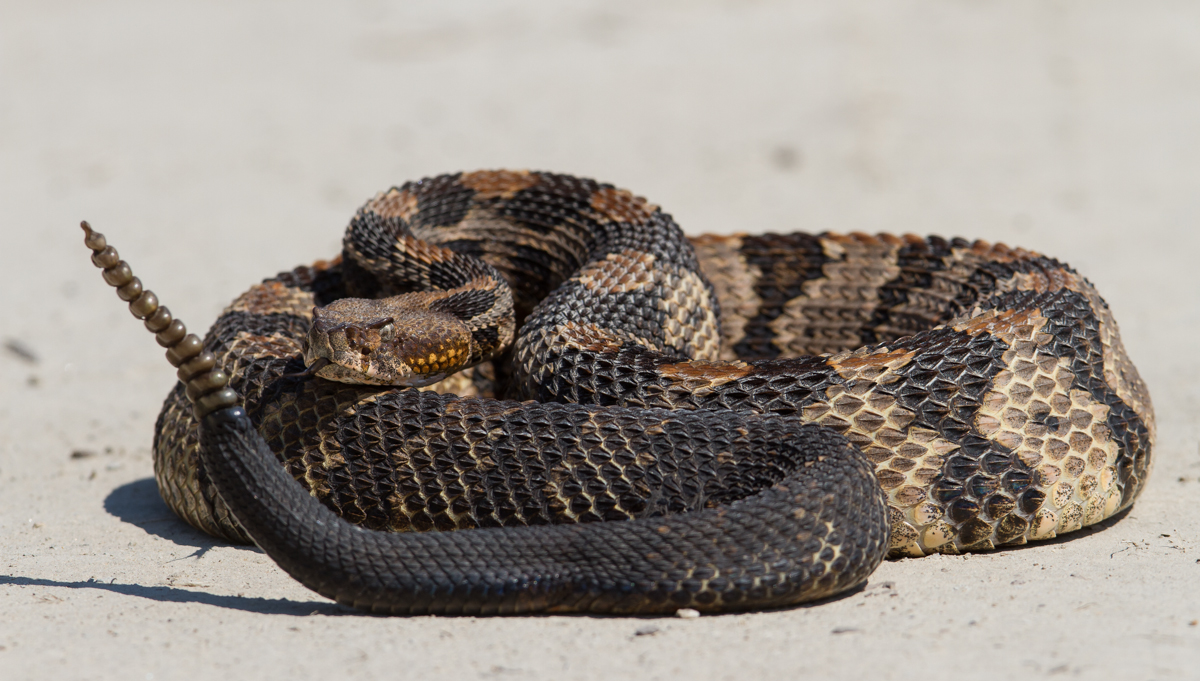
After spending about an hour chatting I decided to explore some other areas of the refuge and headed out. I soon found a large Timber Rattlesnake crossing a sandy stretch of road. Timber Rattlesnakes in this part of the state are usually lighter colored than those in the mountains and are often referred to as Canebrake Rattlesnakes. The name refers to the large patches of River Cane, a type of vegetation common in the coastal plain, and an excellent habitat for these snakes.
Canebrake Rattlesnake in defensive posture
This area has a healthy population of these beautiful snakes so I got out and watched it for a few minutes before it finally crossed the road and disappeared. Unfortunately, I later found one in another section of the refuge that had been recently killed by a vehicle.
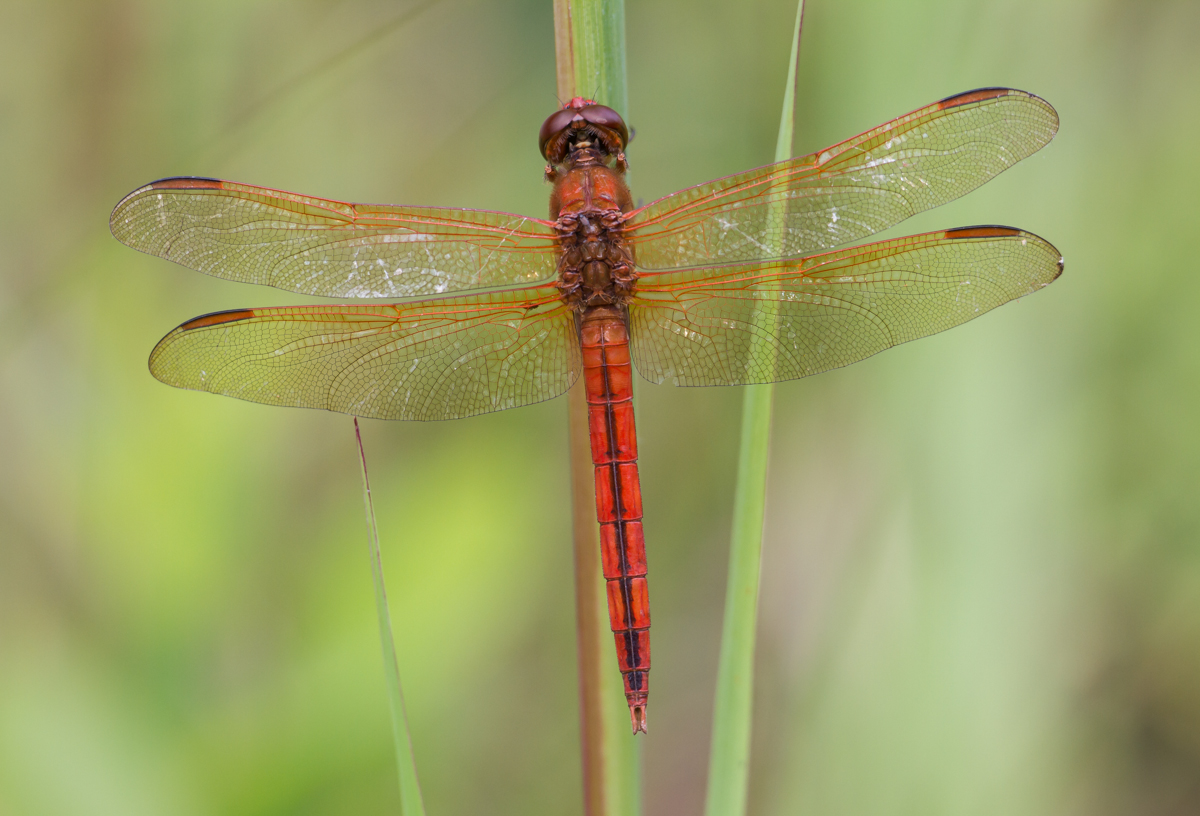
Needham’s Skimmer
I drove over to Alligator River National Wildlife Refuge to look around, and, while I did see two bears in a soybean field, it was the abundance of invertebrates that caught my eye. Dragonflies and butterflies were out in large numbers.
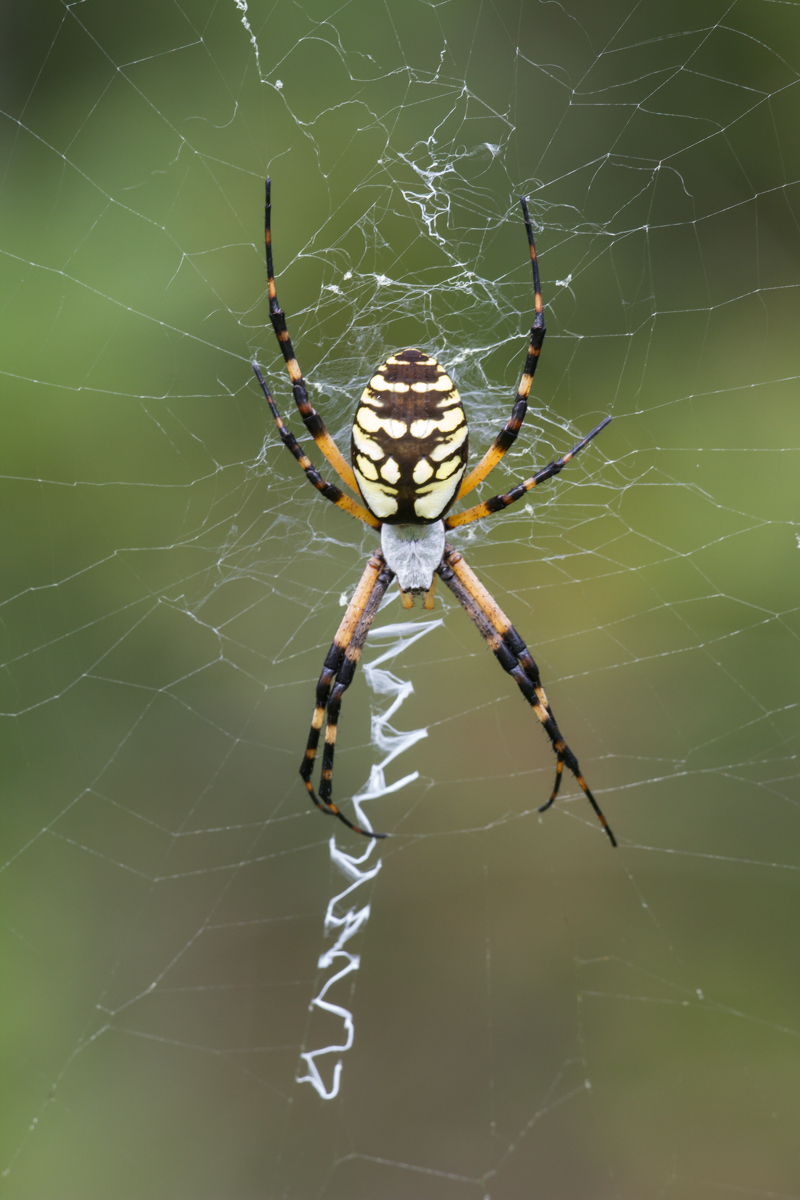
Black and Yellow Argiope
I also spotted several large Argiope spiders as I drove slowly along the refuge roads. Late in the afternoon I decided to drive back through a section of the Pocosin Lakes refuge that I had never explored. I ended up driving all the way through the refuge from Hwy 94 to the Pungo Unit on miles of well-maintained gravel roads Along the way I saw three Black Racer snakes, a few Wild Turkey, two bears, some deer, and more Northern Bobwhite Quail than I have seen in several years.
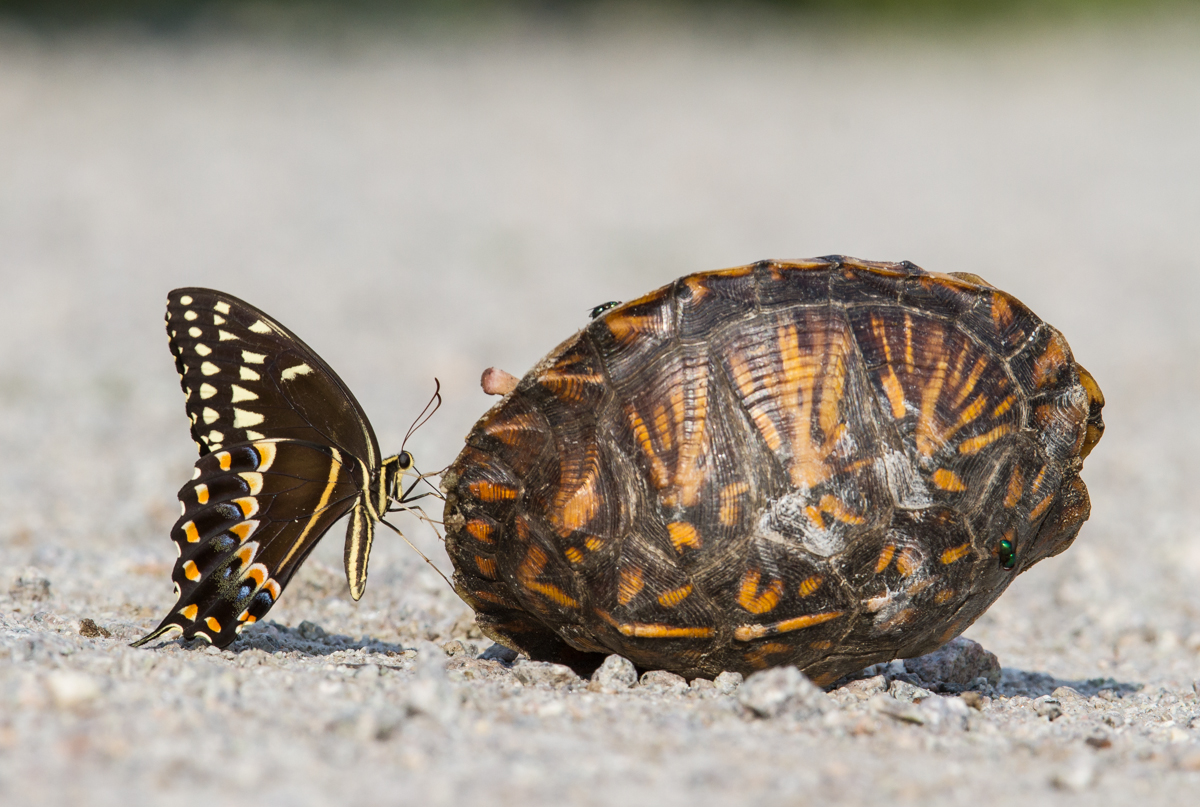
Palamedes Swallowtail on dead box turtle
Palamedes Swallowtails were flying everywhere along the route. These are the quintessential swamp swallowtails and large numbers were puddling in moist spots along the gravel roadways. There was also one sipping a macabre meal form a dead Eastern Box Turtle, one of two box turtles I found dead in the road on the refuge. Both turtles were laying upside down and did not seem to be damaged by cars so I am not sure what happened to them.
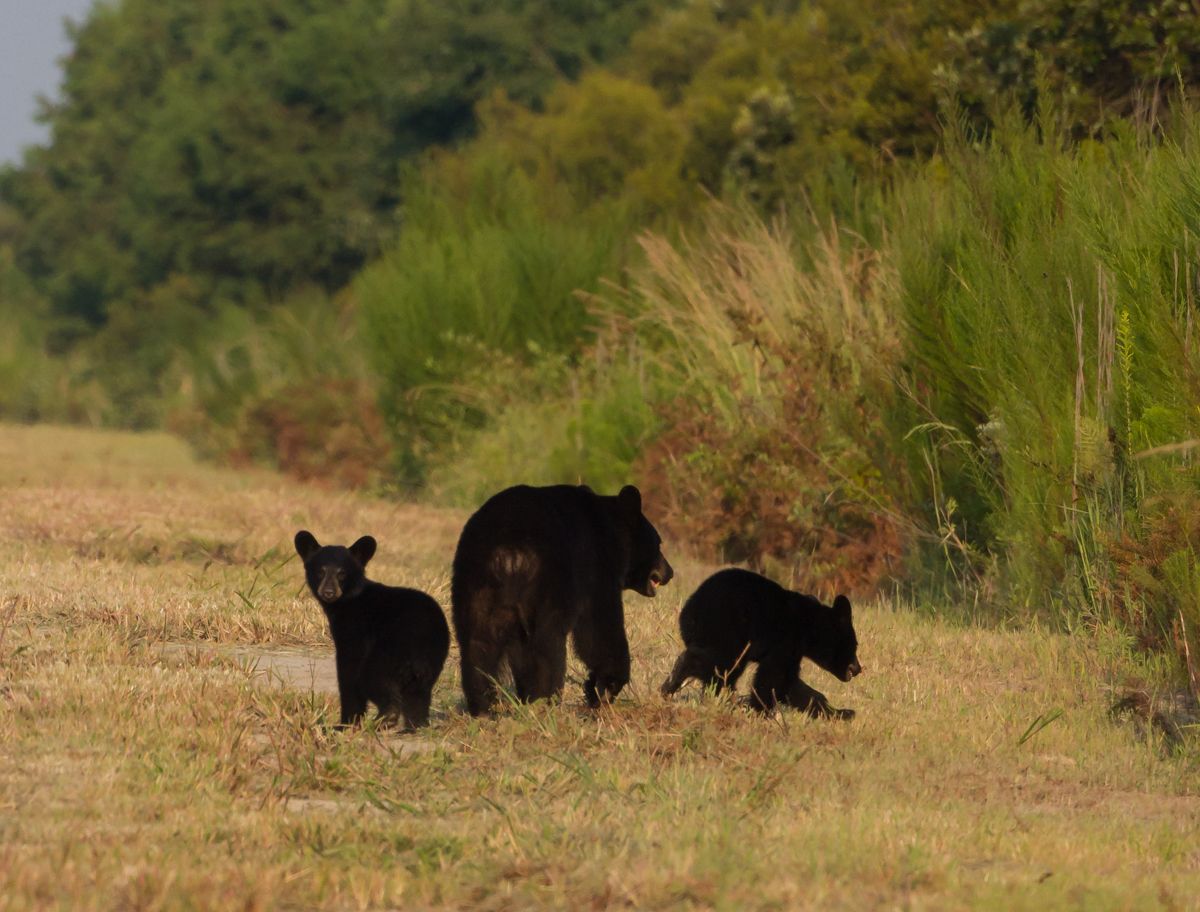
Black Bear with two cubs
It was getting late in the day by the time I arrived back at the Pungo Unit of the refuge. Out of the corner of my eye I saw a bear standing, looking over the vegetation. By the time I stopped the car and grabbed the camera, she had dropped down and was ushering her two young cubs in the opposite direction. Too bad I had missed that shot of her standing looking at me with the cubs huddled by her side. I ended up seeing eleven bears for the day but the last one was my favorite.
Black Bear walking down path
The bears are now feeding in the corn fields on the refuge so I went to one where the fading sun was at a good angle and started walking down a path. As if on cue, a bear walked up out of a canal and ambled down the path ahead of me. It sniffed, walked, sniffed some more, and then went back down into the canal and into an adjacent soybean field.
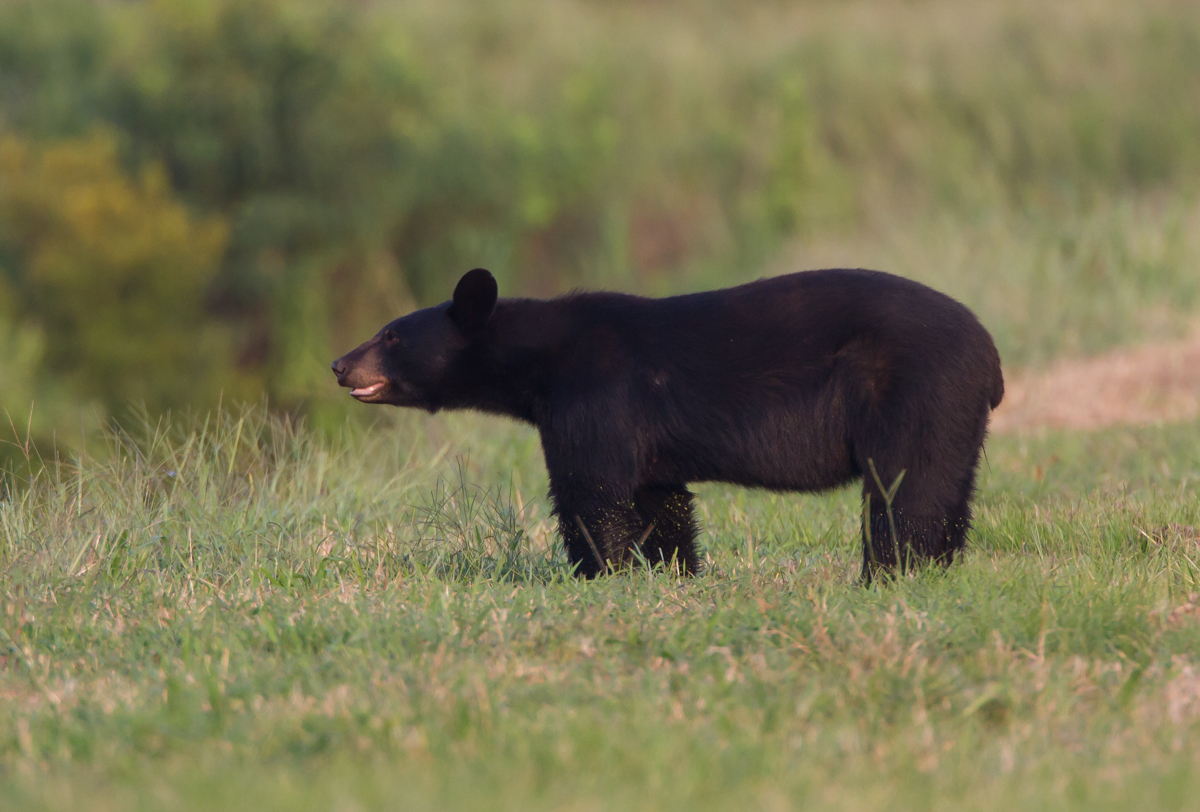
Black Bear standing in soybean field
All I could see were the round black ears moving through the tall soybeans. The sunlight was almost gone so I took a few more steps and apparently made a little too much noise, which caused the bear to stand up, providing me with the shot of the day. The bear looked around and must have decided all was well, as it dropped down and continued walking off to find a nice spot to dine in peace. You never know what you are going to see on these refuges, but there is almost always something memorable.
Butterfly that was laying eggs in a patch of False Nettle (click photos to enlarge)
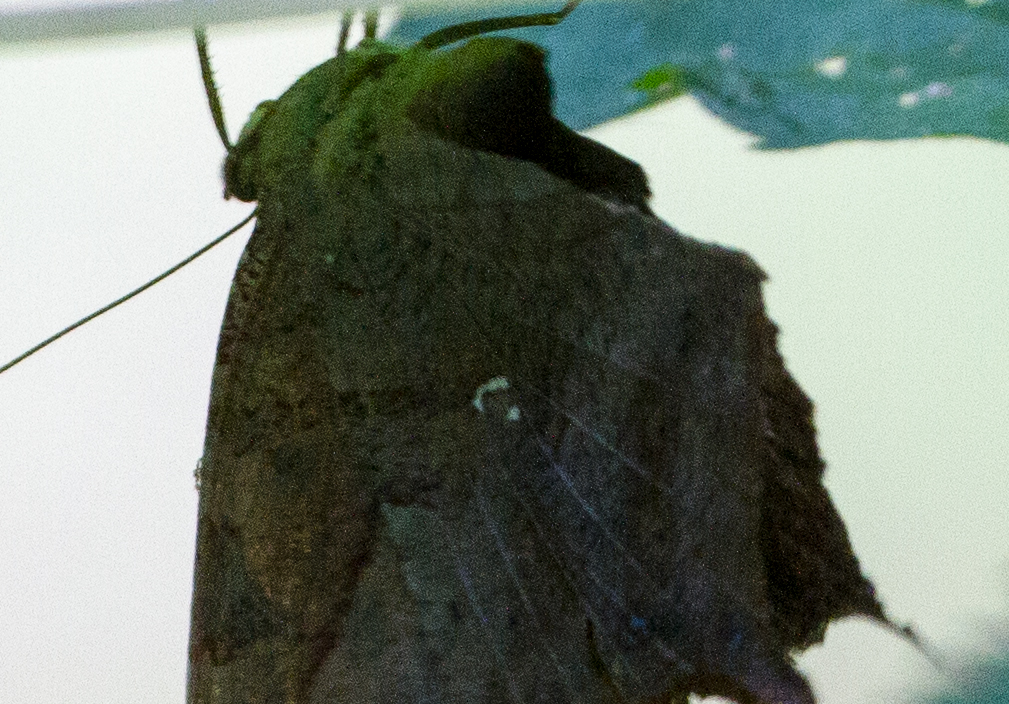
I glanced out the back of the screen porch the other day and saw a butterfly behaving as if it were going to lay eggs – that typical fluttery flight around a plant that indicates she is searching for just the right spot to lay an egg.
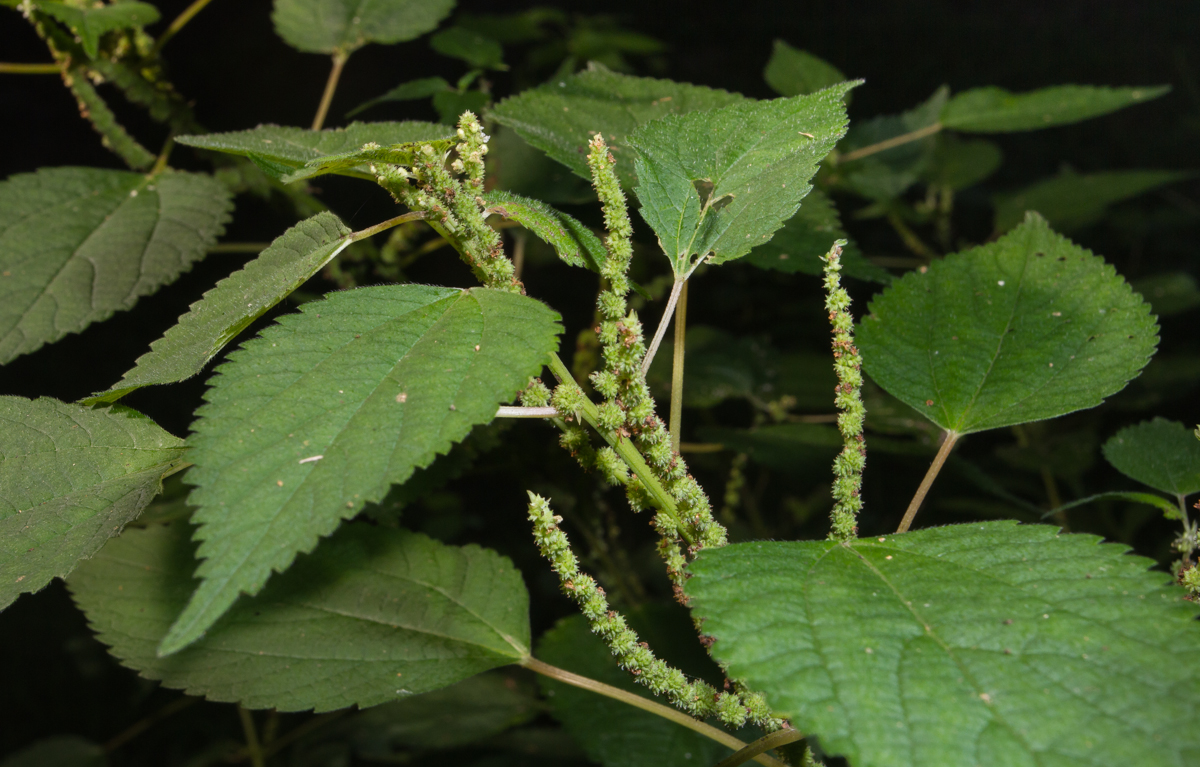
False Nettle, Boehmeria cylindrica
The butterfly was one of the anglewings – either a Question Mark or an Eastern Comma, and the plants were some False Nettles (one of the anglewings’ host plants) mixed in with some ferns and other moisture-loving plants in a shady, wet drainage area out back. I have been seeing Eastern Commas feeding on the figs in the garden but this one would not slow down long enough for me to see any details on the wings to make a clear identification. I went inside and grabbed the camera with the 300mm and an extension tube and fired off several shots as the butterfly flitted about quickly laying an egg here and there on the undersides of leaves.
Question Mark confirmed
I often use the camera to help me identify species that are moving too quickly for a good view. Once you look at images on the computer, you can often see identifying characteristics more clearly. Such was the case in one photo this time – I could just make out the distinct marking on the underside of the wing that identified the egg-layer as a Question Mark, Polygonia interrogationis.
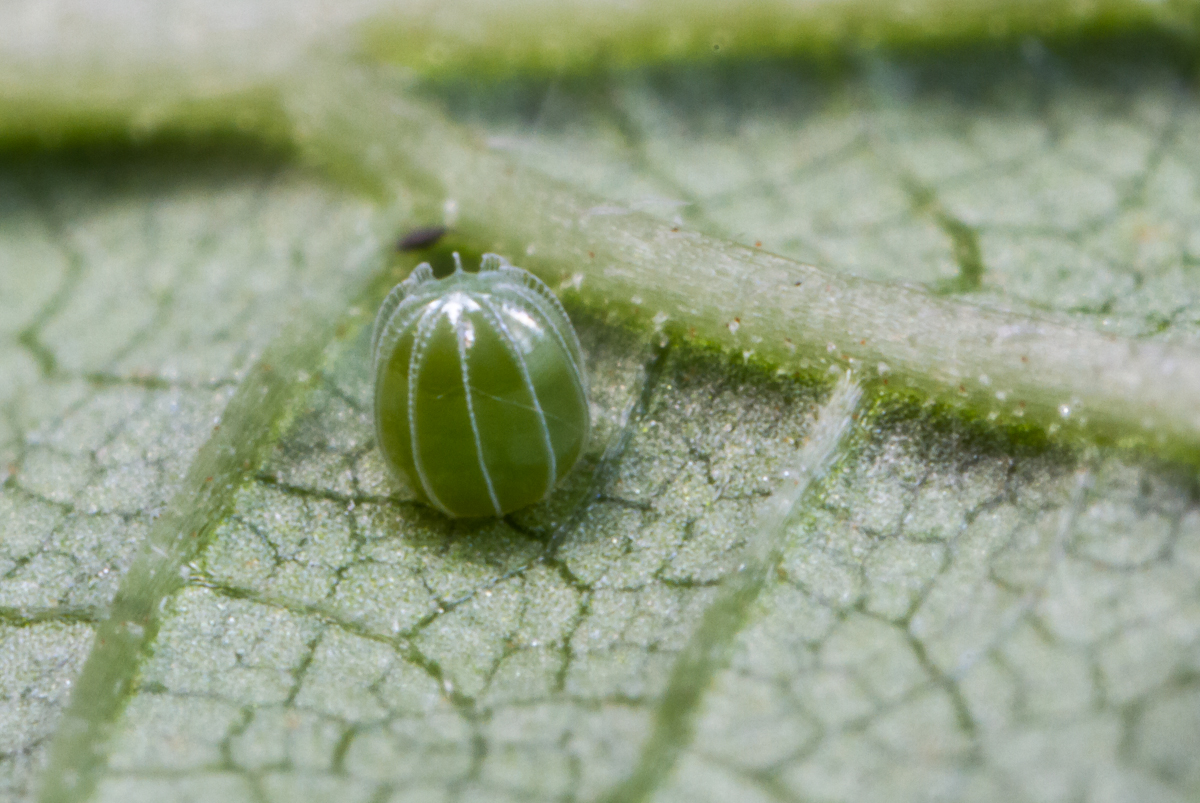
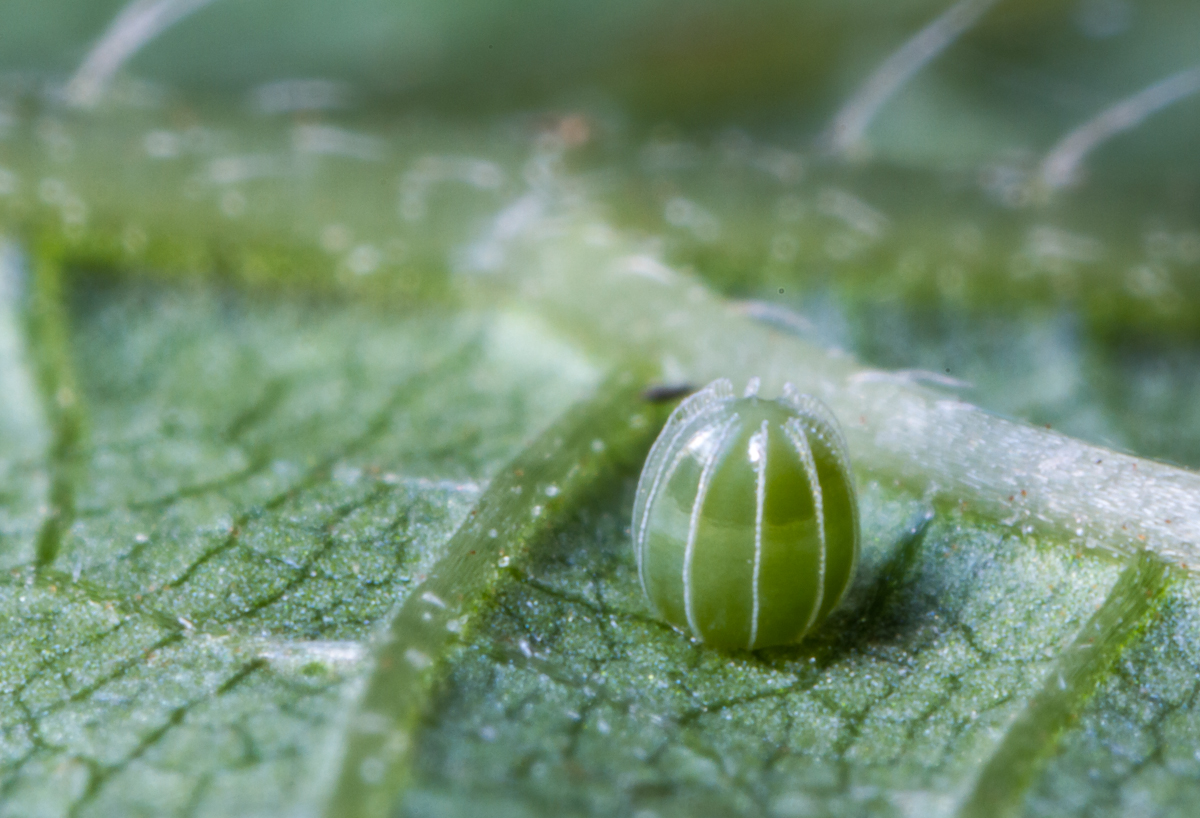
Freshly laid Question Mark egg on underside of False Nettle leaf
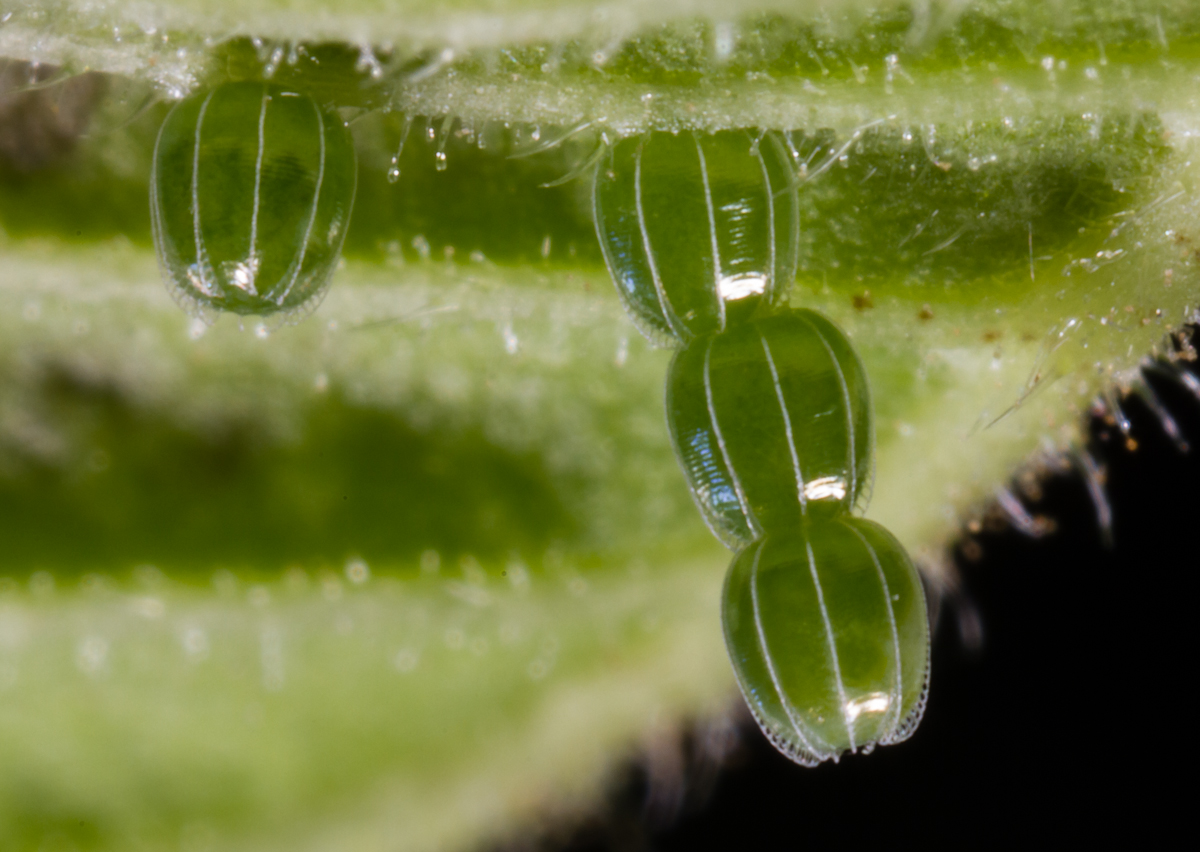
I went back outside and started turning over leaves looking for eggs and finally found one – a very small greenish egg sculpted with vertical ridges. The eggs of Question Marks and Eastern Commas are identical so seeing the egg-layer is important for identification. In reading about these two closely related species, I found an interesting note about their eggs – females often lay eggs in short stacks, one egg on top of the other, in stacks of a few up to 8 or 9 eggs. Naturally, I went back out to see if I could find any.
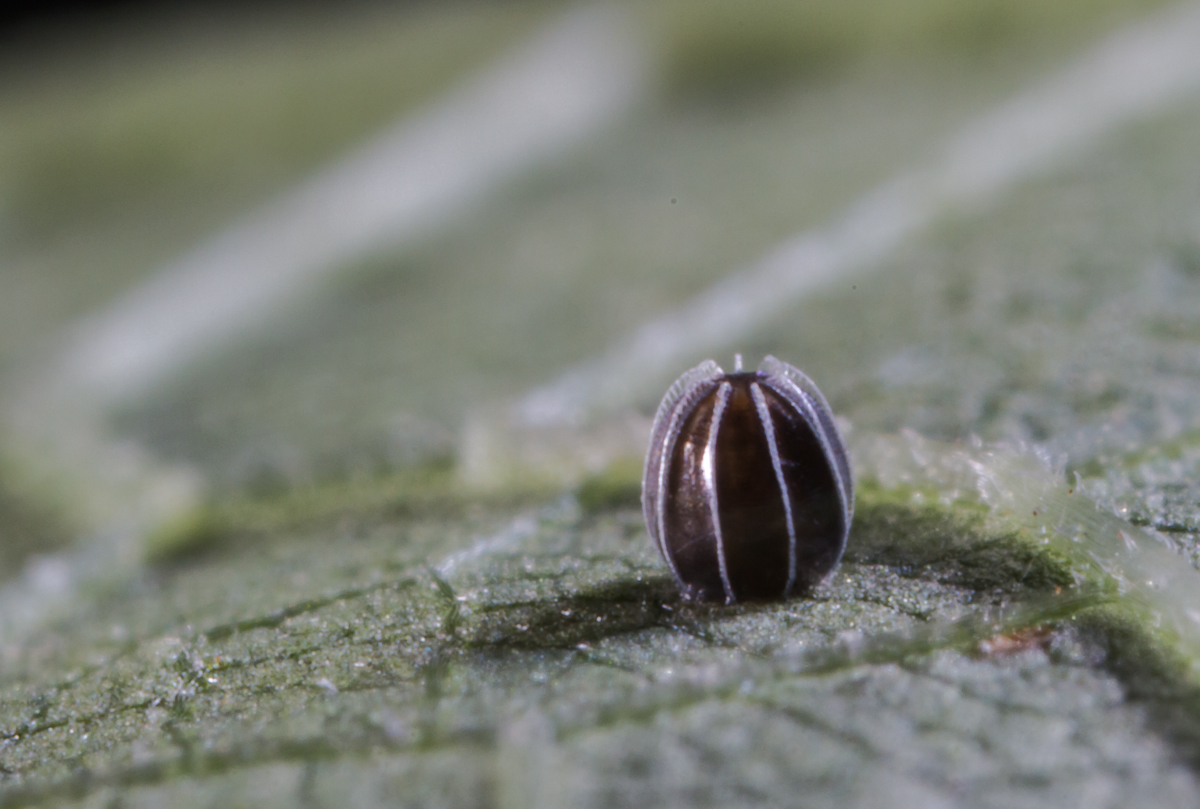
Dark egg of an anglewing
My first find was a single darker-colored egg on the same plant. I assume it is an egg that was laid earlier and may be getting ready to hatch as I have seen other species’ eggs darken prior to hatching. I suppose the other possibility is that the egg has been parastized by something. I’ll have to wait and see.
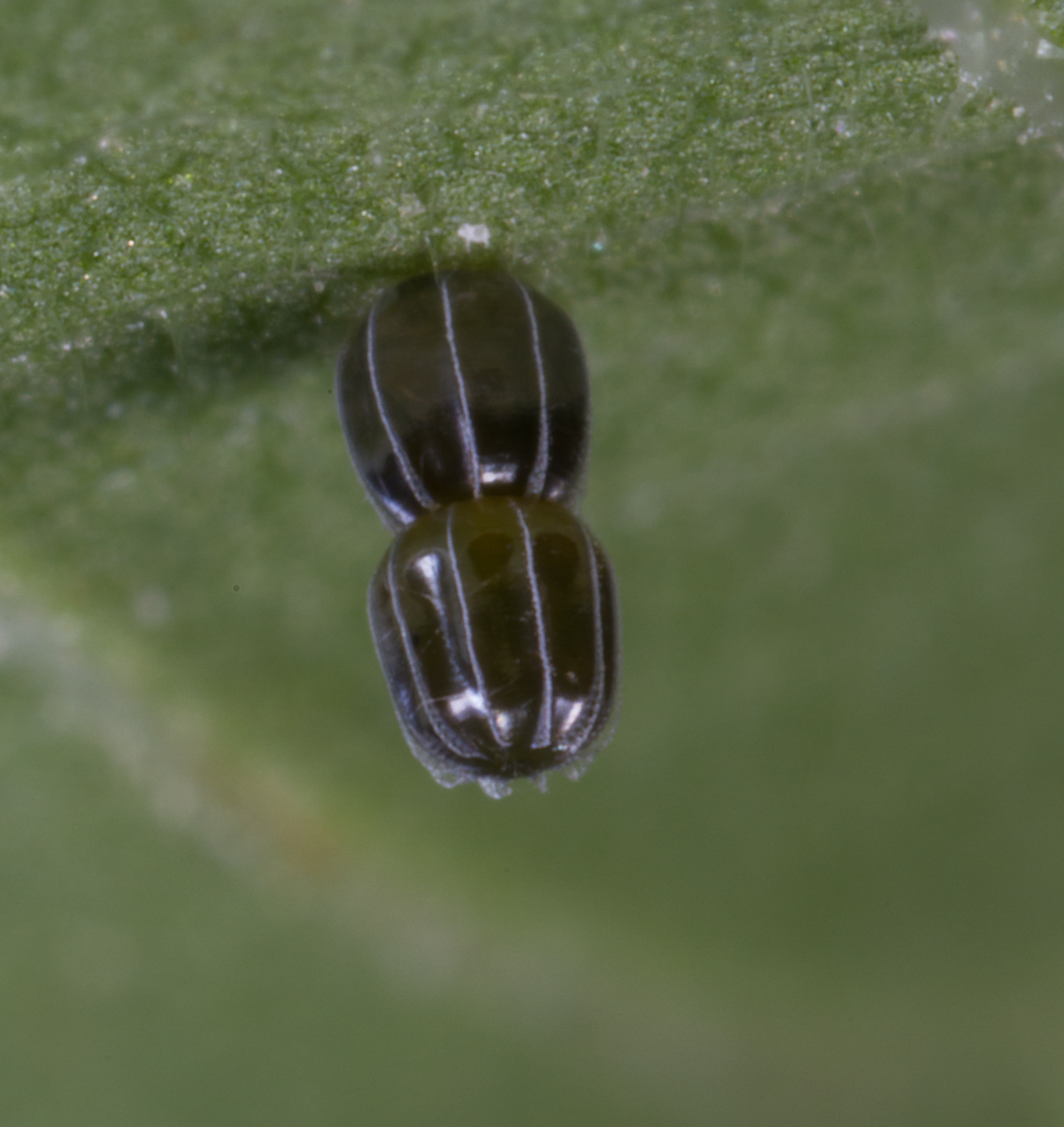
Egg stack
After searching the False Nettles for eggs and only finding singles, I went up to the garden to check another host plant that I know is growing up there – a Winged Elm sapling. Question Marks and Commas have three common host plants in our area – False Nettle, Stinging Nettle, and elms. The first leaf I looked under had a short stack of two dark eggs. There were lots of eggs on this tiny sapling, perhaps due to the abundance of decaying figs in the adjacent trees that attracted the butterflies to the area.
Egg stack on underside of elm leaf
It wasn’t until I had set up to photograph the stack of two eggs that I noticed a cluster of eggs on a curled leaf at the tip of the branch, including a stack of three eggs. It looks so strange and even though I searched the internet and all of my reference books, I came up with no clear explanation as to why these species stack their eggs. Some butterflies, such as the Pipevine Swallowtail, have larvae that contain toxins and lay their brightly-colored (warning colors like orange or red) eggs in clusters. Their distasteful caterpillars usually feed in groups which may afford them more protection from predators. I also found a reference to a species in England whose stacks of eggs are said to resemble the flower parts of the host pant, thus camouflaging the eggs to a certain degree. None of these explanations seems to quite fit in this case, so the reason for egg stacking remains a mystery to me.














 Roads End Naturalist