The crow wished everything was black, the owl, that everything was white.
~William Blake
Those of you that know me probably know I had to look up the name of Harry Potter’s pet Snowy Owl, just to be sure I used it correctly in the title. Oh well, at least I am trying to fit in…
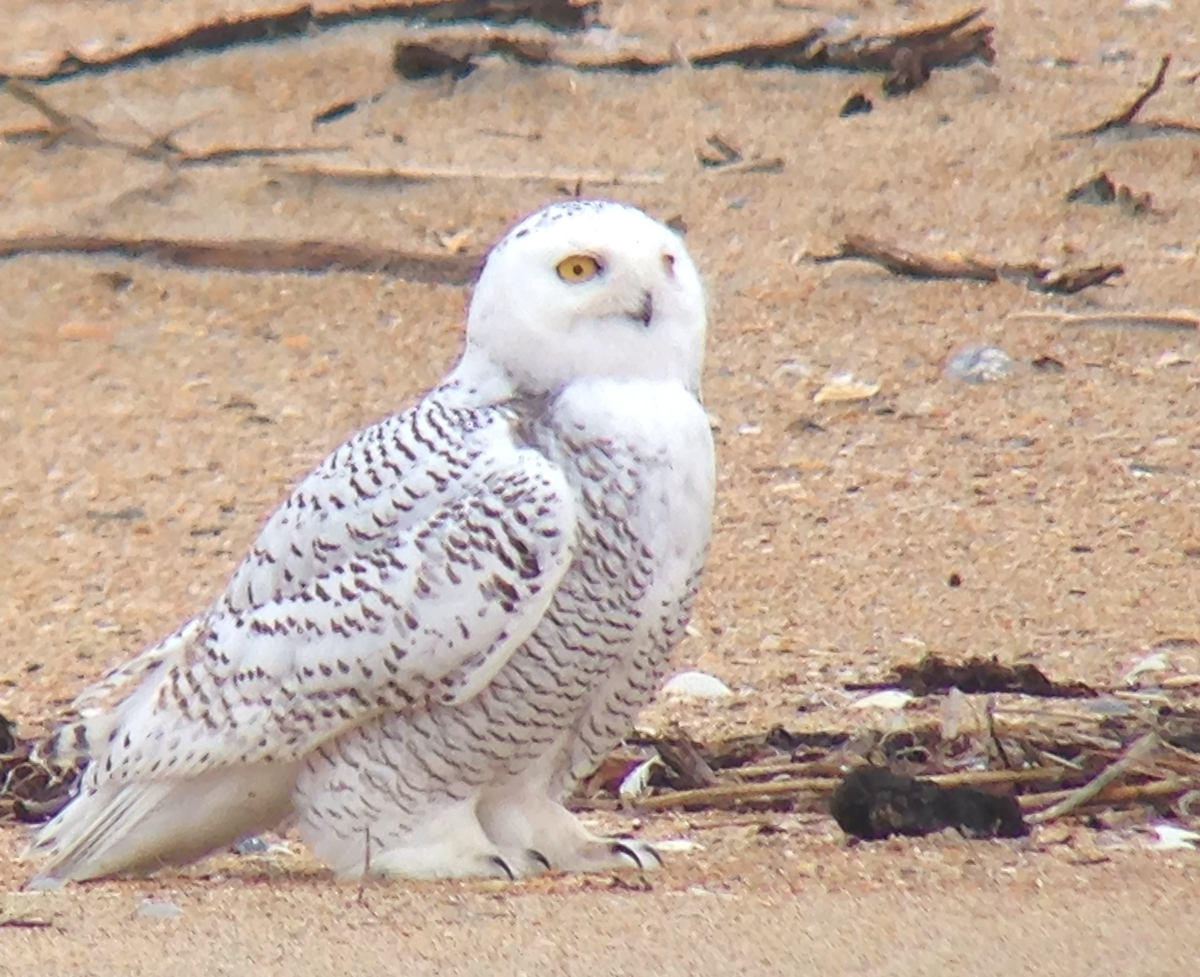
The following images are highly cropped ones from my 500mm lens and 1.4x teleconverter on my Canon 7D. So, just to be clear, I was not as close as these photos make it appear. As I said in yesterday’s post, I was lucky enough to spend well over an hour alone with a Snowy Owl at Cape Hatteras this week. A true privilege. Which face do you like best?
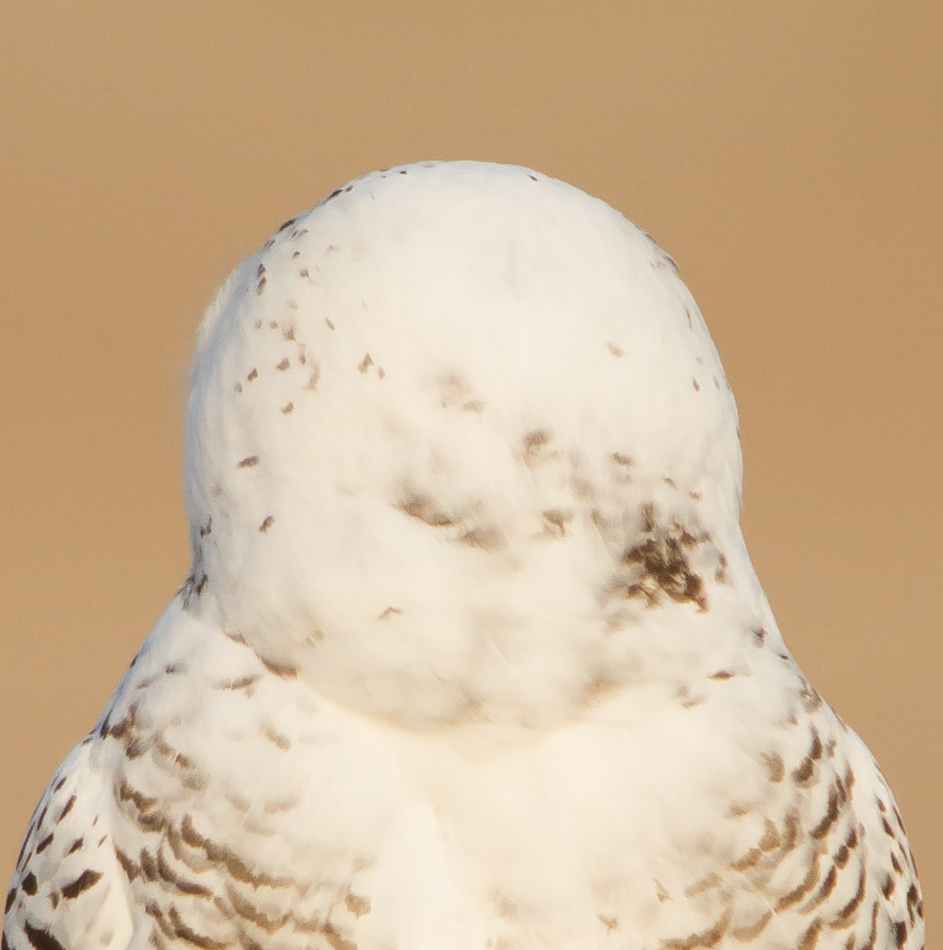
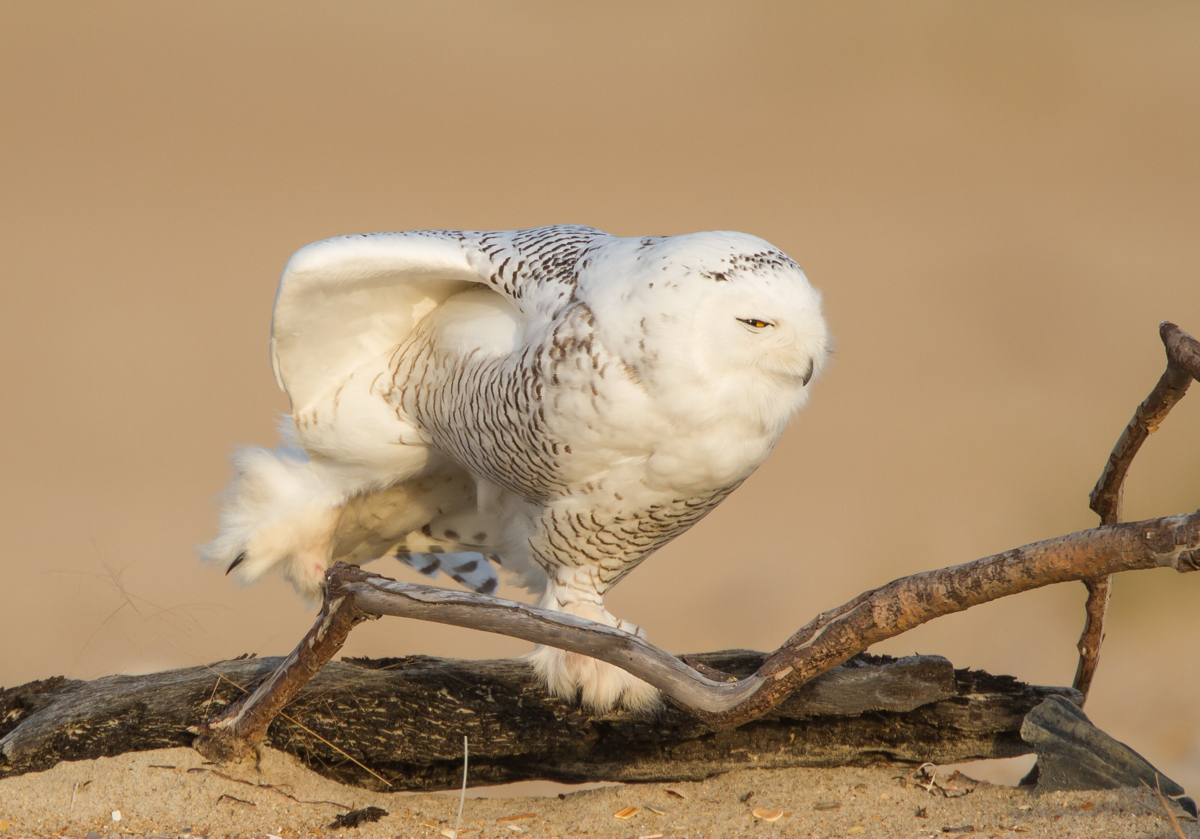
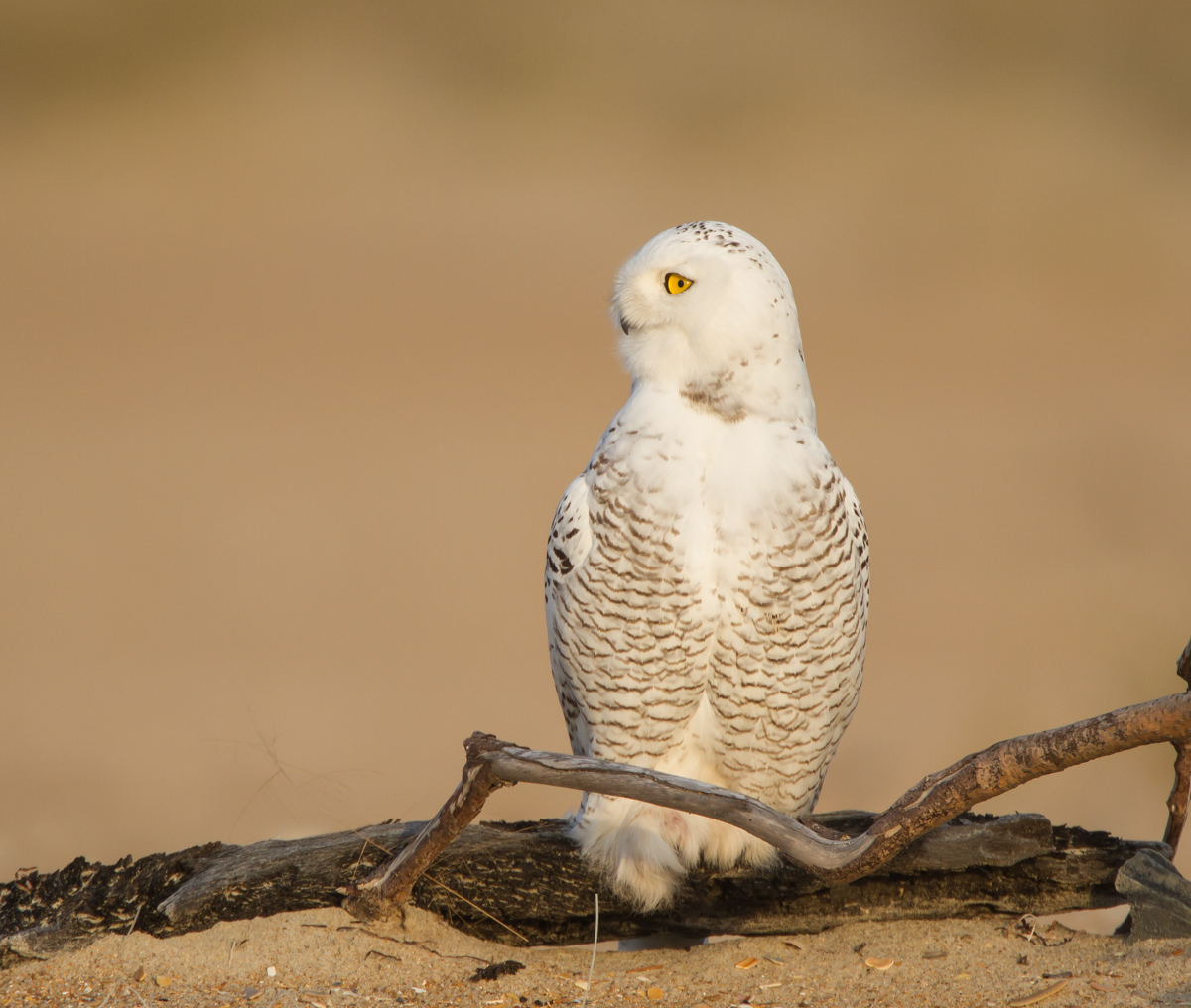
Sleepy eyes (click photos to enlarge)Doing owl yogaLook to the rightNow look to the leftWhat the heck is that?Those eyes…What eyes?Cleaning my feetYou would look this way too if you had to clean your feet with your mouth
I have never been one of “those” people…you know who I mean, the bird chasers. Don’t get me wrong, I enjoy birds, love to watch them, photograph them, and learn about them. But the idea of dropping everything and heading out to see a rare bird was not in my repertoire…until now. My young birder friend, Lucas Bobay, posted something on his blog last week about making a trip to the Outer Banks to see the newly arrived Snowy Owl. He and his friends were out there in what looked like miserable conditions of wind and rain, but they saw it. I could sense their excitement in his words. And, it is a bird I have always thought would be cool to see. So, I decided to head out Tuesday and see if I could find it. Turned out to be an adventure.
I got a late start and was driving down through Cape Hatteras National Seashore a little after lunch when I reached the Bonner Bridge over Oregon Inlet. Some portable stoplights and lots of yellow trucks emblazoned with the DOT insignia indicated some road work was going on. I’ve always enjoyed going over that iconic bridge because of the elevated view of the ocean and marshes bordering the inlet. As I sat at the stoplight near the far side of the bridge, I heard an announcement on NPR – “The NC DOT has declared a state of emergency and closed the Bonner Bridge over Oregon Inlet for safety reasons, effective immediately”. Say what? But I’m on the bridge! It is one of those things you aren’t quite sure you hear correctly and then it is gone. I looked around and everybody seemed to be doing normal things – no Gull Little running around yelling “the bridge is falling, the bridge is falling”. I switched stations hoping to hear the announcement again…nope, just some music and news. The light turns green…do I turn around?; did I hear what I thought I heard? I debated turning back at the far side of the bridge and trying to return to the mainland but decided, what the heck, I’m retired, and there’s a possibility of seeing a Snowy Owl. So, on I drove.
First sighting (click photos to enlarge)
After finding the beach access ramp number I had read about online, I walked out toward the ocean with high hopes. No owl….I scanned to my left toward the Point…nothing. Looking down the beach to my right I saw three people walking several hundred yards away. I looked with the scope and saw a small white blob on the beach – my first Snowy Owl! I gathered my gear and starting walking when I saw the owl take flight and head my way. I stopped and it landed a few hundred yards away between me and the walkers. They continued…I stayed put. The owl flushed again and flew right past me and landed on a log on the beach. As I sat up the camera the walkers stopped higher up on the beach to view the owl through their binoculars. They then veered off to the parking area and I was alone with the bird. And what a magnificent bird!
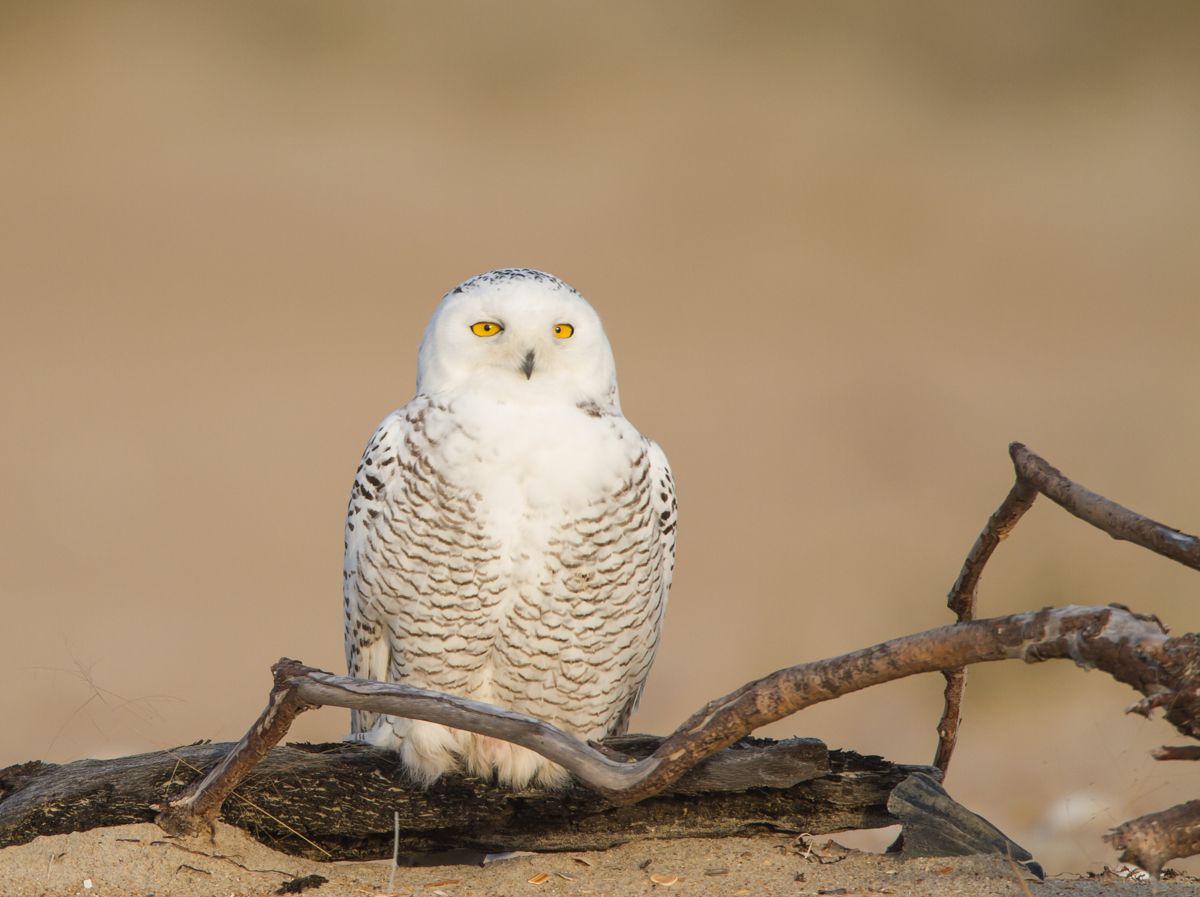
Snowy Owl at Cape Hatteras (cropped image)
Snowy Owls are at home in the far north of the Arctic. In winter, most stay near their frozen homeland, with some migrating into southern Canada or occasionally the northern U.S. But once in a while, a Snowy Owl migrates farther south. The last time one was seen in North Carolina was 2001. And now, this one. The usual thought is that birds migrating this far out of their normal range are young ones that are seeking a winter food supply in years when their prey base in the Arctic (lemmings) is scarce. And this happens only once every few years. But this year seems to be different with Snowy Owls showing up all over the East Coast (and now at least three reported in NC). Kenn Kaufman has written on this year’s unusual migration in a nice article published this week in Audubon Magazine (http://mag.audubon.org/articles/birds/notes-snowy-owl-invasion).
Snowy Owl cleaning its feet
The owl landed about 50 yards from me. I took a few shots with the big lens and started to ease a little closer, taking a step, or at most, two, when it looked away. It was swinging its head around keeping an eye on every gull that called or flew anywhere near. Over a span of about 30 minutes I was able to creep a few yards closer. The owl finally looked straight at me and I decided that this was close enough. I did not want to spook it. Over the next hour or so, it began preening its gorgeous plumage, especially the feathers on its feet.
Snowy Owl stretch
It stretched a few times and turned its head frequently looking at all sorts of things seen and unseen to my meager human eyes.
Looking intently down the beach
At one point, the owl straightened up, opening its eyes wide and staring at something for several seconds before settling back to a more restful pose. I could not see what had caught its attention, although I had seen a Peregrine Falcon when I first walked out, so maybe that had flown by again.
Stretching a wing
I was glad the owl seemed to accept my presence. While I am sure it knew I was there (try as I might I could not make myself look like a seashell washed up on the beach), my lack of motion, plus the fact that there was just me, probably allowed it to go about its normal routine. I felt truly privileged to spend so much time alone with this bird in such a beautiful setting.
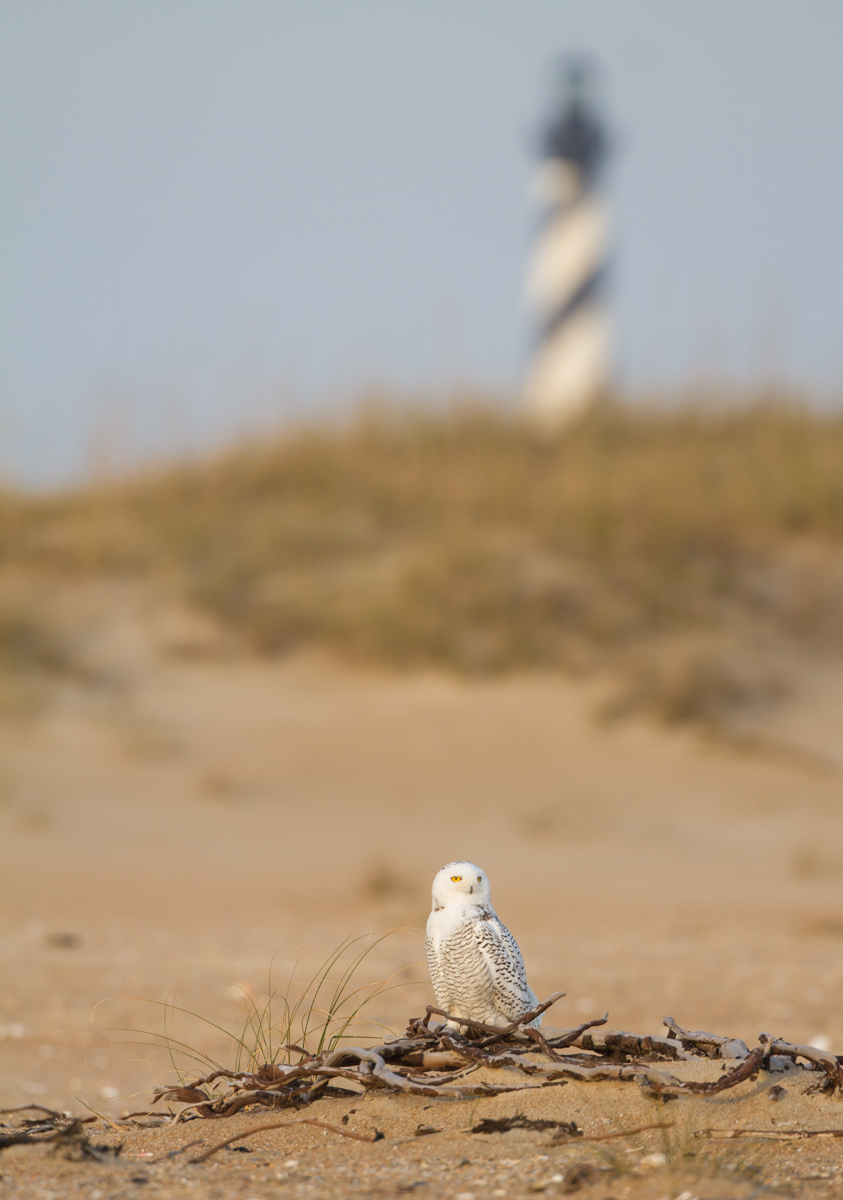
Close to sunset, a young man walked out onto the beach with his dog. The owl acted a little nervous and then flew a short distance with the lighthouse now in the background. I waved the young man away and he walked up to talk after seeing the owl. He didn’t know about it or how rare it is to see a Snowy Owl in these parts, but he seemed to appreciate it and thanked me before walking off down the beach.
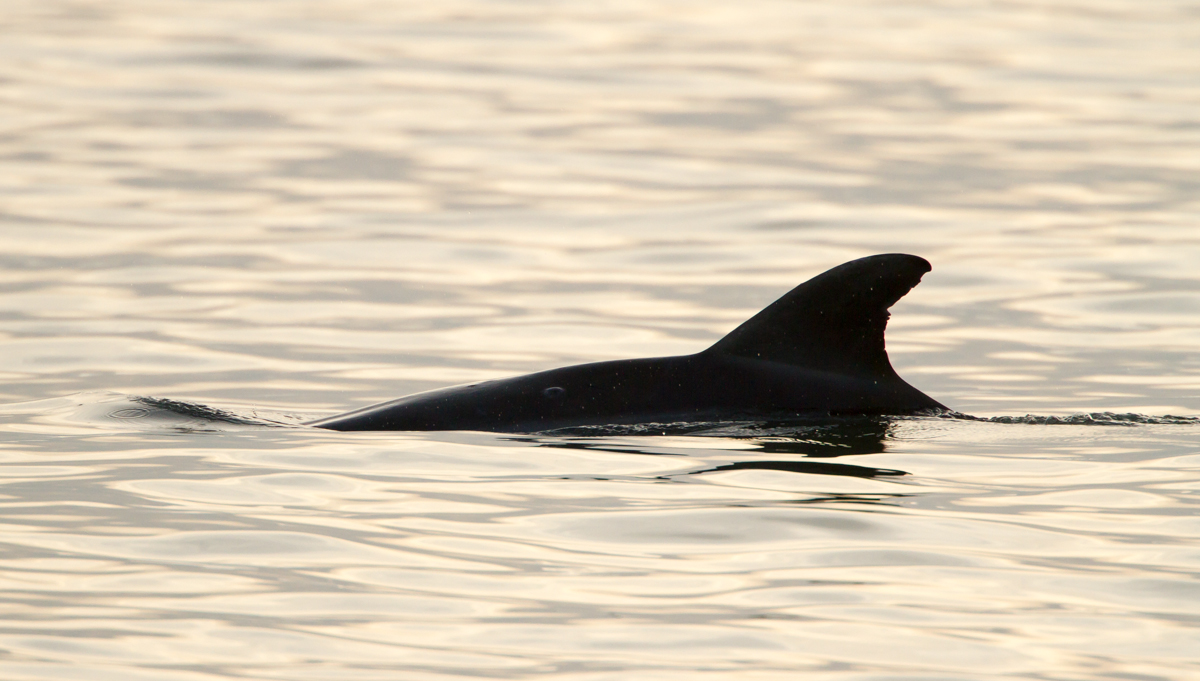
Dolphin bonus
When it was time to leave, I turned around and walked away from the bird towards the water. I wanted to walk way around the owl back toward my car so as to not disturb it. As if it had not been good enough just to be with the owl, a pod of dolphins swam by at that moment in the low angle light of the setting sun. A great day indeed.
The next morning was overcast and drizzly and I found the owl about 3/4 of a mile in the other direction down the beach. When I walked down, there was another birder. We were soon joined by two more folks interested in seeing this rare bird. The owl made few short flights, including two where it seemed to be chasing some grackles that were foraging on the beach. But there was no breakfast for the owl while we watched.
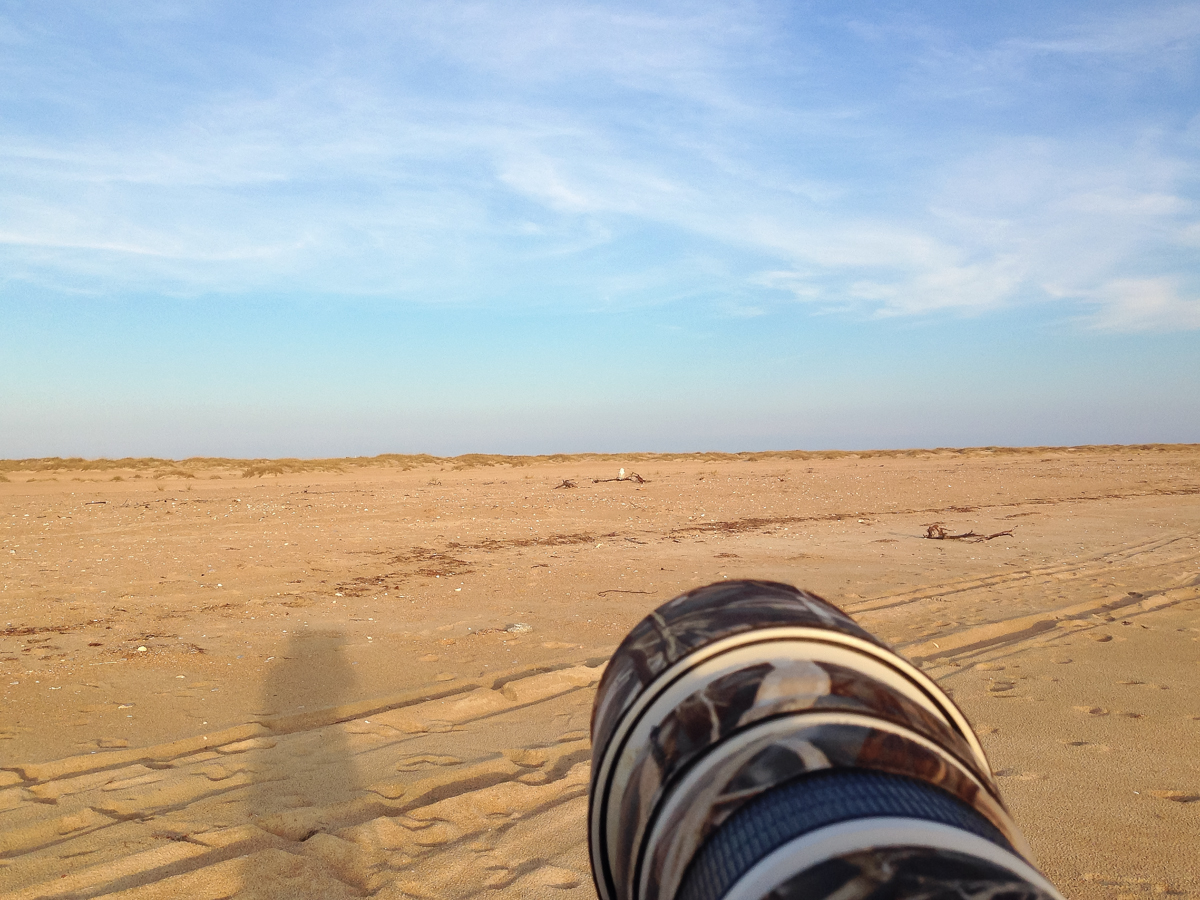
Photo taken with iPhone through spotting scope
I didn’t even take my camera out that morning due to the weather but had brought a spotting scope. I used an adapter purchased specifically for this scope and my iPhone and took a few shots. I still have a lot to learn about “digiscoping” apparently as most of the images turned out pretty “soft”. But it was still fun to try.
One person left and one of the remaining folks then walked out toward the owl and flushed it. I briefly discussed with her why it is important to try not to unduly disturb the bird: it is in unfamiliar territory; it may be a young, inexperienced animal; undue disturbance could cause it to use more of its energy reserves and disturb its hunting success, etc. She seemed to understand, but then walked back out towards it hoping to get a closer picture, and flushed it again. This is a common problem, one that I admit to being guilty of myself from time to time – trying to get just a little closer to an animal, and then spooking it. It helps to have a long lens, and it pays to closely observe the animal. My rule of thumb is that if I change the animal’s behavior, then I am too close. If that happens, I either back away or just stand still until the animal resumes whatever it was doing. This bird is such a rarity and is in a fairly accessible location (even with the bridge now closed) and word has spread rapidly about it via various list serves (and even through blogs like this). I worry a bit that the owl may be bothered to the point of it having some negative consequences. So, please try to respect this, and any other wildlife you encounter. It is best to view from a distance, using a scope, if possible, and as long a lens as possible for photography (borrow or rent one for special occasions like this). If you are lucky enough to go try to see the owl, don’t “rush and flush” it. Be patient, spend some quality time with it, observing it, and appreciating the beauty of this exquisite visitor from the far north.
Tomorrow, I will post a few more images. For now, I leave you with this short video of the owl doing what Snowy Owls do when they are taking in the view of their new terrain…
It is not only fine feathers that make fine birds.
Aesop
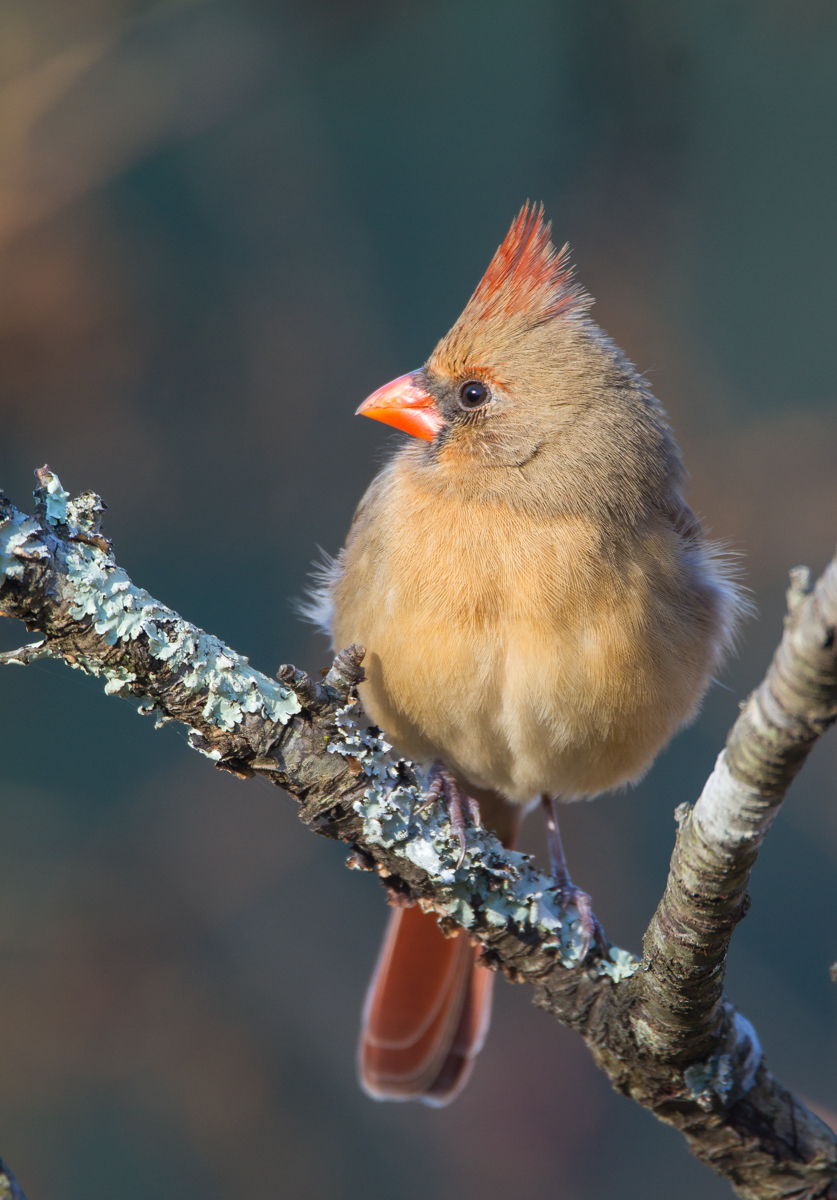
Female Northern Cardinal (click photos to enlarge)
Cardinal….Redbird…the names refer to one of our most beautiful backyard birds…and they refer to the male of the species, Cardinalis cardinalis. He is among our most strikingly colorful birds with his scarlet red plumage and crest. His mate is also a comely bird but with a more subtle grace. Adult females are a warm brownish color with reddish highlights in the tail, wings, and crest.
Female Northern Cardinal – a subtle beauty
I have been sitting out near the garden on several cold mornings recently observing the bird life as it comes and goes to the feeding station. Northern Cardinals are one of the more common visitors. They tend to cling to the feeder for a few moments, gobble a few sunflower seeds, and then flap over to the security of the tangle of grape vines on the fence. Males are more aggressive near the feeders this time of year, but will start feeding females in a couple of months as part of their courtship.
A Northern Cardinal beak is adapted for cracking seeds
Northern Cardinals were previously members of the finch family, Fringillidae. Recent DNA studies have caused scientists to reclassify cardinals into the family Cardinalidae that also includes some stout-billed familiar birds such as grosbeaks and buntings. Cardinals have strong beaks adapted for cracking seeds, a primary part of their diet. I am told by friends that regularly band birds that the beak is also adapted for giving a painful bite to careless handlers.
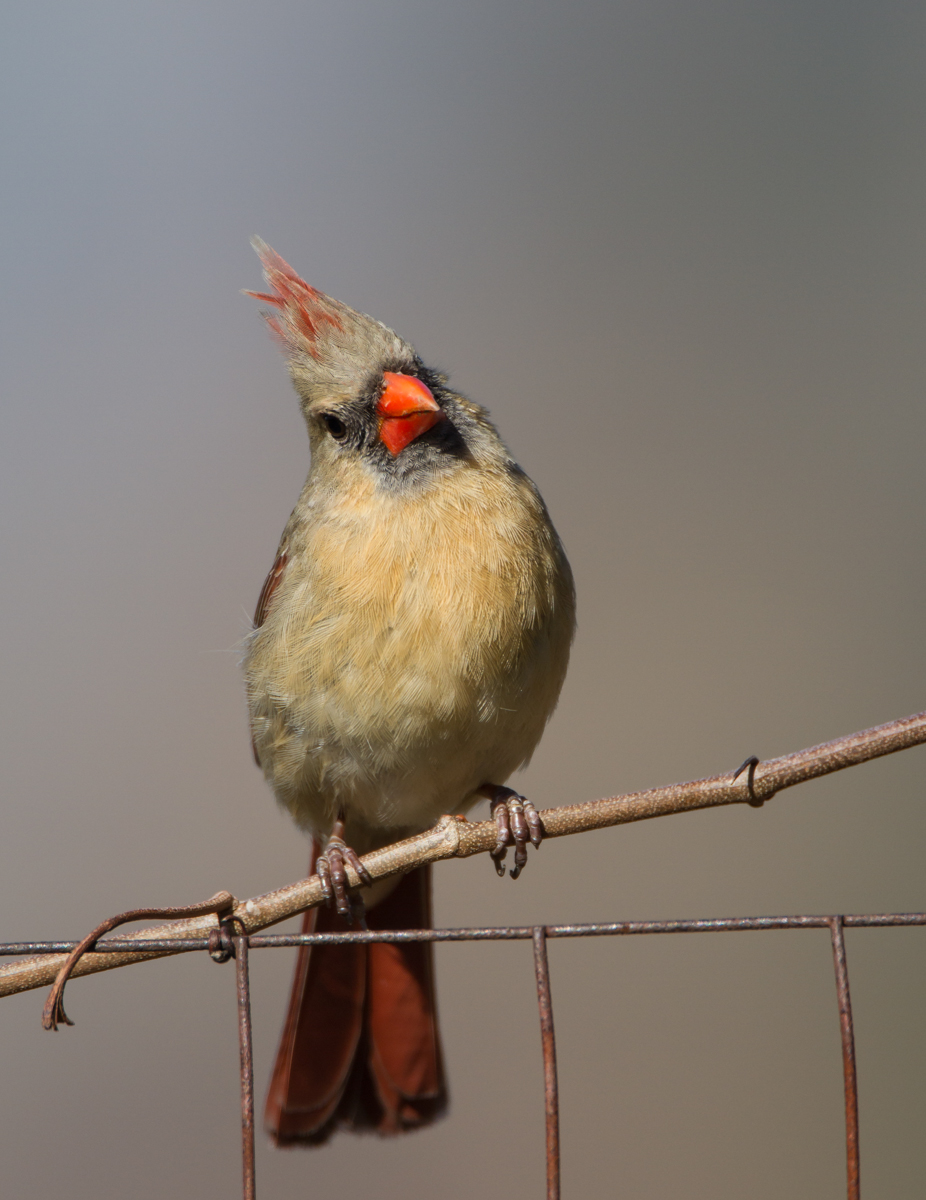
Immature or molting female Northern Cardinal
Immature Northern Cardinals are colored similar to females, but have darker beaks instead of bright orange beaks like the adult female. This bird was photographed in early June last year and appears to be an adult female that is molting. I have some other shots from that same time frame of male cardinals with dark beaks (indicating juvenile birds) and what look like molting male cardinals with orange beaks. References say that Northern Cardinals molt once a year in late summer to early fall so I will leave it to my bird nerd friends to tell me what is going on with this somewhat unkempt bird (is this what the rigors of nesting do to an adult female or is it an early molt?).
In addition to her beauty, female Northern Cardinals are special for another reason. Only a few female North American songbirds sing, but the female Northern Cardinal does. A mated pair shares song phrases, but the female may sing a longer and slightly more complex song than the male. This so-called countersinging may help to strengthen the bond between a courting pair. But rivals males also countersing, so without seeing the birds involved, it is tough for us to tell whether it is love or the urge to fight that is driving the melody.
Northern Cardinal perched on grape vine
Take a few moments this holiday season and appreciate the beauty of this often overlooked bird. It will be time well spent.
Yesterday I posted some of the details of my recent trip to Pettigrew State Park and the Pungo Unit of Pocosin Lakes National Wildlife Refuge. Here are a few more images from that experience:
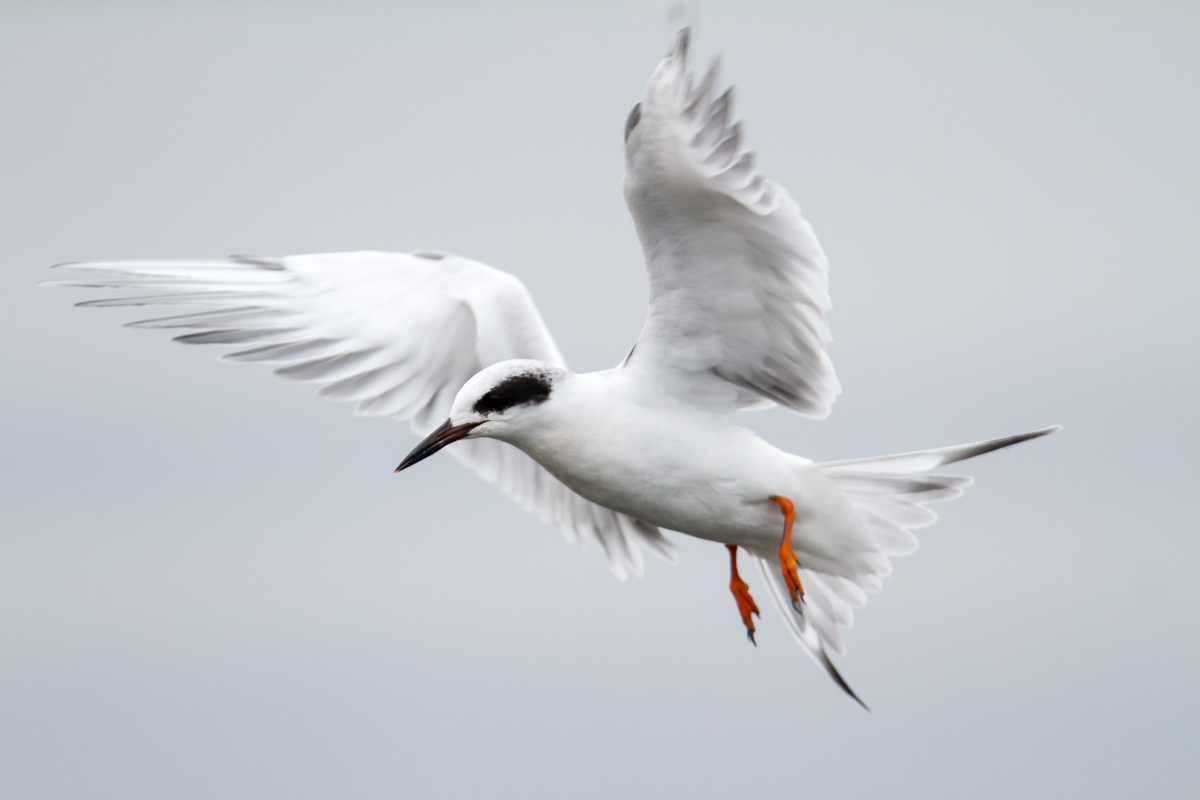
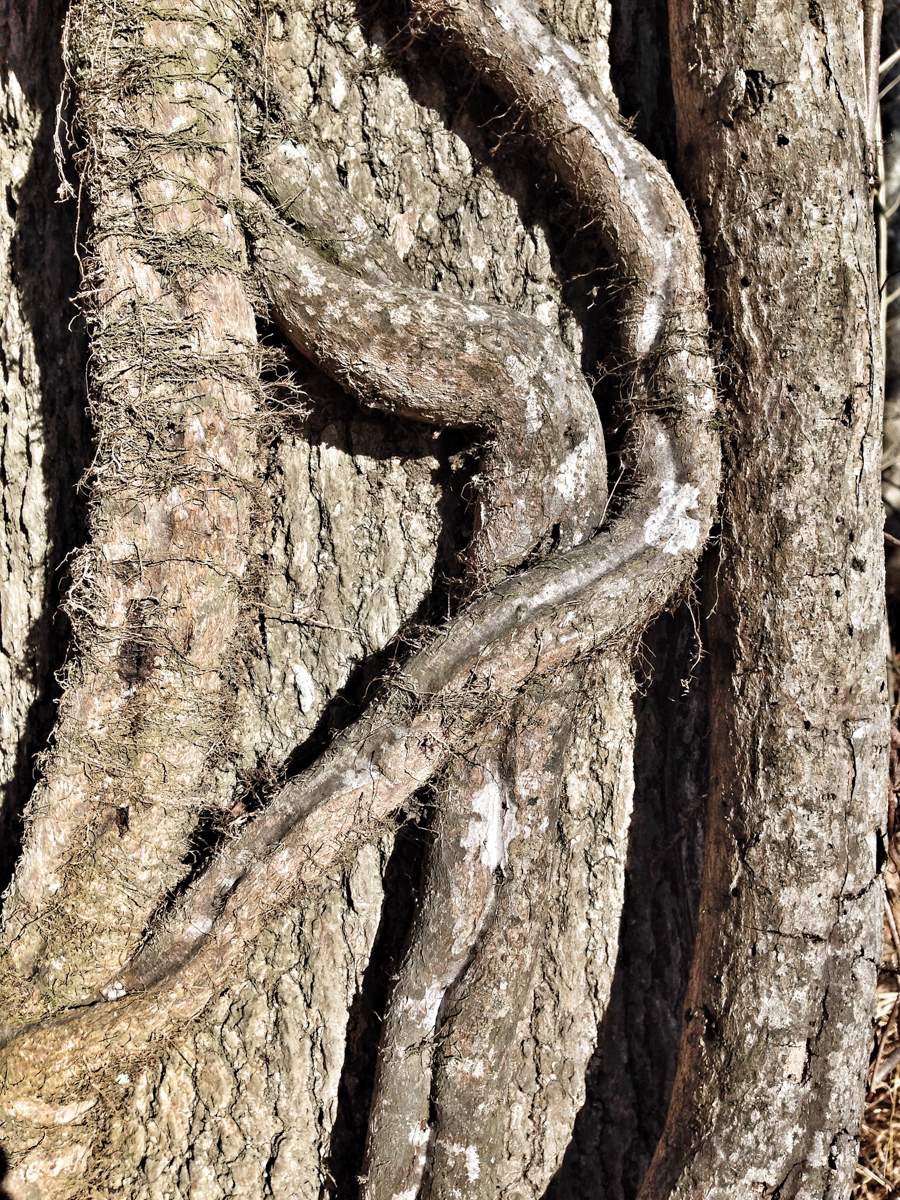
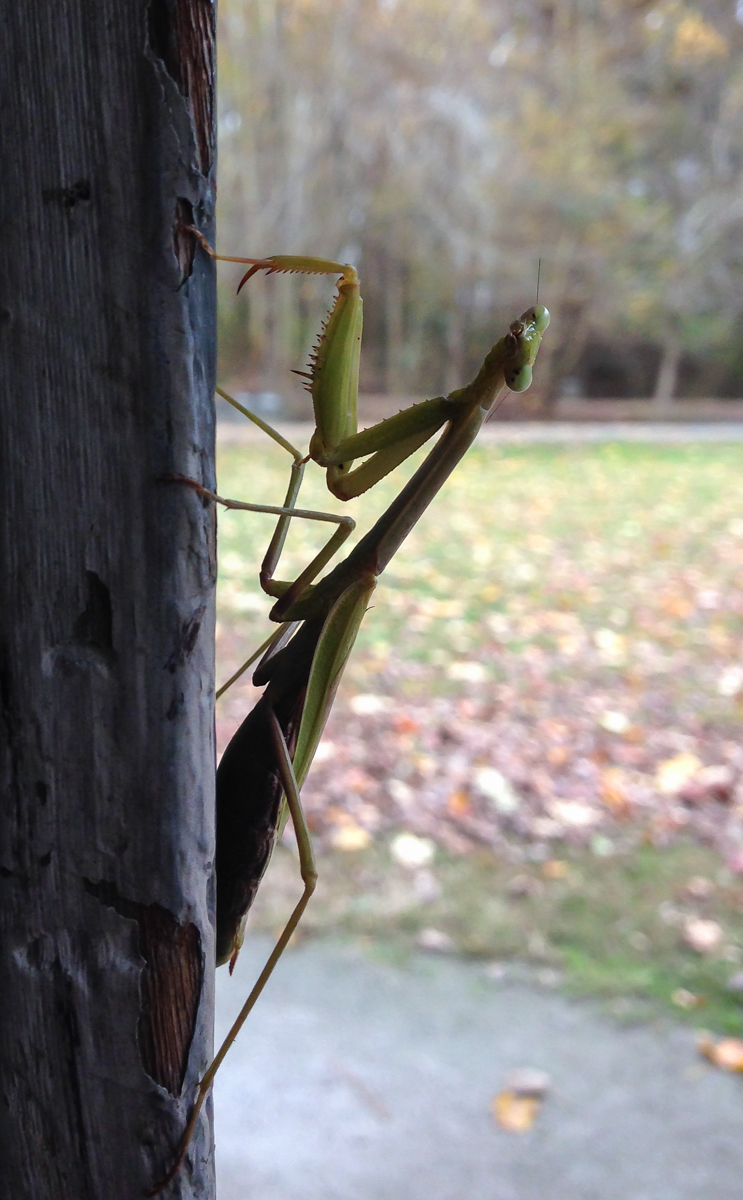
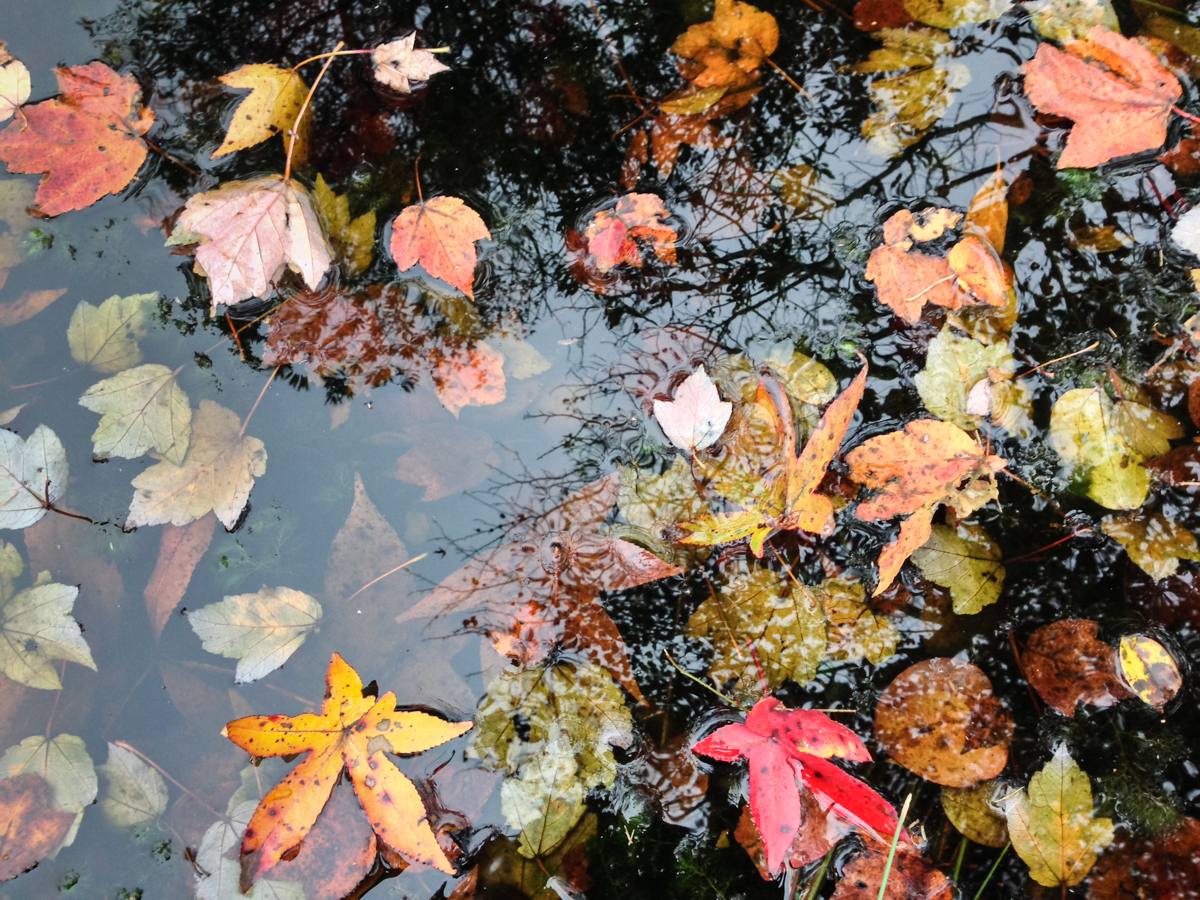
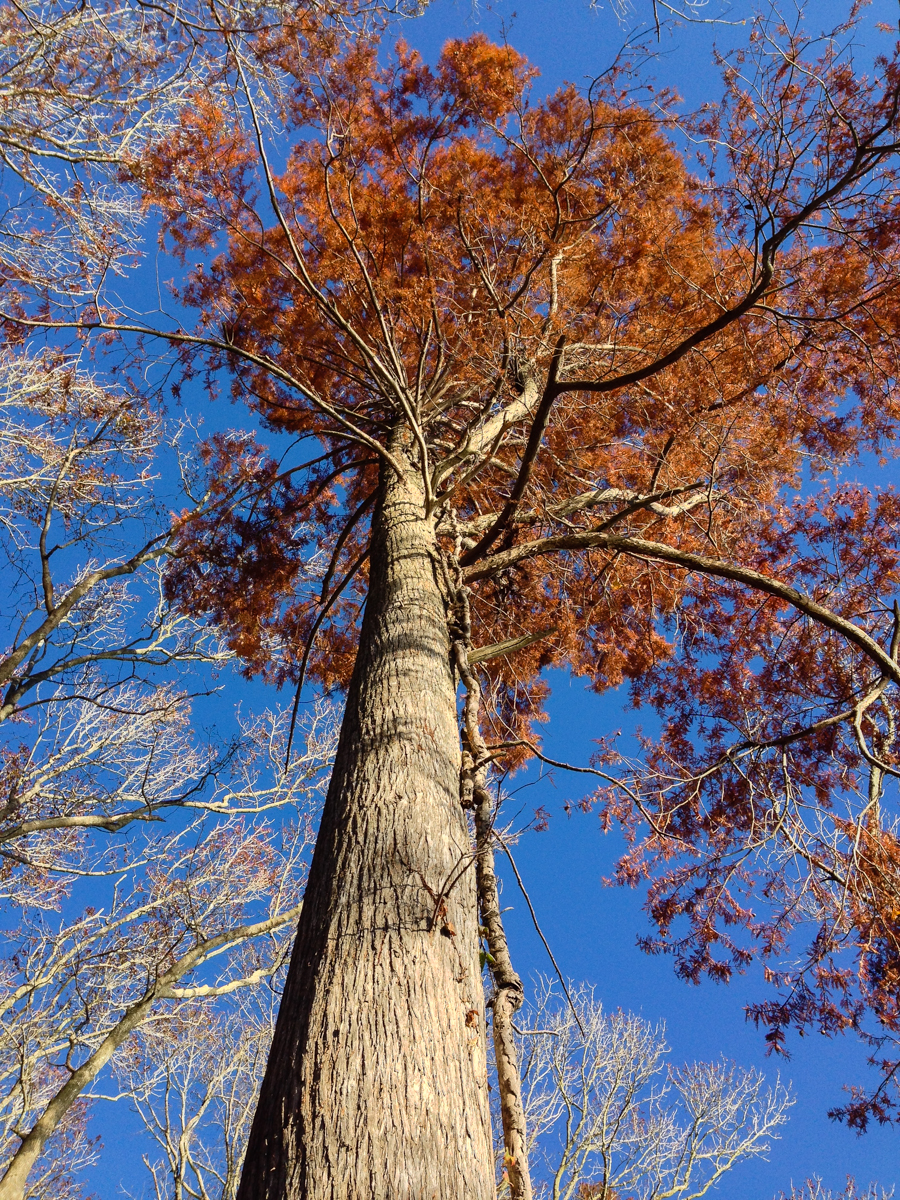
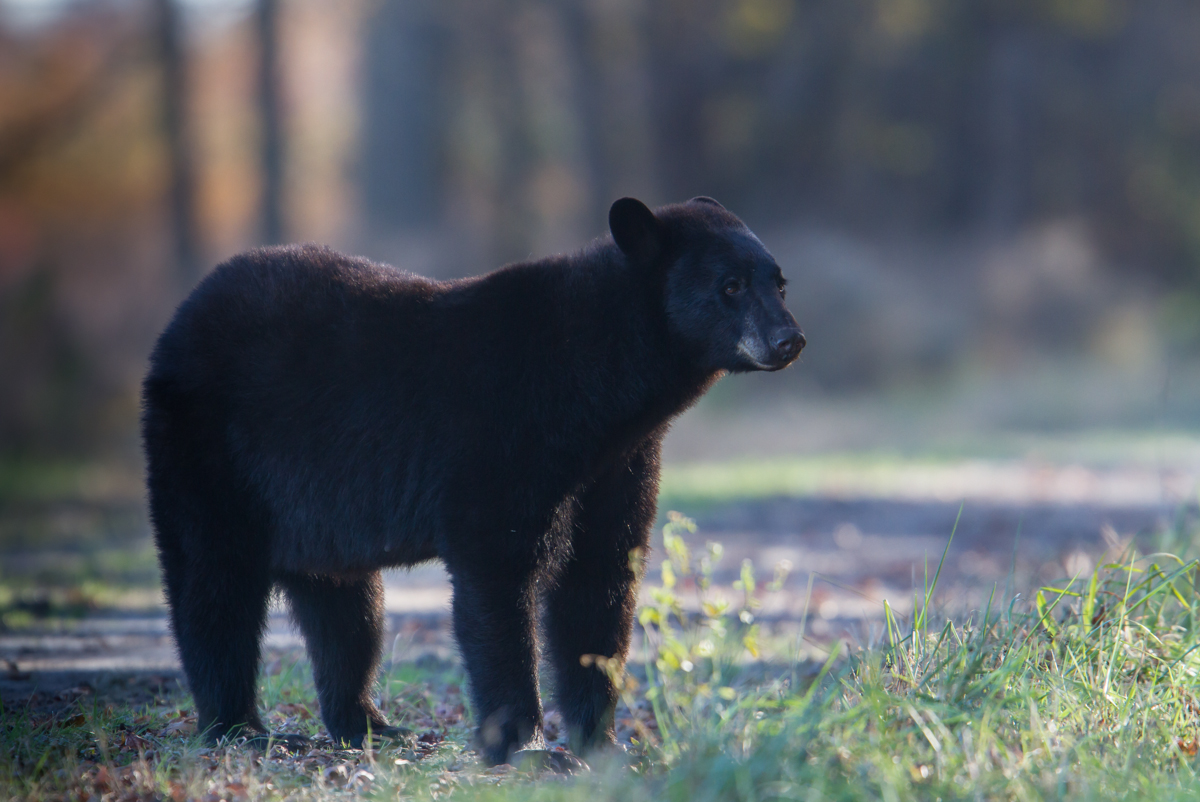
Forster’s Tern coming in for a landing (click photos to enlarge)Vines on tree trunkMantis on building before the deep freezeLarge Black Bear coming out of woodsAutumn leaves in roadside canalBald Cypress with fall color
And a short video of Tundra Swans resting on Pungo Lake…
I went camping last weekend with some friends at Pettigrew State Park and the weather decided to change dramatically during our stay. Saturday was relatively warm and overcast and we just missed the last of the rain when we arrived at the park around noon.
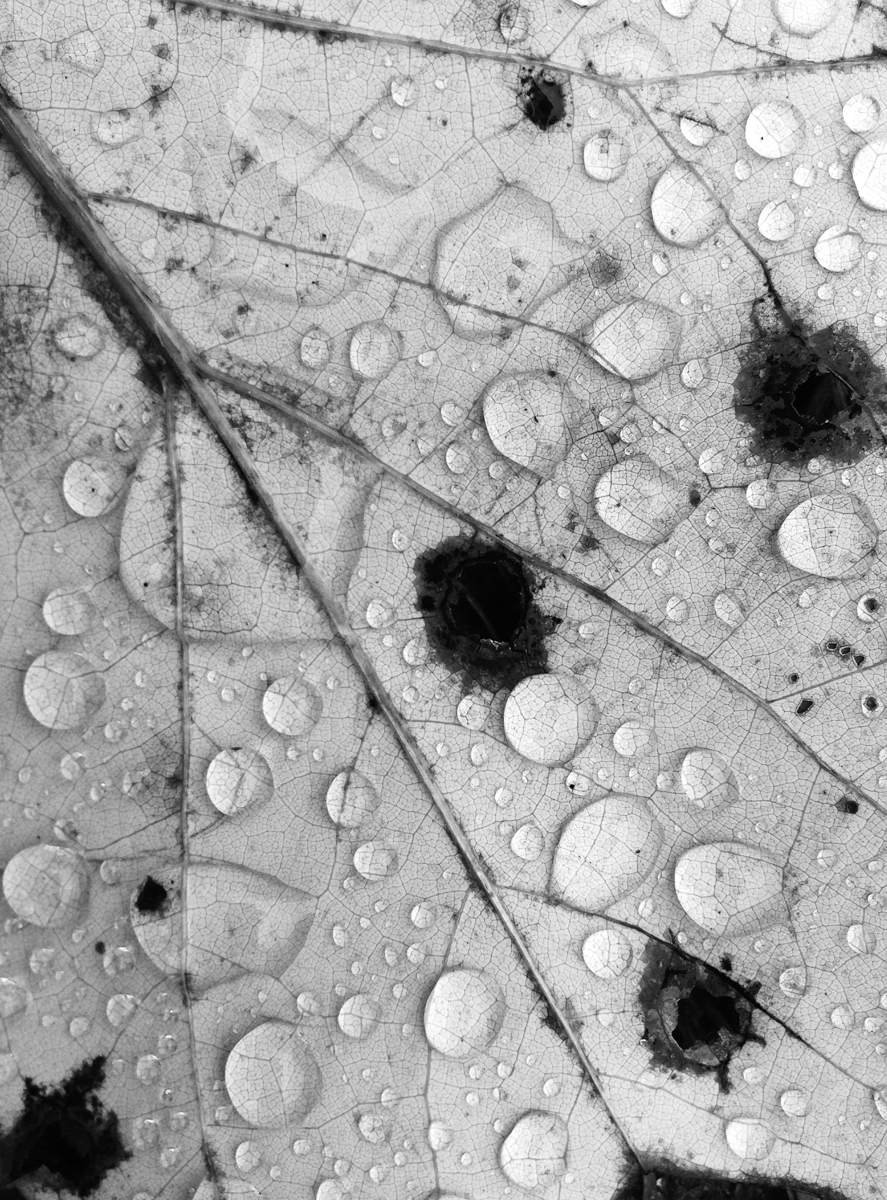
Water drops on fallen leaf (click photos to enlarge)
Everything was slightly wet as we set up camp, and there were insects and spiders moving about. That would all change by nightfall.
Gallery of gulls in winter attire – Laughing Gull, Forster’s Tern, Ring-billed Gull
After setting up tents we did a quick check of the boat ramp and found some Hooded Mergansers, Ring-necked and Ruddy Ducks out on Lake Phelps and a gallery of gulls hanging out on the railing. The rest of the afternoon was spent over at the Pungo Unit of Pocosin Lakes National Wildlife Refuge looking for anything that might be out and about. We spotted a few bears at a distance and then saw what at first looked like a sleeping bear near the refuge maintenance area.
Dead young bear
Unfortunately, it turned out to be a dead young bear and it had not been dead long.
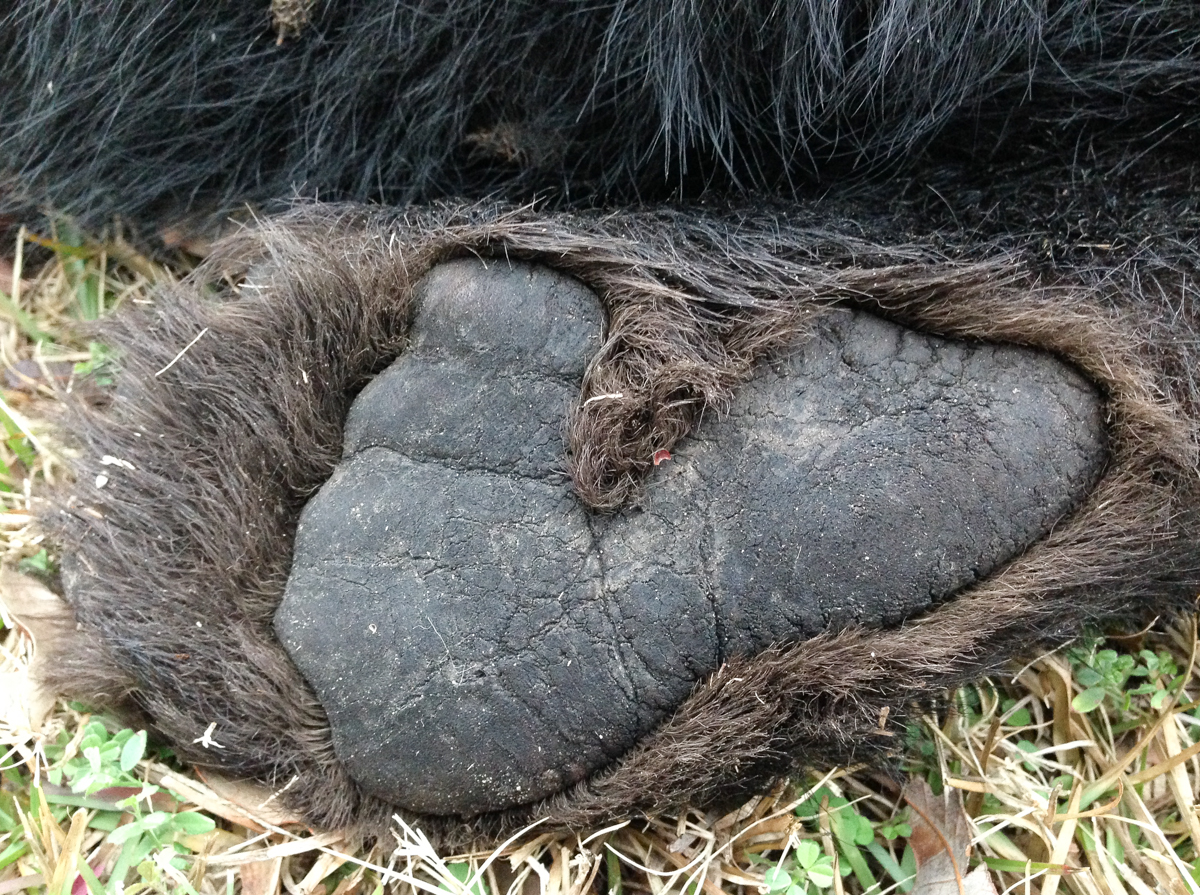
Hind foot of dead bear
While sad, it did offer a rare opportunity to closely observe a bear. It probably weighed about 75 pounds, meaning it was probably born a year ago. One foot was turned so we could examine the soft texture of the pad. We were puzzled by what might have happened, but after talking with refuge staff on my return, they thought it was probably hit by a car. Regrettably, we had seen another, much larger, roadkill bear on our way down alongside Hwy 64…a cautionary note for drivers in bear country, especially after dark, when a large black animal is very difficult to see.
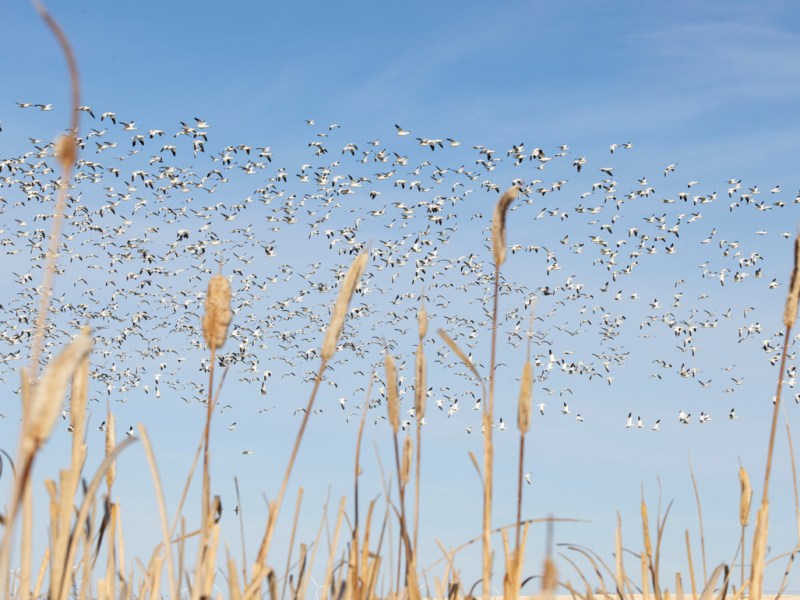
As sunset approached we headed out and were greeted by a flyover of thousands of Tundra Swans and the first Snow Geese of the season. The arrival of the strong cold front may have been the push needed by the birds to complete their migration to their wintering grounds here in North Carolina. In one of the long V-shaped formations of swans, there was one lone Snow Goose flying in line along with his much larger cousins from the far north – the first time any of us had ever seen a mixture of these two birds in formation.
During the night, the wind picked up and the temperature dropped precipitously. By daybreak it was bone-chilling cold with a stiff persistent wind out of the northwest – the perfect Pungo wildlife day.
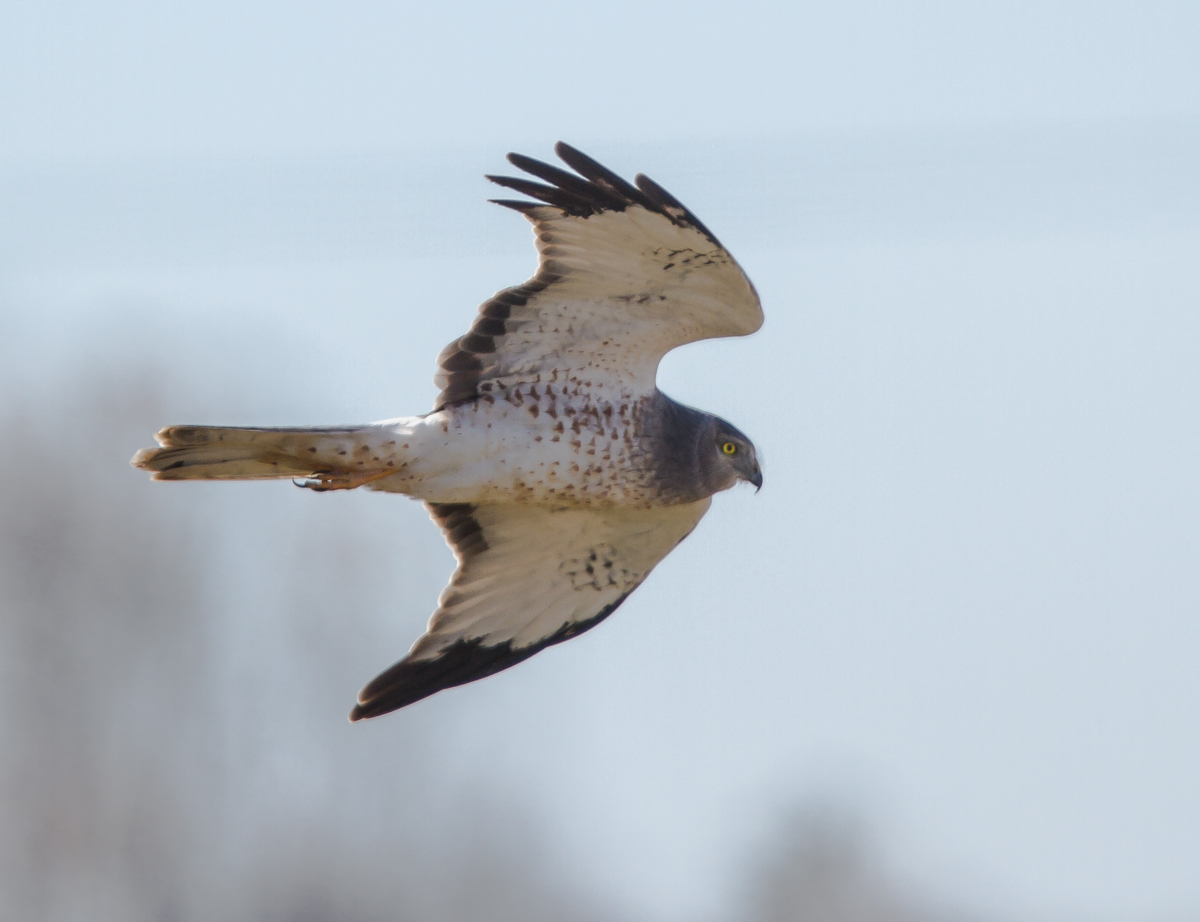
Male Northern Harrier hunting in a stiff wind
One advantage of a steady breeze is that it slows down the flight speed of many birds (at least those heading into the wind) and gives you a chance to watch and photograph them. Such was the case with a ghostly male Northern Harrier battling the stiff wind as he hunted the roadside ditches. If only another car had not come along, we might have stayed with this soaring hunter and grabbed some memorable images.
Bear tooth marks on Sweetgum
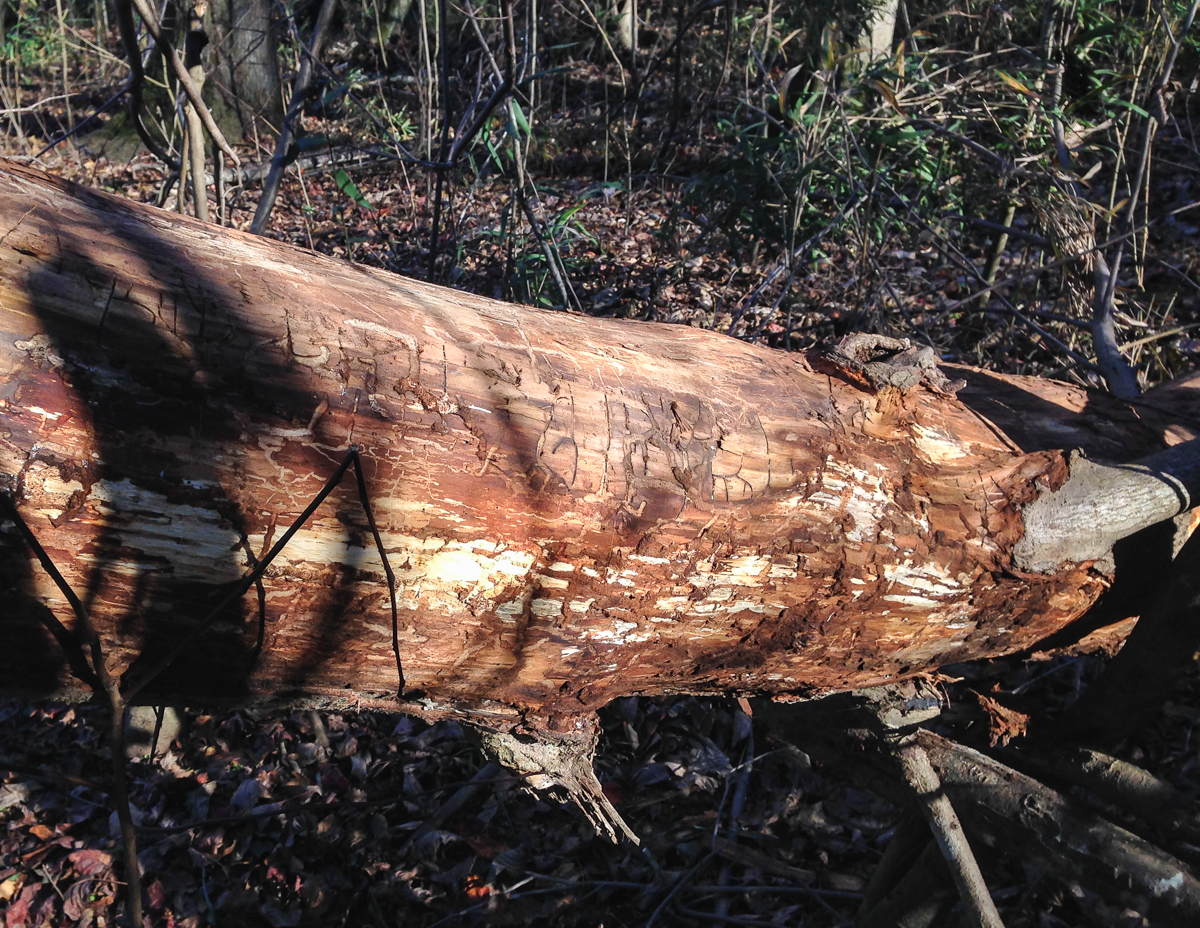
Hiking down one of the dirt roads on the refuge we began seeing lots of bear sign. Many of the trees in the area have claw marks from bears climbing them. But many of the larger Sweetgum trees have another distinctive mark – sections of bark ripped off near the base of the trunk with teeth marks left behind as the bears scrape away the sugar-rich cambium layer.
Fungus on bear scat
There was also an abundance of another bear sign – piles of scat. And much of the scat was odd-looking because of a hairy fungus growing on top. Although I have seen this before, I don’t remember seeing so many scat piles covered in the Chia Pet-type growth. A quick search on the web revealed the fungus is probably one in the genus Phycomyces. This fungus is related to bread mold and is one of the first to grow on substrates that are high in sugar. The hairs are the sporangiophores and each is tipped with a tiny sphere full of spores.
Female Black Bear on “bear road”
It wasn’t long until we encountered something with hair of a different color – a Black Bear. It was a medium-sized adult bear who came out of the woods between myself and my friends a hundred yards or so down the road. She came out cautiously, frequently glancing back in the woods. We all thought she was probably not alone, and, sure enough, a young bear soon followed. I thought they were going to cross over into the nearby corn field, but she slowly meandered my way.
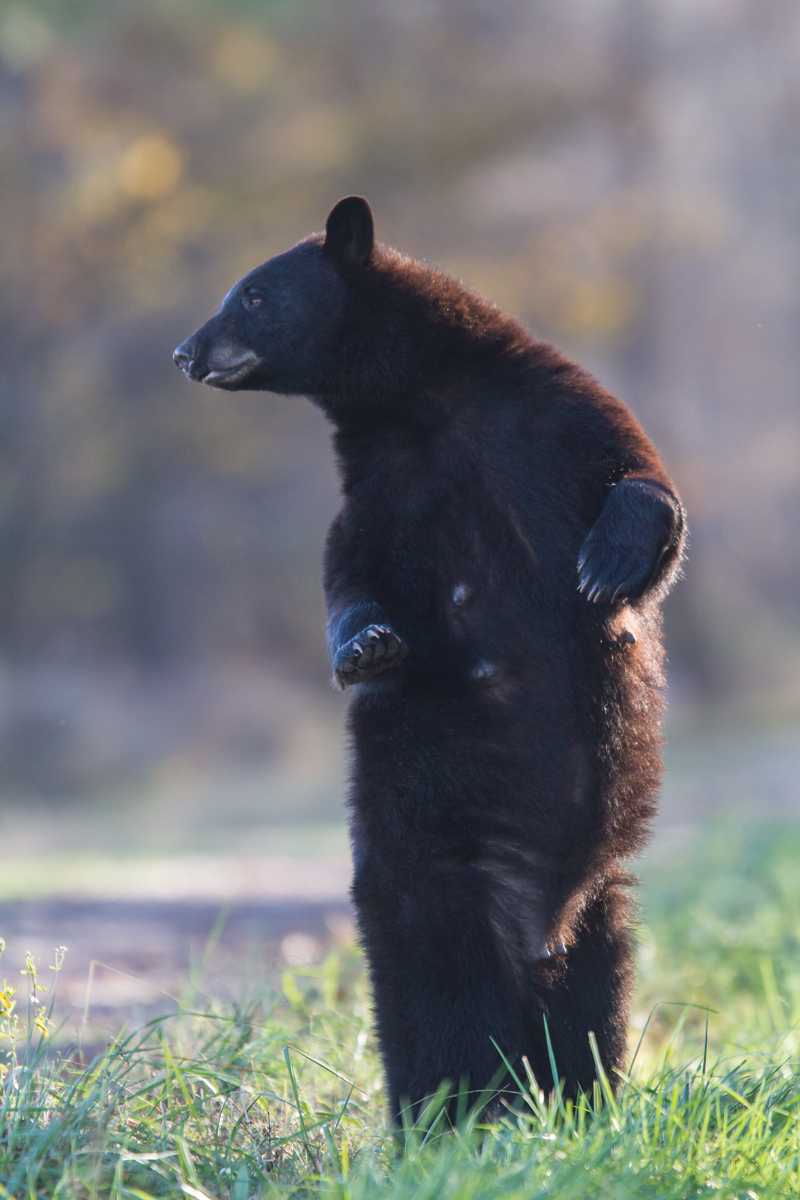
Female bear stands up to sniff and look around
The stiff wind may hamper a bear’s ability to use its keenest environmental sensor, its nose. The young bear disappeared back into the woods and the adult soon stood up to look around and probably try to ascertain if the coast was clear. She probably could sense us, but maybe could not get a direction on the scent. She soon dropped down and ambled off to join her young one.
This log had a bear on it stripping the bark
Cold, windy weather often offers good wildlife watching opportunities on the refuge as animals tend to get hungrier and more active during the day. After walking a few miles on various dirt roads, we encountered two bears off in the woods atop a leaning tree that had broken near the base. We sat and watched for about 20 minutes while the female gingerly pulled off chunks of bark and appeared to lick or bite at something underneath. After they ambled off into the thick undergrowth, we went over to check out the tree.
Beetle grubs under the bark
We quickly found what the large bear was so gently picking off the log – a variety of beetle grubs hidden under the bark. Grubs must be a bruin delicacy as evidenced by the amount of log rolling and stripping of bark that can be found on almost any downed tree in these woods.
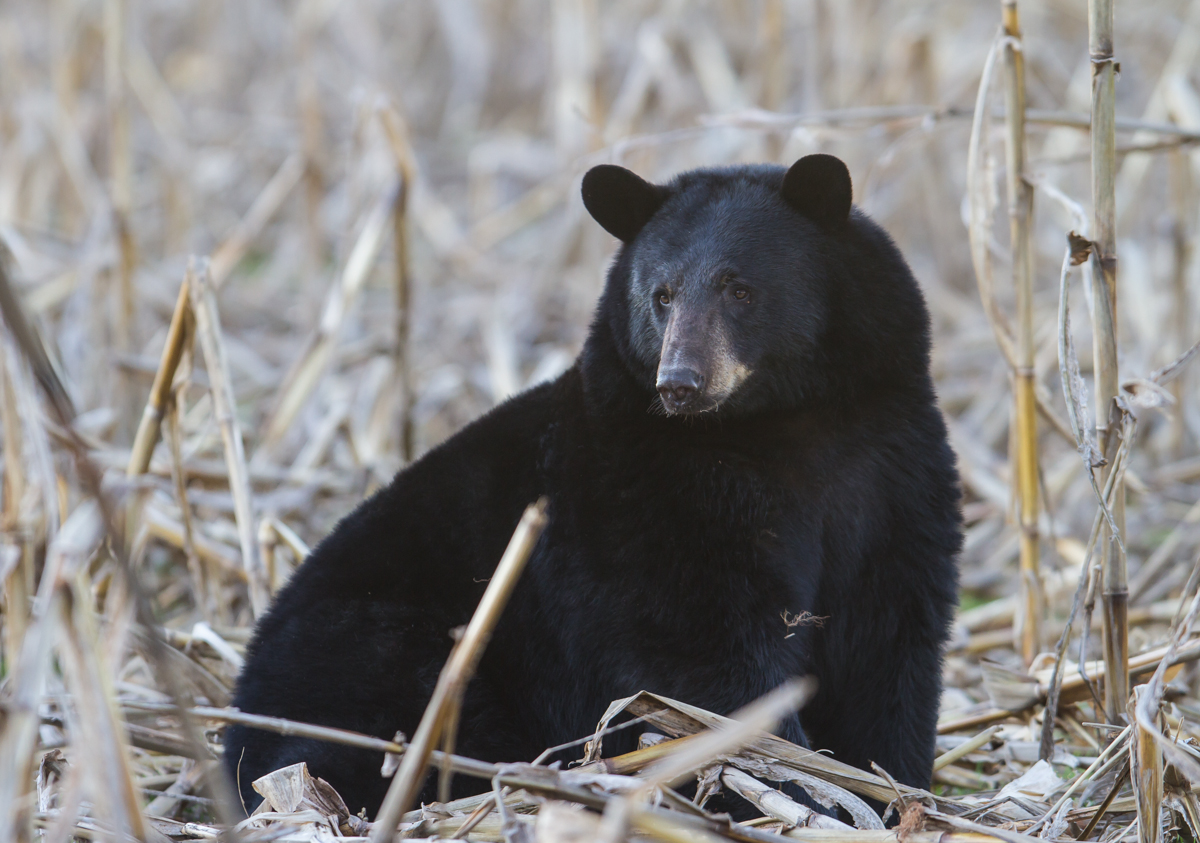
Large Black Bear feeding in corn field
After several more bear sightings we finished our beary good day with a large bear coming out of the woods and feeding in the corn field as we sat and watched nearby. It walked in and sat down, grabbing an ear of corn and feeding on it while sitting and looking around.
Bear carrying ear of corn
Occasionally, the bear would pick up an ear off the ground and carry it a ways before sitting and eating. We finally got up to leave and were greeted by another bear with two young, and then three more on the way back to the car. An amazing day in an amazing place. The final amazement came in the form of a beautiful sky with literally thousands of swans calling and filing by overhead as they made their way back to their critical resting spot on the lake. This short video gives you a sense of what it is like in this magical place.
I will be leading several trips this winter to this area both on weekends and during week days to observe wildlife and learn abut the importance of this and other refuges as critical wildlife habitat. If interested in attending one of these trips, please contact me at my roadsendnaturalist@gmail.com email address or via my Facebook page. While there are no guarantees on seeing so much wildlife, it is a place that never disappoints me.
Earlier this week I pulled a piece of wood out from under the deck and as I did, I apparently disturbed something that had been attached to the side of one of the boards. It was a cocoon of some sort, but it had a distinctive pupa that had been exposed by my actions.
Cocoon and exposed pupa (click photos to enlarge)
Before continuing the story, a note on terminology may be in order – a pupa is the life stage between a larva (in the case of butterflies and moths, a caterpillar) and the adult. A butterfly pupa is usually called a chrysalis. A moth pupa is either a pupa or a cocoon. A cocoon is the silken case a moth caterpillar spins around it before it turns into a pupa.
Typical moth pupa found in soil
Most of the moth caterpillars that bury into the ground to pupate produce an elongate brown pupal case that resembles a shiny sliver of wood in the smaller species or a cigar butt in some of the larger species.
Polyphemus Moth cocoon consisting of a leaf wrapped in silk, hanging from a twig
Many of those that pupate above ground spin a silken “coat” around themselves before pupating. This undoubtedly offers some protection from the elements, parasites and predators. Inside a cocoon is usually a pupa that looks similar to the “naked” ones.
This pupa has an unusual array of hairs and projections on the pupal case
Now, back to the cocoon and pupa I had found. This pupa had abundant hairs and other raised projections coming off the pupal case. I had my suspicions who had made it but I went inside to search the web. There isn’t as much information out there on the pupae of moths as there is for adults and larvae. But, in some old references cited in a couple of web links, I found what I was looking for – this is the cocoon of a White-marked Tussock Moth, Orgyia leucostigma. And it is the pupa of a female moth – the pupa of a male apparently looks much more like a “normal” moth pupa without all the adornments.
White-marked Tussock Moth caterpillar
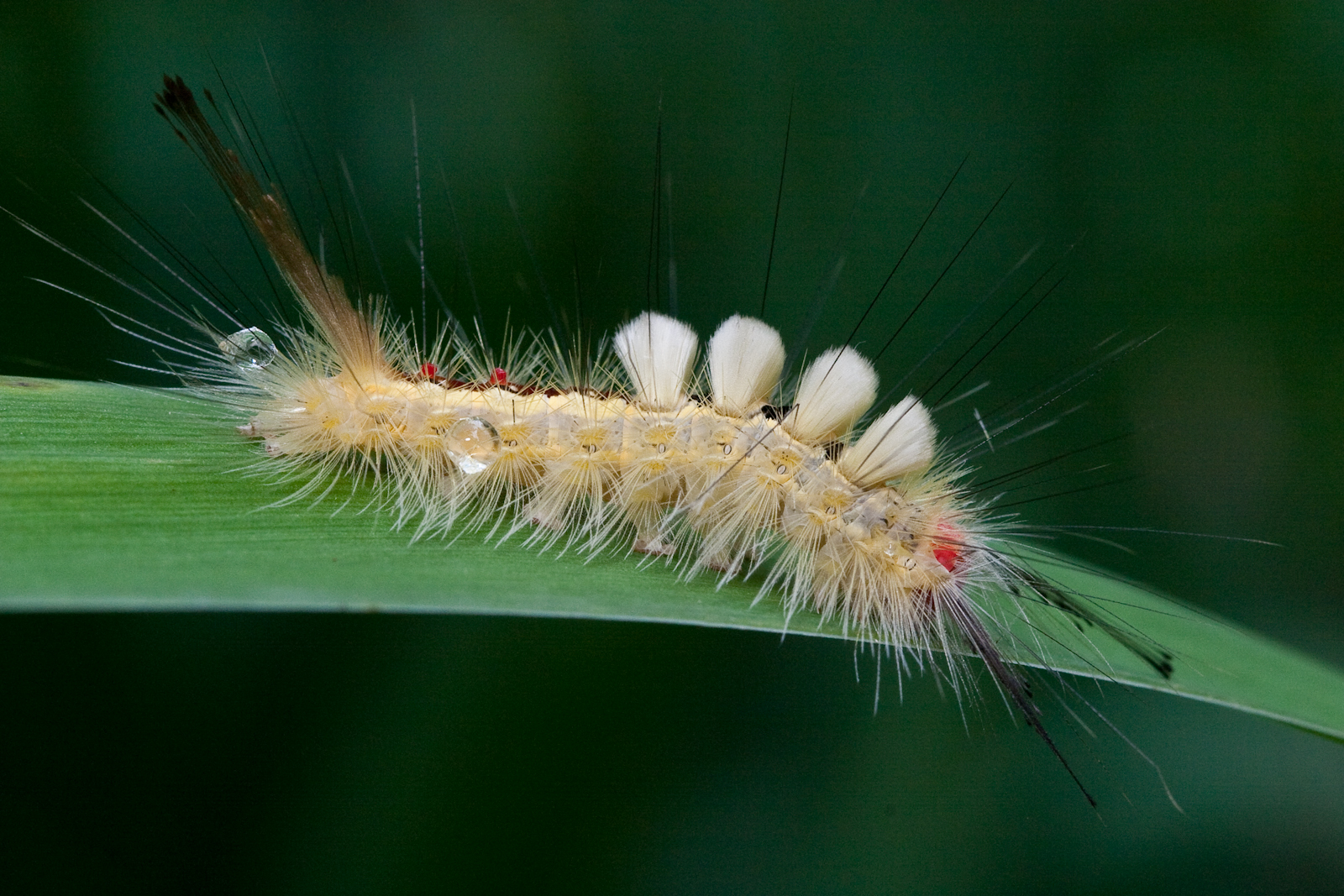
This is a very common caterpillar in these parts and I have photographed them often as they are, well, just so interesting looking. “Tussock” means “tuft,” and the name refers to conspicuous tufts of hairs on the caterpillars. Many species in this family have long lashes, or tufts of so-called pencil hairs, scattered along the body, usually concentrated on the anterior and posterior ends.
White-marked Tussock Moth caterpillar side view
This species (and a few others) also has a row of four brush-like tufts of white to tan hairs arising from the top of the caterpillar out of the first four abdominal segments. I have often referred to this larva as the toothbrush caterpillar because of these distinctive tufts. But, I don’t recommend it for dental hygiene as the setae can apparently cause skin irritations and a rash in sensitive individuals.
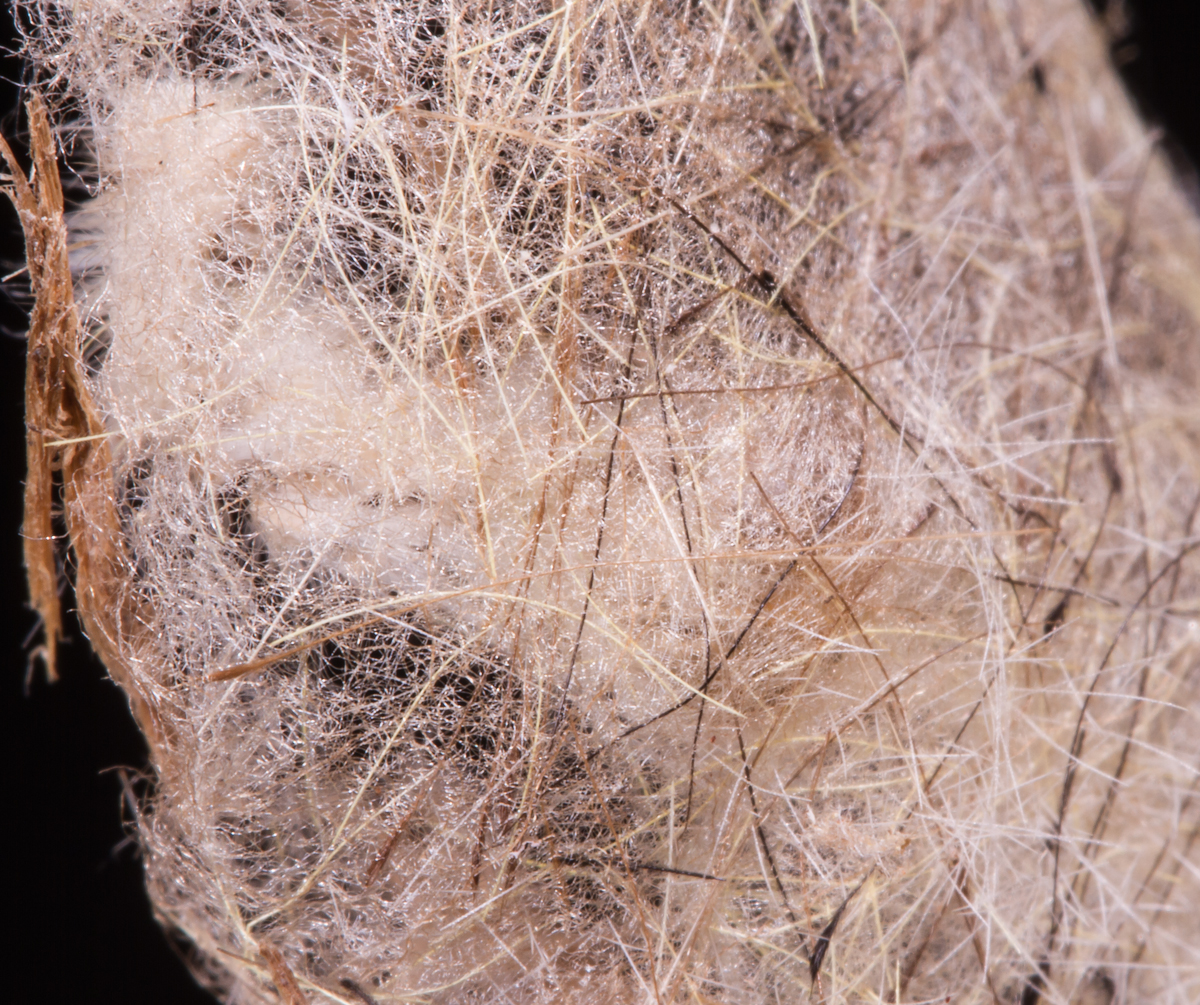
Larval “hairs” incorporated into White-marked Tussock Moth cocoon
Many of the tussock caterpillars incorporate these hairs into their cocoon, which is probably for defensive purposes. Cocoons are attached to tree bark, logs, houses, and other objects in the environment. The female moths (which I have seen once) are wingless and lay their eggs in a frothy crust on the outside of their cocoon after emerging in the fall. The eggs are the life stage that overwinter.
White-marked Tussock Moth pupa (female)
As you would expect this time of year, for this species, the pupa was empty, so the female had apparently emerged. Since there were no eggs present, she must have either been parasitized (and the parasite emerged) or predated upon before she could mate and lay eggs. One thing that struck me as curious is that the pupa seems to have only three remnants of the four dorsal tufts present in the caterpillars. Wonder why? So many things to ponder, so little time…
I have seen a bounty of hawks the past few days here in the woods. I got close to a Red-shouldered Hawk sitting out on a snag in the meadow the other day as I was carrying some firewood in the wheelbarrow. The next day, a Cooper’s Hawk blew by me on the deck as it chased a woodpecker. And while I was doing dishes the other afternoon, I looked out the window to see a Sharp-shinned Hawk land on a branch near one of my feeders, probably hoping to catch some small bird unaware. So, it was no surprise this morning to see a pair of Red-tailed Hawks out on the power line. I was sitting near the garden hoping to get some photos of birds in the morning light when the pair flew over the trees a few hundred yards away, calling their unmistakable shriek, before soaring off over the forested hillside. But they soon returned.
Red-tailed Hawk pursued by crows (click photos to enlarge)
I heard some crows calling their special mobbing call which I hear so often here and then saw shadows coming across the meadow. I glanced up and saw a Red-tailed Hawk being chased by a crow down the power line right-of-way. The hawk appeared to be carrying something in its talons and I managed a few quick shots before it disappeared into the woods. In the quick view I had, it appeared as though the hawk was carrying a squirrel due to the size of the prey, and what appeared to be a bushy tail dangling beneath. Looking at the camera confirmed the prey was, indeed, a Gray Squirrel.
Red-tailed Hawk with Gray Squirrel in its talons
As the hawk carrying the squirrel disappeared, I heard another Red-tail Hawk scream from behind and looked up to see the probable mate of the hunter flying in to perhaps join it for a meal. Online sources say that Red-tailed Hawks sometimes hunt in pairs, with one hawk chasing the squirrel around to the side of a tree where the other waits. I have seen Red-tails capture squirrels on several occasions and watched them chase and miss them as well. Several years ago I found a couple of squirrel skins on the ground in the forest over a period of a few months. The skins were turned inside-out, like when you pull off a sock by grabbing the top and pulling it down your foot. One day while walking my dog, I saw a Red-Tailed Hawk fly up off the ground and my dog went over and found such a skin. Apparently, squirrel skin is pretty tough so some hawks will remove it before tearing at the meat. Given the numbers I see in the woods around here, I imagine the hawks will have squirrel for dinner again soon.
Splitting wood often leads to more than just firewood (click photos to enlarge)
One of the joys of heating with a wood stove is cutting and splitting wood. There is something satisfying about the pile of logs ready for the fire after a couple of hours of work in the cold, crisp air. But often, I find some interesting stowaways in my firewood. Such was the case this week when I finally decided to cut down a large maple snag, all that remained standing of a huge tree that had fallen this summer. The tree had rotted near the base and was riddled with soft wood, insect galleries, and fungi. After felling the snag, I started cutting it into manageable sections with the chain saw. As I cut through one point, I saw something move in a crevice in the wood.
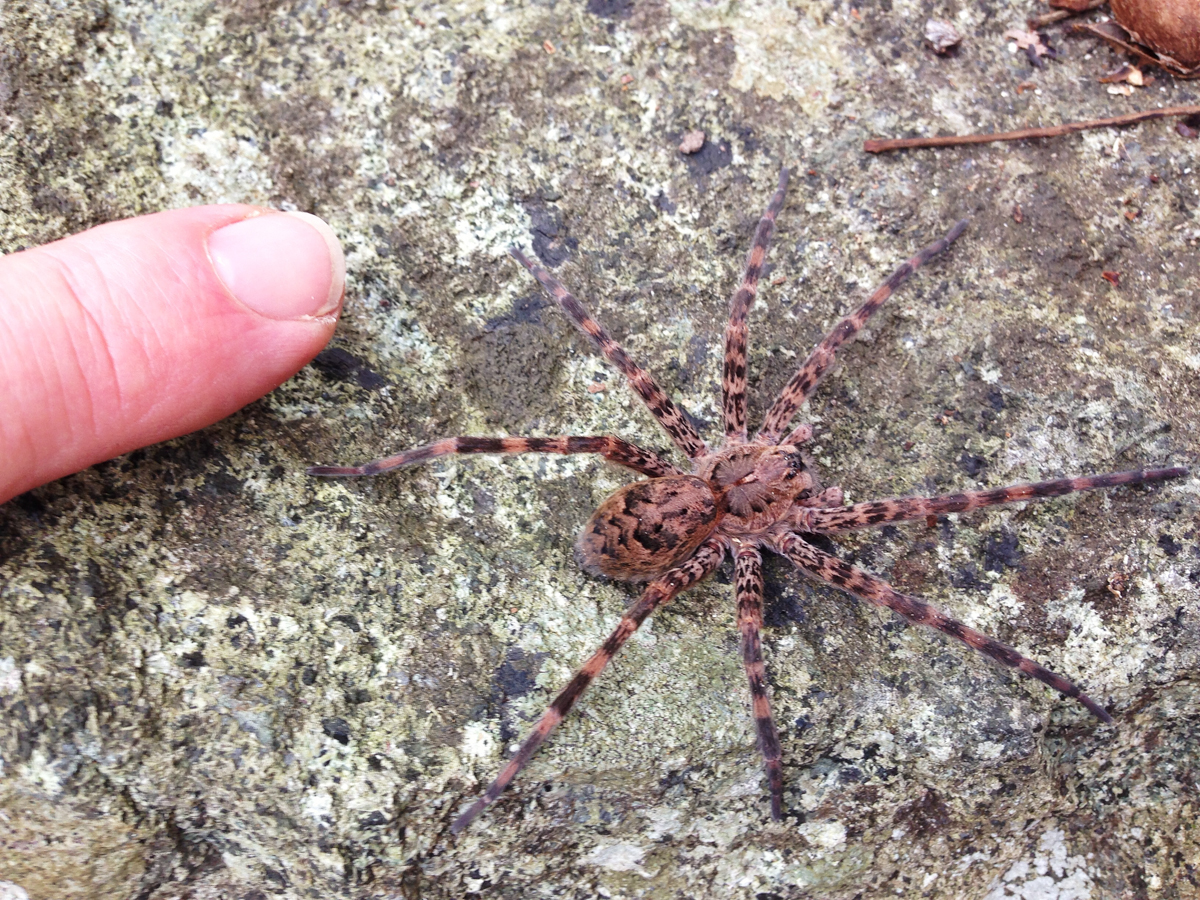
Dark Fishing Spider that emerged from log
It was a huge Dark Fishing Spider, Dolomedes tenebrosus. Way back in March, when I started this blog, I posted on a spider shed I had found – a Dolomedes shed. I have seen the living embodiments of that shed on may occasions since, usually in one of two sheds here in the woods (although I recently found one in the house and promptly captured it and let it go outside – this will probably not be shared with future house guests).
This is one large spider
This is one of the largest spiders in North America, with the larger females having a leg span of up to 3 inches (males are about half that size). This species is the one Dolomedes that is most often found far from water. It is common throughout the Carolinas, hiding by day in dark areas like tree knotholes, stumps, pump houses, and my garden sheds. It is often seen resting in the vertical plane on the sides of walls, trees, etc.
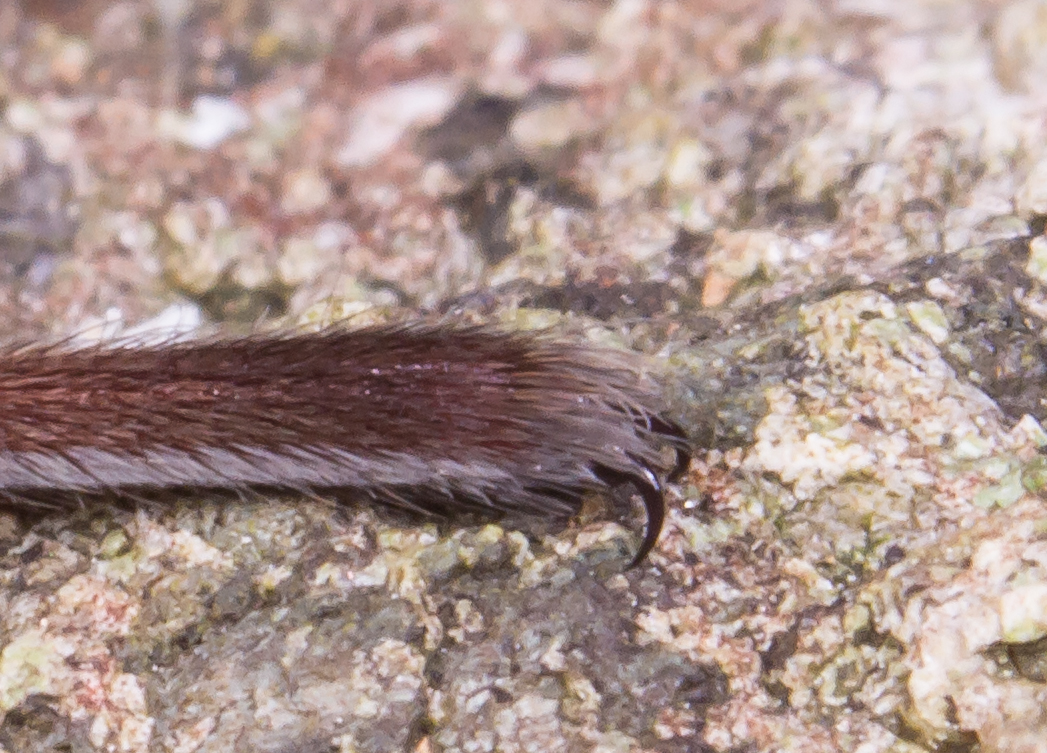
Tarsal claws on spider leg
She was fairly lethargic so I was able to get close to observe. I saw something I had never noticed before, a pair of tiny black claws. Most families of spiders have two, equal-sized claws at the tip of their legs, with some having a smaller, third claw tucked in between.
Pedipalp of female Dolomedes
I could also see the rather straight pedipalps that resemble short legs and are positioned between the jaws and the first pair of legs. The straight last segmet is characteristic of most female spiders. Males have enlarged tips on their pedipalps and the last segment is modified for sperm transfer. I refer to them as looking as if they are wearing boxing gloves.
Another large spider appears
Suddenly, I saw a movement off to my side, and there was another large spider, but only about half the size of the female Dolomedes.
Pedipalp of other spider
I looked at its pedipalps and the tips seemed somewhat irregular in shape so I thought this could be a male Dolomedes. It was much more active so after herding it around with a twig and getting a few shots, I let it ramble off in peace.
Female Dolomedes front view
I went inside to look up the spiders and confirm their identities. The vast majority of spiders have eight eyes and a key feature for identifying different families of spiders is their eye arrangement. I confirmed the large spider as a Dolomedes, (probably D. tenebrosus).
Female Dolomedes with two rows of eyes
Dolomedes spiders are in the family Pisauridae and their eyes are arranged in two slightly curved rows when seen head-on.These spiders do not build webs to catch prey but instead rely on their vision to stalk and capture anything from large insects to small vertebrates such as frogs.
Head-on view of the other spider
When I looked at my images of the other spider, the eye arrangement looked different. Looking in the guides and online (there is an excellent article on spider eye arrangement at http://bugguide.net/node/view/84423), it appeared that the eyes on this specimen were in three rows. This arrangement, with the largest of the eyes being in the middle row facing forward, and the third row being up on top, is diagnostic of the family Lycosidae, the Wolf Spiders. I had also noticed a distinct difference in the chelicerae (the paired, downward projecting “jaws”, each containing a fang) coloration between the two specimens, but I wasn’t sure whether it was a difference between the sexes or indicated different species.
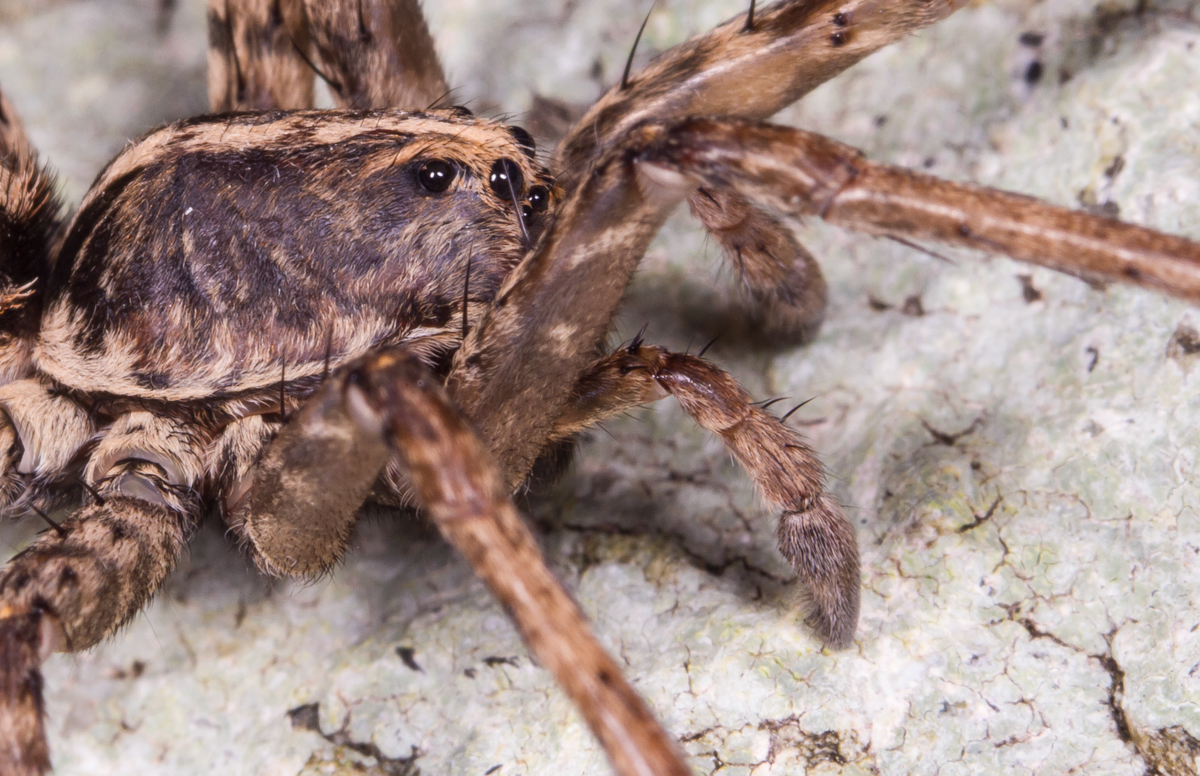
Dolomedes side viewWolf Spider side view
When both spiders are viewed from the side, you can see the difference in the eye arrangement more clearly. Based on this, plus the slight yellowish coloration of the chelicerae and the spiders’ large size, I now think the second spider was a male Carolina Wolf Spider, Hogna carolinensis. These spiders often make burrows to hide in during the day and then come out at night to stalk their prey. These, and other spiders in this family, are frequently seen at night when their eyes reflect the light from your flashlight. This is the largest member of the wolf spider family and is the official state spider of South Carolina. I did not flip it over to check the truly diagnostic feature of black coloration on the underside, but it looks like that species based on other factors, especially its size.
So, as is often the case these days, I frittered away a couple of hours photographing and learning about these two fascinating spiders. I even learned some fascinating secrets of the sex life of the Dolomedes spider, but will save that for another post. Guess that is one of the beauties of retirement, I have the time to fritter. Here’s wishing you some moments to pause and learn about your wild neighbors.
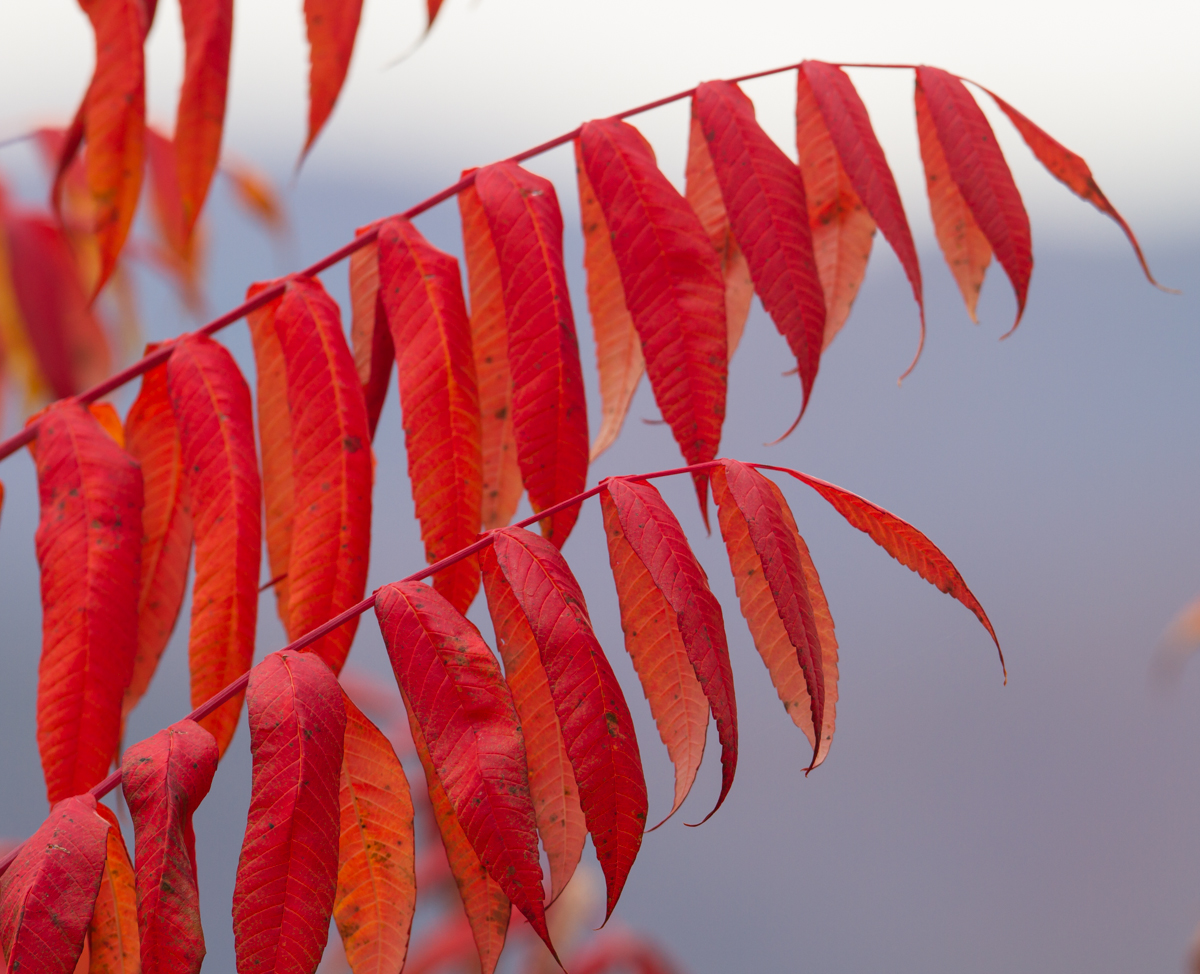
As I mentioned in my last post, I had to leave Cades Cove about noon, and was wondering if my bear mojo was failing me and I would be skunked for bears on this trip (you may recall I am a big fan of bears and enjoy observing them). But, a couple of miles outside of the valley I came across a so-called bear jam. It was attended by a ranger who was trying to keep visitors that were out of their cars from getting too close to the bear and keep those in their cars moving so as not to clog the road. He was having more success with the first objective and the lone bear was foraging up a steep slope and moving away from the road so photo opportunities were limited. Still, it was good to see one at last, so I contentedly continued on through the park. My plan was to drive through the primary road in the park which puts you out in Cherokee on the North Carolina side. Many of the trees had already lost most of their leaves, but there were still lots of spots with beautiful fall colors.
Wooded slope in Smokies
I was intrigued by the splashes of color I saw down some of the steep wooded slopes. The day was overcast and the combination of dark tree trunks with bright yellows and reds looked like an inviting photo op. I stopped at a pullout that looked promising and got out to photograph the scene. As I am looking down-slope and composing a couple of images, another car pulled in and I saw a guy point at something.
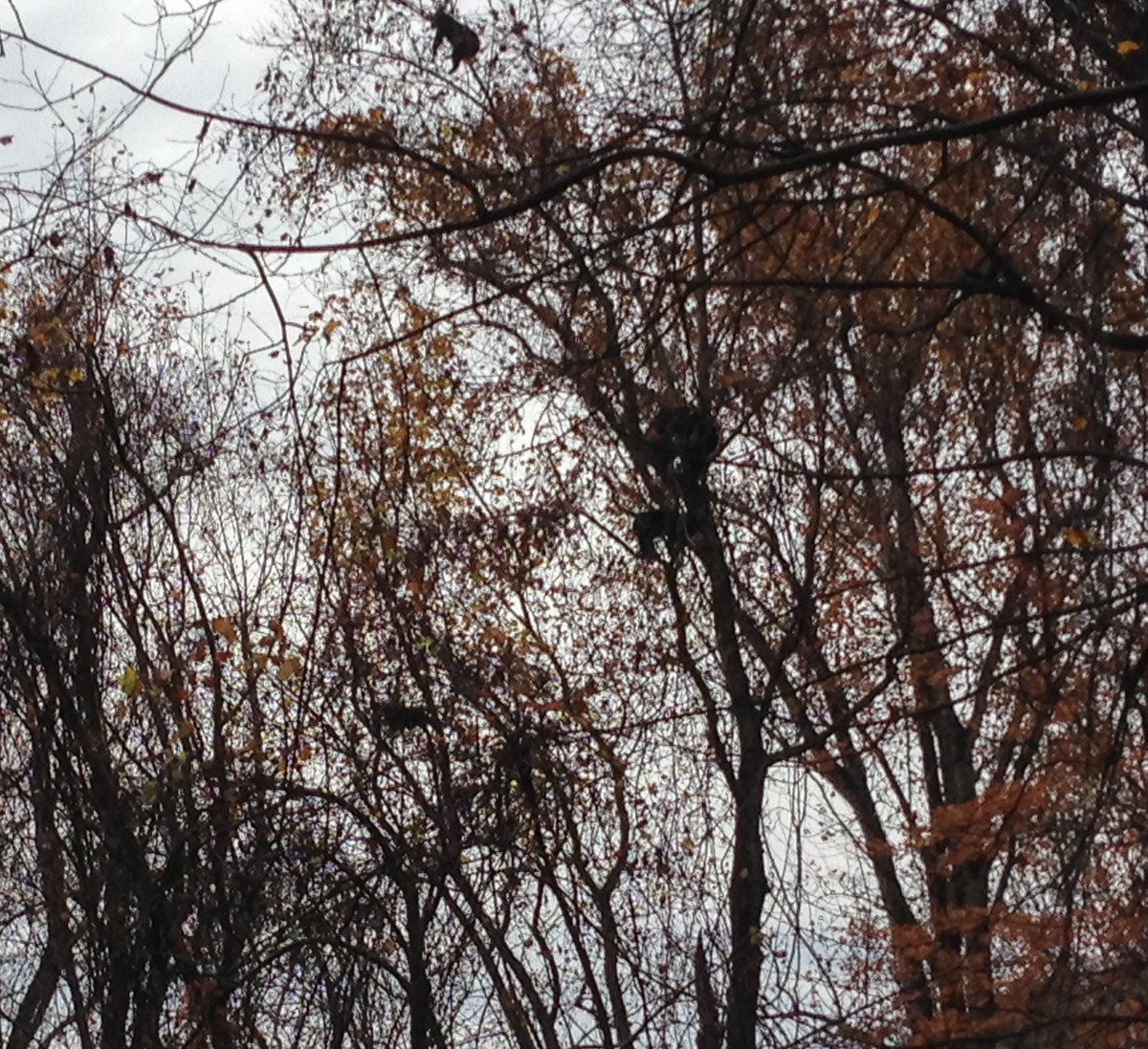
Look up and what do you see? Three blobs in a tree (the fourth bear is just out of the image to the upper right)
He asked what it was and when I looked up I was thrilled. It was a bear! Actually, there were four bears, and they were high off the ground in the tops of two trees. Surprisingly, the other car drove off leaving me alone with the bears. The mother bear was feeding on wild grapes which were abundant in the tree tops on many of the steep wooded slopes along the roadway. The three cubs were all lounging, presumably napping, as they barely moved at all in the 25+ minutes I spent with them.
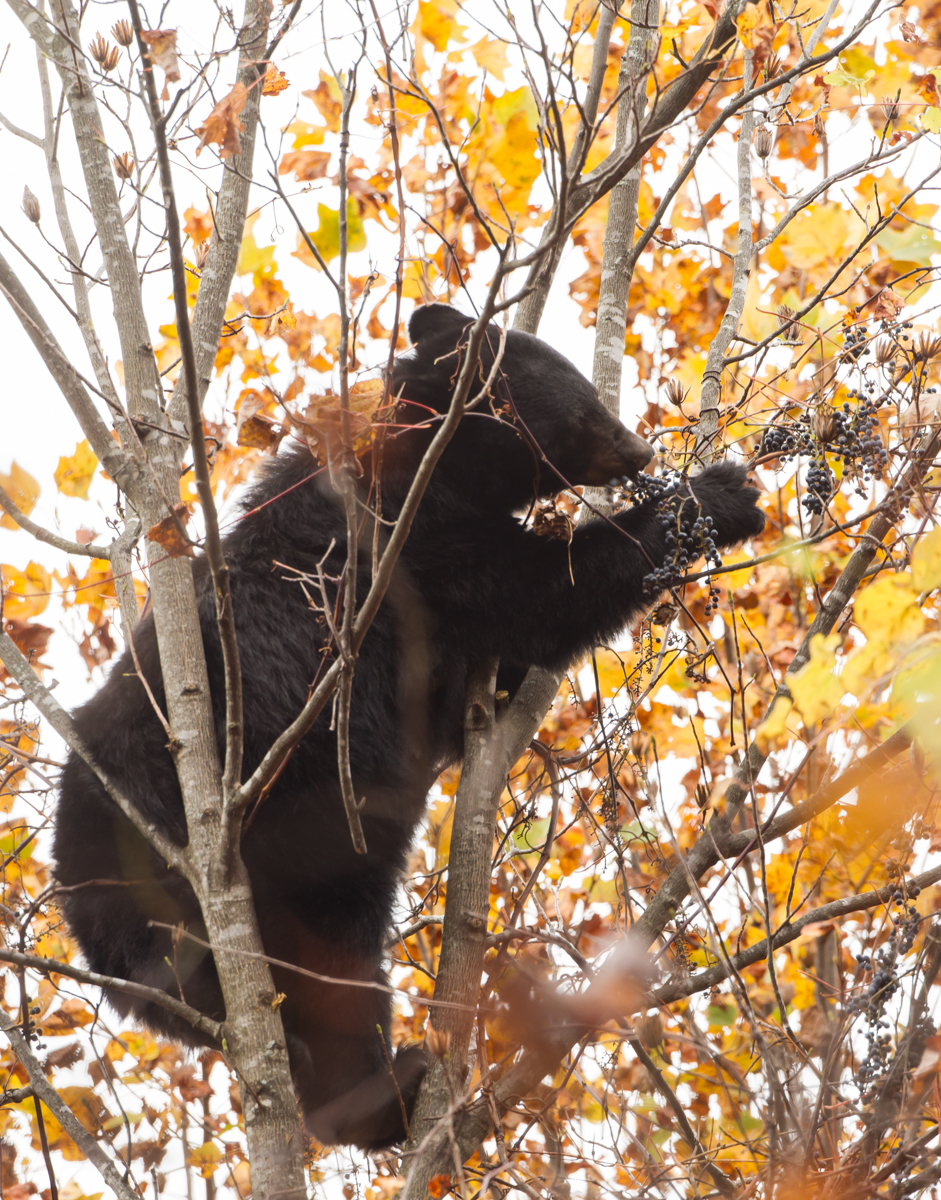
Mother bear eating wild grapes
The large female climbed higher while I watched and was probably 60-70 feet off the ground in the top of a Tulip Poplar when I set the camera up with my long kens to photograph her. Her cubs were almost as high and had balanced themselves in various ways amongst the tangle of branches and vines.
Bear cub relaxing in tree surrounded by clusters of wild grapes
When I looked through the lens, I could see why they had bothered to make the climb – the vines were loaded with clusters of grapes. Black Bears are opportunistic feeders and take advantage of the seasonally changing food availabilities. In autumn, nuts, berries and fruits of various sorts become a critical component as they feed voraciously in preparation for the winter hibernation.
I was impressed by the quantity of grapes the mother bear was able to devour. For the twenty-five minutes I watched, she was constantly feeding, pausing only occasionally to reposition herself on her precarious-looking perch and to grab and pull some more grape-bearing vines toward her. Here is a short video clip of her feeding…
The audio is from all the people that stopped once I set up the telephoto lens pointing skyward – a sure sign there must be something of interest to see.
International tourist taking a picture with his iPhone of the bear as seen on my camera’s LCD screen
If you listen carefully at the very end of the video, you can hear this gentleman thanking me for allowing him to photograph the bear as seen on the LCD screen of my camera using his iPhone. Many of the people that stopped and asked me about the bears were surprised that the bears were up in a tree feeding. It reminded me that this was the third time I have seen bears in the Smokies in trees eating grapes. I have also seen bears in other areas eating wild cherries in tree tops and know that they feed on acorns as well. Climbing to reach these foods gives bears an advantage over competing deer, foxes, and coyotes, who must wait for the fruits and nuts to drop before they can eat them.
Cars stalled in the bear jam I unfortunately helped create
The scene started to become a bit chaotic with more and more cars stopping so I packed up the gear and managed to get out before gridlock set in. I muttered my apologies to the bears for drawing attention to their feeding, but, they really didn’t seem to mind.
Mother Black Bear eyeing grapes
About twenty minutes later I came across another line of traffic, and, amazingly, there was another bear up in a tree feeding on grapes. This was a slightly smaller bear than the first one, but, as I soon found out, it was another mother bear.
Young bear grabbing a grape vine
As the gathering crowd watched, a young bear who had been sleeping at the base of the tree (but was hidden from view) started climbing the trunk toward the other bear. It climbed to a horizontal limb and began grabbing vines to pull grapes within reach. It ate a few and then walked back and forth a couple of times along the skinny limb which was about 30 feet above the ground.
The young bear looked like a high wire artist as it nimbly moved from branch to branch, and only once caused the crowd to gasp as it slipped before grabbing a limb. I noticed the adult bears both used their teeth as aids in climbing and shifting position up in the smaller branches. The young bear tended to be on larger limbs and did not show this aptitude as yet.
With increasing traffic (the line of cars coming in the opposite direction stretched about 3 miles when I left) and shortened tempers on the part of many drivers, I decided it was time to leave. As I was packing up, both bears came down the trunk and headed down slope.
So, in a little over an hour I went from no bears to seven bears, with six high up in the trees. Guess the mojo hasn’t left just yet.
Cades Cove in late afternoon light (click on photos to enlarge)
Cades Cove is a 6800 acre valley on the Tennessee side of Great Smoky Mountains National Park. It is probably the most visited area of the park and the Smokies are the most visited national park in the United States with more than 9 million visitors each year (Grand Canyon is second with about 4 million). And I can believe that Cades Cove is that popular as each of the four times I have been, it has been crowded. This past week was my first autumn visit and I was expecting fewer people, but I was wrong.
Upper end of Cades Cove
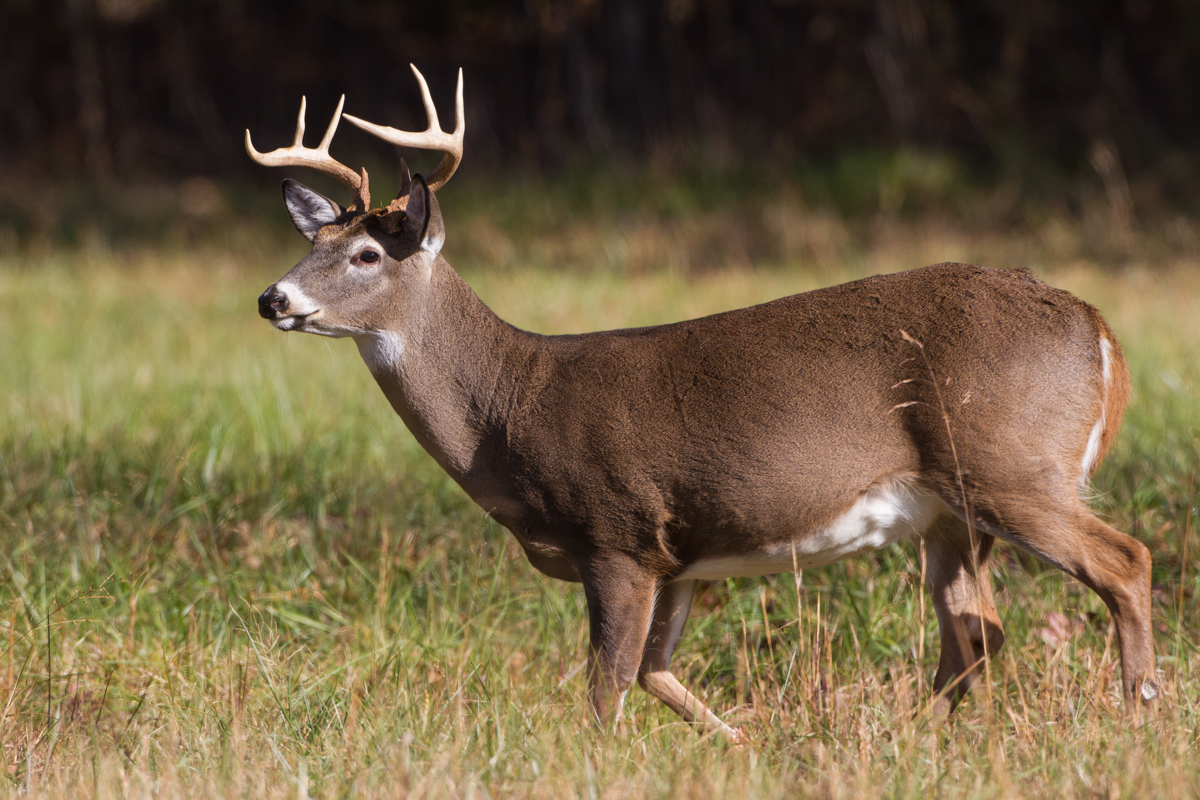
The valley is a beautiful place, especially at sunrise and sunset. There are many short trails, a visitor center, streams, and scenic views. There are also a large number of historic structures from the thriving community that lived in the valley until it became part of the national park in 1934. One reason for its popularity (and the reason for my visit) is its wildlife. Cades Cove is well known for its abundance of species such as White-tailed Deer (especially large bucks), Wild Turkey, and Black Bear. There is easy access provided to the valley via a one way 11-mile loop road. The area offers excellent habitat and relatively easy wildlife viewing with its mix of meadows, managed fields, hardwood forests, and mountain streams.
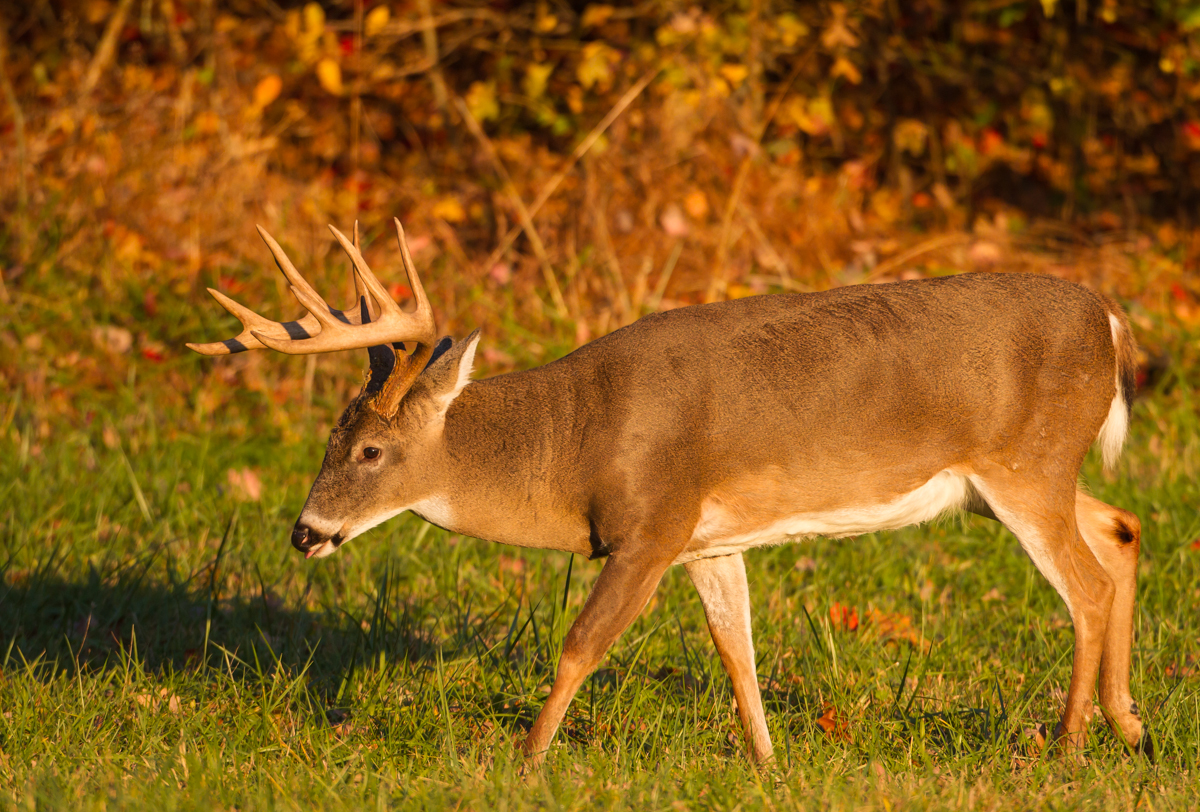
10-point buck at sunset
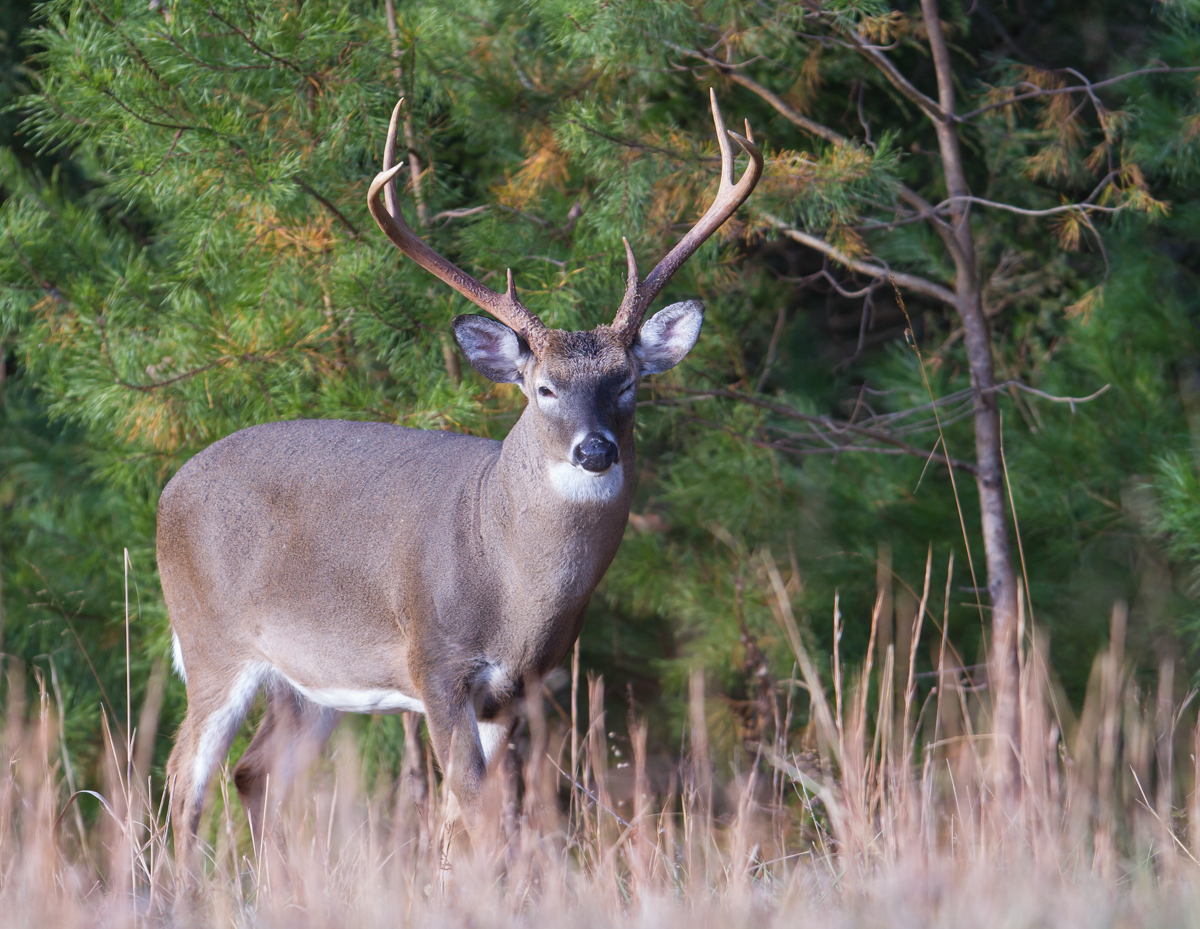
I arrived late in the afternoon last Thursday and, after hurriedly setting up my tent in the campground, headed out to see what I could find as it was approaching prime wildlife viewing time. A few hundred yards past the entrance to the loop road, I came to a field with several large bucks feeding. There were a few folks out watching so I grabbed the camera and walked out. There were five bucks – two 10-points, one 8-point, and two 6-points, an impressive start.
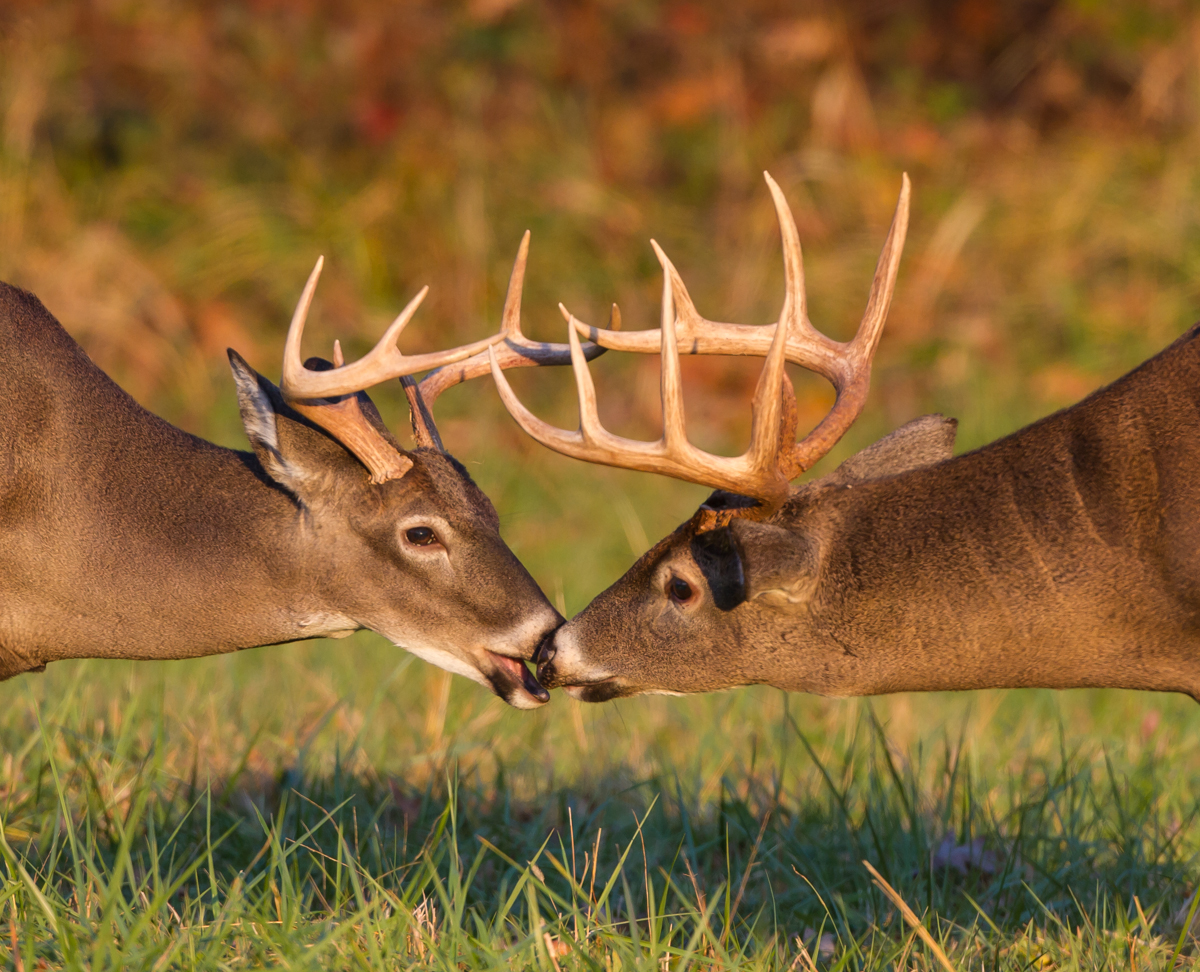
Two bucks talking it over
One thing that is great about Cades Cove is that most of the wildlife is very accustomed to people and so it is a great place to observe behaviors. While the rut is still in progress, I think some of the passions have subsided. But one large buck started thrashing a downed trees’ branches with his antlers and another soon joined him. The larger buck then started licking the antlers of the slightly smaller one, they briefly locked horns for a very passive shove, and then moved off together to feed side-by-side. Two other bucks touched antlers and then brushed noses as if whispering something about one of the other guys in the field.
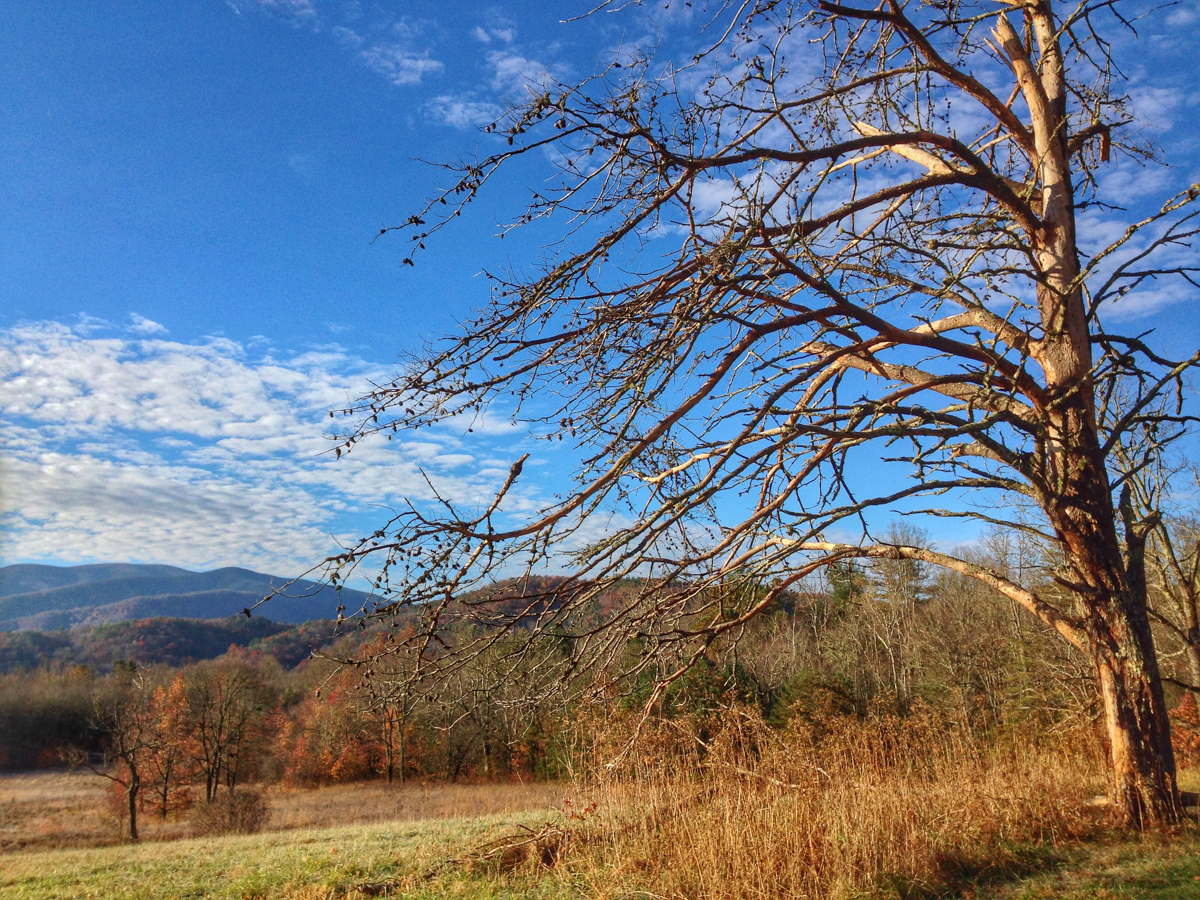
Tree silhouette at sunset
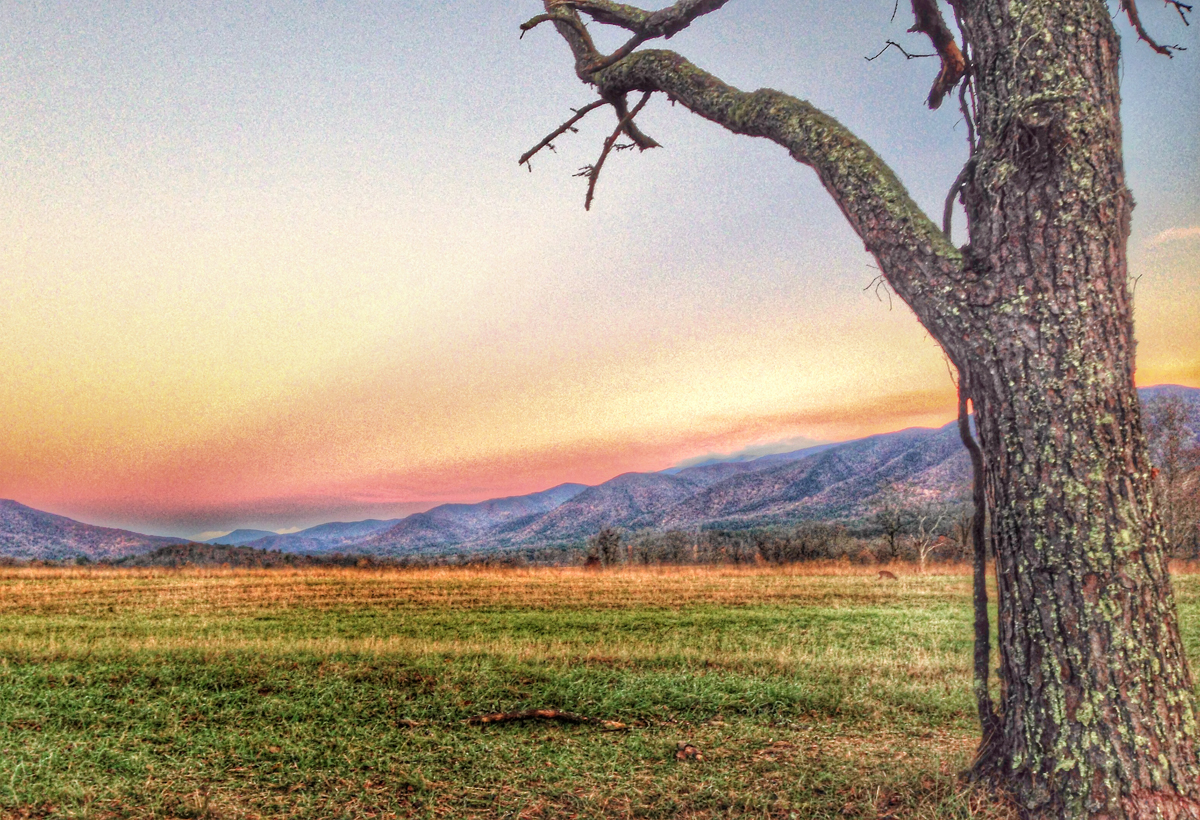
I finally drove the remainder of the loop road as the sun was setting and looked for places to check the next morning. As I photographed a particularly beautiful tree out in one of the meadows, I heard coyotes yipping a few hundred yards away under the clear, darkening sky. A great ending to my first afternoon in Cades Cove. I awoke about 4 a.m. and headed out into the cold air toward the bathroom when I heard some rustling in the leaves about 20 feet from the tent. In the moonlight, I could see a dark form and my first thought was bear (there are warnings about bear-proofing your campsite). But when I turned on my flashlight it was a Wild Boar, an introduced species that the park is actively trying to control. They grub through the soil looking for whatever they can find to eat and, in doing so, root up large amounts of plants which can damage sensitive habitats. It looks like a small bulldozer has gone through an area after they are finished feeding. The Boar trotted off and I gladly moved off in the other direction.
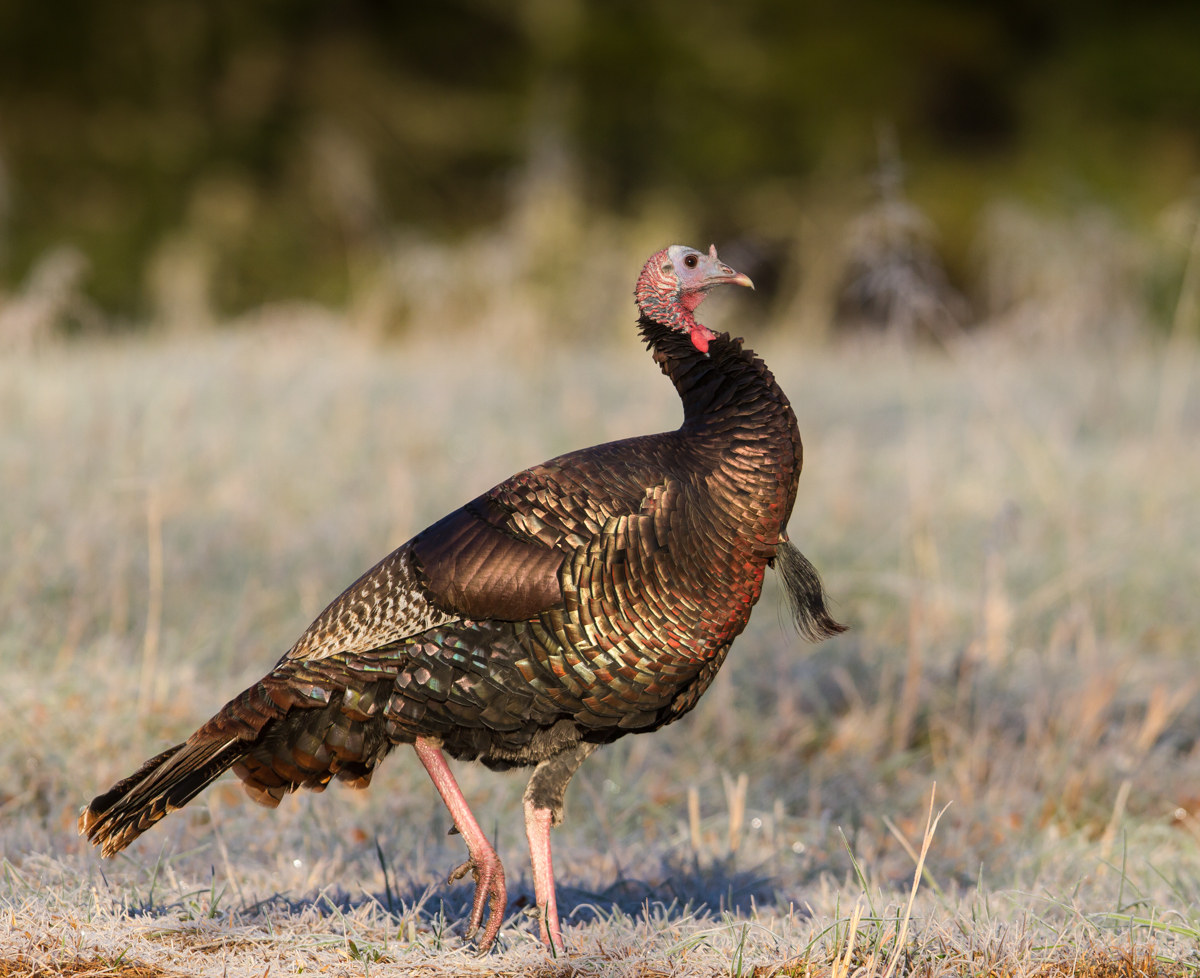
Wild Turkey at sunrise
The next morning there were twenty cars at the entrance to the loop road when the ranger opened the gate at 7 a.m. I drove past the field with all the bucks (and most of the cars) and was soon by myself in the upper end of the valley. A few turkeys flew down from their roost and landed in a nearby field so I stopped to watch. They were picking through the grass for who knows what and then walked over and grabbed a few berries from an American Holly. I had just sat down to photograph them when they started to head my way. I was soon surrounded by turkeys, scratching in the leaves under a nearby Sycamore and pecking at unseen morsels.
Wild Turkey in early morning light
As the light started to hit them, their feathers made them shimmer with bronze, green, and rich rust colors.
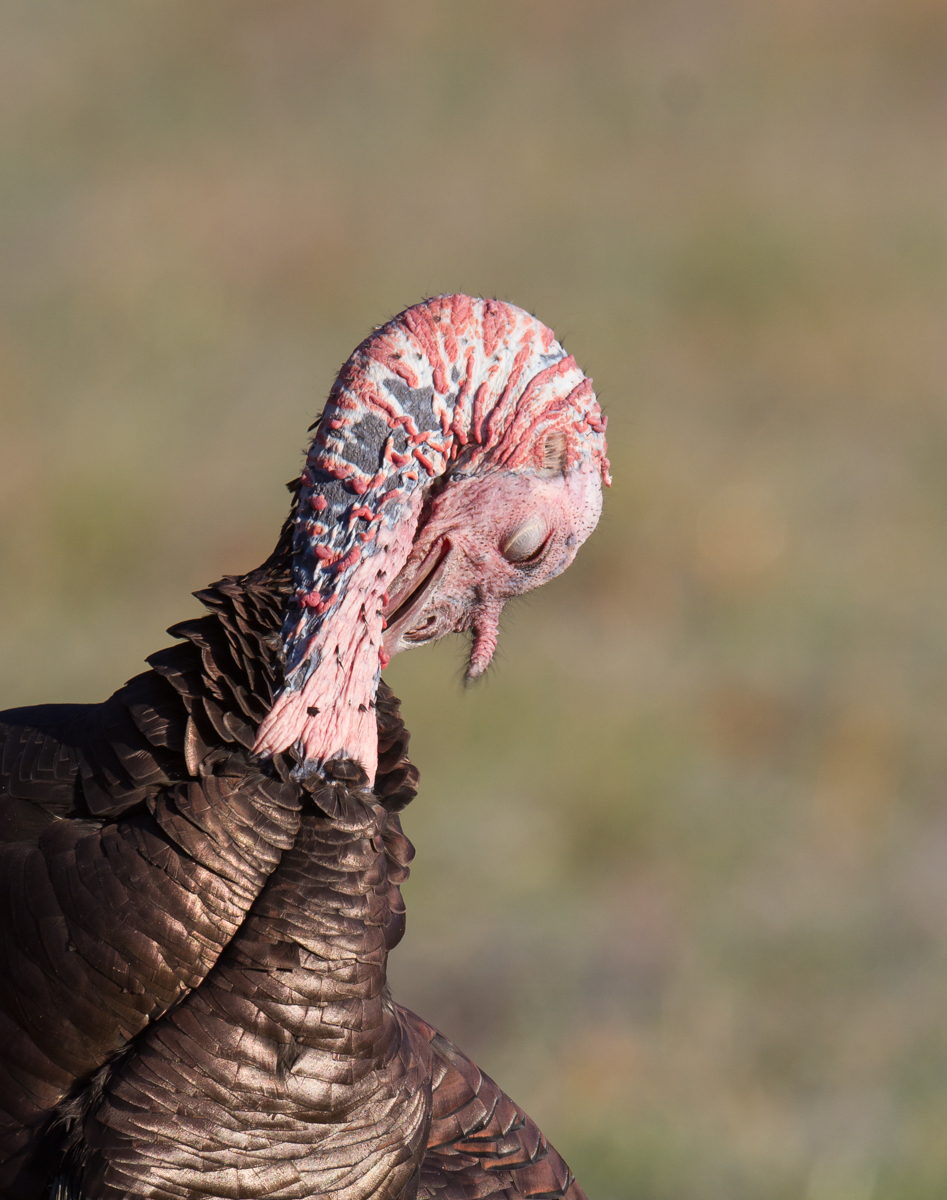
Wild Turkey head close up
As beautiful as their feathers are, their heads are a bit on the not-so-beautiful side, especially with the close looks I was getting. They continued to peck and feed, glancing my way occasionally to make sure I had not moved from my cold, sitting position in the icy grass. I sat with them for about twenty minutes until a diesel pickup truck stopped nearby and spooked them.
Deer eating Smilax berries
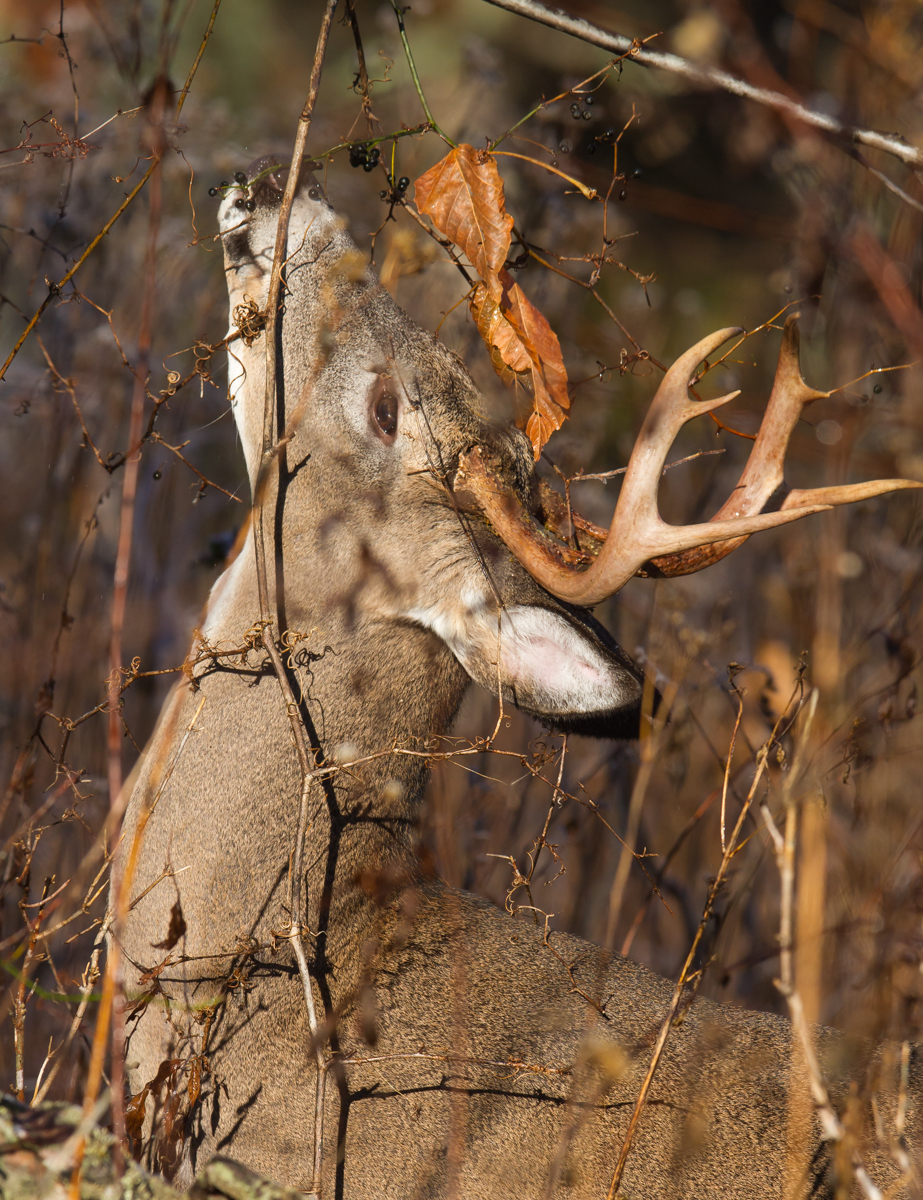
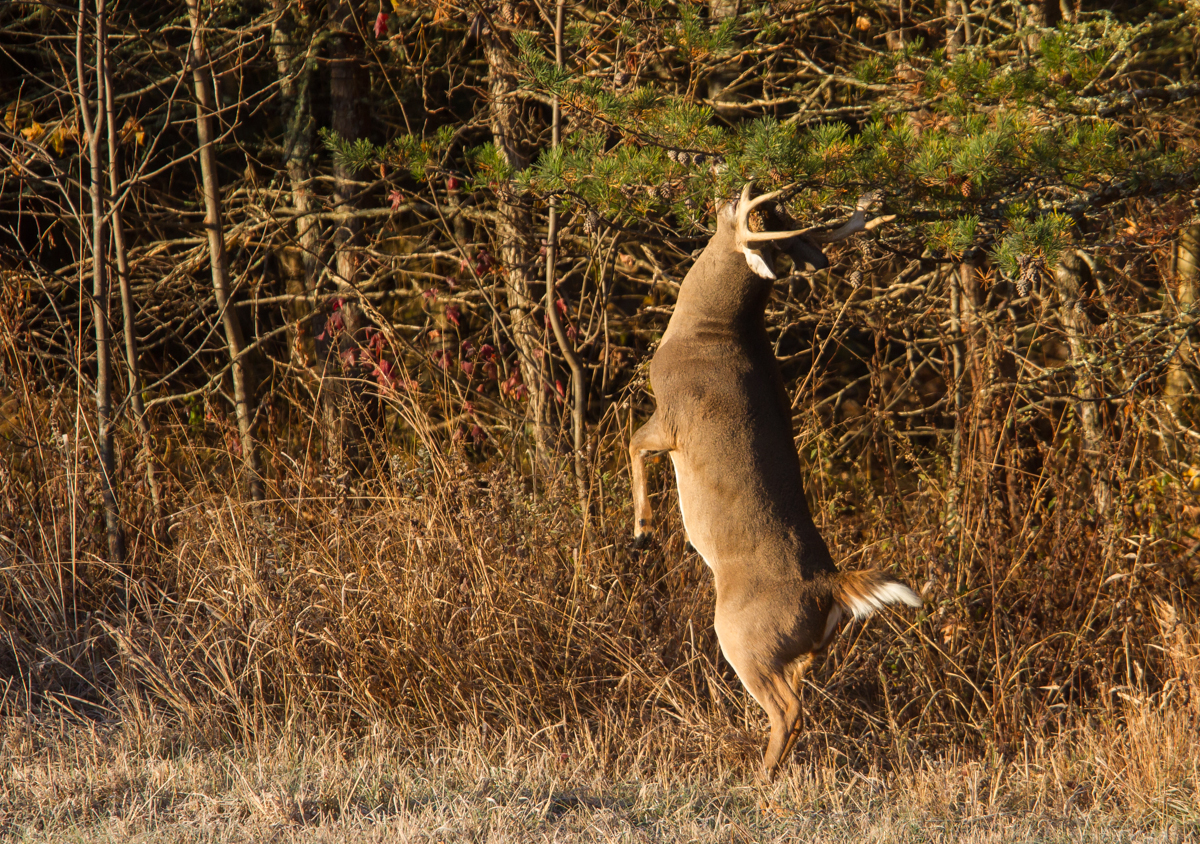
With the increasing traffic, I decided to hike up into the woods near where I had seen a large buck the afternoon before. On top of the hill, I saw movement just inside the woods. A small 6-point buck was stretching his head up and grabbing something. Only when I later looked at the image could I see he was feeding on Greenbrier berries (Smilax sp.). I have seen them eat the shoots of Smilax, but never the berries before now.
7-point buck giving me the once over
Walking down into the woods I came a cross a small herd of deer, all female. Suddenly they all jerked their heads to the left and stared into the woods at something I could not see. A very large 7-point buck then came into view, chased away the does, and started to feed. I moved one step to the side to get a better view and he spotted me and turned my way with nostrils flared and mouth agape. I interpreted that as a “I could take you but I’m going to let you live” look and I didn’t move again until he nibbled his way off into the forest. Driving back to camp later that day I was happy with the wildlife observations except for one thing – no bears. But I still had one more morning.
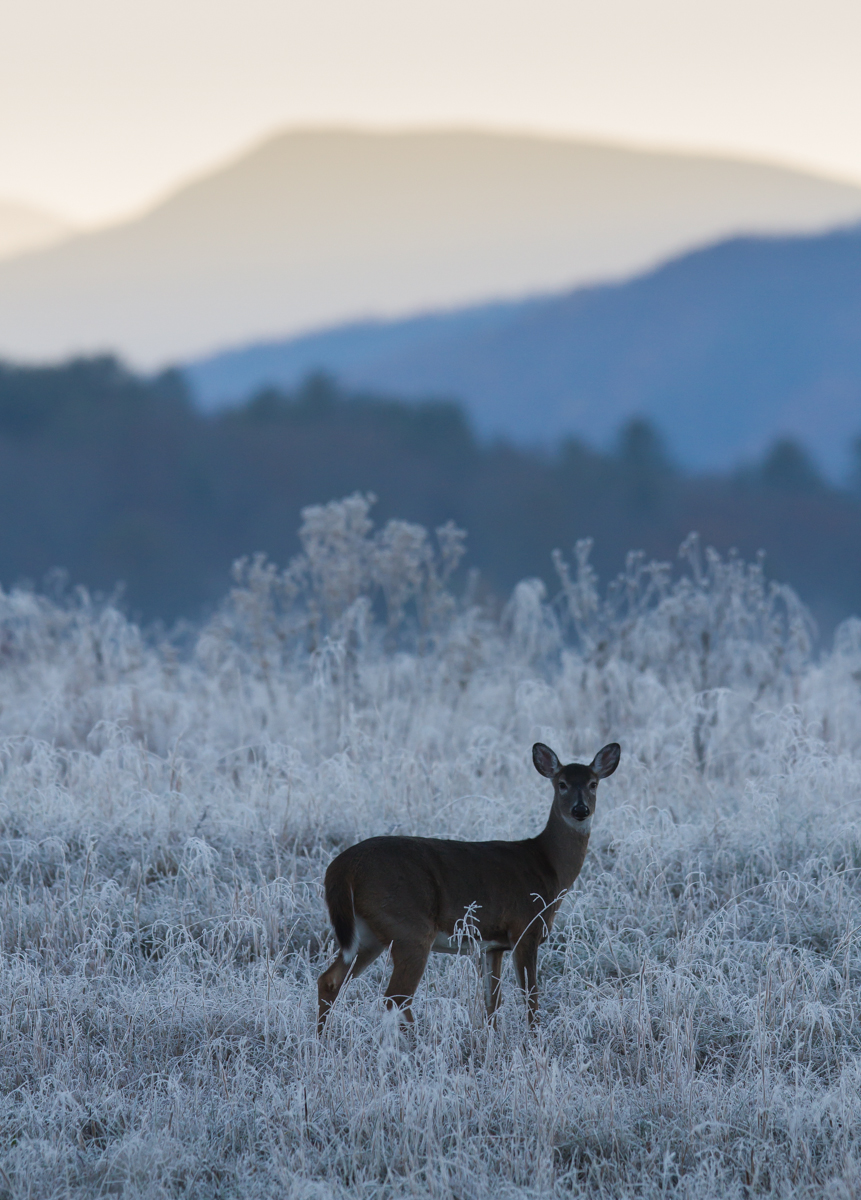
Doe before sunrise
The next morning was in the 20’s with another heavy frost. I drove out to the far end of the loop road and was, again, relatively alone as most had stopped at the first field with all the bucks. A lone doe was at the edge of the frozen meadow when I spotted something trailing her – it first appeared as just antlers in very tall grasses and saplings, but then became a large, frosty buck.
8-point buck emerging from frosty meadow
His antler spread was impressive as he stared at the disappearing doe. I stayed put and he trotted across the field, pausing once to glance at an oncoming car, before retiring into the edge of the woods.
Buck depositing scent on branch above a scrape
I hung around watching some turkey and small groups of birds (Eastern Bluebirds, American Goldfinches, American Robins, Golden-crowned Kinglets) as they swept through feeding on whatever they could find in the crisp morning air. But soon, the rising sun melted the frost and warmed the valley so I headed back over to where the buck had vanished. I saw a large buck, which I assume was the same one, although I can’t be sure as it was turned away from me. It started making a scrape, in which the buck paws at the ground, exposing moist soil. After pawing at the ground a few times he urinated in the scrape and then reached up to am overhanging branch and rubbed his head back and forth. This deposits scent on the branch from his head and from glands in the corners of their eyes. The scrape serves as a signal to all other deer of his presence and his status. I don’t know about the other deer, but I was impressed.
8-point buck after being in sparring match with two other bucks
I drove on as traffic started to increase hoping to find a bear before I had to break camp and leave. Far out in a meadow I instead spotted three bucks moving in an unusual manner. I pulled over to look and it appeared as if they were in a three-way sparring match, heads down, antlers touching, and slowly spinning in a circle testing each other. I grabbed the camera and headed out, when, of course, they broke apart and started feeding (guess all that testosterone-induced activity makes a guy hungry). They slowly drifted apart as they browsed and I managed a few photos of the largest of the bucks, a compact 8-pointer, as he kept an eye on his departing opponents.
Cades Cove from the upper end
It had been a rewarding couple of days in Cades Cove. My only frustration was the traffic congestion. It was made worse by two things: drivers ignoring the signs saying “no stopping” and “please use pullouts to observe wildlife”; and drivers going half or less of the posted 20 mph speed limit without pulling over to let others pass. I also saw a few visitors get way too close to deer (within feet). This explains the signs that read “Do Not Feed, Touch, or Disturb the Wildlife”. Touch…really, you need a sign for that?
My other disappointment was that for the first time in my four visits to this picturesque valley, I had no bear sightings. I was beginning to think I had lost my bear mojo as I drove out…but, such was not the case. But you’ll have to wait until the next post to see why.
I’ll leave you with a few more images from Cades Cove…
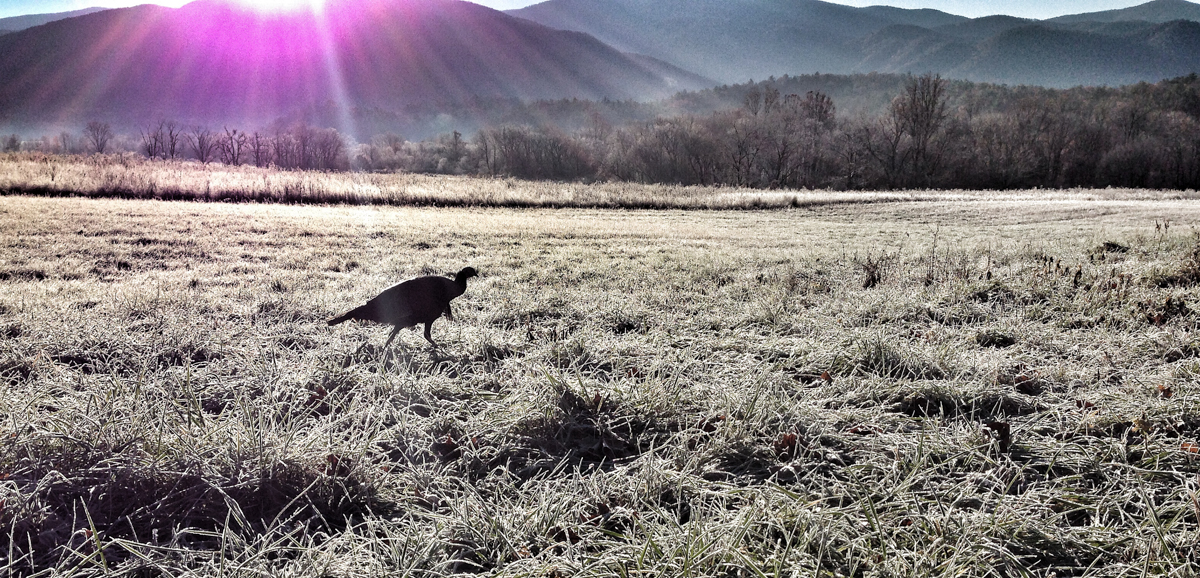
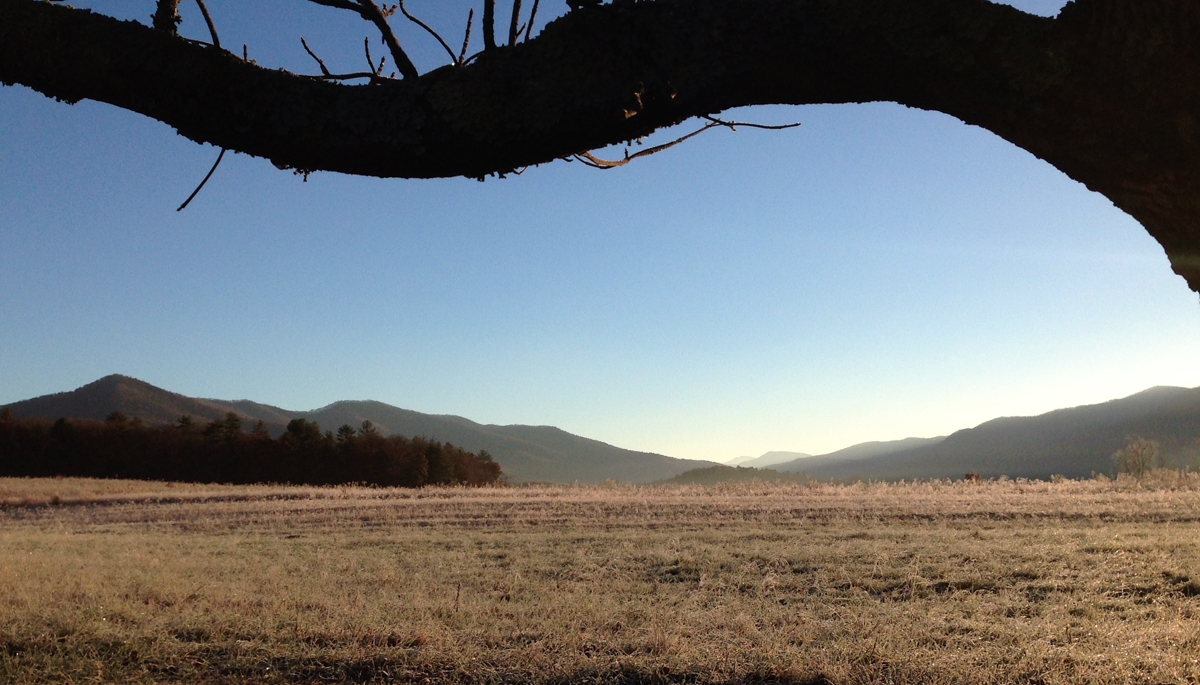
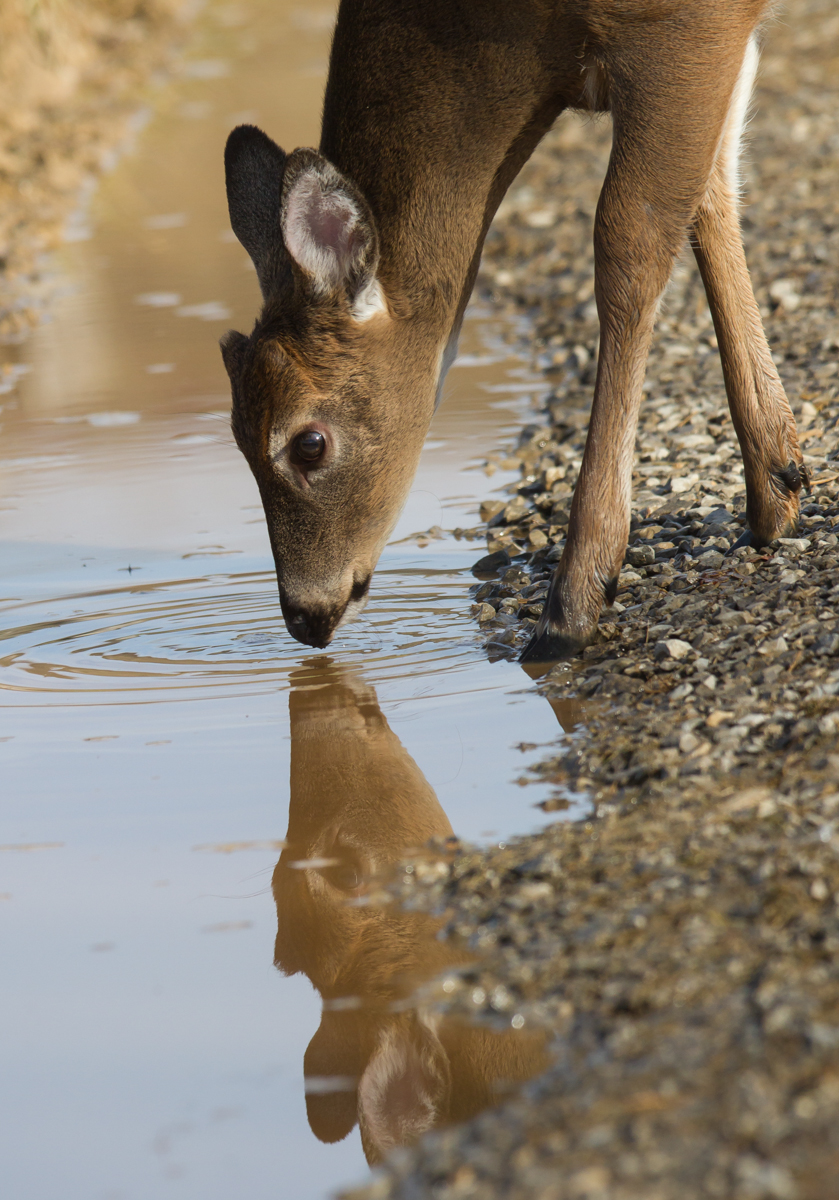
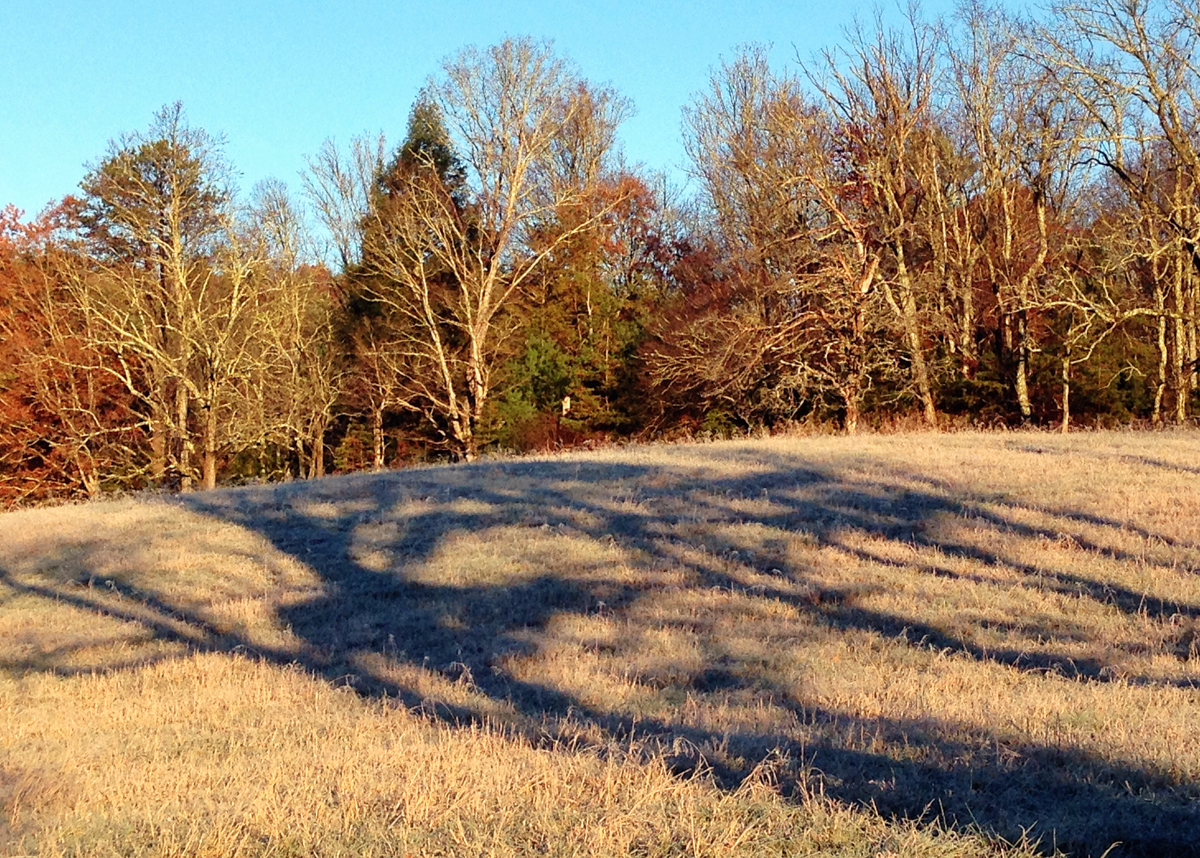
Turkey preeningYoung buck drinking from a roadside puddleTree shadow in Cades CoveHuge antler spread on a large 7-point buckiPhone image of Cades Cove at sunrise





























 Roads End Naturalist